EP1388537A1 - Arginine derivatives - Google Patents
Arginine derivatives Download PDFInfo
- Publication number
- EP1388537A1 EP1388537A1 EP02724787A EP02724787A EP1388537A1 EP 1388537 A1 EP1388537 A1 EP 1388537A1 EP 02724787 A EP02724787 A EP 02724787A EP 02724787 A EP02724787 A EP 02724787A EP 1388537 A1 EP1388537 A1 EP 1388537A1
- Authority
- EP
- European Patent Office
- Prior art keywords
- group
- naphthyl
- substituted
- alaninamide
- arginyl
- Prior art date
- Legal status (The legal status is an assumption and is not a legal conclusion. Google has not performed a legal analysis and makes no representation as to the accuracy of the status listed.)
- Withdrawn
Links
- XIJGQUQAOKJSIO-PEHGTWAWSA-N C[C@@H](CC1CNCCC1)NC(C)=O Chemical compound C[C@@H](CC1CNCCC1)NC(C)=O XIJGQUQAOKJSIO-PEHGTWAWSA-N 0.000 description 1
- XTAYFIVBLUZWAB-GOHLOCJQSA-N C[C@H](CC(C1)CC2C1CCCC2)NC(C)=O Chemical compound C[C@H](CC(C1)CC2C1CCCC2)NC(C)=O XTAYFIVBLUZWAB-GOHLOCJQSA-N 0.000 description 1
Classifications
-
- C—CHEMISTRY; METALLURGY
- C07—ORGANIC CHEMISTRY
- C07C—ACYCLIC OR CARBOCYCLIC COMPOUNDS
- C07C279/00—Derivatives of guanidine, i.e. compounds containing the group, the singly-bound nitrogen atoms not being part of nitro or nitroso groups
- C07C279/04—Derivatives of guanidine, i.e. compounds containing the group, the singly-bound nitrogen atoms not being part of nitro or nitroso groups having nitrogen atoms of guanidine groups bound to acyclic carbon atoms of a carbon skeleton
- C07C279/12—Derivatives of guanidine, i.e. compounds containing the group, the singly-bound nitrogen atoms not being part of nitro or nitroso groups having nitrogen atoms of guanidine groups bound to acyclic carbon atoms of a carbon skeleton being further substituted by nitrogen atoms not being part of nitro or nitroso groups
-
- C—CHEMISTRY; METALLURGY
- C07—ORGANIC CHEMISTRY
- C07K—PEPTIDES
- C07K5/00—Peptides containing up to four amino acids in a fully defined sequence; Derivatives thereof
- C07K5/04—Peptides containing up to four amino acids in a fully defined sequence; Derivatives thereof containing only normal peptide links
- C07K5/06—Dipeptides
- C07K5/06008—Dipeptides with the first amino acid being neutral
- C07K5/06078—Dipeptides with the first amino acid being neutral and aromatic or cycloaliphatic
-
- A—HUMAN NECESSITIES
- A61—MEDICAL OR VETERINARY SCIENCE; HYGIENE
- A61K—PREPARATIONS FOR MEDICAL, DENTAL OR TOILETRY PURPOSES
- A61K31/00—Medicinal preparations containing organic active ingredients
- A61K31/185—Acids; Anhydrides, halides or salts thereof, e.g. sulfur acids, imidic, hydrazonic or hydroximic acids
- A61K31/19—Carboxylic acids, e.g. valproic acid
- A61K31/195—Carboxylic acids, e.g. valproic acid having an amino group
- A61K31/197—Carboxylic acids, e.g. valproic acid having an amino group the amino and the carboxyl groups being attached to the same acyclic carbon chain, e.g. gamma-aminobutyric acid [GABA], beta-alanine, epsilon-aminocaproic acid or pantothenic acid
- A61K31/198—Alpha-amino acids, e.g. alanine or edetic acid [EDTA]
-
- A—HUMAN NECESSITIES
- A61—MEDICAL OR VETERINARY SCIENCE; HYGIENE
- A61K—PREPARATIONS FOR MEDICAL, DENTAL OR TOILETRY PURPOSES
- A61K31/00—Medicinal preparations containing organic active ingredients
- A61K31/33—Heterocyclic compounds
- A61K31/395—Heterocyclic compounds having nitrogen as a ring hetero atom, e.g. guanethidine or rifamycins
- A61K31/40—Heterocyclic compounds having nitrogen as a ring hetero atom, e.g. guanethidine or rifamycins having five-membered rings with one nitrogen as the only ring hetero atom, e.g. sulpiride, succinimide, tolmetin, buflomedil
- A61K31/403—Heterocyclic compounds having nitrogen as a ring hetero atom, e.g. guanethidine or rifamycins having five-membered rings with one nitrogen as the only ring hetero atom, e.g. sulpiride, succinimide, tolmetin, buflomedil condensed with carbocyclic rings, e.g. carbazole
- A61K31/404—Indoles, e.g. pindolol
- A61K31/4045—Indole-alkylamines; Amides thereof, e.g. serotonin, melatonin
-
- A—HUMAN NECESSITIES
- A61—MEDICAL OR VETERINARY SCIENCE; HYGIENE
- A61K—PREPARATIONS FOR MEDICAL, DENTAL OR TOILETRY PURPOSES
- A61K31/00—Medicinal preparations containing organic active ingredients
- A61K31/33—Heterocyclic compounds
- A61K31/395—Heterocyclic compounds having nitrogen as a ring hetero atom, e.g. guanethidine or rifamycins
- A61K31/40—Heterocyclic compounds having nitrogen as a ring hetero atom, e.g. guanethidine or rifamycins having five-membered rings with one nitrogen as the only ring hetero atom, e.g. sulpiride, succinimide, tolmetin, buflomedil
- A61K31/403—Heterocyclic compounds having nitrogen as a ring hetero atom, e.g. guanethidine or rifamycins having five-membered rings with one nitrogen as the only ring hetero atom, e.g. sulpiride, succinimide, tolmetin, buflomedil condensed with carbocyclic rings, e.g. carbazole
- A61K31/404—Indoles, e.g. pindolol
- A61K31/405—Indole-alkanecarboxylic acids; Derivatives thereof, e.g. tryptophan, indomethacin
-
- A—HUMAN NECESSITIES
- A61—MEDICAL OR VETERINARY SCIENCE; HYGIENE
- A61P—SPECIFIC THERAPEUTIC ACTIVITY OF CHEMICAL COMPOUNDS OR MEDICINAL PREPARATIONS
- A61P3/00—Drugs for disorders of the metabolism
- A61P3/04—Anorexiants; Antiobesity agents
-
- A—HUMAN NECESSITIES
- A61—MEDICAL OR VETERINARY SCIENCE; HYGIENE
- A61P—SPECIFIC THERAPEUTIC ACTIVITY OF CHEMICAL COMPOUNDS OR MEDICINAL PREPARATIONS
- A61P43/00—Drugs for specific purposes, not provided for in groups A61P1/00-A61P41/00
-
- C—CHEMISTRY; METALLURGY
- C07—ORGANIC CHEMISTRY
- C07D—HETEROCYCLIC COMPOUNDS
- C07D333/00—Heterocyclic compounds containing five-membered rings having one sulfur atom as the only ring hetero atom
- C07D333/50—Heterocyclic compounds containing five-membered rings having one sulfur atom as the only ring hetero atom condensed with carbocyclic rings or ring systems
- C07D333/52—Benzo[b]thiophenes; Hydrogenated benzo[b]thiophenes
- C07D333/54—Benzo[b]thiophenes; Hydrogenated benzo[b]thiophenes with only hydrogen atoms, hydrocarbon or substituted hydrocarbon radicals, directly attached to carbon atoms of the hetero ring
- C07D333/60—Radicals substituted by carbon atoms having three bonds to hetero atoms with at the most one bond to halogen, e.g. ester or nitrile radicals
-
- C—CHEMISTRY; METALLURGY
- C07—ORGANIC CHEMISTRY
- C07K—PEPTIDES
- C07K5/00—Peptides containing up to four amino acids in a fully defined sequence; Derivatives thereof
- C07K5/04—Peptides containing up to four amino acids in a fully defined sequence; Derivatives thereof containing only normal peptide links
- C07K5/06—Dipeptides
- C07K5/06086—Dipeptides with the first amino acid being basic
- C07K5/06095—Arg-amino acid
-
- C—CHEMISTRY; METALLURGY
- C07—ORGANIC CHEMISTRY
- C07K—PEPTIDES
- C07K5/00—Peptides containing up to four amino acids in a fully defined sequence; Derivatives thereof
- C07K5/04—Peptides containing up to four amino acids in a fully defined sequence; Derivatives thereof containing only normal peptide links
- C07K5/08—Tripeptides
- C07K5/0802—Tripeptides with the first amino acid being neutral
- C07K5/0812—Tripeptides with the first amino acid being neutral and aromatic or cycloaliphatic
-
- C—CHEMISTRY; METALLURGY
- C07—ORGANIC CHEMISTRY
- C07K—PEPTIDES
- C07K5/00—Peptides containing up to four amino acids in a fully defined sequence; Derivatives thereof
- C07K5/04—Peptides containing up to four amino acids in a fully defined sequence; Derivatives thereof containing only normal peptide links
- C07K5/08—Tripeptides
- C07K5/0821—Tripeptides with the first amino acid being heterocyclic, e.g. His, Pro, Trp
-
- A—HUMAN NECESSITIES
- A61—MEDICAL OR VETERINARY SCIENCE; HYGIENE
- A61K—PREPARATIONS FOR MEDICAL, DENTAL OR TOILETRY PURPOSES
- A61K38/00—Medicinal preparations containing peptides
Definitions
- the present invention relates to novel arginine derivatives which are ligands for MC 4 receptor.
- MC receptors melanocortin receptors
- MC 4 receptor is recognized to appear specifically in the brain, and to be widely distributed in the brain (J. Biol. Chem., 268, 15174, 1993; Mol. Endocrinol., 8, 1298, 1994).
- MC 4 receptor is also widely distributed in the limbic system (e.g., the hippocampus and amygdaloid body) and the raphe nuclei which is the origin nuclei of the serotonin nerve as well as the hypothalamus which is deeply pertinent to feeding behavior (Mol. Endocrinol., 8, 1298, 1994). It has further been recognized in the animal tests that ACTH and ⁇ -MSH act to body temperature regulation (Brain Res., 18, 473, 1987), to blood pressure (Am. J. Physiol., 257, R681, 1989), to neuroendocrine system (Life Sci., 25, 1791, 1979), to learning/memory (Neurosci. Biobehav.
- An object of the present invention is to provide peptidergic ligands which have the affinity and specificity to MC 4 receptor and are useful as medicines.
- arginine derivatives which are ligands having the affinity to MC 4 receptor, and thereby the present invention has been accomplished.
- the present invention is directed to an arginine derivative represented by the following formula [1]: [wherein Ar 1 and Ar 2 may be the same or different, and are each a phenyl group, a substituted phenyl group, a naphthyl group, a substituted naphthyl group or a heteroaromatic ring group containing one or more of nitrogen, oxygen and sulfur atoms; Y 1 is a C 1-5 alkylene group, a C 2-5 alkenylene group or a single bond; and the C 1-5 alkylene group optionally contains a carbon atom substituted with a phenyl group, a substituted phenyl group, a naphthyl group, a substituted naphthyl group or a C 1-10 acylamino group; Q is a carbonyl group or a sulfonyl group; Y 2 is a C 1-5 alkylene group; the C 1-5 alkylene group optionally contains a
- the substituted phenyl group refers to a phenyl group substituted with 1 to 3 substituents arbitrarily selected from the group consisting of a C 1-5 alkyl group, a C 1-5 alkoxy group, an aralkyloxy group, a hydroxyl group, a halogen atom, a nitro group, an amino group, a mono-C 1-5 alkylamino group, a di-C 1-5 alkylamino group, a trifluoromethyl group and a phenyl group; and examples of which are a 2-methylphenyl group, a 3-methylphenyl group, a 4-methylphenyl group, a 2-ethylphenyl group, a 3-ethylphenyl group, a 4-ethylphenyl group, a 2-propylphenyl group, a 3-propylphenyl group, a 4-propylphenyl group, a 2-cyclopentylphenyl group,
- the substituted naphthyl group refers to a naphthyl group substituted with 1 to 3 substituents arbitrarily selected from the group consisting of a C 1-5 alkyl group, a C 1-5 alkoxy group, an aralkyloxy group, a halogen atom, a nitro group, an amino group, a mono-C 1-5 alkylamino group, a di-C 1-5 alkylamino group, a trifluoromethyl group and a phenyl group; and an example of which is a 5-dimethylaminonaphthyl group.
- the heteroaromatic ring group containing one or more of nitrogen, oxygen and sulfur atoms refers to a monocyclic or dicyclic aromatic ring group which contains one or more of nitrogen, oxygen and sulfur atoms; and examples of which are a 2-pyridyl group, a 3-pyridyl group, a 4-pyridyl group, a 3-indolyl group, a 3-benzothienyl group and a 4-imidazolyl group.
- the C 1-10 acylamino group refers to an amino group substituted with an aliphatic or aromatic acyl group having 1 to 10 carbon atoms; and examples of which are a formylamino group, an acetylamino group, a propionylamino group, a butyrylamino group, an isobutyrylamino group, a valerylamino group, an isovalerylamino group, a pivaloylamino group, a cyclohexylamino group, a benzyloxycarbonylamino group and a t-butoxycarbonylamino group.
- the C 1-5 alkyl group refers to a straight, branched or cyclic alkyl group having 1 to 5 carbon atoms; and examples which are a methyl group, an ethyl group, a propyl group, an isopropyl group, a cyclopropyl group, a butyl group, an isobutyl group, a cyclobutyl group, a cyclopropylmethyl group, a pentyl group, an isopentyl group, a cyclopentyl group, a cyclobutylmethyl group and a 1-ethylpropyl group.
- the C 1-5 alkoxy group refers to a straight, branced or cyclic alkoxy group having 1 to 5 carbon atoms; and examples of which are a methoxy group, an ethoxy group, a propoxy group, an isopropoxy group, a butoxy group, an isobutoxy group, a cyclopropylmethoxy group, a pentyloxy group and an isopentyloxy group.
- the mono-C 1-5 alkylamino group or a di-C 1-5 alkylamino group refers to an amino group substituted with the above-mentioned C 1-5 alkyl group; and examples of which are a methylamino group, an ethylamino group, a propylamino group, a dimethylamino group, a diethylamino group and a dipropylamino group.
- the halogen atom refers to a fluorine atom, a chlorine atom, a bromine atom or an iodine atom.
- the pharmaceutically acceptable salt refers to a salt with a mineral acid or an organic acid; and examples of which are acetate, propionate, butyrate, formate, trifluoroacetate, maleate, tartrate, citrate, stearate, succinate, ethylsuccinate, lactobionate, gluconate, glucoheptonate, benzoate, methanesulfonate, ethanesulfonate, 2-hydroxyethanesulfonate, benzenesulfonate, p-toluenesulfonate, laurylsulfate, malate, aspartate, glutaminate, adipate, cysteine salt, N-acetylcysteine salt, hydrochloride, hydrobromide, phosphate, sulfate, hydroiodide, nicotinate, oxalate, picrate, thiocyanate, undecanoate, polyacrylate salt and carboxyvinyl poly
- Preferable compounds of the present invention are arginine derivatives of Formula [1] wherein Ar 1 and Ar 2 may be the same or different, and are each a phenyl group, a naphthyl group or a 3-benzothienyl group, Y 1 is a C 1-2 alkylene group or a C 1-2 alkylene group substituted with one acetoamino group; Q is a carbonyl group or a sulfonyl group; Y 2 is a C 1-2 alkylene group or a C 1-2 alkylene group substituted with one carbamoyl group, or a pharmaceutically acceptable salt thereof. More preferable are the following compounds a - n, or pharmaceutically acceptable salts thereof.
- the compounds of Formula [1] can be prepared by the following general preparation method (in the following reaction schemes, Ar 1 , Ar 2 , Y 1 , Y 2 and Q are as defined above;
- X is a hydroxyl group, a chlorine atom, a bromine atom or an iodine atom;
- P 1 is an ordinary amino-protective group such as a t-butoxycarbonyl group or a benzyloxycarbonyl group;
- P 2 and P 3 are each an ordinary guanidino-protective group such as a t-butoxycarbonyl group, a benzyloxycarbonyl group, a nitro group, a tosyl group or a 2,2,5,7,8-pentamethylchroman-6-sulfonyl group).
- Compound (1) can be coupled with compound (2) in the presence or absence of a base in an inert solvent to convert to compound (3).
- the base includes, for example, organic amines (e.g., triethylamine, diisopropylethylamine, pyridine and N-methylmorpholine) and inorganic bases (e.g., potassium carbonate and sodium bicarbonate).
- organic amines e.g., triethylamine, diisopropylethylamine, pyridine and N-methylmorpholine
- inorganic bases e.g., potassium carbonate and sodium bicarbonate.
- the coupling includes, for example, an amidation via an acid halide(e.g., an acid chloride and an acid bromide), an amidation via a mixed acid anhydride using ethyl chlorocarbonate, isobutyl chlorocarbonate, etc., and an amidation using a coupling agent such as 1-(3,3-dimethylaminopropyl)-3-ethylcarbodiimide, 1,3-dicyclohexylcarbodiimide, diphenylphosphoryl azide, diethyl cyanophosphate or carbonylimidazole.
- an acid halide e.g., an acid chloride and an acid bromide
- an amidation via a mixed acid anhydride using ethyl chlorocarbonate ethyl chlorocarbonate
- isobutyl chlorocarbonate etc.
- an amidation using a coupling agent such as 1-(3,3-dimethylaminopropyl)-3-ethylcar
- the inert solvent include, for example, alcohols (e.g., methanol and ethanol), ethers (e.g., diethyl ether and tetrahydrofuran), hydrocarbons (e.g., toluene and benzene), halogenated carbonaceous solvents (e.g., chloroform and dichloromethane), dimethylformamide, acetonitrile, water and a mixed solvent thereof.
- alcohols e.g., methanol and ethanol
- ethers e.g., diethyl ether and tetrahydrofuran
- hydrocarbons e.g., toluene and benzene
- halogenated carbonaceous solvents e.g., chloroform and dichloromethane
- dimethylformamide acetonitrile
- acetonitrile water and a mixed solvent thereof.
- Compound (3) can be deprotected in the presence or absence of an acid in an inert solvent to give compound (4).
- the deprotection of compound (3) can be carried out using the method described in Protective Groups in Organic Synthesis, by Theodora W. Greene and Peter G. M. Wuts.
- Compound (4) can be coupled with compound (5) in the presence or absence of a base in an inert solvent to convert to compound (6).
- acylation of the amino group can be carried out after deprotection in the presence or absence of a base in an inert solvent.
- the base includes, for example, organic amines (e.g., triethylamine, diisopropylethylamine, pyridine and N-methylmorpholine) and inorganic bases (e.g., potassium carbonate and sodium bicarbonate).
- organic amines e.g., triethylamine, diisopropylethylamine, pyridine and N-methylmorpholine
- inorganic bases e.g., potassium carbonate and sodium bicarbonate.
- the coupling includes, for example, an amidation via an acid halide(e.g., an acid chloride and an acid bromide), an amidation via a mixed acid anhydride using ethyl chlorocarbonate, isobutyl chlorocarbonate, etc., and an amidation using a coupling agent such as 1-(3,3-dimethylaminopropyl)-3-ethylcarbodiimide, 1,3-dicyclohexylcarbodiimide, diphenylphosphoryl azide, diethyl cyanophosphate or carbonylimidazole.
- an acid halide e.g., an acid chloride and an acid bromide
- an amidation via a mixed acid anhydride using ethyl chlorocarbonate ethyl chlorocarbonate
- isobutyl chlorocarbonate etc.
- an amidation using a coupling agent such as 1-(3,3-dimethylaminopropyl)-3-ethylcar
- the inert solvent include, for example, alcohols (e.g., methanol and ethanol), ethers (e.g., diethyl ether and tetrahydrofuran), hydrocarbons (e.g., toluene and benzene), halogenated carbonaceous solvents (e.g., chloroform and dichloromethane), dimethylformamide, acetonitrile, water and a mixed solvent thereof.
- the protected amino group is a protected amino group described in Protective Groups in Organic Synthesis, by Theodora W. Greene and Peter G. M. Wuts; and examples of which are a t-butoxycarbonylamino group and a benzyloxycarbonylamino group.
- the deprotection is a deprotection of an amino group carried out according to the method described in Protective Groups in Organic Synthesis, by Theodora W. Greene and Peter G. M. Wuts.
- the acylation includes, for example, an acylation via an acid halide(e.g., an acid chloride and an acid bromide), an acylation using an acid anhydride (e.g., acetic anhydride), an acylation via a mixed acid anhydride using ethyl chlorocarbonate, isobutyl chlorocarbonate, etc., and an acylation using a coupling agent (e.g., 1-(3,3-dimethylaminopropyl)-3-ethylcarbodiimide, 1,3-dicyclohexylcarbodiimide, diphenylphosphoryl azide, diethyl cyanophosphate and carbonylimidazole).
- a coupling agent e.g., 1-(3,3-d
- Deprotection of a guanidino group can be carried out in the presence or absence of an acid in an inert solvent to give compound (6) of the present invention.
- the deprotection of the guanidino group of the compound can be carried out using the method described in Protective Groups in Organic Synthesis, by Theodora W. Greene and Peter G. M. Wuts.
- the dose of the compound according to the present invention when used as a ligand for MC 4 receptor for the treatment of adult human, may range from 1 to 2000 mg per day, in a single portion or several divided portions. This dose can be suitably increased or decreased depending on application and age, body weight and conditions of the patient.
- the compounds according to the present invention can be administered orally or parenterally, and the dosage forms thereof are, for example, tablets, capsules, granules, fine-powders, powders, troches, ointments, creams, emulsions, suspensions, suppositories, injections and nasal administration preparations, all of which can be prepared by conventional preparation techniques (e.g., the method defined in Japanese Pharmacopoeia, 14th edition). These dosage forms can be suitably chosen according to conditions and age of the patient and the purpose of therapy.
- excipients e.g., crystalline cellulose, starches, lactose and mannitol
- binders e.g., hydroxypropylcellulose and polyvinyl pyrrolidone
- lubricants e.g., magnesium stearate and talc
- disintegrators e.g., carboxymethylcellulose calcium
- Boc is a t-butoxycarbonyl group
- Z is a benzyloxycarbonyl group
- Ac is an acetyl group
- MC 4 receptor binding assay was carried out according to the method described in Pharmacology & Toxicology, 79, 161-165, 1996.
- HEK-293 cell membranes expressing the human MC 4 receptor were purchased from Biolinks Co.
- the cell membranes were homogenized in a 50 mM Tris hydrochloric acid buffer solution (pH 7.4) containing 2 mM ethylenediamine tetraacetic acid, 10 mM calcium chloride and 100 ⁇ M phenylmethanesulfonylfluoride.
- the homogenate was centrifuged at 48,000 x g for 20 minutes at 4°C.
- the precipitate obtained by centrifugation was again homogenized in the same buffer solution, and the homogenate was centrifuged at 48,000 x g for 20 minutes at 4°C. This procedure was repeated twice.
- the precipitate was suspended in 50 mM Tris hydrochloric acid buffer solution (pH 7.4) containing 2 mM ethylenediamine tetraacetic acid, 10 mM calcium chloride, 100 ⁇ M phenylmethanesulfonylfluoride and 0.1 % bovine serum albumin to adjust to a protein concentration of 100 ⁇ g/ml to give a crude membrane preparation which was used for the binding assay.
- the crude membrane preparation (0.25 ml, 25 ⁇ g protein) was reacted with [ 125 I]Nle 4 -D-Phe 7 - ⁇ -MSH (final concentration; 0.2 nM) at 25°C for 120 minutes.
- the reaction solution was filtered under suction on GF/C glass filter presoaked for 2 hours in 50 mM Tris hydrochloric acid buffer solution (pH 7.4) containing 0.5 % bovine serum with the use of a cell harvester for receptor binding assay.
- the radioactivity on the filter paper was measured in a gamma-counter.
- the binding in the presence of 1 ⁇ M Nle 4 -D-Phe 7 - ⁇ -MSH was defined as non-specific binding.
- Specific binding was obtained by subtracting the non-specific binding from the total binding, which was the binding in the absence of 1 ⁇ M Nle 4 -D-Phe 7 - ⁇ -MSH.
- Test compound was dissolved in 100 % DMSO, and added simultaneously with [ 125 I]Nle 4 -D-Phe 7 - ⁇ -MSH to the membrane preparation.
- the IC 50 value was calculated from the inhibition curve in the concentration of 10 -9 - 10 -5 .
- the IC 50 value of compound 224 was 690 nM.
- the compounds represented by Formula [1] or pharmaceutically acceptable salts thereof are useful as peptidergic ligands which have the affinity and specificity to MC 4 receptor and are useful as medicines.
Landscapes
- Chemical & Material Sciences (AREA)
- Health & Medical Sciences (AREA)
- Organic Chemistry (AREA)
- Medicinal Chemistry (AREA)
- Life Sciences & Earth Sciences (AREA)
- General Health & Medical Sciences (AREA)
- Animal Behavior & Ethology (AREA)
- Pharmacology & Pharmacy (AREA)
- Molecular Biology (AREA)
- Proteomics, Peptides & Aminoacids (AREA)
- Biophysics (AREA)
- Genetics & Genomics (AREA)
- Veterinary Medicine (AREA)
- Public Health (AREA)
- Biochemistry (AREA)
- Epidemiology (AREA)
- Engineering & Computer Science (AREA)
- Chemical Kinetics & Catalysis (AREA)
- General Chemical & Material Sciences (AREA)
- Nuclear Medicine, Radiotherapy & Molecular Imaging (AREA)
- Bioinformatics & Cheminformatics (AREA)
- Obesity (AREA)
- Hematology (AREA)
- Diabetes (AREA)
- Child & Adolescent Psychology (AREA)
- Medicines That Contain Protein Lipid Enzymes And Other Medicines (AREA)
- Peptides Or Proteins (AREA)
- Pharmaceuticals Containing Other Organic And Inorganic Compounds (AREA)
Abstract
An arginine derivative represented by the formula: <CHEM> Äwherein Ar<1> and Ar<2> may be the same or different, and are each a phenyl group, a substituted phenyl group, a naphthyl group, a substituted naphthyl group or a heteroaromatic ring group containing one or more of nitrogen, oxygen and sulfur atoms; Y<1> is a C1-5 alkylene group, a C2-5 alkenylene group or a single bond; and the C1-5 alkylene group optionally contains a carbon atom substituted with a phenyl group, a substituted phenyl group, a naphthyl group, a substituted naphthyl group or a C1-10 acylamino group; Q is a carbonyl group or a sulfonyl group; Y<2> is a C1-5 alkylene group; the C1-5 alkylene group optionally contains a carbon atom substituted with a phenyl group, a substituted phenyl group, a naphthyl group, a substituted naphthyl group, a hydroxyl group, a carbamoyl group, a mono-C1-5 alkylamide group or a di-C1-5 alkylamide groupÜ, or a pharmaceutically acceptable salt thereof. <??>There are provided peptidergic ligands which have the affinity and specificity to MC4 receptor.
Description
The present invention relates to novel
arginine derivatives which are ligands for MC4
receptor.
Melanocortins (α-, β- and γ-MSH's, and ACTH)
are reported to be biosynthesized in the brain from the
processing of POMC, their precursors, and to be
pertinent to various physiological functions (Nature,
278, 423, 1979). Melanocortins generate the
physiological functions by binding with the specific
receptor. Currently, melanocortin receptors (MC
receptors) are classified into 5 subtypes of MC1 - MC5.
Among these receptors, MC4 receptor is recognized to
appear specifically in the brain, and to be widely
distributed in the brain (J. Biol. Chem., 268, 15174,
1993; Mol. Endocrinol., 8, 1298, 1994).
Recently, the relation among MC4 receptor,
the appetite and the obesity has been suggested. It
has been reported that, in the animal tests using
selective peptidergic agonists and antagonists for MC4
and MC3 receptors, a strong anorectic action was
observed in fast mice and various obesity models
(Nature, 385, 165, 1997).
In addition, remarkable increases in the body
weight, the blood insulin content and the glucose
content have been observed in MC4 receptor KO mice
(Cell, 88, 131, 1997), and it was suggested that MC4
receptor acts to control the feeding behavior and the
obesity.
On the other hand, it is recognized that MC4
receptor is also widely distributed in the limbic
system (e.g., the hippocampus and amygdaloid body) and
the raphe nuclei which is the origin nuclei of the
serotonin nerve as well as the hypothalamus which is
deeply pertinent to feeding behavior (Mol. Endocrinol.,
8, 1298, 1994). It has further been recognized in the
animal tests that ACTH and α-MSH act to body
temperature regulation (Brain Res., 18, 473, 1987), to
blood pressure (Am. J. Physiol., 257, R681, 1989), to
neuroendocrine system (Life Sci., 25, 1791, 1979), to
learning/memory (Neurosci. Biobehav. Rev., 4, 9, 1980)
and to awaking (Neurosci. Biobehav. Rev., 4, 9, 1980),
and reported to cause anxiety-like symptom and the
activation of hypothalamus-pituitary-adrenal system
(Pharmacol. Biochem. Behav., 36, 631, 1990; Peptides,
17, 171, 1996; ibid. 11, 647, 1990; ibid. 11, 915,
1990; Pharmacol. Biochem. Behav., 12, 711, 1980).
However, ACTH and α-MSH are subtype non-specific
agonists, and the relation of melanocortin receptor
subtypes and these physiological functions has not yet
been clarified.
Peptidergic agonists and antagonists have
been reported to MC4 receptor (Nature, 385, 165, 1997),
but they also have the affinity to MC3 receptor, and
cannot be used for MC4 receptor as a selective ligand.
In addition, specific ligands to MC4 receptor have not
been reported at all. Accordingly, among MC receptors,
there has not yet been clarified the physiological
function via MC4 receptor which appears specifically in
the brain and is widely distributed in the brain.
An object of the present invention is to
provide peptidergic ligands which have the affinity and
specificity to MC4 receptor and are useful as
medicines.
As a results of an extensive research on
arginine derivatives, the present inventors have found
arginine derivatives which are ligands having the
affinity to MC4 receptor, and thereby the present
invention has been accomplished.
The present invention is illustrated below.
The present invention is directed to an arginine
derivative represented by the following formula [1]:
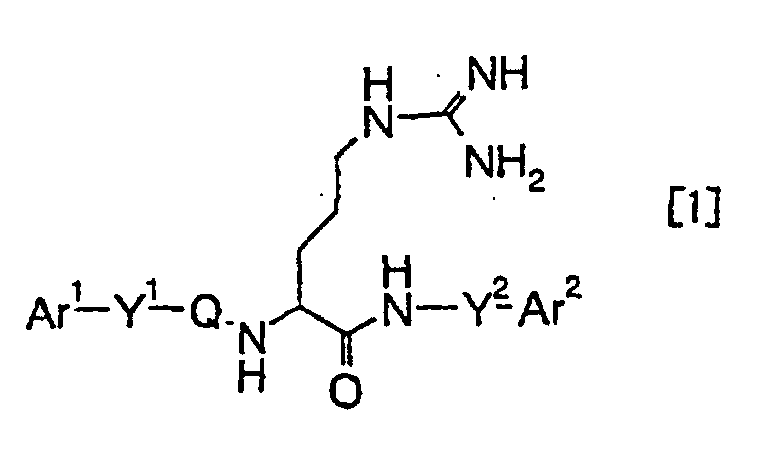 [wherein Ar1 and Ar2 may be the same or different, and
are each a phenyl group, a substituted phenyl group, a
naphthyl group, a substituted naphthyl group or a
heteroaromatic ring group containing one or more of
nitrogen, oxygen and sulfur atoms; Y1 is a C1-5
alkylene group, a C2-5 alkenylene group or a single
bond; and the C1-5 alkylene group optionally contains a
carbon atom substituted with a phenyl group, a
substituted phenyl group, a naphthyl group, a
substituted naphthyl group or a C1-10 acylamino group;
Q is a carbonyl group or a sulfonyl group; Y2 is a C1-5
alkylene group; the C1-5 alkylene group optionally
contains a carbon atom substituted with a phenyl group,
a substituted phenyl group, a naphthyl group, a
substituted naphthyl group, a hydroxyl group, a
carbamoyl group, a mono-C1-5 alkylamide group or a di-C1-5
alkylamide group], or a pharmaceutically
acceptable salt thereof. Stereoisomers exist in the
arginine derivatives of the present invention, and they
are also included in the present invention.
[wherein Ar1 and Ar2 may be the same or different, and
are each a phenyl group, a substituted phenyl group, a
naphthyl group, a substituted naphthyl group or a
heteroaromatic ring group containing one or more of
nitrogen, oxygen and sulfur atoms; Y1 is a C1-5
alkylene group, a C2-5 alkenylene group or a single
bond; and the C1-5 alkylene group optionally contains a
carbon atom substituted with a phenyl group, a
substituted phenyl group, a naphthyl group, a
substituted naphthyl group or a C1-10 acylamino group;
Q is a carbonyl group or a sulfonyl group; Y2 is a C1-5
alkylene group; the C1-5 alkylene group optionally
contains a carbon atom substituted with a phenyl group,
a substituted phenyl group, a naphthyl group, a
substituted naphthyl group, a hydroxyl group, a
carbamoyl group, a mono-C1-5 alkylamide group or a di-C1-5
alkylamide group], or a pharmaceutically
acceptable salt thereof. Stereoisomers exist in the
arginine derivatives of the present invention, and they
are also included in the present invention.
In the present invention, the substituted
phenyl group refers to a phenyl group substituted with
1 to 3 substituents arbitrarily selected from the group
consisting of a C1-5 alkyl group, a C1-5 alkoxy group,
an aralkyloxy group, a hydroxyl group, a halogen atom,
a nitro group, an amino group, a mono-C1-5 alkylamino
group, a di-C1-5 alkylamino group, a trifluoromethyl
group and a phenyl group; and examples of which are a
2-methylphenyl group, a 3-methylphenyl group, a 4-methylphenyl
group, a 2-ethylphenyl group, a 3-ethylphenyl
group, a 4-ethylphenyl group, a 2-propylphenyl
group, a 3-propylphenyl group, a 4-propylphenyl
group, a 2-cyclopentylphenyl group, a 2-methoxyphenyl
group, a 3-methoxyphenyl group, a 4-methoxyphenyl
group, a 4-ethoxyphenyl group, a 4-isopropoxyphenyl
group, a 4-benzyloxyphenyl group, a 4-hydroxyphenyl
group, a 2-fluorophenyl group, a 3-fluorophenyl
group, a 4-fluorophenyl group, a 2-chlorophenyl
group, a 3-chlorophenyl group, a 4-chlorophenyl
group, a 2-bromophenyl group, a 3-bromophenyl
group, a 4-bromophenyl group, a 4-nitrophenyl
group, a 4-trifluoromethylphenyl group and
a 4-biphenyl group.
The substituted naphthyl group refers to a
naphthyl group substituted with 1 to 3 substituents
arbitrarily selected from the group consisting of a C1-5
alkyl group, a C1-5 alkoxy group, an aralkyloxy
group, a halogen atom, a nitro group, an amino group, a
mono-C1-5 alkylamino group, a di-C1-5 alkylamino group,
a trifluoromethyl group and a phenyl group; and an
example of which is a 5-dimethylaminonaphthyl group.
The heteroaromatic ring group containing one
or more of nitrogen, oxygen and sulfur atoms refers to
a monocyclic or dicyclic aromatic ring group which
contains one or more of nitrogen, oxygen and sulfur
atoms; and examples of which are a 2-pyridyl group, a
3-pyridyl group, a 4-pyridyl group, a 3-indolyl group,
a 3-benzothienyl group and a 4-imidazolyl group.
The C1-10 acylamino group refers to an amino
group substituted with an aliphatic or aromatic acyl
group having 1 to 10 carbon atoms; and examples of
which are a formylamino group, an acetylamino group, a
propionylamino group, a butyrylamino group, an
isobutyrylamino group, a valerylamino group, an
isovalerylamino group, a pivaloylamino group, a
cyclohexylamino group, a benzyloxycarbonylamino group
and a t-butoxycarbonylamino group.
The C1-5 alkyl group refers to a straight,
branched or cyclic alkyl group having 1 to 5 carbon
atoms; and examples which are a methyl group, an ethyl
group, a propyl group, an isopropyl group, a
cyclopropyl group, a butyl group, an isobutyl group, a
cyclobutyl group, a cyclopropylmethyl group, a pentyl
group, an isopentyl group, a cyclopentyl group, a
cyclobutylmethyl group and a 1-ethylpropyl group.
The C1-5 alkoxy group refers to a straight,
branced or cyclic alkoxy group having 1 to 5 carbon
atoms; and examples of which are a methoxy group, an
ethoxy group, a propoxy group, an isopropoxy group, a
butoxy group, an isobutoxy group, a cyclopropylmethoxy
group, a pentyloxy group and an isopentyloxy group.
The mono-C1-5 alkylamino group or a di-C1-5
alkylamino group refers to an amino group substituted
with the above-mentioned C1-5 alkyl group; and examples
of which are a methylamino group, an ethylamino group,
a propylamino group, a dimethylamino group, a
diethylamino group and a dipropylamino group.
The halogen atom refers to a fluorine atom, a
chlorine atom, a bromine atom or an iodine atom.
The pharmaceutically acceptable salt refers
to a salt with a mineral acid or an organic acid; and
examples of which are acetate, propionate, butyrate,
formate, trifluoroacetate, maleate, tartrate, citrate,
stearate, succinate, ethylsuccinate, lactobionate,
gluconate, glucoheptonate, benzoate, methanesulfonate,
ethanesulfonate, 2-hydroxyethanesulfonate,
benzenesulfonate, p-toluenesulfonate, laurylsulfate,
malate, aspartate, glutaminate, adipate, cysteine salt,
N-acetylcysteine salt, hydrochloride, hydrobromide,
phosphate, sulfate, hydroiodide, nicotinate, oxalate,
picrate, thiocyanate, undecanoate, polyacrylate salt
and carboxyvinyl polymer salt.
Preferable compounds of the present invention
are arginine derivatives of Formula [1] wherein Ar1 and
Ar2 may be the same or different, and are each a phenyl
group, a naphthyl group or a 3-benzothienyl group, Y1
is a C1-2 alkylene group or a C1-2 alkylene group
substituted with one acetoamino group; Q is a carbonyl
group or a sulfonyl group; Y2 is a C1-2 alkylene group
or a C1-2 alkylene group substituted with one carbamoyl
group, or a pharmaceutically acceptable salt thereof.
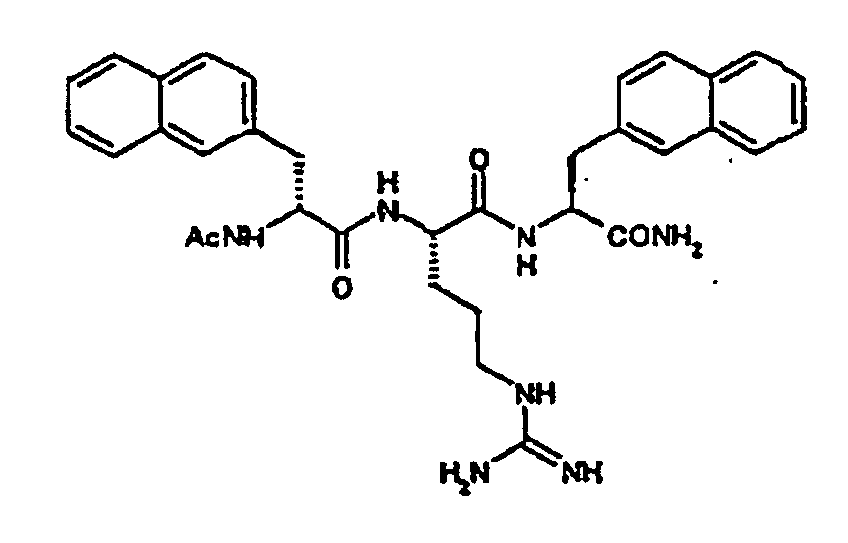
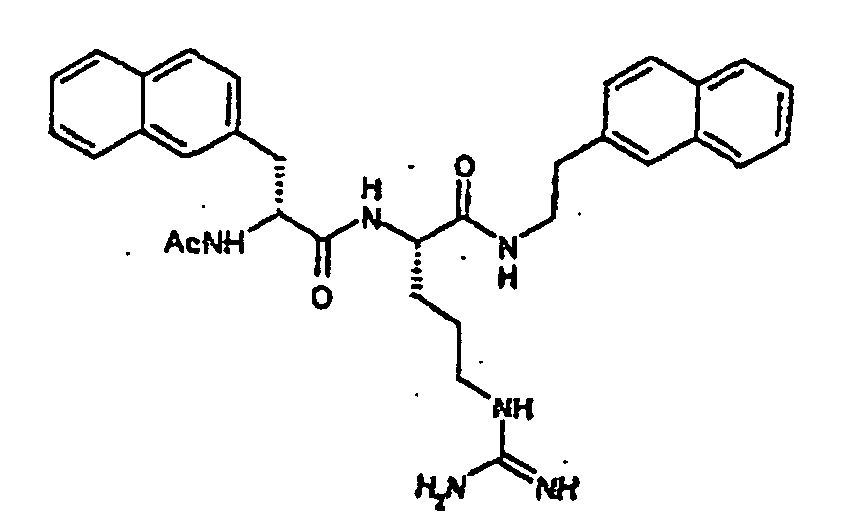
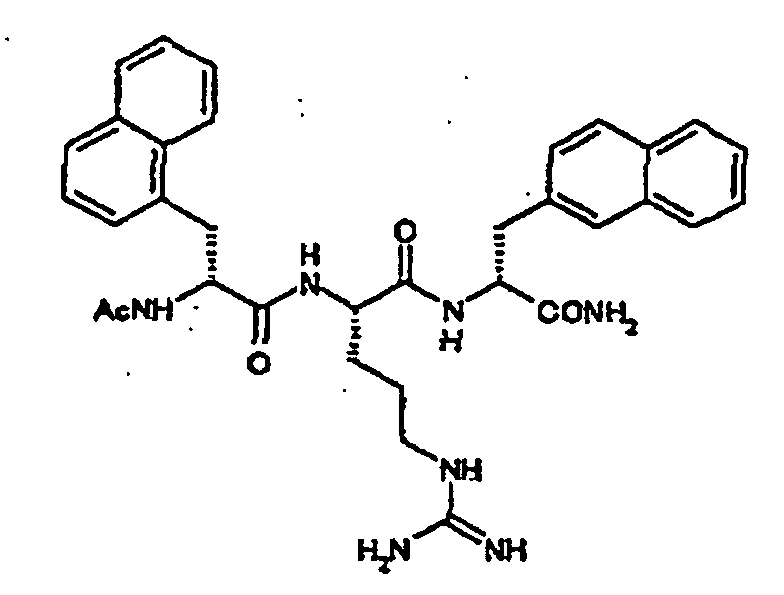
More preferable are the following compounds a - n, or
pharmaceutically acceptable salts thereof.



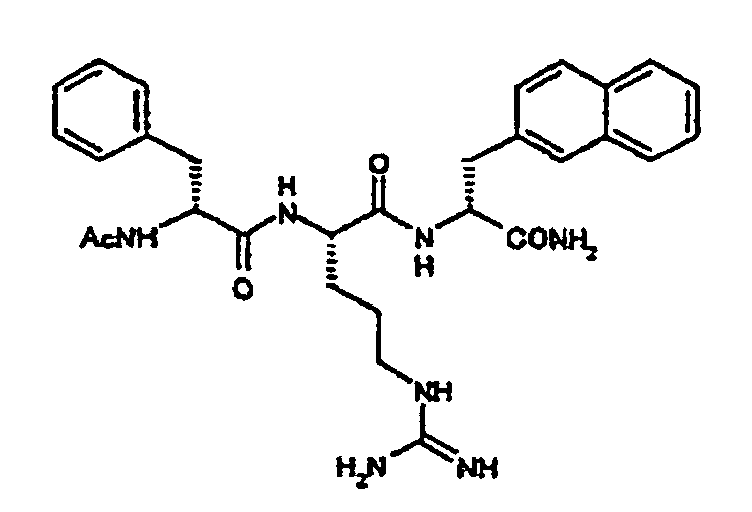
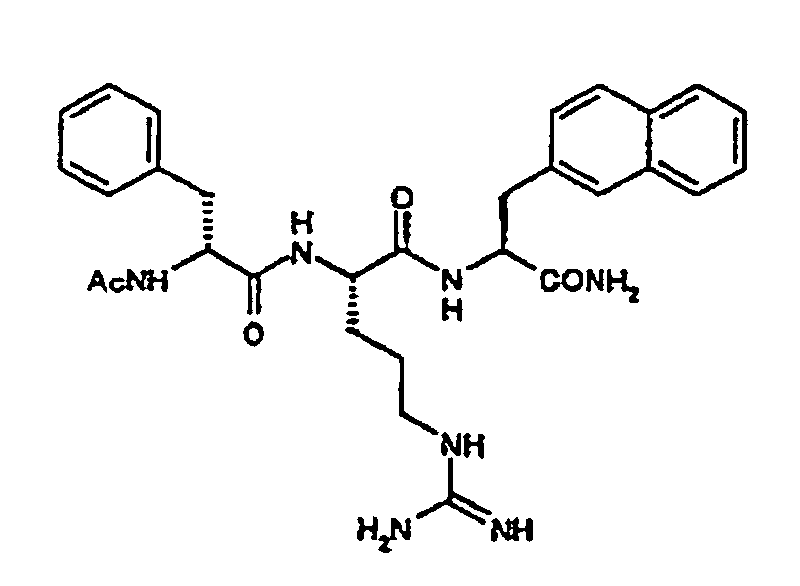


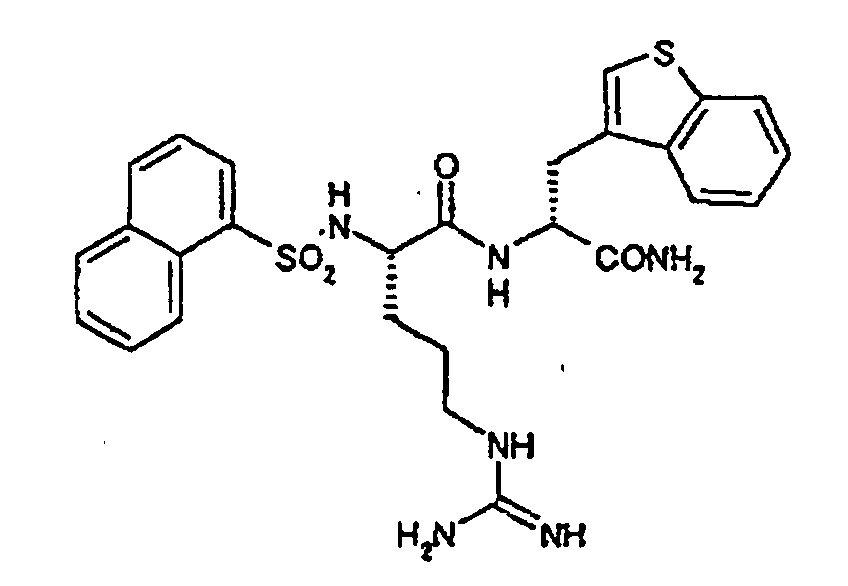
The compounds of Formula [1] can be prepared
by the following general preparation method (in the
following reaction schemes, Ar1, Ar2, Y1, Y2 and Q are
as defined above; X is a hydroxyl group, a chlorine
atom, a bromine atom or an iodine atom; P1 is an
ordinary amino-protective group such as a t-butoxycarbonyl
group or a benzyloxycarbonyl group; P2
and P3 are each an ordinary guanidino-protective group
such as a t-butoxycarbonyl group, a benzyloxycarbonyl
group, a nitro group, a tosyl group or a 2,2,5,7,8-pentamethylchroman-6-sulfonyl
group).
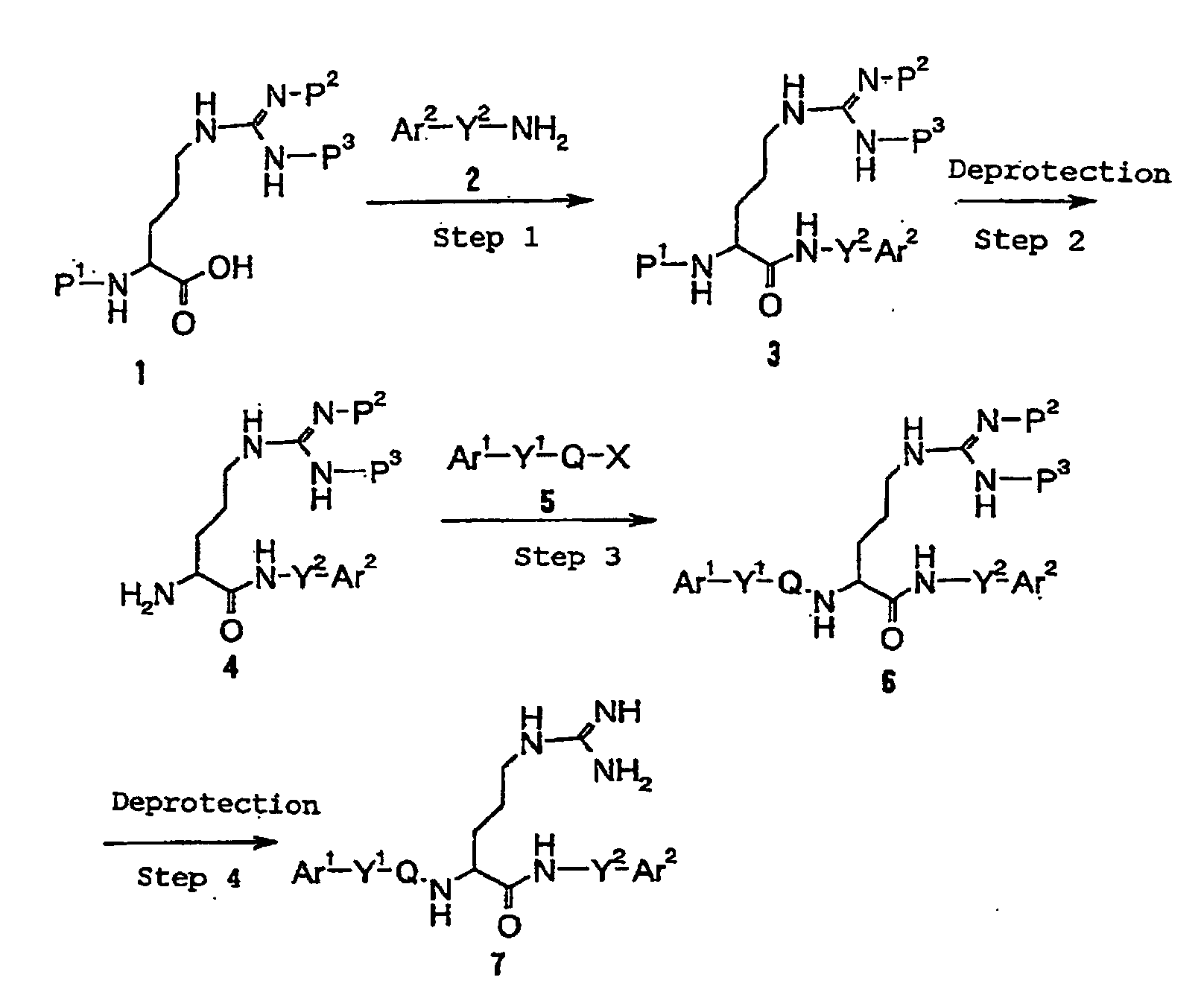
Compound (1) can be coupled with compound (2)
in the presence or absence of a base in an inert
solvent to convert to compound (3).
The base includes, for example, organic
amines (e.g., triethylamine, diisopropylethylamine,
pyridine and N-methylmorpholine) and inorganic bases
(e.g., potassium carbonate and sodium bicarbonate).
The coupling includes, for example, an amidation via an
acid halide(e.g., an acid chloride and an acid
bromide), an amidation via a mixed acid anhydride using
ethyl chlorocarbonate, isobutyl chlorocarbonate, etc.,
and an amidation using a coupling agent such as 1-(3,3-dimethylaminopropyl)-3-ethylcarbodiimide,
1,3-dicyclohexylcarbodiimide,
diphenylphosphoryl azide,
diethyl cyanophosphate or carbonylimidazole. The inert
solvent include, for example, alcohols (e.g., methanol
and ethanol), ethers (e.g., diethyl ether and
tetrahydrofuran), hydrocarbons (e.g., toluene and
benzene), halogenated carbonaceous solvents (e.g.,
chloroform and dichloromethane), dimethylformamide,
acetonitrile, water and a mixed solvent
thereof.
Compound (3) can be deprotected in the
presence or absence of an acid in an inert solvent to
give compound (4). The deprotection of compound (3)
can be carried out using the method described in
Protective Groups in Organic Synthesis, by Theodora W.
Greene and Peter G. M. Wuts.
Compound (4) can be coupled with compound (5)
in the presence or absence of a base in an inert
solvent to convert to compound (6). In case where Y1
includes a protected amino group, acylation of the
amino group can be carried out after deprotection in
the presence or absence of a base in an inert solvent.
The base includes, for example, organic
amines (e.g., triethylamine, diisopropylethylamine,
pyridine and N-methylmorpholine) and inorganic bases
(e.g., potassium carbonate and sodium bicarbonate).
The coupling includes, for example, an amidation via an
acid halide(e.g., an acid chloride and an acid
bromide), an amidation via a mixed acid anhydride using
ethyl chlorocarbonate, isobutyl chlorocarbonate, etc.,
and an amidation using a coupling agent such as 1-(3,3-dimethylaminopropyl)-3-ethylcarbodiimide,
1,3-dicyclohexylcarbodiimide,
diphenylphosphoryl azide,
diethyl cyanophosphate or carbonylimidazole. The inert
solvent include, for example, alcohols (e.g., methanol
and ethanol), ethers (e.g., diethyl ether and
tetrahydrofuran), hydrocarbons (e.g., toluene and
benzene), halogenated carbonaceous solvents (e.g.,
chloroform and dichloromethane), dimethylformamide,
acetonitrile, water and a mixed solvent
thereof. The protected amino group is a protected
amino group described in Protective Groups in Organic
Synthesis, by Theodora W. Greene and Peter G. M. Wuts;
and examples of which are a t-butoxycarbonylamino group
and a benzyloxycarbonylamino group. The deprotection
is a deprotection of an amino group carried out
according to the method described in Protective Groups
in Organic Synthesis, by Theodora W. Greene and Peter
G. M. Wuts. The acylation includes, for example, an
acylation via an acid halide(e.g., an acid chloride and
an acid bromide), an acylation using an acid anhydride
(e.g., acetic anhydride), an acylation via a mixed acid
anhydride using ethyl chlorocarbonate, isobutyl
chlorocarbonate, etc., and an acylation using a
coupling agent (e.g., 1-(3,3-dimethylaminopropyl)-3-ethylcarbodiimide,
1,3-dicyclohexylcarbodiimide,
diphenylphosphoryl azide, diethyl cyanophosphate and
carbonylimidazole).
Deprotection of a guanidino group can be
carried out in the presence or absence of an acid in an
inert solvent to give compound (6) of the present
invention.
The deprotection of the guanidino group of
the compound can be carried out using the method
described in Protective Groups in Organic Synthesis, by
Theodora W. Greene and Peter G. M. Wuts.
The dose of the compound according to the
present invention, when used as a ligand for MC4
receptor for the treatment of adult human, may range
from 1 to 2000 mg per day, in a single portion or
several divided portions. This dose can be suitably
increased or decreased depending on application and
age, body weight and conditions of the patient.
The compounds according to the present
invention can be administered orally or parenterally,
and the dosage forms thereof are, for example, tablets,
capsules, granules, fine-powders, powders, troches,
ointments, creams, emulsions, suspensions,
suppositories, injections and nasal administration
preparations, all of which can be prepared by
conventional preparation techniques (e.g., the method
defined in Japanese Pharmacopoeia, 14th edition).
These dosage forms can be suitably chosen according to
conditions and age of the patient and the purpose of
therapy. For the productions of these forms, there can
be used conventional excipients (e.g., crystalline
cellulose, starches, lactose and mannitol), binders
(e.g., hydroxypropylcellulose and polyvinyl
pyrrolidone), lubricants (e.g., magnesium stearate and
talc), disintegrators (e.g., carboxymethylcellulose
calcium), etc.
The present invention is illustrated in more
detail with reference to the following examples;
however, the present invention is in no way limited to
these examples (in the following formulae, Boc is a t-butoxycarbonyl
group, Z is a benzyloxycarbonyl group
and Ac is an acetyl group).
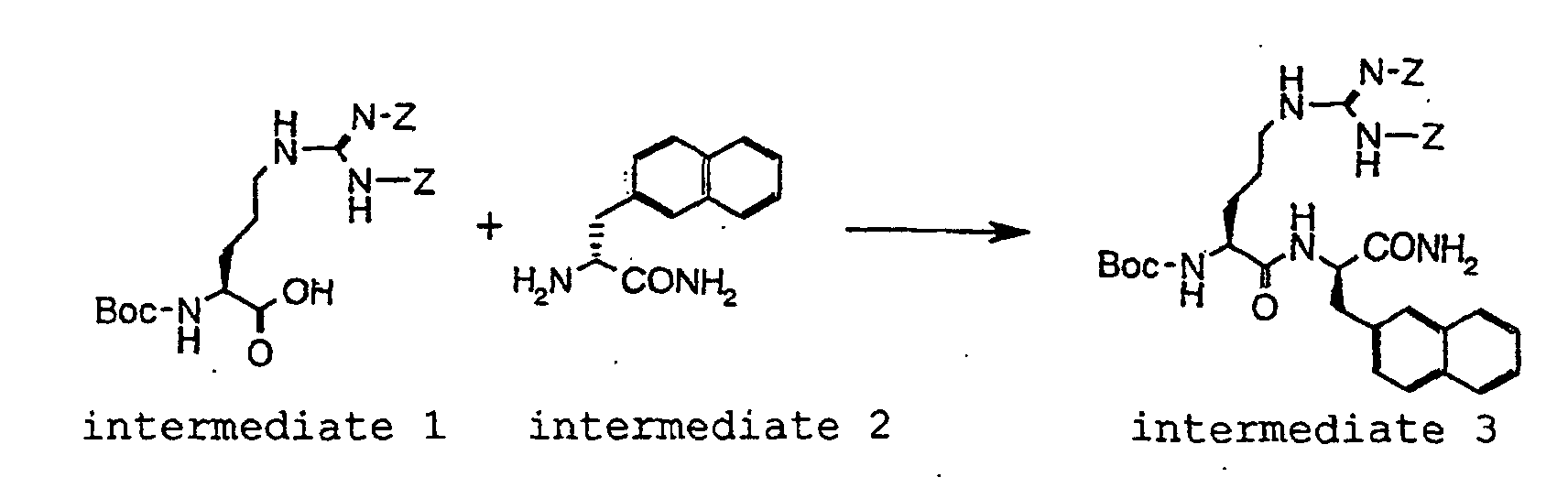


The structures and physical property data of
the present compound and the compounds prepared
similarly are shown in Table 1.

Ar1-Y1-

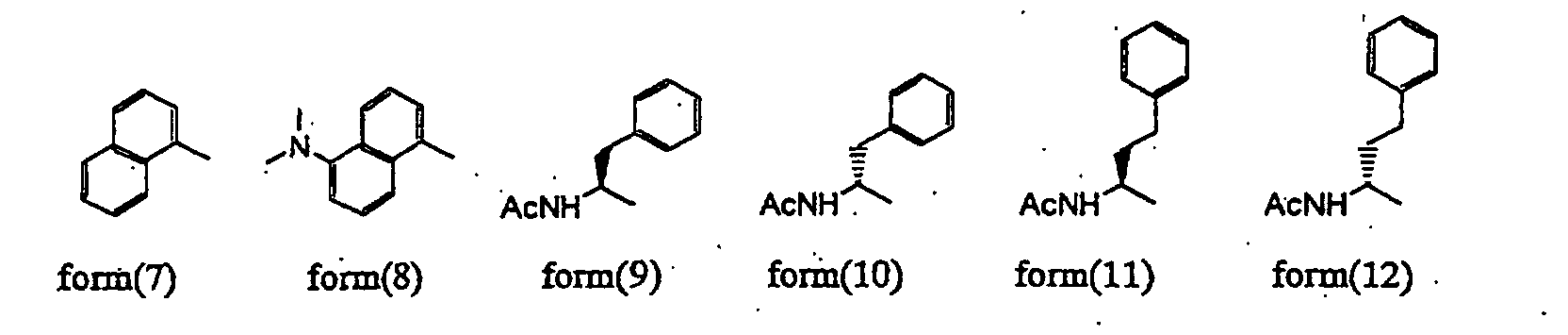


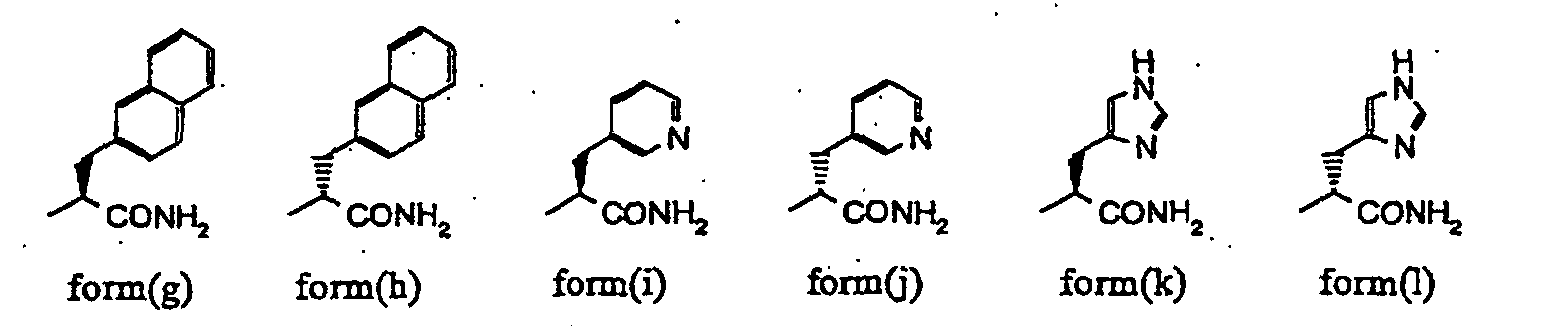


| Comp.No | Ar1-Y1 | Q | Y2-Ar2 | (M+1)+ |
| 001 | form(1) | CO | form(a) | 501.3 |
| 002 | form(1) | CO | form(b) | 501.3 |
| 003 | form(1) | CO | form(c) | 515.3 |
| 004 | form(1) | CO | form(d) | 515.3 |
| 005 | form(1) | CO | form(e) | 551.3 |
| 006 | form(1) | CO | form(f) | 551.3 |
| 007 | form(1) | CO | form(g) | 551.3 |
| 008 | form(1) | CO | form(h) | 551.3 |
| 009 | form(1) | CO | form(i) | 502.3 |
| 010 | form(1) | CO | form(j) | 502.3 |
| 011 | form(1) | CO | form(k) | 491.3 |
| 012 | form(1) | CO | form(l) | 491.3 |
| 013 | form(2) | CO | form(a) | 501.3 |
| 014 | form(2) | CO | form(b) | 501.3 |
| 015 | form(2) | CO | form(c) | 515.3 |
| 016 | form(2) | CO | form(d) | 515.3 |
| 017 | form(2) | CO | form(e) | 551.3 |
| 018 | form(2) | CO | form(f) | 551.3 |
| 019 | form(2) | CO | form(g) | 551.3 |
| 020 | form(2) | CO | form(h) | 551.3 |
| 021 | form(2) | CO | form(i) | 502.3 |
| 022 | form(2) | CO | form(j) | 502.3 |
| 023 | form(2) | CO | form(k) | 491.3 |
| 024 | form(2) | CO | form(l) | 491.3 |
| 025 | form(3) | CO | form(a) | 503.3 |
| 026 | form(3) | CO | form(b) | 503.3 |
| 027 | form(3) | CO | form(c) | 517.3 |
| 028 | form(3) | CO | form(d) | 517.3 |
| 029 | form(3) | CO | form(e) | 553.3 |
| 030 | form(3) | CO | form(f) | 553.3 |
| 031 | form(3) | CO | form(g) | 553.3 |
| 032 | form(3) | CO | form(h) | 553.3 |
| 033 | form(3) | CO | form(i) | 504.3 |
| 034 | form(3) | CO | form(j) | 504.3 |
| 035 | form(3) | CO | form(k) | 493.3 |
| 036 | form(3) | CO | form(l) | 493.3 |
| 037 | form(4) | CO | form(a) | 629.4 |
| 038 | form(4) | CO | form(b) | 629.4 |
| 039 | form(4) | CO | form(c) | 643.4 |
| 040 | form(4) | CO | form(d) | 643.4 |
| 041 | form(4) | CO | form(e) | 679.3 |
| 042 | form(4) | CO | form(f) | 679.3 |
| 043 | form(4) | CO | form(g) | 679.3 |
| 044 | form(4) | CO | form(h) | 679.3 |
| 045 | form(4) | CO | form(i) | 630.4 |
| 046 | form(4) | CO | form(j) | 630.4 |
| 047 | form(4) | CO | form(k) | 619.4 |
| 048 | form(4) | CO | form(l) | 619.4 |
| 049 | form(5) | CO | form(a) | 629.4 |
| 050 | form(5) | CO | form(b) | 629.4 |
| 051 | form(5) | CO | form(c) | 643.4 |
| 052 | form(5) | CO | form(d) | 643.4 |
| 053 | form(5) | CO | form(e) | 679.3 |
| 054 | form(5) | CO | form(f) | 679.3 |
| 055 | form(5) | CO | form(g) | 679.3 |
| 056 | form(5) | CO | form(h) | 679.3 |
| 057 | form(5) | CO | form(i) | 630.4 |
| 058 | form(5) | CO | form(j) | 630.4 |
| 059 | form(5) | CO | form(k) | 619.4 |
| 060 | form(5) | CO | form(l) | 619.4 |
| 061 | form(6) | CO | form(a) | 629.4 |
| 062 | form(6) | CO | form(b) | 629.4 |
| 063 | form(6) | CO | form(c) | 643.4 |
| 064 | form(6) | CO | form(d) | 643.4 |
| 065 | form(6) | CO | form(e) | 679.3 |
| 066 | form(6) | CO | form(f) | 679.3 |
| 067 | form(6) | CO | form(g) | 679.3 |
| 068 | form(6) | CO | form(h) | 679.3 |
| 069 | form(6) | CO | form(i) | 630.4 |
| 070 | form(6) | CO | form(j) | 630.4 |
| 071 | form(6) | CO | form(k) | 619.4 |
| 072 | form(6) | CO | form(l) | 619.4 |
| 073 | form(7) | SO2 | form(a) | 511.2 |
| 074 | form(7) | SO2 | form(b) | 511.2 |
| 075 | form(7) | SO2 | form(c) | 525.3 |
| 076 | form(7) | SO2 | form(d) | 525.3 |
| 077 | form(7) | SO2 | form(e) | 561.3 |
| 078 | form(7) | SO2 | form(f) | 561.3 |
| 079 | form(7) | SO2 | form(g) | 561.3 |
| 080 | form(7) | SO2 | form(h) | 561.3 |
| 081 | form(7) | SO2 | form(i) | 512.2 |
| 082 | form(7) | SO2 | form(j) | 512.3 |
| 083 | form(7) | SO2 | form(k) | 501.2 |
| 084 | form(7) | SO2 | form(l) | 501.2 |
| 085 | form(8) | SO2 | form(a) | 554.3 |
| 086 | form(8) | SO2 | form(b) | 554.3 |
| 087 | form(8) | SO2 | form(c) | 568.3 |
| 088 | form(8) | SO2 | form(d) | 568.3 |
| 089 | form(8) | SO2 | form(e) | 604.3 |
| 090 | form(8) | SO2 | form(f) | 604.3 |
| 091 | form(8) | SO2 | form(g) | 604.3 |
| 092 | form(8) | SO2 | form(h) | 604.3 |
| 093 | form(8) | SO2 | form(i) | 555.3 |
| 094 | form(8) | SO2 | form(j) | 555.3 |
| 095 | form(8) | SO2 | form(k) | 544.3 |
| 096 | form(8) | SO2 | form(l) | 544.3 |
| 097 | form(1) | CO | form(m) | 487.2 |
| 098 | form(1) | CO | form(n) | 487.2 |
| 099 | form(1) | CO | form(o) | 502.3 |
| 100 | form(1) | CO | form(p) | 502.3 |
| 101 | form(1) | CO | form(q) | 502.3 |
| 102 | form(1) | CO | form(r) | 557.2 |
| 103 | form(1) | CO | form(s) | 577.2 |
| 104 | form(1) | CO | form(t) | 577.2 |
| 105 | form(2) | CO | form(m) | 487.2 |
| 106 | form(2) | CO | form(n) | 487.3 |
| 107 | form(2) | CO | form(o) | 502.3 |
| 108 | form(2) | CO | form(p) | 502.3 |
| 109 | form(2) | CO | form(q) | 502.3 |
| 110 | form(2) | CO | form(r) | 557.2 |
| 111 | form(2) | CO | form(s) | 577.2 |
| 112 | form(2) | CO | form(t) | 577.2 |
| 113 | form(3) | CO | form(m) | 489.3 |
| 114 | form(3) | CO | form(n) | 489.3 |
| 115 | form(3) | CO | form(o) | 504.3 |
| 116 | form(3) | CO | form(p) | 504.3 |
| 117 | form(3) | CO | form(q) | 504.3 |
| 118 | form(3) | CO | form(r) | 559.2 |
| 119 | form(3) | CO | form(s) | 579.3 |
| 120 | form(3) | CO | form(t) | 579.3 |
| 121 | form(4) | CO | form(m) | 615.3 |
| 122 | form(4) | CO | form(n) | 615.3 |
| 123 | form(4) | CO | form(o) | 630.4 |
| 124 | form(4) | CO | form(p) | 630.3 |
| 125 | form(4) | CO | form(q) | 630.3 |
| 126 | form(4) | CO | form(r) | 685.3 |
| 127 | form(4) | CO | form(s) | 705.3 |
| 128 | form(4) | CO | form(t) | 705.3 |
| 129 | form(5) | CO | form(m) | 615.3 |
| 130 | form(5) | CO | form(n) | 615.3 |
| 131 | form(5) | CO | form(o) | 630.3 |
| 132 | form(5) | CO | form(p) | 630.3 |
| 133 | form(5) | CO | form(q) | 630.4 |
| 134 | form(5) | CO | form(r) | 685.2 |
| 135 | form(5) | CO | form(s) | 705.3 |
| 136 | form(5) | CO | form(t) | 705.3 |
| 137 | form(6) | CO | form(m) | 615.3 |
| 138 | form(6) | CO | form(n) | 615.3 |
| 139 | form(6) | CO | form(o) | 630.3 |
| 140 | form(6) | CO | form(p) | 630.3 |
| 141 | form(6) | CO | form(q) | 630.3 |
| 142 | form(6) | CO | form(r) | 685.2 |
| 143 | form(6) | CO | form(s) | 705.3 |
| 144 | form(6) | CO | form(t) | 705.3 |
| 145 | form(7) | SO2 | form(m) | 497.2 |
| 146 | form(7) | SO2 | form(n) | 497.2 |
| 147 | form(7) | SO2 | form(p) | 512.2 |
| 148 | form(7) | SO2 | form(r) | 567.1 |
| 149 | form(7) | SO2 | form(s) | 587.2 |
| 150 | form(7) | SO2 | form(t) | 587.2 |
| 151 | form(8) | SO2 | form(m) | 540.3 |
| 152 | form(8) | SO2 | form(n) | 540.3 |
| 153 | form(8) | SO2 | form(p) | 555.2 |
| 154 | form(8) | SO2 | form(r) | 610.2 |
| 155 | form(8) | SO2 | form(s) | 630.3 |
| 156 | form(8) | SO2 | form(t) | 630.3 |
| 157 | form(9) | CO | form(a) | 510.3 |
| 158 | form(9) | CO | form(b) | 510.3 |
| 159 | form(9) | CO | form(c) | 524.3 |
| 160 | form(9) | CO | form(d) | 524.3 |
| 161 | form(9) | CO | form(e) | 560.3 |
| 162 | form(9) | CO | form(f) | 560.3 |
| 163 | form(9) | CO | form(g) | 560.3 |
| 164 | form(9) | CO | form(h) | 560.3 |
| 165 | form(9) | CO | form(i) | 511.3 |
| 166 | form(9) | CO | form(j) | 511.3 |
| 167 | form(9) | CO | form(k) | 500.3 |
| 168 | form(9) | CO | form(l) | 500.3 |
| 169 | form(10) | CO | form(a) | 510.3 |
| 170 | form(10) | CO | form(b) | 510.3 |
| 171 | form(10) | CO | form(c) | 524.3 |
| 172 | form(10) | CO | form(d) | 524.3 |
| 173 | form(10) | CO | form(e) | 560.3 |
| 174 | form(10) | CO | form(f) | 560.3 |
| 175 | form(10) | CO | form(g) | 560.3 |
| 176 | form(10) | CO | form(h) | 560.3 |
| 177 | form(10) | CO | form(i) | 511.3 |
| 178 | form(10) | CO | form(j) | 511.3 |
| 179 | form(10) | CO | form(k) | 500.3 |
| 180 | form(10) | CO | form(l) | 500.3 |
| 181 | form(11) | CO | form(a) | 524.3 |
| 182 | form(11) | CO | form(b) | 524.3 |
| 183 | form(11) | CO | form(c) | 538.3 |
| 184 | form(11) | CO | form(d) | 538.3 |
| 185 | form(11) | CO | form(e) | 574.3 |
| 186 | form(11) | CO | form(f) | 574.3 |
| 187 | form(11) | CO | form(g) | 574.3 |
| 188 | form(11) | CO | form(h) | 574.3 |
| 189 | form(11) | CO | form(i) | 525.3 |
| 190 | form(11) | CO | form(j) | 525.3 |
| 191 | form(11) | CO | form(k) | 514.3 |
| 192 | form(11) | CO | form(l) | 514.3 |
| 193 | form(12) | CO | form(a) | 524.3 |
| 194 | form(12) | CO | form(b) | 524.3 |
| 195 | form(12) | CO | form(c) | 538.3 |
| 196 | form(12) | CO | form(d) | 538.3 |
| 197 | form(12) | CO | form(e) | 574.3 |
| 198 | form(12) | CO | form(f) | 574.3 |
| 199 | form(12) | CO | form(g) | 574.3 |
| 200 | form(12) | CO | form(h) | 574.3 |
| 201 | form(12) | CO | form(i) | 525.3 |
| 202 | form(12) | CO | form(j) | 525.3 |
| 203 | form(12) | CO | form(k) | 514.3 |
| 204 | form(12) | CO | form(l) | 514.3 |
| 205 | form(13) | CO | form(a) | 560.3 |
| 206 | form(13) | CO | form(b) | 560.3 |
| 207 | form(13) | CO | form(c) | 574.3 |
| 208 | form(13) | CO | form(d) | 574.3 |
| 209 | form(13) | CO | form(e) | 610.3 |
| 210 | form(13) | CO | form(f) | 610.3 |
| 211 | form(13) | CO | form(g) | 610.3 |
| 212 | form(13) | CO | form(h) | 610.3 |
| 213 | form(13) | CO | form(i) | 561.3 |
| 214 | form(13) | CO | form(j) | 561.3 |
| 215 | form(13) | CO | form(k) | 550.3 |
| 216 | form(13) | CO | form(l) | 550.3 |
| 217 | form(14) | CO | form(a) | 560.3 |
| 218 | form(14) | CO | form(b) | 560.3 |
| 219 | form(14) | CO | form(c) | 574.3 |
| 220 | form(14) | CO | form(d) | 574.3 |
| 221 | form(14) | CO | form(e) | 610.3 |
| 222 | form(14) | CO | form(f) | 610.3 |
| 223 | form(14) | CO | form(g) | 610.3 |
| 224 | form(14) | CO | form(h) | 610.3 |
| 225 | form(14) | CO | form(i) | 561.3 |
| 226 | form(14) | CO | form(j) | 561.3 |
| 227 | form(14) | CO | form(k) | 550.3 |
| 228 | form(14) | CO | form(l) | 550.3 |
| 229 | form(15) | CO | form(a) | 560.3 |
| 230 | form(15) | CO | form(b) | 560.3 |
| 231 | form(15) | CO | form(c) | 574.3 |
| 232 | form(15) | CO | form(d) | 574.3 |
| 233 | form(15) | CO | form(e) | 610.3 |
| 234 | form(15) | CO | form(f) | 610.3 |
| 235 | form(15) | CO | form(g) | 610.3 |
| 236 | form(15) | CO | form(h) | 610.3 |
| 237 | form(15) | CO | form(i) | 561.3 |
| 238 | form(15) | CO | form(j) | 561.3 |
| 239 | form(15) | CO | form(k) | 550.3 |
| 240 | form(15) | CO | form(l) | 550.3 |
| 241 | form(16) | CO | form(a) | 560.3 |
| 242 | form(16) | CO | form(b) | 560.3 |
| 243 | form(16) | CO | form(c) | 574.3 |
| 244 | form(16) | CO | form(d) | 574.3 |
| 245 | form(16) | CO | form(e) | 610.3 |
| 246 | form(16) | CO | form(f) | 610.3 |
| 247 | form(16) | CO | form(g) | 610.3 |
| 248 | form(16) | CO | form(h) | 610.3 |
| 249 | form(16) | CO | form(i) | 561.3 |
| 250 | form(16) | CO | form(j) | 561.3 |
| 251 | form(16) | CO | form(k) | 550.3 |
| 252 | form(16) | CO | form(l) | 550.3 |
| 253 | form(9) | CO | form(m) | 496.3 |
| 254 | form(9) | CO | form(n) | 496.3 |
| 255 | form(9) | CO | form(o) | 511.3 |
| 256 | form(9) | CO | form(p) | 511.3 |
| 257 | form(9) | CO | form(q) | 511.3 |
| 258 | form(9) | CO | form(r) | 566.2 |
| 259 | form(9) | CO | form(s) | 586.3 |
| 260 | form(9) | CO | form(t) | 586.3 |
| 261 | form(10) | CO | form(m) | 496.3 |
| 262 | form(10) | CO | form(n) | 496.3 |
| 263 | form(10) | CO | form(o) | 511.3 |
| 264 | form(10) | CO | form(p) | 511.3 |
| 265 | form(10) | CO | form(q) | 511.3 |
| 266 | form(10) | CO | form(r) | 566.2 |
| 267 | form(10) | CO | form(s) | 586.3 |
| 268 | form(10) | CO | form(t) | 586.3 |
| 269 | form(11) | CO | form(m) | 510.3 |
| 270 | form(11) | CO | form(n) | 510.3 |
| 271 | form(11) | CO | form(o) | 525.3 |
| 272 | form(11) | CO | form(p) | 525.3 |
| 273 | form(11) | CO | form(q) | 525.3 |
| 274 | form(11) | CO | form(r) | 580.2 |
| 275 | form(11) | CO | form(s) | 600.3 |
| 276 | form(11) | CO | form(t) | 600.3 |
| 277 | form(12) | CO | form(m) | 510.3 |
| 278 | form(12) | CO | form(n) | 510.3 |
| 279 | form(12) | CO | form(o) | 525.3 |
| 280 | form(12) | CO | form(p) | 525.3 |
| 281 | form(12) | CO | form(q) | 525.3 |
| 282 | form(12) | CO | form(r) | 580.2 |
| 283 | form(12) | CO | form(s) | 600.3 |
| 284 | form(12) | CO | form(t) | 600.3 |
| 285 | form(13) | CO | form(m) | 546.3 |
| 286 | form(13) | CO | form(n) | 546.3 |
| 287 | form(13) | CO | form(o) | 561.3 |
| 288 | form(13) | CO | form(p) | 561.3 |
| 289 | form(13) | CO | form(q) | 561.3 |
| 290 | form(13) | CO | form(r) | 616.3 |
| 291 | form(13) | CO | form(s) | 636.4 |
| 292 | form(13) | CO | form(t) | 636.4 |
| 293 | form(14) | CO | form(m) | 546.3 |
| 294 | form(14) | CO | form(n) | 546.3 |
| 295 | form(14) | CO | form(o) | 561.3 |
| 296 | form(14) | CO | form(p) | 561.3 |
| 297 | form(14) | CO | form(q) | 561.3 |
| 298 | form(14) | CO | form(r) | 616.3 |
| 299 | form(14) | CO | form(s) | 616.4 |
| 300 | form(14) | CO | form(t) | 636.4 |
| 301 | form(15) | CO | form(m) | 546.3 |
| 302 | form(15) | CO | form(n) | 546.3 |
| 303 | form(15) | CO | form(o) | 561.2 |
| 304 | form(15) | CO | form(p) | 561.3 |
| 305 | form(15) | CO | form(q) | 561.3 |
| 306 | form(15) | CO | form(r) | 616.3 |
| 307 | form(15) | CO | form(s) | 636.4 |
| 308 | form(15) | CO | form(t) | 636.4 |
| 309 | form(16) | CO | form(m) | 546.3 |
| 310 | form(16) | CO | form(n) | 546.3 |
| 311 | form(16) | CO | form(o) | 561.3 |
| 312 | form(16) | CO | form(p) | 561.3 |
| 313 | form(16) | CO | form(q) | 561.3 |
| 314 | form(16) | CO | form(r) | 616.3 |
| 315 | form(16) | CO | form(s) | 636.4 |
| 316 | form(16) | CO | form(t) | 636.4 |
| 317 | form(17) | CO | form(a) | 511.3 |
| 318 | form(17) | CO | form(b) | 511.3 |
| 319 | form(17) | CO | form(c) | 525.3 |
| 320 | form(17) | CO | form(d) | 525.3 |
| 321 | form(17) | CO | form(e) | 561.3 |
| 322 | form(17) | CO | form(f) | 561.3 |
| 323 | form(17) | CO | form(g) | 561.3 |
| 324 | form(17) | CO | form(h) | 561.3 |
| 325 | form(17) | CO | form(i) | 512.3 |
| 326 | form(17) | CO | form(j) | 512.3 |
| 327 | form(17) | CO | form(k) | 501.3 |
| 328 | form(17) | CO | form(l) | 501.3 |
| 329 | form(18) | CO | form(a) | 511.3 |
| 330 | form(18) | CO | form(b) | 511.3 |
| 331 | form(18) | CO | form(c) | 525.3 |
| 332 | form(18) | CO | form(d) | 525.3 |
| 333 | form(18) | CO | form(e) | 561.3 |
| 334 | form(18) | CO | form(f) | 561.3 |
| 335 | form(18) | CO | form(g) | 561.3 |
| 336 | form(18) | CO | form(h) | 561.3 |
| 337 | form(18) | CO | form(i) | 512.3 |
| 338 | form(18) | CO | form(j) | 512.3 |
| 339 | form(18) | CO | form(k) | 501.3 |
| 340 | form(18) | CO | form(l) | 501.3 |
| 341 | form(19) | CO | form(a) | 500.3 |
| 342 | form(19) | CO | form(b) | 500.3 |
| 343 | form(19) | CO | form(c) | 514.3 |
| 344 | form(19) | CO | form(d) | 514.3 |
| 345 | form(19) | CO | form(e) | 550.3 |
| 346 | form(19) | CO | form(f) | 550.3 |
| 347 | form(19) | CO | form(g) | 550.3 |
| 348 | form(19) | CO | form(h) | 550.3 |
| 349 | form(19) | CO | form(i) | 501.3 |
| 350 | form(19) | CO | form(j) | 501.3 |
| 351 | form(19) | CO | form(k) | 490.3 |
| 352 | form(19) | CO | form(l) | 490.3 |
| 353 | form(20) | CO | form(a) | 500.3 |
| 354 | form(20) | CO | form(b) | 500.3 |
| 355 | form(20) | CO | form(c) | 514.3 |
| 356 | form(20) | CO | form(d) | 514.3 |
| 357 | form(20) | CO | form(e) | 550.3 |
| 358 | form(20) | CO | form(f) | 550.3 |
| 359 | form(20) | CO | form(g) | 550.3 |
| 360 | form(20) | CO | form(h) | 550.3 |
| 361 | form(20) | CO | form(i) | 501.3 |
| 362 | form(20) | CO | form(j) | 501.3 |
| 363 | form(20) | CO | form(k) | 490.3 |
| 364 | form(20) | CO | form(l) | 490.3 |
| 365 | form(21) | CO | form(a) | 496.3 |
| 366 | form(21) | CO | form(b) | 496.3 |
| 367 | form(21) | CO | form(c) | 510.3 |
| 368 | form(21) | CO | form(d) | 510.3 |
| 369 | form(21) | CO | form(e) | 546.3 |
| 370 | form(21) | CO | form(f) | 546.3 |
| 371 | form(21) | CO | form(g) | 546.3 |
| 372 | form(21) | CO | form(h) | 546.3 |
| 373 | form(21) | CO | form(i) | 497.3 |
| 374 | form(21) | CO | form(j) | 497.3 |
| 375 | form(21) | CO | form(k) | 486.3 |
| 376 | form(21) | CO | form(l) | 486.3 |
| 377 | form(22) | CO | form(a) | 496.3 |
| 378 | form(22) | CO | form(b) | 496.3 |
| 379 | form(22) | CO | form(c) | 510.3 |
| 380 | form(22) | CO | form(d) | 510.3 |
| 381 | form(22) | CO | form(e) | 546.3 |
| 382 | form(22) | CO | form(f) | 546.3 |
| 383 | form(22) | CO | form(g) | 546.3 |
| 384 | form(22) | CO | form(h) | 546.3 |
| 385 | form(22) | CO | form(i) | 497.3 |
| 386 | form(22) | CO | form(j) | 497.3 |
| 387 | form(22) | CO | form(k) | 486.3 |
| 388 | form(22) | CO | form(l) | 486.3 |
| 389 | form(23) | CO | form(a) | 511.3 |
| 390 | form(23) | CO | form(b) | 511.3 |
| 391 | form(23) | CO | form(c) | 525.3 |
| 392 | form(23) | CO | form(d) | 525.3 |
| 393 | form(23) | CO | form(e) | 561.3 |
| 394 | form(23) | CO | form(f) | 561.3 |
| 395 | form(23) | CO | form(g) | 561.3 |
| 396 | form(23) | CO | form(h) | 561.3 |
| 397 | form(23) | CO | form(i) | 512.3 |
| 398 | form(23) | CO | form(j) | 512.3 |
| 399 | form(23) | CO | form(k) | 501.3 |
| 400 | form(23) | CO | form(l) | 501.3 |
| 401 | form(24) | CO | form(a) | 511.3 |
| 402 | form(24) | CO | form(b) | 511.3 |
| 403 | form(24) | CO | form(c) | 525.3 |
| 404 | form(24) | CO | form(d) | 525.3 |
| 405 | form(24) | CO | form(e) | 561.3 |
| 406 | form(24) | CO | form(f) | 561.3 |
| 407 | form(24) | CO | form(g) | 561.3 |
| 408 | form(24) | CO | form(h) | 561.3 |
| 409 | form(24) | CO | form(i) | 512.3 |
| 410 | form(24) | CO | form(j) | 512.3 |
| 411 | form(24) | CO | form(k) | 501.3 |
| 412 | form(24) | CO | form(l) | 501.3 |
| 413 | form(17) | CO | form(m) | 497.3 |
| 414 | form(17) | CO | form(n) | 497.3 |
| 415 | form(17) | CO | form(o) | 512.3 |
| 416 | form(17) | CO | form(p) | 512.3 |
| 417 | form(17) | CO | form(q) | 512.3 |
| 418 | form(17) | CO | form(r) | 567.2 |
| 419 | form(17) | CO | form(s) | 587.3 |
| 420 | form(17) | CO | form(t) | 587.3 |
| 421 | form(18) | CO | form(m) | 497.3 |
| 422 | form(18) | CO | form(n) | 497.3 |
| 423 | form(18) | CO | form(o) | 512.3 |
| 424 | form(18) | CO | form(p) | 512.3 |
| 425 | form(18) | CO | form(q) | 512.3 |
| 426 | form(18) | CO | form(r) | 567.2 |
| 427 | form(18) | CO | form(s) | 587.3 |
| 428 | form(18) | CO | form(t) | 587.3 |
| 429 | form(19) | CO | form(m) | 486.3 |
| 430 | form(19) | CO | form(n) | 486.3 |
| 431 | form(19) | CO | form(o) | 501.3 |
| 432 | form(19) | CO | form(p) | 501.3 |
| 433 | form(19) | CO | form(q) | 501.3 |
| 434 | form(19) | CO | form(r) | 556.2 |
| 435 | form(19) | CO | form(s) | 576.3 |
| 436 | form(19) | CO | form(t) | 576.3 |
| 437 | form(20) | CO | form(m) | 486.3 |
| 438 | form(20) | CO | form(n) | 486.3 |
| 439 | form(20) | CO | form(o) | 501.3 |
| 440 | form(20) | CO | form(p) | 501.3 |
| 441 | form(20) | CO | form(q) | 501.3 |
| 442 | form(20) | CO | form(r) | 556.2 |
| 443 | form(20) | CO | form(s) | 576.3 |
| 444 | form(20) | CO | form(t) | 576.3 |
| 445 | form(21) | CO | form(m) | 482.2 |
| 446 | form(21) | CO | form(n) | 482.2 |
| 447 | form(21) | CO | form(o) | 497.3 |
| 448 | form(21) | CO | form(p) | 497.3 |
| 449 | form(21) | CO | form(q) | 497.3 |
| 450 | form(21) | CO | form(r) | 552.2 |
| 451 | form(21) | CO | form(s) | 572.3 |
| 452 | form(21) | CO | form(t) | 572.3 |
| 453 | form(22) | CO | form(m) | 482.3 |
| 454 | form(22) | CO | form(n) | 482.3 |
| 455 | form(22) | CO | form(o) | 497.3 |
| 456 | form(22) | CO | form(p) | 497.3 |
| 457 | form(22) | CO | form(q) | 497.3 |
| 458 | form(22) | CO | form(r) | 552.2 |
| 459 | form(22) | CO | form(s) | 572.3 |
| 460 | form(22) | CO | form(t) | 572.3 |
| 461 | form(23) | CO | form(m) | 497.3 |
| 462 | form(23) | CO | form(n) | 497.3 |
| 463 | form(23) | CO | form(o) | 512.3 |
| 464 | form(23) | CO | form(p) | 512.3 |
| 465 | form(23) | CO | form(q) | 512.3 |
| 466 | form(23) | CO | form(r) | 567.2 |
| 467 | form(23) | CO | form(s) | 587.3 |
| 468 | form(23) | CO | form(t) | 587.3 |
| 469 | form(24) | CO | form(m) | 497.3 |
| 470 | form(24) | CO | form(n) | 497.3 |
| 471 | form(24) | CO | form(o) | 512.3 |
| 472 | form(24) | CO | form(p) | 512.3 |
| 473 | form(24) | CO | form(q) | 512.4 |
| 474 | form(24) | CO | form(r) | 567.2 |
| 475 | form(24) | CO | form(s) | 587.3 |
| 476 | form(24) | CO | form(t) | 587.3 |
| 477 | form(25) | CO | form(a) | 511.3 |
| 478 | form(25) | CO | form(b) | 511.3 |
| 479 | form(25) | CO | form(c) | 525.3 |
| 480 | form(25) | CO | form(d) | 525.3 |
| 481 | form(25) | CO | form(e) | 561.3 |
| 482 | form(25) | CO | form(f) | 561.3 |
| 483 | form(25) | CO | form(g) | 561.3 |
| 484 | form(25) | CO | form(h) | 561.3 |
| 485 | form(25) | CO | form(i) | 512.3 |
| 486 | form(25) | CO | form(j) | 512.3 |
| 487 | form(25) | CO | form(k) | 501.3 |
| 488 | form(25) | CO | form(l) | 501.3 |
| 489 | form(26) | CO | form(a) | 566.2 |
| 490 | form(26) | CO | form(b) | 566.2 |
| 491 | form(26) | CO | form(c) | 580.2 |
| 492 | form(26) | CO | form(d) | 580.2 |
| 493 | form(26) | CO | form(e) | 616.3 |
| 494 | form(26) | CO | form(f) | 616.3 |
| 495 | form(26) | CO | form(g) | 616.3 |
| 496 | form(26) | CO | form(h) | 616.3 |
| 497 | form(26) | CO | form(i) | 567.2 |
| 498 | form(26) | CO | form(j) | 567.2 |
| 499 | form(26) | CO | form(k) | 556.2 |
| 500 | form(26) | CO | form(l) | 556.2 |
| 501 | form(27) | CO | form(a) | 586.3 |
| 502 | form(27) | CO | form(b) | 586.3 |
| 503 | form(27) | CO | form(c) | 600.3 |
| 504 | form(27) | CO | form(d) | 600.3 |
| 505 | form(27) | CO | form(e) | 636.4 |
| 506 | form(27) | CO | form(f) | 636.4 |
| 507 | form(27) | CO | form(g) | 636.4 |
| 508 | form(27) | CO | form(h) | 636.4 |
| 509 | form(27) | CO | form(i) | 587.3 |
| 510 | form(27) | CO | form(j) | 587.3 |
| 511 | form(27) | CO | form(k) | 576.3 |
| 512 | form(27) | CO | form(l) | 576.3 |
| 513 | form(28) | CO | form(a) | 586.3 |
| 514 | form(28) | CO | form(b) | 586.3 |
| 515 | form(28) | CO | form(c) | 600.3 |
| 516 | form(28) | CO | form(d) | 600.3 |
| 517 | form(28) | CO | form(e) | 636.4 |
| 518 | form(28) | CO | form(f) | 636.4 |
| 519 | form(28) | CO | form(g) | 636.3 |
| 520 | form(28) | CO | form(h) | 636.4 |
| 521 | form(28) | CO | form(i) | 587.3 |
| 522 | form(28) | CO | form(j) | 587.3 |
| 523 | form(28) | CO | form(k) | 576.2 |
| 524 | form(28) | CO | form(l) | 576.3 |
| 525 | form(25) | CO | form(m) | 497.3 |
| 526 | form(25) | CO | form(n) | 497.3 |
| 527 | form(25) | CO | form(o) | 512.3 |
| 528 | form(25) | CO | form(p) | 512.3 |
| 529 | form(25) | CO | form(q) | 512.3 |
| 530 | form(25) | CO | form(r) | 567.2 |
| 531 | form(25) | CO | form(s) | 587.3 |
| 532 | form(25) | CO | form(t) | 587.3 |
| 533 | form(26) | CO | form(m) | 552.2 |
| 534 | form(26) | CO | form(n) | 552.2 |
| 535 | form(26) | CO | form(p) | 567.2 |
| 536 | form(26) | CO | form(q) | 567.2 |
| 537 | form(26) | CO | form(r) | 622.2 |
| 538 | form(26) | CO | form(s) | 642.3 |
| 539 | form(26) | CO | form(t) | 642.3 |
| 540 | form(27) | CO | form(m) | 572.3 |
| 541 | form(27) | CO | form(n) | 572.3 |
| 542 | form(27) | CO | form(o) | 587.2 |
| 543 | form(27) | CO | form(p) | 587.3 |
| 544 | form(27) | CO | form(q) | 587.3 |
| 545 | form(27) | CO | form(r) | 642.3 |
| 546 | form(27) | CO | form(s) | 662.3 |
| 547 | form(27) | CO | form(t) | 662.3 |
| 548 | form(28) | CO | form(m) | 572.2 |
| 549 | form(28) | CO | form(n) | 572.2 |
| 550 | form(28) | CO | form(o) | 587.3 |
| 551 | form(28) | CO | form(p) | 587.3 |
| 552 | form(28) | CO | form(q) | 587.3 |
| 553 | form(28) | CO | form(r) | 642.3 |
| 554 | form(28) | CO | form(s) | 662.3 |
| 555 | form(28) | CO | form(t) | 662.3 |
| 556 | form(29) | CO | form(u) | |
| 557 | form(29) | CO | form(w) | |
| 558 | form(29) | CO | form(x) | |
| 559 | form(4) | CO | form(u) |
MC4 receptor binding assay was carried out
according to the method described in Pharmacology &
Toxicology, 79, 161-165, 1996. HEK-293 cell membranes
expressing the human MC4 receptor were purchased from
Biolinks Co. The cell membranes were homogenized in a
50 mM Tris hydrochloric acid buffer solution (pH 7.4)
containing 2 mM ethylenediamine tetraacetic acid, 10 mM
calcium chloride and 100 µM phenylmethanesulfonylfluoride.
The homogenate was centrifuged at 48,000 x g
for 20 minutes at 4°C. The precipitate obtained by
centrifugation was again homogenized in the same buffer
solution, and the homogenate was centrifuged at 48,000
x g for 20 minutes at 4°C. This procedure was repeated
twice. The precipitate was suspended in 50 mM Tris
hydrochloric acid buffer solution (pH 7.4) containing 2
mM ethylenediamine tetraacetic acid, 10 mM calcium
chloride, 100 µM phenylmethanesulfonylfluoride and
0.1 % bovine serum albumin to adjust to a protein
concentration of 100 µg/ml to give a crude membrane
preparation which was used for the binding assay. The
crude membrane preparation (0.25 ml, 25 µg protein) was
reacted with [125I]Nle4-D-Phe7-α-MSH (final
concentration; 0.2 nM) at 25°C for 120 minutes. After
the completion of the reaction, the reaction solution
was filtered under suction on GF/C glass filter
presoaked for 2 hours in 50 mM Tris hydrochloric acid
buffer solution (pH 7.4) containing 0.5 % bovine serum
with the use of a cell harvester for receptor binding
assay. The radioactivity on the filter paper was
measured in a gamma-counter. The binding in the
presence of 1 µM Nle4-D-Phe7-α-MSH was defined as non-specific
binding. Specific binding was obtained by
subtracting the non-specific binding from the total
binding, which was the binding in the absence of 1 µM
Nle4-D-Phe7-α-MSH. Test compound was dissolved in
100 % DMSO, and added simultaneously with [125I]Nle4-D-Phe7-α-MSH
to the membrane preparation. The IC50 value
was calculated from the inhibition curve in the
concentration of 10-9 - 10-5.
As a result, for example, the IC50 value of
compound 224 was 690 nM.
The compounds represented by Formula [1] or
pharmaceutically acceptable salts thereof are useful as
peptidergic ligands which have the affinity and
specificity to MC4 receptor and are useful as
medicines.
Claims (6)
- An arginine derivative represented by the formula:[wherein Ar1 and Ar2 may be the same or different, and are each a phenyl group, a substituted phenyl group, a naphthyl group, a substituted naphthyl group or a heteroaromatic ring group containing one or more of nitrogen, oxygen and sulfur atoms; Y1 is a C1-5 alkylene group, a C2-5 alkenylene group or a single bond; and the C1-5 alkylene group optionally contains a carbon atom substituted with a phenyl group, a substituted phenyl group, a naphthyl group, a substituted naphthyl group or a C1-10 acylamino group; Q is a carbonyl group or a sulfonyl group; Y2 is a C1-5 alkylene group; the C1-5 alkylene group optionally contains a carbon atom substituted with a phenyl group, a substituted phenyl group, a naphthyl group, a substituted naphthyl group, a hydroxyl group, a carbamoyl group, a mono-C1-5 alkylamide group or a di-C1-5 alkylamide group], or a pharmaceutically acceptable salt thereof.

- The arginine derivative or a pharmaceutically acceptable salt thereof according to Claim 1, wherein, the substituted phenyl group is a phenyl group substituted with 1 to 3 substituents selected arbitrarily from the group consisting of a C1-5 alkyl group, a C1-5 alkoxy group, an aralkyloxy group, a hydroxyl group, a halogen atom, a nitro group, an amino group, a mono-C1-5 alkylamino group, a di-C1-5 alkylamino group, a trifluoromethyl group and a phenyl group; the substituted naphthyl group is a naphthyl group substituted with 1 to 3 substituents selected arbitrarily from the group consisting of a C1-5 alkyl group, a C1-5 alkoxy group, an aralkyloxy group, a halogen atom, a nitro group, an amino group, a mono-C1-5 alkylamino group, a di-C1-5 alkylamino group, a trifluoromethyl group and a phenyl group; and the heteroaromatic ring group is a monocyclic or dicyclic aromatic ring group which contains one or more of nitrogen, oxygen and sulfur atoms.
- The arginine derivative or a pharmaceutically acceptable salt thereof according to Claim 1, wherein, Ar1 and Ar2 may be the same or different, and are each a phenyl group, a naphthyl group or a 3-benzothienyl group, Y1 is a C1-2 alkylene group or a C1-2 alkylene group substituted with one acetoamino group; Q is a carbonyl group or a sulfonyl group; Y2 is a C1-2 alkylene group or a C1-2 alkylene group substituted with one carbamoyl group.
- The arginine derivative or a pharmaceutically acceptable salt thereof according to Claim 1, which is selected from the following a - n:a. N2-[N-Acetyl-3-(2-naphthyl)-D-alanyl]-L-arginyl-3-(2-naphthyl)-D-alaninamide,b. N2-[N-Acetyl-3-(2-naphthyl)-D-alanyl]-L-arginyl-3-(2-naphthyl)-L-alaninamide,c. N2-[N-Acetyl-3-(2-naphthyl)-D-alanyl]-N-[2-(2-naphthyl)ethyl]-L-argininamide,d. N2-[N-Acetyl-3-(1-naphthyl)-D-alanyl]-L-arginyl-3-(2-naphthyl)-D-alaninamide,e. N2-[N-Acetyl-3-(1-naphthyl)-D-alanyl]-L-arginyl-3-(2-naphthyl)-L-alaninamide,f. N2-[N-Acetyl-3-(1-naphthyl)-D-alanyl]-L-arginyl-3-(1-naphthyl)-L-alaninamide,g. N2-[N-Acetyl-D-phenylalanyl]-L-arginyl-3-(2-naphthyl)-D-alaninamide,h. N2-[N-Acetyl-D-phenylalanyl]-L-arginyl-3-(2-naphthyl)-L-alaninamide,i. N2-[N-Acetyl-D-phenylalanyl]-N-[2-(2-naphthyl)ethyl]-L-argininamide,j. N2-[3-(2-Naphthyl)propionyl]-L-arginyl-3-(2-naphthyl)-L-alaninamide,k. N2-[3-(1-Naphthyl)propionyl]-L-arginyl-3-(2-naphthyl)-L-alaninamide,l. N2-[N-Acetyl-3-(3-benzothienyl)-L-alanyl]-L-arginyl-3-(2-naphthyl)-L-alaninamide,m. N2-[N-Acetyl-3-(3-benzothienyl)-L-alanyl]-L-arginyl-3-(2-naphthyl)-D-alaninamide, andn. N2-[1-Naphthalenesulfonyl]-L-arginyl-3-(3-benzothienyl)-D-alaninamide.
- A medicine comprising the arginine derivative or a pharmaceutically acceptable salt thereof according to any one of Claims 1 to 4.
- Use of the arginine derivative or a pharmaceutically acceptable salt thereof according to any one of Claims 1 to 4 as a ligand for MC4 receptor.
Applications Claiming Priority (3)
| Application Number | Priority Date | Filing Date | Title |
|---|---|---|---|
| JP2001144659 | 2001-05-15 | ||
| JP2001144659 | 2001-05-15 | ||
| PCT/JP2002/004666 WO2002092566A1 (en) | 2001-05-15 | 2002-05-14 | Arginine derivatives |
Publications (1)
| Publication Number | Publication Date |
|---|---|
| EP1388537A1 true EP1388537A1 (en) | 2004-02-11 |
Family
ID=18990573
Family Applications (1)
| Application Number | Title | Priority Date | Filing Date |
|---|---|---|---|
| EP02724787A Withdrawn EP1388537A1 (en) | 2001-05-15 | 2002-05-14 | Arginine derivatives |
Country Status (7)
| Country | Link |
|---|---|
| US (1) | US20040147567A1 (en) |
| EP (1) | EP1388537A1 (en) |
| JP (1) | JP4010951B2 (en) |
| KR (1) | KR20040007565A (en) |
| CN (1) | CN1535264A (en) |
| CA (1) | CA2447314A1 (en) |
| WO (1) | WO2002092566A1 (en) |
Cited By (2)
| Publication number | Priority date | Publication date | Assignee | Title |
|---|---|---|---|---|
| WO2007055873A3 (en) * | 2005-11-04 | 2007-10-18 | Avanir Pharmaceuticals | Process for the manufacture of peptide facilitators of reverse cholesterol transport |
| WO2011048390A3 (en) * | 2009-10-22 | 2011-11-03 | Imperial Innovations Limited | Gadd45beta targeting agents |
Families Citing this family (24)
| Publication number | Priority date | Publication date | Assignee | Title |
|---|---|---|---|---|
| US7655658B2 (en) * | 2001-08-10 | 2010-02-02 | Palatin Technologies, Inc. | Thieno [2,3-D]pyrimidine-2,4-dione melanocortin-specific compounds |
| US7718802B2 (en) | 2001-08-10 | 2010-05-18 | Palatin Technologies, Inc. | Substituted melanocortin receptor-specific piperazine compounds |
| US7354923B2 (en) | 2001-08-10 | 2008-04-08 | Palatin Technologies, Inc. | Piperazine melanocortin-specific compounds |
| US7732451B2 (en) * | 2001-08-10 | 2010-06-08 | Palatin Technologies, Inc. | Naphthalene-containing melanocortin receptor-specific small molecule |
| CA2462200A1 (en) * | 2001-08-10 | 2003-02-20 | Palatin Technologies, Inc. | Peptidomimetics of biologically active metallopeptides |
| US7456184B2 (en) | 2003-05-01 | 2008-11-25 | Palatin Technologies Inc. | Melanocortin receptor-specific compounds |
| WO2003026575A2 (en) * | 2001-09-24 | 2003-04-03 | Synaptic Pharmaceutical Corporation | Molecules specific for npff receptors and uses thereof |
| US7727990B2 (en) | 2003-05-01 | 2010-06-01 | Palatin Technologies, Inc. | Melanocortin receptor-specific piperazine and keto-piperazine compounds |
| US7968548B2 (en) * | 2003-05-01 | 2011-06-28 | Palatin Technologies, Inc. | Melanocortin receptor-specific piperazine compounds with diamine groups |
| US7727991B2 (en) | 2003-05-01 | 2010-06-01 | Palatin Technologies, Inc. | Substituted melanocortin receptor-specific single acyl piperazine compounds |
| FI20031454A0 (en) * | 2003-10-06 | 2003-10-06 | Juvantia Pharma Ltd Oy | Selective somatostatin receptor 1 and / or 4 agonists and antagonists |
| US20100004339A1 (en) * | 2003-10-06 | 2010-01-07 | Oy Juvantia Pharma Ltd. | Somatostatin Receptor 1 and/or 4 Selective Agonists and Antagonists |
| FI20031455A0 (en) * | 2003-10-06 | 2003-10-06 | Juvantia Pharma Ltd Oy | Sulfonylamino peptidomimetics active against somatostatin receptor subtypes 4 (SSTR4) and 1 (SSTR1) |
| US7709484B1 (en) | 2004-04-19 | 2010-05-04 | Palatin Technologies, Inc. | Substituted melanocortin receptor-specific piperazine compounds |
| US20070021433A1 (en) | 2005-06-03 | 2007-01-25 | Jian-Qiang Fan | Pharmacological chaperones for treating obesity |
| US7834017B2 (en) | 2006-08-11 | 2010-11-16 | Palatin Technologies, Inc. | Diamine-containing, tetra-substituted piperazine compounds having identical 1- and 4-substituents |
| US8759539B2 (en) | 2008-11-17 | 2014-06-24 | Merck Sharp & Dohme Corp. | Substituted bicyclic amines for the treatment of diabetes |
| US20120220567A1 (en) | 2009-07-23 | 2012-08-30 | Shipps Jr Gerald W | Benzo-fused oxazepine compounds as stearoyl-coenzyme a delta-9 desaturase inhibitors |
| WO2011011506A1 (en) | 2009-07-23 | 2011-01-27 | Schering Corporation | Spirocyclic oxazepine compounds as stearoyl-coenzyme a delta-9 desaturase inhibitors |
| US8785634B2 (en) | 2010-04-26 | 2014-07-22 | Merck Sharp & Dohme Corp | Spiropiperidine prolylcarboxypeptidase inhibitors |
| US9006268B2 (en) | 2010-06-11 | 2015-04-14 | Merck Sharp & Dohme Corp. | Prolylcarboxypeptidase inhibitors |
| WO2012100342A1 (en) | 2011-01-27 | 2012-08-02 | Université de Montréal | Pyrazolopyridine and pyrazolopyrimidine derivatives as melanocortin-4 receptor modulators |
| GB201613999D0 (en) * | 2016-08-16 | 2016-09-28 | Neuro-Bio Ltd | Neurodegenerative disorders |
| CN118908874B (en) * | 2024-07-15 | 2025-09-12 | 首都医科大学 | A PAD4 inhibitor, its preparation method and its application in the preparation of anti-pulmonary fibrosis drugs |
Family Cites Families (15)
| Publication number | Priority date | Publication date | Assignee | Title |
|---|---|---|---|---|
| NL165652C (en) * | 1973-08-13 | 1981-05-15 | Mitsubishi Chem Ind | METHOD FOR PREPARING AN ANTI-THROMBOSIS ACTION PREPARATION AND / OR BLOOD THROMBINE DIAGNOSTIC BASED ON L-ARGININE DERIVATIVES, THE PREPARED PREPARATION, THE PREPARED DIAGNOSTIC AND METHOD OF PREPARATION. |
| JPS5941991B2 (en) * | 1975-08-08 | 1984-10-11 | 三菱化学株式会社 | Method for producing N↑2-substituted arginine amides or acid addition salts thereof |
| US4069323A (en) * | 1974-11-08 | 1978-01-17 | Mitsubishi Chemical Industries Ltd. | N2 -substituted-L-arginine derivatives and the pharmaceutically acceptable acid addition salts thereof |
| JPS5198201A (en) * | 1975-02-18 | 1976-08-30 | n22 chikan omega amijino arufua aminosanjudotaimataha sonosanfukaenno seizoho | |
| JPS5940146B2 (en) * | 1975-08-13 | 1984-09-28 | 三菱化学株式会社 | Method for producing N↑2-naphthalenesulfonylargininamides or acid addition salts thereof |
| JPS6010027B2 (en) * | 1976-01-01 | 1985-03-14 | 三菱化学株式会社 | N↑2-naphthalenesulfonyl-L-arginine derivative and its acid addition salt |
| JPS5825666B2 (en) * | 1976-01-01 | 1983-05-28 | 三菱化学株式会社 | N↑2-substituted-ω-amidino-α-amino acid derivative or acid addition salt thereof |
| JPH0681722B2 (en) * | 1984-02-06 | 1994-10-19 | 三菱化成株式会社 | Antitrypsin |
| WO1994013692A1 (en) * | 1992-12-10 | 1994-06-23 | Regents Of The University Of Minnesota | Polypeptides useful for treating inflammatory disorders |
| DE4326465A1 (en) * | 1993-01-20 | 1995-02-09 | Thomae Gmbh Dr K | Amino acid derivatives, pharmaceutical compositions containing these compounds and process for their preparation |
| US6030940A (en) * | 1995-07-31 | 2000-02-29 | Chiron Corporation | Peptide analog inhibitors of urokinase receptor activity |
| DE19544687A1 (en) * | 1995-11-30 | 1997-06-05 | Thomae Gmbh Dr K | Amino acid derivatives, medicaments containing these compounds and processes for their preparation |
| US6114390A (en) * | 1995-11-30 | 2000-09-05 | Karl Thomae Gmbh | Amino acid derivatives, pharmaceutical compositions containing these compounds and processes for preparing them |
| SE9703414D0 (en) * | 1997-09-23 | 1997-09-23 | Astra Ab | New compounds |
| US20020012942A1 (en) * | 1998-01-22 | 2002-01-31 | Regents Of The University Of Minnesota | Polypeptides with a4 integrin subunit related activity |
-
2002
- 2002-05-14 KR KR10-2003-7014843A patent/KR20040007565A/en not_active Withdrawn
- 2002-05-14 CN CNA028100948A patent/CN1535264A/en active Pending
- 2002-05-14 JP JP2002589452A patent/JP4010951B2/en not_active Expired - Fee Related
- 2002-05-14 WO PCT/JP2002/004666 patent/WO2002092566A1/en not_active Ceased
- 2002-05-14 US US10/477,736 patent/US20040147567A1/en not_active Abandoned
- 2002-05-14 CA CA002447314A patent/CA2447314A1/en not_active Abandoned
- 2002-05-14 EP EP02724787A patent/EP1388537A1/en not_active Withdrawn
Non-Patent Citations (1)
| Title |
|---|
| See references of WO02092566A1 * |
Cited By (4)
| Publication number | Priority date | Publication date | Assignee | Title |
|---|---|---|---|---|
| WO2007055873A3 (en) * | 2005-11-04 | 2007-10-18 | Avanir Pharmaceuticals | Process for the manufacture of peptide facilitators of reverse cholesterol transport |
| WO2011048390A3 (en) * | 2009-10-22 | 2011-11-03 | Imperial Innovations Limited | Gadd45beta targeting agents |
| US8993717B2 (en) | 2009-10-22 | 2015-03-31 | Imperial Innovations Limited | Gadd45beta targeting agents |
| US9518083B2 (en) | 2009-10-22 | 2016-12-13 | Imperial Innovations Limited | Gadd45beta targeting agents |
Also Published As
| Publication number | Publication date |
|---|---|
| JPWO2002092566A1 (en) | 2004-08-26 |
| KR20040007565A (en) | 2004-01-24 |
| JP4010951B2 (en) | 2007-11-21 |
| WO2002092566A1 (en) | 2002-11-21 |
| US20040147567A1 (en) | 2004-07-29 |
| CA2447314A1 (en) | 2002-11-21 |
| CN1535264A (en) | 2004-10-06 |
Similar Documents
| Publication | Publication Date | Title |
|---|---|---|
| US20040147567A1 (en) | Arginine derivatives | |
| KR101513842B1 (en) | Synthetic peptide amides and dimers thereof | |
| Salvadori et al. | δ Opioidmimetic antagonists: prototypes for designing a new generation of ultraselective opioid peptides | |
| CN102458436B (en) | Melanocortin receptor-specific peptides | |
| CA2291708A1 (en) | Sulfonamides as cell adhesion inhibitors | |
| PL181286B1 (en) | Compounds with growth hormone releasing properties and pharmaceutical compositions containing them PL PL PL PL PL PL PL PL | |
| WO1998053814A1 (en) | Heterocyclic amide compounds as cell adhesion inhibitors | |
| CN118702766A (en) | Mitochondrial targeting peptides | |
| JPS63215696A (en) | Novel peptide derivative and application | |
| JP2003505435A (en) | Substituted piperidines as melanocortin-4 receptor gonists | |
| JP2002522433A (en) | FSH mimic for the treatment of infertility | |
| BRPI0718651B1 (en) | SYNTHETIC PEPTIDE STARCHES | |
| PL181280B1 (en) | and a pharmaceutical composition comprising them PL PL PL PL PL PL PL PL | |
| EA018000B1 (en) | Peptidomimetics with glucagon antagonistic and glp-1 agonistic activities | |
| BG105978A (en) | Low molecular inhibitors of complement proteases | |
| IE873383L (en) | Phosphinic acid derivatives | |
| JPH09511500A (en) | Bradykinin antagonist peptide containing N-substituted glycine | |
| CA2345569A1 (en) | Somatostatin antagonists and agonists that act at the sst subtype 2 receptor | |
| JP2002505677A (en) | Compounds with growth hormone release properties | |
| JPH09507213A (en) | Antithrombotic azacycloalkylalkanoyl and pseudopeptides | |
| KR890002085B1 (en) | Method for preparing a dihydroorrotic acid derivative | |
| JP2004155695A (en) | Ligand for MC4 receptor | |
| WO2001079263A1 (en) | Peptide derivatives and medicinal compositions | |
| CA1341270C (en) | Hypoglycaemic peptides | |
| JP4173541B2 (en) | Compounds with growth hormone releasing properties |
Legal Events
| Date | Code | Title | Description |
|---|---|---|---|
| PUAI | Public reference made under article 153(3) epc to a published international application that has entered the european phase |
Free format text: ORIGINAL CODE: 0009012 |
|
| 17P | Request for examination filed |
Effective date: 20031114 |
|
| AK | Designated contracting states |
Kind code of ref document: A1 Designated state(s): AT BE CH CY DE DK ES FI FR GB GR IE IT LI LU MC NL PT SE TR |
|
| AX | Request for extension of the european patent |
Extension state: AL LT LV MK RO SI |
|
| STAA | Information on the status of an ep patent application or granted ep patent |
Free format text: STATUS: THE APPLICATION HAS BEEN WITHDRAWN |
|
| 18W | Application withdrawn |
Effective date: 20051222 |