EP1387872B1 - Repositionable adhesive label for optical recording media - Google Patents
Repositionable adhesive label for optical recording media Download PDFInfo
- Publication number
- EP1387872B1 EP1387872B1 EP02713547A EP02713547A EP1387872B1 EP 1387872 B1 EP1387872 B1 EP 1387872B1 EP 02713547 A EP02713547 A EP 02713547A EP 02713547 A EP02713547 A EP 02713547A EP 1387872 B1 EP1387872 B1 EP 1387872B1
- Authority
- EP
- European Patent Office
- Prior art keywords
- repositionable
- major surface
- paper
- adhesive
- label according
- Prior art date
- Legal status (The legal status is an assumption and is not a legal conclusion. Google has not performed a legal analysis and makes no representation as to the accuracy of the status listed.)
- Expired - Lifetime
Links
- 230000003287 optical effect Effects 0.000 title claims abstract description 34
- 230000001070 adhesive effect Effects 0.000 title claims description 60
- 239000000853 adhesive Substances 0.000 title claims description 58
- 239000004820 Pressure-sensitive adhesive Substances 0.000 claims abstract description 29
- 238000000576 coating method Methods 0.000 claims abstract description 19
- 239000011248 coating agent Substances 0.000 claims abstract description 15
- 239000000123 paper Substances 0.000 claims description 52
- 239000010408 film Substances 0.000 claims description 20
- 229920001400 block copolymer Polymers 0.000 claims description 18
- 229920001971 elastomer Polymers 0.000 claims description 17
- 229920001169 thermoplastic Polymers 0.000 claims description 16
- 239000004416 thermosoftening plastic Substances 0.000 claims description 16
- 239000000806 elastomer Substances 0.000 claims description 15
- PPBRXRYQALVLMV-UHFFFAOYSA-N Styrene Chemical compound C=CC1=CC=CC=C1 PPBRXRYQALVLMV-UHFFFAOYSA-N 0.000 claims description 9
- 239000004417 polycarbonate Substances 0.000 claims description 7
- 229920000515 polycarbonate Polymers 0.000 claims description 7
- 229920000728 polyester Polymers 0.000 claims description 6
- 229920000098 polyolefin Polymers 0.000 claims description 6
- 239000011521 glass Substances 0.000 claims description 5
- 239000011888 foil Substances 0.000 claims description 4
- 239000011104 metalized film Substances 0.000 claims description 4
- 239000004745 nonwoven fabric Substances 0.000 claims description 4
- 239000004800 polyvinyl chloride Substances 0.000 claims description 4
- 229920000915 polyvinyl chloride Polymers 0.000 claims description 4
- 238000003860 storage Methods 0.000 claims description 4
- 229920006267 polyester film Polymers 0.000 claims 3
- 229920002633 Kraton (polymer) Polymers 0.000 description 30
- 239000010410 layer Substances 0.000 description 25
- 239000000463 material Substances 0.000 description 16
- 238000000034 method Methods 0.000 description 12
- 239000004698 Polyethylene Substances 0.000 description 10
- 239000012790 adhesive layer Substances 0.000 description 10
- -1 such as Substances 0.000 description 10
- 229920001935 styrene-ethylene-butadiene-styrene Polymers 0.000 description 9
- 239000000203 mixture Substances 0.000 description 7
- 239000000758 substrate Substances 0.000 description 7
- 229920001296 polysiloxane Polymers 0.000 description 6
- 229920000573 polyethylene Polymers 0.000 description 5
- 229920000642 polymer Polymers 0.000 description 5
- 238000007639 printing Methods 0.000 description 5
- 239000004743 Polypropylene Substances 0.000 description 4
- 230000004888 barrier function Effects 0.000 description 4
- 229920002742 polystyrene-block-poly(ethylene/propylene) -block-polystyrene Polymers 0.000 description 4
- 239000002987 primer (paints) Substances 0.000 description 4
- 239000000126 substance Substances 0.000 description 4
- YXFVVABEGXRONW-UHFFFAOYSA-N Toluene Chemical compound CC1=CC=CC=C1 YXFVVABEGXRONW-UHFFFAOYSA-N 0.000 description 3
- 239000002245 particle Substances 0.000 description 3
- 229920001155 polypropylene Polymers 0.000 description 3
- 230000037452 priming Effects 0.000 description 3
- 238000006748 scratching Methods 0.000 description 3
- 230000002393 scratching effect Effects 0.000 description 3
- XLYOFNOQVPJJNP-UHFFFAOYSA-N water Substances O XLYOFNOQVPJJNP-UHFFFAOYSA-N 0.000 description 3
- KWOLFJPFCHCOCG-UHFFFAOYSA-N Acetophenone Chemical compound CC(=O)C1=CC=CC=C1 KWOLFJPFCHCOCG-UHFFFAOYSA-N 0.000 description 2
- NIXOWILDQLNWCW-UHFFFAOYSA-M Acrylate Chemical compound [O-]C(=O)C=C NIXOWILDQLNWCW-UHFFFAOYSA-M 0.000 description 2
- QGZKDVFQNNGYKY-UHFFFAOYSA-N Ammonia Chemical compound N QGZKDVFQNNGYKY-UHFFFAOYSA-N 0.000 description 2
- MKYBYDHXWVHEJW-UHFFFAOYSA-N N-[1-oxo-1-(2,4,6,7-tetrahydrotriazolo[4,5-c]pyridin-5-yl)propan-2-yl]-2-[[3-(trifluoromethoxy)phenyl]methylamino]pyrimidine-5-carboxamide Chemical compound O=C(C(C)NC(=O)C=1C=NC(=NC=1)NCC1=CC(=CC=C1)OC(F)(F)F)N1CC2=C(CC1)NN=N2 MKYBYDHXWVHEJW-UHFFFAOYSA-N 0.000 description 2
- VYPSYNLAJGMNEJ-UHFFFAOYSA-N Silicium dioxide Chemical compound O=[Si]=O VYPSYNLAJGMNEJ-UHFFFAOYSA-N 0.000 description 2
- HUMNYLRZRPPJDN-UHFFFAOYSA-N benzaldehyde Chemical compound O=CC1=CC=CC=C1 HUMNYLRZRPPJDN-UHFFFAOYSA-N 0.000 description 2
- 239000011230 binding agent Substances 0.000 description 2
- 238000010276 construction Methods 0.000 description 2
- 229920001577 copolymer Polymers 0.000 description 2
- 238000005520 cutting process Methods 0.000 description 2
- 238000013461 design Methods 0.000 description 2
- 239000010437 gem Substances 0.000 description 2
- 229910001751 gemstone Inorganic materials 0.000 description 2
- 239000010954 inorganic particle Substances 0.000 description 2
- 238000002372 labelling Methods 0.000 description 2
- 229920000058 polyacrylate Polymers 0.000 description 2
- 239000011253 protective coating Substances 0.000 description 2
- JHGGYGMFCRSWIZ-UHFFFAOYSA-N 2,2-dichloro-1-(4-phenoxyphenyl)ethanone Chemical compound C1=CC(C(=O)C(Cl)Cl)=CC=C1OC1=CC=CC=C1 JHGGYGMFCRSWIZ-UHFFFAOYSA-N 0.000 description 1
- HBKBEZURJSNABK-MWJPAGEPSA-N 2,3-dihydroxypropyl (1r,4ar,4br,10ar)-1,4a-dimethyl-7-propan-2-yl-2,3,4,4b,5,6,10,10a-octahydrophenanthrene-1-carboxylate Chemical compound C([C@@H]12)CC(C(C)C)=CC1=CC[C@@H]1[C@]2(C)CCC[C@@]1(C)C(=O)OCC(O)CO HBKBEZURJSNABK-MWJPAGEPSA-N 0.000 description 1
- SMZOUWXMTYCWNB-UHFFFAOYSA-N 2-(2-methoxy-5-methylphenyl)ethanamine Chemical compound COC1=CC=C(C)C=C1CCN SMZOUWXMTYCWNB-UHFFFAOYSA-N 0.000 description 1
- RLYHOBWTMJVPGB-UHFFFAOYSA-N 2-(3,4-dimethoxyphenyl)-4,6-bis(trichloromethyl)-1,3,5-triazine Chemical compound C1=C(OC)C(OC)=CC=C1C1=NC(C(Cl)(Cl)Cl)=NC(C(Cl)(Cl)Cl)=N1 RLYHOBWTMJVPGB-UHFFFAOYSA-N 0.000 description 1
- NIXOWILDQLNWCW-UHFFFAOYSA-N 2-Propenoic acid Natural products OC(=O)C=C NIXOWILDQLNWCW-UHFFFAOYSA-N 0.000 description 1
- JSLWEMZSKIWXQB-UHFFFAOYSA-N 2-dodecylthioxanthen-9-one Chemical compound C1=CC=C2C(=O)C3=CC(CCCCCCCCCCCC)=CC=C3SC2=C1 JSLWEMZSKIWXQB-UHFFFAOYSA-N 0.000 description 1
- KTALPKYXQZGAEG-UHFFFAOYSA-N 2-propan-2-ylthioxanthen-9-one Chemical compound C1=CC=C2C(=O)C3=CC(C(C)C)=CC=C3SC2=C1 KTALPKYXQZGAEG-UHFFFAOYSA-N 0.000 description 1
- QTBSBXVTEAMEQO-UHFFFAOYSA-M Acetate Chemical compound CC([O-])=O QTBSBXVTEAMEQO-UHFFFAOYSA-M 0.000 description 1
- 229920004939 Cariflex™ Polymers 0.000 description 1
- 239000004971 Cross linker Substances 0.000 description 1
- 229920013645 Europrene Polymers 0.000 description 1
- 241000411998 Gliricidia Species 0.000 description 1
- 235000009664 Gliricidia sepium Nutrition 0.000 description 1
- 229920001410 Microfiber Polymers 0.000 description 1
- CBENFWSGALASAD-UHFFFAOYSA-N Ozone Chemical compound [O-][O+]=O CBENFWSGALASAD-UHFFFAOYSA-N 0.000 description 1
- 239000004793 Polystyrene Substances 0.000 description 1
- 229920002396 Polyurea Polymers 0.000 description 1
- 229920013623 Solprene Polymers 0.000 description 1
- 239000004775 Tyvek Substances 0.000 description 1
- 239000012963 UV stabilizer Substances 0.000 description 1
- 229920006266 Vinyl film Polymers 0.000 description 1
- IKHGUXGNUITLKF-XPULMUKRSA-N acetaldehyde Chemical compound [14CH]([14CH3])=O IKHGUXGNUITLKF-XPULMUKRSA-N 0.000 description 1
- 239000000654 additive Substances 0.000 description 1
- 230000000996 additive effect Effects 0.000 description 1
- 239000002318 adhesion promoter Substances 0.000 description 1
- 238000004026 adhesive bonding Methods 0.000 description 1
- 239000002390 adhesive tape Substances 0.000 description 1
- 150000001299 aldehydes Chemical class 0.000 description 1
- 230000004075 alteration Effects 0.000 description 1
- 229910021529 ammonia Inorganic materials 0.000 description 1
- PYKYMHQGRFAEBM-UHFFFAOYSA-N anthraquinone Natural products CCC(=O)c1c(O)c2C(=O)C3C(C=CC=C3O)C(=O)c2cc1CC(=O)OC PYKYMHQGRFAEBM-UHFFFAOYSA-N 0.000 description 1
- 150000004056 anthraquinones Chemical class 0.000 description 1
- 239000003963 antioxidant agent Substances 0.000 description 1
- RWCCWEUUXYIKHB-UHFFFAOYSA-N benzophenone Chemical compound C=1C=CC=CC=1C(=O)C1=CC=CC=C1 RWCCWEUUXYIKHB-UHFFFAOYSA-N 0.000 description 1
- 239000012965 benzophenone Substances 0.000 description 1
- 150000004054 benzoquinones Chemical class 0.000 description 1
- 238000013500 data storage Methods 0.000 description 1
- 238000010017 direct printing Methods 0.000 description 1
- 238000009826 distribution Methods 0.000 description 1
- 238000005516 engineering process Methods 0.000 description 1
- 230000007613 environmental effect Effects 0.000 description 1
- 239000011094 fiberboard Substances 0.000 description 1
- 239000000945 filler Substances 0.000 description 1
- 238000009472 formulation Methods 0.000 description 1
- 229920000578 graft copolymer Polymers 0.000 description 1
- 229920001519 homopolymer Polymers 0.000 description 1
- 150000002576 ketones Chemical class 0.000 description 1
- 229920000126 latex Polymers 0.000 description 1
- 239000002346 layers by function Substances 0.000 description 1
- 239000007788 liquid Substances 0.000 description 1
- 238000007726 management method Methods 0.000 description 1
- 230000007246 mechanism Effects 0.000 description 1
- 125000005395 methacrylic acid group Chemical group 0.000 description 1
- 239000003658 microfiber Substances 0.000 description 1
- 238000012986 modification Methods 0.000 description 1
- 230000004048 modification Effects 0.000 description 1
- 239000011146 organic particle Substances 0.000 description 1
- 239000012860 organic pigment Substances 0.000 description 1
- QNGNSVIICDLXHT-UHFFFAOYSA-N para-ethylbenzaldehyde Natural products CCC1=CC=C(C=O)C=C1 QNGNSVIICDLXHT-UHFFFAOYSA-N 0.000 description 1
- 238000005191 phase separation Methods 0.000 description 1
- 239000000049 pigment Substances 0.000 description 1
- 238000009832 plasma treatment Methods 0.000 description 1
- 229920003023 plastic Polymers 0.000 description 1
- 239000004033 plastic Substances 0.000 description 1
- 239000002985 plastic film Substances 0.000 description 1
- 229920006255 plastic film Polymers 0.000 description 1
- 239000004014 plasticizer Substances 0.000 description 1
- 229920000139 polyethylene terephthalate Polymers 0.000 description 1
- 239000005020 polyethylene terephthalate Substances 0.000 description 1
- 229920002223 polystyrene Polymers 0.000 description 1
- 230000008569 process Effects 0.000 description 1
- 238000012545 processing Methods 0.000 description 1
- 230000000135 prohibitive effect Effects 0.000 description 1
- 230000035755 proliferation Effects 0.000 description 1
- HNJBEVLQSNELDL-UHFFFAOYSA-N pyrrolidin-2-one Chemical compound O=C1CCCN1 HNJBEVLQSNELDL-UHFFFAOYSA-N 0.000 description 1
- 150000004053 quinones Chemical class 0.000 description 1
- 229920005604 random copolymer Polymers 0.000 description 1
- 239000005060 rubber Substances 0.000 description 1
- 238000007650 screen-printing Methods 0.000 description 1
- 238000007789 sealing Methods 0.000 description 1
- 239000004065 semiconductor Substances 0.000 description 1
- 239000000377 silicon dioxide Substances 0.000 description 1
- 238000009987 spinning Methods 0.000 description 1
- 239000004575 stone Substances 0.000 description 1
- 229920003051 synthetic elastomer Polymers 0.000 description 1
- 229920002994 synthetic fiber Polymers 0.000 description 1
- 239000005061 synthetic rubber Substances 0.000 description 1
- 239000004758 synthetic textile Substances 0.000 description 1
- 238000010998 test method Methods 0.000 description 1
- 239000002966 varnish Substances 0.000 description 1
- 229920002554 vinyl polymer Polymers 0.000 description 1
Images



Classifications
-
- C—CHEMISTRY; METALLURGY
- C09—DYES; PAINTS; POLISHES; NATURAL RESINS; ADHESIVES; COMPOSITIONS NOT OTHERWISE PROVIDED FOR; APPLICATIONS OF MATERIALS NOT OTHERWISE PROVIDED FOR
- C09J—ADHESIVES; NON-MECHANICAL ASPECTS OF ADHESIVE PROCESSES IN GENERAL; ADHESIVE PROCESSES NOT PROVIDED FOR ELSEWHERE; USE OF MATERIALS AS ADHESIVES
- C09J153/00—Adhesives based on block copolymers containing at least one sequence of a polymer obtained by reactions only involving carbon-to-carbon unsaturated bonds; Adhesives based on derivatives of such polymers
- C09J153/02—Vinyl aromatic monomers and conjugated dienes
-
- C—CHEMISTRY; METALLURGY
- C09—DYES; PAINTS; POLISHES; NATURAL RESINS; ADHESIVES; COMPOSITIONS NOT OTHERWISE PROVIDED FOR; APPLICATIONS OF MATERIALS NOT OTHERWISE PROVIDED FOR
- C09J—ADHESIVES; NON-MECHANICAL ASPECTS OF ADHESIVE PROCESSES IN GENERAL; ADHESIVE PROCESSES NOT PROVIDED FOR ELSEWHERE; USE OF MATERIALS AS ADHESIVES
- C09J153/00—Adhesives based on block copolymers containing at least one sequence of a polymer obtained by reactions only involving carbon-to-carbon unsaturated bonds; Adhesives based on derivatives of such polymers
- C09J153/02—Vinyl aromatic monomers and conjugated dienes
- C09J153/025—Vinyl aromatic monomers and conjugated dienes modified
-
- C—CHEMISTRY; METALLURGY
- C09—DYES; PAINTS; POLISHES; NATURAL RESINS; ADHESIVES; COMPOSITIONS NOT OTHERWISE PROVIDED FOR; APPLICATIONS OF MATERIALS NOT OTHERWISE PROVIDED FOR
- C09J—ADHESIVES; NON-MECHANICAL ASPECTS OF ADHESIVE PROCESSES IN GENERAL; ADHESIVE PROCESSES NOT PROVIDED FOR ELSEWHERE; USE OF MATERIALS AS ADHESIVES
- C09J7/00—Adhesives in the form of films or foils
- C09J7/30—Adhesives in the form of films or foils characterised by the adhesive composition
- C09J7/38—Pressure-sensitive adhesives [PSA]
- C09J7/381—Pressure-sensitive adhesives [PSA] based on macromolecular compounds obtained by reactions involving only carbon-to-carbon unsaturated bonds
- C09J7/387—Block-copolymers
-
- G—PHYSICS
- G09—EDUCATION; CRYPTOGRAPHY; DISPLAY; ADVERTISING; SEALS
- G09F—DISPLAYING; ADVERTISING; SIGNS; LABELS OR NAME-PLATES; SEALS
- G09F3/00—Labels, tag tickets, or similar identification or indication means; Seals; Postage or like stamps
- G09F3/08—Fastening or securing by means not forming part of the material of the label itself
- G09F3/10—Fastening or securing by means not forming part of the material of the label itself by an adhesive layer
-
- C—CHEMISTRY; METALLURGY
- C08—ORGANIC MACROMOLECULAR COMPOUNDS; THEIR PREPARATION OR CHEMICAL WORKING-UP; COMPOSITIONS BASED THEREON
- C08L—COMPOSITIONS OF MACROMOLECULAR COMPOUNDS
- C08L2666/00—Composition of polymers characterized by a further compound in the blend, being organic macromolecular compounds, natural resins, waxes or and bituminous materials, non-macromolecular organic substances, inorganic substances or characterized by their function in the composition
- C08L2666/02—Organic macromolecular compounds, natural resins, waxes or and bituminous materials
-
- C—CHEMISTRY; METALLURGY
- C08—ORGANIC MACROMOLECULAR COMPOUNDS; THEIR PREPARATION OR CHEMICAL WORKING-UP; COMPOSITIONS BASED THEREON
- C08L—COMPOSITIONS OF MACROMOLECULAR COMPOUNDS
- C08L2666/00—Composition of polymers characterized by a further compound in the blend, being organic macromolecular compounds, natural resins, waxes or and bituminous materials, non-macromolecular organic substances, inorganic substances or characterized by their function in the composition
- C08L2666/02—Organic macromolecular compounds, natural resins, waxes or and bituminous materials
- C08L2666/24—Graft or block copolymers according to groups C08L51/00, C08L53/00 or C08L55/02; Derivatives thereof
-
- C—CHEMISTRY; METALLURGY
- C09—DYES; PAINTS; POLISHES; NATURAL RESINS; ADHESIVES; COMPOSITIONS NOT OTHERWISE PROVIDED FOR; APPLICATIONS OF MATERIALS NOT OTHERWISE PROVIDED FOR
- C09J—ADHESIVES; NON-MECHANICAL ASPECTS OF ADHESIVE PROCESSES IN GENERAL; ADHESIVE PROCESSES NOT PROVIDED FOR ELSEWHERE; USE OF MATERIALS AS ADHESIVES
- C09J2203/00—Applications of adhesives in processes or use of adhesives in the form of films or foils
- C09J2203/334—Applications of adhesives in processes or use of adhesives in the form of films or foils as a label
-
- Y—GENERAL TAGGING OF NEW TECHNOLOGICAL DEVELOPMENTS; GENERAL TAGGING OF CROSS-SECTIONAL TECHNOLOGIES SPANNING OVER SEVERAL SECTIONS OF THE IPC; TECHNICAL SUBJECTS COVERED BY FORMER USPC CROSS-REFERENCE ART COLLECTIONS [XRACs] AND DIGESTS
- Y10—TECHNICAL SUBJECTS COVERED BY FORMER USPC
- Y10T—TECHNICAL SUBJECTS COVERED BY FORMER US CLASSIFICATION
- Y10T428/00—Stock material or miscellaneous articles
- Y10T428/14—Layer or component removable to expose adhesive
-
- Y—GENERAL TAGGING OF NEW TECHNOLOGICAL DEVELOPMENTS; GENERAL TAGGING OF CROSS-SECTIONAL TECHNOLOGIES SPANNING OVER SEVERAL SECTIONS OF THE IPC; TECHNICAL SUBJECTS COVERED BY FORMER USPC CROSS-REFERENCE ART COLLECTIONS [XRACs] AND DIGESTS
- Y10—TECHNICAL SUBJECTS COVERED BY FORMER USPC
- Y10T—TECHNICAL SUBJECTS COVERED BY FORMER US CLASSIFICATION
- Y10T428/00—Stock material or miscellaneous articles
- Y10T428/28—Web or sheet containing structurally defined element or component and having an adhesive outermost layer
-
- Y—GENERAL TAGGING OF NEW TECHNOLOGICAL DEVELOPMENTS; GENERAL TAGGING OF CROSS-SECTIONAL TECHNOLOGIES SPANNING OVER SEVERAL SECTIONS OF THE IPC; TECHNICAL SUBJECTS COVERED BY FORMER USPC CROSS-REFERENCE ART COLLECTIONS [XRACs] AND DIGESTS
- Y10—TECHNICAL SUBJECTS COVERED BY FORMER USPC
- Y10T—TECHNICAL SUBJECTS COVERED BY FORMER US CLASSIFICATION
- Y10T428/00—Stock material or miscellaneous articles
- Y10T428/28—Web or sheet containing structurally defined element or component and having an adhesive outermost layer
- Y10T428/2848—Three or more layers
-
- Y—GENERAL TAGGING OF NEW TECHNOLOGICAL DEVELOPMENTS; GENERAL TAGGING OF CROSS-SECTIONAL TECHNOLOGIES SPANNING OVER SEVERAL SECTIONS OF THE IPC; TECHNICAL SUBJECTS COVERED BY FORMER USPC CROSS-REFERENCE ART COLLECTIONS [XRACs] AND DIGESTS
- Y10—TECHNICAL SUBJECTS COVERED BY FORMER USPC
- Y10T—TECHNICAL SUBJECTS COVERED BY FORMER US CLASSIFICATION
- Y10T428/00—Stock material or miscellaneous articles
- Y10T428/28—Web or sheet containing structurally defined element or component and having an adhesive outermost layer
- Y10T428/2852—Adhesive compositions
-
- Y—GENERAL TAGGING OF NEW TECHNOLOGICAL DEVELOPMENTS; GENERAL TAGGING OF CROSS-SECTIONAL TECHNOLOGIES SPANNING OVER SEVERAL SECTIONS OF THE IPC; TECHNICAL SUBJECTS COVERED BY FORMER USPC CROSS-REFERENCE ART COLLECTIONS [XRACs] AND DIGESTS
- Y10—TECHNICAL SUBJECTS COVERED BY FORMER USPC
- Y10T—TECHNICAL SUBJECTS COVERED BY FORMER US CLASSIFICATION
- Y10T428/00—Stock material or miscellaneous articles
- Y10T428/28—Web or sheet containing structurally defined element or component and having an adhesive outermost layer
- Y10T428/2852—Adhesive compositions
- Y10T428/2861—Adhesive compositions having readily strippable combined with readily readhearable properties [e.g., stick-ons, etc.]
-
- Y—GENERAL TAGGING OF NEW TECHNOLOGICAL DEVELOPMENTS; GENERAL TAGGING OF CROSS-SECTIONAL TECHNOLOGIES SPANNING OVER SEVERAL SECTIONS OF THE IPC; TECHNICAL SUBJECTS COVERED BY FORMER USPC CROSS-REFERENCE ART COLLECTIONS [XRACs] AND DIGESTS
- Y10—TECHNICAL SUBJECTS COVERED BY FORMER USPC
- Y10T—TECHNICAL SUBJECTS COVERED BY FORMER US CLASSIFICATION
- Y10T428/00—Stock material or miscellaneous articles
- Y10T428/28—Web or sheet containing structurally defined element or component and having an adhesive outermost layer
- Y10T428/2852—Adhesive compositions
- Y10T428/2878—Adhesive compositions including addition polymer from unsaturated monomer
- Y10T428/2883—Adhesive compositions including addition polymer from unsaturated monomer including addition polymer of diene monomer [e.g., SBR, SIS, etc.]
Definitions
- This invention relates to non-pressure sensitive adhesive coated labels and more particularly to non-pressure sensitive adhesive coated labels for optical recording media with repositionability.
- Optical discs including CD, LD, VCD, DVD, CD-R, and DVD-R, are thin circular plastic discs with various functional layers, generally constructed of polycarbonate.
- the proliferation of optical discs has become extensive.
- recordable or writable compact discs have grown in popularity. Further, these discs have been used for archival data storage, immediate distribution of data and for many demonstration purposes.
- optical discs Due to the popularity of optical discs, whether writable or read only, users find that they have more and more optical discs. Therefore, management of optical discs becomes a difficult job. Moreover, optical discs have very large data memory size, that is, users have to put identification on each disc to tell what data has been stored in the disc. Users may also value the ability to place customized graphics on each disc.
- discs can be screen printed to place the content information on company logos and alike on the non-writable/readable surface of these optical recording media.
- ink marks may also be used to label discs, it is unattractive and can cause damage to the disc by scratching on the reflective layer during writing on the disc.
- Another known method of labeling a disc employs a direct printing using an ink jet system onto the disc surface. These systems provide a special carrier for the disc, which is printed using a conventional ink jet printer. Like direct hand marking, this method could damage disc by scratching disc surface, especially for discs lacking scratch resistance (bare discs without prelabels). Furthermore, this method may also bear ink smudging and running problems.
- PSA pressure sensitive adhesive
- Many types of pressure sensitive adhesive (also referred to as "PSA") labels are known, including those are described by Satas (see Handbook of Pressure Sensitive Adhesive Technology, 3 rd edition, D. Satas, 1999).
- Pressure Sensitive Adhesive labels for optical discs are also known.
- the disc labels have pressure sensitive adhesive precoated on one side, protected, and delivered with silicone release liners.
- disc labels typically have same shape (circular shape) and slightly smaller dimensions than the disc needing to be identified. They could be put onto a disc and hand-marked on the label to identify the disc. Even so, a single user may prefer to select a printable CD label and using appropriate software would configure such a label and print the CD label using a printer such as an inkjet printer or laser printer so that personalized information can be professionally put onto a disc.
- disc labels must be precisely positioned onto a disc.
- the ring structure of a disc label has to be well positioned on top of the ring structure of the disc. Mispositioning a label on the disc will not only result in poor appearance but may also cause a disc unbalance. Playing (or spinning) an unbalanced disc could further damage the disc (through scratching) or even damage the disc player.
- U.S. Patent No. 5,715, 934 disclosed a self-guiding disc label having a proper configuration that allows the label to be aligned on a disc by guiding the label with a jewel case.
- Removable labels (as disclosed in U.S. Patent No. 5,316,344) can be adhered and stay firmly in place and generally will remove cleanly. However, they are generally not repositionable, which means they are not reusable. Such removeability, while it allows the user to remove the label, damages the label, either by removal stress or by curl, and thus the user cannot remove the label and replace the label for alignment.
- conventional labels whether using permanent or removable adhesive layers, including labels for optical discs, are delivered and packed with silicone release liners.
- one aspect of the present invention provides a label for applying to a polycarbonate surface comprising a film or paper layer coated with an ink receptive coating on one major surface and a layer of repositionable non-pressure sensitive adhesive coated onto the other major surface having a storage modulus at room temperature of less than 3 x 10 5 Pascals.
- the repositionable adhesive is a low tack, non-pressure sensitive adhesive that allows the adhesive side of the label to be brought into contact using very light pressure with a polycarbonate surface and requires no significant force to break the bond between the adhesive layer of the label and that surface.
- a printed label can be removed from the surface and repositioned, thus assuring the proper position of the label.
- a combination of optical recording medium and a printed label comprising: an optical recording medium having a first major surface and a second major surface opposite the first major surface, the first major surface is the read/write surface and the second major surface is the non-read/write surface; and a printed label having a first major surface and a second major surface opposite the first major surface, the first major surface having an ink receptive layer printed with alphanumerics, graphics or a combination thereof onto the ink receptive layer and the second major surface having a layer of repositionable non-pressure sensitive adhesive.
- the non-pressure sensitive adhesive useful in the present invention demonstrates selective adhesions, that is, high adhesion to targeted surface but low adhesion to undesired surfaces.
- the non-pressure sensitive adhesive comprises a thermoplastic block copolymer elastomer.
- targeted surfaces are a smooth surface and include polycarbonate, polyester, glass, polyvinyl chloride or protective coating layers, such as polyacrylate and reflective coatings.
- Such surfaces are generally found on a variety of articles including in particular the surface of optical recording media.
- the label can be removed and discarded, allowing a new label to be attached to the optical recording medium.
- Undesired surfaces typically include skin, clothing and conventional printing paper.
- a further embodiment of the present invention provides a label for applying to an optical recording media comprising a backing, a repositionable non-pressure sensitive adhesive having selective adhesion on one side of backing, optionally an ink receptive coating on another side of the backing to enhance ink printing quality or writing quality, and optionally, a primer coating between the backing and the adhesive layer to enhance the adhesive bonding to the backing.
- a printed label can be removed from the optical recording medium surface and repositioned, thus assuring the proper position of the label on the optical recording media. Furthermore, when using a rewritable optical recording device, the label can be removed and discarded, allowing a new label to be attached to the optical recording medium.
- the invention further describes a method of identifying an optical disc, comprising the steps of:
- the invention relates to a new class of adhesive labels having a repositionable non-pressure sensitive adhesive that exhibits selective adhesion such that there is essentially no adhesion to paper but instant adhesion to targeted surfaces (such as polycarbonate of an optical recording media).
- a repositionable non-pressure sensitive adhesive that exhibits selective adhesion such that there is essentially no adhesion to paper but instant adhesion to targeted surfaces (such as polycarbonate of an optical recording media).
- targeted surfaces such as polycarbonate of an optical recording media.
- the labels of present invention eliminate the need for silicone release liners.
- the labels usually have the same shape and slightly smaller dimensions as the discs, although this is not necessary.
- the labels of the present invention generally comprise, a backing and a layer of repositionable non-pressure sensitive adhesive and are illustrated by the following figures.
- Figure 1 shows a side view of the core configuration, generally indicated as 10 of the repositionable label of the present invention, which is composed of a backing 11 and a layer of repositionable non-pressure sensitive adhesive 12.
- Useful backings 11 for the application include papers, films, metallized papers, metallized films, foils, synthetic fabrics, non-wovens, and synthetic papers, for example Tyvek TM .
- Useful examples for papers include uncoated paper, such as, micro-fiber uncoated paper and paper with ink reception coating on the opposite of the paper backing (coated paper), fiber board, cardstock and the like. Coated paper may be cast coated, gloss coated, and matte coated.
- Useful examples for films include polyvinyl chloride (vinyl film), polyester, polypropylene, polyethylene, polystyrene, acetate, and multilayer films. Backing choices may also depend on a choice of printers.
- polyolefin films such as polyethylene film and polypropylene film
- film backing may also be coated with an ink reception layer on the opposite of the film.
- repositionable adhesive 12 exhibits a low adhesion to skin or to paper but good adhesion to targeted surfaces. Low adhesion to skin is generally referred to as "low tack”.
- Suitable adhesives that could provide "selective adhesion” might be a homopolymer, a random copolymer, a graft copolymer, and a block copolymer. It may be crosslinked or uncrosslinked. Specific examples of the adhesives include a thermoplastic block copolymer elastomer. Adhesives used with conventional labels, including CD labels, are all pressure sensitive adhesives, that display permanent and/or aggressive tackiness to a wide variety of substrates, including skin and paper, after applying only light pressure. Those adhesives are also commonly called “tacky" adhesives.
- a pressure sensitive adhesive is given by the Dahlquist criterion, which indicates that materials having a storage modulus (G') of less than about 3x10 5 Pascals (measured at 10 radians/second at room temperature, about 20° to 22° C) have pressure sensitive adhesive properties while materials having a G' in excess of this value do not.
- a repositionable non-PSA with selective adhesion also called as “low-tack” adhesive, or sometimes “non-tacky” adhesive, as used herein, refers to an adhesive that has a storage modulus at least above the Dahlquist criterion line (> 3x10 5 Pascals).
- EP0443263 discloses a general tape construction with a low tack or non-tacky adhesive
- U.S. Patent No. 5,851,664 discloses a semiconductor wafer processing tape with a low tack or a non-tacky adhesive
- U.S. Patent Nos. 5,888,335, 5,908,695, and 6,004,670 each discloses a releasable fastener with a low tack or non-tacky adhesive
- U.S. Patent No. 6,099,682 discloses a package sealing tape with a low tack or non-tacky adhesive.
- Thermoplastic block copolymer elastomer refers to a copolymer of segmented A and B blocks or segments and which displays both thermoplastic and elastomeric behavior.
- Thermoplastic block copolymer elastomers useful in the invention include multi-block copolymers having radial, linear A-B diblock, and linear A-B-A triblock structures, as well as blends of these materials.
- thermoplastic block copolymer elastomers may be used (either alone or in combination) in the invention including the SOLPRENE family of materials (from Philips Petroleum Co.), the FINAPRENE family of materials (FINA), the TUFPRENE and ASAPRENE family of materials (Asahi), the STEREON family of materials (Firestone Synthetic Rubber & Latex Co.), the EUROPRENE SOL T family materials (Enichem), the VECTOR family of materials (Dexco polymers), and the CARIFLEX TR family of materials (Shell Chemical Co.). Also useful is silicone polyurea elastomer (U.S. Patent No. 5,670,598), the SEPTON family of materials (Kuraray Co.
- KRATON family of materials such as D-1101, D-1102, D-1107, D-1111, D1112, D-1113, D-1114PX, D-1116, D-1117, D-1118, D-1119, D-1122X, D-1124, D-1125PX, D-1160, D-1165, D-1161, D-1184, D-1193, D-1300, D-1320X, D-4141, D-4158, D-4433, RP-6485, RP-6409, RP-6614, RP-6906, RP-6912, G-1650, G-1651, G-1652, G-1654, G-1657, G-1701, G-1702, G-1726, G-1730, G-1750, G-1765, G-1780, FG-1901, FG1921, FG-1924, and TKG-101.
- Mixtures of any of the above thermoplastic block copolymer elastomers are also permissible. In general; KRATONS are preferred.
- tackifiers or liquid rubbers may be used to modify the adhesion level, quick stick level, and/or viscosity of adhesive coating solutions.
- fillers, pigments plasticizers, antioxidants, UV stabilizers, photo crosslinkers, and so forth may be also employed.
- Tackifiers useful in the repositionable non-pressure sensitive adhesives are typically low molecular weight materials and are usually compatible with the thermoplastic block copolymer elastomer, by which it is meant that there is no visible evidence of phase separation of these components at room temperature.
- examples of commercially available tackifiers include Wingtack95 and Wingtack 115 (from Goodyear Tire and Rubber Co.); Regarlrez 1078, Regalrez 1094, and Regalrez 1126 (from Hercules Chemical Co. Inc.); Akron P115 (from Arakawa Forest Chemical Industries); Escorez (from Exxon Chemical Co.); and Foral 85 and Foral 105 (from Hercules Chemical Co., Inc.).
- the effective amounts of these additive materials may be varied as to provide a repositionable non-pressure sensitive adhesive that exhibits an adhesion in the range of 3 to 40 oz/inch to targeted surfaces and a low adhesion of less than 8 oz/inch to undesired surfaces.
- targeted surfaces are a smooth surface and include polycarbonate, polyester, glass, polyvinyl chloride or protective coating layers, such as polyacrylate and reflective coatings.
- Undesired surfaces typically include skin, clothing and conventional printing paper.
- Photocrosslinkers suitable for the invention include aldehydes, such as benzaldehyde, acetaldehyde, and their substituted derivatives; ketones such as acetophenone, benzophenone and substituted derivatives such as Sandoray 1000 (Sandoz Chemicals, Inc.); quinones such as the benzoquinones, anthraquinone and their substituted derivatives; thioxanthones such as 2-isopropylthioxanthone and 2-dodecylthioxanthone; and certain chromophore substituted halomethyl-sym-triazines such as 2,4-bis-(trichloromethyl)-6-(3',4'-dimethoxyphenyl)-sym-triazine.
- aldehydes such as benzaldehyde, acetaldehyde, and their substituted derivatives
- ketones such as acetophenone, benzophenone and substituted derivatives
- Figures 2a and 2b show a side view of the core configuration with the additional layers, generally indicated as 20 and 200, respectively.
- a release liner 23 On the adhesive layer 22 is a release liner 23.
- an ink receptive layer 24 On the opposite side of the backing 21 (the side opposite the adhesive layer 22) is an ink receptive layer 24.
- the label construction shown in Figure 2a can be inserted into an inkjet printer or a laser jet printer.
- Alphanumerics and graphics, generally referred to as 26, can be printed onto the ink receptive portion of the label.
- the printer mechanism is protected from the adhesive layer 22 by the release liner 23.
- the release liner 23 can be discarded.
- the release liner could be a standard silicone-type release liner, but it could also be a piece of paper, such as a standard copier or printer paper. If the release liner 23 is standard paper, once the label is printed, the paper can be "recycled" and used in the printer for regular printing, or can be discarded into a recycle bin, without environmental concerns generally associated with silicone-type release liners.
- the useful examples of release liner 23 may also include polyolefin coated papers, such as polyethylene coated paper and films, such as PE and PP films.
- An ink reception layer is typically a water-absorbing layer that has a blend of crosslinked, water absorbing polymer particles, a water insoluble binder polymer, and optionally, inert organic or inorganic particles that impart a matte finish on at least one major surface of the substrate.
- the preferred water-absorbing particle is crosslinked polyvinyl pyrollidone.
- the preferred water insoluble binder polymer comprises acrylate and acrylate/styrene copolymers containing ammonia neutralized acrylic acid or methacrylic acid groups.
- the inert particles can be silica or other inorganic particle or can also be organic pigments imparting a color to the coating.
- Useful examples of ink reception layer formulations may include Imprintable Overprint Varnishes (commercially available from Sun Chemicals as OVP-NLJGW0830337 and OVP-RCIFV0482192).
- Figure 3 illustrates a core configuration, generally referred to as 30, wherein there is an additional layer 33 between the backing layer 31 and the adhesive layer 32.
- the additional layer 33 could be a primer layer, a barrier layer, or any kind of layer that would be typically used by someone skilled in the art of making adhesive coated articles.
- a primer layer between backing and adhesive can be used to enhance adhesive anchorage onto the backing.
- chemical priming may be used in the invention
- Such processes for physical priming are generally known to those skilled in the art.
- Barrier coating may also be needed, especially when a paper backing is used.
- Typical barrier coatings are thin polymer coatings, including polyethylene, polypropylene, and PET. It is found that a barrier coating makes a rough backing smoother, which in turn enhances adhesion of the adhesive on desired surfaces.
- adhesives may be microstructured to modify peel adhesion.
- the adhesive could be pattern-coated onto a backing or the adhesive could be coated onto a microstructured liner:
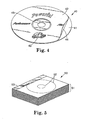
- Figure 4 illustrates a combination, generally indicated as 40, of a label 42 printed with alphanumerics and/or graphics 42 with an optical recording medium 41.
- the label 42 is adhered, adhesive side 44 to the non-read/write surface of the optical recording medium 41. If the initial application of the label 42 is not properly aligned with the center 45, the label can be removed and reapplied.
- Adhesive used in the invention has a selective adhesion between skin and disc surface - very low adhesion to skin but good adhesion to disc that allow a easy label application and reapplication if necessary to an end-user.
- Figure 5 illustrates a means of dispensing printable labels, generally indicated as 50, comprising a stack 51 of die-cut or perforated labels 52, wherein the stack 51 has a strip of adhesive 53 along the upper edge of each sheet in the stack 51.
- the die-cut labels 52 could be configured without the strip of adhesive, such that the stack 51 was similar to a standard pad of paper, wherein the stack 51 may be bounded on the side with a book binding adhesive or adhesive tape on the side.
- the stack 51 could be shaped, such as a circular CD shape, as opposed to the rectangular or regular geometric shape shown in Figure 5.
- Figure 6 illustrates another means of dispensing printable labels, generally indicated as 60, comprising a stack 61 of die-cut or perforated labels 63, wherein the stack 61 is placed into a convenient dispenser housing 62.
- both the stack 61 and the dispenser 62 can be shaped other than is shown in Figure 6.
- Figure 7 illustrates yet another means of dispensing printable labels comprising a roll, generally indicated as 70, wherein the die-cut label 73 is carried on a backing sheet 71.
- Each die-cut label 71, 73 can be separated at the perforated line 72.
- the die-cut label 71, 73 can be separated by cutting apart the individual sections, which could be indicated by a cutting line at 72, rather than a perforated line.
- the label 73 is perforated in the roll sheet 71 and delivered without a separated carrier sheet.
- Figure 8 illustrates a set of printed labels 81 on a carrier or a printed perforated label sheet, generally indicated as 80.
- the carrier could be a silicone release liner, a premarked sheet (template) or a sheet of printer/copier paper that would hold the labels to be printed, as they were processed through an inkjet or laser jet printer.
- Useful template sheets may include plastic film, such as polyester, polyolefin, and film with adhesion promoter.
- the repositionability of the labels of the present invention can be preprinted and used for personal and commercial use, such as for advertising, journaling and the like. Following are some examples of such a use of the labels. Specific configurations in no way limit the uses of such labels.
- a series of disc labels according to the invention was prepared.
- the adhesive composition used in the labels for each of the examples was prepared by mixing 40 grams of thermoplastic block copolymer elastomer and 100 grams of toluene in a glass jar on a roller mill until no undissolved thermoplastic block copolymer elastomer was visible. Total mixing time was longer than 12 hours.
- the adhesive composition solution was then coated onto matt side of a Glossy Digital Paper (commercially available from Japan Pulp & Paper (USA) Corporation, Stone Mountain, GA) using a knife coater configured with a coating gap that insured a dry adhesive coating thickness of about 75 ⁇ m. Once coated, the labels were dried for about 15 minutes at 70°C.
- the adhesive coated labels were further cut into 3 ⁇ 4 inch wide strips and laminated to various substrates to measure peel adhesion.
- the peel adhesion was measured right after the adhesive laminate was prepared on a I-MASS peel tester with 180 peel angle at 90 ipm stripping speed and followed by a ASTM method (ASTM-D3330/3330M, Test Method A, Volume 15.09, Summary 1.1.1).
- ASTM method ASTM-D3330/3330M, Test Method A, Volume 15.09, Summary 1.1.1
- Example 1 - 4 are control examples, wherein some commercially available CD labels were tested, including Fellows High Gloss CD Label 68644, Memorex Photo-Glass 3202-0415 CD Labels, Avery CD Label 5692, and Avery Removable CD Label 5931.
- the adhesive used in Examples 5 and 6 are Kraton type thermoplastic block copolymer elastomers. The instant peel adhesion was measured at various substrates, including CD disc (CD-R, P/N276791, commercially available); paper (CopyPlus, commercially available from International Paper, Memphis, TN), and polyethylene film. Pressure sensitive adhesives used in above CD label examples (Example 1-4) do not have selective adhesions between disc surface and paper. However, the label made with non-PSAs (Example 5 and 6) showed selective adhesion - high adhesion on disc surfaces comparing to very low adhesion to paper.
- Adhesive labels were prepared following the procedure described in conjunction with Examples 1 to 6 except that the Kraton thermoplastic block copolymer elastomer was coated on 50 ⁇ m thick polyethylene phthalate film (Hostaphan, commercially available from Mitsubishi Polyester, Greer, SC). The dry coating thicknesses of the adhesives were controlled at 50 ⁇ m. The peel adhesion was measured following the procedure described in Examples 1 to 6 except all the samples were dwelled on the substrates for 10 minutes before the cut labels were peeled.
- Adhesive labels were prepared following the procedure described in conjunction with Examples 7 to 30 except that the dry coating thickness was varied. The peel adhesion was measured following the procedure described in example 1 to 6 except that some samples were aged on discs at room temperature before they were peeled. All the data in Table 3 are peel adhesion from disc surfaces.
- Adhesive labels were prepared following the procedure described in conjunction with Examples 7 to 30 with the dry coating thickness being about 50 ⁇ m except that the thermoplastic block copolymer elastomers were blended. The peel adhesion was measured following the procedure described in Example 1 to 6.
- Examples Adhesive Peel Adhesion (g/in) Initial 10 minutes 30 minutes 60 minutes 47 100% G1657 23 18 34 47 48 75% G1657 25% D1107 124 158 187 201 49 50% G1657 50% D1107 325 374 480 457 50 25% G1657 75% D1107 396 665 1127 1469 51 100% D1107 1345 1073 2570 2842
Landscapes
- Chemical & Material Sciences (AREA)
- Chemical Kinetics & Catalysis (AREA)
- Organic Chemistry (AREA)
- Physics & Mathematics (AREA)
- General Physics & Mathematics (AREA)
- Engineering & Computer Science (AREA)
- Theoretical Computer Science (AREA)
- Adhesive Tapes (AREA)
- Adhesives Or Adhesive Processes (AREA)
- Paper (AREA)
Abstract
Description
- This invention relates to non-pressure sensitive adhesive coated labels and more particularly to non-pressure sensitive adhesive coated labels for optical recording media with repositionability.
- Optical discs, including CD, LD, VCD, DVD, CD-R, and DVD-R, are thin circular plastic discs with various functional layers, generally constructed of polycarbonate. The proliferation of optical discs has become extensive. In addition, in recent years, recordable or writable compact discs have grown in popularity. Further, these discs have been used for archival data storage, immediate distribution of data and for many demonstration purposes.
- Due to the popularity of optical discs, whether writable or read only, users find that they have more and more optical discs. Therefore, management of optical discs becomes a difficult job. Moreover, optical discs have very large data memory size, that is, users have to put identification on each disc to tell what data has been stored in the disc. Users may also value the ability to place customized graphics on each disc.
- With large numbers and mass marketing, discs can be screen printed to place the content information on company logos and alike on the non-writable/readable surface of these optical recording media.
- However, for single users or for small runs of discs, screenprinting is generally too cost prohibitive to be useful. Although ink marks may also be used to label discs, it is unattractive and can cause damage to the disc by scratching on the reflective layer during writing on the disc. Another known method of labeling a disc employs a direct printing using an ink jet system onto the disc surface. These systems provide a special carrier for the disc, which is printed using a conventional ink jet printer. Like direct hand marking, this method could damage disc by scratching disc surface, especially for discs lacking scratch resistance (bare discs without prelabels). Furthermore, this method may also bear ink smudging and running problems.
- Labeling discs with adhesive labels seems to be the best way to identify the discs, including both content information and personal identity.
- Many types of pressure sensitive adhesive (also referred to as "PSA") labels are known, including those are described by Satas (see Handbook of Pressure Sensitive Adhesive Technology, 3rd edition, D. Satas, 1999). Pressure Sensitive Adhesive labels for optical discs are also known. The disc labels have pressure sensitive adhesive precoated on one side, protected, and delivered with silicone release liners.
- Typically, disc labels have same shape (circular shape) and slightly smaller dimensions than the disc needing to be identified. They could be put onto a disc and hand-marked on the label to identify the disc. Even so, a single user may prefer to select a printable CD label and using appropriate software would configure such a label and print the CD label using a printer such as an inkjet printer or laser printer so that personalized information can be professionally put onto a disc.
- The challenge arises when a user has to put a pressure sensitive adhesive label onto a disc. Unlike conventional die-cut PSA labels for pricing, product identity, office and inventory information, and stamps, disc labels must be precisely positioned onto a disc. The ring structure of a disc label has to be well positioned on top of the ring structure of the disc. Mispositioning a label on the disc will not only result in poor appearance but may also cause a disc unbalance. Playing (or spinning) an unbalanced disc could further damage the disc (through scratching) or even damage the disc player.
- One way to prevent a disc label from being misaligned is to use an alignment device, such as those disclosed in U.S. Patent Nos. 6,196,290; 6,189,590; 6,168,841; 6,148,891; 5,715,934; and EPO 1015326; EPO 0855712; and JP11255223, but this requires additional devices. U.S. Patent No. 5,715, 934 disclosed a self-guiding disc label having a proper configuration that allows the label to be aligned on a disc by guiding the label with a jewel case. Although this eliminates the use of any additional or special devices, placing a sticky label onto the device or a jewel case loaded with a disc is still difficult for the user because such a sticky backside of the label tends to stay on user's fingers rather than on a device, thus making it unwieldy to position the label.
- Regardless of the currently available means of placing a CD label onto a CD, there still remains the fact that the adhesive on a majority of CD labels is a permanent, often aggressive adhesive layer. Thus, when one is placing a label, the user must get it right the first time or else.
- Removable labels (as disclosed in U.S. Patent No. 5,316,344) can be adhered and stay firmly in place and generally will remove cleanly. However, they are generally not repositionable, which means they are not reusable. Such removeability, while it allows the user to remove the label, damages the label, either by removal stress or by curl, and thus the user cannot remove the label and replace the label for alignment.
- Typically, conventional labels, whether using permanent or removable adhesive layers, including labels for optical discs, are delivered and packed with silicone release liners.
- Therefore, there is a great need to have a repositionable and reusable disc label, which allows a user to position the label to the disc without using any additional alignment devices or configurations. It is also a great desire in industry to make linerless labels.
- Briefly, one aspect of the present invention provides a label for applying to a polycarbonate surface comprising a film or paper layer coated with an ink receptive coating on one major surface and a layer of repositionable non-pressure sensitive adhesive coated onto the other major surface having a storage modulus at room temperature of less than 3 x 10⁵ Pascals.
- Advantageously, the repositionable adhesive is a low tack, non-pressure sensitive adhesive that allows the adhesive side of the label to be brought into contact using very light pressure with a polycarbonate surface and requires no significant force to break the bond between the adhesive layer of the label and that surface.
- Because of the nature of the adhesive layer, a printed label can be removed from the surface and repositioned, thus assuring the proper position of the label.
- In another aspect, a combination of optical recording medium and a printed label is provided comprising: an optical recording medium having a first major surface and a second major surface opposite the first major surface, the first major surface is the read/write surface and the second major surface is the non-read/write surface; and a printed label having a first major surface and a second major surface opposite the first major surface, the first major surface having an ink receptive layer printed with alphanumerics, graphics or a combination thereof onto the ink receptive layer and the second major surface having a layer of repositionable non-pressure sensitive adhesive.
- Advantageously, the non-pressure sensitive adhesive useful in the present invention demonstrates selective adhesions, that is, high adhesion to targeted surface but low adhesion to undesired surfaces. Finally, the non-pressure sensitive adhesive comprises a thermoplastic block copolymer elastomer. Typically, targeted surfaces are a smooth surface and include polycarbonate, polyester, glass, polyvinyl chloride or protective coating layers, such as polyacrylate and reflective coatings. Such surfaces are generally found on a variety of articles including in particular the surface of optical recording media. For example, when using rewritable optical recording device, the label can be removed and discarded, allowing a new label to be attached to the optical recording medium. Undesired surfaces typically include skin, clothing and conventional printing paper.
- A further embodiment of the present invention provides a label for applying to an optical recording media comprising a backing, a repositionable non-pressure sensitive adhesive having selective adhesion on one side of backing, optionally an ink receptive coating on another side of the backing to enhance ink printing quality or writing quality, and optionally, a primer coating between the backing and the adhesive layer to enhance the adhesive bonding to the backing. Such a configuration eliminates the need for a silicone release liner.
- Uniquely, because of the nature of the adhesive layer, a printed label can be removed from the optical recording medium surface and repositioned, thus assuring the proper position of the label on the optical recording media. Furthermore, when using a rewritable optical recording device, the label can be removed and discarded, allowing a new label to be attached to the optical recording medium.
- The invention further describes a method of identifying an optical disc, comprising the steps of:
- (a) providing a optical disc
- (b) choosing a label with matched shape and size
- (c) optionally creating a graphic and/or content design on a computer and printing such design on a printer
- (d) positioning the label with realignment if necessary and applying the label onto the disc
- (e) optionally, hand marking onto the label.
- Fig.1 is a side view of an adhesive coated back sheet.
- Fig. 2a is a side view of an adhesive coated sheeting with a printed graphic on the opposing major surface.
- Fig. 2b is a side view of an adhesive coated sheeting with an ink receptive layer on the opposing major surface.
- Fig. 3 is a side view of the adhesive coated back sheet having an additional primer layer between the adhesive coating and the back sheet.
- Fig. 4 is a perspective view of a printed label attached to the non-readable side of an optical recording medium.
- Fig. 5 is a perspective view of a stack of dispensable labels.
- Fig. 6 is a perspective view of an alternative dispensing means.
- Fig. 7 is a perspective view of a roll of dispensable labels.
- Fig. 8 is a perspective view of two printed labels on a carrier sheet.
- The invention relates to a new class of adhesive labels having a repositionable non-pressure sensitive adhesive that exhibits selective adhesion such that there is essentially no adhesion to paper but instant adhesion to targeted surfaces (such as polycarbonate of an optical recording media). Thus, such labels offer repositionability, which in turn permits easy and aligned positioning of the label. Furthermore, the labels of present invention eliminate the need for silicone release liners. The labels usually have the same shape and slightly smaller dimensions as the discs, although this is not necessary. The labels of the present invention generally comprise, a backing and a layer of repositionable non-pressure sensitive adhesive and are illustrated by the following figures.
- Figure 1 shows a side view of the core configuration, generally indicated as 10 of the repositionable label of the present invention, which is composed of a
backing 11 and a layer of repositionable non-pressuresensitive adhesive 12. -
Useful backings 11 for the application include papers, films, metallized papers, metallized films, foils, synthetic fabrics, non-wovens, and synthetic papers, for example Tyvek™. Useful examples for papers include uncoated paper, such as, micro-fiber uncoated paper and paper with ink reception coating on the opposite of the paper backing (coated paper), fiber board, cardstock and the like. Coated paper may be cast coated, gloss coated, and matte coated. Useful examples for films include polyvinyl chloride (vinyl film), polyester, polypropylene, polyethylene, polystyrene, acetate, and multilayer films. Backing choices may also depend on a choice of printers. For example, polyolefin films, such as polyethylene film and polypropylene film, may not be good choices of backings for toner and thermal wax type printers because the hot drum in the printer may soften the films. Like paper backing, film backing may also be coated with an ink reception layer on the opposite of the film. - Preferably, repositionable adhesive 12 exhibits a low adhesion to skin or to paper but good adhesion to targeted surfaces. Low adhesion to skin is generally referred to as "low tack".
- Suitable adhesives that could provide "selective adhesion" might be a homopolymer, a random copolymer, a graft copolymer, and a block copolymer. It may be crosslinked or uncrosslinked. Specific examples of the adhesives include a thermoplastic block copolymer elastomer. Adhesives used with conventional labels, including CD labels, are all pressure sensitive adhesives, that display permanent and/or aggressive tackiness to a wide variety of substrates, including skin and paper, after applying only light pressure. Those adhesives are also commonly called "tacky" adhesives. An accepted quantitative description of a pressure sensitive adhesive is given by the Dahlquist criterion, which indicates that materials having a storage modulus (G') of less than about 3x10⁵ Pascals (measured at 10 radians/second at room temperature, about 20° to 22° C) have pressure sensitive adhesive properties while materials having a G' in excess of this value do not. Thus, more specifically, a repositionable non-PSA with selective adhesion, also called as "low-tack" adhesive, or sometimes "non-tacky" adhesive, as used herein, refers to an adhesive that has a storage modulus at least above the Dahlquist criterion line (> 3x10⁵ Pascals).
- Additional discussion regarding the adhesives and the compositions for various tape applications may be found in a number of publications. For example, EP0443263 discloses a general tape construction with a low tack or non-tacky adhesive; U.S. Patent No. 5,851,664 discloses a semiconductor wafer processing tape with a low tack or a non-tacky adhesive; U.S. Patent Nos. 5,888,335, 5,908,695, and 6,004,670 each discloses a releasable fastener with a low tack or non-tacky adhesive; and U.S. Patent No. 6,099,682 discloses a package sealing tape with a low tack or non-tacky adhesive.
- Thermoplastic block copolymer elastomer refers to a copolymer of segmented A and B blocks or segments and which displays both thermoplastic and elastomeric behavior. Thermoplastic block copolymer elastomers useful in the invention include multi-block copolymers having radial, linear A-B diblock, and linear A-B-A triblock structures, as well as blends of these materials. A wide variety of commercially available thermoplastic block copolymer elastomers may be used (either alone or in combination) in the invention including the SOLPRENE family of materials (from Philips Petroleum Co.), the FINAPRENE family of materials (FINA), the TUFPRENE and ASAPRENE family of materials (Asahi), the STEREON family of materials (Firestone Synthetic Rubber & Latex Co.), the EUROPRENE SOL T family materials (Enichem), the VECTOR family of materials (Dexco polymers), and the CARIFLEX TR family of materials (Shell Chemical Co.). Also useful is silicone polyurea elastomer (U.S. Patent No. 5,670,598), the SEPTON family of materials (Kuraray Co. Ltd.) and the KRATON family of materials (Shell Chemical Co.), such as D-1101, D-1102, D-1107, D-1111, D1112, D-1113, D-1114PX, D-1116, D-1117, D-1118, D-1119, D-1122X, D-1124, D-1125PX, D-1160, D-1165, D-1161, D-1184, D-1193, D-1300, D-1320X, D-4141, D-4158, D-4433, RP-6485, RP-6409, RP-6614, RP-6906, RP-6912, G-1650, G-1651, G-1652, G-1654, G-1657, G-1701, G-1702, G-1726, G-1730, G-1750, G-1765, G-1780, FG-1901, FG1921, FG-1924, and TKG-101. Mixtures of any of the above thermoplastic block copolymer elastomers are also permissible. In general; KRATONS are preferred.
- Various other materials may be incorporated into the adhesive materials. For example, tackifiers or liquid rubbers may be used to modify the adhesion level, quick stick level, and/or viscosity of adhesive coating solutions. Additionally, fillers, pigments plasticizers, antioxidants, UV stabilizers, photo crosslinkers, and so forth may be also employed.
- Tackifiers useful in the repositionable non-pressure sensitive adhesives are typically low molecular weight materials and are usually compatible with the thermoplastic block copolymer elastomer, by which it is meant that there is no visible evidence of phase separation of these components at room temperature. Examples of commercially available tackifiers include Wingtack95 and Wingtack 115 (from Goodyear Tire and Rubber Co.); Regarlrez 1078, Regalrez 1094, and Regalrez 1126 (from Hercules Chemical Co. Inc.); Akron P115 (from Arakawa Forest Chemical Industries); Escorez (from Exxon Chemical Co.); and Foral 85 and Foral 105 (from Hercules Chemical Co., Inc.).
- If added, the effective amounts of these additive materials may be varied as to provide a repositionable non-pressure sensitive adhesive that exhibits an adhesion in the range of 3 to 40 oz/inch to targeted surfaces and a low adhesion of less than 8 oz/inch to undesired surfaces. Typically, targeted surfaces are a smooth surface and include polycarbonate, polyester, glass, polyvinyl chloride or protective coating layers, such as polyacrylate and reflective coatings. Undesired surfaces typically include skin, clothing and conventional printing paper.
- Photocrosslinkers suitable for the invention include aldehydes, such as benzaldehyde, acetaldehyde, and their substituted derivatives; ketones such as acetophenone, benzophenone and substituted derivatives such as Sandoray 1000 (Sandoz Chemicals, Inc.); quinones such as the benzoquinones, anthraquinone and their substituted derivatives; thioxanthones such as 2-isopropylthioxanthone and 2-dodecylthioxanthone; and certain chromophore substituted halomethyl-sym-triazines such as 2,4-bis-(trichloromethyl)-6-(3',4'-dimethoxyphenyl)-sym-triazine.
- Figures 2a and 2b show a side view of the core configuration with the additional layers, generally indicated as 20 and 200, respectively. On the
adhesive layer 22 is arelease liner 23. On the opposite side of the backing 21 (the side opposite the adhesive layer 22) is an inkreceptive layer 24. - The label construction shown in Figure 2a can be inserted into an inkjet printer or a laser jet printer. Alphanumerics and graphics, generally referred to as 26, can be printed onto the ink receptive portion of the label. The printer mechanism is protected from the
adhesive layer 22 by therelease liner 23. Once thelabel 200 is printed, therelease liner 23 can be discarded. Advantageously, the release liner could be a standard silicone-type release liner, but it could also be a piece of paper, such as a standard copier or printer paper. If therelease liner 23 is standard paper, once the label is printed, the paper can be "recycled" and used in the printer for regular printing, or can be discarded into a recycle bin, without environmental concerns generally associated with silicone-type release liners. The useful examples ofrelease liner 23 may also include polyolefin coated papers, such as polyethylene coated paper and films, such as PE and PP films. - An ink reception layer is typically a water-absorbing layer that has a blend of crosslinked, water absorbing polymer particles, a water insoluble binder polymer, and optionally, inert organic or inorganic particles that impart a matte finish on at least one major surface of the substrate. The preferred water-absorbing particle is crosslinked polyvinyl pyrollidone. The preferred water insoluble binder polymer comprises acrylate and acrylate/styrene copolymers containing ammonia neutralized acrylic acid or methacrylic acid groups. The inert particles can be silica or other inorganic particle or can also be organic pigments imparting a color to the coating. Useful examples of ink reception layer formulations may include Imprintable Overprint Varnishes (commercially available from Sun Chemicals as OVP-NLJGW0830337 and OVP-RCIFV0482192).
- Figure 3 illustrates a core configuration, generally referred to as 30, wherein there is an
additional layer 33 between thebacking layer 31 and theadhesive layer 32. Theadditional layer 33 could be a primer layer, a barrier layer, or any kind of layer that would be typically used by someone skilled in the art of making adhesive coated articles. - A primer layer between backing and adhesive can be used to enhance adhesive anchorage onto the backing. Although chemical priming may be used in the invention, physical priming on the backing, especially for film backing or film coated paper backing, including Corona, flame, ozone, and plasma treatment, is generally preferred. Such processes for physical priming are generally known to those skilled in the art.
- Barrier coating may also be needed, especially when a paper backing is used. Typical barrier coatings are thin polymer coatings, including polyethylene, polypropylene, and PET. It is found that a barrier coating makes a rough backing smoother, which in turn enhances adhesion of the adhesive on desired surfaces. Further, adhesives may be microstructured to modify peel adhesion. For example, the adhesive could be pattern-coated onto a backing or the adhesive could be coated onto a microstructured liner:
- Figure 4 illustrates a combination, generally indicated as 40, of a
label 42 printed with alphanumerics and/orgraphics 42 with anoptical recording medium 41. Once thelabel 42 is printed, thelabel 42 is adhered,adhesive side 44 to the non-read/write surface of theoptical recording medium 41. If the initial application of thelabel 42 is not properly aligned with thecenter 45, the label can be removed and reapplied. Adhesive used in the invention has a selective adhesion between skin and disc surface - very low adhesion to skin but good adhesion to disc that allow a easy label application and reapplication if necessary to an end-user. - Figure 5 illustrates a means of dispensing printable labels, generally indicated as 50, comprising a
stack 51 of die-cut orperforated labels 52, wherein thestack 51 has a strip of adhesive 53 along the upper edge of each sheet in thestack 51. Alternatively, the die-cutlabels 52 could be configured without the strip of adhesive, such that thestack 51 was similar to a standard pad of paper, wherein thestack 51 may be bounded on the side with a book binding adhesive or adhesive tape on the side. Furthermore, thestack 51 could be shaped, such as a circular CD shape, as opposed to the rectangular or regular geometric shape shown in Figure 5. - In such pad configuration, no release liner is required although it may be used.
- Figure 6 illustrates another means of dispensing printable labels, generally indicated as 60, comprising a
stack 61 of die-cut orperforated labels 63, wherein thestack 61 is placed into aconvenient dispenser housing 62. Once again, both thestack 61 and thedispenser 62 can be shaped other than is shown in Figure 6. - Figure 7 illustrates yet another means of dispensing printable labels comprising a roll, generally indicated as 70, wherein the die-
cut label 73 is carried on abacking sheet 71. Each die-cut label perforated line 72. Alternatively, the die-cut label label 73 is perforated in theroll sheet 71 and delivered without a separated carrier sheet. - Figure 8 illustrates a set of printed
labels 81 on a carrier or a printed perforated label sheet, generally indicated as 80. The carrier could be a silicone release liner, a premarked sheet (template) or a sheet of printer/copier paper that would hold the labels to be printed, as they were processed through an inkjet or laser jet printer. Useful template sheets may include plastic film, such as polyester, polyolefin, and film with adhesion promoter. - Advantageously, the repositionability of the labels of the present invention can be preprinted and used for personal and commercial use, such as for advertising, journaling and the like. Following are some examples of such a use of the labels. Specific configurations in no way limit the uses of such labels.
- Various modifications and alterations of this invention will become apparent to those skilled in the art without departing from the scope and principles of this invention, and it should be understood that this invention is not to be unduly limited to the illustrative embodiments set forth hereinabove.
- Further embodiments of the invention are found in the following examples, but the invention is not limited by the examples.
- A series of disc labels according to the invention was prepared. The adhesive composition used in the labels for each of the examples was prepared by mixing 40 grams of thermoplastic block copolymer elastomer and 100 grams of toluene in a glass jar on a roller mill until no undissolved thermoplastic block copolymer elastomer was visible. Total mixing time was longer than 12 hours. The adhesive composition solution was then coated onto matt side of a Glossy Digital Paper (commercially available from Japan Pulp & Paper (USA) Corporation, Stone Mountain, GA) using a knife coater configured with a coating gap that insured a dry adhesive coating thickness of about 75µm. Once coated, the labels were dried for about 15 minutes at 70°C.
- The adhesive coated labels were further cut into ¾ inch wide strips and laminated to various substrates to measure peel adhesion. The peel adhesion was measured right after the adhesive laminate was prepared on a I-MASS peel tester with 180 peel angle at 90 ipm stripping speed and followed by a ASTM method (ASTM-D3330/3330M, Test Method A, Volume 15.09, Summary 1.1.1). The control samples, some commercially available CD labels, were also tested and the data are recorded in Table 1.
Table 1 Example Adhesive Instant Peel Adhesion Source Type % Styrene Substrate Adhesion (g/in) Observation 1 Fellowes PSA CD Disc N/A Not peelable Paper N/A Not peelable PE N/A Not peelable 2 Memorex PSA CD Disc N/A Not peelable Paper N/A Not peelable PE 1134 Not peelable 3 Avery PSA CD Disc N/A Not peelable Paper N/A Not peelable PE N/A Not peelable 4 Avery PSA CD Disc 170 Clean peel Removable Paper 167 Clean peel PE 83 Clean peel 5 Kraton SIS 14% CD Disc 1670 Clean peel D 1107 Paper 17 Clean peel PE 16 Clean peel 6 Kraton G SEBS 13 % CD Disc 73 Clean peel 1657 Paper 0 Clean peel PE 11 Clean peel - Example 1 - 4 are control examples, wherein some commercially available CD labels were tested, including Fellows High Gloss CD Label 68644, Memorex Photo-Glass 3202-0415 CD Labels, Avery CD Label 5692, and Avery Removable CD Label 5931. The adhesive used in Examples 5 and 6 are Kraton type thermoplastic block copolymer elastomers. The instant peel adhesion was measured at various substrates, including CD disc (CD-R, P/N276791, commercially available); paper (CopyPlus, commercially available from International Paper, Memphis, TN), and polyethylene film. Pressure sensitive adhesives used in above CD label examples (Example 1-4) do not have selective adhesions between disc surface and paper. However, the label made with non-PSAs (Example 5 and 6) showed selective adhesion - high adhesion on disc surfaces comparing to very low adhesion to paper.
- Adhesive labels were prepared following the procedure described in conjunction with Examples 1 to 6 except that the Kraton thermoplastic block copolymer elastomer was coated on 50µm thick polyethylene phthalate film (Hostaphan, commercially available from Mitsubishi Polyester, Greer, SC). The dry coating thicknesses of the adhesives were controlled at 50µm. The peel adhesion was measured following the procedure described in Examples 1 to 6 except all the samples were dwelled on the substrates for 10 minutes before the cut labels were peeled.
- All the Kraton thermoplastic block copolymer elastomers used in this invention showed non-pressure sensitive adhesive properties, having relatively high adhesion to optical discs but relatively low adhesion to paper as shown in Table 2.
Table 2 Example Thermoplastic Adhesive Peel Adhesion Tradename Type %Styrene Substrate Peel (g/in) 7 Kraton D1107P SIS 15 Disc 1073 8 Kraton D1107P SIS 15 Paper 12 9 Kraton D1111 SIS 22 Disc 1644 10 Kraton D1111 SIS 22 Paper 13 11 Kraton D1193 SIS 24 Disc 1137 12 Kraton D 1193 SIS 24 Paper 3 13 Kraton G1780 SEPS 7 Disc 35 14 Kraton G 1780 SEPS 7 Paper 0 15 Kraton G1652 SEBS 30 Disc 219 16 Kraton G1652 SEBS 30 Paper 0 17 Kraton G1657 SEBS 13 Disc 154 18 Kraton G 1657 SEBS 13 Paper 0 19 Kraton G1650 SEBS 30 Disc 360 20 Kraton G1650 SEBS 30 Paper 0 21 Kraton G 1726 SEBS 30 Disc 10 22 Kraton G1726 SEBS 30 Paper 0 23 Kraton 1101 SBS 31 Disc 858 24 Kraton 1101 SBS 31 Paper 0 25 Kraton 1118 SBS 31 Disc 892 26 Kraton 1118 SBS 31 Paper 0 27 Kraton 1122 SBS 39 Disc 517 28 Kraton 1122 SBS 39 Paper 0 29 Kraton RP6918 SEPS 35 Disc 790 30 Kraton RP6918 SEPS 35 Paper 12 - Adhesive labels were prepared following the procedure described in conjunction with Examples 7 to 30 except that the dry coating thickness was varied. The peel adhesion was measured following the procedure described in example 1 to 6 except that some samples were aged on discs at room temperature before they were peeled. All the data in Table 3 are peel adhesion from disc surfaces.
Table 3 Example Adhesive Thickness (µm) Peel Adhesion Instant 7 Day 14 day 31 G1652 12.5 81 224 362 32 G1652 25 29 404 343 33 G1652 58 36 208 502 34 G1652 75 59 374 257 35 G1726 12.5 4 2 14 36 G1726 25 3 4 5 37 G1726 58 10 16 8 38 G1726 75 7 12 7 39 G1650 12.5 176 571 574 40 G1650 25 453 869 794 41 G1650 58 374 1096 884 42 G1650 75 333 1281 608 43 G1657 12.5 31 737 703 44 G1657 25 17 631 619 45 G1657 58 8 291 269 46 G1657 75 8 215 185 - Adhesive labels were prepared following the procedure described in conjunction with Examples 7 to 30 with the dry coating thickness being about 50µm except that the thermoplastic block copolymer elastomers were blended. The peel adhesion was measured following the procedure described in Example 1 to 6.
Examples Adhesive Peel Adhesion (g/in) Initial 10 minutes 30 minutes 60 minutes 47 100 % G1657 23 18 34 47 48 75% G1657 25% D1107 124 158 187 201 49 50 % G1657 50% D1107325 374 480 457 50 25% G1657 75% D1107 396 665 1127 1469 51 100% D1107 1345 1073 2570 2842
Claims (18)
- A repositionable label comprising:(a) a backing having two major surfaces and(b) a layer of repositionable non-pressure sensitive adhesive comprising a thermoplastic block copolymer elastomer coated onto at least one major surface of the backing, wherein the adhesive has a storage modulus at room temperature greater than 3x10⁵ Pascals.
- The repositionable label according to claim 1 wherein the block copolymer has styrene block
- The repositionable label according to claim 2 wherein the block copolymer has 10% to 30% styrene block
- The repositionable label according to any of claims 1 to 3 wherein the adhesion of the repositionable non-pressure sensitive adhesive is greater than 3 oz/inch on a targeted surface and is less than 3 oz/inch on an undesired surface.
- The repositionable label according to claim 4 wherein the adhesion to the targeted surfaces is in the range 5-40 ounce/inch.
- The repositionable label according to claim 5 wherein the targeted surfaces include but are not limited to polycarbonate, polyvinyl chloride, polyester, or glass.
- The repositionable label according to claim 6 wherein the target surface is the surface of non-reading side of an optical recording media.
- The repositionable label according to any of claims 1 to 7 wherein the backing is a polyester film, polyolefin film, paper, coated paper, metallized film, foil, non-wovens and cardstock.
- The repositionable label according to any of claims 4 to 8 wherein the undesired surfaces comprises skin and paper.
- The repositionable label according to any of claims 4 to 9 wherein the adhesive has an adhesion range of 3 to 40 oz/inch when adhered to the non-read/write surface of an optical recording medium and an adhesion of less than 8 oz/inch when adhered to standard white paper having a standard weight of 20/50 lbs.
- The repositionable label according to any of claims 4 to 10 wherein the adhesion range on a disc surface is 5-10 oz/inch and preferred adhesion range on paper and skin is less than 1 oz/inch.
- The repositionable label according to claim 1, which is a label for an optical disc.
- The repositionable label according to claim 1 comprising:(a) a backing having a first major surface and a second major surface opposite the first major surface,(b) an ink receptive coating coated onto the first major surface, and(c) a repositionable non-pressure sensitive adhesive coated onto the second major surface,wherein the printable label can be adhered and removed from the non-read/write surface of an optical recording medium.
- The repositionable label according to claim 13 wherein the backing is a polyester film, polyolefin film, paper, coated paper, metallized film, foil, non-wovens and cardstock.
- In combination,(a) an optical recording medium having a first major surface and a second major surface opposite the first major surface, the first major surface is the read/write surface and the second major surface is the non-read/write surface; and(b) a printed label having a first major surface and a second major surface opposite the first major surface, the first major surface having an ink receptive layer printed with alphanumerics, graphics or a combination thereof onto the ink receptive layer and the second major surface having a layer of respositionable non-pressures sensitive adhesive.
- The combination according to claim 15 wherein the repositionable non-pressure sensitive adhesive is a low tack adhesive and has an adhesion range in the range of 3 to 40 oz/inch on targeted surfaces.
- The combination according to claim 15 or 16 wherein the low tack adhesive has an adhesion range of less than 8 oz/inch when adhered to standard white paper having a standard weight of 20/50 lbs.
- The repositionable label according to any of claims 15 to 17 wherein the backing is a polyester film, polyolefin film, paper, coated paper, metallized film, foil, non-wovens and cardstock
Applications Claiming Priority (3)
| Application Number | Priority Date | Filing Date | Title |
|---|---|---|---|
| US849147 | 1986-04-07 | ||
| US09/849,147 US6884504B2 (en) | 2001-05-04 | 2001-05-04 | Repositionable adhesive label for optical recording media |
| PCT/US2002/003466 WO2002090456A1 (en) | 2001-05-04 | 2002-02-05 | Repositionable adhesive label for optical recording media |
Publications (2)
| Publication Number | Publication Date |
|---|---|
| EP1387872A1 EP1387872A1 (en) | 2004-02-11 |
| EP1387872B1 true EP1387872B1 (en) | 2006-09-27 |
Family
ID=25305174
Family Applications (1)
| Application Number | Title | Priority Date | Filing Date |
|---|---|---|---|
| EP02713547A Expired - Lifetime EP1387872B1 (en) | 2001-05-04 | 2002-02-05 | Repositionable adhesive label for optical recording media |
Country Status (7)
| Country | Link |
|---|---|
| US (1) | US6884504B2 (en) |
| EP (1) | EP1387872B1 (en) |
| JP (1) | JP2004527795A (en) |
| KR (1) | KR20040043118A (en) |
| AT (1) | ATE340833T1 (en) |
| DE (1) | DE60214998D1 (en) |
| WO (1) | WO2002090456A1 (en) |
Families Citing this family (25)
| Publication number | Priority date | Publication date | Assignee | Title |
|---|---|---|---|---|
| US6884504B2 (en) * | 2001-05-04 | 2005-04-26 | 3M Innovative Properties Company | Repositionable adhesive label for optical recording media |
| US20040185192A1 (en) * | 2001-10-23 | 2004-09-23 | Hiroshi Tsuji | Image-recordable, image-recording medium and adhesive sheet structure |
| JP2004079052A (en) * | 2002-08-14 | 2004-03-11 | Fuji Photo Film Co Ltd | Method for punching stacked sheet material, and method for manufacturing optical disk |
| US7172670B2 (en) * | 2002-12-06 | 2007-02-06 | Quality Assured Enterprises, Inc. | Single-pass, in-line process for manufacturing multi-part articles |
| US7036736B2 (en) * | 2003-01-08 | 2006-05-02 | Hoss Sarbaz | Event entry and advertising medium |
| USD537478S1 (en) * | 2004-03-17 | 2007-02-27 | Brother Industries, Ltd. | Tape for a tape printer |
| US20050258636A1 (en) * | 2004-05-20 | 2005-11-24 | Bova Antonio V | Patient privacy label and method of using same |
| US9326895B1 (en) * | 2005-02-10 | 2016-05-03 | James M. Winey | Protective napkin |
| US20070071945A1 (en) * | 2005-09-29 | 2007-03-29 | Schalk Wesley R | System and method for forming gloss and matte transparent labels from a common film and emulsion set |
| US8168279B2 (en) * | 2005-09-29 | 2012-05-01 | Hewlett-Packard Development Company, L.P. | System and method for forming labels |
| WO2008109733A1 (en) * | 2007-03-07 | 2008-09-12 | 3M Innovative Properties Company | Adhesive-backed polymeric film storage method and assembly |
| US10010739B2 (en) * | 2011-09-02 | 2018-07-03 | P.T. ROM And Associates LLC | Low friction rehabilitation board with an integral band retaining feature and methods of rehabilitation |
| US9821184B1 (en) * | 2011-09-02 | 2017-11-21 | P.T. ROM And Associates LLC | Low friction rehabilitation board with an integral band retaining feature and methods of rehabilitation |
| US10363450B2 (en) * | 2011-09-02 | 2019-07-30 | P.T. ROM And Associates LLC | Low friction rehabilitation board with an integral band retaining feature and methods of rehabilitation |
| US9737748B1 (en) * | 2011-09-02 | 2017-08-22 | P.T. ROM And Associates LLC | Low friction rehabilitation board with an integral band retaining feature |
| US10245705B2 (en) | 2014-11-07 | 2019-04-02 | 3M Innovative Properties Company | Printed abrasive article |
| BR112017011164B1 (en) | 2014-11-26 | 2021-10-05 | 3M Innovative Properties Company | ABRASIVE ARTICLE, ABRASIVE ASSEMBLY AND METHOD FOR ITS USE |
| WO2016209651A1 (en) | 2015-06-22 | 2016-12-29 | 3M Innovative Properties Company | Abrasive articles, assemblies, and methods with gripping material |
| US20180344216A1 (en) * | 2015-12-01 | 2018-12-06 | Pinpoint Biomechanics Holding Ivs | Indication Device |
| CN105563973A (en) * | 2016-02-29 | 2016-05-11 | 东莞中世拓实业有限公司 | A low-viscosity self-venting advertising film |
| CH713579A1 (en) * | 2017-03-17 | 2018-09-28 | Fgp Capital Sa | System comprising an ice cream or a screen. |
| AU2020333250B2 (en) * | 2019-08-20 | 2023-08-10 | 3M Innovative Properties Company | Film including hybrid solvent barrier and primer layer |
| WO2024163414A1 (en) | 2023-01-30 | 2024-08-08 | 3M Innovative Properties Company | Mesh abrasive article with slit patterns and method of making the same |
| EP4512382A1 (en) | 2023-08-25 | 2025-02-26 | Lohmann-koester | Mechanical diaper closure tape, semi-finished tape and diaper |
| WO2026071207A1 (en) * | 2024-09-30 | 2026-04-02 | 積水化学工業株式会社 | Adhesive tape and electronic device |
Family Cites Families (32)
| Publication number | Priority date | Publication date | Assignee | Title |
|---|---|---|---|---|
| US3705908A (en) | 1971-06-28 | 1972-12-12 | Minnesota Mining & Mfg | Process for preparing 2-formyl-2-lower alkyl 1,3-dithiolanes and 1,3-dithianes |
| US4833193A (en) | 1987-08-14 | 1989-05-23 | Sieverding David L | Novel pressure sensitive adhesives |
| US5027465A (en) * | 1988-06-20 | 1991-07-02 | Mckay Nicholas D | Lint remover |
| US6004670A (en) | 1989-10-26 | 1999-12-21 | Minnesota Mining And Manufacturing Company | Multiple releasable contact responsive fasteners |
| US5888335A (en) | 1989-10-26 | 1999-03-30 | Minnesota Mining And Manufacturing Company | Multiple releasable contact responsive fasteners |
| CA2032125A1 (en) | 1990-02-22 | 1991-08-23 | John A. Miller | Repositionable adhesive tape |
| US5316344C1 (en) | 1992-07-31 | 2002-01-08 | Avery Dennison Corp | Stationery with removable printable labels and method therefor |
| US5670598A (en) | 1995-03-24 | 1997-09-23 | Minnesota Mining And Manufacturing Company | Diblock and triblock polydiorganosiloxane-polyurea block copolymers |
| US5715934A (en) | 1995-06-07 | 1998-02-10 | Avery Dennison | CD-ROM label with positioning means |
| TW311927B (en) * | 1995-07-11 | 1997-08-01 | Minnesota Mining & Mfg | |
| US5648136A (en) | 1995-07-11 | 1997-07-15 | Minnesota Mining And Manufacturing Co. | Component carrier tape |
| US5851644A (en) | 1995-08-01 | 1998-12-22 | Loctite (Ireland) Limited | Films and coatings having anisotropic conductive pathways therein |
| US6309727B1 (en) | 1996-02-29 | 2001-10-30 | Wea Manufacturing, Inc. | Coating for optical discs |
| JPH1035767A (en) | 1996-05-23 | 1998-02-10 | Masanobu Muto | Container body of disc for record media |
| US5770289A (en) | 1996-11-13 | 1998-06-23 | Tracy; Peter | Die cut self-adhesive label sheet for labeling CD-ROMS |
| US5715493A (en) | 1997-01-08 | 1998-02-03 | Eastman Kodak Company | Apparatus and electronic camera and associated printer with light tight storage receptacle |
| DE29701108U1 (en) | 1997-01-24 | 1997-03-13 | Herlitz PBS AG Papier-, Büro- und Schreibwaren, 13507 Berlin | Device for applying stickers to storage disks, such as CD's or CD-ROM's |
| US6014788A (en) * | 1997-09-03 | 2000-01-18 | Rubina Jaffri | Lint roller |
| US5958177A (en) | 1997-09-16 | 1999-09-28 | Claussnitzer; Werner | Labelling device |
| US6099682A (en) | 1998-02-09 | 2000-08-08 | 3M Innovative Properties Company Corporation Of Delaware | Cold seal package and method for making the same |
| JPH11238255A (en) | 1998-02-21 | 1999-08-31 | Taiyo Yuden Co Ltd | Optical disk |
| JPH11255223A (en) | 1998-03-06 | 1999-09-21 | Kao Corp | Label sticking device |
| JPH11321958A (en) | 1998-05-14 | 1999-11-24 | Oji Kako Kk | Compact disk storage file |
| US6168841B1 (en) | 1998-05-29 | 2001-01-02 | Yao-Kuo Chen | Label adapted for use on optical disks |
| TW386521U (en) | 1998-06-18 | 2000-04-01 | Tsai Wen Feng | Improvement of labeling device for CD, optical disk |
| GB2339417B (en) | 1998-07-11 | 2002-10-09 | Boma Technology Co Ltd | CD labeling device |
| US6196290B1 (en) | 1998-08-27 | 2001-03-06 | Neato, Llc | Disk labeling device |
| JP2000128265A (en) | 1998-10-27 | 2000-05-09 | Kyushu Hitachi Maxell Ltd | Storage media disk storage |
| US6441114B1 (en) | 1999-06-11 | 2002-08-27 | 3M Innovative Properties Company | Adhesives for use on fluorine-containing or polycarbonate surfaces |
| US6463026B1 (en) * | 1999-09-02 | 2002-10-08 | Digital Innovations, L.L.C. | Optical disc label |
| US6210524B1 (en) * | 1999-09-03 | 2001-04-03 | Avery Dennison Corporation | Method of improving peel-plate dispensability of label constructions |
| US6884504B2 (en) * | 2001-05-04 | 2005-04-26 | 3M Innovative Properties Company | Repositionable adhesive label for optical recording media |
-
2001
- 2001-05-04 US US09/849,147 patent/US6884504B2/en not_active Expired - Fee Related
-
2002
- 2002-02-05 AT AT02713547T patent/ATE340833T1/en not_active IP Right Cessation
- 2002-02-05 EP EP02713547A patent/EP1387872B1/en not_active Expired - Lifetime
- 2002-02-05 JP JP2002587524A patent/JP2004527795A/en not_active Withdrawn
- 2002-02-05 KR KR10-2003-7014310A patent/KR20040043118A/en not_active Withdrawn
- 2002-02-05 DE DE60214998T patent/DE60214998D1/en not_active Expired - Lifetime
- 2002-02-05 WO PCT/US2002/003466 patent/WO2002090456A1/en not_active Ceased
Also Published As
| Publication number | Publication date |
|---|---|
| US6884504B2 (en) | 2005-04-26 |
| JP2004527795A (en) | 2004-09-09 |
| DE60214998D1 (en) | 2006-11-09 |
| EP1387872A1 (en) | 2004-02-11 |
| WO2002090456A1 (en) | 2002-11-14 |
| KR20040043118A (en) | 2004-05-22 |
| ATE340833T1 (en) | 2006-10-15 |
| US20020192465A1 (en) | 2002-12-19 |
Similar Documents
| Publication | Publication Date | Title |
|---|---|---|
| US6884504B2 (en) | Repositionable adhesive label for optical recording media | |
| JP4915920B2 (en) | Tire adhesive sheet | |
| JP2011149033A (en) | Method of manufacturing adhesive sheet for tire | |
| US10793751B2 (en) | Pressure-sensitive adhesive, and self-adhesive products and composites comprising the latter | |
| JPH04351685A (en) | Peelable adhesive tape | |
| WO2009154177A1 (en) | Electrostatic attracting sheet | |
| AU6898596A (en) | Blended pressure-sensitive adhesives | |
| KR20050100696A (en) | Label stock with improved die-cutting performance | |
| US20090312483A1 (en) | Pressure sensitive adhesive | |
| EP0401509A1 (en) | Single side repositionable transfer tape | |
| US6287661B1 (en) | Label for optical disks and optical disk adhered with the label | |
| JP2002194301A (en) | Double adhesive tape | |
| US20030044559A1 (en) | Articles for optical recording media and method for securing the same | |
| JP5346220B2 (en) | Adhesive and adhesive sheet | |
| JP4686689B2 (en) | Hand-held transfer type pressure sensitive adhesive tape transfer tool | |
| JP3565527B2 (en) | Record sheet | |
| JPH09235524A (en) | Surface protection film | |
| JP2003103682A (en) | Laminated sheet | |
| EP0581244B1 (en) | Transfer film | |
| JP4215527B2 (en) | Self-adhesive film laminated with flexible polymer | |
| JP4771613B2 (en) | Adhesive sheet | |
| JP4068402B2 (en) | Scratch card | |
| JPH05247416A (en) | Self-adhesive sheet | |
| JP4307859B2 (en) | Pressure sensitive adhesive sheet | |
| JPH07137487A (en) | Transfer foil |
Legal Events
| Date | Code | Title | Description |
|---|---|---|---|
| PUAI | Public reference made under article 153(3) epc to a published international application that has entered the european phase |
Free format text: ORIGINAL CODE: 0009012 |
|
| 17P | Request for examination filed |
Effective date: 20031203 |
|
| AK | Designated contracting states |
Kind code of ref document: A1 Designated state(s): AT BE CH CY DE DK ES FI FR GB GR IE IT LI LU MC NL PT SE TR |
|
| AX | Request for extension of the european patent |
Extension state: AL LT LV MK RO SI |
|
| 17Q | First examination report despatched |
Effective date: 20040206 |
|
| GRAP | Despatch of communication of intention to grant a patent |
Free format text: ORIGINAL CODE: EPIDOSNIGR1 |
|
| GRAS | Grant fee paid |
Free format text: ORIGINAL CODE: EPIDOSNIGR3 |
|
| GRAA | (expected) grant |
Free format text: ORIGINAL CODE: 0009210 |
|
| AK | Designated contracting states |
Kind code of ref document: B1 Designated state(s): AT BE CH CY DE DK ES FI FR GB GR IE IT LI LU MC NL PT SE TR |
|
| PG25 | Lapsed in a contracting state [announced via postgrant information from national office to epo] |
Ref country code: IT Free format text: LAPSE BECAUSE OF FAILURE TO SUBMIT A TRANSLATION OF THE DESCRIPTION OR TO PAY THE FEE WITHIN THE PRESCRIBED TIME-LIMIT;WARNING: LAPSES OF ITALIAN PATENTS WITH EFFECTIVE DATE BEFORE 2007 MAY HAVE OCCURRED AT ANY TIME BEFORE 2007. THE CORRECT EFFECTIVE DATE MAY BE DIFFERENT FROM THE ONE RECORDED. Effective date: 20060927 Ref country code: LI Free format text: LAPSE BECAUSE OF FAILURE TO SUBMIT A TRANSLATION OF THE DESCRIPTION OR TO PAY THE FEE WITHIN THE PRESCRIBED TIME-LIMIT Effective date: 20060927 Ref country code: FI Free format text: LAPSE BECAUSE OF FAILURE TO SUBMIT A TRANSLATION OF THE DESCRIPTION OR TO PAY THE FEE WITHIN THE PRESCRIBED TIME-LIMIT Effective date: 20060927 Ref country code: BE Free format text: LAPSE BECAUSE OF FAILURE TO SUBMIT A TRANSLATION OF THE DESCRIPTION OR TO PAY THE FEE WITHIN THE PRESCRIBED TIME-LIMIT Effective date: 20060927 Ref country code: CH Free format text: LAPSE BECAUSE OF FAILURE TO SUBMIT A TRANSLATION OF THE DESCRIPTION OR TO PAY THE FEE WITHIN THE PRESCRIBED TIME-LIMIT Effective date: 20060927 Ref country code: NL Free format text: LAPSE BECAUSE OF FAILURE TO SUBMIT A TRANSLATION OF THE DESCRIPTION OR TO PAY THE FEE WITHIN THE PRESCRIBED TIME-LIMIT Effective date: 20060927 Ref country code: AT Free format text: LAPSE BECAUSE OF FAILURE TO SUBMIT A TRANSLATION OF THE DESCRIPTION OR TO PAY THE FEE WITHIN THE PRESCRIBED TIME-LIMIT Effective date: 20060927 |
|
| REG | Reference to a national code |
Ref country code: GB Ref legal event code: FG4D |
|
| REG | Reference to a national code |
Ref country code: CH Ref legal event code: EP |
|
| REG | Reference to a national code |
Ref country code: IE Ref legal event code: FG4D |
|
| REF | Corresponds to: |
Ref document number: 60214998 Country of ref document: DE Date of ref document: 20061109 Kind code of ref document: P |
|
| PG25 | Lapsed in a contracting state [announced via postgrant information from national office to epo] |
Ref country code: DK Free format text: LAPSE BECAUSE OF FAILURE TO SUBMIT A TRANSLATION OF THE DESCRIPTION OR TO PAY THE FEE WITHIN THE PRESCRIBED TIME-LIMIT Effective date: 20061227 Ref country code: SE Free format text: LAPSE BECAUSE OF FAILURE TO SUBMIT A TRANSLATION OF THE DESCRIPTION OR TO PAY THE FEE WITHIN THE PRESCRIBED TIME-LIMIT Effective date: 20061227 |
|
| PG25 | Lapsed in a contracting state [announced via postgrant information from national office to epo] |
Ref country code: DE Free format text: LAPSE BECAUSE OF FAILURE TO SUBMIT A TRANSLATION OF THE DESCRIPTION OR TO PAY THE FEE WITHIN THE PRESCRIBED TIME-LIMIT Effective date: 20061228 |
|
| PG25 | Lapsed in a contracting state [announced via postgrant information from national office to epo] |
Ref country code: ES Free format text: LAPSE BECAUSE OF FAILURE TO SUBMIT A TRANSLATION OF THE DESCRIPTION OR TO PAY THE FEE WITHIN THE PRESCRIBED TIME-LIMIT Effective date: 20070107 |
|
| PG25 | Lapsed in a contracting state [announced via postgrant information from national office to epo] |
Ref country code: MC Free format text: LAPSE BECAUSE OF NON-PAYMENT OF DUE FEES Effective date: 20070228 |
|
| NLV1 | Nl: lapsed or annulled due to failure to fulfill the requirements of art. 29p and 29m of the patents act | ||
| PG25 | Lapsed in a contracting state [announced via postgrant information from national office to epo] |
Ref country code: PT Free format text: LAPSE BECAUSE OF FAILURE TO SUBMIT A TRANSLATION OF THE DESCRIPTION OR TO PAY THE FEE WITHIN THE PRESCRIBED TIME-LIMIT Effective date: 20070313 |
|
| REG | Reference to a national code |
Ref country code: CH Ref legal event code: PL |
|
| EN | Fr: translation not filed | ||
| PLBE | No opposition filed within time limit |
Free format text: ORIGINAL CODE: 0009261 |
|
| STAA | Information on the status of an ep patent application or granted ep patent |
Free format text: STATUS: NO OPPOSITION FILED WITHIN TIME LIMIT |
|
| 26N | No opposition filed |
Effective date: 20070628 |
|
| GBPC | Gb: european patent ceased through non-payment of renewal fee |
Effective date: 20070205 |
|
| PG25 | Lapsed in a contracting state [announced via postgrant information from national office to epo] |
Ref country code: IE Free format text: LAPSE BECAUSE OF NON-PAYMENT OF DUE FEES Effective date: 20070205 |
|
| PG25 | Lapsed in a contracting state [announced via postgrant information from national office to epo] |
Ref country code: GR Free format text: LAPSE BECAUSE OF FAILURE TO SUBMIT A TRANSLATION OF THE DESCRIPTION OR TO PAY THE FEE WITHIN THE PRESCRIBED TIME-LIMIT Effective date: 20061228 Ref country code: FR Free format text: LAPSE BECAUSE OF FAILURE TO SUBMIT A TRANSLATION OF THE DESCRIPTION OR TO PAY THE FEE WITHIN THE PRESCRIBED TIME-LIMIT Effective date: 20070525 Ref country code: GB Free format text: LAPSE BECAUSE OF NON-PAYMENT OF DUE FEES Effective date: 20070205 |
|
| PG25 | Lapsed in a contracting state [announced via postgrant information from national office to epo] |
Ref country code: FR Free format text: LAPSE BECAUSE OF FAILURE TO SUBMIT A TRANSLATION OF THE DESCRIPTION OR TO PAY THE FEE WITHIN THE PRESCRIBED TIME-LIMIT Effective date: 20060927 |
|
| PG25 | Lapsed in a contracting state [announced via postgrant information from national office to epo] |
Ref country code: CY Free format text: LAPSE BECAUSE OF FAILURE TO SUBMIT A TRANSLATION OF THE DESCRIPTION OR TO PAY THE FEE WITHIN THE PRESCRIBED TIME-LIMIT Effective date: 20060927 Ref country code: LU Free format text: LAPSE BECAUSE OF NON-PAYMENT OF DUE FEES Effective date: 20070205 |
|
| PG25 | Lapsed in a contracting state [announced via postgrant information from national office to epo] |
Ref country code: TR Free format text: LAPSE BECAUSE OF FAILURE TO SUBMIT A TRANSLATION OF THE DESCRIPTION OR TO PAY THE FEE WITHIN THE PRESCRIBED TIME-LIMIT Effective date: 20060927 |