EP1387828B1 - Method for producing biperiden iv - Google Patents
Method for producing biperiden iv Download PDFInfo
- Publication number
- EP1387828B1 EP1387828B1 EP02735369A EP02735369A EP1387828B1 EP 1387828 B1 EP1387828 B1 EP 1387828B1 EP 02735369 A EP02735369 A EP 02735369A EP 02735369 A EP02735369 A EP 02735369A EP 1387828 B1 EP1387828 B1 EP 1387828B1
- Authority
- EP
- European Patent Office
- Prior art keywords
- exo
- hept
- bicyclo
- iii
- propanone
- Prior art date
- Legal status (The legal status is an assumption and is not a legal conclusion. Google has not performed a legal analysis and makes no representation as to the accuracy of the status listed.)
- Expired - Lifetime
Links
- YSXKPIUOCJLQIE-UHFFFAOYSA-N biperiden Chemical compound C1C(C=C2)CC2C1C(C=1C=CC=CC=1)(O)CCN1CCCCC1 YSXKPIUOCJLQIE-UHFFFAOYSA-N 0.000 title claims abstract description 41
- 229960003003 biperiden Drugs 0.000 title claims abstract description 24
- 238000004519 manufacturing process Methods 0.000 title claims abstract description 7
- -1 phenylmagnesium compound Chemical class 0.000 claims abstract description 58
- 239000000203 mixture Substances 0.000 claims description 41
- 238000006243 chemical reaction Methods 0.000 claims description 36
- 239000002904 solvent Substances 0.000 claims description 35
- 238000000034 method Methods 0.000 claims description 27
- 239000000243 solution Substances 0.000 claims description 24
- 239000002585 base Substances 0.000 claims description 23
- VEXZGXHMUGYJMC-UHFFFAOYSA-N Hydrochloric acid Chemical compound Cl VEXZGXHMUGYJMC-UHFFFAOYSA-N 0.000 claims description 20
- 239000011541 reaction mixture Substances 0.000 claims description 17
- XLYOFNOQVPJJNP-UHFFFAOYSA-N water Substances O XLYOFNOQVPJJNP-UHFFFAOYSA-N 0.000 claims description 16
- ZAFNJMIOTHYJRJ-UHFFFAOYSA-N Diisopropyl ether Chemical compound CC(C)OC(C)C ZAFNJMIOTHYJRJ-UHFFFAOYSA-N 0.000 claims description 14
- 238000001816 cooling Methods 0.000 claims description 12
- WRYKIHMRDIOPSI-UHFFFAOYSA-N magnesium;benzene Chemical compound [Mg+2].C1=CC=[C-]C=C1.C1=CC=[C-]C=C1 WRYKIHMRDIOPSI-UHFFFAOYSA-N 0.000 claims description 11
- 150000001408 amides Chemical class 0.000 claims description 9
- 125000002496 methyl group Chemical group [H]C([H])([H])* 0.000 claims description 9
- HBAQYPYDRFILMT-UHFFFAOYSA-N 8-[3-(1-cyclopropylpyrazol-4-yl)-1H-pyrazolo[4,3-d]pyrimidin-5-yl]-3-methyl-3,8-diazabicyclo[3.2.1]octan-2-one Chemical class C1(CC1)N1N=CC(=C1)C1=NNC2=C1N=C(N=C2)N1C2C(N(CC1CC2)C)=O HBAQYPYDRFILMT-UHFFFAOYSA-N 0.000 claims description 8
- 239000000284 extract Substances 0.000 claims description 8
- ZCSHNCUQKCANBX-UHFFFAOYSA-N lithium diisopropylamide Chemical compound [Li+].CC(C)[N-]C(C)C ZCSHNCUQKCANBX-UHFFFAOYSA-N 0.000 claims description 8
- 229910052751 metal Inorganic materials 0.000 claims description 6
- 239000002184 metal Substances 0.000 claims description 6
- 239000012074 organic phase Substances 0.000 claims description 6
- 239000008346 aqueous phase Substances 0.000 claims description 5
- 239000007864 aqueous solution Substances 0.000 claims description 5
- 125000000753 cycloalkyl group Chemical group 0.000 claims description 5
- 229910052783 alkali metal Inorganic materials 0.000 claims description 4
- 125000000217 alkyl group Chemical group 0.000 claims description 4
- 239000007787 solid Substances 0.000 claims description 4
- IJOOHPMOJXWVHK-UHFFFAOYSA-N chlorotrimethylsilane Chemical compound C[Si](C)(C)Cl IJOOHPMOJXWVHK-UHFFFAOYSA-N 0.000 claims description 3
- AFRJJFRNGGLMDW-UHFFFAOYSA-N lithium amide Chemical compound [Li+].[NH2-] AFRJJFRNGGLMDW-UHFFFAOYSA-N 0.000 claims description 3
- 125000004178 (C1-C4) alkyl group Chemical group 0.000 claims description 2
- ZZVUWRFHKOJYTH-UHFFFAOYSA-N diphenhydramine Chemical group C=1C=CC=CC=1C(OCCN(C)C)C1=CC=CC=C1 ZZVUWRFHKOJYTH-UHFFFAOYSA-N 0.000 claims description 2
- 125000005843 halogen group Chemical group 0.000 claims description 2
- 125000001072 heteroaryl group Chemical group 0.000 claims description 2
- 239000012452 mother liquor Substances 0.000 claims description 2
- VEXZGXHMUGYJMC-UHFFFAOYSA-M Chloride anion Chemical compound [Cl-] VEXZGXHMUGYJMC-UHFFFAOYSA-M 0.000 claims 1
- BLRPTPMANUNPDV-UHFFFAOYSA-N Silane Chemical compound [SiH4] BLRPTPMANUNPDV-UHFFFAOYSA-N 0.000 claims 1
- DQYBDCGIPTYXML-UHFFFAOYSA-N ethoxyethane;hydrate Chemical compound O.CCOCC DQYBDCGIPTYXML-UHFFFAOYSA-N 0.000 claims 1
- 229910000077 silane Inorganic materials 0.000 claims 1
- 229910052710 silicon Inorganic materials 0.000 claims 1
- 239000010703 silicon Substances 0.000 claims 1
- 125000000391 vinyl group Chemical group [H]C([*])=C([H])[H] 0.000 claims 1
- 229920002554 vinyl polymer Polymers 0.000 claims 1
- RTZKZFJDLAIYFH-UHFFFAOYSA-N ether Substances CCOCC RTZKZFJDLAIYFH-UHFFFAOYSA-N 0.000 abstract description 25
- 150000001875 compounds Chemical class 0.000 abstract description 3
- LCCCAFOMMQBWHG-UHFFFAOYSA-N 1-methylidenepiperidin-1-ium Chemical compound C=[N+]1CCCCC1 LCCCAFOMMQBWHG-UHFFFAOYSA-N 0.000 abstract description 2
- CSCPPACGZOOCGX-UHFFFAOYSA-N Acetone Chemical compound CC(C)=O CSCPPACGZOOCGX-UHFFFAOYSA-N 0.000 description 24
- KFZMGEQAYNKOFK-UHFFFAOYSA-N Isopropanol Chemical compound CC(C)O KFZMGEQAYNKOFK-UHFFFAOYSA-N 0.000 description 24
- YXFVVABEGXRONW-UHFFFAOYSA-N Toluene Chemical compound CC1=CC=CC=C1 YXFVVABEGXRONW-UHFFFAOYSA-N 0.000 description 21
- HEMHJVSKTPXQMS-UHFFFAOYSA-M Sodium hydroxide Chemical compound [OH-].[Na+] HEMHJVSKTPXQMS-UHFFFAOYSA-M 0.000 description 20
- UHOVQNZJYSORNB-UHFFFAOYSA-N Benzene Chemical compound C1=CC=CC=C1 UHOVQNZJYSORNB-UHFFFAOYSA-N 0.000 description 18
- 238000002360 preparation method Methods 0.000 description 18
- WYURNTSHIVDZCO-UHFFFAOYSA-N Tetrahydrofuran Chemical compound C1CCOC1 WYURNTSHIVDZCO-UHFFFAOYSA-N 0.000 description 16
- RYHBNJHYFVUHQT-UHFFFAOYSA-N 1,4-Dioxane Chemical compound C1COCCO1 RYHBNJHYFVUHQT-UHFFFAOYSA-N 0.000 description 12
- NIMLCWCLVJRPFY-UHFFFAOYSA-N 1-(5-bicyclo[2.2.1]hept-2-enyl)ethanone Chemical compound C1C2C(C(=O)C)CC1C=C2 NIMLCWCLVJRPFY-UHFFFAOYSA-N 0.000 description 12
- ZSWFCLXCOIISFI-UHFFFAOYSA-N cyclopentadiene Chemical compound C1C=CC=C1 ZSWFCLXCOIISFI-UHFFFAOYSA-N 0.000 description 12
- VLKZOEOYAKHREP-UHFFFAOYSA-N n-Hexane Chemical compound CCCCCC VLKZOEOYAKHREP-UHFFFAOYSA-N 0.000 description 12
- 125000001931 aliphatic group Chemical group 0.000 description 11
- IJGRMHOSHXDMSA-UHFFFAOYSA-N Atomic nitrogen Chemical compound N#N IJGRMHOSHXDMSA-UHFFFAOYSA-N 0.000 description 10
- FUSUHKVFWTUUBE-UHFFFAOYSA-N buten-2-one Chemical compound CC(=O)C=C FUSUHKVFWTUUBE-UHFFFAOYSA-N 0.000 description 10
- ZMXDDKWLCZADIW-UHFFFAOYSA-N N,N-Dimethylformamide Chemical compound CN(C)C=O ZMXDDKWLCZADIW-UHFFFAOYSA-N 0.000 description 9
- IMNFDUFMRHMDMM-UHFFFAOYSA-N N-Heptane Chemical compound CCCCCCC IMNFDUFMRHMDMM-UHFFFAOYSA-N 0.000 description 9
- 238000003756 stirring Methods 0.000 description 9
- 239000003960 organic solvent Substances 0.000 description 8
- 238000010992 reflux Methods 0.000 description 8
- YLQBMQCUIZJEEH-UHFFFAOYSA-N tetrahydrofuran Natural products C=1C=COC=1 YLQBMQCUIZJEEH-UHFFFAOYSA-N 0.000 description 8
- 238000003747 Grignard reaction Methods 0.000 description 7
- KWYUFKZDYYNOTN-UHFFFAOYSA-M Potassium hydroxide Chemical compound [OH-].[K+] KWYUFKZDYYNOTN-UHFFFAOYSA-M 0.000 description 7
- 238000004821 distillation Methods 0.000 description 7
- LFQSCWFLJHTTHZ-UHFFFAOYSA-N Ethanol Chemical compound CCO LFQSCWFLJHTTHZ-UHFFFAOYSA-N 0.000 description 6
- YNQLUTRBYVCPMQ-UHFFFAOYSA-N Ethylbenzene Chemical compound CCC1=CC=CC=C1 YNQLUTRBYVCPMQ-UHFFFAOYSA-N 0.000 description 6
- OKKJLVBELUTLKV-UHFFFAOYSA-N Methanol Chemical compound OC OKKJLVBELUTLKV-UHFFFAOYSA-N 0.000 description 6
- WQDUMFSSJAZKTM-UHFFFAOYSA-N Sodium methoxide Chemical compound [Na+].[O-]C WQDUMFSSJAZKTM-UHFFFAOYSA-N 0.000 description 6
- 239000002253 acid Substances 0.000 description 6
- 125000004432 carbon atom Chemical group C* 0.000 description 6
- 229910052757 nitrogen Inorganic materials 0.000 description 6
- 239000007858 starting material Substances 0.000 description 6
- KRQADKCTBWUTRW-UHFFFAOYSA-N 1-(5-bicyclo[2.2.1]hept-2-enyl)-3-piperidin-1-ylpropan-1-one Chemical compound C1C(C=C2)CC2C1C(=O)CCN1CCCCC1 KRQADKCTBWUTRW-UHFFFAOYSA-N 0.000 description 5
- BZLVMXJERCGZMT-UHFFFAOYSA-N Methyl tert-butyl ether Chemical compound COC(C)(C)C BZLVMXJERCGZMT-UHFFFAOYSA-N 0.000 description 5
- 238000009835 boiling Methods 0.000 description 5
- 238000006352 cycloaddition reaction Methods 0.000 description 5
- 239000008096 xylene Substances 0.000 description 5
- XKRFYHLGVUSROY-UHFFFAOYSA-N Argon Chemical compound [Ar] XKRFYHLGVUSROY-UHFFFAOYSA-N 0.000 description 4
- YMWUJEATGCHHMB-UHFFFAOYSA-N Dichloromethane Chemical compound ClCCl YMWUJEATGCHHMB-UHFFFAOYSA-N 0.000 description 4
- XTHFKEDIFFGKHM-UHFFFAOYSA-N Dimethoxyethane Chemical compound COCCOC XTHFKEDIFFGKHM-UHFFFAOYSA-N 0.000 description 4
- SECXISVLQFMRJM-UHFFFAOYSA-N N-Methylpyrrolidone Chemical compound CN1CCCC1=O SECXISVLQFMRJM-UHFFFAOYSA-N 0.000 description 4
- 229910052799 carbon Inorganic materials 0.000 description 4
- 239000013078 crystal Substances 0.000 description 4
- 150000004292 cyclic ethers Chemical class 0.000 description 4
- 150000001983 dialkylethers Chemical class 0.000 description 4
- 150000002170 ethers Chemical class 0.000 description 4
- IXCSERBJSXMMFS-UHFFFAOYSA-N hydrogen chloride Substances Cl.Cl IXCSERBJSXMMFS-UHFFFAOYSA-N 0.000 description 4
- 229910000041 hydrogen chloride Inorganic materials 0.000 description 4
- 239000011261 inert gas Substances 0.000 description 4
- GJVFBWCTGUSGDD-UHFFFAOYSA-L pentamethonium bromide Chemical compound [Br-].[Br-].C[N+](C)(C)CCCCC[N+](C)(C)C GJVFBWCTGUSGDD-UHFFFAOYSA-L 0.000 description 4
- BDERNNFJNOPAEC-UHFFFAOYSA-N propan-1-ol Chemical compound CCCO BDERNNFJNOPAEC-UHFFFAOYSA-N 0.000 description 4
- 150000003738 xylenes Chemical class 0.000 description 4
- IKHGUXGNUITLKF-UHFFFAOYSA-N Acetaldehyde Chemical compound CC=O IKHGUXGNUITLKF-UHFFFAOYSA-N 0.000 description 3
- QTBSBXVTEAMEQO-UHFFFAOYSA-N Acetic acid Chemical compound CC(O)=O QTBSBXVTEAMEQO-UHFFFAOYSA-N 0.000 description 3
- WEVYAHXRMPXWCK-UHFFFAOYSA-N Acetonitrile Chemical compound CC#N WEVYAHXRMPXWCK-UHFFFAOYSA-N 0.000 description 3
- XDTMQSROBMDMFD-UHFFFAOYSA-N Cyclohexane Chemical compound C1CCCCC1 XDTMQSROBMDMFD-UHFFFAOYSA-N 0.000 description 3
- OTMSDBZUPAUEDD-UHFFFAOYSA-N Ethane Chemical compound CC OTMSDBZUPAUEDD-UHFFFAOYSA-N 0.000 description 3
- XEKOWRVHYACXOJ-UHFFFAOYSA-N Ethyl acetate Chemical compound CCOC(C)=O XEKOWRVHYACXOJ-UHFFFAOYSA-N 0.000 description 3
- AVXURJPOCDRRFD-UHFFFAOYSA-N Hydroxylamine Chemical compound ON AVXURJPOCDRRFD-UHFFFAOYSA-N 0.000 description 3
- MUBZPKHOEPUJKR-UHFFFAOYSA-N Oxalic acid Chemical compound OC(=O)C(O)=O MUBZPKHOEPUJKR-UHFFFAOYSA-N 0.000 description 3
- RWRDLPDLKQPQOW-UHFFFAOYSA-N Pyrrolidine Chemical compound C1CCNC1 RWRDLPDLKQPQOW-UHFFFAOYSA-N 0.000 description 3
- PMZURENOXWZQFD-UHFFFAOYSA-L Sodium Sulfate Chemical compound [Na+].[Na+].[O-]S([O-])(=O)=O PMZURENOXWZQFD-UHFFFAOYSA-L 0.000 description 3
- 150000007513 acids Chemical class 0.000 description 3
- 125000002723 alicyclic group Chemical group 0.000 description 3
- 239000003513 alkali Substances 0.000 description 3
- 125000000113 cyclohexyl group Chemical group [H]C1([H])C([H])([H])C([H])([H])C([H])(*)C([H])([H])C1([H])[H] 0.000 description 3
- 125000001495 ethyl group Chemical group [H]C([H])([H])C([H])([H])* 0.000 description 3
- 239000000706 filtrate Substances 0.000 description 3
- 239000000543 intermediate Substances 0.000 description 3
- 238000006317 isomerization reaction Methods 0.000 description 3
- 125000001449 isopropyl group Chemical group [H]C([H])([H])C([H])(*)C([H])([H])[H] 0.000 description 3
- 125000004108 n-butyl group Chemical group [H]C([H])([H])C([H])([H])C([H])([H])C([H])([H])* 0.000 description 3
- 125000004123 n-propyl group Chemical group [H]C([H])([H])C([H])([H])C([H])([H])* 0.000 description 3
- 239000000047 product Substances 0.000 description 3
- 229910052938 sodium sulfate Inorganic materials 0.000 description 3
- 235000011152 sodium sulphate Nutrition 0.000 description 3
- NQRYJNQNLNOLGT-UHFFFAOYSA-N tetrahydropyridine hydrochloride Natural products C1CCNCC1 NQRYJNQNLNOLGT-UHFFFAOYSA-N 0.000 description 3
- PQDJYEQOELDLCP-UHFFFAOYSA-N trimethylsilane Chemical compound C[SiH](C)C PQDJYEQOELDLCP-UHFFFAOYSA-N 0.000 description 3
- 238000010626 work up procedure Methods 0.000 description 3
- RKMGAJGJIURJSJ-UHFFFAOYSA-N 2,2,6,6-tetramethylpiperidine Chemical compound CC1(C)CCCC(C)(C)N1 RKMGAJGJIURJSJ-UHFFFAOYSA-N 0.000 description 2
- WRMNZCZEMHIOCP-UHFFFAOYSA-N 2-phenylethanol Chemical compound OCCC1=CC=CC=C1 WRMNZCZEMHIOCP-UHFFFAOYSA-N 0.000 description 2
- NLXLAEXVIDQMFP-UHFFFAOYSA-N Ammonia chloride Chemical compound [NH4+].[Cl-] NLXLAEXVIDQMFP-UHFFFAOYSA-N 0.000 description 2
- 241000219495 Betulaceae Species 0.000 description 2
- ZAMOUSCENKQFHK-UHFFFAOYSA-N Chlorine atom Chemical compound [Cl] ZAMOUSCENKQFHK-UHFFFAOYSA-N 0.000 description 2
- IAZDPXIOMUYVGZ-UHFFFAOYSA-N Dimethylsulphoxide Chemical compound CS(C)=O IAZDPXIOMUYVGZ-UHFFFAOYSA-N 0.000 description 2
- VZCYOOQTPOCHFL-OWOJBTEDSA-N Fumaric acid Chemical compound OC(=O)\C=C\C(O)=O VZCYOOQTPOCHFL-OWOJBTEDSA-N 0.000 description 2
- OFBQJSOFQDEBGM-UHFFFAOYSA-N Pentane Chemical compound CCCCC OFBQJSOFQDEBGM-UHFFFAOYSA-N 0.000 description 2
- NBIIXXVUZAFLBC-UHFFFAOYSA-N Phosphoric acid Chemical compound OP(O)(O)=O NBIIXXVUZAFLBC-UHFFFAOYSA-N 0.000 description 2
- UIIMBOGNXHQVGW-UHFFFAOYSA-M Sodium bicarbonate Chemical compound [Na+].OC([O-])=O UIIMBOGNXHQVGW-UHFFFAOYSA-M 0.000 description 2
- QAOWNCQODCNURD-UHFFFAOYSA-N Sulfuric acid Chemical compound OS(O)(=O)=O QAOWNCQODCNURD-UHFFFAOYSA-N 0.000 description 2
- ADSXDBCZNVXTRD-UHFFFAOYSA-N [Mg]C1=CC=CC=C1 Chemical compound [Mg]C1=CC=CC=C1 ADSXDBCZNVXTRD-UHFFFAOYSA-N 0.000 description 2
- 125000002015 acyclic group Chemical group 0.000 description 2
- WNLRTRBMVRJNCN-UHFFFAOYSA-N adipic acid Chemical compound OC(=O)CCCCC(O)=O WNLRTRBMVRJNCN-UHFFFAOYSA-N 0.000 description 2
- 229910000288 alkali metal carbonate Inorganic materials 0.000 description 2
- 150000008041 alkali metal carbonates Chemical class 0.000 description 2
- 229910052786 argon Inorganic materials 0.000 description 2
- 150000004945 aromatic hydrocarbons Chemical class 0.000 description 2
- WPYMKLBDIGXBTP-UHFFFAOYSA-N benzoic acid Chemical compound OC(=O)C1=CC=CC=C1 WPYMKLBDIGXBTP-UHFFFAOYSA-N 0.000 description 2
- 239000000460 chlorine Substances 0.000 description 2
- 229910052801 chlorine Inorganic materials 0.000 description 2
- 239000012230 colorless oil Substances 0.000 description 2
- 239000012043 crude product Substances 0.000 description 2
- 125000000582 cycloheptyl group Chemical group [H]C1([H])C([H])([H])C([H])([H])C([H])([H])C([H])(*)C([H])([H])C1([H])[H] 0.000 description 2
- 125000000640 cyclooctyl group Chemical group [H]C1([H])C([H])([H])C([H])([H])C([H])([H])C([H])(*)C([H])([H])C([H])([H])C1([H])[H] 0.000 description 2
- 125000001511 cyclopentyl group Chemical group [H]C1([H])C([H])([H])C([H])([H])C([H])(*)C1([H])[H] 0.000 description 2
- 238000001704 evaporation Methods 0.000 description 2
- 230000008020 evaporation Effects 0.000 description 2
- 238000004508 fractional distillation Methods 0.000 description 2
- 238000010438 heat treatment Methods 0.000 description 2
- 229930195733 hydrocarbon Natural products 0.000 description 2
- 238000011065 in-situ storage Methods 0.000 description 2
- 239000012442 inert solvent Substances 0.000 description 2
- 238000002955 isolation Methods 0.000 description 2
- JVTAAEKCZFNVCJ-UHFFFAOYSA-N lactic acid Chemical compound CC(O)C(O)=O JVTAAEKCZFNVCJ-UHFFFAOYSA-N 0.000 description 2
- IWCVDCOJSPWGRW-UHFFFAOYSA-M magnesium;benzene;chloride Chemical compound [Mg+2].[Cl-].C1=CC=[C-]C=C1 IWCVDCOJSPWGRW-UHFFFAOYSA-M 0.000 description 2
- 238000002844 melting Methods 0.000 description 2
- 230000008018 melting Effects 0.000 description 2
- 229910052756 noble gas Inorganic materials 0.000 description 2
- 150000002835 noble gases Chemical class 0.000 description 2
- 125000001181 organosilyl group Chemical group [SiH3]* 0.000 description 2
- 239000002244 precipitate Substances 0.000 description 2
- 229960005335 propanol Drugs 0.000 description 2
- 229920006395 saturated elastomer Polymers 0.000 description 2
- 125000002914 sec-butyl group Chemical group [H]C([H])([H])C([H])([H])C([H])(*)C([H])([H])[H] 0.000 description 2
- 239000000126 substance Substances 0.000 description 2
- 125000000999 tert-butyl group Chemical group [H]C([H])([H])C(*)(C([H])([H])[H])C([H])([H])[H] 0.000 description 2
- VZCYOOQTPOCHFL-UHFFFAOYSA-N trans-butenedioic acid Natural products OC(=O)C=CC(O)=O VZCYOOQTPOCHFL-UHFFFAOYSA-N 0.000 description 2
- XTFIVUDBNACUBN-UHFFFAOYSA-N 1,3,5-trinitro-1,3,5-triazinane Chemical compound [O-][N+](=O)N1CN([N+]([O-])=O)CN([N+]([O-])=O)C1 XTFIVUDBNACUBN-UHFFFAOYSA-N 0.000 description 1
- SVUMJBMMPVDJQA-UHFFFAOYSA-M 1-methylidenepiperidin-1-ium;chloride Chemical compound [Cl-].C=[N+]1CCCCC1 SVUMJBMMPVDJQA-UHFFFAOYSA-M 0.000 description 1
- 125000000094 2-phenylethyl group Chemical group [H]C1=C([H])C([H])=C(C([H])=C1[H])C([H])([H])C([H])([H])* 0.000 description 1
- WQRPHHIOZYGAMQ-UHFFFAOYSA-N 3-methyl-n-phenylbutanamide Chemical compound CC(C)CC(=O)NC1=CC=CC=C1 WQRPHHIOZYGAMQ-UHFFFAOYSA-N 0.000 description 1
- 125000006201 3-phenylpropyl group Chemical group [H]C1=C([H])C([H])=C(C([H])=C1[H])C([H])([H])C([H])([H])C([H])([H])* 0.000 description 1
- ROLMZTIHUMKEAI-UHFFFAOYSA-N 4,5-difluoro-2-hydroxybenzonitrile Chemical compound OC1=CC(F)=C(F)C=C1C#N ROLMZTIHUMKEAI-UHFFFAOYSA-N 0.000 description 1
- 239000005711 Benzoic acid Substances 0.000 description 1
- GZRURAIDGGPXJS-UHFFFAOYSA-N C12C(CC(C=C1)C2)C(CCN2CCCCC2)(O)C2=CC=CC=C2.NO Chemical compound C12C(CC(C=C1)C2)C(CCN2CCCCC2)(O)C2=CC=CC=C2.NO GZRURAIDGGPXJS-UHFFFAOYSA-N 0.000 description 1
- HEDRZPFGACZZDS-UHFFFAOYSA-N Chloroform Chemical compound ClC(Cl)Cl HEDRZPFGACZZDS-UHFFFAOYSA-N 0.000 description 1
- FEWJPZIEWOKRBE-JCYAYHJZSA-N Dextrotartaric acid Chemical compound OC(=O)[C@H](O)[C@@H](O)C(O)=O FEWJPZIEWOKRBE-JCYAYHJZSA-N 0.000 description 1
- DGAQECJNVWCQMB-PUAWFVPOSA-M Ilexoside XXIX Chemical compound C[C@@H]1CC[C@@]2(CC[C@@]3(C(=CC[C@H]4[C@]3(CC[C@@H]5[C@@]4(CC[C@@H](C5(C)C)OS(=O)(=O)[O-])C)C)[C@@H]2[C@]1(C)O)C)C(=O)O[C@H]6[C@@H]([C@H]([C@@H]([C@H](O6)CO)O)O)O.[Na+] DGAQECJNVWCQMB-PUAWFVPOSA-M 0.000 description 1
- FYYHWMGAXLPEAU-UHFFFAOYSA-N Magnesium Chemical compound [Mg] FYYHWMGAXLPEAU-UHFFFAOYSA-N 0.000 description 1
- 238000006683 Mannich reaction Methods 0.000 description 1
- CTQNGGLPUBDAKN-UHFFFAOYSA-N O-Xylene Chemical compound CC1=CC=CC=C1C CTQNGGLPUBDAKN-UHFFFAOYSA-N 0.000 description 1
- 229930040373 Paraformaldehyde Natural products 0.000 description 1
- 208000018737 Parkinson disease Diseases 0.000 description 1
- OFOBLEOULBTSOW-UHFFFAOYSA-N Propanedioic acid Natural products OC(=O)CC(O)=O OFOBLEOULBTSOW-UHFFFAOYSA-N 0.000 description 1
- FEWJPZIEWOKRBE-UHFFFAOYSA-N Tartaric acid Natural products [H+].[H+].[O-]C(=O)C(O)C(O)C([O-])=O FEWJPZIEWOKRBE-UHFFFAOYSA-N 0.000 description 1
- 238000006887 Ullmann reaction Methods 0.000 description 1
- 230000002378 acidificating effect Effects 0.000 description 1
- 239000001361 adipic acid Substances 0.000 description 1
- 235000011037 adipic acid Nutrition 0.000 description 1
- 150000007824 aliphatic compounds Chemical class 0.000 description 1
- 229910001854 alkali hydroxide Inorganic materials 0.000 description 1
- 150000008044 alkali metal hydroxides Chemical class 0.000 description 1
- 229910001860 alkaline earth metal hydroxide Inorganic materials 0.000 description 1
- 229910000147 aluminium phosphate Inorganic materials 0.000 description 1
- 150000001412 amines Chemical class 0.000 description 1
- 150000001414 amino alcohols Chemical class 0.000 description 1
- 235000019270 ammonium chloride Nutrition 0.000 description 1
- 239000003125 aqueous solvent Substances 0.000 description 1
- 235000010233 benzoic acid Nutrition 0.000 description 1
- 125000001797 benzyl group Chemical group [H]C1=C([H])C([H])=C(C([H])=C1[H])C([H])([H])* 0.000 description 1
- 230000015572 biosynthetic process Effects 0.000 description 1
- 229960000749 biperiden hydrochloride Drugs 0.000 description 1
- 150000001732 carboxylic acid derivatives Chemical class 0.000 description 1
- 229960001701 chloroform Drugs 0.000 description 1
- 239000000812 cholinergic antagonist Substances 0.000 description 1
- 238000004140 cleaning Methods 0.000 description 1
- 239000000470 constituent Substances 0.000 description 1
- 238000007796 conventional method Methods 0.000 description 1
- 150000001991 dicarboxylic acids Chemical class 0.000 description 1
- KPUWHANPEXNPJT-UHFFFAOYSA-N disiloxane Chemical class [SiH3]O[SiH3] KPUWHANPEXNPJT-UHFFFAOYSA-N 0.000 description 1
- 238000007876 drug discovery Methods 0.000 description 1
- 150000002148 esters Chemical class 0.000 description 1
- 238000002474 experimental method Methods 0.000 description 1
- 238000001914 filtration Methods 0.000 description 1
- 239000001530 fumaric acid Substances 0.000 description 1
- 235000011087 fumaric acid Nutrition 0.000 description 1
- 239000007789 gas Substances 0.000 description 1
- 125000000623 heterocyclic group Chemical group 0.000 description 1
- 150000004679 hydroxides Chemical class 0.000 description 1
- 238000009413 insulation Methods 0.000 description 1
- 125000000959 isobutyl group Chemical group [H]C([H])([H])C([H])(C([H])([H])[H])C([H])([H])* 0.000 description 1
- 239000004310 lactic acid Substances 0.000 description 1
- 235000014655 lactic acid Nutrition 0.000 description 1
- 229910052749 magnesium Inorganic materials 0.000 description 1
- 239000011777 magnesium Substances 0.000 description 1
- VZCYOOQTPOCHFL-UPHRSURJSA-N maleic acid Chemical compound OC(=O)\C=C/C(O)=O VZCYOOQTPOCHFL-UPHRSURJSA-N 0.000 description 1
- 239000011976 maleic acid Substances 0.000 description 1
- 238000002156 mixing Methods 0.000 description 1
- 150000002763 monocarboxylic acids Chemical class 0.000 description 1
- SYSQUGFVNFXIIT-UHFFFAOYSA-N n-[4-(1,3-benzoxazol-2-yl)phenyl]-4-nitrobenzenesulfonamide Chemical class C1=CC([N+](=O)[O-])=CC=C1S(=O)(=O)NC1=CC=C(C=2OC3=CC=CC=C3N=2)C=C1 SYSQUGFVNFXIIT-UHFFFAOYSA-N 0.000 description 1
- 239000003921 oil Substances 0.000 description 1
- 150000007530 organic bases Chemical class 0.000 description 1
- 235000006408 oxalic acid Nutrition 0.000 description 1
- 229920002866 paraformaldehyde Polymers 0.000 description 1
- 239000012071 phase Substances 0.000 description 1
- 238000000746 purification Methods 0.000 description 1
- 238000010791 quenching Methods 0.000 description 1
- 230000000171 quenching effect Effects 0.000 description 1
- 150000003839 salts Chemical class 0.000 description 1
- 238000000926 separation method Methods 0.000 description 1
- 229910000030 sodium bicarbonate Inorganic materials 0.000 description 1
- 235000017557 sodium bicarbonate Nutrition 0.000 description 1
- 125000001424 substituent group Chemical group 0.000 description 1
- 150000003462 sulfoxides Chemical class 0.000 description 1
- 238000003786 synthesis reaction Methods 0.000 description 1
- 239000011975 tartaric acid Substances 0.000 description 1
- 235000002906 tartaric acid Nutrition 0.000 description 1
- 125000000025 triisopropylsilyl group Chemical group C(C)(C)[Si](C(C)C)(C(C)C)* 0.000 description 1
- 125000000026 trimethylsilyl group Chemical group [H]C([H])([H])[Si]([*])(C([H])([H])[H])C([H])([H])[H] 0.000 description 1
- 238000005406 washing Methods 0.000 description 1
Classifications
-
- C—CHEMISTRY; METALLURGY
- C07—ORGANIC CHEMISTRY
- C07D—HETEROCYCLIC COMPOUNDS
- C07D295/00—Heterocyclic compounds containing polymethylene-imine rings with at least five ring members, 3-azabicyclo [3.2.2] nonane, piperazine, morpholine or thiomorpholine rings, having only hydrogen atoms directly attached to the ring carbon atoms
- C07D295/04—Heterocyclic compounds containing polymethylene-imine rings with at least five ring members, 3-azabicyclo [3.2.2] nonane, piperazine, morpholine or thiomorpholine rings, having only hydrogen atoms directly attached to the ring carbon atoms with substituted hydrocarbon radicals attached to ring nitrogen atoms
- C07D295/08—Heterocyclic compounds containing polymethylene-imine rings with at least five ring members, 3-azabicyclo [3.2.2] nonane, piperazine, morpholine or thiomorpholine rings, having only hydrogen atoms directly attached to the ring carbon atoms with substituted hydrocarbon radicals attached to ring nitrogen atoms substituted by singly bound oxygen or sulfur atoms
- C07D295/084—Heterocyclic compounds containing polymethylene-imine rings with at least five ring members, 3-azabicyclo [3.2.2] nonane, piperazine, morpholine or thiomorpholine rings, having only hydrogen atoms directly attached to the ring carbon atoms with substituted hydrocarbon radicals attached to ring nitrogen atoms substituted by singly bound oxygen or sulfur atoms with the ring nitrogen atoms and the oxygen or sulfur atoms attached to the same carbon chain, which is not interrupted by carbocyclic rings
- C07D295/088—Heterocyclic compounds containing polymethylene-imine rings with at least five ring members, 3-azabicyclo [3.2.2] nonane, piperazine, morpholine or thiomorpholine rings, having only hydrogen atoms directly attached to the ring carbon atoms with substituted hydrocarbon radicals attached to ring nitrogen atoms substituted by singly bound oxygen or sulfur atoms with the ring nitrogen atoms and the oxygen or sulfur atoms attached to the same carbon chain, which is not interrupted by carbocyclic rings to an acyclic saturated chain
-
- C—CHEMISTRY; METALLURGY
- C07—ORGANIC CHEMISTRY
- C07D—HETEROCYCLIC COMPOUNDS
- C07D295/00—Heterocyclic compounds containing polymethylene-imine rings with at least five ring members, 3-azabicyclo [3.2.2] nonane, piperazine, morpholine or thiomorpholine rings, having only hydrogen atoms directly attached to the ring carbon atoms
- C07D295/04—Heterocyclic compounds containing polymethylene-imine rings with at least five ring members, 3-azabicyclo [3.2.2] nonane, piperazine, morpholine or thiomorpholine rings, having only hydrogen atoms directly attached to the ring carbon atoms with substituted hydrocarbon radicals attached to ring nitrogen atoms
- C07D295/10—Heterocyclic compounds containing polymethylene-imine rings with at least five ring members, 3-azabicyclo [3.2.2] nonane, piperazine, morpholine or thiomorpholine rings, having only hydrogen atoms directly attached to the ring carbon atoms with substituted hydrocarbon radicals attached to ring nitrogen atoms substituted by doubly bound oxygen or sulphur atoms
- C07D295/104—Heterocyclic compounds containing polymethylene-imine rings with at least five ring members, 3-azabicyclo [3.2.2] nonane, piperazine, morpholine or thiomorpholine rings, having only hydrogen atoms directly attached to the ring carbon atoms with substituted hydrocarbon radicals attached to ring nitrogen atoms substituted by doubly bound oxygen or sulphur atoms with the ring nitrogen atoms and the doubly bound oxygen or sulfur atoms attached to the same carbon chain, which is not interrupted by carbocyclic rings
- C07D295/108—Heterocyclic compounds containing polymethylene-imine rings with at least five ring members, 3-azabicyclo [3.2.2] nonane, piperazine, morpholine or thiomorpholine rings, having only hydrogen atoms directly attached to the ring carbon atoms with substituted hydrocarbon radicals attached to ring nitrogen atoms substituted by doubly bound oxygen or sulphur atoms with the ring nitrogen atoms and the doubly bound oxygen or sulfur atoms attached to the same carbon chain, which is not interrupted by carbocyclic rings to an acyclic saturated chain
Definitions
- the present invention relates to a process for the preparation of Biperiden.
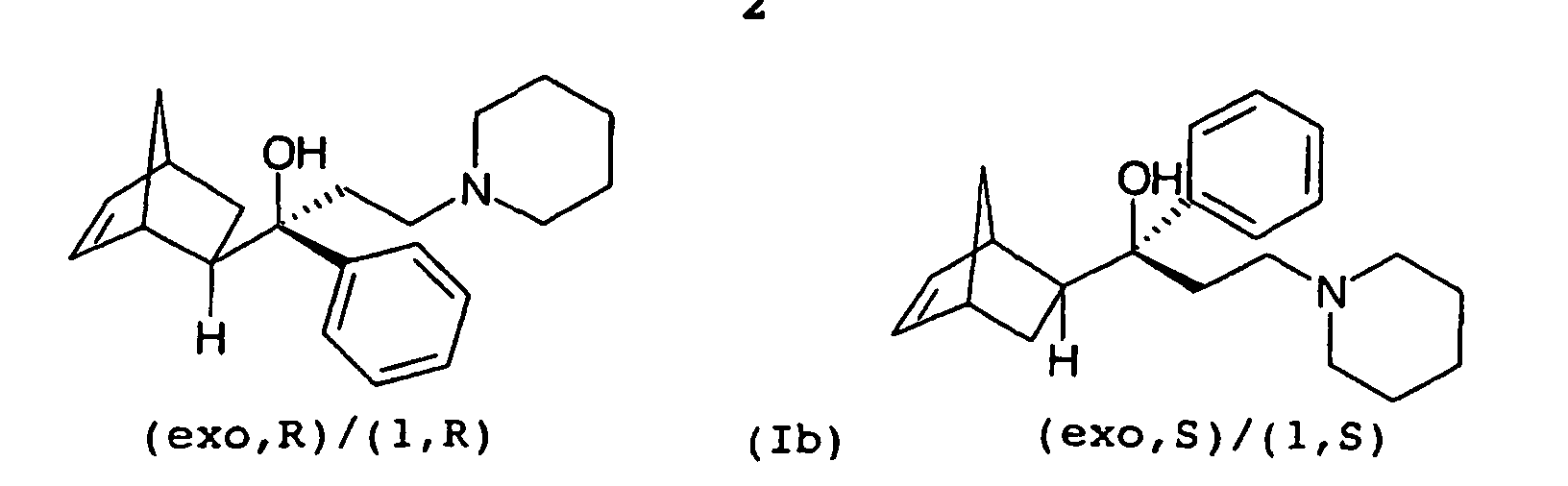
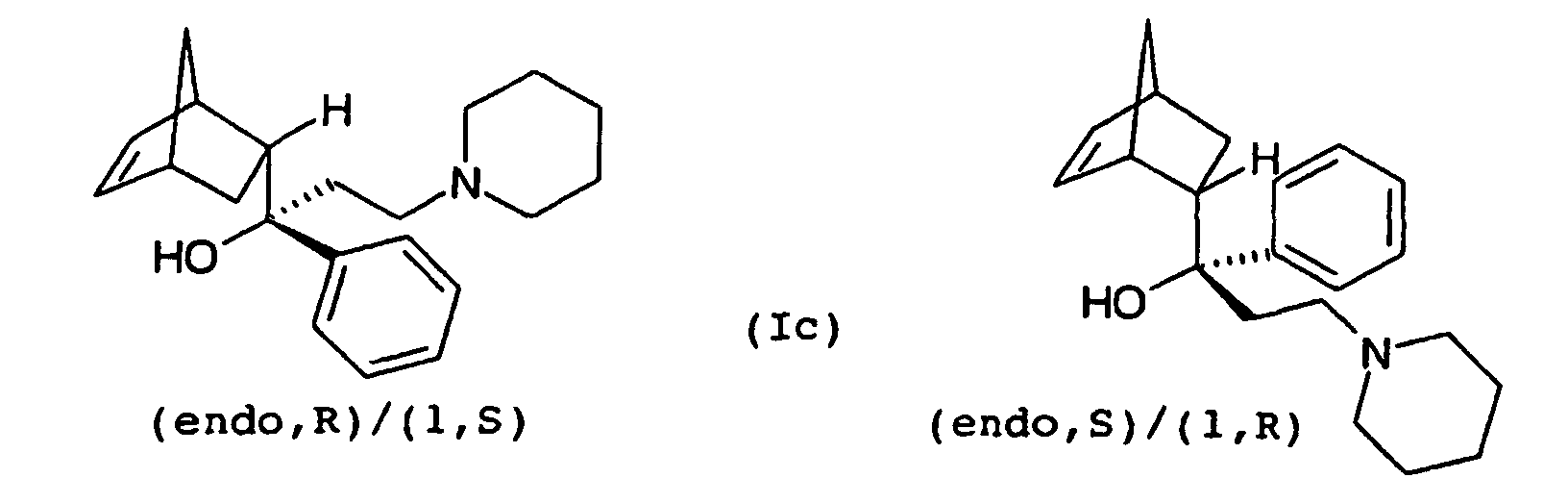
- Biperiden is a known central anticholinergic and is used for the treatment of Parkinson's disease (Ullmann's Encyclopedia of Industrial Chemistry, 4th ed., Volume 21, Verlag Chemie, 1982 , p 627). It is a racemate of 1- (bicyclo [2.2.1] hept-5-en-2-yl (exo, R)) -1-phenyl-3-piperidinopropanol (1, S) and 1- (bicyclo) 2.2.1] hept-5-en-2-yl (exo, S)) - 1-phenyl-3-piperidinopropanol (1, R) (Ia) and represents one of four possible enantiomeric pairs (Ia-d) of the aminoalcohol 1 - (Bicyclo [2.2.1] hept-5-en-2-yl) -1-phenyl-3-piperidino-1-propanol (I).
- the educt of propanol production, 1- (bicyclo [2.2.1] hept-5-en-2-yl) -3-piperidino-1-propanone (II), can exist in two isomeric forms, as an exo or as an endo isomer (II-exo, II-endo), wherein only the exo form in the above-mentioned reaction with a phenylmagnesium halide can give biperiden.
- 1- (bicyclo [2.2.1] hept-5-en-2-yl) ethanone (III) the starting material for the synthesis of propanone II, can be present both as exo and as endo-isomer (III-exo, III -endo) and accordingly, only the conversion of the exo-isomer in the following steps leads to biperiden.
- III-exo and III-endo show simplicity in each case only one of two possible enantiomers of the exo and endo isomers.
- the name refers III-exo and III-endo, however, on the enantiomeric pair the exo or endo form.
- exo-1- (bicyclo [2.2.1] hept-5-en-2-yl) ethanone (III-exo) has been described in 1965 by JG Dinwiddie and SP McManus (J. Org. Chem., 1965 , 30, 766).
- exo / endo mixtures of 1- (bicyclo [2.2.1] hept-5-en-2-yl) ethanone (III) in which the endo portion predominates, are heated in methanol in the presence of sodium methoxide. They areomerize to mixtures with an exo content of about 70%.
- distillate exo-1- bicyclo [2.2.1] hept-5-en-2-yl
- III-exo the distillate exo-1- (bicyclo [2.2.1] hept-5-en-2-yl) ethanone
- the present invention is based on the object, a method for the production of biperiden, this one in a higher yield, this method a Process for the preparation of as isomerically pure exo-propanone II-exo includes. Under the exo-propanone II-exo to a propanone II understood to be at least 96%, preferably to at least 97%, and more preferably at least 98% the exo isomer II exo. Biperiden is supposed to be a substance the structural formula Ia understood.
- exo-silyl enol ether IV shows simplicity half only one of two possible enantiomers.
- exo-silyl enol ether IV refers to the enantiomeric pair.
- an ethanone III is understood to be at least 96%, preferably at least 97% and more preferably too at least 98%, consisting of the exo-isomer III-exo.
- exo-silyl enol ether IV is intended in the following, an ethanone III is understood to be at least 96%, preferably at least 97% and more preferably too at least 98%, consisting of the exo-isomer III-exo. The same applies to the exo-silyl enol ether IV.
- the exo-isomers used in the process according to the invention it is, as for the exo-ethanone III-exo, the exo-propanone II-exo or described for the exo-silyl enol ether IV, around enantiomeric pairs.
- Biperiden (Ia) the itself a racemate, become racemic mixtures of enantiomers the starting materials and the intermediates used.
- the process can also be based on pure enantiomers and to non-racemic mixtures of enantiomers.
- the exo-ethanone III-exo For the conversion of the exo-ethanone III-exo into the corresponding exo-silyl enol ether IV, the exo-ethanone III-exo is generally first converted with a base into the exo-enolate V and this is subsequently reacted with a suitable silyl compound.
- exo-enolate V shows for the sake of simplicity only one of two possible enantiomers. The following refers however, the term exo-enolate V refers to the enantiomeric pair.
- exo-enolate V is understood to mean an enolate V, at least 96%, preferably at least 97% and more preferably at least 98%, is the exo isomer.
- Suitable silyl compounds for the reaction with the exo-enolate V are the compounds of the general formula R 3 Si-X, in which R has the abovementioned meanings and X is a nucleophilically displaceable leaving group, preferably a halogen atom and in particular chlorine.
- alkyl preferably has 1 to 4 C atoms, ie is selected from methyl, ethyl, n-propyl, isopropyl, n-butyl, isobutyl, sec-butyl or tert-butyl.
- Cycloalkyl in this context preferably has 5 to 8 C atoms, such as cyclopentyl, cyclohexyl, cycloheptyl or cyclooctyl.
- Particularly preferred silyl compounds are the tri-C 1 -C 4 alkylsilyl halides, in particular tri-C 1 -C 4 alkylsilyl chlorides are used. Particular preference is given to using trimethylsilyl chloride.
- the exo-ethanone III-exo and the silyl compound are usually used in a molar ratio in the range of 1: 1 to 1: 2.
- the silyl compound is used in excess, preferably in an excess of 10 to 100 mol%, in particular from 10 to 30 mol%, e.g. B. from 20 mol%.
- the reaction is generally carried out at a temperature in the range from -100 to 0 ° C, preferably from -85 to -10 ° C and especially preferably from -80 to -60 ° C, z. At -78 ° C.
- bases usually metal amides. Preference is given to using alkali metal amides and in particular lithium amides.
- the amide nitrogen atom is preferably substituted once or twice.
- Suitable substituents on the amide nitrogen are C 1 -C 4 -alkyl radicals such as methyl, ethyl, n-propyl, isopropyl, n-butyl, sec-butyl or tert-butyl, furthermore C 5 -C 8 -cycloalkyl radicals such as cyclopentyl, cyclohexyl, cycloheptyl or Cyclooctyl, which in turn may have from 1 to 4 methyl groups, and tri-C 1 -C 4 alkylsilyl such as trimethylsilyl or triisopropylsilyl.
- the amide nitrogen may be substituted twice such that it is part of a saturated, 5- or 6-membered heterocycle, which in turn may be substituted by 1, 2, 3 or 4 C 1 -C 4 alkyl groups, in particular methyl groups, such as for example in the amides of piperidine, 2,2,6,6-tetramethylpiperidine or pyrrolidine.
- the amide nitrogen is substituted twice. Particular preference is given to using lithium diisopropylamide as the base.
- the reaction of the exo-ethanone III-exo with the base takes place in Generally in a suitable solvent in a molar ratio of exo-ethane III-exo to the base in the range of 1: 1 to 1: 1.5, preferably from 1: 1 to 1: 1.2, and most preferably almost equimolar.
- the reaction of the exo-ethanone III-exo with the base is carried out in an inert solvent.
- Suitable solvents for this purpose are C 5 -C 9 aliphatics such as n-hexane or n-heptane, aromatics such as benzene, toluene, xylenes or ethylbenzene, aliphatic C 4 -C 8 ethers such as diethyl ether, diisopropyl ether, tert-butyl methyl ether or 1,2 -Dimethoxyethane, alicyclic C 4 -C 6 ethers such as tetrahydrofuran or dioxane, or mixtures thereof.
- the solvents are used anhydrous, as is customary for such reactions.
- the use of lithium diisopropylamide as the base employs a mixture of tetrahydrofuran, ethylbenzene and n-heptane as solvent.
- the reaction of the exo-ethanone III-exo with the base takes place in usually at a temperature in the range of -100 to 0 ° C, preferably from -85 to -10 ° C, and more preferably from -80 to -60 ° C, z. At -78 ° C.
- you puts suitably a solution of the base in one or more of the above Solvent and adds the exo-ethanone III-exo in the above added temperatures.
- the concentration of the base in the original is usually 0.1 to 10 mol / l, preferably 1 to 3 mol / l.
- the addition of exo-ethanone III-exo takes place in In general, in portions; the exo-ethanone III-exo is undiluted or in one or more of the abovementioned solvents, preferably in the same solvent (s), in in which the base is presented, in a concentration of 0.1 to 20 mol / l, preferably from 1 to 15 mol / l, dissolved added.
- the exo-ethanone III-exo is in pure form added.
- the mixture in the above-defined temperature range 10 minutes to z. B. 5 hours, preferably 30 minutes to one hour, preferably stirring.
- the silyl compound may at once or preferably via a Period of 5 minutes to several hours, in particular of 10 minutes to an hour, undiluted or in one or dissolved in several of the above solvents, are added.
- the silyl compound is added in pure form.
- the concentration of the silyl compound is usually 0.1 to 20 mol / l, preferably 1 to 15 mol / l.
- To complete the reaction is usually leave the reaction mixture for some time, z. B. 1 to 5 hours, preferably with stirring. You can do that Keep the temperature of the mixture at the above values or preferably reach room temperature, z. B. by Remove the cooling device.
- exo-silyl enol ether IV is suitably carried out under an inert gas atmosphere.
- inert gases for example, come nitrogen and the noble gases such as argon into consideration.
- the workup of the reaction mixture is preferably aqueous extractive.
- the crude exo-silyl enol ether IV obtained therefrom is optionally purified by distillation, preferably in vacuo.
- the resulting exo-silyl enol ether IV is new and as valuable intermediate for the production of biperiden (Ia) also the subject of the present invention.
- Suitable polar aprotic organic solvents include aliphatic C 4 -C 8 ethers such as diethyl ether, diisopropyl ether or 1,2-dimethoxyethane, alicyclic C 4 -C 6 ethers such as tetrahydrofuran or dioxane, chlorinated C 1 -C 2 aliphatics such as dichloromethane , Carboxylic acid derivatives such as acetonitrile, N, N-dimethylformamide or N-alkylpyrrolidones, e.g.
- N-methyl-2-pyrrolidone and sulfoxides such as dimethyl sulfoxide. Preference is given to using N, N-dimethylformamide or N-methyl-2-pyrrolidone.
- the solvents are generally used anhydrous, as is customary for reactions with N-methylene-piperidinium compounds.
- exo-silyl enol ether IV and the N-methylene-piperidinium compound are preferably in a molar ratio of IV to N-methylene-piperidinium compound in the range of 1: 1 to 1: 2 used.
- the N-methylene piperidinium compound becomes in excess, z. In an excess of 10 to 100 mol%, more preferably 20 to 70 mole%, e.g. B. 50 mol%, based on IV, used.
- the exo-silyl enol ether IV is placed in the solvent at a temperature in the range of -60 to 10 ° C, in particular from -40 to 0 ° C and more preferably from -30 to -15 ° C and then at these temperatures gives the N-methylene piperidinium compound to.
- the addition may be in one portion or over one Period of 5 minutes to several hours.
- z. B. 15 minutes to 5 hours preferably is stirred.
- the mixture can be defined in the above Temperature range leave or it preferably room temperature achieve.
- the isolation of the exo-propanone II-exo from the reaction mixture is usually aqueous-extractive.
- the water-added reaction mixture is first at a pH of 2 to 6, preferably from 2 to 4, z. B. 3, washed with a water-limited or immiscible solvent for cleaning.
- Suitable water-limited or immiscible organic solvents include C 5 -C 8 aliphatics such as n-pentane or n-hexane, C 5 -C 6 -alicyclene such as cyclohexane, aromatics such as benzene, toluene or xylenes, aliphatic C 4 C 8 ethers such as diethyl ether, tert-butyl methyl ether or diisopropyl ether or mixtures thereof.
- aliphatic C 4 -C 8 ethers such as diisopropyl ether are used.
- the aqueous phase is brought to a pH of usually 7.5 to 12, preferably from 9 to 11, z. B. 10, with a suitable base, preferably in the form of its aqueous solution, adjusted and with one of the above solvents optionally extracted several times.
- bases are suitable under other alkali or alkaline earth metal hydroxides or alkali metal carbonates.
- exo-1- bicyclo- [2.2.1] hept-5-en-2-yl
- II-exo -3-piperidino-1-propanone
- exo-1- (bicyclo [2.2.1] hept-5-en-2-yl) -3-piperidino-1-propanone (II-exo) prepared according to the invention is subsequently used to prepare the piperidene with a phenylmagnesium compound in the sense of a Grignard Reacted reaction.
- Preferred phenylmagnesium compounds are diphenylmagnesium and more preferably phenylmagnesium compound of the general formula wherein R 'is C 1 -C 4 -alkyl, such as methyl, ethyl, n-propyl, isopropyl or n-butyl, C 4 -C 6 -cycloalkyl, such as cyclohexyl, C 4 -C 6 -cycloalkyl-C 1 -C 4 -alkyl such as 2-cyclohexylethyl, phenyl-C 1 -C 4 -alkyl such as benzyl, 2-phenylethyl or 3-phenylpropyl, substituted phenyl-C 1 -C 4 -alkyl such as 3,4- (methylenedioxy) benzyl , Heteroaryl, such as 8-quinolyl, heteroaryl-C 1 -C 4 -alkyl, such as furfury
- Suitable solvents are aromatics such as benzene, toluene or xylenes, acyclic or cyclic ethers having 4 to 6 C atoms, mixtures thereof or mixtures thereof with aliphatic or alicyclic Hydrocarbons such as n-hexane or cyclohexane.
- suitable acyclic ethers are, for. B. diethyl ether and tert-butyl methyl ether
- suitable cyclic ethers are, for. B. tetrahydrofuran and Dioxane. Preference is given to using diethyl ether, tetrahydrofuran or dioxane or mixtures thereof.
- the solvents are in usually, as used for Grignard reactions, used anhydrous.
- the phenylmagnesium alkoxide is prepared in a generally known manner, z. B. by reaction of diphenylmagnesium with an alcohol of general formula R'OH, wherein R 'is as defined above.
- Diphenylmagnesium and the alcohol are in one Molar ratio in the range of 1: 0.9 to 1: 1.5, preferably in the range from 1: 1 to 1: 1.2, and more preferably about equimolar implemented.
- diphenylmagnesium which is usually as described below is generated in situ, in one of abovementioned solvents suitable for Grignard reactions and the alcohol is usually in portions over a Time span from 5 minutes to about one hour at a temperature from 0 to 80 ° C, preferably from 0 to 50 ° C and especially preferably added from 0 to 40 ° C. After completion of the addition can the mixture in the same temperature range to complete the reaction for 15 minutes to 2 hours, preferably 15 minutes until one hour, or preferably stir.
- Diphenylmagnesiums in a conventional manner.
- Phenylmagnesium chloride in a suitable solvent with dioxane offset by shifting the Schlenk balance Diphenylmagnesium and the corresponding magnesium halide-dioxane complex arise.
- the latter usually fails, will but preferably not removed from the solution.
- Suitable solvents are generally acyclic and cyclic ethers with preferably 4 to 6 carbon atoms or mixtures thereof with aliphatic, alicyclic or aromatic hydrocarbons.
- suitable acyclic ethers are, for. B.
- a suitable cyclic ether is tetrahydrofuran.
- suitable aliphatic or alicyclic hydrocarbons include in particular n-hexane or cyclohexane, suitable aromatic hydrocarbons are z.
- benzene, toluene and xylenes are examples of aromatic hydrocarbons.
- Dioxane is usually at least equimolar in relation to Phenylmagnesiumhalogenid used.
- phenylmagnesium compound Diphenylmagnesium it is preferably set Excess dioxane, for example in excess from 50 to 500 mol%, especially from 100 to 300 mol% and especially from 100 to 200 mol%, a.
- Dioxane and the phenylmagnesium halide in a molar ratio in the range of 1: 1 to 1.5: 1, in particular 1: 1 to 1.2: 1 and more preferably about equimolar.
- the addition of the dioxane to the solution of the phenylmagnesium halide usually takes place at a temperature in the range of -20 to 60 ° C, preferably in the range of -10 to 40 ° C.
- the phenylmagnesium compound and the exo-propanone II-exo in a molar ratio in Range from 0.8: 1 to 3: 1, preferably in the range of 0.8: 1 to 2: 1 and in particular in the range of 0.8: 1 to 1.5: 1.
- the exo-propanone II-exo is preferred with diphenylmagnesium or with the phenylmagnesium alkoxide in a molar ratio in the range converted from 1: 1 to 1: 1.3.
- the phenylmagnesium compound is placed in the form of a Solution in one of the abovementioned, suitable for Grignard reactions, organic solvent and adds the exo-propanone II-exo at a temperature in the range of -20 ° C to the boiling point, preferably in the range of -10 ° C to 90 ° C and especially preferably in the range of 0 ° C to 70 ° C added.
- the phenylmagnesium compound usually in a concentration in the range of 0.1 to 10 mol / l, preferably in the range of 0.1 to 3 mol / l and more preferably in the range of 0.2 to 2 mol / l used.
- the addition of the exo-propanone II-exo may be in one portion or preferably over a period of a few minutes to several Hours, z. B. 5 minutes to 5 hours.
- the addition exo-propanone II-exo is either in the form of a solution in one of the abovementioned, suitable for Grignard reactions, inert solvent or preferably in pure form. at the addition as a solution is the concentration of the exo-propanone II-exo usually 0.1 to 20 mol / l, preferably 1 to 15 mol / l.
- the reaction mixture usually 15 minutes to 5 hours, especially 30 minutes to 2 hours, at a temperature in the range of -20 ° C to to the boiling point of the reaction mixture, preferably in the range from -10 ° C to 90 ° C, and more preferably in the range of Leave 10 ° C to 80 ° C, preferably for the better Mixing stirs.
- the work-up is carried out as for Grignard reactions usual aqueous-extractive, z. B.
- suitable Solvents are, for example, aromatics such as benzene or toluene, the above-mentioned acyclic ethers, esters such as ethyl acetate or chlorine-containing aliphatic compounds such as dichloro- or trichloromethane.
- Crude product consists essentially of the two diastereomers exo-enantiomeric pairs Ia and Ib of 1- (bicyclo [2.2.1] -hept-5-en-2-yl) -1-phenyl-3-piperidino-1-propanol (I), where the Enantiomeric pair Ia (biperiden) by far constitutes the major amount.
- the Gas Chromatographic Ratio of Biperiden (Ia) to the enantiomer pair Ib is often about 4: 1.
- the Biperidens (Ia) is dissolved with heating, preferably at a temperature of 40 to 80 ° C, in particular from 50 to 70 ° C, in a mixture of water and a polar, water-miscible organic solvent.
- Suitable solvents are C 1 -C 3 alkanols, ie methanol, ethanol, n-propanol and isopropanol.
- Preference is given to using aqueous isopropanol, particularly preferably 70 to 95% isopropanol and in particular 90% isopropanol.
- HCl for example in the form of a solution of hydrogen chloride in an organic solvent, preferably in one of said C 1 -C 3 -alkanols, preferably in isopropanol, or in the form of hydrochloric acid, is added to this solution.
- HCl is at least equimolar based on the mixture of diastereomeric amino alcohols, preferably in an excess of 5 to 50 mol%, and particularly preferably from 5 to 20 mol%, is used.
- the addition is preferably carried out at elevated temperature, for. B.
- the reaction mixture is left at a temperature of 50 ° C to the boiling point of the reaction mixture for 0.5 to 3 hours after completion of the addition, preferably stirring.
- the reaction mixture is first stirred two thirds of the time at 55 to 65 ° C and then a third of the time at reflux temperature.
- the reaction mixture is then cooled to a temperature in the range of 0 to 30 ° C, optionally for up to several hours, z. B. up to 10 hours, preferably up to 5 hours, stirred in this temperature range and then separated the hydrochloride formed in the usual manner from the solution.
- this is generally wet or dry in water and a sufficient Quantity of one or more polar, with water limited or not miscible dialkyl ethers having 4 to 8 carbon atoms, such as diethyl ether, Tert-butyl methyl ether and especially diisopropyl ether recorded and the mixture is mixed with a suitable base.
- sufficient Amounts of organic solvents are z.
- water and Organic solvents are preferably in a volume ratio ranging from 1: 2 to 1: 5.
- Suitable bases are alkali and alkaline earth hydroxides and alkali metal carbonates; particularly preferred are sodium or potassium hydroxide or their aqueous solutions and in particular sodium hydroxide or sodium hydroxide solution used. But it is also possible to use water-soluble organic bases, for example aliphatic substituted amines having 2 to 8 C atoms.
- the base will be at least equimolar, preferably in excess, especially in one Excess of from 5 to 15 mol%, based on the hydrochloride, used.
- the reaction with the base is carried out in the heat.
- the organic phase becomes warm, in case of use diisopropyl ether as a dialkyl ether in the above-mentioned temperature range, washed with water and then preferably at atmospheric pressure by removing the solvent up to a weight / volume ratio of the product to the solvent in the range of 1: 2 to 1: 6, preferably from 1: 3 to 1: 4.5, concentrated.
- Biperiden (Ia) can subsequently be treated with a pharmacologically acceptable Acid in the usual way in its acid addition salt be transferred.
- Suitable acids are, for example, hydrohalic acids, especially hydrogen chloride or hydrochloric acid, and organic mono- or dicarboxylic acids such as acetic acid, oxalic acid, Maleic acid, fumaric acid, lactic acid, tartaric acid, adipic acid or benzoic acid, furthermore phosphoric acid and sulfuric acid and in "Advances in Drug Discovery, Volume 10, P. 224ff, Birkhäuser Verlag, Basel, Stuttgart, 1966 " Acids.
- Biperiden (Ia) comes as hydrochloride in the trade.
- exo-1- (bicyclo [2.2.1] hept-5-en-2-yl) -3-piperidino-1-propanone II-exo used exo-1- (bicyclo [2.2.1] -hept-5-en-2-yl) ethanone (III-exo) is obtained by the reaction of cyclopentadiene and methyl vinyl ketone in a cycloaddition to Diels and Alder.
- a particularly preferred method of preparation of III, in which a product with a high proportion of III-exo is described in the German patent application 10124450.9 the disclosure of which is fully incorporated by reference becomes.
- Cycloaddition of cyclopentadiene and methyl vinyl ketone can be used in a common solvent for such reactions Diethyl ether, benzene, toluene or xylene or without solvent be performed. Preferably, no solvent used. Cyclopentadiene and methyl vinyl ketone are usually used used in a molar ratio in the range of 3.0: 1 to 0.5: 1. Preferably, they become equimolar or with cyclopentadiene implemented in excess, wherein the excess is preferably 50 to 150 mol%.
- the reaction is usually at a temperature in the range from 0 to 60 ° C, preferably in the range of 10 to 40 ° C performed.
- Low-boiling constituents are generally removed by distillation at the end of the cycloaddition at reduced pressure, preferably at from 1 to 150 mbar.
- the remaining mixture which consists of about 20% exo- and about 80% of endo-1- (bicyclo [2.2.1] hept-5-en-2-yl) ethanone, is treated with an alkali C 1 - C 4 -alkoholat reacted.
- the amount of alkali metal alkoxide is usually 0.1 to 5 wt .-%, preferably 0.2 to 2 wt .-%, based on the total weight of the mixture.
- sodium methoxide is used.
- the temperature required for the isomerization of the ethane III is generally in the range of 50 to 110 ° C, preferably in the range of 60 to 100 ° C.
- the mixture is frequently heated under reduced pressure to reflux, preferably at a pressure of 1 to 100 mbar and in particular at a pressure of 5 to 50 mbar.
- These conditions are usually applied for 10 minutes to 5 hours, in particular 20 minutes to 3 hours and especially 0.5 hours to 2 hours, and then the fractionated distilled fraction mixture is distilled off, preferably distilling off the exo isomer of III. It is believed that removal of the exo-isomer from equilibrium promotes isomerization of the endo-ethanone to exo-form.
- the fractional distillation is generally carried out via a column under reduced pressure, preferably in the range from 1 to 100 mbar, in particular from 1 to 50 and especially from 1 to 20 mbar.
- the distillation temperature (head temperature) is preferably set to 50 to 100 ° C and especially to 50 to 80 ° C. In this way one obtains exo-1- (bicyclo [2.2.1] hept-5-en-2-yl) ethanone (III-exo) in a purity of at least 96%.
- reaction mixture was then passed through a column at a temperature distilled from 75 ° C and a pressure of 20 mbar. Receive were thereby 298.3 g (73% of theory) exo-1- (bicyclo [2.2.1-] hept-5-en-2-yl) ethanone (III-exo) in the form of a slightly yellowish Oil.
- the formed precipitate was sucked off and washed with 100 ml of n-hexane.
- the combined filtrates were washed with 250 ml of cold, saturated, aqueous sodium bicarbonate solution extracted and the phases separated. After that The aqueous phase was extracted three times with 100 ml of n-hexane.
- the three organic extracts were combined Filtrates given and the resulting organic phase over sodium sulfate dried. The solvent was removed and the obtained crude product purified by distillation at 95 ° C / 20 mbar.
Landscapes
- Chemical & Material Sciences (AREA)
- Organic Chemistry (AREA)
- Organic Low-Molecular-Weight Compounds And Preparation Thereof (AREA)
- Hydrogenated Pyridines (AREA)
- Cephalosporin Compounds (AREA)
- Pharmaceuticals Containing Other Organic And Inorganic Compounds (AREA)
- Steroid Compounds (AREA)
- Nitrogen And Oxygen Or Sulfur-Condensed Heterocyclic Ring Systems (AREA)
Abstract
Description
Die vorliegende Erfindung betrifft ein Verfahren zur Herstellung von Biperiden.The present invention relates to a process for the preparation of Biperiden.
Biperiden ist ein bekanntes zentrales Anticholinergikum und wird
zur Behandlung der Parkinsonschen Krankheit eingesetzt (Ullmanns
Enzyklopädie der technischen Chemie, 4. Aufl., Band 21, Verlag
Chemie, 1982, S. 627). Es handelt sich um ein Racemat aus
1-(Bicyclo[2.2.1]hept-5-en-2-yl(exo,R))-1-phenyl-3-piperidinopropanol(1,S)
und 1-(Bicyclo[2.2.1]hept-5-en-2-yl(exo,S))-1-phenyl-3-piperidinopropanol(1,R)
(Ia) und stellt eines von vier möglichen
Enantiomerenpaaren (Ia-d) des Aminoalkohols
1-(Bicyclo[2.2.1]hept-5-en-2-yl)-1-phenyl-3-piperidino-1-propanol
(I) dar.


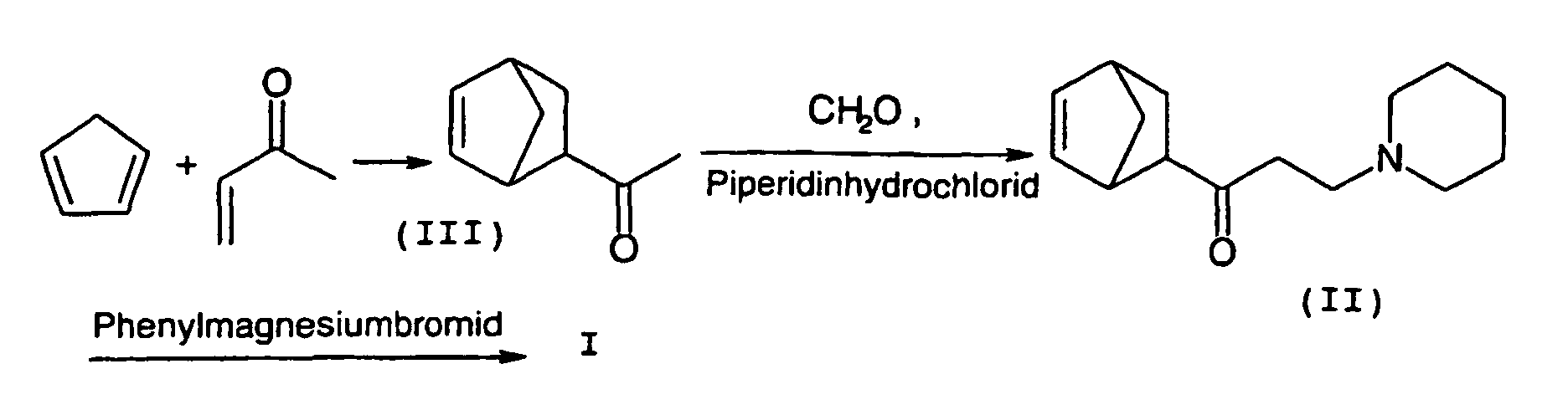
Die DE 1 005 067 und die US 2,789,110 beschreiben die Herstellung
des Aminoalkohols I durch Umsetzung von 1-(Bicyclo[2.2.1]hept-5-en-2-yl)-3-piperidino-1-propanon
(II) mit einem Phenylmagnesiumhalogenid.
Die US 2,789,110 beschreibt zudem die Herstellung
des Propanons II, ausgehend von 1-(Bicyclo[2.2.1]hept-5-en-2-yl)-ethanon
(III), Paraformaldehyd und Piperidinhydrochlorid in einer
Reaktion nach Mannich sowie die Herstellung des Ethanons III aus
Cyclopentadien und Methylvinylketon in einer Cycloaddition nach
Diels und Alder.
Weder die DE 1 005 067 noch die US 2,789,110 offenbaren, ob es sich bei dem so erhaltenen Aminoalkohol I um ein Isomerengemisch oder um ein reines Isomer handelt.Neither DE 1 005 067 nor US 2,789,110 discloses whether it in the thus obtained aminoalcohol I to a mixture of isomers or is a pure isomer.
Das Edukt der Propanolherstellung, 1-(Bicyclo[2.2.1]hept-5-en-2-yl)-3-piperidino-1-propanon
(II), kann in zwei isomeren Formen,
als exo- oder als endo-Isomeres (II-exo, II-endo), vorliegen, wobei
nur die exo-Form in der oben genannten Reaktion mit einem
Phenylmagnesiumhalogenid Biperiden ergeben kann.

Die Strukturformeln des II-exo und des II-endo zeigen der Einfachheit halber jeweils nur eines von zwei möglichen Enantiomeren des exo- bzw. endo-Isomers. Im Folgenden bezieht sich die Bezeichnung II-exo bzw. II-endo jedoch jeweils auf das Enantiomerenpaar der exo- bzw. endo-Form.The structural formulas of II-exo and II-endo show simplicity in each case only one of two possible enantiomers of the exo and endo isomers. In the following, the name refers II-exo and II-endo, however, in each case to the enantiomeric pair the exo or endo form.
Auch 1-(Bicyclo[2.2.1]hept-5-en-2-yl)ethanon (III), die Ausgangssubstanz
für die Synthese des Propanons II, kann sowohl als exoals
auch als endo-Isomeres vorliegen (III-exo, III-endo) und entsprechend
führt nur die Umsetzung des exo-Isomeren in den Folgeschritten
zu Biperiden.
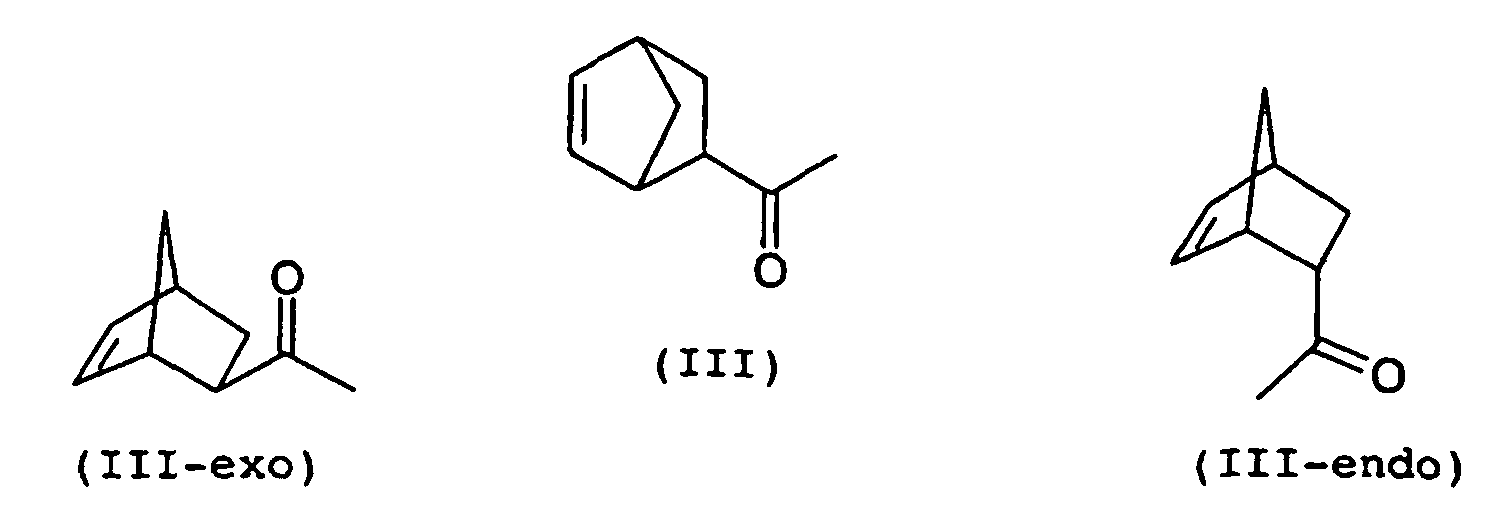
Die Strukturformeln des III-exo und des III-endo zeigen der Einfachheit halber jeweils nur eines von zwei möglichen Enantiomeren des exo- bzw. endo-Isomers. Im Folgenden bezieht sich die Bezeichnung III-exo bzw. III-endo jedoch auf das Enantiomerenpaar der exo- bzw. endo-Form.The structural formulas of III-exo and III-endo show simplicity in each case only one of two possible enantiomers of the exo and endo isomers. In the following, the name refers III-exo and III-endo, however, on the enantiomeric pair the exo or endo form.
Keiner der oben genannten Schriften lassen sich Angaben zur Konfiguration der eingesetzten Edukte III und Zwischenprodukte II entnehmen.None of the above fonts can be specified for configuration the educts III used and intermediates II remove.
Es ist bekannt, dass das 1-(Bicyclo[2.2.1]hept-5-en-2-yl)ethanon (III) aus der Cycloaddition in einem exo/endo-Verhältnis von 1:4 erhalten wird (z.B. R. Breslow, U. Maitra, Tetrahedron Letters, 1984, 25, 1239). Da der eingangs genannte Stand der Technik keinerlei Angaben zur Stereochemie des Ethanons III macht, ist davon auszugehen, dass das Ethanon III in diesem Isomerenverhältnis zur Herstellung des Aminoalkohols I eingesetzt wurde.It is known that the 1- (bicyclo [2.2.1] hept-5-en-2-yl) ethanone (III) is obtained from the cycloaddition in an exo / endo ratio of 1: 4 (eg R. Breslow , U. Maitra, Tetrahedron Letters, 1984 , 25, 1239). Since the prior art mentioned at the outset does not provide any information on the stereochemistry of the ethane III, it can be assumed that the ethanone III was used in this isomer ratio for the preparation of the aminoalcohol I.
Die Herstellung von exo-1-(Bicyclo[2.2.1]hept-5-en-2-yl)ethanon (III-exo) ist 1965 von J.G. Dinwiddie und S.P. McManus beschrieben worden (J. Org. Chem., 1965, 30, 766). Dabei werden exo/endo-Gemische von 1-(Bicyclo[2.2.1]hept-5-en-2-yl)ethanon (III), in denen der endo-Anteil überwiegt, in Methanol in Gegenwart von Natriummethanolat erhitzt. Sie isomerisieren hierbei zu Gemischen mit einem exo-Anteil von ca. 70 %. Aus diesen kann durch fraktionierte Destillation und gegebenenfalls Redestillation des Destillats exo-1-(Bicyclo[2.2.1]hept-5-en-2-yl)ethanon (III-exo) mit einem Reinheitsgrad von bis zu 95 % erhalten werden.The preparation of exo-1- (bicyclo [2.2.1] hept-5-en-2-yl) ethanone (III-exo) has been described in 1965 by JG Dinwiddie and SP McManus (J. Org. Chem., 1965 , 30, 766). In this case, exo / endo mixtures of 1- (bicyclo [2.2.1] hept-5-en-2-yl) ethanone (III), in which the endo portion predominates, are heated in methanol in the presence of sodium methoxide. They areomerize to mixtures with an exo content of about 70%. From these, by fractional distillation and optionally redistillation of the distillate exo-1- (bicyclo [2.2.1] hept-5-en-2-yl) ethanone (III-exo) can be obtained with a purity of up to 95%.
Versuche der Anmelderin haben gezeigt, dass auch bei der Verwendung von einheitlichem exo-Ethanon III-exo als Ausgangsmaterial in der Reaktion nach Mannich stets ein exo/endo-Gemisch des Propanons II entsteht. Dies ist bei der sich anschließenden Umsetzung des Propanons II zum Propanol I hinsichtlich der Ausbeute an sauberem Biperiden (Ia) von Nachteil. Unter sauberem Biperiden versteht man ein Biperiden (Ia) mit einer Reinheit von wenigstens 99,0 %, wie sie für pharmazeutische Anwendungen in der Regel erforderlich ist.Applicant's experiments have shown that even in use of uniform exo-ethanone III-exo as starting material in the reaction according to Mannich always an exo / endo mixture of propanone II arises. This is in the subsequent implementation of propanone II to propanol I in terms of yield clean Biperiden (Ia) of disadvantage. Under clean biperiden is meant a Biperiden (Ia) with a purity of at least 99.0%, as required for pharmaceutical applications in general is.
Der vorliegenden Erfindung liegt die Aufgabe zugrunde, ein Verfahren zur Herstellung von Biperiden bereit zu stellen, das dieses in einer höheren Ausbeute liefert, wobei dieses Verfahren ein Verfahren zur Herstellung von möglichst isomerenreinem exo-Propanon II-exo umfasst. Unter dem exo-Propanon II-exo soll ein Propanon II verstanden werden, das zu wenigstens 96 %, vorzugsweise zu wenigstens 97 % und besonders bevorzugt zu wenigstens 98 %, aus dem exo-Isomeren II-exo besteht. Unter Biperiden soll eine Substanz der Strukturformel Ia verstanden werden.The present invention is based on the object, a method for the production of biperiden, this one in a higher yield, this method a Process for the preparation of as isomerically pure exo-propanone II-exo includes. Under the exo-propanone II-exo to a propanone II understood to be at least 96%, preferably to at least 97%, and more preferably at least 98% the exo isomer II exo. Biperiden is supposed to be a substance the structural formula Ia understood.
Die Aufgabe konnte gelöst werden durch ein Verfahren zur Herstellung
von Biperiden (Ia) durch Umsetzung von exo-1-(Bicyclo-[2.2.1]hept-5-en-2-yl)-3-piperidino-1-propanon
(II-exo) mit einer
Phenylmagnesiumverbindung, dadurch gekennzeichnet, dass die Herstellung
des exo-1-(Bicyclo[2.2.1]hept-5-en-2-yl)-3-piperidino-1-propanons
(II-exo) die folgenden Schritte umfasst:
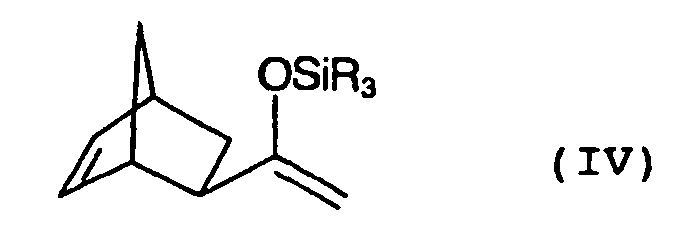
Die Strukturformel des exo-Silylenolethers IV zeigt der Einfachheit halber nur eines von zwei möglichen Enantiomeren. Im Folgenden bezieht sich die Bezeichnung exo-Silylenolether IV jedoch auf das Enantiomerenpaar.The structural formula of exo-silyl enol ether IV shows simplicity half only one of two possible enantiomers. Hereinafter however, the term exo-silyl enol ether IV refers to the enantiomeric pair.
Unter exo-1-(Bicyclo[2.2.1]hept-5-en-2-yl)ethanon (III-exo) soll im Folgenden ein Ethanon III verstanden werden, das zu wenigstens 96 %, vorzugsweise zu wenigstens 97 % und besonders bevorzugt zu wenigstens 98 %, aus dem exo-Isomeren III-exo besteht. Entsprechendes gilt für den exo-Silylenolether IV.Under exo-1- (bicyclo [2.2.1] hept-5-en-2-yl) ethanone (III-exo) is intended in the following, an ethanone III is understood to be at least 96%, preferably at least 97% and more preferably too at least 98%, consisting of the exo-isomer III-exo. The same applies to the exo-silyl enol ether IV.
Bei den im erfindungsgemäßen Verfahren eingesetzten exo-Isomeren handelt es sich, wie bereits für das exo-Ethanon III-exo, das exo-Propanon II-exo bzw. für den exo-Silylenolether IV beschrieben, um Enantiomerenpaare. Um zu Biperiden (Ia) zu gelangen, das selbst ein Racemat ist, werden racemische Enantiomerengemische der Ausgangsstoffe und der Zwischenprodukte eingesetzt. Das erfindungsgemäße Verfahren kann jedoch auch auf reine Enantiomere sowie auf nicht racemische Enantiomerengemische angewendet werden.In the exo-isomers used in the process according to the invention it is, as for the exo-ethanone III-exo, the exo-propanone II-exo or described for the exo-silyl enol ether IV, around enantiomeric pairs. To get to Biperiden (Ia), the itself a racemate, become racemic mixtures of enantiomers the starting materials and the intermediates used. The invention However, the process can also be based on pure enantiomers and to non-racemic mixtures of enantiomers.
Zur Überführung des exo-Ethanons III-exo in den entsprechenden
exo-Silylenolether IV wird das exo-Ethanon III-exo im Allgemeinen
zuerst mit einer Base in das exo-Enolat V überführt und dieses
anschließend mit einer geeigneten Silylverbindung umgesetzt.
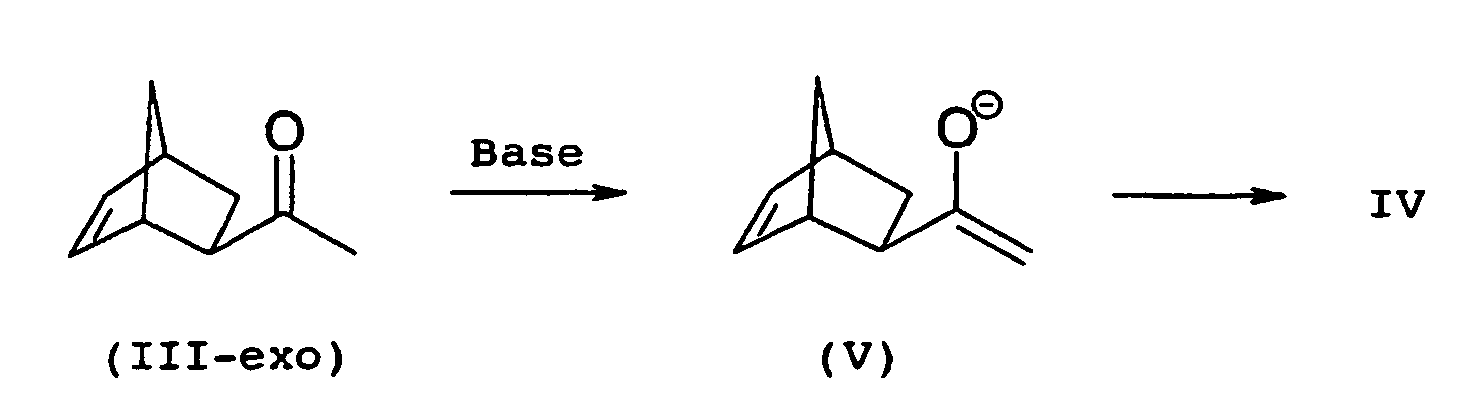
Die Strukturformel des exo-Enolats V zeigt der Einfachheit halber nur eines von zwei möglichen Enantiomeren. Im Folgenden bezieht sich die Bezeichnung exo-Enolat V jedoch auf das Enantiomerenpaar.The structural formula of exo-enolate V shows for the sake of simplicity only one of two possible enantiomers. The following refers however, the term exo-enolate V refers to the enantiomeric pair.
Unter exo-Enolat V soll im Folgenden ein Enolat V verstanden werden, das zu wenigstens 96 %, vorzugsweise zu wenigstens 97 % und besonders bevorzugt zu wenigstens 98 %, aus dem exo-Isomeren besteht.In the following, exo-enolate V is understood to mean an enolate V, at least 96%, preferably at least 97% and more preferably at least 98%, is the exo isomer.
Geeignete Silylverbindungen für die Umsetzung mit dem exo-Enolat V sind die Verbindungen der allgemeinen Formel R3Si-X, worin R die zuvor genannten Bedeutungen hat und X für eine nucleophil verdrängbare Abgangsgruppe, vorzugsweise für ein Halogenatom und insbesondere für Chlor, steht. Alkyl weist in diesem Zusammenhang vorzugsweise 1 bis 4 C-Atome auf, d. h. ist unter Methyl, Ethyl, n-Propyl, Isopropyl, n-Butyl, Isobutyl, sek-Butyl oder tert-Butyl ausgewählt. Cycloalkyl weist in diesem Zusammenhang vorzugsweise 5 bis 8 C-Atome auf wie Cyclopentyl, Cyclohexyl, Cycloheptyl oder Cyclooctyl. Besonders bevorzugte Silylverbindungen sind die Tri-C1-C4-alkylsilylhalogenide, insbesondere werden Tri-C1-C4-alkylsilylchloride verwendet. Besonders bevorzugt wird Trimethylsilylchlorid eingesetzt. Suitable silyl compounds for the reaction with the exo-enolate V are the compounds of the general formula R 3 Si-X, in which R has the abovementioned meanings and X is a nucleophilically displaceable leaving group, preferably a halogen atom and in particular chlorine. In this context, alkyl preferably has 1 to 4 C atoms, ie is selected from methyl, ethyl, n-propyl, isopropyl, n-butyl, isobutyl, sec-butyl or tert-butyl. Cycloalkyl in this context preferably has 5 to 8 C atoms, such as cyclopentyl, cyclohexyl, cycloheptyl or cyclooctyl. Particularly preferred silyl compounds are the tri-C 1 -C 4 alkylsilyl halides, in particular tri-C 1 -C 4 alkylsilyl chlorides are used. Particular preference is given to using trimethylsilyl chloride.
Das exo-Ethanon III-exo und die Silylverbindung werden in der Regel in einem Molverhältnis im Bereich von 1:1 bis 1:2 eingesetzt. Vorzugsweise wird die Silylverbindung im Überschuss eingesetzt, bevorzugt in einem Überschuss von 10 bis 100 Mol-%, insbesondere von 10 bis 30 Mol-%, z. B. von 20 Mol-%.The exo-ethanone III-exo and the silyl compound are usually used in a molar ratio in the range of 1: 1 to 1: 2. Preferably, the silyl compound is used in excess, preferably in an excess of 10 to 100 mol%, in particular from 10 to 30 mol%, e.g. B. from 20 mol%.
Die Umsetzung erfolgt im Allgemeinen bei einer Temperatur im Bereich von -100 bis 0 °C, vorzugsweise von -85 bis -10 °C und besonders bevorzugt von -80 bis -60 °C, z. B. bei -78 °C.The reaction is generally carried out at a temperature in the range from -100 to 0 ° C, preferably from -85 to -10 ° C and especially preferably from -80 to -60 ° C, z. At -78 ° C.
Bei der Behandlung des exo-Ethanons III-exo mit einer Base zur Überführung in das exo-Enolat V verwendet man als Basen in der Regel Metallamide. Bevorzugt verwendet man Alkalimetallamide und insbesondere Lithiumamide. Das Amid-Stickstoffatom ist vorzugsweise ein- oder zweifach substituiert. Geeignete Substituenten am Amidstickstoff sind C1-C4-Alkylreste wie Methyl, Ethyl, n-Propyl, Isopropyl, n-Butyl, sek-Butyl oder tert-Butyl, weiterhin C5-C8-Cycloalkylreste wie Cyclopentyl, Cyclohexyl, Cycloheptyl oder Cyclooctyl, die ihrerseits 1 bis 4 Methylgruppen aufweisen können, und Tri-C1-C4-alkylsilylreste wie Trimethylsilyl oder Triisopropylsilyl. Außerdem kann der Amidstickstoff dergestalt zweifach substituiert sein, dass er Bestandteil eines gesättigten, 5- oder 6-gliedrigen Heterocyclus ist, der seinerseits durch 1, 2, 3 oder 4 C1-C4-Alkylgruppen, insbesondere Methylgruppen, substituiert sein kann wie beispielsweise in den Amiden des Piperidins, 2,2,6,6-Tetramethylpiperidins oder des Pyrrolidins. Vorzugsweise ist der Amidstickstoff zweifach substituiert. Besonders bevorzugt setzt man Lithiumdiisopropylamid als Base ein.In the treatment of the exo-ethanone III-exo with a base for conversion into the exo-enolate V are used as bases usually metal amides. Preference is given to using alkali metal amides and in particular lithium amides. The amide nitrogen atom is preferably substituted once or twice. Suitable substituents on the amide nitrogen are C 1 -C 4 -alkyl radicals such as methyl, ethyl, n-propyl, isopropyl, n-butyl, sec-butyl or tert-butyl, furthermore C 5 -C 8 -cycloalkyl radicals such as cyclopentyl, cyclohexyl, cycloheptyl or Cyclooctyl, which in turn may have from 1 to 4 methyl groups, and tri-C 1 -C 4 alkylsilyl such as trimethylsilyl or triisopropylsilyl. In addition, the amide nitrogen may be substituted twice such that it is part of a saturated, 5- or 6-membered heterocycle, which in turn may be substituted by 1, 2, 3 or 4 C 1 -C 4 alkyl groups, in particular methyl groups, such as for example in the amides of piperidine, 2,2,6,6-tetramethylpiperidine or pyrrolidine. Preferably, the amide nitrogen is substituted twice. Particular preference is given to using lithium diisopropylamide as the base.
Die Umsetzung des exo-Ethanons III-exo mit der Base erfolgt im Allgemeinen in einem geeigneten Lösungsmittel in einem Molverhältnis des exo-Ethanons III-exo zur Base im Bereich von 1:1 bis 1:1,5, vorzugsweise von 1:1 bis 1:1,2 und besonders bevorzugt nahezu äquimolar.The reaction of the exo-ethanone III-exo with the base takes place in Generally in a suitable solvent in a molar ratio of exo-ethane III-exo to the base in the range of 1: 1 to 1: 1.5, preferably from 1: 1 to 1: 1.2, and most preferably almost equimolar.
In der Regel führt man die Umsetzung des exo-Ethanons III-exo mit der Base in einem inerten Lösungsmittel durch. Hierfür geeignete Lösungsmittel sind C5-C9-Aliphaten wie n-Hexan oder n-Heptan, Aromaten wie Benzol, Toluol, Xylole oder Ethylbenzol, aliphatische C4-C8-Ether wie Diethylether, Diisopropylether, tert-Butylmethylether oder 1,2-Dimethoxyethan, alicyclische C4-C6-Ether wie Tetrahydrofuran oder Dioxan oder Gemische davon. Die Lösungsmittel werden in der Regel, wie für solche Umsetzungen üblich, wasserfrei eingesetzt. In einer speziellen Ausgestaltungsform des erfindungsgemäßen Verfahrens setzt man bei der Verwendung von Lithiumdiisopropylamid als Base ein Gemisch aus Tetrahydrofuran, Ethylbenzol und n-Heptan als Lösungsmittel ein.As a rule, the reaction of the exo-ethanone III-exo with the base is carried out in an inert solvent. Suitable solvents for this purpose are C 5 -C 9 aliphatics such as n-hexane or n-heptane, aromatics such as benzene, toluene, xylenes or ethylbenzene, aliphatic C 4 -C 8 ethers such as diethyl ether, diisopropyl ether, tert-butyl methyl ether or 1,2 -Dimethoxyethane, alicyclic C 4 -C 6 ethers such as tetrahydrofuran or dioxane, or mixtures thereof. As a rule, the solvents are used anhydrous, as is customary for such reactions. In a special embodiment of the process according to the invention, the use of lithium diisopropylamide as the base employs a mixture of tetrahydrofuran, ethylbenzene and n-heptane as solvent.
Die Umsetzung des exo-Ethanons III-exo mit der Base erfolgt in der Regel bei einer Temperatur im Bereich von -100 bis 0 °C, vorzugsweise von -85 bis -10 °C und besonders bevorzugt von -80 bis -60 °C, z. B. bei -78 °C. Bei der Umsetzung kann man das exo-Ethanon III-exo vorlegen und die Base hinzufügen oder umgekehrt die Base vorlegen und das exo-Ethanon III-exo hinzufügen, wobei die letzte Möglichkeit bevorzugt ist. Hierzu legt man geeigneterweise eine Lösung der Base in einem oder mehreren der oben genannten Lösungsmittel vor und fügt das exo-Ethanon III-exo bei den oben beschriebenen Temperaturen hinzu. Die Konzentration der Base in der Vorlage beträgt üblicherweise 0,1 bis 10 mol/l, vorzugsweise 1 bis 3 mol/l. Die Zugabe des exo-Ethanons III-exo erfolgt im Allgemeinen portionsweise; das exo-Ethanon III-exo wird dabei unverdünnt oder in einem oder mehreren der oben genannten Lösungsmittel, vorzugsweise in demselben/denselben Lösungsmittel(n), in dem/denen die Base vorgelegt wird, in einer Konzentration von 0,1 bis 20 mol/l, vorzugsweise von 1 bis 15 mol/l, gelöst hinzugefügt. Vorzugsweise wird das exo-Ethanon III-exo jedoch in Reinform zugegeben. Zur Vervollständigung der Reaktion kann das Gemisch im oben definierten Temperaturbereich 10 Minuten bis z. B. 5 Stunden, vorzugsweise 30 Minuten bis eine Stunde belassen werden, wobei vorzugsweise gerührt wird.The reaction of the exo-ethanone III-exo with the base takes place in usually at a temperature in the range of -100 to 0 ° C, preferably from -85 to -10 ° C, and more preferably from -80 to -60 ° C, z. At -78 ° C. In the implementation, you can use the exo-ethanone Submit III-exo and add the base or vice versa Base and add the exo-ethanone III-exo, where the last option is preferred. For this one puts suitably a solution of the base in one or more of the above Solvent and adds the exo-ethanone III-exo in the above added temperatures. The concentration of the base in the original is usually 0.1 to 10 mol / l, preferably 1 to 3 mol / l. The addition of exo-ethanone III-exo takes place in In general, in portions; the exo-ethanone III-exo is undiluted or in one or more of the abovementioned solvents, preferably in the same solvent (s), in in which the base is presented, in a concentration of 0.1 to 20 mol / l, preferably from 1 to 15 mol / l, dissolved added. Preferably, however, the exo-ethanone III-exo is in pure form added. To complete the reaction, the mixture in the above-defined temperature range 10 minutes to z. B. 5 hours, preferably 30 minutes to one hour, preferably stirring.
Zu dem so erhaltenen Reaktionsgemisch, das das exo-Enolat V enthält, fügt man üblicherweise in situ, d. h. ohne vorheriges Isolieren des Enolats, eine der oben beschriebenen siliziumorganischen Verbindungen im oben definierten Temperaturbereich hinzu. Die Silylverbindung kann auf einmal oder vorzugsweise über einen Zeitraum von 5 Minuten bis zu mehreren Stunden, insbesondere von 10 Minuten bis zu einer Stunde, unverdünnt oder in einem oder mehreren der oben genannten Lösungsmittel gelöst, zugegeben werden. Vorzugsweise wird die Silylverbindung in Reinform zugegeben. Bei der Zugabe als Lösung beträgt die Konzentration der Silylverbindung in der Regel 0,1 bis 20 mol/l, vorzugsweise 1 bis 15 mol/l. Zur Vervollständigung der Reaktion wird in der Regel das Reaktionsgemisch noch einige Zeit belassen, z. B. 1 bis 5 Stunden, wobei vorzugsweise gerührt wird. Dabei kann man die Temperatur des Gemischs bei den oben genannten Werten belassen oder vorzugsweise Raumtemperatur erreichen lassen, z. B. durch Entfernen der Kühlvorrichtung.To the reaction mixture thus obtained, which contains the exo-enolate V, usually added in situ, d. H. without previous isolation of the enolate, one of the above-described organosilicon Added compounds in the above defined temperature range. The silyl compound may at once or preferably via a Period of 5 minutes to several hours, in particular of 10 minutes to an hour, undiluted or in one or dissolved in several of the above solvents, are added. Preferably, the silyl compound is added in pure form. When added as a solution, the concentration of the silyl compound is usually 0.1 to 20 mol / l, preferably 1 to 15 mol / l. To complete the reaction is usually leave the reaction mixture for some time, z. B. 1 to 5 hours, preferably with stirring. You can do that Keep the temperature of the mixture at the above values or preferably reach room temperature, z. B. by Remove the cooling device.
Sowohl die Herstellung des exo-Enolats V als auch dessen Umsetzung zum exo-Silylenolether IV erfolgen geeigneterweise unter Inertgasatmosphäre. Als Inertgase kommen beispielsweise Stickstoff und die Edelgase wie Argon in Betracht.Both the preparation of exo-enolate V and its implementation The exo-silyl enol ether IV is suitably carried out under an inert gas atmosphere. As inert gases, for example, come nitrogen and the noble gases such as argon into consideration.
Die Aufarbeitung des Reaktionsgemischs erfolgt vorzugsweise wässrig-extraktiv. Der daraus erhaltene rohe exo-Silylenolether IV wird gegebenenfalls destillativ, vorzugsweise im Vakuum, gereinigt. Der hierbei erhaltene exo-Silylenolether IV ist neu und als wertvolles Zwischenprodukt zur Herstellung von Biperiden (Ia) ebenfalls Gegenstand der vorliegenden Erfindung.The workup of the reaction mixture is preferably aqueous extractive. The crude exo-silyl enol ether IV obtained therefrom is optionally purified by distillation, preferably in vacuo. The resulting exo-silyl enol ether IV is new and as valuable intermediate for the production of biperiden (Ia) also the subject of the present invention.
Entsprechende Silylether in der endo-Form sind aus der Literatur bekannt (siehe Corey, E. J., Xiang, Yi Bin, Tetrahedron Letters 29, 1988, 995-998).Corresponding silyl ethers in the endo form are known from the literature (see Corey, E. J., Xiang, Yi Bin, Tetrahedron Letters 29, 1988, 995-998).
Die sich anschließende Umsetzung des exo-Silylenolethers IV mit einer N-Methylenpiperidinium-Verbindung zum exo-Propanon II-exo erfolgt im Allgemeinen in einem geeigneten polaren aprotischen organischen Lösungsmittel. Geeignete polare aprotische organische Lösungsmittel sind unter anderem aliphatische C4-C8-Ether wie Diethylether, Diisopropylether oder 1,2-Dimethoxyethan, alicyclische C4-C6-Ether wie Tetrahydrofuran oder Dioxan, chlorierte C1-C2-Aliphaten wie Dichlormethan, Carbonsäurederivate wie Acetonitril, N,N-Dimethylformamid oder N-Alkylpyrrolidone, z. B. N-Methyl-2-pyrrolidon, und Sulfoxide wie Dimethylsulfoxid. Vorzugsweise verwendet man N,N-Dimethylformamid oder N-Methyl-2-pyrrolidon. Die Lösungsmittel werden in der Regel, wie für Umsetzungen mit N-Methylenpiperidiniumverbindungen üblich, wasserfrei eingesetzt.The subsequent reaction of the exo-silyl enol ether IV with an N-methylene-piperidinium compound to exo-propanone II-exo is generally carried out in a suitable polar aprotic organic solvent. Suitable polar aprotic organic solvents include aliphatic C 4 -C 8 ethers such as diethyl ether, diisopropyl ether or 1,2-dimethoxyethane, alicyclic C 4 -C 6 ethers such as tetrahydrofuran or dioxane, chlorinated C 1 -C 2 aliphatics such as dichloromethane , Carboxylic acid derivatives such as acetonitrile, N, N-dimethylformamide or N-alkylpyrrolidones, e.g. As N-methyl-2-pyrrolidone, and sulfoxides such as dimethyl sulfoxide. Preference is given to using N, N-dimethylformamide or N-methyl-2-pyrrolidone. The solvents are generally used anhydrous, as is customary for reactions with N-methylene-piperidinium compounds.
Der exo-Silylenolether IV und die N-Methylenpiperidinium-Verbindung werden dabei vorzugsweise in einem Molverhältnis von IV zu N-Methylenpiperidinium-Verbindung im Bereich von 1:1 bis 1:2 eingesetzt. Die N-Methylenpiperidinium-Verbindung wird insbesondere im Überschuss, z. B. in einem Überschuss von 10 bis 100 Mol-%, besonders bevorzugt 20 bis 70 Mol-%, z. B. 50 Mol-%, bezogen auf IV, eingesetzt. The exo-silyl enol ether IV and the N-methylene-piperidinium compound are preferably in a molar ratio of IV to N-methylene-piperidinium compound in the range of 1: 1 to 1: 2 used. In particular, the N-methylene piperidinium compound becomes in excess, z. In an excess of 10 to 100 mol%, more preferably 20 to 70 mole%, e.g. B. 50 mol%, based on IV, used.
Vorzugsweise legt man den exo-Silylenolether IV im Lösungsmittel bei einer Temperatur im Bereich von -60 bis 10 °C, insbesondere von -40 bis 0 °C und besonders bevorzugt von -30 bis -15 °C vor und gibt dann bei diesen Temperaturen die N-Methylenpiperidinium-Verbindung zu. Die Zugabe kann in einer Portion oder über einen Zeitraum von 5 Minuten bis zu mehreren Stunden erfolgen. Zur Vervollständigung der Reaktion wird das Gemisch geeigneterweise noch einige Zeit, z. B. 15 Minuten bis 5 Stunden, belassen, wobei vorzugsweise gerührt wird. Dabei kann man das Gemisch im oben definierten Temperaturbereich belassen oder es vorzugsweise Raumtemperatur erreichen lassen.Preferably, the exo-silyl enol ether IV is placed in the solvent at a temperature in the range of -60 to 10 ° C, in particular from -40 to 0 ° C and more preferably from -30 to -15 ° C and then at these temperatures gives the N-methylene piperidinium compound to. The addition may be in one portion or over one Period of 5 minutes to several hours. To complete the reaction suitably becomes the mixture some time, z. B. 15 minutes to 5 hours, preferably is stirred. In this case, the mixture can be defined in the above Temperature range leave or it preferably room temperature achieve.
Selbstverständlich kann man auch die N-Methylenpiperidinium-Verbindüng vorlegen und den exo-Silylenolether IV hinzufügen, wobei die Zugabe der N-Methylenpiperidinium-Verbindung zum exo-Silylenolether IV bevorzugt ist.Of course you can also the N-Methylenpiperidinium-Verbindüng and add the exo-silyl enol ether IV, wherein the addition of the N-methylene-piperidinium compound to the exo-silyl enol ether IV is preferred.
Die Isolierung des exo-Propanons II-exo aus dem Reaktionsgemisch erfolgt in der Regel wässrig-extraktiv. Hierzu wird das mit Wasser versetzte Reaktionsgemisch zuerst bei einem pH-Wert von 2 bis 6, vorzugsweise von 2 bis 4, z. B. 3, zwecks Reinigung mit einem mit Wasser begrenzt oder nicht mischbaren Lösungsmittel gewaschen. Zu den geeigneten, mit Wasser begrenzt oder nicht mischbaren organischen Lösungsmitteln zählen C5-C8-Aliphaten wie n-Pentan oder n-Hexan, C5-C6-Alicyclen wie Cyclohexan, Aromaten wie Benzol, Toluol oder Xylole, aliphatische C4-C8-Ether wie Diethylether, tert-Butylmethylether oder Diisopropylether bzw. Gemische davon. Vorzugsweise werden aliphatische C4-C8-Ether wie Diisopropylether verwendet.The isolation of the exo-propanone II-exo from the reaction mixture is usually aqueous-extractive. For this purpose, the water-added reaction mixture is first at a pH of 2 to 6, preferably from 2 to 4, z. B. 3, washed with a water-limited or immiscible solvent for cleaning. Suitable water-limited or immiscible organic solvents include C 5 -C 8 aliphatics such as n-pentane or n-hexane, C 5 -C 6 -alicyclene such as cyclohexane, aromatics such as benzene, toluene or xylenes, aliphatic C 4 C 8 ethers such as diethyl ether, tert-butyl methyl ether or diisopropyl ether or mixtures thereof. Preferably, aliphatic C 4 -C 8 ethers such as diisopropyl ether are used.
Nach dem Waschen wird die wässrige Phase auf einen pH-Wert von in der Regel 7,5 bis 12, vorzugsweise von 9 bis 11, z. B. 10, mit einer geeigneten Base, vorzugsweise in Form ihrer wässrigen Lösung, eingestellt und mit einem der oben genannten Lösungsmittel gegebenenfalls mehrfach extrahiert. Als Basen eignen sich unter anderem Alkali- oder Erdalkalihydroxide oder Alkalicarbonate. Bevorzugt verwendet man Alkalihydroxide bzw. ihre wässrigen Lösungen, insbesondere Kaliumhydroxid bzw. Kalilauge oder Natriumhydroxid bzw. Natronlauge. Nach dem Entfernen des Lösungsmittels aus dem/den alkalischen Extrakt(en), was z. B. destillativ, vorzugsweise unter vermindertem Druck, erfolgt, erhält man ein Propanon II, das zu wenigstens 96 % aus dem exo-Isomeren II-exo besteht. Das Propanon II weist somit ein exo/endo-Verhältnis von wenigstens 24:1 auf.After washing, the aqueous phase is brought to a pH of usually 7.5 to 12, preferably from 9 to 11, z. B. 10, with a suitable base, preferably in the form of its aqueous solution, adjusted and with one of the above solvents optionally extracted several times. As bases are suitable under other alkali or alkaline earth metal hydroxides or alkali metal carbonates. Prefers use is made of alkali metal hydroxides or their aqueous solutions, in particular potassium hydroxide or potassium hydroxide solution or sodium hydroxide or sodium hydroxide solution. After removal of the solvent from the / the alkaline extract (s), which z. B. by distillation, preferably under reduced pressure, gives a propanone II, which consists of at least 96% of the exo-isomer II-exo. The propanone II thus has an exo / endo ratio of at least 24: 1 up.
Der Anteil des exo-Isomeren II-exo am Propanon II hängt dabei nahezu ausschließlich vom Reinheitsgrad des eingesetzten exo-Ethanons III-exo ab. Bei Einsatz eines Ethanons III mit einem exo-Anteil von 100 % resultiert somit ein Propanon II mit einem exo-Anteil von etwa 100 %.The proportion of exo-isomer II-exo on propanone II depends almost exclusively on the degree of purity of the exo-ethanone used III-exo off. When using an ethane III with an exo fraction of 100% thus results in a propanone II with an exo share from about 100%.
Bei der erfindungsgemäßen Umsetzung des exo-Ethanons III-exo zum Propanon II erhält man dieses nicht nur in Form des exo-Isomeren II-exo, ohne dass Isomerisierung beobachtet wird, sondern auch in einer wesentlich größeren Ausbeute im Vergleich zur üblichen Vorgehensweise.In the inventive reaction of exo-ethanone III exo to Propanone II is obtained not only in the form of the exo isomer II-exo, without isomerization is observed, but also in a much greater yield compared to the usual procedure.
Hier und im Folgenden steht die Bezeichnung exo-1-(Bicyclo-[2.2.1]hept-5-en-2-yl)-3-piperidino-1-propanon (II-exo) für ein Propanon II, das zu 96 bis 100 % aus dem exo-Propanon II-exo besteht.Here and below is the term exo-1- (bicyclo- [2.2.1] hept-5-en-2-yl) -3-piperidino-1-propanone (II-exo) for one Propanone II, which consists of 96 to 100% of the exo-propanone II-exo.
Das erfindungsgemäß hergestellte exo-1-(Bicyclo[2.2.1]hept-5-en-2-yl)-3-piperidino-1-propanon
(II-exo) wird anschließend zur Herstellung
des Biperidens mit einer Phenylmagnesiumverbindung im
Sinne einer Grignard-Reaktion umgesetzt. Bevorzugte Phenylmagnesiumverbindungen
sind Diphenylmagnesium und besonders bevorzugt
Phenylmagnesiumverbindung der allgemeinen Formel
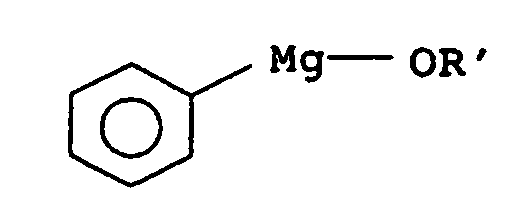
Geeignete Lösungsmittel sind Aromaten wie Benzol, Toluol oder Xylole, acyclische oder cyclische Ether mit 4 bis 6 C-Atomen, Gemische davon oder deren Mischungen mit aliphatischen oder alicyclischen Kohlenwasserstoffen wie n-Hexan bzw. Cyclohexan. Geeignete acyclische Ether sind z. B. Diethylether und tert-Butylmethylether, geeignete cyclische Ether sind z. B. Tetrahydrofuran und Dioxan. Bevorzugt verwendet man Diethylether, Tetrahydrofuran oder Dioxan oder Mischungen davon. Die Lösungsmittel werden in der Regel, wie für Grignard-Reaktionen üblich, wasserfrei eingesetzt.Suitable solvents are aromatics such as benzene, toluene or xylenes, acyclic or cyclic ethers having 4 to 6 C atoms, mixtures thereof or mixtures thereof with aliphatic or alicyclic Hydrocarbons such as n-hexane or cyclohexane. suitable acyclic ethers are, for. B. diethyl ether and tert-butyl methyl ether, suitable cyclic ethers are, for. B. tetrahydrofuran and Dioxane. Preference is given to using diethyl ether, tetrahydrofuran or dioxane or mixtures thereof. The solvents are in usually, as used for Grignard reactions, used anhydrous.
Das Phenylmagnesiumalkoxid wird in allgemein bekannter Weise, z. B. durch Umsetzung von Diphenylmagnesium mit einem Alkohol der allgemeinen Formel R'OH, worin R' wie oben definiert ist, hergestellt. Diphenylmagnesium und der Alkohol werden dabei in einem Molverhältnis im Bereich von 1:0,9 bis 1:1,5, vorzugsweise im Bereich von 1:1 bis 1:1,2 und besonders bevorzugt etwa äquimolar umgesetzt. Gewöhnlich wird Diphenylmagnesium, das üblicherweise wie weiter unten beschrieben in situ erzeugt wird, in einem der oben genannten, für Grignard-Reaktionen geeigneten Lösungsmittel vorgelegt und der Alkohol in der Regel portionsweise über eine Zeitspanne von 5. Minuten bis etwa eine Stunde bei einer Temperatur von 0 bis 80 °C, vorzugsweise von 0 bis 50 °C und besonders bevorzugt von 0 bis 40 °C zugegeben. Nach beendeter Zugabe kann man das Gemisch im selben Temperaturbereich zur Vervollständigung der Reaktion noch 15 Minuten bis 2 Stunden, vorzugsweise 15 Minuten bis eine Stunde, belassen oder vorzugsweise rühren.The phenylmagnesium alkoxide is prepared in a generally known manner, z. B. by reaction of diphenylmagnesium with an alcohol of general formula R'OH, wherein R 'is as defined above. Diphenylmagnesium and the alcohol are in one Molar ratio in the range of 1: 0.9 to 1: 1.5, preferably in the range from 1: 1 to 1: 1.2, and more preferably about equimolar implemented. Usually, diphenylmagnesium, which is usually as described below is generated in situ, in one of abovementioned solvents suitable for Grignard reactions and the alcohol is usually in portions over a Time span from 5 minutes to about one hour at a temperature from 0 to 80 ° C, preferably from 0 to 50 ° C and especially preferably added from 0 to 40 ° C. After completion of the addition can the mixture in the same temperature range to complete the reaction for 15 minutes to 2 hours, preferably 15 minutes until one hour, or preferably stir.
Die Herstellung des in dem erfindungsgemäßen Verfahren eingesetzten Diphenylmagnesiums erfolgt in an sich bekannter Weise. Beispielsweise kann man ein Phenylmagnesiumhalogenid, z. B. Phenylmagnesiumchlorid, in einem geeigneten Lösungsmittel mit Dioxan versetzen, wobei unter Verschiebung des Schlenk-Gleichgewichts Diphenylmagnesium und der entsprechende Magnesiumhalogenid-Dioxan-Komplex entstehen. Letzterer fällt in der Regel aus, wird aber bevorzugt nicht aus der Lösung entfernt. Geeignete Lösungsmittel sind im Allgemeinen acyclische und cyclische Ether mit vorzugsweise 4 bis 6 C-Atomen oder deren Mischungen mit aliphatischen, alicyclischen oder aromatischen Kohlenwasserstoffen. Geeignete acyclische Ether sind z. B. Diethylether und tert-Butylmethylether, ein geeigneter cyclischer Ether ist Tetrahydrofuran. Zu den geeigneten aliphatischen bzw. alicyclischen Kohlenwasserstoffen zählen insbesondere n-Hexan bzw. Cyclohexan, geeignete aromatische Kohlenwasserstoffe sind z. B. Benzol, Toluol und Xylole.The preparation of the used in the process according to the invention Diphenylmagnesiums in a conventional manner. For example can be a Phenylmagnesiumhalogenid, z. Phenylmagnesium chloride, in a suitable solvent with dioxane offset by shifting the Schlenk balance Diphenylmagnesium and the corresponding magnesium halide-dioxane complex arise. The latter usually fails, will but preferably not removed from the solution. Suitable solvents are generally acyclic and cyclic ethers with preferably 4 to 6 carbon atoms or mixtures thereof with aliphatic, alicyclic or aromatic hydrocarbons. suitable acyclic ethers are, for. B. diethyl ether and tert-butyl methyl ether, a suitable cyclic ether is tetrahydrofuran. Among the suitable aliphatic or alicyclic hydrocarbons include in particular n-hexane or cyclohexane, suitable aromatic hydrocarbons are z. As benzene, toluene and xylenes.
Dioxan wird in der Regel mindestens äquimolar im Verhältnis zum Phenylmagnesiumhalogenid eingesetzt. Soll als Phenylmagnesiumverbindung Diphenylmagnesium verwendet werden, so setzt man vorzugsweise Dioxan im Überschuss, beispielsweise in einem Überschuss von 50 bis 500 Mol-%, insbesondere von 100 bis 300 Mol-% und speziell von 100 bis 200 Mol-%, ein. Soll Diphenylmagnesium zuerst in das Phenylmagnesiumalkoxid überführt werden, setzt man vorzugsweise Dioxan und das Phenylmagnesiumhalogenid in einem Molverhältnis im Bereich von 1:1 bis 1,5:1, insbesondere 1:1 bis 1,2:1 und besonders bevorzugt etwa äquimolar ein.Dioxane is usually at least equimolar in relation to Phenylmagnesiumhalogenid used. As phenylmagnesium compound Diphenylmagnesium be used, it is preferably set Excess dioxane, for example in excess from 50 to 500 mol%, especially from 100 to 300 mol% and especially from 100 to 200 mol%, a. Let diphenylmagnesium first are converted into the phenylmagnesium alkoxide, it is preferably used Dioxane and the phenylmagnesium halide in a molar ratio in the range of 1: 1 to 1.5: 1, in particular 1: 1 to 1.2: 1 and more preferably about equimolar.
Die Zugabe des Dioxans zu der Lösung des Phenylmagnesiumhalogenids erfolgt in der Regel bei einer Temperatur im Bereich von -20 bis 60 °C, vorzugsweise im Bereich von -10 bis 40 °C.The addition of the dioxane to the solution of the phenylmagnesium halide usually takes place at a temperature in the range of -20 to 60 ° C, preferably in the range of -10 to 40 ° C.
Üblicherweise belässt man die nach Zugabe des Dioxans erhaltene Mischung noch 15 Minuten bis 2 Stunden, vorzugsweise 20 Minuten bis eine Stunde, in dem für die Zugabe des Dioxans genannten Temperaturbereich, bevor man sie ins erfindungsgemäße Verfahren einsetzt.Usually one leaves the one obtained after the addition of the dioxane Mixture for another 15 minutes to 2 hours, preferably 20 minutes until one hour, in the temperature range mentioned for the addition of the dioxane, before being used in the process according to the invention.
Sowohl die Herstellung von Diphenylmagnesium, die Umsetzung zum Phenylmagnesiumalkoxid als auch die Umsetzung mit dem exo-Propanon II-exo nach Grignard erfolgen geeigneterweise unter einer Inertgasatmosphäre. Als Inertgase kommen beispielsweise Stickstoff und die Edelgase wie Argon sowie deren Mischungen in Betracht.Both the production of diphenylmagnesium, the implementation of the Phenylmagnesiumalkoxid as well as the reaction with the exo-propanone II-exo after Grignard suitably take place under a Inert gas atmosphere. As inert gases, for example, come nitrogen and the noble gases such as argon and mixtures thereof.
In der Grignard-Reaktion des exo-Propanons II-exo mit der Phenylmagnesiumverbindung setzt man in der Regel die Phenylmagnesiumverbindung und das exo-Propanon II-exo in einem Molverhältnis im Bereich von 0,8:1 bis 3:1, vorzugsweise im Bereich von 0,8:1 bis 2:1 und insbesondere im Bereich von 0,8:1 bis 1,5:1 ein. Besonders bevorzugt wird das exo-Propanon II-exo mit Diphenylmagnesium bzw. mit dem Phenylmagnesiumalkoxid in einem Molverhältnis im Bereich von 1:1 bis 1:1,3 umgesetzt.In the Grignard reaction of exo-propanone II-exo with the phenylmagnesium compound one sets usually the phenylmagnesium compound and the exo-propanone II-exo in a molar ratio in Range from 0.8: 1 to 3: 1, preferably in the range of 0.8: 1 to 2: 1 and in particular in the range of 0.8: 1 to 1.5: 1. Especially the exo-propanone II-exo is preferred with diphenylmagnesium or with the phenylmagnesium alkoxide in a molar ratio in the range converted from 1: 1 to 1: 1.3.
In der Regel legt man die Phenylmagnesiumverbindung in Form einer Lösung in einem der oben genannten, für Grignard-Reaktionen geeigneten, organischen Lösungsmittel vor und fügt das exo-Propanon II-exo bei einer Temperatur im Bereich von -20 °C bis zur Siedetemperatur, vorzugsweise im Bereich von -10 °C bis 90 °C und besonders bevorzugt im Bereich von 0 °C bis 70 °C hinzu. Dabei wird die Phenylmagnesiumverbindung in der Regel in einer Konzentration im Bereich von 0,1 bis 10 mol/l, vorzugsweise im Bereich von 0,1 bis 3 mol/l und besonders bevorzugt im Bereich von 0,2 bis 2 mol/l eingesetzt.In general, the phenylmagnesium compound is placed in the form of a Solution in one of the abovementioned, suitable for Grignard reactions, organic solvent and adds the exo-propanone II-exo at a temperature in the range of -20 ° C to the boiling point, preferably in the range of -10 ° C to 90 ° C and especially preferably in the range of 0 ° C to 70 ° C added. It will the phenylmagnesium compound usually in a concentration in the range of 0.1 to 10 mol / l, preferably in the range of 0.1 to 3 mol / l and more preferably in the range of 0.2 to 2 mol / l used.
Die Zugabe des exo-Propanons II-exo kann in einer Portion oder vorzugsweise über einen Zeitraum von wenigen Minuten bis zu mehreren Stunden, z. B. 5 Minuten bis 5 Stunden, erfolgen. Die Zugabe des exo-Propanons II-exo erfolgt entweder in Form einer Lösung in einem der oben genannten, für Grignard-Reaktionen geeigneten, inerten Lösungsmittel oder vorzugsweise in Reinform. Bei der Zugabe als Lösung beträgt die Konzentration des exo-Propanons II-exo in der Regel 0,1 bis 20 mol/l, vorzugsweise 1 bis 15 mol/l. Zur Vervollständigung der Reaktion wird das Reaktionsgemisch üblicherweise 15 Minuten bis 5 Stunden, speziell 30 Minuten bis 2 Stunden, bei einer Temperatur im Bereich von -20 °C bis zur Siedetemperatur des Reaktionsgemischs, vorzugsweise im Bereich von -10 °C bis 90 °C und besonders bevorzugt im Bereich von 10 °C bis 80 °C belassen, wobei man vorzugsweise zur besseren Durchmischung rührt. Die Aufarbeitung erfolgt wie für Grignard-Reaktionen üblich wässrig-extraktiv, z. B. indem man das Reaktionsgemisch mit Wasser, einer wässrigen Ammoniumchloridlösung oder einer sauren wässrigen Lösung quencht, wobei man im letzten Fall in der Regel den pH-Wert des entstandenen Gemischs anschließend alkalisch einstellt, das gequenchte Gemisch gegebenenfalls nach Abtrennung einer organischen Phase mit einem mit Wasser nicht mischbaren, zum Lösen des Produkts geeigneten Lösungsmittel extrahiert und aus dem Extrakt bzw. aus dem mit der organischen Phase vereinigten Extrakt das Lösungsmittel entfernt. Geeignete Lösungsmittel sind beispielsweise Aromaten wie Benzol oder Toluol, die oben genannten acyclischen Ether, Ester wie Ethylacetat oder chlorhaltige Aliphaten wie Dichlor- oder Trichlormethan. The addition of the exo-propanone II-exo may be in one portion or preferably over a period of a few minutes to several Hours, z. B. 5 minutes to 5 hours. The addition exo-propanone II-exo is either in the form of a solution in one of the abovementioned, suitable for Grignard reactions, inert solvent or preferably in pure form. at the addition as a solution is the concentration of the exo-propanone II-exo usually 0.1 to 20 mol / l, preferably 1 to 15 mol / l. To complete the reaction, the reaction mixture usually 15 minutes to 5 hours, especially 30 minutes to 2 hours, at a temperature in the range of -20 ° C to to the boiling point of the reaction mixture, preferably in the range from -10 ° C to 90 ° C, and more preferably in the range of Leave 10 ° C to 80 ° C, preferably for the better Mixing stirs. The work-up is carried out as for Grignard reactions usual aqueous-extractive, z. B. by adding the reaction mixture with water, an aqueous ammonium chloride solution or an acidic aqueous solution quenching, taking in the latter case usually the pH of the resulting mixture then alkaline, the quenched mixture optionally after Separation of an organic phase with one with water not miscible, solvent suitable for dissolving the product extracted and from the extract or from the organic Phase combined extract removes the solvent. suitable Solvents are, for example, aromatics such as benzene or toluene, the above-mentioned acyclic ethers, esters such as ethyl acetate or chlorine-containing aliphatic compounds such as dichloro- or trichloromethane.
Das aus der erfindungsgemäßen Umsetzung des exo-Propanons II-exo mit Diphenylmagnesium bzw. mit einem Phenylmagnesiumalkoxid erhaltene Rohprodukt besteht im Wesentlichen aus den zwei diastereomeren exo-Enantiomerenpaaren Ia und Ib des 1-(Bicyclo[2.2.1]-hept-5-en-2-yl)-1-phenyl-3-piperidino-1-propanols (I), wobei das Enantiomerenpaar Ia (Biperiden) bei weitem die Hauptmenge bildet. Das gaschromatographisch bestimmte Verhältnis von Biperiden (Ia) zum Enantiomerenpaar Ib beläuft sich häufig auf etwa 4:1.From the reaction of the exo-propanone II-exo obtained with diphenylmagnesium or with a phenylmagnesium alkoxide Crude product consists essentially of the two diastereomers exo-enantiomeric pairs Ia and Ib of 1- (bicyclo [2.2.1] -hept-5-en-2-yl) -1-phenyl-3-piperidino-1-propanol (I), where the Enantiomeric pair Ia (biperiden) by far constitutes the major amount. The Gas Chromatographic Ratio of Biperiden (Ia) to the enantiomer pair Ib is often about 4: 1.
Zur Isolierung des Biperidens (Ia) aus dem Diastereomerengemisch wird dieses unter Erwärmen, vorzugsweise bei einer Temperatur von 40 bis 80 °C, insbesondere von 50 bis 70 °C, in einem Gemisch aus Wasser und einem polaren, mit Wasser mischbaren organischen Lösungsmittel gelöst. Geeignete Lösungsmittel sind C1-C3-Alkanole, d. h. Methanol, Ethanol, n-Propanol und Isopropanol. Vorzugsweise verwendet man wässriges Isopropanol, besonders bevorzugt 70 bis 95%iges Isopropanol und insbesondere 90%iges Isopropanol. Die hier und im Folgenden gemachten %-Angaben bezüglich des Isopropanolgehalts beziehen sich auf das Volumen des Isopropanols bezogen auf das Gesamtvolumen des wasserhaltigen Lösungsmittels. Zu dieser Lösung wird HCl, beispielsweise in Form einer Lösung von Chlorwasserstoff in einem organischen Lösungsmittel, vorzugsweise in einem der genannten C1-C3-Alkanole, bevorzugt in Isopropanol, oder in Form von Salzsäure, zugegeben. HCl wird wenigstens äquimolar bezogen auf das Gemisch der diastereomeren Aminoalkohole, vorzugsweise in einem Überschuss von 5 bis 50 Mol-% und besonders bevorzugt von 5 bis 20 Mol-%, eingesetzt. Die Zugabe erfolgt vorzugsweise bei erhöhter Temperatur, z. B. bei 40 bis 80 °C und insbesondere bei 50 bis 70 °C. Zur Vervollständigung der Reaktion wird nach vollendeter Zugabe das Reaktionsgemisch bei einer Temperatur von 50 °C bis zur Siedetemperatur des Reaktionsgemischs 0,5 bis 3 Stunden belassen, wobei man vorzugsweise rührt. In einer bevorzugten Ausführungsform wird das Reaktionsgemisch zuerst zwei Drittel der Zeit bei 55 bis 65 °C und anschließend ein Drittel der Zeit bei Rückflusstemperatur gerührt. Das Reaktionsgemisch wird anschließend auf eine Temperatur im Bereich von 0 bis 30 °C abgekühlt, gegebenenfalls noch bis zu mehreren Stunden, z. B. bis zu 10 Stunden, vorzugsweise bis zu 5 Stunden, in diesem Temperaturbereich gerührt und dann das gebildete Hydrochlorid in üblicher Weise von der Lösung abgetrennt. To isolate the Biperidens (Ia) from the diastereomer mixture this is dissolved with heating, preferably at a temperature of 40 to 80 ° C, in particular from 50 to 70 ° C, in a mixture of water and a polar, water-miscible organic solvent. Suitable solvents are C 1 -C 3 alkanols, ie methanol, ethanol, n-propanol and isopropanol. Preference is given to using aqueous isopropanol, particularly preferably 70 to 95% isopropanol and in particular 90% isopropanol. The percentages given here and hereinafter with regard to the isopropanol content relate to the volume of isopropanol relative to the total volume of the aqueous solvent. HCl, for example in the form of a solution of hydrogen chloride in an organic solvent, preferably in one of said C 1 -C 3 -alkanols, preferably in isopropanol, or in the form of hydrochloric acid, is added to this solution. HCl is at least equimolar based on the mixture of diastereomeric amino alcohols, preferably in an excess of 5 to 50 mol%, and particularly preferably from 5 to 20 mol%, is used. The addition is preferably carried out at elevated temperature, for. B. at 40 to 80 ° C and especially at 50 to 70 ° C. To complete the reaction, the reaction mixture is left at a temperature of 50 ° C to the boiling point of the reaction mixture for 0.5 to 3 hours after completion of the addition, preferably stirring. In a preferred embodiment, the reaction mixture is first stirred two thirds of the time at 55 to 65 ° C and then a third of the time at reflux temperature. The reaction mixture is then cooled to a temperature in the range of 0 to 30 ° C, optionally for up to several hours, z. B. up to 10 hours, preferably up to 5 hours, stirred in this temperature range and then separated the hydrochloride formed in the usual manner from the solution.
Zur weiteren Aufreinigung des Hydrochlorids wird dieses im Allgemeinen feucht oder trocken in Wasser und einer ausreichenden Menge eines oder mehrerer polarer, mit Wasser begrenzt oder nicht mischbarer Dialkylether mit 4 bis 8 C-Atomen wie Diethylether, tert-Butylmethylether und insbesondere Diisopropylether aufgenommen und das Gemisch mit einer geeigneten Base versetzt. Ausreichende Mengen an organischen Lösungsmitteln sind z. B. 4 bis 10 ml Lösungsmittel pro Gramm trockenen Hydrochlorids. Wasser und organisches Lösungsmittel werden vorzugsweise in einem Volumen-verhältnis im Bereich von 1:2 bis 1:5 eingesetzt.For further purification of the hydrochloride this is generally wet or dry in water and a sufficient Quantity of one or more polar, with water limited or not miscible dialkyl ethers having 4 to 8 carbon atoms, such as diethyl ether, Tert-butyl methyl ether and especially diisopropyl ether recorded and the mixture is mixed with a suitable base. sufficient Amounts of organic solvents are z. B. 4 to 10 ml of solvent per gram of dry hydrochloride. water and Organic solvents are preferably in a volume ratio ranging from 1: 2 to 1: 5.
Geeignete Basen sind Alkali- und Erdalkalihydroxide sowie Alkalicarbonate; besonders bevorzugt werden Natrium- oder Kaliumhydroxid bzw. ihre wässrigen Lösungen und insbesondere Natriumhydroxid bzw. Natronlauge verwendet. Möglich ist aber auch die Verwendung wasserlöslicher organischer Basen, beispielsweise aliphatisch substituierte Amine mit 2 bis 8 C-Atomen. Die Base wird wenigstens äquimolar, vorzugsweise im Überschuss, insbesondere in einem Überschuss von 5 bis 15 Mol-%, bezogen auf das Hydrochlorid, eingesetzt.Suitable bases are alkali and alkaline earth hydroxides and alkali metal carbonates; particularly preferred are sodium or potassium hydroxide or their aqueous solutions and in particular sodium hydroxide or sodium hydroxide solution used. But it is also possible to use water-soluble organic bases, for example aliphatic substituted amines having 2 to 8 C atoms. The base will be at least equimolar, preferably in excess, especially in one Excess of from 5 to 15 mol%, based on the hydrochloride, used.
Vorzugsweise erfolgt die Umsetzung mit der Base in der Wärme. Hierzu wird vor, während oder bevorzugt nach Zugabe der Base die Mischung auf eine Temperatur im Bereich oberhalb 25 °C bis zur Siedetemperatur des Reaktionsgemischs, vorzugsweise im Bereich von 30 bis 70 °C, bei Verwendung von Diisopropylether als Dialkylether vorzugsweise im Bereich von 40 bis 65 °C, insbesondere von 55 bis 60 °C, erwärmt. Hierbei entstehen in der Regel zwei klare Phasen, die warm, im Falle der Verwendung von Diisopropylether als Dialkylether im oben erwähnten Temperaturbereich, getrennt werden. Die organische Phase wird warm, im Falle der Verwendung von Diisopropylether als Dialkylether im oben erwähnten Temperaturbereich, mit Wasser gewaschen und dann vorzugsweise bei Normaldruck durch Entfernen des Lösungsmittels bis zu einem Gewicht/Volumen-Verhältnis des Produkts zum Lösungsmittel im Bereich von 1:2 bis 1:6, vorzugsweise von 1:3 bis 1:4,5, aufkonzentriert. Beim Abkühlen des Gemischs auf Raumtemperatur oder darunter, vorzugsweise jedoch nicht unter -10 °C, kristallisiert sauberes Biperiden (Ia) aus, das nach üblichen Methoden der Feststoffisolierung, z. B. Abfiltrieren des Feststoffs oder Dekantieren der Mutterlauge, gewonnen wird. Preferably, the reaction with the base is carried out in the heat. For this purpose, the before, during or preferably after the addition of the base Mixture at a temperature in the range above 25 ° C until Boiling temperature of the reaction mixture, preferably in the range from 30 to 70 ° C, when using diisopropyl ether as a dialkyl ether preferably in the range of 40 to 65 ° C, in particular of 55 to 60 ° C, heated. This usually produces two clear Stages that are warm, in the case of using diisopropyl ether as dialkyl ethers in the above-mentioned temperature range, separated become. The organic phase becomes warm, in case of use diisopropyl ether as a dialkyl ether in the above-mentioned temperature range, washed with water and then preferably at atmospheric pressure by removing the solvent up to a weight / volume ratio of the product to the solvent in the range of 1: 2 to 1: 6, preferably from 1: 3 to 1: 4.5, concentrated. Upon cooling the mixture to room temperature or below, preferably but not below -10 ° C, clean biperiden crystallizes (Ia), which by conventional methods of solid insulation, z. B. filtering off the solid or decanting the mother liquor, is won.
Durch die erfindungsgemäße Verwendung eines Propanons II mit einem exo-Anteil von wenigstens 96 % konnte die Ausbeute an Biperiden (Ia) erheblich gesteigert werden, insbesondere in Kombination mit der oben beschriebenen Aufarbeitung.By the inventive use of a propanone II with a Exo content of at least 96% was the yield of biperiden (Ia) are significantly increased, especially in combination with the work-up described above.
Biperiden (Ia) kann anschließend mit einer pharmakologisch verträglichen Säure in üblicher Weise in sein Säureadditionssalz überführt werden. Geeignete Säuren sind beispielsweise Halogenwasserstoffsäuren, insbesondere Chlorwasserstoff bzw. Salzsäure, sowie organische Mono- oder Dicarbonsäuren wie Essigsäure, Oxalsäure, Maleinsäure, Fumarsäure, Milchsäure, Weinsäure, Adipinsäure oder Benzoesäure, weiterhin Phosphorsäure und Schwefelsäure sowie die in "Fortschritte der Arzneimittelforschung, Band 10, S. 224ff, Birkhäuser Verlag, Basel, Stuttgart, 1966" genannten Säuren. Üblicherweise kommt Biperiden (Ia) als Hydrochlorid in den Handel.Biperiden (Ia) can subsequently be treated with a pharmacologically acceptable Acid in the usual way in its acid addition salt be transferred. Suitable acids are, for example, hydrohalic acids, especially hydrogen chloride or hydrochloric acid, and organic mono- or dicarboxylic acids such as acetic acid, oxalic acid, Maleic acid, fumaric acid, lactic acid, tartaric acid, adipic acid or benzoic acid, furthermore phosphoric acid and sulfuric acid and in "Advances in Drug Discovery, Volume 10, P. 224ff, Birkhäuser Verlag, Basel, Stuttgart, 1966 " Acids. Usually Biperiden (Ia) comes as hydrochloride in the trade.
Das zur Herstellung des exo-1-(Bicyclo[2.2.1]hept-5-en-2-yl)-3-piperidino-1-propanons II-exo verwendete exo-1-(Bicyclo[2.2.1]-hept-5-en-2-yl)ethanon (III-exo) erhält man durch die Umsetzung von Cyclopentadien und Methylvinylketon in einer Cycloaddition nach Diels und Alder. Eine besonders bevorzugte Methode zur Herstellung von III, bei der man ein Produkt mit hohem Anteil III-exo erhält, wird in der deutschen Patentanmeldung 10124450.9 beschrieben auf deren Offenbarung in vollem Umfang Bezug genommen wird. Die Cycloaddition von Cyclopentadien und Methylvinylketon kann in einem für solche Reaktionen gängigen Lösungsmittel wie Diethylether, Benzol, Toluol oder Xylol oder auch ohne Lösungsmittel durchgeführt werden. Vorzugsweise wird kein Lösungsmittel verwendet. Cyclopentadien und Methylvinylketon werden in der Regel in einem Molverhältnis im Bereich von 3,0:1 bis 0,5:1 eingesetzt. Vorzugsweise werden sie äquimolar oder mit Cyclopentadien im Überschuss umgesetzt, wobei der Überschuss vorzugsweise 50 bis 150 Mol-% beträgt.For the preparation of the exo-1- (bicyclo [2.2.1] hept-5-en-2-yl) -3-piperidino-1-propanone II-exo used exo-1- (bicyclo [2.2.1] -hept-5-en-2-yl) ethanone (III-exo) is obtained by the reaction of cyclopentadiene and methyl vinyl ketone in a cycloaddition to Diels and Alder. A particularly preferred method of preparation of III, in which a product with a high proportion of III-exo is described in the German patent application 10124450.9 the disclosure of which is fully incorporated by reference becomes. Cycloaddition of cyclopentadiene and methyl vinyl ketone can be used in a common solvent for such reactions Diethyl ether, benzene, toluene or xylene or without solvent be performed. Preferably, no solvent used. Cyclopentadiene and methyl vinyl ketone are usually used used in a molar ratio in the range of 3.0: 1 to 0.5: 1. Preferably, they become equimolar or with cyclopentadiene implemented in excess, wherein the excess is preferably 50 to 150 mol%.
Die Reaktion wird in der Regel bei einer Temperatur im Bereich von 0 bis 60 °C, vorzugsweise im Bereich von 10 bis 40 °C durchgeführt.The reaction is usually at a temperature in the range from 0 to 60 ° C, preferably in the range of 10 to 40 ° C performed.
Niedrig siedende Bestandteile, meist unumgesetzte Edukte, werden in der Regel im Anschluss an die Cycloaddition bei erniedrigtem Druck, vorzugsweise bei 1 bis 150 mbar, destillativ entfernt. Das zurückbleibende Gemisch, das zu etwa 20 % aus exo- und zu etwa 80 % aus endo-1-(Bicyclo[2.2.1]hept-5-en-2-yl)ethanon besteht, wird mit einem Alkali-C1-C4-alkoholat umgesetzt. Die Menge an Alkalialkoholat beträgt in der Regel 0,1 bis 5 Gew.-%, vorzugsweise 0,2 bis 2 Gew.-%, bezogen auf das Gesamtgewicht der Mischung. Vorzugsweise wird Natriummethanolat verwendet. Die zur Isomerisierung des Ethanons III erforderliche Temperatur liegt in der Regel im Bereich von 50 bis 110 °C, vorzugsweise im Bereich von 60 bis 100 °C. Hierzu erhitzt man häufig die Mischung unter vermindertem Druck zum Rückfluss, vorzugsweise bei einem Druck von 1 bis 100 mbar und insbesondere bei einem Druck von 5 bis 50 mbar. Man wendet diese Bedingungen in der Regel 10 Minuten bis 5 Stunden, insbesondere 20 Minuten bis 3 Stunden und speziell 0,5 Stunden bis 2 Stunden an und beginnt dann das erhaltene Gemisch fraktioniert zu destillieren, wobei bevorzugt das exo-Isomer von III abdestilliert. Man geht davon aus, dass durch das Entfernen des exo-Isomeren aus dem Gleichgewicht die Isomerisierung des endo-Ethanons zur exo-Form gefördert wird. Die fraktionierte Destillation erfolgt in der Regel über eine Kolonne unter vermindertem Druck, vorzugsweise im Bereich von 1 bis 100 mbar, insbesondere von 1 bis 50 und speziell von 1 bis 20 mbar. Die Destillationstemperatur (Kopftemperatur) wird vorzugsweise auf 50 bis 100 °C und speziell auf 50 bis 80 °C eingestellt. Auf diese Weise erhält man exo-1-(Bicyclo[2.2.1]hept-5-en-2-yl)ethanon (III-exo) in einem Reinheitsgrad, der wenigstens 96 % beträgt.Low-boiling constituents, usually unreacted starting materials, are generally removed by distillation at the end of the cycloaddition at reduced pressure, preferably at from 1 to 150 mbar. The remaining mixture, which consists of about 20% exo- and about 80% of endo-1- (bicyclo [2.2.1] hept-5-en-2-yl) ethanone, is treated with an alkali C 1 - C 4 -alkoholat reacted. The amount of alkali metal alkoxide is usually 0.1 to 5 wt .-%, preferably 0.2 to 2 wt .-%, based on the total weight of the mixture. Preferably, sodium methoxide is used. The temperature required for the isomerization of the ethane III is generally in the range of 50 to 110 ° C, preferably in the range of 60 to 100 ° C. For this purpose, the mixture is frequently heated under reduced pressure to reflux, preferably at a pressure of 1 to 100 mbar and in particular at a pressure of 5 to 50 mbar. These conditions are usually applied for 10 minutes to 5 hours, in particular 20 minutes to 3 hours and especially 0.5 hours to 2 hours, and then the fractionated distilled fraction mixture is distilled off, preferably distilling off the exo isomer of III. It is believed that removal of the exo-isomer from equilibrium promotes isomerization of the endo-ethanone to exo-form. The fractional distillation is generally carried out via a column under reduced pressure, preferably in the range from 1 to 100 mbar, in particular from 1 to 50 and especially from 1 to 20 mbar. The distillation temperature (head temperature) is preferably set to 50 to 100 ° C and especially to 50 to 80 ° C. In this way one obtains exo-1- (bicyclo [2.2.1] hept-5-en-2-yl) ethanone (III-exo) in a purity of at least 96%.
Durch Redestillation des Destillats erzielt man Reinheitsgrade von bis zu 100 %. Im erfindungsgemäßen Verfahren wird exo-Ethanon III-exo mit einem Reinheitsgrad von wenigstens 96 % eingesetzt.Redistillation of the distillate achieves purity levels up to 100%. In the process according to the invention, exo-ethanone is used III-exo used with a purity of at least 96%.
Die folgenden Beispiele dienen der Veranschaulichung der Erfindung, sind jedoch nicht einschränkend zu verstehen.The following examples serve to illustrate the invention, but are not meant to be limiting.
Zu 210,3 g Methylvinylketon wurden zügig 198,3 g Cyclopentadien gegeben. Nach beendeter Zugabe wurde die Reaktionslösung noch eine Stunde bei Raumtemperatur nachgerührt und dann bei einer Temperatur von 58 °C und einem Druck von 20 mbar nicht umgesetztes Edukt destillativ entfernt. Der Eindampfrückstand, hauptsächlich bestehend aus einem Gemisch aus der exo- und der endo-Form von 1-(Bicyclo[2.2.1]hept-5-en-2-yl)ethanon (III) im Verhältnis von 1:4, wurde mit 5 g Natriummethanolat versetzt und eine Stunde bei einem Druck von 10 bis 20 mbar zum Rückfluss erhitzt. Das Reaktionsgemisch wurde anschließend über eine Kolonne bei einer Temperatur von 75 °C und einem Druck von 20 mbar destilliert. Erhalten wurden dabei 298,3 g (73 % der Theorie) exo-1-(Bicyclo[2.2.1-]hept-5-en-2-yl)ethanon (III-exo) in Form eines leicht gelblichen Öls.To 210.3 g of methyl vinyl ketone were rapidly 198.3 g of cyclopentadiene given. After completion of the addition, the reaction solution was still stirred for one hour at room temperature and then at a Temperature of 58 ° C and a pressure of 20 mbar unreacted Starting material removed by distillation. The evaporation residue, mainly consisting of a mixture of exo and endo forms of 1- (bicyclo [2.2.1] hept-5-en-2-yl) ethanone (III) in the ratio of 1: 4, was mixed with 5 g of sodium methoxide and one hour at heated to reflux at a pressure of 10 to 20 mbar. The reaction mixture was then passed through a column at a temperature distilled from 75 ° C and a pressure of 20 mbar. Receive were thereby 298.3 g (73% of theory) exo-1- (bicyclo [2.2.1-] hept-5-en-2-yl) ethanone (III-exo) in the form of a slightly yellowish Oil.
68,1 g exo-1-(Bicyclo[2.2.1]hept-5-en-2-yl)ethanon (III-exo), erhalten nach Beispiel 1.1, wurden bei -78 °C innerhalb von 30 Minuten zu 250 ml einer 2M Lithiumdiisopropylamid-Lösung in Tetrahydrofuran/Ethylbenzol/n-Heptan getropft. Das Gemisch wurde eine weitere Stunde bei -78 °C gerührt. Anschließend tropfte man bei -78 °C 67,9 g Trimethylsilylchlorid zügig zu. Das Kühlbad wurde entfernt und die Lösung innerhalb von etwa 1,5 Stunden auf Raumtemperatur aufgetaut. Der gebildete Niederschlag wurde abgenutscht und mit 100 ml n-Hexan gewaschen. Die vereinigten Filtrate wurden mit 250 ml kalter, gesättigter, wässriger Natriumhydrogencarbonatlösung extrahiert und die Phasen getrennt. Danach wurde die wässrige Phase drei Mal mit je 100 ml n-Hexan extrahiert. Die drei organischen Extrakte wurden zu den vereinigten Filtraten gegeben und die so erhaltene organische Phase über Natriumsulfat getrocknet. Das Lösungsmittel wurde entfernt und das erhaltene Rohprodukt durch Destillation bei 95 °C/20 mbar gereinigt. Als Destillat wurden 83,4 g exo-({1-[Bicyclo[2.2.1]-hept-5-en-2-yl]vinyl}oxy)(trimethyl)silan (IV, R = Methyl) in Form eines farblosen Öls erhalten; das sind 80 % der Theorie.68.1 g of exo-1- (bicyclo [2.2.1] hept-5-en-2-yl) ethanone (III-exo) according to Example 1.1, were at -78 ° C within 30 minutes to 250 ml of a 2M lithium diisopropylamide solution in tetrahydrofuran / ethylbenzene / n-heptane dripped. The mixture became a stirred at -78 ° C for an additional hour. Then you dripped at -78 ° C 67.9 g trimethylsilyl chloride rapidly. The cooling bath was removed and the solution within about 1.5 hours to room temperature thawed. The formed precipitate was sucked off and washed with 100 ml of n-hexane. The combined filtrates were washed with 250 ml of cold, saturated, aqueous sodium bicarbonate solution extracted and the phases separated. After that The aqueous phase was extracted three times with 100 ml of n-hexane. The three organic extracts were combined Filtrates given and the resulting organic phase over sodium sulfate dried. The solvent was removed and the obtained crude product purified by distillation at 95 ° C / 20 mbar. The distillate used was 83.4 g exo - ({1- [bicyclo [2.2.1] hept-5-en-2-yl] vinyl} oxy) (trimethyl) silane (IV, R = methyl) in Obtained form of a colorless oil; that's 80% of theory.
83,4 g exo-({1-[Bicyclo[2.2.1]hept-5-en-2-yl]vinyl}oxy)(trimethyl)silan (IV, R = Methyl), erhalten nach Beispiel 1.2.1, wurden in 50 ml N,N-Dimethylformamid bei -25 °C vorgelegt. Im Anschluss wurden 73,5 g N-Methylenpiperidiniumchlorid zugegeben und das Kühlbad wurde entfernt. Das Reaktionsgemisch wurde 30 Minuten gerührt und anschließend zu 250 ml kaltem Wasser gegeben. Der pH-Wert wurde mit verdünnter Salzsäure auf etwa 3 eingestellt und die Lösung drei Mal mit je 75 ml Diisopropylether extrahiert. Die organischen Extrakte wurden verworfen. Die wässrige Phase wurde anschließend mit halbkonzentrierter Natronlauge auf einen pH-Wert von 10 eingestellt und drei Mal mit je 75 ml Diisopropylether extrahiert. Die vereinigten organischen Extrakte wurden über Natriumsulfat getrocknet und das Lösungsmittel wurde im Vakuum entfernt. Erhalten wurden dabei 91,5 g exo-1-(Bicyclo[2.2.1]hept-5-en-2-yl)-3-piperidino-1-propanon (II-exo) in Form eines farblosen Öls; das sind 98 % der Theorie.83.4 g exo - ({1- [bicyclo [2.2.1] hept-5-en-2-yl] vinyl} oxy) (trimethyl) silane (IV, R = methyl), obtained according to Example 1.2.1, were in 50 ml of N, N-dimethylformamide at -25 ° C presented. In connection were added 73.5 g of N-Methylenpiperidiniumchlorid and the Cooling bath was removed. The reaction mixture was stirred for 30 minutes and then added to 250 ml of cold water. The pH was adjusted to about 3 with dilute hydrochloric acid and The solution is extracted three times with 75 ml of diisopropyl ether. The organic extracts were discarded. The aqueous phase became then with half-concentrated sodium hydroxide solution to a pH value of 10 and extracted three times with 75 ml of diisopropyl ether. The combined organic extracts were over sodium sulfate dried and the solvent was removed in vacuo. This gave 91.5 g of exo-1- (bicyclo [2.2.1] hept-5-en-2-yl) -3-piperidino-1-propanone (II-exo) in the form of a colorless oil; That's 98% of theory.
103,1 g Dioxan wurden tropfenweise bei 0 °C zu 640 g einer 25%igen Lösung von Phenylmagnesiumchlorid in Tetrahydrofuran gegeben, wobei sich ein weißer Niederschlag bildete. Man rührte 30 Minuten unter Eisbadkühlung und fügte dann zu dem Gemisch 71,5 g 2-Phenylethanol hinzu. Nach weiterem 30-minütigem Rühren unter Eisbadkühlung fügte man unter Eisbadkühlung 91,5 g exo-1-(Bicyclo[2.2.1]hept-5-en-2-yl)-3-piperidino-1-propanon (II-exo), erhalten nach Beispiel 1.2.2, hinzu. Nach beendeter Zugabe wurde das Eisbad entfernt und das Reaktionsgemisch eine weitere Stunde ohne Kühlung gerührt. Das Gemisch wurde anschließend langsam zu 750 ml eiskaltem Wasser gegeben. Danach wurde drei Mal mit je 100 ml Toluol extrahiert. Die vereinigten Extrakte wurden über Natriumsulfat getrocknet und am Rotationsverdampfer eingedampft. Der Eindampfrückstand - 155,5 g eines Gemischs, das im Wesentlichen aus den Formen Ia und Ib von 1-(Bicyclo[2.2.1]hept-5-en-2-yl)-1-phenyl-3-piperidino-1-propanol (I) im Verhältnis (GC) von 4:1 bestand, - wurde in 750 ml Isopropanol bei Rückflusstemperatur gelöst, die Lösung mit 200 ml Wasser versetzt und auf 60 °C abgekühlt. Bei dieser Temperatur wurden 78 ml 5M Salzsäure hinzugefügt. Nach der Säurezugabe wurde eine Stunde bei 60 °C und anschließend eine halbe Stunde bei Rückflusstemperatur nachgerührt. Nach dem Abkühlen auf Raumtemperatur wurden die ausgefallenen Kristalle abgetrennt, mit 150 ml Isopropanol gewaschen und im Vakuum bei 70 °C getrocknet. Das so erhaltene Hydrochlorid (66,5 g) wurde in 375 ml Diisopropylether und 100 ml Wasser unter Rühren mit 78 ml 5M Natronlauge versetzt. Der Ansatz wurde 15 Minuten bei Rückflusstemperatur gerührt, die Wasserphase warm abgetrennt und aus der organischen Phase bei Normaldruck 150 ml Lösungsmittel durch Destillation entfernt. Man ließ den Destillationsrückstand unter Rühren auf Raumtemperatur abkühlen. Nach weiterem einstündigen Abkühlen im Eisbad wurden die ausgefallenen Kristalle abgetrennt, mit 20 ml Diisopropylether gewaschen und im Vakuum bei 40 °C getrocknet. Gewonnen wurden 53,5 g Biperiden (Ia) als farblose Kristalle vom Schmelzpunkt 112 bis 114 °C (Ullmanns Enzyklopädie der techn. Chemie, 4. Aufl., Band 21, Verlag Chemie, 1982, S. 627: 112 - 114 °C); das sind 44 % der Theorie.103.1 g of dioxane was added dropwise at 0 ° C to 640 g of a 25% solution of phenylmagnesium chloride in tetrahydrofuran to form a white precipitate. The mixture was stirred for 30 minutes under ice-bath cooling and then added to the mixture 71.5 g of 2-phenylethanol. After stirring for another 30 minutes while cooling with an ice bath, 91.5 g of exo-1- (bicyclo [2.2.1] hept-5-en-2-yl) -3-piperidino-1-propanone (II-exo) were added while cooling with an ice bath. , obtained after example 1.2.2. After completion of the addition, the ice bath was removed and the reaction mixture was stirred for an additional hour without cooling. The mixture was then added slowly to 750 ml of ice-cold water. It was then extracted three times with 100 ml of toluene. The combined extracts were dried over sodium sulfate and evaporated on a rotary evaporator. The evaporation residue - 155.5 g of a mixture consisting essentially of the forms Ia and Ib of 1- (bicyclo [2.2.1] hept-5-en-2-yl) -1-phenyl-3-piperidino-1 Propanol (I) in the ratio (GC) of 4: 1 was - was dissolved in 750 ml of isopropanol at reflux temperature, the solution with 200 ml of water and cooled to 60 ° C. At this temperature, 78 ml of 5M hydrochloric acid were added. After the addition of acid was stirred at 60 ° C and then for half an hour at reflux temperature for one hour. After cooling to room temperature, the precipitated crystals were separated, washed with 150 ml of isopropanol and dried in vacuo at 70 ° C. The resulting hydrochloride (66.5 g) was treated in 375 ml of diisopropyl ether and 100 ml of water while stirring with 78 ml of 5M sodium hydroxide solution. The mixture was stirred for 15 minutes at reflux temperature, the aqueous phase was separated off warm and removed from the organic phase at normal pressure 150 ml of solvent by distillation. The still bottoms were allowed to cool to room temperature with stirring. After further cooling for one hour in an ice bath, the precipitated crystals were separated, washed with 20 ml of diisopropyl ether and dried in vacuo at 40 ° C. Were obtained 53.5 g of biperiden (Ia) as colorless crystals of melting point 112 to 114 ° C (Ullmann's Encyclopedia of Industrial Chemistry, 4th ed., Volume 21, Verlag Chemie, 1982 , p 627: 112 - 114 ° C. ); that's 44% of theory.
93,4 g Biperiden (Ia) wurden in 1000 ml Isopropanol durch Erwärmen auf Rückflusstemperatur gelöst. Die Lösung wurde heiß filtriert und der Filter mit 100 ml Isopropanol nachgewaschen. Die vereinigten Filtrate wurden bei 75 °C mit 65 ml 5M Salzsäure versetzt. Anschließend wurde das Gemisch noch 15 Minuten zum Rückfluss erhitzt. Nach dem Abkühlen auf Raumtemperatur wurde noch eine Stunde bei dieser Temperatur gerührt und die ausgefallene Festsubstanz abgesaugt, zwei Mal mit jeweils 50 ml Isopropanol gewaschen und im Vakuum bei 70 °C getrocknet. Erhalten wurden 103,2 g Biperidenhydrochlorid in Form farbloser Kristalle vom Schmelzpunkt 278 bis 280 °C (Ullmanns Enzyklopädie der techn. Chemie, 4. Aufl., Band 21, Verlag Chemie, 1982, S. 627: 278 - 280 °C); das sind 98,9 % der Theorie.93.4 g of biperiden (Ia) were dissolved in 1000 ml of isopropanol by heating to reflux temperature. The solution was filtered hot and the filter washed with 100 ml of isopropanol. The combined filtrates were treated at 75 ° C with 65 ml of 5M hydrochloric acid. The mixture was then heated to reflux for a further 15 minutes. After cooling to room temperature, stirring was continued for a further hour at this temperature and the precipitated solid substance was filtered off with suction, washed twice with 50 ml of isopropanol each time and dried in vacuo at 70.degree. 103.2 g of biperiden hydrochloride were obtained in the form of colorless crystals of melting point 278 ° to 280 ° C. (Ullmanns Enzyklopadie der technischen Chemie, 4th Edition, Volume 21, Verlag Chemie, 1982 , p. 627: 278-280 ° C.); that's 98.9% of the theory.
Claims (16)
- Method for producing biperidene (Ia)by reaction of exo-1-(bicyclo[2.2.1]hept-5-en-2-yl)-3-piperidino-1-propanone (II-exo)
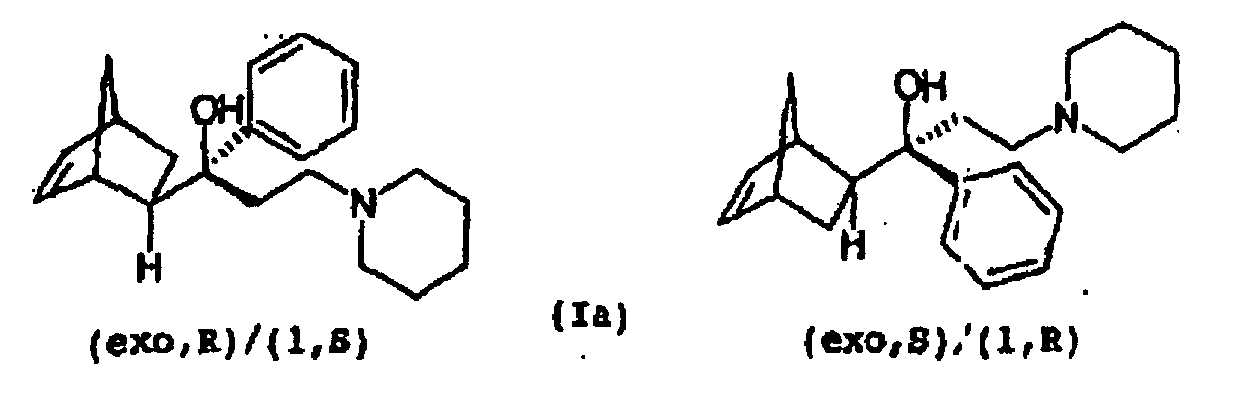 with a phenylmagnesium compound, characterized in that the producdon of the exo-1-(bicyclo[2.2.1]hept-5-en-2-yl)-3-piperidino-1-propanone (II-exo) comprises the following steps:
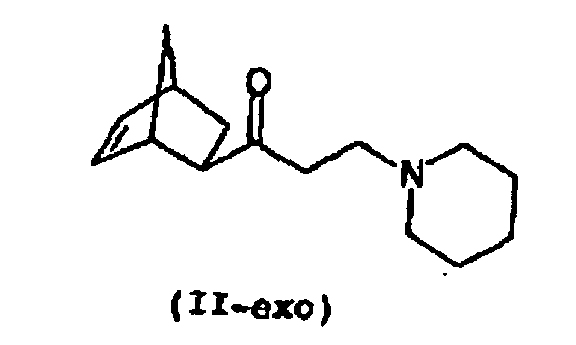 a) conversion of exo-1-[bicyclo[2.2.1]hept-5-en-2-yl)ethanone (III-exo)into an exo-silyl enol ether IV
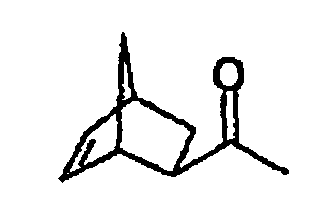 wherein R is the same or different and is alkyl or cycloalkyl, and
 b) reaction of the exo-silyl enol ether IV with a N-methylpiperidinium compound, wherein the shown structural formulae (II-exo) and (III-exo) each relate to the pair of enantiomers.
 - Method according to claim 1, characterized in that in step a), the exo-ethanone III-exo is converted with a metal amide as a base into the exo-metal enolate Vwhich is then converted into the exo-silyl enol ether IV with a silicon organic compound of formula R3Si-X, wherein R has the above meaning and X is a halogen atom.
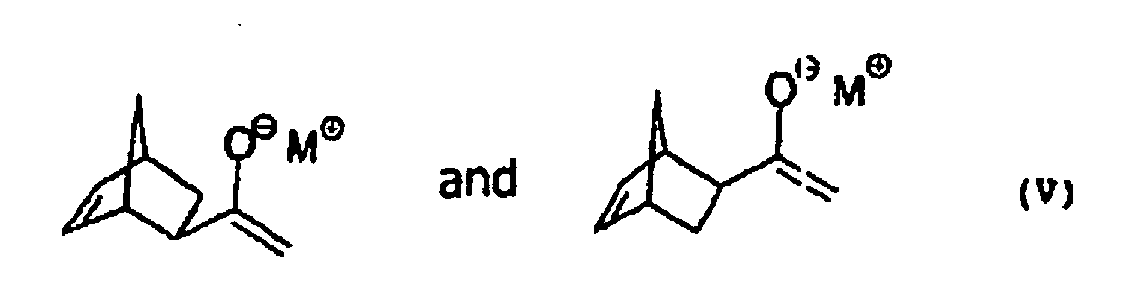
- Method according to claim 2, characterized n that an alkali metal amide is used as metal amide.
- Method according to claim 3, characterized n that a lithium amide is used as a alkali metal amide.
- Method according to claim 4, characterized n that lithium diisopropyl amide is used as lithium amide.
- Method according to any of claims 2 to 5, characterized in that the exo-ethanone III-exo and the metal amide are used in a mole ratio of III exo to metal amide In the range of 1 : 1 to 1 : 1.5.
- Method according to any of the preceding claims, characterized In that the exo-1-(bicyclo[2.2.1]hept-5-en-2-yl)ethanone (III-exo) is converted into the exo-trimethylsilyl enol ether IV with R = methyl.
- Method according to claim 7, characterized in that trimethylsilyl chloride is used in step a).
- Method according to any of the preceding claims, characterized in that step a) is carried out at a temperature In the range of -100 to 0°C.
- Method according to any of the preceding claims, characterized in that N-methyleneplperidinium chloride is used in step b).
- Method according to any of the preceding claims, characterized in that in step b), the N-methylenepiperidinium compound is reacted with the exo-silyl enol ether IV in a mole ratio in the range from 1 : 1 to 2 : 1.
- Method according to any of the preceding claims, characterized in that step b) is carried out at a temperature in the range from -50 to 10°C.
- Method according to any of the preceding claims, characterized in that the reaction mixture resulting from step b) is converted into an aqueous solution and said solution is washed at a pH of at maximum 6 with a solvent which is miscible with water to only a limited extent or immiscible with water, the obtained raffinate is extracted at a pH of at least 7.5 with a solvent that is miscible with water to only a limited extent or is immiscible with water and the solvent is removed from the extract, whereby the exo-1-(bicyclo[2.2.1]hept-5-en-2-yl)-3-piperidino-1-propanone (II-exo) is obtained.
- Method according to any of the preceding claims, characterized in that diphenylmagnesium or a phenylmagnesium compound of the general formulais used as phenylmagnesium compound, wherein R' is C1-C4 alkyl, C4-C6 cycloalkyl, C4-C6 cycloalkyl-C1-C4 alkyl, phenyl C1-C4 alkyl, substituted phenyl C1-C4 alkyl, heteroaryl, heteroaryl C1-C4 alkyl or benzhydryl.
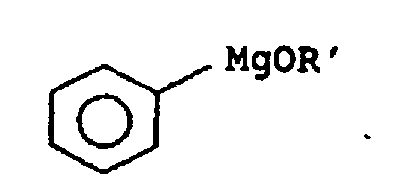
- Method according to any of the preceding claims, characterized in that for obtaining biperiden (Ia) from the reaction of exo-1-(bicyclo[2.2.1]hept-5-en-2-yl)-3-piperidino-1-propanone (II-exo) with the phenylmagnesium compound, the thereby formed mixture of diastereomeric 1-(bicyclo[2.2.1]hept-5-en-2-yl)-1-phenyl-3-plperidino-1-propanolesis converted into the hydrochloride in aqueous isopropanole and isolated,which is reacted with a base in water and diisopropyl ether,the aqueous phase is separated in heat,a part of the diisopropyl ether is removed from the organic phase and after cooling, biperidene (Ia) is isolated by separating the solid from the mother liquor.
- Exo-({1-(bicyclo[2.2.1]hept-5-en-2-yl]vinyl}oxy) silane of the formula IVwherein R is the same or different and is alkyl or cycloalkyl.
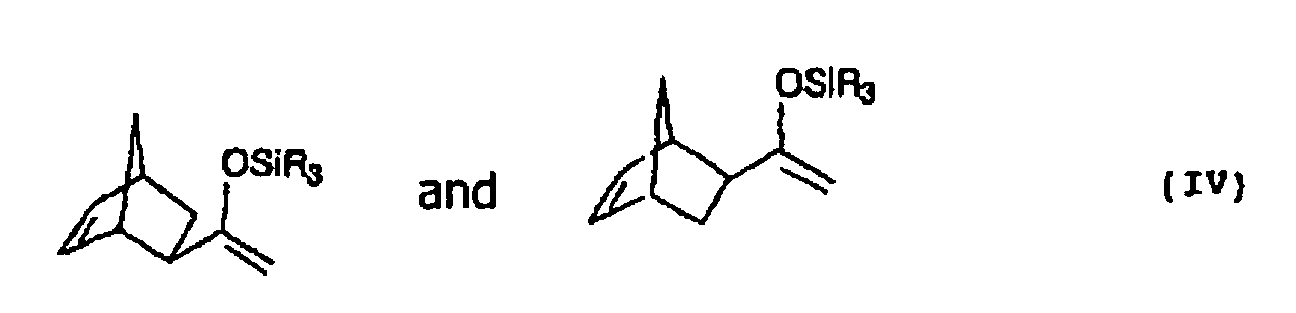
Applications Claiming Priority (3)
| Application Number | Priority Date | Filing Date | Title |
|---|---|---|---|
| DE10124453 | 2001-05-18 | ||
| DE10124453A DE10124453A1 (en) | 2001-05-18 | 2001-05-18 | Preparation of biperiden used for treating Parkinson's disease, by reacting phenylmagnesium compound and exo-bicycloheptenenyl substituted propanone compound |
| PCT/EP2002/005497 WO2002096874A2 (en) | 2001-05-18 | 2002-05-17 | Method for producing biperiden iv |
Publications (2)
| Publication Number | Publication Date |
|---|---|
| EP1387828A2 EP1387828A2 (en) | 2004-02-11 |
| EP1387828B1 true EP1387828B1 (en) | 2005-10-12 |
Family
ID=7685405
Family Applications (1)
| Application Number | Title | Priority Date | Filing Date |
|---|---|---|---|
| EP02735369A Expired - Lifetime EP1387828B1 (en) | 2001-05-18 | 2002-05-17 | Method for producing biperiden iv |
Country Status (8)
| Country | Link |
|---|---|
| US (1) | US7501519B2 (en) |
| EP (1) | EP1387828B1 (en) |
| AT (1) | ATE306471T1 (en) |
| AU (1) | AU2002310828A1 (en) |
| DE (2) | DE10124453A1 (en) |
| DK (1) | DK1387828T3 (en) |
| ES (1) | ES2250653T3 (en) |
| WO (1) | WO2002096874A2 (en) |
Families Citing this family (1)
| Publication number | Priority date | Publication date | Assignee | Title |
|---|---|---|---|---|
| DE10124453A1 (en) | 2001-05-18 | 2002-11-21 | Abbott Gmbh & Co Kg | Preparation of biperiden used for treating Parkinson's disease, by reacting phenylmagnesium compound and exo-bicycloheptenenyl substituted propanone compound |
Family Cites Families (4)
| Publication number | Priority date | Publication date | Assignee | Title |
|---|---|---|---|---|
| DE1005067B (en) * | 1953-03-14 | 1957-03-28 | Knoll Ag | Process for the preparation of bicyclically substituted aminopropanols |
| US2789110A (en) * | 1953-03-14 | 1957-04-16 | Knoll Ag | Amino alcohols substituted by bicycloalkyl residues and a process of making same |
| DE10124453A1 (en) | 2001-05-18 | 2002-11-21 | Abbott Gmbh & Co Kg | Preparation of biperiden used for treating Parkinson's disease, by reacting phenylmagnesium compound and exo-bicycloheptenenyl substituted propanone compound |
| DE10124449A1 (en) * | 2001-05-18 | 2002-11-21 | Abbott Gmbh & Co Kg | Preparation of biperiden used for treating Parkinson's disease by reacting phenylmagnesium compound and bicycloheptenenyl substituted propanone of high exo/endo ratio |
-
2001
- 2001-05-18 DE DE10124453A patent/DE10124453A1/en not_active Withdrawn
-
2002
- 2002-05-17 DK DK02735369T patent/DK1387828T3/en active
- 2002-05-17 WO PCT/EP2002/005497 patent/WO2002096874A2/en not_active Ceased
- 2002-05-17 DE DE50204538T patent/DE50204538D1/en not_active Expired - Lifetime
- 2002-05-17 AU AU2002310828A patent/AU2002310828A1/en not_active Abandoned
- 2002-05-17 ES ES02735369T patent/ES2250653T3/en not_active Expired - Lifetime
- 2002-05-17 AT AT02735369T patent/ATE306471T1/en active
- 2002-05-17 US US10/478,384 patent/US7501519B2/en not_active Expired - Fee Related
- 2002-05-17 EP EP02735369A patent/EP1387828B1/en not_active Expired - Lifetime
Also Published As
| Publication number | Publication date |
|---|---|
| WO2002096874A2 (en) | 2002-12-05 |
| ATE306471T1 (en) | 2005-10-15 |
| US7501519B2 (en) | 2009-03-10 |
| WO2002096874A3 (en) | 2003-01-30 |
| EP1387828A2 (en) | 2004-02-11 |
| ES2250653T3 (en) | 2006-04-16 |
| DE10124453A1 (en) | 2002-11-21 |
| DK1387828T3 (en) | 2006-02-27 |
| DE50204538D1 (en) | 2005-11-17 |
| AU2002310828A1 (en) | 2002-12-09 |
| US20040186294A1 (en) | 2004-09-23 |
Similar Documents
| Publication | Publication Date | Title |
|---|---|---|
| DE69232099T2 (en) | 1,3-SUBSTITUTED CYCLOALKENES AND CYCLOALKANS WITH CENTRAL NERVOUS SYSTEM EFFECT | |
| DE2111071A1 (en) | Process for the preparation of new heterocyclic compounds | |
| DE19619665C2 (en) | Racemate separation of ketamine | |
| DE69116237T2 (en) | Derivatives of hexahydroazepine, process for their preparation and medicinal products containing them | |
| DE2047658B2 (en) | 2-Styryl- and 2-Phenyläthinylbenzylamine derivatives, processes for their preparation and medicaments containing them | |
| WO1996005837A1 (en) | Use of n-substituted phenothiazines | |
| DE9290042U1 (en) | Pro-drug ester of phenolic 2-piperidino-1-alkanols | |
| EP0705830A1 (en) | 2,3-Cyclic condensed 1,4-dihydropyridines, process for their preparation and their use as K-channel modulators | |
| EP1389188B1 (en) | Method for the production of biperiden ii | |
| DE3687515T2 (en) | OXA, THIA AND DIAZABICYCLOAL CANDERIVATIVES, METHOD FOR THE PRODUCTION THEREOF AND THEIR USE AS MEDICINAL PRODUCTS. | |
| DE68925173T2 (en) | 4-methyl and 4-ethyl substituted pyrrolidin-2-ones | |
| EP1392667B1 (en) | Method for the production of biperidin | |
| AT391865B (en) | METHOD FOR PRODUCING NEW BENZOTHIOPHENE DERIVATIVES | |
| WO2002096874A2 (en) | Method for producing biperiden iv | |
| DE3780438T2 (en) | N-SUBSTITUTED CYCLIC AMINES, THEIR PRODUCTION AND THE PHARMACEUTICAL COMPOSITIONS THAT CONTAIN. | |
| DE4341605C2 (en) | Process for the preparation of homochiral amino alcohols | |
| EP1389193B1 (en) | Method for producing biperiden i | |
| DE69203732T2 (en) | Substituted alkenoic acid and its derivatives. | |
| DE3873720T2 (en) | NICOTINOYLPIPERAZINE DERIVATIVES, METHOD FOR THE PRODUCTION THEREOF AND THEIR USE IN THERAPY. | |
| AT371448B (en) | METHOD FOR PRODUCING NEW CIS-4A-PHENYL-ISOCHINOLINE DERIVATIVES AND THEIR ACID ADDITION SALTS | |
| EP1047685A1 (en) | Substituted beta,gamma-anellated lactones | |
| DE3207775A1 (en) | METHOD FOR PRODUCING MOTHER-CORNAL CALOIDS | |
| AT348987B (en) | PROCESS FOR THE PRODUCTION OF NEW FLUORINATED ALKANIC ACID DERIVATIVES AND THEIR ADDITIONAL SALTS | |
| DE69416131T2 (en) | PIPERIDINYL SUBSTITUTED METHANOANTHRACENES AS D1 / D2 ANTAGONISTS AND 5HT2 SEROTONIN ANTAGONISTS | |
| EP0252876A1 (en) | Hydrogenated 1-phenoxyalkylpyridine-3-carboxylic-acid compounds |
Legal Events
| Date | Code | Title | Description |
|---|---|---|---|
| PUAI | Public reference made under article 153(3) epc to a published international application that has entered the european phase |
Free format text: ORIGINAL CODE: 0009012 |
|
| 17P | Request for examination filed |
Effective date: 20031203 |
|
| AK | Designated contracting states |
Kind code of ref document: A2 Designated state(s): AT BE CH CY DE DK ES FI FR GB GR IE IT LI LU MC NL PT SE TR |
|
| AX | Request for extension of the european patent |
Extension state: AL LT LV MK RO SI |
|
| RIN1 | Information on inventor provided before grant (corrected) |
Inventor name: THYES, MARCO Inventor name: GROSSE, MARKUS Inventor name: WEBER, KLAUS, DIETER Inventor name: VILSMAIER, ELMAR Inventor name: KLEIN, PETER |
|
| 17Q | First examination report despatched |
Effective date: 20040525 |
|
| RAP1 | Party data changed (applicant data changed or rights of an application transferred) |
Owner name: LABORATORIO FARMACEUTICO S.I.T.SPECIALITA' IGIENIC |
|
| GRAP | Despatch of communication of intention to grant a patent |
Free format text: ORIGINAL CODE: EPIDOSNIGR1 |
|
| GRAS | Grant fee paid |
Free format text: ORIGINAL CODE: EPIDOSNIGR3 |
|
| GRAA | (expected) grant |
Free format text: ORIGINAL CODE: 0009210 |
|
| AK | Designated contracting states |
Kind code of ref document: B1 Designated state(s): AT BE CH CY DE DK ES FI FR GB GR IE IT LI LU MC NL PT SE TR |
|
| REG | Reference to a national code |
Ref country code: GB Ref legal event code: FG4D Free format text: NOT ENGLISH |
|
| REG | Reference to a national code |
Ref country code: CH Ref legal event code: EP |
|
| REG | Reference to a national code |
Ref country code: IE Ref legal event code: FG4D Free format text: LANGUAGE OF EP DOCUMENT: GERMAN |
|
| REF | Corresponds to: |
Ref document number: 50204538 Country of ref document: DE Date of ref document: 20051117 Kind code of ref document: P |
|
| REG | Reference to a national code |
Ref country code: CH Ref legal event code: NV Representative=s name: AMMANN PATENTANWAELTE AG BERN |
|
| REG | Reference to a national code |
Ref country code: SE Ref legal event code: TRGR |
|
| GBT | Gb: translation of ep patent filed (gb section 77(6)(a)/1977) |
Effective date: 20060116 |
|
| REG | Reference to a national code |
Ref country code: GR Ref legal event code: EP Ref document number: 20050403887 Country of ref document: GR |
|
| REG | Reference to a national code |
Ref country code: DK Ref legal event code: T3 |
|
| REG | Reference to a national code |
Ref country code: ES Ref legal event code: FG2A Ref document number: 2250653 Country of ref document: ES Kind code of ref document: T3 |
|
| ET | Fr: translation filed | ||
| PLBE | No opposition filed within time limit |
Free format text: ORIGINAL CODE: 0009261 |
|
| STAA | Information on the status of an ep patent application or granted ep patent |
Free format text: STATUS: NO OPPOSITION FILED WITHIN TIME LIMIT |
|
| 26N | No opposition filed |
Effective date: 20060713 |
|
| REG | Reference to a national code |
Ref country code: FR Ref legal event code: PLFP Year of fee payment: 14 |
|
| REG | Reference to a national code |
Ref country code: FR Ref legal event code: PLFP Year of fee payment: 15 |
|
| REG | Reference to a national code |
Ref country code: FR Ref legal event code: PLFP Year of fee payment: 16 |
|
| REG | Reference to a national code |
Ref country code: FR Ref legal event code: PLFP Year of fee payment: 17 |
|
| PGFP | Annual fee paid to national office [announced via postgrant information from national office to epo] |
Ref country code: LU Payment date: 20210527 Year of fee payment: 20 |
|
| PGFP | Annual fee paid to national office [announced via postgrant information from national office to epo] |
Ref country code: CY Payment date: 20210507 Year of fee payment: 20 Ref country code: DE Payment date: 20210527 Year of fee payment: 20 Ref country code: FR Payment date: 20210525 Year of fee payment: 20 Ref country code: FI Payment date: 20210527 Year of fee payment: 20 Ref country code: PT Payment date: 20210504 Year of fee payment: 20 Ref country code: MC Payment date: 20210505 Year of fee payment: 20 Ref country code: NL Payment date: 20210526 Year of fee payment: 20 Ref country code: IT Payment date: 20210524 Year of fee payment: 20 Ref country code: GR Payment date: 20210527 Year of fee payment: 20 |
|
| PGFP | Annual fee paid to national office [announced via postgrant information from national office to epo] |
Ref country code: GB Payment date: 20210527 Year of fee payment: 20 Ref country code: ES Payment date: 20210601 Year of fee payment: 20 Ref country code: DK Payment date: 20210527 Year of fee payment: 20 Ref country code: CH Payment date: 20210527 Year of fee payment: 20 Ref country code: BE Payment date: 20210527 Year of fee payment: 20 Ref country code: AT Payment date: 20210504 Year of fee payment: 20 Ref country code: TR Payment date: 20210510 Year of fee payment: 20 Ref country code: IE Payment date: 20210527 Year of fee payment: 20 Ref country code: SE Payment date: 20210527 Year of fee payment: 20 |
|
| REG | Reference to a national code |
Ref country code: DE Ref legal event code: R071 Ref document number: 50204538 Country of ref document: DE |
|
| REG | Reference to a national code |
Ref country code: NL Ref legal event code: MK Effective date: 20220516 |
|
| REG | Reference to a national code |
Ref country code: DK Ref legal event code: EUP Expiry date: 20220517 |
|
| REG | Reference to a national code |
Ref country code: CH Ref legal event code: PL |
|
| REG | Reference to a national code |
Ref country code: GB Ref legal event code: PE20 Expiry date: 20220516 |
|
| REG | Reference to a national code |
Ref country code: BE Ref legal event code: MK Effective date: 20220517 |
|
| REG | Reference to a national code |
Ref country code: IE Ref legal event code: MK9A |
|
| REG | Reference to a national code |
Ref country code: FI Ref legal event code: MAE |
|
| REG | Reference to a national code |
Ref country code: AT Ref legal event code: MK07 Ref document number: 306471 Country of ref document: AT Kind code of ref document: T Effective date: 20220517 |
|
| PG25 | Lapsed in a contracting state [announced via postgrant information from national office to epo] |
Ref country code: PT Free format text: LAPSE BECAUSE OF EXPIRATION OF PROTECTION Effective date: 20220525 Ref country code: IE Free format text: LAPSE BECAUSE OF EXPIRATION OF PROTECTION Effective date: 20220517 Ref country code: GB Free format text: LAPSE BECAUSE OF EXPIRATION OF PROTECTION Effective date: 20220516 |
|
| REG | Reference to a national code |
Ref country code: ES Ref legal event code: FD2A Effective date: 20220805 |
|
| PG25 | Lapsed in a contracting state [announced via postgrant information from national office to epo] |
Ref country code: ES Free format text: LAPSE BECAUSE OF EXPIRATION OF PROTECTION Effective date: 20220518 |