EP1386607B1 - Process for the preparation of Donepezil - Google Patents
Process for the preparation of Donepezil Download PDFInfo
- Publication number
- EP1386607B1 EP1386607B1 EP03253336A EP03253336A EP1386607B1 EP 1386607 B1 EP1386607 B1 EP 1386607B1 EP 03253336 A EP03253336 A EP 03253336A EP 03253336 A EP03253336 A EP 03253336A EP 1386607 B1 EP1386607 B1 EP 1386607B1
- Authority
- EP
- European Patent Office
- Prior art keywords
- process according
- compound
- reaction
- solvent
- group
- Prior art date
- Legal status (The legal status is an assumption and is not a legal conclusion. Google has not performed a legal analysis and makes no representation as to the accuracy of the status listed.)
- Expired - Lifetime
Links
- 0 COc(cc(CC(*)(CC1CCN(*)CC1)C1=O)c1c1)c1OC Chemical compound COc(cc(CC(*)(CC1CCN(*)CC1)C1=O)c1c1)c1OC 0.000 description 5
Classifications
-
- C—CHEMISTRY; METALLURGY
- C07—ORGANIC CHEMISTRY
- C07D—HETEROCYCLIC COMPOUNDS
- C07D211/00—Heterocyclic compounds containing hydrogenated pyridine rings, not condensed with other rings
- C07D211/04—Heterocyclic compounds containing hydrogenated pyridine rings, not condensed with other rings with only hydrogen or carbon atoms directly attached to the ring nitrogen atom
- C07D211/06—Heterocyclic compounds containing hydrogenated pyridine rings, not condensed with other rings with only hydrogen or carbon atoms directly attached to the ring nitrogen atom having no double bonds between ring members or between ring members and non-ring members
- C07D211/08—Heterocyclic compounds containing hydrogenated pyridine rings, not condensed with other rings with only hydrogen or carbon atoms directly attached to the ring nitrogen atom having no double bonds between ring members or between ring members and non-ring members with hydrocarbon or substituted hydrocarbon radicals directly attached to ring carbon atoms
- C07D211/18—Heterocyclic compounds containing hydrogenated pyridine rings, not condensed with other rings with only hydrogen or carbon atoms directly attached to the ring nitrogen atom having no double bonds between ring members or between ring members and non-ring members with hydrocarbon or substituted hydrocarbon radicals directly attached to ring carbon atoms with substituted hydrocarbon radicals attached to ring carbon atoms
- C07D211/34—Heterocyclic compounds containing hydrogenated pyridine rings, not condensed with other rings with only hydrogen or carbon atoms directly attached to the ring nitrogen atom having no double bonds between ring members or between ring members and non-ring members with hydrocarbon or substituted hydrocarbon radicals directly attached to ring carbon atoms with substituted hydrocarbon radicals attached to ring carbon atoms with hydrocarbon radicals, substituted by carbon atoms having three bonds to hetero atoms with at the most one bond to halogen, e.g. ester or nitrile radicals
-
- A—HUMAN NECESSITIES
- A61—MEDICAL OR VETERINARY SCIENCE; HYGIENE
- A61P—SPECIFIC THERAPEUTIC ACTIVITY OF CHEMICAL COMPOUNDS OR MEDICINAL PREPARATIONS
- A61P25/00—Drugs for disorders of the nervous system
-
- A—HUMAN NECESSITIES
- A61—MEDICAL OR VETERINARY SCIENCE; HYGIENE
- A61P—SPECIFIC THERAPEUTIC ACTIVITY OF CHEMICAL COMPOUNDS OR MEDICINAL PREPARATIONS
- A61P25/00—Drugs for disorders of the nervous system
- A61P25/28—Drugs for disorders of the nervous system for treating neurodegenerative disorders of the central nervous system, e.g. nootropic agents, cognition enhancers, drugs for treating Alzheimer's disease or other forms of dementia
-
- C—CHEMISTRY; METALLURGY
- C07—ORGANIC CHEMISTRY
- C07D—HETEROCYCLIC COMPOUNDS
- C07D211/00—Heterocyclic compounds containing hydrogenated pyridine rings, not condensed with other rings
- C07D211/04—Heterocyclic compounds containing hydrogenated pyridine rings, not condensed with other rings with only hydrogen or carbon atoms directly attached to the ring nitrogen atom
- C07D211/06—Heterocyclic compounds containing hydrogenated pyridine rings, not condensed with other rings with only hydrogen or carbon atoms directly attached to the ring nitrogen atom having no double bonds between ring members or between ring members and non-ring members
- C07D211/08—Heterocyclic compounds containing hydrogenated pyridine rings, not condensed with other rings with only hydrogen or carbon atoms directly attached to the ring nitrogen atom having no double bonds between ring members or between ring members and non-ring members with hydrocarbon or substituted hydrocarbon radicals directly attached to ring carbon atoms
- C07D211/18—Heterocyclic compounds containing hydrogenated pyridine rings, not condensed with other rings with only hydrogen or carbon atoms directly attached to the ring nitrogen atom having no double bonds between ring members or between ring members and non-ring members with hydrocarbon or substituted hydrocarbon radicals directly attached to ring carbon atoms with substituted hydrocarbon radicals attached to ring carbon atoms
- C07D211/30—Heterocyclic compounds containing hydrogenated pyridine rings, not condensed with other rings with only hydrogen or carbon atoms directly attached to the ring nitrogen atom having no double bonds between ring members or between ring members and non-ring members with hydrocarbon or substituted hydrocarbon radicals directly attached to ring carbon atoms with substituted hydrocarbon radicals attached to ring carbon atoms with hydrocarbon radicals, substituted by doubly bound oxygen or sulfur atoms or by two oxygen or sulfur atoms singly bound to the same carbon atom
- C07D211/32—Heterocyclic compounds containing hydrogenated pyridine rings, not condensed with other rings with only hydrogen or carbon atoms directly attached to the ring nitrogen atom having no double bonds between ring members or between ring members and non-ring members with hydrocarbon or substituted hydrocarbon radicals directly attached to ring carbon atoms with substituted hydrocarbon radicals attached to ring carbon atoms with hydrocarbon radicals, substituted by doubly bound oxygen or sulfur atoms or by two oxygen or sulfur atoms singly bound to the same carbon atom by oxygen atoms
-
- Y—GENERAL TAGGING OF NEW TECHNOLOGICAL DEVELOPMENTS; GENERAL TAGGING OF CROSS-SECTIONAL TECHNOLOGIES SPANNING OVER SEVERAL SECTIONS OF THE IPC; TECHNICAL SUBJECTS COVERED BY FORMER USPC CROSS-REFERENCE ART COLLECTIONS [XRACs] AND DIGESTS
- Y02—TECHNOLOGIES OR APPLICATIONS FOR MITIGATION OR ADAPTATION AGAINST CLIMATE CHANGE
- Y02P—CLIMATE CHANGE MITIGATION TECHNOLOGIES IN THE PRODUCTION OR PROCESSING OF GOODS
- Y02P20/00—Technologies relating to chemical industry
- Y02P20/50—Improvements relating to the production of bulk chemicals
- Y02P20/55—Design of synthesis routes, e.g. reducing the use of auxiliary or protecting groups
Definitions
- the present invention relates to a novel process for the preparation 1 -benzyl-4-[(5,6-dimethoxyindan-1 -on-2-yl)methyl]piperidine (Donepezil) and new intermediates thereof.
- Donepezil is used in the treatment of Alzheimer's disease.
- Donepezil hydrochloride is a useful memory enhancer introduced by the Japanese pharmaceutical company Eisai. Its preparation was described in patent no. EP 296560. In this patent Donepezil was produced by reaction of 5,6-dimethoxy-1- indanone with 1 -benzyl-4-formylpiperidine in the presence of a strong base, such as lithium diisopropylamide followed by reduction of the double bond. According to this method, Donepezil was obtained (Scheme 1).
- Patent application WO 99/36405 describes another process for the synthesis of Donepezil.
- 2-alkoxycarbonyl-1-indanones are reacted with (4-pyridinyl) methyl halide moiety followed by hydrolysis and decarboxylation to give the 2-(4-pyridinyl)methyl-1-indanone derivative.
- This is followed by reaction with benzyl halides to obtain the corresponding quaternary ammonium salt, and followed by hydrogenation of the pyridine ring to obtain Donepezil (Scheme 2).
- Patent application WO 97/22584 describes the preparation of Donepezil by reaction of pyridine-4-carboxyaldehyde with malonic acid to give 3-(pyridin-4-yl)-2- propenoic acid, followed by hydrogenation of the double bond to give 3-(piperidin-4-yl)-2-propionic acid. Reaction of this intermediate with methyl chloroformate afforded 3-[N-(methyloxycarbonyl) piperidin-4-yl]propionic acid. This was followed by reaction with oxalyl chloride to give methyl 4-(2-chlorocarbonylethyl)piperidin-1-carboxylate.
- Patent application EP 711756 describes the preparation of Donepezil by reaction of 5,6-dimethoxy-1- indanone with pyridin-4-aldehyde to give 5,6-dimethoxy-2-(pyridin-4-yl)methylene indan-1-one. Reaction with benzyl bromide afforded 1-benzyl-4-(5,6-dimethoxyindan-1-on-2-ylidene)methylpyridinium bromide. Hydrogenation in the presence of platinum oxide afforded Donepezil (Scheme 4).
- the present invention relates to a novel process for the synthesis of 1-benzyl-4[(5,6-dimethoxyindan-1-on-2-yl)methyl]piperidine (Donepezil). Novel intermediates are obtained in the synthetic pathway and are described. Scheme 5 gives in outline of the new process.
- N-protected activated -4-methylpiperidine ( 1 ) wherein X represents a leaving group and R 1 represents an N-protecting group reacts with 2-alkoxycarbonyl-5,6-dimethoxyindan-1-one ( 2 ) wherein R represents a C 1 -C 4 alkyl group or an aralkyl group affording 4-[(2-alkoxycarbonyl-5,6-dimethoxy-indan-1-on-2-yl)methyl]-N-protected piperidine)] ( 3 ).
- Compound 3 is deprotected affording 4-[(2-alkoxycarbonyl-5,6-dimethoxy-indan-1-on-2-yl)methyl]piperidine having formula 4 wherein R is as defined above .
- This compound is reacted with a compound of the formula R 2 Y wherein R 2 is a C 1 -C 4 alkyl group or an aralkyl group and Y is a leaving group to afford compound of type 5 wherein R 2 is and Y are as defined above.
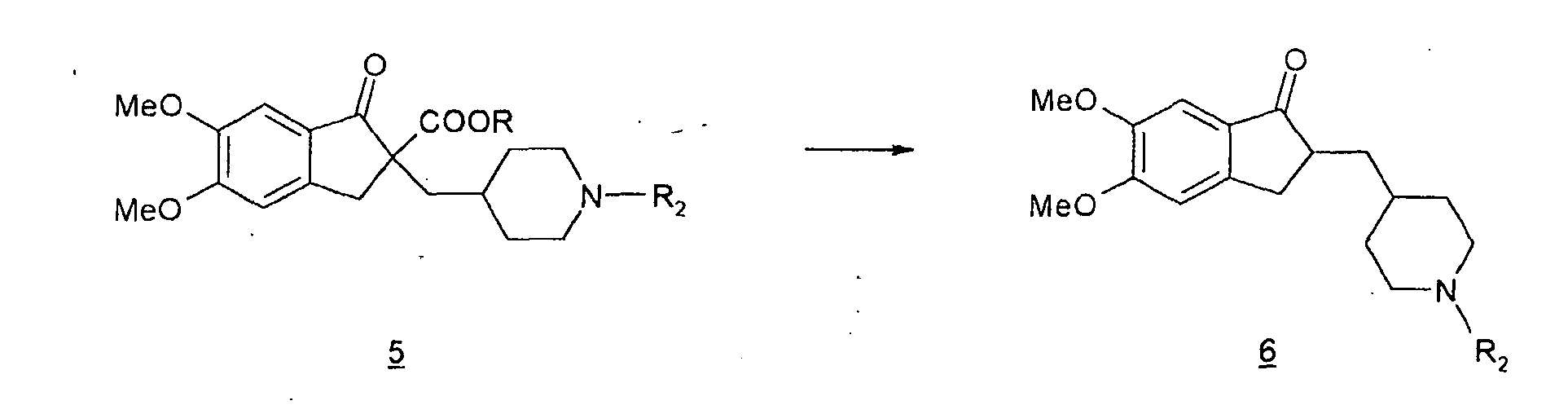
- Compound 5 is subjected to hydrolysis followed by decarboxylation to afford compound of type 6 wherein R 2 is as defined above.
- R 2 is a benzyl group
- compound 6 is Donepezil which is a useful drug for the treatment of Alzhiemer's disease.
- Novel compounds represented by general formulae 3 , 4 and 5 were isolated and identified as intermediates in the said process and are parts of this invention.
- a compound of formula 1 is reacted with a compound of formula 2 , wherein R is a C 1 - C 4 alkyl group such as methyl, ethyl, t-Bu or an aralkyl group such as (optionally substituted) benzyl group.
- R 1 is any appropriate N-protecting group, such as t-Butoxycarbonyl (t-BOC), Benzyloxycarbonyl (CBZ), and triphenylmethyl.
- X is a leaving group, such as halide, mesylate or tosylate, preferably iodide.
- the reaction can be carried out at a temperature range between 0-120°C, preferably at 30-70°C, in the presence of a suitable base, such as alkali metal hydride, alkali metal alkoxide, alkali metal carbonate,alkali metal hydroxide. Potassium carbonate is preferred as base.
- a suitable base such as alkali metal hydride, alkali metal alkoxide, alkali metal carbonate,alkali metal hydroxide. Potassium carbonate is preferred as base.
- a variety of solvents can be used, such as dimethylformamide ( DMF), dimthylsulfoxide (DMSO), ethanol, and methanol. DMF is the preferred solvent.
- Step 2 Protecting group removal:
- the exact manner for removing the protecting group R 1 depends upon its nature. For example; removal of t-butoxycarbonyl (t-BOC ) protecting group is carried out by trifluoroacetic acid (TFA) in an organic solvent like methylene chloride, toluene, chloroform or THF, preferably methylene chloride, while the removal of carbobenzoxycarbonyl (CBZ) protecting group can be done by hydrolysis using an acid, preferably 30% HBr in acetic acid at elevated temperature, in the presence of a solvent like methylene chloride, toluene, chloroform or THF , preferably toluene, or by catalytic hydrogenation using precious metal catalysis like palladium or platinum, preferably palladium on charcoal, in the presence of a C1-C4 alcohol as a solvent, preferably ethanol.
- TFA trifluoroacetic acid
- CBZ carbobenzoxycarbonyl
- Step 3 Substitution of the nitrogen atom
- the reaction can be carried out at temperature range of 0-100°C , preferably at 20-40°C, and in various solvents like THF, methylene chloride, chloroform, toluene, or a mixture thereof; methylene chloride is preferred solvent.
- the reaction is carried out in the presence of an organic or an inorganic base like an alkali metal hydroxide, an alkali metal carbonate or an organic amine, preferably triethylamine.
- Intermediates of type 5 are novel compounds disclosed in this invention and are claimed for.
- R The method for the removal of the R group and decarboxylation depends on the nature of R. Reactions such as acidic or basic hydrolysis can be employed while basic hydrolysis is preferred. Bases like alkali metal hydroxides or carbonates may be employed, potassium carbonate is preferred. If R is a benzyl group catalytic hydrogenolysis can also be employed. Decarboxylation can be accomplished by heating using any appropriate solvent like ethanol, methanol, THF, DMF, DMSO or mixed solvents. Ethanol is the preferred solvent.
- Donepezil using the invention describes hereby consists of four easy chemical steps. No extreme conditions have to be used and starting materials are readily available. The yields are fair and the invention can be easily upscaled without any technical and safety problems.
- This compound is prepared according to the procedure disclosed in EP 534859. To a suspension of sodium hydride (50% dispersion in oil, 20g) in 240mL of THF, diethyl carbonate was added and the mixture was stirred and refluxed for 90 min. A solution of 5,6-Dimethoxyindan-1-one (40g) in THF (440mL) was added, the mixture was heated under reflux for 3h, then cooled and concentrated. Ethyl acetate (200mL) was added, the organic layer was washed with water. The organic layer was dried over MgSO 4 , filtered and the ethyl acetate was removed under reduced pressure. The title product was obtained in 98% yield.
- Triphenylphosphine (31.2gr) was added to a mixture of iodine (29.4g) in toluene (1L). After 5min, pyridine (18ml) was added, followed by CBZ-piperidinemethanol (34.6gr). The resulting mixture was heated and stirred at reflux for 1.5h. The reaction mixture was allowed to cool to room temperature, and filtered. The filtrate was washed with saturated sodium metabisulfite and brine. The organic layer was dried over MgSO 4 and evaporated. The crude product was dissolved in ethyl acetate/hexane 1:5, and filtered through silica gel. The filtrate was evaporated under reduced pressure, and the crude product was crystallized from ethyl acetate/hexane.
Landscapes
- Chemical & Material Sciences (AREA)
- Organic Chemistry (AREA)
- Health & Medical Sciences (AREA)
- Engineering & Computer Science (AREA)
- Bioinformatics & Cheminformatics (AREA)
- Biomedical Technology (AREA)
- Neurology (AREA)
- Neurosurgery (AREA)
- Pharmacology & Pharmacy (AREA)
- Veterinary Medicine (AREA)
- Medicinal Chemistry (AREA)
- Nuclear Medicine, Radiotherapy & Molecular Imaging (AREA)
- Chemical Kinetics & Catalysis (AREA)
- Life Sciences & Earth Sciences (AREA)
- Animal Behavior & Ethology (AREA)
- General Health & Medical Sciences (AREA)
- Public Health (AREA)
- General Chemical & Material Sciences (AREA)
- Hospice & Palliative Care (AREA)
- Psychiatry (AREA)
- Hydrogenated Pyridines (AREA)
- Treatments Of Macromolecular Shaped Articles (AREA)
- Organic Low-Molecular-Weight Compounds And Preparation Thereof (AREA)
- Low-Molecular Organic Synthesis Reactions Using Catalysts (AREA)
- Preparation Of Compounds By Using Micro-Organisms (AREA)
Abstract
Description
- The present invention relates to a novel process for the preparation 1 -benzyl-4-[(5,6-dimethoxyindan-1 -on-2-yl)methyl]piperidine (Donepezil) and new intermediates thereof. Donepezil is used in the treatment of Alzheimer's disease.
- Donepezil hydrochloride is a useful memory enhancer introduced by the Japanese pharmaceutical company Eisai. Its preparation was described in patent no. EP 296560. In this patent Donepezil was produced by reaction of 5,6-dimethoxy-1- indanone with 1 -benzyl-4-formylpiperidine in the presence of a strong base, such as lithium diisopropylamide followed by reduction of the double bond. According to this method, Donepezil was obtained (Scheme 1).

- Patent application WO 99/36405 describes another process for the synthesis of Donepezil. According to this patent, 2-alkoxycarbonyl-1-indanones are reacted with (4-pyridinyl) methyl halide moiety followed by hydrolysis and decarboxylation to give the 2-(4-pyridinyl)methyl-1-indanone derivative. This is followed by reaction with benzyl halides to obtain the corresponding quaternary ammonium salt, and followed by hydrogenation of the pyridine ring to obtain Donepezil (Scheme 2).

- Patent application WO 97/22584 describes the preparation of Donepezil by reaction of pyridine-4-carboxyaldehyde with malonic acid to give 3-(pyridin-4-yl)-2- propenoic acid, followed by hydrogenation of the double bond to give 3-(piperidin-4-yl)-2-propionic acid. Reaction of this intermediate with methyl chloroformate afforded 3-[N-(methyloxycarbonyl) piperidin-4-yl]propionic acid. This was followed by reaction with oxalyl chloride to give methyl 4-(2-chlorocarbonylethyl)piperidin-1-carboxylate. Reaction with 1,2-dimethoxybenzene in the presence of aluminum chloride afforded methyl 4-[3-(3,4-dimethoxyphenyl)-3-oxopropyl]piperidin-1 -carboxylate. Reaction with tetramethyldiaminomethane afforded 4-[2-(3,4-dimethoxybenzoyl)allyl] piperidin-1-carboxylate. Reaction with sulfuric acid afforded methyl 4-(5,6-dimethoxy-1-oxoindan-2-yl)methylpiperidin-1- carboxylate. This was followed by treatment with base to give 5,6-dimethoxy-2-(piperidin-4-ylmethyl) indan-1-one, then reaction with benzyl bromide afforded Donepezil (Scheme 3).

- Patent application EP 711756 describes the preparation of Donepezil by reaction of 5,6-dimethoxy-1- indanone with pyridin-4-aldehyde to give 5,6-dimethoxy-2-(pyridin-4-yl)methylene indan-1-one. Reaction with benzyl bromide afforded 1-benzyl-4-(5,6-dimethoxyindan-1-on-2-ylidene)methylpyridinium bromide. Hydrogenation in the presence of platinum oxide afforded Donepezil (Scheme 4).

- The present invention relates to a novel process for the synthesis of 1-benzyl-4[(5,6-dimethoxyindan-1-on-2-yl)methyl]piperidine (Donepezil). Novel intermediates are obtained in the synthetic pathway and are described. Scheme 5 gives in outline of the new process.

- N-protected activated -4-methylpiperidine (1) wherein X represents a leaving group and R1 represents an N-protecting group reacts with 2-alkoxycarbonyl-5,6-dimethoxyindan-1-one (2) wherein R represents a C1-C4 alkyl group or an aralkyl group affording 4-[(2-alkoxycarbonyl-5,6-dimethoxy-indan-1-on-2-yl)methyl]-N-protected piperidine)] (3). Compound 3 is deprotected affording 4-[(2-alkoxycarbonyl-5,6-dimethoxy-indan-1-on-2-yl)methyl]piperidine having formula 4 wherein R is as defined above . This compound is reacted with a compound of the formula R2Y wherein R2 is a C1-C4 alkyl group or an aralkyl group and Y is a leaving group to afford compound of type 5 wherein R2 is and Y are as defined above. Compound 5 is subjected to hydrolysis followed by decarboxylation to afford compound of type 6 wherein R2 is as defined above. In case where R2 is a benzyl group compound 6 is Donepezil which is a useful drug for the treatment of Alzhiemer's disease.
- Novel compounds represented by general formulae 3, 4 and 5 were isolated and identified as intermediates in the said process and are parts of this invention.
- A compound of formula 1 is reacted with a compound of formula 2, wherein R is a C1 - C4 alkyl group such as methyl, ethyl, t-Bu or an aralkyl group such as (optionally substituted) benzyl group. R1 is any appropriate N-protecting group, such as t-Butoxycarbonyl (t-BOC), Benzyloxycarbonyl (CBZ), and triphenylmethyl. X is a leaving group, such as halide, mesylate or tosylate, preferably iodide.

- The reaction can be carried out at a temperature range between 0-120°C, preferably at 30-70°C, in the presence of a suitable base, such as alkali metal hydride, alkali metal alkoxide, alkali metal carbonate,alkali metal hydroxide. Potassium carbonate is preferred as base. A variety of solvents can be used, such as dimethylformamide ( DMF), dimthylsulfoxide (DMSO), ethanol, and methanol. DMF is the preferred solvent.
- Intermediates described by formula 3 are novel compounds disclosed in this invention and are claimed for.
-

- The exact manner for removing the protecting group R1 depends upon its nature. For example; removal of t-butoxycarbonyl (t-BOC ) protecting group is carried out by trifluoroacetic acid (TFA) in an organic solvent like methylene chloride, toluene, chloroform or THF, preferably methylene chloride, while the removal of carbobenzoxycarbonyl (CBZ) protecting group can be done by hydrolysis using an acid, preferably 30% HBr in acetic acid at elevated temperature, in the presence of a solvent like methylene chloride, toluene, chloroform or THF , preferably toluene, or by catalytic hydrogenation using precious metal catalysis like palladium or platinum, preferably palladium on charcoal, in the presence of a C1-C4 alcohol as a solvent, preferably ethanol.
- Intermediates represented by general formula 4 {4-[(5,6-dimethoxy-2-alkoxycarbonylindan-1-on-2-yl)methyl] piperidine} are novel compounds disclosed in this invention.
- Compounds of type 5 wherein R is C1-C4 alkyl group and R2 is C1-C4 alkyl group or an aralkyl group were obtained by reacting of compounds of general formula 4 with a compound of the formula R2Y wherein R2 is as defined above and Y is a leaving group such as halide (chloride, bromide or iodide), mesylate or tosylate.
- The reaction can be carried out at temperature range of 0-100°C , preferably at 20-40°C, and in various solvents like THF, methylene chloride, chloroform, toluene, or a mixture thereof; methylene chloride is preferred solvent. The reaction is carried out in the presence of an organic or an inorganic base like an alkali metal hydroxide, an alkali metal carbonate or an organic amine, preferably triethylamine.

-

- The method for the removal of the R group and decarboxylation depends on the nature of R. Reactions such as acidic or basic hydrolysis can be employed while basic hydrolysis is preferred. Bases like alkali metal hydroxides or carbonates may be employed, potassium carbonate is preferred. If R is a benzyl group catalytic hydrogenolysis can also be employed. Decarboxylation can be accomplished by heating using any appropriate solvent like ethanol, methanol, THF, DMF, DMSO or mixed solvents. Ethanol is the preferred solvent.
- The preparation of Donepezil using the invention describes hereby consists of four easy chemical steps. No extreme conditions have to be used and starting materials are readily available. The yields are fair and the invention can be easily upscaled without any technical and safety problems.
- Thus according to the present invention there is now provided process for the preparation of a compound of the formula 6 comprising the hydrolysis followed by decarboxylation of a compound of the formula 5 according to the reaction:

- In especially preferred embodiments of the present invention there is provided a process for the preparation of compound 6 as defined above further characterized that the preparation of compound 4 is achieved by the removal of the N-protecting group of compound 3 according to the reaction

- In further especially preferred embodiments of the present invention there is provided a process for the preparation of compound 6 as defined above further characterized that the preparation of compound 3 is a achieved by the coupling of compounds 1 and 2 according to the reaction:

- This compound is prepared according to the procedure disclosed in EP 534859. To a suspension of sodium hydride (50% dispersion in oil, 20g) in 240mL of THF, diethyl carbonate was added and the mixture was stirred and refluxed for 90 min. A solution of 5,6-Dimethoxyindan-1-one (40g) in THF (440mL) was added, the mixture was heated under reflux for 3h, then cooled and concentrated. Ethyl acetate (200mL) was added, the organic layer was washed with water. The organic layer was dried over MgSO4, filtered and the ethyl acetate was removed under reduced pressure. The title product was obtained in 98% yield.
- This compound is prepared according to the procedure disclosed in US 5538984.
- Triphenylphosphine (31.2gr) was added to a mixture of iodine (29.4g) in toluene (1L). After 5min, pyridine (18ml) was added, followed by CBZ-piperidinemethanol (34.6gr). The resulting mixture was heated and stirred at reflux for 1.5h. The reaction mixture was allowed to cool to room temperature, and filtered. The filtrate was washed with saturated sodium metabisulfite and brine. The organic layer was dried over MgSO4 and evaporated. The crude product was dissolved in ethyl acetate/hexane 1:5, and filtered through silica gel. The filtrate was evaporated under reduced pressure, and the crude product was crystallized from ethyl acetate/hexane.
- 5,6-dimethoxy-2-ethoxycarbonylindan-1-one (7.68g) was dissolved in DMF (340mL). 1-t-BOC-piperidyl-4-methyliodide (12.3g) and potassium carbonate (8.0g) were added therein and the mixture was stirred at room temperature overnight. Ethyl acetate (200mL) was added to the reaction mixture followed by water (200mL) and the layers were separated. The organic layer was washed with water (3x50mL) and then with saturated sodium chloride solution (200mL). The organic layer was dried over MgSO4, and the solvent was removed under reduced pressure. The title compound was isolated as a white-yellowish solid and recrystallized from ethyl acetate: hexane. 7.89g (59% yield) of the title product was obtained and found to be pure by HPLC. Mass spectrum m/e: 462[M+H+].
Elemental analysis (calculated for C25H35NO7):
Calculated: C, 65.06%; H, 7.64%; N, 3.03%.
Found: C, 64.92%; H, 7.32%; N, 3.31%.
1H-NMR(CDCl3, δ(ppm)): 7.16(s, 1H), 6.90(s, 1H), 4.21(q, 2H), 3.98(s, 3H), 3.91(s, 3H), 3.67(2H), 2.63(m, 2H), 2.21(m, 2H), 1.74(m, 2H), 1.59(m, 3H), 1.43(s, 9H), 1.26(t,3H).
13C-NMR(CDCl3, δ(ppm)): 200.6, 171.1, 156.0, 149.7,148.4,127.4, 107.1, 104.9, 79.3, 61.7, 60.8, 56.2, 44.0, 41.0, 36.7, 33.5, 28.4, 22.8, 14.0. - 5,6-dimethoxy-2-methoxycarbonylindan-1 -one (1.41g) was dissolved in DMF (30mL). Potassium carbonate (1.56g) was added and the mixture was stirred for 30 min at room temperature. A solution of 1-t-BOC-piperidyl-4-methyliodide (2.2g) dissolved in 10mL DMF was added dropwise within 30min. The mixture was heated gently to (45-50°C) and the reaction mixture was stirred at 50°C for 5 hrs. Ethyl acetate (30mL) was added to the reaction mixture, and the solution was washed with water (3x30mL). The organic layer was separated, dried over MgSO4 and evaporated to give yellowish solid. The oil obtained was crystallized from ethyl acetate/n-hexane. 1.26g of the title product (49.9% yield) were obtained as yellow crystals.
Mass spectrum m/e: 448[M+H+].
1H NMR(CDCl3, δ(ppm)): 7.16(s, 1H), 6.89(s, 1H), 3.99(s, 3H), 3.90(s, 3H), 3.69(s, 3H). - 5,6-dimethoxy-2-ethoxycarbonylindan-1-one (4.74g) was dissolved in DMF (150mL). Potassium carbonate (4.94g) was added. 1-CBZ-piperidyl-4-methyliodide (9.09g) dissolved in DMF (50mL) was added dropwise and the mixture was stirred at room temperature overnight. Ethyl acetate (100mL) was added and the mixture was washed with water (100mL) and then with brine (50mL). The organic layer was dried over MgSO4, filtered and evaporated under reduced pressure. The crude product was crystallized from ethanol to give 4.94g of the title product (59.1 % yield).
Mass spectrum m/e: 496 [M+H+].
Elemental analysis (calculated for C28H33NO7):
Calculated: C, 67.86%; H, 6.71%; N, 2.83%.
Found: C, 67.64%; H, 6.68%; N, 3.07%.
NMR (CDCl3, δ(ppm)): 7.34(br s, 5H), 7.23(s, 1H), 6.89(s, 1H), 5.15(s, 2H), 4.21(q, 2H), 4.02(s, 3H), 3.94(s, 3H), 3.66(d, 1H), 3.03(d, 1H), 2.72(br t, 2H), 2.20(m, 2H), 1.57-1.73(m, 7H), 1.26(t, 3H). - To 5,6-dimethoxy-2-ethoxycarbonylindan-1-one (2.28g) dissolved in DMF (80mL), potassium carbonate (2.4g) was added. Then, N-CBZ-piperidyl-4-methyltosylate (5.0g) dissolved in DMF (25mL) was added dropwise within 3hrs. The mixture was stirred at ambient temperature 48h, ethyl acetate (100mL) was added therein and the mixture was rinsed with water (100mL) and then with brine. The organic layer was dried over MgSO4, filtered and evaporated under reduced pressure. The title product was obtained at 23% yield as confirmed by HPLC-MS analysis.
- To 5,6-dimethoxy-2-ethoxycarbonylindan-1-one (2.6g) dissolved in DMF (50mL), potassium carbonate (2.7g) was added. N-CBZ-piperidyl-4-methylmesylate (4.6g) dissolved in DMF (30mL) was added dropwise within 3hrs and the mixture was stirred for 48h at ambient temperature. Ethyl acetate (100mL) was added and the mixture was washed with water (100mL) and then with brine (50mL). The organic layer was dried over MgSO4, filtered and evaporated under reduced pressure, HPLC of the crude indicate that the coupling product obtained at 5.6% yield and its identity was confirmed by HPLC-MS.
- The product from example 1 (5.3g) was dissolved in methylene chloride (50mL), the solution was cooled to 0°C, trifluoroacetic acid (65.5g) was added, and the solution was stirred at 0-5°C for 30 minute. The methylene chloride and TFA were removed under reduced pressure, toluene (15mL) was added and then removed under reduced pressure. A brownish oily product was obtained. The product was dissolved in a mixture of toluene and water (100mL, 1:1), the mixture was stirred, the layers were allowed to separate and the organic layer was removed. The pH of the aqueous layer was brought to pH 8.0-8.5 with 1 N-NaOH. The solution was extracted with ethyl acetate 3x50mL, the organic layers were combined and washed with brine (20mL), dried (MgSO4) and filtered. The ethyl acetate was removed under reduced pressure. The crude product was crystallized from ethyl acetate/hexane to give 2.4g of the title product (58% yield). The product was pure by HPLC.
Mass spectrum m/e: 362[M+H+].
1H-NMR(CDCl3, δ(ppm)): 7.17(s, 1H), 7.08(s, 1H), 4.06(q, 2H), 3.89(s, 3H), 3.80(s, 3H), 3.21(m, 2H), 2.50(s, 2H), 2.01(m, 2H), 1.73(m, 3H), 1.30(m, 2H), 1.09(t, 3H). - The product from example 2 (9.69g) was dissolved in chloroform (100mL), 30% HBr in acetic acid (23mL) was added dropwise within 30 minute. The mixture was gently heated to 40°C until full conversion was occurred (tested by HPLC). To the reaction mixture water (200mL) was added and the mixture was stirred for 15min. The aqueous solution was separated and washed with chloroform (100mL). Sodium hydroxide solution (20%) was added until pH 10 was reached. The product was extracted with ethyl acetate (50mLx4), the combined organic layer were dried over MgSO4 and evaporated to obtained 4.9g of the title compound (68.6% yield), the product was found to be pure by HPLC.
- The product from example 8 (8.23g) was dissolved in toluene (100mL), triethylamine (15mL) and benzyl chloride (2.9mL) were added therein and the reaction mixture was heated to 35°C and stirred overnight. The organic layer was washed with water and brine; then dried over MgSO4 and evaporated. The crude product was crystallized from ethyl acetate-hexane to give 9.53g of white solid, (89% yield).
Mass spectrum m/e: 452[M+H+].
1H NMR (CDCl3, δ(ppm)): 7.29(m, 5H), 7.22(s, 1H), 6.88(s, 1H), 4.14(q, 2H), 3.97(s, 3H), 3.89(s, 3H), 3.70(m, 2H), 3.44(s, 2H), 3.01(d, 2H), 2.97(m, 2H), 2.0(m, 2H), 1.37(m, 2H), 1.23(m, 3H), 1.20(t, 3H).
13C NMR(CDCl3, δ(ppm)): 200, 171, 149,148, 138, 129-126, 107, 105, 63, 61.3, 58, 56, 53, 41, 36, 33, 18, 14.
IR(NaCI, Nujol) ν(cm-1: 2923, 2853, 1701(C=O), 1591, 1499, 1459, 1376. UV (MeOH) λmax(nm): 207, 232, 272, 318. - Following the procedure described in example 8, the product obtained in example 2 (1.7g), triethylamine (4mL), CH2Cl2 (10mL), and methyl iodide (0.67g) in CH2Cl2 (10mL) were reacted. After crystallization, 1.41 g of the title compound was obtained as white crystals in 80% yield.
Mass spectrum m/e: 376[M+H+]. - The product from example 8 (3.55g,) was dissolved in ethanol-water mixture (5:1). Potassium hydroxide (2.05g) was added and the solution was refluxed for 60min. Water (50ml) was added. And a yellowish precipitation was formed. Ethyl acetate was added, and the solvent was removed under reduced pressure. Donepezil free base was obtained as white solid. The product was crystallized from ethanol to obtain 2.3g of the product (80% yield).
Mass spectrum m/e: 380[M+H+].
1H-NMR(CDCl3, δ(ppm)): 7.63(brs, 2H), 7.44(brs, 3H), 7.11(s, 1H), 6.85(s, 1H), 4.16(s, 2H), 3.95(s, 3H), 3.89(s, 3H), 3.40(m, 2H), 3.25(m, 1H), 2.66(m, 4H), 2.06-1.96(m,6H), 1.51(m, 1H).
Claims (44)
- A process for the preparation of a compound of the formula 6 comprising the hydrolysis and decarboxylation of a compound of the formula 5 according to the reaction:

- A process for the preparation of compound 6 as described in claim 1 further characterized in that the preparation of compound 5 is achieved by the alkylation or aralkylation of compound 4 according to the reaction:

- A process for the preparation of compound 6 according to claims 1 and 2 further characterized that the preparation of compound 4 is achieved by the removal of the N-protecting group of compound 3 according to the reaction

- A process for the preparation of compound 6 according to claims 1, 2 and 3 further characterized that the preparation of compound 3 is a achieved by the coupling of compounds 1 and 2 according to the reaction:

- A process according to claim 1 wherein the hydrolysis and decarboxylation are carried out in a solution, at elevated temperature and in the presence of a base.
- A process according to claim 5 wherein the temperature is in the range of 60-100°C.
- A process according to claim 5 wherein the base is hydroxide or carbonate of an alkali metal.
- A process according to claim 7 wherein said base is potassium hydroxide.
- A process according to claim 5 wherein the reaction is carried out in a mixture of a C1-C6 alcohol and water.
- A process according to claim 9 wherein the reaction is carried out in the presence of ethanol and water.
- A process according to claim 2 wherein the reaction is carried out in a solution, in the presence of an organic or an inorganic base.
- A process according to claim 11 wherein the solvent is toluene, methylene chloride, chloroform, tetrahydrofuran (THF).
- A process according to claim 11 wherein said solvent is methylene chloride.
- A process according to claim 11 wherein the base is an alkali metal hydroxide or an alkali metal carbonate or an amine.
- A process according to claim 11 wherein said base is triethylamine.
- A process according to claim 3 wherein R1 is benzyloxycarbonyl (CBZ).
- A process according to claim 16 wherein the deprotection reaction is carried out in the presence of solvent, at elevated temperature using acid as catalyst.
- A process according to claim 16 wherein the solvent is methylene chloride, toluene, chloroform or THF.
- A processs according to claim 18 wherein the solvent is toluene.
- A process according to claim 16 wherein the acid is 30% solution of HBr in acetic acid.
- A process according to claim 16 wherein the deprotection reaction is carried out in a solvent by hydrogenolysis in the presence of a precious metal catalyst.
- A process according to claim 21 wherein the solvent is a C1-C6 alcohol.
- A process according to claim 22 wherein the solvent is ethanol.
- A process according to claim 21 wherein the catalyst is a supported palladium or platinum catalyst.
- A process according to claim 24 wherein the catalyst is palladium on charcoal A.
- A process according to claim 3 wherein R1 is t-butoxycarbonyl (t-BOC).
- A process according to claim 26 wherein the deprotection is carried out in a solution in a presence of an acid.
- A process according to claim 27 wherein the solvent is selected from the group consisting of methylene chloride, toluene, chloroform and THF.
- A process according to claim 28 wherein the solvent is methylene chloride.
- A process according to claim 28 wherein the acid is trifluoroacetic acid.
- A process according to claim 4 wherein the coupling reaction is carried out in a solution, at elevated temperature and in the presence of a base.
- A process according to claim 31 wherein the solvent is selected from the group consisting of dimethylformamide (DMF), dimethylsulfoxide (DMSO), ethanol and methanol.
- A process according to claim 32 wherein the solvent is dimethylformamide.
- A process according to claim 31 wherein the base is an alkali metal carbonate, alkali metal hydroxide, alkali metal hydride or alkali metal alkoxide.
- A process according to claim 34 wherein the base is potassium carbonate.
- A process according to claim 31 wherein the reaction is carried out within a temperature range of 30-70°C.
- A process for the preparation of Donepezil comprising:i. coupling of a compound of general formula 1 with a compound of general formula 2 wherein R, R1 and X are as defined in claim 4;ii. deprotection of compound of general formula 3 wherein R and R1 are as defined in claim 3;iii. benzylation of a compound of general formula 4 with a compound of formula PhCH2Y wherein Y is as defined in claim 2; andiv. hydrolysis and decarboxylation of a compound of general formula 5 wherein R is as defined in claim 1 and R2 is benzyl.
- A process according to claim 37 wherein step iii is carried out with a benzylhalide.
- Compounds of general formula 3 wherein R is as defined in claim 4 and R1 is a t-BOC, CBZ or triphenylmethyl group.
- Compounds as claimed in claim 39 wherein R is methyl or ethyl group and R1 is CBZ or t-BOC group.
- Compounds of general formula 4 or salts thereof wherein R is as defined in claim 3.
- Compounds as claimed in claim 34 wherein R is methyl or ethyl group.
- Compounds of general formula 5 or salts thereof wherein R and R2 are as defined in claim 2.
- Compounds as claimed in claim 43 wherein R2 is benzyl group and R is ethyl or methyl group.
Applications Claiming Priority (2)
| Application Number | Priority Date | Filing Date | Title |
|---|---|---|---|
| IL15098202 | 2002-07-30 | ||
| IL150982A IL150982A (en) | 2002-07-30 | 2002-07-30 | Process for the preparation of donepezil |
Publications (2)
| Publication Number | Publication Date |
|---|---|
| EP1386607A1 EP1386607A1 (en) | 2004-02-04 |
| EP1386607B1 true EP1386607B1 (en) | 2006-10-25 |
Family
ID=29596379
Family Applications (1)
| Application Number | Title | Priority Date | Filing Date |
|---|---|---|---|
| EP03253336A Expired - Lifetime EP1386607B1 (en) | 2002-07-30 | 2003-05-28 | Process for the preparation of Donepezil |
Country Status (12)
| Country | Link |
|---|---|
| US (1) | US6844440B2 (en) |
| EP (1) | EP1386607B1 (en) |
| JP (1) | JP4662695B2 (en) |
| AT (1) | ATE343385T1 (en) |
| AU (1) | AU2003204939B2 (en) |
| CA (1) | CA2429563C (en) |
| DE (1) | DE60309251T2 (en) |
| ES (1) | ES2275066T3 (en) |
| HR (1) | HRP20030435B1 (en) |
| IL (1) | IL150982A (en) |
| PL (1) | PL360499A1 (en) |
| SI (1) | SI1386607T1 (en) |
Families Citing this family (14)
| Publication number | Priority date | Publication date | Assignee | Title |
|---|---|---|---|---|
| DK1209151T3 (en) * | 1999-09-01 | 2007-08-20 | Eisai R&D Man Co Ltd | 4-SUBSTITUTED PIPERIDE INGREDIATES |
| DE60139781D1 (en) * | 2000-06-21 | 2009-10-15 | Eisai R&D Man Co Ltd | 4-SUBSTITUTED PIPERIDINE COMPOUND |
| AU2005288521A1 (en) | 2004-09-29 | 2006-04-06 | Chemagis Ltd. | Use of purified donepezil maleate for preparing pharmaceutically pure amorphous donepezil hydrochloride |
| US20060122226A1 (en) * | 2004-12-08 | 2006-06-08 | Itai Adin | Crystalline forms of Donepezil base |
| WO2006097341A1 (en) * | 2005-03-17 | 2006-09-21 | Synthon B.V. | Process for making crystalline donepezil hydrochloride monohydrate |
| GB0515803D0 (en) * | 2005-07-30 | 2005-09-07 | Pliva Hrvatska D O O | Intermediate compounds |
| HU227474B1 (en) * | 2005-12-20 | 2011-07-28 | Richter Gedeon Nyrt | Process for industrial scale production of high purity donepezil hydrochloride polymorph i. |
| US20100113793A1 (en) * | 2006-03-20 | 2010-05-06 | Ind-Swift Laboratories Limited | Process for the Preparation of Highly Pure Donepezil |
| KR100914691B1 (en) | 2007-08-10 | 2009-08-28 | 주식회사유한양행 | Method of preparing donepezil or an intermediate for its preparation |
| KR100953038B1 (en) * | 2007-12-12 | 2010-04-14 | 일동제약주식회사 | Improved Manufacturing Method of Donepezil Hydrochloride |
| WO2011151359A1 (en) | 2010-06-02 | 2011-12-08 | Noscira, S.A. | Combined treatment with a cholinesterase inhibitor and a thiadiazolidinedione derivative |
| US8822516B2 (en) | 2010-06-10 | 2014-09-02 | Technion Research & Development Foundation Limited | Process for the preparation of iodides |
| WO2014196557A1 (en) * | 2013-06-04 | 2014-12-11 | 国立大学法人名古屋工業大学 | Method for producing optically active 2-[(1,2,3,6-tetrahydropyridin-4-yl)methyl]-2-fluoro-2,3- dihydroinden-1-one |
| FR3006686A1 (en) | 2013-06-05 | 2014-12-12 | Univ Caen | ACETYLCHOLINESTERASE INHIBITOR COMPOUNDS AND PROMOTING EFFECT OF 5HT4 SEROTONINERGIC RECEPTOR AGONISTS, PROCESSES FOR THEIR PREPARATION AND PHARMACEUTICAL COMPOSITIONS CONTAINING SAME |
Family Cites Families (6)
| Publication number | Priority date | Publication date | Assignee | Title |
|---|---|---|---|---|
| FI95572C (en) * | 1987-06-22 | 1996-02-26 | Eisai Co Ltd | Process for the preparation of a medicament useful as a piperidine derivative or its pharmaceutical salt |
| DE4439822A1 (en) * | 1994-11-08 | 1996-08-29 | Bayer Ag | Process for the preparation of benzyl-piperidylmethyl-indanones |
| AU716462B2 (en) | 1995-12-15 | 2000-02-24 | Pfizer Inc. | Processes and intermediates for preparing 1-benzyl-4-((5,6-dimethoxy-1-indanon)-2-yl)methylpiperidine |
| JP4022332B2 (en) * | 1998-01-16 | 2007-12-19 | エーザイ・アール・アンド・ディー・マネジメント株式会社 | Method for producing donepezil derivative and its intermediate |
| WO1999036405A1 (en) * | 1998-01-16 | 1999-07-22 | Eisai Co., Ltd. | Process for production of donepezil derivative |
| IL125809A (en) * | 1998-08-17 | 2005-08-31 | Finetech Lab Ltd | Process and intermediates for production of donepezil and related compounds |
-
2002
- 2002-07-30 IL IL150982A patent/IL150982A/en not_active IP Right Cessation
-
2003
- 2003-05-23 CA CA2429563A patent/CA2429563C/en not_active Expired - Fee Related
- 2003-05-28 AT AT03253336T patent/ATE343385T1/en not_active IP Right Cessation
- 2003-05-28 ES ES03253336T patent/ES2275066T3/en not_active Expired - Lifetime
- 2003-05-28 EP EP03253336A patent/EP1386607B1/en not_active Expired - Lifetime
- 2003-05-28 HR HR20030435A patent/HRP20030435B1/en not_active IP Right Cessation
- 2003-05-28 SI SI200330606T patent/SI1386607T1/en unknown
- 2003-05-28 DE DE60309251T patent/DE60309251T2/en not_active Expired - Lifetime
- 2003-05-30 JP JP2003154618A patent/JP4662695B2/en not_active Expired - Fee Related
- 2003-06-04 PL PL03360499A patent/PL360499A1/en unknown
- 2003-06-11 US US10/459,662 patent/US6844440B2/en not_active Expired - Fee Related
- 2003-06-25 AU AU2003204939A patent/AU2003204939B2/en not_active Ceased
Also Published As
| Publication number | Publication date |
|---|---|
| ES2275066T3 (en) | 2007-06-01 |
| DE60309251D1 (en) | 2006-12-07 |
| IL150982A0 (en) | 2003-02-12 |
| HRP20030435A2 (en) | 2004-06-30 |
| EP1386607A1 (en) | 2004-02-04 |
| HRP20030435B1 (en) | 2011-10-31 |
| PL360499A1 (en) | 2004-02-09 |
| SI1386607T1 (en) | 2007-04-30 |
| CA2429563C (en) | 2012-02-07 |
| US20040048893A1 (en) | 2004-03-11 |
| DE60309251T2 (en) | 2007-05-31 |
| JP4662695B2 (en) | 2011-03-30 |
| CA2429563A1 (en) | 2004-01-30 |
| AU2003204939B2 (en) | 2009-12-17 |
| US6844440B2 (en) | 2005-01-18 |
| JP2004131465A (en) | 2004-04-30 |
| IL150982A (en) | 2007-02-11 |
| AU2003204939A1 (en) | 2004-02-19 |
| ATE343385T1 (en) | 2006-11-15 |
Similar Documents
| Publication | Publication Date | Title |
|---|---|---|
| US6252081B1 (en) | Process for production of donepezil derivative | |
| US5948914A (en) | Piperidine derivative and process for preparing the same | |
| CA2429563C (en) | Process for the preparation of donepezil | |
| EP0902016A2 (en) | A process and intermediate compounds for the preparation of amlodipine benzene sulphonate | |
| EP0902016A1 (en) | A process and intermediate compounds for the preparation of amlodipine benzene sulphonate | |
| JP2004131465A5 (en) | ||
| WO2007108011A2 (en) | Process for the preparation of highly pure donepezil | |
| AU2001278094B2 (en) | Novel crystalline forms of 4-[4-[4-(hydroxydiphenylmethyl)-1-piperindinyl]-1-hydroxybutyl]-alpha, alpha-dimethylbenzene acetic acid and its hydrochloride | |
| US6953856B2 (en) | Process for the preparation of 1-benzyl-4-(5,6-dimethoxy-1-indanon)-2-yl) methyl piperidine hydrochloride (Donepezil HCI) | |
| US20060041140A1 (en) | Preparation of intermediates for acetyl cholinesterase inhibitors | |
| JP2004523572A (en) | Amlodipine manufacturing method | |
| KR100879120B1 (en) | Method of Preparing Donepezil and Its Intermediate | |
| US20050277775A1 (en) | Process for the preparation of keto compounds | |
| JPH11263774A (en) | Production of donepezil derivative and intermediate therefor | |
| EP1833817A2 (en) | Synthesis of ccr5 receptor antagonists | |
| KR100374405B1 (en) | A new process for amlodipine besylate | |
| JP7307411B2 (en) | Method for producing N-alkoxycarbonylpiperidine derivative and intermediate thereof | |
| KR100516372B1 (en) | Improved method for preparing amlodipine | |
| JP2000515534A (en) | Method for producing 3,3-disubstituted piperidine | |
| KR101709535B1 (en) | Novel method for preparing donepezil | |
| JP2004131486A (en) | Method for producing n-alkoxycarbonylpiperidine derivative, raw material compound of the same and method for producing the same | |
| JPH0559045A (en) | Production of pyridyloxy derivative | |
| JP2005272417A (en) | Process for producing 2-chloro-4-aminomethylpyridines | |
| KR20050021172A (en) | Improved method for preparing amlodipine besilate | |
| JPH0481989B2 (en) |
Legal Events
| Date | Code | Title | Description |
|---|---|---|---|
| PUAI | Public reference made under article 153(3) epc to a published international application that has entered the european phase |
Free format text: ORIGINAL CODE: 0009012 |
|
| AK | Designated contracting states |
Kind code of ref document: A1 Designated state(s): AT BE BG CH CY CZ DE DK EE ES FI FR GB GR HU IE IT LI LU MC NL PT RO SE SI SK TR |
|
| AX | Request for extension of the european patent |
Extension state: AL LT LV MK |
|
| 17P | Request for examination filed |
Effective date: 20040616 |
|
| AKX | Designation fees paid |
Designated state(s): AT BE BG CH CY CZ DE DK EE ES FI FR GB GR HU IE IT LI LU MC NL PT RO SE SI SK TR |
|
| 17Q | First examination report despatched |
Effective date: 20041129 |
|
| GRAP | Despatch of communication of intention to grant a patent |
Free format text: ORIGINAL CODE: EPIDOSNIGR1 |
|
| GRAS | Grant fee paid |
Free format text: ORIGINAL CODE: EPIDOSNIGR3 |
|
| GRAA | (expected) grant |
Free format text: ORIGINAL CODE: 0009210 |
|
| AK | Designated contracting states |
Kind code of ref document: B1 Designated state(s): AT BE BG CH CY CZ DE DK EE ES FI FR GB GR HU IE IT LI LU MC NL PT RO SE SI SK TR |
|
| PG25 | Lapsed in a contracting state [announced via postgrant information from national office to epo] |
Ref country code: IT Free format text: LAPSE BECAUSE OF FAILURE TO SUBMIT A TRANSLATION OF THE DESCRIPTION OR TO PAY THE FEE WITHIN THE PRESCRIBED TIME-LIMIT;WARNING: LAPSES OF ITALIAN PATENTS WITH EFFECTIVE DATE BEFORE 2007 MAY HAVE OCCURRED AT ANY TIME BEFORE 2007. THE CORRECT EFFECTIVE DATE MAY BE DIFFERENT FROM THE ONE RECORDED. Effective date: 20061025 Ref country code: AT Free format text: LAPSE BECAUSE OF FAILURE TO SUBMIT A TRANSLATION OF THE DESCRIPTION OR TO PAY THE FEE WITHIN THE PRESCRIBED TIME-LIMIT Effective date: 20061025 Ref country code: SK Free format text: LAPSE BECAUSE OF FAILURE TO SUBMIT A TRANSLATION OF THE DESCRIPTION OR TO PAY THE FEE WITHIN THE PRESCRIBED TIME-LIMIT Effective date: 20061025 Ref country code: BE Free format text: LAPSE BECAUSE OF FAILURE TO SUBMIT A TRANSLATION OF THE DESCRIPTION OR TO PAY THE FEE WITHIN THE PRESCRIBED TIME-LIMIT Effective date: 20061025 Ref country code: RO Free format text: LAPSE BECAUSE OF FAILURE TO SUBMIT A TRANSLATION OF THE DESCRIPTION OR TO PAY THE FEE WITHIN THE PRESCRIBED TIME-LIMIT Effective date: 20061025 Ref country code: CZ Free format text: LAPSE BECAUSE OF FAILURE TO SUBMIT A TRANSLATION OF THE DESCRIPTION OR TO PAY THE FEE WITHIN THE PRESCRIBED TIME-LIMIT Effective date: 20061025 Ref country code: NL Free format text: LAPSE BECAUSE OF FAILURE TO SUBMIT A TRANSLATION OF THE DESCRIPTION OR TO PAY THE FEE WITHIN THE PRESCRIBED TIME-LIMIT Effective date: 20061025 Ref country code: LI Free format text: LAPSE BECAUSE OF FAILURE TO SUBMIT A TRANSLATION OF THE DESCRIPTION OR TO PAY THE FEE WITHIN THE PRESCRIBED TIME-LIMIT Effective date: 20061025 Ref country code: CH Free format text: LAPSE BECAUSE OF FAILURE TO SUBMIT A TRANSLATION OF THE DESCRIPTION OR TO PAY THE FEE WITHIN THE PRESCRIBED TIME-LIMIT Effective date: 20061025 Ref country code: FI Free format text: LAPSE BECAUSE OF FAILURE TO SUBMIT A TRANSLATION OF THE DESCRIPTION OR TO PAY THE FEE WITHIN THE PRESCRIBED TIME-LIMIT Effective date: 20061025 |
|
| REG | Reference to a national code |
Ref country code: GB Ref legal event code: FG4D |
|
| REG | Reference to a national code |
Ref country code: CH Ref legal event code: EP |
|
| REG | Reference to a national code |
Ref country code: IE Ref legal event code: FG4D |
|
| REF | Corresponds to: |
Ref document number: 60309251 Country of ref document: DE Date of ref document: 20061207 Kind code of ref document: P |
|
| REG | Reference to a national code |
Ref country code: GR Ref legal event code: EP Ref document number: 20060404312 Country of ref document: GR |
|
| PG25 | Lapsed in a contracting state [announced via postgrant information from national office to epo] |
Ref country code: SE Free format text: LAPSE BECAUSE OF FAILURE TO SUBMIT A TRANSLATION OF THE DESCRIPTION OR TO PAY THE FEE WITHIN THE PRESCRIBED TIME-LIMIT Effective date: 20070125 Ref country code: BG Free format text: LAPSE BECAUSE OF FAILURE TO SUBMIT A TRANSLATION OF THE DESCRIPTION OR TO PAY THE FEE WITHIN THE PRESCRIBED TIME-LIMIT Effective date: 20070125 Ref country code: DK Free format text: LAPSE BECAUSE OF FAILURE TO SUBMIT A TRANSLATION OF THE DESCRIPTION OR TO PAY THE FEE WITHIN THE PRESCRIBED TIME-LIMIT Effective date: 20070125 |
|
| PG25 | Lapsed in a contracting state [announced via postgrant information from national office to epo] |
Ref country code: PT Free format text: LAPSE BECAUSE OF FAILURE TO SUBMIT A TRANSLATION OF THE DESCRIPTION OR TO PAY THE FEE WITHIN THE PRESCRIBED TIME-LIMIT Effective date: 20070326 |
|
| NLV1 | Nl: lapsed or annulled due to failure to fulfill the requirements of art. 29p and 29m of the patents act | ||
| REG | Reference to a national code |
Ref country code: CH Ref legal event code: PL |
|
| ET | Fr: translation filed | ||
| REG | Reference to a national code |
Ref country code: ES Ref legal event code: FG2A Ref document number: 2275066 Country of ref document: ES Kind code of ref document: T3 |
|
| PLBE | No opposition filed within time limit |
Free format text: ORIGINAL CODE: 0009261 |
|
| STAA | Information on the status of an ep patent application or granted ep patent |
Free format text: STATUS: NO OPPOSITION FILED WITHIN TIME LIMIT |
|
| 26N | No opposition filed |
Effective date: 20070726 |
|
| PG25 | Lapsed in a contracting state [announced via postgrant information from national office to epo] |
Ref country code: MC Free format text: LAPSE BECAUSE OF NON-PAYMENT OF DUE FEES Effective date: 20070531 |
|
| PG25 | Lapsed in a contracting state [announced via postgrant information from national office to epo] |
Ref country code: IE Free format text: LAPSE BECAUSE OF NON-PAYMENT OF DUE FEES Effective date: 20070528 |
|
| PG25 | Lapsed in a contracting state [announced via postgrant information from national office to epo] |
Ref country code: EE Free format text: LAPSE BECAUSE OF FAILURE TO SUBMIT A TRANSLATION OF THE DESCRIPTION OR TO PAY THE FEE WITHIN THE PRESCRIBED TIME-LIMIT Effective date: 20061025 |
|
| PG25 | Lapsed in a contracting state [announced via postgrant information from national office to epo] |
Ref country code: LU Free format text: LAPSE BECAUSE OF NON-PAYMENT OF DUE FEES Effective date: 20070528 Ref country code: CY Free format text: LAPSE BECAUSE OF FAILURE TO SUBMIT A TRANSLATION OF THE DESCRIPTION OR TO PAY THE FEE WITHIN THE PRESCRIBED TIME-LIMIT Effective date: 20061025 |
|
| PG25 | Lapsed in a contracting state [announced via postgrant information from national office to epo] |
Ref country code: HU Free format text: LAPSE BECAUSE OF FAILURE TO SUBMIT A TRANSLATION OF THE DESCRIPTION OR TO PAY THE FEE WITHIN THE PRESCRIBED TIME-LIMIT Effective date: 20070426 Ref country code: TR Free format text: LAPSE BECAUSE OF FAILURE TO SUBMIT A TRANSLATION OF THE DESCRIPTION OR TO PAY THE FEE WITHIN THE PRESCRIBED TIME-LIMIT Effective date: 20061025 |
|
| PGFP | Annual fee paid to national office [announced via postgrant information from national office to epo] |
Ref country code: DE Payment date: 20120523 Year of fee payment: 10 |
|
| PGFP | Annual fee paid to national office [announced via postgrant information from national office to epo] |
Ref country code: FR Payment date: 20120608 Year of fee payment: 10 Ref country code: GR Payment date: 20120417 Year of fee payment: 10 Ref country code: GB Payment date: 20120523 Year of fee payment: 10 |
|
| PGFP | Annual fee paid to national office [announced via postgrant information from national office to epo] |
Ref country code: SI Payment date: 20120412 Year of fee payment: 10 |
|
| PGFP | Annual fee paid to national office [announced via postgrant information from national office to epo] |
Ref country code: ES Payment date: 20120607 Year of fee payment: 10 |
|
| GBPC | Gb: european patent ceased through non-payment of renewal fee |
Effective date: 20130528 |
|
| PG25 | Lapsed in a contracting state [announced via postgrant information from national office to epo] |
Ref country code: DE Free format text: LAPSE BECAUSE OF NON-PAYMENT OF DUE FEES Effective date: 20131203 |
|
| REG | Reference to a national code |
Ref country code: GR Ref legal event code: ML Ref document number: 20060404312 Country of ref document: GR Effective date: 20131204 |
|
| PG25 | Lapsed in a contracting state [announced via postgrant information from national office to epo] |
Ref country code: GR Free format text: LAPSE BECAUSE OF NON-PAYMENT OF DUE FEES Effective date: 20131204 |
|
| REG | Reference to a national code |
Ref country code: DE Ref legal event code: R119 Ref document number: 60309251 Country of ref document: DE Effective date: 20131203 |
|
| REG | Reference to a national code |
Ref country code: FR Ref legal event code: ST Effective date: 20140131 |
|
| REG | Reference to a national code |
Ref country code: SI Ref legal event code: KO00 Effective date: 20140225 |
|
| PG25 | Lapsed in a contracting state [announced via postgrant information from national office to epo] |
Ref country code: GB Free format text: LAPSE BECAUSE OF NON-PAYMENT OF DUE FEES Effective date: 20130528 |
|
| PG25 | Lapsed in a contracting state [announced via postgrant information from national office to epo] |
Ref country code: SI Free format text: LAPSE BECAUSE OF NON-PAYMENT OF DUE FEES Effective date: 20130529 Ref country code: FR Free format text: LAPSE BECAUSE OF NON-PAYMENT OF DUE FEES Effective date: 20130531 |
|
| REG | Reference to a national code |
Ref country code: ES Ref legal event code: FD2A Effective date: 20140606 |
|
| PG25 | Lapsed in a contracting state [announced via postgrant information from national office to epo] |
Ref country code: ES Free format text: LAPSE BECAUSE OF NON-PAYMENT OF DUE FEES Effective date: 20130529 |