EP1384575A1 - Laminate sheet and producing methods therefor - Google Patents
Laminate sheet and producing methods therefor Download PDFInfo
- Publication number
- EP1384575A1 EP1384575A1 EP03254601A EP03254601A EP1384575A1 EP 1384575 A1 EP1384575 A1 EP 1384575A1 EP 03254601 A EP03254601 A EP 03254601A EP 03254601 A EP03254601 A EP 03254601A EP 1384575 A1 EP1384575 A1 EP 1384575A1
- Authority
- EP
- European Patent Office
- Prior art keywords
- adhesive layer
- sheet
- base material
- laminate sheet
- protective
- Prior art date
- Legal status (The legal status is an assumption and is not a legal conclusion. Google has not performed a legal analysis and makes no representation as to the accuracy of the status listed.)
- Granted
Links
- 238000000034 method Methods 0.000 title claims description 36
- 239000000463 material Substances 0.000 claims abstract description 143
- 239000012790 adhesive layer Substances 0.000 claims abstract description 127
- 230000001681 protective effect Effects 0.000 claims abstract description 72
- 238000010030 laminating Methods 0.000 claims description 8
- 239000000853 adhesive Substances 0.000 description 24
- 230000001070 adhesive effect Effects 0.000 description 24
- 239000000126 substance Substances 0.000 description 19
- -1 polyethylene terephthalate Polymers 0.000 description 17
- 238000004804 winding Methods 0.000 description 13
- 239000004820 Pressure-sensitive adhesive Substances 0.000 description 11
- 239000011248 coating agent Substances 0.000 description 11
- 239000010410 layer Substances 0.000 description 11
- 239000011347 resin Substances 0.000 description 11
- 229920005989 resin Polymers 0.000 description 11
- 230000015572 biosynthetic process Effects 0.000 description 8
- 238000000576 coating method Methods 0.000 description 7
- 238000005520 cutting process Methods 0.000 description 7
- QSHDDOUJBYECFT-UHFFFAOYSA-N mercury Chemical compound [Hg] QSHDDOUJBYECFT-UHFFFAOYSA-N 0.000 description 7
- 239000000428 dust Substances 0.000 description 5
- 230000000694 effects Effects 0.000 description 5
- 239000000123 paper Substances 0.000 description 5
- 229920000139 polyethylene terephthalate Polymers 0.000 description 5
- 239000005020 polyethylene terephthalate Substances 0.000 description 5
- NIXOWILDQLNWCW-UHFFFAOYSA-N acrylic acid group Chemical group C(C=C)(=O)O NIXOWILDQLNWCW-UHFFFAOYSA-N 0.000 description 4
- 230000003287 optical effect Effects 0.000 description 4
- 229920001296 polysiloxane Polymers 0.000 description 4
- 125000006850 spacer group Chemical group 0.000 description 4
- XEKOWRVHYACXOJ-UHFFFAOYSA-N Ethyl acetate Chemical compound CCOC(C)=O XEKOWRVHYACXOJ-UHFFFAOYSA-N 0.000 description 3
- 239000004698 Polyethylene Substances 0.000 description 3
- 239000004743 Polypropylene Substances 0.000 description 3
- XECAHXYUAAWDEL-UHFFFAOYSA-N acrylonitrile butadiene styrene Chemical compound C=CC=C.C=CC#N.C=CC1=CC=CC=C1 XECAHXYUAAWDEL-UHFFFAOYSA-N 0.000 description 3
- 229920006289 polycarbonate film Polymers 0.000 description 3
- 229920000728 polyester Polymers 0.000 description 3
- 229920000573 polyethylene Polymers 0.000 description 3
- 229920001155 polypropylene Polymers 0.000 description 3
- JOYRKODLDBILNP-UHFFFAOYSA-N Ethyl urethane Chemical compound CCOC(N)=O JOYRKODLDBILNP-UHFFFAOYSA-N 0.000 description 2
- 239000004642 Polyimide Substances 0.000 description 2
- 239000004676 acrylonitrile butadiene styrene Substances 0.000 description 2
- 229920000122 acrylonitrile butadiene styrene Polymers 0.000 description 2
- 239000012298 atmosphere Substances 0.000 description 2
- 229920002678 cellulose Polymers 0.000 description 2
- 239000003795 chemical substances by application Substances 0.000 description 2
- 238000001035 drying Methods 0.000 description 2
- 229920001971 elastomer Polymers 0.000 description 2
- 229920003229 poly(methyl methacrylate) Polymers 0.000 description 2
- 229920001707 polybutylene terephthalate Polymers 0.000 description 2
- 239000004417 polycarbonate Substances 0.000 description 2
- 229920000515 polycarbonate Polymers 0.000 description 2
- 229920001721 polyimide Polymers 0.000 description 2
- 239000004926 polymethyl methacrylate Substances 0.000 description 2
- 229920002635 polyurethane Polymers 0.000 description 2
- 239000004814 polyurethane Substances 0.000 description 2
- 229920000915 polyvinyl chloride Polymers 0.000 description 2
- 238000004080 punching Methods 0.000 description 2
- 239000005060 rubber Substances 0.000 description 2
- 239000002904 solvent Substances 0.000 description 2
- SMZOUWXMTYCWNB-UHFFFAOYSA-N 2-(2-methoxy-5-methylphenyl)ethanamine Chemical compound COC1=CC=C(C)C=C1CCN SMZOUWXMTYCWNB-UHFFFAOYSA-N 0.000 description 1
- 229920000178 Acrylic resin Polymers 0.000 description 1
- 239000004925 Acrylic resin Substances 0.000 description 1
- 229920002284 Cellulose triacetate Polymers 0.000 description 1
- 206010052128 Glare Diseases 0.000 description 1
- 239000004696 Poly ether ether ketone Substances 0.000 description 1
- 239000004952 Polyamide Substances 0.000 description 1
- 239000005062 Polybutadiene Substances 0.000 description 1
- 239000004734 Polyphenylene sulfide Substances 0.000 description 1
- 239000004793 Polystyrene Substances 0.000 description 1
- NNLVGZFZQQXQNW-ADJNRHBOSA-N [(2r,3r,4s,5r,6s)-4,5-diacetyloxy-3-[(2s,3r,4s,5r,6r)-3,4,5-triacetyloxy-6-(acetyloxymethyl)oxan-2-yl]oxy-6-[(2r,3r,4s,5r,6s)-4,5,6-triacetyloxy-2-(acetyloxymethyl)oxan-3-yl]oxyoxan-2-yl]methyl acetate Chemical compound O([C@@H]1O[C@@H]([C@H]([C@H](OC(C)=O)[C@H]1OC(C)=O)O[C@H]1[C@@H]([C@@H](OC(C)=O)[C@H](OC(C)=O)[C@@H](COC(C)=O)O1)OC(C)=O)COC(=O)C)[C@@H]1[C@@H](COC(C)=O)O[C@@H](OC(C)=O)[C@H](OC(C)=O)[C@H]1OC(C)=O NNLVGZFZQQXQNW-ADJNRHBOSA-N 0.000 description 1
- 229920003235 aromatic polyamide Polymers 0.000 description 1
- 230000001680 brushing effect Effects 0.000 description 1
- DQXBYHZEEUGOBF-UHFFFAOYSA-N but-3-enoic acid;ethene Chemical compound C=C.OC(=O)CC=C DQXBYHZEEUGOBF-UHFFFAOYSA-N 0.000 description 1
- CQEYYJKEWSMYFG-UHFFFAOYSA-N butyl acrylate Chemical compound CCCCOC(=O)C=C CQEYYJKEWSMYFG-UHFFFAOYSA-N 0.000 description 1
- 239000001913 cellulose Substances 0.000 description 1
- 229920006217 cellulose acetate butyrate Polymers 0.000 description 1
- 239000004927 clay Substances 0.000 description 1
- 230000000052 comparative effect Effects 0.000 description 1
- 150000001875 compounds Chemical class 0.000 description 1
- 229920001577 copolymer Polymers 0.000 description 1
- 239000003431 cross linking reagent Substances 0.000 description 1
- 238000007865 diluting Methods 0.000 description 1
- 229920005648 ethylene methacrylic acid copolymer Polymers 0.000 description 1
- 239000005038 ethylene vinyl acetate Substances 0.000 description 1
- 239000010408 film Substances 0.000 description 1
- 239000011888 foil Substances 0.000 description 1
- 239000011086 glassine Substances 0.000 description 1
- 230000001771 impaired effect Effects 0.000 description 1
- 229920000554 ionomer Polymers 0.000 description 1
- 239000012948 isocyanate Substances 0.000 description 1
- 150000002513 isocyanates Chemical class 0.000 description 1
- 238000003475 lamination Methods 0.000 description 1
- 238000001459 lithography Methods 0.000 description 1
- 229910052751 metal Inorganic materials 0.000 description 1
- 239000002184 metal Substances 0.000 description 1
- 229920001643 poly(ether ketone) Polymers 0.000 description 1
- 229920003207 poly(ethylene-2,6-naphthalate) Polymers 0.000 description 1
- 229920001200 poly(ethylene-vinyl acetate) Polymers 0.000 description 1
- 229920002647 polyamide Polymers 0.000 description 1
- 229920002857 polybutadiene Polymers 0.000 description 1
- 229920001083 polybutene Polymers 0.000 description 1
- 229920002530 polyetherether ketone Polymers 0.000 description 1
- 229920001601 polyetherimide Polymers 0.000 description 1
- 239000011112 polyethylene naphthalate Substances 0.000 description 1
- 229920000306 polymethylpentene Polymers 0.000 description 1
- 229920000098 polyolefin Polymers 0.000 description 1
- 229920000069 polyphenylene sulfide Polymers 0.000 description 1
- 229920002223 polystyrene Polymers 0.000 description 1
- 239000004800 polyvinyl chloride Substances 0.000 description 1
- 238000005507 spraying Methods 0.000 description 1
- 230000003746 surface roughness Effects 0.000 description 1
- 229920002803 thermoplastic polyurethane Polymers 0.000 description 1
Images



Classifications
-
- B—PERFORMING OPERATIONS; TRANSPORTING
- B32—LAYERED PRODUCTS
- B32B—LAYERED PRODUCTS, i.e. PRODUCTS BUILT-UP OF STRATA OF FLAT OR NON-FLAT, e.g. CELLULAR OR HONEYCOMB, FORM
- B32B27/00—Layered products comprising a layer of synthetic resin
-
- B—PERFORMING OPERATIONS; TRANSPORTING
- B32—LAYERED PRODUCTS
- B32B—LAYERED PRODUCTS, i.e. PRODUCTS BUILT-UP OF STRATA OF FLAT OR NON-FLAT, e.g. CELLULAR OR HONEYCOMB, FORM
- B32B27/00—Layered products comprising a layer of synthetic resin
- B32B27/36—Layered products comprising a layer of synthetic resin comprising polyesters
- B32B27/365—Layered products comprising a layer of synthetic resin comprising polyesters comprising polycarbonates
-
- C—CHEMISTRY; METALLURGY
- C09—DYES; PAINTS; POLISHES; NATURAL RESINS; ADHESIVES; COMPOSITIONS NOT OTHERWISE PROVIDED FOR; APPLICATIONS OF MATERIALS NOT OTHERWISE PROVIDED FOR
- C09J—ADHESIVES; NON-MECHANICAL ASPECTS OF ADHESIVE PROCESSES IN GENERAL; ADHESIVE PROCESSES NOT PROVIDED FOR ELSEWHERE; USE OF MATERIALS AS ADHESIVES
- C09J7/00—Adhesives in the form of films or foils
- C09J7/20—Adhesives in the form of films or foils characterised by their carriers
-
- C—CHEMISTRY; METALLURGY
- C09—DYES; PAINTS; POLISHES; NATURAL RESINS; ADHESIVES; COMPOSITIONS NOT OTHERWISE PROVIDED FOR; APPLICATIONS OF MATERIALS NOT OTHERWISE PROVIDED FOR
- C09J—ADHESIVES; NON-MECHANICAL ASPECTS OF ADHESIVE PROCESSES IN GENERAL; ADHESIVE PROCESSES NOT PROVIDED FOR ELSEWHERE; USE OF MATERIALS AS ADHESIVES
- C09J7/00—Adhesives in the form of films or foils
- C09J7/20—Adhesives in the form of films or foils characterised by their carriers
- C09J7/22—Plastics; Metallised plastics
- C09J7/25—Plastics; Metallised plastics based on macromolecular compounds obtained otherwise than by reactions involving only carbon-to-carbon unsaturated bonds
- C09J7/255—Polyesters
-
- C—CHEMISTRY; METALLURGY
- C09—DYES; PAINTS; POLISHES; NATURAL RESINS; ADHESIVES; COMPOSITIONS NOT OTHERWISE PROVIDED FOR; APPLICATIONS OF MATERIALS NOT OTHERWISE PROVIDED FOR
- C09J—ADHESIVES; NON-MECHANICAL ASPECTS OF ADHESIVE PROCESSES IN GENERAL; ADHESIVE PROCESSES NOT PROVIDED FOR ELSEWHERE; USE OF MATERIALS AS ADHESIVES
- C09J7/00—Adhesives in the form of films or foils
- C09J7/20—Adhesives in the form of films or foils characterised by their carriers
- C09J7/29—Laminated material
-
- B—PERFORMING OPERATIONS; TRANSPORTING
- B32—LAYERED PRODUCTS
- B32B—LAYERED PRODUCTS, i.e. PRODUCTS BUILT-UP OF STRATA OF FLAT OR NON-FLAT, e.g. CELLULAR OR HONEYCOMB, FORM
- B32B2405/00—Adhesive articles, e.g. adhesive tapes
-
- C—CHEMISTRY; METALLURGY
- C09—DYES; PAINTS; POLISHES; NATURAL RESINS; ADHESIVES; COMPOSITIONS NOT OTHERWISE PROVIDED FOR; APPLICATIONS OF MATERIALS NOT OTHERWISE PROVIDED FOR
- C09J—ADHESIVES; NON-MECHANICAL ASPECTS OF ADHESIVE PROCESSES IN GENERAL; ADHESIVE PROCESSES NOT PROVIDED FOR ELSEWHERE; USE OF MATERIALS AS ADHESIVES
- C09J2301/00—Additional features of adhesives in the form of films or foils
- C09J2301/10—Additional features of adhesives in the form of films or foils characterized by the structural features of the adhesive tape or sheet
- C09J2301/16—Additional features of adhesives in the form of films or foils characterized by the structural features of the adhesive tape or sheet by the structure of the carrier layer
- C09J2301/162—Additional features of adhesives in the form of films or foils characterized by the structural features of the adhesive tape or sheet by the structure of the carrier layer the carrier being a laminate constituted by plastic layers only
-
- Y—GENERAL TAGGING OF NEW TECHNOLOGICAL DEVELOPMENTS; GENERAL TAGGING OF CROSS-SECTIONAL TECHNOLOGIES SPANNING OVER SEVERAL SECTIONS OF THE IPC; TECHNICAL SUBJECTS COVERED BY FORMER USPC CROSS-REFERENCE ART COLLECTIONS [XRACs] AND DIGESTS
- Y10—TECHNICAL SUBJECTS COVERED BY FORMER USPC
- Y10T—TECHNICAL SUBJECTS COVERED BY FORMER US CLASSIFICATION
- Y10T428/00—Stock material or miscellaneous articles
- Y10T428/14—Layer or component removable to expose adhesive
Definitions
- the present invention relates to a laminate sheet comprising a long release sheet, an adhesive layer and a base material, which are laminated together, and more particularly to a laminate sheet wherein the surface smoothness of the adhesive layer can be kept even when the laminate sheet is wound into a roll.
- a laminate sheet which comprises a long release sheet, an adhesive layer and a base material laminated together, is wound into a roll, transported and stored in the form of such a roll, unrolled from such a roll and punched out into a desired shape prior to the practical use thereof.
- foreign substances such as fine dust are caught between the layers of the wound laminate sheet, when winding the sheet into a roll.
- the base material and the adhesive layer of the laminate sheet are thus locally deformed by the presence of such foreign substances.
- the foregoing adhesive layer which is in the orange peel condition or which is locally deformed, is used in the adhesion of, for instance, a cover sheet for the protection of a recording layer on an optical disk for the next generation (Blu-ray-Disc) having a high capacity and/or a high recording density
- the resulting optical disk may cause errors in reading or writing data because of the lack in the surface smoothness of the adhesive layer.
- the present invention has been developed while taking into consideration the foregoing circumstances and accordingly, it is an object of the present invention to provide a laminate sheet in which the surface smoothness of its adhesive layer can be kept even when the sheet is wound into a roll as well as a producing method therefore.
- the present invention herein provide, for the achievement of the foregoing object, a laminate sheet, which comprises a long release sheet; an adhesive layer formed on the release surface of the release sheet; a base material formed on the adhesive layer; and a protective material provided on a portion of the base material wherein the portion corresponds to a portion other than a principally used portion of the adhesive layer (invention (1)).
- the "base material” used herein may be a sheet made from any desired material or a release sheet.
- a principally used portion of the adhesive layer used herein means a portion where a smoothness of the surface of the adhesive layer is required.
- the protective material is provided on the portion of the base material of the laminate sheet, which corresponds to the portion other than the principally used portion of the adhesive layer and the protective material may serve as a spacer, therefore the release sheet wound and superimposed on the adhesive layer is not strongly pressed against the principally used portion of the adhesive layer. This in turn leads to the restraint of the formation of orange peel on the principally used portion of the adhesive layer due to the winding pressure and accordingly, the surface smoothness of the principally used portion of the adhesive layer can be kept.
- the central portion of the adhesive layer in the widthwise direction thereof is the principally used portion of the adhesive layer, while the protective material is provided on the both sides of the base material in the widthwise direction thereof (invention (2)). If the laminate sheet has such a constitution, the surface smoothness of the adhesive layer is effectively kept when the laminate sheet is wound into a roll.
- the present invention also provides a laminate sheet, which comprises a long release sheet; an adhesive layer formed on the release surface of the release sheet; a base material formed on the adhesive layer; and a protective material provided on a portion of the back surface (the face opposite to the release surface) of the release sheet wherein the portion corresponds to a portion other than a principally used portion of the adhesive layer (invention (3)).
- the protective material is provided on the portion of the back surface of the release sheet, which corresponds to the portion other than the principally used portion of the adhesive layer and the protective material may serve as a spacer, therefore the release sheet wound and superimposed on the adhesive layer is not strongly pressed against the principally used portion of the adhesive layer. This in turn leads to the restraint of the formation of orange peel on the principally used portion of the adhesive layer due to the winding pressure and accordingly, the surface smoothness of the principally used portion of the adhesive layer can be kept.
- the central portion of the adhesive layer in the widthwise direction thereof is the principally used portion of the adhesive layer, while the protective material is provided on the both sides of the back surface of the release sheet in the widthwise direction thereof (invention (4)). If the laminate sheet has such a constitution, the surface smoothness of the adhesive layer is effectively kept when the laminate sheet is wound into a roll.
- the present invention provides a producing method for a laminate sheet, which comprises the steps of; laminating a long release sheet, an adhesive layer and a base material in this order; laminating, at any step, a protective sheet on the surface of the base material or the back surface of the release sheet; and dividing the laminated protective sheet into a portion corresponding to a principally used portion of the adhesive layer and a portion corresponding to a portion other than a principally used portion of the adhesive layer, and removing the portion corresponding to the principally used portion of the adhesive layer to form a protective material (invention (5)).
- the present invention provides a producing method for a laminate sheet, which comprises the steps of; laminating a long release sheet, an adhesive layer and a base material in this order; and providing, at any step, a protective material on a portion of the surface of the base material or the back surface of the release sheet wherein the portion corresponds to a portion other than a principally used portion of the adhesive layer (invention (6)).
- a protective material is a method in which a protective sheet provided with an adhesive layer is laminated with the base material, a method of ink printing and a method of coating application.
- the laminate sheets described above (invention 1 to 4) can efficiently be produced.
- Fig. 1 is a perspective view showing a laminate sheet according to a first embodiment of the present invention
- Fig. 2 is a perspective view showing a roll of the laminate sheet according to the first embodiment
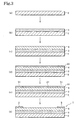
- Figs. 3(a) to (f) are cross sectional views for illustrating an example of the producing method for the laminate sheet according to the first embodiment
- Figs. 4 (a) to (d) are cross sectional views for illustrating another example of the producing method for the laminate sheet according to the first embodiment.
- a laminate sheet 1 As shown in Fig. 1, a laminate sheet 1 according to this embodiment comprises a long release sheet 2, an adhesive layer 3 formed on the release surface of the release sheet 2, a base material 4 formed on the adhesive layer 3 and a protective material 5 provided on the both sides of the surface of the base material 4 in the widthwise direction thereof.
- a well-known sheet may be used as the release sheet 2.
- resin films such as a polyethylene terephthalate film or polypropylene film, or paper such as glassine paper, clay-coated paper, or laminated paper (mainly polyethylene laminated paper) which has been subjected to release treating using a silicone type release agent or the like may be used.
- the surface roughness (Ra) of the release surface of the release sheet 2 may be decided in accordance with the smoothness to be imparted to the adhesive layer 3, but it is in general not more than 0.5 ⁇ m and preferably not more than 0.1 ⁇ m.
- the thickness of the release sheet 2 in general is about 10 to 200 ⁇ m and preferably about 20 to 100 ⁇ m.
- the adhesive layer 3 may be one, which is released from the release sheet 2 and used for adhering the base material 4 to a desired subject to be adhered or may be one, which is released from the release sheet 2 and the base material 4 and used for adhering desired subjects to be adhered to one another.
- the central portion of the adhesive layer 3 in the widthwise direction thereof constitutes the principally used portion thereof (a portion where the surface smoothness of the adhesive layer is required).
- the adhesive constituting the adhesive layer 3 may be various kinds of adhesives, which are appropriately selected in accordance with the applications of the adhesive layer 3 or the base material 4.
- the adhesive usable herein may be pressure sensitive adhesives or curable adhesives.
- the pressure sensitive adhesives may be, for instance, acrylic type, polyester type, urethane type, rubber type and silicone type ones, as well as curable pressure sensitive adhesives.
- curable adhesives are radiation-curable adhesives such as energy rays-curable adhesives and heat-curable adhesives.
- the thickness of the adhesive layer 3 in general is about 5 to 100 ⁇ m and preferably about 10 to 30 ⁇ m.
- the base material 4 may be one, which is adhered to a desired subject with the adhesive layer 3 or may be a release sheet released from the adhesive layer 3. In case of the former, the base material 4 is used as an adhesive sheet together with the adhesive layer 3 and the central portion thereof in the widthwise direction may serve as the principally used portion.
- the base material 4 When the base material 4 is used as an adhesive sheet, a variety of materials may be selected as a material for the base material 4 in accordance with the applications of the base material 4. For instance, when the base material 4 is used as a cover sheet for the recording layer of an optical disk, resins such as polycarbonate, poly (methyl methacrylate), polystyrene and the like may be selected as the material for the base material 4.
- resins for instance, cellulose esters such as cellulose di-acetate, cellulose triacetate and cellulose acetate butyrate; polyesters such as polyethylene terephthalate and polybutylene terephthalate; polyolefins such as polyethylene and polypropylene; polyamides; polyimides; polyvinyl chlorides; poly (methyl methacrylate); polycarbonates; and polyurethanes may be selected as the material for the base material 4.
- These base materials constituted by such resins may be used after subjecting the surface thereof to an anti-reflection treatment or an anti-glare treatment.
- the thickness thereof is determined in accordance with the applications of the base material 4, but the thickness is in general about 25 to 300 ⁇ m and preferably about 50 to 200 ⁇ m.
- the base material 4 is a release sheet
- similar materials to those of the foregoing release sheet 2 may be selected as the material for the base material 4.
- one of the release sheet 2 and the base material 4 is constituted by a light-release sheet and the other is constituted by a heavy-release sheet.
- the protective material 5 may be one formed by entirely laminating a protective sheet with the base material 4 and then cutting off a part of the protective sheet; one formed by laminating a protective sheet which has been, in advance, configured into a desired shape and a desired size on a desired position of the base material 4; or those formed by printing ink or applying a coating onto a desired position of the base material 4.
- the protective sheets preferably used herein include, for instance, those comprising base materials such as resin films, paper and metal foils to which an adhesive layer is formed.
- Examples of base materials for the protective sheets are resin films constituted by a resin such as polyethylene, polypropylene, polybutene, polybutadiene, polyvinyl chloride, ionomers, ethylene-methacrylic acid copolymers, polyethylene terephthalate, polyethylene naphthalate, polybutylene terephthalate, polyimides, polyether imides, polyaramides, polyether ketones, polyether ether ketones, polyphenylene sulfides, poly(4-methylpentene-1) and poly(tetrafluoro-ethylene), a crosslinked resin of the above resin, or a laminated body of such resin films.
- a resin such as polyethylene, polypropylene, polybutene, polybutadiene, polyvinyl chloride, ionomers, ethylene-methacrylic acid copolymers, polyethylene terephthalate, polyethylene naphthalate, polybutylene terephthalate, polyimides, polyether im
- the adhesive which constitutes the adhesive layer of the protective sheet is preferably a pressure sensitive adhesive.
- the protective material 5 may be attached by pressure onto the base material 4. Any one of an acrylic type, polyester type, urethane type, rubber type, silicone type, ethylene-vinyl acetate type, or other pressure sensitive adhesive may be used, and this may be curable pressure sensitive adhesive.
- the protective material 5 is formed by printing ink or applying a coating
- the kinds of ink and coatings as well as printing methods or applying methods are not restricted to specific ones at all.
- the thickness of the protective material 5 is preferably between 5 and 100 ⁇ m, and more preferably between 25 and 50 ⁇ m. If the thickness of the protective material 5 is less than 5 ⁇ m, the effects of the present invention cannot be obtained sufficiently, and if the thickness of the protective material 5 exceeds 100 ⁇ m, the diameter (volume) of the roll obtained when the laminate sheet 1 is wound becomes too large.
- an adhesive layer 3 is formed on the release surface of a long release sheet 2 as shown in Figs. 3(a) to (b).
- a coating agent containing the adhesive which constitutes the adhesive layer 3 and, if desired, a solvent is prepared.
- the coating agent is then applied to the release surface of the release sheet 2 using a coating machine such as a kiss roll coater, a reverse roll coater, a knife coater, a roll knife coater, or a die coater, and dried.
- a base material 4 is attached by pressure to the surface of the adhesive layer 3 as shown in Fig. 3(c) and a protective sheet 50 is attached by pressure to the surface of the base material 4 as shown in Fig. 3 (d) .
- the protective sheet 50 usable herein may be a laminate of a base material and a pressure sensitive adhesive as has been discussed above.
- the protective sheet 50 is divided into both side portions 51 and a central portion 52 by cutting only the protective sheet 50 without reaching the base material 4 as shown in Fig. 3 (e) .
- the cutting of the protective sheet 50 may be conducted according to the usual method, for instance, a punching machine or the like may be used for the cutting.
- the width of the both side portions 51 of the protective sheet 50 is configured in such a manner that the both side portions 51 do not overlap with the principally used portion of the adhesive layer 3.
- the central portion 52 formed by cutting the protective sheet 50 is removed as shown in Fig. 3(f). In this state, the both side portions 51 of the protective sheet 50 serve as the protective material 5.
- an adhesive layer 3 is formed on the release surface of a long release sheet 2 as shown in Figs. 4(a) to (b), and then a base material 4 is attached by pressure to the surface of the adhesive layer 3 as shown in Fig. 4(c).
- the protective material may be a protective sheet which has been, in advance, configured into a desired shape and a desired size or those formed by printing ink or applying a coating.
- an ink or coating containing a vehicle such as urethane resin or acrylic resin may be printed using a method such as lithography or relief-printing, or applied using a method such as spraying or brushing.
- the width of the protective material 5 is configured in such a manner that the protective material 5 does not overlap with the principally used portion of the adhesive layer 3.
- the above protective material 5 is laminated in the final process, but the method of the present invention is not restricted to such a specific embodiment and the lamination process of the protective material 5 may be carried out in any step of the producing method for the laminate sheet 1.
- the protective material 5 is formed on the portion of the base material 4 of the laminate sheet 1, which corresponds to the portion other than the principally used portion of the adhesive layer 3 and the protective material 5 may serve as a spacer, therefore the release sheet 2 wound and superimposed on the adhesive layer 3 is not strongly pressed against the principally used portion of the adhesive layer 3. This in turn leads to the restraint of the formation of orange peel on the principally used portion of the adhesive layer 3 due to the winding pressure and accordingly, the surface smoothness of the principally used portion of the adhesive layer 3 can be kept.
- the release sheet 2, adhesive layer 3 and base material 4 can be displaced in the radial direction of the roll by the size of the interstice, and thus even if a foreign substance with a larger diameter than the size of the interstice becomes attached to the base material 4, the effect thereof on overlapped base materials 4 and adhesive layers 3 can be suppressed such that depressions caused by the foreign substance can be prevented from forming on a plurality portions of the base material 4 and adhesive layer 3.
- the laminate sheet 1 wound into a roll as has been described above, the laminate sheet 1 is unrolled from the roll and a principally used portion of the base material 4 and the adhesive layer 3 are cut into a desired shape and removed from the release sheet 2.
- the cutting may be conducted according to the usual method, for instance, a punching machine may be used for the cutting.
- the surface of the adhesive layer 3 thus cut maintains its smoothness. Therefore, when the adhesive layer 3 is used for the adhesion of a cover sheet for the protection of the recording layer on an optical disk, the occurrence of any error in reading or writing data due to the adhesive layer 3 can be prevented. Further, when the adhesive layer 3 is used in the adhesion of the anti-reflection film for a display, the presence of the adhesive layer 3 does not impair the transparency of the display and the clearness of images displayed thereon.
- Fig. 5 is a perspective view showing a laminate sheet according to a second embodiment of the present invention
- Fig. 6 is a perspective view showing a roll of the laminate sheet according to the second embodiment of the present invention.
- the laminate sheet 1A comprises, as shown in Fig. 5, a long release sheet 2, an adhesive layer 3 formed on the release surface of the release sheet 2, a base material 4 formed on the adhesive layer 3 and a protective material 5 provided on both sides of the back surface (the face opposite to the release surface) of the release sheet 2.
- the materials and thicknesses for the release sheet 2, the adhesive layer 3, the base material 4 and the protective material 5 are similar to the materials and thicknesses for the release sheet 2, the adhesive layer 3, the base material 4 and the protective material 5 constituting the laminate sheet 1 according to the aforementioned first embodiment.
- the laminate sheet 1A according to this embodiment can be produced by a similar method to the producing method for the laminate sheet 1 according to the aforementioned first embodiment except that the protective material 5 is not provided on the surface of the base material 4, but on the back surface of the release sheet 2.
- the protective material 5 is formed on the portion of the back surface of the release sheet 2 of the laminate sheet 1A, which corresponds to the portion other than the principally used portion of the adhesive layer 3 and the protective material 5 may serve as a spacer, therefore the release sheet 2 wound and superimposed on the adhesive layer 3 is not strongly pressed against the principally used portion of the adhesive layer 3. This in turn leads to the restraint of the formation of orange peel on the principally used portion of the adhesive layer 3 due to the winding pressure and accordingly, the surface smoothness of the principally used portion of the adhesive layer 3 can be kept.
- the release sheet 2, adhesive layer 3 and base material 4 can be displaced in the radial direction of the roll by the size of the interstice, and thus even if a foreign substance with a larger diameter than the size of the interstice becomes attached to the base material 4, the effect thereof on overlapped base materials 4 and adhesive layers 3 can be suppressed such that depressions caused by the foreign substance can be prevented from forming on a plurality portions of the base material 4 and adhesive layer 3.
- the shape of the protective material 5 is not restricted to a band-like shape having a uniform width, and the end portion of the protective material 5 on the side of the center in the widthwise direction of the laminate sheet 1, 1A may have any shape such as a waved shape so that it corresponds to the shape of the principally used portion of the adhesive layer 3.
- a protective film (PAC2-70, manufactured by Sun A Kaken Co., Ltd., thickness: 70 ⁇ m) serving as a protective sheet was stuck to one face of a polycarbonate film (Pure Ace C110-75, manufactured by Teijin Ltd., width: 150 mm, length: 100 m, thickness: 75 ⁇ m) serving as a base material by attaching them with pressure.
- PAC2-70 manufactured by Sun A Kaken Co., Ltd., thickness: 70 ⁇ m
- Pure Ace C110-75 manufactured by Teijin Ltd., width: 150 mm, length: 100 m, thickness: 75 ⁇ m
- one part by weight of a poly (isocyanate) compound (Colonate L, manufactured by Nippon Polyurethane Industry Co.,Ltd.) as a cross-linking agent was added to 100 parts by weight of a copolymer obtained by copolymerizing 98 parts by weight of butyl acrylate with 2 parts by weight of acrylic acid, then 200 parts by weight of ethyl acetate as a diluting solvent was added to them to obtain a coating agent of pressure sensitive adhesive.
- a poly (isocyanate) compound Coldate L, manufactured by Nippon Polyurethane Industry Co.,Ltd.
- the aforementioned coating agent of pressure sensitive adhesive was applied using a knife coater to a release surface of a release sheet (SP-PET3811, manufactured by LINTEC Corporation, thickness: 38 ⁇ m) constituted by a silicone type release agent applied to one face of a polyethylene terephthalate film so as to reach a thickness of 25 ⁇ m following drying, and the coating agent on the release sheet was dried for three minutes at 100°C.
- SP-PET3811 manufactured by LINTEC Corporation, thickness: 38 ⁇ m
- the polycarbonate film side of the protective film-attached base material described above was pressed onto the pressure sensitive adhesive layer formed in this manner.
- the central portion (width: 130 mm) of the protect film in the widthwise direction of the film was then punched out and removed from the base material to form protective materials each having a width of 10 mm, a length of 100 m and a thickness of 70 ⁇ m at the both sides in the widthwise direction on one face of the base material.
- the long laminate sheet having a width of 150 mm and a length of 100 m thus produced was wound onto a three-inch diameter ABS (acrylonitrile-butadiene-styrene resin) core at an initial winding tension of 12N and a taper ratio of 50% to form a roll.
- ABS acrylonitrile-butadiene-styrene resin
- the resulting roll of the laminate sheet was placed for one month in an atmosphere of 23°C and 50% relative humidity, after which the release sheet was removed and the state of the adhesive sheet (adhesive layer + base material + protective material) was observed using a mercury vapor lamp projection method.
- Mercury vapor lamp projection was performed by disposing the adhesive sheet between a mercury vapor lamp (light source: SX-01250HQ, mercury vapor lamp power source: BA-H250, manufactured by Ushio Inc.) and a white projection screen and visually observing the projection of the adhesive sheet on the projection screen.
- the distance between the mercury vapor lamp and the adhesive sheet was set at 170cm, and the distance between the adhesive sheet and the projection screen was set at 30cm.
- An acrylic type pressure sensitive adhesive (PL SHIN, manufactured by LINTEC Corporation) was applied onto a base material constituted by a polyethylene terephthalate film having a thickness of 25 ⁇ m in such a manner that the thickness of the adhesive layer determined after drying was equal to 20 ⁇ m to thus form a protective sheet having a width of 10 mm and a length of 100 m.
- An adhesive layer was formed on a release surface of a release sheet in a similar manner to the Example 1.
- a base material constituted by a polycarbonate film (Pure Ace C110-75, manufactured by Teijin Ltd., width: 150 mm, length: 100 m, thickness: 75 ⁇ m) was attached by pressure onto the adhesive layer, and the foregoing protective sheet was stuck to both sides of the back surface of the release sheet in the widthwise direction of the sheet to form a protective material.
- the long laminate sheet having a width of 150 mm and a length of 100 m thus produced was wound onto an ABS core in a similar manner to the Example 1 to thus form a roll.
- the resulting roll of the laminate sheet was placed for one month in an atmosphere of 23°C and 50% relative humidity, after which the protective material-attached release sheet was removed and the state of the adhesive sheet (adhesive layer + base material) was observed using a mercury vapor lamp projection method in a similar manner to the Example 1.
- a roll of laminate sheet was produced in a similar manner to the Example 1 except that any protect film was not used (any protective material was not formed) .
- the resulting roll of the laminate sheet was observed using a mercury vapor lamp projection method in a similar manner to the Example 1. As a result, orange peel was observed throughout the entire surface of the adhesive layer.
- the surface smoothness of the adhesive layer can be kept even when the laminate sheet is wound into a roll. Moreover, according to the producing method for laminate sheet of the present invention, a laminate sheet, in which the surface smoothness of the adhesive layer can be kept even when the laminate sheet is wound into a roll, can be obtained.
Landscapes
- Chemical & Material Sciences (AREA)
- Organic Chemistry (AREA)
- Chemical Kinetics & Catalysis (AREA)
- Laminated Bodies (AREA)
- Adhesive Tapes (AREA)
- Adhesives Or Adhesive Processes (AREA)
Abstract
Description
- The present invention relates to a laminate sheet comprising a long release sheet, an adhesive layer and a base material, which are laminated together, and more particularly to a laminate sheet wherein the surface smoothness of the adhesive layer can be kept even when the laminate sheet is wound into a roll.
- In the majority of cases, a laminate sheet, which comprises a long release sheet, an adhesive layer and a base material laminated together, is wound into a roll, transported and stored in the form of such a roll, unrolled from such a roll and punched out into a desired shape prior to the practical use thereof.
- However, when a laminate sheet is wound into a roll, a winding pressure is applied onto the laminate sheet. Therefore, the adhesive layer, which is softer than the other layers present in the laminate sheet, is deformed with the elapse of time due to the action of the winding pressure, and the adhesive layer is in a so-called "orange peel" state mainly due to the lost of the surface smoothness of the adhesive layer. This accordingly causes a problem such that the adhesive layer lacks in the uniformity of its thickness.
- Moreover, in some cases, foreign substances (of which diameter is in general ranges from 5 to 50 µm) such as fine dust are caught between the layers of the wound laminate sheet, when winding the sheet into a roll. In case of winding a laminate sheet into a roll while catching such foreign substances between the rolled layers thereof, the base material and the adhesive layer of the laminate sheet are thus locally deformed by the presence of such foreign substances.
- When the foregoing adhesive layer, which is in the orange peel condition or which is locally deformed, is used in the adhesion of, for instance, a cover sheet for the protection of a recording layer on an optical disk for the next generation (Blu-ray-Disc) having a high capacity and/or a high recording density, the resulting optical disk may cause errors in reading or writing data because of the lack in the surface smoothness of the adhesive layer.
- Alternatively, when an adhesive layer in the orange peel condition is used in, for instance, the adhesion of the anti-reflection film for a display device such as PDA (Personal Digital Assistants), other problems arise, for instance, the transparency of the display device is impaired and the clearness of images displayed thereon is reduced.
- The present invention has been developed while taking into consideration the foregoing circumstances and accordingly, it is an object of the present invention to provide a laminate sheet in which the surface smoothness of its adhesive layer can be kept even when the sheet is wound into a roll as well as a producing method therefore.
- First, the present invention herein provide, for the achievement of the foregoing object, a laminate sheet, which comprises a long release sheet; an adhesive layer formed on the release surface of the release sheet; a base material formed on the adhesive layer; and a protective material provided on a portion of the base material wherein the portion corresponds to a portion other than a principally used portion of the adhesive layer (invention (1)). Note that, the "base material" used herein may be a sheet made from any desired material or a release sheet. Moreover, the term "a principally used portion of the adhesive layer" used herein means a portion where a smoothness of the surface of the adhesive layer is required.
- In the foregoing invention (1), when the laminate sheet is wound into a roll, the protective material is provided on the portion of the base material of the laminate sheet, which corresponds to the portion other than the principally used portion of the adhesive layer and the protective material may serve as a spacer, therefore the release sheet wound and superimposed on the adhesive layer is not strongly pressed against the principally used portion of the adhesive layer. This in turn leads to the restraint of the formation of orange peel on the principally used portion of the adhesive layer due to the winding pressure and accordingly, the surface smoothness of the principally used portion of the adhesive layer can be kept.
- Moreover, even when foreign substances such as fine dust are caught between the neighboring wound and superimposed layers of the laminate sheet upon winding the same into a roll, because there are interstices between the surface of the base material and the back surface of the release sheet, the formation of any depression on the base material and the adhesive layer due to the presence of such foreign substances are restrained.
- In the foregoing invention (1), it is preferred that the central portion of the adhesive layer in the widthwise direction thereof is the principally used portion of the adhesive layer, while the protective material is provided on the both sides of the base material in the widthwise direction thereof (invention (2)). If the laminate sheet has such a constitution, the surface smoothness of the adhesive layer is effectively kept when the laminate sheet is wound into a roll.
- Secondary, the present invention also provides a laminate sheet, which comprises a long release sheet; an adhesive layer formed on the release surface of the release sheet; a base material formed on the adhesive layer; and a protective material provided on a portion of the back surface (the face opposite to the release surface) of the release sheet wherein the portion corresponds to a portion other than a principally used portion of the adhesive layer (invention (3)).
- In the foregoing invention (3), when the laminate sheet is wound into a roll, the protective material is provided on the portion of the back surface of the release sheet, which corresponds to the portion other than the principally used portion of the adhesive layer and the protective material may serve as a spacer, therefore the release sheet wound and superimposed on the adhesive layer is not strongly pressed against the principally used portion of the adhesive layer. This in turn leads to the restraint of the formation of orange peel on the principally used portion of the adhesive layer due to the winding pressure and accordingly, the surface smoothness of the principally used portion of the adhesive layer can be kept.
- Moreover, even when foreign substances such as fine dust are caught between the neighboring wound and superimposed layers of the laminate sheet upon winding the same into a roll, because there are interstices between the surface of the base material and the back surface of the release sheet the formation of any depression on the base material and the adhesive layer due to the presence of such foreign substances are restrained.
- In the foregoing invention (3), it is preferred that the central portion of the adhesive layer in the widthwise direction thereof is the principally used portion of the adhesive layer, while the protective material is provided on the both sides of the back surface of the release sheet in the widthwise direction thereof (invention (4)). If the laminate sheet has such a constitution, the surface smoothness of the adhesive layer is effectively kept when the laminate sheet is wound into a roll.
- Thirdly, the present invention provides a producing method for a laminate sheet, which comprises the steps of; laminating a long release sheet, an adhesive layer and a base material in this order; laminating, at any step, a protective sheet on the surface of the base material or the back surface of the release sheet; and dividing the laminated protective sheet into a portion corresponding to a principally used portion of the adhesive layer and a portion corresponding to a portion other than a principally used portion of the adhesive layer, and removing the portion corresponding to the principally used portion of the adhesive layer to form a protective material (invention (5)).
- Fourthly, the present invention provides a producing method for a laminate sheet, which comprises the steps of; laminating a long release sheet, an adhesive layer and a base material in this order; and providing, at any step, a protective material on a portion of the surface of the base material or the back surface of the release sheet wherein the portion corresponds to a portion other than a principally used portion of the adhesive layer (invention (6)). Examples of methods for providing a protective material are a method in which a protective sheet provided with an adhesive layer is laminated with the base material, a method of ink printing and a method of coating application.
- According to the foregoing inventions (5, 6), the laminate sheets described above (
invention 1 to 4) can efficiently be produced. -
- Fig. 1 is a perspective view showing a laminate sheet according to a first embodiment of the present invention.
- Fig. 2 is a perspective view showing a roll of the laminate sheet according to the first embodiment of the present invention.
- Fig. 3 is a cross sectional view illustrating an example of the producing method for the laminate sheet according to the first embodiment of the present invention.
- Fig. 4 is a cross sectional view illustrating another example of the producing method for the laminate sheet according to the first embodiment of the present invention.
- Fig. 5 is a perspective view showing a laminate sheet according to a second embodiment of the present invention.
- Fig. 6 is a perspective view showing a roll of the laminate sheet according to the second embodiment of the present invention.
-
- The present invention will hereunder be described in more detail with reference to the accompanying drawings.
- Fig. 1 is a perspective view showing a laminate sheet according to a first embodiment of the present invention; Fig. 2 is a perspective view showing a roll of the laminate sheet according to the first embodiment; Figs. 3(a) to (f) are cross sectional views for illustrating an example of the producing method for the laminate sheet according to the first embodiment; and Figs. 4 (a) to (d) are cross sectional views for illustrating another example of the producing method for the laminate sheet according to the first embodiment.
- As shown in Fig. 1, a
laminate sheet 1 according to this embodiment comprises along release sheet 2, anadhesive layer 3 formed on the release surface of therelease sheet 2, abase material 4 formed on theadhesive layer 3 and aprotective material 5 provided on the both sides of the surface of thebase material 4 in the widthwise direction thereof. - A well-known sheet may be used as the
release sheet 2. For example, resin films such as a polyethylene terephthalate film or polypropylene film, or paper such as glassine paper, clay-coated paper, or laminated paper (mainly polyethylene laminated paper) which has been subjected to release treating using a silicone type release agent or the like may be used. - The surface roughness (Ra) of the release surface of the
release sheet 2 may be decided in accordance with the smoothness to be imparted to theadhesive layer 3, but it is in general not more than 0.5 µm and preferably not more than 0.1 µm. In addition, the thickness of therelease sheet 2 in general is about 10 to 200 µm and preferably about 20 to 100 µm. - The
adhesive layer 3 may be one, which is released from therelease sheet 2 and used for adhering thebase material 4 to a desired subject to be adhered or may be one, which is released from therelease sheet 2 and thebase material 4 and used for adhering desired subjects to be adhered to one another. In this embodiment, the central portion of theadhesive layer 3 in the widthwise direction thereof constitutes the principally used portion thereof (a portion where the surface smoothness of the adhesive layer is required). - The adhesive constituting the
adhesive layer 3 may be various kinds of adhesives, which are appropriately selected in accordance with the applications of theadhesive layer 3 or thebase material 4. - The adhesive usable herein may be pressure sensitive adhesives or curable adhesives. The pressure sensitive adhesives may be, for instance, acrylic type, polyester type, urethane type, rubber type and silicone type ones, as well as curable pressure sensitive adhesives. Examples of curable adhesives are radiation-curable adhesives such as energy rays-curable adhesives and heat-curable adhesives.
- The thickness of the
adhesive layer 3 in general is about 5 to 100µm and preferably about 10 to 30µm. - The
base material 4 may be one, which is adhered to a desired subject with theadhesive layer 3 or may be a release sheet released from theadhesive layer 3. In case of the former, thebase material 4 is used as an adhesive sheet together with theadhesive layer 3 and the central portion thereof in the widthwise direction may serve as the principally used portion. - When the
base material 4 is used as an adhesive sheet, a variety of materials may be selected as a material for thebase material 4 in accordance with the applications of thebase material 4. For instance, when thebase material 4 is used as a cover sheet for the recording layer of an optical disk, resins such as polycarbonate, poly (methyl methacrylate), polystyrene and the like may be selected as the material for thebase material 4. Alternatively, when thebase material 4 is, for instance, used as a film for a display of PDA or the like, resins, for instance, cellulose esters such as cellulose di-acetate, cellulose triacetate and cellulose acetate butyrate; polyesters such as polyethylene terephthalate and polybutylene terephthalate; polyolefins such as polyethylene and polypropylene; polyamides; polyimides; polyvinyl chlorides; poly (methyl methacrylate); polycarbonates; and polyurethanes may be selected as the material for thebase material 4. These base materials constituted by such resins may be used after subjecting the surface thereof to an anti-reflection treatment or an anti-glare treatment. - When the
base material 4 is used as an adhesive sheet, the thickness thereof is determined in accordance with the applications of thebase material 4, but the thickness is in general about 25 to 300 µm and preferably about 50 to 200µ m. - On the other hand, when the
base material 4 is a release sheet, similar materials to those of the foregoingrelease sheet 2 may be selected as the material for thebase material 4. In this case, however, it is preferred that one of therelease sheet 2 and thebase material 4 is constituted by a light-release sheet and the other is constituted by a heavy-release sheet. - The
protective material 5 may be one formed by entirely laminating a protective sheet with thebase material 4 and then cutting off a part of the protective sheet; one formed by laminating a protective sheet which has been, in advance, configured into a desired shape and a desired size on a desired position of thebase material 4; or those formed by printing ink or applying a coating onto a desired position of thebase material 4. - The protective sheets preferably used herein include, for instance, those comprising base materials such as resin films, paper and metal foils to which an adhesive layer is formed.
- Examples of base materials for the protective sheets are resin films constituted by a resin such as polyethylene, polypropylene, polybutene, polybutadiene, polyvinyl chloride, ionomers, ethylene-methacrylic acid copolymers, polyethylene terephthalate, polyethylene naphthalate, polybutylene terephthalate, polyimides, polyether imides, polyaramides, polyether ketones, polyether ether ketones, polyphenylene sulfides, poly(4-methylpentene-1) and poly(tetrafluoro-ethylene), a crosslinked resin of the above resin, or a laminated body of such resin films.
- The adhesive which constitutes the adhesive layer of the protective sheet is preferably a pressure sensitive adhesive. In this case, the
protective material 5 may be attached by pressure onto thebase material 4. Any one of an acrylic type, polyester type, urethane type, rubber type, silicone type, ethylene-vinyl acetate type, or other pressure sensitive adhesive may be used, and this may be curable pressure sensitive adhesive. - On the other hand, when the
protective material 5 is formed by printing ink or applying a coating, the kinds of ink and coatings as well as printing methods or applying methods are not restricted to specific ones at all. - The thickness of the
protective material 5 is preferably between 5 and 100µm, and more preferably between 25 and 50µm. If the thickness of theprotective material 5 is less than 5µm, the effects of the present invention cannot be obtained sufficiently, and if the thickness of theprotective material 5 exceeds 100µm, the diameter (volume) of the roll obtained when thelaminate sheet 1 is wound becomes too large. - An example of the producing method for the
laminate sheet 1 according to the present embodiment will be described below. - In this producing method, first, an
adhesive layer 3 is formed on the release surface of along release sheet 2 as shown in Figs. 3(a) to (b). - To form the
adhesive layer 3, for example, a coating agent containing the adhesive which constitutes theadhesive layer 3 and, if desired, a solvent is prepared. The coating agent is then applied to the release surface of therelease sheet 2 using a coating machine such as a kiss roll coater, a reverse roll coater, a knife coater, a roll knife coater, or a die coater, and dried. - Then a
base material 4 is attached by pressure to the surface of theadhesive layer 3 as shown in Fig. 3(c) and aprotective sheet 50 is attached by pressure to the surface of thebase material 4 as shown in Fig. 3 (d) . In this connection, theprotective sheet 50 usable herein may be a laminate of a base material and a pressure sensitive adhesive as has been discussed above. - Thereafter, the
protective sheet 50 is divided into bothside portions 51 and acentral portion 52 by cutting only theprotective sheet 50 without reaching thebase material 4 as shown in Fig. 3 (e) . The cutting of theprotective sheet 50 may be conducted according to the usual method, for instance, a punching machine or the like may be used for the cutting. In this respect, the width of the bothside portions 51 of theprotective sheet 50 is configured in such a manner that the bothside portions 51 do not overlap with the principally used portion of theadhesive layer 3. - The
central portion 52 formed by cutting theprotective sheet 50 is removed as shown in Fig. 3(f). In this state, the bothside portions 51 of theprotective sheet 50 serve as theprotective material 5. - Another example of the producing method for the
laminate sheet 1 according to the present embodiment will be described below. - In this producing method, first, an
adhesive layer 3 is formed on the release surface of along release sheet 2 as shown in Figs. 4(a) to (b), and then abase material 4 is attached by pressure to the surface of theadhesive layer 3 as shown in Fig. 4(c). - Thereafter,
protective materials 5 are laminated onto both sides of thebase material 4 in the widthwise direction thereof as shown in Fig. 4(d). The protective material may be a protective sheet which has been, in advance, configured into a desired shape and a desired size or those formed by printing ink or applying a coating. In the latter case, for instance, an ink or coating containing a vehicle such as urethane resin or acrylic resin may be printed using a method such as lithography or relief-printing, or applied using a method such as spraying or brushing. Incidentally, the width of theprotective material 5 is configured in such a manner that theprotective material 5 does not overlap with the principally used portion of theadhesive layer 3. - In this embodiment, the above
protective material 5 is laminated in the final process, but the method of the present invention is not restricted to such a specific embodiment and the lamination process of theprotective material 5 may be carried out in any step of the producing method for thelaminate sheet 1. - When the
laminate sheet 1 according to this embodiment is wound into a roll as shown in Fig.2, theprotective material 5 is formed on the portion of thebase material 4 of thelaminate sheet 1, which corresponds to the portion other than the principally used portion of theadhesive layer 3 and theprotective material 5 may serve as a spacer, therefore therelease sheet 2 wound and superimposed on theadhesive layer 3 is not strongly pressed against the principally used portion of theadhesive layer 3. This in turn leads to the restraint of the formation of orange peel on the principally used portion of theadhesive layer 3 due to the winding pressure and accordingly, the surface smoothness of the principally used portion of theadhesive layer 3 can be kept. - Further, even when foreign substances such as fine dust are caught between the neighboring wound and superimposed layers of the
laminate sheet 1 upon winding the same into a roll, because there are interstices between the surface of thebase material 4 and the back surface of therelease sheet 2, the formation of any depression on thebase material 4 and theadhesive layer 3 due to the presence of such foreign substances are restrained if the diameter of the foreign substances is smaller than the size of the interstices. - Furthermore, in a conventional roll, even if only one foreign substance is caught, the effect thereof causes depressions to form in a plurality of overlapped
base materials 4 andadhesive layers 3. In the roll of thelaminate sheet 1 according to this embodiment, however, therelease sheet 2,adhesive layer 3 andbase material 4 can be displaced in the radial direction of the roll by the size of the interstice, and thus even if a foreign substance with a larger diameter than the size of the interstice becomes attached to thebase material 4, the effect thereof on overlappedbase materials 4 andadhesive layers 3 can be suppressed such that depressions caused by the foreign substance can be prevented from forming on a plurality portions of thebase material 4 andadhesive layer 3. - To use the
laminate sheet 1 wound into a roll as has been described above, thelaminate sheet 1 is unrolled from the roll and a principally used portion of thebase material 4 and theadhesive layer 3 are cut into a desired shape and removed from therelease sheet 2. The cutting may be conducted according to the usual method, for instance, a punching machine may be used for the cutting. - The surface of the
adhesive layer 3 thus cut maintains its smoothness. Therefore, when theadhesive layer 3 is used for the adhesion of a cover sheet for the protection of the recording layer on an optical disk, the occurrence of any error in reading or writing data due to theadhesive layer 3 can be prevented. Further, when theadhesive layer 3 is used in the adhesion of the anti-reflection film for a display, the presence of theadhesive layer 3 does not impair the transparency of the display and the clearness of images displayed thereon. - Fig. 5 is a perspective view showing a laminate sheet according to a second embodiment of the present invention and Fig. 6 is a perspective view showing a roll of the laminate sheet according to the second embodiment of the present invention.
- The
laminate sheet 1A according to this embodiment comprises, as shown in Fig. 5, along release sheet 2, anadhesive layer 3 formed on the release surface of therelease sheet 2, abase material 4 formed on theadhesive layer 3 and aprotective material 5 provided on both sides of the back surface (the face opposite to the release surface) of therelease sheet 2. - The materials and thicknesses for the
release sheet 2, theadhesive layer 3, thebase material 4 and theprotective material 5 are similar to the materials and thicknesses for therelease sheet 2, theadhesive layer 3, thebase material 4 and theprotective material 5 constituting thelaminate sheet 1 according to the aforementioned first embodiment. - The
laminate sheet 1A according to this embodiment can be produced by a similar method to the producing method for thelaminate sheet 1 according to the aforementioned first embodiment except that theprotective material 5 is not provided on the surface of thebase material 4, but on the back surface of therelease sheet 2. - When the
laminate sheet 1A according to this embodiment is wound into a roll as shown in Fig.6, theprotective material 5 is formed on the portion of the back surface of therelease sheet 2 of thelaminate sheet 1A, which corresponds to the portion other than the principally used portion of theadhesive layer 3 and theprotective material 5 may serve as a spacer, therefore therelease sheet 2 wound and superimposed on theadhesive layer 3 is not strongly pressed against the principally used portion of theadhesive layer 3. This in turn leads to the restraint of the formation of orange peel on the principally used portion of theadhesive layer 3 due to the winding pressure and accordingly, the surface smoothness of the principally used portion of theadhesive layer 3 can be kept. - Further, even when foreign substances such as fine dust are caught between the neighboring wound and superimposed layers of the
laminate sheet 1A upon winding the same into a roll, because there are interstices between the surface of thebase material 4 and the back surface of therelease sheet 2, the formation of any depression on thebase material 4 and theadhesive layer 3 due to the presence of such foreign substances are restrained if the diameter of the foreign substances is smaller than the size of the interstices. - Furthermore, in a conventional roll, even if only one foreign substance is caught, the effect thereof causes depressions to form in a plurality of overlapped
base materials 4 andadhesive layers 3. In the roll of thelaminate sheet 1A according to this embodiment, however, therelease sheet 2,adhesive layer 3 andbase material 4 can be displaced in the radial direction of the roll by the size of the interstice, and thus even if a foreign substance with a larger diameter than the size of the interstice becomes attached to thebase material 4, the effect thereof on overlappedbase materials 4 andadhesive layers 3 can be suppressed such that depressions caused by the foreign substance can be prevented from forming on a plurality portions of thebase material 4 andadhesive layer 3. - The embodiments, which have been explained above are herein given for making the understanding of the present invention easier and do not restrict the scope of the present invention at all. Therefore, it is herein intended that all of the elements disclosed in the foregoing embodiments should include any change of design and equivalents falling within the technical scope of the present invention.
- For instance, the shape of the
protective material 5 is not restricted to a band-like shape having a uniform width, and the end portion of theprotective material 5 on the side of the center in the widthwise direction of thelaminate sheet adhesive layer 3. - The present invention will hereunder be described in more detail with reference to, for instance, the following Examples, but the scope of the present invention is not restricted to these specific examples or the like at all.
- A protective film (PAC2-70, manufactured by Sun A Kaken Co., Ltd., thickness: 70µm) serving as a protective sheet was stuck to one face of a polycarbonate film (Pure Ace C110-75, manufactured by Teijin Ltd., width: 150 mm, length: 100 m, thickness: 75µm) serving as a base material by attaching them with pressure.
- On the other hand, one part by weight of a poly (isocyanate) compound (Colonate L, manufactured by Nippon Polyurethane Industry Co.,Ltd.) as a cross-linking agent was added to 100 parts by weight of a copolymer obtained by copolymerizing 98 parts by weight of butyl acrylate with 2 parts by weight of acrylic acid, then 200 parts by weight of ethyl acetate as a diluting solvent was added to them to obtain a coating agent of pressure sensitive adhesive.
- The aforementioned coating agent of pressure sensitive adhesive was applied using a knife coater to a release surface of a release sheet (SP-PET3811, manufactured by LINTEC Corporation, thickness: 38µm) constituted by a silicone type release agent applied to one face of a polyethylene terephthalate film so as to reach a thickness of 25µm following drying, and the coating agent on the release sheet was dried for three minutes at 100°C.
- The polycarbonate film side of the protective film-attached base material described above was pressed onto the pressure sensitive adhesive layer formed in this manner. The central portion (width: 130 mm) of the protect film in the widthwise direction of the film was then punched out and removed from the base material to form protective materials each having a width of 10 mm, a length of 100 m and a thickness of 70 µm at the both sides in the widthwise direction on one face of the base material.
- The long laminate sheet having a width of 150 mm and a length of 100 m thus produced was wound onto a three-inch diameter ABS (acrylonitrile-butadiene-styrene resin) core at an initial winding tension of 12N and a taper ratio of 50% to form a roll.
- The resulting roll of the laminate sheet was placed for one month in an atmosphere of 23°C and 50% relative humidity, after which the release sheet was removed and the state of the adhesive sheet (adhesive layer + base material + protective material) was observed using a mercury vapor lamp projection method. Mercury vapor lamp projection was performed by disposing the adhesive sheet between a mercury vapor lamp (light source: SX-01250HQ, mercury vapor lamp power source: BA-H250, manufactured by Ushio Inc.) and a white projection screen and visually observing the projection of the adhesive sheet on the projection screen. The distance between the mercury vapor lamp and the adhesive sheet was set at 170cm, and the distance between the adhesive sheet and the projection screen was set at 30cm.
- As a result, any orange peel on the adhesive surface was not observed in the central portion of the adhesive sheet in the widthwise direction of the adhesive sheet, and the surface conditions of the adhesive layer was excellent.
- An acrylic type pressure sensitive adhesive (PL SHIN, manufactured by LINTEC Corporation) was applied onto a base material constituted by a polyethylene terephthalate film having a thickness of 25 µm in such a manner that the thickness of the adhesive layer determined after drying was equal to 20 µm to thus form a protective sheet having a width of 10 mm and a length of 100 m.
- An adhesive layer was formed on a release surface of a release sheet in a similar manner to the Example 1. A base material constituted by a polycarbonate film (Pure Ace C110-75, manufactured by Teijin Ltd., width: 150 mm, length: 100 m, thickness: 75 µm) was attached by pressure onto the adhesive layer, and the foregoing protective sheet was stuck to both sides of the back surface of the release sheet in the widthwise direction of the sheet to form a protective material.
- The long laminate sheet having a width of 150 mm and a length of 100 m thus produced was wound onto an ABS core in a similar manner to the Example 1 to thus form a roll.
- The resulting roll of the laminate sheet was placed for one month in an atmosphere of 23°C and 50% relative humidity, after which the protective material-attached release sheet was removed and the state of the adhesive sheet (adhesive layer + base material) was observed using a mercury vapor lamp projection method in a similar manner to the Example 1.
- As a result, any orange peel on the adhesive surface was not observed in the central portion of the adhesive sheet in the widthwise direction of the sheet, and the surface conditions of the adhesive layer was excellent.
- A roll of laminate sheet was produced in a similar manner to the Example 1 except that any protect film was not used (any protective material was not formed) . The resulting roll of the laminate sheet was observed using a mercury vapor lamp projection method in a similar manner to the Example 1. As a result, orange peel was observed throughout the entire surface of the adhesive layer.
- As has been discussed above, according to the laminate sheet of the present invention, the surface smoothness of the adhesive layer can be kept even when the laminate sheet is wound into a roll. Moreover, according to the producing method for laminate sheet of the present invention, a laminate sheet, in which the surface smoothness of the adhesive layer can be kept even when the laminate sheet is wound into a roll, can be obtained.
Claims (6)
- A laminate sheet comprising;a long release sheet;an adhesive layer formed on the release surface of the release sheet;a base material formed on the adhesive layer; anda protective material provided on a portion of the base material wherein the portion corresponds to a portion other than a principally used portion of the adhesive layer.
- The laminate sheet as set forth in claim 1;
wherein the central portion of the adhesive layer in the widthwise direction thereof is the principally used portion of the adhesive layer, while the protective material is provided on the both sides of the base material in the widthwise direction thereof. - A laminate sheet comprising;
a long release sheet;
an adhesive layer formed on the release surface of the release sheet;
a base material formed on the adhesive layer; and
a protective material provided on a portion of the back surface of the release sheet wherein the portion corresponds to a portion other than a principally used portion of the adhesive layer. - The laminate sheet as set forth in claim 3;
wherein the central portion of the adhesive layer in the widthwise direction thereof is the principally used portion of the adhesive layer, while the protective material is provided on the both sides of the back surface of the release sheet in the widthwise direction thereof. - A producing method for a laminate sheet comprising the steps of;
laminating a long release sheet, an adhesive layer and a base material in this order;
laminating, at any step, a protective sheet on the surface of the base material or the back surface of the release sheet; and
dividing the laminated protective sheet into a portion corresponding to a principally used portion of the adhesive layer and a portion corresponding to a portion other than a principally used portion of the adhesive layer, and removing the portion corresponding to the principally used portion of the adhesive layer to form a protective material. - A producing method for a laminate sheet comprising the steps of;
laminating a long release sheet, an adhesive layer and a base material in this order; and
providing, at any step, a protective material on a portion of the surface of the base material or the back surface of the release sheet wherein the portion corresponds to a portion other than a principally used portion of the adhesive layer.
Applications Claiming Priority (2)
| Application Number | Priority Date | Filing Date | Title |
|---|---|---|---|
| JP2002214781 | 2002-07-24 | ||
| JP2002214781A JP2004051914A (en) | 2002-07-24 | 2002-07-24 | Laminated sheet and its producing method |
Publications (2)
| Publication Number | Publication Date |
|---|---|
| EP1384575A1 true EP1384575A1 (en) | 2004-01-28 |
| EP1384575B1 EP1384575B1 (en) | 2007-11-07 |
Family
ID=29997239
Family Applications (1)
| Application Number | Title | Priority Date | Filing Date |
|---|---|---|---|
| EP03254601A Expired - Lifetime EP1384575B1 (en) | 2002-07-24 | 2003-07-24 | Laminate sheet and producing methods therefor |
Country Status (7)
| Country | Link |
|---|---|
| US (1) | US20040018329A1 (en) |
| EP (1) | EP1384575B1 (en) |
| JP (1) | JP2004051914A (en) |
| KR (1) | KR101023473B1 (en) |
| CN (1) | CN100389021C (en) |
| DE (1) | DE60317272T2 (en) |
| TW (1) | TWI271311B (en) |
Families Citing this family (19)
| Publication number | Priority date | Publication date | Assignee | Title |
|---|---|---|---|---|
| CN1254317C (en) * | 2001-04-09 | 2006-05-03 | 日东电工株式会社 | Label sheel for cleaning conveying member having cleaning function |
| TW200401237A (en) * | 2002-07-05 | 2004-01-16 | Lintec Corp | Laminate sheet, laminate sheet roll, and producing methods therefor |
| JP2005236082A (en) * | 2004-02-20 | 2005-09-02 | Nitto Denko Corp | Laser dicing adhesive sheet and method for producing the same |
| JP4455139B2 (en) * | 2004-04-21 | 2010-04-21 | 日東電工株式会社 | Mother glass protective film for flat panel display and its use |
| JP4614126B2 (en) * | 2005-02-21 | 2011-01-19 | リンテック株式会社 | LAMINATED SHEET, LAMINATED SHEET WIND AND PROCESS FOR PRODUCING THEM |
| WO2007029979A1 (en) * | 2005-09-07 | 2007-03-15 | Seong-Min Kim | Release film for pcb lamination process |
| JP2008018614A (en) * | 2006-07-12 | 2008-01-31 | Lintec Corp | LAMINATED SHEET, LAMINATED SHEET WIND AND PROCESS FOR PRODUCING THEM |
| US20080120935A1 (en) * | 2006-07-31 | 2008-05-29 | Certainteed Corporation | Vapor retarder fastening strip |
| JP2008102271A (en) * | 2006-10-18 | 2008-05-01 | Nitto Denko Corp | Surface protective film and optical film with surface protective film |
| JP2008302616A (en) * | 2007-06-08 | 2008-12-18 | Tefuko Aomori Kk | Minute metal pattern and its manufacturing method |
| US20110003092A1 (en) * | 2009-07-02 | 2011-01-06 | Brady Worldwide, Inc. | Silicone Optical Film |
| US9486366B2 (en) | 2009-09-30 | 2016-11-08 | Mölnlycke Health Care Ab | Method of attaching grip tabs to the carrier layer of a film dressing |
| JP5723138B2 (en) * | 2010-11-12 | 2015-05-27 | デクセリアルズ株式会社 | Reel body, manufacturing method thereof, and flattening method of adhesive film |
| CN105451989B (en) * | 2013-09-05 | 2017-10-13 | 积水化学工业株式会社 | Release sheet and use its backing sheet laminate |
| CN103753871A (en) * | 2013-12-31 | 2014-04-30 | 苏州米达思精密电子有限公司 | Golden stainless-steel winding belt with local gold-plated surface and preparation process of golden stainless-steel winding belt |
| EP3279139A4 (en) | 2015-03-31 | 2018-11-21 | LINTEC Corporation | Laminated body |
| WO2017047600A1 (en) * | 2015-09-18 | 2017-03-23 | Jnc株式会社 | Film for plastic restoration, surface-protected article, and process for producing film for plastic restoration |
| JP6617056B2 (en) * | 2016-03-04 | 2019-12-04 | リンテック株式会社 | Semiconductor processing sheet, winding body thereof, and method for manufacturing the winding body |
| US20170259545A1 (en) * | 2016-03-11 | 2017-09-14 | Dingzing Advanced Materials Inc. | Thin film device with separable carrier and manufacturing method thereof |
Citations (4)
| Publication number | Priority date | Publication date | Assignee | Title |
|---|---|---|---|---|
| JP2002141309A (en) * | 2000-11-02 | 2002-05-17 | Lintec Corp | Dicing sheet and method of using the same |
| EP1246236A1 (en) * | 2001-03-30 | 2002-10-02 | Lintec Corporation | Semiconductor chip carrying adhesive tape/sheet, semiconductor chip carrier, semiconductor chip mounting method and semiconductor chip packaging body |
| EP1310432A1 (en) * | 2001-11-07 | 2003-05-14 | LINTEC Corporation | Laminating apparatus for optical disc |
| EP1347449A1 (en) * | 2000-12-28 | 2003-09-24 | Kitano Engineering Co., Ltd. | Method of manufacturing optical disk formed of single disk, and four-layer adhered sheet body and wound body of the sheet body used for the method |
Family Cites Families (13)
| Publication number | Priority date | Publication date | Assignee | Title |
|---|---|---|---|---|
| US2800215A (en) * | 1955-04-13 | 1957-07-23 | Converse Products Inc | Method and means for cleaning type |
| GB8812096D0 (en) * | 1988-05-21 | 1988-06-22 | Smith & Nephew Ass | Adhesive sheet |
| US5008110A (en) * | 1988-11-10 | 1991-04-16 | The Procter & Gamble Company | Storage-stable transdermal patch |
| ATE139747T1 (en) * | 1990-04-03 | 1996-07-15 | Voith Gmbh J M | METHOD FOR CONNECTING THE BEGINNING OF A WRAP AT A SPLICE POINT TO THE END OF A WEB RUNNING FROM ANOTHER WRAP |
| US5516581A (en) * | 1990-12-20 | 1996-05-14 | Minnesota Mining And Manufacturing Company | Removable adhesive tape |
| JPH06212133A (en) * | 1993-01-18 | 1994-08-02 | Sekisui Chem Co Ltd | Decorative pressure-sensitive adhesive sheet and prevention of clouding of surface of substrate of said sheet |
| US5376418A (en) * | 1993-09-13 | 1994-12-27 | Uarco Incorporated | Image protected pressure sensitive label |
| US5520762A (en) * | 1993-12-23 | 1996-05-28 | Wilshire Technologies, Inc. (Wilshire Medical Products Division) | Method of manufucturing a wound dressing delivery system |
| US5827589A (en) * | 1995-07-10 | 1998-10-27 | Autterson; Christopher S. | Strap devices, and methods of constructing and utilizing same |
| US5640827A (en) * | 1996-01-31 | 1997-06-24 | Van Someren; Robert A. | Device and method for providing a barrier to unwanted penetration of finishing materials |
| JPH09217042A (en) * | 1996-02-13 | 1997-08-19 | Mitsuko Seki | Multilayer pressure-sensitive adhesive tape roll and multilayer pressure-sensitive adhesive tape for display |
| JP2000067468A (en) | 1998-08-25 | 2000-03-03 | Teijin Ltd | Optical disk and method of manufacturing the same |
| TW200401237A (en) * | 2002-07-05 | 2004-01-16 | Lintec Corp | Laminate sheet, laminate sheet roll, and producing methods therefor |
-
2002
- 2002-07-24 JP JP2002214781A patent/JP2004051914A/en active Pending
-
2003
- 2003-07-07 TW TW092118449A patent/TWI271311B/en not_active IP Right Cessation
- 2003-07-16 US US10/619,511 patent/US20040018329A1/en not_active Abandoned
- 2003-07-21 KR KR1020030049681A patent/KR101023473B1/en not_active Expired - Fee Related
- 2003-07-24 CN CNB031328776A patent/CN100389021C/en not_active Expired - Fee Related
- 2003-07-24 DE DE60317272T patent/DE60317272T2/en not_active Expired - Lifetime
- 2003-07-24 EP EP03254601A patent/EP1384575B1/en not_active Expired - Lifetime
Patent Citations (4)
| Publication number | Priority date | Publication date | Assignee | Title |
|---|---|---|---|---|
| JP2002141309A (en) * | 2000-11-02 | 2002-05-17 | Lintec Corp | Dicing sheet and method of using the same |
| EP1347449A1 (en) * | 2000-12-28 | 2003-09-24 | Kitano Engineering Co., Ltd. | Method of manufacturing optical disk formed of single disk, and four-layer adhered sheet body and wound body of the sheet body used for the method |
| EP1246236A1 (en) * | 2001-03-30 | 2002-10-02 | Lintec Corporation | Semiconductor chip carrying adhesive tape/sheet, semiconductor chip carrier, semiconductor chip mounting method and semiconductor chip packaging body |
| EP1310432A1 (en) * | 2001-11-07 | 2003-05-14 | LINTEC Corporation | Laminating apparatus for optical disc |
Non-Patent Citations (1)
| Title |
|---|
| PATENT ABSTRACTS OF JAPAN vol. 2002, no. 09 4 September 2002 (2002-09-04) * |
Also Published As
| Publication number | Publication date |
|---|---|
| JP2004051914A (en) | 2004-02-19 |
| CN1480323A (en) | 2004-03-10 |
| DE60317272T2 (en) | 2008-08-28 |
| KR20040030237A (en) | 2004-04-09 |
| TWI271311B (en) | 2007-01-21 |
| DE60317272D1 (en) | 2007-12-20 |
| US20040018329A1 (en) | 2004-01-29 |
| TW200406302A (en) | 2004-05-01 |
| CN100389021C (en) | 2008-05-21 |
| EP1384575B1 (en) | 2007-11-07 |
| KR101023473B1 (en) | 2011-03-25 |
Similar Documents
| Publication | Publication Date | Title |
|---|---|---|
| EP1384575B1 (en) | Laminate sheet and producing methods therefor | |
| EP1854855B1 (en) | Multilayer sheet, winding of multilayer sheet, and method for producing them | |
| US7537816B2 (en) | Laminate sheet | |
| JP4405323B2 (en) | Laminated sheet and method for producing the same | |
| JPWO2008075767A1 (en) | Adhesive sheet and method for producing the same | |
| JPWO2003025079A1 (en) | Newly adhesive pressure-sensitive adhesive sheet and method for producing the same | |
| JP4087169B2 (en) | Laminated sheet and method for producing the same | |
| JP4540299B2 (en) | Laminated sheet winding body and method for manufacturing the same | |
| JP2008150613A (en) | Laminated sheet and manufacturing method thereof | |
| JPS60233178A (en) | Sticker base | |
| JP4698687B2 (en) | Laminated sheet and method for producing the same | |
| KR20220011554A (en) | Protective polyethylene film with improved printing defects and manufacturing method thereof | |
| JPS60233176A (en) | Sponge tape | |
| JP2010077284A (en) | Pressure-sensitive adhesive sheet roll | |
| JP2000160116A (en) | Decorative adhesive sheet | |
| JP4780934B2 (en) | Pressure sensitive adhesive tape | |
| JPH07110570A (en) | Laminated adhesive film for photomask protection |
Legal Events
| Date | Code | Title | Description |
|---|---|---|---|
| PUAI | Public reference made under article 153(3) epc to a published international application that has entered the european phase |
Free format text: ORIGINAL CODE: 0009012 |
|
| AK | Designated contracting states |
Kind code of ref document: A1 Designated state(s): AT BE BG CH CY CZ DE DK EE ES FI FR GB GR HU IE IT LI LU MC NL PT RO SE SI SK TR |
|
| AX | Request for extension of the european patent |
Extension state: AL LT LV MK |
|
| 17P | Request for examination filed |
Effective date: 20040406 |
|
| AKX | Designation fees paid |
Designated state(s): CH DE FR GB LI NL |
|
| 17Q | First examination report despatched |
Effective date: 20050317 |
|
| GRAP | Despatch of communication of intention to grant a patent |
Free format text: ORIGINAL CODE: EPIDOSNIGR1 |
|
| RBV | Designated contracting states (corrected) |
Designated state(s): CH DE FR GB LI NL |
|
| GRAS | Grant fee paid |
Free format text: ORIGINAL CODE: EPIDOSNIGR3 |
|
| GRAA | (expected) grant |
Free format text: ORIGINAL CODE: 0009210 |
|
| AK | Designated contracting states |
Kind code of ref document: B1 Designated state(s): CH DE FR GB LI NL |
|
| REG | Reference to a national code |
Ref country code: GB Ref legal event code: FG4D |
|
| REG | Reference to a national code |
Ref country code: CH Ref legal event code: EP |
|
| REF | Corresponds to: |
Ref document number: 60317272 Country of ref document: DE Date of ref document: 20071220 Kind code of ref document: P |
|
| PG25 | Lapsed in a contracting state [announced via postgrant information from national office to epo] |
Ref country code: LI Free format text: LAPSE BECAUSE OF FAILURE TO SUBMIT A TRANSLATION OF THE DESCRIPTION OR TO PAY THE FEE WITHIN THE PRESCRIBED TIME-LIMIT Effective date: 20071107 Ref country code: CH Free format text: LAPSE BECAUSE OF FAILURE TO SUBMIT A TRANSLATION OF THE DESCRIPTION OR TO PAY THE FEE WITHIN THE PRESCRIBED TIME-LIMIT Effective date: 20071107 |
|
| REG | Reference to a national code |
Ref country code: CH Ref legal event code: PL |
|
| EN | Fr: translation not filed | ||
| PLBE | No opposition filed within time limit |
Free format text: ORIGINAL CODE: 0009261 |
|
| STAA | Information on the status of an ep patent application or granted ep patent |
Free format text: STATUS: NO OPPOSITION FILED WITHIN TIME LIMIT |
|
| 26N | No opposition filed |
Effective date: 20080808 |
|
| PG25 | Lapsed in a contracting state [announced via postgrant information from national office to epo] |
Ref country code: FR Free format text: LAPSE BECAUSE OF FAILURE TO SUBMIT A TRANSLATION OF THE DESCRIPTION OR TO PAY THE FEE WITHIN THE PRESCRIBED TIME-LIMIT Effective date: 20080822 |
|
| PGFP | Annual fee paid to national office [announced via postgrant information from national office to epo] |
Ref country code: NL Payment date: 20100716 Year of fee payment: 8 |
|
| PGFP | Annual fee paid to national office [announced via postgrant information from national office to epo] |
Ref country code: DE Payment date: 20100721 Year of fee payment: 8 |
|
| PGFP | Annual fee paid to national office [announced via postgrant information from national office to epo] |
Ref country code: GB Payment date: 20100721 Year of fee payment: 8 |
|
| REG | Reference to a national code |
Ref country code: NL Ref legal event code: V1 Effective date: 20120201 |
|
| GBPC | Gb: european patent ceased through non-payment of renewal fee |
Effective date: 20110724 |
|
| PG25 | Lapsed in a contracting state [announced via postgrant information from national office to epo] |
Ref country code: DE Free format text: LAPSE BECAUSE OF NON-PAYMENT OF DUE FEES Effective date: 20120201 |
|
| REG | Reference to a national code |
Ref country code: DE Ref legal event code: R119 Ref document number: 60317272 Country of ref document: DE Effective date: 20120201 |
|
| PG25 | Lapsed in a contracting state [announced via postgrant information from national office to epo] |
Ref country code: NL Free format text: LAPSE BECAUSE OF NON-PAYMENT OF DUE FEES Effective date: 20120201 |
|
| PG25 | Lapsed in a contracting state [announced via postgrant information from national office to epo] |
Ref country code: GB Free format text: LAPSE BECAUSE OF NON-PAYMENT OF DUE FEES Effective date: 20110724 |