EP1384522A2 - Electrically conductive coatings applied by internally charged electrostatic sprayers - Google Patents
Electrically conductive coatings applied by internally charged electrostatic sprayers Download PDFInfo
- Publication number
- EP1384522A2 EP1384522A2 EP03023699A EP03023699A EP1384522A2 EP 1384522 A2 EP1384522 A2 EP 1384522A2 EP 03023699 A EP03023699 A EP 03023699A EP 03023699 A EP03023699 A EP 03023699A EP 1384522 A2 EP1384522 A2 EP 1384522A2
- Authority
- EP
- European Patent Office
- Prior art keywords
- composition
- weight percent
- charged electrostatic
- electrically conductive
- internally charged
- Prior art date
- Legal status (The legal status is an assumption and is not a legal conclusion. Google has not performed a legal analysis and makes no representation as to the accuracy of the status listed.)
- Ceased
Links
- 238000000576 coating method Methods 0.000 title claims description 33
- 239000000203 mixture Substances 0.000 claims abstract description 89
- 239000011230 binding agent Substances 0.000 claims abstract description 23
- OKTJSMMVPCPJKN-UHFFFAOYSA-N Carbon Chemical compound [C] OKTJSMMVPCPJKN-UHFFFAOYSA-N 0.000 claims abstract description 21
- 239000004020 conductor Substances 0.000 claims abstract description 19
- 239000002243 precursor Substances 0.000 claims abstract description 17
- 239000002904 solvent Substances 0.000 claims abstract description 16
- 229910002804 graphite Inorganic materials 0.000 claims abstract description 15
- 239000010439 graphite Substances 0.000 claims abstract description 15
- 239000004033 plastic Substances 0.000 claims description 29
- 229920003023 plastic Polymers 0.000 claims description 29
- 239000000758 substrate Substances 0.000 claims description 21
- 239000007921 spray Substances 0.000 claims description 19
- 229920000877 Melamine resin Polymers 0.000 claims description 18
- 229910052751 metal Inorganic materials 0.000 claims description 18
- 239000002184 metal Substances 0.000 claims description 18
- 239000011248 coating agent Substances 0.000 claims description 17
- JDSHMPZPIAZGSV-UHFFFAOYSA-N melamine Chemical compound NC1=NC(N)=NC(N)=N1 JDSHMPZPIAZGSV-UHFFFAOYSA-N 0.000 claims description 16
- 238000000034 method Methods 0.000 claims description 15
- 229920005989 resin Polymers 0.000 claims description 15
- 239000011347 resin Substances 0.000 claims description 15
- GWEVSGVZZGPLCZ-UHFFFAOYSA-N Titan oxide Chemical compound O=[Ti]=O GWEVSGVZZGPLCZ-UHFFFAOYSA-N 0.000 claims description 14
- 229920001225 polyester resin Polymers 0.000 claims description 13
- 239000004645 polyester resin Substances 0.000 claims description 13
- YXFVVABEGXRONW-UHFFFAOYSA-N Toluene Chemical compound CC1=CC=CC=C1 YXFVVABEGXRONW-UHFFFAOYSA-N 0.000 claims description 12
- 239000002270 dispersing agent Substances 0.000 claims description 10
- 239000004640 Melamine resin Substances 0.000 claims description 8
- -1 acrylic polyol Chemical class 0.000 claims description 7
- 125000002887 hydroxy group Chemical group [H]O* 0.000 claims description 7
- 238000005507 spraying Methods 0.000 claims description 7
- 238000004132 cross linking Methods 0.000 claims description 6
- 229920000728 polyester Polymers 0.000 claims description 6
- 239000002245 particle Substances 0.000 claims description 5
- YNQLUTRBYVCPMQ-UHFFFAOYSA-N Ethylbenzene Chemical compound CCC1=CC=CC=C1 YNQLUTRBYVCPMQ-UHFFFAOYSA-N 0.000 claims description 4
- 239000012948 isocyanate Substances 0.000 claims description 4
- 150000002513 isocyanates Chemical class 0.000 claims description 4
- 239000004593 Epoxy Substances 0.000 claims description 3
- CTQNGGLPUBDAKN-UHFFFAOYSA-N O-Xylene Chemical compound CC1=CC=CC=C1C CTQNGGLPUBDAKN-UHFFFAOYSA-N 0.000 claims description 3
- 229920000642 polymer Polymers 0.000 claims description 3
- 239000008096 xylene Substances 0.000 claims description 3
- NIXOWILDQLNWCW-UHFFFAOYSA-M Acrylate Chemical compound [O-]C(=O)C=C NIXOWILDQLNWCW-UHFFFAOYSA-M 0.000 claims description 2
- CERQOIWHTDAKMF-UHFFFAOYSA-M Methacrylate Chemical compound CC(=C)C([O-])=O CERQOIWHTDAKMF-UHFFFAOYSA-M 0.000 claims description 2
- 229940058172 ethylbenzene Drugs 0.000 claims description 2
- 229920005862 polyol Polymers 0.000 claims description 2
- 239000004408 titanium dioxide Substances 0.000 claims 2
- 239000003973 paint Substances 0.000 description 20
- 239000006185 dispersion Substances 0.000 description 18
- 239000000049 pigment Substances 0.000 description 18
- 238000012546 transfer Methods 0.000 description 11
- 239000011541 reaction mixture Substances 0.000 description 10
- 229920003270 Cymel® Polymers 0.000 description 9
- 229920003265 Resimene® Polymers 0.000 description 8
- 239000006229 carbon black Substances 0.000 description 7
- 150000007974 melamines Chemical class 0.000 description 7
- 150000004945 aromatic hydrocarbons Chemical class 0.000 description 6
- 239000003377 acid catalyst Substances 0.000 description 5
- 239000000654 additive Substances 0.000 description 5
- 238000004519 manufacturing process Methods 0.000 description 5
- 238000012360 testing method Methods 0.000 description 5
- YIWUKEYIRIRTPP-UHFFFAOYSA-N 2-ethylhexan-1-ol Chemical compound CCCCC(CC)CO YIWUKEYIRIRTPP-UHFFFAOYSA-N 0.000 description 4
- LRHPLDYGYMQRHN-UHFFFAOYSA-N N-Butanol Chemical compound CCCCO LRHPLDYGYMQRHN-UHFFFAOYSA-N 0.000 description 4
- MCMNRKCIXSYSNV-UHFFFAOYSA-N Zirconium dioxide Chemical compound O=[Zr]=O MCMNRKCIXSYSNV-UHFFFAOYSA-N 0.000 description 4
- TVIDDXQYHWJXFK-UHFFFAOYSA-N dodecanedioic acid Chemical compound OC(=O)CCCCCCCCCCC(O)=O TVIDDXQYHWJXFK-UHFFFAOYSA-N 0.000 description 4
- 239000004615 ingredient Substances 0.000 description 4
- 238000003756 stirring Methods 0.000 description 4
- 239000004677 Nylon Substances 0.000 description 3
- 239000002253 acid Substances 0.000 description 3
- NIXOWILDQLNWCW-UHFFFAOYSA-N acrylic acid group Chemical group C(C=C)(=O)O NIXOWILDQLNWCW-UHFFFAOYSA-N 0.000 description 3
- CBTVGIZVANVGBH-UHFFFAOYSA-N aminomethyl propanol Chemical compound CC(C)(N)CO CBTVGIZVANVGBH-UHFFFAOYSA-N 0.000 description 3
- 238000009835 boiling Methods 0.000 description 3
- 238000000227 grinding Methods 0.000 description 3
- 239000011261 inert gas Substances 0.000 description 3
- QANMHLXAZMSUEX-UHFFFAOYSA-N kinetin Chemical compound N=1C=NC=2N=CNC=2C=1NCC1=CC=CO1 QANMHLXAZMSUEX-UHFFFAOYSA-N 0.000 description 3
- SLCVBVWXLSEKPL-UHFFFAOYSA-N neopentyl glycol Chemical compound OCC(C)(C)CO SLCVBVWXLSEKPL-UHFFFAOYSA-N 0.000 description 3
- 229920001778 nylon Polymers 0.000 description 3
- 229920000515 polycarbonate Polymers 0.000 description 3
- 239000004417 polycarbonate Substances 0.000 description 3
- 239000004094 surface-active agent Substances 0.000 description 3
- XLYOFNOQVPJJNP-UHFFFAOYSA-N water Chemical compound O XLYOFNOQVPJJNP-UHFFFAOYSA-N 0.000 description 3
- LSNNMFCWUKXFEE-UHFFFAOYSA-M Bisulfite Chemical compound OS([O-])=O LSNNMFCWUKXFEE-UHFFFAOYSA-M 0.000 description 2
- SOGAXMICEFXMKE-UHFFFAOYSA-N Butylmethacrylate Chemical compound CCCCOC(=O)C(C)=C SOGAXMICEFXMKE-UHFFFAOYSA-N 0.000 description 2
- ZJCCRDAZUWHFQH-UHFFFAOYSA-N Trimethylolpropane Chemical compound CCC(CO)(CO)CO ZJCCRDAZUWHFQH-UHFFFAOYSA-N 0.000 description 2
- WNLRTRBMVRJNCN-UHFFFAOYSA-N adipic acid Chemical compound OC(=O)CCCCC(O)=O WNLRTRBMVRJNCN-UHFFFAOYSA-N 0.000 description 2
- 238000000498 ball milling Methods 0.000 description 2
- TZCXTZWJZNENPQ-UHFFFAOYSA-L barium sulfate Chemical compound [Ba+2].[O-]S([O-])(=O)=O TZCXTZWJZNENPQ-UHFFFAOYSA-L 0.000 description 2
- DKPFZGUDAPQIHT-UHFFFAOYSA-N butyl acetate Chemical compound CCCCOC(C)=O DKPFZGUDAPQIHT-UHFFFAOYSA-N 0.000 description 2
- BTMVHUNTONAYDX-UHFFFAOYSA-N butyl propionate Chemical compound CCCCOC(=O)CC BTMVHUNTONAYDX-UHFFFAOYSA-N 0.000 description 2
- 239000003054 catalyst Substances 0.000 description 2
- 230000005611 electricity Effects 0.000 description 2
- 238000007590 electrostatic spraying Methods 0.000 description 2
- 150000002148 esters Chemical class 0.000 description 2
- ZXEKIIBDNHEJCQ-UHFFFAOYSA-N isobutanol Chemical compound CC(C)CO ZXEKIIBDNHEJCQ-UHFFFAOYSA-N 0.000 description 2
- 150000002739 metals Chemical class 0.000 description 2
- BDJRBEYXGGNYIS-UHFFFAOYSA-N nonanedioic acid Chemical compound OC(=O)CCCCCCCC(O)=O BDJRBEYXGGNYIS-UHFFFAOYSA-N 0.000 description 2
- 238000011022 operating instruction Methods 0.000 description 2
- 238000007591 painting process Methods 0.000 description 2
- 229920001707 polybutylene terephthalate Polymers 0.000 description 2
- 238000007592 spray painting technique Methods 0.000 description 2
- 239000000126 substance Substances 0.000 description 2
- 238000010998 test method Methods 0.000 description 2
- VZXPHDGHQXLXJC-UHFFFAOYSA-N 1,6-diisocyanato-5,6-dimethylheptane Chemical compound O=C=NC(C)(C)C(C)CCCCN=C=O VZXPHDGHQXLXJC-UHFFFAOYSA-N 0.000 description 1
- QBDAFARLDLCWAT-UHFFFAOYSA-N 2,3-dihydropyran-6-one Chemical compound O=C1OCCC=C1 QBDAFARLDLCWAT-UHFFFAOYSA-N 0.000 description 1
- XAVMMNWPOYCFPU-UHFFFAOYSA-N 2-[bis(2-hydroxyethyl)amino]ethanolate;propan-2-olate;titanium(4+) Chemical compound [Ti+4].CC(C)[O-].CC(C)[O-].OCCN(CCO)CC[O-].OCCN(CCO)CC[O-] XAVMMNWPOYCFPU-UHFFFAOYSA-N 0.000 description 1
- POAOYUHQDCAZBD-UHFFFAOYSA-N 2-butoxyethanol Chemical compound CCCCOCCO POAOYUHQDCAZBD-UHFFFAOYSA-N 0.000 description 1
- WBIQQQGBSDOWNP-UHFFFAOYSA-N 2-dodecylbenzenesulfonic acid Chemical compound CCCCCCCCCCCCC1=CC=CC=C1S(O)(=O)=O WBIQQQGBSDOWNP-UHFFFAOYSA-N 0.000 description 1
- WOYWLLHHWAMFCB-UHFFFAOYSA-N 2-ethylhexyl acetate Chemical compound CCCCC(CC)COC(C)=O WOYWLLHHWAMFCB-UHFFFAOYSA-N 0.000 description 1
- LFQSCWFLJHTTHZ-UHFFFAOYSA-N Ethanol Chemical compound CCO LFQSCWFLJHTTHZ-UHFFFAOYSA-N 0.000 description 1
- JOYRKODLDBILNP-UHFFFAOYSA-N Ethyl urethane Chemical compound CCOC(N)=O JOYRKODLDBILNP-UHFFFAOYSA-N 0.000 description 1
- 239000004606 Fillers/Extenders Substances 0.000 description 1
- VVQNEPGJFQJSBK-UHFFFAOYSA-N Methyl methacrylate Chemical compound COC(=O)C(C)=C VVQNEPGJFQJSBK-UHFFFAOYSA-N 0.000 description 1
- 239000004727 Noryl Substances 0.000 description 1
- 229920001207 Noryl Polymers 0.000 description 1
- 239000004721 Polyphenylene oxide Substances 0.000 description 1
- 229910000831 Steel Inorganic materials 0.000 description 1
- RTAQQCXQSZGOHL-UHFFFAOYSA-N Titanium Chemical class [Ti] RTAQQCXQSZGOHL-UHFFFAOYSA-N 0.000 description 1
- 229920000443 Xenoy Polymers 0.000 description 1
- YIMQCDZDWXUDCA-UHFFFAOYSA-N [4-(hydroxymethyl)cyclohexyl]methanol Chemical compound OCC1CCC(CO)CC1 YIMQCDZDWXUDCA-UHFFFAOYSA-N 0.000 description 1
- UKLDJPRMSDWDSL-UHFFFAOYSA-L [dibutyl(dodecanoyloxy)stannyl] dodecanoate Chemical compound CCCCCCCCCCCC(=O)O[Sn](CCCC)(CCCC)OC(=O)CCCCCCCCCCC UKLDJPRMSDWDSL-UHFFFAOYSA-L 0.000 description 1
- 238000009825 accumulation Methods 0.000 description 1
- 235000011037 adipic acid Nutrition 0.000 description 1
- 239000001361 adipic acid Substances 0.000 description 1
- 239000000956 alloy Substances 0.000 description 1
- 229910045601 alloy Inorganic materials 0.000 description 1
- 229910052782 aluminium Inorganic materials 0.000 description 1
- XAGFODPZIPBFFR-UHFFFAOYSA-N aluminium Chemical compound [Al] XAGFODPZIPBFFR-UHFFFAOYSA-N 0.000 description 1
- 150000008064 anhydrides Chemical class 0.000 description 1
- 229920001400 block copolymer Polymers 0.000 description 1
- 230000001680 brushing effect Effects 0.000 description 1
- 229910052799 carbon Inorganic materials 0.000 description 1
- 239000003795 chemical substances by application Substances 0.000 description 1
- 239000003086 colorant Substances 0.000 description 1
- 150000001875 compounds Chemical class 0.000 description 1
- 238000007796 conventional method Methods 0.000 description 1
- 239000008367 deionised water Substances 0.000 description 1
- 229910021641 deionized water Inorganic materials 0.000 description 1
- 230000001419 dependent effect Effects 0.000 description 1
- 239000012975 dibutyltin dilaurate Substances 0.000 description 1
- 238000007598 dipping method Methods 0.000 description 1
- 229940060296 dodecylbenzenesulfonic acid Drugs 0.000 description 1
- 230000005684 electric field Effects 0.000 description 1
- 238000010894 electron beam technology Methods 0.000 description 1
- 238000005516 engineering process Methods 0.000 description 1
- 238000001914 filtration Methods 0.000 description 1
- 230000009969 flowable effect Effects 0.000 description 1
- VOZRXNHHFUQHIL-UHFFFAOYSA-N glycidyl methacrylate Chemical compound CC(=C)C(=O)OCC1CO1 VOZRXNHHFUQHIL-UHFFFAOYSA-N 0.000 description 1
- 238000010438 heat treatment Methods 0.000 description 1
- XXMIOPMDWAUFGU-UHFFFAOYSA-N hexane-1,6-diol Chemical compound OCCCCCCO XXMIOPMDWAUFGU-UHFFFAOYSA-N 0.000 description 1
- 230000002401 inhibitory effect Effects 0.000 description 1
- 239000001023 inorganic pigment Substances 0.000 description 1
- GJRQTCIYDGXPES-UHFFFAOYSA-N iso-butyl acetate Natural products CC(C)COC(C)=O GJRQTCIYDGXPES-UHFFFAOYSA-N 0.000 description 1
- 229940035429 isobutyl alcohol Drugs 0.000 description 1
- FGKJLKRYENPLQH-UHFFFAOYSA-M isocaproate Chemical compound CC(C)CCC([O-])=O FGKJLKRYENPLQH-UHFFFAOYSA-M 0.000 description 1
- OQAGVSWESNCJJT-UHFFFAOYSA-N isovaleric acid methyl ester Natural products COC(=O)CC(C)C OQAGVSWESNCJJT-UHFFFAOYSA-N 0.000 description 1
- 238000005259 measurement Methods 0.000 description 1
- 238000003801 milling Methods 0.000 description 1
- 238000002156 mixing Methods 0.000 description 1
- 239000003607 modifier Substances 0.000 description 1
- 239000012860 organic pigment Substances 0.000 description 1
- 238000010422 painting Methods 0.000 description 1
- PGMYKACGEOXYJE-UHFFFAOYSA-N pentyl acetate Chemical compound CCCCCOC(C)=O PGMYKACGEOXYJE-UHFFFAOYSA-N 0.000 description 1
- CMPQUABWPXYYSH-UHFFFAOYSA-N phenyl phosphate Chemical compound OP(O)(=O)OC1=CC=CC=C1 CMPQUABWPXYYSH-UHFFFAOYSA-N 0.000 description 1
- 229920006380 polyphenylene oxide Polymers 0.000 description 1
- 229920001296 polysiloxane Polymers 0.000 description 1
- 238000010926 purge Methods 0.000 description 1
- 230000005855 radiation Effects 0.000 description 1
- 230000001846 repelling effect Effects 0.000 description 1
- 238000000518 rheometry Methods 0.000 description 1
- 239000004576 sand Substances 0.000 description 1
- 239000007787 solid Substances 0.000 description 1
- 238000010561 standard procedure Methods 0.000 description 1
- 239000010959 steel Substances 0.000 description 1
- 239000000454 talc Substances 0.000 description 1
- 229910052623 talc Inorganic materials 0.000 description 1
- KSBAEPSJVUENNK-UHFFFAOYSA-L tin(ii) 2-ethylhexanoate Chemical compound [Sn+2].CCCCC(CC)C([O-])=O.CCCCC(CC)C([O-])=O KSBAEPSJVUENNK-UHFFFAOYSA-L 0.000 description 1
- JOXIMZWYDAKGHI-UHFFFAOYSA-N toluene-4-sulfonic acid Chemical compound CC1=CC=C(S(O)(=O)=O)C=C1 JOXIMZWYDAKGHI-UHFFFAOYSA-N 0.000 description 1
- PAPBSGBWRJIAAV-UHFFFAOYSA-N ε-Caprolactone Chemical compound O=C1CCCCCO1 PAPBSGBWRJIAAV-UHFFFAOYSA-N 0.000 description 1
Classifications
-
- C—CHEMISTRY; METALLURGY
- C09—DYES; PAINTS; POLISHES; NATURAL RESINS; ADHESIVES; COMPOSITIONS NOT OTHERWISE PROVIDED FOR; APPLICATIONS OF MATERIALS NOT OTHERWISE PROVIDED FOR
- C09D—COATING COMPOSITIONS, e.g. PAINTS, VARNISHES OR LACQUERS; FILLING PASTES; CHEMICAL PAINT OR INK REMOVERS; INKS; CORRECTING FLUIDS; WOODSTAINS; PASTES OR SOLIDS FOR COLOURING OR PRINTING; USE OF MATERIALS THEREFOR
- C09D5/00—Coating compositions, e.g. paints, varnishes or lacquers, characterised by their physical nature or the effects produced; Filling pastes
- C09D5/002—Priming paints
-
- C—CHEMISTRY; METALLURGY
- C09—DYES; PAINTS; POLISHES; NATURAL RESINS; ADHESIVES; COMPOSITIONS NOT OTHERWISE PROVIDED FOR; APPLICATIONS OF MATERIALS NOT OTHERWISE PROVIDED FOR
- C09D—COATING COMPOSITIONS, e.g. PAINTS, VARNISHES OR LACQUERS; FILLING PASTES; CHEMICAL PAINT OR INK REMOVERS; INKS; CORRECTING FLUIDS; WOODSTAINS; PASTES OR SOLIDS FOR COLOURING OR PRINTING; USE OF MATERIALS THEREFOR
- C09D5/00—Coating compositions, e.g. paints, varnishes or lacquers, characterised by their physical nature or the effects produced; Filling pastes
- C09D5/24—Electrically-conducting paints
-
- B—PERFORMING OPERATIONS; TRANSPORTING
- B05—SPRAYING OR ATOMISING IN GENERAL; APPLYING FLUENT MATERIALS TO SURFACES, IN GENERAL
- B05D—PROCESSES FOR APPLYING FLUENT MATERIALS TO SURFACES, IN GENERAL
- B05D1/00—Processes for applying liquids or other fluent materials
- B05D1/02—Processes for applying liquids or other fluent materials performed by spraying
- B05D1/04—Processes for applying liquids or other fluent materials performed by spraying involving the use of an electrostatic field
Definitions
- the present invention relates to compositions sprayed by internally charged electrostatic sprayers that harden to form conductive materials, and to articles comprising one or more layers of these conductive materials.
- Automobiles are painted by various methods and some of them include electrostatic sprayers having high voltage (50 to 140 kilovolt) sprayheads. Automobile bodies used in such processes are usually made of metal and are electrically grounded to create a voltage differential between the spray head and the automobile body. An electrode in the spray head charges droplets of paint, and a charged spray cloud from the spray head is attracted to the grounded automobile body. Paint transfer efficiency (i.e., the amount of paint transferred from a sprayer to a substrate surface) is increased as the paint to be sprayed becomes charged. Internally charged electrostatic sprayers typically have a tube inside the spray head and are able to charge approximately 90% of the paint within the tube.
- Externally charged electrostatic sprayers typically have external projections surrounding the spray head orifice and charges paint leaving the spray head. Externally charged electrostatic sprayers charge a smaller percentage of paint than do the internally charged sprayers and painting processes using externally charged electrostatic sprayers typically provide lower paint transfer efficiencies than processes using internally charged electrostatic sprayers.
- Most automobile bodies also contain plastic parts, such as plastic exterior car body panels and plastic trim components.
- electrostatic charges accumulate on surfaces of uncoated plastic parts and reduce the potential between spray heads and uncoated plastic surfaces. A reduced potential diminishes electrical forces acting on charged paint droplets. Accumulated surface charges may also result in an opposing electrical field on uncoated plastic surfaces repelling air-borne paint particles and resulting in low paint transfer efficiency when plastic surfaces are electrostatically sprayed.
- Plastic surfaces coated with conductive primers are thought to reduce accumulation of surface charges during electrostatic spray painting. Coated plastic parts are attached to an automobile body prior to painting and can be grounded just like metal allowing the plastic to "look" like metal when subsequently electrostatically sprayed with topcoat, clearcoat, and/or other automotive finishes.
- internally charged electrostatic sprayers are unable to spray compositions, which form conductive coatings with high efficiency because of track back. Track back refers to the ability of electricity to travel along the paint spray and return back to the electrostatic sprayer. Most paint compositions sprayed by an internally charged electrostatic sprayer are not conductive enough to result in track back when being sprayed.
- compositions which form conductive coatings, sprayed with an internally charged electrostatic sprayer provide a path for electricity to track back and short out the sprayer. Therefore, airsprayers, or externally charged electrostatic sprayer, are usually used to coat plastic parts before automobile. manufacture. Then the coated plastic parts are attached to the automobile body and then primed a second time (simultaneously with the application of a primer to metal parts) prior to being painted. Consequently, the surfaces of the plastic parts typically include two layers of primer.
- compositions which form conductive coatings and are sprayable by an internally charged electrostatic sprayer onto both metal and plastic would be desirable. Both metal and plastic parts could be primed at the same time and the composition would eliminate a manufacturing step of pre-coating plastic parts prior to automobile body assembly. Using an internally charged electrostatic sprayer, to spray such a composition, would increase paint transfer efficiency compared to processes using externally charged electrostatic sprayers.
- the present invention provides compositions comprising graphite, binder precursor, and low polarity solvent.
- the compositions are capable of being sprayed by an electrostatic sprayer that is internally charged and that upon hardening forms a layer of electrically conductive material.
- Both metal and plastic parts of an automobile body may be electrostatically sprayed with compositions of the present invention so that plastic parts are primed only once during manufacturing reducing the costs of separately applying a layer of conductive material to a plastic part prior to automotive assembly.
- the compositions of the present invention may also be used as primers for metal parts that are applied prior to the electrostatic spraying of topcoat. Consequently, the conductive compositions of the present invention provide, in part, at least two functions: a primer for metal and a conductive surface to plastic.
- the conductive compositions of the present invention are capable of being sprayed through the spray head of an internally charged electrostatic sprayer without track back and shorting out the spray equipment (firefault limit is typically set at 180 microamp).
- the spray head of an internally charged electrostatic sprayer used to spray compositions of the present invention may have a voltage in the range of about 50 to about 140 kilovolts, preferably about 80 to about 90 kilovolts.
- electrostatically spraying compositions a step is removed from an automobile manufacturing process. Automobile manufacturers may therefore obtain a cost savings.
- the coatings of the present invention are chip resistant, impact resistant, have a good appearance and have good adhesion to metal and plastic.
- the present invention also provides an article comprising a substrate attached to a layer of electrically conductive material.
- the compositions of the present invention harden to form a coating (a layer of electrically conductive material) on the surface of a substrate.
- the present invention also provides a process of coating comprising the steps of spraying with an internally charged electrostatic sprayer a composition comprising graphite, binder precursor, and a low polarity solvent.
- compositions of the present invention contain a binder precursor including one or more resins that harden to form a binder.
- a binder precursor may include a hydroxy containing resin, such as polyester, acrylic modified alkyl, acrylic polyols, epoxy, isocyanate, acrylate, methacrylate or combinations thereof.
- Polyester resins are the preferred binder precursor and include polyester urethane, polyester epoxy, or combinations thereof.
- a polyester used in the present invention has a hydroxyl number of about 100 to about 250, a number average molecular weight of about 500 to about 9000, and an acid number of 1 to about 40.
- a binder precursor of the present invention preferably comprises about 45 to 85 weight percent of a hydroxyl containing resin.
- a binder precursor of the present invention also includes one or more cross-linking resins, preferably melamine resin.
- a melamine resin suitable for use in the practice of the present invention includes a non-alkylated melamine resin, a partially alkylated melamine resin, a completely alkylated melamine resin, a melamine formaldehyde resin or combinations thereof.
- Suitable partially-alkylated melamine resin and/or fully alkylated melamine resin used in the practice of the present invention includes CYMEL 1133, RESIMENE 755, CYMEL 1168, RESIMENE 735, CYMEL 327, RESIMENE BM-5503 or combinations thereof.
- the melamines commercially known as CYMEL are sold by Cytex, West Patterson, NJ.
- the melamines commercially known as RESIMENE are sold by Solutia, Springfield, MA.
- Other cross-linking resins suitable for the practice of the present invention include isocyanates such as blocked and/or unblocked isocyanates such as DESMODUR BL-3175 sold by Bayer, Toronto, Ontario.
- a binder precursor preferably includes about 15 weight percent to about 55 weight percent of cross-linking resin.
- compositions of the present invention include one or more low polarity solvents.
- a low polarity solvent as used herein, is defined as a solvent having a polarity in the range of 1 to 4.5 Hansen (H-bonding polarity), preferably in the range of 1 to 3.0 Hansen (H-bonding polarity).
- Preferred solvents include esters and aromatic hydrocarbon solvents.
- Aromatic hydrocarbons used in the practice of the present invention include compounds having a six carbon ring structure such as toluene, ethyl-benzene or xylene.
- Preferred aromatic hydrocarbons include those having a boiling point in the range of about 150 °C to about 180°C such as AROMATIC 100, SOLVESSO 100 sold by Exxon, Baytown, TX and SHELLSOL A sold by Shell Company, Houston, TX.
- the most preferred aromatic hydrocarbons include those having boiling points in the range of approximately 180°C to 220°C such as AROMATIC 150 sold by the Exxon Company, Baytown , TX, SOLVESSO 100 sold by the Exxon Company, Baytown, TX, SHELLSOL AB sold by Shell Company, Houston, TX.
- suitable aromatic hydrocarbons used in the practice of the present invention include those having boiling points in the range of about 215°C to about 295°C such as AROMATIC 200 sold by the Exxon Company, Baytown, TX. PANSOL AN-8N sold by Amoco Company, Altanta, GA may also be used in the practice of the present invention.
- Esters suitable for the practice of the present invention include n-butyl propionate, n-butyl acetate, iso-butyl acetate, primary amyl acetate, 2-ethyl hexyl acetate or combinations thereof. Solvent concentration will depend on desired composition viscosity and the components used to make the composition,
- Graphites suitable for use in the practice of the present invention may be either natural or synthetic, preferably synthetic. Examples of such graphites include M440, M450, M490, M850 and M890 (sold by Asbury Graphite Mills, Inc., Asbury, NJ). Graphites may have a mean particle size of about 1 micron to about 15 micron, preferably in the range of about 3 micron to about 9 micron. Graphites having mean particle size of 5 micron is most preferred.
- Electrostatically sprayable compositions of the present invention include graphite to binder ratio of about 10/100 to 40/100, preferably between about 20/100 to about 30/100. Not to be held to any particular theory, it is thought that the combination of low polarity solvent in combination with the described pigment binder ratios are responsible for inhibiting track back during composition spraying and for making a conductive coating.
- Carbon black is preferably added to a composition of the present invention.
- Examples of carbon black suitable for the practice of the present invention include conductive grades such as CONDUCTEX 975 ULTRA (sold by Columbian Chemical Company, Alanta, GA), Printex XE-2 (sold by Degussa, Frankfurt, Republic of Germany), BLACK PEARLS 2000 (sold by Cabot Corporation, Boston, MA).
- Compositions of the present invention include a carbon to binder ratio of about 0/100 to 4/100.
- Electrostatic sprayable compositions preferably have a carbon black to binder ratio in the range of about 0/100 to 2.0/100, most preferably 0/100 to 1/100.
- Dispersants may be added to compositions of the present invention, in part, for purposes of dispersing graphite, carbon black and/or other pigments.
- Suitable dispersants used in the practice of the present invention include titanate esters such as TYZOR TE (sold by the Du Pont Company, Wilmington, DE), polymer dispersants such as AB polymer dispersants as described in U.S. Patent 4,656,226, or DISPERBYK 161, 162, 170 (sold by Byk-Chemie, Wallingford, CT), comb dispersants such as SOLSPERSE 24000 (Zeneca, Wilmington, DE), or combinations thereof.
- Additives optionally added to compositions of the present invention include surface tension modifiers, rheology control agents, antipopping additives polyacryate, aryl acrylate, modified polysiloxanes or combinations thereof.
- Conductive coatings of the present invention are preferably gray in color and the blackness of a coating may be altered by the addition of TiO 2 . Adding TiO 2 to conductive coatings lightens coating color. Adding colored organic or inorganic pigments to the conductive coating may form different coating colors. Extender pigments such as barium sulfate and/or talc may also be added to the compositions of the present invention.
- compositions of the present invention preferably include a catalyst, preferably an acid catalyst.
- Acid catalyst that may be used in the practice of the present invention include, in part, para-toluene sulfonic acid (NACURE 2500), phenyl acid phosphate (NACURE 4575), dodecylbenzene sulfonic acid (NACURE XP-221, dinonylnaphthalene disulfonic acid, or combinations thereof.
- NACURE 2500 para-toluene sulfonic acid
- NACURE 4575 phenyl acid phosphate
- NACURE XP-221 dodecylbenzene sulfonic acid
- the NACURES are sold by King Industries, Norwalk, CT.
- Pigment dispersions are used to make coatings of the present invention.
- Graphite may be combined with binder precursor, solvent and optional additives such as a dispersant, then dispersed by sand grinding, ball milling, attritor grinding, or by other devices known by one skilled in the art.
- graphite may be dispersed directly into the paint formula.
- Carbon black is combined with binder precursor, solvent, and optional additives such as a dispersant and dispersed by conventional methods such as ball milling, attritor grinding, or media milling.
- Pigment dispersions are then mixed with remaining composition ingredients, such as resins, solvents, and additives, to form the final composition.
- compositions of the present invention may be applied to a substrate by spraying, brushing, dipping, or other application techniques known by one skilled in the art. It is preferred that the conductive primers of the present invention are applied to a substrate by an internally charged electrostatic sprayer that has a spray head having a voltage of about 50 to about 140 kilovolts, or about 50 to about 150 kilovolts, preferably 80 to about 90 kilovolts.
- An example of an electrostatic sprayer suitable for the practice of the present invention includes SAMES 605 BELL sold by Binks-Sames, Livonia, MI.
- compositions of the present invention are hardened by an external energy source, preferably heat.
- Coated substrates may be heated to about 230°F to 350°F, preferably from about 235°F to 245°F until the composition is substantially hardened.
- the bake time may last from 15 minutes to 60 minutes, and more preferably from 25 minutes to 45 minutes. Baking temperatures and durations are dependent upon the components of a composition and will vary from composition to composition.
- Other external energy sources used to harden the compositions may include ultraviolet light, electron beam, infared radiation, or combinations thereof.
- compositions of the present invention are applied to substrates, including in part, metal such as aluminum, steel, coated metals (cathodic electrocoat), or combinations thereof to form an article.
- the substrate may be plastic such as polycarbonate, nylon, polybutylene terephthalate, polyesters, or combinations thereof.
- the substrates may also be combinations of both plastics and metals.
- the substrate is an automotive plastic such as nylon/amorphous polyphenylene oxide alloy commercially available as NORYL GTX (sold by General Electric, Jamaica, NY); polycarbonate/polybutylene terephthalate commercially available as XENOY (sold by General Electric, Jamaica, NY); Polycarbonate/ABS (sold by Dow Chemical Company, Freeport, TX); or amorphous nylon commercially available as BEXLOY (sold by Du Pont, Wilmington, DE).
- automotive plastics are used to make automotive fenders, body panels, bumpers, interior parts, spoilers, bumpers and other parts.
- the compositions of the present invention preferably form a layer of conductive material having conductivity in the range of about 100 Randsburg to about 115 Randsburg, preferably greater than 120 Ransburg up to about 140 Ransburg.
- the layer of conductive material may have a thickness of about 15 micron to about 50 micron, preferably from about 20 micron to about 35 micron.
- Coatings of the present invention may be used in various applications that require a conductive surface, such as to enhance the transfer efficiency of a subsequent coating, such as paint, to a substrate surface (such as plastics).
- the coatings are used as conductive primers and enhance paint transfer efficiency to the exterior of automobile parts during electrostatic spraying.
- the automobile parts may be metal, plastic, or combinations thereof.
- DEFINITIONS DUPONT R-706 TiO2 commercially available from Du Pont, Wilmington, DE SOLVESSO 150 Aromatic hydrocarbon TYZOR TE Triethanolamine titanate ester available from Du Pont, Wilmington, DE CYMEL 1133 Melamine, partially alkyld, commercially available from Cytec, city, state CYMEL 1168 Melamine, commercially available from Cytec, city, state RESIMENE 755 Melamine, commercially available from Solutia, St. Louis, MO RESIMENE 735 Melamine, commercially available from Solutia, St.
- the vessel was heated at 240°C until the contents of the reactor vessel had an acid number of about 0 to 1.5 and a Gardener viscosity of Z2-Z4.
- the contents of the vessel were cooled to 120°C by the addition of 19.05 gm toluene and 88.6 gm AROMATIC 100.
- 39.40 gm neopentyl glycol and 0.085 gm stannous octoate (FASCAT 2003 catalyst obtained from ELF Ato Chem, N.A., Inc., Philadelphia, PA) was added to the vessel followed by the addition of 106.95 gm trimethyl hexamethylene diisocyanate (Creanova, Inc., Somerset, NJ) over a 30 minute period.
- the contents of the reactor vessel was heated held at 120-145 °C for 30 minutes followed by the addition 94.57 gm AROMATIC 100.
- the contents of the reactor vessel were covered with an inert gas and then cooled to 70°C, followed by filtering.
- Dispersion 1 was prepared by combining 26.72 weight percent of a polyester resin commercially available as MCWHORTER 57-5789 (sold by McWhorter Technologies, Carpentersville, IL), 48.29 weight percent AROMATIC 150 and 24.99 weight percent conductive graphite. The dispersion was mixed for 3 hours using high-speed dispersing (HSD) equipment, such as HOCKMEYER high blade (style G), sold by Hockmeyer Equipment Corp., Harrison, NJ
- HSD high-speed dispersing
- Pigment Dispersion 2 was prepared by combining and mixing 26.57 weight percent of a polyester Resin (MCWHORTER 57-5789), 29.98 weight percent n-butyl propionate, 29.98 weight percent AROMATIC 150, 9.18 gm AB block copolymer (glycidyl methacrylate/butyl methacrylate/methyl methacrylate described in U.S. Patent 4,656,226), and 4.3 weight percent of carbon black.
- Pigment Dispersion 3 was prepared by combining 14 weight percent of a polyester resin (80% solids, trimethylol propane/neopentyl glycol/1.6 hexanediol/isophthalic/orthophthalic anhydride/adipic acid/dodecanedioic acid; molecular weight 6,000-10,000, hydroxyl number 130-155 and acid number 2-10 as described in US Patent 4,442,269), 9 weight percent AROMATIC 150, 9 weight percent butyl cellosolve and 68 weight percent TiO2 (DuPont R-706). The dispersion was mixed for 60 minutes using HSD equipment and then pass through a 8 gallon sandmill (0.8-1.0 mm zirconia media) at 8 pounds/hour.
- a polyester resin 80% solids, trimethylol propane/neopentyl glycol/1.6 hexanediol/isophthalic/orthophthalic anhydride/adipic acid/dodecanedi
- Composition 1 is an example of a coating that when hardened is conductive but is not capable of being sprayed with an internally charged electrostatic sprayer.
- Composition 1 was prepared by combining 5.9 weight percent of MCWHORTER polyester resin, 7.7 weight percent Polyester Resin 2, 5.9 weight percent of Polyester resin 3. The following ingredients were combined with the resin mixture: 10.0 weight percent RESIMENE 735 and 2.0 weight percent CYMEL 1168; 3.8 weight percent n-butanol; 3.0 weight percent 2-ethyl hexanol and 0.6 weight percent acrylic surfactant (10 weight percent DISLON L-1984 solution in AROMATIC 100). The reaction mixture was allowed to mix for about 30 minutes.
- a blocked acid catalyst a solution of 48.3 weight percent NACURE XP-221 sulfonic acid and 10.8 weight percent AMP-95
- a blocked acid catalyst a solution of 48.3 weight percent NACURE XP-221 sulfonic acid and 10.8 weight percent AMP-95
- Composition 2 is an example of a composition that can be sprayed by an internally charged electrostatic sprayer.
- Composition 2 was prepared by combining 4.3 weight percent MCWHORTER polyester resin, 7.2 weight percent Polyester Resin 2, and 5.5 weight percent of Polyester Resin 3. The following ingredients were combined with the resin mixture: 9.4 weight percent RESIMENE 735, 1.8 weight percent CYMEL 1168, 3.8 weight percent of alcohol n-butanol, 3.0 weight percent 2-ethyl hexanol, and 0.6 weight percent of acrylic surfactant (10 weight percent DISLON L-1984 solution in AROMATIC 100). The reaction mixture was allowed to mix for about 30 minutes.
- compositions 1 and 2 were sprayed to a film thickness of about 25 microns on to a plastic substrate and baked for 25 minutes at a substrate temperature of 115.56°C.
- the coatings are numbered to correspond to the composition as illustrated in Table 1.
- the dry conductivity of the coatings was measured using the Ransburg Sprayability Meter (Model 8333-00) sold by Ransburg Corporation, Indianapolis, IN.
- Wet Resitivity was measured using the Sames AF200 Resistivoltmeter (sold by Binks-Sames, Livonia, MI). The measurements were taken using the equipment operating instructions from the supplier.
- Coating 2 had a higher wet resistivity than Coating 1 indicating Coating 2 has a lower conductivity in the wet state.
- the electrostatic spray test was performed by spraying Compositions 1 and 2 with a Sames 605 Bell internally charged electrostatic sprayer (sold by Binks-Sames, Livonia, MI).
- the electrostatic sprayer was set at 80 kV (180 microamp) and sprayed for a duration described in Table 2.
- Composition Result Composition 1 Back Track occurred immediately after the sprayer was turned on.
- the sprayer shorted out Composition 2 Back Track did not occur after 30 min nor at 99% Relative humidity and at 35°C.
- Paint was sprayed as described above and the build up of a layer of conductive material on a metal surface was measured using a Fischer Scope (sold by Fischer Company). The method used for quantifying the conductive material on the surface of the metal substrate was described in equipment operating instructions from the supplier and are well known in the art. Transfer efficiency was determined by comparing the amount sprayed to the amount of conductive materials on the surface of the metal substrate.
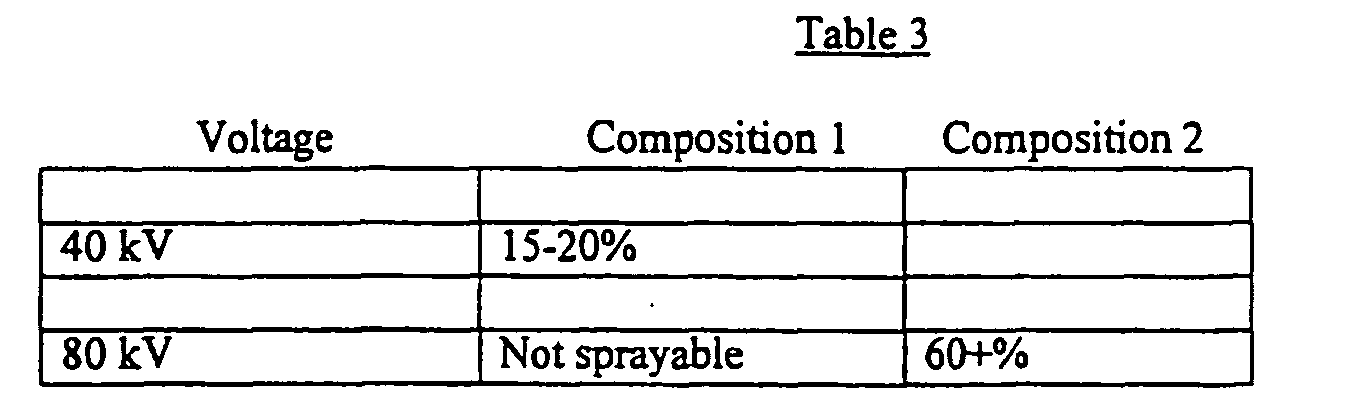
- Composition 2 a sample composition of the present invention, can achieve a higher paint transfer efficiency than Composition 1 because it can be sprayed at higher voltages.
- a painting process using an internally charged electrostatic sprayer and Composition 2 had a paint transfer efficiency that was at least 2 fold greater than the same process using Composition 1.
Landscapes
- Chemical & Material Sciences (AREA)
- Life Sciences & Earth Sciences (AREA)
- Engineering & Computer Science (AREA)
- Materials Engineering (AREA)
- Wood Science & Technology (AREA)
- Organic Chemistry (AREA)
- Paints Or Removers (AREA)
- Compositions Of Macromolecular Compounds (AREA)
Abstract
Description
| DEFINITIONS | |
| DUPONT R-706 | TiO2, commercially available from Du Pont, Wilmington, DE |
| SOLVESSO 150 | Aromatic hydrocarbon |
| TYZOR TE | Triethanolamine titanate ester available from Du Pont, Wilmington, DE |
| CYMEL 1133 | Melamine, partially alkyld, commercially available from Cytec, city, state |
| CYMEL 1168 | Melamine, commercially available from Cytec, city, state |
| RESIMENE 755 | Melamine, commercially available from Solutia, St. Louis, MO |
| RESIMENE 735 | Melamine, commercially available from Solutia, St. Louis, MO |
| CYMEL 327 | Melamine, commercially available from Cytex, West Patterson, NJ |
| RESIMENE-5503 | Melamine, commercially available from Cytex, West Patterson, NJ |
| DISCON L-1984 | Acrylic surfactant, commercially available from King Industries, Norwalk, CT |
| NACURE XP-221 | Acid Catalyst, commercially available from Chem Central, Philadelphia, PA |
| AMP-95 | Chem Central, Philadelphia, PA |

| Composition | Result |
| Composition 1 | Back Track occurred immediately after the sprayer was turned on. The sprayer shorted out |
| Composition 2 | Back Track did not occur after 30 min nor at 99% Relative humidity and at 35°C. |
Claims (24)
- A conductive primer composition comprising graphite, binder precursor and low polarity solvent, wherein the composition contains graphite in a graphite to binder ratio of about 10/100 to 40/100 and is capable of being sprayed by an internally charged electrostatic sprayer and of hardening to form a layer of an electrically conductive material having a conductivity in the range of about 100 up to about 140 Ransburg units.
- The composition of claim 1, which has been sprayed by the internally charged electrostatic sprayer at a voltage of about 50 to about 150 kilovolts.
- The composition of claim 1, which has been sprayed by the internally charged electrostatic sprayer at a voltage of about 80 to about 90 kilovolts.
- The composition of claim 1, wherein the binder precursor comprises a hydroxyl containing resin and a cross-linking resin.
- The composition of claim 1, wherein the hydroxyl containing resin is selected from the group consisting of polyester, epoxy, acrylate, methacrylate, isocyanate, acrylic polyol or combinations thereof.
- The composition of claim 4, wherein the cross-linking resin is melamine.
- The composition of claim 1, wherein the low polarity solvent is selected from the group consisting of toluene, ethyl-benzene, xylene or combinations thereof.
- The composition of claim 1, wherein the graphite has a mean particle size in the range of about 3 micron to about 12 micron.
- The composition of claim 1, wherein the binder precursor comprises about 45 weight percent to about 85 weight percent of a hydroxyl containing resin.
- The composition of claim 4, wherein the binder precursor comprises about 15 weight percent of about 55 weight percent of a cross-linking resin.
- The composition of claim 1 comprising titanium dioxide.
- The composition of claim 1 comprising a dispersant.
- The composition of claim 12 wherein the dispersant is selected from the group consisting of titanate ester, polymer dispersant or combinations thereof.
- An article comprising a substrate attached to a layer of electrically conductive material, the electrically conductive material comprising a hardened composition of claim 1.
- The article of claim 14 wherein the layer of electrically conductive material has a thickness in the range of about 15 micron to about 50 micron.
- The article of claim 14 wherein the substrate is plastic, metal or combinations thereof.
- The article of claim 14 wherein the layer of electrically conductive material comprises titanium dioxide.
- A process of coating comprising the steps of:spraying with an internally charged electrostatic sprayer a conductive primer composition of claim 1 onto a substrate.
- The process of claim 18 wherein the internally charged electrostatic sprayer sprays the composition at about 80 to about 90 kilovolts.
- The process of claim 18 wherein the internally charged electrostatic sprayer sprays the composition at about 50 to about 140 kilovolts.
- The process of claim 18 comprising the step of spraying the composition onto a substrate surface.
- The process of claim 21 wherein the substrate is the exterior of an automobile.
- The process of claim 21 comprising the step of hardening the coating to form a layer of electrically conductive material.
- The composition of claim 1 comprising polyester resin and binder precursor and melamine resin.
Applications Claiming Priority (3)
| Application Number | Priority Date | Filing Date | Title |
|---|---|---|---|
| US12915499P | 1999-04-14 | 1999-04-14 | |
| US129154P | 1999-04-14 | ||
| EP00925957A EP1169138B1 (en) | 1999-04-14 | 2000-04-13 | Electrically conductive coatings applied by internally charged electrostatic sprayers |
Related Parent Applications (1)
| Application Number | Title | Priority Date | Filing Date |
|---|---|---|---|
| EP00925957A Division EP1169138B1 (en) | 1999-04-14 | 2000-04-13 | Electrically conductive coatings applied by internally charged electrostatic sprayers |
Publications (2)
| Publication Number | Publication Date |
|---|---|
| EP1384522A2 true EP1384522A2 (en) | 2004-01-28 |
| EP1384522A3 EP1384522A3 (en) | 2005-03-02 |
Family
ID=30001791
Family Applications (1)
| Application Number | Title | Priority Date | Filing Date |
|---|---|---|---|
| EP03023699A Ceased EP1384522A3 (en) | 1999-04-14 | 2000-04-13 | Electrically conductive coatings applied by internally charged electrostatic sprayers |
Country Status (1)
| Country | Link |
|---|---|
| EP (1) | EP1384522A3 (en) |
Family Cites Families (8)
| Publication number | Priority date | Publication date | Assignee | Title |
|---|---|---|---|---|
| US4035265A (en) * | 1969-04-18 | 1977-07-12 | The Research Association Of British, Paint, Colour & Varnish Manufacturers | Paint compositions |
| CA960395A (en) * | 1972-09-13 | 1974-12-31 | Canadian General Electric Company Limited | Electrically conductive epoxy resin coatings |
| JPS58104965A (en) * | 1981-12-17 | 1983-06-22 | Olympus Optical Co Ltd | Reflection preventing paint |
| US4818437A (en) * | 1985-07-19 | 1989-04-04 | Acheson Industries, Inc. | Conductive coatings and foams for anti-static protection, energy absorption, and electromagnetic compatability |
| CA1320779C (en) * | 1986-08-29 | 1993-07-27 | Henry Stever Tremper Iii | Conductive primer composition |
| JPH0618911B2 (en) * | 1987-09-25 | 1994-03-16 | ポリプラスチックス株式会社 | Method for manufacturing electrostatically-coated plastic molded products |
| EP0647688A3 (en) * | 1987-10-06 | 1996-03-27 | Cabotex Co Ltd | Conductive coating composition comprising graphite intercalation compound. |
| JP2808296B2 (en) * | 1989-02-28 | 1998-10-08 | 東芝シリコーン株式会社 | Primer composition |
-
2000
- 2000-04-13 EP EP03023699A patent/EP1384522A3/en not_active Ceased
Also Published As
| Publication number | Publication date |
|---|---|
| EP1384522A3 (en) | 2005-03-02 |
Similar Documents
| Publication | Publication Date | Title |
|---|---|---|
| JP4463199B2 (en) | White conductive primer coating composition and multilayer coating film forming method | |
| CN100365077C (en) | Powder coating, its preparation method, method of using the same and coated article using the same | |
| WO1994021730A1 (en) | Filler pastes for use in base paints for coating polyolefin substrates, base paints of this kind and methods of directly painting polyolefin substrates | |
| EP0787045A1 (en) | Filler component for use in aqueous base paints | |
| EP1169138B1 (en) | Electrically conductive coatings applied by internally charged electrostatic sprayers | |
| JP2004075735A (en) | White conductive primer coating and method of forming multilayer coating film | |
| GB2129807A (en) | Cationic electrocoating paint compositions | |
| US6689457B1 (en) | Electrically conductive coatings applied by internally charged electrostatic sprayers | |
| WO2004069942A1 (en) | Conductive primer composition for ambient cure | |
| DE4315467A1 (en) | Filler paste for use in basecoats for coating plastic and metal substrates, basecoats and processes for direct painting of metal and plastic substrates | |
| JP4584541B2 (en) | Method for forming a high white pearl tone multilayer coating film | |
| US6531043B1 (en) | Methods for electrocoating a metallic substrate with a primer-surfacer and articles produced thereby | |
| EP1399516B1 (en) | Integrated method for repairing mulitlayered colored and/or effect-producing paint coatings | |
| JP2006239535A (en) | Multi-layer coating on automobile body | |
| JP2008184523A (en) | Primer and coating method using the same | |
| JP4309017B2 (en) | Coating method | |
| JP2004043524A (en) | Aqueous intermediate coating composition and method for forming multilayer coating film | |
| WO2021132132A1 (en) | Method for forming multilayer coating film | |
| JPH09208855A (en) | Thermosetting powder coating | |
| JP2000265109A (en) | Primer composition for polypropylene coating | |
| JP2025080176A (en) | Coating composition for rotary atomizer electrostatic coating device, coating film and vehicle | |
| JPH10309513A (en) | Electrostatic coating method for polyamide resin molded products | |
| JP2004043525A (en) | Aqueous pigment dispersion composition, aqueous intermediate coating composition and coating film forming method | |
| JP5065642B2 (en) | Anion electrodeposition paint | |
| JP2008184521A (en) | Primer and coating method using the same |
Legal Events
| Date | Code | Title | Description |
|---|---|---|---|
| PUAI | Public reference made under article 153(3) epc to a published international application that has entered the european phase |
Free format text: ORIGINAL CODE: 0009012 |
|
| AC | Divisional application: reference to earlier application |
Ref document number: 1169138 Country of ref document: EP Kind code of ref document: P |
|
| AK | Designated contracting states |
Kind code of ref document: A2 Designated state(s): BE DE FR GB |
|
| PUAL | Search report despatched |
Free format text: ORIGINAL CODE: 0009013 |
|
| AK | Designated contracting states |
Kind code of ref document: A3 Designated state(s): BE DE FR GB |
|
| 17P | Request for examination filed |
Effective date: 20050831 |
|
| AKX | Designation fees paid |
Designated state(s): BE DE FR GB |
|
| 17Q | First examination report despatched |
Effective date: 20061128 |
|
| STAA | Information on the status of an ep patent application or granted ep patent |
Free format text: STATUS: THE APPLICATION HAS BEEN REFUSED |
|
| 18R | Application refused |
Effective date: 20090421 |