EP1384340B1 - Testing loops for channel codecs - Google Patents
Testing loops for channel codecs Download PDFInfo
- Publication number
- EP1384340B1 EP1384340B1 EP02706807A EP02706807A EP1384340B1 EP 1384340 B1 EP1384340 B1 EP 1384340B1 EP 02706807 A EP02706807 A EP 02706807A EP 02706807 A EP02706807 A EP 02706807A EP 1384340 B1 EP1384340 B1 EP 1384340B1
- Authority
- EP
- European Patent Office
- Prior art keywords
- decoder
- channel
- inband
- testing apparatus
- data
- Prior art date
- Legal status (The legal status is an assumption and is not a legal conclusion. Google has not performed a legal analysis and makes no representation as to the accuracy of the status listed.)
- Expired - Lifetime
Links
- 238000012360 testing method Methods 0.000 title claims abstract description 95
- 238000000034 method Methods 0.000 claims abstract description 31
- 230000006978 adaptation Effects 0.000 claims description 10
- 230000008569 process Effects 0.000 claims description 6
- 230000004044 response Effects 0.000 claims description 3
- 230000003213 activating effect Effects 0.000 claims 1
- 239000000284 extract Substances 0.000 abstract description 2
- 230000011664 signaling Effects 0.000 description 15
- 230000005540 biological transmission Effects 0.000 description 9
- 230000008859 change Effects 0.000 description 7
- 238000000638 solvent extraction Methods 0.000 description 5
- 230000015572 biosynthetic process Effects 0.000 description 4
- 230000001413 cellular effect Effects 0.000 description 4
- 230000000694 effects Effects 0.000 description 4
- 230000008901 benefit Effects 0.000 description 3
- 238000011161 development Methods 0.000 description 3
- 238000005259 measurement Methods 0.000 description 3
- 230000004913 activation Effects 0.000 description 2
- 230000003044 adaptive effect Effects 0.000 description 2
- 230000007246 mechanism Effects 0.000 description 2
- 238000007476 Maximum Likelihood Methods 0.000 description 1
- 238000013459 approach Methods 0.000 description 1
- 238000012937 correction Methods 0.000 description 1
- 125000004122 cyclic group Chemical group 0.000 description 1
- 230000001419 dependent effect Effects 0.000 description 1
- 230000007774 longterm Effects 0.000 description 1
- 238000013507 mapping Methods 0.000 description 1
- 238000012986 modification Methods 0.000 description 1
- 230000004048 modification Effects 0.000 description 1
- 230000000644 propagated effect Effects 0.000 description 1
- 230000001360 synchronised effect Effects 0.000 description 1
- 230000007704 transition Effects 0.000 description 1
Images


Classifications
-
- H—ELECTRICITY
- H04—ELECTRIC COMMUNICATION TECHNIQUE
- H04W—WIRELESS COMMUNICATION NETWORKS
- H04W24/00—Supervisory, monitoring or testing arrangements
-
- H—ELECTRICITY
- H04—ELECTRIC COMMUNICATION TECHNIQUE
- H04L—TRANSMISSION OF DIGITAL INFORMATION, e.g. TELEGRAPHIC COMMUNICATION
- H04L1/00—Arrangements for detecting or preventing errors in the information received
- H04L1/24—Testing correct operation
-
- H—ELECTRICITY
- H04—ELECTRIC COMMUNICATION TECHNIQUE
- H04L—TRANSMISSION OF DIGITAL INFORMATION, e.g. TELEGRAPHIC COMMUNICATION
- H04L1/00—Arrangements for detecting or preventing errors in the information received
- H04L1/24—Testing correct operation
- H04L1/242—Testing correct operation by comparing a transmitted test signal with a locally generated replica
- H04L1/243—Testing correct operation by comparing a transmitted test signal with a locally generated replica at the transmitter, using a loop-back
Definitions
- the invention relates to a method for measuring the performance of decoding in a telecommunication system.
- the analog speech information has to be encoded into digital form and then secured by channel coding before transmission to ensure adequate voice quality, when receiving the signal.
- speech codecs have had a fixed rate.
- the full-rate speech codecs have the output bit rate of either 13 or 12,2 kbit/s, whereas the half-rate speech codec delivers the output bit rate of 5,6 kbit/s.
- These output bits representing the encoded speech parameters are fed into the channel coder.
- the channel coding is the set of functions responsible for adding redundancy to the information sequence.
- the coding is usually performed on a fixed number of input bits.
- the output bit rate of the channel coder is adjusted to 22,8 kbit/s in full-rate traffic channel or, respectively, to 11,4 kbit/s in half-rate traffic channel.
- AMR codec adapts the partitioning between speech and channel coding bit rates according to the quality of the channel, in order to deliver the best possible overall speech quality.
- the AMR speech coder consists of the multi-rate speech coder, a source controlled rate scheme including a voice activity detector and a comfort noise generation system, and an error concealment mechanism to combat the effects of transmission errors and lost packets.
- the multi-rate speech coder is a single integrated speech codec with eight source rates from 4.75 kbit/s to 12.2 kbit/s, and a low rate background noise encoding mode.
- performance criteria set for the codecs used for instance, in the GSM system, which performance can be measured by e.g. the frame erasure ratio (FER), bit error ratio (BER) or the residual bit error ratio (RBER) of the received data on any traffic channel TCH.
- FER frame erasure ratio
- BER bit error ratio
- RBER residual bit error ratio
- a set of testing loops are implemented into the mobile station connected to a system simulator.
- the system simulator activates a specific test loop and starts to supply either random or predefined test data into the codec.
- the mobile station loops back to the system simulator the data obtained after performing channel decoding.
- the system simulator is then able to compare the looped back data to the sent data.
- the performance of the channel decoder part of the codec for example, can be measured in regard to several criteria.
- testing loops are designed to be particularly suitable for the previous GSM codecs.
- the AMR codec includes features which are not involved in the previous codecs and, therefore, all the features of the AMR codec cannot be tested by using the known testing loops.
- the object of the invention is thus to provide an improved method and an apparatus implementing the method to avoid at least some of the above problems.
- the objects of the invention are achieved by a method and an apparatus, which are characterized in what is said in the independent claims.
- the preferred embodiments of the invention are disclosed in the dependent claims.
- the invention is based on the idea that when the performance of decoding is determined in a telecommunication system, which comprises a decoder and a testing apparatus for supplying test data to the decoder, the measurement is started by generating a test data in the testing apparatus, which test data comprises speech parameters and an inband data field, which are channel encoded in a frame format, preferably speech frame format, which is then transmitted to the decoder for decoding.
- the decoder extracts at least a part of the inband data field from the decoded test data and transmits at least the part of the inband data field back to the testing apparatus, whereby no speech parameters oe any other data is transmitted. Then the performance of decoding is determined by comparing the transmitted inband data field and the received inband data field in the test apparatus.
- An advantage of the method and the apparatus according to the invention is that the performance of the inband decoder can also be measured. Another advantage of the invention is that because only inband data is looped back from the decoder, implementation problems relating to different uplink and downlink speech codec bit rates are reduced. A further advantage of the invention is that the existing testing apparatus can be utilised with only minor modifications.
- the invention will be described in the following more in detail, using the GSM system as a preferred platform for the embodiments of the invention.
- the invention is, however, not limited to the GSM system only, but it can be utilised in any corresponding system where the implementation of test loops counters similar problems. Therefore, the invention can be applied, for example, to the WCDMA (Wideband Code Division Multiple Access) systems, wherein the AMR (Adaptive Multi-rate) codec is also supported.
- WCDMA Wideband Code Division Multiple Access
- AMR Adaptive Multi-rate
- FIG. 1 shows an example of a wireless radio system, some parts of which utilising the method of the invention.
- the presented cellular radio system comprises a base station controller 120, base transceiver stations 110 and a set of subscriber terminals 100, 101.
- the base transceiver stations 110 and subscriber terminals act as transceivers in the cellular radio system.
- the subscriber terminals establish a connection to each other by means of signals propagated through the base transceiver station 110.
- a subscriber terminal 100 can be a mobile phone, for instance.
- the radio system presented in Figure 1 can for instance be a GSM system and the TDMA multiple access method, for instance, can be used in the radio system.
- GSM speech traffic channels are TCH/FS (Full Rate Speech Channel), TCH/HS (Half-Rate Speech Channel), TCH/EFS (EFR Speech Channel), TCH/AFS (AMR Speech on FR Channel) and TCH/AHS (AMR Speech on HR Channel).
- TCHs Traffic channels
- CCHs control channels
- GSM speech traffic channels are TCH/FS (Full Rate Speech Channel), TCH/HS (Half-Rate Speech Channel), TCH/EFS (EFR Speech Channel), TCH/AFS (AMR Speech on FR Channel) and TCH/AHS (AMR Speech on HR Channel).
- control channels are several control channels defined in GSM, most of them being used to set-up a call and for synchronization.
- SACCH Slow Associated Control Channel
- FACCH Fast Associated Control Channel
- RATSCCH Robot AMR Traffic Synchronized Control Channel
- SACCH and FACCH are used for transmission of signalling data during a connection, but there is one SACCH time slot allocated in every 26 th TDMA frame, whereas FACCH channel is used only if necessary.
- RATSCCH which is used for modifying the AMR configurations on the radio interface during a connection, is used only if necessary. When FACCH or RATSCCH are needed, they are allocated the necessary time slots by "stealing" them from TCH speech frames.
- Speech codecs In traditional GSM speech coding, speech codecs have had a fixed rate. There has been three speech codecs in use in the GSM system: the full-rate (FR) speech codec, based on RPE-LTP method (Regular Pulse Excited - Long Term Prediction), the half-rate (HR) speech codec, based on CELP/VCELP method (Codebook Excited Linear Prediction) and the enhanced full-rate (EFR) speech codec, based on ACELP method (Algebraic Codebook Excited Linear Prediction). Speech codecs deliver speech parameters to channel codec every 20 ms. Since the active call logical channel mapping last 120ms, it contains 6 speech frames.
- FR full-rate
- RPE-LTP method Regular Pulse Excited - Long Term Prediction
- HR half-rate
- CELP/VCELP method Codebook Excited Linear Prediction
- EFR enhanced full-rate
- Speech codecs deliver speech parameters to channel codec every 20 m
- a new speech frame is sent every 4 th burst containing TCH information.
- the full-rate speech codec FR delivers 260 bits and the enhanced full-rate speech codec EFR delivers 244 bits representing encoded speech parameters, resulting in the output bit rate of 13 kbit/s and 12,2 kbit/s, respectively.
- the half rate traffic channel (TCH/HS)
- a new speech frame is sent every 2 nd burst containing TCH information.
- the half-rate speech codec HR delivers 112 bits representing encoded speech parameters, resulting in the output bit rate of 5,6 kbit/s.
- the channel coding is the set of functions responsible for adding redundancy to the information sequence.
- the coding is usually performed on a fixed number of input bits. Higher coding gains are achieved by increasing the complexity of the coding. However transmission delay and limited hardware resources limits the complexity that can be used in real time environment.
- FIG. 2 illustrates the channel encoding chain in the encoder.
- the channel encoding of speech parameters consist of several blocks. Bit reordering (200) is performed to the bits of the speech parameters according to subjective importance, dividing the bits into categories 1 A, 1B and 2. For the most important bits, i.e. class 1 A bits, a CRC (Cyclic Redundancy Check, 202) is computed. The CRC technique transmit few additional bits that can be used by the receiver to detect errors in the transmitted frame. Class 1 B bits are not protected by CRC. Both class 1A and 1b bits are protected by convolutional encoding (204), which is a method to add redundancy to the bits transmitted in the channel.
- convolutional encoding 204
- the convolutional encoder produce more output bits than input inputs.
- the way redundancy is added allows the receiver to perform a maximum likelihood algorithm on the convolutionally encoded bits in order to allow the correction of signal errors introduced during transmission.
- the number of bits that can be sent in the channel is limited. Puncturing (206) is a method to reduce the number of bits sent on the channel by deleting bits from the convolutionally encoded data.
- the decoder knows which bits are punctured and adds placeholders for those.
- FR channel 456 bits per 20 ms can be sent, resulting in the gross rate of 22,8 kbit/s in full-rate traffic channel.
- HR channel 228 bits per 20 ms can be sent, resulting in the gross rate of 11,4 kbit/s, which is exactly half the gross rate of that used in full-rate traffic channel.
- AMR codec adapts the error protection level to the radio channel and traffic conditions so that it always aims to select the optimum channel and codec mode (speech and channel bit rates) to achieve the best overall speech quality.
- the AMR codec operates in either the GSM FR or HR channel and it also provides the user with speech quality comparable to wireline for the half-rate channel in good channel conditions.
- the AMR speech coder consists of the multi-rate speech coder, a source controlled rate scheme including a voice activity detector and a comfort noise generation system, and an error concealment mechanism to combat the effects of transmission errors and lost packets.
- the multi-rate speech coder is a single integrated speech codec with eight source rates from 4.75 kbit/s to 12.2 kbit/s, and a low rate background noise encoding mode.
- the speech coder is capable of switching its bit-rate every 20 ms speech frame upon command.
- the AMR codec contains eight speech codecs with bit-rates of 12.2, 10.2, 7.95, 7.4, 6.7, 5.9, 5.15 and 4.75 kbit/s. All the speech codecs are defined for the full-rate channel, while the six lowest ones are defined for the half-rate channel, as shown in the following table. 12.2 10.2 7.95 7.4 6.7 5.9 5.15 4.75 TCH/AFS X X X X X X X X TCH/AHS X X X X X X X X X X
- a mobile station must implement all the codec modes. However, the network can support any combination of them.
- codec mode selection is done from a set of codec modes (ACS, Active Codec Set), which set may include 1 - 4 AMR codec modes. This set can be reconfigured at call setup phase, in handover situation or by RATSCCH signalling.
- Each codec mode provides a different level of error protection through a different distribution between speech and channel coding. All the speech codec modes are allowed to change without the intervention of L3 signalling, enabling fast transition between mode, when channel conditions are varying.
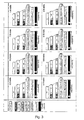
- Figure 3 illustrates the formation of TCH/AFS frames for different codec modes.
- the frame is built starting from the 244 bits output by the speech codec.
- the speech frame bits are reordered and divided into class 1A (81 bits) and 1B (163 bits).
- class 1A 81 bits
- 1B 163 bits
- For the protection of the 81 class 1A bits a 6 bit CRC is computed.
- 4 tail bits are added to the block of 250 bits, which tail bits are used for termination of the channel coder.
- 1 ⁇ 2 rate convolutional encoding is performed over the block of 254 bits (244 + 6 + 4), resulting in a block of 508 bits.
- the block of 508 bits is then punctured, thus reducing the number of bits to 448 bits.
- 8 bits containing inband data are added.
- the final block of data is 456 bits long.
- all the TCH/AFS channel encoded frames have the same length (456 bits) even though the number of bits in the input (the speech parameters) differs from mode to mode.
- the different number of input bits are encoded to exactly 456 output bits by altering the convolutional coding rate and the puncturing rate for each mode. 456 bits sent per every 20 ms, resulting in the gross rate of 22,8 kbit/s, make use of all the bits available from the full-rate traffic channel of the GSM system.
- Figure 4 demonstrates the formation of TCH/AHS frames for the six different codec modes.
- the principle of frame building is similar to the case of TCH/AFS frames, with a few exceptions.
- bit reordering the bits are divided into class 1A, 1B and 2 bits, while in TCH/AFS frames only classes 1A and 1 B are used. These class 2 bits are not convolutionally encoded.
- only 4 inband data bits are added to the convolutionally coded frame.
- the channel encoded frames are 228 bits long. 228 bits sent per 20 ms, resulting in the gross rate of 11,4 kbit/s, fulfills the requirements of the GSM system for the half-rate traffic channel.
- the link adaptation process bears responsibility for measuring the channel quality.
- mode adaptation selects the optimal speech and channel codecs.
- the mobile station (MS) and the base transceiver station (BTS) both perform channel quality estimation for their own receive path.
- the BTS sends to MS a Codec Mode Command (CMC, the mode to be used by MS in uplink) and the MS sends to BTS a Codec Mode Request (CMR, the mode requested to be used in downlink).
- CMC Codec Mode Command
- CMR Codec Mode Request
- This signalling is sent inband, along with the speech data.
- the codec mode in the uplink may be different from the one used in downlink, but the channel mode (full-rate or half-rate) must be the same.
- the inband signalling has been designed to allow fast adaptation to rapid channel variations.
- the network controls the uplink and downlink codec modes and channel modes.
- the mobile station must obey the Codec Mode Command from the network, while the network may use any complementing information to determine downlink and uplink codecs mode.
- performance criteria are defined and have to be met by the MS.
- performance criteria can be measured by e.g. the frame erasure ratio (FER), the bit error ratio (BER) or the residual bit error ratio (RBER) of the received data on any traffic channel TCH.
- FER frame erasure ratio
- BER bit error ratio
- RBER residual bit error ratio
- the criteria is defined more precisely, for example, in the document "3GPP TS 05.05 V8.7.1, Digital cellular telecommunications system (Phase 2+); Radio transmission and reception ".
- SS system simulator
- a predefined testing loop is activated in a mobile station connected to the system simulator and the performance is measured in regard to several criteria.
- these testing loops are defined more precisely in the document "GSM 04.14 ETSI TS 101 293 V8.1.0, Digital cellular telecommunications system (Phase 2+); Individual equipment type requirements and interworking; Special conformance testing function".
- testing loops are designed to be particularly suitable for the previous GSM codecs.
- the AMR codec includes features which are not involved in the previous codecs and, therefore, all the features of the AMR codec cannot be tested by using the known testing loops.
- the present invention solves at least some of the problems involved in the AMR testing.
- a problem is related to determining the performance of inband signalling decoding.
- the AMR encoded traffic channel frame always includes some control bits transmitted along with the speech bits. These bits are called inband signalling bits. The purpose of these bits is to enable the codec mode change without any further signalling frame. Because there is at maximum four modes in a modeset, only two bits are needed to code the inband information. To help the decoding in difficult channel condition, these two bits are mapped to longer bit pattern: 8 bits on TCH/AFS and 4 bits on TCH/AHS.
- the information transmitted inband depends on the direction.
- downlink direction from BTS to MS
- two different information are time multiplexed in two consecutive speech frames.
- a mode command MC is transmitted from the BTS to the MS, whereby the BTS commands the mode the MS must use in uplink.
- a mode indication MI is transmitted from the BTS to the MS, whereby the BTS informs the MS of the mode it uses in downlink.
- uplink direction from MS to BTS
- two different information are time multiplexed in two consecutive speech frames.
- a mode request MR is transmitted from the MS to the BTS, whereby the MS requests the BTS to use a certain mode in downlink.
- a mode indication MI is transmitted from the MS to the BTS, whereby the MS informs the BTS of the mode it uses in uplink.
- the information transmitted inband is always time multiplexed, i.e. every other frame contains current mode, and every other frame contains commanded/requested mode.
- the MS When a 20 ms frame has been received by the MS, it is processed by the channel decoder.
- the output of the channel codec is the channel decoded speech parameters along with the information that was transmitted inband. If that information was a mode command (MC), the MS will modify the speech mode it uses in uplink according to the command, since MS must always obey to commanded mode (MC) from the BTS. This used uplink mode will be signalled to the BTS via the uplink mode indication transmitted inband.
- MC mode command
- MC commanded mode
- the inband decoder performance is tried to be measured with current test loops and testing equipment (system simulator SS)
- the MS would follow received mode command (MC) and change its uplink mode indication (MI) accordingly. It is then possible for the tester SS to compare the received MI against the previously sent MC. If both are similar, the inband decoder can be considered to have worked correctly. If they are different, it informs that MS did not decode correctly the MC coming from BTS. From these observations, the SS can calculate the performance of the inband decoder.
- Downlink MI does not have direct influence on any uplink inband signalled information.
- the uplink MI is directly influenced by the downlink MC.
- the mode request is generated by the mobile station link adaptation algorithm and is not directly modified by the downlink MI. Because of that, the SS cannot calculate the performance of the MI inband decoder.
- a new internal test loop has been developed to overcome this problem.
- the link adaptation algorithm is bypassed and replaced by a function that loops back the received inband data. This is done regardless of the inband signalling phase.
- the received MC can be transmitted in uplink as MI, and the received MI is then looped back as MR.
- the received MC can be transmitted in uplink as MR and received MI is looped back as MI. Since the aim of the loop is to calculate inband decoding performance, the speech parameters transmitted by the SS are not looped back from the MS, but they are encoded as zeros.
- this reduces implementation problems related to different uplink and downlink speech codec bit-rates.
- the frame error rate for the inband channel (TCH/AxS-INB FER), for example, can be determined.
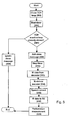
- the method according to the new testing loop is illustrated with a reference to the flow chart in Figure 5.
- a TCH must be active between the SS and the MS.
- the TCH may be AMR speech over full-rate channel or half-rate channel of any rate specified in the GSM system.
- the testing loop is activated in an MS by transmitting an appropriate command message to the MS, which command can be, for example, a CLOSE_TCH_LOOP_CMD message according to the GSM system.
- the SS orders the MS to close its TCH loop by transmitting a CLOSE_TCH_LOOP_CMD message (500), specifying the TCH to be looped and that decoded inband signalling information are to be looped back by the MS.
- the SS then starts timer TT01 (502), which sets a time limit for the MS to response. If no TCH is active, or any test loop is already closed (504), the MS shall ignore any CLOSE_TCH_LOOP_CMD message (506). If a TCH is active, the MS shall close its TCH loop for the TCH specified and send back to the SS a CLOSE_TCH_LOOP_ACK (508). Upon reception of that message the SS stops timer TT01 (510).
- every inband signal decision shall be taken from the output of the channel decoder (512) and input to the channel encoder (514).
- Transmitted speech parameters are not looped by setting the input frame to the channel encoder to zero's (516).
- the inband signal decisions input to the channel encoder are transmitted on the same TCH uplink to the SS (518). This is advantageously done regardless of the link adaptation, whereby the decoded inband information is directly looped back to the SS.
- the SS measures the performance of the inband decoder from the received inband signalling pattern (520), for example, by determining the frame error rate for the inband channel (TCH/AxS-INB FER).
- the content of the CLOSE_TCH_LOOP_CMD message is defined more precisely in the above-mentioned document GSM 04.14. This message is only sent in the direction SS to MS.
- the CLOSE_TCH_LOOP_CMD message comprises four information elements: a protocol discriminator field and a skip indicator field, both having length of four bits and being defined more precisely in the document "GSM 04. 07, v.7.3.0, sect. 11.1.1 and 11.1.2 ", a message type field having length of eight bits all defined as zeros and a sub-channel field having also length of eight bits. From the sub-channel field bits five bits have a specific meaning in defining the message content and they are called X, Y, Z, A and B bits. Three bits are spare bits set to zero.
- the activation of the testing loop according to the invention can be implemented by means of the CLOSE_TCH_LOOP_CMD message, if one of the spare bits is advantageously also allocated a specific meaning in defining the message content.
- This new bit can be called, for example, a C bit.
- the value of X bit indicates whether there is only one full-rate channel active or which one of the possibly available sub-channels is used.
- the values of Y and Z bits can be discarded.
- the test sequence of the inband data modes is delivered to the MS.
- the delivery can take place either before the activation of the test loop or during the test set-up.
- the SS activates the test loop in the MS, for example by sending the CLOSE_TCH_LOOP_CMD message, and starts to transmit said test sequence.
- a counter which will be incremented every time when the decoded inband data does not correspond with the expected result.
- the value of the counter can be either checked from the MS or it can be transmitted to the SS, from which value the performance of the inband decoder can be derived.
- the link adaptation algorithm is remained in active state and the MS follows the mode commands MC sent by the SS. Then only the mode indications MI according to the commanded mode MC are transmitted back to the SS.
- the speech parameters transmitted by the SS are not looped back from the MS, but they are encoded as zeros.
- the SS compares the received mode indication MI to the sent mode command MC and if they correspond, the mode command MC decoding can advantageously be measured. However, because only every second frame will be tested the SS, the performance of mode indication MI decoding must be measured by a separate test loop.
- the block chart of Figure 6 illustrates an apparatus which can be applied in testing configuration according to the invention.
- the system simulator 600 comprises a generator 602 for generating random/constant speech parameter patterns, which are then input to a channel encoder 604 for encoding.
- the channel encoded speech frames are then supplied to a transmitting means 606 for transmitting further via a channel simulator 608 to the mobile station 610.
- the mobile station 610 comprises a receiving means 612 for receiving the transmission, from which the channel encoded speech frames are input to the channel decoder 614.
- the mobile station 610 comprises means 616 for implementing test loops and for executing a specific test loop according to the instructions given by the system simulator 600.
- the test loop to be used can be defined, for example, by the CLOSE_TCH_LOOP_CMD message, as described above.
- the output of the test loop is supplied to the channel encoder 618 for encoding.
- the channel encoded data is then supplied to a transmitting means 620 for transmitting further to the system simulator 600.
- the system simulator 600 also comprises a receiving means 622 for receiving the transmission, from which the channel encoded data is input to the channel decoder 624.
- the system simulator 600 comprises comparing means 626 for comparing the received data to the sent pattern and as a result of said comparison, the performance of the decoding can be measured.
Landscapes
- Computer Networks & Wireless Communication (AREA)
- Signal Processing (AREA)
- Engineering & Computer Science (AREA)
- Mobile Radio Communication Systems (AREA)
- Time-Division Multiplex Systems (AREA)
- Monitoring And Testing Of Transmission In General (AREA)
- Monitoring And Testing Of Exchanges (AREA)
- Maintenance And Management Of Digital Transmission (AREA)
- Television Systems (AREA)
- Error Detection And Correction (AREA)
- Polishing Bodies And Polishing Tools (AREA)
- Compression, Expansion, Code Conversion, And Decoders (AREA)
- Ultra Sonic Daignosis Equipment (AREA)
- Detection And Prevention Of Errors In Transmission (AREA)
Applications Claiming Priority (3)
| Application Number | Priority Date | Filing Date | Title |
|---|---|---|---|
| FI20010533 | 2001-03-16 | ||
| FI20010533A FI110734B (fi) | 2001-03-16 | 2001-03-16 | Kanavakoodekkien testisilmukoita |
| PCT/FI2002/000216 WO2002075986A1 (en) | 2001-03-16 | 2002-03-15 | Testing loops for channel codecs |
Publications (2)
| Publication Number | Publication Date |
|---|---|
| EP1384340A1 EP1384340A1 (en) | 2004-01-28 |
| EP1384340B1 true EP1384340B1 (en) | 2007-05-02 |
Family
ID=8560760
Family Applications (1)
| Application Number | Title | Priority Date | Filing Date |
|---|---|---|---|
| EP02706807A Expired - Lifetime EP1384340B1 (en) | 2001-03-16 | 2002-03-15 | Testing loops for channel codecs |
Country Status (17)
| Country | Link |
|---|---|
| US (1) | US7227888B2 (enExample) |
| EP (1) | EP1384340B1 (enExample) |
| JP (1) | JP2004531932A (enExample) |
| KR (1) | KR100639306B1 (enExample) |
| CN (1) | CN1268079C (enExample) |
| AT (1) | ATE361599T1 (enExample) |
| BR (1) | BRPI0207912B1 (enExample) |
| CA (1) | CA2440313C (enExample) |
| CY (1) | CY1106715T1 (enExample) |
| DE (1) | DE60219907T2 (enExample) |
| DK (1) | DK1384340T3 (enExample) |
| ES (1) | ES2286232T3 (enExample) |
| FI (1) | FI110734B (enExample) |
| MX (1) | MXPA03008189A (enExample) |
| PT (1) | PT1384340E (enExample) |
| RU (1) | RU2258312C2 (enExample) |
| WO (1) | WO2002075986A1 (enExample) |
Families Citing this family (23)
| Publication number | Priority date | Publication date | Assignee | Title |
|---|---|---|---|---|
| US6973579B2 (en) | 2002-05-07 | 2005-12-06 | Interdigital Technology Corporation | Generation of user equipment identification specific scrambling code for the high speed shared control channel |
| DE10324745A1 (de) * | 2003-05-30 | 2004-12-30 | Rohde & Schwarz Gmbh & Co. Kg | Verfahren und Testgerät zum Ermitteln einer Fehlerrate |
| US7328027B1 (en) * | 2004-05-11 | 2008-02-05 | Sprint Spectrum L.P. | Method for vocoder selection based on loads in coverage areas of a wireless wide area network |
| CN1954630A (zh) * | 2004-05-21 | 2007-04-25 | 三菱电机株式会社 | 移动体分组通信系统 |
| SE0401669D0 (sv) * | 2004-06-24 | 2004-06-24 | Ericsson Telefon Ab L M | Method and system for saving bandwidth |
| US7639727B1 (en) * | 2004-10-05 | 2009-12-29 | Cingular Wireless Ii, L.L.C. | System and method for selecting wireless signal bandwidth based on signal strength measurements provided by wireless receivers |
| KR101119281B1 (ko) | 2005-08-29 | 2012-03-15 | 삼성전자주식회사 | 무선 통신 시스템에서 채널 품질 정보 피드백 장치 및방법과 이를 이용한 스케줄링 장치 및 방법 |
| US7720046B2 (en) * | 2005-09-23 | 2010-05-18 | St-Ericsson Sa | Synchronizing a channel codec and vocoder of a mobile station |
| CN101056342B (zh) | 2006-04-13 | 2011-04-20 | 华为技术有限公司 | 一种在数字用户线技术中进行通信的方法和装置 |
| US8964788B2 (en) | 2008-06-05 | 2015-02-24 | Qualcomm Incorporated | System and method of an in-band modem for data communications over digital wireless communication networks |
| US8825480B2 (en) | 2008-06-05 | 2014-09-02 | Qualcomm Incorporated | Apparatus and method of obtaining non-speech data embedded in vocoder packet |
| US9083521B2 (en) | 2008-06-05 | 2015-07-14 | Qualcomm Incorporated | System and method of an in-band modem for data communications over digital wireless communication networks |
| US8958441B2 (en) | 2008-06-05 | 2015-02-17 | Qualcomm Incorporated | System and method of an in-band modem for data communications over digital wireless communication networks |
| US8725502B2 (en) | 2008-06-05 | 2014-05-13 | Qualcomm Incorporated | System and method of an in-band modem for data communications over digital wireless communication networks |
| RU2010154464A (ru) * | 2008-06-05 | 2012-07-20 | Квэлкомм Инкорпорейтед (US) | Система и способ внутриполосного модема для передач данных по сетям цифровой беспроводной связи |
| US8503517B2 (en) | 2008-06-05 | 2013-08-06 | Qualcomm Incorporated | System and method of an in-band modem for data communications over digital wireless communication networks |
| US8855100B2 (en) | 2009-06-16 | 2014-10-07 | Qualcomm Incorporated | System and method for supporting higher-layer protocol messaging in an in-band modem |
| US8743864B2 (en) | 2009-06-16 | 2014-06-03 | Qualcomm Incorporated | System and method for supporting higher-layer protocol messaging in an in-band modem |
| JP5001983B2 (ja) * | 2009-07-21 | 2012-08-15 | 株式会社エヌ・ティ・ティ・ドコモ | 通信制御システム、及び通信制御方法 |
| US9319874B2 (en) * | 2009-11-25 | 2016-04-19 | Wi-Lan Inc. | Automatic channel pass-through |
| CN103684574A (zh) * | 2012-09-07 | 2014-03-26 | 成都林海电子有限责任公司 | 卫星移动通信终端的语音编解码器自闭环性能测试方法 |
| CN103684624B (zh) * | 2012-09-07 | 2015-07-29 | 成都林海电子有限责任公司 | 卫星移动终端语音编解码器半双工语音输出功能测试方法 |
| CN103595862B (zh) * | 2013-10-25 | 2016-02-03 | 福州瑞芯微电子股份有限公司 | 一种mipi dsi控制器的测试系统 |
Family Cites Families (16)
| Publication number | Priority date | Publication date | Assignee | Title |
|---|---|---|---|---|
| JPH01158862A (ja) * | 1987-12-15 | 1989-06-21 | Nec Corp | 遠隔試験方式 |
| US5321605A (en) * | 1990-06-01 | 1994-06-14 | Motorola, Inc. | Process flow information management system |
| US5319543A (en) * | 1992-06-19 | 1994-06-07 | First Data Health Services Corporation | Workflow server for medical records imaging and tracking system |
| US5630069A (en) * | 1993-01-15 | 1997-05-13 | Action Technologies, Inc. | Method and apparatus for creating workflow maps of business processes |
| SE517591C2 (sv) * | 1994-06-09 | 2002-06-25 | Motorola Ltd | Kommunikationssystem |
| US5974395A (en) * | 1996-08-21 | 1999-10-26 | I2 Technologies, Inc. | System and method for extended enterprise planning across a supply chain |
| US6205130B1 (en) * | 1996-09-25 | 2001-03-20 | Qualcomm Incorporated | Method and apparatus for detecting bad data packets received by a mobile telephone using decoded speech parameters |
| KR100268450B1 (ko) * | 1998-03-02 | 2000-10-16 | 윤종용 | 테스트기능을 갖는 비터비 디코더 |
| FI106834B (fi) | 1998-06-03 | 2001-04-12 | Nokia Mobile Phones Ltd | Menetelmä ja järjestelmä datakanavien toimivuuden testaamiseksi radiolaitteessa |
| US6240282B1 (en) * | 1998-07-13 | 2001-05-29 | Motorola, Inc. | Apparatus for performing non-linear signal classification in a communications system |
| US6493665B1 (en) * | 1998-08-24 | 2002-12-10 | Conexant Systems, Inc. | Speech classification and parameter weighting used in codebook search |
| US6308065B1 (en) * | 1998-12-07 | 2001-10-23 | Agilent Technologies, Inc. | Apparatus for testing cellular base stations |
| US6631122B1 (en) * | 1999-06-11 | 2003-10-07 | Nortel Networks Limited | Method and system for wireless QOS agent for all-IP network |
| US7010001B2 (en) | 2000-01-10 | 2006-03-07 | Qualcomm, Incorporated | Method and apparatus for supporting adaptive multi-rate (AMR) data in a CDMA communication system |
| EP1126651A1 (en) * | 2000-02-16 | 2001-08-22 | Lucent Technologies Inc. | Link adaptation for RT-EGPRS |
| GB0008119D0 (en) | 2000-04-03 | 2000-05-24 | Nokia Networks Oy | Estimating communication quality |
-
2001
- 2001-03-16 FI FI20010533A patent/FI110734B/fi not_active IP Right Cessation
-
2002
- 2002-03-15 WO PCT/FI2002/000216 patent/WO2002075986A1/en not_active Ceased
- 2002-03-15 BR BRPI0207912A patent/BRPI0207912B1/pt active IP Right Grant
- 2002-03-15 PT PT02706807T patent/PT1384340E/pt unknown
- 2002-03-15 JP JP2002574284A patent/JP2004531932A/ja active Pending
- 2002-03-15 DE DE60219907T patent/DE60219907T2/de not_active Expired - Lifetime
- 2002-03-15 DK DK02706807T patent/DK1384340T3/da active
- 2002-03-15 US US10/099,627 patent/US7227888B2/en not_active Expired - Lifetime
- 2002-03-15 EP EP02706807A patent/EP1384340B1/en not_active Expired - Lifetime
- 2002-03-15 MX MXPA03008189A patent/MXPA03008189A/es active IP Right Grant
- 2002-03-15 AT AT02706807T patent/ATE361599T1/de active
- 2002-03-15 CA CA002440313A patent/CA2440313C/en not_active Expired - Lifetime
- 2002-03-15 KR KR1020037012031A patent/KR100639306B1/ko not_active Expired - Lifetime
- 2002-03-15 ES ES02706807T patent/ES2286232T3/es not_active Expired - Lifetime
- 2002-03-15 RU RU2003130463/09A patent/RU2258312C2/ru active
- 2002-03-15 CN CNB028067304A patent/CN1268079C/zh not_active Expired - Lifetime
-
2007
- 2007-07-09 CY CY20071100912T patent/CY1106715T1/el unknown
Also Published As
| Publication number | Publication date |
|---|---|
| FI20010533L (fi) | 2002-09-17 |
| EP1384340A1 (en) | 2004-01-28 |
| US20020177436A1 (en) | 2002-11-28 |
| RU2003130463A (ru) | 2005-02-10 |
| DE60219907T2 (de) | 2008-01-10 |
| CN1268079C (zh) | 2006-08-02 |
| FI20010533A0 (fi) | 2001-03-16 |
| US7227888B2 (en) | 2007-06-05 |
| CA2440313C (en) | 2008-12-23 |
| KR20040008137A (ko) | 2004-01-28 |
| CN1498468A (zh) | 2004-05-19 |
| KR100639306B1 (ko) | 2006-10-26 |
| BRPI0207912B1 (pt) | 2017-04-04 |
| PT1384340E (pt) | 2007-07-03 |
| DE60219907D1 (de) | 2007-06-14 |
| DK1384340T3 (da) | 2007-07-16 |
| ATE361599T1 (de) | 2007-05-15 |
| WO2002075986A1 (en) | 2002-09-26 |
| FI110734B (fi) | 2003-03-14 |
| CY1106715T1 (el) | 2012-05-23 |
| HK1064524A1 (en) | 2005-01-28 |
| BR0207912A (pt) | 2004-03-02 |
| CA2440313A1 (en) | 2002-09-26 |
| JP2004531932A (ja) | 2004-10-14 |
| RU2258312C2 (ru) | 2005-08-10 |
| ES2286232T3 (es) | 2007-12-01 |
| MXPA03008189A (es) | 2004-01-29 |
Similar Documents
| Publication | Publication Date | Title |
|---|---|---|
| EP1384340B1 (en) | Testing loops for channel codecs | |
| CA2351571C (en) | Efficient in-band signaling for discontinuous transmission and configuration changes in adaptive multi-rate communications systems | |
| AU683479B2 (en) | Method and apparatus for determining the data rate of a received signal | |
| EP1389372B1 (en) | Testing loops for channel codecs | |
| US6381455B1 (en) | System and method for warning of and providing greater immunity from an impeding call drop in a digital wireless system | |
| Uvliden et al. | Adaptive multi-rate. A speech service adapted to cellular radio network quality | |
| HK1061122B (en) | Testing loops for channel codecs | |
| KR100383155B1 (ko) | 겸용전속/반속서비스통신시스템및그서비스제공방법및이동국 | |
| HK1064524B (en) | Testing loops for channel codecs | |
| WO2009083555A1 (en) | Calculation of standard deviation for frame erasure rate measurements using adaptive multi rate codecs on a per codec type basis |
Legal Events
| Date | Code | Title | Description |
|---|---|---|---|
| PUAI | Public reference made under article 153(3) epc to a published international application that has entered the european phase |
Free format text: ORIGINAL CODE: 0009012 |
|
| 17P | Request for examination filed |
Effective date: 20031001 |
|
| AK | Designated contracting states |
Kind code of ref document: A1 Designated state(s): AT BE CH CY DE DK ES FI FR GB GR IE IT LI LU MC NL PT SE TR |
|
| AX | Request for extension of the european patent |
Extension state: AL LT LV MK RO SI |
|
| GRAP | Despatch of communication of intention to grant a patent |
Free format text: ORIGINAL CODE: EPIDOSNIGR1 |
|
| GRAS | Grant fee paid |
Free format text: ORIGINAL CODE: EPIDOSNIGR3 |
|
| GRAA | (expected) grant |
Free format text: ORIGINAL CODE: 0009210 |
|
| AK | Designated contracting states |
Kind code of ref document: B1 Designated state(s): AT BE CH CY DE DK ES FI FR GB GR IE IT LI LU MC NL PT SE TR |
|
| REG | Reference to a national code |
Ref country code: GB Ref legal event code: FG4D |
|
| REG | Reference to a national code |
Ref country code: CH Ref legal event code: NV Representative=s name: E. BLUM & CO. AG PATENT- UND MARKENANWAELTE VSP Ref country code: CH Ref legal event code: EP |
|
| REG | Reference to a national code |
Ref country code: IE Ref legal event code: FG4D |
|
| REF | Corresponds to: |
Ref document number: 60219907 Country of ref document: DE Date of ref document: 20070614 Kind code of ref document: P |
|
| REG | Reference to a national code |
Ref country code: PT Ref legal event code: SC4A Free format text: AVAILABILITY OF NATIONAL TRANSLATION Effective date: 20070622 |
|
| REG | Reference to a national code |
Ref country code: DK Ref legal event code: T3 |
|
| REG | Reference to a national code |
Ref country code: GR Ref legal event code: EP Ref document number: 20070402017 Country of ref document: GR |
|
| REG | Reference to a national code |
Ref country code: SE Ref legal event code: TRGR |
|
| ET | Fr: translation filed | ||
| REG | Reference to a national code |
Ref country code: ES Ref legal event code: FG2A Ref document number: 2286232 Country of ref document: ES Kind code of ref document: T3 |
|
| PLBE | No opposition filed within time limit |
Free format text: ORIGINAL CODE: 0009261 |
|
| STAA | Information on the status of an ep patent application or granted ep patent |
Free format text: STATUS: NO OPPOSITION FILED WITHIN TIME LIMIT |
|
| 26N | No opposition filed |
Effective date: 20080205 |
|
| PGFP | Annual fee paid to national office [announced via postgrant information from national office to epo] |
Ref country code: IE Payment date: 20120312 Year of fee payment: 11 Ref country code: MC Payment date: 20120228 Year of fee payment: 11 Ref country code: CH Payment date: 20120313 Year of fee payment: 11 Ref country code: LU Payment date: 20120330 Year of fee payment: 11 |
|
| PGFP | Annual fee paid to national office [announced via postgrant information from national office to epo] |
Ref country code: PT Payment date: 20120314 Year of fee payment: 11 |
|
| PGFP | Annual fee paid to national office [announced via postgrant information from national office to epo] |
Ref country code: SE Payment date: 20120313 Year of fee payment: 11 Ref country code: FI Payment date: 20120312 Year of fee payment: 11 Ref country code: BE Payment date: 20120328 Year of fee payment: 11 Ref country code: IT Payment date: 20120323 Year of fee payment: 11 Ref country code: GR Payment date: 20120215 Year of fee payment: 11 Ref country code: DK Payment date: 20120312 Year of fee payment: 11 |
|
| PGFP | Annual fee paid to national office [announced via postgrant information from national office to epo] |
Ref country code: CY Payment date: 20120309 Year of fee payment: 11 |
|
| PGFP | Annual fee paid to national office [announced via postgrant information from national office to epo] |
Ref country code: ES Payment date: 20120419 Year of fee payment: 11 |
|
| PGFP | Annual fee paid to national office [announced via postgrant information from national office to epo] |
Ref country code: AT Payment date: 20120228 Year of fee payment: 11 |
|
| REG | Reference to a national code |
Ref country code: PT Ref legal event code: MM4A Free format text: LAPSE DUE TO NON-PAYMENT OF FEES Effective date: 20130916 |
|
| BERE | Be: lapsed |
Owner name: NOKIA CORPORATION Effective date: 20130331 |
|
| REG | Reference to a national code |
Ref country code: DK Ref legal event code: EBP Effective date: 20130331 Ref country code: DK Ref legal event code: EBP |
|
| REG | Reference to a national code |
Ref country code: SE Ref legal event code: EUG |
|
| PG25 | Lapsed in a contracting state [announced via postgrant information from national office to epo] |
Ref country code: PT Free format text: LAPSE BECAUSE OF NON-PAYMENT OF DUE FEES Effective date: 20130916 Ref country code: MC Free format text: LAPSE BECAUSE OF NON-PAYMENT OF DUE FEES Effective date: 20130331 Ref country code: FI Free format text: LAPSE BECAUSE OF NON-PAYMENT OF DUE FEES Effective date: 20130315 Ref country code: SE Free format text: LAPSE BECAUSE OF NON-PAYMENT OF DUE FEES Effective date: 20130316 |
|
| REG | Reference to a national code |
Ref country code: CH Ref legal event code: PL |
|
| REG | Reference to a national code |
Ref country code: AT Ref legal event code: MM01 Ref document number: 361599 Country of ref document: AT Kind code of ref document: T Effective date: 20130315 |
|
| REG | Reference to a national code |
Ref country code: GR Ref legal event code: ML Ref document number: 20070402017 Country of ref document: GR Effective date: 20131002 |
|
| PG25 | Lapsed in a contracting state [announced via postgrant information from national office to epo] |
Ref country code: CY Free format text: LAPSE BECAUSE OF NON-PAYMENT OF DUE FEES Effective date: 20130315 |
|
| REG | Reference to a national code |
Ref country code: IE Ref legal event code: MM4A |
|
| PG25 | Lapsed in a contracting state [announced via postgrant information from national office to epo] |
Ref country code: LI Free format text: LAPSE BECAUSE OF NON-PAYMENT OF DUE FEES Effective date: 20130331 Ref country code: BE Free format text: LAPSE BECAUSE OF NON-PAYMENT OF DUE FEES Effective date: 20130331 Ref country code: CH Free format text: LAPSE BECAUSE OF NON-PAYMENT OF DUE FEES Effective date: 20130331 Ref country code: AT Free format text: LAPSE BECAUSE OF NON-PAYMENT OF DUE FEES Effective date: 20130315 Ref country code: IE Free format text: LAPSE BECAUSE OF NON-PAYMENT OF DUE FEES Effective date: 20130315 |
|
| PG25 | Lapsed in a contracting state [announced via postgrant information from national office to epo] |
Ref country code: IT Free format text: LAPSE BECAUSE OF NON-PAYMENT OF DUE FEES Effective date: 20130315 Ref country code: GR Free format text: LAPSE BECAUSE OF NON-PAYMENT OF DUE FEES Effective date: 20131002 |
|
| PG25 | Lapsed in a contracting state [announced via postgrant information from national office to epo] |
Ref country code: DK Free format text: LAPSE BECAUSE OF NON-PAYMENT OF DUE FEES Effective date: 20130331 |
|
| REG | Reference to a national code |
Ref country code: ES Ref legal event code: FD2A Effective date: 20140609 |
|
| PG25 | Lapsed in a contracting state [announced via postgrant information from national office to epo] |
Ref country code: ES Free format text: LAPSE BECAUSE OF NON-PAYMENT OF DUE FEES Effective date: 20130316 |
|
| PG25 | Lapsed in a contracting state [announced via postgrant information from national office to epo] |
Ref country code: LU Free format text: LAPSE BECAUSE OF NON-PAYMENT OF DUE FEES Effective date: 20130315 |
|
| REG | Reference to a national code |
Ref country code: GB Ref legal event code: 732E Free format text: REGISTERED BETWEEN 20150910 AND 20150916 |
|
| REG | Reference to a national code |
Ref country code: DE Ref legal event code: R082 Ref document number: 60219907 Country of ref document: DE Representative=s name: COHAUSZ & FLORACK PATENT- UND RECHTSANWAELTE P, DE Ref country code: DE Ref legal event code: R081 Ref document number: 60219907 Country of ref document: DE Owner name: NOKIA TECHNOLOGIES OY, FI Free format text: FORMER OWNER: NOKIA CORP., 02610 ESPOO, FI |
|
| REG | Reference to a national code |
Ref country code: FR Ref legal event code: PLFP Year of fee payment: 15 |
|
| REG | Reference to a national code |
Ref country code: NL Ref legal event code: PD Owner name: NOKIA TECHNOLOGIES OY; FI Free format text: DETAILS ASSIGNMENT: VERANDERING VAN EIGENAAR(S), OVERDRACHT; FORMER OWNER NAME: NOKIA CORPORATION Effective date: 20151111 |
|
| REG | Reference to a national code |
Ref country code: FR Ref legal event code: TP Owner name: NOKIA TECHNOLOGIES OY, FI Effective date: 20170109 |
|
| REG | Reference to a national code |
Ref country code: FR Ref legal event code: PLFP Year of fee payment: 16 |
|
| REG | Reference to a national code |
Ref country code: FR Ref legal event code: PLFP Year of fee payment: 17 |
|
| PGFP | Annual fee paid to national office [announced via postgrant information from national office to epo] |
Ref country code: FR Payment date: 20210210 Year of fee payment: 20 Ref country code: NL Payment date: 20210312 Year of fee payment: 20 |
|
| PGFP | Annual fee paid to national office [announced via postgrant information from national office to epo] |
Ref country code: TR Payment date: 20210312 Year of fee payment: 20 Ref country code: DE Payment date: 20210302 Year of fee payment: 20 Ref country code: GB Payment date: 20210308 Year of fee payment: 20 |
|
| REG | Reference to a national code |
Ref country code: DE Ref legal event code: R071 Ref document number: 60219907 Country of ref document: DE |
|
| REG | Reference to a national code |
Ref country code: NL Ref legal event code: MK Effective date: 20220314 |
|
| REG | Reference to a national code |
Ref country code: GB Ref legal event code: PE20 Expiry date: 20220314 |
|
| PG25 | Lapsed in a contracting state [announced via postgrant information from national office to epo] |
Ref country code: GB Free format text: LAPSE BECAUSE OF EXPIRATION OF PROTECTION Effective date: 20220314 |