EP1382376B1 - Dispositif de mélange et de distribution d'un fluide dense et d'un fluide léger placé en amont d'un lit granulaire et son utilisation en écoulement descendant - Google Patents
Dispositif de mélange et de distribution d'un fluide dense et d'un fluide léger placé en amont d'un lit granulaire et son utilisation en écoulement descendant Download PDFInfo
- Publication number
- EP1382376B1 EP1382376B1 EP03291653A EP03291653A EP1382376B1 EP 1382376 B1 EP1382376 B1 EP 1382376B1 EP 03291653 A EP03291653 A EP 03291653A EP 03291653 A EP03291653 A EP 03291653A EP 1382376 B1 EP1382376 B1 EP 1382376B1
- Authority
- EP
- European Patent Office
- Prior art keywords
- liquid
- gas
- reactor
- fluid
- pipes
- Prior art date
- Legal status (The legal status is an assumption and is not a legal conclusion. Google has not performed a legal analysis and makes no representation as to the accuracy of the status listed.)
- Expired - Lifetime
Links
- 239000012530 fluid Substances 0.000 title claims description 80
- 239000007788 liquid Substances 0.000 claims description 118
- 238000009826 distribution Methods 0.000 claims description 26
- 239000007791 liquid phase Substances 0.000 claims description 23
- 239000000203 mixture Substances 0.000 claims description 20
- 239000012071 phase Substances 0.000 claims description 15
- 238000000926 separation method Methods 0.000 claims description 15
- 238000011144 upstream manufacturing Methods 0.000 claims description 15
- 238000006243 chemical reaction Methods 0.000 claims description 9
- 238000000034 method Methods 0.000 claims description 3
- 229930195733 hydrocarbon Natural products 0.000 claims description 2
- 150000002430 hydrocarbons Chemical class 0.000 claims description 2
- 230000004907 flux Effects 0.000 claims 1
- 239000007789 gas Substances 0.000 description 72
- 238000002347 injection Methods 0.000 description 19
- 239000007924 injection Substances 0.000 description 19
- 239000007792 gaseous phase Substances 0.000 description 14
- 239000007787 solid Substances 0.000 description 5
- 230000003197 catalytic effect Effects 0.000 description 4
- 238000005984 hydrogenation reaction Methods 0.000 description 4
- 230000000052 comparative effect Effects 0.000 description 3
- 238000012360 testing method Methods 0.000 description 3
- 238000004517 catalytic hydrocracking Methods 0.000 description 2
- 238000013016 damping Methods 0.000 description 2
- 230000000694 effects Effects 0.000 description 2
- 238000005187 foaming Methods 0.000 description 2
- 229910052739 hydrogen Inorganic materials 0.000 description 2
- 239000001257 hydrogen Substances 0.000 description 2
- 125000004435 hydrogen atom Chemical class [H]* 0.000 description 2
- 230000000284 resting effect Effects 0.000 description 2
- 239000012798 spherical particle Substances 0.000 description 2
- 238000003892 spreading Methods 0.000 description 2
- 238000003325 tomography Methods 0.000 description 2
- 238000012800 visualization Methods 0.000 description 2
- NINIDFKCEFEMDL-UHFFFAOYSA-N Sulfur Chemical compound [S] NINIDFKCEFEMDL-UHFFFAOYSA-N 0.000 description 1
- 125000001931 aliphatic group Chemical group 0.000 description 1
- 150000001336 alkenes Chemical class 0.000 description 1
- 238000005576 amination reaction Methods 0.000 description 1
- 150000001491 aromatic compounds Chemical class 0.000 description 1
- 125000003118 aryl group Chemical group 0.000 description 1
- 230000005587 bubbling Effects 0.000 description 1
- 239000003054 catalyst Substances 0.000 description 1
- 238000005660 chlorination reaction Methods 0.000 description 1
- 150000001875 compounds Chemical class 0.000 description 1
- 238000001816 cooling Methods 0.000 description 1
- 239000012809 cooling fluid Substances 0.000 description 1
- 238000004090 dissolution Methods 0.000 description 1
- 239000000839 emulsion Substances 0.000 description 1
- 230000005251 gamma ray Effects 0.000 description 1
- 230000026030 halogenation Effects 0.000 description 1
- 238000005658 halogenation reaction Methods 0.000 description 1
- 238000009434 installation Methods 0.000 description 1
- 239000000463 material Substances 0.000 description 1
- 230000010355 oscillation Effects 0.000 description 1
- 238000007254 oxidation reaction Methods 0.000 description 1
- 239000002245 particle Substances 0.000 description 1
- 230000002093 peripheral effect Effects 0.000 description 1
- 238000010791 quenching Methods 0.000 description 1
- 238000012552 review Methods 0.000 description 1
- 239000000243 solution Substances 0.000 description 1
- 230000003068 static effect Effects 0.000 description 1
- 238000004230 steam cracking Methods 0.000 description 1
- 229910052717 sulfur Inorganic materials 0.000 description 1
- 239000011593 sulfur Substances 0.000 description 1
- 238000012546 transfer Methods 0.000 description 1
- 230000005514 two-phase flow Effects 0.000 description 1
- 239000012808 vapor phase Substances 0.000 description 1
Images


Classifications
-
- B—PERFORMING OPERATIONS; TRANSPORTING
- B01—PHYSICAL OR CHEMICAL PROCESSES OR APPARATUS IN GENERAL
- B01D—SEPARATION
- B01D53/00—Separation of gases or vapours; Recovering vapours of volatile solvents from gases; Chemical or biological purification of waste gases, e.g. engine exhaust gases, smoke, fumes, flue gases, aerosols
- B01D53/14—Separation of gases or vapours; Recovering vapours of volatile solvents from gases; Chemical or biological purification of waste gases, e.g. engine exhaust gases, smoke, fumes, flue gases, aerosols by absorption
- B01D53/18—Absorbing units; Liquid distributors therefor
- B01D53/185—Liquid distributors
-
- B—PERFORMING OPERATIONS; TRANSPORTING
- B01—PHYSICAL OR CHEMICAL PROCESSES OR APPARATUS IN GENERAL
- B01F—MIXING, e.g. DISSOLVING, EMULSIFYING OR DISPERSING
- B01F23/00—Mixing according to the phases to be mixed, e.g. dispersing or emulsifying
- B01F23/20—Mixing gases with liquids
-
- B—PERFORMING OPERATIONS; TRANSPORTING
- B01—PHYSICAL OR CHEMICAL PROCESSES OR APPARATUS IN GENERAL
- B01J—CHEMICAL OR PHYSICAL PROCESSES, e.g. CATALYSIS OR COLLOID CHEMISTRY; THEIR RELEVANT APPARATUS
- B01J8/00—Chemical or physical processes in general, conducted in the presence of fluids and solid particles; Apparatus for such processes
- B01J8/02—Chemical or physical processes in general, conducted in the presence of fluids and solid particles; Apparatus for such processes with stationary particles, e.g. in fixed beds
- B01J8/0278—Feeding reactive fluids
Definitions
- the present invention relates to a device for optimizing the mixing and distribution of two fluids constituted for the first of a substantially gaseous phase, most often at least partly consisting of hydrogen, and for the second of a liquid phase.
- essentially composed of hydrocarbons said device being placed upstream of a granular bed or between two successive granular beds.
- granular beds is meant a set of solid particles in the form of grains, these grains may have any shape but most often approximately cylindrical or spherical, and having typical dimensions of the order of a few millimeters. These granular solids advantageously have a catalytic activity.
- the mixing and dispensing device of the present invention is integrated in a reactor that can contain one or more successive fixed granular beds separated from each other, in which the flow of the liquid and gaseous phases is downwardly co-current. through said fixed bed (s) of granular solids.
- reactors for which the flows of liquid to be dispensed are generally between 0.5 and 100 kg / m 2 / s and more usually between 10 and 80 kg / m 2 / s.
- the present invention finds particular application in all cases where the gaseous phase is a minority with respect to the liquid phase, that is to say where the volume ratio between the gas and the liquid is less than 1, but it can also be used when the gaseous phase is largely in the liquid phase, that is to say when the volume ratio between the gas and the liquid is often greater than 3/1 and usually less than 400/1.
- the domain of the invention therefore extends to volume ratios between the gas and the liquid between 0 and 400, 0 excluded.
- the invention is also applicable in cases where the reaction is highly exothermic and requires the introduction into the reactor of an additional fluid, usually gaseous, to cool the gas / liquid mixture.
- the present invention is also applicable to the case where the reaction requires close contact to allow the dissolution of a compound most often gaseous, for example hydrogen H 2 , in the liquid phase.
- the present invention applies in particular in the field of gas / liquid distributors, such as those used for the implementation of hydrotreatment reactions, for example hydrocracking, hydrodesulfurization, hydrodenitrogenation, hydrogenation reactions. selective or total cuts C 2 to C 5 .
- the invention is also applicable to the case of the selective hydrogenation of steam cracking gasolines, the hydrogenation of aromatic compounds in aliphatic and / or naphthenic cuts, and the hydrogenation of olefins in aromatic cuts.
- the FR 2,745,202 and the US Patent 5,688,445 thus offer a fireplace tray with stepped holes along the chimney for the passage of gas (upper holes) and liquid (lower holes).
- No system is provided in this prior art to prevent fluctuations of the liquid / gas interface above the plate due to the injection of the liquid at the top of the reactor. Indeed, because of their configuration, any imbalance of this interface necessarily leads to an imbalance of gas and liquid flows from one stack to another, which is obviously damaging to the homogeneity of the mixture.
- the WO 95/35159 proposes a two-level distribution system.
- the first level consists of a circular plate with flanges for damping the impact of the gas / liquid flow entering the reactor.
- the liquid then flows from this first plate to the distributor plate through tubes whose base has slots. These tubes are not in liquid charge and a certain amount of gas can flow in mixture with the liquid.
- This first plate must calm the oscillations of the liquid level on the second plate or distributor tray, but the gas entrainment at the down tubes can produce foaming at the liquid guard of the distributor plate and thus degrade the feed of distribution fireplaces.
- the second level consists of a plate with chimneys pierced with holes in their part located above the plate and in their part located below the plate.
- the US Patent 4,140,625 proposes a system of trays traversed by venturis. The gas is injected at the top of these venturis and the liquid is injected at the neck or upstream of the convergent. The gas / liquid mixture is then injected into the catalytic bed.
- This system has the disadvantage of offering little flexibility in liquid flow since there is only one level of holes for the liquid.
- the US Patent 5,799,877 proposes a distributor plate system in which the gas and the liquid are injected through concentric tubes, the tube for injecting the gas being located in the center.
- the height of the liquid introduction tubes is variable according to the injection points.
- This invention therefore has the drawback of proposing a density of injection points of the variable liquid as a function of the liquid flow rate.
- the lowest liquid flow rates which are precisely the most difficult to distribute evenly, have the lowest number of injection points.
- no system is provided for damping fluctuations in the liquid level above the plate that would be due to the impact of the gas / liquid flow at the reactor inlet.
- the plate offers a great flexibility in liquid flow but has no means to stabilize the gas interface.
- liquid upstream of the plateau, or the plateau has two levels to damp the fluctuations of the gas / liquid interface, but offers a reduced flexibility in liquid flow.
- the present invention relates to a device for carrying out the mixing of two fluids, one light gas, the other liquid, dense, and the most homogeneous possible distribution of this mixture over the entire section of the reactor. upstream of a bed of granular solid.
- the device comprises a substantially horizontal plate, covering the entire section of the reaction chamber and supporting a plurality of substantially vertical chimneys and of advantageously constant section, having an upper end communicating with the part of the reactor located above the plate, a lower end communicating with the part of the reactor located below the plate, said chimneys being pierced with lateral orifices allowing the introduction of the dense fluid and a part of the light fluid inside said chimneys, and said device being characterized by a tubular system for feeding the dense fluid from the outside of the reactor to a level between the plate and that of at least one lateral orifice of the stacks in contact with the dense fluid, the tubular system having slits of dense fluid outlet fully immersed in said volume surmounting the tray.
- the first fluid, the least dense, is injected through the inlet of the reactor upstream of the tray.
- the second fluid, the denser can be injected via a tubular system comprising a substantially vertical main tube advantageously completed with a plurality of substantially horizontal secondary tubes described below, this tubular system having a multiplicity of orifices preferably opening at a level slightly above the level of the tray supporting the chimneys, and this level being fully immersed in the volume of the second fluid surmounting the plate.
- the two fluids being injected separately upstream of the plate, a plane interface is established between the volume of the second fluid resting on the plate supporting the chimneys, and the volume of the first fluid which occupies the space left free between the upper part. the second fluid and the upper part of the reactor.
- the system described in this invention makes it possible to maintain this interface, between the volume of the second fluid and the volume of the first fluid, flat and horizontal so as to control a homogeneous supply of different perforated chimneys, by each of the two fluids. More specifically, most of the first fluid is introduced into the chimneys through orifices located at the upper end of said chimneys and by a first portion of the lateral orifices arranged along several levels along the chimneys, and the second fluid is introduced by a second part of these side holes located below the first part.
- This system makes it possible to avoid the bubbling or foaming phenomena that may appear in the dense fluid volume and to disturb the supply of the chimneys.
- the present device makes it possible to guarantee that the supply of the chimneys by the dense fluid is done correctly according to a homogeneous physical state of this dense and identical fluid from one chimney to the other, and not according to a state more or less aerated by the presence of a portion of the light fluid in the dense fluid in the form of an emulsion or very fine bubbles, as is possible when the interface between the two fluids is disturbed.
- the liquid and gaseous phases can circulate in co-current flow down through the said beds or granular solids.
- the density of the chimneys expressed in number of chimneys per m 2 of reactor section will generally be between 100 and 700 per m 2 and preferably between 150 and 500 per m 2 .
- the lateral orifices will be distributed along the chimneys on at least two levels, the lowest level being situated at a distance of between 100 and 300 mm from the level at which the tubular system opens, and the successive levels being distant from each other by at least 20 mm.
- the chimneys may be extended below the plateau level by a distance (h), this distance (h) being preferably between 10 and 100 mm.
- the distance (d) between the lower end of the chimneys of the upper level of the bed will be between 0 and 50 mm, 0 excluded, and preferably between 0 and 20 mm, 0 excluded.
- substantially gaseous phase is meant a phase containing at least 50% of gas, preferably at least 70% of gas, and even more preferably at least 90% of gas.
- essentially liquid phase is meant a phase containing at least 50% liquid, preferably at least 70% liquid, and even more preferably at least 90% liquid.
- the present invention allows a great flexibility in the liquid flow, and ensures the absence of fluctuations in the level of the gas / liquid interface.
- the arrival of the phases and their introduction into the reactor can be done in the mixed state.
- This separation system forms an integral part of the present invention when the gaseous and liquid phases are introduced as a mixture into the reactor.
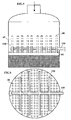
- FIGS. 1 and 2 schematically an embodiment of the mixing and distribution system when it is placed at the head of a first granular bed of the reactor and when the fluids to be mixed can be introduced separately into the reactor.
- FIGS. 3A and 3B show a section of perforated tubes.
- FIGS. 4 and 5 schematically an embodiment of the mixing and distribution system when that is placed at the reactor head or between two successive granular beds, and when the fluids to be mixed can be introduced separately into the reactor.
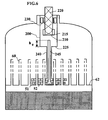
- the figure 6 shows an embodiment of the mixing and distribution system preferably placed upstream of a first granular bed, when the fluids to be contacted are introduced into the mixing reactor.
- FIGS. 7a; 7b; 7c are visualizations of the distribution of the dense fluid on a section of the reactor obtained by gamma tomography without the tubular system for supplying the liquid, for different gas flow rates.
- FIGS 8a; 8b; 8c are visualizations of the distribution of the dense fluid on a section of the reactor obtained by gamma tomography with the tubular liquid supply system, for the same gas flow rates as in the case of Figures 7a; 7b; 7c .
- the reactor schematized on the figure 1 is an elongated fixed bed reactor (10) containing one or more successive beds, which operates in a downward co-flow gas / liquid flow.
- a liquid charge (12) is injected near the reactor head, through a line (2), into at least one tube (50) which will also be called a tubular system.
- a gaseous feedstock (11) is injected at one or more levels of the reactor (10), at least one of these levels being located at the top of the reactor.
- the gaseous feedstock is injected at the top of the reactor via a line (1).
- a pressure compensation system (13) composed of a control valve controlled by a differential pressure sensor, allows to evacuate a portion of the liquid flow to the line (1).
- a substantially horizontal plate (62) covering the entire section of the reactor is adhered to the wall of said reactor and supports a plurality of chimneys (60) open at their upper end and having along their side wall a series of passage (63) of shape is substantially circular or elongate. These chimneys are substantially parallel to the axis of the reactor.
- the liquid is advantageously injected as close as possible to the plate by means of at least one substantially vertical tube (50) optionally provided with slots (53) for outputting said fluid, these slots being arranged on the periphery at the bottom of the tube.
- the slits of the tube are fully immersed in the volume of liquid above the tray defined by the tray and a level of the lateral passage orifices of the liquid, these orifices being preferably fully immersed.
- the tube (50) may also be extended by a series of substantially horizontal tubes (51) provided with liquid outlet ports (54).
- the tube (50) is connected to the liquid injection line (2) after having passed through the wall of the reactor (10).
- the level at which the perforated tubes (51) or the peripheral slots (53) of the tube (50) are located is located below the lowest level (in the fluid flow direction) of the lateral passage sections (63).
- the present invention makes it possible, unlike the devices of the prior art involving chimneys, to maintain a stable and horizontal gas / liquid interface. Indeed, when many chimneys for the distribution of fluids are arranged on a plate to cover the reactor section, it is of prime importance to create a stable and horizontal gas / liquid interface to ensure an identical fluid supply between the different chimneys.
- the distance separating the level of the tubes (51) or the top of the slots (53) and the lowest level of the lateral passage sections (63) of the chimneys (60), will be greater than 50 mm and preferably between 100 mm and 300 mm.
- the supply tube (s) (50) will generally be located in place of one or more chimneys (60) in a region close to the reactor axis, and the tubes (51) will be disposed in an approximately horizontal axis between the rows of chimneys (60). Eight tubes (51) can thus be arranged between the chimneys (60), that the pitch between these chimneys is triangular or square.
- the figure 2 shows an example of distribution of the tubes (51) in the case where the step between chimneys (60) is triangular.
- the Figures 3A and 3B show a section of a tube (51) and describe two examples of outlet section located on these tubes.
- the outlet sections (54) located on the tubes (51) may be orifices (54) of various sizes, or nozzles (55) with substantially constant and circular passage section, or variable passage section so as to present a convergent part followed by a divergent part.
- These orifices (54) or nozzles (55) are arranged along the length of the tubes (51), substantially along a horizontal axis, and are generally directed downwards.
- the angle ( ⁇ ) between the axis of the orifices or nozzles and the vertical will be between -90 ° and 90 ° and preferably between -45 ° and 45 °, counting positively angles on the half right relative to the vertical axis through the tubes (51), and negatively the angles on the left half relative to the same axis.
- the injection speed of the liquid will be determined so that the tube (50) is always filled with liquid.
- the injection speed of the liquid at the orifices or outlet nozzles of the tubes (51) or slots (53) will generally be between 0.5 and 5 m / s. This speed range therefore allows a range of variation in liquid feed rate from 1 to 10.
- the gaseous charge and the liquid charge are mixed inside the perforated chimneys (60) whose lateral passage sections (63) located above the interface between the liquid phase and the gas phase are used for the injection of the gas and whose lateral passage sections located below the interface between the gas phase and the liquid phase are used for the injection of the liquid.
- the lateral passage sections (63) arranged on several levels along the chimneys (60) are not specifically assigned to the passage of the liquid phase or the vapor phase, but will naturally be distributed according to the position of the interface, in a higher group with respect to this interface which will see the gas phase pass, and a lower group with respect to the said interface which will see the liquid phase pass.
- This interface has the property of being flat and remain very well defined over the entire range of gas and liquid flow rates envisaged, because of the characteristics of the device according to the present invention, particularly the liquid introduction system (50).
- a given passage section (63), and all of the passage sections (63) belonging to the same level, will therefore pass either the liquid phase or the gas phase, depending on the respective flow rates of these phases. It is clear that the higher the liquid phase flow rate, the higher the interface between the said liquid phase and the gas phase will be at a high level, but this level will never exceed the level of the upper end of the chimneys ( 60).
- the operating principle of the device according to the present invention is to perform a premixing of the liquid and gas phases in the chimneys (60) before injecting this mixture at different points of the inlet of the bed by the open lower ends of the said chimneys (65).
- the lateral orifices (63) may be of various shape, for example they may be in the form of orifices, or one or more slots. These lateral orifices are arranged on at least two different levels, preferably between 3 and 10 levels, of which at least one level, which is the lowest level, is used for the passage of the liquid and at least one level, located highest, is used for the passage of gas.
- the geometry of the chimneys (60) thus allows a great flexibility of use of the plate in terms of variation of the liquid flow rate and the gas flow rate.
- the distance between two levels of orifices or consecutive slots is greater than 20 mm and preferably at least 50 mm.
- the maximum width of the lateral passage section that corresponds, depending on the case, to the maximum width in the case of a slot, or to the maximum diameter in the case of an orifice, will advantageously be less than 75%.
- the diameter of a chimney and usually greater than 2 mm.
- This density will generally be between 100 and 700 stacks / m 2 of bed section, and preferably between 150 and 500 stacks / m 2 .
- the distance (H) between the level of the lowest passage sections along the stacks (60) and the level of the tubes (51) or the level of the top of the slits (53) will generally be greater than 100 mm and preferably between 100 and 300 mm. This distance first has the effect of leaving a sufficient volume of liquid to dissipate the kinetic energy of the liquid jets from the tubes (51) through the orifices (54) or the nozzles (55) or slots (53), and to prevent these jets of liquid disturb the gas / liquid interface which must remain as far as possible, parallel to the plate (62).
- This distance also has the effect of lengthening the residence time of the liquid gas mixture in the chimneys (60), and thus of optimizing the mass transfer between the gas and the liquid.
- the stacks (60) of the tray (62) thus play the role of a static mixer.
- the chimneys (60) will advantageously be extended by a distance (h) below the support plate of the chimneys (62) so as to prevent a part of the liquid from spreading under the lower face of the plate (62) and to reduce the space between the point of exit of the mixture and the entry into the bed.
- the distance (h) will preferably be between 10 and 100 mm.
- the distance between the lower end of the tubes (60) and the top of the bed will preferably be between 0 and 50 mm, excluding 0 and even more preferably between 0 and 20 mm, 0 excluded.
- inert spherical particles 70
- guard bed In the upper part of the granular bed and resting on it, there will generally be a layer of inert spherical particles (70), called guard bed, to maintain the distribution of gas and liquid fluids intact to the catalyst bed.
- the thickness of this layer will generally be greater than 50 mm, preferably between 80 and 500 mm, and even more preferably between 100 and 300 mm.
- the diameter of the inert spherical particles used will generally be greater than 6 mm and preferably greater than 15 mm.
- the Figures 4 and 5 show a second embodiment of the dispensing system according to the invention when it is disposed at the reactor head, upstream of the first bed or between two successive beds, and when at least one of the fluids to be mixed is introduced directly. from outside the reactor.
- the primary fluid is injected along the axis of the reactor.
- This fluid may be the gaseous feedstock when the system is located at the head of the reactor or a gas / liquid mixture coming from an upstream granular bed when the system is located between two successive granular beds.
- the secondary fluid is injected through a system of perforated tubes (120), the main tube (110) through the side wall of the reactor.
- the secondary fluid may be the liquid charge when the system is located at the reactor head or a liquid or gaseous effluent intended to cool the gas / liquid mixture from an upper bed when the system is located between two successive granular beds.
- the mixing and distribution of the primary fluid and the secondary fluid takes place through perforated funnels (60) disposed on a tray (62).
- the characteristics of these chimneys (60) are identical to those described in the first example.
- the tube (110), called the main tube, is arranged substantially horizontally between two rows of chimneys and can be extended by side secondary tubes (120) connected to the main tube and also extending along a substantially horizontal axis or simply perforated by circular, elliptical or rectangular orifices.
- the secondary tubes (120) are preferably located in the same plane as the main tube.
- the distance between the level of the tubes (110) and (120) and the lowest level of the lateral passage sections (63) located on the chimneys (60) will be greater than 50 mm and preferably between 100 and 500 mm. This distance allows the kinetic energy of the liquid or gaseous jets from the tubes (120) to dissipate so as not to disturb the gas / liquid interface located above the plate.
- this distance makes it possible to increase the contact time necessary to achieve a good heat exchange.
- the figure (5 ) shows an example of configuration in top view of the network of tubes (120) used for the injection of the secondary fluid in the case where the pitch between the chimneys (60) is square.
- the secondary tubes (120) are arranged substantially orthogonally to the main tube (110).
- the characteristics of the output sections of the secondary tubes (120) are the same as those described in figure (3 ).
- the outlet sections of the tubes (120) or (110) may be orifices (54) of various shapes or nozzles (55) whose passage section may be approximately constant and circular or variable so as to have a convergent portion followed of a divergent party.
- orifices or nozzles will be directed generally downwards, and preferably the angle (57) between the axis of the orifice and the vertical will be between -90 ° and 90 °, and preferably between -45 ° and 45 °.
- the injection speed of the liquid at the orifices (54) or the nozzles (55) will be between 0.5 and 3 m / s.
- the injection speed at the orifices (54) or nozzles (55) is advantageously between 0.5 and 5 m / s. This speed range therefore allows a range of variation in gas flow from 1 to 10.
- the figure (6 ) presents a third embodiment of the dispensing device according to the invention when it is placed at the top of the reactor, and when the fluids to be mixed and dispensed are introduced in a mixture, which will also be called in the mixed phase, in the reactor.
- these fluids are generally introduced in the form of a downward co-flow two-phase flow.
- the distribution system is always constituted by a plate with chimneys (60) having lateral passage sections (63) for feeding the two fluids, but it is preceded by a separation system (200). ) allowing the separation of the two fluids upstream of the plate (62).
- the introduction of the gaseous fluid resulting from this separation at the top of the reactor is done by means of side exit windows (230), and the introduction of the liquid fluid resulting from said separation at the level of the plate (62) is done by a concentric tube system (240) and (245) which feed the tube network (51) under the same conditions as in the case previously described.
- the characteristics of the chimneys (60) are identical to those described in the first example.
- the separation system (200) consists of a central cylindrical tube (210) terminated by at least one tangential outlet (215) for the liquid and at least one tangential outlet for the gas (230), imposing on the flow a rotation of at least 90 ° with respect to the axis of the tube.
- This system allows a rapid separation of a gas / liquid mixture whose ratio of gas mass flow rates on the liquid is between 0.1 and 10.
- the number of tangential outlets for the gas and for the liquid is between 1 and 4 preferably two for each phase.
- the ratio of the opening sections of each tangential outlet to the passage section of the tube (210) is between 0.25 and 1, and preferably between 0.4 and 0.6.
- the ratio between the height and the width of the tangential outlet (215) is generally between 1 and 4, preferably substantially equal to 2.
- a helix (220) can be added inside the tube (210) and upstream of the tangential outlets (215.
- This propeller (220) can be single revolution or double revolution.
- the ratio of the width of the helix, corresponding to the cross section of the fluids, to the diameter of the tube may be between 0.5 and 1.
- the number of pitch of the helix (the ratio of the total height of the helix on the pitch of the helix) is generally between 1 and 6, and preferably between 2 and 3.
- the fluids from the tube (210) are recovered in an enclosure (225) whose diameter is greater than twice the diameter of the tube (210) and less than 90% of the reactor diameter.
- This chamber is intended to dampen the flow fluctuations of the liquid to be injected at the tray (62).
- the gas is evacuated from the enclosure (225) through the tangential outlet sections (230).
- These output sections may consist, for example, of circular or elliptical orifices, or of slots of rectangular shape.
- the ratio of the total area of the outlet sections (230), ie the sum of the areas of the sections (230) divided by the area of the section of the tube (210) will be between 0.5 and 4 , preferably substantially equal to 2.
- the distance (p) separating the exit sections (230) from the exit sections (215) will generally be at least 50 mm and in particular between 100 and 300 mm.
- the liquid is discharged from the enclosure (225) by means of at least one tube (240) whose upper end is connected to the bottom of the enclosure (225) and whose lower end is connected to at least one horizontal perforated tube (51).
- the outlet sections of the tubes (51) may be orifices (54) of different sizes or nozzles (55) whose section of passage may be approximately constant and circular or variable, so as to have a convergent portion followed by a divergent part.
- orifices (54) or nozzles (55) will be directed generally downwards and preferably the angle (57) between the axis of the orifice and the vertical will be between -90 ° and 90 °, and preferably between -45 ° and 45 °.
- the diameter of the orifices (54) or nozzles (55) will be calculated to maintain the tube (240) filled with liquid, or more generally dense fluid throughout the flow range of this fluid.
- the range of flow variation will therefore correspond to the variation of the height of the level of the dense fluid in the chamber (225). This level will always be lower than the distance separating the bottom of the tube (210) from the bottom of the enclosure (225).
- a second evacuation tube of the enclosure (225) can be added. This second tube (245), generally concentric and located inside the tube (240), opens into the chamber (225) by its upper end which serves as a dense fluid inlet.
- This upper end of the tube (245) is located at a distance h e from the bottom of the enclosure (225) so that the second tube (245) is used only when the dense fluid flow corresponds to a dense fluid level in the enclosure (225) greater than the distance h e .
- This tube (245) is also connected at its bottom to at least one perforated tube (52) of the same type as the perforated tubes (51).
- This tube (245) may be concentric with the tube (240) as shown in FIG. figure (5 ) or independent of the tube (240).
- the characteristics of the tubes (52) are the same as those of the tubes (51).
- the passage diameter of the tube outlet orifices (52) is calculated so that the level of dense fluid in the enclosure (225) at the maximum flow rate of this dense fluid never exceeds the distance between the bottom of the enclosure (225) and the lower end of the tube (210).
- a comparative test was carried out between a conventional system consisting of a perforated funnel plate fed by a co-current gas / liquid flow and a system, as described in FIG. figure 4 , comprising a plate with perforated chimneys fed with liquid by a radial tube. Both systems were tested on a 400 mm diameter reactor.
- the reference distribution system or according to the prior art, consists of a plate on which are fixed 55 stacks of diameter 15 mm.
- the chimneys are perforated with 20 circular orifices of diameter 7 mm extending over 10 levels between 50 and 250 mm with respect to the plateau level.
- the distribution system was fed directly by a downward co-current gas / liquid flow introduced substantially in the direction of the vertical axis, at the top of the reactor.
- the distribution system as described in the present application consists of a plate on which are fixed 55 stacks (60) of diameter 15 mm.
- the chimneys (60) are perforated with 16 circular orifices of diameter 7 mm located on 8 levels spreading between 90 and 250 mm with respect to the plateau level.
- the liquid is introduced by means of a tube (110) passing through the side wall of the reactor according to the geometry described in FIG.
- This tube is perforated with 68 holes of diameter 7 mm arranged approximately equi-part, at the following angles (57) with respect to the vertical of: -45 °, -30 °, 30 ° and 45 °.
- the liquid velocity at these orifices is equal to 3.8 m / s.
- the distance between the level of the orifices of the tube (110) and the lowest level of the orifices of the chimneys is 50 mm.
- Figure 7 presents a comparison of the distribution of gas content measured in the catalytic bed using a gamma ray tomograph located at a distance of 500 mm from the bottom of the chimneys (60).
- the Figures 7 and 8 present the image of the measured gas rate respectively when the conventional distribution system is used and when the system described according to the invention is implemented.
- the color scale ranges from black for a gas rate of zero (liquid flow only) to white for a gas rate of 60%.
- the liquid flow rate relative to the empty reactor section is 56 kg / m 2 / h
- the gas flow rate is 0.2 kg / m 2 / h ( Figure 7a and 8a ), 0.5 Kg / m2 / h ( Figure 7b and 8b ) and 1 kg / m 2 / h ( Figure 7c and 8c ).
- the gas distribution on the section of the bed is distinctly degraded in that the figures (7 ) show much less uniform gray levels than figures (8 ). Indeed, as shown by the profiles obtained on a reactor diameter, the rate of gas is not at all homogeneous over the entire section.
- the system as described according to the invention makes it possible to obtain a homogeneous distribution of the gas over the entire section of the bed.
- the gas rate profiles obtained on a reactor diameter are all very horizontal.
- the efficiency of the distribution system remains excellent when the gas volume ratio in the gas / liquid mixture varies from 20 to 50%.
Landscapes
- Chemical & Material Sciences (AREA)
- Chemical Kinetics & Catalysis (AREA)
- Engineering & Computer Science (AREA)
- Analytical Chemistry (AREA)
- General Chemical & Material Sciences (AREA)
- Oil, Petroleum & Natural Gas (AREA)
- Organic Chemistry (AREA)
- Devices And Processes Conducted In The Presence Of Fluids And Solid Particles (AREA)
Applications Claiming Priority (2)
| Application Number | Priority Date | Filing Date | Title |
|---|---|---|---|
| FR0209076A FR2842435B1 (fr) | 2002-07-16 | 2002-07-16 | Dispositif de melange et de distribution d'un fluide dense et d'un fluide leger place en amont d'un lit granulaire et son utilisation en ecoulement descendant |
| FR0209076 | 2002-07-16 |
Publications (2)
| Publication Number | Publication Date |
|---|---|
| EP1382376A1 EP1382376A1 (fr) | 2004-01-21 |
| EP1382376B1 true EP1382376B1 (fr) | 2008-07-02 |
Family
ID=29763903
Family Applications (1)
| Application Number | Title | Priority Date | Filing Date |
|---|---|---|---|
| EP03291653A Expired - Lifetime EP1382376B1 (fr) | 2002-07-16 | 2003-07-03 | Dispositif de mélange et de distribution d'un fluide dense et d'un fluide léger placé en amont d'un lit granulaire et son utilisation en écoulement descendant |
Country Status (7)
| Country | Link |
|---|---|
| US (1) | US7250142B2 (enExample) |
| EP (1) | EP1382376B1 (enExample) |
| JP (1) | JP4697572B2 (enExample) |
| KR (1) | KR101015929B1 (enExample) |
| DE (1) | DE60321864D1 (enExample) |
| DK (1) | DK1382376T3 (enExample) |
| FR (1) | FR2842435B1 (enExample) |
Families Citing this family (19)
| Publication number | Priority date | Publication date | Assignee | Title |
|---|---|---|---|---|
| GB0220338D0 (en) * | 2002-09-02 | 2002-10-09 | Secretary Trade Ind Brit | Production of variable concentration fluid mixtures |
| FR2853260B1 (fr) | 2003-04-02 | 2005-05-06 | Inst Francais Du Petrole | Dispositif ameliore de melange et de distribution d'une phase gaz et d'une phase liquide alimentant un lit granulaire |
| US7473405B2 (en) * | 2004-10-13 | 2009-01-06 | Chevron U.S.A. Inc. | Fluid distribution apparatus for downflow multibed poly-phase catalytic reactor |
| FR2883200B1 (fr) * | 2005-03-17 | 2007-05-11 | Inst Francais Du Petrole | Dispositif pour le melange et la repartition d'un gaz et d' un liquide en amont d'un lit granulaire |
| US20080257147A1 (en) * | 2005-12-06 | 2008-10-23 | Johnson Matthey Plc | Gas Distributor |
| US20080128264A1 (en) * | 2006-08-09 | 2008-06-05 | Kuang Yeu Wu | Three-phase extractive distillation with multiple columns connected in series |
| CN101778666B (zh) * | 2007-06-21 | 2012-10-10 | 巴斯夫欧洲公司 | 用于在固定床催化剂上进行液相和气相的三相反应的反应器 |
| DE102011103634A1 (de) * | 2011-06-08 | 2012-12-13 | Linde Aktiengesellschaft | Flüssigkeitsverteiler |
| JP5998915B2 (ja) * | 2012-12-19 | 2016-09-28 | 富士電機株式会社 | 排ガス処理装置 |
| EP3037164A1 (en) | 2014-12-23 | 2016-06-29 | Haldor Topsøe A/S | Particle separating catalytic chemical reactor and particle separator |
| CN104906947B (zh) * | 2015-05-18 | 2017-11-14 | 南京泽众环保科技有限公司 | 氨气分布系统 |
| CN105195036A (zh) * | 2015-09-18 | 2015-12-30 | 宁波天工机械密封有限公司 | 混合搅拌机 |
| FR3065171B1 (fr) * | 2017-04-13 | 2021-02-12 | Saipem Sa | Dispositif de double distribution de liquide utile dans une colonne de fractionnement ou de lavage sur un support flottant |
| US10441932B2 (en) * | 2017-06-28 | 2019-10-15 | Uop Llc | Apparatus for vapor-liquid distribution |
| CN109701299B (zh) * | 2018-12-25 | 2021-01-08 | 重庆纳斯美科技发展有限公司 | 一种涂料除泡机 |
| TWI826653B (zh) * | 2019-03-27 | 2023-12-21 | 美商科氏格利奇有限合夥公司 | 用於質量傳遞柱的二階段液體分布裝置及在質量傳遞柱內分布液體之方法 |
| CN111676056A (zh) * | 2020-06-19 | 2020-09-18 | 中耐工程科技有限公司 | 具有立体网格进料结构的渣油加氢反应器、含有该反应器的渣油加氢系统及其渣油加氢工艺 |
| TWI764774B (zh) * | 2021-07-02 | 2022-05-11 | 信紘科技股份有限公司 | 氣液混合裝置及方法 |
| CN114768482B (zh) * | 2022-03-09 | 2023-06-23 | 山东神驰石化有限公司 | 一种异戊橡胶装置的溶剂回收装置 |
Family Cites Families (20)
| Publication number | Priority date | Publication date | Assignee | Title |
|---|---|---|---|---|
| FR703029A (fr) * | 1930-09-24 | 1931-04-22 | Dispositif d'arrosage pour tours d'absorption, de lavage et analogues | |
| GB1450715A (en) * | 1973-12-07 | 1976-09-29 | British Petroleum Co | Multi-bed reactors |
| GB8721964D0 (en) * | 1987-09-18 | 1987-10-28 | Shell Int Research | Multitube reactor |
| US4839108A (en) * | 1987-12-21 | 1989-06-13 | Mobil Oil Corp. | Liquid distribution device and pan |
| US5014740A (en) * | 1990-05-21 | 1991-05-14 | Cameron Gordon M | Distributor for packed tower |
| US5484578A (en) * | 1994-06-20 | 1996-01-16 | Mobil Oil Corporation | Two-phase distributor system for downflow reactors |
| US5688445A (en) * | 1995-07-31 | 1997-11-18 | Haldor Topsoe A/S | Distributor means and method |
| US5799877A (en) * | 1996-01-03 | 1998-09-01 | Exxon Research And Engineering Company | Fluid distribution across a particulate bed |
| FR2745820B1 (fr) * | 1996-03-08 | 1998-04-17 | Inst Francais Du Petrole | Conversion du gaz de synthese en hydrocarbures en presence d'une phase liquide |
| US5837208A (en) * | 1996-06-12 | 1998-11-17 | Uop | Hydroprocessing reactor mixer/distributor |
| US5679290A (en) * | 1996-09-16 | 1997-10-21 | Cameron; Gordon M. | Packed absorption towers |
| EP0878221B1 (de) * | 1997-05-16 | 2003-11-05 | Sulzer Chemtech AG | Verteilvorrichtung für eine Kolonne |
| US6017443A (en) * | 1998-02-05 | 2000-01-25 | Mobil Oil Corporation | Hydroprocessing process having staged reaction zones |
| US6554994B1 (en) * | 1999-04-13 | 2003-04-29 | Chevron U.S.A. Inc. | Upflow reactor system with layered catalyst bed for hydrotreating heavy feedstocks |
| FR2798864B1 (fr) * | 1999-09-24 | 2001-12-14 | Inst Francais Du Petrole | Systeme de separation gaz/liquide intervenant dans un procede de conversion d'hydrocarbures |
| FR2807673B1 (fr) * | 2000-04-17 | 2003-07-04 | Inst Francais Du Petrole | Dispositif de distribution d'un melange polyphasique sur un lit de solide granulaire comportant un element brise-jet poreux |
| FR2813023B1 (fr) * | 2000-08-17 | 2003-10-24 | Inst Francais Du Petrole | Dispositif de distribution permettant de realiser un melange polyphasique et reacteur associe |
| FR2813024B1 (fr) * | 2000-08-17 | 2004-02-13 | Inst Francais Du Petrole | Dispositif d'injection d'un fluide place entre deux lits successifs permettant de realiser et de distribuer simultanement un melange polyphasique |
| WO2002048286A1 (en) * | 2000-12-11 | 2002-06-20 | Shell Internationale Research Maatschappij B.V. | Mixing device comprising a swirl chamber for mixing liquid |
| FR2832075B1 (fr) * | 2001-11-09 | 2005-02-04 | Inst Francais Du Petrole | Dispositif de distribution d'un melange polyphasique sur un lit de solide granulaire comportant un element brise jet poreux a rebords |
-
2002
- 2002-07-16 FR FR0209076A patent/FR2842435B1/fr not_active Expired - Fee Related
-
2003
- 2003-07-03 EP EP03291653A patent/EP1382376B1/fr not_active Expired - Lifetime
- 2003-07-03 DE DE60321864T patent/DE60321864D1/de not_active Expired - Lifetime
- 2003-07-03 DK DK03291653T patent/DK1382376T3/da active
- 2003-07-15 KR KR1020030048403A patent/KR101015929B1/ko not_active Expired - Fee Related
- 2003-07-16 JP JP2003275473A patent/JP4697572B2/ja not_active Expired - Fee Related
- 2003-07-16 US US10/619,557 patent/US7250142B2/en not_active Expired - Fee Related
Also Published As
| Publication number | Publication date |
|---|---|
| KR20040030232A (ko) | 2004-04-09 |
| FR2842435B1 (fr) | 2004-09-24 |
| US20040086435A1 (en) | 2004-05-06 |
| DE60321864D1 (de) | 2008-08-14 |
| FR2842435A1 (fr) | 2004-01-23 |
| EP1382376A1 (fr) | 2004-01-21 |
| JP2004130301A (ja) | 2004-04-30 |
| DK1382376T3 (da) | 2008-11-03 |
| JP4697572B2 (ja) | 2011-06-08 |
| US7250142B2 (en) | 2007-07-31 |
| KR101015929B1 (ko) | 2011-02-23 |
Similar Documents
| Publication | Publication Date | Title |
|---|---|---|
| EP1382376B1 (fr) | Dispositif de mélange et de distribution d'un fluide dense et d'un fluide léger placé en amont d'un lit granulaire et son utilisation en écoulement descendant | |
| EP1180393B1 (fr) | Réacteur avec dispositif de mélange. | |
| EP1147809B1 (fr) | Dispositif de distribution d'un mélange polyphasique sur un lit de solide granulaire comportant un élément brisejet poreux | |
| EP1464383B1 (fr) | Réacteur comprenant un dispositif de mélange et de distribution d'une phase gaz et d'une phase liquide alimentant un lit granulaire et procédé d'hydrogénation sélective l'utilisant | |
| EP2813283B1 (fr) | Dispositif de distribution d'un fluide | |
| FR2978679A1 (fr) | Plateau distributeur d'un gaz et d'un liquide, reacteur equipe d'un tel plateau et utilisation dudit plateau. | |
| CA2462450C (fr) | Dispositif de distribution d'un melange polyphasique sur un lit de solide granulaire comportant un element brise jet poreux a rebords | |
| CA2925656C (fr) | Dispositif de melange et de distribution avec zones de melange et d'echange | |
| EP2151277B1 (fr) | Réacteur gaz-liquide à écoulement co-courant ascendant avec plateau distributeur | |
| FR2883200A1 (fr) | Dispositif pour le melange et la repartition d'un gaz et d' un liquide en amont d'un lit granulaire | |
| EP0769316A1 (fr) | Distributeur permettant l'injection et/ou le soutirage indépendant de fluides | |
| FR2813023A1 (fr) | Dispositif de distribution permettant de realiser un melange polyphasique et reacteur associe | |
| EP2162207B1 (fr) | Enceinte contenant un lit granulaire et une distribution d'une phase gazeuse et d'une phase liquide circulant en un écoulement ascendant dans cette enceinte. | |
| EP1032464B1 (fr) | Distributeur de liquide pour colonne de distillation non verticale, et colonne de distillation ainsi equipee | |
| WO2013045770A1 (fr) | Plateau distributeur pour la distribution d'un mélange polyphasique avec cheminées inclinées en périphérie | |
| FR2484864A1 (fr) | Distributeur d'alimentation d'un reacteur a courant ascendant | |
| CA2751523A1 (fr) | Dispositif de distribution d'un melange polyphasique comportant un plateau brise-jet perfore avec differents types de trous | |
| FR2818559A1 (fr) | Dispositif permettant de realiser une injection separee et une distribution homogene de deux fluides | |
| FR2824495A1 (fr) | Enceinte reactionnelle de forme allongee le long d'un axe contenant au moins un lit de catalyseur solide et au moins une boite de contact, de melange et de trempe | |
| FR3026316A1 (fr) | Dispositif compact de melange de fluides | |
| EP0773276A1 (fr) | Dispositif d'injection d'une charge d'hydrocarbures | |
| EP1646444B1 (fr) | Plateau de distribution d'une phase gazeuse et d'une phase liquide | |
| FR2740052A1 (fr) | Dispositif de collecte et de distribution d'un fluide principal pour minimiser les differences de temps de parcours | |
| FR3072306B1 (fr) | Dispositif de melange et de distribution avec ouverture longitudinale | |
| CA2751499A1 (fr) | Dispositif de distribution d'un melange polyphasique comportant un plateau brise-jet avec element de separation |
Legal Events
| Date | Code | Title | Description |
|---|---|---|---|
| PUAI | Public reference made under article 153(3) epc to a published international application that has entered the european phase |
Free format text: ORIGINAL CODE: 0009012 |
|
| AK | Designated contracting states |
Kind code of ref document: A1 Designated state(s): AT BE BG CH CY CZ DE DK EE ES FI FR GB GR HU IE IT LI LU MC NL PT RO SE SI SK TR |
|
| AX | Request for extension of the european patent |
Extension state: AL LT LV MK |
|
| 17P | Request for examination filed |
Effective date: 20040721 |
|
| AKX | Designation fees paid |
Designated state(s): DE DK FR GB IT NL |
|
| GRAP | Despatch of communication of intention to grant a patent |
Free format text: ORIGINAL CODE: EPIDOSNIGR1 |
|
| GRAS | Grant fee paid |
Free format text: ORIGINAL CODE: EPIDOSNIGR3 |
|
| GRAA | (expected) grant |
Free format text: ORIGINAL CODE: 0009210 |
|
| AK | Designated contracting states |
Kind code of ref document: B1 Designated state(s): DE DK FR GB IT NL |
|
| REG | Reference to a national code |
Ref country code: GB Ref legal event code: FG4D Free format text: NOT ENGLISH |
|
| REF | Corresponds to: |
Ref document number: 60321864 Country of ref document: DE Date of ref document: 20080814 Kind code of ref document: P |
|
| REG | Reference to a national code |
Ref country code: DK Ref legal event code: T3 |
|
| PLBE | No opposition filed within time limit |
Free format text: ORIGINAL CODE: 0009261 |
|
| STAA | Information on the status of an ep patent application or granted ep patent |
Free format text: STATUS: NO OPPOSITION FILED WITHIN TIME LIMIT |
|
| 26N | No opposition filed |
Effective date: 20090403 |
|
| REG | Reference to a national code |
Ref country code: FR Ref legal event code: CD |
|
| REG | Reference to a national code |
Ref country code: DE Ref legal event code: R081 Ref document number: 60321864 Country of ref document: DE Owner name: IFP ENERGIES NOUVELLES, FR Free format text: FORMER OWNER: INSTITUT FRANCAIS DU PETROLE, RUEIL-MALMAISON, HAUTS-DE-SEINE, FR Effective date: 20110331 |
|
| REG | Reference to a national code |
Ref country code: FR Ref legal event code: PLFP Year of fee payment: 14 |
|
| REG | Reference to a national code |
Ref country code: FR Ref legal event code: PLFP Year of fee payment: 15 |
|
| REG | Reference to a national code |
Ref country code: FR Ref legal event code: PLFP Year of fee payment: 16 |
|
| PGFP | Annual fee paid to national office [announced via postgrant information from national office to epo] |
Ref country code: DE Payment date: 20180730 Year of fee payment: 16 Ref country code: NL Payment date: 20180724 Year of fee payment: 16 Ref country code: IT Payment date: 20180731 Year of fee payment: 16 Ref country code: FR Payment date: 20180725 Year of fee payment: 16 |
|
| PGFP | Annual fee paid to national office [announced via postgrant information from national office to epo] |
Ref country code: GB Payment date: 20180724 Year of fee payment: 16 Ref country code: DK Payment date: 20180724 Year of fee payment: 16 |
|
| REG | Reference to a national code |
Ref country code: DE Ref legal event code: R119 Ref document number: 60321864 Country of ref document: DE |
|
| REG | Reference to a national code |
Ref country code: DK Ref legal event code: EBP Effective date: 20190731 |
|
| GBPC | Gb: european patent ceased through non-payment of renewal fee |
Effective date: 20190703 |
|
| PG25 | Lapsed in a contracting state [announced via postgrant information from national office to epo] |
Ref country code: NL Free format text: LAPSE BECAUSE OF NON-PAYMENT OF DUE FEES Effective date: 20190801 Ref country code: GB Free format text: LAPSE BECAUSE OF NON-PAYMENT OF DUE FEES Effective date: 20190703 Ref country code: DE Free format text: LAPSE BECAUSE OF NON-PAYMENT OF DUE FEES Effective date: 20200201 |
|
| REG | Reference to a national code |
Ref country code: NL Ref legal event code: MM Effective date: 20190801 |
|
| PG25 | Lapsed in a contracting state [announced via postgrant information from national office to epo] |
Ref country code: FR Free format text: LAPSE BECAUSE OF NON-PAYMENT OF DUE FEES Effective date: 20190731 |
|
| PG25 | Lapsed in a contracting state [announced via postgrant information from national office to epo] |
Ref country code: DK Free format text: LAPSE BECAUSE OF NON-PAYMENT OF DUE FEES Effective date: 20190731 |
|
| PG25 | Lapsed in a contracting state [announced via postgrant information from national office to epo] |
Ref country code: IT Free format text: LAPSE BECAUSE OF NON-PAYMENT OF DUE FEES Effective date: 20190703 |