EP1380929B1 - System und Verfahren zum simultanen Behandeln und Anzeigen von hierarchischen und nichthierarchischen Daten - Google Patents
System und Verfahren zum simultanen Behandeln und Anzeigen von hierarchischen und nichthierarchischen Daten Download PDFInfo
- Publication number
- EP1380929B1 EP1380929B1 EP03253084.2A EP03253084A EP1380929B1 EP 1380929 B1 EP1380929 B1 EP 1380929B1 EP 03253084 A EP03253084 A EP 03253084A EP 1380929 B1 EP1380929 B1 EP 1380929B1
- Authority
- EP
- European Patent Office
- Prior art keywords
- nodes
- hierarchical
- cone
- node
- hierarchical relationship
- Prior art date
- Legal status (The legal status is an assumption and is not a legal conclusion. Google has not performed a legal analysis and makes no representation as to the accuracy of the status listed.)
- Expired - Lifetime
Links
Images



Classifications
-
- G—PHYSICS
- G06—COMPUTING OR CALCULATING; COUNTING
- G06T—IMAGE DATA PROCESSING OR GENERATION, IN GENERAL
- G06T17/00—Three-dimensional [3D] modelling for computer graphics
- G06T17/005—Tree description, e.g. octree, quadtree
-
- G—PHYSICS
- G06—COMPUTING OR CALCULATING; COUNTING
- G06F—ELECTRIC DIGITAL DATA PROCESSING
- G06F16/00—Information retrieval; Database structures therefor; File system structures therefor
- G06F16/90—Details of database functions independent of the retrieved data types
- G06F16/95—Retrieval from the web
- G06F16/954—Navigation, e.g. using categorised browsing
-
- G—PHYSICS
- G06—COMPUTING OR CALCULATING; COUNTING
- G06F—ELECTRIC DIGITAL DATA PROCESSING
- G06F3/00—Input arrangements for transferring data to be processed into a form capable of being handled by the computer; Output arrangements for transferring data from processing unit to output unit, e.g. interface arrangements
- G06F3/01—Input arrangements or combined input and output arrangements for interaction between user and computer
- G06F3/048—Interaction techniques based on graphical user interfaces [GUI]
- G06F3/0481—Interaction techniques based on graphical user interfaces [GUI] based on specific properties of the displayed interaction object or a metaphor-based environment, e.g. interaction with desktop elements like windows or icons, or assisted by a cursor's changing behaviour or appearance
- G06F3/0482—Interaction with lists of selectable items, e.g. menus
-
- G—PHYSICS
- G06—COMPUTING OR CALCULATING; COUNTING
- G06T—IMAGE DATA PROCESSING OR GENERATION, IN GENERAL
- G06T11/00—Two-dimensional [2D] image generation
- G06T11/20—Drawing from basic elements
- G06T11/26—Drawing of charts or graphs
-
- G—PHYSICS
- G06—COMPUTING OR CALCULATING; COUNTING
- G06F—ELECTRIC DIGITAL DATA PROCESSING
- G06F2203/00—Indexing scheme relating to G06F3/00 - G06F3/048
- G06F2203/048—Indexing scheme relating to G06F3/048
- G06F2203/04802—3D-info-object: information is displayed on the internal or external surface of a three dimensional manipulable object, e.g. on the faces of a cube that can be rotated by the user
-
- G—PHYSICS
- G06—COMPUTING OR CALCULATING; COUNTING
- G06F—ELECTRIC DIGITAL DATA PROCESSING
- G06F2203/00—Indexing scheme relating to G06F3/00 - G06F3/048
- G06F2203/048—Indexing scheme relating to G06F3/048
- G06F2203/04806—Zoom, i.e. interaction techniques or interactors for controlling the zooming operation
Definitions
- the present invention relates to a system and method for the simultaneous display and manipulation of hierarchical and non-hierarchical data.
- Tree-controlled layouts such as those provided in a list of files stored on a hard drive
- An exemplary hierarchical structure could be a: ⁇ program files ⁇ program, wherein the hierarchy is as follows, on the "a” drive a folder entitled “program files” is stored, within which a program called “program” is stored. In this structure the "a" drive would be a higher level node linked to a lower level file folder node linked to a lower level file node.
- European Publication EP0435601 A2 discloses a system that enables hierarchical three dimensional structures to be easily visualised. Such a system uses conical substructures to represent the relationship between a parent and child node.
- US Patent Number 6144962 discloses a system to visualise the structure of a web-site in two-dimensions.
- both hierarchical and non-hierarchical links are provided between objects in the storage structures.
- Examples of computer storage structures including both hierarchical and non-hierarchical links are some computer file systems with links between files, hypertext systems, and the World Wide web.
- the use of non-hierarchical links is exemplified by web sites on the World Wide web, wherein hyperlinks may be provided within a current hypertext page of a Web site to create a link between the current hypertext page and a hypertext page that is not directly linked to the current document in the hierarchical structure of the Web site. These non-hierarchical links are not properly displayed in the traditional tree-control layout structures.
- the object of the invention is to provide a system and method for displaying hierarchical and non-hierarchical data structures.
- the invention comprises a system and computer implemented method of graphically displaying relationships between a plurality of nodes, comprising: identifying at least one hierarchical relationship between at least two of said plurality of nodes; and generating a virtual three dimensional cone having: graphical representations of each node on a surface of the cone; and graphical representations of the at least one hierarchical relationship; the system and computer implemented method characterised by: identifying at least one non-hierarchical relationship between at least two of said plurality of nodes; and generating graphical representations of the at least one non-hierarchical relationship, wherein the graphical representations of the non-hierarchical relationships between the pairs of non-hierarchically linked nodes are links extending through the interior of the cone.
- nodes are files in a file structure or web pages within a web site.
- a "processor” is a component or system that can provide processing functions.
- An example of a processor is a central processing unit (CPU) of a general purpose computer.
- a "user input device” is a computer component providing data input functionality to a user.
- user input devices include keyboards, mice, track balls, touch pads, and pointing devices.
- a "structure” is a single object or feature that may be displayed to a user on a display device.
- the displayed structure may be comprised of sub-features or substructures.
- a “node-link structure” is a structure that includes display features that can be distinguished into “nodes” that are localized and “links” that extend between nodes so as to provide connections between pairs of nodes.
- Nodes may generally be displayed as point or small object structures on the display device and links may be displayed as lines or arcs connecting nodes.
- the nodes may represent, for example, objects in a tree data structure or other directed graph data structure.
- the node structures may be "selectable structures," such that operations on the part of a user may be used to "activate” or select the object operated upon. An exemplary operation for selecting an node would be clicking on the node with a mouse button.
- a "hierarchical structure” is a structure that is perceptible as having a number of structural levels.
- a hierarchical node link structure could have a number of levels of nodes, with links connecting each node on a lower level to a node on a higher level.
- a "conic structure” is a displayed structure that is perceptible as having a virtual three-dimensional conic shape with a circular or polygonal directrix.
- the directrix may be displayed as the base of the virtual three-dimensional conic shape.
- Cone graph structure 100 includes cone surface 110, hierarchical paths 120 (shown as solid lines on surface 110 of cone 100), non-hierarchical paths 130 (shown as dashed lines extending through the inside of cone 100), vertex node 140, and child nodes 150.
- Nodes in cone 100 are organized by generation. In other words, each generation of nodes is identified by a co-planar ring 155, and is separated from every other generation by one or more hierarchical 120 and non-hierarchical paths 130.
- Hierarchical and non-hierarchical paths may be two-way or one way. That is, node 140 may connect to node 150, but node 150 may not connect back to node 140. These relationships may be depicted on a three-dimensional cone graph using different thickness lines or different colored lines.
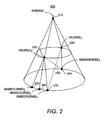
- a second exemplary cone graph structure 200 for a Web page is shown in Fig. 2 .
- the nodes of cone graph structure 200 are each identified by a name.
- the exemplary names of the nodes of the web page include HOMEPAGE 210, CHILDPAGE 1 220 CHILDPAGE 2 230, GRANDCHILDPAGE 1 , 240, GRAND CHILD PAGE 2 250, GRANDCHILDPAGE 3 260 and GRANDCHILDPAGE 4 270.
- the nodes may be displayed as icons or other structures for identifying the presence of a node.
- the nodes themselves may be selectable attributes of the structure, such that, by clicking or selecting a node on the structure, the substructures depending therefrom may be displayed or hidden. The option gives the user the opportunity to increase or decrease the complexity of the displayed structure at a specified point.
- An exemplary cone graph structure 100 may be constructed using data characterizing a structure including both hierarchical paths and non-hierarchical paths between nodes.
- the paths may be, for example, hypertext links between Web pages (nodes).
- Fig. 3 provides an exemplary flowchart for the operation of creating a cone-graph structure.
- An exemplary system for carrying out the operations of the method of Fig. 3 includes a general purpose computer having a central processing unit (CPU), monitor, keyboard, and mouse.
- the cone graph is used to model data of a Web site, wherein the primary (vertex) node of the cone-graph is selected as a home page of the Web site.
- the first step in the process is to select a node as a vertex node of the cone-graph (300).
- an exemplary vertex node is a home page of a Web site. Place this node at the apex of the cone and call it the "parent node.”
- the second step is to identify all of the nodes on the cone graph 300 that have a hierarchical (parent-child) relationship with the parent node.
- Child nodes may be sequentially placed on a ring, randomly placed on a ring, or placed on a ring such that nodes with non-hierarchical relationships are maximally distant from each other to simplify the task of drawing non-hierarchical paths 130.
- Fig. 4 there is shown a representative parent node 400 with a plurality of associated children 410.
- the leftmost or rightmost child may include a pointer back to the parent, with each interior child pointing to the child immediately to its left or right, respectively.
- Each child node 410 may alternatively include a pointer back to the parent 400.
- the pages can be identified as follows: all pages having hypertext links off of the home page and having Universal Resource Locators (URLs) incorporating the home page as the next higher link are identified as child nodes of the parent node.
- URLs Universal Resource Locators
- a hypertext link based on the web page used to construct the cone structure 200 of Fig. 2 would be http://www.HOMEPAGE/CHILDPAGE 1 . com.
- This hyperlink identifies CHILDPAGE 1 as a next lower link in a hierarchical structure from HOMEPAGE. This determination is performed for every page in the Web site in order to identify all of the child-parent relationships for the parent node.
- processing shifts down one level to the child nodes.
- This process of identifying all the child nodes associated with a parent node and creating an unbounded list structure or ring comprised of the child nodes continues down the cone graph for all the generations in the graph.
- Identification of the hierarchical (parent-child) relationships may be developed breadth-first as described above, or they may be developed depth-first (go completely down the hierarchy for a child, back up to next child and then back down the hierarchy), without departing from the scope of this invention as defined in the appended claims.
- Non-hierarchical paths 130 are paths between child nodes and parent nodes that do not have a hierarchical relationship.
- the non-hierarchical paths are hypertext links between the pages of the Web site, wherein the URL of neither of the links identifies the other as the next higher page in the hierarchical structure. For example, based on the structure shown in Fig. 2 , a URL identifying GRANDCHILDPAGE 1 is not hierarchically linked to CHILDPAGE 2 , however a non-hierarchical link 280 is shown connecting these two pages.
- a three-dimensional cone graph representation is constructed based on the hierarchical and non-hierarchical relationships.
- a three-dimensional cone graph is rendered by assigning polygons for each node and lines for the edges. The polygons are drawn at various positions in the X, Y and Z coordinate plane. If the Z-axis corresponds to the longitudinal axis of the cone graph, then Z remains constant for each generation. X and Y vary based on the sine and cosine of each point along each ring 155.
- a three-dimensional cone graph may be rendered by visiting a first node called the source node (step 500) and identifying the nodes connected to it (target nodes). For each target node identified in step 500, determine whether the target node lies on the same ring or on another ring (step 510). If the target lies on the same ring, then it is a sibling of the source node and should be placed on the same ring (step 520).
- step 530 determines whether it is an ancestor (above the source node) or a descendant (below the source node) of the source node (step 530). Processing next flows to step 540 where the target node is placed on the appropriate ring of the cone graph away from the source node, based on the number of generations the target node is above or below the source node. The next step is to select another source node that has not yet been visited (step 550) and all the target nodes associated with the new source node (step 560). Processing then flows to step 510. This process is repeated for all the nodes in the cone graph.
- a cone graph structure may be viewed and manipulated as a computer generated three-dimensional (or pseudo three dimensional) object.
- manipulations include rotations, zoom changes, slicing the structure (to remove layers of the structure from view in order to, for example, focus on a specific segment of the structure), and skinning the structure (removing the surface of the structure including the hierarchical links thereon to view more clearly the non-hierarchical links within the structure.
- a variety of different display properties may be selected for cone graph structures in order to emphasize or differently display particular information provided in the data used to form the cone structure. These options include making the surface of the cone graph opaque as shown in Fig. 6 , such that only the hierarchical information on the side of the cone facing the user is visible. Alternatively the hierarchical or non-hierarchical links may be removed to provide a more detailed view of the remaining information. Another option is to show the surface as translucent, such that both hierarchical and non-hierarchical links may be differently displayed together.
- the user may also be given the option to change ring height and ring width. These values may also be linked to the properties of the base data used to create the cone graph, such as file size. Alternatively the sizes of ring height and ring width may be selected to reflect the number of children nodes present on the level to be displayed.
- the cone structure 700 may be viewed from above as shown in Fig. 7 , which displays the data as concentric circles, wherein the root of the node structure 710 (the vertex node) is provided at the center of the concentric rings and the children on rings extending from the center.
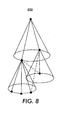
- the arrangement may also be altered to provide the cone graph structure as a cone tree structure, as shown in Fig. 8 .
Landscapes
- Engineering & Computer Science (AREA)
- Theoretical Computer Science (AREA)
- Physics & Mathematics (AREA)
- General Physics & Mathematics (AREA)
- General Engineering & Computer Science (AREA)
- Databases & Information Systems (AREA)
- Human Computer Interaction (AREA)
- Software Systems (AREA)
- Geometry (AREA)
- Radar, Positioning & Navigation (AREA)
- Remote Sensing (AREA)
- Computer Graphics (AREA)
- Data Mining & Analysis (AREA)
- Information Retrieval, Db Structures And Fs Structures Therefor (AREA)
- User Interface Of Digital Computer (AREA)
- Image Generation (AREA)
Claims (9)
- Computerimplementiertes Verfahren zum grafischen Darstellen von Beziehungen zwischen einer Vielzahl von Knoten, das umfasst:Identifizieren (310) wenigstens einer hierarchischen Beziehung zwischen wenigstens zwei der Vielzahl von Knoten; undGenerieren (330) eines virtuellen dreidimensionalen Kegels (100), der aufweist:grafische Darstellungen (150) jedes Knotens an einer Oberfläche des Kegels (100); undgrafische Darstellungen (120) der wenigstens einen hierarchischen Beziehung;wobei das computerimplementierte Verfahren gekennzeichnet ist durch:Identifizieren (320) wenigstens einer nicht-hierarchischen Beziehung zwischen wenigstens zwei der Vielzahl von Knoten; undGenerieren (330) grafischer Darstellungen der wenigstens einen nicht-hierarchischen Beziehung,wobei die grafischen Darstellungen (130) der nicht-hierarchischen Beziehungen zwischen den Paaren nicht-hierarchischer verbundener Knoten Kanten (links) sind, die durch den Innenraum des Kegels (100) hindurch verlaufen.
- Verfahren nach Anspruch 1, wobei die Knoten Webseiten sind und eine Spitze (140) des Kegels (100) vorzugsweise eine Homepage einer Webseite ist.
- Verfahren nach Anspruch 1 oder Anspruch 2, wobei die grafischen Darstellungen (120) der hierarchischen Beziehungen zwischen den Paaren hierarchisch verbundener Knoten Linien an der Oberfläche des Kegels (100) sind.
- Verfahren nach einem der vorangehenden Ansprüche, wobei die Knoten, die die gleiche Hierarchie in der Knotengruppe haben, auf einem einzelnen Ring (155) um den Kegel herum dargestellt werden.
- Verfahren nach einem der vorangehenden Ansprüche, wobei wenigstens eine hierarchische Beziehung einen Eltern-Knoten (400) mit einer Vielzahl dazugehöriger Kind-Knoten (410) umfasst.
- Verfahren nach einem der vorangehenden Ansprüche, wobei der Schritt des Identifizierens wenigstens einer hierarchischen Beziehung zwischen wenigstens zwei der Vielzahl von Knoten des Weiteren einschließt:Identifizieren wenigstens einer hierarchischen Beziehung zwischen einem Spitzen-Knoten (140) und wenigstens einem Kind des Spitzen-Knotens; undIdentifizieren wenigstens einer hierarchischen Beziehung zwischen dem wenigstens einen Kind-Knoten und allen Abkömmlingen des wenigstens einen Kind-Knotens.
- System zum Generieren einer grafischen Anzeige von Beziehungen zwischen einer Vielzahl von Knoten, wobei das System einen Computer umfasst, der so programmiert ist, dass er wenigstens eine hierarchische Beziehung zwischen wenigstens zwei der Vielzahl von Knoten identifiziert und einen virtuellen dreidimensionalen Kegel generiert, der aufweist:grafische Darstellungen (150) jedes Knotens an einer Oberfläche des Knotens; undgrafische Darstellungen (120) der wenigstens einen hierarchischen Beziehung; undeine Anzeigeeinrichtung, die mit dem Computer verbunden ist, um den Kegel anzuzeigen;wobei das System dadurch gekennzeichnet ist, dass der Computer des Weiteren so programmiert ist, dass er wenigstens eine nicht-hierarchische Beziehung zwischen wenigstens zwei der Vielzahl von Knoten identifiziert; undgrafische Darstellungen der wenigstens einen nicht-hierarchischen Beziehung generiert,wobei die grafischen Darstellungen (130) der nicht-hierarchischen Beziehungen zwischen den Paaren nicht-hierarchisch verbundener Knoten Kanten (links) sind, die durch den Innenraum des Kegels (100) hindurch verlaufen.
- System nach Anspruch 7, wobei der Computer zum Ausführen eines Verfahrens nach einem der Ansprüche 1 bis 6 eingerichtet ist.
- Computerprogramm-Erzeugnis, das Programmcodes auf einem Aufzeichnungsmedium zum Durchführen eines Verfahrens nach einem der Ansprüche 1 bis 6 umfasst.
Applications Claiming Priority (2)
| Application Number | Priority Date | Filing Date | Title |
|---|---|---|---|
| US150016 | 2002-05-20 | ||
| US10/150,016 US6856313B2 (en) | 2002-05-20 | 2002-05-20 | System and method for the simultaneous display and manipulation of hierarchical and non-hierarchical data |
Publications (3)
| Publication Number | Publication Date |
|---|---|
| EP1380929A2 EP1380929A2 (de) | 2004-01-14 |
| EP1380929A3 EP1380929A3 (de) | 2006-10-18 |
| EP1380929B1 true EP1380929B1 (de) | 2014-07-16 |
Family
ID=29419160
Family Applications (1)
| Application Number | Title | Priority Date | Filing Date |
|---|---|---|---|
| EP03253084.2A Expired - Lifetime EP1380929B1 (de) | 2002-05-20 | 2003-05-16 | System und Verfahren zum simultanen Behandeln und Anzeigen von hierarchischen und nichthierarchischen Daten |
Country Status (5)
| Country | Link |
|---|---|
| US (1) | US6856313B2 (de) |
| EP (1) | EP1380929B1 (de) |
| JP (1) | JP4335577B2 (de) |
| BR (1) | BR0301718A (de) |
| CA (1) | CA2428678C (de) |
Families Citing this family (19)
| Publication number | Priority date | Publication date | Assignee | Title |
|---|---|---|---|---|
| US7374198B2 (en) * | 2004-04-02 | 2008-05-20 | Toyoda Gosei Co., Ltd | Airbag module canister |
| US7735010B2 (en) * | 2006-04-05 | 2010-06-08 | Lexisnexis, A Division Of Reed Elsevier Inc. | Citation network viewer and method |
| JP4982158B2 (ja) * | 2006-11-15 | 2012-07-25 | クラリオン株式会社 | 入力装置、そのメニュー表示方法 |
| US7861151B2 (en) | 2006-12-05 | 2010-12-28 | Microsoft Corporation | Web site structure analysis |
| US8296741B1 (en) * | 2007-03-05 | 2012-10-23 | Google Inc. | Identifying function-level code dependency by simulating runtime binding |
| US20120124520A1 (en) * | 2008-07-16 | 2012-05-17 | National University Of Ireland | Graphical User Interface Component |
| US7669147B1 (en) * | 2009-01-02 | 2010-02-23 | International Business Machines Corporation | Reorienting navigation trees based on semantic grouping of repeating tree nodes |
| US9021397B2 (en) * | 2011-03-15 | 2015-04-28 | Oracle International Corporation | Visualization and interaction with financial data using sunburst visualization |
| JP5754676B2 (ja) * | 2012-08-23 | 2015-07-29 | 日本電信電話株式会社 | 検索木描画装置、検索木描画方法およびプログラム |
| US10067634B2 (en) * | 2013-09-17 | 2018-09-04 | Amazon Technologies, Inc. | Approaches for three-dimensional object display |
| US10592064B2 (en) | 2013-09-17 | 2020-03-17 | Amazon Technologies, Inc. | Approaches for three-dimensional object display used in content navigation |
| JP6372168B2 (ja) * | 2014-05-30 | 2018-08-15 | 富士通株式会社 | プログラム、情報処理装置および表示方法 |
| US9785773B2 (en) * | 2014-07-03 | 2017-10-10 | Palantir Technologies Inc. | Malware data item analysis |
| CN104461497B (zh) * | 2014-10-30 | 2017-06-27 | 华中科技大学 | 一种无向图或有向有圈图的层次化显示方法 |
| US10102369B2 (en) | 2015-08-19 | 2018-10-16 | Palantir Technologies Inc. | Checkout system executable code monitoring, and user account compromise determination system |
| US10417797B2 (en) | 2016-12-22 | 2019-09-17 | Metricstream, Inc. | Graphically displaying data having complex relationships |
| CN107766474A (zh) * | 2017-10-09 | 2018-03-06 | 平安科技(深圳)有限公司 | 动态展示关系拓展图方法及应用服务器 |
| JP7261083B2 (ja) * | 2019-05-09 | 2023-04-19 | 株式会社日立製作所 | ソフトウェア解析支援システム |
| KR102722083B1 (ko) * | 2021-12-09 | 2024-10-28 | (주)오앤이데이타 | 3차원 다중 위치좌표 궤적 표시 장치 및 방법 |
Family Cites Families (10)
| Publication number | Priority date | Publication date | Assignee | Title |
|---|---|---|---|---|
| JP3151774B2 (ja) * | 1989-12-29 | 2001-04-03 | ゼロックス コーポレーション | 画像をディスプレイへ表示する方法 |
| US5295243A (en) | 1989-12-29 | 1994-03-15 | Xerox Corporation | Display of hierarchical three-dimensional structures with rotating substructures |
| US6486895B1 (en) * | 1995-09-08 | 2002-11-26 | Xerox Corporation | Display system for displaying lists of linked documents |
| US5940830A (en) * | 1996-09-05 | 1999-08-17 | Fujitsu Limited | Distributed document management system |
| US6144962A (en) * | 1996-10-15 | 2000-11-07 | Mercury Interactive Corporation | Visualization of web sites and hierarchical data structures |
| US6137499A (en) * | 1997-03-07 | 2000-10-24 | Silicon Graphics, Inc. | Method, system, and computer program product for visualizing data using partial hierarchies |
| US6297824B1 (en) * | 1997-11-26 | 2001-10-02 | Xerox Corporation | Interactive interface for viewing retrieval results |
| US6483533B1 (en) * | 1998-01-29 | 2002-11-19 | Thomson Licensing S.A. | Projection televisions with three dimensional holographic screens |
| US6496832B2 (en) * | 1998-10-20 | 2002-12-17 | University Of Minnesota | Visualization spreadsheet |
| US6346939B1 (en) * | 1999-05-03 | 2002-02-12 | Microsoft Corporation | View dependent layer ordering method and system |
-
2002
- 2002-05-20 US US10/150,016 patent/US6856313B2/en not_active Expired - Lifetime
-
2003
- 2003-05-13 CA CA002428678A patent/CA2428678C/en not_active Expired - Fee Related
- 2003-05-13 JP JP2003133852A patent/JP4335577B2/ja not_active Expired - Fee Related
- 2003-05-15 BR BR0301718-4A patent/BR0301718A/pt not_active Application Discontinuation
- 2003-05-16 EP EP03253084.2A patent/EP1380929B1/de not_active Expired - Lifetime
Also Published As
| Publication number | Publication date |
|---|---|
| JP2004005649A (ja) | 2004-01-08 |
| EP1380929A2 (de) | 2004-01-14 |
| CA2428678A1 (en) | 2003-11-20 |
| BR0301718A (pt) | 2004-08-24 |
| CA2428678C (en) | 2009-02-17 |
| JP4335577B2 (ja) | 2009-09-30 |
| EP1380929A3 (de) | 2006-10-18 |
| US6856313B2 (en) | 2005-02-15 |
| US20030214517A1 (en) | 2003-11-20 |
Similar Documents
| Publication | Publication Date | Title |
|---|---|---|
| EP1380929B1 (de) | System und Verfahren zum simultanen Behandeln und Anzeigen von hierarchischen und nichthierarchischen Daten | |
| Dudáš et al. | Ontology visualization methods and tools: a survey of the state of the art | |
| Herman et al. | Graph visualization and navigation in information visualization: A survey | |
| Graham et al. | A survey of multiple tree visualisation | |
| US7290222B2 (en) | Methods, systems and computer program products for providing tree diagram graphical user interfaces having secondary expansion capabilities | |
| JP5210561B2 (ja) | コンピュータシステムのデータベースにおけるナビゲート方法およびシステム | |
| JP5503122B2 (ja) | グラフィカルユーザインタフェースのウィジェットおよび関連オブジェクトの間をナビゲーションする方法 | |
| Durand et al. | MAPA: A system for inducing and visualizing hierarchy in websites | |
| JP2003505763A (ja) | 情報のユニットを見つけ出し、収集し、かつそれに基づいて行動するための方法およびデバイス | |
| Yang et al. | InterRing: a visual interface for navigating and manipulating hierarchies | |
| McCall | MIKROPLIS: a hypertext system for design | |
| JP5185793B2 (ja) | 地図検索システム | |
| JP6239005B2 (ja) | 複数のグルーピングにおいてメンバシップを有するデータとの対話の管理 | |
| JP2002525736A (ja) | データファイルをマッピングするための方法および装置 | |
| JPH0991299A (ja) | 階層的に関連した情報の生成方法及びコンピュータ制御ディスプレイシステム | |
| Mutzel et al. | Chapter 4 Graphs in Software Visualization | |
| Dodge | Information maps: tools for document exploration | |
| EP1222572A2 (de) | Methode und gerät zur auswahl von dateien | |
| Chien et al. | Design space navigation: an annotated bibliography | |
| Chang et al. | I-sphere: a virtual reality based 3D interactive web navigation interface | |
| Al-Zokari et al. | CakES: Cake Metaphor for Analyzing Safety Issues of Embedded Systems | |
| Tunçer et al. | Collaborative information structures: educational and research experiences | |
| Coomans et al. | The visualisation of building data in VR-DIS | |
| Leung et al. | Graph Tool-A Tool for Interactive Design and Manipulation of Graphs and Graph Algorithms. | |
| WO1999030223A1 (en) | A method and an interface for providing information |
Legal Events
| Date | Code | Title | Description |
|---|---|---|---|
| PUAI | Public reference made under article 153(3) epc to a published international application that has entered the european phase |
Free format text: ORIGINAL CODE: 0009012 |
|
| AK | Designated contracting states |
Kind code of ref document: A2 Designated state(s): AT BE BG CH CY CZ DE DK EE ES FI FR GB GR HU IE IT LI LU MC NL PT RO SE SI SK TR |
|
| AX | Request for extension of the european patent |
Extension state: AL LT LV MK |
|
| RIN1 | Information on inventor provided before grant (corrected) |
Inventor name: MACKINLAY, JOCK D. Inventor name: GOSSWEILER, RICHARD C., III |
|
| RIN1 | Information on inventor provided before grant (corrected) |
Inventor name: GOSSWEILER, RICHARD C., III Inventor name: MACKINLAY, JOCK D. |
|
| PUAL | Search report despatched |
Free format text: ORIGINAL CODE: 0009013 |
|
| AK | Designated contracting states |
Kind code of ref document: A3 Designated state(s): AT BE BG CH CY CZ DE DK EE ES FI FR GB GR HU IE IT LI LU MC NL PT RO SE SI SK TR |
|
| AX | Request for extension of the european patent |
Extension state: AL LT LV MK |
|
| 17P | Request for examination filed |
Effective date: 20070418 |
|
| AKX | Designation fees paid |
Designated state(s): DE FR GB |
|
| 17Q | First examination report despatched |
Effective date: 20070618 |
|
| GRAP | Despatch of communication of intention to grant a patent |
Free format text: ORIGINAL CODE: EPIDOSNIGR1 |
|
| INTG | Intention to grant announced |
Effective date: 20140214 |
|
| GRAS | Grant fee paid |
Free format text: ORIGINAL CODE: EPIDOSNIGR3 |
|
| GRAA | (expected) grant |
Free format text: ORIGINAL CODE: 0009210 |
|
| AK | Designated contracting states |
Kind code of ref document: B1 Designated state(s): DE FR GB |
|
| REG | Reference to a national code |
Ref country code: GB Ref legal event code: FG4D |
|
| REG | Reference to a national code |
Ref country code: DE Ref legal event code: R096 Ref document number: 60346477 Country of ref document: DE Effective date: 20140821 |
|
| REG | Reference to a national code |
Ref country code: DE Ref legal event code: R097 Ref document number: 60346477 Country of ref document: DE |
|
| PLBE | No opposition filed within time limit |
Free format text: ORIGINAL CODE: 0009261 |
|
| STAA | Information on the status of an ep patent application or granted ep patent |
Free format text: STATUS: NO OPPOSITION FILED WITHIN TIME LIMIT |
|
| 26N | No opposition filed |
Effective date: 20150417 |
|
| REG | Reference to a national code |
Ref country code: FR Ref legal event code: PLFP Year of fee payment: 14 |
|
| REG | Reference to a national code |
Ref country code: FR Ref legal event code: PLFP Year of fee payment: 15 |
|
| REG | Reference to a national code |
Ref country code: FR Ref legal event code: PLFP Year of fee payment: 16 |
|
| PGFP | Annual fee paid to national office [announced via postgrant information from national office to epo] |
Ref country code: DE Payment date: 20200421 Year of fee payment: 18 Ref country code: FR Payment date: 20200422 Year of fee payment: 18 |
|
| PGFP | Annual fee paid to national office [announced via postgrant information from national office to epo] |
Ref country code: GB Payment date: 20200423 Year of fee payment: 18 |
|
| REG | Reference to a national code |
Ref country code: DE Ref legal event code: R119 Ref document number: 60346477 Country of ref document: DE |
|
| GBPC | Gb: european patent ceased through non-payment of renewal fee |
Effective date: 20210516 |
|
| PG25 | Lapsed in a contracting state [announced via postgrant information from national office to epo] |
Ref country code: GB Free format text: LAPSE BECAUSE OF NON-PAYMENT OF DUE FEES Effective date: 20210516 Ref country code: DE Free format text: LAPSE BECAUSE OF NON-PAYMENT OF DUE FEES Effective date: 20211201 |
|
| PG25 | Lapsed in a contracting state [announced via postgrant information from national office to epo] |
Ref country code: FR Free format text: LAPSE BECAUSE OF NON-PAYMENT OF DUE FEES Effective date: 20210531 |