EP1380415A1 - Mehrschichtige, metallisierte oder keramisch beschichtete, siegelfähige, biaxial orientierte Polyesterfolie, Verfahren zu ihrer Herstellung und ihre Verwendung - Google Patents
Mehrschichtige, metallisierte oder keramisch beschichtete, siegelfähige, biaxial orientierte Polyesterfolie, Verfahren zu ihrer Herstellung und ihre Verwendung Download PDFInfo
- Publication number
- EP1380415A1 EP1380415A1 EP20030014482 EP03014482A EP1380415A1 EP 1380415 A1 EP1380415 A1 EP 1380415A1 EP 20030014482 EP20030014482 EP 20030014482 EP 03014482 A EP03014482 A EP 03014482A EP 1380415 A1 EP1380415 A1 EP 1380415A1
- Authority
- EP
- European Patent Office
- Prior art keywords
- sealable
- film
- layer
- polyester film
- less
- Prior art date
- Legal status (The legal status is an assumption and is not a legal conclusion. Google has not performed a legal analysis and makes no representation as to the accuracy of the status listed.)
- Granted
Links
- 239000000919 ceramic Substances 0.000 title claims abstract description 34
- 238000000034 method Methods 0.000 title claims abstract description 27
- 229920006267 polyester film Polymers 0.000 title claims abstract description 26
- 238000004519 manufacturing process Methods 0.000 title abstract description 16
- 239000002245 particle Substances 0.000 claims abstract description 75
- 229910052751 metal Inorganic materials 0.000 claims abstract description 9
- 239000002184 metal Substances 0.000 claims abstract description 9
- 229910010293 ceramic material Inorganic materials 0.000 claims abstract description 6
- 239000000155 melt Substances 0.000 claims abstract description 5
- 238000001816 cooling Methods 0.000 claims abstract 2
- 238000012545 processing Methods 0.000 claims description 36
- LYCAIKOWRPUZTN-UHFFFAOYSA-N Ethylene glycol Chemical group OCCO LYCAIKOWRPUZTN-UHFFFAOYSA-N 0.000 claims description 19
- 229920001634 Copolyester Polymers 0.000 claims description 16
- LZFNKJKBRGFWDU-UHFFFAOYSA-N 3,6-dioxabicyclo[6.3.1]dodeca-1(12),8,10-triene-2,7-dione Chemical group O=C1OCCOC(=O)C2=CC=CC1=C2 LZFNKJKBRGFWDU-UHFFFAOYSA-N 0.000 claims description 9
- 229920000642 polymer Polymers 0.000 claims description 9
- LLLVZDVNHNWSDS-UHFFFAOYSA-N 4-methylidene-3,5-dioxabicyclo[5.2.2]undeca-1(9),7,10-triene-2,6-dione Chemical compound C1(C2=CC=C(C(=O)OC(=C)O1)C=C2)=O LLLVZDVNHNWSDS-UHFFFAOYSA-N 0.000 claims description 7
- 229910004298 SiO 2 Inorganic materials 0.000 claims description 7
- 238000001125 extrusion Methods 0.000 claims description 6
- 229910021486 amorphous silicon dioxide Inorganic materials 0.000 claims description 3
- 239000000356 contaminant Substances 0.000 claims description 2
- 238000004806 packaging method and process Methods 0.000 claims description 2
- 229920006280 packaging film Polymers 0.000 claims 1
- 239000012785 packaging film Substances 0.000 claims 1
- 238000007789 sealing Methods 0.000 abstract description 51
- VYPSYNLAJGMNEJ-UHFFFAOYSA-N Silicium dioxide Chemical compound O=[Si]=O VYPSYNLAJGMNEJ-UHFFFAOYSA-N 0.000 abstract description 20
- 239000000377 silicon dioxide Substances 0.000 abstract description 7
- 229910052681 coesite Inorganic materials 0.000 abstract description 5
- 229910052906 cristobalite Inorganic materials 0.000 abstract description 5
- 229910052682 stishovite Inorganic materials 0.000 abstract description 5
- 229910052905 tridymite Inorganic materials 0.000 abstract description 5
- 235000012239 silicon dioxide Nutrition 0.000 abstract 3
- 229920005601 base polymer Polymers 0.000 abstract 1
- 238000001914 filtration Methods 0.000 abstract 1
- 230000003746 surface roughness Effects 0.000 abstract 1
- 239000010410 layer Substances 0.000 description 175
- 239000010408 film Substances 0.000 description 156
- 238000000576 coating method Methods 0.000 description 20
- 239000011248 coating agent Substances 0.000 description 19
- -1 polyethylene terephthalate Polymers 0.000 description 19
- 230000003287 optical effect Effects 0.000 description 15
- 238000001465 metallisation Methods 0.000 description 14
- 239000000654 additive Substances 0.000 description 10
- 229920000728 polyester Polymers 0.000 description 10
- 229920000139 polyethylene terephthalate Polymers 0.000 description 10
- 239000005020 polyethylene terephthalate Substances 0.000 description 10
- KKEYFWRCBNTPAC-UHFFFAOYSA-N Terephthalic acid Chemical compound OC(=O)C1=CC=C(C(O)=O)C=C1 KKEYFWRCBNTPAC-UHFFFAOYSA-N 0.000 description 9
- 239000003795 chemical substances by application Substances 0.000 description 9
- 150000001991 dicarboxylic acids Chemical class 0.000 description 8
- QQVIHTHCMHWDBS-UHFFFAOYSA-N isophthalic acid Chemical compound OC(=O)C1=CC=CC(C(O)=O)=C1 QQVIHTHCMHWDBS-UHFFFAOYSA-N 0.000 description 8
- 230000000903 blocking effect Effects 0.000 description 7
- 239000000203 mixture Substances 0.000 description 7
- 238000009826 distribution Methods 0.000 description 6
- 238000005809 transesterification reaction Methods 0.000 description 6
- 239000003054 catalyst Substances 0.000 description 5
- 239000006185 dispersion Substances 0.000 description 5
- 239000011888 foil Substances 0.000 description 5
- 239000000543 intermediate Substances 0.000 description 5
- 229920002959 polymer blend Polymers 0.000 description 5
- 125000001931 aliphatic group Chemical group 0.000 description 4
- 229910052782 aluminium Inorganic materials 0.000 description 4
- XAGFODPZIPBFFR-UHFFFAOYSA-N aluminium Chemical compound [Al] XAGFODPZIPBFFR-UHFFFAOYSA-N 0.000 description 4
- 238000005524 ceramic coating Methods 0.000 description 4
- 230000000052 comparative effect Effects 0.000 description 4
- 150000002009 diols Chemical class 0.000 description 4
- 239000011572 manganese Substances 0.000 description 4
- 238000005259 measurement Methods 0.000 description 4
- 229910002027 silica gel Inorganic materials 0.000 description 4
- 239000000741 silica gel Substances 0.000 description 4
- 229960001866 silicon dioxide Drugs 0.000 description 4
- 239000000126 substance Substances 0.000 description 4
- 238000012360 testing method Methods 0.000 description 4
- OYPRJOBELJOOCE-UHFFFAOYSA-N Calcium Chemical compound [Ca] OYPRJOBELJOOCE-UHFFFAOYSA-N 0.000 description 3
- VTYYLEPIZMXCLO-UHFFFAOYSA-L Calcium carbonate Chemical compound [Ca+2].[O-]C([O-])=O VTYYLEPIZMXCLO-UHFFFAOYSA-L 0.000 description 3
- 241001295925 Gegenes Species 0.000 description 3
- QAOWNCQODCNURD-UHFFFAOYSA-N Sulfuric acid Chemical compound OS(O)(=O)=O QAOWNCQODCNURD-UHFFFAOYSA-N 0.000 description 3
- GWEVSGVZZGPLCZ-UHFFFAOYSA-N Titan oxide Chemical compound O=[Ti]=O GWEVSGVZZGPLCZ-UHFFFAOYSA-N 0.000 description 3
- 230000000996 additive effect Effects 0.000 description 3
- OSGAYBCDTDRGGQ-UHFFFAOYSA-L calcium sulfate Chemical compound [Ca+2].[O-]S([O-])(=O)=O OSGAYBCDTDRGGQ-UHFFFAOYSA-L 0.000 description 3
- 229920001577 copolymer Polymers 0.000 description 3
- 230000001186 cumulative effect Effects 0.000 description 3
- MTHSVFCYNBDYFN-UHFFFAOYSA-N diethylene glycol Chemical compound OCCOCCO MTHSVFCYNBDYFN-UHFFFAOYSA-N 0.000 description 3
- 239000010954 inorganic particle Substances 0.000 description 3
- PQXKHYXIUOZZFA-UHFFFAOYSA-M lithium fluoride Chemical compound [Li+].[F-] PQXKHYXIUOZZFA-UHFFFAOYSA-M 0.000 description 3
- RXOHFPCZGPKIRD-UHFFFAOYSA-N naphthalene-2,6-dicarboxylic acid Chemical compound C1=C(C(O)=O)C=CC2=CC(C(=O)O)=CC=C21 RXOHFPCZGPKIRD-UHFFFAOYSA-N 0.000 description 3
- 239000011146 organic particle Substances 0.000 description 3
- 238000005240 physical vapour deposition Methods 0.000 description 3
- 238000006068 polycondensation reaction Methods 0.000 description 3
- 239000002994 raw material Substances 0.000 description 3
- 238000012876 topography Methods 0.000 description 3
- 238000004804 winding Methods 0.000 description 3
- NEQFBGHQPUXOFH-UHFFFAOYSA-N 4-(4-carboxyphenyl)benzoic acid Chemical compound C1=CC(C(=O)O)=CC=C1C1=CC=C(C(O)=O)C=C1 NEQFBGHQPUXOFH-UHFFFAOYSA-N 0.000 description 2
- NIXOWILDQLNWCW-UHFFFAOYSA-M Acrylate Chemical compound [O-]C(=O)C=C NIXOWILDQLNWCW-UHFFFAOYSA-M 0.000 description 2
- 239000005995 Aluminium silicate Substances 0.000 description 2
- XKRFYHLGVUSROY-UHFFFAOYSA-N Argon Chemical compound [Ar] XKRFYHLGVUSROY-UHFFFAOYSA-N 0.000 description 2
- OKTJSMMVPCPJKN-UHFFFAOYSA-N Carbon Chemical compound [C] OKTJSMMVPCPJKN-UHFFFAOYSA-N 0.000 description 2
- FYYHWMGAXLPEAU-UHFFFAOYSA-N Magnesium Chemical compound [Mg] FYYHWMGAXLPEAU-UHFFFAOYSA-N 0.000 description 2
- 239000004594 Masterbatch (MB) Substances 0.000 description 2
- 241000170793 Phalaris canariensis Species 0.000 description 2
- NBIIXXVUZAFLBC-UHFFFAOYSA-N Phosphoric acid Chemical compound OP(O)(O)=O NBIIXXVUZAFLBC-UHFFFAOYSA-N 0.000 description 2
- 239000004698 Polyethylene Substances 0.000 description 2
- HCHKCACWOHOZIP-UHFFFAOYSA-N Zinc Chemical compound [Zn] HCHKCACWOHOZIP-UHFFFAOYSA-N 0.000 description 2
- 235000012211 aluminium silicate Nutrition 0.000 description 2
- ADCOVFLJGNWWNZ-UHFFFAOYSA-N antimony trioxide Chemical compound O=[Sb]O[Sb]=O ADCOVFLJGNWWNZ-UHFFFAOYSA-N 0.000 description 2
- DSAJWYNOEDNPEQ-UHFFFAOYSA-N barium atom Chemical compound [Ba] DSAJWYNOEDNPEQ-UHFFFAOYSA-N 0.000 description 2
- TZCXTZWJZNENPQ-UHFFFAOYSA-L barium sulfate Chemical compound [Ba+2].[O-]S([O-])(=O)=O TZCXTZWJZNENPQ-UHFFFAOYSA-L 0.000 description 2
- 229910052791 calcium Inorganic materials 0.000 description 2
- 239000011575 calcium Substances 0.000 description 2
- 235000010216 calcium carbonate Nutrition 0.000 description 2
- 235000011010 calcium phosphates Nutrition 0.000 description 2
- 238000005229 chemical vapour deposition Methods 0.000 description 2
- JXTHNDFMNIQAHM-UHFFFAOYSA-N dichloroacetic acid Chemical compound OC(=O)C(Cl)Cl JXTHNDFMNIQAHM-UHFFFAOYSA-N 0.000 description 2
- 239000011521 glass Substances 0.000 description 2
- 238000010438 heat treatment Methods 0.000 description 2
- 239000000017 hydrogel Substances 0.000 description 2
- NLYAJNPCOHFWQQ-UHFFFAOYSA-N kaolin Chemical compound O.O.O=[Al]O[Si](=O)O[Si](=O)O[Al]=O NLYAJNPCOHFWQQ-UHFFFAOYSA-N 0.000 description 2
- 229910052749 magnesium Inorganic materials 0.000 description 2
- 239000011777 magnesium Substances 0.000 description 2
- 235000010994 magnesium phosphates Nutrition 0.000 description 2
- 150000002696 manganese Chemical class 0.000 description 2
- 239000000463 material Substances 0.000 description 2
- 239000000178 monomer Substances 0.000 description 2
- 229920000573 polyethylene Polymers 0.000 description 2
- 239000011148 porous material Substances 0.000 description 2
- 238000007639 printing Methods 0.000 description 2
- YPFDHNVEDLHUCE-UHFFFAOYSA-N propane-1,3-diol Chemical compound OCCCO YPFDHNVEDLHUCE-UHFFFAOYSA-N 0.000 description 2
- 229910052710 silicon Inorganic materials 0.000 description 2
- 239000010703 silicon Substances 0.000 description 2
- 239000003381 stabilizer Substances 0.000 description 2
- 210000003934 vacuole Anatomy 0.000 description 2
- 238000001771 vacuum deposition Methods 0.000 description 2
- 239000002699 waste material Substances 0.000 description 2
- XLYOFNOQVPJJNP-UHFFFAOYSA-N water Substances O XLYOFNOQVPJJNP-UHFFFAOYSA-N 0.000 description 2
- 239000011701 zinc Substances 0.000 description 2
- 229910052725 zinc Inorganic materials 0.000 description 2
- PXGZQGDTEZPERC-UHFFFAOYSA-N 1,4-cyclohexanedicarboxylic acid Chemical compound OC(=O)C1CCC(C(O)=O)CC1 PXGZQGDTEZPERC-UHFFFAOYSA-N 0.000 description 1
- VPWNQTHUCYMVMZ-UHFFFAOYSA-N 4,4'-sulfonyldiphenol Chemical class C1=CC(O)=CC=C1S(=O)(=O)C1=CC=C(O)C=C1 VPWNQTHUCYMVMZ-UHFFFAOYSA-N 0.000 description 1
- 229910018072 Al 2 O 3 Inorganic materials 0.000 description 1
- PNEYBMLMFCGWSK-UHFFFAOYSA-N Alumina Chemical compound [O-2].[O-2].[O-2].[Al+3].[Al+3] PNEYBMLMFCGWSK-UHFFFAOYSA-N 0.000 description 1
- 229930185605 Bisphenol Natural products 0.000 description 1
- 206010013457 Dissociation Diseases 0.000 description 1
- 241000196324 Embryophyta Species 0.000 description 1
- WHXSMMKQMYFTQS-UHFFFAOYSA-N Lithium Chemical compound [Li] WHXSMMKQMYFTQS-UHFFFAOYSA-N 0.000 description 1
- OFOBLEOULBTSOW-UHFFFAOYSA-N Malonic acid Chemical compound OC(=O)CC(O)=O OFOBLEOULBTSOW-UHFFFAOYSA-N 0.000 description 1
- ALQSHHUCVQOPAS-UHFFFAOYSA-N Pentane-1,5-diol Chemical compound OCCCCCO ALQSHHUCVQOPAS-UHFFFAOYSA-N 0.000 description 1
- 239000004793 Polystyrene Substances 0.000 description 1
- 229910002046 SYLYSIA SY430 Inorganic materials 0.000 description 1
- XUIMIQQOPSSXEZ-UHFFFAOYSA-N Silicon Chemical compound [Si] XUIMIQQOPSSXEZ-UHFFFAOYSA-N 0.000 description 1
- 239000004115 Sodium Silicate Substances 0.000 description 1
- PMZURENOXWZQFD-UHFFFAOYSA-L Sodium Sulfate Chemical compound [Na+].[Na+].[O-]S([O-])(=O)=O PMZURENOXWZQFD-UHFFFAOYSA-L 0.000 description 1
- 235000010724 Wisteria floribunda Nutrition 0.000 description 1
- 239000006096 absorbing agent Substances 0.000 description 1
- 239000002253 acid Substances 0.000 description 1
- 150000007513 acids Chemical class 0.000 description 1
- NIXOWILDQLNWCW-UHFFFAOYSA-N acrylic acid group Chemical group C(C=C)(=O)O NIXOWILDQLNWCW-UHFFFAOYSA-N 0.000 description 1
- 239000000853 adhesive Substances 0.000 description 1
- 230000001070 adhesive effect Effects 0.000 description 1
- 150000001335 aliphatic alkanes Chemical class 0.000 description 1
- 229910000147 aluminium phosphate Inorganic materials 0.000 description 1
- 229910052786 argon Inorganic materials 0.000 description 1
- QVGXLLKOCUKJST-UHFFFAOYSA-N atomic oxygen Chemical compound [O] QVGXLLKOCUKJST-UHFFFAOYSA-N 0.000 description 1
- 229910052788 barium Inorganic materials 0.000 description 1
- AYJRCSIUFZENHW-DEQYMQKBSA-L barium(2+);oxomethanediolate Chemical compound [Ba+2].[O-][14C]([O-])=O AYJRCSIUFZENHW-DEQYMQKBSA-L 0.000 description 1
- 230000002902 bimodal effect Effects 0.000 description 1
- 230000005540 biological transmission Effects 0.000 description 1
- JRXXLCKWQFKACW-UHFFFAOYSA-N biphenylacetylene Chemical group C1=CC=CC=C1C#CC1=CC=CC=C1 JRXXLCKWQFKACW-UHFFFAOYSA-N 0.000 description 1
- 239000006227 byproduct Substances 0.000 description 1
- 229910000019 calcium carbonate Inorganic materials 0.000 description 1
- 239000001506 calcium phosphate Substances 0.000 description 1
- 229910000389 calcium phosphate Inorganic materials 0.000 description 1
- 238000011088 calibration curve Methods 0.000 description 1
- 125000004432 carbon atom Chemical group C* 0.000 description 1
- 239000006229 carbon black Substances 0.000 description 1
- 230000001427 coherent effect Effects 0.000 description 1
- 239000007859 condensation product Substances 0.000 description 1
- 238000005520 cutting process Methods 0.000 description 1
- QYQADNCHXSEGJT-UHFFFAOYSA-N cyclohexane-1,1-dicarboxylate;hydron Chemical class OC(=O)C1(C(O)=O)CCCCC1 QYQADNCHXSEGJT-UHFFFAOYSA-N 0.000 description 1
- PDXRQENMIVHKPI-UHFFFAOYSA-N cyclohexane-1,1-diol Chemical class OC1(O)CCCCC1 PDXRQENMIVHKPI-UHFFFAOYSA-N 0.000 description 1
- VKONPUDBRVKQLM-UHFFFAOYSA-N cyclohexane-1,4-diol Chemical compound OC1CCC(O)CC1 VKONPUDBRVKQLM-UHFFFAOYSA-N 0.000 description 1
- 230000006735 deficit Effects 0.000 description 1
- 229960005215 dichloroacetic acid Drugs 0.000 description 1
- 238000001035 drying Methods 0.000 description 1
- 238000010894 electron beam technology Methods 0.000 description 1
- 230000032050 esterification Effects 0.000 description 1
- 238000005886 esterification reaction Methods 0.000 description 1
- 239000000945 filler Substances 0.000 description 1
- 238000009459 flexible packaging Methods 0.000 description 1
- 239000007789 gas Substances 0.000 description 1
- 238000000227 grinding Methods 0.000 description 1
- 238000009998 heat setting Methods 0.000 description 1
- XXMIOPMDWAUFGU-UHFFFAOYSA-N hexane-1,6-diol Chemical compound OCCCCCCO XXMIOPMDWAUFGU-UHFFFAOYSA-N 0.000 description 1
- WGCNASOHLSPBMP-UHFFFAOYSA-N hydroxyacetaldehyde Natural products OCC=O WGCNASOHLSPBMP-UHFFFAOYSA-N 0.000 description 1
- 230000001771 impaired effect Effects 0.000 description 1
- 238000010348 incorporation Methods 0.000 description 1
- 230000000977 initiatory effect Effects 0.000 description 1
- 239000011229 interlayer Substances 0.000 description 1
- 238000010030 laminating Methods 0.000 description 1
- 229910052744 lithium Inorganic materials 0.000 description 1
- 229910001386 lithium phosphate Inorganic materials 0.000 description 1
- ZLNQQNXFFQJAID-UHFFFAOYSA-L magnesium carbonate Chemical compound [Mg+2].[O-]C([O-])=O ZLNQQNXFFQJAID-UHFFFAOYSA-L 0.000 description 1
- 239000001095 magnesium carbonate Substances 0.000 description 1
- 229910000021 magnesium carbonate Inorganic materials 0.000 description 1
- 235000011160 magnesium carbonates Nutrition 0.000 description 1
- GVALZJMUIHGIMD-UHFFFAOYSA-H magnesium phosphate Chemical compound [Mg+2].[Mg+2].[Mg+2].[O-]P([O-])([O-])=O.[O-]P([O-])([O-])=O GVALZJMUIHGIMD-UHFFFAOYSA-H 0.000 description 1
- 239000004137 magnesium phosphate Substances 0.000 description 1
- 229910000157 magnesium phosphate Inorganic materials 0.000 description 1
- 229960002261 magnesium phosphate Drugs 0.000 description 1
- 239000011159 matrix material Substances 0.000 description 1
- 238000000691 measurement method Methods 0.000 description 1
- 230000008018 melting Effects 0.000 description 1
- 238000002844 melting Methods 0.000 description 1
- 239000011104 metalized film Substances 0.000 description 1
- 150000002739 metals Chemical class 0.000 description 1
- KYTZHLUVELPASH-UHFFFAOYSA-N naphthalene-1,2-dicarboxylic acid Chemical class C1=CC=CC2=C(C(O)=O)C(C(=O)O)=CC=C21 KYTZHLUVELPASH-UHFFFAOYSA-N 0.000 description 1
- TWNQGVIAIRXVLR-UHFFFAOYSA-N oxo(oxoalumanyloxy)alumane Chemical compound O=[Al]O[Al]=O TWNQGVIAIRXVLR-UHFFFAOYSA-N 0.000 description 1
- 239000001301 oxygen Substances 0.000 description 1
- 229910052760 oxygen Inorganic materials 0.000 description 1
- 230000000737 periodic effect Effects 0.000 description 1
- 150000003014 phosphoric acid esters Chemical class 0.000 description 1
- 150000003018 phosphorus compounds Chemical class 0.000 description 1
- XNGIFLGASWRNHJ-UHFFFAOYSA-N phthalic acid Chemical class OC(=O)C1=CC=CC=C1C(O)=O XNGIFLGASWRNHJ-UHFFFAOYSA-N 0.000 description 1
- 230000000704 physical effect Effects 0.000 description 1
- 239000000049 pigment Substances 0.000 description 1
- 230000019612 pigmentation Effects 0.000 description 1
- 229920002223 polystyrene Polymers 0.000 description 1
- NTHWMYGWWRZVTN-UHFFFAOYSA-N sodium silicate Chemical compound [Na+].[Na+].[O-][Si]([O-])=O NTHWMYGWWRZVTN-UHFFFAOYSA-N 0.000 description 1
- 229910052911 sodium silicate Inorganic materials 0.000 description 1
- 229910052938 sodium sulfate Inorganic materials 0.000 description 1
- 235000011152 sodium sulphate Nutrition 0.000 description 1
- 239000000243 solution Substances 0.000 description 1
- 241000894007 species Species 0.000 description 1
- 238000004544 sputter deposition Methods 0.000 description 1
- 239000001117 sulphuric acid Substances 0.000 description 1
- 239000002344 surface layer Substances 0.000 description 1
- 239000000454 talc Substances 0.000 description 1
- 229910052623 talc Inorganic materials 0.000 description 1
- 238000009864 tensile test Methods 0.000 description 1
- KKEYFWRCBNTPAC-UHFFFAOYSA-L terephthalate(2-) Chemical compound [O-]C(=O)C1=CC=C(C([O-])=O)C=C1 KKEYFWRCBNTPAC-UHFFFAOYSA-L 0.000 description 1
- 150000003608 titanium Chemical class 0.000 description 1
- 239000004408 titanium dioxide Substances 0.000 description 1
- 238000012546 transfer Methods 0.000 description 1
- QORWJWZARLRLPR-UHFFFAOYSA-H tricalcium bis(phosphate) Chemical compound [Ca+2].[Ca+2].[Ca+2].[O-]P([O-])([O-])=O.[O-]P([O-])([O-])=O QORWJWZARLRLPR-UHFFFAOYSA-H 0.000 description 1
- TWQULNDIKKJZPH-UHFFFAOYSA-K trilithium;phosphate Chemical compound [Li+].[Li+].[Li+].[O-]P([O-])([O-])=O TWQULNDIKKJZPH-UHFFFAOYSA-K 0.000 description 1
- 238000011144 upstream manufacturing Methods 0.000 description 1
- 238000007740 vapor deposition Methods 0.000 description 1
- 238000005406 washing Methods 0.000 description 1
Images


Classifications
-
- B—PERFORMING OPERATIONS; TRANSPORTING
- B29—WORKING OF PLASTICS; WORKING OF SUBSTANCES IN A PLASTIC STATE IN GENERAL
- B29C—SHAPING OR JOINING OF PLASTICS; SHAPING OF MATERIAL IN A PLASTIC STATE, NOT OTHERWISE PROVIDED FOR; AFTER-TREATMENT OF THE SHAPED PRODUCTS, e.g. REPAIRING
- B29C55/00—Shaping by stretching, e.g. drawing through a die; Apparatus therefor
- B29C55/02—Shaping by stretching, e.g. drawing through a die; Apparatus therefor of plates or sheets
- B29C55/023—Shaping by stretching, e.g. drawing through a die; Apparatus therefor of plates or sheets using multilayered plates or sheets
-
- B—PERFORMING OPERATIONS; TRANSPORTING
- B32—LAYERED PRODUCTS
- B32B—LAYERED PRODUCTS, i.e. PRODUCTS BUILT-UP OF STRATA OF FLAT OR NON-FLAT, e.g. CELLULAR OR HONEYCOMB, FORM
- B32B18/00—Layered products essentially comprising ceramics, e.g. refractory products
-
- B—PERFORMING OPERATIONS; TRANSPORTING
- B32—LAYERED PRODUCTS
- B32B—LAYERED PRODUCTS, i.e. PRODUCTS BUILT-UP OF STRATA OF FLAT OR NON-FLAT, e.g. CELLULAR OR HONEYCOMB, FORM
- B32B15/00—Layered products comprising a layer of metal
- B32B15/04—Layered products comprising a layer of metal comprising metal as the main or only constituent of a layer, which is next to another layer of the same or of a different material
- B32B15/08—Layered products comprising a layer of metal comprising metal as the main or only constituent of a layer, which is next to another layer of the same or of a different material of synthetic resin
-
- B—PERFORMING OPERATIONS; TRANSPORTING
- B32—LAYERED PRODUCTS
- B32B—LAYERED PRODUCTS, i.e. PRODUCTS BUILT-UP OF STRATA OF FLAT OR NON-FLAT, e.g. CELLULAR OR HONEYCOMB, FORM
- B32B27/00—Layered products comprising a layer of synthetic resin
- B32B27/36—Layered products comprising a layer of synthetic resin comprising polyesters
-
- B—PERFORMING OPERATIONS; TRANSPORTING
- B29—WORKING OF PLASTICS; WORKING OF SUBSTANCES IN A PLASTIC STATE IN GENERAL
- B29K—INDEXING SCHEME ASSOCIATED WITH SUBCLASSES B29B, B29C OR B29D, RELATING TO MOULDING MATERIALS OR TO MATERIALS FOR MOULDS, REINFORCEMENTS, FILLERS OR PREFORMED PARTS, e.g. INSERTS
- B29K2067/00—Use of polyesters or derivatives thereof, as moulding material
-
- Y—GENERAL TAGGING OF NEW TECHNOLOGICAL DEVELOPMENTS; GENERAL TAGGING OF CROSS-SECTIONAL TECHNOLOGIES SPANNING OVER SEVERAL SECTIONS OF THE IPC; TECHNICAL SUBJECTS COVERED BY FORMER USPC CROSS-REFERENCE ART COLLECTIONS [XRACs] AND DIGESTS
- Y10—TECHNICAL SUBJECTS COVERED BY FORMER USPC
- Y10S—TECHNICAL SUBJECTS COVERED BY FORMER USPC CROSS-REFERENCE ART COLLECTIONS [XRACs] AND DIGESTS
- Y10S428/00—Stock material or miscellaneous articles
- Y10S428/91—Product with molecular orientation
-
- Y—GENERAL TAGGING OF NEW TECHNOLOGICAL DEVELOPMENTS; GENERAL TAGGING OF CROSS-SECTIONAL TECHNOLOGIES SPANNING OVER SEVERAL SECTIONS OF THE IPC; TECHNICAL SUBJECTS COVERED BY FORMER USPC CROSS-REFERENCE ART COLLECTIONS [XRACs] AND DIGESTS
- Y10—TECHNICAL SUBJECTS COVERED BY FORMER USPC
- Y10T—TECHNICAL SUBJECTS COVERED BY FORMER US CLASSIFICATION
- Y10T428/00—Stock material or miscellaneous articles
- Y10T428/24—Structurally defined web or sheet [e.g., overall dimension, etc.]
- Y10T428/24355—Continuous and nonuniform or irregular surface on layer or component [e.g., roofing, etc.]
-
- Y—GENERAL TAGGING OF NEW TECHNOLOGICAL DEVELOPMENTS; GENERAL TAGGING OF CROSS-SECTIONAL TECHNOLOGIES SPANNING OVER SEVERAL SECTIONS OF THE IPC; TECHNICAL SUBJECTS COVERED BY FORMER USPC CROSS-REFERENCE ART COLLECTIONS [XRACs] AND DIGESTS
- Y10—TECHNICAL SUBJECTS COVERED BY FORMER USPC
- Y10T—TECHNICAL SUBJECTS COVERED BY FORMER US CLASSIFICATION
- Y10T428/00—Stock material or miscellaneous articles
- Y10T428/24—Structurally defined web or sheet [e.g., overall dimension, etc.]
- Y10T428/24942—Structurally defined web or sheet [e.g., overall dimension, etc.] including components having same physical characteristic in differing degree
- Y10T428/2495—Thickness [relative or absolute]
-
- Y—GENERAL TAGGING OF NEW TECHNOLOGICAL DEVELOPMENTS; GENERAL TAGGING OF CROSS-SECTIONAL TECHNOLOGIES SPANNING OVER SEVERAL SECTIONS OF THE IPC; TECHNICAL SUBJECTS COVERED BY FORMER USPC CROSS-REFERENCE ART COLLECTIONS [XRACs] AND DIGESTS
- Y10—TECHNICAL SUBJECTS COVERED BY FORMER USPC
- Y10T—TECHNICAL SUBJECTS COVERED BY FORMER US CLASSIFICATION
- Y10T428/00—Stock material or miscellaneous articles
- Y10T428/24—Structurally defined web or sheet [e.g., overall dimension, etc.]
- Y10T428/24942—Structurally defined web or sheet [e.g., overall dimension, etc.] including components having same physical characteristic in differing degree
- Y10T428/2495—Thickness [relative or absolute]
- Y10T428/24967—Absolute thicknesses specified
-
- Y—GENERAL TAGGING OF NEW TECHNOLOGICAL DEVELOPMENTS; GENERAL TAGGING OF CROSS-SECTIONAL TECHNOLOGIES SPANNING OVER SEVERAL SECTIONS OF THE IPC; TECHNICAL SUBJECTS COVERED BY FORMER USPC CROSS-REFERENCE ART COLLECTIONS [XRACs] AND DIGESTS
- Y10—TECHNICAL SUBJECTS COVERED BY FORMER USPC
- Y10T—TECHNICAL SUBJECTS COVERED BY FORMER US CLASSIFICATION
- Y10T428/00—Stock material or miscellaneous articles
- Y10T428/24—Structurally defined web or sheet [e.g., overall dimension, etc.]
- Y10T428/24942—Structurally defined web or sheet [e.g., overall dimension, etc.] including components having same physical characteristic in differing degree
- Y10T428/2495—Thickness [relative or absolute]
- Y10T428/24967—Absolute thicknesses specified
- Y10T428/24975—No layer or component greater than 5 mils thick
-
- Y—GENERAL TAGGING OF NEW TECHNOLOGICAL DEVELOPMENTS; GENERAL TAGGING OF CROSS-SECTIONAL TECHNOLOGIES SPANNING OVER SEVERAL SECTIONS OF THE IPC; TECHNICAL SUBJECTS COVERED BY FORMER USPC CROSS-REFERENCE ART COLLECTIONS [XRACs] AND DIGESTS
- Y10—TECHNICAL SUBJECTS COVERED BY FORMER USPC
- Y10T—TECHNICAL SUBJECTS COVERED BY FORMER US CLASSIFICATION
- Y10T428/00—Stock material or miscellaneous articles
- Y10T428/25—Web or sheet containing structurally defined element or component and including a second component containing structurally defined particles
-
- Y—GENERAL TAGGING OF NEW TECHNOLOGICAL DEVELOPMENTS; GENERAL TAGGING OF CROSS-SECTIONAL TECHNOLOGIES SPANNING OVER SEVERAL SECTIONS OF THE IPC; TECHNICAL SUBJECTS COVERED BY FORMER USPC CROSS-REFERENCE ART COLLECTIONS [XRACs] AND DIGESTS
- Y10—TECHNICAL SUBJECTS COVERED BY FORMER USPC
- Y10T—TECHNICAL SUBJECTS COVERED BY FORMER US CLASSIFICATION
- Y10T428/00—Stock material or miscellaneous articles
- Y10T428/25—Web or sheet containing structurally defined element or component and including a second component containing structurally defined particles
- Y10T428/259—Silicic material
-
- Y—GENERAL TAGGING OF NEW TECHNOLOGICAL DEVELOPMENTS; GENERAL TAGGING OF CROSS-SECTIONAL TECHNOLOGIES SPANNING OVER SEVERAL SECTIONS OF THE IPC; TECHNICAL SUBJECTS COVERED BY FORMER USPC CROSS-REFERENCE ART COLLECTIONS [XRACs] AND DIGESTS
- Y10—TECHNICAL SUBJECTS COVERED BY FORMER USPC
- Y10T—TECHNICAL SUBJECTS COVERED BY FORMER US CLASSIFICATION
- Y10T428/00—Stock material or miscellaneous articles
- Y10T428/26—Web or sheet containing structurally defined element or component, the element or component having a specified physical dimension
- Y10T428/263—Coating layer not in excess of 5 mils thick or equivalent
-
- Y—GENERAL TAGGING OF NEW TECHNOLOGICAL DEVELOPMENTS; GENERAL TAGGING OF CROSS-SECTIONAL TECHNOLOGIES SPANNING OVER SEVERAL SECTIONS OF THE IPC; TECHNICAL SUBJECTS COVERED BY FORMER USPC CROSS-REFERENCE ART COLLECTIONS [XRACs] AND DIGESTS
- Y10—TECHNICAL SUBJECTS COVERED BY FORMER USPC
- Y10T—TECHNICAL SUBJECTS COVERED BY FORMER US CLASSIFICATION
- Y10T428/00—Stock material or miscellaneous articles
- Y10T428/26—Web or sheet containing structurally defined element or component, the element or component having a specified physical dimension
- Y10T428/263—Coating layer not in excess of 5 mils thick or equivalent
- Y10T428/264—Up to 3 mils
- Y10T428/265—1 mil or less
-
- Y—GENERAL TAGGING OF NEW TECHNOLOGICAL DEVELOPMENTS; GENERAL TAGGING OF CROSS-SECTIONAL TECHNOLOGIES SPANNING OVER SEVERAL SECTIONS OF THE IPC; TECHNICAL SUBJECTS COVERED BY FORMER USPC CROSS-REFERENCE ART COLLECTIONS [XRACs] AND DIGESTS
- Y10—TECHNICAL SUBJECTS COVERED BY FORMER USPC
- Y10T—TECHNICAL SUBJECTS COVERED BY FORMER US CLASSIFICATION
- Y10T428/00—Stock material or miscellaneous articles
- Y10T428/28—Web or sheet containing structurally defined element or component and having an adhesive outermost layer
- Y10T428/2813—Heat or solvent activated or sealable
-
- Y—GENERAL TAGGING OF NEW TECHNOLOGICAL DEVELOPMENTS; GENERAL TAGGING OF CROSS-SECTIONAL TECHNOLOGIES SPANNING OVER SEVERAL SECTIONS OF THE IPC; TECHNICAL SUBJECTS COVERED BY FORMER USPC CROSS-REFERENCE ART COLLECTIONS [XRACs] AND DIGESTS
- Y10—TECHNICAL SUBJECTS COVERED BY FORMER USPC
- Y10T—TECHNICAL SUBJECTS COVERED BY FORMER US CLASSIFICATION
- Y10T428/00—Stock material or miscellaneous articles
- Y10T428/28—Web or sheet containing structurally defined element or component and having an adhesive outermost layer
- Y10T428/2813—Heat or solvent activated or sealable
- Y10T428/2817—Heat sealable
-
- Y—GENERAL TAGGING OF NEW TECHNOLOGICAL DEVELOPMENTS; GENERAL TAGGING OF CROSS-SECTIONAL TECHNOLOGIES SPANNING OVER SEVERAL SECTIONS OF THE IPC; TECHNICAL SUBJECTS COVERED BY FORMER USPC CROSS-REFERENCE ART COLLECTIONS [XRACs] AND DIGESTS
- Y10—TECHNICAL SUBJECTS COVERED BY FORMER USPC
- Y10T—TECHNICAL SUBJECTS COVERED BY FORMER US CLASSIFICATION
- Y10T428/00—Stock material or miscellaneous articles
- Y10T428/28—Web or sheet containing structurally defined element or component and having an adhesive outermost layer
- Y10T428/2813—Heat or solvent activated or sealable
- Y10T428/2817—Heat sealable
- Y10T428/2826—Synthetic resin or polymer
-
- Y—GENERAL TAGGING OF NEW TECHNOLOGICAL DEVELOPMENTS; GENERAL TAGGING OF CROSS-SECTIONAL TECHNOLOGIES SPANNING OVER SEVERAL SECTIONS OF THE IPC; TECHNICAL SUBJECTS COVERED BY FORMER USPC CROSS-REFERENCE ART COLLECTIONS [XRACs] AND DIGESTS
- Y10—TECHNICAL SUBJECTS COVERED BY FORMER USPC
- Y10T—TECHNICAL SUBJECTS COVERED BY FORMER US CLASSIFICATION
- Y10T428/00—Stock material or miscellaneous articles
- Y10T428/31504—Composite [nonstructural laminate]
- Y10T428/31551—Of polyamidoester [polyurethane, polyisocyanate, polycarbamate, etc.]
- Y10T428/31616—Next to polyester [e.g., alkyd]
-
- Y—GENERAL TAGGING OF NEW TECHNOLOGICAL DEVELOPMENTS; GENERAL TAGGING OF CROSS-SECTIONAL TECHNOLOGIES SPANNING OVER SEVERAL SECTIONS OF THE IPC; TECHNICAL SUBJECTS COVERED BY FORMER USPC CROSS-REFERENCE ART COLLECTIONS [XRACs] AND DIGESTS
- Y10—TECHNICAL SUBJECTS COVERED BY FORMER USPC
- Y10T—TECHNICAL SUBJECTS COVERED BY FORMER US CLASSIFICATION
- Y10T428/00—Stock material or miscellaneous articles
- Y10T428/31504—Composite [nonstructural laminate]
- Y10T428/31678—Of metal
-
- Y—GENERAL TAGGING OF NEW TECHNOLOGICAL DEVELOPMENTS; GENERAL TAGGING OF CROSS-SECTIONAL TECHNOLOGIES SPANNING OVER SEVERAL SECTIONS OF THE IPC; TECHNICAL SUBJECTS COVERED BY FORMER USPC CROSS-REFERENCE ART COLLECTIONS [XRACs] AND DIGESTS
- Y10—TECHNICAL SUBJECTS COVERED BY FORMER USPC
- Y10T—TECHNICAL SUBJECTS COVERED BY FORMER US CLASSIFICATION
- Y10T428/00—Stock material or miscellaneous articles
- Y10T428/31504—Composite [nonstructural laminate]
- Y10T428/31678—Of metal
- Y10T428/31681—Next to polyester, polyamide or polyimide [e.g., alkyd, glue, or nylon, etc.]
-
- Y—GENERAL TAGGING OF NEW TECHNOLOGICAL DEVELOPMENTS; GENERAL TAGGING OF CROSS-SECTIONAL TECHNOLOGIES SPANNING OVER SEVERAL SECTIONS OF THE IPC; TECHNICAL SUBJECTS COVERED BY FORMER USPC CROSS-REFERENCE ART COLLECTIONS [XRACs] AND DIGESTS
- Y10—TECHNICAL SUBJECTS COVERED BY FORMER USPC
- Y10T—TECHNICAL SUBJECTS COVERED BY FORMER US CLASSIFICATION
- Y10T428/00—Stock material or miscellaneous articles
- Y10T428/31504—Composite [nonstructural laminate]
- Y10T428/31786—Of polyester [e.g., alkyd, etc.]
Definitions
- the invention relates to a metallized or ceramic-coated, sealable, coextruded, biaxially oriented polyester film consisting of at least one base layer (B) and cover layers (A) and (C) applied to both sides of this base layer.
- the Cover layer (A) is sealable, cover layer (C) is metallized or ceramic coated.
- the two cover layers (A) and (C) of the film are defined by characterized inventive features.
- the invention further relates to a method for Production of the metallized or ceramic-coated film and its use.
- Sealable, biaxially oriented polyester films are known. These well-known slides are characterized either by a good sealing behavior or by a good appearance or by acceptable processing behavior.
- GB-A 1 465 973 describes a coextruded, two-layer polyester film, one layer of which is composed of isophthalic and terephthalic copolyesters and the other layer of polyethylene terephthalate.
- EP-A-0 035 835 describes a coextruded, sealable polyester film to which particles are added to improve the winding and processing behavior in the sealing layer, the average particle size of which exceeds the layer thickness of the sealing layer.
- the particulate additives form surface protrusions that prevent the unwanted blocking and sticking of the film on rollers or guides.
- No further details regarding the incorporation of antiblocking agents are given about the other, non-sealable layer of the film. If this layer does not contain any antiblocking agents, the film can only be processed to a limited extent. Above all, it can then only be coated in a vacuum with restrictions.
- the preferred use of bimodal particle systems makes the distribution of the particle diameter very wide.
- MST minimum sealing temperature
- the seal seam strength is measured at 140 ° C and is in a range from 85 to 120 N / m (corresponding to 1.275 to 1.8 N / 15 mm film width).
- the film has optical properties that can be improved.
- the haze of the film is in a range of 5 to 15%, which is clearly too high for most applications.
- EP-0 379 190 discloses a coextruded polyester film which has a sealable layer with a sealing energy that is greater than 400 g ⁇ cm / 15 mm.
- the sealing layer contains inorganic or additionally organic particles, which are in a concentration of 0.01 to 5% of the sealing layer to be added.
- the diameter of these particles is smaller than the thickness of the sealing layer, there are no information about the absolute size of the particles definitive information. In the examples, the diameter varies between 2 and 3.5 ⁇ m.
- the particles are monodisperse and almost spherical.
- the base layer can also contain such particulate additives. From this writing however, there are no lessons to be learned, e.g. B. the base is pigmented so that Processable sealable film on systems that are under vacuum are. The film can therefore e.g. not or only with great restrictions in a vacuum be coated.
- EP-A-0 432 886 describes a coextruded multilayer polyester film which has a first surface on which a sealable layer is arranged and a second surface on which an acrylate layer is arranged.
- the sealable cover layer can consist of copolyesters containing isophthalic acid and terephthalic acid. Thanks to the coating on the back, the film has improved processing properties.
- the script does not give any information about the sealing area of the film.
- the seal seam strength is measured at 140 ° C. A seal seam strength of 761.5 N / m (corresponding to 11.4 N / 15 mm film width) is specified for an 11 ⁇ m thick sealing layer.
- a disadvantage of the acrylic coating on the back is that this side has only a low metal adhesion and is therefore less suitable for metallization. In addition, this side does not seal against the sealable top layer, which would be an advantage in the case of strip metallization. The scope of the film is therefore limited.
- EP-A-0 515 096 describes a coextruded, multilayer, sealable polyester film which contains an additional additive on the sealable layer and is distinguished by a corresponding topography (number of surveys and area for the average height of the surveys).
- the additive can e.g. B. contain inorganic particles and is preferably applied in an aqueous layer on the film during its manufacture.
- the back of the film preferably contains only very few, comparatively small particles, which get into this layer mainly via the self-regranulate. No information is given in this document on the sealing temperature range of the film.
- the seal seam strength is measured at 140 ° C and is more than 200 N / m (corresponding to 3 N / 15 mm film width).
- a seal seam strength of 275 N / m (corresponding to 4.125 N / 15 mm film width) is given for a 3 ⁇ m thick seal layer.
- the film is only of limited suitability for further processing on systems that work in a vacuum (physical vapor deposition (PVD) processes such as metallization and coating with ceramic substances).
- PVD physical vapor deposition
- the reasons for this are the low roughness of the heat-sealable layer, the low mean height of the elevations of the particles contained in this layer and the finishing of the other, non-sealable layer of the film with antiblocking agents in only a low concentration (e.g. via the regenerate).
- the film needs improvement in its optical properties.
- the haze of the film is greater than 3%, which is too high for many applications.
- WO 98/06575 describes a coextruded, multilayer polyester film which contains a sealable cover layer and a non-sealable base layer.
- the base layer can be composed of one or more layers, one of the layers being in contact with the sealable layer.
- the other (outer) layer then forms the second, non-sealable top layer.
- the sealable top layer can consist of copolyesters containing isophthalic acid and terephthalic acid, which, however, contain no antiblocking particles.
- the film also contains at least one UV absorber, which is added to the base layer in an amount of 0.1 to 10% by weight.
- the base layer of this film is equipped with the usual antiblocking agents.
- the film is characterized by a good sealability, but is less suitable for metallization. In addition, it has deficits in the optical properties (gloss and cloudiness).
- EP-A 1 138 480 describes a coextruded, biaxially oriented, sealable polyester film with at least one base layer (B), one sealable cover layer (A) and a further cover layer (C).
- the sealable cover layer (A) has a seal starting temperature of at most 110 ° C and a seal seam strength of at least 1.3 N / 15 mm film width and is further characterized by corresponding features with regard to the topography of the two cover layers (A) and (C).
- the relatively smooth sealing layer which contains comparatively few antiblocking particles, is characterized by excellent sealing properties, good manufacturability and good processability (printing, cutting, laminating, etc.). It cannot be used or can only be used with great restrictions for processing on systems in which vacuum is used.
- the object is achieved by the provision of a metallized or ceramic coated, coextruded, biaxially oriented, sealable polyester film with at least one base layer (B), a sealable cover layer (A) and one metallized or ceramic-coated cover layer (C) dissolved, the sealable Top layer (A) a seal starting temperature (fin) of not more than 110 ° C and a Sealing seam strength (fin) of at least 1.3 N / 15 mm film width and the two Cover layers (A) and (C) are characterized by the following features:
- the film has at least three layers and then comprises the layers Base layer (B), the sealable top layer (A) and the non-sealable, metallized or ceramic-coated cover layer (C).
- Polyesters which are particularly preferred at least 90 mol%, preferably at least 95 mol%, of ethylene glycol and Terephthalic acid units or from ethylene glycol and naphthalene-2,6-dicarboxylic acid units consist.
- Mixtures (blends) of the aforementioned are also preferred Raw materials, especially blends, the polyethylene terephthalate and polyethylene 2,6-naphthalate contain.
- blends that are particularly preferred are those that match the above contain mentioned raw materials and have semi-crystalline character.
- the remaining Monomer units come from other aliphatic, cycloaliphatic or aromatic Diols or dicarboxylic acids, as they also exist in layer (A) or in layer (C) can occur.
- Suitable other aliphatic diols are, for example, diethylene glycol, triethylene glycol, aliphatic glycols of the general formula HO- (CH 2 ) n -OH, where n represents an integer from 3 to 6 (in particular propane-1,3-diol, butane-1,4) diol, pentane-1,5-diol and hexane-1,6-diol) or branched aliphatic glycols with up to 6 carbon atoms.
- cyclohexanediols in particular cyclohexane-1,4-diol
- cyclohexanediols in particular cyclohexane-1,4-diol
- Suitable other aromatic diols correspond, for example, to the formula HO-C 6 H 4 -XC 6 H 4 -OH, where X is -CH 2 -, -C (CH 3 ) 2 -, -C (CF 3 ) 2 -, -O -, -S- or -SO 2 - stands.
- bisphenols of the formula HO-C 6 H4 4 -C 6 H 4 -OH are also very suitable.
- aromatic dicarboxylic acids are preferably benzenedicarboxylic acids, naphthalene dicarboxylic acids, for example naphthalene-1,4- or 1,6-dicarboxylic acid, biphenylx, x'-dicarboxylic acids, especially biphenyl-4,4'-dicarboxylic acid, diphenylacetylene-x, x'dicarboxylic acids, especially diphenylacetylene -4,4'-dicarboxylic acid, or stilbene-x, x'dicarboxylic acids.
- cycloaliphatic dicarboxylic acids cyclohexanedicarboxylic acids, in particular cyclohexane-1,4-dicarboxylic acid, should be mentioned.
- aliphatic dicarboxylic acids the (C 3 to C 19 ) alkanedioic acids are particularly suitable, the alkane fraction being straight-chain or branched.
- the production of the polyesters can e.g. according to the transesterification process.
- dicarboxylic acid esters and diols with the usual Transesterification catalysts, such as zinc, calcium, lithium, magnesium and manganese salts, be implemented.
- Transesterification catalysts such as zinc, calcium, lithium, magnesium and manganese salts
- the intermediates are then more common in the presence Polycondensation catalysts, such as antimony trioxide or titanium salts, are polycondensed.
- the Production can also be carried out by the direct esterification process in the presence of Polycondensation catalysts take place. One goes directly from the dicarboxylic acids and the diols.
- the preferred Copolyesters that provide the desired sealing properties are those that are made from Ethylene terephthalate and ethylene isophthalate units and from ethylene glycol units are built up. The proportion of ethylene terephthalate is 40 to 95 mol% and corresponding proportion of ethylene isophthalate 60 to 5 mol%.
- Copolyesters are preferred which the proportion of ethylene terephthalate 50 to 85 mol% and the corresponding proportion Ethylene isophthalate is 50 to 15 mol%, and copolyesters in which are very preferred the proportion of ethylene terephthalate 60 to 80 mol% and the corresponding proportion Ethylene isophthalate is 40 to 20 mol%.
- non-sealable, metallized or ceramic-coated cover layer (C) or, in principle, the same polymers are used for any intermediate layers used as previously described for the base layer (B).
- the desired sealing and processing properties are made from the combination of the properties of the copolyesters used for the sealable cover layer and the topographies of the sealable cover layer (A) and the non-sealable, metallized or ceramic-coated top layer (C).
- the seal initiation temperature (fin) of 110 ° C. and the seal seam strength (fin) of at least 1.3 N / 15 mm film width are achieved, for example, if the copolymers described in more detail above are used for the sealable cover layer (A).
- the best sealing properties of the film result if no further additives, in particular no inorganic or organic particles, are added to the copolymer. In this case, however, the handling of the film is poor, since the surface of the sealable cover layer (A) tends to block.
- the film is not easy to wrap and is not very suitable for further processing on high-speed packaging machines. Such a film is not at all suitable for processing on systems that work with the help of an applied vacuum. Due to the prevailing vacuum, the film is particularly prone to blocking. The individual layers of film are pressed together by the vacuum (less than 10 -2 Torr) and "stick" immediately if they are not sufficiently pigmented.
- the three-layer film from the above Type should expediently be the amount of particles in the base layer (B) between 0 and 0.15% by weight, preferably between 0 and 0.12% by weight, in particular between 0 and 0.10 wt%. It has proven to be particularly useful only in the base layer Incorporate particles as they get into the film via the species' own regrind. The optical properties of the film, especially the gloss of the metallized or ceramic coated film, are then particularly good.
- the film consists of three layers, the base layer (B) and cover layers (A) and (C) applied to both sides of this base layer, wherein the top layer (A) against itself (“fin” seal) and against (not Metallized or non-ceramic coated top layer (C) sealable (“lap” seal) is.
- the "lap” seal is generally somewhat worse than the "fin” seal.
- the seal start temperature in the "lap” seal should not be greater than 120 ° C and the seal seam strength should be at least 1.0 N / 15 mm film width be. This is the case in the films according to the invention.
- the base layer and the cover layers Interlayer there may be another layer between the base layer and the cover layers Interlayer. This can in turn consist of those for the base layers described polymers exist.
- the intermediate layer made of the polyesters used for the base layer.
- the Intermediate layer can also contain the usual additives described below.
- the fat the intermediate layer is generally larger than 0.3 ⁇ m and is preferably in the range from 0.5 to 15 ⁇ m, in particular in the range from 1.0 to 10 ⁇ m, particularly preferably in Range from 1.0 to 5 ⁇ m.
- the thickness of the cover layers (A) and (C) is generally greater than 0.5 ⁇ m and lies preferably in the range from 0.55 to 6.0 ⁇ m, particularly preferably in the range from 0.6 to 5 ⁇ m, in particular in the range from 0.65 to 4 ⁇ m and very particularly preferably in the range from 0.7 to 3 ⁇ m, the cover layers (A) and (C) being of the same or different thickness can.
- the total thickness of the polyester film according to the invention can be within certain limits vary. It is 3 to 100 ⁇ m, in particular 4 to 80 ⁇ m, preferably 5 to 60 ⁇ m, wherein the layer (B) has a share of preferably 45 to 90% of the total thickness.
- the base layer and the other layers can additionally conventional additives such as Stabilizers and other fillers included. You will expediently the polymer or Polymer mixture added before melting.
- stabilizers for example phosphorus compounds, such as phosphoric acid or phosphoric acid esters.
- the invention also relates to a method for producing the invention Polyester film according to the coextrusion process known per se from the literature.
- the polymers for the base layer (B) and the two outer layers (A) and (C) become Production of the film fed to three separate extruders. Any foreign bodies present or contaminants can pass out of the polymer melt before extrusion remove suitable filters.
- the melts corresponding to the individual layers (A), (B) and (C) of the film become co-extruded through a flat die, the film thus obtained is solidified on a or pulled off several roller / s, then stretched the film biaxially (oriented), the biaxial stretched film heat-set and, if necessary, on the treatment intended Surface layer corona or flame treated.
- the polymer or Polymer mixtures for the individual layers compressed in the respective extruder and liquefied the additives which may be provided as additives already in the Polymer or can be contained in the polymer mixture.
- the melts are then pressed simultaneously through a flat die (slot die) and the squeezed multilayer melt is drawn off on one or more take-off rolls, the The melt cools down and solidifies into a pre-film.
- Biaxial stretching is generally carried out sequentially.
- the Stretching in the longitudinal direction can, for. B. with the help of two according to the desired Carry out stretch ratio of rollers rotating at different speeds.
- For cross stretching one generally uses a corresponding clip frame in which the film on both Edges clamped and then pulled to both sides at elevated temperature.
- the temperature at which the stretching is carried out can be in a relatively large Range vary and depends on the desired properties of the film.
- the longitudinal stretching is carried out at a temperature in the range from 80 to 130 ° C. and the transverse stretching is carried out in the range from 90 to 150 ° C.
- the longitudinal stretch ratio is generally in the range from 2.5: 1 to 6: 1, preferably from 3: 1 to 5.5: 1.
- the Cross-stretch ratio is generally in the range from 3.0: 1 to 5.0: 1, preferably from 3.5: 1 to 4.5: 1.
- one or both surface (s) of the film can be removed coat known processes in-line.
- the in-line coating can, for example, too improved adhesion of the metal layer, the ceramic coating (in this case the top layer C is coated) or a printing ink which may be applied later, but also to improve the antistatic behavior or processing behavior serve (in this case, alternatively, the sealable cover layer A can also be coated become).
- this is in-line on the metallizing or the ceramic-coated side C with an aqueous dispersion coated as described in EP-A-0 144 978.
- the polyester coating is there from a condensation product of various capable of forming polyesters Derivatives such as isophthalic acid, aliphatic dicarboxylic acid, sulfomonomers and aliphatic or cycloaliphatic glycol.
- the film then has very good adhesion to metals or ceramic coatings, which is particularly advantageous for the present application.
- the film is over a period of about 0.1 to Maintained at a temperature of 150 to 250 ° C for 10 s. Then the slide in wound up in the usual way.
- one or both surfaces of the film are preferred Corona or flame treated according to one of the known methods.
- the intensity of treatment is generally in the range above 50 mN / m.
- the metal layer or the ceramic layer is expediently applied general industrial plants. Metal layers are made of aluminum usually produced by vapor deposition, while ceramic layers also with Electron beam process or sputtering can be generated.
- the Process parameters of the system when applying the metal layer or the ceramic Layer on the foils meet the standard conditions.
- the metallization of the foils is preferably carried out so that the optical density of the metallized films in the Range from about 0.3 to 3.4.
- the application of the ceramic layer on the film is carried out so that the layer thickness of the oxide layer is preferably in the range of 30 to 200 nm.
- the web speed of the film to be coated is all Settings between 2 and 10 m / s.
- the metal layer preferably consists of aluminum. But there are other materials too suitable, which can be applied in the form of a thin, coherent layer. In particular, e.g. As silicon, which is a compared to aluminum transparent layer results.
- the ceramic layer preferably consists of oxides of Elements of the II., III. or IV. main group of the periodic table, in particular oxides of Magnesium, aluminum or silicon. Generally, such are metallic or ceramic materials used at significantly reduced pressure or in a vacuum can be applied. The thickness of the applied layer is generally 10 to 200 nm.
- the film can also be coated to set other desired properties become.
- Typical coatings are adhesion-promoting, antistatic, slip-improving or acting adhesive. It lends itself to coating these additional layers via in-line by means of aqueous dispersions on the film before the transverse stretching step applied.
- the film on the top layer C directly before metallization or coating with ceramic materials (in-line) plasmavorzubehandeln.
- the plasma pretreatment takes place in the same process as metallization or coating with ceramic materials; but it is actual coating upstream.
- a reactor gas z. B argon or oxygen or but a mixture of both substances can be used. Through the plasma pretreatment better adhesion to the applied coating is also achieved.
- the film according to the invention is characterized by an excellent sealability, a very good handling and very good processing behavior, especially with the Processing in vacuum, out.
- the sealable top layer (A) does not seal the film only against itself (fin seal), but also against the non-sealable top layer (C) (lap sealing).
- the haze of the (non-metallized) film could be significantly improved.
- the haze of the (non-metallized) film according to the present invention is less than 3.0%, preferably less than 2.7% and particularly preferably less than 2.5%. Besides is ensured during the production of the film that the waste material (regrind) in an amount in the range from 10 to 60% by weight, based on the total weight of the film, can be returned to the extrusion without the physical Properties of the film are significantly affected, especially its optical Appearance.
- the film is therefore extremely suitable for use in flexible packaging especially where their excellent sealing properties and good Workability comes into play. This is particularly their use at Coating in a vacuum, or at the downstream of the vacuum coating process steps
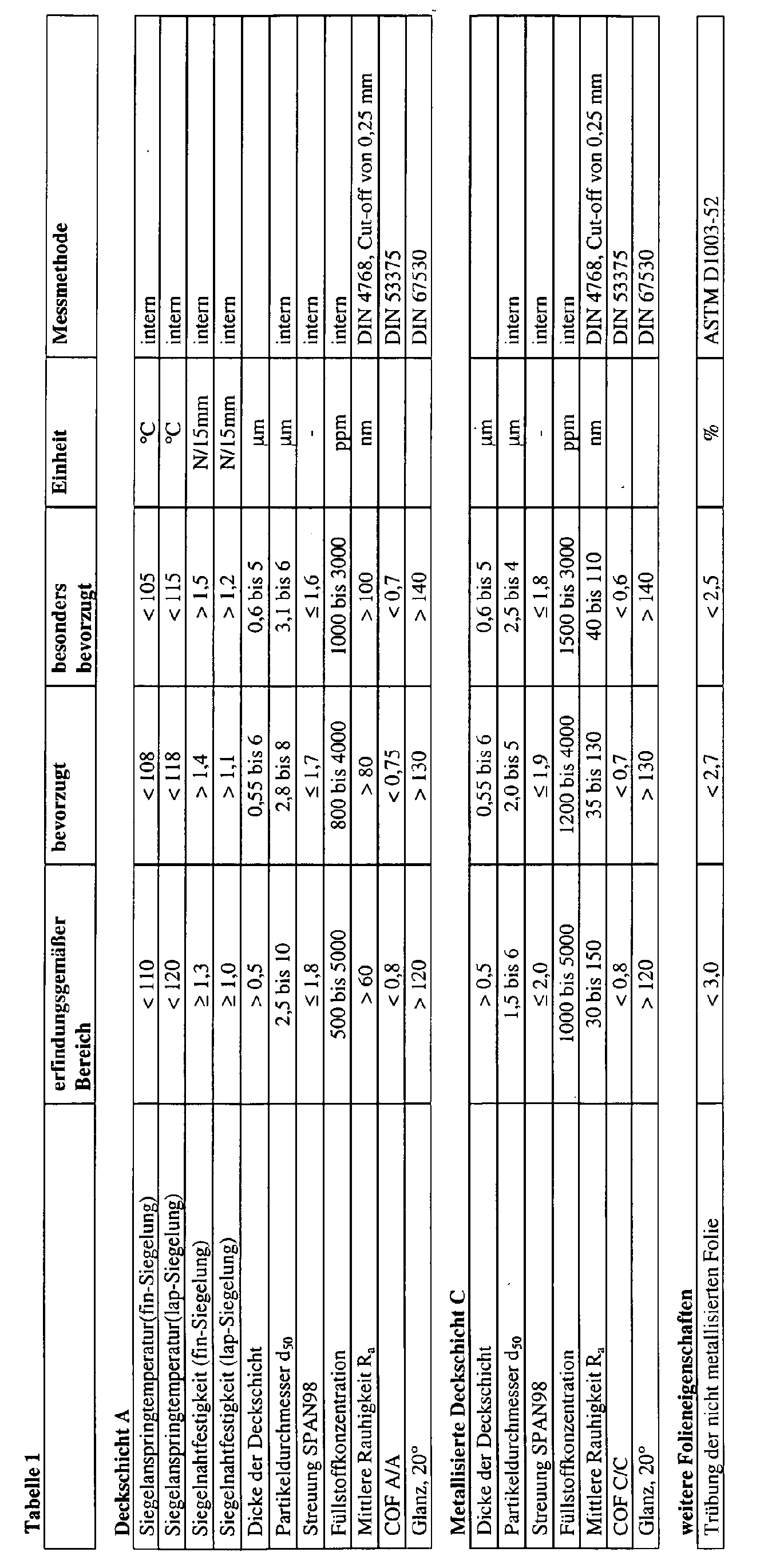
- Table 1 summarizes the most important film properties according to the invention at a glance.
- the Macbeth TD-904 densitometer from Macbeth (Division of Kollmorgen Instruments Corp.) was used to measure the optical density.
- the d 50 value is determined from the (relative) sum curve of the particle size distribution: the intersection of the 50% ordinate value with the sum curve provides the desired d on the abscissa axis 50 value (also called median, see FIG. 1).
- d 98 and d 10 are again based on the (relative) cumulative curve of the particle size distribution.
- the intersection of the 98% ordinate value with the cumulative curve immediately provides the desired d 98 value on the abscissa axis and the intersection of the 10% ordinate value of the cumulative curve with the curve provides the desired d 10 value on the abscissa axis (see FIG. 2).
- the standard viscosity SV (DCE) is based on DEN 53726 in dichloroacetic acid measured.
- the sealing device HSG / ET from Brugger when measuring the Seal seam strength described heat-sealed samples (seal seam 10 mm x 100 mm) produced, the film at different temperatures with the help of two heated Sealing jaws is sealed at a sealing pressure of 2 bar and a sealing time of 0.5 s. Test strips 15 mm wide were cut from the sealed samples.
- the Seal start temperature is the temperature at which a seal seam strength of at least 0.5 N / 15 mm is reached.
- the seal seam strength was like that of the Determination of the seal seam strength measured.
- the roughness R a of the film was determined according to DIN 4768 with a cut-off of 0.25 mm. It was not measured on a glass plate, but in the ring. In the ring method, the film is clamped in a ring so that neither surface touches a third surface (e.g. glass).
- the friction was determined according to DIN 53375.
- the sliding friction number was 14 days after of production measured.
- the haze after Hölz was determined based on ASTM D1O03-52, however to utilize the optimal measuring range on four superimposed foil layers measured and a 1 ° slit was used instead of a 4 ° pinhole.
- the gloss was determined in accordance with DIN 67 530.
- the reflector value was measured as an optical one Parameter for the surface of a film. Based on the standards ASTM-D 523-78 and In ISO 2813, the angle of incidence was set at 20 °. A beam of light hits under that set angle of incidence on the flat test surface and is reflected by it or scattered. The light rays striking the photoelectronic receiver are called proportional electrical quantity is displayed. The measured value is dimensionless and must be included the angle of incidence.
- Polyethylene terephthalate chips (made by the transesterification process with Mn as Transesterification catalyst, Mn concentration: 100 ppm) were at a temperature of 150 ° C to a residual moisture of below 100 ppm and the extruder for the Base layer (B) supplied. Chips made of polyethylene terephthalate and Particles are fed to the extruder for the non-sealable top layer (C).
- chips were made from a linear polyester, which from an amorphous Copolyester with 78 mol% ethylene terephthalate and 22 mol% ethylene isophthalate (produced via the transesterification process with Mn as transesterification catalyst, Mn concentration: 100 ppm).
- the copolyester was at a temperature of 100 ° C on a Residual moisture dried below 200 ppm and the extruder for the sealable Top layer (A) supplied.
- the manufacturing conditions in the individual process steps were: extrusion temperatures A-layer: B layer: C layer: 270 290 ° C ° C ° C ° C Pull roller temperature 30 ° C longitudinal stretching heating temperature 80-125 ° C stretching temperature 122 ° C Longitudinal stretching ratio 4.2 transverse stretching heating temperature 100 ° C stretching temperature 135 ° C Transverse stretching ratio 4.0 fixation temperature 230 ° C duration 3 s
- the film had the required good sealing properties, showed the desired handling and processing behavior, in particular the processing behavior in systems that work in a vacuum.
- the film was coated on a commercial vacuum coating system (Top-Beam) from Applied / Hanau with SiO x with standard parameters.
- the layer thickness of the SiO x layer was 200 nm and the coating speed was 300 m / min.
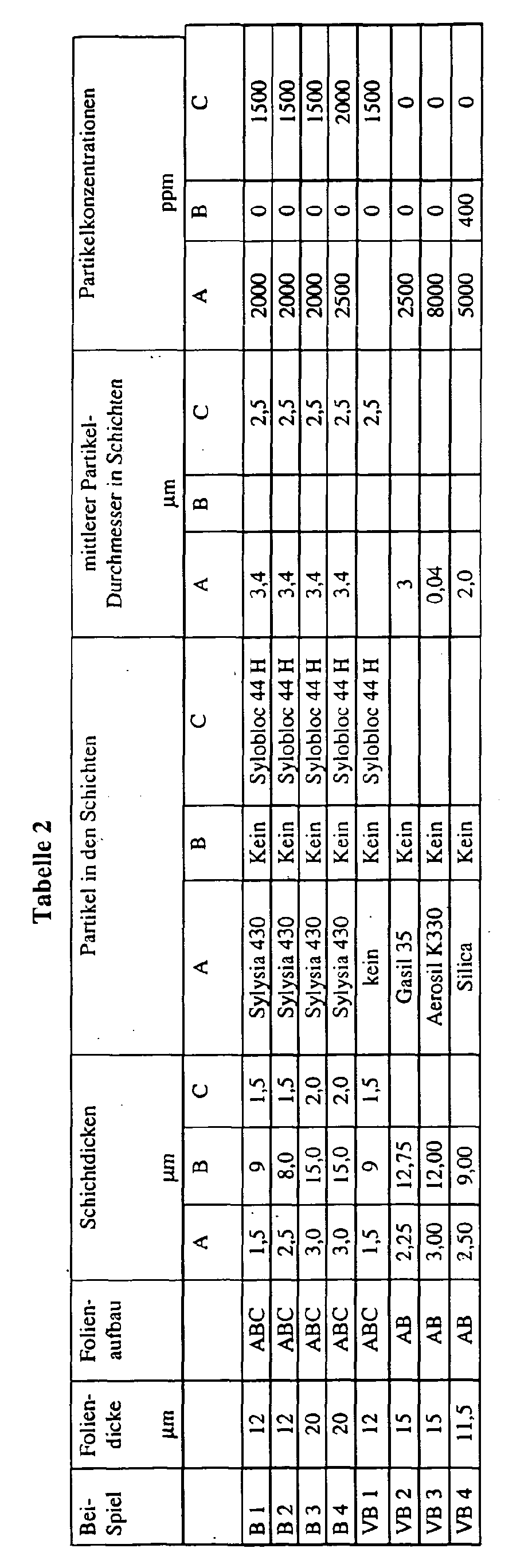
- Tables 2 and 3 The film structure and the properties achieved in films produced in this way are shown in Tables 2 and 3.
- the top layer thickness of the sealable layer (A) was 1.5 raised to 2.5 ⁇ m with an otherwise identical film structure and identical production method.
- the film had the required Sealing properties, showed the desired handling and the desired Processing behavior in systems that work in a vacuum.
- the film was as in Example 1 coated in a vacuum.
- Example 2 In comparison to Example 1, a 20 ⁇ m thick film was now produced.
- the Cover layer thickness of the sealable layer (A) was 3.0 ⁇ m and that of the was not sealable layer (C) was 2.0 ⁇ m. This has the sealing properties again improved, in particular the seal seam strength has increased significantly.
- the Film had the required sealing properties, showed the desired handling and that desired processing behavior in systems that work in a vacuum.
- the slide was coated in a vacuum as in Example 1.
- the copolymer was used for the sealable top layer (A) changed.
- the amorphous copolyester with 78 mol% polyethylene terephthalate and 22 Mol% ethylene isophthalate now became an amorphous copolyester with 70 mol% Polyethylene terephthalate and 30 mol% ethylene isophthalate are used.
- the top layer thickness the sealable layer (A) was again 3 ⁇ m and that of the non-sealable Layer (C) was 2.0 ⁇ m.
- the sealing properties have further improved in particular, the seal seam strength has increased significantly.
- the particle concentration became handling and good processing behavior of the film slightly raised in the two outer layers.
- the film was in a vacuum as in Example 1 coated.
- the sealable top layer (A) was now not pigmented (not provided with particles).
- the sealing properties have improved as a result, however, the handling of the film and the processing behavior are unacceptably worse become.
- the film was coated in a vacuum as in Example 1. This happened strong blockages between the coated side (C) and the sealable side (A). The film could not be transferred due to the larger ceramic transfer (from the top layer (C) to the top layer (A)) can no longer be processed.
- Example 1 from EP-A-0 035 835 was reworked.
- the sealing behavior of the film, the handling of the film and the processing behavior of the film are worse than that of the examples according to the invention.
- the film was coated in a vacuum as in Example 1. In addition, the haze of the film was poor.
- Example 1 from EP-A-0 515 096 was reworked.
- the processing behavior of the Film in vacuum is worse than in the films according to the invention.
- the slide was like coated in Example 1 in a vacuum.
- the film was not cloudy satisfactory.
- Example 21 from EP-A-0 379 190 was reworked.
- the processing behavior of the film in a vacuum is significantly worse than in the examples according to the invention.
- the film was coated in a vacuum as in Example 1.
Landscapes
- Engineering & Computer Science (AREA)
- Mechanical Engineering (AREA)
- Chemical & Material Sciences (AREA)
- Ceramic Engineering (AREA)
- Laminated Bodies (AREA)
- Extrusion Moulding Of Plastics Or The Like (AREA)
- Shaping By String And By Release Of Stress In Plastics And The Like (AREA)
Abstract
Description
- die Eigenschaften, die für eine gute Verarbeitung der Folie im Vakuum und den nachfolgenden Verarbeitungsschritten notwendig sind
- die Wickelung, insbesondere bei der Verarbeitung der Folie im Vakuum und bei der Weiterverarbeitung in nachfolgenden Prozessschritten
- das Blockverhalten der beiden Folienoberflächen, insbesondere nach der Metallisierung oder der keramischen Beschichtung
- die optischen Eigenschaften der metallisierten oder keramisch beschichteten Folie, insbesondere der Glanz.
| Deckschicht (A), Mischung aus: | |
| 96,0 Gew.-% | Copolyester mit einem SV-Wert von 800 |
| 4,0 Gew.-% | Masterbatch aus 95 Gew.-% Copolyester (SV-Wert von 800) und 5,0 Gew.-% ® Sylysia 430 (synthetisches SiO2 der Fa. Fuji/Japan); SPAN98 = 1,7 |
| Basisschicht (B): | |
| 100,0 Gew.-% | Polyethylenterephthalat mit einem SV-Wert von 800 |
| Deckschicht (C), Mischung aus: | |
| 85 Gew.-% | Polyethylenterephthalat mit einem SV-Wert von 800 |
| 15 Gew.-% | Masterbatch aus 99 Gew.-% Polyester (SV-Wert von 800) und 1,0 Gew.-% Sylobloc 44 H (synthetisches SiO2 der Fa. Grace), SPAN98 = 1,9 |
| Extrusion | Temperaturen | A-Schicht: B-Schicht: C-Schicht: | 270 290 290 | °C °C °C |
| Temperatur der Abzugswalze | 30 | °C | ||
| Längsstreckung | Aufheiztemperatur | 80-125 | °C | |
| Strecktemperatur | 122 | °C | ||
| Längsstreckverhältnis | 4,2 | |||
| Querstreckung | Aufheiztemperatur | 100 | °C | |
| Strecktemperatur | 135 | °C | ||
| Querstreckverhältnis | 4,0 | |||
| Fixierung | Temperatur | 230 | °C | |
| Dauer | 3 | s |

Claims (11)
- Koextrudierte,, biaxial orientierte, siegelfähige Polyesterfolie mit mindestens einer Basisschicht (B), einer siegelfähigen Deckschicht (A) auf der einen Oberfläche der Basisschicht (B) und einer metallisierten oder keramisch beschichteten Deckschicht (C) auf der anderen Oberfläche der Basisschicht (B), wobei die siegelfähige Deckschicht (A) eine Siegelanspringtemperatur (fin) von nicht mehr als 110 °C und eine Siegelnahtfestigkeit (fin) von mindestens 1,3 N/15 mm Folienbreite aufweist und die beiden Deckschichten (A) und (C) durch die folgenden Merkmale gekennzeichnet sind:Siegelfähige Deckschicht (A):a) enthält Partikel aus synthetischem SiO2 in einer Konzentration von 500 bis 5000 ppm mit einem mittleren Partikeldurchmesser d50von 2,5 bis 10 µm, der eine SPAN98 aufweist, die kleiner/gleich 1,80 ist, weist eine Rauhigkeit Ra von größer als 60 nm auf,b) weist einen Reibungskoeffizienten A-Seite /A-Seite auf, der kleiner als 0,8 ist Nicht siegelfähige Deckschicht (C):c) enthält Partikel aus synthetischem und amorphem SiO2 in einer Konzentration von größer 1000 bis 5000 ppm mit einem mittleren Partikeldurchmesser d50 von 1,5 bis 6 µm, der eine SPAN98 aufweist, die kleiner/gleich 2,0 ist,d) weist eine Rauhigkeit Ra auf, die zwischen 30 ≤Ra ≤ 150 nm liegt,e) weist einen Reibungskoeffizienten C-Seite /C-Seite auf, der kleiner als 0,6 ist,f) ist mit einem Metall oder keramischen Material beschichtet
- Siegelfähige Polyesterfolie nach Anspruch 1, dadurch gekennzeichnet, dass die siegelfähige Deckschicht (A) einen amorphen Copolyester enthält, der aus Ethylenterephthalat- und Ethylenisophthalat-Einheiten und aus Ethylenglykol-Einheiten aufgebaut ist.
- Siegelfähige Polyesterfolie nach Anspruch 2, dadurch gekennzeichnet, dass der amorphe Copolyester der siegelfähigen Deckschicht (A) Ethylenterephthalat in einem Anteil von 40 bis 95 Mol-% und Ethylenisophthalat in einem Anteil von 60 bis 5 Mol-% enthält.
- Siegelfähige Polyesterfolie nach einem der Ansprüche 1 bis 3, dadurch gekennzeichnet, dass die siegelfähige Deckschicht (A) eine Dicke von größer als 0,5 µm aufweist.
- Siegelfähige Polyesterfolie nach einem der Ansprüche 1 bis 4, dadurch gekennzeichnet, dass ihre Trübung im unmetallisierten Zustand kleiner als 3,0 ist.
- Siegelfähige Polyesterfolie nach einem der Ansprüche 1 bis 5, dadurch gekennzeichnet, dass die Menge an Partikeln in der Basisschicht (B) niedriger ist als in den beiden Deckschichten (A) und (C).
- Verfahren zum Herstellen einer siegelfähigen Polyesterfolie nach Anspruch 1, bei dem die Polymere für die Basisschicht (B) und die beiden Deckschichten (A) und (C) getrennten Extrudern zugeführt werden, etwa vorhandene Fremdkörper oder Verunreinigungen aus der Polymerschmelze vor der Extrusion durch geeignete Filter entfernt werden, die Schmelzen dann in einer Mehrschichtdüse zu flachen Schmelzefilmen ausgeformt und übereinander geschichtet werden, anschließend der Mehrschichtfilm mit Hilfe einer Kühlwalze und gegebenenfalls weiteren Walzen abgezogen, verfestigt und danach biaxial streckorientiert und hitzefixiert wird, wobei die biaxiale Streckung aufeinanderfolgend durchgeführt wird, wobei zuerst längs (in Maschinenrichtung) und dann quer (senkrecht zur Maschinenrichtung) gestreckt wird, dadurch gekennzeichnet, dass die Längsstreckung bei einer Temperatur im Bereich von 80 bis 130 °C und die Querstreckung im Bereich von 90 bis 150 °C durchgeführt wird und dass das Längsstreckverhältnis im Bereich von 2,5:1 bis 6:1, , und das Querstreckverhältnis im Bereich von 3,0:1 bis 5,0:1 liegt.
- Verfahren nach Anspruch 7, dadurch gekennzeichnet, dass nach der Längsstreckung und vor der Querstreckung eine oder beide Oberfläche(n) der Folie nach dem In-line-Verfahren beschichtet wird/werden.
- Verwendung einer siegelfähigen Polyesterfolie nach einem der Ansprüche 1 bis 5 auf schnelllaufenden Verpackungsmaschinen.
- Verwendung einer siegelfähigen Polyesterfolie nach einem der Ansprüche 1 bis 5 bei der Verarbeitung auf Anlagen, die unter Anwendung eines Vakuums arbeiten.
- Verwendung einer siegelfähigen Polyesterfolie nach einem der Ansprüche 1 bis 5 als Verpackungsfolie.
Applications Claiming Priority (2)
| Application Number | Priority Date | Filing Date | Title |
|---|---|---|---|
| DE2002131594 DE10231594A1 (de) | 2002-07-12 | 2002-07-12 | Mehrschichtige, metallisierte oder keramisch beschichtete, siegelfähige, biaxial orientierte Polyesterfolie, Verfahren zu ihrer Herstellung und ihre Verwendung |
| DE10231594 | 2002-07-12 |
Publications (2)
| Publication Number | Publication Date |
|---|---|
| EP1380415A1 true EP1380415A1 (de) | 2004-01-14 |
| EP1380415B1 EP1380415B1 (de) | 2006-07-26 |
Family
ID=29723873
Family Applications (1)
| Application Number | Title | Priority Date | Filing Date |
|---|---|---|---|
| EP20030014482 Expired - Lifetime EP1380415B1 (de) | 2002-07-12 | 2003-07-02 | Mehrschichtige, metallisierte oder keramisch beschichtete, siegelfähige, biaxial orientierte Polyesterfolie, Verfahren zu ihrer Herstellung und ihre Verwendung |
Country Status (5)
| Country | Link |
|---|---|
| US (1) | US6797359B2 (de) |
| EP (1) | EP1380415B1 (de) |
| JP (1) | JP2004042642A (de) |
| KR (1) | KR20040007285A (de) |
| DE (2) | DE10231594A1 (de) |
Cited By (2)
| Publication number | Priority date | Publication date | Assignee | Title |
|---|---|---|---|---|
| EP1857496A3 (de) * | 2006-05-18 | 2009-03-11 | Mitsubishi Polyester Film GmbH | Biaxial orientierte Polyesterfolie für die Blechlaminierung |
| EP3878895A4 (de) * | 2018-11-07 | 2022-08-03 | Toyobo Co., Ltd. | Biaxial orientierte polyesterfolie und verfahren zur herstellung davon |
Families Citing this family (18)
| Publication number | Priority date | Publication date | Assignee | Title |
|---|---|---|---|---|
| DE10007728A1 (de) * | 2000-02-19 | 2001-08-23 | Mitsubishi Polyester Film Gmbh | Weiße, siegelfähige flammhemmend ausgerüstete, biaxial orientierte Polyesterfolie, Verfahren zu ihrer Herstellung und ihre Verwendung |
| DE10007726A1 (de) * | 2000-02-19 | 2001-08-23 | Mitsubishi Polyester Film Gmbh | Transparente, siegelfähige, UV-stabilisierte und flammhemmend ausgerüstete Polyesterfolie, Verfahren zu ihrer Herstellung und ihre Verwendung |
| DE10152141A1 (de) * | 2001-10-23 | 2003-04-30 | Mitsubishi Polyester Film Gmbh | Matte, biaxial orientiertge Polyesterfolie, Verfahren zu ihrer Herstellung und ihre Verwendung |
| DE10231594A1 (de) * | 2002-07-12 | 2004-01-22 | Mitsubishi Polyester Film Gmbh | Mehrschichtige, metallisierte oder keramisch beschichtete, siegelfähige, biaxial orientierte Polyesterfolie, Verfahren zu ihrer Herstellung und ihre Verwendung |
| DE10231595A1 (de) * | 2002-07-12 | 2004-01-22 | Mitsubishi Polyester Film Gmbh | Mehrschichtige, transparente, siegelfähige, biaxial orientierte Polyesterfolie, Verfahren zu ihrer Herstellung und ihre Verwendung |
| DE10301786A1 (de) * | 2003-01-20 | 2004-07-29 | Mitsubishi Polyester Film Gmbh | Mehrschichtige transparente, biaxial orientierte Polyesterfolie, Verfahren zu ihrer Herstellung und ihre Verwendung |
| DE10303145A1 (de) * | 2003-01-28 | 2004-07-29 | Mitsubishi Polyester Film Gmbh | Einseitig matte, biaxial orietierte Polyesterfolie mit charakteristischen Schrumpfeigenschaften, Verfahren zu ihrer Herstellung und ihre Verwendung |
| DE10303144A1 (de) * | 2003-01-28 | 2004-07-29 | Mitsubishi Polyester Film Gmbh | Einseitig matte, biaxial orientierte Polyesterfolie, Verfahren zu ihrer Herstellung und ihre Verwendung |
| DE102005027657A1 (de) * | 2005-06-15 | 2006-12-21 | Mitsubishi Polyester Film Gmbh | Mehrschichtige, transparente Polyesterfolie mit hoher Sauerstoffbarriere |
| KR100727087B1 (ko) * | 2005-10-06 | 2007-06-13 | 주식회사 케이티프리텔 | 메시지 서비스를 이용한 내용 증명 서비스 방법 및 이를구현한 이동 통신 시스템 |
| US20070134470A1 (en) * | 2005-12-09 | 2007-06-14 | Martin Jesberger | Multilayer, white, biaxially oriented polyester film |
| CN101195685B (zh) * | 2007-04-30 | 2010-12-08 | 天津市大港区兴起化工有限公司 | 全消光彩色绝缘聚酯薄膜及其生产工艺 |
| DE102007028348A1 (de) * | 2007-06-20 | 2008-12-24 | Mitsubishi Polyester Film Gmbh | Bernsteinfarbene Polyesterfolie mit besonderer Eignung für Metallisierung und Stahllaminierung |
| FR2929948B1 (fr) * | 2008-04-09 | 2010-09-24 | Toray Plastics Europ | Film plastique extrude charge en particules metalliques, procede d'obtention et utilisations dudit film |
| DE102008046781A1 (de) * | 2008-09-11 | 2010-03-18 | Mitsubishi Polyester Film Gmbh | Siegelfähige, biaxial orientierte Polyesterfolie |
| DE102009021714A1 (de) * | 2009-05-18 | 2010-11-25 | Mitsubishi Polyester Film Gmbh | Niedrigsiegelnde Polyesterfolie für unpolare Substrate |
| KR101284915B1 (ko) * | 2013-04-01 | 2013-07-10 | 동양인더스트리 주식회사 | 페트 필름의 제조장치 |
| JP6587039B1 (ja) * | 2017-12-06 | 2019-10-09 | 大日本印刷株式会社 | 電池用包装材料、電池、これらの製造方法、及びポリエステルフィルム |
Citations (3)
| Publication number | Priority date | Publication date | Assignee | Title |
|---|---|---|---|---|
| DE10007724A1 (de) * | 2000-02-19 | 2001-08-23 | Mitsubishi Polyester Film Gmbh | Transparente, siegelfähige, UV-stabilisierte Polyesterfolie, Verfahren zu ihrer Herstellung und ihre Verwendung |
| EP1197327A1 (de) * | 2000-10-14 | 2002-04-17 | Mitsubishi Polyester Film GmbH | Koextrudierte, zumindest einseitig matte, biaxial orientierte Polyesterfolie |
| EP1197326A1 (de) * | 2000-10-14 | 2002-04-17 | Mitsubishi Polyester Film GmbH | Matte, pigmentierte, biaxial orientierte Polyesterfolie |
Family Cites Families (18)
| Publication number | Priority date | Publication date | Assignee | Title |
|---|---|---|---|---|
| FI44811C (fi) | 1963-12-23 | 1972-01-10 | Loeoef Nils Oskar T | Sähköjohtojen, kaapeleiden ja sentapaisten merkkauslaite. |
| US4198458A (en) * | 1973-05-11 | 1980-04-15 | Teijin Limited | Laminate polyester films |
| EP0035835B1 (de) | 1980-03-12 | 1984-03-14 | Imperial Chemical Industries Plc | Verbundstoffe aus Polyesterfilmen |
| DE3344435A1 (de) | 1983-12-08 | 1985-06-20 | Siemens AG, 1000 Berlin und 8000 München | Schaltungsanordnung zum ansteuern eines thyristors mit einem fototransistor |
| KR960004763B1 (ko) | 1989-01-19 | 1996-04-13 | 도오요오 보오세끼 가부시끼가이샤 | 폴리에스테르계 수지 적층 필름 |
| GB8925785D0 (en) | 1989-11-15 | 1990-01-04 | Ici Plc | Multilayer film |
| US5096784A (en) * | 1989-12-20 | 1992-03-17 | Hoechst Celanese Corporation | Polyester film with nodule surface |
| GB9110902D0 (en) | 1991-05-21 | 1991-07-10 | Ici Plc | Polymeric film |
| JPH05128490A (ja) * | 1991-11-07 | 1993-05-25 | Diafoil Co Ltd | 磁気記録媒体用積層ポリエステルフイルム |
| WO1999015590A1 (en) * | 1997-09-25 | 1999-04-01 | Toray Industries, Inc. | Polyester composition and film made therefrom |
| MY127653A (en) * | 1996-05-16 | 2006-12-29 | Toray Industries | Biaxially stretched polyester film for forming container and method of producing the film |
| GB9617185D0 (en) | 1996-08-15 | 1996-09-25 | Ici Plc | Polymeric film |
| JPH10138432A (ja) * | 1996-11-14 | 1998-05-26 | Teijin Ltd | 磁気テープ用二軸配向積層ポリエステルフィルム |
| DE19813269A1 (de) * | 1998-03-25 | 1999-09-30 | Hoechst Diafoil Gmbh | Siegelfähige Polyesterfolie mit hoher Sauerstoffbarriere, Verfahren zu ihrer Herstellung und ihre Verwendung |
| DE10015633A1 (de) | 2000-03-29 | 2001-10-04 | Mitsubishi Polyester Film Gmbh | Siegelfähige biaxial orientierte Polyesterfolie |
| DE10051082A1 (de) * | 2000-10-14 | 2002-04-25 | Mitsubishi Polyester Film Gmbh | Matte, koextrudierte, biaxial orientierte Polyesterfolie |
| DE10231595A1 (de) * | 2002-07-12 | 2004-01-22 | Mitsubishi Polyester Film Gmbh | Mehrschichtige, transparente, siegelfähige, biaxial orientierte Polyesterfolie, Verfahren zu ihrer Herstellung und ihre Verwendung |
| DE10231594A1 (de) * | 2002-07-12 | 2004-01-22 | Mitsubishi Polyester Film Gmbh | Mehrschichtige, metallisierte oder keramisch beschichtete, siegelfähige, biaxial orientierte Polyesterfolie, Verfahren zu ihrer Herstellung und ihre Verwendung |
-
2002
- 2002-07-12 DE DE2002131594 patent/DE10231594A1/de not_active Withdrawn
-
2003
- 2003-07-01 US US10/611,003 patent/US6797359B2/en not_active Expired - Fee Related
- 2003-07-02 DE DE50304339T patent/DE50304339D1/de not_active Expired - Lifetime
- 2003-07-02 EP EP20030014482 patent/EP1380415B1/de not_active Expired - Lifetime
- 2003-07-09 KR KR1020030046426A patent/KR20040007285A/ko not_active Withdrawn
- 2003-07-11 JP JP2003195487A patent/JP2004042642A/ja not_active Withdrawn
Patent Citations (3)
| Publication number | Priority date | Publication date | Assignee | Title |
|---|---|---|---|---|
| DE10007724A1 (de) * | 2000-02-19 | 2001-08-23 | Mitsubishi Polyester Film Gmbh | Transparente, siegelfähige, UV-stabilisierte Polyesterfolie, Verfahren zu ihrer Herstellung und ihre Verwendung |
| EP1197327A1 (de) * | 2000-10-14 | 2002-04-17 | Mitsubishi Polyester Film GmbH | Koextrudierte, zumindest einseitig matte, biaxial orientierte Polyesterfolie |
| EP1197326A1 (de) * | 2000-10-14 | 2002-04-17 | Mitsubishi Polyester Film GmbH | Matte, pigmentierte, biaxial orientierte Polyesterfolie |
Cited By (4)
| Publication number | Priority date | Publication date | Assignee | Title |
|---|---|---|---|---|
| EP1857496A3 (de) * | 2006-05-18 | 2009-03-11 | Mitsubishi Polyester Film GmbH | Biaxial orientierte Polyesterfolie für die Blechlaminierung |
| US7588816B2 (en) | 2006-05-18 | 2009-09-15 | Mitsubishi Polyester Film Gmbh | Biaxially oriented polyester film for heat-metal lamination |
| EP3878895A4 (de) * | 2018-11-07 | 2022-08-03 | Toyobo Co., Ltd. | Biaxial orientierte polyesterfolie und verfahren zur herstellung davon |
| US12186971B2 (en) | 2018-11-07 | 2025-01-07 | Toyobo Co., Ltd. | Biaxially oriented polyester film and method for producing same |
Also Published As
| Publication number | Publication date |
|---|---|
| DE10231594A1 (de) | 2004-01-22 |
| JP2004042642A (ja) | 2004-02-12 |
| US20040009355A1 (en) | 2004-01-15 |
| EP1380415B1 (de) | 2006-07-26 |
| KR20040007285A (ko) | 2004-01-24 |
| DE50304339D1 (de) | 2006-09-07 |
| US6797359B2 (en) | 2004-09-28 |
Similar Documents
| Publication | Publication Date | Title |
|---|---|---|
| EP0903222B1 (de) | Mehrschichtige, biaxial orientierte Polyesterfolie, Verfahren zu ihrer Herstellung und ihre Verwendung | |
| EP1380414B1 (de) | Mehrschichtige, transparente, siegelfähige, biaxial orientierte Polyesterfolie, Verfahren zu ihrer Herstellung und ihre Verwendung | |
| EP1197327B1 (de) | Koextrudierte, zumindest einseitig matte, biaxial orientierte Polyesterfolie | |
| EP1138480B1 (de) | Siegelfähige biaxial orientierte Polyesterfolie | |
| EP0882577B1 (de) | Biaxial orientierte Polyesterfolie mit hoher Sauerstoffbarriere, Verfahren zu ihrer Herstellung und ihre Verwendung | |
| EP0903221B1 (de) | Biaxial orientierte Polyesterfolie, Verfahren zu ihrer Herstellung und ihre Verwendung zum Verpacken von Leben- und Genussmittel | |
| EP1380415B1 (de) | Mehrschichtige, metallisierte oder keramisch beschichtete, siegelfähige, biaxial orientierte Polyesterfolie, Verfahren zu ihrer Herstellung und ihre Verwendung | |
| EP1442876B1 (de) | Einseitig matte, biaxial orientierte Polyesterfolie mit charakteristischen Schrumpfeigenschaften, Verfahren zu ihrer Herstellung und ihre Verwendung | |
| EP1471098B1 (de) | Coextrudierte, heisssiegelbare und peelfähige Polyesterfolie, Verfahren zu ihrer Herstellung und ihre Verwendung | |
| EP1475229A2 (de) | Coextrudierte, heisssiegelbare und peelfähige Polyesterfolie mit leichter Peelbarkeit, Verfahren zu ihrer Herstellung und ihre Verwendung | |
| EP1471096A1 (de) | Coextrudierte, heisssiegelbare und peelfähige Polyesterfolie mit starker Peelbarkeit, Verfahren zu ihrer Herstellung und ihre Verwendung | |
| EP1197328A2 (de) | Zumindest einseitig matte, biaxial orientierte Polyesterfolie | |
| EP1471097A1 (de) | Coextrudierte, heisssiegelbare und peelfähige Polyesterfolie, Verfahren zu ihrer Herstellung und ihre Verwendung | |
| EP0952176B1 (de) | Mehrschichtige, biaxial orientierte Polyesterfolie, Verfahren zu ihrer Herstellung und ihre Verwendung | |
| EP1186405B1 (de) | Koextrudierte, biaxial orientierte Polyesterfolie mit guter Metallhaftung, Verfahren zu ihrer Herstellung und ihre Verwendung | |
| EP1471094B1 (de) | Coextrudierte, heisssiegelbare und peelfähige Polyesterfolie, Verfahren zu ihrer Herstellung und ihre Verwendung | |
| EP1442875B1 (de) | Einseitig matte, biaxial orientierte Polyesterfolie, Verfahren zu ihrer Herstellung und ihre Verwendung | |
| EP1236568A1 (de) | Mehrschichtige transparente, biaxial orientierte Polyesterfolie | |
| EP1219413B1 (de) | Einseitig matte, siegelfähige, biaxial orientierte Polyesterfolie | |
| DE10152141A1 (de) | Matte, biaxial orientiertge Polyesterfolie, Verfahren zu ihrer Herstellung und ihre Verwendung | |
| EP1291168B1 (de) | Biaxial orientierte Polyesterfolie mit guter Metallhaftung, Verfahren zu ihrer Herstellung und ihre Verwendung | |
| DE102005058907A1 (de) | Matte, siegelfähige, biaxial orientierte Polyesterfolie | |
| EP1700878A1 (de) | Mehrschichtige, transparente Polyesterfolie mit hoher Sauerstoffbarriere | |
| DE102005058910A1 (de) | Siegelfähige, biaxial orientierte Polyesterfolie | |
| DE102005058918A1 (de) | Matte, UV-stabilisierte, biaxial orientierte Polyesterfolie mit hoher Siegelnahtfestigkeit |
Legal Events
| Date | Code | Title | Description |
|---|---|---|---|
| PUAI | Public reference made under article 153(3) epc to a published international application that has entered the european phase |
Free format text: ORIGINAL CODE: 0009012 |
|
| AK | Designated contracting states |
Kind code of ref document: A1 Designated state(s): AT BE BG CH CY CZ DE DK EE ES FI FR GB GR HU IE IT LI LU MC NL PT RO SE SI SK TR |
|
| AX | Request for extension of the european patent |
Extension state: AL LT LV MK |
|
| 17P | Request for examination filed |
Effective date: 20040714 |
|
| AKX | Designation fees paid |
Designated state(s): DE FR GB IT LU NL |
|
| 17Q | First examination report despatched |
Effective date: 20041006 |
|
| GRAP | Despatch of communication of intention to grant a patent |
Free format text: ORIGINAL CODE: EPIDOSNIGR1 |
|
| GRAS | Grant fee paid |
Free format text: ORIGINAL CODE: EPIDOSNIGR3 |
|
| GRAA | (expected) grant |
Free format text: ORIGINAL CODE: 0009210 |
|
| AK | Designated contracting states |
Kind code of ref document: B1 Designated state(s): DE FR GB IT LU |
|
| REG | Reference to a national code |
Ref country code: GB Ref legal event code: FG4D Free format text: NOT ENGLISH |
|
| REF | Corresponds to: |
Ref document number: 50304339 Country of ref document: DE Date of ref document: 20060907 Kind code of ref document: P |
|
| GBT | Gb: translation of ep patent filed (gb section 77(6)(a)/1977) |
Effective date: 20061016 |
|
| ET | Fr: translation filed | ||
| PLBE | No opposition filed within time limit |
Free format text: ORIGINAL CODE: 0009261 |
|
| STAA | Information on the status of an ep patent application or granted ep patent |
Free format text: STATUS: NO OPPOSITION FILED WITHIN TIME LIMIT |
|
| 26N | No opposition filed |
Effective date: 20070427 |
|
| PG25 | Lapsed in a contracting state [announced via postgrant information from national office to epo] |
Ref country code: IT Free format text: LAPSE BECAUSE OF NON-PAYMENT OF DUE FEES Effective date: 20080702 |
|
| PGRI | Patent reinstated in contracting state [announced from national office to epo] |
Ref country code: IT Effective date: 20091001 |
|
| PGFP | Annual fee paid to national office [announced via postgrant information from national office to epo] |
Ref country code: LU Payment date: 20130724 Year of fee payment: 11 |
|
| PGFP | Annual fee paid to national office [announced via postgrant information from national office to epo] |
Ref country code: DE Payment date: 20130810 Year of fee payment: 11 |
|
| PGFP | Annual fee paid to national office [announced via postgrant information from national office to epo] |
Ref country code: GB Payment date: 20130726 Year of fee payment: 11 Ref country code: FR Payment date: 20130722 Year of fee payment: 11 |
|
| PGFP | Annual fee paid to national office [announced via postgrant information from national office to epo] |
Ref country code: IT Payment date: 20140722 Year of fee payment: 12 |
|
| REG | Reference to a national code |
Ref country code: DE Ref legal event code: R119 Ref document number: 50304339 Country of ref document: DE |
|
| PG25 | Lapsed in a contracting state [announced via postgrant information from national office to epo] |
Ref country code: LU Free format text: LAPSE BECAUSE OF NON-PAYMENT OF DUE FEES Effective date: 20140702 |
|
| GBPC | Gb: european patent ceased through non-payment of renewal fee |
Effective date: 20140702 |
|
| REG | Reference to a national code |
Ref country code: FR Ref legal event code: ST Effective date: 20150331 |
|
| PG25 | Lapsed in a contracting state [announced via postgrant information from national office to epo] |
Ref country code: DE Free format text: LAPSE BECAUSE OF NON-PAYMENT OF DUE FEES Effective date: 20150203 |
|
| REG | Reference to a national code |
Ref country code: DE Ref legal event code: R119 Ref document number: 50304339 Country of ref document: DE Effective date: 20150203 |
|
| PG25 | Lapsed in a contracting state [announced via postgrant information from national office to epo] |
Ref country code: FR Free format text: LAPSE BECAUSE OF NON-PAYMENT OF DUE FEES Effective date: 20140731 Ref country code: GB Free format text: LAPSE BECAUSE OF NON-PAYMENT OF DUE FEES Effective date: 20140702 |
|
| PG25 | Lapsed in a contracting state [announced via postgrant information from national office to epo] |
Ref country code: IT Free format text: LAPSE BECAUSE OF NON-PAYMENT OF DUE FEES Effective date: 20150702 |