EP1380342A1 - Complex catalyst, process for producing the complex catalyst, and process for producing alcohol derivative with the complex catalyst - Google Patents

Complex catalyst, process for producing the complex catalyst, and process for producing alcohol derivative with the complex catalyst Download PDF

Info

Publication number
EP1380342A1
EP1380342A1 EP02720443A EP02720443A EP1380342A1 EP 1380342 A1 EP1380342 A1 EP 1380342A1 EP 02720443 A EP02720443 A EP 02720443A EP 02720443 A EP02720443 A EP 02720443A EP 1380342 A1 EP1380342 A1 EP 1380342A1
Authority
EP
European Patent Office
Prior art keywords
carbon atoms
tert
bis
iii
optically active
Prior art date
Legal status (The legal status is an assumption and is not a legal conclusion. Google has not performed a legal analysis and makes no representation as to the accuracy of the status listed.)
Granted
Application number
EP02720443A
Other languages
German (de)
French (fr)
Other versions
EP1380342B1 (en
EP1380342A4 (en
Inventor
Kazuaki Sasaki
Current Assignee (The listed assignees may be inaccurate. Google has not performed a legal analysis and makes no representation or warranty as to the accuracy of the list.)
Sumitomo Chemical Co Ltd
Original Assignee
Sumitomo Chemical Co Ltd
Priority date (The priority date is an assumption and is not a legal conclusion. Google has not performed a legal analysis and makes no representation as to the accuracy of the date listed.)
Filing date
Publication date
Application filed by Sumitomo Chemical Co Ltd filed Critical Sumitomo Chemical Co Ltd
Publication of EP1380342A1 publication Critical patent/EP1380342A1/en
Publication of EP1380342A4 publication Critical patent/EP1380342A4/en
Application granted granted Critical
Publication of EP1380342B1 publication Critical patent/EP1380342B1/en
Priority to CY20091100800T priority Critical patent/CY1109302T1/en
Anticipated expiration legal-status Critical
Expired - Lifetime legal-status Critical Current

Links

Classifications

    • BPERFORMING OPERATIONS; TRANSPORTING
    • B01PHYSICAL OR CHEMICAL PROCESSES OR APPARATUS IN GENERAL
    • B01JCHEMICAL OR PHYSICAL PROCESSES, e.g. CATALYSIS OR COLLOID CHEMISTRY; THEIR RELEVANT APPARATUS
    • B01J31/00Catalysts comprising hydrides, coordination complexes or organic compounds
    • B01J31/16Catalysts comprising hydrides, coordination complexes or organic compounds containing coordination complexes
    • B01J31/22Organic complexes
    • BPERFORMING OPERATIONS; TRANSPORTING
    • B01PHYSICAL OR CHEMICAL PROCESSES OR APPARATUS IN GENERAL
    • B01JCHEMICAL OR PHYSICAL PROCESSES, e.g. CATALYSIS OR COLLOID CHEMISTRY; THEIR RELEVANT APPARATUS
    • B01J31/00Catalysts comprising hydrides, coordination complexes or organic compounds
    • B01J31/16Catalysts comprising hydrides, coordination complexes or organic compounds containing coordination complexes
    • B01J31/22Organic complexes
    • B01J31/2204Organic complexes the ligands containing oxygen or sulfur as complexing atoms
    • B01J31/2208Oxygen, e.g. acetylacetonates
    • B01J31/2226Anionic ligands, i.e. the overall ligand carries at least one formal negative charge
    • B01J31/2243At least one oxygen and one nitrogen atom present as complexing atoms in an at least bidentate or bridging ligand
    • CCHEMISTRY; METALLURGY
    • C07ORGANIC CHEMISTRY
    • C07DHETEROCYCLIC COMPOUNDS
    • C07D213/00Heterocyclic compounds containing six-membered rings, not condensed with other rings, with one nitrogen atom as the only ring hetero atom and three or more double bonds between ring members or between ring members and non-ring members
    • C07D213/02Heterocyclic compounds containing six-membered rings, not condensed with other rings, with one nitrogen atom as the only ring hetero atom and three or more double bonds between ring members or between ring members and non-ring members having three double bonds between ring members or between ring members and non-ring members
    • C07D213/04Heterocyclic compounds containing six-membered rings, not condensed with other rings, with one nitrogen atom as the only ring hetero atom and three or more double bonds between ring members or between ring members and non-ring members having three double bonds between ring members or between ring members and non-ring members having no bond between the ring nitrogen atom and a non-ring member or having only hydrogen or carbon atoms directly attached to the ring nitrogen atom
    • C07D213/60Heterocyclic compounds containing six-membered rings, not condensed with other rings, with one nitrogen atom as the only ring hetero atom and three or more double bonds between ring members or between ring members and non-ring members having three double bonds between ring members or between ring members and non-ring members having no bond between the ring nitrogen atom and a non-ring member or having only hydrogen or carbon atoms directly attached to the ring nitrogen atom with hetero atoms or with carbon atoms having three bonds to hetero atoms with at the most one bond to halogen, e.g. ester or nitrile radicals, directly attached to ring carbon atoms
    • C07D213/62Oxygen or sulfur atoms
    • C07D213/63One oxygen atom
    • C07D213/64One oxygen atom attached in position 2 or 6
    • BPERFORMING OPERATIONS; TRANSPORTING
    • B01PHYSICAL OR CHEMICAL PROCESSES OR APPARATUS IN GENERAL
    • B01JCHEMICAL OR PHYSICAL PROCESSES, e.g. CATALYSIS OR COLLOID CHEMISTRY; THEIR RELEVANT APPARATUS
    • B01J2231/00Catalytic reactions performed with catalysts classified in B01J31/00
    • B01J2231/40Substitution reactions at carbon centres, e.g. C-C or C-X, i.e. carbon-hetero atom, cross-coupling, C-H activation or ring-opening reactions
    • B01J2231/48Ring-opening reactions
    • BPERFORMING OPERATIONS; TRANSPORTING
    • B01PHYSICAL OR CHEMICAL PROCESSES OR APPARATUS IN GENERAL
    • B01JCHEMICAL OR PHYSICAL PROCESSES, e.g. CATALYSIS OR COLLOID CHEMISTRY; THEIR RELEVANT APPARATUS
    • B01J2531/00Additional information regarding catalytic systems classified in B01J31/00
    • B01J2531/02Compositional aspects of complexes used, e.g. polynuclearity
    • B01J2531/0238Complexes comprising multidentate ligands, i.e. more than 2 ionic or coordinative bonds from the central metal to the ligand, the latter having at least two donor atoms, e.g. N, O, S, P
    • B01J2531/0241Rigid ligands, e.g. extended sp2-carbon frameworks or geminal di- or trisubstitution
    • B01J2531/0252Salen ligands or analogues, e.g. derived from ethylenediamine and salicylaldehyde
    • BPERFORMING OPERATIONS; TRANSPORTING
    • B01PHYSICAL OR CHEMICAL PROCESSES OR APPARATUS IN GENERAL
    • B01JCHEMICAL OR PHYSICAL PROCESSES, e.g. CATALYSIS OR COLLOID CHEMISTRY; THEIR RELEVANT APPARATUS
    • B01J2531/00Additional information regarding catalytic systems classified in B01J31/00
    • B01J2531/60Complexes comprising metals of Group VI (VIA or VIB) as the central metal
    • BPERFORMING OPERATIONS; TRANSPORTING
    • B01PHYSICAL OR CHEMICAL PROCESSES OR APPARATUS IN GENERAL
    • B01JCHEMICAL OR PHYSICAL PROCESSES, e.g. CATALYSIS OR COLLOID CHEMISTRY; THEIR RELEVANT APPARATUS
    • B01J2531/00Additional information regarding catalytic systems classified in B01J31/00
    • B01J2531/70Complexes comprising metals of Group VII (VIIB) as the central metal
    • B01J2531/72Manganese
    • BPERFORMING OPERATIONS; TRANSPORTING
    • B01PHYSICAL OR CHEMICAL PROCESSES OR APPARATUS IN GENERAL
    • B01JCHEMICAL OR PHYSICAL PROCESSES, e.g. CATALYSIS OR COLLOID CHEMISTRY; THEIR RELEVANT APPARATUS
    • B01J2531/00Additional information regarding catalytic systems classified in B01J31/00
    • B01J2531/80Complexes comprising metals of Group VIII as the central metal
    • B01J2531/84Metals of the iron group
    • B01J2531/845Cobalt

Definitions

  • the present invention relates to a process for the production of alcohol derivatives and more particularly to a process for the regio- or stereo-selective production of alcohol derivatives as well as to catalysts having excellent regio- and stereo-selectivity.
  • optically active nitrogen-containing heterocyclic compounds requires the step of treating an organic carboxylic acid ester of the above alcohol derivative with a microorganism-derived esterase to cause asymmetric hydrolysis, affording an optically active alcohol derivative. This cannot always be said to be quite satisfactory from an industrial point of view in that the number of steps for production becomes increased.
  • the primary purpose of the invention is to provide an industrially advantageous process for the production of alcohol derivatives as described above.
  • an alcohol derivative can be obtained in a regio- and stereo-selective manner by the use of a catalyst as described below for the reaction of a cyclic ether compound, a typical example of which is propylene oxide, with a phenol derivative.
  • a catalyst as described below for the reaction of a cyclic ether compound, a typical example of which is propylene oxide, with a phenol derivative.
  • the desired nitrogen-containing heterocyclic compound can be produced in high yield.
  • the present invention provides:
  • the halogen atom may include fluorine, chlorine, bromine and the like.
  • the alkyl group may include straight chain, branched chain or cyclic alkyl groups of 1 to 6 carbon atoms, such as methyl, ethyl, n-propyl, isopropyl, n-butyl, isobutyl, sec-butyl, tert-butyl, n-pentyl, tert-pentyl, n-hexyl, cylcopentyl and cyclohexyl.
  • the alkoxy group may include straight chain, branched chain or cyclic alkoxy groups of 1 to 6 carbon atoms, such as methoxy, ethoxy, n-propoxy, isopropoxy, n-butoxy, isobutoxy, sec-butoxy, tert-butoxy, n-hexyloxy and cyclohexyloxy.
  • the haloalkyl group may include those obtained by substituting the above halogen atom(s) for one or more than one hydrogen atom of the above alkyl, such as chloromethyl, chloroethyl, fluoromethyl and trifluoromethyl.
  • the haloalkoxy group may include those obtained by substituting the above halogen atom(s) for one or more than one hydrogen atom of the above alkoxy, such as chloromethoxy, chloroethoxy, fluoroethoxy and trifluoromethoxy.
  • the alkenyl group may include straight chain, branched chain or cyclic alkenyl groups of 2 to 6 carbon atoms, such as vinyl, propenyl, 1-butenyl, 2-butenyl, 2-methyl-1-propenyl, pentenyl, hexenyl and cyclohexenyl.
  • the alkynyl group may include straight chain or branched chain alkynyl groups of 2 to 6 carbon atoms, such as ethynyl, propynyl, 1-butynyl, 2-butynyl and hexynyl.
  • the substituted or unsubstituted aryl group may include aryl groups optionally substituted with methyl, nitro or methoxy, such as phenyl, toluyl, xylyl, nitrophenyl, methoxyphenyl and naphthyl.
  • the silyl group may include silyl groups tri-substituted with hydrocarbon groups, and the hydrocarbon groups may include C 1-4 alkyl or aryl. Specific examples thereof may include trimethylsilyl, triethylsilyl, triphenylsilyl and tert-butyldimethylsilyl.
  • R 1 , R 2 , R 3 , R 4 , R 5 , R 6 , R 7 and R 8 are combined together to represent a naphthalene ring together with a benzene ring to which they are attached.
  • one of R 9 and R 10 is hydrogen and the other is phenyl or naphthyl optionally substituted with at least one selected from the group consisting of C 1-4 alkyl, C 1-4 alkoxy, haloalkyl where the alkyl group is halogenated, haloalkoxy where the alkoxy group is halogenated, and halogen.
  • either one pair of R 9 and R 10 attached to the different carbon atoms are combined together to form a tetramethylene linkage. In this case, the other pair are hydrogen atoms.
  • the C 1-4 alkyl group may include straight chain or branched chain alkyl groups such as methyl, ethyl, n-propyl, isopropyl, n-butyl and tert-butyl.
  • the C 1-4 alkoxy group may include straight chain or branched chain alkoxy groups such as methoxy, ethoxy, n-propoxy, isopropoxy, n-butoxy and tert-butoxy.
  • the halogen atom may include fluorine, chlorine, bromine and the like.
  • the phenyl or naphthyl group optionally substituted with at least one selected from the group consisting of C 1-4 alkyl, C 1-4 alkoxy, haloalkyl, haloalkoxy and halogen may include phenyl, 1-naphthyl, 2-naphthyl, 2-methylphenyl, 3-methylphenyl, 4-methylphenyl, 2-methoxyphenyl, 3-methoxyphenyl, 4-methoxyphenyl, 2-chlorophenyl, 3-chlorophenyl, 4-chlorophenyl, 2-fluorophenyl, 3-fluorophenyl, 4-fluorophenyl, 4-bromophenyl, 2-trifluoromethylphenyl, 3-trifluoromethylphenyl and 4-trifluoromethylphenyl.
  • the alkylene group of 2 to 4 carbon atoms which is represented by Q, may include methylene, ethylene, trimethylene and tetramethylene.
  • M is a metal ion and A is a balancing counter ion or ligand.
  • A is a balancing counter ion or ligand.
  • the metal ion may include cobalt ion, chromium ion and manganese ion.
  • the counter ion or ligand may include halogen ions such as chloride ion, perfluoroalkoxide ions such as nonafluoro-tert-butoxide ion, acetate ligands, and phenolate ligands corresponding to phenol derivatives, which are used in the reaction of cyclic ether compounds with phenol derivatives as described below.
  • acetate ligands and phenolate ligands corresponding to phenol derivatives which are used in the reaction of cyclic ether compounds with phenol derivatives as described below.
  • halogen atom and the alkyl, alkylene, alkenyl, alkynyl and aryl groups found in the compounds of formulas (2) to (6') refer to the same as described above, unless otherwise indicated.
  • the above metal complexes of formula (1) may include the following metal complexes of formula (1a), optically active metal complexes of formula (1') and optically active metal complexes of formula (1'a).
  • the metal complexes of formula (1) or (1a) may include:
  • optically active metal complexes of formula (1') or (1'a) may include:
  • the Lewis acid may include aluminum halides, dialkyl aluminum halides, trialkoxy aluminum, titanium halides, tetraalkoxy titanium, boron halides and zinc halides.
  • the aluminum halides may include aluminum chloride and aluminum bromide.
  • the dialkyl aluminum halides may include diethyl aluminum chloride, diethyl aluminum bromide and diisopropyl aluminum chloride.
  • the trialkoxy aluminum may include triethoxy aluminum, triisopropoxy aluminum and tri-tert-butoxy aluminum.
  • the titanium halides may include titanium tetrachloride.
  • the tetraalkoxy titanium may include tetraisopropoxy titanium.
  • the boron halides may include boron trifluoride, boron trichloride and boron tribromide.
  • the zinc halides may include zinc chloride and zinc bromide.
  • the Lewis acid may be used as such or as a solution in an organic solvent.
  • the Lewis acid which is unstable to, for example, air or water and which requires careful handling, may preferably be used as a solution in an organic solvent.
  • the organic solvent is not particularly limited, so long as it is inert to the Lewis acid, and may include aliphatic hydrocarbon solvents such as hexane and heptane; and ether solvents such as diethyl ether and tert-butyl methyl ether.
  • complex compounds of Lewis acids such as boron trifluoride-diethyl ether complex compounds may also be used.
  • the amount of Lewis acid used is not particularly limited, but is usually 0.2 to 5 moles, preferably 0.5 to 2 moles, relative to 1 mole of metal complex (1).
  • the metal complex catalyst of the present invention can be produced by reacting metal complex (1) with a Lewis acid, and the reaction is usually carried out in an organic solvent by contacting and mixing both of them. When both of them are contacted and mixed, the reaction will occur to form a novel complex.
  • the production of a novel (asymmetric) complex is achieved by, for example, mixing both of them in an organic solvent, which causes the change of color in the reaction mixture, thereby making it possible to verify that the metal complex is being reacted with the Lewis acid to form a novel (asymmetric) complex.
  • the reaction temperature in the reaction of metal complex (1) with a Lewis acid is usually -50 to 50°C, preferably -25 to 40°C.
  • the organic solvent may include ether solvents such as diethyl ether and tert-butyl methyl ether; aromatic hydrocarbon solvents such as toluene; halogenated hydrocarbon solvents such as chlorobenzene and chloroform; and aliphatic hydrocarbon solvents such as hexane.
  • ether solvents such as diethyl ether and tert-butyl methyl ether
  • aromatic hydrocarbon solvents such as toluene
  • halogenated hydrocarbon solvents such as chlorobenzene and chloroform
  • aliphatic hydrocarbon solvents such as hexane.
  • the amounts for their use are not particularly limited.
  • the reagents, solvents to be used and the like may preferably be subjected to dehydration in advance or dehydrating agents such as molecular sieves may preferably be allowed to coexist in the reaction system.
  • the solution containing a novel complex catalyst produced may be used as such in the reaction of cyclic ether compound (2) with phenol derivative (3), or the novel complex catalyst may be separated before use by, for example, concentration of the above solution.
  • the cyclic ether compound may be any reactive cyclic ether compound which causes ring-opening reaction by the reaction with a phenol derivative, and may include cyclic ether compounds of the following formula (2): (hereinafter abbreviated as cyclic ether compound (2)) wherein R 13 is hydrogen; R 14 is hydrogen or alkyl; or R 13 and R 14 are combined together to represent alkylene of 2 to 6 carbon toms; R 15 is alkyl, aryl or aralkyl; wherein the alkyl, aryl or aralkyl group may have a substituent(s); and n is 0 or 1.
  • the cyclic ether compound When the cyclic ether compound has an asymmetric carbon atom(s) in the molecule, it may be an optically active form or a mixture of the optically active forms.
  • the alkyl group represented by R 14 may include alkyl groups of 1 to 4 carbon atoms such as methyl, ethyl, n-propyl, isopropyl, n-butyl and isobutyl.
  • the alkylene group of 2 to 6 carbon atoms formed by combining R 13 and R 14 together may include ethylene, propylene, butylene, pentylene and hexylene.
  • R 15 represents alkyl, aryl or aralkyl.
  • the alkyl group may include the same as described for R 14 .
  • the aryl group may include phenyl and naphthyl.
  • the aralkyl group may include those composed of such alkyl and aryl groups, and may include benzyl and phenylethyl.
  • These alkyl, aryl and aralkyl groups may have a substituent(s), and the substituent(s) which may include halogen as described above, such as chlorine and fluorine, hydroxyl and alkoxy such as methoxy and ethoxy.
  • cyclic ether compound (2) may include propylene oxide, 1,2-epoxybutane, 1,2-epoxyhexane, 1,3-epoxyhexane, 1,2-epoxy-4-methylpentane, 1,2-epoxy-3-phenylpropane, styrene oxide, 1-chloro-2,3-epoxypropane, 1-bromo-2,3-epoxypropane, 2,3-epoxy-1-propanol, cyclohexene oxide, cyclopentene oxide and 1,2-epoxycyclooctane.
  • the preferred cyclic ether compound may include propylene oxide and 1,2-epoxybutane.
  • the phenol derivative may be any phenol having a phenolic hydroxyl group or any thiophenol derivative obtained by replacing the oxygen atom in the hydroxyl group of the phenol derivative by a sulfur atom, which may include phenol derivatives of formula (3): (hereinafter abbreviated as phenol derivative (3)) wherein X is oxygen or sulfur; R 16' s are the same or different and are independently hydrogen, halogen, nitro, alkyl of 1 to 6 carbon atoms, alkoxy of 1 to 6 carbon atoms, phenylthio, benzyl or phenoxy; and m is an integer of 0 to 5; wherein the alkyl group of 1 to 6 carbon atoms, the alkoxy group of 1 to 6 carbon atoms, the phenylthio, benzyl or phenoxy group may optionally be substituted with alkyl of 1 to 4 carbon atoms, alkoxy of 1 to 4 carbon atoms, haloalkyl of 1 to 4 carbon atoms, hal
  • the halogen atom, the alkyl group of 1 to 6 carbon atoms and the alkoxy group of 1 to 6 carbon atoms, which are represented by R 16 may include the same as described above.
  • the haloalkyl group of 1 to 4 carbon atoms may include chloromethyl and trifluoromethyl.
  • the haloalkoxy group of 1 to 4 carbon atoms may include chloromethoxy.
  • the phenol derivative may include compounds of the above formula (3) wherein R 16 is hydrogen, halogen, nitro, alkyl of 1 to 4 carbon atoms, alkoxy of 1 to 4 carbon atoms, or phenoxy; provided that the alkyl group of 1 to 4 carbon atoms, the alkoxy group of 1 to 4 carbon atoms, or the phenoxy group may optionally be substituted with alkyl of 1 to 4 carbon atoms, alkoxy of 1 to 4 carbon atoms, haloalkyl of 1 to 4 carbon atoms, haloalkoxy of 1 to 4 carbon atoms, or halogen; and phenol derivatives of formula (3a): wherein X is oxygen or sulfur; Y is oxygen, sulfur or methylene; R a 's are independently halogen or methyl; R b 's are the same or different and are independently hydrogen, halogen, alkyl of 1 to 4 carbon atoms, alkoxy of 1 to 4 carbon atoms, or trifluoromethyl;
  • the phenol derivative (3) may include phenol, 4-chlorophenol, 2-bromophenol, 4-bromophenol, o-cresol, m-cresol, p-cresol, 4-methoxyphenol, 4-phenoxyphenol, 4-nitrophenol, 2,3-difluoro-6-nitrophenol, thiophenol, 2-bromo-4-methylthiophenol, 4-chlorothiophenol, 4-methoxythiophenol, 4-phenoxythiophenol, 4-(3-methylphenoxy)phenol, 4-(2-fluorophenoxy)phenol, 4-(3-fluorophenoxy)phenol, 4-(4-fluorophenoxy)phenol, 4-(3,5-difluorophenoxy)-phenol, 4-(3,5-dichlorophenoxy)phenol, 4-(3-trifluoromethylphenoxy)phenol, 4-(3-methoxyphenoxy)phenol, 4-benzylphenol and 4-phenoxythiophenol.
  • the preferred phenol derivative (3) may include 4-phenoxyphenol, 4-(3-methylphenoxy)phenol, 4-(2-fluorophenoxy)phenol, 4-(3-fluorophenoxy)-phenol, 4-(4-fluorophenoxy)phenol, 4-(3,5-difluorophenoxy)phenol, 4-(3,5-dichlorophenoxy)phenol, 4-(3-trifluoromethylphenoxy)phenol, 4-(3-methoxyphenoxy)phenol, 4-benzylphenol and 4-phenoxythiophenol.
  • the amount of cyclic ether compound used is usually 1 mole or more (2 moles or more when an asymmetric complex catalyst is used), relative to 1 mole of phenol derivative, and there is no particular upper limit thereof. Since too large amounts may easily result in an economical disadvantage, the amount thereof is practically 5 moles or less (10 moles or less when an asymmetric complex catalyst is used).
  • the complex catalyst comprising metal complex (1) and a Lewis acid may exhibit sufficient catalytic activity, preferably in amounts for use ranging from 0.1 to 3 mol%, relative to 1 mole of phenol derivative.
  • amounts larger than 3 mol% may be used; however, larger amounts for use will easily result in an economical disadvantage. Therefore, practical amounts for use are as described above.
  • the reaction temperature is usually -50 to 50°C, preferably -25 to 40°C.
  • the reaction is achieved by contacting or mixing a complex catalyst, which has been obtained by reacting metal complex (1) with a Lewis acid; a cyclic ether compound and a phenol derivative.
  • a complex catalyst which has been obtained by reacting metal complex (1) with a Lewis acid; a cyclic ether compound and a phenol derivative.
  • the order of mixing is not particularly limited.
  • the reaction is usually carried out in the presence of an organic solvent.
  • the organic solvent may include single or mixed solvents selected from aliphatic hydrocarbon solvents such as hexane and heptane; aromatic hydrocarbon solvents such as toluene; ether solvents such as diethyl ether and tert-butyl methyl ether; and halogenated hydrocarbon solvents such as chloroform and chlorobenzene.
  • aliphatic hydrocarbon solvents such as hexane and heptane
  • aromatic hydrocarbon solvents such as toluene
  • ether solvents such as diethyl ether and tert-butyl methyl ether
  • halogenated hydrocarbon solvents such as chloroform and chlorobenzene.
  • the reaction mixture containing an alcohol derivative may be used as such in the subsequent step or, for example, the reaction mixture may be subjected to concentration to separate the alcohol derivative, which is then used in the subsequent step.
  • water and, if necessary, a water-insoluble organic solvent may be added to the reaction mixture, followed by extraction, providing the organic layer containing the alcohol derivative, which organic layer may be used in the subsequent step or may be subjected to concentration to separate the alcohol derivative, which is then used in the subsequent step.
  • the separated alcohol derivative may be further purified by an ordinary means of purification, such as distillation, recrystallization and column chromatography, and then used in the subsequent step.
  • the water-insoluble organic solvent may include aromatic hydrocarbon solvents such as toluene and xylene; aliphatic hydrocarbon solvents such as hexane and heptane; halogenated hydrocarbon solvents such as chloroform and chlorobenzene; and ether solvents such as diethyl ether and tert-butyl methyl ether.
  • aromatic hydrocarbon solvents such as toluene and xylene
  • aliphatic hydrocarbon solvents such as hexane and heptane
  • halogenated hydrocarbon solvents such as chloroform and chlorobenzene
  • ether solvents such as diethyl ether and tert-butyl methyl ether.
  • the amounts for their use are not particularly limited.
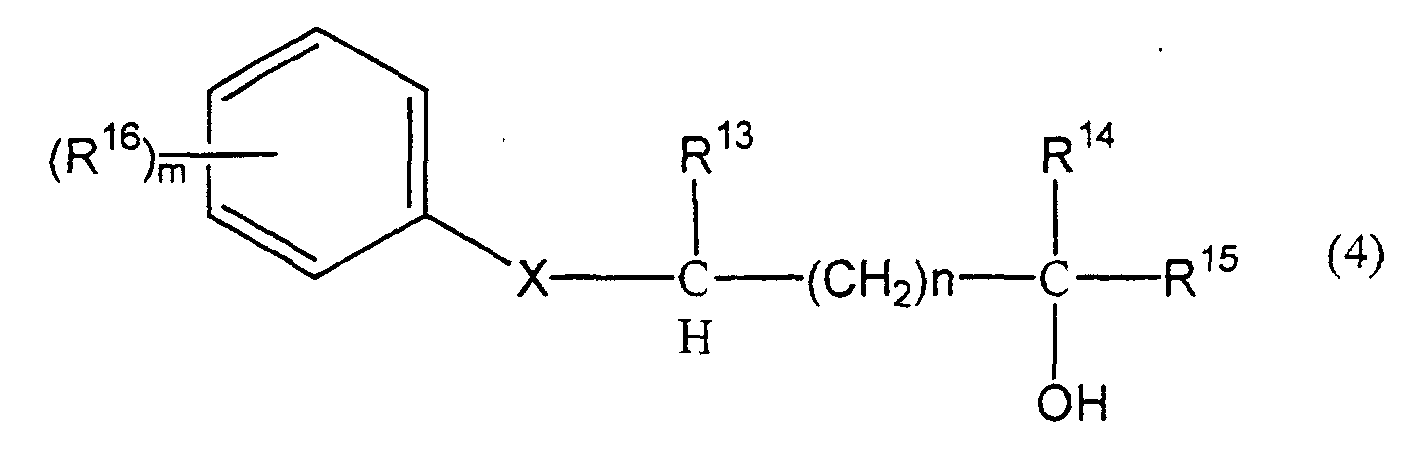
  • alcohol derivative (4) (hereinafter abbreviated as alcohol derivative (4)) wherein R 13 , R 14 , R 15 , R 16 , X, m and n are as defined above.
  • the above alcohol derivative may include alcohol derivatives of the following formula (4a): (hereinafter abbreviated as alcohol derivative (4a)) wherein R 13 , R 14 , R 15 , R a , R b , X, Y, n, p and q are as defined above.
  • the alcohol derivatives (4) and (4a) thus obtained may include:
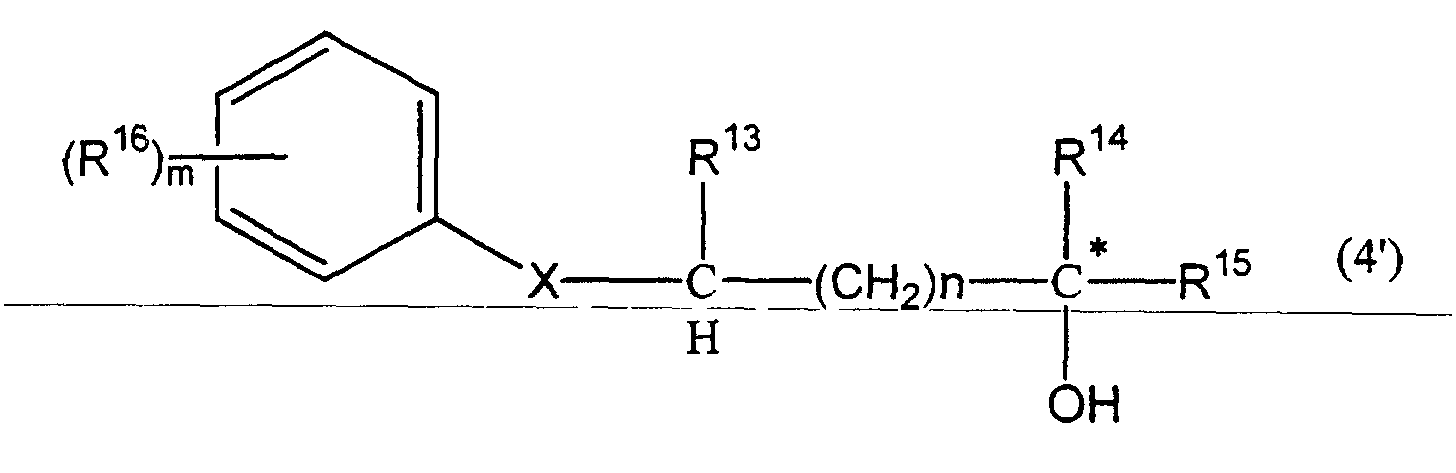
  • optically active alcohol derivative (4') (hereinafter abbreviated as optically active alcohol derivative (4')) wherein R 13 , R 14 , R 15 , R 16 , X, m and n are as defined above and * indicates an asymmetric carbon atom.
  • the above alcohol derivative may include alcohol derivatives of the following formula (4'a): (hereinafter abbreviated as alcohol derivative (4'a)) wherein R 13 , R 14 , R 15 , R a , R b , X, Y, n, p and q are as defined above and * indicates an asymmetric carbon atom.
  • optically active alcohol derivatives (4') and (4'a) thus obtained may include:
  • an optically active alcohol derivative can be reacted with a halogenated nitrogen-containing heterocyclic compound in the presence of a base to give an optically active nitrogen-containing heterocyclic compound.
  • the halogenated nitrogen-containing heterocyclic compound may be any nitrogen-containing heterocyclic compound having a halogen atom which can be reacted with the hydroxyl group of the above alcohol derivative, and may include halogenated nitrogen-containing heterocyclic compounds of the formula (5): Z-R 17 (hereinafter abbreviated as halogenated nitrogen-containing heterocyclic compound (5)) wherein Z is halogen and R 17 is pyridyl, pyridazinyl, pyrimidinyl, pyrazinyl, triazinyl, 2-thiazolyl or dihydro-2-thiazolyl; wherein these groups may optionally have one or more than one substituent selected from the group consisting of halogen, alkyl of 1 to 4 carbon atoms, alkoxy of 1 to 4 carbon atoms, alkylthio of 1 to 4 carbon atoms, trifluoromethyl or nitro.
  • the halogen atom, the alkyl group of 1 to 4 carbon atoms and the alkoxy group of 1 to 4 carbon atoms may include the same as described above.
  • the alkylthio group of 1 to 4 carbon atoms may include methylthio, ethylthio, n-propylthio, isopropylthio, n-butylthio, isobutylthio, sec-butylthio and tert-butylthio.
  • the pyridyl group may include 2-pyridyl, 3-pyridyl and 4-pyridyl.
  • the pyridazinyl group may include 3-pyridazinyl.
  • the pyrimidinyl group may include 2-pyrimidinyl and 4-pyrimidinyl.
  • the pyrazinyl group may include 2-pyrazinyl.
  • the triazinyl group may include 1,3,5-triazin-2-yl.
  • the halogenated nitrogen-containing heterocyclic compound (5) may include:
  • the amount of halogenated nitrogen-containing heterocyclic compound used is usually 0.5 to 10 moles, preferably 0.8 to 2 moles, relative to 1 mole of alcohol derivative.
  • the base may include alkali metals such as sodium and potassium; alkyl lithium such as n-butyl lithium; alkali metal halides such as sodium hydride; alkali metal amides such as lithium amide; alkali metal hydroxides such as sodium hydroxide and potassium hydroxide; alkali metal carbonates such as sodium carbonate and potassium carbonate; and organic bases such as triethylamine.
  • alkali metals such as sodium and potassium
  • alkyl lithium such as n-butyl lithium
  • alkali metal halides such as sodium hydride
  • alkali metal amides such as lithium amide
  • alkali metal hydroxides such as sodium hydroxide and potassium hydroxide
  • alkali metal carbonates such as sodium carbonate and potassium carbonate
  • organic bases such as triethylamine.
  • the amounts for their use are usually 1 to 2 moles, relative to 1 mole of halogenated nitrogen-containing heterocyclic compound.
  • the reaction is usually carried out in the presence of an organic solvent.
  • the organic solvent may include single or mixed solvents selected from aprotic polar solvents such as N,N-dimethylformamide and dimethylsulfoxide; ether solvents such as tetrahydrofuran and dimethoxyethane; and aromatic hydrocarbon solvents such as toluene; or mixed solvents of these organic solvents and water.
  • aprotic polar solvents such as N,N-dimethylformamide and dimethylsulfoxide
  • ether solvents such as tetrahydrofuran and dimethoxyethane
  • aromatic hydrocarbon solvents such as toluene
  • phase transfer catalysts such as benzyltriethyl ammonium chloride and tetra(n-butyl) ammonium bromide may be used so that the reaction can proceed more smoothly.
  • the reaction temperature is usually in the range of -80°C to the reflux temperature of the reaction mixture, preferably in the range of 10°C to the reflux temperature of the reaction mixture.
  • the separated (optically active) nitrogen-containing heterocyclic compound may be further purified by an ordinary means of purification such as recrystallization, column chromatography and distillation.
  • the above alcohol derivative (4) is reacted with the above halogenated nitrogen-containing heterocyclic compound (5) to give a nitrogen-containing heterocyclic compound of formula (6): wherein X, R 13 , R 14 , R 15 , R 16 , R 17 , X and n are as defined above.
  • the nitrogen-containing heterocyclic compound (6) thus obtained may include:
  • optically active alcohol derivative (4') is reacted with the above halogenated nitrogen-containing heterocyclic compound (5) to give an optically active nitrogen-containing heterocyclic compound of formula (6'): (hereinafter abbreviated as optically active nitrogen-containing heterocyclic compound (6')) wherein R 11 , R 12 , R 13 , R 14 , R 15 , X, Y, n and * are as defined above.
  • optically active nitrogen-containing heterocyclic compound (6') thus obtained may include:
  • the present invention will be further illustrated by reference to the following examples; however, the present invention is not limited to these examples.
  • the yields were calculated from the results of analysis by high performance liquid chromatography.
  • the optical purity of optically active alcohol derivatives and the optical purity of optically active nitrogen-containing heterocyclic compounds were calculated from the results of analysis by high performance liquid chromatography using optically active columns (CHIRALCEL OD: available from DAICEL CHEMICAL INDUSTRIES, LTD.) and optically active columns (CHIRALCEL OJ-H: available from DAICEL CHEMICAL INDUSTRIES, LTD.), respectively.
  • Example 2 0.1 mL of a diethyl aluminum chloride/hexane solution was used in place of anhydrous aluminum chloride, and the color of the catalyst solution changed from brown to dark green by the addition of a diethyl aluminum chloride/hexane solution. Then 4-phenoxyphenol and propylene oxide were added to the dark green catalyst solution to achieve the reaction in the same manner as described in Example 2. Thus (S)-(+)-1-(4-phenoxyphenoxy)-2-propanol was obtained in 72% yield and the optical purity was 87% e.e.
  • Example 2 26 mg of tri-tert-butoxy aluminum was used in place of anhydrous aluminum chloride, and the color of the catalyst solution changed from brown to slightly greenish brown by the addition of tri-tert-butoxy aluminum. Then 4-phenoxyphenol and propylene oxide were added to the slightly greenish brown catalyst solution to achieve the reaction in the same manner as described in Example 2. Thus (S)-(+)-1-(4-phenoxyphenoxy)-2-propanol was obtained in 68% yield and the optical purity was 87% e.e.
  • Example 2 16 mg of tri-tert-ethoxy aluminum was used in place of anhydrous aluminum chloride, and the color of the catalyst solution changed from brown to slightly greenish brown by the addition of tri-tert-ethoxy aluminum. Then 4-phenoxyphenol and propylene oxide were added to the slightly greenish brown catalyst solution to achieve the reaction in the same manner as described in Example 2. Thus (S)-(+)-1-(4-phenoxyphenoxy)-2-propanol was obtained in 83% yield and the optical purity was 90% e.e.
  • Example 2 29 mg of tetraisopropoxy titanium was used in place of anhydrous aluminum chloride, and the color of the catalyst solution changed from brown to slightly greenish brown by the addition of tetraisopropoxy titanium. Then 4-phenoxyphenol and propylene oxide were added to the slightly greenish brown catalyst solution to achieve the reaction in the same manner as described in Example 2. Thus (S)-(+)-1-(4-phenoxyphenoxy)-2-propanol was obtained in 84% yield and the optical purity was 95% e.e.
  • Example 2 the amount of (R,R)-(-)-N,N'-bis(3,5-di-tert-butylsalicylidene)-1,2-cyclohexanediamino cobalt (III) 4-phenoxyphenolate used was changed to 41 mg, and 15 mg of tetraisopropoxy titanium was used in place of anhydrous aluminum chloride, and the color of the catalyst solution changed from brown to slightly greenish brown by the addition of tetraisopropoxy titanium. Then 4-phenoxyphenol and propylene oxide were added to the slightly greenish brown catalyst solution to achieve the reaction in the same manner as described in Example 2. Thus (S)-(+)-1-(4-phenoxyphenoxy)-2-propanol was obtained in 77% yield and the optical purity was 94% e.e.
  • a nitrogen-purged 50-mL Schlenk's tube was charged with 960 mg of 4-phenoxyphenol and 1 mL of tert-butyl ethyl ether, to which 13 mg of anhydrous aluminum chloride, 1 g of molecular sieves 3A and 1.47 g of propylene oxide were added, and the mixture was stirred at room temperature for 20 hours to achieve the reaction.
  • tert-butyl methyl ether was distilled out to give an oily substance.
  • the oily substance was analyzed by high performance liquid chromatography to reveal that the main component was 4-phenoxyphenol and the recovery of 4-phenoxyphenol was 93%.
  • Isomer ratio 1 [LC area value of 2-(4-phenoxyphenoxy)-1-propanol]/ [LC area value of 2-(4-phenoxyphenoxy)-1-propanol + LC area value of 1-(4- phenoxyphenoxy)-2-propanol]
  • novel (asymmetric) complex catalysts obtained by reaction of (optically active) metal complexes with Lewis acids exhibit high catalytic activity in the reaction of cyclic ether compounds with phenol derivatives; therefore, it is possible to produce (optically active) alcohol derivatives in an industrially advantageous manner by reacting cyclic ether compounds with phenol derivatives in the presence of these (asymmetric) complex catalysts, and it is possible to obtain (optically active) nitrogen-containing heterocyclic compounds in an industrially advantageous manner by reacting these resulting (optically active) alcohol derivatives with halogenated nitrogen-containing heterocyclic compounds in the presence of a base.

Landscapes

  • Chemical & Material Sciences (AREA)
  • Organic Chemistry (AREA)
  • Inorganic Chemistry (AREA)
  • Engineering & Computer Science (AREA)
  • Materials Engineering (AREA)
  • Chemical Kinetics & Catalysis (AREA)
  • Organic Low-Molecular-Weight Compounds And Preparation Thereof (AREA)
  • Catalysts (AREA)
  • Low-Molecular Organic Synthesis Reactions Using Catalysts (AREA)

Abstract

There are provided (asymmetric) complex catalysts comprising metal complexes and Lewis acids as components, the metal complex being of formula (1):
Figure 80000001
wherein R1, R2, R3, R4, R5, R6, R7 and R8 are the same or different and are independently hydrogen, halogen, alkyl or the like; one of R9 and R10 is hydrogen and the other is alkyl of 1 to 4 carbon atoms or the like; Q is a single bond or alkylene of 1 to 4 carbon atoms; M is a metal ion; and A is a balancing counter ion or ligand; processes for the production of these complex catalysts; processes for the production of (optically active) alcohol derivatives, characterized in that cyclic ether compounds are reacted with phenol derivatives in the presence of these complex catalysts; and further processes for producing (optically active) nitrogen-containing heterocyclic compounds by reacting these alcohol derivatives with halogenated nitrogen-containing heterocyclic compounds in the presence of a base.

Description

Technical Field of Invention
The present invention relates to a process for the production of alcohol derivatives and more particularly to a process for the regio- or stereo-selective production of alcohol derivatives as well as to catalysts having excellent regio- and stereo-selectivity.
Background Art
It has been known that 2-[1-methyl-2-(4-phenoxyphenoxy)ethoxy]-pyridine, which is a nitrogen-containing heterocyclic compound having juvenile hormone activity, is produced by a process in which an alcohol derivative such as 1-methyl-2-(4-phenoxyphenoxy)ethanol is reacted with a halogenated nitrogen-containing heterocyclic compound such as 2-chloropyridine in the presence of a base (JP 3034951 A). The alcohol derivative, 1-methyl-2-(4-phenoxyphenoxy)ethanol, which is an intermediate for production, has been produced by, for example, reacting propylene oxide with 4-phenoxy-phenol in the presence of a base. In this process, however, in addition to the desired 1-methyl-2-(4-phenoxyphenoxy)ethanol, there is also produced its isomer, 2-methyl-2-(4-phenoxyphenoxy)ethanol, as a by-product; therefore, it is necessary to separate and remove this isomer by a separating technique such as crystallization. For this reason, the above process cannot always be said to be a quite satisfactory process from an industrial point of view.
Further, for producing optically active nitrogen-containing heterocyclic compounds, it requires the step of treating an organic carboxylic acid ester of the above alcohol derivative with a microorganism-derived esterase to cause asymmetric hydrolysis, affording an optically active alcohol derivative. This cannot always be said to be quite satisfactory from an industrial point of view in that the number of steps for production becomes increased.
Purpose of the Invention
The primary purpose of the invention is to provide an industrially advantageous process for the production of alcohol derivatives as described above.
Summary of the Invention
According to the process of the present invention, an alcohol derivative can be obtained in a regio- and stereo-selective manner by the use of a catalyst as described below for the reaction of a cyclic ether compound, a typical example of which is propylene oxide, with a phenol derivative. In addition, by reacting the alcohol derivative obtained by this process with a halogenated nitrogen-containing heterocyclic compound, the desired nitrogen-containing heterocyclic compound can be produced in high yield.
That is, the present invention provides:
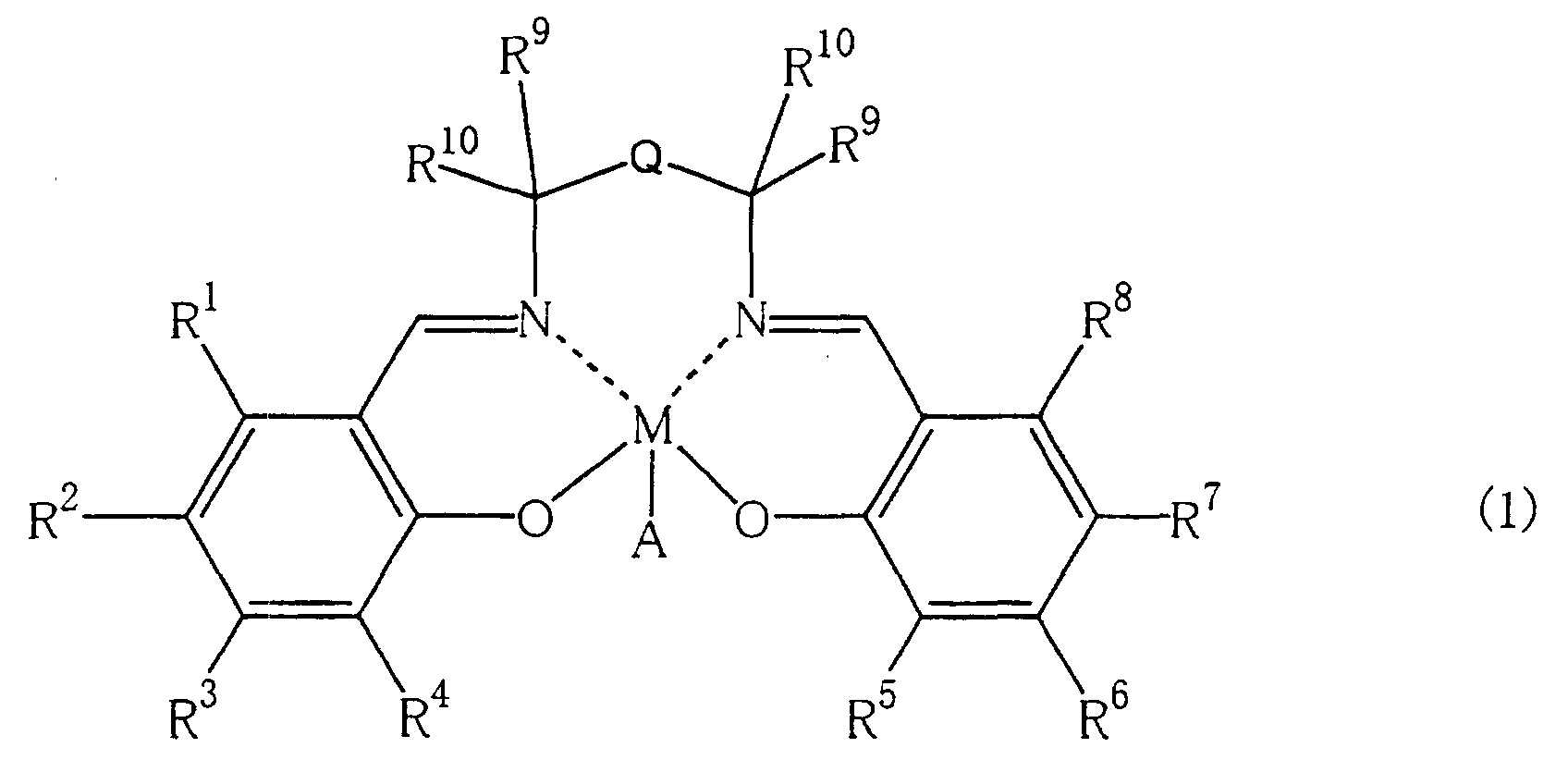
  • 1. a complex catalyst comprising a metal complex and a Lewis acid as components, the metal complex being of formula (1):
    Figure 00020001
    wherein R1, R2, R3, R4, R5, R6, R7 and R8 are the same or different and are independently hydrogen, halogen, alkyl, alkenyl, alkynyl, alkoxy, haloalkyl, haloalkoxy, hydroxyl, nitro, amino, carbamoyl, carboxyl, substituted or unsubstituted aryl, or silyl; or two adjacent groups of R1, R2, R3, R4, R5, R6, R7 and R8 are combined together to represent a naphthalene ring by forming a ring together with a benzene ring to which they are attached;
       one of R9 and R10 is hydrogen and the other is phenyl or naphthyl optionally substituted with at least one selected from the group consisting of alkyl of 1 to 4 carbon atoms, alkoxy of 1 to 4 carbon atoms, haloalkyl, haloalkoxy and halogen; or either one pair of R9 and R10 attached to the different carbon atoms are combined together at their ends to form a tetramethylene linkage and the other pair are hydrogen atoms;
       Q is a single bond or alkylene of 1 to 4 carbon atoms; or Q is combined with R9 and R10 to represent 1,1'-binaphthyl attached to the nitrogen atoms at 2 and 2' positions;
       M is a metal ion; and
       A is a balancing counter ion or ligand;
  • 2. a process for the production of the above complex catalyst;
  • 3. a process for the production of an alcohol derivative, characterized in that a cyclic ether compound is reacted with a phenol derivative in the presence of the above complex catalyst; and
  • 4. the above production process comprising the step of reacting the alcohol derivative with a halogenated nitrogen-containing heterocyclic compound in the presence of a base to give a nitrogen-containing heterocyclic compound.
  • Detailed Description of the Invention
    First, the following will describe the metal complex catalyst of formula (1).
    In the above formula (1), the halogen atom and the alkyl, alkenyl, alkynyl, alkoxy, haloalkyl, haloalkoxy, hydroxyl, nitro, amino, carbamoyl, carboxyl, aryl and silyl groups, which are represented by R1, R2, R3, R4, R5, R7 and R8, are defined below.
    The halogen atom may include fluorine, chlorine, bromine and the like.
    The alkyl group may include straight chain, branched chain or cyclic alkyl groups of 1 to 6 carbon atoms, such as methyl, ethyl, n-propyl, isopropyl, n-butyl, isobutyl, sec-butyl, tert-butyl, n-pentyl, tert-pentyl, n-hexyl, cylcopentyl and cyclohexyl.
    The alkoxy group may include straight chain, branched chain or cyclic alkoxy groups of 1 to 6 carbon atoms, such as methoxy, ethoxy, n-propoxy, isopropoxy, n-butoxy, isobutoxy, sec-butoxy, tert-butoxy, n-hexyloxy and cyclohexyloxy.
    The haloalkyl group may include those obtained by substituting the above halogen atom(s) for one or more than one hydrogen atom of the above alkyl, such as chloromethyl, chloroethyl, fluoromethyl and trifluoromethyl.
    The haloalkoxy group may include those obtained by substituting the above halogen atom(s) for one or more than one hydrogen atom of the above alkoxy, such as chloromethoxy, chloroethoxy, fluoroethoxy and trifluoromethoxy.
    The alkenyl group may include straight chain, branched chain or cyclic alkenyl groups of 2 to 6 carbon atoms, such as vinyl, propenyl, 1-butenyl, 2-butenyl, 2-methyl-1-propenyl, pentenyl, hexenyl and cyclohexenyl.
    The alkynyl group may include straight chain or branched chain alkynyl groups of 2 to 6 carbon atoms, such as ethynyl, propynyl, 1-butynyl, 2-butynyl and hexynyl.
    The substituted or unsubstituted aryl group may include aryl groups optionally substituted with methyl, nitro or methoxy, such as phenyl, toluyl, xylyl, nitrophenyl, methoxyphenyl and naphthyl.
    The silyl group may include silyl groups tri-substituted with hydrocarbon groups, and the hydrocarbon groups may include C1-4 alkyl or aryl. Specific examples thereof may include trimethylsilyl, triethylsilyl, triphenylsilyl and tert-butyldimethylsilyl.
    Two adjacent groups of R1, R2, R3, R4, R5, R6, R7 and R8 are combined together to represent a naphthalene ring together with a benzene ring to which they are attached.
    In the above formula (1), one of R9 and R10 is hydrogen and the other is phenyl or naphthyl optionally substituted with at least one selected from the group consisting of C1-4 alkyl, C1-4 alkoxy, haloalkyl where the alkyl group is halogenated, haloalkoxy where the alkoxy group is halogenated, and halogen. Alternatively, either one pair of R9 and R10 attached to the different carbon atoms are combined together to form a tetramethylene linkage. In this case, the other pair are hydrogen atoms.
    The C1-4 alkyl group may include straight chain or branched chain alkyl groups such as methyl, ethyl, n-propyl, isopropyl, n-butyl and tert-butyl.
    The C1-4 alkoxy group may include straight chain or branched chain alkoxy groups such as methoxy, ethoxy, n-propoxy, isopropoxy, n-butoxy and tert-butoxy.
    The halogen atom may include fluorine, chlorine, bromine and the like. The phenyl or naphthyl group optionally substituted with at least one selected from the group consisting of C1-4 alkyl, C1-4 alkoxy, haloalkyl, haloalkoxy and halogen may include phenyl, 1-naphthyl, 2-naphthyl, 2-methylphenyl, 3-methylphenyl, 4-methylphenyl, 2-methoxyphenyl, 3-methoxyphenyl, 4-methoxyphenyl, 2-chlorophenyl, 3-chlorophenyl, 4-chlorophenyl, 2-fluorophenyl, 3-fluorophenyl, 4-fluorophenyl, 4-bromophenyl, 2-trifluoromethylphenyl, 3-trifluoromethylphenyl and 4-trifluoromethylphenyl.
    The alkylene group of 2 to 4 carbon atoms, which is represented by Q, may include methylene, ethylene, trimethylene and tetramethylene.
    In the above formula (1), M is a metal ion and A is a balancing counter ion or ligand. For example, when the ionic valence of a metal ion is equal to the coordination number of ligands, A is not present. When the ionic valence of a metal ion is different from the coordination number, A is a counter ion or ligand.
    The metal ion may include cobalt ion, chromium ion and manganese ion. The counter ion or ligand may include halogen ions such as chloride ion, perfluoroalkoxide ions such as nonafluoro-tert-butoxide ion, acetate ligands, and phenolate ligands corresponding to phenol derivatives, which are used in the reaction of cyclic ether compounds with phenol derivatives as described below. In particular, preferred are acetate ligands and phenolate ligands corresponding to phenol derivatives, which are used in the reaction of cyclic ether compounds with phenol derivatives as described below.
    In the present specification, the halogen atom and the alkyl, alkylene, alkenyl, alkynyl and aryl groups found in the compounds of formulas (2) to (6') refer to the same as described above, unless otherwise indicated.
    The above metal complexes of formula (1) may include the following metal complexes of formula (1a), optically active metal complexes of formula (1') and optically active metal complexes of formula (1'a).
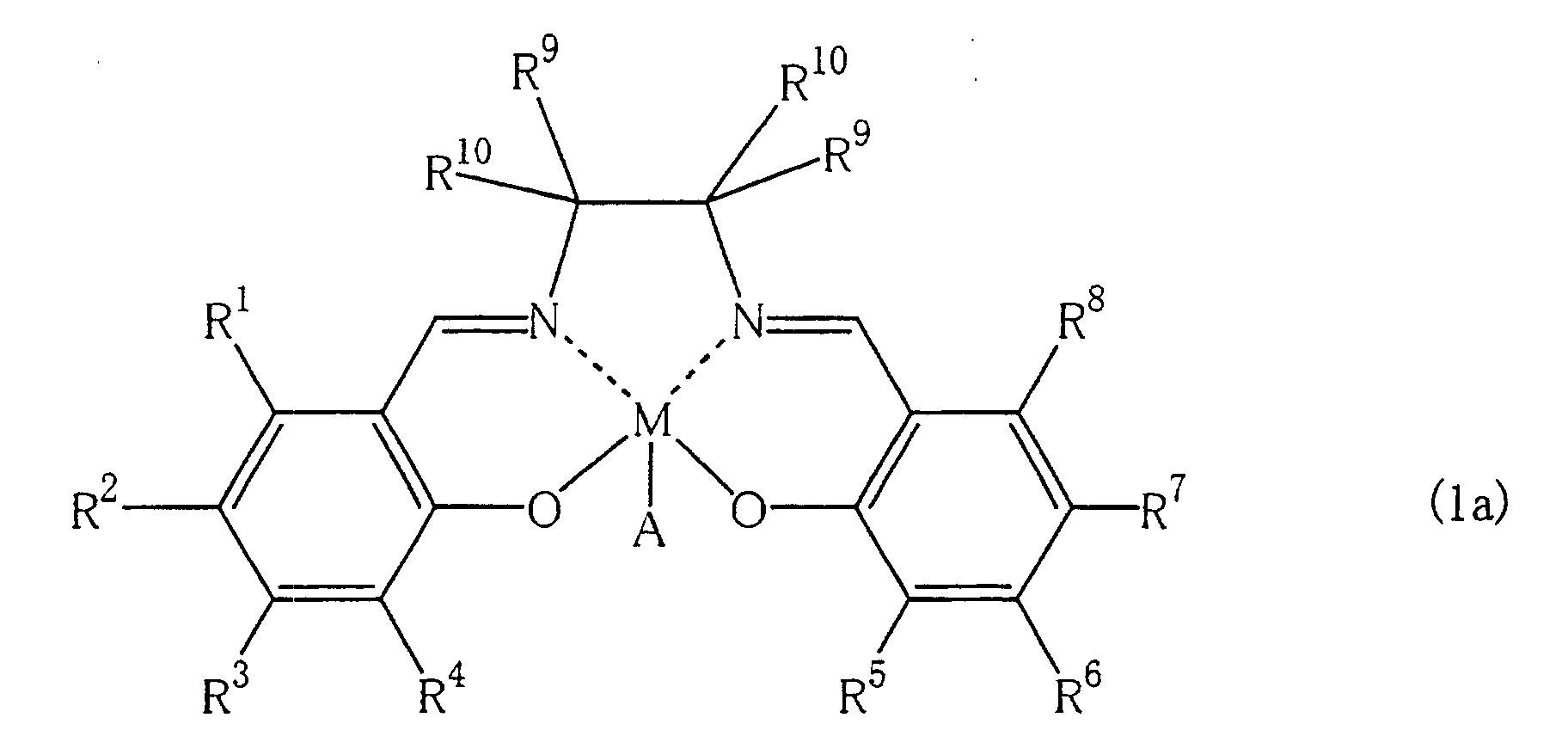
    More specifically, the metal complexes of formula (1a) corresponding to the above formula (1) wherein Q is a single bond:
    Figure 00070001
    wherein R1, R2, R3, R4, R5, R6, R7, R8, R9, R10, M and A are as defined above.
    Further, the optically active metal complexes of formula (1'):
    Figure 00070002
    wherein R1, R2, R3, R4, R5, R6, R7, R8, R9, R10, M, A and Q are as defined above.
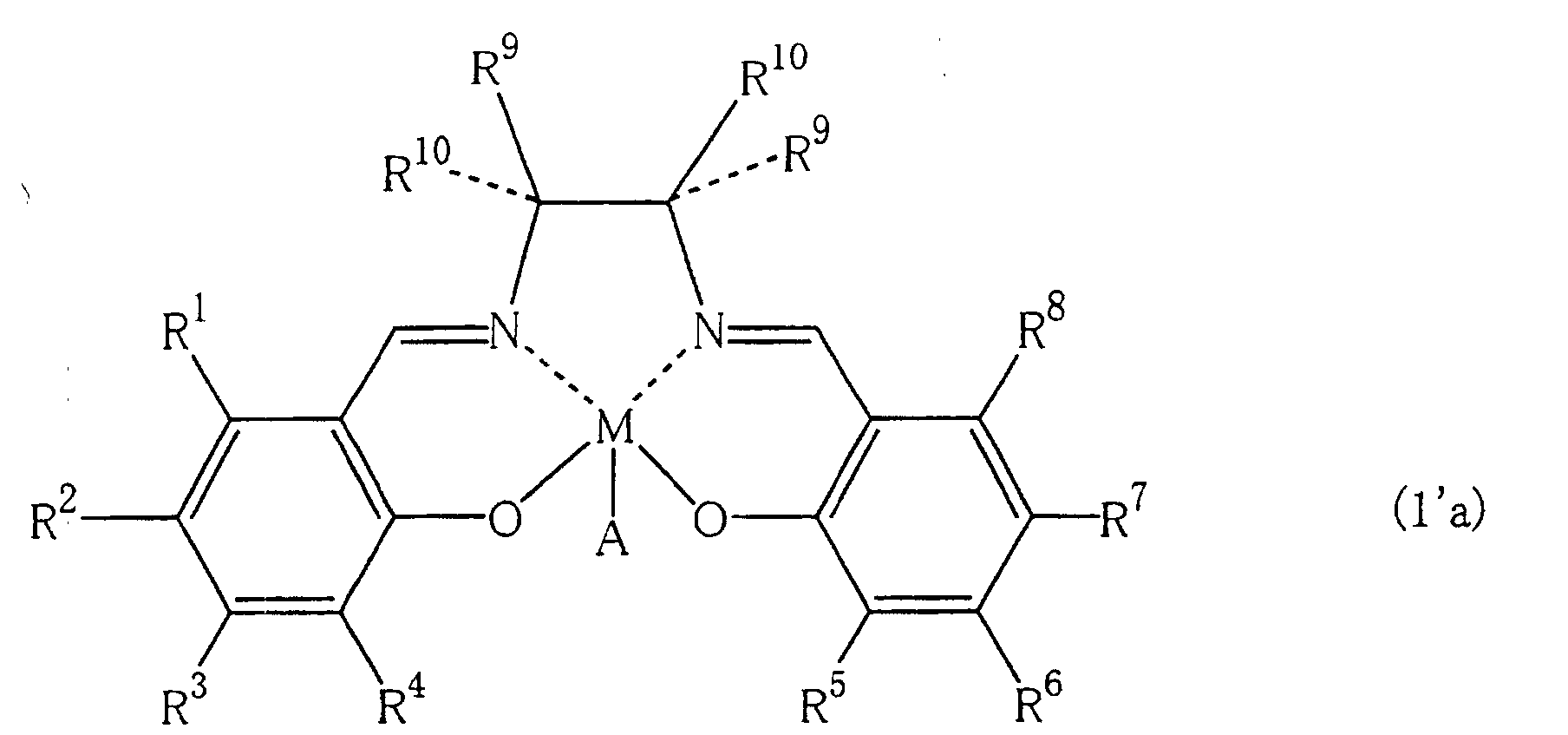
    The optically active metal complexes of the following formula (1'a) corresponding to the above formula (1') wherein Q is a single bond:
    Figure 00080001
    wherein R1, R2, R3, R4, R5, R6, R7, R8, R9, R10, M and A are as defined above.
    The metal complexes of formula (1) or (1a) may include:
  • N,N'-bis(salicylidene)-1,2-ethylenediamino cobalt (III) acetate,
  • N,N'-bis(salicylidene)-1,2-ethylenediamino cobalt (III) 4-phenoxyphenolate,
  • N,N-bis(3,5-di-tert-butylsalicylidene)-1,2-cyclohexanediamino cobalt (III) acetate,
  • N,N'-bis(3,5-di-tert-butylsalicylidene)-1,2-cyclohexanediamino cobalt (III) nonafluoro-tert-butoxide,
  • N,N'-bis(3,5-di-tert-butylsalicylidene)-1,2-cyclohexanediamino cobalt (III) hexafluoroisopropoxide,
  • N,N'-bis(3,5-di-tert-butylsalicylidene)-1,2-cyclohexanediamino cobalt (III) 4-phenoxyphenolate,
  • N,N'-bis(3,5-di-tert-pentylsalicylidene)-1,2-cyclohexanediamino cobalt (III) acetate,
  • N,N'-bis(3,5-di-tert-pentylsalicylidene)-1,2-cyclohexanediamino cobalt (III) nonafluoro-tert-butoxide,
  • N,N'-bis(3,5-di-tert-pentylsalicylidene)-1,2-cyclohexanediamino cobalt (III) hexafluoroisopropoxide,
  • N,N'-bis(3,5-di-tert-pentylsalicylidene)-1,2-cyclohexanediamino cobalt (III) 4-phenoxyphenolate,
  • N,N'-bis(salicylidene)-1,2-cyclohexanediamino cobalt (III) acetate,
  • N,N'-bis(salicylidene)-1,2-cyclohexanediamino cobalt (III) nonafluoro-tert-butoxide,
  • N,N'-bis(salicylidene)-1,2-cyclohexanediamino cobalt (III) 4-phenoxyphenolate,
  • N,N'-bis(3-tert-butyl-5-methylsalicylidene)-1,2-cyclohexanediamino cobalt (III) acetate,
  • N,N'-bis(3-tert-butyl-5-methylsalicylidene)-1,2-cyclohexanediamino cobalt (III) nonafluoro-tert-butoxide,
  • N,N'-bis(3-tert-butyl-5-methylsalicylidene)-1,2-cyclohexanediamino cobalt (III) 4-phenoxyphenolate,
  • N,N'-bis(3-tert-butyl-5-nitrosalicylidene)-1,2-cyclohexanediamino cobalt (III) acetate,
  • N,N'-bis(3-tert-butyl-5-nitrosalicylidene)-1,2-cyclohexanediamino cobalt (III) nonafluoro-tert-butoxide,
  • N,N'-bis(3-tert-butyl-5-nitrosalicylidene)-1,2-cyclohexanediamino cobalt (III) 4-phenoxyphenolate,
  • N,N'-bis(3-tert-butyl-5-methoxysalicylidene)-1,2-cyclohexanediamino cobalt (III) acetate,
  • N,N'-bis(3-tert-butyl-5-methoxysalicylidene)-1,2-cyclohexanediamino cobalt (III) nonafluoro-tert-butoxide,
  • N,N'-bis(3-tert-butyl-5-methoxysalicylidene)-1,2-cyclohexanediamino cobalt (III) 4-phenoxyphenolate,
  • N,N'-bis(3-tert-butyl-5-chlorosalicylidene)-1,2-cyclohexanediamino cobalt (III) acetate,
  • N,N'-bis(3-tert-butyl-5-chlorosalicylidene)-1,2-cyclohexanediamino cobalt (III) nonafluoro-tert-butoxide,
  • N,N'-bis(3-tert-butyl-5-chlorosalicylidene)-1,2-cyclohexanediamino cobalt (III) 4-phenoxyphenolate,
  • N,N'-bis(3-tert-butylsalicylidene)-1,2-cyclohexanediamino cobalt (III) acetate,
  • N,N'-bis(3-tert-butylsalicylidene)-1,2-cyclohexanediamino cobalt (III) nonafluoro-tert-butoxide,
  • N,N-bis(3-tert-butylsalicylidene)-1,2-cyclohexanediamino cobalt (III) 4-phenoxyphenolate,
  • N,N'-bis[(5-methyl-3-(1-methyl-1-phenylethyl)salicylidene)-1,2-cyclohexanediamino cobalt (III) acetate,
  • N,N'-bis[(5-methyl-3-(1-methyl-1-phenylethyl)salicylidene)-1,2-cyclohexanediamino cobalt (III) nonafluoro-tert-butoxide,
  • N,N'-bis[(5-methyl-3-(1-methyl-1-phenylethyl)salicylidene)-1,2-cyclohexanediamino cobalt (III) 4-phenoxyphenolate,
  • N,N'-bis(3-tert-butyl-5-triphenylmethylsalicylidene)-1,2-cyclohexanediamino cobalt (III) acetate,
  • N,N'-bis(3-tert-butyl-5-triphenylmethylsalicylidene)-1,2-cyclohexanediamino cobalt (III) nonafluoro-tert-butoxide,
  • N,N'-bis(3-tert-butyl-5-triphenylmethylsalicylidene)-1,2-cyclohexanediamino cobalt (III) 4-phenoxyphenolate,
  • N,N'-bis[5-tert-butyl-3-(1-methyl-1-phenylethyl)salicylidene]-1,2-cyclohexanediamino cobalt (III) acetate,
  • N,N'-bis[5-tert-butyl-3-(1-methyl-1-phenylethyl)salicylidene]-1,2-cyclohexanediamino cobalt (III) nonafluoro-tert-butoxide,
  • N,N'-bis[5-tert-butyl-3-(1-methyl-1-phenylethyl)salicylidene]-1,2-cyclohexanediamino cobalt (III) 4-phenoxyphenolate,
  • N,N'-bis(3,5-di-tert-butylsalicylidene)-1,2-diphenylethylenediamino cobalt (III) acetate,
  • N,N'-bis(3,5-di-tert-butylsalicylidene)-1,2-diphenylethylenediamino cobalt (III) nonafluoro-tert-butoxide,
  • N,N'-bis(3,5-di-tert-butylsalicylidene)-1,2-diphenylethylenediamino cobalt (III) hexafluoroisopropoxide,
  • N,N'-bis(3,5-di-tert-butylsalicylidene)-1,2-diphenylethylenediamino cobalt (III) 4-phenoxyphenolate,
  • N,N'-bis(3,5-di-tert-pentylsalicylidene)-1,2-diphenylethylenediamino cobalt (III) acetate,
  • N,N'-bis(3,5-di-tert-pentylsalicylidene)-1,2-diphenylethylenediamino cobalt (III) 4-phenoxyphenolate,
  • N,N'-bis(3,5-di-tert-butylsalicylidene)-1,1'-binaphthalene-2,2'-diamino cobalt (III) acetate,
  • N,N'-bis(3,5-di-tert-butylsalicylidene)-1,1'-binaphthalene-2,2'-diamino cobalt (III) 4-phenoxyphenolate,
  • N,N'-bis(3,5-di-tert-butylsalicylidene)-1,2-cyclohexanediamino chromium (III) acetate,
  • N,N'-bis(3,5-di-tert-butylsalicylidene)-1,2-cyclohexanediamino chromium (III) nonafluoro-tert-butoxide,
  • N,N'-bis(3,5-di-tert-butylsalicylidene)-1,2-cyclohexanediamino chromium (III) 4-phenoxyphenolate,
  • N,N'-bis(salicylidene)-1,2-cyclohexanediamino chromium(III) acetate,
  • N,N'-bis(salicylidene)-1,2-cyclohexanediamino chromium (III) nonafluoro-tert-butoxide,
  • N,N'-bis(salicylidene)-1,2-cyclohexanediamino chromium (III) 4-phenoxyphenolate,
  • N,N'-bis(3-tert-butyl-5-methylsalicylidene)-1,2-cyclohexanediamino chromium (III) acetate,
  • N,N'-bis(3-tert-butyl-5-methylsalicylidene)-1,2-cyclohexanediamino chromium (III) 4-phenoxyphenolate,
  • N,N'-bis(3-tert-butyl-5-nitrosalicylidene)-1,2-cyclohexanediamino chromium (III) acetate,
  • N,N'-bis(3-tert-butyl-5-nitrosalicylidene)-1,2-cyclohexanediamino chromium (III) 4-phenoxyphenolate,
  • N,N'-bis(3-tert-butyl-5-methoxysalicylidene)-1,2-cyclohexanediamino chromium (III) acetate,
  • N,N'-bis(3-tert-butyl-5-methoxysalicylidene)-1,2-cyclohexanediamino chromium (III) 4-phenoxyphenolate,
  • N,N'-bis(3-tert-butyl-5-chlorosalicylidene)-1,2-cyclohexanediamino chromium (III) acetate,
  • N,N'-bis(3-tert-butyl-5-chlorosalicylidene)-1,2-cyclohexanediamino chromium (III) 4-phenoxyphenolate,
  • N,N'-bis(3-tert-butylsalicylidene)-1,2-cyclohexanediamino chromium (III) acetate,
  • N,N'-bis(3-tert-butylsalicylidene)-1,2-cyclohexanediamino chromium (III) 4-phenoxyphenolate,
  • N,N'-bis(3,5-di-tert-butylsalicylidene)-1,2-diphenylethylenediamino-chromium (III) acetate,
  • N,N'-bis(3,5-di-tert-butylsalicylidene)-1,2-diphenylethylenediamino chromium (III) nonafluoro-tert-butoxide,
  • N,N'-bis(3,5-di-tert-butylsalicylidene)-1,2-diphenylethylenediamino chromium (III) 4-phenoxyphenolate,
  • N,N'-bis(3,5-di-tert-butylsalicylidene)-1,1'-binaphthalene-2,2'-diamino chromium (III) acetate,
  • N,N'-bis(3,5-di-tert-butylsalicylidene)-1,1'-binaphthalene-2,2'-diamino chromium (III) 4-phenoxyphenolate,
  • N,N'-bis(3,5-di-tert-butylsalicylidene)-1,2-cyclohexanediamino manganese (III) acetate,
  • N,N-bis(3,5-di-tert-butylsalicylidene)-1,2-cyclohexanediamino manganese (III) nonafluoro-tert-butoxide,
  • N,N'-bis(3,5-di-tert-butylsalicylidene)-1,2-cyclohexanediamino manganese (III) 4-phenoxyphenolate,
  • N,N-bis(salicylidene)-1,2-cyclohexanediamino manganese (III) acetate,
  • N,N'-bis(salicylidene)-1,2-cyclohexanediamino manganese (III) 4-phenoxyphenolate,
  • N,N'-bis(3-tert-butyl-5-methylsalicylidene)-1,2-cyclohexanediamino manganese (III) acetate,
  • N,N'-bis(3-tert-butyl-5-methylsalicylidene)-1,2-cyclohexanediamino manganese (III) nonafluoro-tert-butoxide,
  • N,N'-bis(3-tert-butyl-5-nitrosalicylidene)-1,2-cyclohexanediamino manganese (III) acetate,
  • N,N'-bis(3-tert-butyl-5-nitrosalicylidene)-1,2-cyclohexanediamino manganese (III) 4-phenoxyphenolate,
  • N,N'-bis(3-tert-butyl-5-methoxysalicylidene)-1,2-cyclohexanediamino manganese (III) acetate,
  • N,N'-bis(3-tert-butyl-5-methoxysalicylidene)-1,2-cyclohexanediamino manganese (III) 4-phenoxyphenolate,
  • N,N'-bis(3-tert-butyl-5-chlorosalicylidene)-1,2-cyclohexanediamino manganese (III) acetate,
  • N,N'-bis(3-tert-butyl-5-chlorosalicylidene)-1,2-cyclohexanediamino manganese (III) 4-phenoxyphenolate,
  • N,N'-bis(3-tert-butylsalicylidene)-1,2-cyclohexanediamino manganese (III) acetate,
  • N,N'-bis(3-tert-butylsalicylidene)-1,2-cyclohexanediamino manganese (III) 4-phenoxyphenolate,
  • N,N'-bis[5-methyl-3-(1-methyl-1-phenylethyl)salicylidene]-1,2-cyclohexanediamino manganese (III) acetate,
  • N,N'-bis[5-methyl-3-(1-methyl-1-phenylethyl)salicylidene]-1,2-cyclohexanediamino manganese (III) 4-phenoxyphenolate,
  • N,N'-bis(3-tert-butyl-5-triphenylmethylsalicylidene)-1,2-cyclohexanediamino manganese (III) acetate,
  • N,N'-bis(3-tert-butyl-5-triphenylmethylsalicylidene)-1,2-cyclohexanediamino manganese (III) 4-phenoxyphenolate,
  • N,N'-bis[5-tert-butyl-3-(1-methyl-1-phenylethyl)salicylidene]-1,2-cyclohexanediamino manganese (III) acetate,
  • N,N'-bis[5-tert-butyl-3-(1-methyl-1-phenylethyl)salicylidene]-1,2-cyclohexanediamino manganese (III) 4-phenoxyphenolate,
  • N,N'-bis(3,5-di-tert-butylsalicylidene)-1,2-diphenylethylenediamino manganese (III) acetate,
  • N,N'-bis(3,5-di-tert-butylsalicylidene)-1,2-diphenylethylenediamino manganese (III) nonafluoro-tert-butoxide,
  • N,N'-bis(3,5-di-tert-butylsalicylidene)-1,2-diphenylethylenediamino manganese (III) 4-phenoxyphenolate,
  • N,N'-bis(3,5-di-tert-butylsalicylidene)-1,1'-binaphthalene-2,2'-diamino manganese (III) acetate, and
  • N,N'-bis(3,5-di-tert-butylsalicylidene)-1,1'-binaphthalene-2,2'-diamino manganese (III) 4-phenoxyphenolate.
  • The optically active metal complexes of formula (1') or (1'a) may include:
  • (R,R)-(-)-N,N'-bis(3,5-di-tert-butylsalicylidene)-1,2-cyclohexanediamino cobalt (III) acetate,
  • (R,R)-(-)-N,N'-bis(3,5-di-tert-butylsalicylidene)-1,2-cyclohexanediamino cobalt (III) nonafluoro-tert-butoxide,
  • (R,R)-(-)-N,N'-bis(3,5-di-tert-butylsalicylidene)-1,2-cyclohexanediamino cobalt (III) hexafluoroisopropoxide,
  • (R,R)-(-)-N,N'-bis(3,5-di-tert-butylsalicylidene)-1,2-cyclohexanediamino cobalt (III) 4-phenoxyphenolate,
  • (R,R)-(-)-N,N'-bis(salicylidene)-1,2-cyclohexanediamino cobalt (III) acetate,
  • (R,R)-(-)-N,N'-bis(salicylidene)-1,2-cyclohexanediamino cobalt (III) nonafluoro-tert-butoxide,
  • (R,R)-(-)-N,N'-bis(salicylidene)-1,2-cyclohexanediamino cobalt (III) 4-phenoxyphenolate,
  • (R,R)-(-)-N,N'-bis(3-tert-butyl-5-methylsalicylidene)-1,2-cyclohexanediamino cobalt (III) acetate
  • (R,R)-(-)-N,N'-bis(3-tert-butyl-5-methylsalicylidene)-1,2-cyclohexanediamino cobalt (III) nonafluoro-tert-butoxide,
  • (R,R)-(-)-N,N'-bis(3-tert-butyl-5-methylsalicylidene)-1,2-cyclohexanediamino cobalt (III) 4-phenoxyphenolate,
  • (R,R)-(-)-N,N'-bis(3-tert-butyl-5-nitrosalicylidene)-1,2-cyclohexanediamino cobalt (III) acetate,
  • (R,R)-(-)-N,N'-bis(3-tert-butyl-5-nitrosalicylidene)-1,2-cyclohexanediamino cobalt (III) nonafluoro-tert-butoxide,
  • (R,R)-(-)-N,N'-bis(3-tert-butyl-5-nitrosalicylidene)-1,2-cyclohexanediamino cobalt (III) 4-phenoxyphenolate,
  • (R,R)-(-)-N,N'-bis(3-tert-butyl-5-methoxysalicylidene)-1,2-cyclohexanediamino cobalt (III) acetate,
  • (R,R)-(-)-N,N'-bis(3-tert-butyl-5-methoxysalicylidene)-1,2-cyclohexanediamino cobalt (III) nonafluoro-tert-butoxide,
  • (R,R)-(-)-N,N'-bis(3-tert-butyl-5-methoxysalicylidene)-1,2-cyclohexanediamino cobalt (III) 4-phenoxyphenolate,
  • (R,R)-(-)-N,N'-bis(3-tert-butyl-5-chlorosalicylidene)-1,2-cyclohexanediamino cobalt (III) acetate,
  • (R,R)-(-)-N,N'-bis(3-tert-butyl-5-chlorosalicylidene)-1,2-cyclohexanediamino cobalt (III) nonafluoro-tert-butoxide,
  • (R,R)-(-)-N,N'-bis(3-tert-butyl-5-chlorosalicylidene)-1,2-cyclohexanediamino cobalt (III) 4-phenoxyphenolate,
  • (R,R)-(-)-N,N'-bis(3-tert-butylsalicylidene)-1,2-cyclohexanediamino cobalt (III) acetate,
  • (R,R)-(-)-N,N'-bis(3-tert-butylsalicylidene)-1,2-cyclohexanediamino cobalt (III) nonafluoro-tert-butoxide,
  • (R,R)-(-)-N,N'-bis(3-tert-butylsalicylidene)-1,2-cyclohexanediamino cobalt (III) 4-phenoxyphenolate,
  • (R,R)-(-)-N,N'-bis[(5-methyl-3-(1-methyl-1-phenyiethyl)salicylidene)-1,2-cyclohexanediamino cobalt (III) acetate,
  • (R,R)-(-)-N,N'-bis[(5-methyl-3-(1-methyl-1-phenylethyl)salicylidene)-1,2-cyclohexanediamino cobalt (III) nonafluoro-tert-butoxide,
  • (R,R)-(-)-N,N'-bis[(5-methyl-3-(1-methyl-1-phenylethyl)salicylidene)-1,2-cyclohexanediamino cobalt (III) 4-phenoxyphenolate,
  • (R,R)-(-)-N,N'-bis(3-tert-butyl-5-triphenylmethylsalicylidene)-1,2-cyclohexanediamino cobalt (III) acetate,
  • (R,R)-(-)-N,N'-bis(3-tert-butyl-5-triphenylmethylsalicylidene)-1,2-cyclohexanediamino cobalt (III) nonafluoro-tert-butoxide,
  • (R,R)-(-)-N,N'-bis(3-tert-butyl-5-triphenylmethylsalicylidene)-1,2-cyclohexanediamino cobalt (III) 4-phenoxyphenolate,
  • (R,R)-(-)-N,N'-bis[5-tert-butyl-3-(1-methyl-1-phenylethyl)salicylidene]-1,2-cyclohexanediamino cobalt (III) acetate,
  • (R,R)-(-)-N,N'-bis[5-tert-butyl-3-(1-methyl-1-phenylethyl)salicylidene]-1,2-cyclohexanediamino cobalt (III) nonafluoro-tert-butoxide,
  • (R,R)-(-)-N,N'-bis[5-tert-butyl-3-(1-methyl-1-phenylethyl)salicylidene]-1,2-cyclohexanediamino cobalt (III) 4-phenoxyphenolate,
  • (R,R)-(-)-N,N'-bis(3,5-di-tert-butylsalicylidene)-1,2-diphenylethylenediamino cobalt (III) acetate,
  • (R,R)-(-)-N,N'-bis(3,5-di-tert-butylsalicylidene)-1,2-diphenylethylenediamino cobalt (III) nonafluoro-tert-butoxide,
  • (R,R)-(-)-N,N'-bis(3,5-di-tert-butylsalicylidene)-1,2-diphenylethylenediamino cobalt (III) hexafluoroisopropoxide,
  • (R,R)-(-)-N,N'-bis(3,5-di-tert-butylsalicylidene)-1,2-diphenylethylenediamino cobalt (III) 4-phenoxyphenolate,
  • (R)-(+)-N,N'-bis(3,5-di-tert-butylsalicylidene)-1,1'-binaphthalene-2,2'-diamino cobalt (III) acetate,
  • (R)-(+)-N,N'-bis(3,5-di-tert-butylsalicylidene)-1,1'-binaphthalene-2,2'-diamino cobalt (III) 4-phenoxyphenolate,
  • (R,R)-(-)-N,N'-bis(3,5-di-tert-butylsalicylidene)-1,2-cyclohexanediamino chromium (III) acetate,
  • (R,R)-(-)-N,N'-bis(3,5-di-tert-butylsalicylidene)-1,2-cyclohexanediamino chromium (III) nonafluoro-tert-butoxide,
  • (R,R)-(-)-N,N'-bis(3,5-di-tert-butylsalicylidene)-1,2-cyclohexanediamino chromium (III) 4-phenoxyphenolate,
  • (R,R)-(-)-N,N'-bis(salicylidene)-1,2-cyclohexanediamino chromium (III) acetate,
  • (R,R)-(-)-N,N'-bis(salicylidene)-1,2-cyclohexanediamino chromium (III) nonafluoro-tert-butoxide,
  • (R,R)-(-)-N,N'-bis(salicylidene)-1,2-cyclohexanediamino chromium (III) 4-phenoxyphenolate,
  • (R,R)-(-)-N,N'-bis(3-tert-butyl-5-methylsalicylidene)-1,2-cyclohexanediamino chromium (III) acetate,
  • (R,R)-(-)-N,N'-bis(3-tert-butyl-5-methylsalicylidene)-1,2-cyclohexanediamino chromium (III) 4-phenoxyphenolate,
  • (R,R)-(-)-N,N'-bis(3-tert-butyl-5-nitrosalicylidene)-1,2-cyclohexanediamino chromium (III) acetate,
  • (R,R)-(-)-N,N'-bis(3-tert-butyl-5-nitrosalicylidene)-1,2-cyclohexanediamino chromium (III) 4-phenoxyphenolate,
  • (R,R)-(-)-N,N'-bis(3-tert-butyl-5-methoxysalicylidene)-1,2-cyclohexanediamino chromium (III) acetate,
  • (R,R)-(-)-N,N'-bis(3-tert-butyl-5-methoxysalicylidene)-1,2-cyclohexanediamino chromium (III) 4-phenoxyphenolate,
  • (R,R)-(-)-N,N'-bis(3-tert-butyl-5-chlorosalicylidene)-1,2-cyclohexanediamino chromium (III) acetate,
  • (R,R)-(-)-N,N'-bis(3-tert-butyl-5-chlorosalicylidene)-1,2-cyclohexanediamino chromium (III) 4-phenoxyphenolate,
  • (R,R)-(-)-N,N'-bis(3-tert-butylsalicylidene)-1,2-cyclohexanediamino chromium (III) acetate,
  • (R,R)-(-)-N,N'-bis(3-tert-butylsalicylidene)-1,2-cyclohexanediamino chromium (III) 4-phenoxyphenolate,
  • (R,R)-(-)-N,N'-bis(3,5-di-tert-butylsalicylidene)-1,2-diphenylethylenediamino chromium (III) acetate,
  • (R,R)-(-)-N,N'-bis(3,5-di-tert-butylsalicylidene)-1,2-diphenylethylenediamino chromium (III) nonafluoro-tert-butoxide,
  • (R,R)-(-)-N,N'-bis(3,5-di-tert-butylsalicylidene)-1,2-diphenylethylenediamino chromium (III) 4-phenoxyphenolate,
  • (R)-(+)-N,N'-bis(3,5-di-tert-butylsalicylidene)-1,1'-binaphthalene-2,2'-diamino chromium (III) acetate,
  • (R)-(+)-N,N'-bis(3,5-di-tert-butylsalicylidene)-1,1'-binaphthalene-2,2'-diamino chromium (III) 4-phenoxyphenolate,
  • (R,R)-(-)-N,N'-bis(3,5-di-tert-butylsalicylidene)-1,2-cyclohexanediamino manganese (III) acetate,
  • (R,R)-(-)-N,N'-bis(3,5-di-tert-butylsalicylidene)-1,2-cyclohexanediamino manganese (III) nonafluoro-tert-butoxide,
  • (R,R)-(-)-N,N'-bis(3,5-di-tert-butylsalicylidene)-1,2-cyclohexanediamino manganese (III) 4-phenoxyphenolate,
  • (R,R)-(-)-N,N'-bis(salicylidene)-1,2-cyclohexanediamino manganese (III) acetate,
  • (R,R)-(-)-N,N'-bis(salicylidene)-1,2-cyclohexanediamino manganese (III) 4-phenoxyphenolate,
  • (R,R)-(-)-N,N'-bis(3-tert-butyl-5-methylsalicylidene)-1,2-cyclohexanediamino manganese (III) acetate,
  • (R,R)-(-)-N,N'-bis(3-tert-butyl-5-methylsalicylidene)-1,2-cyclohexanediamino manganese (III) nonafluoro-tert-butoxide,
  • (R,R)-(-)-N,N'-bis(3-tert-butyl-5-nitrosalicylidene)-1,2-cyclohexanediamino manganese (III) acetate,
  • (R,R)-(-)-N,N'-bis(3-tert-butyl-5-nitrosalicylidene)-1,2-cyclohexanediamino manganese (III) 4-phenoxyphenolate,
  • (R,R)-(-)-N,N'-bis(3-tert-butyl-5-methoxysalicylidene)-1,2-cyclohexanediamino manganese (III) acetate,
  • (R,R)-(-)-N,N'-bis(3-tert-butyl-5-methoxysalicylidene)-1,2-cyclohexanediamino manganese (III) 4-phenoxyphenolate,
  • (R,R)-(-)-N,N'-bis(3-tert-butyl-5-chlorosalicylidene)-1,2-cyclohexanediamino manganese (III) acetate,
  • (R,R)-(-)-N,N'-bis(3-tert-butyl-5-chlorosalicylidene)-1,2-cyclohexanediamino manganese (III) 4-phenoxyphenolate,
  • (R,R)-(-)-N,N'-bis(3-tert-butylsalicylidene)-1,2-cyclohexanediamino manganese (III) acetate,
  • (R,R)-(-)-N,N'-bis(3-tert-butylsalicylidene)-1,2-cyclohexanediamino manganese (III) 4-phenoxyphenolate,
  • (R,R)-(-)-N,N'-bis[5-methyl-3-(1-methyl-1-phenylethyl)salicylidene]-1,2-cyclohexanediamino manganese (III) acetate,
  • (R,R)-(-)-N,N'-bis[5-methyl-3-(1-methyl-1-phenylethyl)salicylidene]-1,2-cyclohexanediamino manganese (III) 4-phenoxyphenolate,
  • (R,R)-(-)-N,N'-bis(3-tert-butyl-5-triphenylmethylsalicylidene)-1,2-cyclohexanediamino manganese (III) acetate,
  • (R,R)-(-)-N,N'-bis(3-tert-butyl-5-triphenylmethylsalicylidene)-1,2-cyclohexanediamino manganese (III) 4-phenoxyphenolate,
  • (R,R)-(-)-N,N'-bis[5-tert-butyl-3-(1-methyl-1-phenylethyl)salicylidene]-1,2-cyclohexanediamino manganese (III) acetate,
  • (R,R)-(-)-N,N'-bis[5-tert-butyl-3-(1-methyl-1-phenylethyl)salicylidene]-1,2-cyclohexanediamino manganese (III) 4-phenoxyphenolate,
  • (R,R)-(-)-N,N'-bis(3,5-di-tert-butylsalicylidene)-1,2-diphenylethylenediamino manganese (III) acetate,
  • (R,R)-(-)-N,N'-bis(3,5-di-tert-butylsalicylidene)-1,2-diphenylethylenediamino manganese (III) nonafluoro-tert-butoxide,
  • (R,R)-(-)-N,N'-bis(3,5-di-tert-butylsalicylidene)-1,2-diphenylethylenediamino manganese (III) 4-phenoxyphenolate,
  • (R)-(+)-N,N'-bis(3,5-di-tert-butylsalicylidene)-1,1'-binaphthalene-2,2'-diamino manganese (III) acetate,
  • (R)-(+)-N,N'-bis(3,5-di-tert-butylsalicylidene)-1,1'-binaphthalene-2,2'-diamino manganese (III) 4-phenoxyphenolate, and
  •    similar optically active metal complexes in which the above configuration (R,R)-(-) or (R)-(+) is changed to (S,S)-(+) or (S)-(-), respectively.
    The Lewis acid may include aluminum halides, dialkyl aluminum halides, trialkoxy aluminum, titanium halides, tetraalkoxy titanium, boron halides and zinc halides.
    The aluminum halides may include aluminum chloride and aluminum bromide. The dialkyl aluminum halides may include diethyl aluminum chloride, diethyl aluminum bromide and diisopropyl aluminum chloride. The trialkoxy aluminum may include triethoxy aluminum, triisopropoxy aluminum and tri-tert-butoxy aluminum. The titanium halides may include titanium tetrachloride. The tetraalkoxy titanium may include tetraisopropoxy titanium. The boron halides may include boron trifluoride, boron trichloride and boron tribromide. The zinc halides may include zinc chloride and zinc bromide.
    The Lewis acid may be used as such or as a solution in an organic solvent. The Lewis acid, which is unstable to, for example, air or water and which requires careful handling, may preferably be used as a solution in an organic solvent. The organic solvent is not particularly limited, so long as it is inert to the Lewis acid, and may include aliphatic hydrocarbon solvents such as hexane and heptane; and ether solvents such as diethyl ether and tert-butyl methyl ether. Further, complex compounds of Lewis acids such as boron trifluoride-diethyl ether complex compounds may also be used.
    The amount of Lewis acid used is not particularly limited, but is usually 0.2 to 5 moles, preferably 0.5 to 2 moles, relative to 1 mole of metal complex (1).
    The metal complex catalyst of the present invention can be produced by reacting metal complex (1) with a Lewis acid, and the reaction is usually carried out in an organic solvent by contacting and mixing both of them. When both of them are contacted and mixed, the reaction will occur to form a novel complex. The production of a novel (asymmetric) complex is achieved by, for example, mixing both of them in an organic solvent, which causes the change of color in the reaction mixture, thereby making it possible to verify that the metal complex is being reacted with the Lewis acid to form a novel (asymmetric) complex. For example, when (-)-N,N'-bis(3,5-di-tert-butylsalicylidene)-1,2-cyclohexanediamino cobalt (III) 4-phenoxyphenolate is mixed with aluminum chloride in tert-butyl methyl ether, the color of the mixture changes from brown to dark green.
    The reaction temperature in the reaction of metal complex (1) with a Lewis acid is usually -50 to 50°C, preferably -25 to 40°C.
    The organic solvent may include ether solvents such as diethyl ether and tert-butyl methyl ether; aromatic hydrocarbon solvents such as toluene; halogenated hydrocarbon solvents such as chlorobenzene and chloroform; and aliphatic hydrocarbon solvents such as hexane. The amounts for their use are not particularly limited.
    If, for example, water is present in the reaction system, Lewis acids are easily decomposed; therefore, the reagents, solvents to be used and the like may preferably be subjected to dehydration in advance or dehydrating agents such as molecular sieves may preferably be allowed to coexist in the reaction system.
    When metal complex (1) is reacted with a Lewis acid in an organic solvent, the solution containing a novel complex catalyst produced may be used as such in the reaction of cyclic ether compound (2) with phenol derivative (3), or the novel complex catalyst may be separated before use by, for example, concentration of the above solution.
    In this step, the use of a metal complex of formula (1') or (1'a) makes it possible to obtain an asymmetric complex catalyst. The reaction of cyclic ether compound (2) with phenol derivative (3) in the presence of this catalyst makes it possible to the desired optically active alcohol derivative by the reaction exhibiting excellent regio- and stereo-selectivity.
    Next, the following will describe the step of reacting a cyclic ether compound with a phenol derivative in the presence of the complex catalyst obtained above to give an alcohol derivative.
    The cyclic ether compound may be any reactive cyclic ether compound which causes ring-opening reaction by the reaction with a phenol derivative, and may include cyclic ether compounds of the following formula (2):
    Figure 00230001
    (hereinafter abbreviated as cyclic ether compound (2))
    wherein R13 is hydrogen; R14 is hydrogen or alkyl; or R13 and R14 are combined together to represent alkylene of 2 to 6 carbon toms; R15 is alkyl, aryl or aralkyl; wherein the alkyl, aryl or aralkyl group may have a substituent(s); and n is 0 or 1.
    When the cyclic ether compound has an asymmetric carbon atom(s) in the molecule, it may be an optically active form or a mixture of the optically active forms.
    The alkyl group represented by R14 may include alkyl groups of 1 to 4 carbon atoms such as methyl, ethyl, n-propyl, isopropyl, n-butyl and isobutyl. The alkylene group of 2 to 6 carbon atoms formed by combining R13 and R14 together may include ethylene, propylene, butylene, pentylene and hexylene.
    Further, R15 represents alkyl, aryl or aralkyl. The alkyl group may include the same as described for R14. The aryl group may include phenyl and naphthyl. The aralkyl group may include those composed of such alkyl and aryl groups, and may include benzyl and phenylethyl. These alkyl, aryl and aralkyl groups may have a substituent(s), and the substituent(s) which may include halogen as described above, such as chlorine and fluorine, hydroxyl and alkoxy such as methoxy and ethoxy.
    Specific examples of cyclic ether compound (2) may include propylene oxide, 1,2-epoxybutane, 1,2-epoxyhexane, 1,3-epoxyhexane, 1,2-epoxy-4-methylpentane, 1,2-epoxy-3-phenylpropane, styrene oxide, 1-chloro-2,3-epoxypropane, 1-bromo-2,3-epoxypropane, 2,3-epoxy-1-propanol, cyclohexene oxide, cyclopentene oxide and 1,2-epoxycyclooctane.
    The preferred cyclic ether compound may include propylene oxide and 1,2-epoxybutane.
    The phenol derivative may be any phenol having a phenolic hydroxyl group or any thiophenol derivative obtained by replacing the oxygen atom in the hydroxyl group of the phenol derivative by a sulfur atom, which may include phenol derivatives of formula (3):
    Figure 00240001
    (hereinafter abbreviated as phenol derivative (3))
    wherein X is oxygen or sulfur; R16's are the same or different and are independently hydrogen, halogen, nitro, alkyl of 1 to 6 carbon atoms, alkoxy of 1 to 6 carbon atoms, phenylthio, benzyl or phenoxy; and m is an integer of 0 to 5; wherein the alkyl group of 1 to 6 carbon atoms, the alkoxy group of 1 to 6 carbon atoms, the phenylthio, benzyl or phenoxy group may optionally be substituted with alkyl of 1 to 4 carbon atoms, alkoxy of 1 to 4 carbon atoms, haloalkyl of 1 to 4 carbon atoms, haloalkoxy of 1 to 4 carbon atoms or halogen.
    The halogen atom, the alkyl group of 1 to 6 carbon atoms and the alkoxy group of 1 to 6 carbon atoms, which are represented by R16, may include the same as described above. The haloalkyl group of 1 to 4 carbon atoms may include chloromethyl and trifluoromethyl. The haloalkoxy group of 1 to 4 carbon atoms may include chloromethoxy.
    The phenol derivative may include compounds of the above formula (3) wherein R16 is hydrogen, halogen, nitro, alkyl of 1 to 4 carbon atoms, alkoxy of 1 to 4 carbon atoms, or phenoxy; provided that the alkyl group of 1 to 4 carbon atoms, the alkoxy group of 1 to 4 carbon atoms, or the phenoxy group may optionally be substituted with alkyl of 1 to 4 carbon atoms, alkoxy of 1 to 4 carbon atoms, haloalkyl of 1 to 4 carbon atoms, haloalkoxy of 1 to 4 carbon atoms, or halogen; and
       phenol derivatives of formula (3a):
    Figure 00250001
    wherein X is oxygen or sulfur; Y is oxygen, sulfur or methylene; Ra's are independently halogen or methyl; Rb's are the same or different and are independently hydrogen, halogen, alkyl of 1 to 4 carbon atoms, alkoxy of 1 to 4 carbon atoms, or trifluoromethyl; p is an integer of 0 to 4; and q is an integer of 0 to 2.
    The phenol derivative (3) may include phenol, 4-chlorophenol, 2-bromophenol, 4-bromophenol, o-cresol, m-cresol, p-cresol, 4-methoxyphenol, 4-phenoxyphenol, 4-nitrophenol, 2,3-difluoro-6-nitrophenol, thiophenol, 2-bromo-4-methylthiophenol, 4-chlorothiophenol, 4-methoxythiophenol, 4-phenoxythiophenol, 4-(3-methylphenoxy)phenol, 4-(2-fluorophenoxy)phenol, 4-(3-fluorophenoxy)phenol, 4-(4-fluorophenoxy)phenol, 4-(3,5-difluorophenoxy)-phenol, 4-(3,5-dichlorophenoxy)phenol, 4-(3-trifluoromethylphenoxy)phenol, 4-(3-methoxyphenoxy)phenol, 4-benzylphenol and 4-phenoxythiophenol.
    The preferred phenol derivative (3) may include 4-phenoxyphenol, 4-(3-methylphenoxy)phenol, 4-(2-fluorophenoxy)phenol, 4-(3-fluorophenoxy)-phenol, 4-(4-fluorophenoxy)phenol, 4-(3,5-difluorophenoxy)phenol, 4-(3,5-dichlorophenoxy)phenol, 4-(3-trifluoromethylphenoxy)phenol, 4-(3-methoxyphenoxy)phenol, 4-benzylphenol and 4-phenoxythiophenol.
    The amount of cyclic ether compound used is usually 1 mole or more (2 moles or more when an asymmetric complex catalyst is used), relative to 1 mole of phenol derivative, and there is no particular upper limit thereof. Since too large amounts may easily result in an economical disadvantage, the amount thereof is practically 5 moles or less (10 moles or less when an asymmetric complex catalyst is used).
    The complex catalyst comprising metal complex (1) and a Lewis acid, although it exhibits sufficient activity in a catalytic amount, may exhibit sufficient catalytic activity, preferably in amounts for use ranging from 0.1 to 3 mol%, relative to 1 mole of phenol derivative. Of course, amounts larger than 3 mol% may be used; however, larger amounts for use will easily result in an economical disadvantage. Therefore, practical amounts for use are as described above.
    The reaction temperature is usually -50 to 50°C, preferably -25 to 40°C.
    The reaction is achieved by contacting or mixing a complex catalyst, which has been obtained by reacting metal complex (1) with a Lewis acid; a cyclic ether compound and a phenol derivative. The order of mixing is not particularly limited.
    The reaction is usually carried out in the presence of an organic solvent. The organic solvent may include single or mixed solvents selected from aliphatic hydrocarbon solvents such as hexane and heptane; aromatic hydrocarbon solvents such as toluene; ether solvents such as diethyl ether and tert-butyl methyl ether; and halogenated hydrocarbon solvents such as chloroform and chlorobenzene. The amounts for their use are not particularly limited.
    After completion of the reaction, the reaction mixture containing an alcohol derivative may be used as such in the subsequent step or, for example, the reaction mixture may be subjected to concentration to separate the alcohol derivative, which is then used in the subsequent step. Further, for example, water and, if necessary, a water-insoluble organic solvent may be added to the reaction mixture, followed by extraction, providing the organic layer containing the alcohol derivative, which organic layer may be used in the subsequent step or may be subjected to concentration to separate the alcohol derivative, which is then used in the subsequent step. The separated alcohol derivative may be further purified by an ordinary means of purification, such as distillation, recrystallization and column chromatography, and then used in the subsequent step. The water-insoluble organic solvent may include aromatic hydrocarbon solvents such as toluene and xylene; aliphatic hydrocarbon solvents such as hexane and heptane; halogenated hydrocarbon solvents such as chloroform and chlorobenzene; and ether solvents such as diethyl ether and tert-butyl methyl ether. The amounts for their use are not particularly limited.
    The above cyclic ether compound (2) is reacted with the above phenol derivative (3) to give an alcohol derivative of formula (4):
    Figure 00270001
    (hereinafter abbreviated as alcohol derivative (4))
    wherein R13, R14, R15, R16, X, m and n are as defined above.
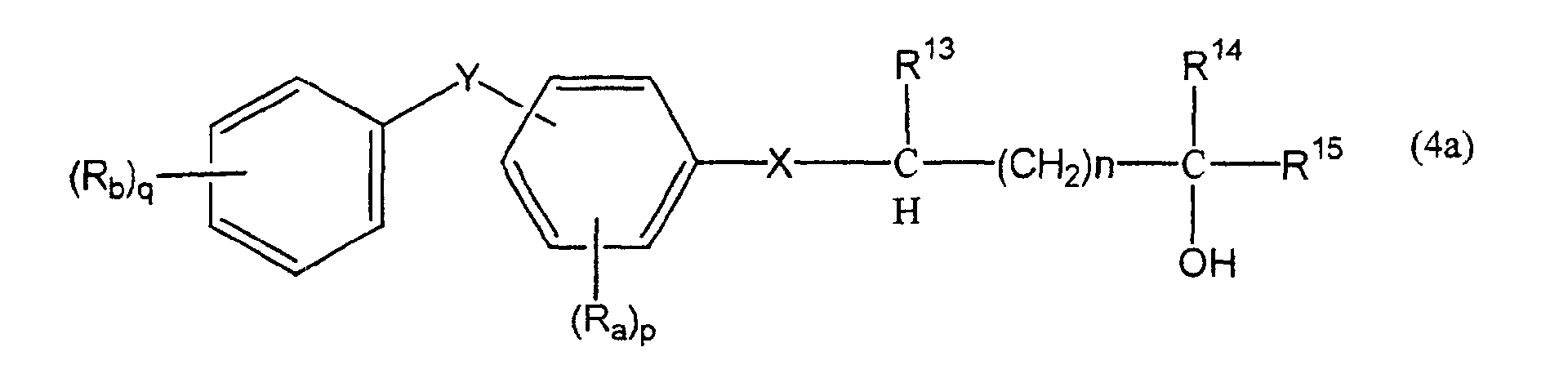
    The above alcohol derivative may include alcohol derivatives of the following formula (4a):
    Figure 00280001
    (hereinafter abbreviated as alcohol derivative (4a))
    wherein R13, R14, R15, Ra, Rb, X, Y, n, p and q are as defined above.
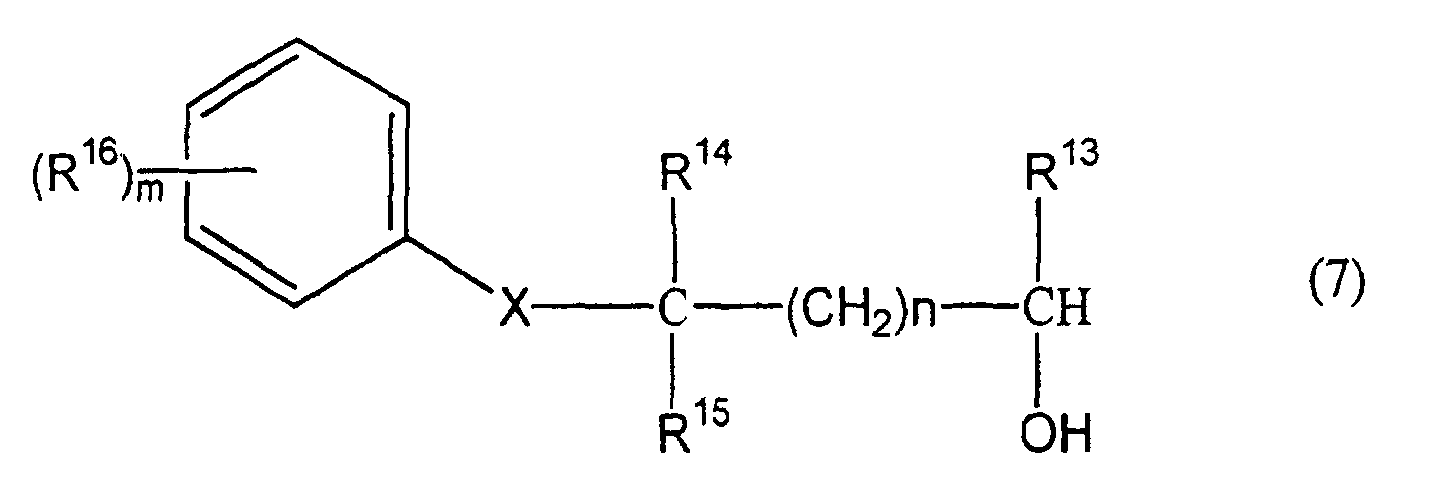
    The alcohol derivatives (4) and (4a) thus obtained may include:
  • 1-phenoxy-2-propanol,
  • 1-(4-chlorophenoxy)-2-propanol,
  • 1-(2-bromophenoxy)-2-propanol,
  • 1-(4-bromophenoxy)-2-propanol,
  • 1-(2-methylphenoxy)-2-propanol,
  • 1-(3-methylphenoxy)-2-propanol,
  • 1-(4-methylphenoxy)-2-propanol,
  • 1-(4-methoxyphenoxy)-2-propanol,
  • 1-(4-phenoxyphenoxy)-2-propanol,
  • 1-(4-nitrophenoxy)-2-propanol,
  • 1-(2,3-difluoro-6-nitrophenoxy)-2-propanol,
  • 1-phenylthio-2-propanol,
  • 1-(2-bromo-4-methylphenylthio)-2-propanol,
  • 1-(4-chlorophenylthio)-2-propanol,
  • 1-(4-methoxyphenylthio)-2-propanol,
  • 1-(4-phenoxyphenylthio)-2-propanol,
  • 1-phenoxy-2-butanol,
  • 1-(4-chlorophenoxy)-2-butanol,
  • 1-(2-bromophenoxy)-2-butanol,
  • 1-(4-bromophenoxy)-2-butanol,
  • 1-(2-methylphenoxy)-2-butanol,
  • 1-(3-methylphenoxy)-2-butanol,
  • 1-(4-methylphenoxy)-2-butanol,
  • 1-(4-methoxyphenoxy)-2-butanol,
  • 1-(4-phenoxyphenoxy)-2-butanol,
  • 1-(4-nitrophenoxy)-2-butanol,
  • 1-(2,3-difluoro-6-nitrophenoxy)-2-butanol,
  • 1-phenylthio-2-butanol,
  • 1-(2-bromo-4-methylphenylthio)-2-butanol,
  • 1-(4-chlorophenylthio)-2-butanol,
  • 1-(4-methoxyphenylthio)-2-butanol,
  • 1-(4-phenoxyphenylthio)-2-butanol,
  • 1-phenoxy-2-hexanol,
  • 1-(4-chlorophenoxy)-2-hexanol,
  • 1-(2-bromophenoxy)-2-hexanol,
  • 1-(4-bromophenoxy)-2-hexanol,
  • 1-(2-methylphenoxy)-2-hexanol,
  • 1-(3-methylphenoxy)-2-hexanol,
  • 1-(4-methylphenoxy)-2-hexanol,
  • 1-(4-methoxyphenoxy)-2-hexanol,
  • 1-(4-phenoxyphenoxy)-2-hexanol,
  • 1-(4-nitrophenoxy)-2-hexanol,
  • 1-(2, 3-difluoro-6-nitrophenoxy)-2-hexanol,
  • 1-phenylthio-2-hexanol,
  • 1-(2-bromo-4-methylphenylthio)-2-hexanol,
  • 1-(4-chlorophenylthio)-2-hexanol,
  • 1-(4-methoxyphenylthio)-2-hexanol,
  • 1-(4-phenoxyphenylthio)-2-hexanol,
  • 2-phenoxy-1-phenylethanol,
  • 2-(4-chlorophenoxy)-1-phenylethanol,
  • 2-(2-bromophenoxy)-1-phenylethanol,
  • 2-(4-bromophenoxy)-1-phenylethanol,
  • 2-(2-methylphenoxy)-1-phenylethanol,
  • 2-(3-methylphenoxy)-1-phenylethanol,
  • 2-(4-methylphenoxy)-1-phenylethanol,
  • 2-(4-methoxyphenoxy)-1-phenylethanol,
  • 2-(4-phenoxyphenoxy)-1-phenylethanol,
  • 2-(4-nitrophenoxy)-1-phenylethanol,
  • 2-(2,3-difluoro-6-nitrophenoxy)-1-phenylethanol,
  • 2-phenylthio-1-phenylethanol,
  • 2-(2-bromo-4-methylphenylthio)-1-phenylethanol,
  • 2-(4-chlorophenylthio)-1-phenylethanol,
  • 2-(4-methoxyphenylthio)-1-phenylethanol,
  • 2-(4-phenoxyphenylthio)-1-phenylethanol,
  • 3-phenoxy-1-chloro-2-propanol,
  • 3-(4-chlorophenoxy)-1-chloro-2-propanol,
  • 3-(2-bromophenoxy)-1-chloro-2-propanol,
  • 3-(4-bromophenoxy)-1-chloro-2-propanol,
  • 3-(2-methylphenoxy)-1-chloro-2-propanol,
  • 3-(3-methylphenoxy)-1-chloro-2-propanol,
  • 3-(4-methylphenoxy)-1-chloro-2-propanol,
  • 3-(4-methoxyphenoxy)-1-chloro-2-propanol,
  • 3-(4-phenoxyphenoxy)-1-chloro-2-propanol,
  • 3-(4-nitrophenoxy)-1-chloro-2-propanol,
  • 3-(2,3-difluoro-6-nitrophenoxy)-1-chloro-2-propanol,
  • 3-phenylthio-1-chloro-2-propanol,
  • 3-(2-bromo-4-methylphenylthio)-1-chloro-2-propanol,
  • 3-(4-chlorophenylthio)-1-chloro-2-propanol,
  • 3-(4-methoxyphenylthio)-1-chloro-2-propanol,
  • 3-(4-phenoxyphenylthio)-1-chloro-2-propanol,
  • 3-phenoxy-1-bromo-2-propanol,
  • 3-(4-chlorophenoxy)-1-bromo-2-propanol,
  • 3-(2-bromophenoxy)-1-bromo-2-propanol,
  • 3-(4-bromophenoxy)-1-bromo-2-propanol,
  • 3-(2-methylphenoxy)-1-bromo-2-propanol,
  • 3-(3-methylphenoxy)-1-bromo-2-propanol,
  • 3-(4-methylphenoxy)-1-bromo-2-propanol,
  • 3-(4-methoxyphenoxy)-1-bromo-2-propanol,
  • 3-(4-phenoxyphenoxy)-1-bromo-2-propanol,
  • 3-(4-nitrophenoxy)-1-bromo-2-propanol,
  • 3-(2,3-difluoro-6-nitrophenoxy)-1-bromo-2-propanol,
  • 3-phenylthio-1-bromo-2-propanol,
  • 3-(2-bromo-4-methylphenylthio)-1-bromo-2-propanol,
  • 3-(4-chlorophenylthio)-1-bromo-2-propanol,
  • 3-(4-methoxyphenylthio)-1-bromo-2-propanol,
  • 3-(4-phenoxyphenylthio)-1-bromo-2-propanol,
  • 3-phenoxy-1,2-propanediol,
  • 3-(4-chlorophenoxy)-1,2-propanediol,
  • 3-(2-bromophenoxy)-1,2-propanediol,
  • 3-(4-bromophenoxy)-1,2-propanediol,
  • 3-(2-methylphenoxy)-1,2-propanediol,
  • 3-(3-methylphenoxy)-1,2-propanediol,
  • 3-(4-methylphenoxy)-1,2-propanediol,
  • 3-(4-methoxyphenoxy)-1,2-propanediol,
  • 3-(4-phenoxyphenoxy)-1,2-propanediol,
  • 3-(4-nitrophenoxy)-1,2-propanediol,
  • 3-(2,3-diffuoro-6-nitrophenoxy)-1,2-propanediol,
  • 3-phenylthio-1,2-propanediol,
  • 3-(2-bromo-4-methylphenylthio)-1,2-propanediol,
  • 3-(4-chlorophenylthio)-1,2-propanediol,
  • 3-(4-methoxyphenylthio)-1,2-propanediol,
  • 3-(4-pheoxyphenylthio)-1,2-propanediol,
  • 2-phenoxycyclohexanol,
  • 2-(4-chlorophenoxy)cyclohexanol,
  • 2-(2-bromophenoxy)cyclohexanol,
  • 2-(4-bromophenoxy)cyclohexanol,
  • 2-(2-methylphenoxy)cyclohexanol,
  • 2-(3-methylphenoxy)cyclohexanol,
  • 2-(4-methylphenoxy)cyclohexanol,
  • 2-(4-methoxyphenoxy)cyclohexanol,
  • 2-(4-phenoxyphenoxy)cyclohexanol,
  • 2-(4-nitrophenoxy)cyclohexanol,
  • 2-(2,3-difluoro-6-nitrophenoxy)cyclohexanol,
  • 2-(phenylthio)cyclohexanol,
  • 2-(2-bromo-4-methylphenylthio)cyclohexanol,
  • 2-(4-chlorophenylthio)cyclohexanol,
  • 2-(4-methoxyphenylthio)cyclohexanol,
  • 2-(4-phenoxyphenylthio)cyclohexanol,
  • 2-phenoxycyclopentanol,
  • 2-(4-chlorophenoxy)cyclopentanol,
  • 2-(2-bromophenoxy)cyclopentanol,
  • 2-(4-bromophenoxy)cyclopentanol,
  • 2-(2-methylphenoxy)cyclopentanol,
  • 2-(3-methylphenoxy)cyclopentanol,
  • 2-(4-methylphenoxy)cyclopentanol,
  • 2-(4-methoxyphenoxy)cyclopentanol,
  • 2-(4-phenoxyphenoxy)cyclopentanol,
  • 2-(4-nitrophenoxy)cyclopentanol,
  • 2-(2,3-difluoro-6-nitrophenoxy)cyclopentanol,
  • 2-(phenylthio)cyclopentanol,
  • 2-(2-bromo-4-methylphenylthio)cyclopentanol,
  • 2-(4-chlorophenylthio)cyclopentanol,
  • 2-(4-methoxyphenylthio)cyclopentanol,
  • 2-(4-phenoxyphenylthio)cyclopentanol,
  • 2-phenoxycyclooctanol,
  • 2-(4-chlorophenoxy)cyclooctanol,
  • 2-(2-bromophenoxy)cyclooctanol,
  • 2-(4-bromophenoxy)cyclooctanol,
  • 2-(2-methylphenoxy)cyclooctanol,
  • 2-(3-methylphenoxy)cyclooctanol,
  • 2-(4-methylphenoxy)cyclooctanol,
  • 2-(4-methoxyphenoxy)cyclooctanol,
  • 2-(4-phenoxyphenoxy)cyclooctanol,
  • 2-(4-nitrophenoxy)cyclooctanol,
  • 2-(2, 3-difluoro-6-nitrophenoxy)cyclooctanol,
  • 2-(phenylthio)cyclooctanol,
  • 2-(2-bromo-4-methylphenylthio)cyclooctanol,
  • 2-(4-chlorophenylthio)cyclooctanol,
  • 2-(4-methoxyphenylthio)cyclooctanol, and
  • 2-(4-phenoxyphenylthio)cyclooctanol.
  • The amount of a regio-isomer of the following formula (7):
    Figure 00340001
    produced as a by-product, which regio-isomer is a by-product in this step, is very small.
    The process of reacting the above cyclic ether compound (2) with the above phenol derivative (3) in the presence of an asymmetric complex catalyst makes it possible to obtain an optically active alcohol derivative of formula (4'):
    Figure 00340002
    (hereinafter abbreviated as optically active alcohol derivative (4'))
    wherein R13, R14, R15, R16, X, m and n are as defined above and * indicates an asymmetric carbon atom.
    The above alcohol derivative may include alcohol derivatives of the following formula (4'a):
    Figure 00350001
    (hereinafter abbreviated as alcohol derivative (4'a))
    wherein R13, R14, R15, Ra, Rb, X, Y, n, p and q are as defined above and * indicates an asymmetric carbon atom.
    The optically active alcohol derivatives (4') and (4'a) thus obtained may include:
  • optically active 1-(4-phenoxyphenoxy)-2-propanol,
  • optically active 1-[4-(3-methylphenoxy)phenoxy]-2-propanol,
  • optically active 1-[4-(2-fluorophenoxy)phenoxy]-2-propanol,
  • optically active 1-[4-(3-fluorophenoxy)phenoxy]-2-propanol,
  • optically active 1-[4-(4-fluorophenoxy)phenoxy]-2-propanol,
  • optically active 1-[4-(3,5-difluorophenoxy)phenoxy]-2-propanol,
  • optically active 1-[4-(3,5-dichlorophenoxy)phenoxy]-2-propanol,
  • optically active 1-[4-(3-trifluoromethylphenoxy)]-2-propanol,
  • optically active 1-[4-(3-methoxyphenoxy)phenoxy]-propanol,
  • optically active 1-(4-benzylphenoxy)-2-propanol,
  • optically active 1-(4-phenylthiophenoxy)-2-propanol,
  • optically active 1-(4-phenoxyphenoxy)-2-butanol,
  • optically active 1-[4-(3-methylphenoxy)phenoxy]-2-butanol,
  • optically active 1-[4-(2-fluorophenoxy)phenoxy]-2-butanol,
  • optically active 1-[4-(3-fluorophenoxy)phenoxy]-2-butanol,
  • optically active 1-[4-(4-fluorophenoxy)phenoxy]-2-butanol,
  • optically active 1-[4-(3,5-difluorophenoxy)phenoxy]-2-butanol,
  • optically active 1-[4-(3,5-dichlorophenoxy)phenoxy]-2-butanol,
  • optically active 1-[4-(3-trifluoromethylphenoxy)]-2-butanol,
  • optically active 1-[4-(3-methoxyphenoxy)phenoxy]-2-butanol,
  • optically active 1-(4-benzylphenoxy)-2-butanol, and
  • optically active 1-(4-phenylthiophenoxy)-2-butanol.
  • Next, the following will describe the step of reacting the alcohol derivative obtained above with a halogenated nitrogen-containing heterocyclic compound in the presence of a base to give a nitrogen-containing heterocyclic compound. In this step, an optically active alcohol derivative can be reacted with a halogenated nitrogen-containing heterocyclic compound in the presence of a base to give an optically active nitrogen-containing heterocyclic compound.
    The halogenated nitrogen-containing heterocyclic compound may be any nitrogen-containing heterocyclic compound having a halogen atom which can be reacted with the hydroxyl group of the above alcohol derivative, and may include halogenated nitrogen-containing heterocyclic compounds of the formula (5): Z-R17 (hereinafter abbreviated as halogenated nitrogen-containing heterocyclic compound (5))
    wherein Z is halogen and R17 is pyridyl, pyridazinyl, pyrimidinyl, pyrazinyl, triazinyl, 2-thiazolyl or dihydro-2-thiazolyl; wherein these groups may optionally have one or more than one substituent selected from the group consisting of halogen, alkyl of 1 to 4 carbon atoms, alkoxy of 1 to 4 carbon atoms, alkylthio of 1 to 4 carbon atoms, trifluoromethyl or nitro.
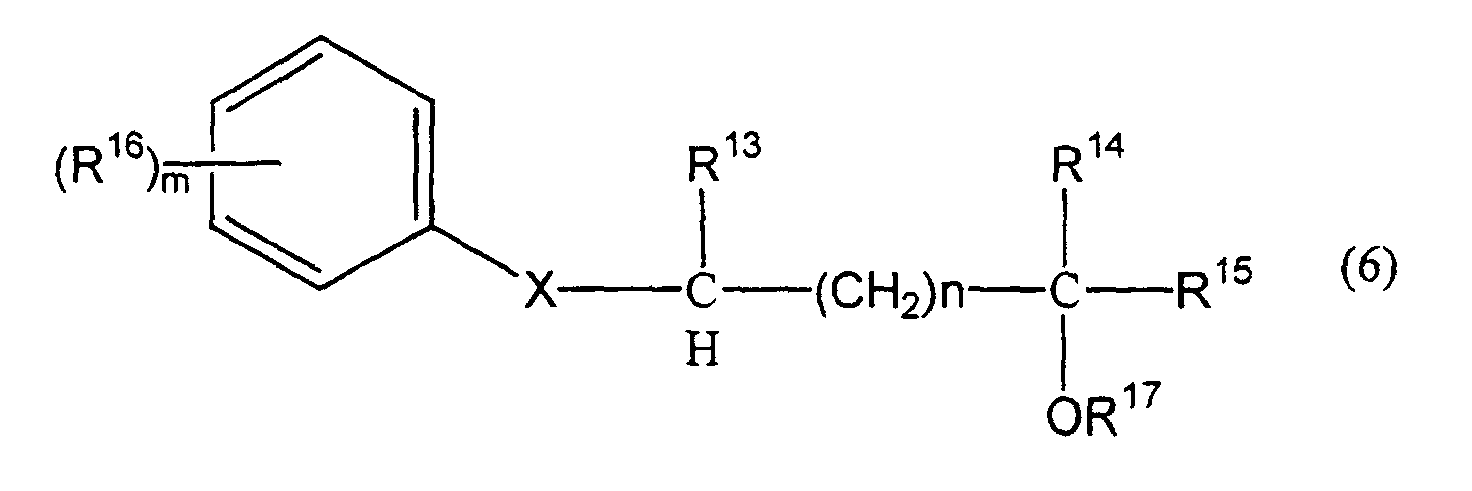
    The halogen atom, the alkyl group of 1 to 4 carbon atoms and the alkoxy group of 1 to 4 carbon atoms may include the same as described above. The alkylthio group of 1 to 4 carbon atoms may include methylthio, ethylthio, n-propylthio, isopropylthio, n-butylthio, isobutylthio, sec-butylthio and tert-butylthio.
    The pyridyl group may include 2-pyridyl, 3-pyridyl and 4-pyridyl. The pyridazinyl group may include 3-pyridazinyl. The pyrimidinyl group may include 2-pyrimidinyl and 4-pyrimidinyl. The pyrazinyl group may include 2-pyrazinyl. The triazinyl group may include 1,3,5-triazin-2-yl.
    The halogenated nitrogen-containing heterocyclic compound (5) may include:
  • 2-fluoropyridine, 2-chloropyridine, 2-bromopyridine,
  • 3-chloropyridine, 4-chloropyridine, 2-chloro-5-methylpyridine,
  • 2-chloro-6-methylpyridine, 2-chloro-5-nitropyridine,
  • 2,5-dichloropyridine, 2-chloro-3-nitropyridine,
  • 2,3-dichloro-5-trifluoromethylpyridine,
  • 2-chloro-3,4,5,6-tetrafluoropyridine,
  • 2-chloro-6-fluoropyridine, 2-chloropyrazine,
  • 3,6-dichloropyridazine, 2-chloro-1,3-thiazole,
  • 2-chloro-5-nitro-1,3-thiazole,
  • 2-chloro-4,5-dihydro-1,3-thiazole,
  • 2-chloro-4,4-dimethyl-5-hydro-1,3-thiazole,
  • 2-chloro-4,5-dihydro-4-methyl-1,3-thiazole,
  • 2-chloro-4,5-dihydro-1,3-thiazine, 2-chloropyrimidine,
  • 2-chloro-4,6-dimethylpyrimidine,
  • 4-chloro-2, 6-dimethylpyrimidine,
  • 2,4,6-trichloro-1,3,5-triazine, and
  • 2-chloro-4,6-dimethylthio-1,3,5-triazine.
  • The amount of halogenated nitrogen-containing heterocyclic compound used is usually 0.5 to 10 moles, preferably 0.8 to 2 moles, relative to 1 mole of alcohol derivative.
    The base may include alkali metals such as sodium and potassium; alkyl lithium such as n-butyl lithium; alkali metal halides such as sodium hydride; alkali metal amides such as lithium amide; alkali metal hydroxides such as sodium hydroxide and potassium hydroxide; alkali metal carbonates such as sodium carbonate and potassium carbonate; and organic bases such as triethylamine. The amounts for their use are usually 1 to 2 moles, relative to 1 mole of halogenated nitrogen-containing heterocyclic compound.
    The reaction is usually carried out in the presence of an organic solvent. The organic solvent may include single or mixed solvents selected from aprotic polar solvents such as N,N-dimethylformamide and dimethylsulfoxide; ether solvents such as tetrahydrofuran and dimethoxyethane; and aromatic hydrocarbon solvents such as toluene; or mixed solvents of these organic solvents and water. The amount of solvent used is not particularly limited. When mixed solvents of organic solvents and water are used, phase transfer catalysts such as benzyltriethyl ammonium chloride and tetra(n-butyl) ammonium bromide may be used so that the reaction can proceed more smoothly.
    The reaction temperature is usually in the range of -80°C to the reflux temperature of the reaction mixture, preferably in the range of 10°C to the reflux temperature of the reaction mixture.
    After completion of the reaction, for example, water and, if necessary, a water-insoluble organic solvent are added to the reaction mixture, followed by extraction, and the resulting organic layer is subjected to concentration to separate the desired (optically active) nitrogen-containing heterocyclic compound. The separated (optically active) nitrogen-containing heterocyclic compound may be further purified by an ordinary means of purification such as recrystallization, column chromatography and distillation.
    The above alcohol derivative (4) is reacted with the above halogenated nitrogen-containing heterocyclic compound (5) to give a nitrogen-containing heterocyclic compound of formula (6):
    Figure 00390001
    wherein X, R13, R14, R15, R16, R17, X and n are as defined above.
    In the above reaction, the use of alcohol derivatives of the above formula (4a) and (4'a) makes it possible to obtain nitrogen-containing heterocyclic compounds in which hydrogen atoms of hydroxyl groups in formula (4a) and (4'a) have been replaced by R17.
    The nitrogen-containing heterocyclic compound (6) thus obtained may include:
  • 2-[1-methyl-2-(4-phenoxyphenoxy)ethoxy]pyridine,
  • 2-[1-methyl-2-(3-phenoxyphenoxy)ethoxy]pyridine,
  • 2-[1-methyl-2-[4-(3-methylphenoxy)phenoxy]ethoxy]pyridine,
  • 2-[1-methyl-2-(2-methyl-4-phenoxyphenoxy)ethoxy]pyridine,
  • 2-[1-methyl-2-[4-(2-fluorophenoxy)phenoxy]ethoxy]pyridine,
  • 2-[1-methyl-2-[4-(3-fluorophenoxy)phenoxy]ethoxy]pyridine,
  • 2-[1-methyl-2-[4-(4-fluorophenoxy)phenoxy]ethoxy]pyridine,
  • 2-[1-methyl-2-[4-(3,5-difluorophenoxy)phenoxy]ethoxy]pyridine,
  • 2-[1-methyl-2-[4-(3,5-dichlorophenoxy)phenoxy]ethoxy]pyridine,
  • 2-[1-methyl-2-[4-(3-trifluoromethylphenoxy)phenoxy]ethoxy]pyridine,
  • 2-[1-methyl-2-[4-(3-methoxyphenoxy)phenoxy]ethoxy]pyridine,
  • 2-[1-methyl-2-(4-benzylphenoxy)ethoxy]pyridine,
  • 2-[1-methyl-2-(4-phenoxythiophenoxy)ethoxy]pyridine,
  • 6-methyl-2-[1-methyl-2-(4-phenoxyphenoxy)ethoxy]pyridine,
  • 6-methyl-3-[1-methyl-2-(4-phenoxyphenoxy)ethoxy]pyridine,
  • 5-nitro-2-[1-methyl-2-(4-phenoxyphenoxy)ethoxy]pyridine,
  • 5-fluoro-2-[1-methyl-2-(4-phenoxyphenoxy)ethoxy]pyridine,
  • 6-methoxy-2-[1-methyl-2-(4-phenoxyphenoxy)ethoxy]pyridine,
  • 5-chloro-2-[1-methyl-2-(4-phenoxyphenoxy)ethoxy]pyridine,
  • 3-chloro-2-[1-methyl-2-(4-phenoxyphenoxy)ethoxy]pyridine,
  • 3-nitro-2-[1-methyl-2-(4-phenoxyphenoxy)ethoxy]pyridine,
  • 3-[1-methyl-2-(4-phenoxyphenoxy)ethoxy]pyridine,
  • 4-[1-methyl-2-(4-phenoxyphenoxy)ethoxy]pyridine,
  • 3-chloro-5-trifluoromethyl-2-[1-methyl-2-(4-phenoxyphenoxy)-ethoxy]pyridine,
  • 5-fluoro-2-[1-methyl-2-[4-(3-fluorophenoxy)phenoxy]ethoxy]pyridine,
  • 5-fluoro-2-[1-methyl-2-[4-(3,5-difluorophenoxy)phenoxy]ethoxy]pyridine,
  • 2-[1-methyl-2-(4-phenoxyphenoxy)ethoxy]pyrazine,
  • 6-chloro-3-[1-methyl-2-(4-phenoxyphenoxy)ethoxy]pyridazine,
  • 2-[1-methyl-2-(4-phenoxyphenoxy)ethoxy]thiazoline,
  • 2-[1-methyl-2-[4-(3-fluorophenoxy)phenoxy]ethoxy]thiazoline,
  • 2-[1-methyl-2-[4-(3,5-difluorophenoxy)phenoxy]ethoxy]thiazoline,
  • 5-nitro-2-[1-methyl-2-(4-phenoxyphenoxy)ethoxy]thiazoline,
  • 2-[1-methyl-2-(4-phenoxyphenoxy)ethoxy]pyrimidine,
  • 2-[1-methyl-2-[4-(3-ffuorophenoxy)phenoxy]ethoxy]pyrimidine,
  • 2-[1-methyl-2-[4-(3,5-difluorophenoxy)phenoxy]ethoxy]pyrimidine,
  • 6-chloro-4-[1-methyl-2-(4-phenoxyphenoxy)ethoxy]pyrimidine,
  • 6-methylthio-4-[1-methyl-2-(4-phenoxyphenoxy)ethoxy]pyrimidine,
  • 4,6-dimethyl-2-[1-methyl-2-(4-phenoxyphenoxy)ethoxy]pyrimidine,
  • 2,6-climethyl-2-[1-methyl-2-(4-phenoxyphenoxy)ethoxy]pyrimidine,
  • 2-[1-methyl-2-(4-phenoxyphenoxy)ethoxy]-3,5-dimethylthio-1,3,5-triazine,
  • 2-[1-ethyl-2-(4-phenoxyphenoxy)ethoxy]pyridine,
  • 2-[1-ethyl-2-(3-phenoxyphenoxy)ethoxy]pyridine,
  • 2-[1-ethyl-2-[4-(3-methylphenoxy)phenoxy]ethoxy]pyridine,
  • 2-[1-ethyl-2-(2-methyl-4-phenoxyphenoxy)ethoxy]pyridine,
  • 2-[1-ethyl-2-[4-(2-fluorophenoxy)phenoxy]ethoxy]pyridine,
  • 2-[1-ethyl-2-[4-(3-fluorophenoxy)phenoxy]ethoxy]pyridine,
  • 2-[1-ethyl-2-[4-(4-fluorophenoxy)phenoxy]ethoxy]pyridine,
  • 2-[1-ethyl-2-[4-(3,5-difluorophenoxy)phenoxy]ethoxy]pyridine,
  • 2-[1-ethyl-2-[4-(3, 5-dichlorophenoxy)phenoxy]ethoxy]pyridine,
  • 2-[1-ethyl-2-[4-(3-trifluoromethylphenoxy)phenoxy]ethoxy]pyridine,
  • 2-[1-ethyl-2-[4-(3-methoxyphenoxy)phenoxy]ethoxy]pyridine,
  • 2-[1-ethyl-2-(4-benzylphenoxy)ethoxy]pyridine,
  • 2-[1-ethyl-2-(4-phenoxythiophenoxy)ethoxy]pyridine,
  • 6-methyl-2-[1-ethyl-2-(4-phenoxyphenoxy)ethoxy]pyridine,
  • 6-methyl-3-[1-ethyl-2-(4-phenoxyphenoxy)ethoxy]pyridine,
  • 5-nitro-2-[1-ethyl-2-(4-phenoxyphenoxy)ethoxy]pyridine,
  • 5-fluoro-2-[1-ethyl-2-(4-phenoxyphenoxy)ethoxy]pyridine,
  • 6-methoxy-2-[1-ethyl-2-(4-phenoxyphenoxy)ethoxy]pyridine,
  • 5-chloro-2-[1-ethyl-2-(4-phenoxyphenoxy)ethoxy]pyridine,
  • 3-chloro-2-[1-ethyl-2-(4-phenoxyphenoxy)ethoxy]pyridine,
  • 3-nitro-2-[1-ethyl-2-(4-phenoxyphenoxy)ethoxy]pyridine,
  • 3-[1-ethyl-2-(4-phenoxyphenoxy)ethoxy]pyridine,
  • 4-[1-ethyl-2-(4-phenoxyphenoxy)ethoxy]pyridine,
  • 3-chloro-5-trifluoromethyl-2-[1-ethyl-2-(4-phenoxyphenoxy)ethoxy]-pyridine,
  • 5-fluoro-2-[1-ethyl-2-[4-(3-fluorophenoxy)phenoxy]ethoxy]pyridine, and
  • 5-fluoro-2-[1-ethyl-2-[4-(3,5-difluorophenoxy)phenoxy]ethoxy]pyridine.
  • The above optically active alcohol derivative (4') is reacted with the above halogenated nitrogen-containing heterocyclic compound (5) to give an optically active nitrogen-containing heterocyclic compound of formula (6'):
    Figure 00420001
    (hereinafter abbreviated as optically active nitrogen-containing heterocyclic compound (6'))
    wherein R11, R12, R13, R14, R15, X, Y, n and * are as defined above.
    The optically active nitrogen-containing heterocyclic compound (6') thus obtained may include:
  • optically active 2-[1-methyl-2-(4-phenoxyphenoxy)ethoxy]pyridine,
  • optically active 2-[1-methyl-2-(3-phenoxyphenoxy)ethoxy]pyridine,
  • optically active 2-[1-methyl-2-[4-(3-methylphenoxy)phenoxy]ethoxy]-pyridine,
  • optically active 2-[1-methyl-2-(4-phenoxy-2-methylphenoxy)ethoxy]-pyridine,
  • optically active 2-[1-methyl-2-[4-(2-fluorophenoxy)phenoxy]ethoxy]-pyridine,
  • optically active 2-[1-methyl-2-[4-(3-fluorophenoxy)phenoxy]ethoxy]-pyridine,
  • optically active 2-[1-methyl-2-[4-(4-fluorophenoxy)phenoxy]ethoxy]-pyridine,
  • optically active 2-[1-methyl-2-[4-(3,5-difluorophenoxy)phenoxy]ethoxy]pyridine,
  • optically active 2-[1-methyl-2-[4-(3,5-dichlorophenoxy)phenoxy]ethoxy]pyridine,
  • optically active 2-[1-methyl-2-[4-(3-trifluoromethylphenoxy)phenoxy]ethoxy]pyridine,
  • optically active 2-[1-methyl-2-[4-(3-methoxyphenoxy)phenoxy]ethoxy]pyridine,
  • optically active 2-[1-methyl-2-(4-benzylphenoxy)ethoxy]pyridine,
  • optically active 2-[1-methyl-2-(4-phenoxythiophenoxy)ethoxy]pyridine,
  • optically active 6-methyl-2-[1-methyl-2-(4-phenoxyphenoxy)ethoxy]-pyridine,
  • optically active 6-methyl-3-[1-methyl-2-(4-phenoxyphenoxy)ethoxy]-pyridine,
  • optically active 5-nitro-2-[1-methyl-2-(4-phenoxyphenoxy)ethoxy]-pyridine,
  • optically active 5-fluoro-2-[1-methyl-2-(4-phenoxyphenoxy)ethoxy]-pyridine,
  • optically active 6-methoxy-2-[1-methyl-2-(4-phenoxyphenoxy)ethoxy]pyridine,
  • optically active 5-chloro-2-[1-methyl-2-(4-phenoxyphenoxy)ethoxy]-pyridine,
  • optically active 3-chloro-2-[1-methyl-2-(4-phenoxyphenoxy)ethoxy]-pyridine,
  • optically active 3-nitro-2-[1-methyl-2-(4-phenoxyphenoxy)ethoxy]-pyridine,
  • optically active 3-[1-methyl-2-(4-phenoxyphenoxy)ethoxy]pyridine,
  • optically active 4-[1-methyl-2-(4-phenoxyphenoxy)ethoxy]pyridine,
  • optically active 3-chloro-5-trifluoromethyl-2-[1-methyl-2-(4-phenoxyphenoxy)ethoxy]pyridine,
  • optically active 5-fluoro-2-[1-methyl-2-[4-(3-fluorophenoxy)phenoxy]-ethoxy]pyridine,
  • optically active 5-fluoro-2-[1-methyl-2-[4-(3,5-difluorophenoxy)phenoxy]ethoxy]pyridine,
  • optically active 2-[1-methyl-2-(4-phenoxyphenoxy)ethoxy]pyrazine,
  • optically active 6-chloro-3-[1-methyl-2-(4-phenoxyphenoxy)ethoxy]-pyridazine,
  • optically active 2-[1-methyl-2-(4-phenoxyphenoxy)ethoxy]thiazoline,
  • optically active 2-[1-methyl-2-[4-(3-fluorophenoxy)phenoxy]ethoxy]-thiazoline,
  • optically active 2-[1-methyl-2-[4-(3,5-difluorophenoxy)phenoxy]ethoxy]thiazoline,
  • optically active 5-nitro-2-[1-methyl-2-(4-phenoxyphenoxy)ethoxy]-thiazoline,
  • optically active 2-[1-methyl-2-(4-phenoxyphenoxy)ethoxy]pyrimidine,
  • optically active 2-[1-methyl-2-[4-(3-fluorophenoxy)phenoxy]ethoxy]-pyrimidine,
  • optically active 2-[1-methyl-2-[4-(3,5-difluorophenoxy)phenoxy]ethoxy]pyrimidine,
  • optically active 6-chloro-4-[1-methyl-2-(4-phenoxyphenoxy)ethoxy]-pyrimidine,
  • optically active 6-methylthio-4-[1-methyl-2-(4-phenoxyphenoxy)ethoxy]pyrimidine,
  • optically active 4,6-dimethyl-2-[1-methyl-2-(4-phenoxyphenoxy)ethoxy]pyrimidine,
  • optically active 2,6-dimethyl-2-[1-methyl-2-(4-phenoxyphenoxy)ethoxy]pyrimidine,
  • optically active 2-[1-methyl-2-(4-phenoxyphenoxy)ethoxy]-3,5-dimethylthio-1,3,5-triazine,
  • optically active 2-[1-ethyl-2-(4-phenoxyphenoxy)ethoxy]pyridine,
  • optically active 2-[1-ethyl-2-(3-phenoxyphenoxy)ethoxy]pyridine,
  • optically active 2-[1-ethyl-2-[4-(3-methylphenoxy)phenoxy]ethoxy]-pyridine,
  • optically active 2-[1-ethyl-2-(4-phenoxy-2-methylphenoxy)ethoxy]-pyridine,
  • optically active 2-[1-ethyl-2-[4-(2-fluorophenoxy)phenoxy]ethoxy]pyridine,
  • optically active 2-[1-ethyl-2-[4-(3-fluorophenoxy)phenoxy]ethoxy]pyridine,
  • optically active 2-[1-ethyl-2-[4-(4-fluorophenoxy)phenoxy]ethoxy]pyridine,
  • optically active 2-[1-ethyl-2-[4-(3,5-difluorophenoxy)phenoxy]ethoxy]pyridine,
  • optically active 2-[1-ethyl-2-[4-(3,5-dichlorophenoxy)phenoxy]ethoxy]pyridine,
  • optically active 2-[1-ethyl-2-[4-(3-trifluoromethylphenoxy)phenoxy]-ethoxy]pyridine,
  • optically active 2-[1-ethyl-2-[4-(3-methoxyphenoxy)phenoxy]ethoxy]-pyridine,
  • optically active 2-[1-ethyl-2-(4-benzylphenoxy)ethoxy]pyridine,
  • optically active 2-[1-ethyl-2-(4-phenoxythiophenoxy)ethoxy]pyridine,
  • optically active 6-methyl-2-[1-ethyl-2-(4-phenoxyphenoxy)ethoxy]-pyridine,
  • optically active 6-methyl-3-[1-ethyl-2-(4-phenoxyphenoxy)ethoxy]-pyridine,
  • optically active 5-nitro-2-[1-ethyl-2-(4-phenoxyphenoxy)ethoxy]pyridine,
  • optically active 5-fluoro-2-[1-ethyl-2-(4-phenoxyphenoxy)ethoxy]pyridine,
  • optically active 6-methoxy-2-[1-ethyl-2-(4-phenoxyphenoxy)ethoxy]-pyridine,
  • optically active 5-chloro-2-[1-ethyl-2-(4-phenoxyphenoxy)ethoxy]pyridine,
  • optically active 3-chloro-2-[1-ethyl-2-(4-phenoxyphenoxy)ethoxy)pyridine,
  • optically active 3-nitro-2-[1-ethyl-2-(4-phenoxyphenoxy)ethoxy]pyridine,
  • optically active 3-[1-ethyl-2-(4-phenoxyphenoxy)ethoxy]pyridine,
  • optically active 4-[1-ethyl-2-(4-phenoxyphenoxy)ethoxy]pyridine,
  • optically active 3-chloro-5-trifluoromethyl-2-[1-ethyl-2-(4-phenoxyphenoxy)ethoxy]pyridine,
  • optically active 5-fluoro-2-[1-ethyl-2-[4-(3-fluorophenoxy)phenoxy]-ethoxy]pyridine, and
  • optically active 5-fluoro-2-[1-ethyl-2-[4-(3,5-difluorophenoxy)phenoxy]ethoxy]pyridine.
  • Examples
    The present invention will be further illustrated by reference to the following examples; however, the present invention is not limited to these examples. The yields were calculated from the results of analysis by high performance liquid chromatography. The optical purity of optically active alcohol derivatives and the optical purity of optically active nitrogen-containing heterocyclic compounds were calculated from the results of analysis by high performance liquid chromatography using optically active columns (CHIRALCEL OD: available from DAICEL CHEMICAL INDUSTRIES, LTD.) and optically active columns (CHIRALCEL OJ-H: available from DAICEL CHEMICAL INDUSTRIES, LTD.), respectively.
    Example 1
    A nitrogen-purged 200-mL separable flask was charged with 404 mg of (R,R)-(-)-N,N'-bis(3,5-di-tert-butylsalicylidene)-1,2-cyclohexanediamino cobalt (III) 4-phenoxyphenolate and 10 mL of tert-butyl methyl ether, to which 147 mg of tetraisopropoxy titanium was added, and the mixture was stirred at room temperature for 1 hour to prepare a catalyst solution (the color of the catalyst solution changed from brown to slightly greenish brown). To the catalyst solution were added 9.41 g of 4-phenoxyphenol and 10 mL of tert-butyl methyl ether, and the mixture was cooled to the internal temperature of 5°C, after which 13.2 g of propylene oxide was added dropwise over 30 minutes. The mixture was kept stirred at the same temperature for 8 hours to achieve the reaction, followed by addition of water and extraction with ethyl acetate. From the resulting organic layer, the solvent was distilled out to give a solid substance containing (S)-(+)-1-(4-phenoxyphenoxy)-2-propanol.
    The yield of (S)-(+)-1-(4-phenoxyphenoxy)-2-propanol: 98% (based on 4-phenoxyphenol); optical purity: 98% e.e.
    To a suspension prepared by suspending 1.14 g of sodium hydride (60 wt% oil suspension) in 40 mL of N,N-dimethylformamide was slowly added under ice cooling a solution prepared by dissolving the solid substance (pure content: 5.34 g) obtained above in 20 g of N,N-dimethylformamide, followed by keeping stirred at room temperature for 1 hour. Then 3.64 g of 2-chloropyridine was added, and the mixture was stirred at the internal temperature of 60°C for 10 hours to achieve the reaction. Then ice water was poured into the reaction mixture, which was extracted three times with ethyl acetate. The resulting organic layer was concentrated to give a solid substance containing (S)-(+)-2-[1-methyl-2-(4-phenoxyphenoxy)ethoxy]pyridine.
    The yield of (S)-(+)-2-[1-methyl-2-(4-phenoxyphenoxy)ethoxy]pyridine: 91% (based on (S)-(+)-1-(4-phenoxyphenoxy)-2-propanol); and optical purity: 98% e.e.
    Example 2
    A nitrogen-purged 50-mL Schlenk's tube was charged with 81 mg of (R,R)-(-)-N,N'-bis(3,5-di-tert-butylsalicylidene)-1,2-cyclohexanediamino cobalt (III) 4-phenoxyphenolate and 1 mL of tert-butyl methyl ether, to which 13 mg of anhydrous aluminum chloride and 1 g of molecular sieves 3A were added, and the mixture was stirred at room temperature for 1 hour to prepare a catalyst solution. With the lapse of time, the color of the catalyst solution changed from brown to dark green. To the dark green catalyst solution were added 960 mg of 4-phenoxyphenol and 1.47 g of propylene oxide, and the mixture was stirred at room temperature for 20 hours to achieve the reaction. After completion of the reaction, tert-butyl methyl ether was distilled out to give an oily substance containing (S)-(+)-1-(4-phenoxyphenoxy)-2-propanol.
    The yield of (S)-(+)-1-(4-phenoxyphenoxy)-2-propanol: 82% (based on 4-phenoxyphenol); and optical purity: 92% e.e.
    The resulting oily substance containing (S)-(+)-1-(4-phenoxyphenoxy)-2-propanol was reacted with 2-chloropyridine in the same manner as described in Example 1 to give (S)-(+)-2-[1-methyl-2-(4-phenoxyphenoxy)ethoxy]pyridine.
    Example 3
    In Example 2, 0.1 mL of a diethyl aluminum chloride/hexane solution was used in place of anhydrous aluminum chloride, and the color of the catalyst solution changed from brown to dark green by the addition of a diethyl aluminum chloride/hexane solution. Then 4-phenoxyphenol and propylene oxide were added to the dark green catalyst solution to achieve the reaction in the same manner as described in Example 2. Thus (S)-(+)-1-(4-phenoxyphenoxy)-2-propanol was obtained in 72% yield and the optical purity was 87% e.e.
    The resulting (S)-(+)-1-(4-phenoxyphenoxy)-2-propanol was reacted with 2-chloropyridine in the same manner as described in Example 1 to give (S)-(+)-2-[1-methyl-2-(4-phenoxyphenoxy)ethoxy]pyridine.
    Example 4
    In Example 2, 26 mg of tri-tert-butoxy aluminum was used in place of anhydrous aluminum chloride, and the color of the catalyst solution changed from brown to slightly greenish brown by the addition of tri-tert-butoxy aluminum. Then 4-phenoxyphenol and propylene oxide were added to the slightly greenish brown catalyst solution to achieve the reaction in the same manner as described in Example 2. Thus (S)-(+)-1-(4-phenoxyphenoxy)-2-propanol was obtained in 68% yield and the optical purity was 87% e.e.
    The resulting (S)-(+)-1-(4-phenoxyphenoxy)-2-propanol was reacted with 2-chloropyridine in the same manner as described in Example 1 to give (S)-(+)-2-[1-methyl-2-(4-phenoxyphenoxy)ethoxy]pyridine.
    Example 5
    In Example 2, 16 mg of tri-tert-ethoxy aluminum was used in place of anhydrous aluminum chloride, and the color of the catalyst solution changed from brown to slightly greenish brown by the addition of tri-tert-ethoxy aluminum. Then 4-phenoxyphenol and propylene oxide were added to the slightly greenish brown catalyst solution to achieve the reaction in the same manner as described in Example 2. Thus (S)-(+)-1-(4-phenoxyphenoxy)-2-propanol was obtained in 83% yield and the optical purity was 90% e.e.
    The resulting (S)-(+)-1-(4-phenoxyphenoxy)-2-propanol was reacted with 2-chloropyridine in the same manner as described in Example 1 to give (S)-(+)-2-[1-methyl-2-(4-phenoxyphenoxy)ethoxy]pyridine.
    Example 6
    In Example 2, 29 mg of tetraisopropoxy titanium was used in place of anhydrous aluminum chloride, and the color of the catalyst solution changed from brown to slightly greenish brown by the addition of tetraisopropoxy titanium. Then 4-phenoxyphenol and propylene oxide were added to the slightly greenish brown catalyst solution to achieve the reaction in the same manner as described in Example 2. Thus (S)-(+)-1-(4-phenoxyphenoxy)-2-propanol was obtained in 84% yield and the optical purity was 95% e.e.
    The resulting (S)-(+)-1-(4-phenoxyphenoxy)-2-propanol was reacted with 2-chloropyridine in the same manner as described in Example 1 to give (S)-(+)-2- [1-methyl-2-(4-phenoxyphenoxy)ethoxy]pyridine.
    Example 7
    In Example 2, the amount of (R,R)-(-)-N,N'-bis(3,5-di-tert-butylsalicylidene)-1,2-cyclohexanediamino cobalt (III) 4-phenoxyphenolate used was changed to 41 mg, and 15 mg of tetraisopropoxy titanium was used in place of anhydrous aluminum chloride, and the color of the catalyst solution changed from brown to slightly greenish brown by the addition of tetraisopropoxy titanium. Then 4-phenoxyphenol and propylene oxide were added to the slightly greenish brown catalyst solution to achieve the reaction in the same manner as described in Example 2. Thus (S)-(+)-1-(4-phenoxyphenoxy)-2-propanol was obtained in 77% yield and the optical purity was 94% e.e.
    The resulting (S)-(+)-1-(4-phenoxyphenoxy)-2-propanol was reacted with 2-chloropyridine in the same manner as described in Example 1 to give (S)-(+)-2-[1-methyl-2-(4-phenoxyphenoxy)ethoxy]pyxidine.
    Example 8
    A nitrogen-purged 50-mL Schlenk's tube was charged with 404 mg of (R,R)-(-)-N,N-bis(3,5-di-tert-butylsalicylidene)-1,2-cylcohexanediamino cobalt (III) 4-phenoxyphanolate and 10 mL of tert-butyl ethyl ether, and the IR spectrum of the reaction mixture was measured. Then 147 mg of tetraisopropoxy titanium was added, and the color of the reaction mixture was changed from brown to slightly greenish brown. The peaks at 752 cm-1 and 956 cm-1 appeared in addition to the peaks from (R,R)-(-)-N,N-bis(3,5-ditert-butylsalicylidene)-1,2-cyclohexanediamino cobalt (III) 4-phenoxyphenolate, tert-butyl methyl ether and tetraisopropoxy titanium.
    Comparative Example 1
    A nitrogen-purged 50-mL Schlenk's tube was charged with 202 mg of (R,R)-(-)-N,N'-bis(3,5-di-tert-butylsalicylidene)-1,2-cyclohexanediamino cobalt (III) 4-phenoxyphenolate, 1 g of molecular sieves 3A, 960 mg of 4-phenoxyphenol and 1.47 g of propylene oxide, and the mixture was stirred at room temperature for 20 hours to achieve the reaction. After completion of the reaction, the solvent was distilled out to give an oily substance containing (S)-(+)-1-(4-phenoxyphenoxy)-2-propanol. The oily substance was analyzed by high performance liquid chromatography in the same manner as described in Example 1 to reveal that the yield of (S)-(+)-1-(4-phenoxyphenoxy)-2-propanol was 14% (based on 4-phenoxyphenol) and the optical purity was 77% e.e.
    Comparative Example 2
    A nitrogen-purged 50-mL Schlenk's tube was charged with 960 mg of 4-phenoxyphenol and 1 mL of tert-butyl ethyl ether, to which 13 mg of anhydrous aluminum chloride, 1 g of molecular sieves 3A and 1.47 g of propylene oxide were added, and the mixture was stirred at room temperature for 20 hours to achieve the reaction. After completion of the reaction, tert-butyl methyl ether was distilled out to give an oily substance. The oily substance was analyzed by high performance liquid chromatography to reveal that the main component was 4-phenoxyphenol and the recovery of 4-phenoxyphenol was 93%.
    Example 9
    A nitrogen-purged 200-mL separable flask was charged with 170 mg of N,N'-bis(salicylidene)-1,2-diphenylethylenediamino cobalt (III) 4-phenoxyphenolate and 10 mL of tert-butyl methyl ether, to which 733 mg of tetraisopropoxy titanium was added, and the mixture was stirred at room temperature for 1 hour to prepare a catalyst solution (the color of the catalyst solution changed from brown to slightly greenish brown). To the catalyst solution were added 9.41 g of 4-phenoxyphenol and 10 mL of tert-butyl methyl ether, and the mixture was cooled to the internal temperature of 5°C. To this was added dropwise 6.6 g of propylene oxide over 30 minutes, and the mixture was then stirred at 5°C for 8 hours to achieve the reaction. After completion of the reaction, tert-butyl methyl ether was distilled out to give an oily substance containing 1-(4-phenoxyphenoxy)-2-propanol. The oily substance was quantitated by high performance liquid chromatography (hereinafter abbreviated as LC) to reveal that the yield of 1-(4-phenoxyphenoxy)-2-propanol was 93% (based on 4-phenoxyphenol) and isomer ratio 1 was 0.001.
    Isomer ratio 1 was calculated by the following equation: Isomer ratio 1 = [LC area value of 2-(4-phenoxyphenoxy)-1-propanol]/ [LC area value of 2-(4-phenoxyphenoxy)-1-propanol + LC area value of 1-(4- phenoxyphenoxy)-2-propanol]
    To the resulting oily substance (pure content: 10.5 g) were added 6.5 g of 2-chloropyridine and 3.5 g of sodium hydroxide (granular), followed by mixing with stirring at the internal temperature of 100°C. Then azeotropic dehydration was carried out at the internal temperature of 150°C, operation pressure of 70 Torr (corresponding to 9.3 kPa) to achieve the reaction for 3 hours. Then the remaining 2-chloropyridine was distilled out at the internal temperature of 157°C, operation pressure of 10 Torr (corresponding to 1.3 kPa), followed by cooling. To the reaction mixture were added water and toluene, and the mixture was filtered through Celite. The filtrate was extracted with toluene, and the resulting organic layer was concentrated to give 2-[1-methyl-2-(4-phenoxyphenoxy)ethoxy]pyridine. Yield: 90%. Isomer ratio 2 was 0.001.
    Isomer ratio 2 was calculated by the following equation: Isomer ratio 2 = {LC area value of 2-[1-methyl-2-(4-phenoxyphen- oxy)ethoxy]pyridine} / {LC area value of 2-[1-methyl-2-(4-phenoxyphenoxy)- ethoxy]pyridine + LC area value of 2-[2-methyl-2-(4-phenoxyphenoxy)eth- oxy]pyridine}
    Example 10
    A nitrogen-purged 50-mL Schlenk's tube was charged with 26 mg of N,N-bis(salicylidene)-ethylenediamine cobalt (III) 4-phenoxyphenolate and 1 mL of tert-butyl methyl ether, to which 74 mg of tetraisopropoxy titanium was added, and the mixture was stirred at room temperature for 1 hour to prepare a catalyst solution. To the catalyst solution were added 960 mg of 4-phenoxyphenol and 1.47 g of propylene oxide, and the mixture was then stirred at room temperature for 20 hours to achieve the reaction. After completion of the reaction, tert-butyl methyl ether was distilled out to give an oily substance containing 1-(4-phenoxyphenoxy)-2-propanol. Yield: 92% (based on 4-phenoxyphenol). Isomer ratio 1 = 0.003 (isomer ratio 1 was calculated by the same equation as described above in Example 9).
    The resulting oily substance containing 1-(4-phenoxyphenoxy)-2-propanol is reacted with 2-chloropyridine in the same manner as described in Example 9 to give 2-[1-methyl-2-(4-phenoxyphenoxy)ethoxy]pyridine.
    Example 11
    In Example 9, the reaction was carried out in the same manner as described in Example 9, except that 17 mg of N,N'-bis(salicylidene)-1,2-diphenylethylenediamino cobalt (III) 4-phenoxyphenolate was used in place of 26 mg of N,N'-bis(salicylidene)-ethylenediamino cobalt (III) 4-phenoxyphenolate and the amount of tert-butyl methyl ether used for the preparation of a catalyst was changed to 2 mL, 1-(4-phenoxyphenoxy)-2-propanol was obtained in 95% yield and isomer ratio 1 = 0.003 (isomer ratio 1 was calculated by the same equation as described above in Example 9).
    The resulting oily substance containing 1-(4-phenoxyphenoxy)-2-propanol is reacted with 2-chloropyridine in the same manner as described in Example 9 to give 2-[1-methyl-2-(4-phenoxyphenoxy)ethoxy]pyridine.
    Industrial Applicability
    According to the present invention, novel (asymmetric) complex catalysts obtained by reaction of (optically active) metal complexes with Lewis acids exhibit high catalytic activity in the reaction of cyclic ether compounds with phenol derivatives; therefore, it is possible to produce (optically active) alcohol derivatives in an industrially advantageous manner by reacting cyclic ether compounds with phenol derivatives in the presence of these (asymmetric) complex catalysts, and it is possible to obtain (optically active) nitrogen-containing heterocyclic compounds in an industrially advantageous manner by reacting these resulting (optically active) alcohol derivatives with halogenated nitrogen-containing heterocyclic compounds in the presence of a base.

    Claims (18)

    1. A complex catalyst comprising a metal complex and a Lewis acid as components, the metal complex being of formula (1):
      Figure 00550001
      wherein R1, R2, R3, R4, R5, R6, R7 and R8 are the same or different and are independently hydrogen, halogen, alkyl, alkenyl, alkynyl, alkoxy, haloalkyl, haloalkoxy, hydroxyl, nitro, amino, carbamoyl, carboxyl, substituted or unsubstituted aryl, or silyl; or two adjacent groups of R1, R2, R3, R4, R5, R6, R7 and R8 are combined together to represent a naphthalene ring by forming a ring together with a benzene ring to which they are attached;
         one of R9 and R10 is hydrogen an the other is phenyl or naphthyl optionally substituted with at least one selected from the group consisting of alkyl of 1 to 4 carbon atoms, alkoxy of 1 to 4 carbon atoms, haloalkyl, haloalkoxy and halogen; or either one pair of R9 and R10 attached to the different carbon atoms are combined together at their ends to form a tetramethylene linkage and the other pair are hydrogen atoms;
         Q is a single bond or alkylene of 1 to 4 carbon atoms; or Q is combined with R9 and R10 to represent 1,1'-binaphthyl attached to the nitrogen atoms at 2 and 2' positions;
         M is a metal ion; and
         A is a balancing counter ion or ligand.
    2. A complex catalyst according to claim 1, wherein the metal complex is an optically active metal complex of formula (1'):
      Figure 00560001
      wherein R1, R2, R3, R4, R5, R6, R7, R8, R9, R10, M, A and Q are as defined in formula (1).
    3. A complex catalyst according to claim 1, wherein Q is a single bond.
    4. A complex catalyst according to claim 2, wherein Q is a single bond.
    5. A complex catalyst according to any one of claims 1 to 4, wherein M is a cobalt ion, a chromium ion or a manganese ion.
    6. A complex catalyst according to any one of claims 1 to 4, wherein the Lewis acid is an aluminum halide, a dialkyl aluminum halide, a trialkoxy aluminum, a titanium halide, a tetraalkoxy titanium, a boron halide or a zinc halide.
    7. A process for the production of a metal complex catalyst according to claim 1, characterized in that a metal complex of formula (1) is reacted with a Lewis acid.
    8. A process for the production of an alcohol derivative, characterized in that a cyclic ether compound is reacted with a phenol derivative in the presence of a complex catalyst according to claim 1.
    9. A production process according to claim 8, characterized by further comprising the step of reacting the resulting alcohol derivative with a halogenated nitrogen-containing heterocyclic compound in the presence of a base to give a nitrogen-containing heterocyclic compound.
    10. A production process according to claim 8, wherein the cyclic ether compound is a cyclic ether compound of formula (2):
      Figure 00570001
      wherein R13 is hydrogen; R14 is hydrogen or alkyl; or R13 and R14 are combined together to represent alkylene of 2 to 6 carbon atoms; R15 is alkyl, aryl or aralkyl; where the alkyl, aryl and aralkyl groups may optionally have a substituent(s); and n is 0 or 1;
         the phenol derivative is a phenol derivative of the following formula (3):
      Figure 00570002
      wherein X is oxygen or sulfur; R16's are the same or different and are independently hydrogen, halogen, nitro, alkyl of 1 to 6 carbon atoms, alkoxy of 1 to 6 carbon atoms, phenylthio, benzyl or phenoxy; where the alkyl group of 1 to 6 carbon atoms, the alkoxy group of 1 to 6 carbon atoms, the phenylthio, benzyl or phenoxy group may optionally be substituted with alkyl of 1 to 4 carbon atoms, alkoxy of 1 to 4 carbon atoms, haloalkyl of 1 to 4 carbon atoms, haloalkoxy of 1 to 4 carbon atoms, or halogen; and m is an integer of 0 to 5;
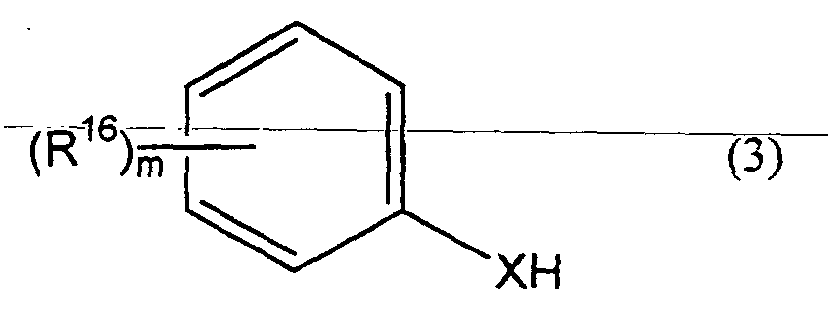
         the alcohol derivative is an alcohol derivative of the following formula (4):
      Figure 00580001
      wherein R13, R14, R15, R16, X, m and n are as defined above.
    11. A production process according to claim 10, comprising the further step of reacting the alcohol derivative of formula (4) with a halogenated nitrogen-containing heterocyclic compound of formula (5): Z-R17 wherein Z is halogen and R17 is pyridyl, pyridazinyl, pyrimidinyl, pyrazinyl, triazinyl, 2-thiazolyl or dihydro-2-thiazolyl; wherein these groups may optionally have one or more than one substituent selected from the group consisting of halogen, alkyl of 1 to 4 carbon atoms, alkoxy of 1 to 4 carbon atoms, alkylthio of 1 to 4 carbon atoms, trifluoromethyl and nitro, to give a nitrogen-containing heterocyclic compound of formula (6):
      Figure 00580002
      wherein X, R13, R14, R15, R16, R17, X and n are as defined above.
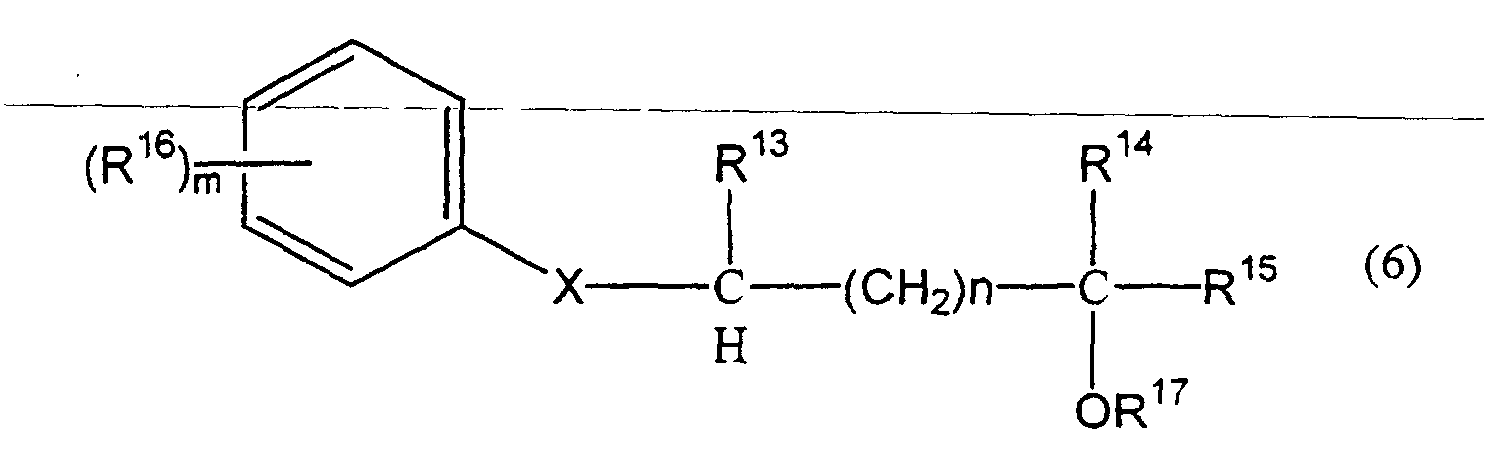
    12. A process for the production of an optically active alcohol derivative, characterized in that a cyclic ether compound is reacted with a phenol derivative in the presence of an asymmetric complex catalyst comprising an optically active metal complex and a Lewis acid according to claim 2.
    13. A production process according to claim 12, characterized by further comprising the step of reacting the resulting optically active alcohol derivative with a halogenated nitrogen-containing heterocyclic compound in the presence of a base to give an optically active nitrogen-containing heterocyclic compound.
    14. A production process according to claim 12, wherein the cyclic ether compound is a cyclic ether compound of formula (2):
      Figure 00590001
      wherein R13 is hydrogen; R14 is hydrogen or alkyl; or R13 and R14 are combined together to represent alkylene of 2 to 6 carbon atoms; R15 is alkyl, aryl or aralkyl; wherein the alkyl, aryl or aralkyl group may optionally have a substituent(s); and n is 0 or 1;
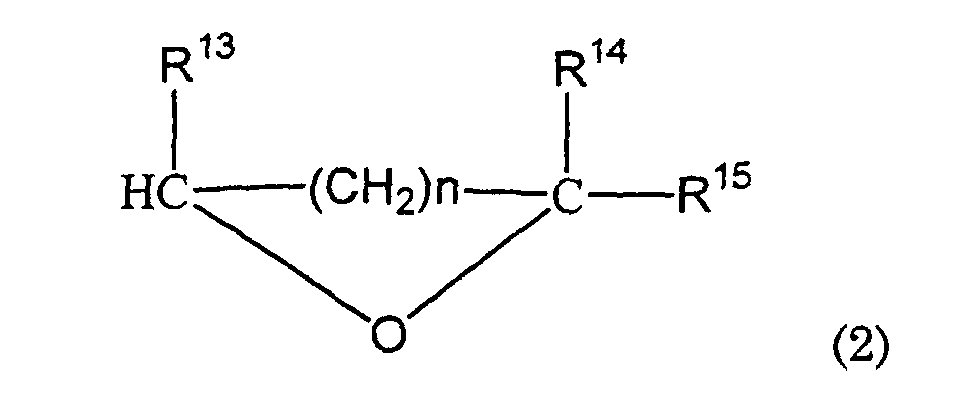
         the phenol derivative is a phenol derivative of the following formula (3):
      Figure 00590002
      wherein X is oxygen or sulfur; R16 's are the same or different and are independently hydrogen, halogen, nitro, alkyl of 1 to 6 carbon atoms, alkoxy of 1 to 6 carbon atoms, phenylthio, benzyl or phenoxy; wherein the alkyl group of 1 to 6 carbon atoms, the alkoxy group of 1 to 6 carbon atoms, the phenylthio, benzyl or phenoxy group may optionally be substituted with alkyl of 1 to 4 carbon atoms, alkoxy of 1 to 4 carbon atoms, haloalkyl of 1 to 4 carbon atoms, haloalkoxy of 1 to 4 carbon atoms, or halogen; and m is an integer of 0 to 5; and
         the optically active alcohol derivative is an optically active alcohol derivative of the following formula (4'):
      Figure 00600001
      wherein R13, R14, R15, R16, m and n are as defined above and * indicates an asymmetric carbon atom.
    15. A production process according to claim 14, comprising the further step of reacting the optically active alcohol derivative of formula (4') with a halogenated nitrogen-containing heterocyclic compound of formula (5): Z-R17 wherein Z is halogen and R17 is pyridyl, pyridazinyl, pyrimidinyl, pyrazinyl, triazinyl, 2-thiazolyl or dihydro-2-thiazolyl; wherein these groups may optionally have one to two substituents selected from the group consisting of halogen, alkyl of 1 to 4 carbon atoms, alkoxy of 1 to 4 carbon atoms, alkylthio of 1 to 4 carbon atoms, trifluoromethyl and nitro in the presence of a base to give an optically active nitrogen-containing heterocyclic compound of formula (6'):
      Figure 00600002
      wherein R11, R12, R13, R14, R15, X, Y, n and * are as defined above.
    16. A production process according to any one of claims 7 to 15, wherein M is a cobalt ion, a chromium ion or a manganese ion.
    17. A production process according to any one of claims 7 to 15, wherein the Lewis acid is an aluminum halide, a dialkyl aluminum halide, a trialkoxy aluminum, a titanium halide, a tetraalkoxy titanium, a boron halide or a zinc halide.
    18. A production process according to claims 10, 11, 14, 15 or 16, wherein R13 is hydrogen; R19 is hydrogen; R15 is methyl or ethyl; R16 is hydrogen, halogen, alkyl of 1 to 4 carbon atoms, alkoxy of 1 to 4 carbon atoms, or trifluoromethyl; and n is an integer of 0 to 4.
    EP02720443A 2001-04-18 2002-04-17 Complex catalyst, process for producing the complex catalyst, and process for producing alcohol derivative with the complex catalyst Expired - Lifetime EP1380342B1 (en)

    Priority Applications (1)

    Application Number Priority Date Filing Date Title
    CY20091100800T CY1109302T1 (en) 2001-04-18 2009-07-28 Catalyst Complex, Method of Preparation of Complex Catalyst and Method of Preparation of Alcohol Derivatives with Catalyst Complex

    Applications Claiming Priority (9)

    Application Number Priority Date Filing Date Title
    JP2001119307 2001-04-18
    JP2001119307 2001-04-18
    JP2001300869 2001-09-28
    JP2001300870 2001-09-28
    JP2001300870 2001-09-28
    JP2001300868 2001-09-28
    JP2001300868 2001-09-28
    JP2001300869 2001-09-28
    PCT/JP2002/003791 WO2002085516A1 (en) 2001-04-18 2002-04-17 Complex catalyst, process for producing the complex catalyst, and process for producing alcohol derivative with the complex catalyst

    Publications (3)

    Publication Number Publication Date
    EP1380342A1 true EP1380342A1 (en) 2004-01-14
    EP1380342A4 EP1380342A4 (en) 2004-09-29
    EP1380342B1 EP1380342B1 (en) 2009-07-01

    Family

    ID=27482215

    Family Applications (1)

    Application Number Title Priority Date Filing Date
    EP02720443A Expired - Lifetime EP1380342B1 (en) 2001-04-18 2002-04-17 Complex catalyst, process for producing the complex catalyst, and process for producing alcohol derivative with the complex catalyst

    Country Status (15)

    Country Link
    US (1) US6995110B2 (en)
    EP (1) EP1380342B1 (en)
    KR (1) KR100838139B1 (en)
    CN (1) CN1281320C (en)
    AT (1) ATE435069T1 (en)
    BR (1) BR0208921B1 (en)
    CY (1) CY1109302T1 (en)
    DE (1) DE60232786D1 (en)
    DK (1) DK1380342T3 (en)
    ES (1) ES2327718T3 (en)
    HU (1) HU228372B1 (en)
    IL (2) IL156631A0 (en)
    PT (1) PT1380342E (en)
    SA (1) SA02230312B1 (en)
    WO (1) WO2002085516A1 (en)

    Cited By (2)

    * Cited by examiner, † Cited by third party
    Publication number Priority date Publication date Assignee Title
    WO2010099303A1 (en) * 2009-02-26 2010-09-02 Dow Global Technologies Inc. Alkoxylation processes and catalysts therefor
    EP2123638A4 (en) * 2007-03-09 2011-04-06 Sumitomo Chemical Co METALLIC COMPLEX

    Families Citing this family (4)

    * Cited by examiner, † Cited by third party
    Publication number Priority date Publication date Assignee Title
    DE10164348A1 (en) 2001-12-28 2003-07-17 Basf Ag Process for the preparation of 1-methoypropanol-2
    US7186630B2 (en) 2002-08-14 2007-03-06 Asm America, Inc. Deposition of amorphous silicon-containing films
    WO2007089022A1 (en) * 2006-02-01 2007-08-09 Sumitomo Chemical Company, Limited Method for producing optically active alcohol compound
    US7906667B2 (en) 2006-02-01 2011-03-15 Sumitomo Chemical Company, Limited Method for producing optically active alcohol compound

    Family Cites Families (8)

    * Cited by examiner, † Cited by third party
    Publication number Priority date Publication date Assignee Title
    JPS60176592A (en) 1984-02-23 1985-09-10 Sumitomo Chem Co Ltd Biochemical preparation of optically active 1-(4-phenoxyphenoxy)propan-2-ol
    WO1993014031A1 (en) * 1988-12-16 1993-07-22 Cahiez Gerard Preparation and application of brominated manganese compounds
    US5665890A (en) 1995-03-14 1997-09-09 President And Fellows Of Harvard College Stereoselective ring opening reactions
    US6262278B1 (en) 1995-03-14 2001-07-17 President And Fellows Of Harvard College Stereoselective ring opening reactions
    JPH11209387A (en) * 1998-01-26 1999-08-03 Hiroshi Kashihara Optically active manganese complex
    GB9813939D0 (en) * 1998-06-29 1998-08-26 Ici Plc A living polymerisation process
    JP2000026442A (en) * 1998-07-14 2000-01-25 Sumika Fine Chemicals Co Ltd Production of optically active styrene oxide
    JP3968076B2 (en) 2001-06-27 2007-08-29 アールエス テック コーポレイション New chiral salen compound, chiral salen catalyst, and method for producing chiral compound from racemic epoxy compound using the same

    Cited By (10)

    * Cited by examiner, † Cited by third party
    Publication number Priority date Publication date Assignee Title
    EP2123638A4 (en) * 2007-03-09 2011-04-06 Sumitomo Chemical Co METALLIC COMPLEX
    US8329929B2 (en) 2007-03-09 2012-12-11 Sumitomo Chemical Company, Limited Metal complex
    WO2010099303A1 (en) * 2009-02-26 2010-09-02 Dow Global Technologies Inc. Alkoxylation processes and catalysts therefor
    WO2010099300A1 (en) * 2009-02-26 2010-09-02 Dow Global Technologies Inc. Alkoxylation processes and catalysts therefor
    CN102316982A (en) * 2009-02-26 2012-01-11 陶氏环球技术有限责任公司 Alkoxylating method and catalyst thereof
    CN102316981A (en) * 2009-02-26 2012-01-11 陶氏环球技术有限责任公司 Alkoxylation processes and catalysts therefor
    US8748336B2 (en) 2009-02-26 2014-06-10 Dow Global Technologies Llc Alkoxylation processes and catalysts therefor
    US8835348B2 (en) 2009-02-26 2014-09-16 Dow Global Technologies Llc Alkoxylation processes and catalysts therefor
    US8975446B2 (en) 2009-02-26 2015-03-10 Dow Global Technologies Llc Alkoxylation processes and catalysts therefor
    CN102316981B (en) * 2009-02-26 2015-07-01 陶氏环球技术有限责任公司 Alkoxylation process and its catalyst

    Also Published As

    Publication number Publication date
    KR100838139B1 (en) 2008-06-13
    ATE435069T1 (en) 2009-07-15
    BR0208921A (en) 2004-04-27
    IL156631A0 (en) 2004-01-04
    IL156631A (en) 2006-12-31
    US6995110B2 (en) 2006-02-07
    PT1380342E (en) 2009-07-20
    HUP0303823A3 (en) 2004-06-28
    DE60232786D1 (en) 2009-08-13
    CN1281320C (en) 2006-10-25
    DK1380342T3 (en) 2009-08-24
    ES2327718T3 (en) 2009-11-03
    EP1380342B1 (en) 2009-07-01
    CN1503696A (en) 2004-06-09
    HU228372B1 (en) 2013-03-28
    SA02230312B1 (en) 2007-07-31
    HUP0303823A2 (en) 2004-03-29
    CY1109302T1 (en) 2014-07-02
    BR0208921B1 (en) 2012-07-24
    US20040077487A1 (en) 2004-04-22
    KR20040004579A (en) 2004-01-13
    WO2002085516A1 (en) 2002-10-31
    EP1380342A4 (en) 2004-09-29

    Similar Documents

    Publication Publication Date Title
    Miceli et al. Vanadium (V) catalysts with high activity for the coupling of epoxides and CO2: characterization of a putative catalytic intermediate
    Darensbourg et al. Carbon dioxide/epoxide coupling reactions utilizing lewis base adducts of zinc halides as catalysts. Cyclic carbonate versus polycarbonate production
    EP1380342B1 (en) Complex catalyst, process for producing the complex catalyst, and process for producing alcohol derivative with the complex catalyst
    Martinez et al. Synthesis of new macrocyclic chiral manganese (III) Schiff bases as catalysts for asymmetric epoxidation
    Banerjee et al. Heterometallic Ln/Hg compounds with fluorinated thiolate ligands
    JP4258195B2 (en) Process for producing optically active nitrogen-containing heterocyclic compound
    JP4258196B2 (en) Method for producing nitrogen-containing heterocyclic compound
    CN109574999B (en) Preparation method of pitavastatin calcium intermediate
    JP5211495B2 (en) Process for producing optically active alcohol compound and asymmetric complex used therefor
    JP4844130B2 (en) Process for producing β-hydroxy ethers
    TWI299728B (en) Process for production of alcohol derivatives
    JP5211496B2 (en) Process for producing optically active alcohol compound and asymmetric complex used therefor
    Pyne et al. Chiral Sulfur Compounds. XV. Diastereoselective Additions of Lithiated S-Benzyl-Nt-butyldiphenylsilyl-S-methyl-sulfoximine to Imines and Aldehydes
    JP2003176246A (en) Method for producing alcohol derivative and catalyst thereof
    US20100234629A1 (en) Method for producing optically active alcohol compound
    US20090012330A1 (en) Method for producing optically active alcohol compound
    JP2003002854A (en) Method for producing optically active alcohol derivative and catalyst thereof
    JP4305018B2 (en) Method for producing alcohol compound
    US9765102B2 (en) ONO pincer ligands and ONO pincer ligand comprising metal complexes
    KR102156368B1 (en) Fe Complex Catalyst, And Preparing Method of Cyclic Carboates Using The Same
    KR102184197B1 (en) Fe Complex Catalist, Preparing Method Thereof, And Preparing Method of Cyclic Carboates Using The Same
    Kotov et al. Preparation and use of novel molybdenum-containing organic complexes as catalysts in the epoxidation of cyclohexene: II. Synthesis and applicability of molybdenum complexes based on squaric acid, 1-phenyl-1-ethanamine and 1, 3-diamino-2-propanol
    WO2022256525A1 (en) Cobalt catalysts containing "smart"or"task specific"anions
    WO2013188771A2 (en) Catalytic c-h bond activation for the synthesis of ethers and thioethers
    JP2006089463A (en) Method for producing aryl ethers

    Legal Events

    Date Code Title Description
    PUAI Public reference made under article 153(3) epc to a published international application that has entered the european phase

    Free format text: ORIGINAL CODE: 0009012

    17P Request for examination filed

    Effective date: 20030728

    AK Designated contracting states

    Kind code of ref document: A1

    Designated state(s): AT BE CH CY DE DK ES FI FR GB GR IE IT LI LU MC NL PT SE TR

    AX Request for extension of the european patent

    Extension state: AL LT LV MK RO SI

    RIC1 Information provided on ipc code assigned before grant

    Ipc: 7B 01J 31/22 A

    Ipc: 7C 07B 53/00 B

    Ipc: 7C 07C 41/03 B

    Ipc: 7C 07C 43/23 B

    Ipc: 7C 07D 213/64 B

    Ipc: 7B 01J 27/20 B

    A4 Supplementary search report drawn up and despatched

    Effective date: 20040818

    RAP1 Party data changed (applicant data changed or rights of an application transferred)

    Owner name: SUMITOMO CHEMICAL COMPANY, LIMITED

    17Q First examination report despatched

    Effective date: 20041125

    GRAP Despatch of communication of intention to grant a patent

    Free format text: ORIGINAL CODE: EPIDOSNIGR1

    GRAS Grant fee paid

    Free format text: ORIGINAL CODE: EPIDOSNIGR3

    GRAA (expected) grant

    Free format text: ORIGINAL CODE: 0009210

    AK Designated contracting states

    Kind code of ref document: B1

    Designated state(s): AT BE CH CY DE DK ES FI FR GB GR IE IT LI LU MC NL PT SE TR

    REG Reference to a national code

    Ref country code: GB

    Ref legal event code: FG4D

    REG Reference to a national code

    Ref country code: CH

    Ref legal event code: EP

    Ref country code: CH

    Ref legal event code: NV

    Representative=s name: BOHEST AG

    REG Reference to a national code

    Ref country code: PT

    Ref legal event code: SC4A

    Free format text: AVAILABILITY OF NATIONAL TRANSLATION

    Effective date: 20090713

    REG Reference to a national code

    Ref country code: IE

    Ref legal event code: FG4D

    REF Corresponds to:

    Ref document number: 60232786

    Country of ref document: DE

    Date of ref document: 20090813

    Kind code of ref document: P

    REG Reference to a national code

    Ref country code: DK

    Ref legal event code: T3

    REG Reference to a national code

    Ref country code: GR

    Ref legal event code: EP

    Ref document number: 20090401914

    Country of ref document: GR

    REG Reference to a national code

    Ref country code: ES

    Ref legal event code: FG2A

    Ref document number: 2327718

    Country of ref document: ES

    Kind code of ref document: T3

    PG25 Lapsed in a contracting state [announced via postgrant information from national office to epo]

    Ref country code: FI

    Free format text: LAPSE BECAUSE OF FAILURE TO SUBMIT A TRANSLATION OF THE DESCRIPTION OR TO PAY THE FEE WITHIN THE PRESCRIBED TIME-LIMIT

    Effective date: 20090701

    Ref country code: SE

    Free format text: LAPSE BECAUSE OF FAILURE TO SUBMIT A TRANSLATION OF THE DESCRIPTION OR TO PAY THE FEE WITHIN THE PRESCRIBED TIME-LIMIT

    Effective date: 20090701

    PLBE No opposition filed within time limit

    Free format text: ORIGINAL CODE: 0009261

    STAA Information on the status of an ep patent application or granted ep patent

    Free format text: STATUS: NO OPPOSITION FILED WITHIN TIME LIMIT

    26N No opposition filed

    Effective date: 20100406

    PG25 Lapsed in a contracting state [announced via postgrant information from national office to epo]

    Ref country code: MC

    Free format text: LAPSE BECAUSE OF NON-PAYMENT OF DUE FEES

    Effective date: 20100430

    PG25 Lapsed in a contracting state [announced via postgrant information from national office to epo]

    Ref country code: IE

    Free format text: LAPSE BECAUSE OF NON-PAYMENT OF DUE FEES

    Effective date: 20100417

    PGFP Annual fee paid to national office [announced via postgrant information from national office to epo]

    Ref country code: TR

    Payment date: 20120327

    Year of fee payment: 11

    PG25 Lapsed in a contracting state [announced via postgrant information from national office to epo]

    Ref country code: LU

    Free format text: LAPSE BECAUSE OF NON-PAYMENT OF DUE FEES

    Effective date: 20100417

    PGFP Annual fee paid to national office [announced via postgrant information from national office to epo]

    Ref country code: ES

    Payment date: 20120510

    Year of fee payment: 11

    PGFP Annual fee paid to national office [announced via postgrant information from national office to epo]

    Ref country code: AT

    Payment date: 20120327

    Year of fee payment: 11

    PGFP Annual fee paid to national office [announced via postgrant information from national office to epo]

    Ref country code: GR

    Payment date: 20130319

    Year of fee payment: 12

    PGFP Annual fee paid to national office [announced via postgrant information from national office to epo]

    Ref country code: CY

    Payment date: 20130306

    Year of fee payment: 12

    Ref country code: CH

    Payment date: 20130412

    Year of fee payment: 12

    Ref country code: DE

    Payment date: 20130508

    Year of fee payment: 12

    Ref country code: BE

    Payment date: 20130415

    Year of fee payment: 12

    Ref country code: DK

    Payment date: 20130410

    Year of fee payment: 12

    Ref country code: GB

    Payment date: 20130417

    Year of fee payment: 12

    PGFP Annual fee paid to national office [announced via postgrant information from national office to epo]

    Ref country code: FR

    Payment date: 20130625

    Year of fee payment: 12

    Ref country code: IT

    Payment date: 20130422

    Year of fee payment: 12

    Ref country code: NL

    Payment date: 20130410

    Year of fee payment: 12

    Ref country code: PT

    Payment date: 20130416

    Year of fee payment: 12

    REG Reference to a national code

    Ref country code: CH

    Ref legal event code: PCAR

    Free format text: NEW ADDRESS: HOLBEINSTRASSE 36-38, 4051 BASEL (CH)

    REG Reference to a national code

    Ref country code: PT

    Ref legal event code: MM4A

    Free format text: LAPSE DUE TO NON-PAYMENT OF FEES

    Effective date: 20141017

    REG Reference to a national code

    Ref country code: DE

    Ref legal event code: R119

    Ref document number: 60232786

    Country of ref document: DE

    REG Reference to a national code

    Ref country code: DK

    Ref legal event code: EBP

    Effective date: 20140430

    REG Reference to a national code

    Ref country code: NL

    Ref legal event code: V1

    Effective date: 20141101

    REG Reference to a national code

    Ref country code: CH

    Ref legal event code: PL

    REG Reference to a national code

    Ref country code: AT

    Ref legal event code: MM01

    Ref document number: 435069

    Country of ref document: AT

    Kind code of ref document: T

    Effective date: 20140417

    GBPC Gb: european patent ceased through non-payment of renewal fee

    Effective date: 20140417

    REG Reference to a national code

    Ref country code: GR

    Ref legal event code: ML

    Ref document number: 20090401914

    Country of ref document: GR

    Effective date: 20141104

    REG Reference to a national code

    Ref country code: DE

    Ref legal event code: R119

    Ref document number: 60232786

    Country of ref document: DE

    Effective date: 20141101

    REG Reference to a national code

    Ref country code: FR

    Ref legal event code: ST

    Effective date: 20141231

    PG25 Lapsed in a contracting state [announced via postgrant information from national office to epo]

    Ref country code: LI

    Free format text: LAPSE BECAUSE OF NON-PAYMENT OF DUE FEES

    Effective date: 20140430

    Ref country code: DE

    Free format text: LAPSE BECAUSE OF NON-PAYMENT OF DUE FEES

    Effective date: 20141101

    Ref country code: PT

    Free format text: LAPSE BECAUSE OF NON-PAYMENT OF DUE FEES

    Effective date: 20141017

    Ref country code: GR

    Free format text: LAPSE BECAUSE OF NON-PAYMENT OF DUE FEES

    Effective date: 20141104

    Ref country code: GB

    Free format text: LAPSE BECAUSE OF NON-PAYMENT OF DUE FEES

    Effective date: 20140417

    Ref country code: CH

    Free format text: LAPSE BECAUSE OF NON-PAYMENT OF DUE FEES

    Effective date: 20140430

    PG25 Lapsed in a contracting state [announced via postgrant information from national office to epo]

    Ref country code: NL

    Free format text: LAPSE BECAUSE OF NON-PAYMENT OF DUE FEES

    Effective date: 20141101

    Ref country code: FR

    Free format text: LAPSE BECAUSE OF NON-PAYMENT OF DUE FEES

    Effective date: 20140430

    Ref country code: AT

    Free format text: LAPSE BECAUSE OF NON-PAYMENT OF DUE FEES

    Effective date: 20140417

    Ref country code: CY

    Free format text: LAPSE BECAUSE OF NON-PAYMENT OF DUE FEES

    Effective date: 20140417

    PG25 Lapsed in a contracting state [announced via postgrant information from national office to epo]

    Ref country code: IT

    Free format text: LAPSE BECAUSE OF NON-PAYMENT OF DUE FEES

    Effective date: 20140417

    PG25 Lapsed in a contracting state [announced via postgrant information from national office to epo]

    Ref country code: DK

    Free format text: LAPSE BECAUSE OF NON-PAYMENT OF DUE FEES

    Effective date: 20140430

    REG Reference to a national code

    Ref country code: ES

    Ref legal event code: FD2A

    Effective date: 20150528

    PG25 Lapsed in a contracting state [announced via postgrant information from national office to epo]

    Ref country code: ES

    Free format text: LAPSE BECAUSE OF NON-PAYMENT OF DUE FEES

    Effective date: 20140418

    PG25 Lapsed in a contracting state [announced via postgrant information from national office to epo]

    Ref country code: BE

    Free format text: LAPSE BECAUSE OF NON-PAYMENT OF DUE FEES

    Effective date: 20140430

    PG25 Lapsed in a contracting state [announced via postgrant information from national office to epo]

    Ref country code: TR

    Free format text: LAPSE BECAUSE OF NON-PAYMENT OF DUE FEES

    Effective date: 20140417