EP1377337B1 - Abdeckung und applikator für ein teil eines säugetierkörpers - Google Patents
Abdeckung und applikator für ein teil eines säugetierkörpers Download PDFInfo
- Publication number
- EP1377337B1 EP1377337B1 EP02713650A EP02713650A EP1377337B1 EP 1377337 B1 EP1377337 B1 EP 1377337B1 EP 02713650 A EP02713650 A EP 02713650A EP 02713650 A EP02713650 A EP 02713650A EP 1377337 B1 EP1377337 B1 EP 1377337B1
- Authority
- EP
- European Patent Office
- Prior art keywords
- cover
- nipple
- flexible member
- well
- agent
- Prior art date
- Legal status (The legal status is an assumption and is not a legal conclusion. Google has not performed a legal analysis and makes no representation as to the accuracy of the status listed.)
- Expired - Lifetime
Links
- 239000003795 chemical substances by application Substances 0.000 claims abstract description 49
- 230000003444 anaesthetic effect Effects 0.000 claims abstract description 12
- 210000002445 nipple Anatomy 0.000 claims description 91
- 239000000853 adhesive Substances 0.000 claims description 21
- 230000001070 adhesive effect Effects 0.000 claims description 20
- 210000004883 areola Anatomy 0.000 claims description 8
- 239000006260 foam Substances 0.000 claims description 3
- 239000012780 transparent material Substances 0.000 claims description 2
- 239000003193 general anesthetic agent Substances 0.000 claims 2
- 239000012790 adhesive layer Substances 0.000 claims 1
- 238000000034 method Methods 0.000 abstract description 48
- 239000003814 drug Substances 0.000 abstract description 12
- 230000000699 topical effect Effects 0.000 abstract description 4
- 208000010201 Exanthema Diseases 0.000 abstract description 2
- 201000005884 exanthem Diseases 0.000 abstract description 2
- 206010037844 rash Diseases 0.000 abstract description 2
- 231100000046 skin rash Toxicity 0.000 abstract description 2
- 239000000463 material Substances 0.000 description 19
- 238000004873 anchoring Methods 0.000 description 6
- -1 polyethylene Polymers 0.000 description 5
- 239000004698 Polyethylene Substances 0.000 description 4
- 210000000481 breast Anatomy 0.000 description 4
- 239000012530 fluid Substances 0.000 description 4
- 229920000573 polyethylene Polymers 0.000 description 4
- 238000002360 preparation method Methods 0.000 description 4
- 206010052428 Wound Diseases 0.000 description 3
- 208000027418 Wounds and injury Diseases 0.000 description 3
- 239000000203 mixture Substances 0.000 description 3
- 210000003371 toe Anatomy 0.000 description 3
- 239000003242 anti bacterial agent Substances 0.000 description 2
- 230000004888 barrier function Effects 0.000 description 2
- 230000000694 effects Effects 0.000 description 2
- 230000000774 hypoallergenic effect Effects 0.000 description 2
- 230000003902 lesion Effects 0.000 description 2
- 239000003589 local anesthetic agent Substances 0.000 description 2
- 210000001331 nose Anatomy 0.000 description 2
- 210000003899 penis Anatomy 0.000 description 2
- 229920003023 plastic Polymers 0.000 description 2
- 239000004033 plastic Substances 0.000 description 2
- 229920000728 polyester Polymers 0.000 description 2
- 230000001012 protector Effects 0.000 description 2
- 210000003491 skin Anatomy 0.000 description 2
- 238000005482 strain hardening Methods 0.000 description 2
- 238000003856 thermoforming Methods 0.000 description 2
- 239000003860 topical agent Substances 0.000 description 2
- 238000009423 ventilation Methods 0.000 description 2
- 235000002566 Capsicum Nutrition 0.000 description 1
- 240000008574 Capsicum frutescens Species 0.000 description 1
- 229920010126 Linear Low Density Polyethylene (LLDPE) Polymers 0.000 description 1
- 206010033372 Pain and discomfort Diseases 0.000 description 1
- 239000004743 Polypropylene Substances 0.000 description 1
- 239000004775 Tyvek Substances 0.000 description 1
- 229920000690 Tyvek Polymers 0.000 description 1
- 239000013543 active substance Substances 0.000 description 1
- 230000002411 adverse Effects 0.000 description 1
- 229940088710 antibiotic agent Drugs 0.000 description 1
- 230000003115 biocidal effect Effects 0.000 description 1
- 239000001390 capsicum minimum Substances 0.000 description 1
- 238000004140 cleaning Methods 0.000 description 1
- 239000011248 coating agent Substances 0.000 description 1
- 238000000576 coating method Methods 0.000 description 1
- 239000002131 composite material Substances 0.000 description 1
- 238000000748 compression moulding Methods 0.000 description 1
- 229920003020 cross-linked polyethylene Polymers 0.000 description 1
- 239000004703 cross-linked polyethylene Substances 0.000 description 1
- 229910003460 diamond Inorganic materials 0.000 description 1
- 239000010432 diamond Substances 0.000 description 1
- 230000000916 dilatatory effect Effects 0.000 description 1
- 230000005489 elastic deformation Effects 0.000 description 1
- 239000013013 elastic material Substances 0.000 description 1
- 210000002615 epidermis Anatomy 0.000 description 1
- 210000003811 finger Anatomy 0.000 description 1
- 210000003128 head Anatomy 0.000 description 1
- 230000035876 healing Effects 0.000 description 1
- 208000015181 infectious disease Diseases 0.000 description 1
- 238000001746 injection moulding Methods 0.000 description 1
- 238000012986 modification Methods 0.000 description 1
- 230000004048 modification Effects 0.000 description 1
- 229920000642 polymer Polymers 0.000 description 1
- 229920001155 polypropylene Polymers 0.000 description 1
- 229920001296 polysiloxane Polymers 0.000 description 1
- 239000011148 porous material Substances 0.000 description 1
- 239000012858 resilient material Substances 0.000 description 1
- 230000000717 retained effect Effects 0.000 description 1
- 239000000523 sample Substances 0.000 description 1
- 230000000153 supplemental effect Effects 0.000 description 1
- 229920003051 synthetic elastomer Polymers 0.000 description 1
- 239000005061 synthetic rubber Substances 0.000 description 1
- 230000001225 therapeutic effect Effects 0.000 description 1
- 229920001187 thermosetting polymer Polymers 0.000 description 1
- 238000001721 transfer moulding Methods 0.000 description 1
- 238000003466 welding Methods 0.000 description 1
- 239000003357 wound healing promoting agent Substances 0.000 description 1
Images


Classifications
-
- A—HUMAN NECESSITIES
- A61—MEDICAL OR VETERINARY SCIENCE; HYGIENE
- A61J—CONTAINERS SPECIALLY ADAPTED FOR MEDICAL OR PHARMACEUTICAL PURPOSES; DEVICES OR METHODS SPECIALLY ADAPTED FOR BRINGING PHARMACEUTICAL PRODUCTS INTO PARTICULAR PHYSICAL OR ADMINISTERING FORMS; DEVICES FOR ADMINISTERING FOOD OR MEDICINES ORALLY; BABY COMFORTERS; DEVICES FOR RECEIVING SPITTLE
- A61J13/00—Breast-nipple shields
-
- A—HUMAN NECESSITIES
- A61—MEDICAL OR VETERINARY SCIENCE; HYGIENE
- A61F—FILTERS IMPLANTABLE INTO BLOOD VESSELS; PROSTHESES; DEVICES PROVIDING PATENCY TO, OR PREVENTING COLLAPSING OF, TUBULAR STRUCTURES OF THE BODY, e.g. STENTS; ORTHOPAEDIC, NURSING OR CONTRACEPTIVE DEVICES; FOMENTATION; TREATMENT OR PROTECTION OF EYES OR EARS; BANDAGES, DRESSINGS OR ABSORBENT PADS; FIRST-AID KITS
- A61F13/00—Bandages or dressings; Absorbent pads
- A61F13/14—Bandages or dressings; Absorbent pads specially adapted for the breast or abdomen
- A61F13/141—Milk breast pads
-
- A—HUMAN NECESSITIES
- A61—MEDICAL OR VETERINARY SCIENCE; HYGIENE
- A61F—FILTERS IMPLANTABLE INTO BLOOD VESSELS; PROSTHESES; DEVICES PROVIDING PATENCY TO, OR PREVENTING COLLAPSING OF, TUBULAR STRUCTURES OF THE BODY, e.g. STENTS; ORTHOPAEDIC, NURSING OR CONTRACEPTIVE DEVICES; FOMENTATION; TREATMENT OR PROTECTION OF EYES OR EARS; BANDAGES, DRESSINGS OR ABSORBENT PADS; FIRST-AID KITS
- A61F15/00—Auxiliary appliances for wound dressings; Dispensing containers for dressings or bandages
- A61F15/008—Appliances for wound protecting, e.g. avoiding contact between wound and bandage
-
- A—HUMAN NECESSITIES
- A61—MEDICAL OR VETERINARY SCIENCE; HYGIENE
- A61M—DEVICES FOR INTRODUCING MEDIA INTO, OR ONTO, THE BODY; DEVICES FOR TRANSDUCING BODY MEDIA OR FOR TAKING MEDIA FROM THE BODY; DEVICES FOR PRODUCING OR ENDING SLEEP OR STUPOR
- A61M19/00—Local anaesthesia; Hypothermia
-
- A—HUMAN NECESSITIES
- A61—MEDICAL OR VETERINARY SCIENCE; HYGIENE
- A61F—FILTERS IMPLANTABLE INTO BLOOD VESSELS; PROSTHESES; DEVICES PROVIDING PATENCY TO, OR PREVENTING COLLAPSING OF, TUBULAR STRUCTURES OF THE BODY, e.g. STENTS; ORTHOPAEDIC, NURSING OR CONTRACEPTIVE DEVICES; FOMENTATION; TREATMENT OR PROTECTION OF EYES OR EARS; BANDAGES, DRESSINGS OR ABSORBENT PADS; FIRST-AID KITS
- A61F13/00—Bandages or dressings; Absorbent pads
- A61F13/15—Absorbent pads, e.g. sanitary towels, swabs or tampons for external or internal application to the body; Supporting or fastening means therefor; Tampon applicators
- A61F2013/15008—Absorbent pads, e.g. sanitary towels, swabs or tampons for external or internal application to the body; Supporting or fastening means therefor; Tampon applicators characterized by the use
- A61F2013/15016—Absorbent pads, e.g. sanitary towels, swabs or tampons for external or internal application to the body; Supporting or fastening means therefor; Tampon applicators characterized by the use for breast; pads for bras
-
- A—HUMAN NECESSITIES
- A61—MEDICAL OR VETERINARY SCIENCE; HYGIENE
- A61M—DEVICES FOR INTRODUCING MEDIA INTO, OR ONTO, THE BODY; DEVICES FOR TRANSDUCING BODY MEDIA OR FOR TAKING MEDIA FROM THE BODY; DEVICES FOR PRODUCING OR ENDING SLEEP OR STUPOR
- A61M2210/00—Anatomical parts of the body
- A61M2210/10—Trunk
- A61M2210/1007—Breast; mammary
Definitions
- the present invention relates to a device for covering and applying a medicament to a protruding portion of a mammalian body. More specifically, the present invention relates to a flexible, continuous covering apparatus that surrounds the protruding body portion in order to protect it and/or retain a medical agent on it before or after an operation or other medical procedure has been performed.
- Certain medical procedures require that an agent, such as a medicament, be topically applied to, and maintained on, a portion of a patient's body.
- the need for the agent can arise before or after the medical procedures have been performed.
- These procedures can comprise patient examinations, minimally invasive diagnostic operations, exploratory operations and invasive therapeutic operations.
- the patient examinations may include the step of positioning a medical device, such as a probe, scope or catheter, within a body passageway to perform an examination or retrieve material from within the passageway or a related body cavity, such as a duct.
- Topical anesthetics are an example of one class of medicaments that may be applied to the portion of the body hours before and/or after the intended procedure is performed.
- topical anesthetics can prepare the body portion to receive a medical device that will be positioned within a body opening or incision during the procedure.
- a composition including an anesthetic and another active agent may also be used.
- a dekeratinizing agent and/or a ductal orifice dilating agent such as capsicum may be used.
- Agents applied post procedure might include topical antibiotics or well-known wound healing agents.
- a cover such as a bandage
- conventional covers do not offer the patient an effective option for covering the anesthetic for an hour or any other extended period of time that is sufficient to prepare (numb) the body portion. Instead, these covers lay like a flat drape, are normally ineffective and are uncomfortable to wear, especially when the patient is active between the time the anesthetic is applied and the procedure is performed. Hence, the patient may only wear the cover and the anesthetic for a short time before the procedure begins. Unfortunately, when this occurs, the amount of discomfort experienced by the patient during the procedure may be significantly increased.
- the bandages can be wrapped circumferentially around the portion of the body being treated like an open ended cylinder if the treated portion is part or all of a protruding body member.
- these bandages do not cover, encapsulate and isolate the portion of the body from its normal environment.
- Examples of the protruding body portions that do not form effective seals with conventional bandages include, but are not limited to, nipples, fingers, toes, noses and pediatric penises.
- the added amount may adversely effect the adhesive portion of the bandage and prevent any portion of it from adhering to the patient. If this occurs, the amount of the agent that will leak out from under the bandage will be excessive.
- nipple covers for lactating nipples that permit expelled fluid to dry on the nipple. Examples of these covers are disclosed in U.S. Patent No. 3,840,012 to Rushton, Jr., U.S. Patent No. 5,032,103 to Larsson and French Patent No. 792,353 to Proquitte et al.. These nipple covers include openings along their outer surface that permit air to enter the interior of the cover and dry any fluid expelled from the breast. As a result, these covers cannot be used to hold a medicament on a nipple. If they were, the medicament would leak out through the air hole(s) and onto the clothes of the patient. Therefore, the use of these covers would be pointless.
- nipples Other types of devices without ventilation holes are used to cover nipples.
- One such nipple cover is used to cover the nipples of male long distance runners. Such a cover is disclosed in U.S. Patent No. 5,743,272 to Kocher, Jr.
- the male nipple covers do not include ventilation openings. Instead, these covers have large, flat outer end surfaces. Additionally, these covers are not laterally or longitudinally flexible. As a result, they do not collapse around the nipple and conform to its shape. Therefore, others will readily notice these nipple covers when worn.
- nipple covers will be conspicuous and possibly embarrass the person using them because they can be easily seen under clothing when worn.
- U.S. Patent No. 6,005,159 discloses a protected covering for body lesions comprising a frame having a base, wherein the frame defines an opening for surrounding a lesion and a cover for covering the frame opening. A well adapted to hold a medical agent is not disclosed.
- U.S. Patent No. 4,870,977 discloses an areola/nipple surfical wound protector including a sterile pad and a cone-shaped nipple protector that has an opening at its base.
- the pad is made from porous material and is incapable of forming a seal with the body.
- U.S. Patent No. 5,230,350 discloses a moisture barrier comprising inner and outer layers. Medical and aesthetic agents are also disclosed.
- One aspect of the present invention relates to a covering member for a protruding portion of a patient's body.
- This cover is flexible and collapsible so that it conforms to the shape of the encased portion of the body. This prevents the cover from being noticed while it is worn under clothing.
- the cover can contain a medicament or agent for treating a portion of the body before and/or after an examination or procedure.
- the cover is used to apply a topical anesthetic to a portion of the body for a recommended period of time prior to the procedure or examination commencing, the amount of discomfort experienced by the patient can be significantly reduced compared to the amount experienced by the patient who has the anesthetic applied for just a few moments before the procedure begins.
- the cover can be used to hold a medicament or agent on the intended portion of the body in order to heal a wound or cure a condition such as a skin rash or the like.
- the present invention provides a cover for a protruding portion of a mammalian body.
- This cover comprises first and second flexible members.
- the first member includes a securing portion, at least one sidewall and at least one end wall.
- the sidewall and end wall form a continuous, uninterrupted well for receiving and covering the protruding body portion and adapted to hold a medical agent for applying to the body portion.
- the second flexible member has a first surface for attaching to the securing portion of the first member and a second surface for securing to the body so that the second surface does not move relative to the body.
- the cover is a flexible nipple covering apparatus for enclosing a mammalian nipple.
- the covering apparatus comprises an anchoring member for securing to a portion of a body carrying the nipple.
- the cover also includes an uninterrupted nipple receiving well that has at least one sidewall and at least one end wall. The well is secured to the anchoring member in order to form a sealed enclosure about the nipple when the anchoring member is fixed to the body. As a result, the anchoring member and body are free of relative movement.
- the cover is a flexible apparatus for covering and isolating a nipple of a mammalian body.
- the apparatus comprises a base for positioning proximate an areola and an internal well for receiving the nipple.
- the well includes at least one sidewall and at least one end wall at an opposite end of the apparatus from the base.
- the well, the base and the end wall form a continuous, uninterrupted nipple enclosure for holding an agent on the nipple.
- Cover can be used in a method of preparing a portion of a body for a medical procedure.
- the method includes the steps of positioning a flexible covering apparatus including a well and an anchoring member over the body portion and locating the body portion so that it extends within the well.
- the method also includes the steps of fixing the covering apparatus to the body around the covered body portion so that a seal is formed between the anchoring member and the body and applying an agent to the body portion.
- the present invention relates to a flexible cover 10 for enclosing a protruding body portion and effectively isolating the body portion from its surrounding environment as shown in Fig. 1.
- the cover 10 can be applied to the body before or after a medical procedure is performed. In one embodiment, the cover 10 is applied prior to a procedure being conducted in order to prepare the body portion 1 for the procedure. In another embodiment, the cover 10 can be used to enclose a protruding portion of the body 1 after a procedure has been performed in order to isolate the body portion 1 and prevent infection. With either embodiment, the cover 10 can hold a desired amount of an effective topical agent 100 on the body portion 1 and prevent the agent 100 from leaking to other parts of the patient's body or his/her clothes. The cover 10 can be repeatedly used as an applicator for initial or supplemental amounts of the agent 100. Alternatively, the cover 10 can be disposed after the first application of the agent 100.
- the agent 100 can be any type of topical agent used on the body.
- the agent 100 can be, but is not limited to, a topical anesthetic capable of anesthetizing a region of a patient's body portion in preparation for a diagnostic examination or another medical procedure.
- the agent discussed herein could include any of the agents disclosed and defined in U.S. Provisional Patent application number 60/252,090 to Hung and Patel, which was filed on November 21, 2000 and entitled "Preparation for Breast Duct Fluid Collection.”
- the term procedure can include any of the medical procedures discussed above or any additional procedures that are known to medical practitioners.
- the cover 10 will be described as it is used to prepare a breast nipple for a diagnostic examination such as ductal lavage.
- Ductal lavage includes the introduction of a fluid into a mammalian breast duct and the retrieval of a composition from within the duct via a lumen that extends through the nipple and into the duct.
- U.S. Patent application No. 09/473,510 to Hung et al. provides a more detailed description of ductal lavage.
- the present invention is being described with respect to ductal lavage, its use is not limited to this procedure.
- it may be used to cover and retain a medicament on other portions of a body including a pediatric penis and a nose.
- the cover 10 can also be applied over one or more fingers or toes.
- Fig. 1 illustrates a first embodiment of the cover 10 for positioning over a protruding body portion. While this embodiment of the cover 10 and the others disclosed below can be used to cover many different body parts, such as those discussed above, for clarity, the cover 10 will only be discussed as it is used to cover a nipple 110, shown in Fig. 4, in order to prepare the nipple 110 for a medical procedure.
- the preparation includes the steps of (1) applying an anesthetizing agent to the nipple 110, (2) positioning the cover 10 over the nipple 110 and (3) forming a seal between the cover 10 and the patient's body. The formed seal prevents the agent from leaking out of the cover 10 and onto other parts of the patient, including her clothes.
- the agent can be applied directly to the nipple 110, applied only within the cover 10 or a combination of both.
- the cover 10 then encloses the nipple 110 for a predetermined period of time that is sufficient to prepare it for the intended procedure.
- the cover 10 and agent can be securely positioned over the nipple 110 for about two minutes to about forty-eight hours prior to the procedure.
- the cover 10 and agent are securely positioned over the nipple 110 for about one hour to about ten hours prior to the procedure.
- the cover 10 and agent are securely positioned over the nipple for about two hours to about four hours prior to the procedure.
- the cover 10 is a unitary, continuous uninterrupted enclosure that isolates the nipple 110 from its surrounding environment.
- the cover 10 includes a body portion covering chimney 20 and a base 30 that is secured to the patient after the cover 10 has been positioned over the nipple so that a seal is formed between the patient and the cover 10.
- the term "chimney” refers to an elongated portion of the cover 10 that includes an internal receiving well and that extends longitudinally away from the base 30 in the same direction that the nipple 110 protrudes from the body.
- the shape and size of the chimney 20 and the base 30 will depend on the portion of the body they are intended to cover.
- the cover 10 for a nipple may have different dimensions than a cover 10 for a toe.
- the chimney 20 includes an agent and a nipple receiving well 21.
- the chimney 20 also includes portion that forms a securing ring 28 having a lower surface 29 for attaching to the base 30 as discussed below.
- the well 21 is defined by at least one sidewall 22 and a distal end wall 23.
- the number of sidewalls 22 will vary with the shape of the well 21.
- a well 21 that has a circular, substantially circular or elliptical cross section may have only one sidewall 22.
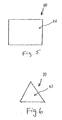
- a well 21 with a triangular, square, rectangular, diamond, or other known polygonal cross section will include more than one sidewall 22 as shown in Figs. 5 and 6.
- the distal end wall 23 forms a continuous barrier at one end of the sidewalls 22 of the well 21.
- the securing ring 28 and end wall 23 are integrally formed with the sidewall(s) 22 so that the sidewall(s) 22, end wall 23 and securing ring 28 form a continuous, uninterrupted, flexible enclosure around the nipple 110.
- sidewall(s), end wall 23 and securing ring 28 are formed from the same piece of material. Alternatively, they can be formed of separate pieces of material and secured together. Well known securing techniques such as RF welding can be used.
- the end wall 23 can be flat, rounded or stepped in between the outer edge(s) 26 of the sidewall(s) 22.
- the sidewall(s) 22, end wall 23 and securing ring 28 are formed of a flexible, easily manipulated material that can be stretched into any desired shape.
- the material is preferably biocompatible and hypoallergenic.
- the material can also be resilient.
- a resilient material will permit the cover 10 to stretch and conform to the shape of the nipple 110.
- the material holds its shape after it experiences elastic deformation.
- the flexible, easily manipulated material includes a linear low density polyethylene (LLDPE).
- LLDPE linear low density polyethylene
- Other known flexible, stretchable and/or elastic materials may be used to form the chimney 20. Examples of these well-known materials include, but are not limited to, other types of polyethylene, plastics, thermoset polymers, thermoforming polymers, paper, TYVEK ® , webbed materials, composites, and polyesters.
- the flexible material used for at least the sidewall(s) 22 and the end wall 23 is partially transparent so that the nipple 110 can be seen through the cover 10.
- the material is completely transparent so that the patient, attendant and/or physician can easily view the nipple 110 and determine the extent of its preparation or healing without having to remove the cover 10.
- the transparent aspect of the material permits someone to determine if additional amounts of the agent need to be applied to the nipple 110 without having to break the seal between the base 30 and the patient.
- the securing ring 28 does not need to be formed of a transparent material. However, if it is formed from the same sheet of material as the transparent chimney 20 than it may be transparent. Alternatively, the securing ring 28 may also be transparent if the base 30 is at least partially transparent. In this alternative embodiment, the cover 10 could be easily and accurately positioned on a particular portion of the body.
- the chimney 20 is easily deformable (elastic) under pressure. As a result, it will collapse around and substantially conform to the shape of the nipple 110 as the cover 10 is being applied to the body. Typically, the patient or attendant applying the cover 10 will apply pressure to the chimney 20 as the cover 10 is applied so that air is expelled from the well 21 and the sidewall(s) 22 and end wall 23 conform to the shape of the nipple 110. Since the chimney is able to collapse and substantially conform to the shape of the nipple 110, the cover 10 will not be visible when it is worn under a patient's clothing. This is especially important for a woman who may feel self conscious and uncomfortable when a strange shape protrudes from underneath her blouse.
- the cover 10 illustrated in the figures allows a patient to discreetly wear a cover 10 over her nipple 110. This can encourage the use of the cover 10 in the future. Additionally, as the chimney 20 collapses, any agent within the well 21 will be forced into contact with the nipple 110.
- the portion of the chimney 20 that forms the securing ring 28 is secured to an upper surface of the base 30 by adhesives.
- the securing ring 28 has a cohesive on its lower surface 29.
- the cohesive cooperates with a cohesive carried by the upper surface of the base 30 that is already secured onto the areola or another portion of the body surrounding the nipple 110.
- the use of cohesives permits easy removal of the chimney 20.
- the cohesives also allow for the chimney 20 to be repeatedly removed without the patient feeling any uncomfortable tugs on her areola. Additionally, the cohesives will not stick to the person removing or replacing the chimney 20 when the base 30 is left on the patient for an extended period of time.
- the base 30 includes a main body ring 31 that makes the cover 10 easy to handle and position over the protruding nipple 110.
- the ring 31 extends in a direction away from the body (thickness) between about 0.4mm (0.0156 inch) and 6.4mm (0.25 inch). In one embodiment, the ring has a thickness of about 1.6mm (0.0625 inch). In another embodiment, the ring 31 is about 0.8mm (0.03125 inch) thick.
- the ring 31 is formed of biocompatible, hypoallergenic cross-linked polyethylene foam that is available from Scapa Medical ® having a tensile strength of at least about 11bar (160 psi) and an elongation of at least about 290%.
- Other materials that can be used for ring 31 include, but are not limited to, other polyethylene foams, polyesters, papers, polyethylene liners, plastics and polypropylenes.
- the ring 31 is semi-rigid. It is stiff enough that a person can firmly hold onto it an easily manipulate the cover 10 without adhesive carrying portions of the cover 10 becoming secured to each other.
- the ring 31 can be stiff enough to permit one-handed application of the cover 10.
- the ring 31 is flexible enough to conform to the shape of the person's body that surrounds the nipple 110.
- the ring 31 is defined by an outer edge 32 and an inner edge 33. As shown in Fig. 4, the inner edge 33 extends around the base of the nipple 110 when the base 30 is secured to the patient as discussed below.
- the inner edge 33 defines an opening 35 that forms a nipple receiving entrance to the well 21. When the cover 10 is positioned on the patient, the nipple 110 will be received in the opening 35 and extend into the well 21.
- the base 30 is shown as being circular in shape for ease of explanation. However, the base 30 can have any shape that permits it to securely hold an agent carrying chimney 20 over the nipple 110. Also, while the opening 35 is shown to match the shape of the opening to the well 21, the opening 35 can have any shape that cooperates with one of the above listed cross sections of the chimney 20 to receive the nipple 110. Additionally, the shape of the outer edge 32 of the base 30 does not need to match the shape of the inner edge 33. Instead, as mentioned above, the outer edge 32 can have any shape that permits the cover 10 to be securely positioned on the patient and over the nipple 110.
- the ring 31 also has a lower surface 36 for contacting and being secured to the patient's body.
- the lower surface 36 is sized so that it covers a portion of the epidermis and/or the areola around the nipple 110.
- An adhesive or other well-known securing element covers the lower surface 36 so that is can be securely positioned on the patient.
- the adhesive can be any known, medically approved skin adhesive, such as those approved by 3M ® .
- the adhesive is a synthetic rubber based medical approved skin adhesive (I-832) available with the ring 31 from Scapa Medical ® .
- a removable release sheet 75 extends over the lower surface 36 to prevent the cover 10 from erroneously adhering to the body portion.
- the release sheet 75 includes a polyethylene coated paper having a silicone release coating on one side.
- the adhesive can secure the lower surface 36 to the patient's body for either a short or an extended period of time.
- the surface 36 can be secured to the patient for between about two minutes and about forty-eight hours prior to (and/or after) the procedure. In one embodiment, the surface 36 is secured to the patient for about one hour to about ten hours. In another embodiment, the surface is secured to the patient for about two hours to about four hours.
- the chimney 20 is removed and the ring 31 stays secured on the patient throughout the procedure.
- the ring 31 acts as a location to place or affix other items such as tubes and/or tethers etc.
- the adhered ring 31 may remain or be replaced with a post procedure cover 10, for example containing an antibiotic and/or a wound healer, etc.
- the release sheet 75 is removed immediately before the cover 10 is applied over the nipple 110 and secured to the body.
- the release sheet 75 could include two separate pieces. In this embodiment, one piece is removed after the cover 10 has been positioned over the nipple 110. Then, the exposed adhesive can be applied against the body so that a partial seal is formed between the cover and the body. Next, the second release sheet will be removed and the base 30 pressed against the body. This will close the seal between the body and the cover 10. The seal will prevent any of an applied agent from leaking out of the cover.
- the lower surface 36 can be free of an adhesive. If the lower surface 36 does not include an adhesive, strips of adhesive carrying tape could be extended across the base 30 to secure the cover 10 to the patient.
- the cover 10 could have a cohesive on the lower surface 36 that will cooperate with a cohesive carried by an outer surface of a ring that is already secured onto the areola or another portion of the body surrounding the nipple 110.
- the use of cohesives allows the cover 10 to be positioned on the body without the chance of the lower surface 36 becoming erroneously secured to the attendant applying the cover 10 or on another portion of the patient's body. Additionally, the cohesives permit the cover 10 to be removed without the patient feeling the discomfort of having an adhesively secured cover being ripped off their sensitive areola.
- the body contacting ring is secured to the patient using an adhesive or other well-known securing arrangement.
- the lower surface 36 must have enough surface area that it forms an effective seal with the patient's body.
- the seal must be strong enough to prevent the cover 10 from separating from the body.
- the size of the lower surface 36 will vary depending on a number of factors. These factors include at least the following: the length of the chimney 21, the amount of pressure that will be normally applied to the chimney 21 in order to form it to the shape of the nipple 110 and the weight of the amount of the agent that will be applied to the patient and carried by the cover 10 when the chimney is filled with the agent.
- the surface area of the lower surface 36 is larger for the covers 10 having longer chimneys 21 and/or the covers 10 having large wells 21 intended to carry large amounts of the agent. No matter the length of the well 21, the lower surface 36 must have enough surface area that it forms an effective seal with the patient's body. The seal must be strong enough to prevent the cover 10 from separating from the body.
- the chimney 20 has a length L of about 003mm (0.001 inch) to about 76mm (3.0 inches). In one embodiment, the length L is about 6mm (0.25 inch) to about 51mm (2.0 inches). In another embodiment, the preferred length L is about 16mm (0.63 inch).
- the diameter D of the base 30 and securing ring 28 is about 13mm (0.5 inch) to about 76mm (3.0 inches). In one embodiment, a preferred diameter D is about 51mm (2.0 inches).
- the diameter I of the opening 35 is about 6mm (0.25 inch) to about 64mm (2.5 inches) with a preferred diameter being about 25mm (1.0 inch).
- the diameter O of the well 21 at the securing ring is about 13mm (0.5 inch) to about 51mm (2.0 inches).
- a preferred diameter O is about 25mm (1.0 inch).
- the diameter of the end wall 23 can be the same as diameter O or it can be slightly smaller so that the chimney 20 has a tapered profile.
- the term diameter can refer to corresponding widths for those embodiments that do not have circular cross sections.
- Each dimension of the cover 10 can be individually set to match the size of the patient's nipple. For example, it is possible to make the diameter O slightly smaller than the diameter of the patient's nipple 110 so that the chimney forms a secure fit with the base of the nipple 110.
- the diameter of the opening 35 does not need to be a function of the length of the chimney 20. Instead, the size of the opening 35 is chosen based on the diameter of the nipple 110 that it will cover.
- the cover 10 can be manufactured using any known method for forming a well in a sheet of flexible material.
- One method of forming the cover 10 according to the present invention includes the step of cold working the material until the well 21 is formed.
- the step of cold working the material includes advancing a blunt object, such as a flat or rounded head punch, into the material until a well having sufficient depth to cover the nipple 110 and hold the agent is achieved.
- Another known way of forming the cover 10 includes thermoforming it using the method currently used to form bubble wrap. Additional forming methods include injection molding, compression molding and transfer molding.
Landscapes
- Health & Medical Sciences (AREA)
- Veterinary Medicine (AREA)
- Life Sciences & Earth Sciences (AREA)
- Animal Behavior & Ethology (AREA)
- General Health & Medical Sciences (AREA)
- Public Health (AREA)
- Engineering & Computer Science (AREA)
- Biomedical Technology (AREA)
- Heart & Thoracic Surgery (AREA)
- Vascular Medicine (AREA)
- Anesthesiology (AREA)
- Epidemiology (AREA)
- Hematology (AREA)
- Media Introduction/Drainage Providing Device (AREA)
- Infusion, Injection, And Reservoir Apparatuses (AREA)
- Medicinal Preparation (AREA)
- Medicines That Contain Protein Lipid Enzymes And Other Medicines (AREA)
Claims (22)
- Abdeckung (10) für einen vorstehenden Teil (1) eines Säugetierkörpers, wobei die Abdeckung (10) beinhaltet: ein erstes und ein zweites flexibles Element (20, 30), wobei das erste Element (20) einen Sicherungsabschnitt (28), mindestens eine Seitenwand (22) und mindestens eine Abschlusswand (23) aufweist, wobei die mindestens eine Seitenwand (22) und die Abschlusswand (23) einen durchgehenden ununterbrochenen Topf (21) zum Aufnehmen und Bedecken des vorstehenden Körperteils (1) bilden und zum Aufbringen eines medizinischen Mittels auf das vorstehende Körperteil (1) eingerichtet ist, und wobei das zweite flexible Element (30) eine erste Oberfläche zum Anbringen des Sicherungsabschnittes (28) an das erste Element (20) aufweist und eine zweite Oberfläche (36) zum Sichern an dem Körper aufweist, so dass die zweite Oberfläche (36) sich nicht bezüglich des Körpers bewegt.
- Abdeckung (10) nach Anspruch 1, wobei die mindestens eine Seitenwand (22) und die Abschlusswand (23) zusammenfaltbar sind, so dass die Abdeckung (10) der Form des hervorstehenden Körperteils (1) konform sein kann.
- Abdeckung (10) nach Anspruch 1, wobei die zweite Oberfläche (36) ein Haftmittel zum Sichern derer an dem Körperteil (1) aufweist.
- Abdeckung (10) nach Anspruch 1, wobei der Topf (21) ein medizinisches Mittel zum Aufbringen auf den vorstehenden Körperteil (1) enthält.
- Abdeckung (10) nach Anspruch 1, wobei der Sicherungsabschnitt (28) und das zweite flexible Element (30) durch ein co-Haftmittel aneinander gesichert sind.
- Abdeckung (10) nach Anspruch 1, wobei der Sicherungsabschnitt (28) und das zweite flexible Element (30) durch ein Haftmittel aneinander gesichert sind.
- Abdeckung (10) nach Anspruch 1, wobei der Topf (21) eine Höhe von weniger als 51 mm (zwei Inch) aufweist.
- Abdeckung (10) nach Anspruch 1, wobei das erste flexible Element (20) aus einem transparenten Material und das zweite flexible Element (30) aus einem flexiblen Schaum gebildet ist.
- Abdeckung (10) nach Anspruch 1, wobei der hervorstehende Körperteil (1) eine Mamilla aufweist und der Topf (21) ein Anästhetikum zum Aufbringen auf die Mamilla aufweist und der Topf (21) ein Anästhetikum zum Aufbringen auf die Mamilla enthält, wenn die Abdeckung (10) auf dem Körper platziert ist.
- Abdeckung (10) nach Anspruch 9, wobei die zweite Oberfläche (36) des zweiten flexiblen Elements (30) eine Versiegelung um die Mamilla bildet, wenn sie an dem Körper gesichert ist.
- Abdeckung (10) nach Anspruch 10, wobei die zweite Oberfläche (36) eine haftende Schicht zum Sichern des zweiten flexiblen Elements (30) an dem Körper, nachdem die Abdeckung (10) um die Mamilla positioniert wurde, aufweist.
- Abdeckung (10) nach Anspruch 1 zum Umschließen einer Mamilla eines Säugetieres, wobei das zweite flexible Element (30) zum Sichern an einem Teil eines Körpers, der die Mamilla trägt, ist, das erste flexible Element (20) ein ununterbrochener Mamilla-Aufnahmetopf (21) ist, wobei der Topf (21) an dem zweiten flexiblen Element (30) zum Bilden einer versiegelten Umschließung um die Mamilla gesichert ist, wenn die zweite Oberfläche (36) des zweiten flexiblen Elements (30) an dem Körper fixiert ist, so dass das zweite flexible Element (30) und der Körper ohne eine relative Bewegung sind.
- Abdeckung (10) nach Anspruch 12, wobei der Sicherungsabschnitt (28) an dem zweiten flexiblen Element (30) durch ein Haftmittel fixiert ist, bevor die Abdeckung (10) auf den Körper aufgebracht ist.
- Abdeckung (10) nach Anspruch 12, wobei der Sicherungsabschnitt (28) an dem zweiten flexiblen Element (30) durch ein kohäsives Mittel fixiert ist, nachdem das zweite flexible Element (30) an dem Körper um die Mamilla fixiert ist.
- Abdeckung (10) nach Anspruch 12, wobei der Mamilla-Aufnahmetopf (21) eine Mehrzahl von Seitenwänden (22) aufweist.
- Abdeckung (10) nach Anspruch 12, wobei das zweite flexible Element (30) steifer als der Mamilla-Aufnahmetopf (21) ist.
- Abdeckung (10) nach Anspruch 12, wobei das zweite flexible Element (30) eine erste Oberfläche und eine zweite Oberfläche (36) aufweist, wobei die zweite Oberfläche (36) ein Haftmittel zum Sichern der Abdeckung (10) an dem Körper und um die Mamilla aufweist.
- Abdeckung (10) nach Anspruch 1, die zum Abdecken und Isolieren einer Mamilla eines Säugetierkörpers ist, wobei das zweite flexible Element (30) zum Positionieren nahe einer Areola und das zweite flexible Element (20) ein interner Topf zum Aufnehmen der Mamilla ist, wobei das erste und das zweite flexible Element (20, 30) eine kontinuierliche, durchgehende Mamilla-Umschließung zum Halten eines Mittels an der Mamilla bilden.
- Abdeckung (10) nach Anspruch 18, die ein Haftmittel auf einer zweiten Oberfläche (36) des zweiten flexiblen Elements (30) aufweist.
- Abdeckung (10) nach Anspruch 18, wobei der Topf (21) eine Mehrzahl von Seitenwänden (22) aufweist.
- Satz bestehend aus der Abdeckung (10) des Anspruchs 1 und eines Mittels zum Aufbringen auf den Körperteil (1).
- Satz nach Anspruch 21, wobei das Mittel ein Anästhetikum ist.
Applications Claiming Priority (3)
| Application Number | Priority Date | Filing Date | Title |
|---|---|---|---|
| US793110 | 2001-02-27 | ||
| US09/793,110 US20020117169A1 (en) | 2001-02-27 | 2001-02-27 | Cover and applicator for a portion of a mammalian body |
| PCT/US2002/005202 WO2002068038A1 (en) | 2001-02-27 | 2002-02-22 | Cover and application for a portion of amamalian body |
Publications (2)
| Publication Number | Publication Date |
|---|---|
| EP1377337A1 EP1377337A1 (de) | 2004-01-07 |
| EP1377337B1 true EP1377337B1 (de) | 2007-04-18 |
Family
ID=25159119
Family Applications (1)
| Application Number | Title | Priority Date | Filing Date |
|---|---|---|---|
| EP02713650A Expired - Lifetime EP1377337B1 (de) | 2001-02-27 | 2002-02-22 | Abdeckung und applikator für ein teil eines säugetierkörpers |
Country Status (7)
| Country | Link |
|---|---|
| US (6) | US20020117169A1 (de) |
| EP (1) | EP1377337B1 (de) |
| JP (1) | JP2004523307A (de) |
| AT (1) | ATE359846T1 (de) |
| AU (1) | AU2006201771A1 (de) |
| DE (1) | DE60219610D1 (de) |
| WO (1) | WO2002068038A1 (de) |
Cited By (2)
| Publication number | Priority date | Publication date | Assignee | Title |
|---|---|---|---|---|
| US10596360B2 (en) | 2017-04-03 | 2020-03-24 | Simple Life Products LLC | Applicator for a topical agent and methods of use thereof |
| USD1094871S1 (en) | 2022-06-21 | 2025-09-23 | Practical Science Llc | Skincare applicator |
Families Citing this family (38)
| Publication number | Priority date | Publication date | Assignee | Title |
|---|---|---|---|---|
| WO2000076555A1 (en) * | 1999-06-11 | 2000-12-21 | Pro Duct Health, Inc. | Gel composition for filing a breast milk duct prior to surgical excision of the duct or other breast tissue |
| US20020117169A1 (en) * | 2001-02-27 | 2002-08-29 | Kurz Daniel R. | Cover and applicator for a portion of a mammalian body |
| US20030108581A1 (en) * | 2001-05-11 | 2003-06-12 | Silver Brian H. | Applicator and method for applying lanolin to a sore nipple |
| WO2004034059A1 (en) * | 2002-10-11 | 2004-04-22 | Sentina Biotechnology Incorporated | Methods for detection of breast cancer |
| CA2417320A1 (en) * | 2002-10-31 | 2004-04-30 | Medela Holding Ag | Applicator and method for applying lanolin to a sore nipple |
| WO2008141318A1 (en) * | 2007-05-14 | 2008-11-20 | Dr. Susan Love Research Foundation | Device for determining risk of developing breast cancer and method thereof |
| US20090088717A1 (en) * | 2007-09-28 | 2009-04-02 | Pawloski Charles J | Absorbent nursing pad adhesive cover |
| US7726317B1 (en) * | 2007-10-02 | 2010-06-01 | Yvonne Garcia | Apparatus to protect a piercing |
| US9272034B2 (en) | 2007-10-04 | 2016-03-01 | The Regents Of The University Of California | Treatment of conditions related to shock |
| KR100920996B1 (ko) * | 2009-08-11 | 2009-10-09 | 한국 한의학 연구원 | 일회용 멸균 부항장치 |
| US20140200529A1 (en) * | 2009-08-27 | 2014-07-17 | Julie Hyde-Edwards | Post-nipple reconstruction protector |
| US20130158394A1 (en) * | 2010-01-14 | 2013-06-20 | The Regents Of The University Of California | Devices, Systems and Methods to Detect and Reduce or Prevent Entry of Inflammatory Mediators into Milk Ducts |
| US20110247636A1 (en) * | 2010-04-12 | 2011-10-13 | Pollack Larry H | Nipple/Areola Protective Cover |
| JP5788150B2 (ja) * | 2010-06-23 | 2015-09-30 | 旭化成せんい株式会社 | 乳頭部保護用キャップ |
| US8641758B1 (en) * | 2010-08-06 | 2014-02-04 | Robert G. Anderson | Method and apparatus for inserting a filled prosthetic bladder into a patient |
| CN103237558A (zh) | 2010-10-02 | 2013-08-07 | 加利福尼亚大学董事会 | 最小化肠功能障碍 |
| EP2658503B1 (de) * | 2010-12-31 | 2017-02-22 | Koninklijke Philips N.V. | Vorrichtung und verfahren zur anleitung für eine richtige anlegeposition |
| US20120277648A1 (en) * | 2011-04-28 | 2012-11-01 | Tianna Michelle Kendall | Adhesive bandage with raised portion |
| US9308081B2 (en) | 2011-09-09 | 2016-04-12 | TauTona Group Research and Development Company, L.L.C. | Apparatus and methods for nipple formation via collapsible devices |
| US9517183B2 (en) | 2012-01-30 | 2016-12-13 | Patrick B. Ward | Nipple abrasion protector |
| US8808262B2 (en) * | 2012-06-08 | 2014-08-19 | Eln Group, Llc | Medical bra assembly for post-surgical breast reconstruction and cosmetic breast procedures |
| US9687388B2 (en) | 2013-04-15 | 2017-06-27 | Joseph Raniere | Method, system, and apparatus for protecting mammalian tissue regions |
| US9339063B2 (en) * | 2013-11-19 | 2016-05-17 | Kelly Taylor | Illuminated nipple cover |
| CN108024959A (zh) * | 2015-07-14 | 2018-05-11 | 阿托萨遗传学公司 | 用于治疗乳腺病症的经乳头方法和组合物 |
| US11013882B1 (en) * | 2015-07-28 | 2021-05-25 | Joni Ann Wilson | Anesthetic breast pad |
| US10271996B2 (en) * | 2016-06-29 | 2019-04-30 | Zorka Hufnagel | Device for an eversion assist of inverted nipples |
| US10925719B2 (en) | 2017-02-09 | 2021-02-23 | Ivor Barry Kaplan | Cover device and method of applying cover device for constructing and protecting a nipple/areola complex |
| EA202091381A1 (ru) * | 2017-12-20 | 2020-08-24 | Фармадом С.Р.Л. | Жесткий или полужесткий защитный элемент для покрытия ран |
| US11752029B2 (en) * | 2018-12-07 | 2023-09-12 | Michael Quiz Hansen | Adjustable, waterproof wound shield |
| WO2020231470A1 (en) * | 2019-05-13 | 2020-11-19 | Bresnick Stephen David | Biofilm protection implant shield |
| US20210045928A1 (en) * | 2019-08-12 | 2021-02-18 | David Derohanian | Blister protector cap |
| US11425941B1 (en) * | 2019-11-08 | 2022-08-30 | MaryMac Revisions, LLC | Comfort fit natural breast shaping nipple concealer |
| US11206875B2 (en) * | 2019-11-14 | 2021-12-28 | Christina Morrow Contreras | Breast adhesive |
| CA3161366A1 (en) | 2019-12-10 | 2021-06-17 | Stephen David BRESNICK | Implant delivery device with biofilm protection shield |
| CN112933385A (zh) * | 2021-01-29 | 2021-06-11 | 上海市第一人民医院 | 一种乳腺涂抹耦合剂的装置 |
| WO2023034305A2 (en) * | 2021-08-31 | 2023-03-09 | Smiler Girl, LLC | Apparatus for sealing and coupling material to a body |
| EP4676326A1 (de) * | 2023-03-08 | 2026-01-14 | Feminai Ltd | Einheit, kit und system zur identifizierung von anomalien in einem gewebe einer person |
| WO2025244757A1 (en) * | 2024-05-20 | 2025-11-27 | The Regents Of The University Of California | Breast protection device |
Citations (3)
| Publication number | Priority date | Publication date | Assignee | Title |
|---|---|---|---|---|
| US4870977A (en) * | 1987-03-20 | 1989-10-03 | Coopervision, Inc. | Surgical protector for raised wounds |
| US5230350A (en) * | 1991-05-29 | 1993-07-27 | Tabex Industries, Inc. | Moisture barrier for indwelling catheters and the like |
| US6005159A (en) * | 1995-02-17 | 1999-12-21 | Alan J. Ackerman | Protective covering for body lesions |
Family Cites Families (49)
| Publication number | Priority date | Publication date | Assignee | Title |
|---|---|---|---|---|
| US65978A (en) * | 1867-06-18 | wilder | ||
| FR792353A (fr) | 1935-07-11 | 1935-12-30 | Gaine de protection des mamelons pendant l'allaitement | |
| US3187591A (en) * | 1961-06-12 | 1965-06-08 | Louis W Johnson | Vibrating apparatus |
| US3229691A (en) * | 1963-07-10 | 1966-01-18 | Johnson & Johnson | Flexible absorbent sheet |
| US3786801A (en) * | 1969-02-24 | 1974-01-22 | Diagnostic Inc | Method and apparatus for aiding in the detection of breast cancer |
| US3782377A (en) * | 1971-09-07 | 1974-01-01 | Illinois Tool Works | Sterile plastic shield |
| US3867517A (en) * | 1971-12-21 | 1975-02-18 | Abbott Lab | Direct radioimmunoassay for antigens and their antibodies |
| US3840012A (en) * | 1973-10-17 | 1974-10-08 | R Rushton | Milk collector and shield for nursing women |
| US4195639A (en) * | 1976-03-05 | 1980-04-01 | Lee Denis C | External breast prosthesis |
| US4036945A (en) * | 1976-05-03 | 1977-07-19 | The Massachusetts General Hospital | Composition and method for determining the size and location of myocardial infarcts |
| DE2901218A1 (de) * | 1979-01-13 | 1980-07-17 | Byk Gulden Lomberg Chem Fab | Ung von theophyllin |
| US4311688A (en) * | 1979-10-29 | 1982-01-19 | Serono Laboratories Inc. | Composition and method for cancer detection in humans |
| US4376110A (en) * | 1980-08-04 | 1983-03-08 | Hybritech, Incorporated | Immunometric assays using monoclonal antibodies |
| US4333471A (en) * | 1981-01-19 | 1982-06-08 | Tokiwa Chemical Industries, Limited | Nipple cover |
| JPS6071702A (ja) * | 1983-09-28 | 1985-04-23 | 日交化工材株式会社 | 人体貼着用シ−ト |
| US4732864A (en) * | 1983-10-06 | 1988-03-22 | E. I. Du Pont De Nemours And Company | Trace-labeled conjugates of metallothionein and target-seeking biologically active molecules |
| GB2150028A (en) * | 1983-11-09 | 1985-06-26 | Michael William Nolan | Wound dressings |
| US4667666A (en) * | 1986-04-18 | 1987-05-26 | Alice Fryslie | Protective bandaging device |
| US4754750A (en) * | 1987-03-20 | 1988-07-05 | Coopervision, Inc. | Areola/nipple surgical wound protector |
| US5348860A (en) * | 1988-08-04 | 1994-09-20 | Shamsuddin Abulkalam M | Screening test and kit for cancerous and precancerous conditions |
| US4917112A (en) * | 1988-08-22 | 1990-04-17 | Kalt Medical Corp. | Universal bandage with transparent dressing |
| DE3907007A1 (de) * | 1989-03-04 | 1990-09-13 | Joachim Dr Med Kell | Wundverband |
| US5032103A (en) * | 1990-02-16 | 1991-07-16 | Isg/Ag | Breast shield |
| ATE216865T1 (de) * | 1991-10-23 | 2002-05-15 | Holdings L L C Patent | Wundverbandsystem |
| WO1994013209A1 (fr) * | 1992-12-07 | 1994-06-23 | Hisamitsu Pharmaceutical Co., Inc. | Emplatre de test et procede de test |
| US5416025A (en) | 1993-11-29 | 1995-05-16 | Krepinsky; Jiri J. | Screening test for early detection of colorectal cancer |
| US6093160A (en) * | 1994-11-21 | 2000-07-25 | Augustine Medical, Inc. | Flexible non-contact wound treatment device |
| US5627034A (en) * | 1995-12-05 | 1997-05-06 | Wisconsin Alumni Research Foundation | Assay for carcinoma proliferative status by measuring NGAL expression level |
| US5740550A (en) * | 1996-03-15 | 1998-04-21 | Yavitz; Edward Q. | Membrane shield for eyes |
| US5743272A (en) * | 1996-04-10 | 1998-04-28 | Kocher, Jr.; Robert W. | Male nipple abrasion protector |
| EP1579814A3 (de) | 1996-05-17 | 2006-06-14 | Roche Diagnostics Operations, Inc. | Verfahren und Vorrichtung zur Probenahme und Analyse von Körperflüssigkeit |
| US5798266A (en) * | 1996-08-27 | 1998-08-25 | K-Quay Enterprises, Llc | Methods and kits for obtaining and assaying mammary fluid samples for breast diseases, including cancer |
| EP0826819B1 (de) * | 1996-08-30 | 2002-11-20 | Voith Paper Fiber Systems GmbH & Co. KG | Vorrichtung zum Entwässern einer Faserstoffsuspension |
| US6221622B1 (en) * | 1998-04-28 | 2001-04-24 | The Regents Of The University Of California | Method and kit for obtaining fluids and cellular material from breast ducts |
| US6168779B1 (en) * | 1997-09-16 | 2001-01-02 | The Regents Of The University Of California | Methods and kits for identifying ductal orifices |
| US6096943A (en) * | 1998-01-09 | 2000-08-01 | Maiwald; Diane C | Skin wound protector |
| US6152887A (en) | 1998-02-27 | 2000-11-28 | Blume; Richard Stephen | Method and test kit for oral sampling and diagnosis |
| US6143945A (en) * | 1998-04-06 | 2000-11-07 | Augustine Medical, Inc. | Bandage for autolytic wound debridement |
| CA2253093A1 (en) | 1998-11-06 | 2000-05-06 | Jiri J. Krepinsky | Screening test for early detection of colorectal cancer |
| US6642009B2 (en) * | 1999-05-17 | 2003-11-04 | Cytyc Health Corporation | Isolated ductal fluid sample |
| AU1600901A (en) | 1999-11-12 | 2001-06-06 | Tuan Pham | Diagnostic testing kit for collection and testing of fluid samples with user configurable test strips and timer |
| WO2001053450A1 (en) * | 2000-01-21 | 2001-07-26 | Thomas Jefferson University | Nipple aspirate fluid specific microarrays |
| WO2002038032A2 (en) | 2000-11-13 | 2002-05-16 | Atossa Healthcare, Inc. | Methods and devices for collecting and processing mammary fluid |
| US20020117169A1 (en) | 2001-02-27 | 2002-08-29 | Kurz Daniel R. | Cover and applicator for a portion of a mammalian body |
| EP1195590B1 (de) * | 2001-08-11 | 2007-08-08 | Agilent Technologies, Inc. | Optische Messvorrichtung mit Bilderzeugungseinheit |
| US20030124130A1 (en) | 2002-01-02 | 2003-07-03 | Brown Robert E. | Proteomic analysis of tumors for development of consultative report of therapeutic options |
| WO2004034059A1 (en) | 2002-10-11 | 2004-04-22 | Sentina Biotechnology Incorporated | Methods for detection of breast cancer |
| EP1765868B1 (de) | 2004-06-07 | 2016-04-20 | MacroGenics, Inc. | Antikörper gegen den transferrinrezeptor |
| WO2008141318A1 (en) | 2007-05-14 | 2008-11-20 | Dr. Susan Love Research Foundation | Device for determining risk of developing breast cancer and method thereof |
-
2001
- 2001-02-27 US US09/793,110 patent/US20020117169A1/en not_active Abandoned
-
2002
- 2002-02-22 AT AT02713650T patent/ATE359846T1/de not_active IP Right Cessation
- 2002-02-22 WO PCT/US2002/005202 patent/WO2002068038A1/en not_active Ceased
- 2002-02-22 DE DE60219610T patent/DE60219610D1/de not_active Expired - Lifetime
- 2002-02-22 JP JP2002567400A patent/JP2004523307A/ja active Pending
- 2002-02-22 EP EP02713650A patent/EP1377337B1/de not_active Expired - Lifetime
-
2005
- 2005-12-01 US US11/291,738 patent/US7487779B2/en not_active Expired - Fee Related
-
2006
- 2006-04-27 AU AU2006201771A patent/AU2006201771A1/en not_active Abandoned
-
2009
- 2009-02-09 US US12/368,257 patent/US7921851B2/en not_active Expired - Fee Related
-
2011
- 2011-04-08 US US13/083,442 patent/US8191554B2/en not_active Expired - Fee Related
-
2012
- 2012-06-01 US US13/486,999 patent/US8844539B2/en not_active Expired - Fee Related
-
2014
- 2014-09-26 US US14/498,652 patent/US20150209238A1/en not_active Abandoned
Patent Citations (3)
| Publication number | Priority date | Publication date | Assignee | Title |
|---|---|---|---|---|
| US4870977A (en) * | 1987-03-20 | 1989-10-03 | Coopervision, Inc. | Surgical protector for raised wounds |
| US5230350A (en) * | 1991-05-29 | 1993-07-27 | Tabex Industries, Inc. | Moisture barrier for indwelling catheters and the like |
| US6005159A (en) * | 1995-02-17 | 1999-12-21 | Alan J. Ackerman | Protective covering for body lesions |
Cited By (2)
| Publication number | Priority date | Publication date | Assignee | Title |
|---|---|---|---|---|
| US10596360B2 (en) | 2017-04-03 | 2020-03-24 | Simple Life Products LLC | Applicator for a topical agent and methods of use thereof |
| USD1094871S1 (en) | 2022-06-21 | 2025-09-23 | Practical Science Llc | Skincare applicator |
Also Published As
| Publication number | Publication date |
|---|---|
| US8191554B2 (en) | 2012-06-05 |
| US8844539B2 (en) | 2014-09-30 |
| US7921851B2 (en) | 2011-04-12 |
| US20020117169A1 (en) | 2002-08-29 |
| US20150209238A1 (en) | 2015-07-30 |
| US20060074363A1 (en) | 2006-04-06 |
| US20090250074A1 (en) | 2009-10-08 |
| WO2002068038A1 (en) | 2002-09-06 |
| US20120302974A1 (en) | 2012-11-29 |
| EP1377337A1 (de) | 2004-01-07 |
| JP2004523307A (ja) | 2004-08-05 |
| US7487779B2 (en) | 2009-02-10 |
| AU2006201771A1 (en) | 2006-05-18 |
| ATE359846T1 (de) | 2007-05-15 |
| DE60219610D1 (de) | 2007-05-31 |
| US20110184355A1 (en) | 2011-07-28 |
Similar Documents
| Publication | Publication Date | Title |
|---|---|---|
| EP1377337B1 (de) | Abdeckung und applikator für ein teil eines säugetierkörpers | |
| US6809230B2 (en) | Waterproof venipuncture site cover | |
| US6526980B1 (en) | Cervical drug delivery system | |
| US6222090B1 (en) | Waterproof injection port cover | |
| US6875200B1 (en) | Bandage for protection of skin surrounding an umbilical cord stump | |
| US20090240207A1 (en) | adhesive tape for an intravascular catheter | |
| JP2002506680A (ja) | 皮膚及び他の組織を摩擦から保護する器具 | |
| US11197783B2 (en) | Two-part bandage with replaceable wound covering portion | |
| US4820279A (en) | Article and method for prepping a patient prior to surgery | |
| JP6927587B2 (ja) | 固定要素を有する外科用絆創膏 | |
| WO2005041847A2 (en) | Method and apparatus for applying medication to internal tissue | |
| AU2002245487A1 (en) | Cover and application for a portion of amamalian body | |
| US20120071717A1 (en) | Dressing and method for cleaning and protecting a laparoscopic camera lens intra-abdominally, stomas, appendages, and insertion sites of tubes and catheters | |
| KR200165223Y1 (ko) | 파스 | |
| WO2003073978A1 (en) | Post treatment protector device | |
| US20010031939A1 (en) | Arm and leg medical protection sleeve | |
| WO1994016655A1 (en) | Non-irritating clothing liner for persons with touch sensitive wounds | |
| CN214910198U (zh) | 一种用于肢体气压治疗的隔离套 | |
| US20230240899A1 (en) | Umbilical Cord Stump Protector | |
| KR20250138031A (ko) | 실리콘 코보호 필름 | |
| AU650070B2 (en) | Pliable securing device for medical needles | |
| TR2025003395A2 (tr) | Su geçi̇rmez özelli̇kte kateter koruyucu örtü | |
| BRMU8901213U2 (pt) | pelìcula impermeável transparente adesiva de proteção e fixação de tubo sonda cateter curativos e similares | |
| Derman et al. | The Olympic team physician's medical bag: what should it contain? | |
| US20100100059A1 (en) | Methods and Apparatus for Preparing a Hemodialytic Site |
Legal Events
| Date | Code | Title | Description |
|---|---|---|---|
| PUAI | Public reference made under article 153(3) epc to a published international application that has entered the european phase |
Free format text: ORIGINAL CODE: 0009012 |
|
| 17P | Request for examination filed |
Effective date: 20030922 |
|
| AK | Designated contracting states |
Kind code of ref document: A1 Designated state(s): AT BE CH CY DE DK ES FI FR GB GR IE IT LI LU MC NL PT SE TR |
|
| AX | Request for extension of the european patent |
Extension state: AL LT LV MK RO SI |
|
| RAP1 | Party data changed (applicant data changed or rights of an application transferred) |
Owner name: CYTYC CORPORATION |
|
| RIN1 | Information on inventor provided before grant (corrected) |
Inventor name: SEELY, LYNN Inventor name: KURZ, DANIEL, R. |
|
| 17Q | First examination report despatched |
Effective date: 20050114 |
|
| RAP1 | Party data changed (applicant data changed or rights of an application transferred) |
Owner name: CYTYC CORPORATION |
|
| GRAP | Despatch of communication of intention to grant a patent |
Free format text: ORIGINAL CODE: EPIDOSNIGR1 |
|
| GRAS | Grant fee paid |
Free format text: ORIGINAL CODE: EPIDOSNIGR3 |
|
| GRAA | (expected) grant |
Free format text: ORIGINAL CODE: 0009210 |
|
| AK | Designated contracting states |
Kind code of ref document: B1 Designated state(s): AT BE CH CY DE DK ES FI FR GB GR IE IT LI LU MC NL PT SE TR |
|
| AX | Request for extension of the european patent |
Extension state: AL LT LV MK RO SI |
|
| PG25 | Lapsed in a contracting state [announced via postgrant information from national office to epo] |
Ref country code: FI Free format text: LAPSE BECAUSE OF FAILURE TO SUBMIT A TRANSLATION OF THE DESCRIPTION OR TO PAY THE FEE WITHIN THE PRESCRIBED TIME-LIMIT Effective date: 20070418 |
|
| REG | Reference to a national code |
Ref country code: CH Ref legal event code: EP |
|
| REG | Reference to a national code |
Ref country code: IE Ref legal event code: FG4D |
|
| REF | Corresponds to: |
Ref document number: 60219610 Country of ref document: DE Date of ref document: 20070531 Kind code of ref document: P |
|
| REG | Reference to a national code |
Ref country code: CH Ref legal event code: NV Representative=s name: KELLER & PARTNER PATENTANWAELTE AG |
|
| PG25 | Lapsed in a contracting state [announced via postgrant information from national office to epo] |
Ref country code: SE Free format text: LAPSE BECAUSE OF FAILURE TO SUBMIT A TRANSLATION OF THE DESCRIPTION OR TO PAY THE FEE WITHIN THE PRESCRIBED TIME-LIMIT Effective date: 20070718 |
|
| PG25 | Lapsed in a contracting state [announced via postgrant information from national office to epo] |
Ref country code: ES Free format text: LAPSE BECAUSE OF FAILURE TO SUBMIT A TRANSLATION OF THE DESCRIPTION OR TO PAY THE FEE WITHIN THE PRESCRIBED TIME-LIMIT Effective date: 20070729 |
|
| PG25 | Lapsed in a contracting state [announced via postgrant information from national office to epo] |
Ref country code: PT Free format text: LAPSE BECAUSE OF FAILURE TO SUBMIT A TRANSLATION OF THE DESCRIPTION OR TO PAY THE FEE WITHIN THE PRESCRIBED TIME-LIMIT Effective date: 20070918 |
|
| LTIE | Lt: invalidation of european patent or patent extension |
Effective date: 20070418 |
|
| NLV1 | Nl: lapsed or annulled due to failure to fulfill the requirements of art. 29p and 29m of the patents act | ||
| PG25 | Lapsed in a contracting state [announced via postgrant information from national office to epo] |
Ref country code: AT Free format text: LAPSE BECAUSE OF FAILURE TO SUBMIT A TRANSLATION OF THE DESCRIPTION OR TO PAY THE FEE WITHIN THE PRESCRIBED TIME-LIMIT Effective date: 20070418 |
|
| EN | Fr: translation not filed | ||
| PG25 | Lapsed in a contracting state [announced via postgrant information from national office to epo] |
Ref country code: BE Free format text: LAPSE BECAUSE OF FAILURE TO SUBMIT A TRANSLATION OF THE DESCRIPTION OR TO PAY THE FEE WITHIN THE PRESCRIBED TIME-LIMIT Effective date: 20070418 |
|
| PG25 | Lapsed in a contracting state [announced via postgrant information from national office to epo] |
Ref country code: NL Free format text: LAPSE BECAUSE OF FAILURE TO SUBMIT A TRANSLATION OF THE DESCRIPTION OR TO PAY THE FEE WITHIN THE PRESCRIBED TIME-LIMIT Effective date: 20070418 Ref country code: DK Free format text: LAPSE BECAUSE OF FAILURE TO SUBMIT A TRANSLATION OF THE DESCRIPTION OR TO PAY THE FEE WITHIN THE PRESCRIBED TIME-LIMIT Effective date: 20070418 |
|
| PLBE | No opposition filed within time limit |
Free format text: ORIGINAL CODE: 0009261 |
|
| STAA | Information on the status of an ep patent application or granted ep patent |
Free format text: STATUS: NO OPPOSITION FILED WITHIN TIME LIMIT |
|
| 26N | No opposition filed |
Effective date: 20080121 |
|
| PG25 | Lapsed in a contracting state [announced via postgrant information from national office to epo] |
Ref country code: IT Free format text: LAPSE BECAUSE OF FAILURE TO SUBMIT A TRANSLATION OF THE DESCRIPTION OR TO PAY THE FEE WITHIN THE PRESCRIBED TIME-LIMIT Effective date: 20070418 Ref country code: GR Free format text: LAPSE BECAUSE OF FAILURE TO SUBMIT A TRANSLATION OF THE DESCRIPTION OR TO PAY THE FEE WITHIN THE PRESCRIBED TIME-LIMIT Effective date: 20070719 Ref country code: DE Free format text: LAPSE BECAUSE OF FAILURE TO SUBMIT A TRANSLATION OF THE DESCRIPTION OR TO PAY THE FEE WITHIN THE PRESCRIBED TIME-LIMIT Effective date: 20070719 Ref country code: FR Free format text: LAPSE BECAUSE OF FAILURE TO SUBMIT A TRANSLATION OF THE DESCRIPTION OR TO PAY THE FEE WITHIN THE PRESCRIBED TIME-LIMIT Effective date: 20071214 |
|
| PG25 | Lapsed in a contracting state [announced via postgrant information from national office to epo] |
Ref country code: MC Free format text: LAPSE BECAUSE OF NON-PAYMENT OF DUE FEES Effective date: 20080228 |
|
| PG25 | Lapsed in a contracting state [announced via postgrant information from national office to epo] |
Ref country code: FR Free format text: LAPSE BECAUSE OF FAILURE TO SUBMIT A TRANSLATION OF THE DESCRIPTION OR TO PAY THE FEE WITHIN THE PRESCRIBED TIME-LIMIT Effective date: 20070418 |
|
| PG25 | Lapsed in a contracting state [announced via postgrant information from national office to epo] |
Ref country code: CY Free format text: LAPSE BECAUSE OF FAILURE TO SUBMIT A TRANSLATION OF THE DESCRIPTION OR TO PAY THE FEE WITHIN THE PRESCRIBED TIME-LIMIT Effective date: 20070418 |
|
| PGFP | Annual fee paid to national office [announced via postgrant information from national office to epo] |
Ref country code: CH Payment date: 20100215 Year of fee payment: 9 Ref country code: IE Payment date: 20100217 Year of fee payment: 9 |
|
| PGFP | Annual fee paid to national office [announced via postgrant information from national office to epo] |
Ref country code: GB Payment date: 20100202 Year of fee payment: 9 |
|
| PG25 | Lapsed in a contracting state [announced via postgrant information from national office to epo] |
Ref country code: LU Free format text: LAPSE BECAUSE OF NON-PAYMENT OF DUE FEES Effective date: 20080222 |
|
| PG25 | Lapsed in a contracting state [announced via postgrant information from national office to epo] |
Ref country code: TR Free format text: LAPSE BECAUSE OF FAILURE TO SUBMIT A TRANSLATION OF THE DESCRIPTION OR TO PAY THE FEE WITHIN THE PRESCRIBED TIME-LIMIT Effective date: 20070418 |
|
| REG | Reference to a national code |
Ref country code: CH Ref legal event code: PL |
|
| GBPC | Gb: european patent ceased through non-payment of renewal fee |
Effective date: 20110222 |
|
| PG25 | Lapsed in a contracting state [announced via postgrant information from national office to epo] |
Ref country code: CH Free format text: LAPSE BECAUSE OF NON-PAYMENT OF DUE FEES Effective date: 20110228 Ref country code: LI Free format text: LAPSE BECAUSE OF NON-PAYMENT OF DUE FEES Effective date: 20110228 |
|
| REG | Reference to a national code |
Ref country code: IE Ref legal event code: MM4A |
|
| PG25 | Lapsed in a contracting state [announced via postgrant information from national office to epo] |
Ref country code: IE Free format text: LAPSE BECAUSE OF NON-PAYMENT OF DUE FEES Effective date: 20110222 |
|
| PG25 | Lapsed in a contracting state [announced via postgrant information from national office to epo] |
Ref country code: GB Free format text: LAPSE BECAUSE OF NON-PAYMENT OF DUE FEES Effective date: 20110222 |