EP1375553A1 - Curable resin, curable resin material, curable film, and insulator - Google Patents
Curable resin, curable resin material, curable film, and insulator Download PDFInfo
- Publication number
- EP1375553A1 EP1375553A1 EP01958566A EP01958566A EP1375553A1 EP 1375553 A1 EP1375553 A1 EP 1375553A1 EP 01958566 A EP01958566 A EP 01958566A EP 01958566 A EP01958566 A EP 01958566A EP 1375553 A1 EP1375553 A1 EP 1375553A1
- Authority
- EP
- European Patent Office
- Prior art keywords
- curable resin
- group
- meth
- monomers
- ether
- Prior art date
- Legal status (The legal status is an assumption and is not a legal conclusion. Google has not performed a legal analysis and makes no representation as to the accuracy of the status listed.)
- Withdrawn
Links
- 0 *C1(*2O)C=CC2(*)C=C1 Chemical compound *C1(*2O)C=CC2(*)C=C1 0.000 description 1
Classifications
-
- C—CHEMISTRY; METALLURGY
- C08—ORGANIC MACROMOLECULAR COMPOUNDS; THEIR PREPARATION OR CHEMICAL WORKING-UP; COMPOSITIONS BASED THEREON
- C08F—MACROMOLECULAR COMPOUNDS OBTAINED BY REACTIONS ONLY INVOLVING CARBON-TO-CARBON UNSATURATED BONDS
- C08F283/00—Macromolecular compounds obtained by polymerising monomers on to polymers provided for in subclass C08G
-
- C—CHEMISTRY; METALLURGY
- C08—ORGANIC MACROMOLECULAR COMPOUNDS; THEIR PREPARATION OR CHEMICAL WORKING-UP; COMPOSITIONS BASED THEREON
- C08G—MACROMOLECULAR COMPOUNDS OBTAINED OTHERWISE THAN BY REACTIONS ONLY INVOLVING UNSATURATED CARBON-TO-CARBON BONDS
- C08G59/00—Polycondensates containing more than one epoxy group per molecule; Macromolecules obtained by polymerising compounds containing more than one epoxy group per molecule using curing agents or catalysts which react with the epoxy groups
-
- C—CHEMISTRY; METALLURGY
- C08—ORGANIC MACROMOLECULAR COMPOUNDS; THEIR PREPARATION OR CHEMICAL WORKING-UP; COMPOSITIONS BASED THEREON
- C08F—MACROMOLECULAR COMPOUNDS OBTAINED BY REACTIONS ONLY INVOLVING CARBON-TO-CARBON UNSATURATED BONDS
- C08F287/00—Macromolecular compounds obtained by polymerising monomers on to block polymers
-
- C—CHEMISTRY; METALLURGY
- C08—ORGANIC MACROMOLECULAR COMPOUNDS; THEIR PREPARATION OR CHEMICAL WORKING-UP; COMPOSITIONS BASED THEREON
- C08F—MACROMOLECULAR COMPOUNDS OBTAINED BY REACTIONS ONLY INVOLVING CARBON-TO-CARBON UNSATURATED BONDS
- C08F290/00—Macromolecular compounds obtained by polymerising monomers on to polymers modified by introduction of aliphatic unsaturated end or side groups
- C08F290/02—Macromolecular compounds obtained by polymerising monomers on to polymers modified by introduction of aliphatic unsaturated end or side groups on to polymers modified by introduction of unsaturated end groups
- C08F290/04—Polymers provided for in subclasses C08C or C08F
-
- C—CHEMISTRY; METALLURGY
- C08—ORGANIC MACROMOLECULAR COMPOUNDS; THEIR PREPARATION OR CHEMICAL WORKING-UP; COMPOSITIONS BASED THEREON
- C08F—MACROMOLECULAR COMPOUNDS OBTAINED BY REACTIONS ONLY INVOLVING CARBON-TO-CARBON UNSATURATED BONDS
- C08F290/00—Macromolecular compounds obtained by polymerising monomers on to polymers modified by introduction of aliphatic unsaturated end or side groups
- C08F290/02—Macromolecular compounds obtained by polymerising monomers on to polymers modified by introduction of aliphatic unsaturated end or side groups on to polymers modified by introduction of unsaturated end groups
- C08F290/06—Polymers provided for in subclass C08G
-
- C—CHEMISTRY; METALLURGY
- C08—ORGANIC MACROMOLECULAR COMPOUNDS; THEIR PREPARATION OR CHEMICAL WORKING-UP; COMPOSITIONS BASED THEREON
- C08F—MACROMOLECULAR COMPOUNDS OBTAINED BY REACTIONS ONLY INVOLVING CARBON-TO-CARBON UNSATURATED BONDS
- C08F290/00—Macromolecular compounds obtained by polymerising monomers on to polymers modified by introduction of aliphatic unsaturated end or side groups
- C08F290/08—Macromolecular compounds obtained by polymerising monomers on to polymers modified by introduction of aliphatic unsaturated end or side groups on to polymers modified by introduction of unsaturated side groups
- C08F290/14—Polymers provided for in subclass C08G
-
- C—CHEMISTRY; METALLURGY
- C08—ORGANIC MACROMOLECULAR COMPOUNDS; THEIR PREPARATION OR CHEMICAL WORKING-UP; COMPOSITIONS BASED THEREON
- C08G—MACROMOLECULAR COMPOUNDS OBTAINED OTHERWISE THAN BY REACTIONS ONLY INVOLVING UNSATURATED CARBON-TO-CARBON BONDS
- C08G61/00—Macromolecular compounds obtained by reactions forming a carbon-to-carbon link in the main chain of the macromolecule
- C08G61/02—Macromolecular compounds containing only carbon atoms in the main chain of the macromolecule, e.g. polyxylylenes
- C08G61/04—Macromolecular compounds containing only carbon atoms in the main chain of the macromolecule, e.g. polyxylylenes only aliphatic carbon atoms
- C08G61/06—Macromolecular compounds containing only carbon atoms in the main chain of the macromolecule, e.g. polyxylylenes only aliphatic carbon atoms prepared by ring-opening of carbocyclic compounds
-
- C—CHEMISTRY; METALLURGY
- C08—ORGANIC MACROMOLECULAR COMPOUNDS; THEIR PREPARATION OR CHEMICAL WORKING-UP; COMPOSITIONS BASED THEREON
- C08G—MACROMOLECULAR COMPOUNDS OBTAINED OTHERWISE THAN BY REACTIONS ONLY INVOLVING UNSATURATED CARBON-TO-CARBON BONDS
- C08G65/00—Macromolecular compounds obtained by reactions forming an ether link in the main chain of the macromolecule
- C08G65/34—Macromolecular compounds obtained by reactions forming an ether link in the main chain of the macromolecule from hydroxy compounds or their metallic derivatives
- C08G65/48—Polymers modified by chemical after-treatment
- C08G65/485—Polyphenylene oxides
-
- C—CHEMISTRY; METALLURGY
- C08—ORGANIC MACROMOLECULAR COMPOUNDS; THEIR PREPARATION OR CHEMICAL WORKING-UP; COMPOSITIONS BASED THEREON
- C08L—COMPOSITIONS OF MACROMOLECULAR COMPOUNDS
- C08L25/00—Compositions of, homopolymers or copolymers of compounds having one or more unsaturated aliphatic radicals, each having only one carbon-to-carbon double bond, and at least one being terminated by an aromatic carbocyclic ring; Compositions of derivatives of such polymers
- C08L25/02—Homopolymers or copolymers of hydrocarbons
- C08L25/04—Homopolymers or copolymers of styrene
- C08L25/08—Copolymers of styrene
- C08L25/14—Copolymers of styrene with unsaturated esters
-
- C—CHEMISTRY; METALLURGY
- C08—ORGANIC MACROMOLECULAR COMPOUNDS; THEIR PREPARATION OR CHEMICAL WORKING-UP; COMPOSITIONS BASED THEREON
- C08L—COMPOSITIONS OF MACROMOLECULAR COMPOUNDS
- C08L33/00—Compositions of homopolymers or copolymers of compounds having one or more unsaturated aliphatic radicals, each having only one carbon-to-carbon double bond, and only one being terminated by only one carboxyl radical, or of salts, anhydrides, esters, amides, imides or nitriles thereof; Compositions of derivatives of such polymers
- C08L33/04—Homopolymers or copolymers of esters
- C08L33/06—Homopolymers or copolymers of esters of esters containing only carbon, hydrogen and oxygen, which oxygen atoms are present only as part of the carboxyl radical
-
- C—CHEMISTRY; METALLURGY
- C08—ORGANIC MACROMOLECULAR COMPOUNDS; THEIR PREPARATION OR CHEMICAL WORKING-UP; COMPOSITIONS BASED THEREON
- C08L—COMPOSITIONS OF MACROMOLECULAR COMPOUNDS
- C08L35/00—Compositions of homopolymers or copolymers of compounds having one or more unsaturated aliphatic radicals, each having only one carbon-to-carbon double bond, and at least one being terminated by a carboxyl radical, and containing at least one other carboxyl radical in the molecule, or of salts, anhydrides, esters, amides, imides or nitriles thereof; Compositions of derivatives of such polymers
- C08L35/06—Copolymers with vinyl aromatic monomers
-
- C—CHEMISTRY; METALLURGY
- C08—ORGANIC MACROMOLECULAR COMPOUNDS; THEIR PREPARATION OR CHEMICAL WORKING-UP; COMPOSITIONS BASED THEREON
- C08L—COMPOSITIONS OF MACROMOLECULAR COMPOUNDS
- C08L51/00—Compositions of graft polymers in which the grafted component is obtained by reactions only involving carbon-to-carbon unsaturated bonds; Compositions of derivatives of such polymers
- C08L51/006—Compositions of graft polymers in which the grafted component is obtained by reactions only involving carbon-to-carbon unsaturated bonds; Compositions of derivatives of such polymers grafted on to block copolymers containing at least one sequence of polymer obtained by reactions only involving carbon-to-carbon unsaturated bonds
-
- C—CHEMISTRY; METALLURGY
- C08—ORGANIC MACROMOLECULAR COMPOUNDS; THEIR PREPARATION OR CHEMICAL WORKING-UP; COMPOSITIONS BASED THEREON
- C08L—COMPOSITIONS OF MACROMOLECULAR COMPOUNDS
- C08L63/00—Compositions of epoxy resins; Compositions of derivatives of epoxy resins
-
- H—ELECTRICITY
- H10—SEMICONDUCTOR DEVICES; ELECTRIC SOLID-STATE DEVICES NOT OTHERWISE PROVIDED FOR
- H10W—GENERIC PACKAGES, INTERCONNECTIONS, CONNECTORS OR OTHER CONSTRUCTIONAL DETAILS OF DEVICES COVERED BY CLASS H10
- H10W70/00—Package substrates; Interposers; Redistribution layers [RDL]
- H10W70/60—Insulating or insulated package substrates; Interposers; Redistribution layers
- H10W70/67—Insulating or insulated package substrates; Interposers; Redistribution layers characterised by their insulating layers or insulating parts
- H10W70/69—Insulating materials thereof
-
- H—ELECTRICITY
- H10—SEMICONDUCTOR DEVICES; ELECTRIC SOLID-STATE DEVICES NOT OTHERWISE PROVIDED FOR
- H10W—GENERIC PACKAGES, INTERCONNECTIONS, CONNECTORS OR OTHER CONSTRUCTIONAL DETAILS OF DEVICES COVERED BY CLASS H10
- H10W74/00—Encapsulations, e.g. protective coatings
- H10W74/40—Encapsulations, e.g. protective coatings characterised by their materials
- H10W74/47—Encapsulations, e.g. protective coatings characterised by their materials comprising organic materials, e.g. plastics or resins
-
- C—CHEMISTRY; METALLURGY
- C08—ORGANIC MACROMOLECULAR COMPOUNDS; THEIR PREPARATION OR CHEMICAL WORKING-UP; COMPOSITIONS BASED THEREON
- C08L—COMPOSITIONS OF MACROMOLECULAR COMPOUNDS
- C08L101/00—Compositions of unspecified macromolecular compounds
- C08L101/02—Compositions of unspecified macromolecular compounds characterised by the presence of specified groups, e.g. terminal or pendant functional groups
-
- C—CHEMISTRY; METALLURGY
- C08—ORGANIC MACROMOLECULAR COMPOUNDS; THEIR PREPARATION OR CHEMICAL WORKING-UP; COMPOSITIONS BASED THEREON
- C08L—COMPOSITIONS OF MACROMOLECULAR COMPOUNDS
- C08L53/00—Compositions of block copolymers containing at least one sequence of a polymer obtained by reactions only involving carbon-to-carbon unsaturated bonds; Compositions of derivatives of such polymers
- C08L53/02—Compositions of block copolymers containing at least one sequence of a polymer obtained by reactions only involving carbon-to-carbon unsaturated bonds; Compositions of derivatives of such polymers of vinyl-aromatic monomers and conjugated dienes
-
- Y—GENERAL TAGGING OF NEW TECHNOLOGICAL DEVELOPMENTS; GENERAL TAGGING OF CROSS-SECTIONAL TECHNOLOGIES SPANNING OVER SEVERAL SECTIONS OF THE IPC; TECHNICAL SUBJECTS COVERED BY FORMER USPC CROSS-REFERENCE ART COLLECTIONS [XRACs] AND DIGESTS
- Y10—TECHNICAL SUBJECTS COVERED BY FORMER USPC
- Y10S—TECHNICAL SUBJECTS COVERED BY FORMER USPC CROSS-REFERENCE ART COLLECTIONS [XRACs] AND DIGESTS
- Y10S525/00—Synthetic resins or natural rubbers -- part of the class 520 series
- Y10S525/931—Blend of stated incompatibility
Definitions
- the present invention relates to a curable resin, a curable resin material, a curable film, and an insulator. More specifically, the present invention relates to a curable resin, a curable resin material, a curable film, and an insulator which are useful as overcoating materials and interlayer insulating materials for wiring boards used in various types of electric equipments, electronic parts, and semiconductor elements.
- the dielectric constant is as high as 3.7 or more, and therefore the former method is not suitable for use as insulating materials such as overcoat materials and interlayer insulation materials.
- an allyl group, olefinic unsaturated group, or unsaturated carboxylic acid is used as a curable functional group, which results in insufficient heat resistance because of insufficient curing reactivity, especially in an oxygen atmosphere (in air).
- the object of the present invention is to provide an insulator having excellent thermal shock resistance and excellent dielectric properties, and a suitable material therefor.
- a first of the present invention is a curable resin which has: in the molecule thereof, at least two crosslinking functional groups of at least one kind selected from the group consisting of epoxy group, (meth)acryloyl group, alkenylamino group and alkenyloxy group; a glass transition temperature before curing of 50 to 150°C; a weight-average molecular weight of 10,000 to 1,000,000; and a dielectric constant after curing of not higher than 3.5.
- the dielectric constant after curing is not higher than 3.2.
- a second of the present invention is a curable resin material comprising a curable resin composition (X) and a thermoplastic resin (Y), wherein a difference of solubility parameter between (X) and (Y) is 0.5 to 3.0, and (Y) has a weight-average molecular weight of 5,000 to 1,000,000.
- a third of the present invention is a curable resin material comprising a curable resin composition (X) and a thermoplastic resin (Y), wherein a difference of solubility parameter between (X) and (Y) is 1.0 to 3.0, and (X) has a solubility parameter of 5.0 to 12.0.
- a fourth of the present invention is a curable film comprising a composition which contains a curable polymer compound having a weight-average molecular weight of 10,000 to 1,000,000, in which the curable film has a tensile modulus of 100 to 250 kgf/mm 2 after curing and a dielectric constant of not higher than 3.5 after curing.
- a fifth of the present invention is an insulator having a tensile modulus of 100 to 250 kgf/mm 2 , and a thermal expansion coefficient ⁇ 1 of 30 to 50 ppm.
- the crosslinking functional group is at least one selected from the group consisting of an epoxy group, (meth)acryloyl group, alkenylamino group and alkenyloxy group, or combination of two or more kinds of the groups.
- the epoxy group may be any of the groups represented by Formula (1) or (2) below:
- the alkenylamino groups include alkenylamino groups of 2 to 4 carbon atoms such as a vinylamino, propenylamino (1-propenylamino), allylamino (2-propenyloxy), 1-butenylamino, 2-butenylamino and 1-methylpropenylamino groups.
- the alkenyloxy groups include alkenyloxy groups of 2 to 4 carbon atoms such as a vinyloxy, propenyloxy (1-propenyloxy), allyloxy (2-propenyloxy), 1-butenyloxy, 2-butenyloxy and 1-methylpropenyloxy groups.
- epoxy, (meth)acryloyl, vinyloxy, propenyloxy and allyloxy groups preferable are epoxy, (meth)acryloyl and propenyloxy groups; still more preferable are epoxy, and (meth)acryloyl; still more preferable are epoxy groups; particularly preferable is the epoxy group represented by the Formula (2).
- Such crosslinking functional groups can give insulators having excellent thermal shock resistance and an excellent dielectric constant.
- the number of the crosslinking functional groups mentioned above should be at least two; preferably 2 to 5,000 groups, more preferably 3 to 3,000, still more preferably 5 to 1,000, still more preferably 7 to 500, most preferably 10 to 400. Within such a range of the number of the crosslinking functional groups, the obtained insulator can readily have excellent thermal shock resistance and excellent dielectric constant.
- the glass transition temperature of the curable resin (A) before curing should be in the range of 50 to 150°C, preferably 53 to 140°C, more preferably 56 to 130°C, still more preferably 59 to 135°C, still more preferably 62 to 120°C, most preferably 65 to 100°C. Within such a range of the glass transition temperature, the obtained insulator can readily have excellent thermal shock resistance and other excellent properties.
- the glass transition temperature is measured by TMA-Tg.
- the weight-average molecular weight of the curable resin (A) is 10,000 to 1,000,000, preferably 20,000 to 900,000, more preferably 30,000 to 500,000, still more preferably 40,000 to 200,000, still more preferably 50,000 to 150,000, most preferably 60,000 to 120,000. Within such a range of the weight-average molecular weight, the obtained insulator can readily have excellent thermal shock resistance and other excellent properties.
- the weight-average molecular weight is measured by gel permeation chromatography, and is hereafter referred to as "Mw”.
- the dielectric constant of the curable resin (A) after curing is not higher than 3.5, preferably 2.4 to 3.2, more preferably 2.5 to 3.1, still more preferably 2.5 to 3.0, still more preferably 2.6 to 2.9, most preferably 2.6 to 2.8.
- the resulting resin has higher reliability for use as the insulator, and can facilitate, in application to an integrated circuit of electronic parts or the like, improvement of a circuit performance with less delay of signals.
- the curing is conducted by heating at 170 ⁇ 10°C for 90 ⁇ 10 minutes in a following hot-air heater.
- the dielectric constant is measured at 1 GHz according to JIS K6911 (1955) 5.14.
- the curable resin (A) can readily be produced, for example, by 1 ⁇ (co)polymerization of a monomer having the crosslinking functional group, or 2 ⁇ conversion of a resin having a reactive functional group (an amino, nitrile, carboxyl, hydroxyl, isocyanato group, or the like) by reaction with a monomer having a crosslinking functional group into a crosslinking group-containing resin.
- a resin having a reactive functional group an amino, nitrile, carboxyl, hydroxyl, isocyanato group, or the like
- the reactive functional group-containing resin can be readily produced by (co)polymerization of a monomer (monomers) having a reactive functional group.
- the useful crosslinking functional group-containing monomer includes monomers (a-j,v,w) having at least two functional groups of at least one kind selected from epoxy, (meth)acryloyl, alkenylamino, and alkenyloxy groups, and monomers (q-w) having at least one of the above-mentioned crosslinking functional groups and at least one of primary-amino, secondary-amino, nitrile, carboxyl, hydroxyl, and isocyanato groups.
- the reactive functional group-containing monomer includes monomers (k-p) having at least two of at least one kind of functional group selected from primary-amino, secondary-amino, nitrile, carboxyl, hydroxyl, and isocyanato groups.
- the useful monomers (a-j,v,w) having at least two functional groups of at least one kind selected from the group of epoxy, (meth)acryloyl and alkenyloxy groups include monomers (a) having only epoxy groups, monomers (b) having only (meth)acryloyl groups, monomers (c) having only vinyloxy groups, monomers (d) having only allyloxy groups, monomers (e) having only 2-propenyloxy groups, monomers (f) having an epoxy group and a (meth)acryloyl group, monomers (g) having an epoxy group and a vinyl group, monomers (h) having a (meth)acryloyl group and a vinyloxy group, monomers (i) having a (meth)acryloyl group and an allyloxy group, monomers (j) having a (meth)acryloyl group and a propenyloxy group, monomers (v) having allylamino groups, and monomers (w) having propenylamino groups.
- the useful monomers (k-p) having at least two of at least one kind of functional group selected from primary-amino, secondary-amino, nitrile, carboxyl, hydroxyl, and isocyanato groups include monomers (k) having primary-amino groups, monomers (m) having secondary amino groups, monomers (n) having only carboxyl groups, monomers (o) having only hydroxyl groups, and monomers (p) having isocyanato groups.
- the useful monomers (q-w) having at least one of the above-mentioned crosslinking functional groups and at least one of primary-amino, secondary-amino, nitrile, carboxyl, hydroxyl, and isocyanato groups include monomers (q) having a nitrile group and a vinyloxy group, monomers (r) having a nitrile group and a (meth)acryloyl group, monomers (s) having a hydroxyl group and a (meth)acryloyl group, monomers (t) having a (meth)acryloyl group and an isocyanato group, monomers (u) having a (meth)acryloyl group and a carboxyl group, monomers (v) having allylamino groups, and monomers (w) having propenylamino groups.
- polyepoxides having 2 to 7 or more epoxy groups in the molecule and the like including glycidyl ether type polyepoxides (a1), glycidyl ester type polyepoxides (a2), glycidylamine type polyepoxides (a3), alicyclic polyepoxides (a4), etc.
- the glycidyl ether type polyepoxides (a1) include the compounds (a11) to (a14) below.
- the alicyclic polyepoxides (a4) include alicyclic epoxides having 6 to 50 or more carbon atoms, Mw of 98 to 5,000, and having 2 to 4 or more epoxy groups, including vinylcyclohexene dioxide, limonene dioxide, dicyclopentadiene dioxide, bis(2,3-epoxycyclopentyl) ether, ethylene glycol bisepoxydicyclopentyl ether, 3,4-epoxy-6-methylcyclohexylmethyl-3',4'-epoxy-6'-methylcyclohexanecarboxylate, bis(3,4-epoxy-6-methylcyclohexylmethyl)butylamine, etc.
- the monomers (b) having only (meth)acryloyl groups useful are (b1) di(meth)acrylates of dihydric phenols (6 to 30 carbon atoms), (b2) poly(meth)acrylates of polyhydric phenols ⁇ 6 to 50 or more carbon atoms, Mw 110 to 5,000, 3 to 6 hydric or higher), (b3) di(meth)acrylates of dihydric alcohols [alkylene glycols of 2 to 6 or more carbon atoms, or 1 to 90 mole-AO adducts of dihydric phenols of 6 to 24 or more carbon atoms, and (b4) poly(meth)acrylates of 3 to 7 hydric or higher polyhydric alcohols (3 to 50 or more carbon atoms, Mw 76 to 10,000).
- the (meth)acrylates (b1) of a dihydric phenol include bisphenol F di(meth)acrylate, bisphenol A di(meth)acrylate, bisphenol B di(meth)acrylate, bisphenol AD di(meth)acrylate, bisphenol S di(meth)acrylate, halogenated bisphenol A di(meth)acrylates (e.g., tetrachlorobisphenol A di(meth)acrylate, etc.), catechin di(meth)acrylate, resorcinol di(meth)acrylate, hydroquinone di(meth)acrylate, 1,5-dihydroxynaphthalene di(meth)acrylate, dihydroxybiphenyl di(meth)acrylate, octachloro-4,4'-dihydroxybiphenyl di(meth)acrylate, tetramethylbiphenyl di(meth)acrylate, 9,9'-bis(4-hydroxyphenyl)fluorene di(meth)acrylate
- the poly(meth)acrylates (b2) of a polyhydric phenol include pyrogallol tri(meth)acrylate, dihydroxynaphthylcresol tri(meth)acrylate, tris(hydroxyphenyl)methane tri(meth)acrylate, dinaphthyltriol tri(meth)acrylate, tetrakis(4-hydroxyphenyl)ethane tetra(meth)acrylate, tris-methyl-tert-butyl-butylhydroxymethane tri(meth)acrylate, 4,4'-oxybis(1,4-phenylethyl)tetracresol (meth)acrylate, 4,4'-oxybis(1,4-phenylethyl)phenyl (meth)acrylate, bis(dihydroxynaphthalene) tetra(meth)acrylate, etc.
- the methacrylates (b3) of a dihydric alcohol include ethylene glycol di(meth)acrylate, propylene glycol di(meth)acrylate, tetramethylene glycol di(meth)acrylate, 1,6-hexanediol di(meth)acrylate, polyethylene glycol (Mw 150 to 4,000) di(meth)acrylate, polypropylene glycol (Mw 180 to 5,000) di(meth)acrylate, polytetramethylene glycol (Mw 200 to 5,000) di(meth)acrylate, neopentylglycol di(meth)acrylate, di(meth)acrylates of adducts of EO and/or PO (1 to 20 moles) of bisphenol A.
- the poly(meth)acrylates (b4) of a 3 to 7 hydric or higher polyhydric alcohol include trimethylolpropane tri(meth)acrylate, glycerin tri(meth)acrylate, pentaerythritol tetra(meth)acrylate, sorbitol hexa(meth)acrylate, and poly(meth)acrylates of polyglycerin (polymerization degree: 2 to 5), etc.
- the monomers (c) having only vinyloxy groups useful are hydrocarbon compounds of 4 to 20 carbon atoms, such as divinyl ether, divinyloxybenzene, divinyloxytoluene, divinyloxyxylene, trivinyloxybenzene, 1,2-divinyloxyethane, etc. Further, divinyl sulfide, divinyl sulfone, divinyl sulfoxide, etc. are also useful therefor.
- the diallyl ethers (d1) of a dihydric phenol include bisphenol F diallyl ether, bisphenol A diallyl ether, bisphenol B diallyl ether, bisphenol AD diallyl ether, bisphenol S diallyl ether, halogenated bisphenol A diallyl ether, tetrachlorobisphenol A diallyl ether, catechin diallyl ether, resorcinol diallyl ether, hydroquinone diallyl ether, 1,5-dihydroxynaphthalene diallyl ether, dihydroxybiphenyl diallyl ether, octachloro-4,4'-dihydroxybiphenyl diallyl ether, tetramethylbiphenyl diallyl ether, 9,9'-bis(4-hydroxyphenyl)fluorene diallyl ether, etc.
- the polyallyl ethers (d2) of a polyhydric phenol include pyrogallol triallyl ether, dihydroxynaphthylcresol triallyl ether, tris(hydroxyphenyl)methane triallyl ether, dinaphthyltriol triallyl ether, tetrakis(4-hydroxyphenyl)ethane tetraallyl ether, tris-methyl-tert-butyl-butylhydroxymethane triallyl ether, 4,4'-oxybis(1,4-phenylethyl)tetracresol allyl ether, 4,4'-oxybis(1,4-phenylethyl)phenyl allyl ether, bis(dihydroxynaphthalene) tetraallyl ether, etc.
- the diallyl ethers (d3) of a dihydric alcohol include ethylene glycol diallyl ether, propylene glycol diallyl ether, tetramethylene glycol diallyl ether, 1,6-hexanediol diallyl ether, polyethylene glycol (Mw 150 to 4,000) diallyl ether, polypropylene glycol (Mw 180 to 5,000) diallyl ether, polytetramethylene glycol (Mw 200 to 5,000) diallyl ether, neopentyl glycol diallyl ether, diallyl ethers of adducts of EO and/or PO (1 to 20 moles) with bisphenol A, etc.
- the polyallyl ethers (d4) of a 3 to 7 hydric or higher polyhydric alcohol include trimethylolpropane triallyl ether, glycerin triallyl ether, pentaerythritol tetraallyl ether, sorbitol hexaallyl ether, polyglycerin (polymerization degree: 2 to 5) polyallyl ethers, etc.
- the polyallyl esters (d5) of an aromatic polycarboxylic acid include diallyl phthalate, diallyl isophthalate, diallyl terephthalate, triallyl trimellitate, etc.
- the polyallyl esters (d6) of an aliphatic or alicyclic polycarboxylic acid include compounds (d5) hydrogenated at the aromatic nucleus, diallyl esters of a dimer acid, diallyl oxalate, diallyl maleate, diallyl succinate, diallyl glutarate, diallyl adipate, diallyl pimelate, triallyl tricarballylate, etc.
- the dipropenyl ether (e1) of a dihydric phenol include bisphenol F dipropenyl ether, bisphenol A dipropenyl ether, bisphenol B dipropenyl ether, bisphenol AD dipropenyl ether, bisphenol S dipropenyl ether, halogenated bisphenol A dipropenyl ether, tetrachlorobisphenol A dipropenyl ether, catechin dipropenyl ether, resorcinol dipropenyl ether, hydroquinone dipropenyl ether, 1,5-dihydroxynaphthalene dipropenyl ether, dihydroxybiphenyl dipropenyl ether, octachloro-4,4'-dihydroxybiphenyl dipropenyl ether, tetramethylbiphenyl dipropenyl ether, 9,9'-bis(4-hydroxyphenyl)fluorene dipropenyl ether, etc.
- the polypropenyl ethers (e2) of a polyhydric phenol include pyrogallol tripropenyl ether, dihydroxynaphthylcresol tripropenyl ether, tris(hydroxyphenyl)methane tripropenyl ether, dinaphthyltriol tripropenyl ether, tetrakis(4-hydroxyphenyl)ethane tetrapropenyl ether, tris-methyl-tert-butyl-butylhydroxymethane tripropenyl ether, 4,4'-oxybis(1,4-phenylethyl)tetracresol propenyl ether, 4,4'-oxybis(1,4-phenylethyl)phenyl propenyl ether, bis(dihydroxynaphthalene) tetrapropenyl ether, etc.
- the dipropenyl ethers (e3) of a dihydric alcohol include ethylene glycol dipropenyl ether, propylene glycol dipropenyl ether, tetramethylene glycol dipropenyl ether, 1,6-hexanediol dipropenyl ether, polyethylene glycol (Mw 150 to 4,000) dipropenyl ether, polypropylene glycol (Mw 180 to 5,000) dipropenyl ether, polytetramethylene glycol (Mw 200 to 5,000) dipropenyl ether, neopentyl glycol dipropenyl ether, dipropenyl ethers of adducts of EO and/or PO (1 to 20 moles) with bisphenol A, etc.
- the polypropenyl ethers (e4) of a 3 to 7 hydric or higher polyhydric alcohol include trimethylolpropane tripropenyl ether, glycerin tripropenyl ether, pentaerythritol tetrapropenyl ether, sorbitol hexapropenyl ether, polyglycerin (polymerization degree 2 to 5) polypropenyl ethers, etc.
- the polypropenyl esters (e5) of an aromatic polycarboxylic acid include dipropenyl phthalate, dipropenyl isophthalate, dipropenyl terephthalate, tripropenyl trimellitate, etc.
- the polypropenyl esters (e6) of an aliphatic or alicyclic polycarboxylic acid include compounds (d5) hydrogenated at the aromatic nucleus, dipropenyl esters of a dimer acid, dipropenyl oxalate, dipropenyl maleate, dipropenyl succinate, dipropenyl glutarate, dipropenyl adipate, dipropenyl pimelate, tripropenyl tricarballylate, etc.
- the monomers (f) having an epoxy group and a (meth)acryloyl group include glycidyl (meth)acrylate, 3,4-epoxycyclohexylmethyl (meth)acrylate, etc.
- the monomers (g) an epoxy group and a vinyl group include vinylcyclohexene monoxide, glycidyl vinyl ether, butadiene monoxide, etc.
- the monomers (h) having a (meth)acryloyl group and a vinyloxy group as the crosslinking groups include vinyl (meth)acrylate, vinyloxyethyl (meth)acrylate, vinyloxypropyl (meth)acrylate, 3-vinyloxy-2-hydroxypropyl (meth)acrylate, 3-vinyloxy-2-chloropropyl (meth)acrylate, vinyloxybutyl (meth)acrylate, vinyloxyhexyl (meth)acrylate, etc.
- the monomers (h) include also vinyl ethers and alkenyl (meth)acrylates.
- the vinyl ethers include propenyloxyethyl vinyl ether, propenyloxypropyl vinyl ether, vinyloxyethyl vinyl ether, vinyloxypropyl vinyl ether, allyloxyethyl vinyl ether, allyloxypropyl vinyl ether, hexenyloxyethyl vinyl ether, decenyloxypropyl vinyl ether, etc.
- the alkenyl (meth)acrylates include butenyl (meth)acrylate, butenyloxyethyl (meth)acrylate, octenyloxypropyl (meth)acrylate, 3-butenyloxy-2-hydroxypropyl (meth)acrylate, 3-hexenyloxy-2-chloropropyl (meth)acrylate, octenyloxy (meth)acrylate, decenyloxyhexyl (meth)acrylate, etc.
- the monomers (i) having a (meth)acryloyl group and an allyl group include allyl (meth)acrylate, allyloxyethyl (meth)acrylate, allyloxypropyl (meth)acrylate, 3-allyloxy-2-hydroxypropyl (meth)acrylate, 3-allyoxy-2-chloropropyl (meth)acrylate, allyloxybutyl (meth)acrylate, allyloxyhexyl (meth)acrylate, etc.
- the monomers (j) having a (meth)acryloyl group and a propenyloxy group include propenyl (meth)acrylate, propenyloxyethyl (meth)acrylate, propenyloxypropyl (meth)acrylate, 3-propenyloxy-2-hydroxypropyl (meth)acrylate, 3-propenyloxy-2-chloropropyl (meth)acrylate, propenyloxybutyl (meth)acrylate, propenyloxyhexyl (meth)acrylate, etc.
- aliphatic polyamines (k1) (2 to 18 carbon atoms, having 2 to 7 amino groups), alicyclic polyamines (k2) (4 to 15 carbon atoms, having 2 to 3 amino groups), polyamidopolyamines (k3), polyetherpolyamines. (k4), etc.
- the aliphatic polyamines (k1) include alkylenediamines of 2 to 6 carbon atoms, polyalkylene (2 to 6 carbon atoms) polyamines, the above polyamines substituted by an alkyl (1 to 4 carbon atoms) or a hydroxyalkyl (2 to 4 carbon atoms) , alicyclic ring- or heterocyclic ring-containing aliphatic polyamines (5 to 18 carbon atoms), aromatic ring-containing aliphatic polyamines (8 to 15 carbon atoms), etc.
- the alkylenediamines include ethylenediamine, propylenediamine, trimethylenediamine, tetramethylenediamine, hexamethylenediamine, etc.
- the polyalkylenepolyamines include diethylenetriamine, iminobispropylamine, bis(hexamethylene)triamine, triethylenetetramine, tetraethylenepentamine, pentaethylenehexamine, etc.
- the alkyl- or hydroxyalkyl-substituted polyamines include dialkyl(1 to 3 carbon atoms)-aminopropylamine, trimethylhexamethylenediamine, aminoethylethanolamine, methyliminobispropylamines, etc.
- the alicyclic ring- or heterocyclic ring-containing aliphatic polyamines include 3,9-bis(3-aminopropyl)-2,4,8,10-tetraoxaspiro[5.5]undecane, etc.
- the aromatic ring-containing aliphatic polyamines include xylylenediamine, tetrachloro-p-xylylenediamine, etc.
- the alicyclic polyamines (k2) include 1,3-diaminocyclohexane, isophoronediamine, menthenediamine, 4,4'-methylenedicyclohexanediamine (hydrogenated methylenedianiline), etc.
- the polyamidopolyamines (k3) include polyamidopolyamines of Mw 80 to 2,000 which are derived by condensation of a dicarboxylic acid (dimer acid, etc.) with an excess amount (2 or more moles per mole of acid) of a polyamine (the above-mentioned alkylenediamine, polyalkylenepolyamine, etc.).
- polyamidopolyamines are, for example, POLYMIDE (Sanyo Chemical Ind. Co.), TOHMIDE (Fuji Kasei K.K.), BARSAMIDE (Henkel Hakusui Corp.), LUCKAMIDE (Dainippon Ink & Chemicals, Inc.), and SANMIDE (Sanwa Kagaku K.K.), etc.
- the polyetherpolyamines (k4) include hydrogenated cyanoethylation products of polyetherpolyols (2 to 6 hydric, Mw 90 to 2,000) [e.g., polyalkylene (2 to 8 carbon atoms) glycols, etc.].
- the monomers (m) having secondary amino groups useful are derivatives of the compounds (k) obtained by substituting the primary amino group (-NH 2 ) with -NH-R (R: an alkyl of 1 to 4 carbon atoms), such as di(methylamino)ethylene, di(ethylamino)hexane, 1,3-di(methylamino)cyclohexane, etc.
- the monomers (n) having only carboxyl groups useful are divalent to hexavalent or higher aromatic polycarboxylic acids (6 to 20 or more carbon)(n1), and divalent to hexavalent or higher aliphatic or alicyclic polycarboxylic acids (n2) (6 to 20 or more carbon atoms).
- the aromatic polycarboxylic acids (n1) include phthalic acid, isophthalic acid, terephthalic acid, himic acid, trimellitic acid, etc.
- the aliphatic or alicyclic polycarboxylic acids (n2) include hydrogenated products of the compounds (n1) having a hydrogenated aromatic nucleus, dimer acids, oxalic acid, maleic acid, succinic acid, glutaric acid, adipic acid, azelaic acid, sebacic acid, tricarballylic acid, dodecenylsuccinic acid, etc.
- dihydric phenols (o1) of 6 to 30 carbon atoms useful are dihydric phenols (o1) of 6 to 30 carbon atoms, polyhydric phenols (o2) (6 to 50 or more carbon atoms, Mw 110 to 5,000, 3 to 6 hydric or higher), dihydric alcohols (o3) (alkylene glycols of 2 to 6 or more carbon atoms, or adducts of 1 to 90 moles of AO with dihydric phenols of 6 to 24 or more carbon atoms), 3 to 7 hydric or higher polyhydric alcohols (o4) (3 to 50 or more carbon atoms, Mw 76 to 10,000), etc.
- dihydric phenols (o1) of 6 to 30 carbon atoms useful are dihydric phenols (o1) of 6 to 30 carbon atoms, polyhydric phenols (o2) (6 to 50 or more carbon atoms, Mw 110 to 5,000, 3 to 6 hydric or higher), dihydric alcohols (o3) (alkylene glycol
- the dihydric phenols (o1) include bisphenol F, bisphenol A, bisphenol B, bisphenol AD, bisphenol S, halogenated bisphenol A (e.g., tetrachlorobisphenol A, etc.), catechin, resorcinol, hydroquinone, 1,5-dihydroxynaphthalene, dihydroxybiphenyl, octachloro-4,4'-dihydroxybiphenyl, tetramethylbiphenyl, 9,9'-bis(4-hydroxyphenyl)fluorene, etc.
- bisphenol F bisphenol A
- bisphenol B bisphenol AD
- bisphenol S halogenated bisphenol A
- halogenated bisphenol A e.g., tetrachlorobisphenol A, etc.
- catechin e.g., tetrachlorobisphenol A, etc.
- catechin e.g., tetrachlorobisphenol A, etc.
- catechin e.g
- the polyhydric phenols (o2) include pyrogallol, dihydroxynaphthylcresol, tris(hydroxyphenyl)methane, dinaphthyltriol, tetrakis(4-hydroxyphenyl)ethane, tris-methyl-tert-butyl-butylhydroxymethane, 4,4'-oxybis(1,4-phenylethyl)tetracresol, 4,4'-oxybis(1,4-phenylethyl)phenyl, bis(dihydroxynaphthalene), etc.
- the dihydric alcohols (o3) include ethylene glycol, propylene glycol, tetramethylene glycol, 1,6-hexanediol, polyethylene glycol (Mw 150 to 4,000), polypropylene glycol (Mw 180 to 5,000), polytetramethylene glycol (Mw 200 to 5,000), neopentyl glycol, adducts of EO and/or PO (1 to 20 moles) with bisphenol A, etc.
- the polyhydric alcohols (o4) include trimethylolpropane, ditrimethylolpropane, glycerin, pentaerythritol, dipentaerythritol, sorbitol, polyglycerin (polymerization degree 2 to 5), etc.
- aromatic polyisocyanates p1 of 6 to 20 carbon atoms (excluding the carbon atom in the NCO group, hereinafter the same), aliphatic isocyanates (p2) of 2 to 18 carbon atoms, alicyclic polyisocyanates (p3) of 4 to 15 carbon atoms, aromatic aliphatic polyisocyanates (p4) of 8 to 15 carbon atoms, modified products (p5) of the above polyisocyanates (modified products containing a group of urethane, carbodiimide, allophanate, urea, biuret, urethodione, urethoimine, isocyanurate, oxazolidone, or the like), etc.
- the aromatic polyisocyanates (p1) include 1,3- or 1,4-phenylene diisocyanate, 2,4- or 2,6-tolylene diisocyanate (TDI), crude TDI, 2,4'- or 4,4'-diphenylmethane diisocyanate (MDI), 4,4'-diisocyanatobiphenyl, 3,3'-dimethyl-4,4'-diisocyanatobiphenyl, 3,3'-dimethyl-4,4'-diisocyanatodiphenylmethane, crude MDI [phosgenated product of crude diaminophenylmethane [condensation product of formaldehyde with an aromatic amine (aniline) or a mixture thereof; a mixture of diaminodiphenylmethane and a small amount (e.g., 5 to 20 mass%) of a 3- or more functional polyamine]: polyaryl polyisocyanate (PAPI)], 1,5-naphthylene di
- the aliphatic polyisocyanates (p2) include ethylene diisocyanate, tetramethylene diisocyanate, hexamethylene diisocyanate (HDI), dodecamethylene diisocyanate, 1,6,11-uncecane triisocyanate, 2,2,4-trimethylhexamethylene diisocyanate, lysine diisocyanate, 2,6-dicyanato methyl caproate, bis(2-isocyanatoethyl) fumarate, bis(2-cyanatoethyl) carbonate, 2-cyanatoethyl 2,6-diisocyanatohexanoate, etc.
- the alicyclic polyisocyanate (p3) include isophorone diisocyanate (IPDI), dicyclohexylmethane-4,4'-diisocyanate (hydrogenated TDI), cyclohexylene diisocyanate, methylcyclohexylene diisocyanate (hydrogenated TDI), bis(2-isocyanatoethyl) 4-cyclohexene-1,2-dicarboxylate, 2,5- or 2,6-norbornane diisocyanate, etc.
- IPDI isophorone diisocyanate
- TDI dicyclohexylmethane-4,4'-diisocyanate
- cyclohexylene diisocyanate cyclohexylene diisocyanate
- methylcyclohexylene diisocyanate hydrochloride
- the aromatic aliphatic polyisocyanates (p4) include m- or p-xylylene diisocyanate (XDI), ⁇ , ⁇ , ⁇ ' ⁇ '-tetramethylxylylene diisocyanate (TMXDI), etc.
- the modified products (p5) of the above polyisocyanates include modified MDIs (urethane-modified MDI, carbodiimide-modified MDI, and trihydrocarbyl phosphate-modified MDI), urethane-modified TDI, buiret-modified HDI, isocyanurate-modified HDI, isocyanurate-modified IPDI, and the like modified polyisocyanates, and mixtures of two or more thereof [e.g., combination of a modified MDI and a urethane-modified TDI (isocyanate-containing prepolymer)].
- modified MDIs urethane-modified MDI, carbodiimide-modified MDI, and trihydrocarbyl phosphate-modified MDI
- urethane-modified TDI urethane-modified TDI
- buiret-modified HDI isocyanurate-modified HDI
- a urethane-modified polyisocyanate a resin (prepolymer) containing a free isocyanate (reactive functional group) by reaction of an excess amount of a polyisocyanate (TDI, MDI, or the like) and a polyol
- the polyol used has an equivalent of 30 to 200.
- the polyol includes glycols (ethylene glycol, propylene glycol, diethylene glycol, dipropylene glycol, etc.), triols (trimethylolpropane, glycerin, etc.), higher functional polyols (pentaerythritol, sorbitol, etc.), and adducts of AO (EO and/or PO 1 to 20 moles), and so forth.
- the monomers (q) having a nitrile group and a vinyloxy group include cyanobutene, cyanovinyloxybenzene, etc.
- the monomers (r) having a nitrile group and a (meth)acryloyl group include (meth)acrylonitrile, cyanoethyl (meth)acrylate, etc.
- the monomers (s) having a hydroxyl group and a (meth)acryloyl group include mono(meth)acrylate (Mw 300 to 3,000) having a polyalkylene (2 to 8 carbon atoms) glycol chain, such as polyethylene glycol (Mw 300) mono(meth)acrylate, polypropylene glycol (Mw 500) mono(meth)acrylate, ethylene glycol mono(meth)acrylate, propylene glycol mono(meth)acrylate, glycerin mono(meth)acrylate, trimethylolpropane mono(meth)acrylate, pentaerythritol mono(meth)acrylate, polyglycerin (polymerization degree being the same as above) mono(meth)acrylate, etc.
- mono(meth)acrylate Mw 300 to 3,000
- polyalkylene (2 to 8 carbon atoms) glycol chain such as polyethylene glycol (Mw 300) mono(meth)acrylate, polypropylene glycol (M
- the monomers (t) having a (meth)acryloyl group and an isocyanato group include 2-(meth)acryloylethyl isocyanate, and (meth)acryloylpropyl isocyanate, etc.
- the monomers (u) having a (meth)acryloyl group and a carboxyl group include (meth)acrylic acid, maleic acid, maleic anhydride, etc.
- the monomers (v) having allylamino groups includes derivatives of the compounds (k) obtained by substituting at least a part of the primary amino groups (-NH 2 ) with -NH-R (R: an allyl group) such as di(allylamino)ethylene, di(allylamino)propylene, 4,7,10-triazatrideca-1,12-diene, 4,7,10,13-tetraazahexadeca-1,15-diene, di(allylamino)hexane, N,N-diallylxylylenediamine, N,N-di(allylamino)cyclohexane, N,N-diallylisophoronediamine, etc.
- R an allyl group
- the monomers (w) having propenylamino groups include derivatives of the compounds (k) obtained by substituting at least a part of the primary amino groups (-NH 2 ) with -NH-R (R: a propenyl group), such as di(propenylamino)ethylene, di(propenylamino)propylene, 4,7,10-triazatrideca-2,11-diene, 4,7,10,13-tetraazahexadeca-2,14-diene, di(propenylamino)hexane, N,N-dipropenylxylylenedamine, N,N-di(propenylamino)cyclohexane, N,N-dipropenylisophoronediamine, etc.
- R a propenyl group
- monomers having the above crosslinking functional groups preferable are those of (a)-(f), (n), (o), (q)-(s), and (u); more preferable are (a)-(f), (n), (o), (s), and (u); still more preferable are (a), (b), and (f); still more preferable are (a), (b), and (f); and particularly preferable are (a) and (f).
- These monomers may be used singly, in combination of two or more thereof, and/or with an additional copolymerizable monomer.
- the additional copolymerizable monomer useful are the monomers (aa)-(ww) below.
- hydrocarbon oxides (aa1) of 4 to 24 carbon atoms, monoglycidyl ethers (aa2) of a hydrocarbon (3 to 21 carbon atoms), aliphatic carboxylic acids (aa3) of 1 to 18 carbon atoms, aromatic carboxylic acids (aa4) of 7 to 18 carbon atoms, alcohols (aa5) of 1 to 18 carbon atoms, phenols (aa6) of 6 to 18 carbon atoms, aliphatic amines (aa7) of 1 to 18 carbon atoms, and aromatic amines (aa8) of 6 to 18 carbon atoms.
- hydrocarbon oxides (aa1) of 4 to 24 carbon atoms
- monoglycidyl ethers (aa2) of a hydrocarbon (3 to 21 carbon atoms)
- aliphatic carboxylic acids (aa3) of 1 to 18 carbon atoms
- aromatic carboxylic acids (aa4) of 7 to 18 carbon atoms
- alcohols (aa5) of 1 to 18 carbon atoms
- the hydrocarbon oxides (aa1) include EO, PO, butene oxide, ⁇ -olefin oxides of 5 to 18 carbon atoms (e.g., pentane oxide, decene oxide, octadecene oxide, etc.), styrene oxide, etc.
- the monoglycidyl ethers (aa2) of a hydrocarbon (4 to 21 carbon atoms) include methyl glycidyl ether, propyl glycidyl ether, butyl glycidyl ether, 2-ethylhexyl glycidyl ether, phenyl glycidyl ether, octadecyl glycidyl ether, etc.
- the aliphatic carboxylic acids (aa3) include acetic acid, butanoic acid, 2-ethylhexanoic acid, undecanoic acid, octadecanoic acid, etc.
- aromatic carboxylic acids (aa4) include benzoic acid, p-methylbenzoic acid, naphthalene carboxylic acid, etc.
- the alcohols (aa5) include methanol, isopropanol, butanol, 2-ethylhexanol, tetradecyl alcohol, octadecyl alcohol, benzyl alcohol, etc.
- the phenols (aa6) include phenol, o-, m-, or p-cresol, p-ethylphenol, etc.
- the aliphatic amines (aa7) include methylamine, dimethylamine, methylbutylamine, undecylamine, decalylamine, octadecylamine, etc.
- the aromatic amines (aa8) include aniline, p-methylaniline, p-undecylaniline, m-methoxyaniline, naphthylamine, etc.
- the monomer (bb) copolymerizable with the monomer (b) having only (meth)acryloyl groups useful are olefins (bb1) of 4 to 20 carbon atoms, aromatic compounds (bb2) of 8 to 18 carbon atoms having polymerizable unsaturated double bonds, alkyl (meth)acrylates (bb3) of 5 to 22 carbon atoms, polymerizable aliphatic acid esters (bb4) of 4 to 20 carbon atoms, vinyl ethers (bb5) of 4 to 20 carbon atoms, etc.
- the olefins (bb1) include ethylene, propylene, butene, 1-octene, 1-decene, 1-eicosene, 6-methyl-1,4:5,8-dimethano-1,4,4a,5,6,7,8,8a-octahydronaphthalene, norbornene, dicyclopentadiene, 5-ethylidene-2-norbornene, etc .
- the aromatic compounds (bb2) having a polymerizable double bond include styrene, ⁇ -methylstyrene, p-methylstyrene, o-methylstyrene, m-methylstyrene, p-decylstyrene, o-bromostyrene, m-bromostyrene, p-iodostyrene, p-chlorostyrene, m-chlorostyrene, p-chlorostyrene, o-fluorostyrene, m-fluorostyrene, p-fluorostyrene, 2,6-dichlorostyrene, 2,6-difluorostyrene, 2,3,4,5,6-pentafluorostyrene, divinylbenzene, etc.
- the alkyl (meth)acrylates (bb3) include methyl (meth)acrylate, ethyl (meth)acrylate, butyl (meth)acrylate, undecyl (meth)acrylate, octadecyl (meth)acrylate, cyclohexyl (meth)acrylate, isobornyl (meth)acrylate, adamantyl (meth)acrylate, 3-methylcyclohexyl (meth)acrylate, cyclopentenyl (meth)acrylate, cyclohexenyl (meth)acrylate, etc.
- the polymerizable aliphatic acid esters (bb4) include vinyl acetate, vinyl propanoate, vinyl octadecanoate, allyl acetate, allyl butanoate, propenyl acetate, propenyl hexanoate, etc.
- the vinyl ethers (bb5) include ethyl vinyl ether, octyl vinyl ether, octadecyl vinyl ether, cyclohexyl vinyl ether, isobornyl vinyl ether, adamantyl vinyl ether, 3-methylcyclohexyl vinyl ether, cyclopentenyl vinyl ether, cyclohexenyl vinyl ether, etc.
- the monomers (bb) are useful as the monomers (cc) copolymerizable with the monomer (c) having only vinyloxy groups, as the monomers (dd) copolymerizable with the monomer (d) having only allyloxy groups, and as the monomers (ee) copolymerizable with the monomer (e) having only propenyloxy groups.
- the monomers (ff) copolymerizable with the monomers (f) having an epoxy group and a (meth)acryloyl group useful are the monomers (aa) and (bb), etc.
- the monomers (gg) copolymerizable with the monomers (g) having an epoxy group and a vinyl group useful are the monomers (aa) and (bb), etc.
- the monomers (hh) copolymerizable with the monomers (h) having a (meth)acryloyl group and a vinyloxy group useful are the monomers (bb), etc.
- the monomers (ii) copolymerizable with the monomers (i) having a (meth)acryloyl group and an allyloxy group useful are the monomers (bb), etc.
- the monomers (jj) copolymerizable with the monomers (j) having a (meth)acryloyl group and a propenyloxy group useful are the monomers (bb), etc.
- the monomers (kk) copolymerizable with the monomers (k) having primary amino groups useful are the monomers (aa1) to (aa4), etc.
- the monomers (mm) copolymerizable with the monomers (m) having secondary amino groups useful are the monomers (aa1) to (aa4), etc.
- the monomers (nn) copolymerizable with the monomers (n) having only carboxyl groups useful are the monomers (aa1), (aa2), (aa5) to (aa8), etc.
- the monomers (oo) copolymerizable with the monomers (o) having only hydroxyl groups useful are the monomers (aa1) to (aa4), etc.
- the monomers (pp) copolymerizable with the monomers (p) having only isocyanato groups useful are the monomers (aa), etc.
- the monomers (qq) copolymerizable with the monomers (q) having a nitrile group and a vinyloxy group useful are the monomers (bb), etc.
- the monomers (rr) copolymerizable with the monomers (r) having a nitrile group and an acryloyl group useful are the monomers (bb), etc.
- the monomers (ss) copolymerizable with the monomers (s) having a hydroxyl group and a (meth)acryloyl group useful are the monomers (aa1) to (aa4), (bb), etc.
- the monomers (tt) copolymerizable with the monomers (t) having a (meth)acryloyl group and an isocyanato group useful are the monomers (aa), (bb), etc.
- the monomers (uu) copolymerizable with the monomers (u) having a (meth)acryloyl group and a carboxyl group useful are the monomers (aa1), (aa2), (aa5) to (aa8), (bb), etc.
- the monomers (vv) copolymerizable with the monomers (v) having allylamino groups useful are the monomers (aa1) to (aa4), (bb), etc.
- the monomers (ww) copolymerizable with the monomers (w) having propenylamino groups useful are the monomers (aa1) to (aa4), (bb), etc.
- the monomers (aa) and (bb) in view of heat resistance, electrical properties, and resin strength, preferable are the monomers (aa) and (bb), more preferable are (bb), still more preferable are (bb1), (bb2), and (bb3), still more preferable are (bb1), and (bb2), particularly preferable are styrene, ethylene, propylene, 6-methyl-1,4:5,8-dimethano-1,4,4a,5,6,7,8,8a-octahydronaphthalene, norbornene, dicyclpentadiene, and 5-ethylidene-2-norbornene.
- the content thereof is not specially limited, but is preferably in the range of 20 to 80 wt%, more preferably 35 to 70 wt%, still more preferably 50 to 60 wt% based on the total weight of the used monomers in view of the heat resistance and the resin strength.
- the process of (co)polymerization of the monomer(s) having a crosslinking functional group is not limited, and can be conducted in a conventional manner.
- a monomer having a crosslinking functional group is placed in a reaction vessel purged with nitrogen as necessary; the additional copolymerizable monomer is added thereto dropwise as necessary; and the mixture is aged for a suitable time.
- the reaction temperature is usually 0 to 180°C, preferably 60 to 150°C.
- the time for the aging is usually 0 to 50 hours, preferably 4 to 15 hours.
- the polymerization type may be either of a block type or of a random type.
- a solvent may be used.
- the solvent is not specially limited, provided that the solvent does not harmed the reaction and is capable of dissolving the monomer and the formed resin.
- the solvent includes aromatic solvents (e.g., toluene, xylene, etc.), ketone solvents (e.g., acetone, methyl ethyl ketone, methyl isobutyl ketone, etc.), ether solvents (e.g., diethyl ether, dioxane, tatrahydrofuran, etc.), chlorine type solvents (e.g., chloroform, carbon tetrachloride, dichloromethane, etc.), and the like.
- aromatic solvents e.g., toluene, xylene, etc.
- ketone solvents e.g., acetone, methyl ethyl ketone, methyl isobutyl ketone, etc.
- ether solvents e
- the amount of the solvent, when used, is in the range of 20 to 100%, preferable 25 to 80%, more preferably 30 to 65% by weight based on the total weight of the monomers.
- reaction initiator (C) may be used.
- This reaction initiator (C) may be conventional one, and is not limited specially, being selected from radical reaction initiation catalysts (C1), cationic polymerization initiation catalysts (C2), esterification catalysts (C3), amidation catalysts (C4), epoxy ring-opening catalysts (C5), isocyanate reaction catalysts (C6), etc. depending on the kind of the crosslinking functional group.
- the radical reaction initiation catalysts (C1) include thermal radical reaction initiation catalyst (C11), photo-induced radical reaction initiation catalysts (C12), etc.
- the thermal radical initiation catalyst (C11) has a 10-hour half-life temperature of preferably not lower than 80°C, more preferably not lower than 120°C, and are selected from peroxides, azo compounds, etc.
- the peroxides include t-butyl peroxyacetate, t-butyl peroxybenzoate, dicumyl peroxide, t-butylcumyl peroxide, 2,5-dimethyl-2,5-di(t-butylperoxy)hexyne-3, cumene hydroperoxide, benzoyl peroxide, bis(t-butylperoxy)diisopropylbenzene, di-t-butyl peroxide, 2,5-dimethyl-2,5-bis(t-butylperoxy)hexane, t-butylcumyl peroxide, P-menthane hydroperoxide, 2,5-dimethyl-2,5-bis(t-butylperoxy)hexyne-3, dicumyl peroxide, etc.
- the azo compounds include 2,2'-azobis(2,4-dimethylvaleronitrile), 2,2'-azobisisobutyronitrile, 1,1'-azobis(1-cyclohexanecarbonitrile), etc.
- the photo-induced radical reaction initiation catalysts (C12) include benzoin alkyl ether, benzyl dimethyl ketal, 1-hydroxycyclohexyl phenyl ketone, 2-hydroxy-2-methyl-1-phenyl-propan-1-one, benzophenone, methylbenzoyl formate, isopropylthioxanthone, etc.
- a sensitizer may be used together with the photo-induced radical reaction initiation catalyst (C12), the sensitizer including nitro compounds (e.g., carbonyl compounds such as anthraquinone, 1,2-naphthoquinone, 1,4-naphthoquinone, benzanthrone, p,p'-tetramethyldiaminobenzophenone, and chloranil; nitrobenzene, p-dinitrobenzene, 2-nitrofluorene, etc.), aromatic hydrocarbons (e.g., anthracene, chrysene, etc.), sulfur compounds (e.g., diphenyl disulfide, etc.), and nitrogen compounds (e.g., nitroaniline, 2-chloro-4-nitroaniline, 5-nitro-2-aminotoluene, tetracyanoethylene, etc.), etc.
- nitro compounds e.g., carbonyl compounds such as anthraquinone,
- the cationic polymerization catalysts (C2) include thermal cationic polymerization catalysts (C21), photo-induced cationic polymerization catalysts (C22), etc.
- the thermal cationic polymerization catalysts (C21) include onium salt type catalysts (e.g., triaryl sulfonium salts, diaryl iodonium salts, etc.), etc.; for example, SAN AID SI series (trade name, produced by Sanshin Kagaku Kogyo K.K.).
- onium salt type catalysts e.g., triaryl sulfonium salts, diaryl iodonium salts, etc.
- SAN AID SI series trade name, produced by Sanshin Kagaku Kogyo K.K.
- the photo-induced cationic polymerization catalysts (C22) include triphenylsulfonium hexafluoroantimonate, triphenylsulfonium phosphate, p-(phenylthio)phenyl-diphenylsulfonium hexafluoroantimonate, p-(phenylthio)phenyl-diphenylsulfonium hexafluorophosphate, 4-chlorophenyl-diphenylsulfonium hexafluorophosphate, 4-chlorophenyl-diphenylsulfonium hexafluoroantimonate, bis[4-(diphenylsulfonio)phenyl]sulfido bishexafluorophosphate, bis[4-(diphenylsulfonio)phenyl]sulfido bishexafluoroantimonate, (2,4-cyclopentadie
- catalyst materials are readily available commercially: for example, SP-150, and SP-170 (trade name, produced by Asahi Denka Kogyo K.K.); IRGACURE-261 (trade name, produced by Ciba Geigy Co.); UVR-6974, and UVR-6990 (trade name, produced by Union Carbide Co.); CI-2855 (trade name, produced by Nippon Soda Co.); CD-1012 (trade name, produced by Sahtoma Co.), etc.
- the esterification catalysts (C3) and the amidation catalysts (C4) include acid catalysts (hydrochloric acid, sulfuric acid, phosphoric acid, methanesulfonic acid, p-toluenesulfonic acid, trifluoroborane, etc.), alkalies (e.g., sodium hydroxide, potassium hydroxide, 1,8-diazabicyclo[5.4.0]undecene-7 (DBU, registered trademark, produced by Sun Apro Co.), etc.), metal complexes (e.g., tetrapropyltitanium, etc.), etc.
- acid catalysts hydroochloric acid, sulfuric acid, phosphoric acid, methanesulfonic acid, p-toluenesulfonic acid, trifluoroborane, etc.
- alkalies e.g., sodium hydroxide, potassium hydroxide, 1,8-diazabicyclo[5.4.0]undecene-7 (DBU, registered trademark, produced
- the epoxy ring-opening catalysts (C5) include imidazole catalysts (2-methylimidazole, 2-ethyl-4-methylimidazole, 2-undecylimidazole, 2-heptadecylimidazole, 2-phenylimidazole, 1-benzyl-2-methylimidazole, 1-cyanoethyl-2-methylimidazole, etc.), tertiary amines (benzylmethylamine, 2-(dimethylaminomethyl)phenol, 2,4,6-tris(diaminomethyl)phenol, triethylamine, DBU, etc.), onium salts (San Aid SI series produced by Sanshin Kagaku Kogyo K.K.; etc.), etc.
- the isocyanate reaction catalysts (C6) include organometallic compounds (e.g., trimethyltin laurate, trimethyltin hydroxide, dimethyltin dilaurate, dibutyltin diacetate, dibutyltin dilaurate, stannous octoate, dibutyltin maleate, lead oleate, lead 2-ethylhexanoate, lead naphthenate, lead octenoate, bismuth octanoate, bismuth naphthenate, cobalt naphthenate, phenylmercury propionate, etc.), tertiary amines (e.g., DBU, N-methylmorpholine, N-ethylmorpholine, methyldibutylamine, triethylamine, and their carbonate and salts of organic acids of 1 to 8 carbon atoms (formate, etc.) etc.), etc.
- organometallic compounds e
- reaction initiator (C) may be used singly or as a mixture of two or more thereof.
- the amount of (C) to be used is preferably 0.001 to 3.0 wt%, more preferably 0.01 to 2.0 wt%, still more preferably 0.05 to 1.0 wt% based on the total weight of the monomers.
- a polymerization inhibitor may be used for leaving at least two crosslinking functional group in the resin (A).
- the polymerization initiator is not specially limited, and the ones which are used conventionally for usual reactions are useful, including diphenylhydrazyl, tri-p-nitrophenylmethyl, N-(3-N-oxyanilino-1,3-dimethylbutylidene)aniline oxide, p-benzoquinone, p-tert-butylcathecol, nitrobenzene, picric acid, dithiobenzoyl disulfide, copper (II) chloride, etc.
- the amount of the polymerization initiator to be used is preferably 0.1 to 5.0 wt%, more preferably 0.1 to 2.0 wt%, still more preferably 0.5 to 1.0 wt% based on the total weight of the monomers.
- the process of conversion of the crosslinking functional group of a resin having a crosslinking functional group by reaction with a monomer having a crosslinking functional group is not limited specially, but can be conducted by a conventional manner.
- a resin having a reactive functional group is produced from a monomer (q-w) and the resin is converted by reaction of a monomer (k-p); in another process, a resin produced by the process 1 ⁇ and having at least two crosslinking functional groups is allowed to react with a monomer (a-j) or a monomer (q-w).
- reaction temperature the aging time, the solvent, the reaction initiator (C), and the polymerization inhibitor are the same as those mentioned in the process 1 ⁇ .
- a resin is produced by copolymerization of hydroxyethyl (meth)acrylate (20 to 80 parts by weight) and styrene (80 to 20 parts by weight), and the resulting resin is allowed to react with (meth)acrylic acid for esterification to convert the hydroxyl groups to (meth)acryloyl groups.
- a monomer (a-j, v, w) having a crosslinking functional group is introduced by graft reaction.
- 20 to 40 mole parts of propylene and 60 to 80 mole parts of 5-ethylidene-2-norbornene are addition-copolymerized by use of a solvent and a catalyst of a transition metal compound type (e.g., a titanium compound)/aluminum compound or a like catalyst to obtain a copolymer, and to the copolymer, glycidyl (meth)acrylate, vinylcyclohexene monoxide, 3,4-epoxycyclohexylmethyl (meth)acrylate or a like monomer can be grafted to convert the unsaturated double bond to an epoxy group.
- a transition metal compound type e.g., a titanium compound
- aluminum compound or a like catalyst e.g., glycidyl (meth)acrylate, vinylcyclohexene monoxide, 3,4-epoxycyclohexylmethyl (meth)acrylate or a like monomer
- the curable resin (A) of the present invention is preferably used in combination with a low-molecular compound (B) which has at least two crosslinking functional groups of at least one kind selected from the group consisting of epoxy, (meth)acryloyl, and alkenyloxy group, as a curable resin composition in view of the thermal resistance and the dielectric properties.
- the low molecular weight compound (B) has an Mw of preferably 170 to 3,000, more preferably 200 to 1,500, still more preferably 500 to 1,200, still more preferably 600 to 1,000.
- the Mw is preferably in this range in view of the thermal resistance and the ease of handling.
- the crosslinking functional group of the low molecular weight compound (B) is of the same kind as that of the resin (A), and the same functional groups are preferred.
- the number of the crosslinking groups of the compound (B) is at least two, preferably 2 to 5,000, more preferably 3 to 3,000, still more preferably 5 to 1,000, still more preferably 7 to 500, most preferably 10 to 200.
- the compound (B) useful are the monomers (a-j), monomers (q-w), (aa1), (aa2), (bb3), (bb4), etc.
- a monoepoxide (x), a polyepoxide (y), a curing agent (z), or the like may be used.
- the monoepoxide (x) includes glycidyl esters (x1) of a monocarboxylic acid (3 to 30 carbon atoms), cyclohexene monoxide group-containing compound (x2).
- the glycidyl esters (x1) of a monocarboxylic acid include glycidyl (meth)acrylate, epihalohydrin (e.g., epichlorohydrin, epibromohydrin, etc.), hydroxyl group-containing oxide (e.g., glycidol, etc.), etc.
- the cyclohexene monoxide group-containing compounds (x2) include 3,9-epoxycyclohexylmethyl-3',4'-epoxymethylcyclohexanecarboxylate, 3,4-epoxy-6-methylcyclohexylmethyl-3',4'-epoxy-6'-methylcylohexanecarboxylate, etc.
- the polyepoxides (y) include vinylcyclohexene dioxide, bis(3,4-epoxy-6-methylcyclohexylmethyl) adipate, glycidyl ethers of a phenol- or cresol-novolak resin (Mw 400 to 3,000), glycidyl ethers of a limonene-phenol novolak resin (Mw 400 to 3,000), glycidyl ethers of a polyphenol (Mw 400 to 3,000) prepared by condensation reaction of phenol with glyoxal, glutaraldehyde, or formaldehyde, polyglycidyl ethers of polyphenol of Mw 400 to 3,000 prepared by condensation reaction of resorcin and acetone, glycidyl (meth)acrylate (co)polymers (e.g., polymerization degree 2 to 10), epoxidated polybutadiene (Mw 170 to 3000) of an epoxy equivalent of 130 to 1,000,
- the curing agents (z) include monomers (n) having only carboxyl groups, acid anhydrides of aliphatic carboxylic acids (aa3) and of aromatic carboxylic acids (aa4), etc.
- low molecular compounds (B) preferable are (a), (b), (c), (d), (e), (m), (n), (f), (g), (h), (r), (s), (i), (j), (m), (aa3), and (aa4); more preferable are (a),(b), (n), (f), (g) and (s); still more preferable are (a), (b), (n), and (f).
- the amounts to be used is not specially limited, but is preferably 20 to 80 wt%, more preferably 30 to 70 wt%, still more preferably 40 to 60 wt% in view of the heat resistance and strength of the resin.
- the weight ratio (A:B) of (A) to (B) is preferably 10 to 95:5 to 90, more preferably 20 to 90:10 to 80, still more preferably 30 to 80:20 to 70.
- the difference in the solubility parameter (hereinafter referred to as "SP") between the curable resin composition (X) and the thermoplastic resin (Y) should be 0.5 to 3.0, preferably 0.6 to 2.5, more preferably 0.7 to 2.0, still more preferably 0.8 to 1.8, still more preferably 0.9 to 1.5, most preferably 1.0 to 1.2. Within this range of the solubility parameters, high thermal impact strength of the insulator can be obtained.
- the SP value of the curable resin composition is preferably 5.0 to 12.0, more preferably 6.0 to 11.5, still more preferably 7.0 to 11.0, still more preferably 8.0 to 10.5, most preferably 9.0 to 10.0.
- SP value ( ⁇ ) ( ⁇ H/V) 1/2
- ⁇ H indicates a molar evaporation heat (cal)
- V indicates a molar volume (cm 3 ).
- the values ⁇ H and V may be the sum ( ⁇ H) of the molar evaporation heats ( ⁇ e i ), and the sum (V) of the molar volumes ( ⁇ v i ) of atomic groups described in "POLYMER ENGINEERING AND FEBRUARY, 1974, Vol. 14, No.2, ROBERT F.FERORS (pp. 151-153)".
- the Mw of the aforementioned thermoplastic resin (Y) is 3,000 to 1,000,000, preferably 5,000 to 800,000, more preferably 10,000 to 600,000, still more preferably 50,000 to 400,000, most preferably 60,000 to 100,000.
- the dielectric constant of the aforementioned curable resin composition (X) after curing is preferably not higher than 3.5, more preferably 2 to 3.5, still more preferably 2.2 to 3.4, still more preferably 2.4 to 3.3, still more preferably 2.7 to 3.2.
- the insulator prepared from the resin has higher reliability.
- the performance of the circuit can readily be made higher by preventing signal delay.
- the boiling water absorption percentage of (X) after curing is preferably not higher than 3%, preferably 3.00 to 0.001, more preferably 2.5 to 0.005, still more preferably 2 to 0.001%.
- the curing conditions were the same as the conditions for measurement of the dielectric constant.
- the boiling water absorption percentage is measured according to JIS K7209 (2000) 6.3B.
- the dielectric constant of the curable resin material after curing is preferably 2.4 to 3.2, more preferably 2.5 to 3.2, still more preferably 2.5 to 3.0, still more preferably 2.6 to 2.9, most preferably 2.6 to 2.8.
- the insulator prepared from the resin has higher reliability. By use thereof for integrated wirings of electronic parts and the like, the performance of the wiring can readily be made higher by preventing signal delay.
- the curable resin composition (X) may contain a resin selected from a variety of resins curable by heating or a like method. In view of the thermal shock resistance, the three types of resin compositions below are preferable.
- n an integer of 1 to 10.
- R 1 represents a hydrogen atom or a methyl group
- m represents an integer of 0 to 6
- n represents an integer of 1 to 10.
- R 3 represents a hydrogen atom or a fluorine atom
- R 4 represents a hydrogen atom, a chlorine atom, or a fluorine atom
- R 5 represents a hydrogen atom, a fluorine atom, or a trifluoromethyl group.
- the curable resin composition (X1) is explained firstly.
- the composition (X1) may contain the other additive (D), the other resin (E), a rubber (F), a filler (G), etc.
- the other additive (D) includes phenol type age resistors, phosphorus type age resistors, flame retardants, phenol type thermal deterioration inhibitors, benzophenone type UV stabilizers, antistatic agents, etc.
- the content of (D) is preferably 0.001 to 3.0 wt%, more preferably 0.01 to 2.0 wt%, still more preferably 0.05 to 1.0 wt% based on the total weight of (A) and (B).
- the other resin (E) includes conventional resins used conventionally for insulators, such as ABS resins, polystyrene, polycarbonate, polyamide, polyphenylene oxide, polyethylene terephthalate, polybutylene terephthalate, polyphenylene sulfide, polyimide, polysulfone, polyether sulfone, and polyarylate.
- ABS resins polystyrene, polycarbonate, polyamide, polyphenylene oxide, polyethylene terephthalate, polybutylene terephthalate, polyphenylene sulfide, polyimide, polysulfone, polyether sulfone, and polyarylate.
- the Mw of the other resin (E) is preferably 10,000 to 500,000, more preferably 20,000 to 100,000, still more preferably 40,000 to 60,000.
- the content of (E) is preferably 0.1 to 20 wt%, more preferably 1 to 10 wt%, still more preferably 2 to 8 wt%, still more preferably 3 to 5 wt% based on the total weight of (A) and (B).
- the rubber (F) includes isoprene rubber, butadiene rubber, styrene-butadiene rubber, styrene/isoprene rubber, nitrile rubber, chloroprene rubber, and ethylene-propylene rubber.
- the elongation of rubber (JIS K6301 (1995) 3. Tensile Test) is preferably 500 to 2,000%, more preferably 700 to 1,500%, still more preferably 800 to 1,000%.
- the content of the rubber (F) is preferably 1 to 40 wt%, more preferably 5 to 30 wt%, still more preferably 8 to 25 wt% based on the total weight of (A) and (B) .
- the filler (G) includes materials used conventionally for insulators, such as silica, alumina, calcium carbonate, barium sulfate, titanium oxide, talc, etc.
- the content of the filler (G) is preferably 1 to 50 wt%, more preferably 5 to 40 wt%, still more preferably 8 to 30 wt% based on the total weight of the curable resin (A) and the low molecular weight compound (B).
- the curable resin composition (X1) may contain further a solvent.
- the solvent may be the same as the one useful for polymerization of the curable resin (A).
- the solvent used in polymerization of (A) may be kept unremoved and used in production of (X1).
- the solvent used in polymerization of (A) may be removed once and the same solvent used in polymerization of (A). or another solvent may be added later for production of (X1). Otherwise, a mixture of (B) and a solvent may be mixed with (A) .
- the content of the solvent is preferably 5 to 90 wt%, more preferably 10 to 80 wt%, still more preferably 30 to 70 wt% based on the total weight of (A) (excluding the weight of the solvent) and (B) .
- composition (X1) can be readily produced by mixing (A), (B), and optionally (D)-(G) and/or a solvent uniformly in a conventional manner, for example, by any of the methods (1)-(3) shown below.
- the dielectric constant after curing of the curable resin composition (X1) can be adjusted by the kind of the monomer as the source material of (A). For example, a higher content of ethylene, propylene, butadiene, isoprene, (meth)acrylate esters of 4 or more carbon atoms, styrene, or the like tends to decrease the dielectric constant, whereas a higher content of (meth)acrylic acid, acrylonitrile, etc. tends to increase the dielectric constant.
- the examples of the monomer mixture giving a dielectric constant of 2 to 3.5 include a mixture of styrene/glycidyl (meth)acrylate (10 to 55/90 to 45 by mass parts) and a stoichiometric ratio (equivalent ratio) of bisphenol A diglycidyl ether and 4-methylcyclohexane-1,2-dicarboxylic anhydride; a mixture of styrene/glycidyl (meth)acrylate (10 to 55/90 to 45 by mass parts), bisphenol-A diglycidyl ether, and tris(hydroxyphenyl)methane; a mixture of styrene/glycidyl (meth)acrylate (10 to 55/90 to 45 by mass parts), bisphenol A diglycidyl ether, and a phenol novolak resin (2 to 8 nuclear); a mixture of styrene/glycidyl (meth)acrylate (10 to 55/90 to 45 by mass parts) and bisphenol-
- the ⁇ -olefin (Ha) has preferably carbon atoms of 2 to 20, more preferably 3 to 18, still more preferably 3 to 12.
- the (Ha) includes ethylene, propylene, 1-butene, 3-methyl-1-butene, 1-pentene, 3-methyl-1-pentene, 4-methyl-1-pentene, 1-hexene, 1-octene, 1-decene, 1-dodecene, 1-tetradecene, 1-hexadecene, 1-octadecene, 1-eicosene, etc.
- the cyclic olefin (Hb) has preferably carbon-carbon double bonds of at least 2, more preferably 2 to 5, still more preferably 2 to 3 in number.
- the (Hb) includes cyclic olefins (Hb1) represented by Formula (6), cyclic olelfins (Hb2) represented by Formula (7), cyclic olefins (Hb3) represented by Formula (8), and mixtures thereof.
- R 7 to R 17 each independently represents a hydrogen atom or an alkyl group of 1 to 4 (preferably 1 to 2) carbon atoms.
- the alkyl group includes methyl, ethyl, isopropyl, butyl, t-butyl, etc.
- R 7 to R 17 a hydrogen atom, a methyl group, and an ethyl group are preferable in view of the heat resistance.
- n indicates an integer of 0 to 5, preferably 0 to 2 in view of mechanical strengths (tensile strength, tensile elongation, etc.).
- the (Hb1) includes dicyclopentadiene (in Formula (6), n is 0, and all of the R 7 to R 17 groups are a hydrogen atom), tricyclopentadiene (in Formula (6), n is 1, and all of the R 7 to R 17 groups are a hydrogen atom), tetracyclopentadiene (in Formula (6), n is 2, and all of the R 7 to R 17 groups are a hydrogen atom), etc.
- R 18 to R 21 represent the same as R 7 to R 17 in Formula (6), and the preferred ranges are the same.
- the (Hb2) includes norbornadiene, 3-methylnorbornadiene, etc.
- R 22 to R 29 represent the same as R 7 to R 17 in Formula (6), and the preferred ranges are the same.
- R 30 and R 31 each independently represent a hydrogen atom or a hydrocarbon group of 1 to 4 (preferably 1 to 2) carbon atoms.
- the hydrocarbon group includes methyl, ethyl, isopropyl, butyl, t-butyl, ethylidene, vinylidene, etc.
- R 30 and R 31 preferable are methyl, ethyl, ethylidene, and vinylidene in view of the heat resistance.
- m indicates an integer of 0 to 5, preferably 0 to 2 in view of the mechanical strengths (tensile strength, tensile elongation, etc.).
- the cyclic olefin (Hb3) includes 5-ethylidene-2-norbornene, 5-vinylidene-2-norbornene, 2-ethylidene-1,4,5,8-dimethano-1,2,3,4,4a,5,8,8a-octahydronaphthalene, etc.
- cyclic olefins Hb
- Hb3 cyclic olefins
- 5-ethylidene-2-norbornene 2-ethylidene-1,4,5,8-dimethano-1,2,3,4,4a,5,8,8a-octahydronaphthalene, particularly preferable is 5-ethylidene-2-norbornene.
- the weight ratio of the ⁇ -olefin (Ha)/cyclic olefin (Hb) is preferably 99/1 to 10/90, more preferably 90/10 to 20/80, most preferably 30/70 to 60/40. Within this range, the thermal shock resistance of the resin after curing tends to be improved further.
- the number of the carbon-carbon double bonds contained in the copolymer (H) is preferably 2 to 3,000, more preferably 3 to 1,000, still more preferably 5 to 500, most preferably 10 to 200.
- the Mw of the copolymer (H) is preferably 3,000 to 1,000,000, more preferably 50,000 to 400,000, still more preferably 70,000 to 200,000, most preferably 80,000 to 100,000.
- the (H) can readily be produced by copolymerizing (Ha) and (Hb) in the same manner as the polymerization of the curable resin (A) used for the aforementioned curable resin composition (X1).
- the crosslinking agent (I) has preferably 1 to 6, more preferably 1 to 5, still more preferably 1 to 3 carbon-carbon double bonds.
- (I) useful are (meth)acrylates, unsaturated hydrocarbons, alkenyl ethers, etc.
- the (meth)acrylates include monomers (b) having only (meth)acryloyl groups, monomers (f) having an epoxy group and a (meth)acryloyl group, monomers (h) having a (meth)acryloyl group and a vinyloxy group, monomers (i) having a (meth)acryloyl group and an allyloxy group, monomers (j) having a (meth)acryloyl group and a propenyloxy group, monomers (s) having a hydroxyl group and a (meth)acryloyl group, monomers (t) having a (meth)acryloyl group and an isocyanato group, monomers (u) having a (meth)acryloyl group and a carboxyl group, alkyl (meth)acrylate esters (bb3), phenoxy group-containing (meth)acrylates, etc.
- the phenoxy group-containing (meth)acrylates include phenoxyethyl (meth)acrylate, (meth)acrylate of an adduct of phenol and 2 moles of EO, (meth)acrylate of an adduct of phenol and 2 moles of EO and 2 moles of PO, etc.
- the unsaturated hydrocarbons include aromatic compounds (bb2) having a polymerizable unsaturated double bond, ⁇ -olefins (Ha), aliphatic nonconjugated polyenes of 5 to 10 carbon atoms, cyclic olefins of 5 to 10 carbon atoms, and oligomers of the cyclic olefins, etc.
- the aliphatic nonconjugated polyenes include 1,4-pentadiene, 1,4-hexadiene, 1,5-hexadiene, 1,6-octadiene, 2-methyl-1,5-hexadiene, 6-methyl-1,5-heptadiene, 7-methyl-1,6-octadiene, 1,3,5-octatriene, 1,4,9-decatriene, etc.
- the cyclic olefins include cyclopentene, cyclohexene, 3,4-dimethylcyclopentene, 3-methylcyclohexene, 2-(2-methylbutyl)-1-cyclohexene, cyclohexadiene, cyclooctadiene, dicyclopentadiene, methyltetrahydroindene, norbornadiene, 2-propenyl-2,5-norbornadiene, norbornene, dicyclopentadiene, dimethanocyclopentadienonaphthalene, trimers and tetramers of cyclopentadiene, 2-norbornene, 5-methyl-2-norbornene, 5,5-dimethyl-2-norbornene, 5-ethyl-2-norbornene, 5-ethylidene-2-norbornene, 5-vinylidene-2-norbornene, 5-phenyl-2-norbornene, 5-
- the oligomers of cyclic olefins include 3 to 4 mers of cyclopentadiene, cyclopentediene oligomers (2 to 30 mers), 5-ethylidene-2-norbornene oligomers (2 to 30 mers), etc.
- alkenyl ethers useful are vinyl ethers of 4 to 10 carbon atoms, propenyl ethers of 5 to 12 carbon atoms, allyl ethers of 5 to 12 carbon atoms.
- the vinyl ethers include ethylene glycol divinyl ethers, diethylene glycol divinyl ethers, triethylene glycol divinyl ethers, tetraethylene glycol divinyl ethers, propylene glycol divinyl ethers, dipropylene glycol divinyl ethers, butylene glycol divinyl ethers, etc.
- the propenyl ethers include ethylene glycol dipropenyl ether, diethylene glycol dipropenyl ether, triethylene glycol dipropenyl ether, tetraethylene glycol dipropenyl ether, propylene glycol dipropenyl ether, dipropylene glycol dipropenyl ether, butylene glycol dipropenyl ether, etc.
- the allyl ethers include ethylene glycol diallyl ether, diethylene glycol diallyl ether, triethylene glycol diallyl ether, tetraethylene glycol diallyl ether, propylene glycol diallyl ether, dipropylene glycol diallyl ether, butylene glycol diallyl ether, etc.
- the aforementioned crosslinking agent (I) preferably does not contain a polar group in the molecule in view of the dielectric constant.
- the crosslinking agent in view of the reactivity and the dielectric constant, preferable are ⁇ -olefins, cyclic olefins, cyclic olefin oligomers, vinyl ethers, propenyl ethers, and allyl ethers, more preferable are cyclic olefins, cyclic olefin oligomers, vinyl ethers, propenyl ethers, and allyl ethers, particularly preferable are propenyl ethers.
- the boiling point of the crosslinking agent (I) is preferably 250°C or higher, more preferably 250 to 350°C, still more preferably 280 to 300°C.
- the crosslinking agent (I) may be used singly or in combination of two or more thereof.
- the part of the copolymer can serve a crosslinking agent to cause reaction between the copolymers (H).
- an additional crosslinking agent (I) is preferably used in view of the physical properties such as heat resistance.
- the weight ratio of the copolymer (H)/crosslinking agent (I) is preferably 99/1 to 20/80, more preferably 90/10 to 40/60, still more preferably 85/15 to 50/50.
- the aforementioned curable resin composition (X2) may contain the other additive (D), the other resin (E), a rubber (F), a filler (G), etc.
- the content of (D) is preferably 0.001 to 3.0 wt%, more preferably 0.01 to 2.0 wt%, still more preferably 0.05 to 1.0 wt% based on the total weight of (H) and (I).
- the content of (E) is preferably 1 to 45 wt%, more preferably 5 to 40 wt%, still more preferably 10 to 30 wt% based on the total weight of the copolymer (H) and the crosslinking agent (I).
- the content of (F) is preferably 1 to 40 wt%, more preferably 5 to 30 wt%, still more preferably 8 to 25 wt% based on the total weight of (H) and (I).
- the content of (G) is preferably 1 to 50 wt%, more preferably 5 to 40 wt%, still more preferably 8 to 30 wt% based on the total weight of (H) and (I).
- the curable resin composition (X2) may further contain a solvent.
- the solvent may be the same as the one useful for polymerization of the curable resin (A).
- the content of the solvent is preferably 5 to 90 wt%, more preferably 10 to 80 wt%, still more preferably 30 to 70 wt% based on the total weight of (H)(excluding the weight of the solvent) and (I).
- the curable resin composition (X2) can readily be produced by mixing (H), (I), and optionally (D)-(G) and/or a solvent uniformly in a conventional manner, for example, by any of the methods (1)-(3) shown below.
- the dielectric constant after curing of the curable resin composition (X2) can be adjusted by the kind of the crosslinking agent (I). For example, a higher content of the ⁇ -olefin, cyclic olefin, cyclic olefin oligomer, or the like tends to decrease the dielectric constant, whereas a higher content of the (meth)acrylate, alkenyl ether or the like tends to increase the dielectric constant.
- the examples of the composition giving a dielectric constant of 2 to 3.5 are a mixture of a 1-hexene/5-ethylidene-2-norbornene copolymer and ethylene glycol diallyl ether, a mixture of 1-hexene/5-ethylidene-2-norbornene copolymer and ethylene glycol dimethacrylate, a mixture of 1-hexene/dicyclopentadiene copolymer and ethylene glycol diallyl ether, a mixture of 1-hexene/dicyclopentadiene copolymer and ethylene glycol dimethacrylate, etc.
- n is an integer of preferably 2 to 6, more preferably 2 to 4.
- the monomers represented by Formula (3) include perfluoromethyl perfluorovinyl ether, perfluoroethyl perfluorovinyl ether, perfluoropropyl perfluorovinyl ether, perfluoroisobutyl perfluorovinyl ether, perfluorohexyl perfluorovinyl ether, perfluorodecyl perfluorovinyl ether, etc.
- perfluoromethyl perfluorovinyl ether perfluoroethyl perfluorovinyl ether, perfluoropropyl perfluorovinyl ether, perfluoroisobutyl perfluorovinyl ether, and perfluorohexyl perfluorovinyl ether
- perfluoromethyl perfluorovinyl ether perfluoroethyl perfluorovinyl ether, perfluoropropyl perfluorovinyl ether, and perfluoroisobutyl perfluorovinyl ether.
- m is an integer of preferably 0 to 4, more preferably 0 to 2.
- n is an integer of preferably 2 to 6, more preferably 2 to 4.
- the monomers represented by Formula (4) include perfluoromethyl (meth)acrylate, perfluoroethyl (meth)acrylate, perfluoropropyl (meth)acrylate, perfluoroisobutyl (meth)acrylate, perfluorohexyl (meth)acrylate, tridecafluorohexyl (meth)acrylate, perfluorodecyl (meth)acrylate, perfluoropropylmethyl (meth)acrylate, perfluoroisobutylethyl (meth)acrylate, perfluoromethylbutyl (meth)acrylate, perfluoroethylhexyl (meth)acrylate, etc.
- perfluoroethyl (meth)acrylate perfluoropropyl (meth)acrylate, perfluoroisobutyl (meth)acrylate, perfluorohexyl (meth)acrylate, perfluoropropylmethyl (meth)acrylate, perfluoroisobutylethyl (meth)acrylate, perfluoromethylbutyl (meth)acrylate, and perfluoroethylhexyl (meth)acrylate, more preferable is perfluoroethyl (meth)acrylate.
- R 3 and R 4 are preferably a fluorine atom respectively, and R 5 is preferably a fluorine atom or a trifluoromethyl group.
- the monomers represented by Formula (5) include vinyl fluoride, vinylidene fluoride, chlorotrifluoroethylene, dichlorodifluoroethylene, tetrafluoroethylene, hexafluoropropylene, etc.
- vinyl fluoride vinylidene fluoride, tetrafluoroethylene, and hexafluoropropylene
- tetrafluoroethylene tetrafluoropropylene
- hexafluoropropylene tetrafluoropropylene
- the monomers (fgw), (f) and (g) are preferable.
- the monomers (bb235) are preferable; in view of the dielectric constant and the thermal resistance, more preferable are styrene, o-methylstyrene, p-methylstyrene, o-fluorostyrene, m-fluorostyrene, p-fluorostyrene, 2,6-difluorostyrene, and 2,3,4,5,6-pentafluorostyrene.
- the curable resin composition (X3) comprises a copolymer (J) formed from at least one monomer selected from the monomers (fgw), at least one of a monomer (345), and optionally at least one monomer selected from the monomers (bb235).
- (X3) may be a binary copolymer formed from combination of at least one monomer selected from the monomers (fgw), any one of the monomers (345), and optionally at least one monomer selected from (bb235); or may be a polygenetic copolymer formed from combination of at least one monomer selected from the monomers (fgw), two or more of the monomers (345), and optionally at least one monomer selected from (bb235).
- These binary copolymers and polygenetic copolymers are referred to collectively and simply as copolymers (J).
- polygenetic copolymers are preferable in view of the dielectric constant, the thermal resistance and workability; more preferable are polymers having (f) and/or (g) as the essential constituting monomer unit; still more preferable are polymers having (f) and/or (g), and a monomer (4) as the essential constituting monomer units; still more preferable are polymers formed from (f) and/or (g), a monomer (4), and optionally (bb2), (bb3), and/or (bb5), polymers formed from (f) and/or (g), monomers (3) and (4), and optionally (bb2), (bb3), and/or (bb5), polymers formed from (f) and/or (g), monomers (4) and (5), and optionally (bb2), (bb3), and/or (bb5); still more preferable are polymers formed from (f) and/or (g), a monomer (4), and (bb2), polymers formed
- the weight ratio of the monomer (fgw)/monomer (345) is preferably 5/95 to 95/5, more preferably 20/80 to 70/30, still more preferably 30/70 to 60/40.
- the weight ratio of the monomer (fgw)/monomer (bb235) is preferably 10/90 to 95/5, more preferably 30/70 to 90/10, still more preferably 40/60 to 80/20.
- the bonding type of the copolymer (J) may be a block type, a random type or a combination thereof.
- the total number of epoxy groups and alkenyl ether groups in the copolymer (J) is preferably 2 to 3,000, more preferably 3 to 1,000, still more preferably 5 to 500, still more preferably 10 to 200.
- the Mw of (J) is preferably 2,000 to 1,000,000, more preferably 3,000 to 700,000, still more preferably 50,000 to 400,000.
- the (J) can readily be produced by copolymerizing a monomer (fgw) and a monomer (345), and optionally a monomer (bb235) in the same manner as the polymerization of the (A) used for the aforementioned (X1).
- the composition (X3) may contain the other additive (D), the other resin (E), a rubber (F), a filler (G), etc.
- the content of (D) is preferably 0.001 to 3.0 wt%, more preferably 0.01 to 2.0 wt%, still more preferably 0.05 to 1.0 wt% based on the weight of (J).
- the content of (E) is preferably 1 to 45 wt%, more preferably 5 to 40 wt%, still more preferably 10 to 30 wt% based on the weight of the copolymer (J).
- the content of (F) is preferably 1 to 40 wt%, more preferably 5 to 30 wt%, still more preferably 8 to 25 wt% based on the weight of the copolymer (J).
- the content of (G) is preferably 1 to 50 wt%, more preferably 5 to 40 wt%, still more preferably 8 to 30 wt% based on the weight of the copolymer (J).
- the curable resin composition (X3) may contain further a solvent.
- the solvent may be the same as the one useful for polymerization of the curable resin (A).
- the content of the solvent is preferably 5 to 90 wt%, more preferably 10 to 80 wt%, still more preferably 30 to 70 wt% based on the weight of the copolymer (J).
- composition (X3) can be readily produced by mixing (J), and optionally (D)-(G) and/or a solvent uniformly in a conventional manner, for example, by any of the methods (1)-(3) shown below.
- the dielectric constant of the curable resin composition (X3) after curing can be adjusted by the kinds of the monomer (ggw), the monomer (345), and the monomer (bb235). For example, a higher content of (f), (g), and (bb2) tends to increase the dielectric constant.
- composition giving a dielectric constant of 2 to 3.5 are styrene/propenoxyethyl methacrylate copolymers (weight ratio: 45 to 90/55 to 19), styrene/propenoxyethyl methacrylate/2-ethylhexyl acrylate copolymers (weight ratio: 44 to 80/55 to 10/1 to 10), etc.
- thermoplastic resin (Y) is explained.
- the dielectric constant of the thermoplastic resin (Y) is preferably not higher than 3.0; more preferably 1.9 to 2.8; still more preferably 2.0 to 2.6; still more preferably 2.0 to 2.5; most preferably 2.1 to 2.3. Within such a range of the dielectric constant, the resulting resin has higher reliability for use as an insulator, and tends to facilitate, in application to an electronic integrated wiring or the like, improvement of a wiring performance with less delay of signals.
- the curing conditions and the method for measuring the dielectric constant are the same as those for the curable resin (A).
- the content of the carbon-carbon double bond or the carbon-nitrogen bond in the thermoplastic resin (Y) per gram of (Y) is preferably 5 ⁇ 10 -5 to 3.5 ⁇ 10 -2 mol/g; more preferably 1.0 ⁇ 10 -4 to 3.5 ⁇ 10 -2 mol/g for the carbon-carbon double bonds and 1 ⁇ 10 -4 to 3.5 ⁇ 10 -2 mol/g for the carbon-nitrogen bonds; and in particular in view of the dielectric constant, still more preferably 1.0 ⁇ 10 -3 to 2.5 ⁇ 10 -2 mol/g for the carbon-carbon double bonds, and 5 ⁇ 10 -4 to 2.5 ⁇ 10 -2 mol/g for the carbon-nitrogen bond.
- thermoplastic resin on the surface of the insulation layer is not readily melted out and tends to be not capable of forming fine surface roughness and tends to deteriorate the adhesiveness of electroless plating.
- dielectric constant of the curable resin material tends to deteriorate.
- the carbon-carbon double bonds or the carbon-nitrogen bonds in (Y) may be present either in the main chain skeleton or the side chain skeleton of the resin, but is preferably present in the main chain skeleton of the resin.
- thermoplastic resin (Y) useful are thermoplastic resins (Y1) having a carbon-carbon double bond, thermoplastic resins (Y2) having a carbon-nitrogen bond, etc.
- thermoplastic resins (Y1) include (co)polymers having essentially constituting monomer units of (b1), (b3), (c), (d1), (d3), (e1), and/or (e3).
- the copolymer of the above resin may be of a random type or of a block type.
- thermoplastic resin (Y1) may contain, in addition to the essential constituting monomer units, an additional comonomer.
- the additional comonomer includes (b2), (b4), (d2), (d4), (d5), (d6), (e2), (e4), (e5), (e6), (f), (g), (h), (i), (j), (q), (r), (s), (t), (u), (v), (w), (bb), etc.
- the content of the additional comonomer is not specially limited, but is preferably 20 to 80 wt%, more preferably 35 to 70 wt%, still more preferably 50 to 60 wt% based in the total weight of the used monomers in view of the thermal resistance and the resin strength.
- the (Y1) can readily be produced in the same manner as polymerization of (A) for use for (X1).
- the thermoplastic resin (Y1) includes polybutadiene, polyisoprene, styrene-butadiene copolymers, styrene-isoprene copolymers, acrylonitrile-butadiene copolymers, ring-opened norbornene polymer, etc. These resins are readily available commercially.
- the commercial products include polybutadiene such as JSR BR series (produced by JSR), polyisoprene such as JSR IR series (produced by JSR), styrene-butadiene copolymers such as JSR TR series (produced by JSR), styrene-isoprene copolymers such as JSR SIS series (produced by JSR), ring-opened norbornene polymers such as NORSOREX series (produced by JSR), etc.
- polybutadiene such as JSR BR series (produced by JSR)
- polyisoprene such as JSR IR series (produced by JSR)
- styrene-butadiene copolymers such as JSR TR series (produced by JSR)
- styrene-isoprene copolymers such as JSR SIS series (produced by JSR)
- ring-opened norbornene polymers such as NORSOREX series (produced by JSR), etc.
- thermoplastic resins (Y2) having a carbon-nitrogen bond include polyamides, polyurethanes, polyureas, polyimides, polyamino acids, reaction products of a bifunctional epoxy compound and a monofunctional primary amine.
- the polyamides include reaction products of a diamine of 2 to 18 carbon atoms and a dicarboxylic acid of 6 to 20 or more carbon atoms.
- the diamines include diamines in the monomer groups (k) and (m).
- the dicarboxylic acids include dicarboxylic acids in the monomer group (n).
- reaction for producing the polyamide for controlling the molecular weight, there may be used a compound of (k) or (m) other than the diamines, (aa7), or (aa8), or a compound of (n) other than the dicarboxylic acids, (aa3), or (aa4).
- the polyurethanes useful are produced by reaction of a dihydric phenol or dihydric alcohol of 2 to 100 or more carbon atoms with a diisocyanate of 6 to 20 carbon atoms.
- the dihydric phenols include the compounds (o1), etc., and the dihydric alcohols include the compounds (o3), etc.
- the isocyanates include isocyanates in the (p), etc.
- reaction for producing the polyurethane for controlling the molecular weight, there may be used a compound of (o2), (o4), or (p) other than diisocyanates.
- the polyureas include reaction products of a diamine of 2 to 18 carbon atoms, and a diisocyanate of 6 to 20 carbon atoms.
- the diamines include those in the compounds (k) and (m), etc.
- the isocyanates include those in the compounds (p), etc.
- reaction for producing the polyurea for controlling the molecular weight, there may be used a compound of (k) or (m) other than the diamines, a compound of (aa7), (aa8), or (p) other than diisocyanates, or the like.
- the polyimides include reaction products produced by reaction of a diamine of 2 to 18 carbon atoms and polycarboxylic acid of 6 to 20 carbon atoms.
- the diamines include the diamines in the compounds (k) and (m) .
- the polycarboxylic acids include those of (n).
- the reaction for producing the polyimide for controlling the molecular weight, there may be used a compound of (k) or (m) other than the diamines, a compound of (aa7), (aa8), (aa3), (aa4), or the like.
- the polyamino acids include condensate of an aminocarboxylic acid of 2 to 12 carbon atoms, ring-opening polymerization products of lactams of 6 to 12 carbon atoms, etc.
- the aminocarboxylic acids include amino acids (glycine, alanine, valine, leucine, isoleucine, phenylalanine, etc.), ⁇ -amino-caproic acid, ⁇ -amino-enanthic acid, ⁇ -amino-caprylic acid, ⁇ -amino-pelargonic acid, ⁇ -amino-capric acid, 11-amino-undecanoic acid, 12-amino-dodecanoic acid, etc.
- amino acids glycine, alanine, valine, leucine, isoleucine, phenylalanine, etc.
- ⁇ -amino-caproic acid ⁇ -amino-enanthic acid
- ⁇ -amino-caprylic acid ⁇ -amino-pelargonic acid
- ⁇ -amino-capric acid 11-amino-undecanoic acid, 12-amino-dodecanoic acid,
- lactams include caprolactam, enantholactam, laurolactam, undecanolactam, etc.
- reaction for producing the polyamino acid for controlling the molecular weight, there may be used also a compound of (k), (m), (aa7), (aa8), (n), (aa3), (aa4), or the like.
- the bifunctional epoxy compounds include bifunctional glycidyl esters in the compounds of (a11), (a13), and (a2); bifunctional glycidylamine in the compounds of (a3); bifunctional epoxides in the compounds of (a4); etc.
- the monofunctional primary amines include the primary amines in the compounds (aa7) and (aa8), etc.
- the resin (Y2) can readily be produced in the same manner as polymerization of (A) for use for (X1).
- (Y1) resins in view of the dielectric constant, preferable are (Y1) resins, and reaction products of a bifunctional epoxy compound and a monofunctional primary amine; more preferable are polybutadiene, polyisoprene, styrene-butadiene copolymers, styrene-isoprene copolymers, ring-opened norbornene polymers, and reaction products of a bifunctional epoxy compound and a monofunctional amine.
- the resin (Y) may contain the other additive (D), the other resin (E), a rubber (F), a filler (G), etc.
- the content of (D) is preferably 0.001 to 3.0 wt%, more preferably 0.01 to 2.0 wt%, still more preferably 0.05 to 1.0 wt% based on the weight of (Y).
- the content of (E) is preferably 1 to 45 wt%, more preferably 5 to 40 wt%, still more preferably 10 to 30 wt% based on the weight of (Y).
- the content of (F) is preferably 1 to 40 wt%, more preferably 5 to 30 wt%, still more preferably 8 to 25 wt% based on the weight of (Y).
- the content of (G) is preferably 1 to 50 wt%, more preferably 5 to 40 wt%, still more preferably 8 to 30 wt% based on the weight of (Y).
- the (Y) may contain a solvent.
- the solvent may be the same as the one useful for polymerization of the curable resin (A).
- the content of the solvent is preferably 5 to 90 wt%, more preferably 10 to 80 wt%, still more preferably 30 to 70 wt% based on the weight of (Y) .
- the (Y) can readily be produced by uniform mixing, optionally with (D)-(G) and/or a solvent in a conventional method.
- the dielectric constant of (Y) can be controlled, in the case of (Y1), by adjusting the amounts of the source materials of (Y1). For example, a higher content of butadiene, etc. tends to lower the dielectric constant, whereas a higher content of styrene, etc. tends to raise the dielectric constant.
- the amounts of the source materials of (Y2) are adjusted.
- use of a diamine, a dicarboxylic acid, and a monoalkylamine, etc. having a relatively large number of carbon atoms tends to lower the dielectric constant
- use of a diamine, a dicarboxylic acid, and a monoalkylamine, etc. having a relatively small number of carbon atoms tends to raise the dielectric constant.
- the dielectric constant of 2 to 3.5 of the curable resin material can be obtained, for example, by styrene/butadiene copolymers, styrene/butadiene/acrylonitrile copolymers, bisphenol A/monododecylamine copolymers, and so forth.
- the weight ratio of (X)/(Y) in a solvent-free state is preferably 40 to 98/2 to 60, more preferably 65 to 96/4 to 35 in view of the resin strength, and still more preferably 70 to 90/10 to 30 in view of the thermal resistance, most preferably 80 to 85/15 to 20.
- the curable resin material of the present invention may contain a curing catalyst (C), as necessary.
- the catalyst (C) may be added immediately before use of the curable resin material of the present invention, or may be added during production of the curable resin material of the present invention.
- the content of (C) (excluding the ones used in preparation of (A), (X1), (X2), and (X3)) is preferably 0.001 to 10 wt%, more preferably 0.01 to 8.0 wt%, still more preferably 0.05 to 5.0 wt%, most preferably 0.1 to 2.0 wt% based on the weight of (X) and (Y) .
- the curable resin material of the present invention may contain the other additive (D), the other resin (E), a rubber (F), a filler (G), etc.
- the content of (D) is preferably 0.001 to 3.0 wt%, more preferably 0.01 to 2.0 wt%, still more preferably 0.05 to 1.0 wt% based on the weight of (X) and (Y).
- the content of (E) is preferably 1 to 45 wt%, more preferably 5 to 40 wt%, still more preferably 10 to 30 wt% based on the total weight of (X) and (Y) .
- the content of (F) is preferably 1 to 40 wt%, more preferably 5 to 30 wt%, still more preferably 8 to 25 wt% based on the weight of (X) and (Y).
- the content of (G) is preferably 1 to 50 wt%, more preferably 5 to 40 wt%, still more preferably 8 to 30 wt% based on the weight of (X) and (Y) .
- the curable resin material of the present invention may contain a solvent.
- the solvent may be the same as the one useful for polymerization of (A).
- the content of the solvent is preferably 5 to 90 wt%, more preferably 10 to 80 wt%, still more preferably 30 to 70 wt% based on the weight of (X) and (Y) .
- the curable resin material of the present invention comprises (X) and (Y).
- (Y) is preferably distributed uniformly in (X), or (Y) is preferably dispersed uniformly in (X) .
- the average diameter of the dispersed particles is not limited, but is preferably 0.001 to 50 ⁇ m, more preferably 0.005 to 20 ⁇ m in view of the resin strength, still more preferably 0.01 to 10 ⁇ m, still more preferably 0.05 to 5 ⁇ m in view of the adhesion properties, most preferably 0.1 to 2 ⁇ m.
- the average diameter of the dispersed particles is derived by curing the curable resin material at 180°C for 3 hours, observing the cross section thereof by scanning electron microscopy, and averaging arithmetically the particle diameters of at least 10 particles of (Y).
- the curable resin material of the present invention is a uniform mixture of (X), and (Y), and optionally (C)-(G) and/or a solvent, and can be produced readily by a conventional process, for example by any of the process below.
- the solvent is not limited provided that the solvent is capable of dissolving both of the resins.
- the solvent for production of (A) is useful.
- stirring is preferably conducted at 1,000 to 20,000 rpm.
- the curable resin material may be in any state, for example, in a liquid state (including a solution state), or in a film state (including a plate state and a sheet state).
- the film thickness is preferably 1 to 100 ⁇ m, more preferably 5 to 60 ⁇ m, still more preferably 15 to 50 ⁇ m.
- the curable film of the present invention after curing has a tensile modulus of 100 to 250 Kgf/mm 2 , preferably 110 to 240 Kgf/mm 2 , more preferably 120 to 230 Kgf/mm 2 , still more preferably 130 to 220 Kgf/mm 2 , still more preferably 140 to 210 Kgf/mm 2 , most preferably 150 to 200 Kgf/mm 2 .
- a tensile modulus 100 to 250 Kgf/mm 2 , preferably 110 to 240 Kgf/mm 2 , more preferably 120 to 230 Kgf/mm 2 , still more preferably 130 to 220 Kgf/mm 2 , still more preferably 140 to 210 Kgf/mm 2 , most preferably 150 to 200 Kgf/mm 2 .
- the tensile modulus is measured according to JIS K7113 (1995).
- the curable film after curing has a dielectric constant of not higher than 3.5, preferably 1.9 to 3.5, more preferably 2.0 to 3.4, still more preferably 2.0 to 3.3, still more preferably 2.1 to 3.3, most preferably 2.1 to 3.2.
- the curing conditions of the curable film are the same as the curing conditions in the dielectric constant measurement.
- composition constituting the curable film of the present invention contains a curable polymer compound.
- the Mw of the curable polymer compound is 10,000 to 1,000,000, preferably 20,000 to 500,000, more preferably 30,000 to 100,000, still more preferably 40,000 to 500,000, still more preferably 50,000 to 200,000, most preferably 60,000 to 100,000. Within this range of the Mw, an insulating material having high thermal shock resistance and other excellent properties can readily be obtained.
- curable polymer compound useful are curable resins (A), and curable resin compositions (X1), (X2), and (X3) .
- composition constituting the curable film of the present invention useful are the above curable resin materials, etc., most preferably the curable resin material containing (X1).
- the thickness of the curable film of the present invention may be decided suitably to meet the use thereof, but is preferably 1 to 100 ⁇ m, more preferably 5 to 70 ⁇ m, still more preferably 15 to 60 ⁇ m, still more preferably 20 to 50 ⁇ m.
- the curable film of the present invention can be produced by molding the composition (e.g., aforementioned curable resin material) by a conventional molding process such as application of the composition onto a supporting medium, a substrate, or the like by using a curtain coater, a knife coater, a spray gun, a roll coater, a pin coater, a dispenser, a bar coater, a screen printer, or the like; by a dipping method; an injection-molding method; and the like method.
- a conventional molding process such as application of the composition onto a supporting medium, a substrate, or the like by using a curtain coater, a knife coater, a spray gun, a roll coater, a pin coater, a dispenser, a bar coater, a screen printer, or the like
- a dipping method an injection-molding method
- an injection-molding method and the like method.
- a curtain coater a knife coater, a spray gun, or a roll coater
- the viscosity may be adjusted as necessary by use of a solvent, or the like.
- the solvent is not limited specially provided that the solvent is capable of dissolving, emulsifying, or dispersing the composition.
- the solvent for production of the curable resin (A) is useful.
- PET polyethylene terephthalate
- polyethylene polyethylene
- polypropylene polypropylene
- modified materials thereof etc.
- the substrate may be a printed wiring board having a conduction wiring (copper, gold, silver, aluminum, etc.), etc.
- a substrate-preparing resin e.g., epoxy resins, bismaleimide-triazine resins (BT), polyamides resins, etc.
- BT bismaleimide-triazine resins
- polyamides resins etc.
- a nonwoven fabric glass fiber nonwoven fabric, aramide fiber nonwoven fabric, etc.
- glass fiber is added to a substrate-preparing resin, and the resin is cured and a copper wiring is allowed to adhere thereon (e.g., BT substrates, glass epoxy substrates, paper-phenol substrates, paper-epoxy substrates, etc.), etc.
- a film on the supporting medium may be transferred onto a substrate or the like.
- the film thereon is cured as it is.
- the composition after application is preferably heated to remove the solvent, etc.
- the heating is conducted at a temperature of 10 to 150°C (preferably 20 to 200°C) for a time of 1 to 60 minutes (preferably 2 to 40 minutes).
- the curable film of the present invention can be softened readily by heating (by hot-pressing, etc.) to penetrate into fine portions (fine concave, etc.) of the substrate, having excellent workability.
- the insulator of the present invention has a tensile modulus of 100 to 250 Kgf/mm 2 , preferably 110 to 240 Kgf/mm 2 , more preferably 120 to 230 Kgf/mm 2 , still more preferably 130 to 220 Kgf/mm 2 , still more preferably 140 to 210 Kgf/mm 2 , most preferably 150 to 200 Kgf/mm 2 .
- the insulator has high thermal shock resistance.
- the tensile modulus is measured according to JIS K7113 (1995).
- the thermal expansion coefficient ( ⁇ 1) of the insulator of the present invention is 30 to 50 ppm, preferably 31 to 49 ppm, more preferably 32 to 48 ppm, still more preferably 35 to 47 ppm, still more preferably 38 to 46 ppm, most preferably 40 to 45 ppm. Within this range of the thermal expansion coefficient, the insulator has high thermal shock resistance.
- the thermal expansion coefficient is measured by a tension loading method of TMA (differential expansion system). Specifically, a cured film of 40 ⁇ m thick is cut into a size of 20mm ⁇ 2mm; the film is heated with a load of 5 g at a rate of 10°C/minute from room temperature (about 25°C) up to 250°C; and the length change ratio of the sample in the temperature change from 30°C to 100°C is measured.
- TMA tension loading method
- the dielectric constant of the insulator of the present invention is preferably not higher than 3.5, more preferably 1.9 to 3.5, still more preferably 2.0 to 3.4, still more preferably 2.0 to 3.3, still more preferably 2.1 to 3.3, most preferably 2.1 to 3.2.
- the insulator of the present invention can be produced readily by thermally curing the above curable resin (A), curable resin composition, curable resin material, curable film, etc.
- the conditions of the curing are 80 to 250°C (preferably 120 to 200°C, more preferably 150 to 200°C), and 0.1 to 15 hours (preferably 0.2 to 5 hours, more preferably 0.5 to 2.0 hours), and so forth.
- the boiling water absorption percentage of the insulator of the present invention is 3.00 to 0.001%, preferably 2.50 to 0.005%, still more preferably 2.00 to 0.01%, still more preferably 1.0 to 0.05%.
- the boiling water absorption percentage is measured according to JIS K7209 (2000) 6.3B.
- the volume resistivity of the insulator of the present invention is 10 10 to 10 19 ⁇ /cm, preferably 10 12 to 5 ⁇ 10 18 ⁇ /cm, more preferably 10 14 to 10 18 ⁇ /cm, still more preferably 10 16 to 5 ⁇ 10 17 ⁇ /cm.
- This insulator is superior in insulation performance to conventional insulating materials such as epoxy resins and polyimide resins.
- the volume resistivity is measured according to JIS K6011 (1995).
- the insulator of the present invention exhibits excellent adhesiveness to copper formed by oxidant-treatment and electroless plating, having a peeling strength (JIS C6481 (1995) 5.7) of not lower than 0.8 Kgf/cm.
- thermal resistance is comparable to that of conventional insulators, not causing sagging, collapse, blistering, or other abnormalities of the pattern even by contact with solder at 300°C and having excellent chemical resistance against solvents.
- the insulating material is also excellent in 10%-sulfuric acid resistance, 10%-hydorchloric acid resistance, 10%-nitric acid resistance, and 10%-sodium hydroxide resistance as measured by JIS K6911 (1995) 5.32.
- the insulator of the present invention has high merits for speed-up and density-increase of electronic circuits.
- curable resin (A), curable resin composition, curable resin material, curable film, and insulator of the present invention are useful widely as insulators, being useful as overcoating materials, interlayer insulating materials, printed circuit boards, etc., especially as overcoating materials, and interlayer insulating materials.
- the insulators are the most suitable as overcoating materials and interlayer insulating materials of electronic elements (semiconductor elements, light-emitting diodes, memories, etc.), hybrid ICs, MCMs, electric wiring boards, display parts, etc.
- the curable resin (A), curable resin composition, curable resin material, or curable film of the present invention for example, as layer insulating material, the curable resin (A), curable resin composition, or curable resin material is applied on a substrate, or the curable film of the present invention is stuck to a substrate, then is subjected to hot pressing, and, as necessary, working for boring, etc. (roughening, conductive circuit formation, etc.). Thereto, another substrate is stuck. The above operation is repeated, and finally the piled matter is thermally cured to prepare multi-layered product.
- the curable resin (A), curable resin composition, curable resin material, or curable film of the present invention is applied on a substrate, or the curable film of the present invention is stuck to a substrate, then is subjected to hot pressing, and, as necessary, working for boring, etc. The above operation is repeated, and finally the piled matter is thermally cured to prepare multi-layered product.
- the above materials may be used as a printed wiring board without using the substrate.
- the one layer insulating layer may be one-layered or multi-layered, and the layer thickness (after curing) is preferably 1-100 ⁇ m, more preferably 15 to 50 ⁇ m.
- the preferred hot pressing conditions are temperature 25 to 180°C (preferably 50 to 150°C), pressure 0.01 MPa to 10 MPa (Preferably 0.1 to 1 MPa), time 1 to 1200 seconds (preferably 10 to 300 seconds).
- Holes (via holes and through holes) for conduction between layers of the multilayered substrate can be formed by a conventional manner, for example, by use of laser (carbon dioxide gas, YAG, excimer, etc.) or drill, etc.
- laser carbon dioxide gas, YAG, excimer, etc.
- drill etc.
- Roughening can be conducted by a conventional manner, for example by a method disclosed in Examined Japanese Patent Publication No. 6-49852, etc.
- the conduction circuit can be formed by a conventional manner, for example by sputtering or an electroless method.
- (A 1 ⁇ ) had an Mw of 220,000, a number-average molecular weight (hereinafter referred to as Mn) of 90,000 according to GPC, and an epoxy equivalent of 246. From the Mn and the epoxy equivalent, the number of crosslinking functional groups of (A 1 ⁇ ) was estimated to be 365.
- (A 2 ⁇ ) had an Mw of 210,000, Mn of 88,000, and an epoxy equivalent of 180. From the Mn and the epoxy equivalent, the number of crosslinking functional groups of (A 2 ⁇ ) was estimated to be 489.
- the polymerization experiment described below was conducted in a nitrogen-substituted glove box.
- This copolymer solution was added dropwise into 3000 parts of isopropanol with stirring to form a precipitate. From the precipitate, the solvent was evaporated off at 100°C under a reduced pressure of 10 mmHg to obtain 70 parts of a copolymer (H 1 ⁇ ).
- (H 1 ⁇ ) had an Mw of 98,000, Mn of 25,000, and a double bond equivalent of 204 according NMR analysis. From the Mn and the double bond equivalent, the number of crosslinking functional groups (double bonds) of (H 1 ⁇ ) was estimated to be 114.
- a curable resin (A 3 ⁇ ) was prepared by dry-blending 100 parts of the copolymer solution (H 1 ⁇ S), 20 parts of glycidyl methacrylate, and 7.0 parts of 2,5-dimethyl-2,5-di(t-butylperoxy)hexane (trade name PERHEXA 25B, produced by Nihon Yushi K.K.) at room temperature, and extruding the dry-blended matter by a twin-screw extruder at a cylinder temperature of 260°C and a screw revolution speed of 230 rpm.
- (A 3 ⁇ ) had an Mw of 117,000, Mn of 29,000, and an epoxy equivalent of 850. From the Mn and the epoxy equivalent, the number of crosslinking functional groups of (A 3 ⁇ ) was estimated to be 138.
- a curable resin (A 4 ⁇ ) was prepared by dry-blending 100 parts of a cyclic olefin resin (Mw 28,000) produced by ring-opening polymerization of 6-methyl-1,4:5,8-dimethano-1,4,4a,5,6,7,8,8a-octahydronaphthalene (MTD) in a conventional manner, 20 parts of glycidyl methacrylate, and 7.0 parts of 2,5-dimethyl-2,5-di(t-butylperoxy)hexane (trade name PERHEXA 25B, produced by Nihon Yushi K.K.) at room temperature, and extruding the dry-blended matter by a twin-screw extruder at a cylinder temperature of 260°C and a screw revolution speed of 230 rpm.
- Mw 28,000 6-methyl-1,4:5,8-dimethano-1,4,4a,5,6,7,8,8a-octahydronaphthalen
- (A 4 ⁇ ) had an Mw of 33,000, Mn of 8,400, and an epoxy equivalent of 840. From the Mn and the epoxy equivalent, the number of crosslinking functional groups (epoxy groups) of (A 4 ⁇ ) was estimated to be 10.
- (A 5 ⁇ ) had an Mw of 160,000, an Mn of 45,000, and an acryloyl equivalent of 610 according to NMR analysis. From the Mn and the acryloyl equivalent, the number of crosslinking functional groups (acryloyl groups) of (A 5 ⁇ ) was estimated to be 74.
- the curable resin material (3 ⁇ ) had an Mw of 230,000, an Mn of 90,000, and an propenyl ether group equivalent of 570 according to NMR analysis. From the Mn and the propenyl ether group equivalent, the number of crosslinking functional groups (propenyl ether group) of (3 ⁇ ) was estimated to be 158.
- thermoplastic resin (Y2 1 ⁇ ).
- (Y2 1 ⁇ ) had an Mw of 75,000, an Mn of 37,000, and a nitrogen-carbon bond concentration of 1.9 ⁇ 10 -3 mol/g.
- thermoplastic resin solution (Y2 1 ⁇ ) was dissolved in toluene to obtain a solution of a solid matter content of 40% to prepare a thermoplastic resin solution (Y2 1 ⁇ S).
- (A 7 ⁇ ) had an Mw of 120,000, a number-average molecular weight (hereinafter referred to as "Mn") of 60,000 according to GPC, and an epoxy equivalent of 325. From the Mn and the epoxy equivalent, the number of crosslinking functional groups (epoxy group) of (A 7 ⁇ ) was estimated to be 185.
- Example 1 (Example of Combination of X1 and Y1)
- This solution was applied on a PET film (257mm ⁇ 364mm) of 50 ⁇ m thick by means of a knife coater (Knife Coater SNC-300, manufactured by Yasui Seiki K.K.). The applied solution was dried at 60°C for 30 minutes to remove the solvent to prepare a curable film (4 ⁇ F) on the PET film.
- the curable film (4 ⁇ F) had a thickness of 47 ⁇ 2 ⁇ m.
- the curable film (4 ⁇ F) was brought into contact with a BT substrate (CCL-HL830, produced by Mitsubishi Gas Chemical Co., 100mm ⁇ 100mm, a half of copper foil being removed from the front and back faces respectively), and hot-pressed under conditions of 120°C, 5 minutes, and 0.4 kg/cm 2 . Thereafter the PET film was peeled off, and the curable film was cured at 180°C for 3 hours to obtain an insulator (4 ⁇ Z).
- a BT substrate CCL-HL830, produced by Mitsubishi Gas Chemical Co., 100mm ⁇ 100mm, a half of copper foil being removed from the front and back faces respectively
- the insulator (4 ⁇ Z) was cut by a diamond cutter.
- the cross section was observed by a scanning electron microscope. Thereby the average particle diameter of the (Y11 ⁇ (styrene/butadiene block copolymer)) was calculated to be 0.4 ⁇ m.
- This insulator (4 ⁇ Z) was subjected to a thermal cycle test with repetition of a thermal cycle pattern: constant temperature of -55°C for 30 seconds, temperature elevation to 125°C in 10 seconds, constant temperature of 125°C for 30 seconds, temperature lowering to -55°C in 10 seconds. Even after 1000 cycles, defect such as cracking, swelling, and peeling was not observed.
- the cured surface of the insulator (4 ⁇ Z) was roughened and treated for copper plating in the same manner as described in Example of Examined Japanese Patent Publication 6-49852.
- the peeling strength JIS C6481 (1995) 5.7) was found to be 0.8 kg/cm.
- the curable film (4 ⁇ F) was cured at 170°C for 90 minutes.
- the cured film had a dielectric constant of 2.9, a dielectric loss tangent of 0.009, and a volume resistivity of 5 . 1 ⁇ 20 16 ⁇ /cm at 1 GHz according to JIS K6911 (1995) 5.14.
- the tensile modulus (JIS K7113 (1995)) of (4 ⁇ F) after curing was 16000 kgf/mm 2 .
- the thermal expansion coefficient (TMA tension loading method) of (4 ⁇ F) after curing was 45 ppm/°C.
- the SP value of the styrene/butadiene/styrene block copolymer (Y11 ⁇ ) was 9.1, and the SP value of the curable resin composition (X11 ⁇ ) composed of the styrene/glycidyl methacrylate copolymer (curable resin (A1 ⁇ ) and resorcinol diglycidyl ether (B1 ⁇ ) was 11.0. Therefore, the difference in the SP value between (Y11 ⁇ ) and (X11 ⁇ ) was 1.9.
- Example 2 (Example of Combination of X1 and Y1)
- a solution of a curable resin material (5 ⁇ ), a curable film (5 ⁇ F), and an insulator (5 ⁇ Z) were obtained in the same manner as in Example 1 except that 175 parts of heat-curable resin material solution (2 ⁇ S) was used in place of 175 parts of the heat-curable resin material solution (1 ⁇ S).
- the thickness of the curable film (5 ⁇ F) was 47 ⁇ 2 ⁇ m.
- the average particle diameter of the particles of (Y11 ⁇ (styrene/butadiene/styrene block copolymer)) of the insulator was 0.4 ⁇ m as calculated in the same manner as in Example 1.
- the thermal cycle test was conducted in the same manner as in Example 1. As the results, even after 1000 cycles, defect of cracking, swelling, or peeling was not observed.
- the peeling strength was measured in the same manner as in Example 1, and was found to be 0.8 kg/cm.
- the film (5 ⁇ F) after curing had a dielectric constant of 2.9, a dielectric loss tangent of 0.009, a volume resistivity of 3.5 ⁇ 10 16 ⁇ /cm, and a tensile modulus of 17400 kgf/mm 2 .
- the thermal expansion coefficient of (5 ⁇ F) after curing was 46 ppm/°C.
- Example 3 (Example of Combination of X2 and Y1)
- a curable film (6 ⁇ F) was prepared in the same manner as in Example 1.
- an insulator (6 ⁇ Z) was prepared in the same manner as in Example 1.
- the thickness of the curable film (6 ⁇ F) was 47 ⁇ 2 ⁇ m.
- the average particle diameter of the particles of (Y11 ⁇ (styrene/butadiene/styrene block copolymer)) of the insulator (6 ⁇ Z) was 0.3 ⁇ m as calculated in the same manner as in Example 1.
- the peeling strength was measured in the same manner as in Example 1, and was found to be 0.8 kg/cm.
- the film (6 ⁇ F) after curing had a dielectric constant of 2.4, a dielectric loss tangent of 0.006, a volume resistivity of 4.1 ⁇ 10 17 ⁇ /cm, and a tensile modulus of 18400 kgf/mm 2 , and a thermal expansion coefficient of 47 ppm/°C.
- the SP value of the styrene/butadiene/styrene block copolymer (Y11 ⁇ ) was 9.1, and the SP value of the curable resin composition (X2 1 ⁇ ) composed of copolymer solution (H 1 ⁇ S) and ethylene glycol diallyl ether (I 1 ⁇ ) was 9.9. Therefore, the difference in the SP value between (Y11 ⁇ ) and (X2 1 ⁇ ) was 0.8.
- Example 4 (Example of Combination of X1 and Y2)
- a curable film (7 ⁇ F) was prepared in the same manner as in Example 1.
- an insulator (7 ⁇ Z) was prepared in the same manner as in Example 1.
- the thickness of the curable film (7 ⁇ F) was 47 ⁇ 2 ⁇ m.
- the average particle diameter of the particles of (Y2 1 ⁇ of the insulator (7 ⁇ Z) was 0.8 ⁇ m as calculated in the same manner as in Example 1.
- This insulator (7 ⁇ Z) was subjected to the thermal cycle test in the same manner as in Example 1. As the results, defect of cracking, swelling, or peeling was not observed.
- the peeling strength was measured in the same manner as in Example 1, and was found to be 0.8 kg/cm.
- the film (7 ⁇ F) after curing had a dielectric constant of 2.5, a dielectric loss tangent of 0.006, a volume resistivity of 4.3 ⁇ 10 17 ⁇ /cm, a tensile modulus of 18800 kgf/mm 2 , and a thermal expansion coefficient of 47 ppm/°C.
- the SP value of the curable resin (Y2 1 ⁇ ) was 13.5, and the SP value of the curable resin composition (X12 ⁇ ) composed of curable resin (A 3 ⁇ ) and resorcinol diglycidyl ether (B 1 ⁇ ) was 11.2. Therefore, the difference in the SP value between (Y2 1 ⁇ ) and (X12 ⁇ ) was 2.3.
- Example 5 (Example of Combination of X1 and Y2)
- a solution of a curable resin material (8 ⁇ ) was obtained in the same manner as in Example 4 except that 175 parts of a curable resin material solution (A 4 ⁇ S) was used in place of 175 parts of the curable resin material solution (A 3 ⁇ S).
- a curable film (8 ⁇ F) was prepared in the same manner as in Example 1.
- an insulator (8 ⁇ Z) was prepared in the same manner as in Example 1.
- the thickness of the curable film (8 ⁇ F) was 47 ⁇ 2 ⁇ m.
- the average particle diameter of the particles of (Y2 1 ⁇ of the insulator (8 ⁇ Z) was 0.8 ⁇ m as calculated in the same manner as in Example 1.
- This insulator (8 ⁇ Z) was subjected to the thermal cycle test in the same manner as in Example 1. As the results, defect of cracking, swelling, or peeling was not observed. The peeling strength was measured in the same manner as in Example 1, and was found to be 0.8 kg/cm.
- the film (8 ⁇ F) after curing had a dielectric constant of 2.5, a dielectric loss tangent of 0.006, a volume resistivity of 2.9 ⁇ 10 17 ⁇ /cm, a tensile modulus of 16800 kgf/mm 2 , and a thermal expansion coefficient of 46 ppm/°C.
- the SP value of the curable resin (Y2 1 ⁇ ) was 13.5, and the SP value of the curable resin composition (X13 ⁇ ) composed of curable resin (A 4 ⁇ ) and resorcinol diglycidyl ether (B 1 ⁇ ) was 10.2. Therefore, the difference in the SP value between (Y2 1 ⁇ ) and (X13 ⁇ ) was 3.5.
- Example 6 Example of Combination of X1 and Y2
- a curable film (9 ⁇ F) was prepared in the same manner as in Example 1.
- an insulator (9 ⁇ Z) was prepared in the same manner as in Example 1.
- the thickness of the curable film (9 ⁇ F) was 47 ⁇ 2 ⁇ m.
- the average particle diameter of the particles of (Y2 1 ⁇ of the insulator (9 ⁇ Z) was 0.5 ⁇ m as calculated in the same manner as in Example 1.
- This insulator (9 ⁇ Z) was subjected to the thermal cycle test in the same manner as in Example 1. As the results, defect of cracking, swelling, or peeling was not observed. The peeling strength was measured in the same manner as in Example 1, and was found to be 0.8 kg/cm.
- the film (9 ⁇ F) after curing had a dielectric constant of 2.9, a dielectric loss tangent of 0.009, a volume resistivity of 4.6 ⁇ 10 16 ⁇ /cm, and a tensile modulus of 18200 kgf/mm 2 , and a thermal expansion coefficient of 47 ppm.
- the SP value of the curable resin (Y2 1 ⁇ ) was 13.5, and the SP value of the curable resin composition (X14 ⁇ ) comprising curable resin (A 5 ⁇ ) and ethylene glycol dimethacrylate (B 2 ⁇ ) was 10.4. Therefore, the difference in the SP value between (Y2 1 ⁇ ) and (X14 ⁇ ) was 3.1.
- Example 7 (Example of Combination of X1 and Y1)
- a solution of a curable resin material ( ) was prepared by stirring 175 parts of a curable resin material solution (3 ⁇ S) and 5.0 parts by weight of a photo-induced cation polymerization initiator (UVR-6990, produced by Union Carbide Co.).
- a curable film ( F) was prepared by using the solution of a curable resin material ( ) in the same manner as in Example 1.
- the curable film ( F) was irradiated with ultraviolet light (with a high-pressure mercury-vapor lamp of 80 W/cm, at a distance of 10 cm, irradiation intensity of 160 mW/cm 2 ) at 150°C for one minute, and was further heat -treated at 150°C for 3 hours to obtain an insulator ( Z).
- the thickness of the curable film ( ) was. 47 ⁇ 2 ⁇ m.
- the average particle diameter of (Y11 ⁇ ) in the insulator ( Z) was 0.4 ⁇ m by calculation in the same manner as in Example 1.
- This insulator ( Z) was subjected to the thermal cycle test in the same manner as in Example 1. As the results, defect of cracking, swelling, or peeling was not observed. The peeling strength was measured in the same manner as in Example 1, and was found to be 0.8 kg/cm.
- the film ( F) after curing had a dielectric constant of 2.9, a dielectric loss tangent of 0.009, a volume resistivity of 6.7 ⁇ 10 16 ⁇ /cm, and a tensile modulus of 22000 kgf/mm 2 , and a thermal expansion coefficient of 45 ppm.
- the film ( F) had a dielectric constant of 2.9 after curing by irradiation of ultraviolet light (with a high-pressure mercury-vapor lamp of 80 W/cm, at a distance of 10 cm, irradiation intensity of 160 mW/cm 2 ) at 150°C for one minute and further heat-treatment at 150°C for 3 hours.
- the SP value of the curable resin (Y11 ⁇ ) was 9.1, and the SP value of the curable resin composition (X15 ⁇ ) comprising the curable resin (A 6 ⁇ ) was 10.2.
- Example 8 (Example of Combination of X3 and Y1 )
- This solution was applied on a PET film (257mm ⁇ 364mm) of 50 ⁇ m thick by means of a knife coater (Knife Coater SNC-300, manufactured by Yasui Seiki K.K.). The applied solution was dried at 60°C for 30 minutes to remove the solvent to prepare a curable film ( F) on the PET film.
- the curable film ( F) had a thickness of 47 ⁇ 2 ⁇ m.
- the curable film ( F) was brought into contact with a BT substrate (CCL-HL830, produced by Mitsubishi Gas Chemical Co., 100mm ⁇ 100mm, a half of copper foil being removed from the front and back faces respectively), and hot-pressed under conditions of 120°C, 5 minutes, and 0.4 kg/cm 2 . Thereafter the PET film was peeled off, and the curable film was cured at 180°C for 3 hours to obtain an insulator ( Z).
- the average particle diameter of (Y11 ⁇ ) in the insulator ( Z) was 0.5 ⁇ m by calculation in the same manner as in Example 1.
- This insulator ( Z) was subjected to the thermal cycle test in the same manner as in Example 1. As the results, defect of cracking, swelling, or peeling was not observed. The peeling strength was measured in the same manner as in Example 1, and was found to be 0.8 kg/cm.
- the film ( F) after curing had a dielectric constant of 2.7, a dielectric loss tangent of 0.007, a volume resistivity of 5.7 ⁇ 10 16 ⁇ /cm, and a tensile modulus of 19000 kgf/mm 2 , and a thermal expansion coefficient of 43 ppm.
- the SP value of the curable resin (Y11 ⁇ ) was 9.1, and the SP value of the curable resin composition (X15 ⁇ ) comprising the curable resin (A 7 ⁇ ) was 9.7.
- EPICOAT 828 (trade name, bisphenol-A type epoxy resin, produced by Yuka Shell Epoxy K.K.), was added 85 parts of 4-methylcyclohexane-1,2-dicarboxylic acid, and the mixture was stirred.
- This mixture was applied on a BT substrate (CCL-HL830, produced by Mitsubishi Gas Chemical Co., 100mm ⁇ 100mm, a half of copper foil being removed from the front and back faces respectively) by means of a knife coater (Knife Coater SNC-300, manufactured by Yasui Seiki K.K.) in a layer thickness of 62 ⁇ 2 ⁇ m.
- the applied matter was cured at 180°C for 3 hours to prepare a comparative insulator (1).
- This comparative insulator (1) was subjected to the thermal cycle test in the same manner as in Example 1. As the results, after 500 cycles, cracking was observed at a ratio of one crack per cm 2 .
- the peeling strength after roughening and copper plating was measured in the same manner as in Example 1, and was found to be 0.2 kg/cm.
- the comparative insulator (1) had a dielectric constant of 3.6, a dielectric loss tangent of 0 . 020, a volume resistivity of 4 . 8 ⁇ 10 16 ⁇ /cm, and a tensile modulus of 38000 kgf/mm 2 , and a thermal expansion coefficient of 60 ppm.
- This comparative insulator (2) was subjected to the thermal cycle test in the same manner as in Example 1. As the results, after 700 cycles, cracking was observed at a ratio of one crack per cm 2 . The peeling strength after roughening and copper plating was measured in the same manner as in Example 1, and was found to be 0.2 kg/cm.
- the comparative insulator (2) had a dielectric constant of 3.5, a dielectric loss tangent of 0.020, a volume resistivity of 5.3 ⁇ 10 16 ⁇ /cm, and a tensile modulus of 35000 kgf/mm 2 , and a thermal expansion coefficient of 70 ppm/°C.
- the curable resin, the curable resin material, and the curable film of the present invention are suitable for production of an insulator having excellent thermal shock resistance and excellent dielectric properties.
- curable resin, curable resin material, or curable film of the present invention enables formation of an insulator having excellent adhesiveness, thermal resistance, solvent resistance, low water absorbency, electrical insulation performance, chemical resistance, workability, and the like properties.
- the present invention is suitable for production of overcoating materials or layer insulation materials for circuit boards of electrical equipment, electronic parts, or semiconductor elements.
- the curable resin, the curable resin material, and the curable film of the present invention are useful in various application fields, being not limited to the technical fields of the circuit boards and the like.
- the material of the present invention is excellent in formation of thin films.
Landscapes
- Chemical & Material Sciences (AREA)
- Health & Medical Sciences (AREA)
- Chemical Kinetics & Catalysis (AREA)
- Medicinal Chemistry (AREA)
- Polymers & Plastics (AREA)
- Organic Chemistry (AREA)
- General Chemical & Material Sciences (AREA)
- Compositions Of Macromolecular Compounds (AREA)
- Manufacture Of Macromolecular Shaped Articles (AREA)
- Macromonomer-Based Addition Polymer (AREA)
- Organic Insulating Materials (AREA)
Abstract
The present invention uses a curable resin which
has: in the molecule thereof, at least two crosslinking
functional groups of at least one kind selected from the
group consisting of epoxy group, (meth)acryloyl group,
alkenylamino group and alkenyloxy group; a glass
transition temperature before curing of 50 to 150°C; a
weight-average molecular weight of 10,000 to 1,000,000;
and a dielectric constant of not higher than 3.5 after
curing. By use of the curable resin of the above
constitution, the present invention can provide a curable
resin that an insulator having an excellent thermal shock
resistance and an excellent dielectric property is
obtained.
Description
The present invention relates to a curable resin, a
curable resin material, a curable film, and an insulator.
More specifically, the present invention relates to a
curable resin, a curable resin material, a curable film,
and an insulator which are useful as overcoating materials
and interlayer insulating materials for wiring boards used
in various types of electric equipments, electronic parts,
and semiconductor elements.
Various methods are known for improvement of
humidity resistance and dielectric properties at a high
frequency region in epoxy resin composition, polyimide
resins and like resins, and for improvement of heat
resistance and solvent resistance of polyolefin resins,
polyphenylene ether resins and like as insulating
materials: for example, curing by sulfur, organic peroxide,
or crosslinking by electronic ray, radioactive ray of
copolymers of ethylene and a norbornene type monomer (JP-A-62-34924);
and use of a polyphenylene ether substituted
by a propargyl or allyl group, a polyphenylene ether
containing a double bond, and a polyphenylene ether
modified by an unsaturated carboxylic acid or acid
anhydride thereof (JP-A-1-69628, JP-A-1-69629, JP-A-1-113425,
JP-A-1-113426, JP-A-1-239017, etc.).
However, in the former method, the dielectric
constant is as high as 3.7 or more, and therefore the
former method is not suitable for use as insulating
materials such as overcoat materials and interlayer
insulation materials.
On the other hand, in the latter examples, an allyl
group, olefinic unsaturated group, or unsaturated
carboxylic acid is used as a curable functional group,
which results in insufficient heat resistance because of
insufficient curing reactivity, especially in an oxygen
atmosphere (in air).
The object of the present invention is to provide an
insulator having excellent thermal shock resistance and
excellent dielectric properties, and a suitable material
therefor.
After comprehensive investigation to achieve the
above object, the inventors of the present invention have
completed the present invention.
A first of the present invention is a curable resin
which has: in the molecule thereof, at least two
crosslinking functional groups of at least one kind
selected from the group consisting of epoxy group,
(meth)acryloyl group, alkenylamino group and alkenyloxy
group; a glass transition temperature before curing of 50
to 150°C; a weight-average molecular weight of 10,000 to
1,000,000; and a dielectric constant after curing of not
higher than 3.5. Preferably the dielectric constant after
curing is not higher than 3.2.
A second of the present invention is a curable resin
material comprising a curable resin composition (X) and a
thermoplastic resin (Y), wherein a difference of
solubility parameter between (X) and (Y) is 0.5 to 3.0,
and (Y) has a weight-average molecular weight of 5,000 to
1,000,000.
A third of the present invention is a curable resin
material comprising a curable resin composition (X) and a
thermoplastic resin (Y), wherein a difference of
solubility parameter between (X) and (Y) is 1.0 to 3.0,
and (X) has a solubility parameter of 5.0 to 12.0.
A fourth of the present invention is a curable film
comprising a composition which contains a curable polymer
compound having a weight-average molecular weight of
10,000 to 1,000,000, in which the curable film has a
tensile modulus of 100 to 250 kgf/mm2 after curing and a
dielectric constant of not higher than 3.5 after curing.
A fifth of the present invention is an insulator
having a tensile modulus of 100 to 250 kgf/mm2, and a
thermal expansion coefficient α1 of 30 to 50 ppm.
The crosslinking functional group is at least one
selected from the group consisting of an epoxy group,
(meth)acryloyl group, alkenylamino group and alkenyloxy
group, or combination of two or more kinds of the groups.
The epoxy group may be any of the groups represented
by Formula (1) or (2) below:


The (meth)acryloyl group means acryloyl group
(CH2=CHCO-) or methacryloyl group (CH2=C(CH3)CO-).
The alkenylamino groups include alkenylamino groups
of 2 to 4 carbon atoms such as a vinylamino, propenylamino
(1-propenylamino), allylamino (2-propenyloxy), 1-butenylamino,
2-butenylamino and 1-methylpropenylamino
groups.
The alkenyloxy groups include alkenyloxy groups of 2
to 4 carbon atoms such as a vinyloxy, propenyloxy (1-propenyloxy),
allyloxy (2-propenyloxy), 1-butenyloxy, 2-butenyloxy
and 1-methylpropenyloxy groups.
Of the above crosslinking functional groups,
preferable are epoxy, (meth)acryloyl, vinyloxy,
propenyloxy and allyloxy groups; more preferable are epoxy,
(meth)acryloyl and propenyloxy groups; still more
preferable are epoxy, and (meth)acryloyl; still more
preferable are epoxy groups; particularly preferable is
the epoxy group represented by the Formula (2).
Such crosslinking functional groups can give
insulators having excellent thermal shock resistance and
an excellent dielectric constant.
The number of the crosslinking functional groups
mentioned above should be at least two; preferably 2 to
5,000 groups, more preferably 3 to 3,000, still more
preferably 5 to 1,000, still more preferably 7 to 500,
most preferably 10 to 400. Within such a range of the
number of the crosslinking functional groups, the obtained
insulator can readily have excellent thermal shock
resistance and excellent dielectric constant.
The glass transition temperature of the curable
resin (A) before curing should be in the range of 50 to
150°C, preferably 53 to 140°C, more preferably 56 to 130°C,
still more preferably 59 to 135°C, still more preferably
62 to 120°C, most preferably 65 to 100°C. Within such a
range of the glass transition temperature, the obtained
insulator can readily have excellent thermal shock
resistance and other excellent properties.
The glass transition temperature is measured by TMA-Tg.
The weight-average molecular weight of the curable
resin (A) is 10,000 to 1,000,000, preferably 20,000 to
900,000, more preferably 30,000 to 500,000, still more
preferably 40,000 to 200,000, still more preferably 50,000
to 150,000, most preferably 60,000 to 120,000. Within
such a range of the weight-average molecular weight, the
obtained insulator can readily have excellent thermal
shock resistance and other excellent properties.
The weight-average molecular weight is measured by
gel permeation chromatography, and is hereafter referred
to as "Mw".
The dielectric constant of the curable resin (A)
after curing is not higher than 3.5, preferably 2.4 to 3.2,
more preferably 2.5 to 3.1, still more preferably 2.5 to
3.0, still more preferably 2.6 to 2.9, most preferably 2.6
to 2.8. Within such a range of the dielectric constant of
the resin after curing, the resulting resin has higher
reliability for use as the insulator, and can facilitate,
in application to an integrated circuit of electronic
parts or the like, improvement of a circuit performance
with less delay of signals.
The curing is conducted by heating at 170±10°C for
90±10 minutes in a following hot-air heater.
The dielectric constant is measured at 1 GHz
according to JIS K6911 (1955) 5.14.
The curable resin (A) can readily be produced, for
example, by 1 ○ (co)polymerization of a monomer having the
crosslinking functional group, or 2 ○ conversion of a resin
having a reactive functional group (an amino, nitrile,
carboxyl, hydroxyl, isocyanato group, or the like) by
reaction with a monomer having a crosslinking functional
group into a crosslinking group-containing resin.
The reactive functional group-containing resin can
be readily produced by (co)polymerization of a monomer
(monomers) having a reactive functional group.
The useful crosslinking functional group-containing
monomer includes monomers (a-j,v,w) having at least two
functional groups of at least one kind selected from epoxy,
(meth)acryloyl, alkenylamino, and alkenyloxy groups, and
monomers (q-w) having at least one of the above-mentioned
crosslinking functional groups and at least one of
primary-amino, secondary-amino, nitrile, carboxyl,
hydroxyl, and isocyanato groups.
Other than the above-mentioned monomers (q-w), the
reactive functional group-containing monomer includes
monomers (k-p) having at least two of at least one kind of
functional group selected from primary-amino, secondary-amino,
nitrile, carboxyl, hydroxyl, and isocyanato groups.
The useful monomers (a-j,v,w) having at least two
functional groups of at least one kind selected from the
group of epoxy, (meth)acryloyl and alkenyloxy groups
include monomers (a) having only epoxy groups, monomers
(b) having only (meth)acryloyl groups, monomers (c) having
only vinyloxy groups, monomers (d) having only allyloxy
groups, monomers (e) having only 2-propenyloxy groups,
monomers (f) having an epoxy group and a (meth)acryloyl
group, monomers (g) having an epoxy group and a vinyl
group, monomers (h) having a (meth)acryloyl group and a
vinyloxy group, monomers (i) having a (meth)acryloyl group
and an allyloxy group, monomers (j) having a
(meth)acryloyl group and a propenyloxy group, monomers (v)
having allylamino groups, and monomers (w) having
propenylamino groups.
The useful monomers (k-p) having at least two of at
least one kind of functional group selected from primary-amino,
secondary-amino, nitrile, carboxyl, hydroxyl, and
isocyanato groups include monomers (k) having primary-amino
groups, monomers (m) having secondary amino groups,
monomers (n) having only carboxyl groups, monomers (o)
having only hydroxyl groups, and monomers (p) having
isocyanato groups.
The useful monomers (q-w) having at least one of the
above-mentioned crosslinking functional groups and at
least one of primary-amino, secondary-amino, nitrile,
carboxyl, hydroxyl, and isocyanato groups include monomers
(q) having a nitrile group and a vinyloxy group, monomers
(r) having a nitrile group and a (meth)acryloyl group,
monomers (s) having a hydroxyl group and a (meth)acryloyl
group, monomers (t) having a (meth)acryloyl group and an
isocyanato group, monomers (u) having a (meth)acryloyl
group and a carboxyl group, monomers (v) having allylamino
groups, and monomers (w) having propenylamino groups.
As the monomers (a) having only epoxy groups, useful
are polyepoxides having 2 to 7 or more epoxy groups in the
molecule and the like, including glycidyl ether type
polyepoxides (a1), glycidyl ester type polyepoxides (a2),
glycidylamine type polyepoxides (a3), alicyclic
polyepoxides (a4), etc.
The glycidyl ether type polyepoxides (a1) include
the compounds (a11) to (a14) below.
bisphenol F diglycidyl ether, bisphenol A diglycidyl ether, bisphenol B diglycidyl ether, bisphenol AD diglycidyl ether, bisphenol S diglycidyl ether, halogenated bisphenol A diglycidyl ether, tetrachlorobisphenol A diglycidyl ether, catechin diglycidyl ether, resorcinol diglycidyl ether, hydroquinone diglycidyl ether, 1,5-dihydroxynaphthalene diglycidyl ether, dihydroxybiphenyl diglycidyl ether, octachloro-4,4'-dihydroxybiphenyl diglycidyl ether, tetramethylbiphenyl diglycidyl ether, 9,9'-bis(4-hydroxyphenyl)fluorene diglycidyl ether, diglycidyl ether formed from 2 moles of bisphenol A and 3 moles of epichlorohydrin, etc.
pyrogallol triglycidyl ether, dihydroxynaphthylcresol triglycidyl ether, tris(hydroxyphenyl)methane triglycidyl ether, dinaphthyltriol triglycidyl ether, tetrakis(4-hydroxyphenyl)ethane tetraglycidyl ether, tris-methyl-tert-butyl-butylhydroxymethane triglycidyl ether, 4,4'-oxybis(1,4-phenylethyl)tetracresol glycidyl ether, 4,4'-oxybis(1,4-phenylethyl)phenyl glycidyl ether, bis(dihydroxynaphthalene) tetraglycidyl ether, etc.
trimethylolpropane triglycidyl ether, glycerin triglycidyl ether, pentaerythritol tetraglycidyl ether, sorbitol hexaglycidyl ether, polyglycerin (polymerization degree: 2 to 5) polyglycidyl ether, etc.
The glycidyl ester type polyepoxides (a2) include the compounds (a21) to (a22) below.
diglycidyl phthalate, diglycidyl isophthalate, diglycidyl terephthalate, triglycidyl trimellitate, etc.
hydrogenated products of compounds (a21) hydrogenated at the aromatic nucleus, diglycidyl esters of a dimer acid, diglycidyl oxalate, diglycidyl maleate, diglycidyl succinate, diglycidyl glutarate, diglycidyl adipate, diglycidyl pimelate, triglycidyl tricarballylate, etc.
The glycidylamine type polyepoxides (a3) include the compounds (a31)∼(a34) below.
N,N-diglycidyl-aniline, N,N-diglycidyl-toluidine, N,N,N',N'-tetraglycidyl-diaminodiphenylmethane, N,N,N',N'-tetraglycidyl-diaminodiphenyl sulfone, N,N,N',N'-tetraglycidyl-diethyldiphenylmethane, N,N,O-triglycidylaminophenol, etc.
N,N,N',N'-tetraglycidyl-xylylenediamine, N,N,N',N'-tetraglycidyl-hexamethylenediamine, etc.
hydrogenated N,N,N',N'-tetraglycidyl-xylylenediamine, etc.
The alicyclic polyepoxides (a4) include alicyclic
epoxides having 6 to 50 or more carbon atoms, Mw of 98 to
5,000, and having 2 to 4 or more epoxy groups, including
vinylcyclohexene dioxide, limonene dioxide,
dicyclopentadiene dioxide, bis(2,3-epoxycyclopentyl) ether,
ethylene glycol bisepoxydicyclopentyl ether, 3,4-epoxy-6-methylcyclohexylmethyl-3',4'-epoxy-6'-methylcyclohexanecarboxylate,
bis(3,4-epoxy-6-methylcyclohexylmethyl)butylamine,
etc.
As the monomers (b) having only (meth)acryloyl
groups, useful are (b1) di(meth)acrylates of dihydric
phenols (6 to 30 carbon atoms), (b2) poly(meth)acrylates
of polyhydric phenols {6 to 50 or more carbon atoms, Mw
110 to 5,000, 3 to 6 hydric or higher), (b3)
di(meth)acrylates of dihydric alcohols [alkylene glycols
of 2 to 6 or more carbon atoms, or 1 to 90 mole-AO adducts
of dihydric phenols of 6 to 24 or more carbon atoms, and
(b4) poly(meth)acrylates of 3 to 7 hydric or higher
polyhydric alcohols (3 to 50 or more carbon atoms, Mw 76
to 10,000).
The (meth)acrylates (b1) of a dihydric phenol
include bisphenol F di(meth)acrylate, bisphenol A
di(meth)acrylate, bisphenol B di(meth)acrylate, bisphenol
AD di(meth)acrylate, bisphenol S di(meth)acrylate,
halogenated bisphenol A di(meth)acrylates (e.g.,
tetrachlorobisphenol A di(meth)acrylate, etc.), catechin
di(meth)acrylate, resorcinol di(meth)acrylate,
hydroquinone di(meth)acrylate, 1,5-dihydroxynaphthalene
di(meth)acrylate, dihydroxybiphenyl di(meth)acrylate,
octachloro-4,4'-dihydroxybiphenyl di(meth)acrylate,
tetramethylbiphenyl di(meth)acrylate, 9,9'-bis(4-hydroxyphenyl)fluorene
di(meth)acrylate, etc.
The poly(meth)acrylates (b2) of a polyhydric phenol
include pyrogallol tri(meth)acrylate,
dihydroxynaphthylcresol tri(meth)acrylate,
tris(hydroxyphenyl)methane tri(meth)acrylate,
dinaphthyltriol tri(meth)acrylate, tetrakis(4-hydroxyphenyl)ethane
tetra(meth)acrylate, tris-methyl-tert-butyl-butylhydroxymethane
tri(meth)acrylate, 4,4'-oxybis(1,4-phenylethyl)tetracresol
(meth)acrylate, 4,4'-oxybis(1,4-phenylethyl)phenyl
(meth)acrylate,
bis(dihydroxynaphthalene) tetra(meth)acrylate, etc.
The methacrylates (b3) of a dihydric alcohol include
ethylene glycol di(meth)acrylate, propylene glycol
di(meth)acrylate, tetramethylene glycol di(meth)acrylate,
1,6-hexanediol di(meth)acrylate, polyethylene glycol (Mw
150 to 4,000) di(meth)acrylate, polypropylene glycol (Mw
180 to 5,000) di(meth)acrylate, polytetramethylene glycol
(Mw 200 to 5,000) di(meth)acrylate, neopentylglycol
di(meth)acrylate, di(meth)acrylates of adducts of EO
and/or PO (1 to 20 moles) of bisphenol A.
The poly(meth)acrylates (b4) of a 3 to 7 hydric or
higher polyhydric alcohol include trimethylolpropane
tri(meth)acrylate, glycerin tri(meth)acrylate,
pentaerythritol tetra(meth)acrylate, sorbitol
hexa(meth)acrylate, and poly(meth)acrylates of
polyglycerin (polymerization degree: 2 to 5), etc.
As the monomers (c) having only vinyloxy groups,
useful are hydrocarbon compounds of 4 to 20 carbon atoms,
such as divinyl ether, divinyloxybenzene,
divinyloxytoluene, divinyloxyxylene, trivinyloxybenzene,
1,2-divinyloxyethane, etc. Further, divinyl sulfide,
divinyl sulfone, divinyl sulfoxide, etc. are also useful
therefor.
As the monomers (d) having only allyloxy groups,
useful are diallyl ethers (d1) of a dihydric phenol (6 to
30 carbon atoms), polyallyl ethers (d2) of a polyhydric
phenol {6 to 50 or more carbon atoms, Mw 110 to 5,000, 3
to 6 hydric or higher}, diallyl ethers (d3) of a dihydric
alcohol (alkylene glycols of 2 to 6 or more carbon atoms
or dihydric phenol of 1 to 90 mole-AO adducts of dihydric
phenols), polyallyl ethers (d4) of a 3 to 7 hydric or
higher polyhydric alcohol (3 to 50 or more carbon atoms,
Mw 76 to 10,000), polyallyl esters (d5) of a divalent to
hexavalent or higher aromatic polycarboxylic acid (6 to 20
or more carbon atoms), polyallyl esters (d6) of a divalent
to hexavalent or higher aliphatic or alicyclic
polycarboxylic acid (6 to 20 or more carbon atoms), etc.
The diallyl ethers (d1) of a dihydric phenol include
bisphenol F diallyl ether, bisphenol A diallyl ether,
bisphenol B diallyl ether, bisphenol AD diallyl ether,
bisphenol S diallyl ether, halogenated bisphenol A diallyl
ether, tetrachlorobisphenol A diallyl ether, catechin
diallyl ether, resorcinol diallyl ether, hydroquinone
diallyl ether, 1,5-dihydroxynaphthalene diallyl ether,
dihydroxybiphenyl diallyl ether, octachloro-4,4'-dihydroxybiphenyl
diallyl ether, tetramethylbiphenyl
diallyl ether, 9,9'-bis(4-hydroxyphenyl)fluorene diallyl
ether, etc.
The polyallyl ethers (d2) of a polyhydric phenol
include pyrogallol triallyl ether, dihydroxynaphthylcresol
triallyl ether, tris(hydroxyphenyl)methane triallyl ether,
dinaphthyltriol triallyl ether, tetrakis(4-hydroxyphenyl)ethane
tetraallyl ether, tris-methyl-tert-butyl-butylhydroxymethane
triallyl ether, 4,4'-oxybis(1,4-phenylethyl)tetracresol
allyl ether, 4,4'-oxybis(1,4-phenylethyl)phenyl
allyl ether, bis(dihydroxynaphthalene)
tetraallyl ether, etc.
The diallyl ethers (d3) of a dihydric alcohol
include ethylene glycol diallyl ether, propylene glycol
diallyl ether, tetramethylene glycol diallyl ether, 1,6-hexanediol
diallyl ether, polyethylene glycol (Mw 150 to
4,000) diallyl ether, polypropylene glycol (Mw 180 to
5,000) diallyl ether, polytetramethylene glycol (Mw 200 to
5,000) diallyl ether, neopentyl glycol diallyl ether,
diallyl ethers of adducts of EO and/or PO (1 to 20 moles)
with bisphenol A, etc.
The polyallyl ethers (d4) of a 3 to 7 hydric or
higher polyhydric alcohol include trimethylolpropane
triallyl ether, glycerin triallyl ether, pentaerythritol
tetraallyl ether, sorbitol hexaallyl ether, polyglycerin
(polymerization degree: 2 to 5) polyallyl ethers, etc.
The polyallyl esters (d5) of an aromatic
polycarboxylic acid include diallyl phthalate, diallyl
isophthalate, diallyl terephthalate, triallyl trimellitate,
etc.
The polyallyl esters (d6) of an aliphatic or
alicyclic polycarboxylic acid include compounds (d5)
hydrogenated at the aromatic nucleus, diallyl esters of a
dimer acid, diallyl oxalate, diallyl maleate, diallyl
succinate, diallyl glutarate, diallyl adipate, diallyl
pimelate, triallyl tricarballylate, etc.
As the monomers (e) having only propenyloxy groups,
useful are dipropenyl ether (e1) of a dihydric phenol (6
to 30 carbon atoms), polypropenyl ethers (e2) of a
polyhydric phenol {6 to 50 or more carbon atoms, Mw 110 to
5,000, 3 to 6 hydric or higher}, dipropenyl ethers (e3) of
a dihydric alcohol (alkylene glycols of 2 to 6 or more
carbon atoms, or 1 to 90 mole AO adducts of dihydric
phenols of 6 to 24 or more carbon atoms), polypropenyl
ethers (e4) of a 3 to 7 hydric or higher polyhydric
alcohol (3 to 50 or more carbon atoms, Mw 76 to 10,000),
polypropenyl esters (e5) of a divalent to hexavalent or
higher aromatic polycarboxylic acid (6 to 20 or more
carbon atoms), polypropenyl esters (e6) of a divalent to
hexavalent or higher aliphatic or alicyclic polycarboxylic
acid (6 to 20 or more carbon atoms).
The dipropenyl ether (e1) of a dihydric phenol
include bisphenol F dipropenyl ether, bisphenol A
dipropenyl ether, bisphenol B dipropenyl ether, bisphenol
AD dipropenyl ether, bisphenol S dipropenyl ether,
halogenated bisphenol A dipropenyl ether,
tetrachlorobisphenol A dipropenyl ether, catechin
dipropenyl ether, resorcinol dipropenyl ether,
hydroquinone dipropenyl ether, 1,5-dihydroxynaphthalene
dipropenyl ether, dihydroxybiphenyl dipropenyl ether,
octachloro-4,4'-dihydroxybiphenyl dipropenyl ether,
tetramethylbiphenyl dipropenyl ether, 9,9'-bis(4-hydroxyphenyl)fluorene
dipropenyl ether, etc.
The polypropenyl ethers (e2) of a polyhydric phenol
include pyrogallol tripropenyl ether,
dihydroxynaphthylcresol tripropenyl ether,
tris(hydroxyphenyl)methane tripropenyl ether,
dinaphthyltriol tripropenyl ether, tetrakis(4-hydroxyphenyl)ethane
tetrapropenyl ether, tris-methyl-tert-butyl-butylhydroxymethane
tripropenyl ether, 4,4'-oxybis(1,4-phenylethyl)tetracresol
propenyl ether, 4,4'-oxybis(1,4-phenylethyl)phenyl
propenyl ether,
bis(dihydroxynaphthalene) tetrapropenyl ether, etc.
The dipropenyl ethers (e3) of a dihydric alcohol
include ethylene glycol dipropenyl ether, propylene glycol
dipropenyl ether, tetramethylene glycol dipropenyl ether,
1,6-hexanediol dipropenyl ether, polyethylene glycol (Mw
150 to 4,000) dipropenyl ether, polypropylene glycol (Mw
180 to 5,000) dipropenyl ether, polytetramethylene glycol
(Mw 200 to 5,000) dipropenyl ether, neopentyl glycol
dipropenyl ether, dipropenyl ethers of adducts of EO
and/or PO (1 to 20 moles) with bisphenol A, etc.
The polypropenyl ethers (e4) of a 3 to 7 hydric or
higher polyhydric alcohol include trimethylolpropane
tripropenyl ether, glycerin tripropenyl ether,
pentaerythritol tetrapropenyl ether, sorbitol hexapropenyl
ether, polyglycerin (polymerization degree 2 to 5)
polypropenyl ethers, etc.
The polypropenyl esters (e5) of an aromatic
polycarboxylic acid include dipropenyl phthalate,
dipropenyl isophthalate, dipropenyl terephthalate,
tripropenyl trimellitate, etc.
The polypropenyl esters (e6) of an aliphatic or
alicyclic polycarboxylic acid include compounds (d5)
hydrogenated at the aromatic nucleus, dipropenyl esters of
a dimer acid, dipropenyl oxalate, dipropenyl maleate,
dipropenyl succinate, dipropenyl glutarate, dipropenyl
adipate, dipropenyl pimelate, tripropenyl tricarballylate,
etc.
The monomers (f) having an epoxy group and a
(meth)acryloyl group include glycidyl (meth)acrylate, 3,4-epoxycyclohexylmethyl
(meth)acrylate, etc.
The monomers (g) an epoxy group and a vinyl group
include vinylcyclohexene monoxide, glycidyl vinyl ether,
butadiene monoxide, etc.
The monomers (h) having a (meth)acryloyl group and a
vinyloxy group as the crosslinking groups include vinyl
(meth)acrylate, vinyloxyethyl (meth)acrylate,
vinyloxypropyl (meth)acrylate, 3-vinyloxy-2-hydroxypropyl
(meth)acrylate, 3-vinyloxy-2-chloropropyl (meth)acrylate,
vinyloxybutyl (meth)acrylate, vinyloxyhexyl (meth)acrylate,
etc. The monomers (h) include also vinyl ethers and
alkenyl (meth)acrylates.
The vinyl ethers include propenyloxyethyl vinyl
ether, propenyloxypropyl vinyl ether, vinyloxyethyl vinyl
ether, vinyloxypropyl vinyl ether, allyloxyethyl vinyl
ether, allyloxypropyl vinyl ether, hexenyloxyethyl vinyl
ether, decenyloxypropyl vinyl ether, etc.
The alkenyl (meth)acrylates include butenyl
(meth)acrylate, butenyloxyethyl (meth)acrylate,
octenyloxypropyl (meth)acrylate, 3-butenyloxy-2-hydroxypropyl
(meth)acrylate, 3-hexenyloxy-2-chloropropyl
(meth)acrylate, octenyloxy (meth)acrylate, decenyloxyhexyl
(meth)acrylate, etc.
The monomers (i) having a (meth)acryloyl group and
an allyl group include allyl (meth)acrylate, allyloxyethyl
(meth)acrylate, allyloxypropyl (meth)acrylate, 3-allyloxy-2-hydroxypropyl
(meth)acrylate, 3-allyoxy-2-chloropropyl
(meth)acrylate, allyloxybutyl (meth)acrylate,
allyloxyhexyl (meth)acrylate, etc.
The monomers (j) having a (meth)acryloyl group and a
propenyloxy group include propenyl (meth)acrylate,
propenyloxyethyl (meth)acrylate, propenyloxypropyl
(meth)acrylate, 3-propenyloxy-2-hydroxypropyl
(meth)acrylate, 3-propenyloxy-2-chloropropyl
(meth)acrylate, propenyloxybutyl (meth)acrylate,
propenyloxyhexyl (meth)acrylate, etc.
As the monomers (k) having primary amino groups,
useful are aliphatic polyamines (k1) (2 to 18 carbon atoms,
having 2 to 7 amino groups), alicyclic polyamines (k2) (4
to 15 carbon atoms, having 2 to 3 amino groups),
polyamidopolyamines (k3), polyetherpolyamines. (k4), etc.
The aliphatic polyamines (k1) include
alkylenediamines of 2 to 6 carbon atoms, polyalkylene (2
to 6 carbon atoms) polyamines, the above polyamines
substituted by an alkyl (1 to 4 carbon atoms) or a
hydroxyalkyl (2 to 4 carbon atoms) , alicyclic ring- or
heterocyclic ring-containing aliphatic polyamines (5 to 18
carbon atoms), aromatic ring-containing aliphatic
polyamines (8 to 15 carbon atoms), etc.
The alkylenediamines include ethylenediamine,
propylenediamine, trimethylenediamine,
tetramethylenediamine, hexamethylenediamine, etc.
The polyalkylenepolyamines include
diethylenetriamine, iminobispropylamine,
bis(hexamethylene)triamine, triethylenetetramine,
tetraethylenepentamine, pentaethylenehexamine, etc.
The alkyl- or hydroxyalkyl-substituted polyamines
include dialkyl(1 to 3 carbon atoms)-aminopropylamine,
trimethylhexamethylenediamine, aminoethylethanolamine,
methyliminobispropylamines, etc.
The alicyclic ring- or heterocyclic ring-containing
aliphatic polyamines include 3,9-bis(3-aminopropyl)-2,4,8,10-tetraoxaspiro[5.5]undecane,
etc.
The aromatic ring-containing aliphatic polyamines
include xylylenediamine, tetrachloro-p-xylylenediamine,
etc.
The alicyclic polyamines (k2) include 1,3-diaminocyclohexane,
isophoronediamine, menthenediamine,
4,4'-methylenedicyclohexanediamine (hydrogenated
methylenedianiline), etc.
The polyamidopolyamines (k3) include
polyamidopolyamines of Mw 80 to 2,000 which are derived by
condensation of a dicarboxylic acid (dimer acid, etc.)
with an excess amount (2 or more moles per mole of acid)
of a polyamine (the above-mentioned alkylenediamine,
polyalkylenepolyamine, etc.).
Commercially available polyamidopolyamines (trade
name) are, for example, POLYMIDE (Sanyo Chemical Ind. Co.),
TOHMIDE (Fuji Kasei K.K.), BARSAMIDE (Henkel Hakusui
Corp.), LUCKAMIDE (Dainippon Ink & Chemicals, Inc.), and
SANMIDE (Sanwa Kagaku K.K.), etc.
The polyetherpolyamines (k4) include hydrogenated
cyanoethylation products of polyetherpolyols (2 to 6
hydric, Mw 90 to 2,000) [e.g., polyalkylene (2 to 8 carbon
atoms) glycols, etc.].
As the monomers (m) having secondary amino groups,
useful are derivatives of the compounds (k) obtained by
substituting the primary amino group (-NH2) with -NH-R (R:
an alkyl of 1 to 4 carbon atoms), such as
di(methylamino)ethylene, di(ethylamino)hexane, 1,3-di(methylamino)cyclohexane,
etc.
As the monomers (n) having only carboxyl groups,
useful are divalent to hexavalent or higher aromatic
polycarboxylic acids (6 to 20 or more carbon)(n1), and
divalent to hexavalent or higher aliphatic or alicyclic
polycarboxylic acids (n2) (6 to 20 or more carbon atoms).
The aromatic polycarboxylic acids (n1) include
phthalic acid, isophthalic acid, terephthalic acid, himic
acid, trimellitic acid, etc.
The aliphatic or alicyclic polycarboxylic acids (n2)
include hydrogenated products of the compounds (n1) having
a hydrogenated aromatic nucleus, dimer acids, oxalic acid,
maleic acid, succinic acid, glutaric acid, adipic acid,
azelaic acid, sebacic acid, tricarballylic acid,
dodecenylsuccinic acid, etc.
As the monomers (o) having only hydroxyl groups,
useful are dihydric phenols (o1) of 6 to 30 carbon atoms,
polyhydric phenols (o2) (6 to 50 or more carbon atoms, Mw
110 to 5,000, 3 to 6 hydric or higher), dihydric alcohols
(o3) (alkylene glycols of 2 to 6 or more carbon atoms, or
adducts of 1 to 90 moles of AO with dihydric phenols of 6
to 24 or more carbon atoms), 3 to 7 hydric or higher
polyhydric alcohols (o4) (3 to 50 or more carbon atoms, Mw
76 to 10,000), etc.
The dihydric phenols (o1) include bisphenol F,
bisphenol A, bisphenol B, bisphenol AD, bisphenol S,
halogenated bisphenol A (e.g., tetrachlorobisphenol A,
etc.), catechin, resorcinol, hydroquinone, 1,5-dihydroxynaphthalene,
dihydroxybiphenyl, octachloro-4,4'-dihydroxybiphenyl,
tetramethylbiphenyl, 9,9'-bis(4-hydroxyphenyl)fluorene,
etc.
The polyhydric phenols (o2) include pyrogallol,
dihydroxynaphthylcresol, tris(hydroxyphenyl)methane,
dinaphthyltriol, tetrakis(4-hydroxyphenyl)ethane, tris-methyl-tert-butyl-butylhydroxymethane,
4,4'-oxybis(1,4-phenylethyl)tetracresol,
4,4'-oxybis(1,4-phenylethyl)phenyl,
bis(dihydroxynaphthalene), etc.
The dihydric alcohols (o3) include ethylene glycol,
propylene glycol, tetramethylene glycol, 1,6-hexanediol,
polyethylene glycol (Mw 150 to 4,000), polypropylene
glycol (Mw 180 to 5,000), polytetramethylene glycol (Mw
200 to 5,000), neopentyl glycol, adducts of EO and/or PO
(1 to 20 moles) with bisphenol A, etc.
The polyhydric alcohols (o4) include
trimethylolpropane, ditrimethylolpropane, glycerin,
pentaerythritol, dipentaerythritol, sorbitol, polyglycerin
(polymerization degree 2 to 5), etc.
As the monomers (p) having only isocyanato groups,
useful are aromatic polyisocyanates (p1) of 6 to 20 carbon
atoms (excluding the carbon atom in the NCO group,
hereinafter the same), aliphatic isocyanates (p2) of 2 to
18 carbon atoms, alicyclic polyisocyanates (p3) of 4 to 15
carbon atoms, aromatic aliphatic polyisocyanates (p4) of 8
to 15 carbon atoms, modified products (p5) of the above
polyisocyanates (modified products containing a group of
urethane, carbodiimide, allophanate, urea, biuret,
urethodione, urethoimine, isocyanurate, oxazolidone, or
the like), etc.
The aromatic polyisocyanates (p1) include 1,3- or
1,4-phenylene diisocyanate, 2,4- or 2,6-tolylene
diisocyanate (TDI), crude TDI, 2,4'- or 4,4'-diphenylmethane
diisocyanate (MDI), 4,4'-diisocyanatobiphenyl,
3,3'-dimethyl-4,4'-diisocyanatobiphenyl,
3,3'-dimethyl-4,4'-diisocyanatodiphenylmethane,
crude MDI [phosgenated
product of crude diaminophenylmethane [condensation
product of formaldehyde with an aromatic amine (aniline)
or a mixture thereof; a mixture of diaminodiphenylmethane
and a small amount (e.g., 5 to 20 mass%) of a 3- or more
functional polyamine]: polyaryl polyisocyanate (PAPI)],
1,5-naphthylene diisocyanate, 4,4',4"-triphenylmethane
triisocyanate, m- or p-isocyanatophenylsulfonyl isocyanate,
etc.
The aliphatic polyisocyanates (p2) include ethylene
diisocyanate, tetramethylene diisocyanate, hexamethylene
diisocyanate (HDI), dodecamethylene diisocyanate, 1,6,11-uncecane
triisocyanate, 2,2,4-trimethylhexamethylene
diisocyanate, lysine diisocyanate, 2,6-dicyanato methyl
caproate, bis(2-isocyanatoethyl) fumarate, bis(2-cyanatoethyl)
carbonate, 2-cyanatoethyl 2,6-diisocyanatohexanoate,
etc.
The alicyclic polyisocyanate (p3) include isophorone
diisocyanate (IPDI), dicyclohexylmethane-4,4'-diisocyanate
(hydrogenated TDI), cyclohexylene diisocyanate,
methylcyclohexylene diisocyanate (hydrogenated TDI),
bis(2-isocyanatoethyl) 4-cyclohexene-1,2-dicarboxylate,
2,5- or 2,6-norbornane diisocyanate, etc.
The aromatic aliphatic polyisocyanates (p4) include
m- or p-xylylene diisocyanate (XDI), α, α,α' α'-tetramethylxylylene
diisocyanate (TMXDI), etc.
The modified products (p5) of the above
polyisocyanates include modified MDIs (urethane-modified
MDI, carbodiimide-modified MDI, and trihydrocarbyl
phosphate-modified MDI), urethane-modified TDI, buiret-modified
HDI, isocyanurate-modified HDI, isocyanurate-modified
IPDI, and the like modified polyisocyanates, and
mixtures of two or more thereof [e.g., combination of a
modified MDI and a urethane-modified TDI (isocyanate-containing
prepolymer)]. For production of a urethane-modified
polyisocyanate [a resin (prepolymer) containing a
free isocyanate (reactive functional group) by reaction of
an excess amount of a polyisocyanate (TDI, MDI, or the
like) and a polyol], the polyol used has an equivalent of
30 to 200. The polyol includes glycols (ethylene glycol,
propylene glycol, diethylene glycol, dipropylene glycol,
etc.), triols (trimethylolpropane, glycerin, etc.), higher
functional polyols (pentaerythritol, sorbitol, etc.), and
adducts of AO (EO and/or PO 1 to 20 moles), and so forth.
The monomers (q) having a nitrile group and a
vinyloxy group include cyanobutene, cyanovinyloxybenzene,
etc.
The monomers (r) having a nitrile group and a
(meth)acryloyl group include (meth)acrylonitrile,
cyanoethyl (meth)acrylate, etc.
The monomers (s) having a hydroxyl group and a
(meth)acryloyl group include mono(meth)acrylate (Mw 300 to
3,000) having a polyalkylene (2 to 8 carbon atoms) glycol
chain, such as polyethylene glycol (Mw 300)
mono(meth)acrylate, polypropylene glycol (Mw 500)
mono(meth)acrylate, ethylene glycol mono(meth)acrylate,
propylene glycol mono(meth)acrylate, glycerin
mono(meth)acrylate, trimethylolpropane mono(meth)acrylate,
pentaerythritol mono(meth)acrylate, polyglycerin
(polymerization degree being the same as above)
mono(meth)acrylate, etc.
The monomers (t) having a (meth)acryloyl group and
an isocyanato group include 2-(meth)acryloylethyl
isocyanate, and (meth)acryloylpropyl isocyanate, etc.
The monomers (u) having a (meth)acryloyl group and a
carboxyl group include (meth)acrylic acid, maleic acid,
maleic anhydride, etc.
The monomers (v) having allylamino groups includes
derivatives of the compounds (k) obtained by substituting
at least a part of the primary amino groups (-NH2)
with -NH-R (R: an allyl group) such as di(allylamino)ethylene,
di(allylamino)propylene, 4,7,10-triazatrideca-1,12-diene,
4,7,10,13-tetraazahexadeca-1,15-diene,
di(allylamino)hexane, N,N-diallylxylylenediamine, N,N-di(allylamino)cyclohexane,
N,N-diallylisophoronediamine,
etc.
The monomers (w) having propenylamino groups include
derivatives of the compounds (k) obtained by substituting
at least a part of the primary amino groups (-NH2)
with -NH-R (R: a propenyl group), such as
di(propenylamino)ethylene, di(propenylamino)propylene,
4,7,10-triazatrideca-2,11-diene, 4,7,10,13-tetraazahexadeca-2,14-diene,
di(propenylamino)hexane, N,N-dipropenylxylylenedamine,
N,N-di(propenylamino)cyclohexane,
N,N-dipropenylisophoronediamine, etc.
Of the monomers having the above crosslinking
functional groups, preferable are those of (a)-(f), (n),
(o), (q)-(s), and (u); more preferable are (a)-(f), (n),
(o), (s), and (u); still more preferable are (a), (b), and
(f); still more preferable are (a), (b), and (f); and
particularly preferable are (a) and (f). These monomers
may be used singly, in combination of two or more thereof,
and/or with an additional copolymerizable monomer.
As the additional copolymerizable monomer, useful
are the monomers (aa)-(ww) below.
As the monomer (aa) copolymerizable with the monomer
(a) having only epoxy groups, useful are hydrocarbon
oxides (aa1) of 4 to 24 carbon atoms, monoglycidyl ethers
(aa2) of a hydrocarbon (3 to 21 carbon atoms), aliphatic
carboxylic acids (aa3) of 1 to 18 carbon atoms, aromatic
carboxylic acids (aa4) of 7 to 18 carbon atoms, alcohols
(aa5) of 1 to 18 carbon atoms, phenols (aa6) of 6 to 18
carbon atoms, aliphatic amines (aa7) of 1 to 18 carbon
atoms, and aromatic amines (aa8) of 6 to 18 carbon atoms.
The hydrocarbon oxides (aa1) include EO, PO, butene
oxide, α-olefin oxides of 5 to 18 carbon atoms (e.g.,
pentane oxide, decene oxide, octadecene oxide, etc.),
styrene oxide, etc.
The monoglycidyl ethers (aa2) of a hydrocarbon (4 to
21 carbon atoms) include methyl glycidyl ether, propyl
glycidyl ether, butyl glycidyl ether, 2-ethylhexyl
glycidyl ether, phenyl glycidyl ether, octadecyl glycidyl
ether, etc.
The aliphatic carboxylic acids (aa3) include acetic
acid, butanoic acid, 2-ethylhexanoic acid, undecanoic acid,
octadecanoic acid, etc.
The aromatic carboxylic acids (aa4) include benzoic
acid, p-methylbenzoic acid, naphthalene carboxylic acid,
etc.
The alcohols (aa5) include methanol, isopropanol,
butanol, 2-ethylhexanol, tetradecyl alcohol, octadecyl
alcohol, benzyl alcohol, etc.
The phenols (aa6) include phenol, o-, m-, or p-cresol,
p-ethylphenol, etc.
The aliphatic amines (aa7) include methylamine,
dimethylamine, methylbutylamine, undecylamine,
decalylamine, octadecylamine, etc.
The aromatic amines (aa8) include aniline, p-methylaniline,
p-undecylaniline, m-methoxyaniline,
naphthylamine, etc.
As the monomer (bb) copolymerizable with the monomer
(b) having only (meth)acryloyl groups, useful are olefins
(bb1) of 4 to 20 carbon atoms, aromatic compounds (bb2) of
8 to 18 carbon atoms having polymerizable unsaturated
double bonds, alkyl (meth)acrylates (bb3) of 5 to 22
carbon atoms, polymerizable aliphatic acid esters (bb4) of
4 to 20 carbon atoms, vinyl ethers (bb5) of 4 to 20 carbon
atoms, etc.
The olefins (bb1) include ethylene, propylene,
butene, 1-octene, 1-decene, 1-eicosene, 6-methyl-1,4:5,8-dimethano-1,4,4a,5,6,7,8,8a-octahydronaphthalene,
norbornene, dicyclopentadiene, 5-ethylidene-2-norbornene,
etc .
The aromatic compounds (bb2) having a polymerizable
double bond include styrene, α-methylstyrene, p-methylstyrene,
o-methylstyrene, m-methylstyrene, p-decylstyrene,
o-bromostyrene, m-bromostyrene, p-iodostyrene,
p-chlorostyrene, m-chlorostyrene, p-chlorostyrene,
o-fluorostyrene, m-fluorostyrene, p-fluorostyrene,
2,6-dichlorostyrene, 2,6-difluorostyrene,
2,3,4,5,6-pentafluorostyrene, divinylbenzene, etc.
The alkyl (meth)acrylates (bb3) include methyl
(meth)acrylate, ethyl (meth)acrylate, butyl (meth)acrylate,
undecyl (meth)acrylate, octadecyl (meth)acrylate,
cyclohexyl (meth)acrylate, isobornyl (meth)acrylate,
adamantyl (meth)acrylate, 3-methylcyclohexyl
(meth)acrylate, cyclopentenyl (meth)acrylate, cyclohexenyl
(meth)acrylate, etc.
The polymerizable aliphatic acid esters (bb4)
include vinyl acetate, vinyl propanoate, vinyl
octadecanoate, allyl acetate, allyl butanoate, propenyl
acetate, propenyl hexanoate, etc.
The vinyl ethers (bb5) include ethyl vinyl ether,
octyl vinyl ether, octadecyl vinyl ether, cyclohexyl vinyl
ether, isobornyl vinyl ether, adamantyl vinyl ether, 3-methylcyclohexyl
vinyl ether, cyclopentenyl vinyl ether,
cyclohexenyl vinyl ether, etc.
The monomers (bb) are useful as the monomers (cc)
copolymerizable with the monomer (c) having only vinyloxy
groups, as the monomers (dd) copolymerizable with the
monomer (d) having only allyloxy groups, and as the
monomers (ee) copolymerizable with the monomer (e) having
only propenyloxy groups.
As the monomers (ff) copolymerizable with the
monomers (f) having an epoxy group and a (meth)acryloyl
group, useful are the monomers (aa) and (bb), etc.
As the monomers (gg) copolymerizable with the
monomers (g) having an epoxy group and a vinyl group,
useful are the monomers (aa) and (bb), etc.
As the monomers (hh) copolymerizable with the
monomers (h) having a (meth)acryloyl group and a vinyloxy
group, useful are the monomers (bb), etc.
As the monomers (ii) copolymerizable with the
monomers (i) having a (meth)acryloyl group and an allyloxy
group, useful are the monomers (bb), etc.
As the monomers (jj) copolymerizable with the
monomers (j) having a (meth)acryloyl group and a
propenyloxy group, useful are the monomers (bb), etc.
As the monomers (kk) copolymerizable with the
monomers (k) having primary amino groups, useful are the
monomers (aa1) to (aa4), etc.
As the monomers (mm) copolymerizable with the
monomers (m) having secondary amino groups, useful are the
monomers (aa1) to (aa4), etc.
As the monomers (nn) copolymerizable with the
monomers (n) having only carboxyl groups, useful are the
monomers (aa1), (aa2), (aa5) to (aa8), etc.
As the monomers (oo) copolymerizable with the
monomers (o) having only hydroxyl groups, useful are the
monomers (aa1) to (aa4), etc.
As the monomers (pp) copolymerizable with the
monomers (p) having only isocyanato groups, useful are the
monomers (aa), etc.
As the monomers (qq) copolymerizable with the
monomers (q) having a nitrile group and a vinyloxy group,
useful are the monomers (bb), etc.
As the monomers (rr) copolymerizable with the
monomers (r) having a nitrile group and an acryloyl group,
useful are the monomers (bb), etc.
As the monomers (ss) copolymerizable with the
monomers (s) having a hydroxyl group and a (meth)acryloyl
group, useful are the monomers (aa1) to (aa4), (bb), etc.
As the monomers (tt) copolymerizable with the
monomers (t) having a (meth)acryloyl group and an
isocyanato group, useful are the monomers (aa), (bb), etc.
As the monomers (uu) copolymerizable with the
monomers (u) having a (meth)acryloyl group and a carboxyl
group, useful are the monomers (aa1), (aa2), (aa5) to
(aa8), (bb), etc.
As the monomers (vv) copolymerizable with the
monomers (v) having allylamino groups, useful are the
monomers (aa1) to (aa4), (bb), etc.
As the monomers (ww) copolymerizable with the
monomers (w) having propenylamino groups, useful are the
monomers (aa1) to (aa4), (bb), etc.
Of the above-mentioned additional copolymerizable
monomers, in view of heat resistance, electrical
properties, and resin strength, preferable are the
monomers (aa) and (bb), more preferable are (bb), still
more preferable are (bb1), (bb2), and (bb3), still more
preferable are (bb1), and (bb2), particularly preferable
are styrene, ethylene, propylene, 6-methyl-1,4:5,8-dimethano-1,4,4a,5,6,7,8,8a-octahydronaphthalene,
norbornene, dicyclpentadiene, and 5-ethylidene-2-norbornene.
The above-mentioned additional copolymerizable
monomers may be used singly or in combination of two or
more thereof.
In use of the additional copolymerizable monomer,
the content thereof is not specially limited, but is
preferably in the range of 20 to 80 wt%, more preferably
35 to 70 wt%, still more preferably 50 to 60 wt% based on
the total weight of the used monomers in view of the heat
resistance and the resin strength.
1 ○ The process of (co)polymerization of the
monomer(s) having a crosslinking functional group is not
limited, and can be conducted in a conventional manner.
For example, a monomer having a crosslinking functional
group is placed in a reaction vessel purged with nitrogen
as necessary; the additional copolymerizable monomer is
added thereto dropwise as necessary; and the mixture is
aged for a suitable time.
The reaction temperature is usually 0 to 180°C,
preferably 60 to 150°C. The time for the aging is usually
0 to 50 hours, preferably 4 to 15 hours.
In the case where two or more monomers are used, the
polymerization type may be either of a block type or of a
random type.
In the polymerization, a solvent may be used. The
solvent is not specially limited, provided that the
solvent does not harmed the reaction and is capable of
dissolving the monomer and the formed resin. The solvent
includes aromatic solvents (e.g., toluene, xylene, etc.),
ketone solvents (e.g., acetone, methyl ethyl ketone,
methyl isobutyl ketone, etc.), ether solvents (e.g.,
diethyl ether, dioxane, tatrahydrofuran, etc.), chlorine
type solvents (e.g., chloroform, carbon tetrachloride,
dichloromethane, etc.), and the like.
The amount of the solvent, when used, is in the
range of 20 to 100%, preferable 25 to 80%, more preferably
30 to 65% by weight based on the total weight of the
monomers.
A reaction initiator (C) may be used. This reaction
initiator (C) may be conventional one, and is not limited
specially, being selected from radical reaction initiation
catalysts (C1), cationic polymerization initiation
catalysts (C2), esterification catalysts (C3), amidation
catalysts (C4), epoxy ring-opening catalysts (C5),
isocyanate reaction catalysts (C6), etc. depending on the
kind of the crosslinking functional group.
The radical reaction initiation catalysts (C1)
include thermal radical reaction initiation catalyst (C11),
photo-induced radical reaction initiation catalysts (C12),
etc.
The thermal radical initiation catalyst (C11) has a
10-hour half-life temperature of preferably not lower than
80°C, more preferably not lower than 120°C, and are
selected from peroxides, azo compounds, etc.
The peroxides include t-butyl peroxyacetate, t-butyl
peroxybenzoate, dicumyl peroxide, t-butylcumyl peroxide,
2,5-dimethyl-2,5-di(t-butylperoxy)hexyne-3, cumene
hydroperoxide, benzoyl peroxide, bis(t-butylperoxy)diisopropylbenzene,
di-t-butyl peroxide, 2,5-dimethyl-2,5-bis(t-butylperoxy)hexane,
t-butylcumyl
peroxide, P-menthane hydroperoxide, 2,5-dimethyl-2,5-bis(t-butylperoxy)hexyne-3,
dicumyl peroxide, etc.
The azo compounds include 2,2'-azobis(2,4-dimethylvaleronitrile),
2,2'-azobisisobutyronitrile, 1,1'-azobis(1-cyclohexanecarbonitrile),
etc.
The photo-induced radical reaction initiation
catalysts (C12) include benzoin alkyl ether, benzyl
dimethyl ketal, 1-hydroxycyclohexyl phenyl ketone, 2-hydroxy-2-methyl-1-phenyl-propan-1-one,
benzophenone,
methylbenzoyl formate, isopropylthioxanthone, etc.
Additionally, a sensitizer may be used together with
the photo-induced radical reaction initiation catalyst
(C12), the sensitizer including nitro compounds (e.g.,
carbonyl compounds such as anthraquinone, 1,2-naphthoquinone,
1,4-naphthoquinone, benzanthrone, p,p'-tetramethyldiaminobenzophenone,
and chloranil;
nitrobenzene, p-dinitrobenzene, 2-nitrofluorene, etc.),
aromatic hydrocarbons (e.g., anthracene, chrysene, etc.),
sulfur compounds (e.g., diphenyl disulfide, etc.), and
nitrogen compounds (e.g., nitroaniline, 2-chloro-4-nitroaniline,
5-nitro-2-aminotoluene, tetracyanoethylene,
etc.), etc.
The cationic polymerization catalysts (C2) include
thermal cationic polymerization catalysts (C21), photo-induced
cationic polymerization catalysts (C22), etc.
The thermal cationic polymerization catalysts (C21)
include onium salt type catalysts (e.g., triaryl sulfonium
salts, diaryl iodonium salts, etc.), etc.; for example,
SAN AID SI series (trade name, produced by Sanshin Kagaku
Kogyo K.K.).
The photo-induced cationic polymerization catalysts
(C22) include triphenylsulfonium hexafluoroantimonate,
triphenylsulfonium phosphate, p-(phenylthio)phenyl-diphenylsulfonium
hexafluoroantimonate, p-(phenylthio)phenyl-diphenylsulfonium
hexafluorophosphate,
4-chlorophenyl-diphenylsulfonium hexafluorophosphate, 4-chlorophenyl-diphenylsulfonium
hexafluoroantimonate,
bis[4-(diphenylsulfonio)phenyl]sulfido
bishexafluorophosphate, bis[4-(diphenylsulfonio)phenyl]sulfido
bishexafluoroantimonate,
(2,4-cyclopentadien-1-yl)[(1-methylethyl)benzene]-Fe
hexafluorophosphate, diallyliodonium haxafluoroantimonate,
etc.
These catalyst materials are readily available
commercially: for example, SP-150, and SP-170 (trade name,
produced by Asahi Denka Kogyo K.K.); IRGACURE-261 (trade
name, produced by Ciba Geigy Co.); UVR-6974, and UVR-6990
(trade name, produced by Union Carbide Co.); CI-2855
(trade name, produced by Nippon Soda Co.); CD-1012 (trade
name, produced by Sahtoma Co.), etc.
The esterification catalysts (C3) and the amidation
catalysts (C4) include acid catalysts (hydrochloric acid,
sulfuric acid, phosphoric acid, methanesulfonic acid, p-toluenesulfonic
acid, trifluoroborane, etc.), alkalies
(e.g., sodium hydroxide, potassium hydroxide, 1,8-diazabicyclo[5.4.0]undecene-7
(DBU, registered trademark,
produced by Sun Apro Co.), etc.), metal complexes (e.g.,
tetrapropyltitanium, etc.), etc.
The epoxy ring-opening catalysts (C5) include
imidazole catalysts (2-methylimidazole, 2-ethyl-4-methylimidazole,
2-undecylimidazole, 2-heptadecylimidazole,
2-phenylimidazole, 1-benzyl-2-methylimidazole, 1-cyanoethyl-2-methylimidazole,
etc.), tertiary amines
(benzylmethylamine, 2-(dimethylaminomethyl)phenol, 2,4,6-tris(diaminomethyl)phenol,
triethylamine, DBU, etc.),
onium salts (San Aid SI series produced by Sanshin Kagaku
Kogyo K.K.; etc.), etc.
The isocyanate reaction catalysts (C6) include
organometallic compounds (e.g., trimethyltin laurate,
trimethyltin hydroxide, dimethyltin dilaurate, dibutyltin
diacetate, dibutyltin dilaurate, stannous octoate,
dibutyltin maleate, lead oleate, lead 2-ethylhexanoate,
lead naphthenate, lead octenoate, bismuth octanoate,
bismuth naphthenate, cobalt naphthenate, phenylmercury
propionate, etc.), tertiary amines (e.g., DBU, N-methylmorpholine,
N-ethylmorpholine, methyldibutylamine,
triethylamine, and their carbonate and salts of organic
acids of 1 to 8 carbon atoms (formate, etc.) etc.), etc.
The reaction initiator (C) may be used singly or as
a mixture of two or more thereof.
In use of the reaction initiator (C), the amount of
(C) to be used is preferably 0.001 to 3.0 wt%, more
preferably 0.01 to 2.0 wt%, still more preferably 0.05 to
1.0 wt% based on the total weight of the monomers.
A polymerization inhibitor may be used for leaving
at least two crosslinking functional group in the resin
(A). The polymerization initiator is not specially
limited, and the ones which are used conventionally for
usual reactions are useful, including diphenylhydrazyl,
tri-p-nitrophenylmethyl, N-(3-N-oxyanilino-1,3-dimethylbutylidene)aniline
oxide, p-benzoquinone, p-tert-butylcathecol,
nitrobenzene, picric acid, dithiobenzoyl
disulfide, copper (II) chloride, etc.
In use of the polymerization inhibitor, the amount
of the polymerization initiator to be used is preferably
0.1 to 5.0 wt%, more preferably 0.1 to 2.0 wt%, still more
preferably 0.5 to 1.0 wt% based on the total weight of the
monomers.
2 ○ The process of conversion of the crosslinking
functional group of a resin having a crosslinking
functional group by reaction with a monomer having a
crosslinking functional group is not limited specially,
but can be conducted by a conventional manner. In one
process, for example, a resin having a reactive functional
group is produced from a monomer (q-w) and the resin is
converted by reaction of a monomer (k-p); in another
process, a resin produced by the process 1 ○ and having at
least two crosslinking functional groups is allowed to
react with a monomer (a-j) or a monomer (q-w).
The reaction temperature, the aging time, the
solvent, the reaction initiator (C), and the
polymerization inhibitor are the same as those mentioned
in the process 1 ○.
For example, a resin is produced by copolymerization
of hydroxyethyl (meth)acrylate (20 to 80 parts by weight)
and styrene (80 to 20 parts by weight), and the resulting
resin is allowed to react with (meth)acrylic acid for
esterification to convert the hydroxyl groups to
(meth)acryloyl groups.
Otherwise, to a resin having an unsaturated double
bond, a monomer (a-j, v, w) having a crosslinking
functional group is introduced by graft reaction.
For example, 20 to 40 mole parts of propylene and 60
to 80 mole parts of 5-ethylidene-2-norbornene are
addition-copolymerized by use of a solvent and a catalyst
of a transition metal compound type (e.g., a titanium
compound)/aluminum compound or a like catalyst to obtain a
copolymer, and to the copolymer, glycidyl (meth)acrylate,
vinylcyclohexene monoxide, 3,4-epoxycyclohexylmethyl
(meth)acrylate or a like monomer can be grafted to convert
the unsaturated double bond to an epoxy group.
The curable resin (A) of the present invention is
preferably used in combination with a low-molecular
compound (B) which has at least two crosslinking
functional groups of at least one kind selected from the
group consisting of epoxy, (meth)acryloyl, and alkenyloxy
group, as a curable resin composition in view of the
thermal resistance and the dielectric properties.
The low molecular weight compound (B) has an Mw of
preferably 170 to 3,000, more preferably 200 to 1,500,
still more preferably 500 to 1,200, still more preferably
600 to 1,000. The Mw is preferably in this range in view
of the thermal resistance and the ease of handling.
The crosslinking functional group of the low
molecular weight compound (B) is of the same kind as that
of the resin (A), and the same functional groups are
preferred.
The number of the crosslinking groups of the
compound (B) is at least two, preferably 2 to 5,000, more
preferably 3 to 3,000, still more preferably 5 to 1,000,
still more preferably 7 to 500, most preferably 10 to 200.
As the compound (B), useful are the monomers (a-j),
monomers (q-w), (aa1), (aa2), (bb3), (bb4), etc. In
addition to those, a monoepoxide (x), a polyepoxide (y), a
curing agent (z), or the like may be used.
The monoepoxide (x) includes glycidyl esters (x1) of
a monocarboxylic acid (3 to 30 carbon atoms), cyclohexene
monoxide group-containing compound (x2).
The glycidyl esters (x1) of a monocarboxylic acid
include glycidyl (meth)acrylate, epihalohydrin (e.g.,
epichlorohydrin, epibromohydrin, etc.), hydroxyl group-containing
oxide (e.g., glycidol, etc.), etc.
The cyclohexene monoxide group-containing compounds
(x2) include 3,9-epoxycyclohexylmethyl-3',4'-epoxymethylcyclohexanecarboxylate,
3,4-epoxy-6-methylcyclohexylmethyl-3',4'-epoxy-6'-methylcylohexanecarboxylate,
etc.
The polyepoxides (y) include vinylcyclohexene
dioxide, bis(3,4-epoxy-6-methylcyclohexylmethyl) adipate,
glycidyl ethers of a phenol- or cresol-novolak resin (Mw
400 to 3,000), glycidyl ethers of a limonene-phenol
novolak resin (Mw 400 to 3,000), glycidyl ethers of a
polyphenol (Mw 400 to 3,000) prepared by condensation
reaction of phenol with glyoxal, glutaraldehyde, or
formaldehyde, polyglycidyl ethers of polyphenol of Mw 400
to 3,000 prepared by condensation reaction of resorcin and
acetone, glycidyl (meth)acrylate (co)polymers (e.g.,
polymerization degree 2 to 10), epoxidated polybutadiene
(Mw 170 to 3000) of an epoxy equivalent of 130 to 1,000,
epoxidated soy bean oil (Mw 170 to 3,000), etc.
The curing agents (z) include monomers (n) having
only carboxyl groups, acid anhydrides of aliphatic
carboxylic acids (aa3) and of aromatic carboxylic acids
(aa4), etc.
Of the above low molecular compounds (B), preferable
are (a), (b), (c), (d), (e), (m), (n), (f), (g), (h), (r),
(s), (i), (j), (m), (aa3), and (aa4); more preferable are
(a),(b), (n), (f), (g) and (s); still more preferable are
(a), (b), (n), and (f).
In use of the monoepoxide (x), the polyepoxide (y),
and the curing agent (z), the amounts to be used is not
specially limited, but is preferably 20 to 80 wt%, more
preferably 30 to 70 wt%, still more preferably 40 to 60
wt% in view of the heat resistance and strength of the
resin.
The weight ratio (A:B) of (A) to (B) is preferably
10 to 95:5 to 90, more preferably 20 to 90:10 to 80, still
more preferably 30 to 80:20 to 70.
The difference in the solubility parameter
(hereinafter referred to as "SP") between the curable
resin composition (X) and the thermoplastic resin (Y)
should be 0.5 to 3.0, preferably 0.6 to 2.5, more
preferably 0.7 to 2.0, still more preferably 0.8 to 1.8,
still more preferably 0.9 to 1.5, most preferably 1.0 to
1.2. Within this range of the solubility parameters, high
thermal impact strength of the insulator can be obtained.
The SP value of the curable resin composition is
preferably 5.0 to 12.0, more preferably 6.0 to 11.5, still
more preferably 7.0 to 11.0, still more preferably 8.0 to
10.5, most preferably 9.0 to 10.0.
The SP value is represented by the equation below:
SP value (δ) = (ΔH/V)1/2
where ΔH indicates a molar evaporation heat (cal), and V
indicates a molar volume (cm3). The values ΔH and V may
be the sum (ΔH) of the molar evaporation heats (Δei), and
the sum (V) of the molar volumes (Δvi) of atomic groups
described in "POLYMER ENGINEERING AND FEBRUARY, 1974, Vol.
14, No.2, ROBERT F.FERORS (pp. 151-153)".
The Mw of the aforementioned thermoplastic resin (Y)
is 3,000 to 1,000,000, preferably 5,000 to 800,000, more
preferably 10,000 to 600,000, still more preferably 50,000
to 400,000, most preferably 60,000 to 100,000.
The dielectric constant of the aforementioned
curable resin composition (X) after curing is preferably
not higher than 3.5, more preferably 2 to 3.5, still more
preferably 2.2 to 3.4, still more preferably 2.4 to 3.3,
still more preferably 2.7 to 3.2.
Within this range of the dielectric constant after
curing, the insulator prepared from the resin has higher
reliability. By use thereof for integrated circuits of
electronic parts and the like, the performance of the
circuit can readily be made higher by preventing signal
delay.
The conditions of curing and the method of
dielectric constant measurement are the same as those for
the curable resin (A).
The boiling water absorption percentage of (X) after
curing is preferably not higher than 3%, preferably 3.00
to 0.001, more preferably 2.5 to 0.005, still more
preferably 2 to 0.001%.
The curing conditions were the same as the
conditions for measurement of the dielectric constant.
The boiling water absorption percentage is measured
according to JIS K7209 (2000) 6.3B.
The dielectric constant of the curable resin
material after curing is preferably 2.4 to 3.2, more
preferably 2.5 to 3.2, still more preferably 2.5 to 3.0,
still more preferably 2.6 to 2.9, most preferably 2.6 to
2.8. Within this range of the dielectric constant after
curing, the insulator prepared from the resin has higher
reliability. By use thereof for integrated wirings of
electronic parts and the like, the performance of the
wiring can readily be made higher by preventing signal
delay.
The conditions of curing and the method of the
dielectric constant measurement are the same as those for
the curable resin (A).
The curable resin composition (X) may contain a
resin selected from a variety of resins curable by heating
or a like method. In view of the thermal shock resistance,
the three types of resin compositions below are preferable.
In Formula (3), the symbol n represents an integer
of 1 to 10.

In formula (4), R1 represents a hydrogen atom or a
methyl group, m represents an integer of 0 to 6, and n
represents an integer of 1 to 10.
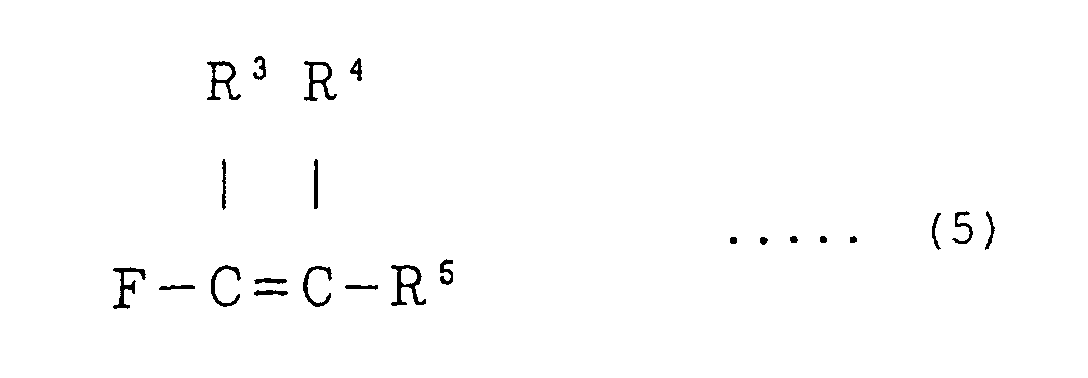
In Formula (5), R3 represents a hydrogen atom or a
fluorine atom, R4 represents a hydrogen atom, a chlorine
atom, or a fluorine atom, and R5 represents a hydrogen
atom, a fluorine atom, or a trifluoromethyl group.
The curable resin composition (X1) is explained
firstly.
The composition (X1) may contain the other additive
(D), the other resin (E), a rubber (F), a filler (G), etc.
The other additive (D) includes phenol type age
resistors, phosphorus type age resistors, flame retardants,
phenol type thermal deterioration inhibitors, benzophenone
type UV stabilizers, antistatic agents, etc.
In using (D), the content of (D) is preferably 0.001
to 3.0 wt%, more preferably 0.01 to 2.0 wt%, still more
preferably 0.05 to 1.0 wt% based on the total weight of
(A) and (B).
The other resin (E) includes conventional resins
used conventionally for insulators, such as ABS resins,
polystyrene, polycarbonate, polyamide, polyphenylene oxide,
polyethylene terephthalate, polybutylene terephthalate,
polyphenylene sulfide, polyimide, polysulfone, polyether
sulfone, and polyarylate.
The Mw of the other resin (E) is preferably 10,000
to 500,000, more preferably 20,000 to 100,000, still more
preferably 40,000 to 60,000.
In using the other resin (E), the content of (E) is
preferably 0.1 to 20 wt%, more preferably 1 to 10 wt%,
still more preferably 2 to 8 wt%, still more preferably 3
to 5 wt% based on the total weight of (A) and (B).
The rubber (F) includes isoprene rubber, butadiene
rubber, styrene-butadiene rubber, styrene/isoprene rubber,
nitrile rubber, chloroprene rubber, and ethylene-propylene
rubber.
The elongation of rubber (JIS K6301 (1995) 3.
Tensile Test) is preferably 500 to 2,000%, more preferably
700 to 1,500%, still more preferably 800 to 1,000%.
In using the rubber (F), the content of the rubber
(F) is preferably 1 to 40 wt%, more preferably 5 to 30 wt%,
still more preferably 8 to 25 wt% based on the total
weight of (A) and (B) .
The filler (G) includes materials used
conventionally for insulators, such as silica, alumina,
calcium carbonate, barium sulfate, titanium oxide, talc,
etc.
In using the filler (G), the content of the filler
(G) is preferably 1 to 50 wt%, more preferably 5 to 40 wt%,
still more preferably 8 to 30 wt% based on the total
weight of the curable resin (A) and the low molecular
weight compound (B).
The curable resin composition (X1) may contain
further a solvent.
The solvent may be the same as the one useful for
polymerization of the curable resin (A).
The solvent used in polymerization of (A) may be
kept unremoved and used in production of (X1). The
solvent used in polymerization of (A) may be removed once
and the same solvent used in polymerization of (A). or
another solvent may be added later for production of (X1).
Otherwise, a mixture of (B) and a solvent may be mixed
with (A) .
In using the solvent, the content of the solvent is
preferably 5 to 90 wt%, more preferably 10 to 80 wt%,
still more preferably 30 to 70 wt% based on the total
weight of (A) (excluding the weight of the solvent) and
(B) .
The composition (X1) can be readily produced by
mixing (A), (B), and optionally (D)-(G) and/or a solvent
uniformly in a conventional manner, for example, by any of
the methods (1)-(3) shown below.
The dielectric constant after curing of the curable
resin composition (X1) can be adjusted by the kind of the
monomer as the source material of (A). For example, a
higher content of ethylene, propylene, butadiene, isoprene,
(meth)acrylate esters of 4 or more carbon atoms, styrene,
or the like tends to decrease the dielectric constant,
whereas a higher content of (meth)acrylic acid,
acrylonitrile, etc. tends to increase the dielectric
constant. The examples of the monomer mixture giving a
dielectric constant of 2 to 3.5 include a mixture of
styrene/glycidyl (meth)acrylate (10 to 55/90 to 45 by mass
parts) and a stoichiometric ratio (equivalent ratio) of
bisphenol A diglycidyl ether and 4-methylcyclohexane-1,2-dicarboxylic
anhydride; a mixture of styrene/glycidyl
(meth)acrylate (10 to 55/90 to 45 by mass parts),
bisphenol-A diglycidyl ether, and
tris(hydroxyphenyl)methane; a mixture of styrene/glycidyl
(meth)acrylate (10 to 55/90 to 45 by mass parts),
bisphenol A diglycidyl ether, and a phenol novolak resin
(2 to 8 nuclear); a mixture of styrene/glycidyl
(meth)acrylate (10 to 55/90 to 45 by mass parts) and
bisphenol-A diglycidyl ether; a mixture of
styrene/glycidyl (meth)acrylate (10 to 55/90 to 45 by mass
parts) and phenol novolak polyglycidyl ether, and so forth.
Next, the curable resin composition (X2) is
explained.
The α-olefin (Ha) has preferably carbon atoms of 2
to 20, more preferably 3 to 18, still more preferably 3 to
12.
The (Ha) includes ethylene, propylene, 1-butene, 3-methyl-1-butene,
1-pentene, 3-methyl-1-pentene, 4-methyl-1-pentene,
1-hexene, 1-octene, 1-decene, 1-dodecene, 1-tetradecene,
1-hexadecene, 1-octadecene, 1-eicosene, etc.
The cyclic olefin (Hb) has preferably carbon-carbon
double bonds of at least 2, more preferably 2 to 5, still
more preferably 2 to 3 in number.
The (Hb) includes cyclic olefins (Hb1) represented
by Formula (6), cyclic olelfins (Hb2) represented by
Formula (7), cyclic olefins (Hb3) represented by Formula
(8), and mixtures thereof.

In Formula (6), R7 to R17 each independently
represents a hydrogen atom or an alkyl group of 1 to 4
(preferably 1 to 2) carbon atoms.
The alkyl group includes methyl, ethyl, isopropyl,
butyl, t-butyl, etc.
As the groups of R7 to R17, a hydrogen atom, a methyl
group, and an ethyl group are preferable in view of the
heat resistance.
The symbol n indicates an integer of 0 to 5,
preferably 0 to 2 in view of mechanical strengths (tensile
strength, tensile elongation, etc.).
The (Hb1) includes dicyclopentadiene (in Formula (6),
n is 0, and all of the R7 to R17 groups are a hydrogen
atom), tricyclopentadiene (in Formula (6), n is 1, and all
of the R7 to R17 groups are a hydrogen atom),
tetracyclopentadiene (in Formula (6), n is 2, and all of
the R7 to R17 groups are a hydrogen atom), etc.
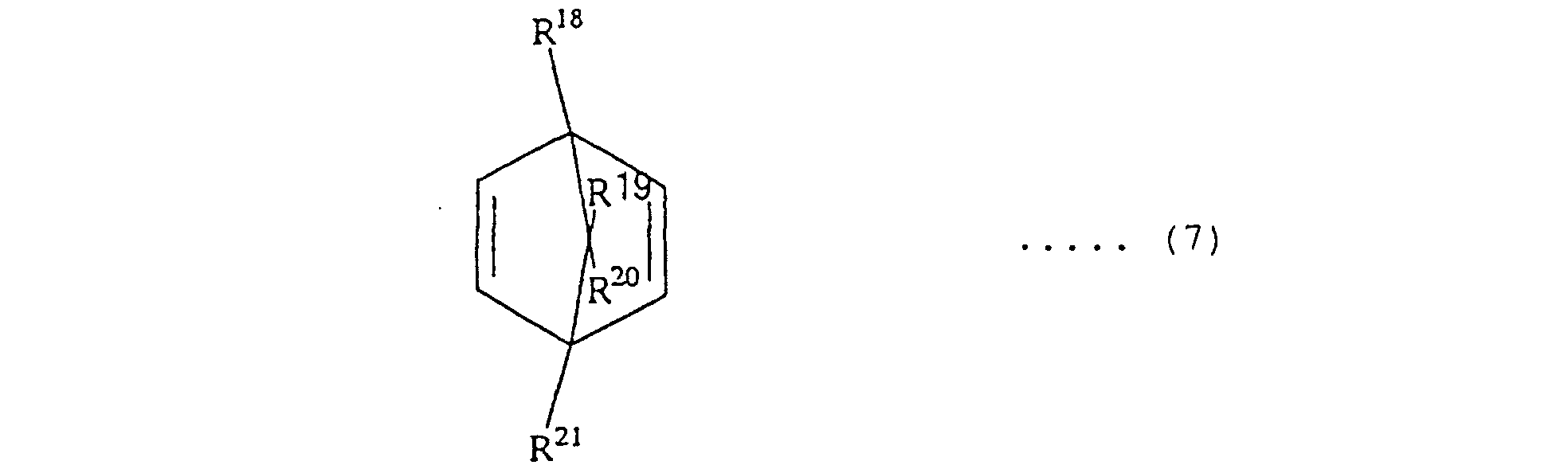
In Formula (7), R18 to R21 represent the same as R7 to
R17 in Formula (6), and the preferred ranges are the same.
The (Hb2) includes norbornadiene, 3-methylnorbornadiene,
etc.

In Formula (8), R22 to R29 represent the same as R7 to
R17 in Formula (6), and the preferred ranges are the same.
R30 and R31 each independently represent a hydrogen
atom or a hydrocarbon group of 1 to 4 (preferably 1 to 2)
carbon atoms.
The hydrocarbon group includes methyl, ethyl,
isopropyl, butyl, t-butyl, ethylidene, vinylidene, etc.
As R30 and R31, preferable are methyl, ethyl,
ethylidene, and vinylidene in view of the heat resistance.
The symbol m indicates an integer of 0 to 5,
preferably 0 to 2 in view of the mechanical strengths
(tensile strength, tensile elongation, etc.).
The cyclic olefin (Hb3) includes 5-ethylidene-2-norbornene,
5-vinylidene-2-norbornene, 2-ethylidene-1,4,5,8-dimethano-1,2,3,4,4a,5,8,8a-octahydronaphthalene,
etc.
Of the cyclic olefins (Hb), preferable are (Hb3),
more preferable are 5-ethylidene-2-norbornene, and 2-ethylidene-1,4,5,8-dimethano-1,2,3,4,4a,5,8,8a-octahydronaphthalene,
particularly preferable is 5-ethylidene-2-norbornene.
The weight ratio of the α-olefin (Ha)/cyclic olefin
(Hb) is preferably 99/1 to 10/90, more preferably 90/10 to
20/80, most preferably 30/70 to 60/40. Within this range,
the thermal shock resistance of the resin after curing
tends to be improved further.
The number of the carbon-carbon double bonds
contained in the copolymer (H) is preferably 2 to 3,000,
more preferably 3 to 1,000, still more preferably 5 to 500,
most preferably 10 to 200.
The Mw of the copolymer (H) is preferably 3,000 to
1,000,000, more preferably 50,000 to 400,000, still more
preferably 70,000 to 200,000, most preferably 80,000 to
100,000.
The (H) can readily be produced by copolymerizing
(Ha) and (Hb) in the same manner as the polymerization of
the curable resin (A) used for the aforementioned curable
resin composition (X1).
The crosslinking agent (I) has preferably 1 to 6,
more preferably 1 to 5, still more preferably 1 to 3
carbon-carbon double bonds.
As the (I), useful are (meth)acrylates, unsaturated
hydrocarbons, alkenyl ethers, etc.
The (meth)acrylates include monomers (b) having only
(meth)acryloyl groups, monomers (f) having an epoxy group
and a (meth)acryloyl group, monomers (h) having a
(meth)acryloyl group and a vinyloxy group, monomers (i)
having a (meth)acryloyl group and an allyloxy group,
monomers (j) having a (meth)acryloyl group and a
propenyloxy group, monomers (s) having a hydroxyl group
and a (meth)acryloyl group, monomers (t) having a
(meth)acryloyl group and an isocyanato group, monomers (u)
having a (meth)acryloyl group and a carboxyl group, alkyl
(meth)acrylate esters (bb3), phenoxy group-containing
(meth)acrylates, etc.
The phenoxy group-containing (meth)acrylates include
phenoxyethyl (meth)acrylate, (meth)acrylate of an adduct
of phenol and 2 moles of EO, (meth)acrylate of an adduct
of phenol and 2 moles of EO and 2 moles of PO, etc.
The unsaturated hydrocarbons include aromatic
compounds (bb2) having a polymerizable unsaturated double
bond, α-olefins (Ha), aliphatic nonconjugated polyenes of
5 to 10 carbon atoms, cyclic olefins of 5 to 10 carbon
atoms, and oligomers of the cyclic olefins, etc.
The aliphatic nonconjugated polyenes include 1,4-pentadiene,
1,4-hexadiene, 1,5-hexadiene, 1,6-octadiene,
2-methyl-1,5-hexadiene, 6-methyl-1,5-heptadiene, 7-methyl-1,6-octadiene,
1,3,5-octatriene, 1,4,9-decatriene, etc.
The cyclic olefins include cyclopentene, cyclohexene,
3,4-dimethylcyclopentene, 3-methylcyclohexene, 2-(2-methylbutyl)-1-cyclohexene,
cyclohexadiene, cyclooctadiene,
dicyclopentadiene, methyltetrahydroindene, norbornadiene,
2-propenyl-2,5-norbornadiene, norbornene,
dicyclopentadiene, dimethanocyclopentadienonaphthalene,
trimers and tetramers of cyclopentadiene, 2-norbornene, 5-methyl-2-norbornene,
5,5-dimethyl-2-norbornene, 5-ethyl-2-norbornene,
5-ethylidene-2-norbornene, 5-vinylidene-2-norbornene,
5-phenyl-2-norbornene, 5-phenyl-5-methyl-2-norbornene,
6-ethyl-1,4:5,8-dimethano-1,4,4a,5,6,7,8,8a-octahydronaphthalene,
2,3-cyclopentadienonaphthalene, 2-ethylidene-1,
4, 5, 8-dimethano-1, 2, 3, 4, 4a, 5, 8, 8a-octahydronaphthalene,
1,4:5,10:6,9-trimethano-1,2,3,4,4a,5,5a,6,9,9a,10,10a-dodecahydro-2,3-cyclopentadienoanthracene,
etc.
The oligomers of cyclic olefins include 3 to 4 mers
of cyclopentadiene, cyclopentediene oligomers (2 to 30
mers), 5-ethylidene-2-norbornene oligomers (2 to 30 mers),
etc.
As the alkenyl ethers, useful are vinyl ethers of 4
to 10 carbon atoms, propenyl ethers of 5 to 12 carbon
atoms, allyl ethers of 5 to 12 carbon atoms.
The vinyl ethers include ethylene glycol divinyl
ethers, diethylene glycol divinyl ethers, triethylene
glycol divinyl ethers, tetraethylene glycol divinyl ethers,
propylene glycol divinyl ethers, dipropylene glycol
divinyl ethers, butylene glycol divinyl ethers, etc.
The propenyl ethers include ethylene glycol
dipropenyl ether, diethylene glycol dipropenyl ether,
triethylene glycol dipropenyl ether, tetraethylene glycol
dipropenyl ether, propylene glycol dipropenyl ether,
dipropylene glycol dipropenyl ether, butylene glycol
dipropenyl ether, etc.
The allyl ethers include ethylene glycol diallyl
ether, diethylene glycol diallyl ether, triethylene glycol
diallyl ether, tetraethylene glycol diallyl ether,
propylene glycol diallyl ether, dipropylene glycol diallyl
ether, butylene glycol diallyl ether, etc.
The aforementioned crosslinking agent (I) preferably
does not contain a polar group in the molecule in view of
the dielectric constant. As the crosslinking agent, in
view of the reactivity and the dielectric constant,
preferable are α-olefins, cyclic olefins, cyclic olefin
oligomers, vinyl ethers, propenyl ethers, and allyl ethers,
more preferable are cyclic olefins, cyclic olefin
oligomers, vinyl ethers, propenyl ethers, and allyl ethers,
particularly preferable are propenyl ethers.
The boiling point of the crosslinking agent (I) is
preferably 250°C or higher, more preferably 250 to 350°C,
still more preferably 280 to 300°C.
The crosslinking agent (I) may be used singly or in
combination of two or more thereof.
Incidentally, since the copolymer (H) has itself at
least one carbon-carbon double bond, the part of the
copolymer can serve a crosslinking agent to cause reaction
between the copolymers (H). However, an additional
crosslinking agent (I) is preferably used in view of the
physical properties such as heat resistance.
The weight ratio of the copolymer (H)/crosslinking
agent (I) is preferably 99/1 to 20/80, more preferably
90/10 to 40/60, still more preferably 85/15 to 50/50.
Within this range, the heat resistance tends to be
improved further owing to sufficient crosslinking.
The aforementioned curable resin composition (X2)
may contain the other additive (D), the other resin (E), a
rubber (F), a filler (G), etc.
In using (D), the content of (D) is preferably 0.001
to 3.0 wt%, more preferably 0.01 to 2.0 wt%, still more
preferably 0.05 to 1.0 wt% based on the total weight of
(H) and (I).
In using the other resin (E), the content of (E) is
preferably 1 to 45 wt%, more preferably 5 to 40 wt%, still
more preferably 10 to 30 wt% based on the total weight of
the copolymer (H) and the crosslinking agent (I).
In using the rubber (F), the content of (F) is
preferably 1 to 40 wt%, more preferably 5 to 30 wt%, still
more preferably 8 to 25 wt% based on the total weight of
(H) and (I).
In using the filler (G), the content of (G) is
preferably 1 to 50 wt%, more preferably 5 to 40 wt%, still
more preferably 8 to 30 wt% based on the total weight of
(H) and (I).
The curable resin composition (X2) may further
contain a solvent.
The solvent may be the same as the one useful for
polymerization of the curable resin (A).
In using the solvent, the content of the solvent is
preferably 5 to 90 wt%, more preferably 10 to 80 wt%,
still more preferably 30 to 70 wt% based on the total
weight of (H)(excluding the weight of the solvent) and (I).
The curable resin composition (X2) can readily be
produced by mixing (H), (I), and optionally (D)-(G) and/or
a solvent uniformly in a conventional manner, for example,
by any of the methods (1)-(3) shown below.
The dielectric constant after curing of the curable
resin composition (X2) can be adjusted by the kind of the
crosslinking agent (I). For example, a higher content of
the α-olefin, cyclic olefin, cyclic olefin oligomer, or
the like tends to decrease the dielectric constant,
whereas a higher content of the (meth)acrylate, alkenyl
ether or the like tends to increase the dielectric
constant.
The examples of the composition giving a dielectric
constant of 2 to 3.5 are a mixture of a 1-hexene/5-ethylidene-2-norbornene
copolymer and ethylene glycol
diallyl ether, a mixture of 1-hexene/5-ethylidene-2-norbornene
copolymer and ethylene glycol dimethacrylate, a
mixture of 1-hexene/dicyclopentadiene copolymer and
ethylene glycol diallyl ether, a mixture of 1-hexene/dicyclopentadiene
copolymer and ethylene glycol
dimethacrylate, etc.
Next, the curable resin composition (X3) is
explained.
The monomers (345) represented by formulas (3)-(5)
are explained below.
In Formula (3), n is an integer of preferably 2 to 6,
more preferably 2 to 4.
The monomers represented by Formula (3) include
perfluoromethyl perfluorovinyl ether, perfluoroethyl
perfluorovinyl ether, perfluoropropyl perfluorovinyl ether,
perfluoroisobutyl perfluorovinyl ether, perfluorohexyl
perfluorovinyl ether, perfluorodecyl perfluorovinyl ether,
etc.
Of these monomers, in view of the thermal resistance,
preferable are perfluoromethyl perfluorovinyl ether,
perfluoroethyl perfluorovinyl ether, perfluoropropyl
perfluorovinyl ether, perfluoroisobutyl perfluorovinyl
ether, and perfluorohexyl perfluorovinyl ether, more
preferable are perfluoromethyl perfluorovinyl ether,
perfluoroethyl perfluorovinyl ether, perfluoropropyl
perfluorovinyl ether, and perfluoroisobutyl perfluorovinyl
ether.
In Formula (4), m is an integer of preferably 0 to 4,
more preferably 0 to 2.
The symbol n is an integer of preferably 2 to 6,
more preferably 2 to 4.
The monomers represented by Formula (4) include
perfluoromethyl (meth)acrylate, perfluoroethyl
(meth)acrylate, perfluoropropyl (meth)acrylate,
perfluoroisobutyl (meth)acrylate, perfluorohexyl
(meth)acrylate, tridecafluorohexyl (meth)acrylate,
perfluorodecyl (meth)acrylate, perfluoropropylmethyl
(meth)acrylate, perfluoroisobutylethyl (meth)acrylate,
perfluoromethylbutyl (meth)acrylate, perfluoroethylhexyl
(meth)acrylate, etc.
Of these monomers, in view of the dielectric
constant, preferred are perfluoroethyl (meth)acrylate,
perfluoropropyl (meth)acrylate, perfluoroisobutyl
(meth)acrylate, perfluorohexyl (meth)acrylate,
perfluoropropylmethyl (meth)acrylate,
perfluoroisobutylethyl (meth)acrylate,
perfluoromethylbutyl (meth)acrylate, and
perfluoroethylhexyl (meth)acrylate, more preferable is
perfluoroethyl (meth)acrylate.
In Formula (5), R3 and R4 are preferably a fluorine
atom respectively, and R5 is preferably a fluorine atom or
a trifluoromethyl group.
The monomers represented by Formula (5) include
vinyl fluoride, vinylidene fluoride,
chlorotrifluoroethylene, dichlorodifluoroethylene,
tetrafluoroethylene, hexafluoropropylene, etc.
Of these, in view of the dielectric constant,
preferable are vinyl fluoride, vinylidene fluoride,
tetrafluoroethylene, and hexafluoropropylene, still more
preferable are tetrafluoroethylene, and
hexafluoropropylene.
For the curable resin composition (X3), of the
monomers (fgw), (f) and (g) are preferable. In (X3), of
the monomers (bb235), the monomers (bb2) are preferable;
in view of the dielectric constant and the thermal
resistance, more preferable are styrene, o-methylstyrene,
p-methylstyrene, o-fluorostyrene, m-fluorostyrene, p-fluorostyrene,
2,6-difluorostyrene, and 2,3,4,5,6-pentafluorostyrene.
The curable resin composition (X3) comprises a
copolymer (J) formed from at least one monomer selected
from the monomers (fgw), at least one of a monomer (345),
and optionally at least one monomer selected from the
monomers (bb235).
In other words, (X3) may be a binary copolymer
formed from combination of at least one monomer selected
from the monomers (fgw), any one of the monomers (345),
and optionally at least one monomer selected from (bb235);
or may be a polygenetic copolymer formed from combination
of at least one monomer selected from the monomers (fgw),
two or more of the monomers (345), and optionally at least
one monomer selected from (bb235). These binary
copolymers and polygenetic copolymers are referred to
collectively and simply as copolymers (J).
As the copolymer (J), polygenetic copolymers are
preferable in view of the dielectric constant, the thermal
resistance and workability; more preferable are polymers
having (f) and/or (g) as the essential constituting
monomer unit; still more preferable are polymers having
(f) and/or (g), and a monomer (4) as the essential
constituting monomer units; still more preferable are
polymers formed from (f) and/or (g), a monomer (4), and
optionally (bb2), (bb3), and/or (bb5), polymers formed
from (f) and/or (g), monomers (3) and (4), and optionally
(bb2), (bb3), and/or (bb5), polymers formed from (f)
and/or (g), monomers (4) and (5), and optionally (bb2),
(bb3), and/or (bb5); still more preferable are polymers
formed from (f) and/or (g), a monomer (4), and (bb2),
polymers formed from (f) and/or (g), monomers (3) and (4),
and (bb2), and polymers formed from (f) and/or (g),
monomers (4) and (5), and optionally (bb2).
The weight ratio of the monomer (fgw)/monomer (345)
is preferably 5/95 to 95/5, more preferably 20/80 to 70/30,
still more preferably 30/70 to 60/40.
In the case of the polygenetic copolymers, a higher
weight ratio of the monomer (345) is preferable. When the
monomer (bb235) is used, the weight ratio of the monomer
(fgw)/monomer (bb235) is preferably 10/90 to 95/5, more
preferably 30/70 to 90/10, still more preferably 40/60 to
80/20.
The bonding type of the copolymer (J) may be a block
type, a random type or a combination thereof.
The total number of epoxy groups and alkenyl ether
groups in the copolymer (J) is preferably 2 to 3,000, more
preferably 3 to 1,000, still more preferably 5 to 500,
still more preferably 10 to 200.
The Mw of (J) is preferably 2,000 to 1,000,000, more
preferably 3,000 to 700,000, still more preferably 50,000
to 400,000.
The (J) can readily be produced by copolymerizing a
monomer (fgw) and a monomer (345), and optionally a
monomer (bb235) in the same manner as the polymerization
of the (A) used for the aforementioned (X1).
The composition (X3) may contain the other additive
(D), the other resin (E), a rubber (F), a filler (G), etc.
In using (D), the content of (D) is preferably 0.001
to 3.0 wt%, more preferably 0.01 to 2.0 wt%, still more
preferably 0.05 to 1.0 wt% based on the weight of (J).
In using (E), the content of (E) is preferably 1 to
45 wt%, more preferably 5 to 40 wt%, still more preferably
10 to 30 wt% based on the weight of the copolymer (J).
In using (F), the content of (F) is preferably 1 to
40 wt%, more preferably 5 to 30 wt%, still more preferably
8 to 25 wt% based on the weight of the copolymer (J).
In using (G), the content of (G) is preferably 1 to
50 wt%, more preferably 5 to 40 wt%, still more preferably
8 to 30 wt% based on the weight of the copolymer (J).
The curable resin composition (X3) may contain
further a solvent.
The solvent may be the same as the one useful for
polymerization of the curable resin (A).
In using the solvent, the content of the solvent is
preferably 5 to 90 wt%, more preferably 10 to 80 wt%,
still more preferably 30 to 70 wt% based on the weight of
the copolymer (J).
The composition (X3) can be readily produced by
mixing (J), and optionally (D)-(G) and/or a solvent
uniformly in a conventional manner, for example, by any of
the methods (1)-(3) shown below.
The dielectric constant of the curable resin
composition (X3) after curing can be adjusted by the kinds
of the monomer (ggw), the monomer (345), and the monomer
(bb235). For example, a higher content of (f), (g), and
(bb2) tends to increase the dielectric constant.
The examples of the composition giving a dielectric
constant of 2 to 3.5 are styrene/propenoxyethyl
methacrylate copolymers (weight ratio: 45 to 90/55 to 19),
styrene/propenoxyethyl methacrylate/2-ethylhexyl acrylate
copolymers (weight ratio: 44 to 80/55 to 10/1 to 10), etc.
Next, the thermoplastic resin (Y) is explained.
The dielectric constant of the thermoplastic resin
(Y) is preferably not higher than 3.0; more preferably 1.9
to 2.8; still more preferably 2.0 to 2.6; still more
preferably 2.0 to 2.5; most preferably 2.1 to 2.3. Within
such a range of the dielectric constant, the resulting
resin has higher reliability for use as an insulator, and
tends to facilitate, in application to an electronic
integrated wiring or the like, improvement of a wiring
performance with less delay of signals.
The curing conditions and the method for measuring
the dielectric constant are the same as those for the
curable resin (A).
The content of the carbon-carbon double bond or the
carbon-nitrogen bond in the thermoplastic resin (Y) per
gram of (Y) is preferably 5×10⁻⁵ to 3.5×10⁻² mol/g; more
preferably 1.0×10⁻⁴ to 3.5×10⁻² mol/g for the carbon-carbon
double bonds and 1×10⁻⁴ to 3.5×10⁻² mol/g for the
carbon-nitrogen bonds; and in particular in view of the
dielectric constant, still more preferably 1.0×10⁻³ to 2.5
×10-2 mol/g for the carbon-carbon double bonds, and 5×10⁻⁴
to 2.5×10⁻² mol/g for the carbon-nitrogen bond.
At a lower content of the carbon-carbon double bond
or carbon-nitrogen bond than the above range, the
thermoplastic resin on the surface of the insulation layer
is not readily melted out and tends to be not capable of
forming fine surface roughness and tends to deteriorate
the adhesiveness of electroless plating. On the other
hand, at a higher content thereof, the dielectric constant
of the curable resin material tends to deteriorate.
The carbon-carbon double bonds or the carbon-nitrogen
bonds in (Y) may be present either in the main
chain skeleton or the side chain skeleton of the resin,
but is preferably present in the main chain skeleton of
the resin.
As the thermoplastic resin (Y), useful are
thermoplastic resins (Y1) having a carbon-carbon double
bond, thermoplastic resins (Y2) having a carbon-nitrogen
bond, etc.
The thermoplastic resins (Y1) include (co)polymers
having essentially constituting monomer units of (b1),
(b3), (c), (d1), (d3), (e1), and/or (e3).
The copolymer of the above resin may be of a random
type or of a block type.
The thermoplastic resin (Y1) may contain, in
addition to the essential constituting monomer units, an
additional comonomer.
The additional comonomer includes (b2), (b4), (d2),
(d4), (d5), (d6), (e2), (e4), (e5), (e6), (f), (g), (h),
(i), (j), (q), (r), (s), (t), (u), (v), (w), (bb), etc.
In using the additional comonomer, the content of
the additional comonomer is not specially limited, but is
preferably 20 to 80 wt%, more preferably 35 to 70 wt%,
still more preferably 50 to 60 wt% based in the total
weight of the used monomers in view of the thermal
resistance and the resin strength.
The (Y1) can readily be produced in the same manner
as polymerization of (A) for use for (X1).
The thermoplastic resin (Y1) includes polybutadiene,
polyisoprene, styrene-butadiene copolymers, styrene-isoprene
copolymers, acrylonitrile-butadiene copolymers,
ring-opened norbornene polymer, etc. These resins are
readily available commercially.
The commercial products (trade names) include
polybutadiene such as JSR BR series (produced by JSR),
polyisoprene such as JSR IR series (produced by JSR),
styrene-butadiene copolymers such as JSR TR series
(produced by JSR), styrene-isoprene copolymers such as JSR
SIS series (produced by JSR), ring-opened norbornene
polymers such as NORSOREX series (produced by JSR), etc.
The thermoplastic resins (Y2) having a carbon-nitrogen
bond include polyamides, polyurethanes, polyureas,
polyimides, polyamino acids, reaction products of a
bifunctional epoxy compound and a monofunctional primary
amine.
The polyamides include reaction products of a
diamine of 2 to 18 carbon atoms and a dicarboxylic acid of
6 to 20 or more carbon atoms.
The diamines include diamines in the monomer groups
(k) and (m).
The dicarboxylic acids include dicarboxylic acids in
the monomer group (n).
In the reaction for producing the polyamide, for
controlling the molecular weight, there may be used a
compound of (k) or (m) other than the diamines, (aa7), or
(aa8), or a compound of (n) other than the dicarboxylic
acids, (aa3), or (aa4).
The polyurethanes useful are produced by reaction of
a dihydric phenol or dihydric alcohol of 2 to 100 or more
carbon atoms with a diisocyanate of 6 to 20 carbon atoms.
The dihydric phenols include the compounds (o1),
etc., and the dihydric alcohols include the compounds (o3),
etc.
The isocyanates include isocyanates in the (p), etc.
In the reaction for producing the polyurethane, for
controlling the molecular weight, there may be used a
compound of (o2), (o4), or (p) other than diisocyanates.
The polyureas include reaction products of a diamine
of 2 to 18 carbon atoms, and a diisocyanate of 6 to 20
carbon atoms.
The diamines include those in the compounds (k) and
(m), etc.
The isocyanates include those in the compounds (p),
etc.
In the reaction for producing the polyurea, for
controlling the molecular weight, there may be used a
compound of (k) or (m) other than the diamines, a compound
of (aa7), (aa8), or (p) other than diisocyanates, or the
like.
The polyimides include reaction products produced by
reaction of a diamine of 2 to 18 carbon atoms and
polycarboxylic acid of 6 to 20 carbon atoms.
The diamines include the diamines in the compounds
(k) and (m) .
The polycarboxylic acids include those of (n).
In the reaction for producing the polyimide, for
controlling the molecular weight, there may be used a
compound of (k) or (m) other than the diamines, a compound
of (aa7), (aa8), (aa3), (aa4), or the like.
The polyamino acids include condensate of an
aminocarboxylic acid of 2 to 12 carbon atoms, ring-opening
polymerization products of lactams of 6 to 12 carbon atoms,
etc.
The aminocarboxylic acids include amino acids
(glycine, alanine, valine, leucine, isoleucine,
phenylalanine, etc.), ω-amino-caproic acid, ω-amino-enanthic
acid, ω-amino-caprylic acid, ω-amino-pelargonic
acid, ω-amino-capric acid, 11-amino-undecanoic acid, 12-amino-dodecanoic
acid, etc.
The lactams include caprolactam, enantholactam,
laurolactam, undecanolactam, etc.
In the reaction for producing the polyamino acid,
for controlling the molecular weight, there may be used
also a compound of (k), (m), (aa7), (aa8), (n), (aa3),
(aa4), or the like.
The bifunctional epoxy compounds include
bifunctional glycidyl esters in the compounds of (a11),
(a13), and (a2); bifunctional glycidylamine in the
compounds of (a3); bifunctional epoxides in the compounds
of (a4); etc.
The monofunctional primary amines include the
primary amines in the compounds (aa7) and (aa8), etc.
In the reaction of the bifunctional epoxy compound
and the monofunctional primary amine, for controlling the
molecular weight, there may be used a compound of (a), (k),
(m), (n), (p), (p), or the like.
The resin (Y2) can readily be produced in the same
manner as polymerization of (A) for use for (X1).
Of the resins (Y), in view of the dielectric
constant, preferable are (Y1) resins, and reaction
products of a bifunctional epoxy compound and a
monofunctional primary amine; more preferable are
polybutadiene, polyisoprene, styrene-butadiene copolymers,
styrene-isoprene copolymers, ring-opened norbornene
polymers, and reaction products of a bifunctional epoxy
compound and a monofunctional amine.
The resin (Y) may contain the other additive (D),
the other resin (E), a rubber (F), a filler (G), etc.
In using (D), the content of (D) is preferably 0.001
to 3.0 wt%, more preferably 0.01 to 2.0 wt%, still more
preferably 0.05 to 1.0 wt% based on the weight of (Y).
In using (E), the content of (E) is preferably 1 to
45 wt%, more preferably 5 to 40 wt%, still more preferably
10 to 30 wt% based on the weight of (Y).
In using (F), the content of (F) is preferably 1 to
40 wt%, more preferably 5 to 30 wt%, still more preferably
8 to 25 wt% based on the weight of (Y).
In using (G), the content of (G) is preferably 1 to
50 wt%, more preferably 5 to 40 wt%, still more preferably
8 to 30 wt% based on the weight of (Y).
The (Y) may contain a solvent.
The solvent may be the same as the one useful for
polymerization of the curable resin (A).
In using the solvent, the content of the solvent is
preferably 5 to 90 wt%, more preferably 10 to 80 wt%,
still more preferably 30 to 70 wt% based on the weight of
(Y) .
The (Y) can readily be produced by uniform mixing,
optionally with (D)-(G) and/or a solvent in a conventional
method.
The dielectric constant of (Y) can be controlled, in
the case of (Y1), by adjusting the amounts of the source
materials of (Y1). For example, a higher content of
butadiene, etc. tends to lower the dielectric constant,
whereas a higher content of styrene, etc. tends to raise
the dielectric constant.
In the case of (Y2), the amounts of the source
materials of (Y2) are adjusted. For example, use of a
diamine, a dicarboxylic acid, and a monoalkylamine, etc.
having a relatively large number of carbon atoms tends to
lower the dielectric constant, whereas use of a diamine, a
dicarboxylic acid, and a monoalkylamine, etc. having a
relatively small number of carbon atoms tends to raise the
dielectric constant.
The dielectric constant of 2 to 3.5 of the curable
resin material can be obtained, for example, by
styrene/butadiene copolymers,
styrene/butadiene/acrylonitrile copolymers, bisphenol
A/monododecylamine copolymers, and so forth.
The weight ratio of (X)/(Y) in a solvent-free state
(in terms of pure components) is preferably 40 to 98/2 to
60, more preferably 65 to 96/4 to 35 in view of the resin
strength, and still more preferably 70 to 90/10 to 30 in
view of the thermal resistance, most preferably 80 to
85/15 to 20.
The curable resin material of the present invention
may contain a curing catalyst (C), as necessary.
The catalyst (C) may be added immediately before use
of the curable resin material of the present invention, or
may be added during production of the curable resin
material of the present invention.
In using (C), the content of (C) (excluding the ones
used in preparation of (A), (X1), (X2), and (X3)) is
preferably 0.001 to 10 wt%, more preferably 0.01 to 8.0
wt%, still more preferably 0.05 to 5.0 wt%, most
preferably 0.1 to 2.0 wt% based on the weight of (X) and
(Y) .
The curable resin material of the present invention
may contain the other additive (D), the other resin (E), a
rubber (F), a filler (G), etc.
In using the other additive (D), the content of (D)
is preferably 0.001 to 3.0 wt%, more preferably 0.01 to
2.0 wt%, still more preferably 0.05 to 1.0 wt% based on
the weight of (X) and (Y).
In using the other resin (E), the content of (E) is
preferably 1 to 45 wt%, more preferably 5 to 40 wt%, still
more preferably 10 to 30 wt% based on the total weight of
(X) and (Y) .
In using the rubber (F), the content of (F) is
preferably 1 to 40 wt%, more preferably 5 to 30 wt%, still
more preferably 8 to 25 wt% based on the weight of (X) and
(Y).
In using the filler (G), the content of (G) is
preferably 1 to 50 wt%, more preferably 5 to 40 wt%, still
more preferably 8 to 30 wt% based on the weight of (X) and
(Y) .
The curable resin material of the present invention
may contain a solvent.
The solvent may be the same as the one useful for
polymerization of (A).
In using the solvent, the content of the solvent is
preferably 5 to 90 wt%, more preferably 10 to 80 wt%,
still more preferably 30 to 70 wt% based on the weight of
(X) and (Y) .
The curable resin material of the present invention
comprises (X) and (Y). (Y) is preferably distributed
uniformly in (X), or (Y) is preferably dispersed uniformly
in (X) .
In the case where (Y) is dispersed in (X), the
average diameter of the dispersed particles is not limited,
but is preferably 0.001 to 50 µm, more preferably 0.005
to 20 µm in view of the resin strength, still more
preferably 0.01 to 10 µm, still more preferably 0.05 to 5
µm in view of the adhesion properties, most preferably
0.1 to 2 µm.
The average diameter of the dispersed particles is
derived by curing the curable resin material at 180°C for
3 hours, observing the cross section thereof by scanning
electron microscopy, and averaging arithmetically the
particle diameters of at least 10 particles of (Y).
The curable resin material of the present invention
is a uniform mixture of (X), and (Y), and optionally (C)-(G)
and/or a solvent, and can be produced readily by a
conventional process, for example by any of the process
below.
The solvent is not limited provided that the solvent
is capable of dissolving both of the resins. For example,
the solvent for production of (A) is useful.
In the steps of dissolution, polymerization, and
solvent removal, a special operation is not necessary, but
stirring is preferably conducted at 1,000 to 20,000 rpm.
The curable resin material may be in any state, for
example, in a liquid state (including a solution state),
or in a film state (including a plate state and a sheet
state). The film thickness is preferably 1 to 100 µm,
more preferably 5 to 60 µm, still more preferably 15 to
50 µm.
The curable film of the present invention after
curing has a tensile modulus of 100 to 250 Kgf/mm2,
preferably 110 to 240 Kgf/mm2, more preferably 120 to 230
Kgf/mm2, still more preferably 130 to 220 Kgf/mm2, still
more preferably 140 to 210 Kgf/mm2, most preferably 150 to
200 Kgf/mm2. Within this range of the tensile modulus, an
insulating material having high thermal shock resistance
and other excellent properties can readily be obtained.
The tensile modulus is measured according to JIS
K7113 (1995).
The curable film after curing has a dielectric
constant of not higher than 3.5, preferably 1.9 to 3.5,
more preferably 2.0 to 3.4, still more preferably 2.0 to
3.3, still more preferably 2.1 to 3.3, most preferably 2.1
to 3.2.
The curing conditions of the curable film are the
same as the curing conditions in the dielectric constant
measurement.
The composition constituting the curable film of the
present invention contains a curable polymer compound.
The Mw of the curable polymer compound is 10,000 to
1,000,000, preferably 20,000 to 500,000, more preferably
30,000 to 100,000, still more preferably 40,000 to 500,000,
still more preferably 50,000 to 200,000, most preferably
60,000 to 100,000. Within this range of the Mw, an
insulating material having high thermal shock resistance
and other excellent properties can readily be obtained.
As the curable polymer compound, useful are curable
resins (A), and curable resin compositions (X1), (X2), and
(X3) .
As the composition constituting the curable film of
the present invention, useful are the above curable resin
materials, etc., most preferably the curable resin
material containing (X1).
The thickness of the curable film of the present
invention may be decided suitably to meet the use thereof,
but is preferably 1 to 100 µm, more preferably 5 to 70 µm,
still more preferably 15 to 60 µm, still more preferably
20 to 50 µm.
The curable film of the present invention can be
produced by molding the composition (e.g., aforementioned
curable resin material) by a conventional molding process
such as application of the composition onto a supporting
medium, a substrate, or the like by using a curtain coater,
a knife coater, a spray gun, a roll coater, a pin coater,
a dispenser, a bar coater, a screen printer, or the like;
by a dipping method; an injection-molding method; and the
like method.
Among the above molding process, preferable are the
methods employing a curtain coater, a knife coater, a
spray gun, or a roll coater, more preferable are the
methods employing a curtain coater or a knife coater,
still more preferable is the method employing a knife
coater.
In formation of the film, the viscosity may be
adjusted as necessary by use of a solvent, or the like.
The solvent is not limited specially provided that
the solvent is capable of dissolving, emulsifying, or
dispersing the composition. For example, the solvent for
production of the curable resin (A) is useful.
As the aforementioned supporting medium, useful are
materials used conventionally for film formation, such as
PET (polyethylene terephthalate), polyethylene,
polypropylene, and modified materials thereof, etc.
The substrate may be a printed wiring board having a
conduction wiring (copper, gold, silver, aluminum, etc.),
etc. For example, a substrate-preparing resin (e.g.,
epoxy resins, bismaleimide-triazine resins (BT),
polyamides resins, etc.) is impregnated into a nonwoven
fabric (glass fiber nonwoven fabric, aramide fiber
nonwoven fabric, etc.), etc., or glass fiber is added to a
substrate-preparing resin, and the resin is cured and a
copper wiring is allowed to adhere thereon (e.g., BT
substrates, glass epoxy substrates, paper-phenol
substrates, paper-epoxy substrates, etc.), etc.
In the case where a supporting medium is employed, a
film on the supporting medium may be transferred onto a
substrate or the like. In the case where base member is
used, the film thereon is cured as it is.
The composition after application is preferably
heated to remove the solvent, etc. The heating is
conducted at a temperature of 10 to 150°C (preferably 20
to 200°C) for a time of 1 to 60 minutes (preferably 2 to
40 minutes).
The curable film of the present invention can be
softened readily by heating (by hot-pressing, etc.) to
penetrate into fine portions (fine concave, etc.) of the
substrate, having excellent workability.
The insulator of the present invention has a tensile
modulus of 100 to 250 Kgf/mm2, preferably 110 to 240
Kgf/mm2, more preferably 120 to 230 Kgf/mm2, still more
preferably 130 to 220 Kgf/mm2, still more preferably 140
to 210 Kgf/mm2, most preferably 150 to 200 Kgf/mm2. Within
this range of the tensile modulus, the insulator has high
thermal shock resistance.
The tensile modulus is measured according to JIS
K7113 (1995).
The thermal expansion coefficient (α1) of the
insulator of the present invention is 30 to 50 ppm,
preferably 31 to 49 ppm, more preferably 32 to 48 ppm,
still more preferably 35 to 47 ppm, still more preferably
38 to 46 ppm, most preferably 40 to 45 ppm. Within this
range of the thermal expansion coefficient, the insulator
has high thermal shock resistance.
The thermal expansion coefficient is measured by a
tension loading method of TMA (differential expansion
system). Specifically, a cured film of 40 µm thick is cut
into a size of 20mm×2mm; the film is heated with a load
of 5 g at a rate of 10°C/minute from room temperature
(about 25°C) up to 250°C; and the length change ratio of
the sample in the temperature change from 30°C to 100°C is
measured.
The dielectric constant of the insulator of the
present invention is preferably not higher than 3.5, more
preferably 1.9 to 3.5, still more preferably 2.0 to 3.4,
still more preferably 2.0 to 3.3, still more preferably
2.1 to 3.3, most preferably 2.1 to 3.2.
The insulator of the present invention can be
produced readily by thermally curing the above curable
resin (A), curable resin composition, curable resin
material, curable film, etc.
The conditions of the curing are 80 to 250°C
(preferably 120 to 200°C, more preferably 150 to 200°C),
and 0.1 to 15 hours (preferably 0.2 to 5 hours, more
preferably 0.5 to 2.0 hours), and so forth.
The boiling water absorption percentage of the
insulator of the present invention is 3.00 to 0.001%,
preferably 2.50 to 0.005%, still more preferably 2.00 to
0.01%, still more preferably 1.0 to 0.05%.
The boiling water absorption percentage is measured
according to JIS K7209 (2000) 6.3B.
The volume resistivity of the insulator of the
present invention is 1010 to 1019 Ω/cm, preferably 1012 to 5
× 1018 Ω/cm, more preferably 1014 to 1018 Ω/cm, still more
preferably 1016 to 5×10¹⁷ Ω/cm. This insulator is
superior in insulation performance to conventional
insulating materials such as epoxy resins and polyimide
resins.
The volume resistivity is measured according to JIS
K6011 (1995).
The insulator of the present invention exhibits
excellent adhesiveness to copper formed by oxidant-treatment
and electroless plating, having a peeling
strength (JIS C6481 (1995) 5.7) of not lower than 0.8
Kgf/cm.
Yet the thermal resistance is comparable to that of
conventional insulators, not causing sagging, collapse,
blistering, or other abnormalities of the pattern even by
contact with solder at 300°C and having excellent chemical
resistance against solvents.
The insulating material is also excellent in 10%-sulfuric
acid resistance, 10%-hydorchloric acid resistance,
10%-nitric acid resistance, and 10%-sodium hydroxide
resistance as measured by JIS K6911 (1995) 5.32.
Accordingly, the insulator of the present invention
has high merits for speed-up and density-increase of
electronic circuits.
The curable resin (A), curable resin composition,
curable resin material, curable film, and insulator of the
present invention are useful widely as insulators, being
useful as overcoating materials, interlayer insulating
materials, printed circuit boards, etc., especially as
overcoating materials, and interlayer insulating materials.
The insulators are the most suitable as overcoating
materials and interlayer insulating materials of
electronic elements (semiconductor elements, light-emitting
diodes, memories, etc.), hybrid ICs, MCMs,
electric wiring boards, display parts, etc.
In one method of using the curable resin (A),
curable resin composition, curable resin material, or
curable film of the present invention, for example, as
layer insulating material, the curable resin (A), curable
resin composition, or curable resin material is applied on
a substrate, or the curable film of the present invention
is stuck to a substrate, then is subjected to hot pressing,
and, as necessary, working for boring, etc. (roughening,
conductive circuit formation, etc.). Thereto, another
substrate is stuck. The above operation is repeated, and
finally the piled matter is thermally cured to prepare
multi-layered product.
For using the curable resin (A), curable resin
composition, curable resin material, or curable film of
the present invention as a part of a base member of a
multilayered substrate, the curable resin (A), curable
resin composition, or curable resin material of the
present invention is applied on a substrate, or the
curable film of the present invention is stuck to a
substrate, then is subjected to hot pressing, and, as
necessary, working for boring, etc. The above operation
is repeated, and finally the piled matter is thermally
cured to prepare multi-layered product.
The above materials may be used as a printed wiring
board without using the substrate.
For use as a layer insulating material of multi-layered
wiring boards of electronic circuits, the one
layer insulating layer may be one-layered or multi-layered,
and the layer thickness (after curing) is preferably 1-100
µm, more preferably 15 to 50 µm.
The preferred hot pressing conditions are
temperature 25 to 180°C (preferably 50 to 150°C), pressure
0.01 MPa to 10 MPa (Preferably 0.1 to 1 MPa), time 1 to
1200 seconds (preferably 10 to 300 seconds).
Holes (via holes and through holes) for conduction
between layers of the multilayered substrate can be formed
by a conventional manner, for example, by use of laser
(carbon dioxide gas, YAG, excimer, etc.) or drill, etc.
Roughening can be conducted by a conventional manner,
for example by a method disclosed in Examined Japanese
Patent Publication No. 6-49852, etc.
The conduction circuit can be formed by a
conventional manner, for example by sputtering or an
electroless method.
The present invention is described in more detail by
reference to Examples without limiting the invention.
Hereinafter, the unit "parts" means parts by weight, and
"%" means percent by weight.
Into a reaction vessel having been purged with
nitrogen, was placed 50 parts of methyl ethyl ketone, and
was heated to 80°C. In another vessel having been purged
with nitrogen, were mixed and dissolved uniformly 200
parts of glycidyl methacrylate, 200 parts of styrene, 200
parts of methyl ethyl ketone, 170 parts of
styrene/butadiene/styrene block copolymer (Y11 ○) (trade
name TR2250, produced by JSR (styrene/butadiene weight
ratio = 52/48, Mw = 90,000, carbon-carbon bond
concentration 8.9×10⁻³ mol/g)), and 1.5 parts of
azobisisobutyronitrile. This mixture was added dropwise
into the reaction vessel in 4 hours.
After completion of the dropping addition, the
mixture was allowed to age at 100°C for 4 hours to obtain
a curable resin material ( 1 ○) comprising a
styrene/glycidyl methacrylate copolymer (styrene/glycidyl
methacrylate weight ratio = 50/50, curable resin (A 1 ○)
containing the styrene/butadiene/styrene block copolymer
(Y11 ○) dispersed therein.
(A 1 ○) had an Mw of 220,000, a number-average
molecular weight (hereinafter referred to as Mn) of 90,000
according to GPC, and an epoxy equivalent of 246. From
the Mn and the epoxy equivalent, the number of
crosslinking functional groups of (A 1 ○) was estimated to
be 365.
( 1 ○) was dissolved in methyl ethyl ketone to obtain
a solution of a solid matter content of 40% to prepare a
curable resin material solution ( 1 ○S)
A curable resin material ( 2 ○) was prepared in the
same manner as in Synthesis Example 1 except that 232
parts of glycidyl methacrylate and 168 parts of styrene
were used in place of 200 parts of glycidyl methacrylate
and 200 parts of styrene used in Example 1, the produced
curable resin material comprising a styrene/glycidyl
methacrylate copolymer (styrene/glycidyl methacrylate
weight ratio = 42/58, curable resin (A 2 ○) containing the
styrene/butadiene/styrene block copolymer dispersed
therein.
(A 2 ○) had an Mw of 210,000, Mn of 88,000, and an
epoxy equivalent of 180. From the Mn and the epoxy
equivalent, the number of crosslinking functional groups
of (A 2 ○) was estimated to be 489.
( 2 ○) was dissolved in methyl ethyl ketone to obtain
a solution of a solid matter content of 40% to prepare a
curable resin material solution ( 2 ○S).
The polymerization experiment described below was
conducted in a nitrogen-substituted glove box.
In a four-neck flask equipped with a stirrer and a
temperature controller, was placed 100 parts of toluene,
and the temperature was controlled to be at 30°C. Thereto,
were charged 5 weight parts of a solution of a
diethylaluminum chloride in hexane (catalyst concentration
in hexane solution: 0.2 mmol/mL), 5 weight parts of a
solution of a vanadium trichloride oxide in hexane
(catalyst concentration in hexane solution: 0.02 mmol/mL),
50 parts of 5-ethylidene-2-norbornene, and 50 parts of 1-hexene.
Polymerization was allowed to proceed at 30°C for
120 minute to obtain a copolymer solution.
This copolymer solution was added dropwise into 3000
parts of isopropanol with stirring to form a precipitate.
From the precipitate, the solvent was evaporated off at
100°C under a reduced pressure of 10 mmHg to obtain 70
parts of a copolymer (H 1 ○).
(H 1 ○) had an Mw of 98,000, Mn of 25,000, and a
double bond equivalent of 204 according NMR analysis.
From the Mn and the double bond equivalent, the number of
crosslinking functional groups (double bonds) of (H 1 ○) was
estimated to be 114.
(H 1 ○) was dissolved in toluene to obtain a solution
of a solid matter content of 40% to prepare a copolymer
solution (H 1 ○S).
A curable resin (A 3 ○) was prepared by dry-blending
100 parts of the copolymer solution (H 1 ○S), 20 parts of
glycidyl methacrylate, and 7.0 parts of 2,5-dimethyl-2,5-di(t-butylperoxy)hexane
(trade name PERHEXA 25B, produced
by Nihon Yushi K.K.) at room temperature, and extruding
the dry-blended matter by a twin-screw extruder at a
cylinder temperature of 260°C and a screw revolution speed
of 230 rpm.
(A 3 ○) had an Mw of 117,000, Mn of 29,000, and an
epoxy equivalent of 850. From the Mn and the epoxy
equivalent, the number of crosslinking functional groups
of (A 3 ○) was estimated to be 138.
(A 3 ○) was dissolved in toluene to obtain a solution
of a solid matter content of 40% to prepare a curable
resin solution (A 3 ○S).
A curable resin (A 4 ○) was prepared by dry-blending
100 parts of a cyclic olefin resin (Mw 28,000) produced by
ring-opening polymerization of 6-methyl-1,4:5,8-dimethano-1,4,4a,5,6,7,8,8a-octahydronaphthalene
(MTD) in a
conventional manner, 20 parts of glycidyl methacrylate,
and 7.0 parts of 2,5-dimethyl-2,5-di(t-butylperoxy)hexane
(trade name PERHEXA 25B, produced by Nihon Yushi K.K.) at
room temperature, and extruding the dry-blended matter by
a twin-screw extruder at a cylinder temperature of 260°C
and a screw revolution speed of 230 rpm.
(A 4 ○) had an Mw of 33,000, Mn of 8,400, and an epoxy
equivalent of 840. From the Mn and the epoxy equivalent,
the number of crosslinking functional groups (epoxy
groups) of (A 4 ○) was estimated to be 10.
(A 4 ○) was dissolved in toluene to obtain a solution
of a solid matter content of 40% to prepare a curable
resin solution (A 4 ○S).
Into a reaction vessel having been purged with
nitrogen, was placed 50 parts of methyl ethyl ketone, and
was heated to 80°C. In another vessel having been purged
with nitrogen, were mixed and dissolved uniformly 200
parts of hydroxyethyl methacrylate, 200 parts of styrene,
200 parts of methyl ethyl ketone, and 1.5 parts of
azobisisobutyronitrile. This mixture was added dropwise
into the reaction vessel in 4 hours. After completion of
the dropping addition, the mixture was allowed to age at
100°C for 4 hours to obtain a solution of a hydroxyl
group-containing resin in methyl ethyl ketone.
To 100 part of the solution of the hydroxyl group-containing
resin in methyl ethyl ketone, was added 30
parts of acrylic acid, and estrification was allowed to
proceed with supplemental addition of the solvent (methyl
ethyl ketone) under a reduced pressure at 100°C for 4
hours to obtain a solution of a curable resin (A 5 ○) in
methyl ethyl ketone.
(A 5 ○) had an Mw of 160,000, an Mn of 45,000, and an
acryloyl equivalent of 610 according to NMR analysis.
From the Mn and the acryloyl equivalent, the number of
crosslinking functional groups (acryloyl groups) of (A 5 ○)
was estimated to be 74.
To (A 5 ○), methyl ethyl ketone was added for
adjustment to obtain a solution of a solid matter content
of 40% to prepare a curable resin solution (A 5 ○S).
Into a reaction vessel having been purged with
nitrogen, was placed 50 parts of methyl ethyl ketone, and
was heated to 80°C. In another vessel having been purged
with nitrogen, were mixed and dissolved uniformly 120
parts of propenyloxyethyl methacrylate, 280 parts of
styrene, 200 parts of methyl ethyl ketone, 170 parts of
styrene/butadiene/styrene block copolymer (Y11 ○)(trade
name TR2250, produced by JSR (styrene/butadiene weight
ratio = 52/48, Mw = 90,000, carbon-carbon bond
concentration 8.9×10⁻³ mol/g)), and 1.5 parts of
azobisisobutyronitrile. This mixture was added dropwise
into the reaction vessel in 4 hours. After completion of
the dropping addition, the mixture was allowed to age at
100°C for 4 hours to obtain a solution of a curable resin
material (3 ○) comprising a styrene/propenyloxyethyl
methacrylate copolymer (styrene/propenoxyethyl
methacrylate weight ratio = 70/30, curable resin (A 6 ○)
containing the styrene/butadiene/styrene block copolymer
dispersed therein.
The curable resin material (3 ○) had an Mw of 230,000,
an Mn of 90,000, and an propenyl ether group equivalent of
570 according to NMR analysis. From the Mn and the
propenyl ether group equivalent, the number of
crosslinking functional groups (propenyl ether group) of
(3 ○) was estimated to be 158.
(3 ○) was dissolved in methyl ethyl ketone to obtain
a solution of a solid matter content of 40% to prepare a
curable resin material solution (3 ○)S).
In a reaction vessel having been purged with
nitrogen, were placed 100 parts of toluene, 100 parts of
Epicoat 828 (bisphenol-A type epoxy resin, produced by
Yuka Shell Epoxy K.K.), and 50 parts of dodecylamine. The
mixture was allowed to react at 25°C for 4 hours with
stirring to obtain a thermoplastic resin (Y2 1 ○).
(Y2 1 ○) had an Mw of 75,000, an Mn of 37,000, and a
nitrogen-carbon bond concentration of 1.9×10⁻³ mol/g.
(Y2 1 ○) was dissolved in toluene to obtain a solution
of a solid matter content of 40% to prepare a
thermoplastic resin solution (Y2 1 ○S).
Into a reaction vessel having been purged with
nitrogen, was placed 50 parts of methyl ethyl ketone, and
was heated to 80°C. In another vessel having been purged
with nitrogen, were mixed and dissolved uniformly 200
parts of glycidyl methacrylate, 200 parts of styrene, 200
parts of tridecafluorohexylethyl acrylate (C6F13C2H4-OCOCH=CH2),
200 parts of methyl ethyl ketone, 170 parts of
styrene/butadiene/styrene block copolymer (Y11 ○) (trade
name TR2250, produced by JSR (styrene/butadiene weight
ratio = 52/48, Mw = 90,000, carbon-carbon bond
concentration 8.9×10⁻³ mol/g)), and 1.5 parts of
azobisisobutyronitrile. This mixture was added dropwise
into the reaction vessel in 4 hours. After completion of
the dropping addition, the mixture was allowed to age at
100°C for 4 hours to obtain a curable resin material (4 ○)
comprising a styrene/glycidyl
methacrylate/tridecafluorohexylethyl acrylate copolymer
(monomer weight ratio = 50/50/50, curable resin (A7 ○))
containing the styrene/butadiene/styrene block copolymer
(Y11 ○) dispersed therein.
(A 7 ○) had an Mw of 120,000, a number-average
molecular weight (hereinafter referred to as "Mn") of
60,000 according to GPC, and an epoxy equivalent of 325.
From the Mn and the epoxy equivalent, the number of
crosslinking functional groups (epoxy group) of (A 7 ○) was
estimated to be 185.
(4 ○) was dissolved in methyl ethyl ketone to obtain
a solution of a solid matter content of 40% to prepare a
curable resin material solution (A 7 ○S).
To 175 parts of the thermally curable resin material
solution (1 ○S), were added 30 parts of resorcinol
diglycidyl ether (B 1 ○), and 6 parts of 2-ethyl-4-methylimidazole
(C 1 ○) to obtain a solution of the curable
resin material (4 ○).
This solution was applied on a PET film (257mm×
364mm) of 50 µm thick by means of a knife coater (Knife
Coater SNC-300, manufactured by Yasui Seiki K.K.). The
applied solution was dried at 60°C for 30 minutes to
remove the solvent to prepare a curable film (4 ○F) on the
PET film. The curable film (4 ○F) had a thickness of 47±2
µm.
The curable film (4 ○F) was brought into contact with
a BT substrate (CCL-HL830, produced by Mitsubishi Gas
Chemical Co., 100mm×100mm, a half of copper foil being
removed from the front and back faces respectively), and
hot-pressed under conditions of 120°C, 5 minutes, and 0.4
kg/cm2. Thereafter the PET film was peeled off, and the
curable film was cured at 180°C for 3 hours to obtain an
insulator (4 ○Z).
The insulator (4 ○Z) was cut by a diamond cutter. The
cross section was observed by a scanning electron
microscope. Thereby the average particle diameter of the
(Y11 ○ (styrene/butadiene block copolymer)) was calculated
to be 0.4 µm.
This insulator (4 ○Z) was subjected to a thermal
cycle test with repetition of a thermal cycle pattern:
constant temperature of -55°C for 30 seconds, temperature
elevation to 125°C in 10 seconds, constant temperature of
125°C for 30 seconds, temperature lowering to -55°C in 10
seconds. Even after 1000 cycles, defect such as cracking,
swelling, and peeling was not observed.
The cured surface of the insulator (4 ○Z) was
roughened and treated for copper plating in the same
manner as described in Example of Examined Japanese Patent
Publication 6-49852. The peeling strength (JIS C6481
(1995) 5.7) was found to be 0.8 kg/cm.
The curable film (4 ○F) was cured at 170°C for 90
minutes. The cured film had a dielectric constant of 2.9,
a dielectric loss tangent of 0.009, and a volume
resistivity of 5 . 1 × 2016 Ω/cm at 1 GHz according to JIS
K6911 (1995) 5.14. The tensile modulus (JIS K7113 (1995))
of (4 ○F) after curing was 16000 kgf/mm2.
The thermal expansion coefficient (TMA tension
loading method) of (4 ○F) after curing was 45 ppm/°C.
The SP value of the styrene/butadiene/styrene block
copolymer (Y11 ○) was 9.1, and the SP value of the curable
resin composition (X11 ○) composed of the styrene/glycidyl
methacrylate copolymer (curable resin (A1 ○) and
resorcinol diglycidyl ether (B1 ○) was 11.0. Therefore, the
difference in the SP value between (Y11 ○) and (X11 ○) was
1.9.
A solution of a curable resin material (5 ○), a
curable film (5 ○F), and an insulator (5 ○Z) were obtained in
the same manner as in Example 1 except that 175 parts of
heat-curable resin material solution (2 ○S) was used in
place of 175 parts of the heat-curable resin material
solution (1 ○S). The thickness of the curable film (5 ○F)
was 47±2 µm.
The average particle diameter of the particles of
(Y11 ○ (styrene/butadiene/styrene block copolymer)) of the
insulator (5 ○Z) was 0.4 µm as calculated in the same
manner as in Example 1.
The thermal cycle test was conducted in the same
manner as in Example 1. As the results, even after 1000
cycles, defect of cracking, swelling, or peeling was not
observed.
The peeling strength was measured in the same manner
as in Example 1, and was found to be 0.8 kg/cm.
As the results of measurements in the same manner as
in Example 1, the film (5 ○F) after curing had a dielectric
constant of 2.9, a dielectric loss tangent of 0.009, a
volume resistivity of 3.5×10¹⁶ Ω/cm, and a tensile
modulus of 17400 kgf/mm2.
The thermal expansion coefficient of (5 ○F) after
curing was 46 ppm/°C.
The difference in the SP value between (Y11 ○) and
(X11 ○) was 1.9 similarly as in Example 1.
To 175 parts of a copolymer solution (H 1 ○S), were
added 30 parts of ethylene glycol diallyl ether (I 1 ○), 2
parts of p-menthane hydroperoxide (C 2 ○), and 15 parts of a
styrene/butadiene/styrene block copolymer (Y1 1 ○) (TR2250,
produced by JSR). The mixture was stirred to obtain a
solution of a curable resin material (6 ○).
With this solution of the curable resin material
(6 ○), a curable film (6 ○F) was prepared in the same manner
as in Example 1. With this film, an insulator (6 ○Z) was
prepared in the same manner as in Example 1. The
thickness of the curable film (6 ○F) was 47±2 µm.
The average particle diameter of the particles of
(Y11 ○ (styrene/butadiene/styrene block copolymer)) of the
insulator (6 ○Z) was 0.3 µm as calculated in the same
manner as in Example 1.
The thermal cycle test was conducted with this
insulator (Z6 ○) in the same manner as in Example 1. As the
results, defect of cracking, swelling, or peeling was not
observed.
The peeling strength was measured in the same manner
as in Example 1, and was found to be 0.8 kg/cm.
As the results of measurements in the same manner as
in Example 1, the film (6 ○F) after curing had a dielectric
constant of 2.4, a dielectric loss tangent of 0.006, a
volume resistivity of 4.1×10¹⁷ Ω/cm, and a tensile
modulus of 18400 kgf/mm2, and a thermal expansion
coefficient of 47 ppm/°C.
The SP value of the styrene/butadiene/styrene block
copolymer (Y11 ○) was 9.1, and the SP value of the curable
resin composition (X2 1 ○) composed of copolymer solution (H
1 ○S) and ethylene glycol diallyl ether (I 1 ○) was 9.9.
Therefore, the difference in the SP value between (Y11 ○)
and (X2 1 ○) was 0.8.
To 175 parts of a curable resin solution (A 3 ○S),
were added 30 parts of resorcinol diglycidyl ether (B 1 ○),
6 parts of 2-ethyl-4-methylimidazole (C5 1 ○), and 15 parts
of a thermoplastic resin solution (Y2 1 ○S), and the mixture
was stirred to obtain a solution of a curable resin
material (7 ○).
With this solution of the curable resin material
(7 ○), a curable film (7 ○F) was prepared in the same manner
as in Example 1. With this film, an insulator (7 ○Z) was
prepared in the same manner as in Example 1. The
thickness of the curable film (7 ○F) was 47±2 µm.
The average particle diameter of the particles of
(Y2 1 ○ of the insulator (7 ○Z) was 0.8 µm as calculated in
the same manner as in Example 1.
This insulator (7 ○Z) was subjected to the thermal
cycle test in the same manner as in Example 1. As the
results, defect of cracking, swelling, or peeling was not
observed.
The peeling strength was measured in the same manner
as in Example 1, and was found to be 0.8 kg/cm.
As the results of measurements in the same manner as
in Example 1, the film (7 ○F) after curing had a dielectric
constant of 2.5, a dielectric loss tangent of 0.006, a
volume resistivity of 4.3×10¹⁷ Ω/cm, a tensile modulus of
18800 kgf/mm2, and a thermal expansion coefficient of 47
ppm/°C.
The SP value of the curable resin (Y2 1 ○) was 13.5,
and the SP value of the curable resin composition (X12 ○)
composed of curable resin (A 3 ○) and resorcinol diglycidyl
ether (B 1 ○) was 11.2. Therefore, the difference in the SP
value between (Y2 1 ○) and (X12 ○) was 2.3.
A solution of a curable resin material (8 ○) was
obtained in the same manner as in Example 4 except that
175 parts of a curable resin material solution (A 4 ○S) was
used in place of 175 parts of the curable resin material
solution (A 3 ○S).
With this solution of the curable resin material
(8 ○), a curable film (8 ○F) was prepared in the same manner
as in Example 1. With this film, an insulator (8 ○Z) was
prepared in the same manner as in Example 1. The
thickness of the curable film (8 ○F) was 47±2 µm.
The average particle diameter of the particles of
(Y2 1 ○ of the insulator (8 ○Z) was 0.8 µm as calculated in
the same manner as in Example 1.
This insulator (8 ○Z) was subjected to the thermal
cycle test in the same manner as in Example 1. As the
results, defect of cracking, swelling, or peeling was not
observed. The peeling strength was measured in the same
manner as in Example 1, and was found to be 0.8 kg/cm.
As the results of measurements in the same manner as
in Example 1, the film (8 ○F) after curing had a dielectric
constant of 2.5, a dielectric loss tangent of 0.006, a
volume resistivity of 2.9×10¹⁷ Ω/cm, a tensile modulus of
16800 kgf/mm2, and a thermal expansion coefficient of 46
ppm/°C.
The SP value of the curable resin (Y2 1 ○) was 13.5,
and the SP value of the curable resin composition (X13 ○)
composed of curable resin (A 4 ○) and resorcinol diglycidyl
ether (B 1 ○) was 10.2. Therefore, the difference in the SP
value between (Y2 1 ○) and (X13 ○) was 3.5.
To 175 parts of a curable resin solution (A 5 ○S),
were added 30 parts of ethylene glycol dimethacrylate (B
2 ○), 2 parts of p-menthane hydroperoxide (C2 ○), and 15
parts of a thermoplastic resin solution (Y2 1 ○S). The
mixture was stirred to obtain a solution of a curable
resin material (9 ○).
With this solution of the curable resin material
(9 ○), a curable film (9 ○F) was prepared in the same manner
as in Example 1. With this film, an insulator (9 ○Z) was
prepared in the same manner as in Example 1. The
thickness of the curable film (9 ○F) was 47±2 µm.
The average particle diameter of the particles of
(Y2 1 ○ of the insulator (9 ○Z) was 0.5 µm as calculated in
the same manner as in Example 1.
This insulator (9 ○Z) was subjected to the thermal
cycle test in the same manner as in Example 1. As the
results, defect of cracking, swelling, or peeling was not
observed. The peeling strength was measured in the same
manner as in Example 1, and was found to be 0.8 kg/cm.
As the results of measurements in the same manner as
in Example 1, the film (9 ○F) after curing had a dielectric
constant of 2.9, a dielectric loss tangent of 0.009, a
volume resistivity of 4.6×10¹⁶ Ω/cm, and a tensile
modulus of 18200 kgf/mm2, and a thermal expansion
coefficient of 47 ppm.
The SP value of the curable resin (Y2 1 ○) was 13.5,
and the SP value of the curable resin composition (X14 ○)
comprising curable resin (A 5 ○) and ethylene glycol
dimethacrylate (B 2 ○) was 10.4. Therefore, the difference
in the SP value between (Y2 1 ○) and (X14 ○) was 3.1.
A solution of a curable resin material ( ) was
prepared by stirring 175 parts of a curable resin material
solution (3 ○S) and 5.0 parts by weight of a photo-induced
cation polymerization initiator (UVR-6990, produced by
Union Carbide Co.).
) was
prepared by stirring 175 parts of a curable resin material
solution (3 ○S) and 5.0 parts by weight of a photo-induced
cation polymerization initiator (UVR-6990, produced by
Union Carbide Co.).
A curable film ( F) was prepared by using the
solution of a curable resin material ( ) in the same
manner as in Example 1.
The curable film ( F) was irradiated with
ultraviolet light (with a high-pressure mercury-vapor lamp
of 80 W/cm, at a distance of 10 cm, irradiation intensity
of 160 mW/cm2) at 150°C for one minute, and was further
heat -treated at 150°C for 3 hours to obtain an insulator
( Z). The thickness of the curable film ( ) was. 47±2 µm.
The average particle diameter of (Y11 ○) in the
insulator ( Z) was 0.4 µm by calculation in the same
manner as in Example 1.
This insulator ( Z) was subjected to the thermal
cycle test in the same manner as in Example 1. As the
results, defect of cracking, swelling, or peeling was not
observed. The peeling strength was measured in the same
manner as in Example 1, and was found to be 0.8 kg/cm.
As the results of measurements in the same manner as
in Example 1, the film ( F) after curing had a dielectric
constant of 2.9, a dielectric loss tangent of 0.009, a
volume resistivity of 6.7×10¹⁶ Ω/cm, and a tensile
modulus of 22000 kgf/mm2, and a thermal expansion
coefficient of 45 ppm.
The film ( F) had a dielectric constant of 2.9
after curing by irradiation of ultraviolet light (with a
high-pressure mercury-vapor lamp of 80 W/cm, at a distance
of 10 cm, irradiation intensity of 160 mW/cm2) at 150°C
for one minute and further heat-treatment at 150°C for 3
hours. The SP value of the curable resin (Y11 ○) was 9.1,
and the SP value of the curable resin composition (X15 ○)
comprising the curable resin (A 6 ○) was 10.2.
Therefore, the difference in the SP value between
(Y11 ○) and (X15 ○) was 1.1.
To 175 parts of a curable resin material solution
(7 ○S), were added 30 parts of resorcinol diglycidyl ether
(B 1 ○), and 6 parts of 2-ethyl-4-methylimidazole (C 1 ○) and
the mixture was stirred to obtain a solution of a curable
resin material ( ).
).
This solution was applied on a PET film (257mm×
364mm) of 50 µm thick by means of a knife coater (Knife
Coater SNC-300, manufactured by Yasui Seiki K.K.). The
applied solution was dried at 60°C for 30 minutes to
remove the solvent to prepare a curable film ( F) on the
PET film. The curable film ( F) had a thickness of 47±2
µm.
The curable film ( F) was brought into contact with
a BT substrate (CCL-HL830, produced by Mitsubishi Gas
Chemical Co., 100mm×100mm, a half of copper foil being
removed from the front and back faces respectively), and
hot-pressed under conditions of 120°C, 5 minutes, and 0.4
kg/cm2. Thereafter the PET film was peeled off, and the
curable film was cured at 180°C for 3 hours to obtain an
insulator ( Z). The average particle diameter of (Y11 ○)
in the insulator ( Z) was 0.5 µm by calculation in the
same manner as in Example 1.
This insulator ( Z) was subjected to the thermal
cycle test in the same manner as in Example 1. As the
results, defect of cracking, swelling, or peeling was not
observed. The peeling strength was measured in the same
manner as in Example 1, and was found to be 0.8 kg/cm.
As the results of measurements in the same manner as
in Example 1, the film ( F) after curing had a dielectric
constant of 2.7, a dielectric loss tangent of 0.007, a
volume resistivity of 5.7×10¹⁶ Ω/cm, and a tensile
modulus of 19000 kgf/mm2, and a thermal expansion
coefficient of 43 ppm.
The SP value of the curable resin (Y11 ○) was 9.1,
and the SP value of the curable resin composition (X15 ○)
comprising the curable resin (A 7 ○) was 9.7.
Therefore, the difference in the SP value between
(Y11 ○ ) and (X15 ○) was 0. 6.
To 100 parts of EPICOAT 828 (trade name, bisphenol-A
type epoxy resin, produced by Yuka Shell Epoxy K.K.), was
added 85 parts of 4-methylcyclohexane-1,2-dicarboxylic
acid, and the mixture was stirred. This mixture was
applied on a BT substrate (CCL-HL830, produced by
Mitsubishi Gas Chemical Co., 100mm × 100mm, a half of
copper foil being removed from the front and back faces
respectively) by means of a knife coater (Knife Coater
SNC-300, manufactured by Yasui Seiki K.K.) in a layer
thickness of 62±2 µm. The applied matter was cured at
180°C for 3 hours to prepare a comparative insulator (1).
This comparative insulator (1) was subjected to the
thermal cycle test in the same manner as in Example 1. As
the results, after 500 cycles, cracking was observed at a
ratio of one crack per cm2.
The peeling strength after roughening and copper
plating was measured in the same manner as in Example 1,
and was found to be 0.2 kg/cm.
As the results of measurements in the same manner as
in Example 1, the comparative insulator (1) had a
dielectric constant of 3.6, a dielectric loss tangent of
0 . 020, a volume resistivity of 4 . 8×10¹⁶ Ω/cm, and a
tensile modulus of 38000 kgf/mm2, and a thermal expansion
coefficient of 60 ppm.
To 100 parts of cresol novolak epoxy resin, was
added 95 parts of 4-methylcyclohexane-1,2-dicarboxylic
acid, and the mixture was stirred. This mixture was
applied on a BT substrate (CCL-HL830, produced by
Mitsubishi Gas Chemical Co., 100mm×100mm, a half of
copper foil being removed from the front and back faces
respectively) by means of a knife coater (Knife Coater
SNC-300, manufactured by Yasui Seiki K.K.) in a layer
thickness of 62±2 µm. The applied matter was cured at
180°C for 3 hours to prepare a comparative insulator (2).
This comparative insulator (2) was subjected to the
thermal cycle test in the same manner as in Example 1. As
the results, after 700 cycles, cracking was observed at a
ratio of one crack per cm2. The peeling strength after
roughening and copper plating was measured in the same
manner as in Example 1, and was found to be 0.2 kg/cm.
As the results of measurements in the same manner as
in Example 1, the comparative insulator (2) had a
dielectric constant of 3.5, a dielectric loss tangent of
0.020, a volume resistivity of 5.3×10¹⁶ Ω/cm, and a
tensile modulus of 35000 kgf/mm2, and a thermal expansion
coefficient of 70 ppm/°C.
The curable resin, the curable resin material, and
the curable film of the present invention are suitable for
production of an insulator having excellent thermal shock
resistance and excellent dielectric properties.
Further, use of the curable resin, curable resin
material, or curable film of the present invention enables
formation of an insulator having excellent adhesiveness,
thermal resistance, solvent resistance, low water
absorbency, electrical insulation performance, chemical
resistance, workability, and the like properties.
Accordingly, the present invention is suitable for
production of overcoating materials or layer insulation
materials for circuit boards of electrical equipment,
electronic parts, or semiconductor elements.
The curable resin, the curable resin material, and
the curable film of the present invention are useful in
various application fields, being not limited to the
technical fields of the circuit boards and the like. In
particular, the material of the present invention is
excellent in formation of thin films.
Claims (18)
- A curable resin which has: in the molecule thereof, at least two crosslinking functional groups of at least one kind selected from the group consisting of epoxy group, (meth)acryloyl group, alkenylamino group and alkenyloxy group; a glass transition temperature before curing of 50 to 150°C; a weight-average molecular weight of 10,000 to 1,000,000; and a dielectric constant after curing of not higher than 3.5.
- The curable resin according to claim 1, wherein the dielectric constant after curing of the curable resin is not higher than 3.2.
- The curable resin according to claim 1, wherein the crosslinking functional group is an epoxy group.
- The curable resin according to any of claims 1 to 3, wherein the curable resin contains, as an essential constituting monomer, at least one monomer selected from the group consisting of styrene, ethylene, propylene, 6-methyl-1,4:5,8-dimethano-1,4,4a,5,6,7,8,8a-octahydronaphthalene, norbornene, dicyclopentadiene and 5-ethylidene-2-norbornene.
- A curable resin composition comprising: the curable resin (A) set forth in any of claims 1 to 4; and a low molecular weight compound (B) having, in the molecule thereof, at least two crosslinking functional groups of at least one kind selected from the group consisting of epoxy group, (meth)acryloyl group, alkenylamino group, and alkenyloxy group and a weight-average molecular weight of 170 to 3,000, in which the curable resin composition after curing has a dielectric constant of not higher than 3.5.
- A curable resin material comprising a curable resin composition (X) and a thermoplastic resin (Y), wherein a difference of solubility parameter between (X) and (Y) is 0.5 to 3.0, and (Y) has a weight-average molecular weight of 5,000 to 1,000,000.
- A curable resin material comprising a curable resin composition (X) and a thermoplastic resin (Y), wherein a difference of solubility parameter between (X) and (Y) is 1.0 to 3.0, and (X) has a solubility parameter of 5.0 to 12.0.
- The curable resin material according to claim 6 or 7, wherein the curable resin composition (X) contains a curable resin (A) and/or (B):the curable resin (A): a curable resin which has: in the molecule thereof, at least two crosslinking functional groups of at least one kind selected from the group consisting of epoxy group, (meth)acryloyl group, alkenylamino group and alkenyloxy group; a glass transition temperature before curing of 50 to 150°C; and a weight-average molecular weight of 10,000 to 1,000,000,the curable resin (B): a low molecular compound which has: in the molecule thereof, at least two crosslinking functional groups of at least one kind selected from the group consisting of epoxy group, (meth)acryloyl group, alkenylamino group, and alkenyloxy group.
- A curable film comprising a composition which contains a curable polymer compound having a weight-average molecular weight of 10,000 to 1,000,000, in which the curable film has a tensile modulus of 100 to 250 kgf/mm2 after curing and a dielectric constant of not higher than 3.5 after curing.
- A curable film comprising the curable resin set forth in any of claims 1 to 4.
- A curable film comprising the curable resin composition set forth in claim 5.
- A curable film comprising the curable resin material set forth in any of claims 6 to 8.
- An insulator having a tensile modulus of 100 to 250 kgf/mm2, and a thermal expansion coefficient α1 of 30 to 50 ppm.
- The insulator according to claim 13, wherein the tensile modulus is 150 to 200 kgf/mm2, and the thermal expansion coefficient α1 is 35 to 45 ppm.
- An insulator prepared by curing an insulater composition which contains the curable resin set forth in any of claims 1 to 4.
- An insulator prepared by curing an insulator composition which contains the curable resin composition set forth in claim 5.
- An insulator prepared by curing an insulator composition which contains the curable resin material set forth in any of claims 6 to 8.
- An insulator prepared by curing the curable film set forth in any of claims 9 to 12.
Applications Claiming Priority (5)
| Application Number | Priority Date | Filing Date | Title |
|---|---|---|---|
| JP2001017684A JP3685998B2 (en) | 2000-01-25 | 2001-01-25 | Curable resin composition and insulator comprising the same |
| JP2001017688 | 2001-01-25 | ||
| JP2001017688A JP3618669B2 (en) | 2000-01-25 | 2001-01-25 | Resin fine dispersion composition and insulator comprising the same |
| JP2001017684 | 2001-01-25 | ||
| PCT/JP2001/007373 WO2002059176A1 (en) | 2001-01-25 | 2001-08-28 | Curable resin, curable resin material, curable film, and insulator |
Publications (2)
| Publication Number | Publication Date |
|---|---|
| EP1375553A1 true EP1375553A1 (en) | 2004-01-02 |
| EP1375553A4 EP1375553A4 (en) | 2009-07-29 |
Family
ID=26608315
Family Applications (1)
| Application Number | Title | Priority Date | Filing Date |
|---|---|---|---|
| EP01958566A Withdrawn EP1375553A4 (en) | 2001-01-25 | 2001-08-28 | CURABLE RESIN, CURABLE RESIN MATERIAL, CURABLE FILM AND ELECTRICAL INSULATION |
Country Status (4)
| Country | Link |
|---|---|
| US (1) | US7271219B2 (en) |
| EP (1) | EP1375553A4 (en) |
| KR (1) | KR100679361B1 (en) |
| WO (1) | WO2002059176A1 (en) |
Families Citing this family (14)
| Publication number | Priority date | Publication date | Assignee | Title |
|---|---|---|---|---|
| US6940177B2 (en) * | 2002-05-16 | 2005-09-06 | Dow Corning Corporation | Semiconductor package and method of preparing same |
| TW200628981A (en) * | 2004-09-29 | 2006-08-16 | Sumitomo Bakelite Co | Semiconductor device |
| JP2006312724A (en) * | 2005-04-05 | 2006-11-16 | Canon Inc | Composition containing polymer compound, image forming method and apparatus |
| DE102005015605B4 (en) * | 2005-04-05 | 2008-04-17 | Schill + Seilacher "Struktol" Aktiengesellschaft | Organophosphorus-containing prepolymers and uses therefor |
| KR101097045B1 (en) * | 2005-05-31 | 2011-12-22 | 동우 화인켐 주식회사 | Thermosetting resin composition for protecting display color filter |
| TWI435887B (en) * | 2008-02-26 | 2014-05-01 | Toray Industries | Epoxy resin composition, prepreg and fiber-reinforced composite material |
| KR101197193B1 (en) * | 2010-01-05 | 2012-11-02 | 도레이첨단소재 주식회사 | Resin composition for no-flow underfill, no-flow underfill film using the same and manufacturing method thereof |
| TWI564151B (en) * | 2011-03-30 | 2017-01-01 | 住友電木股份有限公司 | Film and packaged product |
| US9196559B2 (en) * | 2013-03-08 | 2015-11-24 | Taiwan Semiconductor Manufacturing Company, Ltd. | Directly sawing wafers covered with liquid molding compound |
| JP6362067B2 (en) * | 2014-01-31 | 2018-07-25 | キヤノン株式会社 | Polymer nanofiber sheet and manufacturing method thereof |
| US20150284849A1 (en) * | 2014-04-07 | 2015-10-08 | Applied Materials, Inc. | Low-k films with enhanced crosslinking by uv curing |
| KR101926294B1 (en) * | 2015-03-30 | 2018-12-06 | 미쓰이 가가쿠 가부시키가이샤 | METHOD FOR MANUFACTURING FLANGE FLATING FILM |
| WO2018143904A1 (en) * | 2017-02-02 | 2018-08-09 | Олег Юрьевич ХАЛИП | Method for producing a functional element-containing three-dimensional object from a liquid photopolymer cured by actinic radiation, and device for the implementation thereof |
| CN116056893A (en) * | 2020-09-11 | 2023-05-02 | 松下知识产权经营株式会社 | Resin composition, prepreg, resin-coated film, resin-coated metal foil, metal-clad laminate, and wiring board |
Family Cites Families (15)
| Publication number | Priority date | Publication date | Assignee | Title |
|---|---|---|---|---|
| JPS544392B2 (en) * | 1973-07-28 | 1979-03-06 | ||
| NL7713407A (en) * | 1976-12-16 | 1978-06-20 | Rohm & Haas | PROCESS FOR PREPARING MOLDING MIXTURES BASED ON ACRYLIC POLYMER. |
| US4873116A (en) * | 1986-09-30 | 1989-10-10 | Union Carbide Chemicals And Plastics Company Inc. | Method of preparing mixtures of incompatible hydrocarbon polymers |
| GB8730153D0 (en) * | 1987-12-24 | 1988-02-03 | Univ Manchester | Polymer compositions |
| US5066726A (en) * | 1990-04-23 | 1991-11-19 | Shell Oil Company | Process for melt grafting epoxy compounds to polymers |
| USH1064H (en) * | 1990-05-16 | 1992-06-02 | Shell Oil Company | Melt functionalization of polymers |
| JPH06100628A (en) * | 1992-09-21 | 1994-04-12 | Nippon Oil & Fats Co Ltd | Polymer containing vinyl ether group and its production |
| AU692167B2 (en) * | 1993-09-21 | 1998-06-04 | Sekisui Kagaku Kogyo Kabushiki Kaisha | Plastic foam material composed of polyolefin based resin and silane-modified polymer and method for making same |
| GB2288404B (en) * | 1994-03-14 | 1998-09-02 | Nippon Zeon Co | Composition of epoxy group-containing cycloolefin resin |
| EP0857761B1 (en) * | 1996-05-29 | 2007-01-03 | The Yokohama Rubber Co., Ltd. | Process for making a pneumatic tire having an almost impermeable thermoplastic elastomer composition in gas-barrier layer |
| WO1999000435A1 (en) * | 1997-06-30 | 1999-01-07 | Sanyo Chemical Industries, Ltd. | Polymerizable resin, and cured resins, insulators, components of electrical appliances, and electrical appliances made by using the same |
| TW359642B (en) * | 1997-04-21 | 1999-06-01 | Toray Industries | Resin composition for fiber-reinforced complex material, prepreg and fiber-reinforced complex material |
| JP3081189B2 (en) | 1997-09-24 | 2000-08-28 | 三洋化成工業株式会社 | Curable resin composition for insulator and insulator |
| WO1999015585A1 (en) * | 1997-09-24 | 1999-04-01 | Sanyo Chemical Industries, Ltd. | Curable resin composition for insulator and insulator |
| US6454969B1 (en) * | 1998-02-05 | 2002-09-24 | Asahi Kasei Kabushiki Kaisha | Silicon-containing flame retardant |
-
2001
- 2001-08-28 EP EP01958566A patent/EP1375553A4/en not_active Withdrawn
- 2001-08-28 US US10/466,559 patent/US7271219B2/en not_active Expired - Fee Related
- 2001-08-28 WO PCT/JP2001/007373 patent/WO2002059176A1/en not_active Ceased
- 2001-08-28 KR KR1020037009741A patent/KR100679361B1/en not_active Expired - Fee Related
Also Published As
| Publication number | Publication date |
|---|---|
| US20040102601A1 (en) | 2004-05-27 |
| KR100679361B1 (en) | 2007-02-05 |
| KR20030071850A (en) | 2003-09-06 |
| EP1375553A4 (en) | 2009-07-29 |
| US7271219B2 (en) | 2007-09-18 |
| WO2002059176A1 (en) | 2002-08-01 |
Similar Documents
| Publication | Publication Date | Title |
|---|---|---|
| US7271219B2 (en) | Curable resin, curable resin material, curable film, and insulator | |
| JP5976112B2 (en) | Curable conductive adhesive composition, electromagnetic wave shielding film, conductive adhesive film, adhesion method and circuit board | |
| EP3056540B1 (en) | Core-shell polymer-containing epoxy resin composition, cured product of same and method for producing same | |
| EP1025989B1 (en) | Composite film | |
| CN102119201B (en) | One-part structural epoxy resin adhesives containing elastomeric tougheners capped with phenols and hydroxy-terminated acrylates or hydroxy-terminated methacrylates | |
| EP1832617B1 (en) | Polyfunctional phenylene ether oligomer, derivative thereof, resin composition containing the same, and use thereof | |
| JP2023002638A (en) | resin composition | |
| CN111748206A (en) | Resin composition, cured product of resin composition, resin sheet, printed wiring board, and semiconductor device | |
| CN1289594C (en) | Thermosetting resin composition and its application | |
| CN115777003A (en) | Isocyanate-modified polyimide resin, resin composition, and cured product thereof | |
| KR20220025677A (en) | Resin composition | |
| Saadati et al. | Effect of modified liquid rubber on increasing toughness of epoxy resins | |
| EP2644630B1 (en) | Modifier for polyolefin resin | |
| US12545780B2 (en) | Flexible metal clad laminates and methods of preparation thereof | |
| JP3978832B2 (en) | Circuit board adhesive | |
| KR20010023010A (en) | Conductive epoxy resin compositions, anisotropically conductive adhesive films and electrical connecting methods | |
| JP3616360B2 (en) | Curable film and insulator | |
| JP2004162074A (en) | Curable film and insulator | |
| EP2046104B1 (en) | Circuit connection material, circuit member connecting structure and method of connecting circuit member | |
| JP3618669B2 (en) | Resin fine dispersion composition and insulator comprising the same | |
| JP3685998B2 (en) | Curable resin composition and insulator comprising the same | |
| US6613855B1 (en) | Polymerizable resin, and cured resins, insulators, components of electrical appliances, and electrical appliances made by using the same | |
| JP2004277735A (en) | Curable resin composition and cured product thereof | |
| JP2001223472A (en) | Insulating material for multi-layer substrate with excellent bond properties to copper circuit | |
| CN119552478A (en) | Resin composition |
Legal Events
| Date | Code | Title | Description |
|---|---|---|---|
| PUAI | Public reference made under article 153(3) epc to a published international application that has entered the european phase |
Free format text: ORIGINAL CODE: 0009012 |
|
| 17P | Request for examination filed |
Effective date: 20030805 |
|
| AK | Designated contracting states |
Kind code of ref document: A1 Designated state(s): AT BE CH CY DE DK ES FI FR GB GR IE IT LI LU MC NL PT SE TR |
|
| A4 | Supplementary search report drawn up and despatched |
Effective date: 20090626 |
|
| STAA | Information on the status of an ep patent application or granted ep patent |
Free format text: STATUS: THE APPLICATION HAS BEEN WITHDRAWN |
|
| 18W | Application withdrawn |
Effective date: 20090826 |