EP1375452A1 - Method for producing sic fiber-reinforced sic composite material by means of hot press - Google Patents
Method for producing sic fiber-reinforced sic composite material by means of hot press Download PDFInfo
- Publication number
- EP1375452A1 EP1375452A1 EP01980902A EP01980902A EP1375452A1 EP 1375452 A1 EP1375452 A1 EP 1375452A1 EP 01980902 A EP01980902 A EP 01980902A EP 01980902 A EP01980902 A EP 01980902A EP 1375452 A1 EP1375452 A1 EP 1375452A1
- Authority
- EP
- European Patent Office
- Prior art keywords
- sic
- hot
- fiber
- polymeric
- sintering
- Prior art date
- Legal status (The legal status is an assumption and is not a legal conclusion. Google has not performed a legal analysis and makes no representation as to the accuracy of the status listed.)
- Granted
Links
Images

Classifications
-
- B—PERFORMING OPERATIONS; TRANSPORTING
- B32—LAYERED PRODUCTS
- B32B—LAYERED PRODUCTS, i.e. PRODUCTS BUILT-UP OF STRATA OF FLAT OR NON-FLAT, e.g. CELLULAR OR HONEYCOMB, FORM
- B32B18/00—Layered products essentially comprising ceramics, e.g. refractory products
-
- B—PERFORMING OPERATIONS; TRANSPORTING
- B82—NANOTECHNOLOGY
- B82Y—SPECIFIC USES OR APPLICATIONS OF NANOSTRUCTURES; MEASUREMENT OR ANALYSIS OF NANOSTRUCTURES; MANUFACTURE OR TREATMENT OF NANOSTRUCTURES
- B82Y30/00—Nanotechnology for materials or surface science, e.g. nanocomposites
-
- C—CHEMISTRY; METALLURGY
- C04—CEMENTS; CONCRETE; ARTIFICIAL STONE; CERAMICS; REFRACTORIES
- C04B—LIME, MAGNESIA; SLAG; CEMENTS; COMPOSITIONS THEREOF, e.g. MORTARS, CONCRETE OR LIKE BUILDING MATERIALS; ARTIFICIAL STONE; CERAMICS; REFRACTORIES; TREATMENT OF NATURAL STONE
- C04B35/00—Shaped ceramic products characterised by their composition; Ceramics compositions; Processing powders of inorganic compounds preparatory to the manufacturing of ceramic products
- C04B35/515—Shaped ceramic products characterised by their composition; Ceramics compositions; Processing powders of inorganic compounds preparatory to the manufacturing of ceramic products based on non-oxide ceramics
- C04B35/56—Shaped ceramic products characterised by their composition; Ceramics compositions; Processing powders of inorganic compounds preparatory to the manufacturing of ceramic products based on non-oxide ceramics based on carbides or oxycarbides
- C04B35/565—Shaped ceramic products characterised by their composition; Ceramics compositions; Processing powders of inorganic compounds preparatory to the manufacturing of ceramic products based on non-oxide ceramics based on carbides or oxycarbides based on silicon carbide
- C04B35/571—Shaped ceramic products characterised by their composition; Ceramics compositions; Processing powders of inorganic compounds preparatory to the manufacturing of ceramic products based on non-oxide ceramics based on carbides or oxycarbides based on silicon carbide obtained from Si-containing polymer precursors or organosilicon monomers
-
- C—CHEMISTRY; METALLURGY
- C04—CEMENTS; CONCRETE; ARTIFICIAL STONE; CERAMICS; REFRACTORIES
- C04B—LIME, MAGNESIA; SLAG; CEMENTS; COMPOSITIONS THEREOF, e.g. MORTARS, CONCRETE OR LIKE BUILDING MATERIALS; ARTIFICIAL STONE; CERAMICS; REFRACTORIES; TREATMENT OF NATURAL STONE
- C04B35/00—Shaped ceramic products characterised by their composition; Ceramics compositions; Processing powders of inorganic compounds preparatory to the manufacturing of ceramic products
- C04B35/515—Shaped ceramic products characterised by their composition; Ceramics compositions; Processing powders of inorganic compounds preparatory to the manufacturing of ceramic products based on non-oxide ceramics
- C04B35/56—Shaped ceramic products characterised by their composition; Ceramics compositions; Processing powders of inorganic compounds preparatory to the manufacturing of ceramic products based on non-oxide ceramics based on carbides or oxycarbides
- C04B35/565—Shaped ceramic products characterised by their composition; Ceramics compositions; Processing powders of inorganic compounds preparatory to the manufacturing of ceramic products based on non-oxide ceramics based on carbides or oxycarbides based on silicon carbide
- C04B35/575—Shaped ceramic products characterised by their composition; Ceramics compositions; Processing powders of inorganic compounds preparatory to the manufacturing of ceramic products based on non-oxide ceramics based on carbides or oxycarbides based on silicon carbide obtained by pressure sintering
-
- C—CHEMISTRY; METALLURGY
- C04—CEMENTS; CONCRETE; ARTIFICIAL STONE; CERAMICS; REFRACTORIES
- C04B—LIME, MAGNESIA; SLAG; CEMENTS; COMPOSITIONS THEREOF, e.g. MORTARS, CONCRETE OR LIKE BUILDING MATERIALS; ARTIFICIAL STONE; CERAMICS; REFRACTORIES; TREATMENT OF NATURAL STONE
- C04B35/00—Shaped ceramic products characterised by their composition; Ceramics compositions; Processing powders of inorganic compounds preparatory to the manufacturing of ceramic products
- C04B35/622—Forming processes; Processing powders of inorganic compounds preparatory to the manufacturing of ceramic products
- C04B35/626—Preparing or treating the powders individually or as batches ; preparing or treating macroscopic reinforcing agents for ceramic products, e.g. fibres; mechanical aspects section B
- C04B35/62605—Treating the starting powders individually or as mixtures
- C04B35/62625—Wet mixtures
- C04B35/6264—Mixing media, e.g. organic solvents
-
- C—CHEMISTRY; METALLURGY
- C04—CEMENTS; CONCRETE; ARTIFICIAL STONE; CERAMICS; REFRACTORIES
- C04B—LIME, MAGNESIA; SLAG; CEMENTS; COMPOSITIONS THEREOF, e.g. MORTARS, CONCRETE OR LIKE BUILDING MATERIALS; ARTIFICIAL STONE; CERAMICS; REFRACTORIES; TREATMENT OF NATURAL STONE
- C04B35/00—Shaped ceramic products characterised by their composition; Ceramics compositions; Processing powders of inorganic compounds preparatory to the manufacturing of ceramic products
- C04B35/622—Forming processes; Processing powders of inorganic compounds preparatory to the manufacturing of ceramic products
- C04B35/626—Preparing or treating the powders individually or as batches ; preparing or treating macroscopic reinforcing agents for ceramic products, e.g. fibres; mechanical aspects section B
- C04B35/63—Preparing or treating the powders individually or as batches ; preparing or treating macroscopic reinforcing agents for ceramic products, e.g. fibres; mechanical aspects section B using additives specially adapted for forming the products, e.g.. binder binders
- C04B35/6303—Inorganic additives
-
- C—CHEMISTRY; METALLURGY
- C04—CEMENTS; CONCRETE; ARTIFICIAL STONE; CERAMICS; REFRACTORIES
- C04B—LIME, MAGNESIA; SLAG; CEMENTS; COMPOSITIONS THEREOF, e.g. MORTARS, CONCRETE OR LIKE BUILDING MATERIALS; ARTIFICIAL STONE; CERAMICS; REFRACTORIES; TREATMENT OF NATURAL STONE
- C04B35/00—Shaped ceramic products characterised by their composition; Ceramics compositions; Processing powders of inorganic compounds preparatory to the manufacturing of ceramic products
- C04B35/71—Ceramic products containing macroscopic reinforcing agents
- C04B35/78—Ceramic products containing macroscopic reinforcing agents containing non-metallic materials
- C04B35/80—Fibres, filaments, whiskers, platelets, or the like
-
- B—PERFORMING OPERATIONS; TRANSPORTING
- B32—LAYERED PRODUCTS
- B32B—LAYERED PRODUCTS, i.e. PRODUCTS BUILT-UP OF STRATA OF FLAT OR NON-FLAT, e.g. CELLULAR OR HONEYCOMB, FORM
- B32B2315/00—Other materials containing non-metallic inorganic compounds not provided for in groups B32B2311/00 - B32B2313/04
- B32B2315/02—Ceramics
-
- C—CHEMISTRY; METALLURGY
- C04—CEMENTS; CONCRETE; ARTIFICIAL STONE; CERAMICS; REFRACTORIES
- C04B—LIME, MAGNESIA; SLAG; CEMENTS; COMPOSITIONS THEREOF, e.g. MORTARS, CONCRETE OR LIKE BUILDING MATERIALS; ARTIFICIAL STONE; CERAMICS; REFRACTORIES; TREATMENT OF NATURAL STONE
- C04B2235/00—Aspects relating to ceramic starting mixtures or sintered ceramic products
- C04B2235/02—Composition of constituents of the starting material or of secondary phases of the final product
- C04B2235/30—Constituents and secondary phases not being of a fibrous nature
- C04B2235/32—Metal oxides, mixed metal oxides, or oxide-forming salts thereof, e.g. carbonates, nitrates, (oxy)hydroxides, chlorides
- C04B2235/3217—Aluminum oxide or oxide forming salts thereof, e.g. bauxite, alpha-alumina
-
- C—CHEMISTRY; METALLURGY
- C04—CEMENTS; CONCRETE; ARTIFICIAL STONE; CERAMICS; REFRACTORIES
- C04B—LIME, MAGNESIA; SLAG; CEMENTS; COMPOSITIONS THEREOF, e.g. MORTARS, CONCRETE OR LIKE BUILDING MATERIALS; ARTIFICIAL STONE; CERAMICS; REFRACTORIES; TREATMENT OF NATURAL STONE
- C04B2235/00—Aspects relating to ceramic starting mixtures or sintered ceramic products
- C04B2235/02—Composition of constituents of the starting material or of secondary phases of the final product
- C04B2235/30—Constituents and secondary phases not being of a fibrous nature
- C04B2235/32—Metal oxides, mixed metal oxides, or oxide-forming salts thereof, e.g. carbonates, nitrates, (oxy)hydroxides, chlorides
- C04B2235/3224—Rare earth oxide or oxide forming salts thereof, e.g. scandium oxide
- C04B2235/3225—Yttrium oxide or oxide-forming salts thereof
-
- C—CHEMISTRY; METALLURGY
- C04—CEMENTS; CONCRETE; ARTIFICIAL STONE; CERAMICS; REFRACTORIES
- C04B—LIME, MAGNESIA; SLAG; CEMENTS; COMPOSITIONS THEREOF, e.g. MORTARS, CONCRETE OR LIKE BUILDING MATERIALS; ARTIFICIAL STONE; CERAMICS; REFRACTORIES; TREATMENT OF NATURAL STONE
- C04B2235/00—Aspects relating to ceramic starting mixtures or sintered ceramic products
- C04B2235/02—Composition of constituents of the starting material or of secondary phases of the final product
- C04B2235/30—Constituents and secondary phases not being of a fibrous nature
- C04B2235/34—Non-metal oxides, non-metal mixed oxides, or salts thereof that form the non-metal oxides upon heating, e.g. carbonates, nitrates, (oxy)hydroxides, chlorides
- C04B2235/3418—Silicon oxide, silicic acids or oxide forming salts thereof, e.g. silica sol, fused silica, silica fume, cristobalite, quartz or flint
-
- C—CHEMISTRY; METALLURGY
- C04—CEMENTS; CONCRETE; ARTIFICIAL STONE; CERAMICS; REFRACTORIES
- C04B—LIME, MAGNESIA; SLAG; CEMENTS; COMPOSITIONS THEREOF, e.g. MORTARS, CONCRETE OR LIKE BUILDING MATERIALS; ARTIFICIAL STONE; CERAMICS; REFRACTORIES; TREATMENT OF NATURAL STONE
- C04B2235/00—Aspects relating to ceramic starting mixtures or sintered ceramic products
- C04B2235/02—Composition of constituents of the starting material or of secondary phases of the final product
- C04B2235/30—Constituents and secondary phases not being of a fibrous nature
- C04B2235/38—Non-oxide ceramic constituents or additives
- C04B2235/3817—Carbides
- C04B2235/3826—Silicon carbides
-
- C—CHEMISTRY; METALLURGY
- C04—CEMENTS; CONCRETE; ARTIFICIAL STONE; CERAMICS; REFRACTORIES
- C04B—LIME, MAGNESIA; SLAG; CEMENTS; COMPOSITIONS THEREOF, e.g. MORTARS, CONCRETE OR LIKE BUILDING MATERIALS; ARTIFICIAL STONE; CERAMICS; REFRACTORIES; TREATMENT OF NATURAL STONE
- C04B2235/00—Aspects relating to ceramic starting mixtures or sintered ceramic products
- C04B2235/02—Composition of constituents of the starting material or of secondary phases of the final product
- C04B2235/30—Constituents and secondary phases not being of a fibrous nature
- C04B2235/38—Non-oxide ceramic constituents or additives
- C04B2235/3817—Carbides
- C04B2235/3826—Silicon carbides
- C04B2235/3834—Beta silicon carbide
-
- C—CHEMISTRY; METALLURGY
- C04—CEMENTS; CONCRETE; ARTIFICIAL STONE; CERAMICS; REFRACTORIES
- C04B—LIME, MAGNESIA; SLAG; CEMENTS; COMPOSITIONS THEREOF, e.g. MORTARS, CONCRETE OR LIKE BUILDING MATERIALS; ARTIFICIAL STONE; CERAMICS; REFRACTORIES; TREATMENT OF NATURAL STONE
- C04B2235/00—Aspects relating to ceramic starting mixtures or sintered ceramic products
- C04B2235/02—Composition of constituents of the starting material or of secondary phases of the final product
- C04B2235/30—Constituents and secondary phases not being of a fibrous nature
- C04B2235/48—Organic compounds becoming part of a ceramic after heat treatment, e.g. carbonising phenol resins
- C04B2235/483—Si-containing organic compounds, e.g. silicone resins, (poly)silanes, (poly)siloxanes or (poly)silazanes
-
- C—CHEMISTRY; METALLURGY
- C04—CEMENTS; CONCRETE; ARTIFICIAL STONE; CERAMICS; REFRACTORIES
- C04B—LIME, MAGNESIA; SLAG; CEMENTS; COMPOSITIONS THEREOF, e.g. MORTARS, CONCRETE OR LIKE BUILDING MATERIALS; ARTIFICIAL STONE; CERAMICS; REFRACTORIES; TREATMENT OF NATURAL STONE
- C04B2235/00—Aspects relating to ceramic starting mixtures or sintered ceramic products
- C04B2235/02—Composition of constituents of the starting material or of secondary phases of the final product
- C04B2235/50—Constituents or additives of the starting mixture chosen for their shape or used because of their shape or their physical appearance
- C04B2235/52—Constituents or additives characterised by their shapes
- C04B2235/5208—Fibers
- C04B2235/5216—Inorganic
- C04B2235/524—Non-oxidic, e.g. borides, carbides, silicides or nitrides
- C04B2235/5244—Silicon carbide
-
- C—CHEMISTRY; METALLURGY
- C04—CEMENTS; CONCRETE; ARTIFICIAL STONE; CERAMICS; REFRACTORIES
- C04B—LIME, MAGNESIA; SLAG; CEMENTS; COMPOSITIONS THEREOF, e.g. MORTARS, CONCRETE OR LIKE BUILDING MATERIALS; ARTIFICIAL STONE; CERAMICS; REFRACTORIES; TREATMENT OF NATURAL STONE
- C04B2235/00—Aspects relating to ceramic starting mixtures or sintered ceramic products
- C04B2235/02—Composition of constituents of the starting material or of secondary phases of the final product
- C04B2235/50—Constituents or additives of the starting mixture chosen for their shape or used because of their shape or their physical appearance
- C04B2235/54—Particle size related information
- C04B2235/5418—Particle size related information expressed by the size of the particles or aggregates thereof
- C04B2235/5445—Particle size related information expressed by the size of the particles or aggregates thereof submicron sized, i.e. from 0,1 to 1 micron
-
- C—CHEMISTRY; METALLURGY
- C04—CEMENTS; CONCRETE; ARTIFICIAL STONE; CERAMICS; REFRACTORIES
- C04B—LIME, MAGNESIA; SLAG; CEMENTS; COMPOSITIONS THEREOF, e.g. MORTARS, CONCRETE OR LIKE BUILDING MATERIALS; ARTIFICIAL STONE; CERAMICS; REFRACTORIES; TREATMENT OF NATURAL STONE
- C04B2235/00—Aspects relating to ceramic starting mixtures or sintered ceramic products
- C04B2235/02—Composition of constituents of the starting material or of secondary phases of the final product
- C04B2235/50—Constituents or additives of the starting mixture chosen for their shape or used because of their shape or their physical appearance
- C04B2235/54—Particle size related information
- C04B2235/5418—Particle size related information expressed by the size of the particles or aggregates thereof
- C04B2235/5454—Particle size related information expressed by the size of the particles or aggregates thereof nanometer sized, i.e. below 100 nm
-
- C—CHEMISTRY; METALLURGY
- C04—CEMENTS; CONCRETE; ARTIFICIAL STONE; CERAMICS; REFRACTORIES
- C04B—LIME, MAGNESIA; SLAG; CEMENTS; COMPOSITIONS THEREOF, e.g. MORTARS, CONCRETE OR LIKE BUILDING MATERIALS; ARTIFICIAL STONE; CERAMICS; REFRACTORIES; TREATMENT OF NATURAL STONE
- C04B2235/00—Aspects relating to ceramic starting mixtures or sintered ceramic products
- C04B2235/70—Aspects relating to sintered or melt-casted ceramic products
- C04B2235/74—Physical characteristics
- C04B2235/77—Density
-
- C—CHEMISTRY; METALLURGY
- C04—CEMENTS; CONCRETE; ARTIFICIAL STONE; CERAMICS; REFRACTORIES
- C04B—LIME, MAGNESIA; SLAG; CEMENTS; COMPOSITIONS THEREOF, e.g. MORTARS, CONCRETE OR LIKE BUILDING MATERIALS; ARTIFICIAL STONE; CERAMICS; REFRACTORIES; TREATMENT OF NATURAL STONE
- C04B2235/00—Aspects relating to ceramic starting mixtures or sintered ceramic products
- C04B2235/70—Aspects relating to sintered or melt-casted ceramic products
- C04B2235/96—Properties of ceramic products, e.g. mechanical properties such as strength, toughness, wear resistance
-
- C—CHEMISTRY; METALLURGY
- C04—CEMENTS; CONCRETE; ARTIFICIAL STONE; CERAMICS; REFRACTORIES
- C04B—LIME, MAGNESIA; SLAG; CEMENTS; COMPOSITIONS THEREOF, e.g. MORTARS, CONCRETE OR LIKE BUILDING MATERIALS; ARTIFICIAL STONE; CERAMICS; REFRACTORIES; TREATMENT OF NATURAL STONE
- C04B2237/00—Aspects relating to ceramic laminates or to joining of ceramic articles with other articles by heating
- C04B2237/30—Composition of layers of ceramic laminates or of ceramic or metallic articles to be joined by heating, e.g. Si substrates
- C04B2237/32—Ceramic
- C04B2237/36—Non-oxidic
- C04B2237/365—Silicon carbide
Definitions
- the present invention relates to a hot-pressing method of manufacturing a SiC fiber-reinforced SiC-matrix composite useful as structural members of aircraft, spacecraft, nuclear reactors, nuclear fusion power reactors or the like, which are exposed to a high-temperature atmosphere or driven under severe conditions.
- SiC and Si 3 N 4 which have good properties such as heat-resistance, corrosion-resistance and mechanical strength, have been developed so far for structural members of aircraft, spacecraft, nuclear reactors or the like driven under severe conditions. Such ceramics are also used as members of heat exchangers or mechanical seals driven under heavy-duty conditions.
- SiC is a suitable material in various industrial fields from aerospace to nuclear power generation, due to its excellent heat-and wear-resistance as well as chemical stability and reduced-activation property in a nuclear environment.
- SiC is brittle itself, despite of good high-temperature property with a sublimation temperature higher than 2600°C.
- a SiC fiber-reinforced SiC-matrix composite (hereinafter referred to as merely "a SiC composite") has been proposed, as reported in A. Lacombe and C. Bonnet, 2nd Int. Aerospace Planes Conf. Proc. AIAA-90-5208 (1990) and C. W. Hollenberg et al., J. Nucl. Mat., 219, (1995)70-86.
- a sintering temperature can not be elevated to a level enough to improve properties of a SiC composite without damages of SiC fiber. Due to the restriction on the sintering temperature, properties of the SiC matrix are not well improved. For instance, when SiC fiber synthesized from polycarbosilane is used for manufacturing a SiC composite, a sintering temperature is necessarily predetermined not higher than 1600°C even in short-time heat-treatment, since heat-resistance of SiC fiber itself is 1300°C or so at highest. The sintering temperature below 1600°C is too low to promote a liquid-phase sintering reaction. Consequently, a heat-treated SiC composite is not well densified and poor of thermal and mechanical properties.
- the present invention aims at provision of a dense SiC composite having good mechanical properties.
- An object of the present invention is to manufacture a SiC composite by one-step hot-pressing.
- Another object of the present invention is to enable heat-treatment of a SiC composite at an elevated temperature in a simple and cheap hot-pressing process.
- fine SiC powder is premixed with one or more oxide powders of Al 2 O 3 , Y 2 O 3 , SiO 2 and CaO as sintering additives.
- a slurry is prepared by blending the powdery mixture with a polymeric SiC precursor.
- a preform of SiC fiber which has quasi-stoichiometric composition with high crystallinity, is impregnated with the slurry and then hot-pressed at a temperature of 1600°C or higher in presence of a liquid phase.
- a pressure, which is applied to the prepreg during hot-pressing, is preferably controlled to 10-20 MPa.
- the proposed SiC composite is reinforced with SiC fiber, which has quasi-stoichiometric composition with high crystallinity. Since impurity content in the SiC fiber is controlled as small as possible except small amounts of Ti, Zr, Nb, Y and Mg, the SiC fiber can be heated at a temperature of 1600°C or higher without degradation of mechanical properties. As a result, a SiC preform impregnated with a slurry can be hot-pressed to a dense and strengthened structure at an elevated temperature.
- Fine SiC powder mixed with a sintering additive may be added to a polymeric SiC precursor to prepare a slurry.
- the sintering additive may be one or more of metal oxides such as Al 2 O 3 , Y 2 O 3 , SiO 2 and CaO.
- a ratio of the sintering additive to the fine SiC powder is preferably adjusted to 5-15 mass %.
- the fine SiC powder and the sintering additive are preferably of 0.02-0.3 ⁇ m in particle size for infiltration into the SiC fiber preform.
- the sintering additive is reacted with a surface layer of the fine SiC powder and converted to a complex compound, which partially involves a liquid, during high-temperature sintering. Formation of the complex compound accelerates a sintering reaction of the fine SiC powder and densification of the prepreg.
- a slurry is prepared by uniformly blending fine SiC powder and a sintering additive with a polymeric SiC precursor.
- a representative SiC precursor is polycarbosilane, but polyvinylsilane, polymethylsilane or a polymeric mixture thereof is also used as the SiC precursor.
- a certain solvent may be optionally used for preparation of the slurry based on such a solid SiC precursor as polycarbosilane, but such a liquid SiC precursor as polyvinylsilane or polymethylsilane does not need a solvent.
- a ratio of the polymeric SiC precursor in the slurry is preferably adjusted to 20-80 mass %.
- the slurry changes its fluidity in response to kinds and particle sizes of the SiC powder and the sintering additive, the fluidity is maintained at a level suitable for sufficient impregnation of a SiC fiber preform with the slurry by controlling the ratio of the SiC precursor. If a ratio of the SiC precursor is less than 20 mass %, the slurry is too viscous to infiltrate into the SiC fiber preform for densification of a prepreg. However, an excess of the SiC precursor above 80 mass % causes uneven distribution of the SiC fiber and the SiC precursor, resulting in defects such as cracks.
- a prepreg is sintered by a hot-pressing process at a temperature of 1600°C or higher in presence of a liquid phase.
- a pressure during sintering is preferably controlled to 10-20 MPa.
- Sintering conditions are controlled in relation of a sintering temperature with a pressure. If the sintering temperature or the pressure is too low, a sintering reaction is not well promoted so that a manufactured SiC composite will be inferior in density, strength, thermal conductivity and airtightness. If the sintering temperature or the pressure is too high, the SiC fiber is damaged so that a manufactured SiC composite will be weakened.
- the sintering temperature and the pressure are determined within ranges of 1600-1850°C and 10-20 MPa, respectively, referring to objective properties of the SiC composite.
- the sintering temperature in relation with the pressure is properly determined from ranges of 1700-1750°C and 10-15 MPa in an industrial point of view for manufacturing a SiC composite with well-balanced properties.
- a sintering additive was prepared by mixing Al 2 O 3 powder of 0.3 ⁇ m in particle size with Y 2 O 3 powder of 1 ⁇ m in particle size.
- the sintering additive was added to ⁇ -SiC powder of 0.02 ⁇ m in particle size at a ratio of 10 mass %.
- the powdery mixture was blended in polycarbosilane at a mass ratio of 1:1 in presence of hexane (a solvent) to prepare a polymeric SiC precursor for formation of a SiC matrix.
- Plain-woven cloth of SiC fiber (offered as TyrannoTM-SA by Ube Industries, Ltd.) of 40mm ⁇ 20mm in size was impregnated with the polymeric SiC precursor.
- a prepreg was heated up to 800°C at a heating rate of 300°C/hour in an argon atmosphere, held 10 minutes at 800 °C and then cooled down to a room temperature over one hour or longer. When the cooled prepreg was observed by a microscope, it was noted that the solidified SiC precursor was integrated with the SiC fiber.
- 8 sheets of the prepreg were laminated together to a preform of 2 mm in thickness.
- the preform was put in a carbon mold and located in an oven equipped with a carbon heater.
- the preform was heated up to 1720-1780°C at a heating rate of 300°C/h in an argon atmosphere under application of a uniaxial pressure of 15 MPa along its perpendicular direction, held at 1720-1780°C for 10 minutes and then cooled down in a pressure-released state over 2 hours or longer.
- the manufactured SiC composite was examined to research an effect of a sintering temperature on its volume density. Results shown in Fig. 1 prove that density of the SiC composite was improved as elevation of the sintering temperature.
- a SiC composite sintered at 1780°C had density of 2.95 g/cm 3
- a SiC composite hot-pressed at 1750°C with 15 MPa had flexural strength of 410 MPa.
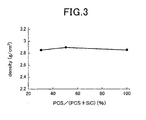
- SiC fiber preforms impregnated with several slurries which were prepared by blending polycarbosilane with a powdery mixture of fine SiC powder and a sintering additive at various ratios, and then hot-pressed at 1750°C with 15 MPa. Density of each SiC composite was measured and evaluated in relation with a sintering temperature. It is understood from results as shown in Fig. 3 that densification of the SiC composite is promoted as increase of polycarbosilane content. That is, density of the SiC composite approximated 2.9 g/cm 3 at polycarbosilane content of 30 mass % or more, and reached 2.9 g/cm 3 at polycarbosilane content near 50 mass %.
- SiC composite which was manufactured by hot-pressing SiC fiber preform impregnated with a polymeric slurry consisting of polycarbosilane only, had the structure that many cavities were unfavorably present inside SiC fiber, resulting in cracks and poor strength.
- SiC fiber which has quasi-stoichiometric composition with high crystallinity, is used as strengthening fiber, and SiC fiber preform is impregnated with a polymeric SiC precursor, which contains fine SiC powder and a sintering additive therein.
- the prepreg is hot-pressed at an elevated sintering temperature due to the specified SiC fiber without damages, and a sintering reaction is advantageously promoted due to presence of the sintering additive. Consequently, a SiC composite, which has a dense structure of 2.9 g/cm 3 or more and strength of 400 MPa or higher, can be manufactured by one-step hot-pressing.
Landscapes
- Chemical & Material Sciences (AREA)
- Engineering & Computer Science (AREA)
- Ceramic Engineering (AREA)
- Manufacturing & Machinery (AREA)
- Materials Engineering (AREA)
- Structural Engineering (AREA)
- Organic Chemistry (AREA)
- Inorganic Chemistry (AREA)
- Nanotechnology (AREA)
- Physics & Mathematics (AREA)
- Condensed Matter Physics & Semiconductors (AREA)
- General Physics & Mathematics (AREA)
- Crystallography & Structural Chemistry (AREA)
- Composite Materials (AREA)
- Chemical Kinetics & Catalysis (AREA)
- Ceramic Products (AREA)
Abstract
Description
Claims (3)
- A hot-pressing method of manufacturing a SiC-matrix composite reinforced with SiC fiber, which comprises the steps ofproviding a powdery mixture of fine SiC powder with one or more sintering additives selected from Al2O3, Y2O3, SiO2 and CaO;preparing a matrix-forming slurry by blending said powdery mixture in a polymeric SiC precursor;impregnating a preform of SiC fiber, which has quasi-stoichiometric composition with high crystallinity, with said slurry! andhot-pressing said SiC fiber preform at a temperature of 1600°C or higher with a pressure in presence of a liquid phase.
- The hot-pressing method defined by Claim1, wherein the polymeric SiC precursor is one or more of polycarbosilane, polyvinylsilane and polymethylsilane.
- The hot-pressing method defined by Claim1 or 2, wherein the impregnated SiC fiber preform is hot-pressed with a pressure of 10-20 MPa.
Applications Claiming Priority (3)
| Application Number | Priority Date | Filing Date | Title |
|---|---|---|---|
| JP2001104186 | 2001-04-03 | ||
| JP2001104186A JP4536950B2 (en) | 2001-04-03 | 2001-04-03 | Hot press manufacturing method for SiC fiber reinforced SiC composite material |
| PCT/JP2001/009363 WO2002081405A1 (en) | 2001-04-03 | 2001-10-25 | Method for producing sic fiber-reinforced sic composite material by means of hot press |
Publications (3)
| Publication Number | Publication Date |
|---|---|
| EP1375452A1 true EP1375452A1 (en) | 2004-01-02 |
| EP1375452A4 EP1375452A4 (en) | 2005-03-09 |
| EP1375452B1 EP1375452B1 (en) | 2007-09-26 |
Family
ID=18957082
Family Applications (1)
| Application Number | Title | Priority Date | Filing Date |
|---|---|---|---|
| EP01980902A Expired - Lifetime EP1375452B1 (en) | 2001-04-03 | 2001-10-25 | Method for producing sic fiber-reinforced sic composite material by means of hot press |
Country Status (6)
| Country | Link |
|---|---|
| US (1) | US7404922B2 (en) |
| EP (1) | EP1375452B1 (en) |
| JP (1) | JP4536950B2 (en) |
| CA (1) | CA2443119C (en) |
| DE (1) | DE60130688T2 (en) |
| WO (1) | WO2002081405A1 (en) |
Cited By (1)
| Publication number | Priority date | Publication date | Assignee | Title |
|---|---|---|---|---|
| WO2021083440A1 (en) * | 2019-10-31 | 2021-05-06 | MTU Aero Engines AG | Process for producing a component from an sic/sic fibre composite material |
Families Citing this family (21)
| Publication number | Priority date | Publication date | Assignee | Title |
|---|---|---|---|---|
| JP4429004B2 (en) * | 2003-12-17 | 2010-03-10 | 京セラ株式会社 | Manufacturing method of porous ceramic sintered body for sliding member, porous ceramic sintered body for sliding member obtained thereby, and seal ring using the same |
| US20060039524A1 (en) * | 2004-06-07 | 2006-02-23 | Herbert Feinroth | Multi-layered ceramic tube for fuel containment barrier and other applications in nuclear and fossil power plants |
| JP2006265080A (en) * | 2005-03-25 | 2006-10-05 | Ishikawajima Harima Heavy Ind Co Ltd | Ceramic composite material and manufacturing method thereof |
| CN101164999B (en) * | 2006-10-16 | 2010-07-28 | 宁波大学 | A kind of manufacturing method of three-component combined toughening material combined toughened silicon carbide ceramics |
| CN101164992B (en) * | 2006-10-16 | 2010-07-28 | 宁波大学 | Manufacturing method of flaky alumina particles combined with silicon carbide whiskers to toughen silicon carbide ceramics |
| CN101172877B (en) * | 2006-10-16 | 2010-06-16 | 宁波大学 | A method for manufacturing multi-component toughened silicon carbide ceramics including whiskers and fibers |
| CN101164971B (en) * | 2006-10-16 | 2011-06-01 | 宁波大学 | A multi-component silicon carbide ceramic with inserts including fibers and whiskers |
| CN101164993B (en) * | 2006-10-16 | 2010-08-18 | 宁波大学 | Method for preparing silicon carbide ceramic composition containing fibre and whisker |
| JP5677184B2 (en) * | 2011-04-28 | 2015-02-25 | 株式会社東芝 | Fuel cladding tube assembly and manufacturing method thereof |
| US9650303B2 (en) * | 2013-03-15 | 2017-05-16 | Rolls-Royce Corporation | Silicon carbide ceramic matrix composites |
| FR3015975A1 (en) * | 2013-12-27 | 2015-07-03 | Commissariat Energie Atomique | METHOD FOR MANUFACTURING A PIECE OF SICF / SIC COMPOSITE MATERIAL FROM A COLLOIDAL SUSPENSION AND A PIECE THUS OBTAINED |
| US9644158B2 (en) | 2014-01-13 | 2017-05-09 | General Electric Company | Feed injector for a gasification system |
| KR101578439B1 (en) * | 2014-04-08 | 2015-12-21 | 서울시립대학교 산학협력단 | Pressureless sintered silicon carbide ceramics with high thermal conductivity, compositions thereof and Process for producing the Same |
| JP6685929B2 (en) * | 2014-12-12 | 2020-04-22 | 国立大学法人京都大学 | Silicon carbide fiber reinforced silicon carbide composite material |
| KR101677175B1 (en) * | 2015-08-07 | 2016-11-21 | 서울시립대학교 산학협력단 | Composition of fully ceramic microencapsulated fuels containing tristructural-isotropic particles with a coating layer having higher shrinkage than matrix, material and manufacturing method of the same |
| CN106977222A (en) * | 2017-04-19 | 2017-07-25 | 中国航发北京航空材料研究院 | A kind of preparation method of short fiber reinforced carbon/silicon carbide ceramic matrix composite |
| RU2744543C1 (en) * | 2020-09-15 | 2021-03-11 | Федеральное государственное бюджетное учреждение науки Институт металлургии и материаловедения им. А.А. Байкова Российской академии наук (ИМЕТ РАН) | Method for producing ceramic composite material based on silicon carbide, reinforced with silicon carbide fibers |
| RU2749387C1 (en) * | 2020-10-16 | 2021-06-09 | Федеральное государственное бюджетное учреждение науки Институт металлургии и материаловедения им. А.А. Байкова Российской академии наук (ИМЕТ РАН) | Method for producing composite material with ceramic matrix and layering reinforcing component in form of silicon carbide fabric |
| CN115124360B (en) * | 2022-06-27 | 2023-07-14 | 河北工业大学 | Carbon fiber toughened ceramic material and preparation method thereof |
| WO2024077567A1 (en) * | 2022-10-13 | 2024-04-18 | 中广核研究院有限公司 | High-density silicon carbide composite material cladding and preparation method therefor |
| CN115724674B (en) * | 2022-11-16 | 2023-12-19 | 航天特种材料及工艺技术研究所 | Impregnation-curing treatment method of polysilabozane, composite material and preparation method |
Family Cites Families (16)
| Publication number | Priority date | Publication date | Assignee | Title |
|---|---|---|---|---|
| US4829027A (en) * | 1987-01-12 | 1989-05-09 | Ceramatec, Inc. | Liquid phase sintering of silicon carbide |
| CA1335016C (en) * | 1988-10-03 | 1995-03-28 | William H. Atwell | Highly densified bodies from polysilanes filled with silicon carbide powders |
| AU8101491A (en) * | 1990-06-29 | 1992-01-23 | Gui Gerard De Jager | A process for manufacturing reinforced composites and filament material for use in said process |
| US5707471A (en) * | 1991-12-20 | 1998-01-13 | Dow Corning Corporation | Method for making ceramic matrix composites |
| FR2686874B1 (en) * | 1992-02-04 | 1994-09-23 | Europ Propulsion | PROCESS FOR MANUFACTURING PARTS OF COMPOSITE MATERIAL WITH CERAMIC MATRIX. |
| JPH05221739A (en) * | 1992-02-12 | 1993-08-31 | Toshiba Corp | Production of ceramic filament ceramic-composite sintered body |
| US5279780A (en) * | 1992-07-22 | 1994-01-18 | Dow Corning Corporation | Preparation of polycrystalline ceramic fibers |
| JPH06287079A (en) | 1993-03-31 | 1994-10-11 | Toshiba Corp | Fiber-reinforced composite ceramics |
| JPH0881276A (en) * | 1994-09-13 | 1996-03-26 | Nippon Cement Co Ltd | Method for producing long fiber-reinforced ceramic composite material |
| JP2938389B2 (en) | 1995-05-22 | 1999-08-23 | 日本カーボン株式会社 | Method for producing silicon carbide fiber |
| JP3140701B2 (en) * | 1996-12-12 | 2001-03-05 | 日本カーボン株式会社 | Method for producing long fiber reinforced silicon carbide composite material |
| JPH11130552A (en) * | 1997-10-27 | 1999-05-18 | Japan Atom Energy Res Inst | Method for producing ceramic composite material by radiation infusibility |
| JPH11171658A (en) * | 1997-12-05 | 1999-06-29 | Ube Ind Ltd | Crystalline silicon carbide fiber reinforced ceramic composite |
| JP3557939B2 (en) * | 1998-09-16 | 2004-08-25 | 宇部興産株式会社 | Matrix for high performance ceramic matrix composites |
| JP3722188B2 (en) | 1999-01-28 | 2005-11-30 | 石川島播磨重工業株式会社 | Ceramic matrix composite member and manufacturing method thereof |
| JP3971903B2 (en) * | 2001-05-31 | 2007-09-05 | 独立行政法人科学技術振興機構 | Method for producing SiC fiber reinforced SiC composite material |
-
2001
- 2001-04-03 JP JP2001104186A patent/JP4536950B2/en not_active Expired - Lifetime
- 2001-10-25 CA CA002443119A patent/CA2443119C/en not_active Expired - Fee Related
- 2001-10-25 WO PCT/JP2001/009363 patent/WO2002081405A1/en not_active Ceased
- 2001-10-25 US US10/473,853 patent/US7404922B2/en not_active Expired - Lifetime
- 2001-10-25 DE DE60130688T patent/DE60130688T2/en not_active Expired - Lifetime
- 2001-10-25 EP EP01980902A patent/EP1375452B1/en not_active Expired - Lifetime
Cited By (1)
| Publication number | Priority date | Publication date | Assignee | Title |
|---|---|---|---|---|
| WO2021083440A1 (en) * | 2019-10-31 | 2021-05-06 | MTU Aero Engines AG | Process for producing a component from an sic/sic fibre composite material |
Also Published As
| Publication number | Publication date |
|---|---|
| DE60130688T2 (en) | 2008-07-17 |
| US7404922B2 (en) | 2008-07-29 |
| DE60130688D1 (en) | 2007-11-08 |
| WO2002081405A1 (en) | 2002-10-17 |
| JP2002293636A (en) | 2002-10-09 |
| CA2443119C (en) | 2008-09-30 |
| JP4536950B2 (en) | 2010-09-01 |
| CA2443119A1 (en) | 2002-10-17 |
| EP1375452B1 (en) | 2007-09-26 |
| US20040113332A1 (en) | 2004-06-17 |
| EP1375452A4 (en) | 2005-03-09 |
Similar Documents
| Publication | Publication Date | Title |
|---|---|---|
| US7404922B2 (en) | Method for producing SiC fiber-reinforced SiC composite material by means of hot press | |
| US6576076B1 (en) | Process for producing fiber-reinforced silicon carbide composites | |
| EP1391442B1 (en) | METHOD FOR PRODUCING SIC FIBER−REINFORCED SIC COMPOSITE MATERIAL | |
| EP0798280B1 (en) | Ceramic matrix composite and method of manufacturing the same | |
| Katoh et al. | Thermo-mechanical properties and microstructure of silicon carbide composites fabricated by nano-infiltrated transient eutectoid process | |
| EP2543650B1 (en) | Method for manufacturing high-density fiber reinforced ceramic composite materials | |
| EP0781737B1 (en) | Ceramic-based composite fiber material | |
| CA2335427C (en) | Carbon composites | |
| EP1481954A1 (en) | Oxidation resistant carbon fiber reinforced carbon composite material and process for producing the same | |
| JPH05105521A (en) | Carbon-fiber reinforced silicon nitride-based nano-composite material and its production | |
| Yoshida et al. | Improvement of the mechanical properties of hot-pressed silicon-carbide-fiber-reinforced silicon carbide composites by polycarbosilane impregnation | |
| JP5944618B2 (en) | Carbon fiber composite material, brake member using this carbon fiber composite material, structural member for semiconductor, heat resistant panel, heat sink | |
| Yonathan et al. | Improvement of SiCf/SiC density by slurry infiltration and tape stacking | |
| JP2011190169A (en) | Carbon fiber composite material, and break member, structural member for semiconductors, heat-resistant panel and heat sink using the carbon fiber composite material | |
| Wang et al. | Fabrication of carbon fiber reinforced ceramic matrix composites with improved oxidation resistance using boron as active filler | |
| Kim et al. | Nicalon-fibre-reinforced silicon-carbide composites via polymer solution infiltration and chemical vapour infiltration | |
| Rocha et al. | Formation of carbon fiber-reinforced ceramic matrix composites with polysiloxane/silicon derived matrix | |
| He et al. | Microstructures of short-carbon-fiber-reinforced SiC composites prepared by hot-pressing | |
| EP1364929A1 (en) | Method for producing sic fiber-reinforced sic composite material having excellent fracture toughness | |
| CN1157276A (en) | Reaction Sintered Ceramics and Its Preparation Technology | |
| EP1281696A1 (en) | Method for producing sic fiber-reinforced sic composite material having high density | |
| KR101972350B1 (en) | A ZrC Composites and A Manufacturing method of the same | |
| EP1388527A2 (en) | Highly heat-resistant inorganic fiber bonded ceramic component and process for the production thereof | |
| JP3969106B2 (en) | High heat resistant inorganic fiber bonded ceramic bonded body and bonding method thereof | |
| JPH0687657A (en) | Silicon Carbide Inorganic Fiber Reinforced Ceramics Composite Material |
Legal Events
| Date | Code | Title | Description |
|---|---|---|---|
| PUAI | Public reference made under article 153(3) epc to a published international application that has entered the european phase |
Free format text: ORIGINAL CODE: 0009012 |
|
| 17P | Request for examination filed |
Effective date: 20030904 |
|
| AK | Designated contracting states |
Kind code of ref document: A1 Designated state(s): AT BE CH CY DE DK ES FI FR GB GR IE IT LI LU MC NL PT SE TR |
|
| A4 | Supplementary search report drawn up and despatched |
Effective date: 20050126 |
|
| RIC1 | Information provided on ipc code assigned before grant |
Ipc: 7C 04B 35/80 A Ipc: 7C 04B 35/575 B Ipc: 7C 04B 35/571 B |
|
| 17Q | First examination report despatched |
Effective date: 20050318 |
|
| GRAP | Despatch of communication of intention to grant a patent |
Free format text: ORIGINAL CODE: EPIDOSNIGR1 |
|
| RBV | Designated contracting states (corrected) |
Designated state(s): DE FR GB IT SE |
|
| GRAS | Grant fee paid |
Free format text: ORIGINAL CODE: EPIDOSNIGR3 |
|
| GRAA | (expected) grant |
Free format text: ORIGINAL CODE: 0009210 |
|
| AK | Designated contracting states |
Kind code of ref document: B1 Designated state(s): DE FR GB IT SE |
|
| REG | Reference to a national code |
Ref country code: GB Ref legal event code: FG4D |
|
| REF | Corresponds to: |
Ref document number: 60130688 Country of ref document: DE Date of ref document: 20071108 Kind code of ref document: P |
|
| REG | Reference to a national code |
Ref country code: SE Ref legal event code: TRGR |
|
| ET | Fr: translation filed | ||
| PLBE | No opposition filed within time limit |
Free format text: ORIGINAL CODE: 0009261 |
|
| STAA | Information on the status of an ep patent application or granted ep patent |
Free format text: STATUS: NO OPPOSITION FILED WITHIN TIME LIMIT |
|
| 26N | No opposition filed |
Effective date: 20080627 |
|
| PG25 | Lapsed in a contracting state [announced via postgrant information from national office to epo] |
Ref country code: IT Free format text: LAPSE BECAUSE OF NON-PAYMENT OF DUE FEES Effective date: 20071025 |
|
| PGRI | Patent reinstated in contracting state [announced from national office to epo] |
Ref country code: IT Effective date: 20110616 |
|
| PGFP | Annual fee paid to national office [announced via postgrant information from national office to epo] |
Ref country code: GB Payment date: 20140919 Year of fee payment: 14 Ref country code: SE Payment date: 20140912 Year of fee payment: 14 |
|
| PGFP | Annual fee paid to national office [announced via postgrant information from national office to epo] |
Ref country code: FR Payment date: 20140925 Year of fee payment: 14 Ref country code: DE Payment date: 20140919 Year of fee payment: 14 |
|
| PGFP | Annual fee paid to national office [announced via postgrant information from national office to epo] |
Ref country code: IT Payment date: 20140916 Year of fee payment: 14 |
|
| REG | Reference to a national code |
Ref country code: DE Ref legal event code: R119 Ref document number: 60130688 Country of ref document: DE |
|
| REG | Reference to a national code |
Ref country code: SE Ref legal event code: EUG |
|
| GBPC | Gb: european patent ceased through non-payment of renewal fee |
Effective date: 20151025 |
|
| PG25 | Lapsed in a contracting state [announced via postgrant information from national office to epo] |
Ref country code: DE Free format text: LAPSE BECAUSE OF NON-PAYMENT OF DUE FEES Effective date: 20160503 Ref country code: IT Free format text: LAPSE BECAUSE OF NON-PAYMENT OF DUE FEES Effective date: 20151025 Ref country code: GB Free format text: LAPSE BECAUSE OF NON-PAYMENT OF DUE FEES Effective date: 20151025 |
|
| REG | Reference to a national code |
Ref country code: FR Ref legal event code: ST Effective date: 20160630 |
|
| PG25 | Lapsed in a contracting state [announced via postgrant information from national office to epo] |
Ref country code: SE Free format text: LAPSE BECAUSE OF NON-PAYMENT OF DUE FEES Effective date: 20151026 Ref country code: FR Free format text: LAPSE BECAUSE OF NON-PAYMENT OF DUE FEES Effective date: 20151102 |