EP1375438A2 - Process for decomposing a substance collected from polluted soil and apparatus therefor - Google Patents
Process for decomposing a substance collected from polluted soil and apparatus therefor Download PDFInfo
- Publication number
- EP1375438A2 EP1375438A2 EP03012943A EP03012943A EP1375438A2 EP 1375438 A2 EP1375438 A2 EP 1375438A2 EP 03012943 A EP03012943 A EP 03012943A EP 03012943 A EP03012943 A EP 03012943A EP 1375438 A2 EP1375438 A2 EP 1375438A2
- Authority
- EP
- European Patent Office
- Prior art keywords
- decomposition
- decomposing
- site
- treatment
- primary
- Prior art date
- Legal status (The legal status is an assumption and is not a legal conclusion. Google has not performed a legal analysis and makes no representation as to the accuracy of the status listed.)
- Withdrawn
Links
- 238000000034 method Methods 0.000 title claims abstract description 22
- 239000000126 substance Substances 0.000 title claims abstract description 8
- 239000002689 soil Substances 0.000 title abstract description 24
- 238000000354 decomposition reaction Methods 0.000 claims description 166
- 239000007788 liquid Substances 0.000 claims description 34
- 239000003344 environmental pollutant Substances 0.000 claims description 28
- 231100000719 pollutant Toxicity 0.000 claims description 28
- 150000004045 organic chlorine compounds Chemical group 0.000 claims description 9
- 125000000218 acetic acid group Chemical group C(C)(=O)* 0.000 claims description 8
- ZAMOUSCENKQFHK-UHFFFAOYSA-N Chlorine atom Chemical compound [Cl] ZAMOUSCENKQFHK-UHFFFAOYSA-N 0.000 description 14
- 238000006243 chemical reaction Methods 0.000 description 14
- 229910052801 chlorine Inorganic materials 0.000 description 14
- 239000000460 chlorine Substances 0.000 description 14
- 238000005202 decontamination Methods 0.000 description 8
- 230000003588 decontaminative effect Effects 0.000 description 8
- XSTXAVWGXDQKEL-UHFFFAOYSA-N Trichloroethylene Chemical group ClC=C(Cl)Cl XSTXAVWGXDQKEL-UHFFFAOYSA-N 0.000 description 7
- UBOXGVDOUJQMTN-UHFFFAOYSA-N trichloroethylene Natural products ClCC(Cl)Cl UBOXGVDOUJQMTN-UHFFFAOYSA-N 0.000 description 7
- 238000010521 absorption reaction Methods 0.000 description 6
- 230000007423 decrease Effects 0.000 description 6
- 239000007791 liquid phase Substances 0.000 description 6
- 150000001875 compounds Chemical class 0.000 description 5
- 238000005868 electrolysis reaction Methods 0.000 description 5
- CYTYCFOTNPOANT-UHFFFAOYSA-N Perchloroethylene Chemical group ClC(Cl)=C(Cl)Cl CYTYCFOTNPOANT-UHFFFAOYSA-N 0.000 description 4
- 229950011008 tetrachloroethylene Drugs 0.000 description 4
- 239000000243 solution Substances 0.000 description 3
- KZBUYRJDOAKODT-UHFFFAOYSA-N Chlorine Chemical compound ClCl KZBUYRJDOAKODT-UHFFFAOYSA-N 0.000 description 2
- 230000002378 acidificating effect Effects 0.000 description 2
- 239000003513 alkali Substances 0.000 description 2
- 230000003247 decreasing effect Effects 0.000 description 2
- JXTHNDFMNIQAHM-UHFFFAOYSA-N dichloroacetic acid Chemical compound OC(=O)C(Cl)Cl JXTHNDFMNIQAHM-UHFFFAOYSA-N 0.000 description 2
- 239000006185 dispersion Substances 0.000 description 2
- 238000004817 gas chromatography Methods 0.000 description 2
- 230000001678 irradiating effect Effects 0.000 description 2
- 239000003595 mist Substances 0.000 description 2
- 150000002896 organic halogen compounds Chemical class 0.000 description 2
- 238000012856 packing Methods 0.000 description 2
- 239000012071 phase Substances 0.000 description 2
- 239000004033 plastic Substances 0.000 description 2
- 238000005070 sampling Methods 0.000 description 2
- XLYOFNOQVPJJNP-UHFFFAOYSA-N water Substances O XLYOFNOQVPJJNP-UHFFFAOYSA-N 0.000 description 2
- OKTJSMMVPCPJKN-UHFFFAOYSA-N Carbon Chemical compound [C] OKTJSMMVPCPJKN-UHFFFAOYSA-N 0.000 description 1
- VGGSQFUCUMXWEO-UHFFFAOYSA-N Ethene Chemical class C=C VGGSQFUCUMXWEO-UHFFFAOYSA-N 0.000 description 1
- 239000012670 alkaline solution Substances 0.000 description 1
- 229910052799 carbon Inorganic materials 0.000 description 1
- -1 chlorinated methane compounds Chemical class 0.000 description 1
- FOCAUTSVDIKZOP-UHFFFAOYSA-N chloroacetic acid Chemical compound OC(=O)CCl FOCAUTSVDIKZOP-UHFFFAOYSA-N 0.000 description 1
- 229940106681 chloroacetic acid Drugs 0.000 description 1
- 230000001351 cycling effect Effects 0.000 description 1
- 238000001784 detoxification Methods 0.000 description 1
- 229960005215 dichloroacetic acid Drugs 0.000 description 1
- 230000007613 environmental effect Effects 0.000 description 1
- 230000005484 gravity Effects 0.000 description 1
- 239000000203 mixture Substances 0.000 description 1
- 238000006303 photolysis reaction Methods 0.000 description 1
- 239000002985 plastic film Substances 0.000 description 1
- 229920006255 plastic film Polymers 0.000 description 1
- 238000005067 remediation Methods 0.000 description 1
- 239000003802 soil pollutant Substances 0.000 description 1
- 238000001179 sorption measurement Methods 0.000 description 1
- YNJBWRMUSHSURL-UHFFFAOYSA-N trichloroacetic acid Chemical compound OC(=O)C(Cl)(Cl)Cl YNJBWRMUSHSURL-UHFFFAOYSA-N 0.000 description 1
- 229960004319 trichloroacetic acid Drugs 0.000 description 1
- 238000009281 ultraviolet germicidal irradiation Methods 0.000 description 1
- 239000002699 waste material Substances 0.000 description 1
- 239000002351 wastewater Substances 0.000 description 1
Images

Classifications
-
- B—PERFORMING OPERATIONS; TRANSPORTING
- B09—DISPOSAL OF SOLID WASTE; RECLAMATION OF CONTAMINATED SOIL
- B09C—RECLAMATION OF CONTAMINATED SOIL
- B09C1/00—Reclamation of contaminated soil
- B09C1/005—Extraction of vapours or gases using vacuum or venting
-
- C—CHEMISTRY; METALLURGY
- C02—TREATMENT OF WATER, WASTE WATER, SEWAGE, OR SLUDGE
- C02F—TREATMENT OF WATER, WASTE WATER, SEWAGE, OR SLUDGE
- C02F1/00—Treatment of water, waste water, or sewage
- C02F1/30—Treatment of water, waste water, or sewage by irradiation
-
- C—CHEMISTRY; METALLURGY
- C02—TREATMENT OF WATER, WASTE WATER, SEWAGE, OR SLUDGE
- C02F—TREATMENT OF WATER, WASTE WATER, SEWAGE, OR SLUDGE
- C02F1/00—Treatment of water, waste water, or sewage
- C02F1/72—Treatment of water, waste water, or sewage by oxidation
- C02F1/76—Treatment of water, waste water, or sewage by oxidation with halogens or compounds of halogens
-
- C—CHEMISTRY; METALLURGY
- C02—TREATMENT OF WATER, WASTE WATER, SEWAGE, OR SLUDGE
- C02F—TREATMENT OF WATER, WASTE WATER, SEWAGE, OR SLUDGE
- C02F2101/00—Nature of the contaminant
- C02F2101/30—Organic compounds
- C02F2101/36—Organic compounds containing halogen
-
- C—CHEMISTRY; METALLURGY
- C02—TREATMENT OF WATER, WASTE WATER, SEWAGE, OR SLUDGE
- C02F—TREATMENT OF WATER, WASTE WATER, SEWAGE, OR SLUDGE
- C02F2103/00—Nature of the water, waste water, sewage or sludge to be treated
- C02F2103/06—Contaminated groundwater or leachate
-
- C—CHEMISTRY; METALLURGY
- C02—TREATMENT OF WATER, WASTE WATER, SEWAGE, OR SLUDGE
- C02F—TREATMENT OF WATER, WASTE WATER, SEWAGE, OR SLUDGE
- C02F2103/00—Nature of the water, waste water, sewage or sludge to be treated
- C02F2103/18—Nature of the water, waste water, sewage or sludge to be treated from the purification of gaseous effluents
Definitions
- the present invention relates to a process for decomposing a decomposition-object, and to an apparatus for the process.
- organic chlorine compounds e.g., chlorinated ethylene compounds, and chlorinated methane compounds
- these gaseous substances after use are causing pollution of natural environment and other environmental problems.
- Great efforts are being paid to solve the problems.
- photodecomposition has been tried and disclosed which decomposes the compound by UV irradiation in a gas phase.
- a process is disclosed in which an exhaust gas containing an organic halogen compound is irradiated with UV light to change the gas into an acidic gaseous decomposition product and is washed with an alkali for detoxification (Japanese Patent Application Laid-Open No. 62-191025).
- An apparatus therefor is disclosed in which waste water containing an organic halogen compound is aerated and the discharged gas is irradiated with UV light and washed with an alkali (Japanese Patent Application Laid-Open No. 62-191095).
- Another apparatus in which a gaseous organic chlorine compound to be decomposed is mixed with a chlorine-containing gas and the mixture is irradiated with light to decompose and detoxify the gaseous organic chlorine compound.
- the present invention intends to decontaminate polluted soil, and provides a process and apparatus for treating effectively a decomposition-object like the above decomposition product.
- the present invention provides also a process and an apparatus for decontaminating polluted soils collected from plural areas.
- the process for decomposing a decomposition-object of the present invention comprises steps of decomposing a decomposition-object collected from a first area, interrupting the decomposing step, transporting to a second area the decomposition-object remaining to be decomposed after interrupting step, and decomposing the transported decomposition-object together with decomposition-object collected from the second area to be decomposed, wherein the first decomposition-object collected from the first area and the second decomposition-object collected from the second area are the same substance.
- the apparatus for decomposing the decomposition-object of the present invention comprises a receiving means for receiving an undecomposed decomposition-object transported from a first area to a second area and a decomposing means for decomposing in the second area the transported decomposition-object together with a decomposition-object collected from the second area, wherein the transported decomposition-object and the decomposition-object collected from the second area are the same substance.
- Fig. 2 illustrates decomposition-treatment apparatus 1 for decomposing a pollutant in soil such as organic chlorine compounds like trichloroethylene.
- the apparatus comprises main decomposition-treatment unit 1a, secondary decomposition-treatment unit 1b, and pollutant-feeding means 1c.
- Pollutant-feeding means 1c comprises a pipeline and a sucking device for sucking the pollutant from the polluted soil 5 through sucking well 6 placed in the soil and feeding the pollutant to main decomposition-treatment unit 1a.
- Numeral 2 indicates schematically a pollutant gathered by suction by sucking well 6.
- Main decomposition-treatment unit 1a conducts primary decomposition treatment step involving a primary decomposition reaction as a basic decomposition reaction of the pollutant to form a decomposition product.
- a primary decomposition reaction As a basic decomposition reaction of the pollutant to form a decomposition product.
- the decomposition product produced by the primary decomposition-treatment step is referred to as "primary decomposition product”.
- An example of the primary decomposition reaction is decomposition of pollutant gas by irradiation of light in a chlorine atmosphere.
- main decomposition-treatment unit 1a comprised of a reaction vessel provided with a light-irradiating means, chlorine is fed from a chlorine cylinder to generate chlorine gas-containing air.
- the light irradiating means in this example may be a black-light fluorescence lamp not containing light with wavelength of 300 nm or shorter.
- the device for producing the chlorine gas-containing air may be omitted.
- An example of the primary decomposition product is a halogenated acetic acid produced by decomposition of trichloroethylene or the like, such as chloroacetic acid, dichloroacetic acid, and trichloroacetic acid.
- the primary decomposition product is discharged to secondary decomposition-treatment unit 1b which is comprised of an absorbing means for an absorption step to trap the primary decomposition product and a decomposing means for decomposing the primary : decomposition product.
- Secondary decomposition-treatment unit 1b conducts a secondary decomposition-treatment step comprising an absorption step and a secondary decomposition reaction to decompose the primary decomposition product.
- the decomposition product produced by the second decomposition-treatment step is referred to as a "secondary decomposition product".
- the mode of the secondary decomposition-treatment step is not specially limited.
- the primary decomposition product is derived in a state of a gas or a mist of a gas-liquid dispersion.
- the gas or the dispersion containing the primary decomposition product derived from main decomposition-treatment unit 1a is referred to as a "primary decomposition product-containing gas”.
- the absorbing means has usually constitution to absorb the gas by contact of the gas with a liquid.
- Fig. 2 shows, as an example of the absorbing means, gas-liquid contact tower 4 (hereinafter referred to as a "scrubber") having packed bed 14.
- the bottom of the scrubber constitutes a reservoir serving as the decomposing means.
- the liquid phase after contact with the primary decomposition product is accumulated in the reservoir, and the primary decomposition product absorbed is decomposed there.
- the second decomposition-treatment step is explained below taking the scrubber as an example of the absorbing-decomposing means.
- the primary decomposition product-containing gas in a state of a gas or mist which contains the primary decomposition product from main decomposition-treatment unit 1a is introduced to scrubber 4.
- the liquid phase in the scrubber is circulated by pump 9, and is allowed to flow down from the upper part of the scrubber.
- the primary decomposition product-containing gas introduced into the scrubber is brought into contact with the downflowing liquid phase mainly on the surface of the packing of packed bed 14, whereby the primary decomposition product is transferred to the liquid phase.
- the liquid containing the absorbed primary decomposition product (hereinafter referred to as a "treatment liquid”) flows down by gravity and is stored in the reservoir 10 at the bottom of scrubber 4 as shown by the symbol L in Fig. 2.
- the liquid phase is pumped up to the upper part of scrubber 4 by pump 9, and allowed to flow down again through the packed bed to contact with the primary decomposition product-containing gas. With such circulation of the treatment liquid, the concentration of the primary decomposition product increases in the treatment liquid.
- the primary decomposition product trapped by the absorbing means is subjected to a secondary decomposition reaction by a decomposition means.
- the secondary decomposition reaction is preferably conducted at a high concentration of the primary decomposition product in secondary decomposition-treatment unit 1b. At the higher concentration, the decomposition reaction will proceed at a higher probability in a shorter time.
- decomposing electrodes 7a, 7b are used for the reaction. In this case, the amount of the decomposition in a unit time at a constant electric current quantity depends on the concentration of the solution.
- the treatment liquid is circulated to repeat the absorption step, as mentioned above.
- the absorption step and the secondary decomposition reaction are controlled to keep the concentration of the primary decomposition product in secondary decomposition-treatment unit 1b by adjusting the amount of absorption of the primary decomposition product in the secondary decomposition-treatment unit 1b to be nearly equal to the amount of decomposition of the primary decomposition product decomposed in decomposition-treatment unit 1b. This control is explained below by taking a secondary decomposition reaction in the secondary decomposition-treatment step by electrolysis in the scrubber.
- the amount of the primary decomposition product decomposable in a unit time is larger at the higher concentration of the primary decomposition product in the treatment liquid if the electric current quantity is constant.
- the concentration of the primary decomposition product in the treatment liquid decreases.
- the amount of the decomposition by electrolysis also decreases.
- an untreated primary decomposition product is newly fed, whereby the concentration of the primary decomposition product in the treatment liquid is increased, not being kept at a lower level.
- the amount of decomposition in a unit time is increased to decrease again the concentration of the primary decomposition product in the treatment liquid.
- the concentration of the primary decomposition product in the treatment liquid reaches a certain amount and keeps the certain amount, increasing and decreasing repeatedly as above described.
- the primary decomposition product is decomposed by the decomposing means in the amount equal to the primary decomposition product fed to scrubber 4 in a unit time.
- the certain amount of the concentration is kept higher at a less electric current in comparison with a case of a higher electric current level.
- the apparatus is driven in high efficiency.
- treatment liquid L which contains an undecomposed primary-decomposition product at a high concentration remains in reservoir 10 of secondary decomposition-treatment unit 1b.
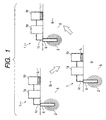
- the symbols S i-1 , S i , and S i+1 indicate respectively a site having polluted soil 5, and the bold blank arrows indicate the order of the decontamination operation. Naturally the number of the sites may be varied depending on the circumstances.
- the decomposition treatment apparatuses 1 i-1 , 1 i , and 1 i+1 are installed.
- the decomposition treatment apparatuses respectively comprise main decomposition-treatment unit 1a, secondary decomposition-treatment unit 1b, and pollutant-feeding means 1c.
- the same symbols are used as in Fig. 2.
- the soil of site S i-1 is decontaminated in a manner described above by reference to Fig. 2. Then in next site S i , the same treatment is started.
- treatment liquid L i-1 remaining in the reservoir of secondary decomposition treatment unit 1b of decomposition treatment apparatus 1 i-1 is taken out after completion of the decontamination at site S i-1 .
- This taking-out operation is explained by taking as an example the scrubber as secondary decomposition treatment unit 1b.
- a valve is provided at the bottom of the scrubber, and the treatment liquid L i-1 is discharged by opening the valve and is transferred into a plastic tank.
- a pipe branching from pump 9 is provided additionally, and the liquid is discharged through this pipe into a plastic tank.
- the decomposing means of the next decomposition-treatment apparatus may be provided with an openable hatch for introducing the stored liquid transported from the preceding site.
- the decomposing means of the decomposition-treatment apparatus in the preceding site is sealed to be liquid-tight with the stored liquid kept contained therein, demounted from the main apparatus, and transported to the next site. Otherwise the entire of the decomposition apparatus may be transported to the next site.
- the treatment liquid L i-1 taken out is transported to site S i , and is used in secondary decomposition-treatment unit 1b of decomposition-treatment apparatus 1 i from the start of the operation. This makes unnecessary, in the preceding site S i-1 , the secondary decomposition reaction treatment of the primary decomposition product remaining in secondary decomposition treatment unit 1b of decomposition-treatment unit 1 i-1 . A large amount of energy and a long time can be saved which will be required if the secondary decomposition reaction treatment is conducted for entire of the remaining primary decomposition product in the preceding site S i-1 .
- the second decomposition-treatment step in apparatus 1 i time and energy can be saved since the second decomposition-treatment step need not be started in the absence of the primary decomposition product in secondary decomposition-treatment unit 1b. If the operation is started in the complete absence of the primary decomposition product in secondary decomposition-treatment unit 1b of apparatus 1 i , the decomposition of the primary decomposition product should be started after the concentration of the primary decomposition product such as halogenated acetic acid formed by decomposition of the pollutant like trichloroethylene has reached a prescribed level. This causes waste of time for the waiting.
- the concentration of the primary decomposition product such as halogenated acetic acid formed by decomposition of the pollutant like trichloroethylene has reached a prescribed level. This causes waste of time for the waiting.
- the primary decomposition product produced by a pollutant decomposition-treatment step and remaining undecomposed in the secondary decomposition step in one site need not be entirely decomposed at that site, whereby time and energy therefore are saved; and further by using the remaining primary decomposition product in another site, the waiting time in the decomposition of the primary decomposition product is saved. Therefore, the decomposition can be conducted effectively in a short time.
- the treatment liquid L i containing the primary decomposition product is transported from site S i to next site S i+1 , similarly as the transport from S i-1 to S i , and is introduced into secondary decomposition-treatment unit 1b of apparatus 1 n+1 for the treatment.
- the treatment liquid L i+1 is remaining in the reservoir of apparatus 1 i+1 . This process is allowed proceed successively as shown in Fig. 1.
- the operation is conducted at a high concentration for the highest decomposition efficiency and the decomposition product is not entirely treated but partly kept untreated, and the untreated remaining decomposition product is transported to a next site.
- the decomposition product is subjected to decomposition at a high concentration for the highest efficiency from the start of the operation.
- Such a treatment system improves the treatment efficiency as a whole.
- the solution containing a primary decomposition product formed at a site is transported to another site to be decomposed further, whereby the additional operation can be omitted at the respective sites and the decomposition treatment can be conducted efficiently in a short time.
- Example of the present invention is described below.
- the decomposition of the primary decomposition product is continued until completion of decontamination treatment of soil.
- the amount of the sucked pollutant decreases gradually toward the end of the soil decontamination treatment, and the concentration of the soil-pollutant in the pollutant-containing air decreases, resulting in decrease of the produced amount of the primary decomposition product. Therefore, in the final stage of the soil decontamination treatment, the secondary decomposition reaction treatment of the primary decomposition product may be interrupted, and the cycling liquid at a high concentration may be recovered and brought to the next soil remediation site.
- the secondary decomposition-treatment step is preferably stopped before the last stage of the primary decomposition-treatment step.
- the secondary decomposition-treatment step is discontinued in the final stage where the primary decomposition product is produced in a very low rate.
- concentration of the primary decomposition product in the liquid transported to another treatment site is not decreased unnecessarily, and in the next site, the decomposition of the primary decomposition product at a high concentration can be conducted at a high efficiency after transport to the site.
- Decomposition-treatment apparatus 1 shown in Fig. 2 was installed in site S 1 . From soil polluted by organic chlorine compounds, the pollutants were sucked by means of a vacuum sucking pump, and the pollutant-containing gas was introduced into a reaction vessel at a rate of 1 m 3 /min (residence time: 30 seconds).
- the pollutant and the concentration thereof in the pollutant-containing gas were: trichloroethylene: 5 to 20 ppmV, and tetrachloroethylene: 5 to 30 ppmV.
- Chlorine was fed from a chlorine cylinder to keep the chlorine concentration in the reaction vessel at 50 ppmV.
- the pollutant-containing gas was irradiated from outside the reaction vessel with 16 commercial black-light fluorescent lamps (Toshiba; FL40S BLB) not emitting light with wavelength of 300 nm or shorter as the light irradiating means.
- the side wall of the reaction vessel is formed from a fluoro-plastic film, and had been confirmed to transmit the light with wavelength of not less than 300 nm.
- the primary decomposition product-containing gas was continuously introduced from the reaction vessel to the scrubber.
- the halogenated acetic acid, the primary decomposition product was absorbed by the circulating liquid phase in packed bed 14 comprised of a packing.
- the absorbed halogenated acetic acid was decomposed by electrolysis by application of electric current of 15 A at 3.0 V to electrodes provided in reservoir 10, by adjusting the electric current in comparison with the state of a larger electric current.
- the concentrations of trichloroethylene and tetrachloroethylene in the primary decomposition product-containing gas discharged from the reaction vessel were monitored by sampling periodically with a gas-tight syringe and determining the compounds with a gas chromatography apparatus (GC-14B (with an FID detector), manufactured by Shimadzu Corp.), column: DB-624, produced by J & W Co.). The both compounds were not detected throughout the operation.
- GC-14B with an FID detector
- the concentration of the halogenated acetic acid in the stored liquid was maintained at about 0.6%. Little amount of the pollutant-containing gas was detected in the gas sucked from the soil. This showed the completion of the soil decontamination. Thus the operation in this site was finished.
- decomposition-treatment apparatus 1 which was the same as that employed in the preceding site S 1 was installed at site S 2 having another polluted soil 5 polluted with organic chlorine compounds. From the polluted soil, the pollutant was sucked by means of a vacuum sucking pump, and the pollutant-containing gas was introduced into a reaction vessel at a rate of 1 m 3 /min (residence time: 30 seconds).
- the pollutant and the concentration thereof in the pollutant-containing gas were: trichloroethylene: 30 to 50 ppmV, and tetrachloroethylene: 20 to 40 ppmV.
- Chlorine was fed from a chlorine cylinder to keep the chlorine concentration in the reaction vessel at 50 ppmV.
- the pollutant-containing gas was irradiated from outside the reaction vessel with 16 commercial black-light fluorescent lamps (Toshiba; FL40S BLB).
- the primary decomposition product-containing gas was continuously introduced from the reaction vessel into the scrubber, and the electrolysis was conducted in the same manner as conducted at site S 1 .
- the soil was decontaminated without a problem, and the primary decomposition product was steadily decomposed.
- the concentrations of trichloroethylene and tetrachloroethylene in the primary decomposition product-containing gas discharged from the reaction vessel were monitored by sampling periodically with a gas-tight syringe and determining the compounds with a gas chromatography apparatus (GC-14B (with an FID detector), manufactured by Shimadzu Corp.), column: DB-624, produced by J & W Co.). The both compounds were not detected throughout the operation.
- GC-14B with an FID detector
- the concentration of the halogenated acetic acid in the storage liquid was found to be maintained at about 0.7%. Little amount of the pollutant-containing gas was detected in the gas sucked from the soil, which showed the completion of the soil decontamination. Thus the operation in this site was finished.
Landscapes
- Life Sciences & Earth Sciences (AREA)
- Soil Sciences (AREA)
- Engineering & Computer Science (AREA)
- Environmental & Geological Engineering (AREA)
- Fire-Extinguishing Compositions (AREA)
- Processing Of Solid Wastes (AREA)
- Organic Low-Molecular-Weight Compounds And Preparation Thereof (AREA)
Abstract
Description
Claims (7)
- A process for decomposing a decomposition-object comprising steps of decomposing a decomposition-object collected from a first area, interrupting the decomposing step, transporting to a second area the decomposition-object remaining to be decomposed after the interrupting step, and decomposing the transported decomposition-object together with a decomposition-object collected from the second area,
wherein the first decomposition-object collected from the first area and the second decomposition-object collected from the second area are the same substance. - The process for decomposing a decomposition-object according to claim 1, wherein the decomposition-object is decomposed in a state contained in a liquid.
- The process for decomposing a decomposition-object according to claim 1, wherein the decomposition-object remaining to be decomposed is held in a container in the transporting step.
- The process for decomposing a decomposition-object according to claim 1, wherein the areas mean areas polluted with a pollutant, and the decomposition-object is a decomposition product derived by decomposing the pollutant collected from the polluted area.
- The process for decomposing a decomposition-object according to claim 4, wherein the step of interrupting the decomposition is conducted before the completion of the step of decomposing the pollutant.
- The process for decomposing a decomposition-object according to claim 4, wherein the pollutant is an organic chlorine compound, and the decomposition product is a halogenated acetic acid.
- The apparatus for decomposing a decomposition-object, comprising:wherein the transported decomposition-object and the decomposition-object collected from the second area are the same substance.a receiving means for receiving an undecomposed decomposition-object transported from a first area to a second area anda decomposing means for decomposing in the second area the transported decomposition-object together with a decomposition-object collected from the second area,
Applications Claiming Priority (2)
| Application Number | Priority Date | Filing Date | Title |
|---|---|---|---|
| JP2002174901 | 2002-06-14 | ||
| JP2002174901A JP3854898B2 (en) | 2002-06-14 | 2002-06-14 | Decomposition product decomposition method and apparatus |
Publications (2)
| Publication Number | Publication Date |
|---|---|
| EP1375438A2 true EP1375438A2 (en) | 2004-01-02 |
| EP1375438A3 EP1375438A3 (en) | 2004-11-10 |
Family
ID=29717438
Family Applications (1)
| Application Number | Title | Priority Date | Filing Date |
|---|---|---|---|
| EP03012943A Withdrawn EP1375438A3 (en) | 2002-06-14 | 2003-06-06 | Process for decomposing a substance collected from polluted soil and apparatus therefor |
Country Status (5)
| Country | Link |
|---|---|
| US (1) | US20030233020A1 (en) |
| EP (1) | EP1375438A3 (en) |
| JP (1) | JP3854898B2 (en) |
| CN (1) | CN1261240C (en) |
| CA (1) | CA2432110A1 (en) |
Family Cites Families (8)
| Publication number | Priority date | Publication date | Assignee | Title |
|---|---|---|---|---|
| US4780287A (en) * | 1984-07-03 | 1988-10-25 | Ultrox International | Decomposition of volatile organic halogenated compounds contained in gases |
| US5688076A (en) * | 1996-09-09 | 1997-11-18 | Atkins; Parker E. | High-vacuum groundwater and soil remediation system and related method and apparatus |
| US6096283A (en) * | 1998-04-03 | 2000-08-01 | Regents Of The University Of California | Integrated system for the destruction of organics by hydrolysis and oxidation with peroxydisulfate |
| DE69942497D1 (en) * | 1998-06-22 | 2010-07-29 | Canon Kk | Process for the decomposition of halogenated aliphatic and aromatic compounds |
| US6462250B1 (en) * | 1999-06-22 | 2002-10-08 | Canon Kabushiki Kaisha | Method for decomposing halogenated aliphatic hydrocarbon compounds having adsorption process and apparatus for decomposition having adsorption means |
| CA2338668C (en) * | 2000-02-29 | 2005-02-15 | Canon Kabushiki Kaisha | Polluted soil remediation apparatus, polluted soil remediation method, pollutant degrading apparatus and pollutant degrading method |
| US6599431B2 (en) * | 2000-06-16 | 2003-07-29 | Canon Kabushiki Kaisha | Purifying apparatus for contaminated water and ground water and method thereof |
| JP2003205221A (en) * | 2001-11-12 | 2003-07-22 | Canon Inc | Method for treating organochlorine compound and apparatus used therefor, method for repairing soil and apparatus used therefor |
-
2002
- 2002-06-14 JP JP2002174901A patent/JP3854898B2/en not_active Expired - Fee Related
-
2003
- 2003-06-02 US US10/449,396 patent/US20030233020A1/en not_active Abandoned
- 2003-06-06 EP EP03012943A patent/EP1375438A3/en not_active Withdrawn
- 2003-06-12 CA CA002432110A patent/CA2432110A1/en not_active Abandoned
- 2003-06-13 CN CNB031425798A patent/CN1261240C/en not_active Expired - Fee Related
Also Published As
| Publication number | Publication date |
|---|---|
| CA2432110A1 (en) | 2003-12-14 |
| EP1375438A3 (en) | 2004-11-10 |
| CN1468669A (en) | 2004-01-21 |
| JP2004016915A (en) | 2004-01-22 |
| JP3854898B2 (en) | 2006-12-06 |
| US20030233020A1 (en) | 2003-12-18 |
| CN1261240C (en) | 2006-06-28 |
Similar Documents
| Publication | Publication Date | Title |
|---|---|---|
| US6585897B2 (en) | Apparatus for treating gas containing substance to be decomposed and method of treating its gas | |
| EP1129795B1 (en) | Polluted soil remediation apparatus, polluted soil remediation method, pollutant degrading apparatus and pollutant degrading method | |
| US7163615B2 (en) | Method of treating substance to be degraded and its apparatus | |
| WO2004101442A1 (en) | Method and system for the degradation of halogenated compounds | |
| EP1375438A2 (en) | Process for decomposing a substance collected from polluted soil and apparatus therefor | |
| JPH08243351A (en) | Method for decomposing organic chlorine compounds | |
| JP2613586B2 (en) | Wastewater treatment equipment and wastewater treatment method | |
| JP2001259664A (en) | Method and apparatus for purifying contaminated water and gas | |
| US7018514B2 (en) | Method and apparatus for processing substances to be decomposed | |
| JP3739169B2 (en) | Organochlorine compound decomposition equipment | |
| JP2005103519A (en) | Pollutant decomposition method and apparatus | |
| JP2004305958A (en) | Method for treating aqueous solution and apparatus for treating aqueous solution | |
| JP3958126B2 (en) | Method for decomposing pollutants and apparatus used therefor | |
| JP2003181448A (en) | Method and apparatus for treating VOC contaminated water | |
| JP2003145180A (en) | Method and apparatus for purifying contaminated water | |
| JP3825992B2 (en) | Contaminated water and groundwater purification apparatus and method | |
| JP2004114005A (en) | How to purify contaminated water | |
| JP2004188396A (en) | Decomposition method of decomposition object and decomposition apparatus used for the method | |
| JP2005103520A (en) | Method for decomposing pollutants and equipment used therefor | |
| JP2002219450A (en) | Contaminated soil remediation device, pollutant decomposing device, contaminated soil remediation method, pollutant decomposing method | |
| JP2004008980A (en) | Method and apparatus for purifying contaminated water | |
| JPH09234339A (en) | Photolysis method for organochlorine compounds | |
| JP2004351280A (en) | How to purify contaminated water | |
| JP2002361270A (en) | Method and apparatus for purifying contaminated water | |
| JP2002143642A (en) | Decomposition method of pollutant gas and equipment used for it |
Legal Events
| Date | Code | Title | Description |
|---|---|---|---|
| PUAI | Public reference made under article 153(3) epc to a published international application that has entered the european phase |
Free format text: ORIGINAL CODE: 0009012 |
|
| AK | Designated contracting states |
Kind code of ref document: A2 Designated state(s): AT BE BG CH CY CZ DE DK EE ES FI FR GB GR HU IE IT LI LU MC NL PT RO SE SI SK TR |
|
| AX | Request for extension of the european patent |
Extension state: AL LT LV MK |
|
| PUAL | Search report despatched |
Free format text: ORIGINAL CODE: 0009013 |
|
| AK | Designated contracting states |
Kind code of ref document: A3 Designated state(s): AT BE BG CH CY CZ DE DK EE ES FI FR GB GR HU IE IT LI LU MC NL PT RO SE SI SK TR |
|
| AX | Request for extension of the european patent |
Extension state: AL LT LV MK |
|
| 17P | Request for examination filed |
Effective date: 20050510 |
|
| AKX | Designation fees paid |
Designated state(s): DE FR GB |
|
| 17Q | First examination report despatched |
Effective date: 20050802 |
|
| STAA | Information on the status of an ep patent application or granted ep patent |
Free format text: STATUS: THE APPLICATION HAS BEEN WITHDRAWN |
|
| 18W | Application withdrawn |
Effective date: 20080402 |