EP1375112A2 - Liquid-crystal polymer film and manufacturing method thereof - Google Patents
Liquid-crystal polymer film and manufacturing method thereof Download PDFInfo
- Publication number
- EP1375112A2 EP1375112A2 EP03253221A EP03253221A EP1375112A2 EP 1375112 A2 EP1375112 A2 EP 1375112A2 EP 03253221 A EP03253221 A EP 03253221A EP 03253221 A EP03253221 A EP 03253221A EP 1375112 A2 EP1375112 A2 EP 1375112A2
- Authority
- EP
- European Patent Office
- Prior art keywords
- liquid
- film
- crystal polymer
- fluororesin porous
- polymer film
- Prior art date
- Legal status (The legal status is an assumption and is not a legal conclusion. Google has not performed a legal analysis and makes no representation as to the accuracy of the status listed.)
- Granted
Links
Images

Classifications
-
- B—PERFORMING OPERATIONS; TRANSPORTING
- B29—WORKING OF PLASTICS; WORKING OF SUBSTANCES IN A PLASTIC STATE IN GENERAL
- B29C—SHAPING OR JOINING OF PLASTICS; SHAPING OF MATERIAL IN A PLASTIC STATE, NOT OTHERWISE PROVIDED FOR; AFTER-TREATMENT OF THE SHAPED PRODUCTS, e.g. REPAIRING
- B29C55/00—Shaping by stretching, e.g. drawing through a die; Apparatus therefor
- B29C55/02—Shaping by stretching, e.g. drawing through a die; Apparatus therefor of plates or sheets
- B29C55/18—Shaping by stretching, e.g. drawing through a die; Apparatus therefor of plates or sheets by squeezing between surfaces, e.g. rollers
-
- B—PERFORMING OPERATIONS; TRANSPORTING
- B29—WORKING OF PLASTICS; WORKING OF SUBSTANCES IN A PLASTIC STATE IN GENERAL
- B29C—SHAPING OR JOINING OF PLASTICS; SHAPING OF MATERIAL IN A PLASTIC STATE, NOT OTHERWISE PROVIDED FOR; AFTER-TREATMENT OF THE SHAPED PRODUCTS, e.g. REPAIRING
- B29C55/00—Shaping by stretching, e.g. drawing through a die; Apparatus therefor
- B29C55/02—Shaping by stretching, e.g. drawing through a die; Apparatus therefor of plates or sheets
- B29C55/023—Shaping by stretching, e.g. drawing through a die; Apparatus therefor of plates or sheets using multilayered plates or sheets
-
- B—PERFORMING OPERATIONS; TRANSPORTING
- B29—WORKING OF PLASTICS; WORKING OF SUBSTANCES IN A PLASTIC STATE IN GENERAL
- B29D—PRODUCING PARTICULAR ARTICLES FROM PLASTICS OR FROM SUBSTANCES IN A PLASTIC STATE
- B29D7/00—Producing flat articles, e.g. films or sheets
- B29D7/01—Films or sheets
-
- B—PERFORMING OPERATIONS; TRANSPORTING
- B29—WORKING OF PLASTICS; WORKING OF SUBSTANCES IN A PLASTIC STATE IN GENERAL
- B29K—INDEXING SCHEME ASSOCIATED WITH SUBCLASSES B29B, B29C OR B29D, RELATING TO MOULDING MATERIALS OR TO MATERIALS FOR MOULDS, REINFORCEMENTS, FILLERS OR PREFORMED PARTS, e.g. INSERTS
- B29K2105/00—Condition, form or state of moulded material or of the material to be shaped
- B29K2105/0079—Liquid crystals
Definitions
- the present invention relates to a liquid-crystal polymer film and a manufacturing method thereof.
- a liquid-crystal polymer (LCP) film with high surface accuracy can be obtained by the coextrusion of an LCP and a non-LCP.
- a liquid-crystal polymer film with high surface accuracy can be obtained by using as a lamination film a polyether sulfone (PES) film according to JP (Kokai) 7-323506, and a thermoplastic polyimide (TPI) film according to JP (Kokai) 7-251438.
- PES polyether sulfone
- TPI thermoplastic polyimide
- JP (Kokai) 9-131789 depicts an embodiment in which a liquid-crystal polymer with a melting point of 330°C is drawn using a PES film as a lamination film, and then the lamination film is peeled off to yield a liquid-crystal polymer.
- JP (Kokai) 9-131789 and 10-34742 have embodiments of manufacturing an LCP film with a melting point of 335°C or greater, but the surface roughness Rz value of the film is at best 0.5 ⁇ m, and its surface accuracy is insufficient.
- An object of the present invention is to provide a liquid-crystal polymer film (and a manufacturing method thereof) with a melting point of 335°C or greater and high surface accuracy, and specifically with a surface roughness Ra of 0.1 ⁇ m or less both in the machine direction and in the transverse direction.
- the inventors completed the present invention as a result of intense research aimed at resolving the above-mentioned problems.
- the present invention provides a liquid-crystal polymer film with a melting point of 335°C or greater and a surface roughness Ra of 0.1 ⁇ m or less both in the machine direction and in the transverse direction, which is obtained by a process in which a laminate of a fluororesin porous film and a resin film made from a liquid-crystal polymer or a polymer alloy containing a liquid-crystal polymer is drawn, and the fluororesin porous film is peeled off.
- the present invention also provides a method for manufacturing a liquid-crystal polymer film with a melting point of 335°C or greater and a surface roughness Ra of 0.1 ⁇ m or less both in the machine direction and in the transverse direction, characterized in that a laminate of a fluororesin porous film and a resin film made from a liquid-crystal polymer or a polymer alloy containing a liquid-crystal polymer is drawn, and the fluororesin porous film is peeled off.
- the liquid-crystal polymer used in the present invention is preferably a thermotropic liquid-crystal polymer with a melting point of 335°C or greater, and various types known in conventional practice can be used. A preferable melting point is 335-400°C.
- Such liquid-crystal polymers include, for example, aromatic polyesters that display liquid crystallinity when melted and are synthesized from monomers such as aromatic diols, aromatic carboxylic acids, and hydroxycarboxylic acids.
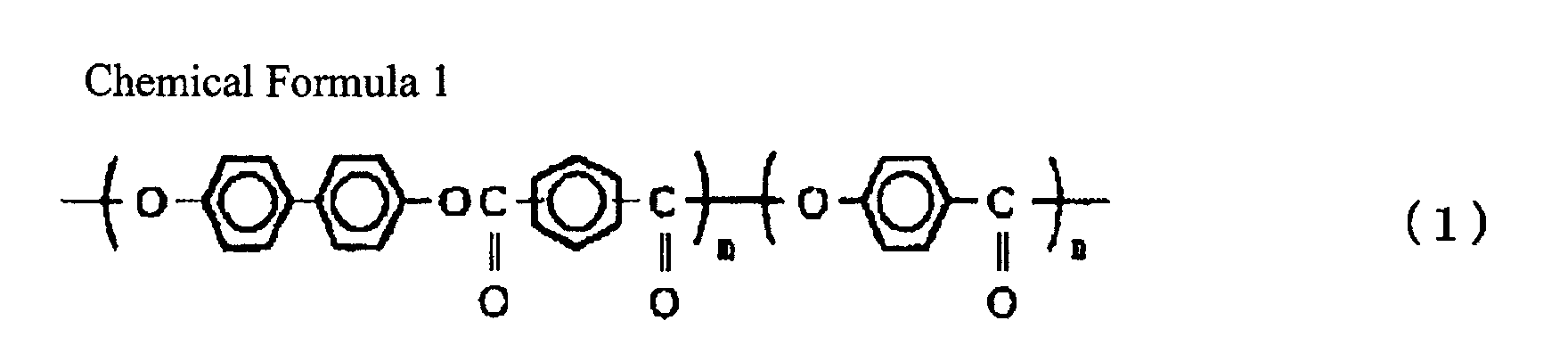
- Typical examples thereof include type 1 polymers comprising p -hydroxybenzoic acid (PHB), terephthalic acid, and biphenyls (formula 1 below); type 2 polymers comprising PHB and 2,6-hydroxynaphthoic acid (formula 2 below); and type 3 polymers comprising PHB, terephthalic acid, and ethylene glycol (formula 3 below).
- PHB p -hydroxybenzoic acid
- terephthalic acid and biphenyls
- biphenyls formula 1 below
- type 2 polymers comprising PHB and 2,6-hydroxynaphthoic acid
- type 3 polymers comprising PHB, terephthalic acid, and ethylene glycol (formula 3 below).
- polymers that can be mixed or chemically bonded with the liquid-crystal polymer include, but are not limited to, polyether ether ketone, polyether sulfone, polyimide, polyetherimide, polyamide, polyamide-imide, polyarylate, and the like.
- the mixture ratio of the macromolecules and liquid-crystal polymer is preferably (by weight) 10:90-90:10, and more preferably 30:70-70:30.
- the polymer alloy containing a liquid-crystal polymer also has excellent properties due to the liquid-crystal polymer.
- the resin composed of a liquid-crystal polymer or a polymer alloy with a liquid-crystal polymer as the alloy component may also contain additives such as compatibility accelerators, plasticizers, or flame retardants, or fillers such as inorganic powder or fiber, which are added in accordance with the intended purpose.
- liquid-crystal polymer or the polymer alloy containing a liquid-crystal polymer (these will also be referred to hereinbelow simply as "liquid-crystal polymer") used as a raw film is formed into a film.
- Film forming in this case can be done by extrusion, roll calendering, or the like.
- This raw liquid-crystal polymer resin film has a thickness of 5-1000 ⁇ m, and preferably 10-500 ⁇ m.
- the fluororesin porous film used as a lamination film in the present invention preferably has a specific gravity of 1.3 or greater, and more preferably 1.5 or greater, the upper limit of which is commonly about 2.0.
- the porosity thereof is preferably 40% or less, and more preferably 30% or less, the lower limit of which is commonly about 5%.
- the elongation at break in the direction of draw is preferably 400% or greater, and more preferably 600% or greater.
- the upper limit thereof is commonly about 900%.
- the fluororesin porous film preferably has an average pore size of 0.05-5.0 ⁇ m, and more preferably of 0.2-1.0 ⁇ m.
- the thickness thereof is preferably 5-300 ⁇ m, and more preferably 20-150 ⁇ m.
- fluororesin porous film examples include tetrafluoroethylene/hexafluoropropylene copolymers, polyvinyl fluoride, polyvinylidene fluoride, polytrifluorochloroethylene, and the like.
- an drawn porous polytetrafluoroethylene film is preferred on the basis of heat resistance and chemical resistance.
- the surface roughness Ra of the resulting liquid-crystal polymer film increases (the surface becomes rough).
- the surface roughness Ra of the resulting liquid-crystal polymer film also increases (the surface becomes rough) when elongation at break in the direction of draw is too low.
- the method for manufacturing a liquid-crystal polymer of the present invention comprises steps of forming a laminate film, drawing, cooling, and peeling. Each of these steps is described below in detail.
- This step entails forming a laminate film by the thermocompression bonding of a fluororesin porous film on both sides of a liquid-crystal polymer film.
- the preferred temperature for obtaining the laminate film differs depending on the melting point of the liquid-crystal polymer film employed, but it is essentially a temperature which softens at least the surface of the liquid-crystal polymer film, or else the area in contact with the fluororesin porous film or the entire film, while the fluororesin porous film maintains sufficient strength.
- thermocompression bonding device When the laminate film is manufactured in this manner, a pair of thermocompression bonding rolls or a hot-press device is used as the thermocompression bonding device.
- thermocompression bonding rolls When thermocompression bonding rolls are used, the liquid-crystal polymer film and the two fluororesin porous films laminated to both surfaces thereof are fed to a gap (clearance) between the pair of thermocompression bonding rolls and are thermocompression-bonded in the gap between the thermocompression bonding rolls.
- the liquid-crystal polymer film used herein can be a solid sheet, a softened film extruded from the T-die of an extruder, or the like.
- a fluororesin porous film is laid on the bottom plate of the hot-press device, a liquid-crystal polymer film is laid thereon, a fluororesin porous film is placed on top, the resulting assembly is thermocompression-bonded by applying downward pressure with a top plate for a specific period of time, and the product is cooled.
- the bottom plate and/or top plate is heated, and at least the surface portion of the liquid-crystal polymer film is softened.
- the laminate obtained by the laminate film forming step is sent on to the subsequent drawing step either directly or after being cooled.
- Fig. 1 is a diagram illustrating an example of the method for manufacturing the laminate film.
- Fig. 1 indicates thermocompression bonding rolls.
- 2 indicates guiding rolls, A indicates a liquid-crystal polymer film, and B-1 and B-2 indicate fluororesin porous films.
- the liquid-crystal polymer film A and the two fluororesin porous films B-1 and B-2 are fed to a gap (clearance) between the pair of thermocompression bonding rolls 1, 1 and are thermocompression-bonded in the gap between the thermocompression bonding rolls.
- the fluororesin porous films B-1 and B-2 are supplied to both sides of the liquid-crystal polymer film A.
- the liquid-crystal polymer film A can be a solid sheet, a softened film extruded from the T-die of an extruder, or the like.
- the laminate obtained by the laminate film forming step is sent on to the subsequent drawing step either directly or after being cooled.
- the laminate film obtained by the laminate film formation step is drawn uniaxially or biaxially, that is, only in the direction perpendicular to the orientation direction of the liquid-crystal polymer film (transverse direction) or both in the same direction as the orientation of the liquid-crystal polymer film (machine direction) and in the direction perpendicular thereto (transverse direction), under temperature conditions in which the fluororesin porous film softens but the liquid-crystal polymer film melts or softens while remaining substantially unmelted.
- the drawing may either be sequential or continuous. In this case, the draw ratio in the machine direction is 1-10, and preferably 1-5, and the draw ratio in the transverse direction is 1.5-20, and preferably 3-15.
- the draw ratio in the transverse direction should be established as 1.0-5.0 times the draw ratio in the machine direction, and preferably 1.5-3.0 times.
- the drawing speed is 1-200% per second, and preferably 5-50% per second.
- the drawing device may be a conventionally known device.
- This step entails cooling the laminate film obtained during the drawing step, and cooling and solidifying the molten liquid-crystal polymer film, and can be implemented using a pair of cooling rolls.
- the step may also be performed by natural cooling.
- This step entails peeling off the fluororesin porous films thermocompression-bonded to both sides of the laminate film obtained by the cooling step.
- the fluororesin porous films are weakly bonded to, and can be easily peeled off from, the liquid-crystal polymer film due to adequate lamination and thermocompression bonding conditions, allowing the porous films to be easily peeled off by being pulled up from the liquid-crystal polymer film.
- the liquid-crystal polymer film thus obtained is a drawn liquid-crystal polymer film with a surface roughness Ra of 0.1 ⁇ m or less, and preferably 0.07 ⁇ m or less, both in the machine direction (the same direction as the orientation of the liquid-crystal polymer film) and in the transverse direction (the direction perpendicular to the orientation direction of the liquid-crystal polymer film).
- the thickness of the liquid-crystal polymer film of the present invention is 10-300 ⁇ m, and preferably 25-125 ⁇ m.
- a liquid-crystal polymer (LCP) was melted in a short-screw extruder (screw diameter: 50 mm), the melt was extruded into a film shape from a T-die at the tip of the extruder (lip length: 300 cm, lip clearance: 2.5 mm, die temperature: 350°C), and the film was cooled to yield a raw LCP film with a thickness of 250 ⁇ m.
- each side of this raw LCP film was laminated with the lamination films (thickness: 100 ⁇ m) shown in Table 1, the films were thermocompression-bonded with the aid of a pair of rolls (temperature: 330°C, roll peripheral speed: 2 m/min), and the bonded films were then cooled by being passed between a pair of cooling rolls (temperature: 150°C, roll peripheral speed: 2 m/min).
- the laminated film was drawn with the aid of a biaxial drawing device at a drawing temperature of 350°C, a draw ratio of 1.3 in the machine direction and 3.9 in the transverse direction, and a drawing speed of 20% per second.
- the lamination films were peeled off from both sides of the liquid-crystal polymer film, yielding a liquid-crystal polymer film product with a thickness of 50 ⁇ m.
- the surface roughness Ra ( ⁇ m) of the LCP film obtained as previously described is shown in Table 1 in relation to the lamination films employed.
- a surface roughness measuring device SV600 made by Mitutoyo Corp. was used to measure the surface roughness Ra ( ⁇ m) (refer to JIS B0601) of the liquid-crystal polymer film both in the machine direction and in the transverse direction.
- a liquid-crystal polymer sample of 10 mg was weighed, and a differential scanning calorimeter made by TA Instruments was used to measure an endothermic thermograph by raising the temperature at a rate of 40°C per minute from 50°C to 370°C and maintaining it for 5 minutes, then lowering the temperature at a rate of 20°C per minute to 25°C, and then once again raising the temperature at a rate of 20°C per minute to 370°C. The melting point was calculated from the temperature at which an endothermic peak was observed during the second temperature increase.
- the elongation at break shown in Table 1 refers to elongation at break in the direction of draw. This was measured according to JIS K7161.
- the specific gravity was measured by cutting out a specific area of the film, measuring its thickness, and calculating its volume V. The weight W of the cut-out film was then measured.
- Specific gravity G was calculated as weight W (g)/volume V (cm 3 ).
- the porosity P (%) of ePTFE was calculated as [(2.2 - Specific gravity G)/2.2] ⁇ 100 (%) because the true specific gravity of PTFE was assumed to be 2.2.
- Experiment No. LCP Lamination film LCP film Type Specific gravity Porosity (%) Elongation at break (%) Ra( ⁇ m) MD TD 1 A ePTFE 1.90 13 850 0.042 0.039 2 A ePTFE 1.50 32 680 0.059 0.051 3 B ePTFE 1.50 32 680 0.043 0.041 4 A EPTFE 0.50 77 100 0.167 0.121 5* A EPTFE 0.76 65 140 0.163 0.08 6* A Skived 2.11 4 300 - - 7* A TPI 1.45 0 50 - -
- the LCP film of the present invention has low surface roughness and high surface accuracy.
- the present invention provides an improvement in surface accuracy in a resin film composed of a high-melting liquid-crystal polymer or alloy with a melting point of 335°C or greater. This film can be used to advantage in a wide range of fields.
Landscapes
- Engineering & Computer Science (AREA)
- Mechanical Engineering (AREA)
- Laminated Bodies (AREA)
- Manufacture Of Macromolecular Shaped Articles (AREA)
- Shaping By String And By Release Of Stress In Plastics And The Like (AREA)
- Shaping Of Tube Ends By Bending Or Straightening (AREA)
Abstract
Description


| Experiment No. | LCP | Lamination film | LCP film | ||||
| Type | Specific gravity | Porosity (%) | Elongation at break (%) | Ra(µm) | |||
| MD | TD | ||||||
| 1 | A | ePTFE | 1.90 | 13 | 850 | 0.042 | 0.039 |
| 2 | A | ePTFE | 1.50 | 32 | 680 | 0.059 | 0.051 |
| 3 | B | ePTFE | 1.50 | 32 | 680 | 0.043 | 0.041 |
| 4 | A | EPTFE | 0.50 | 77 | 100 | 0.167 | 0.121 |
| 5* | A | EPTFE | 0.76 | 65 | 140 | 0.163 | 0.08 |
| 6* | A | Skived | 2.11 | 4 | 300 | - | - |
| 7* | A | TPI | 1.45 | 0 | 50 | - | - |
(1) LCP: A
Sumitomo Chemical Co., Ltd.; Sumika Super E6000 (melting point: 355°C)
(2) LCP: B
Polyplastics Co., Ltd.; Vectra E950 (melting point: 345°C)
(3) ePTFE
Drawn porous polytetrafluoroethylene
(4) Skived
PTFE skived film
(5) TPI
Heat reversible polyimide film
Claims (4)
- A liquid-crystal polymer film with a melting point of 335°C or greater and a surface roughness Ra of 0.1 µm or less both in the machine direction and in the transverse direction, which is obtained by a process in which a laminate of a fluororesin porous film and a resin film made from a liquid-crystal polymer or a polymer alloy containing a liquid-crystal polymer is drawn, and the fluororesin porous film is peeled off.
- The liquid-crystal polymer film according to claim 1, wherein the fluororesin porous film has a specific gravity of 1.3 or greater and an elongation at break in the direction of draw of 400% or greater.
- A method for manufacturing a liquid-crystal polymer film with a melting point of 335°C or greater and a surface roughness Ra of 0.1 µm or less both in the machine direction and in the transverse direction, characterized in that a laminate of a fluororesin porous film and a resin film made from a liquid-crystal polymer or a polymer alloy containing a liquid-crystal polymer is drawn, and the fluororesin porous film is peeled off.
- The method for manufacturing a liquid-crystal polymer film according to claim 3, wherein the fluororesin porous film has a specific gravity of 1.3 or greater and an elongation at break in the direction of draw of 400% or greater.
Applications Claiming Priority (2)
| Application Number | Priority Date | Filing Date | Title |
|---|---|---|---|
| JP2002158150 | 2002-05-30 | ||
| JP2002158150A JP3958629B2 (en) | 2002-05-30 | 2002-05-30 | Liquid crystal polymer film and method for producing the same |
Publications (4)
| Publication Number | Publication Date |
|---|---|
| EP1375112A2 true EP1375112A2 (en) | 2004-01-02 |
| EP1375112A3 EP1375112A3 (en) | 2004-11-17 |
| EP1375112B1 EP1375112B1 (en) | 2013-07-10 |
| EP1375112B8 EP1375112B8 (en) | 2013-08-21 |
Family
ID=29717423
Family Applications (1)
| Application Number | Title | Priority Date | Filing Date |
|---|---|---|---|
| EP03253221.0A Expired - Lifetime EP1375112B8 (en) | 2002-05-30 | 2003-05-23 | Liquid-crystal polymer film and manufacturing method thereof |
Country Status (3)
| Country | Link |
|---|---|
| US (1) | US6963387B2 (en) |
| EP (1) | EP1375112B8 (en) |
| JP (1) | JP3958629B2 (en) |
Cited By (3)
| Publication number | Priority date | Publication date | Assignee | Title |
|---|---|---|---|---|
| US7329465B2 (en) | 2004-10-29 | 2008-02-12 | 3M Innovative Properties Company | Optical films incorporating cyclic olefin copolymers |
| EP2267497A1 (en) * | 2004-10-29 | 2010-12-29 | 3M Innovative Properties Co. | Optical bodies and methods for making optical bodies |
| WO2014171822A1 (en) * | 2013-04-16 | 2014-10-23 | Technische Universiteit Delft | Molecular composites based on high-performance polymers and an interpenetrating liquid crystal thermoset |
Families Citing this family (17)
| Publication number | Priority date | Publication date | Assignee | Title |
|---|---|---|---|---|
| JP4598408B2 (en) * | 2004-01-15 | 2010-12-15 | ジャパンゴアテックス株式会社 | Adhesive sheet |
| JP2006284968A (en) * | 2005-03-31 | 2006-10-19 | Dainippon Printing Co Ltd | Optical element having homeotropic alignment of liquid crystal molecules, substrate for liquid crystal display device using the same, and liquid crystal display device |
| US20060227421A1 (en) | 2005-04-06 | 2006-10-12 | Stover Carl A | Optical bodies including strippable boundary layers |
| US8568869B2 (en) * | 2005-04-06 | 2013-10-29 | 3M Innovative Properties Company | Optical bodies including rough strippable boundary layers and asymmetric surface structures |
| US9709700B2 (en) * | 2005-04-06 | 2017-07-18 | 3M Innovative Properties Company | Optical bodies including rough strippable boundary layers |
| JP2009229471A (en) * | 2006-07-12 | 2009-10-08 | Sharp Corp | Optical component, lighting system for display, and display |
| CN104220236A (en) | 2012-03-29 | 2014-12-17 | 株式会社可乐丽 | Thermoplasitc liquid crystal polymer film and method for producing same |
| CN107922664A (en) | 2015-09-04 | 2018-04-17 | 东京应化工业株式会社 | Perforated membrane and its manufacture method |
| KR102403839B1 (en) * | 2016-03-08 | 2022-05-31 | 주식회사 쿠라레 | Manufacturing method of metal-clad laminate and metal-clad laminate |
| WO2019217053A1 (en) | 2018-05-07 | 2019-11-14 | Neograf Solutions, Llc | Methods and apparatus for forming liquid crystal polymer flexible circuits |
| US20220073732A1 (en) * | 2018-12-27 | 2022-03-10 | Eneos Corporation | Resin composition and resin molded article comprising the same |
| JP7203994B2 (en) * | 2019-09-25 | 2023-01-13 | 富士フイルム株式会社 | Liquid crystal polymer film and manufacturing method thereof, flexible copper-clad laminate, and flexible printed circuit board |
| TWI740515B (en) | 2019-12-23 | 2021-09-21 | 長春人造樹脂廠股份有限公司 | Liquid crystal polymer film and laminate comprising the same |
| TWI697549B (en) | 2019-12-23 | 2020-07-01 | 長春人造樹脂廠股份有限公司 | Liquid crystal polymer film and laminate comprising the same |
| JPWO2024004952A1 (en) * | 2022-06-30 | 2024-01-04 | ||
| JP7897965B2 (en) | 2023-02-09 | 2026-07-30 | デンカ株式会社 | LCP film |
| WO2025142791A1 (en) * | 2023-12-26 | 2025-07-03 | 東洋鋼鈑株式会社 | Stretched liquid crystal polymer film, laminate, circuit board, metamaterial, and method for producing stretched liquid crystal polymer film |
Family Cites Families (8)
| Publication number | Priority date | Publication date | Assignee | Title |
|---|---|---|---|---|
| JP2852553B2 (en) | 1990-06-18 | 1999-02-03 | ダイセル化学工業株式会社 | Liquid crystalline polymer film and method for producing the same |
| JP2962459B2 (en) | 1993-02-25 | 1999-10-12 | ジャパンゴアテックス株式会社 | Liquid crystal polymer film and method for producing the same |
| US6027771A (en) * | 1993-02-25 | 2000-02-22 | Moriya; Akira | Liquid crystal polymer film and a method for manufacturing the same |
| JP2921670B2 (en) | 1995-09-08 | 1999-07-19 | ジャパンゴアテックス株式会社 | Method for producing isotropic liquid crystal polymer film and laminate thereof, and isotropic liquid crystal polymer film and laminate thereof |
| JPH07251438A (en) * | 1994-03-15 | 1995-10-03 | Japan Gore Tex Inc | Liquid crystal polymer film and method for producing the same |
| JP3795966B2 (en) | 1996-07-19 | 2006-07-12 | ジャパンゴアテックス株式会社 | Liquid crystal polymer film and laminate thereof |
| JP2000044797A (en) * | 1998-04-06 | 2000-02-15 | Kuraray Co Ltd | Liquid crystal polymer films and laminates, their manufacturing methods, and multilayer mounting circuit boards |
| JP2002196117A (en) * | 2000-12-25 | 2002-07-10 | Nitto Denko Corp | Light diffusion layer, light diffusion sheet and optical element |
-
2002
- 2002-05-30 JP JP2002158150A patent/JP3958629B2/en not_active Expired - Lifetime
-
2003
- 2003-05-16 US US10/439,597 patent/US6963387B2/en not_active Expired - Fee Related
- 2003-05-23 EP EP03253221.0A patent/EP1375112B8/en not_active Expired - Lifetime
Cited By (6)
| Publication number | Priority date | Publication date | Assignee | Title |
|---|---|---|---|---|
| US7329465B2 (en) | 2004-10-29 | 2008-02-12 | 3M Innovative Properties Company | Optical films incorporating cyclic olefin copolymers |
| US7348066B2 (en) | 2004-10-29 | 2008-03-25 | 3M Innovative Properties Company | Optical films incorporating cyclic olefin copolymers |
| EP2267497A1 (en) * | 2004-10-29 | 2010-12-29 | 3M Innovative Properties Co. | Optical bodies and methods for making optical bodies |
| EP2273291A3 (en) * | 2004-10-29 | 2011-01-26 | 3M Innovative Properties Co. | Optical bodies and methods for making optical bodies |
| WO2014171822A1 (en) * | 2013-04-16 | 2014-10-23 | Technische Universiteit Delft | Molecular composites based on high-performance polymers and an interpenetrating liquid crystal thermoset |
| US9598574B2 (en) | 2013-04-16 | 2017-03-21 | Allotropica Technologies Inc. | Molecular composites based on high-performance polymers and an interpenetrating liquid crystal thermoset |
Also Published As
| Publication number | Publication date |
|---|---|
| JP3958629B2 (en) | 2007-08-15 |
| EP1375112A3 (en) | 2004-11-17 |
| US6963387B2 (en) | 2005-11-08 |
| US20040012754A1 (en) | 2004-01-22 |
| EP1375112B1 (en) | 2013-07-10 |
| JP2003340918A (en) | 2003-12-02 |
| EP1375112B8 (en) | 2013-08-21 |
Similar Documents
| Publication | Publication Date | Title |
|---|---|---|
| US6963387B2 (en) | Liquid-crystal polymer film and manufacturing method thereof | |
| JP3795966B2 (en) | Liquid crystal polymer film and laminate thereof | |
| JP3896324B2 (en) | Liquid crystal polymer blend film | |
| EP0677368B1 (en) | A method for manufacturing a liquid crystal polymer film | |
| TWI616328B (en) | Thermotropic liquid crystal polymer film, laminate and circuit board using the same, method of producing laminate, and method of producing thermotropic liquid crystal polymer film | |
| US6027771A (en) | Liquid crystal polymer film and a method for manufacturing the same | |
| KR101202233B1 (en) | Metal-clad laminate and method for production thereof | |
| JP2003200534A (en) | Fluororesin laminate and method for producing the same | |
| JP4598408B2 (en) | Adhesive sheet | |
| JP2921670B2 (en) | Method for producing isotropic liquid crystal polymer film and laminate thereof, and isotropic liquid crystal polymer film and laminate thereof | |
| US20230105357A1 (en) | Thermoplastic liquid crystal polymer molded body, metal-clad laminate, and circuit board | |
| JPH0985814A (en) | Hollow molded article having liquid crystal polymer layer | |
| EP1395102A2 (en) | Multi-layer circuit board and method of making the same | |
| JP7615308B2 (en) | Liquid crystal polyester resin composition, liquid crystal polyester film using said composition, metal laminate film using said film, and circuit board | |
| JP3695890B2 (en) | IC chip mounting interposer and IC chip package | |
| JP2003082123A (en) | Polyarylketone film and flexible printed circuit board using the same | |
| WO2024166775A1 (en) | Lcp film | |
| JP4184529B2 (en) | Thermoplastic liquid crystal polymer film and method for modifying the same | |
| JP3684260B2 (en) | Liquid crystal polymer sheet laminate and method for producing the same | |
| EP0612610B1 (en) | A liquid crystal polymer film and a manufacturing process therefor | |
| JP3072717B2 (en) | Biaxially oriented polyester film | |
| EP0669207B1 (en) | A liquid crystal polymer film and a process for manufacture thereof | |
| CN118952551A (en) | A support film-coated liquid crystal polymer film and its preparation method and application | |
| JPH1022351A (en) | IC chip mounting interposer and IC chip package | |
| JP2002192608A (en) | Manufacturing method of stretched film |
Legal Events
| Date | Code | Title | Description |
|---|---|---|---|
| PUAI | Public reference made under article 153(3) epc to a published international application that has entered the european phase |
Free format text: ORIGINAL CODE: 0009012 |
|
| AK | Designated contracting states |
Kind code of ref document: A2 Designated state(s): AT BE BG CH CY CZ DE DK EE ES FI FR GB GR HU IE IT LI LU MC NL PT RO SE SI SK TR |
|
| AX | Request for extension of the european patent |
Extension state: AL LT LV MK |
|
| PUAL | Search report despatched |
Free format text: ORIGINAL CODE: 0009013 |
|
| AK | Designated contracting states |
Kind code of ref document: A3 Designated state(s): AT BE BG CH CY CZ DE DK EE ES FI FR GB GR HU IE IT LI LU MC NL PT RO SE SI SK TR |
|
| AX | Request for extension of the european patent |
Extension state: AL LT LV MK |
|
| 17P | Request for examination filed |
Effective date: 20050322 |
|
| AKX | Designation fees paid |
Designated state(s): DE FR GB IT SE |
|
| 17Q | First examination report despatched |
Effective date: 20100308 |
|
| GRAP | Despatch of communication of intention to grant a patent |
Free format text: ORIGINAL CODE: EPIDOSNIGR1 |
|
| GRAS | Grant fee paid |
Free format text: ORIGINAL CODE: EPIDOSNIGR3 |
|
| RAP1 | Party data changed (applicant data changed or rights of an application transferred) |
Owner name: W. L. GORE & ASSOCIATES, CO., LTD. |
|
| GRAA | (expected) grant |
Free format text: ORIGINAL CODE: 0009210 |
|
| AK | Designated contracting states |
Kind code of ref document: B1 Designated state(s): DE FR GB IT SE |
|
| REG | Reference to a national code |
Ref country code: GB Ref legal event code: FG4D |
|
| RAP2 | Party data changed (patent owner data changed or rights of a patent transferred) |
Owner name: PRIMATEC INC. |
|
| REG | Reference to a national code |
Ref country code: DE Ref legal event code: R096 Ref document number: 60344455 Country of ref document: DE Effective date: 20130905 |
|
| PG25 | Lapsed in a contracting state [announced via postgrant information from national office to epo] |
Ref country code: SE Free format text: LAPSE BECAUSE OF FAILURE TO SUBMIT A TRANSLATION OF THE DESCRIPTION OR TO PAY THE FEE WITHIN THE PRESCRIBED TIME-LIMIT Effective date: 20130710 |
|
| PLBE | No opposition filed within time limit |
Free format text: ORIGINAL CODE: 0009261 |
|
| STAA | Information on the status of an ep patent application or granted ep patent |
Free format text: STATUS: NO OPPOSITION FILED WITHIN TIME LIMIT |
|
| PG25 | Lapsed in a contracting state [announced via postgrant information from national office to epo] |
Ref country code: IT Free format text: LAPSE BECAUSE OF FAILURE TO SUBMIT A TRANSLATION OF THE DESCRIPTION OR TO PAY THE FEE WITHIN THE PRESCRIBED TIME-LIMIT Effective date: 20130710 |
|
| 26N | No opposition filed |
Effective date: 20140411 |
|
| REG | Reference to a national code |
Ref country code: DE Ref legal event code: R097 Ref document number: 60344455 Country of ref document: DE Effective date: 20140411 |
|
| REG | Reference to a national code |
Ref country code: DE Ref legal event code: R119 Ref document number: 60344455 Country of ref document: DE |
|
| GBPC | Gb: european patent ceased through non-payment of renewal fee |
Effective date: 20140523 |
|
| REG | Reference to a national code |
Ref country code: DE Ref legal event code: R119 Ref document number: 60344455 Country of ref document: DE Effective date: 20141202 |
|
| REG | Reference to a national code |
Ref country code: FR Ref legal event code: ST Effective date: 20150130 |
|
| PG25 | Lapsed in a contracting state [announced via postgrant information from national office to epo] |
Ref country code: DE Free format text: LAPSE BECAUSE OF NON-PAYMENT OF DUE FEES Effective date: 20141202 |
|
| PG25 | Lapsed in a contracting state [announced via postgrant information from national office to epo] |
Ref country code: GB Free format text: LAPSE BECAUSE OF NON-PAYMENT OF DUE FEES Effective date: 20140523 Ref country code: FR Free format text: LAPSE BECAUSE OF NON-PAYMENT OF DUE FEES Effective date: 20140602 |