EP1370005A2 - Reed-Solomon decoder - Google Patents
Reed-Solomon decoder Download PDFInfo
- Publication number
- EP1370005A2 EP1370005A2 EP03291352A EP03291352A EP1370005A2 EP 1370005 A2 EP1370005 A2 EP 1370005A2 EP 03291352 A EP03291352 A EP 03291352A EP 03291352 A EP03291352 A EP 03291352A EP 1370005 A2 EP1370005 A2 EP 1370005A2
- Authority
- EP
- European Patent Office
- Prior art keywords
- error
- polynomial
- forney
- erasure
- reed
- Prior art date
- Legal status (The legal status is an assumption and is not a legal conclusion. Google has not performed a legal analysis and makes no representation as to the accuracy of the status listed.)
- Ceased
Links
Images


Classifications
-
- H—ELECTRICITY
- H03—ELECTRONIC CIRCUITRY
- H03M—CODING; DECODING; CODE CONVERSION IN GENERAL
- H03M13/00—Coding, decoding or code conversion, for error detection or error correction; Coding theory basic assumptions; Coding bounds; Error probability evaluation methods; Channel models; Simulation or testing of codes
- H03M13/03—Error detection or forward error correction by redundancy in data representation, i.e. code words containing more digits than the source words
- H03M13/05—Error detection or forward error correction by redundancy in data representation, i.e. code words containing more digits than the source words using block codes, i.e. a predetermined number of check bits joined to a predetermined number of information bits
- H03M13/13—Linear codes
- H03M13/15—Cyclic codes, i.e. cyclic shifts of codewords produce other codewords, e.g. codes defined by a generator polynomial, Bose-Chaudhuri-Hocquenghem [BCH] codes
- H03M13/151—Cyclic codes, i.e. cyclic shifts of codewords produce other codewords, e.g. codes defined by a generator polynomial, Bose-Chaudhuri-Hocquenghem [BCH] codes using error location or error correction polynomials
- H03M13/1545—Determination of error locations, e.g. Chien search or other methods or arrangements for the determination of the roots of the error locator polynomial
-
- H—ELECTRICITY
- H03—ELECTRONIC CIRCUITRY
- H03M—CODING; DECODING; CODE CONVERSION IN GENERAL
- H03M13/00—Coding, decoding or code conversion, for error detection or error correction; Coding theory basic assumptions; Coding bounds; Error probability evaluation methods; Channel models; Simulation or testing of codes
- H03M13/03—Error detection or forward error correction by redundancy in data representation, i.e. code words containing more digits than the source words
- H03M13/05—Error detection or forward error correction by redundancy in data representation, i.e. code words containing more digits than the source words using block codes, i.e. a predetermined number of check bits joined to a predetermined number of information bits
- H03M13/13—Linear codes
- H03M13/15—Cyclic codes, i.e. cyclic shifts of codewords produce other codewords, e.g. codes defined by a generator polynomial, Bose-Chaudhuri-Hocquenghem [BCH] codes
- H03M13/151—Cyclic codes, i.e. cyclic shifts of codewords produce other codewords, e.g. codes defined by a generator polynomial, Bose-Chaudhuri-Hocquenghem [BCH] codes using error location or error correction polynomials
- H03M13/1515—Reed-Solomon codes
-
- H—ELECTRICITY
- H03—ELECTRONIC CIRCUITRY
- H03M—CODING; DECODING; CODE CONVERSION IN GENERAL
- H03M13/00—Coding, decoding or code conversion, for error detection or error correction; Coding theory basic assumptions; Coding bounds; Error probability evaluation methods; Channel models; Simulation or testing of codes
- H03M13/03—Error detection or forward error correction by redundancy in data representation, i.e. code words containing more digits than the source words
- H03M13/05—Error detection or forward error correction by redundancy in data representation, i.e. code words containing more digits than the source words using block codes, i.e. a predetermined number of check bits joined to a predetermined number of information bits
- H03M13/13—Linear codes
- H03M13/15—Cyclic codes, i.e. cyclic shifts of codewords produce other codewords, e.g. codes defined by a generator polynomial, Bose-Chaudhuri-Hocquenghem [BCH] codes
- H03M13/151—Cyclic codes, i.e. cyclic shifts of codewords produce other codewords, e.g. codes defined by a generator polynomial, Bose-Chaudhuri-Hocquenghem [BCH] codes using error location or error correction polynomials
- H03M13/1525—Determination and particular use of error location polynomials
- H03M13/1535—Determination and particular use of error location polynomials using the Euclid algorithm
-
- H—ELECTRICITY
- H03—ELECTRONIC CIRCUITRY
- H03M—CODING; DECODING; CODE CONVERSION IN GENERAL
- H03M13/00—Coding, decoding or code conversion, for error detection or error correction; Coding theory basic assumptions; Coding bounds; Error probability evaluation methods; Channel models; Simulation or testing of codes
- H03M13/03—Error detection or forward error correction by redundancy in data representation, i.e. code words containing more digits than the source words
- H03M13/05—Error detection or forward error correction by redundancy in data representation, i.e. code words containing more digits than the source words using block codes, i.e. a predetermined number of check bits joined to a predetermined number of information bits
- H03M13/13—Linear codes
- H03M13/15—Cyclic codes, i.e. cyclic shifts of codewords produce other codewords, e.g. codes defined by a generator polynomial, Bose-Chaudhuri-Hocquenghem [BCH] codes
- H03M13/151—Cyclic codes, i.e. cyclic shifts of codewords produce other codewords, e.g. codes defined by a generator polynomial, Bose-Chaudhuri-Hocquenghem [BCH] codes using error location or error correction polynomials
- H03M13/154—Error and erasure correction, e.g. by using the error and erasure locator or Forney polynomial
-
- H—ELECTRICITY
- H03—ELECTRONIC CIRCUITRY
- H03M—CODING; DECODING; CODE CONVERSION IN GENERAL
- H03M13/00—Coding, decoding or code conversion, for error detection or error correction; Coding theory basic assumptions; Coding bounds; Error probability evaluation methods; Channel models; Simulation or testing of codes
- H03M13/03—Error detection or forward error correction by redundancy in data representation, i.e. code words containing more digits than the source words
- H03M13/05—Error detection or forward error correction by redundancy in data representation, i.e. code words containing more digits than the source words using block codes, i.e. a predetermined number of check bits joined to a predetermined number of information bits
- H03M13/13—Linear codes
- H03M13/15—Cyclic codes, i.e. cyclic shifts of codewords produce other codewords, e.g. codes defined by a generator polynomial, Bose-Chaudhuri-Hocquenghem [BCH] codes
- H03M13/151—Cyclic codes, i.e. cyclic shifts of codewords produce other codewords, e.g. codes defined by a generator polynomial, Bose-Chaudhuri-Hocquenghem [BCH] codes using error location or error correction polynomials
- H03M13/158—Finite field arithmetic processing
-
- H—ELECTRICITY
- H03—ELECTRONIC CIRCUITRY
- H03M—CODING; DECODING; CODE CONVERSION IN GENERAL
- H03M13/00—Coding, decoding or code conversion, for error detection or error correction; Coding theory basic assumptions; Coding bounds; Error probability evaluation methods; Channel models; Simulation or testing of codes
- H03M13/65—Purpose and implementation aspects
- H03M13/6502—Reduction of hardware complexity or efficient processing
-
- H—ELECTRICITY
- H03—ELECTRONIC CIRCUITRY
- H03M—CODING; DECODING; CODE CONVERSION IN GENERAL
- H03M13/00—Coding, decoding or code conversion, for error detection or error correction; Coding theory basic assumptions; Coding bounds; Error probability evaluation methods; Channel models; Simulation or testing of codes
- H03M13/65—Purpose and implementation aspects
- H03M13/6561—Parallelized implementations
Definitions
- the invention pertains generally to error detection/correction and more particularly to systems and methods used in Reed-Solomon decoders.
- a commonly used error correcting technique is a Reed-Solomon error correcting code.
- RS Reed-Solomon
- codewords are transmitted, each codeword comprising k information symbols and n-k appended error correcting (parity) symbols. Each symbol comprises s bits.
- An RS decoder can correct up to (n-k)/2 symbols that contain errors in a codeword. Because each of these correctable symbols may contain multiple bit-errors, the RS encoding technique is particularly well suited for burst errors that affect multiple contiguous bits.
- a common RS encoding scheme uses a codeword of 255 eight-bit symbols, 223 of which are information symbols, and the remaining 32 symbols are error correcting parity symbols.
- This encoding scheme will correct up to 16 erroneous symbols in every 255-bit codeword, thereby providing a substantial improvement with respect to the 'received' Bit Error Rate.
- the RS encoding scheme will also detect 'erasures', which are errors at known locations, and require less information to correct.
- the number of erasures plus twice the number of errors that an RS decoder can correct is (n-k)/2.
- the term 'error' is used hereinafter to refer to either an error of unknown location or an erasure of known location.
- Fig. 1 illustrates an example block diagram of a prior art RS decoder 100.
- the decoder 100 receives each codeword r(x) 101, and produces a corrected codeword c(x) 151.
- a syndrome calculator 110 processes the codeword 101 to produce corresponding syndrome polynomials S i (x) 111.
- Each codeword has n-k syndromes that depend only on errors, and not on the transmitted codeword.
- an error locator polynomial ⁇ (x) 121 is produced.
- Euclid's algorithm 120 is illustrated for providing the error locator polynomial 121, and an error magnitude polynomial ⁇ (x) 122, although other techniques, such as the Berlekamp-Massey algorithm can be used as well.
- Each RS code has a parameter ' ⁇ ' that is the primitive element of a Galois Field (FG) that is chosen for the RS code.
- the error locator polynomial is structured such that if an error occurs at position p, ⁇ -p will be a root of the error polynomial (p is indexed from 0 to n-1).
- An iterative approach is conventionally applied to test each value of ⁇ -p for each position p in the codeword, to determine of ⁇ -p is a root, X k -1 , of the error locator polynomial 121.
- a commonly used algorithm for this iterative test is the Chien error locator 130.
- the Chien locator 130 also provides a related error differential term, X k -1 ⁇ ' (X k -1 ) 132, that facilitates a determination of the magnitude 141 of the error, typically via the Forney error determination algorithm, as illustrated at block 140.
- the error determinator 140 evaluates the error magnitude polynomial 122 corresponding to the located error symbol.
- an error corrector 150 determines the corrected codeword c(x) 151, based on the location 131 and magnitude 141 of this error. If an error is not detected for a given symbol, the symbol in the corrected codeword c(x) 151 at this evaluated position is equal to the symbol in the received codeword r(x) 101.
- WO-A-01/39378 shows a Reed-Solomon decoder that simultaneously searches for m roots of the error locator polynomial and the error magnitude polynomial.
- a polynomial evaluator includes a plurality of slice elements corresponding to each term of the polynomial. Each slice element includes a plurality of coefficient multipliers that are configured to evaluate the term for different values, thereby effecting a simultaneous evaluation of the polynomial at each of these different values.
- US-B-6 279 137 shows a system and method for a storage-efficient parallel Chien search. The system determines the root of a polynomial by employing a parallel structure that implements a Chien Search and reduces the amount of storage required.
- the location of an error in a codeword can be derived from the root of an error locator polynomial.
- the performance of the Chien Search is enhanced by the parallel structure, and the location of the error can be easily determined using a simple calculation that preferably includes the cycle count, the parallelism, and the index of the multiplier/summer rank that indicates a root.
- Multiple ranks of multipliers receive data stored in a single array of data storage units. Multiplier values of each multiplier are based on the elements of a Galois Field.
- EP-A-1 102 406 shows a decoder circuit used for decoding Reed-Solomon codes.
- a decoder which performs concurrent execution of a Chien search that determines the error locator polynomial for a received code word and a Forney algorithm that computes the error pattern.
- US-B-6 347 389 shows a pipelined Reed-Solomon error/erasure decoder processes multiple code words in a pipelined fashion.
- the pipelined Reed-Solomon error/erasure decoder is designed to process Reed-Solomon encoded words that have been corrupted in a digital system by processing errors as well as erasures through a simple iterative modified syndrome process.
- the problem to be solved by the invention is to provide an improved Reed-Solomon decoder and an improved method for Reed-Solomon decoding. Further, to provide an improved electronic system including a Reed-Solomon decoder, such as a DVD system. This problem is solved basically by applying the features of the independent claims. Preferred embodiments of the invention are given in the dependent claims.
- the invention provides for improved Reed-Solomon decoding by combining a parallel Chien search with a modified serial Forney's computation. This enables to reduce the required hardware complexity of the decoder while increasing decoder performance.
- the error positions only are calculated in the parallel Chien search block.
- the erasure locations need not to be calculated in the Chien search as they are already known from the demodulation block of the CD or DVD system. Because the erasure locations, which are commonly referred to as 'roots', are known, it is possible to reduce the complexity of the parallel Chien search logic. This implies that the Chien search logic has only to evaluate the error locator polynomial ⁇ (x).
- the error locations and the roots that correspond to these error locations are known after evaluation of the error locator polynomial.
- the roots are stored in a shift register.
- the hardware complexity is further reduced by the use of a modified serial Forney's algorithm.
- the high performance of the combined Chien and Forney's blocks enables to perform multiple-pass error corrections, which essentially decreases the output error rate.
- the inventive Reed-Solomon decoder can be utilised in many electronic systems, such as DVD systems or other optical or magnetic storage systems.
- the inventive method is suited for Reed-Solomon decoding and includes the steps of:
- the inventive Reed-Solomon decoder includes:
- Error locator polynomial ⁇ (x) Erasure locator polynomial ⁇ (x) Error / Erasure locator polynomial ⁇ (x) Error position i l ,..., i v Error locations
- X l a i l Error values e k ,0 ⁇ k ⁇ n Erasure positions j l ,..., j f Erasure locators
- Y l a j l Erasure values f k ,0 ⁇ k ⁇ n
- the Reed-Solomon decoding can be considered as employing five steps.
- Reed-Solomon decoding starts with calculating a syndrome polynomial S(x):
- a modified syndrome polynomial T(x) S(x) ⁇ (x) mod 2 t is calculated, where t is the symbol-error correcting capability of the Reed-Solomon code.
- Euclid's algorithm is used, which is a method for finding the greatest common divisor of two polynomials, cf. Y.M. Sugiyama, S.H. Kasahara, and T. Namekawa, "A Method for Solving the Key Equation for Decoding of Goppa Codes", Information and Control, Volume 27, pp. 87-89, January 1975.
- Both the error locator polynomial ⁇ (x) and the error evaluator polynomial ⁇ (x) can be calculated using Euclid's algorithm. This is as such known from the prior art, cf. Steven B. Wicker, Vijay K. Bhargava, “Reed-Solomon codes and their applications", IEEE Press 1994.
- the coefficients of a new error/erasure polynomial are loaded into the registers of a serial Forney's block, and the error/erasure magnitude values are computed.
- the erasure locations are already known after carrying out step 1, or are obtained by means of the demodulation block of the CD or DVD system. Therefore the erasure locations need not be calculated in the Chien search of step 5.
- the erasure locations are known one can reduce the complexity of the parallel Chien search logic, i.e. the Chien search logic needs to evaluate the error locator polynomial ⁇ (x) only.
- error locator polynomial ⁇ (x) has nine coefficients only. The error locations and the roots that correspond to these error locations are known after evaluation of this error locator polynomial.
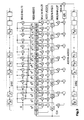
- Fig. 2 illustrates a parallel Chien search logic that comprises four ranks. Each cycle of the Chien search logic will check corresponding four trial roots in parallel:
- the Galois Field counter GFC defines the power of the GF element. During initialisation, the ⁇ 0 element is loaded into the register. In each cycle (clock CLK) counter GFC is counted down. If comparator compl indicates zero then the multiplication product in multiplier MUL33 of the current power from counter GFC and the ⁇ -1 element is the root of the error locator polynomial. If comparator comp2 indicates zero then the multiplication product in multiplier MUL34 of the current power from counter GFC and the ⁇ -2 element is the root of the error locator polynomial. If comparator comp3 indicates zero then the multiplication product in multiplier MUL35 of the current power from counter GFC and the ⁇ -3 element is the root of the error locator polynomial. If comparator comp4 indicates zero then counter GFC defines the roots.
- the shift register SHR1 (in Fig. 3) is used to memorise the roots that correspond to the erasure or the error location. During Step 1 of the decoding process the roots that correspond to the erasure locations are memorised in the SHR1 registers.
- the depth of SHR1 register is 16. This is enough for memorising all the errors and erasures that are decoded in a RS codeword of a CD or DVD system.
- Step 3 the error locator polynomial ⁇ (x) is computed and its nine coefficients are loaded into the registers REG1 to REG9 of the parallel Chien search block depicted in Fig. 2. These registers are clocked by clock CLK. Their output values are fed within each of the four ranks to a chain of multipliers MUL* and adders ADD*. The output of the rank 3 chain is fed to comparator compl. The output of the rank 2 chain is fed to comparator comp2. The output of the rank 1 chain is fed to comparator comp3. The output of the rank 0 chain is fed to comparator comp4.
- the output of register REG1 to REG8 is in each case fed via a multiplicator MUL32 to MUL25, respectively, applying in each case a factor ⁇ -32 , ⁇ -28 , ⁇ -24 , ⁇ -20 , ..., ⁇ -4 , respectively.
- the error locators are found during the evaluation of the error locator polynomial in the Chien search.
- the values of the inverse of the error locators are output from MUL33, MUL34, MUL35, and GF counter. These locations of the errors are loaded into the above SHR1 registers.
- Fig. 3 illustrates the block for calculating an error and erasure magnitude value at various symbol positions, yielding an error or erasure pattern.
- This block implements the modified Forney algorithm (serial implementation).
- the coefficients of an error evaluator polynomial ( ⁇ 0 to ⁇ 15 ) are loaded into respective registers REG0 to REG15.
- the coefficients ⁇ 1 to ⁇ 15 of the first derivation ⁇ ' (x) of an error/erasure polynomial ⁇ (x) are loaded into the respective registers REG16 to REG23.
- These registers as well as registers REG0 to REG15 are clocked by clock CLK.
- the root x which corresponds to an erasure or an error location, is output from register SHR1 and input in the Forney block.
- the degrees x 1 , x 2 , x 3 , ..., x 15 of x are calculated from x.
- the coefficients ⁇ 1 to ⁇ 15 are multiplied by the respective degrees x 1 , x 2 , x 3 , ..., x 15 of the current root x using respective multipliers MUL14 to MUL29.
- the set of 15 products is summed up by respective adders ADD2 to ADD15.
- the value ⁇ 0 is added to the first product.
- the coefficients ⁇ 1, ⁇ 3, ⁇ 5, ..., ⁇ 15 are multiplied with corresponding degrees x 1 , x 3 , x 5 , ..., x 15 of the current root x by respective multipliers MUL30 to MUL37.
- the set of products of these multipliers is summed up by respective adders ADD16 to ADD22.
- the product Xk-1 ⁇ '(Xk-1) from the output of adder ADD22 is inverted in an GF inverter GFI and multiplied in a multiplier MUL38 with above output value of adder ADD 15, resulting in error magnitude e i k and erasure magnitude f i k , respectively.
- the calculated erasure or error magnitude values are output from multiplier MUL38 and stored in a register SHR2. This register has the same depth as register SHR1. All roots, that have been stored in register SHR1, are processed in the Forney block in the same way.
- the calculated magnitude values are memorised in register SHR2.
- the inventive Chien&Forney stages used for determining error locations and error values in a DVD-system require the following minimum hardware only:
- the invention can be utilised for any electronic system that requires error determination and/or correction, such as CD, DVD, blue-laser DVD (Blu-Ray) or other storage systems.
- the invention enables to decrease the number of cycles needed to compute the error locations and the error values and at the same time requires hardware of relatively low complexity only.
Landscapes
- Physics & Mathematics (AREA)
- Mathematical Physics (AREA)
- Probability & Statistics with Applications (AREA)
- Engineering & Computer Science (AREA)
- Theoretical Computer Science (AREA)
- Algebra (AREA)
- General Physics & Mathematics (AREA)
- Pure & Applied Mathematics (AREA)
- Error Detection And Correction (AREA)
- Detection And Correction Of Errors (AREA)
Abstract
- means for calculation of a syndrome polynomial S(x) and an erasure locator polynomial Γ(x),
- means for calculating a modified syndrome polynomial T(x)=S(x)Γ(x)mod2 t , where t is the symbol-error correcting capability of the Reed-Solomon code,
- means for performing Euclid's algorithm to calculate and error locator polynomial Δ(x) and an error evaluator polynomial Ω(x),
- means for computing a second error / erasure locator polynomial Ψ(x) = Δ(x)Γ(x),
- means for performing a parallel Chien search,
- means for serial computation of the error magnitudes according for Forney's equation.
Description
Because each of these correctable symbols may contain multiple bit-errors, the RS encoding technique is particularly well suited for burst errors that affect multiple contiguous bits. A common RS encoding scheme uses a codeword of 255 eight-bit symbols, 223 of which are information symbols, and the remaining 32 symbols are error correcting parity symbols. This encoding scheme will correct up to 16 erroneous symbols in every 255-bit codeword, thereby providing a substantial improvement with respect to the 'received' Bit Error Rate.
The RS encoding scheme will also detect 'erasures', which are errors at known locations, and require less information to correct. The number of erasures plus twice the number of errors that an RS decoder can correct is (n-k)/2.
For ease of reference, the term 'error' is used hereinafter to refer to either an error of unknown location or an erasure of known location.
An iterative approach is conventionally applied to test each value of α-p for each position p in the codeword, to determine of α-p is a root, Xk -1, of the error locator polynomial 121. A commonly used algorithm for this iterative test is the Chien error locator 130. The Chien locator 130 also provides a related error differential term, Xk -1 Δ' (Xk -1) 132, that facilitates a determination of the magnitude 141 of the error, typically via the Forney error determination algorithm, as illustrated at block 140.
The error determinator 140 evaluates the error magnitude polynomial 122 corresponding to the located error symbol. For each error that the error locator 130 locates, an error corrector 150 determines the corrected codeword c(x) 151, based on the location 131 and magnitude 141 of this error. If an error is not detected for a given symbol, the symbol in the corrected codeword c(x) 151 at this evaluated position is equal to the symbol in the received codeword r(x) 101.
US-B-6 279 137 shows a system and method for a storage-efficient parallel Chien search. The system determines the root of a polynomial by employing a parallel structure that implements a Chien Search and reduces the amount of storage required.
The location of an error in a codeword can be derived from the root of an error locator polynomial. The performance of the Chien Search is enhanced by the parallel structure, and the location of the error can be easily determined using a simple calculation that preferably includes the cycle count, the parallelism, and the index of the multiplier/summer rank that indicates a root. Multiple ranks of multipliers receive data stored in a single array of data storage units. Multiplier values of each multiplier are based on the elements of a Galois Field.
EP-A-1 102 406 shows a decoder circuit used for decoding Reed-Solomon codes. A decoder is provided which performs concurrent execution of a Chien search that determines the error locator polynomial for a received code word and a Forney algorithm that computes the error pattern.
US-B-6 347 389 shows a pipelined Reed-Solomon error/erasure decoder processes multiple code words in a pipelined fashion. The pipelined Reed-Solomon error/erasure decoder is designed to process Reed-Solomon encoded words that have been corrupted in a digital system by processing errors as well as erasures through a simple iterative modified syndrome process.
This problem is solved basically by applying the features of the independent claims. Preferred embodiments of the invention are given in the dependent claims.
Because the erasure locations, which are commonly referred to as 'roots', are known, it is possible to reduce the complexity of the parallel Chien search logic. This implies that the Chien search logic has only to evaluate the error locator polynomial Δ(x).
- calculating a syndrome polynomial S(x) and an erasure locator polynomial Γ(x);
- calculating a modified syndrome polynomial
T(x)=S(x)Γ(x)mod 2t, where t is the symbol-error correcting capability of the Reed-Solomon code; - performing Euclid's algorithm for calculating an error locator polynomial Δ(x) and an error evaluator polynomial Ω(x);
- performing a parallel Chien search and concurrently computing an error/erasure locator polynomial Ψ(x)=Δ(x)Γ(x);
- serially computing the error magnitudes according to Forney's equation.
- means for calculating a syndrome polynomial S(x) and an erasure locator polynomial Γ(x);
- means for calculating a modified syndrome polynomial T(x)-S(x)Γ(x)mod 2t, wherein t is the symbol-error correcting capability of the Reed-Solomon code;
- means for performing Euclid's algorithm to calculate an error locator polynomial Δ(x) and an error evaluator polynomial Ω(x);
- means for computing an error/erasure locator polynomial Ψ(x) = Δ(x)Γ(x);
- means for performing a parallel Chien search;
- means for serially computing error magnitudes according to Forney's equation.
- Fig. 1
- example block diagram of a prior art error correcting decoder;
- Fig. 2
- example block diagram of a parallel Chien search circuit in accordance with the invention;
- Fig. 3
- example block diagram of a circuit for serial computation of Forney's equation in accordance with the invention.
| Error locator polynomial | Δ(x) |
| Erasure locator polynomial | Γ(x) |
| Error / Erasure locator polynomial | Ψ(x) |
| Error position | il ,...,iv |
| Error locations | Xl = ail |
| Error values | ek,0 ⇐ k < n |
| Erasure positions | j l,..., jf |
| Erasure locators | Yl = ajl |
| Erasure values | fk,0 ⇐ k < n |


Both the error locator polynomial Δ(x) and the error evaluator polynomial Ω(x) can be calculated using Euclid's algorithm. This is as such known from the prior art, cf. Steven B. Wicker, Vijay K. Bhargava, "Reed-Solomon codes and their applications", IEEE Press 1994.
If comparator compl indicates zero then the multiplication product in multiplier MUL33 of the current power from counter GFC and the α-1 element is the root of the error locator polynomial. If comparator comp2 indicates zero then the multiplication product in multiplier MUL34 of the current power from counter GFC and the α-2 element is the root of the error locator polynomial. If comparator comp3 indicates zero then the multiplication product in multiplier MUL35 of the current power from counter GFC and the α-3 element is the root of the error locator polynomial. If comparator comp4 indicates zero then counter GFC defines the roots.
The error locators are found during the evaluation of the error locator polynomial in the Chien search. The values of the inverse of the error locators are output from MUL33, MUL34, MUL35, and GF counter. These locations of the errors are loaded into the above SHR1 registers.

The Ω(x) and Ψ'(x) polynomials are expressed below:
All roots, that have been stored in register SHR1, are processed in the Forney block in the same way. The calculated magnitude values are memorised in register SHR2.
Claims (12)
- Reed-Solomon decoder including:means (110) for calculating a syndrome polynomial S(x) and an erasure locator polynomial Γ(x);means for calculating a modified syndrome polynomial T(x)= S(x)Γ(x)mod 2t, wherein t is the symbol-error correcting capability of the Reed-Solomon code;means (120) for performing Euclid's algorithm to calculate an error locator polynomial Δ(x) and an error evaluator polynomial Ω(x);means for computing an error/erasure locator polynomial Ψ(x)= Δ(x)Γ(x);means (Fig. 2) for performing a parallel Chien search;means (Fig. 3) for serially computing error magnitudes according to Forney's equation.
- Decoder according to claim 1, wherein modified Forney's equations for calculation of error values ei
k and erasure values fik ,are utilised for the serial computation of the error magnitudes.
- Decoder according to claim 1, wherein modified Forney's equations for calculation of error values ei
k and erasure values fik ,are utilised for the serial computation of the error magnitudes.
- Decoder according to claim 1, 2 or 3, said means for performing a parallel Chien search having a number of n ranks for checking n trial roots in parallel.
- Decoder according to one of claims 1 to 4, said means for serial computation of the error magnitudes according to Forney's equation comprising shift register means (SHR1) for storing the roots determined by said means for performing a parallel Chien search.
- Decoder according to one of claims 1 to 5, said means for serial computation of the error magnitudes according to Forney's equation comprising Galois Fields inverter means (GFI) for inverting the product X k -1Ψ'(X k -1).
- Method for Reed-Solomon decoding including the steps of:calculating (110) a syndrome polynomial S(x) and an erasure locator polynomial Γ(x);calculating a modified syndrome polynomial
T(x)=S(x)Γ(x)mod2t, where t is the symbol-error correcting capability of the Reed-Solomon code;performing (120) Euclid's algorithm for calculating an error locator polynomial Δ(x) and an error evaluator polynomial Ω(x);performing (Fig. 2) a parallel Chien search and concurrently computing an error/erasure locator polynomial Ψ(x) = Δ(x)Γ(x);serially computing (Fig. 3) the error magnitudes according to Forney's equation. - The method of claim 7, wherein modified Forney's equations for calculation of error values ei
k and erasure values fik ,are utilised for the serial computation of the error magnitudes.
- Method according to claim 7, wherein modified Forney's equations for calculation of error values ei
k and erasure values fik ,are utilised for the serial computation of the error magnitudes.
- Method according to claim 7, 8 or 9, wherein n trial roots are checked in parallel by means of n ranks.
- Method according to one of claims 7 to 10, wherein said serial computation of the error magnitudes according to Forney's equation is performed by Galois Fields inverter means (GFI) for inverting the product X k -1Ψ(X k -1).
- Electronic system, such as a CD, DVD, blue-laser DVD or other optical or magnetic storage system, including a Reed-Solomon decoder in accordance with one of the claims 1 to 6.
Priority Applications (1)
| Application Number | Priority Date | Filing Date | Title |
|---|---|---|---|
| EP03291352A EP1370005A3 (en) | 2002-06-07 | 2003-06-04 | Reed-Solomon decoder |
Applications Claiming Priority (3)
| Application Number | Priority Date | Filing Date | Title |
|---|---|---|---|
| EP02090207 | 2002-06-07 | ||
| EP02090207A EP1370003A1 (en) | 2002-06-07 | 2002-06-07 | Reed-Solomon Decoder |
| EP03291352A EP1370005A3 (en) | 2002-06-07 | 2003-06-04 | Reed-Solomon decoder |
Publications (2)
| Publication Number | Publication Date |
|---|---|
| EP1370005A2 true EP1370005A2 (en) | 2003-12-10 |
| EP1370005A3 EP1370005A3 (en) | 2003-12-17 |
Family
ID=29551334
Family Applications (1)
| Application Number | Title | Priority Date | Filing Date |
|---|---|---|---|
| EP03291352A Ceased EP1370005A3 (en) | 2002-06-07 | 2003-06-04 | Reed-Solomon decoder |
Country Status (1)
| Country | Link |
|---|---|
| EP (1) | EP1370005A3 (en) |
Cited By (2)
| Publication number | Priority date | Publication date | Assignee | Title |
|---|---|---|---|---|
| EP2194648A1 (en) * | 2008-12-03 | 2010-06-09 | Electronics and Telecommunications Research Institute | MPE-FEC RS decoder and decoding method thereof |
| US20250192915A1 (en) * | 2023-12-10 | 2025-06-12 | Quasistatics Inc. | Communication system and method for error-proportional energy saving in encoding and decoding in body area networks using human body communication |
Family Cites Families (5)
| Publication number | Priority date | Publication date | Assignee | Title |
|---|---|---|---|---|
| US5537426A (en) * | 1992-05-29 | 1996-07-16 | Goldstar Co., Ltd. | Operation apparatus for deriving erasure position Γ(x) and Forney syndrome T(x) polynomials of a Galois field employing a single multiplier |
| US6279137B1 (en) * | 1998-12-08 | 2001-08-21 | Lsi Logic Corporation | System and method for a storage-efficient parallel Chien Search |
| US6347389B1 (en) * | 1999-03-23 | 2002-02-12 | Storage Technology Corporation | Pipelined high speed reed-solomon error/erasure decoder |
| EP1102406A3 (en) * | 1999-11-17 | 2003-11-19 | STMicroelectronics, Inc. | Apparatus and method for decoding digital data |
| US6539515B1 (en) * | 1999-11-24 | 2003-03-25 | Koninklijke Philips Electronics N.V. | Accelerated Reed-Solomon error correction |
-
2003
- 2003-06-04 EP EP03291352A patent/EP1370005A3/en not_active Ceased
Cited By (2)
| Publication number | Priority date | Publication date | Assignee | Title |
|---|---|---|---|---|
| EP2194648A1 (en) * | 2008-12-03 | 2010-06-09 | Electronics and Telecommunications Research Institute | MPE-FEC RS decoder and decoding method thereof |
| US20250192915A1 (en) * | 2023-12-10 | 2025-06-12 | Quasistatics Inc. | Communication system and method for error-proportional energy saving in encoding and decoding in body area networks using human body communication |
Also Published As
| Publication number | Publication date |
|---|---|
| EP1370005A3 (en) | 2003-12-17 |
Similar Documents
| Publication | Publication Date | Title |
|---|---|---|
| US6539515B1 (en) | Accelerated Reed-Solomon error correction | |
| EP1370003A1 (en) | Reed-Solomon Decoder | |
| EP1131893B1 (en) | Forward error corrector | |
| US6374383B1 (en) | Determining error locations using error correction codes | |
| US6637002B1 (en) | Decoder for error correcting block codes | |
| US5715262A (en) | Errors and erasures correcting reed-solomon decoder | |
| US4873688A (en) | High-speed real-time Reed-Solomon decoder | |
| EP0838905B1 (en) | Reed-Solomon Decoder | |
| US20050138533A1 (en) | Encoding/decoding device using a reed-solomon encoder/decoder | |
| US7028245B2 (en) | Even-load software Reed-Solomon decoder | |
| US20060174181A1 (en) | Identifying uncorrectable codewords in a Reed-Solomon decoder for errors and erasures | |
| JP3188707B2 (en) | Realization of a single stack of Reed-Solomon encoder / decoder | |
| US7051267B1 (en) | Efficient high-speed Reed-Solomon decoder | |
| EP1502356B1 (en) | A method of soft-decision decoding of reed-solomon codes | |
| EP1102406A2 (en) | Apparatus and method for decoding digital data | |
| US20040078747A1 (en) | Generalized forney algorithm circuit | |
| US9191029B2 (en) | Additional error correction apparatus and method | |
| US6735737B2 (en) | Error correction structures and methods | |
| US20100174970A1 (en) | Efficient implementation of a key-equation solver for bch codes | |
| US20240421833A1 (en) | Error correction systems and methods | |
| US20050050131A1 (en) | Data processing system and method | |
| US6691277B1 (en) | High speed pre-computing circuit and method for finding the error-locator polynomial roots in a Reed-Solomon decoder | |
| US20250173123A1 (en) | Polynomial root search circuitry | |
| US7117425B2 (en) | Decoder architecture for reed solomon codes | |
| JP3860023B2 (en) | Decoding circuit and decoding method |
Legal Events
| Date | Code | Title | Description |
|---|---|---|---|
| PUAI | Public reference made under article 153(3) epc to a published international application that has entered the european phase |
Free format text: ORIGINAL CODE: 0009012 |
|
| PUAL | Search report despatched |
Free format text: ORIGINAL CODE: 0009013 |
|
| AK | Designated contracting states |
Kind code of ref document: A2 Designated state(s): AT BE BG CH CY CZ DE DK EE ES FI FR GB GR HU IE IT LI LU MC NL PT RO SE SI SK TR |
|
| AX | Request for extension of the european patent |
Extension state: AL LT LV MK |
|
| AK | Designated contracting states |
Kind code of ref document: A3 Designated state(s): AT BE BG CH CY CZ DE DK EE ES FI FR GB GR HU IE IT LI LU MC NL PT RO SE SI SK TR |
|
| AX | Request for extension of the european patent |
Extension state: AL LT LV MK |
|
| 17P | Request for examination filed |
Effective date: 20040324 |
|
| AKX | Designation fees paid |
Designated state(s): AT BE BG CH CY CZ DE DK EE ES FI FR GB GR HU IE IT LI LU MC NL PT RO SE SI SK TR |
|
| 17Q | First examination report despatched |
Effective date: 20050601 |
|
| RAP1 | Party data changed (applicant data changed or rights of an application transferred) |
Owner name: THOMSON LICENSING |
|
| 17Q | First examination report despatched |
Effective date: 20050601 |
|
| STAA | Information on the status of an ep patent application or granted ep patent |
Free format text: STATUS: THE APPLICATION HAS BEEN REFUSED |
|
| 18R | Application refused |
Effective date: 20070729 |