EP1369680A1 - Méthode de détermination de profils de concentration à partir de profils infrarouges et de données CLHP - Google Patents
Méthode de détermination de profils de concentration à partir de profils infrarouges et de données CLHP Download PDFInfo
- Publication number
- EP1369680A1 EP1369680A1 EP03291273A EP03291273A EP1369680A1 EP 1369680 A1 EP1369680 A1 EP 1369680A1 EP 03291273 A EP03291273 A EP 03291273A EP 03291273 A EP03291273 A EP 03291273A EP 1369680 A1 EP1369680 A1 EP 1369680A1
- Authority
- EP
- European Patent Office
- Prior art keywords
- infrared
- concentration
- hplc
- profiles
- product
- Prior art date
- Legal status (The legal status is an assumption and is not a legal conclusion. Google has not performed a legal analysis and makes no representation as to the accuracy of the status listed.)
- Withdrawn
Links
Images

Classifications
-
- G—PHYSICS
- G01—MEASURING; TESTING
- G01N—INVESTIGATING OR ANALYSING MATERIALS BY DETERMINING THEIR CHEMICAL OR PHYSICAL PROPERTIES
- G01N30/00—Investigating or analysing materials by separation into components using adsorption, absorption or similar phenomena or using ion-exchange, e.g. chromatography or field flow fractionation
- G01N30/02—Column chromatography
- G01N30/62—Detectors specially adapted therefor
- G01N30/74—Optical detectors
-
- C—CHEMISTRY; METALLURGY
- C07—ORGANIC CHEMISTRY
- C07C—ACYCLIC OR CARBOCYCLIC COMPOUNDS
- C07C67/00—Preparation of carboxylic acid esters
- C07C67/08—Preparation of carboxylic acid esters by reacting carboxylic acids or symmetrical anhydrides with the hydroxy or O-metal group of organic compounds
-
- G—PHYSICS
- G01—MEASURING; TESTING
- G01N—INVESTIGATING OR ANALYSING MATERIALS BY DETERMINING THEIR CHEMICAL OR PHYSICAL PROPERTIES
- G01N21/00—Investigating or analysing materials by the use of optical means, i.e. using sub-millimetre waves, infrared, visible or ultraviolet light
- G01N21/17—Systems in which incident light is modified in accordance with the properties of the material investigated
- G01N21/25—Colour; Spectral properties, i.e. comparison of effect of material on the light at two or more different wavelengths or wavelength bands
- G01N21/31—Investigating relative effect of material at wavelengths characteristic of specific elements or molecules, e.g. atomic absorption spectrometry
- G01N21/35—Investigating relative effect of material at wavelengths characteristic of specific elements or molecules, e.g. atomic absorption spectrometry using infrared light
- G01N21/3577—Investigating relative effect of material at wavelengths characteristic of specific elements or molecules, e.g. atomic absorption spectrometry using infrared light for analysing liquids, e.g. polluted water
Definitions
- the present invention relates to a method for determining the profiles of concentrations of all the species present in the same solution without prior calibration of measuring devices.
- a device is used based on the principle of infrared spectrometry (IR) and any other technique proportional to concentration analysis such as HPLC (high performance liquid chromatography). This method can be used to determine the kinetics of a reaction and quantitatively determine the different entities formed.
- IR infrared spectrometry
- HPLC high performance liquid chromatography
- This method makes it possible to quickly obtain a quantitative profile of all the species present without prior calibration (IR or HPLC), to obtain the coefficients UV response (ultraviolet) of each species without needing to be isolated (i.e. statistically) and allows to determine a connecting model IR absorbance and concentration for each product taking into account the error Experimental.
- the technique according to the invention makes it possible to extract the maximum amount of information from these two methods of analysis. It is applicable to any method of determination “in line "of a measure proportional to the concentration as a function of time allowing to obtain a large number of data but whose coefficient is unknown proportionality to concentration.
- the subject of the invention is a statistical method making it possible to extract from two qualitative analysis series, quantitative data.
- the method developed makes it possible to obtain a concentration profile of all the species without prior calibration (IR or analogous method, and HPLC), to obtain the UV response coefficients of each species without isolating them and determining a model linking the IR absorbance (or other) and the concentration for each product.
- the subject of this invention is a method for determining the concentrations of environmental species characterized by the measurement of infrared spectra as a function of time and a second measurement using an analysis technique proportional to the concentration of the species in the environment.
- the method according to the invention therefore allows faster to obtain the data necessary to determine a profile kinetic.
- the method according to the invention for determining the concentrations of the species of environment is characterized by the determination in the environment of the coefficients of proportionality infrared and HPLC.
- the method according to the invention where the concentration of the species is determined by the infrared and HPLC profiles, is characterized by the fact that no calibration prior to online infrared and HPLC devices is not performed.
- the subject of the invention is the use of online infrared spectrometry devices, of its deconvolution software and HPLC device for the implementation of the method of analysis.
- the invention also relates to the use of infrared spectrometry apparatus in line and its deconvolution software for the implementation of the method analysis.
- a subject of the invention is also the use of measuring apparatus making it possible to obtain a profile linked to the concentration and time for the implementation of the method analysis.
- the invention also relates to the use of an HPLC device for the implementation of the analysis method.
- This method is illustrated without limitation on a reaction conventional acid esterification of benzoic acid into ethyl benzoate.
- This chemical reaction was followed by two online analysis techniques: Fourrier transform infrared (FTIR) and by high liquid chromatography performance (HPLC). These two series of analyzes make it possible to obtain separately “qualitative” analyzes (evolution of one product compared to another, not evolution, end of reaction). Due to the large amount of redundant data from of the 2 series of analysis, and after identifying in HPLC the products detected in IR, we can calculate the proportionality coefficients in relation to the concentration. In combining these results it was then possible to obtain conversions in real time, the residual starting material concentration and the UV response coefficients of each product. Kinetic monitoring could be carried out and the kinetic model validated.
- FTIR Fourrier transform infrared
- HPLC high liquid chromatography performance
- This method makes it possible to exploit in depth the two types of analysis and obtain more information by combining them than each taken separately i.e. to determine the proportionality coefficients (the coefficient of statistical UV response for each product in solution and model parameters linking the IR absorbance and the concentration of each species).
- the principle of the program is based on the comparison of all the recorded signals for each product and the overall signal. These answers are reworked mathematically by using the response coefficients and using a simple proportionality model between measured absorbance and concentration while respecting the equations of the material balance at each instant t and the equality of results obtained for each series of analysis.
- the present invention is illustrated in a nonlimiting manner with the example. according to where three products are present in the environment.
- This method was tested on the esterification reaction of benzoic acid in ethyl benzoate in ethanol in the presence of sulfuric acid at 50 ° C.
- An IR probe React IR 1000 is introduced into the medium and allows after treatment with deconvolution obtaining an absorbance profile as a function of the wave number and time. According to Beer-Lambert's law, the infrared profiles obtained are proportional to the concentration in the medium.
- the HPLC profile is determined by regular withdrawals.
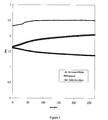
- the infrared data used are shown in Figure 1. These are the profiles infrared of the different products obtained by deconvolution of raw data infrared, they represent the absorbance of the products as a function of time.
- Ci is the molar concentration of product i
- Hi is the response coefficient Area / calculated molar concentration
- Ai is the area of product i in CHLP.
- the concentration profile obtained by correlating the CHLP points and the infrared profiles is presented in FIG. 2.
- the residue on the material balance for the infrared is 1.3 10 -13 and the correlation residue between the CHLP and infrared results is 6 10 -4 .
- the equality of balance sheets and results is therefore well achieved.
- the concentration profiles are therefore realistic.
- This method made it possible to find the relative response coefficients of the then to obtain a concentration profile respecting the material balance to every instant and for each measurement series and corresponding to the kinetic model known.
Landscapes
- Chemical & Material Sciences (AREA)
- Physics & Mathematics (AREA)
- Spectroscopy & Molecular Physics (AREA)
- Organic Chemistry (AREA)
- Biochemistry (AREA)
- Analytical Chemistry (AREA)
- Life Sciences & Earth Sciences (AREA)
- General Health & Medical Sciences (AREA)
- General Physics & Mathematics (AREA)
- Immunology (AREA)
- Pathology (AREA)
- Health & Medical Sciences (AREA)
- Investigating Or Analysing Materials By Optical Means (AREA)
Abstract
Description
| T (h) | Aire du pic acide benzoïque (ua) | Aire du pic benzoate d'éthyle (ua) |
| 0 | 7824759,5 | 86477 |
| 0,233 | 7529081,5 | 218547 |
| 0,666 | 7237722 | 561973 |
| 4,1 | 5685246 | 2018365 |
| T (h) | Abs réduite Acide benzoïque | Abs réduite Benzoate d'éthyle |
| 0 | 1 | 0 |
| 0,233 | 0,89354125 | 0,10645875 |
| 0,666 | 0,67349637 | 0,32650363 |
| 4,1 | 0 | 1 |
| ABS brute min | 1,382 | 1,648 |
| ABS brute max. | 1,6204 | 2,041 |
| Produit | H statistique | H expérimental |
| Acide benzoïque | 4,55.106 | 4,36 106 |
| Benzoate d'éthyle | 4,293.106 | 4,38106 |
βio, βi1 et βi2 les coefficients du modèle de corrélation pour le produit i
[Abs Xri]t l'absorbance réduite du produit i à l'instant t
| Coefficient du modèle | Acide benzoïque | Benzoate d'éthyle |
| βo | 1,24897 | 0,0201432 |
| β1 | 0,44988 | 0,44987 |
| β2 | -2,6 e-6 | 2,573e-6 |
Claims (2)
- Méthode de détermination des concentrations des espèces du milieu par la mesure de spectres infrarouges en fonction du temps et d'une seconde mesure à partir d'une technique d'analyse proportionnelle à la concentration de l'espèce dans le milieu caractérisée par la détermination dans le milieu des coefficients de proportionnalité infrarouge et CLHP.
- Méthode de détermination des concentrations des espèces du milieu sans calibration préalable des deux appareils par la mesure de spectres infrarouges en fonction du temps avec un appareil à infrarouge et d'une seconde mesure à partir d'une technique d'analyse proportionnelle à la concentration de l'espèce dans le milieu avec un appareil CLHP.
Applications Claiming Priority (2)
| Application Number | Priority Date | Filing Date | Title |
|---|---|---|---|
| FR0206781A FR2840406B1 (fr) | 2002-06-03 | 2002-06-03 | Methode de determination de profils de concentration a partir de profils infrarouges et de donnees clhp |
| FR0206781 | 2002-06-03 |
Publications (1)
| Publication Number | Publication Date |
|---|---|
| EP1369680A1 true EP1369680A1 (fr) | 2003-12-10 |
Family
ID=29433300
Family Applications (1)
| Application Number | Title | Priority Date | Filing Date |
|---|---|---|---|
| EP03291273A Withdrawn EP1369680A1 (fr) | 2002-06-03 | 2003-05-28 | Méthode de détermination de profils de concentration à partir de profils infrarouges et de données CLHP |
Country Status (3)
| Country | Link |
|---|---|
| US (2) | US20040003654A1 (fr) |
| EP (1) | EP1369680A1 (fr) |
| FR (1) | FR2840406B1 (fr) |
Cited By (1)
| Publication number | Priority date | Publication date | Assignee | Title |
|---|---|---|---|---|
| EP1932953A1 (fr) * | 2006-12-11 | 2008-06-18 | Atotech Deutschland Gmbh | Procédé galvanique avec analyse du bain electrolytique par extraction en phase solide |
Families Citing this family (1)
| Publication number | Priority date | Publication date | Assignee | Title |
|---|---|---|---|---|
| CN103454435B (zh) * | 2013-08-06 | 2014-06-25 | 北京农业质量标准与检测技术研究中心 | 一种农药残留检测方法 |
Citations (3)
| Publication number | Priority date | Publication date | Assignee | Title |
|---|---|---|---|---|
| DD231649A1 (de) * | 1984-12-17 | 1986-01-02 | Akad Wissenschaften Ddr | Einrichtung zur messung von differenzspektren geloester stoffe |
| WO1995033705A1 (fr) * | 1994-06-03 | 1995-12-14 | Exxon Chemical Patents Inc. | Procede pour controler la conversion de plastifiants au moyen de l'analyse dans l'infrarouge proche |
| WO2002000760A1 (fr) * | 2000-06-23 | 2002-01-03 | General Electric Company | Evaluation par infrarouge du rapport stoechiometrique du phenol dihydrique sur le diarylcarbonate durant le production de polycarbonates |
Family Cites Families (3)
| Publication number | Priority date | Publication date | Assignee | Title |
|---|---|---|---|---|
| US5599796A (en) * | 1993-12-02 | 1997-02-04 | Emory University | Treatment of urogenital cancer with boron neutron capture therapy |
| US6818450B2 (en) * | 2001-05-22 | 2004-11-16 | Monsanto Technology Llc | Use of infrared spectroscopy for on-line process control and endpoint detection |
| EP1429783A4 (fr) * | 2001-09-04 | 2006-08-09 | Univ Texas Tech | Chelates d'imagerie multimodaux a usages multiples |
-
2002
- 2002-06-03 FR FR0206781A patent/FR2840406B1/fr not_active Expired - Fee Related
-
2003
- 2003-05-28 EP EP03291273A patent/EP1369680A1/fr not_active Withdrawn
- 2003-06-02 US US10/452,412 patent/US20040003654A1/en not_active Abandoned
-
2006
- 2006-01-30 US US11/343,162 patent/US20060180757A1/en not_active Abandoned
Patent Citations (3)
| Publication number | Priority date | Publication date | Assignee | Title |
|---|---|---|---|---|
| DD231649A1 (de) * | 1984-12-17 | 1986-01-02 | Akad Wissenschaften Ddr | Einrichtung zur messung von differenzspektren geloester stoffe |
| WO1995033705A1 (fr) * | 1994-06-03 | 1995-12-14 | Exxon Chemical Patents Inc. | Procede pour controler la conversion de plastifiants au moyen de l'analyse dans l'infrarouge proche |
| WO2002000760A1 (fr) * | 2000-06-23 | 2002-01-03 | General Electric Company | Evaluation par infrarouge du rapport stoechiometrique du phenol dihydrique sur le diarylcarbonate durant le production de polycarbonates |
Cited By (3)
| Publication number | Priority date | Publication date | Assignee | Title |
|---|---|---|---|---|
| EP1932953A1 (fr) * | 2006-12-11 | 2008-06-18 | Atotech Deutschland Gmbh | Procédé galvanique avec analyse du bain electrolytique par extraction en phase solide |
| WO2008071371A3 (fr) * | 2006-12-11 | 2009-02-26 | Atotech Deutschland Gmbh | Procédé galvanique avec analyse du bain électrolytique par extraction en phase solide |
| US9057145B2 (en) | 2006-12-11 | 2015-06-16 | Atotech Deutschland Gmbh | Electrodeposition method with analysis of the electrolytic bath by solid phase extraction |
Also Published As
| Publication number | Publication date |
|---|---|
| US20040003654A1 (en) | 2004-01-08 |
| FR2840406A1 (fr) | 2003-12-05 |
| FR2840406B1 (fr) | 2005-02-25 |
| US20060180757A1 (en) | 2006-08-17 |
Similar Documents
| Publication | Publication Date | Title |
|---|---|---|
| Hu et al. | Rapid detection of three quality parameters and classification of wine based on Vis-NIR spectroscopy with wavelength selection by ACO and CARS algorithms | |
| Yu et al. | Nondestructive determination of SSC in Korla fragrant pear using a portable near-infrared spectroscopy system | |
| Nieuwoudt et al. | Principal component analysis applied to Fourier transform infrared spectroscopy for the design of calibration sets for glycerol prediction models in wine and for the detection and classification of outlier samples | |
| Cen et al. | Measurement of soluble solids contents and pH in orange juice using chemometrics and vis− NIRS | |
| Chapman et al. | Spectroscopic approaches for rapid beer and wine analysis | |
| da Silva Ferreira et al. | Determination of pitaya quality using portable NIR spectroscopy and innovative low-cost electronic nose | |
| Cozzolino | Sample presentation, sources of error and future perspectives on the application of vibrational spectroscopy in the wine industry | |
| CN108508122A (zh) | 色谱仪用数据处理装置 | |
| RU2007135874A (ru) | Система окраски волос | |
| CN111157484A (zh) | 用于水果糖度检测设备的近红外光谱模型传递方法 | |
| CN105675582B (zh) | 利用拉曼光谱检测水果中β-胡萝卜素含量的方法 | |
| Huang et al. | Multigranularity cascade forest algorithm based on hyperspectral imaging to detect moisture content in Daqu | |
| Lu et al. | The rapid quantitative analysis of three pesticides in cherry tomatoes and red grape samples with Tchebichef image moments | |
| EP3411691A1 (fr) | Procédé et appareil d'analyse spectroscopique, utilisant un traitement multivoies de données spectrales en infrarouge et en fluorescence | |
| CA3135861A1 (fr) | Procede pour configurer un dispositif de spectrometrie | |
| Chen et al. | Detection of the alcohol fermentation process in vinegar production with a digital micro-mirror based NIR spectra set-up and chemometrics | |
| CN105004707B (zh) | Ccd阵列在线拉曼光谱仪谱图标准化方法 | |
| Yang et al. | A novel method for quantitative determination of multiple substances using Raman spectroscopy combined with CWT | |
| CN104297201A (zh) | 一种快速、准确定量调和油中各种油份比例的检测方法 | |
| CN106338503A (zh) | 植物油的过氧化值快速检测方法 | |
| EP1369680A1 (fr) | Méthode de détermination de profils de concentration à partir de profils infrarouges et de données CLHP | |
| CN105067540A (zh) | 一种利用可见光透射吸收光谱鉴别植物油种类的方法 | |
| Mehrotra | Infrared spectroscopy, gas chromatography/Infrared in food analysis | |
| CN107036999A (zh) | 一种基于近红外光谱及化学计量学的五元调和油定量分析方法 | |
| Shadrack et al. | A rapid method for methanol quantification in spirits using UV-visible spectroscopy and FTIR |
Legal Events
| Date | Code | Title | Description |
|---|---|---|---|
| PUAI | Public reference made under article 153(3) epc to a published international application that has entered the european phase |
Free format text: ORIGINAL CODE: 0009012 |
|
| AK | Designated contracting states |
Kind code of ref document: A1 Designated state(s): AT BE BG CH CY CZ DE DK EE ES FI FR GB GR HU IE IT LI LU MC NL PT RO SE SI SK TR |
|
| AX | Request for extension of the european patent |
Extension state: AL LT LV MK |
|
| RIN1 | Information on inventor provided before grant (corrected) |
Inventor name: LAGOUARDAT, JACQUES,RESIDENCE DE LA TOUR Inventor name: NOGENT, HELENE |
|
| 17P | Request for examination filed |
Effective date: 20040611 |
|
| AKX | Designation fees paid |
Designated state(s): AT BE BG CH CY CZ DE DK EE ES FI FR GB GR HU IE IT LI LU MC NL PT RO SE SI SK TR |
|
| AXX | Extension fees paid |
Extension state: MK Payment date: 20040611 Extension state: LV Payment date: 20040611 Extension state: LT Payment date: 20040611 Extension state: AL Payment date: 20040611 |
|
| STAA | Information on the status of an ep patent application or granted ep patent |
Free format text: STATUS: THE APPLICATION IS DEEMED TO BE WITHDRAWN |
|
| 18D | Application deemed to be withdrawn |
Effective date: 20071201 |