EP1365566A2 - Transaktionsbasierte Konfiguration von Mediengatewaysgruppe in einer Kundendienstanrufzentrale - Google Patents
Transaktionsbasierte Konfiguration von Mediengatewaysgruppe in einer Kundendienstanrufzentrale Download PDFInfo
- Publication number
- EP1365566A2 EP1365566A2 EP03012491A EP03012491A EP1365566A2 EP 1365566 A2 EP1365566 A2 EP 1365566A2 EP 03012491 A EP03012491 A EP 03012491A EP 03012491 A EP03012491 A EP 03012491A EP 1365566 A2 EP1365566 A2 EP 1365566A2
- Authority
- EP
- European Patent Office
- Prior art keywords
- server
- request
- media gateway
- administrator
- transaction
- Prior art date
- Legal status (The legal status is an assumption and is not a legal conclusion. Google has not performed a legal analysis and makes no representation as to the accuracy of the status listed.)
- Withdrawn
Links
Images


Classifications
-
- H—ELECTRICITY
- H04—ELECTRIC COMMUNICATION TECHNIQUE
- H04M—TELEPHONIC COMMUNICATION
- H04M3/00—Automatic or semi-automatic exchanges
- H04M3/42—Systems providing special services or facilities to subscribers
- H04M3/50—Centralised arrangements for answering calls; Centralised arrangements for recording messages for absent or busy subscribers ; Centralised arrangements for recording messages
- H04M3/51—Centralised call answering arrangements requiring operator intervention, e.g. call or contact centers for telemarketing
-
- H—ELECTRICITY
- H04—ELECTRIC COMMUNICATION TECHNIQUE
- H04M—TELEPHONIC COMMUNICATION
- H04M3/00—Automatic or semi-automatic exchanges
- H04M3/42—Systems providing special services or facilities to subscribers
- H04M3/50—Centralised arrangements for answering calls; Centralised arrangements for recording messages for absent or busy subscribers ; Centralised arrangements for recording messages
- H04M3/51—Centralised call answering arrangements requiring operator intervention, e.g. call or contact centers for telemarketing
- H04M3/5183—Call or contact centers with computer-telephony arrangements
- H04M3/5191—Call or contact centers with computer-telephony arrangements interacting with the Internet
-
- H—ELECTRICITY
- H04—ELECTRIC COMMUNICATION TECHNIQUE
- H04M—TELEPHONIC COMMUNICATION
- H04M3/00—Automatic or semi-automatic exchanges
- H04M3/42—Systems providing special services or facilities to subscribers
- H04M3/50—Centralised arrangements for answering calls; Centralised arrangements for recording messages for absent or busy subscribers ; Centralised arrangements for recording messages
- H04M3/51—Centralised call answering arrangements requiring operator intervention, e.g. call or contact centers for telemarketing
- H04M3/5175—Call or contact centers supervision arrangements
-
- H—ELECTRICITY
- H04—ELECTRIC COMMUNICATION TECHNIQUE
- H04M—TELEPHONIC COMMUNICATION
- H04M3/00—Automatic or semi-automatic exchanges
- H04M3/42—Systems providing special services or facilities to subscribers
- H04M3/50—Centralised arrangements for answering calls; Centralised arrangements for recording messages for absent or busy subscribers ; Centralised arrangements for recording messages
- H04M3/51—Centralised call answering arrangements requiring operator intervention, e.g. call or contact centers for telemarketing
- H04M3/523—Centralised call answering arrangements requiring operator intervention, e.g. call or contact centers for telemarketing with call distribution or queueing
- H04M3/5232—Call distribution algorithms
- H04M3/5233—Operator skill based call distribution
Definitions
- the present invention relates to administration of media gateways, and more particularly, transaction-based administration of media gateways in a customer care center.
- customer care center was a synonym for a call center, where a call center is a common interface between a commercial interest and its customers.
- a toll-free telephone number is often provided to customers as a source of such services as product information and technical support.
- customer care centers now bring together such varied components as call processing servers, fax response severs, world wide web response servers, interactive voice response servers and databases of customer billing and sales information.
- One known model of relating two computer programs is well suited to a customer care center.
- one program, the client makes a service request from another program, the server, which fulfils the request.
- the processing requirements of any one of these applications are increasingly difficult to meet with a single node. Consequently, networks of nodes may be used, but only if the application can "scale” to take advantage of the combined processing power.
- implementing truly scalable client/server systems is very difficult (see John Lam, "Building Scalable Apps" PC Magazine, 4/21/98, incorporated herein by reference).
- computing hardware and software employed to perform the above tasks has been chosen for their individual qualities rather than for an ability to work together in a customer care center environment.
- media gateways are used to allow the applications to communicate. For instance, a customer visiting a company's web page may make a purchase. Information relating that purchase may be used to bill the customer, deliver the goods and update a customer history record. As these may happen on different systems within a company, synchronization of the data may be important.
- a media gateway is a combination of hardware and software that links two different types of networks.
- a call center server (such as the Symposium Call Center Server, from Nortel Networks Corporation of Montreal, Canada) is an example of a media gateway in that a call from one network, the public switch telephone network (PSTN) for instance, is linked (routed) to an agent at a telephone on another network, say a private branch exchange (PBX) at the customer care center.
- PSTN public switch telephone network
- PBX private branch exchange
- a web response server (such as the Symposium Web Response Server, from Nortel Networks Corporation of Montreal, Canada) is a media gateway in that an e-mail message arriving from one data network, the Internet for instance, is linked (or directed) to an agent on another data network, say a local area data network (LAN) at the customer care center.
- An agent server (such as the Symposium Agent Server, from Nortel Networks Corporation of Montreal, Canada) may present an agent with a display of information relating to an incoming call. Once an agent is assigned to an incoming call, an agent server can use information associated with the incoming call (such as calling line identification) to present data associated with a caller likely to be placing the call, such as name and purchasing history. The associated data may be presented to the agent on an associated terminal screen.
- an agent server is a media gateway because information gleaned from a telephone network may be used to present information via a data network.
- information may be known about the incoming call or e-mail message.
- the information may be known as a result of a caller answering a number of questions presented by an Interactive Voice Response (IVR) server or by matching calling line identification with a record in a database.
- IVR Interactive Voice Response
- the information may be used to direct the incoming call or e-mail to an agent that has qualities (often called a skillset) appropriate to answering the call or e-mail message.
- the customer care center To properly direct the call or e-mail message, the customer care center also requires general data on available agents, like the skillsets with which each one is associated, as well as specific data on individual available agents, like a telephone directory number (for a call center server), an e-mail address (for a web response server) or a terminal network address (for an agent server).
- available agents like the skillsets with which each one is associated, as well as specific data on individual available agents, like a telephone directory number (for a call center server), an e-mail address (for a web response server) or a terminal network address (for an agent server).
- the present invention allows creation of administrative groups among heterogeneous media gateways and related equipment.
- the data on the equipment in the administrative groups may then be configured, maintained, and administered using transaction-based processing techniques.
- a method of configuring an administrative group including receiving, from a client, an indication of a media gateway to add to an administrative group and an administrator with which to associate the administrative group and adding the media gateway to the administrative group associated with the administrator.
- a method of administering heterogeneous media gateways including receiving, from a client, a request relating to an administrative group, where the administrative group comprises a plurality of heterogeneous media gateways.
- the method further includes, using transaction-based processing techniques, communicating a gateway specific request, based on the received request, to each the media gateway in the administrative group and receiving a response to the gateway specific request from each the media gateway in the administrative group.
- an transaction-based administration server for carrying out this method.
- a computer media product that permits a general purpose computer to carry out this method.
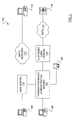
- FIG. 1 illustrates a communication system 100 including various channels through which customers may contact a customer care center 104 and channels through which customer care center 104 may be administered.
- a connection to customer care center 104 is maintained by a transaction-based administration server 102.
- An administrator may communicate with transaction-based administration server 102 through the use of a user interface at either a thick client 106 or a thin client 108, where the latter presents the user interface as served by a hypertext transfer protocol server 110 (also known as HTTP server, world wide web server or just web server).
- a customer at telephone station apparatus 116 may call a customer care center 104 over a voice link, say via a public switched telephone network (PSTN) 114.
- PSTN public switched telephone network
- Transaction-based administration server 102 may be loaded with administration software for executing the method of this invention from software medium 120 , which could be a disk, tape, chip or random access memory containing a file downloaded from a remote source.
- Transaction-based administration server 102 includes a request broker 202 , a request queue 204, a configuration database 206 and a set of configuration drivers 208 which facilitate communication with various servers comprising customer care center 104.
- a call center server 210 which is a component of customer care center 104, connects, via an embedded LAN (ELAN) 218 , to a PBX switch 224 and also connects to a customer LAN (CLAN) 216.
- ELAN embedded LAN
- CLAN customer LAN
- Each agent at the customer care center 104 may be equipped with one of a number of telephone station apparatus 222A, 222B, 222C and one of a number of terminals 220A, 220B, 220C.
- an Agent "A” may have access to telephone station apparatus 222A and terminal 220A. While terminals 220A, 220B, 220C connect to CLAN 216, telephone station apparatus 222A, 222B, 222C connect to PBX switch 224, which maintains a link to PSTN 114.
- Also connected to CLAN 216 may be a web response server 214, maintaining a link to data network 110, and an agent server 212.
- an administrator defines the location and type of each server in a given network.
- Any of the servers which may act as media gateways (i.e. any of servers 210, 212 and 214 but not administration server 102 ), may then be logically collected into administrative groups by the administrator. For instance, servers that have synchronized configuration data may be grouped together.
- Transaction-based processing techniques may then be used to configure, maintain and administer the configuration data for the servers in each administrative group. For instance, with reference to FIG. 1 and 2 , an administration session may be opened, via request queue 204 of transaction-based administration server 102, through the use of a user interface application run on thick 106 or thin 108 client, and administrative tasks may be executed on one of the administrative groups.
- a transaction is a sequence of information exchanges and related work (such as database updates) that is treated as a single unit for the purposes of satisfying a request.
- Transaction-based processing is a type of computer processing in which a computer responds to user requests. Each request is considered to be a transaction.
- Automatic teller machines for banks are an example of an application of transaction-based processing.
- Configuration database 206 stores information on the location and type of each server in the network. Information stored on configuration database 206 related to a particular server may include the transaction types possible at the server, the server's network address, the server type and a log of transaction information for auditing purposes.
- Request queue 204 is preferably a software component that stores and submits transaction requests to request broker 202 and maintains the state of a session at a client (i.e. whether the client is connected or disconnected). Request queue 204 may proxy an administrative transaction on behalf of the client so that the client does not have to remain connected to the server while the transaction executes.
- the transaction result may be stored by request queue 204 and transmitted to the client when the client reconnects to the server.
- Request broker 202 executes administrative transactions on an administrative group of servers. Note that there can be more than one administrative group, request broker 202 will roll-back a transaction if it cannot be completed on an entire administrative group of servers, and transaction execution details may be recorded by request broker 202 for auditing purposes.
- Configuration drivers 208 are software components that manage connectivity to servers in the network. Specifically, a particular configuration driver 208, associated with a particular server, has an ability to set up and to break down a connection between the particular server and request broker 202, as required. Data is passed by a configuration driver 208 from request broker 202 to a particular type of server depending on the transaction type. The transaction may then be executed on the server.
- thick client 106 is an application that maintains persistent data on a client workstation and enables a user to perform administrative tasks
- thin client 108 is an application that has no persistent data on the client workstation yet enables a user to perform administrative tasks.
- thin client 108 uses a Hyper-Text Markup Language (HTML) browser to launch an administrative application on a client workstation.
- Web server 110 is a component that provides the capability for browser-based administration, such as administration based at thin client 108.
- a particular administrator initializes a user interface application at thick client 106 (FIG. 1 ) running, say, MicrosoftTM WindowsTM as an operating system.
- the administrator logs onto request broker 202 (for example, a MicrosoftTM Transaction Server) through request queue 204.
- Request broker 202 authenticates the administrator and presents a view of customer care center 104, which view is specific to the particular administrator.
- the view of customer care center 104 which may have been set up by the administrator at an earlier time, is retrieved by request broker 202 from a configuration database 206. Also stored in configuration database 206 may be a record of capabilities and privileges for that particular administrator.
- the administrator may wish to configure a new administrative group. Through requests made of request broker 202 , a new group may be opened and given a name, say "Group X". The administrator may then request that call center server 210 be added to Group X.
- the request sent to request broker 202, via request queue 204 (a MicrosoftTM Message Queue Server, for instance), may include a name for call center server 210 and a network address.
- the request causes request broker 202 to initiate an appropriate driver, among a set of configuration drivers 208 , to be used for communicating with call center server 210. Through the use of the appropriate driver, request broker 202 confirms that communication may be established with call center server 210. Once satisfied of the availability of communication with call center server 210, request broker 202 adds call center server to Group X, for this administrator.
- a similar procedure may be used to add web response server 214 and agent server 212 to Group X, for this administrator.
- a number of data elements may be defined for the various servers in a group. However, where some data elements may be shared between all servers, many may be unique to a single server. For instance, both a call center server and a web response server require knowledge of a data element which specifies skillsets to associate with a particular agent, but only the web response server requires knowledge of a data element specifying the particular agent's e-mail address.
- the administrator may perform administrative tasks with regard to an entire group.
- the administrator may send a request to request broker 202 .
- the request from the client is analyzed using information relating to each server in the administrative group found in configuration database 206.
- the data elements appropriate to the particular server are used in creating a message to the server. This message makes a request, corresponding to the administrator's request, in a format specific to the particular server.
- request broker 202 may indicate to the client that the requested task was completed.
- the administrator may add a new agent to Group X.
- the administrator creates a request for the addition of the new agent by specifying, via the user interface, information relating to the agent such as a name, a directory number for the agent's phone, an e-mail address, a network address for the agent's terminal, skillsets with which the agent is associated, etc.
- the specifications of the new agent are sent to request broker 202 in a request message.
- Request broker 202 first receives the request message (step 302 ).
- request broker 202 analyzes the request message (step 304 ) received from the client, determining, from information in configuration database 206 , which servers are members of Group X and which data elements are to be included in an "add agent" request for each server in Group X.
- Request broker 202 then sends an "add agent" request (step 306 ) to each server in Group X, namely call center server 210, web response server 214 and agent server 212.
- An "add agent" request to call center server 210 might include the agent's name, a directory number for the agent's phone and skillsets with which the agent is associated.
- Request broker 202 receives responses (step 310 ) from the servers. After determining that responses have been received from all servers (step 312 ), request broker 202 determines which of the responses indicate fulfillment of the "add agent" request (step 314 ). If all responses indicate fulfillment of the "add agent” request, request broker 202 indicates to the client (step 316 ) that the agent has been added to Group X. However, if even one server indicates a failure to perform the request, request broker 202 indicates to all servers to "roll back" the request (step 318 ). That is, the servers are instructed to return to the state that preceded the request. Request broker 202 then indicates to the client (step 320 ) that the request to add an agent to Group X has failed.
- a second administrator may be making requests of request broker 202 and that the presentation order of requests from varied sources is determined by request queue 204.
- the second administrator may define administrative groups differently than other administrators, dependent on the second administrator's privileges and responsibilities within the organization. For instance, the second administrator may be responsible for all the web response servers in network of customer care centers. The view presented by request broker 202 to the second administrator via the user interface application in use by the second administrator would then be different from the view presented to other administrators with different responsibilities.
- request broker 202 (FIG. 2 ) is a MicrosoftTM Transaction Server
- programming objects allowing transaction-based administration server 102 (FIG. 2 ) to perform the method of the present invention, can be written using virtually any object-oriented programming language.
Landscapes
- Business, Economics & Management (AREA)
- Marketing (AREA)
- Engineering & Computer Science (AREA)
- Signal Processing (AREA)
- Telephonic Communication Services (AREA)
Applications Claiming Priority (3)
| Application Number | Priority Date | Filing Date | Title |
|---|---|---|---|
| US46118599A | 1999-12-14 | 1999-12-14 | |
| US461185 | 1999-12-14 | ||
| EP00650167A EP1109388A3 (de) | 1999-12-14 | 2000-10-25 | Transaktionsbasierte Administration von Mediengateways in einer Kundendienstanrufzentrale |
Related Parent Applications (1)
| Application Number | Title | Priority Date | Filing Date |
|---|---|---|---|
| EP00650167A Division EP1109388A3 (de) | 1999-12-14 | 2000-10-25 | Transaktionsbasierte Administration von Mediengateways in einer Kundendienstanrufzentrale |
Publications (2)
| Publication Number | Publication Date |
|---|---|
| EP1365566A2 true EP1365566A2 (de) | 2003-11-26 |
| EP1365566A3 EP1365566A3 (de) | 2003-12-03 |
Family
ID=23831540
Family Applications (2)
| Application Number | Title | Priority Date | Filing Date |
|---|---|---|---|
| EP00650167A Withdrawn EP1109388A3 (de) | 1999-12-14 | 2000-10-25 | Transaktionsbasierte Administration von Mediengateways in einer Kundendienstanrufzentrale |
| EP03012491A Withdrawn EP1365566A3 (de) | 1999-12-14 | 2000-10-25 | Transaktionsbasierte Konfiguration von Mediengatewaysgruppe in einer Kundendienstanrufzentrale |
Family Applications Before (1)
| Application Number | Title | Priority Date | Filing Date |
|---|---|---|---|
| EP00650167A Withdrawn EP1109388A3 (de) | 1999-12-14 | 2000-10-25 | Transaktionsbasierte Administration von Mediengateways in einer Kundendienstanrufzentrale |
Country Status (2)
| Country | Link |
|---|---|
| EP (2) | EP1109388A3 (de) |
| CA (1) | CA2323246A1 (de) |
Cited By (1)
| Publication number | Priority date | Publication date | Assignee | Title |
|---|---|---|---|---|
| US7660824B2 (en) * | 2004-05-20 | 2010-02-09 | Bea Systems, Inc. | System and method for performing batch configuration changes |
Families Citing this family (1)
| Publication number | Priority date | Publication date | Assignee | Title |
|---|---|---|---|---|
| DE10202499A1 (de) * | 2002-01-23 | 2003-07-31 | Siemens Ag | Call-Center sowie Verfahren zum Betreiben eines Call-Centers |
Family Cites Families (4)
| Publication number | Priority date | Publication date | Assignee | Title |
|---|---|---|---|---|
| US5784452A (en) * | 1994-06-01 | 1998-07-21 | Davox Corporation | Telephony call center with agent work groups |
| US6209018B1 (en) * | 1997-11-13 | 2001-03-27 | Sun Microsystems, Inc. | Service framework for a distributed object network system |
| US20020049693A1 (en) * | 1997-11-21 | 2002-04-25 | Hewlett-Packard Company | Batch configuration of network devices |
| GB2334353B (en) * | 1998-02-12 | 2002-08-07 | Ibm | An apparatus,method and computer program product for client/server computing with the ability to select which servers are capable of creating transaction stat |
-
2000
- 2000-10-11 CA CA 2323246 patent/CA2323246A1/en not_active Abandoned
- 2000-10-25 EP EP00650167A patent/EP1109388A3/de not_active Withdrawn
- 2000-10-25 EP EP03012491A patent/EP1365566A3/de not_active Withdrawn
Cited By (1)
| Publication number | Priority date | Publication date | Assignee | Title |
|---|---|---|---|---|
| US7660824B2 (en) * | 2004-05-20 | 2010-02-09 | Bea Systems, Inc. | System and method for performing batch configuration changes |
Also Published As
| Publication number | Publication date |
|---|---|
| EP1109388A2 (de) | 2001-06-20 |
| EP1365566A3 (de) | 2003-12-03 |
| CA2323246A1 (en) | 2001-06-14 |
| EP1109388A3 (de) | 2003-03-12 |
Similar Documents
| Publication | Publication Date | Title |
|---|---|---|
| US6654815B1 (en) | Contact server for call center | |
| US7315616B2 (en) | System and method for maintaining real-time agent information for multi-channel communication queuing | |
| US8365205B2 (en) | Adaptive communication application programming interface | |
| JP3226929B2 (ja) | 電話通信とデータ通信を調整するための装置および方法 | |
| US6330243B1 (en) | System and method for providing an electronic chat session between a data terminal and an information provider at the request of an inquiring party input into the data terminal | |
| EP1087596B1 (de) | Verfahren und Gerät zum Bereitstellen von geschätzten Antwort-Wartenzeit Anzeigen für Daten-Netzwerke basierte Abfragen eines Kommunikationscentrum | |
| US7522582B2 (en) | Embedded WEB phone module | |
| US20090252320A1 (en) | System and Method for Multi-Channel Communication Queuing | |
| US20020194272A1 (en) | Method for establishing a communication connection between two or more users via a network of interconnected computers | |
| JPH11514820A (ja) | カスタマ・コンタクト・サービス・ノード/インターネット・ゲートウェイを介してカスタマ・コンタクト・サービスを提供するためのシステムおよび方法 | |
| JP2001517033A (ja) | 小企業とクライアント間の自動ネットワーク接続のための方法および装置 | |
| CA2480503A1 (en) | Videoconference with a call center | |
| US7302051B1 (en) | System and method for providing an automatic telephone call back from information provided at a data terminal | |
| AU771695B2 (en) | Enterprise contact server with enhanced routing features | |
| EP1365566A2 (de) | Transaktionsbasierte Konfiguration von Mediengatewaysgruppe in einer Kundendienstanrufzentrale | |
| US20070203797A1 (en) | Configurable media-independent server | |
| WO2002009406A1 (en) | Method and system for providing multichannel customer interaction | |
| US20050169455A1 (en) | Method and apparatus for demonstrating telecommunications products |
Legal Events
| Date | Code | Title | Description |
|---|---|---|---|
| PUAI | Public reference made under article 153(3) epc to a published international application that has entered the european phase |
Free format text: ORIGINAL CODE: 0009012 |
|
| PUAL | Search report despatched |
Free format text: ORIGINAL CODE: 0009013 |
|
| AC | Divisional application: reference to earlier application |
Ref document number: 1109388 Country of ref document: EP Kind code of ref document: P |
|
| AK | Designated contracting states |
Kind code of ref document: A2 Designated state(s): AT BE CH CY DE DK ES FI FR GB GR IE IT LI LU MC NL PT SE |
|
| AX | Request for extension of the european patent |
Extension state: AL LT LV MK |
|
| AK | Designated contracting states |
Kind code of ref document: A3 Designated state(s): AT BE CH CY DE DK ES FI FR GB GR IE IT LI LU MC NL PT SE |
|
| AX | Request for extension of the european patent |
Extension state: AL LT LV MK |
|
| 17P | Request for examination filed |
Effective date: 20040505 |
|
| 17Q | First examination report despatched |
Effective date: 20040622 |
|
| AKX | Designation fees paid |
Designated state(s): DE FR GB |
|
| STAA | Information on the status of an ep patent application or granted ep patent |
Free format text: STATUS: THE APPLICATION IS DEEMED TO BE WITHDRAWN |
|
| 18D | Application deemed to be withdrawn |
Effective date: 20051102 |