EP1364558B1 - Microwave cooking tray and sleeve assembly - Google Patents
Microwave cooking tray and sleeve assembly Download PDFInfo
- Publication number
- EP1364558B1 EP1364558B1 EP01992254A EP01992254A EP1364558B1 EP 1364558 B1 EP1364558 B1 EP 1364558B1 EP 01992254 A EP01992254 A EP 01992254A EP 01992254 A EP01992254 A EP 01992254A EP 1364558 B1 EP1364558 B1 EP 1364558B1
- Authority
- EP
- European Patent Office
- Prior art keywords
- tray
- sleeve
- rim
- heat seal
- food
- Prior art date
- Legal status (The legal status is an assumption and is not a legal conclusion. Google has not performed a legal analysis and makes no representation as to the accuracy of the status listed.)
- Expired - Lifetime
Links
Images



Classifications
-
- A—HUMAN NECESSITIES
- A47—FURNITURE; DOMESTIC ARTICLES OR APPLIANCES; COFFEE MILLS; SPICE MILLS; SUCTION CLEANERS IN GENERAL
- A47J—KITCHEN EQUIPMENT; COFFEE MILLS; SPICE MILLS; APPARATUS FOR MAKING BEVERAGES
- A47J36/00—Parts, details or accessories of cooking-vessels
- A47J36/06—Lids or covers for cooking-vessels
-
- A—HUMAN NECESSITIES
- A47—FURNITURE; DOMESTIC ARTICLES OR APPLIANCES; COFFEE MILLS; SPICE MILLS; SUCTION CLEANERS IN GENERAL
- A47J—KITCHEN EQUIPMENT; COFFEE MILLS; SPICE MILLS; APPARATUS FOR MAKING BEVERAGES
- A47J36/00—Parts, details or accessories of cooking-vessels
- A47J36/02—Selection of specific materials, e.g. heavy bottoms with copper inlay or with insulating inlay
- A47J36/027—Cooking- or baking-vessels specially adapted for use in microwave ovens; Accessories therefor
-
- B—PERFORMING OPERATIONS; TRANSPORTING
- B65—CONVEYING; PACKING; STORING; HANDLING THIN OR FILAMENTARY MATERIAL
- B65D—CONTAINERS FOR STORAGE OR TRANSPORT OF ARTICLES OR MATERIALS, e.g. BAGS, BARRELS, BOTTLES, BOXES, CANS, CARTONS, CRATES, DRUMS, JARS, TANKS, HOPPERS, FORWARDING CONTAINERS; ACCESSORIES, CLOSURES, OR FITTINGS THEREFOR; PACKAGING ELEMENTS; PACKAGES
- B65D77/00—Packages formed by enclosing articles or materials in preformed containers, e.g. boxes, cartons, sacks or bags
- B65D77/04—Articles or materials enclosed in two or more containers disposed one within another
- B65D77/0413—Articles or materials enclosed in two or more containers disposed one within another the inner and outer containers being rigid or semi-rigid and the outer container being of polygonal cross-section formed by folding or erecting one or more blanks, e.g. carton
- B65D77/0433—Articles or materials enclosed in two or more containers disposed one within another the inner and outer containers being rigid or semi-rigid and the outer container being of polygonal cross-section formed by folding or erecting one or more blanks, e.g. carton the inner container being a tray or like shallow container, not formed by folding or erecting one or more blanks
-
- B—PERFORMING OPERATIONS; TRANSPORTING
- B65—CONVEYING; PACKING; STORING; HANDLING THIN OR FILAMENTARY MATERIAL
- B65D—CONTAINERS FOR STORAGE OR TRANSPORT OF ARTICLES OR MATERIALS, e.g. BAGS, BARRELS, BOTTLES, BOXES, CANS, CARTONS, CRATES, DRUMS, JARS, TANKS, HOPPERS, FORWARDING CONTAINERS; ACCESSORIES, CLOSURES, OR FITTINGS THEREFOR; PACKAGING ELEMENTS; PACKAGES
- B65D81/00—Containers, packaging elements, or packages, for contents presenting particular transport or storage problems, or adapted to be used for non-packaging purposes after removal of contents
- B65D81/34—Containers, packaging elements, or packages, for contents presenting particular transport or storage problems, or adapted to be used for non-packaging purposes after removal of contents for packaging foodstuffs or other articles intended to be cooked or heated within the package
- B65D81/3446—Containers, packaging elements, or packages, for contents presenting particular transport or storage problems, or adapted to be used for non-packaging purposes after removal of contents for packaging foodstuffs or other articles intended to be cooked or heated within the package specially adapted to be heated by microwaves
- B65D81/3453—Rigid containers, e.g. trays, bottles, boxes, cups
-
- B—PERFORMING OPERATIONS; TRANSPORTING
- B65—CONVEYING; PACKING; STORING; HANDLING THIN OR FILAMENTARY MATERIAL
- B65D—CONTAINERS FOR STORAGE OR TRANSPORT OF ARTICLES OR MATERIALS, e.g. BAGS, BARRELS, BOTTLES, BOXES, CANS, CARTONS, CRATES, DRUMS, JARS, TANKS, HOPPERS, FORWARDING CONTAINERS; ACCESSORIES, CLOSURES, OR FITTINGS THEREFOR; PACKAGING ELEMENTS; PACKAGES
- B65D2205/00—Venting means
- B65D2205/02—Venting holes
-
- B—PERFORMING OPERATIONS; TRANSPORTING
- B65—CONVEYING; PACKING; STORING; HANDLING THIN OR FILAMENTARY MATERIAL
- B65D—CONTAINERS FOR STORAGE OR TRANSPORT OF ARTICLES OR MATERIALS, e.g. BAGS, BARRELS, BOTTLES, BOXES, CANS, CARTONS, CRATES, DRUMS, JARS, TANKS, HOPPERS, FORWARDING CONTAINERS; ACCESSORIES, CLOSURES, OR FITTINGS THEREFOR; PACKAGING ELEMENTS; PACKAGES
- B65D2581/00—Containers, packaging elements, or packages, for contents presenting particular transport or storage problems, or adapted to be used for non-packaging purposes after removal of contents
- B65D2581/34—Containers, packaging elements, or packages, for contents presenting particular transport or storage problems, or adapted to be used for non-packaging purposes after removal of contents for packaging foodstuffs or other articles intended to be cooked or heated within
- B65D2581/3437—Containers, packaging elements, or packages, for contents presenting particular transport or storage problems, or adapted to be used for non-packaging purposes after removal of contents for packaging foodstuffs or other articles intended to be cooked or heated within specially adapted to be heated by microwaves
- B65D2581/3439—Means for affecting the heating or cooking properties
- B65D2581/3455—Packages having means for improving the internal circulation of air
- B65D2581/3456—Means for holding the contents at a distance from the base of the package, e.g. raised islands or protrusions
-
- Y—GENERAL TAGGING OF NEW TECHNOLOGICAL DEVELOPMENTS; GENERAL TAGGING OF CROSS-SECTIONAL TECHNOLOGIES SPANNING OVER SEVERAL SECTIONS OF THE IPC; TECHNICAL SUBJECTS COVERED BY FORMER USPC CROSS-REFERENCE ART COLLECTIONS [XRACs] AND DIGESTS
- Y10—TECHNICAL SUBJECTS COVERED BY FORMER USPC
- Y10S—TECHNICAL SUBJECTS COVERED BY FORMER USPC CROSS-REFERENCE ART COLLECTIONS [XRACs] AND DIGESTS
- Y10S229/00—Envelopes, wrappers, and paperboard boxes
- Y10S229/902—Box for prepared or processed food
- Y10S229/903—Ovenable, i.e. disclosed to be placed in an oven
-
- Y—GENERAL TAGGING OF NEW TECHNOLOGICAL DEVELOPMENTS; GENERAL TAGGING OF CROSS-SECTIONAL TECHNOLOGIES SPANNING OVER SEVERAL SECTIONS OF THE IPC; TECHNICAL SUBJECTS COVERED BY FORMER USPC CROSS-REFERENCE ART COLLECTIONS [XRACs] AND DIGESTS
- Y10—TECHNICAL SUBJECTS COVERED BY FORMER USPC
- Y10S—TECHNICAL SUBJECTS COVERED BY FORMER USPC CROSS-REFERENCE ART COLLECTIONS [XRACs] AND DIGESTS
- Y10S99/00—Foods and beverages: apparatus
- Y10S99/14—Induction heating
Definitions
- the present invention relates to the field of cooking devices. More particularly, the present invention relates to a steam tray for use in a microwave oven for cooking meats, vegetables, and other food products.
- microwave oven Consumers often prefer to cook food in a microwave oven rather than conventional ovens because of the reduced cooking time required to heat foods in a microwave oven.
- cooking desirable and tasty food in a microwave oven can be a difficult task.
- Foods cooked in a microwave oven tend to be tough and/or dry in texture and consistency rather than tender and moist. When liquid is added to the food in an attempt to retain moisture, the food can become soggy and undesirable.
- microwave ovens do not evenly distribute heat to the product being cooked. This results in a cooked food product that may be very hot in one area, but cold in another area. Because of these problems, many people consider microwave cooking to be problematic and generally undesirable.
- One method for improving the texture and consistency of food cooked in a microwave oven is to use steam generated by the heated food product to assist in cooking the food. Cooking with steam not only provides moisture for the food being cooked, but also results in more consistent heating throughout the food product. In order to retain steam in a cooking container when cooking food in a microwave oven, the container must be at least partially sealed. A lid covering the cooking container is often used to provide such a complete or partial seal.
- US Patent 4013798 discloses a tray for food having a plurality of compartments and a sleeve which encloses the top of the tray and which is opaque to radiant energy.
- the sleeve has radiant transparent apertures over each compartment which are dimensioned and configured in relation to the compartments to provide the necessary amount of microwave heat to each compartment.
- This arrangement has the disadvantage that the tray and sleeve must be designed so that they can only fit together in one way to avoid incorrect heating.
- the interior of the tray is sealed by a protective cover heat-sealed to the peripheral rim of the tray and the peripheral rim contains notches which provide a weakened part for the seal.
- Water vapour venting from the tray has to pass out of the open end of the sleeve and for certain compartments the water vapour has to vent through other compartments to reach the open end, which leads to difficulty in controlling the quality of cooking.
- the sleeve is open at at least one end, in practice, the container and sleeve are placed within a further closed container.
- the present invention seeks to provide solutions to these disadvantages.
- an apparatus for cooking food comprising:
- This arrangement has the advantage that the container is cheap and inexpensive to produce such that it can be used with pre-packaged food products, such as frozen dinners. It also has the advantage that the container can be transferred directly from the freezer to the microwave without the need for additional preparation before cooking.
- the consumer When the consumer desires to cook the food in the tray for consumption, the consumer takes the tray and sleeve assembly and places the entire assembly in a microwave oven.
- the microwave oven When the microwave oven generates radiant energy, it travels through the sleeve and tray and heats the food positioned in the tray.
- the food cooks As the food cooks, it gives of water vapour and steam is generated.
- the steam and heat from cooking the food causes pressure to build in the hermetically sealed tray.
- the vents direct pressure at the weakened portion of the heat seal. Because the size of the rim is reduced at the vents, the hermetic seal between the rim and the heat seal is weakest at this point. Thus, pressure inside the tray causes the seal to first break completely away from the rim near the vents.
- the present invention provides a sealed container having a pressure relief system allowing excess pressure to be removed from the container when cooking food in a microwave oven.
- the assembly also may be transferred directly from the freezer to the microwave without the need for additional preparation before cooking.
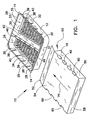
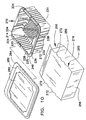
- a Microwave Cooking Tray and Sleeve Assembly 10 comprises a tray 12 for holding food to be cooked, a clear film heat seal 14 covering the tray, and a sleeve 16 designed to hold the tray.
- a tray 12 for holding food to be cooked
- a clear film heat seal 14 covering the tray
- a sleeve 16 designed to hold the tray.
- the tray 12 is made of a thermo-formed co-polymer polypropylene quality food grade plastic.
- the tray is transparent to radiant energy, such as energy from a microwave oven.
- the phrase "transparent to radiant energy” is used herein to mean that radiant energy passes through the material so that the food within the tray receives the radiant energy, and the material does not completely block the radiant energy from the food.
- the tray 12 comprises a bottom surface 26 with four sidewalls 31-34 extending therefrom to define a tray interior 28.
- a plurality of ribs 30 are raised from the bottom surface 26 to provide a cooking plane above the bottom surface 26. The ribs terminate near the interior edges of the tray before reaching the four sidewalls.
- Steam channels 29 are formed between the ribs 30, such that steam produced while cooking food in the tray travels all around the food cooked in the tray, including underneath the food.
- the four sidewalls 31-34 are bounded by a rim providing a top surface for the four sidewalls.
- the rim 35 in this embodiment of the invention extends outward from and encircles the top of the four sidewalls.
- Vents 40 are formed in the rim at two of the opposing sidewalls.
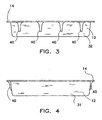
- the vents 40 each include a V-shaped indentation 38 in the rim and a channel extending beneath the V-shaped indentation and tapering into the sidewall.
- Eight vents 40, including eight V-shaped indentations are shown in Figs. 1 and 2.
- the V-shaped indentations 38 extend into the rim with the tip 39 of the "V" ending just before the edge of the rim.
- a small portion of the rim 35 extends around each V-shaped indentation 38 such that the rim is continuous around the four sidewalls 31-34 and not completely interrupted by the V-shaped indentations.
- the channel portion of the vents 40 are formed in the sidewalls 31-34 below each of the V-shaped indentations 38.
- the channel portion of the vents 40 taper out from the middle portion of the sidewalls and feed into the profile of the V-shaped indentations 38.
- a dividing wall 42 is provided in the tray interior 28.
- the dividing wall 42 extends between two opposing sidewalls 32 and 34 to split the tray interior 28 into two trapezoidal chambers 44.
- multiple dividing walls may also be used to split the tray interior into different sized and shaped compartments.
- the dividing wall 42 includes grooves 46 placed upon the top of the dividing wall 42 for providing a passage between the two chambers, thereby allowing heat and steam to be communicated between the chambers.
- the heat seal 14 is a food grade plastic film used to cover the tray 12.
- the heat seal 14 is also transparent to radiant energy.
- the heat seal 14 is typically 2 or 3 mils in thickness, but various film thicknesses may be used.
- the heat seal 14 is hermetically sealed to the tray 12 along the rim 35 after food is packed in the tray.
- the heat seal 14 provides a cover for the tray and keeps the food in an air-tight container until the seal is manually removed by a consumer or hermetic seal is broken when the food in the assembly is cooked.
- the strength of the hermetic seal between the rim 35 and the heat seal 14 is weakest near the tip of the V-shaped indentations because this is the smallest area on the rim for the heat seal to be attached to the rim.
- this weakened portion of the heat seal is designed to be the first portion of the heat seal to rupture or tear away from the rim while cooking food in the tray, thereby allowing steam to pass through the tray.
- the sleeve 16 is a box-shaped container made of cardboard or a similar paper product that is also transparent to radiant energy.
- the sleeve 16 includes a sleeve top 54, two depending sleeve sides 56, a sleeve bottom (not shown), and a sleeve back 58.
- An opening 50 is also provided at the front of the sleeve 16 and a flap 52 is attached to the top 54 of the sleeve above the opening.
- the flap 54 may be used to cover the opening 50 when the tray 12 is placed inside of the sleeve 16.
- Ports 60 in the form of holes in the sleeve 16 are placed in the top 54 of the sleeve along the two sides 56.
- the ports 60 also extend slightly down the sides 56 of the sleeve.
- the ports 60 provide passages from the inside of the sleeve 16 to the outside of the sleeve, but are not large enough to allow the tray to enter the sleeve.
- the diameter of each port is smaller than the diameter of each sidewall (i.e., the distance from one side of the tray to the opposite side, typically measured as the length of one sidewall).
- the opening 50 is the feature designed for allowing the tray to enter the sleeve, while the ports are designed for allowing steam to pass through the assembly while retaining the heat seal in place.
- the sleeve 16 is designed to contain the tray 12 and snugly hold the tray within the sleeve.
- the tips 39 of the V-shaped indentations 38 are aligned with and point to the ports 60 in the sleeve.
- the weakened portion of the heat seal 14 is also aligned with the ports 60 in the sleeve.
- the top 54 of the sleeve 16 fits against the heat seal 14 which is sealed to the rim 35 of the tray.
- the rim 35 is closely positioned to the sides 56 of the sleeve 16 when the tray 12 is placed in the sleeve. The snug positioning of the tray 12 in the sleeve 16 provides very little room for the tray 12 to move in the sleeve 16.
- the assembly 10 is used to package foods for preparation by a consumer in a microwave oven.
- the food distributor places food products in the various tray compartments 44 (i.e., the trapezoidal chambers form the compartments in Figs. 1-4). Different types of food are typically placed in differing compartments 44. For example, a meat product may be placed in one compartment and a vegetable may be placed in another compartment.
- the heat seal 14 is placed over the tray and hermetically sealed to the rim 35 to provide an air tight compartment in the tray interior 28.
- the sealed tray 12 is placed in the cardboard sleeve 16 by sliding the cardboard sleeve over the tray in the direction of arrow 70.
- the opening 50 in the tray allows the tray to slide directly into the sleeve.
- the opening may be closed by attaching the flap 52 to the bottom of the tray, for example, by use of an adhesive to secure the flap to the bottom of the tray.
- a the complete tray and sleeve assembly is prepared and the assembly is ready for distribution in the marketplace.
- the sleeve may be built around the tray after the tray is packed with food instead of inserting the tray into the completed sleeve.
- the sleeve protects the tray and insures that the heat seal 14 will remain hermetically sealed to the rim 35.
- the sleeve protects the tray by acting as a protective layer during shipping and also when the tray is displayed on the shelf, freezer, refrigerator, or other display area.
- the sleeve top 54 is typically a continuous piece that is free of any apertures other than the ports 60.
- the consumer purchasing the tray and sleeve assembly is provided with a cooking apparatus which goes directly from shelf, freezer, refrigerator, etc. to the microwave oven. After the assembly 10 is purchased, the consumer simply places the assembly in his or her home pantry, freezer or refrigerator until the consumer wishes to cook the food in the tray.
- the consumer When the consumer desires to prepare the food in the tray 12 for consumption, the consumer takes the tray and sleeve assembly 10 and places the entire assembly in a microwave oven.
- the microwave oven When the microwave oven generates radiant energy, it travels through the sleeve 16 and tray 12 and heats the food positioned in the tray 12.
- the food As the food positioned in the tray begins to heat and cook, the food gives off water vapor and steam is generated, thus increasing the temperature and building pressure within the hermetically sealed tray.
- the vents 40 direct the pressure at the tips 39 of the V-shaped indentations where the weakened portion of the heat seal is located.
- the hermetic seal between the rim and the heat seal 14 is weakest at this point.
- pressure directed at the weakened portion of the seal causes the seal to break first at the tips 39 of the V-shaped indentations 38 as the heat seal pulls away from the rim.
- an opening in the seal is created and steam and heat escape from the tray at the tips of the V-shaped indentation.
- the ports 60 in the sleeve 16 are directly aligned with the V-shaped indentations 38, the steam escapes the assembly 10 through the ports 60.
- the top 54 of the sleeve 16 rests against the heat seal 14 and keeps the heat seal in place upon the rest of the rim.
- the top of the sleeve 16 helps prevent complete removal of the heat seal from the rim along one side of the tray.
- the tray is not held by the sleeve having ports positioned thereon, or if the ports are too large (e.g., extending for the entire length of the sidewall) a large seal opening is often created when pressure within the tray causes the heat seal to rupture at one of the V-shaped indentations. If the force of the steam escaping the tray in such a "blow-out" situation is great enough, the seal opening may extend along the rim for the entire length of one sidewall.
- the size of the seal opening is minimized when the seal first ruptures and steam blows through the seal at one of the V-shaped indentations.
- the top of the sleeve and the size of the ports influence the size of the seal opening that is made when the heat seal ruptures at the V-shaped indentations.
- the size of the seal opening made when the heat seal ruptures is generally limited to the size of the slot because ruptures are limited along portions of the heat seal that are covered by the top of the sleeve.
- the ports are made larger in size, and are cut to remove the top of the sleeve away from a large portion of the rim near the V-shaped indentations. If more pressure and a smaller seal opening is desired for cooking another food product, the ports are made smaller in size and are cut to remove little, if any, of the top of the sleeve away from the rim.
- the assembly 10 allows steam to escape out of the V-shaped indentations 38 and ports 60 when the food in the tray 12 is cooked in a microwave oven, the assembly acts as a mini steam/pressure cooker. Some amount of pressure and steam is retained in the tray 12 during cooking and is used to cook the food to a desirable texture and temperature. At the same time, pressure and steam is released from the assembly 10 through the vents 40 and ports 60. As described above, the amount of pressure released from the tray during cooking is influenced by the number of vents positioned in each tray and the size of the ports formed in the cardboard sleeve.
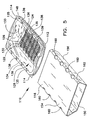
- the apparatus 110 comprises a single compartment tray 112, made of plastic and transparent to radiant energy.
- the tray 112 comprises a bottom surface 126 with four sidcwalls 131-134 extending therefrom to define a tray interior 128.
- a plurality of sinusoidal-shaped ribs 130 are raised from the bottom surface 126 to provide a cooking plane.
- the ribs terminate near the interior edges of the tray before reaching the four sidewalls.
- Sinusoidal-shaped steam channels 129 are formed between the ribs 130, such that steam produced while cooking food in the tray travels all around the food cooked in the tray, including underneath the food.
- the four sidewalls 131-134 are bounded by a rim 135 which extends outward from and encircles the top of the four sidewalls.
- Vents 138 in the form of V-shaped indentations 138 are formed in the rim on two of the opposing sidewalls.
- the V-shaped indentations 138 extend into the rim 135 with the tip of the "V" ending just before the edge of the rim.
- a small portion of the rim 135 extends around each V-shaped indentation 138 such that the rim is continuous around the four sidewalls 131-134 and not completely interrupted by the V-shaped indentations.
- a small portion of the rim 135 extends around each V-shaped indentation 138 such that the rim is continuous around the four sidewalls 131-134 and not completely interrupted by the V-shaped indentations.
- each of the V-shaped indentations 138 form a small V-shaped pocket under the heat seal 114 where the rim would otherwise be found.
- Each of the V-shaped indentations 138 are deep enough to cut slightly into the height of the sidewall immediately below the V-shaped indentation.
- a skirt 136 depends from the edge of the rim 135 opposite the sidewalls.
- the skirt 136 terminates in a flange 148 that protrudes from the skirt.
- Dents 124 are formed in the skirt 136 and flange 148.
- the dents are positioned adjacent to each of the V-shaped indentations 138 on the rim 135, but a thin portion of the rim does extend between V-shaped indentations and dents 124.
- the rim 135 is continuous around each of the four sidewalls 131-134, although the rim is relatively thin between the V-shaped indentations 138 and the dents 124.
- the dents 124 extend down the skirt 136 and across the flange 148 and act as channels that direct steam down the skirt and across the flange when steam escapes from the tray near one of the V-shaped indentations 138.
- a film heat seal 114 made of a food grade plastic film transparent to radiant energy is used to cover the tray 112.
- the heat seal 114 is hermetically sealed to the tray 112 along the rim 135 after food is packed in the tray.
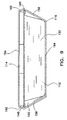
- the sleeve 116 is a cardboard or similar paper product that is transparent to radiant energy and designed to firmly hold the tray 112. As shown in Fig. 8, the sleeve in this embodiment of the invention has a substantially trapezoidal cross-section.
- the sleeve 116 includes a sleeve top 154, two beveled edges 162 positioned along the sleeve top, two sloped sleeve sides 156, and a sleeve bottom 164. Openings 150 are also provided at the front of the sleeve 116 and the rear of the sleeve for accepting the tray 112 into the sleeve.
- Ports 160 are placed in the sleeve along the beveled edges162.
- the ports 160 also extend onto the top 154 of the sleeve and the two sloped sides 156.
- the ports 160 provide passages to allow steam to escape from inside of the sleeve 116 to the outside of the sleeve.
- the sleeve 116 is designed to contain the tray 112 and snugly hold the tray within the sleeve.
- the tips 139 of the V-shaped indentations 138 are aligned with and point to the ports 160 in the sleeve, as shown in Fig. 8.
- the top 154 of the sleeve 116 fits against the heat seal 112 which is sealed to the rim 135 of the tray.
- the rim 135 is closely positioned to the beveled edges 162 of the sleeve 116 when the tray 112 is placed in the sleeve.
- the flange 148 is closely positioned to the sides 156 of the sleeve. The snug positioning of the tray 112 in the sleeve 116 provides very little room for the tray 112 to move in the sleeve 116.
- the alternative embodiment of the invention shown in Figs. 5-9 may be transferred directly from the freezer to microwave to prepare the food contained in the tray and sleeve assembly 110.
- heat and steam build within the tray 112.
- the pressure within the tray 112 causes the film 114 covering the tray to break away from the rim 135 at the tips of the V-shaped indentations 138, thereby venting steam and heat out of the holes created at the V-shaped indentations.
- the ports 160 in the sleeve allow the heat and steam to immediately vent out of the sleeve and into the atmosphere around the assembly.
- the positioning of the top 154 of the sleeve 116 against the heat seal 114 and the alignment of the ports 160 with the V-shaped indentations 138 influence the size of the seal openings created when the heat seal 114 breaks away from the rim 135 during cooking and prevents large portions of the heat seal from tearing away from the tray.
- a rigid lid may be used in association with the tray.
- the apparatus 210 includes a tray 212 having a rim 235 and four sidewalls 231-234.
- the tray further includes V-shaped indentations 238 positioned upon the rim 235.
- Each V-shaped indentation 238 is deep enough to cut slightly into the sidewall where the V-shaped indentation is positioned.
- a skirt 236 depends from the edge of the rim 235 opposite the sidewalls.
- the skirt 236 terminates in a flange 248 that protrudes substantially perpendicular to the skirt. Dents 224 are formed in the skirt 236 and flange 248.
- the dents are positioned adjacent to each of the V-shaped indentations 238 on the rim 235, but a thin portion of the rim does extend between V-shaped indentations and dents 224.
- the rim 235 is continuous around each of the four sidewalls 231-234, although the rim is relatively thin between the V-shaped indentations 238 and the dents 224.
- the dents 224 extend down the skirt 136 and across the flange 148 and act as channels that direct steam down the skirt and across the flange when steam escapes from the tray near one of the V-shaped indentations 238.
- a heat seal 214 made of a food grade plastic film transparent to radiant energy is used to cover the tray 212.
- the heat seal 214 is sealed to the tray 212 along the rim 235 after food is packed in the tray.
- a lid 280 is provided to further cover the tray 212 and heat seal 214.
- the lid includes a top 282 and a lip 284. The lid 280 snaps over the rim of the tray 212 to secure it to the tray. When snapped on to the tray, the top 282 of the lid 280 rests on the rim 235 of the tray and the lip 284 of the lid rests on the flange of the tray.
- the sleeve 216 is a cardboard or similar paper product that is transparent to radiant energy and designed to firmly hold the tray 212. As shown in Fig. 10, the sleeve in this embodiment is box shaped with sleeve sides 256 and an opening 250 provided at the front of the sleeve 216 for accepting the tray 212 into the sleeve. Ports 260 are located in the sleeve along the top of the sleeve sides 254. The ports 260 are created from small arcs 272 cut in the flattened cardboard before the sleeve it is constructed.
- the arcs 272 extend from folded portions of the box and the ports 260 are formed directly under the arcs 272 along the top edges of the sleeve sides 156.
- the ports 260 provide passages from the inside of the sleeve 216 to the outside of the sleeve.
- the word "arc" as used herein is not intended to be limited to a shape defined by a segment of a circle, buy may also include other shapes such as segments of polygons, ovals, and other shapes such that folding along the ends of the shape will create a port adjacent to the shape. This method of creating ports is desirable for high quantity sleeve manufacturing environments where speed, simplicity of manufacture, and ease of automation are important factors.
- the sleeve 216 is designed to snugly hold the tray 212.
- the tips 239 of the V-shaped indentations 238 are aligned with and point to the top portion of the ports 260 in the sleeve.
- the channels formed from dents 224 in the flange 248 are aligned with and extend toward the center of the ports 260 in the sleeve.
- the flange 248 also contacts the sleeve sides 256. If the lid 280 is included with the assembly 210, the lid is snapped on to the tray such that the lid top 282 rests on the rim 235 and the lid lip 284 rests on the flange 248.
- the top 254 of the sleeve 216 rests against the lid 280 when the tray 212 is positioned in the sleeve 216.
- the snug positioning of the tray 212 in the sleeve 116 provides very little room for the tray 212 to move in the sleeve 216.
- the lid may be used to cover any portion of the food that has not been consumed for subsequent storage in the refrigerator. After storing the food in the container, the consumer may then use the same container to reheat the food. After all of the food is finally consumed, the consumer may discard the tray.
- the consumer may use the apparatus 210 as not only a convenient container for cooking pre-packaged food, but also as a storage container for any left-overs, and a container for reheating left-overs.
- the present invention provides for a cheap and easy to produce container for preparing microwave cooked meals that are tasty and pleasing to the pallette.
- the invention provides for a disposable food container having a pressure relief system that can be easily modified so that different amounts of pressure are relieved from within the container depending upon the configuration of the tray and associated sleeve.
- the sleeve provides insulation from the heated tray when a human hand removes the tray and sleeve assembly from an oven.
- the sleeve provides additional structure to the tray and supports the weight of objects in the tray so the tray does not accidentally fold and spill when it is removed from the oven.
- V-shaped indentations and vents may be differently shaped or differently arranged than provided herein, or additional vents maybe, included.
- the ports on the sleeve may be shaped or positioned differently than that described herein, such as circular ports positioned only on the top of the sleeve or only on the side of the sleeve.
- the trays may include features such as nesting lugs that provide clearance between the trays when stacked to make the trays more compatible for use with high speed packing equipment.
- the tray and sleeve may include only a single sidewall or sides (e.g., circular shape) rather than plural sidewalls (e.g., box shape).
Landscapes
- Engineering & Computer Science (AREA)
- Food Science & Technology (AREA)
- Mechanical Engineering (AREA)
- Life Sciences & Earth Sciences (AREA)
- Package Specialized In Special Use (AREA)
- Packages (AREA)
- Cookers (AREA)
- Constitution Of High-Frequency Heating (AREA)
Applications Claiming Priority (3)
| Application Number | Priority Date | Filing Date | Title |
|---|---|---|---|
| US26368601P | 2001-01-23 | 2001-01-23 | |
| US263686P | 2001-01-23 | ||
| PCT/US2001/049728 WO2002060223A1 (en) | 2001-01-23 | 2001-12-20 | Microwave cooking tray and sleeve assembly |
Publications (3)
| Publication Number | Publication Date |
|---|---|
| EP1364558A1 EP1364558A1 (en) | 2003-11-26 |
| EP1364558A4 EP1364558A4 (en) | 2004-03-03 |
| EP1364558B1 true EP1364558B1 (en) | 2005-03-09 |
Family
ID=23002832
Family Applications (1)
| Application Number | Title | Priority Date | Filing Date |
|---|---|---|---|
| EP01992254A Expired - Lifetime EP1364558B1 (en) | 2001-01-23 | 2001-12-20 | Microwave cooking tray and sleeve assembly |
Country Status (8)
| Country | Link |
|---|---|
| US (1) | US6559431B2 (enExample) |
| EP (1) | EP1364558B1 (enExample) |
| JP (1) | JP2004520901A (enExample) |
| AT (1) | ATE290760T1 (enExample) |
| CA (1) | CA2435338A1 (enExample) |
| DE (1) | DE60109327D1 (enExample) |
| WO (1) | WO2002060223A1 (enExample) |
| ZA (1) | ZA200306500B (enExample) |
Cited By (7)
| Publication number | Priority date | Publication date | Assignee | Title |
|---|---|---|---|---|
| US9078296B2 (en) | 2011-06-08 | 2015-07-07 | Graphic Packaging International, Inc. | Tray with curved bottom surface |
| WO2015191738A1 (en) * | 2014-06-11 | 2015-12-17 | Dale Wettlaufer | Juice press apparatus and methods |
| US10232973B2 (en) | 2014-11-07 | 2019-03-19 | Graphic Packaging International, Llc | Tray for holding a food product |
| US10336500B2 (en) | 2014-11-07 | 2019-07-02 | Graphic Packaging International, Llc | Tray for holding a food product |
| US11844466B2 (en) | 2019-05-24 | 2023-12-19 | Goodnature Products, Inc. | Juicing devices with a removable grinder |
| EP4371896A1 (en) * | 2022-11-16 | 2024-05-22 | Selek Holding A/S | A display packaging for a product, uses thereof and an object comprising a product and such display packaging |
| US12344445B2 (en) | 2018-11-20 | 2025-07-01 | Graphic Packaging International, Llc | Adjustable tray |
Families Citing this family (81)
| Publication number | Priority date | Publication date | Assignee | Title |
|---|---|---|---|---|
| USD461713S1 (en) * | 2001-09-26 | 2002-08-20 | Indiana Carton Company | Food carrier |
| JP2005526670A (ja) * | 2001-10-24 | 2005-09-08 | パクティブ コーポレイション | 食肉品を低酸素濃度環境で包装するシステム及び方法 |
| US20030180426A1 (en) * | 2002-03-21 | 2003-09-25 | Wright Sabrena A. | Bacon cooker |
| CN1735543A (zh) * | 2003-01-03 | 2006-02-15 | 纳幕尔杜邦公司 | 微波感受器包装材料 |
| USD487971S1 (en) | 2003-02-07 | 2004-04-06 | Tekni-Plex, Inc. | Tray for shipment of frozen items |
| US7034268B2 (en) * | 2003-05-09 | 2006-04-25 | Steamway Franchise Sales, Inc. | Self-venting microwave cooking container for use with a vertical fill automated machine |
| US20040234653A1 (en) * | 2003-05-22 | 2004-11-25 | Cogley Paul A. | Susceptor tray and mirowavable dough products |
| US20070266864A1 (en) * | 2003-09-29 | 2007-11-22 | Gary Hopkins Sr | Microwave Cooking Container with Improved Lid Design |
| EP1680946A2 (en) * | 2003-11-03 | 2006-07-19 | Steamway Franchise Sales, Inc. | Microwave cooking container with separate compartments for crisping and steaming |
| US20060233928A1 (en) * | 2004-06-17 | 2006-10-19 | Paragon Potato Farms, Inc. | Single serving packaged potato |
| US7109455B2 (en) * | 2004-09-15 | 2006-09-19 | Steamway Franchise Sales, Inc. | Microwave cooking container with 2-position inverted dome locks |
| US20060191935A1 (en) * | 2005-01-21 | 2006-08-31 | Tuszkiewicz George A | Microwavable container with sleeve |
| US7468498B2 (en) * | 2005-01-21 | 2008-12-23 | General Mills Marketing, Inc. | Microwavable container with sleeve |
| CA2603602C (en) * | 2005-04-11 | 2010-11-16 | Graphic Packaging International, Inc. | Microwavable food package having an easy-open feature |
| US20060249522A1 (en) * | 2005-05-06 | 2006-11-09 | Dobbs-Stanford Corporation | Reusable container for retail display of electric cable components |
| FR2888225B1 (fr) * | 2005-07-05 | 2009-05-08 | Claude Sebban | Boite d'emballage pour le conditionnement, la conservation, la cuisson vapeur au four a micro-ondes et la consommation d'aliments |
| US7647866B2 (en) * | 2005-10-06 | 2010-01-19 | John Edwin Button | Griddle for cooking and preparing foods |
| US9211030B2 (en) | 2005-10-20 | 2015-12-15 | Conagra Foods Rdm, Inc. | Steam cooking apparatus |
| US8850964B2 (en) | 2005-10-20 | 2014-10-07 | Conagra Foods Rdm, Inc. | Cooking method and apparatus |
| US8302528B2 (en) | 2005-10-20 | 2012-11-06 | Conagra Foods Rdm, Inc. | Cooking method and apparatus |
| US7345262B2 (en) * | 2005-11-07 | 2008-03-18 | Graphic Packaging International, Inc. | Microwave interactive display package |
| GB0522766D0 (en) * | 2005-11-08 | 2005-12-14 | Dupont Teijin Films Us Ltd | Polymeric film packaging |
| US9132951B2 (en) * | 2005-11-23 | 2015-09-15 | Conagra Foods Rdm, Inc. | Food tray |
| CA2527770C (en) | 2005-11-21 | 2014-07-22 | Steven M. Parsons | Food tray |
| WO2007056866A1 (en) * | 2005-11-21 | 2007-05-24 | Parsons Steven M | Food tray |
| USD635816S1 (en) | 2006-06-09 | 2011-04-12 | Conagra Foods Rdm, Inc. | Container basket |
| WO2008109448A2 (en) | 2007-03-02 | 2008-09-12 | Conagra Foods Rdm, Inc. | Multi-component packaging system |
| WO2008122069A1 (en) * | 2007-04-09 | 2008-10-16 | Peter Grech | Food packaging with automatic steam safety release vent |
| WO2012064862A2 (en) * | 2010-11-10 | 2012-05-18 | Sara Lee Corporation | Packaging for food product |
| US8613249B2 (en) | 2007-08-03 | 2013-12-24 | Conagra Foods Rdm, Inc. | Cooking apparatus and food product |
| CA2700871C (en) * | 2007-10-03 | 2012-12-04 | Graphic Packaging International, Inc. | Microwave heating sleeve |
| USD608633S1 (en) * | 2007-12-18 | 2010-01-26 | Saturn Petfood Gmbh | Hand basin |
| EP2248737B1 (fr) | 2009-05-07 | 2012-03-14 | Charal | Emballage pourvu d'un film à déformation maîtrisée |
| FR2945281B1 (fr) * | 2009-05-07 | 2013-08-23 | Charal | Emballage pourvu d'un film a deformation maitrisee |
| FR2945282B1 (fr) * | 2009-05-07 | 2013-11-22 | Charal | Emballage a conditionnement confine |
| WO2011028724A1 (en) * | 2009-09-01 | 2011-03-10 | Manitowoc Foodservice Companies, Llc. | Method and apparatus for venting a cooking device |
| JP5467201B2 (ja) | 2009-11-19 | 2014-04-09 | クラフト・フーヅ・グループ・ブランヅ リミテッド ライアビリティ カンパニー | 電子レンジ用容器 |
| USD638701S1 (en) | 2010-09-08 | 2011-05-31 | Conagra Foods Rdm, Inc. | Container |
| USD639656S1 (en) | 2010-09-08 | 2011-06-14 | Con Agra Foods RDM, Inc. | Container lid |
| USD639186S1 (en) | 2010-09-08 | 2011-06-07 | Conagra Foods Rdm, Inc. | Container with sleeve |
| CA2714877C (en) * | 2010-09-15 | 2016-10-25 | Steven M. Parsons | Food tray |
| USD676721S1 (en) | 2010-11-22 | 2013-02-26 | John Edwin Button | Grill top griddle |
| WO2012072086A1 (en) * | 2010-12-03 | 2012-06-07 | Saharas A/S | Microwavable packaging assembly |
| USD717162S1 (en) | 2012-06-12 | 2014-11-11 | Conagra Foods Rdm, Inc. | Container |
| US9027825B2 (en) | 2012-06-12 | 2015-05-12 | Conagra Foods Rdm, Inc. | Container assembly and foldable container system |
| USD680426S1 (en) | 2012-06-12 | 2013-04-23 | Conagra Foods Rdm, Inc. | Container |
| US9215949B1 (en) * | 2012-10-17 | 2015-12-22 | Magellan Group Ltd. | Modular griddle and grill frame with inserts |
| US20140311361A1 (en) * | 2013-04-22 | 2014-10-23 | Eric J. Wangler | Device for storing, marinating, transporting and serving food including warming cover and cutting board and method therefor |
| WO2014190266A1 (en) | 2013-05-24 | 2014-11-27 | Graphic Packaging International, Inc. | Package for combined steam and microwave heating of food |
| US11785958B2 (en) * | 2013-06-11 | 2023-10-17 | Edgardo Torrens-Figueroa | Method and process for making natural cut pork chops |
| US11344052B2 (en) | 2014-06-11 | 2022-05-31 | Goodnature Products, Inc. | Partial or whole food hopper, grinder and cold press counter-top juicing machine, system and method |
| EP3033948A1 (en) * | 2014-12-18 | 2016-06-22 | MicVac AB | Method and device for cooking and/or pasteurization of foodstuff |
| CA2979396A1 (en) | 2015-03-11 | 2016-09-15 | Eric Wettlaufer | Apparatus and method for multi-stage cutting and juice pressing |
| US10362899B2 (en) | 2015-03-13 | 2019-07-30 | Adrenaline Barbecue Company, LLC | Barbecue grill accessory and method for preparing food |
| EP3108774B1 (en) * | 2015-06-24 | 2021-01-13 | Electrolux Appliances Aktiebolag | Cooking vessel for an oven cavity of a cooking oven |
| DE102016120615A1 (de) * | 2016-01-27 | 2017-07-27 | Lidl Stiftung & Co. Kg | Verfahren zum Herstellen, Garen und Präsentieren eines Lebensmittelprodukts sowie Verpackung zur Verwendung in diesem Verfahren |
| EP3410908A1 (en) * | 2016-02-01 | 2018-12-12 | Graphic Packaging International, LLC | Microwave heating construct |
| IT201700073576A1 (it) * | 2017-06-30 | 2018-12-30 | Cryovac Inc | Supporto, confezione, apparecchiatura e procedimento di realizzazione di detto supporto e detta confezione |
| FR3071230A1 (fr) * | 2017-09-20 | 2019-03-22 | France Food Sas | Creation d’un systeme de fermeture de barquettes cartonnees |
| CN110631352A (zh) * | 2017-10-15 | 2019-12-31 | 杜丽红 | 一种真空烤箱的联动机构 |
| WO2019108979A1 (en) | 2017-11-30 | 2019-06-06 | Dale Wettlaufer | Partial or whole food hopper, grinder and cold press counter-top juicing machine, system and method |
| US10674851B1 (en) * | 2018-01-02 | 2020-06-09 | David Haight | Microwave bacon cooker |
| US11402105B2 (en) * | 2018-12-07 | 2022-08-02 | Bsh Home Appliances Corporation | Spill proof warming drawer |
| US11292654B2 (en) * | 2019-06-20 | 2022-04-05 | Sonoco Development, Inc. | Venting system for ovenable containers |
| USD875551S1 (en) * | 2019-08-29 | 2020-02-18 | General Mills, Inc. | Packaging container |
| USD914465S1 (en) | 2019-09-12 | 2021-03-30 | Goodnature Products, Inc. | Juicing device |
| USD914464S1 (en) | 2019-09-12 | 2021-03-30 | Goodnature Products, Inc. | Press box |
| USD918656S1 (en) | 2019-09-12 | 2021-05-11 | Goodnature Products, Inc. | Pusher |
| USD915156S1 (en) | 2020-09-15 | 2021-04-06 | Goodnature Products, Inc. | Press box |
| USD916565S1 (en) | 2020-09-15 | 2021-04-20 | Goodnature Products, Inc. | Juicing device |
| CA3197556A1 (en) | 2020-11-06 | 2022-05-12 | Matthew R. Kearns | Tray for food products |
| USD1062459S1 (en) | 2021-05-27 | 2025-02-18 | Graphic Packaging International, Llc | Tray |
| USD1044494S1 (en) | 2021-05-27 | 2024-10-01 | Graphic Packaging International, Llc | Tray |
| USD1042119S1 (en) | 2021-05-27 | 2024-09-17 | Graphic Pachaging International, LLC | Tray |
| USD1042121S1 (en) | 2021-05-27 | 2024-09-17 | Graphic Packaging International, Llc | Tray |
| USD1042116S1 (en) | 2021-05-27 | 2024-09-17 | Graphic Packaging International, Llc | Carton |
| USD1042122S1 (en) | 2021-05-27 | 2024-09-17 | Graphic Packaging International, Llc | Tray |
| USD1042117S1 (en) | 2021-05-27 | 2024-09-17 | Graphic Packaging International, Llc | Tray |
| USD1042120S1 (en) | 2021-05-27 | 2024-09-17 | Graphic Packaging International, Llc | Tray |
| USD1042118S1 (en) | 2021-05-27 | 2024-09-17 | Graphic Packaging International, Llc | Tray |
| CN114423106A (zh) * | 2021-12-07 | 2022-04-29 | 中山东菱威力电器有限公司 | 一种测压控制微波炉 |
Family Cites Families (30)
| Publication number | Priority date | Publication date | Assignee | Title |
|---|---|---|---|---|
| US2633284A (en) * | 1949-03-28 | 1953-03-31 | Howard J Moffett | Sealed cooking container for comestibles |
| US3835281A (en) * | 1973-07-05 | 1974-09-10 | F Mannix | Differential microwave heating container |
| US4013798A (en) | 1973-11-21 | 1977-03-22 | Teckton, Inc. | Selectively ventable food package and micro-wave shielding device |
| US4058214A (en) * | 1976-04-21 | 1977-11-15 | Mancuso Louis C | Carrying and insulating enclosure for pizza pie containers |
| US4140889A (en) | 1977-07-08 | 1979-02-20 | Mason Jr Stanley I | Cooking vessel for microwave oven cookery adapted to aid in browning foods by heat from hot, liquid fats |
| US4416906A (en) | 1979-04-27 | 1983-11-22 | Golden Valley Foods Inc. | Microwave food heating container |
| US4286136A (en) | 1979-12-10 | 1981-08-25 | Mason Jr Stanley I | Cooking container for more efficient cooking in a microwave oven |
| DE3106236C2 (de) | 1981-02-20 | 1986-11-27 | Paul 8000 München Hirsch | Zusatzvorrichtung für Mikrowellengeräte zum Kochen und Garen |
| US4317017A (en) | 1981-03-03 | 1982-02-23 | Raytheon Company | Microwave steamer |
| US4425368A (en) | 1981-07-13 | 1984-01-10 | Golden Valley Foods Inc. | Food heating container |
| US4529089A (en) | 1984-11-30 | 1985-07-16 | Anthony Gasbarra | Food container |
| US4560850A (en) | 1984-12-03 | 1985-12-24 | Aluminum Company Of America | Container with steam port for use in microwave ovens |
| US4923704A (en) | 1985-05-24 | 1990-05-08 | Levinson Melvin L | Methods for microwave cooking in a steam-chamber kit |
| US4960598A (en) * | 1986-02-14 | 1990-10-02 | James River Corporation | Package assembly including a multi-surface, microwave interactive tray |
| JPH0825583B2 (ja) * | 1986-03-27 | 1996-03-13 | ハウス食品株式会社 | 加熱調理用密封容器 |
| US4703148A (en) * | 1986-10-17 | 1987-10-27 | General Mills, Inc. | Package for frozen foods for microwave heating |
| US4818831A (en) * | 1987-06-25 | 1989-04-04 | General Mills, Inc. | Amphoteric ceramic microwave heating susceptor |
| ES2020316B3 (es) | 1987-07-11 | 1991-08-01 | Frisco-Findus Ag | Embalaje con tapadera para productos alimenticios |
| US5005703A (en) | 1988-12-08 | 1991-04-09 | Edward Bodker | Apparatus for individualized angular containment of crawfish |
| US4873406A (en) | 1988-12-23 | 1989-10-10 | Connor Gary L | Microwave popcorn popper |
| US5370042A (en) | 1991-11-01 | 1994-12-06 | Tolchin; Norman | Container for cooking foods |
| US5521361A (en) | 1992-06-22 | 1996-05-28 | Strait, Jr.; Clifford C. | Microwave ovenware apparatus, hydrating microwave ovens and microwave water purifier |
| US5352465A (en) | 1992-08-04 | 1994-10-04 | Vendtron, Inc. | Disposable, microwaveable, food storage container |
| US5310981A (en) | 1993-07-23 | 1994-05-10 | Ensar Corporation | Microwave cooker |
| US5797312A (en) | 1995-09-28 | 1998-08-25 | Brant; Dody Lynn | Microwave steam chamber cooker |
| USD378178S (en) | 1995-10-30 | 1997-02-25 | Microperfect, Inc. | Shrimp steaming tray |
| US5750967A (en) | 1996-06-19 | 1998-05-12 | Sprauer, Jr.; Joseph E. | Microwavable container with steam vent valve |
| GB2337033A (en) | 1998-05-08 | 1999-11-10 | Nestle Sa | Pouch containing food to be cooked while therein |
| USD420584S (en) | 1998-07-14 | 2000-02-15 | Gary L. Hopkins | Seafood and vegetable steaming tray |
| US6187354B1 (en) * | 1998-07-31 | 2001-02-13 | Steamway Franchise Sales, Inc. | Microwave steaming tray |
-
2000
- 2000-08-20 ZA ZA200306500A patent/ZA200306500B/en unknown
-
2001
- 2001-12-20 DE DE60109327T patent/DE60109327D1/de not_active Expired - Lifetime
- 2001-12-20 CA CA002435338A patent/CA2435338A1/en not_active Abandoned
- 2001-12-20 WO PCT/US2001/049728 patent/WO2002060223A1/en not_active Ceased
- 2001-12-20 JP JP2002560427A patent/JP2004520901A/ja not_active Withdrawn
- 2001-12-20 EP EP01992254A patent/EP1364558B1/en not_active Expired - Lifetime
- 2001-12-20 US US10/028,622 patent/US6559431B2/en not_active Expired - Fee Related
- 2001-12-20 AT AT01992254T patent/ATE290760T1/de not_active IP Right Cessation
Cited By (7)
| Publication number | Priority date | Publication date | Assignee | Title |
|---|---|---|---|---|
| US9078296B2 (en) | 2011-06-08 | 2015-07-07 | Graphic Packaging International, Inc. | Tray with curved bottom surface |
| WO2015191738A1 (en) * | 2014-06-11 | 2015-12-17 | Dale Wettlaufer | Juice press apparatus and methods |
| US10232973B2 (en) | 2014-11-07 | 2019-03-19 | Graphic Packaging International, Llc | Tray for holding a food product |
| US10336500B2 (en) | 2014-11-07 | 2019-07-02 | Graphic Packaging International, Llc | Tray for holding a food product |
| US12344445B2 (en) | 2018-11-20 | 2025-07-01 | Graphic Packaging International, Llc | Adjustable tray |
| US11844466B2 (en) | 2019-05-24 | 2023-12-19 | Goodnature Products, Inc. | Juicing devices with a removable grinder |
| EP4371896A1 (en) * | 2022-11-16 | 2024-05-22 | Selek Holding A/S | A display packaging for a product, uses thereof and an object comprising a product and such display packaging |
Also Published As
| Publication number | Publication date |
|---|---|
| CA2435338A1 (en) | 2002-08-01 |
| EP1364558A4 (en) | 2004-03-03 |
| DE60109327D1 (de) | 2005-04-14 |
| ATE290760T1 (de) | 2005-03-15 |
| ZA200306500B (en) | 2004-03-02 |
| US20020096056A1 (en) | 2002-07-25 |
| EP1364558A1 (en) | 2003-11-26 |
| US6559431B2 (en) | 2003-05-06 |
| WO2002060223A1 (en) | 2002-08-01 |
| JP2004520901A (ja) | 2004-07-15 |
Similar Documents
| Publication | Publication Date | Title |
|---|---|---|
| EP1364558B1 (en) | Microwave cooking tray and sleeve assembly | |
| US20250197084A1 (en) | Food tray | |
| US7105788B2 (en) | Microwave cooking device with improved venting configuration | |
| US5484984A (en) | Ovenable food package including a base with depending leg member and a plurality of raised portions and associated food packages | |
| US5096723A (en) | Microwave food heating package with serving tray | |
| US9815607B2 (en) | Food tray | |
| US5214257A (en) | Tub-shaped packaging container for microwave popcorn | |
| US20090208614A1 (en) | Microwave food packaging | |
| AU2002232718A1 (en) | Microwave cooking tray and sleeve assembly | |
| CA2597125C (en) | Cooking method and apparatus | |
| CA2630367C (en) | Food tray | |
| CA2033643A1 (en) | Ovenable container | |
| WO2005025273A1 (en) | Microwave cooking container with venting assembly | |
| WO2004100737A2 (en) | Microwave cooking container with venting patch |
Legal Events
| Date | Code | Title | Description |
|---|---|---|---|
| PUAI | Public reference made under article 153(3) epc to a published international application that has entered the european phase |
Free format text: ORIGINAL CODE: 0009012 |
|
| 17P | Request for examination filed |
Effective date: 20030825 |
|
| AK | Designated contracting states |
Kind code of ref document: A1 Designated state(s): AT BE CH CY DE DK ES FI FR GB GR IE IT LI LU MC NL PT SE TR |
|
| AX | Request for extension of the european patent |
Extension state: AL LT LV MK RO SI |
|
| A4 | Supplementary search report drawn up and despatched |
Effective date: 20040122 |
|
| RIC1 | Information provided on ipc code assigned before grant |
Ipc: 7B 65D 81/34 B Ipc: 7A 47J 36/02 B Ipc: 7H 05B 6/80 A |
|
| 17Q | First examination report despatched |
Effective date: 20040323 |
|
| GRAP | Despatch of communication of intention to grant a patent |
Free format text: ORIGINAL CODE: EPIDOSNIGR1 |
|
| GRAS | Grant fee paid |
Free format text: ORIGINAL CODE: EPIDOSNIGR3 |
|
| GRAA | (expected) grant |
Free format text: ORIGINAL CODE: 0009210 |
|
| AK | Designated contracting states |
Kind code of ref document: B1 Designated state(s): AT BE CH CY DE DK ES FI FR GB GR IE IT LI LU MC NL PT SE TR |
|
| AX | Request for extension of the european patent |
Extension state: AL LT LV MK RO SI |
|
| PG25 | Lapsed in a contracting state [announced via postgrant information from national office to epo] |
Ref country code: LI Free format text: LAPSE BECAUSE OF FAILURE TO SUBMIT A TRANSLATION OF THE DESCRIPTION OR TO PAY THE FEE WITHIN THE PRESCRIBED TIME-LIMIT Effective date: 20050309 Ref country code: IT Free format text: LAPSE BECAUSE OF FAILURE TO SUBMIT A TRANSLATION OF THE DESCRIPTION OR TO PAY THE FEE WITHIN THE PRESCRIBED TIME-LIMIT;WARNING: LAPSES OF ITALIAN PATENTS WITH EFFECTIVE DATE BEFORE 2007 MAY HAVE OCCURRED AT ANY TIME BEFORE 2007. THE CORRECT EFFECTIVE DATE MAY BE DIFFERENT FROM THE ONE RECORDED. Effective date: 20050309 Ref country code: AT Free format text: LAPSE BECAUSE OF FAILURE TO SUBMIT A TRANSLATION OF THE DESCRIPTION OR TO PAY THE FEE WITHIN THE PRESCRIBED TIME-LIMIT Effective date: 20050309 Ref country code: CH Free format text: LAPSE BECAUSE OF FAILURE TO SUBMIT A TRANSLATION OF THE DESCRIPTION OR TO PAY THE FEE WITHIN THE PRESCRIBED TIME-LIMIT Effective date: 20050309 Ref country code: NL Free format text: LAPSE BECAUSE OF FAILURE TO SUBMIT A TRANSLATION OF THE DESCRIPTION OR TO PAY THE FEE WITHIN THE PRESCRIBED TIME-LIMIT Effective date: 20050309 Ref country code: FI Free format text: LAPSE BECAUSE OF FAILURE TO SUBMIT A TRANSLATION OF THE DESCRIPTION OR TO PAY THE FEE WITHIN THE PRESCRIBED TIME-LIMIT Effective date: 20050309 Ref country code: BE Free format text: LAPSE BECAUSE OF FAILURE TO SUBMIT A TRANSLATION OF THE DESCRIPTION OR TO PAY THE FEE WITHIN THE PRESCRIBED TIME-LIMIT Effective date: 20050309 Ref country code: TR Free format text: LAPSE BECAUSE OF FAILURE TO SUBMIT A TRANSLATION OF THE DESCRIPTION OR TO PAY THE FEE WITHIN THE PRESCRIBED TIME-LIMIT Effective date: 20050309 |
|
| REG | Reference to a national code |
Ref country code: GB Ref legal event code: FG4D |
|
| REG | Reference to a national code |
Ref country code: CH Ref legal event code: EP |
|
| REG | Reference to a national code |
Ref country code: IE Ref legal event code: FG4D |
|
| REF | Corresponds to: |
Ref document number: 60109327 Country of ref document: DE Date of ref document: 20050414 Kind code of ref document: P |
|
| PG25 | Lapsed in a contracting state [announced via postgrant information from national office to epo] |
Ref country code: DK Free format text: LAPSE BECAUSE OF FAILURE TO SUBMIT A TRANSLATION OF THE DESCRIPTION OR TO PAY THE FEE WITHIN THE PRESCRIBED TIME-LIMIT Effective date: 20050609 Ref country code: GR Free format text: LAPSE BECAUSE OF FAILURE TO SUBMIT A TRANSLATION OF THE DESCRIPTION OR TO PAY THE FEE WITHIN THE PRESCRIBED TIME-LIMIT Effective date: 20050609 |
|
| PG25 | Lapsed in a contracting state [announced via postgrant information from national office to epo] |
Ref country code: DE Free format text: LAPSE BECAUSE OF FAILURE TO SUBMIT A TRANSLATION OF THE DESCRIPTION OR TO PAY THE FEE WITHIN THE PRESCRIBED TIME-LIMIT Effective date: 20050610 |
|
| PG25 | Lapsed in a contracting state [announced via postgrant information from national office to epo] |
Ref country code: ES Free format text: LAPSE BECAUSE OF FAILURE TO SUBMIT A TRANSLATION OF THE DESCRIPTION OR TO PAY THE FEE WITHIN THE PRESCRIBED TIME-LIMIT Effective date: 20050620 |
|
| LTIE | Lt: invalidation of european patent or patent extension |
Effective date: 20050309 |
|
| NLV1 | Nl: lapsed or annulled due to failure to fulfill the requirements of art. 29p and 29m of the patents act | ||
| PG25 | Lapsed in a contracting state [announced via postgrant information from national office to epo] |
Ref country code: PT Free format text: LAPSE BECAUSE OF FAILURE TO SUBMIT A TRANSLATION OF THE DESCRIPTION OR TO PAY THE FEE WITHIN THE PRESCRIBED TIME-LIMIT Effective date: 20050907 |
|
| REG | Reference to a national code |
Ref country code: CH Ref legal event code: PL |
|
| PG25 | Lapsed in a contracting state [announced via postgrant information from national office to epo] |
Ref country code: CY Free format text: LAPSE BECAUSE OF FAILURE TO SUBMIT A TRANSLATION OF THE DESCRIPTION OR TO PAY THE FEE WITHIN THE PRESCRIBED TIME-LIMIT Effective date: 20051220 Ref country code: GB Free format text: LAPSE BECAUSE OF NON-PAYMENT OF DUE FEES Effective date: 20051220 |
|
| PG25 | Lapsed in a contracting state [announced via postgrant information from national office to epo] |
Ref country code: MC Free format text: LAPSE BECAUSE OF NON-PAYMENT OF DUE FEES Effective date: 20051231 Ref country code: LU Free format text: LAPSE BECAUSE OF NON-PAYMENT OF DUE FEES Effective date: 20051231 |
|
| PLBE | No opposition filed within time limit |
Free format text: ORIGINAL CODE: 0009261 |
|
| STAA | Information on the status of an ep patent application or granted ep patent |
Free format text: STATUS: NO OPPOSITION FILED WITHIN TIME LIMIT |
|
| 26N | No opposition filed |
Effective date: 20051212 |
|
| PGFP | Annual fee paid to national office [announced via postgrant information from national office to epo] |
Ref country code: IE Payment date: 20060315 Year of fee payment: 5 |
|
| EN | Fr: translation not filed | ||
| GBPC | Gb: european patent ceased through non-payment of renewal fee |
Effective date: 20051220 |
|
| PG25 | Lapsed in a contracting state [announced via postgrant information from national office to epo] |
Ref country code: IE Free format text: LAPSE BECAUSE OF NON-PAYMENT OF DUE FEES Effective date: 20061220 |
|
| REG | Reference to a national code |
Ref country code: IE Ref legal event code: MM4A |
|
| PG25 | Lapsed in a contracting state [announced via postgrant information from national office to epo] |
Ref country code: SE Free format text: LAPSE BECAUSE OF FAILURE TO SUBMIT A TRANSLATION OF THE DESCRIPTION OR TO PAY THE FEE WITHIN THE PRESCRIBED TIME-LIMIT Effective date: 20050609 |
|
| PG25 | Lapsed in a contracting state [announced via postgrant information from national office to epo] |
Ref country code: FR Free format text: LAPSE BECAUSE OF NON-PAYMENT OF DUE FEES Effective date: 20051231 |
|
| PG25 | Lapsed in a contracting state [announced via postgrant information from national office to epo] |
Ref country code: FR Free format text: LAPSE BECAUSE OF NON-PAYMENT OF DUE FEES Effective date: 20050309 |