EP1363161A1 - Silver halide color photographic lightsensitive material - Google Patents
Silver halide color photographic lightsensitive material Download PDFInfo
- Publication number
- EP1363161A1 EP1363161A1 EP03011016A EP03011016A EP1363161A1 EP 1363161 A1 EP1363161 A1 EP 1363161A1 EP 03011016 A EP03011016 A EP 03011016A EP 03011016 A EP03011016 A EP 03011016A EP 1363161 A1 EP1363161 A1 EP 1363161A1
- Authority
- EP
- European Patent Office
- Prior art keywords
- group
- carbon atoms
- page
- silver halide
- silver
- Prior art date
- Legal status (The legal status is an assumption and is not a legal conclusion. Google has not performed a legal analysis and makes no representation as to the accuracy of the status listed.)
- Granted
Links
- -1 Silver halide Chemical class 0.000 title claims abstract description 251
- 229910052709 silver Inorganic materials 0.000 title claims abstract description 97
- 239000004332 silver Substances 0.000 title claims abstract description 97
- 239000000463 material Substances 0.000 title claims abstract description 55
- 150000001875 compounds Chemical class 0.000 claims abstract description 128
- 125000004432 carbon atom Chemical group C* 0.000 claims abstract description 104
- 125000001424 substituent group Chemical group 0.000 claims abstract description 54
- 125000000217 alkyl group Chemical group 0.000 claims abstract description 43
- 125000000623 heterocyclic group Chemical group 0.000 claims abstract description 42
- 125000003342 alkenyl group Chemical group 0.000 claims abstract description 25
- 125000004433 nitrogen atom Chemical group N* 0.000 claims abstract description 20
- 238000012545 processing Methods 0.000 claims description 57
- 239000003795 chemical substances by application Substances 0.000 claims description 35
- 125000004435 hydrogen atom Chemical group [H]* 0.000 claims description 24
- 229910052757 nitrogen Inorganic materials 0.000 claims description 18
- 125000005843 halogen group Chemical group 0.000 claims description 16
- 125000003545 alkoxy group Chemical group 0.000 claims description 15
- 238000000034 method Methods 0.000 claims description 15
- 125000006575 electron-withdrawing group Chemical group 0.000 claims description 11
- 238000005859 coupling reaction Methods 0.000 claims description 5
- 230000003647 oxidation Effects 0.000 claims description 5
- 238000007254 oxidation reaction Methods 0.000 claims description 5
- 230000008569 process Effects 0.000 claims description 3
- 239000010410 layer Substances 0.000 description 126
- 239000000839 emulsion Substances 0.000 description 94
- 239000000243 solution Substances 0.000 description 51
- 239000003960 organic solvent Substances 0.000 description 50
- 238000009835 boiling Methods 0.000 description 49
- BQCADISMDOOEFD-UHFFFAOYSA-N Silver Chemical compound [Ag] BQCADISMDOOEFD-UHFFFAOYSA-N 0.000 description 45
- 239000000975 dye Substances 0.000 description 41
- XLYOFNOQVPJJNP-UHFFFAOYSA-N water Substances O XLYOFNOQVPJJNP-UHFFFAOYSA-N 0.000 description 32
- 239000010408 film Substances 0.000 description 31
- 108010010803 Gelatin Proteins 0.000 description 28
- 229920000159 gelatin Polymers 0.000 description 28
- 235000019322 gelatine Nutrition 0.000 description 28
- 235000011852 gelatine desserts Nutrition 0.000 description 28
- 239000008273 gelatin Substances 0.000 description 27
- 239000011248 coating agent Substances 0.000 description 23
- 238000000576 coating method Methods 0.000 description 23
- 239000002250 absorbent Substances 0.000 description 21
- 230000002745 absorbent Effects 0.000 description 21
- 238000004061 bleaching Methods 0.000 description 21
- 238000011161 development Methods 0.000 description 21
- 230000018109 developmental process Effects 0.000 description 21
- 125000000304 alkynyl group Chemical group 0.000 description 20
- 125000000753 cycloalkyl group Chemical group 0.000 description 20
- 125000003118 aryl group Chemical group 0.000 description 19
- 125000000392 cycloalkenyl group Chemical group 0.000 description 19
- XEKOWRVHYACXOJ-UHFFFAOYSA-N Ethyl acetate Chemical compound CCOC(C)=O XEKOWRVHYACXOJ-UHFFFAOYSA-N 0.000 description 18
- 239000013078 crystal Substances 0.000 description 16
- 239000000654 additive Substances 0.000 description 15
- 125000004453 alkoxycarbonyl group Chemical group 0.000 description 15
- HEMHJVSKTPXQMS-UHFFFAOYSA-M Sodium hydroxide Chemical compound [OH-].[Na+] HEMHJVSKTPXQMS-UHFFFAOYSA-M 0.000 description 14
- 230000035945 sensitivity Effects 0.000 description 14
- WEVYAHXRMPXWCK-UHFFFAOYSA-N Acetonitrile Chemical compound CC#N WEVYAHXRMPXWCK-UHFFFAOYSA-N 0.000 description 12
- 125000004093 cyano group Chemical group *C#N 0.000 description 12
- 239000006185 dispersion Substances 0.000 description 12
- 239000000203 mixture Substances 0.000 description 12
- 230000008961 swelling Effects 0.000 description 12
- 238000005406 washing Methods 0.000 description 12
- 0 *c1cccc(C(NCCNC(c2cccc(O)c2)=O)=O)c1 Chemical compound *c1cccc(C(NCCNC(c2cccc(O)c2)=O)=O)c1 0.000 description 11
- QTBSBXVTEAMEQO-UHFFFAOYSA-N Acetic acid Chemical compound CC(O)=O QTBSBXVTEAMEQO-UHFFFAOYSA-N 0.000 description 11
- 125000002252 acyl group Chemical group 0.000 description 11
- 125000004414 alkyl thio group Chemical group 0.000 description 11
- CPELXLSAUQHCOX-UHFFFAOYSA-M Bromide Chemical compound [Br-] CPELXLSAUQHCOX-UHFFFAOYSA-M 0.000 description 10
- WSFSSNUMVMOOMR-UHFFFAOYSA-N Formaldehyde Chemical compound O=C WSFSSNUMVMOOMR-UHFFFAOYSA-N 0.000 description 10
- 125000004104 aryloxy group Chemical group 0.000 description 10
- 125000003917 carbamoyl group Chemical group [H]N([H])C(*)=O 0.000 description 10
- 239000007788 liquid Substances 0.000 description 10
- 239000003381 stabilizer Substances 0.000 description 10
- ZMXDDKWLCZADIW-UHFFFAOYSA-N N,N-Dimethylformamide Chemical compound CN(C)C=O ZMXDDKWLCZADIW-UHFFFAOYSA-N 0.000 description 9
- KWYUFKZDYYNOTN-UHFFFAOYSA-M Potassium hydroxide Chemical compound [OH-].[K+] KWYUFKZDYYNOTN-UHFFFAOYSA-M 0.000 description 9
- YXFVVABEGXRONW-UHFFFAOYSA-N Toluene Chemical compound CC1=CC=CC=C1 YXFVVABEGXRONW-UHFFFAOYSA-N 0.000 description 9
- 238000010521 absorption reaction Methods 0.000 description 9
- 125000004423 acyloxy group Chemical group 0.000 description 9
- 230000000996 additive effect Effects 0.000 description 9
- 125000005161 aryl oxy carbonyl group Chemical group 0.000 description 9
- 125000005110 aryl thio group Chemical group 0.000 description 9
- 230000000694 effects Effects 0.000 description 9
- 125000000449 nitro group Chemical group [O-][N+](*)=O 0.000 description 9
- 150000003839 salts Chemical class 0.000 description 9
- 239000004094 surface-active agent Substances 0.000 description 9
- ZAMASFSDWVSMSY-UHFFFAOYSA-N 5-[[4-[3-chloro-5-(trifluoromethyl)pyridin-2-yl]oxy-2-methylphenyl]methyl]-1,3-thiazolidine-2,4-dione Chemical compound C=1C=C(CC2C(NC(=O)S2)=O)C(C)=CC=1OC1=NC=C(C(F)(F)F)C=C1Cl ZAMASFSDWVSMSY-UHFFFAOYSA-N 0.000 description 8
- 125000004442 acylamino group Chemical group 0.000 description 8
- 239000011229 interlayer Substances 0.000 description 8
- 238000002360 preparation method Methods 0.000 description 8
- GEHJYWRUCIMESM-UHFFFAOYSA-L sodium sulfite Chemical compound [Na+].[Na+].[O-]S([O-])=O GEHJYWRUCIMESM-UHFFFAOYSA-L 0.000 description 8
- JKFYKCYQEWQPTM-UHFFFAOYSA-N 2-azaniumyl-2-(4-fluorophenyl)acetate Chemical compound OC(=O)C(N)C1=CC=C(F)C=C1 JKFYKCYQEWQPTM-UHFFFAOYSA-N 0.000 description 7
- 229910021612 Silver iodide Inorganic materials 0.000 description 7
- 238000006243 chemical reaction Methods 0.000 description 7
- 230000002829 reductive effect Effects 0.000 description 7
- 229940045105 silver iodide Drugs 0.000 description 7
- OKKJLVBELUTLKV-UHFFFAOYSA-N Methanol Chemical compound OC OKKJLVBELUTLKV-UHFFFAOYSA-N 0.000 description 6
- QAOWNCQODCNURD-UHFFFAOYSA-N Sulfuric acid Chemical compound OS(O)(=O)=O QAOWNCQODCNURD-UHFFFAOYSA-N 0.000 description 6
- 125000003282 alkyl amino group Chemical group 0.000 description 6
- 125000004397 aminosulfonyl group Chemical group NS(=O)(=O)* 0.000 description 6
- 229940006460 bromide ion Drugs 0.000 description 6
- 229910052799 carbon Inorganic materials 0.000 description 6
- 125000005708 carbonyloxy group Chemical group [*:2]OC([*:1])=O 0.000 description 6
- 239000000084 colloidal system Substances 0.000 description 6
- IOLCXVTUBQKXJR-UHFFFAOYSA-M potassium bromide Chemical compound [K+].[Br-] IOLCXVTUBQKXJR-UHFFFAOYSA-M 0.000 description 6
- BWHMMNNQKKPAPP-UHFFFAOYSA-L potassium carbonate Chemical compound [K+].[K+].[O-]C([O-])=O BWHMMNNQKKPAPP-UHFFFAOYSA-L 0.000 description 6
- 239000011541 reaction mixture Substances 0.000 description 6
- 125000004149 thio group Chemical group *S* 0.000 description 6
- 125000003710 aryl alkyl group Chemical group 0.000 description 5
- 125000004391 aryl sulfonyl group Chemical group 0.000 description 5
- 125000000751 azo group Chemical group [*]N=N[*] 0.000 description 5
- 239000007844 bleaching agent Substances 0.000 description 5
- 125000001951 carbamoylamino group Chemical group C(N)(=O)N* 0.000 description 5
- 125000003178 carboxy group Chemical group [H]OC(*)=O 0.000 description 5
- 229940125904 compound 1 Drugs 0.000 description 5
- 125000001511 cyclopentyl group Chemical group [H]C1([H])C([H])([H])C([H])([H])C([H])(*)C1([H])[H] 0.000 description 5
- 125000001495 ethyl group Chemical group [H]C([H])([H])C([H])([H])* 0.000 description 5
- 239000003112 inhibitor Substances 0.000 description 5
- 125000001449 isopropyl group Chemical group [H]C([H])([H])C([H])(*)C([H])([H])[H] 0.000 description 5
- 125000002496 methyl group Chemical group [H]C([H])([H])* 0.000 description 5
- QJGQUHMNIGDVPM-UHFFFAOYSA-N nitrogen group Chemical group [N] QJGQUHMNIGDVPM-UHFFFAOYSA-N 0.000 description 5
- 125000001997 phenyl group Chemical group [H]C1=C([H])C([H])=C(*)C([H])=C1[H] 0.000 description 5
- 239000004848 polyfunctional curative Substances 0.000 description 5
- NLKNQRATVPKPDG-UHFFFAOYSA-M potassium iodide Chemical compound [K+].[I-] NLKNQRATVPKPDG-UHFFFAOYSA-M 0.000 description 5
- ZUNKMNLKJXRCDM-UHFFFAOYSA-N silver bromoiodide Chemical compound [Ag].IBr ZUNKMNLKJXRCDM-UHFFFAOYSA-N 0.000 description 5
- 239000007962 solid dispersion Substances 0.000 description 5
- 230000003595 spectral effect Effects 0.000 description 5
- 239000000126 substance Substances 0.000 description 5
- 125000000999 tert-butyl group Chemical group [H]C([H])([H])C(*)(C([H])([H])[H])C([H])([H])[H] 0.000 description 5
- VEXZGXHMUGYJMC-UHFFFAOYSA-N Hydrochloric acid Chemical compound Cl VEXZGXHMUGYJMC-UHFFFAOYSA-N 0.000 description 4
- ISWSIDIOOBJBQZ-UHFFFAOYSA-N Phenol Chemical compound OC1=CC=CC=C1 ISWSIDIOOBJBQZ-UHFFFAOYSA-N 0.000 description 4
- OFOBLEOULBTSOW-UHFFFAOYSA-N Propanedioic acid Natural products OC(=O)CC(O)=O OFOBLEOULBTSOW-UHFFFAOYSA-N 0.000 description 4
- HEDRZPFGACZZDS-MICDWDOJSA-N Trichloro(2H)methane Chemical compound [2H]C(Cl)(Cl)Cl HEDRZPFGACZZDS-MICDWDOJSA-N 0.000 description 4
- MCMNRKCIXSYSNV-UHFFFAOYSA-N Zirconium dioxide Chemical compound O=[Zr]=O MCMNRKCIXSYSNV-UHFFFAOYSA-N 0.000 description 4
- 229960000583 acetic acid Drugs 0.000 description 4
- 238000013019 agitation Methods 0.000 description 4
- 125000005194 alkoxycarbonyloxy group Chemical group 0.000 description 4
- 125000004644 alkyl sulfinyl group Chemical group 0.000 description 4
- 125000004390 alkyl sulfonyl group Chemical group 0.000 description 4
- 125000005135 aryl sulfinyl group Chemical group 0.000 description 4
- 125000005200 aryloxy carbonyloxy group Chemical group 0.000 description 4
- 239000011230 binding agent Substances 0.000 description 4
- 230000008033 biological extinction Effects 0.000 description 4
- 238000012937 correction Methods 0.000 description 4
- 125000000113 cyclohexyl group Chemical group [H]C1([H])C([H])([H])C([H])([H])C([H])(*)C([H])([H])C1([H])[H] 0.000 description 4
- 230000003247 decreasing effect Effects 0.000 description 4
- 150000004683 dihydrates Chemical class 0.000 description 4
- 125000002887 hydroxy group Chemical group [H]O* 0.000 description 4
- 125000002883 imidazolyl group Chemical group 0.000 description 4
- 125000001820 oxy group Chemical group [*:1]O[*:2] 0.000 description 4
- 229910052760 oxygen Inorganic materials 0.000 description 4
- 125000001436 propyl group Chemical group [H]C([*])([H])C([H])([H])C([H])([H])[H] 0.000 description 4
- 125000003226 pyrazolyl group Chemical group 0.000 description 4
- UWYCMJHIERYINA-UHFFFAOYSA-N pyrrol-1-ylmethanol Chemical class OCN1C=CC=C1 UWYCMJHIERYINA-UHFFFAOYSA-N 0.000 description 4
- 230000001105 regulatory effect Effects 0.000 description 4
- 230000001235 sensitizing effect Effects 0.000 description 4
- 235000010265 sodium sulphite Nutrition 0.000 description 4
- 238000010186 staining Methods 0.000 description 4
- 238000006467 substitution reaction Methods 0.000 description 4
- 229910052717 sulfur Inorganic materials 0.000 description 4
- 125000001425 triazolyl group Chemical group 0.000 description 4
- 125000002889 tridecyl group Chemical group [H]C([*])([H])C([H])([H])C([H])([H])C([H])([H])C([H])([H])C([H])([H])C([H])([H])C([H])([H])C([H])([H])C([H])([H])C([H])([H])C([H])([H])C([H])([H])[H] 0.000 description 4
- 238000005160 1H NMR spectroscopy Methods 0.000 description 3
- QGZKDVFQNNGYKY-UHFFFAOYSA-O Ammonium Chemical compound [NH4+] QGZKDVFQNNGYKY-UHFFFAOYSA-O 0.000 description 3
- WKBOTKDWSSQWDR-UHFFFAOYSA-N Bromine atom Chemical group [Br] WKBOTKDWSSQWDR-UHFFFAOYSA-N 0.000 description 3
- 229920002284 Cellulose triacetate Polymers 0.000 description 3
- KCXVZYZYPLLWCC-UHFFFAOYSA-N EDTA Chemical compound OC(=O)CN(CC(O)=O)CCN(CC(O)=O)CC(O)=O KCXVZYZYPLLWCC-UHFFFAOYSA-N 0.000 description 3
- LFQSCWFLJHTTHZ-UHFFFAOYSA-N Ethanol Chemical compound CCO LFQSCWFLJHTTHZ-UHFFFAOYSA-N 0.000 description 3
- QIGBRXMKCJKVMJ-UHFFFAOYSA-N Hydroquinone Chemical compound OC1=CC=C(O)C=C1 QIGBRXMKCJKVMJ-UHFFFAOYSA-N 0.000 description 3
- AVXURJPOCDRRFD-UHFFFAOYSA-N Hydroxylamine Chemical compound ON AVXURJPOCDRRFD-UHFFFAOYSA-N 0.000 description 3
- LSNNMFCWUKXFEE-UHFFFAOYSA-N Sulfurous acid Chemical compound OS(O)=O LSNNMFCWUKXFEE-UHFFFAOYSA-N 0.000 description 3
- NNLVGZFZQQXQNW-ADJNRHBOSA-N [(2r,3r,4s,5r,6s)-4,5-diacetyloxy-3-[(2s,3r,4s,5r,6r)-3,4,5-triacetyloxy-6-(acetyloxymethyl)oxan-2-yl]oxy-6-[(2r,3r,4s,5r,6s)-4,5,6-triacetyloxy-2-(acetyloxymethyl)oxan-3-yl]oxyoxan-2-yl]methyl acetate Chemical compound O([C@@H]1O[C@@H]([C@H]([C@H](OC(C)=O)[C@H]1OC(C)=O)O[C@H]1[C@@H]([C@@H](OC(C)=O)[C@H](OC(C)=O)[C@@H](COC(C)=O)O1)OC(C)=O)COC(=O)C)[C@@H]1[C@@H](COC(C)=O)O[C@@H](OC(C)=O)[C@H](OC(C)=O)[C@H]1OC(C)=O NNLVGZFZQQXQNW-ADJNRHBOSA-N 0.000 description 3
- 125000002777 acetyl group Chemical group [H]C([H])([H])C(*)=O 0.000 description 3
- 125000004466 alkoxycarbonylamino group Chemical group 0.000 description 3
- 125000005422 alkyl sulfonamido group Chemical group 0.000 description 3
- 125000003277 amino group Chemical group 0.000 description 3
- 125000002490 anilino group Chemical group [H]N(*)C1=C([H])C([H])=C([H])C([H])=C1[H] 0.000 description 3
- 239000002216 antistatic agent Substances 0.000 description 3
- 125000005162 aryl oxy carbonyl amino group Chemical group 0.000 description 3
- 125000005421 aryl sulfonamido group Chemical group 0.000 description 3
- 125000004657 aryl sulfonyl amino group Chemical group 0.000 description 3
- 239000011324 bead Substances 0.000 description 3
- DMSMPAJRVJJAGA-UHFFFAOYSA-N benzo[d]isothiazol-3-one Chemical compound C1=CC=C2C(=O)NSC2=C1 DMSMPAJRVJJAGA-UHFFFAOYSA-N 0.000 description 3
- 125000003236 benzoyl group Chemical group [H]C1=C([H])C([H])=C(C([H])=C1[H])C(*)=O 0.000 description 3
- 239000002738 chelating agent Substances 0.000 description 3
- 229910052801 chlorine Inorganic materials 0.000 description 3
- 125000001309 chloro group Chemical group Cl* 0.000 description 3
- 230000000052 comparative effect Effects 0.000 description 3
- 239000002131 composite material Substances 0.000 description 3
- 125000005170 cycloalkyloxycarbonyl group Chemical group 0.000 description 3
- 238000004043 dyeing Methods 0.000 description 3
- 238000001704 evaporation Methods 0.000 description 3
- 230000008020 evaporation Effects 0.000 description 3
- 239000008187 granular material Substances 0.000 description 3
- 229910052736 halogen Inorganic materials 0.000 description 3
- 150000002367 halogens Chemical class 0.000 description 3
- 230000006872 improvement Effects 0.000 description 3
- 239000000314 lubricant Substances 0.000 description 3
- 239000012528 membrane Substances 0.000 description 3
- 239000010413 mother solution Substances 0.000 description 3
- 150000002894 organic compounds Chemical class 0.000 description 3
- 125000004430 oxygen atom Chemical group O* 0.000 description 3
- 125000000951 phenoxy group Chemical group [H]C1=C([H])C([H])=C(O*)C([H])=C1[H] 0.000 description 3
- 125000005499 phosphonyl group Chemical group 0.000 description 3
- 125000004193 piperazinyl group Chemical group 0.000 description 3
- 125000000587 piperidin-1-yl group Chemical group [H]C1([H])N(*)C([H])([H])C([H])([H])C([H])([H])C1([H])[H] 0.000 description 3
- 239000004014 plasticizer Substances 0.000 description 3
- 229920000139 polyethylene terephthalate Polymers 0.000 description 3
- 239000005020 polyethylene terephthalate Substances 0.000 description 3
- 229910000027 potassium carbonate Inorganic materials 0.000 description 3
- 235000011181 potassium carbonates Nutrition 0.000 description 3
- 239000003755 preservative agent Substances 0.000 description 3
- 230000002335 preservative effect Effects 0.000 description 3
- 239000011241 protective layer Substances 0.000 description 3
- QEIQICVPDMCDHG-UHFFFAOYSA-N pyrrolo[2,3-d]triazole Chemical compound N1=NC2=CC=NC2=N1 QEIQICVPDMCDHG-UHFFFAOYSA-N 0.000 description 3
- 230000002441 reversible effect Effects 0.000 description 3
- 125000004469 siloxy group Chemical group [SiH3]O* 0.000 description 3
- ADZWSOLPGZMUMY-UHFFFAOYSA-M silver bromide Chemical compound [Ag]Br ADZWSOLPGZMUMY-UHFFFAOYSA-M 0.000 description 3
- 239000002002 slurry Substances 0.000 description 3
- UOULCEYHQNCFFH-UHFFFAOYSA-M sodium;hydroxymethanesulfonate Chemical compound [Na+].OCS([O-])(=O)=O UOULCEYHQNCFFH-UHFFFAOYSA-M 0.000 description 3
- 239000007787 solid Substances 0.000 description 3
- 239000002904 solvent Substances 0.000 description 3
- 230000006641 stabilisation Effects 0.000 description 3
- 238000011105 stabilization Methods 0.000 description 3
- 125000000475 sulfinyl group Chemical group [*:2]S([*:1])=O 0.000 description 3
- 125000000020 sulfo group Chemical group O=S(=O)([*])O[H] 0.000 description 3
- 125000005420 sulfonamido group Chemical group S(=O)(=O)(N*)* 0.000 description 3
- 125000000472 sulfonyl group Chemical group *S(*)(=O)=O 0.000 description 3
- 125000004434 sulfur atom Chemical group 0.000 description 3
- 125000002023 trifluoromethyl group Chemical group FC(F)(F)* 0.000 description 3
- 125000004201 2,4-dichlorophenyl group Chemical group [H]C1=C([H])C(*)=C(Cl)C([H])=C1Cl 0.000 description 2
- PDHFSBXFZGYBIP-UHFFFAOYSA-N 2-[2-(2-hydroxyethylsulfanyl)ethylsulfanyl]ethanol Chemical compound OCCSCCSCCO PDHFSBXFZGYBIP-UHFFFAOYSA-N 0.000 description 2
- KDWGEPODFRBACT-UHFFFAOYSA-N 2-[hydroxy(2-sulfoethyl)amino]ethanesulfonic acid Chemical compound OS(=O)(=O)CCN(O)CCS(O)(=O)=O KDWGEPODFRBACT-UHFFFAOYSA-N 0.000 description 2
- 125000004182 2-chlorophenyl group Chemical group [H]C1=C([H])C(Cl)=C(*)C([H])=C1[H] 0.000 description 2
- 125000004204 2-methoxyphenyl group Chemical group [H]C1=C([H])C(*)=C(OC([H])([H])[H])C([H])=C1[H] 0.000 description 2
- WRMNZCZEMHIOCP-UHFFFAOYSA-N 2-phenylethanol Chemical compound OCCC1=CC=CC=C1 WRMNZCZEMHIOCP-UHFFFAOYSA-N 0.000 description 2
- PLIKAWJENQZMHA-UHFFFAOYSA-N 4-aminophenol Chemical compound NC1=CC=C(O)C=C1 PLIKAWJENQZMHA-UHFFFAOYSA-N 0.000 description 2
- 125000004172 4-methoxyphenyl group Chemical group [H]C1=C([H])C(OC([H])([H])[H])=C([H])C([H])=C1* 0.000 description 2
- GYXGGHPMGUITOT-IAGOWNOFSA-N 5-(3,4-dichlorophenyl)-n-[(1r,2r)-2-hydroxycyclohexyl]-6-(2,2,2-trifluoroethoxy)pyridine-3-carboxamide Chemical compound O[C@@H]1CCCC[C@H]1NC(=O)C1=CN=C(OCC(F)(F)F)C(C=2C=C(Cl)C(Cl)=CC=2)=C1 GYXGGHPMGUITOT-IAGOWNOFSA-N 0.000 description 2
- OYPRJOBELJOOCE-UHFFFAOYSA-N Calcium Chemical compound [Ca] OYPRJOBELJOOCE-UHFFFAOYSA-N 0.000 description 2
- 229940126062 Compound A Drugs 0.000 description 2
- XPDWGBQVDMORPB-UHFFFAOYSA-N Fluoroform Chemical compound FC(F)F XPDWGBQVDMORPB-UHFFFAOYSA-N 0.000 description 2
- NLDMNSXOCDLTTB-UHFFFAOYSA-N Heterophylliin A Natural products O1C2COC(=O)C3=CC(O)=C(O)C(O)=C3C3=C(O)C(O)=C(O)C=C3C(=O)OC2C(OC(=O)C=2C=C(O)C(O)=C(O)C=2)C(O)C1OC(=O)C1=CC(O)=C(O)C(O)=C1 NLDMNSXOCDLTTB-UHFFFAOYSA-N 0.000 description 2
- XEEYBQQBJWHFJM-UHFFFAOYSA-N Iron Chemical compound [Fe] XEEYBQQBJWHFJM-UHFFFAOYSA-N 0.000 description 2
- 239000004677 Nylon Substances 0.000 description 2
- 239000004698 Polyethylene Substances 0.000 description 2
- 206010070834 Sensitisation Diseases 0.000 description 2
- 229910021607 Silver chloride Inorganic materials 0.000 description 2
- FAPWRFPIFSIZLT-UHFFFAOYSA-M Sodium chloride Chemical class [Na+].[Cl-] FAPWRFPIFSIZLT-UHFFFAOYSA-M 0.000 description 2
- 239000006096 absorbing agent Substances 0.000 description 2
- 125000003668 acetyloxy group Chemical group [H]C([H])([H])C(=O)O[*] 0.000 description 2
- 125000005035 acylthio group Chemical group 0.000 description 2
- WNLRTRBMVRJNCN-UHFFFAOYSA-N adipic acid Chemical compound OC(=O)CCCCC(O)=O WNLRTRBMVRJNCN-UHFFFAOYSA-N 0.000 description 2
- 125000005278 alkyl sulfonyloxy group Chemical group 0.000 description 2
- MTHSVFCYNBDYFN-UHFFFAOYSA-N anhydrous diethylene glycol Natural products OCCOCCO MTHSVFCYNBDYFN-UHFFFAOYSA-N 0.000 description 2
- 239000003242 anti bacterial agent Substances 0.000 description 2
- 125000005279 aryl sulfonyloxy group Chemical group 0.000 description 2
- 125000004429 atom Chemical group 0.000 description 2
- QVGXLLKOCUKJST-UHFFFAOYSA-N atomic oxygen Chemical compound [O] QVGXLLKOCUKJST-UHFFFAOYSA-N 0.000 description 2
- 150000001555 benzenes Chemical class 0.000 description 2
- 230000015572 biosynthetic process Effects 0.000 description 2
- 125000004744 butyloxycarbonyl group Chemical group 0.000 description 2
- 239000011575 calcium Substances 0.000 description 2
- 229910052791 calcium Inorganic materials 0.000 description 2
- 230000008859 change Effects 0.000 description 2
- 239000013256 coordination polymer Substances 0.000 description 2
- 230000008878 coupling Effects 0.000 description 2
- 230000001808 coupling effect Effects 0.000 description 2
- 238000010168 coupling process Methods 0.000 description 2
- 239000008367 deionised water Substances 0.000 description 2
- 229910021641 deionized water Inorganic materials 0.000 description 2
- 239000012153 distilled water Substances 0.000 description 2
- 238000003912 environmental pollution Methods 0.000 description 2
- 230000002349 favourable effect Effects 0.000 description 2
- 238000001914 filtration Methods 0.000 description 2
- 125000005842 heteroatom Chemical group 0.000 description 2
- 239000006224 matting agent Substances 0.000 description 2
- 125000005948 methanesulfonyloxy group Chemical group 0.000 description 2
- 125000001160 methoxycarbonyl group Chemical group [H]C([H])([H])OC(*)=O 0.000 description 2
- 125000004170 methylsulfonyl group Chemical group [H]C([H])([H])S(*)(=O)=O 0.000 description 2
- 238000002156 mixing Methods 0.000 description 2
- 125000004573 morpholin-4-yl group Chemical group N1(CCOCC1)* 0.000 description 2
- 229920001778 nylon Polymers 0.000 description 2
- 125000003261 o-tolyl group Chemical group [H]C1=C([H])C(*)=C(C([H])=C1[H])C([H])([H])[H] 0.000 description 2
- 239000001301 oxygen Substances 0.000 description 2
- 239000006072 paste Substances 0.000 description 2
- 230000002093 peripheral effect Effects 0.000 description 2
- 230000035699 permeability Effects 0.000 description 2
- 125000006678 phenoxycarbonyl group Chemical group 0.000 description 2
- 125000003170 phenylsulfonyl group Chemical group C1(=CC=CC=C1)S(=O)(=O)* 0.000 description 2
- 229920000573 polyethylene Polymers 0.000 description 2
- 239000000843 powder Substances 0.000 description 2
- 230000002265 prevention Effects 0.000 description 2
- 125000000168 pyrrolyl group Chemical group 0.000 description 2
- 230000009257 reactivity Effects 0.000 description 2
- 230000005070 ripening Effects 0.000 description 2
- 125000001824 selenocyanato group Chemical group *[Se]C#N 0.000 description 2
- 230000008313 sensitization Effects 0.000 description 2
- HKZLPVFGJNLROG-UHFFFAOYSA-M silver monochloride Chemical compound [Cl-].[Ag+] HKZLPVFGJNLROG-UHFFFAOYSA-M 0.000 description 2
- 125000002813 thiocarbonyl group Chemical group *C(*)=S 0.000 description 2
- 125000000858 thiocyanato group Chemical group *SC#N 0.000 description 2
- 125000003396 thiol group Chemical group [H]S* 0.000 description 2
- FYSNRJHAOHDILO-UHFFFAOYSA-N thionyl chloride Chemical compound ClS(Cl)=O FYSNRJHAOHDILO-UHFFFAOYSA-N 0.000 description 2
- 125000005147 toluenesulfonyl group Chemical group C=1(C(=CC=CC1)S(=O)(=O)*)C 0.000 description 2
- 239000002699 waste material Substances 0.000 description 2
- HBOMLICNUCNMMY-XLPZGREQSA-N zidovudine Chemical compound O=C1NC(=O)C(C)=CN1[C@@H]1O[C@H](CO)[C@@H](N=[N+]=[N-])C1 HBOMLICNUCNMMY-XLPZGREQSA-N 0.000 description 2
- TXUICONDJPYNPY-UHFFFAOYSA-N (1,10,13-trimethyl-3-oxo-4,5,6,7,8,9,11,12,14,15,16,17-dodecahydrocyclopenta[a]phenanthren-17-yl) heptanoate Chemical compound C1CC2CC(=O)C=C(C)C2(C)C2C1C1CCC(OC(=O)CCCCCC)C1(C)CC2 TXUICONDJPYNPY-UHFFFAOYSA-N 0.000 description 1
- STBLNCCBQMHSRC-BATDWUPUSA-N (2s)-n-[(3s,4s)-5-acetyl-7-cyano-4-methyl-1-[(2-methylnaphthalen-1-yl)methyl]-2-oxo-3,4-dihydro-1,5-benzodiazepin-3-yl]-2-(methylamino)propanamide Chemical compound O=C1[C@@H](NC(=O)[C@H](C)NC)[C@H](C)N(C(C)=O)C2=CC(C#N)=CC=C2N1CC1=C(C)C=CC2=CC=CC=C12 STBLNCCBQMHSRC-BATDWUPUSA-N 0.000 description 1
- MPDDTAJMJCESGV-CTUHWIOQSA-M (3r,5r)-7-[2-(4-fluorophenyl)-5-[methyl-[(1r)-1-phenylethyl]carbamoyl]-4-propan-2-ylpyrazol-3-yl]-3,5-dihydroxyheptanoate Chemical compound C1([C@@H](C)N(C)C(=O)C2=NN(C(CC[C@@H](O)C[C@@H](O)CC([O-])=O)=C2C(C)C)C=2C=CC(F)=CC=2)=CC=CC=C1 MPDDTAJMJCESGV-CTUHWIOQSA-M 0.000 description 1
- 229940116368 1,2-benzisothiazoline-3-one Drugs 0.000 description 1
- NWUYHJFMYQTDRP-UHFFFAOYSA-N 1,2-bis(ethenyl)benzene;1-ethenyl-2-ethylbenzene;styrene Chemical compound C=CC1=CC=CC=C1.CCC1=CC=CC=C1C=C.C=CC1=CC=CC=C1C=C NWUYHJFMYQTDRP-UHFFFAOYSA-N 0.000 description 1
- PWMWNFMRSKOCEY-UHFFFAOYSA-N 1-Phenyl-1,2-ethanediol Chemical compound OCC(O)C1=CC=CC=C1 PWMWNFMRSKOCEY-UHFFFAOYSA-N 0.000 description 1
- RTBFRGCFXZNCOE-UHFFFAOYSA-N 1-methylsulfonylpiperidin-4-one Chemical compound CS(=O)(=O)N1CCC(=O)CC1 RTBFRGCFXZNCOE-UHFFFAOYSA-N 0.000 description 1
- KJCVRFUGPWSIIH-UHFFFAOYSA-N 1-naphthol Chemical compound C1=CC=C2C(O)=CC=CC2=C1 KJCVRFUGPWSIIH-UHFFFAOYSA-N 0.000 description 1
- 125000001462 1-pyrrolyl group Chemical group [*]N1C([H])=C([H])C([H])=C1[H] 0.000 description 1
- TZMSYXZUNZXBOL-UHFFFAOYSA-N 10H-phenoxazine Chemical compound C1=CC=C2NC3=CC=CC=C3OC2=C1 TZMSYXZUNZXBOL-UHFFFAOYSA-N 0.000 description 1
- YXMWGHKZTMANIJ-UHFFFAOYSA-N 1h-pyrrol-2-ylmethanamine Chemical class NCC1=CC=CN1 YXMWGHKZTMANIJ-UHFFFAOYSA-N 0.000 description 1
- YQTCQNIPQMJNTI-UHFFFAOYSA-N 2,2-dimethylpropan-1-one Chemical group CC(C)(C)[C]=O YQTCQNIPQMJNTI-UHFFFAOYSA-N 0.000 description 1
- VEPOHXYIFQMVHW-XOZOLZJESA-N 2,3-dihydroxybutanedioic acid (2S,3S)-3,4-dimethyl-2-phenylmorpholine Chemical compound OC(C(O)C(O)=O)C(O)=O.C[C@H]1[C@@H](OCCN1C)c1ccccc1 VEPOHXYIFQMVHW-XOZOLZJESA-N 0.000 description 1
- 125000001917 2,4-dinitrophenyl group Chemical group [H]C1=C([H])C(=C([H])C(=C1*)[N+]([O-])=O)[N+]([O-])=O 0.000 description 1
- PAWQVTBBRAZDMG-UHFFFAOYSA-N 2-(3-bromo-2-fluorophenyl)acetic acid Chemical compound OC(=O)CC1=CC=CC(Br)=C1F PAWQVTBBRAZDMG-UHFFFAOYSA-N 0.000 description 1
- QTLHLXYADXCVCF-UHFFFAOYSA-N 2-(4-amino-n-ethyl-3-methylanilino)ethanol Chemical compound OCCN(CC)C1=CC=C(N)C(C)=C1 QTLHLXYADXCVCF-UHFFFAOYSA-N 0.000 description 1
- 125000001340 2-chloroethyl group Chemical group [H]C([H])(Cl)C([H])([H])* 0.000 description 1
- 125000001731 2-cyanoethyl group Chemical group [H]C([H])(*)C([H])([H])C#N 0.000 description 1
- 125000002941 2-furyl group Chemical group O1C([*])=C([H])C([H])=C1[H] 0.000 description 1
- QCDWFXQBSFUVSP-UHFFFAOYSA-N 2-phenoxyethanol Chemical compound OCCOC1=CC=CC=C1 QCDWFXQBSFUVSP-UHFFFAOYSA-N 0.000 description 1
- 125000000175 2-thienyl group Chemical group S1C([*])=C([H])C([H])=C1[H] 0.000 description 1
- ALYHIRRZMINDCI-UHFFFAOYSA-N 3-(4-amino-n-ethyl-3-methylanilino)propan-1-ol Chemical compound OCCCN(CC)C1=CC=C(N)C(C)=C1 ALYHIRRZMINDCI-UHFFFAOYSA-N 0.000 description 1
- NZWIYPLSXWYKLH-UHFFFAOYSA-N 3-(bromomethyl)heptane Chemical compound CCCCC(CC)CBr NZWIYPLSXWYKLH-UHFFFAOYSA-N 0.000 description 1
- GOKVSLADUAKALT-UHFFFAOYSA-N 3-[2-carboxyethyl(hydroxy)amino]propanoic acid Chemical compound OC(=O)CCN(O)CCC(O)=O GOKVSLADUAKALT-UHFFFAOYSA-N 0.000 description 1
- NEOLPILWCFQCPC-UHFFFAOYSA-N 4-(4-amino-n-ethyl-3-methylanilino)butan-1-ol Chemical compound OCCCCN(CC)C1=CC=C(N)C(C)=C1 NEOLPILWCFQCPC-UHFFFAOYSA-N 0.000 description 1
- DSVIHYOAKPVFEH-UHFFFAOYSA-N 4-(hydroxymethyl)-4-methyl-1-phenylpyrazolidin-3-one Chemical compound N1C(=O)C(C)(CO)CN1C1=CC=CC=C1 DSVIHYOAKPVFEH-UHFFFAOYSA-N 0.000 description 1
- FXJVNINSOKCNJP-UHFFFAOYSA-M 4-methylbenzenesulfinate Chemical compound CC1=CC=C(S([O-])=O)C=C1 FXJVNINSOKCNJP-UHFFFAOYSA-M 0.000 description 1
- QZHXKQKKEBXYRG-UHFFFAOYSA-N 4-n-(4-aminophenyl)benzene-1,4-diamine Chemical compound C1=CC(N)=CC=C1NC1=CC=C(N)C=C1 QZHXKQKKEBXYRG-UHFFFAOYSA-N 0.000 description 1
- HCXJFMDOHDNDCC-UHFFFAOYSA-N 5-$l^{1}-oxidanyl-3,4-dihydropyrrol-2-one Chemical group O=C1CCC(=O)[N]1 HCXJFMDOHDNDCC-UHFFFAOYSA-N 0.000 description 1
- SEKMAUCMRCHQMC-UHFFFAOYSA-N 5-chloro-2-methyl-1,2-thiazolidin-3-one Chemical compound CN1SC(Cl)CC1=O SEKMAUCMRCHQMC-UHFFFAOYSA-N 0.000 description 1
- 125000005330 8 membered heterocyclic group Chemical group 0.000 description 1
- VHUUQVKOLVNVRT-UHFFFAOYSA-N Ammonium hydroxide Chemical compound [NH4+].[OH-] VHUUQVKOLVNVRT-UHFFFAOYSA-N 0.000 description 1
- 241000894006 Bacteria Species 0.000 description 1
- BTBUEUYNUDRHOZ-UHFFFAOYSA-N Borate Chemical compound [O-]B([O-])[O-] BTBUEUYNUDRHOZ-UHFFFAOYSA-N 0.000 description 1
- YZPJNDMPJRIDCG-FSQYMNRGSA-N CC(C(/C=C\C=C(/C(C)=C(C(N1)=NN2c(cc3)ccc3C(O)=O)C2=O)\C1=O)=C(NC1=NN2c(cc3)ccc3C(O)=O)O)=C1C2=O Chemical compound CC(C(/C=C\C=C(/C(C)=C(C(N1)=NN2c(cc3)ccc3C(O)=O)C2=O)\C1=O)=C(NC1=NN2c(cc3)ccc3C(O)=O)O)=C1C2=O YZPJNDMPJRIDCG-FSQYMNRGSA-N 0.000 description 1
- HZJAVIYGXROLSZ-PHQLEHQQSA-N CC/C(/C=C1/Oc(ccc(Cl)c2)c2N1C)=C\c1[o](C)c2cc(-c3ccccc3)ccc2[o]1 Chemical compound CC/C(/C=C1/Oc(ccc(Cl)c2)c2N1C)=C\c1[o](C)c2cc(-c3ccccc3)ccc2[o]1 HZJAVIYGXROLSZ-PHQLEHQQSA-N 0.000 description 1
- CMQJSECIJIYKFU-UHFFFAOYSA-N CCCCCCCCC(CCCCCC)COc(cccc1)c1C(N)=O Chemical compound CCCCCCCCC(CCCCCC)COc(cccc1)c1C(N)=O CMQJSECIJIYKFU-UHFFFAOYSA-N 0.000 description 1
- CSGQJHQYWJLPKY-UHFFFAOYSA-N CITRAZINIC ACID Chemical compound OC(=O)C=1C=C(O)NC(=O)C=1 CSGQJHQYWJLPKY-UHFFFAOYSA-N 0.000 description 1
- BVKZGUZCCUSVTD-UHFFFAOYSA-L Carbonate Chemical compound [O-]C([O-])=O BVKZGUZCCUSVTD-UHFFFAOYSA-L 0.000 description 1
- 229920001174 Diethylhydroxylamine Polymers 0.000 description 1
- 229920005682 EO-PO block copolymer Polymers 0.000 description 1
- VTLYFUHAOXGGBS-UHFFFAOYSA-N Fe3+ Chemical compound [Fe+3] VTLYFUHAOXGGBS-UHFFFAOYSA-N 0.000 description 1
- CEAZRRDELHUEMR-URQXQFDESA-N Gentamicin Chemical compound O1[C@H](C(C)NC)CC[C@@H](N)[C@H]1O[C@H]1[C@H](O)[C@@H](O[C@@H]2[C@@H]([C@@H](NC)[C@@](C)(O)CO2)O)[C@H](N)C[C@@H]1N CEAZRRDELHUEMR-URQXQFDESA-N 0.000 description 1
- 229930182566 Gentamicin Natural products 0.000 description 1
- DGAQECJNVWCQMB-PUAWFVPOSA-M Ilexoside XXIX Chemical compound C[C@@H]1CC[C@@]2(CC[C@@]3(C(=CC[C@H]4[C@]3(CC[C@@H]5[C@@]4(CC[C@@H](C5(C)C)OS(=O)(=O)[O-])C)C)[C@@H]2[C@]1(C)O)C)C(=O)O[C@H]6[C@@H]([C@H]([C@@H]([C@H](O6)CO)O)O)O.[Na+] DGAQECJNVWCQMB-PUAWFVPOSA-M 0.000 description 1
- CERQOIWHTDAKMF-UHFFFAOYSA-N Methacrylic acid Chemical compound CC(=C)C(O)=O CERQOIWHTDAKMF-UHFFFAOYSA-N 0.000 description 1
- VVQNEPGJFQJSBK-UHFFFAOYSA-N Methyl methacrylate Chemical compound COC(=O)C(C)=C VVQNEPGJFQJSBK-UHFFFAOYSA-N 0.000 description 1
- FXHOOIRPVKKKFG-UHFFFAOYSA-N N,N-Dimethylacetamide Chemical compound CN(C)C(C)=O FXHOOIRPVKKKFG-UHFFFAOYSA-N 0.000 description 1
- QPCDCPDFJACHGM-UHFFFAOYSA-N N,N-bis{2-[bis(carboxymethyl)amino]ethyl}glycine Chemical compound OC(=O)CN(CC(O)=O)CCN(CC(=O)O)CCN(CC(O)=O)CC(O)=O QPCDCPDFJACHGM-UHFFFAOYSA-N 0.000 description 1
- 238000005481 NMR spectroscopy Methods 0.000 description 1
- GRYLNZFGIOXLOG-UHFFFAOYSA-N Nitric acid Chemical compound O[N+]([O-])=O GRYLNZFGIOXLOG-UHFFFAOYSA-N 0.000 description 1
- 229910019142 PO4 Inorganic materials 0.000 description 1
- PCNDJXKNXGMECE-UHFFFAOYSA-N Phenazine Natural products C1=CC=CC2=NC3=CC=CC=C3N=C21 PCNDJXKNXGMECE-UHFFFAOYSA-N 0.000 description 1
- 229920002025 Pluronic® F 88 Polymers 0.000 description 1
- RVGRUAULSDPKGF-UHFFFAOYSA-N Poloxamer Chemical compound C1CO1.CC1CO1 RVGRUAULSDPKGF-UHFFFAOYSA-N 0.000 description 1
- 239000004743 Polypropylene Substances 0.000 description 1
- ZLMJMSJWJFRBEC-UHFFFAOYSA-N Potassium Chemical compound [K] ZLMJMSJWJFRBEC-UHFFFAOYSA-N 0.000 description 1
- GGZHVNZHFYCSEV-UHFFFAOYSA-N Sc1nnn[n]1-c1ccccc1 Chemical compound Sc1nnn[n]1-c1ccccc1 GGZHVNZHFYCSEV-UHFFFAOYSA-N 0.000 description 1
- DWAQJAXMDSEUJJ-UHFFFAOYSA-M Sodium bisulfite Chemical compound [Na+].OS([O-])=O DWAQJAXMDSEUJJ-UHFFFAOYSA-M 0.000 description 1
- KDYFGRWQOYBRFD-UHFFFAOYSA-N Succinic acid Natural products OC(=O)CCC(O)=O KDYFGRWQOYBRFD-UHFFFAOYSA-N 0.000 description 1
- YSMRWXYRXBRSND-UHFFFAOYSA-N TOTP Chemical compound CC1=CC=CC=C1OP(=O)(OC=1C(=CC=CC=1)C)OC1=CC=CC=C1C YSMRWXYRXBRSND-UHFFFAOYSA-N 0.000 description 1
- DHXVGJBLRPWPCS-UHFFFAOYSA-N Tetrahydropyran Chemical group C1CCOCC1 DHXVGJBLRPWPCS-UHFFFAOYSA-N 0.000 description 1
- YPWFISCTZQNZAU-UHFFFAOYSA-N Thiane Chemical group C1CCSCC1 YPWFISCTZQNZAU-UHFFFAOYSA-N 0.000 description 1
- ZMZDMBWJUHKJPS-UHFFFAOYSA-M Thiocyanate anion Chemical compound [S-]C#N ZMZDMBWJUHKJPS-UHFFFAOYSA-M 0.000 description 1
- 229910021626 Tin(II) chloride Inorganic materials 0.000 description 1
- 235000010724 Wisteria floribunda Nutrition 0.000 description 1
- SJOOOZPMQAWAOP-UHFFFAOYSA-N [Ag].BrCl Chemical compound [Ag].BrCl SJOOOZPMQAWAOP-UHFFFAOYSA-N 0.000 description 1
- HOLVRJRSWZOAJU-UHFFFAOYSA-N [Ag].ICl Chemical compound [Ag].ICl HOLVRJRSWZOAJU-UHFFFAOYSA-N 0.000 description 1
- 238000000862 absorption spectrum Methods 0.000 description 1
- AJJJMKBOIAWMBE-UHFFFAOYSA-N acetic acid;propane-1,3-diamine Chemical compound CC(O)=O.CC(O)=O.CC(O)=O.CC(O)=O.NCCCN AJJJMKBOIAWMBE-UHFFFAOYSA-N 0.000 description 1
- 239000001361 adipic acid Substances 0.000 description 1
- 235000011037 adipic acid Nutrition 0.000 description 1
- 238000005273 aeration Methods 0.000 description 1
- 230000032683 aging Effects 0.000 description 1
- 125000005092 alkenyloxycarbonyl group Chemical group 0.000 description 1
- 125000005115 alkyl carbamoyl group Chemical group 0.000 description 1
- 125000005153 alkyl sulfamoyl group Chemical group 0.000 description 1
- 125000004656 alkyl sulfonylamino group Chemical group 0.000 description 1
- 125000005225 alkynyloxycarbonyl group Chemical group 0.000 description 1
- 238000005267 amalgamation Methods 0.000 description 1
- 235000011114 ammonium hydroxide Nutrition 0.000 description 1
- XYXNTHIYBIDHGM-UHFFFAOYSA-N ammonium thiosulfate Chemical compound [NH4+].[NH4+].[O-]S([O-])(=O)=S XYXNTHIYBIDHGM-UHFFFAOYSA-N 0.000 description 1
- JFCQEDHGNNZCLN-UHFFFAOYSA-N anhydrous glutaric acid Natural products OC(=O)CCCC(O)=O JFCQEDHGNNZCLN-UHFFFAOYSA-N 0.000 description 1
- 230000002421 anti-septic effect Effects 0.000 description 1
- 229940088710 antibiotic agent Drugs 0.000 description 1
- 239000004599 antimicrobial Substances 0.000 description 1
- 125000005098 aryl alkoxy carbonyl group Chemical group 0.000 description 1
- 125000001769 aryl amino group Chemical group 0.000 description 1
- 125000005116 aryl carbamoyl group Chemical group 0.000 description 1
- IOJUPLGTWVMSFF-UHFFFAOYSA-N benzothiazole Chemical compound C1=CC=C2SC=NC2=C1 IOJUPLGTWVMSFF-UHFFFAOYSA-N 0.000 description 1
- 125000001231 benzoyloxy group Chemical group C(C1=CC=CC=C1)(=O)O* 0.000 description 1
- 230000003115 biocidal effect Effects 0.000 description 1
- 230000033228 biological regulation Effects 0.000 description 1
- 239000006172 buffering agent Substances 0.000 description 1
- KDYFGRWQOYBRFD-NUQCWPJISA-N butanedioic acid Chemical compound O[14C](=O)CC[14C](O)=O KDYFGRWQOYBRFD-NUQCWPJISA-N 0.000 description 1
- 125000004181 carboxyalkyl group Chemical group 0.000 description 1
- 150000001768 cations Chemical class 0.000 description 1
- UOCJDOLVGGIYIQ-PBFPGSCMSA-N cefatrizine Chemical group S([C@@H]1[C@@H](C(N1C=1C(O)=O)=O)NC(=O)[C@H](N)C=2C=CC(O)=CC=2)CC=1CSC=1C=NNN=1 UOCJDOLVGGIYIQ-PBFPGSCMSA-N 0.000 description 1
- 239000003638 chemical reducing agent Substances 0.000 description 1
- 229940125878 compound 36 Drugs 0.000 description 1
- 238000009833 condensation Methods 0.000 description 1
- 230000005494 condensation Effects 0.000 description 1
- 230000003750 conditioning effect Effects 0.000 description 1
- 230000001276 controlling effect Effects 0.000 description 1
- 229920001577 copolymer Polymers 0.000 description 1
- 125000006165 cyclic alkyl group Chemical group 0.000 description 1
- 125000000582 cycloheptyl group Chemical group [H]C1([H])C([H])([H])C([H])([H])C([H])([H])C([H])(*)C([H])([H])C1([H])[H] 0.000 description 1
- 150000001934 cyclohexanes Chemical group 0.000 description 1
- 125000000596 cyclohexenyl group Chemical group C1(=CCCCC1)* 0.000 description 1
- 125000000640 cyclooctyl group Chemical group [H]C1([H])C([H])([H])C([H])([H])C([H])([H])C([H])(*)C([H])([H])C([H])([H])C1([H])[H] 0.000 description 1
- 238000004042 decolorization Methods 0.000 description 1
- 238000000354 decomposition reaction Methods 0.000 description 1
- 230000007547 defect Effects 0.000 description 1
- 230000006866 deterioration Effects 0.000 description 1
- 230000002542 deteriorative effect Effects 0.000 description 1
- GLUUGHFHXGJENI-UHFFFAOYSA-N diethylenediamine Natural products C1CNCCN1 GLUUGHFHXGJENI-UHFFFAOYSA-N 0.000 description 1
- FVCOIAYSJZGECG-UHFFFAOYSA-N diethylhydroxylamine Chemical compound CCN(O)CC FVCOIAYSJZGECG-UHFFFAOYSA-N 0.000 description 1
- USIUVYZYUHIAEV-UHFFFAOYSA-N diphenyl ether Chemical compound C=1C=CC=CC=1OC1=CC=CC=C1 USIUVYZYUHIAEV-UHFFFAOYSA-N 0.000 description 1
- 239000000986 disperse dye Substances 0.000 description 1
- 238000001035 drying Methods 0.000 description 1
- 238000010981 drying operation Methods 0.000 description 1
- 239000000428 dust Substances 0.000 description 1
- 238000004945 emulsification Methods 0.000 description 1
- 238000005516 engineering process Methods 0.000 description 1
- 239000003623 enhancer Substances 0.000 description 1
- 230000007613 environmental effect Effects 0.000 description 1
- 150000002148 esters Chemical class 0.000 description 1
- 125000003754 ethoxycarbonyl group Chemical group C(=O)(OCC)* 0.000 description 1
- 238000011156 evaluation Methods 0.000 description 1
- 230000001747 exhibiting effect Effects 0.000 description 1
- 238000005562 fading Methods 0.000 description 1
- 239000010946 fine silver Substances 0.000 description 1
- 239000007850 fluorescent dye Substances 0.000 description 1
- 229910052731 fluorine Inorganic materials 0.000 description 1
- 125000001153 fluoro group Chemical group F* 0.000 description 1
- 125000002485 formyl group Chemical class [H]C(*)=O 0.000 description 1
- 230000006870 function Effects 0.000 description 1
- 229960002518 gentamicin Drugs 0.000 description 1
- 125000002350 geranyl group Chemical group [H]C([*])([H])/C([H])=C(C([H])([H])[H])/C([H])([H])C([H])([H])C([H])=C(C([H])([H])[H])C([H])([H])[H] 0.000 description 1
- 239000012362 glacial acetic acid Substances 0.000 description 1
- 150000004820 halides Chemical class 0.000 description 1
- UKACHOXRXFQJFN-UHFFFAOYSA-N heptafluoropropane Chemical compound FC(F)C(F)(F)C(F)(F)F UKACHOXRXFQJFN-UHFFFAOYSA-N 0.000 description 1
- 150000002391 heterocyclic compounds Chemical class 0.000 description 1
- 229910052739 hydrogen Inorganic materials 0.000 description 1
- 125000002768 hydroxyalkyl group Chemical group 0.000 description 1
- 125000002349 hydroxyamino group Chemical group [H]ON([H])[*] 0.000 description 1
- 150000002443 hydroxylamines Chemical class 0.000 description 1
- RSAZYXZUJROYKR-UHFFFAOYSA-N indophenol Chemical compound C1=CC(O)=CC=C1N=C1C=CC(=O)C=C1 RSAZYXZUJROYKR-UHFFFAOYSA-N 0.000 description 1
- 238000005342 ion exchange Methods 0.000 description 1
- 239000003456 ion exchange resin Substances 0.000 description 1
- 229920003303 ion-exchange polymer Polymers 0.000 description 1
- 229910052742 iron Inorganic materials 0.000 description 1
- 230000001788 irregular Effects 0.000 description 1
- 125000005929 isobutyloxycarbonyl group Chemical group [H]C([H])([H])C([H])(C([H])([H])[H])C([H])([H])OC(*)=O 0.000 description 1
- 125000005928 isopropyloxycarbonyl group Chemical group [H]C([H])([H])C([H])(OC(*)=O)C([H])([H])[H] 0.000 description 1
- 150000002576 ketones Chemical class 0.000 description 1
- 229910000464 lead oxide Inorganic materials 0.000 description 1
- 239000003446 ligand Substances 0.000 description 1
- VZCYOOQTPOCHFL-UPHRSURJSA-N maleic acid Chemical compound OC(=O)\C=C/C(O)=O VZCYOOQTPOCHFL-UPHRSURJSA-N 0.000 description 1
- 239000011976 maleic acid Substances 0.000 description 1
- 230000000873 masking effect Effects 0.000 description 1
- 238000004949 mass spectrometry Methods 0.000 description 1
- 229910052751 metal Inorganic materials 0.000 description 1
- 239000002184 metal Substances 0.000 description 1
- 229910021645 metal ion Inorganic materials 0.000 description 1
- 125000006626 methoxycarbonylamino group Chemical group 0.000 description 1
- 239000004292 methyl p-hydroxybenzoate Substances 0.000 description 1
- 235000010270 methyl p-hydroxybenzoate Nutrition 0.000 description 1
- LXCFILQKKLGQFO-UHFFFAOYSA-N methylparaben Chemical compound COC(=O)C1=CC=C(O)C=C1 LXCFILQKKLGQFO-UHFFFAOYSA-N 0.000 description 1
- 125000002950 monocyclic group Chemical group 0.000 description 1
- 150000004682 monohydrates Chemical class 0.000 description 1
- PJUIMOJAAPLTRJ-UHFFFAOYSA-N monothioglycerol Chemical compound OCC(O)CS PJUIMOJAAPLTRJ-UHFFFAOYSA-N 0.000 description 1
- VMESOKCXSYNAKD-UHFFFAOYSA-N n,n-dimethylhydroxylamine Chemical compound CN(C)O VMESOKCXSYNAKD-UHFFFAOYSA-N 0.000 description 1
- NPKFETRYYSUTEC-UHFFFAOYSA-N n-[2-(4-amino-n-ethyl-3-methylanilino)ethyl]methanesulfonamide Chemical compound CS(=O)(=O)NCCN(CC)C1=CC=C(N)C(C)=C1 NPKFETRYYSUTEC-UHFFFAOYSA-N 0.000 description 1
- 125000004108 n-butyl group Chemical group [H]C([H])([H])C([H])([H])C([H])([H])C([H])([H])* 0.000 description 1
- VDUIPQNXOQMTBF-UHFFFAOYSA-N n-ethylhydroxylamine Chemical compound CCNO VDUIPQNXOQMTBF-UHFFFAOYSA-N 0.000 description 1
- 125000003136 n-heptyl group Chemical group [H]C([H])([H])C([H])([H])C([H])([H])C([H])([H])C([H])([H])C([H])([H])C([H])([H])* 0.000 description 1
- 125000001280 n-hexyl group Chemical group C(CCCCC)* 0.000 description 1
- CPQCSJYYDADLCZ-UHFFFAOYSA-N n-methylhydroxylamine Chemical compound CNO CPQCSJYYDADLCZ-UHFFFAOYSA-N 0.000 description 1
- 125000000740 n-pentyl group Chemical group [H]C([H])([H])C([H])([H])C([H])([H])C([H])([H])C([H])([H])* 0.000 description 1
- 125000004123 n-propyl group Chemical group [H]C([H])([H])C([H])([H])C([H])([H])* 0.000 description 1
- 229910017604 nitric acid Inorganic materials 0.000 description 1
- 125000002801 octanoyl group Chemical group C(CCCCCCC)(=O)* 0.000 description 1
- 125000001117 oleyl group Chemical group [H]C([*])([H])C([H])([H])C([H])([H])C([H])([H])C([H])([H])C([H])([H])C([H])([H])C([H])([H])/C([H])=C([H])\C([H])([H])C([H])([H])C([H])([H])C([H])([H])C([H])([H])C([H])([H])C([H])([H])C([H])([H])[H] 0.000 description 1
- 239000012044 organic layer Substances 0.000 description 1
- 239000007800 oxidant agent Substances 0.000 description 1
- 230000033116 oxidation-reduction process Effects 0.000 description 1
- YEXPOXQUZXUXJW-UHFFFAOYSA-N oxolead Chemical compound [Pb]=O YEXPOXQUZXUXJW-UHFFFAOYSA-N 0.000 description 1
- 125000005740 oxycarbonyl group Chemical group [*:1]OC([*:2])=O 0.000 description 1
- 239000006179 pH buffering agent Substances 0.000 description 1
- 229960003330 pentetic acid Drugs 0.000 description 1
- CMCWWLVWPDLCRM-UHFFFAOYSA-N phenidone Chemical compound N1C(=O)CCN1C1=CC=CC=C1 CMCWWLVWPDLCRM-UHFFFAOYSA-N 0.000 description 1
- 229960003742 phenol Drugs 0.000 description 1
- 229960005323 phenoxyethanol Drugs 0.000 description 1
- NBIIXXVUZAFLBC-UHFFFAOYSA-K phosphate Chemical compound [O-]P([O-])([O-])=O NBIIXXVUZAFLBC-UHFFFAOYSA-K 0.000 description 1
- 239000010452 phosphate Substances 0.000 description 1
- 125000005936 piperidyl group Chemical group 0.000 description 1
- 229920003207 poly(ethylene-2,6-naphthalate) Polymers 0.000 description 1
- 229920003229 poly(methyl methacrylate) Polymers 0.000 description 1
- 239000011112 polyethylene naphthalate Substances 0.000 description 1
- 229920001444 polymaleic acid Polymers 0.000 description 1
- 229920000642 polymer Polymers 0.000 description 1
- 238000006116 polymerization reaction Methods 0.000 description 1
- 239000004926 polymethyl methacrylate Substances 0.000 description 1
- 229920001155 polypropylene Polymers 0.000 description 1
- 239000004800 polyvinyl chloride Substances 0.000 description 1
- 229920000915 polyvinyl chloride Polymers 0.000 description 1
- 239000011591 potassium Substances 0.000 description 1
- 229910052700 potassium Inorganic materials 0.000 description 1
- 235000015497 potassium bicarbonate Nutrition 0.000 description 1
- 239000011736 potassium bicarbonate Substances 0.000 description 1
- 229910000028 potassium bicarbonate Inorganic materials 0.000 description 1
- TYJJADVDDVDEDZ-UHFFFAOYSA-M potassium hydrogencarbonate Chemical compound [K+].OC([O-])=O TYJJADVDDVDEDZ-UHFFFAOYSA-M 0.000 description 1
- ZNNZYHKDIALBAK-UHFFFAOYSA-M potassium thiocyanate Chemical compound [K+].[S-]C#N ZNNZYHKDIALBAK-UHFFFAOYSA-M 0.000 description 1
- 229940116357 potassium thiocyanate Drugs 0.000 description 1
- 239000002243 precursor Substances 0.000 description 1
- 125000001844 prenyl group Chemical group [H]C([*])([H])C([H])=C(C([H])([H])[H])C([H])([H])[H] 0.000 description 1
- NDGRWYRVNANFNB-UHFFFAOYSA-N pyrazolidin-3-one Chemical class O=C1CCNN1 NDGRWYRVNANFNB-UHFFFAOYSA-N 0.000 description 1
- 125000002755 pyrazolinyl group Chemical group 0.000 description 1
- 125000000246 pyrimidin-2-yl group Chemical group [H]C1=NC(*)=NC([H])=C1[H] 0.000 description 1
- 238000001953 recrystallisation Methods 0.000 description 1
- 238000011160 research Methods 0.000 description 1
- MOODSJOROWROTO-UHFFFAOYSA-N salicylsulfuric acid Chemical compound OC(=O)C1=CC=CC=C1OS(O)(=O)=O MOODSJOROWROTO-UHFFFAOYSA-N 0.000 description 1
- 229920006395 saturated elastomer Polymers 0.000 description 1
- DCKVNWZUADLDEH-UHFFFAOYSA-N sec-butyl acetate Chemical compound CCC(C)OC(C)=O DCKVNWZUADLDEH-UHFFFAOYSA-N 0.000 description 1
- 229920002545 silicone oil Polymers 0.000 description 1
- 239000011734 sodium Substances 0.000 description 1
- 229910052708 sodium Inorganic materials 0.000 description 1
- 235000010267 sodium hydrogen sulphite Nutrition 0.000 description 1
- 239000001488 sodium phosphate Substances 0.000 description 1
- 239000001119 stannous chloride Substances 0.000 description 1
- 235000011150 stannous chloride Nutrition 0.000 description 1
- 238000003756 stirring Methods 0.000 description 1
- 125000000547 substituted alkyl group Chemical group 0.000 description 1
- BUUPQKDIAURBJP-UHFFFAOYSA-N sulfinic acid Chemical compound OS=O BUUPQKDIAURBJP-UHFFFAOYSA-N 0.000 description 1
- 125000004964 sulfoalkyl group Chemical group 0.000 description 1
- 125000006296 sulfonyl amino group Chemical group [H]N(*)S(*)(=O)=O 0.000 description 1
- 229940071103 sulfosalicylate Drugs 0.000 description 1
- 230000000153 supplemental effect Effects 0.000 description 1
- 239000002344 surface layer Substances 0.000 description 1
- 238000010189 synthetic method Methods 0.000 description 1
- 239000003826 tablet Substances 0.000 description 1
- 125000005931 tert-butyloxycarbonyl group Chemical group [H]C([H])([H])C(OC(*)=O)(C([H])([H])[H])C([H])([H])[H] 0.000 description 1
- CZDYPVPMEAXLPK-UHFFFAOYSA-N tetramethylsilane Chemical compound C[Si](C)(C)C CZDYPVPMEAXLPK-UHFFFAOYSA-N 0.000 description 1
- 125000003831 tetrazolyl group Chemical group 0.000 description 1
- WJCNZQLZVWNLKY-UHFFFAOYSA-N thiabendazole Chemical compound S1C=NC(C=2NC3=CC=CC=C3N=2)=C1 WJCNZQLZVWNLKY-UHFFFAOYSA-N 0.000 description 1
- 239000004308 thiabendazole Substances 0.000 description 1
- 235000010296 thiabendazole Nutrition 0.000 description 1
- 229960004546 thiabendazole Drugs 0.000 description 1
- 125000001984 thiazolidinyl group Chemical group 0.000 description 1
- 150000003568 thioethers Chemical class 0.000 description 1
- VZCYOOQTPOCHFL-UHFFFAOYSA-N trans-butenedioic acid Natural products OC(=O)C=CC(O)=O VZCYOOQTPOCHFL-UHFFFAOYSA-N 0.000 description 1
- JPMCMQORJRTDKK-UHFFFAOYSA-N triazol-1-ylmethanol Chemical compound OCN1C=CN=N1 JPMCMQORJRTDKK-UHFFFAOYSA-N 0.000 description 1
- 150000003852 triazoles Chemical class 0.000 description 1
- IELLVVGAXDLVSW-UHFFFAOYSA-N tricyclohexyl phosphate Chemical compound C1CCCCC1OP(OC1CCCCC1)(=O)OC1CCCCC1 IELLVVGAXDLVSW-UHFFFAOYSA-N 0.000 description 1
- 125000000876 trifluoromethoxy group Chemical group FC(F)(F)O* 0.000 description 1
- SFENPMLASUEABX-UHFFFAOYSA-N trihexyl phosphate Chemical compound CCCCCCOP(=O)(OCCCCCC)OCCCCCC SFENPMLASUEABX-UHFFFAOYSA-N 0.000 description 1
- ZFVJLNKVUKIPPI-UHFFFAOYSA-N triphenyl(selanylidene)-$l^{5}-phosphane Chemical compound C=1C=CC=CC=1P(C=1C=CC=CC=1)(=[Se])C1=CC=CC=C1 ZFVJLNKVUKIPPI-UHFFFAOYSA-N 0.000 description 1
- RYFMWSXOAZQYPI-UHFFFAOYSA-K trisodium phosphate Chemical compound [Na+].[Na+].[Na+].[O-]P([O-])([O-])=O RYFMWSXOAZQYPI-UHFFFAOYSA-K 0.000 description 1
- 229910000406 trisodium phosphate Inorganic materials 0.000 description 1
- 235000019801 trisodium phosphate Nutrition 0.000 description 1
- 239000006097 ultraviolet radiation absorber Substances 0.000 description 1
- 229920003169 water-soluble polymer Polymers 0.000 description 1
- 150000003752 zinc compounds Chemical class 0.000 description 1
Classifications
-
- C—CHEMISTRY; METALLURGY
- C07—ORGANIC CHEMISTRY
- C07D—HETEROCYCLIC COMPOUNDS
- C07D295/00—Heterocyclic compounds containing polymethylene-imine rings with at least five ring members, 3-azabicyclo [3.2.2] nonane, piperazine, morpholine or thiomorpholine rings, having only hydrogen atoms directly attached to the ring carbon atoms
- C07D295/16—Heterocyclic compounds containing polymethylene-imine rings with at least five ring members, 3-azabicyclo [3.2.2] nonane, piperazine, morpholine or thiomorpholine rings, having only hydrogen atoms directly attached to the ring carbon atoms acylated on ring nitrogen atoms
- C07D295/18—Heterocyclic compounds containing polymethylene-imine rings with at least five ring members, 3-azabicyclo [3.2.2] nonane, piperazine, morpholine or thiomorpholine rings, having only hydrogen atoms directly attached to the ring carbon atoms acylated on ring nitrogen atoms by radicals derived from carboxylic acids, or sulfur or nitrogen analogues thereof
- C07D295/182—Radicals derived from carboxylic acids
- C07D295/192—Radicals derived from carboxylic acids from aromatic carboxylic acids
-
- G—PHYSICS
- G03—PHOTOGRAPHY; CINEMATOGRAPHY; ANALOGOUS TECHNIQUES USING WAVES OTHER THAN OPTICAL WAVES; ELECTROGRAPHY; HOLOGRAPHY
- G03C—PHOTOSENSITIVE MATERIALS FOR PHOTOGRAPHIC PURPOSES; PHOTOGRAPHIC PROCESSES, e.g. CINE, X-RAY, COLOUR, STEREO-PHOTOGRAPHIC PROCESSES; AUXILIARY PROCESSES IN PHOTOGRAPHY
- G03C7/00—Multicolour photographic processes or agents therefor; Regeneration of such processing agents; Photosensitive materials for multicolour processes
- G03C7/30—Colour processes using colour-coupling substances; Materials therefor; Preparing or processing such materials
- G03C7/392—Additives
- G03C7/39208—Organic compounds
- G03C7/3924—Heterocyclic
- G03C7/39244—Heterocyclic the nucleus containing only nitrogen as hetero atoms
- G03C7/39252—Heterocyclic the nucleus containing only nitrogen as hetero atoms two nitrogen atoms
-
- G—PHYSICS
- G03—PHOTOGRAPHY; CINEMATOGRAPHY; ANALOGOUS TECHNIQUES USING WAVES OTHER THAN OPTICAL WAVES; ELECTROGRAPHY; HOLOGRAPHY
- G03C—PHOTOSENSITIVE MATERIALS FOR PHOTOGRAPHIC PURPOSES; PHOTOGRAPHIC PROCESSES, e.g. CINE, X-RAY, COLOUR, STEREO-PHOTOGRAPHIC PROCESSES; AUXILIARY PROCESSES IN PHOTOGRAPHY
- G03C7/00—Multicolour photographic processes or agents therefor; Regeneration of such processing agents; Photosensitive materials for multicolour processes
- G03C7/30—Colour processes using colour-coupling substances; Materials therefor; Preparing or processing such materials
- G03C7/32—Colour coupling substances
- G03C7/36—Couplers containing compounds with active methylene groups
- G03C7/38—Couplers containing compounds with active methylene groups in rings
- G03C7/381—Heterocyclic compounds
- G03C7/382—Heterocyclic compounds with two heterocyclic rings
- G03C7/3825—Heterocyclic compounds with two heterocyclic rings the nuclei containing only nitrogen as hetero atoms
Definitions
- the present invention relates to a bis type amide compound of novel structure. More particularly, the present invention relates to a bis type amide compound which exhibits excellent performance as a high-boiling organic solvent being superior in dissolving power, dispersibility, dispersion stability, etc., and relates to a silver halide color photographic lightsensitive material which contains this bis type amide compound.
- photographically useful compounds of low solubility in water by dissolving each thereof in an appropriate oil-droplet forming agent, namely, a high-boiling organic solvent, subsequently dispersing the resultant solution in a solution of hydrophilic organic colloid, for example, gelatin in the presence of a surfactant, and thereafter incorporating the thus obtained dispersion in a hydrophilic organic colloid layer or layers.
- an appropriate oil-droplet forming agent namely, a high-boiling organic solvent
- hydrophilic organic colloid for example, gelatin
- a surfactant for example, gelatin
- a phthalic ester compound and a phosphoric ester compound are used as such a high-boiling organic solvent.
- the high-boiling organic solvent have the following wide range of capabilities.
- the high-boiling organic solvent must be excellent in the dissolving power of photographically useful compounds, affinity with gelatin, dispersibility and dispersion stability therein, etc.; should not lower the reactivity of photographically useful compounds (color forming performance of coupler, or redox reactivity with redox compounds such as a color mixing prevention agent); must be able to optimally regulate the hue of dye formed by a color forming reaction; and must be excellent in the chemical stability of itself.
- the high-boiling organic solvent should not accelerate the decomposition of dispersed photographically useful compounds; should not accelerate the fading of formed dye by light, humidity and heat; should not accelerate such a phenomenon (stain) that a photographically useful compound contained in the lightsensitive material, or a compound which is present in a processing solution and which, after processing, remains in the lightsensitive material is decomposed by light, humidity or heat to result in dyeing; should not deteriorate the emulsion and the storability of latent image; must be inexpensive; and must be easily available.
- Phosphoric ester and phthalic ester compounds have been employed as the high-boiling organic solvent which can satisfy the above requirements for capabilities.
- amide compounds which, due to high polarity, are excellent in the capability of regulating the absorption waveform of formed dye and color forming properties.
- compounds having a plurality of amido bonds in each molecule have been proposed in Jpn. Pat. Appln. KOKAI Publication No. (hereinafter referred to as JP-A-) 2-262654 and JP-A-8-110624.
- JP-A- 2-262654
- JP-A-8-110624 JP-A-8-110624.
- these amide compounds have a drawback in that the capability of regulating the absorption waveform of formed dye is still unsatisfactory.
- sensitizing dyes are used for spectral sensitization.
- the sensitizing dyes are needed at the exposure but must be completely decolorized after the processing.
- tint attributed to the sensitizing dyes would remain on white background, thereby posing a problem from the viewpoint of faithful color reproduction.
- This is known as residual color.
- the degree of residual color differs depending on the type of added high-boiling organic solvent. It has been found that the compounds of the present invention which will be described in detail below are superior to the known amide compounds in the effect of improvement to residual color.
- an aromatic primary amine color developing agent oxidized with exposed silver halides as an oxidizing agent reacts with a coupler, thereby producing a dye, such as indophenol, indoaniline, indamine, azomethine, phenoxazine or phenazine, so that an image is formed.
- a dye such as indophenol, indoaniline, indamine, azomethine, phenoxazine or phenazine
- the first object of the present invention is to provide a high-boiling organic solvent which exhibits high dissolving power and which is excellent in dispersibility and dispersion stability, and further to provide a lightsensitive material containing the high-boiling organic solvent.
- the second object of the present invention is to provide a high-boiling organic solvent which improves durability of color images and staining, and further to provide a lightsensitive material containing the high-boiling organic solvent.
- the third object of the present invention is to provide a high-boiling organic solvent which exhibits high capability of regulating the absorption waveform of color forming dyes, and further to provide a lightsensitive material containing the high-boiling organic solvent.
- the fourth object of the present invention is to control the state of association of formed dyes derived from pyrrolotriazole couplers so as to realize desired absorption waveforms.
- the fifth object of the present invention is to provide a lightsensitive material capable of forming images of high durability.
- Hammett substituent constant ⁇ p value used herein will be briefly described.
- Hammett's rule is a rule of thumb advocated by L. P. Hammett in 1935 for quantitatively considering the effect of substituents on the reaction or equilibrium of benzene derivatives, and the appropriateness thereof is now widely recognized.
- the substituent constant determined in the Hammett's rule involves ⁇ p value and ⁇ m value.
- the heterocycle refers to a ring having a heteroatom therein.
- the heterocycles include those having aromaticity, and further may have substituents.
- substituents there can be mentioned N, S, O or P.
- the substituents and the substituents which may be had by the alkyl group, alkenyl group, alkynyl group, cycloalkyl group, cycloalkenyl group, aryl group and heterocycle are not limited as long as they are capable of substitution unless otherwise specified.
- the substituents can be any of an alkyl group, an alkenyl group, an alkynyl group, a cycloalkyl group, a cycloalkenyl group, an aryl group, a heterocyclic group, an acyl group, an acyloxy group, an acylamino group, an alkyloxy group, an aryloxy group, a heterocyclic oxy group, an alkyloxycarbonyl group, an aryloxycarbonyl group, a heterocyclic oxycarbonyl group, an alkylcarbamoyl group, an arylcarbamoyl group, an alkylsulfonyl group, an arylsulfonyl group, an alkylsulfamoyl group, an arylsulfamoyl group, an alkylsulfamoyl group, an arylsulfamoyl group, an alkylsulfamoyl group, an
- R 1 and R 2 independently represents a substituted or unsubstituted alkyl group having 1 to 30 carbon atoms, or a substituted or unsubstituted alkenyl group having 3 to 30 carbon atoms.
- substituents there can be mentioned, for example, a halogen atom, an alkyl group, an alkenyl group, an alkynyl group, a cycloalkyl group, a cycloalkenyl group, an aryl group, a heterocyclic group, a cyano group, a hydroxy group, a nitro group, a carboxy group, a sulfo group, an amino group, an alkyloxy group, an aryloxy group, an acylamino group, an alkylamino group, an anilino group, a ureido group, a sulfamoylamino group, an alkylthio group, an arylthio group, an alkyloxy
- R 1 and R 2 examples include methyl, ethyl, isopropyl, n-butyl, n-propyl, n-pentyl, n-hexyl, n-heptyl, 3-methoxybutyl, 2-cyanoethyl, 2-chloroethyl, n-octyl, 2-ethyl-1-hexyl, n-decyl, prenyl, geranyl and oleyl. It is preferred that R 1 and R 2 represent unsubstituted alkyl groups having 10 to 20 carbon atoms. Further, it is preferred that R 1 and R 2 represent the same groups.
- R 3 and R 4 independently represents a substituent.
- the substituent can be any of a halogen atom, an alkyl group, an alkenyl group, an alkynyl group, a cycloalkyl group, a cycloalkenyl group, an aryl group, a heterocyclic group, a cyano group, a hydroxy group, a nitro group, a carboxy group, a sulfo group, an amino group, an alkyloxy group, an aryloxy group, an acylamino group, an alkylamino group, an anilino group, a ureido group, a sulfamoylamino group, an alkylthio group, an arylthio group, an alkyloxycarbonylamino group, a sulfonamido group, a carbamoyl group, a sulfamoyl group, a sulfonyl group,
- the substituents represented by R 3 and R 4 can be, for example, a halogen atom (e.g., a chlorine atom or a bromine atom); an alkyl group, an alkenyl group, an alkynyl group, a cycloalkyl group and a cycloalkenyl group (e.g., a linear or branched alkyl group having 1 to 32 carbon atoms, an aralkyl group having 7 to 38 carbon atoms, an alkenyl group having 2 to 32 carbon atoms, a linear or branched alkynyl group having 2 to 32 carbon atoms, a linear or branched cycloalkyl group having 3 to 32 carbon atoms and a linear or branched cycloalkenyl group having 3 to 32 carbon atoms, such as methyl, ethyl, propyl, isopropyl, t-butyl, tridecyl, 2-methanesulfon
- the alkyl of a group having alkyl moiety among the above substituents refers to a linear or branched alkyl or cycloalkyl.
- the substituted alkyl groups comprehend an aralkyl, an alkenyl, an alkynyl and a cycloalkenyl.
- alkyloxycarbonyl groups comprehend linear or branched alkyloxycarbonyl, aralkyloxycarbonyl, alkenyloxycarbonyl, alkynyloxycarbonyl, cycloalkyloxycarbonyl and cycloalkenoxycarbonyl groups.
- R 3 and R 4 preferably represent halogen atoms, unsubstituted alkyl groups each having 1 to 30 carbon atoms, unsubstituted alkyloxy groups each having 1 to 30 carbon atoms, cyano groups, or acylamino groups each having 2 to 30 carbon atoms. More preferably, R 3 and R 4 represent halogen atoms, unsubstituted alkyl groups each having 1 to 10 carbon atoms, or unsubstituted alkyloxy groups each having 1 to 10 carbon atoms.
- R 3 and R 4 represent the same groups.
- Q represents an atomic group needed to form a 5-membered or 6-membered heterocycle in cooperation with two nitrogen atoms.
- the heterocycle is preferably in the form of a 6-membered ring, more preferably a piperazine ring.
- n and m is independently an integer of 0 to 3, preferably 0 to 2. More preferably, each of n and m is 0 or 1. 0 is most preferred. It is preferred that n and m be the same integers. Most preferably, both n and m are 0.
- the compounds of the general formula (I) preferably have nondiffusing groups (known as ballasting groups) from the viewpoint of nondiffusivity.
- nondiffusing groups known as ballasting groups
- the compounds wherein R 1 and R 2 represent ballasting groups are preferred.
- the molecular weight of the amide compound of the present invention is preferably 400 or greater, more preferably 450 or greater. Further, the molecular weight of the amide compound of the present invention is still more preferably 500 or greater, most preferably 530 or greater.
- the molecular weight of the amide compound of the present invention is preferably 800 or less, more preferably 750 or less, still more preferably 700 or less, and most preferably 650 or less.
- the molecular weight of the amide compound of the present invention is preferably in the range of 400 to 800, more preferably 450 to 750, still more preferably 500 to 700, and most preferably 530 to 650.
- cyan couplers of the general formula (II) for use in the present invention (hereinafter also referred to as “cyan couplers of the present invention") will be described in detail below.
- X represents a hydrogen atom, or a group which can be split off at a coupling reaction with products of oxidation of an aromatic primary amine color developing agent.
- the split off group is preferably, for example, any of a halogen atom, an alkyloxy group, an aryloxy group, an acyloxy group, an alkyl- or arylsulfonyloxy group, an acylamino group, an alkyl- or arylsulfonamido group, an alkyloxycarbonyloxy group, an aryloxycarbonyloxy group, an alkylthio group, an arylthio group, a heterocyclic thio group, a carbamoylamino group, a carbamoyloxy group, a heterocyclic carbonyloxy group, a 5-membered or 6-membered nitrogenous heterocyclic group, an imido group and an arylazo group.
- These groups may further have substituents, a carbam
- X represents, for example, a hydrogen atom; a halogen atom (e.g., a fluorine atom, a chlorine atom or a bromine atom); an alkyloxy group (e.g., ethoxy, dodecyloxy, methoxyethylcarbamoylmethoxy, carboxypropyloxy, methanesulfonylethoxy or ethoxycarbonylmethoxy); an aryloxy group (e.g., 4-methylphenoxy, 4-chlorophenoxy, 4-methoxyphenoxy, 4-carboxyphenoxy, 3-ethoxycarbonylphenoxy, 3-acetylaminophenoxy or 2-carboxyphenoxy); an acyloxy group (e.g., acetoxy, tetradecanoyloxy or benzoyloxy); an alkyl- or arylsulfonyloxy group (e.g., methanesulfonyloxy or tol
- X may be in the form of a bis type coupler obtained by condensation of an aldehyde or ketone 4-equivalent coupler as a split off group bonded through a carbon atom. Further, X may contain a photographically useful group, such as a development inhibitor or a development accelerator.
- X represents a hydrogen atom, a halogen atom, an alkyloxy group having 1 to 32 carbon atoms, an aryloxy group having 6 to 32 carbon atoms, an alkylthio group having 1 to 32 carbon atoms, an arylthio group having 6 to 32 carbon atoms, a heterocyclic thio group having 2 to 32 carbon atoms, an alkyloxycarbonyloxy group having 2 to 32 carbon atoms, an aryloxycarbonyloxy group having 7 to 32 carbon atoms, a carbamoyloxy group having 1 to 32 carbon atoms, a heterocyclic carbonyloxy group having 3 to 32 carbon atoms, or a 5-membered or 6-membered nitrogenous heterocyclic group having 2 to 32 carbon atoms, the heterocyclic group capable of bonding with a coupling active site at a nitrogen atom.
- X represents a hydrogen atom, a halogen atom, an alkylthio group, an arylthio group, an alkyloxycarbonyloxy group, an aryloxycarbonyloxy group, a carbamoyloxy group or a heterocyclic carbonyloxy group. Still more preferably, X represents a hydrogen atom, a halogen atom, an arylthio group, a carbamoyloxy group or a heterocyclic carbonyloxy group. Yet still more preferably, X represents a hydrogen atom or a heterocyclic carbonyloxy group. Most preferably, X represents a hydrogen atom.
- both R 11 and R 12 represent an electron withdrawing group whose Hammett substituent constant ⁇ p value is 0.20 or greater, provided that the sum of R 11 and R 12 ⁇ p values is 0.65 or greater.
- the cyan coupler satisfying this requirement realizes color formation into cyan images.
- the sum of R 11 and R 12 ⁇ p values is preferably 0.70 or greater, and the upper limit thereof is about 2.0.
- Each of R 11 and R 12 represents an electron withdrawing group of 0.20 or greater Hammett substituent constant ⁇ p value, preferably an electron withdrawing group of 0.30 or greater Hammett substituent constant ⁇ p value.
- the upper limit thereof is an electron withdrawing group of 1.0 or less Hammett substituent constant ⁇ p value.
- R 11 and R 12 groups which are electron withdrawing groups of 0.20 or greater ⁇ p value
- an acyl group an acyloxy group, a carbamoyl group, an alkyloxycarbonyl group, an aryloxycarbonyl group, a cyano group, a nitro group, a dialkylphosphono group, a diarylphosphono group, a diarylphosphinyl group, an alkylsulfinyl group, an arylsulfinyl group, an alkylsulfonyl group, an arylsulfonyl group, a sulfonyloxy group, an acylthio group, a sulfamoyl group, a thiocyanato group, a thiocarbonyl group, a halogenated alkyl group, a halogenated alkoxy group, a halogenated aryloxy group, a halogenated al
- an acyl group e.g., acetyl, 3-phenylpropanoyl, benzoyl or 4-dodecyloxybenzoyl
- an acyloxy group e.g., acetoxy
- a carbamoyl group e.g., carbamoyl, N-ethylcarbamoyl, N-phenylcarbamoyl, N,N-dibutylcarbamoyl, N-(2-dodecyloxyethyl)carbamoyl, N-(4-n-pentadecanamido)phenylcarbamoyl, N-methyl-N-dodecylcarbamoyl or N- ⁇ 3-(2,4-di-t-amylphenoxy)propyl ⁇ carbamoyl
- the groups capable of further having a substituent among these substituents may further have the above substituents.
- R 11 and R 12 groups there can be mentioned an acyl group having 2 to 32 carbon atoms, an acyloxy group having 2 to 32 carbon atoms, a carbamoyl group having 1 to 32 carbon atoms, an alkyloxycarbonyl group having 2 to 32 carbon atoms, an aryloxycarbonyl group having 7 to 32 carbon atoms, a cyano group, a nitro group, an alkylsulfinyl group having 1 to 32 carbon atoms, an arylsulfinyl group having 6 to 32 carbon atoms, an alkylsulfonyl group having 1 to 32 carbon atoms, an arylsulfonyl group having 6 to 32 carbon atoms, a sulfamoyl group having 0 to 32 carbon atoms, a halogenated alkyl group having 1 to 32 carbon atoms, a halogenated alkyloxy group having 1 to 32 carbon atoms, a halogen
- R 11 and R 12 groups there can be mentioned an alkyloxycarbonyl group having 2 to 32 carbon atoms, a nitro group, a cyano group, an arylsulfonyl group having 6 to 32 carbon atoms, a carbamoyl group having 1 to 32 carbon atoms and a halogenated alkyl group having 1 to 32 carbon atoms.
- R 11 most preferably represents a cyano group.
- R 12 especially preferably represents an alkyloxycarbonyl group having 2 to 32 carbon atoms, and most preferably represents a branched alkyloxycarbonyl group having 4 to 32 carbon atoms (in particular, a cycloalkyloxycarbonyl group).
- R 13 represents a hydrogen atom or a substituent.
- the substituent is as defined above with respect to R 3 and R 4 , and examples thereof are also as mentioned there.
- R 13 preferably represents a substituted or unsubstituted alkyl group having 1 to 30 carbon atoms, or a substituted or unsubstituted aryl group having 6 to 30 carbon atoms.
- the cyan coupler of the present invention and the amide compound of the present invention be added to the same layer of a silver halide lightsensitive material.
- the cyan coupler of the present invention is preferably added to a red-sensitive silver halide emulsion layer of a silver halide lightsensitive material.
- the cyan coupler of the present invention be a so-called incorporated coupler.
- at least one of the R 11 , R 12 , R 13 and X groups be a so-called ballasting group (preferably, the total number of carbon atoms thereof is 10 or greater). With respect to the ballasting group, it is preferred that the total number of carbon atoms be in the range of 10 to 50. It is especially preferred that the ballasting group be had at R 13 .
- X is a hydrogen atom
- R 11 is a cyano group
- R 12 is a branched alkyloxycarbonyl group having 4 to 32 carbon atoms
- G 1 is a nitrogen atom
- G 2 is -C( wherein R 13 is preferably a substituted or unsubstituted aryl group having 6 to 30 carbon atoms.
- the cyan coupler of the general formula (II) has the structure represented by the following general formula (III).
- X has the same meaning as that of X of the general formula (II).
- R 31 , R 32 , R 35 and R 36 independently represents a hydrogen atom or a substituent.
- R 33 represents a substituted or unsubstituted alkyl group, a substituted or unsubstituted alkenyl group, a substituted or unsubstituted alkynyl group, a substituted or unsubstituted aryl group, a substituted or unsubstituted cycloalkyl group, or a substituted or unsubstituted heterocyclic group.
- R 34 represents a hydrogen atom, or a substituent capable of bonding at a carbon atom.
- R 33 and R 34 may be bonded with each other to thereby form a ring.
- alkyl group alkenyl group, alkynyl group, cycloalkyl group or cycloalkenyl group represented by R 33
- a linear or branched alkyl group having 1 to 32 carbon atoms an aralkyl group having 7 to 32 carbon atoms, an alkenyl group having 2 to 32 carbon atoms, an alkynyl group having 2 to 32 carbon atoms, a cycloalkyl group having 3 to 32 carbon atoms, or a cycloalkenyl group having 3 to 32 carbon atoms.
- aryl group aryls having 6 to 36 carbon atoms are preferred, and monocyclic aryls are more preferred. Examples thereof include phenyl, 4-t-butylphenyl, 2-methylphenyl, 2,4,6-trimethylphenyl, 2-methoxyphenyl, 4-methoxyphenyl, 2,6-dichlorophenyl, 2-chlorophenyl and 2,4-dichlorophenyl.
- a 5 to 8-membered ring group having 1 to 36 carbon atoms wherein a nitrogen atom, an oxygen atom or a sulfur atom is contained is preferred. A 5-membered or 6-membered ring bonded at a nitrogen atom is more preferred.
- This ring may form a condensed ring in cooperation with a benzene ring or another heterocycle.
- a heterocyclic group there can be mentioned, for example, imidazolyl, pyrazolyl, triazolyl, piperidino, pyrrolidyl, pyrrolyl, morpholino, pyrazolidyl, or thiazolidyl.
- imidazolyl, pyrazolyl, triazolyl, piperidino, pyrrolidyl, pyrrolyl, morpholino, pyrazolidyl, or thiazolidyl Among these, pyrrolidyl is preferred.
- substituents those capable of further having a substituent may further be substituted with groups as exemplified above with respect to R 3 and R 4 .
- R 33 there can be mentioned a substituted or unsubstituted alkyl group, a substituted or unsubstituted alkenyl group, or a substituted or unsubstituted cycloalkyl group.
- R 34 represents a hydrogen atom, or a substituent capable of bonding at a carbon atom.
- substituent capable of bonding at a carbon atom there can be mentioned, for example, a substituted or unsubstituted alkyl group, a substituted or unsubstituted alkenyl group, a substituted or unsubstituted alkynyl group, a substituted or unsubstituted cycloalkyl group, a substituted or unsubstituted cycloalkenyl group, a substituted or unsubstituted aryl group, a substituted or unsubstituted acyl group, a substituted or unsubstituted alkyloxycarbonyl group, a substituted or unsubstituted aryloxycarbonyl group, or a substituted or unsubstituted carbamoyl group.
- R 34 can be a hydrogen atom
- the alkyl, alkenyl, alkynyl, cycloalkyl and cycloalkenyl groups represented by R 34 can be a linear or branched alkyl group having 1 to 32 carbon atoms, an aralkyl group having 7 to 32 carbon atoms, an alkenyl group having 2 to 32 carbon atoms, an alkynyl group having 2 to 32 carbon atoms, a cycloalkyl group having 3 to 32 carbon atoms and a cycloalkenyl group having 3 to 32 carbon atoms.
- they can be, for example, methyl, ethyl, propyl, isopropyl, t-butyl, tridecyl, 2-methanesulfonylethyl, 3-(3-pentadecylphenoxy)propyl, 3- ⁇ 4- ⁇ 2-[4-(4-hydroxyphenylsulfonyl)phenoxy]dodecanamido ⁇ phenyl ⁇ propy 1, 2-ethoxytridecyl, trifluoromethyl, cyclopentyl and 3-(2,4-di-t-amylphenoxy)propyl.
- the aryl group one having 6 to 36 carbon atoms is preferred, and monocyclic one is more preferred.
- the aryl group can be, for example, phenyl, 4-t-butylphenyl, 2-methylphenyl, 2,4,6-trimethylphenyl, 2-methoxyphenyl, 4-methoxyphenyl, 2,6-dichlorophenyl, 2-chlorophenyl, 2,4-dichlorophenyl or the like.
- the acyl group is preferably one having 2 to 32 carbon atoms, and can be, for example, acetyl, pivaloyl, octanoyl or benzoyl.
- Examples of the alkyloxycarbonyl, aryloxycarbonyl and carbamoyl groups can be, for example, those described above with respect to groups employed for substitution of R 1 and R 2 .
- those capable of further having a substituent may further have substituents exemplified above with respect to groups employed for substitution of R 3 and R 4 .
- R 34 there can be mentioned a substituted or unsubstituted alkyl group, a substituted or unsubstituted alkenyl group, a substituted or unsubstituted alkynyl group, a substituted or unsubstituted cycloalkyl group, a substituted or unsubstituted cycloalkenyl group, or a substituted or unsubstituted aryl group.
- R 33 and R 34 may be bonded with each other to thereby form a 5 or 6-membered ring having a bonding with nitrogen atom.
- This nitrogenous ring can be, for example, any of imidazolyl, pyrazolyl, triazolyl, piperidyl, piperidino, pyrrolidinyl, pyrrolyl, morpholyl, morpholino, pyrazolidinyl, thiazolidinyl, pyrazolinyl, piperadinyl and the like.
- These nitrogenous rings may form a condensed ring in cooperation with a benzene ring or another heterocycle.
- R 33 and R 34 those which form a ring structure are preferred to those which do not form any ring structure.
- groups which form a 6-membered ring having a bonding with nitrogen atom are preferred, and those which form morpholino, a piperadinyl substituted with an acyl group, piperidino or a piperidino substituted with a carboxy group are more preferred.
- R 21 , R 22 , R 23 , R 24 and R 25 may be identical with or different from each other. Each thereof represents a hydrogen atom or a substituent.
- a substituent there can be mentioned a substituted or unsubstituted alkyl group, a substituted or unsubstituted alkenyl group, a substituted or unsubstituted alkynyl group, a substituted or unsubstituted cycloalkyl group, a substituted or unsubstituted cycloalkenyl group, or a substituted or unsubstituted aryl group. More preferred substituents are as follows.
- Each of R 21 and R 22 preferably represents an alkyl group, an alkenyl group, an alkynyl group, a cycloalkyl group or a cycloalkenyl group.
- each of R 21 and R 22 represents a linear, branched or cyclic alkyl group having 1 to 36 carbon atoms, an aralkyl group having 7 to 36 carbon atoms, an alkenyl group having 2 to 36 carbon atoms, an alkynyl group having 2 to 36 carbon atoms, or a cycloalkenyl group having 3 to 36 carbon atoms.
- each of R 21 and R 22 represents, for example, methyl, ethyl, propyl, isopropyl, t-butyl, t-amyl, t-octyl, tridecyl, cyclopentyl or cyclohexyl.
- the upper limit thereof be 12. More preferably, each of R 21 and R 22 represents an unsubstituted alkyl group having 1 to 8 carbon atoms.
- Each of R 23 , R 24 and R 25 preferably represents a hydrogen atom, an alkyl group, an alkenyl group, an alkynyl group, a cycloalkyl group or a cycloalkenyl group.
- alkyl, alkenyl, alkynyl, cycloalkyl and cycloalkenyl groups there can be mentioned those set out above with respect to R 21 and R 22 .
- each of R 23 , R 24 and R 25 represents a hydrogen atom.
- Z represents a nonmetallic atomic group required for forming a 5 to 8-membered ring.
- This ring may have a substituent, and may be a saturated ring or have an unsaturated bond.
- a nonmetallic atom there can be mentioned a nitrogen atom, an oxygen atom, a sulfur atom or a carbon atom. More preferably, the nonmetallic atom is a carbon atom.
- a cyclopentane ring for example, a cyclohexane ring, a cycloheptane ring, a cyclooctane ring, a cyclohexene ring, a piperazine ring, an oxane ring or a thiane ring.
- These rings may have any of the above-mentioned substituents.
- an unsubstituted or substituted cyclohexane ring is preferred.
- a cyclohexane ring having its 4-position substituted with an alkyl group having 1 to 24 carbon atoms (may have any of the above-mentioned substituents) is especially preferred.
- the cyan coupler of the general formula (III) for use in the present invention have an oil solubility increasing group in its molecule so as to be easily dissolved in high-boiling organic solvents, and further that this coupler per se and the dye formed by oxidation coupling between this coupler and a color reducing agent (developer) be nondiffusive in hydrophilic colloid layers.
- R 21 and R 22 are t-butyl; each of R 23 , R 24 and R 25 is a hydrogen atom; Z is one for forming a cyclohexane ring wherein the 4-position is an alkyl group having 1 to 8 carbon atoms; R 33 and R 34 are those for forming a ring structure (in particular, preferably groups forming a 6-membered ring having a bonding with nitrogen atom, for example, morpholino, a piperazinyl substituted with an acyl group, or a piperidino substituted with a carboxy group); R 35 is a substituted or unsubstituted alkylsulfonylamino group having 1 to 32 carbon atoms, a substituted or unsubstituted arylsulfonylamino group having 6 to 30 carbon atoms,
- the substituent had by the arylsulfonylamino group is preferably an alkoxy group having 1 to 32 carbon atoms, an alkyl group having 1 to 32 carbon atoms, a sulfonylamino group having 1 to 32 carbon atoms, an acylamino group having 1 to 32 carbon atoms, or a halogen atom.
- the whole amount of intermediate A synthesized in the step 1 was added to a mixture of 226 g (3.43 mol) of potassium hydroxide, 1.0 L of methanol and 100 mL of water under agitation at 60°C. After the addition, reaction was conducted at 65°C for 2 hr. The reaction mixture was cooled to 40°C, and 450 mL of concentrated hydrochloric acid was added to the cooled reaction mixture. Further, 500 mL of acetonitrile was added, and agitated at 20°C. Thus, crystal was precipitated. The crystal was collected by filtration, washed well with 500 mL of acetonitrile, and dried. Thus, 526 g of intermediate B was obtained (inorganic salts were mingled into the crystal, so that calculated yield exceeded 100%).
- NMR measurement data of the compound 1 will be set out below.
- the cyan coupler compounds of the general formula (II) can be synthesized by methods described in JP-A-2001-163887.
- the coating amount of cyan coupler according to the present invention is preferably in the range of 0.01 to 2 g/m 2 , more preferably 0.05 to 1.0 g/m 2 .
- a light-sensitive material of the present invention at least one sensitive layer need only be formed on a support.
- a typical example is a silver halide photographic light-sensitive material having, on a support, at least one sensitive layer consisting of a plurality of silver halide emulsion layers sensitive to substantially the same color but different in sensitivity.
- This sensitive layer is a unit sensitive layer sensitive to one of blue light, green light, and red light.
- sensitive layers are generally arranged in the order of red-, green-, and blue-sensitive layers from a support. However, according to the intended use, this order of arrangement can be reversed, or sensitive layers sensitive to the same color can sandwich another sensitive layer sensitive to a different color.
- Non-light-sensitive layers can be formed between the silver halide sensitive layers and as the uppermost layer and the lowermost layer. These non-light-sensitive layers can contain, e.g., couplers, DIR compounds, and color amalgamation inhibitors to be described later.
- layers can be arranged such that a low-speed emulsion layer is formed apart from a support and a high-speed layer is formed close to the support.
- layers can be arranged, from the one farthest from a support, in the order of a low-speed blue-sensitive layer (BL)/high-speed blue-sensitive layer (BH)/high-speed green-sensitive layer (GH)/low-speed green-sensitive layer (GL)/high-speed red-sensitive layer (RH)/low-speed red-sensitive layer (RL), the order of BH/BL/GL/GH/RH/RL, or the order of BH/BL/GH/GL/RL/RH.
- BL low-speed blue-sensitive layer
- BH high-speed blue-sensitive layer
- GH high-speed green-sensitive layer
- GL low-speed green-sensitive layer
- RH red-sensitive layer
- RL low-speed red-sensitive layer
- JP-B- layers can be arranged in the order of a blue-sensitive layer/GH/RH/GL/RL from the one farthest from a support.
- layers can be arranged in the order of a blue-sensitive layer/GL/RL/GH/RH from the one farthest from a support.
- three layers can be arranged such that a silver halide emulsion layer having the highest sensitivity is arranged as an upper layer, a silver halide emulsion layer having sensitivity lower than that of the upper layer is arranged as an interlayer, and a silver halide emulsion layer having sensitivity lower than that of the interlayer is arranged as a lower layer, i.e., three layers having different sensitivities can be arranged such that the sensitivity is sequentially decreased toward a support.
- the layer structure is thus constituted by three layers having different sensitivities
- these three layers can be arranged, in the same color-sensitive layer, in the order of a medium-speed emulsion layer/high-speed emulsion layer/low-speed emulsion layer from the one farthest from a support as described in JP-A-59-202464.
- the order of a high-speed emulsion layer/low-speed emulsion layer/medium-speed emulsion layer or low-speed emulsion layer/medium-speed emulsion layer/high-speed emulsion layer can be used. Furthermore, the arrangement can be changed as described above even when four or more layers are formed.
- a donor layer (CL) with an interlayer effect which has a different spectral sensitivity distribution from that of a main sensitive layer such as BL, GL, or RL, is preferably formed adjacent to, or close to, this main sensitive layer.
- a silver halide used in the present invention is silver iodobromide, silver iodochloride, or silver bromochloroiodide containing about 30 mol% or less of silver iodide.
- a silver halide is most preferably silver iodobromide or silver bromochloroiodide containing about 2 to about 10 mol% of silver iodide.
- Silver halide grains contained in a photographic emulsion can have regular crystals such as cubic, octahedral, or tetradecahedral crystals, irregular crystals such as spherical or tabular crystals, crystals having crystal defects such as twin planes, or composite shapes thereof.
- a silver halide can consist of fine grains having a grain size of about 0.2 ⁇ m or less or large grains having a projected area diameter of about 10 ⁇ m, and an emulsion can be either a polydisperse or monodisperse emulsion.
- a silver halide photographic emulsion usable in the present invention can be prepared by methods described in, e.g., "I. Emulsion preparation and types," Research Disclosure (RD) No. 17643 (December, 1978), pp. 22 and 23, RD No. 18716 (November, 1979), p. 648, and RD No. 307105 (November, 1989), pp. 863 to 865; P. Glafkides, "Chemie et Phisique Photographique", Paul Montel, 1967; G.F. Duffin, "Photographic Emulsion Chemistry", Focal Press, 1966; and V.L. Zelikman et al., “Making and Coating Photographic Emulsion", Focal Press, 1964.
- Monodisperse emulsions described in, e.g., US3,574,628, US3,655,394, and GB1,413,748 are also favorable.
- Tabular grains having an aspect ratio of about 3 or more can also be used in the present invention.
- Tabular grains can be easily prepared by methods described in Gutoff, "Photographic Science and Engineering", Vol. 14, pp. 248 to 257 (1970); and US4,434,226, US4,414,310, US4,433,048, US4,439,520, and GB2,112,157.
- a crystal structure can be uniform, can have different halogen compositions in the interior and the surface layer thereof, or can be a layered structure.
- a silver halide having a different composition can be bonded by an epitaxial junction, or a compound except for a silver halide such as silver rhodanide or lead oxide can be bonded.
- a mixture of grains having various types of crystal shapes can also be used.
- the above emulsion can be any of a surface latent image type emulsion which mainly forms a latent image on the surface of a grain, an internal latent image type emulsion which forms a latent image in the interior of a grain, and another type of emulsion which has latent images on the surface and in the interior of a grain.
- the emulsion must be a negative type emulsion.
- the internal latent image type emulsion can be a core/shell internal latent image type emulsion described in JP-A-63-264740. A method of preparing this core/shell internal latent image type emulsion is described in JP-A-59-133542.
- the thickness of a shell of this emulsion depends on the development conditions and the like, it is preferably 3 to 40 nm, and most preferably, 5 to 20 nm.
- a silver halide emulsion layer is normally subjected to physical ripening, chemical ripening, and spectral sensitization steps before it is used. Additives for use in these steps are described in RD Nos. 17643, 18716, and 307105 and they are summarized in a table to be presented later.
- a light-sensitive material of the present invention it is possible to mix, in the same layer, two or more types of emulsions different in at least one of the characteristics, i.e., the grain size, grain size distribution, halogen composition, grain shape, and sensitivity, of a photosensitive silver halide emulsion.
- the internally fogged or surface-fogged silver halide grain means a silver halide grain which can be developed uniformly (non-imagewise) regardless of whether the location is a non-exposed portion or an exposed portion of the light-sensitive material.
- a method of preparing the internally fogged or surface-fogged silver halide grain is described in US4,626,498 and JP-A-59-214852.
- a silver halide which forms the core of an internally fogged core/shell type silver halide grain can have a different halogen composition.
- the internally fogged or surface-fogged silver halide any of silver chloride, silver chlorobromide, silver bromoiodide, and silver bromochloroiodide can be used.
- the average grain size of these fogged silver halide grains is preferably 0.01 to 0.75 ⁇ m, and most preferably, 0.05 to 0.6 ⁇ m.
- the grain shape can be a regular grain shape.
- the emulsion can be a polydisperse emulsion, it is preferably a monodisperse emulsion (in which at least 95% in weight or number of grains of silver halide grains have grain sizes falling within the range of ⁇ 40% of the average grain size).
- the non-light-sensitive, fine-grain silver halide preferably consists of silver halide grains which are not exposed during imagewise exposure for obtaining a dye image and are not substantially developed during development. These silver halide grains are preferably not fogged in advance.
- the content of silver bromide is 0 to 100 mol%, and silver chloride and/or silver iodide can be added if necessary.
- the fine-grain silver halide preferably contains 0.5 to 10 mol% of silver iodide.
- the average grain size (the average value of the equivalent-circle diameters of projected areas) of the fine-grain silver halide is preferably 0.01 to 0.5 ⁇ m, and more preferably, 0.02 to 2 ⁇ m.
- the fine-grain silver halide can be prepared following the same procedures as for a common sensitive silver halide.
- the surface of each silver halide grain need not be optically sensitized nor spectrally sensitized.
- a well-known stabilizer such as a triazole-based compound, azaindene-based compound, benzothiazolium-based compound, mercapto-based compound, or zinc compound.
- Colloidal silver can be added to this layer containing fine silver halide grains.
- the silver coating amount of a light-sensitive material of the present invention is preferably 6.0 g/m 2 or less, and most preferably, 4.5 g/m 2 or less.
- Photographic additives usable in the present invention are also described in RDs, and the relevant portions are summarized in the following table.
- Additives RD17643 RD18716 1. Chemical sensitizers page 23 page 648, right column 2. Sensitivity increasing agents do 3. Spectral sensitizers, super sensitizers pages 23 - 24 page 648, right column to page 649, right column 4. Brighteners page 24 page 647, right column 5. Light absorbents, filter dyes, ultraviolet absorbents pages 25 - 26 page 649, right column to page 650, left column 6. Binders page 26 page 651, left column 7. Plasticizers, lubricants page 27 page 650, right column 8. Coating aids, surface active agents pages 26 - 27 do 9. Antistatic agents page 27 do 10.
- Matting agents Additives RD307105 1. Chemical sensitizers page 866 2. Sensitivity increasing agents 3. Spectral sensitizers, super sensitizers pages 866 - 868 4. Brighteners page 868 5. Light absorbent, filter dye, ultra-violet absorbents page 873 6. Binder pages 873 - 874 7. Plasticizers, lubricants page 876 8. Coating aids, surface active agents pages 875 - 876 9. Antistatic agents pages 876 - 877 10. Matting agent pages 878 - 879
- Couplers can be used in the lightsensitive material of the present invention, and the following couplers are particularly preferred.
- Yellow couplers couplers represented by formulae (I) and (II) described in EP 502,424A; couplers represented by formulae (1) and (2) described in EP 513,496A (particularly Y-28 on page 18); couplers represented by formula (I) of claim 1 described in EP 568,037A; couplers represented by general formula (I) described in column 1, lines 45 to 55, of U.S.P.
- Magenta couplers JP-A-3-39737 (L-57 (page 11, lower right column), L-68 (page 12, lower right column) and L-77 (page 13, lower right column); A-4-63 (page 134), and A-4-73 and -75 (page 139) described in EP 456,257; M-4 and -6 (page 26), and M-7 (page 27) described in EP 486,965; M-45 (page 19) described in EP 571,959A; (M-1) (page 6) described in JP-A-5-204106; and M-22 described in paragraph 0237 of JP-A-4-362631.
- Cyan couplers CX-1, -3, -4, -5, -11, -12, -14 and -15 (pages 14 to 16) described in JP-A-4-204843; C-7 and -10 (page 35), C-34 and -35 (page 37), and (I-1) and (I-17) (pages 42 and 43) described in JP-A-4-43345; and couplers represented by general formulae (Ia) and (Ib) described in claim 1 of JP-A-6-67385.
- Polymer couplers P-1 and P-5 (page 11) described in JP-A-2-44345.
- Couplers for forming a color forming dye of appropriate diffusivity are preferably those described in U.S.P. 4,366,237, GB 2,125,570, EP 96,873B and DE 3,234,533.
- yellow colored cyan couplers represented by formulae (CI), (CII), (CIII) and (CIV) described on page 5 of EP 456,257A1 (particularly YC-86 on page 84); yellow colored magenta couplers ExM-7 (page 202), Ex-1 (page 249) and EX-7 (page 251) described in EP 456,257A1; magenta colored cyan couplers CC-9 (column 8) and CC-13 (column 10) described in U.S.P. 4,833,069; coupler (2) (column 8) described in U.S.P. 4,837,136; and colorless masking couplers represented by formula (A) described in claim 1 of WO 92/11575 (particularly compound examples on pages 36 to 45).
- couplers which release a photographically useful group are as follows. Development inhibitor release compounds: compounds represented by formulae (I), (II), (III) and (IV) described on page 11 of EP 378,236A1 (particularly T-101 (page 30), T-104 (page 31), T-113 (page 36), T-131 (page 45), T-144 (page 51) and T-158 (page 58)); compounds represented by formula (I) described on page 7 of EP 436,938A2 (particularly D-49 (page 51)); compounds represented by formula (1) in EP 568,037A (particularly compound (23) (page 11)); and compounds represented by formulae (I), (II) and (III) described on pages 5 and 6 of EP 440,195A2 (particularly compound I-(1) on page 29).
- development inhibitor release compounds compounds represented by formulae (I), (II), (III) and (IV) described on page 11 of EP 378,236A1 (particularly T-101 (page 30), T-104 (page 31), T-113 (page 36),
- Bleaching accelerator release compounds compounds represented by formulae (I) and (I') described on page 5 of EP 310,125A2 (particularly compounds (60) and (61) on page 61); and compounds represented by formula (I) in claim 1 of JP-A-6-59411 (particularly compound (7) (page 7)).
- Ligand release compounds compounds represented by LIG-X described in claim 1 of U.S.P. 4,555,478 (particularly compounds in column 12, lines 21 to 41).
- Leuco dye release compounds compounds 1 to 6 described in columns 3 to 8 of U.S.P. 4,749,641.
- Fluorescent dye release compounds compounds represented by COUP-DYE described in claim 1 of U.S.P. 4,774,181 (particularly compounds 1 to 11 in columns 7 to 10).
- Development accelerator or fogging agent release compounds compounds represented by formulae (1), (2) and (3) described in column 3 of U.S.P. 4,656,123 (particularly compound (I-22) in column 25); and ExZK-2 described on page 75, lines 36 to 38, in EP 450,637A2.
- Compounds which release a group becoming a dye only when split off compounds represented by formula (I) described in claim 1 of U.S.P. 4,857,447 (particularly compounds Y-1 to Y-19 in columns 25 to 36).
- additives other than the couplers are as follows.
- Dispersion mediums of an oil-soluble organic compound P-3, -5, -16, -19, -25, -30, -42, -49, -54, -55, -66, -81, -85, -86 and -93 (pages 140 to 144) described in JP-A-62-215272.
- Impregnating latexes of an oil-soluble organic compound latexes described in U.S.P. 4,199,363.
- Developing agent oxidation product scavengers compounds represented by formula (I) described in column 2, lines 54 to 62, of U.S.P.
- Stain inhibitors formulae (I) to (III) described on page 4, lines 30 to 33, particularly I-47, I-72, III-1 and III-27 (pages 24 to 48) in EP 298321A.
- Antifading agents A-6, -7, -20, -21, -23, -24, -25, -26, -30, -37, -40, -42, -48, -63, -90, -92, -94 and -164 (pages 69 to 118) in EP 298321A; II-1 to III-23, particularly III-10, described in columns 25 to 38 of U.S.P. 5,122,444; I-1 to III-4, particularly II-2, described on pages 8 to 12 in EP 471347A; and A-1 to A-48, particularly A-39 and A-42, described in columns 32 to 40 of U.S.P. 5,139,931.
- I-1 to II-15 Materials which reduce the use amount of a color enhancer or a color mixing prevention agent: I-1 to II-15, particularly I-46, described on pages 5 to 24 of EP 411324A.
- Formalin scavengers SCV-1 to SCV-28, particularly SCV-8, described on pages 24 to 29 of EP 477932A.
- Film hardeners H-1, -4, -6, -8 and -14 described on page 17 in JP-A-1-214845; compounds (H-1 to -54) represented by formulae (VII) to (XII) described in columns 13 to 23 of U.S.P.
- Stabilizers and antifoggants I-1 to (14), particularly I-1, I-60, (2) and (13), described in columns 6 to 16 of U.S.P. 4,923,793; and compounds 1 to 65, particularly compound 36, described in columns 25 to 32 of U.S.P. 4,952,483.
- Chemical sensitizers triphenylphosphine selenide and compound 50 described in JP-A-5-40324.
- Dyes a-1 to b-20, particularly a-1, -12, -18, -27, -35, -36 and b-5, described on pages 15 to 18, and V-1 to -23, particularly V-1, described on pages 27 to 29 in JP-A-3-156450; F-I-1 to F-II-43, particularly F-I-11 and F-II-8, described on pages 33 to 55 of EP 445627A; III-1 to -36, particularly III-1 and -3, described on pages 17 to 28 in EP 457153A; microcrystalline dispersions of Dye-1 to -124 described on pages 8 to 2 of WO 88/04794; compounds 1 to 22, particularly compound 1, described on pages 6 to 11 in EP 319999A; compounds D-1 to -87 (pages 3 to 28) represented by formulae (1) to (3) described in EP 519306A; compounds 1 to 22 (columns 3 to 10) represented by formula (I) described in U.S.P.
- UV absorbers compounds (18b) to (18r) and 101 to 427 (pages 6 to 9) represented by formula (1) described in JP-A-46-3335; compounds (3) to (66) (pages 10 to 44) represented by formula (I) and compounds HBT-1 to -10 (page 14) represented by formula (III) described in EP 520938A; and compounds (1) to (31) (columns 2 to 9) represented by formula (1) described in EP 521823A.
- the present invention can be applied to various color lightsensitive materials such as color negative films for general purposes or cinemas, color reversal photographic films for slides and TV, color paper, color positive films and color reversal paper. Moreover, the present invention is suitable to lens equipped film units described in Jpn. Pat. Appln. KOKOKU Publication No. 2-32615 and Jpn. Utility Model Appln. KOKOKU Publication No. 3-39784.
- the sum of the thicknesses of all hydrophilic colloid layers on its side having emulsion layers is preferably 28 ⁇ m or less, more preferably 23 ⁇ m or less, still more preferably 18 ⁇ m or less, and most preferably 16 ⁇ m or less.
- Film swelling speed T 1/2 is preferably 30 sec or less, more preferably 20 sec or less.
- the film swelling speed T 1/2 is defined as the time that when the saturation film thickness refers to 90% of the maximum swollen film thickness attained by the processing in a color developer at 30°C for 3 min 15 sec, spent for the film thickness to reach 1/2 of the saturation film thickness.
- the film thickness means one measured under moisture conditioning at 25°C in a relative humidity of 55% (two days).
- the film swelling speed T 1/2 can be measured by using a swellometer described in A. Green et al., Photogr. Sci. Eng., Vol. 19, No. 2, pp. 124 to 129.
- the film swelling speed T 1/2 can be regulated by adding a film hardener to gelatin as a binder, or by changing aging conditions after coating.
- the swelling ratio preferably ranges from 150 to 400%.
- the swelling ratio can be calculated from the maximum swollen film thickness measured under the above conditions in accordance with the formula: (maximum swollen film thickness - film thickness) / film thickness.
- hydrophilic colloid layers having a total dried film thickness of 2 to 20 ⁇ m are preferably formed on the side opposite to the side having emulsion layers.
- the back layers preferably contain the above light absorber, filter dye, ultraviolet absorber, antistatic agent, film hardener, binder, plasticizer, lubricant, coating aid and surfactant.
- the swelling ratio of the back layers is preferably in the range of 150 to 500%.
- the lightsensitive material according to the present invention can be developed by conventional methods described in RD No. 17643, pages 28 and 29; RD No. 18716, page 651, left to right columns; and RD No. 307105, pages 880 and 881.
- a replenisher of a color developer preferably contains a color developing agent at a concentration 1.1 to 3 times, particularly 1.3 to 2.5 times the above concentration.
- hydroxylamine can be extensively used. If higher preservability is necessary, the use of a hydroxylamine derivative having a substituent such as an alkyl group, hydroxylalkyl group, sulfoalkyl group, or carboxyalkyl group is preferable. Examples are N,N-di(sulfoethyl)hydroxylamine, monomethylhydroxylamine, dimethylhydroxylamine, monoethylhydroxylamine, diethylhydroxylamine, and N,N-di(carboxylethyl)hydroxylamine. Of these derivatives, N,N-di(sulfoethyl)hydroxylamine is particularly preferred. Although these derivatives can be used together with hydroxylamine, it is preferable to use one or two types of these derivatives instead of hydroxylamine.
- the use amount of a preservative is preferably 0.02 to 0.2 mol, more preferably, 0.03 to 0.15 mol, and most preferably, 0.04 to 0.1 mol per L.
- a replenisher preferably contains a preservative at a concentration 1.1 to 3 times that of a mother solution (processing tank solution).
- a color developer contains sulfite as an agent for preventing an oxide of a color developing agent from changing into tar.
- the use amount of this sulfite is preferably 0.01 to 0.05 mol, and more preferably, 0.02 to 0.04 mol per L.
- Sulfite is preferably used at a concentration 1.1 to 3 times the above concentration in a replenisher.
- the pH of a color developer is preferably 9.8 to 11.0, and more preferably, 10.0 to 10.5.
- the pH is preferably set to be higher by 0.1 to 1.0 than these values.
- a known buffering agent such as carbonate, phosphate, sulfosalicylate, or borate is used.
- the replenishment rate of a color developer is preferably 80 to 1,300 mL per m 2 of a light-sensitive material.
- the replenishment rate is preferably smaller in order to reduce environmental pollution.
- the replenishment rate is preferably 80 to 600 mL, and more preferably, 80 to 400 mL.
- a development accelerator such as pyrazolidones represented by 1-phenyl-3-pyrazolidone and 1-phenyl-2-methyl-2-hydroxylmethyl-3-pyrazolidone, or a thioether compound represented by 3,6-dithia-1,8-octandiol.
- the concentration of any of these bleaching agents is preferably 0.05 to 0.3 mol per L of a solution having bleaching capacity.
- the concentration is preferably designed to be 0.1 to 0.15 mol per L of the solution having bleaching capacity.
- the solution having bleaching capacity is a bleaching solution, preferably 0.2 to 1 mol, and more preferably, 0.3 to 0.8 mol of a bromide is added per L.
- a replenisher of the solution having bleaching capacity basically contains components at concentrations calculated by the following equation. This makes it possible to maintain the concentrations in a mother solution constant.
- C R CT ⁇ (V 1 + V 2 )/V 1 + C P
- a bleaching solution preferably contains a pH buffering agent, and more preferably contains succinic acid, maleic acid, malonic acid, glutaric acid, adipic acid, or dicarboxylic acid with little odor. Also, the use of known bleaching accelerators described in JP-A-53-95630, RD No. 17129, and US3,893,858 is preferable.
- a bleaching replenisher it is preferable to replenish 50 to 1,000 mL of a bleaching replenisher to a bleaching solution per m 2 of a light-sensitive material.
- the replenishment rate is more preferably 80 to 500 mL, and most preferably, 100 to 300 mL. Aeration of a bleaching solution is also preferable.
- ammonium is preferably used as a cation in a solution with bleaching capacity or in a solution with fixing capacity.
- the amount of ammonium is preferably reduced, or zero, to reduce environmental pollution.
- the replenishment rate of a replenisher in the bleach-fixing or fixing step is preferably 100 to 1,000 mL, more preferably, 150 to 700 mL, and most preferably, 200 to 600 mL per m 2 of a light-sensitive material.
- an appropriate silver collecting apparatus is preferably installed either in-line or off-line to collect silver. When the apparatus is installed in-line, processing can be performed while the silver concentration in a solution is reduced, so the replenishment rate can be reduced. It is also preferable to install the apparatus off-line to collect silver and reuse the residual solution as a replenisher.
- the bleach-fixing or fixing step can be performed by using a plurality of processing tanks, and these tanks are preferably cascaded to form a multistage counterflow system. To balance the size of a processor, a two-tank cascade system is generally efficient.
- the processing time ratio of the front tank to the rear tank is preferably 0.5 : 1 to 1 : 0.5, and more preferably, 0.8 : 1 to 1 : 0.8.
- chelating agents which are not metal complexes are preferable to improve the preservability.
- these chelating agents the use of the biodegradable chelating agents previously described in connection to a bleaching solution is preferred.
- a stabilizer described in JP-A-6-289559 can be preferably used.
- the replenishment rate of washing water and a stabilizer is preferably 80 to 1,000 mL, more preferably, 100 to 500 mL, and most preferably, 150 to 300 mL per m 2 of a light-sensitive material in order to maintain the washing and stabilization functions and at the same time reduce the waste liquors for environmental protection.
- it is preferable to prevent the propagation of bacteria and mildew by using known mildewproofing agents such as thiabendazole, 1,2-benzoisothiazoline-3-one, and 5-chloro-2-methylisothiazoline-3-one, antibiotics such as gentamicin, and water deionized by an ion exchange resin or the like. It is more effective to use deionized water together with a mildewproofing agent or an antibiotic.
- the replenishment rate of a solution in a washing water tank or stabilizer tank is preferably reduced by performing reverse permeable membrane processing described in JP-A-3-46652, JP-A-3-53246, JP-A-3-55542, JP-A-3-121448, and JP-A-3-126030.
- a reverse permeable membrane used in this processing is preferably a low-pressure reverse permeable membrane.
- processing solution evaporation correction disclosed in JIII Journal of Technical Disclosure No. 94-4992.
- a method of performing correction on the basis of (formula-1) on page 2 by using temperature and humidity information of an environment in which a processor is installed is preferred.
- Water for use in this evaporation correction is preferably taken from the washing water replenishment tank. If this is the case, deionized water is preferably used as the washing replenishing water.
- Processing agents described in aforementioned JIII Journal of Technical Disclosure No. 94-4992, page 3, right column, line 15 to page 4, left column, line 32, are preferably used in the present invention.
- a processor for these processing agents a film processor described on page 3, right column, lines 22 to 28 is preferred.
- Processing agents used in the present invention can be supplied in any form: a liquid agent having the concentration of a solution to be used, concentrated liquid agent, granules, powder, tablets, paste, and emulsion.
- processing agents are a liquid agent contained in a low-oxygen-permeable vessel disclosed in JP-A-63-17453, vacuum-packed powders and granules disclosed in JP-A-4-19655 and JP-A-4-230748, granules containing a water-soluble polymer disclosed in JP-A-4-221951, tablets disclosed in JP-A-51-61837 and JP-A-6-102628, and a paste disclosed in International Patent Laid-Open No. 57-500485.
- the use of a liquid adjusted to have the concentration of a solution to be used is preferable for the sake of convenience in use.
- polyethylene, polypropylene, polyvinylchloride, polyethyleneterephthalate, and nylon are used singly or as a composite material. These materials are selected in accordance with the level of necessary oxygen permeability. For a readily oxidizable solution such as a color developer, a low-oxygen-permeable material is preferred. More specifically, polyethyleneterephthalate or a composite material of polyethylene and nylon is favorable.
- a vessel made of any of these materials preferably has a thickness of 500 to 1,500 ⁇ m and an oxygen permeability of 20 mL/m 2 ⁇ 24 hrs ⁇ atm or less.
- an image stabilizing agent is contained in a control bath or a final bath.
- this image stabilizing agent are formalin, sodium formaldehyde-bisulfite, and N-methylolazole.
- Sodium formaldehyde-bisulfite or N-methylolazole is preferred in terms of work environment, and N-methyloltriazole is particularly preferred as N-methylolazole.
- the contents pertaining to a color developer, bleaching solution, fixing solution, and washing water described in the color negative film processing can be preferably applied to the color reversal film processing.
- color reversal film processing agents containing the above contents are the E-6 processing agent manufactured by Eastman Kodak Co. and the CR-56 processing agent manufactured by Fuji Photo Film Co., Ltd.
- a multilayer color lightsensitive material consisting of a support of 127 ⁇ m thick undercoated triacetylcellulose film and, superimposed thereon, a given number of layers of the following compositions was prepared and designated sample 101.
- the figures are for the addition amount per m 2 .
- the effects of added compounds are not limited to described uses.
- gelatin of 1000 ppm or less calcium content was used in combination therewith.
- the organic compounds to be added were formed into gelatinous emulsified dispersions (surfactants W-2, W-3 and W-4 used). Also, lightsensitive emulsions and yellow colloidal silver were formed into respective gelatinous dispersions. These dispersions were mixed together, thereby obtaining a coating liquid so formulated as to realize described addition amounts. The obtained coating liquid was subjected to coating operation.
- Compounds Cpd-H, O, P and Q and dyes D-1, 2, 3, 5, 6, 8 and 9, H-1, P-3 and F-1 to 9 were dissolved in water or appropriate water miscible organic solvents, such as methanol, dimethylformamide, ethanol and dimethylacetamide, and added to the coating liquid for each of the layers.
- the gelatin concentration of each of the thus prepared layers was in the range of 2.5 to 15.0%.
- the pH value of each of the coating liquids was in the range of 5.0 to 8.5.
- the pAg value upon regulation to pH 6.0 and 40°C was in the range of 7.0 to 9.5.
- additives F-1 to F-9 were added to all emulsion layers. Also, a gelatin hardener H-1 and surfactants W-2, W-3 and W-4 for coating and emulsification were added to each layer.
- phenol, 1,2-benzisothiazoline-3-one, 2-phenoxyethanol, phenethylalcohol, and p-benzoic butylester were added as antiseptic and mildewproofing agents.
- the thus produced sample 101 in the dry state had a coating thickness of 25.5 ⁇ m, and exhibited a swelling ratio, upon swelling in distilled water at 25°C, of 1.85.
- UVM-2 Ultra Visco Mill
- Imex K.K. the Ultra Visco Mill manufactured by Imex K.K. was filled with 1,700 mL of zirconia beads with an average grain size of 0.5 mm, and the slurry was milled through the UVM-2 at a peripheral speed of approximately 10 m/sec and a discharge rate of 0.5 L/min for 8 hr, thereby obtaining a solid fine-grain dispersion of E-2.
- This dispersion was diluted to 20 mass% by ion exchange water to obtain a fine-crystal solid dispersion.
- the average grain size was 0.15 ⁇ m.
- samples 102 to 113 were prepared in the same manner as in the preparation of the sample 101 except that supplemental addition or replacement by high-boiling organic solvents of the present invention or comparative high-boiling organic solvents were carried out in lightsensitive emulsion layers, as specified in Table 3.
- each of the thus obtained samples 101 to 113 was cut into two strips and exposed to light with such an exposure intensity that the minimum density of the respective sample was realized.
- One thereof was subjected to the following development processing A, while the other strip was subjected to processing which was the same as the development processing A except that the washing temperature of the second washing was changed to 15°C (development processing B).
- the amide compounds of the present invention exert an effect of reducing white background dyeing, while the effect of reducing the residual amount of sensitizing dye to thereby enable an improvement to white background dyeing cannot be attained by the use of comparative compound A being an amide compound similar to the amide compounds of the present invention. This result is unexpected from prior known compounds.
- the hues of cyan and magenta formed dyes were sharp and excellent. Further, when the amide compounds of the present invention were employed, the fastness of color images to heat and humidity was also excellent.
- the ISO speeds of lightsensitive material samples 101 to 113, when having been processed according to development processing A, were in the range of 80 to 150.
- the respective maximum densities were in the range of 3.3 to 4.2 with respect to all of yellow, magenta and cyan, while the respective minimum densities were less than 0.20.
- the development processing step shown below is the development processing A.
- compositions of the processing solutions were as follows. ⁇ 1st developer> ⁇ Tank solution> ⁇ Replenisher> Nitrilo-N,N,N-trimethylene phosphonic acid ⁇ pentasodium salt 1.5 g 1.5 g Diethylenetriamine pentaacetic acid ⁇ pentasodium salt 2.0 g 2.0 g Sodium sulfite 30 g 30 g Hydroquinone.potassium monosulfonate 20 g 20 g Potassium carbonate 15 g 20 g Potassium bicarbonate 12 g 15 g 1-phenyl-4-methyl-4-hydroxymethyl-3-pyrazolidone 1.5 g 2.0 g Potassium bromide 2.5 g 1.4 g Potassium thiocyanate 1.2 g 1.2 g Potassium iodide 2.0 mg - Diethyleneglycol 13 g 15 g Water to make 1,000 mL 1,000 mL pH 9.60 9.60 9.60
- the pH was adjusted by sulfuric acid or potassium hydroxide.
- ⁇ Reversal solution> ⁇ Tank solution> ⁇ Replenisher> Nitrilo-N,N,N-trimethylene phosphonic acid. pentasodium salt 3.0 g the same as tank solution
- the pH was adjusted by acetic acid or sodium hydroxide.
- the pH was adjusted by acetic acid or sodium hydroxide.
- ⁇ Bleaching solution> ⁇ Tank solution> ⁇ Replenisher> Ethylenediaminetetraacetic acid.disodium salt ⁇ dihydrate 2.0 g 4.0 g Ethylenediaminetetraacetic acid ⁇ Fe(III) ⁇ ammonium ⁇ dihydrate 120 g 240 g Potassium bromide 100 g 200 g Ammonium nitrate 10 g 20 g Water to make 1,000 mL 1,000 mL pH 5.70 5.50
- the pH was adjusted by acetic acid or ammonia water.
- Samples 201 to 213 were prepared by coating a 97 ⁇ m thick triacetylcellulose support with the same lightsensitive emulsion layers as employed in the samples 101 to 113, respectively (the sides opposite to the lightsensitive emulsion layers were coated with back layers of the same particulars as those applied to base D in Example 1 of JP-A-2002-62624).
- samples 301 to 313 were prepared by coating a 205 ⁇ m thick triacetylcellulose support with the above lightsensitive emulsion layers in the same manner.
- samples 401 to 413 were prepared by coating a 200 ⁇ m thick polyethylene terephthalate support with the above lightsensitive emulsion layers in the same manner (the sides opposite to the lightsensitive emulsion layers were coated with back layers of the same particulars as those applied to base E in Example 1 of JP-A-2002-62624).
- samples 501 to 513 were prepared by coating a 190 ⁇ m thick polyethylene naphthalate support with the above lightsensitive emulsion layers in the same manner (the sides opposite to the lightsensitive emulsion layers were coated with back layers of the same particulars as those applied to base E in Example 1 of JP-A-2002-62624).
- Samples exhibiting swelling ratios, as measured by swelling in 25°C distilled water, of 1.50, 1.60, 1.70, 1.80, 1.90, 2.00 and 2.10 were prepared from the same coating materials as used in the samples 101, 201, 301, 401, 501, 113, 213, 313, 413 and 513 of Examples 1 and 2 except that only the addition amount of hardener H-1 was increased or decreased, and evaluated in the same manner as in Example 1.
- the results showed that the samples of the present invention, irrespective of the change of swelling ratio value, exhibit reduced white background staining and are excellent in both the hue of formed dye and the durability of color image.
- Samples 601 to 613 were prepared in the same manner as in the preparation of the samples 101 to 113, respectively, except that the couplers of specified layers were changed as follows.
- the results showed that the samples of the present invention exhibit reduced white background staining and are excellent in both the hue of formed dye and the durability of color image.
Landscapes
- Chemical & Material Sciences (AREA)
- Organic Chemistry (AREA)
- Physics & Mathematics (AREA)
- Spectroscopy & Molecular Physics (AREA)
- General Physics & Mathematics (AREA)
- Silver Salt Photography Or Processing Solution Therefor (AREA)
- Nitrogen Condensed Heterocyclic Rings (AREA)
Abstract

Description
- The present invention relates to a bis type amide compound of novel structure. More particularly, the present invention relates to a bis type amide compound which exhibits excellent performance as a high-boiling organic solvent being superior in dissolving power, dispersibility, dispersion stability, etc., and relates to a silver halide color photographic lightsensitive material which contains this bis type amide compound.
- It is common practice to use photographically useful compounds of low solubility in water by dissolving each thereof in an appropriate oil-droplet forming agent, namely, a high-boiling organic solvent, subsequently dispersing the resultant solution in a solution of hydrophilic organic colloid, for example, gelatin in the presence of a surfactant, and thereafter incorporating the thus obtained dispersion in a hydrophilic organic colloid layer or layers.
Generally, a phthalic ester compound and a phosphoric ester compound are used as such a high-boiling organic solvent. - It is demanded that the high-boiling organic solvent have the following wide range of capabilities. The high-boiling organic solvent must be excellent in the dissolving power of photographically useful compounds, affinity with gelatin, dispersibility and dispersion stability therein, etc.; should not lower the reactivity of photographically useful compounds (color forming performance of coupler, or redox reactivity with redox compounds such as a color mixing prevention agent); must be able to optimally regulate the hue of dye formed by a color forming reaction; and must be excellent in the chemical stability of itself. Further, the high-boiling organic solvent should not accelerate the decomposition of dispersed photographically useful compounds; should not accelerate the fading of formed dye by light, humidity and heat; should not accelerate such a phenomenon (stain) that a photographically useful compound contained in the lightsensitive material, or a compound which is present in a processing solution and which, after processing, remains in the lightsensitive material is decomposed by light, humidity or heat to result in dyeing; should not deteriorate the emulsion and the storability of latent image; must be inexpensive; and must be easily available.
- Phosphoric ester and phthalic ester compounds have been employed as the high-boiling organic solvent which can satisfy the above requirements for capabilities. However, in place thereof, it is proposed to employ amide compounds which, due to high polarity, are excellent in the capability of regulating the absorption waveform of formed dye and color forming properties. In particular, as a high-boiling organic solvent of high performance, compounds having a plurality of amido bonds in each molecule have been proposed in Jpn. Pat. Appln. KOKAI Publication No. (hereinafter referred to as JP-A-) 2-262654 and JP-A-8-110624. However, these amide compounds have a drawback in that the capability of regulating the absorption waveform of formed dye is still unsatisfactory.
- In color lightsensitive materials, sensitizing dyes are used for spectral sensitization. The sensitizing dyes are needed at the exposure but must be completely decolorized after the processing. When the decolorization is incomplete, tint attributed to the sensitizing dyes would remain on white background, thereby posing a problem from the viewpoint of faithful color reproduction. This is known as residual color. The degree of residual color differs depending on the type of added high-boiling organic solvent. It has been found that the compounds of the present invention which will be described in detail below are superior to the known amide compounds in the effect of improvement to residual color.
- In silver halide color photographic lightsensitive materials, it is well known that an aromatic primary amine color developing agent oxidized with exposed silver halides as an oxidizing agent reacts with a coupler, thereby producing a dye, such as indophenol, indoaniline, indamine, azomethine, phenoxazine or phenazine, so that an image is formed. In this photography, the subtractive color process is employed, and each color image is formed by yellow, magenta and cyan dyes.
- For formation of a cyan dye image among these, it is common practice to employ phenol or naphthol couplers. However, the dyes formed from such couplers exhibit undesirable absorption in the region from yellow to magenta, thereby posing a problem of deteriorating the color reproduction. Thus, it is demanded to resolve this problem.
- Especially in recent years, demands on the system in which image information is digitized and subjected to image processing and in which thereafter a silver halide color photographic lightsensitive material is exposed according to the information, known as the digital photography, are increasing. Particularly in this system, there is a strong demand for a silver halide color photographic lightsensitive material of large color reproduction range wherein formed dyes do not exhibit the above undesirable absorption.
- On the other hand, high saturation and large color reproduction range are demanded on reversal photographic films. Since the method of emphasizing an interlayer effect has a drawback of, for example, deterioration in processing dependence, it is now demanded to realize the high saturation and large color reproduction range by the use of a coupler of excellent hue.
- As means for solving this problem, there have been proposed heterocyclic compounds as described in, for example, U.S.P.'s 4,728,598 and 4,873,183 and EP 0249453A2. However, the couplers described therein have fatal drawbacks such as low coupling activity and poor dye durability. As a coupler which overcomes these problems, there have been proposed pyrrolotriazole couplers as described in U.S.P. 5,256,526 and EP 0545300. Although these couplers are excellent in hue and coupling activity, absorption bands attributed to association of formed dyes are present in the couplers, thereby posing a critical technical task of controlling the association condition so as to obtain desired absorption waveforms. Moreover, it has been revealed that color photographic lightsensitive materials wherein these couplers are employed are not satisfactory in color image durability, thereby necessitating further improvement.
- The first object of the present invention is to provide a high-boiling organic solvent which exhibits high dissolving power and which is excellent in dispersibility and dispersion stability, and further to provide a lightsensitive material containing the high-boiling organic solvent. The second object of the present invention is to provide a high-boiling organic solvent which improves durability of color images and staining, and further to provide a lightsensitive material containing the high-boiling organic solvent. The third object of the present invention is to provide a high-boiling organic solvent which exhibits high capability of regulating the absorption waveform of color forming dyes, and further to provide a lightsensitive material containing the high-boiling organic solvent. The fourth object of the present invention is to control the state of association of formed dyes derived from pyrrolotriazole couplers so as to realize desired absorption waveforms. The fifth object of the present invention is to provide a lightsensitive material capable of forming images of high durability.
- The inventors have conducted extensive and intensive studies with respect to the relationship between the structures of bis type amide compounds and the photographic performance realized thereby. As a result, a compound of unknown completely novel structure represented by the following general formula (I) has been found. Further, it has been found that the above objects can be attained by incorporating the compound of the following general formula (I) combined with a pyrrolotriazole coupler of the following general formula (II) in a lightsensitive material. That is, the above objects of the present invention have been attained by the following means.
- (1) A silver halide color photographic
lightsensitive material, characterized by comprising a
compound of the following general formula (I):
In the formul (I), each of R1 and R2 independently represents a substituted or unsubstituted alkyl group having 1 to 30 carbon atoms, or a substituted or unsubstituted alkenyl group having 3 to 30 carbon atoms. Each of R3 and R4 independently represents a substituent. Each of n and m is independently an integer of 0 to 3. Q represents an atomic group needed to form a 5-membered or 6-membered heterocycle in cooperation with two nitrogen atoms.

- (2) The silver halide color photographic
lightsensitive material according to item (1) above,
characterized in that a coupler of the following
general formula (II) is contained.
In the formula (II), X represents a hydrogen atom, or a group which may be split off at a coupling reaction with products of oxidation of an aromatic primary amine color developing agent. Each of R11 and R12 independently represents an electron withdrawing group whose Hammett substituent constant σp value is 0.20 or greater, provided that the sum of R11 and R12 σp values is 0.65 or greater. Either of G1 and G2 is a nitrogen atom while the rest is -C(R13)=, wherein R13 represents a hydrogen atom or a substituent.

- (3) A compound of the following general formula
(I) .
In the formula (I), each of R1 and R2 independently represents an unsubstituted alkyl group having 10 to 20 carbon atoms. Each of R3 and R4 independently represents an unsubstituted alkyl group having 1 to 10 carbon atoms, a halogen atom or an unsubstituted alkoxy group having 1 to 10 carbon atoms. Each of n and m is independently an integer of 0 to 2. Q represents an atomic group needed to form a 5-membered or 6-membered heterocycle in cooperation with two nitrogen atoms.

- (4) A method of forming an image, characterized by comprising subjecting the silver halide color photographic lightsensitive material according to item (2) above to processes including reversal processing.
-
- The present invention will be described in detail below. First, the expression "Hammett substituent constant σp value" used herein will be briefly described. Hammett's rule is a rule of thumb advocated by L. P. Hammett in 1935 for quantitatively considering the effect of substituents on the reaction or equilibrium of benzene derivatives, and the appropriateness thereof is now widely recognized. The substituent constant determined in the Hammett's rule involves σp value and σm value. These values can be found in a multiplicity of general publications, and are detailed in, for example, "Lange's Handbook of Chemistry" 12th edition by J. A. Dean, 1979 (Mc Graw-Hill) and "Kagaku no Ryoiki" special issue, no. 122, p.p. 96 to 103, 1979 (Nankodo). Although in the present invention, substituents are limited by the Hammett substituent constant σp or described thereby, this should not be construed as limitation to only substituents whose values are known from literature and can be found in the above publications, and should naturally be construed as including substituents whose values, even if unknown from literature, would be included in stated ranges when measured according to the Hammett's rule. Further, although the compounds represented by the general formula (II) of the present invention, or the general formula (III) described later as being preferred, are not benzene derivatives, the σp value is used, irrespective of the position of substitution, as a scale for evaluating the electronic effect of substituents thereof. In the present invention, the σp value will be used in the above meaning below. The terminology "lipophilicity" used in the present invention refers to the property of compound whose solubility in water at room temperature is 10% or less.
- Herein, the heterocycle refers to a ring having a heteroatom therein. The heterocycles include those having aromaticity, and further may have substituents. As the heteroatom, there can be mentioned N, S, O or P. Herein, the substituents and the substituents which may be had by the alkyl group, alkenyl group, alkynyl group, cycloalkyl group, cycloalkenyl group, aryl group and heterocycle are not limited as long as they are capable of substitution unless otherwise specified. For example, the substituents can be any of an alkyl group, an alkenyl group, an alkynyl group, a cycloalkyl group, a cycloalkenyl group, an aryl group, a heterocyclic group, an acyl group, an acyloxy group, an acylamino group, an alkyloxy group, an aryloxy group, a heterocyclic oxy group, an alkyloxycarbonyl group, an aryloxycarbonyl group, a heterocyclic oxycarbonyl group, an alkylcarbamoyl group, an arylcarbamoyl group, an alkylsulfonyl group, an arylsulfonyl group, an alkylsulfamoyl group, an arylsulfamoyl group, an alkylsulfonamido group, an arylsulfonamido group, an alkylamino group, an arylamino group, an alkylsulfinyl group, an arylsulfinyl group, an alkylthio group, an arylthio group, a mercapto group, a hydroxy group, a cyano group, a nitro group, a hydroxyamino group, a halogen atom and the like.
- The compounds represented by the general formula (I) of the present invention (hereinafter also referred to as "amide compounds of the present invention") will be described in detail below.
- Each of R1 and R2 independently represents a substituted or unsubstituted alkyl group having 1 to 30 carbon atoms, or a substituted or unsubstituted alkenyl group having 3 to 30 carbon atoms. As appropriate substituents, there can be mentioned, for example, a halogen atom, an alkyl group, an alkenyl group, an alkynyl group, a cycloalkyl group, a cycloalkenyl group, an aryl group, a heterocyclic group, a cyano group, a hydroxy group, a nitro group, a carboxy group, a sulfo group, an amino group, an alkyloxy group, an aryloxy group, an acylamino group, an alkylamino group, an anilino group, a ureido group, a sulfamoylamino group, an alkylthio group, an arylthio group, an alkyloxycarbonylamino group, a sulfonamido group, a carbamoyl group, a sulfamoyl group, a sulfonyl group, an alkyloxycarbonyl group, a heterocyclic oxy group, an azo group, an acyloxy group, a carbamoyloxy group, a silyloxy group, an aryloxycarbonylamino group, an imido group, a heterocyclic thio group, a sulfinyl group, a phosphonyl group, an aryloxycarbonyl group, an acyl group and the like. Further, there can be mentioned substituents described later with respect to R3 and R4.
- Examples of the groups represented by R1 and R2 include methyl, ethyl, isopropyl, n-butyl, n-propyl, n-pentyl, n-hexyl, n-heptyl, 3-methoxybutyl, 2-cyanoethyl, 2-chloroethyl, n-octyl, 2-ethyl-1-hexyl, n-decyl, prenyl, geranyl and oleyl. It is preferred that R1 and R2 represent unsubstituted alkyl groups having 10 to 20 carbon atoms. Further, it is preferred that R1 and R2 represent the same groups.
- Each of R3 and R4 independently represents a substituent. The substituent can be any of a halogen atom, an alkyl group, an alkenyl group, an alkynyl group, a cycloalkyl group, a cycloalkenyl group, an aryl group, a heterocyclic group, a cyano group, a hydroxy group, a nitro group, a carboxy group, a sulfo group, an amino group, an alkyloxy group, an aryloxy group, an acylamino group, an alkylamino group, an anilino group, a ureido group, a sulfamoylamino group, an alkylthio group, an arylthio group, an alkyloxycarbonylamino group, a sulfonamido group, a carbamoyl group, a sulfamoyl group, a sulfonyl group, an alkyloxycarbonyl group, a heterocyclic oxy group, an azo group, an acyloxy group, a carbamoyloxy group, a silyloxy group, an aryloxycarbonylamino group, an imido group, a heterocyclic thio group, a sulfinyl group, a phosphonyl group, an aryloxycarbonyl group and an acyl group.
- More specifically, the substituents represented by R3 and R4 can be, for example, a halogen atom (e.g., a chlorine atom or a bromine atom); an alkyl group, an alkenyl group, an alkynyl group, a cycloalkyl group and a cycloalkenyl group (e.g., a linear or branched alkyl group having 1 to 32 carbon atoms, an aralkyl group having 7 to 38 carbon atoms, an alkenyl group having 2 to 32 carbon atoms, a linear or branched alkynyl group having 2 to 32 carbon atoms, a linear or branched cycloalkyl group having 3 to 32 carbon atoms and a linear or branched cycloalkenyl group having 3 to 32 carbon atoms, such as methyl, ethyl, propyl, isopropyl, t-butyl, tridecyl, 2-methanesulfonylethyl, 3-(3-pentadecylphenoxy)propyl, 3-{4-{2-[4-(4-hydroxyphenylsulfonyl)phenoxy]dodecanamido}phenyl}propy 1, 2-ethoxytridecyl, trifluoromethyl, cyclopentyl, and 3-(2,4-di-t-amylphenoxy)propyl); an aryl group (e.g., phenyl, 4-t-butylphenyl, 2,4-di-t-amylphenyl or 4-tetradecanamidophenyl); a heterocyclic group (e.g., imidazolyl, pyrazolyl, triazolyl, 2-furyl, 2-thienyl, 2-pyrimidinyl or 2-benzothiazolyl); a cyano group, a hydroxy group, a nitro group, a carboxy group, a sulfo group and an amino group; an alkyloxy group (e.g., methoxy, ethoxy, 2-methoxyethoxy, 2-dodecylethoxy or 2-methanesulfonylethoxy); an aryloxy group (e.g., phenoxy, 2-methylphenoxy, 4-t-butylphenoxy, 3-nitrophenoxy, 3-t-butyloxycarbamoylphenoxy or 3-methoxycarbamoylphenoxy); an acylamino group (e.g., acetamido, benzamido, tetradecanamido, 2-(2,4-di-t-amylphenoxy) butanamido, 4-(3-t-butyl-4-hydroxyphenoxy)butanamido or 2-{4-(4-hydroxyphenylsulfonyl)phenoxy}decanamido); an alkylamino group (e.g., methylamino, butylamino, dodecylamino, diethylamino or methylbutylamino); an anilino group (e.g., phenylamino, 2-chloroanilino, 2-chloro-5-tetradecanaminoanilino, 2-chloro-5-dodecyloxycarbonylanilino, N-acetylanilino or 2-chloro-5-{2-(3-t-butyl-4-hydroxyphenoxy)dodecanamido}anilino); a ureido group (e.g., phenylureido, methylureido or N,N-dibutylureido); a sulfamoylamino group (e.g., N,N-dipropylsulfamoylamino or N-methyl-N-decylsulfamoylamino); an alkylthio group (e.g., methylthio, octylthio, tetradecylthio, 2-phenoxyethylthio, 3-phenoxypropylthio or 3-(4-t-butylphenoxy)propylthio); an arylthio group (e.g., phenylthio, 2-butoxy-5-t-octylphenylthio, 3-pentadecylphenylthio, 2-carboxyphenylthio or 4-tetradecanamidophenylthio); an alkyloxycarbonylamino group (e.g., methoxycarbonylamino or tetradecyloxycarbonylamino); a sulfonamido group (e.g., methanesulfonamido, hexadecanesulfonamido, benzenesulfonamido, p-toluenesulfonamido, octadecanesulfonamido or 2-methoxy-5-t-butylbenzenesulfonamido); a carbamoyl group (e.g., N-ethylcarbamoyl, N,N-dibutylcarbamoyl, N-(2-dodecyloxyethyl)carbamoyl, N-methyl-N-dodecylcarbamoyl or N-{3-(2,4-di-t-amylphenoxy)propyl}carbamoyl); a sulfamoyl group (e.g., N-ethylsulfamoyl, N,N-dipropylsulfamoyl, N-(2-dodecyloxyethyl)sulfamoyl, N-ethyl-N-dodecylsulfamoyl or N,N-diethylsulfamoyl); a sulfonyl group (e.g., methanesulfonyl, octanesulfonyl, benzenesulfonyl or toluenesulfonyl); an alkyloxycarbonyl group (e.g., methoxycarbonyl, butyloxycarbonyl, dodecyloxycarbonyl or octadecyloxycarbonyl); a heterocyclic oxy group (e.g., 1-phenyltetrazol-5-oxy or 2-tetrahydropyranyloxy); an azo group (e.g., phenylazo, 4-methoxyphenylazo, 4-pivaloylaminophenylazo or 2-hydroxy-4-propanoylphenylazo); an acyloxy group (e.g., acetoxy); a carbamoyloxy group (e.g., N-methylcarbamoyloxy or N-phenylcarbamoyloxy); a silyloxy group (e.g., trimethylsilyloxy or dibutylmethylsilyloxy); an aryloxycarbonylamino group (e.g., phenoxycarbonylamino); an imido group (e.g., N-succinimido, N-phthalimido or 3-octadecenylsuccinimido); a heterocyclic thio group (e.g., 2-benzothiazolylthio or 2,4-diphenoxy-1,3,5-triazole-6-thio or 2-pyridylthio); a sulfinyl group (e.g., dodecanesulfinyl, 3-pentadecylphenylsulfinyl or 3-phenoxypropylsulfinyl); a phosphonyl group (e.g., phenoxyphosphonyl, octyloxyphosphonyl or phenylphosphonyl); an aryloxycarbonyl group (e.g., phenoxycarbonyl); and an acyl group (e.g., acetyl, 3-phenylpropanoyl, benzoyl or 4-dodecyloxybenzoyl).
- The alkyl of a group having alkyl moiety among the above substituents refers to a linear or branched alkyl or cycloalkyl. The substituted alkyl groups comprehend an aralkyl, an alkenyl, an alkynyl and a cycloalkenyl.
- Accordingly, the alkyloxycarbonyl groups comprehend linear or branched alkyloxycarbonyl, aralkyloxycarbonyl, alkenyloxycarbonyl, alkynyloxycarbonyl, cycloalkyloxycarbonyl and cycloalkenoxycarbonyl groups.
- R3 and R4 preferably represent halogen atoms, unsubstituted alkyl groups each having 1 to 30 carbon atoms, unsubstituted alkyloxy groups each having 1 to 30 carbon atoms, cyano groups, or acylamino groups each having 2 to 30 carbon atoms. More preferably, R3 and R4 represent halogen atoms, unsubstituted alkyl groups each having 1 to 10 carbon atoms, or unsubstituted alkyloxy groups each having 1 to 10 carbon atoms.
- It is preferred that R3 and R4 represent the same groups.
- Q represents an atomic group needed to form a 5-membered or 6-membered heterocycle in cooperation with two nitrogen atoms. In particular, the heterocycle is preferably in the form of a 6-membered ring, more preferably a piperazine ring.
- Each of n and m is independently an integer of 0 to 3, preferably 0 to 2. More preferably, each of n and m is 0 or 1. 0 is most preferred. It is preferred that n and m be the same integers. Most preferably, both n and m are 0.
- The compounds of the general formula (I) preferably have nondiffusing groups (known as ballasting groups) from the viewpoint of nondiffusivity. Among them, the compounds wherein R1 and R2 represent ballasting groups are preferred.
- From the viewpoint of nondiffusivity, the molecular weight of the amide compound of the present invention is preferably 400 or greater, more preferably 450 or greater. Further, the molecular weight of the amide compound of the present invention is still more preferably 500 or greater, most preferably 530 or greater.
- With respect to the upper limit of the molecular weight of the amide compound of the present invention, from the viewpoint of the number of polar groups per unit mass, the molecular weight is preferably 800 or less, more preferably 750 or less, still more preferably 700 or less, and most preferably 650 or less.
- Therefore, the molecular weight of the amide compound of the present invention is preferably in the range of 400 to 800, more preferably 450 to 750, still more preferably 500 to 700, and most preferably 530 to 650.
- Specific examples of the compounds represented by the general formula (I) of the present invention will be set out below, which however in no way limit the scope of the present invention.

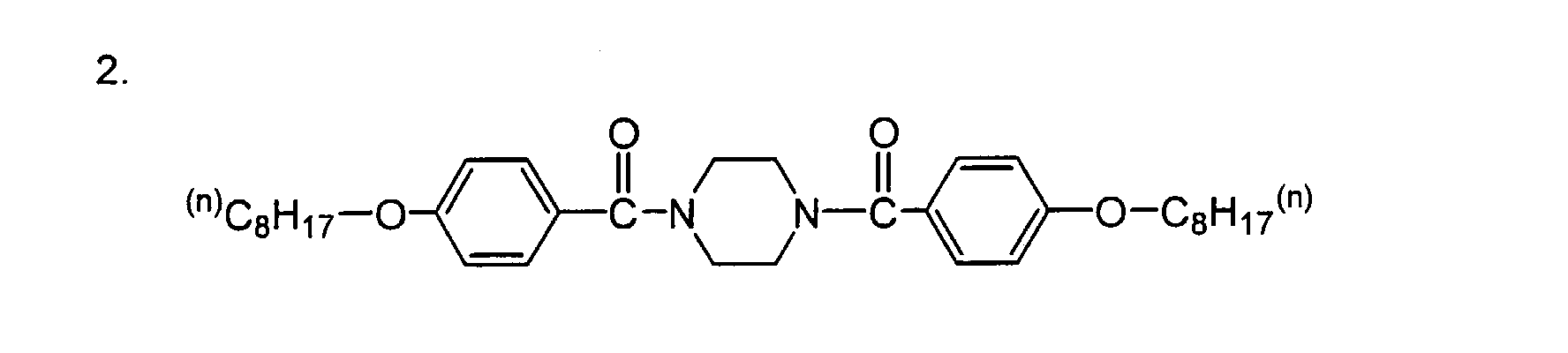
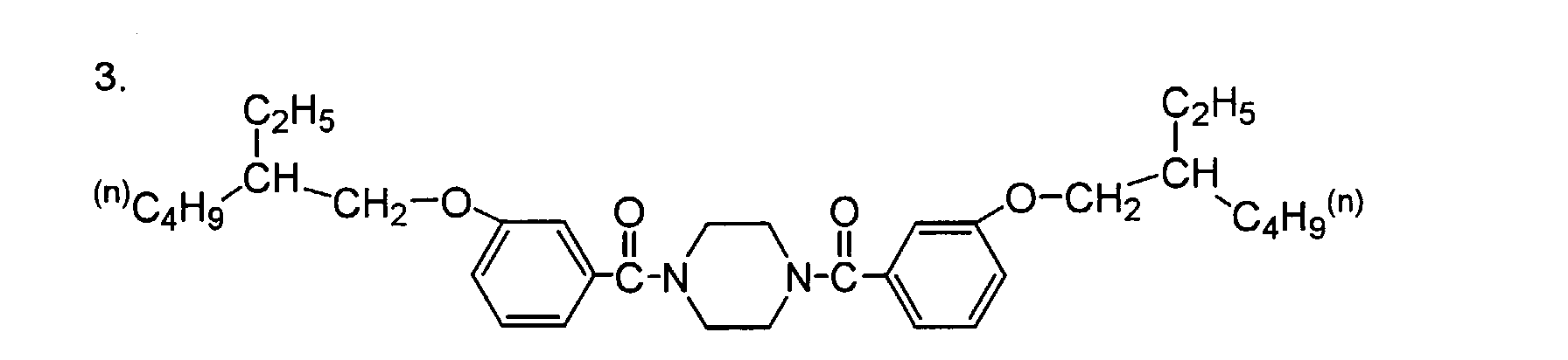
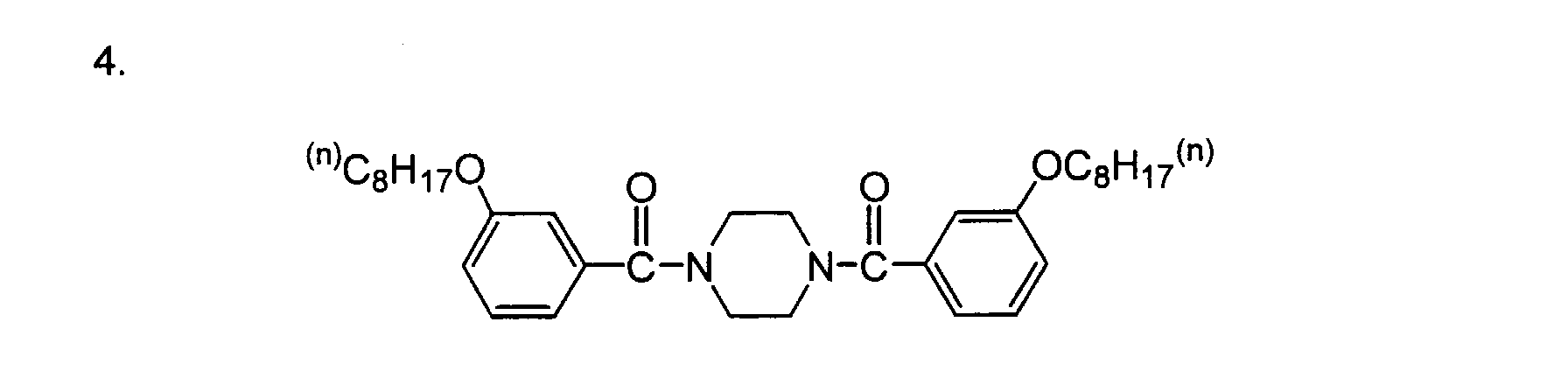


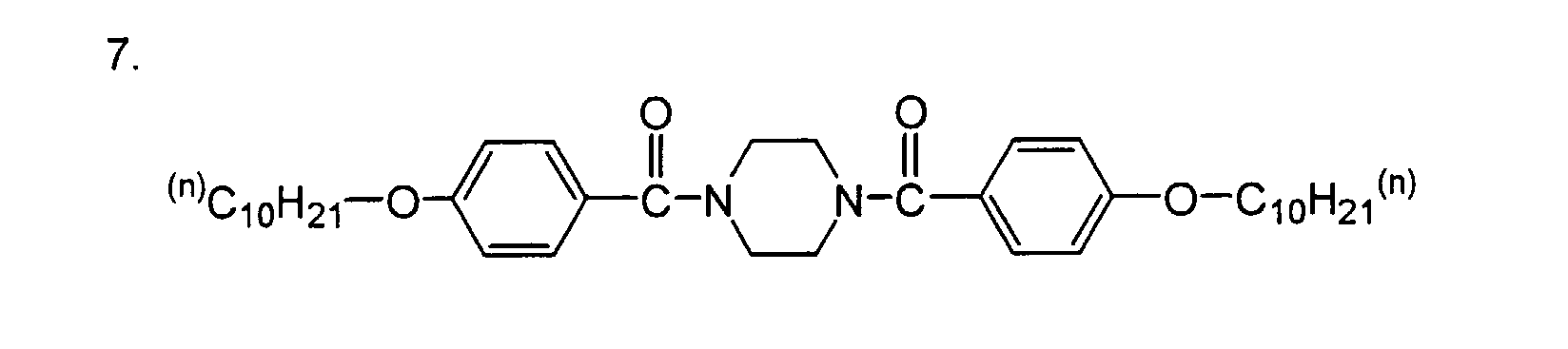


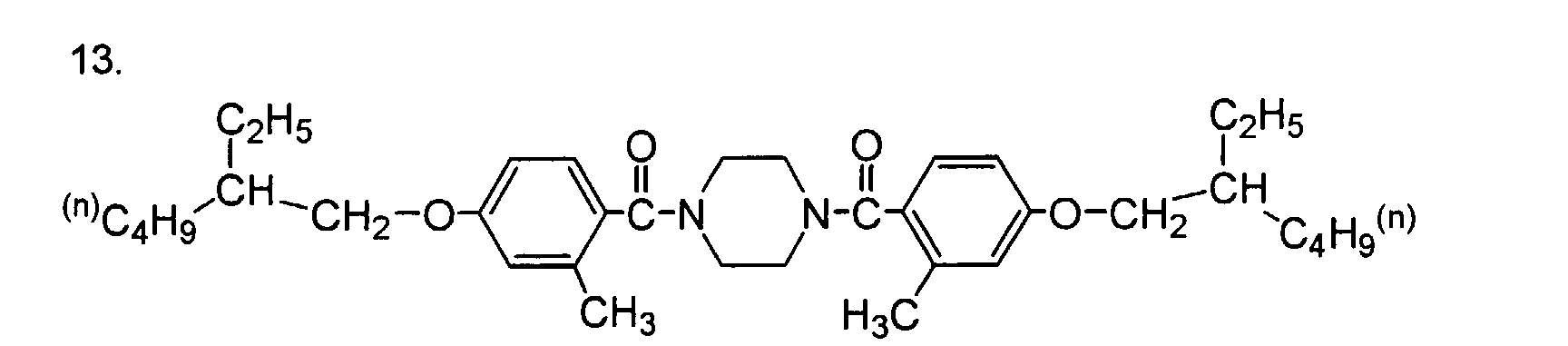
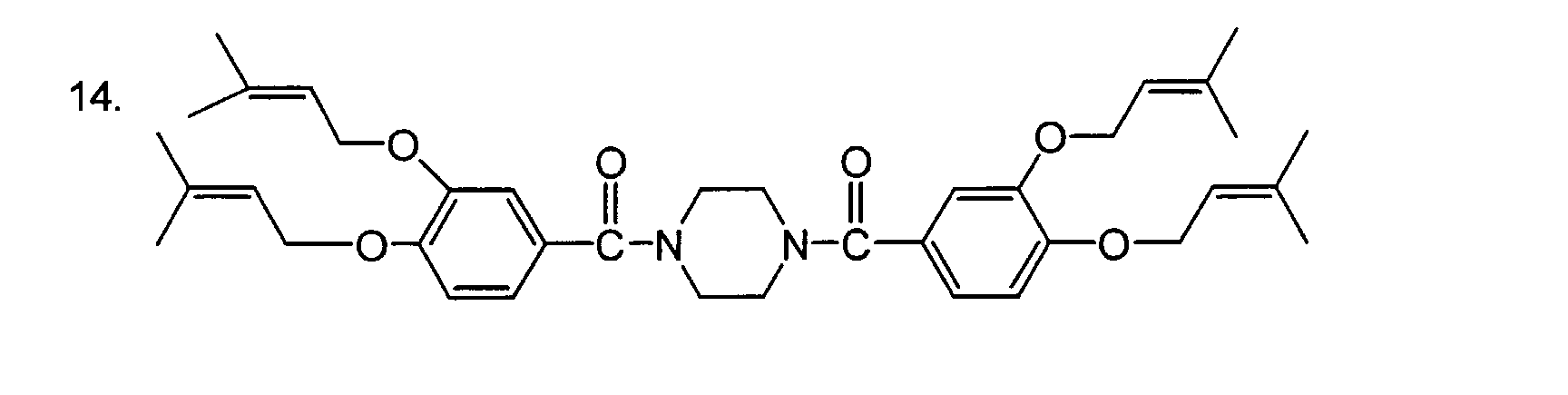


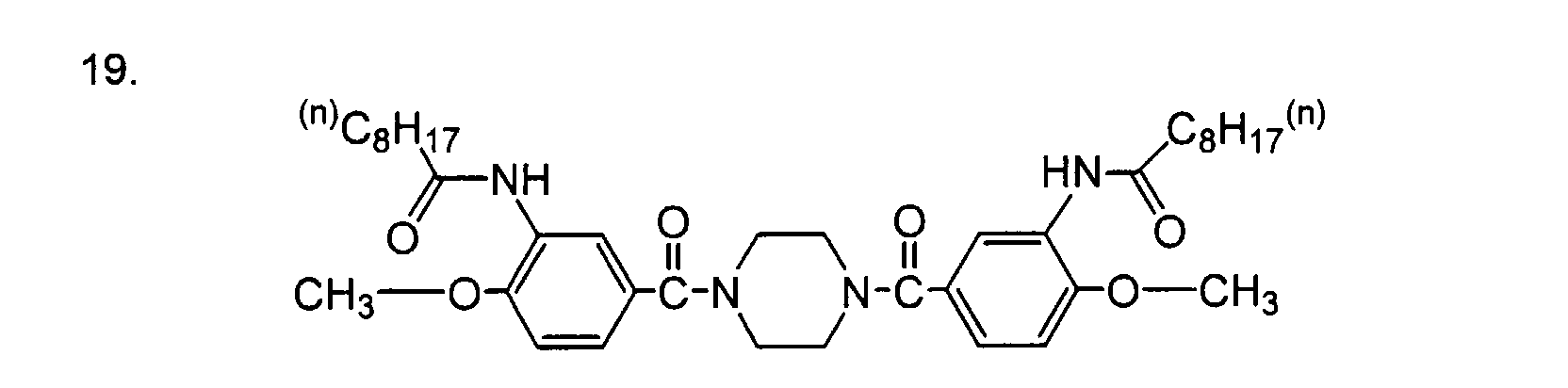
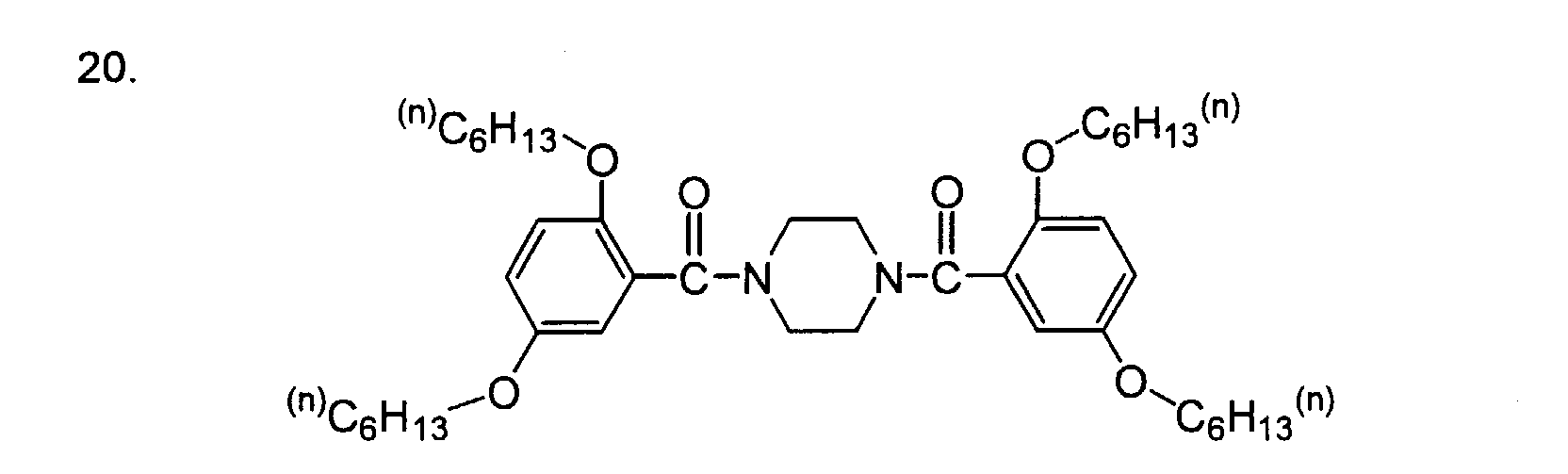
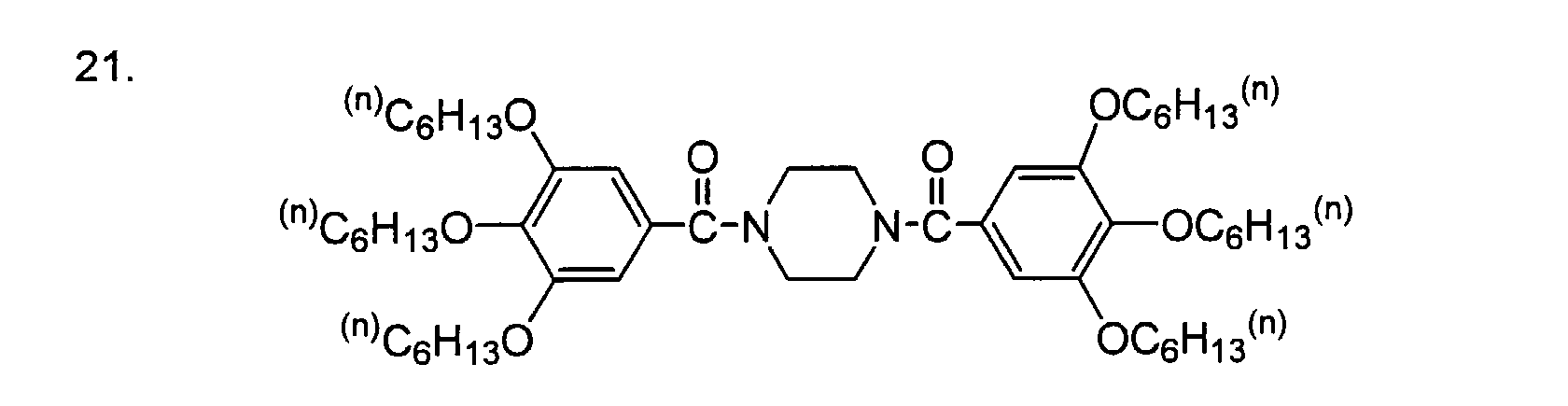

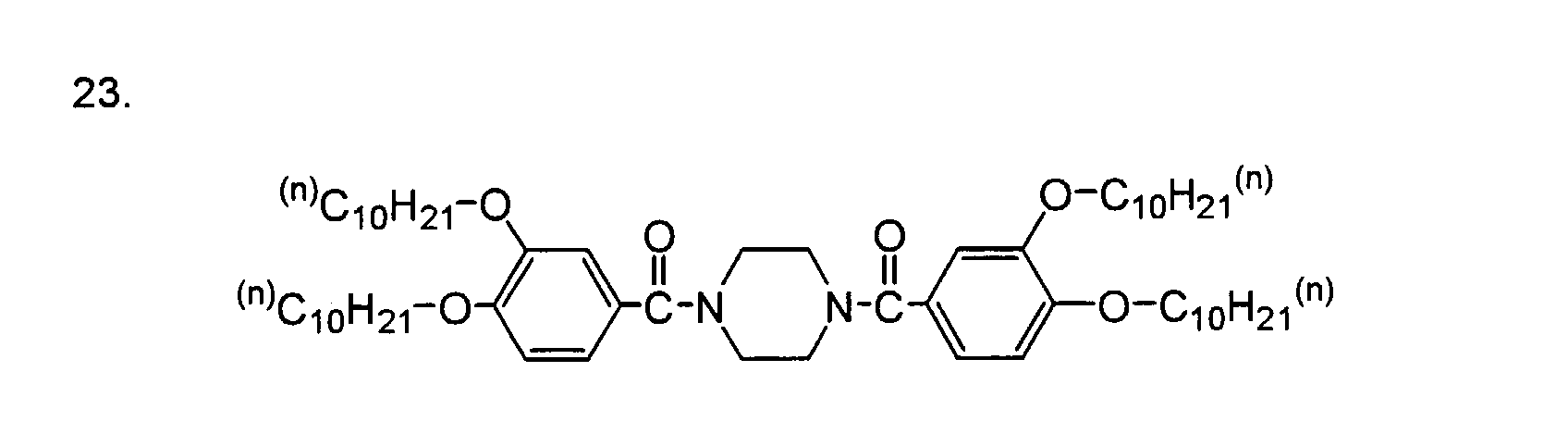

- The cyan couplers of the general formula (II) for use in the present invention (hereinafter also referred to as "cyan couplers of the present invention") will be described in detail below.
- In the cyan couplers of the present invention, X represents a hydrogen atom, or a group which can be split off at a coupling reaction with products of oxidation of an aromatic primary amine color developing agent. The split off group is preferably, for example, any of a halogen atom, an alkyloxy group, an aryloxy group, an acyloxy group, an alkyl- or arylsulfonyloxy group, an acylamino group, an alkyl- or arylsulfonamido group, an alkyloxycarbonyloxy group, an aryloxycarbonyloxy group, an alkylthio group, an arylthio group, a heterocyclic thio group, a carbamoylamino group, a carbamoyloxy group, a heterocyclic carbonyloxy group, a 5-membered or 6-membered nitrogenous heterocyclic group, an imido group and an arylazo group. These groups may further have substituents as exemplified above with respect to R3 and R4 of the general formula (I).
- More specifically, X represents, for example, a hydrogen atom; a halogen atom (e.g., a fluorine atom, a chlorine atom or a bromine atom); an alkyloxy group (e.g., ethoxy, dodecyloxy, methoxyethylcarbamoylmethoxy, carboxypropyloxy, methanesulfonylethoxy or ethoxycarbonylmethoxy); an aryloxy group (e.g., 4-methylphenoxy, 4-chlorophenoxy, 4-methoxyphenoxy, 4-carboxyphenoxy, 3-ethoxycarbonylphenoxy, 3-acetylaminophenoxy or 2-carboxyphenoxy); an acyloxy group (e.g., acetoxy, tetradecanoyloxy or benzoyloxy); an alkyl- or arylsulfonyloxy group (e.g., methanesulfonyloxy or toluenesulfonyloxy); an acylamino group (e.g., dichloroacetylamino or heptafluorobutyrylamino); an alkyl- or arylsulfonamido group (e.g., methanesulfonylamino, trifluoromethanesulfonylamino or p-toluenesulfonylamino); an alkyloxycarbonyloxy group (e.g., ethoxycarbonyloxy or benzyloxycarbonyloxy); an aryloxycarbonyloxy group (e.g., phenoxycarbonyloxy); an alkylthio group, an arylthio group or a heterocyclic thio group (e.g., dodecylthio, 1-carboxydodecylthio, phenylthio, 2-butoxy-5-t-octylphenylthio or tetrazolylthio); a carbamoylamino group (e.g., N-methylcarbamoylamino or N-phenylcarbamoylamino); a carbamoyloxy group (e.g., N,N-diethylcarbamoyloxy, N-ethylcarbamoyloxy or N-ethyl-N-phenylcarbamoyloxy); a heterocyclic carbonyloxy group (e.g., morpholinocarbonyloxy or piperidinocarbonyloxy); a 5-membered or 6-membered nitrogenous heterocyclic group (e.g., imidazolyl, pyrazolyl, triazolyl, tetrazolyl or 1,2-dihydro-2-oxo-1-pyridyl); an imido group (e.g., succinimido or hydantoinyl); or an arylazo group (e.g., phenylazo or 4-methoxyphenylazo). Apart from these, X may be in the form of a bis type coupler obtained by condensation of an aldehyde or ketone 4-equivalent coupler as a split off group bonded through a carbon atom. Further, X may contain a photographically useful group, such as a development inhibitor or a development accelerator.
- Preferably, X represents a hydrogen atom, a halogen atom, an alkyloxy group having 1 to 32 carbon atoms, an aryloxy group having 6 to 32 carbon atoms, an alkylthio group having 1 to 32 carbon atoms, an arylthio group having 6 to 32 carbon atoms, a heterocyclic thio group having 2 to 32 carbon atoms, an alkyloxycarbonyloxy group having 2 to 32 carbon atoms, an aryloxycarbonyloxy group having 7 to 32 carbon atoms, a carbamoyloxy group having 1 to 32 carbon atoms, a heterocyclic carbonyloxy group having 3 to 32 carbon atoms, or a 5-membered or 6-membered nitrogenous heterocyclic group having 2 to 32 carbon atoms, the heterocyclic group capable of bonding with a coupling active site at a nitrogen atom. More preferably, X represents a hydrogen atom, a halogen atom, an alkylthio group, an arylthio group, an alkyloxycarbonyloxy group, an aryloxycarbonyloxy group, a carbamoyloxy group or a heterocyclic carbonyloxy group. Still more preferably, X represents a hydrogen atom, a halogen atom, an arylthio group, a carbamoyloxy group or a heterocyclic carbonyloxy group. Yet still more preferably, X represents a hydrogen atom or a heterocyclic carbonyloxy group. Most preferably, X represents a hydrogen atom.
- In the cyan coupler of the present invention, both R11 and R12 represent an electron withdrawing group whose Hammett substituent constant σp value is 0.20 or greater, provided that the sum of R11 and R12 σp values is 0.65 or greater. The cyan coupler satisfying this requirement realizes color formation into cyan images. The sum of R11 and R12 σp values is preferably 0.70 or greater, and the upper limit thereof is about 2.0.
- R11 and R12 will be described in detail below.
- Each of R11 and R12 represents an electron withdrawing group of 0.20 or greater Hammett substituent constant σp value, preferably an electron withdrawing group of 0.30 or greater Hammett substituent constant σp value. The upper limit thereof is an electron withdrawing group of 1.0 or less Hammett substituent constant σp value.
- As examples of R11 and R12 groups which are electron withdrawing groups of 0.20 or greater σp value, there can be mentioned an acyl group, an acyloxy group, a carbamoyl group, an alkyloxycarbonyl group, an aryloxycarbonyl group, a cyano group, a nitro group, a dialkylphosphono group, a diarylphosphono group, a diarylphosphinyl group, an alkylsulfinyl group, an arylsulfinyl group, an alkylsulfonyl group, an arylsulfonyl group, a sulfonyloxy group, an acylthio group, a sulfamoyl group, a thiocyanato group, a thiocarbonyl group, a halogenated alkyl group, a halogenated alkoxy group, a halogenated aryloxy group, a halogenated alkylamino group, a halogenated alkylthio group, an aryl group substituted with another electron withdrawing group of 0.20 or greater σp value, a heterocyclic group, a halogen atom, an azo group and a selenocyanato group.
- R11 and R12 will be described in greater detail below. As the electron withdrawing group of 0.20 or greater σp value, there can be specifically mentioned an acyl group (e.g., acetyl, 3-phenylpropanoyl, benzoyl or 4-dodecyloxybenzoyl); an acyloxy group (e.g., acetoxy); a carbamoyl group (e.g., carbamoyl, N-ethylcarbamoyl, N-phenylcarbamoyl, N,N-dibutylcarbamoyl, N-(2-dodecyloxyethyl)carbamoyl, N-(4-n-pentadecanamido)phenylcarbamoyl, N-methyl-N-dodecylcarbamoyl or N-{3-(2,4-di-t-amylphenoxy)propyl}carbamoyl); an alkyloxycarbonyl group (e.g., methoxycarbonyl, ethoxycarbonyl, isopropyloxycarbonyl, tert-butyloxycarbonyl, isobutyloxycarbonyl, butyloxycarbonyl, dodecyloxycarbonyl, octadecyloxycarbonyl, cyclohexyloxycarbonyl or cyclohexenoxycarbonyl); an aryloxycarbonyl group (e.g., phenoxycarbonyl); a cyano group; a nitro group; a dialkylphosphono group (e.g., dimethylphosphono); a diarylphosphono group (e.g., diphenylphosphono); a diarylphosphinyl group (e.g., diphenylphosphinyl); an alkylsulfinyl group (e.g., 3-phenoxypropylsulfinyl); an arylsulfinyl group (e.g., 3-pentadecylphenylsulfinyl); an alkylsulfonyl group (e.g., methanesulfonyl or octanesulfonyl); an arylsulfonyl group (e.g., benzenesulfonyl or toluenesulfonyl); a sulfonyloxy group (e.g., methanesulfonyloxy or toluenesulfonyloxy); an acylthio group (e.g., acetylthio or benzoylthio); a sulfamoyl group (e.g., N-ethylsulfamoyl, N,N-dipropylsulfamoyl, N-(2-dodecyloxyethyl)sulfamoyl, N-ethyl-N-dodecylsulfamoyl or N,N-diethylsulfamoyl); a thiocyanato group; a thiocarbonyl group (e.g., methylthiocarbonyl or phenylthiocarbonyl); a halogenated alkyl group (e.g., trifluoromethane or heptafluoropropane); a halogenated alkyloxy group (e.g., trifluoromethyloxy); a halogenated aryloxy group (e.g., pentafluorophenyloxy); a halogenated alkylamino group (e.g., N,N-di(trifluoromethyl)amino); a halogenated alkylthio group (e.g., difluoromethylthio or 1,1,2,2-tetrafluoroethylthio); an aryl group substituted with another electron withdrawing group of 0.20 or greater σp value (e.g., 2,4-dinitrophenyl, 2,4,6-trichlorophenyl or pentachlorophenyl); a heterocyclic group (e.g., 2-benzoxazolyl, 2-benzothiazolyl, 1-phenyl-2-benzimidazolyl, 5-chloro-1-tetrazolyl or 1-pyrrolyl); a halogen atom (e.g., a chlorine atom or a bromine atom); an azo group (e.g., phenylazo); or a selenocyanato group.
- The groups capable of further having a substituent among these substituents may further have the above substituents.
- As preferred examples of R11 and R12 groups, there can be mentioned an acyl group having 2 to 32 carbon atoms, an acyloxy group having 2 to 32 carbon atoms, a carbamoyl group having 1 to 32 carbon atoms, an alkyloxycarbonyl group having 2 to 32 carbon atoms, an aryloxycarbonyl group having 7 to 32 carbon atoms, a cyano group, a nitro group, an alkylsulfinyl group having 1 to 32 carbon atoms, an arylsulfinyl group having 6 to 32 carbon atoms, an alkylsulfonyl group having 1 to 32 carbon atoms, an arylsulfonyl group having 6 to 32 carbon atoms, a sulfamoyl group having 0 to 32 carbon atoms, a halogenated alkyl group having 1 to 32 carbon atoms, a halogenated alkyloxy group having 1 to 32 carbon atoms, a halogenated alkylthio group having 1 to 32 carbon atoms, a halogenated aryloxy group having 7 to 32 carbon atoms, an aryl group having 7 to 32 carbon atoms substituted with two or more other electron withdrawing groups of 0.20 or greater σp value, and a 5 to 8-membered heterocyclic group having 1 to 36 carbon atoms wherein a nitrogen atom, an oxygen atom or a sulfur atom is contained.
- As more preferred examples of R11 and R12 groups, there can be mentioned an alkyloxycarbonyl group having 2 to 32 carbon atoms, a nitro group, a cyano group, an arylsulfonyl group having 6 to 32 carbon atoms, a carbamoyl group having 1 to 32 carbon atoms and a halogenated alkyl group having 1 to 32 carbon atoms. R11 most preferably represents a cyano group. R12 especially preferably represents an alkyloxycarbonyl group having 2 to 32 carbon atoms, and most preferably represents a branched alkyloxycarbonyl group having 4 to 32 carbon atoms (in particular, a cycloalkyloxycarbonyl group).
- In the cyan coupler of the present invention, each of G1 and G2 represents a nitrogen atom or a substituent of the formula -C(R13)=, provided that either of G1 and G2 is a nitrogen atom while the rest is a substituent of the formula -C(R13)=.
- R13 represents a hydrogen atom or a substituent. The substituent is as defined above with respect to R3 and R4, and examples thereof are also as mentioned there.
- R13 preferably represents a substituted or unsubstituted alkyl group having 1 to 30 carbon atoms, or a substituted or unsubstituted aryl group having 6 to 30 carbon atoms.
- It is preferred that the cyan coupler of the present invention and the amide compound of the present invention be added to the same layer of a silver halide lightsensitive material. Further, the cyan coupler of the present invention is preferably added to a red-sensitive silver halide emulsion layer of a silver halide lightsensitive material. In that instance, it is preferred that the cyan coupler of the present invention be a so-called incorporated coupler. For this purpose, it is preferred that at least one of the R11, R12, R13 and X groups be a so-called ballasting group (preferably, the total number of carbon atoms thereof is 10 or greater). With respect to the ballasting group, it is preferred that the total number of carbon atoms be in the range of 10 to 50. It is especially preferred that the ballasting group be had at R13.
- An especially preferred combination of groups for the cyan coupler of the general formula (II) according to the present invention is realized when X is a hydrogen atom, R11 is a cyano group, R12 is a branched alkyloxycarbonyl group having 4 to 32 carbon atoms, G1 is a nitrogen atom, and G2 is -C( wherein R13 is preferably a substituted or unsubstituted aryl group having 6 to 30 carbon atoms.
- Most preferred combination of groups for the cyan coupler of the general formula (II) according to the present invention is realized when X is a hydrogen atom, R11 is a cyano group, R12 is a cycloalkyloxycarbonyl group having 6 to 32 carbon atoms, G1 is a nitrogen atom, and G2 is -C(R13)= wherein R13 is preferably a substituted or unsubstituted aryl group having 6 to 30 carbon atoms.
- Still preferably, the cyan coupler of the general formula (II) has the structure represented by the following general formula (III).
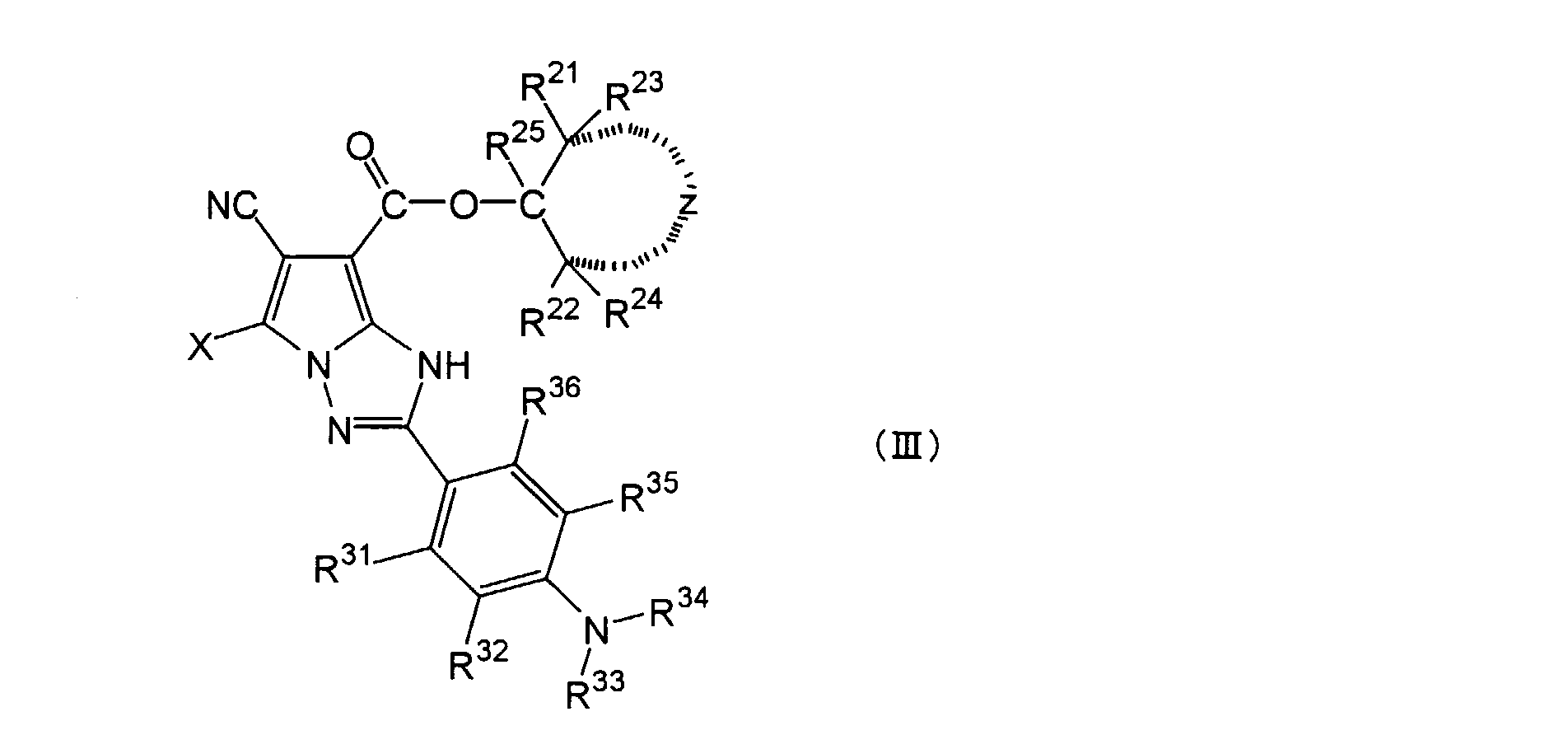
- In the general formula (III), X has the same meaning as that of X of the general formula (II). Each of R31, R32, R35 and R36 independently represents a hydrogen atom or a substituent. R33 represents a substituted or unsubstituted alkyl group, a substituted or unsubstituted alkenyl group, a substituted or unsubstituted alkynyl group, a substituted or unsubstituted aryl group, a substituted or unsubstituted cycloalkyl group, or a substituted or unsubstituted heterocyclic group. R34 represents a hydrogen atom, or a substituent capable of bonding at a carbon atom. R33 and R34 may be bonded with each other to thereby form a ring.
- Specifically, as the alkyl group, alkenyl group, alkynyl group, cycloalkyl group or cycloalkenyl group represented by R33, there can be mentioned a linear or branched alkyl group having 1 to 32 carbon atoms, an aralkyl group having 7 to 32 carbon atoms, an alkenyl group having 2 to 32 carbon atoms, an alkynyl group having 2 to 32 carbon atoms, a cycloalkyl group having 3 to 32 carbon atoms, or a cycloalkenyl group having 3 to 32 carbon atoms. More specifically, there can be mentioned, for example, methyl, ethyl, propyl, isopropyl, t-butyl, tridecyl, 2-methanesulfonylethyl, 3-(3-pentadecylphenoxy)propyl, 3-{4-{2-[4- (4-hydroxyphenylsulfonyl)phenoxy]dodecanamido}phenyl}propy 1, 2-ethoxytridecyl, trifluoromethyl, cyclopentyl, or 3-(2,4-di-t-amylphenoxy)propyl. As the aryl group, aryls having 6 to 36 carbon atoms are preferred, and monocyclic aryls are more preferred. Examples thereof include phenyl, 4-t-butylphenyl, 2-methylphenyl, 2,4,6-trimethylphenyl, 2-methoxyphenyl, 4-methoxyphenyl, 2,6-dichlorophenyl, 2-chlorophenyl and 2,4-dichlorophenyl. As the heterocyclic group, a 5 to 8-membered ring group having 1 to 36 carbon atoms wherein a nitrogen atom, an oxygen atom or a sulfur atom is contained is preferred. A 5-membered or 6-membered ring bonded at a nitrogen atom is more preferred. This ring may form a condensed ring in cooperation with a benzene ring or another heterocycle. As such a heterocyclic group, there can be mentioned, for example, imidazolyl, pyrazolyl, triazolyl, piperidino, pyrrolidyl, pyrrolyl, morpholino, pyrazolidyl, or thiazolidyl. Among these, pyrrolidyl is preferred.
- Among these substituents, those capable of further having a substituent may further be substituted with groups as exemplified above with respect to R3 and R4.
- As preferred R33, there can be mentioned a substituted or unsubstituted alkyl group, a substituted or unsubstituted alkenyl group, or a substituted or unsubstituted cycloalkyl group.
- R34 represents a hydrogen atom, or a substituent capable of bonding at a carbon atom. As the substituent capable of bonding at a carbon atom, there can be mentioned, for example, a substituted or unsubstituted alkyl group, a substituted or unsubstituted alkenyl group, a substituted or unsubstituted alkynyl group, a substituted or unsubstituted cycloalkyl group, a substituted or unsubstituted cycloalkenyl group, a substituted or unsubstituted aryl group, a substituted or unsubstituted acyl group, a substituted or unsubstituted alkyloxycarbonyl group, a substituted or unsubstituted aryloxycarbonyl group, or a substituted or unsubstituted carbamoyl group.
- More specifically, R34 can be a hydrogen atom, and the alkyl, alkenyl, alkynyl, cycloalkyl and cycloalkenyl groups represented by R34 can be a linear or branched alkyl group having 1 to 32 carbon atoms, an aralkyl group having 7 to 32 carbon atoms, an alkenyl group having 2 to 32 carbon atoms, an alkynyl group having 2 to 32 carbon atoms, a cycloalkyl group having 3 to 32 carbon atoms and a cycloalkenyl group having 3 to 32 carbon atoms. Still more specifically, they can be, for example, methyl, ethyl, propyl, isopropyl, t-butyl, tridecyl, 2-methanesulfonylethyl, 3-(3-pentadecylphenoxy)propyl, 3-{4-{2-[4-(4-hydroxyphenylsulfonyl)phenoxy]dodecanamido}phenyl}propy 1, 2-ethoxytridecyl, trifluoromethyl, cyclopentyl and 3-(2,4-di-t-amylphenoxy)propyl. With respect to the aryl group, one having 6 to 36 carbon atoms is preferred, and monocyclic one is more preferred. The aryl group can be, for example, phenyl, 4-t-butylphenyl, 2-methylphenyl, 2,4,6-trimethylphenyl, 2-methoxyphenyl, 4-methoxyphenyl, 2,6-dichlorophenyl, 2-chlorophenyl, 2,4-dichlorophenyl or the like. The acyl group is preferably one having 2 to 32 carbon atoms, and can be, for example, acetyl, pivaloyl, octanoyl or benzoyl. Examples of the alkyloxycarbonyl, aryloxycarbonyl and carbamoyl groups can be, for example, those described above with respect to groups employed for substitution of R1 and R2.
- Among these substituents, those capable of further having a substituent may further have substituents exemplified above with respect to groups employed for substitution of R3 and R4.
- As preferred R34, there can be mentioned a substituted or unsubstituted alkyl group, a substituted or unsubstituted alkenyl group, a substituted or unsubstituted alkynyl group, a substituted or unsubstituted cycloalkyl group, a substituted or unsubstituted cycloalkenyl group, or a substituted or unsubstituted aryl group.
- R33 and R34 may be bonded with each other to thereby form a 5 or 6-membered ring having a bonding with nitrogen atom. This nitrogenous ring can be, for example, any of imidazolyl, pyrazolyl, triazolyl, piperidyl, piperidino, pyrrolidinyl, pyrrolyl, morpholyl, morpholino, pyrazolidinyl, thiazolidinyl, pyrazolinyl, piperadinyl and the like. These nitrogenous rings may form a condensed ring in cooperation with a benzene ring or another heterocycle.
- With respect to R33 and R34, those which form a ring structure are preferred to those which do not form any ring structure. In particular, groups which form a 6-membered ring having a bonding with nitrogen atom are preferred, and those which form morpholino, a piperadinyl substituted with an acyl group, piperidino or a piperidino substituted with a carboxy group are more preferred.
- R21, R22, R23, R24 and R25 may be identical with or different from each other. Each thereof represents a hydrogen atom or a substituent. As a preferred substituent, there can be mentioned a substituted or unsubstituted alkyl group, a substituted or unsubstituted alkenyl group, a substituted or unsubstituted alkynyl group, a substituted or unsubstituted cycloalkyl group, a substituted or unsubstituted cycloalkenyl group, or a substituted or unsubstituted aryl group. More preferred substituents are as follows.
- Each of R21 and R22 preferably represents an alkyl group, an alkenyl group, an alkynyl group, a cycloalkyl group or a cycloalkenyl group. For example, each of R21 and R22 represents a linear, branched or cyclic alkyl group having 1 to 36 carbon atoms, an aralkyl group having 7 to 36 carbon atoms, an alkenyl group having 2 to 36 carbon atoms, an alkynyl group having 2 to 36 carbon atoms, or a cycloalkenyl group having 3 to 36 carbon atoms. Specifically, each of R21 and R22 represents, for example, methyl, ethyl, propyl, isopropyl, t-butyl, t-amyl, t-octyl, tridecyl, cyclopentyl or cyclohexyl. With respect to the number of carbon atoms of these alkyl, alkenyl, alkynyl, cycloalkyl and cycloalkenyl groups, it is preferred that the upper limit thereof be 12. More preferably, each of R21 and R22 represents an unsubstituted alkyl group having 1 to 8 carbon atoms. Each of R23, R24 and R25 preferably represents a hydrogen atom, an alkyl group, an alkenyl group, an alkynyl group, a cycloalkyl group or a cycloalkenyl group. As the alkyl, alkenyl, alkynyl, cycloalkyl and cycloalkenyl groups, there can be mentioned those set out above with respect to R21 and R22. Most preferably, each of R23, R24 and R25 represents a hydrogen atom.
- Z represents a nonmetallic atomic group required for forming a 5 to 8-membered ring. This ring may have a substituent, and may be a saturated ring or have an unsaturated bond. As a preferred nonmetallic atom, there can be mentioned a nitrogen atom, an oxygen atom, a sulfur atom or a carbon atom. More preferably, the nonmetallic atom is a carbon atom.
- As the ring formed by Z, there can be mentioned, for example, a cyclopentane ring, a cyclohexane ring, a cycloheptane ring, a cyclooctane ring, a cyclohexene ring, a piperazine ring, an oxane ring or a thiane ring. These rings may have any of the above-mentioned substituents.
- Among the rings formed by Z, an unsubstituted or substituted cyclohexane ring is preferred. A cyclohexane ring having its 4-position substituted with an alkyl group having 1 to 24 carbon atoms (may have any of the above-mentioned substituents) is especially preferred.
- It is preferred that the cyan coupler of the general formula (III) for use in the present invention have an oil solubility increasing group in its molecule so as to be easily dissolved in high-boiling organic solvents, and further that this coupler per se and the dye formed by oxidation coupling between this coupler and a color reducing agent (developer) be nondiffusive in hydrophilic colloid layers.
- An especially preferred combination of groups for the cyan coupler of the general formula (III) according to the present invention is realized when X is a hydrogen atom; each of R21 and R22 is t-butyl; each of R23, R24 and R25 is a hydrogen atom; Z is one for forming a cyclohexane ring wherein the 4-position is an alkyl group having 1 to 8 carbon atoms; R33 and R34 are those for forming a ring structure (in particular, preferably groups forming a 6-membered ring having a bonding with nitrogen atom, for example, morpholino, a piperazinyl substituted with an acyl group, or a piperidino substituted with a carboxy group); R35 is a substituted or unsubstituted alkylsulfonylamino group having 1 to 32 carbon atoms, a substituted or unsubstituted arylsulfonylamino group having 6 to 30 carbon atoms, or a nitro group; and each of R36, R31 and R32 is preferably a hydrogen atom or a substituted arylsulfonylamino group having 6 to 30 carbon atoms. The substituent had by the arylsulfonylamino group is preferably an alkoxy group having 1 to 32 carbon atoms, an alkyl group having 1 to 32 carbon atoms, a sulfonylamino group having 1 to 32 carbon atoms, an acylamino group having 1 to 32 carbon atoms, or a halogen atom.
- Specific examples of the cyan couplers of the present invention will be set out below, which are however not limitative.
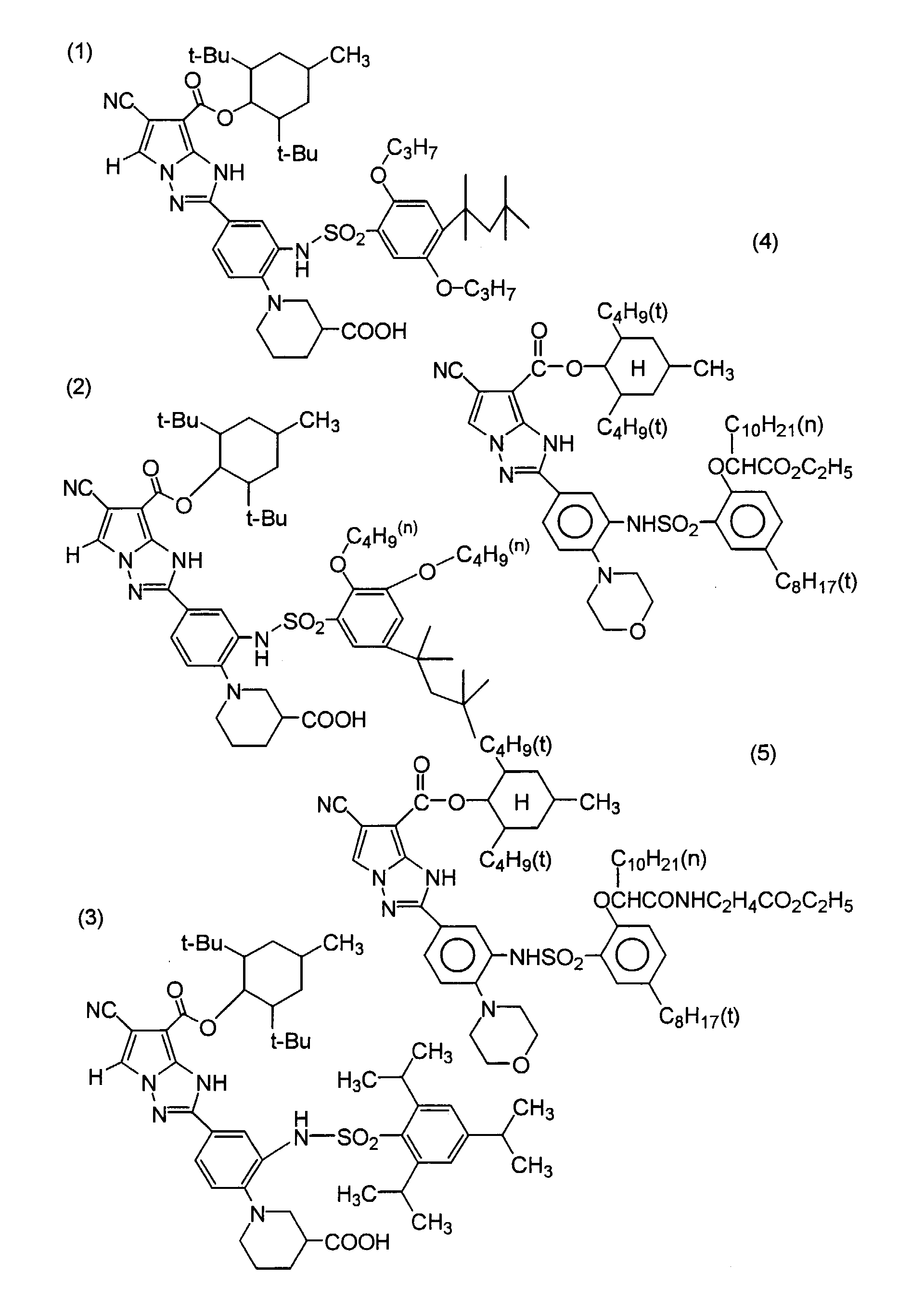
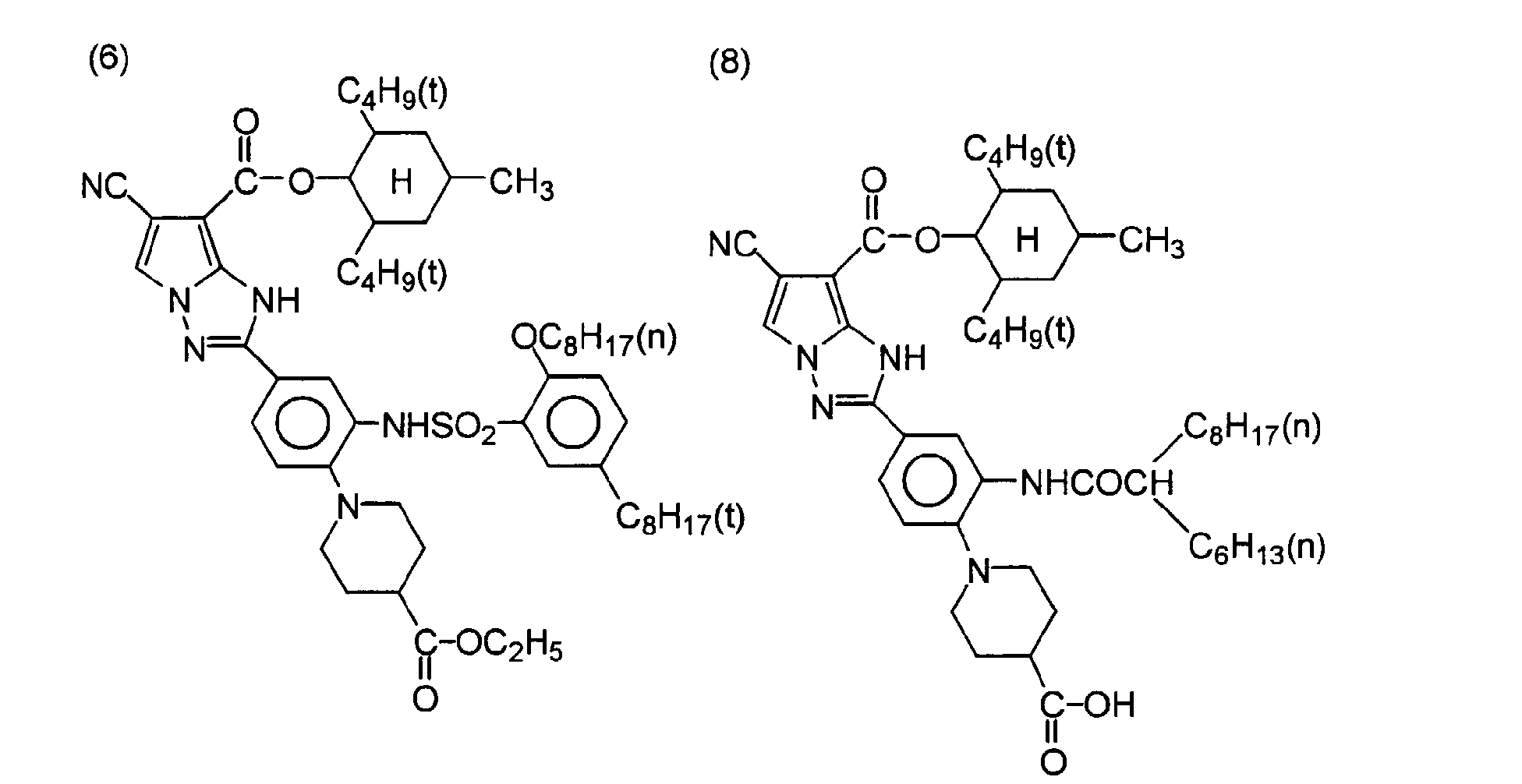
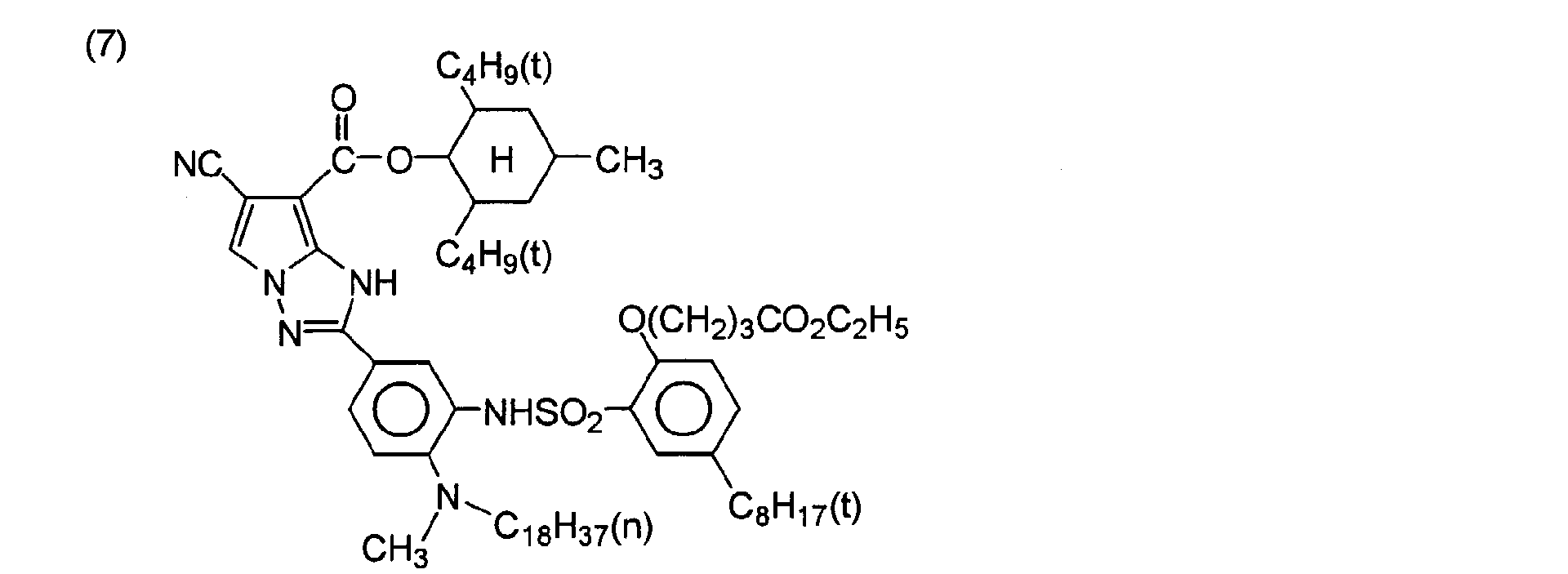

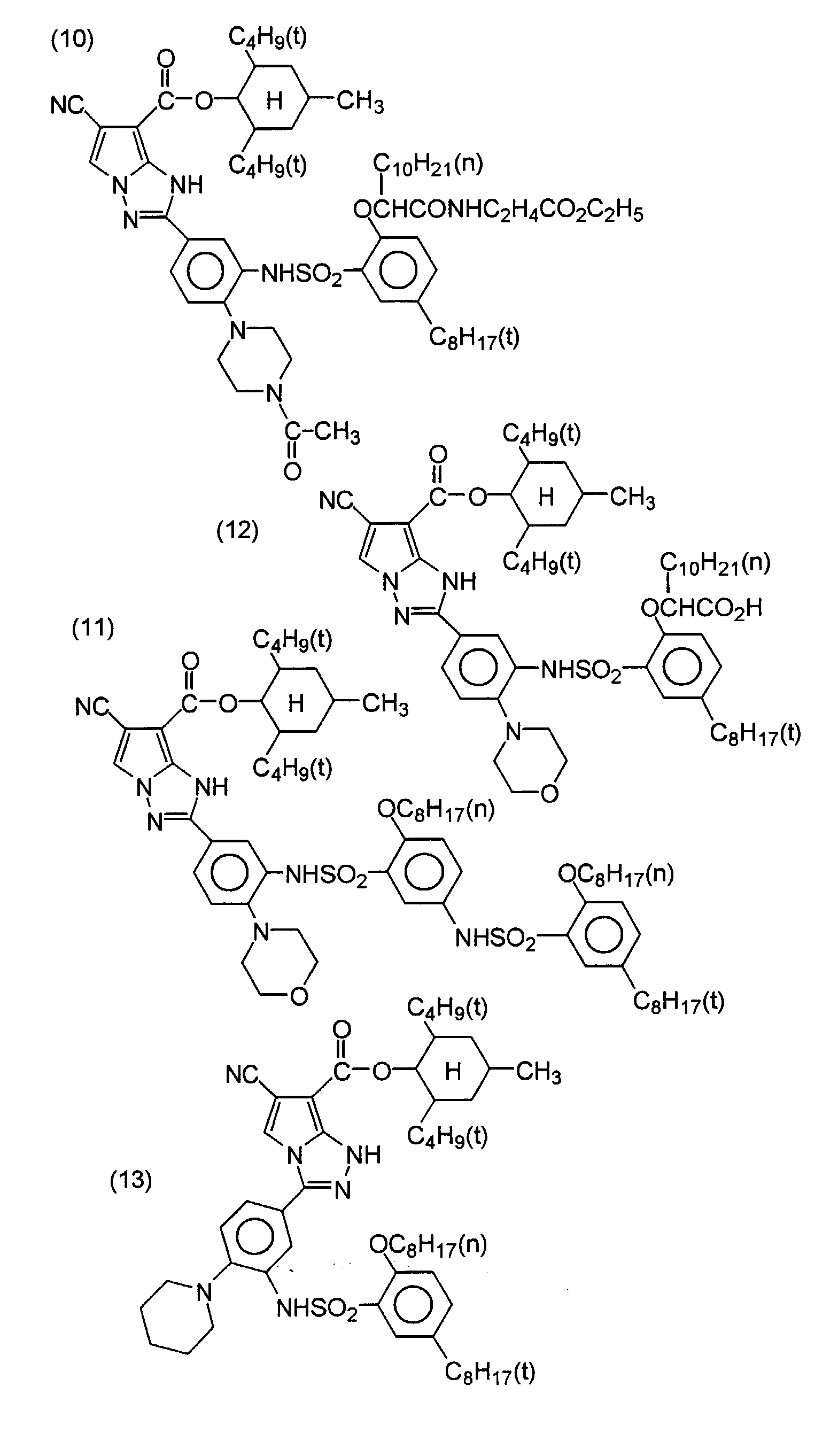


- A specific example of a synthetic method of the amide compound (compound 1) of the present invention will be set out below.

- 456 g (2.36 mol) of 1-bromo-2-ethylhexane was dropped over a period of 1 hr into a mixture of 409 g (2.96 mol) of potassium carbonate, 300 g (1.97 mol) of methyl p-hydroxybenzoate and 900 mL of dimethylformamide under agitation at 70°C. After the dropping, reaction was conducted at 70°C for 4 hr. The reaction mixture was cooled to 40°C, and 500 mL of ethyl acetate was added to the cooled reaction mixture. Inorganic salts were filtered off, and the obtained reaction solution was washed with first 300 mL of water. subsequently 300 mL of a 1 N aqueous hydrochloric acid solution, and finally 200 mL of saturated saline solution. Solvent was distilled off in vacuum, thereby obtaining 530 g of intermediate A. The intermediate A left intact was used in the subsequent step.
- The whole amount of intermediate A synthesized in the step 1 was added to a mixture of 226 g (3.43 mol) of potassium hydroxide, 1.0 L of methanol and 100 mL of water under agitation at 60°C. After the addition, reaction was conducted at 65°C for 2 hr. The reaction mixture was cooled to 40°C, and 450 mL of concentrated hydrochloric acid was added to the cooled reaction mixture. Further, 500 mL of acetonitrile was added, and agitated at 20°C. Thus, crystal was precipitated. The crystal was collected by filtration, washed well with 500 mL of acetonitrile, and dried. Thus, 526 g of intermediate B was obtained (inorganic salts were mingled into the crystal, so that calculated yield exceeded 100%).
- 286 g (2.4 mol) of thionyl chloride was dropped over a period of 30 min into a mixture of the whole amount of intermediate B synthesized in the preceding step, 900 mL of toluene and 2 mL of dimethylformamide under agitation at 60°C. Further, reaction was conducted at 60°C for 2 hr. The reaction mixture was concentrated in vacuum, and 250 mL of solvent was distilled off. Thereafter, 100 mL of ethyl acetate was added, and inorganic salts were filtered off. Thus, a toluene / ethyl acetate solution of intermediate C was obtained.
- The whole amount of toluene/ethyl acetate solution of intermediate C synthesized in the preceding step was dropped over a period of 30 min into a mixture of 108 g (1.25 mol) of piperazine anhydride, 414.6 g (3.0 mol) of potassium carbonate, 650 mL of water and 500 mL of ethyl acetate under agitation at 25°C. After the dropping, reaction was conducted at 25°C for 30 min, and the temperature was raised to 50°C. The obtained reaction mixture was washed with 400 mL of 40°C water and subsequently 400 mL of saturated saline solution. An organic layer was distilled off in vacuum, and 700 mL of ethyl acetate and 1.7 L of acetonitrile were added so as to effect recrystallization. Crystal was collected by filtration, washed well with acetonitrile, and dried. Thus, 300 g of compound 1 was obtained (total yield through four steps: 55.6%).
- The structure thereof was identified by mass spectrometry and 300 MHz 1H-NMR.
- NMR measurement data of the compound 1 will be set out below.
300 MHz 1H-NMR
Solvent used in measuring: deuterated chloroform
Internal standard: tetramethylsilane
1H-NMR σ (CDCl3): 0.85 - 0.98 (m, 6H), 1.22 - 1.61 (m, 8H), 1.66 - 1.80 (m, 1H), 3.50 - 3.80 (bs, 4H), 3.88 (d, J = 8.6 Hz, 2H), 6.92 (d, J = 8.6 Hz, 2H), 7.39 (d, J = 8.6, 2H). - The cyan coupler compounds of the general formula (II) can be synthesized by methods described in JP-A-2001-163887.
- The coating amount of cyan coupler according to the present invention is preferably in the range of 0.01 to 2 g/m2, more preferably 0.05 to 1.0 g/m2.
- In a light-sensitive material of the present invention, at least one sensitive layer need only be formed on a support. A typical example is a silver halide photographic light-sensitive material having, on a support, at least one sensitive layer consisting of a plurality of silver halide emulsion layers sensitive to substantially the same color but different in sensitivity. This sensitive layer is a unit sensitive layer sensitive to one of blue light, green light, and red light. In a multilayered silver halide color photographic light-sensitive material, sensitive layers are generally arranged in the order of red-, green-, and blue-sensitive layers from a support. However, according to the intended use, this order of arrangement can be reversed, or sensitive layers sensitive to the same color can sandwich another sensitive layer sensitive to a different color. Non-light-sensitive layers can be formed between the silver halide sensitive layers and as the uppermost layer and the lowermost layer. These non-light-sensitive layers can contain, e.g., couplers, DIR compounds, and color amalgamation inhibitors to be described later. As a plurality of silver halide emulsion layers constituting each unit sensitive layer, as described in DE1,121,470 or GB923,045, high- and low-speed emulsion layers are preferably arranged such that the sensitivity is sequentially decreased toward a support. Also, as described in JP-A's-57-112751, 62-200350, 62-206541, and 62-206543, layers can be arranged such that a low-speed emulsion layer is formed apart from a support and a high-speed layer is formed close to the support.
- More specifically, layers can be arranged, from the one farthest from a support, in the order of a low-speed blue-sensitive layer (BL)/high-speed blue-sensitive layer (BH)/high-speed green-sensitive layer (GH)/low-speed green-sensitive layer (GL)/high-speed red-sensitive layer (RH)/low-speed red-sensitive layer (RL), the order of BH/BL/GL/GH/RH/RL, or the order of BH/BL/GH/GL/RL/RH.
- In addition, as described in Jpn. Pat. Appln. KOKOKU Publication No. (hereinafter referred to as JP-B-)55-34932, layers can be arranged in the order of a blue-sensitive layer/GH/RH/GL/RL from the one farthest from a support. Furthermore, as described in JP-A's-56-25738 and 62-63936, layers can be arranged in the order of a blue-sensitive layer/GL/RL/GH/RH from the one farthest from a support.
- As described in JP-B-49-15495, three layers can be arranged such that a silver halide emulsion layer having the highest sensitivity is arranged as an upper layer, a silver halide emulsion layer having sensitivity lower than that of the upper layer is arranged as an interlayer, and a silver halide emulsion layer having sensitivity lower than that of the interlayer is arranged as a lower layer, i.e., three layers having different sensitivities can be arranged such that the sensitivity is sequentially decreased toward a support. When the layer structure is thus constituted by three layers having different sensitivities, these three layers can be arranged, in the same color-sensitive layer, in the order of a medium-speed emulsion layer/high-speed emulsion layer/low-speed emulsion layer from the one farthest from a support as described in JP-A-59-202464.
- In addition, the order of a high-speed emulsion layer/low-speed emulsion layer/medium-speed emulsion layer or low-speed emulsion layer/medium-speed emulsion layer/high-speed emulsion layer can be used. Furthermore, the arrangement can be changed as described above even when four or more layers are formed.
- To improve the color reproducibility, as described in US4,663,271, US4,705,744, US4,707,436, and JP-A's-62-160448 and 63-89850, a donor layer (CL) with an interlayer effect, which has a different spectral sensitivity distribution from that of a main sensitive layer such as BL, GL, or RL, is preferably formed adjacent to, or close to, this main sensitive layer.
- A silver halide used in the present invention is silver iodobromide, silver iodochloride, or silver bromochloroiodide containing about 30 mol% or less of silver iodide. A silver halide is most preferably silver iodobromide or silver bromochloroiodide containing about 2 to about 10 mol% of silver iodide.
- Silver halide grains contained in a photographic emulsion can have regular crystals such as cubic, octahedral, or tetradecahedral crystals, irregular crystals such as spherical or tabular crystals, crystals having crystal defects such as twin planes, or composite shapes thereof.
- A silver halide can consist of fine grains having a grain size of about 0.2 µm or less or large grains having a projected area diameter of about 10 µm, and an emulsion can be either a polydisperse or monodisperse emulsion.
- A silver halide photographic emulsion usable in the present invention can be prepared by methods described in, e.g., "I. Emulsion preparation and types," Research Disclosure (RD) No. 17643 (December, 1978), pp. 22 and 23, RD No. 18716 (November, 1979), p. 648, and RD No. 307105 (November, 1989), pp. 863 to 865; P. Glafkides, "Chemie et Phisique Photographique", Paul Montel, 1967; G.F. Duffin, "Photographic Emulsion Chemistry", Focal Press, 1966; and V.L. Zelikman et al., "Making and Coating Photographic Emulsion", Focal Press, 1964.
- Monodisperse emulsions described in, e.g., US3,574,628, US3,655,394, and GB1,413,748 are also favorable.
- Tabular grains having an aspect ratio of about 3 or more can also be used in the present invention. Tabular grains can be easily prepared by methods described in Gutoff, "Photographic Science and Engineering", Vol. 14, pp. 248 to 257 (1970); and US4,434,226, US4,414,310, US4,433,048, US4,439,520, and GB2,112,157.
- A crystal structure can be uniform, can have different halogen compositions in the interior and the surface layer thereof, or can be a layered structure. Alternatively, a silver halide having a different composition can be bonded by an epitaxial junction, or a compound except for a silver halide such as silver rhodanide or lead oxide can be bonded. A mixture of grains having various types of crystal shapes can also be used.
- The above emulsion can be any of a surface latent image type emulsion which mainly forms a latent image on the surface of a grain, an internal latent image type emulsion which forms a latent image in the interior of a grain, and another type of emulsion which has latent images on the surface and in the interior of a grain. However, the emulsion must be a negative type emulsion. The internal latent image type emulsion can be a core/shell internal latent image type emulsion described in JP-A-63-264740. A method of preparing this core/shell internal latent image type emulsion is described in JP-A-59-133542. Although the thickness of a shell of this emulsion depends on the development conditions and the like, it is preferably 3 to 40 nm, and most preferably, 5 to 20 nm.
- A silver halide emulsion layer is normally subjected to physical ripening, chemical ripening, and spectral sensitization steps before it is used. Additives for use in these steps are described in RD Nos. 17643, 18716, and 307105 and they are summarized in a table to be presented later.
- In a light-sensitive material of the present invention, it is possible to mix, in the same layer, two or more types of emulsions different in at least one of the characteristics, i.e., the grain size, grain size distribution, halogen composition, grain shape, and sensitivity, of a photosensitive silver halide emulsion.
- It is also possible to preferably use surface-fogged silver halide grains described in US4,082,553, internally fogged silver halide grains described in US4,626,498 and JP-A-59-214852 and colloidal silver, in photosensitive silver halide emulsion layers and/or substantially non-light-sensitive hydrophilic colloid layers. The internally fogged or surface-fogged silver halide grain means a silver halide grain which can be developed uniformly (non-imagewise) regardless of whether the location is a non-exposed portion or an exposed portion of the light-sensitive material. A method of preparing the internally fogged or surface-fogged silver halide grain is described in US4,626,498 and JP-A-59-214852. A silver halide which forms the core of an internally fogged core/shell type silver halide grain can have a different halogen composition. As the internally fogged or surface-fogged silver halide, any of silver chloride, silver chlorobromide, silver bromoiodide, and silver bromochloroiodide can be used. The average grain size of these fogged silver halide grains is preferably 0.01 to 0.75 µm, and most preferably, 0.05 to 0.6 µm. The grain shape can be a regular grain shape. Although the emulsion can be a polydisperse emulsion, it is preferably a monodisperse emulsion (in which at least 95% in weight or number of grains of silver halide grains have grain sizes falling within the range of ±40% of the average grain size).
- In the present invention, it is preferable to use a non-light-sensitive, fine-grain silver halide. The non-light-sensitive, fine-grain silver halide preferably consists of silver halide grains which are not exposed during imagewise exposure for obtaining a dye image and are not substantially developed during development. These silver halide grains are preferably not fogged in advance. In the fine-grain silver halide, the content of silver bromide is 0 to 100 mol%, and silver chloride and/or silver iodide can be added if necessary. The fine-grain silver halide preferably contains 0.5 to 10 mol% of silver iodide. The average grain size (the average value of the equivalent-circle diameters of projected areas) of the fine-grain silver halide is preferably 0.01 to 0.5 µm, and more preferably, 0.02 to 2 µm.
- The fine-grain silver halide can be prepared following the same procedures as for a common sensitive silver halide. The surface of each silver halide grain need not be optically sensitized nor spectrally sensitized. However, before the silver halide grains are added to a coating solution, it is preferable to add a well-known stabilizer such as a triazole-based compound, azaindene-based compound, benzothiazolium-based compound, mercapto-based compound, or zinc compound. Colloidal silver can be added to this layer containing fine silver halide grains.
- The silver coating amount of a light-sensitive material of the present invention is preferably 6.0 g/m2 or less, and most preferably, 4.5 g/m2 or less.
- Photographic additives usable in the present invention are also described in RDs, and the relevant portions are summarized in the following table.
Additives RD17643 RD18716 1. Chemical sensitizers page 23 page 648, right column 2. Sensitivity increasing agents do 3. Spectral sensitizers, super sensitizers pages 23 - 24 page 648, right column to page 649, right column 4. Brighteners page 24 page 647, right column 5. Light absorbents, filter dyes, ultraviolet absorbents pages 25 - 26 page 649, right column to page 650, left column 6. Binders page 26 page 651, left column 7. Plasticizers, lubricants page 27 page 650, right column 8. Coating aids, surface active agents pages 26 - 27 do 9. Antistatic agents page 27 do 10. Matting agents Additives RD307105 1. Chemical sensitizers page 866 2. Sensitivity increasing agents 3. Spectral sensitizers, super sensitizers pages 866 - 868 4. Brighteners page 868 5. Light absorbent, filter dye, ultra-violet absorbents page 873 6. Binder pages 873 - 874 7. Plasticizers, lubricants page 876 8. Coating aids, surface active agents pages 875 - 876 9. Antistatic agents pages 876 - 877 10. Matting agent pages 878 - 879 - Various dye forming couplers can be used in the lightsensitive material of the present invention, and the following couplers are particularly preferred.
- Yellow couplers: couplers represented by formulae (I) and (II) described in EP 502,424A; couplers represented by formulae (1) and (2) described in EP 513,496A (particularly Y-28 on page 18); couplers represented by formula (I) of claim 1 described in EP 568,037A; couplers represented by general formula (I) described in column 1, lines 45 to 55, of U.S.P. 5,066,576; couplers represented by general formula (I) described in paragraph 0008 of JP-A-4-274425; couplers described in claim 1 on page 40 of EP 498,381A1 (particularly D-35 on page 18); couplers represented by formula (Y) described on page 4 of EP 447,969A1 (particularly Y-1 (page 17) and Y-54 (page 41)); and couplers represented by formulae (II) to (IV) described in column 7, lines 36 to 58, of U.S.P. 4,476,219 (particularly II-17, 11-19 (column 17) and II-24 (column 19)).
- Magenta couplers: JP-A-3-39737 (L-57 (page 11, lower right column), L-68 (page 12, lower right column) and L-77 (page 13, lower right column); A-4-63 (page 134), and A-4-73 and -75 (page 139) described in EP 456,257; M-4 and -6 (page 26), and M-7 (page 27) described in EP 486,965; M-45 (page 19) described in EP 571,959A; (M-1) (page 6) described in JP-A-5-204106; and M-22 described in paragraph 0237 of JP-A-4-362631.
- Cyan couplers: CX-1, -3, -4, -5, -11, -12, -14 and -15 (pages 14 to 16) described in JP-A-4-204843; C-7 and -10 (page 35), C-34 and -35 (page 37), and (I-1) and (I-17) (pages 42 and 43) described in JP-A-4-43345; and couplers represented by general formulae (Ia) and (Ib) described in claim 1 of JP-A-6-67385.
- Polymer couplers: P-1 and P-5 (page 11) described in JP-A-2-44345.
- Couplers for forming a color forming dye of appropriate diffusivity are preferably those described in U.S.P. 4,366,237, GB 2,125,570, EP 96,873B and DE 3,234,533.
- As couplers for correcting the unnecessary absorption of a color forming dye, preferred use is made of yellow colored cyan couplers represented by formulae (CI), (CII), (CIII) and (CIV) described on page 5 of EP 456,257A1 (particularly YC-86 on page 84); yellow colored magenta couplers ExM-7 (page 202), Ex-1 (page 249) and EX-7 (page 251) described in EP 456,257A1; magenta colored cyan couplers CC-9 (column 8) and CC-13 (column 10) described in U.S.P. 4,833,069; coupler (2) (column 8) described in U.S.P. 4,837,136; and colorless masking couplers represented by formula (A) described in claim 1 of WO 92/11575 (particularly compound examples on pages 36 to 45).
- Examples of couplers which release a photographically useful group are as follows. Development inhibitor release compounds: compounds represented by formulae (I), (II), (III) and (IV) described on page 11 of EP 378,236A1 (particularly T-101 (page 30), T-104 (page 31), T-113 (page 36), T-131 (page 45), T-144 (page 51) and T-158 (page 58)); compounds represented by formula (I) described on page 7 of EP 436,938A2 (particularly D-49 (page 51)); compounds represented by formula (1) in EP 568,037A (particularly compound (23) (page 11)); and compounds represented by formulae (I), (II) and (III) described on pages 5 and 6 of EP 440,195A2 (particularly compound I-(1) on page 29). Bleaching accelerator release compounds: compounds represented by formulae (I) and (I') described on page 5 of EP 310,125A2 (particularly compounds (60) and (61) on page 61); and compounds represented by formula (I) in claim 1 of JP-A-6-59411 (particularly compound (7) (page 7)). Ligand release compounds: compounds represented by LIG-X described in claim 1 of U.S.P. 4,555,478 (particularly compounds in column 12, lines 21 to 41). Leuco dye release compounds: compounds 1 to 6 described in columns 3 to 8 of U.S.P. 4,749,641. Fluorescent dye release compounds: compounds represented by COUP-DYE described in claim 1 of U.S.P. 4,774,181 (particularly compounds 1 to 11 in columns 7 to 10). Development accelerator or fogging agent release compounds: compounds represented by formulae (1), (2) and (3) described in column 3 of U.S.P. 4,656,123 (particularly compound (I-22) in column 25); and ExZK-2 described on page 75, lines 36 to 38, in EP 450,637A2. Compounds which release a group becoming a dye only when split off: compounds represented by formula (I) described in claim 1 of U.S.P. 4,857,447 (particularly compounds Y-1 to Y-19 in columns 25 to 36).
- Preferable examples of additives other than the couplers are as follows.
- Dispersion mediums of an oil-soluble organic compound: P-3, -5, -16, -19, -25, -30, -42, -49, -54, -55, -66, -81, -85, -86 and -93 (pages 140 to 144) described in JP-A-62-215272. Impregnating latexes of an oil-soluble organic compound: latexes described in U.S.P. 4,199,363. Developing agent oxidation product scavengers: compounds represented by formula (I) described in column 2, lines 54 to 62, of U.S.P. 4,978,606 (particularly I-(1), -(2), -(6) and -(12) (columns 4 and 5)), and formulae described in column 2, lines 5 to 10, of U.S.P. 4,923,787 (particularly compound 1 (column 3)). Stain inhibitors: formulae (I) to (III) described on page 4, lines 30 to 33, particularly I-47, I-72, III-1 and III-27 (pages 24 to 48) in EP 298321A. Antifading agents: A-6, -7, -20, -21, -23, -24, -25, -26, -30, -37, -40, -42, -48, -63, -90, -92, -94 and -164 (pages 69 to 118) in EP 298321A; II-1 to III-23, particularly III-10, described in columns 25 to 38 of U.S.P. 5,122,444; I-1 to III-4, particularly II-2, described on pages 8 to 12 in EP 471347A; and A-1 to A-48, particularly A-39 and A-42, described in columns 32 to 40 of U.S.P. 5,139,931. Materials which reduce the use amount of a color enhancer or a color mixing prevention agent: I-1 to II-15, particularly I-46, described on pages 5 to 24 of EP 411324A. Formalin scavengers: SCV-1 to SCV-28, particularly SCV-8, described on pages 24 to 29 of EP 477932A. Film hardeners: H-1, -4, -6, -8 and -14 described on page 17 in JP-A-1-214845; compounds (H-1 to -54) represented by formulae (VII) to (XII) described in columns 13 to 23 of U.S.P. 4,618,573;, compounds (H-1 to -76), particularly H-14, represented by formula (6) described on page 8, lower right column, in JP-A-2-214852; and compounds described in claim 1 of U.S.P. 3,325,287. Development inhibitor precursors: P-24, -37 and -39 (pages 6 and 7) described in JP-A-62-168139; and compounds described in claim 1, particularly compounds 28 and 29 in column 7, of U.S.P. 5,019,492. Antiseptic agents and mildewproofing agents; I-1 to III-43, particularly II-1, -9, -10, -18 and III-25, described in columns 3 to 15 of U.S.P. 4,923,790. Stabilizers and antifoggants: I-1 to (14), particularly I-1, I-60, (2) and (13), described in columns 6 to 16 of U.S.P. 4,923,793; and compounds 1 to 65, particularly compound 36, described in columns 25 to 32 of U.S.P. 4,952,483. Chemical sensitizers: triphenylphosphine selenide and compound 50 described in JP-A-5-40324. Dyes: a-1 to b-20, particularly a-1, -12, -18, -27, -35, -36 and b-5, described on pages 15 to 18, and V-1 to -23, particularly V-1, described on pages 27 to 29 in JP-A-3-156450; F-I-1 to F-II-43, particularly F-I-11 and F-II-8, described on pages 33 to 55 of EP 445627A; III-1 to -36, particularly III-1 and -3, described on pages 17 to 28 in EP 457153A; microcrystalline dispersions of Dye-1 to -124 described on pages 8 to 2 of WO 88/04794; compounds 1 to 22, particularly compound 1, described on pages 6 to 11 in EP 319999A; compounds D-1 to -87 (pages 3 to 28) represented by formulae (1) to (3) described in EP 519306A; compounds 1 to 22 (columns 3 to 10) represented by formula (I) described in U.S.P. 4,268,622; and compounds (1) to (31) (columns 2 to 9) represented by formula (I) described in U.S.P. 4,923,788. UV absorbers: compounds (18b) to (18r) and 101 to 427 (pages 6 to 9) represented by formula (1) described in JP-A-46-3335; compounds (3) to (66) (pages 10 to 44) represented by formula (I) and compounds HBT-1 to -10 (page 14) represented by formula (III) described in EP 520938A; and compounds (1) to (31) (columns 2 to 9) represented by formula (1) described in EP 521823A.
- The present invention can be applied to various color lightsensitive materials such as color negative films for general purposes or cinemas, color reversal photographic films for slides and TV, color paper, color positive films and color reversal paper. Moreover, the present invention is suitable to lens equipped film units described in Jpn. Pat. Appln. KOKOKU Publication No. 2-32615 and Jpn. Utility Model Appln. KOKOKU Publication No. 3-39784.
- Supports which can be suitably used in the present invention are described in, e.g., RD No. 17643, page 28; RD No. 18716, from the right column of page 647 to the left column of page 648; and RD No. 307105, page 879.
- In the lightsensitive material of the present invention, the sum of the thicknesses of all hydrophilic colloid layers on its side having emulsion layers is preferably 28 µm or less, more preferably 23 µm or less, still more preferably 18 µm or less, and most preferably 16 µm or less. Film swelling speed T1/2 is preferably 30 sec or less, more preferably 20 sec or less. The film swelling speed T1/2 is defined as the time that when the saturation film thickness refers to 90% of the maximum swollen film thickness attained by the processing in a color developer at 30°C for 3 min 15 sec, spent for the film thickness to reach 1/2 of the saturation film thickness. The film thickness means one measured under moisture conditioning at 25°C in a relative humidity of 55% (two days). The film swelling speed T1/2 can be measured by using a swellometer described in A. Green et al., Photogr. Sci. Eng., Vol. 19, No. 2, pp. 124 to 129. The film swelling speed T1/2 can be regulated by adding a film hardener to gelatin as a binder, or by changing aging conditions after coating. The swelling ratio preferably ranges from 150 to 400%. The swelling ratio can be calculated from the maximum swollen film thickness measured under the above conditions in accordance with the formula:
- In the lightsensitive material of the present invention, hydrophilic colloid layers (called "back layers") having a total dried film thickness of 2 to 20 µm are preferably formed on the side opposite to the side having emulsion layers. The back layers preferably contain the above light absorber, filter dye, ultraviolet absorber, antistatic agent, film hardener, binder, plasticizer, lubricant, coating aid and surfactant. The swelling ratio of the back layers is preferably in the range of 150 to 500%.
- The lightsensitive material according to the present invention can be developed by conventional methods described in RD No. 17643, pages 28 and 29; RD No. 18716, page 651, left to right columns; and RD No. 307105, pages 880 and 881.
- Color negative film processing solutions used in the present invention will be described below.
- Compounds described in JP-A-4-121739, page 9, upper right column, line 1 to page 11, lower left column, line 4 can be used in a color developer of the present invention. As a color developing agent used when particularly rapid processing is to be performed, 2-methyl-4-[N-ethyl-N-(2-hydroxyethyl)amino]aniline, 2-methyl-4-[N-ethyl-N-(3-hydroxypropyl)amino]aniline, or 2-methyl-4-[N-ethyl-N-(4-hydroxybutyl)amino]aniline is preferred.
- The use amount of any of these color developing agents is preferably 0.01 to 0.08 mol, more preferably, 0.015 to 0.06 mol, and most preferably, 0.02 to 0.05 mol per liter (to be referred to as "L" hereinafter) of a color developer. Also, a replenisher of a color developer preferably contains a color developing agent at a concentration 1.1 to 3 times, particularly 1.3 to 2.5 times the above concentration.
- As a preservative of a color developer, hydroxylamine can be extensively used. If higher preservability is necessary, the use of a hydroxylamine derivative having a substituent such as an alkyl group, hydroxylalkyl group, sulfoalkyl group, or carboxyalkyl group is preferable. Examples are N,N-di(sulfoethyl)hydroxylamine, monomethylhydroxylamine, dimethylhydroxylamine, monoethylhydroxylamine, diethylhydroxylamine, and N,N-di(carboxylethyl)hydroxylamine. Of these derivatives, N,N-di(sulfoethyl)hydroxylamine is particularly preferred. Although these derivatives can be used together with hydroxylamine, it is preferable to use one or two types of these derivatives instead of hydroxylamine.
- The use amount of a preservative is preferably 0.02 to 0.2 mol, more preferably, 0.03 to 0.15 mol, and most preferably, 0.04 to 0.1 mol per L. As in the case of a color developing agent, a replenisher preferably contains a preservative at a concentration 1.1 to 3 times that of a mother solution (processing tank solution).
- A color developer contains sulfite as an agent for preventing an oxide of a color developing agent from changing into tar. The use amount of this sulfite is preferably 0.01 to 0.05 mol, and more preferably, 0.02 to 0.04 mol per L. Sulfite is preferably used at a concentration 1.1 to 3 times the above concentration in a replenisher.
- The pH of a color developer is preferably 9.8 to 11.0, and more preferably, 10.0 to 10.5. In a replenisher, the pH is preferably set to be higher by 0.1 to 1.0 than these values. To stably maintain this pH, a known buffering agent such as carbonate, phosphate, sulfosalicylate, or borate is used.
- The replenishment rate of a color developer is preferably 80 to 1,300 mL per m2 of a light-sensitive material. However, the replenishment rate is preferably smaller in order to reduce environmental pollution. For example, the replenishment rate is preferably 80 to 600 mL, and more preferably, 80 to 400 mL.
- The bromide ion concentration in the color developer is usually 0.01 to 0.06 mol per L. However, this bromide ion concentration is preferably set at 0.015 to 0.03 mol per L in order to suppress fog and improve discrimination and graininess while maintaining sensitivity. To set the bromide ion concentration in this range, it is only necessary to add bromide ions calculated by the following equation to a replenisher. If C takes a negative value, however, no bromide ions are preferably added to a replenisher.
- C :
- the bromide ion concentration (mol/L) in a color developer replenisher
- A :
- the target bromide ion concentration (mol/L) in a color developer
- W :
- the amount (mol) of bromide ions dissolving into the color developer from 1 m2 of a light-sensitive material when the sensitive material is color-developed
- V :
- the replenishment rate (L) of the color developer replenisher for 1 m2 of the light-sensitive material
- As a method of increasing the sensitivity when the replenishment rate is decreased or high bromide ion concentration is set, it is preferable to use a development accelerator such as pyrazolidones represented by 1-phenyl-3-pyrazolidone and 1-phenyl-2-methyl-2-hydroxylmethyl-3-pyrazolidone, or a thioether compound represented by 3,6-dithia-1,8-octandiol.
- Compounds and processing conditions described in JP-A-4-125558, page 4, lower left column, line 16 to page 7, lower left column, line 6 can be applied to a processing solution having bleaching capacity in the present invention. This bleaching agent preferably has an oxidation-reduction potential of 150 mV. Favored practical examples of the bleaching agent are described in JP-A's-5-72694 and 5-173312. In particular, 1,3-diaminopropane tetraacetic acid and ferric complex salt of a compound as practical example 1 in JP-A-5-173312, page 7 are preferred.
- To improve the biodegradability of a bleaching agent, it is preferable to use compound ferric complex salts described in JP-A-4-251845, JP-A-4-268552, EP588,289, EP591,934, and JP-A-6-208213 as the bleaching agent. The concentration of any of these bleaching agents is preferably 0.05 to 0.3 mol per L of a solution having bleaching capacity. To reduce the amount of waste to the environment, the concentration is preferably designed to be 0.1 to 0.15 mol per L of the solution having bleaching capacity. When the solution having bleaching capacity is a bleaching solution, preferably 0.2 to 1 mol, and more preferably, 0.3 to 0.8 mol of a bromide is added per L.
- A replenisher of the solution having bleaching capacity basically contains components at concentrations calculated by the following equation. This makes it possible to maintain the concentrations in a mother solution constant.
- CR :
- the concentrations of components in a replenisher
- CT :
- the concentrations of components in a mother solution (processing tank solution)
- CP :
- the concentrations of components consumed during processing
- V1 :
- the replenishment rate (mL) of a replenisher having bleaching capacity per m2 of a light-sensitive material
- V2 :
- an amount (mL) carried over from a pre-bath by m2 of the light-sensitive material
- Additionally, a bleaching solution preferably contains a pH buffering agent, and more preferably contains succinic acid, maleic acid, malonic acid, glutaric acid, adipic acid, or dicarboxylic acid with little odor. Also, the use of known bleaching accelerators described in JP-A-53-95630, RD No. 17129, and US3,893,858 is preferable.
- It is preferable to replenish 50 to 1,000 mL of a bleaching replenisher to a bleaching solution per m2 of a light-sensitive material. The replenishment rate is more preferably 80 to 500 mL, and most preferably, 100 to 300 mL. Aeration of a bleaching solution is also preferable.
- Compounds and processing conditions described in JP-A-4-125558, page 7, lower left column, line 10 to page 8, lower right column, line 19 can be applied to a processing solution with fixing capacity.
- To improve the fixing rate and preservability, compounds represented by formulas (I) and (II) described in JP-A-6-301169 are preferably added singly or together to a processing solution with fixing capacity. To improve the preservability, the use of sulfinic acid such as p-toluenesulfinate described in JP-A-1-224762 is also preferable.
- To improve the desilvering characteristics, ammonium is preferably used as a cation in a solution with bleaching capacity or in a solution with fixing capacity. However, the amount of ammonium is preferably reduced, or zero, to reduce environmental pollution.
- In the bleaching, bleach-fixing, and fixing steps, it is particularly preferable to perform jet stirring described in JP-A-1-309059.
- The replenishment rate of a replenisher in the bleach-fixing or fixing step is preferably 100 to 1,000 mL, more preferably, 150 to 700 mL, and most preferably, 200 to 600 mL per m2 of a light-sensitive material. In the bleach-fixing or fixing step, an appropriate silver collecting apparatus is preferably installed either in-line or off-line to collect silver. When the apparatus is installed in-line, processing can be performed while the silver concentration in a solution is reduced, so the replenishment rate can be reduced. It is also preferable to install the apparatus off-line to collect silver and reuse the residual solution as a replenisher.
- The bleach-fixing or fixing step can be performed by using a plurality of processing tanks, and these tanks are preferably cascaded to form a multistage counterflow system. To balance the size of a processor, a two-tank cascade system is generally efficient. The processing time ratio of the front tank to the rear tank is preferably 0.5 : 1 to 1 : 0.5, and more preferably, 0.8 : 1 to 1 : 0.8.
- In a bleach-fixing or fixing solution, the presence of free chelating agents which are not metal complexes is preferable to improve the preservability. As these chelating agents, the use of the biodegradable chelating agents previously described in connection to a bleaching solution is preferred.
- Contents described in aforementioned JP-A-4-125558, page 12, lower right column, line 6 to page 13, lower right column, line 16 can be preferably applied to the washing and stabilization steps. To improve the safety of the work environment, it is preferable to use azolylmethylamines described in EP504,609 and EP519,190 or N-methylolazoles described in JP-A-4-362943 instead of formaldehyde in a stabilizer and to make a magenta coupler divalent to form a solution of surfactant containing no image stabilizing agent such as formaldehyde.
- To reduce adhesion of dust to a magnetic recording layer formed on a light-sensitive material, a stabilizer described in JP-A-6-289559 can be preferably used.
- The replenishment rate of washing water and a stabilizer is preferably 80 to 1,000 mL, more preferably, 100 to 500 mL, and most preferably, 150 to 300 mL per m2 of a light-sensitive material in order to maintain the washing and stabilization functions and at the same time reduce the waste liquors for environmental protection. In processing performed with this replenishment rate, it is preferable to prevent the propagation of bacteria and mildew by using known mildewproofing agents such as thiabendazole, 1,2-benzoisothiazoline-3-one, and 5-chloro-2-methylisothiazoline-3-one, antibiotics such as gentamicin, and water deionized by an ion exchange resin or the like. It is more effective to use deionized water together with a mildewproofing agent or an antibiotic.
- The replenishment rate of a solution in a washing water tank or stabilizer tank is preferably reduced by performing reverse permeable membrane processing described in JP-A-3-46652, JP-A-3-53246, JP-A-3-55542, JP-A-3-121448, and JP-A-3-126030. A reverse permeable membrane used in this processing is preferably a low-pressure reverse permeable membrane.
- In the processing of the present invention, it is particularly preferable to perform processing solution evaporation correction disclosed in JIII Journal of Technical Disclosure No. 94-4992. In particular, a method of performing correction on the basis of (formula-1) on page 2 by using temperature and humidity information of an environment in which a processor is installed is preferred. Water for use in this evaporation correction is preferably taken from the washing water replenishment tank. If this is the case, deionized water is preferably used as the washing replenishing water.
- Processing agents described in aforementioned JIII Journal of Technical Disclosure No. 94-4992, page 3, right column, line 15 to page 4, left column, line 32, are preferably used in the present invention. As a processor for these processing agents, a film processor described on page 3, right column, lines 22 to 28 is preferred.
- Practical examples of processing agents, automatic processors, and evaporation correction methods suited to practicing the present invention are described in the same JIII Journal of Technical Disclosure No. 94-4992, page 5, right column, line 11 to page 7, right column, last line.
- Processing agents used in the present invention can be supplied in any form: a liquid agent having the concentration of a solution to be used, concentrated liquid agent, granules, powder, tablets, paste, and emulsion. Examples of such processing agents are a liquid agent contained in a low-oxygen-permeable vessel disclosed in JP-A-63-17453, vacuum-packed powders and granules disclosed in JP-A-4-19655 and JP-A-4-230748, granules containing a water-soluble polymer disclosed in JP-A-4-221951, tablets disclosed in JP-A-51-61837 and JP-A-6-102628, and a paste disclosed in International Patent Laid-Open No. 57-500485. Although any of these processing agents can be preferably used, the use of a liquid adjusted to have the concentration of a solution to be used is preferable for the sake of convenience in use.
- As a vessel for containing these processing agents, polyethylene, polypropylene, polyvinylchloride, polyethyleneterephthalate, and nylon are used singly or as a composite material. These materials are selected in accordance with the level of necessary oxygen permeability. For a readily oxidizable solution such as a color developer, a low-oxygen-permeable material is preferred. More specifically, polyethyleneterephthalate or a composite material of polyethylene and nylon is favorable. A vessel made of any of these materials preferably has a thickness of 500 to 1,500 µm and an oxygen permeability of 20 mL/m2·24 hrs·atm or less.
- Color reversal film processing solutions used in the present invention will be described below.
- Processing for a color reversal film is described in detail in Aztech Ltd., Known Technology No. 6 (1991, April 1), page 1, line 5 to page 10, line 5 and page 15, line 8 to page 24, line 2, and any of the contents can be preferably applied.
- In this color reversal film processing, an image stabilizing agent is contained in a control bath or a final bath. Preferable examples of this image stabilizing agent are formalin, sodium formaldehyde-bisulfite, and N-methylolazole. Sodium formaldehyde-bisulfite or N-methylolazole is preferred in terms of work environment, and N-methyloltriazole is particularly preferred as N-methylolazole. The contents pertaining to a color developer, bleaching solution, fixing solution, and washing water described in the color negative film processing can be preferably applied to the color reversal film processing.
- Preferred examples of color reversal film processing agents containing the above contents are the E-6 processing agent manufactured by Eastman Kodak Co. and the CR-56 processing agent manufactured by Fuji Photo Film Co., Ltd.
- The present invention will be described in more detail below by way of its examples. However, the present invention is not limited to these examples. (Example 1)
- A multilayer color lightsensitive material consisting of a support of 127 µm thick undercoated triacetylcellulose film and, superimposed thereon, a given number of layers of the following compositions was prepared and designated sample 101. The figures are for the addition amount per m2. The effects of added compounds are not limited to described uses.
- With respect to the following gelatins, use was made of those of 100 thousand to 200 thousand molecular weight (mass average molecular weight). With respect to the contents of major metal ions therein, the content of calcium was in the range of 2500 to 3000 ppm; the content of iron was in the range of 1 to 7 ppm; and the content of sodium was in the range of 1500 to 3000 ppm.
- Moreover, gelatin of 1000 ppm or less calcium content was used in combination therewith.
- In the preparation of each of the layers, the organic compounds to be added were formed into gelatinous emulsified dispersions (surfactants W-2, W-3 and W-4 used). Also, lightsensitive emulsions and yellow colloidal silver were formed into respective gelatinous dispersions. These dispersions were mixed together, thereby obtaining a coating liquid so formulated as to realize described addition amounts. The obtained coating liquid was subjected to coating operation. Compounds Cpd-H, O, P and Q and dyes D-1, 2, 3, 5, 6, 8 and 9, H-1, P-3 and F-1 to 9 were dissolved in water or appropriate water miscible organic solvents, such as methanol, dimethylformamide, ethanol and dimethylacetamide, and added to the coating liquid for each of the layers.
- The gelatin concentration of each of the thus prepared layers (mass of gelatin solid contents / volume of coating liquid) was in the range of 2.5 to 15.0%. The pH value of each of the coating liquids was in the range of 5.0 to 8.5. With respect to the coating liquids for the layers containing silver halide emulsions, the pAg value upon regulation to pH 6.0 and 40°C was in the range of 7.0 to 9.5.
- The coating operation was followed by drying operation through a multi-stage drying process wherein the temperature was controlled so as to be in the range of 10 to 45°C. Thus, the desired sample was obtained.
1st layer: Antihalation layer Black colloidal silver 0.20 g Gelatin 2.20 g Compound Cpd-B 0.010 g Ultraviolet absorbent U-1 0.050 g Ultraviolet absorbent U-3 0.020 g Ultraviolet absorbent U-4 0.020 g Ultraviolet absorbent U-5 0.010 g Ultraviolet absorbent U-2 0.070 g Compound Cpd-F 0.20 g Compound Cpd-R 0.020 g Compound Cpd-S 0.020 g High-boiling organic solvent Oil-2 0.020 g High-boiling organic solvent Oil-6 0.020 g High-boiling organic solvent Oil-8 0.020 g Dye D-4 1.0 mg Dye D-8 1.0 mg Fine crystal solid dispersion of dye E-1 0.05 g 2nd layer: Interlayer Gelatin 0.40 g Compound Cpd-F 0.050 g High-boiling organic solvent Oil-6 0.010 g 3rd layer: Sensitive emulsion layer Emulsion R silver 0.20 g Emulsion S silver 0.10 g Fine-grain silver iodide (cubic, av. equivalent-sphere diameter 0.05 µm) silver 0.050 g Gelatin 0.50 g Compound Cpd-M 0.030 g High-boiling organic solvent Oil-6 0.030 g High-boiling organic solvent Oil-7 5.0 mg Dye D-7 4.0 mg 4th layer: Interlayer Gelatin 1.50 g Compound Cpd-M 0.10 g Compound Cpd-F 0.030 g Compound Cpd-D 0.010 g Compound Cpd-K 3.0 mg Ultraviolet absorbent U-6 0.010 g High-boiling organic solvent Oil-6 0.10 g High-boiling organic solvent Oil-3 0.010 g High-boiling organic solvent Oil-4 0.010 g 5th layer: Low-speed red-sensitive emulsion layer Emulsion A silver 0.15 g Emulsion B silver 0.10 g Emulsion C silver 0.15 g Yellow colloidal silver silver 1.0 mg Gelatin 0.60 g Coupler C-1 0.15 g Coupler C-2 7.0 mg Coupler C-9 2.0 mg Ultraviolet absorbent U-2 3.0 mg Compound Cpd-D 1.0 mg Compound Cpd-J 2.0 mg High-boiling organic solvent Oil-2 0.040 g 6th layer: Medium-speed red-sensitive emulsion layer Emulsion C silver 0.20 g Emulsion D silver 0.15 g Silver bromide emulsion which internal thereof was fogged. (cubic, av. equivalent-sphere diameter 0.11 µm) silver 0.010 g Gelatin 0.60 g Coupler C-1 0.15 g Coupler C-2 7.0 mg Compound Cpd-D 1.5 mg High-boiling organic solvent Oil-2 0.045 g Compound Cpd-T 2.0 mg 7th layer: High-speed red-sensitive emulsion layer Emulsion E silver 0.15 g Emulsion F silver 0.20 g Fine-grain silver iodobromide (av. silver iodide content 0.1 mol%, av. equivalent-sphere diameter 0.05 µm) silver 0.03 g Gelatin 1.50 g Coupler C-1 0.70 g Coupler C-2 0.025 g Coupler C-3 0.020 g Coupler C-8 3.0 mg Ultraviolet absorbent U-1 0.010 g High-boiling organic solvent Oil-2 0.20 g High-boiling organic solvent Oil-9 0.030 g Compound Cpd-D 5.0 mg Compound Cpd-L 1.0 mg Compound Cpd-T 0.020 g Additive P-1 0.010 g Additive P-3 0.030 g 8th layer: Interlayer Gelatin 0.50 g Additive P-2 0.10 g Dye D-5 0.020 g Dye D-9 6.0 mg Compound Cpd-I 0.020 g Compound Cpd-O 3.0 mg Compound Cpd-P 5.0 mg High-boiling organic solvent Oil-6 0.050 g 9th layer: Interlayer Yellow colloidal silver silver 0.010 g Gelatin 1.00 g Additive P-2 0.05 g Compound Cpd-A 0.050 g Compound Cpd-D 0.030 g Compound Cpd-M 0.10 g High-boiling organic solvent Oil-6 0.10 g High-boiling organic solvent Oil-3 0.010 g 10th layer: Low-speed green-sensitive emulsion layer Emulsion G silver 0.15 g Emulsion H silver 0.15 g Emulsion I silver 0.15 g Gelatin 1.00 g Coupler C-4 0.040 g Coupler C-5 0.080 g Compound Cpd-B 0.010 g Compound Cpd-G 2.5 mg Compound Cpd-K 2.0 mg Compound Cpd-U 3.0 mg High-boiling organic solvent Oil-2 0.020 g High-boiling organic solvent Oil-5 0.020 g Additive P-1 5.0 mg 11th layer: Medium-speed green-sensitive emulsion layer Emulsion I silver 0.10 g Emulsion J silver 0.20 g Gelatin 0.50 g Coupler C-4 0.10 g Coupler C-5 0.050 g Coupler C-6 0.010 g Compound Cpd-B 0.020 g High-boiling organic solvent Oil-2 0.020 g High-boiling organic solvent Oil-5 0.020 g 12th layer: High-speed green-sensitive emulsion layer Emulsion K silver 0.40 g Silver bromide emulsion which internal thereof was fogged. (cubic, av. equivalent-sphere diameter 0.11 µm) silver 5.0 mg Gelatin 1.20 g Coupler C-4 0.60 g Coupler C-5 0.30 g Coupler C-7 0.050 g Compound Cpd-B 0.030 g High-boiling organic solvent Oil-2 0.020 g High-boiling organic solvent Oil-5 0.050 g Additive P-1 0.020 g 13th layer: Yellow filter layer Yellow colloidal silver silver 2.0 mg Gelatin 1.0 g Compound Cpd-C 0.010 g Compound Cpd-M 0.020 g High-boiling organic solvent Oil-1 0.020 g High-boiling organic solvent Oil-6 0.020 g Fine-crystal solid dispersion of dye E-2 0.25 g 14th layer: Sensitive emulsion layer Emulsion T silver 0.20 g Gelatin 0.40 g Coupler C-1 5.0 mg Coupler C-2 0.5 mg High-boiling organic solvent Oil-5 2.0 mg Compound Cpd-Q 0.20 g Dye D-6 4.0 mg 15th layer: Low-speed blue-sensitive emulsion layer Emulsion L silver 0.10 g Emulsion M silver 0.10 g Emulsion N silver 0.10 g Gelatin 0.80 g Coupler C-10 0.35 mg Compound Cpd-B 0.015 g Compound Cpd-I 8.0 mg Compound Cpd-K 1.0 mg Ultraviolet absorbent U-5 0.015 g High-boiling organic solvent Oil-2 0.015 g Additive P-1 0.020 g 16th layer: Medium-speed blue-sensitive emulsion layer Emulsion N silver 0.10 g Emulsion O silver 0.20 g Gelatin 0.80 g Coupler C-8 0.050 g Coupler C-10 0.30 g Compound Cpd-B 0.010 g Compound Cpd-E 0.020 g Compound Cpd-N 2.0 mg Compound Cpd-T 0.015 g Ultraviolet absorbent U-5 0.015 g High-boiling organic solvent Oil-2 0.015 g Additive P-1 0.020 g 17th layer: High-speed blue-sensitive emulsion layer Emulsion P silver 0.20 g Emulsion Q silver 0.25 g Gelatin 2.00 g Coupler C-3 0.20 g Coupler C-10 1.20 g High-boiling organic solvent Oil-2 0.020 g High-boiling organic solvent Oil-5 0.030 g Ultraviolet absorbent U-2 0.030 g Ultraviolet absorbent U-5 0.030 g Compound Cpd-D 3.0 mg Compound Cpd-E 0.020 g Compound Cpd-F 0.020 g Compound Cpd-N 5.0 mg Compound Cpd-T 0.050 g Additive P-1 0.010 g 18th layer: 1st protective layer Gelatin 0.70 g Ultraviolet absorbent U-1 0.030 g Ultraviolet absorbent U-2 0.10 g Ultraviolet absorbent U-5 0.050 g Compound Cpd-B 0.030 g Compound Cpd-O 5.0 mg Compound Cpd-A 0.030 g Compound Cpd-H 0.20 g Dye D-1 8.0 mg Dye D-2 0.010 g Dye D-3 0.010 g High-boiling organic solvent Oil-3 0.040 q 19th layer: 2nd protective layer Colloidal silver silver 2.5 mg Fine-grain silver iodobromide emulsion (av. silver iodide content 1 mol%, av. equivalent-sphere diameter 0.06 µm) silver 0.10 g Gelatin 0.80 g Ultraviolet absorbent U-2 0.030 g Ultraviolet absorbent U-5 0.030 g High-boiling organic solvent Oil-3 0.010 g 20th layer: 3rd protective layer Gelatin 1.00 g Polymethylmethacrylate (average grain size 1.5 µm) 0.10 g 6 : 4 copolymer of methylmethacrylate and methacrylic acid (average grain size 1.5 µm) 0.15 g Silicone oil SO-1 0.20 g Surfactant W-1 0.020 g Surfactant W-2 0.040 g - In addition to the above compositions, additives F-1 to F-9 were added to all emulsion layers. Also, a gelatin hardener H-1 and surfactants W-2, W-3 and W-4 for coating and emulsification were added to each layer.
- Furthermore, phenol, 1,2-benzisothiazoline-3-one, 2-phenoxyethanol, phenethylalcohol, and p-benzoic butylester were added as antiseptic and mildewproofing agents.
- The thus produced sample 101 in the dry state had a coating thickness of 25.5 µm, and exhibited a swelling ratio, upon swelling in distilled water at 25°C, of 1.85.

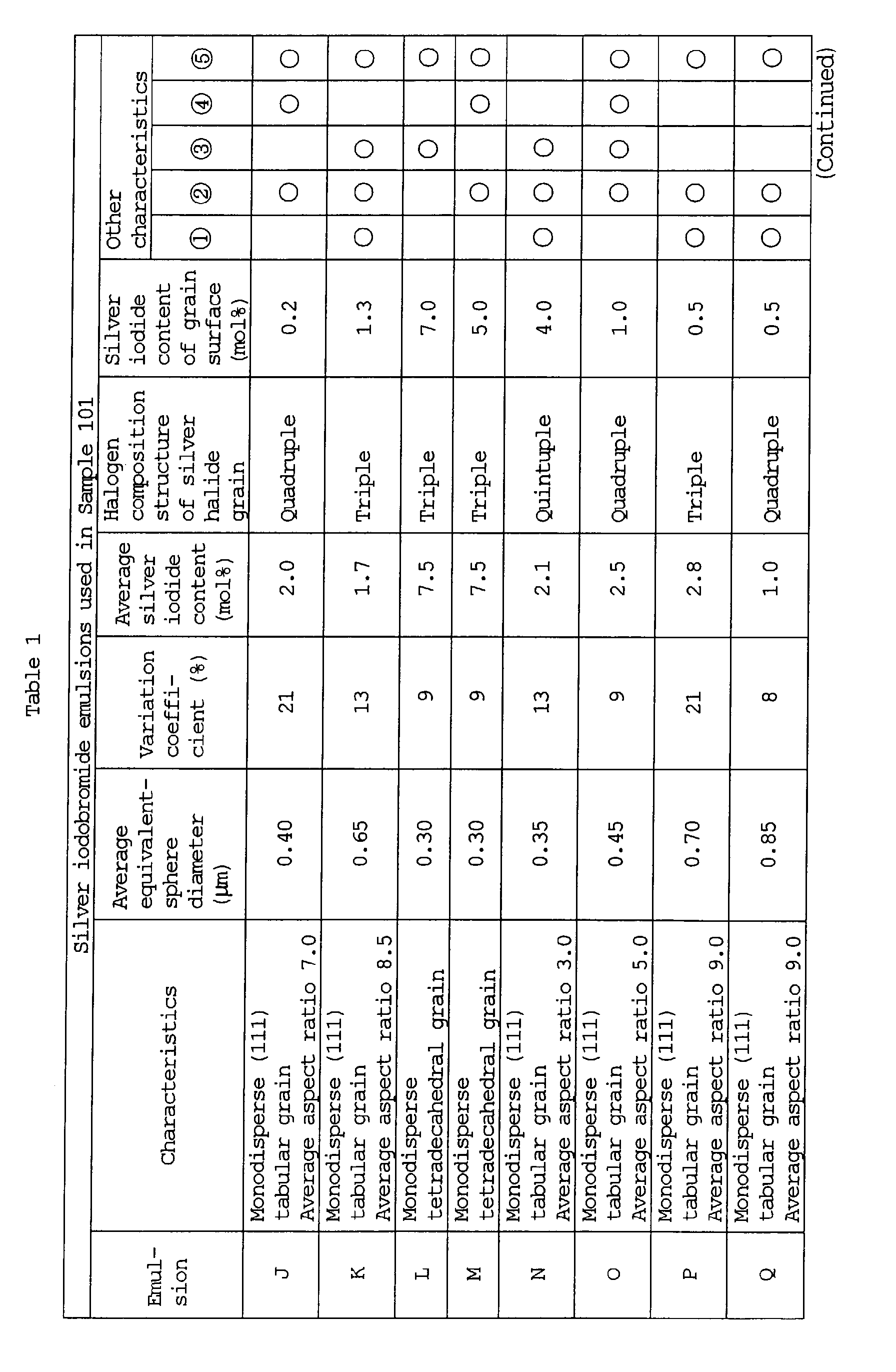


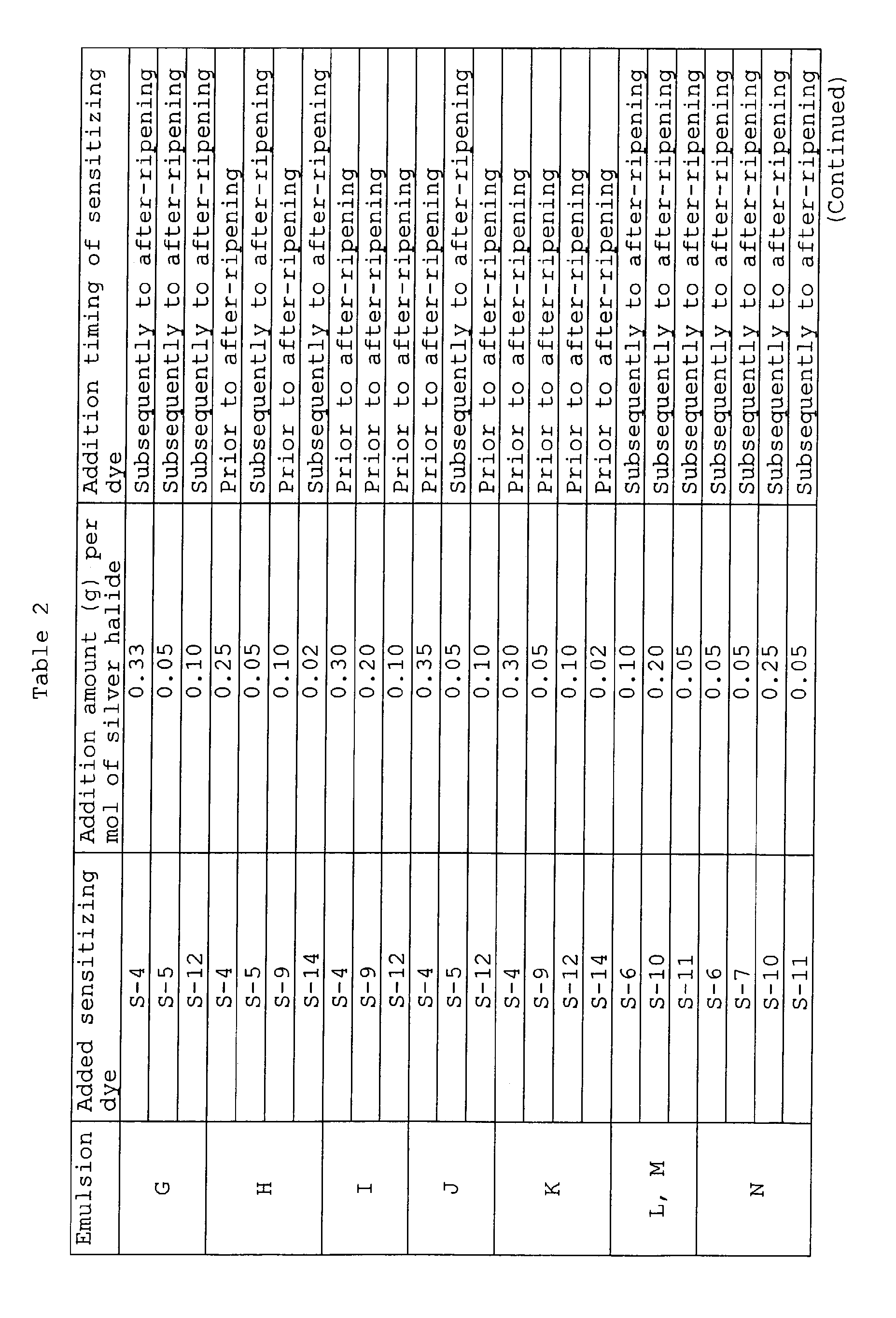

-
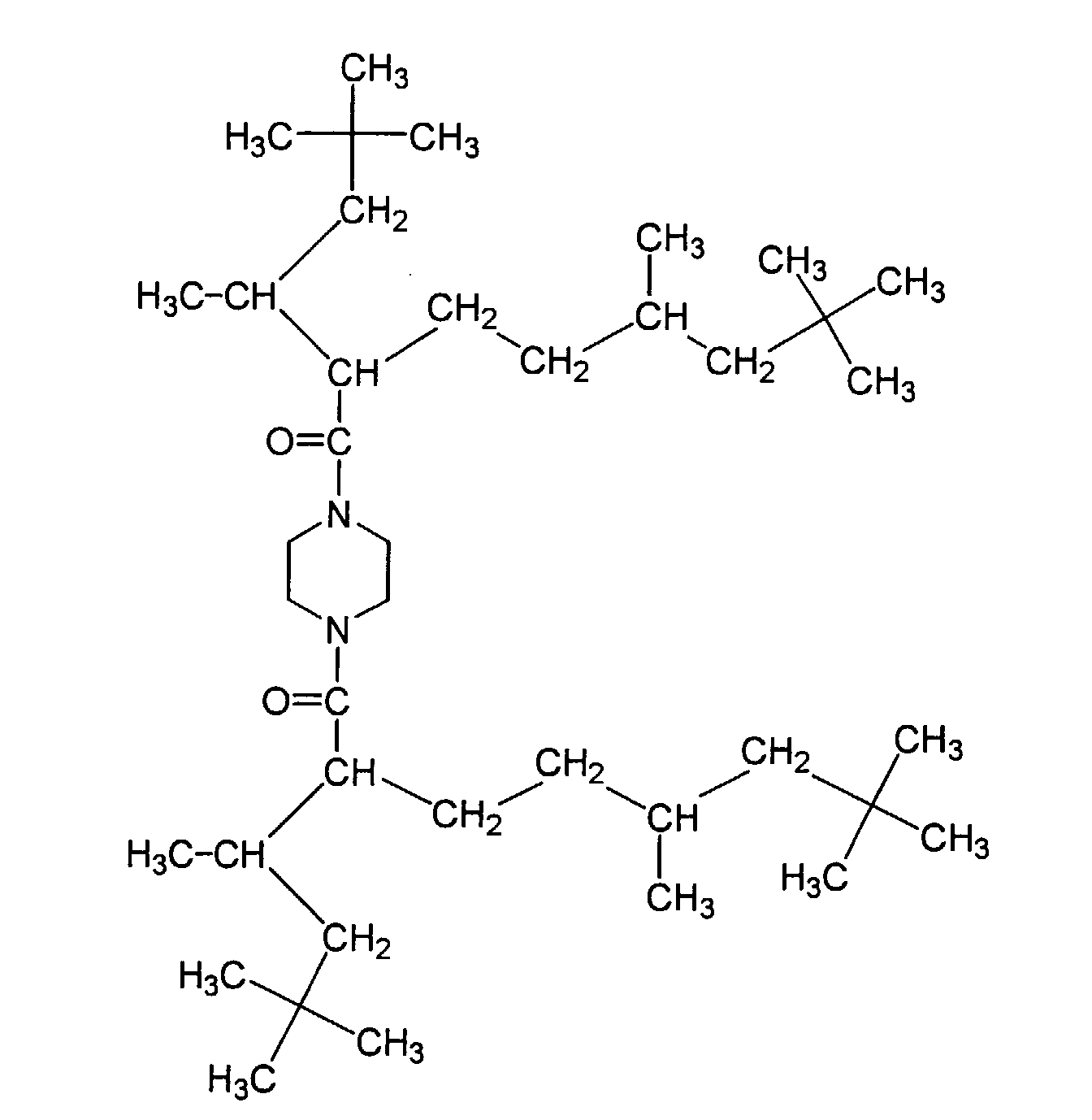
- Compound described in JP-A-8-110624


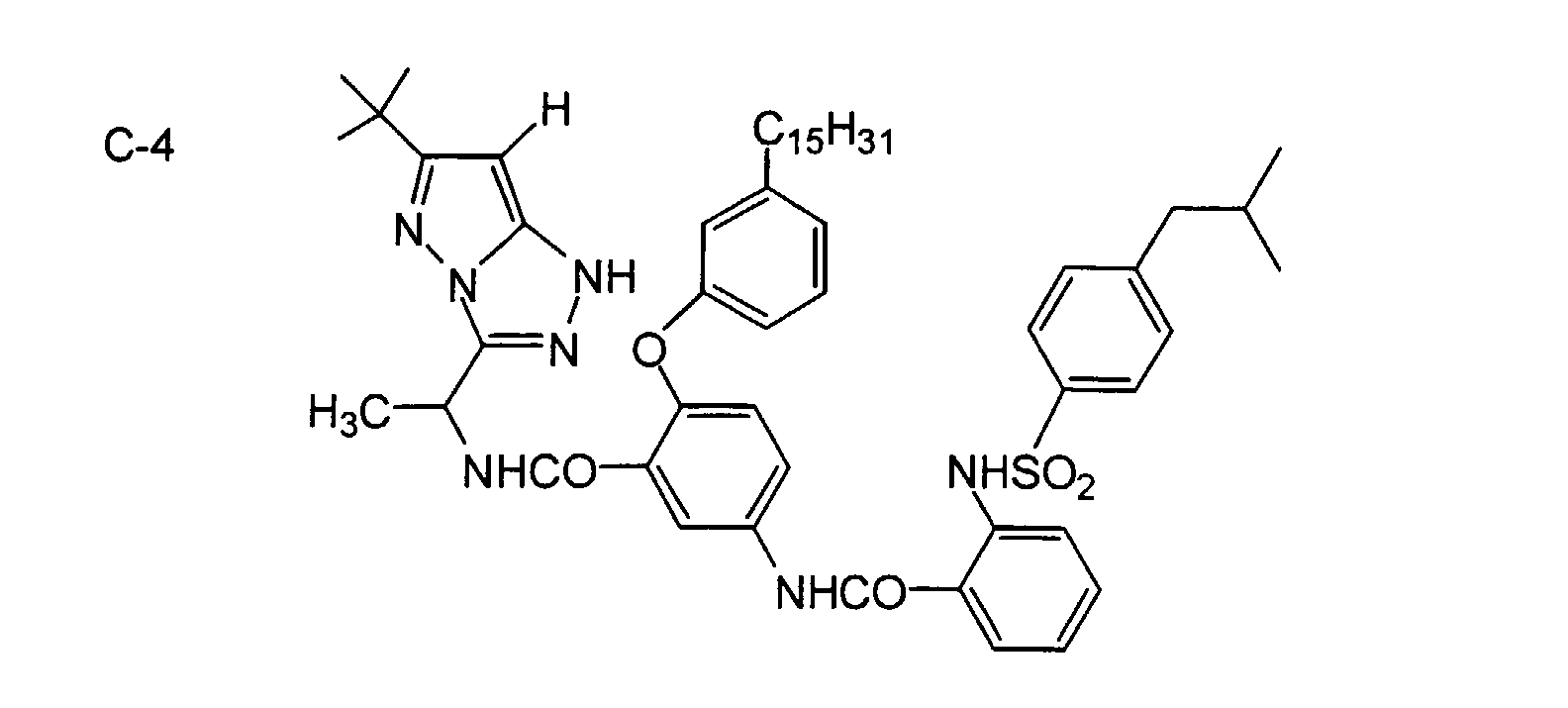

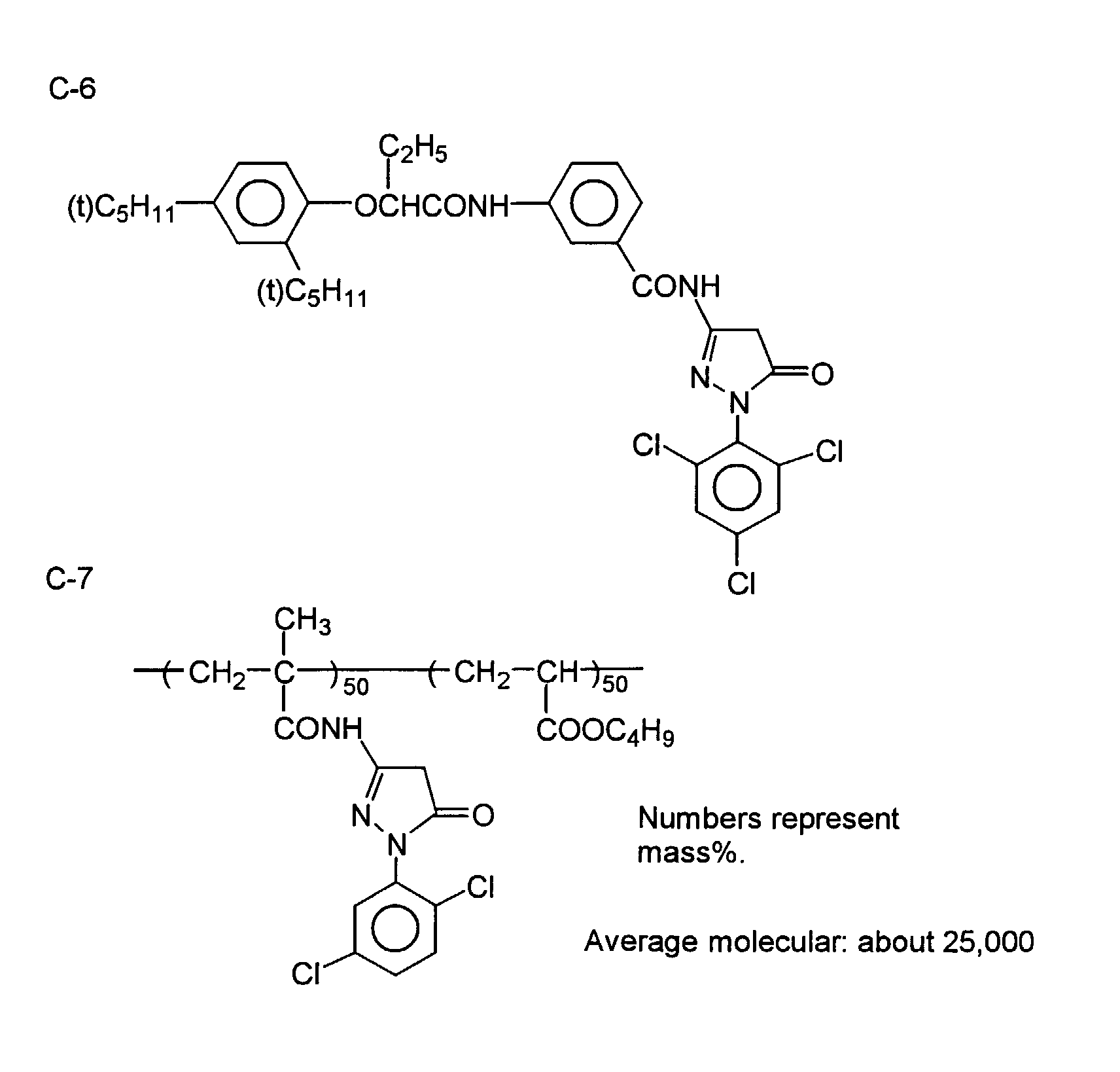


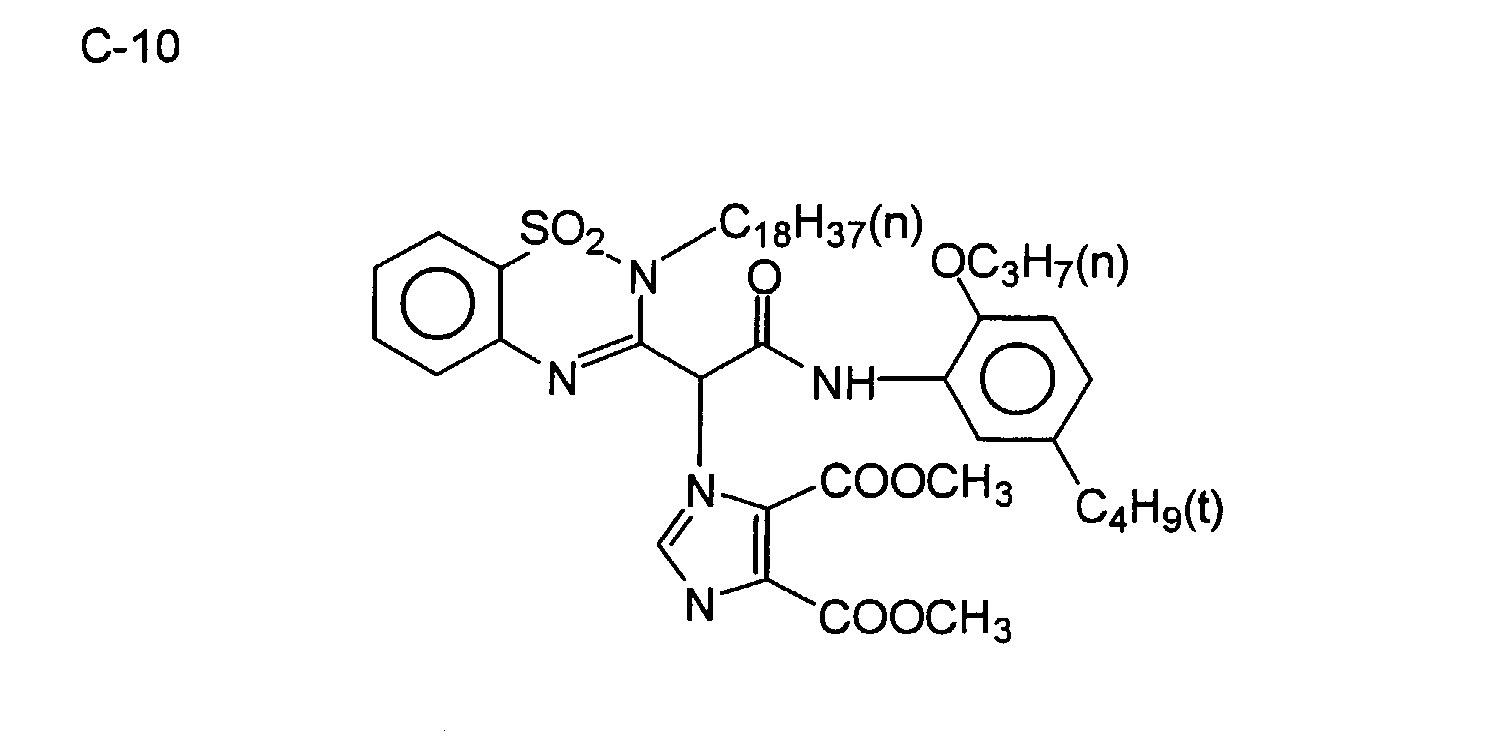
- Oil-1
- Tri-n-hexyl phosphate
- Oil-2
- Tricresyl phosphate
- Oil-3
-
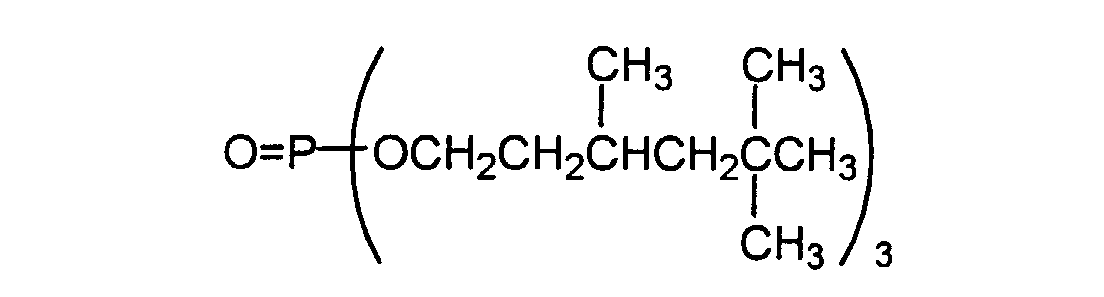
- Oil-4
- Tricyclohexyl phosphate
- Oil-5
-
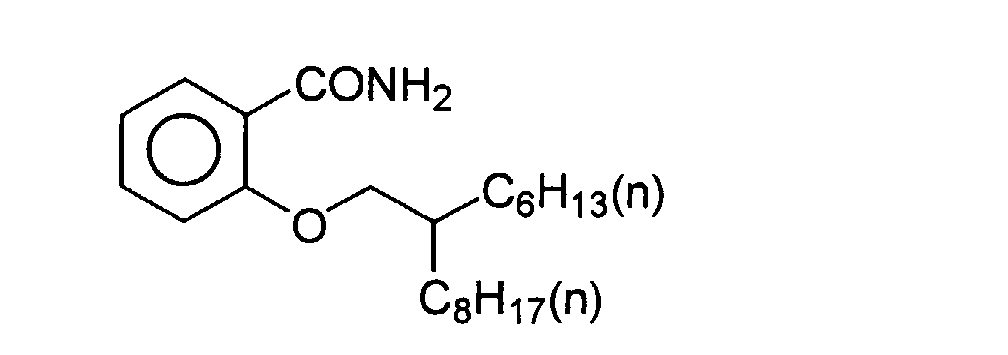
- Oil-6
-

- Oil-7
-

- Oil-8
-

- Oil-9
-

- Cpd-A
-

- Cpd-B
-
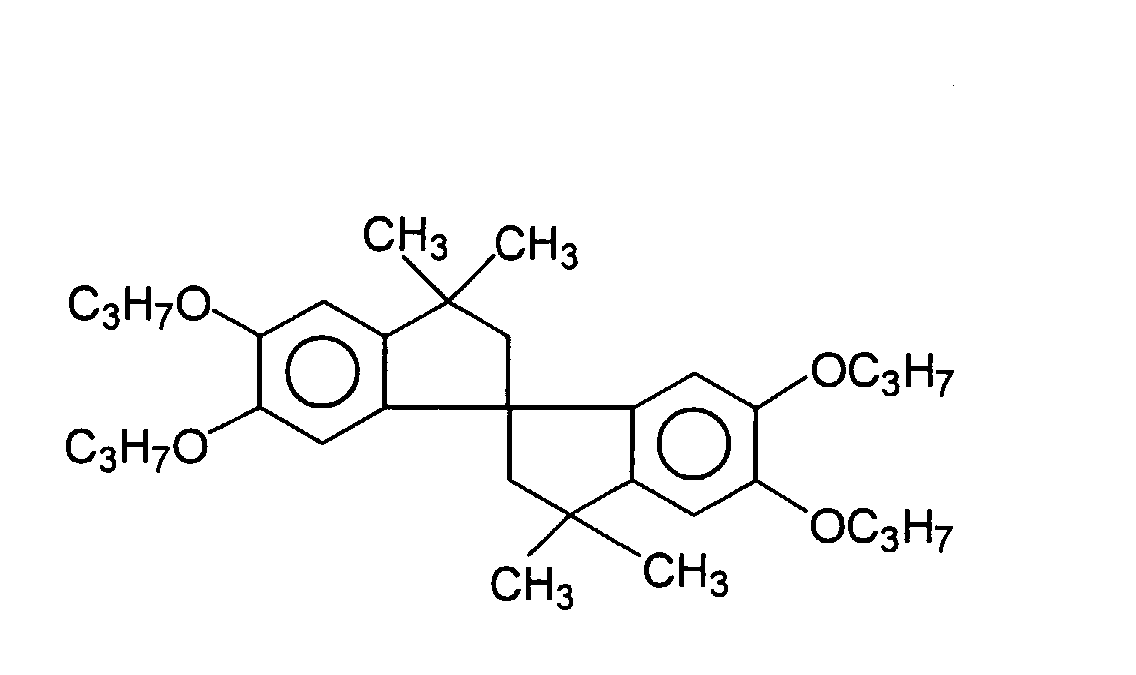
- Cpd-C
-

- Cpd-D
-

- Cpd-E
-
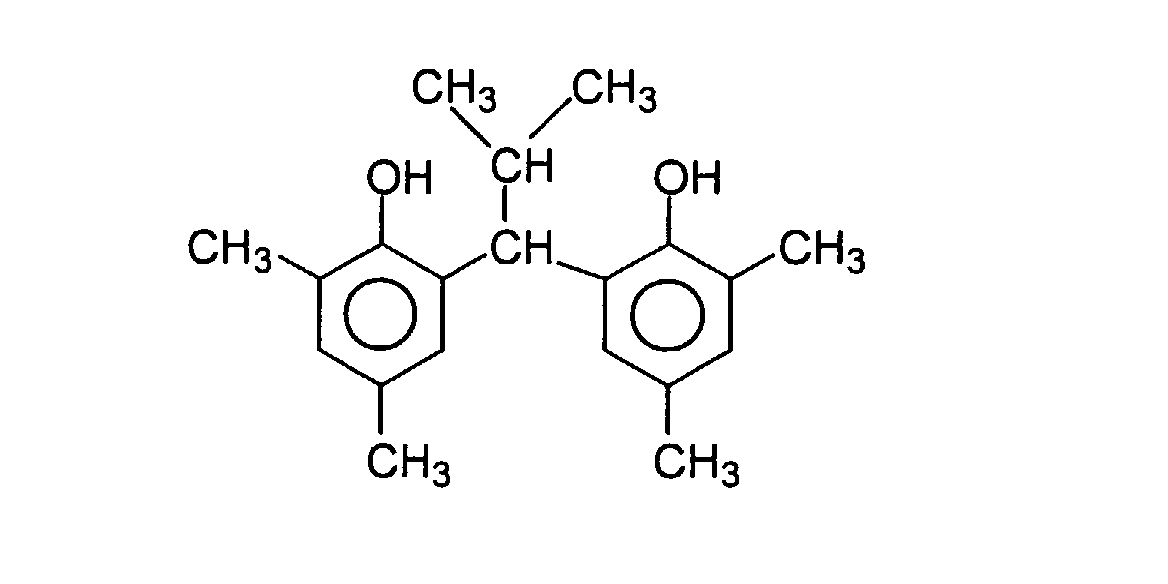
- Cpd-F
-
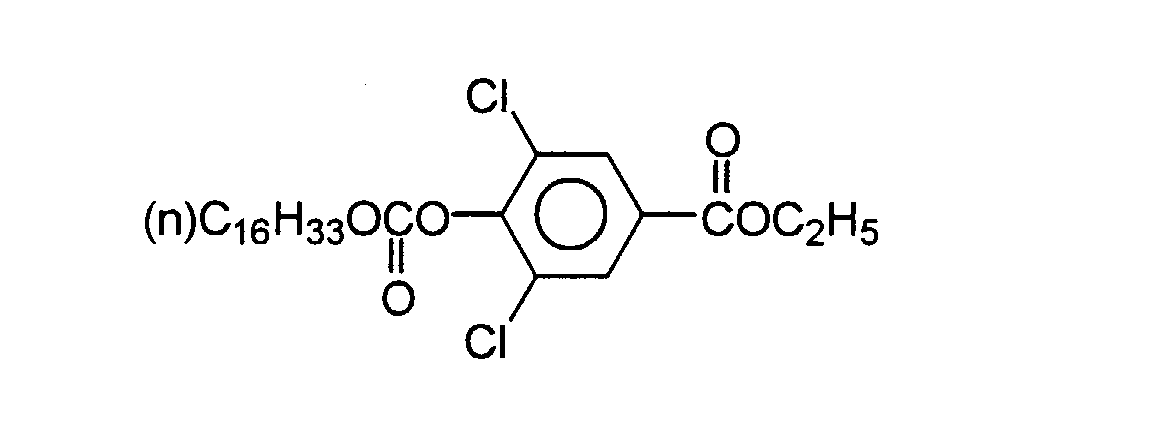
- Cpd-G
-
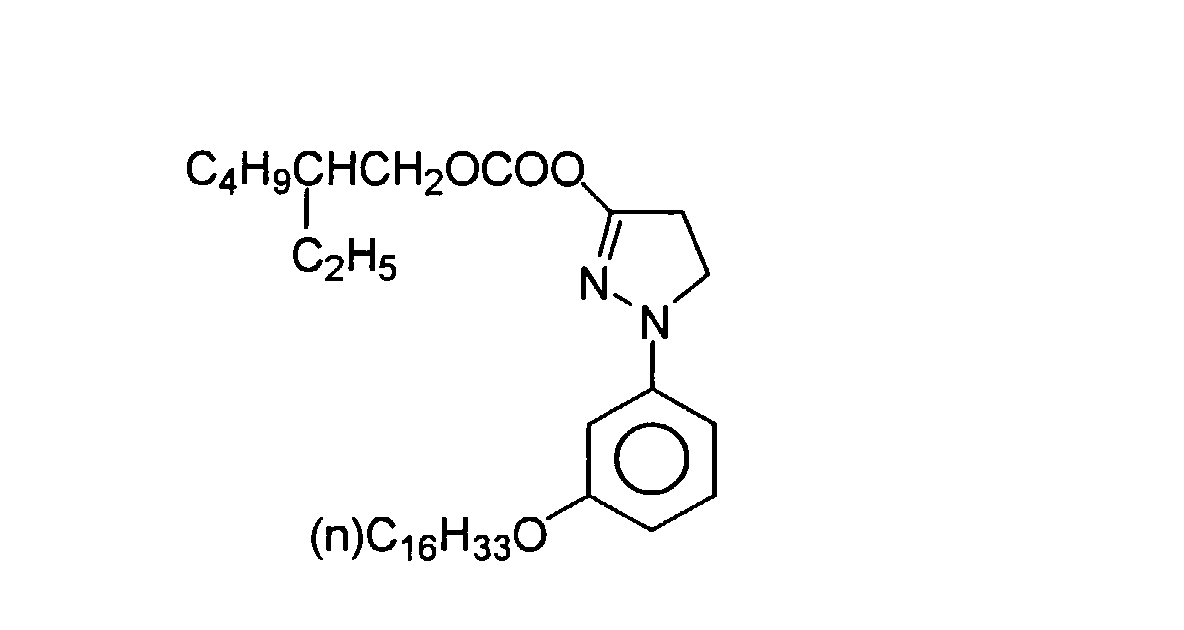
- Cpd-H
-

- Cpd-I
-
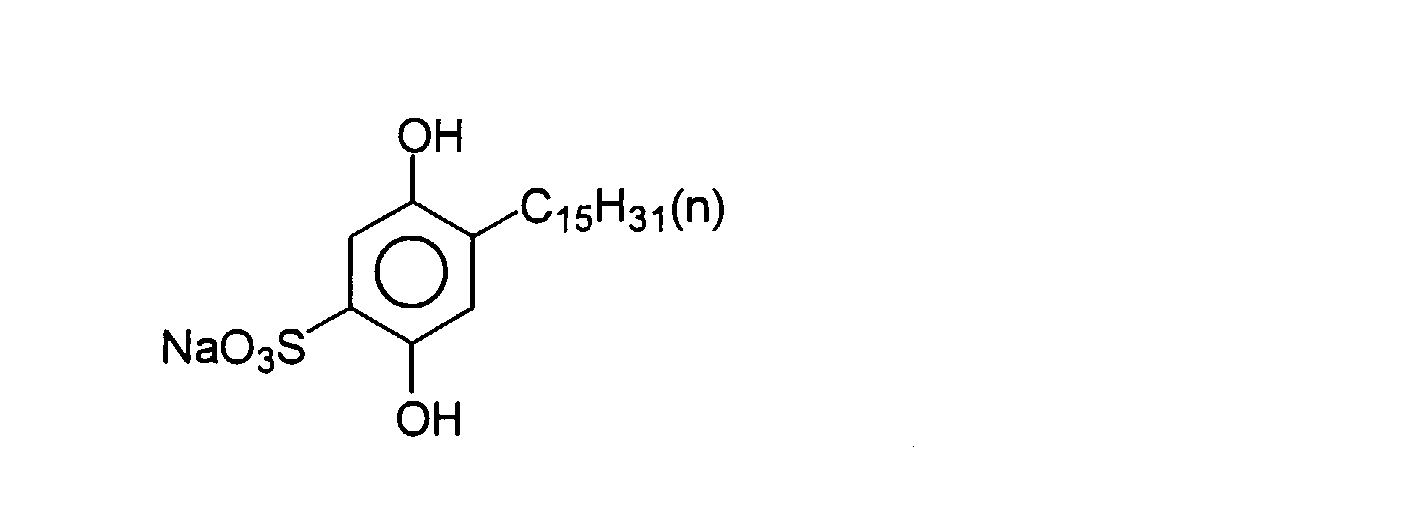
- Cpd-J
-

- Cpd-K
-
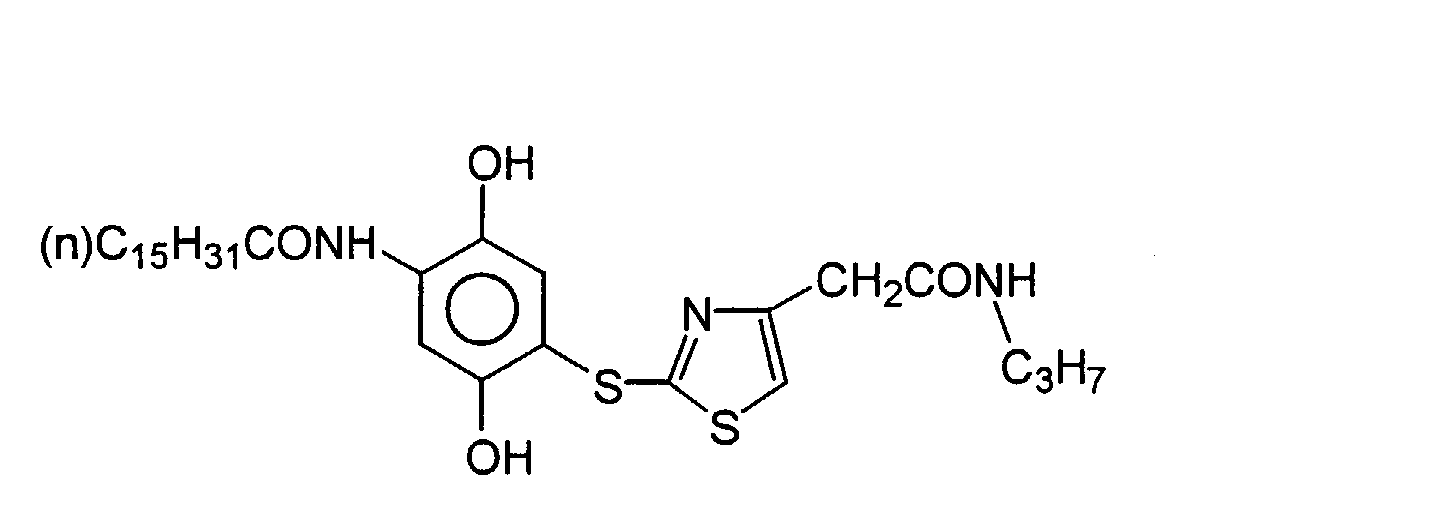
- Cpd-L
-

- Cpd-M
-

- Cpd-N
-
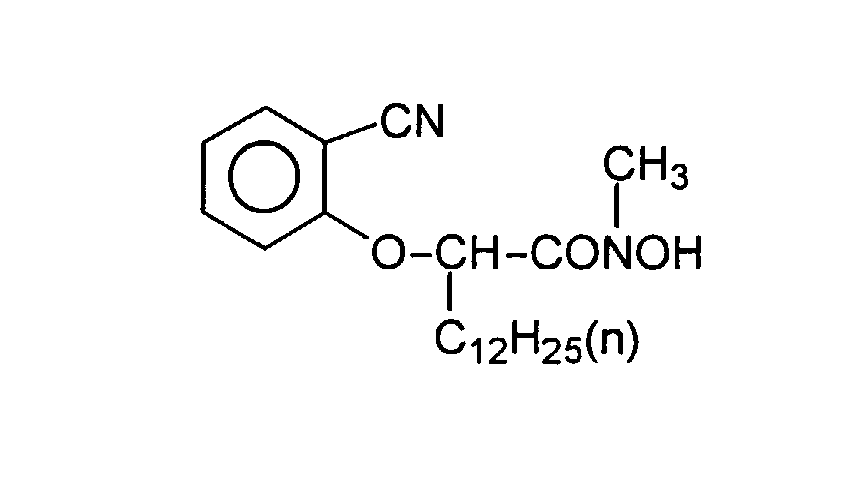
- Cpd-O
-
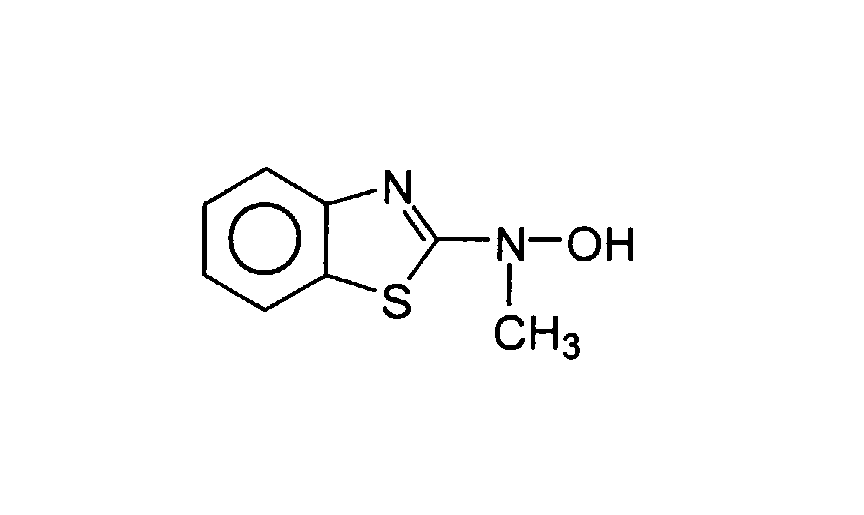
- Cpd-P
-

- Cpd-Q
-
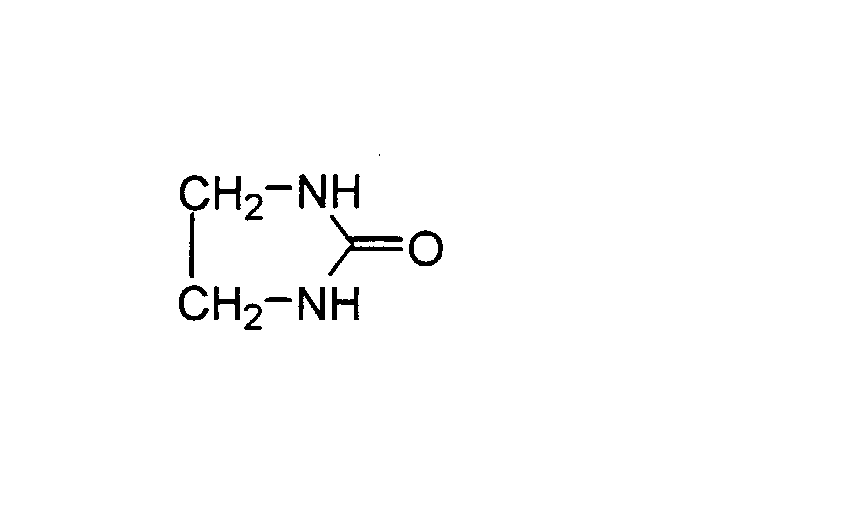
- Cpd-R
-

- Cpd-S
-
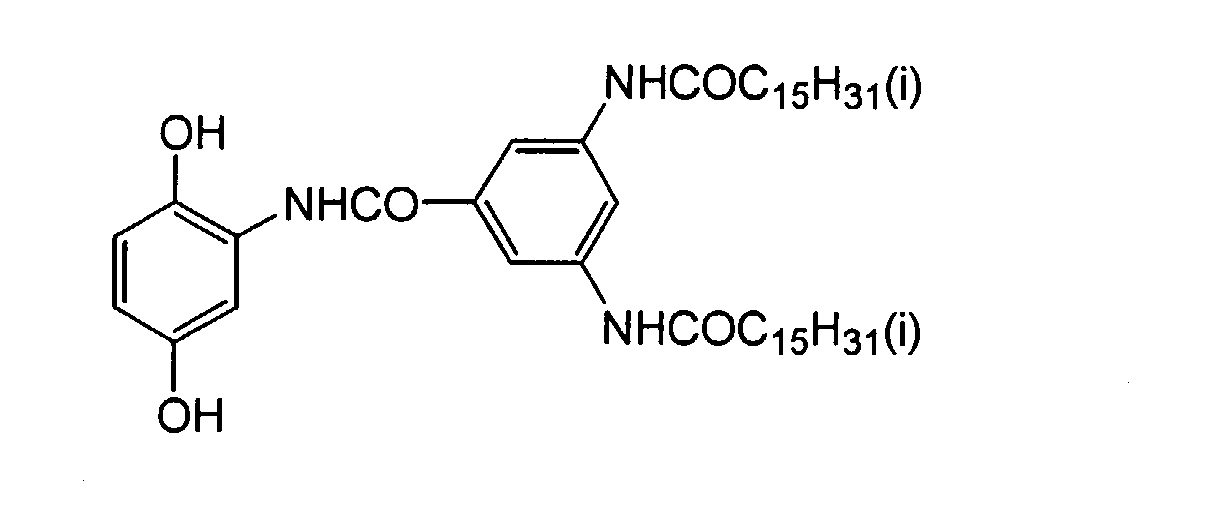
- Cpd-T
-

- Cpd-U
-

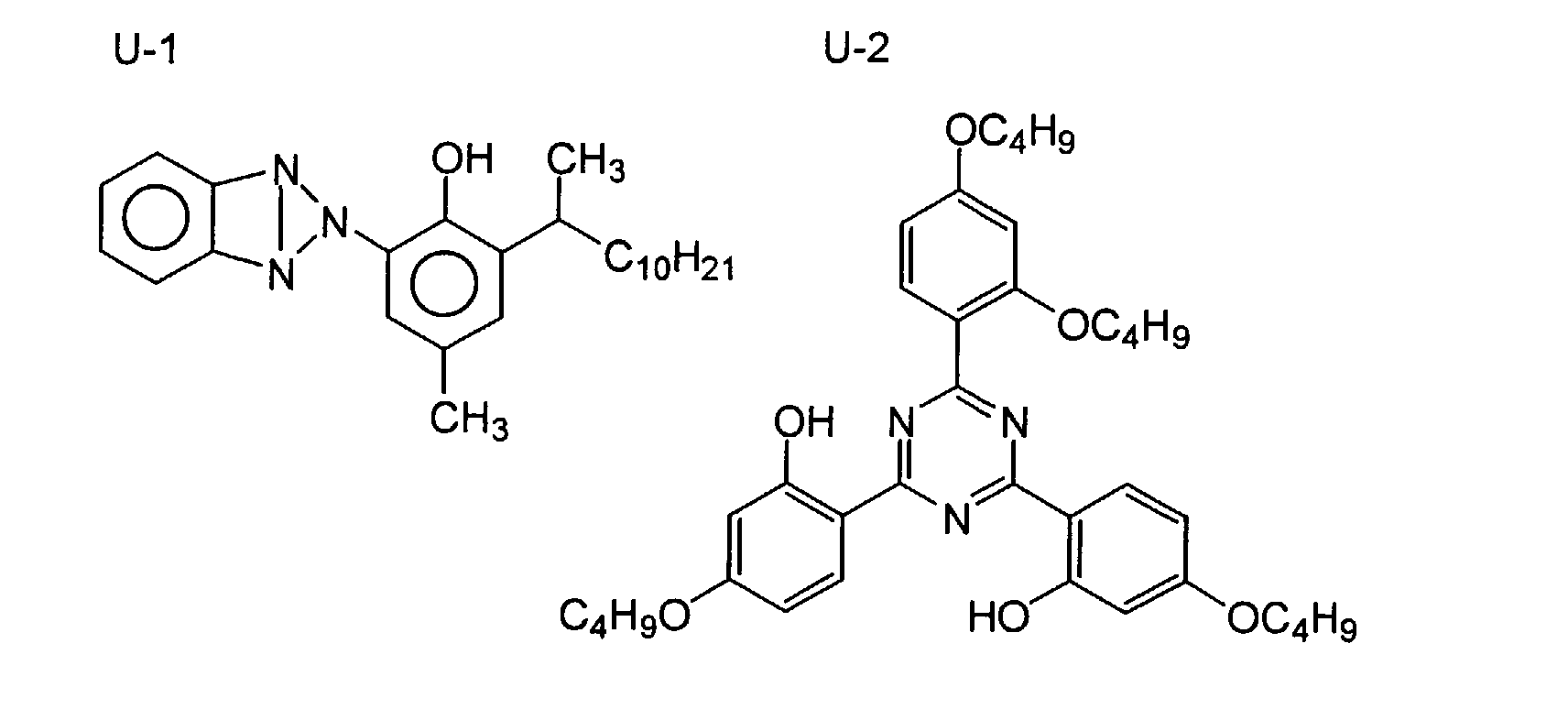
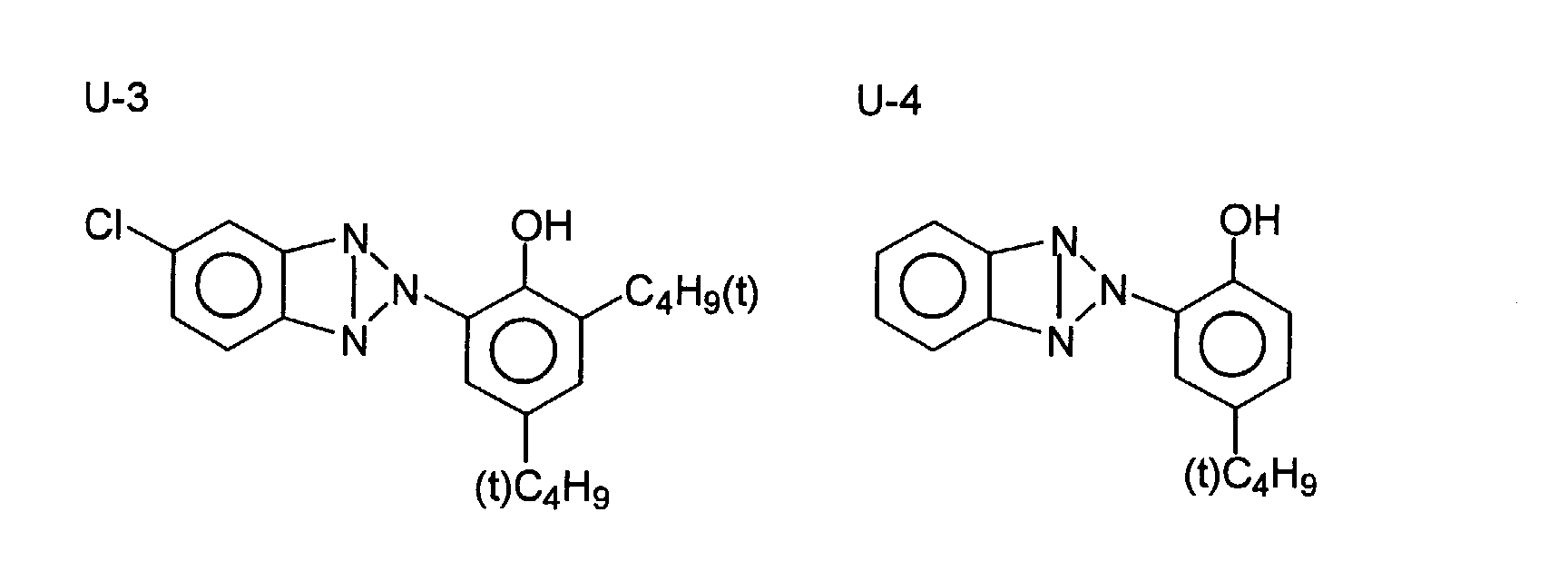
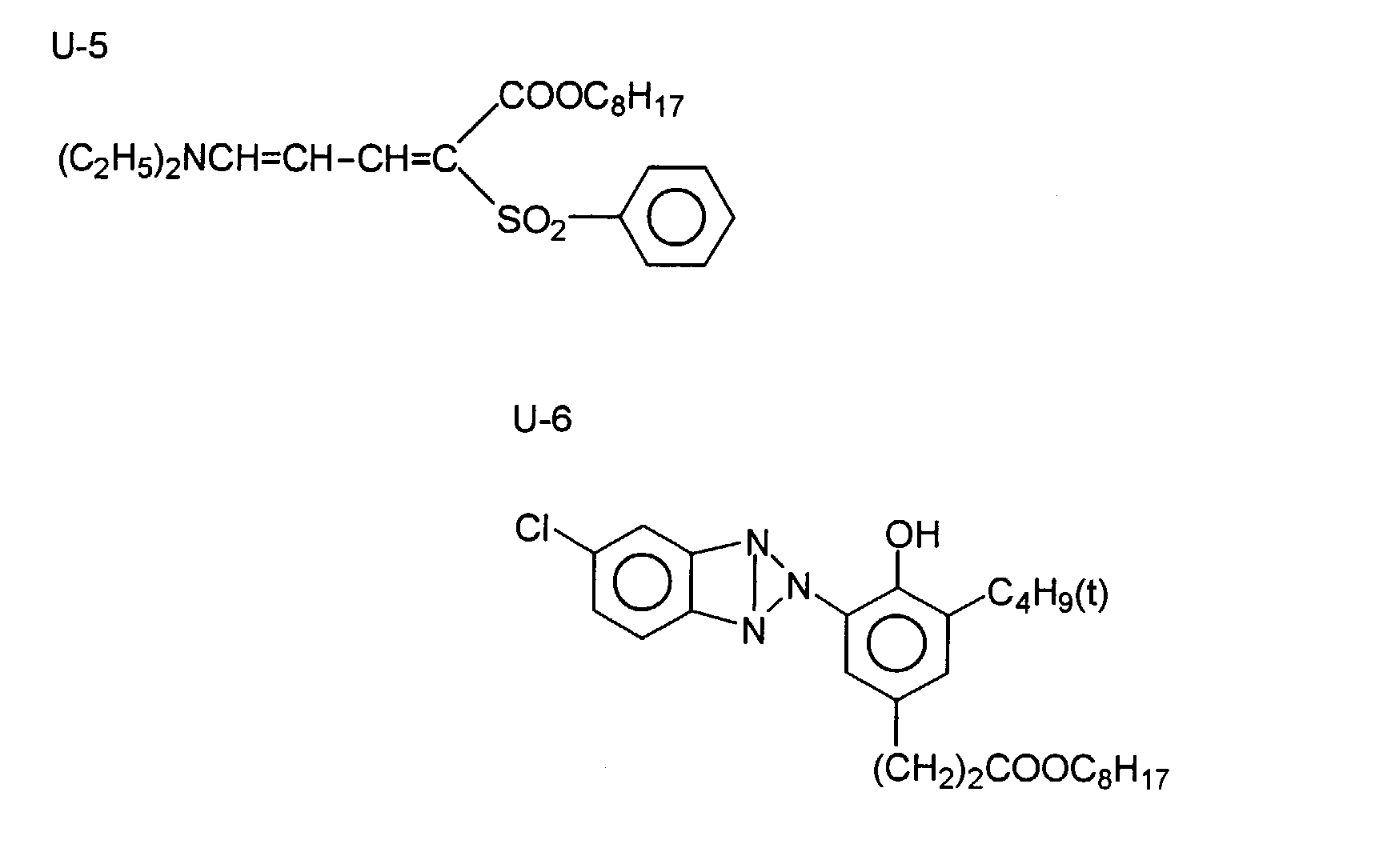
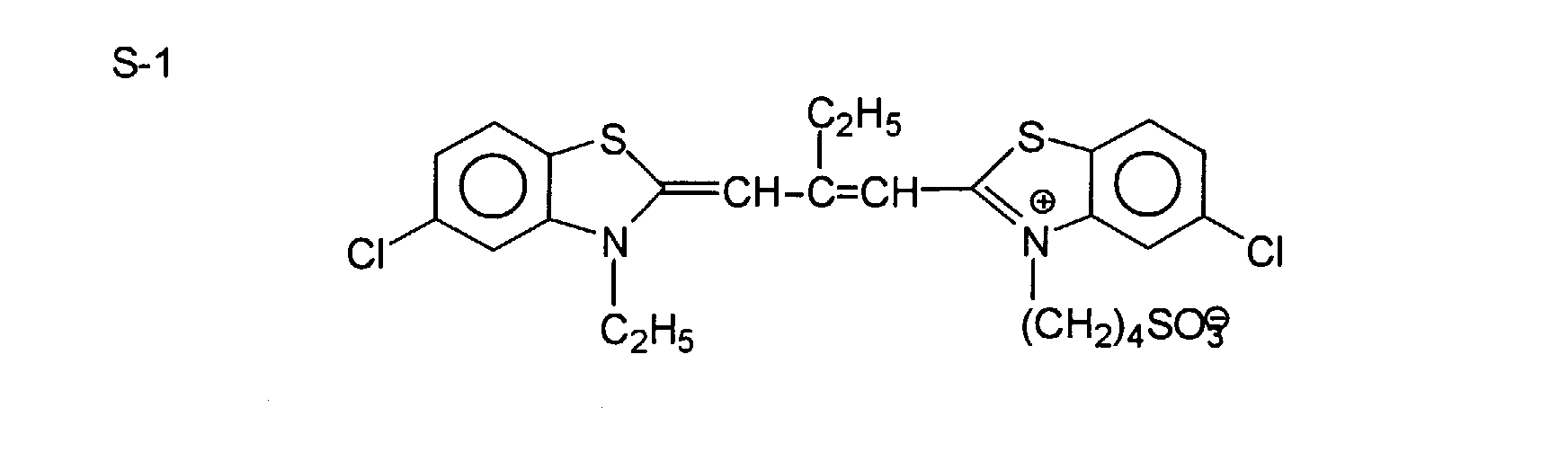
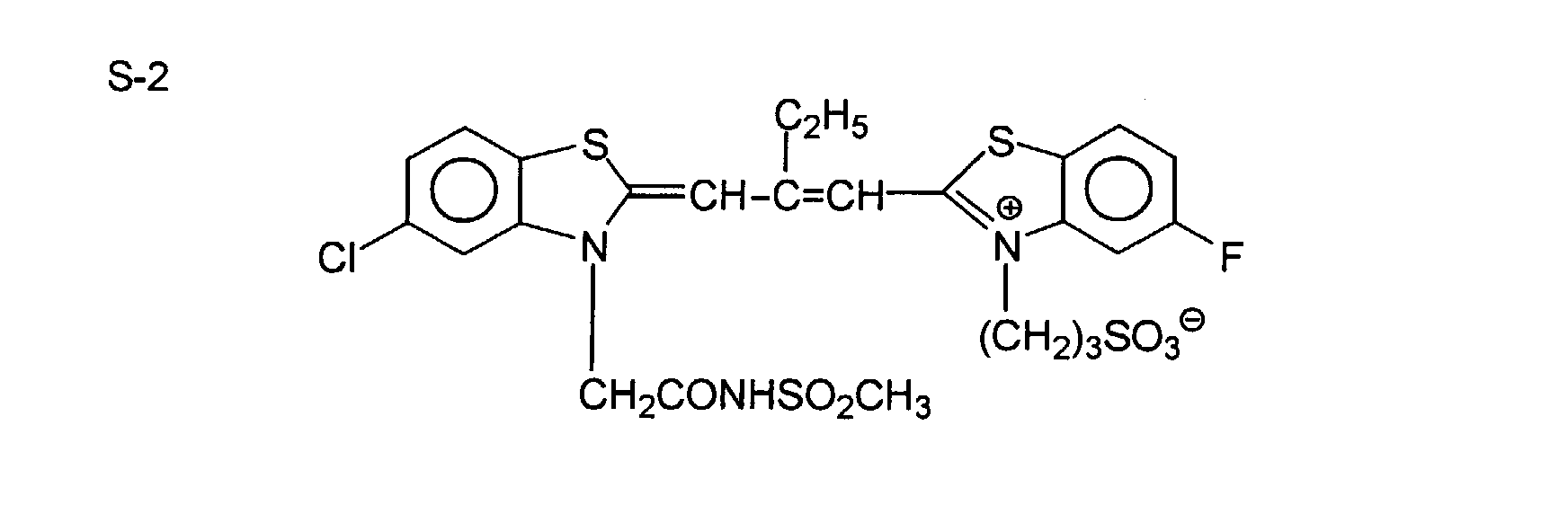
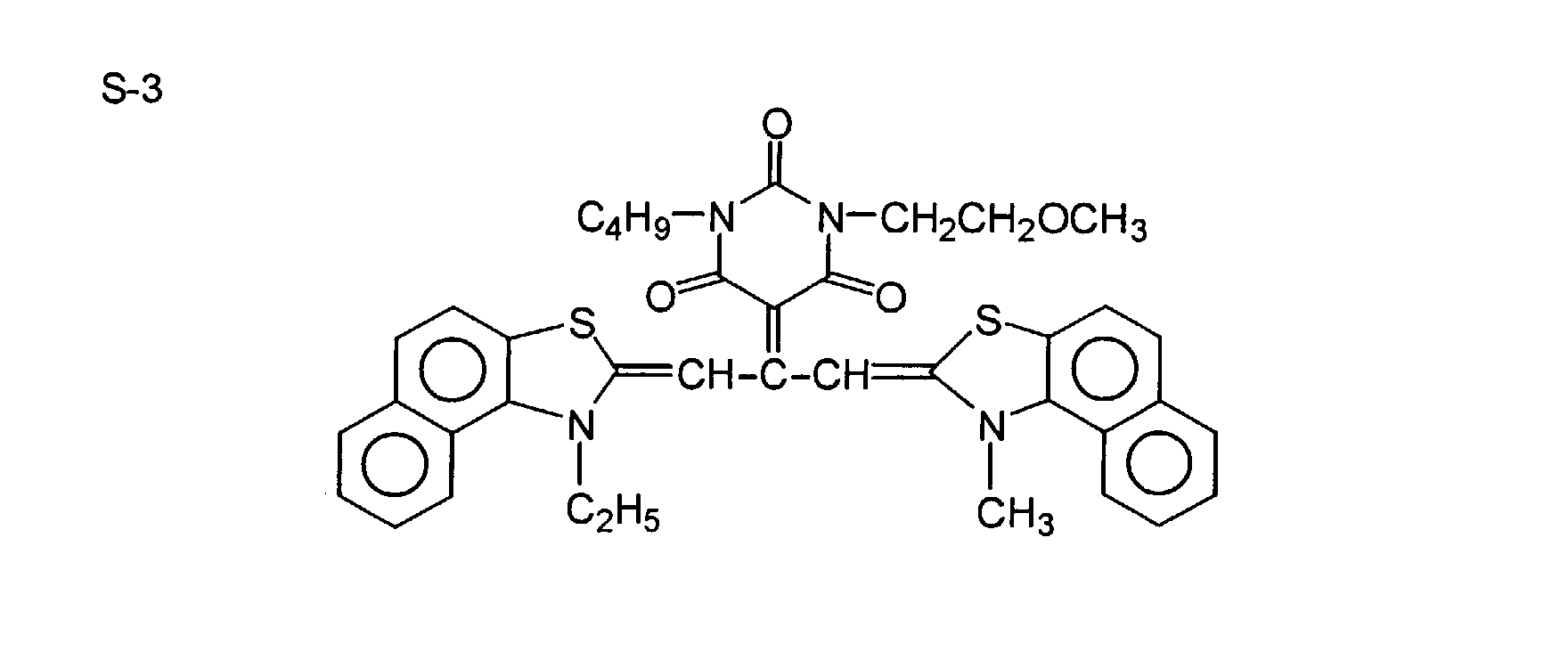


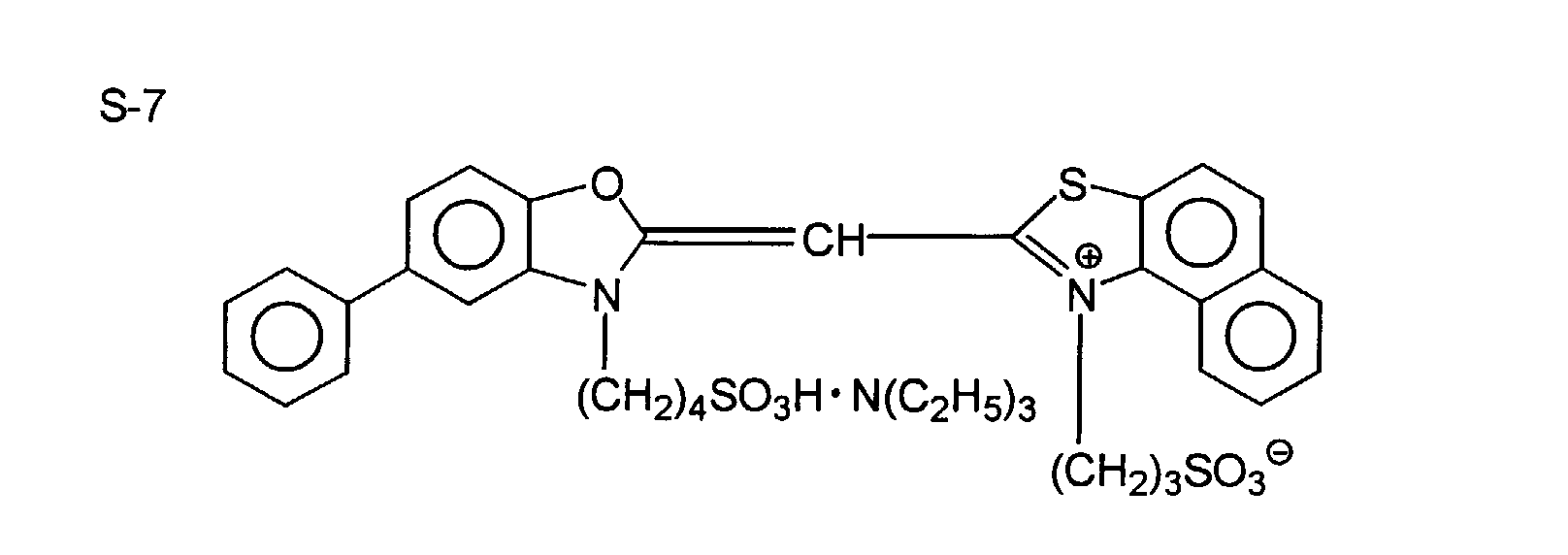
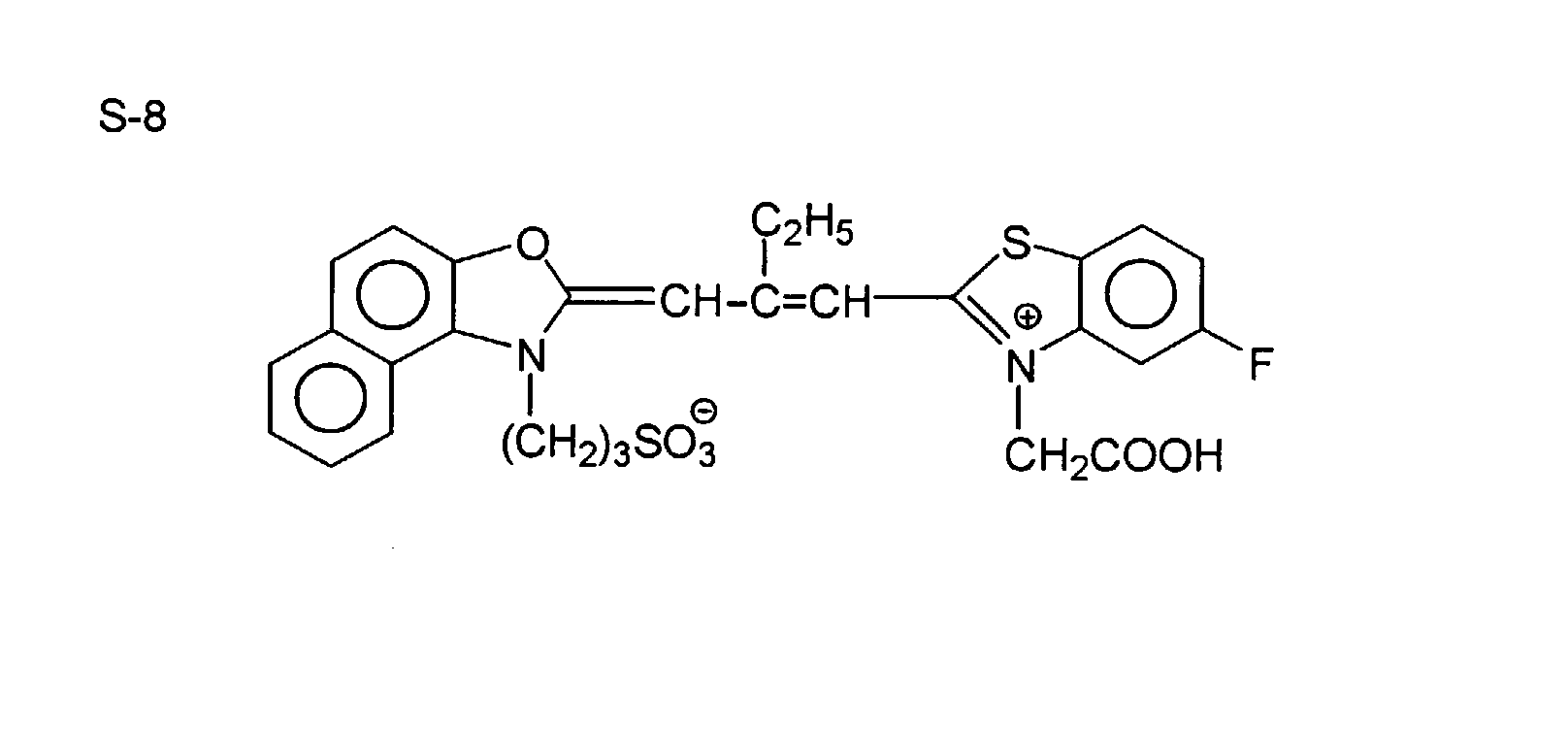
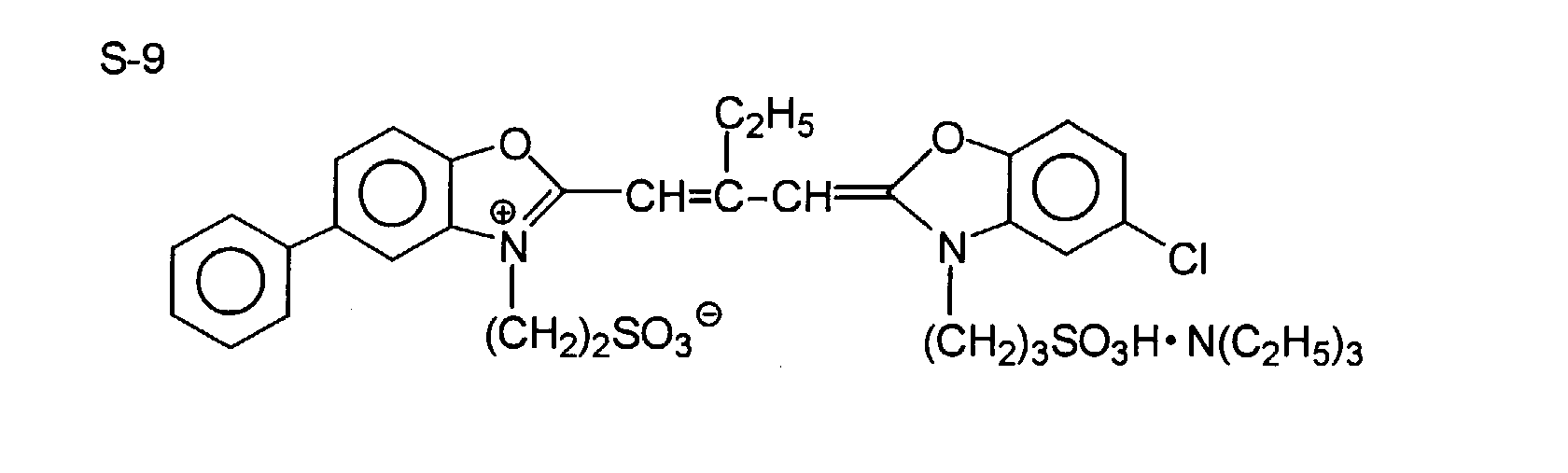
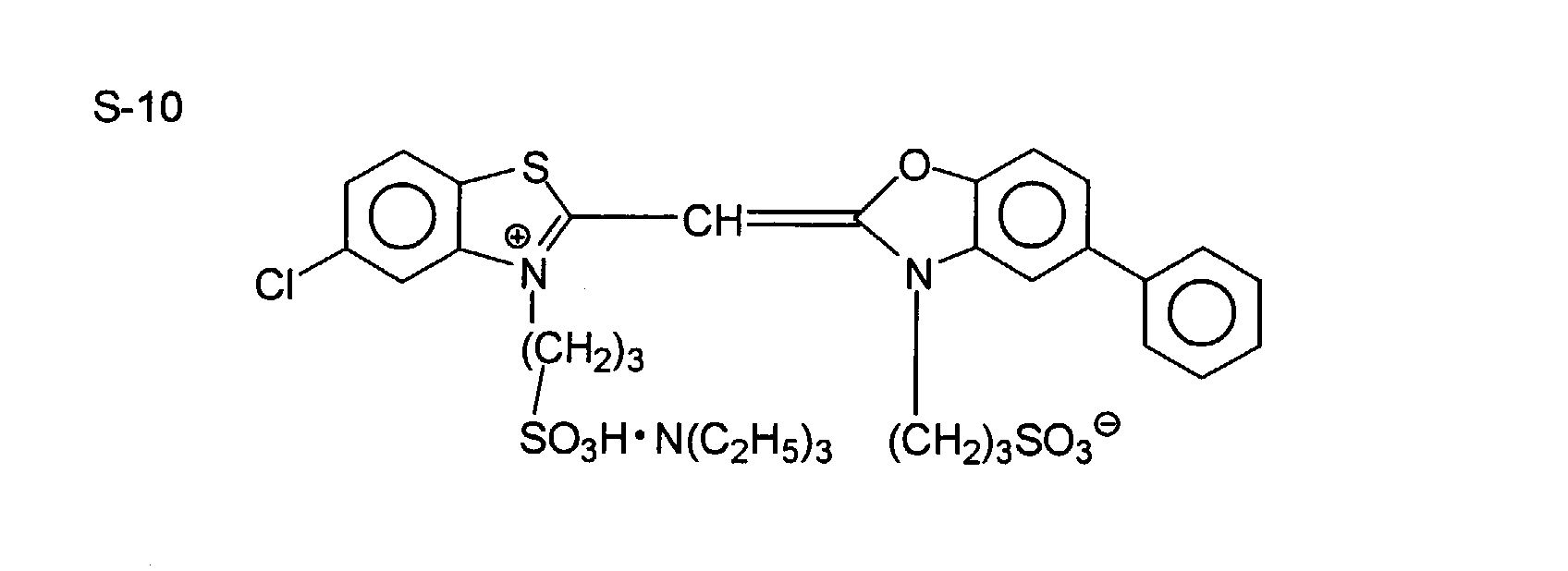

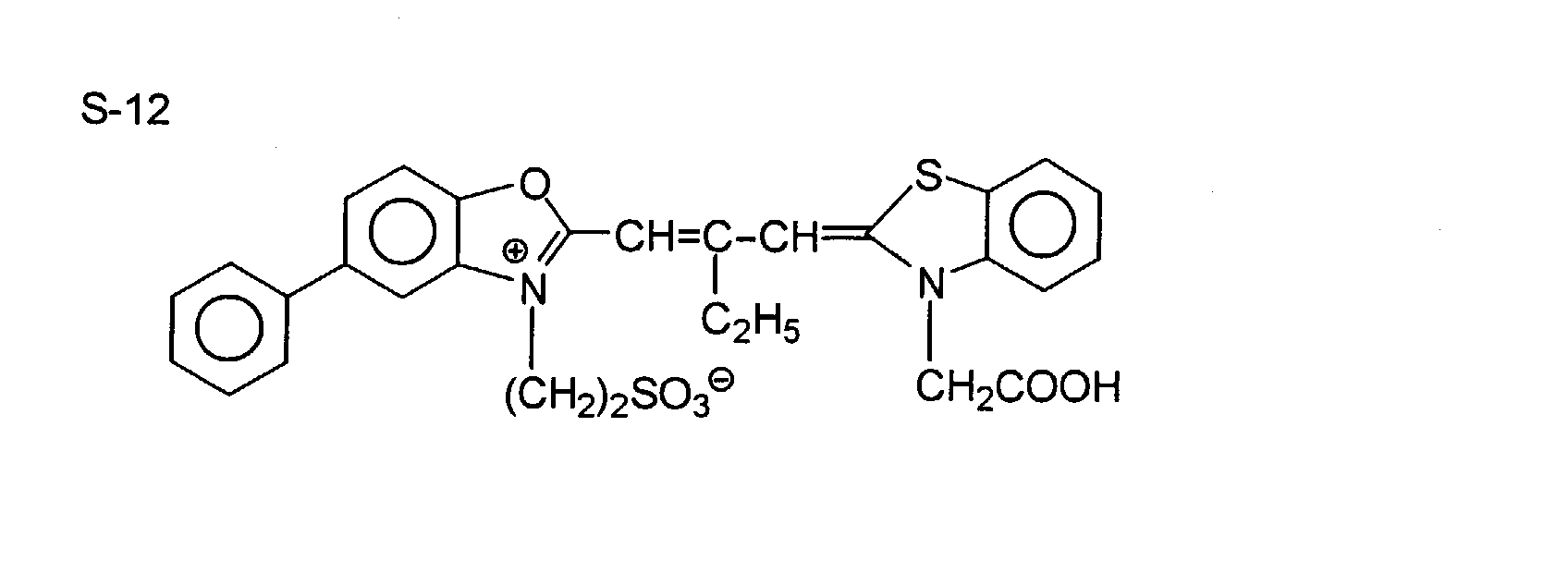
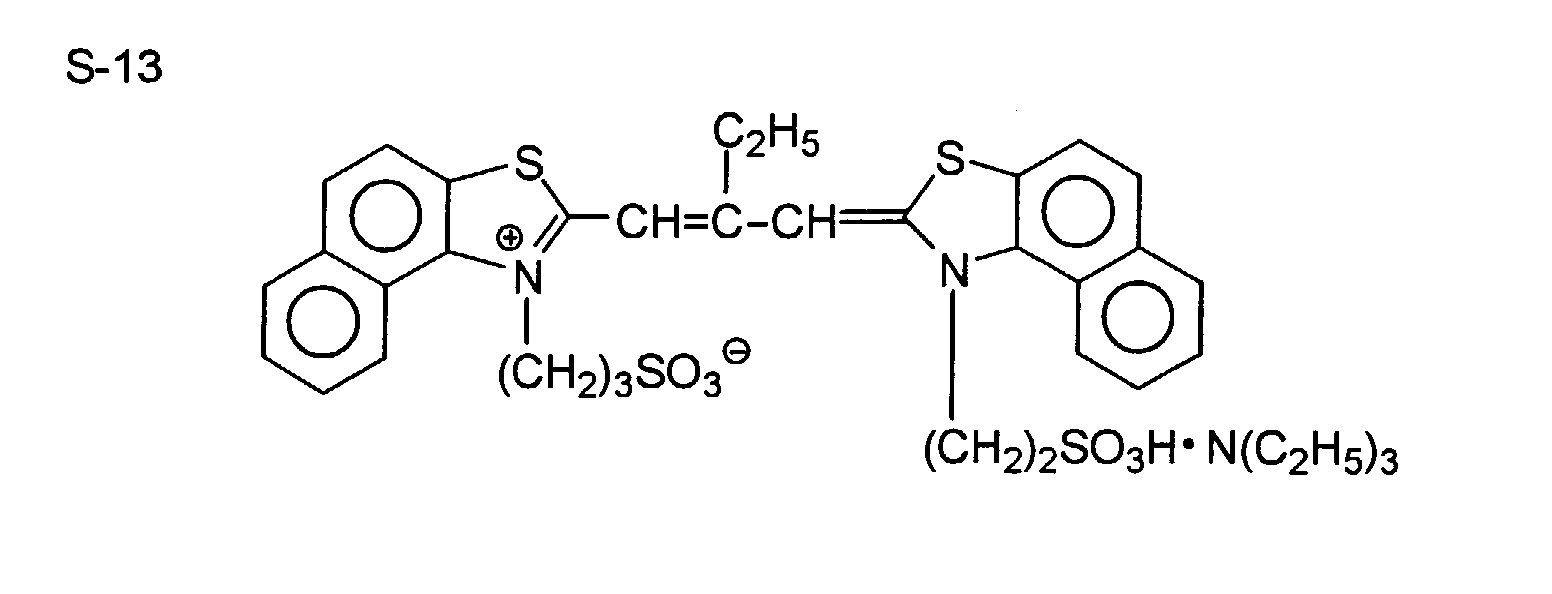


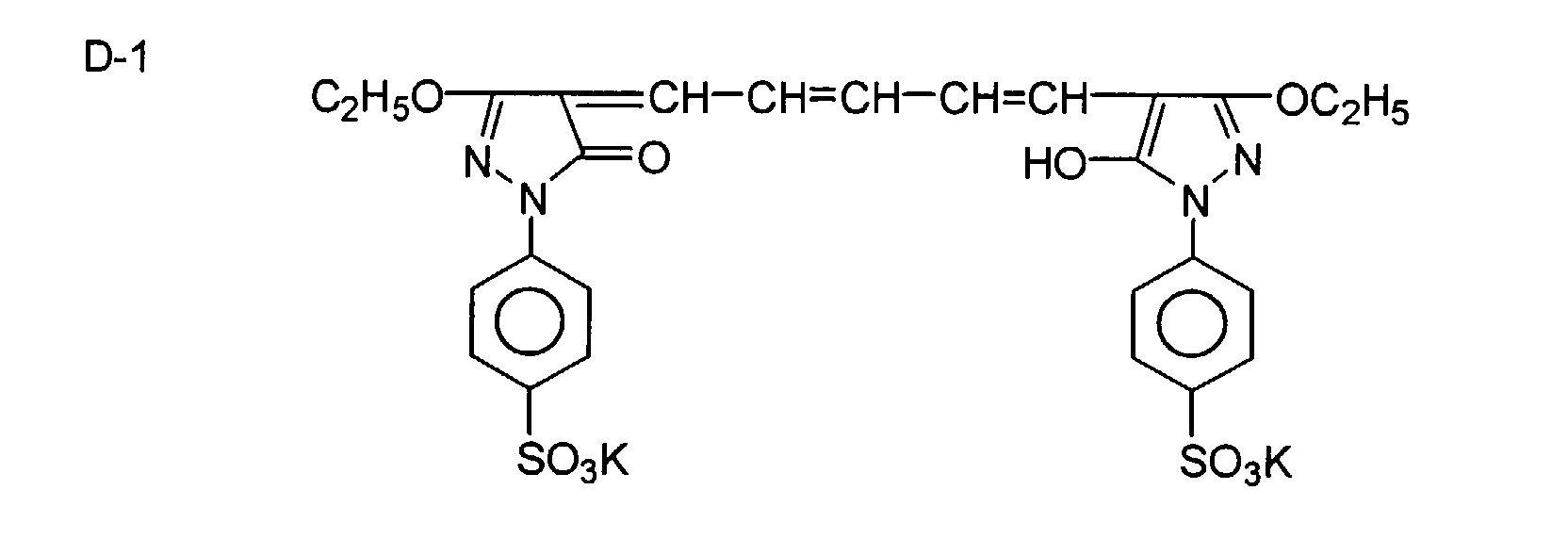

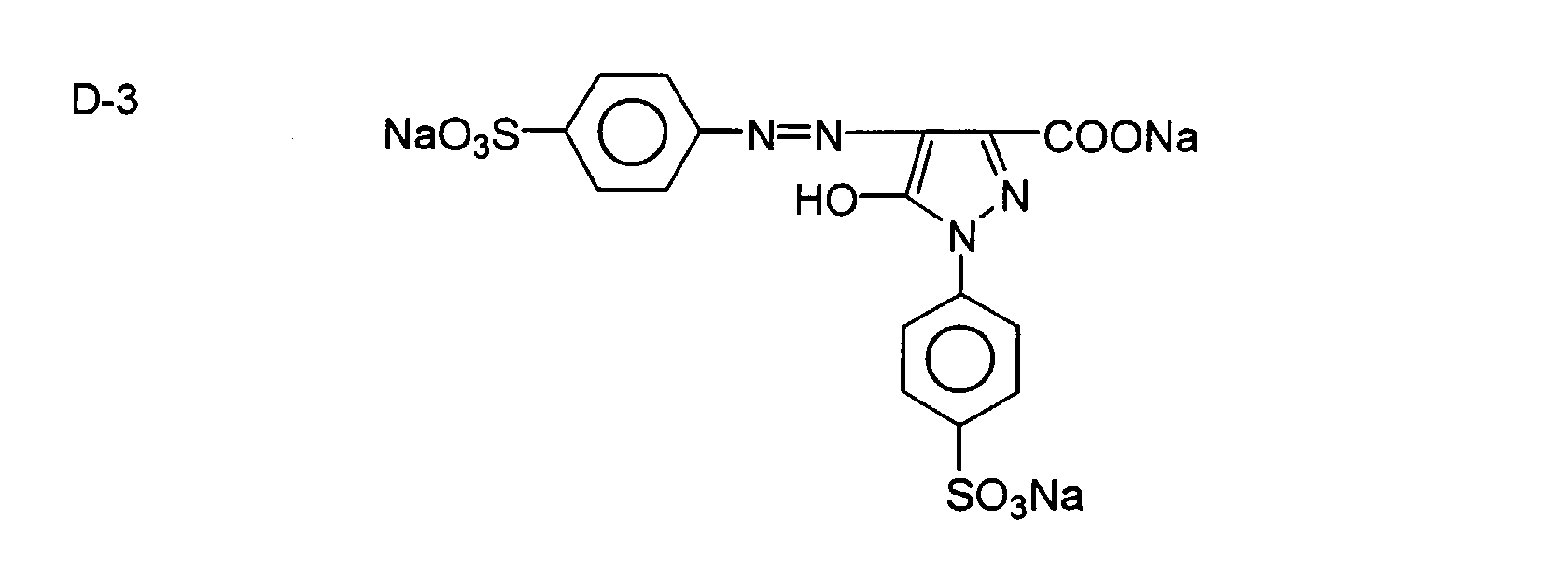

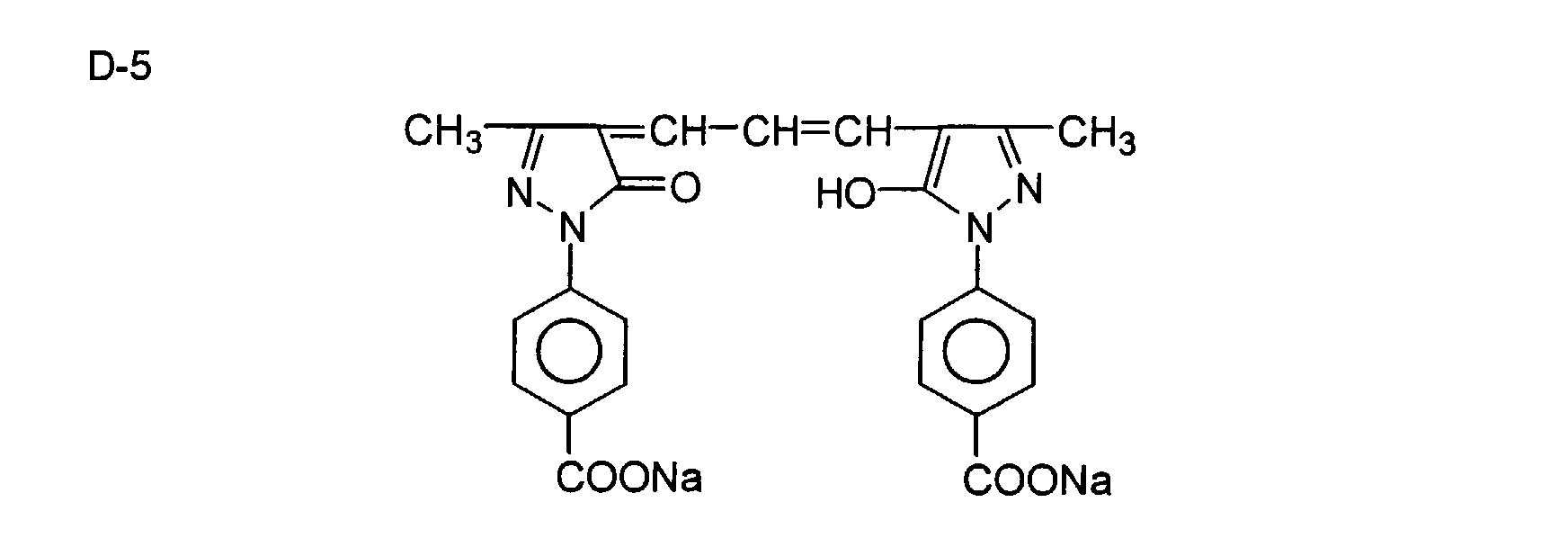

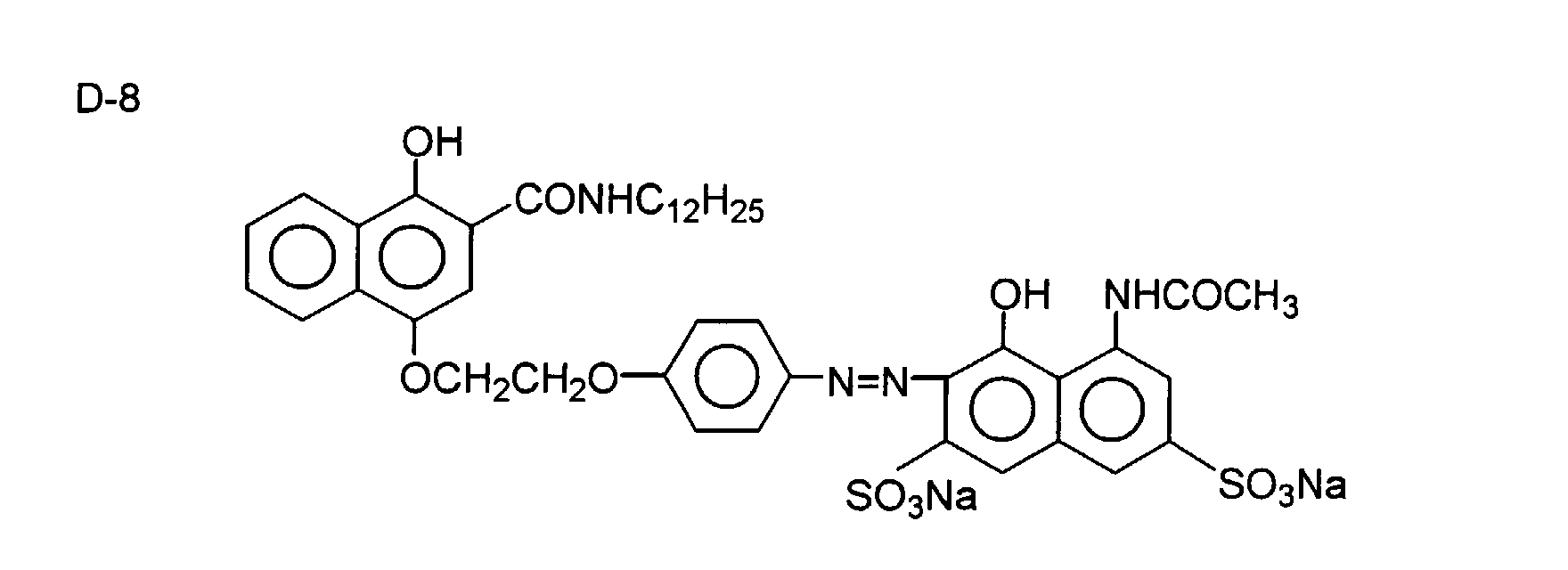
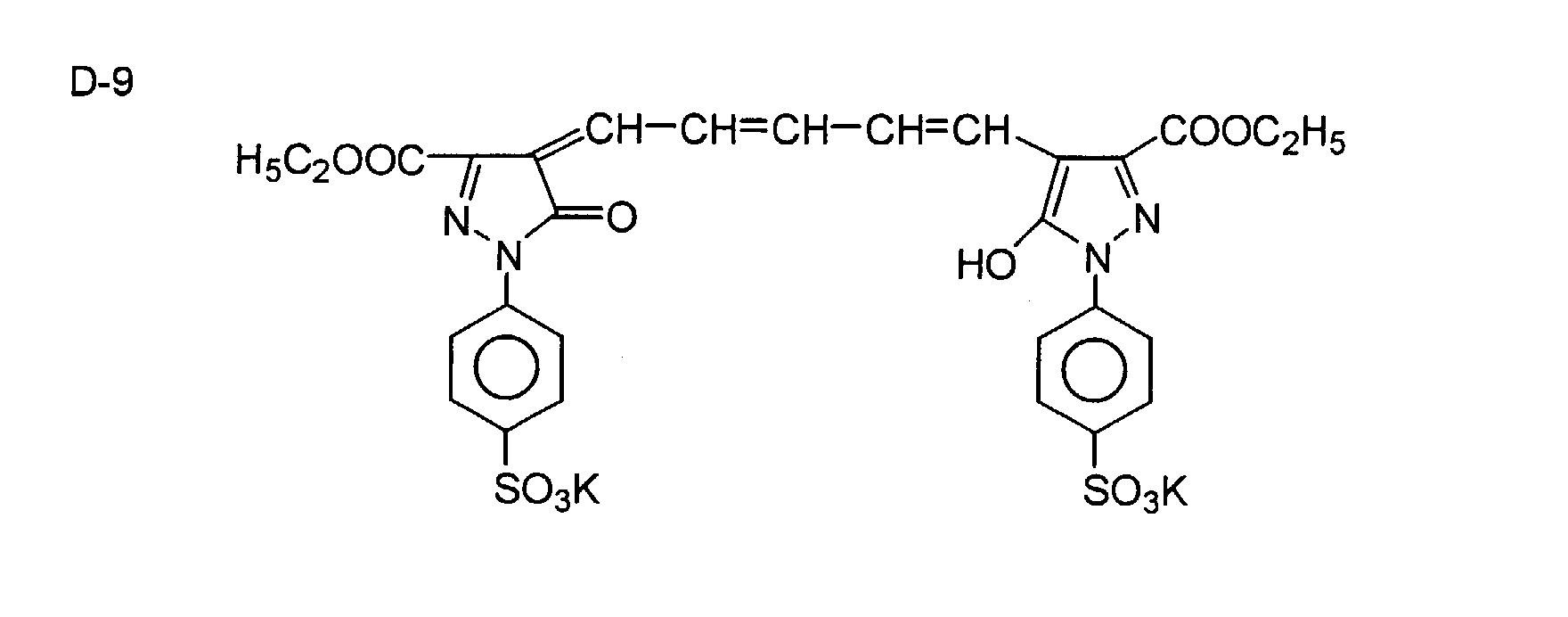


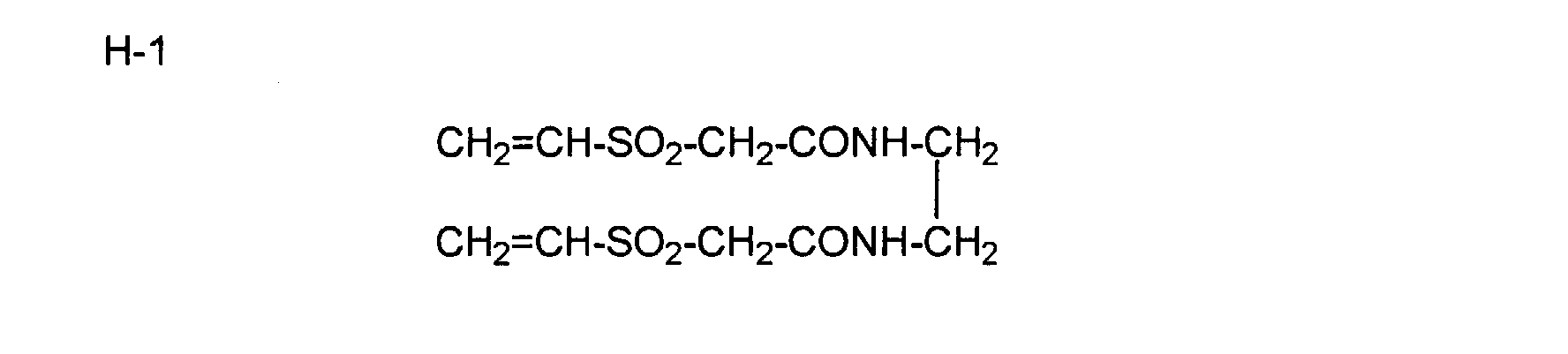




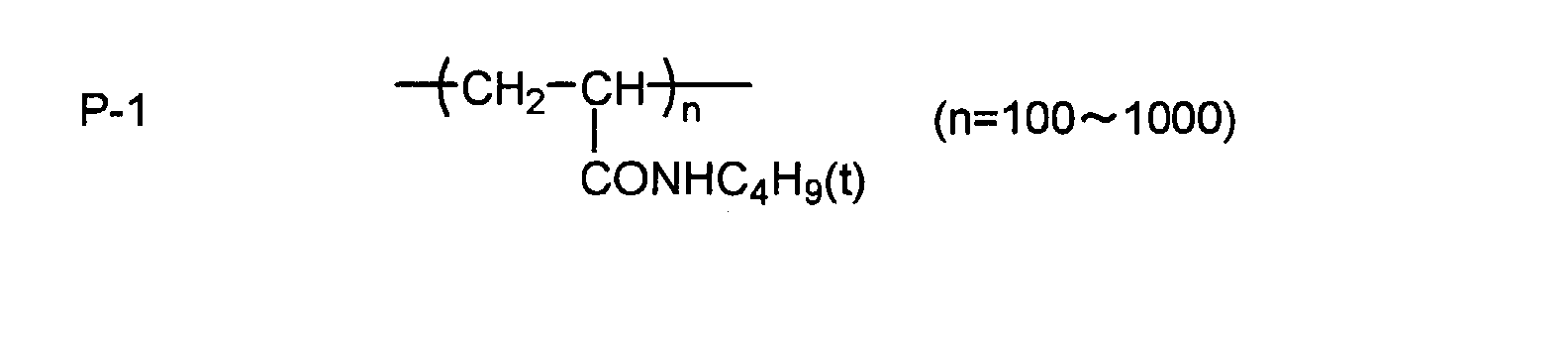



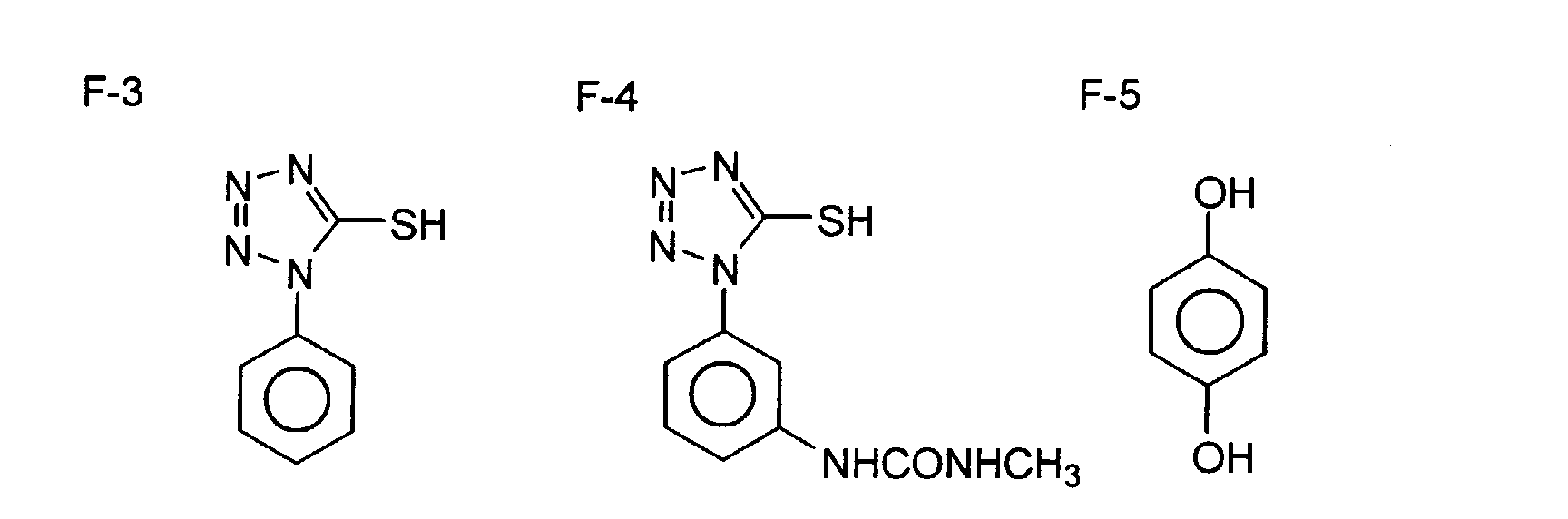

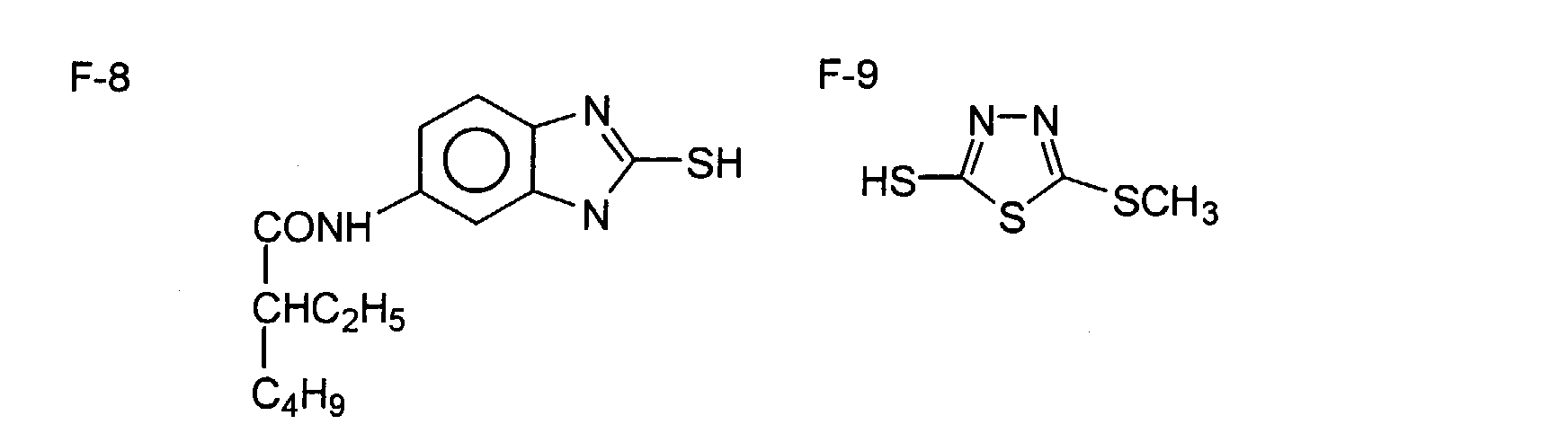
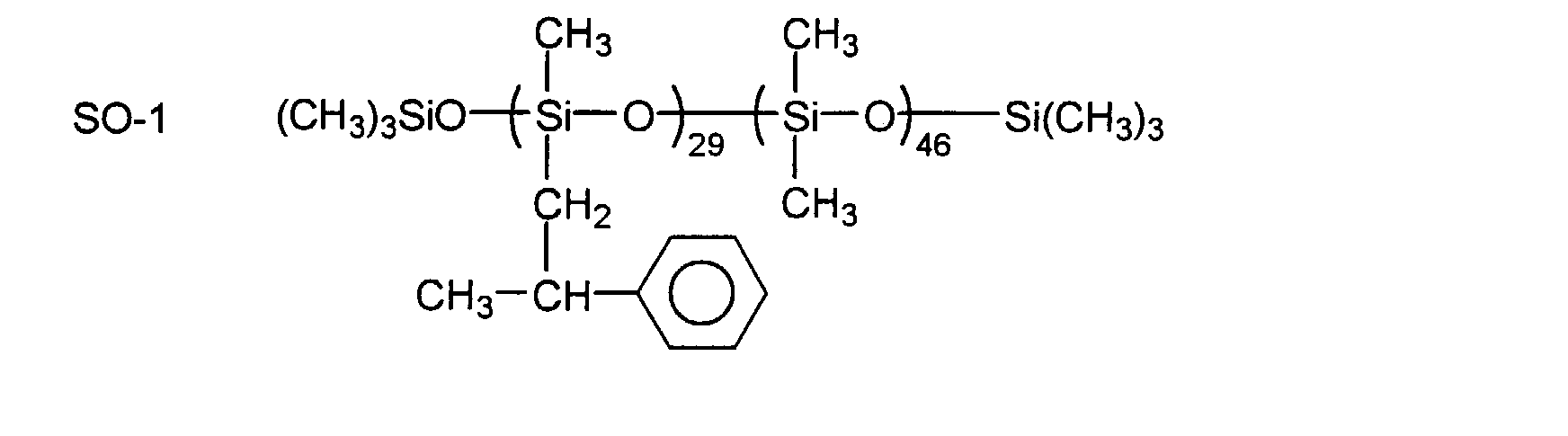
- 100 g of Pluronic F88 (an ethylene oxide-propylene oxide block copolymer) manufactured by BASF CORP. and water were added to a wet cake of the dye E-1 (the net weight of E-1 was 270 g), and the resultant material was stirred to make 4,000 g. Next, the Ultra Visco Mill (UVM-2) manufactured by Imex K.K. was filled with 1,700 mL of zirconia beads with an average grain size of 0.5 mm, and the slurry was milled through the UVM-2 at a peripheral speed of approximately 10 m/sec and a discharge rate of 0.5 L/min for 2 hrs. The beads were filtered out, and water was added to dilute the material to a dye concentration of 3%. After that, the material was heated to 90°C for 10 hrs for stabilization. The average grain size of the obtained fine dye grains was 0.30 µm, and the grain size distribution (grain size standard deviation × 100/average grain size) was 20%.
- Water and 270 g of W-4 were added to 1,400 g of a wet cake of E-2 containing 30 mass% of water, and the resultant material was stirred to form a slurry having an E-2 concentration of 40 mass%. Next, the Ultra Visco Mill (UVM-2) manufactured by Imex K.K. was filled with 1,700 mL of zirconia beads with an average grain size of 0.5 mm, and the slurry was milled through the UVM-2 at a peripheral speed of approximately 10 m/sec and a discharge rate of 0.5 L/min for 8 hr, thereby obtaining a solid fine-grain dispersion of E-2. This dispersion was diluted to 20 mass% by ion exchange water to obtain a fine-crystal solid dispersion. The average grain size was 0.15 µm.
- Then, samples 102 to 113 were prepared in the same manner as in the preparation of the sample 101 except that supplemental addition or replacement by high-boiling organic solvents of the present invention or comparative high-boiling organic solvents were carried out in lightsensitive emulsion layers, as specified in Table 3.


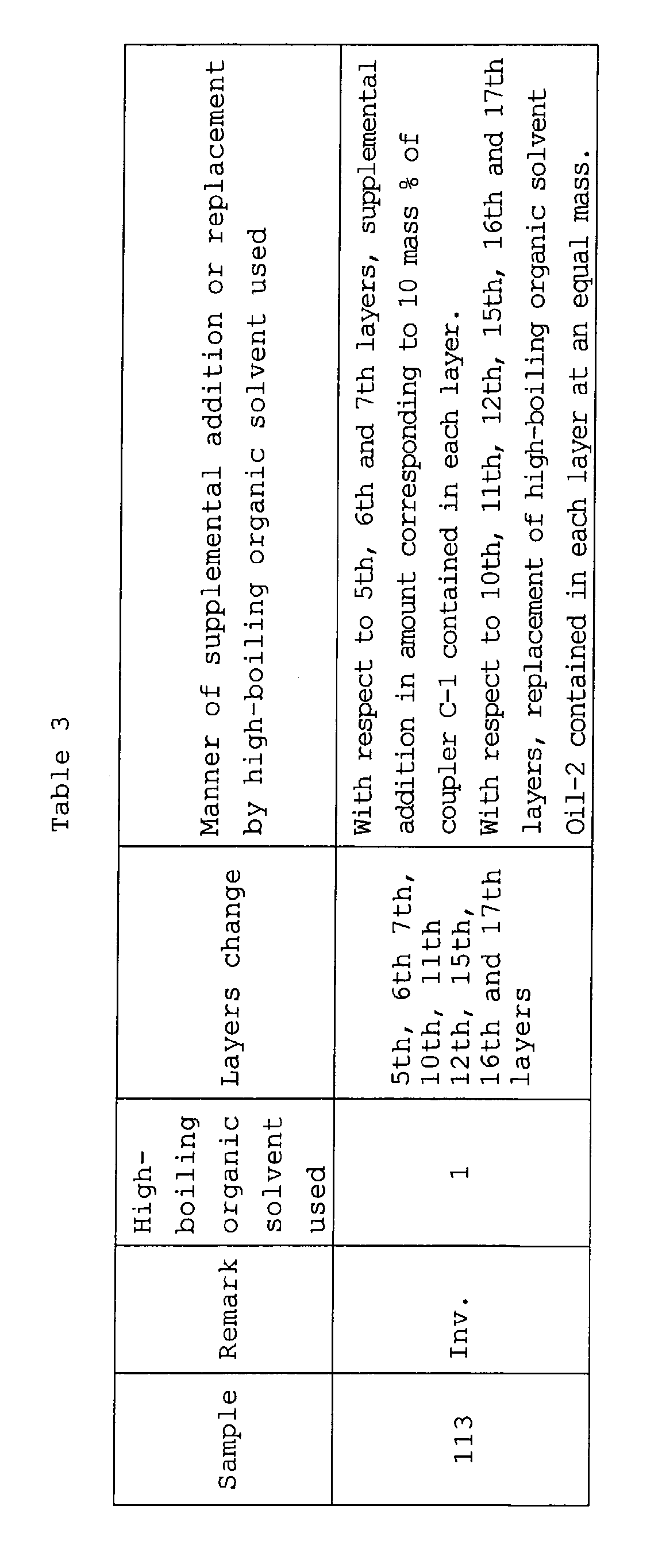
- Each of the thus obtained samples 101 to 113 was cut into two strips and exposed to light with such an exposure intensity that the minimum density of the respective sample was realized. One thereof was subjected to the following development processing A, while the other strip was subjected to processing which was the same as the development processing A except that the washing temperature of the second washing was changed to 15°C (development processing B).
- The absorption spectra of the two sample strips after developments were taken, and an extinction coefficient difference at 510 nm was determined.
- Relative values providing that the extinction coefficient difference at 510 nm between development processing A and development processing B with respect to the sample 101 is 1.0 are listed in Table 4. The smaller the relative value, the more favorably higher the resistance to change of the water temperature of the second washing.
Result of estimation Sample Remark Extinction coefficient difference at 510 nm between development processing A and development processing B (Relative value providing that extinction coefficient difference with respect to sample 101 is 1.0) 101 Comp. 1.0 (Standard) 102 Comp. 1.05 103 Inv. 0.85 104 Inv. 0.87 105 Inv. 0.90 106 Comp. 1.08 107 Inv. 0.83 108 Inv. 0.85 109 Inv. 0.87 110 Comp. 1.0 111 Inv. 0.86 112 Inv. 0.88 113 Inv. 0.60 - It is seen that the amide compounds of the present invention exert an effect of reducing white background dyeing, while the effect of reducing the residual amount of sensitizing dye to thereby enable an improvement to white background dyeing cannot be attained by the use of comparative compound A being an amide compound similar to the amide compounds of the present invention. This result is unexpected from prior known compounds.
- The hues of cyan and magenta formed dyes were sharp and excellent. Further, when the amide compounds of the present invention were employed, the fastness of color images to heat and humidity was also excellent.
- The ISO speeds of lightsensitive material samples 101 to 113, when having been processed according to development processing A, were in the range of 80 to 150. The respective maximum densities were in the range of 3.3 to 4.2 with respect to all of yellow, magenta and cyan, while the respective minimum densities were less than 0.20.
- The development processing step shown below is the development processing A.
- With respect to processing, after running processing was carried out until replenishment amount becomes 4 times the tank volume at a ratio 1:1 of an unexposed one to a completely exposed one of Sample 101, the processing for evaluation was carried out.
Processing Step Time Temperature Tank volume Replenishment rate 1st development 6 min 38°C 12 L 2,200 mL/m2 1st washing 2 min 38°C 4 L 7,500 mL/m2 Reversal 2 min 38°C 4 L 1,100 mL/m2 Color development 6 min 38°C 12 L 2,200 mL/m2 Pre-bleaching 2 min 38°C 4 L 1,100 mL/m2 Bleaching 6 min 38°C 12 L 220 mL/m2 Fixing 1,100 mL/m2 4 min 38°C 8 L 2nd washing 7,500 mL/m2 4 min 40°C 8 L Final rinsing 1,100 mL/m2 1 min 25°C 2 L - The compositions of the processing solutions were as follows.
<1st developer> <Tank solution> <Replenisher> Nitrilo-N,N,N-trimethylene phosphonic acid· pentasodium salt 1.5 g 1.5 g Diethylenetriamine pentaacetic acid· pentasodium salt 2.0 g 2.0 g Sodium sulfite 30 g 30 g Hydroquinone.potassium monosulfonate 20 g 20 g Potassium carbonate 15 g 20 g Potassium bicarbonate 12 g 15 g 1-phenyl-4-methyl-4-hydroxymethyl-3-pyrazolidone 1.5 g 2.0 g Potassium bromide 2.5 g 1.4 g Potassium thiocyanate 1.2 g 1.2 g Potassium iodide 2.0 mg - Diethyleneglycol 13 g 15 g Water to make 1,000 mL 1,000 mL pH 9.60 9.60 - The pH was adjusted by sulfuric acid or potassium hydroxide.
<Reversal solution> <Tank solution> <Replenisher> Nitrilo-N,N,N-trimethylene phosphonic acid. pentasodium salt 3.0 g the same as tank solution Stannous chloride.dihydrate 1.0 g p-aminophenol 0.1 g Sodium hydroxide 8 g Glacial acetic acid 15 mL Water to make 1,000 mL pH 6.00 - The pH was adjusted by acetic acid or sodium hydroxide.
<Color developer> <Tank solution> <Replenisher> Nitrilo-N,N,N-trimethylene phosphonic acid· pentasodium salt 2.0 g 2.0 g Sodium sulfite 7.0 g 7.0 g Trisodium phosphate. dodecahydrate 30 g 30 g Potassium bromide 1.0 g - Potassium iodide 90 mg - Sodium hydroxide 8.0 g 8.0 g Citrazinic acid 0.5 g 0.5 g N-ethyl-N-(β-methanesulfon amidoethyl)-3-methyl-4 aminoaniline·3/2 sulfuric acid.monohydrate 9.0 g 9.0 g 3,6-dithiaoctane-1,8-diol 0.6 g 0.7 g Water to make 1,000 mL 1,000 mL pH 11.80 12.00 - The pH was adjusted by sulfuric acid or potassium hydroxide.
<Pre-bleaching solution> <Tank solution> <Replenisher> Ethylenediaminetetraacetic acid.disodium salt· dihydrate 8.0 g 8.0 g Sodium sulfite 6.0 g 8.0 g 1-thioglycerol 0.4 g 0.4 g Formaldehyde sodium bisulfite adduct 30 g 35 g Water to make 1,000 mL 1,000 mL pH 6.3 6.10 - The pH was adjusted by acetic acid or sodium hydroxide.
<Bleaching solution> <Tank solution> <Replenisher> Ethylenediaminetetraacetic acid.disodium salt· dihydrate 2.0 g 4.0 g Ethylenediaminetetraacetic acid·Fe(III) · ammonium · dihydrate 120 g 240 g Potassium bromide 100 g 200 g Ammonium nitrate 10 g 20 g Water to make 1,000 mL 1,000 mL pH 5.70 5.50 - The pH was adjusted by nitric acid or sodium hydroxide.
<Fixing solution> <Tank solution> <Replenisher> Ammonium thiosulfate 80 g the same as tank solution Sodium sulfite 5.0 g Sodium bisulfite 5.0 g Water to make 1,000 mL pH 6.60 - The pH was adjusted by acetic acid or ammonia water.
<Stabilizer> <Tank solution> <Replenisher> 1,2-benzoisothiazoline-3-one 0.02 g 0.03 g Polyoxyethylene-p-monononyl phenylether (average polymerization degree = 10) 0.3 g 0.3 g Polymaleic acid (weight-average molecular weight = 2,000) 0.1 g 0.15 g Water to make 1,000 mL 1,000 mL pH 7.0 7.0 - Samples 201 to 213 were prepared by coating a 97 µm thick triacetylcellulose support with the same lightsensitive emulsion layers as employed in the samples 101 to 113, respectively (the sides opposite to the lightsensitive emulsion layers were coated with back layers of the same particulars as those applied to base D in Example 1 of JP-A-2002-62624).
- Further, samples 301 to 313 were prepared by coating a 205 µm thick triacetylcellulose support with the above lightsensitive emulsion layers in the same manner.
- Still further, samples 401 to 413 were prepared by coating a 200 µm thick polyethylene terephthalate support with the above lightsensitive emulsion layers in the same manner (the sides opposite to the lightsensitive emulsion layers were coated with back layers of the same particulars as those applied to base E in Example 1 of JP-A-2002-62624).
- Yet still further, samples 501 to 513 were prepared by coating a 190 µm thick polyethylene naphthalate support with the above lightsensitive emulsion layers in the same manner (the sides opposite to the lightsensitive emulsion layers were coated with back layers of the same particulars as those applied to base E in Example 1 of JP-A-2002-62624).
- The thus obtained samples 201 to 213, 301 to 313, 401 to 413 and 501 to 513 were evaluated in the same manner as in Example 1. The results showed that the samples of the present invention exhibit reduced white background staining and are excellent in both the hue of formed dye and the durability of color image.
- Samples exhibiting swelling ratios, as measured by swelling in 25°C distilled water, of 1.50, 1.60, 1.70, 1.80, 1.90, 2.00 and 2.10 were prepared from the same coating materials as used in the samples 101, 201, 301, 401, 501, 113, 213, 313, 413 and 513 of Examples 1 and 2 except that only the addition amount of hardener H-1 was increased or decreased, and evaluated in the same manner as in Example 1. The results showed that the samples of the present invention, irrespective of the change of swelling ratio value, exhibit reduced white background staining and are excellent in both the hue of formed dye and the durability of color image.
- Samples 601 to 613 were prepared in the same manner as in the preparation of the samples 101 to 113, respectively, except that the couplers of specified layers were changed as follows.
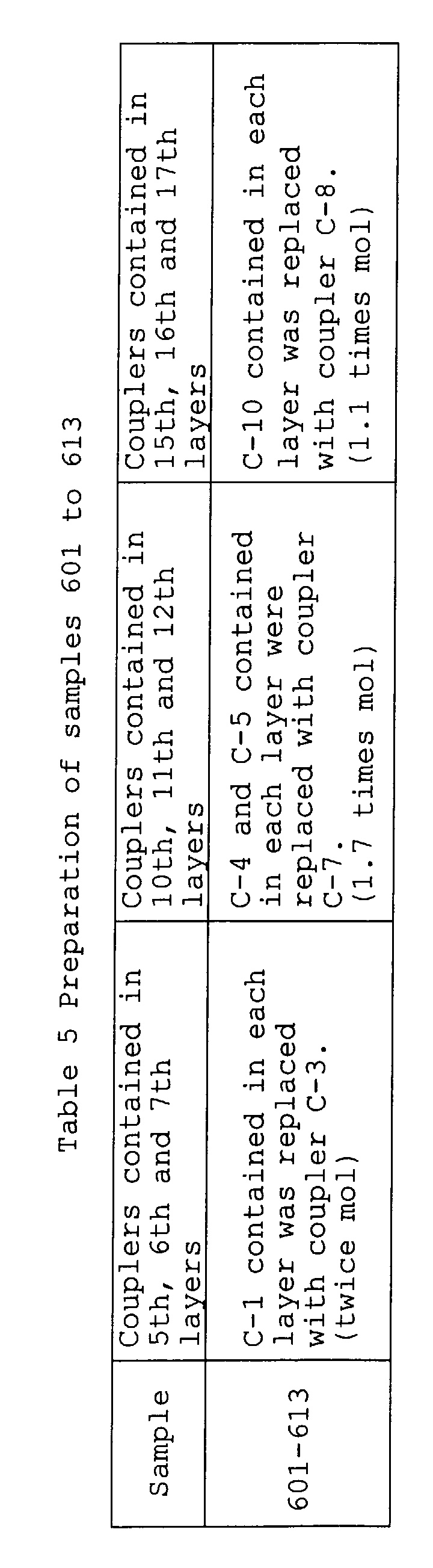
- In comparisons among the samples 601 to 613 as well, the results showed that the samples of the present invention exhibit reduced white background staining and are excellent in both the hue of formed dye and the durability of color image.
Claims (4)
- A silver halide color photographic lightsensitive material, characterized by comprising a compound of the following general formula (I):In the formul (I), each of R1 and R2 independently represents a substituted or unsubstituted alkyl group having 1 to 30 carbon atoms, or a substituted or unsubstituted alkenyl group having 3 to 30 carbon atoms. Each of R3 and R4 independently represents a substituent. Each of n and m is independently an integer of 0 to 3. Q represents an atomic group needed to form a 5-membered or 6-membered heterocycle in cooperation with two nitrogen atoms.

- The silver halide color photographic lightsensitive material according to claim 1, characterized in that a coupler of the following general formula (II) is contained.In the formula (II), X represents a hydrogen atom, or a group which may be split off at a coupling reaction with products of oxidation of an aromatic primary amine color developing agent. Each of R11 and R12 independently represents an electron withdrawing group whose Hammett substituent constant σp value is 0.20 or greater, provided that the sum of R11 and R12 σp values is 0.65 or greater. Either of G1 and G2 is a nitrogen atom while the rest is -C(R13)=, wherein R13 represents a hydrogen atom or a substituent.
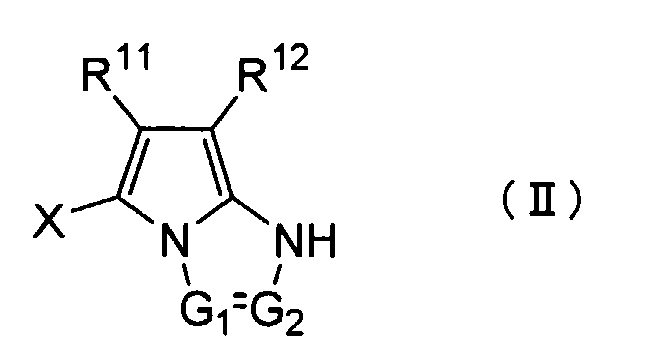
- A compound of the following general formula (I) .In the formula (I), each of R1 and R2 independently represents an unsubstituted alkyl group having 10 to 20 carbon atoms. Each of R3 and R4 independently represents an unsubstituted alkyl group having 1 to 10 carbon atoms, a halogen atom or an unsubstituted alkoxy group having 1 to 10 carbon atoms. Each of n and m is independently an integer of 0 to 2. Q represents an atomic group needed to form a 5-membered or 6-membered heterocycle in cooperation with two nitrogen atoms.

- A method of forming an image, characterized by comprising subjecting the silver halide color photographic lightsensitive material according to claim 2 to processes including reversal processing.
Applications Claiming Priority (2)
| Application Number | Priority Date | Filing Date | Title |
|---|---|---|---|
| JP2002143552 | 2002-05-17 | ||
| JP2002143552 | 2002-05-17 |
Publications (2)
| Publication Number | Publication Date |
|---|---|
| EP1363161A1 true EP1363161A1 (en) | 2003-11-19 |
| EP1363161B1 EP1363161B1 (en) | 2007-09-12 |
Family
ID=29267847
Family Applications (1)
| Application Number | Title | Priority Date | Filing Date |
|---|---|---|---|
| EP03011016A Expired - Lifetime EP1363161B1 (en) | 2002-05-17 | 2003-05-16 | Silver halide color photographic lightsensitive material |
Country Status (3)
| Country | Link |
|---|---|
| EP (1) | EP1363161B1 (en) |
| AT (1) | ATE373255T1 (en) |
| DE (1) | DE60316219T2 (en) |
Citations (2)
| Publication number | Priority date | Publication date | Assignee | Title |
|---|---|---|---|---|
| JPH06157442A (en) * | 1992-11-17 | 1994-06-03 | Fuji Photo Film Co Ltd | 2,6-dialkoxy-4-carbamoylphenol derivative and antioxidant composition |
| US5418122A (en) * | 1992-12-04 | 1995-05-23 | Fuji Photo Film Co., Ltd. | Silver halide color photographic material |
-
2003
- 2003-05-16 EP EP03011016A patent/EP1363161B1/en not_active Expired - Lifetime
- 2003-05-16 AT AT03011016T patent/ATE373255T1/en not_active IP Right Cessation
- 2003-05-16 DE DE60316219T patent/DE60316219T2/en not_active Expired - Lifetime
Patent Citations (2)
| Publication number | Priority date | Publication date | Assignee | Title |
|---|---|---|---|---|
| JPH06157442A (en) * | 1992-11-17 | 1994-06-03 | Fuji Photo Film Co Ltd | 2,6-dialkoxy-4-carbamoylphenol derivative and antioxidant composition |
| US5418122A (en) * | 1992-12-04 | 1995-05-23 | Fuji Photo Film Co., Ltd. | Silver halide color photographic material |
Non-Patent Citations (2)
| Title |
|---|
| LATTERMANN, G. ET AL: "Liquid crystalline piperazine and triazacyclononane derivatives", JOURNAL OF THE CHEMICAL SOCIETY, CHEMICAL COMMUNICATIONS (1992), (15), 1091-2, XP009014884 * |
| PATENT ABSTRACTS OF JAPAN vol. 018, no. 482 (C - 1247) 8 September 1994 (1994-09-08) * |
Also Published As
| Publication number | Publication date |
|---|---|
| DE60316219T2 (en) | 2008-06-05 |
| EP1363161B1 (en) | 2007-09-12 |
| DE60316219D1 (en) | 2007-10-25 |
| ATE373255T1 (en) | 2007-09-15 |
Similar Documents
| Publication | Publication Date | Title |
|---|---|---|
| DE60318267T2 (en) | Color photographic light-sensitive silver halide material | |
| US5756274A (en) | Silver halide color photographic material and method for forming images | |
| US6399291B1 (en) | Silver halide color photographic lightsensitive material and novel pyrrolotriazole compound | |
| US6541192B2 (en) | Silver halide color photographic lightsensitive material | |
| EP1363161B1 (en) | Silver halide color photographic lightsensitive material | |
| EP0544319B1 (en) | Silver halide color photographic light-sensitive material | |
| US6858380B2 (en) | Silver halide color photosensitive material | |
| US5468600A (en) | Silver halide color photographic material | |
| EP1132770B1 (en) | Silver halide photographic light-sensitive material | |
| US5736299A (en) | Silver halide color photographic material comprising a magenta or cyan coupler and a hydrazine compound | |
| US6440650B1 (en) | Silver halide color reversal photosensitive material and color image forming method using the same | |
| US6660465B2 (en) | Yellow coupler and silver halide color photographic lightsensitive material containing the same | |
| JP4302867B2 (en) | Silver halide color photographic light-sensitive material and novel pyrrolotriazole compound | |
| US6936412B2 (en) | Method of forming color images | |
| EP0800113B1 (en) | Silver halide color photographic light-sensitive material | |
| EP0573008A1 (en) | Silver halide color photographic material | |
| JP2004046138A (en) | Silver halide color photographic sensitive material | |
| US20030091945A1 (en) | Silver halide color photographic material and method of reducing magenta stain | |
| JPH0830871B2 (en) | Silver halide color photographic light-sensitive material | |
| JP2002162715A (en) | Transmission type color image forming material | |
| JPH0566529A (en) | Reducing method for color picture | |
| JPH05289263A (en) | Silver halide color photographic sensitive material | |
| JPH05333497A (en) | Silver halide color photographic sensitive material | |
| JPH06208210A (en) | Silver halide color photosensitive material | |
| JPH05333499A (en) | Silver halide color photographic sensitive material |
Legal Events
| Date | Code | Title | Description |
|---|---|---|---|
| PUAI | Public reference made under article 153(3) epc to a published international application that has entered the european phase |
Free format text: ORIGINAL CODE: 0009012 |
|
| 17P | Request for examination filed |
Effective date: 20030516 |
|
| AK | Designated contracting states |
Kind code of ref document: A1 Designated state(s): AT BE BG CH CY CZ DE DK EE ES FI FR GB GR HU IE IT LI LU MC NL PT RO SE SI SK TR |
|
| AX | Request for extension of the european patent |
Extension state: AL LT LV MK |
|
| AKX | Designation fees paid |
Designated state(s): AT BE BG CH CY CZ DE DK EE ES FI FR GB GR HU IE IT LI LU MC NL PT RO SE SI SK TR |
|
| 17Q | First examination report despatched |
Effective date: 20051018 |
|
| RAP1 | Party data changed (applicant data changed or rights of an application transferred) |
Owner name: FUJIFILM CORPORATION |
|
| GRAP | Despatch of communication of intention to grant a patent |
Free format text: ORIGINAL CODE: EPIDOSNIGR1 |
|
| GRAS | Grant fee paid |
Free format text: ORIGINAL CODE: EPIDOSNIGR3 |
|
| GRAA | (expected) grant |
Free format text: ORIGINAL CODE: 0009210 |
|
| AK | Designated contracting states |
Kind code of ref document: B1 Designated state(s): AT BE BG CH CY CZ DE DK EE ES FI FR GB GR HU IE IT LI LU MC NL PT RO SE SI SK TR |
|
| REG | Reference to a national code |
Ref country code: GB Ref legal event code: FG4D |
|
| REG | Reference to a national code |
Ref country code: CH Ref legal event code: EP |
|
| REF | Corresponds to: |
Ref document number: 60316219 Country of ref document: DE Date of ref document: 20071025 Kind code of ref document: P |
|
| REG | Reference to a national code |
Ref country code: IE Ref legal event code: FG4D |
|
| PG25 | Lapsed in a contracting state [announced via postgrant information from national office to epo] |
Ref country code: FI Free format text: LAPSE BECAUSE OF FAILURE TO SUBMIT A TRANSLATION OF THE DESCRIPTION OR TO PAY THE FEE WITHIN THE PRESCRIBED TIME-LIMIT Effective date: 20070912 |
|
| PG25 | Lapsed in a contracting state [announced via postgrant information from national office to epo] |
Ref country code: CH Free format text: LAPSE BECAUSE OF FAILURE TO SUBMIT A TRANSLATION OF THE DESCRIPTION OR TO PAY THE FEE WITHIN THE PRESCRIBED TIME-LIMIT Effective date: 20070912 Ref country code: AT Free format text: LAPSE BECAUSE OF FAILURE TO SUBMIT A TRANSLATION OF THE DESCRIPTION OR TO PAY THE FEE WITHIN THE PRESCRIBED TIME-LIMIT Effective date: 20070912 Ref country code: LI Free format text: LAPSE BECAUSE OF FAILURE TO SUBMIT A TRANSLATION OF THE DESCRIPTION OR TO PAY THE FEE WITHIN THE PRESCRIBED TIME-LIMIT Effective date: 20070912 |
|
| NLV1 | Nl: lapsed or annulled due to failure to fulfill the requirements of art. 29p and 29m of the patents act | ||
| PG25 | Lapsed in a contracting state [announced via postgrant information from national office to epo] |
Ref country code: BE Free format text: LAPSE BECAUSE OF FAILURE TO SUBMIT A TRANSLATION OF THE DESCRIPTION OR TO PAY THE FEE WITHIN THE PRESCRIBED TIME-LIMIT Effective date: 20070912 |
|
| REG | Reference to a national code |
Ref country code: CH Ref legal event code: PL |
|
| PG25 | Lapsed in a contracting state [announced via postgrant information from national office to epo] |
Ref country code: NL Free format text: LAPSE BECAUSE OF FAILURE TO SUBMIT A TRANSLATION OF THE DESCRIPTION OR TO PAY THE FEE WITHIN THE PRESCRIBED TIME-LIMIT Effective date: 20070912 Ref country code: GR Free format text: LAPSE BECAUSE OF FAILURE TO SUBMIT A TRANSLATION OF THE DESCRIPTION OR TO PAY THE FEE WITHIN THE PRESCRIBED TIME-LIMIT Effective date: 20071213 Ref country code: ES Free format text: LAPSE BECAUSE OF FAILURE TO SUBMIT A TRANSLATION OF THE DESCRIPTION OR TO PAY THE FEE WITHIN THE PRESCRIBED TIME-LIMIT Effective date: 20071223 |
|
| PG25 | Lapsed in a contracting state [announced via postgrant information from national office to epo] |
Ref country code: SK Free format text: LAPSE BECAUSE OF FAILURE TO SUBMIT A TRANSLATION OF THE DESCRIPTION OR TO PAY THE FEE WITHIN THE PRESCRIBED TIME-LIMIT Effective date: 20070912 Ref country code: PT Free format text: LAPSE BECAUSE OF FAILURE TO SUBMIT A TRANSLATION OF THE DESCRIPTION OR TO PAY THE FEE WITHIN THE PRESCRIBED TIME-LIMIT Effective date: 20080212 Ref country code: CZ Free format text: LAPSE BECAUSE OF FAILURE TO SUBMIT A TRANSLATION OF THE DESCRIPTION OR TO PAY THE FEE WITHIN THE PRESCRIBED TIME-LIMIT Effective date: 20070912 |
|
| PG25 | Lapsed in a contracting state [announced via postgrant information from national office to epo] |
Ref country code: SE Free format text: LAPSE BECAUSE OF FAILURE TO SUBMIT A TRANSLATION OF THE DESCRIPTION OR TO PAY THE FEE WITHIN THE PRESCRIBED TIME-LIMIT Effective date: 20071212 Ref country code: RO Free format text: LAPSE BECAUSE OF FAILURE TO SUBMIT A TRANSLATION OF THE DESCRIPTION OR TO PAY THE FEE WITHIN THE PRESCRIBED TIME-LIMIT Effective date: 20070912 |
|
| PLBE | No opposition filed within time limit |
Free format text: ORIGINAL CODE: 0009261 |
|
| STAA | Information on the status of an ep patent application or granted ep patent |
Free format text: STATUS: NO OPPOSITION FILED WITHIN TIME LIMIT |
|
| PG25 | Lapsed in a contracting state [announced via postgrant information from national office to epo] |
Ref country code: DK Free format text: LAPSE BECAUSE OF FAILURE TO SUBMIT A TRANSLATION OF THE DESCRIPTION OR TO PAY THE FEE WITHIN THE PRESCRIBED TIME-LIMIT Effective date: 20070912 |
|
| 26N | No opposition filed |
Effective date: 20080613 |
|
| PG25 | Lapsed in a contracting state [announced via postgrant information from national office to epo] |
Ref country code: MC Free format text: LAPSE BECAUSE OF NON-PAYMENT OF DUE FEES Effective date: 20080531 |
|
| GBPC | Gb: european patent ceased through non-payment of renewal fee |
Effective date: 20080516 |
|
| PG25 | Lapsed in a contracting state [announced via postgrant information from national office to epo] |
Ref country code: EE Free format text: LAPSE BECAUSE OF FAILURE TO SUBMIT A TRANSLATION OF THE DESCRIPTION OR TO PAY THE FEE WITHIN THE PRESCRIBED TIME-LIMIT Effective date: 20070912 |
|
| PG25 | Lapsed in a contracting state [announced via postgrant information from national office to epo] |
Ref country code: IE Free format text: LAPSE BECAUSE OF NON-PAYMENT OF DUE FEES Effective date: 20080516 |
|
| PG25 | Lapsed in a contracting state [announced via postgrant information from national office to epo] |
Ref country code: SI Free format text: LAPSE BECAUSE OF FAILURE TO SUBMIT A TRANSLATION OF THE DESCRIPTION OR TO PAY THE FEE WITHIN THE PRESCRIBED TIME-LIMIT Effective date: 20070912 Ref country code: GB Free format text: LAPSE BECAUSE OF NON-PAYMENT OF DUE FEES Effective date: 20080516 |
|
| PG25 | Lapsed in a contracting state [announced via postgrant information from national office to epo] |
Ref country code: CY Free format text: LAPSE BECAUSE OF FAILURE TO SUBMIT A TRANSLATION OF THE DESCRIPTION OR TO PAY THE FEE WITHIN THE PRESCRIBED TIME-LIMIT Effective date: 20070912 |
|
| PG25 | Lapsed in a contracting state [announced via postgrant information from national office to epo] |
Ref country code: BG Free format text: LAPSE BECAUSE OF FAILURE TO SUBMIT A TRANSLATION OF THE DESCRIPTION OR TO PAY THE FEE WITHIN THE PRESCRIBED TIME-LIMIT Effective date: 20071212 |
|
| PG25 | Lapsed in a contracting state [announced via postgrant information from national office to epo] |
Ref country code: LU Free format text: LAPSE BECAUSE OF NON-PAYMENT OF DUE FEES Effective date: 20080516 Ref country code: HU Free format text: LAPSE BECAUSE OF FAILURE TO SUBMIT A TRANSLATION OF THE DESCRIPTION OR TO PAY THE FEE WITHIN THE PRESCRIBED TIME-LIMIT Effective date: 20080313 |
|
| PG25 | Lapsed in a contracting state [announced via postgrant information from national office to epo] |
Ref country code: TR Free format text: LAPSE BECAUSE OF FAILURE TO SUBMIT A TRANSLATION OF THE DESCRIPTION OR TO PAY THE FEE WITHIN THE PRESCRIBED TIME-LIMIT Effective date: 20070912 |
|
| PGFP | Annual fee paid to national office [announced via postgrant information from national office to epo] |
Ref country code: DE Payment date: 20100422 Year of fee payment: 8 |
|
| PG25 | Lapsed in a contracting state [announced via postgrant information from national office to epo] |
Ref country code: IT Free format text: LAPSE BECAUSE OF NON-PAYMENT OF DUE FEES Effective date: 20080531 |
|
| REG | Reference to a national code |
Ref country code: DE Ref legal event code: R119 Ref document number: 60316219 Country of ref document: DE Effective date: 20111201 |
|
| PG25 | Lapsed in a contracting state [announced via postgrant information from national office to epo] |
Ref country code: DE Free format text: LAPSE BECAUSE OF NON-PAYMENT OF DUE FEES Effective date: 20111201 |
|
| PG25 | Lapsed in a contracting state [announced via postgrant information from national office to epo] |
Ref country code: FR Free format text: LAPSE BECAUSE OF FAILURE TO SUBMIT A TRANSLATION OF THE DESCRIPTION OR TO PAY THE FEE WITHIN THE PRESCRIBED TIME-LIMIT Effective date: 20070912 |