EP1359403A1 - Apparatus and method of extracting volatile components - Google Patents
Apparatus and method of extracting volatile components Download PDFInfo
- Publication number
- EP1359403A1 EP1359403A1 EP02716451A EP02716451A EP1359403A1 EP 1359403 A1 EP1359403 A1 EP 1359403A1 EP 02716451 A EP02716451 A EP 02716451A EP 02716451 A EP02716451 A EP 02716451A EP 1359403 A1 EP1359403 A1 EP 1359403A1
- Authority
- EP
- European Patent Office
- Prior art keywords
- sample
- volatile constituents
- constituents
- sample vessel
- canister
- Prior art date
- Legal status (The legal status is an assumption and is not a legal conclusion. Google has not performed a legal analysis and makes no representation as to the accuracy of the status listed.)
- Withdrawn
Links
Images



Classifications
-
- G—PHYSICS
- G01—MEASURING; TESTING
- G01N—INVESTIGATING OR ANALYSING MATERIALS BY DETERMINING THEIR CHEMICAL OR PHYSICAL PROPERTIES
- G01N1/00—Sampling; Preparing specimens for investigation
- G01N1/02—Devices for withdrawing samples
-
- G—PHYSICS
- G01—MEASURING; TESTING
- G01N—INVESTIGATING OR ANALYSING MATERIALS BY DETERMINING THEIR CHEMICAL OR PHYSICAL PROPERTIES
- G01N1/00—Sampling; Preparing specimens for investigation
- G01N1/02—Devices for withdrawing samples
- G01N1/22—Devices for withdrawing samples in the gaseous state
- G01N1/2226—Sampling from a closed space, e.g. food package, head space
-
- G—PHYSICS
- G01—MEASURING; TESTING
- G01N—INVESTIGATING OR ANALYSING MATERIALS BY DETERMINING THEIR CHEMICAL OR PHYSICAL PROPERTIES
- G01N1/00—Sampling; Preparing specimens for investigation
- G01N1/02—Devices for withdrawing samples
- G01N1/22—Devices for withdrawing samples in the gaseous state
- G01N1/2202—Devices for withdrawing samples in the gaseous state involving separation of sample components during sampling
- G01N1/2214—Devices for withdrawing samples in the gaseous state involving separation of sample components during sampling by sorption
-
- G—PHYSICS
- G01—MEASURING; TESTING
- G01N—INVESTIGATING OR ANALYSING MATERIALS BY DETERMINING THEIR CHEMICAL OR PHYSICAL PROPERTIES
- G01N1/00—Sampling; Preparing specimens for investigation
- G01N1/02—Devices for withdrawing samples
- G01N1/22—Devices for withdrawing samples in the gaseous state
- G01N1/2226—Sampling from a closed space, e.g. food package, head space
- G01N2001/2241—Sampling from a closed space, e.g. food package, head space purpose-built sampling enclosure for emissions
-
- G—PHYSICS
- G01—MEASURING; TESTING
- G01N—INVESTIGATING OR ANALYSING MATERIALS BY DETERMINING THEIR CHEMICAL OR PHYSICAL PROPERTIES
- G01N30/00—Investigating or analysing materials by separation into components using adsorption, absorption or similar phenomena or using ion-exchange, e.g. chromatography or field flow fractionation
- G01N30/02—Column chromatography
- G01N30/04—Preparation or injection of sample to be analysed
- G01N30/06—Preparation
- G01N30/12—Preparation by evaporation
- G01N2030/126—Preparation by evaporation evaporating sample
-
- G—PHYSICS
- G01—MEASURING; TESTING
- G01N—INVESTIGATING OR ANALYSING MATERIALS BY DETERMINING THEIR CHEMICAL OR PHYSICAL PROPERTIES
- G01N30/00—Investigating or analysing materials by separation into components using adsorption, absorption or similar phenomena or using ion-exchange, e.g. chromatography or field flow fractionation
- G01N30/02—Column chromatography
- G01N30/88—Integrated analysis systems specially adapted therefor, not covered by a single one of the groups G01N30/04 - G01N30/86
- G01N2030/8809—Integrated analysis systems specially adapted therefor, not covered by a single one of the groups G01N30/04 - G01N30/86 analysis specially adapted for the sample
- G01N2030/884—Integrated analysis systems specially adapted therefor, not covered by a single one of the groups G01N30/04 - G01N30/86 analysis specially adapted for the sample organic compounds
Definitions
- the invention relates to an apparatus and method for extracting volatile constituents from a solid, which is suited to extract constituents evaporating from leaf tobacco or the like, for example, in order to analyze an aroma of leaf tobacco.
- analysis of an aroma of leaf tobacco is performed by collecting constituents evaporating from the leaf tobacco (laminae or shreds) and analyzing the collected volatile constituents. Further, if flour or the like has abnormal smell, analysis of the abnormal smell of the flour or the like is performed by collecting constituents evaporating and escaping from the flour or the like and analyzing the collected constituents.
- a conventional and common way of collecting volatile constituents from a solid is, for example, as shown in FIG. 10, to put a sample S of leaf tobacco or the like in a hermetic container 1 such as a sample vessel, heat it with a heater 2, and collect constituents G which evaporate from the sample S due to the heating and accumulate in an upper space of the hermetic container 1 (a static method; a head space method).
- Another conventional and common way is, as shown in FIG. 11, to heat a sample S in a hermetic container 3 with a heater 4, and collect constituents G evaporating from the sample S with a collecting agent 6 provided in a collecting tube 5 while the constituents G are continuously circulated between the hermetic container and the collecting tube 5 (a dynamic method).
- constituents G evaporating from a sample S are collected in the above-described manners, the respective amounts of the constituents (quantitative relation between the constituents) change under some conditions about heating of the sample S.
- constituents contained in a sample S may be thermally decomposed and produce unexpected secondary products.
- constituents G which evaporate from the sample S vary in volatility, from a high volatility to a low volatility.
- pressure of a constituent G which is high in volatility and evaporates from the sample S in the hermetic container 1 earliest may prevent a constituent G which is low in volatility from evaporating from the sample S and make it difficult to collect the latter constituent G.
- An object of the invention is to provide an apparatus and method for extracting volatile constituents, capable of surely collecting volatile constituents contained in a sample of a solid such as leaf tobacco or flour to subject them to, for example, constituent analysis by atmospheric concentration analysis or sensory evaluation by a human sense of smell.
- the invention is characterized in that a sample of a solid containing volatile constituents is put in a hermetic sample vessel (hermetic can) with inert gas, and a canister depressurized in advance is selectively connected to the sample vessel so that the sample vessel will be depressurized in a moment and constituents evaporating from the sample will be collected into the canister.
- a hermetic sample vessel hermetic can
- inert gas hermetic can
- a canister depressurized in advance is selectively connected to the sample vessel so that the sample vessel will be depressurized in a moment and constituents evaporating from the sample will be collected into the canister.
- an apparatus for extracting volatile constituents comprises a sample vessel for containing a sample containing volatile constituents, a gas feeding device for filling the sample vessel containing the sample with inert gas, a thermostatic chamber for containing the sample vessel and keeping the sample contained in the sample vessel at a predetermined temperature (a temperature at which thermal decomposition does not happen, for example, an ordinary temperature), and a canister as a collecting container capable of being depressurized in advance and selectively connected to the sample vessel for collecting constituents evaporating from the sample contained in the sample vessel.
- a predetermined temperature a temperature at which thermal decomposition does not happen, for example, an ordinary temperature
- the gas feeding device is designed to fill the sample vessel with inert air to replace atmospheric air in the sample vessel containing the sample by the inert gas.
- the canister is desirably designed to be depressurized to about 1 ⁇ 10 2 Pa in advance and selectively connected to the sample vessel to collect constituents evaporating from the sample under depressurization, by sucking the constituents with negative pressure in a canister.
- a method of extracting volatile constituents comprises the steps of putting a sample containing volatile constituents in a sample vessel, then filling the sample vessel containing the sample with inert gas and keeping the sample at a predetermined temperature (a temperature at which thermal decomposition does not happen, for example, an ordinary temperature), and thereafter selectively connecting a canister depressurized in advance to the sample vessel to thereby collect constituents evaporating from the sample under depressurization, into the canister with the inert gas in a moment.
- a predetermined temperature a temperature at which thermal decomposition does not happen, for example, an ordinary temperature
- volatile constituents of the sample are collected into the canister in the above-described way in particular, not only chemical analysis of the volatile constituents with an atmospheric concentration analyzer but also sensory evaluation of the volatile constituents with a human sense of smell can be performed effectively. Further, the volatile constituents can be evaluated as a whole, analytic-chemically as well as sensory-scientifically, irrespective of when the volatile constituents were collected into the canister.
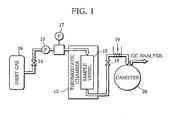
- FIG. 1 is an illustration schematically showing a structure of an apparatus for extracting volatile constituents according to an embodiment of the invention.
- Reference numeral 10 denotes a sample vessel for containing a sample S of a solid containing volatile constituents such as leaf tobacco, and 12 a thermostatic chamber for containing the sample vessel 10 and keeping the sample S contained in the sample vessel 10 at a predetermined temperature.
- a carrier gas cylinder (bag) 16 with a gas feeding valve 14 between, so that inert gas such as He or N 2 can be fed from the carrier gas cylinder (bag) 16 into the sample vessel 10.
- the amount of the inert gas fed from the carrier gas cylinder (bag) 16 into the sample vessel 10 is monitored by a flowmeter 15.
- inert gas He, N 2 or the like
- the atmospheric air in the sample vessel 10 is replaced with the inert gas, and the pressure in the sample vessel 10 is set at a desired value.
- the pressure P of the inert gas fed into the sample vessel 10 is monitored by a pressure gauge 17.
- a canister 20 globular in shape and used as a collecting container is selectively connected to the sample vessel 10 with a collecting valve 18 between.
- the canister 20 is depressurized to about 1 ⁇ 10 2 Pa (1/1000atm) in advance, and has a capacity of, for example, about 6 liter.
- the inside of the canister 20 is inactivated in advance.
- By connecting the depressurized canister 20 to the sample vessel 10 and opening the collecting valve 18, the inside of the sample vessel 10 is depressurized rapidly.
- volatile constituents G of the sample S evaporate from the sample S in a moment and are sucked into the canister 20 with negative pressure and collected in the canister 20 with the inert gas.
- Reference numeral 19 in FIG. 1 denotes a heater for heating the gas (volatile constituents G of the sample S) collected in the canister 20.
- the sample S contained in the sample vessel 10 is not heated.
- volatile constituents contained in the sample S is prevented from being thermally decomposed and producing unexpected secondary products.
- constituents G evaporating from the sample S are prevented from combining with constituents of the atmospheric air remaining in the sample vessel which forms a hermetic system, unlike the conventional apparatus and method.
- the canister 20 depressurized in advance is selectively connected to the sample vessel 10 which is filled with inert gas and kept at a fixed pressure inside, to thereby decrease the pressure in the sample vessel 10 rapidly.
- various volatile constituents G contained in the sample S can evaporate in a moment, and be taken (collected) into the canister 20.
- problems with the analysis using the conventional head space method specifically, troubles such as balance of collected constituents getting disturbed can be prevented effectively.
- by controlling the pressure difference between the sample vessel 10 and the canister 20, out of the volatile constituents contained in the sample S intended volatile constituents can be surely collected, irrespective of degree of volatility, from highly volatile constituents to low volatile constituents.
- Another advantage is that since a collecting agent is not used unlike the conventional dynamic method, influence of the kind of a collecting agent on selectivity of constituents can be avoided. Further, since the sample vessel 10 is filled with inert gas as mentioned above, evaporated constituents G escaping from the sample S are prevented from combining with constituents of the atmospheric air remaining in the container which forms a hermetic system. Thus, constituents G evaporating from the sample S can be surely collected.
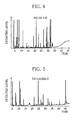
- FIG. 4 shows the result of analysis by gas chromatography of volatile constituents which were collected from leaf tobacco by the volatile constituent extracting method according to the present invention.
- the analysis was performed as follows: Precisely 2.0g of leaf tobacco shreds (flue cured type) and filter paper impregnated with 20 ⁇ L of 100ppm isoamyl alcohol as a reference substance were put in a container of 20mL in capacity (sample vessel 10).
- sample vessel 10 the leaf tobacco shreds and the filter paper impregnated with the reference substance together form a test sample S.
- the test sample S was kept at 40°C for 10 minutes.
- FIG. 5 shows the result of analysis of volatile constituents which were collected from the same test sample by a conventional static method, for comparison with the result of analysis shown in FIG. 4.
- the gas chromatography analysis was performed using a gas chromatography analyzer HP6890 (product name) produced by Hewlett-Packard Company, feeding He as carrier gas (in constant float mode), under the condition that the oven temperature was kept at 40°C for 3 minutes, then raised at the rate of 10°C per minute, and then kept at 240°C for 5 minutes.
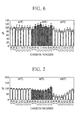
- FIG. 6 relates to another test, where precisely 2g of filter paper (product name: ADVANTEC 5C) was put in a container (sample vessel 10) of 20mL in capacity and got impregnated with 20 ⁇ L of a mixture of hydrocarbons as a reference substance (carbon number: C8 to C15).
- the filter paper impregnated with the reference substance is a test sample S.
- FIG. 6 shows the result of gas chromatography analysis of volatile constituents collected from this test sample S by the volatile constituent extracting method according to the present invention.
- the test sample S was kept at 40°C in one case, at 60°C for 10 minutes in another case, and at 80°C for 10 minutes in another case.
- FIG. 6 shows the volatile constituents collected in those three cases, comparatively.
- FIG. 7 shows the result of analysis of volatile constituents collected from the same test sample S as used in the test of FIG. 6 by a conventional head space method, where the test sample S was heated for 30 minutes to keep it at 70°C in one case, 80°C in another case, and 100°C in another case.
- the gas chromatography analysis was performed using a gas chromatography analyzer HP6890 (product name) produced by Hewlett-Packard Company, feeding He as carrier gas (in constant float mode), under the condition that the oven temperature was kept at 40°C for 3 minutes, then raised at the rate of 10°C per minute, and then kept at 240°C for 5 minutes.
- FIG. 8 relates to anther test, where two test samples S were prepared by putting precisely 2g of leaf tobacco shreds (flue cured type) having a 13.8% water content and precisely 2g of leaf tobacco shreds (flue cured type) having a 14.5% water content in a container of 20mL in capacity (sample vessel 10), separately, each with filter paper impregnated with 5 ⁇ L of C10 (0.2% n-dodecanol) as a reference substance.
- FIG. 8 shows the result of analysis of constituents collected into a canister 20 from each test sample S by the volatile constituent extracting method according to the present invention.
- each test sample contained in the container was kept at 40°C for 10 minutes, and 1000mL of constituents evaporating and escaping from each test sample S were collected using a canister 20 depressurized to about 1 ⁇ 10 2 Pa (1/1000atm).
- the analysis was performed using a gas chromatography apparatus.
- the volatile constituent extracting method according to the present invention can surely extract volatile constituents of a sample, hardly being affected by the water content of the sample.
- water contained in a sample was all extracted in a moment by depressurization, it hardly affected the collection of volatile constituents contained in the sample.
- FIG. 9 shows the result of sensory evaluation, where leaf tobacco shreds (flue cured type) which had been preserved at 5°C for two weeks and leaf tobacco shreds of the same type which had been preserved at 25°C for two weeks were sensory-evaluated comparatively, in respect of greenness, fruity scent, smoothness, terpeny scent and hay-like scent.
- volatile constituents of the two samples were collected separately in two canisters 20, 20 by the method according to the present invention, and smell of the volatile constituents collected in the two canisters 20, 20 were smelt through snifling port 40, 40 fitted to the canisters 20, 20 and thereby evaluated comparatively.
- the method of collecting volatile constituents of a sample into a canister 20 this way can be applied to comparative evaluation of volatile constituents collected at different times. Specifically, by collecting volatile constituents in one canister 20 before a sample is subjected to some treatment, and collecting volatile constituents in another canister 20 after the sample is subjected to the treatment, change of volatile constituents of the sample due to the treatment can be analyzed. In other words, when volatile constituents are collected in a canister 20, the collected volatile constituents can be preserved. Thus, off-line analysis of those collected volatile constituents can be performed easily.
- the present invention is not limited to the above-described embodiment.
- volatile constituents were collected, keeping a test sample at 40°C.
- what is essential is to collect volatile constituents, heating a test sample within the range that does not allow unexpected secondary products to be produced due to thermal decomposition.
- volatile constituents are collected from a test sample, keeping the test sample at an ordinary temperature, like effects can be expected.
- the canister 20 may be depressurized to a greater degree.
- the canister 20 may be depressurized to a smaller degree, for example, to about 10Pa (1/100atm), depending on the kind of a sample.
- the size of the canister 20 is not restricted to any particular one, either.
- canisters used in the analysis methods denominated TO-14 and TO-15 can be used suitably.
- the present invention can also be applied when constituents causing abnormal smell contained in a solid such as flour or confections should be analyzed, or when formaldehyde contained in wall paper should be analyzed.
- the present invention is optimal for collecting volatile constituents evaporating from various kinds of solids to subject them to analysis, and can be carried out with various modifications falling within the scope of the invention.
- a sample containing volatile constituents is put in a sample vessel with inert gas, and a canister which has been depressurized in advance is selectively connected to the sample vessel.
- the inside of the sample vessel is depressurized rapidly, which enables the volatile constituents to evaporate from the sample in a moment.
- the volatile constituents evaporating from the sample are collected into the canister.
- the invention can surely collect volatile constituents, from highly volatile constituents to low volatile constituents, without the volatile constituents suffering adverse effects of heating such as thermal decomposition.
- the invention can surely collect volatile constituents contained in a sample, easily and effectively, irrespective of the water content of the sample, to subject them to analysis.
- the invention has practically highly beneficial effects such that volatile constituents collected in a canister can be preserved for (analytical-chemical or sensory-scientific) comparative evaluation with other volatile constituents.
Landscapes
- Health & Medical Sciences (AREA)
- Life Sciences & Earth Sciences (AREA)
- General Health & Medical Sciences (AREA)
- Physics & Mathematics (AREA)
- Chemical & Material Sciences (AREA)
- Analytical Chemistry (AREA)
- Biochemistry (AREA)
- General Physics & Mathematics (AREA)
- Immunology (AREA)
- Pathology (AREA)
- Biomedical Technology (AREA)
- Molecular Biology (AREA)
- Engineering & Computer Science (AREA)
- Sampling And Sample Adjustment (AREA)
- Manufacture Of Tobacco Products (AREA)
Abstract
A method of collecting volatile constituents, capable of
surely collecting volatile constituents contained in a solid
such as leaf tobacco. In particular, a sample vessel 10 for
containing a sample of a solid containing volatile constituents,
a gas feeding device 16 for filling the sample vessel with inert
gas, a thermostatic chamber 12 for containing the sample vessel
and keeping the sample contained in the sample vessel at a
predetermined temperature, and a canister 20 designed to be
depressurized in advance and selectively connected to the
sample vessel are provided. The sample vessel containing the
sample S is filled with inert gas, and the sample S is kept at
a predetermined temperature. Thereafter, the canister
depressurized in advance is connected to the sample vessel, and
constituents evaporating and escaping from the sample are
collected.
Description
The invention relates to an apparatus and method for
extracting volatile constituents from a solid, which is suited
to extract constituents evaporating from leaf tobacco or the
like, for example, in order to analyze an aroma of leaf tobacco.
For example, analysis of an aroma of leaf tobacco is
performed by collecting constituents evaporating from the leaf
tobacco (laminae or shreds) and analyzing the collected
volatile constituents. Further, if flour or the like has
abnormal smell, analysis of the abnormal smell of the flour or
the like is performed by collecting constituents evaporating
and escaping from the flour or the like and analyzing the
collected constituents.
A conventional and common way of collecting volatile
constituents from a solid is, for example, as shown in FIG. 10,
to put a sample S of leaf tobacco or the like in a hermetic
container 1 such as a sample vessel, heat it with a heater 2,
and collect constituents G which evaporate from the sample S
due to the heating and accumulate in an upper space of the
hermetic container 1 (a static method; a head space method).
Another conventional and common way is, as shown in FIG. 11,
to heat a sample S in a hermetic container 3 with a heater 4,
and collect constituents G evaporating from the sample S with
a collecting agent 6 provided in a collecting tube 5 while the
constituents G are continuously circulated between the hermetic
container and the collecting tube 5 (a dynamic method).
However, when constituents G evaporating from a sample S
are collected in the above-described manners, the respective
amounts of the constituents (quantitative relation between the
constituents) change under some conditions about heating of the
sample S. For example, when heated, constituents contained in
a sample S may be thermally decomposed and produce unexpected
secondary products. Further, constituents G which evaporate
from the sample S vary in volatility, from a high volatility
to a low volatility. For example, pressure of a constituent
G which is high in volatility and evaporates from the sample
S in the hermetic container 1 earliest (inner pressure) may
prevent a constituent G which is low in volatility from
evaporating from the sample S and make it difficult to collect
the latter constituent G. Thus, it is difficult to surely
collect volatile constituents which are different in volatility
and analyse them accurately.
An object of the invention is to provide an apparatus and
method for extracting volatile constituents, capable of surely
collecting volatile constituents contained in a sample of a
solid such as leaf tobacco or flour to subject them to, for
example, constituent analysis by atmospheric concentration
analysis or sensory evaluation by a human sense of smell.
In order to achieve the above object, the invention is
characterized in that a sample of a solid containing volatile
constituents is put in a hermetic sample vessel (hermetic can)
with inert gas, and a canister depressurized in advance is
selectively connected to the sample vessel so that the sample
vessel will be depressurized in a moment and constituents
evaporating from the sample will be collected into the canister.
Thus, the volatile constituents can be extracted from the sample
without heating the sample.
Specifically, an apparatus for extracting volatile
constituents according to the present invention comprises a
sample vessel for containing a sample containing volatile
constituents, a gas feeding device for filling the sample vessel
containing the sample with inert gas, a thermostatic chamber
for containing the sample vessel and keeping the sample
contained in the sample vessel at a predetermined temperature
(a temperature at which thermal decomposition does not happen,
for example, an ordinary temperature), and a canister as a
collecting container capable of being depressurized in advance
and selectively connected to the sample vessel for collecting
constituents evaporating from the sample contained in the
sample vessel.
Desirably, the gas feeding device is designed to fill the
sample vessel with inert air to replace atmospheric air in the
sample vessel containing the sample by the inert gas. The
canister is desirably designed to be depressurized to about
1×10²Pa in advance and selectively connected to the sample
vessel to collect constituents evaporating from the sample
under depressurization, by sucking the constituents with
negative pressure in a canister.
A method of extracting volatile constituents according to
the present invention comprises the steps of putting a sample
containing volatile constituents in a sample vessel, then
filling the sample vessel containing the sample with inert gas
and keeping the sample at a predetermined temperature (a
temperature at which thermal decomposition does not happen, for
example, an ordinary temperature), and thereafter selectively
connecting a canister depressurized in advance to the sample
vessel to thereby collect constituents evaporating from the
sample under depressurization, into the canister with the inert
gas in a moment.
When volatile constituents of the sample are collected
into the canister in the above-described way in particular, not
only chemical analysis of the volatile constituents with an
atmospheric concentration analyzer but also sensory evaluation
of the volatile constituents with a human sense of smell can
be performed effectively. Further, the volatile constituents
can be evaluated as a whole, analytic-chemically as well as
sensory-scientifically, irrespective of when the volatile
constituents were collected into the canister.
Referring to the attached drawings, an apparatus and
method for extracting volatile constituents according an
embodiment of the invention will be described, using an example
in which volatile constituents are extracted from leaf tobacco.
FIG. 1 is an illustration schematically showing a
structure of an apparatus for extracting volatile constituents
according to an embodiment of the invention. Reference numeral
10 denotes a sample vessel for containing a sample S of a solid
containing volatile constituents such as leaf tobacco, and 12
a thermostatic chamber for containing the sample vessel 10 and
keeping the sample S contained in the sample vessel 10 at a
predetermined temperature. To the sample vessel 10 is
connected a carrier gas cylinder (bag) 16 with a gas feeding
valve 14 between, so that inert gas such as He or N2 can be fed
from the carrier gas cylinder (bag) 16 into the sample vessel
10.
The amount of the inert gas fed from the carrier gas
cylinder (bag) 16 into the sample vessel 10 is monitored by a
flowmeter 15. By filling the sample vessel 10 containing the
sample S with inert gas (He, N2 or the like) under open/close
control on the gas feeding valve 14, the atmospheric air in the
sample vessel 10 is replaced with the inert gas, and the pressure
in the sample vessel 10 is set at a desired value. The pressure
P of the inert gas fed into the sample vessel 10 is monitored
by a pressure gauge 17.
A canister 20 globular in shape and used as a collecting
container is selectively connected to the sample vessel 10 with
a collecting valve 18 between. The canister 20 is depressurized
to about 1×10²Pa (1/1000atm) in advance, and has a capacity of,
for example, about 6 liter. The inside of the canister 20 is
inactivated in advance. By connecting the depressurized
canister 20 to the sample vessel 10 and opening the collecting
valve 18, the inside of the sample vessel 10 is depressurized
rapidly. Thus, volatile constituents G of the sample S
evaporate from the sample S in a moment and are sucked into the
canister 20 with negative pressure and collected in the canister
20 with the inert gas. Reference numeral 19 in FIG. 1 denotes
a heater for heating the gas (volatile constituents G of the
sample S) collected in the canister 20.
The canister 20, which was selectively connected to the
sample vessel 10 and collected constituents G evaporating from
the sample S as described above, is then sealed, and then
disconnected from the sample vessel 10. Then, as shown in FIG.
2, the canister 20 is fitted to an atmospheric concentration
analyzer 30 employing gas chromatography, and the volatile
constituents G collected in the canister 20 are analyzed.
Alternatively, as shown in FIG. 3, a snifling port 40 with
controlled air flow is fitted to the canister 20, and the
volatile constituents G collected in the canister 20 are
subjected to sensory evaluation by a human sense (sense of smell,
etc.)
In the volatile constituent extracting apparatus and
method in which constituents G evaporating from a sample S are
collected into the canister 20 in the described way, the sample
S contained in the sample vessel 10 is not heated. Thus,
volatile constituents contained in the sample S is prevented
from being thermally decomposed and producing unexpected
secondary products. In addition, since the sample vessel 10
is filled with inert gas, constituents G evaporating from the
sample S are prevented from combining with constituents of the
atmospheric air remaining in the sample vessel which forms a
hermetic system, unlike the conventional apparatus and method.
Further, the canister 20 depressurized in advance is
selectively connected to the sample vessel 10 which is filled
with inert gas and kept at a fixed pressure inside, to thereby
decrease the pressure in the sample vessel 10 rapidly. Thus,
various volatile constituents G contained in the sample S can
evaporate in a moment, and be taken (collected) into the
canister 20. As a result, problems with the analysis using the
conventional head space method, specifically, troubles such as
balance of collected constituents getting disturbed can be
prevented effectively. Further, by controlling the pressure
difference between the sample vessel 10 and the canister 20,
out of the volatile constituents contained in the sample S,
intended volatile constituents can be surely collected,
irrespective of degree of volatility, from highly volatile
constituents to low volatile constituents.
Another advantage is that since a collecting agent is not
used unlike the conventional dynamic method, influence of the
kind of a collecting agent on selectivity of constituents can
be avoided. Further, since the sample vessel 10 is filled with
inert gas as mentioned above, evaporated constituents G
escaping from the sample S are prevented from combining with
constituents of the atmospheric air remaining in the container
which forms a hermetic system. Thus, constituents G
evaporating from the sample S can be surely collected.
FIG. 4 shows the result of analysis by gas chromatography
of volatile constituents which were collected from leaf tobacco
by the volatile constituent extracting method according to the
present invention. The analysis was performed as follows:
Precisely 2.0g of leaf tobacco shreds (flue cured type) and
filter paper impregnated with 20µL of 100ppm isoamyl alcohol
as a reference substance were put in a container of 20mL in
capacity (sample vessel 10). Here, the leaf tobacco shreds and
the filter paper impregnated with the reference substance
together form a test sample S. The test sample S was kept at
40°C for 10 minutes. After that, 1000mL of evaporated
constituents from the sample S was collected using a canister
20 which had been depressurized to about 1×10²Pa (1/1000atm).
The evaporated constituents collected in the canister 20 were
analyzed with a gas chromatography apparatus (atmospheric
concentration analyzer).
FIG. 5 shows the result of analysis of volatile
constituents which were collected from the same test sample by
a conventional static method, for comparison with the result
of analysis shown in FIG. 4. It is to be noted that the gas
chromatography analysis was performed using a gas
chromatography analyzer HP6890 (product name) produced by
Hewlett-Packard Company, feeding He as carrier gas (in constant
float mode), under the condition that the oven temperature was
kept at 40°C for 3 minutes, then raised at the rate of 10°C per
minute, and then kept at 240°C for 5 minutes.
As clear from comparison between the result shown in FIG.
4 and the result shown in FIG. 5, when volatile constituents
of leaf tobacco shreds were collected by the conventional static
method, the result of analysis showed that pyrolysates produced
due to the heating were contained in the collected constituents.
In contrast, regarding the volatile constituent extracting
method according to the present invention, it was proved that
many volatile constituents can be detected, from highly
volatile constituents to low volatile constituents, without
being affected by thermal decomposition.
FIG. 6 relates to another test, where precisely 2g of
filter paper (product name: ADVANTEC 5C) was put in a container
(sample vessel 10) of 20mL in capacity and got impregnated with
20µL of a mixture of hydrocarbons as a reference substance
(carbon number: C8 to C15). Here, the filter paper impregnated
with the reference substance is a test sample S. FIG. 6 shows
the result of gas chromatography analysis of volatile
constituents collected from this test sample S by the volatile
constituent extracting method according to the present
invention. When volatile constituents (hydrocarbons) were
extracted from the test sample S, the test sample S was kept
at 40°C in one case, at 60°C for 10 minutes in another case,
and at 80°C for 10 minutes in another case. FIG. 6 shows the
volatile constituents collected in those three cases,
comparatively.
FIG. 7 shows the result of analysis of volatile
constituents collected from the same test sample S as used in
the test of FIG. 6 by a conventional head space method, where
the test sample S was heated for 30 minutes to keep it at 70°C
in one case, 80°C in another case, and 100°C in another case.
It is to be noted that the gas chromatography analysis was
performed using a gas chromatography analyzer HP6890 (product
name) produced by Hewlett-Packard Company, feeding He as
carrier gas (in constant float mode), under the condition that
the oven temperature was kept at 40°C for 3 minutes, then raised
at the rate of 10°C per minute, and then kept at 240°C for 5
minutes.
As clear from comparison between the result of analysis
shown in FIG. 6 and the result of analysis shown in FIG. 7, it
was recognized that in the volatile constituent extracting
method according to the present invention, even when the test
sample was heated, the respective amounts of the collected
volatile constituents changed little. This means that the
volatile constituent extracting method according to the present
invention is little affected by the heating temperature. Also,
it was recognized that constituents which do not undergo thermal
decomposition are not affected by the heating temperature.
FIG. 8 relates to anther test, where two test samples S
were prepared by putting precisely 2g of leaf tobacco shreds
(flue cured type) having a 13.8% water content and precisely
2g of leaf tobacco shreds (flue cured type) having a 14.5% water
content in a container of 20mL in capacity (sample vessel 10),
separately, each with filter paper impregnated with 5µL of C10
(0.2% n-dodecanol) as a reference substance. FIG. 8 shows the
result of analysis of constituents collected into a canister
20 from each test sample S by the volatile constituent
extracting method according to the present invention.
Specifically, each test sample contained in the container
(sample vessel 10) was kept at 40°C for 10 minutes, and 1000mL
of constituents evaporating and escaping from each test sample
S were collected using a canister 20 depressurized to about
1×10²Pa (1/1000atm). The analysis was performed using a gas
chromatography apparatus.
As seen from FIG. 8 which shows the result of analysis of
the two test samples having different water contents
comparatively, it was proved that the volatile constituent
extracting method according to the present invention can surely
extract volatile constituents of a sample, hardly being
affected by the water content of the sample. In particular,
it was recognized that since water contained in a sample was
all extracted in a moment by depressurization, it hardly
affected the collection of volatile constituents contained in
the sample.
FIG. 9 shows the result of sensory evaluation, where leaf
tobacco shreds (flue cured type) which had been preserved at
5°C for two weeks and leaf tobacco shreds of the same type which
had been preserved at 25°C for two weeks were sensory-evaluated
comparatively, in respect of greenness, fruity scent,
smoothness, terpeny scent and hay-like scent. Specifically,
volatile constituents of the two samples were collected
separately in two canisters 20, 20 by the method according to
the present invention, and smell of the volatile constituents
collected in the two canisters 20, 20 were smelt through
snifling port 40, 40 fitted to the canisters 20, 20 and thereby
evaluated comparatively.
When the volatile constituents as a whole collected in one
canister 20 and those in the other canister 20 are smelt and
compared this way, relative differences in the above-mentioned
evaluation items can be recognized. Thus, evaluation in
respect of the above-mentioned items, which deals with subtle
differences and largely relies on human senses (sense of smell,
etc.), can be surely performed. It is also possible to use the
smell of the volatile constituents collected in one canister
20 as a reference (standard) and evaluate the smell of the
volatile constituents collected in the other canister 20
comparatively.
The method of collecting volatile constituents of a sample
into a canister 20 this way can be applied to comparative
evaluation of volatile constituents collected at different
times. Specifically, by collecting volatile constituents in
one canister 20 before a sample is subjected to some treatment,
and collecting volatile constituents in another canister 20
after the sample is subjected to the treatment, change of
volatile constituents of the sample due to the treatment can
be analyzed. In other words, when volatile constituents are
collected in a canister 20, the collected volatile constituents
can be preserved. Thus, off-line analysis of those collected
volatile constituents can be performed easily.
The present invention is not limited to the above-described
embodiment. In the examples of experiment, volatile
constituents were collected, keeping a test sample at 40°C.
However, what is essential is to collect volatile constituents,
heating a test sample within the range that does not allow
unexpected secondary products to be produced due to thermal
decomposition. Also when volatile constituents are collected
from a test sample, keeping the test sample at an ordinary
temperature, like effects can be expected.
Further, while the canister 20 was depressurized to about
1×10²Pa (1/1000atm) in advance and then connected to the sample
vessel 10, the canister 20 may be depressurized to a greater
degree. Conversely, the canister 20 may be depressurized to
a smaller degree, for example, to about 10Pa (1/100atm),
depending on the kind of a sample. The size of the canister
20 is not restricted to any particular one, either. For example,
canisters used in the analysis methods denominated TO-14 and
TO-15 can be used suitably.
Further, while the above explanation took up the example
in which volatile constituents were collected from leaf tobacco
shreds, the present invention can also be applied when
constituents causing abnormal smell contained in a solid such
as flour or confections should be analyzed, or when formaldehyde
contained in wall paper should be analyzed. To sum up, the
present invention is optimal for collecting volatile
constituents evaporating from various kinds of solids to
subject them to analysis, and can be carried out with various
modifications falling within the scope of the invention.
As explained above, in the present invention, a sample
containing volatile constituents is put in a sample vessel with
inert gas, and a canister which has been depressurized in
advance is selectively connected to the sample vessel. By this,
the inside of the sample vessel is depressurized rapidly, which
enables the volatile constituents to evaporate from the sample
in a moment. The volatile constituents evaporating from the
sample are collected into the canister. Thus, the invention
can surely collect volatile constituents, from highly volatile
constituents to low volatile constituents, without the volatile
constituents suffering adverse effects of heating such as
thermal decomposition. Further, the invention can surely
collect volatile constituents contained in a sample, easily and
effectively, irrespective of the water content of the sample,
to subject them to analysis. Further, the invention has
practically highly beneficial effects such that volatile
constituents collected in a canister can be preserved for
(analytical-chemical or sensory-scientific) comparative
evaluation with other volatile constituents.
Claims (5)
- An apparatus for extracting volatile constituents, comprising:a sample vessel for containing a sample of a solid containing volatile constituents, a gas feeding device for filling the sample vessel with inert gas, a thermostatic chamber for containing said sample vessel and keeping said sample contained in said sample vessel at a predetermined temperature, and a canister capable of being depressurized in advance and selectively connected to said sample vessel for collecting constituents evaporating from said sample contained in said sample vessel.
- The apparatus for extracting volatile constituents according to claim 1, wherein said gas feeding device is designed to replace atmospheric air in said sample vessel with said inert gas, and said canister is designed to be depressurized to about 1×10²Pa in advance and selectively connected to said sample vessel to collect constituents evaporating from said sample by sucking said constituents with negative pressure.
- A method of extracting volatile constituents, comprising the steps of filling a sample vessel containing a sample of a solid containing volatile constituents with inert gas and keeping said sample at a predetermined temperature, and thereafter connecting a canister depressurized in advance to said sample vessel to thereby collect constituents evaporating from said sample.
- The method of extracting volatile constituents according to claim 3, wherein He or N2 is used as said inert gas.
- The method of extracting volatile constituents according to claim 3, wherein the temperature at which said sample is kept is predetermined to be a temperature which does not allow the volatile constituents contained in said sample to be thermally decomposed and produce unexpected secondary products.
Applications Claiming Priority (3)
| Application Number | Priority Date | Filing Date | Title |
|---|---|---|---|
| JP2001030923 | 2001-02-07 | ||
| JP2001030923A JP3416121B2 (en) | 2001-02-07 | 2001-02-07 | Apparatus and method for extracting volatile components |
| PCT/JP2002/000668 WO2002063275A1 (en) | 2001-02-07 | 2002-01-29 | Apparatus and method of extracting volatime components |
Publications (2)
| Publication Number | Publication Date |
|---|---|
| EP1359403A1 true EP1359403A1 (en) | 2003-11-05 |
| EP1359403A4 EP1359403A4 (en) | 2004-04-14 |
Family
ID=18895071
Family Applications (1)
| Application Number | Title | Priority Date | Filing Date |
|---|---|---|---|
| EP02716451A Withdrawn EP1359403A4 (en) | 2001-02-07 | 2002-01-29 | Apparatus and method of extracting volatile components |
Country Status (7)
| Country | Link |
|---|---|
| US (1) | US7082849B2 (en) |
| EP (1) | EP1359403A4 (en) |
| JP (1) | JP3416121B2 (en) |
| KR (1) | KR100578990B1 (en) |
| CN (1) | CN1222764C (en) |
| CA (1) | CA2437210A1 (en) |
| WO (1) | WO2002063275A1 (en) |
Cited By (6)
| Publication number | Priority date | Publication date | Assignee | Title |
|---|---|---|---|---|
| EP1710554A1 (en) * | 2005-04-05 | 2006-10-11 | Fraunhofer-Gesellschaft zur Förderung der angewandten Forschung e.V. | Apparatus for human olfactory characterisation of materials |
| WO2012143202A1 (en) * | 2011-04-19 | 2012-10-26 | Siemens Aktiengesellschaft | Detection and analysis of oil-based contaminants in organic material |
| CN103698164A (en) * | 2013-12-31 | 2014-04-02 | 宁波高新区环测实验器材有限公司 | VOC (volatile organic compound) gas filling and sampling system |
| CN104049067A (en) * | 2014-07-01 | 2014-09-17 | 天津力神电池股份有限公司 | Device and method for determining inorganic salts and additives in lithium battery electrolyte |
| DE102015119267A1 (en) * | 2015-11-09 | 2017-05-11 | Brabender Messtechnik Gmbh & Co. Kg | Apparatus and method for determining the moisture of a sample |
| CN111904020A (en) * | 2020-08-07 | 2020-11-10 | 云南中烟工业有限责任公司 | Method for screening sensory quality characteristic components of tobacco leaf source spice |
Families Citing this family (22)
| Publication number | Priority date | Publication date | Assignee | Title |
|---|---|---|---|---|
| CN1580731B (en) * | 2004-05-14 | 2010-05-12 | 上海烟草(集团)公司 | Cigarette pack-opening breath capture device and detection method |
| KR100689790B1 (en) * | 2004-12-31 | 2007-03-08 | 삼성토탈 주식회사 | Method for pretreatment of resin or product thereof for analysis of volatile organic compounds and pretreatment vessel and apparatus used therefor |
| EP1764603A1 (en) * | 2005-09-20 | 2007-03-21 | AC Analytical Controls Holding B.V. | Sampler system |
| US7404311B2 (en) * | 2006-09-11 | 2008-07-29 | Guth Laboratories, Inc. | Breath test simulator |
| JP5108711B2 (en) * | 2008-10-03 | 2012-12-26 | 株式会社荏原製作所 | Gas sampling method and apparatus |
| JP6198408B2 (en) * | 2012-04-02 | 2017-09-20 | 株式会社日立ハイテクノロジーズ | Method for analyzing volatile substances in sample liquid |
| US9746399B2 (en) | 2012-08-24 | 2017-08-29 | The Unites States of America as represented by the Secretary of Commerce, The National Institute of Standards and Technology | Headspace sampling device and method for sampling |
| CN103063481B (en) * | 2012-12-28 | 2014-12-24 | 浙江大学 | Automatic sampling device for surface source gas |
| CN103645262B (en) * | 2013-12-18 | 2015-07-01 | 中国烟草总公司湖北省公司 | Method for measuring benzene volatile organic compounds in cigarette filters by using headspace gas chromatograph |
| CN104087418B (en) * | 2014-06-17 | 2016-08-24 | 福建春伦茶业集团有限公司 | Jasmin gas hood intelligent elevated control device planted by canopy |
| CN104374612B (en) * | 2014-11-18 | 2017-02-22 | 同济大学 | Constant-temperature rapid air sampling device and using method thereof |
| KR102719793B1 (en) | 2015-11-27 | 2024-10-21 | 필립모리스 프로덕츠 에스.에이. | Method and device for obtaining tobacco flavor extract |
| CN107153014A (en) * | 2016-03-02 | 2017-09-12 | 上海烟草集团有限责任公司 | A kind of detection method of papermaking-method reconstituted tobaccos material breath composition |
| US10502664B2 (en) * | 2016-03-08 | 2019-12-10 | Entech Instruments Inc. | Vacuum-assisted sample extraction device and method |
| CN105891349A (en) * | 2016-03-28 | 2016-08-24 | 浙江中烟工业有限责任公司 | Method for determining volatile components in tobaccos through infrared-aided headspace solid-phase microextraction-gas chromatography-mass spectrometry |
| CN107114821B (en) * | 2017-07-07 | 2019-03-19 | 重庆中烟工业有限责任公司 | A device and method for preparing tobacco flavors by thermal capture |
| CN107702949A (en) * | 2017-08-15 | 2018-02-16 | 杭州臻盛科技有限公司 | Head-space sampling pin and sampling method |
| EP3742969B1 (en) | 2018-03-06 | 2025-04-09 | Entech Instruments Inc. | Ventilator-coupled sampling device and method |
| CN108709984A (en) * | 2018-06-28 | 2018-10-26 | 江苏阳光海克医疗器械有限公司 | Expiration formula method for detecting cancer |
| US12158454B2 (en) | 2018-07-31 | 2024-12-03 | Entech Instruments Inc. | Hybrid capillary/packed trap and method of use |
| JP6788204B2 (en) * | 2019-02-12 | 2020-11-25 | 曽田香料株式会社 | Evaluation method of volatile components and equipment used for it |
| EP4179286A1 (en) | 2020-08-11 | 2023-05-17 | Entech Instruments Inc. | System and method of matrix accelerated vacuum-assisted sorbent extraction for improved sample preparation prior to gcms analysis |
Family Cites Families (31)
| Publication number | Priority date | Publication date | Assignee | Title |
|---|---|---|---|---|
| FR1211596A (en) * | 1958-08-26 | 1960-03-17 | Commissariat Energie Atomique | Automatic sampling device for active solutions |
| US3205700A (en) * | 1963-02-25 | 1965-09-14 | Continental Oil Co | Apparatus for recovering minute quantities of volatile compounds from inert solids |
| US3290889A (en) * | 1965-03-11 | 1966-12-13 | Sumitomo Electric Industries | Thermal junction thermostatic chamber |
| US4008621A (en) * | 1975-07-07 | 1977-02-22 | Geo. A. Hormel & Co. | Method and apparatus for sampling gas |
| US4096734A (en) * | 1977-01-21 | 1978-06-27 | Ralston Purina Company | Method of removing headspace volatiles and analysis thereof |
| JPS54126599A (en) | 1978-03-24 | 1979-10-01 | Sumitomo Chemical Co | Method of analyzing volatile component in high polymer compound |
| US4293379A (en) * | 1980-03-26 | 1981-10-06 | The Dow Chemical Company | Neutron activation analysis method and apparatus for determining sodium and sodium compounds in liquid samples |
| US4388272A (en) * | 1981-04-08 | 1983-06-14 | Northwestern University | Method and apparatus for precise control of vapor phase concentrations of volatile organics |
| DE3537940A1 (en) * | 1985-10-25 | 1987-05-07 | Erdoelchemie Gmbh | DEVICE FOR EMISSION-FREE SAMPLING OF EASILY VAPORABLE LIQUIDS |
| US5646334A (en) * | 1995-09-12 | 1997-07-08 | Seagate Technology, Inc. | Multisample dynamic headspace sampler |
| JP2858143B2 (en) * | 1989-11-30 | 1999-02-17 | 日本酸素株式会社 | Concentration analysis method and apparatus therefor |
| US5191211A (en) * | 1992-03-23 | 1993-03-02 | Bridgestone/Firestone, Inc. | Thermal desorption method for separating volatile additives from vulcanizable rubber |
| US5363707A (en) * | 1992-05-01 | 1994-11-15 | Hewlett-Packard Company | Headspace sampling system |
| US5792423A (en) * | 1993-06-07 | 1998-08-11 | Markelov; Michael | Headspace autosampler apparatus and method |
| US5433120A (en) * | 1993-07-30 | 1995-07-18 | Texas Sampling, Inc. | Sampling system for septum closed container |
| EP0646642A3 (en) * | 1993-09-30 | 1995-08-16 | Canon Kk | Microorganism-holding carrier and method for remediation of soil employing the carrier. |
| US5463909A (en) * | 1994-03-15 | 1995-11-07 | Minnesota Mining And Manufacturing Company | Runoff water sampler |
| US5437201A (en) * | 1994-03-30 | 1995-08-01 | Shell Oil Company | Negative pressure gas sampling device |
| US5700695A (en) * | 1994-06-30 | 1997-12-23 | Zia Yassinzadeh | Sample collection and manipulation method |
| GB9509577D0 (en) * | 1995-05-11 | 1995-07-05 | Martinex R & D Inc | Capillary sampling flow controller |
| US5837203A (en) * | 1996-04-09 | 1998-11-17 | Sievers Instruments, Inc. | Device to alternately supply a fluid to an analyzer |
| JPH11142385A (en) | 1997-11-12 | 1999-05-28 | Mitsubishi Gas Chem Co Inc | Automatic measuring device for volatile organic compounds in wastewater |
| US6048404A (en) * | 1998-05-07 | 2000-04-11 | R.J. Reynolds Tobacco Company | Tobacco flavoring components of enhanced aromatic content and method of providing same |
| SE512229C2 (en) * | 1998-06-15 | 2000-02-14 | Mo Och Domsjoe Ab | Method and apparatus for enriching volatiles from a gas stream and dosing to an analytical instrument |
| US6319724B1 (en) * | 1998-06-19 | 2001-11-20 | Cyrano Sciences, Inc. | Trace level detection of analytes using artificial olfactometry |
| US5932482A (en) * | 1998-08-10 | 1999-08-03 | Markelov; Michael | Headspace vial apparatus and method |
| US6541272B1 (en) * | 1998-12-31 | 2003-04-01 | New Jersey Institute Of Technology | Pulse introduction membrane extraction apparatus and method for separating and analyzing at least one component in a fluid contaminated with the at least one component |
| US6119534A (en) * | 1999-01-21 | 2000-09-19 | Seagate Technology, Inc. | Dynamic headspace outgassing system |
| US6199436B1 (en) * | 1999-06-09 | 2001-03-13 | Electric Power Research Institute, Inc. | Method and apparatus for field fluid sampling and dissolved gas analysis |
| WO2001007907A1 (en) * | 1999-07-23 | 2001-02-01 | Cyrano Sciences, Inc. | Food applications of artificial olfactometry |
| US6395560B1 (en) * | 1999-08-02 | 2002-05-28 | Michael Markelov | Headspace sampling apparatus and method |
-
2001
- 2001-02-07 JP JP2001030923A patent/JP3416121B2/en not_active Expired - Lifetime
-
2002
- 2002-01-29 WO PCT/JP2002/000668 patent/WO2002063275A1/en not_active Ceased
- 2002-01-29 KR KR1020037010064A patent/KR100578990B1/en not_active Expired - Fee Related
- 2002-01-29 CA CA002437210A patent/CA2437210A1/en not_active Abandoned
- 2002-01-29 CN CNB028046269A patent/CN1222764C/en not_active Expired - Fee Related
- 2002-01-29 EP EP02716451A patent/EP1359403A4/en not_active Withdrawn
-
2003
- 2003-07-24 US US10/625,594 patent/US7082849B2/en not_active Expired - Fee Related
Cited By (9)
| Publication number | Priority date | Publication date | Assignee | Title |
|---|---|---|---|---|
| EP1710554A1 (en) * | 2005-04-05 | 2006-10-11 | Fraunhofer-Gesellschaft zur Förderung der angewandten Forschung e.V. | Apparatus for human olfactory characterisation of materials |
| WO2012143202A1 (en) * | 2011-04-19 | 2012-10-26 | Siemens Aktiengesellschaft | Detection and analysis of oil-based contaminants in organic material |
| CN103698164A (en) * | 2013-12-31 | 2014-04-02 | 宁波高新区环测实验器材有限公司 | VOC (volatile organic compound) gas filling and sampling system |
| CN103698164B (en) * | 2013-12-31 | 2016-09-07 | 宁波环测实验器材有限公司 | VOC fills gas production system |
| CN104049067A (en) * | 2014-07-01 | 2014-09-17 | 天津力神电池股份有限公司 | Device and method for determining inorganic salts and additives in lithium battery electrolyte |
| DE102015119267A1 (en) * | 2015-11-09 | 2017-05-11 | Brabender Messtechnik Gmbh & Co. Kg | Apparatus and method for determining the moisture of a sample |
| US10852226B2 (en) | 2015-11-09 | 2020-12-01 | Brabender Messtechnik Gmbh & Co. Kg | Apparatus and method for determining the moisture of a sample |
| CN111904020A (en) * | 2020-08-07 | 2020-11-10 | 云南中烟工业有限责任公司 | Method for screening sensory quality characteristic components of tobacco leaf source spice |
| CN111904020B (en) * | 2020-08-07 | 2022-02-01 | 云南中烟工业有限责任公司 | Method for screening sensory quality characteristic components of tobacco leaf source spice |
Also Published As
| Publication number | Publication date |
|---|---|
| EP1359403A4 (en) | 2004-04-14 |
| CN1491352A (en) | 2004-04-21 |
| KR100578990B1 (en) | 2006-05-12 |
| WO2002063275A1 (en) | 2002-08-15 |
| JP3416121B2 (en) | 2003-06-16 |
| US7082849B2 (en) | 2006-08-01 |
| JP2002236079A (en) | 2002-08-23 |
| CA2437210A1 (en) | 2002-08-15 |
| CN1222764C (en) | 2005-10-12 |
| US20040182180A1 (en) | 2004-09-23 |
| KR20030069229A (en) | 2003-08-25 |
Similar Documents
| Publication | Publication Date | Title |
|---|---|---|
| US7082849B2 (en) | Apparatus and method for extracting volatile constituents | |
| Brunton et al. | The effects of temperature and pressure on the performance of Carboxen/PDMS fibres during solid phase microextraction (SPME) of headspace volatiles from cooked and raw turkey breast | |
| Bicchi et al. | Headspace sorptive extraction (HSSE), stir bar sorptive extraction (SBSE), and solid phase microextraction (SPME) applied to the analysis of roasted Arabica coffee and coffee brew | |
| Chin et al. | Solid phase microextraction for cheese volatile compound analysis | |
| Balasubramanian et al. | Solid-phase microextraction (SPME) techniques for quality characterization of food products: a review | |
| Zhang et al. | Field air sampling and simultaneous chemical and sensory analysis of livestock odorants with sorbent tubes and GC–MS/olfactometry | |
| Mattiolo et al. | Volatile profiling of durum wheat kernels by HS–SPME/GC–MS | |
| AU2017219165B1 (en) | Instrument for analytical sample preparation | |
| US11977011B2 (en) | Isolation and analysis of terpenes | |
| Coleman III et al. | A comparison of selected analytical approaches to the analysis of an essential oil | |
| WO2021023513A1 (en) | Leak-tightness testing of a liquid-filled test subject | |
| McEwan | Direct analysis mass spectrometry | |
| US4314027A (en) | Method of detecting mold toxin infected grains | |
| Sberveglieri et al. | Electronic nose for the early detection of different types of indigenous mold contamination in green coffee | |
| US4493207A (en) | Method and apparatus for measuring the rate at which air infiltrates into and out of buildings | |
| EP1169640B1 (en) | Method for detecting conditions by analysis of aqueous condensate from respiratory gases | |
| JP2002005796A (en) | Headspace sampling and monitoring device and method | |
| US20120247188A1 (en) | Gas Sample Collection and Analysis | |
| Verma et al. | Solid Phase Micro Extraction (SPME): A modern extraction method for rice aroma chemicals | |
| Tikunov et al. | Metabolomic profiling of natural volatiles: headspace trapping: GC-MS | |
| Toebe et al. | Interaction of flavour components from an onion/garlic flavoured sour cream with high impact polystyrene | |
| BRAGGINS et al. | Analysis of Food Volatiles Using | |
| US12436071B2 (en) | Method | |
| CN215066398U (en) | A device for analyzing aroma components | |
| Larson et al. | Laboratory and quality assurance protocols for the analysis of herbicides in ground water from the Management Systems Evaluation Area, Princeton, Minnesota |
Legal Events
| Date | Code | Title | Description |
|---|---|---|---|
| PUAI | Public reference made under article 153(3) epc to a published international application that has entered the european phase |
Free format text: ORIGINAL CODE: 0009012 |
|
| 17P | Request for examination filed |
Effective date: 20030717 |
|
| AK | Designated contracting states |
Kind code of ref document: A1 Designated state(s): AT BE CH CY DE DK ES FI FR GB GR IE IT LI LU MC NL PT SE TR |
|
| AX | Request for extension of the european patent |
Extension state: AL LT LV MK RO SI |
|
| A4 | Supplementary search report drawn up and despatched |
Effective date: 20040226 |
|
| STAA | Information on the status of an ep patent application or granted ep patent |
Free format text: STATUS: THE APPLICATION IS DEEMED TO BE WITHDRAWN |
|
| 18D | Application deemed to be withdrawn |
Effective date: 20070801 |