EP1355915B1 - Markierungsfähige verbindungen zur einfachen synthese von 3'-[18f]fluor-3'-deoxythymidin und verfahren zu deren herstellung - Google Patents
Markierungsfähige verbindungen zur einfachen synthese von 3'-[18f]fluor-3'-deoxythymidin und verfahren zu deren herstellung Download PDFInfo
- Publication number
- EP1355915B1 EP1355915B1 EP02708318A EP02708318A EP1355915B1 EP 1355915 B1 EP1355915 B1 EP 1355915B1 EP 02708318 A EP02708318 A EP 02708318A EP 02708318 A EP02708318 A EP 02708318A EP 1355915 B1 EP1355915 B1 EP 1355915B1
- Authority
- EP
- European Patent Office
- Prior art keywords
- compound
- substituted
- deoxy
- dimethoxytrityl
- synthesis
- Prior art date
- Legal status (The legal status is an assumption and is not a legal conclusion. Google has not performed a legal analysis and makes no representation as to the accuracy of the status listed.)
- Expired - Lifetime
Links
Images

Classifications
-
- C—CHEMISTRY; METALLURGY
- C07—ORGANIC CHEMISTRY
- C07H—SUGARS; DERIVATIVES THEREOF; NUCLEOSIDES; NUCLEOTIDES; NUCLEIC ACIDS
- C07H19/00—Compounds containing a hetero ring sharing one ring hetero atom with a saccharide radical; Nucleosides; Mononucleotides; Anhydro-derivatives thereof
- C07H19/02—Compounds containing a hetero ring sharing one ring hetero atom with a saccharide radical; Nucleosides; Mononucleotides; Anhydro-derivatives thereof sharing nitrogen
- C07H19/04—Heterocyclic radicals containing only nitrogen atoms as ring hetero atom
- C07H19/06—Pyrimidine radicals
Definitions
- the invention relates to compounds which are suitable as markable precursors for the preparation of 3 '- [ 18 F] fluoro-3'-deoxythymidine ([ 18 F] FLT), processes for their preparation and their use for the synthesis of [ 18 F ] FLT.
- PET positron emission tomography
- the labeled compound may be 3 '- [ 18 F] fluoro-3'-deoxythymidine ([ 18 F] FLT) used, which accumulates in rapidly dividing cells, such as those present in tumors. In this way, for example, tumors, especially in the brain, but also in the body trunk, find or assess the therapy-accompanying the response to a treatment regimen or its optimization.
- [ 18 F] FLT 3 '- [ 18 F] fluoro-3'-deoxythymidine
- Machulla et al. in J. Radioanal. Nucl. Chem ., 2000, 243 , 843-846 and Wodarski et al. in J. Labeled Cpd. Radiopharm , 2000, 43, 1211-1218 describe the synthesis of label precursors for the production of [ 18 F] FLT, but extreme reaction conditions are necessary, for example reaction temperatures of about 160 ° C, and DMSO is used as solvent. This allows only limited implementation of the synthesis of commercially available synthesis modules. Furthermore, DMSO is very difficult to remove as a high-boiling solvent.
- the phenyl radical is in the triphenylmethyl or triphenylsilyl radical substituted.
- the triphenylmethyl and triphenylsilyl radical each comprise three phenyl radicals, so that 1, 2 or 3 of the phenyl radicals may be substituted.
- the substituents on the phenyl radicals can be chosen independently of each other, but they can also be the same.
- At a phenyl radical may be 1 substituent or there may be a plurality of substituents which are the same or different from each other.
- the substituents may be in the o-, m- and / or p-position to the methyl carbon or Si atom. As substituents such radicals are used, which cause a + M effect. You should not have any reaction with functional Groups of reactants and products that are used in the manufacture and further processing of the inventive compound can be used.
- Preferred substituents on the phenyl radical are in addition to methyl, ethyl, methoxy and ethoxy, since the latter exercise a particularly favorable + M effect.
- R is 4,4'-dimethoxytriphenylmethyl, since this is a very good leaving group which can be removed in a particularly gentle and simple manner, in particular under mild conditions (pH, low temperatures) , as well as being easy to prepare and easily insertable into the compound according to the invention.
- the 4,4'-dimethoxytriphenylmethyl group can be selectively added in high yield under mild conditions, for example, room temperature, to the OH group at the 5'-position.
- compounds of the invention with dimethoxytriphenylmethyl groups give [ 18 F] FLT in high yields.
- R ' is R 1 -SO 2 , wherein R 1 may be an unsubstituted or substituted C 1 -C 5 alkyl.
- R 1 may be an unsubstituted or substituted C 1 -C 5 alkyl.
- An example of an unsubstituted C 1 -C 5 -alkyl radical is methyl, ie R 1 -SO 2 is methanesulfonyl. This is preferred because the mesylation, ie the reaction with which it is introduced into the compound according to the invention, proceeds rapidly and the product is obtained in high yields.
- the substituent on the substituted C 1 -C 5 alkyl is preferably an electron withdrawing group in order that R 'represents a good leaving group.
- Examples of electron-withdrawing groups are halogens, such as F, Cl, Br and I, and NO 2 , with fluorine being particularly suitable because of the favorable electron-withdrawing property.
- fluorine being particularly suitable because of the favorable electron-withdrawing property.
- a particularly preferred representative of the substituted C 1 -C 5 -alkyl radical is CF 3 , ie R 1 -SO 2 is trifluoromethanesulfonyl.
- the radical R 1 may be an unsubstituted or a substituted phenyl.
- substituents There may be one or more substituents, which may be the same or different.
- the substituents may be in the o, m and / or p position to the SO 2 radical.
- suitable substituents are C 1 -C 5 -alkyl radicals, such as methyl, or electron-withdrawing substituents, in particular halogens, such as F, Cl, Br and I, and the NO 2 group.
- Preferred radicals R 1 -SO 2 are 4-nitrophenylsulfonyl or p-toluenesulfonyl.
- Particularly favorable representatives of the C 2 -C 10 -alkyloxycarbonyl radical given in formula (1) are tert- butyloxycarbonyl and neopentyloxycarbonyl. These are particularly suitable because their cleavage by acid hydrolysis CO 2 and an alcohol arise, which are good, almost complete and easily separable from the reaction mixture.
- Preferred compounds according to the invention are 3- N -Boc-1- (5- O- (4,4'-dimethoxytrityl) -3- O -nosyl-2-deoxy- ⁇ -D-lyxofuranosyl) thymine, 3- N -Boc- 1- (5- O - (4,4'-dimethoxytrityl) -3- O -tosyl-2-deoxy- ⁇ -D-lyxofuranosyl) thymine and 3- N -Boc-1- (5- O- (4, 4'-dimethoxytrityl) -3- O- mesyl-2-deoxy- ⁇ -D-lyxofuranosyl) thymine.
- the compound [ 18 F] FLT used in positron emission tomography can be produced in a simple and rapid manner. It was also completely surprising that the compounds of the invention can be prepared in a simple and rapid manner in good yields and high purity under mild conditions.
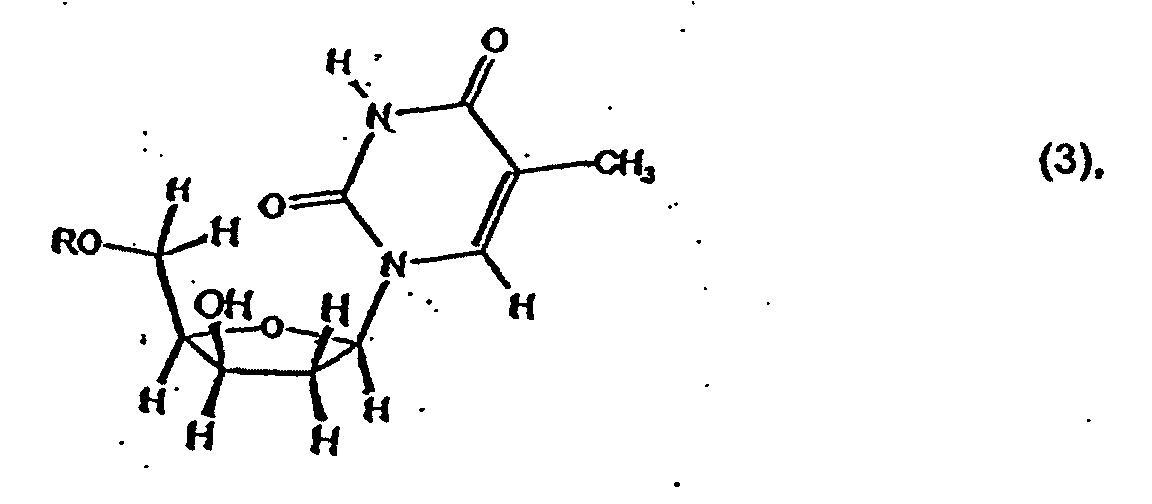
- the present invention furthermore provides a process for the preparation of the compound of the formula (1) according to the invention, where a compound of the formula (2) in which R and R 'are as defined above, is reacted with pyrocarbonic acid di-C 2 -C 10 alkyl esters.
- the compound of the formula (2) may preferably be prepared by reacting the compound of the formula (3) with R 1 -SO 2 Hal, wherein R 1 is as defined above and Hal is a halogen, in particular chlorine, whereby the substituent R 'is introduced.
- R 1 -SO 2 Hal are methanesulfonyl chloride, 4-nitrophenylsulfonyl chloride, p-toluenesulfonyl chloride and trifluoromethanesulfonyl chloride. This reaction can be conveniently carried out at room temperature.
- As the solvent dry pyridine or a mixture of triethylamine / dichloromethane can be used.
- the compound of the formula (3) can be initially charged in the solvent and the compound of the formula R 1 -SO 2 Hal can be added.
- the isolation and purification of the crude product of the formula (2) obtained after the above reaction can be carried out, for example, by removing the solvent under reduced pressure and chromatographic purification, for example on silica gel.
- the compound of formula (3) may, if it is not commercially available, starting from Thymidine can be prepared by introduction of the protective group R and configuration reversal. These Reactions are known in the art, d. H. he knows the necessary reaction conditions, Chemicals and devices.
- R is as is defined above and Hal is a halogen, in particular chlorine.
- R-Hal are Triphenylmethyl chloride and 4,4'-dimethoxytriphenylmethyl chloride.
- the inventive method has a number of advantages. For example, commercially available reagents which are available quickly and inexpensively are used as starting materials or solvents. Furthermore, common laboratory practices are used, such as reaction at room temperature, carrying out the reactions with conventional stirrers, use of inert gas and chromatographic methods for the isolation and purification of products.
- the reaction temperature in the process according to the invention is low, so that no expensive devices for heating are required.
- the solvents used in the process according to the invention are generally low-boiling and can thus be easily separated.
- the method according to the invention can be automated, so that it is favorable for radiation protection reasons, since the radiation exposure and the contamination of humans is kept as low as possible.
- the [ 18 F] FLT used in positron emission tomography which is obtainable in high yield and in high purity, can be prepared in a simple and fast manner.
- the present invention furthermore relates to the use of the compound according to the invention for the preparation of [ 18 F] FLT.
- the OR 'group is preferably substituted by 18 F.
- the protecting groups R "and R can then be eliminated, preferably by acid hydrolysis.
- the compound of the invention may be reacted with [ 18 F] fluoride in an organic solvent, especially acetonitrile, in the presence of a base such as potassium carbonate, and a macrocyclic neutral ligand such as Kryptofix® 222 from Merck, to the R and R " protected [18 F] FLT be implemented.
- a base such as potassium carbonate
- a macrocyclic neutral ligand such as Kryptofix® 222 from Merck
- the use of the protecting group Boc in the compound of the invention, which can be used for the preparation of [ 18 F] FLT, has the advantage that, in contrast to z.
- the acyl protecting group not or, if at all, only marginally to a yield loss during the [ 18 F] FLT synthesis leads.
- the use according to the invention ie the use of the compound according to the invention for producing the proliferation marker [ 18 F] FLT, it is possible in a surprisingly simple and fast manner under mild conditions in good yields and in high purity to produce this proliferation marker.
- This manufacturing method can be automated, ie a device can be constructed with which this method can be carried out automatically. For radiation protection reasons, this is preferred since the radiation exposure and the contamination of humans in a fully automatic process is low.
- the proliferation marker is obtainable in high purity when it is synthesized starting from the compound of the invention, it can be administered to the patient either immediately or without further elaborate purification steps, without causing unwanted effects in the patient by any impurities. Due to the high yield in which the proliferation marker is obtainable, enough radiosynthesis can be used to produce enough label to screen several patients.
- the THF is largely removed from the reaction mixture, the remaining aqueous phase diluted with water to 400 ml and extracted three times with 400 ml of ethyl acetate.
- the combined organic phases are dried over magnesium sulfate and the solvent is first removed on a rotary evaporator, then in a high vacuum, the product being obtained in sufficient purity.
- the respective reagent can be transferred from one of the feed vessels A via the 6-way motor valve B through the line a in the programmable engine syringe C.
- the reagent is conveyed through line b and the dual 6-way engine valve D (position 1) to the reactor E located in a heating bath (not shown).
- the pressure equalization within the reactor via the line c, which leads via the valve D (position 1) in a pressure equalization vessel F.
- the venting of F takes place via an Alox cartridge, which prevents contamination of the environment with [18F] hydrogen fluoride or a contaminated aerosol.
- Each transport step z. B. on a template in the reactor is repeated once to remove remnants of solution from the capillaries.
- the azeotropic drying of the Kryptofix® potassium [ 18 F] fluoride complex takes place in position 6 of the valve D.
- the inert gas stream is passed through the boiling reaction solution in the reactor E and the azeotrope is transferred via the line c into the cold trap G.
- the cold trap is also vented through an Alox cartridge.
- the valve D is brought into position 2 during the heating phase of the reaction solution.
- Position 3 of the valve D closes off the gas-tight reactor and allows reaction temperatures above the boiling point of the solvent. Due to the increase in pressure within the reactor E , depending on the amount of solvent, up to 30% of the reaction mixture is forced into the capillary b extending to the bottom of the reactor. By briefly lowering the reaction temperature below the boiling point of the solvent, the reaction mixture is transferred from the capillary back into the reactor.
- a pressure equalization takes place in position 5 of the valve D.
- the reaction solution is drawn from the reactor E via the valve D (position 1) in the engine syringe C and from there upper the valve B (position 6) optionally pressed into a product glass H , which is provided with a lead shield, or abandoned on the loop of HPLC J.
- the pure product is fractionated in a collection station in product vials, the remaining fractions are separated into a waste vessel.
- the reactor is filled with a solution of Kryptofix® in 1 ml of dry acetonitrile, the receiver 2 with 1 ml of acetonitrile for azeotropic drying, the receiver 3 with a solution of the marker precursor in 300 ⁇ l of dry Acetonitrile and the reservoirs 4 and 5 with 150 ul of 1 M hydrochloric acid for hydrolysis or 1 M sodium hydroxide solution for neutralization of the reaction solution.
- a pointed bottom glass with septum and aeration cannula which is in a lead shield, is filled with the [ 18 F] fluoride-containing aqueous potassium carbonate solution and connected to the apparatus as a receiving vessel 1 , which is provided with a lead shield, after the activity A 0A at time T 0 has determined.
- the basic [ 18 F] fluoride solution is transferred to the reactor, then determines the residual activity in the pit bottom glass and distilling off the azeotrope in the reactor in Helimstrom at a heating bath temperature of t ⁇ 115 ° C. About 14 minutes after T 0 , the internal temperature of the reactor reaches t ⁇ 110 ° C.
- the reactor is allowed to cool to t ⁇ 90 ° C, filled with 1 ml of acetonitrile and repeats the azeotropic drying step.
- About 28 minutes after T 0 the synthesis of the [ 18 F] fluorine-labeled intermediate begins. The synthesis time is 10 minutes at a heating bath temperature of t ⁇ 115 ° C with reactor completion.
- the start of the HPLC run is about 58 minutes after T 0 o.
- the consideration of A 0K is only necessary if there is an unusually high activity at the end of the synthesis in the cold trap. Cause this can be z.
Landscapes
- Chemical & Material Sciences (AREA)
- Organic Chemistry (AREA)
- Engineering & Computer Science (AREA)
- Health & Medical Sciences (AREA)
- Biochemistry (AREA)
- Biotechnology (AREA)
- General Health & Medical Sciences (AREA)
- Genetics & Genomics (AREA)
- Molecular Biology (AREA)
- Life Sciences & Earth Sciences (AREA)
- Saccharide Compounds (AREA)
- Organic Low-Molecular-Weight Compounds And Preparation Thereof (AREA)
- Hydrogenated Pyridines (AREA)
- Plural Heterocyclic Compounds (AREA)
Description



- Fig. 1
- eine Vorrichtung zur Herstellung von [18F]FLT zeigt, wie sie in Beispiel 6 verwendet wird
| Ansatz | 5,12 g | (21,14 mmol) | Thymidin |
| 8,56 g | (25,26 mmol) | 4,4'-Dimethoxytriphenylmethylchlorid (Dimethoxytritylchlorid) | |
| 100 ml | Pyridin (trocken) |
| Ausbeute | 10,54 g | (19,35 mmol) | 91,5 % der Theorie |
| Eigenschaften | beigefarbener, amorpher Festkörper; Fp. = 114 - 116 °C (Sublimation) Rf = 0,23 (V MeOH: V CH |
| Ansatz | 10,04 g | (18,44 mmol) | 5'-O-(4,4'-Dimethoxytrityl)thymidin |
| 3,26 g | (28,46 mmol, 2,2 ml) | Methansufonylchlorid (Mesylchlorid) | |
| 4,82 g | (47,63 mmol, 6,6 ml) | Triethylamin | |
| 160 ml | Tetrahydrofuran (getrocknet über Natrium; frisch destilliert) | ||
| 53 ml | Ethanol | ||
| 53 ml | 1 M NaOH (aq) | ||
| 37 ml | 10 M NaOH (aq) |
| Ausbeute | 9,32 g | (17,11 mmol) | 92,8 % der Theorie |
| Eigenschaften | farbloser, amorpher Festkörper; Rf= 0,31 (V MeOH: V CH |
| Ansatz | 1,97 g | (3,62 mmol) | 1-(5-O-(4,4'-Dimethoxytrityl)-2-deoxy-β-D- |
| lyxofuranosyl)thymin | |||
| 0,83 g | (7,25 mmol, 0,56 ml) | Methansulfonylchlorid (Mesylchlorid) | |
| 1,10 g | (10,82 mmol, 1,51 ml) | Triethylamin | |
| 25 ml | Dichlormethan (trocken) |
| Ausbeute | 1,83 g | (2,94 mmol) | 81,2 % der Theorie |
| Eigenschaften | farbloser, amorpher Festkörper; Rf = 0,43 (VMeOH:VCH |
| Ansatz | 1,65 g | (2,65 mmol) | 1-(5-O-(4,4'-Dimethoxytrityl)-3-O-mesyl-2-deoxy-β-D-lyxofuranosyl)thymin |
| 3,52 g | (16,13 mmol, 3,7 ml) | Pyrokohlensäure-di-tert-butylester (Boc2O) | |
| 30 ml | Pyridin (trocken) |
| Ausbeute | 0,32 g | (0,44 mmol) | 16,6% der Theorie |
| Eigenschaften | gelber, amorpher Festkörper; Fp. = 79,0 - 85,5 °C (Zersetzung); Rf = 0,44 (VEt2O = 100) |
| Ansatz | 2,00 g | (3,67 mmol) | 1-(5-O-(4,4'-Dimethoxytrityl)-2-deoxy-β-D-lyxofuranosyl)thymin, hergestellt nach Beispiel 3 |
| 3,50 g | (18,36 mmol) | p-Toluensulfonylchlorid (Tosylchlorid) | |
| 30 ml | Pyridin (trocken) |
| Ausbeute | 0,83 g | (1,19 mmol) | 32,4% der Theorie |
| Eigenschaften | beigefarbener, amorpher Festkörper; Rf = 0,50 (VMeOH:VCH |
| Ansatz | 0,70 g | (1,00 mmol) | 1-(5-O-(4,4'-Dimethoxytrityl)-3-O-tosyl-2-deoxy-β-D-lyxofuranosyl)thymin |
| 0,67 g | (3,07 mmol, 0,71 ml) |
Pyrokohlensäure-di-tert-butylester (Boc2O) | |
| 25 ml | Pyridin (trocken) |
| Ausbeute | 0,50 g | (0,63 mmol) | 63,0% der Theorie |
| Eigenschaften | blaßgelber, amorpher Festkörper; Fp. = 87,0 - 93,0 °C Rf = 0,67 ( VEt |
| Ansatz: | 0,58 g (1,07 mmol) | 1-(5-O-(4,4'-Dimethoxytrityl)-2-deoxy-β-D-lxyofuranosyl)thymin, hergestellt nach Beispiel 3 |
| 0,72 g (3,25 mmol) | 4-Nitrophenylsulfonylchlorid (Nosylchlorid) | |
| 15 ml | Pyridin (trocken) |
| Ausbeute | 0,48 g | (0,66 mmol) | 61,7% der Theorie |
| Eigenschaften: | blaßgelber, amorpher Festkörper; Fp. = 85,9 - 93,4 °C; Rf = 0,53 (VMeOH:VCH |
| Ansatz | 0,57 g | (0,78 mmol) | 1-(5-O-(4,4'-Dimethoxytrityl)-3-O-nosyl-2-deoxy-β-D-lxyofuranosyl)thymin |
| 0,51 g | (2,34 mmol, 0,54 ml) | Pyrokohlensäure-di-tert-butylester (Boc2O) | |
| 15 ml | Pyridin (trocken) |
| Ausbeute | 0,38 g | (0,46 mmol) | 58,9 % der Theorie |
| Eigenschaften | blaßgelber, amorpher Festkörper; Fp. = 118,8 -120,6 °C; Rf = 0,62 ( VEt |
| Ansatz | 0,013 mmol | Markierungsvorläufer gemäß Beispielen 1-5 | |
| 7,8 mg | (0,021 mmol) | Kryptofix®222 (Macrocyclischer Neutral-Ligand für die Synthese der Fa. Merck) | |
| 2,3 ml | Acetonitril (trocken; für die DNA-Synthese) | ||
| 0,15 ml | 1 M Salzsäure | ||
| 0,15 ml | 1 M Natronlauge | ||
| 0,2 ml | (0,020 mmol k⊕) | 0,05 M Kaliumcarbonat (aq) | |
| 15392 MBq | (416mCi) | [18F]Fluorid zum Zeitpunkt T 0 |
Die azeotrope Trocknung des Kryptofix®-Kalium[18F]fluorid-Komplexes erfolgt in der Stellung 6 des Ventils D. Der Inertgasstrom wird hierbei im Reaktor E durch die siedende Reaktionslösung geleitet und das Azeotrop über die Leitung c in die Kühlfalle G überführt. Die Kühlfalle wird ebenfalls über eine Alox-Kartusche entlüftet.
Zum Abschluß der Synthese wird die Reaktionslösung aus dem Reaktor E über das Ventil D (Stellung 1) in die Motorspritze C gezogen und von dort Ober das Ventil B (Stellung 6) wahlweise in ein Produktgläschen H gedrückt, das mit einer Bleiabschirmung versehen ist, oder auf die Schleife der HPLC J aufgegeben. Nach der präparativen Trennung wird das Reinprodukt in einer Sammelstation in Produktgläschen fraktioniert, wobei die übrigen Fraktionen in ein Abfallgefäß abgetrennt werden.
| Ausbeute | 1106 | MBq | (29.9 mCi) | 9,3% der Theorie; unkorrigiert; gemessen zum Zeitpunkt T = 97:20 min nach T 0 |
| 2042 | MBq | (55,2 mCi) | 17,2% der Theorie; korrigiert auf Zeitpunkt T 0; |
spezifische Aktivität: 33 MBq/ml(0,88mCi/ml)
Claims (11)
- Verbindung der Formel (1)in der
 R für am Phenyl-Rest substituiertes Triphenylmethyl oder am Phenyl-Rest substituiertes Triphenylsilyl, wobei als Substituenten solche Reste eingesetzt werden, die einen +M-Effekt bewirken;R' für R1-SO2, wobei R1 ein unsubstituiertes oder substituiertes C1-C5-Alkyl oder ein unsubstituiertes oder substituiertes Phenyl bedeutet, undR" für ein C2-C10-Alkyloxycarbonyl stehen.
 - Verbindung nach Anspruch 1, wobei der Substituent am Phenyl-Rest unter Methyl, Ethyl, Methoxy und Ethoxy ausgewählt ist.
- Verbindung nach Anspruch 1 oder 2, wobei R für 4,4'-Dimethoxytriphenylmethyl steht.
- Verbindung nach einem der vorhergehenden Ansprüche, wobei R1-SO2 für Methansulfonyl, 4-Nitrophenylsulfonyl, p-Toluensulfonyl oder Trifluormethansulfonyl steht.
- Verbindung nach einem der vorhergehenden Ansprüche, wobei das C2-C10-Alkyloxycarbonyl tert-Butyloxycarbonyl oder Neopentyloxycarbonyl ist.
- Verbindung nach einem der vorhergehenden Ansprüche, die ausgewählt ist unter 3-N-Boc-1-(5-O-(4,4'-dimethoxytrityl)-3-O-nosyl-2-deoxy-β-D-lyxofuranosyl)thymin, 3-N-Boc-1-(5-O-(4,4'-dimethoxytrityl)-3-O-tosyl-2-deoxy-β-D-lyxofuranosyl)thymin und 3-N-Boc-1-(5-O-(4,4'-dimethoxytrityl)-3-O-mesyl-2-deoxy-β-D-lyxofuranosyl)thymin.
- Verfahren zur Herstellung der Verbindung nach einem der Ansprüche 1 bis 6, wobei eine Verbindung der Formel (2)in der R und R' wie vorstehend definiert sind, mit Pyrokohlensäure-di-C2-C10-Alkylester umgesetzt wird.
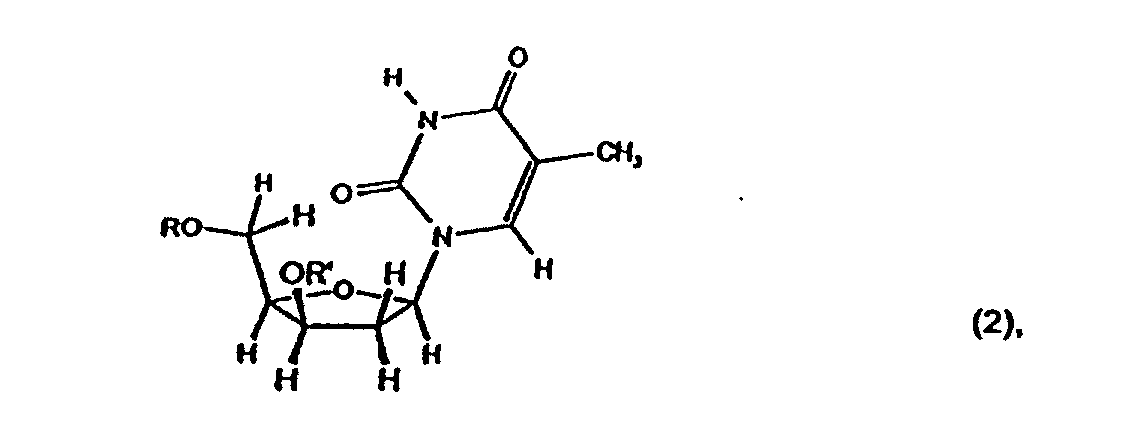
- Verfahren nach Anspruch 7, wobei die Verbindung der Formel (2) erhalten wird durch Umsetzen der Verbindung der Formel (3)mit R1-SO2Hal, wobei R1 wie vorstehend definiert ist und Hal für ein Halogen steht, wodurch der Substituent R' eingeführt wird.
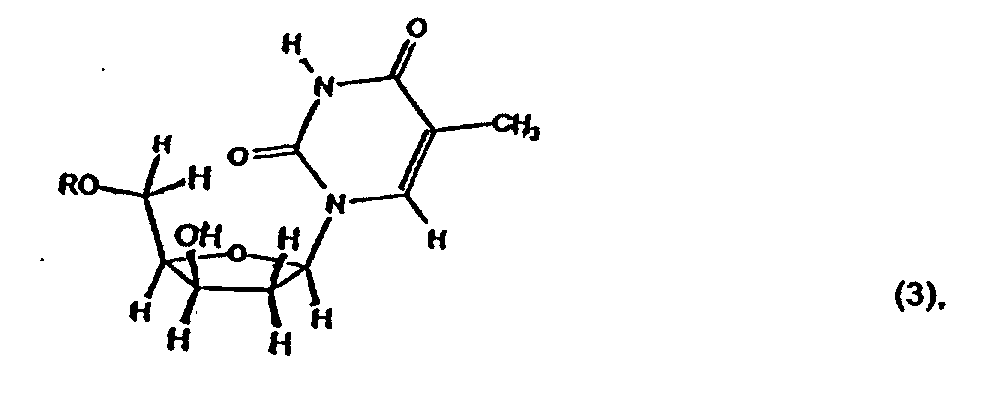
- Verfahren nach einem der Ansprüche 7 oder 8, wobei die Verbindung der Formel (3) aus Thymidin durch Einführen des Substituenten R und Konfigurationsumkehr hergestellt wird.
- Verwendung der Verbindung nach einem der Ansprüche 1 bis 6 zur Herstellung von 3'-[18F]Fluor-3'-deoxythymidin.
- Verwendung nach Anspruch 10, wobei die OR'-Gruppe durch 18F substituiert und die Schutzgruppen R" und R abgespalten werden.
Applications Claiming Priority (3)
| Application Number | Priority Date | Filing Date | Title |
|---|---|---|---|
| DE10104250A DE10104250A1 (de) | 2001-01-31 | 2001-01-31 | Markierungsfähige Verbindungen zur einfachen Synthese von 3'-[18F]Fluor-3'-deoxythymidin und Verfahren zu deren Herstellung |
| DE10104250 | 2001-01-31 | ||
| PCT/EP2002/000865 WO2002060913A1 (de) | 2001-01-31 | 2002-01-28 | Markierungsfähige verbindungen zur einfachen synthese von 3'(18f)fluor-3'-deoxythymidin und verfahren zu deren herstellung |
Publications (2)
| Publication Number | Publication Date |
|---|---|
| EP1355915A1 EP1355915A1 (de) | 2003-10-29 |
| EP1355915B1 true EP1355915B1 (de) | 2005-08-10 |
Family
ID=7672295
Family Applications (1)
| Application Number | Title | Priority Date | Filing Date |
|---|---|---|---|
| EP02708318A Expired - Lifetime EP1355915B1 (de) | 2001-01-31 | 2002-01-28 | Markierungsfähige verbindungen zur einfachen synthese von 3'-[18f]fluor-3'-deoxythymidin und verfahren zu deren herstellung |
Country Status (7)
| Country | Link |
|---|---|
| US (1) | US6891033B2 (de) |
| EP (1) | EP1355915B1 (de) |
| AT (1) | ATE301668T1 (de) |
| DE (2) | DE10104250A1 (de) |
| DK (1) | DK1355915T3 (de) |
| ES (1) | ES2248524T3 (de) |
| WO (1) | WO2002060913A1 (de) |
Families Citing this family (5)
| Publication number | Priority date | Publication date | Assignee | Title |
|---|---|---|---|---|
| EP1670519B1 (de) * | 2003-09-11 | 2016-07-13 | Mayo Foundation For Medical Education And Research | Festphasenextraktionsreinigungsverfahren für radioaktiv markiertes thymidin |
| GB0422004D0 (en) * | 2004-10-05 | 2004-11-03 | Amersham Plc | Method of deprotection |
| KR100789847B1 (ko) * | 2004-12-15 | 2007-12-28 | (주)퓨쳐켐 | 알코올 용매하에서 유기플루오로 화합물의 제조방법 |
| US9163054B2 (en) * | 2011-09-20 | 2015-10-20 | Institute of Nuclear Energy Research, Atomic Energy Council, Executive Yuan, R.O.C. | Method for F-18 FLT synthesis |
| AU2015253843A1 (en) * | 2014-04-29 | 2016-10-20 | Biosearch Technologies, Inc. | Compounds compositions and methods including thermally labile moieties |
Family Cites Families (4)
| Publication number | Priority date | Publication date | Assignee | Title |
|---|---|---|---|---|
| US5561225A (en) * | 1990-09-19 | 1996-10-01 | Southern Research Institute | Polynucleotide analogs containing sulfonate and sulfonamide internucleoside linkages |
| US20020120130A1 (en) * | 1993-09-10 | 2002-08-29 | Gilles Gosselin | 2' or 3' -deoxy and 2', 3' -dideoxy-beta-L-pentofuranonucleo-side compounds, method of preparation and application in therapy, especially as anti- viral agents |
| FR2709754B1 (fr) * | 1993-09-10 | 1995-12-01 | Centre Nat Rech Scient | Composés 2' ou 3'-déoxy- et 2', 3'-didéoxy-beta-L-pentofuranonucléosides, procédé de préparation et application thérapeutique, notamment anti-virale. |
| IL141151A0 (en) | 2001-01-29 | 2002-02-10 | Compugen Ltd | Method for comparing signal arrays in digital images |
-
2001
- 2001-01-31 DE DE10104250A patent/DE10104250A1/de not_active Ceased
-
2002
- 2002-01-28 ES ES02708318T patent/ES2248524T3/es not_active Expired - Lifetime
- 2002-01-28 EP EP02708318A patent/EP1355915B1/de not_active Expired - Lifetime
- 2002-01-28 AT AT02708318T patent/ATE301668T1/de active
- 2002-01-28 DE DE50203881T patent/DE50203881D1/de not_active Expired - Lifetime
- 2002-01-28 WO PCT/EP2002/000865 patent/WO2002060913A1/de not_active Ceased
- 2002-01-28 US US10/470,817 patent/US6891033B2/en not_active Expired - Lifetime
- 2002-01-28 DK DK02708318T patent/DK1355915T3/da active
Also Published As
| Publication number | Publication date |
|---|---|
| DK1355915T3 (da) | 2005-12-12 |
| DE10104250A1 (de) | 2002-08-14 |
| WO2002060913A1 (de) | 2002-08-08 |
| US6891033B2 (en) | 2005-05-10 |
| DE50203881D1 (de) | 2005-09-15 |
| ATE301668T1 (de) | 2005-08-15 |
| EP1355915A1 (de) | 2003-10-29 |
| US20040110720A1 (en) | 2004-06-10 |
| ES2248524T3 (es) | 2006-03-16 |
Similar Documents
| Publication | Publication Date | Title |
|---|---|---|
| EP0797580B1 (de) | Nucleosid-derivate mit photolabilen schutzgruppen | |
| EP0152459B1 (de) | Verfahren zur herstellung von oligonucleotiden | |
| DE69407419T2 (de) | 2' oder 3' -deoxy- und 2' -dideoxy-beta-l-pentafuranonukleoside, verfahren zur herstellung und anwendung in der therapie, insbesondere als antivirale wirkstoffe | |
| DE3751468T2 (de) | Verfahren zur herstellung von oligonukleotiden und verbindungen zur bildung hochmolekularer schutzgruppen. | |
| EP0901501B1 (de) | Nucleosid-derivate mit photolabilen schutzgruppen | |
| DE3390162T1 (de) | Desoxyuridinderivate, Verfahren zu ihrer Herstellung und ihre Verwendung als Pharmazeutika | |
| EP4153569A1 (de) | Verfahren zur herstellung von butyl-(5s)-5-({2-[4-(butoxycarbonyl)phenyl]ethyl}[2-(2-{[3-chlor-4'-(trifluormethyl)[biphenyl]-4-yl]methoxy}phenyl)ethyl]amino)-5,6,7,8-tetrahydrochinolin-2-carboxylat | |
| DE3719377C2 (de) | Anthracyclinglykoside, Verfahren zu deren Herstellung und Arzneimittel, welche diese enthalten | |
| DE10104250A1 (de) | Markierungsfähige Verbindungen zur einfachen Synthese von 3'-[18F]Fluor-3'-deoxythymidin und Verfahren zu deren Herstellung | |
| EP1401851B1 (de) | Zweistufige schutzgruppen für die synthese von biopolymeren | |
| DE102019116986A1 (de) | Deuterierte 7-(3-(4-(2-([18F]Fluor)ethoxy)phenyl)propyl)-2-(furan-2-yl)-7H-pyrazolo[4,3-e][1,2,4]triazolo[1,5-c]pyrimidin-5-amin-Derivate | |
| Aigbirhio et al. | Automated radiosynthesis of no‐carrier‐added [S‐fluoromethyl‐18F] fluticasone propionate as a radiotracer for lung deposition studies with PET | |
| EP1224198B1 (de) | Nucleosid-derivate mit photolabilen schutzgruppen | |
| EP1419167B1 (de) | 1-(2,5'-anhydro-lyxofuranosyl) thymine zur synthese von radiomarkierten fluor-3' deoxynucleotiden | |
| DE69709098T2 (de) | Zwischenprodukten für oligonukleotid-synthese | |
| EP1392650A2 (de) | Geschützte tyrosinderivate, verfahren zu deren herstellung und deren verwendung zur herstellung von o-(2- ?18 f]-fluorethyl)-l-tyrosin | |
| AT400953B (de) | Pentofuranosid-derivate, deren herstellung und verwendung | |
| EP1923382A1 (de) | [F-18] markierte L-Glutaminsäure, [F-18] markiertes Glutamin, ihre Derivate und ihre Verwendung sowie Verfahren zu ihrer Herstellung | |
| DE2503889A1 (de) | Verfahren zur herstellung von 2,2'- cyclocytidin | |
| DE102005019452A1 (de) | Neues Verfahren zur Durchführung der Positronen-Emissions-Tomographie (PET) mittels 18F-haltigen Nukleosiden | |
| EP1232164A1 (de) | Vorstufenverbindung für radiodiagnostika und deren herstellung | |
| DE3606395A1 (de) | Neue nucleinsaeurebausteine, verfahren zu deren herstellung und deren verwendung | |
| DE102009046981A1 (de) | Verfahren zur Herstellung von Trinukleotiden | |
| DE2522224B2 (de) | Jodierte Cholesterin-Verbindungen, Verfahren zu ihrer Herstellung und sie enthaltendes Mittel | |
| Dimagno | Heavily fluorinated sugar analogs |
Legal Events
| Date | Code | Title | Description |
|---|---|---|---|
| PUAI | Public reference made under article 153(3) epc to a published international application that has entered the european phase |
Free format text: ORIGINAL CODE: 0009012 |
|
| 17P | Request for examination filed |
Effective date: 20030716 |
|
| AK | Designated contracting states |
Kind code of ref document: A1 Designated state(s): AT BE CH CY DE DK ES FI FR GB GR IE IT LI LU MC NL PT SE TR |
|
| AX | Request for extension of the european patent |
Extension state: AL LT LV MK RO SI |
|
| 17Q | First examination report despatched |
Effective date: 20040709 |
|
| GRAP | Despatch of communication of intention to grant a patent |
Free format text: ORIGINAL CODE: EPIDOSNIGR1 |
|
| GRAS | Grant fee paid |
Free format text: ORIGINAL CODE: EPIDOSNIGR3 |
|
| GRAA | (expected) grant |
Free format text: ORIGINAL CODE: 0009210 |
|
| AK | Designated contracting states |
Kind code of ref document: B1 Designated state(s): AT BE CH CY DE DK ES FI FR GB GR IE IT LI LU MC NL PT SE TR |
|
| PG25 | Lapsed in a contracting state [announced via postgrant information from national office to epo] |
Ref country code: IE Free format text: LAPSE BECAUSE OF FAILURE TO SUBMIT A TRANSLATION OF THE DESCRIPTION OR TO PAY THE FEE WITHIN THE PRESCRIBED TIME-LIMIT Effective date: 20050810 Ref country code: FI Free format text: LAPSE BECAUSE OF FAILURE TO SUBMIT A TRANSLATION OF THE DESCRIPTION OR TO PAY THE FEE WITHIN THE PRESCRIBED TIME-LIMIT Effective date: 20050810 Ref country code: TR Free format text: LAPSE BECAUSE OF FAILURE TO SUBMIT A TRANSLATION OF THE DESCRIPTION OR TO PAY THE FEE WITHIN THE PRESCRIBED TIME-LIMIT Effective date: 20050810 |
|
| REG | Reference to a national code |
Ref country code: GB Ref legal event code: FG4D Free format text: NOT ENGLISH |
|
| REG | Reference to a national code |
Ref country code: CH Ref legal event code: EP |
|
| REG | Reference to a national code |
Ref country code: IE Ref legal event code: FG4D Free format text: LANGUAGE OF EP DOCUMENT: GERMAN |
|
| REF | Corresponds to: |
Ref document number: 50203881 Country of ref document: DE Date of ref document: 20050915 Kind code of ref document: P |
|
| PG25 | Lapsed in a contracting state [announced via postgrant information from national office to epo] |
Ref country code: GR Free format text: LAPSE BECAUSE OF FAILURE TO SUBMIT A TRANSLATION OF THE DESCRIPTION OR TO PAY THE FEE WITHIN THE PRESCRIBED TIME-LIMIT Effective date: 20051110 |
|
| REG | Reference to a national code |
Ref country code: SE Ref legal event code: TRGR |
|
| REG | Reference to a national code |
Ref country code: DK Ref legal event code: T3 |
|
| PG25 | Lapsed in a contracting state [announced via postgrant information from national office to epo] |
Ref country code: PT Free format text: LAPSE BECAUSE OF FAILURE TO SUBMIT A TRANSLATION OF THE DESCRIPTION OR TO PAY THE FEE WITHIN THE PRESCRIBED TIME-LIMIT Effective date: 20060110 |
|
| GBT | Gb: translation of ep patent filed (gb section 77(6)(a)/1977) |
Effective date: 20051221 |
|
| PG25 | Lapsed in a contracting state [announced via postgrant information from national office to epo] |
Ref country code: LI Free format text: LAPSE BECAUSE OF NON-PAYMENT OF DUE FEES Effective date: 20060131 Ref country code: LU Free format text: LAPSE BECAUSE OF NON-PAYMENT OF DUE FEES Effective date: 20060131 Ref country code: CH Free format text: LAPSE BECAUSE OF NON-PAYMENT OF DUE FEES Effective date: 20060131 Ref country code: MC Free format text: LAPSE BECAUSE OF NON-PAYMENT OF DUE FEES Effective date: 20060131 |
|
| NLR4 | Nl: receipt of corrected translation in the netherlands language at the initiative of the proprietor of the patent | ||
| REG | Reference to a national code |
Ref country code: ES Ref legal event code: FG2A Ref document number: 2248524 Country of ref document: ES Kind code of ref document: T3 |
|
| REG | Reference to a national code |
Ref country code: IE Ref legal event code: FD4D |
|
| ET | Fr: translation filed | ||
| PLBE | No opposition filed within time limit |
Free format text: ORIGINAL CODE: 0009261 |
|
| STAA | Information on the status of an ep patent application or granted ep patent |
Free format text: STATUS: NO OPPOSITION FILED WITHIN TIME LIMIT |
|
| 26N | No opposition filed |
Effective date: 20060511 |
|
| REG | Reference to a national code |
Ref country code: CH Ref legal event code: PL |
|
| PG25 | Lapsed in a contracting state [announced via postgrant information from national office to epo] |
Ref country code: CY Free format text: LAPSE BECAUSE OF FAILURE TO SUBMIT A TRANSLATION OF THE DESCRIPTION OR TO PAY THE FEE WITHIN THE PRESCRIBED TIME-LIMIT Effective date: 20050810 |
|
| REG | Reference to a national code |
Ref country code: FR Ref legal event code: PLFP Year of fee payment: 15 |
|
| REG | Reference to a national code |
Ref country code: FR Ref legal event code: PLFP Year of fee payment: 16 |
|
| REG | Reference to a national code |
Ref country code: FR Ref legal event code: PLFP Year of fee payment: 17 |
|
| PGFP | Annual fee paid to national office [announced via postgrant information from national office to epo] |
Ref country code: FR Payment date: 20210121 Year of fee payment: 20 Ref country code: NL Payment date: 20210120 Year of fee payment: 20 |
|
| PGFP | Annual fee paid to national office [announced via postgrant information from national office to epo] |
Ref country code: AT Payment date: 20210121 Year of fee payment: 20 Ref country code: DE Payment date: 20210120 Year of fee payment: 20 Ref country code: BE Payment date: 20210120 Year of fee payment: 20 Ref country code: SE Payment date: 20210120 Year of fee payment: 20 Ref country code: DK Payment date: 20210122 Year of fee payment: 20 Ref country code: ES Payment date: 20210324 Year of fee payment: 20 Ref country code: GB Payment date: 20210121 Year of fee payment: 20 |
|
| PGFP | Annual fee paid to national office [announced via postgrant information from national office to epo] |
Ref country code: IT Payment date: 20210121 Year of fee payment: 20 |
|
| REG | Reference to a national code |
Ref country code: DE Ref legal event code: R071 Ref document number: 50203881 Country of ref document: DE |
|
| REG | Reference to a national code |
Ref country code: DK Ref legal event code: EUP Expiry date: 20220128 |
|
| REG | Reference to a national code |
Ref country code: NL Ref legal event code: MK Effective date: 20220127 |
|
| REG | Reference to a national code |
Ref country code: GB Ref legal event code: PE20 Expiry date: 20220127 |
|
| REG | Reference to a national code |
Ref country code: BE Ref legal event code: MK Effective date: 20220128 |
|
| REG | Reference to a national code |
Ref country code: AT Ref legal event code: MK07 Ref document number: 301668 Country of ref document: AT Kind code of ref document: T Effective date: 20220128 |
|
| PG25 | Lapsed in a contracting state [announced via postgrant information from national office to epo] |
Ref country code: GB Free format text: LAPSE BECAUSE OF EXPIRATION OF PROTECTION Effective date: 20220127 |
|
| REG | Reference to a national code |
Ref country code: ES Ref legal event code: FD2A Effective date: 20220506 |
|
| PG25 | Lapsed in a contracting state [announced via postgrant information from national office to epo] |
Ref country code: ES Free format text: LAPSE BECAUSE OF EXPIRATION OF PROTECTION Effective date: 20220129 |