EP1355102A1 - Gaine auto-fermable de protection thermique et son procédé de fabrication - Google Patents
Gaine auto-fermable de protection thermique et son procédé de fabrication Download PDFInfo
- Publication number
- EP1355102A1 EP1355102A1 EP03290871A EP03290871A EP1355102A1 EP 1355102 A1 EP1355102 A1 EP 1355102A1 EP 03290871 A EP03290871 A EP 03290871A EP 03290871 A EP03290871 A EP 03290871A EP 1355102 A1 EP1355102 A1 EP 1355102A1
- Authority
- EP
- European Patent Office
- Prior art keywords
- self
- sheath
- closing
- monofilament
- sheet strips
- Prior art date
- Legal status (The legal status is an assumption and is not a legal conclusion. Google has not performed a legal analysis and makes no representation as to the accuracy of the status listed.)
- Granted
Links
- 238000004519 manufacturing process Methods 0.000 title claims description 9
- 238000000034 method Methods 0.000 title claims description 3
- 229920000728 polyester Polymers 0.000 claims description 12
- 238000003856 thermoforming Methods 0.000 claims description 6
- 238000009941 weaving Methods 0.000 claims description 5
- 239000011888 foil Substances 0.000 description 7
- 230000005855 radiation Effects 0.000 description 4
- 239000003365 glass fiber Substances 0.000 description 3
- 238000010438 heat treatment Methods 0.000 description 3
- 239000000853 adhesive Substances 0.000 description 2
- 230000001070 adhesive effect Effects 0.000 description 2
- 238000001816 cooling Methods 0.000 description 2
- 229920006267 polyester film Polymers 0.000 description 2
- KWGRBVOPPLSCSI-WPRPVWTQSA-N (-)-ephedrine Chemical compound CN[C@@H](C)[C@H](O)C1=CC=CC=C1 KWGRBVOPPLSCSI-WPRPVWTQSA-N 0.000 description 1
- 241001080024 Telles Species 0.000 description 1
- 239000003570 air Substances 0.000 description 1
- XAGFODPZIPBFFR-UHFFFAOYSA-N aluminium Chemical compound [Al] XAGFODPZIPBFFR-UHFFFAOYSA-N 0.000 description 1
- 229910052782 aluminium Inorganic materials 0.000 description 1
- 239000012080 ambient air Substances 0.000 description 1
- 230000007547 defect Effects 0.000 description 1
- 239000004744 fabric Substances 0.000 description 1
- 239000012530 fluid Substances 0.000 description 1
- 230000004927 fusion Effects 0.000 description 1
- 238000002844 melting Methods 0.000 description 1
- 230000008018 melting Effects 0.000 description 1
- 238000012986 modification Methods 0.000 description 1
- 230000004048 modification Effects 0.000 description 1
- 238000011084 recovery Methods 0.000 description 1
- 239000002966 varnish Substances 0.000 description 1
Images
Classifications
-
- F—MECHANICAL ENGINEERING; LIGHTING; HEATING; WEAPONS; BLASTING
- F16—ENGINEERING ELEMENTS AND UNITS; GENERAL MEASURES FOR PRODUCING AND MAINTAINING EFFECTIVE FUNCTIONING OF MACHINES OR INSTALLATIONS; THERMAL INSULATION IN GENERAL
- F16L—PIPES; JOINTS OR FITTINGS FOR PIPES; SUPPORTS FOR PIPES, CABLES OR PROTECTIVE TUBING; MEANS FOR THERMAL INSULATION IN GENERAL
- F16L59/00—Thermal insulation in general
- F16L59/08—Means for preventing radiation, e.g. with metal foil
-
- D—TEXTILES; PAPER
- D03—WEAVING
- D03D—WOVEN FABRICS; METHODS OF WEAVING; LOOMS
- D03D1/00—Woven fabrics designed to make specified articles
- D03D1/0035—Protective fabrics
- D03D1/0043—Protective fabrics for elongated members, i.e. sleeves
-
- F—MECHANICAL ENGINEERING; LIGHTING; HEATING; WEAPONS; BLASTING
- F16—ENGINEERING ELEMENTS AND UNITS; GENERAL MEASURES FOR PRODUCING AND MAINTAINING EFFECTIVE FUNCTIONING OF MACHINES OR INSTALLATIONS; THERMAL INSULATION IN GENERAL
- F16L—PIPES; JOINTS OR FITTINGS FOR PIPES; SUPPORTS FOR PIPES, CABLES OR PROTECTIVE TUBING; MEANS FOR THERMAL INSULATION IN GENERAL
- F16L59/00—Thermal insulation in general
- F16L59/02—Shape or form of insulating materials, with or without coverings integral with the insulating materials
- F16L59/021—Shape or form of insulating materials, with or without coverings integral with the insulating materials comprising a single piece or sleeve, e.g. split sleeves; consisting of two half sleeves; comprising more than two segments
Definitions
- the present invention relates to a self-closing sheath of thermal protection.
- It also relates to a method of manufacturing such a sheath.
- the present invention relates to sheaths self-closing used in the field of motor vehicles and intended to mechanically protect the bundles of cables arranged in the vehicle or fluid lines.
- sheaths woven in the form of a band plane on which is then fixed an aluminized layer. This sheath is then closed around a bundle of cables and held in place by a Velcro and / or adhesive system.
- This sheath can be positioned and closed automatically around a cable bundle. Then closure adhesives allow keep it closed, especially at the curves in which the self-closing sheath tends to open.
- the present invention aims to provide a self-closing sheath improved thermal protection.
- a self-closing sheath which includes a interlaced structure comprising on the one hand a monofilament, and on the other hand, metallic foil strips.
- a unique structure is thus obtained which has the particularity have a reflective surface suitable for protecting cables from infrared radiation.
- this structure without added aluminized sheet offers a flexibility allowing a better conformation of the sheath during its setting in place on longitudinal elements, in particular at the level of the curves.
- this sheath is consisting of a woven structure comprising a monofilament as a thread weft and strips of metallic foil as warp threads.
- This structure can be produced by a conventional weaving loom, the monofilament making it possible to ensure a certain rigidity in this flexible sheath.
- the metallized sheet strips are made up a film of aluminized polyester on both sides.
- the strips can thus be obtained by cutting into polyester film strips.
- the interlaced structure can thus be made flat then thermoformed into the form of a split tubular sheath so that its placement around the longitudinal elements can be achieved by simple spacing of the edges of the sheath, then by closing it around the elements.
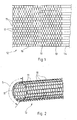
- This thermal protection sheath here consists of a structure interlaced comprising a monofilament 10 and on the other hand strips of metallic sheet 11.
- the weft thread used in this woven structure is here a monofilament.
- This monofilament can be a polyester thread of diameter included between 0.1 and 0.5 mm.
- Such a polyester monofilament makes it possible to support high temperatures, of the order of 150 ° C. and ensuring a certain resistance to this self-closing sheath.
- the warp threads used in this woven structure are here made up of strips of metallic foil.
- These metallized sheet strips are preferably made a film of aluminized polyester on both sides.
- These metallized sheet strips have a width of preferably between 2 and 5 mm.
- this width of the strips could be between 1 mm and 15 mm.
- the Applicant has made realizations with strips 3 mm wide which allows to obtain a completely woven structure satisfactory.
- This woven strip further comprises a selvedge thread 14, parallel with metallic foil strips 11.
- This selvedge thread is woven with the strips and thus extends along a longitudinal edge of the sheath.
- This selvedge thread limits the fraying of the sheath. It can be interesting to use a colored thread as selvedge thread on the one hand, to detect easily its presence (its absence is a defect) and on the other hand, identify easily the "tied" edge of the fabric.
- this self-closing sheath is thus presents in a tubular form having a covering portion S which extends over an angular sector between 45 ° and 180 °.
- this covering portion extends substantially over 180 °.
- This relatively large portion makes it possible to adapt the sheath of thermal protection at different diameters of cable bundles or pipes while ensuring the closure of this sheath by covering edges.
- a reflective structure is thus obtained from strips aluminized sheet, not requiring the addition of a sheet added in aluminum.
- This structure in one piece provides a flexible sheath adaptable to various forms of bundles of cables or conduits.
- an interlaced structure and by example a woven structure, in the form of a flat strip 12 such as illustrated for example in Figure 1.
- thermoforming this flat strip allows to conform it into a self-closing tubular sheath 13 as illustrated in Figure 2.
- the weaving step of the flat strip uses as a weft thread monofilament, for example polyester, and as warp yarn, metallized foil strips, produced from a polyester film alluminisé.
- the sheath thus treated remains closed, with a portion of recovery.
- the self-closing thermal protection sheath could be achieved by a different manufacturing process, using for example a braided structure or a knitted structure.
- the woven structure could include a selvedge thread on each longitudinal edge of the sheath.
- the interlaced structure could comprise two layers, one first layer comprising the interlaced metallic foil strips with a monofilament, adapted to reflect infrared radiation, and a second layer, made of glass fibers for example, suitable for insulating cables or the conduits of heat transmitted by convection or conduction.
- This interlaced structure could be obtained by a process of double face weaving, the glass fiber face being intended to constitute the face inside of the tubular sheath.
Landscapes
- Engineering & Computer Science (AREA)
- General Engineering & Computer Science (AREA)
- Mechanical Engineering (AREA)
- Textile Engineering (AREA)
- Woven Fabrics (AREA)
- Details Of Indoor Wiring (AREA)
- Thermal Insulation (AREA)
- Insulated Conductors (AREA)
- Organic Insulating Materials (AREA)
Abstract
Description
- réalisation d'une structure entrelacée d'une bande plane comprenant d'une part un monofilament, et d'autre part, des bandelettes de feuille métallisée ; et
- thermoformage de la bande plane sous forme d'une gaine tubulaire auto-fermable.
- la figure 1 est une vue d'une portion de gaine conforme à l'invention, avant thermoformage ; et
- la figure 2 est une vue partielle en perspective d'une gaine auto-fermable conforme à l'invention.
- conformation à froid de la bande plane dans une forme tubulaire, avec une zone de recouvrement qui s'étend sur un secteur angulaire inférieur ou égal à 180°. On peut ainsi conformer la bande à froid autour d'un mandrin de diamètre approprié de telle sorte qu'une zone de recouvrement soit constituée ;
- chauffage de la forme tubulaire conformée à froid ; Cette température de chauffage est comprise entre le point de ramollissement du polyester et la température de fusion de ce dernier. Cette étape de chauffage a une durée relativement courte, généralement inférieure ou égale à 1 minute.
- refroidissement de la gaine thermoformée. On refroidit ensuite cette gaine chauffée, de manière rapide, généralement par contact avec l'air ambiant.
Claims (9)
- Gaine auto-fermable de protection thermique, caractérisée en ce qu'elle comprend une structure entrelacée comprenant d'une part un monofilament (10), et d'autre part, des bandelettes de feuille métallisée (11).
- Gaine auto-fermable conforme à la revendication 1, caractérisée en ce qu'elle est constituée d'une structure tissée comprenant un monofilament (10) comme fil de trame et des bandelettes de feuille métallisée (11) comme fils de chaíne.
- Gaine auto-fermable conforme à l'une des revendications 1 ou 2, caractérisée en ce que les bandelettes de feuille métallisée (11) sont constituées d'un film en polyester aluminisé sur ses deux faces.
- Gaine auto-fermable conforme à l'une des revendications 1 à 3, caractérisée en ce que les bandelettes de feuille métallisée (11) ont une largeur comprise entre 2 et 5 mm.
- Gaine auto-fermable conforme à l'une des revendications 1 à 4, caractérisée en ce que le monofilament (10) est un fil de polyester de diamètre compris entre 0,1 et 0,5 mm.
- Gaine auto-fermable conforme à l'une des revendications 1 à 5, caractérisée en ce qu'elle comprend une portion de recouvrement (S) s'étendant sur un secteur angulaire compris entre 45° et 180°.
- Gaine auto-fermable conforme à l'une des revendications 1 à 6, caractérisée en ce qu'elle comprend au moins un fil de lisière (14), parallèle aux bandelettes de feuille métallisée (11) et s'étendant le long d'un bord longitudinal de ladite gaine.
- Procédé de fabrication d'une gaine auto-fermable conforme à l'une des revendications 1 à 7, caractérisé en ce qu'il comprend les étapes suivantes :réalisation d'une structure entrelacée sous forme d'une bande plane (12) comprenant d'une part un monofilament (10), et d'autre part, des bandelettes de feuille métallisée (11) ; etthermoformage de ladite bande plane (12) sous forme d'une gaine tubulaire auto-fermable (13).
- Procédé de fabrication conforme à la revendication 8, caractérisé en ce qu'il comprend une étape de tissage d'une bande plane (12) comprenant un monofilament (10) comme fil de trame et des bandelettes de feuille métallisée (11) comme fils de chaíne.
Applications Claiming Priority (2)
| Application Number | Priority Date | Filing Date | Title |
|---|---|---|---|
| FR0204620A FR2838502B1 (fr) | 2002-04-12 | 2002-04-12 | Gaine auto-fermable de protection thermique et son procede de fabrication |
| FR0204620 | 2002-04-12 |
Publications (2)
| Publication Number | Publication Date |
|---|---|
| EP1355102A1 true EP1355102A1 (fr) | 2003-10-22 |
| EP1355102B1 EP1355102B1 (fr) | 2004-12-22 |
Family
ID=28459797
Family Applications (1)
| Application Number | Title | Priority Date | Filing Date |
|---|---|---|---|
| EP03290871A Expired - Lifetime EP1355102B1 (fr) | 2002-04-12 | 2003-04-08 | Gaine auto-fermable de protection thermique et son procédé de fabrication |
Country Status (7)
| Country | Link |
|---|---|
| US (2) | US7013929B2 (fr) |
| EP (1) | EP1355102B1 (fr) |
| JP (1) | JP4527360B2 (fr) |
| AT (1) | ATE285543T1 (fr) |
| DE (1) | DE60300228T2 (fr) |
| ES (1) | ES2233912T3 (fr) |
| FR (1) | FR2838502B1 (fr) |
Cited By (2)
| Publication number | Priority date | Publication date | Assignee | Title |
|---|---|---|---|---|
| WO2014163924A1 (fr) * | 2013-03-13 | 2014-10-09 | Federal-Mogul Powertrain, Inc. | Manchon textile de blindage emi auto-enveloppant et son procédé de fabrication |
| WO2016087699A1 (fr) * | 2014-12-05 | 2016-06-09 | Relats, S. A. | Procédé d'empaquetage pour le transport et la distribution d'enveloppes de protection thermique et électromagnétique et unité d'empaquetage |
Families Citing this family (21)
| Publication number | Priority date | Publication date | Assignee | Title |
|---|---|---|---|---|
| FR2838502B1 (fr) * | 2002-04-12 | 2004-07-09 | Fed Mogul Systems Prot Group | Gaine auto-fermable de protection thermique et son procede de fabrication |
| ES2244334B1 (es) * | 2004-05-19 | 2006-09-01 | Relats, S.A. | Tubo de proteccion. |
| EP1861530A2 (fr) * | 2005-03-24 | 2007-12-05 | Federal-Mogul Corporation | Substrat comprenant des elements non-tisses |
| US8273429B2 (en) * | 2006-01-19 | 2012-09-25 | Federal-Mogul World Wide, Inc. | Fabric for end fray resistance and protective sleeves formed therewith and methods of construction |
| FR2897877B1 (fr) * | 2006-02-28 | 2008-07-11 | Fed Mogul Systems Prot Group S | Gaine de protection aux chocs d'un tuyau, notamment pour conduite de carburant |
| US7600539B2 (en) * | 2006-03-03 | 2009-10-13 | Federal-Mogul World Wide, Inc | Low profile textile wire bundler sleeve |
| US7671783B2 (en) * | 2006-11-20 | 2010-03-02 | Raytheon Company | Radar reflector |
| FR2916081B1 (fr) * | 2007-05-07 | 2009-09-25 | Fed Mogul Systems Prot Group S | Gaine de protection electromagnetique en textile. |
| US9032729B2 (en) * | 2008-12-15 | 2015-05-19 | Jens Ole Sorensen | Heated-air conduit for energy conversion systems and methods |
| BR112014004033A2 (pt) * | 2011-08-22 | 2017-06-13 | Federal-Mogul Powertrain Inc | luva têxtil radialmente dobrável e expancível, e métodos de construção da mesma |
| EP3012930A4 (fr) * | 2013-06-19 | 2017-03-08 | Relats, S.A. | Gaine de protection contre le feu, thermique et électrique, auto-fermante |
| USD743657S1 (en) * | 2013-09-13 | 2015-11-17 | Samsung Electronics Co., Ltd. | Hose for cleaner |
| USD743656S1 (en) * | 2013-09-13 | 2015-11-17 | Samsung Electronics Co., Ltd. | Hose for cleaner |
| USD742604S1 (en) * | 2013-09-13 | 2015-11-03 | Samsung Electronics Co., Ltd. | Hose for cleaner |
| USD742605S1 (en) * | 2013-09-13 | 2015-11-03 | Samsung Electronics Co., Ltd. | Hose for cleaner |
| USD753358S1 (en) * | 2013-09-26 | 2016-04-05 | Samsung Electronics Co., Ltd. | Hose for cleaner |
| USD743658S1 (en) * | 2013-09-26 | 2015-11-17 | Samsung Electronics Co., Ltd. | Hose for cleaner |
| USD743132S1 (en) * | 2014-03-10 | 2015-11-10 | Samsung Electronics Co., Ltd. | Hose for cleaner |
| JP6642408B2 (ja) * | 2016-12-19 | 2020-02-05 | 住友電装株式会社 | 車両用高圧電線及びワイヤハーネス |
| FR3069611B1 (fr) * | 2017-07-31 | 2020-03-06 | Exel Industries | Couche et tuyau comprenant une telle couche |
| KR102165440B1 (ko) * | 2020-01-23 | 2020-10-14 | 안켐 주식회사 | 화재 확산 방지용 난연 프로텍터 |
Citations (3)
| Publication number | Priority date | Publication date | Assignee | Title |
|---|---|---|---|---|
| US4438168A (en) * | 1981-07-30 | 1984-03-20 | Commissariat A L'energie Atomique | Composite heat shield |
| WO1999004194A1 (fr) * | 1997-07-18 | 1999-01-28 | Federal-Mogul Systems Protection Group Inc | Gaine a isolation thermique secondaire |
| FR2789151A1 (fr) * | 1999-02-01 | 2000-08-04 | Federal Mogul Sys Prot Group | Gaine de protection thermique et son procede de fabrication |
Family Cites Families (33)
| Publication number | Priority date | Publication date | Assignee | Title |
|---|---|---|---|---|
| US1341987A (en) * | 1920-06-01 | Laminated pabbic | ||
| US1948410A (en) * | 1931-06-13 | 1934-02-20 | Whitehead Bros Rubber Co | Hose |
| US2416056A (en) * | 1944-02-21 | 1947-02-18 | Heinz E Kallmann | Raster screen |
| US3152033A (en) * | 1960-06-17 | 1964-10-06 | Little Inc A | Insulating assembly |
| US3481368A (en) * | 1966-04-18 | 1969-12-02 | Goodrich Co B F | Flexible reinforced hose |
| US3669157A (en) * | 1970-06-01 | 1972-06-13 | Carolina Narrow Fabric Co | Shrinkable tubular fabric |
| US3888418A (en) * | 1973-02-20 | 1975-06-10 | Gulf States Paper Corp | Devices, systems and methods employing knitted fabric mulch |
| GB1590449A (en) * | 1977-05-06 | 1981-06-03 | Bloom Eng Co Inc | Reinforced insulating members |
| US4200126A (en) * | 1978-08-07 | 1980-04-29 | Plas/Steel Products, Inc. | Plastic composite tubular element containing a sleeve of braided metallic ribbons |
| JPS5896007U (ja) * | 1981-12-24 | 1983-06-29 | 片山工業株式会社 | ベロ−ズ式排気管 |
| BR8400031A (pt) * | 1983-01-06 | 1984-08-14 | Raychem Ltd | Processo de encerrar um substrato perfilado,processo de encerrar uma emenda,processo de encerrar uma juncao,artigo recuperavel e substrato alongado |
| DE3312785C2 (de) * | 1983-04-09 | 1987-04-30 | Continental Gummi-Werke Ag, 3000 Hannover | Fahrzeugluftreifen mit Verstärkungseinlagen aus einem Cordgewebe |
| US4741087A (en) * | 1983-09-16 | 1988-05-03 | Plummer Jr Walter A | Method of making pre-expanded braided sleeving |
| EP0134864A3 (fr) * | 1983-09-16 | 1986-10-01 | Walter A. Plummer Jr. | Manchon tressé |
| GB8528966D0 (en) * | 1985-11-25 | 1986-01-02 | Raychem Ltd | Wrap-around fabric articles |
| US4888234A (en) * | 1986-07-17 | 1989-12-19 | Gates Formed-Fibre Products, Inc. | Formable fiber composite |
| US4946722A (en) * | 1988-09-30 | 1990-08-07 | The Bentley-Harris Manufacturing Company | Protective fabric sleeves |
| US5613522A (en) * | 1991-11-05 | 1997-03-25 | Bentley-Harris Inc. | Shaped fabric products |
| US5413149A (en) * | 1991-11-05 | 1995-05-09 | The Bentley-Harris Manufacturing Company | Shaped fabric products and methods of making same |
| US5617900A (en) * | 1993-07-20 | 1997-04-08 | Davlyn Manufacturing Co., Inc. | Multilayer flexibility resilient thermal shielding sleeves |
| US6045884A (en) * | 1996-02-27 | 2000-04-04 | Federal-Mogul Systems Protection Group, Inc. | Thermally protective sleeving |
| US5849379A (en) * | 1997-01-06 | 1998-12-15 | Bentley-Harris Inc. | Wrappable sleeve |
| US6586080B1 (en) * | 1997-11-03 | 2003-07-01 | Raphael Heifetz | Sealing sheet assembly for construction surfaces and methods of making and applying same |
| US5843542A (en) * | 1997-11-10 | 1998-12-01 | Bentley-Harris Inc. | Woven fabric having improved flexibility and conformability |
| GB2357133A (en) * | 1999-12-10 | 2001-06-13 | Federal Mogul Technology Ltd | Flexible protective sleeve |
| EP1238128B1 (fr) * | 1999-12-15 | 2005-11-30 | N.V. Bekaert S.A. | Tissu renforce |
| TW576883B (en) * | 2000-04-03 | 2004-02-21 | Astenjohnson Inc | Industrial textiles assembled from pre-crimped components |
| US6455115B1 (en) * | 2001-01-26 | 2002-09-24 | Milliken & Company | Textile reinforced thermoplastic or thermoset pipes |
| US6571833B1 (en) * | 2000-07-14 | 2003-06-03 | Milliken & Company | Optic cable conduit insert and method of manufacture |
| US20030059562A1 (en) * | 2001-08-31 | 2003-03-27 | Lien Gerald T. | Sleeve with attachment flange |
| JP2003130284A (ja) * | 2001-10-30 | 2003-05-08 | Yazawa Sangyo Kk | 配管等の保護具 |
| FR2832487B1 (fr) * | 2001-11-21 | 2004-02-13 | Fed Mogul Systems Prot Group | Gaine de protection pour tube de circulation de fluide |
| FR2838502B1 (fr) * | 2002-04-12 | 2004-07-09 | Fed Mogul Systems Prot Group | Gaine auto-fermable de protection thermique et son procede de fabrication |
-
2002
- 2002-04-12 FR FR0204620A patent/FR2838502B1/fr not_active Expired - Fee Related
-
2003
- 2003-04-04 JP JP2003101721A patent/JP4527360B2/ja not_active Expired - Fee Related
- 2003-04-08 EP EP03290871A patent/EP1355102B1/fr not_active Expired - Lifetime
- 2003-04-08 ES ES03290871T patent/ES2233912T3/es not_active Expired - Lifetime
- 2003-04-08 AT AT03290871T patent/ATE285543T1/de not_active IP Right Cessation
- 2003-04-08 DE DE60300228T patent/DE60300228T2/de not_active Expired - Fee Related
- 2003-04-08 US US10/408,091 patent/US7013929B2/en not_active Expired - Fee Related
-
2006
- 2006-01-27 US US11/341,130 patent/US20060118193A1/en not_active Abandoned
Patent Citations (3)
| Publication number | Priority date | Publication date | Assignee | Title |
|---|---|---|---|---|
| US4438168A (en) * | 1981-07-30 | 1984-03-20 | Commissariat A L'energie Atomique | Composite heat shield |
| WO1999004194A1 (fr) * | 1997-07-18 | 1999-01-28 | Federal-Mogul Systems Protection Group Inc | Gaine a isolation thermique secondaire |
| FR2789151A1 (fr) * | 1999-02-01 | 2000-08-04 | Federal Mogul Sys Prot Group | Gaine de protection thermique et son procede de fabrication |
Cited By (5)
| Publication number | Priority date | Publication date | Assignee | Title |
|---|---|---|---|---|
| WO2014163924A1 (fr) * | 2013-03-13 | 2014-10-09 | Federal-Mogul Powertrain, Inc. | Manchon textile de blindage emi auto-enveloppant et son procédé de fabrication |
| US9277684B2 (en) | 2013-03-13 | 2016-03-01 | Federal-Mogul Powertrain, Inc. | Self-wrapping EMI shielding textile sleeve and method of construction thereof |
| RU2649903C2 (ru) * | 2013-03-13 | 2018-04-05 | Федерал-Могал Пауэртрейн, Инк. | Самозаворачивающаяся текстильная оплетка и способ ее изготовления |
| RU2649903C9 (ru) * | 2013-03-13 | 2018-05-15 | Федерал-Могал Пауэртрейн, Инк. | Самозаворачивающаяся текстильная оплетка и способ ее изготовления |
| WO2016087699A1 (fr) * | 2014-12-05 | 2016-06-09 | Relats, S. A. | Procédé d'empaquetage pour le transport et la distribution d'enveloppes de protection thermique et électromagnétique et unité d'empaquetage |
Also Published As
| Publication number | Publication date |
|---|---|
| US20030221736A1 (en) | 2003-12-04 |
| FR2838502A1 (fr) | 2003-10-17 |
| DE60300228T2 (de) | 2005-12-29 |
| JP4527360B2 (ja) | 2010-08-18 |
| ES2233912T3 (es) | 2005-06-16 |
| JP2004003628A (ja) | 2004-01-08 |
| ATE285543T1 (de) | 2005-01-15 |
| FR2838502B1 (fr) | 2004-07-09 |
| US20060118193A1 (en) | 2006-06-08 |
| DE60300228D1 (de) | 2005-01-27 |
| EP1355102B1 (fr) | 2004-12-22 |
| US7013929B2 (en) | 2006-03-21 |
Similar Documents
| Publication | Publication Date | Title |
|---|---|---|
| EP1355102B1 (fr) | Gaine auto-fermable de protection thermique et son procédé de fabrication | |
| FR2580003A1 (fr) | ||
| CA1162729A (fr) | Couche poreuse pour structure composite destinee a l'absorption d'energie sonore et son procede de fabrication | |
| US9994977B2 (en) | Ballistic resistant thermoplastic sheet, process of making and its applications | |
| EP0193478B1 (fr) | Armature textile utilisable pour la réalisation de complexes stratifiés | |
| WO2006079697A1 (fr) | Gaine de protection thermique | |
| EP2086309B1 (fr) | Ecran d'isolation thermique, notamment pour serres horticoles et maraîchères | |
| EP1416075A1 (fr) | Ruban de renforcement comportant une nappe de fils longitudinaux de haute ténacité | |
| EP0428456B1 (fr) | Procédé de fabrication de tubes composites à base de tissu et de résine | |
| FR2523264A1 (fr) | Procede pour la fabrication d'une canalisation thermiquement isolee pour des installations de distribution d'eau ou de chauffage | |
| FR2975709A1 (fr) | Nappe textile lumineuse et procede de fabrication d'une telle nappe textile lumineuse | |
| FR2819803A1 (fr) | Procede de fabrication d'un porte-creuset et carbone/carbone et porte-creuset obtenu | |
| EP0723105A2 (fr) | Structure complexe utilisable pour la réfection de conduites et élément tubulaire réalisé a partir d'une telle structure | |
| FR2746953A1 (fr) | Materiau composite pour gainage des faisceaux electriques | |
| EP0524049B1 (fr) | Joint d'étanchéité à rembourrage en non-tissé et procédé de fabrication | |
| FR2853037A1 (fr) | Joint de four | |
| EP4366937A1 (fr) | Nappe electroconductrice tridimensionnelle tricotee pour constituer une paroi resistant a la foudre | |
| FR2781599A1 (fr) | Gaine souple pour faisceau de cables | |
| FR2738773A1 (fr) | Structure complexe utilisable pour la refection de conduites | |
| EP0003921A1 (fr) | Procédé de fabrication d'un revêtement mural | |
| FR2856336A1 (fr) | Feuille de matiere thermoplastique renforcee par des elements unidirectionnels de renforcement, et procede de fabrication | |
| JP3726350B2 (ja) | ネット状の農業用資材 | |
| BE508975A (fr) | ||
| FR2679931A1 (fr) | Armature textile utilisable pour la realisation de complexes stratifies et procede pour son obtention. | |
| FR2728650A1 (fr) | Structure complexe utilisable pour la refection de conduites |
Legal Events
| Date | Code | Title | Description |
|---|---|---|---|
| PUAI | Public reference made under article 153(3) epc to a published international application that has entered the european phase |
Free format text: ORIGINAL CODE: 0009012 |
|
| AK | Designated contracting states |
Kind code of ref document: A1 Designated state(s): AT BE BG CH CY CZ DE DK EE ES FI FR GB GR HU IE IT LI LU MC NL PT RO SE SI SK TR |
|
| AX | Request for extension of the european patent |
Extension state: AL LT LV MK |
|
| 17P | Request for examination filed |
Effective date: 20040331 |
|
| GRAP | Despatch of communication of intention to grant a patent |
Free format text: ORIGINAL CODE: EPIDOSNIGR1 |
|
| AKX | Designation fees paid |
Designated state(s): AT BE BG CH CY CZ DE DK EE ES FI FR GB GR HU IE IT LI LU MC NL PT RO SE SI SK TR |
|
| GRAS | Grant fee paid |
Free format text: ORIGINAL CODE: EPIDOSNIGR3 |
|
| GRAA | (expected) grant |
Free format text: ORIGINAL CODE: 0009210 |
|
| AK | Designated contracting states |
Kind code of ref document: B1 Designated state(s): AT BE BG CH CY CZ DE DK EE ES FI FR GB GR HU IE IT LI LU MC NL PT RO SE SI SK TR |
|
| PG25 | Lapsed in a contracting state [announced via postgrant information from national office to epo] |
Ref country code: FI Free format text: LAPSE BECAUSE OF FAILURE TO SUBMIT A TRANSLATION OF THE DESCRIPTION OR TO PAY THE FEE WITHIN THE PRESCRIBED TIME-LIMIT Effective date: 20041222 Ref country code: BG Free format text: LAPSE BECAUSE OF FAILURE TO SUBMIT A TRANSLATION OF THE DESCRIPTION OR TO PAY THE FEE WITHIN THE PRESCRIBED TIME-LIMIT Effective date: 20041222 Ref country code: TR Free format text: LAPSE BECAUSE OF FAILURE TO SUBMIT A TRANSLATION OF THE DESCRIPTION OR TO PAY THE FEE WITHIN THE PRESCRIBED TIME-LIMIT Effective date: 20041222 Ref country code: NL Free format text: LAPSE BECAUSE OF FAILURE TO SUBMIT A TRANSLATION OF THE DESCRIPTION OR TO PAY THE FEE WITHIN THE PRESCRIBED TIME-LIMIT Effective date: 20041222 Ref country code: RO Free format text: LAPSE BECAUSE OF FAILURE TO SUBMIT A TRANSLATION OF THE DESCRIPTION OR TO PAY THE FEE WITHIN THE PRESCRIBED TIME-LIMIT Effective date: 20041222 Ref country code: EE Free format text: LAPSE BECAUSE OF FAILURE TO SUBMIT A TRANSLATION OF THE DESCRIPTION OR TO PAY THE FEE WITHIN THE PRESCRIBED TIME-LIMIT Effective date: 20041222 Ref country code: AT Free format text: LAPSE BECAUSE OF FAILURE TO SUBMIT A TRANSLATION OF THE DESCRIPTION OR TO PAY THE FEE WITHIN THE PRESCRIBED TIME-LIMIT Effective date: 20041222 Ref country code: IE Free format text: LAPSE BECAUSE OF FAILURE TO SUBMIT A TRANSLATION OF THE DESCRIPTION OR TO PAY THE FEE WITHIN THE PRESCRIBED TIME-LIMIT Effective date: 20041222 Ref country code: SI Free format text: LAPSE BECAUSE OF FAILURE TO SUBMIT A TRANSLATION OF THE DESCRIPTION OR TO PAY THE FEE WITHIN THE PRESCRIBED TIME-LIMIT Effective date: 20041222 Ref country code: CZ Free format text: LAPSE BECAUSE OF FAILURE TO SUBMIT A TRANSLATION OF THE DESCRIPTION OR TO PAY THE FEE WITHIN THE PRESCRIBED TIME-LIMIT Effective date: 20041222 Ref country code: SK Free format text: LAPSE BECAUSE OF FAILURE TO SUBMIT A TRANSLATION OF THE DESCRIPTION OR TO PAY THE FEE WITHIN THE PRESCRIBED TIME-LIMIT Effective date: 20041222 |
|
| REG | Reference to a national code |
Ref country code: GB Ref legal event code: FG4D Free format text: NOT ENGLISH |
|
| REG | Reference to a national code |
Ref country code: CH Ref legal event code: EP |
|
| REG | Reference to a national code |
Ref country code: IE Ref legal event code: FG4D Free format text: FRENCH |
|
| REF | Corresponds to: |
Ref document number: 60300228 Country of ref document: DE Date of ref document: 20050127 Kind code of ref document: P |
|
| PG25 | Lapsed in a contracting state [announced via postgrant information from national office to epo] |
Ref country code: DK Free format text: LAPSE BECAUSE OF FAILURE TO SUBMIT A TRANSLATION OF THE DESCRIPTION OR TO PAY THE FEE WITHIN THE PRESCRIBED TIME-LIMIT Effective date: 20050322 Ref country code: SE Free format text: LAPSE BECAUSE OF FAILURE TO SUBMIT A TRANSLATION OF THE DESCRIPTION OR TO PAY THE FEE WITHIN THE PRESCRIBED TIME-LIMIT Effective date: 20050322 Ref country code: GR Free format text: LAPSE BECAUSE OF FAILURE TO SUBMIT A TRANSLATION OF THE DESCRIPTION OR TO PAY THE FEE WITHIN THE PRESCRIBED TIME-LIMIT Effective date: 20050322 |
|
| PG25 | Lapsed in a contracting state [announced via postgrant information from national office to epo] |
Ref country code: HU Free format text: LAPSE BECAUSE OF FAILURE TO SUBMIT A TRANSLATION OF THE DESCRIPTION OR TO PAY THE FEE WITHIN THE PRESCRIBED TIME-LIMIT Effective date: 20050323 |
|
| PG25 | Lapsed in a contracting state [announced via postgrant information from national office to epo] |
Ref country code: CY Free format text: LAPSE BECAUSE OF FAILURE TO SUBMIT A TRANSLATION OF THE DESCRIPTION OR TO PAY THE FEE WITHIN THE PRESCRIBED TIME-LIMIT Effective date: 20050408 Ref country code: LU Free format text: LAPSE BECAUSE OF NON-PAYMENT OF DUE FEES Effective date: 20050408 |
|
| GBT | Gb: translation of ep patent filed (gb section 77(6)(a)/1977) |
Effective date: 20050405 |
|
| PG25 | Lapsed in a contracting state [announced via postgrant information from national office to epo] |
Ref country code: BE Free format text: LAPSE BECAUSE OF NON-PAYMENT OF DUE FEES Effective date: 20050430 Ref country code: MC Free format text: LAPSE BECAUSE OF NON-PAYMENT OF DUE FEES Effective date: 20050430 |
|
| NLV1 | Nl: lapsed or annulled due to failure to fulfill the requirements of art. 29p and 29m of the patents act | ||
| REG | Reference to a national code |
Ref country code: ES Ref legal event code: FG2A Ref document number: 2233912 Country of ref document: ES Kind code of ref document: T3 |
|
| REG | Reference to a national code |
Ref country code: IE Ref legal event code: FD4D |
|
| PLBE | No opposition filed within time limit |
Free format text: ORIGINAL CODE: 0009261 |
|
| STAA | Information on the status of an ep patent application or granted ep patent |
Free format text: STATUS: NO OPPOSITION FILED WITHIN TIME LIMIT |
|
| BERE | Be: lapsed |
Owner name: FEDERAL MOGUL SYSTEMS PROTECTION GROUP Effective date: 20050430 |
|
| 26N | No opposition filed |
Effective date: 20050923 |
|
| PGFP | Annual fee paid to national office [announced via postgrant information from national office to epo] |
Ref country code: FR Payment date: 20060320 Year of fee payment: 4 |
|
| REG | Reference to a national code |
Ref country code: CH Ref legal event code: PL |
|
| BERE | Be: lapsed |
Owner name: *FEDERAL MOGUL SYSTEMS PROTECTION GROUP Effective date: 20050430 |
|
| PG25 | Lapsed in a contracting state [announced via postgrant information from national office to epo] |
Ref country code: PT Free format text: LAPSE BECAUSE OF NON-PAYMENT OF DUE FEES Effective date: 20050522 |
|
| PG25 | Lapsed in a contracting state [announced via postgrant information from national office to epo] |
Ref country code: LI Free format text: LAPSE BECAUSE OF NON-PAYMENT OF DUE FEES Effective date: 20070430 Ref country code: CH Free format text: LAPSE BECAUSE OF NON-PAYMENT OF DUE FEES Effective date: 20070430 |
|
| PGFP | Annual fee paid to national office [announced via postgrant information from national office to epo] |
Ref country code: GB Payment date: 20080317 Year of fee payment: 6 |
|
| PG25 | Lapsed in a contracting state [announced via postgrant information from national office to epo] |
Ref country code: FR Free format text: LAPSE BECAUSE OF NON-PAYMENT OF DUE FEES Effective date: 20070430 |
|
| PGFP | Annual fee paid to national office [announced via postgrant information from national office to epo] |
Ref country code: DE Payment date: 20080430 Year of fee payment: 6 Ref country code: ES Payment date: 20080414 Year of fee payment: 6 |
|
| PGFP | Annual fee paid to national office [announced via postgrant information from national office to epo] |
Ref country code: IT Payment date: 20080418 Year of fee payment: 6 |
|
| GBPC | Gb: european patent ceased through non-payment of renewal fee |
Effective date: 20090408 |
|
| PG25 | Lapsed in a contracting state [announced via postgrant information from national office to epo] |
Ref country code: DE Free format text: LAPSE BECAUSE OF NON-PAYMENT OF DUE FEES Effective date: 20091103 |
|
| PG25 | Lapsed in a contracting state [announced via postgrant information from national office to epo] |
Ref country code: GB Free format text: LAPSE BECAUSE OF NON-PAYMENT OF DUE FEES Effective date: 20090408 |
|
| REG | Reference to a national code |
Ref country code: ES Ref legal event code: FD2A Effective date: 20090411 |
|
| PG25 | Lapsed in a contracting state [announced via postgrant information from national office to epo] |
Ref country code: ES Free format text: LAPSE BECAUSE OF NON-PAYMENT OF DUE FEES Effective date: 20090411 |
|
| PG25 | Lapsed in a contracting state [announced via postgrant information from national office to epo] |
Ref country code: IT Free format text: LAPSE BECAUSE OF NON-PAYMENT OF DUE FEES Effective date: 20090408 |