EP1354971A1 - Bearing material - Google Patents
Bearing material Download PDFInfo
- Publication number
- EP1354971A1 EP1354971A1 EP02716355A EP02716355A EP1354971A1 EP 1354971 A1 EP1354971 A1 EP 1354971A1 EP 02716355 A EP02716355 A EP 02716355A EP 02716355 A EP02716355 A EP 02716355A EP 1354971 A1 EP1354971 A1 EP 1354971A1
- Authority
- EP
- European Patent Office
- Prior art keywords
- mass
- less
- contained
- oxide
- inspection area
- Prior art date
- Legal status (The legal status is an assumption and is not a legal conclusion. Google has not performed a legal analysis and makes no representation as to the accuracy of the status listed.)
- Ceased
Links
- 239000000463 material Substances 0.000 title claims abstract description 50
- 238000007689 inspection Methods 0.000 claims abstract description 38
- UCKMPCXJQFINFW-UHFFFAOYSA-N Sulphide Chemical compound [S-2] UCKMPCXJQFINFW-UHFFFAOYSA-N 0.000 claims abstract description 22
- 239000000203 mixture Substances 0.000 claims abstract description 18
- 229910052760 oxygen Inorganic materials 0.000 claims abstract description 15
- 229910052804 chromium Inorganic materials 0.000 claims abstract description 11
- 239000012535 impurity Substances 0.000 claims abstract description 11
- 229910052698 phosphorus Inorganic materials 0.000 claims abstract description 11
- 229910052717 sulfur Inorganic materials 0.000 claims abstract description 10
- 239000000126 substance Substances 0.000 claims description 5
- 229910000831 Steel Inorganic materials 0.000 abstract description 42
- 239000010959 steel Substances 0.000 abstract description 42
- 238000007670 refining Methods 0.000 abstract description 10
- 238000000034 method Methods 0.000 abstract description 9
- 238000005096 rolling process Methods 0.000 description 33
- XEEYBQQBJWHFJM-UHFFFAOYSA-N Iron Chemical compound [Fe] XEEYBQQBJWHFJM-UHFFFAOYSA-N 0.000 description 10
- 239000011651 chromium Substances 0.000 description 10
- 238000004519 manufacturing process Methods 0.000 description 10
- 230000000171 quenching effect Effects 0.000 description 7
- QVGXLLKOCUKJST-UHFFFAOYSA-N atomic oxygen Chemical compound [O] QVGXLLKOCUKJST-UHFFFAOYSA-N 0.000 description 5
- 230000000694 effects Effects 0.000 description 5
- 239000001301 oxygen Substances 0.000 description 5
- 238000012360 testing method Methods 0.000 description 5
- 230000000052 comparative effect Effects 0.000 description 4
- 238000010791 quenching Methods 0.000 description 4
- 239000011159 matrix material Substances 0.000 description 3
- FXNGWBDIVIGISM-UHFFFAOYSA-N methylidynechromium Chemical group [Cr]#[C] FXNGWBDIVIGISM-UHFFFAOYSA-N 0.000 description 3
- 238000005496 tempering Methods 0.000 description 3
- 238000011156 evaluation Methods 0.000 description 2
- 229910000734 martensite Inorganic materials 0.000 description 2
- 238000002844 melting Methods 0.000 description 2
- 230000008018 melting Effects 0.000 description 2
- 239000006104 solid solution Substances 0.000 description 2
- 238000005299 abrasion Methods 0.000 description 1
- 229910045601 alloy Inorganic materials 0.000 description 1
- 239000000956 alloy Substances 0.000 description 1
- 230000015572 biosynthetic process Effects 0.000 description 1
- 238000005266 casting Methods 0.000 description 1
- 238000009749 continuous casting Methods 0.000 description 1
- 238000007796 conventional method Methods 0.000 description 1
- 230000001186 cumulative effect Effects 0.000 description 1
- 238000005520 cutting process Methods 0.000 description 1
- 238000007872 degassing Methods 0.000 description 1
- 238000009826 distribution Methods 0.000 description 1
- 238000005516 engineering process Methods 0.000 description 1
- 229910052742 iron Inorganic materials 0.000 description 1
- 238000011068 loading method Methods 0.000 description 1
- 239000010687 lubricating oil Substances 0.000 description 1
- 238000005259 measurement Methods 0.000 description 1
- 150000001247 metal acetylides Chemical class 0.000 description 1
- 239000003921 oil Substances 0.000 description 1
- 230000003014 reinforcing effect Effects 0.000 description 1
- 238000011160 research Methods 0.000 description 1
- 239000002436 steel type Substances 0.000 description 1
- 239000010723 turbine oil Substances 0.000 description 1
Images
Classifications
-
- C—CHEMISTRY; METALLURGY
- C22—METALLURGY; FERROUS OR NON-FERROUS ALLOYS; TREATMENT OF ALLOYS OR NON-FERROUS METALS
- C22C—ALLOYS
- C22C38/00—Ferrous alloys, e.g. steel alloys
- C22C38/002—Ferrous alloys, e.g. steel alloys containing In, Mg, or other elements not provided for in one single group C22C38/001 - C22C38/60
-
- C—CHEMISTRY; METALLURGY
- C21—METALLURGY OF IRON
- C21D—MODIFYING THE PHYSICAL STRUCTURE OF FERROUS METALS; GENERAL DEVICES FOR HEAT TREATMENT OF FERROUS OR NON-FERROUS METALS OR ALLOYS; MAKING METAL MALLEABLE, e.g. BY DECARBURISATION OR TEMPERING
- C21D9/00—Heat treatment, e.g. annealing, hardening, quenching or tempering, adapted for particular articles; Furnaces therefor
- C21D9/40—Heat treatment, e.g. annealing, hardening, quenching or tempering, adapted for particular articles; Furnaces therefor for rings; for bearing races
-
- C—CHEMISTRY; METALLURGY
- C22—METALLURGY; FERROUS OR NON-FERROUS ALLOYS; TREATMENT OF ALLOYS OR NON-FERROUS METALS
- C22C—ALLOYS
- C22C38/00—Ferrous alloys, e.g. steel alloys
- C22C38/02—Ferrous alloys, e.g. steel alloys containing silicon
-
- C—CHEMISTRY; METALLURGY
- C22—METALLURGY; FERROUS OR NON-FERROUS ALLOYS; TREATMENT OF ALLOYS OR NON-FERROUS METALS
- C22C—ALLOYS
- C22C38/00—Ferrous alloys, e.g. steel alloys
- C22C38/04—Ferrous alloys, e.g. steel alloys containing manganese
-
- C—CHEMISTRY; METALLURGY
- C22—METALLURGY; FERROUS OR NON-FERROUS ALLOYS; TREATMENT OF ALLOYS OR NON-FERROUS METALS
- C22C—ALLOYS
- C22C38/00—Ferrous alloys, e.g. steel alloys
- C22C38/18—Ferrous alloys, e.g. steel alloys containing chromium
-
- C—CHEMISTRY; METALLURGY
- C22—METALLURGY; FERROUS OR NON-FERROUS ALLOYS; TREATMENT OF ALLOYS OR NON-FERROUS METALS
- C22C—ALLOYS
- C22C38/00—Ferrous alloys, e.g. steel alloys
- C22C38/60—Ferrous alloys, e.g. steel alloys containing lead, selenium, tellurium, or antimony, or more than 0.04% by weight of sulfur
-
- F—MECHANICAL ENGINEERING; LIGHTING; HEATING; WEAPONS; BLASTING
- F16—ENGINEERING ELEMENTS AND UNITS; GENERAL MEASURES FOR PRODUCING AND MAINTAINING EFFECTIVE FUNCTIONING OF MACHINES OR INSTALLATIONS; THERMAL INSULATION IN GENERAL
- F16C—SHAFTS; FLEXIBLE SHAFTS; ELEMENTS OR CRANKSHAFT MECHANISMS; ROTARY BODIES OTHER THAN GEARING ELEMENTS; BEARINGS
- F16C33/00—Parts of bearings; Special methods for making bearings or parts thereof
- F16C33/02—Parts of sliding-contact bearings
- F16C33/04—Brasses; Bushes; Linings
- F16C33/06—Sliding surface mainly made of metal
- F16C33/12—Structural composition; Use of special materials or surface treatments, e.g. for rust-proofing
- F16C33/121—Use of special materials
Definitions
- the present invention relates to a bearing material used for a rolling bearing, such as a roller bearing and a ball bearing, and, in particular, it relates to a bearing material having an excellent rolling contact fatigue life property.
- the B 10 life is used as one of evaluation methods of the rolling contact fatigue life.
- the B 10 life refers to the total number of loadings until cumulative failure establishment is statistically assumed to reach 10%.
- improvement of the rolling contact fatigue life has been intended by reducing the amount of oxygen in the material and, therefore, by achieving reduction of the amount of the oxide-based nonmetallic inclusions.
- the method for improving the rolling contact fatigue life by reduction of oxygen has reached nearly the limit.
- the manufacturing cost is increased and, therefore, it is difficult to apply to steels for general purpose use.
- Japanese Unexamined Patent Application Publication No. 9-291340 has focused attention on the thickness and the number of the sulfide-based nonmetallic inclusions in steel, and on the predicted maximum diameter of the oxide-based nonmetallic inclusion.
- the steel for bearing which realize a long life by controlling the number of the sulfide-based nonmetallic inclusions having a thickness of 1 ⁇ m or more at 1,200 or less in an inspection area: 320 mm 2 , and/or the predicted maximum diameter of the oxide-based nonmetallic inclusion at 10 ⁇ m or less in the inspection area: 320 mm 2 has been disclosed.
- the B 10 life of 5 ⁇ 10 7 or more has not been achieved with respect to the one in which the maximum diameter of the oxide-based nonmetallic inclusion is 10 ⁇ m or more.
- the aforementioned conventional technique is based on reduction of the number or the maximum diameter of the oxide to an extremely low value.
- a specific secondary refining process such as ladle refining, is required.
- ladle refining There are restrictions on the manufacturing process and the iron and steel maker which can carry out those in practice. Since the refining cost of steel is increased by a large degree, it is difficult to enlarge application to practical steels for general purpose use.
- the present invention was made for the aforementioned object. That is, the inventors of the present invention found out that regarding the steel in which the steel composition specified in the present invention and AlN and/or sulfide-based nonmetallic inclusions were controlled, a long-life bearing steel was able to realize even when the predicted maximum diameter of the oxide-based nonmetallic inclusion exceeded 10 ⁇ m, as long as it was 15 ⁇ m or less, and the number thereof was controlled at a predetermined level or less and, therefore, the present invention was completed.
- the present invention is a bearing material having a component composition in which C: 0.95 to 1.10 mass%, Si: 0.15 to 0.70 mass%, Mn: 1.15 mass% or less, Cr: 0.90 to 1.60 mass%, and P: 0.025 mass% or less are contained, S and O, that are elements forming nonmetallic inclusions, are contained at S: 0.025 mass% or less and O: 0.0012 mass% or less, and the rest is composed of Fe and incidental impurities, wherein in the material, AlN is contained at 0.020 mass% or less, and furthermore, the maximum diameter of the oxide-based nonmetallic inclusion is more than 10 ⁇ m, but 15 ⁇ m or less in an inspection area: 320 mm 2 , while the number of oxide-based nonmetallic inclusions having an equivalent circle diameter of 3 ⁇ m or more is 250 or less in the inspection area: 320 mm 2 .
- the present invention is a bearing material having a component composition in which C: 0.95 to 1.10 mass%, Si: 0.15 to 0.70 mass%, Mn: 1.15 mass% or less, Cr: 0.90 to 1.60 mass%, and P: 0.025 mass% or lessare contained, Mo: 0.10 to 0.25 mass% is further contained, S and 0, that are elements forming nonmetallic inclusions, are contained at S: 0.025 mass% or less and O: 0.0012 mass% or less, and the rest is composed of Fe and incidental impurities, wherein in the material, AlN is contained at 0.020 mass% or less, and furthermore, the maximum diameter of the oxide-based nonmetallic inclusion is more than 10 ⁇ m, but 15 ⁇ m or less in an inspection area: 320 mm 2 , while the number of oxide-based nonmetallic inclusions having an equivalent circle diameter of 3 ⁇ m or more is 250 or less in the inspection area: 320 mm 2 .
- the present invention is a bearing material having a component composition in which C: 0.95 to 1.10 mass%, Si: 0.15 to 0.70 mass%, Mn: 1.15 mass% or less, Cr: 0.90 to 1.60 mass%, and P: 0.025 mass% or less are contained, Sb: 0.0010 mass% or less is further contained, S and O, that are elements forming nonmetallic inclusions, are contained at S: 0.025 mass% or less and O: 0.0012 mass% or less, and the rest is composed of Fe and incidental impurities, wherein in the material, AlN is contained at 0.020 mass% or less, and furthermore, the maximum diameter of the oxide-based nonmetallic inclusion is more than 10 ⁇ m, but 15 ⁇ m or less in an inspection area: 320 mm 2 , while the number of oxide-based nonmetallic inclusions having an equivalent circle diameter of 3 ⁇ m or more is 250 or less in the inspection area: 320 mm 2 .
- the present invention is a bearing material having a component composition in which C: 0.95 to 1.10.mass%, Si: 0.15 to 0.70 mass%, Mn: 1.15 mass% or less, Cr: 0.90 to 1.60 mass%, and P: 0.025 mass% or less are contained, Mo: 0.10 to 0.25 mass% and Sb: 0.0010 mass% or less are further contained, S and O, that are elements forming nonmetallic inclusions, are contained at S: 0.025 mass% or less and O: 0.0012 mass% or less, and the rest is composed of Fe and incidental impurities, wherein in the material, AlN is contained at 0.020 mass% or less, and furthermore, the maximum diameter of the oxide-based nonmetallic inclusion is more than 10 ⁇ m, but 15 ⁇ m or less in an inspection area: 320 mm 2 , while the number of oxide-based nonmetallic . inclusions having an equivalent circle diameter of 3 ⁇ m or more is 250 or less in the inspection area: 320 mm 2 .
- the number of sulfide-based nonmetallic inclusions having a thickness of 1 ⁇ m or more is preferably 1,200 or less in an inspection area: 320 mm 2 .
- the present invention is a bearing material having a component composition in which C: 0..95 to 1.10 mass%, Si: 0.15 to 0.70 mass%, Mn: 1.15 mass% or less, Cr: 0.90 to 1.60 mass%, and P: 0.025 mass% or less are contained, S and O, that are elements forming nonmetallic inclusions, are contained at S: 0.025 mass% or less and O: 0.0012 mass% or less, and the rest is composed of Fe and incidental impurities, wherein in this material, the number of sulfide-based nonmetallic inclusions having a thickness of 1 ⁇ m or more is 1,200 or less in an inspection area: 320 mm 2 , and furthermore, the maximum diameter of the oxide-based nonmetallic inclusion is more than 10 ⁇ m, but 15 ⁇ m or less in the inspection area: 320 mm 2 , while the number of oxide-based nonmetallic inclusions having an equivalent circle diameter of 3 ⁇ m or more is 250 or less in the inspection area: 320 mm 2 .
- the present invention is a bearing material having a component composition in which C: 0.95 to 1.10 mass%, Si: 0.15 to 0.70 mass%, Mn: 1.15 mass% or less, Cr: 0.90 to 1.60 mass%, and P: 0.025 mass% or less are contained, S and O, that are elements forming nonmetallic inclusions, are contained at S: 0.025 mass% or less and O: 0.0012 mass% or less, Mo: 0.10 to 0.25 mass% is further contained, and the rest is composed of Fe and incidental impurities, wherein in the material, the number of sulfide-based nonmetallic inclusions having a thickness of 1 ⁇ m or more is 1,200 or less in an inspection area: 320 mm 2 , and furthermore, the maximum diameter of the oxide-based nonmetallic inclusion is more than 10 ⁇ m, but 15 ⁇ m or less in the inspection area: 320 mm 2 , while the number of oxide-based nonmetallic inclusions having an equivalent circle diameter of 3 ⁇ m or more is 250 or less in
- the present invention is a bearing material having a component composition in which C: 0.95 to 1.10 mass%, Si: 0.15 to 0.70 mass%, Mn: 1.15 mass% or less, Cr: 0.90 to 1.60 mass%, and P: 0.025 mass% or less are contained, S and O, that are elements forming nonmetallic inclusions, are contained at S: 0.025 mass% or less and O: 0.0012 mass% or less, Sb: 0.0010 mass% or less is further contained, and the rest is composed of Fe and incidental impurities, wherein in the material, the number of sulfide-based nonmetallic inclusions having a thickness of 1 ⁇ m or more is 1,200 or less in an inspection area: 320 mm 2 , and furthermore, the maximum diameter of the oxide-based nonmetallic inclusion is more than 10 ⁇ m, but 15 ⁇ m or less in the inspection area: 320 mm 2 , while the number of oxide-based nonmetallic inclusions having an equivalent circle diameter of 3 ⁇ m or more is 250 or less
- the present invention is a bearing material having a component composition in which C: 0.95 to 1.10 mass%, Si: 0.15 to 0.70 mass%, Mn: 1.15 mass% or less, Cr: 0.90 to 1.60 mass%, and P: 0.025 mass% or less are contained, S and O, that are elements forming nonmetaliic inclusions, are contained at S: 0.025 mass% or less and O: 0.0012 mass% or less, Mo: 0.10 to 0.25 mass% and Sb: 0.0010 mass% or less are further contained, and the rest is composed of Fe and incidental impurities, wherein in the material, the number of sulfide-based nonmetallic inclusions having a thickness of 1 ⁇ m or more is 1,200 or less in an inspection area: 320 mm 2 , and furthermore, the maximum diameter of an oxide-based nonmetallic inclusion is more than 10 ⁇ m, but 15 ⁇ m or less in the inspection area: 320 mm 2 , while the number of oxide-based nonmetallic inclusions having an equivalent circle diameter
- the bearing material of the present invention has a component composition in which alloy designing has been performed based on JIS G4805 High carbon chromium bearing steels. Therefore, the bearing steel will be described below.
- C 0.95 to 1.10 mass%
- C is an element which brings about a solid solution with a matrix and, therefore, effectively performs the function of reinforcing martensite, and is contained in order to ensure the strength after quenching and tempering and, thereby, to improve the rolling contact fatigue life.
- content thereof is less than 0.95 mass%, such an effect cannot be achieved.
- it exceeds 1.10 mass% since giant carbides are generated during casting and, therefore, workability and the rolling contact fatigue life are reduced, the content was limited within the range of 0.95 to 1.10 mass%.
- Si is effective as an element which brings about a solid solution with a matrix, which increases the strength after quenching and tempering by an increase in temper softening resistance and, thereby, which improves the rolling contact fatigue life.
- the content of Si added for such purposes is specified to be within the range of 0.15 to 0.70 mass%.
- Mn 1.15 mass% or less
- Mn improves toughness and hardness of the matrix martensite by improving the quenching property of the steel and, therefore, effectively performs the function of improving the rolling contact fatigue life.
- An addition of 1.15 mass% or less is adequate for such purposes. Although there is no need to specifically set the lower limit, an addition of 0.10 mass% or more is appropriate in order to deoxidize, and the like.
- Cr is a component which improves strength and improves abrasion resistance through improvement of a quenching property and formation of stable carbide and, by extension, which improves the rolling contact fatigue life. In order to achieve such effects, an addition of 0.90 to 1.60 mass%. is necessary. P: 0.025 mass% or less
- the upper limit is specified to be 0.003 mass%. O: 0.0012 mass% or less
- Mo is added if necessary. However, since it is an expensive element, the addition is performed only when further improvement of quenching property is required. The addition of Mo within the range of 0.10 to 0.25 mass% is adequate for achieving the aforementioned effect. Sb: 0.0010 mass% or less
- Sb may be introduced from a material for manufacturing steel, for example, scrap. Since it is an element which reduces the rolling contact fatigue life, the upper limit thereof is desirably specified to be 0.0010 mass% by means of, for example, stringent selection of the scrap, etc. Amount of AlN: 0.020 mass% or less
- the rolling contact fatigue life is reduced remarkably when the amount of AlN exceeds 0.020 mass%, it is desirable that the amount is made to be as low as possible, while the upper limit is specified to be 0.020 mass%.
- As a method for reducing the amount of AlN in the steel reduction of the amount of Al in the steel and the amount of N in the steel is most effective. Although handling is possible by increasing the keeping temperature during quenching, manufacturability of the bearing may be degraded remarkably.
- Al in the steel is specified to be 0.030 mass% or less, and preferably, be 0.020 mass% or less and, furthermore, N is specified to be 0.010 mass% or less, and preferably, be 0.008 mass% or less.
- the number of sulfide-based nonmetallic inclusions having a thickness of 1 ⁇ m or more is specified to be 1,200 or less when the inspection area is 320 mm 2 .
- the reasons the thickness is limited to be 1 ⁇ m or more are that it is the limit of a size at which the composition of the nonmetallic inclusion can be visibly identified, and that there is good correspondence with the rolling contact fatigue life. It is desirable that the number of the sulfide-based nonmetallic inclusions is as small as possible with respect to improvement of the rolling contact fatigue life. Since the B 10 life is reduced rapidly when this number of the sulfide-based nonmetallic inclusions having a thickness of 1 ⁇ m or more exceeds 1,200 in the inspection area of 320 mm 2 , the upper limit thereof is specified to be 1,200.
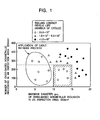
- Fig. 1 is a graph showing the relationship of the maximum diameter of the oxide-based nonmetallic inclusion with the number of oxide-based nonmetallic inclusions having an equivalent circle diameter of 3 ⁇ m or more and the relationship with the rolling contact fatigue life when the inspection area is 320 mm 2 .
- JIS G4805 High carbon chromium bearing steel type 2 (SUJ2-equivalent steel) having the chemical composition, amount of AlN, sulfide-based nonmetallic inclusions, and oxides shown in Table 1 was melted by a converter, RH degassing was performed and, thereafter, continuous casting was performed and rolling into a bar steel 65 mm in diameter was performed. For purposes of comparison, super clean steel subjected to ladle refining after melting with the converter was also melted.
- a disk type test piece of 60 mm in diameter by 5mm for a rolling contact fatigue life test was prepared.
- a test piece having an inspection surface of 16 mm by 120 mm was taken from one quarter-diameter portion of the bar steel along the rolling direction, and the maximum diameter and the number of the oxide-based nonmetallic inclusions and the total number of the sulfide-based nonmetallic inclusions having a thickness of 1 ⁇ m or more were actually measured when the inspection area was 320 mm 2 .
- the rolling contact fatigue life test was performed using a Mori thrust rolling contact-fatigue tester under the condition of a Hertzian maximum contact stress: 5,260 MPa, a stress frequency: 30 Hz, and a lubricating oil: #68 turbine oil. The results of the tests were plotted onto probability paper on the assumption that the Weibull distribution was followed, and were evaluated as the B 10 life.
- Steel No. 7 is a comparative steel in which although the amount of AlN and sulfide-based inclusions are outside of the range of the present invention, oxides are controlled within the range of the present invention. It is clear that any remarkable effect of improving the rolling contact fatigue life is not recognized, and the effects of the present invention are achieved only after AlN and/or sulfide-based inclusions are controlled and, at the same time, the sizes and the numbers of oxides are controlled.
- Steel Nos. 8 and 9 are comparative steels in which the maximum diameter or the number of the oxide-based inclusions exceeds the range specified in the present invention. It is clear that the rolling contact fatigue lives are reduced remarkably.
- Steel No. 10 is a comparative steel in which the maximum diameter of the oxide-based inclusion is specified to be 10 ⁇ m or less by application of a ladle refining process. The life is certainly extended. However, the manufacturing cost is high, and there are restrictions on the manufacturing process and manufacturing maker. This is not suitable as the steel for general purpose use.
- the rolling contact fatigue life of the bearing material according to the present invention can be further improved regarding the steel in which the steel composition, and AlN and/or sulfide-based nonmetallic inclusions are controlled, even when the predicted maximum diameter of the oxide-based nonmetallic inclusion exceeds 10 ⁇ m, as long as it is 15 ⁇ m or less, and the number thereof is controlled at a predetermined number or less. Consequently, according to the present invention, the ladle refining, etc., which have been conventionally used for reducing the maximum diameter of the oxide-based nonmetallic inclusion, are not required. Since the manufacturing cost is controlled at a low level, and there is no restriction on the manufacturing process and manufacturing maker, the steel suitable for the long-life steel for general purpose use can be provided.
Landscapes
- Chemical & Material Sciences (AREA)
- Engineering & Computer Science (AREA)
- Mechanical Engineering (AREA)
- Materials Engineering (AREA)
- Metallurgy (AREA)
- Organic Chemistry (AREA)
- General Engineering & Computer Science (AREA)
- Physics & Mathematics (AREA)
- Thermal Sciences (AREA)
- Crystallography & Structural Chemistry (AREA)
- Rolling Contact Bearings (AREA)
Abstract
Description
C: 0.95 to 1.10 mass%
Si: 0.15 to 0.70 mass%
Mn: 1.15 mass% or less
Cr: 0.90 to 1.60 mass%
P: 0.025 mass% or less
S: 0.025 mass%
O: 0.0012 mass% or less
Mo: 0.10 to 0.25 mass%
Sb: 0.0010 mass% or less
Amount of AlN: 0.020 mass% or less

Claims (7)
- A bearing material having a component composition in which C: 0.95 to 1.10 mass%, Si: 0.15 to 0.70 mass%, Mn: 1.15 mass% or less, Cr: 0.90 to 1.60 mass%, and P: 0.025 mass% or less are contained, S and O, that are elements forming nonmetallic inclusions, are contained at S: 0.025 mass% or less and O: 0.0012 mass% or less, and the rest comprises Fe and incidental impurities, wherein in the material, AlN is contained at 0.020 mass% or less, and furthermore, the maximum diameter of the oxide-based nonmetallic inclusion is more than 10 µm, but 15 µm or less in an inspection area: 320 mm2, while the number of oxide-based nonmetallic inclusions having an equivalent circle diameter of 3 µm or more is 250 or less in the inspection area: 320 mm2.
- A bearing material, wherein 0.10 to 0.25 mass% of Mo is further contained in the material according to Claim 1 in addition to the aforementioned chemical components of this material.
- A bearing material, wherein 0.0010 mass% or less of Sb is further contained in the material according to Claim 1 or Claim 2 in addition to the aforementioned chemical components of these materials.
- The bearing material according to any one of Claims 1 to 3, wherein the number of sulfide-based nonmetallic inclusions having a thickness of 1 µm or more is 1,200 or less in the inspection area: 320 mm2.
- A bearing material having a component composition in which C: 0.95 to 1.10 mass%, Si: 0.15 to 0.70 mass%, Mn: 1.15 mass% or less, Cr: 0.90 to 1.60 mass%, and P: 0.025 mass% or less are contained, S and O, that are elements forming nonmetallic inclusions, are contained at S: 0.025 mass% or less and O: 0.0012 mass% or less, and the rest coinprises Fe and incidental impurities, wherein in this material, the number of sulfide-based nonmetallic inclusions having a thickness of 1 µm or more is 1,200. or less in an inspection area: 320 mm2, and furthermore, the maximum diameter of the oxide-based nonmetallic inclusion is more than 10 µm, but 15 µm or less in the inspection area: 320 mm2 , while the number of oxide-based nonmetallic inclusions having an equivalent circle diameter of 3 µm or more is 250 or less in the inspection area: 320 mm2.
- A bearing material, wherein 0.10 to 0.25 mass% of Mo is further contained in the material according to Claim 5 in addition to the aforementioned chemical components of this material.
- A.bearing material, wherein 0.0010 mass% or less of Sb is further contained in the material according to Claim 5 or Claim 6 in addition to the aforementioned chemical components of these materials.
Applications Claiming Priority (3)
| Application Number | Priority Date | Filing Date | Title |
|---|---|---|---|
| JP2001018884 | 2001-01-26 | ||
| JP2001018884A JP3889931B2 (en) | 2001-01-26 | 2001-01-26 | Bearing material |
| PCT/JP2002/000493 WO2002059390A1 (en) | 2001-01-26 | 2002-01-24 | Bearing material |
Publications (2)
| Publication Number | Publication Date |
|---|---|
| EP1354971A1 true EP1354971A1 (en) | 2003-10-22 |
| EP1354971A4 EP1354971A4 (en) | 2006-01-04 |
Family
ID=18884844
Family Applications (1)
| Application Number | Title | Priority Date | Filing Date |
|---|---|---|---|
| EP02716355A Ceased EP1354971A4 (en) | 2001-01-26 | 2002-01-24 | Bearing material |
Country Status (7)
| Country | Link |
|---|---|
| US (1) | US6893609B2 (en) |
| EP (1) | EP1354971A4 (en) |
| JP (1) | JP3889931B2 (en) |
| KR (2) | KR20080035021A (en) |
| CN (1) | CN1201026C (en) |
| CA (1) | CA2404363C (en) |
| WO (1) | WO2002059390A1 (en) |
Cited By (2)
| Publication number | Priority date | Publication date | Assignee | Title |
|---|---|---|---|---|
| WO2010134867A1 (en) * | 2009-05-20 | 2010-11-25 | Aktiebolaget Skf | Bearing component |
| WO2012002869A1 (en) * | 2010-07-02 | 2012-01-05 | Aktiebolaget Skf | Flash-butt welded bearing component |
Families Citing this family (15)
| Publication number | Priority date | Publication date | Assignee | Title |
|---|---|---|---|---|
| CN100339606C (en) | 2002-05-14 | 2007-09-26 | 株式会社捷太格特 | Method for manufacturing a bearing raceway member |
| CN101397628B (en) * | 2007-09-25 | 2011-04-13 | 宝山钢铁股份有限公司 | Continuous casting bearing steel round steel and method for producing the same |
| JP5400589B2 (en) * | 2009-11-30 | 2014-01-29 | 株式会社神戸製鋼所 | Steel material with excellent rolling fatigue life |
| JP5400590B2 (en) * | 2009-11-30 | 2014-01-29 | 株式会社神戸製鋼所 | Steel material with excellent rolling fatigue life |
| JP5400591B2 (en) * | 2009-11-30 | 2014-01-29 | 株式会社神戸製鋼所 | Bearing steel with excellent cold workability |
| JP5406687B2 (en) * | 2009-11-30 | 2014-02-05 | 株式会社神戸製鋼所 | Steel material with excellent rolling fatigue life |
| JP5605912B2 (en) | 2011-03-31 | 2014-10-15 | 株式会社神戸製鋼所 | Bearing steel and bearing parts with excellent rolling fatigue characteristics |
| EP2716781B1 (en) | 2011-05-25 | 2018-06-20 | Kabushiki Kaisha Kobe Seiko Sho | Bearing steel with excellent rolling fatigue characteristics |
| TWI448565B (en) * | 2011-05-30 | 2014-08-11 | Kobe Steel Ltd | Steel with improved rolling fatigue characteristics |
| JP2013047557A (en) * | 2011-08-29 | 2013-03-07 | Nsk Ltd | Thrust bearing |
| JP5820326B2 (en) | 2012-03-30 | 2015-11-24 | 株式会社神戸製鋼所 | Steel for bearings with excellent rolling fatigue characteristics and method for producing the same |
| KR101826458B1 (en) | 2014-01-10 | 2018-02-06 | 신닛테츠스미킨 카부시키카이샤 | Bearing component |
| CN111763889A (en) * | 2020-06-02 | 2020-10-13 | 钢铁研究总院 | A kind of high carbon bearing steel and preparation method thereof |
| CN112111696A (en) * | 2020-09-29 | 2020-12-22 | 钢铁研究总院 | High carbon bearing steel with high tropism and long contact fatigue life and manufacturing method |
| JP7860689B2 (en) * | 2020-12-28 | 2026-05-18 | 山陽特殊製鋼株式会社 | Bearing steel with excellent rolling fatigue life in a hydrogen environment, bearings and bearing components formed from this bearing steel. |
Family Cites Families (5)
| Publication number | Priority date | Publication date | Assignee | Title |
|---|---|---|---|---|
| JP2657420B2 (en) * | 1989-07-21 | 1997-09-24 | 日本精工株式会社 | Rolling bearing |
| JP3725179B2 (en) * | 1991-07-18 | 2005-12-07 | 日本精工株式会社 | Manufacturing method of rolling bearing |
| JP3254317B2 (en) * | 1993-10-08 | 2002-02-04 | 日本精工株式会社 | Method for producing ultra-clean bearing steel and ultra-clean bearing steel |
| JP3338761B2 (en) * | 1996-02-29 | 2002-10-28 | 川崎製鉄株式会社 | Bearing material |
| JP3779078B2 (en) * | 1998-11-10 | 2006-05-24 | Jfeスチール株式会社 | Bearing steel with excellent rolling fatigue life |
-
2001
- 2001-01-26 JP JP2001018884A patent/JP3889931B2/en not_active Expired - Fee Related
-
2002
- 2002-01-24 KR KR1020087007287A patent/KR20080035021A/en not_active Ceased
- 2002-01-24 KR KR1020027012629A patent/KR20020083529A/en not_active Ceased
- 2002-01-24 CA CA002404363A patent/CA2404363C/en not_active Expired - Lifetime
- 2002-01-24 CN CN02800813.8A patent/CN1201026C/en not_active Expired - Fee Related
- 2002-01-24 WO PCT/JP2002/000493 patent/WO2002059390A1/en not_active Ceased
- 2002-01-24 US US10/240,297 patent/US6893609B2/en not_active Expired - Lifetime
- 2002-01-24 EP EP02716355A patent/EP1354971A4/en not_active Ceased
Cited By (4)
| Publication number | Priority date | Publication date | Assignee | Title |
|---|---|---|---|---|
| WO2010134867A1 (en) * | 2009-05-20 | 2010-11-25 | Aktiebolaget Skf | Bearing component |
| WO2012002869A1 (en) * | 2010-07-02 | 2012-01-05 | Aktiebolaget Skf | Flash-butt welded bearing component |
| US9080608B2 (en) | 2010-07-02 | 2015-07-14 | Aktiebolaget Skf | Flash-butt welded bearing component |
| RU2566130C2 (en) * | 2010-07-02 | 2015-10-20 | Актиеболагет Скф | Bearing part made by butt fusion welding |
Also Published As
| Publication number | Publication date |
|---|---|
| CA2404363C (en) | 2009-12-01 |
| WO2002059390A1 (en) | 2002-08-01 |
| JP2002220638A (en) | 2002-08-09 |
| KR20080035021A (en) | 2008-04-22 |
| EP1354971A4 (en) | 2006-01-04 |
| CN1201026C (en) | 2005-05-11 |
| US20030136474A1 (en) | 2003-07-24 |
| JP3889931B2 (en) | 2007-03-07 |
| CN1460127A (en) | 2003-12-03 |
| US6893609B2 (en) | 2005-05-17 |
| CA2404363A1 (en) | 2002-09-24 |
| KR20020083529A (en) | 2002-11-02 |
Similar Documents
| Publication | Publication Date | Title |
|---|---|---|
| US6893609B2 (en) | Bearing material | |
| US4802918A (en) | Case hardened steel and method of manufacturing the same | |
| CN106086678B (en) | High life bearing steel material and its processing method | |
| KR20100105796A (en) | Steel for high-frequency hardening | |
| EP1930459A1 (en) | High-toughness wear-resistant steel exhibiting little hardness change in service and process for production thereof | |
| EP2843074A1 (en) | Rail | |
| WO2004092434A1 (en) | Steel material with excellent rolling fatigue life and method of producing the same | |
| JPH08296002A (en) | Bearing steel, bearing member having excellent heat resistance and toughness, and manufacturing method thereof | |
| JP3779078B2 (en) | Bearing steel with excellent rolling fatigue life | |
| EP0825270B2 (en) | Bearing material | |
| JPH05117804A (en) | Bearing steel having excellent workability and rolling fatigue property | |
| KR20060126375A (en) | Forging steel and crankshaft with excellent hydrogen crack resistance | |
| JP5783056B2 (en) | Carburized bearing steel | |
| US20100092330A1 (en) | Eco-friendly pb-free free cutting steel with excellent machinability and hot workability | |
| JPH05163563A (en) | High-speed steel for end mill | |
| JP2001026836A (en) | Induction hardened steel and machine structural parts with excellent cold workability, rolling fatigue strength and torsional fatigue strength | |
| AU2019242777A1 (en) | Rail | |
| JPH01129952A (en) | Steel for long-life rolling parts with good chip disposal properties | |
| EP1496132A1 (en) | Steel for case hardening bearing excellent in toughness and rolling fatigue life in quasi-high temperature region | |
| JPH07286234A (en) | Bearing members with excellent delay characteristics for microstructural changes due to repeated stress loading | |
| JPH0633190A (en) | Long-life bearing steel | |
| JPH05117806A (en) | High strength and high toughness case hardening steel for ball cages | |
| WO2018105088A1 (en) | Cold rolled steel sheet for separator plate | |
| KR101536405B1 (en) | Steel for high carbon chromium bearing having excellent fatigue resistance properties and method for manufacturing the same | |
| JP2002285285A (en) | Work roll for cold rolling with excellent wear and seizure resistance |
Legal Events
| Date | Code | Title | Description |
|---|---|---|---|
| PUAI | Public reference made under article 153(3) epc to a published international application that has entered the european phase |
Free format text: ORIGINAL CODE: 0009012 |
|
| 17P | Request for examination filed |
Effective date: 20021025 |
|
| AK | Designated contracting states |
Kind code of ref document: A1 Designated state(s): AT BE CH CY DE DK ES FI FR GB GR IE IT LI LU MC NL PT SE TR |
|
| AX | Request for extension of the european patent |
Extension state: AL LT LV MK RO SI |
|
| RAP1 | Party data changed (applicant data changed or rights of an application transferred) |
Owner name: KOYO SEIKO CO., LTD. Owner name: JFE STEEL CORPORATION |
|
| A4 | Supplementary search report drawn up and despatched |
Effective date: 20051118 |
|
| RIC1 | Information provided on ipc code assigned before grant |
Ipc: C22C 38/18 20000101ALI20051114BHEP Ipc: C21D 9/40 19680901ALI20051114BHEP Ipc: C22C 38/00 19740701AFI20020805BHEP |
|
| RAP1 | Party data changed (applicant data changed or rights of an application transferred) |
Owner name: JTEKT CORPORATION Owner name: JFE STEEL CORPORATION |
|
| 17Q | First examination report despatched |
Effective date: 20070208 |
|
| APBN | Date of receipt of notice of appeal recorded |
Free format text: ORIGINAL CODE: EPIDOSNNOA2E |
|
| APBR | Date of receipt of statement of grounds of appeal recorded |
Free format text: ORIGINAL CODE: EPIDOSNNOA3E |
|
| APAF | Appeal reference modified |
Free format text: ORIGINAL CODE: EPIDOSCREFNE |
|
| APAF | Appeal reference modified |
Free format text: ORIGINAL CODE: EPIDOSCREFNE |
|
| APBT | Appeal procedure closed |
Free format text: ORIGINAL CODE: EPIDOSNNOA9E |
|
| STAA | Information on the status of an ep patent application or granted ep patent |
Free format text: STATUS: THE APPLICATION HAS BEEN REFUSED |
|
| 18R | Application refused |
Effective date: 20100204 |