EP1351161A1 - TERMINAL APPARATUS, SERVER, CONTENT DATA STORAGE METHOD, AND PROGRAM FOR EXECUTING THE METHOD - Google Patents
TERMINAL APPARATUS, SERVER, CONTENT DATA STORAGE METHOD, AND PROGRAM FOR EXECUTING THE METHOD Download PDFInfo
- Publication number
- EP1351161A1 EP1351161A1 EP02730766A EP02730766A EP1351161A1 EP 1351161 A1 EP1351161 A1 EP 1351161A1 EP 02730766 A EP02730766 A EP 02730766A EP 02730766 A EP02730766 A EP 02730766A EP 1351161 A1 EP1351161 A1 EP 1351161A1
- Authority
- EP
- European Patent Office
- Prior art keywords
- contents
- hierarchical information
- retrieval
- data
- key
- Prior art date
- Legal status (The legal status is an assumption and is not a legal conclusion. Google has not performed a legal analysis and makes no representation as to the accuracy of the status listed.)
- Withdrawn
Links
Images





Classifications
-
- G—PHYSICS
- G06—COMPUTING OR CALCULATING; COUNTING
- G06Q—INFORMATION AND COMMUNICATION TECHNOLOGY [ICT] SPECIALLY ADAPTED FOR ADMINISTRATIVE, COMMERCIAL, FINANCIAL, MANAGERIAL OR SUPERVISORY PURPOSES; SYSTEMS OR METHODS SPECIALLY ADAPTED FOR ADMINISTRATIVE, COMMERCIAL, FINANCIAL, MANAGERIAL OR SUPERVISORY PURPOSES, NOT OTHERWISE PROVIDED FOR
- G06Q50/00—Information and communication technology [ICT] specially adapted for implementation of business processes of specific business sectors, e.g. utilities or tourism
- G06Q50/10—Services
-
- H—ELECTRICITY
- H05—ELECTRIC TECHNIQUES NOT OTHERWISE PROVIDED FOR
- H05B—ELECTRIC HEATING; ELECTRIC LIGHT SOURCES NOT OTHERWISE PROVIDED FOR; CIRCUIT ARRANGEMENTS FOR ELECTRIC LIGHT SOURCES, IN GENERAL
- H05B6/00—Heating by electric, magnetic or electromagnetic fields
- H05B6/64—Heating using microwaves
- H05B6/66—Circuits
- H05B6/68—Circuits for monitoring or control
- H05B6/688—Circuits for monitoring or control for thawing
-
- G—PHYSICS
- G06—COMPUTING OR CALCULATING; COUNTING
- G06Q—INFORMATION AND COMMUNICATION TECHNOLOGY [ICT] SPECIALLY ADAPTED FOR ADMINISTRATIVE, COMMERCIAL, FINANCIAL, MANAGERIAL OR SUPERVISORY PURPOSES; SYSTEMS OR METHODS SPECIALLY ADAPTED FOR ADMINISTRATIVE, COMMERCIAL, FINANCIAL, MANAGERIAL OR SUPERVISORY PURPOSES, NOT OTHERWISE PROVIDED FOR
- G06Q30/00—Commerce
- G06Q30/02—Marketing; Price estimation or determination; Fundraising
Definitions
- the present invention relates to a technology of storing contents data in a recording medium such as a semiconductor memory card so as to facilitate retrieval of the data.
- these services include allowing each user to store the downloaded contents data (e.g., music data) in a recording medium such as a semiconductor memory card and enjoy the contents data with another application equipment.
- a recording medium such as a semiconductor memory card
- a method for distributing recipe data for preparing a meal with a cooking appliance such as a microwave oven from a server has been proposed as one of the services described above. According to this method, each user can download recipe data of any meal he/she likes and store the downloaded recipe data in a recording medium. By mounting the recording medium to the cooking appliance, each user can easily prepare any meal he/she likes by using the recipe data.
- the kinds of recipe data to be downloaded vary depending on the preferences of the users. Moreover, the users would add or delete recipe data frequently and irregularly. Therefore, a fixed mechanism should not be used to facilitate retrieval of recipe data.
- a mechanism for facilitating retrieval of recipe data must work flexibly for each user and dynamically for operation of each user.
- a terminal device has the functions of receiving contents data from a server via a communication network, storing the received contents data in a recording medium, and updating contents hierarchical information stored in the recording medium with reference to overall hierarchical information so that the newly stored contents data is included in the contents hierarchical information.
- the contents hierarchical information indicates classified levels of contents data based on retrieval keys.
- the overall hierarchical information indicates a hierarchical relation of the retrieval keys in the whole contents.
- the contents hierarchical information stored in the recording medium is updated with reference to the overall hierarchical information so that the newly stored contents data is included in the contents hierarchical information. This ensures that the contents hierarchical information stored in the recording medium always accurately indicates currently stored contents data. Accordingly, by conducting retrieve operation according to the classified levels of such accurate contents hierarchical information, the user can easily find desired contents data.
- the contents data is data for cooking
- the retrieval keys are ingredients used for cooking.
- the terminal device when the number of elements under any one of the retrieval keys exceeds an upper limit in the updated contents hierarchical information, the terminal device further updates the contents hierarchical information so that the number of elements under that retrieval key becomes equal to or less than the upper limit.
- the terminal device deletes a level above that level from the contents hierarchical information.
- the upper limit in the terminal device is determined based on a size of a display screen of the terminal device itself or another equipment which receives contents data via the recording medium.
- a server has the functions of receiving a request to transmit contents data from a terminal device via a communication network, receiving contents hierarchical information from the terminal device, updating the received contents hierarchical information with reference to overall hierarchical information so that the requested contents data is included in the contents hierarchical information, and transmitting the updated contents hierarchical information and the requested contents data to the terminal device.
- the contents hierarchical information indicates classified levels of contents data based on retrieval keys.
- the overall hierarchical information indicates a hierarchical relation of the retrieval keys in the whole contents.
- the server when the server receives a request to transmit contents data, the server updates the received contents hierarchical information with reference to the overall hierarchical information so that the requested contents data is included in the contents hierarchical information.
- the server then transmits the updated contents hierarchical information and the requested contents data to the terminal device. This ensures that the contents hierarchical information stored in the terminal device always accurately indicates the received contents data. Accordingly, by conducting retrieve operation according to the classified levels of such accurate contents hierarchical information, the user can easily find desired contents data.
- a server has the functions of receiving a request to transmit contents data from a terminal device via a communication network, receiving identifier information of contents data from the terminal device, generating contents hierarchical information with reference to overall hierarchical information so that the requested contents data and the contents data indicated by the identifier information are included in the contents hierarchical information, and transmitting the generated contents hierarchical information and the requested contents data to the terminal device.
- the contents hierarchical information indicates classified levels of contents data based on retrieval keys.
- the overall hierarchical information indicates a hierarchical relation of the retrieval keys in the whole contents.
- the server when the server receives a request to transmit contents data, the server generates contents hierarchical information with reference to the overall hierarchical information so that the requested contents data and the contents data indicated by the received identifier information are included in the contents hierarchical information.
- the server then transmits the generated contents hierarchical information and the requested contents data to the terminal device. This ensures that the contents hierarchical information stored in the terminal device always accurately indicates the received contents data. Accordingly, by conducting retrieve operation according to the classified levels of such accurate contents hierarchical information, the user can easily find desired contents data.
- the contents data is data for cooking
- the retrieval keys are ingredients used for cooking.
- the recording medium has contents hierarchical information which indicates classified levels of contents data recorded on the recording medium based on retrieval keys.
- contents hierarchical information is updated with reference to general hierarchical information which indicates a hierarchical relation of the retrieval keys in the whole contents.
- the contents hierarchical information stored in the recording medium is updated with reference to the overall hierarchical information. This ensures that the contents hierarchical information stored in the terminal device always accurately indicates currently stored contents data. Accordingly, by conducting retrieve operation according to the classified levels of such accurate contents hierarchical information, the user can easily find desired contents data.
- adding new contents data to the recording medium includes a first step of determining whether or not the contents hierarchical information has a retrieval key associated with the contents data, and if the contents hierarchical information has the retrieval key, allocating the contents data to the retrieval key, a second step of, if the contents hierarchical information does not have the retrieval key in the first step, retrieving the retrieval key from the overall hierarchical information and retrieving a root key of the retrieval key, and a third step of determining whether or not the contents hierarchical information has the root key, and if the contents hierarchical information has the root key, allocating the contents data to the root key.
- deleting contents data from the recording medium includes a first step of retrieving a retrieval key of the contents data from the contents hierarchical information and specifying a root key of the retrieval key, a second step of determining whether or not the number of remaining child keys of the root key is one, a third step of, if the number of remaining child keys is one in the second step, deleting the root key and attaching the remaining child key to a root key of the root key, and a fourth step of deleting the contents data and the retrieval key from the contents hierarchical information.
- the recording medium has contents hierarchical information which indicates classified levels of contents data recorded on the recording medium based on retrieval keys.
- the program causes the computer to conduct a first process of adding new contents data to the recording medium or deleting contents data from the recording medium, and a second process of updating, in the first process, the contents hierarchical information with reference to general hierarchical information which indicates a hierarchical relation of the retrieval keys in the whole contents.
- the contents data are data for cooking
- the retrieval keys are ingredients used for cooking.
- the program when new contents data is added to the recording medium in the first process, the program causes the computer to conduct a first step of determining whether or not the contents hierarchical information has a retrieval key associated with the contents data, and if the contents hierarchical information has the retrieval key, allocating the contents data to the retrieval key, a second step of, if the contents hierarchical information does not have the retrieval key in the first step, retrieving the retrieval key from the overall hierarchical information and retrieving a root key of the retrieval key, and a third step of determining whether or not the contents hierarchical information has the root key, and if the contents hierarchical information has the root key, allocating the contents data to the root key.
- the program causes the computer to conduct the step of determining whether or not the contents hierarchical information has any one of child keys of the root key, and if the contents hierarchical information has any one of child keys of the root key, inserting the root key above the child key, adding the retrieval key under the root key, and allocating the contents data to the retrieval key.
- the program causes the computer to conduct the step of allocating these contents data to a plurality of sub keys separately.
- the program when contents data is deleted from the recording medium in the first process, causes the computer to conduct a first step of retrieving a retrieval key associated with the contents data from the contents hierarchical information and specifying a root key of the retrieval key, a second step of determining whether or not the number of remaining child keys of the root key is one, a third step of, if the number of remaining child keys is one in the second step, deleting the root key and attaching the remaining child key to a root key of the root key, and a fourth step of deleting the contents data and the retrieval key from the contents hierarchical information.
- the program causes the computer to conduct a third process of further updating the contents hierarchical information so that the number of elements under that retrieval key becomes equal to or less than the upper limit.
- the third process includes the steps of removing the elements under the retrieval key from the retrieval key and dividing the removed elements into a plurality of groups, placing each of the plurality of element groups under a corresponding one of a plurality of new retrieval keys, and placing the plurality of new retrieval keys under the retrieval key.
- the third process includes the steps of removing the elements under the retrieval key from the retrieval key and dividing the removed elements into a plurality of groups, placing each of the plurality of element groups under a corresponding one of a plurality of new retrieval keys, and replacing the retrieval key with the plurality of new retrieval keys.
- the program causes the computer to conduct a process of deleting a level above that level from the contents hierarchical information.
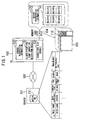
- FIG. 1 schematically shows the overall structure of an information transmission system according to the first embodiment of the present invention.
- the information communication system of FIG. 1 implements a method for storing contents data according to the present embodiment.
- 101 denotes a server for controlling services such as providing recipe data
- 102 denotes a communication network such as the Internet
- 103 denotes a personal computer (PC) serving as a terminal device
- 104 denotes a semiconductor memory card like an SD card as a recording medium
- 105 denotes a microwave oven as a cooking appliance.
- the server 101 includes a recipe DB (database) 111 storing a plurality of recipe data to be supplied to the users.
- Each recipe data has various files such as a cooking data file regarding temperature setting and output of a cooking appliance during cooking, a document file for displaying cooking procedures, required ingredients, quantities and the like on a screen, and an image file including a finished image of a meal prepared according to the recipe and an image for giving advice about cooking.
- the microwave oven 105 is structured so that the semiconductor memory card 104 can be mounted thereto.
- the microwave oven 105 has a liquid crystal screen 110 for displaying cooking procedures and the like.
- the semiconductor memory card 104 serves to supply recipe data received by the personal computer 103 to the microwave oven 105 .
- the personal computer 103 includes a directory R/W module 131 , a classification/configuration algorithm module 132 , and overall hierarchical information 133 indicating the hierarchical relation of retrieval keys in the entire recipes.
- the semiconductor memory card 104 includes a recipe storing section 141 for storing downloaded recipe data, and recipe hierarchical information 142 serving as contents hierarchical information indicating classified levels of recipe data based on the retrieval keys.
- the directory R/W module 131 of the personal computer 103 stores recipe data received from the server 101 via the communication network 102 in the memory card 104 .
- the classification/configuration algorithm module 132 reads recipe hierarchical information 142 from the memory card 104 , and updates the recipe hierarchical information 142 with reference to the overall hierarchical information 133 so that recipe data to be added is included in the recipe hierarchical information 142 .
- the classification/configuration algorithm module 132 then stores the updated recipe hierarchical information 142 in the memory card 104 .
- This classification/configuration algorithm module 132 corresponds to a program for causing the computer to conduct the method for storing contents data according to the present invention.
- FIG. 2 shows an example of the overall hierarchical information 133 according to the present embodiment.
- “ingredients” is used as a retrieval key of each recipe. More specifically, “ingredients” is placed at the highest level, i.e., a first level, and “beans”, “root vegetables”, “leaf vegetables”, “meat” and “fish and shellfish” are placed at a second level. Moreover, “potato”, “carrot”, “Japanese radish” and “burdock” are placed at a third level under “root vegetables”, and “chicken”, “pork” and “beef' are placed at the third level under “meat”. Moreover, “loin”, “ham” and “spareribs” are placed at a fourth level under "pork”.
- retrieving recipe data by "ingredients” simplifies the operation of inputting characters by the user. Moreover, there are only a limited number of ingredients. Therefore, the system structure of the cooking appliance is also simplified. In addition, retrieving recipe data by "ingredients” may greatly help the user think of a meal from leftovers in the refrigerator, bargain foods at a supermarket and the like.
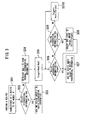
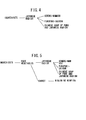
- FIG. 3 is a flowchart of a process of adding recipe data. It is herein assumed that only three recipes for Japanese radish, i.e., "strips of various vegetables marinated in vinegar (a Japanese food called “Gomoku-namasu”)", “slices of boiled Japanese radish with sweet miso (fermented soybean paste) (a Japanese food called “Furofuki-daikon”)” and “Chinese soup of pork and Japanese radish", are stored in the memory card 104 . In this case, the memory card 104 has recipe hierarchical information 142 as shown in FIG. 4 .
- step S04 P is retrieved from the overall hierarchical information 133 in the personal computer 103 .
- a category name Root(Mat) at the level above an ingredient Mat defined by Mat P, that is, an ingredient as a root key of P, is defined as Target (S05) .
- Target S05
- Root(Mat) at the level above an ingredient Mat defined by Mat P, that is, an ingredient as a root key of P, is defined as Target (S05) .
- Root vegetables at the level above “carrot” is herein defined as Target.
- step S06 It is then determined whether the recipe hierarchical information 142 has Target or not (S06) . If the recipe hierarchical information 142 has Target, new recipe data is added under Target in the recipe hierarchical information 142 (S07) . In this example, the recipe hierarchical information 142 does not have Target (root vegetables) (NO in S06 ), the routine proceeds to step S08 .
- step S08 it is determined whether or not the recipe hierarchical information 142 has any of the child keys of Target, i.e., Child(Target). If the recipe hierarchical information 142 does not have any of the child keys Child(Target) (No in S08 ), a root key of Target, i.e., Root(Target), is defined as a new Target (S10) , and the routine returns to step S06 .
- step S08 it is determined whether the recipe hierarchical information 142 in the memory card 104 has these ingredients or not. It can be seen from FIG. 4 that the recipe hierarchical information 142 has "Japanese radish”.
- the level of Target i.e., the level of "root vegetables”
- “Japanese radish” i.e., the child key included in the recipe hierarchical information 142 (S09)
- new recipe data for "Ninjin no Kinpira” is then added under "root vegetables” (S07) .
- the recipe hierarchical information is updated as shown in FIG. 5 .
- step S06 the determination result of step S06 is "Yes", and "carrot” and “Ninjin no Kinpira” are added under "root vegetables”.
- the recipe hierarchical information is thus updated as shown in FIG. 6(b).
- FIG. 7 is a flowchart of a process of deleting recipe data.
- the process of deleting recipe data may either be spontaneously conducted by the user or automatically conducted based on the remaining capacity of the memory card 104 , the date of each recipe data, and the like.
- a recipe Z written on the least recent date is selected from the recipe data stored in the memory card 104 , and a message to delete the recipe Z is presented to the user. If the user accepts deletion of the recipe Z , a process of deleting the recipe Z is conducted. If the date the user viewed a recipe is stored in the memory card, the recipe which was viewed on the least recent date may be selected as a recipe to be deleted. If the number of times the user has viewed a recipe is stored in the memory card, the recipe which has been viewed the smallest number of times may be selected as a recipe to be deleted.
- step S22 P is retrieved from the recipe hierarchical information 142 .
- a category name Rbot(Mat) at the level above an ingredient Mat defined by Mat P, that is, an ingredient as a root key of P, is defined as Target (S23) .
- Target S23
- “root vegetables” at the level above “carrot” is herein defined as Target.
- these recipe data may be allocated to a plurality of sub keys. For example, it is now assumed that the microwave oven 105 can display only eight meals on the liquid crystal screen 110 at a time. In this case, if the number of recipe data per retrieval key exceeds eight, these recipe data are allocated to a plurality of sub keys. This prevents the recipes of a single category from being displayed over a plurality of pages. As a result, the user can view the recipe more easily.
- the sub keys include a kind of food (Japanese food, Western food, and Chinese food; boil, broil/roast/grill, and fry; and the like), easiness of the recipes (cooking time and the like), nutriment, calories, the amount of salt, costs, season, and the like. Adding such sub keys to each recipe data in advance facilitates the processing.
- the number of recipe data for each ingredient may be displayed on the screen.
- “Japanese radish (3)” is displayed on the screen. This allows the user to know the number of recipes without changing the page of the display.
- Each recipe normally includes a plurality of ingredients. Therefore, a plurality of ingredients may be used as a retrieval key. For example, for "boiled potatoes and meat (a Japanese food called "Niku-jaga”)", “beef' and “potato” may be used as a retrieval key, and recipe data for "Niku-jaga” may be attached to each of "beef' and “potato”.
- recipe data having a plurality of ingredients as a retrieval data is retrieved using a certain ingredient, it is preferable to allow the user to return not only to the certain ingredient but also to the levels of the remaining ingredients. For example, if "Niku-jaga” is retrieved using "beef', the user is preferably allowed to return to either "beef' or "potato”.
- the recipe hierarchical information is updated with reference to the overall hierarchical information upon adding new recipe data or deleting recipe data. This ensures that the recipe hierarchical information stored in a recording medium always accurately indicates currently stored recipe data. Accordingly, by conducting retrieve operation according to the classified levels of such accurate recipe hierarchical information, the user can easily find desired recipe data.
- the microwave oven 105 is herein used as a cooking appliance.
- the present invention is not limited to this.
- a rice cooker, an IH cooking heater, a refrigerator, a toaster oven or the like may be used as a cooking appliance.
- the overall hierarchical information 133 may be stored in the semiconductor memory card 104 instead of the personal computer 103 .
- data exchange between a terminal device and a cooking appliance is conducted using a semiconductor memory card like a SD card as a recording medium.
- a semiconductor memory card like a SD card
- another recording medium such as a floppy disk or DVD-RAM may alternatively be used.
- Data exchange between a terminal device and a cooking appliance may be conducted using a physical communication network (wired or wireless) instead of the recording medium. It is expected that a home LAN will be increasingly widespread and cooking appliances will be connected to the home LAN as information appliances. If a cooking appliance itself has a communication function, this cooking appliance can be used as a terminal device. In this case, the cooking appliance can exchange data directly with a server. In this case, an internal memory, a hard disk or the like of the cooking appliance and the terminal device corresponds to a recording medium in the present invention.
- the personal computer 103 serving as a terminal device updates the recipe hierarchical information. If a terminal device such as a telephone and a facsimile machine does not have such a data processing function as described above, the server may update the recipe hierarchical information.
- FIG. 8 schematically shows another structure of the information transmission system according to an embodiment of the present invention.
- a terminal device 201 such as a telephone and a facsimile machine receives recipe data from a server 101A .
- the server 101A includes a classification/configuration algorithm module 112 in addition TO the recipe DB 111 .
- a semiconductor memory card 104A includes overall hierarchical information 143 in addition to the recipe storing section 141 for storing downloaded recipe data and the recipe hierarchical information 142 .
- the terminal device 201 transmits to the server 101A the recipe hierarchical information 142 and the overall hierarchical information 143 which are stored in the memory card 104A , together with a request to transmit recipe data.
- the server 101A receives the request to transmit recipe data from the terminal device 201 via the communication network 102 .
- the server 101A receives the recipe hierarchical information 142 and the overall hierarchical information 143 transmitted from the terminal device 201 .
- the classification/configuration algorithm module 112 in the server 101A updates the received recipe hierarchical information 142 with reference to the overall hierarchical information 143 so that the requested recipe data is included in the recipe hierarchical information 142 .
- the server 101A then transmits the updated recipe hierarchical information 142 and the requested recipe data to the terminal device 201 .
- the directory R/W module 211 of the terminal device 201 stores the recipe data received from the server 101A via the communication network 102 in the memory card 104A .
- the server itself is provided with a function to update the recipe hierarchical information. This enables appropriate recipe hierarchical information to be retained in the recording medium all the time. It should be understood that the server may update the recipe hierarchical information even if the terminal device has a data processing function.
- the overall hierarchical information 143 is stored in the memory 104A ;
- the overall hierarchical information 143 may alternatively be stored in the server 101A . This eliminates the need to transmit the overall hierarchical information 143 from the terminal device 201 , and thus enables reduction in communication costs.
- the recipe hierarchical information 142 may alternatively be updated by transmitting identifier information (e.g., data ID) indicating each recipe data recorded on the memory card 104A to the server 101 , instead of transmitting the recipe hierarchical information 142 to the server 101A .
- the server 101A receives a request to transmit recipe data and identifier information indicating recipe data stored in the semiconductor memory card 104A from the terminal device 201 .
- the server 101A then produces recipe hierarchical information which includes the requested recipe data and the recipe data indicated by the received identifier information.
- the server 101A transmits the requested recipe data and the produced recipe hierarchical information to the terminal device 201 .
- the terminal device 201 replaces the recipe hierarchical information 142 stored in the memory card with the received recipe hierarchical information.
- the recipe hierarchical information is thus updated.
- the classified levels of the recipes stored in the memory card of the user can be managed all the time. In this case, even if the user loses the memory card, the data in the memory card can be restored based on the past record of editing (adding and deleting) a recipe in the memory card.
- a personal computer or a large-screen display device having a sufficient resolution has an interface equipment such as a mouse, a large amount of information can be confirmed at a time.
- cooking appliances such as a microwave oven and a rice cooker are originally intended for cooking. Therefore, the display portion of many cooking appliances is not large enough to display a large amount of information.
- cooking data stored in a recording medium such as a memory card is automatically classified and stored in order to facilitate viewing and retrieval of the data.
- FIG. 9 shows eight categories (retrieval keys) such as “leaf vegetables”, “fruit vegetables, flower vegetables”, “root vegetables, mushrooms” and “meat” as classified information of ingredients, and also shows specific ingredients under each retrieval key.
- “leaf vegetables” includes the following four ingredients: “cabbage”; “Chinese cabbage”; “spinach, Brassica campestris”; and “asparagus”. Recipe data is classified by using such overall hierarchical information of the ingredients.
- FIG. 10 is a flowchart of an algorithm for updating recipe hierarchical information in order to add recipe data.
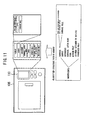
- the liquid crystal screen 110 of the microwave oven 105 is sized so that it can display only eight data at a time. Therefore, in the recipe hierarchical information 142 , the number of elements per category must be equal to or less than eight. More specifically, if the number of elements under any one of the retrieval keys exceeds the upper limit (i.e., eight), the recipe hierarchical information 142 is farther updated so that the number of elements under that retrieval key becomes equal to or less than eight.
- step S31 "cabbage” and “pork” are first selected as main ingredients of "pork and vegetables stir-fried in a Chinese style" (S31) .
- the recipe hierarchical information 142 does not have the selected ingredients, i.e., "cabbage” and "pork” (No in S32 ).
- the broutine then proceeds to step S36 .
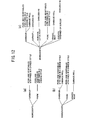
- step S36 as shown in FIG. 12(a) , the selected ingredients i.e., "cabbage” and “pork”, are added under “ingredients", and "pork and vegetables stir-fried in a Chinese style” is added under each of "cabbage” and "pork". Since the number of elements under the category including the added elements "cabbage” and "pork” does not exceed eight (No in S37 ), execution of the algorithm is terminated.
- “cabbage” and “minced meat” are selected as main ingredients of “cabbage roll” (S31) .
- “minced meat” is a new ingredient that is not included in the recipe hierarchical information 142 . Therefore, “minced meat” is added under “ingredients”, and “cabbage roll” is added under “minced meat” as in the case where "pork and vegetables stir-fried in a Chinese style” is added ( S36 to S38 ).
- “cabbage” is already included in the recipe hierarchical information 142 (Yes in S32 ). Therefore, the routine proceeds to step S33 , and "cabbage roll” is added under “cabbage” (S34) . Since the number of recipe data under "cabbage” does not exceed eight (No in S34 ), execution of the algorithm is terminated. As a result, the recipe hierarchical information 142 is updated as shown in FIG. 12(b) .
- “Chinese cabbage” is selected as a main ingredient of "Chinese cabbage kimchi” (S31) .
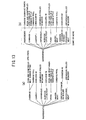
- the selected ingredient, “Chinese cabbage” is a new ingredient which is not included in the recipe hierarchical information 142 (No in S32 ). Therefore, the routine proceeds to step S36 , and "Chinese cabbage” is added under "ingredients” as shown in FIG. 13(b) . As a result, the number of elements under “ingredients” reaches nine. Since the number of elements under “ingredients" exceeds the upper limit (i.e., eight) (Yes in S37 ), the routine proceeds to step S38 .
- step S38 the nine elements under “ingredients” are removed from “ingredients”, and divided into the following groups with reference to the overall hierarchical information 133 of FIG. 9 : the group of "Chinese cabbage” and “cabbage”; the group of “carrot” and “asparagus”; the group of “burdock, lotus root”; and the group of "pork”, “minced meat”, “chicken (steamed or boiled)” and “processed meat”.
- Each of the element groups is placed under a corresponding one of the following new retrieval keys: “leaf vegetables”; “fruit vegetables, flower vegetables”; “root vegetables, mushrooms”; and “meat”. Moreover, these new retrieval keys are placed under "ingredients”.
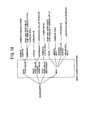
- the recipe hierarchical information 142 having a single level added thereto is obtained as shown in FIG. 14 .
- the number of elements under each retrieval key does not exceed the upper limit (i.e., eight). Therefore, these elements can be appropriately displayed on the liquid crystal screen 110 of the microwave oven 105 .
- the recipe hierarchical information 142 is updated with reference to the overall hierarchical information 133 of FIG. 9 indicating the hierarchical relation of the ingredients.
- the recipe hierarchical information 142 may alternatively be updated without referencing to the overall hierarchical information 133 .
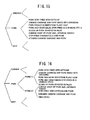
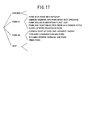
- the recipe hierarchical information 142 has eight recipe data under "pork”, and "fried pork” is added as recipe data regarding "pork”. This process will now be described with reference to the flowchart of FIG. 10 .
- "pork” is selected as a main ingredient of "fried pork” (S31) . Since the recipe hierarchical information 142 of FIG. 15 has “pork” (Yes in S32 ), the routine proceeds to step S33 , and "fried pork” is added under “pork” in the recipe hierarchical information 142 of FIG. 15 .
- the routine proceeds to step S35 .
- the recipe data under "pork” are removed from “pork” and divided into two groups. These two groups are respectively placed under' the following new retrieval keys: "pork (1)”; and “pork (2)".
- "pork (1)” and “pork (2)” are placed under "pork”.
- the recipe hierarchical information 142 of FIG. 15 is updated as shown in FIG. 16 so that the number of elements per category does not exceed eight. This allows all recipe data under each retrieval key to be displayed on the screen at a time.
- the recipe data are arbitrarily classified.
- the recipe data may alternatively be classified according to a predetermined rule.
- the recipe data may be classified according to the number of times the recipe data is viewed.
- the recipe data may be classified into the following two groups: the recipe data which have been viewed many times; and the recipe data which have been viewed only a few times.
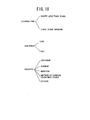
- category information regarding other points such as cooking time, calories, and countries of the recipes may be stored as shown in FIG. 18 .
- new retrieval keys may be introduced based on such category information.
- the recipe data are classified based on cooking time, and "short cooking time” and "long cooking time” are introduced as new retrieval keys. Note that only the categories of a single level are shown in FIG. 18 . However, the same algorithm can be applied even if the classified information of two or more levels is stored as in the case of FIG. 19 .
- the recipe data may be divided into the following two groups: the group including seven recipe data and the operation name "next page”; and the group including two recipe data and the operation name "previous page”.
- the display on the screen can be quickly shifted from the first page displaying seven recipes to the second page displaying the remaining two recipes.
- the display can be easily returned from the second page to the first page.
- the display cannot be shifted between the page of "pork (1)” and the page of "pork (2)” without interposing the page of the level right above the level of "pork (1)” and “pork (2)".
- inserting the operation names such as "next page” and "previous page” facilitates shifting between pages regarding the recipe data of the same category.
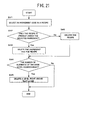
- step S41 “carrot”, “burdock, lotus root” and “chicken (steamed or boiled)” are selected as main ingredients of “Chikuzen-ni” (S41) . Only the recipe data “Chikuzen-ni” is present under each of the selected main ingredients, i.e., “carrot”, “burdock, lotus root” and “chicken (steamed or boiled) (Yes in S42 ). Therefore, the routine proceeds to step S43. In step S43 , “Chikuzen-ni” is deleted together with “carrot”, “burdock, lotus root” and “chicken (steamed or boiled)".
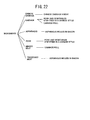
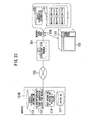
- the routine proceeds to step S45 , and the categories at the level right above this level are deleted. More specifically, “leaf vegetables”, “fruit vegetables, flower vegetables”, “root vegetables, mushrooms” and “meat” are deleted. As a result, the recipe hierarchical information 142 is updated as shown in FIG. 22 .
- recipe data are classified within the recipe hierarchical information 142 according to the ingredients and the like. Therefore, recipe data can be easily deleted on a category-by-category basis. For example, by providing a function to delete recipe data of a designated retrieved key at a time, recipe data using "meat” as an ingredient ("pork and vegetables stir-fried in a Chinese style", “cabbage roll”, “Chikuzen-ni”, and “asparagus rolled in bacon") can be easily deleted from the recipe hierarchical information 142 of FIG. 14 . Without the classified levels according to the present invention, recipe data using, e.g., "meat” as an ingredient would have to be deleted one by one, which is inconvenient.
- the method of the present embodiment is also effective for mobile equipments such as mobile phones and PDA. More specifically, these mobile equipments are intended for outdoor use. Therefore, the display portion of many mobile equipments is not large enough to allow the user to view a large amount of information. Accordingly, the use of the method of the present embodiment in the mobile equipments facilitates viewing and retrieval of recipe data.
- the upper limit of the number of elements under each retrieval key is eight in the above example, it should be understood that the present invention is not limited to this.
- the user may want to display recipe data on an equipment different from the equipment which updated the recipe hierarchical information.
- the former equipment may have a different screen size and a different upper limit of the number of elements from those of the latter equipment. In this case, the recipe hierarchical information need only be updated using the upper limit of the former equipment.
- Recipe names and ingredients may actually be displayed on the screen in order of the number of times the recipe has been used (used for cooking, viewed and the like). This enables implementation of a user friendly interface. The user may be informed of the recipe data which has not been used. For example, this may be implemented by displaying that recipe data in a different color.
- recipe data which has not been used may be preferentially deleted.
- recipe data which was added on a less recent date may be preferentially deleted.
- the method for storing contents data according to the present invention is implemented by executing the classification/configuration algorithm module by the PC or server functioning as a terminal device.
- the method for storing contents data according to the present invention can be implemented by executing a program by a computer.
- a microcomputer or CPU incorporated therein executes a program as a computer, whereby contents data can be stored in a recording medium such as a memory card in the same manner as that described in the above embodiments.
- data transmission and reception via a communication network is not necessarily required.
- contents hierarchical information is updated when new contents data is added or contents data is deleted. This ensures that the stored contents hierarchical information always accurately indicates currently stored recipe data. By conducting retrieve operation according to the classified levels of such accurate contents hierarchical information, the user can easily find desired contents data.
Landscapes
- Business, Economics & Management (AREA)
- Physics & Mathematics (AREA)
- Engineering & Computer Science (AREA)
- Strategic Management (AREA)
- Finance (AREA)
- Accounting & Taxation (AREA)
- Development Economics (AREA)
- Economics (AREA)
- Theoretical Computer Science (AREA)
- General Physics & Mathematics (AREA)
- General Business, Economics & Management (AREA)
- Marketing (AREA)
- Electromagnetism (AREA)
- Entrepreneurship & Innovation (AREA)
- Game Theory and Decision Science (AREA)
- Tourism & Hospitality (AREA)
- Health & Medical Sciences (AREA)
- General Health & Medical Sciences (AREA)
- Human Resources & Organizations (AREA)
- Primary Health Care (AREA)
- Information Retrieval, Db Structures And Fs Structures Therefor (AREA)
- Management, Administration, Business Operations System, And Electronic Commerce (AREA)
Abstract
The users are allowed to easily retrieve contents data such as recipe data. A
personal computer (103) receives recipe data from a server (101) via a communication
network (102), and stores the received recipe data in a memory card (104). The personal
computer updates recipe hierarchical information (142) in the memory card (104), i.e.,
information which indicates classified levels of recipe data based on retrieval keys, with
reference to overall hierarchical information (133), i.e., information which indicates the
hierarchical relation of retrieval keys in the whole recipes, so that the newly stored recipe
data is included in the recipe hierarchical information.
Description
The present invention relates to a technology of storing contents data in a recording
medium such as a semiconductor memory card so as to facilitate retrieval of the data.
With the recent rapid spread and progress of the Internet, services of transmitting
various kinds of information to the users are implemented in various forms.
In addition to allowing each user to merely view the received contents data by a
terminal device, these services include allowing each user to store the downloaded contents
data (e.g., music data) in a recording medium such as a semiconductor memory card and
enjoy the contents data with another application equipment.
A method for distributing recipe data for preparing a meal with a cooking appliance
such as a microwave oven from a server has been proposed as one of the services described
above. According to this method, each user can download recipe data of any meal he/she
likes and store the downloaded recipe data in a recording medium. By mounting the
recording medium to the cooking appliance, each user can easily prepare any meal he/she
likes by using the recipe data.
In such a service, however, as the number of downloaded recipes is increased, it
becomes more difficult to find required recipe data from the large amount of recipe data
recorded on the recording medium. In order to improve convenience of the user in this
respect, a mechanism for facilitating retrieval of recipe data is required.
The kinds of recipe data to be downloaded vary depending on the preferences of the
users. Moreover, the users would add or delete recipe data frequently and irregularly.
Therefore, a fixed mechanism should not be used to facilitate retrieval of recipe data. A
mechanism for facilitating retrieval of recipe data must work flexibly for each user and
dynamically for operation of each user.
In view of the above problems, it is an object of the present invention to enable a
user to easily retrieve contents data such as stored recipe data.
In order to achieve the above object, a terminal device according to the present
invention has the functions of receiving contents data from a server via a communication
network, storing the received contents data in a recording medium, and updating contents
hierarchical information stored in the recording medium with reference to overall
hierarchical information so that the newly stored contents data is included in the contents
hierarchical information. The contents hierarchical information indicates classified levels
of contents data based on retrieval keys. The overall hierarchical information indicates a
hierarchical relation of the retrieval keys in the whole contents.
According to the present invention, when the terminal device stores the received
contents data in the recording medium, the contents hierarchical information stored in the
recording medium is updated with reference to the overall hierarchical information so that
the newly stored contents data is included in the contents hierarchical information. This
ensures that the contents hierarchical information stored in the recording medium always
accurately indicates currently stored contents data. Accordingly, by conducting retrieve
operation according to the classified levels of such accurate contents hierarchical
information, the user can easily find desired contents data.
Preferably, the contents data is data for cooking, and the retrieval keys are
ingredients used for cooking.
Preferably, when the number of elements under any one of the retrieval keys
exceeds an upper limit in the updated contents hierarchical information, the terminal
device further updates the contents hierarchical information so that the number of elements
under that retrieval key becomes equal to or less than the upper limit.
Preferably, when the number of elements at any one of the levels becomes equal to
or less than an upper limit in the updated contents hierarchical information, the terminal
device deletes a level above that level from the contents hierarchical information.
Preferably, the upper limit in the terminal device is determined based on a size of a
display screen of the terminal device itself or another equipment which receives contents
data via the recording medium.
A server according to the present invention has the functions of receiving a request
to transmit contents data from a terminal device via a communication network, receiving
contents hierarchical information from the terminal device, updating the received contents
hierarchical information with reference to overall hierarchical information so that the
requested contents data is included in the contents hierarchical information, and
transmitting the updated contents hierarchical information and the requested contents data
to the terminal device. The contents hierarchical information indicates classified levels of
contents data based on retrieval keys. The overall hierarchical information indicates a
hierarchical relation of the retrieval keys in the whole contents.
According to the present invention, when the server receives a request to transmit
contents data, the server updates the received contents hierarchical information with
reference to the overall hierarchical information so that the requested contents data is
included in the contents hierarchical information. The server then transmits the updated
contents hierarchical information and the requested contents data to the terminal device.
This ensures that the contents hierarchical information stored in the terminal device always
accurately indicates the received contents data. Accordingly, by conducting retrieve
operation according to the classified levels of such accurate contents hierarchical
information, the user can easily find desired contents data.
A server according to the present invention has the functions of receiving a request
to transmit contents data from a terminal device via a communication network, receiving
identifier information of contents data from the terminal device, generating contents
hierarchical information with reference to overall hierarchical information so that the
requested contents data and the contents data indicated by the identifier information are
included in the contents hierarchical information, and transmitting the generated contents
hierarchical information and the requested contents data to the terminal device. The
contents hierarchical information indicates classified levels of contents data based on
retrieval keys. The overall hierarchical information indicates a hierarchical relation of the
retrieval keys in the whole contents.
According to the present invention, when the server receives a request to transmit
contents data, the server generates contents hierarchical information with reference to the
overall hierarchical information so that the requested contents data and the contents data
indicated by the received identifier information are included in the contents hierarchical
information. The server then transmits the generated contents hierarchical information
and the requested contents data to the terminal device. This ensures that the contents
hierarchical information stored in the terminal device always accurately indicates the
received contents data. Accordingly, by conducting retrieve operation according to the
classified levels of such accurate contents hierarchical information, the user can easily find
desired contents data.
Preferably, the contents data is data for cooking, and the retrieval keys are
ingredients used for cooking.
In a method for storing contents data in a recording medium according to the
present invention, the recording medium has contents hierarchical information which
indicates classified levels of contents data recorded on the recording medium based on
retrieval keys. When new contents data is added to the recording medium or contents
data is deleted from the recording medium, the contents hierarchical information is updated
with reference to general hierarchical information which indicates a hierarchical relation of
the retrieval keys in the whole contents.
According to the present invention, when new contents data is added or contents
data is deleted, the contents hierarchical information stored in the recording medium is
updated with reference to the overall hierarchical information. This ensures that the
contents hierarchical information stored in the terminal device always accurately indicates
currently stored contents data. Accordingly, by conducting retrieve operation according
to the classified levels of such accurate contents hierarchical information, the user can
easily find desired contents data.
Preferably, in the above method, adding new contents data to the recording medium
includes a first step of determining whether or not the contents hierarchical information has
a retrieval key associated with the contents data, and if the contents hierarchical
information has the retrieval key, allocating the contents data to the retrieval key, a second
step of, if the contents hierarchical information does not have the retrieval key in the first
step, retrieving the retrieval key from the overall hierarchical information and retrieving a
root key of the retrieval key, and a third step of determining whether or not the contents
hierarchical information has the root key, and if the contents hierarchical information has
the root key, allocating the contents data to the root key.
Preferably, in the above method, deleting contents data from the recording medium
includes a first step of retrieving a retrieval key of the contents data from the contents
hierarchical information and specifying a root key of the retrieval key, a second step of
determining whether or not the number of remaining child keys of the root key is one, a
third step of, if the number of remaining child keys is one in the second step, deleting the
root key and attaching the remaining child key to a root key of the root key, and a fourth
step of deleting the contents data and the retrieval key from the contents hierarchical
information.
In a program for causing a computer to conduct a method for storing contents data
in a recording medium according to the present invention, the recording medium has
contents hierarchical information which indicates classified levels of contents data
recorded on the recording medium based on retrieval keys. The program causes the
computer to conduct a first process of adding new contents data to the recording medium
or deleting contents data from the recording medium, and a second process of updating, in
the first process, the contents hierarchical information with reference to general
hierarchical information which indicates a hierarchical relation of the retrieval keys in the
whole contents.
Preferably, the contents data are data for cooking, and the retrieval keys are
ingredients used for cooking.
Preferably, when new contents data is added to the recording medium in the first
process, the program causes the computer to conduct a first step of determining whether or
not the contents hierarchical information has a retrieval key associated with the contents
data, and if the contents hierarchical information has the retrieval key, allocating the
contents data to the retrieval key, a second step of, if the contents hierarchical information
does not have the retrieval key in the first step, retrieving the retrieval key from the overall
hierarchical information and retrieving a root key of the retrieval key, and a third step of
determining whether or not the contents hierarchical information has the root key, and if
the contents hierarchical information has the root key, allocating the contents data to the
root key.
Preferably, if the contents hierarchical information does not have the root key in the
third step, the program causes the computer to conduct the step of determining whether or
not the contents hierarchical information has any one of child keys of the root key, and if
the contents hierarchical information has any one of child keys of the root key, inserting
the root key above the child key, adding the retrieval key under the root key, and allocating
the contents data to the retrieval key.
Preferably, when the number of contents data per retrieval key exceeds a
predetermined value, the program causes the computer to conduct the step of allocating
these contents data to a plurality of sub keys separately.
Preferably, when contents data is deleted from the recording medium in the first
process, the program causes the computer to conduct a first step of retrieving a retrieval
key associated with the contents data from the contents hierarchical information and
specifying a root key of the retrieval key, a second step of determining whether or not the
number of remaining child keys of the root key is one, a third step of, if the number of
remaining child keys is one in the second step, deleting the root key and attaching the
remaining child key to a root key of the root key, and a fourth step of deleting the contents
data and the retrieval key from the contents hierarchical information.
Preferably, when the number of elements under any one of the retrieval keys
exceeds an upper limit in the updated contents hierarchical information, the program
causes the computer to conduct a third process of further updating the contents hierarchical
information so that the number of elements under that retrieval key becomes equal to or
less than the upper limit.
Preferably, the third process includes the steps of removing the elements under the
retrieval key from the retrieval key and dividing the removed elements into a plurality of
groups, placing each of the plurality of element groups under a corresponding one of a
plurality of new retrieval keys, and placing the plurality of new retrieval keys under the
retrieval key.
Preferably, the third process includes the steps of removing the elements under the
retrieval key from the retrieval key and dividing the removed elements into a plurality of
groups, placing each of the plurality of element groups under a corresponding one of a
plurality of new retrieval keys, and replacing the retrieval key with the plurality of new
retrieval keys.
Preferably, when the number of elements at any one of the levels becomes equal to
or less than an upper limit in the updated contents hierarchical information, the program
causes the computer to conduct a process of deleting a level above that level from the
contents hierarchical information.
Hereinafter, embodiments of the present invention will be described with reference
to the accompanying drawings.
FIG. 1 schematically shows the overall structure of an information transmission
system according to the first embodiment of the present invention. The information
communication system of FIG. 1 implements a method for storing contents data according
to the present embodiment. In FIG. 1, 101 denotes a server for controlling services such
as providing recipe data, 102 denotes a communication network such as the Internet, 103
denotes a personal computer (PC) serving as a terminal device, 104 denotes a
semiconductor memory card like an SD card as a recording medium, and 105 denotes a
microwave oven as a cooking appliance.
The server 101 includes a recipe DB (database) 111 storing a plurality of recipe
data to be supplied to the users. Each recipe data has various files such as a cooking data
file regarding temperature setting and output of a cooking appliance during cooking, a
document file for displaying cooking procedures, required ingredients, quantities and the
like on a screen, and an image file including a finished image of a meal prepared according
to the recipe and an image for giving advice about cooking.
The microwave oven 105 is structured so that the semiconductor memory card 104
can be mounted thereto. The microwave oven 105 has a liquid crystal screen 110 for
displaying cooking procedures and the like. The semiconductor memory card 104 serves
to supply recipe data received by the personal computer 103 to the microwave oven 105.
The personal computer 103 includes a directory R/W module 131, a
classification/configuration algorithm module 132, and overall hierarchical information
133 indicating the hierarchical relation of retrieval keys in the entire recipes. The
semiconductor memory card 104 includes a recipe storing section 141 for storing
downloaded recipe data, and recipe hierarchical information 142 serving as contents
hierarchical information indicating classified levels of recipe data based on the retrieval
keys.
The directory R/W module 131 of the personal computer 103 stores recipe data
received from the server 101 via the communication network 102 in the memory card 104.
The classification/configuration algorithm module 132 reads recipe hierarchical
information 142 from the memory card 104, and updates the recipe hierarchical
information 142 with reference to the overall hierarchical information 133 so that recipe
data to be added is included in the recipe hierarchical information 142. The
classification/configuration algorithm module 132 then stores the updated recipe
hierarchical information 142 in the memory card 104. This classification/configuration
algorithm module 132 corresponds to a program for causing the computer to conduct the
method for storing contents data according to the present invention.
FIG. 2 shows an example of the overall hierarchical information 133 according to
the present embodiment. In the example of FIG. 2, "ingredients" is used as a retrieval
key of each recipe. More specifically, "ingredients" is placed at the highest level, i.e., a
first level, and "beans", "root vegetables", "leaf vegetables", "meat" and "fish and
shellfish" are placed at a second level. Moreover, "potato", "carrot", "Japanese radish"
and "burdock" are placed at a third level under "root vegetables", and "chicken", "pork"
and "beef' are placed at the third level under "meat". Moreover, "loin", "ham" and
"spareribs" are placed at a fourth level under "pork".
The reason why "ingredients" is used as a retrieval key of recipe data is as follows:
For example, retrieving recipe data by "meal name" complicates the operation of inputting
characters. Moreover, each meal has various names depending on the areas and the
households (e.g., "curry and rice" and "rice and curry"). Therefore, the input meal name
does not always match the meal name stored in the system, which may possibly degrade
convenience. It is of course possible to add a function to retrieve recipe data by inference,
and the like. However, adding such a complex function is not preferable due to the
hardware limitations on the cooking appliance (e.g., it is difficult to mount a keyboard, the
screen size is small, the number of buttons is limited, and the like). On the other hand,
retrieving recipe data by "ingredients" simplifies the operation of inputting characters by
the user. Moreover, there are only a limited number of ingredients. Therefore, the
system structure of the cooking appliance is also simplified. In addition, retrieving recipe
data by "ingredients" may greatly help the user think of a meal from leftovers in the
refrigerator, bargain foods at a supermarket and the like.
It should be understood that, in addition to "ingredients", a kind of food (Japanese
food, Western food, and Chinese food; boil, broil/roast/grill, and fry; and the like), cooking
time (easiness), nutriment, calories, the amount of salt, costs, season, or the like may be
used as a retrieval key.
FIG. 3 is a flowchart of a process of adding recipe data. It is herein assumed that
only three recipes for Japanese radish, i.e., "strips of various vegetables marinated in
vinegar (a Japanese food called "Gomoku-namasu")", "slices of boiled Japanese radish
with sweet miso (fermented soybean paste) (a Japanese food called "Furofuki-daikon")"
and "Chinese soup of pork and Japanese radish", are stored in the memory card 104. In
this case, the memory card 104 has recipe hierarchical information 142 as shown in FIG. 4.
In this state, recipe data for "strings of carrot fried and boiled down in sugar and
soy sauce (a Japanese food called "Ninjin no Kinpira)" (ingredients: carrot) is added to the
memory card 104. Since the ingredients of "Ninjin no Kinpira" is "carrot", P = "carrot"
(S01).
It is then determined whether the recipe hierarchical information 142 in the
memory card 104 has P or not (S02). If the recipe hierarchical information 142 has P,
new recipe data is added under P in the recipe hierarchical information 142 (S03). In this
example, the recipe hierarchical information 142 does not have P (carrot) (NO in S02).
Therefore, the routine proceeds to step S04.
In step S04, P is retrieved from the overall hierarchical information 133 in the
personal computer 103. A category name Root(Mat) at the level above an ingredient Mat
defined by Mat = P, that is, an ingredient as a root key of P, is defined as Target (S05).
Based on the overall hierarchical information of FIG. 2, "root vegetables" at the level
above "carrot" is herein defined as Target.
It is then determined whether the recipe hierarchical information 142 has Target or
not (S06). If the recipe hierarchical information 142 has Target, new recipe data is added
under Target in the recipe hierarchical information 142 (S07). In this example, the recipe
hierarchical information 142 does not have Target (root vegetables) (NO in S06), the
routine proceeds to step S08.
In step S08, it is determined whether or not the recipe hierarchical information 142
has any of the child keys of Target, i.e., Child(Target). If the recipe hierarchical
information 142 does not have any of the child keys Child(Target) (No in S08), a root key
of Target, i.e., Root(Target), is defined as a new Target (S10), and the routine returns to
step S06.
As can be seen from the overall hierarchical information of FIG. 2, "potato",
"carrot", "Japanese radish" and "burdock" correspond to the child keys of "root
vegetables". In step S08, it is determined whether the recipe hierarchical information 142
in the memory card 104 has these ingredients or not. It can be seen from FIG. 4 that the
recipe hierarchical information 142 has "Japanese radish". Therefore, the level of Target,
i.e., the level of "root vegetables", is inserted above "Japanese radish", i.e., the child key
included in the recipe hierarchical information 142 (S09), and new recipe data for "Ninjin
no Kinpira" is then added under "root vegetables" (S07). As a result, the recipe
hierarchical information is updated as shown in FIG. 5.
If the recipe hierarchical information before updating is as shown in FIG. 6(a), the
recipe hierarchical information does not have "carrot", but has "root vegetables".
Therefore, the determination result of step S06 is "Yes", and "carrot" and "Ninjin no
Kinpira" are added under "root vegetables". The recipe hierarchical information is thus
updated as shown in FIG. 6(b).
FIG. 7 is a flowchart of a process of deleting recipe data. The process of deleting
recipe data may either be spontaneously conducted by the user or automatically conducted
based on the remaining capacity of the memory card 104, the date of each recipe data, and
the like.
It is now assumed that adding a recipe A to the memory card 104 (with a memory
capacity of, e.g., 64 megabytes) is impossible because the remaining memory capacity is
not large enough. In this case, a recipe Z written on the least recent date is selected from
the recipe data stored in the memory card 104, and a message to delete the recipe Z is
presented to the user. If the user accepts deletion of the recipe Z, a process of deleting the
recipe Z is conducted. If the date the user viewed a recipe is stored in the memory card,
the recipe which was viewed on the least recent date may be selected as a recipe to be
deleted. If the number of times the user has viewed a recipe is stored in the memory card,
the recipe which has been viewed the smallest number of times may be selected as a recipe
to be deleted.
It is now assumed that three recipes for Japanese radish, i.e., "Gomoku-namasu",
"Furofuki-daikon" and "Chinese soup of pork and Japanese radish", and "Ninjin no
Kinpira" are stored in the memory card 104. In this case, the recipe hierarchical
information 142 in the memory card 104 is as shown in FIG. 5.
In this state, the recipe data for "Ninjin no Kinpira" (ingredients: carrot) is deleted
from the memory card 104. Since the ingredients of "Ninjin no Kinpira" is "carrot", P =
"carrot" (S21).
In step S22, P is retrieved from the recipe hierarchical information 142. A
category name Rbot(Mat) at the level above an ingredient Mat defined by Mat =P, that is,
an ingredient as a root key of P, is defined as Target (S23). Based on the recipe
hierarchical information of FIG. 5, "root vegetables" at the level above "carrot" is herein
defined as Target.
It is then determined whether the number of child keys of Target, i.e., the number of
child keys "Child(Target), is two or not. In other words, it is determined whether the
number of child keys other than "carrot" is one or not. If the number of child keys other
than "carrot" is not one (No in S24), Mat (=P) and the recipe data are deleted (S26). In
this example, the number of child keys other than "carrot" is one ("Japanese radish") (Yes
in S24). Therefore, the routine proceeds to step S25, where Target is deleted and the
remaining child key, i.e., "Japanese radish", is attached to a root key of Target (in this
example, "ingredients"). Thereafter, "carrot" and "Ninjin no Kinpira" are deleted (S26).
As a result, the recipe hierarchical information is updated as shown in FIG. 4.
In the above processes of adding and deleting a recipe, if only one ingredient is
present under a certain category, this category is omitted. This feature is implemented
especially by steps S08, S09, S10 of the process of adding a recipe and steps S24, S25 of
the process of deleting a recipe. This prevents the number of levels from being increased
unnecessarily, and thus enables improvement in retrieve operation speed.
If the number of recipes for any one of the ingredients is increased by adding a
recipe, these recipe data may be allocated to a plurality of sub keys. For example, it is
now assumed that the microwave oven 105 can display only eight meals on the liquid
crystal screen 110 at a time. In this case, if the number of recipe data per retrieval key
exceeds eight, these recipe data are allocated to a plurality of sub keys. This prevents the
recipes of a single category from being displayed over a plurality of pages. As a result,
the user can view the recipe more easily. The sub keys include a kind of food (Japanese
food, Western food, and Chinese food; boil, broil/roast/grill, and fry; and the like), easiness
of the recipes (cooking time and the like), nutriment, calories, the amount of salt, costs,
season, and the like. Adding such sub keys to each recipe data in advance facilitates the
processing.
The number of recipe data for each ingredient may be displayed on the screen.
For example, in the case of the recipe hierarchical information of FIG. 4, "Japanese radish
(3)" is displayed on the screen. This allows the user to know the number of recipes
without changing the page of the display.
Each recipe normally includes a plurality of ingredients. Therefore, a plurality of
ingredients may be used as a retrieval key. For example, for "boiled potatoes and meat (a
Japanese food called "Niku-jaga")", "beef' and "potato" may be used as a retrieval key,
and recipe data for "Niku-jaga" may be attached to each of "beef' and "potato". In the
case where recipe data having a plurality of ingredients as a retrieval data is retrieved using
a certain ingredient, it is preferable to allow the user to return not only to the certain
ingredient but also to the levels of the remaining ingredients. For example, if "Niku-jaga"
is retrieved using "beef', the user is preferably allowed to return to either "beef' or
"potato".
As has been described above, according to the present embodiment, the recipe
hierarchical information is updated with reference to the overall hierarchical information
upon adding new recipe data or deleting recipe data. This ensures that the recipe
hierarchical information stored in a recording medium always accurately indicates
currently stored recipe data. Accordingly, by conducting retrieve operation according to
the classified levels of such accurate recipe hierarchical information, the user can easily
find desired recipe data.
Note that the microwave oven 105 is herein used as a cooking appliance.
However, the present invention is not limited to this. For example, a rice cooker, an IH
cooking heater, a refrigerator, a toaster oven or the like may be used as a cooking appliance.
The overall hierarchical information 133 may be stored in the semiconductor memory card
104 instead of the personal computer 103.
In the present embodiment, data exchange between a terminal device and a cooking
appliance is conducted using a semiconductor memory card like a SD card as a recording
medium. However, another recording medium such as a floppy disk or DVD-RAM may
alternatively be used.
Data exchange between a terminal device and a cooking appliance may be
conducted using a physical communication network (wired or wireless) instead of the
recording medium. It is expected that a home LAN will be increasingly widespread and
cooking appliances will be connected to the home LAN as information appliances. If a
cooking appliance itself has a communication function, this cooking appliance can be used
as a terminal device. In this case, the cooking appliance can exchange data directly with a
server. In this case, an internal memory, a hard disk or the like of the cooking appliance
and the terminal device corresponds to a recording medium in the present invention.
In the above embodiment, the personal computer 103 serving as a terminal device
updates the recipe hierarchical information. If a terminal device such as a telephone and a
facsimile machine does not have such a data processing function as described above, the
server may update the recipe hierarchical information.
FIG. 8 schematically shows another structure of the information transmission
system according to an embodiment of the present invention. In FIG. 8, the same
components as those of FIG. 1 are denoted with the same reference numerals, and detailed
description thereof is omitted. In the structure of FIG. 8, a terminal device 201 such as a
telephone and a facsimile machine receives recipe data from a server 101A.
The server 101A includes a classification/configuration algorithm module 112 in
addition TO the recipe DB 111. A semiconductor memory card 104A includes overall
hierarchical information 143 in addition to the recipe storing section 141 for storing
downloaded recipe data and the recipe hierarchical information 142.
The terminal device 201 transmits to the server 101A the recipe hierarchical
information 142 and the overall hierarchical information 143 which are stored in the
memory card 104A, together with a request to transmit recipe data. The server 101A
receives the request to transmit recipe data from the terminal device 201 via the
communication network 102. At the same time, the server 101A receives the recipe
hierarchical information 142 and the overall hierarchical information 143 transmitted from
the terminal device 201.
The classification/configuration algorithm module 112 in the server 101A updates
the received recipe hierarchical information 142 with reference to the overall hierarchical
information 143 so that the requested recipe data is included in the recipe hierarchical
information 142. The server 101A then transmits the updated recipe hierarchical
information 142 and the requested recipe data to the terminal device 201. The directory
R/W module 211 of the terminal device 201 stores the recipe data received from the server
101A via the communication network 102 in the memory card 104A.
As has been described above, if the terminal device does not have a data processing
function, the server itself is provided with a function to update the recipe hierarchical
information. This enables appropriate recipe hierarchical information to be retained in
the recording medium all the time. It should be understood that the server may update the
recipe hierarchical information even if the terminal device has a data processing function.
In the above modification, the overall hierarchical information 143 is stored in the
memory 104A; However, the overall hierarchical information 143 may alternatively be
stored in the server 101A. This eliminates the need to transmit the overall hierarchical
information 143 from the terminal device 201, and thus enables reduction in
communication costs.
The recipe hierarchical information 142 may alternatively be updated by
transmitting identifier information (e.g., data ID) indicating each recipe data recorded on
the memory card 104A to the server 101, instead of transmitting the recipe hierarchical
information 142 to the server 101A. In other words, the server 101A receives a request to
transmit recipe data and identifier information indicating recipe data stored in the
semiconductor memory card 104A from the terminal device 201. The server 101A then
produces recipe hierarchical information which includes the requested recipe data and the
recipe data indicated by the received identifier information. The server 101A then
transmits the requested recipe data and the produced recipe hierarchical information to the
terminal device 201. The terminal device 201 replaces the recipe hierarchical information
142 stored in the memory card with the received recipe hierarchical information. The
recipe hierarchical information is thus updated.
As shown in FIG. 23, by storing in the server the past record of adding
(downloading) and deleting a recipe by the user, the classified levels of the recipes stored
in the memory card of the user can be managed all the time. In this case, even if the user
loses the memory card, the data in the memory card can be restored based on the past
record of editing (adding and deleting) a recipe in the memory card.
If a personal computer or a large-screen display device having a sufficient
resolution has an interface equipment such as a mouse, a large amount of information can
be confirmed at a time. However, cooking appliances such as a microwave oven and a
rice cooker are originally intended for cooking. Therefore, the display portion of many
cooking appliances is not large enough to display a large amount of information.
In order to enable the user to easily confirm a large amount of recipe information
and the like by a cooking appliance, it is necessary to automatically classify the
information and hold the classified information in such a form that can be easily viewed by
the user. In the present embodiment, cooking data stored in a recording medium such as a
memory card is automatically classified and stored in order to facilitate viewing and
retrieval of the data.
An overall system of the present embodiment has the same structure as that of FIG.
1. It is herein assumed that the overall hierarchical information 133 regarding the
ingredients shown in FIG. 9 is stored in the PC 103. FIG. 9 shows eight categories
(retrieval keys) such as "leaf vegetables", "fruit vegetables, flower vegetables", "root
vegetables, mushrooms" and "meat" as classified information of ingredients, and also
shows specific ingredients under each retrieval key. For example, "leaf vegetables"
includes the following four ingredients: "cabbage"; "Chinese cabbage"; "spinach,
Brassica campestris"; and "asparagus". Recipe data is classified by using such overall
hierarchical information of the ingredients.
FIG. 10 is a flowchart of an algorithm for updating recipe hierarchical information
in order to add recipe data. As shown in FIG. 11, it is herein assumed that the liquid
crystal screen 110 of the microwave oven 105 is sized so that it can display only eight data
at a time. Therefore, in the recipe hierarchical information 142, the number of elements
per category must be equal to or less than eight. More specifically, if the number of
elements under any one of the retrieval keys exceeds the upper limit (i.e., eight), the recipe
hierarchical information 142 is farther updated so that the number of elements under that
retrieval key becomes equal to or less than eight.
It is now assumed that "pork and vegetables stir-fried in a Chinese style", which is
one of the recipe data stored in the recipe DB 111, is downloaded from the server 101 to
the PC 103.
In this case, "cabbage" and "pork" are first selected as main ingredients of "pork
and vegetables stir-fried in a Chinese style" (S31). The recipe hierarchical information
142 does not have the selected ingredients, i.e., "cabbage" and "pork" (No in S32). The
broutine then proceeds to step S36. In step S36, as shown in FIG. 12(a), the selected
ingredients i.e., "cabbage" and "pork", are added under "ingredients", and "pork and
vegetables stir-fried in a Chinese style" is added under each of "cabbage" and "pork".
Since the number of elements under the category including the added elements "cabbage"
and "pork" does not exceed eight (No in S37), execution of the algorithm is terminated.
Thereafter, "cabbage roll" is added as recipe data.
In this case, "cabbage" and "minced meat" are selected as main ingredients of
"cabbage roll" (S31). Of the selected ingredients, "minced meat" is a new ingredient that
is not included in the recipe hierarchical information 142. Therefore, "minced meat" is
added under "ingredients", and "cabbage roll" is added under "minced meat" as in the case
where "pork and vegetables stir-fried in a Chinese style" is added (S36 to S38). On the
other hand, "cabbage" is already included in the recipe hierarchical information 142 (Yes
in S32). Therefore, the routine proceeds to step S33, and "cabbage roll" is added under
"cabbage" (S34). Since the number of recipe data under "cabbage" does not exceed eight
(No in S34), execution of the algorithm is terminated. As a result, the recipe hierarchical
information 142 is updated as shown in FIG. 12(b).
Thereafter, "chicken and vegetables stir-fried and boiled with soy sauce" (a
Japanese food called "Chikuzen-ni") is added as recipe data. In this case, three
ingredients, i.e., "carrot", "burdock, lotus root" and "chicken (steamed or boiled)", are
selected as main ingredients (S31) and then added under "ingredients" as in the case of the
algorithm described above. As a result, the recipe hierarchical information 142 is updated
as shown in FIG. 12(c).
Thereafter, "asparagus rolled in bacon" is added as recipe data. In this case, two
ingredients, i.e., "asparagus" and "processed meat", are selected as main ingredients (S31)
and then added under "ingredients" as in the case of the algorithm described above. As a
result, the recipe hierarchical information 142 is updated as shown in FIG. 13(a).
The number of elements under "ingredients" reaches eight, that is, "cabbage",
"carrot", "asparagus", "burdock, lotus root", "pork", "minced meat", "chicken (steamed or
boiled)" and "processed meat". Therefore, if a new ingredient is further added, the
number of elements under "ingredients" exceeds the upper limit (i.e., eight). Accordingly,
the recipe hierarchical information 142 is further updated. This process will now be
described. It is herein assumed that "Chinese cabbage kimchi" ("kimchi" is a type of
Korean pickles) is further added as recipe data.
First, "Chinese cabbage" is selected as a main ingredient of "Chinese cabbage
kimchi" (S31). The selected ingredient, "Chinese cabbage", is a new ingredient which is
not included in the recipe hierarchical information 142 (No in S32). Therefore, the
routine proceeds to step S36, and "Chinese cabbage" is added under "ingredients" as
shown in FIG. 13(b). As a result, the number of elements under "ingredients" reaches
nine. Since the number of elements under "ingredients" exceeds the upper limit (i.e.,
eight) (Yes in S37), the routine proceeds to step S38.
In step S38, the nine elements under "ingredients" are removed from "ingredients",
and divided into the following groups with reference to the overall hierarchical information
133 of FIG. 9: the group of "Chinese cabbage" and "cabbage"; the group of "carrot" and
"asparagus"; the group of "burdock, lotus root"; and the group of "pork", "minced meat",
"chicken (steamed or boiled)" and "processed meat". Each of the element groups is
placed under a corresponding one of the following new retrieval keys: "leaf vegetables";
"fruit vegetables, flower vegetables"; "root vegetables, mushrooms"; and "meat".
Moreover, these new retrieval keys are placed under "ingredients". As a result, the recipe
hierarchical information 142 having a single level added thereto is obtained as shown in
FIG. 14. As can be seen from FIG. 14, the number of elements under each retrieval key
does not exceed the upper limit (i.e., eight). Therefore, these elements can be
appropriately displayed on the liquid crystal screen 110 of the microwave oven 105.
In the above example, when the number of elements under a certain retrieval key
exceeds the upper limit, the recipe hierarchical information 142 is updated with reference
to the overall hierarchical information 133 of FIG. 9 indicating the hierarchical relation of
the ingredients. However, the recipe hierarchical information 142 may alternatively be
updated without referencing to the overall hierarchical information 133.
As shown in FIG. 15, it is now assumed that the recipe hierarchical information 142
has eight recipe data under "pork", and "fried pork" is added as recipe data regarding
"pork". This process will now be described with reference to the flowchart of FIG. 10.
First, "pork" is selected as a main ingredient of "fried pork" (S31). Since the
recipe hierarchical information 142 of FIG. 15 has "pork" (Yes in S32), the routine
proceeds to step S33, and "fried pork" is added under "pork" in the recipe hierarchical
information 142 of FIG. 15.
As a result, the number of recipe data using "pork" as an ingredient reaches nine.
In other words, the number of recipe data using "pork" as an ingredient exceeds the upper
limit (i.e., eight) (Yes in S34). Therefore, the routine proceeds to step S35. Thereafter,
the recipe data under "pork" are removed from "pork" and divided into two groups.
These two groups are respectively placed under' the following new retrieval keys: "pork
(1)"; and "pork (2)". Moreover, "pork (1)" and "pork (2)" are placed under "pork". As
a result, the recipe hierarchical information 142 of FIG. 15 is updated as shown in FIG. 16
so that the number of elements per category does not exceed eight. This allows all recipe
data under each retrieval key to be displayed on the screen at a time.
Note that, in the example of FIG. 16, "pork (1)" and "pork (2)" are added under
"pork". As shown in FIG. 17, however, "pork" may be replaced with the new retrieval
keys, i.e., "pork (1)" and "pork (2)". In other words, "pork (1)" and "pork (2)" may be
created at the same level as that of "chicken" and "beef'. Although the recipe data are
divided into two groups in the above example, the recipe data may alternatively be divided
into three or more groups.
In the above example, the recipe data are arbitrarily classified. However, the
recipe data may alternatively be classified according to a predetermined rule. For
example, the recipe data may be classified according to the number of times the recipe data
is viewed. In other words, the recipe data may be classified into the following two
groups: the recipe data which have been viewed many times; and the recipe data which
have been viewed only a few times.
In addition to the overall hierarchical information 133 regarding the ingredients of
the recipes, category information regarding other points such as cooking time, calories, and
countries of the recipes may be stored as shown in FIG. 18. In this case, new retrieval
keys may be introduced based on such category information. In the example of FIG. 19,
the recipe data are classified based on cooking time, and "short cooking time" and "long
cooking time" are introduced as new retrieval keys. Note that only the categories of a
single level are shown in FIG. 18. However, the same algorithm can be applied even if
the classified information of two or more levels is stored as in the case of FIG. 19.
As shown in FIG. 20(a), the recipe data may be divided into the following two
groups: the group including seven recipe data and the operation name "next page"; and the
group including two recipe data and the operation name "previous page". In this case, as
shown in FIG. 20(b), the display on the screen can be quickly shifted from the first page
displaying seven recipes to the second page displaying the remaining two recipes.
Similarly, the display can be easily returned from the second page to the first page. In
other words, if the recipe data are merely classified, the display cannot be shifted between
the page of "pork (1)" and the page of "pork (2)" without interposing the page of the level
right above the level of "pork (1)" and "pork (2)". However, inserting the operation
names such as "next page" and "previous page" facilitates shifting between pages
regarding the recipe data of the same category.
In the above example, the process of adding recipe data is described. Hereinafter,
the process of deleting recipe data will be described with reference to the flowchart of FIG.
21.
It is now assumed that the recipe hierarchical information 142 of FIG. 14 is stored,
and the following five recipe data are included in the recipe hierarchical information 142:
"Chinese cabbage kimchi"; "pork and vegetables stir-fried in a Chinese style"; "cabbage
roll"; "Chikuzen-ni"; and "asparagus rolled in bacon". Hereinafter, the process of
deleting "Chikuzen-ni" will be described.
First, "carrot", "burdock, lotus root" and "chicken (steamed or boiled)" are selected
as main ingredients of "Chikuzen-ni" (S41). Only the recipe data "Chikuzen-ni" is
present under each of the selected main ingredients, i.e., "carrot", "burdock, lotus root" and
"chicken (steamed or boiled) (Yes in S42). Therefore, the routine proceeds to step S43.
In step S43, "Chikuzen-ni" is deleted together with "carrot", "burdock, lotus root" and
"chicken (steamed or boiled)".
Since the three ingredients, i.e., "carrot", "burdock, lotus root" and "chicken
(steamed or boiled)", are deleted from the recipe hierarchical information 142 of FIG. 14,
the number of elements at this level is reduced to six, i.e., "Chinese cabbage", "cabbage",
"asparagus", "pork", "minced meat" and "processed meat". In other words, the number
of elements of this level becomes equal to or less than the upper limit (i.e., eight) (Yes in
S44). Accordingly, the routine proceeds to step S45, and the categories at the level right
above this level are deleted. More specifically, "leaf vegetables", "fruit vegetables,
flower vegetables", "root vegetables, mushrooms" and "meat" are deleted. As a result,
the recipe hierarchical information 142 is updated as shown in FIG. 22.
Note that the operation of deleting one recipe data is described in the above
example. In the present invention, however, recipe data are classified within the recipe
hierarchical information 142 according to the ingredients and the like. Therefore, recipe
data can be easily deleted on a category-by-category basis. For example, by providing a
function to delete recipe data of a designated retrieved key at a time, recipe data using
"meat" as an ingredient ("pork and vegetables stir-fried in a Chinese style", "cabbage roll",
"Chikuzen-ni", and "asparagus rolled in bacon") can be easily deleted from the recipe
hierarchical information 142 of FIG. 14. Without the classified levels according to the
present invention, recipe data using, e.g., "meat" as an ingredient would have to be deleted
one by one, which is inconvenient.
The method of the present embodiment is also effective for mobile equipments
such as mobile phones and PDA. More specifically, these mobile equipments are
intended for outdoor use. Therefore, the display portion of many mobile equipments is
not large enough to allow the user to view a large amount of information. Accordingly,
the use of the method of the present embodiment in the mobile equipments facilitates
viewing and retrieval of recipe data.
Although the upper limit of the number of elements under each retrieval key is
eight in the above example, it should be understood that the present invention is not limited
to this. The user may want to display recipe data on an equipment different from the
equipment which updated the recipe hierarchical information. The former equipment
may have a different screen size and a different upper limit of the number of elements from
those of the latter equipment. In this case, the recipe hierarchical information need only
be updated using the upper limit of the former equipment.
Each of the above embodiments is described on the assumption that fixed overall
hierarchical information is used. For example, however, a new classifying pattern of
recipe data may be desired if a new foodstuff or the effects of a certain nutriment on health
are found. In this case, the overall hierarchical information itself may be updated so that
the classified levels of recipe data are updated or adapted for a specific application.
Recipe names and ingredients may actually be displayed on the screen in order of
the number of times the recipe has been used (used for cooking, viewed and the like).
This enables implementation of a user friendly interface. The user may be informed of
the recipe data which has not been used. For example, this may be implemented by
displaying that recipe data in a different color.
In the case where a recording medium such as a memory card is used to store recipe
data, only a limited number of recipe data can be stored therein due to the storage capacity
of the recording medium. Therefore, adding new recipe data is impossible if the
remaining storage capacity is not large enough. In this case, recipe data which has not
been used (or which has been used only a few times) may be preferentially deleted.
Alternatively, recipe data which was added on a less recent date may be preferentially
deleted.
In each of the above embodiments, the method for storing contents data according
to the present invention is implemented by executing the classification/configuration
algorithm module by the PC or server functioning as a terminal device. In other
embodiments, the method for storing contents data according to the present invention can
be implemented by executing a program by a computer. For example, in a cooking
appliance, a microcomputer or CPU incorporated therein executes a program as a computer,
whereby contents data can be stored in a recording medium such as a memory card in the
same manner as that described in the above embodiments. In this case, data transmission
and reception via a communication network is not necessarily required.
Each of the above embodiments has been described regarding recipe data.
However, the present invention is similarly applicable to data for cooking other than the
recipe data. In this case, the same effects as those of the above embodiments can be
obtained. Examples of the data for cooking other than the recipe data are data regarding
ingredients, data regarding nutritive values, and the like. Moreover, the present invention
is similarly applicable to contents data other than the data for cooking. In this case, the
same effects as those of the above embodiments can be obtained.
As has been described above, according to the present invention, contents
hierarchical information is updated when new contents data is added or contents data is
deleted. This ensures that the stored contents hierarchical information always accurately
indicates currently stored recipe data. By conducting retrieve operation according to the
classified levels of such accurate contents hierarchical information, the user can easily find
desired contents data.
Claims (21)
- A terminal device having the functions ofreceiving contents data from a server via a communication network,storing the received contents data in a recording medium, andupdating contents hierarchical information stored in the recording medium with reference to overall hierarchical information so that the newly stored contents data is included in the contents hierarchical information, and whereinthe contents hierarchical information indicates classified levels of contents data based on retrieval keys, and the overall hierarchical information indicates a hierarchical relation of the retrieval keys in the whole contents.
- The terminal device according to claim 1, wherein
the contents data is data for cooking, and
the retrieval keys are ingredients used for cooking. - The terminal device according to claim 1, wherein, when the number of elements under any one of the retrieval keys exceeds an upper limit in the updated contents hierarchical information, the terminal device further updates the contents hierarchical information so that the number of elements under that retrieval key becomes equal to or less than the upper limit.
- The terminal device according to claim 1, wherein, when the number of elements at any one of the levels becomes equal to or less than an upper limit in the updated contents hierarchical information, the terminal device deletes a level above that level from the contents hierarchical information.
- The terminal device according to claim 3 or 4, wherein the upper limit is determined based on a size of a display screen of the terminal device itself or another equipment which receives contents data via the recording medium.
- A server having the functions of:receiving a request to transmit contents data from a terminal device via a communication network,receiving contents hierarchical information from the terminal device,updating the received contents hierarchical information with reference to overall hierarchical information so that the requested contents data is included in the contents hierarchical information, andtransmitting the updated contents hierarchical information and the requested contents data to the terminal device, and whereinthe contents hierarchical information indicates classified levels of contents data based on retrieval keys, and the overall hierarchical information indicates a hierarchical relation of the retrieval keys in the whole contents.
- A server having the functions of:receiving a request to transmit contents data from a terminal device via a communication network,receiving identifier information of contents data from the terminal device,generating contents hierarchical information with reference to overall hierarchical information so that the requested contents data and the contents data indicated by the identifier information are included in the contents hierarchical information, andtransmitting the generated contents hierarchical information and the requested contents data to the terminal device, and whereinthe contents hierarchical information indicates classified levels of contents data based on retrieval keys, and the overall hierarchical information indicates a hierarchical relation of the retrieval keys in the whole contents.
- The server according to claim 6 or 7, wherein
the contents data is data for cooking, and
the retrieval keys are ingredients used for cooking. - A method for storing contents data in a recording medium, wherein
the recording medium has contents hierarchical information which indicates classified levels of contents data recorded on the recording medium based on retrieval keys, and
when new contents data is added to the recording medium or contents data is deleted from the recording medium, the contents hierarchical information is updated with reference to general hierarchical information which indicates a hierarchical relation of the retrieval keys in the whole contents. - The method according to claim 9, wherein
adding new contents data to the recording medium includes
a first step of determining whether or not the contents hierarchical information has
a retrieval key associated with the contents data, and if the contents hierarchical information has the retrieval key, allocating the contents data to the retrieval key,
a second step of, if the contents hierarchical information does not have the retrieval key in the first step, retrieving the retrieval key from the overall hierarchical information and retrieving a root key of the retrieval key, and
a third step of determining whether or not the contents hierarchical information has the root key, and if the contents hierarchical information has the root key, allocating the contents data to the root key. - The method according to claim 9, wherein
deleting contents data from the recording medium includesa first step of retrieving a retrieval key of the contents data from the contents hierarchical information and specifying a root key of the retrieval key,a second step of determining whether or not the number of remaining child keys of the root key is one,a third step of, if the number of remaining child keys is one in the second step, deleting the root key and attaching the remaining child key to a root key of the root key, anda fourth step of deleting the contents data and the retrieval key from the contents hierarchical information. - A program for causing a computer to conduct a method for storing contents data in a recording medium, wherein
the recording medium has contents hierarchical information which indicates classified levels of contents data recorded on the recording medium based on retrieval keys, and
the program causes the computer to conduct
a first process of adding new contents data to the recording medium or deleting contents data from the recording medium, and
a second process of updating, in the first process, the contents hierarchical information with reference to general hierarchical information which indicates a hierarchical relation of the retrieval keys in the whole contents. - The program according to claim 12, wherein
the contents data are data for cooking, and
the retrieval keys are ingredients used for cooking. - The program according to claim 12, wherein
when new contents data is added to the recording medium in the first process, the program causes the computer to conduct
a first step of determining whether or not the contents hierarchical information has a retrieval key associated with the contents data, and if the contents hierarchical information has the retrieval key, allocating the contents data to the retrieval key,
a second step of, if the contents hierarchical information does not have the retrieval key in the first step, retrieving the retrieval key from the overall hierarchical information and retrieving a root key of the retrieval key, and
a third step of determining whether or not the contents hierarchical information has the root key, and if the contents hierarchical information has the root key, allocating the contents data to the root key. - The program according to claim 14, wherein, if the contents hierarchical information does not have the root key in the third step, the program causes the computer to conduct the step of determining whether or not the contents hierarchical information has any one of child keys of the root key, and if the contents hierarchical information has any one of child keys of the root key, inserting the root key above the child key, adding the retrieval key under the root key, and allocating the contents data to the retrieval key.
- The program according to claim 14, wherein, when the number of contents data per retrieval key exceeds a predetermined value, the program causes the computer to conduct the step of allocating these contents data to a plurality of sub keys separately.
- The program according to claim 12, wherein
when contents data is deleted from the recording medium in the first process, the program causes the computer to conduct
a first step of retrieving a retrieval key associated with the contents data from the contents hierarchical information and specifying a root key of the retrieval key,
a second step of determining whether or not the number of remaining child keys of the root key is one,
a third step of, if the number of remaining child keys is one in the second step, deleting the root key and attaching the remaining child key to a root key of the root key, and
a fourth step of deleting the contents data and the retrieval key from the contents hierarchical information. - The program according to claim 12, wherein, when the number of elements under any one of the retrieval keys exceeds an upper limit in the updated contents hierarchical information, the program causes the computer to conduct a third process of further updating the contents hierarchical information so that the number of elements under that retrieval key becomes equal to or less than the upper limit.
- The program according to claim 18, wherein
the third process includes the steps ofremoving the elements under the retrieval key from the retrieval key and dividing the removed elements into a plurality of groups,placing each of the plurality of element groups under a corresponding one of a plurality of new retrieval keys, andplacing the plurality of new retrieval keys under the retrieval key. - The program according to claim 18, wherein
the third process includes the steps ofremoving the elements under the retrieval key from the retrieval key and dividing the removed elements into a plurality of groups,placing each of the plurality of element groups under a corresponding one of a plurality of new retrieval keys, andreplacing the retrieval key with the plurality of new retrieval keys. - The program according to claim 12, wherein, when the number of elements at any one of the levels becomes equal to or less than an upper limit in the updated contents hierarchical information, the program causes the computer to conduct a process of deleting a level above that level from the contents hierarchical information.
Applications Claiming Priority (3)
| Application Number | Priority Date | Filing Date | Title |
|---|---|---|---|
| JP2001162875 | 2001-05-30 | ||
| JP2001162875 | 2001-05-30 | ||
| PCT/JP2002/005243 WO2002097670A1 (en) | 2001-05-30 | 2002-05-29 | Terminal apparatus, server, content data storage method, and program for executing the method |
Publications (2)
| Publication Number | Publication Date |
|---|---|
| EP1351161A1 true EP1351161A1 (en) | 2003-10-08 |
| EP1351161A4 EP1351161A4 (en) | 2004-04-14 |
Family
ID=19005934
Family Applications (1)
| Application Number | Title | Priority Date | Filing Date |
|---|---|---|---|
| EP02730766A Withdrawn EP1351161A4 (en) | 2001-05-30 | 2002-05-29 | TERMINAL DEVICE, SERVER, CONTENT DATA STORAGE METHOD AND PROGRAM FOR IMPLEMENTING THE METHOD |
Country Status (5)
| Country | Link |
|---|---|
| US (1) | US7660722B2 (en) |
| EP (1) | EP1351161A4 (en) |
| KR (1) | KR20040007522A (en) |
| CN (1) | CN1513147A (en) |
| WO (1) | WO2002097670A1 (en) |
Cited By (2)
| Publication number | Priority date | Publication date | Assignee | Title |
|---|---|---|---|---|
| US7343452B2 (en) | 2004-03-31 | 2008-03-11 | Kabushiki Kaisha Toshiba | Apparatus for direct access to only specific lower hierarchy data in a nest structure |
| EP1906094B1 (en) | 2006-09-27 | 2019-12-25 | Electrolux Home Products Corporation N.V. | Cooking appliance |
Families Citing this family (14)
| Publication number | Priority date | Publication date | Assignee | Title |
|---|---|---|---|---|
| CN1513148A (en) * | 2001-05-29 | 2004-07-14 | ���µ�����ҵ��ʽ���� | Cooking performance management method, content management method, server and cooking device |
| US7430410B2 (en) * | 2003-07-14 | 2008-09-30 | Sony Corporation | Communication method |
| JP4698211B2 (en) * | 2003-12-15 | 2011-06-08 | 株式会社リコー | Information processing apparatus, image forming apparatus, and method for canceling movement of electronic data |
| AU2005291958A1 (en) * | 2004-09-30 | 2006-04-13 | Cargill, Incorporated | Recipe generating methods and systems |
| US8816828B2 (en) * | 2005-06-09 | 2014-08-26 | Whirlpool Corporation | Recipe wand and recipe book for use with a networked appliance |
| EP2821707B1 (en) * | 2012-03-02 | 2017-09-20 | Panasonic Corporation | Information terminal and information terminal control method |
| JP6168933B2 (en) | 2013-09-09 | 2017-07-26 | パナソニック インテレクチュアル プロパティ コーポレーション オブ アメリカPanasonic Intellectual Property Corporation of America | Control method of information terminal device |
| JP6336864B2 (en) * | 2014-09-05 | 2018-06-06 | シャープ株式会社 | Cooking system |
| JP5755824B1 (en) * | 2014-09-29 | 2015-07-29 | 楽天株式会社 | Information processing apparatus, information processing method, and program |
| EP3053498A1 (en) * | 2015-02-04 | 2016-08-10 | Vorwerk & Co. Interholding GmbH | Kitchen appliance |
| CN106033190A (en) * | 2015-03-12 | 2016-10-19 | 联想(北京)有限公司 | Information processing method and electronic equipment |
| US20170097934A1 (en) * | 2015-10-02 | 2017-04-06 | Panasonic Intellectual Property Corporation Of America | Method of providing cooking recipes |
| KR102028820B1 (en) * | 2018-01-22 | 2019-10-04 | 숭실대학교산학협력단 | Method and device for providing recipe, recipe providing system including the device |
| US20230080205A1 (en) * | 2021-09-16 | 2023-03-16 | Maplebear Inc. (Dba Instacart) | Recommendation of recipes to a user of an online concierge system based on items included in an order by the user |
Family Cites Families (13)
| Publication number | Priority date | Publication date | Assignee | Title |
|---|---|---|---|---|
| US4965825A (en) * | 1981-11-03 | 1990-10-23 | The Personalized Mass Media Corporation | Signal processing apparatus and methods |
| US5832446A (en) * | 1993-03-31 | 1998-11-03 | Cornell Research Foundation, Inc. | Interactive database method and system for food and beverage preparation |
| EP0820027B1 (en) | 1996-07-18 | 2002-05-29 | Matsushita Electric Industrial Co., Ltd. | Data retrieval support apparatus |
| US5963948A (en) * | 1996-11-15 | 1999-10-05 | Shilcrat; Esther Dina | Method for generating a path in an arbitrary physical structure |
| US6370513B1 (en) * | 1997-08-08 | 2002-04-09 | Parasoft Corporation | Method and apparatus for automated selection, organization, and recommendation of items |
| US6061692A (en) * | 1997-11-04 | 2000-05-09 | Microsoft Corporation | System and method for administering a meta database as an integral component of an information server |
| JP4570701B2 (en) | 1998-02-26 | 2010-10-27 | ソニー株式会社 | Information distribution system, terminal device, and file processing method |
| EP0948240B1 (en) * | 1998-03-30 | 2004-08-25 | Sharp Kabushiki Kaisha | Cooking apparatus |
| US6342901B1 (en) * | 1998-12-22 | 2002-01-29 | Xerox Corporation | Interactive device for displaying information from multiple sources |
| US6393427B1 (en) | 1999-03-22 | 2002-05-21 | Nec Usa, Inc. | Personalized navigation trees |
| EP1041860A3 (en) | 1999-03-31 | 2004-01-21 | Sharp Kabushiki Kaisha | Microwave oven system receiving information through the internet and operating in accordance with the received information, microwave oven, relay apparatus, information processing apparatus, host computer and computer readable recording medium recording home page information |
| JP2000346366A (en) | 1999-03-31 | 2000-12-15 | Sharp Corp | Microwave oven system, microwave oven, relay device, information processing device, host computer, and computer-readable recording medium on which homepage information is recorded |
| US6493702B1 (en) * | 1999-05-05 | 2002-12-10 | Xerox Corporation | System and method for searching and recommending documents in a collection using share bookmarks |
-
2002
- 2002-05-29 EP EP02730766A patent/EP1351161A4/en not_active Withdrawn
- 2002-05-29 KR KR10-2003-7014224A patent/KR20040007522A/en not_active Withdrawn
- 2002-05-29 WO PCT/JP2002/005243 patent/WO2002097670A1/en not_active Ceased
- 2002-05-29 CN CNA028109546A patent/CN1513147A/en active Pending
- 2002-05-29 US US10/344,822 patent/US7660722B2/en not_active Expired - Fee Related
Cited By (2)
| Publication number | Priority date | Publication date | Assignee | Title |
|---|---|---|---|---|
| US7343452B2 (en) | 2004-03-31 | 2008-03-11 | Kabushiki Kaisha Toshiba | Apparatus for direct access to only specific lower hierarchy data in a nest structure |
| EP1906094B1 (en) | 2006-09-27 | 2019-12-25 | Electrolux Home Products Corporation N.V. | Cooking appliance |
Also Published As
| Publication number | Publication date |
|---|---|
| KR20040007522A (en) | 2004-01-24 |
| EP1351161A4 (en) | 2004-04-14 |
| US7660722B2 (en) | 2010-02-09 |
| US20030187682A1 (en) | 2003-10-02 |
| WO2002097670A1 (en) | 2002-12-05 |
| CN1513147A (en) | 2004-07-14 |
Similar Documents
| Publication | Publication Date | Title |
|---|---|---|
| US7660722B2 (en) | Terminal apparatus, server, content data storage method, and program for executing the method | |
| KR20030081528A (en) | Cooking-related information providing system, cooking-related information providing apparatus, cooking apparatus, cooking-related information providing method, cooking-related information fetch method, cooking-related information providing program, and cooking-related information fetch program | |
| CN108447543A (en) | Menu method for pushing based on cooking equipment and device | |
| CN106560829A (en) | Method And System Of Providing Cooking Recipes | |
| CN105844553A (en) | Food order processing method and sever | |
| JP2002063178A (en) | Cooking recipe supply method and cooking procedure presentation method | |
| US7685256B2 (en) | Actual cooking result management method, content management method, server, and cooking apparatus | |
| JP2002366737A (en) | Cooking related information providing system, cooking related information providing device, cooking appliance, cooking related information providing method, cooking related information obtaining method, cooking related information providing program, and cooking related information obtaining program | |
| JP3681710B2 (en) | Cooking data provision device | |
| JP3496015B2 (en) | Terminal device, content data storage method, and program for executing the method | |
| JP6890747B2 (en) | Information processing equipment, information processing methods, programs | |
| JP6599530B1 (en) | Information processing apparatus, information processing method, program, and storage medium | |
| JPH11243874A (en) | Cooking system | |
| JP6835994B1 (en) | Information processing equipment, programs and methods | |
| JP2002056077A (en) | Recipe providing system, server computer, recording medium | |
| JP6310165B1 (en) | Information processing apparatus, information processing method, program, and storage medium | |
| JP4177608B2 (en) | Customized cooking program distribution device and customized cooking program distribution program | |
| JP3696179B2 (en) | Cooking results management system | |
| JPH11134322A (en) | Cooking recipe processing device and recording medium | |
| CN112099372A (en) | Menu generation method and device, cooking equipment, mobile terminal and storage medium | |
| JP2021047471A (en) | Information terminal device, cooker, program and recipe display method | |
| US12086764B2 (en) | Image analysis system and method for dynamically modifying a recipe | |
| JP7305321B2 (en) | Information processing device, information processing system, information processing method, and program | |
| CN119903095A (en) | A recipe retrieval method, device, equipment, medium and program product | |
| CN113768385A (en) | Blanking interface display method and device, storage medium and computing equipment |
Legal Events
| Date | Code | Title | Description |
|---|---|---|---|
| PUAI | Public reference made under article 153(3) epc to a published international application that has entered the european phase |
Free format text: ORIGINAL CODE: 0009012 |
|
| 17P | Request for examination filed |
Effective date: 20030205 |
|
| AK | Designated contracting states |
Kind code of ref document: A1 Designated state(s): AT BE CH CY DE DK ES FI FR GB GR IE IT LI LU MC NL PT SE TR |
|
| A4 | Supplementary search report drawn up and despatched |
Effective date: 20040226 |
|
| RIC1 | Information provided on ipc code assigned before grant |
Ipc: 7G 06F 17/30 A |
|
| 17Q | First examination report despatched |
Effective date: 20040406 |
|
| STAA | Information on the status of an ep patent application or granted ep patent |
Free format text: STATUS: THE APPLICATION IS DEEMED TO BE WITHDRAWN |
|
| 18D | Application deemed to be withdrawn |
Effective date: 20040817 |