EP1350464A1 - Procédé pour vérifier l'efficacité d'un produit pour la peau - Google Patents
Procédé pour vérifier l'efficacité d'un produit pour la peau Download PDFInfo
- Publication number
- EP1350464A1 EP1350464A1 EP03290828A EP03290828A EP1350464A1 EP 1350464 A1 EP1350464 A1 EP 1350464A1 EP 03290828 A EP03290828 A EP 03290828A EP 03290828 A EP03290828 A EP 03290828A EP 1350464 A1 EP1350464 A1 EP 1350464A1
- Authority
- EP
- European Patent Office
- Prior art keywords
- skin
- information
- brain
- imaging method
- product
- Prior art date
- Legal status (The legal status is an assumption and is not a legal conclusion. Google has not performed a legal analysis and makes no representation as to the accuracy of the status listed.)
- Granted
Links
Images

Classifications
-
- A—HUMAN NECESSITIES
- A61—MEDICAL OR VETERINARY SCIENCE; HYGIENE
- A61B—DIAGNOSIS; SURGERY; IDENTIFICATION
- A61B5/00—Measuring for diagnostic purposes; Identification of persons
- A61B5/48—Other medical applications
- A61B5/4824—Touch or pain perception evaluation
- A61B5/4827—Touch or pain perception evaluation assessing touch sensitivity, e.g. for evaluation of pain threshold
-
- A—HUMAN NECESSITIES
- A61—MEDICAL OR VETERINARY SCIENCE; HYGIENE
- A61B—DIAGNOSIS; SURGERY; IDENTIFICATION
- A61B5/00—Measuring for diagnostic purposes; Identification of persons
- A61B5/05—Detecting, measuring or recording for diagnosis by means of electric currents or magnetic fields; Measuring using microwaves or radio waves
- A61B5/055—Detecting, measuring or recording for diagnosis by means of electric currents or magnetic fields; Measuring using microwaves or radio waves involving electronic [EMR] or nuclear [NMR] magnetic resonance, e.g. magnetic resonance imaging
Definitions
- the present invention relates, inter alia, to the treatment of sensitive skin and assessment of skin sensitivity.
- a new skin stimulus can be done before collecting the second information. This can allow for example to highlight different behaviors of the brain in response to a given stimulus, in the presence or not of a product action. The latter can be considered to be demonstrated by example when brain activation in response to a discomfort stimulus is less after application or administration of the product than before, the product having example an effect on the transmission of the stimulus to the brain by reducing the sensitivity of nerve endings of the skin.
- the third aforementioned information can be delivered by example based on a comparison of the first and second information.
- the product can be applied or administered after collecting the first information. It can also, if its action is slow to be exerted, be applied or administered just before the first information is collected, i.e. before the product has had time to produce its effects.
- the stimulus can include the application to the skin of an irritant substance, for example containing lactic acid or capsaicin.
- the predetermined region of the brain may include the contralateral cortex sensory, upper prefrontal cortex and / or the cingulate region.
- the imaging method used may be a resonance imaging method magnetic function, also called fMRI.
- Brain imaging methods are already used to highlight a cerebral reaction caused by an application capsaicin.
- Other imaging methods can also be used, in particular the positron emission camera imaging methods, EEG imaging methods, MEG or optics.
- the product whose effectiveness is sought to be verified may be a product intended for be applied to the skin, for example a cream, lotion, ointment, oil, powder, this list is not exhaustive.
- the product can also be contained in a support to be applied to the skin, for example a patch, a bandage, a bandage or a mask.
- the product can be a cosmetic product.
- a cosmetic product is a product as defined by Council Directive 93/35 / EEC of June 14, 1993, amending, for the sixth time, Directive 76/768 / EEC, and treatment cosmetic carried out by means of a cosmetic product as defined above.
- the product may not be intended only to decrease the sensitivity of the skin.
- the product can thus be intended, for example, mainly for makeup, for hydration, skin protection, especially sun protection, depigmentation or repair of the skin, and also have effects on the sensitivity of the skin.
- the product may thus contain different compounds, in particular active agents other than active agents intended to decrease the sensitivity of the skin.
- active ingredients that can be used to reduce the sensitivity of the skin, those having an action on the nerve endings can be used. Actives producing a feeling of well-being, softening or soothing can also be used.
- Information about brain behavior can be collected from various ways. This may, for example, be raw or processed data in order to quantify the intensity and / or the extent and / or the kinetics of the activation of one or more areas of the brain.
- Another object of the invention is a method to promote the sale of a product, in particular a cosmetic product, comprising the step of reporting that the effectiveness of the product has been verified by a method brain imaging.
- Such promotion of the product may be done through any channel of communication.
- the aforementioned stimulus may include the application to the skin of a substance irritant, containing for example lactic acid or capsaicin.
- the predetermined region of the brain may include the contralateral cortex sensory, upper prefrontal cortex and / or the cingulate region.
- the first information can be obtained by example thanks to a questionnaire.
- the invention also relates to a method of selecting individuals with a view to test them, especially for product development or evaluation cosmetics, comprising the step of subjecting these individuals to the process as defined above.
- Another object of the invention is a method to promote the sale of a product, in particular a cosmetic product, comprising the step consisting in reporting the fact that the aforementioned test was carried out on an individual whose verified that he had sensitive skin using the aforementioned evaluation process.
- a test is carried out in subjecting a group of individuals to a questionnaire containing questions allowing to assess the skin sensitivity of the people in the group.
- the questions can be diverse and in particular refer to factors climatic or topical conditions that generate discomfort, for example sensitivity to cold, sudden variations in temperature and hard water.
- the questionnaire can possibly also include questions relating to discomfort caused by contact with certain materials or when applying certain products.
- the processing of responses to the questionnaire allows to select at least two subgroups of people, a first subgroup being made up of people who can be considered to have sensitive skin and a second subgroup of people who can be considered as having no skin sensitive.
- Each sub-group includes, for example, nine people.
- an irritant product containing a substance generating discomfort such as for example lactic acid or capsaicin mixed with a vehicle, for example saline
- a vehicle for example saline
- Control tests may also be carried out with the application of an inert substance, which may be vehicle alone.
- the irritant can be applied for example to half of the face, and more particularly, the irritant can be applied to the right wing of the nose and to the left wing of the nose the vehicle alone.
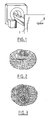
- each person is, as shown schematically in Figure 1, lying in the device with a mirror allowing him to observe a screen 1 on which an arrow 2 is projected which can point either to the left or to the right.
- Each person also has a keyboard that allows them to report whether she feels a feeling of discomfort on the left wing or the right wing of the nose, depending on the direction in which the arrow points.
- Each person can enter a keyboard response between 0 and 3 depending on the level of discomfort felt.
- Figure 2 is an example of a brain image for a person considered as not having sensitive skin
- Figure 3 an example of brain image for a person considered to have sensitive skin.
- Brain activation can be observed in the contralateral cortex sensory response to the application of the irritant among people of the first subgroup while no similar activation is observed during the tests witnesses.
- Extensive brain activation localized in particular in the upper cortex prefrontal and in the cingulate region, can be observed among people of the first subgroup, while activation is lower among people in the second subgroup, thus highlighting the correlation between the responses to the questionnaire and physiological reality.
Landscapes
- Health & Medical Sciences (AREA)
- Life Sciences & Earth Sciences (AREA)
- Physics & Mathematics (AREA)
- Molecular Biology (AREA)
- Animal Behavior & Ethology (AREA)
- Nuclear Medicine, Radiotherapy & Molecular Imaging (AREA)
- Biophysics (AREA)
- Pathology (AREA)
- Engineering & Computer Science (AREA)
- Biomedical Technology (AREA)
- Heart & Thoracic Surgery (AREA)
- Medical Informatics (AREA)
- Pain & Pain Management (AREA)
- Surgery (AREA)
- Veterinary Medicine (AREA)
- General Health & Medical Sciences (AREA)
- Public Health (AREA)
- Radiology & Medical Imaging (AREA)
- High Energy & Nuclear Physics (AREA)
- Hospice & Palliative Care (AREA)
- Psychiatry (AREA)
- Magnetic Resonance Imaging Apparatus (AREA)
- Medicines Containing Antibodies Or Antigens For Use As Internal Diagnostic Agents (AREA)
- Measurement And Recording Of Electrical Phenomena And Electrical Characteristics Of The Living Body (AREA)
Abstract
Description
- effectuer un stimulus prédéterminé apte à provoquer une réaction cérébrale caractéristique d'une peau sensible,
- recueillir par une méthode d'imagerie cérébrale une première information relative à la réaction d'au moins une région prédéterminée du cerveau en réponse à ce stimulus,
- recueillir par une méthode d'imagerie cérébrale une deuxième information relative au comportement de cette région prédéterminée du cerveau, après application ou administration du produit,
- délivrer, au moins en fonction des première et deuxième informations une troisième information relative à l'action du produit sur la sensibilité de la peau.
- vérifier par la mise en oeuvre du procédé défini ci-dessus l'action du produit sur la sensibilité de la peau,
- faire état, lors de la commercialisation du produit, par exemple dans la publicité ou sur un emballage, du fait que l'efficacité du produit a été vérifiée par une méthode d'imagerie cérébrale.
- recueillir une première information relative à la sensibilité de la peau d'au moins un individu, cette première information étant recueillie par une méthode autre qu'une méthode d'imagerie cérébrale,
- effectuer au moins un stimulus prédéterminé de la peau de l'individu et recueillir, par une méthode d'imagerie cérébrale, une deuxième information relative à la réaction d'au moins une région prédéterminée du cerveau en réponse à ce stimulus,
- générer une troisième information en fonction du degré de corrélation entre les première et deuxième informations. Cette troisième information peut comporter la validation ou non de la première information, par exemple.
- effectuer un test en appliquant un produit sur la peau d'au moins un individu qui a été reconnue comme étant sensible par la mise en oeuvre du procédé d'évaluation précité,
- faire état, lors de la commercialisation du produit cosmétique, du fait que le test a été effectué sur un individu dont on a vérifié qu'il avait une peau sensible grâce au procédé d'évaluation précité.
- effectuer en relation avec un produit cosmétique un stimulus sur un individu,
- recueillir par une méthode d'imagerie cérébrale au moins une information représentative de la réaction d'au moins une région prédéterminée du cerveau, en réponse à ce stimulus,
- déterminer des modifications éventuelles à apporter à la formulation du produit en fonction de l'information précédemment recueillie ou effectuer en fonction de cette information une sélection parmi plusieurs produits.
Claims (17)
- Procédé pour permettre de vérifier l'efficacité d'un produit censé avoir une action sur la sensibilité de la peau, notamment un produit cosmétique, caractérisé par le fait qu'il comporte les étapes suivantes :effectuer un stimulus prédéterminé de la peau apte à provoquer une réaction cérébrale caractéristique d'une peau sensible,recueillir par une méthode d'imagerie cérébrale une première information relative à la réaction d'au moins une région prédéterminée du cerveau en réponse à ce stimulus,recueillir par une méthode d'imagerie cérébrale une deuxième information relative au comportement de cette région prédéterminée du cerveau, après application ou administration du produit censé avoir une action sur la sensibilité de la peau,délivrer, au moins en fonction des première et deuxième informations une troisième information relative à l'action du produit sur la sensibilité de la peau.
- Procédé selon la revendication 1, caractérisé par le fait que la troisième information est délivrée sur la base d'une comparaison des première et deuxième informations.
- Procédé selon l'une des revendications 1 et 2, caractérisé par le fait qu'avant de recueillir la deuxième information, un nouveau stimulus de la peau est effectué.
- Procédé selon l'une quelconque des revendications 1 à 3, caractérisé par le fait que la méthode d'imagerie cérébrale utilisée permet de mettre en évidence une activation cérébrale moindre de la région prédéterminée en réponse au stimulus après application ou administration du produit censé avoir une action sur la sensibilité de la peau.
- Procédé selon l'une quelconque des revendications 1 à 4, caractérisé par le fait que le stimulus comporte l'application sur la peau d'une substance irritante, notamment une substance contenant de l'acide lactique ou de la capsaïcine.
- Procédé selon l'une quelconque des revendications précédentes, caractérisé par le fait que la région prédéterminée du cerveau comprend le cortex contralatéral sensoriel primaire, le cortex préfrontal supérieur et/ou la région cingulaire.
- Procédé selon l'une quelconque des revendications précédentes, caractérisé par le fait que la méthode d'imagerie utilisée est une méthode d'imagerie par résonance magnétique fonctionnelle.
- Procédé selon l'une quelconque des revendications 1 à 6, caractérisé par le fait que la méthode d'imagerie utilisée est une méthode d'imagerie par caméra à émission de positons, une méthode d'imagerie EEG, une méthode d'imagerie MEG ou une méthode d'imagerie optique.
- Procédé selon l'une quelconque des revendications précédentes, caractérisé par le fait que le produit dont on cherche à vérifier l'efficacité est un produit cosmétique.
- Procédé d'évaluation de la sensibilité de la peau, comportant les étapes suivantes :recueillir une première information relative à la sensibilité de la peau d'au moins un individu, cette première information étant recueillie par une méthode autre qu'une méthode d'imagerie cérébrale,effectuer au moins un stimulus prédéterminé de la peau de l'individu et recueillir, par une méthode d'imagerie cérébrale, une deuxième information relative à la réaction d'au moins une région prédéterminée du cerveau en réponse à ce stimulus,générer une troisième information en fonction du degré de corrélation entre les première et deuxième informations.
- Procédé selon la revendication 10, caractérisé par le fait que la troisième information comporte la validation ou non de la première information.
- Procédé selon la revendication 10 ou 11, caractérisé par le fait que le stimulus comporte l'application sur la peau d'une substance irritante.
- Procédé selon la revendication précédente, caractérisé par le fait que la substance irritante contient un composé choisi parmi les suivants: acide lactique, capsaïcine.
- Procédé selon l'une quelconque des revendications 10 à 13, caractérisé par le fait que la région prédéterminée comprend le cortex contralatéral sensoriel primaire, le cortex préfrontal supérieur et/ou la région cingulaire.
- Procédé selon l'une quelconque des revendications 10 à 14, caractérisé par le fait que la deuxième information est recueillie par une méthode d'imagerie par résonance magnétique fonctionnelle.
- Procédé selon l'une quelconque des revendications 10 à 15, caractérisé par le fait que la deuxième information est recueillie par une méthode d'imagerie par caméra à émission de positons, par une méthode d'imagerie EEG, une méthode d'imagerie MEG ou une méthode d'imagerie optique.
- Procédé selon l'une quelconque des revendications 10 à 16, caractérisé par le fait que la première information est obtenue grâce à un questionnaire.
Applications Claiming Priority (2)
| Application Number | Priority Date | Filing Date | Title |
|---|---|---|---|
| FR0204142A FR2838040B1 (fr) | 2002-04-03 | 2002-04-03 | Procede pour verifier l'efficacite d'un produit destine a exercer une action sur la sensibilite de la peau |
| FR0204142 | 2002-04-03 |
Publications (2)
| Publication Number | Publication Date |
|---|---|
| EP1350464A1 true EP1350464A1 (fr) | 2003-10-08 |
| EP1350464B1 EP1350464B1 (fr) | 2008-10-29 |
Family
ID=27839414
Family Applications (1)
| Application Number | Title | Priority Date | Filing Date |
|---|---|---|---|
| EP03290828A Expired - Lifetime EP1350464B1 (fr) | 2002-04-03 | 2003-04-02 | Procédé d'evaluation de la sensibilité la peau |
Country Status (5)
| Country | Link |
|---|---|
| EP (1) | EP1350464B1 (fr) |
| JP (1) | JP3713024B2 (fr) |
| DE (1) | DE60324348D1 (fr) |
| ES (1) | ES2315468T3 (fr) |
| FR (1) | FR2838040B1 (fr) |
Families Citing this family (3)
| Publication number | Priority date | Publication date | Assignee | Title |
|---|---|---|---|---|
| WO2011068718A1 (fr) * | 2009-12-03 | 2011-06-09 | The Procter & Gamble Company | Procédé pour évaluer les propriétés des forces générées par la pointe de fibre |
| JP6688164B2 (ja) * | 2016-06-09 | 2020-04-28 | 花王株式会社 | 皮膚毛細血管の観察方法 |
| JP7288272B2 (ja) * | 2018-12-28 | 2023-06-07 | 株式会社 資生堂 | 評価方法、及び評価装置 |
Citations (3)
| Publication number | Priority date | Publication date | Assignee | Title |
|---|---|---|---|---|
| FR2759588A1 (fr) * | 1997-02-17 | 1998-08-21 | Daniel Paul Sincholle | Compositions pour diminuer la sensibilite de la peau |
| EP0906752A1 (fr) | 1997-09-22 | 1999-04-07 | L'oreal | Utilisation d'un extrait d'au moins un végétal de la famille des Rosacées |
| WO2001074240A2 (fr) * | 2000-03-30 | 2001-10-11 | The General Hospital Corporation | Methode et dispositif permettant de mesurer objectivement la douleur, les traitements anti-douleur et autres techniques connexes |
-
2002
- 2002-04-03 FR FR0204142A patent/FR2838040B1/fr not_active Expired - Fee Related
-
2003
- 2003-04-02 EP EP03290828A patent/EP1350464B1/fr not_active Expired - Lifetime
- 2003-04-02 ES ES03290828T patent/ES2315468T3/es not_active Expired - Lifetime
- 2003-04-02 DE DE60324348T patent/DE60324348D1/de not_active Expired - Lifetime
- 2003-04-03 JP JP2003099902A patent/JP3713024B2/ja not_active Expired - Fee Related
Patent Citations (3)
| Publication number | Priority date | Publication date | Assignee | Title |
|---|---|---|---|---|
| FR2759588A1 (fr) * | 1997-02-17 | 1998-08-21 | Daniel Paul Sincholle | Compositions pour diminuer la sensibilite de la peau |
| EP0906752A1 (fr) | 1997-09-22 | 1999-04-07 | L'oreal | Utilisation d'un extrait d'au moins un végétal de la famille des Rosacées |
| WO2001074240A2 (fr) * | 2000-03-30 | 2001-10-11 | The General Hospital Corporation | Methode et dispositif permettant de mesurer objectivement la douleur, les traitements anti-douleur et autres techniques connexes |
Also Published As
| Publication number | Publication date |
|---|---|
| ES2315468T3 (es) | 2009-04-01 |
| JP2003334178A (ja) | 2003-11-25 |
| EP1350464B1 (fr) | 2008-10-29 |
| FR2838040A1 (fr) | 2003-10-10 |
| FR2838040B1 (fr) | 2004-07-02 |
| JP3713024B2 (ja) | 2005-11-02 |
| DE60324348D1 (de) | 2008-12-11 |
Similar Documents
| Publication | Publication Date | Title |
|---|---|---|
| Pennanen et al. | Effect of virtual eating environment on consumers’ evaluations of healthy and unhealthy snacks | |
| Stallen et al. | Celebrities and shoes on the female brain: The neural correlates of product evaluation in the context of fame | |
| Kumar et al. | Neuromarketing: An emerging tool of market research | |
| Cash | The psychology of hair loss and its implications for patient care | |
| Vecchiato et al. | Understanding the impact of TV commercials | |
| Sakai et al. | Data augmentation methods for machine-learning-based classification of bio-signals | |
| Lee et al. | Physiological relaxation induced by horticultural activity: transplanting work using flowering plants | |
| Arai et al. | Cosmetic makeup enhances facial attractiveness and affective neural responses | |
| Flament et al. | How a working day‐induced‐tiredness may alter some facial signs in differently‐aged Caucasian women | |
| Chang et al. | EEG based functional connectivity analysis of human pain empathy towards humans and robots | |
| Ortigue et al. | The chronoarchitecture of human sexual desire: a high-density electrical mapping study | |
| Benuzzi et al. | Processing the socially relevant parts of faces | |
| Hassani et al. | Gender differences in EEG responses to color and black-white images: implications for neuromarketing strategies | |
| Erkan | A neuro-cognitive perspective on urban behavior of people with different moods | |
| Wang et al. | Electroencephalography as an objective method for assessing subjective emotions during the application of cream | |
| Heyselaar et al. | Changes in alpha activity reveal that social opinion modulates attention allocation during face processing | |
| EP1350464B1 (fr) | Procédé d'evaluation de la sensibilité la peau | |
| Hernández-Martín et al. | Hyperpigmented macules on the face of young children: a series of 25 cases | |
| Erkan | Sense of urban and architectural environment | |
| Pratama et al. | Neuromarketing study of purchase decisions using advertising videos based on EEG signal analysis | |
| Congedo | Tomographic Neurofeedback: A new technique for the Self-Regulation of brain electrical activity | |
| Muñoz et al. | Selling of products: the use of single-electrode wireless EEG in consumer behavior | |
| Sameeha et al. | Analysis And Evaluation Of Consumers’ Cognitive Responses To Visual And Gustatory Stimuli For Neuromarketing Application | |
| Yoelin et al. | A retrospective review and observational study of outcomes and safety of bimatoprost ophthalmic solution 0.03% for treating eyelash hypotrichosis | |
| Di Dio | The neural basis of the hedonic quality of aesthetic experience |
Legal Events
| Date | Code | Title | Description |
|---|---|---|---|
| PUAI | Public reference made under article 153(3) epc to a published international application that has entered the european phase |
Free format text: ORIGINAL CODE: 0009012 |
|
| 17P | Request for examination filed |
Effective date: 20030407 |
|
| AK | Designated contracting states |
Kind code of ref document: A1 Designated state(s): AT BE BG CH CY CZ DE DK EE ES FI FR GB GR HU IE IT LI LU MC NL PT RO SE SI SK TR |
|
| AX | Request for extension of the european patent |
Extension state: AL LT LV MK |
|
| AKX | Designation fees paid |
Designated state(s): DE ES FR GB IT |
|
| 17Q | First examination report despatched |
Effective date: 20061207 |
|
| RTI1 | Title (correction) |
Free format text: METHOD FOR EVALUATING THE SKIN SENSITIVITY |
|
| GRAP | Despatch of communication of intention to grant a patent |
Free format text: ORIGINAL CODE: EPIDOSNIGR1 |
|
| GRAS | Grant fee paid |
Free format text: ORIGINAL CODE: EPIDOSNIGR3 |
|
| GRAA | (expected) grant |
Free format text: ORIGINAL CODE: 0009210 |
|
| AK | Designated contracting states |
Kind code of ref document: B1 Designated state(s): DE ES FR GB IT |
|
| REG | Reference to a national code |
Ref country code: GB Ref legal event code: FG4D Free format text: NOT ENGLISH |
|
| REF | Corresponds to: |
Ref document number: 60324348 Country of ref document: DE Date of ref document: 20081211 Kind code of ref document: P |
|
| REG | Reference to a national code |
Ref country code: ES Ref legal event code: FG2A Ref document number: 2315468 Country of ref document: ES Kind code of ref document: T3 |
|
| PLBE | No opposition filed within time limit |
Free format text: ORIGINAL CODE: 0009261 |
|
| STAA | Information on the status of an ep patent application or granted ep patent |
Free format text: STATUS: NO OPPOSITION FILED WITHIN TIME LIMIT |
|
| 26N | No opposition filed |
Effective date: 20090730 |
|
| PGFP | Annual fee paid to national office [announced via postgrant information from national office to epo] |
Ref country code: DE Payment date: 20110330 Year of fee payment: 9 |
|
| PGFP | Annual fee paid to national office [announced via postgrant information from national office to epo] |
Ref country code: GB Payment date: 20120328 Year of fee payment: 10 |
|
| PGFP | Annual fee paid to national office [announced via postgrant information from national office to epo] |
Ref country code: FR Payment date: 20120504 Year of fee payment: 10 |
|
| PGFP | Annual fee paid to national office [announced via postgrant information from national office to epo] |
Ref country code: IT Payment date: 20120413 Year of fee payment: 10 |
|
| PGFP | Annual fee paid to national office [announced via postgrant information from national office to epo] |
Ref country code: ES Payment date: 20120510 Year of fee payment: 10 |
|
| REG | Reference to a national code |
Ref country code: DE Ref legal event code: R119 Ref document number: 60324348 Country of ref document: DE Effective date: 20121101 |
|
| GBPC | Gb: european patent ceased through non-payment of renewal fee |
Effective date: 20130402 |
|
| PG25 | Lapsed in a contracting state [announced via postgrant information from national office to epo] |
Ref country code: GB Free format text: LAPSE BECAUSE OF NON-PAYMENT OF DUE FEES Effective date: 20130402 |
|
| REG | Reference to a national code |
Ref country code: FR Ref legal event code: ST Effective date: 20131231 |
|
| PG25 | Lapsed in a contracting state [announced via postgrant information from national office to epo] |
Ref country code: FR Free format text: LAPSE BECAUSE OF NON-PAYMENT OF DUE FEES Effective date: 20130430 Ref country code: IT Free format text: LAPSE BECAUSE OF NON-PAYMENT OF DUE FEES Effective date: 20130402 |
|
| PG25 | Lapsed in a contracting state [announced via postgrant information from national office to epo] |
Ref country code: DE Free format text: LAPSE BECAUSE OF NON-PAYMENT OF DUE FEES Effective date: 20121101 |
|
| REG | Reference to a national code |
Ref country code: ES Ref legal event code: FD2A Effective date: 20150709 |
|
| PG25 | Lapsed in a contracting state [announced via postgrant information from national office to epo] |
Ref country code: ES Free format text: LAPSE BECAUSE OF NON-PAYMENT OF DUE FEES Effective date: 20130403 |