EP1348706A1 - Substituted thiazole derivatives bearing 3-pyridyl groups, process for preparing the same and use thereof - Google Patents
Substituted thiazole derivatives bearing 3-pyridyl groups, process for preparing the same and use thereof Download PDFInfo
- Publication number
- EP1348706A1 EP1348706A1 EP01999258A EP01999258A EP1348706A1 EP 1348706 A1 EP1348706 A1 EP 1348706A1 EP 01999258 A EP01999258 A EP 01999258A EP 01999258 A EP01999258 A EP 01999258A EP 1348706 A1 EP1348706 A1 EP 1348706A1
- Authority
- EP
- European Patent Office
- Prior art keywords
- group
- substituents
- optionally
- group optionally
- hydrogen atom
- Prior art date
- Legal status (The legal status is an assumption and is not a legal conclusion. Google has not performed a legal analysis and makes no representation as to the accuracy of the status listed.)
- Granted
Links
- 0 Cc1c(*)nc(C)[s]1 Chemical compound Cc1c(*)nc(C)[s]1 0.000 description 4
Classifications
-
- C—CHEMISTRY; METALLURGY
- C07—ORGANIC CHEMISTRY
- C07D—HETEROCYCLIC COMPOUNDS
- C07D417/00—Heterocyclic compounds containing two or more hetero rings, at least one ring having nitrogen and sulfur atoms as the only ring hetero atoms, not provided for by group C07D415/00
- C07D417/02—Heterocyclic compounds containing two or more hetero rings, at least one ring having nitrogen and sulfur atoms as the only ring hetero atoms, not provided for by group C07D415/00 containing two hetero rings
- C07D417/04—Heterocyclic compounds containing two or more hetero rings, at least one ring having nitrogen and sulfur atoms as the only ring hetero atoms, not provided for by group C07D415/00 containing two hetero rings directly linked by a ring-member-to-ring-member bond
-
- A—HUMAN NECESSITIES
- A61—MEDICAL OR VETERINARY SCIENCE; HYGIENE
- A61K—PREPARATIONS FOR MEDICAL, DENTAL OR TOILETRY PURPOSES
- A61K31/00—Medicinal preparations containing organic active ingredients
- A61K31/33—Heterocyclic compounds
- A61K31/395—Heterocyclic compounds having nitrogen as a ring hetero atom, e.g. guanethidine or rifamycins
- A61K31/435—Heterocyclic compounds having nitrogen as a ring hetero atom, e.g. guanethidine or rifamycins having six-membered rings with one nitrogen as the only ring hetero atom
- A61K31/44—Non condensed pyridines; Hydrogenated derivatives thereof
- A61K31/4427—Non condensed pyridines; Hydrogenated derivatives thereof containing further heterocyclic ring systems
- A61K31/4439—Non condensed pyridines; Hydrogenated derivatives thereof containing further heterocyclic ring systems containing a five-membered ring with nitrogen as a ring hetero atom, e.g. omeprazole
-
- A—HUMAN NECESSITIES
- A61—MEDICAL OR VETERINARY SCIENCE; HYGIENE
- A61K—PREPARATIONS FOR MEDICAL, DENTAL OR TOILETRY PURPOSES
- A61K31/00—Medicinal preparations containing organic active ingredients
- A61K31/33—Heterocyclic compounds
- A61K31/395—Heterocyclic compounds having nitrogen as a ring hetero atom, e.g. guanethidine or rifamycins
- A61K31/435—Heterocyclic compounds having nitrogen as a ring hetero atom, e.g. guanethidine or rifamycins having six-membered rings with one nitrogen as the only ring hetero atom
- A61K31/44—Non condensed pyridines; Hydrogenated derivatives thereof
- A61K31/445—Non condensed piperidines, e.g. piperocaine
- A61K31/4523—Non condensed piperidines, e.g. piperocaine containing further heterocyclic ring systems
- A61K31/4545—Non condensed piperidines, e.g. piperocaine containing further heterocyclic ring systems containing a six-membered ring with nitrogen as a ring hetero atom, e.g. pipamperone, anabasine
-
- A—HUMAN NECESSITIES
- A61—MEDICAL OR VETERINARY SCIENCE; HYGIENE
- A61K—PREPARATIONS FOR MEDICAL, DENTAL OR TOILETRY PURPOSES
- A61K31/00—Medicinal preparations containing organic active ingredients
- A61K31/33—Heterocyclic compounds
- A61K31/395—Heterocyclic compounds having nitrogen as a ring hetero atom, e.g. guanethidine or rifamycins
- A61K31/435—Heterocyclic compounds having nitrogen as a ring hetero atom, e.g. guanethidine or rifamycins having six-membered rings with one nitrogen as the only ring hetero atom
- A61K31/47—Quinolines; Isoquinolines
- A61K31/472—Non-condensed isoquinolines, e.g. papaverine
- A61K31/4725—Non-condensed isoquinolines, e.g. papaverine containing further heterocyclic rings
-
- A—HUMAN NECESSITIES
- A61—MEDICAL OR VETERINARY SCIENCE; HYGIENE
- A61P—SPECIFIC THERAPEUTIC ACTIVITY OF CHEMICAL COMPOUNDS OR MEDICINAL PREPARATIONS
- A61P13/00—Drugs for disorders of the urinary system
- A61P13/08—Drugs for disorders of the urinary system of the prostate
-
- A—HUMAN NECESSITIES
- A61—MEDICAL OR VETERINARY SCIENCE; HYGIENE
- A61P—SPECIFIC THERAPEUTIC ACTIVITY OF CHEMICAL COMPOUNDS OR MEDICINAL PREPARATIONS
- A61P15/00—Drugs for genital or sexual disorders; Contraceptives
-
- A—HUMAN NECESSITIES
- A61—MEDICAL OR VETERINARY SCIENCE; HYGIENE
- A61P—SPECIFIC THERAPEUTIC ACTIVITY OF CHEMICAL COMPOUNDS OR MEDICINAL PREPARATIONS
- A61P15/00—Drugs for genital or sexual disorders; Contraceptives
- A61P15/08—Drugs for genital or sexual disorders; Contraceptives for gonadal disorders or for enhancing fertility, e.g. inducers of ovulation or of spermatogenesis
-
- A—HUMAN NECESSITIES
- A61—MEDICAL OR VETERINARY SCIENCE; HYGIENE
- A61P—SPECIFIC THERAPEUTIC ACTIVITY OF CHEMICAL COMPOUNDS OR MEDICINAL PREPARATIONS
- A61P17/00—Drugs for dermatological disorders
- A61P17/14—Drugs for dermatological disorders for baldness or alopecia
-
- A—HUMAN NECESSITIES
- A61—MEDICAL OR VETERINARY SCIENCE; HYGIENE
- A61P—SPECIFIC THERAPEUTIC ACTIVITY OF CHEMICAL COMPOUNDS OR MEDICINAL PREPARATIONS
- A61P35/00—Antineoplastic agents
-
- A—HUMAN NECESSITIES
- A61—MEDICAL OR VETERINARY SCIENCE; HYGIENE
- A61P—SPECIFIC THERAPEUTIC ACTIVITY OF CHEMICAL COMPOUNDS OR MEDICINAL PREPARATIONS
- A61P43/00—Drugs for specific purposes, not provided for in groups A61P1/00-A61P41/00
-
- A—HUMAN NECESSITIES
- A61—MEDICAL OR VETERINARY SCIENCE; HYGIENE
- A61P—SPECIFIC THERAPEUTIC ACTIVITY OF CHEMICAL COMPOUNDS OR MEDICINAL PREPARATIONS
- A61P5/00—Drugs for disorders of the endocrine system
- A61P5/24—Drugs for disorders of the endocrine system of the sex hormones
- A61P5/28—Antiandrogens
-
- A—HUMAN NECESSITIES
- A61—MEDICAL OR VETERINARY SCIENCE; HYGIENE
- A61P—SPECIFIC THERAPEUTIC ACTIVITY OF CHEMICAL COMPOUNDS OR MEDICINAL PREPARATIONS
- A61P5/00—Drugs for disorders of the endocrine system
- A61P5/24—Drugs for disorders of the endocrine system of the sex hormones
- A61P5/32—Antioestrogens
-
- C—CHEMISTRY; METALLURGY
- C07—ORGANIC CHEMISTRY
- C07D—HETEROCYCLIC COMPOUNDS
- C07D417/00—Heterocyclic compounds containing two or more hetero rings, at least one ring having nitrogen and sulfur atoms as the only ring hetero atoms, not provided for by group C07D415/00
- C07D417/14—Heterocyclic compounds containing two or more hetero rings, at least one ring having nitrogen and sulfur atoms as the only ring hetero atoms, not provided for by group C07D415/00 containing three or more hetero rings
Definitions
- the present invention relates to a novel thiazole derivative having an inhibitory activity on steroid C 17,20 -lyase, a salt thereof and to a pharmaceutical composition containing the same.
- Androgen and estrogen which are sex hormones, show a great diversity of physiological activities inclusive of differentiation and proliferation of cells.
- androgen and estrogen act as an exacerbation factor in certain diseases.
- steroid C 17, 20 -lyase is responsible for the final stage of the biosynthesis of androgen in the body. That is, steroid C 17,20 -lyase produces dehydroepiandrosterone and androstenedione using, as a substrate, 17-hydroxypregnenolone and 17-hydroxyprogesterone, which are generated by cholesterol.
- a pharmaceutical agent inhibiting steroid C 17,20 -lyase suppresses production of androgen, as well as production of estrogen synthesized using androgen as a substrate.
- Such pharmaceutical agent is useful as an agent for the prevention and therapy of diseases wherein androgen and estrogen are exacerbation factors.
- diseases, in which androgen or estrogen is an exacerbation factor include prostate cancer, prostatic hypertrophy, masculinism, hypertrichosis, male-type baldness, male infant-type prematurity, breast cancer, uterine cancer, ovarian cancer, mastopathy, hysteromyoma, endometriosis, adenomyosis of uterus, polycystic ovary syndrome and the like.
- Steroid-type compounds and non-steroid type compounds are already known as steroid C 17,20 -lyase inhibitors.
- Steroid-type compounds are disclosed in, for example, WO92/15404, WO93/20097 EP-A-288053, EP-A-413270 and the like.
- JP-A-64-85975 discloses (1H-imidazol-1-yl )methyl-substituted benzimidazole derivatives
- WO94/27989 and WO96/14090 disclose carbazole derivatives
- WO95/09157 discloses azole derivatives
- US 5,491,161 discloses 1H-benzimidazole derivatives
- WO99/18075 discloses dihydronaphthalene derivatives.
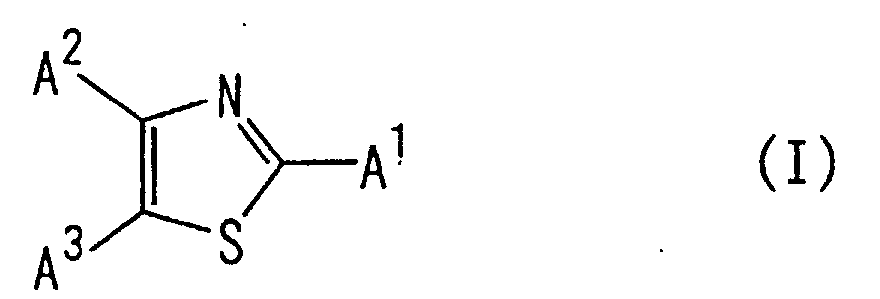
- the present inventors have conducted intensive studies in an attempt to find a superior steroid C 17,20 -lyase inhibitor and found that a compound of the formula (I) unexpectedly has a superior pharmaceutical use, particularly a superior steroid C 17,20 -lyase-inhibitory activity, and shows less toxicity and superior properties as a pharmaceutical product, based on its unique chemical structure.
- the present invention relates to the following:
- the compound represented by the aforementioned formula (I) or a salt thereof is a compound wherein 1) A 1 is a 3-pyridyl group optionally having substituents, A 2 is an aromatic hydrocarbon group optionally having substituents or a heterocyclic group optionally having substituents, A 3 is a hydrogen atom, a halogen atom, a C 1-4 aliphatic hydrocarbon group optionally having substituents or an optionally esterified carboxyl group, or a salt thereof [hereinafter to be referred to as compound (I-1)], 2) a compound wherein A 1 is an aromatic hydrocarbon group optionally having substituents or a heterocyclic group optionally having substituents, A 2 is a 3-pyridyl group optionally having substituents, A 3 is a hydrogen atom, a halogen atom, a C 1-4 aliphatic hydrocarbon group optionally having substituents or an optionally esterified carboxyl group, or
- compound (I-1) and compound (I-2) are preferable, and particularly a compound (I-1) wherein A 2 is a C 6-14 aryl group optionally having substituents or a 3-pyridyl group optionally having substituents and a compound (I-2), wherein A 1 is a C 6-14 aryl group optionally having substituents, is preferable.
- substituents which is one of the aforementioned A 1 , A 2 and A 3 , for example, 1) an oxo, 2) a halogen atom (e.g., fluorine atom, chlorine atom, bromine atom, iodine atom), 3) a nitro, 4) a cyano, 5) a C 1-6 aliphatic hydrocarbon group optionally having substituents, 6) a C 6-14 aryl (e.g., phenyl, 1-naphthyl, 2-naphthyl, 2-biphenylyl, 3-biphenylyl, 4-biphenylyl, 2-anthryl etc.), 7) a 5 to 1O-membere aromatic heterocyclic group (e.g., 2-thienyl, 3-thienyl, 2-pyridyl, 3-pyridyl, 4-pyridyl, 2-anthryl etc.), 7) a 5 to 1O-membere aromatic heterocyclic group (
- an optionally halogenated C 1-6 alkyl e.g., C 1-6 alkyl (e.g., methyl, ethyl, propyl, isopropyl, butyl, isobutyl, sec-butyl, tert-butyl, pentyl, hexyl etc.) optionally having 1 to 5, preferably 1 to 3, halogen atoms (e.g., fluorine, chlorine, bromine, iodine etc.), such as methyl, chloromethyl, difluoromethyl, trichloromethyl, trifluoromethyl, ethyl, 2-bromoethyl, 2,2,2-trifluoroethyl, pentafluoroethyl, propyl, 3,3,3-trifluoropropyl, isopropyl, butyl, 4,4,4-trifluorobutyl
- C 1-6 alkyl e.g., methyl, ethyl, prop
- an optionally esterified carboxyl group [e.g., unsubstituted carboxyl group etc., a C 1-6 alkoxy-carbonyl (e.g., methoxycarbonyl, ethoxycarbonyl, propoxycarbonyl, tert-butoxycarbonyl etc.)], a C 6-14 aryloxy-carbonyl (e.g., phenoxycarbonyl etc.), a C 7-16 aralkyloxy-carbonyl (e.g., benzyloxycarbonyl, phenethyloxycarbonyl etc.), a formyl, a C 1-6 alkyl-carbonyl (e.g., acetyl, propionyl etc.), a C 3-6 cycloalkyl-carbonyl (e.g., cyclopropylcarbonyl, cyclopentylcarbonyl, cyclohexylcarbonyl etc.
- carbamoyl optionally having substituents, for example, an unsubstituted carbamoyl, and a mono-C 1-6 alkyl-carbamoyl (e.g., methylcarbamoyl, ethylcarbamoyl etc.), a di-C 1-6 alkyl-carbamoyl (e.g., dimethylcarbamoyl, diethylcarbamoyl, ethylmethylcarbamoyl etc.), a C 6-14 arylcarbamoyl (e.g., phenylcarbamoyl, 1-naphthylcarbamoyl, 2-naphthylcarbamoyl etc.), a 5 or 6-membered heterocyclic carbamoyl (e.g., 2-pyridylcarbamoyl, 3-pyridylcarbamoyl, 4-pyri
- cyclic aminocarbonyl optionally having substituents, for example, morpholinocarbonyl, thiomorpholinocarbonyl, piperazin-1-ylcarbonyl, 4-methylpiperazin-1-ylcarbonyl, pyrrolidin-1-ylcarbonyl, 3-methylpyrrolidin-1-ylcarbonyl and the like can be mentioned.
- an unsubstituted amino optionally having substituents, an unsubstituted amino, and a mono-C 1-6 alkylamino (e.g., methylamino, ethylamino etc.), a mono-C 6-14 arylamino (e.g., phenylamino, 1-naphthylamino, 2-naphthylamino etc.), a di-C 1-6 alkylamino (e.g., dimethylamino, diethylamino, ethylmethylamino etc.), a di-C 6-14 arylamino (e.g., diphenylamino etc.), a formylamino, a C 1-6 alkyl-carbonylamino (e.g., acetylamino etc.), a C 6-14 aryl-carbonylamino (e.g., benzoylamino, naphthoylamino etc.),
- cyclic amino of the above-mentioned “cyclic amino optionally having substituents”
- a 5 to 7-membered saturated cyclic amino optionally having, besides one nitrogen atom and carbon atoms, 1 to 4 of 1 or 2 kinds of hetero atoms selected from nitrogen atom, sulfur atom and oxygen atom can be mentioned.
- Specific examples thereof include pyrrolidin-1-yl, piperidino, piperazin-1-yl, morpholino, thiomorpholino, hexahydroazepin-1-yl and the like.
- substituents for example, 1 to 3 substituents selected from a C 1-6 alkyl (e.g., methyl, ethyl, propyl, isopropyl, butyl, isobutyl, sec-butyl, tert-butyl, pentyl, hexyl etc.), a C 6-14 aryl (e.g., phenyl, 1-naphthyl, 2-naphthyl, 2-biphenylyl, 3-biphenylyl, 4-biphenylyl, 2-anthryl etc.), a C 1-6 alkyl-carbonyl (e.g., acetyl, propionyl etc.), a 5 to 10-membered aromatic heterocyclic group (e.g., 2-thienyl, 3-thienyl, 2-pyridyl, 3-pyridyl, 4-pyridyl, 2-
- mercapto group optionally having substituents
- an unsubstituted mercapto group, and an alkylthio optionally having substituents e.g., unsubstituted C 1-6 alkylthio (e.g., methylthio, ethylthio, propylthio, butylthio, pentylthio etc.), optionally halogenated C 1-6 alkylthio], C 6-14 arylthio (e.g., phenylthio, 1-naphthylthio, 2-naphthylthio etc.), C 7-16 aralkylthio (e.g., benzylthio, phenethylthio etc.)] and the like can be mentioned.
- C 1-6 alkylthio e.g., methylthio, ethylthio, propylthio, butylthio, pentylthio etc.
- hydroxy group optionally having substituents, an unsubstituted hydroxy, and an alkoxy optionally having substituents
- substituents e.g., optionally halogenated C 1-8 alkoxy (e.g., a C 1-8 alkoxy (e.g., methoxy, ethoxy, propoxy, isopropoxy, butoxy, isobutoxy, sec-butoxy, pentyloxy, hexyloxy etc.) optionally having 1 to 5, preferably 1 to 3, halogen atoms (e.g., fluorine, chlorine, bromine, iodine etc.) such as methoxy, difluoromethoxy, trifluoromethoxy, ethoxy, 2,2,2-trifluoroethoxy, propoxy, isopropoxy, butoxy, 4,4,4-trifluorobutoxy, isobutoxy, sec-butoxy, pentyloxy, hexyloxy, etc.), a C 1-6 alkoxy-
- the "3-pyridyl group” may have, for example, 1 to 5, preferably 1 to 3, of the above-mentioned substituents at substitutable positions. When the number of substituent is not less than 2, respective substituents may be the same or different.
- One of A 2 and A 3 is a hydrogen atom, a halogen atom, a C 1-4 hydrocarbon group optionally having substituents or an optionally esterified carboxyl group.
- halogen atom a fluorine atom, a chlorine atom, a bromine atom or an iodine atom is used, with preference given to fluorine atom, chlorine atom and bromine atom.
- a C 1-4 alkyl group e.g., methyl, ethyl, propyl, isopropyl, butyl, isobutyl, sec-butyl, tert-butyl
- a C 2-4 alkenyl group e.g., vinyl, allyl, isopropenyl, 1-butenyl, 2-butenyl, 3-butenyl, 2-methyl-2-propenyl, 1-methyl-2-propenyl, 2-methyl-1-propenyl etc.
- a C 2-4 alkynyl group e.g., ethynyl, propargyl, 1-butynyl, 2-butynyl, 3-butynyl
- a C 3-4 cycloalkyl group e.g., cyclopropyl, cyclobutyl
- Preferred is a C 3-4 cycloalkyl group (e.g., cyclopropyl, cyclobuty
- a halogen atom e.g., fluorine atom, chlorine atom, bromine atom, iodine atom
- nitro, cyano optionally halogenated C 3-6 cycloalkyl (e.g., cyclopropyl, cyclohexyl etc.)
- a C 6-14 aryl e.g., phenyl, 1-naphthyl, 2-naphthyl, 2-biphenylyl, 3-biphenylyl, 4-biphenylyl, 2-anthryl etc.
- an optionally halogenated C 1-4 alkoxy a C 1-6 alkoxy-carbonyl-C 1-6 alkoxy (e.g., ethoxycarbonylmethyloxy etc.), hydroxy, a C 6-14 aryloxy (e.g., phenyloxy, 1-naphth)
- carboxyl group optionally esterified by C 1-4 alkyl group and the like, and the like are used, with preference given to a C 1-4 alkoxycarbonyl group such as methoxycarbonyl, ethoxycarbonyl and the like.
- aromatic hydrocarbon group of the "aromatic hydrocarbon group optionally having substituents” represented by one of A 1 , A 2 and A 3 , for example, a monocycle having 6 to 14 carbon atoms or a condensed polycyclic (bicyclic or tricyclic) aromatic hydrocarbon group and the like can be mentioned.
- a C 6-14 aryl group such as phenyl, 1-naphthyl, 2-naphthyl, 2-biphenylyl, 3-biphenylyl, 4-biphenylyl, 2-anthryl and the like, from which a C 6-10 aryl group such as phenyl, 1-naphthyl, 2-naphthyl and the like is preferable, particularly a phenyl group is preferable.
- aromatic hydrocarbon group may have, for example, 1 to 5, preferably 1 to 3, of the above-mentioned substituents at substitutable position(s). When the number of substituents is not less than 2, each substituent may be the same or different.
- the aromatic hydrocarbon group optionally having substituents the aforementioned C 6-14 aryl group optionally having substituents is preferable.
- heterocyclic group of the “heterocyclic group optionally having substituents"
- 2-thienyl, 3-thienyl, 2-pyridyl, 3-pyridyl, 4-pyridyl, 2-quinolyl, 3-quinolyl, 4-quinolyl, 5-quinolyl, 8-quinolyl, 1-isoquinolyl, 3-isoquinolyl, 4-isoquinolyl, 5-isoquinolyl, 1-indolyl, 2-indolyl, 3-indolyl, 2-benzothiazolyl, 2-benzo[b]thienyl, 3-benzo[b]thienyl, 2-benzo[b]furanyl, 3-benzo[b]furanyl and the like are mentioned, with preference given to pyridyl, particularly 3-pyridyl group.
- the “heterocyclic group” may have, for example, 1 to 5, preferably 1 to 3, the above-mentioned substituents at substitutable position(s). When the number of substituents is not less than 2, each substituent may be the same or different. When a nitrogen atom is contained in the ring of the "heterocyclic group", the nitrogen atom may be N-oxidized.
- substituent of the "3-pyridyl group optionally having substituents” and “heterocyclic group optionally having substituents”, which is represented by one of the aforementioned A 1 , A 2 and A 3 for example, an optionally halogenated C 1-6 alkyl group (e.g., methyl, ethyl, propyl, trifluoromethyl etc.), a hydroxy-C 1-6 alkyl group (e.g., hydroxymethyl, hydroxyethyl, hydroxypropyl, hydroxy-isopropyl etc.), a C 1-6 alkoxy group (e.g., methoxy, ethoxy, propoxy, isopropoxy etc.), a mono- or di-C 1-6 alkylamino group (e.g., methylamino, dimethylamino etc.), a C 1-6 alkylthio group (e.g., methylthio, ethylthio group), a (C 7-15)
- heterocyclic group e.g., piperidino, piperazino, morpholino, thienyl, furyl, pyridyl, pyrimidinyl, quinolyl, isoquinolyl, imidazolyl etc., hereinafter sometimes to be abbreviated as a heterocyclic group
- C 7-15 aralkyl)(heterocyclic group)amino group e.g., (4-benzylpiperidyl)amino etc.
- methyl, trifluoromethyl and the like are particularly preferable.
- a C 6-10 aryl group e.g., phenyl etc.
- a nitro group e.g., a hydroxy group, a halogen atom (e.g., fluorine atom, chlorine atom, bromine atom), an optionally halogenated C 1-6 alkyl group (e.g., methyl, ethyl, propyl, isopropyl, trifluoromethyl, bistrifluoromethyl etc.), a C 1-6 alkoxy group (e.g., methoxy, ethoxy etc.), an amino group, a mono- or di-C 1-6 alkylamino group (e.g., methylamino, ethylamino, dimethylamino, diethylamino etc.), a C 1-6 alkoxycarbonyl group (e.g., methoxycarbonyl, ethoxycarbony
- a 3-pyridyl group a 4-methyl-3-pyridyl group, a 4-trifluoromethyl-3-pyridyl group, a 4-methoxy-3-pyridyl group, a 4-isoquinolyl-3-pyridyl group, a 4-methylamino-3-pyridyl group, a 4-dimethylamino-3-pyridyl group, a 4-methylthio-3-pyridyl group, a 4-(benzylmethyl)amino-3-pyridyl group, a 4-isopropoxy-3-pyridyl group, a 5-methoxycarbonyl-3-pyridyl group, a 5-ethoxycarbonyl-3-pyridyl group, a 4-morpholino-3-pyridyl group, a 1-hydroxyisopropyl-3
- aromatic hydrocarbon group optionally having substituents and "C 6-14 aryl group optionally having substituents"
- a hydrogen atom, a halogen atom (e.g., fluorine atom, chlorine atom, bromine atom), a C 1-4 alkyl group (e.g., methyl, ethyl) or a C 1-4 ethoxycarbonyl group (e.g., methoxycarbonyl, ethoxycarbonyl) and the like are preferable.
- sulfamoyl group optionally having substituents represented by R 1a in the aforementioned formulas (Ia) and (Ia1) for example, a sulfamoyl, a C 1-6 alkylsulfamoyl group (e.g., methylsulfamoyl etc.), a C 7-15 aralkylsulfamoyl group (e.g., benzylsulfamoyl etc.) can be mentioned, and as the alkylsulfonyl group optionally having substituents, for example, unsubstituted methylsulfonyl, ethylsulfonyl and the like, as well as an alkylsulfonyl substituted by halogen (e.g., chloromethylsulfonyl, 1,1-difluoroethylsulfonyl etc.) and the like can be mentioned.
- halogen e.g., chlor
- carbamoyl group optionally having substituents represented by R 10 in the aforementioned formulas (Ib) and (Ib1), for example, an unsubstituted carbamoyl, as well as a mono-C 1-6 alkyl-carbamoyl (e.g., methylcarbamoyl, ethylcarbamoyl etc.), a di-C 1-6 alkyl-carbamoyl (e.g., dimethylcarbamoyl, diethylcarbamoyl, ethylmethylcarbamoyl etc.), a C 6-14 arylcarbamoyl (e.g., phenylcarbamoyl, 1-naphthylcarbamoyl, 2-naphthylcarbamoyl etc.), a 5 or 6-membered heterocyclic carbamoyl (e.g., 2-pyridylcarbamoyl
- alkylsulfonyl group optionally having substituents represented by R 1c those mentioned as the alkylsulfonyl group optionally having substituents, which is represented by R 1a can be mentioned.
- an optionally halogenated C 1-6 alkyl [e.g., C 1-6 alkyl (e.g., methyl, ethyl, propyl, isopropyl, butyl, isobutyl, sec-butyl, tert-butyl, pentyl, hexyl etc.) optionally having 1 to 5, preferably 1 to 3, halogen atoms (e.g., fluorine, chlorine, bromine, iodine etc.), such as methyl, chloromethyl, difluoromethyl, trichloromethyl, trifluoromethyl, ethyl, 2-bromomethyl, 2,2,2-trifluoroethyl, pentafluoroethyl, propyl, 3,3,3-trifluoropropyl, isopropyl, butyl, 4,4,4-trifluorobutyl, isobutyl
- R 1b As the optionally esterified carboxyl group, which is represented by R 1b , for example, an unsubstituted carboxyl group, as well as a C 1-6 alkoxy-carbonyl (e.g., methoxycarbonyl, ethoxycarbonyl, propoxycarbonyl, tert-butoxycarbonyl etc.) can be mentioned.
- a C 1-6 alkoxy-carbonyl e.g., methoxycarbonyl, ethoxycarbonyl, propoxycarbonyl, tert-butoxycarbonyl etc.
- halogen atom represented by R 1b for example, fluorine, chlorine, bromine, iodine and the like can be mentioned.
- amino group optionally having substituents which is represented by R 1b , unsubstituted amino, as well as mono-C 1-6 alkylamino (e.g., methylamino, ethylamino etc.), mono-C 6-14 arylamino (e.g., phenylamino, 1-naphthylamino, 2-naphthylamino etc.), di-C 1-6 alkylamino (e.g., dimethylamino, diethylamino, ethylmethylamino etc.), di-C 6-14 arylamino (e.g., diphenylamino etc.), formylamino, C 1-6 alkyl-carbonylamino (e.g., acetylamino etc.), C 6-14 aryl-carbonylamino (e.g., benzoylamino, naphthoylamino etc.), C 1-6 alkoxy-carbonyl
- an unsubstituted hydroxy as well as an alkoxy optionally having substituents
- an alkoxy optionally having substituents e.g., optionally halogenated C 1-8 alkoxy (e.g., C 1-8 alkoxy (e.g., methoxy, ethoxy, propoxy, isopropoxy, butoxy, isobutoxy, sec-butoxy, pentyloxy, hexyloxy etc.) optionally having 1 to 5, preferably 1 to 3, halogen atoms (e.g., fluorine, chlorine, bromine, iodine etc.), such as methoxy, difluoromethoxy, trifluoromethoxy, ethoxy, 2,2,2-trifluoroethoxy, propoxy, isopropoxy, butoxy, 4,4,4-trifluorobutoxy, isobutoxy, sec-butoxy, pentyloxy, hexyloxy etc., and the like), a C 1-8 alkoxy (e.g
- alkylsulfonyl group optionally having substituents which is represented by R 1b
- those mentioned as the alkylsulfonyl group optionally having substituents, which is represented by R 1a can be mentioned.
- an optionally halogenated C 1-4 alkyl e.g., a C 1-4 alkyl (e.g., methyl, ethyl, propyl, isopropyl, butyl, isobutyl, sec-butyl, tert-butyl etc.) optionally having 1 to 5, preferably 1 to 3, halogen atoms (e.g., fluorine, chlorine, bromine, iodine etc.), such as methyl, chloromethyl, difluoromethyl, trichloromethyl, trifluoromethyl, ethyl, 2-bromomethyl, 2,2,2-trifluoroethyl, pentafluoroethyl, propyl, 3,3,3-trifluoropropyl, isopropyl, but
- halogenated C 1-4 alkyl e.g., a C 1-4 alkyl (e.g., methyl, ethyl, propyl, isopropyl
- amino group optionally having substituents which is represented by R 2
- those mentioned as the amino group optionally having substituents, which is represented by R 1b can be mentioned.
- cyclic amino group represented by R 2 a 5 to 7-membered saturated cyclic amino optionally having, besides one nitrogen atom and carbon atoms, 1 to 4 of 1 or 2 kinds of hetero atoms selected from nitrogen atom, sulfur atom and oxygen atom.
- pyrrolidin-1-yl, piperidino, piperazin-1-yl, morpholino, thiomorpholino, hexahydroazepin-1-yl and the like are used.
- alkylthio group optionally having substituents which is represented by R 2 , for example, an unsubstituted C 1-6 alkylthio (e.g., methylthio, ethylthio, propylthio, butylthio, pentylthio etc.), an optionally halogenated C 1-6 alkylthio, a C 7-16 aralkylthio (e.g., benzylthio, phenethylthio etc.) and the like can be mentioned.
- C 1-6 alkylthio e.g., methylthio, ethylthio, propylthio, butylthio, pentylthio etc.
- an optionally halogenated C 1-6 alkylthio e.g., benzylthio, phenethylthio etc.
- an optionally halogenated C 1-8 alkoxy [e.g., a C 1-8 alkoxy (e.g., methoxy, ethoxy, propoxy, isopropoxy, butoxy, isobutoxy, sec-butoxy, pentyloxy, hexyloxy etc.) optionally having 1 to 5, preferably 1 to 3, halogen atoms (e.g., fluorine, chlorine, bromine, iodine etc.), such as methoxy, difluoromethoxy, trifluoromethoxy, ethoxy, 2,2,2-trifluoroethoxy, propoxy, isopropoxy, butoxy, 4,4,4-trifluorobutoxy, isobutoxy, sec-butoxy, pentyloxy, hexyloxy etc.], a C 1-6 alkoxy-carbonyl-C 1-6 alkoxy (e.g., ethoxycarbon
- saturated or unsaturated divalent C 3-5 carbon chain designated by the two bonded R 2 substituting adjacent carbon atoms for example, trimethylene, tetramethylene, butadienylene and the like can be mentioned.
- halogen atom represented by R 1d for example, fluorine, chlorine, bromine, iodine and the like can be mentioned.
- amino group optionally having substituents which is represented by R 1d
- those mentioned as the amino group optionally having substituents, which is represented by R 1b can be mentioned.
- alkylthio optionally having substituents group which is represented by R 1d
- those mentioned as the alkylthio optionally having substituents group, which is represented by R 2 can be mentioned.
- alkylsulfonyl group optionally having substituents which is represented by R 1d
- those mentioned as the alkylsulfonyl group optionally having substituents, which is represented by R 1a can be mentioned.
- saturated or unsaturated divalent C 3-5 carbon chain designated by the two bonded R 1d substituting adjacent carbon atoms those mentioned as the saturated or unsaturated divalent C 3-5 carbon chain designated by bonded R 2 , can be mentioned.
- halogen atom represented by R 3 in the aforementioned formulas (Ia), (Ia1), (Ia2), (Ia3), (Ia4), (Ib), (Ib1) (Ib2), (Ib3), (Ib4), (Icl)and (Ic2) fluorine atom, chlorine atom, bromine atom, iodine atom and the like can be mentioned.
- compound (I) 3-[4-(4-chlorophenyl)-1,3-thiazol-2-yl]-4-methylpyridine (compound No. 74), 3-[4-(4-fluorophenyl)-1,3-thiazol-2-yl]-4-methylpyridine (compound No. 78), 4-[2-(4-methyl-pyridin-3-yl)-1,3-thiazol-4-yl]benzenesulfonamide (compound No. 154), 3-[2-(4-fluorophenyl)-1,3-thiazol-4-yl]-4-methylpyridine (compound No. 137), 4-[4-(4-methyl-pyridin-3-yl)-1,3-thiazol-2-yl]benzenesulfonamide (compound No. 135) and the like are preferable.
- salts of the compounds represented by the formula (I) for example, a metal salt, an ammonium salt, a salt with an organic base, a salt with an inorganic acid, a salt with an organic acid, a salt with a basic or acidic amino acid and the like can be mentioned.
- the metal salt are, for example, alkali metal salts such as sodium salt, potassium salt and the like; alkaline earth metal salts such as calcium salt, magnesium salt, barium salt and the like; aluminum salt and the like can be mentioned.
- salts with an organic base are, for example, salts with trimethylamine, triethylamine, pyridine, picoline, 2,6-lutidine, ethanolamine, diethanolamine, triethanolamine, cyclohexylamine, dicyclohexylamine, N,N'-dibenzylethylenediamine and the like can be mentioned.
- salts with an inorganic acid are, for example, salts with hydrochloric acid, hydrobromic acid, nitric acid, sulfuric acid, phosphoric acid and the like can be mentioned.
- the salt with an organic acid are, for example, salts with formic acid, acetic acid, trifluoroacetic acid, phthalic acid, fumaric acid, oxalic acid, tartaric acid, maleic acid, citric acid, succinic acid, malic acid, methanesulfonic acid, benzenesulfonic acid, p-toluenesulfonic acid and the like can be mentioned.
- the salt with a basic amino acid are, for example, salts with arginine, lysine, ornithine and the like can be mentioned and preferable examples of the salt with an acidic amino acid are, for example, salts with aspartic acid, glutamic acid and the like can be mentioned.
- a pharmacologically acceptable salt is preferable.
- an inorganic salt such as an alkali metal salt (e.g., sodium salt, potassium salt etc.), an alkaline earth metal salt (e.g., calcium salt, magnesium salt, barium salt etc.) and the like, an ammonium salt and the like can be mentioned.
- a salt with an inorganic acid such as hydrochloric acid, hydrobromic acid, nitric acid, sulfuric acid, phosphoric acid and the like
- a salt with an organic acid such as acetic acid, phthalic acid, fumaric acid, oxalic acid, tartaric acid, maleic acid, citric acid, succinic acid, methanesulfonic acid, p-toluenesulfonic acid and the like
- the starting compounds and synthetic intermediates may be used as a free form or a salt similar to the salts of compound (I), or may be subjected to a reaction in the form of a reaction mixture, or after isolation according to a known means.
- a compound represented by the formula (symbol accorded to the formula) or a salt thereof is simply referred to as compound (symbol accorded to the formula).
- the compound (I-1) can be produced by the reaction shown by the following formulas. wherein Q 1 is an aromatic hydrocarbon group optionally having substituents or a heterocyclic group optionally having substituents, Q 2 is a 3-pyridyl group optionally having substituents, Q 3 is a hydrogen atom, a halogen atom, a C 1-4 aliphatic hydrocarbon group optionally having substituents or an optionally esterified carboxyl group, X is a halogen atom such as chlorine atom, a bromine atom and the like, M is an alkali metal atom such as potassium, sodium, lithium and the like.
- the compound (v-1) can be obtained by halogenating compound (II-1) according to a method known per se or a method analogous thereto.
- This reaction can be performed according to a method known per se, such as the method described in Shin Jikken Kagaku Koza (New Courses in Experimental Chemistry) , vol. 14, p. 331 (Maruzen) or a method analogous thereto.
- As the halogenating agent used for this reaction chlorine, bromine, NCS, NBS, phosphorus pentachloride, cupric bromide and the like are mentioned. Particularly, bromine and cupric bromide are preferable.
- the halogenating agent is used in 1 to 10 equivalents, preferably 1 - 3 equivalents, relative to ketone form (II-1).
- the reaction temperature is from 20°C to 100°C, preferably 0°C - 50°C.
- the reaction time is about 5 min. to 20 hrs. This reaction is generally carried out in an organic solvent that does not affect the reaction.
- organic acids such as acetic acid and the like, acetic acid esters such as ethyl acetate, isopropyl acetate and the like, ethers such as diethyl ether, dioxane, tetrahydrofuran and the like, saturated hydrocarbons such as hexane, pentane and the like, halogenated hydrocarbons such as dichloromethane, chloroform and the like, aromatic hydrocarbons such as benzene, toluene and the like, and the like are used. These may be used upon mixing one or more kinds thereof at an appropriate ratio. .
- organic acids such as acetic acid and the like, acetic acid esters such as ethyl acetate, isopropyl acetate and the like, ethers such as diethyl ether, dioxane, tetrahydrofuran and the like, saturated hydrocarbons such as hexane, pentane and the like, halogenated
- compound (VI-1) can be obtained by thioamidating compound (III-1) according to a method known per se or a method analogous thereto.
- This reaction can be performed by a method known.per se, such as the method described in Shin Jikken Kagaku Koza (New Courses in Experimental Chemistry) , vol. 14, p. 1827 (Maruzen) or a method analogous thereto.
- hydrogen sulfide is mainly used as a thioamidating agent.
- the reaction temperature is from 20°C to 100°C, preferably 20°C - 50°C.
- the reaction time is about 5 min. to 20 hrs. This reaction is generally carried out in an organic solvent that does not affect the reaction.
- organic solvent that does not affect the reaction for example, basic solvents such as DMF, DMSO and the like, ethers such as diethyl ether, dioxane, tetrahydrofuran and the like, saturated hydrocarbons such as hexane, pentane and the like, halogenated hydrocarbons such as dichloromethane, chloroform and the like, aromatic hydrocarbons such as benzene, toluene and the like, and the like are used. These may be used upon mixing one or more kinds thereof at an appropriate ratio.
- basic solvents such as DMF, DMSO and the like
- ethers such as diethyl ether, dioxane, tetrahydrofuran and the like
- saturated hydrocarbons such as hexane, pentane and the like
- halogenated hydrocarbons such as dichloromethane, chloroform and the like
- aromatic hydrocarbons such as benzene, toluene and the like, and
- compound (VI-1) can be also synthesized from the corresponding carboxamide compound (IV-1) according to a method described in, for example, Shin Jikken Kagaku Koza (New Courses in Experimental Chemistry) , vol. 14, p. 1827 (Maruzen).
- the thiazole compound (1-1) can be obtained by subjecting compound (V-l) and compound (VI-1) to a reaction known per se, such as reaction according to, for example, Shin Jikken Kagaku Koza (New Courses in Experimental Chemistry) , vol. 14, p. 2191 (Maruzen) or a method analogous thereto.
- a solvent inert to the reaction such as THF, alcohols, dichloromethane and the like are used.
- the compound (V-l) is used in a 0.2 to 2 equivalents, preferably 1.0 to 1.5 equivalents, relative to compound (VI-1).
- the reaction temperature is 0°C - 150°C, preferably 20°C - 120°C.
- the compound (I-1) can be also synthesized by a method that goes through compound (VII-1) and compound (VIII-1) or compound (VII-1) and compounds (IX-1) and (X-1). That is, compound (I-1) can be obtained by converting compound (V-1) to thiocyanate compound (VII-1), and then to bromothiazole (VIII-1) according to a method known per se, such as a method of Journal of Indian Chemical Society , vol. 37, pp. 773-774 (1960) or Tetrahedron , vol. 56, pp.
- compound (I-1) can be also obtained from compound (VII-1) by a reaction known per se, such as the method described in Journal of Indian Chemical Society , vol. 32, pp. 427-430 (1955) or a method analogous thereto via compounds (IX-1) and (X-1).
- the functional group of Q 1 , Q 2 and Q 3 can be converted by a reaction known per se , such as the method described in Tetrahedron Letters , vol. 41, pp. 1707-1710 (2000) or a method analogous thereto.
- acylation and alkylation of Q 1 and Q 3 , and halogenation of Q 2 and the like are included.
- the compound (I-2) can be produced by the reaction shown by the following formula. wherein each symbol is as defined above.
- the compound (V-2) can be obtained by halogenating compound (II-2) according to a method known per se or a method analogous thereto.
- This reaction can be performed according to a method known per se, such as the method described in Shin Jikken Kagaku Koza (New Courses in Experimental Chemistry) , vol. 14, p. 331 (Maruzen) or a method analogous thereto.
- As the halogenating agent used for this reaction chlorine, bromine, NCS, NBS, phosphorus pentachloride, cupric bromide and the like are mentioned. Particularly, bromine and cupric bromide are preferable.
- the halogenating agent is used in 1 to 10 equivalents, preferably 1 - 3 equivalents, relative to ketone form (II-2).
- the reaction temperature is from 20°C to 100°C, preferably 0°C - 50°C.
- the reaction time is about 5 min. to 20 hrs. This reaction is generally carried out in an organic solvent that does not affect the reaction.
- organic acids such as acetic acid and the like, acetic acid esters such as ethyl acetate, isopropyl acetate and the like, ethers such as diethyl ether, dioxane, tetrahydrofuran and the like, saturated hydrocarbons such as hexane, pentane and the like, halogenated hydrocarbons such as dichloromethane, chloroform and the like, aromatic hydrocarbons such as benzene, toluene and the like, and the like are used. These may be used upon mixing one or more kinds thereof at an appropriate ratio.
- organic acids such as acetic acid and the like, acetic acid esters such as ethyl acetate, isopropyl acetate and the like, ethers such as diethyl ether, dioxane, tetrahydrofuran and the like, saturated hydrocarbons such as hexane, pentane and the like, halogenated hydrocarbon
- compound (VI-2) can be obtained by thioamidating compound (III-2) according to a method known per se or a method analogous thereto.
- This reaction can be performed by a method known per se, such as the method described in Shin Jikken Kagaku Koza (New Courses in Experimental Chemistry) , vol. 14, p. 1827 (Maruzen) or a method analogous thereto.
- hydrogen sulfide is mainly used as a thioamidating agent.
- the reaction temperature is from 20°C to preferably 20°C - 50°C.
- the reaction time is about 5 min. to 20 hrs. This reaction is generally carried out in an organic solvent that does not affect the reaction.
- organic solvent that does not affect the reaction for example, basic solvents such as DMF, DMSO and the like, ethers such as diethyl ether, dioxane, tetrahydrofuran and the like, saturated hydrocarbons such as hexane, pentane and the like, halogenated hydrocarbons such as dichloromethane, chloroform and the like, aromatic hydrocarbons such as benzene, toluene and the like, and the like are used. These may be used upon mixing one or more kinds thereof at an appropriate ratio.
- basic solvents such as DMF, DMSO and the like
- ethers such as diethyl ether, dioxane, tetrahydrofuran and the like
- saturated hydrocarbons such as hexane, pentane and the like
- halogenated hydrocarbons such as dichloromethane, chloroform and the like
- aromatic hydrocarbons such as benzene, toluene and the like, and
- compound (VI-2) can be also synthesized from the corresponding carboxamide compound (IV-2) according to a method described in, for example, Shin Jikken Kagaku Koza (New Courses in Experimental Chemistry) , vol. 14, p. 1827 (Maruzen).
- the thiazole compound (1-2) can be obtained by subjecting compound (V-2) and compound (VI-2) to a reaction known per se, such as reaction according to, for example, Shin Jikken Kagaku Koza (New courses in Experimental Chemistry) , vol. 14, p. 2191 (Maruzen) or a method analogous thereto.
- a solvent inert to the reaction such as THF, alcohols, dichloromethane and the like are used.
- the compound (V-2) is used in a 0.2 to 2 equivalents, preferably 1.0 to 1.5 equivalents, relative to compound (VI-2).
- the reaction temperature is 0°C - 150°C, preferably 20°C - 120°C.
- the compound (I-2) can be also synthesized by a method that goes through compound (VII-2) and compound (VIII-2) or compound (VII-2) and compound (IX-2). That is, compound (I-2) can be obtained by converting compound (V-2) to thiocyanate compound (VII-2), and then to bromothiazole (VIII-2) according to a method known per se, such as a method of Journal of Indian Chemical Society , vol. 37, pp. 773-774 (1960) or Tetrahedron , vol. 56, pp.
- compound (I-2) can be also obtained from compound (VII-2) by a reaction known per se, such as the method described in Journal of Indian Chemical Society , vol. 32, pp. 427-430 (1955) or a method analogous thereto via compound (IX-2).
- the functional group of Q 1 , Q 2 and Q 3 can be converted by a reaction known per se, such as the method described in Tetrahedron Letters , vol. 41, pp. 1707-1710 (2000) or a method analogous thereto.
- acylation and alkylation of Q 1 and Q 3 , and halogenation of Q 2 and the like are included.
- the compound (I-3) can be produced by the reaction shown by the following formula. wherein each symbol is as defined above.
- the compound (I-3) can be also obtained by condensation of compound (XIII-1) obtained from compound (XII-1) as a starting material with compound (VI-1) obtained by the aforementioned method.
- the compound (XII-1) can be synthesized according to the method of Synthesis , pp. 705-706 (1975) or Journal of Chemical and Engineering Data , vol. 19, pp. 392-393 (1974) or JP-A-5-345772.
- the compound (XIII-1) can be obtained from compound (XII-1) as a starting material according to the aforementioned method for obtaining compound (V-1) from compound (II-1).
- condensation of compound (XIII-1) and compound (VI-1) can be carried out according to condensation of compound (V-1) and compound (VI-1).
- compound (I-3) can be also obtained by halogenation using compound (I-5), wherein the 5-position of thiazole ring is unsubstituted, which is obtained by the aforementioned method, as a starting material according to the method described in Shin Jikken Kagaku Koza (New Courses in Experimental Chemistry) , vol. 14, p. 331 (Maruzen) to give compound (1-6), wherein the 5-position is halogenated, and substitution using compound (XI-2) according to the method used to give compound (I-1) from compound (VIII-1).
- the compound (I-4) can be produced by the reaction shown by the following formula. wherein each symbol is as defined above.
- the compound (I-4) can be also obtained by condensation of compound (XIII-2) obtained from compound (XII-2) as a starting material with compound (VI-2) obtained by the aforementioned method.
- the compound (XII-2) can be synthesized according to the method of Synthesis , pp. 705-706 (1975) or Journal of Chemical and Engineering Data , vol. 19, pp. 392-393 (1974) or JP-A-5-345772.
- the compound (XIII-2) can be obtained from compound (XII-2) as a starting material according to the aforementioned method for obtaining compound (V-1) from compound (II-1).
- condensation of compound (XIII-2) and compound (VI-2) can be carried out according to condensation of compound (V-1) and compound (VI-1).
- compound (I-4) can be also obtained by halogenation using compound (I-7), wherein the 5-position of thiazole ring is unsubstituted, which is obtained by the aforementioned method, as a starting material according to the method described in Shin Jikken Kagaku Koza (New Courses in ExperimentalChemistry) , vol. 14, p. 331 (Maruzen) to give compound (I-8), wherein the 5-position is halogenated, and substitution using compound (XI-1) according to the method used to give compound (I-1) from compound (VIII-1).
- the objective product obtained by the above-mentioned reaction is a free form, it may be converted to a salt according to a conventional method, and when it is obtained as a salt, it may be converted to a free form or a different salt according to a conventional method.
- the compound (I) thus obtained can be isolated and purified from a reaction solution by a known means such as phase transfer, concentration, solvent extraction, fractional distillation, crystallization, recrystallization, chromatography and the like.
- a starting compound when a starting compound contains amino, carboxy or hydroxy as a substituent, it may be protected by a group generally used in peptide chemistry and the like. The protecting group is removed as necessary after the reaction to give the object compound.
- protecting group of amino there are exemplified formyl, and C 1-6 alkyl-carbonyl (e.g., acetyl, propionyl etc.), phenylcarbonyl, C 1-6 alkyloxy-carbonyl (e.g., methoxycarbonyl, ethoxycarbonyl etc.), phenyloxycarbonyl, C 7-10 aralkyloxy-carbonyl (e.g., benzyloxycarbonyl etc.), trityl, phthaloyl and the like, all of which are optionally substituted.
- C 1-6 alkyl-carbonyl e.g., acetyl, propionyl etc.
- phenylcarbonyl C 1-6 alkyloxy-carbonyl
- C 1-6 alkyloxy-carbonyl e.g., methoxycarbonyl, ethoxycarbonyl etc.
- phenyloxycarbonyl e.g., C 7-10
- substituents include halogen atom (e.g., fluorine, chlorine, bromine, iodine etc.), C 1-6 alkyl-carbonyl (e.g., acetyl, propionyl, valeryl etc.), nitro and the like, wherein the number of substituents is approximately 1 to 3.
- halogen atom e.g., fluorine, chlorine, bromine, iodine etc.
- C 1-6 alkyl-carbonyl e.g., acetyl, propionyl, valeryl etc.
- nitro and the like wherein the number of substituents is approximately 1 to 3.
- C 1-6 alkyl e.g., methyl, ethyl, propyl, isopropyl, butyl, tert-butyl etc.
- phenyl, trityl, silyl and the like all of which are optionally substituted.
- substituents include halogen atom (e.g., fluorine, chlorine etc.), formyl, C 1-6 alkyl-carbonyl (e.g., acetyl, propionyl, butylcarbonyl etc.), nitro, C 1-6 alkyl (e.g., methyl, ethyl, tert-butyl etc.), C 6-10 aryl (e.g., phenyl, naphthyl etc.) and the like, wherein the number of substituents is approximately 1 to 3.
- halogen atom e.g., fluorine, chlorine etc.
- formyl e.g., C 1-6 alkyl-carbonyl (e.g., acetyl, propionyl, butylcarbonyl etc.), nitro, C 1-6 alkyl (e.g., methyl, ethyl, tert-butyl etc.), C 6-10 aryl (e.g., phen
- C 1-6 alkyl e.g., methyl, ethyl, propyl, isopropyl, butyl, tert-butyl etc.
- phenyl C 7-11 aralkyl (e.g., benzyl etc.), formyl, C 1-6 alkyl-carbonyl (e.g., acetyl, propionyl etc.), phenyloxycarbonyl, C 7-11 aralkyloxy-carbonyl (e.g., benzyloxycarbonyl etc.), tetrahydropyranyl, tetrahydrofuranyl or silyl and the like, all of which are optionally substituted.
- C 1-6 alkyl e.g., methyl, ethyl, propyl, isopropyl, butyl, tert-butyl etc.
- C 7-11 aralkyl e.g., benzyl etc.
- formyl C
- substituents include halogen atom (e.g., fluorine, chlorine, bromine, iodine etc.), C 1-6 alkyl (e.g., methyl, ethyl, tert-butyl etc.), C 7-11 aralkyl (e.g., benzyl etc.), C 6-10 aryl (e.g., phenyl, naphthyl etc.), nitro and the like, wherein the number of substituents is approximately 1 to 4.
- halogen atom e.g., fluorine, chlorine, bromine, iodine etc.
- C 1-6 alkyl e.g., methyl, ethyl, tert-butyl etc.
- C 7-11 aralkyl e.g., benzyl etc.
- C 6-10 aryl e.g., phenyl, naphthyl etc.
- nitro and the like wherein the number of substituents is approximately
- a method known per se or a method analogous thereto is used.
- a method comprising treatment with an acid, a base, ultraviolet radiation, hydrazine, phenylhydrazine, sodium N-methyldithiocarbamate, tetrabutyl ammonium fluoride, palladium acetate and the like or reduction reaction is used.
- compound (I) can be synthesized by each of known deprotection, acylation reaction, alkylation reaction, hydrogenation reaction, oxidization reaction, reduction reaction, carbon chain extension reaction and substituent exchange reaction, where desired, alone or two or more thereof in combination.
- deprotection for example, the methods described in Shin Jikken Kagaku Koza (New Courses in Experimental Chemistry) , vol. 15 (1977), (Maruzen) are employed.
- the objective product obtained by the above-mentioned reaction is a free form, it may be converted to a salt according to a conventional method, and when it is obtained as a salt, it may be converted to a free form or a different salt according to a conventional method.
- the compound (I) thus obtained can be isolated and purified from a reaction solution by a known means such as phase transfer, concentration, solvent extraction, fractional distillation, crystallization, recrystallization, chromatography and the like.
- compound (I) When compound (I) is present as a configuration isomer, diastereomer, conformer and the like, it can be isolated as desired by the aforementioned separation and purification means. When compound (I) is a racemate, it can be separated into an S form and an R form by a general means for optical resolution.
- compound (I) has a steric isomer, such isomer alone and a mixture thereof are encompassed in the present invention.
- the compound (I) may be a hydrate or a non-hydrate.
- the compound (I) may be labeled with an isotope (e.g., 3 H, 14 C, 35 S) and the like.
- an isotope e.g., 3 H, 14 C, 35 S
- a prodrug of compound (I) is a compound which is converted into compound (I) as a result of a reaction with an enzyme, gastric acid etc. under physiological conditions in vivo.
- the compound is converted into compound (I) by enzymatical oxidation, reduction, hydrolysis etc., or by hydrolysis due to gastric acid etc.
- a prodrug of compound (I) may be a compound obtained by subjecting an amino group of compound (I) to an acylation, alkylation or phosphorylation (e.g., a compound obtained by subjecting an amino group of compound (I) to an eicosanoylation, alanylation, pentylaminocarbonylation, (5-methyl-2-oxo-1,3-dioxolen-4-yl)methoxycarbonylation, tetrahydrofuranylation, pivaloylmethylation, pivaloyloxymethylation, tert-butylation, etc.); a compound obtained by subjecting a hydroxy group in compound (I) to an acylation, alkylation, phosphorylation and boration (e.g., a compound obtained by subjecting a hydroxy group of compound (I) to an acetylation, palmitoylation, propanoylation, pivaloylation, succinylation, fumarylation, alanylation, dimethyla
- a prodrug of compound (I) may also be one which is converted to compound (I) under physiological conditions, such as those described in "IYAKUHIN no KAIHATSU (Development of Pharmaceuticals)", Vol. 7, Design of Molecules, p. 163-198, Published by HIROKAWA SHOTEN (1990).
- the compounds (I), (I-1), (I-2), (I-3), (I-4), (I-5), (I-6), (I-7), (I-8), (Ia), (Ia1), (Ia2), (Ia3), (Ia4), (Ib), (Ib1) (Ib2), (Ib3), (Ib4), (Ic1) and (Ic2) (hereinafter the both are also referred to as the compound of the present invention) provide a superior effect as a medicine and show a particularly superior steroid C 17,20 -lyase-inhibitory activity.
- the compound of the present invention shows low toxicity and lower side effects.
- mammals e.g., human, calf, horse, pig, dog, cat, monkey, mouse, rat etc., particularly human
- mammals are useful as, for example, (i) an androgen or estrogen reducing agent or (ii) an agent for the treatment or prevention of various diseases such as diseases related to androgen or estrogen, such as (1) primary cancer, metastasis or recurrence of malignant tumor (e.g., prostate cancer, breast cancer, uterine cancer, ovarian cancer etc.), (2) various symptoms accompanying the cancers (e.g., pain, cachexia etc.), and (3) sex hormone dependent diseases (e.g., prostatic hypertrophy, masculinism, hypertrichosis, male pattern baldness, male infant-type prematurity, endometriosis, hysteromyoma, adenomyosis of uterus, mastopathy, polycystic ovary syndrome etc.) and the like.
- diseases related to androgen or estrogen such as (1) primary cancer
- the compound of the present invention shows a superior effect even when used alone. When combined with a different pharmaceutical preparation or therapy, the effect can be reinforced furthermore.
- the combination drug and therapy for example, there are mentioned, but not limited to, "sex hormone agents (hormone preparation)", “alkylating agents”, “antimetabolites”, “carcinostatic antibiotics”, “plant alkaloids”, “immunotherapeutic agents”, “pharmaceutical agents inhibiting action of cell growth factor and its receptor” and the like (hereinafter to be briefly referred to as a combination drug).
- a combination drug for example, there are mentioned, but not limited to, “sex hormone agents (hormone preparation)”, “alkylating agents”, “antimetabolites”, “carcinostatic antibiotics”, “plant alkaloids”, “immunotherapeutic agents”, “pharmaceutical agents inhibiting action of cell growth factor and its receptor” and the like (hereinafter to be briefly referred to as a combination drug).
- the compound of the present invention and a different compound that provides preferable efficacy
- hormone preparation examples include fosfest ro l , diethylstilbestrol, chlorotrianisene, medroxyprogesterone acetate, megesterol acetate, chlormadinone acetate, cyproterone acetate, danazol, allylestrenol, gestrinone, mepartricine, raloxifene, ormeloxifene, levormeloxifene, antiestrogen (e.g., tamoxifen citrate, toremifene citrate etc.), contraceptive pill, mepitiostane, testolactone, aminoglutethimide, LHRH receptor modulator [LH-RH receptor agonist (e.g., goserelin acetate, buserelin acetate, leuprorelin acetate etc.), LH-RH receptor antagonist (e.g., ganirelix, cetrorelix, abarelix etc.)], d
- alkylating agents include nitrogen mustard, nitrogen mustard-n-oxide hydrochloride, chlorambucil, cyclophosphamide, ifosfamide, thiotepa, carboquone, improsulfan tosilate, busulfan, nimustine hydrochloride, mitobronitol, melphalan, dacarbazine, ranimustine, estramustine phosphate sodium, triethylene melamine, carmustine, lomustine, streptozocin, pipobroman, etoglucide, carboplatin, cisplatin, miboplatin, nedaplatin, oxaliplatin, altretamin, ambamustine, dibrospidium hydrochloride, fotemustine, prednimustine, pumitepa, ribomustin, temozolomide, treosulfan, trophosphamide, zinostatin stimal
- antimetabolites examples include mercaptopurine, 6-mercaptopurine riboside, thioinosine, methotrexate, enocitabine, cytarabine, cytarabine ocphosphate, ancitabine hydrochloride, 5-FU pharmaceutical agents (e.g., fluorouracil, tegafur, UFT, doxifluridine, carmofur, galocitabine, emitefur etc.), aminopterin, calcium leucovorin, tabloid, butocin, calcium folinate, calcium levofolinate, cladribine, fludarabine, gemcitabine, hydroxycarbamide, pentostatin, piritrexim, idoxuridine, mitoguazone, tiazofurin and the like.
- 5-FU pharmaceutical agents e.g., fluorouracil, tegafur, UFT, doxifluridine, carmofur, galocitabine, emitefur etc.
- Examples of the "carcinostatic antibiotics” include actinomycin D, actinomycin C, mitomycin C, chromomycin A3, bleomycin hydrochloride, bleomycin sulfate, peplomycin sulfate, daunorubicin hydrochloride, doxorubicin hydrochloride, aclarubicin hydrochloride, pirarubicin hydrochloride, epirubicin hydrochloride, neocarzinostatin, mithramycin, sarcomycin, carzinophilin, mitotane, zorubicin hydrochloride, mitoxantrone hydrochloride, idarubicin hydrochloride and the like.
- plant alkaloids examples include etoposide, etoposide phosphate, vinblastine sulfate, vincristine sulfate, vindesine sulfate, teniposide, paclitaxel, vinorelbine and the like.
- BRM immunotherapeutic agents
- examples of the "immunotherapeutic agents” include picibanil, krestin, sizofiran, lentinan, ubenimex, interferon, interleukin, macrophage colony stimulating factor, granulocyte-colony stimulating factor, erythropoietin, lymphotoxin, BCG vaccine, Corynebacterium parvum, levamisole, polysaccharide K, procodazol and the like.
- the “cell growth factor” in the "pharmaceutical agents inhibiting action of the cell growth factor and its receptor” any substance can be used as long as it enhances proliferation of cells.
- a factor which is a peptide having a molecular weight of not more than 20,000, and which can show effect upon binding with receptor at a low concentration is exemplified.
- EGF epidermal growth factor
- IGF insulin receptor ase B
- IGF insulin receptor ase B
- FGF fibroblast growth factor
- acidic FGF basic FGF
- KGF keratinocyte growth factor
- FGF-10 cell growth factors
- CSF colony stimulating factor
- EPO erythropoietin
- IL-2 interleukin-2
- NGF nerve growth factor
- PDGF platelet-derived growth factor
- TGF ⁇ transforming growth factor ⁇
- HGF hepatocyte growth factor
- VEGF vascular endothelial growth factor
- the "receptor of the cell growth factor” may be any receptor as long as it has a binding ability with the above-mentioned cell growth factor. Specific examples include EGF receptor, HER2 (heregulin receptor), insulin receptor, IGF receptor, FGF receptor-1, FGF receptor-2 and the like.
- Examples of the "pharmaceutical agents inhibiting action of the cell growth factor” include antibodies against cell growth factor and receptor thereof, such as EGF receptor antibody (e.g., cetuximab) and HER2 antibody (e.g., herceptin); tyrosine kinase inhibitors such as Iressa (EGF receptor tyrosine kinase inhibitor), TAK-165 (HER2 tyrosine kinase inhibitor), GW2016 (EGF receptor/HER2 tyrosine kinase inhibitor) and the like; ribozyme that inhibits expression of cell growth factor and receptor thereof; anti-sense medicaments and the like.
- EGF receptor antibody e.g., cetuximab
- HER2 antibody e.g., herceptin
- tyrosine kinase inhibitors such as Iressa (EGF receptor tyrosine kinase inhibitor), TAK-165 (HER2 tyrosine kinase inhibitor), GW
- L-asparaginase aceglatone, procarbazine hydrochloride, cobalt protoporphyrin complex, mercurial hematoporphyrin sodium, topoisomerase I inhibitor (e.g., irinotecan, topotecan etc.), topoisomerase II inhibitor (e.g., sobuzoxane etc.), differentiation inducing agent (e.g., retinoid, vitamine D etc.), angiogenesis inhibitor, ⁇ -blocker (e.g., tamsulosin hydrochloride etc.) and the like can be also used.
- topoisomerase I inhibitor e.g., irinotecan, topotecan etc.
- topoisomerase II inhibitor e.g., sobuzoxane etc.
- differentiation inducing agent e.g., retinoid, vitamine D etc.
- angiogenesis inhibitor e.g., tamsulosin hydrochloride
- a therapy other than the chemical therapy such as an operation including orchiectomy, thermotherapy, radiation therapy and the like can be applied in combination.
- the compound of the present invention can more effectively remove androgen or estrogen in blood when used in combination with an LHRH receptor modulator (LHRH modulator) such as LHRH receptor agonist (e.g., goserelin acetate, buserelin acetate, leuprorelin acetate etc.) and LHRH receptor antagonist (e.g., ganirelix, cetrorelix, abarelix etc.).
- LHRH receptor modulator such as LHRH receptor agonist (e.g., goserelin acetate, buserelin acetate, leuprorelin acetate etc.) and LHRH receptor antagonist (e.g., ganirelix, cetrorelix, abarelix etc.).
- LHRH receptor modulator such as LHRH receptor agonist (e.g., goserelin acetate, buserelin acetate, leuprorelin acetate etc.) and LHRH receptor antagonist (e.g., ganirelix
- the compound of the present invention has high selectivity to steroid C 17,20 -lyase and shows less influence on drug metabolizing enzymes, such as CYP3A4. Since influence on drug metabolizing enzymes (e.g., CYP3A4) is small, it serves well as a safe pharmaceutical agent with less limitation on combined drug.
- drug metabolizing enzymes e.g., CYP3A4
- the administration time of compound (I) and combination drug is not limited, and compound (I) and combination drug may be simultaneously administered to the administration objects or administered with time lag.
- the dose of the combination drug may be similar to that clinically employed, which can be determined as appropriate depending on the administration objects, administration route, disease, combination and the like.
- the mode of administration of compound (I) and combination drug is not particularly limited, and compound (I) and combination drug only need to be combined on administration.
- Such administration mode is exemplified by (1) administration of a single pharmaceutical preparation obtained by simultaneous formulation of compound (I) and combination drug, (2) simultaneous administration of two kinds of pharmaceutical preparations obtained by separate formulation of compound (I) and combination drug by the same administration route, (3) time lag administration of two kinds of pharmaceutical preparations obtained by separate formulation of compound (I) and combination drug by the same administration route, (4) simultaneous administration of two kinds of pharmaceutical preparations obtained by separate formulation of compound (I) and combination drug by different administration routes, (5) time lag administration of two kinds of pharmaceutical preparations obtained by separate formulation of compound (I) and combination drug by different administration routes (e.g., administration of compound (I) ⁇ combination drug and administration in reverse order) and the like.
- administration routes e.g., administration of compound (I) ⁇ combination drug and administration in reverse order
- various organic and inorganic carrier substances for conventional production material are used and appropriately added as an excipient, a lubricant, a binder, a disintegrating agent and a thickener to solid preparations; as a solvent, a dispersing agent, a solubilizer, a suspending agent, an isotonicity agent, a buffer and a soothing agent to liquid preparations, and the like.
- additives such as an antiseptic, an antioxidant, a coloring agent, a sweetener and the like can be used according to a conventional method.
- the excipient include lactose, sucrose, D-mannitol, starch, crystalline cellulose, light anhydrous silicic acid and the like.
- Preferable examples of the lubricant include magnesium stearate, calcium stearate, talc, colloidal silica and the like.
- Preferable examples of the binder include crystalline cellulose, sucrose, D-mannitol, dextrin, hydroxypropylcellulose, hydroxypropylmethylcellulose, polyvinylpyrrolidone and the like.
- Preferable examples of the disintegrating agent include starch, carboxymethyl cellulose, carboxymethyl cellulose calcium, crosscarmellose sodium, sodium carboxymethyl starch and the like.
- Preferable examples of the thickener include natural gums, cellulose derivative, acrylate polymer and the like.
- Preferable examples of the solvent include water for injection, alcohol, propylene glycol, Macrogol, sesame oil, corn oil and the like.
- Preferable examples of the dispersing agent include Tween 80, HCO 60, polyethylene glycol, carboxymethyl cellulose, alginate sodium and the like.
- Preferable examples of the solubilizer include polyethylene glycol, propylene glycol, D-mannitol, benzyl benzoate, ethanol, tris-aminomethane, cholesterol, triethanolamine, sodium carbonate, sodium citrate and the like.
- suspending agent examples include surfactants such as stearyl triethanolamine, sodium lauryl sulfate, lauryl aminopropionate, lecithin, benzalkonium chloride, benzethonium chloride, glyceryl monostearate and the like; hydrophilic polymers such as polyvinyl alcohol, polyvinylpyrrolidone, carboxymethylcellulose sodium, methylcellulose, hydroxymethylcellulose, hydroxyethyl cellulose, hydroxypropylcellulose etc., and the like.
- isotonicity agent include sodium chloride, glycerine, D-mannitol and the like.
- Preferable examples of the buffer include buffer solutions of phosphate, acetate, carbonate, citrate and the like.
- Preferable examples of the soothing agent include benzyl alcohol and the like.
- Preferable examples of the antiseptic include p-hydroxybenzoic acid esters, chlorobutanol, benzyl alcohol, phenethyl alcohol, dehydroacetic acid, sorbic acid and the like.
- Preferable examples of the antioxidant include sulfite, ascorbic acid and the like.
- the pharmaceutical preparation of the present invention can be produced according to a conventional method, wherein the content of the compound of the present invention in the preparation is generally 0.1 - 100% (w/w). Specific examples are shown in the following.
- These can be produced by adding, for example, an excipient, a disintegrating agent, a binder, a lubricant and the like to the compound of the present invention, and subjecting the mixture to compression molding, and where necessary, coating for masking of taste, enteric coating or coating for sustained release.
- An injection can be produced by preparing the compound of the present invention into an aqueous injection together with, for example, a dispersing agent, a preservative, an isotonicity agent and the like, or dissolving, suspending or emulsifying in vegetable oil, such as olive oil, sesame oil, cottonseed oil, corn oil etc., propylene glycol and the like, to give an oily injection.
- a dispersing agent such as olive oil, sesame oil, cottonseed oil, corn oil etc., propylene glycol and the like
- a suppository can be produced by making the compound of the present invention into an oily or aqueous solid, semisolid or liquid composition.
- the oily base to be used for such a composition include glyceride of higher fatty acid (e.g., cacao butter, Witepsol etc.), medium fatty acid (e.g., migliol etc.), vegetable oil (e.g., sesame oil, soybean oil, cottonseed oil etc.) and the like.
- the aqueous gel base include natural gums, cellulose derivative, vinyl polymer, acrylate polymer and the like.
- the amount of the compound of the present invention to be used in the aforementioned pharmaceutical preparation varies depending on the compound to be selected, animal species selected to be the administration object, frequency of administration and the like.
- the compound exerts effectiveness over a wide range of dosages.
- the daily dose of a pharmaceutical preparation of the present invention when orally administered to an adult patient with solid tumor (e.g., patient with prostate cancer), as expressed in the effective amount of the compound of the present invention is generally about 0.001 to about 500 mg/kg body weight, preferably about 0.1 to about 40 mg/kg body weight, more preferably about 0.5 to about 20 mg/kg body weight.
- the dose is generally smaller than the doses mentioned above.
- the amount of the compound actually administered is determined based on the selection of the compound, various dosage forms, age, body weight and sex of the patient, level of disease state, administration route, the period and intervals of the administration and the like, and can be modified at any time according to the judgment of doctors.
- parenteral intravenous, intramuscular, subcutaneous, intranasal, intracutaneous, instillation, intracranial, endorectal, intravaginal and intraperitoneal administrations.
- the period and intervals of the administration of the aforementioned pharmaceutical preparation are modified according to various conditions and determined according to the judgment of doctors at any time.
- the administration method includes, for example, divisional administration, consecutive daily administration, intermittent administration, administration in large amounts in a short term, repeat administration and the like.
- the preparation is desirably administered once a day to several times a day (particularly 2 or 3 times a day) by dividing the dose. It is also possible to administer as a sustained release preparation or intravenous infusion over a long time.
- the compound (25) (0.73 g, 5.61 mmol) was dissolved in ethyl acetate (15 ml) and 10% palladium carbon (20 mg) was added. The mixture was stirred at normal temperature and normal pressure under a hydrogen atmosphere for 2 hrs. for hydrogenation. The reaction mixture was passed through celite and the filtrate was partitioned between ethyl acetate and brine. The aqueous layer was extracted with ethyl acetate, and the extract was combined and dried (MgSO 4 ). The solvent was evaporated under reduced pressure. The obtained residue was purified by silica gel column chromatography to give a colorless oil (0.62 g, 84%).
- Morpholine (5 ml) was added to compound (43) (120 mg, 0.40 mmol) and sodium iodide (156 mg, 0.40 mmol). The reaction mixture was heated to 80°C and stirred for 6 hrs. The solvent was evaporated under reduced pressure, and the obtained residue was partitioned between ethyl acetate and aqueous sodium hydrogen carbonate. The aqueous layer was extracted with ethyl acetate. The extracts were combined, dried (MgsO 4 ) and the solvent was evaporated under reduced pressure. The residue was purified by silica gel column chromatography, and crystallized from ethyl acetate-n-hexane to give white crystals (100 mg, 67%).
- the compound (141) (857 mg, 2.5 mmol) was dissolved in anhydrous tetrahydrofuran (5 ml) and a 2M solution (3 ml, 6.0 mmol) of MeMgI in ether was added'under ice-cooling. The reaction mixture was stirred at room temperature for one hr. The reaction mixture was partitioned between ethyl acetate and aqueous ammonium chloride and the aqueous layer was extracted with ethyl acetate. The organic layers were combined and dried (MgSO 4 ). The solvent was evaporated under reduced pressure, and the residue was purified by silica gel column chromatography to give the title compound as white crystals (480 mg, 61%).
- the compound (141) (170 mg, 0.5 mmol) was dissolved in methanol (10 ml)-1N NaOH aq. (10 ml) and the mixture was stirred at 40°C for one hr. The pH of the reaction mixture was adjusted to around 6, and the precipitated solid was collected by filtration, which was dried in vacuo and dissolved in dimethylformamide (3 ml) together with WSC (117 mg, 0.6 mmol), HOBt (85 mg, 0.6 mmol) and dimethylamine (27 mg, 0.6 mmol). The mixture was stirred at 30°C for 2 hrs. The reaction mixture was partitioned between ethyl acetate and aqueous sodium hydrogen carbonate.
- the compound (74) (286 mg, 1.0 mmol) was dissolved in dimethylformamide (2 ml) and a solution of trichloroisocyanuric acid (100 mg, 0.4 mmol) in dimethylformamide (1 ml) was added under ice-cooling.
- the reaction mixture was stirred at room temperature for one hr. and partitioned between ethyl acetate and aqueous sodium hydrogen carbonate. The aqueous layer was extracted with ethyl acetate, and the organic layers were combined and dried (MgSO 4 ). The solvent was evaporated under reduced pressure to give the title compound as white crystals (190 mg, 59%).
- the compound (119) (770 mg, 1.3 mmol) was dissolved in conc. sulfuric acid (3.0 ml) and the mixture was stirred at 10°C for 0.5 hr.
- the reaction mixture was poured into ice water (50 ml) and neutralized with 5% aqueous sodium hydrogen carbonate.
- the reaction mixture was extracted with ethyl acetate-tetrahydrofuran (1:1) and the organic layer was dried (MgSO 4 ). The solvent was evaporated under reduced pressure, and the residue was recrystallized from a small amount of dichloromethane to give the title compound as white crystals (260 mg, 67%).
- the compound (59) (0.61 g, 1.72 mmol) was dissolved in formic acid (10 ml) and Pd-C (0.06 g, 10 wt.%) was added. The mixture was stirred at normal temperature and normal pressure under a hydrogen atmosphere for 2 hrs. The catalyst and the like were filtered off and formic acid was concentrated under reduced pressure. The residue was partitioned between ethyl acetate and saturated aqueous sodium hydrogen carbonate. The organic layer was washed with brine and dried (MgSO 4 ). The solvent was evaporated under reduced pressure, and the obtained residue was purified by silica gel column chromatography to give white crystals (0.23 g, 42%).
- 3-Cyanobenzoic acid (12.60 g) was dissolved in THF (200 ml) and thionyl chloride (13.0 g) and DMF (0.05 ml) were added. The mixture was stirred at 60°C for 2 hrs. The reaction mixture was concentrated under reduced pressure and re-dissolved in THF (100 ml). The solution was slowly added to 50% aqueous dimethylamine solution (80 ml) cooled to 5°C. The reaction mixture was stirred at room temperature for one hr. and extracted with ethyl acetate.
- Example compound (10 mg), lactose (60 mg) and corn starch (35 mg) is passed through a 1 mm mesh sieve using a 10% aqueous gelatin solution (0.03 ml) (3 mg as gelatin) to give granules. They are dried at 40°C and again passed through a sieve. The thus-obtained granules are mixed with magnesium stearate (2.0 mg) and compressed. The resulting core tablets are sugar-coated with an aqueous suspension of sucrose, titanium dioxide, talc and acacia. The tablets subjected to the coating are glazed with bee wax to give coated tablets.
- Formulation Example 3 (1) compound No. 154 10 mg (2) lactose 70 mg (3) corn starch 50 mg (4) soluble starch 7 mg (5) magnesium stearate 3 mg
- Example compound (10 mg) and magnesium stearate (3 mg) are granulated with an aqueous solution (0.07 ml) of soluble starch (7 mg as soluble starch), dried, and mixed with lactose (70 mg) and corn starch (50 mg). The mixture is compressed to give tablets.
- Formulation Example 4 (1) compound No. 137 5 mg (2) salt 20 mg (3) distilled water amount to make the total amount 2 ml
- Example compound (5 mg) and salt (20 mg) are dissolved in distilled water, and water is added to the total amount (2 ml). The solution is filtrated and filled in an ampoule (2 ml) under aseptic conditions. The ampoule is sterilized and sealed to give a solution for injection.
- Formulation Example 5 (1) compound No. 135 10 mg (2) lactose 90 mg (3) microcrystalline cellulose 70 mg (4) magnesium stearate 10 mg per capsule 180 mg
- the assay was performed according to The Prostate , Vol. 26, 140-150 (1995).
- the orchis was removed from 13-week-old male SD rat.
- the orchis was homogenized and centrifuged to prepare a microsome.
- the (1.2- 3 H]-17 ⁇ -hydroxyprogesterone having a final concentration of 10 nM, NADPH solution and the test compound were was dissolved in a 100 mM phosphate buffer solution (10 ⁇ l, pH 7.4).
- Microsome protein (7 ⁇ g/10 ⁇ l) was added and the mixture was incubated at 37°C for 7 min.
- the compound of the present invention, a salt thereof and a prodrug thereof have a steroid C 17,20 -lyase-inhibitory activity and are useful for the therapy and prophylaxis of various diseases such as primary cancer, metastasis or recrudescence of malignant tumor, various symptoms associated with these cancers, prostatic hypertrophy, masculinism, hypertrichosis, male type baldness, male infant-type prematurity, endometriosis, hysteromyoma, mastopathy, polycystic ovary syndrome and the like in mammals.
- diseases such as primary cancer, metastasis or recrudescence of malignant tumor, various symptoms associated with these cancers, prostatic hypertrophy, masculinism, hypertrichosis, male type baldness, male infant-type prematurity, endometriosis, hysteromyoma, mastopathy, polycystic ovary syndrome and the like in mammals.
Landscapes
- Health & Medical Sciences (AREA)
- Chemical & Material Sciences (AREA)
- Organic Chemistry (AREA)
- Veterinary Medicine (AREA)
- Medicinal Chemistry (AREA)
- Pharmacology & Pharmacy (AREA)
- Life Sciences & Earth Sciences (AREA)
- Animal Behavior & Ethology (AREA)
- General Health & Medical Sciences (AREA)
- Public Health (AREA)
- Nuclear Medicine, Radiotherapy & Molecular Imaging (AREA)
- General Chemical & Material Sciences (AREA)
- Chemical Kinetics & Catalysis (AREA)
- Bioinformatics & Cheminformatics (AREA)
- Engineering & Computer Science (AREA)
- Epidemiology (AREA)
- Endocrinology (AREA)
- Reproductive Health (AREA)
- Diabetes (AREA)
- Dermatology (AREA)
- Urology & Nephrology (AREA)
- Gynecology & Obstetrics (AREA)
- Pregnancy & Childbirth (AREA)
- Pharmaceuticals Containing Other Organic And Inorganic Compounds (AREA)
- Plural Heterocyclic Compounds (AREA)
- Cephalosporin Compounds (AREA)
Abstract
Description

- A1
- is an aromatic hydrocarbon group optionally having substituents or a heterocyclic group optionally having substituents,
- one of A2 and A3
- is a hydrogen atom, a halogen atom, a C1-4 aliphatic hydrocarbon group optionally having substituents or an optionally esterified carboxyl group,
- the other of A2 and A3
- is an aromatic hydrocarbon group optionally having substituents or a heterocyclic group optionally having substituents, and
- at least one of A1, A2 and A3
- is a 3-pyridyl group optionally having substituents, or a salt thereof or a prodrug thereof,

- A1
- is an aromatic hydrocarbon group optionally having substituents or a heterocyclic group optionally having substituents,
- one of A2 and A3
- is a hydrogen atom, a halogen atom, a C1-4 aliphatic hydrocarbon group optionally having substituents or an optionally esterified carboxyl group,
- the other of A2 and A3
- is an aromatic hydrocarbon group optionally having substituents or a heterocyclic group optionally having substituents, and
- at least one of A1, A2 and A3
- is a 3-pyridyl group optionally having substituents,

- A1
- is an aromatic hydrocarbon group optionally having substituents or a heterocyclic group optionally having substituents,
- one of A2 and A3
- is a hydrogen atom, a halogen atom, a C1-4 aliphatic hydrocarbon group optionally having substituents or an optionally esterified carboxyl group,
- the other of A2 and A3
- is an aromatic hydrocarbon group optionally having substituents or a heterocyclic group optionally having substituents, and
- at least one of A1, A2 and A3
- is a 3-pyridyl group optionally having substituents,

- A1
- is an aromatic hydrocarbon group optionally having substituents or a heterocyclic group optionally having substituents,
- one of A2 and A3
- is a hydrogen atom, a halogen atom, a C1-4 aliphatic hydrocarbon group optionally having substituents or an optionally esterified carboxyl group,
- the other of A2 and A3
- is an aromatic hydrocarbon group optionally having substituents or a heterocyclic group optionally having substituents, and
- at least one of A1, A2 and A3
- is a 3-pyridyl group optionally having substituents,

- n
- is an integer of 1 to 5,
- R1a
- is a sulfamoyl group optionally having substituents or an alkylsulfonyl group optionally having substituents, or two R1a substituting adjacent carbon atoms are bonded to designate a C1-2 alkylenedioxy group, and when n is not less than 2, R1a in the number of n may be the same or different,
- m
- is an integer of 1 to 5,
- R2
- is 1) a hydrogen atom, 2) a C1-4 aliphatic hydrocarbon group optionally having substituents, 3) an optionally esterified carboxyl group, 4) a carbamoyl group optionally having substituents, 5) an amino group optionally having substituents, 6) a cyclic amino group, 7) an alkylthio group optionally having substituents or 8) an alkoxy group optionally having substituents, or two R2 substituting adjacent carbon atoms may be bonded to form 9) a saturated or unsaturated divalent C3-5 carbon chain, and when m is not less than 2, R2 in the number of m may be the same or different, and
- R3
- is 1) a hydrogen atom, 2) a halogen atom, 3) a C1-4 aliphatic hydrocarbon group optionally having substituents or 4) an optionally esterified carboxyl group,

- n
- is an integer of 1 to 5,
- R1a
- is a sulfamoyl group optionally having substituents or an alkylsulfonyl group optionally having substituents, or two R1a substituting adjacent carbon atoms are bonded to designate a C1-2 alkylenedioxy group, and when n is not less than 2, R1a in the number of n may be the same or different,
- m
- is an integer of 1 to 5,
- R2
- is 1) a hydrogen atom, 2) a C1-4 aliphatic hydrocarbon group optionally having substituents, 3) an optionally esterified carboxyl group, 4) a carbamoyl group optionally having substituents, 5) an amino group optionally having substituents, 6) a cyclic amino group, 7) an alkylthio group optionally having substituents or 8) an alkoxy group optionally having substituents, or two R2 substituting adjacent carbon atoms may be bonded to form 9) a saturated or unsaturated divalent C3-5 carbon chain, and when m is not less than 2, R2 in the number of m may be the same or different, and
- R3
- is 1) a hydrogen atom, 2) a halogen atom, 3) a C1-4 aliphatic hydrocarbon group optionally having substituents or 4) an optionally esterified carboxyl group,
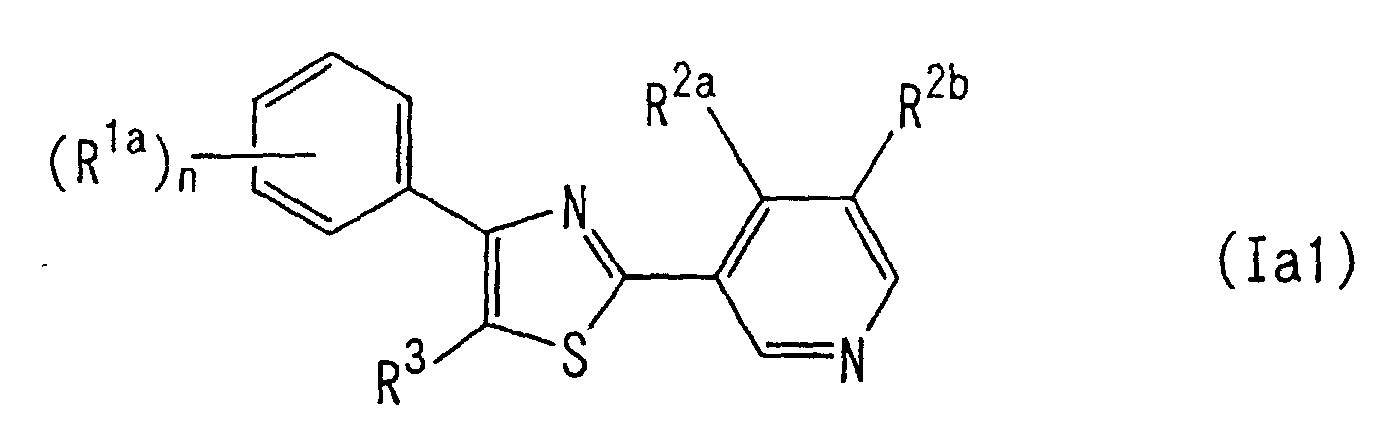
- n
- is an integer of 1 to 5,
- R1a
- is a sulfamoyl group optionally having substituents or an alkylsulfonyl group optionally having substituents, or two R1a substituting adjacent carbon atoms are bonded to designate a C1-2 alkylenedioxy group, and when n is not less than 2, R1a in the number of n may be the same or different,
- R2a and R2b
- are the same or different and each is 1) a hydrogen atom, 2) a C1-4 aliphatic hydrocarbon group optionally having substituents, 3) an optionally esterified carboxyl group, 4) a carbamoyl group optionally having substituents, 5) an amino group optionally having substituents, 6) a cyclic amino group, 7) an alkylthio group optionally having substituents or 8) an alkoxy group optionally having substituents, or R2a and R2b may be bonded to form 9) a saturated or unsaturated divalent C3-5 carbon chain, and
- R3
- is 1) a hydrogen atom, 2) a halogen atom, 3) a C1-4 aliphatic hydrocarbon group optionally having substituents or 4) an optionally esterified carboxyl group,

- n
- is an integer of 1 to 5,
- R1a
- is a sulfamoyl group optionally having substituents or an alkylsulfonyl group optionally having substituents, or two R1a substituting adjacent carbon atoms are bonded to designate a C1-2 alkylenedioxy group, and when n is not less than 2, R1a in the number of n may be the same or different,
- R2a and R2b
- are the same or different and each is 1) a hydrogen atom, 2) a C1-4 aliphatic hydrocarbon group optionally having substituents, 3) an optionally esterified carboxyl group, 4) a carbamoyl group optionally having substituents, 5) an amino group optionally having substituents, 6) a cyclic amino group, 7) an alkylthio group optionally having substituents or 8) an alkoxy group optionally having substituents, or R2a and R2b may be bonded to form 9) a saturated or unsaturated divalent C3-5 carbon chain, and
- R3
- is 1) a hydrogen atom, 2) a halogen atom, 3) a C1-4 aliphatic hydrocarbon group optionally having substituents or 4) an optionally esterified carboxyl group,

- n
- is an integer of 1 to 5,
- R1b
- is 1) a sulfamoyl group optionally having substituents, 2) a carbamoyl group optionally having substituents, 3) an alkyl group optionally having substituents, 4) an optionally esterified carboxyl group, 5) a halogen atom, 6) an amino group optionally having substituents, 7) a nitro group, 8) a hydroxy group optionally having substituents or 9) an alkylsulfonyl group optionally having substituents, or two R1b substituting adjacent carbon atoms are bonded to designate a C1-2 alkylenedioxy group, and when n is not less than 2, R1b in the number of n may be the same or different, and
- R3
- is 1) a hydrogen atom, 2) a halogen atom, 3) a C1-4 aliphatic hydrocarbon group optionally having substituents or 4) an optionally esterified carboxyl group,

- n
- is an integer of 1 to 5,
- R1b
- is 1) a sulfamoyl group optionally having substituents, 2) a carbamoyl group optionally having substituents, 3) an alkyl group optionally having substituents, 4) an optionally esterified carboxyl group, 5) a halogen atom, 6) an amino group optionally having substituents, 7) a nitro group, 8) a hydroxy group optionally having substituents or 9) an alkylsulfonyl group optionally having substituents, or two R1b substituting adjacent carbon atoms are bonded to designate a C1-2 alkylenedioxy group, and when n is not less than 2, R1b in the number of n may be the same or different, and
- R3
- is 1) a hydrogen atom, 2) a halogen atom, 3) a C1-4 aliphatic hydrocarbon group optionally having substituents or 4) an optionally esterified carboxyl group,

- m
- is an integer of 1 to 5,
- R2
- is 1) a hydrogen atom, 2) a C1-4 aliphatic hydrocarbon group optionally having substituents, 3) an optionally esterified carboxyl group, 4) a carbamoyl group optionally having substituents, 5) an amino group optionally having substituents, 6) a cyclic amino group 7) an alkylthio group optionally having substituents or 8) an alkoxy group optionally having substituents, or two R2 substituting adjacent carbon atoms may be bonded to form 9) a saturated or unsaturated divalent C3-5 carbon chain, and when m is not less than 2, R2 in the number of m may be the same or different, and
- R3
- is 1) a hydrogen atom, 2) a halogen atom, 3) a C1-4 aliphatic hydrocarbon group optionally having substituents or 4) an optionally esterified carboxyl group,

- m
- is an integer of 1 to 5,
- R2
- is 1) a hydrogen atom, 2) a C1-4 aliphatic hydrocarbon group optionally having substituents, 3) an optionally esterified carboxyl group, 4) a carbamoyl group optionally having substituents, 5) an amino group optionally having substituents, 6) a cyclic amino group, 7) an alkylthio group optionally having substituents or 8) an alkoxy group optionally having substituents, or two R2 substituting adjacent carbon atoms may be bonded to form 9) a saturated or unsaturated divalent C3-5 carbon chain, and when m is not less than 2, R2 in the number of m may be the same or different, and
- R3
- is 1) a hydrogen atom, 2) a halogen atom, 3) a C1-4 aliphatic hydrocarbon group optionally having substituents or 4) an optionally esterified carboxyl group,

- p
- is 0 or an integer of 1 to 5,
- Ra and Rb
- are the same or different and each is a hydrogen atom, a C1-6 lower alkyl group, or Ra and Rb may be bonded together with a nitrogen atom to form a ring,
- R1d
- is 1) a hydrogen atom, 2) a C1-4 aliphatic hydrocarbon group optionally having substituents, 3) a sulfamoyl group optionally having substituents, 4) a carbamoyl group optionally having substituents, 5) an optionally esterified carboxyl group, 6) a halogen atom, 7) an amino group optionally having substituents, 8) a cyclic amino group, 9) a hydroxy group optionally having substituents, 10) an alkylthio group optionally having substituents, 11) a nitro group, 12) an alkylsulfonyl group optionally having substituents, or 13) two R1d substituting adjacent carbon atoms may be bonded to form 13a) a C1-2 alkylenedioxy group or 13b) a saturated or unsaturated divalent C3-5 carbon chain, and when p is not less than 2, R1d in the number of p may be the same or different, and
- R3
- is 1) a hydrogen atom, 2) a halogen atom, 3) a C1-4 aliphatic hydrocarbon group optionally having substituents or 4) an optionally esterified carboxyl group,
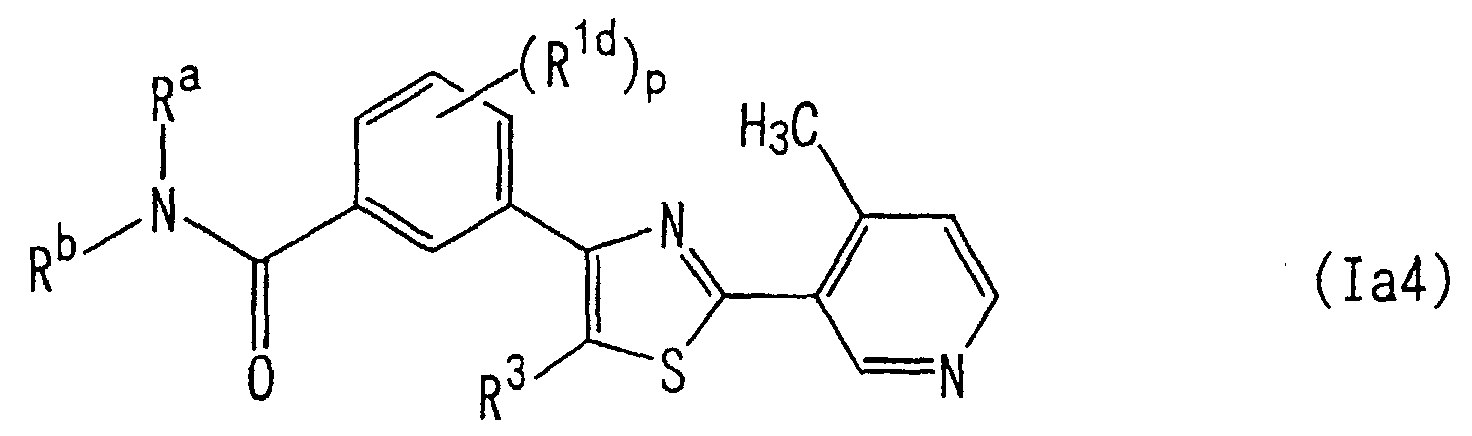
- p
- is 0 or an integer of 1 to 5,
- Ra and Rb
- are the same or different and each is a hydrogen atom, a C1-6 lower alkyl group, or Ra and Rb may be bonded together with a nitrogen atom to form a ring,
- R1d
- is 1) a hydrogen atom, 2) a C1-4 aliphatic hydrocarbon group optionally having substituents, 3) a sulfamoyl group optionally having substituents, 4) a carbamoyl group optionally having substituents, 5) an optionally esterified carboxyl group, 6) a halogen atom, 7) an amino group optionally having substituents, 8) a cyclic amino group, 9) a hydroxy group optionally having substituents, 10) an alkylthio group optionally having substituents, 11) a nitro group, 12) an alkylsulfonyl group optionally having substituents, or 13) two R1d substituting adjacent carbon atoms may be bonded to form 13a) a C1-2 alkylenedioxy group or 13b) a saturated or unsaturated divalent C3-5 carbon chain, and when p is not less than 2, R1d in the number of p may be the same or different, and
- R3
- is 1) a hydrogen atom, 2) a halogen atom, 3) a C1-4 aliphatic hydrocarbon group optionally having substituents or 4) an optionally esterified carboxyl group,

- n
- is an integer of 1 to 5,
- R1c
- is a carbamoyl group optionally having substituents or an alkylsulfonyl group optionally having substituents, or two R1c substituting adjacent carbon atoms are bonded to designate a C1-2 alkylenedioxy group, and when n is not less than 2, R1c in the number of n are the same or different, m is an integer of 1 to 5,
- R2
- is 1) a hydrogen atom, 2) a C1-4 aliphatic hydrocarbon group optionally having substituents, 3) an optionally esterified carboxyl group, 4) a carbamoyl group optionally having substituents, 5) an amino group optionally having substituents, 6) a cyclic amino group, 7) an alkylthio group optionally having substituents or 8) an alkoxy group optionally having substituents, or two R2 substituting adjacent carbon atoms may be bonded to form 9) a saturated or unsaturated divalent C3-5 carbon chain, and when m is not less than 2, R2 in the number of m may be the same or different, and
- R3
- is 1) a hydrogen atom, 2) a halogen atom, 3) a C1-4 aliphatic hydrocarbon group optionally having substituents or 4) an optionally esterified carboxyl group,

- n
- is an integer of 1 to 5,
- R1c
- is a carbamoyl group optionally having substituents or an alkylsulfonyl group optionally having substituents, or two R1c substituting adjacent carbon atoms are bonded to designate a C1-2 alkylenedioxy group, and when n is not less than 2, R1c in the number of n are the same or different, m is an integer of 1 to 5,
- R2
- is 1) a hydrogen atom, 2) a C1-4 aliphatic hydrocarbon group optionally having substituents, 3) an optionally esterified carboxyl group, 4) a carbamoyl group optionally having substituents, 5) an amino group optionally having substituents, 6) a cyclic amino group, 7) an alkylthio group optionally having substituents or 8) an alkoxy group optionally having substituents, or two R2 substituting adjacent carbon atoms may be bonded to form 9) a saturated or unsaturated divalent C3-5 carbon chain, and when m is not less than 2, R2 in the number of m may be the same or different, and
- R3
- is 1) a hydrogen atom, 2) a halogen atom, 3) a C1-4 aliphatic hydrocarbon group optionally having substituents or 4) an optionally esterified carboxyl group,
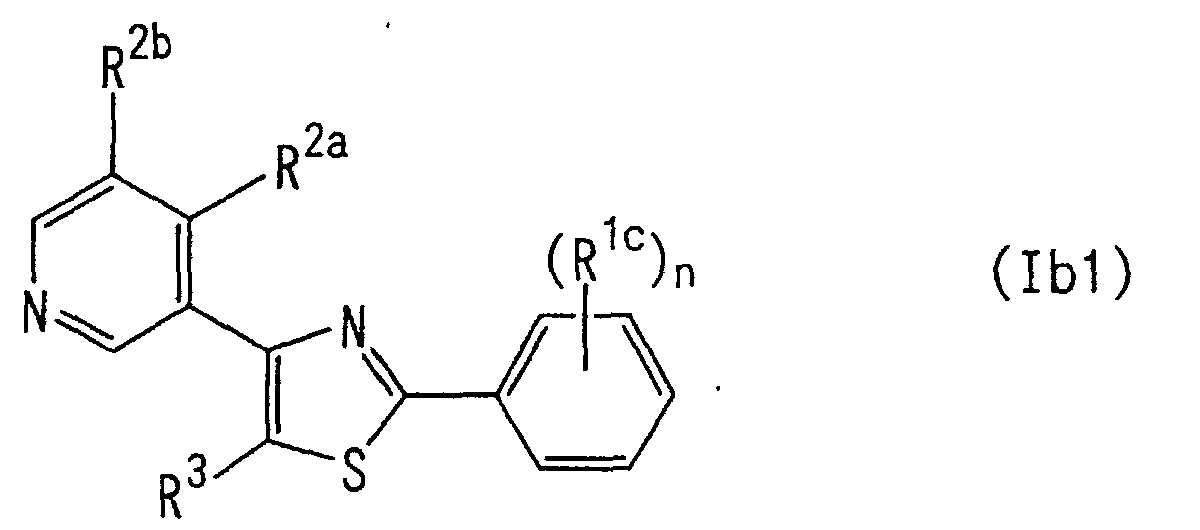
- n
- is an integer of 1 to 5,
- R1c
- is a carbamoyl group optionally having substituents or an alkylsulfonyl group optionally having substituents, or two R1c substituting adjacent carbon atoms are bonded to designate a C1-2 alkylenedioxy group, and when n is not less than 2, R1c in the number of n are the same or different,
- R2a and R2b
- are the same or different and each is 1) a hydrogen atom, 2) a C1-4 aliphatic hydrocarbon group optionally having substituents, 3) an optionally esterified carboxyl group, 4) a carbamoyl group optionally having substituents, 5) an amino group optionally having substituents, 6) a cyclic amino group, 7) an alkylthio group optionally having substituents or 8) an alkoxy group optionally having substituents, or R2a and R2b may be bonded to form 9) a saturated or unsaturated divalent C3-5 carbon chain, and
- R3
- is 1) a hydrogen atom, 2) a halogen atom, 3) a C1-4 aliphatic hydrocarbon group optionally having substituents or 4) an optionally esterified carboxyl qroup,

- n
- is an integer of 1 to 5,
- R1c
- is a carbamoyl group optionally having substituents or an alkylsulfonyl group optionally having substituents, or two R1c substituting adjacent carbon atoms are bonded to designate a C1-2 alkylenedioxy group, and when n is not less than 2, R1c in the number of n are the same or different,
- R2a and R2b
- are the same or different and each is 1) a hydrogen atom, 2) a C1-4 aliphatic hydrocarbon group optionally having substituents, 3) an optionally esterified carboxyl group, 4) a carbamoyl group optionally having substituents, 5) an amino group optionally having substituents, 6) a cyclic amino group, 7) an alkylthio group optionally having substituents or 8) an alkoxy group optionally having substituents, or R2a and R2b may be bonded to form 9) a saturated or unsaturated divalent C3-5 carbon chain, and
- R3
- is 1) a hydrogen atom, 2) a halogen atom, 3) a C1-4 aliphatic hydrocarbon group optionally having substituents or 4) an optionally esterified carboxyl group,

- n
- is an integer of 1 to 5,
- R1b
- is 1) a sulfamoyl group optionally having substituents, 2) a carbamoyl group optionally having substituents, 3) an alkyl group optionally having substituents, 4) an optionally esterified carboxyl group, 5) a halogen atom 6) an amino group optionally having substituents, 7) a nitro group, 8) a hydroxy group optionally having substituents or 9) an alkylsulfonyl group optionally having substituents, or two R1b substituting adjacent carbon atoms are bonded to designate a C1-2 alkylenediox group, and when n is not less than 2, R1b in the number of n may be the same or different, and
- R3
- is 1) a hydrogen atom, 2) a halogen atom, 3) a C1-4 aliphatic hydrocarbon group optionally having substituents or 4) an optionally esterified carboxyl group,
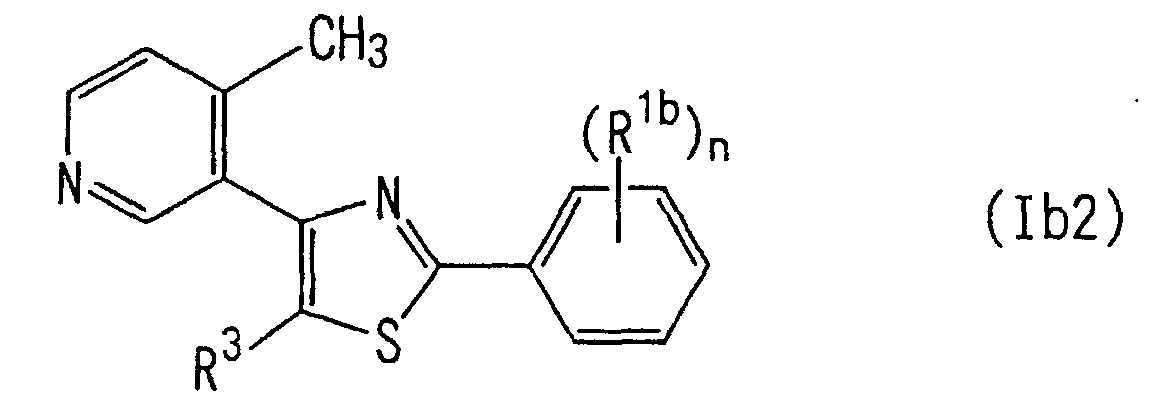
- n
- is an integer of 1 to 5,
- R1b
- is 1) a sulfamoyl group optionally having substituents, 2) a carbamoyl group optionally having substituents, 3) an alkyl group optionally having substituents, 4) an optionally esterified carboxyl group, 5) a halogen atom, 6) an amino group optionally having substituents, 7) a nitro group, 8) a hydroxy group optionally having substituents or 9) an alkylsulfonyl group optionally having substituents, or two R1b substituting adjacent carbon atoms are bonded to designate a C1-2 alkylenedioxy group, and when n is not less than 2, R1b in the number of n may be the same or different, and
- R3
- is 1) a hydrogen atom, 2) a halogen atom, 3) a C1-4 aliphatic hydrocarbon group optionally having substituents or 4) an optionally esterified carboxyl group,

- m
- is an integer of 1 to 5,
- R2
- is 1) a hydrogen atom, 2) a C1-4 aliphatic hydrocarbon group optionally having substituents, 3) an optionally esterified carboxyl group, 4) a carbamoyl group optionally having substituents, 5) an amino group optionally having substituents, 6) a cyclic amino group, 7) an alkylthio group optionally having substituents or 8) an alkoxy group optionally having substituents, or two R2 substituting adjacent carbon atoms are bonded to form 9) a saturated or unsaturated divalent C3-5 carbon chain, and when m is not less than 2, R2 in the number of m may be the same or different, and
- R3
- is 1) a hydrogen atom, 2) a halogen atom, 3) a C1-4 aliphatic hydrocarbon group optionally having substituents or 4) an optionally esterified carboxyl group,

- m
- is an integer of 1 to 5,
- R2
- is 1) a hydrogen atom, 2) a C1-4 aliphatic hydrocarbon group optionally having substituents, 3) an optionally esterified carboxyl group, 4) a carbamoyl group optionally having substituents, 5) an amino group optionally having substituents, 6) a cyclic amino group, 7) an alkylthio group optionally having substituents or 8) an alkoxy group optionally having substituents, or two R2 substituting adjacent carbon atoms are bonded to form 9) a saturated or unsaturated divalent C3-5 carbon chain, and when m is not less than 2, R2 in the number of m may be the same or different, and
- R3
- is 1) a hydrogen atom, 2) a halogen atom, 3) a C1-4 aliphatic hydrocarbon group optionally having substituents or 4) an optionally esterified carboxyl group,

- p
- is 0 or an integer of 1 to 5,
- Ra and Rb
- are the same or different and each is a hydrogen atom or a C1-6 lower alkyl group, or Ra and Rb may be bonded together with a nitrogen atom to form a ring,
- R1d
- is 1) a hydrogen atom, 2) a C1-4 aliphatic hydrocarbon group optionally having substituents, 3) a sulfamoyl group optionally having substituents, 4) a carbamoyl group optionally having substituents, 5) an optionally esterified carboxyl group, 6) a halogen atom, 7) an amino group optionally having substituents, 8) a cyclic amino group, 9) a hydroxy group optionally having substituents, 10) an alkylthio group optionally having substituents, 11) a nitro group, 12) an alkylsulfonyl group optionally having substituents, or 13) two R1d substituting adjacent carbon atoms may be bonded to form 13a) a C1-2 alkylenedioxy group or 13b) a saturated or unsaturated divalent C3-5 carbon chain, and when p is not less than 2, R1d in the number of p may be the same or different, and
- R3
- is 1) a hydrogen atom, 2) a halogen atom, 3) a C1-4 aliphatic hydrocarbon group optionally having substituents or 4) an optionally esterified carboxyl group,
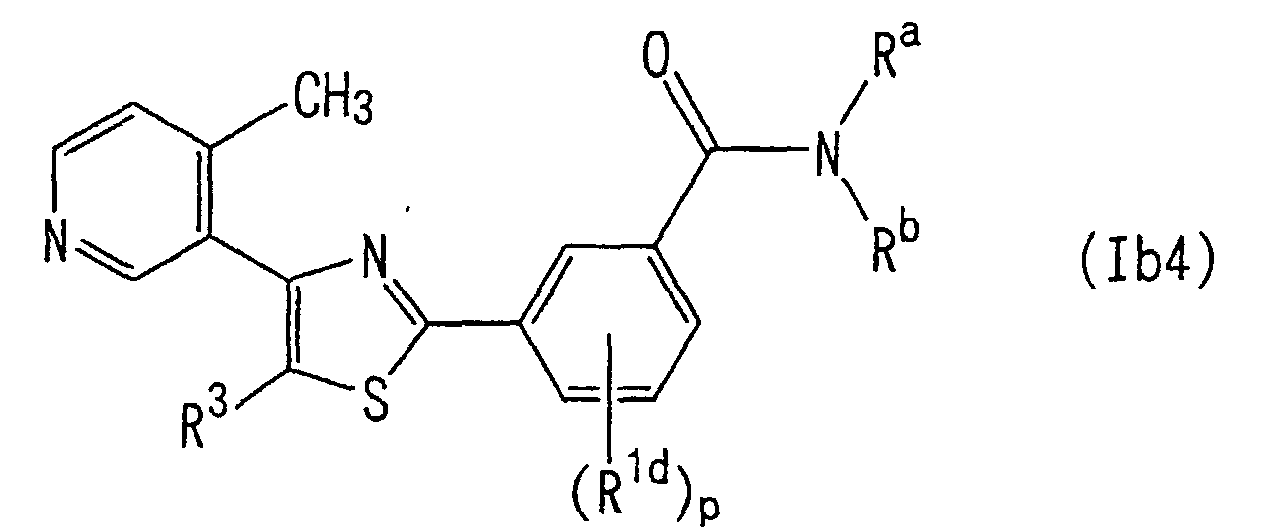
- p
- is 0 or an integer of 1 to 5,
- Ra and Rb
- are the same or different and each is a hydrogen atom or a C1-6 lower alkyl group, or Ra and Rb may be bonded together with a nitrogen atom to form a ring,
- R1d
- is 1) a hydrogen atom, 2) a C1-4 aliphatic hydrocarbon group optionally having substituents, 3) a sulfamoyl group optionally having substituents, 4) a carbamoyl group optionally having substituents, 5) an optionally esterified carboxyl group, 6) a halogen atom, 7) an amino group optionally having substituents, 8) a cyclic amino group, 9) a hydroxy group optionally having substituents, 10) an alkylthio group optionally having substituents, 11) a nitro group, 12) an alkylsulfonyl group optionally having substituents, or 13) two R1d substituting adjacent carbon atoms may be bonded to form 13a) a C1-2 alkylenedioxy group or 13b) a saturated or unsaturated divalent C3-5 carbon chain, and when p is not less than 2, R1d in the number of p may be the same or different, and
- R3
- is 1) a hydrogen atom, 2) a halogen atom, 3) a C1-4 aliphatic hydrocarbon group optionally having substituents or 4) an optionally esterified carboxyl group,
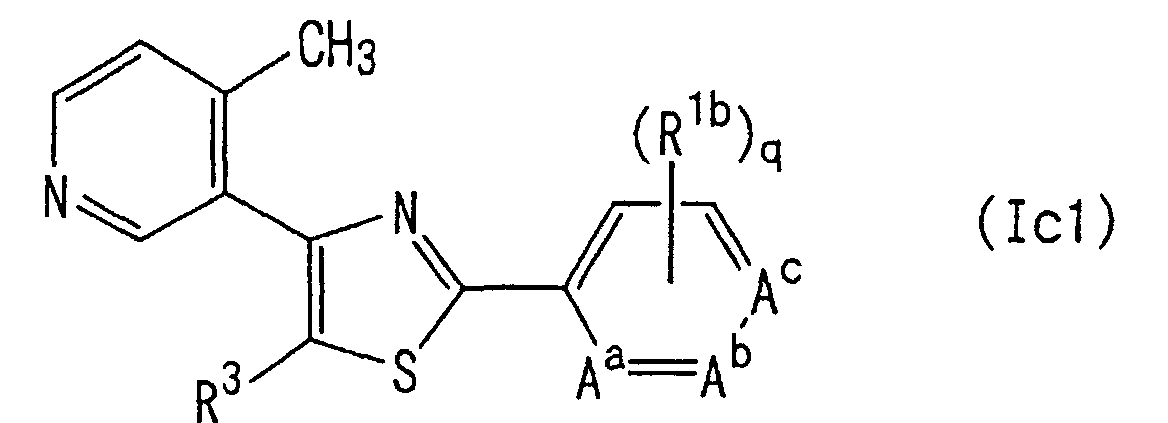
- q
- is 0 or an integer of 1 to 5,
- R1b
- is 1) a sulfamoyl group optionally having substituents, 2) a carbamoyl group optionally having substituents, 3) an alkyl group optionally having substituents, 4) an optionally esterified carboxyl group, 5) a halogen atom, 6) an amino group optionally having substituents, 7) a nitro group, 8) a hydroxy group optionally having substituents or 9) an alkylsulfonyl group optionally having substituents, or 10) two R1b substituting adjacent carbon atoms are bonded to designate a C1-2 alkylenedioxy group, and when q is not less than 2, R1b in the number of q may be the same or different,
- R3
- is 1) a hydrogen atom, 2) a halogen atom, 3) a C1-4 aliphatic hydrocarbon group optionally having substituents or 4) an optionally esterified carboxyl group, and
- Aa, Ab and Ac
- are the same or different and each is a nitrogen atom or a methine group,
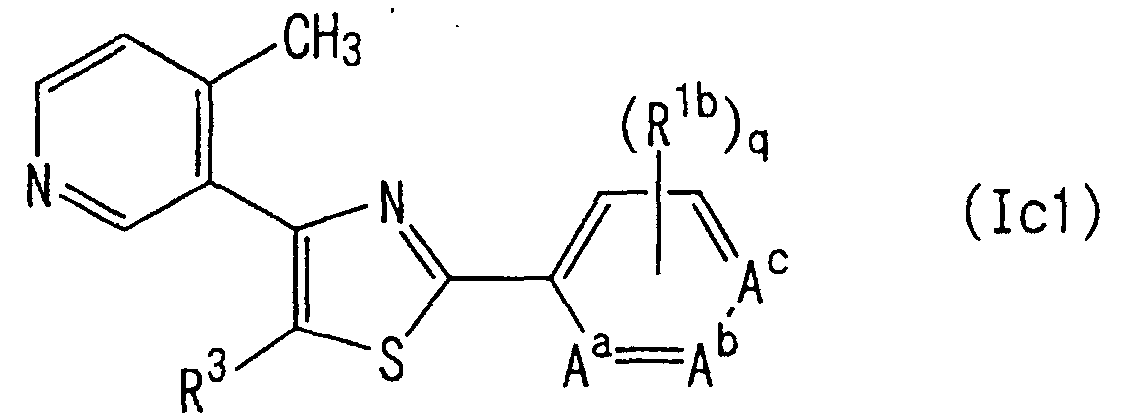
- q
- is 0 or an integer of 1 to 5,
- R1b
- is 1) a sulfamoyl group optionally having substituents, 2) a carbamoyl group optionally having substituents, 3) an alkyl group optionally having substituents, 4) an optionally esterified carboxyl group, 5) a halogen atom, 6) an amino group optionally having substituents, 7) a nitro group, 8) a hydroxy group optionally having substituents or 9) an alkylsulfonyl group optionally having substituents, or 10) two R1b substituting adjacent carbon atoms are bonded to designate a C1-2 alkylenedioxy group, and when q is not less than 2, R1b in the number of q may be the same or different,
- R3
- is 1) a hydrogen atom, 2) a halogen atom, 3) a C1-4 aliphatic hydrocarbon group optionally having substituents or 4) an optionally esterified carboxyl group, and
- Aa, Ab and Ac
- are the same or different and each is a nitrogen atom or a methine group,

- q
- is 0 or an integer of 1 to 5,
- R1b
- is 1) a sulfamoyl group optionally having substituents, 2) a carbamoyl group optionally having substituents, 3) an alkyl group optionally having substituents, 4) an optionally esterified carboxyl group, 5) a halogen atom, 6) an amino group optionally having substituents, 7) a nitro group, 8) a hydroxy group optionally having substituents or 9) an alkylsulfonyl group optionally having substituents, or 10) two R1b substituting adjacent carbon atoms are bonded to designate a C1-2 alkylenedioxy group, and when q is not less than 2, R1b in the number of q are the same or different,
- R3
- is 1) a hydrogen atom, 2) a halogen atom, 3) a C1-4 aliphatic hydrocarbon group optionally having substituents or 4) an optionally esterified carboxyl group, and
- Aa, Ab and Ac
- are the same or different and each is a nitrogen atom or a methine group,
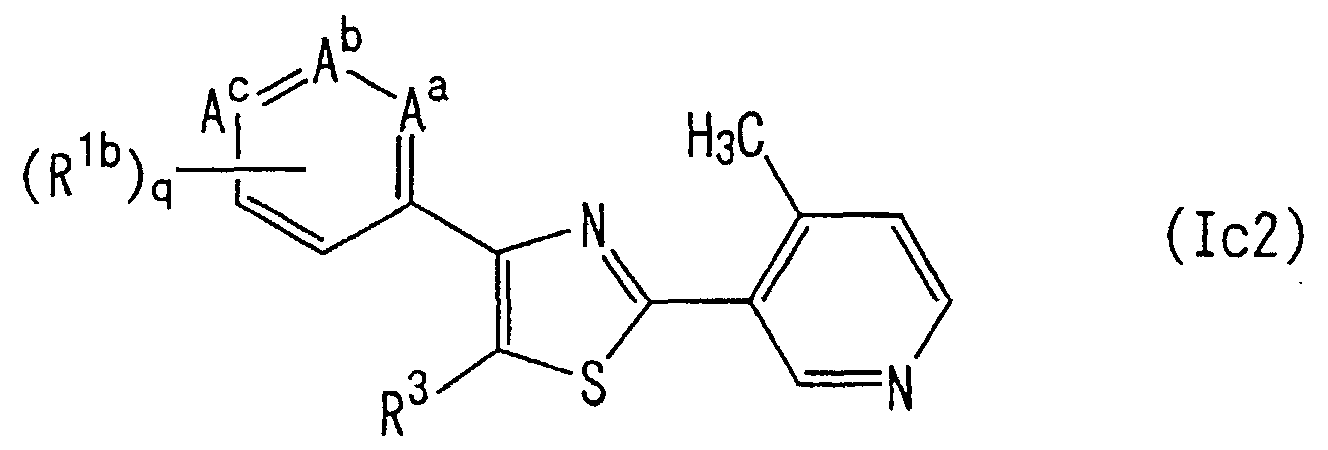
- q
- is 0 or an integer of 1 to 5,
- R1b
- is 1) a sulfamoyl group optionally having substituents, 2) a carbamoyl group optionally having substituents, 3) an alkyl group optionally having substituents, 4) an optionally esterified carboxyl group, 5) a halogen atom, 6) an amino group optionally having substituents, 7) a nitro group, 8) a hydroxy group optionally having substituents or 9) an alkylsulfonyl group optionally having substituents, or 10) two R1b substituting adjacent carbon atoms are bonded to designate a C1-2 alkylenedioxy group, and when q is not less than 2, R1b in the number of q are the same or different,
- R3
- is 1) a hydrogen atom, 2) a halogen atom, 3) a C1-4 aliphatic hydrocarbon group optionally having substituents or 4) an optionally esterified carboxyl group, and
- Aa, Ab and Ac
- are the same or different and each is a nitrogen atom or a methine group,


s: singlet, d: doublet, t: triplet, q: quartet, dd: double doublet, dt: double triplet, m: multiplet, br: broad, J: coupling constant, room temperature:20 - 30°C, DMF: dimethylformamide, THF: tetrahydrofuran.
| elemental analysis for C10H11OBr | ||
| C(%) | H(%) | |
| Calculated | 52.89; | 4.88 |
| Found | 52.69; | 4.90 |

| elemental analysis for C21H21NO3SBr | |||
| C(%) | H(%) | N(%) | |
| Calculated | 56.38; | 4.73; | 3.13 |
| Found | 56.61; | 4.85; | 3.40 |
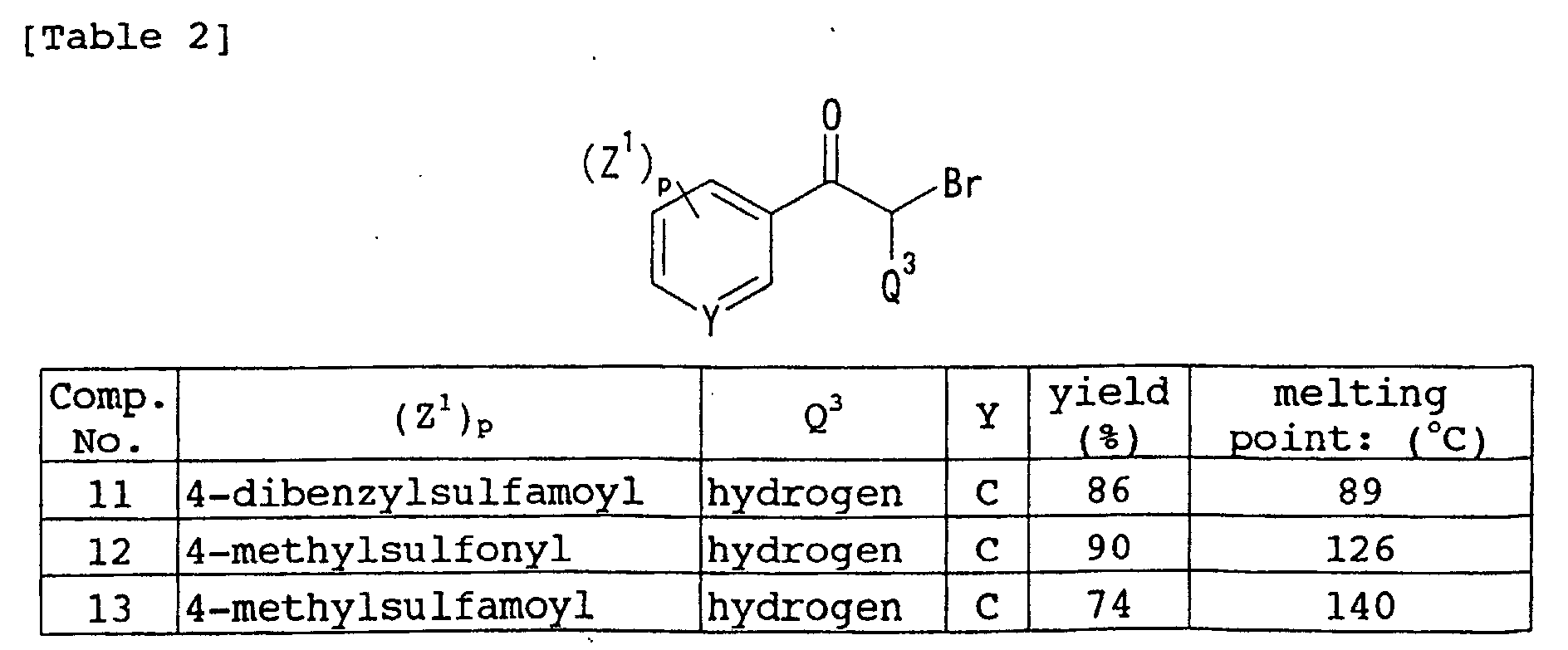
sublimability
| elemental analysis for C7H6N2 | |||
| C(%) | H(%) | N(%) | |
| Calculated | 71.17; | 5.12; | 23.71 |
| Found | 71.19; | 5.40; | 23.88 |
1H-NMR (200HZ, CDCl3) δ: 2.57 (3H, s), 2.65 (3H, s), 7.20 (1H, d, J = 5.2 Hz), 8.55 (1H, d, J = 5.2 Hz), 8.95 (1H, s).
melting point: 228°C
1H-NMR (200Hz, DMSO-d6) δ: 5.08 (2H, s), 7.93 (1H, dd, J = 8.0 Hz, 5.6 Hz), 8.69 (1H, d, J = 8.0 Hz), 8.99 (1H, d, J = 5.6 Hz), 9.33 (1H, s).

1H-NMR (200Hz, CDCl3) δ: 7.45 (1H, d, J = 5.0 Hz), 8.69 (1H, d, J = 5.0Hz), 9.05 (1H, s), 10.51 (1H, S).
1H-NMR (200Hz, CDCl3) δ: 7.52 (1H, d, J = 5.0 Hz), 8.72 (1H, d, J = 5.0Hz), 8.87 (1H, s).
| elemental analysis for C7H8N2O | |||
| C(%) | H(%) | N(%) | |
| Calculated | 62.68; | 4.51; | 20.88 |
| Found | 62.74; | 4.69; | 20.59 |
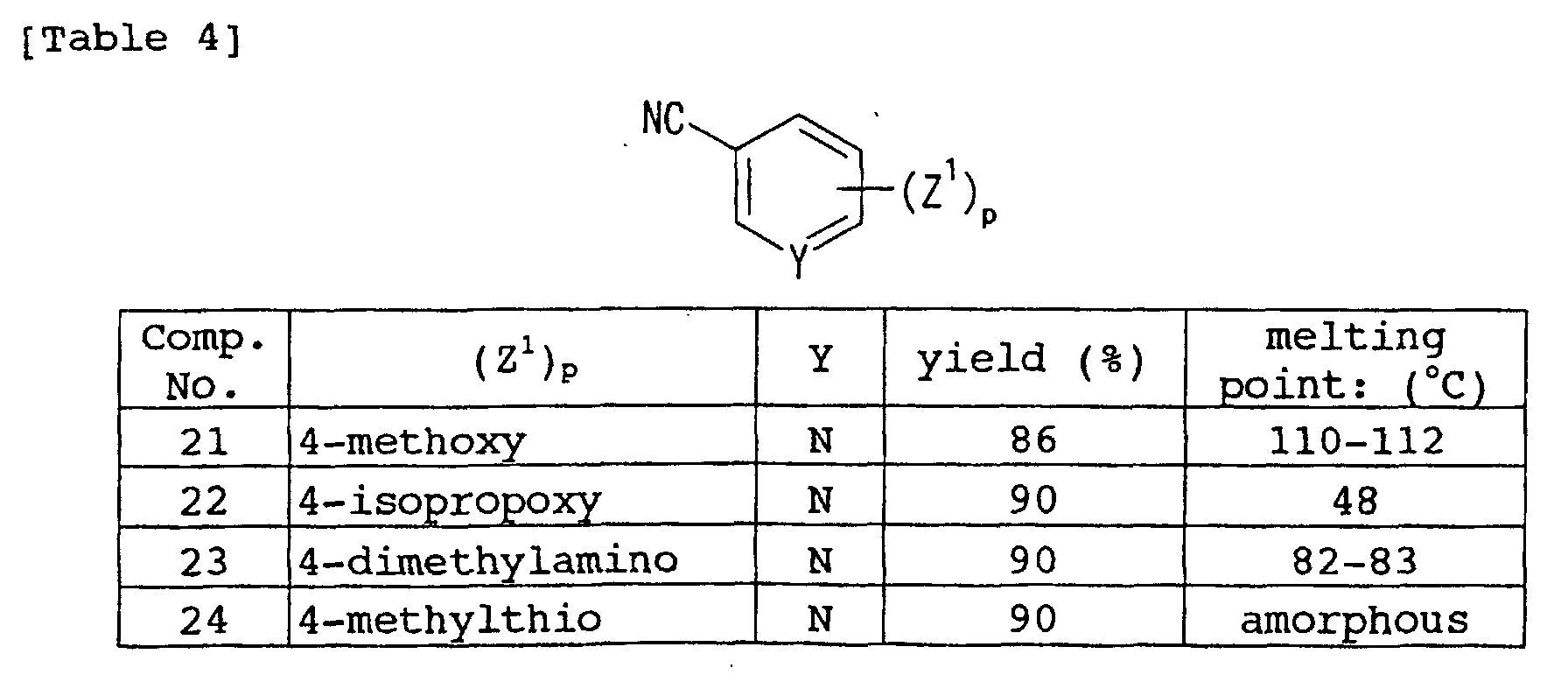
melting point: 56-57°C
1H-NMR (200Hz, CDCl3) δ: 5.80 (1H, d, J = 11.0 Hz), 6.21 (1H, d, J = 17.6 Hz), 7.02 (1H, dd, J = 11.0 Hz, 17.6 Hz), 7.54 (1H, d, J = 5.6 Hz), 8.73 (1H, d, J = 5.6 Hz), 8.85 (1H, s).
1H-NMR (200Hz, CDCl3) δ: 1.34 (3H, t, J = 7.6 Hz), 2.89 (2H, q, J = 7.6 Hz), 7.30 (1H, d, J = 5.6 Hz), 8.68 (1H, d, J = 5.6 Hz), 8.80 (1H, s).
| elemental analysis for C7H8N2S | |||
| C(%) | H(%) | N(%) | |
| Calculated | 55.24; | 5.30; | 18.40 |
| Found | 55.38; | 5.42; | 18.43 |

1H-NMR (200Hz, CDCl3) δ: 7.39 (2H, d, J = 8.8 Hz), 7.41 (1H, s), 7.80 (1H, d, J = 5.6 Hz).
melting point: 230-233°C
1H-NMR (200Hz, CDCl3) δ: 6.28 (1H, s), 7.37 (2H, d, J=7.0Hz), 7.52 (2H, d, J =7.0 Hz), 11.46 (1H, brs).
melting point: 149-150°C
1H-NMR (200Hz, CDCl3) δ: 7.17 (1H, s), 7.49 (2H, d, J=8.0Hz), 7.63 - 7.67 (1H, m), 7.84 (2H, d, J =8.0 Hz), 8.59 (1H, d, J=6.0Hz), 9.11 (1H, s).
melting point: 148-150°C
1H-NMR (200Hz, CDCl3) δ: 2.33 (3H, s), 2.47 (3H, s), 2.83 (3H, s), 7.10-7.17 (2H, m), 7.59 (1H, d, J=7.6Hz), 7.96 (1H, d, J =5.8 Hz), 8.10(1H, s), 8.79 (1H, d, J =5.8 Hz), 9.22 (1H, s).
[Table 6]
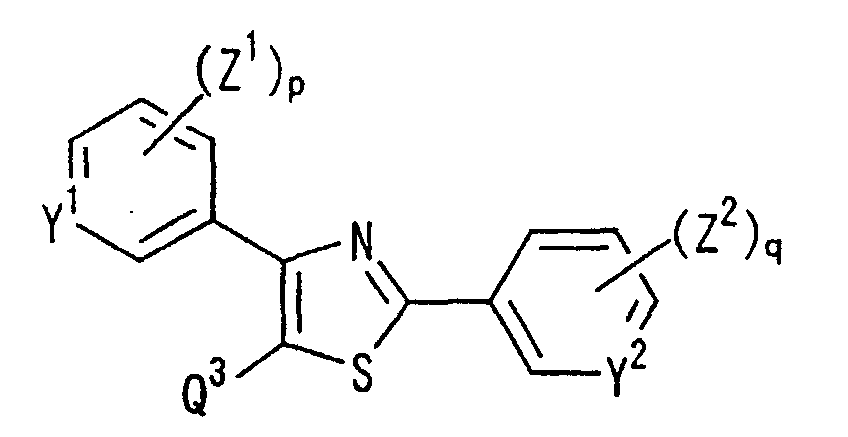
| Comp. No. | (Z1)p | Q3 | (Z2)q | Y1 | Y2 | salt | yield (%) | melting point: (°C) |
| 45 | 4-phenyl | hydrogen | hydrogen | C | N | HBr | 82 | 238-241 |
| 46 | 4-nitro | hydrogen | hydrogen | C | N | HBr | 92 | 267-271 |
| 47 | 4-bromo | hydrogen | hydrogen | C | N | HBr | 71 | 213-216 |
| 48 | 3-nitro | hydrogen | hydrogen | C | N | HBr | 91 | 238-241 |
| 49 | 3-methoxy | hydrogen | hydrogen | C | N | HBr | 83 | 231-233 |
| 50 | 2-methoxy | hydrogen | hydrogen | C | N | HBr | 81 | 242-243 |
| 51 | 2,4-dimethoxy | hydrogen | hydrogen | C | N | HBr | 70 | 224-225 |
| 52 | 4-phenyl | hydrogen | 4-trifluoromethyl | C | N | 83 | 94-95 | |
| 53 | 4-bromo | hydrogen | 4-trifluoromethyl | C | N | 93 | 69-71 | |
| 54 | 2,5-dimethoxy | hydrogen | hydrogen | C | N | HBr | 79 | 223-226 |
| 55 | 4-diethylamino | hydrogen | hydrogen | C | N | 65 | 76-77 | |
| 56 | 2,4-dimethyl | hydrogen | hydrogen | C | N | HCl | 78 | 152 |
| 57 | 2,4-dimethyl | hydrogen | 4-trifluoromethyl | C | N | HBr | 33 | 152 |
| 58 | 4-fluoro | hydrogen | 4-trifluoromethyl | C | N | 81 | 52-53 |
| Comp. No. | (Z1)p | Q3 | (Z2)q | Y1 | Y2 | salt | yield (%) | melting point: (°C) |
| 59 | 4-nitro | hydrogen | 4-trifluoromethyl | C | N | HBr | 80 | 165-167 |
| 60 | 3-nitro | hydrogen | 4-trifluoromethyl | C | N | HBr | 70 | 178-183 |
| 61 | 3-methoxy | hydrogen | 4-trifluoromethyl | C | N | HBr | 70 | 140-145 |
| 62 | 2-methoxy | hydrogen | 4-trifluoromethyl | C | N | HBr | 42 | 176-180 |
| 63 | 4-methyl | hydrogen | 4-trifluoromethyl | C | N | HBr | 58 | 184 |
| 64 | 4-methoxy | hydrogen | 4-trifluoromethyl | C | N | HCl | 40 | 93-95 |
| 65 | 3-chloro | hydrogen | 4-trifluoromethyl | C | N | HBr | 65 | 140-143 |
| 66 | 2-chloro | hydrogen | 4-trifluoromethyl | C | N | HCl | 82 | 87-90 |
| 67 | 3,4-dimethyl | hydrogen | 4-trifluoromethyl | C | N | HBr | 47 | 123 |
| 68 | 4-hydroxy | hydrogen | 4-trifluoromethyl | C | N | 40 | 117-119 | |
| 69 | 4-ethoxycarbonyl | hydrogen | 4-trifluoromethyl | C | N | HBr | 69 | 168-170 |
| 70 | 4-diethylamino | hydrogen | 4-trifluoromethyl | C | N | HCl | 91 | 105-110 |
| 71 | 3-methylcarbamoyl | hydrogen | 4-trifluoromethyl | C | N | 89 | 132-133 |
| comp. No. | (Z1)p | Q3 | (Z2)q | Y1 | Y2 | salt | yield (%) | melting point: (°C) |
| 72 | 4-trifluoromethyl | hydrogen | 4-trifluoromethyl . | C | N | HBr | 60 | 144-145 |
| 73 | 3,4-butadienylene | hydrogen | 4-trifluoromethyl | C | N | HBr | 77 | 107 |
| 74 | 4-chloro | hydrogen | 4-methyl | C | N | 38 | 119 | |
| 75 | hydrogen | methyl | 4-trifluoromethyl | C | N | 34 | 75 | |
| 76 | 2,5-dimethoxy | hydrogen | 4-trifluoromethyl | C | N | HBr | 52 | 154-157 |
| 77 | 2,4-dimethoxy | hydrogen | 4-trifluoromethyl | C | N | HBr | 46 | 157-160 |
| 78 | 4-fluoro | hydrogen | 4-methyl | C | N | 44 | 129 | |
| 79 | 4-fluoro | hydrogen | 4-trifluoromethyl | C | N | HCl | 67 | 100-102 |
| 80 | hydrogen | methyl | 4,5-butadienylene | C | N | 47 | amorphous | |
| 81 | hydrogen | methyl | hydrogen | N | N | 31 | 146-147 | |
| 82 | hydrogen | hydrogen | 4-trifluoromethyl | C | N | HBr | 36 | 150-152 |
| 83 | 3,4-dichloro | hydrogen | 4-trifluoromethyl | C | N | HBr | 41 | 146-148 |
| 84 | 4-fluoro | hydrogen | 4-methoxy | C | N | 17 | 184 | |
| 85 | 2,4-dimethyl | hydrogen | 4-methoxy | C | N | HCl | 16 | 154 |
| 86 | hydrogen | methyl | 4-methyl | C | N | 13 | 65 | |
| 87 | hydrogen | methyl | hydrogen | C | N | 24 | 80 | |
| 88 | 4-hydroxy | hydrogen | C | N | 72 | 218 |
| Comp. No. | (Z1)p | Q3 | (Z2)q | Y1 | Y2 | salt | yield (%) | melting point: (°C) |
| 89 | 4-methylsulfamoyl | hydrogen | 4,5-butadienylene | C | N | 24 | amorphous | |
| 90 | 3,4-ethylenedioxy | hydrogen | 4-trifluoromethyl | C | N | HBr | 54 | 148-150 |
| 91 | 4-fluoro | methyl | 4-trifluoromethyl | C | N | HCl | 16 | 84 |
| 92 | 4-fluoro | methyl | 4-methyl | C | N | 21 | 82 | |
| 93 | 2-fluoro | hydrogen | 4-trifluoromethyl | C | N | HBr | 81 | 155-158 |
| 94 | 3-fluoro | hydrogen | 4-trifluoromethyl | C | N | HBr | 64 | 160-163 |
| 95 | 4-acetoxy | hydrogen | 4-trifluoromethyl | C | N | 97 | 116-118 | |
| 96 | 2,4-bis-trifluoromethyl | hydrogen | 4-trifluoromethyl | C | N | HCl | 67 | 102-103 |
| 97 | 3,4-ethylenedioxy | hydrogen | 4-methoxy | C | N | 52 | 152 | |
| 98 | hydrogen | ethoxycarbonyl | 4-trifluoromethyl | C | N | 46 | oil | |
| 99 | 4-fluoro | methyl | hydrogen | C | N | 31 | 136 | |
| 100 | 4-fluoro | hydrogen | dimethylamino | C | N | 2HCl | 78 | 189-192 |
| 101 | 4-fluoro | hydrogen | 4-methylthio | C | N | HCl | 64 | 195-199 |
| 102 | hydrogen | hydrogen | 4-trifluoromethyl | N | N | 2HCl | 76 | 171-173 |
| Comp. No. | (Z1)p | Q3 | (Z2)q | Y1 | Y2 | salt | yield (%) | melting point: (°C) |
| 103 | 4-methyl | hydrogen | 4-methyl | C | N | 65 | 98 | |
| 104 | 2-methoxy | hydrogen | 4-methyl | C | N | 28 | 106 | |
| 105 | 3,4-ethylenedioxy | hydrogen | 4-methyl | C | N | 58 | 87 | |
| 106 | 2,4-dimethoxy | hydrogen | 4-methyl | C | N | 22 | 88 | |
| 107 | 3,4-dimethyl | hydrogen | 4-methyl | C | N | 53 | 78 | |
| 108 | 2,4-difluoro | hydrogen | 4-methyl | C | N | 21 | 89 | |
| 109 | 2,4-bis-trifluoromethyl | hydrogen | 4-methyl | C | N | HCl | 27 | 155 |
| 110 | 3-methoxy | hydrogen | 4-methyl | C | N | 35 | amorphous | |
| 111 | 3-nitro | hydrogen | 4-methyl | C | N | 61 | 149 | |
| 112 | 4-ethoxycarbonyl | hydrogen | 4-methyl | C | N | 62 | 116 | |
| 113 | 3-fluoro | hydrogen | 4-methyl | C | N | 37 | 136 | |
| 114 | 2-chloro | hydrogen | 4-methyl | C | N | HCl | 44 | 136 |
| 115 | 4-trifluoromethyl | hydrogen | 4-methyl | C | N | HBr | 48 | 128 |
| 116 | 4-fluoro | hydrogen | 4-ethyl | C | N | HBr | 74 | 233-235 |
| 117 | 4-fluoro | hydrogen | 4-(benzylmethyl)amino | C | N | 2HCl | 64 | 204-205 |
| Comp. No. | (Z1)p | Q3 | (Z2)q | Y1 | Y2 | salt | yield (%) | melting point: (°C) |
| 118 | 4-dibenzylsulfamoyl | hydrogen | 4-trifluoromethyl | C | N | 74 | 130 | |
| 119 | 4-dibenzylsulfamoyl | hydrogen | 4-methyl | C | N | 45 | 160 | |
| 120 | 3-acetylamino | hydrogen | 4-trifluoromethyl | C | N | HCl | 70 | 154-155 |
| 121 | hydrogen | hydrogen | 4-methyl | N | N | 32 | 110 | |
| 122 | 4-methylsulfamoyl | hydrogen | 4-trifluoromethyl | C | N | 63 | 197 | |
| 123 | 4-methylsulfamoyl | hydrogen | 4-methyl | C | N | 46 | 164 | |
| 124 | 4-fluoro | hydrogen | 4-isopropoxy | C | N | 64 | 114 | |
| 125 | 4-methylsulfonyl | hydrogen | 4-methyl | C | N | 51 | 167 | |
| 126 | 2-fluoro | methyl | 4-methyl | C | N | 39 | 95 | |
| 127 | 3,4-butadienylene | hydrogen | 4-methyl | C | N | 63 | 116 | |
| 128 | 3-methoxy | hydrogen | 4-isopropoxy | C | N | 55 | 74-76 | |
| 129 | hydrogen | hydrogen | hydrogen | N | N | HBr | 64 | 195-198 |
| 130 | 4-methylsulfamoyl | hydrogen | hydrogen | C | N | HCl | 58 | 211-213 |
| 131 | 4-methylsulfonyl | hydrogen | hydrogen | C | N | HBr | 74 | 220-223 |
| Comp. No. | (Z1)p | Q3 | (Z2)q | Y1 | Y2 | salt | yield (%) | melting point: (°C) |
| 132 | 4-hydroxy | hydrogen | 4,5-butadienylene | C | N | 79 | 142 | |
| 133 | 4-fluoro | hydrogen | 4,5-butadienylene | C | N | 33 | 95 | |
| 134 | 4-methyl | hydrogen | 2-chloro | N | C | 90 | 111-112 | |
| 135 | 4-methyl | hydrogen | 4-sulfamoyl | N | C | 54 | 192-195 | |
| 136 | hydrogen | hydrogen | 4-fluoro | N | C | HBr | 84 | 225-227 |
| 137 | 4-methyl | hydrogen | 4-fluoro | N | C | HCl | 93 | 180-183 |
| 138 | 4-methyl | methyl | 4-sulfamoyl | N | C | 50 | 202-204 | |
| 139 | 4-methyl | hydrogen | 2,4-difluoro | N | C | HBr | 82 | 225-230 |
melting point: 132-135°C
| elemental analysis for C17H13ClN2O2S | |||
| C(%) | H(%) | N(%) | |
| Calculated | 59.21; | 3.80; | 8.12 |
| Found | 59.15; | 3.66; | 7.97 |
melting point: 92-94°C
| elemental analysis for C16H11ClN2O2S | |||
| C(%) | H(%) | N(%) | |
| Calculated | 58.09; | 3.35; | 8.47 |
| Found | 58.23; | 3.56; | 8.58 |
melting point: 169°C
| elemental analysis for C19H16ClN3OS .0.5H2O | |||
| C(%) | H(%) | N(%) | |
| Calculated | 60.23; | 4.52; | 11.09 |
| Found | 59.71; | 4.58; | 11.47 |

melting point: 146°C
| elemental analysis for C17H15ClN2OS | |||
| C(%) | H(%) | N(%) | |
| Calculated | 61.72; | 4.57; | 8.47 |
| Found | 61.98; | 4.58; | 8.55 |
melting point: 195°C
| elemental analysis for C17H14ClN3OS | |||
| C(%) | H(%) | N(%) | |
| Calculated | 59.38; | 4.10; | 12.22 |
| Found | 59.11; | 4.17; | 12.23 |
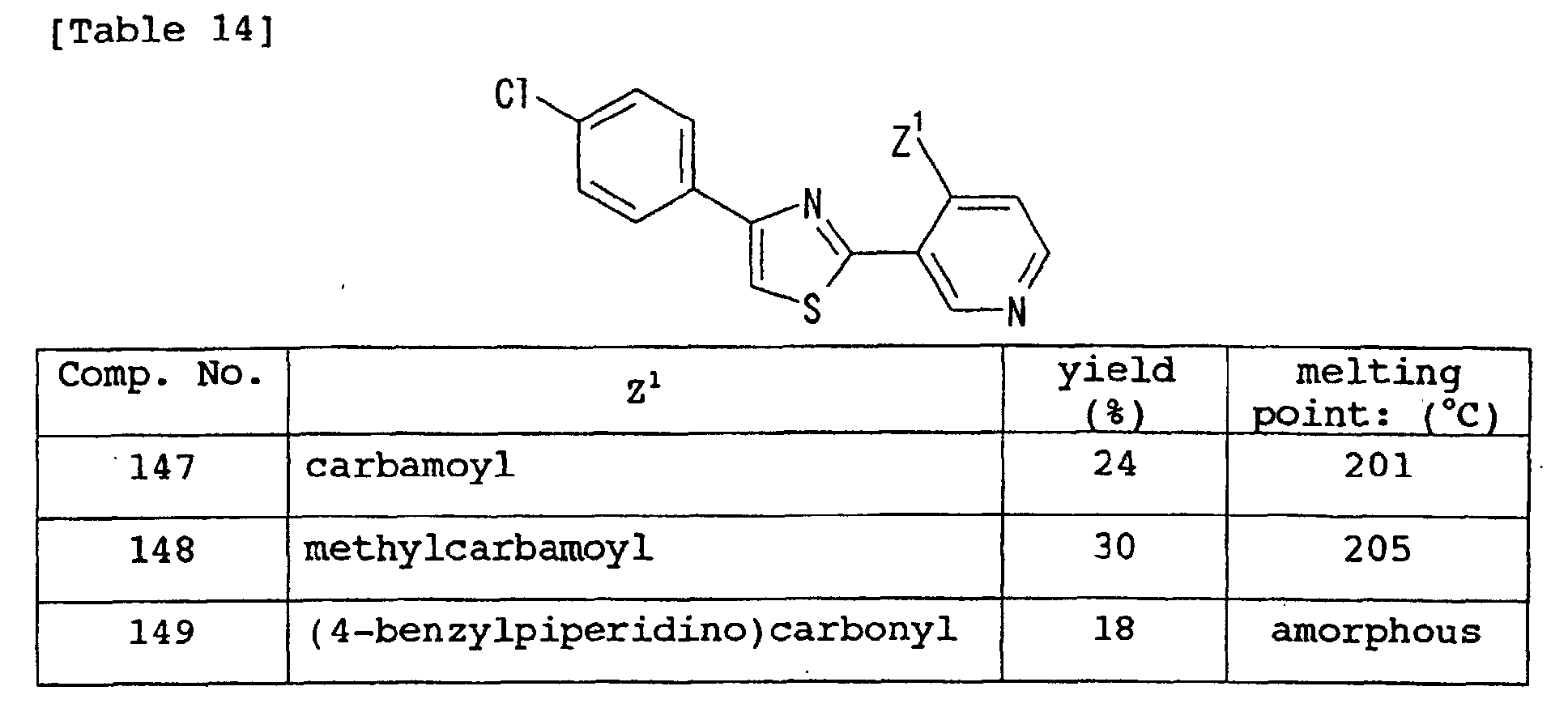
melting point: 146°C
| elemental analysis for C15H10Cl2N2S | |||
| C(%) | H(%) | N(%) | |
| Calculated | 56.09; | 3.14; | 8.72 |
| Found | 55.95; | 3.13; | 8.43 |
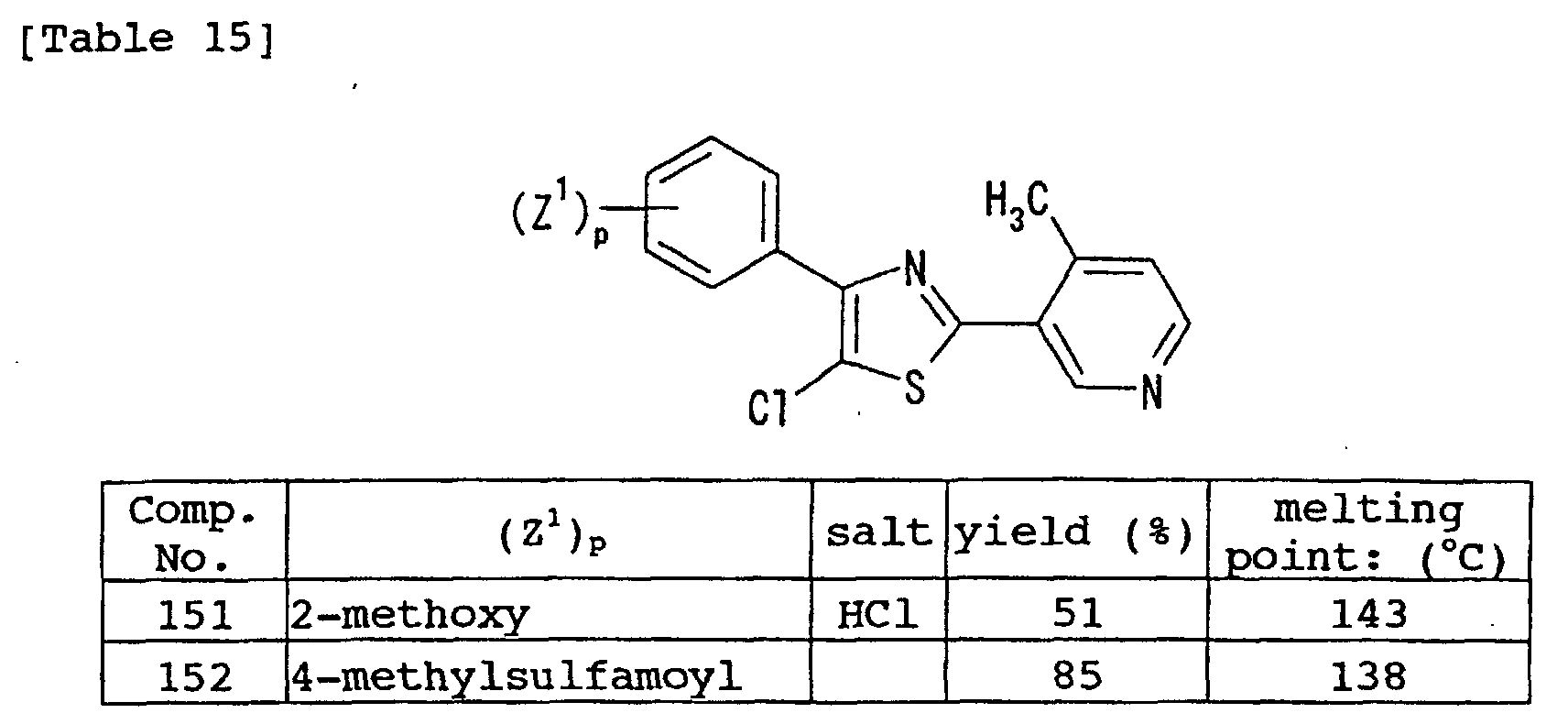
melting point: 96°C
| elemental analysis for C16H13FN2S | |||
| C(%) | H(%) | N(%) | |
| Calculated | 67.58; | 4.61; | 9.85 |
| Found | 67.87; | 4.77; | 9.88 |
melting point: 219°C
| elemental analysis for C15H13N3O2S2 0.25H2O | |||
| C(%) | H(%) | N(%) | |
| Calculated | 53.63; | 4.05; | 12.51 |
| Found | 53.81; | 3.99; | 12.22 |
melting point: 217°C
| elemental analysis for C15H10F3N3O2S2 0.5H20 | |||
| C(%) | H(%) | N(%) | |
| Calculated | 45.68; | 2.81; | 10.65 |
| Found | 45.94; | 2.59; | 10.84 |
melting point: 71-72°C
| elemental analysis for C15H10N3O2SF3 | |||
| C(%) | H(%) | N(%) | |
| Calculated | 56.07; | 3.14; | 13.08 |
| Found | 56.08; | 3.09; | 13.12 |
| elemental analysis for C15H10N3O2SF3 | |||
| C(%) | H(%) | N(%) | |
| Calculated | 56.07; | 3.14; | 13.08 |
| Found | 56.00; | 3.23; | 13.02 |
melting point: 216-213°C
| elemental analysis for C17H12N3OSF3 | |||
| C(%) | H(%) | N(%) | |
| Calculated: | 56.19; | 3.33; | 11.56 |
| Found: | 56.10; | 3.30; | 11.42 |
melting point: 154-155°C
| elemental analysis for C17H12N3OSF3·HCl·0.1H2O | |||
| C(%) | H(%) | N(%) | |
| Calculated | 50.84; | 3.31; | 10.45 |
| Found | 50.76; | 3.54; | 10.36 |
melting point: 205-207°C
| elemental analysis for C16H12N3O2S2F3·HCl | |||
| C(%) | H(%) | N(%) | |
| Calculated | 44.09; | 3.01; | 9.64 |
| Found | 44.07; | 2.97; | 9.69 |
melting point: 162-165°C
| elemental analysis for C16H12N3O2S2F3·HCl | |||
| C(%) | H(%) | N(%) | |
| Calculated | 44.09; | 3.01; | 9.64 |
| Found | 44.02; | 2.28; | 9.63 |
| elemental analysis for C16H9N2O2SF3·0.4H2O | |||
| C(%) | H(%) | N(%) | |
| Calculated | 53.75; | 2.76; | 7.84 |
| Found | 53.85; | 2.60; | 7.79 |
melting point: >300°C
| elemental analysis for C16H12N2O2S | |||
| C(%) | H(%) | N(%) | |
| Calculated | 65.85; | 4.08; | 9.45 |
| Found | 64.60; | 4.19; | 9.66 |
melting point: 192-193°C
| elemental analysis for C16H10N3OSF3·0.5AcOEt | |||
| C(%) | H(%) | N(%) | |
| Calculated | 54.96; | 3.59; | 10.68 |
| Found | 54.69; | 3.47; | 10.77 |
| elemental analysis for C16H13N3OS | |||
| C(%) | H(%) | N(%) | |
| Calculated | 65.06; | 4.44; | 14.22 |
| Found | 64.98; | 4.56; | 14.10 |
1H-NMR (CDCl3+CD3OD)δ: 7.61 (1H, t, J= 7.8 Hz), 7.82 (1H, dt, J= 7.8, 1.4 Hz), 8.13 (1H, dt, J= 7.8, 1.4 Hz), 8.21 (1H, t, J= 1.4 Hz).
IR (KBr): 3420, 3160, 2232, 1705, 1397 cm-1.
1H-NMR (DMSO-d6)δ: 7.40-7.56 (2H, m), 7.91-8.08 (3H, m), 8.32 (1H, t, J= 1.8 Hz), 9.58 (1H, brs), 9.98 (1H, brs).
IR (KBr): 3358, 3160, 1659, 1636, 1418 cm-1.
1H-NMR (DMSO-d6) δ: 2.54 (3H, s), 7.38 (1H, d, J=5.2 Hz), 7.57 (1H, brs), 7.63 (1H, t, J=7.7 Hz), 7.96-8.05 (1H, m), 8.09 (1H, s), 8.14-8.26 (2H, m), 8.43-8.50 (2H, m), 8.86 (1H, s).
IR (KBr): 3266, 3106, 3056, 1713, 1402 cm-1.
1H-NMR (CDCl3) δ: 3.06 (3H, d, J= 4.8 Hz), 6.26 (1H, brs), 7.59 (1H, t, J= 7.9 Hz), 7.80 (1H, dt, J= 7.9, 2.6 Hz), 7.95-8.10 (2H, m).
IR (KBr): 3293, 2232, 1636, 1559 cm-1.
1H-NMR (DMSO-d6)δ: 2.79 (3H, d, J= 4.8 Hz), 7.49 (1H, t, J= 7.8 Hz), 7.86-8.04 (2H, m), 8.29 (1H, s), 8.44-8.64 (1H, m), 9.59 (1H, brs), 9.98 (1H, brs).
IR (KBr): 3304, 1630, 1416 cm-1.
1H-NMR (DMSO-d6)δ: 2.54 (3H, s), 2.82 (3H, d, J=4.4 Hz), 7.38 (1H, d, J=5.0 Hz), 7.63 (1H, t, J=7.6 Hz), 7.96 (1H, d, J=7.6 Hz), 8.09 (1H, s), 8.17 (1H, d, J= 7.6 Hz), 8.44 (1H, s), 8.47 (1H, d, J= 5.0 Hz), 8.60-8.76 (1H, m), 8.86 (1H, s).
IR (KBr): 3268, 3139, 1672, 1553 cm-1.
1H-NMR (CDCl3) δ: 2.99 (3H, s), 3.13 (3H, s), 7.55 (1H, t, J=8.1 Hz), 7.64 - 7.74 (3H, m).
IR (KBr): 3054, 2228, 1613, 1580 cm-1.
1H-NMR (DMSO-d6)δ: 2.91 (3H, s), 3.00 (3H, s), 7.42 - 7.57 (2H, m), 7.86 - 7.98 (2H, m), 9.59, (1H, brs), 9.97 (1H, brs).
IR (KBr): 3210, 3056, 1615, 1601 cm-1.
1H-NMR (CDCl3) δ: 2.54 (3H, s), 3.03 (3H, s), 3.15 (3H, s), 7.22 (1H, d, J=5.2 Hz), 7.38 - 7.41 (1H, m), 7.46 - 7.60 (2H, m), 8.00 - 8.10 (2H, m), 8.48 (1H, d, J=5.2 Hz), 8.81 (1H, s). IR (KBr): 2930, 1634, 1395 cm-1.
1H-NMR (CDCl3+CD3OD) δ: 7.76 (2H, d, J=8.1 Hz), 7.96 (2H, d, J= 8.1 Hz).
IR (KBr): 3443, 3177, 2230, 1701, 1618, 1561, 1414, 1399 cm-1.
1H-NMR (DMSO-d6) δ: 7.51 (1H, brs), 7.80-7.98 (4H, m), 8.08 (1H, brs), 9.61 (1H, brs), 10.01 (1H, brs).
IR (KBr): 3164, 1659, 1632, 1568, 1427 cm-1.
1H-NMR (DMSO-d6)δ: 2.54 (3H, s), 7.38 (1H, d, J= 4.9 Hz), 7.52 (1H, brs), 7.96-8.18 (6H, m), 8.47 (1H, d, J= 4.9 Hz), 8.85 (1H, s).
IR (KBr): 3169, 1703, 1416, 1397 cm-1.
1H-NMR (CDCl3) δ: 3.04 (3H, d, J= 4.8 Hz), 6.23 (1H, brs), 7.74 (2H, d, J=8.5 Hz), 7.86 (2H, d, J= 8.5 Hz).
IR (KBr): 3341, 2228, 1644, 1555 cm-1.
1H-NMR (DMSO-d6)δ: 2.79 (3H, d, J= 4.4 Hz), 7.83 (2H, d, J= 8.8 Hz), 7.92 (2H, d, J= 8.8 Hz), 8.50-8.64 (1H, m), 9.61 (1H, brs), 10.01 (1H, brs).
IR (KBr): 3113, 1634, 1547 cm-1.
1H-NMR (DMSO-d6) δ: 2.54 (3H, s), 2.81 (3H, d, J= 4.4 Hz), 7.38 (1H, d, J= 5.2 Hz), 7.98 (2H, d, J= 8.6 Hz), 8.11 (2H, d, J= 8.6 Hz), 8.11 (1H, s), 8.47 (1H, d, J= 5.2 Hz), 8.54-8.67 (1H, m), 8.85 (1H, s).
IR (KBr): 3343, 1645, 1563 cm-1.
1H-NMR (CDCl3) δ: 2.46 (3H, s), 3.00 (3H, d, J=5.2 Hz), 6.11 (1H, brs), 7.28 (1H, d, J=7.6 Hz), 7.64 (1H, dd, J=1.8, 7.6 Hz), 8.19 (1H, d, J=1.8 Hz).
IR (KBr): 3322, 1638, 1549, 1480, 1410, 1316, 1265, 667 cm-1.
1H-NMR (CDCl3)δ: 2.60 (3H, s), 3.02 (1H, d, J=4.8 Hz), 6.31 (1H, brs), 7.40 (1H, d, J=8.0 Hz), 7.90 (1H, dd, J= 1.8, 8.0 Hz), 8.01 (1H, d, J=1.8 Hz).
IR (KBr): 3349, 2228, 1647, 1561 cm-1.
1H-NMR (DMSO-d6)δ: 2.35 (3H, s), 2.76 (3H, d, J=4.4 Hz), 7.28 (1H, d, J=8.4 Hz), 7.66 - 7.76 (2H, m), 8.38 - 8.51 (1H, m), 9.56 (1H, brs), 10.09 (1H, brs).
IR (KBr): 3297, 3125, 1622, 1559 cm-1.
1H-NMR (DMSO-d6)δ: 2.53 (3H, s), 2.66 (3H, s), 2.81 (3H, d, J=4.8 Hz), 7.38 (1H, d, J=5.2 Hz), 7.50 (1H, d, J=7.9 Hz), 7.87 (1H, dd, J=1.8, 7.8 Hz), 8.15 (1H, s), 8.25 (1H, d, J=1.8 Hz), 8.46 (1H, d, J=5.2 Hz), 8.52 - 8.64 (1H, m), 8.84 (1H, s).
IR (KBr): 3340, 3044, 1663, 1551 cm-1.
1H-NMR (CDCl3)δ: 2.45 (3H, s), 2.99 (3H, brs), 3.08 (3H, brs), 7.20 - 7.34 (2H, m), 7.87 (1H, d, J=1.4 Hz).
IR (KBr): 2926, 1634, 1395 cm"1.
1H-NMR (CDCl3)δ: 2.59 (3H, s), 3.03 (3H, s), 3.17 (3H, s), 7.39 (1H, d, J=7.9 Hz), 7.62 (1H, dd, J=1.8, 8.0 Hz), 7.69 (1H, d, J=1.8 Hz).
IR (KBr): 2936, 2226, 1634, 1404 cm-1.
1H-NMR (CDCl3)δ: 2.56 (3H, s), 2.69 (3H, s), 3.04 (3H, brs), 3.13 (3H, brs), 7.22 (1H, d, J=4.7 Hz), 7.34 - 7.46 (2H, m), 7.46 (1H, s), 7.86 (1H, d, J=1.2 Hz), 8.47 (1H, d, J=4.7 Hz), 8.83 (1H, s).
IR (KBr): 2924, 1632, 1397 cm-1.
1H-NMR (CDCl3)δ: 1.80 - 2.04 (4H, m), 2.45 (3H, s), 3.43 (2H, t, J=6.4 Hz), 3.62 (2H, t, J=6.7 Hz), 7.24 (1H, d, J=7.5 Hz), 7.40 (1H, dd, J=1.8, 7.5 Hz), 7.97 (1H, d, J=1.8 Hz).
IR (KBr): 2971, 1624, 1422 cm-1.
1H-NMR (CDCl3)δ: 1.80 - 2.05 (4H, m), 2.58 (3H, s), 3.46 (2H, t, J=6.2 Hz), 3.72 (2H, t, J=6.7 Hz), 7.38 (1H, d, J=8.0 Hz), 7.72 (1H, dd, J=1.8, 8.0 Hz), 7.79 (1H, d, J=1.8 Hz).
IR (KBr): 2975, 2228, 1620, 1445 cm-1.
1H-NMR (CDCl3)δ: 1.60 - 2.10 (4H, m), 2.55 (3H, s), 2.69 (3H, s), 3.49 (2H, t, J=6.5 Hz), 3.67 (2H, t, J=6.8 Hz), 7.22 (1H, dd, J=0.8, 5.0 Hz), 7.37 (1H, dd, J= 0.8, 7.5 Hz), 7.46 (1H, s), 7.51 (1H, dd, J=1.7, 7.5 Hz), 7.97 (1H, d, J=1.7 Hz), 8.47 (1H, d, J=5.0 Hz), 8.83 (1H, s).
IR (KBr): 2971, 1622, 1429 cm-1.
1H-NMR (CDCl3)δ: 3.03 (3H, d, J=4.6 Hz), 6.19 (1H, brs), 7.28 - 7.38 (1H, m), 7.99 - 8.12 (2H, m).
IR (KBr): 3328, 3069, 2236, 1638, 1495 cm-1.
1H-NMR (CDCl3+CD3OD)δ: 2.94 - 3.04 (3H, m), 7.17 (1H, dd, J=8.8, 11.2 Hz), 7.49 (1H, brs), 7.92 - 8.03 (1H, m), 8.42 (1H, dd, J=2.2, 7.6 Hz).
IR (KBr): 3275, 3131, 1655, 1630 cm-1.
1H-NMR (DMSO-d6)δ: 2.54 (3H, s), 2.82 (3H, dd, J= 4.4 Hz), 7.40 (1H, d, J=5.2 Hz), 7.58 (1H, dd, J=8.8, 11.0 Hz), 7.96 - 8.08 (1H, m), 8.22 (1H, s), 8.49 (1H, d, J=5.2 Hz), 8.65 - 8.86 (2H, m), 8.89 (1H, s).
IR (KBr): 3254, 3102, 1653, 1507 cm-1.
1H-NMR (CDCl3)δ: 3.05 (3H, d, J=4.8 Hz), 6.23 (1H, brs), 7.54 (1H, d, J=8.0 Hz), 7.65 (1H, dd, J=1.8, 8.0 Hz), 7.97 (1H, d, J=1.8 Hz).
IR (KBr): 3277, 2238, 1653, 1551 cm-1.
1H-NMR (DMSO-d6)δ: 2.77 (3H, d, J=4.4 Hz), 7.56 (1H, d, J=9.2 Hz), 7.88 - 8.02 (2H, m), 8.38 - 8.54 (1H, m), 9.63 (1H, brs), 10.03 (1H, brs).
IR (KBr): 3289, 3177, 1634, 1549, 1408, 1285 cm-1.
1H-NMR (DMSO-d6)δ: 2.52 (3H, s), 2.79 (3H, d, J=4.4 Hz), 7.38 (1H, d, J=4.9 Hz), 7.66 (1H, d, J=8.3 Hz), 8.01 (1H, d, J=2.2 Hz), 8.07 (1H, dd, J=2.2, 8.3 Hz), 8.11 (1H, s), 8.46 (1H, d, J=4.9 Hz), 8.50 - 8.62 (1H, m), 8.84 (1H, s).
IR (KBr): 3277, 1645, 1063 cm"1.
1H-NMR (CDCl3)δ: 2.21 (3H, s), 7.34 - 7.48 (2H, m), 7.62 (1H, brs), 7.72 (1H, dt, J=7.0, 2.4 Hz), 7.93 (1H, s).
IR (KBr): 3303, 3272, 2228, 1667, 1559 cm-1.
1H-NMR (DMSO-d6)δ: 2.05 (3H, s), 7.25 - 7.48 (2H, s), 7.78 (1H, d, J=8.0 Hz), 8.05 (1H, s), 9.48 (1H, brs), 9.87 (1H, brs), 10.11 (1H, s).
IR (KBr): 3260, 3152, 1663, 1611, 1586, 1551, 1445 cm-1.
1H-NMR (CDCl3+CD3OD)δ: 2.21 (3H, s), 2.52 (3H, s), 7.21 (1H, d, J=5.2 Hz), 7.34 (1H, s), 7.40 (1H, d, J=8.2 Hz), 7.66 - 7.80 (2H, m), 8.08 - 8.22 (2H, m), 8.46 (1H, d, J=5.2 Hz), 8.81 (1H, s).
IR (KBr): 3056, 2988, 1684, 1615, 1561 cm-1.
1H-NMR (CDCl3+CD3OD)δ: 2.20 (3H, s), 7.59 (2H, d, J=8.7 Hz), 7.68 (2H, d, J=8.7 Hz).
IR (KBr): 3304, 3260, 2222, 1667, 1599 cm-1.
1H-NMR (DMSO-d6)δ: 2.07 (3H, s), 7.60 (2H, d, J=8.8 Hz), 7.90 (2H, d, J=8.8 Hz), 9.36 (1H, brs), 9.71 (1H, brs).
IR (KBr): 3283, 3112, 1667, 1593, 1412 cm-1. .
1H-NMR (DMSO-d6)δ: 2.09 (3H, s), 2.52 (3H, s), 7.36 (1H, d, J=5.0 Hz), 7.74 (2H, d, J=8.8 Hz); 7.95 (2H, d, J=8.8 Hz), 7.96 (1H, s), 8.65 (1H, d, J=5.0 Hz), 8.82 (1H, s).
IR (KBr): 3042, 1690, 1603, 1543 cm-1.
1H-NMR (DMSO-d6)δ: 2.53 (3H, s), 2.57 (3H, s), 7.30 - 7.42 (2H, m), 7.61 (1H, dd, J=2.2, 8.4 Hz), 8.10 (1H, s), 8.18 (1H, d, J=2.2 Hz), 8.32 (1H, s), 8.46 (1H, d, J=4.8 Hz), 8.83 (1H, s), 10.34 (1H, s).
IR (KBr): 2861, 1686, 1620 cm-1.
1H-NMR (CDCl3)δ: 2.19 (3H, s), 2.54 (3H, s), 2.61 (3H, s), 7.18 - 7.30 (2H, m), 7.42 (1H, s), 7.58 (1H, dd, J=2.2, 8.4 Hz), 7.71 (1H, brs), 7.94 (1H, d, J=2.2 Hz), 8.46 (1H, d, J=4.8 Hz), 8.82 (1H, s).
IR (KBr): 1671, 1613, 1541 cm-1.
1H-NMR (DMSO-d6)δ: 7.55-7.66 (1H, m), 7.90-8.04 (1H, m), 8.46-8.64 (2H, m), 9.95 (1H, brs), 10.19 (1H, brs).
IR (KBr): 3353, 3154, 1603, 1582 cm-1.
1H-NMR (CDCl3)δ: 2.55 (3H, s), 7.23 (1H, d, J= 4.9 Hz), 7.30-7.42 (1H, m), 7.48 (1H, s), 7.83 (1H, dt, J= 1.4, 7.9 Hz), 8.26 (1H, d, J=7.6 Hz), 8.48 (1H, d, J= 4.9 Hz), 8.60-8.70 (1H, m), 8.84 (1H, s).
IR (KBr): 3100, 1582, 1433 cm-1.
1H-NMR (CDCl3)δ: 2.55 (3H, s), 7.24 (1H, d, J=5.0 Hz), 7.37-7.46 (2H, m), 8.26-8.36 (1H, m), 8.49 (1H, d, J= 5.0 Hz), 8.69 (1H, dd, J= 1.8, 4.8 Hz), 8.82 (1H, s), 9.24 (1H, dd, J= 1.0, 2.2 Hz).
IR (KBr): 3046, 1597, 1466 cm-1.
1H-NMR (CDCl3)δ: 2.55 (3H, s), 7.24 (1H, d, J= 5.0 Hz), 7.51 (1H, s), 7.88 (2H, dd, J= 1.8, 4.4 Hz), 8.50 (1H, d, J=5.0 Hz), 8.74 (2H, dd, J=1.8, 4.4 Hz), 8.82 (1H, s).
IR (KBr): 3044, 1597, 1468, 820 cm-1.
1H-NMR (CDCl3+CD3OD)δ: 8.41 (1H, t, J= 2.2 Hz), 8.77 (1H, d, J=2.2 Hz), 8.94 (1H, d, J=2.2 Hz).
IR (KBr): 3389, 3194, 3032, 1657, 1620 cm-1.
1H-NMR (DMSO-d6)δ: 7.88 (1H, s), 8.31 (1H, s), 8.67 (1H, s), 9.20 (1H, brs), 9.27 (1H, brs).
IR (KBr): 3398, 3198, 2238, 1663 cm-1.
1H-NMR (DMSO-d6)δ: 7.73 (1H, s), 8.26 (1H, s), 8.50-8.60 (1H, m), 8.98-9.16 (2H, m), 9.83 (1H, s), 10.19 (1H, s).
IR (KBr): 3137, 1699, 1630, 1410 cm-1.
1H-NMR (DMSO-d6)δ: 2.54 (3H, s), 7.39 (1H, d, J=5.1 Hz), 7.80 (1H, s), 8.19 (1H, s), 8.41 (1H, s), 8.48 (1H, d, J=5.1 Hz), 8.75 (1H, t, J=2.3 Hz), 8.87 (1H, s), 9.13 (1H, d, J=2.3 Hz), 9.34 (1H, d, J=2.3 Hz).
IR (KBr): 3316, 3131, 1713, 1420 cm-1.
1H-NMR (CDCl3+CD3OD)δ: 3.00 (3H, s), 8.49 (1H, t, J=2.1 Hz), 8.96 (1H, d, J=2.1 Hz), 9.18 (1H, d, J=2.1 Hz).
IR (KBr): 3310, 2234, 1651, 1559 cm-1.
1H-NMR (CDCl3+CD3OD)δ: 3.00 (3H, s), 8.56 (1H, t, J= 2.2 Hz), 9.01 (1H, d, J= 2.2 Hz), 9.16 (1H, d, J= 2.2 Hz).
IR (KBr): 3330, 3127, 1642, 1287 cm-1.
1H-NMR (DMSO-d6)δ: 2.54 (3H, s), 2.85 (3H, d, J= 4.6 Hz), 7.39 (1H, d, J= 5.2 Hz), 8.18 (1H, s), 8.48 (1H, d, J= 5.2 Hz), 8.72 (1H, t, J= 2.2 Hz), 8.80-8.94 (1H, m), 8.86 (1H, s), 9.09 (1H, d, J= 2.2 Hz),9.33 (1H, d, J= 2.2 Hz).
IR (KBr): 3233, 1669, 1551, 1435 cm-1.
1H-NMR (CDCl3)δ: 1.28 (3H, t, J= 6.3 Hz), 3.40-3.64 (2H, m), 6.14 (1H, brs), 8.26 (1H, t, J=2.2 Hz), 8.78 (1H, d, J=2.2 Hz), 8.85 (1H, d, J=2.2 Hz).
IR (KBr): 3301, 3027, 1640, 1537 cm-1.
1H-NMR (CDCl3+CD3OD)δ: 1.27 (3H, t, J=7.4 Hz), 3.48 (2H, q, J=7.4 Hz), 8.51 (1H, t, J=2.2 Hz), 8.95 (1H, d, J=2.2 Hz), 9.19 (2H, d, J=2.2 Hz).
IR (KBr): 3310, 3054, 2236, 1645, 1549 cm-1.
1H-NMR (DMSO-d6)δ: 1.15 (3H, t, J=7.1 Hz), 3.20-3.44 (2H, m), 8.55 (1H, t, J=2.2 Hz), 8.70-8.84 (1H, m), 9.20-9.12 (2H, m), 9.83 (1H, brs), 10.20 (1H, brs).
IR (KBr): 3285, 3146, 1663, 1545 cm-1.
1H-NMR (DMSO-d6)δ: 1.17 (3H, t, J=7.2 Hz), 2.54 (3H, s), 3.20 - 3.50 (2H, m), 7.39 (1H, d, J=4.8 Hz), 8.19 (1H, s), 8.48 (1H, d, J=4.8 Hz), 8.72 (1H, t, J=2.2 Hz), 8.87 (1H, s), 8.80 - 8.99 (1H, m), 9.10 (1H, d, J=2.2 Hz), 9.33 (1H, d, J=2.2 Hz).
IR (KBr): 3148, 1738, 1657, 1549 cm-1.
1H-NMR (CDCl3)δ: 3.06 (3H, d, J=5.1 Hz), 7.07-7.95 (1H, brs), 7.82 (1H, dd, J=1.2, 7.8 Hz), 8.03 (1H, t, J=7.8 Hz), 8.43 (1H, dd, J=1.2, 7.8 Hz).
IR (KBr): 3366, 2247, 1680, 1537 cm-1.
1H-NMR (CDCl3+CD3OD)δ: 3.03 (3H, s), 8.01 (1H, t, J=5.2 Hz), 8.31 (1H, dd, J=0.8, 5.2 Hz), 8.84 (1H, dd, J= 0.8, 5.2 Hz).
IR (KBr): 3162, 1651, 1622, 1541, 1456 cm-1.
1H-NMR (CDCl3)δ: 2.56 (3H, s), 3.13 (3H, d, J= 3.4 Hz), 7.22-7.27 (1H, m), 7.53 (1H, s), 7.90-8.03 (1H, m), 7.99 (1H, t, J= 5.2 Hz), 8.27 (1H, dd, J= 0.8, 5.2 Hz), 8.38 (1H, dd, J= 0.8, 5.2 Hz), 8.50 (1H, d, J= 3.2 Hz), 8.84 (1H, s).
IR (KBr): 3412, 3094, 1676, 1537 cm-1.
1H-NMR (CDCl3)6: 3.03 (3H, d, J=4.8 Hz), 6.53 (1H, brs), 7.41 (1H, d, J=8.4 Hz), 8.10 (1H, dd, J=2.6, 8.4 Hz), 8.74 (1H, d, J=2.6 Hz).
IR (KBr): 3306, 3059, 1651, 1557 cm-1.
1H-NMR (CDCl3)δ: 3.07 (3H, d, J= 4.8 Hz), 6.34 (1H, brs), 7.80 (1H, dd, J= 0.6, 8.1 Hz), 8.27 (1H, dd, J= 2.2, 8.1 Hz), 9.04 (1H, dd, J= 0.6, 2.2 Hz).
IR (KBr): 3293, 3092, 2236, 1645, 1559 cm-1.
1H-NMR (DMSO-d6)δ: 2.82 (3H, d, J=4.4 Hz), 8.32 (1H, dd, J=2.1, 8.4 Hz), 8.55 (1H, d, J=8.4 Hz), 8.70 - 8.88 (1H, m), 8.97 (1H, d, J=2.1 Hz), 10.03 (1H, brs), 10.29 (1H, brs).
IR (KBr): 3370, 3333, 1640, 1599, 1551 cm-1.
1H-NMR (DMSO-d6)δ: 2.54 (3H, s), 2.84 (3H, d, J=4.0 Hz), 7.38 (1H, d, J=5.0 Hz), 8.20 (1H, s), 8.29 (1H, d, J=8.4 Hz), 8.32 - 8.42 (1H, m), 8.47 (1H, d, J=5.0 Hz), 8.70 - 8.84 (1H, m), 8.86 (1H, s), 9.05 (1H, t, J=0.9 Hz).
IR (KBr): 3312, 1645, 1593 cm-1.
1H-NMR (DMSO-d6)δ: 4.59 (2H, s), 7.69 (1H, t, J=7.7 Hz), 8.00 (1H, d, J=7.7 Hz), 8.04 - 8.16 (1H, m), 8.92 (1H, brs).
IR (KBr): 3090, 2230, 1705 cm"1. .
1H-NMR (DMSO-d6)δ: 2.56 (3H, s), 4.79 (2H, s), 7.39 (1H, d, J=5.1 Hz), 7.68 (1H, t, J=7.3 Hz), 7.83 (1H, d, J=7.3 Hz), 8.16 (1H, s), 8.20 (1H, d, J=7.3 Hz), 8.47 (1H, d, J=5.1 Hz), 8.80 (1H, brs), 8.90 (1H, s).
IR (KBr): 3077, 1698, 750 cm-1.
1H-NMR (DMSO-d6)δ: 3.10 (3H, s), 4.68 (2H, s), 7.58 - 7.78 (1H, m), 7.99 (1H, d, J=7.2 Hz), 8.07 (1H, dd, J=0.8, 7.6 Hz).
IR (KBr): 2942, 2234, 1696 cm-1.
1H-NMR (DMSO-d6)δ: 2.55 (3H, s), 3,14 (3H, s), 4.86 (2H, s), 7.40 (1H, d, J=4.2 Hz), 7.66 (1H, t, J=7.7 Hz), 7.81 (1H, d, J=7.7 Hz), 8.10 - 8.22 (2H, m), 8.48 (1H, d, J=4.2 Hz), 8.89 (1H, s).
IR (KBr): 3079, 1701, 1468 cm-1.
1H-NMR (CDCl3)δ: 1.60 (9H, s), 6.68 (1H, d, J=8.6 Hz), 7.70 (1H, dd, J=2.4, 8.6 Hz), 8.43 (1H, d, J=2.2 Hz).
IR (KBr): 2976, 2230, 1603, 1485 cm-1.
1H-NMR (CDCl3)δ: 1.60 (9H, s), 6.63 (1H, dd, J=0.6, 8.8 Hz), 7.07 (1H, brs), 7.51 (1H, brs), 8.11 (1H, dd, J=2.7, 8.8 Hz), 8.64 (1H, dd, J=0.6, 2.7 Hz).
IR (KBr): 3144, 1620, 1595, 1323 cm-1.
1H-NMR (DMSO-d6)δ: 2.50 (3H, s), 6.49 (1H, d, J=9.6 Hz), 7.35 (1H, d, J=4.8 Hz), 7.90 (1H, s), 8.02 (1H, dd, J=2.7, 9.6 Hz), 8.11 (1H, d, J=2.7 Hz), 8.44 (1H, d, J=4.8 Hz), 8.01 (1H, s).
IR (KBr): 3090, 2768, 1682, 1601 cm-1.
1H-NMR (DMSO-d6)δ: 2.58 (3H, s), 7.40 (1H, d, J=5.1 Hz), 7.71 - 7.93 (2H, m), 8.12 (1H, s), 8.15 - 8.26 (2H, m), 8.48 (1H, d, J=5.1 Hz), 8.71 (1H, s), 8.90 (1H, s), 9.42 (1H, s).
IR (KBr): 3092, 1622, 1590, 1578 cm-1.
1H-NMR (DMSO-d6)δ: 7.60 - 7.78 (2H, m), 7.84 (1H, d, J=5.6 Hz), 7.99 (1H, d, J=8.3 Hz), 8.26 (1H, d, J=8.3 Hz), 8.43 (1H, d, J=5.6 Hz), 10.00, (1H, brs), 10.43 (1H, brs).
IR (KBr): 3034, 1653, 1426, 835 cm-1.
1H-NMR (DMSO-d6)δ: 2.60 (3H, s), 7.43 (1H, d, J=5.0 Hz), 7.80 - 7.96 (2H, m), 8.02 (1H, d, J=5.6 Hz), 8.05 - 8.18 (1H, m), 8.23 (1H, s), 8.51 (1H, d, J=5.0 Hz), 8.64 (1H, d, J=5.6 Hz), 8.93 (1H, s), 9.70 - 9.88 (1H, m).
IR (KBr): 3102, 1553, 1397, 949 cm-1.
1H-NMR (CDCl3)δ: 4.08, (3H, s), 4.12 (3H, s), 8.54 (1H, s).
IR (KBr): 2971, 2236, 1601, 1541 cm-1.
1H-NMR (CDCl3)δ: 2.55 (3H, s), 4.01 (3H, s), 4.24 (3H, s), 7.22 (1H, d, J=5.2 Hz), 7.44 (1H, s), 8.47 (1H, d, J=5.2 Hz), 8.81 (1H, s), 9.30 (1H, s).
IR (KBr): 3019, 1601, 1561 cm-1.
1H-NMR (CDCl3)δ: 1.23 (3H, t, J=7.3 Hz), 2.54 (3H, s), 2.98 (2H, q, J=7.3 Hz), 7.19 (1H, d, J=5.1 Hz), 8.54 (1H, d, J=5.1 Hz), 8.91 (1H, s).
IR (KBr): 2978, 1692, 1591 cm-1.
1H-NMR (DMSO-d6)δ: 1.82 (3H, d, J=6.6 Hz), 2.60 (3H, s), 5.81 (1H, q, J=6.6 Hz), 7.95 (1H, d, J=5.7 Hz), 8.88 (1H, d, J=5.7 Hz), 9.30 (1H, brs).
IR (KBr): 2573, 1705, 1636, 1595 cm-1.
1H-NMR (DMSO-d6)δ: 2.28 (3H, s), 2.41 (3H, s), 7.41 (1H, d, J=5.2 Hz), 7.53 (1H, brs), 7.59 (1H, t, J=7.8 Hz), 7.96 (1H, d, J=7.8 Hz), 8.06 (1H, d, J=7.8 Hz), 8.20 (1H, brs), 8.34 - 8.40 (1H, m), 8.47 - 8.54 (2H, m).
IR (KBr): 3191, 1701, 1672, 1422, 1383 cm-1.
1H-NMR (CDCl3)δ: 0.99 (6H, d, J=6.6 Hz), 2.16 - 2.40 (1H, m), 2.52 (3H, s), 2.81 (2H, d, J=7.0 Hz), 7.19 (1H, d, J=5.2 Hz), 8.53 (1H, d, J=5.2 Hz), 8.85 (1H, s).
IR (KBr): 2959, 1688, 1591 cm-1.
1H-NMR (DMSO-d6)δ: 1.07 (3H, d, J=6.6 Hz), 1.09 (3H, d, J=6.4 Hz), 2.21 - 2.43 (1H, m), 2.58 (3H, s), 5.70 (1H, d, J=6.6 Hz), 7.92 (1H, d, J=5.9 Hz), 8.88 (1H, d, J=5.9 Hz), 9.31 (1H, s). IR (KBr): 2710, 1711, 1636, 1588 cm-1.
1H-NMR (CDCl3)δ: 1.30 (6H, d, J=6.6 Hz), 2.30 (3H, s), 2.96 - 3.16 (1H, m), 5.83 (1H, brs), 6.31 (1H, brs), 7.26 (1H, d, J=5.1 Hz), 7.53 (1H, t, J=7.7 Hz), 7.89 (1H, dt, J=7.7, 1.6 Hz), 8.08 (1H, dt, J=7.7, 1.6 Hz), 8.37 (1H, t, J=1.6 Hz), 8.49 (1H, s), 8.52 (1H, d, J=5.1 Hz).
IR (KBr): 3318, 3191, 2963, 1669, 1387 cm-1.
1H-NMR (CDCl3)δ: 2.38 (3H, s), 3.01 (3H, s), 3.14 (3H, s), 7.20 - 7.30 (1H, m), 7.46 - 7.55 (2H, m), 7.88 - 8.00 (2H, m), 8.48 - 8.60 (1H, m), 8.65 (1H, brs).
IR (KBr): 1638, 1595, 1397 cm-1.
1H-NMR (DMSO-d6)δ: 2.28 (3H, s), 2.41 (3H, s), 7.41 (1H, d, J=4.8 Hz), 7.53 (2H, brs), 7.71 (1H, t, J=8.2 Hz), 7.90 (1H, dt, J=8.4, 1.5 Hz), 8.10 (1H, dt, J=8.4, 1.5 Hz), 8.38 (1H, t, J=1.5 Hz), 8.46 - 8.56 (2H, m).
IR (KBr): 3177, 1599, 1341, 1159 cm-1.
1H-NMR (DMSO-d6)δ: 2.28 (3H, s), 2.42 (3H, s), 7.41 (1H, d, J=4.8 Hz), 7.50 (2H, brs), 7.94 (2H, d, J=8.8 Hz), 8.11 (2H, d, J=8.8 Hz), 8.46 - 8.55 (2H, m).
IR (KBr): 3297, 1341, 1157 cm-1.
1H-NMR (DMSO-d6)δ: 2.68 (3H, s), 7.40 - 7.68 (3H, m), 7.88 (1H, d, J=8.4 Hz), 8.12 (1H, brs), 8.20 (1H, d, J=7.6 Hz), 8.40 (1H, s), 8.48 - 8.63 (2H, m), 9.01 (1H, s).
IR (KBr): 3380, 3191, 1655, 1406 cm-1.
1H-NMR (DMSO-d6)δ: 7.47 (1H, brs), 7.57 (1H, t, J=7.8 Hz), 7.87 (1H, d, J=7.8 Hz), 8.00 (1H, d, J=5.3 Hz), 8.08 (1H, brs), 8.16 (1H, d, J=7.8 Hz), 8.48 - 8.54 (2H, m), 9.03 (1H, d, J=5.3 Hz), 9.14 (1H, s).
IR (KBr): 3173, 1694, 1146 cm-1.
1H-NMR (CDCl3)δ: 5.92 (1H, brs), 6.78 (1H, brs), 7.19 - 7.32 (1H, m), 7.73 (1H, d, J=5.4 Hz), 7.80 (1H, s), 8.20 - 8.31 (1H, m), 8.62 (1H, dd, J=2.2, 7.4 Hz), 8.91 (1H, d, J=5.4 Hz), 9.06 (1H, s).
IR (KBr): 3193, 1678, 1607, 1144 cm-1.
1H-NMR (CDCl3)δ: 3.08 (3H, d, J=4.6 Hz), 6.65 - 6.90 (1H, m), 7.16 - 7.30 (1H, m), 7.72 (1H, d, J=5.1 Hz), 7.79 (1H, s), 8.16 - 8.26 (1H, m), 8.60 (1H, dd, J=2.6, 7.4 Hz), 8.90 (1H, d, J=5.1 Hz), 9.06 (1H, s).
IR (KBr): 3399, 3090, 1657, 1647, 1316 cm-1.
1H-NMR (CDCl3)δ: 2.99 (3H, s), 3.16 (3H, s), 7.19 (1H, t, J=8.8 Hz), 7.68 (1H, s), 7.72 (1H, d, J=5.0 Hz), 7.92 - 8.10 (2H, m), 8.90 (1H, d, J=5.0 Hz), 9.04 (1H, s).
IR (KBr): 1644, 1483, 1319, 1159 cm-1.
1H-NMR (CDCl3)δ: 1.29 (3H, t, J=7.2 Hz), 3.48 - 3.66 (2H, m), 6.74 (1H, brs), 7.14 - 7.30 (1H, m), 7.72 (1H, d, J=5.1 Hz), 7.78 (1H, s), 8.14 - 8.26 (1H, m), 8.59 (1H, dd, J=2.4, 7.6 Hz), 8.90 (1H, d, J=5.1 Hz), 9.06 (1H, s).
IR (KBr): 3295, 1636, 1325 cm-1.
1H-NMR (CDCl3)δ: 1.34 (3H, t, J=7.7 Hz), 2.89 (2H, q, J=7.7 Hz), 7.31 (1H, d, J=5.2 Hz), 8.69 (1H, d, J=5.2 Hz), 8.80 (1H, s).
IR (KBr): 2976, 2230, 1591, 1406 cm-1.
1H-NMR (CDCl3)δ: 1.23 (3H, t, J=7.4 Hz), 2.64 (3H, s), 2.92 (2H, q, J=7.4 Hz), 7.24 (1H, d, J=5.2 Hz), 8.58 (1H, d, J=5.2 Hz), 8.91 (1H, s).
IR (KBr): 2975, 1688, 1590, 1269 cm-1.
1H-NMR (DMSO-d6)δ: 1.21 (3H, t, J=7.5 Hz), 2.90 (2H, q, J=7.5 Hz), 5.03 (2H, s), 7.89 (1H, d, J=5.8 Hz), 8.88 (1H, d, J=5.8 Hz), 9.24 (1H, s).
IR (KBr): 2978, 1713, 1638, 1584 cm-1.
1H-NMR (DMSO-d6)δ: 1.19 (3H, t, J=7.6 Hz), 2.87 (2H, q, J=7.6 Hz), 7.41 (1H, d, J=5.2 Hz), 7.55 (1H, brs), 7.63 (1H, t, J=8.0 Hz), 8.00 (1H, d, J=8.0 Hz), 8.05 (1H, s), 8.16 (1H, d, J=8.0 Hz), 8.22 (1H, brs), 8.46 (1H, s), 8.52 (1H, d, J=5.2 Hz), 8.74 (1H, s).
IR (KBr): 3152, 1684, 1383 cm"1.
1H-NMR (DMSO-d6)δ: 1.18 (3H, t, J=7.5 Hz), 2.82 (3H, d, J=4.8 Hz), 2.88 (2H, q, J=7.5 Hz), 7.40 (1H, d, J=4.8 Hz), 7.63 (1H, t, J=7.8 Hz), 7.96 (1H, d, J=7.8 Hz), 8.04 (1H, s), 8.15 (1H, d, J=7.8 Hz), 8.42 (1H, s), 8.52 (1H, d, J=4.8 Hz), 8.63 - 8.73 (1H, m), 8.73 (1H, s).
IR (KBr): 3266, 3189, 1669 cm-1.
1H-NMR (DMSO-d6)δ: 1.18 (3H, t, J=7.2 Hz), 2.87 (2H, q, J=7.2 Hz), 2.95 (3H, s), 3.02 (3H, s), 7.40 (1H, d, J=5.1 Hz), 7.54 (1H, dd, J=1.1, 7.5 Hz), 7.61 (1H, t, J=7.5 Hz), 7.99 (1H, d, J=1.1 Hz), 8.03 - 8.14 (2H, m), 8.52 (1H, d, J=5.1 Hz), 8.73 (1H, s).
IR (KBr): 2969, 1634, 1395 cm-1.
1H-NMR (CDCl3)δ: 1.35 (6H, d, J=6.6 Hz), 3.22 - 3.46 (1H, m), 7.36 (1H, d, J=5.2 Hz), 8.72 (1H, d, J=5.2 Hz), 8.80 (1H, s).
IR (KBr): 2971, 2228, 1588, 1406 cm-1.
1H-NMR (CDCl3)δ: 1.24 (6H, d, J=6.6 Hz), 2.64 (3H, s), 3.46 - 3.70 (1H, m), 7.34 (1H, d, J=5.0 Hz), 8.60 (1H, d, J=5.0 Hz), 8.79 (1H, s).
IR (KBr): 2969, 1690, 1588, 1267 cm-1.
1H-NMR (DMSO-d6)δ: 1.23 (6H, d, J=6.2 Hz), 3.20 - 3.60 (1H, m), 7.42 - 7.70 (3H, m), 8.00 (2H, s), 8.07 - 8.28 (2H, m), 8.38 - 8.68 (3H, m).
IR (KBr): 3104, 1703, 1420, 1387 cm-1.
1H-NMR (CDCl3)δ: 1.25 (6H, d, J=7.0 Hz), 2.67 (3H, s), 3.01 (3H, d, J=4.8 Hz), 3.40 - 3.68 (1H, m), 6.58 - 6.76 (1H, brs), 7.20 - 7.48 (3H, m), 7.75 (1H, dd, J=1.8, 8.0 Hz), 8.21 (1H, d, J=1.8 Hz), 8.55 (1H, d, J=5.2 Hz), 8.65 (1H, s).
IR (KBr): 3285, 2967, 1645, 1557 cm"1.
1H-NMR (DMSO-d6)δ: 1.22 (6H, d, J=6.6 Hz), 2.95 (3H, s), 3.02 (3H, s), 3.20 - 3.60 (1H, m), 6.63 (1H, s), 7.46 - 7.65 (3H, m), 7.92 - 8.09 (3H, m), 8.57 (1H, d, J=5.4 Hz), 8.63 (1H, s).
IR (KBr): 3083, 1705, 1657 cm-1.
1H-NMR (DMSO-d6)δ: 1.18 (3H, t, J=7.5 Hz), 2.87 (2H, q, J=7.5 Hz), 7.41 (1H, d, J=5.0 Hz), 7.55 (2H, brs), 7.75 (1H, t, J=7.9 Hz), 7.94 (1H, dt, J=7.9, 1.6 Hz), 8.09 (1H, s), 8.21 (1H, dt, J=7.9, 1.6 Hz), 8.45 (1H, t, J=1.6 Hz), 8.53 (1H, d, J=5.0 Hz), 8.74 (1H, s).
IR (KBr): 3270, 1599, 1460, 1341, 1154 cm-1.
1H-NMR (DMSO-d6)δ: 1.19 (3H, t, J=7.5 Hz), 2.88 (2H, q, J=7.5 Hz), 7.41 (1H, d, J=4.8 Hz), 7.52 (2H, brs), 7.96 (2H, d, J=8.4 Hz), 8.11 (1H, s), 8.20 (2H, d, J=8.4 Hz), 8.53 (1H, d, J=4.8 Hz), 8.74 (1H, S).
IR (KBr): 3291, 1597, 1399, 1333, 1159 cm-1.
1H-NMR (CDCl3)δ: 2.69 (3H, s), 7.54 (1H, d, J=8.4 Hz), 8.34 (1H, dd, J=2.6, 8.4 Hz), 8.48 (1H, d, J=2.6 Hz).
IR (KBr): 3077, 2236, 1615, 1524 cm-1.
1H-NMR (CDCl3)δ: 2.56 (3H, s), 2.78 (3H, s), 7.24 (1H, d, J=5.0 Hz), 7.46 - 7.57 (2H, m), 8.20 (1H, dd, J=2.3, 8.4 Hz), 8.49 (1H, d, J=5.0 Hz), 8.67 (1H, d, J=2.3 Hz), 8.84 (1H, s).
IR (KBr): 3038, 1530, 1343 cm-1.
1H-NMR (CDCl3)δ: 2.82 (2H, s), 6.06 (1H, t, J=7.8 Hz), 6.29 (1H, d, J=7.8 Hz), 6.57 - 6.72 (2H, m).
IR (KBr): 3104, 2942, 2230, 1709, 1599 cm-1.
1H-NMR (DMSO-d6)δ: 2.67 (3H, s), 7.46 (1H, d, J=5.2 Hz), 7.71 (1H, t, J=8.0 Hz), 7.85 (1H, d, J=8.0 Hz), 8.39 (1H, d, J=8.0 Hz), 8.50 (1H, s), 8.55 (1H, d, J=5.2 Hz), 8.56 (1H, s), 9.00 (1H, s).
IR (KBr): 3104, 2230, 1593, 1485 cm-1.
1H-NMR (CDCl3)δ: 7.52 - 7.70 (2H, m), 7.74 (1H, d, J=5.2 Hz), 7.80 (1H, s), 8.16 - 8.30 (2H, m), 8.93 (1H, d, J=5.2 Hz), 9.05 (1H, s).
IR (KBr): 3088, 2230, 1316, 1130 cm-1.
1H-NMR (CDCl3)δ: 4.39 (2H, s), 7.20 - 7.28 (1H, m), 7.90 - 7.99 (1H, m), 8.23 (1H, dd, J=2.1, 6.6 Hz).
IR (KBr): 1684, 1591, 1281, 1264 cm-1.
1H-NMR (CDCl3)δ:7.20 (1H, t, J=8.5 Hz), 7.66 (1H, s), 7.73 (1H, d, J=5.2 Hz), 7.84 - 7.94 (1H, m), 8.18 (1H, dd, J=2.2, 6.6 Hz), 8.91 (1H, d, J=5.2 Hz), 9.04 (1H, s).
IR (KBr): 3063, 1472, 1319, 1127 cm-1.
1H-NMR (CDCl3)δ: 1.43 (3H, t, J=7.1 Hz), 4.44 (2H, q, J=7.1 Hz), 7.18 - 7.30 (1H, m), 7.73 (1H, d, J=5.0 Hz), 7.73 (1H, s), 8.12 - 8.22 (1H, m), 8.49 (1H, dd, J=2.2, 7.0 Hz), 8.91 (1H, d, J=5.0 Hz), 9.06 (1H, s).
IR (KBr): 1728, 1318, 1291, 1146 cm-1.
1H-NMR (DMSO-d6)δ: 7.40 - 7.60 (1H, m), 8.00 (1H, d, J=5.2 Hz), 8.20 - 8.38 (1H, m), 8.46 - 8.70 (2H, m), 9.03 (1H, d, J=5.2 Hz), 9.13 (1H, s).
IR (KBr): 1717, 1318, 1159 cm-1.
1H-NMR (CDCl3)δ: 2.56 (3H, s), 2.70 (3H, s), 7.20-7.30 (2H, m), 7.50 (1H, s), 8.49 (1H, d, J= 5.1 Hz), 8.53 (1H, d, J= 5.1 Hz), 8.84 (1H, s), 8.98 (1H, s).
IR (KBr): 3071, 1593, 1491, 1399 cm-1.
1H-NMR (CDCl3)δ: 2.72 (3H, s), 7.28 (1H, d, J=5.0Hz), 7.80-7.90 (3H, m), 8.54 (1H, d, J=5.0Hz), 8.64-8.74 (2H, m), 8.98 (1H, s).
IR (KBr): 1599, 1483, 1209 cm-1.
1H-NMR (CDCl3)δ: 1.43 (3H, t, J=7.2 Hz), 2.67 (3H, s), 4.42 (2H, q, J=7.2 Hz), 7.56 (1H, t, J=7.8 Hz), 8.15 (1H, dt, J=7.8, 1.6 Hz), 8.25 (1H, dt, J=7.8, 1.6 Hz); 8.60 (1H, t, J=1.6 Hz).
IR (KBr): 1723, 1692, 1302, 1236 cm-1.
1H-NMR (CDCl3)δ: 1.43 (3H, t, J=7.2 Hz), 4.43 (2H, q, J=7.2 Hz), 4.50 (2H, s), 7.60 (1H, t, J=8.0 Hz), 8.18 (1H, dt, J=8.0, 1.6 Hz), 8.29 (1H, dt, J=8.0, 1.6 Hz), 8.62 (1H, t, J=1.6 Hz).
IR (KBr): 1721, 1688, 1304, 1246 cm-1.
1H-NMR (CDCl3)δ: 1.43 (3H, t, J=7.1Hz), 2.73 (3H, s), 4.43 (2H, q, J=7.1Hz), 7.25-7.30 (1H, m), 7.54 (1H, t, J=7.8Hz), 7.71 (1H, s), 8.05 (1H, dt, J=7.8, 1.2Hz), 8.19-8.26 (1H, m), 8.53 (1H, d, J=4.8Hz), 8.58-8.64 (1H, m), 9.00 (1H, s).
IR (KBr): 3059, 1713, 1285 cm-1.
1H-NMR (DMSO-d6)δ: 2.68 (3H, s), 7.47 (1H, d, J= 5.0HZ), 7.63 (1H, t, J=7.8Hz), 7.96 (1H, d, J=7.8Hz), 8.30 (1H, d, J=7.8Hz), 8.49 (1H, s), 8.55 (1H, d, J=5.0Hz), 8.58-8.64 (1H, m), 8.99 (1H, s).
IR (KBr): 3088, 1703, 1601, 1292 cm-1.
1H-NMR (DMSO-d6)δ: 2.68 (3H, s), 2.83 (3H, d, J=4.6Hz), 7.47 (1H, d, J=4.6Hz), 7.58 (1H, t, J=7.8Hz), 7.83 (1H, d, J=7.8Hz), 8.19 (1H, d, J=7.8Hz), 8.40 (1H, s), 8.49 (1H, s), 8.51-8.63 (2H, m), 9.01 (1H, s).
IR (KBr): 3347, 3086, 1663, 1559 cm-1.
1H-NMR (CDCl3)δ: 2.71 (3H, s), 3.04 (3H, s), 3.16 (3H, s), 7.24-7.30 (1H, m), 7.38-7.45 (1H, m), 7.50 (1H, t, J=8.1Hz), 8.02-8.08 (2H, m), 8.52 (1H, d, J=5.4Hz), 8.98 (1H, s).
IR (KBr): 3079, 1634, 1395 cm-1.
1H-NMR (DMSO-d6)δ: 1.16 (3H, t, J=7.2Hz), 2.68 (3H, s), 3.24-3.60 (2H, m), 7.47 (1H, d, J=5.0Hz), 7.58 (1H, t, J=7.9Hz), 7.84 (1H, dt, J=7.9, 1.6Hz), 8.19 (1H, dt, J=7.9, 1.6Hz), 8.40 (1H, s), 8.49 (1H, t, J=1.6Hz), 8.55 (1H, d, J=5.0Hz), 8.54-8.66 (1H, m), 9.01 (1H, s).
IR (KBr): 3308, 2978, 1634, 1545 cm-1.
1H-NMR (DMSO-d6)δ: 2.28 (2H, quintet, J=7.5Hz), 2.68 (3H, s), 4.09 (2H, t, J=7.5Hz), 4.35 (2H, t, J= 7.5Hz), 7.47 (1H, d, J=5.0Hz), 7.51-7.67 (2H, m), 8.18 (1H, d, J=7.0Hz), 8.27 (1H, s), 8.47 (1H, s), 8.55 (1H, d, J=5.0Hz), 8.99 (1H, s).
IR (KBr): 3056, 1634, 1437, 1404 cm-1.
| Formulation Example 1 | |
| (1) compound No. 74 | 50 mg |
| (2) lactose | 34 mg |
| (3) corn starch | 10.6 mg |
| (4) corn starch (paste) | 5 mg |
| (5) magnesium stearate | 0.4 mg |
| (6) calcium carboxymethylcellulose | 20 mg |
| total | 120 mg |
| Formulation Example 2 | |
| (1) compound No. 78 | 10 mg |
| (2) lactose | 60 mg |
| (3) corn starch | 35 mg |
| (4) gelatin | 3 mg |
| (5) magnesium stearate | 2 mg |
| Formulation Example 3 | |
| (1) compound No. 154 | 10 mg |
| (2) lactose | 70 mg |
| (3) corn starch | 50 mg |
| (4) soluble starch | 7 mg |
| (5) magnesium stearate | 3 mg |
| Formulation Example 4 | |
| (1) compound No. 137 | 5 mg |
| (2) salt | 20 mg |
| (3) distilled water | amount to make the total |
| amount 2 ml |
| Formulation Example 5 | |
| (1) compound No. 135 | 10 mg |
| (2) lactose | 90 mg |
| (3) microcrystalline cellulose | 70 mg |
| (4) magnesium stearate | 10 mg |
| per capsule | 180 mg |
| In vitro enzyme inhibitory activity (IC50) | |
| Comp. No. | Rat C17,20-lyase (nM) |
| 49 | 33 |
| 53 | <10 |
| 64 | <10 |
| 78 | <10 |
| 85 | 30 |
| 103 | <10 |
| 136 | 14 |
Claims (60)
- A steroid C17,20-lyase inhibitor comprising a compound represented by the formula:wherein
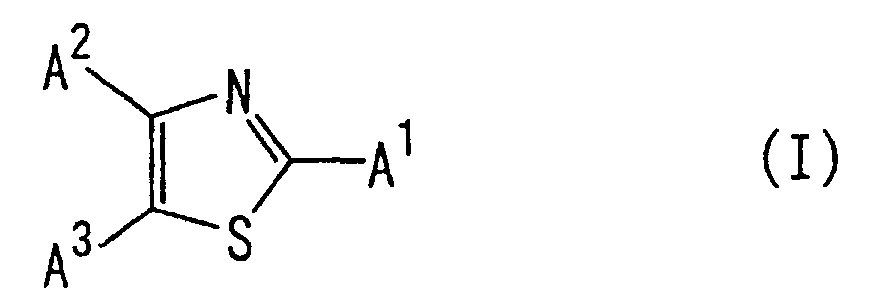
- A1
- is an aromatic hydrocarbon group optionally having substituents or a heterocyclic group optionally having substituents,
- one of A2 and A3
- is a hydrogen atom, a halogen atom, a C1-4 aliphatic hydrocarbon group optionally having substituents or an optionally esterified carboxyl group,
- the other of A2 and A3
- is an aromatic hydrocarbon group optionally having substituents or a heterocyclic group optionally having substituents, and
- at least one of A1, A2 and A3
- is a 3-pyridyl group optionally having substituents,
- The steroid C17,20-lyase inhibitor of claim 1, wherein one of A1, A2 and A3 is a 3-pyridyl group optionally having substituents.
- The steroid C17,20-lyase inhibitor of claim 2, wherein (1) A1 is a 3-pyridyl group optionally having substituents and A2 is a C6-14 aryl group optionally having substituents, or (2) A1 is a 3-pyridyl group optionally having substituents and A2 is a 3-pyridyl group optionally having substituents or (3) A1 is a C6-14 aryl group optionally having substituents and A2 is a 3-pyridyl group optionally having substituents.
- The steroid C17,20-lyase inhibitor of claim 2, wherein one of A2 and A3 is 1) a hydrogen atom, 2) a C1-4 aliphatic hydrocarbon group optionally having substituents, 3) an optionally esterified carboxyl group or 4) a halogen atom, the substituent of the "3-pyridyl group optionally having substituents", which is one of A1 A2 and A3, is 1 to 4 groups selected from 1) a C1-6 aliphatic hydrocarbon group optionally having substituents, 2) an optionally esterified carboxyl group, 3) a carbamoyl optionally having 1 or 2 substituents, 4) a cyclic aminocarbonyl optionally having substituents, 5) an amino optionally having substituents, 6) a cyclic amino optionally having substituents, 7) an alkylthio optionally having substituents, 8) an alkoxy optionally having substituents and 9) a halogen, or one saturated or unsaturated divalent C3-5 carbon chain, and the other of A2 and A3 and the aromatic hydrocarbon group optionally having substituents or heterocyclic group optionally having substituents for A1 are (a) a C6-14 aryl optionally having, as a substituent, 1 to 5 groups selected from 1) a C1-4 alkyl optionally having substituents, 2) a phenyl optionally having substituents, 3) a C1-4 alkoxycarbonyl, 4) a carbamoyl optionally having substituents, 5) a C1-2 alkylenedioxy, 6) an amino optionally having substituents, 7) a nitro, 8) a hydroxy optionally having substituents, 9) an optionally esterified carboxyl, 10) an alkylsulfonyl, 11) a sulfamoyl optionally having substituents and 12) a halogen, or (b) a pyridyl.
- The steroid C17,20-lyase inhibitor of claim 2, wherein one of A2 and A3 is 1) a hydrogen atom, 2) a C1-4 alkyl optionally substituted by hydroxy, 3) a carboxyl, 4) a C1-4 alkoxycarbonyl or 5) a halogen, and the other of A2 and A3 and the aromatic hydrocarbon group optionally having substituents or heterocyclic group optionally having substituents for A1 are (a) a C6-14 aryl optionally having, as a substituent, 1 to 5 groups selected from 1) a C1-4 alkyl optionally having halogen, 2) a phenyl optionally having C1-4 alkoxy, 3) a C1-4 alkoxycarbonyl, 4) a carbamoyl optionally having 1 or 2 C1-4 alkyl, 5) a C1-2 alkylenedioxy, 6) an amino optionally having 1 or 2 substituents selected from C1-4 alkyl, C1-6 alkanoyl and C1-4 alkylsulfonyl, 7) a nitro, 8) a hydroxy, 9) a C1-4 alkoxy, 10) a C1-4 alkanoyloxy, 11) a C1-4 alkylsulfonyl, 12) a sulfamoyl optionally having 1 or 2 substituents selected from C1-4 alkyl and benzyl and 13) a halogen or (b) a pyridyl, and the substituent of the "3-pyridyl group optionally having substituents", which is one of A1, A2 and A3, is 1 to 4 selected from 1) a C1-6 alkyl group optionally having, as a substituent, halogen or hydroxy, 2) a carboxyl group, 3) a C1-4 alkoxycarbonyl group, 4) a carbamoyl optionally having, as a substituent, 1 or 2 C1-4 alkyl, 5) a 4-benzylpiperidinocarbonyl, 6) an amino optionally having, as a substituent, 1 or 2 groups selected from carbamoylmethyl, C1-4 alkyl and benzyl, 7) a morpholino, 8) a 4-(4-chlorophenyl)-4-hydroxypiperidino, 9) a C1-4 alkylthio, 10) a C1-4 alkoxy, 11) a halogen and 12) a butadienylene.
- The steroid C17,20-lyase inhibitor of claim 2, wherein one of A2 and A3 is a hydrogen atom, a methyl group, a chlorine atom or a fluorine atom, the other of A2 and A3 and the aromatic hydrocarbon group optionally having substituents or heterocyclic group optionally having substituents for A1 are 1) a phenyl group optionally having, as a substituent, 1 or 2 groups selected from methyl, methoxycarbonyl, carbamoyl, trifluoromethyl, diethylamino, acetylamino, methylsulfonylamino, hydroxy, methoxy, sulfamoyl, methylsulfamoyl, fluorine and chlorine, 2) a naphthyl group or 3) a 3-pyridyl group, and the substituent of the "3-pyridyl group optionally having substituents", which is one of A1, A2 and A3, is methyl, ethyl, trifluoromethyl, 1-hydroxy-1-methylethyl, carbamoylmethylamino, dimethylamino, morpholino, methylbenzylamino, methylthio, methoxy, isopropoxy or butadienylene.
- The steroid C17,20-lyase inhibitor of claim 3, wherein the 3-pyridyl group optionally having substituents is a 4-methyl-3-pyridyl group or a 4-trifluoromethyl-3-pyridyl group.
- The steroid C17,20-lyase inhibitor of claim 2, wherein A3 is a hydrogen atom, a halogen atom, a C1-4 alkyl group or a C1-4 alkoxycarbonyl group.
- The steroid C17,20-lyase inhibitor of claim 3, wherein 3-pyridyl group optionally having substituents is a 3-pyridyl group, a 4-methyl-3-pyridyl group, a 4-trifluoromethyl-3-pyridyl group, a 4-methoxy-3-pyridyl group, a 4,5-butadienylene-3-pyridyl group, a 4-dimethylamino-3-pyridyl group, a 4-methylthio-3-pyridyl group, a 4-benzylmethylamino-3-pyridyl group, a 4-isopropoxy-3-pyridyl group, a 5-ethoxycarbonyl-3-pyridyl group, a 4-morpholino-3-pyridyl group, a 1-hydroxyisopropyl-3-pyridyl group, a 6-dimethylcarbamoyl-3-pyridyl group, a 4-hydroxy-4-(4-chlorophenyl)piperidino-3-pyridyl group, a 4-(N-methylcarbamoyl)-3-pyridyl group, a 4-ethyl-3-pyridyl group, a 4-carbamoylmethylamino-3-pyridyl group, a 4-carbamoyl-3-pyridyl group or a 4-(4-benzylpiperidinocarbonyl)-3-pyridyl group, and the Cg_i4 aryl group optionally having substituents is a phenyl group, a 4-phenylphenyl group, a 3-nitrophenyl group, a 4-nitrophenyl group, a 4-hydroxyphenyl group, a 2-chlorophenyl group, a 3-chlorophenyl group, a 4-chlorophenyl group, a 3,4-dichlorophenyl group, a 2-fluorophenyl group, a 3-fluorophenyl group, a 4-fluorophenyl group, a 4-bromophenyl group, a 4-methyiphenyi group, a 2,4-dimethylphenyl group, a 3,4-dimethylphenyl group, a 4-trifluoromethylphenyl group, a 2,4-bistrifluoromethylphenyl group, a 2-methoxyphenyl group, a 3-methoxyphenyl group, a 4-methoxyphenyl group, a 2,4-dimethoxyphenyl group, a 4-aminophenyl group, a 4-diethylaminophenyl group, a 4-methoxycarbonylphenyl group, a 4-ethoxycarbonylphenyl group, a 3-methylcarbamoylphenyl group, a 4-sulfamoylphenyl group, a 4-methylsulfamoylphenyl group, a 3,4-ethylenedioxyphenyl group, a 4-acetoxyphenyl group, a 4-methylsulfonylphenyl group, a 4-dibenzylsulfamoylphenyl group, 3-acetylaminophenyl group, a 4-acetylaminophenyl group, a 4-methylsulfonylaminophenyl group, a 3-methylsulfonylaminophenyl group, a 4-carbamoylphenyl group or a 2-naphthyl group.
- The steroid C17,20-lyase inhibitor of claim 2, which is a prophylactic or therapeutic agent of a sex hormone dependent disease.
- The steroid C17,20-lyase inhibitor of claim 2, which is a prophylactic or therapeutic agent of prostatic hypertrophy, masculinism, hypertrichosis, male-type baldness, male infant-type prematurity, endometriosis, hysteromyoma, adenomyosis of uterus, mastopathy or polycystic ovary syndrome.
- An androgen or estrogen reducing agent, which comprises a steroid C17,20-lyase inhibitor and an LHRH receptor modulator in combination.
- An androgen or estrogen reducing agent comprising a compound represented by the formula:wherein

- A1
- is an aromatic hydrocarbon group optionally having substituents or a heterocyclic group optionally having substituents,
- one of A2 and A3
- is a hydrogen atom, a halogen atom, a C1-4 aliphatic hydrocarbon group optionally having substituents or an optionally esterified carboxyl group,
- the other of A2 and A3
- is an aromatic hydrocarbon group optionally having substituents or a heterocyclic group optionally having substituents, and
- at least one of A1, A2 and A3
- is a 3-pyridyl group optionally having substituents,
- A method for inhibiting steroid C17,20-lyase, which comprises administering an effective amount of a compound represented by the formula:wherein

- A1
- is an aromatic hydrocarbon group optionally having substituents or a heterocyclic group optionally having substituents,
- one of A2 and A3
- is a hydrogen atom, a halogen atom, a C1-4 aliphatic hydrocarbon group optionally having substituents or an optionally esterified carboxyl group,
- the other of A2 and A3
- is an aromatic hydrocarbon group optionally having substituents or a heterocyclic group optionally having substituents, and
- at least one of A1, A2 and A3
- is a 3-pyridyl group optionally having substituents,
- use of a compound represented by the formula:wherein

- A1
- is an aromatic hydrocarbon group optionally having substituents or a heterocyclic group optionally having substituents,
- one of A2 and A3
- is a hydrogen atom, a halogen atom, a C1-4 aliphatic hydrocarbon group optionally having substituents or an optionally esterified carboxyl group,
- the other of A2 and A3
- is an aromatic hydrocarbon group optionally having substituents or a heterocyclic group optionally having substituents, and
- at least one of A1, A2 and A3
- is a 3-pyridyl group optionally having substituents,
- A compound represented by the formula:wherein

- n
- is an integer of 1 to 5,
- R1a
- is a sulfamoyl group optionally having substituents or an alkylsulfonyl group optionally having substituents, or two R1a substituting adjacent carbon atoms are bonded to designate a C1-2 alkylenedioxy group, and when n is not less than 2, R1a in the number of n may be the same or different,
- m
- is an integer of 1 to 5,
- R2
- is 1) a hydrogen atom, 2) a C1-4 aliphatic hydrocarbon group optionally having substituents, 3) an optionally esterified carboxyl group, 4) a carbamoyl group optionally having substituents, 5) an amino group optionally having substituents, 6) a cyclic amino group, 7) an alkylthio group optionally having substituents or 8) an alkoxy group optionally having substituents, or two R2 substituting adjacent carbon atoms may be bonded to form 9) a saturated or unsaturated divalent C3-5 carbon chain, and when m is not less than 2, R2 in the number of m may be the same or different, and
- R3
- is 1) a hydrogen atom, 2) a halogen atom, 3) a C1-4 aliphatic hydrocarbon group optionally having substituents or 4) an optionally esterified carboxyl group,
- The compound of claim 16, wherein R1a is 1) a sulfamoyl group optionally having C1-4 alkyl or C7-9 aralkyl as a substituent or 2) a C1-4 alkylsulfonyl group, or two R1a substituting adjacent carbon atoms are bonded to designate a C1-2 alkylenedioxy group, R2 is 1) a hydrogen atom, 2) a C1-4 alkyl optionally having halogen or hydroxy as a substituent, 3) a carboxyl group, 4) a C1-4 alkoxycarbonyl group, 5) a carbamoyl group optionally having C1-4 alkyl or C7-9 aralkyl as a substituent, 6) an amino group optionally having C1-4 alkyl, carbamoyl-C1-4 alkyl or C7-10 aralkyl as a substituent, 7) a piperidino group, 8) a morpholino group, 9) a C1-4 alkylthio group or 10) a C1-4 alkoxy group, or two adjacent R2 are bonded to form 11) a butadienylene group, and R3 is 1) a hydrogen atom, 2) a halogen atom, 3) a C1-4 alkyl group, 4) a carboxyl group or 5) a C1-4 alkoxycarbonyl group.
- The compound of claim 16, wherein R1a is a sulfamoyl group, a methylsulfamoyl group, a dibenzylsulfamoyl group or a methylsulfonyl group, or two R1a substituting adjacent carbon atoms are bonded to designate an ethylenedioxy group, R2 is a hydrogen atom, a methyl group, a trifluoromethyl group or a methoxy group, or two adjacent R2 are bonded to form a butadienylene group, and R3 is a hydrogen atom or a chlorine atom.
- A prodrug of a compound represented by the formula:wherein

- n
- is an integer of 1 to 5,
- R1a
- is a sulfamoyl group optionally having substituents or an alkylsulfonyl group optionally having substituents, or two R1a substituting adjacent carbon atoms are bonded to designate a C1-2 alkylenedioxy group, and when n is not less than 2, R1a in the number of n may be the same or different,
- m
- is an integer of 1 to 5,
- R2
- is 1) a hydrogen atom, 2) a C1-4 aliphatic hydrocarbon group optionally having substituents, 3) an optionally esterified carboxyl group, 4) a carbamoyl group optionally having substituents, 5) an amino group optionally having substituents, 6) a cyclic amino group, 7) an alkylthio group optionally having substituents or 8) an alkoxy group optionally having substituents, or two R2 substituting adjacent carbon atoms may be bonded to form 9) a saturated or unsaturated divalent C3-5 carbon chain, and when m is not less than 2, R2 in the number of m may be the same or different, and
- R3
- is 1) a hydrogen atom, 2) a halogen atom, 3) a C1-4 aliphatic hydrocarbon group optionally having substituents or 4) an optionally esterified carboxyl group,
- A compound represented by the formula:wherein
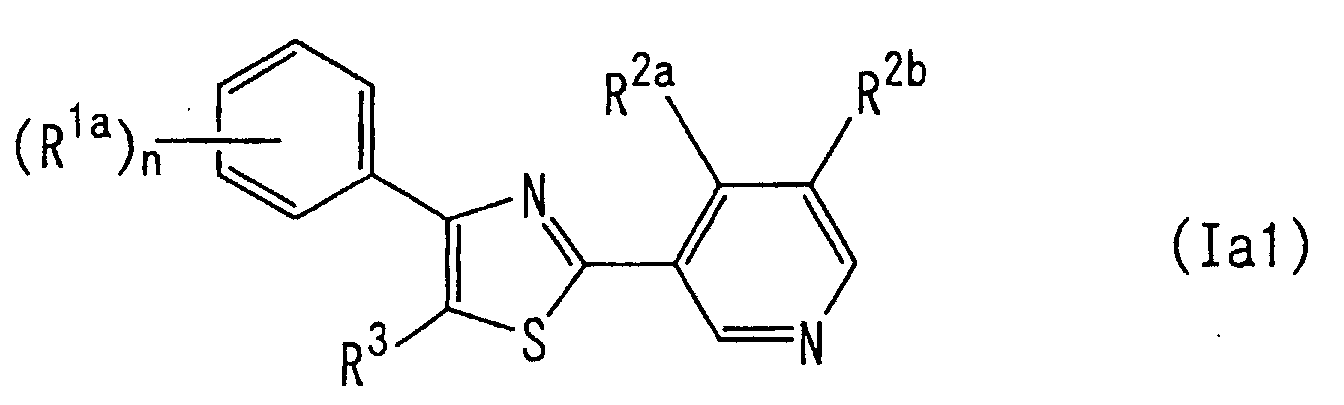
- n
- is an integer of 1 to 5,
- R1a
- is a sulfamoyl group optionally having substituents or an alkylsulfonyl group optionally having substituents, or two R1a substituting adjacent carbon atoms are bonded to designate a C1-2 alkylenedioxy group, and when n is not less than 2, R1a in the number of n may be the same or different,
- R2a and R2b
- are the same or different and each is 1) a hydrogen atom, 2) a C1-4 aliphatic hydrocarbon group optionally having substituents, 3) an optionally esterified carboxyl group, 4) a carbamoyl group optionally having substituents, 5) an amino group optionally having substituents, 6) a cyclic amino group, 7) an alkylthio group optionally having substituents or 8) an alkoxy group optionally having substituents, or R2a and R2b may be bonded to form 9) a saturated or unsaturated divalent C3-5 carbon chain, and
- R3
- is 1) a hydrogen atom, 2) a halogen atom, 3) a C1-4 aliphatic hydrocarbon group optionally having substituents or 4) an optionally esterified carboxyl group,
- The compound of claim 20, wherein R1a is 1) a sulfamoyl group optionally having C1-4 alkyl or a C7-9 aralkyl as a substituent or 2) a C1-4 alkylsulfonyl group, or two R1a substituting adjacent carbon atoms are bonded to designate a C1-2 alkylenedioxy group, R2a and R2b are the same or different and each is 1) a hydrogen atom, 2) a C1-4 alkyl optionally having halogen or hydroxy as a substituent, 3) a carboxyl group or a C1-4 alkoxycarbonyl group, 4) a carbamoyl group optionally having C1-4 alkyl or C7-9 aralkyl as a substituent, 5) an amino group optionally having C1-4 alkyl, carbamoyl-C1-4 alkyl or C7-10 aralkyl as a substituent, 6) a piperidino group or morpholino group, 7) a C1-4 alkylthio group or 8) a C1-4 alkoxy group, or R2a and R2b are bonded to form a butadienylene group, and R3 is 1) a hydrogen atom, 2) a halogen atom, 3) a C1-4 alkyl group, 4) a carboxyl group or 5) a C1-4 alkoxycarbonyl group.
- The compound of claim 20, wherein R1a is a sulfamoyl group, a methylsulfamoyl group, a dibenzylsulfamoyl group or a methylsulfonyl group, or two R1a substituting adjacent carbon atoms are bonded to designate an ethylenedioxy group, R2a is a hydrogen atom, a methyl group, a trifluoromethyl group or a methoxy group, R2b is a hydrogen atom, or R2a and R2b are bonded to form a butadienylene group, and R3 is a hydrogen atom or a chlorine atom.
- A prodrug of a compound represented by the formula:wherein
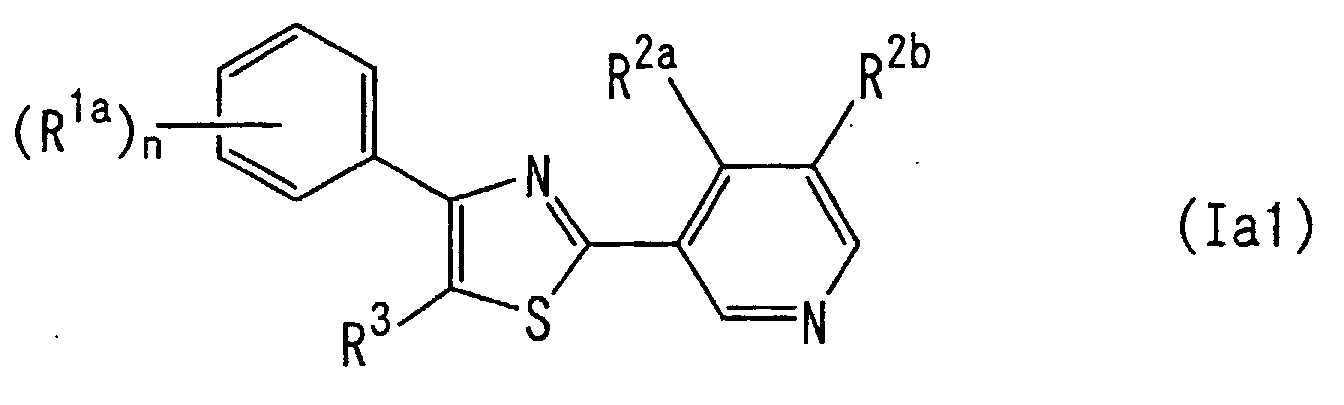
- n
- is an integer of 1 to 5,
- R1a
- is a sulfamoyl group optionally having substituents or an alkylsulfonyl group optionally having substituents, or two R1a substituting adjacent carbon atoms are bonded to designate a C1-2 alkylenedioxy group, and when n is not less than 2, R1a in the number of n may be the same or different,
- R2a and R2b
- are the same or different and each is 1) a hydrogen atom, 2) a C1-4 aliphatic hydrocarbon group optionally having substituents, 3) an optionally esterified carboxyl group, 4) a carbamoyl group optionally having substituents, 5) an amino group optionally having substituents, 6) a cyclic amino group, 7) an alkylthio group optionally having substituents or 8) an alkoxy group optionally having substituents, or R2a and R2b may be bonded to form 9) a saturated or unsaturated divalent C3-5 carbon chain, and
- R3
- is 1) a hydrogen atom, 2) a halogen atom, 3) a C1-4 aliphatic hydrocarbon group optionally having substituents or 4) an optionally esterified carboxyl group,
- A compound represented by the formula:wherein
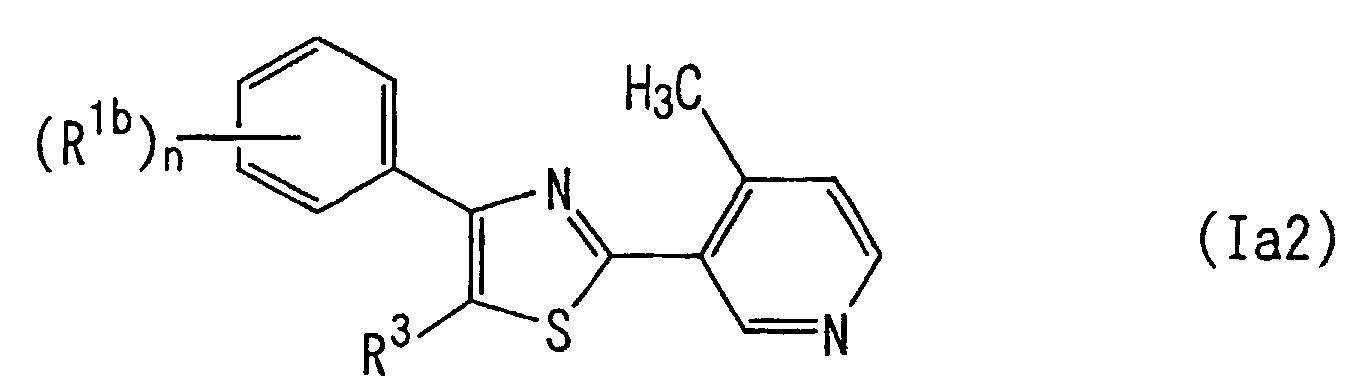
- n
- is an integer of 1 to 5,
- R1b
- is 1) a sulfamoyl group optionally having substituents, 2) a carbamoyl group optionally having substituents, 3) an alkyl group optionally having substituents, 4) an optionally esterified carboxyl group, 5) a halogen atom, 6) an amino group optionally having substituents, 7) a nitro group, 8) a hydroxy group optionally having substituents or 9) an alkylsulfonyl group optionally having substituents, or two R1b substituting adjacent carbon atoms are bonded to designate a C1-2 alkylenedioxy group, and when n is not less than 2, R1b in the number of n may be the same or different, and
- R3
- is 1) a hydrogen atom, 2) a halogen atom, 3) a C1-4 aliphatic hydrocarbon group optionally having substituents or 4) an optionally esterified carboxyl group,
- The compound of claim 24, wherein R1b is 1) a sulfamoyl group optionally having C1-4 alkyl or C7-9 aralkyl as a substituent, 2) a carbamoyl group optionally having C1-4 alkyl or C7-9 aralkyl as a substituent, 3) a C1-4 alkyl group optionally having halogen as a substituent, 4) a carboxyl group, 5) a C1-4 alkoxycarbonyl group, 6) a halogen atom, 7) an amino group optionally having C1-6 alkanoyl, C1-4 alkyl or C1-4 alkylsulfonyl as a substituent, 8) a nitro group, 9) a hydroxy group optionally having C1-4 alkyl or C1-6 alkanoyl as a substituent or 10) a C1-4 alkylsulfonyl group, or two R1b substituting adjacent carbon atoms are bonded to designate a C1-2 alkylenedioxy group, and R3 is 1) a hydrogen atom, 2) a halogen atom, 3) a C1-4 alkyl group, 4) a carboxyl group or 5) a C1-4 alkoxycarbonyl group.
- The compound of claim 24, wherein R1b is a sulfamoyl group, a methylsulfamoyl group, a dibenzylsulfamoyl group, a carbamoyl group, a methylcarbamoyl group, an ethylcarbamoyl group, a dimethylcarbamoyl group, an azetidine-1-ylcarbonyl group, a methyl group, a trifluoromethyl group, a carboxyl group, an ethoxycarbonyl group, a chlorine atom, a fluorine atom, a nitro group, a hydroxy group, a methoxy group or a methylsulfonyl group, or two R1b substituting adjacent carbon atoms are bonded to designate an ethylenedioxy group, and R3 is a hydrogen atom, a chlorine atom, a fluorine atom or a methyl group.
- A prodrug a compound represented by the formula:wherein

- n
- is an integer of 1 to 5,
- R1b
- is 1) a sulfamoyl group optionally having substituents, 2) a carbamoyl group optionally having substituents, 3) an alkyl group optionally having substituents, 4) an optionally esterified carboxyl group, 5) a halogen atom, 6) an amino group optionally having substituents, 7) a nitro group, 8) a hydroxy group optionally having substituents or 9) an alkylsulfonyl group optionally having substituents, or two R1b substituting adjacent carbon atoms are bonded to designate a C1-2 alkylenedioxy group, and when n is not less than 2, R1b in the number of n may be the same or different, and
- R3
- is 1) a hydrogen atom, 2) a halogen atom, 3) a C1-4 aliphatic hydrocarbon group optionally having substituents or 4) an optionally esterified carboxyl group,
- A compound represented by the formula:wherein
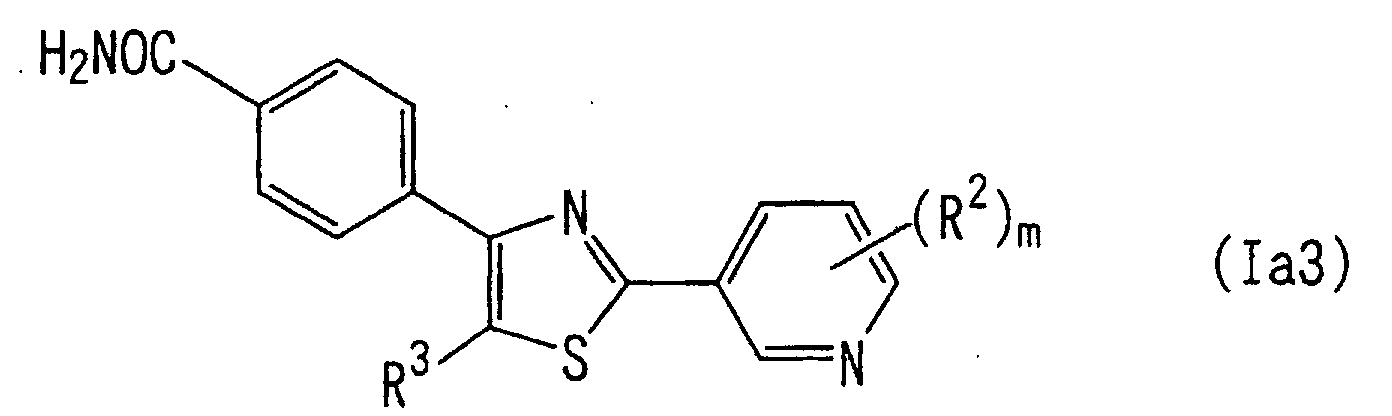
- m
- is an integer of 1 to 5,
- R2
- is 1) a hydrogen atom, 2) a C1-4 aliphatic hydrocarbon group optionally having substituents, 3) an optionally esterified carboxyl group, 4) a carbamoyl group optionally having substituents, 5) an amino group optionally having substituents, 6) a cyclic amino group, 7) an alkylthio group optionally having substituents or 8) an alkoxy group optionally having substituents, or two R2 substituting adjacent carbon atoms may be bonded to form 9) a saturated or unsaturated divalent C3-5 carbon chain, and when m is not less than 2, R2 in the number of m may be the same or different, and
- R3
- is 1) a hydrogen atom, 2) a halogen atom, 3) a C1-4 aliphatic hydrocarbon group optionally having substituents or 4) an optionally esterified carboxyl group,
- The compound of claim 28, wherein R2 is 1) a hydrogen atom, 2) a C1-4 alkyl optionally having halogen or hydroxy as a substituent, 3) a carboxyl group, 4) a C1-4 alkoxycarbonyl group, 5) a carbamoyl group optionally having C1-4 alkyl or C7-9 aralkyl as a substituent, 6) an amino group optionally having C1-4 alkyl, carbamoyl-C1-4 alkyl or C7-10 aralkyl as a substituent, 7) a piperidino group, 8) a morpholino group, 9) a C1-4 alkylthio group or 10) a C1-4 alkoxy group, or two adjacent R2 are bonded to form 11) a butadienylene group, and R3 is 1) a hydrogen atom, 2) a halogen atom, 3) a C1-4 alkyl group, 4) a carboxyl group or 5) a C1-4 alkoxycarbonyl group.
- The compound of claim 28, wherein R2 is a hydrogen atom, a methyl group or a trifluoromethyl group, and R3 is a hydrogen atom.
- A prodrug of a compound represented by the formula:wherein
- m
- is an integer of 1 to 5,
- R2
- is 1) a hydrogen atom, 2) a C1-4 aliphatic hydrocarbon group optionally having substituents, 3) an optionally esterified carboxyl group, 4) a carbamoyl group optionally having substituents, 5) an amino group optionally having substituents, 6) a cyclic amino group, 7) an alkylthio group optionally having substituents or 8) an alkoxy group optionally having substituents, or two R2 substituting adjacent carbon atoms may be bonded to form 9) a saturated or unsaturated divalent C3-5 carbon chain, and when m is not less than 2, R2 in the number of m may be the same or different, and
- R3
- is 1) a hydrogen atom, 2) a halogen atom, 3) a C1-4 aliphatic hydrocarbon group optionally having substituents or 4) an optionally esterified carboxyl group,
- A compound represented by the formula:wherein
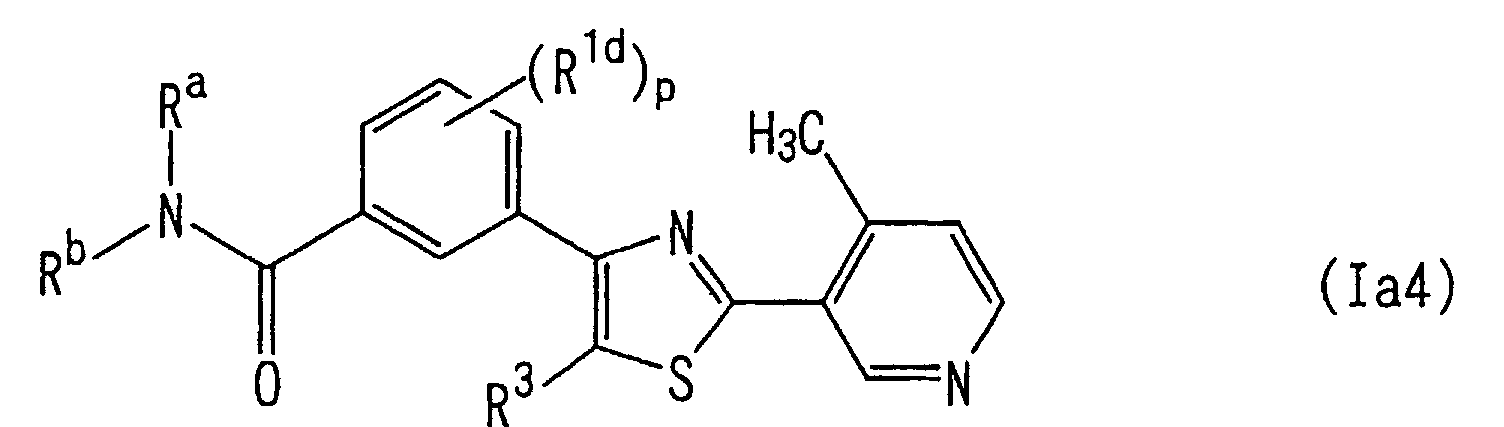
- p
- is 0 or an integer of 1 to 5,
- Ra and Rb
- are the same or different and each is a hydrogen atom, a C1-6 lower alkyl group, or Ra and Rb may be bonded together with a nitrogen atom to form a ring,
- R1d
- is 1) a hydrogen atom, 2) a C1-4 aliphatic hydrocarbon group optionally having substituents, 3) a sulfamoyl group optionally having substituents, 4) a carbamoyl group optionally having substituents, 5) an optionally esterified carboxyl group, 6) a halogen atom, 7) an amino group optionally having substituents, 8) a cyclic amino group, 9) a hydroxy group optionally having substituents, 10) an alkylthio group optionally having substituents, 11) a nitro group, 12) an alkylsulfonyl group optionally having substituents, or 13) two R1d substituting adjacent carbon atoms may be bonded to form 13a) a C1-2 alkylenedioxy group or 13b) a saturated or unsaturated divalent C3-5 carbon chain, and when p is not less than 2, R1d in the number of p may be the same or different, and
- R3
- is 1) a hydrogen atom, 2) a halogen atom, 3) a C1-4 aliphatic hydrocarbon group optionally having substituents or 4) an optionally esterified carboxyl group,
- The compound of claim 32, wherein Ra and Rb are the same or different and each is hydrogen atom, a methyl group or an ethyl group, or Ra and Rb are bonded together with a nitrogen atom to designate an azetidin-1-yl group, R1d is a hydrogen atom, and R3 is a hydrogen atom.
- A prodrug of a compound represented by the formula:wherein
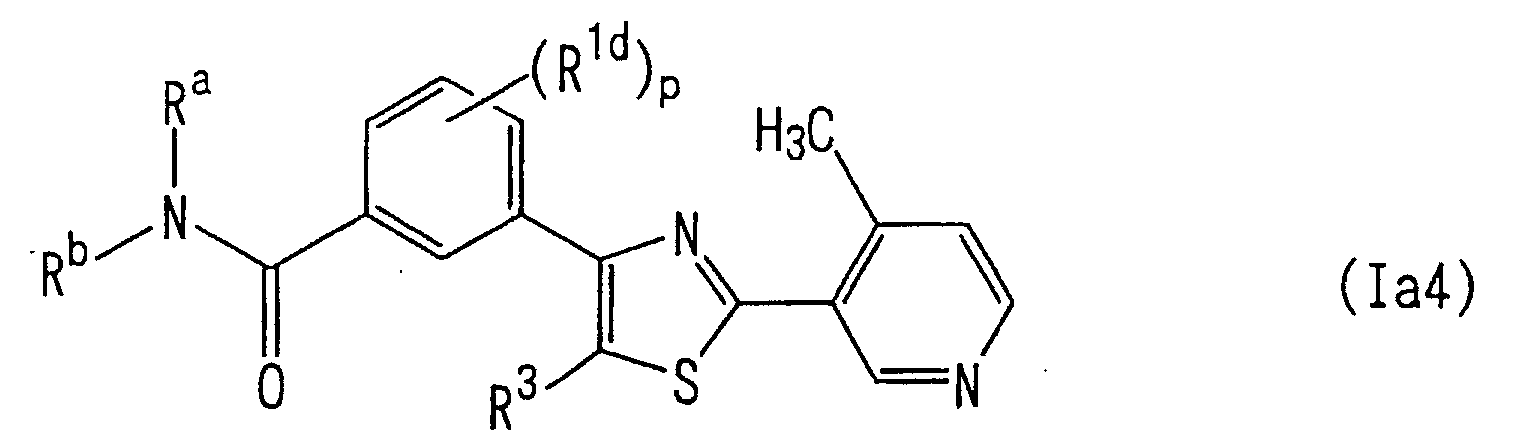
- p
- is 0 or an integer of 1 to 5,
- Ra and Rb
- are the same or different and each is a hydrogen atom, a C1-6 lower alkyl group, or Ra and Rb may be bonded together with a nitrogen atom to form a ring,
- R1d
- is 1) a hydrogen atom, 2) a C1-4 aliphatic hydrocarbon group optionally having substituents, 3) a sulfamoyl group optionally having substituents, 4) a carbamoyl group optionally having substituents, 5) an optionally esterified carboxyl group, 6) a halogen atom, 7) an amino group optionally having substituents, 8) a cyclic amino group, 9) a hydroxy group optionally having substituents, 10) an alkylthio group optionally having substituents, 11) a nitro group, 12) an alkylsulfonyl group optionally having substituents, or 13) two R1d substituting adjacent carbon atoms may be bonded to form 13a) a C1-2 alkylenedioxy group or 13b) a saturated or unsaturated divalent C3-5 carbon chain, and when p is not less than 2, R1d in the number of p may be the same or different, and
- R3
- is 1) a hydrogen atom, 2) a halogen atom, 3) a C1-4 aliphatic hydrocarbon group optionally having substituents or 4) an optionally esterified carboxyl group,
- A compound represented by the formula:wherein

- n
- is an integer of 1 to 5,
- R1c
- is a carbamoyl group optionally having substituents or an alkylsulfonyl group optionally having substituents, or two R1c substituting adjacent carbon atoms are bonded to designate a C1-2 alkylenedioxy group, and when n is not less than 2, R1c in the number of n are the same or different, m is an integer of 1 to 5,
- R2
- is 1) a hydrogen atom, 2) a C1-4 aliphatic hydrocarbon group optionally having substituents, 3) an optionally esterified carboxyl group, 4) a carbamoyl group optionally having substituents, 5) an amino group optionally having substituents, 6) a cyclic amino group, 7) an alkylthio group optionally having substituents or 8) an alkoxy group optionally having substituents, or two R2 substituting adjacent carbon atoms may be bonded to form 9) a saturated or unsaturated divalent C3-5 carbon chain, and when m is not less than 2, R2 in the number of m may be the same or different, and
- R3
- is 1) a hydrogen atom, 2) a halogen atom, 3) a C1-4 aliphatic hydrocarbon group optionally having substituents or 4) an optionally esterified carboxyl group,
- The compound of claim 35, wherein R1c is 1) a carbamoyl group optionally having C1-4 alkyl or C7-9 aralkyl as a substituent or 2) a C1-4 alkylsulfonyl group, or two R1b substituting adjacent carbon atoms are bonded to designate a C1-2 alkylenedioxy group, R2 is 1) a hydrogen atom, 2) a C1-4 alkyl optionally having halogen or hydroxy as a substituent, 3) a carboxyl group, 4) a C1-4 alkoxycarbonyl group, 5) a carbamoyl group optionally having C1-4 alkyl or C7-9 aralkyl as a substituent, 6) an amino group optionally having C1-4 alkyl, carbamoyl-C1-4 alkyl or C7-10 aralkyl as a substituent, 7) a piperidino group, 8) a morpholino group, 9) a C1-4 alkylthio group or 10) a C1-4 alkoxy group, or two R2 substituting adjacent carbon atoms are bonded to form 11) a butadienylene group, and R3 is 1) a hydrogen atom, 2) a halogen atom, 3) a C1-4 alkyl group, 4) a carboxyl group or 5) a C1-4 alkoxycarbonyl group.
- The compound of claim 35, wherein R1c is a carbamoyl group, a methylcarbamoyl group, or a dimethylcarbamoyl group, R2 is a hydrogen atom, a methyl group, an ethyl group or an isopropyl group, and R3 is a hydrogen atom, a chlorine atom, a methyl group or an isopropyl group.
- A prodrug of a compound represented by the formula:wherein

- n
- is an integer of 1 to 5,
- R1c
- is a carbamoyl group optionally having substituents or an alkylsulfonyl group optionally having substituents, or two R1c substituting adjacent carbon atoms are bonded to designate a C1-2 alkylenedioxy group, and when n is not less than 2, R1c in the number of n are the same or different, m is an integer of 1 to 5,
- R2
- is 1) a hydrogen atom, 2) a C1-4 aliphatic hydrocarbon group optionally having substituents, 3) an optionally esterified carboxyl group, 4) a carbamoyl group optionally having substituents, 5) an amino group optionally having substituents, 6) a cyclic amino group, 7) an alkylthio group optionally having substituents or 8) an alkoxy group optionally having substituents, or two R2 substituting adjacent carbon atoms may be bonded to form 9) a saturated or unsaturated divalent C3-5 carbon chain, and when m is not less than 2, R2 in the number of m may be the same or different, and
- R3
- is 1) a hydrogen atom, 2) a halogen atom, 3) a C1-4 aliphatic hydrocarbon group optionally having substituents or 4) an optionally esterified carboxyl group,
- A compound represented by the formula:wherein

- n
- is an integer of 1 to 5,
- R1c
- is a carbamoyl group optionally having substituents or an alkylsulfonyl group optionally having substituents, or two R1c substituting adjacent carbon atoms are bonded to designate a C1-2 alkylenedioxy group, and when n is not less than 2, R1c in the number of n are the same or different,
- R2a and R2b
- are the same or different and each is 1) a hydrogen atom, 2) a C1-4 aliphatic hydrocarbon group optionally having substituents, 3) an optionally esterified carboxyl group, 4) a carbamoyl group optionally having substituents, 5) an amino group optionally having substituents, 6) a cyclic amino group, 7) an alkylthio group optionally having substituents or 8) an alkoxy group optionally having substituents, or R2a and R2b may be bonded to form 9) a saturated or unsaturated divalent C3-5 carbon chain, and
- R3
- is 1) a hydrogen atom, 2) a halogen atom, 3) a C1-4 aliphatic hydrocarbon group optionally having substituents or 4) an optionally esterified carboxyl group,
- The compound of claim 39, wherein R1c is 1) a carbamoyl group optionally having C1-4 alkyl or C7-9 aralkyl as a substituent or 2) a C1-4 alkylsulfonyl group, or two R1b substituting adjacent carbon atoms are bonded to designate a C1-2 alkylenedioxy group, R2a and R2b are the same or different and each is 1) a hydrogen atom, 2) a C1-4 alkyl optionally having halogen or hydroxy as a substituent, 3) a carboxyl group or C1-4 alkoxycarbonyl group, 4) a carbamoyl group optionally having C1-4 alkyl or C7-9 aralkyl as a substituent, 5) an amino group optionally having C1-4 alkyl, carbamoyl-C1-4 alkyl or C7-10 aralkyl as a substituent, 6) a piperidino group or morpholino group, 7) a C1-4 alkylthio group or 8) a C1-4 alkoxy group, or R2a and R2a are bonded to form a butadienylene group, and R3 is 1) a hydrogen atom, 2) a halogen atom, 3) a C1-4 alkyl group, 4) a carboxyl group or 5) a C1-4 alkoxycarbonyl group.
- The compound of claim 39, wherein R1c is a carbamoyl group, a methylcarbamoyl group, or a dimethylcarbamoyl group, R2a is a methyl group, an ethyl group or an isopropyl group, R2b is a hydrogen atom, and R3 is a hydrogen atom, a chlorine atom, a methyl group or an isopropyl group.
- A prodrug of a compound represented by the formula:wherein
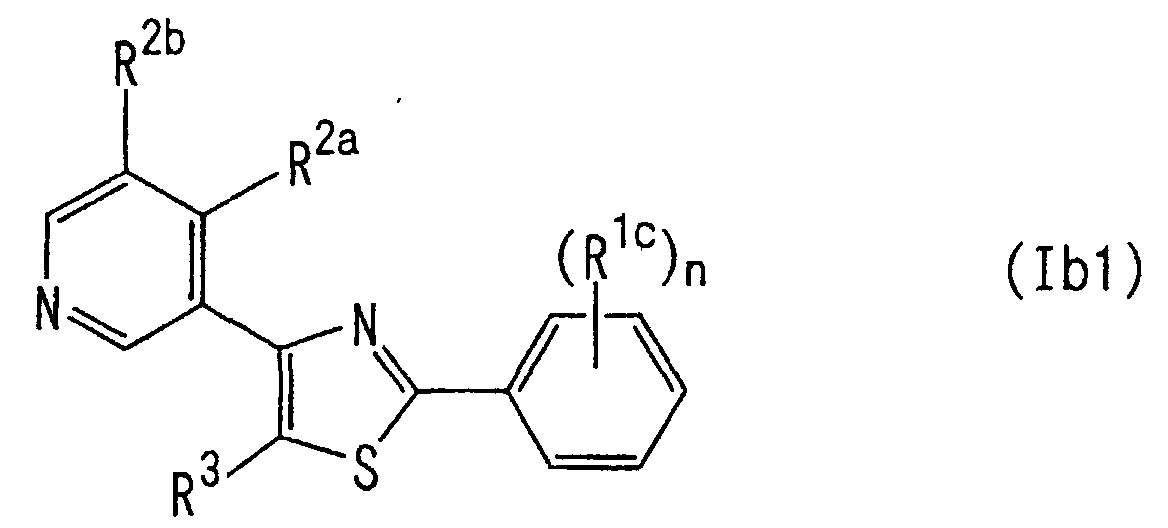
- n
- is an integer of 1 to 5,
- R1c
- is a carbamoyl group optionally having substituents or an alkylsulfonyl group optionally having substituents, or two R1c substituting adjacent carbon atoms are bonded to designate a C1-2 alkylenedioxy group, and when n is not less than 2, R1c in the number of n are the same or different,
- R2a and R2b
- are the same or different and each is 1) a hydrogen atom, 2) a C1-4 aliphatic hydrocarbon group optionally having substituents, 3) an optionally esterified carboxyl group, 4) a carbamoyl group optionally having substituents, 5) an amino group optionally having substituents, 6) a cyclic amino group, 7) an alkylthio group optionally having substituents or 8) an alkoxy group optionally having substituents, or R2a and R2b may be bonded to form 9) a saturated or unsaturated divalent C3-5 carbon chain, and
- R3
- is 1) a hydrogen atom, 2) a halogen atom, 3) a C1-4 aliphatic hydrocarbon group optionally having substituents or 4) an optionally esterified carboxyl group,
- A compound represented by the formula:wherein

- n
- is an integer of 1 to 5,
- R1b
- is 1) a sulfamoyl group optionally having substituents, 2) a carbamoyl group optionally having substituents, 3) an alkyl group optionally having substituents, 4) an optionally esterified carboxyl group, 5) a halogen atom, 6) an amino group optionally having substituents, 7) a nitro group, 8) a hydroxy group optionally having substituents or 9) an alkylsulfonyl group optionally having substituents, or two R1b substituting adjacent carbon atoms are bonded to designate a C1-2 alkylenedioxy group, and when n is not less than 2, R1b in the number of n may be the same or different, and
- R3
- is 1) a hydrogen atom, 2) a halogen atom, 3) a C1-4 aliphatic hydrocarbon group optionally having substituents or 4) an optionally esterified carboxyl group,
- The compound of claim 43, wherein R1b is 1) a sulfamoyl group optionally having C1-4 alkyl or C7-9 aralkyl as a substituent, 2) a carbamoyl group optionally having C1-4 alkyl or C7-9 aralkyl as a substituent, 3) a C1-4 alkyl group optionally having halogen as a substituent, 4) a carboxyl group, 5) a C1-4 alkoxycarbonyl group, 6) a halogen atom, 7) an amino group optionally having C1-6 alkanoyl, C1-4 alkyl or C1-4 alkylsulfonyl as a substituent, 8) a nitro group, 9) a hydroxy group optionally having C1-4 alkyl or C1-6 alkanoyl as a substituent or 10) a C1-4 alkylsulfonyl group, or two R1b substituting adjacent carbon atoms are bonded to designate a C1-2 alkylenedioxy group, and R3 is 1) a hydrogen atom, 2) a halogen atom, 3) a C1-4 alkyl group, 4) a carboxyl group or 5) a C1-4 alkoxycarbonyl group.
- The compound of claim 43, wherein R1b is a sulfamoyl group, a carbamoyl group, a methylcarbamoyl group, a dimethylcarbamoyl group, a pyrrolidin-1-ylcarbonyl group, a methyl group, a chlorine atom, a fluorine atom, an acetylamino group, a formylamino group or nitro group, and R3 is a hydrogen atom, a chlorine atom, a methyl group or an isopropyl group.
- A prodrug of a compound represented by the formula:wherein

- n
- is an integer of 1 to 5,
- R1b
- is 1) a sulfamoyl group optionally having substituents, 2) a carbamoyl group optionally having substituents, 3) an alkyl group optionally having substituents, 4) an optionally esterified carboxyl group, 5) a halogen atom, 6) an amino group optionally having substituents, 7) a nitro group, 8) a hydroxy group optionally having substituents or 9) an alkylsulfonyl group optionally having substituents, or two R1b substituting adjacent carbon atoms are bonded to designate a C1-2 alkylenedioxy group, and when n is not less than 2, R1b in the number of n may be the same or different, and
- R3
- is 1) a hydrogen atom, 2) a halogen atom, 3) a C1-4 aliphatic hydrocarbon group optionally having substituents or 4) an optionally esterified carboxyl group,
- A compound represented by the formula:wherein

- m
- is an integer of 1 to 5,
- R2
- is 1) a hydrogen atom, 2) a C1-4 aliphatic hydrocarbon group optionally having substituents, 3) an optionally esterified carboxyl group, 4) a carbamoyl group optionally having substituents, 5) an amino group optionally having substituents, 6) a cyclic amino group, 7) an alkylthio group optionally having substituents or 8) an alkoxy group optionally having substituents, or two R2 substituting adjacent carbon atoms are bonded to form 9) a saturated or unsaturated divalent C3-5 carbon chain, and when m is not less than 2, R2 in the number of m may be the same or different, and
- R3
- is 1) a hydrogen atom, 2) a halogen atom, 3) a C1-4 aliphatic hydrocarbon group optionally having substituents or 4) an optionally esterified carboxyl group,
- The compound of claim 47, wherein R2 is 1) a hydrogen atom, 2) a C1-4 alkyl optionally having halogen or hydroxy as a substituent, 3) a carboxyl group, 4) a C1-4 alkoxycarbonyl group, 5) a carbamoyl group optionally having C1-4 alkyl or C7-9 aralkyl as a substituent, 6) an amino group optionally having C1-4 alkyl, carbamoyl-C1-4 alkyl or C7-10 aralkyl as a substituent, 7) a piperidino group, 8) a morpholino group, 9) a C1-4 alkylthio group or 10) a C1-4 alkoxy group, or two adjacent R2 are bonded to form 11) a butadienylene group, and R3 is 1) a hydrogen atom, 2) a halogen atom, 3) a C1-4 alkyl group, 4) a carboxyl group or 5) a C1-4 alkoxycarbonyl group.
- The compound of claim 47, wherein R2 is a hydrogen atom, a methyl group or an ethyl group and R3 is a hydrogen atom or a methyl group.
- A prodrug of a compound represented by the formula:wherein
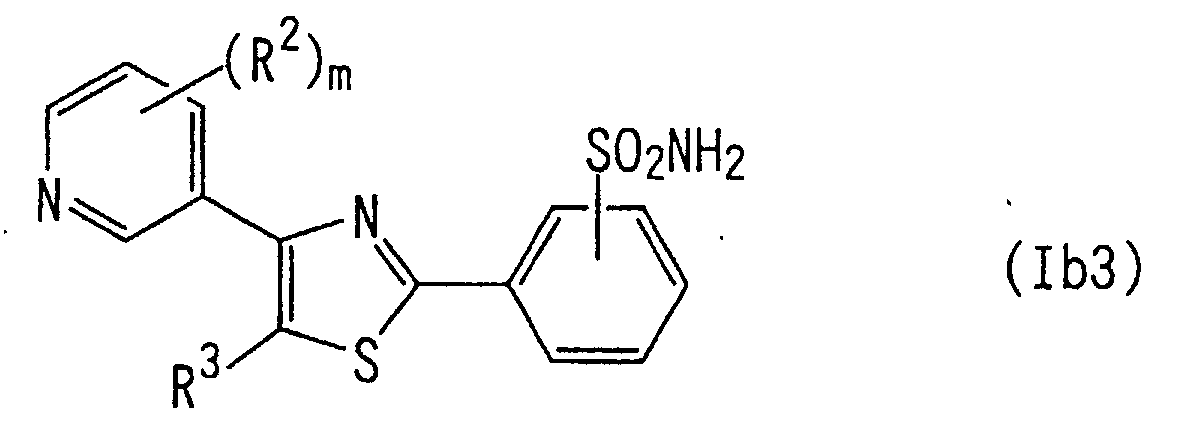
- m
- is an integer of 1 to 5,
- R2
- is 1) a hydrogen atom, 2) a C1-4 aliphatic hydrocarbon group optionally having substituents, 3) an optionally esterified carboxyl group, 4) a carbamoyl group optionally having substituents, 5) an amino group optionally having substituents, 6) a cyclic amino group, 7) an alkylthio group optionally having substituents or 8) an alkoxy group optionally having substituents, or two R2 substituting adjacent carbon atoms are bonded to form 9) a saturated or unsaturated divalent C3-5 carbon chain, and when m is not less than 2, R2 in the number of m may be the same or different, and
- R3
- is 1) a hydrogen atom, 2) a halogen atom, 3) a C1-4 aliphatic hydrocarbon group optionally having substituents or 4) an optionally esterified carboxyl group,
- A compound represented by the formula:wherein
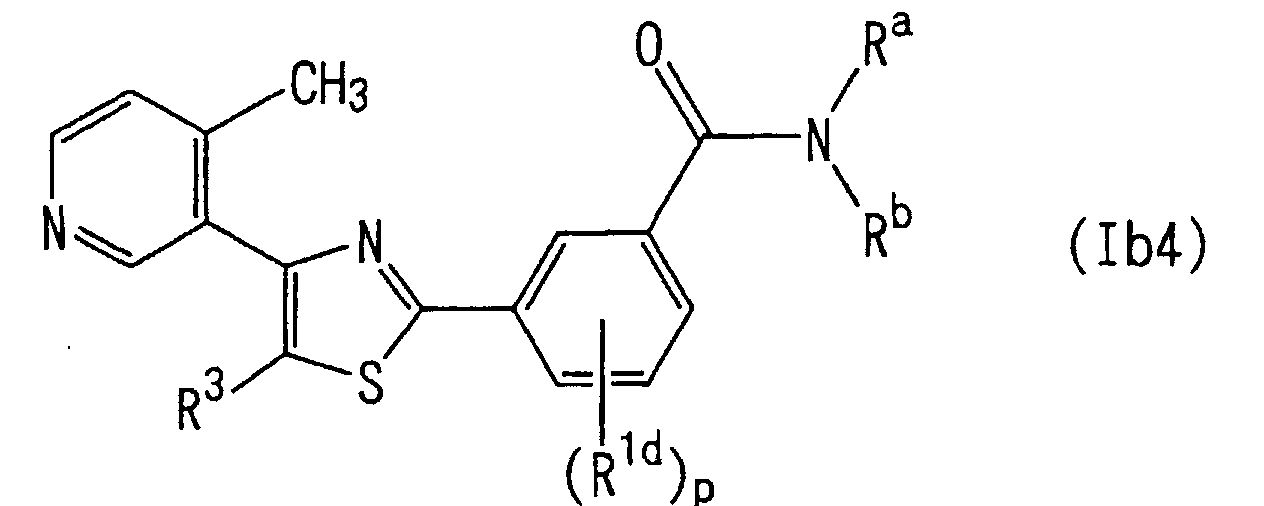
- p
- is 0 or an integer of 1 to 5,
- Ra and Rb
- are the same or different and each is a hydrogen atom or a C1-6 lower alkyl group, or Ra and Rb may be bonded together with a nitrogen atom to form a ring,
- R1d
- is 1) a hydrogen atom, 2) a C1-4 aliphatic hydrocarbon group optionally having substituents, 3) a sulfamoyl group optionally having substituents, 4) a carbamoyl group optionally having substituents, 5) an optionally esterified carboxyl group, 6) a halogen atom, 7) an amino group optionally having substituents, 8) a cyclic amino group, 9) a hydroxy group optionally having substituents, 10) an alkylthio group optionally having substituents, 11) a nitro group, 12) an alkylsulfonyl group optionally having substituents, or 13) two Rld substituting adjacent carbon atoms may be bonded to form 13a) a C1-2 alkylenedioxy group or 13b) a saturated or unsaturated divalent C3-5 carbon chain, and when p is not less than 2, R1d in the number of p may be the same or different, and
- R3
- is 1) a hydrogen atom, 2) a halogen atom, 3) a C1-4 aliphatic hydrocarbon group optionally having substituents or 4) an optionally esterified carboxyl group,
- The compound of claim 51, wherein Ra and Rb are the same or different and each is a hydrogen atom or a methyl group, or Ra and Rb are bonded together with a nitrogen atom to form a pyrrolidin-1-yl group, R1d is a hydrogen atom, a methyl group, a chlorine atom or a fluorine atom, and R3 is a hydrogen atom, a chlorine atom, a methyl group or an isopropyl group.
- A prodrug of a compound represented by the formula:wherein
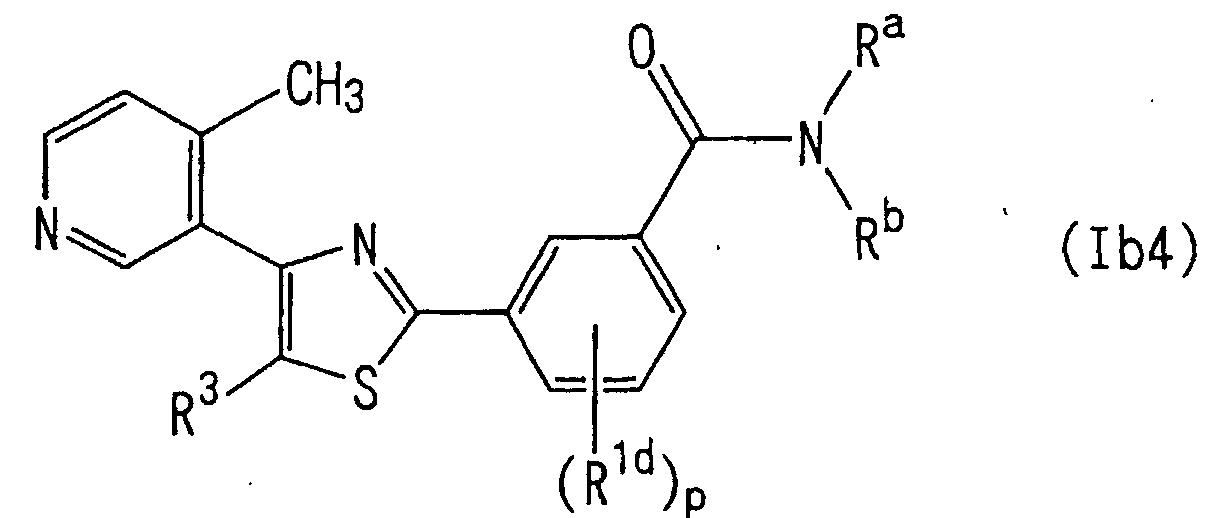
- p
- is 0 or an integer of 1 to 5,
- Ra and Rb
- are the same or different and each is a hydrogen atom or a C1-6 lower alkyl group, or Ra and Rb may be bonded together with a nitrogen atom to form a ring,
- R1d
- is 1) a hydrogen atom, 2) a C1-4 aliphatic hydrocarbon group optionally having substituents, 3) a sulfamoyl group optionally having substituents, 4) a carbamoyl group optionally having substituents, 5) an optionally esterified carboxyl group, 6) a halogen atom, 7) an amino group optionally having substituents, 8) a cyclic amino group, 9) a hydroxy group optionally having substituents, 10) an alkylthio group optionally having substituents, 11) a nitro group, 12) an alkylsulfonyl group optionally having substituents, or 13) two R1d substituting adjacent carbon atoms may be bonded to form 13a) a C1-2 alkylenedioxy group or 13b) a saturated or unsaturated divalent C3-5 carbon chain, and when p is not less than 2, R1d in the number of p may be the same or different, and
- R3
- is 1) a hydrogen atom, 2) a halogen atom, 3) a C1-4 aliphatic hydrocarbon group optionally having substituents or 4) an optionally esterified carboxyl group,
- A compound represented by the formula:wherein

- q
- is 0 or an integer of 1 to 5,
- R1b
- is 1) a sulfamoyl group optionally having substituents, 2) a carbamoyl group optionally having substituents, 3) an alkyl group optionally having substituents, 4) an optionally esterified carboxyl group, 5) a halogen atom, 6) an amino group optionally having substituents, 7) a nitro group, 8) a hydroxy group optionally having substituents or 9) an alkylsulfonyl group optionally having substituents, or 10) two R1b substituting adjacent carbon atoms are bonded to designate a C1-2 alkylenedioxy group, and when q is not less than 2, R1b in the number of q may be the same or different,
- R3
- is 1) a hydrogen atom, 2) a halogen atom, 3) a C1-4 aliphatic hydrocarbon group optionally having substituents or 4) an optionally esterified carboxyl group, and
- Aa, Ab and Ac
- are the same or different and each is a nitrogen atom or a methine group,
- The compound of claim 54, wherein R1b is a sulfamoyl group, a carbamoyl group, a methylcarbamoyl group, a dimethylcarbamoyl group, an ethylcarbamoyl group, a pyrrolidin-1-ylcarbonyl group, a methyl group, a chlorine atom, a fluorine atom, an acetylamino group, a formylamino group or a nitro group, R3 is a hydrogen atom, a chlorine atom, a methyl group or an isopropyl group, and Aa, Ab and Ac are the same or different and each is a nitrogen atom or a methine group.
- A prodrug of a compound represented by the formula:wherein

- q
- is 0 or an integer of 1 to 5,
- R1b
- is 1) a sulfamoyl group optionally having substituents, 2) a carbamoyl group optionally having substituents, 3) an alkyl group optionally having substituents, 4) an optionally esterified carboxyl group, 5) a halogen atom, 6) an amino group optionally having substituents, 7) a nitro group, 8) a hydroxy group optionally having substituents or 9) an alkylsulfonyl group optionally having substituents, or 10) two R1b substituting adjacent carbon atoms are bonded to designate a C1-2 alkylenedioxy group, and when q is not less than 2, R1b in the number of q may be the same or different,
- R3
- is 1) a hydrogen atom, 2) a halogen atom, 3) a C1-4 aliphatic hydrocarbon group optionally having substituents or 4) an optionally esterified carboxyl group, and
- Aa, Ab and Ac
- are the same or different and each is a nitrogen atom or a methine group,
- A compound represented by the formula:wherein
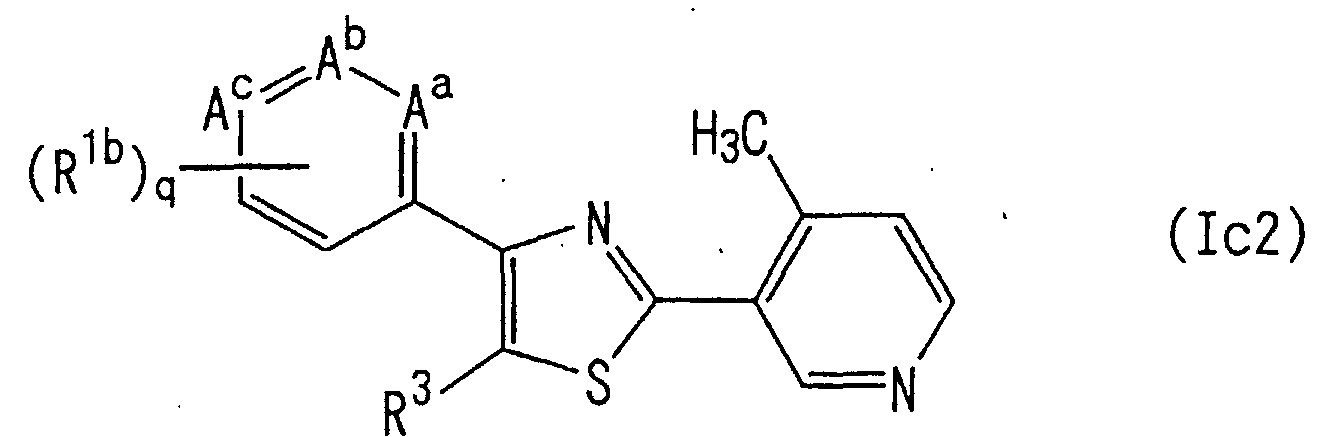
- q
- is 0 or an integer of 1 to 5,
- R1b
- is 1) a sulfamoyl group optionally having substituents, 2) a carbamoyl group optionally having substituents, 3) an alkyl group optionally having substituents, 4) an optionally esterified carboxyl group, 5) a halogen atom, 6) an amino group optionally having substituents, 7) a nitro group, 8) a hydroxy group optionally having substituents or 9) an alkylsulfonyl group optionally having substituents, or 10) two R1b substituting adjacent carbon atoms are bonded to designate a C1-2 alkylenedioxy group, and when q is not less than 2, R1b in the number of q are the same or different,
- R3
- is 1) a hydrogen atom, 2) a halogen atom, 3) a C1-4 aliphatic hydrocarbon group optionally having substituents or 4) an optionally esterified carboxyl group, and
- A3, Ab and Ac
- are the same or different and each is a nitrogen atom or a methine group,
- The compound of claim 57, wherein R1b is a sulfamoyl group, a methylsulfamoyl group, a dibenzylsulfamoyl group, a carbamoyl group, a methylcarbamoyl group, an ethylcarbamoyl group, a dimethylcarbamoyl group, an azetidin-1-ylcarbonyl group, a methyl group, a trifluoromethyl group, a carboxyl group, an ethoxycarbonyl group, a chlorine atom, a fluorine atom, a nitro group, a hydroxy group, a methoxy group or a methylsulfonyl group, or two R1b substituting adjacent carbon atoms are bonded to designate an ethylenedioxy group, R3 is a hydrogen atom, a chlorine atom, a fluorine atom or a methyl group, Aa is a methine, Ab is a nitrogen atom or a methine, and Ac is a nitrogen atom or a methine.
- A prodrug of a compound represented by the formula:wherein
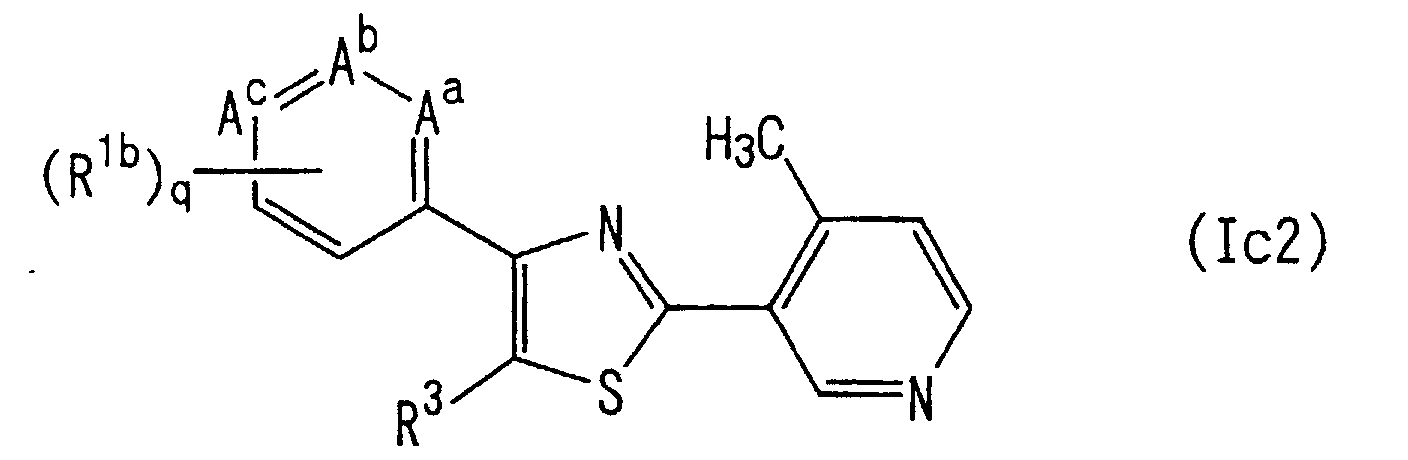
- q
- is 0 or an integer of 1 to 5,
- R1b
- is 1) a sulfamoyl group optionally having substituents, 2) a carbamoyl group optionally having substituents, 3) an alkyl group optionally having substituents, 4) an optionally esterified carboxyl group, 5) a halogen atom, 6) an amino group optionally having substituents, 7) a nitro group, 8) a hydroxy group optionally having substituents or 9) an alkylsulfonyl group optionally having substituents, or 10) two R1b substituting adjacent carbon atoms are bonded to designate a C1-2 alkylenedioxy group, and when q is not less than 2, R1b in the number of q are the same or different,
- R3
- is 1) a hydrogen atom, 2) a halogen atom, 3) a C1-4 aliphatic hydrocarbon group optionally having substituents or 4) an optionally esterified carboxyl group, and
- Aa, Ab and Ac
- are the same or different and each is a nitrogen atom or a methine group,
- 3-[4-(4-Chlorophenyl)-1,3-thiazol-2-yl]-4-methylpyridine, 3-[4-(4-fluorophenyl)-1,3-thiazol-2-yl]-4-methylpyridine, 4-[2-(4-methyl-pyridin-3-yl)-1,3-thiazol-4-yl]benzenesulfonamide, 3-[2-(4-fluorophenyl)-1,3-thiazol-4-yl]-4-methylpyridine, 4-[4-(4-methyl-pyridin-3-yl)-l,3-thiazol-2-yl]benzenesulfonamide or a salt thereof.
Applications Claiming Priority (3)
| Application Number | Priority Date | Filing Date | Title |
|---|---|---|---|
| JP2000373868 | 2000-12-08 | ||
| JP2000373868 | 2000-12-08 | ||
| PCT/JP2001/010723 WO2002046186A1 (en) | 2000-12-08 | 2001-12-07 | Substituted thiazole derivatives bearing 3-pyridyl groups, process for preparing the same and use thereof |
Publications (3)
| Publication Number | Publication Date |
|---|---|
| EP1348706A1 true EP1348706A1 (en) | 2003-10-01 |
| EP1348706A4 EP1348706A4 (en) | 2005-08-10 |
| EP1348706B1 EP1348706B1 (en) | 2009-08-19 |
Family
ID=18843165
Family Applications (1)
| Application Number | Title | Priority Date | Filing Date |
|---|---|---|---|
| EP01999258A Expired - Lifetime EP1348706B1 (en) | 2000-12-08 | 2001-12-07 | Substituted thiazole derivatives bearing 3-pyridyl groups, process for preparing the same and use thereof |
Country Status (8)
| Country | Link |
|---|---|
| US (1) | US7067537B2 (en) |
| EP (1) | EP1348706B1 (en) |
| JP (1) | JP2008266349A (en) |
| AT (1) | ATE440096T1 (en) |
| AU (1) | AU2002221080A1 (en) |
| CA (1) | CA2431171A1 (en) |
| DE (1) | DE60139639D1 (en) |
| WO (1) | WO2002046186A1 (en) |
Cited By (13)
| Publication number | Priority date | Publication date | Assignee | Title |
|---|---|---|---|---|
| WO2004018463A3 (en) * | 2002-08-23 | 2004-05-06 | Rigel Pharmaceuticals Inc | Pyridyl substituted heterocycles useful for treating or preventing hcv infection |
| US7326790B2 (en) | 2003-05-02 | 2008-02-05 | Rigel Pharmaceuticals, Inc. | Diphenylisoxazole compounds and hydro isomers thereof |
| US7410979B2 (en) | 2003-11-19 | 2008-08-12 | Rigel Pharmaceuticals, Inc. | Synergistically effective combinations of dihaloacetamide compounds and interferon or ribavirin against HCV infections |
| WO2008097835A2 (en) | 2007-02-02 | 2008-08-14 | Baylor College Of Medicine | Compositions and methods for the treatment of metabolic disorders |
| US7498353B2 (en) | 2005-05-02 | 2009-03-03 | Rigel Pharmaceuticals, Inc. | Heterocyclic anti-viral compounds comprising metabolizable moieties and their uses |
| US7514434B2 (en) | 2004-02-23 | 2009-04-07 | Rigel Pharmaceuticals, Inc. | Heterocyclic compounds having an oxadiazole moiety and hydro isomers thereof |
| WO2012170976A3 (en) * | 2011-06-10 | 2013-04-11 | Merck Patent Gmbh | Compositions and methods for the production of pyrimidine and pyridine compounds with btk inhibitory activity |
| EP2606889A1 (en) * | 2011-12-21 | 2013-06-26 | Telik, Inc. | Substituted Thiazoles as VEGFR2 kinase Inhibitors |
| WO2014076127A1 (en) * | 2012-11-16 | 2014-05-22 | F. Hoffmann-La Roche Ag | Process for the preparation of 2-trifluoromethyl isonicotinic acid and esters |
| US9085566B2 (en) | 2007-02-02 | 2015-07-21 | Baylor College Of Medicine | Compositions and methods for the treatment of metabolic and related disorders |
| US9187485B2 (en) | 2007-02-02 | 2015-11-17 | Baylor College Of Medicine | Methods and compositions for the treatment of cancer and related hyperproliferative disorders |
| US9212179B2 (en) | 2007-02-02 | 2015-12-15 | Baylor College Of Medicine | Compositions and methods for the treatment of metabolic disorders |
| US9233941B2 (en) | 2007-02-02 | 2016-01-12 | Baylor College Of Medicine | Methods and compositions for the treatment of body weight related disorders |
Families Citing this family (15)
| Publication number | Priority date | Publication date | Assignee | Title |
|---|---|---|---|---|
| PT1176195E (en) | 1999-04-09 | 2013-07-18 | Kyowa Hakko Kirin Co Ltd | Method for controlling the activity of immunologically functional molecule |
| US6946292B2 (en) | 2000-10-06 | 2005-09-20 | Kyowa Hakko Kogyo Co., Ltd. | Cells producing antibody compositions with increased antibody dependent cytotoxic activity |
| US7071223B1 (en) * | 2002-12-31 | 2006-07-04 | Pfizer, Inc. | Benzamide inhibitors of the P2X7 receptor |
| ES2281801T3 (en) * | 2003-05-12 | 2007-10-01 | Pfizer Products Inc. | BENZAMIDE INHIBITORS OF THE P2X7 RECEIVER. |
| WO2005063225A1 (en) * | 2003-12-19 | 2005-07-14 | Rigel Pharmaceuticals, Inc. | Compositions and methods for treating hepatitis c virus (hcv) infection |
| CA2572119A1 (en) * | 2004-06-29 | 2006-01-12 | Warner-Lambert Company Llc | Combination therapies utilizing benzamide inhibitors of the p2x7 receptor |
| BRPI0512781A (en) * | 2004-06-29 | 2008-04-08 | Pfizer Prod Inc | Method for preparing 5- {4- (2-hydroxy-propyl) -3,5-dioxo-4,5-dihydro-3h- [1,2,4] triazin-2-yl} -benzamide derivatives by of the unprotection of hydroxyl protector precursors |
| EP2220050A2 (en) | 2007-10-26 | 2010-08-25 | The Regents Of The University Of California | Diarylhydantoin compounds as androgen receptor modulators |
| JP2011513203A (en) * | 2008-03-14 | 2011-04-28 | 大塚製薬株式会社 | MMP-2 and / or MMP-9 inhibitor |
| GB0818241D0 (en) * | 2008-10-06 | 2008-11-12 | Cancer Res Technology | Compounds and their use |
| US11291655B2 (en) * | 2017-07-11 | 2022-04-05 | Cyteir Therapeutics, Inc. | RAD51 inhibitors |
| MX2022010693A (en) * | 2020-02-28 | 2022-09-26 | Univ Texas | Inhibitors of receptor interacting protein kinase i for the treatment of disease. |
| CN117185961A (en) * | 2023-09-08 | 2023-12-08 | 天津师范大学 | An organic elastic room temperature phosphorescent crystal based on 4-cyanobenzamide and its preparation method and application |
| WO2025165773A1 (en) * | 2024-02-01 | 2025-08-07 | Board Of Regents, The University Of Texas System | Inhibitors of receptor interacting protein kinase i for the treatment of disease |
| WO2025165774A1 (en) * | 2024-02-01 | 2025-08-07 | Board Of Regents, The University Of Texas System | Inhibitors of receptor interacting protein kinase i for the treatment of disease |
Family Cites Families (33)
| Publication number | Priority date | Publication date | Assignee | Title |
|---|---|---|---|---|
| US3821384A (en) | 1972-10-06 | 1974-06-28 | Uniroyal Inc | Pharmaceutical compositions containing a4-aryl-2-(3-pyridyl)thiazole and methods of using same |
| US4153703A (en) | 1977-06-30 | 1979-05-08 | Uniroyal, Inc. | Method of controlling insects and acarids with certain aryl-substituted thiazoles |
| DE3486009T2 (en) | 1983-09-09 | 1993-04-15 | Takeda Chemical Industries Ltd | 5-PYRIDYL-1,3-THIAZOL DERIVATIVES, THEIR PRODUCTION AND USE. |
| NZ221729A (en) | 1986-09-15 | 1989-07-27 | Janssen Pharmaceutica Nv | Imidazolyl methyl-substituted benzimidazole derivatives and pharmaceutical compositions |
| NZ224288A (en) | 1987-04-22 | 1989-12-21 | Merrell Dow Pharma | 17b-(cyclopropylamino)androst-5-en-3b-ol and related compounds and methods using these for treatment of non-humans |
| US4966898A (en) | 1989-08-15 | 1990-10-30 | Merrell Dow Pharmaceuticals Inc. | 4-substituted 17β-(cyclopropylamino)androst-5-en-3β-ol and related compounds useful as C17-20 lyase inhibitors |
| JPH06507355A (en) | 1991-03-01 | 1994-08-25 | エレクトロスタティック テクノロジー インコーポレーテッド | Powder coating method for manufacturing thin laminates for circuit boards, etc. |
| US5457102A (en) | 1994-07-07 | 1995-10-10 | Janssen Pharmaceutica, N.V. | Pyrroloimidazolyl and imidazopyridinyl substituted 1H-benzimidazole derivatives |
| GB2265624B (en) | 1992-03-31 | 1995-04-19 | British Tech Group | 17-substituted steroids useful in cancer treatment |
| GB9310635D0 (en) | 1993-05-21 | 1993-07-07 | Glaxo Group Ltd | Chemical compounds |
| CN1131944A (en) | 1993-09-30 | 1996-09-25 | 山之内制药株式会社 | Azole derivatives and its pharmaceutical composition |
| WO1996014090A1 (en) | 1994-11-07 | 1996-05-17 | Janssen Pharmaceutica N.V. | Compositions comprising carbazoles and cyclodextrins |
| PL322028A1 (en) | 1995-03-01 | 1998-01-05 | Yamanouchi Pharma Co Ltd | Derivatives of imidazoles and pharmaceutic composition containing them |
| WO1997000257A1 (en) | 1995-06-14 | 1997-01-03 | Yamanouchi Pharmaceutical Co., Ltd. | Fused imidazole derivatives and medicinal composition thereof |
| ES2178750T3 (en) * | 1996-02-14 | 2003-01-01 | Aventis Pharma Inc | 17-BETA- ICLOPROPIL (AMINO / OXI) 4-AZA STEROIDS AS ACTIVE INHIBITORS OF 5-ALFA-REDUCTASE AND C17-20-LIASA DE TESTOSTERONA. |
| WO1997040846A1 (en) | 1996-04-30 | 1997-11-06 | Takeda Chemical Industries, Ltd. | COMBINED USE OF GnRH AGONIST AND ANTAGONIST |
| AU4015497A (en) * | 1996-08-26 | 1998-03-19 | Byk Gulden Lomberg Chemische Fabrik Gmbh | Thiazole derivatives useful as selective inhibitors of pde-iv |
| AU4298997A (en) * | 1996-08-26 | 1998-03-19 | Byk Gulden Lomberg Chemische Fabrik Gmbh | Thiazole derivatives useful as selective inhibitors of pde-iv |
| JPH10195056A (en) * | 1996-11-12 | 1998-07-28 | Takeda Chem Ind Ltd | Condensed benzene derivative, its production and agent |
| SK100099A3 (en) * | 1997-01-28 | 2000-05-16 | Merck & Co Inc | Thiazole benzenesulfonamides as 'beta'3 agonists for the treatment of diabetes and obesity |
| EP0974584B1 (en) | 1997-02-21 | 2003-01-15 | Takeda Chemical Industries, Ltd. | Fused ring compounds, process for producing the same and use thereof |
| JPH1179993A (en) * | 1997-09-05 | 1999-03-23 | Sumitomo Pharmaceut Co Ltd | Immunosuppressants |
| ATE264304T1 (en) | 1997-10-02 | 2004-04-15 | Daiichi Seiyaku Co | DIHYDRONAPHTHALINE DERIVATIVES AND METHOD FOR PRODUCING THE SAME |
| ATE257703T1 (en) | 1997-10-27 | 2004-01-15 | Takeda Chemical Industries Ltd | 1,3-THIAZOLES AS ADENOSINE A3 RECEPTOR ANTAGONISTS FOR THE TREATMENT OF ASTHMA, ALLERGIES AND DIABETES |
| ATE293102T1 (en) * | 1998-04-23 | 2005-04-15 | Takeda Pharmaceutical | NAPHTHALENE DERIVATIVES, THEIR PRODUCTION AND USE |
| EA200100972A1 (en) | 1999-03-15 | 2002-02-28 | Аксис Фармасьютикалз, Инк. | NEW COMPOUNDS AND COMPOSITIONS AS PROTEAS INHIBITORS |
| PL351148A1 (en) | 1999-04-23 | 2003-03-24 | Takeda Chemical Industries Ltd | 5-pyridyl-1,3-azole compounds, process for producing the same and use thereof |
| JP2000302680A (en) | 1999-04-23 | 2000-10-31 | Takeda Chem Ind Ltd | Brain protective agent |
| WO2001010865A1 (en) | 1999-08-06 | 2001-02-15 | Takeda Chemical Industries, Ltd. | p38MAP KINASE INHIBITORS |
| WO2001030764A1 (en) * | 1999-10-22 | 2001-05-03 | Takeda Chemical Industries, Ltd. | 1-substituted phenyl-1-(1h-imidazol-4-yl) alcohols, process for producing the same and use thereof |
| AU2001245764A1 (en) * | 2000-03-15 | 2001-09-24 | Axys Pharmaceuticals, Inc. | Novel compounds and compositions as protease inhibitors |
| AU2001248820A1 (en) * | 2000-04-28 | 2001-11-12 | Shionogi And Co., Ltd. | Thiazole and oxazole derivatives |
| WO2003027094A2 (en) * | 2001-09-26 | 2003-04-03 | Bayer Pharmaceuticals Corporation | Substituted 3-pyridyl indoles and indazoles as c17,20 lyase inhibitors |
-
2001
- 2001-12-07 WO PCT/JP2001/010723 patent/WO2002046186A1/en not_active Ceased
- 2001-12-07 AT AT01999258T patent/ATE440096T1/en not_active IP Right Cessation
- 2001-12-07 CA CA002431171A patent/CA2431171A1/en not_active Abandoned
- 2001-12-07 EP EP01999258A patent/EP1348706B1/en not_active Expired - Lifetime
- 2001-12-07 DE DE60139639T patent/DE60139639D1/en not_active Expired - Lifetime
- 2001-12-07 AU AU2002221080A patent/AU2002221080A1/en not_active Abandoned
- 2001-12-07 US US10/433,910 patent/US7067537B2/en not_active Expired - Fee Related
-
2008
- 2008-06-12 JP JP2008154723A patent/JP2008266349A/en not_active Abandoned
Cited By (29)
| Publication number | Priority date | Publication date | Assignee | Title |
|---|---|---|---|---|
| US7157473B2 (en) | 2002-08-23 | 2007-01-02 | Rigel Pharmaceuticals, Inc. | Pyridyl substituted heterocycles useful for treating or preventing HCV infection |
| WO2004018463A3 (en) * | 2002-08-23 | 2004-05-06 | Rigel Pharmaceuticals Inc | Pyridyl substituted heterocycles useful for treating or preventing hcv infection |
| US7326790B2 (en) | 2003-05-02 | 2008-02-05 | Rigel Pharmaceuticals, Inc. | Diphenylisoxazole compounds and hydro isomers thereof |
| US7410979B2 (en) | 2003-11-19 | 2008-08-12 | Rigel Pharmaceuticals, Inc. | Synergistically effective combinations of dihaloacetamide compounds and interferon or ribavirin against HCV infections |
| US7514434B2 (en) | 2004-02-23 | 2009-04-07 | Rigel Pharmaceuticals, Inc. | Heterocyclic compounds having an oxadiazole moiety and hydro isomers thereof |
| US7498353B2 (en) | 2005-05-02 | 2009-03-03 | Rigel Pharmaceuticals, Inc. | Heterocyclic anti-viral compounds comprising metabolizable moieties and their uses |
| US8927578B2 (en) | 2007-02-02 | 2015-01-06 | Baylor College Of Medicine | Compositions and methods for the treatment of metabolic disorders |
| US9085566B2 (en) | 2007-02-02 | 2015-07-21 | Baylor College Of Medicine | Compositions and methods for the treatment of metabolic and related disorders |
| US8207196B2 (en) | 2007-02-02 | 2012-06-26 | Baylor College Of Medicine | Compositions and methods for the treatment of metabolic disorders |
| US9713613B2 (en) | 2007-02-02 | 2017-07-25 | Motonari Uesugi | Methods and compositions for the treatment of cancer and related hyperproliferative disorders |
| US9233941B2 (en) | 2007-02-02 | 2016-01-12 | Baylor College Of Medicine | Methods and compositions for the treatment of body weight related disorders |
| US9212179B2 (en) | 2007-02-02 | 2015-12-15 | Baylor College Of Medicine | Compositions and methods for the treatment of metabolic disorders |
| AU2008214095B2 (en) * | 2007-02-02 | 2014-07-10 | Baylor College Of Medicine | Compositions and methods for the treatment of metabolic disorders |
| US8778976B2 (en) | 2007-02-02 | 2014-07-15 | Baylor College Of Medicine | Compositions and methods for the treatment of metabolic disorders |
| WO2008097835A2 (en) | 2007-02-02 | 2008-08-14 | Baylor College Of Medicine | Compositions and methods for the treatment of metabolic disorders |
| US9187485B2 (en) | 2007-02-02 | 2015-11-17 | Baylor College Of Medicine | Methods and compositions for the treatment of cancer and related hyperproliferative disorders |
| EP2120580A4 (en) * | 2007-02-02 | 2011-09-28 | Baylor College Medicine | COMPOSITIONS AND METHODS FOR TREATING METABOLIC DISORDERS |
| US9073947B2 (en) | 2011-06-10 | 2015-07-07 | Merck Patent Gmbh | Compositions and methods for the production of pyrimidine and pyridine compounds with BTK inhibitory activity |
| US9580449B2 (en) | 2011-06-10 | 2017-02-28 | Merck Patent Gmbh | Compositions and methods for the production of pyrimidine and pyridine compounds with BTK inhibitory activity |
| WO2012170976A3 (en) * | 2011-06-10 | 2013-04-11 | Merck Patent Gmbh | Compositions and methods for the production of pyrimidine and pyridine compounds with btk inhibitory activity |
| EA027584B1 (en) * | 2011-06-10 | 2017-08-31 | Мерк Патент Гмбх | Compositions and methods for the production of pyrimidine and pyridine compounds with btk inhibitory activity |
| US10016448B2 (en) | 2011-06-10 | 2018-07-10 | Merck Patent Gmbh | Compositions and methods for the production of pyrimidine and pyridine compounds with BTK inhibitory activity |
| EA031153B1 (en) * | 2011-06-10 | 2018-11-30 | Мерк Патент Гмбх | Use of pyrimidine compounds with btk inhibitory activity |
| US10413562B2 (en) | 2011-06-10 | 2019-09-17 | Merck Patent Gmbh | Compositions and methods for the production of pyrimidine and pyridine compounds with BTK inhibitory activity |
| EP2606889A1 (en) * | 2011-12-21 | 2013-06-26 | Telik, Inc. | Substituted Thiazoles as VEGFR2 kinase Inhibitors |
| CN104781236A (en) * | 2012-11-16 | 2015-07-15 | 霍夫曼-拉罗奇有限公司 | Process for the preparation of 2-trifluoromethyl isonicotinic acid and esters |
| WO2014076127A1 (en) * | 2012-11-16 | 2014-05-22 | F. Hoffmann-La Roche Ag | Process for the preparation of 2-trifluoromethyl isonicotinic acid and esters |
| US9481650B2 (en) | 2012-11-16 | 2016-11-01 | Hoffmann La Roche Inc. | Process for the preparation of 2-trifluoromethyl isonicotinic acid and esters |
| CN104781236B (en) * | 2012-11-16 | 2018-04-24 | 霍夫曼-拉罗奇有限公司 | The method for preparing 2- trifluoromethyls isonicotinic acid and ester |
Also Published As
| Publication number | Publication date |
|---|---|
| US20040072876A1 (en) | 2004-04-15 |
| WO2002046186A1 (en) | 2002-06-13 |
| AU2002221080A1 (en) | 2002-06-18 |
| DE60139639D1 (en) | 2009-10-01 |
| US7067537B2 (en) | 2006-06-27 |
| ATE440096T1 (en) | 2009-09-15 |
| EP1348706A4 (en) | 2005-08-10 |
| CA2431171A1 (en) | 2002-06-13 |
| JP2008266349A (en) | 2008-11-06 |
| EP1348706B1 (en) | 2009-08-19 |
Similar Documents
| Publication | Publication Date | Title |
|---|---|---|
| EP1348706B1 (en) | Substituted thiazole derivatives bearing 3-pyridyl groups, process for preparing the same and use thereof | |
| EP1355889B1 (en) | Substituted triazole diamine derivatives as kinase inhibitors | |
| TWI461423B (en) | Thiazolidinedione compounds useful in the treatment of pim kinase related conditions and diseases | |
| AU2017261336B2 (en) | Modulators of the integrated stress pathway | |
| US8486945B2 (en) | Heterocyclic inhibitors of an Hh-signal cascade, medicinal compositions based thereon and methods for treating diseases caused by the aberrant activity of an Hh-signal system | |
| EP1382603B1 (en) | Nitrogenous fused-ring compound having pyrazolyl group as substituent and medicinal composition thereof | |
| EP2730564B1 (en) | Heterocycle amines and uses thereof | |
| JP6545199B2 (en) | 3-Amino-1,5,6,7-tetrahydro-4H-indol-4-ones | |
| JP4719317B2 (en) | Fused heterocyclic derivatives and uses thereof | |
| WO2002034748A1 (en) | Imidazopyridine derivatives | |
| MX2012005827A (en) | Compounds and methods for kinase modulation, and indications therefor. | |
| CN103313968A (en) | Nampt and rock inhibitors | |
| AU2006232620A1 (en) | Substituted heterocycles and their use as CHK1, PDK1 and PAK inhibitors | |
| EP3480193B1 (en) | Pyrazole derivatives as alk5 inhibitors and uses thereof | |
| KR20170106452A (en) | 4h-pyrrolo[3,2-c]pyridin-4-one derivatives | |
| TW200526208A (en) | Substituted benzazoles and methods of their use as inhibitors of Raf kinase | |
| WO2004052880A1 (en) | Pyridine derivatives as jnk inhibitors and their use | |
| EP4479380A1 (en) | Inhibitors of rna helicase dhx9 and uses thereof | |
| AU2004273771A1 (en) | 3-heterocyclyl-indole derivatives as inhibitors of glycogen synthase kinase-3 (GSK-3) | |
| JPWO2009113560A1 (en) | Fused heterocyclic compounds | |
| JP4160295B2 (en) | Substituted thiazole derivatives having a 3-pyridyl group, method for producing the same, and use thereof | |
| EP1921066A1 (en) | Pyridylphenol compound and use thereof | |
| KR20090053593A (en) | 5-acylhydrazinecarbonyl-3,4-disubstituted pyrazole derivatives and preparation method thereof | |
| CN120917019A (en) | Thiadiazolone derivative, composition and application thereof | |
| EP1712550A2 (en) | Substituted triazole diamine derivatives as kinase inhibitors |
Legal Events
| Date | Code | Title | Description |
|---|---|---|---|
| PUAI | Public reference made under article 153(3) epc to a published international application that has entered the european phase |
Free format text: ORIGINAL CODE: 0009012 |
|
| 17P | Request for examination filed |
Effective date: 20030624 |
|
| AK | Designated contracting states |
Kind code of ref document: A1 Designated state(s): AT BE CH CY DE DK ES FI FR GB GR IE IT LI LU MC NL PT SE TR |
|
| AX | Request for extension of the european patent |
Extension state: AL LT LV MK RO SI |
|
| RAP1 | Party data changed (applicant data changed or rights of an application transferred) |
Owner name: TAKEDA CHEMICAL INDUSTRIES, LTD. |
|
| RAP1 | Party data changed (applicant data changed or rights of an application transferred) |
Owner name: TAKEDA PHARMACEUTICAL COMPANY LIMITED |
|
| A4 | Supplementary search report drawn up and despatched |
Effective date: 20050628 |
|
| 17Q | First examination report despatched |
Effective date: 20060329 |
|
| GRAP | Despatch of communication of intention to grant a patent |
Free format text: ORIGINAL CODE: EPIDOSNIGR1 |
|
| GRAS | Grant fee paid |
Free format text: ORIGINAL CODE: EPIDOSNIGR3 |
|
| RIN1 | Information on inventor provided before grant (corrected) |
Inventor name: YAMAOKA, MASUO Inventor name: KUSAKA, MASAMI Inventor name: TASAKA, AKIHIRO Inventor name: KAKU, TOMOHIRO Inventor name: HASHIGUCHI, SHOHEI Inventor name: NARA, YOSHI Inventor name: KURODA, NORITAKA |
|
| GRAA | (expected) grant |
Free format text: ORIGINAL CODE: 0009210 |
|
| RAP1 | Party data changed (applicant data changed or rights of an application transferred) |
Owner name: TAKEDA PHARMACEUTICAL COMPANY LIMITED |
|
| AK | Designated contracting states |
Kind code of ref document: B1 Designated state(s): AT BE CH CY DE DK ES FI FR GB GR IE IT LI LU MC NL PT SE TR |
|
| REG | Reference to a national code |
Ref country code: GB Ref legal event code: FG4D |
|
| REG | Reference to a national code |
Ref country code: CH Ref legal event code: NV Representative=s name: BOHEST AG Ref country code: CH Ref legal event code: EP |
|
| REG | Reference to a national code |
Ref country code: IE Ref legal event code: FG4D |
|
| REF | Corresponds to: |
Ref document number: 60139639 Country of ref document: DE Date of ref document: 20091001 Kind code of ref document: P |
|
| PG25 | Lapsed in a contracting state [announced via postgrant information from national office to epo] |
Ref country code: FI Free format text: LAPSE BECAUSE OF FAILURE TO SUBMIT A TRANSLATION OF THE DESCRIPTION OR TO PAY THE FEE WITHIN THE PRESCRIBED TIME-LIMIT Effective date: 20090819 Ref country code: ES Free format text: LAPSE BECAUSE OF FAILURE TO SUBMIT A TRANSLATION OF THE DESCRIPTION OR TO PAY THE FEE WITHIN THE PRESCRIBED TIME-LIMIT Effective date: 20091130 Ref country code: SE Free format text: LAPSE BECAUSE OF FAILURE TO SUBMIT A TRANSLATION OF THE DESCRIPTION OR TO PAY THE FEE WITHIN THE PRESCRIBED TIME-LIMIT Effective date: 20090819 Ref country code: AT Free format text: LAPSE BECAUSE OF FAILURE TO SUBMIT A TRANSLATION OF THE DESCRIPTION OR TO PAY THE FEE WITHIN THE PRESCRIBED TIME-LIMIT Effective date: 20090819 |
|
| PGFP | Annual fee paid to national office [announced via postgrant information from national office to epo] |
Ref country code: CH Payment date: 20091215 Year of fee payment: 9 |
|
| NLV1 | Nl: lapsed or annulled due to failure to fulfill the requirements of art. 29p and 29m of the patents act | ||
| PG25 | Lapsed in a contracting state [announced via postgrant information from national office to epo] |
Ref country code: NL Free format text: LAPSE BECAUSE OF FAILURE TO SUBMIT A TRANSLATION OF THE DESCRIPTION OR TO PAY THE FEE WITHIN THE PRESCRIBED TIME-LIMIT Effective date: 20090819 |
|
| PG25 | Lapsed in a contracting state [announced via postgrant information from national office to epo] |
Ref country code: PT Free format text: LAPSE BECAUSE OF FAILURE TO SUBMIT A TRANSLATION OF THE DESCRIPTION OR TO PAY THE FEE WITHIN THE PRESCRIBED TIME-LIMIT Effective date: 20091221 Ref country code: CY Free format text: LAPSE BECAUSE OF FAILURE TO SUBMIT A TRANSLATION OF THE DESCRIPTION OR TO PAY THE FEE WITHIN THE PRESCRIBED TIME-LIMIT Effective date: 20090819 |
|
| PG25 | Lapsed in a contracting state [announced via postgrant information from national office to epo] |
Ref country code: DK Free format text: LAPSE BECAUSE OF FAILURE TO SUBMIT A TRANSLATION OF THE DESCRIPTION OR TO PAY THE FEE WITHIN THE PRESCRIBED TIME-LIMIT Effective date: 20090819 |
|
| PGFP | Annual fee paid to national office [announced via postgrant information from national office to epo] |
Ref country code: FR Payment date: 20091221 Year of fee payment: 9 Ref country code: GB Payment date: 20091202 Year of fee payment: 9 |
|
| PLBE | No opposition filed within time limit |
Free format text: ORIGINAL CODE: 0009261 |
|
| STAA | Information on the status of an ep patent application or granted ep patent |
Free format text: STATUS: NO OPPOSITION FILED WITHIN TIME LIMIT |
|
| PG25 | Lapsed in a contracting state [announced via postgrant information from national office to epo] |
Ref country code: BE Free format text: LAPSE BECAUSE OF FAILURE TO SUBMIT A TRANSLATION OF THE DESCRIPTION OR TO PAY THE FEE WITHIN THE PRESCRIBED TIME-LIMIT Effective date: 20090819 |
|
| PGFP | Annual fee paid to national office [announced via postgrant information from national office to epo] |
Ref country code: DE Payment date: 20091203 Year of fee payment: 9 |
|
| 26N | No opposition filed |
Effective date: 20100520 |
|
| PG25 | Lapsed in a contracting state [announced via postgrant information from national office to epo] |
Ref country code: MC Free format text: LAPSE BECAUSE OF NON-PAYMENT OF DUE FEES Effective date: 20100701 |
|
| PG25 | Lapsed in a contracting state [announced via postgrant information from national office to epo] |
Ref country code: IE Free format text: LAPSE BECAUSE OF NON-PAYMENT OF DUE FEES Effective date: 20091207 Ref country code: GR Free format text: LAPSE BECAUSE OF FAILURE TO SUBMIT A TRANSLATION OF THE DESCRIPTION OR TO PAY THE FEE WITHIN THE PRESCRIBED TIME-LIMIT Effective date: 20091120 |
|
| PG25 | Lapsed in a contracting state [announced via postgrant information from national office to epo] |
Ref country code: IT Free format text: LAPSE BECAUSE OF FAILURE TO SUBMIT A TRANSLATION OF THE DESCRIPTION OR TO PAY THE FEE WITHIN THE PRESCRIBED TIME-LIMIT Effective date: 20090819 |
|
| PG25 | Lapsed in a contracting state [announced via postgrant information from national office to epo] |
Ref country code: LU Free format text: LAPSE BECAUSE OF NON-PAYMENT OF DUE FEES Effective date: 20091207 |
|
| REG | Reference to a national code |
Ref country code: CH Ref legal event code: PL |
|
| GBPC | Gb: european patent ceased through non-payment of renewal fee |
Effective date: 20101207 |
|
| PG25 | Lapsed in a contracting state [announced via postgrant information from national office to epo] |
Ref country code: TR Free format text: LAPSE BECAUSE OF FAILURE TO SUBMIT A TRANSLATION OF THE DESCRIPTION OR TO PAY THE FEE WITHIN THE PRESCRIBED TIME-LIMIT Effective date: 20090819 |
|
| REG | Reference to a national code |
Ref country code: FR Ref legal event code: ST Effective date: 20110831 |
|
| PG25 | Lapsed in a contracting state [announced via postgrant information from national office to epo] |
Ref country code: CH Free format text: LAPSE BECAUSE OF NON-PAYMENT OF DUE FEES Effective date: 20101231 Ref country code: FR Free format text: LAPSE BECAUSE OF NON-PAYMENT OF DUE FEES Effective date: 20110103 Ref country code: LI Free format text: LAPSE BECAUSE OF NON-PAYMENT OF DUE FEES Effective date: 20101231 |
|
| PG25 | Lapsed in a contracting state [announced via postgrant information from national office to epo] |
Ref country code: DE Free format text: LAPSE BECAUSE OF NON-PAYMENT OF DUE FEES Effective date: 20110701 Ref country code: GB Free format text: LAPSE BECAUSE OF NON-PAYMENT OF DUE FEES Effective date: 20101207 |
|
| REG | Reference to a national code |
Ref country code: DE Ref legal event code: R119 Ref document number: 60139639 Country of ref document: DE Effective date: 20110701 |