EP1348569A2 - Heat-sensitive recording material - Google Patents
Heat-sensitive recording material Download PDFInfo
- Publication number
- EP1348569A2 EP1348569A2 EP03251888A EP03251888A EP1348569A2 EP 1348569 A2 EP1348569 A2 EP 1348569A2 EP 03251888 A EP03251888 A EP 03251888A EP 03251888 A EP03251888 A EP 03251888A EP 1348569 A2 EP1348569 A2 EP 1348569A2
- Authority
- EP
- European Patent Office
- Prior art keywords
- heat
- sensitive recording
- microcapsules
- glass transition
- electron
- Prior art date
- Legal status (The legal status is an assumption and is not a legal conclusion. Google has not performed a legal analysis and makes no representation as to the accuracy of the status listed.)
- Granted
Links
- 239000000463 material Substances 0.000 title claims abstract description 98
- 239000003094 microcapsule Substances 0.000 claims abstract description 106
- 150000001875 compounds Chemical class 0.000 claims abstract description 84
- 230000009477 glass transition Effects 0.000 claims abstract description 47
- 239000000758 substrate Substances 0.000 claims abstract description 30
- 239000002243 precursor Substances 0.000 claims abstract description 21
- 239000002775 capsule Substances 0.000 claims description 23
- 238000000034 method Methods 0.000 claims description 22
- 239000006185 dispersion Substances 0.000 claims description 19
- 239000000839 emulsion Substances 0.000 claims description 14
- 238000012695 Interfacial polymerization Methods 0.000 claims description 3
- 239000005058 Isophorone diisocyanate Substances 0.000 claims description 3
- NIMLQBUJDJZYEJ-UHFFFAOYSA-N isophorone diisocyanate Chemical compound CC1(C)CC(N=C=O)CC(C)(CN=C=O)C1 NIMLQBUJDJZYEJ-UHFFFAOYSA-N 0.000 claims description 3
- DVKJHBMWWAPEIU-UHFFFAOYSA-N toluene 2,4-diisocyanate Chemical compound CC1=CC=C(N=C=O)C=C1N=C=O DVKJHBMWWAPEIU-UHFFFAOYSA-N 0.000 claims description 3
- 239000010410 layer Substances 0.000 description 124
- 239000000243 solution Substances 0.000 description 93
- 238000000576 coating method Methods 0.000 description 77
- 239000011248 coating agent Substances 0.000 description 76
- XLYOFNOQVPJJNP-UHFFFAOYSA-N water Substances O XLYOFNOQVPJJNP-UHFFFAOYSA-N 0.000 description 30
- -1 isocyanate compound Chemical class 0.000 description 26
- 229920002451 polyvinyl alcohol Polymers 0.000 description 25
- 235000019422 polyvinyl alcohol Nutrition 0.000 description 25
- 239000011241 protective layer Substances 0.000 description 22
- 108010010803 Gelatin Proteins 0.000 description 21
- 229920000159 gelatin Polymers 0.000 description 21
- 235000019322 gelatine Nutrition 0.000 description 21
- 235000011852 gelatine desserts Nutrition 0.000 description 21
- 239000004372 Polyvinyl alcohol Substances 0.000 description 19
- 239000008273 gelatin Substances 0.000 description 19
- 239000000203 mixture Substances 0.000 description 19
- 239000000049 pigment Substances 0.000 description 19
- 238000002360 preparation method Methods 0.000 description 18
- 239000000975 dye Substances 0.000 description 17
- 239000002245 particle Substances 0.000 description 16
- XEKOWRVHYACXOJ-UHFFFAOYSA-N Ethyl acetate Chemical compound CCOC(C)=O XEKOWRVHYACXOJ-UHFFFAOYSA-N 0.000 description 12
- 239000004094 surface-active agent Substances 0.000 description 11
- OKKJLVBELUTLKV-UHFFFAOYSA-N Methanol Chemical compound OC OKKJLVBELUTLKV-UHFFFAOYSA-N 0.000 description 9
- VYPSYNLAJGMNEJ-UHFFFAOYSA-N Silicium dioxide Chemical compound O=[Si]=O VYPSYNLAJGMNEJ-UHFFFAOYSA-N 0.000 description 9
- 229920005989 resin Polymers 0.000 description 9
- 239000011347 resin Substances 0.000 description 9
- 239000002253 acid Substances 0.000 description 8
- 238000006116 polymerization reaction Methods 0.000 description 8
- 239000012948 isocyanate Substances 0.000 description 7
- 239000007787 solid Substances 0.000 description 7
- RTTZISZSHSCFRH-UHFFFAOYSA-N 1,3-bis(isocyanatomethyl)benzene Chemical compound O=C=NCC1=CC=CC(CN=C=O)=C1 RTTZISZSHSCFRH-UHFFFAOYSA-N 0.000 description 6
- 239000007864 aqueous solution Substances 0.000 description 6
- 238000006243 chemical reaction Methods 0.000 description 6
- 230000000052 comparative effect Effects 0.000 description 6
- NLYAJNPCOHFWQQ-UHFFFAOYSA-N kaolin Chemical compound O.O.O=[Al]O[Si](=O)O[Si](=O)O[Al]=O NLYAJNPCOHFWQQ-UHFFFAOYSA-N 0.000 description 6
- 239000006224 matting agent Substances 0.000 description 6
- 229910052751 metal Inorganic materials 0.000 description 6
- 239000002184 metal Substances 0.000 description 6
- 239000011859 microparticle Substances 0.000 description 6
- 238000002156 mixing Methods 0.000 description 6
- 229920000642 polymer Polymers 0.000 description 6
- 239000011734 sodium Substances 0.000 description 6
- 229910052708 sodium Inorganic materials 0.000 description 6
- DGAQECJNVWCQMB-PUAWFVPOSA-M Ilexoside XXIX Chemical compound C[C@@H]1CC[C@@]2(CC[C@@]3(C(=CC[C@H]4[C@]3(CC[C@@H]5[C@@]4(CC[C@@H](C5(C)C)OS(=O)(=O)[O-])C)C)[C@@H]2[C@]1(C)O)C)C(=O)O[C@H]6[C@@H]([C@H]([C@@H]([C@H](O6)CO)O)O)O.[Na+] DGAQECJNVWCQMB-PUAWFVPOSA-M 0.000 description 5
- 239000002671 adjuvant Substances 0.000 description 5
- 150000001412 amines Chemical class 0.000 description 5
- 239000011230 binding agent Substances 0.000 description 5
- 230000008859 change Effects 0.000 description 5
- 230000001681 protective effect Effects 0.000 description 5
- 239000000126 substance Substances 0.000 description 5
- 239000006097 ultraviolet radiation absorber Substances 0.000 description 5
- WNZQDUSMALZDQF-UHFFFAOYSA-N 2-benzofuran-1(3H)-one Chemical class C1=CC=C2C(=O)OCC2=C1 WNZQDUSMALZDQF-UHFFFAOYSA-N 0.000 description 4
- VTYYLEPIZMXCLO-UHFFFAOYSA-L Calcium carbonate Chemical compound [Ca+2].[O-]C([O-])=O VTYYLEPIZMXCLO-UHFFFAOYSA-L 0.000 description 4
- LFQSCWFLJHTTHZ-UHFFFAOYSA-N Ethanol Chemical compound CCO LFQSCWFLJHTTHZ-UHFFFAOYSA-N 0.000 description 4
- WSFSSNUMVMOOMR-UHFFFAOYSA-N Formaldehyde Chemical compound O=C WSFSSNUMVMOOMR-UHFFFAOYSA-N 0.000 description 4
- XSQUKJJJFZCRTK-UHFFFAOYSA-N Urea Chemical compound NC(N)=O XSQUKJJJFZCRTK-UHFFFAOYSA-N 0.000 description 4
- XLOMVQKBTHCTTD-UHFFFAOYSA-N Zinc monoxide Chemical compound [Zn]=O XLOMVQKBTHCTTD-UHFFFAOYSA-N 0.000 description 4
- WNROFYMDJYEPJX-UHFFFAOYSA-K aluminium hydroxide Chemical compound [OH-].[OH-].[OH-].[Al+3] WNROFYMDJYEPJX-UHFFFAOYSA-K 0.000 description 4
- 230000005540 biological transmission Effects 0.000 description 4
- IISBACLAFKSPIT-UHFFFAOYSA-N bisphenol A Chemical compound C=1C=C(O)C=CC=1C(C)(C)C1=CC=C(O)C=C1 IISBACLAFKSPIT-UHFFFAOYSA-N 0.000 description 4
- 239000000084 colloidal system Substances 0.000 description 4
- 229920001577 copolymer Polymers 0.000 description 4
- 238000001035 drying Methods 0.000 description 4
- 238000004519 manufacturing process Methods 0.000 description 4
- QIQXTHQIDYTFRH-UHFFFAOYSA-N octadecanoic acid Chemical compound CCCCCCCCCCCCCCCCCC(O)=O QIQXTHQIDYTFRH-UHFFFAOYSA-N 0.000 description 4
- 239000003960 organic solvent Substances 0.000 description 4
- 239000004848 polyfunctional curative Substances 0.000 description 4
- 238000007767 slide coating Methods 0.000 description 4
- QTBSBXVTEAMEQO-UHFFFAOYSA-N Acetic acid Chemical compound CC(O)=O QTBSBXVTEAMEQO-UHFFFAOYSA-N 0.000 description 3
- CSCPPACGZOOCGX-UHFFFAOYSA-N Acetone Chemical compound CC(C)=O CSCPPACGZOOCGX-UHFFFAOYSA-N 0.000 description 3
- 239000005995 Aluminium silicate Substances 0.000 description 3
- UHOVQNZJYSORNB-UHFFFAOYSA-N Benzene Chemical compound C1=CC=CC=C1 UHOVQNZJYSORNB-UHFFFAOYSA-N 0.000 description 3
- 235000008733 Citrus aurantifolia Nutrition 0.000 description 3
- VGGSQFUCUMXWEO-UHFFFAOYSA-N Ethene Chemical compound C=C VGGSQFUCUMXWEO-UHFFFAOYSA-N 0.000 description 3
- 239000005977 Ethylene Substances 0.000 description 3
- LYCAIKOWRPUZTN-UHFFFAOYSA-N Ethylene glycol Chemical compound OCCO LYCAIKOWRPUZTN-UHFFFAOYSA-N 0.000 description 3
- PEDCQBHIVMGVHV-UHFFFAOYSA-N Glycerine Chemical compound OCC(O)CO PEDCQBHIVMGVHV-UHFFFAOYSA-N 0.000 description 3
- 108010009736 Protein Hydrolysates Proteins 0.000 description 3
- HEMHJVSKTPXQMS-UHFFFAOYSA-M Sodium hydroxide Chemical compound [OH-].[Na+] HEMHJVSKTPXQMS-UHFFFAOYSA-M 0.000 description 3
- 235000021355 Stearic acid Nutrition 0.000 description 3
- 235000011941 Tilia x europaea Nutrition 0.000 description 3
- 239000000654 additive Substances 0.000 description 3
- 235000012211 aluminium silicate Nutrition 0.000 description 3
- 230000004888 barrier function Effects 0.000 description 3
- 239000008119 colloidal silica Substances 0.000 description 3
- 239000011162 core material Substances 0.000 description 3
- 238000011161 development Methods 0.000 description 3
- 235000014113 dietary fatty acids Nutrition 0.000 description 3
- 238000007765 extrusion coating Methods 0.000 description 3
- 239000000194 fatty acid Substances 0.000 description 3
- 229930195729 fatty acid Natural products 0.000 description 3
- 150000004665 fatty acids Chemical class 0.000 description 3
- 230000001771 impaired effect Effects 0.000 description 3
- 239000004571 lime Substances 0.000 description 3
- 230000004048 modification Effects 0.000 description 3
- 238000012986 modification Methods 0.000 description 3
- OQCDKBAXFALNLD-UHFFFAOYSA-N octadecanoic acid Natural products CCCCCCCC(C)CCCCCCCCC(O)=O OQCDKBAXFALNLD-UHFFFAOYSA-N 0.000 description 3
- 229920003229 poly(methyl methacrylate) Polymers 0.000 description 3
- 229920000728 polyester Polymers 0.000 description 3
- 230000035484 reaction time Effects 0.000 description 3
- 150000003839 salts Chemical class 0.000 description 3
- 238000007127 saponification reaction Methods 0.000 description 3
- 239000008117 stearic acid Substances 0.000 description 3
- 125000000542 sulfonic acid group Chemical group 0.000 description 3
- 229920003169 water-soluble polymer Polymers 0.000 description 3
- 229940116368 1,2-benzisothiazoline-3-one Drugs 0.000 description 2
- FKTHNVSLHLHISI-UHFFFAOYSA-N 1,2-bis(isocyanatomethyl)benzene Chemical compound O=C=NCC1=CC=CC=C1CN=C=O FKTHNVSLHLHISI-UHFFFAOYSA-N 0.000 description 2
- ZWQBZEFLFSFEOS-UHFFFAOYSA-N 3,5-ditert-butyl-2-hydroxybenzoic acid Chemical compound CC(C)(C)C1=CC(C(O)=O)=C(O)C(C(C)(C)C)=C1 ZWQBZEFLFSFEOS-UHFFFAOYSA-N 0.000 description 2
- OKTJSMMVPCPJKN-UHFFFAOYSA-N Carbon Chemical compound [C] OKTJSMMVPCPJKN-UHFFFAOYSA-N 0.000 description 2
- HEDRZPFGACZZDS-UHFFFAOYSA-N Chloroform Chemical compound ClC(Cl)Cl HEDRZPFGACZZDS-UHFFFAOYSA-N 0.000 description 2
- LRHPLDYGYMQRHN-UHFFFAOYSA-N N-Butanol Chemical compound CCCCO LRHPLDYGYMQRHN-UHFFFAOYSA-N 0.000 description 2
- 229920002125 Sokalan® Polymers 0.000 description 2
- 229920002472 Starch Polymers 0.000 description 2
- PPBRXRYQALVLMV-UHFFFAOYSA-N Styrene Chemical compound C=CC1=CC=CC=C1 PPBRXRYQALVLMV-UHFFFAOYSA-N 0.000 description 2
- GWEVSGVZZGPLCZ-UHFFFAOYSA-N Titan oxide Chemical compound O=[Ti]=O GWEVSGVZZGPLCZ-UHFFFAOYSA-N 0.000 description 2
- 239000006096 absorbing agent Substances 0.000 description 2
- 150000003863 ammonium salts Chemical class 0.000 description 2
- QVGXLLKOCUKJST-UHFFFAOYSA-N atomic oxygen Chemical compound [O] QVGXLLKOCUKJST-UHFFFAOYSA-N 0.000 description 2
- DMSMPAJRVJJAGA-UHFFFAOYSA-N benzo[d]isothiazol-3-one Chemical compound C1=CC=C2C(=O)NSC2=C1 DMSMPAJRVJJAGA-UHFFFAOYSA-N 0.000 description 2
- IMHDGJOMLMDPJN-UHFFFAOYSA-N biphenyl-2,2'-diol Chemical group OC1=CC=CC=C1C1=CC=CC=C1O IMHDGJOMLMDPJN-UHFFFAOYSA-N 0.000 description 2
- YXVFYQXJAXKLAK-UHFFFAOYSA-N biphenyl-4-ol Chemical compound C1=CC(O)=CC=C1C1=CC=CC=C1 YXVFYQXJAXKLAK-UHFFFAOYSA-N 0.000 description 2
- KGBXLFKZBHKPEV-UHFFFAOYSA-N boric acid Chemical compound OB(O)O KGBXLFKZBHKPEV-UHFFFAOYSA-N 0.000 description 2
- 239000004327 boric acid Substances 0.000 description 2
- 229910000019 calcium carbonate Inorganic materials 0.000 description 2
- 239000004202 carbamide Substances 0.000 description 2
- 229910052799 carbon Inorganic materials 0.000 description 2
- 125000003178 carboxy group Chemical group [H]OC(*)=O 0.000 description 2
- 239000001913 cellulose Substances 0.000 description 2
- 229920002678 cellulose Polymers 0.000 description 2
- 235000010980 cellulose Nutrition 0.000 description 2
- 239000004927 clay Substances 0.000 description 2
- 230000003247 decreasing effect Effects 0.000 description 2
- POULHZVOKOAJMA-UHFFFAOYSA-N dodecanoic acid Chemical compound CCCCCCCCCCCC(O)=O POULHZVOKOAJMA-UHFFFAOYSA-N 0.000 description 2
- 230000000694 effects Effects 0.000 description 2
- 239000003792 electrolyte Substances 0.000 description 2
- 239000003822 epoxy resin Substances 0.000 description 2
- 150000002148 esters Chemical class 0.000 description 2
- 238000011156 evaluation Methods 0.000 description 2
- 238000005562 fading Methods 0.000 description 2
- FWQHNLCNFPYBCA-UHFFFAOYSA-N fluoran Chemical class C12=CC=CC=C2OC2=CC=CC=C2C11OC(=O)C2=CC=CC=C21 FWQHNLCNFPYBCA-UHFFFAOYSA-N 0.000 description 2
- NIHNNTQXNPWCJQ-UHFFFAOYSA-N fluorene Chemical compound C1=CC=C2CC3=CC=CC=C3C2=C1 NIHNNTQXNPWCJQ-UHFFFAOYSA-N 0.000 description 2
- 125000000524 functional group Chemical group 0.000 description 2
- 239000007789 gas Substances 0.000 description 2
- LNEPOXFFQSENCJ-UHFFFAOYSA-N haloperidol Chemical compound C1CC(O)(C=2C=CC(Cl)=CC=2)CCN1CCCC(=O)C1=CC=C(F)C=C1 LNEPOXFFQSENCJ-UHFFFAOYSA-N 0.000 description 2
- 238000010438 heat treatment Methods 0.000 description 2
- IPCSVZSSVZVIGE-UHFFFAOYSA-N hexadecanoic acid Chemical compound CCCCCCCCCCCCCCCC(O)=O IPCSVZSSVZVIGE-UHFFFAOYSA-N 0.000 description 2
- 125000004435 hydrogen atom Chemical group [H]* 0.000 description 2
- 239000001023 inorganic pigment Substances 0.000 description 2
- 239000011259 mixed solution Substances 0.000 description 2
- 239000000178 monomer Substances 0.000 description 2
- 229920003986 novolac Polymers 0.000 description 2
- 239000012860 organic pigment Substances 0.000 description 2
- 239000001301 oxygen Substances 0.000 description 2
- 229910052760 oxygen Inorganic materials 0.000 description 2
- 230000036961 partial effect Effects 0.000 description 2
- 150000002989 phenols Chemical class 0.000 description 2
- 239000004014 plasticizer Substances 0.000 description 2
- 239000004584 polyacrylic acid Substances 0.000 description 2
- 229920000647 polyepoxide Polymers 0.000 description 2
- 229920000139 polyethylene terephthalate Polymers 0.000 description 2
- 239000005020 polyethylene terephthalate Substances 0.000 description 2
- 239000004926 polymethyl methacrylate Substances 0.000 description 2
- 239000004814 polyurethane Substances 0.000 description 2
- 229920000036 polyvinylpyrrolidone Polymers 0.000 description 2
- 239000001267 polyvinylpyrrolidone Substances 0.000 description 2
- 235000013855 polyvinylpyrrolidone Nutrition 0.000 description 2
- 239000004576 sand Substances 0.000 description 2
- 230000035945 sensitivity Effects 0.000 description 2
- 235000019698 starch Nutrition 0.000 description 2
- 150000005846 sugar alcohols Polymers 0.000 description 2
- VZGDMQKNWNREIO-UHFFFAOYSA-N tetrachloromethane Chemical compound ClC(Cl)(Cl)Cl VZGDMQKNWNREIO-UHFFFAOYSA-N 0.000 description 2
- FAGUFWYHJQFNRV-UHFFFAOYSA-N tetraethylenepentamine Chemical compound NCCNCCNCCNCCN FAGUFWYHJQFNRV-UHFFFAOYSA-N 0.000 description 2
- OGIDPMRJRNCKJF-UHFFFAOYSA-N titanium oxide Inorganic materials [Ti]=O OGIDPMRJRNCKJF-UHFFFAOYSA-N 0.000 description 2
- 238000002834 transmittance Methods 0.000 description 2
- 239000011787 zinc oxide Substances 0.000 description 2
- LNAZSHAWQACDHT-XIYTZBAFSA-N (2r,3r,4s,5r,6s)-4,5-dimethoxy-2-(methoxymethyl)-3-[(2s,3r,4s,5r,6r)-3,4,5-trimethoxy-6-(methoxymethyl)oxan-2-yl]oxy-6-[(2r,3r,4s,5r,6r)-4,5,6-trimethoxy-2-(methoxymethyl)oxan-3-yl]oxyoxane Chemical compound CO[C@@H]1[C@@H](OC)[C@H](OC)[C@@H](COC)O[C@H]1O[C@H]1[C@H](OC)[C@@H](OC)[C@H](O[C@H]2[C@@H]([C@@H](OC)[C@H](OC)O[C@@H]2COC)OC)O[C@@H]1COC LNAZSHAWQACDHT-XIYTZBAFSA-N 0.000 description 1
- RYHBNJHYFVUHQT-UHFFFAOYSA-N 1,4-Dioxane Chemical compound C1COCCO1 RYHBNJHYFVUHQT-UHFFFAOYSA-N 0.000 description 1
- YLVACWCCJCZITJ-UHFFFAOYSA-N 1,4-dioxane-2,3-diol Chemical compound OC1OCCOC1O YLVACWCCJCZITJ-UHFFFAOYSA-N 0.000 description 1
- IXPNQXFRVYWDDI-UHFFFAOYSA-N 1-methyl-2,4-dioxo-1,3-diazinane-5-carboximidamide Chemical compound CN1CC(C(N)=N)C(=O)NC1=O IXPNQXFRVYWDDI-UHFFFAOYSA-N 0.000 description 1
- CTNICFBTUIFPOE-UHFFFAOYSA-N 2-(4-hydroxyphenoxy)ethane-1,1-diol Chemical compound OC(O)COC1=CC=C(O)C=C1 CTNICFBTUIFPOE-UHFFFAOYSA-N 0.000 description 1
- TWJNQYPJQDRXPH-UHFFFAOYSA-N 2-cyanobenzohydrazide Chemical compound NNC(=O)C1=CC=CC=C1C#N TWJNQYPJQDRXPH-UHFFFAOYSA-N 0.000 description 1
- BQRSKHITKXPIQX-UHFFFAOYSA-N 2-ethenylsulfonyl-n-[3-[(2-ethenylsulfonylacetyl)amino]propyl]acetamide Chemical compound C=CS(=O)(=O)CC(=O)NCCCNC(=O)CS(=O)(=O)C=C BQRSKHITKXPIQX-UHFFFAOYSA-N 0.000 description 1
- UXDLAKCKZCACAX-UHFFFAOYSA-N 2-hydroxy-3,5-bis(1-phenylethyl)benzoic acid Chemical compound C=1C(C(C)C=2C=CC=CC=2)=C(O)C(C(O)=O)=CC=1C(C)C1=CC=CC=C1 UXDLAKCKZCACAX-UHFFFAOYSA-N 0.000 description 1
- VBFSEZPGDSUQIJ-UHFFFAOYSA-N 2-hydroxy-3,5-bis(2,4,4-trimethylpentan-2-yl)benzoic acid Chemical compound CC(C)(C)CC(C)(C)C1=CC(C(O)=O)=C(O)C(C(C)(C)CC(C)(C)C)=C1 VBFSEZPGDSUQIJ-UHFFFAOYSA-N 0.000 description 1
- YDHMBOBWVQZXIA-UHFFFAOYSA-N 2-hydroxy-3,5-bis(2-phenylpropan-2-yl)benzoic acid Chemical compound C=1C(C(O)=O)=C(O)C(C(C)(C)C=2C=CC=CC=2)=CC=1C(C)(C)C1=CC=CC=C1 YDHMBOBWVQZXIA-UHFFFAOYSA-N 0.000 description 1
- IJAWKNXNDNQFEJ-UHFFFAOYSA-N 2-hydroxy-3-(2-phenylpropan-2-yl)-5-(2,4,4-trimethylpentan-2-yl)benzoic acid Chemical compound CC(C)(C)CC(C)(C)C1=CC(C(O)=O)=C(O)C(C(C)(C)C=2C=CC=CC=2)=C1 IJAWKNXNDNQFEJ-UHFFFAOYSA-N 0.000 description 1
- RYIJAJSDZMDFFP-UHFFFAOYSA-N 2-hydroxy-3-methyl-5-(1-phenylethyl)benzoic acid Chemical compound C=1C(C)=C(O)C(C(O)=O)=CC=1C(C)C1=CC=CC=C1 RYIJAJSDZMDFFP-UHFFFAOYSA-N 0.000 description 1
- RNVCNYOEVJFCNK-UHFFFAOYSA-N 2-hydroxy-3-methyl-5-(2-phenylpropan-2-yl)benzoic acid Chemical compound OC(=O)C1=C(O)C(C)=CC(C(C)(C)C=2C=CC=CC=2)=C1 RNVCNYOEVJFCNK-UHFFFAOYSA-N 0.000 description 1
- QCTXYKHYIZDVRR-UHFFFAOYSA-N 2-hydroxy-3-phenyl-5-(2,4,4-trimethylpentan-2-yl)benzoic acid Chemical compound CC(C)(C)CC(C)(C)C1=CC(C(O)=O)=C(O)C(C=2C=CC=CC=2)=C1 QCTXYKHYIZDVRR-UHFFFAOYSA-N 0.000 description 1
- YBXZFYBYIPONRP-UHFFFAOYSA-N 2-hydroxy-3-phenyl-5-(2-phenylpropan-2-yl)benzoic acid Chemical compound C=1C(C(O)=O)=C(O)C(C=2C=CC=CC=2)=CC=1C(C)(C)C1=CC=CC=C1 YBXZFYBYIPONRP-UHFFFAOYSA-N 0.000 description 1
- FYCJGRISRLXTCZ-UHFFFAOYSA-N 2-hydroxy-4-(2-phenoxyethoxy)benzoic acid Chemical compound C1=C(O)C(C(=O)O)=CC=C1OCCOC1=CC=CC=C1 FYCJGRISRLXTCZ-UHFFFAOYSA-N 0.000 description 1
- ZCPCQTFJJJQCGQ-UHFFFAOYSA-N 2-hydroxy-4-pentadecylbenzoic acid Chemical compound CCCCCCCCCCCCCCCC1=CC=C(C(O)=O)C(O)=C1 ZCPCQTFJJJQCGQ-UHFFFAOYSA-N 0.000 description 1
- YLSIJAXCRMURFO-UHFFFAOYSA-N 2-hydroxy-5-phenyl-3-(2-phenylpropan-2-yl)benzoic acid Chemical compound C=1C(C=2C=CC=CC=2)=CC(C(O)=O)=C(O)C=1C(C)(C)C1=CC=CC=C1 YLSIJAXCRMURFO-UHFFFAOYSA-N 0.000 description 1
- NLOJWOBGXNDBHR-UHFFFAOYSA-N 2-phenylethyl n-phenylcarbamate Chemical compound C=1C=CC=CC=1CCOC(=O)NC1=CC=CC=C1 NLOJWOBGXNDBHR-UHFFFAOYSA-N 0.000 description 1
- HXIQYSLFEXIOAV-UHFFFAOYSA-N 2-tert-butyl-4-(5-tert-butyl-4-hydroxy-2-methylphenyl)sulfanyl-5-methylphenol Chemical compound CC1=CC(O)=C(C(C)(C)C)C=C1SC1=CC(C(C)(C)C)=C(O)C=C1C HXIQYSLFEXIOAV-UHFFFAOYSA-N 0.000 description 1
- UYMBCDOGDVGEFA-UHFFFAOYSA-N 3-(1h-indol-2-yl)-3h-2-benzofuran-1-one Chemical compound C12=CC=CC=C2C(=O)OC1C1=CC2=CC=CC=C2N1 UYMBCDOGDVGEFA-UHFFFAOYSA-N 0.000 description 1
- UPMLOUAZCHDJJD-UHFFFAOYSA-N 4,4'-Diphenylmethane Diisocyanate Chemical compound C1=CC(N=C=O)=CC=C1CC1=CC=C(N=C=O)C=C1 UPMLOUAZCHDJJD-UHFFFAOYSA-N 0.000 description 1
- VWGKEVWFBOUAND-UHFFFAOYSA-N 4,4'-thiodiphenol Chemical compound C1=CC(O)=CC=C1SC1=CC=C(O)C=C1 VWGKEVWFBOUAND-UHFFFAOYSA-N 0.000 description 1
- ZTILAOCGFRDHBH-UHFFFAOYSA-N 4-(4-propan-2-yloxyphenyl)sulfonylphenol Chemical compound C1=CC(OC(C)C)=CC=C1S(=O)(=O)C1=CC=C(O)C=C1 ZTILAOCGFRDHBH-UHFFFAOYSA-N 0.000 description 1
- PVFQHGDIOXNKIC-UHFFFAOYSA-N 4-[2-[3-[2-(4-hydroxyphenyl)propan-2-yl]phenyl]propan-2-yl]phenol Chemical compound C=1C=CC(C(C)(C)C=2C=CC(O)=CC=2)=CC=1C(C)(C)C1=CC=C(O)C=C1 PVFQHGDIOXNKIC-UHFFFAOYSA-N 0.000 description 1
- ISAVYTVYFVQUDY-UHFFFAOYSA-N 4-tert-Octylphenol Chemical compound CC(C)(C)CC(C)(C)C1=CC=C(O)C=C1 ISAVYTVYFVQUDY-UHFFFAOYSA-N 0.000 description 1
- QHPQWRBYOIRBIT-UHFFFAOYSA-N 4-tert-butylphenol Chemical compound CC(C)(C)C1=CC=C(O)C=C1 QHPQWRBYOIRBIT-UHFFFAOYSA-N 0.000 description 1
- 244000215068 Acacia senegal Species 0.000 description 1
- QGZKDVFQNNGYKY-UHFFFAOYSA-O Ammonium Chemical compound [NH4+] QGZKDVFQNNGYKY-UHFFFAOYSA-O 0.000 description 1
- MOZDKDIOPSPTBH-UHFFFAOYSA-N Benzyl parahydroxybenzoate Chemical compound C1=CC(O)=CC=C1C(=O)OCC1=CC=CC=C1 MOZDKDIOPSPTBH-UHFFFAOYSA-N 0.000 description 1
- HTVITOHKHWFJKO-UHFFFAOYSA-N Bisphenol B Chemical compound C=1C=C(O)C=CC=1C(C)(CC)C1=CC=C(O)C=C1 HTVITOHKHWFJKO-UHFFFAOYSA-N 0.000 description 1
- GIXXQTYGFOHYPT-UHFFFAOYSA-N Bisphenol P Chemical compound C=1C=C(C(C)(C)C=2C=CC(O)=CC=2)C=CC=1C(C)(C)C1=CC=C(O)C=C1 GIXXQTYGFOHYPT-UHFFFAOYSA-N 0.000 description 1
- SDDLEVPIDBLVHC-UHFFFAOYSA-N Bisphenol Z Chemical compound C1=CC(O)=CC=C1C1(C=2C=CC(O)=CC=2)CCCCC1 SDDLEVPIDBLVHC-UHFFFAOYSA-N 0.000 description 1
- DDTPKRQDXGEHHB-UHFFFAOYSA-N CC(CCCCCCCCCC)OCCOC=1C=C(C(C(=O)O)=CC=1)O Chemical compound CC(CCCCCCCCCC)OCCOC=1C=C(C(C(=O)O)=CC=1)O DDTPKRQDXGEHHB-UHFFFAOYSA-N 0.000 description 1
- 229920002134 Carboxymethyl cellulose Polymers 0.000 description 1
- 229920003043 Cellulose fiber Polymers 0.000 description 1
- WQZGKKKJIJFFOK-CBPJZXOFSA-N D-Gulose Chemical compound OC[C@H]1OC(O)[C@H](O)[C@H](O)[C@H]1O WQZGKKKJIJFFOK-CBPJZXOFSA-N 0.000 description 1
- IEPRKVQEAMIZSS-UHFFFAOYSA-N Di-Et ester-Fumaric acid Natural products CCOC(=O)C=CC(=O)OCC IEPRKVQEAMIZSS-UHFFFAOYSA-N 0.000 description 1
- IEPRKVQEAMIZSS-WAYWQWQTSA-N Diethyl maleate Chemical compound CCOC(=O)\C=C/C(=O)OCC IEPRKVQEAMIZSS-WAYWQWQTSA-N 0.000 description 1
- RPNUMPOLZDHAAY-UHFFFAOYSA-N Diethylenetriamine Chemical compound NCCNCCN RPNUMPOLZDHAAY-UHFFFAOYSA-N 0.000 description 1
- 239000001856 Ethyl cellulose Substances 0.000 description 1
- ZZSNKZQZMQGXPY-UHFFFAOYSA-N Ethyl cellulose Chemical compound CCOCC1OC(OC)C(OCC)C(OCC)C1OC1C(O)C(O)C(OC)C(CO)O1 ZZSNKZQZMQGXPY-UHFFFAOYSA-N 0.000 description 1
- PIICEJLVQHRZGT-UHFFFAOYSA-N Ethylenediamine Chemical compound NCCN PIICEJLVQHRZGT-UHFFFAOYSA-N 0.000 description 1
- YCKRFDGAMUMZLT-UHFFFAOYSA-N Fluorine atom Chemical compound [F] YCKRFDGAMUMZLT-UHFFFAOYSA-N 0.000 description 1
- SXRSQZLOMIGNAQ-UHFFFAOYSA-N Glutaraldehyde Chemical compound O=CCCCC=O SXRSQZLOMIGNAQ-UHFFFAOYSA-N 0.000 description 1
- 229920000084 Gum arabic Polymers 0.000 description 1
- 239000005057 Hexamethylene diisocyanate Substances 0.000 description 1
- 101100364835 Homo sapiens SALL1 gene Proteins 0.000 description 1
- 240000005979 Hordeum vulgare Species 0.000 description 1
- 235000007340 Hordeum vulgare Nutrition 0.000 description 1
- 102220492656 Integrin alpha-3_H42S_mutation Human genes 0.000 description 1
- 239000005639 Lauric acid Substances 0.000 description 1
- 229920000881 Modified starch Polymers 0.000 description 1
- 239000004368 Modified starch Substances 0.000 description 1
- 235000021360 Myristic acid Nutrition 0.000 description 1
- TUNFSRHWOTWDNC-UHFFFAOYSA-N Myristic acid Natural products CCCCCCCCCCCCCC(O)=O TUNFSRHWOTWDNC-UHFFFAOYSA-N 0.000 description 1
- MXRIRQGCELJRSN-UHFFFAOYSA-N O.O.O.[Al] Chemical compound O.O.O.[Al] MXRIRQGCELJRSN-UHFFFAOYSA-N 0.000 description 1
- 240000007594 Oryza sativa Species 0.000 description 1
- 235000007164 Oryza sativa Nutrition 0.000 description 1
- 235000021314 Palmitic acid Nutrition 0.000 description 1
- 244000046052 Phaseolus vulgaris Species 0.000 description 1
- 235000010627 Phaseolus vulgaris Nutrition 0.000 description 1
- PCNDJXKNXGMECE-UHFFFAOYSA-N Phenazine Natural products C1=CC=CC2=NC3=CC=CC=C3N=C21 PCNDJXKNXGMECE-UHFFFAOYSA-N 0.000 description 1
- 229920002396 Polyurea Polymers 0.000 description 1
- 229920001328 Polyvinylidene chloride Polymers 0.000 description 1
- OFOBLEOULBTSOW-UHFFFAOYSA-N Propanedioic acid Natural products OC(=O)CC(O)=O OFOBLEOULBTSOW-UHFFFAOYSA-N 0.000 description 1
- XBDQKXXYIPTUBI-UHFFFAOYSA-M Propionate Chemical compound CCC([O-])=O XBDQKXXYIPTUBI-UHFFFAOYSA-M 0.000 description 1
- KYQCOXFCLRTKLS-UHFFFAOYSA-N Pyrazine Natural products C1=CN=CC=N1 KYQCOXFCLRTKLS-UHFFFAOYSA-N 0.000 description 1
- 101150049532 SAL1 gene Proteins 0.000 description 1
- 102100037204 Sal-like protein 1 Human genes 0.000 description 1
- 206010070834 Sensitisation Diseases 0.000 description 1
- YSMRWXYRXBRSND-UHFFFAOYSA-N TOTP Chemical compound CC1=CC=CC=C1OP(=O)(OC=1C(=CC=CC=1)C)OC1=CC=CC=C1C YSMRWXYRXBRSND-UHFFFAOYSA-N 0.000 description 1
- 206010057040 Temperature intolerance Diseases 0.000 description 1
- 235000021307 Triticum Nutrition 0.000 description 1
- 244000098338 Triticum aestivum Species 0.000 description 1
- XTXRWKRVRITETP-UHFFFAOYSA-N Vinyl acetate Chemical compound CC(=O)OC=C XTXRWKRVRITETP-UHFFFAOYSA-N 0.000 description 1
- BZHJMEDXRYGGRV-UHFFFAOYSA-N Vinyl chloride Chemical compound ClC=C BZHJMEDXRYGGRV-UHFFFAOYSA-N 0.000 description 1
- 240000008042 Zea mays Species 0.000 description 1
- 235000005824 Zea mays ssp. parviglumis Nutrition 0.000 description 1
- 235000002017 Zea mays subsp mays Nutrition 0.000 description 1
- 235000010489 acacia gum Nutrition 0.000 description 1
- 239000000205 acacia gum Substances 0.000 description 1
- KXKVLQRXCPHEJC-UHFFFAOYSA-N acetic acid trimethyl ester Natural products COC(C)=O KXKVLQRXCPHEJC-UHFFFAOYSA-N 0.000 description 1
- 229920006322 acrylamide copolymer Polymers 0.000 description 1
- 230000001154 acute effect Effects 0.000 description 1
- 230000000996 additive effect Effects 0.000 description 1
- 230000002411 adverse Effects 0.000 description 1
- 230000001476 alcoholic effect Effects 0.000 description 1
- 150000001298 alcohols Chemical class 0.000 description 1
- 125000000217 alkyl group Chemical group 0.000 description 1
- 125000003368 amide group Chemical group 0.000 description 1
- 150000001408 amides Chemical class 0.000 description 1
- 125000003277 amino group Chemical group 0.000 description 1
- 125000000129 anionic group Chemical group 0.000 description 1
- 229920006318 anionic polymer Polymers 0.000 description 1
- 239000003945 anionic surfactant Substances 0.000 description 1
- 239000002518 antifoaming agent Substances 0.000 description 1
- 239000002216 antistatic agent Substances 0.000 description 1
- 239000012298 atmosphere Substances 0.000 description 1
- 239000011324 bead Substances 0.000 description 1
- 239000000440 bentonite Substances 0.000 description 1
- 229910000278 bentonite Inorganic materials 0.000 description 1
- SVPXDRXYRYOSEX-UHFFFAOYSA-N bentoquatam Chemical compound O.O=[Si]=O.O=[Al]O[Al]=O SVPXDRXYRYOSEX-UHFFFAOYSA-N 0.000 description 1
- VHNFAQLOVBWGGB-UHFFFAOYSA-N benzhydrylbenzene;3h-2-benzofuran-1-one Chemical compound C1=CC=C2C(=O)OCC2=C1.C1=CC=CC=C1C(C=1C=CC=CC=1)C1=CC=CC=C1 VHNFAQLOVBWGGB-UHFFFAOYSA-N 0.000 description 1
- RWCCWEUUXYIKHB-UHFFFAOYSA-N benzophenone Chemical compound C=1C=CC=CC=1C(=O)C1=CC=CC=C1 RWCCWEUUXYIKHB-UHFFFAOYSA-N 0.000 description 1
- 239000012965 benzophenone Substances 0.000 description 1
- QRUDEWIWKLJBPS-UHFFFAOYSA-N benzotriazole Chemical compound C1=CC=C2N[N][N]C2=C1 QRUDEWIWKLJBPS-UHFFFAOYSA-N 0.000 description 1
- 239000012964 benzotriazole Substances 0.000 description 1
- SGZWYNUJLMTSMJ-UHFFFAOYSA-N benzyl n-phenylcarbamate Chemical compound C=1C=CC=CC=1COC(=O)NC1=CC=CC=C1 SGZWYNUJLMTSMJ-UHFFFAOYSA-N 0.000 description 1
- 230000015572 biosynthetic process Effects 0.000 description 1
- 239000001045 blue dye Substances 0.000 description 1
- 238000009835 boiling Methods 0.000 description 1
- 150000004657 carbamic acid derivatives Chemical class 0.000 description 1
- 239000001768 carboxy methyl cellulose Substances 0.000 description 1
- 235000010948 carboxy methyl cellulose Nutrition 0.000 description 1
- 239000008112 carboxymethyl-cellulose Substances 0.000 description 1
- 239000005018 casein Substances 0.000 description 1
- BECPQYXYKAMYBN-UHFFFAOYSA-N casein, tech. Chemical compound NCCCCC(C(O)=O)N=C(O)C(CC(O)=O)N=C(O)C(CCC(O)=N)N=C(O)C(CC(C)C)N=C(O)C(CCC(O)=O)N=C(O)C(CC(O)=O)N=C(O)C(CCC(O)=O)N=C(O)C(C(C)O)N=C(O)C(CCC(O)=N)N=C(O)C(CCC(O)=N)N=C(O)C(CCC(O)=N)N=C(O)C(CCC(O)=O)N=C(O)C(CCC(O)=O)N=C(O)C(COP(O)(O)=O)N=C(O)C(CCC(O)=N)N=C(O)C(N)CC1=CC=CC=C1 BECPQYXYKAMYBN-UHFFFAOYSA-N 0.000 description 1
- 235000021240 caseins Nutrition 0.000 description 1
- 235000013339 cereals Nutrition 0.000 description 1
- 239000003795 chemical substances by application Substances 0.000 description 1
- 229920006026 co-polymeric resin Polymers 0.000 description 1
- 238000005345 coagulation Methods 0.000 description 1
- 230000015271 coagulation Effects 0.000 description 1
- 230000010485 coping Effects 0.000 description 1
- XCJYREBRNVKWGJ-UHFFFAOYSA-N copper(II) phthalocyanine Chemical compound [Cu+2].C12=CC=CC=C2C(N=C2[N-]C(C3=CC=CC=C32)=N2)=NC1=NC([C]1C=CC=CC1=1)=NC=1N=C1[C]3C=CC=CC3=C2[N-]1 XCJYREBRNVKWGJ-UHFFFAOYSA-N 0.000 description 1
- 235000005822 corn Nutrition 0.000 description 1
- 238000007766 curtain coating Methods 0.000 description 1
- 238000002242 deionisation method Methods 0.000 description 1
- 238000003745 diagnosis Methods 0.000 description 1
- 150000008049 diazo compounds Chemical class 0.000 description 1
- 239000004205 dimethyl polysiloxane Substances 0.000 description 1
- 238000003618 dip coating Methods 0.000 description 1
- 239000002270 dispersing agent Substances 0.000 description 1
- 238000009826 distribution Methods 0.000 description 1
- AFOSIXZFDONLBT-UHFFFAOYSA-N divinyl sulfone Chemical class C=CS(=O)(=O)C=C AFOSIXZFDONLBT-UHFFFAOYSA-N 0.000 description 1
- GVGUFUZHNYFZLC-UHFFFAOYSA-N dodecyl benzenesulfonate;sodium Chemical compound [Na].CCCCCCCCCCCCOS(=O)(=O)C1=CC=CC=C1 GVGUFUZHNYFZLC-UHFFFAOYSA-N 0.000 description 1
- 238000004945 emulsification Methods 0.000 description 1
- DUZXVLRTMFAOLX-UHFFFAOYSA-N ethenyl acetate;prop-2-enamide Chemical compound NC(=O)C=C.CC(=O)OC=C DUZXVLRTMFAOLX-UHFFFAOYSA-N 0.000 description 1
- 235000019325 ethyl cellulose Nutrition 0.000 description 1
- 229920001249 ethyl cellulose Polymers 0.000 description 1
- 230000001747 exhibiting effect Effects 0.000 description 1
- 238000001125 extrusion Methods 0.000 description 1
- 239000007888 film coating Substances 0.000 description 1
- 238000009501 film coating Methods 0.000 description 1
- 150000002220 fluorenes Chemical class 0.000 description 1
- 239000007850 fluorescent dye Substances 0.000 description 1
- 229910052731 fluorine Inorganic materials 0.000 description 1
- 239000011737 fluorine Substances 0.000 description 1
- RPOCFUQMSVZQLH-UHFFFAOYSA-N furan-2,5-dione;2-methylprop-1-ene Chemical compound CC(C)=C.O=C1OC(=O)C=C1 RPOCFUQMSVZQLH-UHFFFAOYSA-N 0.000 description 1
- 230000008543 heat sensitivity Effects 0.000 description 1
- RRAMGCGOFNQTLD-UHFFFAOYSA-N hexamethylene diisocyanate Chemical compound O=C=NCCCCCCN=C=O RRAMGCGOFNQTLD-UHFFFAOYSA-N 0.000 description 1
- 238000009775 high-speed stirring Methods 0.000 description 1
- 229920003063 hydroxymethyl cellulose Polymers 0.000 description 1
- 229940031574 hydroxymethyl cellulose Drugs 0.000 description 1
- 235000019239 indanthrene blue RS Nutrition 0.000 description 1
- 229910010272 inorganic material Inorganic materials 0.000 description 1
- 239000011147 inorganic material Substances 0.000 description 1
- 150000003951 lactams Chemical class 0.000 description 1
- 150000002596 lactones Chemical class 0.000 description 1
- 239000004816 latex Substances 0.000 description 1
- 229920000126 latex Polymers 0.000 description 1
- 230000000670 limiting effect Effects 0.000 description 1
- 239000007788 liquid Substances 0.000 description 1
- 239000011976 maleic acid Substances 0.000 description 1
- 238000005259 measurement Methods 0.000 description 1
- 238000002844 melting Methods 0.000 description 1
- 230000008018 melting Effects 0.000 description 1
- 229910044991 metal oxide Inorganic materials 0.000 description 1
- 150000004706 metal oxides Chemical class 0.000 description 1
- 150000002739 metals Chemical class 0.000 description 1
- 229920000609 methyl cellulose Polymers 0.000 description 1
- 239000001923 methylcellulose Substances 0.000 description 1
- 235000010981 methylcellulose Nutrition 0.000 description 1
- 239000010445 mica Substances 0.000 description 1
- 229910052618 mica group Inorganic materials 0.000 description 1
- 239000004530 micro-emulsion Substances 0.000 description 1
- 235000019426 modified starch Nutrition 0.000 description 1
- VYQNWZOUAUKGHI-UHFFFAOYSA-N monobenzone Chemical compound C1=CC(O)=CC=C1OCC1=CC=CC=C1 VYQNWZOUAUKGHI-UHFFFAOYSA-N 0.000 description 1
- YSKUDFBMFIEUIA-UHFFFAOYSA-N n-(2-hydroxyethyl)methanesulfonamide Chemical compound CS(=O)(=O)NCCO YSKUDFBMFIEUIA-UHFFFAOYSA-N 0.000 description 1
- WQEPLUUGTLDZJY-UHFFFAOYSA-N n-Pentadecanoic acid Natural products CCCCCCCCCCCCCCC(O)=O WQEPLUUGTLDZJY-UHFFFAOYSA-N 0.000 description 1
- LBTPIFQNEKOAIM-UHFFFAOYSA-N n-phenylmethanesulfonamide Chemical compound CS(=O)(=O)NC1=CC=CC=C1 LBTPIFQNEKOAIM-UHFFFAOYSA-N 0.000 description 1
- 239000002736 nonionic surfactant Substances 0.000 description 1
- 125000001484 phenothiazinyl group Chemical class C1(=CC=CC=2SC3=CC=CC=C3NC12)* 0.000 description 1
- 125000001997 phenyl group Chemical group [H]C1=C([H])C([H])=C(*)C([H])=C1[H] 0.000 description 1
- 229920000435 poly(dimethylsiloxane) Polymers 0.000 description 1
- 229920001495 poly(sodium acrylate) polymer Polymers 0.000 description 1
- 229920001467 poly(styrenesulfonates) Polymers 0.000 description 1
- 229920000162 poly(ureaurethane) Polymers 0.000 description 1
- 229920002401 polyacrylamide Polymers 0.000 description 1
- 229920001515 polyalkylene glycol Polymers 0.000 description 1
- 229920000120 polyethyl acrylate Polymers 0.000 description 1
- 229920000193 polymethacrylate Polymers 0.000 description 1
- 229920000098 polyolefin Polymers 0.000 description 1
- 229920001296 polysiloxane Polymers 0.000 description 1
- 229920005990 polystyrene resin Polymers 0.000 description 1
- 229920002635 polyurethane Polymers 0.000 description 1
- 229920005749 polyurethane resin Polymers 0.000 description 1
- 229920003226 polyurethane urea Polymers 0.000 description 1
- 239000005033 polyvinylidene chloride Substances 0.000 description 1
- WFRUBUQWJYMMRQ-UHFFFAOYSA-M potassium;1,1,2,2,3,3,4,4,5,5,6,6,7,7,8,8,8-heptadecafluorooctane-1-sulfonate Chemical compound [K+].[O-]S(=O)(=O)C(F)(F)C(F)(F)C(F)(F)C(F)(F)C(F)(F)C(F)(F)C(F)(F)C(F)(F)F WFRUBUQWJYMMRQ-UHFFFAOYSA-M 0.000 description 1
- 238000001556 precipitation Methods 0.000 description 1
- 230000003449 preventive effect Effects 0.000 description 1
- 125000002924 primary amino group Chemical group [H]N([H])* 0.000 description 1
- 230000008569 process Effects 0.000 description 1
- 150000003216 pyrazines Chemical class 0.000 description 1
- JUJWROOIHBZHMG-UHFFFAOYSA-N pyridine Substances C1=CC=NC=C1 JUJWROOIHBZHMG-UHFFFAOYSA-N 0.000 description 1
- UMJSCPRVCHMLSP-UHFFFAOYSA-N pyridine Natural products COC1=CC=CN=C1 UMJSCPRVCHMLSP-UHFFFAOYSA-N 0.000 description 1
- 150000003222 pyridines Chemical class 0.000 description 1
- 239000002994 raw material Substances 0.000 description 1
- 239000000376 reactant Substances 0.000 description 1
- 230000009467 reduction Effects 0.000 description 1
- 235000009566 rice Nutrition 0.000 description 1
- 229940058287 salicylic acid derivative anticestodals Drugs 0.000 description 1
- 150000003872 salicylic acid derivatives Chemical class 0.000 description 1
- 239000012266 salt solution Substances 0.000 description 1
- 239000012488 sample solution Substances 0.000 description 1
- 229920006395 saturated elastomer Polymers 0.000 description 1
- 125000005372 silanol group Chemical group 0.000 description 1
- 239000000377 silicon dioxide Substances 0.000 description 1
- 229920002545 silicone oil Polymers 0.000 description 1
- 229910021647 smectite Inorganic materials 0.000 description 1
- 235000010413 sodium alginate Nutrition 0.000 description 1
- 239000000661 sodium alginate Substances 0.000 description 1
- 229940005550 sodium alginate Drugs 0.000 description 1
- 229940080264 sodium dodecylbenzenesulfonate Drugs 0.000 description 1
- 235000011121 sodium hydroxide Nutrition 0.000 description 1
- NNMHYFLPFNGQFZ-UHFFFAOYSA-M sodium polyacrylate Chemical compound [Na+].[O-]C(=O)C=C NNMHYFLPFNGQFZ-UHFFFAOYSA-M 0.000 description 1
- 229940006186 sodium polystyrene sulfonate Drugs 0.000 description 1
- XFTALRAZSCGSKN-UHFFFAOYSA-M sodium;4-ethenylbenzenesulfonate Chemical compound [Na+].[O-]S(=O)(=O)C1=CC=C(C=C)C=C1 XFTALRAZSCGSKN-UHFFFAOYSA-M 0.000 description 1
- DAJSVUQLFFJUSX-UHFFFAOYSA-M sodium;dodecane-1-sulfonate Chemical compound [Na+].CCCCCCCCCCCCS([O-])(=O)=O DAJSVUQLFFJUSX-UHFFFAOYSA-M 0.000 description 1
- 239000002904 solvent Substances 0.000 description 1
- 239000008107 starch Substances 0.000 description 1
- 229920003048 styrene butadiene rubber Polymers 0.000 description 1
- 229940124530 sulfonamide Drugs 0.000 description 1
- 150000008053 sultones Chemical class 0.000 description 1
- 229920001059 synthetic polymer Polymers 0.000 description 1
- 238000010345 tape casting Methods 0.000 description 1
- 238000009210 therapy by ultrasound Methods 0.000 description 1
- 125000003396 thiol group Chemical group [H]S* 0.000 description 1
- VZCYOOQTPOCHFL-UHFFFAOYSA-N trans-butenedioic acid Natural products OC(=O)C=CC(O)=O VZCYOOQTPOCHFL-UHFFFAOYSA-N 0.000 description 1
- 150000004654 triazenes Chemical class 0.000 description 1
- 150000004961 triphenylmethanes Chemical class 0.000 description 1
- 125000000391 vinyl group Chemical group [H]C([*])=C([H])[H] 0.000 description 1
- 229920002554 vinyl polymer Polymers 0.000 description 1
- 239000001993 wax Substances 0.000 description 1
- XOOUIPVCVHRTMJ-UHFFFAOYSA-L zinc stearate Chemical compound [Zn+2].CCCCCCCCCCCCCCCCCC([O-])=O.CCCCCCCCCCCCCCCCCC([O-])=O XOOUIPVCVHRTMJ-UHFFFAOYSA-L 0.000 description 1
Classifications
-
- B—PERFORMING OPERATIONS; TRANSPORTING
- B41—PRINTING; LINING MACHINES; TYPEWRITERS; STAMPS
- B41M—PRINTING, DUPLICATING, MARKING, OR COPYING PROCESSES; COLOUR PRINTING
- B41M5/00—Duplicating or marking methods; Sheet materials for use therein
- B41M5/26—Thermography ; Marking by high energetic means, e.g. laser otherwise than by burning, and characterised by the material used
- B41M5/30—Thermography ; Marking by high energetic means, e.g. laser otherwise than by burning, and characterised by the material used using chemical colour formers
-
- B—PERFORMING OPERATIONS; TRANSPORTING
- B41—PRINTING; LINING MACHINES; TYPEWRITERS; STAMPS
- B41M—PRINTING, DUPLICATING, MARKING, OR COPYING PROCESSES; COLOUR PRINTING
- B41M5/00—Duplicating or marking methods; Sheet materials for use therein
- B41M5/26—Thermography ; Marking by high energetic means, e.g. laser otherwise than by burning, and characterised by the material used
- B41M5/30—Thermography ; Marking by high energetic means, e.g. laser otherwise than by burning, and characterised by the material used using chemical colour formers
- B41M5/323—Organic colour formers, e.g. leuco dyes
- B41M5/327—Organic colour formers, e.g. leuco dyes with a lactone or lactam ring
-
- B—PERFORMING OPERATIONS; TRANSPORTING
- B41—PRINTING; LINING MACHINES; TYPEWRITERS; STAMPS
- B41M—PRINTING, DUPLICATING, MARKING, OR COPYING PROCESSES; COLOUR PRINTING
- B41M5/00—Duplicating or marking methods; Sheet materials for use therein
- B41M5/26—Thermography ; Marking by high energetic means, e.g. laser otherwise than by burning, and characterised by the material used
- B41M5/30—Thermography ; Marking by high energetic means, e.g. laser otherwise than by burning, and characterised by the material used using chemical colour formers
- B41M5/323—Organic colour formers, e.g. leuco dyes
- B41M5/327—Organic colour formers, e.g. leuco dyes with a lactone or lactam ring
- B41M5/3275—Fluoran compounds
-
- B—PERFORMING OPERATIONS; TRANSPORTING
- B41—PRINTING; LINING MACHINES; TYPEWRITERS; STAMPS
- B41M—PRINTING, DUPLICATING, MARKING, OR COPYING PROCESSES; COLOUR PRINTING
- B41M5/00—Duplicating or marking methods; Sheet materials for use therein
- B41M5/26—Thermography ; Marking by high energetic means, e.g. laser otherwise than by burning, and characterised by the material used
- B41M5/30—Thermography ; Marking by high energetic means, e.g. laser otherwise than by burning, and characterised by the material used using chemical colour formers
- B41M5/333—Colour developing components therefor, e.g. acidic compounds
- B41M5/3331—Macromolecular compounds
-
- B—PERFORMING OPERATIONS; TRANSPORTING
- B41—PRINTING; LINING MACHINES; TYPEWRITERS; STAMPS
- B41M—PRINTING, DUPLICATING, MARKING, OR COPYING PROCESSES; COLOUR PRINTING
- B41M5/00—Duplicating or marking methods; Sheet materials for use therein
- B41M5/26—Thermography ; Marking by high energetic means, e.g. laser otherwise than by burning, and characterised by the material used
- B41M5/30—Thermography ; Marking by high energetic means, e.g. laser otherwise than by burning, and characterised by the material used using chemical colour formers
- B41M5/333—Colour developing components therefor, e.g. acidic compounds
- B41M5/3333—Non-macromolecular compounds
-
- B—PERFORMING OPERATIONS; TRANSPORTING
- B41—PRINTING; LINING MACHINES; TYPEWRITERS; STAMPS
- B41M—PRINTING, DUPLICATING, MARKING, OR COPYING PROCESSES; COLOUR PRINTING
- B41M5/00—Duplicating or marking methods; Sheet materials for use therein
- B41M5/26—Thermography ; Marking by high energetic means, e.g. laser otherwise than by burning, and characterised by the material used
- B41M5/30—Thermography ; Marking by high energetic means, e.g. laser otherwise than by burning, and characterised by the material used using chemical colour formers
- B41M5/337—Additives; Binders
- B41M5/3372—Macromolecular compounds
-
- B—PERFORMING OPERATIONS; TRANSPORTING
- B41—PRINTING; LINING MACHINES; TYPEWRITERS; STAMPS
- B41M—PRINTING, DUPLICATING, MARKING, OR COPYING PROCESSES; COLOUR PRINTING
- B41M5/00—Duplicating or marking methods; Sheet materials for use therein
- B41M5/26—Thermography ; Marking by high energetic means, e.g. laser otherwise than by burning, and characterised by the material used
- B41M5/30—Thermography ; Marking by high energetic means, e.g. laser otherwise than by burning, and characterised by the material used using chemical colour formers
- B41M5/337—Additives; Binders
- B41M5/3377—Inorganic compounds, e.g. metal salts of organic acids
Definitions
- the present invention relates to a heat-sensitive recording material, and, particularly, to a heat-sensitive recording material which is superior in the reproduction of gradation and enables recording at high density.
- the heat-sensitive recording method has the following advantages: (1) developing is unnecessary; (2) when the substrate is paper, paper quality is close to that of general paper; (3) the handling thereof is easy; (4) developed color density is high; (5) the recording device is simple and inexpensive; and (6) this method is free from noises when recording. Therefore, the application of the heat-sensitive recording has spread to the fields of facsimiles and printers and the fields of labels such as POS.
- a heat-sensitive recording material in which a second color developing layer and a first color developing layer having the same developed color tone as the second color developing layer and laminated on the second color developing layer are laminated on a substrate and the first color developing layer is made to develop a color at a lower temperature than the second color developing layer (Japanese Patent Application Publication (JP-B) No. 6-30953) .
- This invention gives priority to the color development of the first layer in low temperature printing and makes use of color development of the second color developing layer in high temperature printing; however, it possesses the problem that only insufficient image density can be obtained.
- one aspect of the invention provides a heat-sensitive recording material comprising a substrate; and at least two heat-sensitive recording layers provided on the substrate, the heat-sensitive recording layers including microcapsules encapsulating an electron-donating dye precursor, and an electron-accepting compound, which reacts with the electron-donating dye precursor to develop a color and is disposed outside of the microcapsules, wherein the microcapsules include at least two kinds of microcapsules having different glass transition temperatures.
- another aspect of the invention provides a heat-sensitive recording material, wherein a difference between each of the glass transition temperatures of the at least two microcapsules having different glass transition temperatures is in a range from 20°C to 70°C.
- thermosensitive recording material wherein the heat-sensitive recording layer includes at least a heat-sensitive recording layer, in which a mass component ratio of microcapsules with a high glass transition temperature to microcapsules with a low glass transition temperature is from 85:15 to 55:45, and a heat-sensitive recording layer, in which a mass component ratio of microcapsules with a high glass transition temperature to microcapsules with a low glass transition temperature is from 20:80 to 50:50.
- a heat-sensitive material comprises at least two heat-sensitive recording layers provided on the substrate, the heat-sensitive recording layers including microcapsules encapsulating an electron-donating dye precursor, and an electron-accepting compound, which reacts with the electron-donating dye precursor to develop a color and is disposed outside of the microcapsules, wherein the microcapsules include at least two kinds of microcapsules having different glass transition temperatures. Also, in the heat-sensitive recording material to be provided in the invention, a difference between each of the glass transition temperatures of the at least two microcapsules having different glass transition temperatures is preferably in a range from 20°C to 70°C.
- the heat-sensitive recording layers preferably include at least a heat-sensitive recording layer, in which a mass component ratio of microcapsules with a high glass transition temperature to microcapsules with a low glass transition temperature is from 85:15 to 55:45, and a heat-sensitive recording layer, in which a mass component ratio of microcapsules with a high glass transition temperature to microcapsules with a low glass transition temperature is from 20:80 to 50:50.
- a microcapsule encapsulates a diazo compound or an electron-donating dye precursor and the wall of the capsule is made of a polymer obtained by the polymerization of a polyfunctional isocyanate compound.
- a polyfunctional isocyanate compound descriptions in, for example, Japanese Patent Application Laid-Open (JP-A) No. 10-114153 maybe served as references.
- the capsule wall is made of the polymer obtained by the polymerization of a polyfunctional isocyanate compound.
- the polymerization of a polyfunctional isocyanate compound is preferably accomplished by a reaction with, for example, a compound having two or more active hydrogen atoms in its molecule.
- the compound having an active hydrogen atoms include, besides water, polyhydric alcohol type compounds such as ethylene glycol and glycerol, polyvalent amine type compounds such as ethylenediamine and diethylenetriamine or mixtures of these compounds.
- water may be combined with alcohol or amines as needed.
- a capsule wall (polyurethane/polyurea wall) is formed.
- a capsule wall material having a low Tg may be formed using an aliphatic isocyanate, whereas a capsule wall material having a high Tg may be formed using an aromatic isocyanate.
- Tg of the capsule wall may also be adjusted by controlling the amount of the polyhydric alcohol or polyvalent amine type compound to be added, reaction temperature and reaction time in the aforementioned polymerization of a polyfunctional isocyanate compound.
- Tg can be made high by increasing the amount of the polyvalent amine type compound and the like, by raising the reaction temperature and by prolonging the reaction time.
- the effective amount, reaction temperature and reaction time It is therefore preferable that an adjustment accompanied by a large change in Tg be made by the selection of a proper capsule wall material.
- microcapsules differing in Tg may be formed using optional capsule wall materials differing in Tg.
- a difference between each of the Tg of the microcapsules used in the invention is preferably in a range from 20°C to 70°C.
- the difference in Tg is in a range from 20°C to 70°C, an effect due to the difference in temperature can be sufficiently produced, it is possible to reproduce a high image gradation and also required energy to be applied is not excessively high.
- tolylenediisocyanate, diphenylmethanediisocyanate, xylylenediisocyanate and the like are preferable as the wall material having a high glass transition temperature and hexamethylenediisocyanate, isophoronediisocyanate, hydrogenated xylylenediisocyanate and the like are preferable as the wall material having a low glass transition temperature.
- a combination of tolylenediisocyanate and isophoronediisocyanate among these compounds is particularly preferable.
- These capsule wall materials may be used in combinations of two or more.
- Tg may also be controlled by adding a compound capable of decreasing the glass transition temperature of a microcapsule wall.
- the above additive is called a sensitizer.
- the sensitizer those which have a melting point of 50°C or more and preferably 120°C or less and are solid at ambient temperature may be selected from among plasticizers of a polymer used as the microcapsule wall material and used.
- the wall material is made of, for example, polyurea or polyurethane
- carbamate compounds aromatic alkoxy compounds, organic sulfonamide compounds, aliphatic amide compounds, arylamide compounds, phenol compounds and alcoholic compounds are exemplified.
- plasticizers may include compounds such as p-tert-octylphenol, p-benzyloxyphenol, phenyl p-oxybenzoate, benzyl carbanilate, phenethyl carbanilate, hydroquinone dihydroxyethyl ether, xylylene diol, N-hydroxyethyl-methanesulfonic acid amide and N-phenyl-methanesulfonic acid amide. These compounds may be contained in the core material or may be added as an emulsion dispersion outside of the microcapsule.
- any of an interfacial polymerization method, internal polymerization method and external polymerization method may be adopted.
- a reactant for forming the high molecular material is added to the inside of an oil droplet and/or the outside of an oil droplet.
- a low-boiling point solvent such as ethyl acetate, methyl acetate, carbon tetrachloride, chloroform, methanol, ethanol, n-butanol, dioxane, acetone and benzene are preferable.
- a low-boiling point solvent such as ethyl acetate, methyl acetate, carbon tetrachloride, chloroform, methanol, ethanol, n-butanol, dioxane, acetone and benzene are preferable.
- Such an organic solvent is described in detail in JP-A No. 4-19778.
- a metal-containing dye, a charge regulator such as nigrosine and other additives may be added to the microcapsule wall to be used in the invention as needed. These additives may be added at any time before or when the wall is formed.
- a vinyl monomer or the like may be added to graft-polymerize the monomer in order to control the charge of the surface of the microcapsule wall.
- the microcapsule produced in the above manner is not broken by heat or pressure and has the heat-sensibility control ability that when the wall of the microcapsule is heated to a temperature above its glass transition temperature, the material transmittance of the wall increases and a color-developing component contained in the core and outside of the microcapsule transmits the wall of the microcapsule to develop a color.
- the glass transition temperature of the wall of the microcapsule may be measured using a known temperature gage used to measure the glass transition temperature of high molecular materials.
- a component which cannot be made into a microcapsule may be solid-dispersed as usual. It is preferable to use such a component in the form an emulsion dispersion from the viewpoint of improving the transparency of the heat-sensitive layer and bettering image quality; specifically, an electron-accepting compound is dissolved in an organic solvent which is sparingly soluble or insoluble in water and then the obtained solution is mixed with a water phase containing a water-soluble polymer as a protective colloid and, as required, a surfactant, to form an emulsion.
- the water-soluble polymer which is to be contained as a protective colloid in a water phase mixed with an oil phase containing these components may be selected from known anionic polymers, nonionic polymers and amphoteric polymers. Among these compounds, particularly polyvinyl alcohols, gelatins and cellulose derivatives are preferable. Also, as the surfactant to be contained in a water phase, a surfactant may be used which is properly selected from anionic or nonionic surfactants and is other than those which react with the aforementioned protective colloid to give rise to precipitation and coagulation.
- the surfactant may include sodium alkylbenzenesulfonate, sodium alkylsulfate, dioctylsodium sulfosuucinate and polyalkylene glycol (e.g., polyoxyethylene nonylphenyl ether).
- the emulsion dispersion in the invention can be easily obtained by mixing or dispersing an oil phase containing the above components and a water phase containing a protective colloid and further a surfactant as needed using a means, such as high-speed stirring or ultrasonic dispersing, which is used in usual emulsification of microparticles.
- a means such as high-speed stirring or ultrasonic dispersing, which is used in usual emulsification of microparticles.
- the ratio of the oil phase to the water phase is preferably 0.02 to 0.6 and particularly preferably 0.1 to 0.4.
- the heat-sensitive recording material of the invention comprises, on a substrate, at least two heat-sensitive recording layers provided on the substrate, the heat-sensitive recording layers including microcapsules encapsulating an electron-donating dye precursor, and an electron-accepting compound, which reacts with the electron-donating dye precursor to develop a color and is disposed outside of the microcapsules, wherein the microcapsules include at least two kinds of microcapsules having different glass transition temperatures.
- the heat-sensitive recording layers preferably include at least a heat-sensitive recording layer, in which a mass component ratio of microcapsules with a high glass transition temperature to microcapsules with a low glass transition temperature is from 85:15 to 55:45, and a heat-sensitive recording layer, in which a mass component ratio of microcapsules with a high glass transition temperature to microcapsules with a low glass transition temperature is from 20:80 to 50:50.
- microcapsules having different glass transition temperatures are made to be contained in structural ratios differing from each other to thereby control the heat-sensibility of the heat-sensitive recording layer and two or more heat-sensitive recording layers differing in heat-sensibility are laminated, thereby making it possible to lower a change in density as a function of heat energy to be applied in the density range required for medical images and a heat-sensitive recording material superior in the reproduction of gradation can be thereby formed.
- the electron-donating dye precursor compounds are used which characteristically donates an electron or accepts a proton such as an acid to develop a color and have a partial skeleton of lactone, lactam, sultone, spiropyran, ester, amide or the like, which partial skeleton is ring-opened or cleft when these compounds are brought into contact with an electron-accepting compound used as a developer.
- the electron-donating precursor examples include various electron-donating colorless dye compounds such as phthalide type compounds such as triphenylmethane phthalide and indolyl phthalide, fluoran type compounds, phenothiazine type compounds, leucoauramine type compounds, rhodaminelactam type compounds, triphenylmethane type compounds, triazene type compounds, spirodipyran type compounds, pyridine type compounds, pyrazine type compounds and fluorene type compounds.
- phthalide type compounds such as triphenylmethane phthalide and indolyl phthalide
- fluoran type compounds such as triphenylmethane phthalide and indolyl phthalide
- fluoran type compounds such as triphenylmethane phthalide and indolyl phthalide
- phenothiazine type compounds such as triphenylmethane phthalide and indolyl phthalide
- fluoran type compounds such as trip
- phthalide compound examples include compounds described in U.S. Republished Patent No. 23024, U.S. Patent Nos. 3491111, 3491112, 3491116 and 3509174.
- fluoran type compound examples include compounds described in U.S. Patent Nos. 3624107, 3627787, 3641011, 3462828, 3681390, 3920510 and 3959571.
- spirodipyran type compound examples include compounds described in U.S. Patent No. 3971808.
- pyridine compound and pyrazine compound include compounds described in U.S. Patent Nos. 3775424, 3853869 and 4246318.
- the electron-accepting material examples include conventionally known compounds such as phenol derivatives, salicylic acid derivatives, metal salts of aromatic carboxylic acids, acid clay, bentonite, novolac resins, novolac resins treated with metals and metal complexes.
- Typical examples of these compounds include compounds described in JP-B Nos. 40-9309 and 45-14039, JP-A Nos. 52-140483, 48-51510, 57-210886, 58-87089, 59-11286, 60-76795 and 61-95988.
- these compounds include 4-t-butylphenol, 4-phenylphenol, 2,2'-dihydroxybiphenyl, 2,2-bis(4-hydroxyphenyl)propane(bisphenol A), 4,4'-sec-butylidenediphenol, 4,4'-cyclohexylidenediphenol, 4-hydroxyphenyl-3',4'-dimethylphenylsulfone, 4-(4-isopropoxyphenylsulfonyl)phenol, 4,4'-dihydroxydiphenyl sulfide, 1,4-bis-(4'-hydroxycumyl)benzene, 1,3-bis-(4'-hydroxycumyl)benzene, 4,4'-thiobis(6-t-butyl-3-methylphenol), benzyl 4-hydroxybenzoate.
- Specific examples also include 3,5-di-t-butylsalicylic acid, 3-phenyl-5-( ⁇ , ⁇ -dimethylbenzyl)salicylic acid, 3-cumyl-5-t-octylsalicylic acid, 3,5-di-t-butylsalicylic acid, 3-phenyl-5-t-octylsalicylic acid, 3-methyl-5- ⁇ -methylbenzylsalicylic acid, 3-methyl-5-cumylsalicylic acid, 3,5-di-t-octylsalicylci acid, 3,5-bis( ⁇ -methylbenzyl)salicylic acid, 3-cumyl-5-phenylsalicylic acid, 5-n-octadecylsalicilic acid, 4-pentadecylsalicylic acid, 3,5-bis( ⁇ , ⁇ -dimethylbenzyl)salicylic acid, 3,5-bis-t-octylsalicylic acid, 4- ⁇ -dode
- the amount of the electron-accepting material to be used is preferably 50 to 800 % by weight and more preferably 100 to 500 % by weight of the electron-donating dye precursor. Even if the amount exceeds 800 % by weight, no effect corresponding to the addition of a large amount of the electron-accepting material is obtained. On the other hand, an amount less than 50 % by weight brings about insufficient color developing. An amount out of the above range are therefore undesirable.
- the electron-accepting material and the electron-donating dye precursor are compounded as color developing components in an aqueous solution of the aforementioned water-soluble polyvinyl alcohol resin
- the electron-accepting material and the electron-donating dye precursor may be compounded simultaneously in the foregoing aqueous solution of the water-soluble polyvinyl alcohol resin or may be respectively compounded in each of the foregoing aqueous solutions of the water-soluble polyvinyl alcohol resin and the obtained two mixed solutions are further mixed with each other.
- components such as a color developing adjuvant may be added.
- heat-meltable material ultraviolet absorber, pigments, sensitizers, wax, antistatic agent, antifoaming agent, electroconductive agent, fluorescent dyes, surfactants, ultraviolet absorber precursor and the like may be added to the heat-sensitive recording layer corresponding to the use of the heat-sensitive recording material.
- Heat-sensitive recording layers differing in glass transition temperature
- the heat-sensitive recording layers containing microcapsules having different glass transition temperatures may be formed by adjusting the structural ratio of the aforementioned microcapsules having different glass transition temperatures.
- the recording material composition in the invention it is preferable to use a polyvinyl alcohol having an average saponification degree of 95 to 100% and a color difference value YI of 15 or more for a protective layer, an intermediate layer and the like. This is because if the average saponification degree is less than 95%, crystallinity is decreased and barrier characteristics are lowered.
- the average saponification degree is particularly preferably 95 to 98%.
- the polymerization degree of the aforementioned polyvinyl alcohol is preferably in a range from 300 to 3000 with the view of maintaining barrier characteristics and solubility in water. Particularly, a range from 1500 to 2500 is preferable.
- the recording material composition of the invention may use a wide range of conventionally known materials to the extent that the object of the invention is not impaired.
- Polyvinyl alcohols other than the above polyvinyl alcohol and modified polyvinyl alcohols such as ethylene-modified polyvinyl alcohols and carboxy-modified polyvinyl alcohols may be used.
- the degree of ethylene modification is preferably 1% to 20% and particularly preferably 4% to 12%.
- water resistance is deteriorated whereas the degree of ethylene modification exceeds the above range, water solubility is deteriorated.
- the ethylene-modified polyvinyl alcohol may be further modified by other functional groups to the extent that its characteristics and the stability of a coating solution are not adversely affected.
- specific examples of the above other functional groups include a carboxyl group, terminal alkyl group, amino group, sulfonic acid group, terminal thiol group, silanol group and amide group.
- a carboxyl group-modified sulfonic acid group, amino group-modified sulfonic acid group and the like are effective from the viewpoint of giving solubility to the ethylene-modified polyvinyl alcohol.
- a known water-soluble resin such as vinyl acetate-acrylamide copolymer, silicon-modified polyvinyl alcohol, starch, modified starch, methyl cellulose, ethyl cellulose, carboxymethyl cellulose, hydroxymethyl cellulose, gelatins, gum arabic, casein, styrene-maleic acid copolymer hydrolysate, styrene-maleic acid copolymer half-ester hydrolysate, isobutylene-maleic acid anhydride hydrolysate, polyacrylamide derivative, polyvinylpyrrolidone, sodium polystyrenesulfonate, sodium alginate and the like may be used.
- Recording material such as vinyl acetate-acrylamide copolymer, silicon-modified polyvinyl alcohol, starch, modified starch, methyl cellulose, ethyl cellulose, carboxymethyl cellulose, hydroxymethyl cellulose, gelatins, gum arabic, casein, styrene-maleic acid cop
- the recording material of the invention comprises two or more heat-sensitive recording layers differing in the structural ratio of microcapsules differing in Tg on a substrate.
- the provision of two or more heat-sensitive recording layers differing in the structural ratio of microcapsules differing in Tg makes it possible to decrease a change in density as a factor of applied heat energy in the density range required for medical images, whereby a heat-sensitive recording material superior in the reproduction of the gradation of an image can be formed.
- the heat-sensitive recording material of the invention may be preferably used.
- the recording material of the invention is preferably provided with an intermediate layer and a protective layer and may be further provided with an undercoat layer, a ultraviolet filter layer and a back layer on the heat-sensitive recording layer.
- the heat-sensitive recording layer in the invention is preferably a heat-sensitive recording layer having a wide range of the quantity of energy required to obtain saturated transmitting density (Dt-max), namely a wide dynamic range, to suppress density unevenness caused by a slight difference in the heat conductivity of a thermal head to thereby obtain a high quality image.
- the heat-sensitive recording material of the invention preferably has a heat-sensitive recording layer such as those aforementioned and the heat-sensitive recording layer preferably has the characteristics enough to obtain a transmission density (Dt-max) of 3.0 at a heat energy quantity ranging from 90 to 150 mJ/mm 2 .
- the above heat-sensitive recording layer is preferably applied such that the dry coating amount after the recording layer is applied and dried is 1 to 25 g/m 2 . Two or more heat-sensitive recording layers may be laminated when used. In this case, it is also preferable to apply such that the dry coating amount of all heat-sensitive recording layers after the recording layers are applied and dried is 1 to 25 g/m 2 .
- the protective layer is formed on the aforementioned heat-sensitive recording layer or on an intermediate layer in the case of forming the intermediate layer as one of other layers on the heat-sensitive recording layer.
- the protective layer is formed by applying a protective layer coating solution.
- the pigments which may be used for the protective layer and examples of the pigment may include known organic or inorganic pigments.
- preferable examples include inorganic pigments such as calcium carbonate, titanium oxide, kaolin, aluminum hydroxide, amorphous silica and zinc oxide and organic pigments such as urea formalin resins and epoxy resins.
- kaolin, aluminum hydroxide and amorphous silica are particularly preferable. These pigments may be used either singly or in combinations of two or more.
- Pigments among these pigments may be surface-coated with at least one type selected from the group consisting of higher fatty acids, metal salts of higher fatty acids and higher alcohols.
- higher fatty acids may include stearic acid, palmitic acid, myristic acid and lauric acid.
- adjuvants for dispersing these pigments may include sodium hexamethaphosphate, partially or completely saponified polyvinyl alcohols, polyacrylic acid copolymers and various surfactants. It is preferable to use each of these pigments after it is dispersed using a known dispersing machine such as a dissolver, sand mill or ball mill in the presence of a partially or completely saponified polyvinyl alcohol or polyacrylic acid copolymer among these adjuvants together with an ammonium salt until the 50% volume average particle diameter falls in a range from 0.1 to 5.0 ⁇ m.
- a known dispersing machine such as a dissolver, sand mill or ball mill in the presence of a partially or completely saponified polyvinyl alcohol or polyacrylic acid copolymer among these adjuvants together with an ammonium salt until the 50% volume average particle diameter falls in a range from 0.1 to 5.0 ⁇ m.
- Surfactants metal oxide microparticles, inorganic electrolytes, high molecular electrolytes and the like may be added to the aforementioned protective layer for the purpose of imparting antistatic ability to the heat-sensitive recording material.
- the substrate a polyester, particularly, polyethylene terephthalate is preferably used.
- the transparent substrate may be colored by a blue dye (e.g., the dye-1 described in the Example of JP-A No. 8-240877) or may be non-colored.
- the substrate is preferably undercoated with a gelatin, a water-soluble polyester or the like.
- the undercoat layer those described in each publication of JP-A Nos. 51-11420, 51-123139 and 52-65422 may be utilized.
- the intermediate layer is preferably formed on the heat-sensitive recording layer.
- the intermediate layer is formed with the intentions of preventing mixing of layers and shutting out gases (e.g., oxygen) harmful to image-preserving ability.
- gases e.g., oxygen
- a binder to be used and a polyvinyl alcohol, gelatin, polyvinylpyrrolidone, cellulose derivative or the like may be used corresponding to the system.
- a gelatin is suitable to recording materials for medical diagnosis which needs forming a clear image extending into details, because an aqueous solution containing the gelatin has fluidity at high temperatures but loses fluidity and is gelled at low temperatures (e.g., 35°C or less), exhibiting high gelling qualities (setting characteristics), to thereby efficiently prevent two neighboring layers from being mixed with each other both in a method in which plural layers are applied sequentially and dried and in a method in which plural layers are applied as a multilayer at a time by using an extrusion die system or the like and dried, when coating solutions for forming plural layers on a substrate are applied and dried to form the foregoing layer, with the result that the surface condition of the resulting heat-sensitive recording material is bettered and a heat-sensitive recording material which can form a high quality image can be obtained. Further, the surface condition is not impaired even if the surface is dried at high air rate and production efficiency is therefore improved.
- an unmodified (untreated) gelatin or a modified (treated) gelatin are both used without any trouble.
- the modified gelatin include a lime- treated gelatin, acid-treated gelatin, phthalide-treated gelatin, deionization-treated gelatin and oxygen-treated low molecular gelatin.
- Various surfactants may also be added to impart coatability.
- inorganic microparticles such as mica may be added to the binder in an amount of 2 to 20 % by weight and more preferably 5 to 10 % by weight.
- the concentration of the binder contained in the intermediate layer coating solution is 3 to 25 % by weight and preferably 5 to 15 % by weight.
- the dry amount of the intermediate layer to be coated is preferably 0.5 to 6 g/m 2 and more preferably 1 to 4 g/m 2 .
- an undercoat layer may be disposed on the substrate before the heat-sensitive recording layer containing microcapsules and the like and a photo-reflection preventive layer are applied for the purpose of preventing the heat-sensitive recording layer from being peeled off from the substrate.
- a photo-reflection preventive layer As the undercoat layer, an acrylate copolymer, polyvinylidene chloride, SBR and aqueous polyester may be used.
- the thickness of the layer is preferably 0.05 to 0.5 ⁇ m.
- the undercoat layer is preferably hardened using a hardener such as dialdehydes, e.g., glutaraldehyde and 2,3-dihydroxy-1,4-dioxane and boric acid.
- a hardener such as dialdehydes, e.g., glutaraldehyde and 2,3-dihydroxy-1,4-dioxane and boric acid.
- dialdehydes e.g., glutaraldehyde and 2,3-dihydroxy-1,4-dioxane and boric acid.
- a proper amount may be selected from a range of 0.2 to 3.0 % by weight in accordance with a desired hardness corresponding to the weight of the undercoat raw material.
- a light-cutoff layer may be disposed to prevent color fading caused by light and background fogging.
- the light-cutoff layer is produced by dispersing a ultraviolet absorber uniformly in a binder. This uniformly dispersed ultraviolet absorber effectively absorbs ultraviolet light to thereby prevent the background from being deteriorated in color and an image portion from being deteriorated in color or fading by ultraviolet light.
- ultraviolet absorbers such as a benzotriazole type, benzophenone type and hindered amine type, those described in JP-A No. 4-197778 may be utilized.
- the heat-sensitive recording material in the invention is preferably a one-side sensitive material which is provided with a heat-sensitive recording layer on one surface of a substrate and with a back layer on the other surface.
- a matting agent is preferably added to the back layer for the purpose of imparting transporting ability and preventing light reflection. It is preferable to decrease the glossiness measured at light-incident angle of 20° to 50% or less and more preferably 30% or less by the addition of the matting agent.
- the matting agent examples include, besides microparticles of starches obtained from barley, wheat, corn, rice, beans and the like, microparticles of synthetic polymers such as cellulose fibers, polystyrene resins, epoxy resins, polyurethane resins, urea formalin resins, poly(meth)acrylate resins, polymethyl(meth)acrylate resins, vinyl chloride resins or copolymer resins of, for example, vinyl acetate, and polyolefins and microparticles of inorganic materials such as calcium carbonate, titanium oxide, kaolin, smectite clay, aluminum hydroxide, silica and zinc oxide.
- synthetic polymers such as cellulose fibers, polystyrene resins, epoxy resins, polyurethane resins, urea formalin resins, poly(meth)acrylate resins, polymethyl(meth)acrylate resins, vinyl chloride resins or copolymer resins of, for example, vinyl acetate, and poly
- the average particle diameter of the matting agent is preferably in a range from 0.5 to 20 ⁇ m and more preferably in a range from 0.5 to 10 ⁇ m.
- the matting agents may be used either singly or in combinations of two or more.
- the matting agent preferably has a refractive index ranging from 1.4 to 1.8 from the viewpoint of bettering the transparency of the heat-sensitive recording material.
- various dyes e.g., C.I. Pigment Blue 60, C.I. Pigment Blue 64 and C.I. Pigment Blue 15:6 may be used from the viewpoint of improving a hue.
- a hardener may be used in the back layer. As to examples of the hardener, there is each method described in T. H. James "THE THEORY OF THE PHOTOGRAPHIC PROCESS 4 TH EDITION" pp.77-87 and vinylsulfone type compounds are desirable.
- a heat-sensitive recording layer coating solution is applied to a substrate to form a heat-sensitive recording layer and a protective layer forming coating solution is applied to the heat-sensitive recording layer to form a protective layer. Further, other layers are formed as needed.
- the heat-sensitive recording layer and the protective layer may be formed simultaneously. In this case, when the heat-sensitive recording layer is formed, the protective layer can be formed thereon at the same time.
- the substrate used here the already explained substrate which is to be used in the heat-sensitive recording material of the invention may be used.
- the heat-sensitive recording layer-forming coating solution the above-mentioned heat-sensitive recording layer-forming solution may be used.
- the protective layer-forming coating solution the aforementioned protective layer coating solution containing a pigment and a binder may be used.
- the other layers include other layers such as the aforementioned undercoat layer, intermediate layer, ultraviolet filter layer and back layer.
- the heat-sensitive recording material of the invention may be applied using any method.
- various coating operations are used which include extrusion coating, slide coating, curtain coating, knife coating, dip coating, flow coating or extrusion coating using a hopper of the type described in U.S. patent No. 2681294.
- extrusion coating and slide coating described in Stephen F. Kistler, Petert M. Schwaizer "LIQUID FILM COATING" (published by CHAPMAN & HALL, 1997) pp. 399-536 are preferably used and slide coating is particularly preferably used. Examples of the shape of a slide coater to be used in the slide coating are described in the same document, page 427, Figure 11b.1.
- each coating solution is dried using dry air at a dry-bulb temperature of 20 to 65°C and preferably 25 to 55°C and a wet-bulb temperature of 10 to 30°C and preferably 15 to 25°C.
- a thermal head to be used in the heat-sensitive recording system according to the invention is obtained by disposing a heating element doubling as a heating resistance and as an electrode and a protective layer on a gulose layer by using a known filming device such that the ratio of carbon contained in the outermost layer which is in contact with the heat-sensitive recording material is 90% or more.
- the head protective layer may be formed of two or more layers, it is necessary that the ratio of carbon contained in at least the outermost layer is 90% or more.
- the emulsion dispersion means an oil-in-water dispersed type dispersion.
- the average particle diameter an average particle diameter of pigment particles corresponding to 50% by volume of all pigments which particle diameter is measured by the following method is used: a pigment to be used is dispersed in the presence of a dispersing adjuvant, the pigment dispersion just after dispersed is diluted to a concentration of 0.5% by adding water to obtain a sample solution, which is then poured into 40°C warm water to adjust the light transmittance to 75 ⁇ 1.0%, thereafter subjected to ultrasonic treatment for 30 seconds and then subjected to measurement using a laser diffraction grain distribution measuring device (trade name: LA700, manufactured by Horiba, Ltd.). All designations of the "average particle diameter” described hereinbelow indicates an average particle diameter measured by the same method.
- Aqueous 8% polyvinyl alcohol solution (trade name: PVA124C, manufactured by Kuraray Ltd.) 90 g 20.5% zinc stearate dispersion (trade name: F115, manufactured by Chukyo Oil & Fat Co., Ltd.) 5.5 g 21.5% stearic acid amide compound (trade name: G-270, manufactured by Chukyo Oil & Fat Co., Ltd.) 3.8 g 18.0% stearic acid dispersion (trade name: Cellosol 920, manufactured by Chukyo Oil & Fat Co., Ltd.) 2.8 g Aqueous 4% boric acid solution 10 g Protective layer pigment dispersion mentioned above 70 g Water dispersion of 35% silicone oil (polydimethylsiloxane, trademark: BY22-840, manufactured by Dow Corning Toray Silicone Co., Ltd.) 4.7 g Aqueous 10% sodium dodecylbenzenesulfonate
- This solution was added to a water-phase obtained by mixing 48 g of an aqueous 8% polyvinyl alcohol solution (trade name: MP-103, manufactured by Kuraray) with 16 g of water. The mixture was emulsified for 5 minutes at a rotation of 15000 rpm by using a Ace Homogenizer (trade name: manufactured by Nippon Seiki Co., Ltd.). To the resulting emulsion were further added 110 g of water and 1.0 g of tetraethylenepentamine. The resulting mixture was subjected to a capsulation reaction run at 60°C for 4 hours to prepare a microcapsule coating solution A having an average particle diameter of 0.80 ⁇ m.
- Tg glass transition temperature of the resulting capsule wall of the microcapsule solution was measured using a DMTA (Dynamic Mechanical Thermal Analyzer) (trademark of a glass transition temperature gage manufactured by Polymer Laboratory) to find that it was 193°C.
- DMTA Dynamic Mechanical Thermal Analyzer
- This solution was added to a water-phase obtained by mixing 48.1 g of an aqueous 8% polyvinyl alcohol solution (trade name: MP-103, manufactured by Kuraray) with 16.6 g of water.
- the mixture was emulsified for 5 minutes at a rotation of 15000 rpm by using a Ace Homogenizer (trade name: manufactured by Nippon Seiki Co., Ltd.).
- To the resulting emulsion were further added 112 g of water and 0.9 g of tetraethylenepentamine.
- the resulting mixture was subjected to a capsulation reaction run at 60°C for 4 hours to prepare a microcapsule coating solution B having an average particle diameter of 0.30 ⁇ m.
- Tg of the resulting capsule wall of the microcapsule solution B was measured in the same manner as in the preparation of the microcapsule solution A to find that it was 153°C.
- the mixture was heated to 70°C to dissolve these compounds.
- This solution was added to a water-phase obtained by mixing 70 g of water, 57 g of an aqueous 8% polyvinyl alcohol solution (trade name: PVA217C, manufactured by Kuraray), 20 g of an aqueous 15% polyvinyl alcohol solution (trade name: PVA205C, manufactured by Kuraray) and 11.5 g of an aqueous 2% solution of the compound represented by the following structural formula [401] and the compound represented by the following structural formula [402].
- the mixture was then emulsified at a rotation of 10000 rpm by using a Ace Homogenizer (trade name: manufactured by Nippon Seiki Co., Ltd.) such that the average particle diameter was 0.7 ⁇ m to obtain a developer emulsion dispersion C.
- Microcapsule coating solution A obtained above (solid concentration: 23%) 12 g Microcapsule coating solution B (solid concentration: 24%) 2.5 g Developer emulsion dispersion C obtained above (solid concentration: 22%) 50 g Aqueous 50% solution of the compound represented by the following structural formula [403] 0.7 g Colloidal silica (Snowtex, manufactured by Nissan Chemical Industries, Ltd.) 1.8 g
- the application and drying conditions were as follows.
- the coating speed was designed to be 160 m/min
- the interval between the distal end of coating die and the substrate was designed to be 0.10 to 0.30 mm
- the pressure in the vacuum chamber was set to a pressure lower by 200 to 1000 Pa than the atmosphere.
- the substrate was de-electrified using ionic wind prior to coating.
- the coating solution was cooled using air having a dry-bulb temperature of 0 to 20°C and then conveyed in a contactless state to a helical type contactless drier where it was dried using dry air having a dry-bulb temperature of 23 to 45°C and a wet-bulb temperature of 15 to 21°C.
- the heat-sensitive color developing layer coating solutions A and B, the intermediate layer coating solution and the protective layer coating solution were applied to the surface of the substrate coated with the back layer on the side opposite to the back layer in this order from the side close to the substrate such that the coating amounts were 50 ml/m 2 , 20 ml/m 2 , 27 ml/m 2 and 25 ml/m 2 respectively, followed by drying to obtain a transparent heat-sensitive recording material of Example 1.
- a microcapsule coating solution C was prepared using "12.3 g of a capsule wall material (trade name: Takenate D110N, manufactured by Mitsui Takeda Chemical Co., Ltd.) and 3.1 g of a capsule wall material (trade name: Barnock D750, manufactured by Dainippon Ink and Chemicals Incorporated) in place of "15.4 g of the capsule wall material (trade name: Takenate D140N, manufactured by Mitsui Takeda Chemical Co., Ltd.)" used in the microcapsule coating solution A of Example 1.
- Tg of the capsule wall of the resulting microcapsule coating solution C was measured in the same manner as in the preparation of the microcapsule coating solution A, to find that it was 185°C.
- Heat-sensitive coating solutions A and B were prepared afterward in the same manner as in Example 1 except that the microcapsule coating solution C was used in place of the microcapsule coating solution A in Example 1, to prepare a heat-sensitive recording material of Example 2.
- a microcapsule coating solution D was prepared using "12.3 g of a capsule wall material (trade name: Takenate D110N, manufactured by Mitsui Takeda Chemical Co., Ltd.) and 3.1 g of a capsule wall material (trade name: Sumidule N3200, manufactured by Sumitomo Bayer Urethane Co., Ltd.) in place of "16.6 g of a capsule wall material (trade name: Takenate D127N, manufactured by Mitsui Takeda Chemical Co., Ltd.)" used in the microcapsule coating solution B of Example 1.
- Tg of the capsule wall of the resulting microcapsule coating solution D was measured in the same manner as in the preparation of the microcapsule coating solution A, to find that it was 128°C.
- Heat-sensitive coating solutions A and B were prepared afterward in the same manner as in Example 1 except that the microcapsule coating solution D was used in place of the microcapsule coating solution B in Example 1, to prepare a heat-sensitive recording material of Example 3.
- a heat-sensitive coating solution C was prepared using "4.0 g of the microcapsule coating solution A and 4.0 g of the microcapsule coating solution B" were used in place of "2.3 g of the microcapsule coating solution A and 6.6 g of the microcapsule coating solution B" used in the preparation of the heat-sensitive coating solution B of Example 1.
- a heat-sensitive recording material of Example 4 was obtained in the same manner as in Example 1 except that the heat-sensitive coating solution C was used in place of the heat-sensitive coating solution B used in Example 1.
- Heat-sensitive coating solutions A and B were prepared and applied in the same manner as in Example 1 except that the microcapsule coating solution A was only used in the preparation of the heat-sensitive coating solutions A and B used in Example 1, to obtain a heat-sensitive recording material of Comparative Example 1.
- Heat-sensitive coating solutions A and B were prepared and applied in the same manner as in Example 1 except that the microcapsule coating solution B was only used in the preparation of the heat-sensitive coating solutions A and B used in Example 1, to obtain a heat-sensitive recording material of Comparative Example 2.
- the heat-sensitive recording materials of Examples 1 to 4 provided with heat-sensitive recording layers differing in the structural ratio of microcapsules having different glass transition temperatures according to the invention has a smaller change in density as a factor of applied energy as compared with the comparative examples, showing that these materials are superior in the expression of the gradation of an image.
- the heat-sensitive recording material according to the invention which is made of two or more microcapsules having different glass transition temperatures and where two or more layers are disposed as the heat-sensitive recording layer containing the microcapsules is superior in the expression of the gradation of an image and is therefore preferably used as heat-sensitive recording materials for medical use.
Landscapes
- Chemical & Material Sciences (AREA)
- Chemical Kinetics & Catalysis (AREA)
- General Chemical & Material Sciences (AREA)
- Physics & Mathematics (AREA)
- Optics & Photonics (AREA)
- Heat Sensitive Colour Forming Recording (AREA)
Abstract
Description
wherein the microcapsules include at least two kinds of microcapsules having different glass transition temperatures. Also, in the heat-sensitive recording material to be provided in the invention, the heat-sensitive recording layers preferably include at least a heat-sensitive recording layer, in which a mass component ratio of microcapsules with a high glass transition temperature to microcapsules with a low glass transition temperature is from 85:15 to 55:45, and a heat-sensitive recording layer, in which a mass component ratio of microcapsules with a high glass transition temperature to microcapsules with a low glass transition temperature is from 20:80 to 50:50.

| Aqueous 8% polyvinyl alcohol solution (trade name: PVA124C, manufactured by Kuraray Ltd.) | 90 g |
| 20.5% zinc stearate dispersion (trade name: F115, manufactured by Chukyo Oil & Fat Co., Ltd.) | 5.5 g |
| 21.5% stearic acid amide compound (trade name: G-270, manufactured by Chukyo Oil & Fat Co., Ltd.) | 3.8 g |
| 18.0% stearic acid dispersion (trade name: Cellosol 920, manufactured by Chukyo Oil & Fat Co., Ltd.) | 2.8 g |
| Aqueous 4% boric acid solution | 10 g |
| Protective layer pigment dispersion mentioned above | 70 g |
| Water dispersion of 35% silicone oil (polydimethylsiloxane, trademark: BY22-840, manufactured by Dow Corning Toray Silicone Co., Ltd.) | 4.7 g |
| Aqueous 10% sodium dodecylbenzenesulfonate solution | 6.5 g |
| Aqueous 75% ammonium di-2-ethylhexylsulfosuccinate solution (trade name: Nissan Electol SAL1, manufactured by Nippon Oil & Fats Co., Ltd.) | 3.28 g |
| Aqueous 6% styrene/maleic acid copolymer ammonium salt solution (trade name: Polymalon 385, manufactured by Arakawa Chemical Industries, Ltd.) | 17.5 g |
| 20% Colloidal silica (trade name: Snowtex, manufactured by Nissan Chemical Industries, Ltd.) | 14 g |
| 10% Fluorine-based surfactant (trade name: Surflon S131S, manufactured by Asahi Glass Company) | 16 g |
| Alkylphosphate ester surfactant (trade name: Plysurf A217E, manufactured by Dai-ichi Kogyo Seiyaku Co., Ltd.) | 1.1 g |
| 2% Acetic acid | 8 g |
| Compound represented by the following structural formula [201] | 11.7 g |
| Compound represented by the following structural formula [202] | 1.5 g |
| Compound represented by the following structural formula [203] | 2.2 g |
| Compound represented by the following structural formula [204] | 5.65 g |
| Compound represented by the following structural formula [205] | 1.2 g |
| Compound represented by the following structural formula [206] | 1.1 g |
| Compound represented by the following structural formula [207] | 0.57 g |
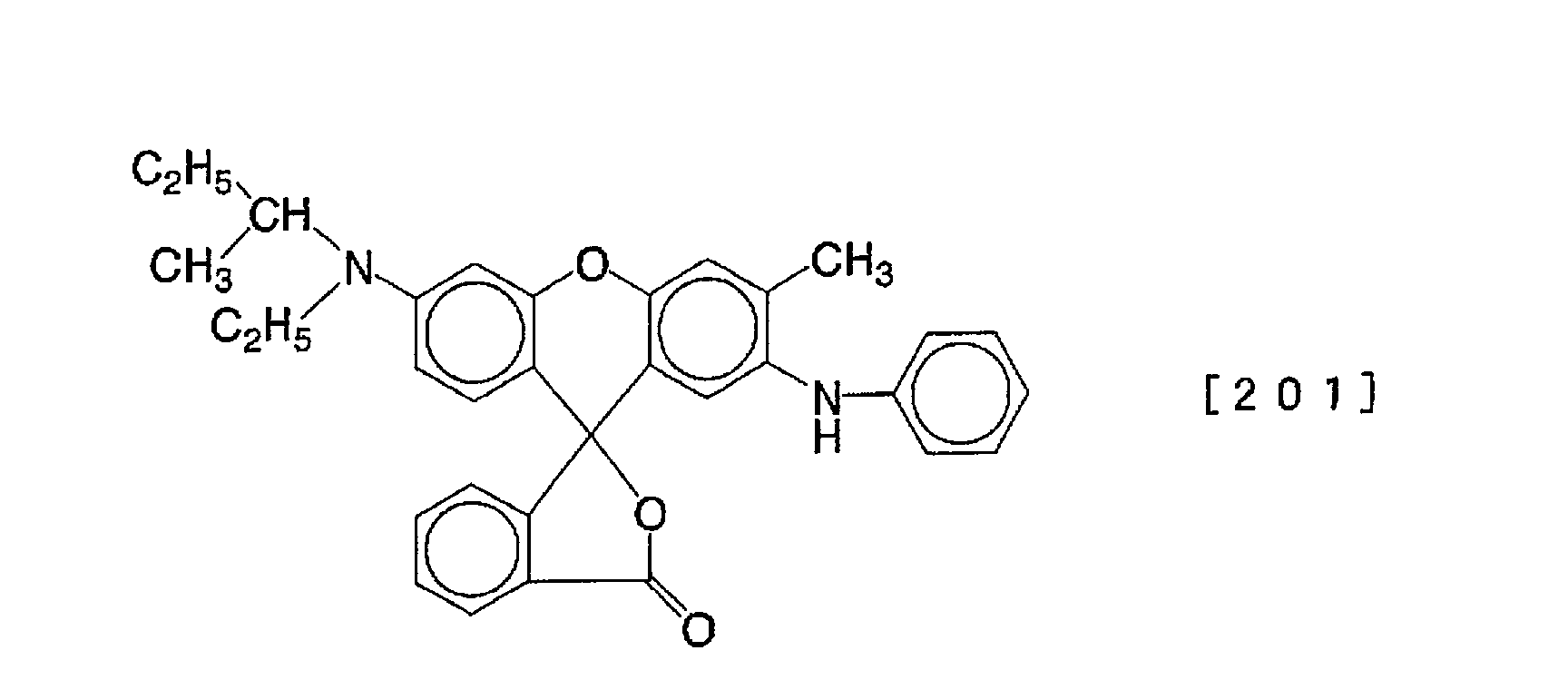
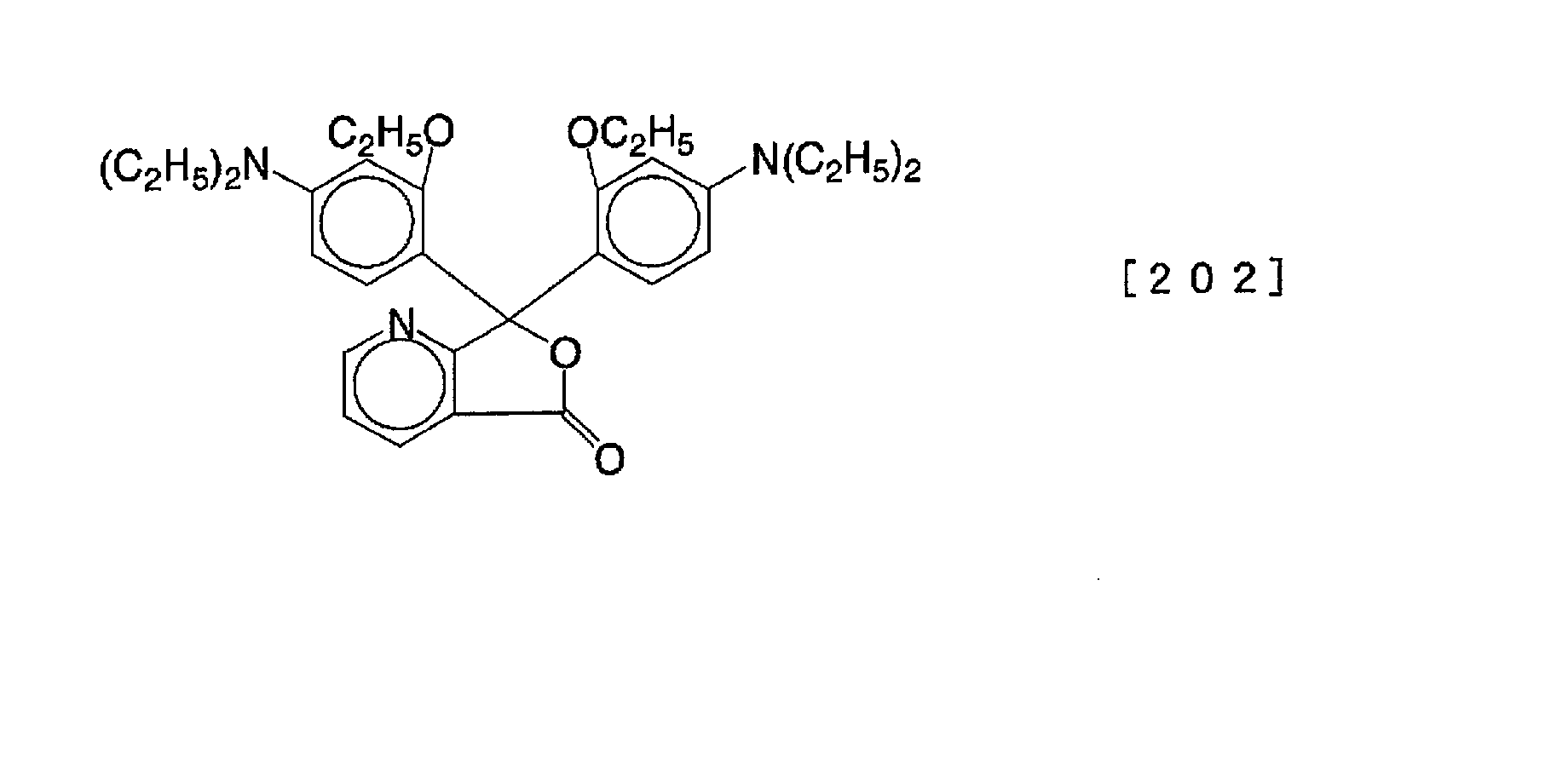

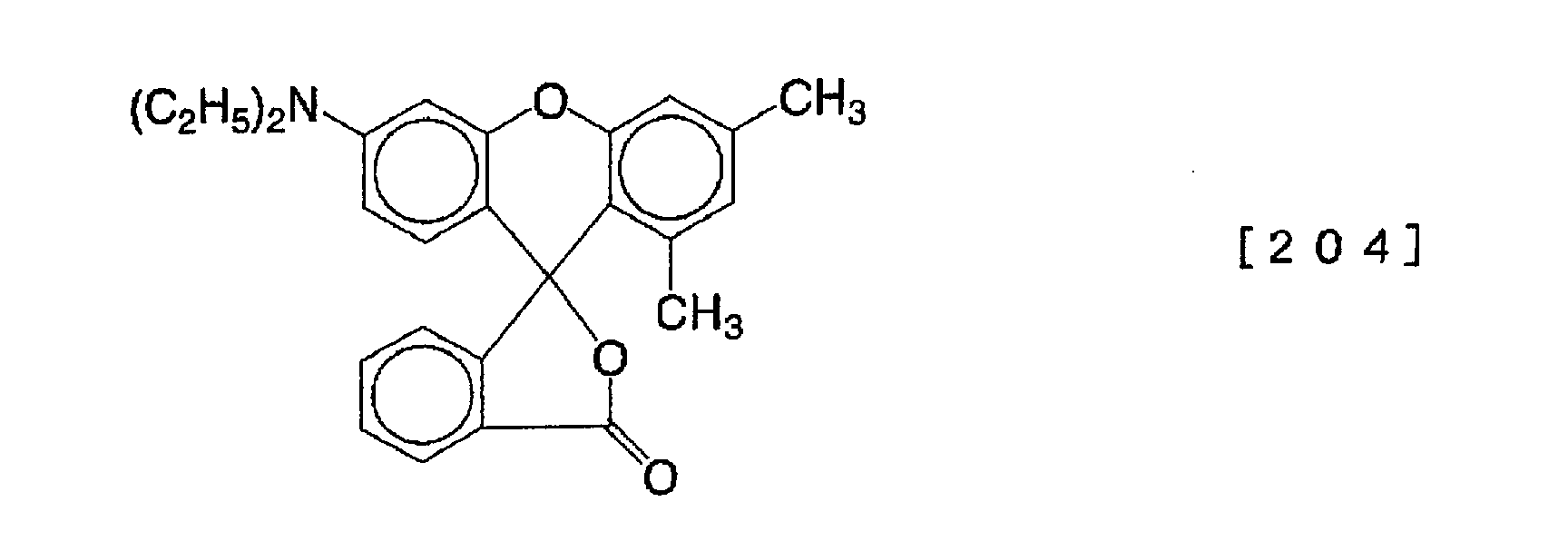
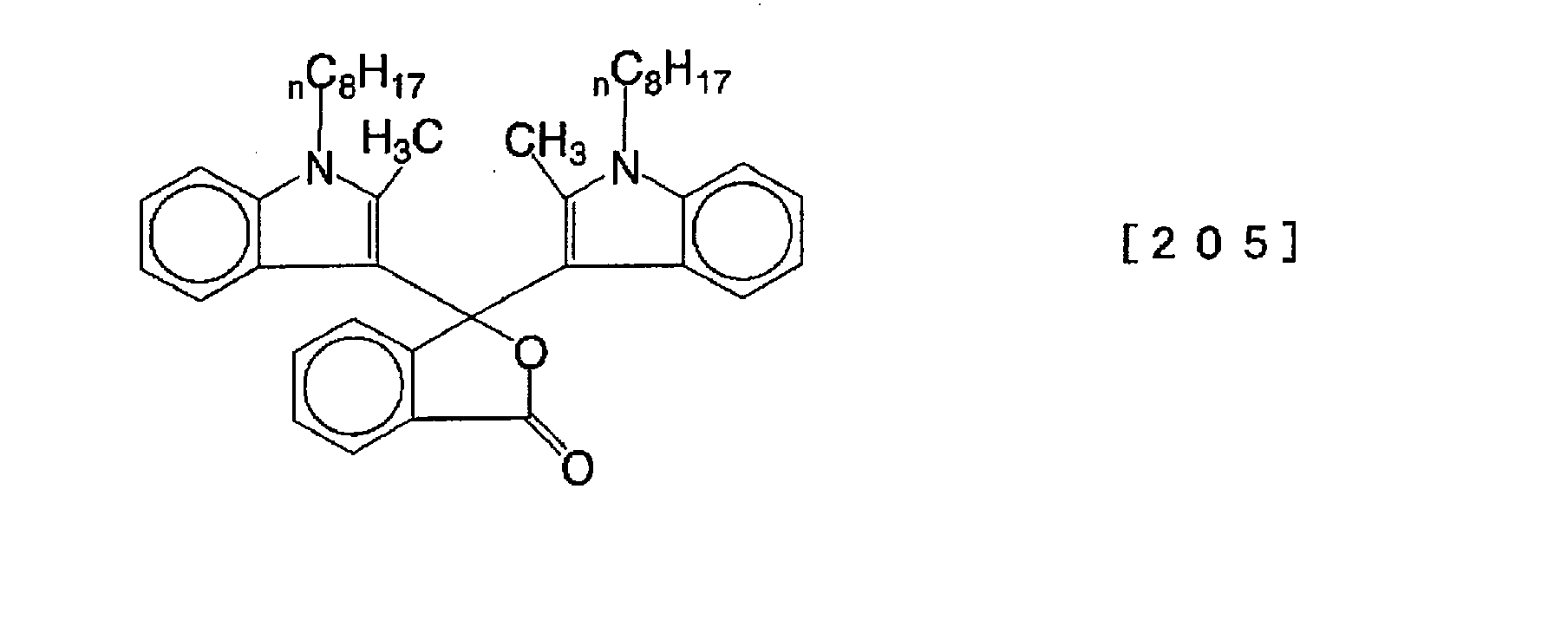
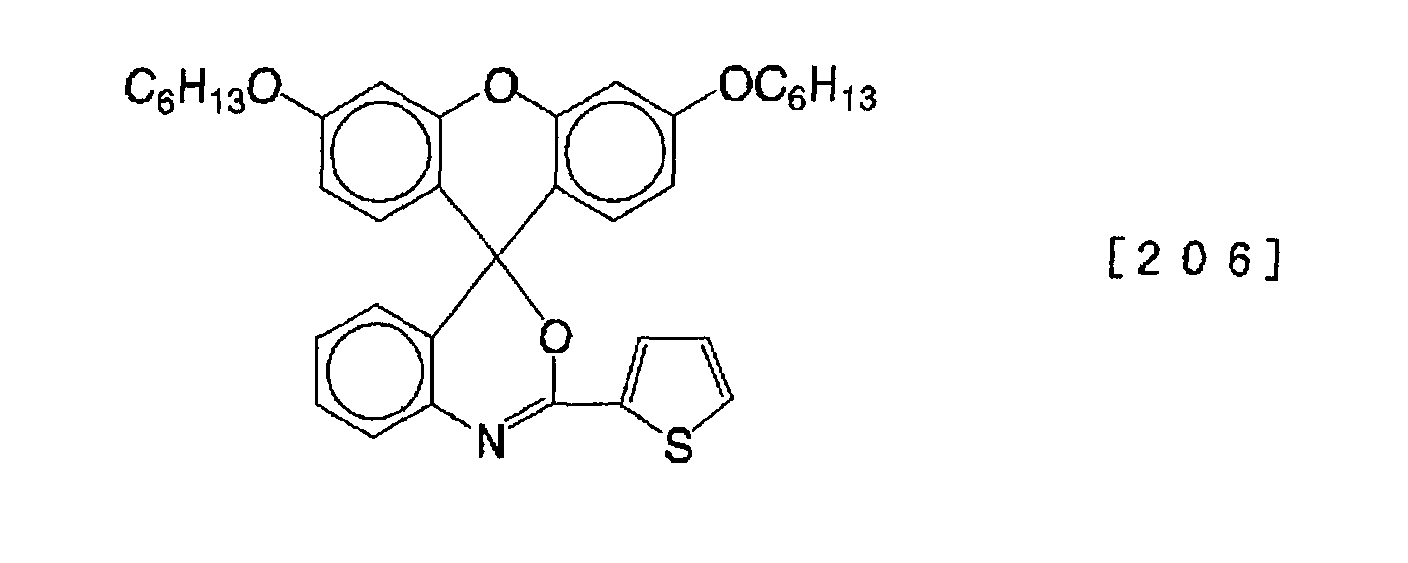
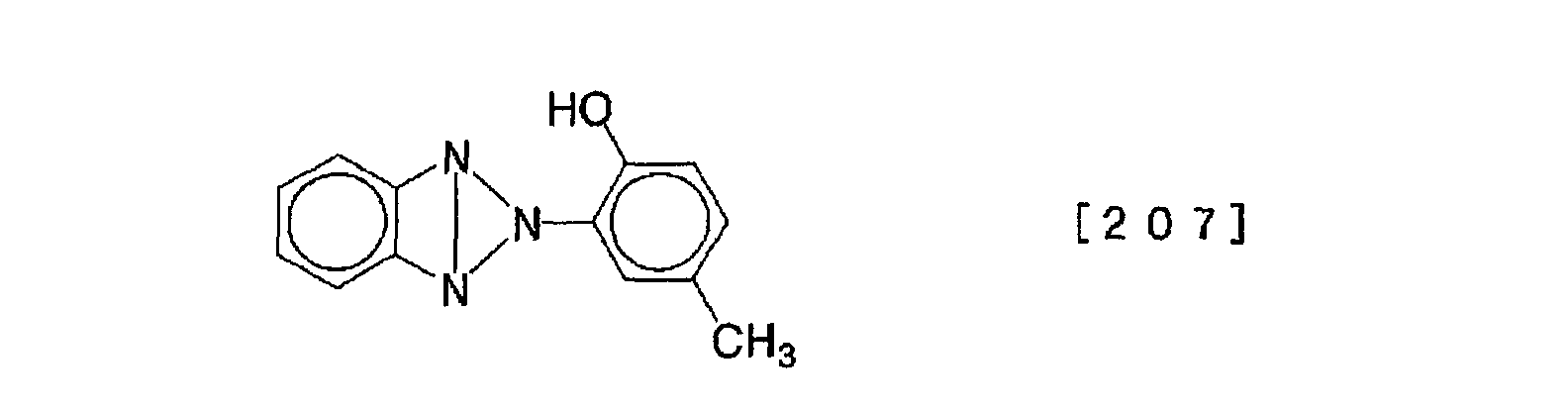
| Compound represented by the following structural formula [201] | 12.2 g |
| Compound represented by the following structural formula [202] | 1.6 g |
| Compound represented by the following structural formula [203] | 2.4 g |
| Compound represented by the following structural formula [204] | 3.3 g |
| Compound represented by the following structural formula [205] | 1.5 g |
| Compound represented by the following structural formula [206] | 0.2 g |
| Compound represented by the following structural formula [207] | 0.5 g |
| Compound represented by the following structural formula [301] | 6.7 g |
| Compound represented by the following structural formula [302] | 8.0 g |
| Compound represented by the following structural formula [303] | 5.8 g |
| Compound represented by the following structural formula [304] | 1.5 g |
| Compound represented by the following structural formula [305] | 2.2 g |
| Compound represented by the following structural formula [306] | 0.8 g |
| Compound represented by the following structural formula [307] | 4.3 g |
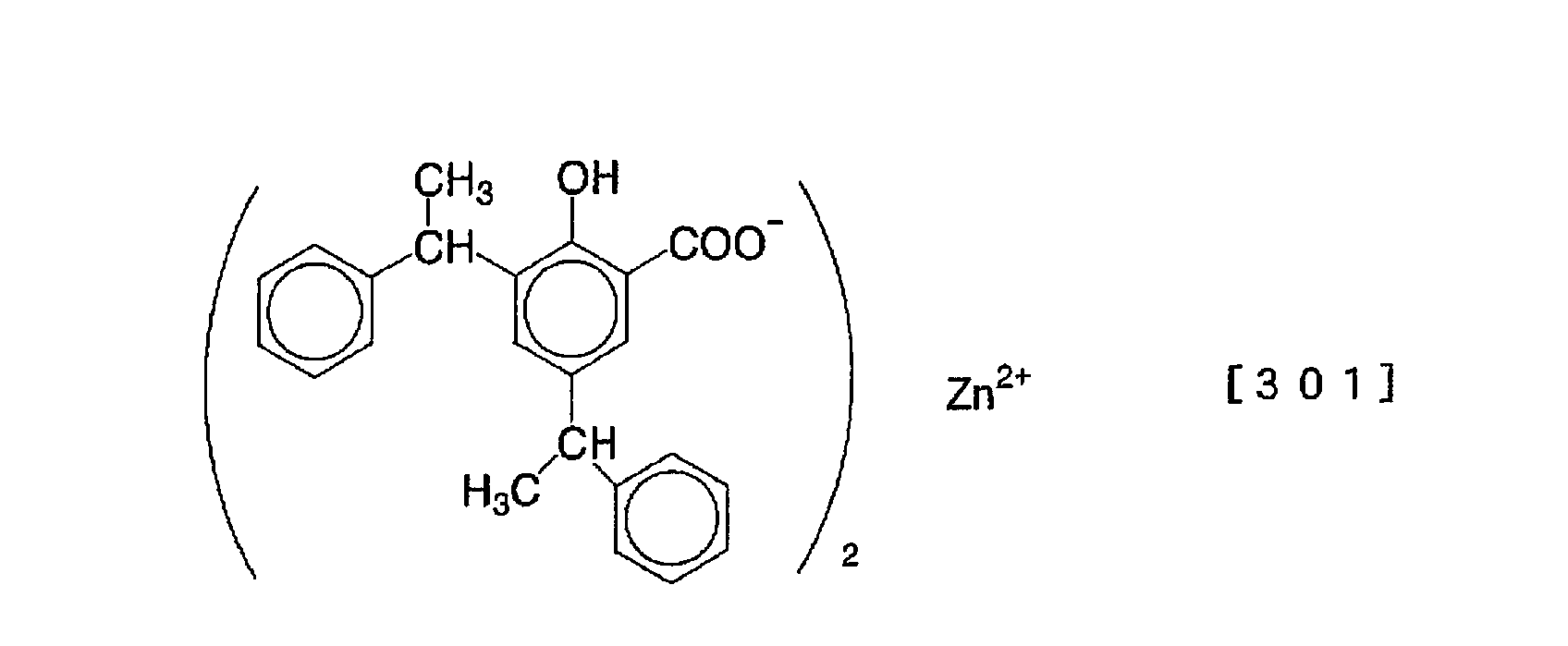
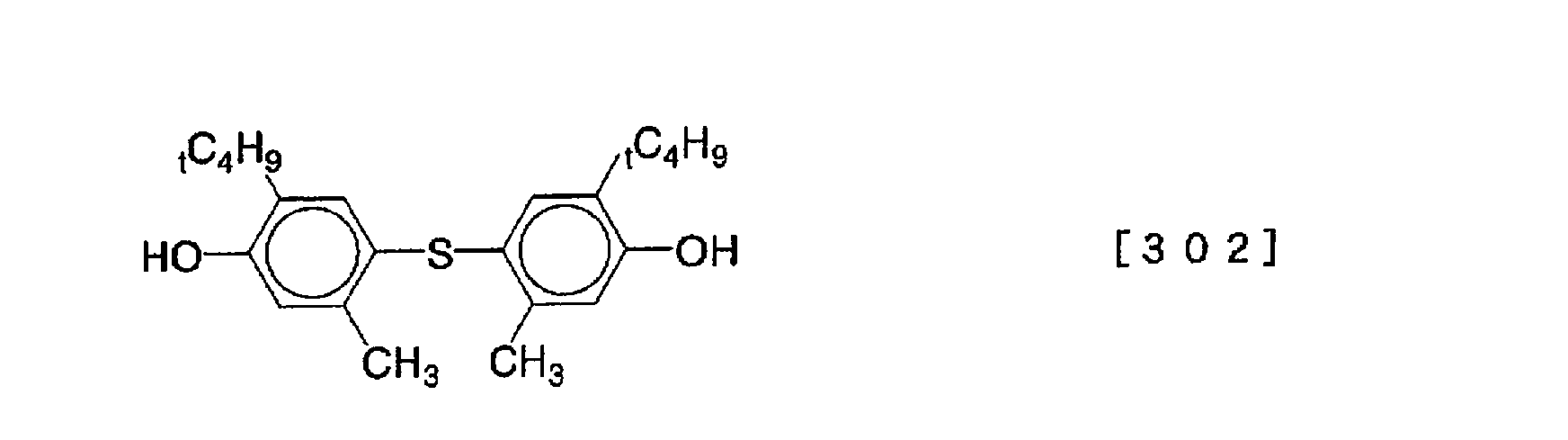

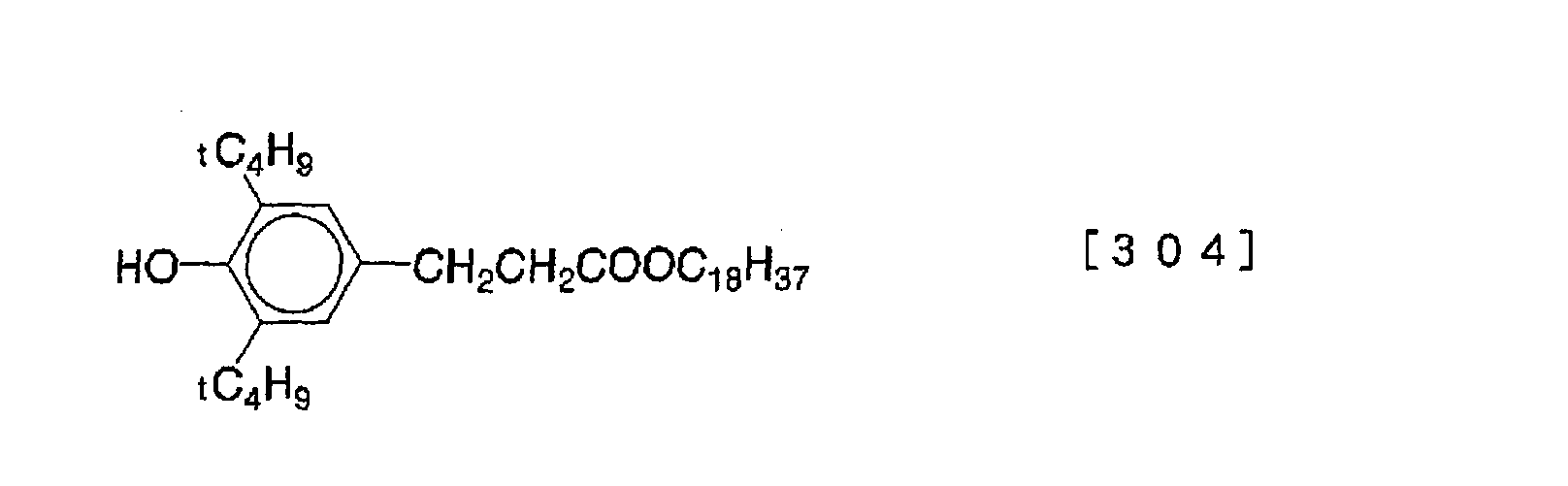


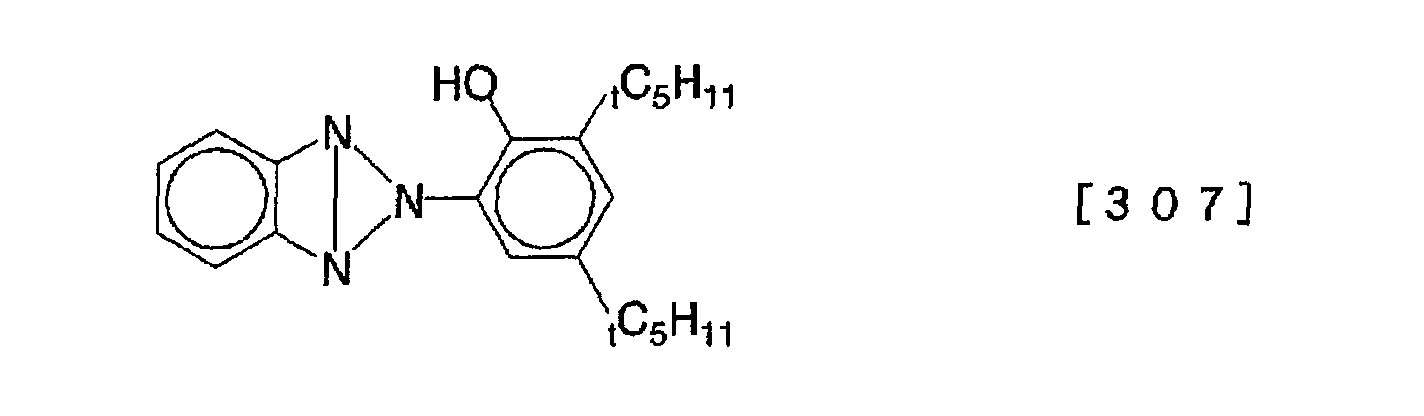

| Microcapsule coating solution A obtained above (solid concentration: 23%) | 12 g |
| Microcapsule coating solution B (solid concentration: 24%) | 2.5 g |
| Developer emulsion dispersion C obtained above (solid concentration: 22%) | 50 g |
| Aqueous 50% solution of the compound represented by the following structural formula [403] | 0.7 g |
| Colloidal silica (Snowtex, manufactured by Nissan Chemical Industries, Ltd.) | 1.8 g |

| Microcapsule coating solution A (solid concentration: 23%) | 2.3 g |
| Microcapsule coating solution B (solid concentration: 24%) | 6.6 g |
| Developer emulsion dispersion C (solid concentration: 22%) | 33 g |
| Colloidal silica (Snowtex, manufactured by Nissan Chemical Industries, Ltd.) | 1.5 g |
| Aqueous 50% solution of the compound represented by the following structural formula [403] | 0.4 g |
| Compound represented by the structural formula [501] | 9.8 g |
| Compound represented by the structural formula [502] | 8.4 g |
| Compound represented by the structural formula [503] | 9.8 g |
| Compound represented by the structural formula [504] | 13.98 g |
| Compound represented by the structural formula [505] | 29.3 g |
| 1,2-benzisothiazoline-3-one | 1.75 g |
| Poly(sodium p-vinylbenzenesulfonate) (molecular weight: about 400000) | 64.2 g |
| Compound represented by the structural formula [506] | 10.0 g |
| Latex 20% solution of a polyethylacrylate | 3180 ml |
| N,N-ethylenebis(vinylsulfonylacetamido) | 75.0 g |
| 1,3-bis(vinylsulfonylacetamido)propane to be a total volume of 62.77 l. | 25.0 g |
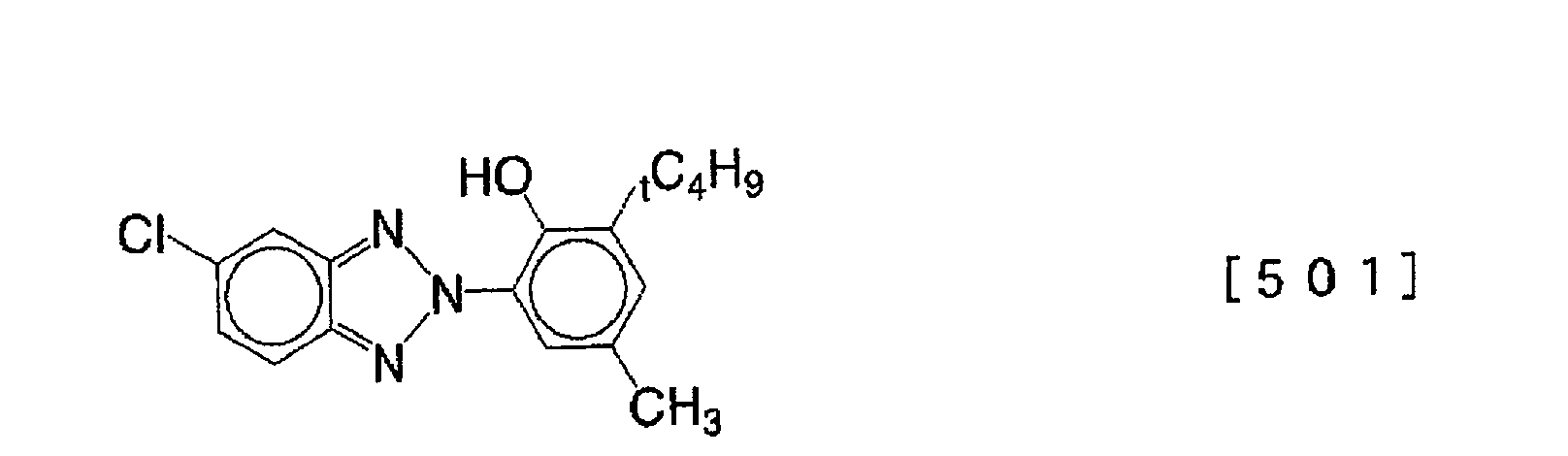
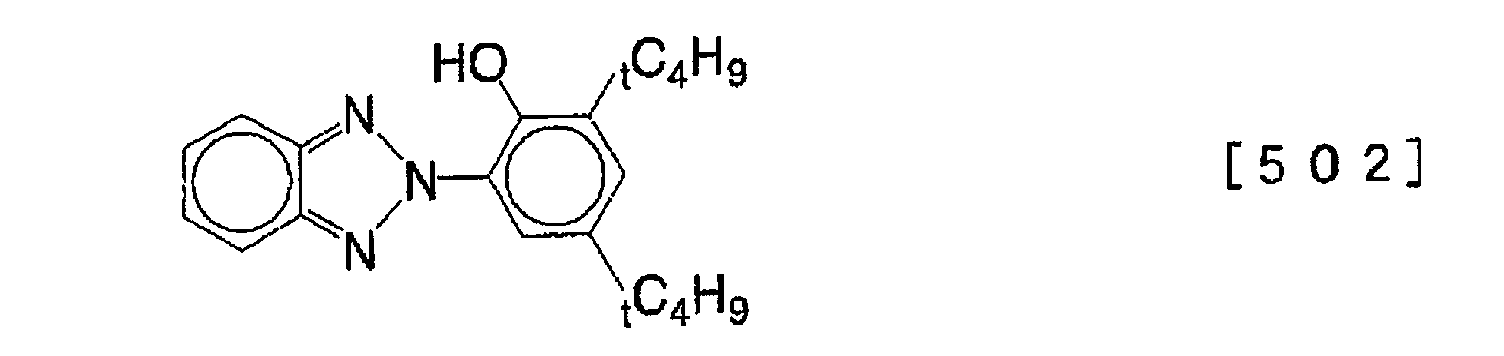


Claims (7)
- A heat-sensitive recording material comprising a substrate; and at least two heat-sensitive recording layers provided on the substrate, the heat-sensitive recording layers including microcapsules encapsulating an electron-donating dye precursor, and an electron-accepting compound, which reacts with the electron-donating dye precursor to develop a color and is disposed outside of the microcapsules,
wherein the microcapsules include at least two kinds of microcapsules having different glass transition temperatures. - A heat-sensitive recording material according to claim 1, wherein a difference between each of the glass transition temperatures of the at least two microcapsules having different glass transition temperatures is in a range from 20°C to 70°C.
- A heat-sensitive recording material according to claim 1 or claim 2, wherein the heat-sensitive recording layers include at least a heat-sensitive recording layer, in which a mass component ratio of microcapsules with a high glass transition temperature to microcapsules with a low glass transition temperature is from 85:15 to 55:45, and a heat-sensitive recording layer, in which a mass component ratio of microcapsules with a high glass transition temperature to microcapsules with a low glass transition temperature is from 20:80 to 50:50.
- A heat-sensitive recording material according to any one of claims 1 to 3, wherein a capsule wall material of the microcapsules is made of a combination of tolylenediisocyanate and isophoronediisocyanate.
- A heat-sensitive recording material according to any one of claims 1 to 4, wherein the microcapsules are produced by an interfacial polymerization method.
- A heat-sensitive recording material according to any one of claims 1 to 5, wherein the electron-accepting compound is contained in the microcapsules in the form of an emulsion dispersion.
- A heat-sensitive recording material according to any one of claims 1 to 6, in which the electron-accepting material is contained in an amount of 50 to 800 % by weight of an amount of the electron-donating dye precursor.
Applications Claiming Priority (2)
| Application Number | Priority Date | Filing Date | Title |
|---|---|---|---|
| JP2002085657A JP3822513B2 (en) | 2002-03-26 | 2002-03-26 | Thermal recording material |
| JP2002085657 | 2002-03-26 |
Publications (3)
| Publication Number | Publication Date |
|---|---|
| EP1348569A2 true EP1348569A2 (en) | 2003-10-01 |
| EP1348569A3 EP1348569A3 (en) | 2004-09-22 |
| EP1348569B1 EP1348569B1 (en) | 2006-10-04 |
Family
ID=27800429
Family Applications (1)
| Application Number | Title | Priority Date | Filing Date |
|---|---|---|---|
| EP03251888A Revoked EP1348569B1 (en) | 2002-03-26 | 2003-03-26 | Heat-sensitive recording material |
Country Status (4)
| Country | Link |
|---|---|
| US (1) | US7235512B2 (en) |
| EP (1) | EP1348569B1 (en) |
| JP (1) | JP3822513B2 (en) |
| DE (1) | DE60308742T2 (en) |
Cited By (1)
| Publication number | Priority date | Publication date | Assignee | Title |
|---|---|---|---|---|
| EP2070714A1 (en) | 2007-12-11 | 2009-06-17 | Mitsubishi HiTec Paper Bielfeld GmbH | Heat sensitive recording material |
Families Citing this family (5)
| Publication number | Priority date | Publication date | Assignee | Title |
|---|---|---|---|---|
| US20050255999A1 (en) * | 2004-05-11 | 2005-11-17 | Appleton Papers Inc. | Faux metallic imaging thermally responsive record material |
| US20070098900A1 (en) * | 2004-11-05 | 2007-05-03 | Fuji Hunt Photographic Chemicals, Inc. | Media providing non-contacting formation of high contrast marks and method of using same, composition for forming a laser-markable coating, a laser-markable material and process of forming a marking |
| JP4466483B2 (en) * | 2005-06-17 | 2010-05-26 | 王子製紙株式会社 | Thermal recording material |
| JP2007152686A (en) * | 2005-12-02 | 2007-06-21 | Fujifilm Corp | Recording method |
| WO2014171494A1 (en) * | 2013-04-17 | 2014-10-23 | コニカミノルタ株式会社 | Optical reflective film, method for manufacturing same, and optical reflector using same |
Citations (7)
| Publication number | Priority date | Publication date | Assignee | Title |
|---|---|---|---|---|
| USRE23024E (en) | 1948-08-17 | X-dimethylaminophenyl | ||
| US3491111A (en) | 1967-01-30 | 1970-01-20 | Ncr Co | Indole- and carbazole-substituted phthalides |
| US3509174A (en) | 1967-01-30 | 1970-04-28 | Ncr Co | 3-(indol-3-yl)-phthalides |
| US3624107A (en) | 1969-01-21 | 1971-11-30 | Ncr Co | Nitro- and amino-substituted fluorans |
| JPS5866948A (en) | 1981-10-16 | 1983-04-21 | Fuji Photo Film Co Ltd | Capsulated toner |
| JPH0419778A (en) | 1990-05-15 | 1992-01-23 | Canon Inc | Image forming device |
| JPH10114153A (en) | 1996-10-09 | 1998-05-06 | Fuji Photo Film Co Ltd | Thermally responsive microcapsule, thermal recording material and multicolor thermal recording material employing it |
Family Cites Families (9)
| Publication number | Priority date | Publication date | Assignee | Title |
|---|---|---|---|---|
| GB2160671B (en) * | 1984-05-02 | 1987-03-11 | Fuji Photo Film Co Ltd | Heat-sensitive recording material |
| JPH0630953B2 (en) | 1984-10-20 | 1994-04-27 | 株式会社リコー | Gradation type thermal recording material |
| JPH0832484B2 (en) | 1988-11-25 | 1996-03-29 | 富士写真フイルム株式会社 | Multicolor recording material |
| JP2625194B2 (en) * | 1989-02-03 | 1997-07-02 | 富士写真フイルム株式会社 | Multicolor recording material |
| JPH0880671A (en) | 1994-09-14 | 1996-03-26 | Fuji Photo Film Co Ltd | Thermal recording material |
| JPH08156421A (en) | 1994-12-05 | 1996-06-18 | Fuji Photo Film Co Ltd | Thermal recording material |
| JPH11109554A (en) * | 1997-10-01 | 1999-04-23 | Fuji Photo Film Co Ltd | Photosensitive and thermosensitive recording material, and dye |
| JP2000233574A (en) | 1999-02-15 | 2000-08-29 | Fuji Photo Film Co Ltd | Manufacture of heat sensitive recording material |
| JP2001105738A (en) | 1999-10-07 | 2001-04-17 | Fuji Photo Film Co Ltd | Heat-sensitive recording material |
-
2002
- 2002-03-26 JP JP2002085657A patent/JP3822513B2/en not_active Expired - Lifetime
-
2003
- 2003-03-25 US US10/395,278 patent/US7235512B2/en not_active Expired - Lifetime
- 2003-03-26 EP EP03251888A patent/EP1348569B1/en not_active Revoked
- 2003-03-26 DE DE60308742T patent/DE60308742T2/en not_active Expired - Lifetime
Patent Citations (8)
| Publication number | Priority date | Publication date | Assignee | Title |
|---|---|---|---|---|
| USRE23024E (en) | 1948-08-17 | X-dimethylaminophenyl | ||
| US3491111A (en) | 1967-01-30 | 1970-01-20 | Ncr Co | Indole- and carbazole-substituted phthalides |
| US3509174A (en) | 1967-01-30 | 1970-04-28 | Ncr Co | 3-(indol-3-yl)-phthalides |
| US3624107A (en) | 1969-01-21 | 1971-11-30 | Ncr Co | Nitro- and amino-substituted fluorans |
| US3627787A (en) | 1969-01-21 | 1971-12-14 | Ncr Co | Amids- and sulfonamido-substituted fluorans |
| JPS5866948A (en) | 1981-10-16 | 1983-04-21 | Fuji Photo Film Co Ltd | Capsulated toner |
| JPH0419778A (en) | 1990-05-15 | 1992-01-23 | Canon Inc | Image forming device |
| JPH10114153A (en) | 1996-10-09 | 1998-05-06 | Fuji Photo Film Co Ltd | Thermally responsive microcapsule, thermal recording material and multicolor thermal recording material employing it |
Cited By (2)
| Publication number | Priority date | Publication date | Assignee | Title |
|---|---|---|---|---|
| EP2070714A1 (en) | 2007-12-11 | 2009-06-17 | Mitsubishi HiTec Paper Bielfeld GmbH | Heat sensitive recording material |
| WO2009074292A1 (en) * | 2007-12-11 | 2009-06-18 | Mitsubishi Hitec Paper Bielefeld Gmbh | Heat sensitive recording material |
Also Published As
| Publication number | Publication date |
|---|---|
| DE60308742D1 (en) | 2006-11-16 |
| EP1348569B1 (en) | 2006-10-04 |
| DE60308742T2 (en) | 2007-08-09 |
| EP1348569A3 (en) | 2004-09-22 |
| JP2003276345A (en) | 2003-09-30 |
| JP3822513B2 (en) | 2006-09-20 |
| US7235512B2 (en) | 2007-06-26 |
| US20030191022A1 (en) | 2003-10-09 |
Similar Documents
| Publication | Publication Date | Title |
|---|---|---|
| JPS6392489A (en) | Thermal recording material | |
| JP3776810B2 (en) | Thermal recording material and thermal recording method | |
| US7235512B2 (en) | Heat-sensitive recording material | |
| JPH0880671A (en) | Thermal recording material | |
| US7176162B2 (en) | Heat-sensitive recording material | |
| JP2006150826A (en) | Thermal recording material and manufacturing method thereof | |
| JP2003094826A (en) | Heat-sensitive recording material and its manufacturing method | |
| JP2004216878A (en) | Heat-sensitive recording material | |
| JP2002331752A (en) | Heat-sensitive recording material | |
| JP2003094827A (en) | Heat-sensitive recording material | |
| JP2005271283A (en) | Thermal recording material and its manufacturing method | |
| JP2006035594A (en) | Thermal recording material and image recording method | |
| JP2004130580A (en) | Thermal recording material and manufacturing method thereof | |
| JP2006088668A (en) | Thermal recording material, method for manufacturing thermal recording material and method for recording image | |
| JPS63189286A (en) | Thermal recording material | |
| JP2002067500A (en) | Heat-sensitive recording medium and heat-sensitive recording method | |
| JP2002331753A (en) | Heat-sensitive recording material | |
| JP2004130696A (en) | Thermosensitive recording material and microcapsule liquid | |
| JP2004314613A (en) | Thermal recording material | |
| JP2006248198A (en) | Thermal recording material | |
| JP2002362029A (en) | Thermal recording material | |
| JP2005313478A (en) | Thermosensitive recording material and its manufacturing method | |
| JP2003276329A (en) | Thermal recording material | |
| JP2007230151A (en) | Thermal recording material and method for producing the same | |
| JP2003211845A (en) | Thermal recording material and thermal recording method |
Legal Events
| Date | Code | Title | Description |
|---|---|---|---|
| PUAI | Public reference made under article 153(3) epc to a published international application that has entered the european phase |
Free format text: ORIGINAL CODE: 0009012 |
|
| AK | Designated contracting states |
Kind code of ref document: A2 Designated state(s): AT BE BG CH CY CZ DE DK EE ES FI FR GB GR HU IE IT LI LU MC NL PT RO SE SI SK TR |
|
| AX | Request for extension of the european patent |
Extension state: AL LT LV MK |
|
| PUAL | Search report despatched |
Free format text: ORIGINAL CODE: 0009013 |
|
| AK | Designated contracting states |
Kind code of ref document: A3 Designated state(s): AT BE BG CH CY CZ DE DK EE ES FI FR GB GR HU IE IT LI LU MC NL PT RO SE SI SK TR |
|
| AX | Request for extension of the european patent |
Extension state: AL LT LV MK |
|
| 17P | Request for examination filed |
Effective date: 20050323 |
|
| AKX | Designation fees paid |
Designated state(s): AT BE BG |
|
| RBV | Designated contracting states (corrected) |
Designated state(s): DE FR GB |
|
| REG | Reference to a national code |
Ref country code: DE Ref legal event code: 8566 |
|
| GRAP | Despatch of communication of intention to grant a patent |
Free format text: ORIGINAL CODE: EPIDOSNIGR1 |
|
| GRAS | Grant fee paid |
Free format text: ORIGINAL CODE: EPIDOSNIGR3 |
|
| GRAA | (expected) grant |
Free format text: ORIGINAL CODE: 0009210 |
|
| AK | Designated contracting states |
Kind code of ref document: B1 Designated state(s): DE FR GB |
|
| REG | Reference to a national code |
Ref country code: GB Ref legal event code: FG4D |
|
| REF | Corresponds to: |
Ref document number: 60308742 Country of ref document: DE Date of ref document: 20061116 Kind code of ref document: P |
|
| RAP2 | Party data changed (patent owner data changed or rights of a patent transferred) |
Owner name: FUJIFILM CORPORATION |
|
| REG | Reference to a national code |
Ref country code: GB Ref legal event code: 732E |
|
| ET | Fr: translation filed | ||
| PLBI | Opposition filed |
Free format text: ORIGINAL CODE: 0009260 |
|
| PLAX | Notice of opposition and request to file observation + time limit sent |
Free format text: ORIGINAL CODE: EPIDOSNOBS2 |
|
| 26 | Opposition filed |
Opponent name: OJI PAPER COMPANY, LIMITED Effective date: 20070703 |
|
| REG | Reference to a national code |
Ref country code: FR Ref legal event code: TP Ref country code: FR Ref legal event code: CD |
|
| PLBB | Reply of patent proprietor to notice(s) of opposition received |
Free format text: ORIGINAL CODE: EPIDOSNOBS3 |
|
| REG | Reference to a national code |
Ref country code: DE Ref legal event code: R064 Ref document number: 60308742 Country of ref document: DE Ref country code: DE Ref legal event code: R103 Ref document number: 60308742 Country of ref document: DE |
|
| RDAF | Communication despatched that patent is revoked |
Free format text: ORIGINAL CODE: EPIDOSNREV1 |
|
| RDAG | Patent revoked |
Free format text: ORIGINAL CODE: 0009271 |
|
| STAA | Information on the status of an ep patent application or granted ep patent |
Free format text: STATUS: PATENT REVOKED |
|
| PGFP | Annual fee paid to national office [announced via postgrant information from national office to epo] |
Ref country code: FR Payment date: 20130325 Year of fee payment: 11 Ref country code: GB Payment date: 20130320 Year of fee payment: 11 Ref country code: DE Payment date: 20130320 Year of fee payment: 11 |
|
| 27W | Patent revoked |
Effective date: 20121120 |
|
| GBPR | Gb: patent revoked under art. 102 of the ep convention designating the uk as contracting state |
Effective date: 20121120 |
|
| REG | Reference to a national code |
Ref country code: DE Ref legal event code: R107 Ref document number: 60308742 Country of ref document: DE Effective date: 20130926 |