EP1348541A1 - Multi-layered polyester film - Google Patents
Multi-layered polyester film Download PDFInfo
- Publication number
- EP1348541A1 EP1348541A1 EP03006468A EP03006468A EP1348541A1 EP 1348541 A1 EP1348541 A1 EP 1348541A1 EP 03006468 A EP03006468 A EP 03006468A EP 03006468 A EP03006468 A EP 03006468A EP 1348541 A1 EP1348541 A1 EP 1348541A1
- Authority
- EP
- European Patent Office
- Prior art keywords
- polyester
- layer
- aliphatic
- acid
- film
- Prior art date
- Legal status (The legal status is an assumption and is not a legal conclusion. Google has not performed a legal analysis and makes no representation as to the accuracy of the status listed.)
- Withdrawn
Links
- 229920006267 polyester film Polymers 0.000 title claims abstract description 18
- 229920000728 polyester Polymers 0.000 claims abstract description 66
- 229920003232 aliphatic polyester Polymers 0.000 claims abstract description 36
- OFOBLEOULBTSOW-UHFFFAOYSA-N Malonic acid Chemical compound OC(=O)CC(O)=O OFOBLEOULBTSOW-UHFFFAOYSA-N 0.000 claims description 37
- 125000001931 aliphatic group Chemical group 0.000 claims description 23
- 125000003118 aryl group Chemical group 0.000 claims description 20
- PUPZLCDOIYMWBV-UHFFFAOYSA-N (+/-)-1,3-Butanediol Chemical compound CC(O)CCO PUPZLCDOIYMWBV-UHFFFAOYSA-N 0.000 claims description 19
- 238000007789 sealing Methods 0.000 claims description 5
- 239000010410 layer Substances 0.000 description 83
- -1 cyclic lactone Chemical class 0.000 description 23
- 229920005989 resin Polymers 0.000 description 23
- 239000011347 resin Substances 0.000 description 23
- 239000000194 fatty acid Substances 0.000 description 12
- 238000000034 method Methods 0.000 description 12
- 229920000642 polymer Polymers 0.000 description 12
- 239000004645 polyester resin Substances 0.000 description 11
- KKEYFWRCBNTPAC-UHFFFAOYSA-N Terephthalic acid Chemical compound OC(=O)C1=CC=C(C(O)=O)C=C1 KKEYFWRCBNTPAC-UHFFFAOYSA-N 0.000 description 10
- WNLRTRBMVRJNCN-UHFFFAOYSA-N adipic acid Chemical compound OC(=O)CCCCC(O)=O WNLRTRBMVRJNCN-UHFFFAOYSA-N 0.000 description 10
- 239000007788 liquid Substances 0.000 description 9
- VYPSYNLAJGMNEJ-UHFFFAOYSA-N Silicium dioxide Chemical compound O=[Si]=O VYPSYNLAJGMNEJ-UHFFFAOYSA-N 0.000 description 8
- JVTAAEKCZFNVCJ-UHFFFAOYSA-N lactic acid Chemical compound CC(O)C(O)=O JVTAAEKCZFNVCJ-UHFFFAOYSA-N 0.000 description 8
- 238000004519 manufacturing process Methods 0.000 description 8
- 239000011248 coating agent Substances 0.000 description 7
- 238000000576 coating method Methods 0.000 description 7
- 239000000203 mixture Substances 0.000 description 7
- 239000003607 modifier Substances 0.000 description 7
- TZCXTZWJZNENPQ-UHFFFAOYSA-L barium sulfate Chemical compound [Ba+2].[O-]S([O-])(=O)=O TZCXTZWJZNENPQ-UHFFFAOYSA-L 0.000 description 6
- WERYXYBDKMZEQL-UHFFFAOYSA-N butane-1,4-diol Chemical compound OCCCCO WERYXYBDKMZEQL-UHFFFAOYSA-N 0.000 description 6
- GWEVSGVZZGPLCZ-UHFFFAOYSA-N Titan oxide Chemical compound O=[Ti]=O GWEVSGVZZGPLCZ-UHFFFAOYSA-N 0.000 description 5
- 239000001361 adipic acid Substances 0.000 description 5
- 235000011037 adipic acid Nutrition 0.000 description 5
- BVKZGUZCCUSVTD-UHFFFAOYSA-N carbonic acid Chemical group OC(O)=O BVKZGUZCCUSVTD-UHFFFAOYSA-N 0.000 description 5
- 238000000465 moulding Methods 0.000 description 5
- VTYYLEPIZMXCLO-UHFFFAOYSA-L Calcium carbonate Chemical compound [Ca+2].[O-]C([O-])=O VTYYLEPIZMXCLO-UHFFFAOYSA-L 0.000 description 4
- 238000005266 casting Methods 0.000 description 4
- 235000014113 dietary fatty acids Nutrition 0.000 description 4
- 150000002009 diols Chemical class 0.000 description 4
- 229930195729 fatty acid Natural products 0.000 description 4
- 229960000448 lactic acid Drugs 0.000 description 4
- 229920001225 polyester resin Polymers 0.000 description 4
- 239000000377 silicon dioxide Substances 0.000 description 4
- 239000002904 solvent Substances 0.000 description 4
- 239000007858 starting material Substances 0.000 description 4
- IJGRMHOSHXDMSA-UHFFFAOYSA-N Atomic nitrogen Chemical compound N#N IJGRMHOSHXDMSA-UHFFFAOYSA-N 0.000 description 3
- 229920000298 Cellophane Polymers 0.000 description 3
- LYCAIKOWRPUZTN-UHFFFAOYSA-N Ethylene glycol Chemical compound OCCO LYCAIKOWRPUZTN-UHFFFAOYSA-N 0.000 description 3
- MUBZPKHOEPUJKR-UHFFFAOYSA-N Oxalic acid Chemical compound OC(=O)C(O)=O MUBZPKHOEPUJKR-UHFFFAOYSA-N 0.000 description 3
- DNIAPMSPPWPWGF-UHFFFAOYSA-N Propylene glycol Chemical compound CC(O)CO DNIAPMSPPWPWGF-UHFFFAOYSA-N 0.000 description 3
- 229910052796 boron Inorganic materials 0.000 description 3
- 230000000052 comparative effect Effects 0.000 description 3
- 230000018044 dehydration Effects 0.000 description 3
- 238000006297 dehydration reaction Methods 0.000 description 3
- 150000001991 dicarboxylic acids Chemical class 0.000 description 3
- MTHSVFCYNBDYFN-UHFFFAOYSA-N diethylene glycol Chemical compound OCCOCCO MTHSVFCYNBDYFN-UHFFFAOYSA-N 0.000 description 3
- 229920005839 ecoflex® Polymers 0.000 description 3
- 230000002452 interceptive effect Effects 0.000 description 3
- 239000004310 lactic acid Substances 0.000 description 3
- 235000014655 lactic acid Nutrition 0.000 description 3
- 238000004806 packaging method and process Methods 0.000 description 3
- 239000002985 plastic film Substances 0.000 description 3
- 230000003252 repetitive effect Effects 0.000 description 3
- 230000003068 static effect Effects 0.000 description 3
- XLYOFNOQVPJJNP-UHFFFAOYSA-N water Substances O XLYOFNOQVPJJNP-UHFFFAOYSA-N 0.000 description 3
- WHBMMWSBFZVSSR-UHFFFAOYSA-N 3-hydroxybutyric acid Chemical compound CC(O)CC(O)=O WHBMMWSBFZVSSR-UHFFFAOYSA-N 0.000 description 2
- FMHKPLXYWVCLME-UHFFFAOYSA-N 4-hydroxy-valeric acid Chemical compound CC(O)CCC(O)=O FMHKPLXYWVCLME-UHFFFAOYSA-N 0.000 description 2
- IWHLYPDWHHPVAA-UHFFFAOYSA-N 6-hydroxyhexanoic acid Chemical compound OCCCCCC(O)=O IWHLYPDWHHPVAA-UHFFFAOYSA-N 0.000 description 2
- 239000005995 Aluminium silicate Substances 0.000 description 2
- CURLTUGMZLYLDI-UHFFFAOYSA-N Carbon dioxide Chemical compound O=C=O CURLTUGMZLYLDI-UHFFFAOYSA-N 0.000 description 2
- AEMRFAOFKBGASW-UHFFFAOYSA-N Glycolic acid Chemical compound OCC(O)=O AEMRFAOFKBGASW-UHFFFAOYSA-N 0.000 description 2
- JVTAAEKCZFNVCJ-REOHCLBHSA-N L-lactic acid Chemical compound C[C@H](O)C(O)=O JVTAAEKCZFNVCJ-REOHCLBHSA-N 0.000 description 2
- 235000010724 Wisteria floribunda Nutrition 0.000 description 2
- 239000002253 acid Substances 0.000 description 2
- 239000000853 adhesive Substances 0.000 description 2
- 230000001070 adhesive effect Effects 0.000 description 2
- 235000012211 aluminium silicate Nutrition 0.000 description 2
- 150000008064 anhydrides Chemical class 0.000 description 2
- ADCOVFLJGNWWNZ-UHFFFAOYSA-N antimony trioxide Chemical compound O=[Sb]O[Sb]=O ADCOVFLJGNWWNZ-UHFFFAOYSA-N 0.000 description 2
- 239000002216 antistatic agent Substances 0.000 description 2
- 230000004888 barrier function Effects 0.000 description 2
- CDQSJQSWAWPGKG-UHFFFAOYSA-N butane-1,1-diol Chemical compound CCCC(O)O CDQSJQSWAWPGKG-UHFFFAOYSA-N 0.000 description 2
- 229910000019 calcium carbonate Inorganic materials 0.000 description 2
- 125000004432 carbon atom Chemical group C* 0.000 description 2
- 229920001577 copolymer Polymers 0.000 description 2
- 125000004122 cyclic group Chemical group 0.000 description 2
- ZBCBWPMODOFKDW-UHFFFAOYSA-N diethanolamine Chemical compound OCCNCCO ZBCBWPMODOFKDW-UHFFFAOYSA-N 0.000 description 2
- 238000001125 extrusion Methods 0.000 description 2
- 150000004665 fatty acids Chemical class 0.000 description 2
- 239000007789 gas Substances 0.000 description 2
- 239000011521 glass Substances 0.000 description 2
- QQVIHTHCMHWDBS-UHFFFAOYSA-N isophthalic acid Chemical compound OC(=O)C1=CC=CC(C(O)=O)=C1 QQVIHTHCMHWDBS-UHFFFAOYSA-N 0.000 description 2
- NLYAJNPCOHFWQQ-UHFFFAOYSA-N kaolin Chemical compound O.O.O=[Al]O[Si](=O)O[Si](=O)O[Al]=O NLYAJNPCOHFWQQ-UHFFFAOYSA-N 0.000 description 2
- JJTUDXZGHPGLLC-UHFFFAOYSA-N lactide Chemical compound CC1OC(=O)C(C)OC1=O JJTUDXZGHPGLLC-UHFFFAOYSA-N 0.000 description 2
- 238000002844 melting Methods 0.000 description 2
- 230000008018 melting Effects 0.000 description 2
- 238000002156 mixing Methods 0.000 description 2
- 239000000178 monomer Substances 0.000 description 2
- BDJRBEYXGGNYIS-UHFFFAOYSA-N nonanedioic acid Chemical compound OC(=O)CCCCCCCC(O)=O BDJRBEYXGGNYIS-UHFFFAOYSA-N 0.000 description 2
- 239000003960 organic solvent Substances 0.000 description 2
- NWVVVBRKAWDGAB-UHFFFAOYSA-N p-methoxyphenol Chemical compound COC1=CC=C(O)C=C1 NWVVVBRKAWDGAB-UHFFFAOYSA-N 0.000 description 2
- 239000008188 pellet Substances 0.000 description 2
- XNGIFLGASWRNHJ-UHFFFAOYSA-N phthalic acid Chemical compound OC(=O)C1=CC=CC=C1C(O)=O XNGIFLGASWRNHJ-UHFFFAOYSA-N 0.000 description 2
- WLJVNTCWHIRURA-UHFFFAOYSA-N pimelic acid Chemical compound OC(=O)CCCCCC(O)=O WLJVNTCWHIRURA-UHFFFAOYSA-N 0.000 description 2
- 229920006255 plastic film Polymers 0.000 description 2
- 229920000747 poly(lactic acid) Polymers 0.000 description 2
- 238000006068 polycondensation reaction Methods 0.000 description 2
- 238000006116 polymerization reaction Methods 0.000 description 2
- 229920005672 polyolefin resin Polymers 0.000 description 2
- 239000000843 powder Substances 0.000 description 2
- 230000002265 prevention Effects 0.000 description 2
- 239000011342 resin composition Substances 0.000 description 2
- 150000003839 salts Chemical class 0.000 description 2
- TYFQFVWCELRYAO-UHFFFAOYSA-N suberic acid Chemical compound OC(=O)CCCCCCC(O)=O TYFQFVWCELRYAO-UHFFFAOYSA-N 0.000 description 2
- 150000005846 sugar alcohols Polymers 0.000 description 2
- 239000000454 talc Substances 0.000 description 2
- 229910052623 talc Inorganic materials 0.000 description 2
- 239000004408 titanium dioxide Substances 0.000 description 2
- HVLLSGMXQDNUAL-UHFFFAOYSA-N triphenyl phosphite Chemical compound C=1C=CC=CC=1OP(OC=1C=CC=CC=1)OC1=CC=CC=C1 HVLLSGMXQDNUAL-UHFFFAOYSA-N 0.000 description 2
- 239000002699 waste material Substances 0.000 description 2
- PAPBSGBWRJIAAV-UHFFFAOYSA-N ε-Caprolactone Chemical compound O=C1CCCCCO1 PAPBSGBWRJIAAV-UHFFFAOYSA-N 0.000 description 2
- ZORQXIQZAOLNGE-UHFFFAOYSA-N 1,1-difluorocyclohexane Chemical compound FC1(F)CCCCC1 ZORQXIQZAOLNGE-UHFFFAOYSA-N 0.000 description 1
- YHMYGUUIMTVXNW-UHFFFAOYSA-N 1,3-dihydrobenzimidazole-2-thione Chemical compound C1=CC=C2NC(S)=NC2=C1 YHMYGUUIMTVXNW-UHFFFAOYSA-N 0.000 description 1
- RKDVKSZUMVYZHH-UHFFFAOYSA-N 1,4-dioxane-2,5-dione Chemical compound O=C1COC(=O)CO1 RKDVKSZUMVYZHH-UHFFFAOYSA-N 0.000 description 1
- ALVZNPYWJMLXKV-UHFFFAOYSA-N 1,9-Nonanediol Chemical compound OCCCCCCCCCO ALVZNPYWJMLXKV-UHFFFAOYSA-N 0.000 description 1
- RTBFRGCFXZNCOE-UHFFFAOYSA-N 1-methylsulfonylpiperidin-4-one Chemical compound CS(=O)(=O)N1CCC(=O)CC1 RTBFRGCFXZNCOE-UHFFFAOYSA-N 0.000 description 1
- VBICKXHEKHSIBG-UHFFFAOYSA-N 1-monostearoylglycerol Chemical compound CCCCCCCCCCCCCCCCCC(=O)OCC(O)CO VBICKXHEKHSIBG-UHFFFAOYSA-N 0.000 description 1
- RNFJDJUURJAICM-UHFFFAOYSA-N 2,2,4,4,6,6-hexaphenoxy-1,3,5-triaza-2$l^{5},4$l^{5},6$l^{5}-triphosphacyclohexa-1,3,5-triene Chemical compound N=1P(OC=2C=CC=CC=2)(OC=2C=CC=CC=2)=NP(OC=2C=CC=CC=2)(OC=2C=CC=CC=2)=NP=1(OC=1C=CC=CC=1)OC1=CC=CC=C1 RNFJDJUURJAICM-UHFFFAOYSA-N 0.000 description 1
- GOXQRTZXKQZDDN-UHFFFAOYSA-N 2-Ethylhexyl acrylate Chemical compound CCCCC(CC)COC(=O)C=C GOXQRTZXKQZDDN-UHFFFAOYSA-N 0.000 description 1
- SXFJDZNJHVPHPH-UHFFFAOYSA-N 3-methylpentane-1,5-diol Chemical compound OCCC(C)CCO SXFJDZNJHVPHPH-UHFFFAOYSA-N 0.000 description 1
- SJZRECIVHVDYJC-UHFFFAOYSA-N 4-hydroxybutyric acid Chemical compound OCCCC(O)=O SJZRECIVHVDYJC-UHFFFAOYSA-N 0.000 description 1
- 229940006015 4-hydroxybutyric acid Drugs 0.000 description 1
- DBOSBRHMHBENLP-UHFFFAOYSA-N 4-tert-Butylphenyl Salicylate Chemical compound C1=CC(C(C)(C)C)=CC=C1OC(=O)C1=CC=CC=C1O DBOSBRHMHBENLP-UHFFFAOYSA-N 0.000 description 1
- JJTUDXZGHPGLLC-IMJSIDKUSA-N 4511-42-6 Chemical compound C[C@@H]1OC(=O)[C@H](C)OC1=O JJTUDXZGHPGLLC-IMJSIDKUSA-N 0.000 description 1
- PHOJOSOUIAQEDH-UHFFFAOYSA-N 5-hydroxypentanoic acid Chemical compound OCCCCC(O)=O PHOJOSOUIAQEDH-UHFFFAOYSA-N 0.000 description 1
- XZIIFPSPUDAGJM-UHFFFAOYSA-N 6-chloro-2-n,2-n-diethylpyrimidine-2,4-diamine Chemical compound CCN(CC)C1=NC(N)=CC(Cl)=N1 XZIIFPSPUDAGJM-UHFFFAOYSA-N 0.000 description 1
- 239000004925 Acrylic resin Substances 0.000 description 1
- 229920000178 Acrylic resin Polymers 0.000 description 1
- ZOXJGFHDIHLPTG-UHFFFAOYSA-N Boron Chemical compound [B] ZOXJGFHDIHLPTG-UHFFFAOYSA-N 0.000 description 1
- OYPRJOBELJOOCE-UHFFFAOYSA-N Calcium Chemical compound [Ca] OYPRJOBELJOOCE-UHFFFAOYSA-N 0.000 description 1
- 229930182843 D-Lactic acid Natural products 0.000 description 1
- JVTAAEKCZFNVCJ-UWTATZPHSA-N D-lactic acid Chemical compound C[C@@H](O)C(O)=O JVTAAEKCZFNVCJ-UWTATZPHSA-N 0.000 description 1
- JIGUQPWFLRLWPJ-UHFFFAOYSA-N Ethyl acrylate Chemical compound CCOC(=O)C=C JIGUQPWFLRLWPJ-UHFFFAOYSA-N 0.000 description 1
- FYYHWMGAXLPEAU-UHFFFAOYSA-N Magnesium Chemical compound [Mg] FYYHWMGAXLPEAU-UHFFFAOYSA-N 0.000 description 1
- XQVWYOYUZDUNRW-UHFFFAOYSA-N N-Phenyl-1-naphthylamine Chemical compound C=1C=CC2=CC=CC=C2C=1NC1=CC=CC=C1 XQVWYOYUZDUNRW-UHFFFAOYSA-N 0.000 description 1
- 229910019142 PO4 Inorganic materials 0.000 description 1
- 239000004698 Polyethylene Substances 0.000 description 1
- 229920001328 Polyvinylidene chloride Polymers 0.000 description 1
- XUIMIQQOPSSXEZ-UHFFFAOYSA-N Silicon Chemical compound [Si] XUIMIQQOPSSXEZ-UHFFFAOYSA-N 0.000 description 1
- 235000021355 Stearic acid Nutrition 0.000 description 1
- KDYFGRWQOYBRFD-UHFFFAOYSA-N Succinic acid Natural products OC(=O)CCC(O)=O KDYFGRWQOYBRFD-UHFFFAOYSA-N 0.000 description 1
- RTAQQCXQSZGOHL-UHFFFAOYSA-N Titanium Chemical compound [Ti] RTAQQCXQSZGOHL-UHFFFAOYSA-N 0.000 description 1
- QCWXUUIWCKQGHC-UHFFFAOYSA-N Zirconium Chemical compound [Zr] QCWXUUIWCKQGHC-UHFFFAOYSA-N 0.000 description 1
- YIMQCDZDWXUDCA-UHFFFAOYSA-N [4-(hydroxymethyl)cyclohexyl]methanol Chemical compound OCC1CCC(CO)CC1 YIMQCDZDWXUDCA-UHFFFAOYSA-N 0.000 description 1
- 230000002745 absorbent Effects 0.000 description 1
- 239000002250 absorbent Substances 0.000 description 1
- 238000007754 air knife coating Methods 0.000 description 1
- 150000001298 alcohols Chemical class 0.000 description 1
- 150000003973 alkyl amines Chemical class 0.000 description 1
- 239000004411 aluminium Substances 0.000 description 1
- 229910052782 aluminium Inorganic materials 0.000 description 1
- XAGFODPZIPBFFR-UHFFFAOYSA-N aluminium Chemical compound [Al] XAGFODPZIPBFFR-UHFFFAOYSA-N 0.000 description 1
- 150000001412 amines Chemical class 0.000 description 1
- JFCQEDHGNNZCLN-UHFFFAOYSA-N anhydrous glutaric acid Natural products OC(=O)CCCC(O)=O JFCQEDHGNNZCLN-UHFFFAOYSA-N 0.000 description 1
- 229940058905 antimony compound for treatment of leishmaniasis and trypanosomiasis Drugs 0.000 description 1
- 150000001463 antimony compounds Chemical class 0.000 description 1
- 239000003963 antioxidant agent Substances 0.000 description 1
- 230000003078 antioxidant effect Effects 0.000 description 1
- 229910052788 barium Inorganic materials 0.000 description 1
- DSAJWYNOEDNPEQ-UHFFFAOYSA-N barium atom Chemical compound [Ba] DSAJWYNOEDNPEQ-UHFFFAOYSA-N 0.000 description 1
- 239000012965 benzophenone Substances 0.000 description 1
- 150000008366 benzophenones Chemical class 0.000 description 1
- 150000001565 benzotriazoles Chemical class 0.000 description 1
- 229920000704 biodegradable plastic Polymers 0.000 description 1
- 229920002988 biodegradable polymer Polymers 0.000 description 1
- 239000004621 biodegradable polymer Substances 0.000 description 1
- 230000001680 brushing effect Effects 0.000 description 1
- KDYFGRWQOYBRFD-NUQCWPJISA-N butanedioic acid Chemical compound O[14C](=O)CC[14C](O)=O KDYFGRWQOYBRFD-NUQCWPJISA-N 0.000 description 1
- CQEYYJKEWSMYFG-UHFFFAOYSA-N butyl acrylate Chemical compound CCCCOC(=O)C=C CQEYYJKEWSMYFG-UHFFFAOYSA-N 0.000 description 1
- 229910052791 calcium Inorganic materials 0.000 description 1
- 239000011575 calcium Substances 0.000 description 1
- CJZGTCYPCWQAJB-UHFFFAOYSA-L calcium stearate Chemical compound [Ca+2].CCCCCCCCCCCCCCCCCC([O-])=O.CCCCCCCCCCCCCCCCCC([O-])=O CJZGTCYPCWQAJB-UHFFFAOYSA-L 0.000 description 1
- 239000008116 calcium stearate Substances 0.000 description 1
- 235000013539 calcium stearate Nutrition 0.000 description 1
- 239000006229 carbon black Substances 0.000 description 1
- 239000001569 carbon dioxide Substances 0.000 description 1
- 229910002092 carbon dioxide Inorganic materials 0.000 description 1
- 150000004649 carbonic acid derivatives Chemical class 0.000 description 1
- 238000006243 chemical reaction Methods 0.000 description 1
- 239000003795 chemical substances by application Substances 0.000 description 1
- 238000009833 condensation Methods 0.000 description 1
- 230000005494 condensation Effects 0.000 description 1
- 238000007334 copolymerization reaction Methods 0.000 description 1
- 238000003851 corona treatment Methods 0.000 description 1
- 229940022769 d- lactic acid Drugs 0.000 description 1
- WHHGLZMJPXIBIX-UHFFFAOYSA-N decabromodiphenyl ether Chemical compound BrC1=C(Br)C(Br)=C(Br)C(Br)=C1OC1=C(Br)C(Br)=C(Br)C(Br)=C1Br WHHGLZMJPXIBIX-UHFFFAOYSA-N 0.000 description 1
- 238000007872 degassing Methods 0.000 description 1
- 239000007857 degradation product Substances 0.000 description 1
- JQZRVMZHTADUSY-UHFFFAOYSA-L di(octanoyloxy)tin Chemical compound [Sn+2].CCCCCCCC([O-])=O.CCCCCCCC([O-])=O JQZRVMZHTADUSY-UHFFFAOYSA-L 0.000 description 1
- 125000001142 dicarboxylic acid group Chemical group 0.000 description 1
- 239000000539 dimer Substances 0.000 description 1
- 229910001873 dinitrogen Inorganic materials 0.000 description 1
- SZXQTJUDPRGNJN-UHFFFAOYSA-N dipropylene glycol Chemical compound OCCCOCCCO SZXQTJUDPRGNJN-UHFFFAOYSA-N 0.000 description 1
- 238000002845 discoloration Methods 0.000 description 1
- 238000007606 doctor blade method Methods 0.000 description 1
- LQZZUXJYWNFBMV-UHFFFAOYSA-N dodecan-1-ol Chemical compound CCCCCCCCCCCCO LQZZUXJYWNFBMV-UHFFFAOYSA-N 0.000 description 1
- MCPKSFINULVDNX-UHFFFAOYSA-N drometrizole Chemical compound CC1=CC=C(O)C(N2N=C3C=CC=CC3=N2)=C1 MCPKSFINULVDNX-UHFFFAOYSA-N 0.000 description 1
- 229940079593 drug Drugs 0.000 description 1
- 239000003814 drug Substances 0.000 description 1
- 238000009820 dry lamination Methods 0.000 description 1
- 239000000839 emulsion Substances 0.000 description 1
- 230000007613 environmental effect Effects 0.000 description 1
- 150000002148 esters Chemical class 0.000 description 1
- 150000002170 ethers Chemical class 0.000 description 1
- 238000011156 evaluation Methods 0.000 description 1
- 239000002657 fibrous material Substances 0.000 description 1
- 239000000945 filler Substances 0.000 description 1
- 239000003063 flame retardant Substances 0.000 description 1
- 235000013305 food Nutrition 0.000 description 1
- 230000009477 glass transition Effects 0.000 description 1
- 150000004676 glycans Chemical class 0.000 description 1
- 229960004275 glycolic acid Drugs 0.000 description 1
- 238000007756 gravure coating Methods 0.000 description 1
- 229910052735 hafnium Inorganic materials 0.000 description 1
- VBJZVLUMGGDVMO-UHFFFAOYSA-N hafnium atom Chemical compound [Hf] VBJZVLUMGGDVMO-UHFFFAOYSA-N 0.000 description 1
- 150000002366 halogen compounds Chemical class 0.000 description 1
- XXMIOPMDWAUFGU-UHFFFAOYSA-N hexane-1,6-diol Chemical compound OCCCCCCO XXMIOPMDWAUFGU-UHFFFAOYSA-N 0.000 description 1
- 229920001519 homopolymer Polymers 0.000 description 1
- 229930195733 hydrocarbon Natural products 0.000 description 1
- 150000002430 hydrocarbons Chemical class 0.000 description 1
- 150000004679 hydroxides Chemical class 0.000 description 1
- 150000002462 imidazolines Chemical class 0.000 description 1
- 239000004615 ingredient Substances 0.000 description 1
- 239000003112 inhibitor Substances 0.000 description 1
- 238000007759 kiss coating Methods 0.000 description 1
- 238000004898 kneading Methods 0.000 description 1
- 239000005001 laminate film Substances 0.000 description 1
- 238000003475 lamination Methods 0.000 description 1
- 229940057995 liquid paraffin Drugs 0.000 description 1
- 239000000314 lubricant Substances 0.000 description 1
- 229910052749 magnesium Inorganic materials 0.000 description 1
- 239000011777 magnesium Substances 0.000 description 1
- ZLNQQNXFFQJAID-UHFFFAOYSA-L magnesium carbonate Chemical compound [Mg+2].[O-]C([O-])=O ZLNQQNXFFQJAID-UHFFFAOYSA-L 0.000 description 1
- 239000001095 magnesium carbonate Substances 0.000 description 1
- 229910000021 magnesium carbonate Inorganic materials 0.000 description 1
- HCWCAKKEBCNQJP-UHFFFAOYSA-N magnesium orthosilicate Chemical compound [Mg+2].[Mg+2].[O-][Si]([O-])([O-])[O-] HCWCAKKEBCNQJP-UHFFFAOYSA-N 0.000 description 1
- 239000000391 magnesium silicate Substances 0.000 description 1
- 229910052919 magnesium silicate Inorganic materials 0.000 description 1
- 235000019792 magnesium silicate Nutrition 0.000 description 1
- 230000014759 maintenance of location Effects 0.000 description 1
- 239000000463 material Substances 0.000 description 1
- 238000005259 measurement Methods 0.000 description 1
- 239000000155 melt Substances 0.000 description 1
- 229910052751 metal Inorganic materials 0.000 description 1
- 239000002184 metal Substances 0.000 description 1
- 229910044991 metal oxide Inorganic materials 0.000 description 1
- 150000004706 metal oxides Chemical class 0.000 description 1
- VUZPPFZMUPKLLV-UHFFFAOYSA-N methane;hydrate Chemical compound C.O VUZPPFZMUPKLLV-UHFFFAOYSA-N 0.000 description 1
- SLCVBVWXLSEKPL-UHFFFAOYSA-N neopentyl glycol Chemical compound OCC(C)(C)CO SLCVBVWXLSEKPL-UHFFFAOYSA-N 0.000 description 1
- 229910052757 nitrogen Inorganic materials 0.000 description 1
- 239000012299 nitrogen atmosphere Substances 0.000 description 1
- QIQXTHQIDYTFRH-UHFFFAOYSA-N octadecanoic acid Chemical compound CCCCCCCCCCCCCCCCCC(O)=O QIQXTHQIDYTFRH-UHFFFAOYSA-N 0.000 description 1
- OQCDKBAXFALNLD-UHFFFAOYSA-N octadecanoic acid Natural products CCCCCCCC(C)CCCCCCCCC(O)=O OQCDKBAXFALNLD-UHFFFAOYSA-N 0.000 description 1
- 230000003287 optical effect Effects 0.000 description 1
- 235000006408 oxalic acid Nutrition 0.000 description 1
- DXGLGDHPHMLXJC-UHFFFAOYSA-N oxybenzone Chemical compound OC1=CC(OC)=CC=C1C(=O)C1=CC=CC=C1 DXGLGDHPHMLXJC-UHFFFAOYSA-N 0.000 description 1
- 239000005022 packaging material Substances 0.000 description 1
- PNJWIWWMYCMZRO-UHFFFAOYSA-N pent‐4‐en‐2‐one Natural products CC(=O)CC=C PNJWIWWMYCMZRO-UHFFFAOYSA-N 0.000 description 1
- 229940083254 peripheral vasodilators imidazoline derivative Drugs 0.000 description 1
- 239000003208 petroleum Substances 0.000 description 1
- 150000002989 phenols Chemical class 0.000 description 1
- 125000001997 phenyl group Chemical group [H]C1=C([H])C([H])=C(*)C([H])=C1[H] 0.000 description 1
- 239000010452 phosphate Substances 0.000 description 1
- AQSJGOWTSHOLKH-UHFFFAOYSA-N phosphite(3-) Chemical class [O-]P([O-])[O-] AQSJGOWTSHOLKH-UHFFFAOYSA-N 0.000 description 1
- 230000000704 physical effect Effects 0.000 description 1
- 239000000049 pigment Substances 0.000 description 1
- 239000004014 plasticizer Substances 0.000 description 1
- 229920000573 polyethylene Polymers 0.000 description 1
- 239000010695 polyglycol Substances 0.000 description 1
- 229920000151 polyglycol Polymers 0.000 description 1
- 229920001522 polyglycol ester Polymers 0.000 description 1
- 239000004626 polylactic acid Substances 0.000 description 1
- 229920000098 polyolefin Polymers 0.000 description 1
- 229920001282 polysaccharide Polymers 0.000 description 1
- 239000005017 polysaccharide Substances 0.000 description 1
- 229920000915 polyvinyl chloride Polymers 0.000 description 1
- 239000004800 polyvinyl chloride Substances 0.000 description 1
- 239000005033 polyvinylidene chloride Substances 0.000 description 1
- QQONPFPTGQHPMA-UHFFFAOYSA-N propylene Natural products CC=C QQONPFPTGQHPMA-UHFFFAOYSA-N 0.000 description 1
- 125000004805 propylene group Chemical group [H]C([H])([H])C([H])([*:1])C([H])([H])[*:2] 0.000 description 1
- 150000003242 quaternary ammonium salts Chemical class 0.000 description 1
- 230000002441 reversible effect Effects 0.000 description 1
- 238000003385 ring cleavage reaction Methods 0.000 description 1
- 238000007151 ring opening polymerisation reaction Methods 0.000 description 1
- 229940058287 salicylic acid derivative anticestodals Drugs 0.000 description 1
- 150000003872 salicylic acid derivatives Chemical class 0.000 description 1
- 239000013535 sea water Substances 0.000 description 1
- 150000004760 silicates Chemical class 0.000 description 1
- 239000010703 silicon Substances 0.000 description 1
- 229910052710 silicon Inorganic materials 0.000 description 1
- 239000000344 soap Substances 0.000 description 1
- 239000002689 soil Substances 0.000 description 1
- 229940035044 sorbitan monolaurate Drugs 0.000 description 1
- 239000001593 sorbitan monooleate Substances 0.000 description 1
- 235000011069 sorbitan monooleate Nutrition 0.000 description 1
- 229940035049 sorbitan monooleate Drugs 0.000 description 1
- 238000005507 spraying Methods 0.000 description 1
- 239000008117 stearic acid Substances 0.000 description 1
- 238000003756 stirring Methods 0.000 description 1
- 150000008054 sulfonate salts Chemical class 0.000 description 1
- 150000003464 sulfur compounds Chemical class 0.000 description 1
- 150000003467 sulfuric acid derivatives Chemical class 0.000 description 1
- 239000002344 surface layer Substances 0.000 description 1
- 239000004094 surface-active agent Substances 0.000 description 1
- 239000003017 thermal stabilizer Substances 0.000 description 1
- 229920001169 thermoplastic Polymers 0.000 description 1
- 239000004416 thermosoftening plastic Substances 0.000 description 1
- 239000010936 titanium Substances 0.000 description 1
- 229910052719 titanium Inorganic materials 0.000 description 1
- OGIDPMRJRNCKJF-UHFFFAOYSA-N titanium oxide Inorganic materials [Ti]=O OGIDPMRJRNCKJF-UHFFFAOYSA-N 0.000 description 1
- ZIBGPFATKBEMQZ-UHFFFAOYSA-N triethylene glycol Chemical compound OCCOCCOCCO ZIBGPFATKBEMQZ-UHFFFAOYSA-N 0.000 description 1
- 125000002348 vinylic group Chemical group 0.000 description 1
- 239000001993 wax Substances 0.000 description 1
- 229910052726 zirconium Inorganic materials 0.000 description 1
Classifications
-
- B—PERFORMING OPERATIONS; TRANSPORTING
- B32—LAYERED PRODUCTS
- B32B—LAYERED PRODUCTS, i.e. PRODUCTS BUILT-UP OF STRATA OF FLAT OR NON-FLAT, e.g. CELLULAR OR HONEYCOMB, FORM
- B32B27/00—Layered products comprising a layer of synthetic resin
- B32B27/36—Layered products comprising a layer of synthetic resin comprising polyesters
-
- B—PERFORMING OPERATIONS; TRANSPORTING
- B65—CONVEYING; PACKING; STORING; HANDLING THIN OR FILAMENTARY MATERIAL
- B65D—CONTAINERS FOR STORAGE OR TRANSPORT OF ARTICLES OR MATERIALS, e.g. BAGS, BARRELS, BOTTLES, BOXES, CANS, CARTONS, CRATES, DRUMS, JARS, TANKS, HOPPERS, FORWARDING CONTAINERS; ACCESSORIES, CLOSURES, OR FITTINGS THEREFOR; PACKAGING ELEMENTS; PACKAGES
- B65D65/00—Wrappers or flexible covers; Packaging materials of special type or form
- B65D65/38—Packaging materials of special type or form
- B65D65/46—Applications of disintegrable, dissolvable or edible materials
- B65D65/466—Bio- or photodegradable packaging materials
-
- Y—GENERAL TAGGING OF NEW TECHNOLOGICAL DEVELOPMENTS; GENERAL TAGGING OF CROSS-SECTIONAL TECHNOLOGIES SPANNING OVER SEVERAL SECTIONS OF THE IPC; TECHNICAL SUBJECTS COVERED BY FORMER USPC CROSS-REFERENCE ART COLLECTIONS [XRACs] AND DIGESTS
- Y02—TECHNOLOGIES OR APPLICATIONS FOR MITIGATION OR ADAPTATION AGAINST CLIMATE CHANGE
- Y02W—CLIMATE CHANGE MITIGATION TECHNOLOGIES RELATED TO WASTEWATER TREATMENT OR WASTE MANAGEMENT
- Y02W90/00—Enabling technologies or technologies with a potential or indirect contribution to greenhouse gas [GHG] emissions mitigation
- Y02W90/10—Bio-packaging, e.g. packing containers made from renewable resources or bio-plastics
-
- Y—GENERAL TAGGING OF NEW TECHNOLOGICAL DEVELOPMENTS; GENERAL TAGGING OF CROSS-SECTIONAL TECHNOLOGIES SPANNING OVER SEVERAL SECTIONS OF THE IPC; TECHNICAL SUBJECTS COVERED BY FORMER USPC CROSS-REFERENCE ART COLLECTIONS [XRACs] AND DIGESTS
- Y10—TECHNICAL SUBJECTS COVERED BY FORMER USPC
- Y10T—TECHNICAL SUBJECTS COVERED BY FORMER US CLASSIFICATION
- Y10T428/00—Stock material or miscellaneous articles
- Y10T428/31504—Composite [nonstructural laminate]
- Y10T428/31551—Of polyamidoester [polyurethane, polyisocyanate, polycarbamate, etc.]
- Y10T428/31616—Next to polyester [e.g., alkyd]
-
- Y—GENERAL TAGGING OF NEW TECHNOLOGICAL DEVELOPMENTS; GENERAL TAGGING OF CROSS-SECTIONAL TECHNOLOGIES SPANNING OVER SEVERAL SECTIONS OF THE IPC; TECHNICAL SUBJECTS COVERED BY FORMER USPC CROSS-REFERENCE ART COLLECTIONS [XRACs] AND DIGESTS
- Y10—TECHNICAL SUBJECTS COVERED BY FORMER USPC
- Y10T—TECHNICAL SUBJECTS COVERED BY FORMER US CLASSIFICATION
- Y10T428/00—Stock material or miscellaneous articles
- Y10T428/31504—Composite [nonstructural laminate]
- Y10T428/31551—Of polyamidoester [polyurethane, polyisocyanate, polycarbamate, etc.]
- Y10T428/31645—Next to addition polymer from unsaturated monomers
- Y10T428/31649—Ester, halide or nitrile of addition polymer
-
- Y—GENERAL TAGGING OF NEW TECHNOLOGICAL DEVELOPMENTS; GENERAL TAGGING OF CROSS-SECTIONAL TECHNOLOGIES SPANNING OVER SEVERAL SECTIONS OF THE IPC; TECHNICAL SUBJECTS COVERED BY FORMER USPC CROSS-REFERENCE ART COLLECTIONS [XRACs] AND DIGESTS
- Y10—TECHNICAL SUBJECTS COVERED BY FORMER USPC
- Y10T—TECHNICAL SUBJECTS COVERED BY FORMER US CLASSIFICATION
- Y10T428/00—Stock material or miscellaneous articles
- Y10T428/31504—Composite [nonstructural laminate]
- Y10T428/31786—Of polyester [e.g., alkyd, etc.]
Definitions
- the present invention relates to a multi-layered film which comprises a layer (layer A) that contains a polyhydroxycarboxylic acid-type aliphatic polyester (polyester A) and a layer (layer B) that contains a diol-dicarboxylic acid polycondensation-type polyester (polyester B) having constitutive components of an aliphatic dicarboxylic acid, an aromatic dicarboxylic acid and an aliphatic diol, and to a bag formed of the film.
- the invention provides a multi-layered film which comprises a layer (layer A) that contains a polyhydroxycarboxylic acid-type aliphatic polyester (polyester A) and a layer (layer B) that contains a diol-dicarboxylic acid polycondensation-type polyester (polyester B) having constitutive components of an aliphatic dicarboxylic acid, an aromatic dicarboxylic acid and an aliphatic diol, and which has good heat-sealability and good transparency and is degradable in the natural environment after use; an oriented film produced by stretching it; and a bag formed of the film.
- layer A that contains a polyhydroxycarboxylic acid-type aliphatic polyester
- layer B that contains a diol-dicarboxylic acid polycondensation-type polyester (polyester B) having constitutive components of an aliphatic dicarboxylic acid, an aromatic dicarboxylic acid and an aliphatic diol, and which has good heat-seal
- films of good heat-sealability are needed for wide-range applications of wrapping and packaging materials for ordinary goods, foods and drinks, fibrous materials, medicines and others.
- Heat-sealing means that multiple films put in layers are sealed under heat and pressure by the use of any of hot bars, hot plates, hot rolls and the like.
- Films of good heat-sealability are meant to be scalable under heat at different temperatures in a broad range to have a stable adhesion strength enough for practical use.
- plastic films of good heat-sealability heretofore used in the field of wrapping and packaging applications is polyvinylidene chloride-coated, moisture-proof cellophane.
- Cellophane is produced in a cast film process that comprises chemically processing pulp to dissolve it and casting it into film, and its productivity is therefore low. In addition, the waste treatment in the process is troublesome. Anyhow, cellophane is problematic in that its production costs are high from the economical viewpoint and for the environmental protection.
- Moldings of the resin of the type mentioned above are highly transparent, but if not correctly processed before disposed of, they will increase the amount of their wastes. In addition, since they do not almost degrade in the natural environment, they will semi-permanently remain in the ground even after disposed of for land reclamation.
- polyhydroxycarboxylic acid-type aliphatic polyesters and diol-dicarboxylic acid polycondensation-type polyesters have been developed for thermoplastic and biodegradable polymers.
- These polymers are characterized in that, when kept wetted in soil or seawater, they begin to degrade in a few weeks and completely degrade within a period of from about one year to a few years, and the degradation products are lactic acid, carbon dioxide and water all harmless to human bodies.
- Films of such aliphatic polyesters are comparable to or rather better than ordinary resin films in point of the physical properties, optical properties and thermal properties and are biodegradable, and therefore they are expected to have wide-range applications in the field of wrapping and packaging industry.
- JP-A 8-323946 discloses a biodegradable, multi-layered plastic film which comprises a film of a composition consisting essentially of a polylactic acid-type polymer and in which at least one outermost layer is formed of a biodegradable plastic film.
- JP-A 9-157408 discloses a multi-layered film of a polylactic acid polymer and an aliphatic polyester having Tg ⁇ 0°C. These disclose that a polymer obtained through condensation of an aliphatic diol and an aliphatic dicarboxylic acid and a polymer obtained through ring-cleavage polymerization of a cyclic lactone are effective for improving heat-sealability of films. The heat-sealability of the films disclosed could be improved, but the films could not still satisfy both good heat sealability and good transparency.
- An object of the invention is to provide a multi-layered film which comprises a layer (layer A) that contains a polyhydroxycarboxylic acid-type aliphatic polyester (polyester A) and a layer (layer B) that contains a diol-dicarboxylic acid polycondensation-type polyester (polyester B) having constitutive components of an aliphatic dicarboxylic acid, an aromatic dicarboxylic acid and an aliphatic diol, and which has good heat-sealability and good transparency; an oriented film produced by stretching it; and a bag formed of the film.
- the invention provides a multi-layered film which comprises a layer (layer A) that contains a polyhydroxycarboxylic acid-type aliphatic polyester (polyester A) and a layer (layer B) that contains a diol-dicarboxylic acid polycondensation-type polyester (polyester B) having constitutive components of an aliphatic dicarboxylic acid, an aromatic dicarboxylic acid and an aliphatic diol.
- At least any one layer of the film is at least monoaxially stretched by 1.5 to 7 times to give an oriented, multi-layered polyester film.
- the invention also provides a bag produced by partly heat-sealing the above-mentioned, non-oriented or oriented multi-layered film.
- the invention is described in detail hereinunder. First described are the constitutive layers in the invention, the layer (layer A) that contains a polyhydroxycarboxylic acid-type aliphatic polyester (polyester A) and the layer (layer B) that contains a diol-dicarboxylic acid polycondensation-type polyester (polyester B) having constitutive components of an aliphatic dicarboxylic acid, an aromatic dicarboxylic acid and an aliphatic diol.
- polyhydroxycarboxylic acid-type aliphatic polyester (polyester A) for use in the invention is an aliphatic polyester that contains hydroxycarboxylic acid units in the molecule. Concretely, it includes the following:
- aliphatic hydroxycarboxylic acids are preferably those having from 2 to 10 carbon atoms. Concretely, their preferred examples are L-lactic acid, D-lactic acid, DL-lactic acid, glycolic acid, 3-hydroxybutyric acid, 4-hydroxybutyric acid, 4-hydroxyvaleric acid, 5-hydroxyvaleric acid, and 6-hydroxycaproic acid. Also usable are cyclic esters of aliphatic hydroxycarboxylic acids, for example, a dimer of lactic acid, lactide, and acyclic ester of 6-hydroxycaproic acid, ⁇ -caprolactone.
- the polyhydroxycarboxylic acid-type aliphatic polyester (polyester A) preferably has from 50 to 100 mol% of polylactic acid repetitive units based on the number of mols of all the repetitive units in the molecule.
- the polyhydroxycarboxylic acid-type aliphatic polyester may be obtained according to a method of direct polycondensation with dehydration of the above-mentioned starting material, or a method of ring-opening polymerization of a cyclic dimer of the above-mentioned lactic acid or hydroxycarboxylic acid, for example, a cyclic ester such as lactide, glycolide and ⁇ -caprolactone.
- the starting material, aliphatic hydroxycarboxylic acid is preferably polycondensed through azeotropic dehydration in the presence of an organic solvent, especially a phenyl ether-type solvent, and more preferably in such a manner that water is removed from the solvent having been azeotropically removed from the system and the resulting, substantially water-free solvent is returned to the reaction system.
- an organic solvent especially a phenyl ether-type solvent
- the process gives a high-molecular polymer having a mechanical strength suitable to the invention.
- the weight average molecular weight of the polymer is as high as possible within the moldable range thereof, more preferably falling between 30,000 and 1,000,000.
- the polyester A may contain the other aliphatic polyester such as an aliphatic diol-aliphatic dicarboxylic acid polycondensation-type polyester and a resin for general use such as a polyolefin resin, not interfering with the object of the invention.
- the layer A of the multi-layered polyester film contains the polyhydroxycarboxylic acid-type aliphatic polyester (polyester A).
- the layer A may contain from 50 to 100 % by weight of the polyhydroxycarboxylic acid-type aliphatic polyester (polyester A).
- polyester B having constitutive components of aliphatic dicarboxylic acid, aromatic dicarboxylic acid and aliphatic diol
- the dicarboxylic acid-derived structural units for the repetitive units to constitute the molecule of the polyester include those of aliphatic dicarboxylic acids, aromatic dicarboxylic acids and their mixtures.
- the diol-derived structural units include those of aliphatic diols and their mixtures.
- the diols are, for example, aliphatic diols having from 2 to 10 carbon atoms.
- they include ethylene glycol, diethylene glycol, triethylene glycol, propylene glycol, dipropylene glycol, 1,3-butanediol, 1,4-butanediol, 3-methyl-1,5-pentanediol, 1,6-hexanediol, 1,9-nonanediol, neopentyl glycol, tetramethylene glycol, and 1,4-cyclohexanedimethanol. These may be used either singly or as combined.
- the dicarboxylic acids for use herein may be aromatic and/or aliphatic dicarboxylic acids.
- the aromatic dicarboxylic acid includes phthalic acid, isophthalic acid, and terephthalic acid.
- Preferred examples of the aliphatic dicarboxylic acids are oxalic acid, succinic acid, malonid acid, glutaric acid, adipic acid, pimelic acid, suberic acid, azelaic acid, undecane-diacid, dodecane-diacid, and their anhydrides.
- the dicarboxylic acids may be mixed with their anhydrides, and they may be used either singly or as combined.
- the diol-dicarboxylic acid polycondensation-type polyester having the constitutive components of such an aliphatic dicarboxylic acid, an aromatic dicarboxylic acid and an aliphatic diol
- the diol is 1,4-butanediol and the dicarboxylic acids are adipic acid and terephthalic acid.
- the dicarboxylic acid units in the polyester it is more desirable that the adipic acid-derived structural units account for from 10 to 90 mol% and the terephthalic acid-derived structural units for from 10 to 90 mol%, based on the number of mols of all the diol-derived structural units in the molecule.
- polyester B having constitutive components of an aliphatic dicarboxylic acid, an aromatic dicarboxylic acid and an aliphatic diol, which is to form a layer (layer B) that contains the polyester B, is not specifically defined.
- the weight average molecular weight of the diol-dicarboxylic acid polycondensation-type polyester (polyester B) that has such constitutive components of an aliphatic dicarboxylic acid, an aromatic dicarboxylic acid and an aliphatic diol is as high as possible within the moldable range thereof, more preferably falling between 30,000 and 1,000,000.
- the polyester B may contain the other aliphatic polyester such as a polyhydroxycarboxylic acid and a resin for general use such as a polyolefin resin, not interfering with the object of the invention.
- the diol-dicarboxylic acid polycondensation-type polyester (polyester B) for use in the invention which has constitutive components of an aliphatic dicarboxylic acid, an aromatic dicarboxylic acid and an aliphatic diol, may be resin available on the market.
- One example of the commercially-available resin for the polyester is Ecoflex (trade name by BASF).
- Layer B that contains diol-dicarboxylic acid polycondensation-type polyester (polyester B) having constitutive components of aliphatic dicarboxylic acid, aromatic dicarboxylic acid and aliphatic diol
- another layer may contain from 50 to 100 % by weight of the diol-dicarboxylic acid polycondensation-type polyester (polyester B) having constitutive components of an aliphatic dicarboxylic acid, an aromatic dicarboxylic acid and an aliphatic diol.
- polyester B diol-dicarboxylic acid polycondensation-type polyester having constitutive components of an aliphatic dicarboxylic acid, an aromatic dicarboxylic acid and an aliphatic diol.
- a modifier may be used in the invention, and it may be powder of metal oxides, hydroxides, carbonates, sulfates or silicates with magnesium, calcium, barium, boron, aluminium, silicon, titanium, zirconium, hafnium or the like. These may be used either singly or as combined. Of those, preferred are calcium carbonate, magnesium carbonate, barium sulfate, titanium dioxide, magnesium silicate, silica, talc, kaolin, glass balloons, etc. More preferred are calcium carbonate, barium sulfate, silica, titanium dioxide, and talc.
- the modifier content may be from 0.01 to 20 parts by weight, more preferably from 0.1 to 5 parts by weight, based on 100 parts by weight of the resin that forms the outermost layer of the multi-layered film of the invention.
- the layer (layer A) that contains the polyhydroxycarboxylic acid-type aliphatic polyester (polyester A) and the layer (layer B) that contains the diol-dicarboxylic acid polycondensation-type polyester (polyester B) having constitutive components of an aliphatic dicarboxylic acid, an aromatic dicarboxylic acid and an aliphatic diol may contain any other modifier, depending on the use of the film and not interfering with the object of the invention.
- the additional modifier includes, for example, antiblocking agent; lubricant such as hydrocarbons (e.g., liquid paraffin, polyethylene wax), fatty acids (e.g., stearic acid), hydroxy-fatty acids, fatty acid amides, alkylenebis-fatty acid amides, fatty acid-lower alcohol esters, fatty acid-polyalcohol esters, fatty acid-polyglycol esters, aliphatic alcohols, polyalcohols, polyglycols, and metal soaps (e.g., calcium stearate); antistatic agent such as fatty acid salts, higher alcohol-sulfate esters, liquid fatty oil-sulfate ester salts, aliphatic amine and aliphatic amide-sulfate salts, aliphatic alcohol-phosphate ester salts, sulfonate salts of dibasic fatty acid esters, aliphatic amide-sulfonate salts, alkylallylsulf
- the method for producing the film of the invention which comprises the player (layer A) that contains the polyhydroxycarboxylic acid-type aliphatic polyester (polyester A) and the layer (layer B) that contains the diol-dicarboxylic acid polycondensation-type polyester (polyester B) having constitutive components of an aliphatic dicarboxylic acid, an aromatic dicarboxylic acid and an aliphatic diol.
- the resin composition in the invention is preferably in the form of pellets, rods, powder or the like.
- the resin composition thus obtained in the manner as above is melt-extruded through an extruder equipped with a T-die to give a film.
- films of the layer A and the layer B may be separately prepared and laminated later to give the intended multi-layered film.
- the two may be co-extruded through an co-extruder equipped with a multi-manifold die or a feed block.
- the film may be stretched in the machine direction by the use of rolls and then in the transverse direction by the use of a tenter. After thus stretched, the film may be heat-set under tension.
- the multi-layered film of the invention shall have at least two layers of A/B, B/A/B, A/B/A/B, A/B/ ... /B, etc.
- at least one outermost layer of the film must be formed of the layer B.
- the thickness ratio of the layer Bis preferably from 0.1 to 60 % of the overall thickness of the film, in view of the heat-seal strength and the transparency of the film. More preferably, it is from 1 to 30 %.
- the total thickness of the two outermost layers B is preferably from 0.1 to 60 % of the overall thickness of the film, more preferably from 1 to 30 %.
- the melt extrusion temperature of the aliphatic polyester composition that contains the above-mentioned various types of modifiers preferably falls between 100 and 280°C, more preferably between 130 and 250°C. If the molding temperature is too low, the molding could not be stabilized with ease and, in addition, the molding system will often undergo overloading. On the contrary, if the molding temperature is too high, it is also unfavorable since the aliphatic polyester may decompose whereby the molecular weight of the polymer may decrease, the strength thereof may decrease and the polymer may discolor.
- the multi-layered film may be stretched at least monoaxially in any of the machine direction (the direction of resin flow) or the transverse direction (the direction perpendicular to the machine direction) by 1.5 to 7 times to give the oriented film of the invention.
- the film is stretched biaxially in both the machine direction and the transverse direction.
- the stretching temperature preferably falls between the glass transition temperature (Tg) of the aliphatic polyester and (Tg + 50)°C, more preferably between Tg and (Tg + 30)°C.
- the film may be, after stretched, heat-set under tension at a temperature not lower than (Tg + 10)°C but lower then the melting point thereof.
- the multi-layered film that comprises the polyester of the invention may be finished in the form of rolls, tapes, cut sheets or sleeves (seamless) by suitably determining the process condition in accordance with the object.
- the multi-layered film of the invention may be coated with a surface layer having a function of static charge prevention, fogging resistance, stickiness, gas barrier capability, airtight adhesiveness, easy adhesiveness or the like.
- an aqueous coating liquid that contains an antistatic agent may be applied to one or both surfaces of the film and dried to form an antistatic layer thereon.
- employable is any known method. Concretely, employable for it is any of spraying, air-knife coating, reverse coating, kiss coating, gravure coating, Meyer's bar coating, roll brushing, doctor-blade coating or the like.
- An acrylic resin adhesive for example, a copolymer prepared through copolymerization of an essential ingredient such as ethyl acrylate, butyl acrylate or 2-ethylhexyl acrylate with any other vinylic monomer is uniformly dissolved in an organic solvent to prepare a solvent-based coating liquid, or it is granularly dispersed in water to prepare an aqueous emulsion-based coating liquid.
- the coating liquid may be applied to the film and dried thereon in a known method to thereby make the film adhesive.
- the multi-layered film that comprises the polyester of the invention may be further laminated with any other resin or film so as to be coated with the layer thereof having a function of static charge prevention, fogging resistance, stickiness, gas barrier capability, airtight adhesiveness, easy adhesiveness or the like.
- employable is any known method of extrusion lamination, dry lamination or the like.
- the reactor was purged with nitrogen, and the polymer therein, aliphatic polyester resin A was taken out through its bottom in the form of strings. This was pelletized into pellets having a mean diameter of 3 mm and a length of 3 mm.
- the weight-average molecular weight Mw of the resin was about 130,000.
- the multi-layered polyester film of the invention was evaluated as follows:
- the film is cut into a size of 100 mm in the machine direction and 15 mm in the transverse direction.
- two film pieces are put on top of each other in such a manner that their layers B may face each other, and heat-sealed to a width of 15 mm in the direction perpendicular to the machine direction.
- the heat-sealing condition is as follows: Using a 15 mm-wide hot bar that is heated at a temperature falling between 80 and 180°C, the film pieces are heat-sealed under a pressure of 0.2 MPa for 2 seconds.
- the sample is spread and set on a tensile tester (Strograph Model M by Toyo Seiki Seisakusho) in such a manner that it may be stretched in the machine direction.
- the chuck-to-chuck distance is 100 mm. In that condition, this is pulled at a rate of 100 mm/min, and the maximum load (kgf/15 mmwidth) at which the sealed part is peeled or broken is measured. This is the heat-seal strength of the sample tested.
- the modulus of elasticity of each film sample is measured at 23°C and 80°C.
- the ratio of the elasticity at 80°C (E80) to that at 23°C (E23), E80/E23 (%) indicates the heat resistance of the sample.
- the haze value (%) of each film sample is measured, using Tokyo Denshoku's Haze Meter.
- the aliphatic polyester resin A obtained in Production Example 1 was used to form an inner layer; and Ecoflex (by BASF), a polyester resin having butanediol-derived structural units, adipic acid-derived structural units and terephthalic acid-derived structural units, was used to form outer layers. These were co-extruded through a two-resin three-layer T-die in such a manner that the resin melt from a 50 mm ⁇ single-screw extruder could form an inner layer and the resin melt from a 30 mm ⁇ single-screw extruder could form two outer layers.
- the resin discharge and the die lip aperture were so controlled that the overall film thickness could be 25 ⁇ m and the thickness ratio of outer layer/inner layer/outer layer could be 1/8/1.
- this was rapidly cooled on a casting roll to give a multi-layered polyester film having a thickness of 25 ⁇ m.
- a 25 ⁇ m-thick multi-layered polyester film was produced in the same manner as in Example 1 except that 0.1 parts by weight of silica (Fuji Silicia's Silicia 310) was added to 100 parts by weight of the polyester resin for the outer layers.
- silica Fuji Silicia's Silicia 310
- a 25 ⁇ m-thick multi-layered polyester film was produced in the same manner as in Example 1 except that 0.2 parts by weight of silica (Fuji Silicia's Silicia 310) and 0.5 parts by weight of surfactant, Neopex F-25 (by Kao) were added to 100 parts by weight of the polyester resin for the outer layers.
- silica Fuji Silicia's Silicia 310
- Neopex F-25 by Kao
- the aliphatic polyester resin A obtained in Production Example 1 was used to form an inner layer; and Ecoflex (by BASF), a polyester resin having butanediol-derived structural units, adipic acid-derived structural units and terephthalic acid-derived structural units, was used to form outer layers. These were co-extruded through a two-resin three-layer T-die in such a manner that the resin melt from a 50 mm ⁇ single-screw extruder could form an inner layer and the resin melt from a 30 mm ⁇ single-screw extruder could form two outer layers.
- the resin discharge and the die lip aperture were so controlled that the overall film thickness could be 300 ⁇ m and the thickness ratio of outer layer/inner layer/outer layer could be 1/8/1.
- this was rapidly cooled on a casting roll to give a multi-layered polyester film having a thickness of 300 ⁇ m.
- the film was stretched by 3 times in the machine direction and then by 4 times in the direction perpendicular to the machine direction, and thereafter heat-set at 130°C for 60 seconds. Then, this was cooled in air at 30°C to be an oriented, multi-layered polyester film having a thickness of 25 ⁇ m.
- Both surfaces of the multi-layered polyester film obtained in Example 1 were subjected to corona treatment at an intensity of 50 W/m 2 /min.
- the aliphatic polyester resin A obtained in Production Example 1 was extruded through a 50 mm ⁇ single-screw extruder to give a polyester film having a thickness of 25 ⁇ m.
- the aliphatic polyester resin A obtained in Production Example 1 was extruded through a 50 mm ⁇ single-screw extruder to give a polyester film having a thickness of 300 ⁇ m.
- the film was stretched by 3 times in the machine direction and then by 4 times in the direction perpendicular to the machine direction, and thereafter heat-set at 130°C for 60 seconds. Then, this was cooled in air at 30°C to be an oriented polyester film having a thickness of 25 ⁇ m.
- the aliphatic polyester resin A obtained in Production Example 1 was used to form an inner layer; and Bionole #1010 (by Showa Polymer), an aliphatic polyester resin with no aromatic dicarboxylic acid-derived structural unit, was used to form outer layers. These were co-extruded through a two-resin three-layer T-die in such a manner that the resin melt from a 50 mm ⁇ single-screw extruder could form an inner layer and the resin melt from a 30 mm ⁇ single-screw extruder could form two outer layers.
- the resin discharge and the die lip aperture were so controlled that the overall film thickness could be 25 ⁇ m and the thickness ratio of outer layer/inner layer/outer layer could be 1/8/1. Thus co-extruded, this was rapidly cooled on a casting roll to give a multi-layered polyester film having a thickness of 25 ⁇ m.
- the 25 ⁇ m-thick film obtained in Example 4 was cut into a size of 180 mm long x 500 mm wide, and folded in two in the transverse direction. The two sides running from the folded edge were heat-sealed at 100°C to give a bag having an opening width of about 175 mm and a depth 250 mm.
- the multi-layered polyester film of the invention has good heat-sealability and transparency and is suitable to secondary working into bags, etc.
Landscapes
- Life Sciences & Earth Sciences (AREA)
- Biodiversity & Conservation Biology (AREA)
- Engineering & Computer Science (AREA)
- Mechanical Engineering (AREA)
- Laminated Bodies (AREA)
- Shaping By String And By Release Of Stress In Plastics And The Like (AREA)
- Compositions Of Macromolecular Compounds (AREA)
- Wrappers (AREA)
- Polyesters Or Polycarbonates (AREA)
Abstract
The invention is to provide a multi-layered polyester
film having good heat-sealability and transparency and suitable
to secondary working into bags, etc. The film comprises a layer
(layer A) that contains a polyhydroxycarboxylic acid-type
aliphatic polyester (polyester A) and a layer (layer B) that
contains a diol-dicarboxylic acid polycondensation-type
polyester (polyester B).
Description
The present invention relates to a multi-layered film
which comprises a layer (layer A) that contains a
polyhydroxycarboxylic acid-type aliphatic polyester
(polyester A) and a layer (layer B) that contains a
diol-dicarboxylic acid polycondensation-type polyester
(polyester B) having constitutive components of an aliphatic
dicarboxylic acid, an aromatic dicarboxylic acid and an
aliphatic diol, and to a bag formed of the film. More precisely,
the invention provides a multi-layered film which comprises
a layer (layer A) that contains a polyhydroxycarboxylic
acid-type aliphatic polyester (polyester A) and a layer (layer
B) that contains a diol-dicarboxylic acid
polycondensation-type polyester (polyester B) having
constitutive components of an aliphatic dicarboxylic acid, an
aromatic dicarboxylic acid and an aliphatic diol, and which
has good heat-sealability and good transparency and is
degradable in the natural environment after use; an oriented
film produced by stretching it; and a bag formed of the film.
Heretofore, films of good heat-sealability are needed
for wide-range applications of wrapping and packaging materials
for ordinary goods, foods and drinks, fibrous materials,
medicines and others.
Heat-sealing means that multiple films put in layers are
sealed under heat and pressure by the use of any of hot bars,
hot plates, hot rolls and the like.
Films of good heat-sealability are meant to be scalable
under heat at different temperatures in a broad range to have
a stable adhesion strength enough for practical use.
One typical example of plastic films of good
heat-sealability heretofore used in the field of wrapping and
packaging applications is polyvinylidene chloride-coated,
moisture-proof cellophane.
Cellophane is produced in a cast film process that
comprises chemically processing pulp to dissolve it and casting
it into film, and its productivity is therefore low. In addition,
the waste treatment in the process is troublesome. Anyhow,
cellophane is problematic in that its production costs are high
from the economical viewpoint and for the environmental
protection.
In order to solve the problems in that situation,
inexpensive, petroleum-derived general films of polyolefin,
aromatic polyester, polyvinyl chloride or the like is blended
and laminated with a different type of material to produce
laminate films of goodheat-sealability, and they are used for
wrapping and packaging applications.
Moldings of the resin of the type mentioned above are
highly transparent, but if not correctly processed before
disposed of, they will increase the amount of their wastes.
In addition, since they do not almost degrade in the natural
environment, they will semi-permanently remain in the ground
even after disposed of for land reclamation. On the other hand,
polyhydroxycarboxylic acid-type aliphatic polyesters and
diol-dicarboxylic acid polycondensation-type polyesters have
been developed for thermoplastic and biodegradable polymers.
These polymers are characterized in that, when kept wetted in
soil or seawater, they begin to degrade in a few weeks and
completely degrade within a period of from about one year to
a few years, and the degradation products are lactic acid, carbon
dioxide and water all harmless to human bodies.
Films of such aliphatic polyesters are comparable to or
rather better than ordinary resin films in point of the physical
properties, optical properties and thermal properties and are
biodegradable, and therefore they are expected to have
wide-range applications in the field of wrapping and packaging
industry.
However, the heat-sealability of films of aliphatic
polyesters, especially those of lactic acid-type polymers is
poor, and secondary working of the films into bags and others
is difficult, and this is a problem with the films in their
practical use.
JP-A 8-323946 discloses a biodegradable, multi-layered
plastic film which comprises a film of a composition consisting
essentially of a polylactic acid-type polymer and in which at
least one outermost layer is formed of a biodegradable plastic
film. JP-A 9-157408 discloses a multi-layered film of a
polylactic acid polymer and an aliphatic polyester having Tg
≤ 0°C. These disclose that a polymer obtained through
condensation of an aliphatic diol and an aliphatic dicarboxylic
acid and a polymer obtained through ring-cleavage
polymerization of a cyclic lactone are effective for improving
heat-sealability of films. The heat-sealability of the films
disclosed could be improved, but the films could not still
satisfy both good heat sealability and good transparency.
An object of the invention is to provide a multi-layered
film which comprises a layer (layer A) that contains a
polyhydroxycarboxylic acid-type aliphatic polyester
(polyester A) and a layer (layer B) that contains a
diol-dicarboxylic acid polycondensation-type polyester
(polyester B) having constitutive components of an aliphatic
dicarboxylic acid, an aromatic dicarboxylic acid and an
aliphatic diol, and which has good heat-sealability and good
transparency; an oriented film produced by stretching it; and
a bag formed of the film.
Specifically, the invention provides a multi-layered
film which comprises a layer (layer A) that contains a
polyhydroxycarboxylic acid-type aliphatic polyester
(polyester A) and a layer (layer B) that contains a
diol-dicarboxylic acid polycondensation-type polyester
(polyester B) having constitutive components of an aliphatic
dicarboxylic acid, an aromatic dicarboxylic acid and an
aliphatic diol.
In one preferred embodiment of the invention, at least
any one layer of the film is at least monoaxially stretched
by 1.5 to 7 times to give an oriented, multi-layered polyester
film.
The invention also provides a bag produced by partly
heat-sealing the above-mentioned, non-oriented or oriented
multi-layered film.
The invention is described in detail hereinunder. First
described are the constitutive layers in the invention, the
layer (layer A) that contains a polyhydroxycarboxylic acid-type
aliphatic polyester (polyester A) and the layer (layer B) that
contains a diol-dicarboxylic acid polycondensation-type
polyester (polyester B) having constitutive components of an
aliphatic dicarboxylic acid, an aromatic dicarboxylic acid and
an aliphatic diol.
The polyhydroxycarboxylic acid-type aliphatic polyester
(polyester A) for use in the invention is an aliphatic polyester
that contains hydroxycarboxylic acid units in the molecule.
Concretely, it includes the following:
For the starting material for the polyhydroxycarboxylic
acid-type aliphatic polyester (polyesterA) used are aliphatic
hydroxycarboxylic acids. The aliphatic hydroxycarboxylic
acids are preferably those having from 2 to 10 carbon atoms.
Concretely, their preferred examples are L-lactic acid,
D-lactic acid, DL-lactic acid, glycolic acid, 3-hydroxybutyric
acid, 4-hydroxybutyric acid, 4-hydroxyvaleric acid,
5-hydroxyvaleric acid, and 6-hydroxycaproic acid. Also usable
are cyclic esters of aliphatic hydroxycarboxylic acids, for
example, a dimer of lactic acid, lactide, and acyclic ester
of 6-hydroxycaproic acid, ε-caprolactone.
In the invention, the polyhydroxycarboxylic acid-type
aliphatic polyester (polyester A) preferably has from 50 to
100 mol% of polylactic acid repetitive units based on the number
of mols of all the repetitive units in the molecule.
The polyhydroxycarboxylic acid-type aliphatic polyester
(polyester A) may be obtained according to a method of direct
polycondensation with dehydration of the above-mentioned
starting material, or a method of ring-opening polymerization
of a cyclic dimer of the above-mentioned lactic acid or
hydroxycarboxylic acid, for example, a cyclic ester such as
lactide, glycolide and ε-caprolactone.
In case where the polyester is prepared in the method
of direct polycondensation with dehydration, the starting
material, aliphatic hydroxycarboxylic acid is preferably
polycondensed through azeotropic dehydration in the presence
of an organic solvent, especially a phenyl ether-type solvent,
and more preferably in such a manner that water is removed from
the solvent having been azeotropically removed from the system
and the resulting, substantially water-free solvent is returned
to the reaction system. The process gives a high-molecular
polymer having a mechanical strength suitable to the invention.
Preferably, the weight average molecular weight of the polymer
is as high as possible within the moldable range thereof, more
preferably falling between 30,000 and 1,000,000.
The polyester A may contain the other aliphatic polyester
such as an aliphatic diol-aliphatic dicarboxylic acid
polycondensation-type polyester and a resin for general use
such as a polyolefin resin, not interfering with the object
of the invention.
In the invention, the layer A of the multi-layered
polyester film contains the polyhydroxycarboxylic acid-type
aliphatic polyester (polyester A).
Concretely, the layer A may contain from 50 to 100 % by
weight of the polyhydroxycarboxylic acid-type aliphatic
polyester (polyester A).
In the diol-dicarboxylic acid polycondensation-type
polyester (polyester B) having constitutive components of an
aliphatic dicarboxylic acid, an aromatic dicarboxylic acid and
an aliphatic diol, the dicarboxylic acid-derived structural
units for the repetitive units to constitute the molecule of
the polyester include those of aliphatic dicarboxylic acids,
aromatic dicarboxylic acids and their mixtures. In the
polyester, the diol-derived structural units include those of
aliphatic diols and their mixtures. Regarding the starting
materials for the polymer, the diols are, for example, aliphatic
diols having from 2 to 10 carbon atoms. Concretely, they include
ethylene glycol, diethylene glycol, triethylene glycol,
propylene glycol, dipropylene glycol, 1,3-butanediol,
1,4-butanediol, 3-methyl-1,5-pentanediol, 1,6-hexanediol,
1,9-nonanediol, neopentyl glycol, tetramethylene glycol, and
1,4-cyclohexanedimethanol. These may be used either singly
or as combined.
The dicarboxylic acids for use herein may be aromatic
and/or aliphatic dicarboxylic acids. The aromatic
dicarboxylic acid includes phthalic acid, isophthalic acid,
and terephthalic acid. Preferred examples of the aliphatic
dicarboxylic acids are oxalic acid, succinic acid, malonid acid,
glutaric acid, adipic acid, pimelic acid, suberic acid, azelaic
acid, undecane-diacid, dodecane-diacid, and their anhydrides.
The dicarboxylic acids may be mixed with their anhydrides, and
they may be used either singly or as combined.
For the constitutive components of the diol-dicarboxylic
acid polycondensation-type polyester (polyester B) having the
constitutive components of such an aliphatic dicarboxylic acid,
an aromatic dicarboxylic acid and an aliphatic diol, it is
desirable that the diol is 1,4-butanediol and the dicarboxylic
acids are adipic acid and terephthalic acid. Regarding the
dicarboxylic acid units in the polyester, it is more desirable
that the adipic acid-derived structural units account for from
10 to 90 mol% and the terephthalic acid-derived structural units
for from 10 to 90 mol%, based on the number of mols of all the
diol-derived structural units in the molecule.
The method of producing the diol-dicarboxylic acid
polycondensation-type polyester (polyester B) having
constitutive components of an aliphatic dicarboxylic acid, an
aromatic dicarboxylic acid and an aliphatic diol, which is to
form a layer (layer B) that contains the polyester B, is not
specifically defined.
Preferably, the weight average molecular weight of the
diol-dicarboxylic acid polycondensation-type polyester
(polyester B) that has such constitutive components of an
aliphatic dicarboxylic acid, an aromatic dicarboxylic acid and
an aliphatic diol is as high as possible within the moldable
range thereof, more preferably falling between 30,000 and
1,000,000.
The polyester B may contain the other aliphatic polyester
such as a polyhydroxycarboxylic acid and a resin for general
use such as a polyolefin resin, not interfering with the object
of the invention.
The diol-dicarboxylic acid polycondensation-type
polyester (polyester B) for use in the invention, which has
constitutive components of an aliphatic dicarboxylic acid, an
aromatic dicarboxylic acid and an aliphatic diol, may be resin
available on the market. One example of the
commercially-available resin for the polyester is Ecoflex
(trade name by BASF).
In the invention, another layer (layer B) may contain
from 50 to 100 % by weight of the diol-dicarboxylic acid
polycondensation-type polyester (polyester B) having
constitutive components of an aliphatic dicarboxylic acid, an
aromatic dicarboxylic acid and an aliphatic diol.
A modifier may be used in the invention, and it may be
powder of metal oxides, hydroxides, carbonates, sulfates or
silicates with magnesium, calcium, barium, boron, aluminium,
silicon, titanium, zirconium, hafnium or the like. These may
be used either singly or as combined. Of those, preferred are
calcium carbonate, magnesium carbonate, barium sulfate,
titanium dioxide, magnesium silicate, silica, talc, kaolin,
glass balloons, etc. More preferred are calcium carbonate,
barium sulfate, silica, titanium dioxide, and talc.
The modifier content may be from 0.01 to 20 parts by weight,
more preferably from 0.1 to 5 parts by weight, based on 100
parts by weight of the resin that forms the outermost layer
of the multi-layered film of the invention.
Of the film of the invention, the layer (layer A) that
contains the polyhydroxycarboxylic acid-type aliphatic
polyester (polyester A) and the layer (layer B) that contains
the diol-dicarboxylic acid polycondensation-type polyester
(polyester B) having constitutive components of an aliphatic
dicarboxylic acid, an aromatic dicarboxylic acid and an
aliphatic diol may contain any other modifier, depending on
the use of the film and not interfering with the object of the
invention. The additional modifier includes, for example,
antiblocking agent; lubricant such as hydrocarbons (e.g.,
liquid paraffin, polyethylene wax), fatty acids (e.g., stearic
acid), hydroxy-fatty acids, fatty acid amides,
alkylenebis-fatty acid amides, fatty acid-lower alcohol esters,
fatty acid-polyalcohol esters, fatty acid-polyglycol esters,
aliphatic alcohols, polyalcohols, polyglycols, and metal soaps
(e.g., calcium stearate); antistatic agent such as fatty acid
salts, higher alcohol-sulfate esters, liquid fatty oil-sulfate
ester salts, aliphatic amine and aliphatic amide-sulfate salts,
aliphatic alcohol-phosphate ester salts, sulfonate salts of
dibasic fatty acid esters, aliphatic amide-sulfonate salts,
alkylallylsulfonate salts, aliphatic amine salts, quaternary
ammonium salts, alkylpyridinium salts, polyoxyethylene-alkyl
ethers, polyoxyethylene-alkylphenol ethers,
polyoxyethylene-alkyl esters, sorbitan-alkyl esters,
polyoxyethylene-sorbitan-alkyl esters, imidazoline
derivatives, higher alkylamines; antifoggant such as
glycerin-fatty acid esters (e.g., glycerin monostearate),
sorbitan-fatty acid esters (e.g., sorbitan monolaurate,
sorbitan monooleate), polyglycerin-fatty acid esters,
propylene glycol-fatty acid esters; UV absorbent such as
benzotriazoles (e.g.,
2-(2'-hydroxy-5'-methylphenyl)benzotriazole), benzophenones
(e.g., 2-hydroxy-4-methoxybenzophenone), salicylic acid
derivatives (e.g., p-tert-butylphenyl salicylate); thermal
stabilizer, antioxidant and discoloration inhibitor such as
phenols (e.g., paramethoxyphenol), phosphites (e.g., triphenyl
phosphite), sulfur compounds (e.g., 2-mercaptobenzimidazole),
amines (e.g., phenylnaphthylamine); filler such as barium
sulfate, titanium oxide, kaolin, carbon black; pigment; flame
retardant such as halogen compounds (e.g., decabromodiphenyl
ether), antimony compounds (e.g., antimony trioxide), and
plasticizer such as glycerin-fatty acid esters,
polyglycerin-fatty acid esters and the like.
Next described hereinunder are some examples of the method
for producing the film of the invention which comprises the
player (layer A) that contains the polyhydroxycarboxylic
acid-type aliphatic polyester (polyester A) and the layer (layer
B) that contains the diol-dicarboxylic acid
polycondensation-type polyester (polyester B) having
constitutive components of an aliphatic dicarboxylic acid, an
aromatic dicarboxylic acid and an aliphatic diol. For adding
a modifier to the polyhydroxycarboxylic acid-type aliphatic
polyester (polyester A) and the diol-dicarboxylic acid
polycondensation-type polyester (polyester B) and mixing them,
for example, employable is a method that comprises uniformly
mixing the resin with the modifier in a high-speed stirrer or
a low-speed stirrer followed by melting and kneading the
resulting mixture in a high-performance single-screw or
multi-screw extruder. Regarding its shape, the resin
composition in the invention is preferably in the form of pellets,
rods, powder or the like.
The resin composition thus obtained in the manner as above
is melt-extruded through an extruder equipped with a T-die to
give a film. In this step, films of the layer A and the layer
B may be separately prepared and laminated later to give the
intended multi-layered film. Alternatively, the two may be
co-extruded through an co-extruder equipped with a
multi-manifold die or a feed block. Thus obtained, the film
may be stretched in the machine direction by the use of rolls
and then in the transverse direction by the use of a tenter.
After thus stretched, the film may be heat-set under tension.
Regarding the layer constitution thereof, the
multi-layered film of the invention shall have at least two
layers of A/B, B/A/B, A/B/A/B, A/B/ ... /B, etc. For its
better heat-sealability, at least one outermost layer of the
film must be formed of the layer B.
In case where one outermost layer of the film is formed
of the layer B, the thickness ratio of the layer Bis preferably
from 0.1 to 60 % of the overall thickness of the film, in view
of the heat-seal strength and the transparency of the film.
More preferably, it is from 1 to 30 %. In case where two outermost
layers of the film are both formed of the layer B, the total
thickness of the two outermost layers B is preferably from 0.1
to 60 % of the overall thickness of the film, more preferably
from 1 to 30 %.
The melt extrusion temperature of the aliphatic polyester
composition that contains the above-mentioned various types
of modifiers preferably falls between 100 and 280°C, more
preferably between 130 and 250°C. If the molding temperature
is too low, the molding could not be stabilized with ease and,
in addition, the molding system will often undergo overloading.
On the contrary, if the molding temperature is too high, it
is also unfavorable since the aliphatic polyester may decompose
whereby the molecular weight of the polymer may decrease, the
strength thereof may decrease and the polymer may discolor.
Thus produced, the multi-layered film may be stretched
at least monoaxially in any of the machine direction (the
direction of resin flow) or the transverse direction (the
direction perpendicular to the machine direction) by 1.5 to
7 times to give the oriented film of the invention. Preferably,
the film is stretched biaxially in both the machine direction
and the transverse direction. The stretching temperature
preferably falls between the glass transition temperature (Tg)
of the aliphatic polyester and (Tg + 50)°C, more preferably
between Tg and (Tg + 30)°C. For improving the heat resistance
and the dimensional stability thereof, the film may be, after
stretched, heat-set under tension at a temperature not lower
than (Tg + 10)°C but lower then the melting point thereof.
The multi-layered film that comprises the polyester of
the invention may be finished in the form of rolls, tapes, cut
sheets or sleeves (seamless) by suitably determining the process
condition in accordance with the object.
If desired, the multi-layered film of the invention may
be coated with a surface layer having a function of static charge
prevention, fogging resistance, stickiness, gas barrier
capability, airtight adhesiveness, easy adhesiveness or the
like. For example, an aqueous coating liquid that contains
an antistatic agent may be applied to one or both surfaces of
the film and dried to form an antistatic layer thereon. For
applying such an aqueous coating liquid, employable is any known
method. Concretely, employable for it is any of spraying,
air-knife coating, reverse coating, kiss coating, gravure
coating, Meyer's bar coating, roll brushing, doctor-blade
coating or the like.
An acrylic resin adhesive, for example, a copolymer
prepared through copolymerization of an essential ingredient
such as ethyl acrylate, butyl acrylate or 2-ethylhexyl acrylate
with any other vinylic monomer is uniformly dissolved in an
organic solvent to prepare a solvent-based coating liquid, or
it is granularly dispersed in water to prepare an aqueous
emulsion-based coating liquid. Thus prepared, the coating
liquid may be applied to the film and dried thereon in a known
method to thereby make the film adhesive.
Also if desired, the multi-layered film that comprises
the polyester of the invention may be further laminated with
any other resin or film so as to be coated with the layer thereof
having a function of static charge prevention, fogging
resistance, stickiness, gas barrier capability, airtight
adhesiveness, easy adhesiveness or the like. For this,
employable is any known method of extrusion lamination, dry
lamination or the like.
The invention is described in more detail with reference
to the following Examples, which demonstrate some embodiments
of the invention and are not intended to restrict the scope
of the invention.
100 parts by weight of L-lactide, 0.01 parts by weight
of stannous octanoate, and 0.03 parts by weight of lauryl alcohol
were put into a thick-wall cylindrical stainless polymerization
reactor equipped with a stirrer, degassed for 2 hours in vacuum,
and then purged with nitrogen gas. With stirring it in a nitrogen
atmosphere, the resulting mixture was heated at 200°C for 3
hours. While still kept at the elevated temperature, the
reactor was gradually degassed to a reduced pressure of 3 mmHg
by the action of a vacuum pump fitted thereto via an exhaust
pipe and a glass receiver. One hour after the start of degassing,
the monomer and other low-molecular volatile components did
not evaporate any more. Then, the reactor was purged with
nitrogen, and the polymer therein, aliphatic polyester resin
A was taken out through its bottom in the form of strings. This
was pelletized into pellets having a mean diameter of 3 mm and
a length of 3 mm. The weight-average molecular weight Mw of
the resin was about 130,000.
The multi-layered polyester film of the invention was
evaluated as follows:
The film is cut into a size of 100 mm in the machine direction
and 15 mm in the transverse direction. Thus cut, two film pieces
are put on top of each other in such a manner that their layers
B may face each other, and heat-sealed to a width of 15 mm in
the direction perpendicular to the machine direction. The
heat-sealing condition is as follows: Using a 15 mm-wide hot
bar that is heated at a temperature falling between 80 and 180°C,
the film pieces are heat-sealed under a pressure of 0.2 MPa
for 2 seconds.
Thus heat-sealed, the sample is spread and set on a tensile
tester (Strograph Model M by Toyo Seiki Seisakusho) in such
a manner that it may be stretched in the machine direction.
The chuck-to-chuck distance is 100 mm. In that condition, this
is pulled at a rate of 100 mm/min, and the maximum load (kgf/15
mmwidth) at which the sealed part is peeled or broken is measured.
This is the heat-seal strength of the sample tested.
Various wettability index standard liquids (by Nacalai
Tesque) are tried by separately applying them to the surface
of the film in a range of 10 mm wide × 60 mm long, and the liquid
having kept its coated area for 2 seconds is selected. The
surface tension of the thus-selected liquid on the film is
measured.
The modulus of elasticity of each film sample is measured
at 23°C and 80°C. The ratio of the elasticity at 80°C (E80)
to that at 23°C (E23), E80/E23 (%) indicates the heat resistance
of the sample.
The haze value (%) of each film sample is measured, using
Tokyo Denshoku's Haze Meter.
Measured according to ASTM D1894-75.
The aliphatic polyester resin A obtained in Production
Example 1 was used to form an inner layer; and Ecoflex (by BASF),
a polyester resin having butanediol-derived structural units,
adipic acid-derived structural units and terephthalic
acid-derived structural units, was used to form outer layers.
These were co-extruded through a two-resin three-layer T-die
in such a manner that the resin melt from a 50 mm single-screw
extruder could form an inner layer and the resin melt from a
30 mm single-screw extruder could form two outer layers. The
resin discharge and the die lip aperture were so controlled
that the overall film thickness could be 25 µm and the thickness
ratio of outer layer/inner layer/outer layer could be 1/8/1.
Thus co-extruded, this was rapidly cooled on a casting roll
to give a multi-layered polyester film having a thickness of
25 µm.
A 25 µm-thick multi-layered polyester film was produced
in the same manner as in Example 1 except that 0.1 parts by
weight of silica (Fuji Silicia's Silicia 310) was added to 100
parts by weight of the polyester resin for the outer layers.
A 25 µm-thick multi-layered polyester film was produced
in the same manner as in Example 1 except that 0.2 parts by
weight of silica (Fuji Silicia's Silicia 310) and 0.5 parts
by weight of surfactant, Neopex F-25 (by Kao) were added to
100 parts by weight of the polyester resin for the outer layers.
The aliphatic polyester resin A obtained in Production
Example 1 was used to form an inner layer; and Ecoflex (by BASF),
a polyester resin having butanediol-derived structural units,
adipic acid-derived structural units and terephthalic
acid-derived structural units, was used to form outer layers.
These were co-extruded through a two-resin three-layer T-die
in such a manner that the resin melt from a 50 mm single-screw
extruder could form an inner layer and the resin melt from a
30 mm single-screw extruder could form two outer layers. The
resin discharge and the die lip aperture were so controlled
that the overall film thickness could be 300 µm and the thickness
ratio of outer layer/inner layer/outer layer could be 1/8/1.
Thus co-extruded, this was rapidly cooled on a casting roll
to give a multi-layered polyester film having a thickness of
300 µm. Thus obtained, the film was stretched by 3 times in
the machine direction and then by 4 times in the direction
perpendicular to the machine direction, and thereafter heat-set
at 130°C for 60 seconds. Then, this was cooled in air at 30°C
to be an oriented, multi-layered polyester film having a
thickness of 25 µm.
Both surfaces of the multi-layered polyester film
obtained in Example 1 were subjected to corona treatment at
an intensity of 50 W/m2/min.
The aliphatic polyester resin A obtained in Production
Example 1 was extruded through a 50 mm single-screw extruder
to give a polyester film having a thickness of 25 µm.
The aliphatic polyester resin A obtained in Production
Example 1 was extruded through a 50 mm single-screw extruder
to give a polyester film having a thickness of 300 µm. Thus
produced, the film was stretched by 3 times in the machine
direction and then by 4 times in the direction perpendicular
to the machine direction, and thereafter heat-set at 130°C for
60 seconds. Then, this was cooled in air at 30°C to be an oriented
polyester film having a thickness of 25 µm.
The aliphatic polyester resin A obtained in Production
Example 1 was used to form an inner layer; and Bionole #1010
(by Showa Polymer), an aliphatic polyester resin with no aromatic
dicarboxylic acid-derived structural unit, was used to form
outer layers. These were co-extruded through a two-resin
three-layer T-die in such a manner that the resin melt from
a 50 mm single-screw extruder could form an inner layer and
the resin melt from a 30 mm single-screw extruder could form
two outer layers. The resin discharge and the die lip aperture
were so controlled that the overall film thickness could be
25 µm and the thickness ratio of outer layer/inner layer/outer
layer could be 1/8/1. Thus co-extruded, this was rapidly cooled
on a casting roll to give a multi-layered polyester film having
a thickness of 25 µm.
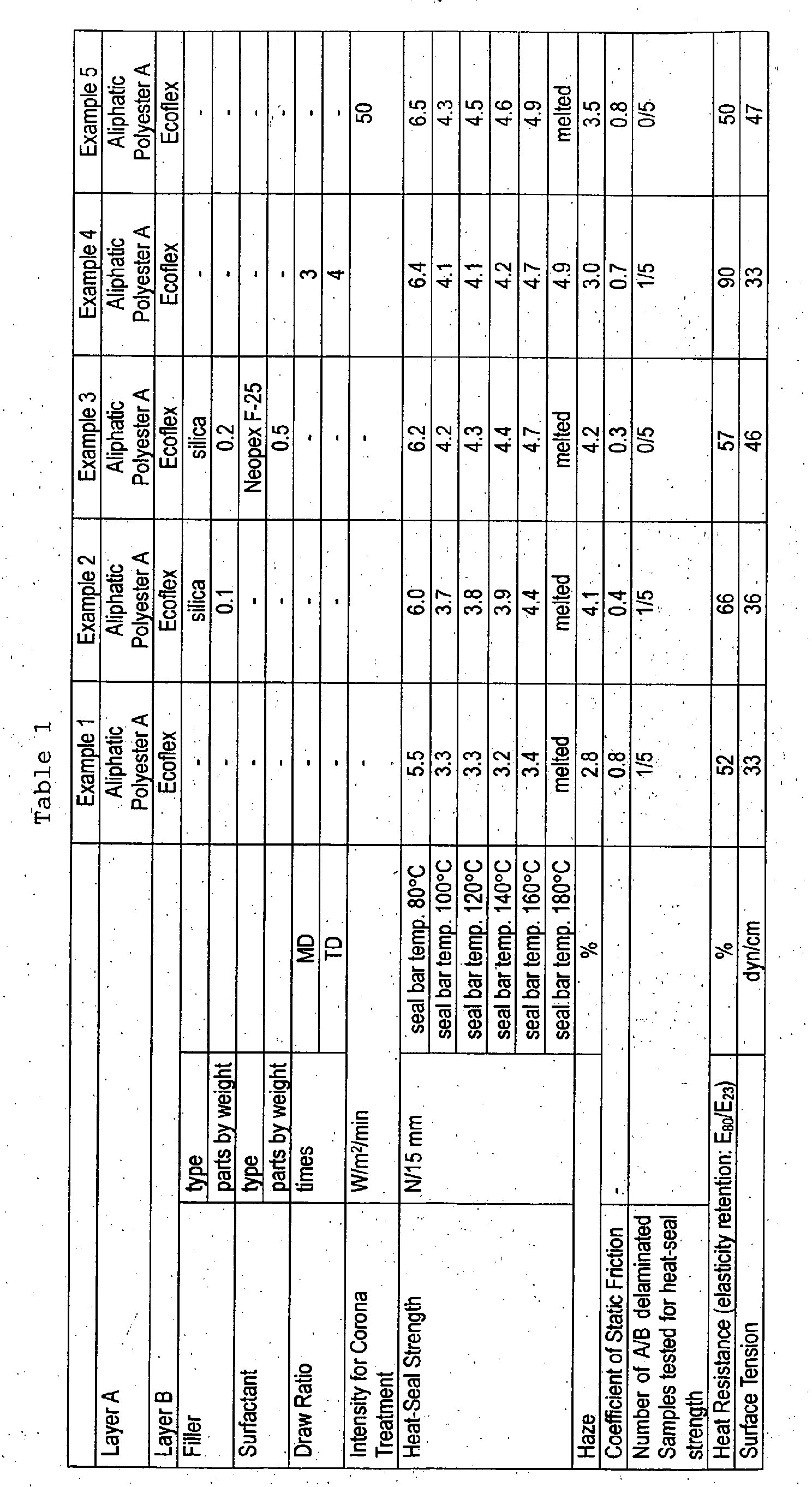
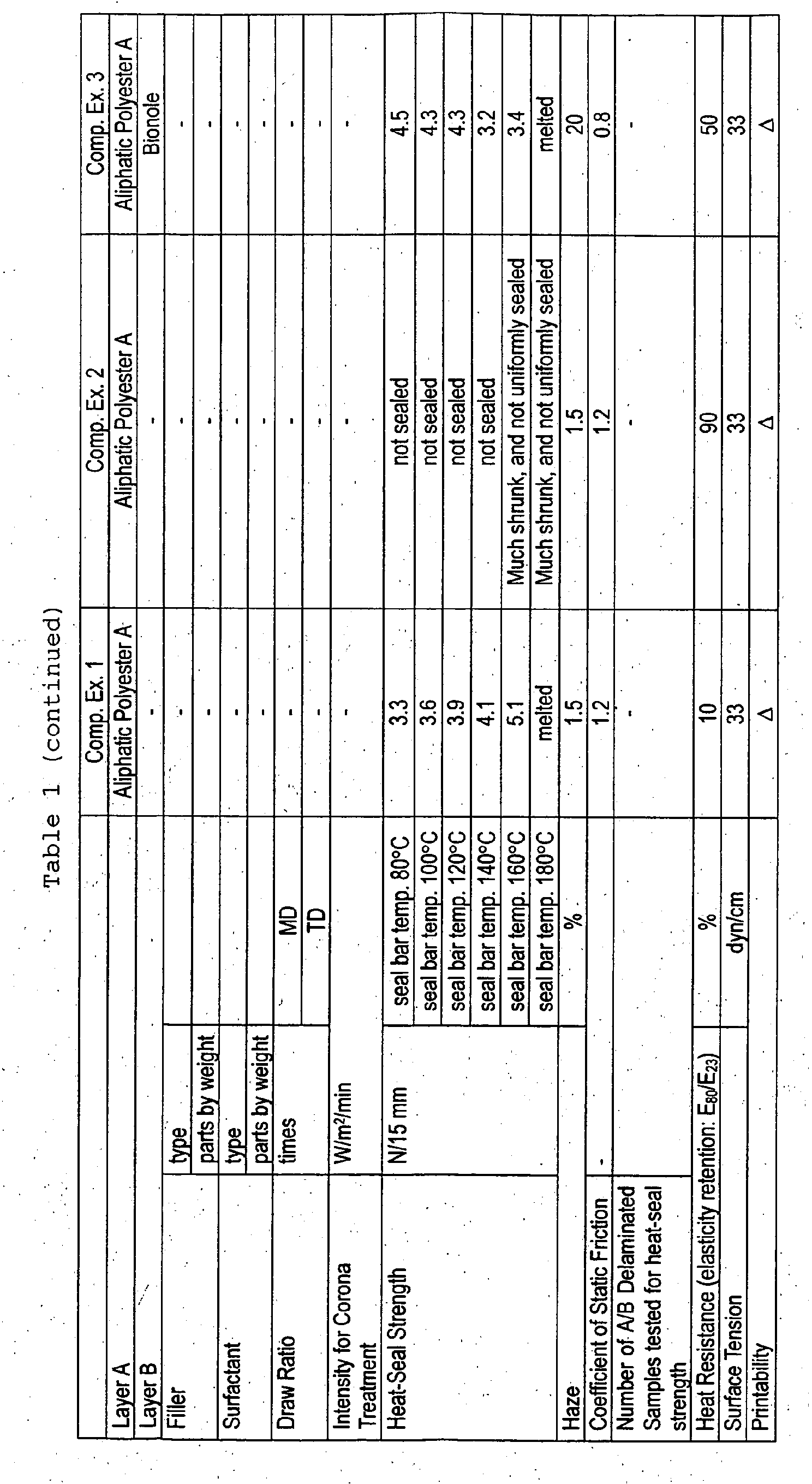
The 25 µm-thick film obtained in Example 4 was cut into
a size of 180 mm long x 500 mm wide, and folded in two in the
transverse direction. The two sides running from the folded
edge were heat-sealed at 100°C to give a bag having an opening
width of about 175 mm and a depth 250 mm.
As described in detail hereinabove with reference to its
preferred embodiments, the multi-layered polyester film of the
invention has good heat-sealability and transparency and is
suitable to secondary working into bags, etc.
Claims (3)
- A multi-layered polyester film comprising a layer (layer A) comprising a polyhydroxycarboxylic acid-type aliphatic polyester (polyester A) and a layer (layer B) comprising a diol-dicarboxylic acid polycondensation-type polyester (polyester B) having constitutive components of an aliphatic dicarboxylic acid, an aromatic dicarboxylic acid and an aliphatic diol.
- The multi-layered polyester film according to claim 1, wherein at least any one layer is at least monoaxially stretched by 1.5 to 7 times.
- A bag produced by partly heat-sealing the multi-layered film according to claim 1 or 2.
Applications Claiming Priority (2)
| Application Number | Priority Date | Filing Date | Title |
|---|---|---|---|
| JP2002083654A JP2003276143A (en) | 2002-03-25 | 2002-03-25 | Multilayered film of aliphatic polyester |
| JP2002083654 | 2002-03-25 |
Publications (1)
| Publication Number | Publication Date |
|---|---|
| EP1348541A1 true EP1348541A1 (en) | 2003-10-01 |
Family
ID=27800405
Family Applications (1)
| Application Number | Title | Priority Date | Filing Date |
|---|---|---|---|
| EP03006468A Withdrawn EP1348541A1 (en) | 2002-03-25 | 2003-03-21 | Multi-layered polyester film |
Country Status (6)
| Country | Link |
|---|---|
| US (1) | US20030180561A1 (en) |
| EP (1) | EP1348541A1 (en) |
| JP (1) | JP2003276143A (en) |
| KR (1) | KR20030077392A (en) |
| CN (1) | CN1446853A (en) |
| TW (1) | TW200304412A (en) |
Cited By (2)
| Publication number | Priority date | Publication date | Assignee | Title |
|---|---|---|---|---|
| EP1598399A1 (en) * | 2004-05-18 | 2005-11-23 | Tohcello Co., Ltd. | Aliphatic polyester composition films and multilayer films produced therefrom |
| EP4338955A1 (en) * | 2022-09-13 | 2024-03-20 | SK microworks Co., Ltd. | Polyester film and packaging material |
Families Citing this family (15)
| Publication number | Priority date | Publication date | Assignee | Title |
|---|---|---|---|---|
| US7326659B2 (en) * | 2004-02-16 | 2008-02-05 | Conwed Plastics Llc | Biodegradable netting |
| CN1869108B (en) * | 2005-05-26 | 2010-06-09 | 东丽株式会社 | Laminated polyester film, flame-retardant polyester film using the laminated polyester film, copper-clad laminate, and circuit board |
| KR100816417B1 (en) * | 2006-12-05 | 2008-03-25 | 에스케이씨 주식회사 | Multilayer Aliphatic Polyester Film |
| KR20090101933A (en) * | 2006-12-20 | 2009-09-29 | 비스테온 글로벌 테크놀로지스, 인크. | Double-cast slush molding compositions |
| JP5008405B2 (en) * | 2007-01-18 | 2012-08-22 | 剛行 山松 | Paper cup made of polylactic acid laminated paper |
| US8323796B2 (en) * | 2007-07-17 | 2012-12-04 | United Technologies Corporation | High temperature refractory coatings for ceramic substrates |
| JP2009067011A (en) * | 2007-09-18 | 2009-04-02 | Tohcello Co Ltd | Laminated film, polylactic acid biaxially stretched laminated film and its packaging bag |
| JP2009143111A (en) * | 2007-12-14 | 2009-07-02 | Tohcello Co Ltd | Polylactic acid laminated stretched film and decorative paper using the same |
| KR100995514B1 (en) * | 2007-12-21 | 2010-11-19 | (주)엘지하우시스 | Record fabric and its manufacturing method |
| US7842761B2 (en) * | 2008-04-03 | 2010-11-30 | Lapol, Llc | Bioderived plasticizer for biopolymers |
| CN102794965B (en) * | 2012-08-06 | 2015-01-07 | 宁波长阳科技有限公司 | Anti-fog polyester film and preparation method thereof |
| CN105793040A (en) * | 2013-12-10 | 2016-07-20 | 巴斯夫欧洲公司 | Polymer mixture for barrier film |
| KR101399425B1 (en) * | 2013-12-16 | 2014-05-27 | 에스케이씨 주식회사 | Multi-layer oriented film |
| ITUB20152688A1 (en) * | 2015-07-31 | 2017-01-31 | Novamont Spa | Polymeric composition for the production of biodegradable molded articles in industrial composting. |
| IT202000032663A1 (en) * | 2020-12-29 | 2022-06-29 | Novamont Spa | HIGHLY DISINTEGRATED MULTILAYER BIODEGRADABLE FILM |
Citations (5)
| Publication number | Priority date | Publication date | Assignee | Title |
|---|---|---|---|---|
| US5849401A (en) * | 1995-09-28 | 1998-12-15 | Cargill, Incorporated | Compostable multilayer structures, methods for manufacture, and articles prepared therefrom |
| US20010026874A1 (en) * | 1998-07-20 | 2001-10-04 | Upm- Kymmene Corporation | Foodstuff package coverstructure |
| EP1153743A1 (en) * | 1999-10-27 | 2001-11-14 | Mitsubishi Plastics Inc. | Biodegradable bag |
| JP2002234117A (en) * | 2001-02-08 | 2002-08-20 | Mitsubishi Plastics Ind Ltd | Heat shrinkable film |
| JP2002273845A (en) * | 2001-03-16 | 2002-09-25 | Unitika Ltd | Biodegradable laminated film |
Family Cites Families (4)
| Publication number | Priority date | Publication date | Assignee | Title |
|---|---|---|---|---|
| US5939467A (en) * | 1992-06-26 | 1999-08-17 | The Procter & Gamble Company | Biodegradable polymeric compositions and products thereof |
| US6096431A (en) * | 1994-07-25 | 2000-08-01 | Toppan Printing Co., Ltd. | Biodegradable cards |
| US5849374A (en) * | 1995-09-28 | 1998-12-15 | Cargill, Incorporated | Compostable multilayer structures, methods for manufacture, and articles prepared therefrom |
| JPH10151715A (en) * | 1996-11-22 | 1998-06-09 | Dainippon Ink & Chem Inc | Heat-fusible lactic acid-based polymer laminate |
-
2002
- 2002-03-25 JP JP2002083654A patent/JP2003276143A/en active Pending
-
2003
- 2003-03-17 TW TW92105766A patent/TW200304412A/en unknown
- 2003-03-18 US US10/390,042 patent/US20030180561A1/en not_active Abandoned
- 2003-03-21 CN CN03120957A patent/CN1446853A/en active Pending
- 2003-03-21 EP EP03006468A patent/EP1348541A1/en not_active Withdrawn
- 2003-03-22 KR KR10-2003-0018007A patent/KR20030077392A/en not_active Ceased
Patent Citations (5)
| Publication number | Priority date | Publication date | Assignee | Title |
|---|---|---|---|---|
| US5849401A (en) * | 1995-09-28 | 1998-12-15 | Cargill, Incorporated | Compostable multilayer structures, methods for manufacture, and articles prepared therefrom |
| US20010026874A1 (en) * | 1998-07-20 | 2001-10-04 | Upm- Kymmene Corporation | Foodstuff package coverstructure |
| EP1153743A1 (en) * | 1999-10-27 | 2001-11-14 | Mitsubishi Plastics Inc. | Biodegradable bag |
| JP2002234117A (en) * | 2001-02-08 | 2002-08-20 | Mitsubishi Plastics Ind Ltd | Heat shrinkable film |
| JP2002273845A (en) * | 2001-03-16 | 2002-09-25 | Unitika Ltd | Biodegradable laminated film |
Non-Patent Citations (2)
| Title |
|---|
| PATENT ABSTRACTS OF JAPAN vol. 2002, no. 12 12 December 2002 (2002-12-12) * |
| PATENT ABSTRACTS OF JAPAN vol. 2003, no. 01 14 January 2003 (2003-01-14) * |
Cited By (2)
| Publication number | Priority date | Publication date | Assignee | Title |
|---|---|---|---|---|
| EP1598399A1 (en) * | 2004-05-18 | 2005-11-23 | Tohcello Co., Ltd. | Aliphatic polyester composition films and multilayer films produced therefrom |
| EP4338955A1 (en) * | 2022-09-13 | 2024-03-20 | SK microworks Co., Ltd. | Polyester film and packaging material |
Also Published As
| Publication number | Publication date |
|---|---|
| CN1446853A (en) | 2003-10-08 |
| TW200304412A (en) | 2003-10-01 |
| JP2003276143A (en) | 2003-09-30 |
| US20030180561A1 (en) | 2003-09-25 |
| KR20030077392A (en) | 2003-10-01 |
Similar Documents
| Publication | Publication Date | Title |
|---|---|---|
| US6984443B2 (en) | Aliphatic polyester resin composition and films containing the same | |
| US20030180561A1 (en) | Multi-layered polyester film | |
| EP1449867B1 (en) | Window of polylactic acid based resin films | |
| JP3258302B2 (en) | Biodegradable biaxially stretched film | |
| CN100379800C (en) | Biodegradable resin film or sheet and manufacturing method thereof | |
| JP3236842B2 (en) | Biodegradable bag | |
| WO2004000939A1 (en) | Polylactic acid base polymer composition, molding thereof and film | |
| JP4210492B2 (en) | Biodegradable film and biodegradable bag comprising the film | |
| JP2004300197A (en) | Polyglycolic acid-based resin composition and its molded article | |
| JP2000273207A (en) | Polylactic acid-based film and its production | |
| JP5594135B2 (en) | Polylactic acid laminated sheet | |
| JP3084239B2 (en) | Biodegradable laminated film | |
| JP2005329557A (en) | Multilayered film | |
| JP5777133B2 (en) | Polylactic acid resin film | |
| JP2004358721A (en) | Lactic acid-based polymer multilayered film | |
| JP4452014B2 (en) | Polylactic acid resin film and polylactic acid resin fusing seal bag | |
| JP2002249603A (en) | Aliphatic polyester film | |
| JP3718636B2 (en) | Heat-shrinkable film | |
| WO2002034818A1 (en) | Biaxially oriented aliphatic polyester film and process for producing the same | |
| JP5396688B2 (en) | Polyester film | |
| JP4418161B2 (en) | Heat-sealable polylactic acid-based biaxially stretched film | |
| JP2005263932A (en) | Matte film with fine polymer | |
| US20070160818A1 (en) | Biaxially stretched polyester film | |
| JP4836194B2 (en) | Transparent biodegradable resin stretched film and resin product with improved gas barrier properties | |
| JP2003313404A (en) | Aliphatic polyester resin composition and multilayer film of aliphatic polyester |
Legal Events
| Date | Code | Title | Description |
|---|---|---|---|
| PUAI | Public reference made under article 153(3) epc to a published international application that has entered the european phase |
Free format text: ORIGINAL CODE: 0009012 |
|
| AK | Designated contracting states |
Kind code of ref document: A1 Designated state(s): AT BE BG CH CY CZ DE DK EE ES FI FR GB GR HU IE IT LI LU MC NL PT RO SE SI SK TR |
|
| AX | Request for extension of the european patent |
Extension state: AL LT LV MK |
|
| AKX | Designation fees paid | ||
| REG | Reference to a national code |
Ref country code: DE Ref legal event code: 8566 |
|
| STAA | Information on the status of an ep patent application or granted ep patent |
Free format text: STATUS: THE APPLICATION IS DEEMED TO BE WITHDRAWN |
|
| RAP1 | Party data changed (applicant data changed or rights of an application transferred) |
Owner name: MITSUI CHEMICALS, INC. |
|
| 18D | Application deemed to be withdrawn |
Effective date: 20040402 |