EP1348513A1 - Solder pastes - Google Patents
Solder pastes Download PDFInfo
- Publication number
- EP1348513A1 EP1348513A1 EP01998186A EP01998186A EP1348513A1 EP 1348513 A1 EP1348513 A1 EP 1348513A1 EP 01998186 A EP01998186 A EP 01998186A EP 01998186 A EP01998186 A EP 01998186A EP 1348513 A1 EP1348513 A1 EP 1348513A1
- Authority
- EP
- European Patent Office
- Prior art keywords
- solder
- solder paste
- lead
- flux
- powder
- Prior art date
- Legal status (The legal status is an assumption and is not a legal conclusion. Google has not performed a legal analysis and makes no representation as to the accuracy of the status listed.)
- Granted
Links
Classifications
-
- B—PERFORMING OPERATIONS; TRANSPORTING
- B23—MACHINE TOOLS; METAL-WORKING NOT OTHERWISE PROVIDED FOR
- B23K—SOLDERING OR UNSOLDERING; WELDING; CLADDING OR PLATING BY SOLDERING OR WELDING; CUTTING BY APPLYING HEAT LOCALLY, e.g. FLAME CUTTING; WORKING BY LASER BEAM
- B23K35/00—Rods, electrodes, materials, or media, for use in soldering, welding, or cutting
- B23K35/22—Rods, electrodes, materials, or media, for use in soldering, welding, or cutting characterised by the composition or nature of the material
- B23K35/36—Selection of non-metallic compositions, e.g. coatings or fluxes; Selection of soldering or welding materials, conjoint with selection of non-metallic compositions, both selections being of interest
- B23K35/362—Selection of compositions of fluxes
-
- B—PERFORMING OPERATIONS; TRANSPORTING
- B23—MACHINE TOOLS; METAL-WORKING NOT OTHERWISE PROVIDED FOR
- B23K—SOLDERING OR UNSOLDERING; WELDING; CLADDING OR PLATING BY SOLDERING OR WELDING; CUTTING BY APPLYING HEAT LOCALLY, e.g. FLAME CUTTING; WORKING BY LASER BEAM
- B23K35/00—Rods, electrodes, materials, or media, for use in soldering, welding, or cutting
- B23K35/22—Rods, electrodes, materials, or media, for use in soldering, welding, or cutting characterised by the composition or nature of the material
- B23K35/36—Selection of non-metallic compositions, e.g. coatings or fluxes; Selection of soldering or welding materials, conjoint with selection of non-metallic compositions, both selections being of interest
- B23K35/3612—Selection of non-metallic compositions, e.g. coatings or fluxes; Selection of soldering or welding materials, conjoint with selection of non-metallic compositions, both selections being of interest with organic compounds as principal constituents
- B23K35/3613—Polymers, e.g. resins
-
- B—PERFORMING OPERATIONS; TRANSPORTING
- B23—MACHINE TOOLS; METAL-WORKING NOT OTHERWISE PROVIDED FOR
- B23K—SOLDERING OR UNSOLDERING; WELDING; CLADDING OR PLATING BY SOLDERING OR WELDING; CUTTING BY APPLYING HEAT LOCALLY, e.g. FLAME CUTTING; WORKING BY LASER BEAM
- B23K35/00—Rods, electrodes, materials, or media, for use in soldering, welding, or cutting
- B23K35/02—Rods, electrodes, materials, or media, for use in soldering, welding, or cutting characterised by mechanical features, e.g. shape
- B23K35/0222—Rods, electrodes, materials, or media, for use in soldering, welding, or cutting characterised by mechanical features, e.g. shape for use in soldering or brazing
- B23K35/0244—Powders, particles or spheres; Preforms made therefrom
- B23K35/025—Pastes, creams or slurries
-
- B—PERFORMING OPERATIONS; TRANSPORTING
- B23—MACHINE TOOLS; METAL-WORKING NOT OTHERWISE PROVIDED FOR
- B23K—SOLDERING OR UNSOLDERING; WELDING; CLADDING OR PLATING BY SOLDERING OR WELDING; CUTTING BY APPLYING HEAT LOCALLY, e.g. FLAME CUTTING; WORKING BY LASER BEAM
- B23K35/00—Rods, electrodes, materials, or media, for use in soldering, welding, or cutting
- B23K35/22—Rods, electrodes, materials, or media, for use in soldering, welding, or cutting characterised by the composition or nature of the material
- B23K35/24—Selection of soldering or welding materials proper
- B23K35/26—Selection of soldering or welding materials proper with the principal constituent melting at less than 400°C
- B23K35/262—Sn as the principal constituent
-
- B—PERFORMING OPERATIONS; TRANSPORTING
- B23—MACHINE TOOLS; METAL-WORKING NOT OTHERWISE PROVIDED FOR
- B23K—SOLDERING OR UNSOLDERING; WELDING; CLADDING OR PLATING BY SOLDERING OR WELDING; CUTTING BY APPLYING HEAT LOCALLY, e.g. FLAME CUTTING; WORKING BY LASER BEAM
- B23K35/00—Rods, electrodes, materials, or media, for use in soldering, welding, or cutting
- B23K35/22—Rods, electrodes, materials, or media, for use in soldering, welding, or cutting characterised by the composition or nature of the material
- B23K35/36—Selection of non-metallic compositions, e.g. coatings or fluxes; Selection of soldering or welding materials, conjoint with selection of non-metallic compositions, both selections being of interest
- B23K35/3601—Selection of non-metallic compositions, e.g. coatings or fluxes; Selection of soldering or welding materials, conjoint with selection of non-metallic compositions, both selections being of interest with inorganic compounds as principal constituents
- B23K35/3603—Halide salts
-
- B—PERFORMING OPERATIONS; TRANSPORTING
- B23—MACHINE TOOLS; METAL-WORKING NOT OTHERWISE PROVIDED FOR
- B23K—SOLDERING OR UNSOLDERING; WELDING; CLADDING OR PLATING BY SOLDERING OR WELDING; CUTTING BY APPLYING HEAT LOCALLY, e.g. FLAME CUTTING; WORKING BY LASER BEAM
- B23K35/00—Rods, electrodes, materials, or media, for use in soldering, welding, or cutting
- B23K35/22—Rods, electrodes, materials, or media, for use in soldering, welding, or cutting characterised by the composition or nature of the material
- B23K35/36—Selection of non-metallic compositions, e.g. coatings or fluxes; Selection of soldering or welding materials, conjoint with selection of non-metallic compositions, both selections being of interest
- B23K35/3612—Selection of non-metallic compositions, e.g. coatings or fluxes; Selection of soldering or welding materials, conjoint with selection of non-metallic compositions, both selections being of interest with organic compounds as principal constituents
- B23K35/3615—N-compounds
-
- B—PERFORMING OPERATIONS; TRANSPORTING
- B23—MACHINE TOOLS; METAL-WORKING NOT OTHERWISE PROVIDED FOR
- B23K—SOLDERING OR UNSOLDERING; WELDING; CLADDING OR PLATING BY SOLDERING OR WELDING; CUTTING BY APPLYING HEAT LOCALLY, e.g. FLAME CUTTING; WORKING BY LASER BEAM
- B23K35/00—Rods, electrodes, materials, or media, for use in soldering, welding, or cutting
- B23K35/22—Rods, electrodes, materials, or media, for use in soldering, welding, or cutting characterised by the composition or nature of the material
- B23K35/36—Selection of non-metallic compositions, e.g. coatings or fluxes; Selection of soldering or welding materials, conjoint with selection of non-metallic compositions, both selections being of interest
- B23K35/3612—Selection of non-metallic compositions, e.g. coatings or fluxes; Selection of soldering or welding materials, conjoint with selection of non-metallic compositions, both selections being of interest with organic compounds as principal constituents
- B23K35/3618—Carboxylic acids or salts
Definitions
- This invention relates to a solder paste for use in soldering of electronic devices and in particular to a solder paste of an Sn-based, lead-free solder.
- Sn-Pb alloys have continued to be used as solder since ancient times. They have advantages of low melting points and good solderability. For example, a eutectic Sn63%-Pb37% solder, the most popular solder, has a melting point of 183 °C.
- soldering is typically carried out by the reflow soldering method using a solder paste (also called a cream solder) which comprises a solder powder uniformly mixed with a soldering flux, particularly a rosin-based flux.
- solder paste also called a cream solder
- the reflow soldering method comprises feeding a solder paste onto a printed board by printing or dispensing (discharging through a dispenser), temporarily fixing chip-type electronic parts on the solder paste by use of the adhesion of the paste, and heating the printed board with the electronic parts thereon in a reflow furnace to allow the solder to melt, whereby the parts are fixed and electrically connected to the printed board.
- Printed boards withdrawn from waste electronic devices by disassembly are frequently discarded by pulverizing in a shredder and burying in the ground.
- the lead (Pb) in the Sn-Pb solder may be dissolved out and contaminate underground water. If a human or animal continues to drink a lead-containing water for long years, there is the concern that lead is accumulated in its body to cause lead poisoning. Therefore, it has been recommended in the art to use a lead-free solder, which is completely free from lead, in soldering of electronic devices.
- Lead-free solders should consists of element which are harmless to humans. For example, Cd should not be used, even though it has an effect of lowering a melting temperature.
- Lead-free solders which are promising at present are Sn-based alloys which comprise a major proportion of Sn and one or more alloying elements such as Ag, Cu, Bi, In, Sb, or Zn.
- Ag-containing Sn-based solders such as an Sn-Ag alloy and an Sn-Ag-Cu alloy have the advantage of being easy to handle since they have relatively good wettability as a lead-free solder.
- Sn-Ag based, lead-free solders have a melting point on the order of 220°C, which is approximately 30 - 40°C higher than that of a eutectic Sn-Pb alloy, so the working temperature (heating temperature in soldering) also becomes higher correspondingly. Therefore, they may not be suitable for use in soldering of some thermally sensitive electronic parts.
- Zn-containing Sn-based solders are advantageous from the standpoints of safety and economy, since Zn is not only an element which is harmless and indispensable for the human body but is found underground in large amounts so that its cost is low compared to Ag, Cu, Bi, In, and the like.
- a typical alloy composition of an Sn-Zn lead-free solder is Sn-9Zn. This solder has a melting point of 199°C, which is approximately 20°C lower than that of an Sn-Ag lead-free solder, so it also has the advantage that it can be used for soldering thermally sensitive electronic parts to which an Sn-Ag based, lead-free solder cannot be applied.
- a reaction between the solder powder with a constituent of the flux, particularly with an activator which is normally present in the rosin-based flux, may occur readily due to the high content of the active Sn metal in the solder powder, compared to a conventional solder paste prepared from an Sn-Pb solder powder and the same rosin-based flux.
- Such a reaction may result in a change in viscosity of the solder paste and cause the problem that the solder paste cannot satisfactorily be fed by printing or dispensing.
- an approach can be employed, particularly in a solder paste of an Sn-Ag based solder, in which the viscosity change is controlled by decreasing the amount of an activator, e.g., an amine hydrohalide and organic acid, added to the rosin-based flux, thereby suppressing a reaction of the flux with the solder powder.
- an activator e.g., an amine hydrohalide and organic acid
- this approach weakens the activity of the flux, it may cause the formation of solder balls and adversely affect the wettability of the solder. Accordingly, there is a need to control the viscosity change of an Sn-based, lead-free solder paste without decreasing the amount of an activator in the flux.
- a solder paste comprising a powder of an Sn-Zn based, lead-free solder (hereunder referred to as an Sn-Zn based solder paste) has another problem.
- Zn is a metal which is susceptible to oxidation due to its high ionization tendency. Therefore, an oxide layer is formed on the surface of the solder powder which contacts air, and it makes the wettability of the solder powder poor.
- a rosin-based flux containing an increased amount of an activator In order to increase the wettability of the solder in the Sn-Zn based solder paste, it is conceivable to use a rosin-based flux containing an increased amount of an activator.
- the activator tends to react with the solder powder prior to soldering, and an increase in the amount of an activator may cause the viscosity of the solder paste to increase rapidly and interfere with the feeding of the solder paste by printing or dispensing.
- an approach in which the surface of the Sn-Zn based solder powder is coated with a suitable material prior to mixing with the flux to prevent the solder powder from reacting with the flux and causing surface oxidation may be employed.
- a suitable material such as Au or Pd, an inorganic oxide formed from a hydrolyzable organosilicon compound or the like, or an organic substance such as an imidazole or a triazole can be used.
- coating adds to the manufacturing costs of a solder paste.
- some types and methods of coating may promote oxidation of solder powder during the coating operation, and the method is not necessarily effective at improving solder wettability or solderability.
- Another object of the present invention is to provide such an Sn-based, lead-free solder paste exhibiting a minimized viscosity change and having good wettability.
- a further object of the present invention is to provide an Sn-based, lead-free solder paste, and in particular an Sn-Zn based solder paste, which has good solder wettability and solderability in which the surface oxidation of the solder powder which is encountered significantly with a conventional Sn-Zn based solder paste can be prevented without coating of the solder powder.
- the present invention provides a solder paste comprising a powder of an Sn-based, lead-free solder mixed with a rosin-based flux, wherein the rosin-based flux contains 0.5 - 10.0 wt% of at least one isocyanuric compound selected from isocyanuric acid and derivatives thereof having no hydroxyl group.
- the present invention provides a solder paste comprising a powder of an Sn-based, lead-free solder mixed with a rosin-based flux, wherein the rosin-based flux contains 0.01-10.0 wt% of at least one salicylamide compound selected from salicylamide and derivatives thereof.
- a rosin-based flux for use in a solder paste is normally prepared by dissolving a rosin in a solvent along with one or more additives such as an activator and a thixotropic agent.
- an activator such as an activator and a thixotropic agent.
- the type and amount of the activator have a great effect on the solder wettability of the solder paste.
- an Sn-based, lead-free solder has poor solder wettability compared to an Sn-Pb solder. For example, compared to the spreading factor of an Sn-Pb solder, an Sn-Ag lead-free solder spreads only about 80% as much as an Sn-Pb solder. An Sn-Zn lead-free solder has an even worse spreading factor, and it only spreads about 70% as much as an Sn-Pb solder.
- an Sn-based, lead-free solder paste to incorporate a large amount of an activator to improve the wettability.
- this causes the viscosity of the solder paste to increase rapidly due to a reaction between the activator and the solder powder.
- the solder paste soon becomes difficult to be fed by printing or through a dispenser, and its shelf or service life becomes extremely short. Therefore, unless the solder powder is protected by surface coating, the amount of the activator should be decreased, resulting in poor wettability.
- a conventional Sn-Zn based, lead-free solder paste has very poor wettability.
- soldering is performed in a heating furnace called a reflow furnace.
- Heating in a reflow furnace is normally two-step heating in which preheating is first carried out at a temperature of 150 - 170°C for 30 - 100 seconds followed by main heating at a temperature of 20 - 50°C above the melting temperature of the solder. Preheating is carried out in order to vaporize the solvent in the solder paste and to simultaneously alleviate heat shock to electronic parts to be soldered.
- Materials for use in a solder paste of a eutectic Sn-Pb solder are designed so as to exhibit optimal performance in this two-step heating.
- an activator begins to react partially from around 150°C, which is the preheating temperature, and completely reacts at around 210 - 230°C, which is the main heating temperature for an Sn-Pb solder.
- a solder paste of an Sn-Pb solder even if the activator used becomes active at a temperature as low as 150°C, oxidation of the solder powder does not occur significantly during the preheating stage due to the low reactivity of Pb.
- the zinc exposed on the surface of the Sn-Zn based solder powder can readily combine with the oxygen present in the reflow furnace to form a relatively thick surface oxide layer on the solder powder, even during the preheating stage. If the solder powder having such an oxide layer formed by oxidation during preheating is subjected to main heating, the solder powder melts with the oxide layer covering its surface, so it remains without spreading as solder balls. In addition, the flux is mostly consumed by reacting with the surface oxide layer on the solder powder and loses its activity, resulting in poor wettability and causing the formation of voids in the interior of the resulting soldered joints. The formation of these solder balls and voids becomes a cause of soldering defects.
- an Sn-Zn based, lead-free solder is highly susceptible to surface oxidation.
- the solder is in the form of a powder having an extremely large surface area, so oxidation of the Sn-Zn based solder becomes severe during the preheating stage, resulting in a markedly adverse effect on solderability.
- Isocyanuric compounds generally have high heat resistance, and they do not undergo decomposition during heating at 150 - 170°C for 30 - 100 seconds, which are the standard preheating conditions in a reflow furnace. Therefore, if a flux which contains an isocyanuric compound is used to prepare an Sn-Zn based solder paste, the isocyanuric compound will cover the surface of the Sn-Zn-based solder powder during preheating in a reflow furnace, and surface oxidation thereof can be effectively prevented.
- the rosin-based flux used to prepare a solder paste contains an activator in order to improve wettability.
- the activator usually comprises a hydrohalide salt of an organic amine.
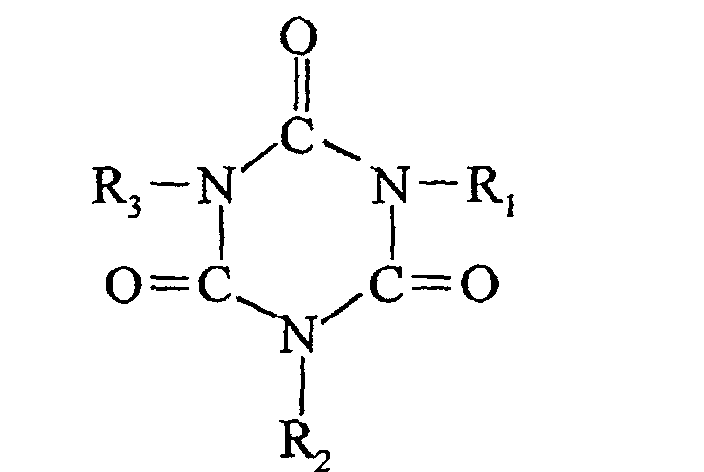
- the amine hydrohalide can react with the Sn-Zn based solder powder prior to soldering, particularly at the time of printing when the solder paste is exposed to air. Due to this reaction, the viscosity of the solder paste changes and usually increases, thereby making it difficult to perform printing smoothly. This tendency is particularly strong with an Sn-Zn lead-free solder paste, so the use of a polar substance should be avoided. Since isocyanuric acid derivatives having a hydroxyl group exhibit polarity, they are not used in a flux for a solder paste according to the present invention.
- an isocyanuric acid derivative having a hydroxyl group is used in a flux for an Sn-Zn based, lead-free solder paste, the zinc on the powder surface may be oxidized to cause the surface to turn white during washing with water, which is performed subsequent to soldering. This is another reason why an isocyanuric acid derivative having a hydroxyl group is not suitable for an Sn-Zn based, lead-free solder paste.
- An alkyl group is preferably a lower alkyl group having 1 to 6 and more preferably 1 to 4 carbon atoms.
- a compound in which R 1 - R 3 are all hydrogen is isocyanuric acid.
- a compound in which they are all alkyl groups is an isocyanuric acid trialkyl ester.
- isocyanuric compounds include isocyanuric acid, trimethyl isocyanurate, triethyl isocyanurate, tripropyl isocyanurate, butyl isocyanurate, tris(2,3-dibromopropyl) isocyanurate, triallyl isocyanurate, and the like.
- isocyanuric compounds include isocyanuric acid, trimethyl isocyanurate, triethyl isocyanurate, tripropyl isocyanurate, butyl isocyanurate, tris(2,3-dibromopropyl) isocyanurate, triallyl isocyanurate, and the like.
- One or more isocyanuric compounds may be used.
- Isocyanuric compounds which are preferably used in the present invention are isocyanuric acid and an isocyanuric acid tris(haloalkyl) ester (a compound of the above formula in which R 1 -R 3 are haloalkyl groups) such as tris(2,3-dibromopropyl) isocyanurate. Both of these may be used together. In particular, it is preferable to use isocyanuric acid by itself or as a mixture with another isocyanuric compound.
- the amount of the isocyanuric compound which is present in the rosin-based flux is in the range of 0.5 - 10.0 wt%. If this amount is smaller than 0.5 wt%, the effect of preventing surface oxidation of Sn-Zn-based solder powder during preheating is not substantially achieved, while if more than 10.0 wt% is added, solderability is impeded.
- the amount of an isocyanuric compound which is added to the flux is preferably 2 - 6 wt%.
- the salicylamide compound is preferentially adsorbed by the surface of the solder powder so that it can prevent the solder powder from reacting with a constituent of the flux, particularly an activator such as an amine hydrohalide and organic acid.
- a change mainly an increase in the viscosity of the solder paste caused by such a reaction is prevented and the solder paste can be smoothly fed by printing or dispensing even after storage for a prolonged period.
- the salicylamide compounds do not interfere with the reflow properties of the solder paste.
- the salicylamide compound useful in the present invention includes salicylamide, decamethylenedicarboxylic acid disalicyloyl hydrazide, 3-(N-salicyloyl)-amino-1,2,4-triazole, and the like. If the amount of a salicylamide compound present in the rosin-based flux is less than 0.01 wt%, the above-described effect is not appreciably attained. If it is more than 10.0 wt%, melting of the solder powder may be inhibited, resulting in the formation of solder balls during soldering.
- the amount of the salicylamide compound in the flux is preferably 0.1 - 3.0 wt%.
- a salicylamide compound seems to exert its effect of suppressing the viscosity change of an Sn-based, lead-free solder paste through adsorption by the surface of the Sn-based, lead-free solder powder in the solder paste.
- the salicylamide compound instead of adding the salicylamide compound to the flux, it is also possible for the salicylamide compound to be previously adsorbed by the surface of the solder powder, using surface treatment of the solder powder by, for example, spraying with or immersion in a solution of the salicylamide compound dissolved in an appropriate volatile solvent, followed by evaporation of the solvent.
- the resulting Sn-based solder powder having the salicylamide compound deposited thereon by adsorption may be mixed with a rosin-based flux which does not contain a salicylamide compound to prepare a solder paste.
- the present invention also provides a process for preparing a solder paste comprising subjecting an Sn-based, lead-free solder powder to surface treatment with a solution of a salicylamide compound in an organic solvent, and mixing the resulting solder powder having the salicylamide compound deposited thereon with a rosin-based flux.
- the surface treatment is preferably performed such that the amount of the salicylamide compound deposited on the solder powder is in the range of 0.01 - 10.0 wt% based on the weight of the flux to be mixed with the surface-treated solder powder in the next step.
- a flux used in a solder paste according to the present invention is a rosin-based flux having a rosin as a primary constituent.
- a rosin-based flux comprises a rosin, an activator, a thixotropic agent, and a solvent.
- the type and amount of the other constituents of the flux may be the same as for a conventional rosin-based flux, and there are no particular restrictions.
- the flux contains both an isocyanuric compound and a salicylamide compound each in an amount in the above-described range, thereby further improving the solderability of the paste.
- the rosin may be a natural, unmodified rosin such as a gum rosin, a tall oil rosin, or a wood rosin, or it may be a modified rosin such as a polymerized rosin, a hydrogenated rosin, a rosin ester, or rosin-modified resin. Of course, two or more of these may be used.
- a hydrohalide and particularly a hydrobromide of an organic amine may be primary (such as an ethyl amine), secondary (such as a diethyl amine), or tertiary (such as a triethyl amine).
- a heterocyclic amine such as pyridine, an aromatic amine such as aniline, an alicyclic amine such as cyclohexylamine, and a compound having two or more amino groups such as diphenylguanidine may also be used.
- An organic acid activator such as stearic acid and sebacic acid or another activator may also be used, preferably in addition to an amine hydrohalide activator.
- Hardened castor oil, an amide, or the like is generally used as a thixotropic agent.
- Examples of a solvent are Carbitols such as butyl Carbitol and hexyl Carbitol, and alcohols such as terpineol and halogenated alcohols.
- the amounts of the above-described constituents in the flux are, for example, 35 - 60% for the rosin, 0.5 - 10% for the activator, 1 - 10% for the thixotropic agent in weight percent.
- the amount of an amine hydrohalide activator is preferably 0.5-5%.
- the flux also contains an isocyanuric compound and/or a salicylamide compound according to the present invention.
- the flux may contain one or more additives other than those mentioned above.
- a powder of an Sn-based, lead-free solder used in a solder paste according to the present invention may be a powder of an alloy comprised predominantly of Sn and including one or more of the elements Ag, Cu, In, Sb, and Zn.
- the Sn-based, lead-free solder is an Sn-Ag alloy (e.g., Sn-3.5Ag), an Sn-Ag-Cu alloy (e.g., Sn-3Ag-0.5Cu), an Sn-Zn alloy (e.g., Sn-9Zn), or an Sn-Zn-Bi alloy (e.g., Sn-8Zn-3Bi), in which the numeral preceding an element indicates the content of the element in weight percent.
- Sn-based, lead-free solders may further include one or more of Bi, In, Ag, Ni, Co, Mo, Fe, P, Ge, Ga, or the like with the object of further lowering the melting point, increasing the mechanical strength, or suppressing oxidation of the solder.
- the Sn-based, lead-free solder is preferably an Sn-Zn based solder such as an Sn-Zn alloy or Sn-Zn-Bi alloy.
- the isocyanuric compound present in the flux is highly effective in preventing a solder powder from oxidizing at the preheating stage in a reflow furnace.
- a solder paste comprising a powder of an Sn-Zn based, lead-free solder which is highly susceptible to oxidation, a particularly significant effect can be obtained.
- the second embodiment of the present invention in which the flux contains a salicylamide compound can satisfactorily be applied to a solder paste comprising a powder of any Sn-based, lead-free solder including an Sn-Ag based alloy and an Sn-Zn based alloy, although its effect with an Sn-Zn solder is generally greater than with an Sn-Ag solder.
- the shape of the solder powder is not critical, but normally it is a spherical powder which can be prepared by the centrifugal atomizing method, the gas atomizing method, or the like.
- the particle size of the solder powder may be the same as for a conventional solder paste, and it is normally on the order of 200 - 400 mesh, but it is also possible to use a powder which is 500 mesh or finer.
- the mixing ratio of the solder powder and the flux may be selected so as to obtain a solder paste having a viscosity suitable for printing or dispensing.
- the flux is 5 - 20 wt%, and the remainder is a solder powder.
- solder paste 88.5% of a spherical powder of an Sn-Zn based, lead-free solder alloy having a composition of 8% Zn, 3% Bi and a remainder of Sn was thoroughly mixed with 11.5% of a rosin-based flux having the composition shown in Table 1 to prepare a solder paste.
- solder paste prepared above Using the solder paste prepared above, a reflow test was carried out in a standard reflow furnace of a two-stage heating type in which preheating and main heating were performed under usual conditions, and solderability (wettability) and the formation of solder balls were evaluated. The results are also shown in Table 1.
- solder paste prepared above was allowed to stand at room temperature to determine the shelf life, which is the period that the solder paste retains a pasty state capable of printing or dispensing, as an index to evaluate the speed of viscosity change of the solder paste.
- shelf life is the period that the solder paste retains a pasty state capable of printing or dispensing, as an index to evaluate the speed of viscosity change of the solder paste.
- the results are also shown in Table 2 with the type of solder powder.
- the present invention provides an Sn-based, lead-free solder paste which has improved solderability and which can be satisfactorily used in a conventional reflow soldering method.
- a solder paste comprising a powder of an Sn-Zn based, lead-free solder which is highly susceptible to oxidation, it is possible to provide a solder paste in which formation of solder balls is suppressed and which has excellent wettability using a flux containing a proper amount of an activator as is conventional.
- an Sn-based, lead-free solder paste comprising a powder of an Sn-based solder including an Sn-Ag based and Sn-Zn based solder, thereby making it possible to use such lead-free solder paste for a significantly prolonged period while making printing or dispensing operations easy.
Landscapes
- Engineering & Computer Science (AREA)
- Mechanical Engineering (AREA)
- Chemical & Material Sciences (AREA)
- Inorganic Chemistry (AREA)
- Electric Connection Of Electric Components To Printed Circuits (AREA)
- Conductive Materials (AREA)
- Die Bonding (AREA)
Abstract
Description
| Flux Composition (wt%) | Example 1 | Example 2 | Example 3 | Comparative Example 1 |
| Polymerized rosin | 44 | 41 | 41 | 46 |
| Diphenylguanidine HBr | 2 | 2 | 2 | 2 |
| Hardened castor oil | 5 | 5 | 5 | 5 |
| Isocyanuric acid | 2 - | 1 | - | |
| Tris(2,3-dibromopropyl) isocyanurate | - | 5 | 4 | - |
| 2,3-Dibromo-1-propanol | 2 | 2 | 2 | 2 |
| Alpha-terpineol | 45 | 45 | 45 | 45 |
| Test results | Example 1 | Example 2 | Example 3 | Comparative Example 1 |
| Solder balls | none | a few | none | many |
| Solderability | excellent | good | excellent | poor |
| Flux Composition (wt%) | Example 4 | Example 5 | Comparative Example 2 | Comparative Example 3 |
| Polymerized rosin | 49 | 47 | 50 | 49 |
| Diphenylguanidine HBr | 1 | 1 | 1 | 1 |
| Stearic acid 5555 | ||||
| Hardened castor oil | 5 | 5 | 5 | 5 |
| Decamethylenedicarboxylic acid disalicyloyl hydrazide | 1 | - | - | - |
| 3-(N-salicyloyl-amino - 1,2,4-triazole | - | 2 | - | - |
| 2,3-Dibromo-1-propanol | - | 2 | - | 2 |
| Alpha-terpineol | 38 | 38 | 38 | 38 |
| Solder powder/Test Result | Example 4 | Example 5 | Comparative Example 2 | Comparative Example 3 |
| Solder Powder | Sn-8Zn-3Bi | Sn-3Ag-0.5Cu | Sn-8Zn-3Bi | Sn-3Ag-0.5Cu |
| Shelf Life | > 12 weeks | >12 weeks | 1 week | 6 weeks |
Claims (10)
- A solder paste comprising a powder of an Sn-based, lead-free solder mixed with a rosin-based flux, characterized in that the rosin-based flux contains 0.5 - 10.0 wt% of at least one isocyanuric compound selected from isocyanuric acid and derivatives thereof having no hydroxyl group.
- A solder paste according to claim 1 wherein the lead-free solder is a Zn-containing Sn-based solder.
- A solder paste according to claim 1 wherein the isocyanuric compound is selected from isocyanuric acid and an isocyanuric acid tris(haloalkyl) ester.
- A solder paste comprising a powder of an Sn-based, lead-free solder mixed with a rosin-based flux, characterized in that the rosin-based flux contains 0.01 - 10.0 wt% of at least one salicylamide compound selected from salicylamide and derivatives thereof.
- A solder paste according to claim 4 wherein the lead-free solder is selected from an Ag-containing Sn-based solder and a Zn-containing Sn-based solder.
- A solder paste according to claim 4 wherein the salicylamide compound is selected from salicylamide, decamethylenedicarboxylic acid disalicyloyl hydrazide, and 3-(N-salicyloyl)-amino-1,2,4-triazole.
- A solder paste according to claim 2 or 5 wherein the Zn-containing Sn-based solder further contains Bi.
- A solder paste according to claim 5 wherein the Ag-containing Sn-based solder further contains Cu.
- A solder paste according to claim 1 or 4 wherein the rosin-based flux contains an activator.
- A solder paste according to claim 9 wherein the activator comprises at least one organic amine hydrohalide.
Applications Claiming Priority (3)
| Application Number | Priority Date | Filing Date | Title |
|---|---|---|---|
| JP2000362985 | 2000-11-29 | ||
| JP2000362985 | 2000-11-29 | ||
| PCT/JP2001/010431 WO2002043916A1 (en) | 2000-11-29 | 2001-11-29 | Solder pastes |
Publications (3)
| Publication Number | Publication Date |
|---|---|
| EP1348513A1 true EP1348513A1 (en) | 2003-10-01 |
| EP1348513A4 EP1348513A4 (en) | 2007-04-04 |
| EP1348513B1 EP1348513B1 (en) | 2008-07-09 |
Family
ID=18834169
Family Applications (1)
| Application Number | Title | Priority Date | Filing Date |
|---|---|---|---|
| EP01998186A Expired - Lifetime EP1348513B1 (en) | 2000-11-29 | 2001-11-29 | Solder pastes |
Country Status (9)
| Country | Link |
|---|---|
| US (1) | US6926849B2 (en) |
| EP (1) | EP1348513B1 (en) |
| JP (1) | JP4103591B2 (en) |
| KR (1) | KR100613640B1 (en) |
| CN (1) | CN1247360C (en) |
| AT (1) | ATE400395T1 (en) |
| DE (1) | DE60134781D1 (en) |
| MY (1) | MY138347A (en) |
| WO (1) | WO2002043916A1 (en) |
Cited By (5)
| Publication number | Priority date | Publication date | Assignee | Title |
|---|---|---|---|---|
| US6926849B2 (en) * | 2000-11-29 | 2005-08-09 | Senju Metal Industry Co., Ltd. | Solder paste |
| EP2100690A4 (en) * | 2006-12-12 | 2012-07-18 | Senju Metal Industry Co | FLOW FOR LEAD FREE BRAZING AND WAVE BRAZING METHOD |
| EP2412775A4 (en) * | 2009-03-23 | 2016-06-29 | Duksan Hi Metal Co Ltd | Solder adhesive and a production method for the same, and an electronic device comprising the same |
| US10158032B2 (en) | 2012-10-12 | 2018-12-18 | Heraeus Deutschland GmbH & Co. KG | Solar cells produced from high Ohmic wafers and halogen containing paste |
| US11833620B2 (en) | 2018-01-16 | 2023-12-05 | Senju Metal Industry Co., Ltd. | Flux and solder paste |
Families Citing this family (29)
| Publication number | Priority date | Publication date | Assignee | Title |
|---|---|---|---|---|
| ATE547494T1 (en) * | 2002-09-04 | 2012-03-15 | Namics Corp | CONDUCTIVE ADHESIVE AND CIRCUIT CONTAINING SAME |
| JP2004322139A (en) * | 2003-04-24 | 2004-11-18 | Tamura Kaken Co Ltd | Solder paste and flux for forming bump of circuit substrate |
| US7074627B2 (en) * | 2004-06-29 | 2006-07-11 | Freescale Semiconductor, Inc. | Lead solder indicator and method |
| JP2006181635A (en) * | 2004-12-28 | 2006-07-13 | Senju Metal Ind Co Ltd | Method for preventing blackening of lead-free solder and solder paste |
| CN100488703C (en) * | 2006-10-13 | 2009-05-20 | 华南理工大学 | Copper powder reinforced composite Sn-Zn brazing alloy and its preparation process |
| CN101347874B (en) * | 2008-08-19 | 2011-04-06 | 深圳悍豹科技有限公司 | Low-temperature energy-saving leadless solder paste special for tuners |
| US8070045B1 (en) * | 2010-12-02 | 2011-12-06 | Rohm And Haas Electronic Materials Llc | Curable amine flux composition and method of soldering |
| US8070043B1 (en) * | 2010-12-02 | 2011-12-06 | Rohm And Haas Electronic Materials Llc | Curable flux composition and method of soldering |
| US8070044B1 (en) * | 2010-12-02 | 2011-12-06 | Rohm And Haas Electronic Materials Llc | Polyamine flux composition and method of soldering |
| US8070047B1 (en) * | 2010-12-02 | 2011-12-06 | Rohm And Haas Electronic Materials Llc | Flux composition and method of soldering |
| US8070046B1 (en) * | 2010-12-02 | 2011-12-06 | Rohm And Haas Electronic Materials Llc | Amine flux composition and method of soldering |
| CN102198567A (en) * | 2011-05-09 | 2011-09-28 | 深圳市同方电子新材料有限公司 | Sn-Zn-based lead-free solder paste |
| US8430293B2 (en) | 2011-09-30 | 2013-04-30 | Rohm And Haas Electronic Materials Llc | Curable amine, carboxylic acid flux composition and method of soldering |
| US8430294B2 (en) | 2011-09-30 | 2013-04-30 | Rohm And Haas Electronic Materials Llc | Amine, carboxylic acid flux composition and method of soldering |
| US8434667B2 (en) | 2011-09-30 | 2013-05-07 | Rohm And Haas Electronic Materials Llc | Polyamine, carboxylic acid flux composition and method of soldering |
| US8434666B2 (en) | 2011-09-30 | 2013-05-07 | Rohm And Haas Electronic Materials Llc | Flux composition and method of soldering |
| US8430295B2 (en) | 2011-09-30 | 2013-04-30 | Rohm And Haas Electronic Materials Llc | Curable flux composition and method of soldering |
| WO2014061085A1 (en) * | 2012-10-15 | 2014-04-24 | 千住金属工業株式会社 | Soldering method for low-temperature solder paste |
| MY181753A (en) | 2013-05-03 | 2021-01-06 | Honeywell Int Inc | Lead frame construct for lead-free solder connections |
| KR20160121562A (en) | 2014-02-20 | 2016-10-19 | 허니웰 인터내셔날 인코포레이티드 | Lead-free solder compositions |
| CN108296668A (en) * | 2017-12-21 | 2018-07-20 | 柳州智臻智能机械有限公司 | A kind of leadless welding alloy and preparation method thereof |
| JP6903037B2 (en) * | 2018-07-20 | 2021-07-14 | 千住金属工業株式会社 | Solder paste |
| JP6555402B1 (en) * | 2018-07-27 | 2019-08-07 | 千住金属工業株式会社 | Solder paste |
| JP6849923B2 (en) * | 2018-07-27 | 2021-03-31 | 千住金属工業株式会社 | Solder paste |
| JP6676242B1 (en) * | 2019-05-27 | 2020-04-08 | 千住金属工業株式会社 | Solder paste |
| TWI753469B (en) * | 2019-06-27 | 2022-01-21 | 日商弘輝股份有限公司 | Flux and solder paste |
| JP6845452B1 (en) * | 2020-03-30 | 2021-03-17 | 千住金属工業株式会社 | Solder failure suppressant, flux and solder paste |
| CN113441806A (en) * | 2021-04-27 | 2021-09-28 | 中国电子科技集团公司第十四研究所 | Collector ring electric brush welding device and method |
| JP2025167896A (en) * | 2024-04-26 | 2025-11-07 | 株式会社弘輝 | Soldering flux and soldering materials |
Family Cites Families (9)
| Publication number | Priority date | Publication date | Assignee | Title |
|---|---|---|---|---|
| US5088189A (en) * | 1990-08-31 | 1992-02-18 | Federated Fry Metals | Electronic manufacturing process |
| JPH0615483A (en) * | 1992-07-02 | 1994-01-25 | Shikoku Chem Corp | Flux for soldering and solder paste composition |
| JPH08155676A (en) * | 1994-12-06 | 1996-06-18 | Murata Mfg Co Ltd | Flux composition |
| JP3106910B2 (en) * | 1995-06-20 | 2000-11-06 | 松下電器産業株式会社 | Flux for low melting point solder |
| US5851311A (en) * | 1996-03-29 | 1998-12-22 | Sophia Systems Co., Ltd. | Polymerizable flux composition for encapsulating the solder in situ |
| EP0974419A3 (en) * | 1998-07-24 | 2003-10-15 | Oatey Company | Water soluble fluxes and methods of using the same |
| JP3105505B1 (en) * | 1999-11-19 | 2000-11-06 | 株式会社ニホンゲンマ | Solder flux and solder paste |
| JP4426076B2 (en) * | 2000-08-08 | 2010-03-03 | 昭和電工株式会社 | Low temperature active solder paste |
| JP4103591B2 (en) * | 2000-11-29 | 2008-06-18 | 千住金属工業株式会社 | Solder paste |
-
2001
- 2001-11-29 JP JP2002545879A patent/JP4103591B2/en not_active Expired - Lifetime
- 2001-11-29 WO PCT/JP2001/010431 patent/WO2002043916A1/en not_active Ceased
- 2001-11-29 US US10/432,844 patent/US6926849B2/en not_active Expired - Lifetime
- 2001-11-29 DE DE60134781T patent/DE60134781D1/en not_active Expired - Lifetime
- 2001-11-29 MY MYPI20015454A patent/MY138347A/en unknown
- 2001-11-29 EP EP01998186A patent/EP1348513B1/en not_active Expired - Lifetime
- 2001-11-29 AT AT01998186T patent/ATE400395T1/en not_active IP Right Cessation
- 2001-11-29 CN CNB018197701A patent/CN1247360C/en not_active Expired - Lifetime
- 2001-11-29 KR KR1020037007186A patent/KR100613640B1/en not_active Expired - Lifetime
Cited By (6)
| Publication number | Priority date | Publication date | Assignee | Title |
|---|---|---|---|---|
| US6926849B2 (en) * | 2000-11-29 | 2005-08-09 | Senju Metal Industry Co., Ltd. | Solder paste |
| EP2100690A4 (en) * | 2006-12-12 | 2012-07-18 | Senju Metal Industry Co | FLOW FOR LEAD FREE BRAZING AND WAVE BRAZING METHOD |
| US9073154B2 (en) | 2006-12-12 | 2015-07-07 | Senju Metal Industry Co., Ltd. | Flux for lead-free solder and soldering method |
| EP2412775A4 (en) * | 2009-03-23 | 2016-06-29 | Duksan Hi Metal Co Ltd | Solder adhesive and a production method for the same, and an electronic device comprising the same |
| US10158032B2 (en) | 2012-10-12 | 2018-12-18 | Heraeus Deutschland GmbH & Co. KG | Solar cells produced from high Ohmic wafers and halogen containing paste |
| US11833620B2 (en) | 2018-01-16 | 2023-12-05 | Senju Metal Industry Co., Ltd. | Flux and solder paste |
Also Published As
| Publication number | Publication date |
|---|---|
| EP1348513A4 (en) | 2007-04-04 |
| ATE400395T1 (en) | 2008-07-15 |
| WO2002043916A1 (en) | 2002-06-06 |
| CN1478009A (en) | 2004-02-25 |
| US6926849B2 (en) | 2005-08-09 |
| KR100613640B1 (en) | 2006-08-17 |
| CN1247360C (en) | 2006-03-29 |
| KR20030055327A (en) | 2003-07-02 |
| US20040069974A1 (en) | 2004-04-15 |
| MY138347A (en) | 2009-05-29 |
| JP4103591B2 (en) | 2008-06-18 |
| DE60134781D1 (en) | 2008-08-21 |
| EP1348513B1 (en) | 2008-07-09 |
| JPWO2002043916A1 (en) | 2004-04-02 |
Similar Documents
| Publication | Publication Date | Title |
|---|---|---|
| EP1348513B1 (en) | Solder pastes | |
| EP1317991B1 (en) | Solder paste | |
| EP1142666B1 (en) | Lead-free zinc-containing solder paste | |
| JP2002018589A (en) | Lead-free solder alloy | |
| US6159304A (en) | Solder paste | |
| JP2005169495A (en) | Pre-flux, flux, solder paste and fabrication method of structure joined with lead-free solder | |
| KR100540846B1 (en) | Tin-Zinc-Based Lead-Free Solder Alloys and Solder Joints | |
| JP4426076B2 (en) | Low temperature active solder paste | |
| KR100540847B1 (en) | Tin-Zinc-Based Lead-Free Solder Alloys and Solder Joints | |
| JP2000158179A (en) | Solder paste | |
| JP3462025B2 (en) | Solder paste | |
| JP2006181635A (en) | Method for preventing blackening of lead-free solder and solder paste | |
| JPWO2005089999A1 (en) | Lead-free solder balls | |
| JP7517669B2 (en) | Flux and solder paste | |
| EP0931622B1 (en) | Solder paste | |
| JP2011115855A (en) | Solder paste having blackening preventive effect, and lead-free solder blackening preventive method | |
| JP3815997B2 (en) | Solder paste | |
| JPWO1999001251A1 (en) | solder paste |
Legal Events
| Date | Code | Title | Description |
|---|---|---|---|
| PUAI | Public reference made under article 153(3) epc to a published international application that has entered the european phase |
Free format text: ORIGINAL CODE: 0009012 |
|
| 17P | Request for examination filed |
Effective date: 20030623 |
|
| AK | Designated contracting states |
Kind code of ref document: A1 Designated state(s): AT BE CH CY DE DK ES FI FR GB GR IE IT LI LU MC NL PT SE TR |
|
| A4 | Supplementary search report drawn up and despatched |
Effective date: 20070305 |
|
| RIC1 | Information provided on ipc code assigned before grant |
Ipc: B23K 35/36 20060101AFI20070227BHEP |
|
| 17Q | First examination report despatched |
Effective date: 20070618 |
|
| GRAP | Despatch of communication of intention to grant a patent |
Free format text: ORIGINAL CODE: EPIDOSNIGR1 |
|
| GRAS | Grant fee paid |
Free format text: ORIGINAL CODE: EPIDOSNIGR3 |
|
| GRAA | (expected) grant |
Free format text: ORIGINAL CODE: 0009210 |
|
| AK | Designated contracting states |
Kind code of ref document: B1 Designated state(s): AT BE CH CY DE DK ES FI FR GB GR IE IT LI LU MC NL PT SE TR |
|
| REG | Reference to a national code |
Ref country code: GB Ref legal event code: FG4D |
|
| REG | Reference to a national code |
Ref country code: CH Ref legal event code: EP |
|
| REF | Corresponds to: |
Ref document number: 60134781 Country of ref document: DE Date of ref document: 20080821 Kind code of ref document: P |
|
| REG | Reference to a national code |
Ref country code: IE Ref legal event code: FG4D |
|
| RAP2 | Party data changed (patent owner data changed or rights of a patent transferred) |
Owner name: SENJU METAL INDUSTRY CO., LTD. Owner name: PANASONIC CORPORATION |
|
| REG | Reference to a national code |
Ref country code: CH Ref legal event code: PFA Owner name: SENJU METAL INDUSTRY CO., LTD. Free format text: MATSUSHITA ELECTRIC INDUSTRIAL CO., LTD.#1006, OAZA-KADOMA#KADOMA-SHI, OSAKA 571-8501 (JP) $ SENJU METAL INDUSTRY CO., LTD.#23 SENJU-HASHIDO-CHO ADACHI-KU#TOKYO, 120-8555 (JP) -TRANSFER TO- SENJU METAL INDUSTRY CO., LTD.#23 SENJU-HASHIDO-CHO ADACHI-KU#TOKYO, 120-8555 (JP) $ PANASONIC CORPORATION#1006, OAZA KADOMA, KADOMA-SHI#OSAKA 571-8501 (JP) |
|
| NLT2 | Nl: modifications (of names), taken from the european patent patent bulletin |
Owner name: SENJU METAL INDUSTRY CO., LTD. EN PANASONIC CORPOR Effective date: 20081119 |
|
| PG25 | Lapsed in a contracting state [announced via postgrant information from national office to epo] |
Ref country code: PT Free format text: LAPSE BECAUSE OF FAILURE TO SUBMIT A TRANSLATION OF THE DESCRIPTION OR TO PAY THE FEE WITHIN THE PRESCRIBED TIME-LIMIT Effective date: 20081209 Ref country code: ES Free format text: LAPSE BECAUSE OF FAILURE TO SUBMIT A TRANSLATION OF THE DESCRIPTION OR TO PAY THE FEE WITHIN THE PRESCRIBED TIME-LIMIT Effective date: 20081020 |
|
| PG25 | Lapsed in a contracting state [announced via postgrant information from national office to epo] |
Ref country code: AT Free format text: LAPSE BECAUSE OF FAILURE TO SUBMIT A TRANSLATION OF THE DESCRIPTION OR TO PAY THE FEE WITHIN THE PRESCRIBED TIME-LIMIT Effective date: 20080709 Ref country code: FI Free format text: LAPSE BECAUSE OF FAILURE TO SUBMIT A TRANSLATION OF THE DESCRIPTION OR TO PAY THE FEE WITHIN THE PRESCRIBED TIME-LIMIT Effective date: 20080709 |
|
| PG25 | Lapsed in a contracting state [announced via postgrant information from national office to epo] |
Ref country code: BE Free format text: LAPSE BECAUSE OF FAILURE TO SUBMIT A TRANSLATION OF THE DESCRIPTION OR TO PAY THE FEE WITHIN THE PRESCRIBED TIME-LIMIT Effective date: 20080709 |
|
| PG25 | Lapsed in a contracting state [announced via postgrant information from national office to epo] |
Ref country code: DK Free format text: LAPSE BECAUSE OF FAILURE TO SUBMIT A TRANSLATION OF THE DESCRIPTION OR TO PAY THE FEE WITHIN THE PRESCRIBED TIME-LIMIT Effective date: 20080709 |
|
| PLBE | No opposition filed within time limit |
Free format text: ORIGINAL CODE: 0009261 |
|
| STAA | Information on the status of an ep patent application or granted ep patent |
Free format text: STATUS: NO OPPOSITION FILED WITHIN TIME LIMIT |
|
| 26N | No opposition filed |
Effective date: 20090414 |
|
| PG25 | Lapsed in a contracting state [announced via postgrant information from national office to epo] |
Ref country code: MC Free format text: LAPSE BECAUSE OF NON-PAYMENT OF DUE FEES Effective date: 20081130 |
|
| REG | Reference to a national code |
Ref country code: CH Ref legal event code: PL |
|
| PG25 | Lapsed in a contracting state [announced via postgrant information from national office to epo] |
Ref country code: IT Free format text: LAPSE BECAUSE OF FAILURE TO SUBMIT A TRANSLATION OF THE DESCRIPTION OR TO PAY THE FEE WITHIN THE PRESCRIBED TIME-LIMIT Effective date: 20080709 |
|
| PG25 | Lapsed in a contracting state [announced via postgrant information from national office to epo] |
Ref country code: LI Free format text: LAPSE BECAUSE OF NON-PAYMENT OF DUE FEES Effective date: 20081130 Ref country code: IE Free format text: LAPSE BECAUSE OF NON-PAYMENT OF DUE FEES Effective date: 20081129 Ref country code: CH Free format text: LAPSE BECAUSE OF NON-PAYMENT OF DUE FEES Effective date: 20081130 |
|
| PG25 | Lapsed in a contracting state [announced via postgrant information from national office to epo] |
Ref country code: SE Free format text: LAPSE BECAUSE OF FAILURE TO SUBMIT A TRANSLATION OF THE DESCRIPTION OR TO PAY THE FEE WITHIN THE PRESCRIBED TIME-LIMIT Effective date: 20081009 |
|
| PG25 | Lapsed in a contracting state [announced via postgrant information from national office to epo] |
Ref country code: CY Free format text: LAPSE BECAUSE OF FAILURE TO SUBMIT A TRANSLATION OF THE DESCRIPTION OR TO PAY THE FEE WITHIN THE PRESCRIBED TIME-LIMIT Effective date: 20080709 Ref country code: LU Free format text: LAPSE BECAUSE OF NON-PAYMENT OF DUE FEES Effective date: 20081129 |
|
| PG25 | Lapsed in a contracting state [announced via postgrant information from national office to epo] |
Ref country code: TR Free format text: LAPSE BECAUSE OF FAILURE TO SUBMIT A TRANSLATION OF THE DESCRIPTION OR TO PAY THE FEE WITHIN THE PRESCRIBED TIME-LIMIT Effective date: 20080709 |
|
| PG25 | Lapsed in a contracting state [announced via postgrant information from national office to epo] |
Ref country code: GR Free format text: LAPSE BECAUSE OF FAILURE TO SUBMIT A TRANSLATION OF THE DESCRIPTION OR TO PAY THE FEE WITHIN THE PRESCRIBED TIME-LIMIT Effective date: 20081010 |
|
| REG | Reference to a national code |
Ref country code: FR Ref legal event code: PLFP Year of fee payment: 15 |
|
| REG | Reference to a national code |
Ref country code: FR Ref legal event code: PLFP Year of fee payment: 16 |
|
| REG | Reference to a national code |
Ref country code: FR Ref legal event code: PLFP Year of fee payment: 17 |
|
| REG | Reference to a national code |
Ref country code: FR Ref legal event code: PLFP Year of fee payment: 18 |
|
| PGFP | Annual fee paid to national office [announced via postgrant information from national office to epo] |
Ref country code: NL Payment date: 20201015 Year of fee payment: 20 |
|
| PGFP | Annual fee paid to national office [announced via postgrant information from national office to epo] |
Ref country code: FR Payment date: 20201013 Year of fee payment: 20 Ref country code: GB Payment date: 20201118 Year of fee payment: 20 Ref country code: DE Payment date: 20201118 Year of fee payment: 20 |
|
| REG | Reference to a national code |
Ref country code: DE Ref legal event code: R071 Ref document number: 60134781 Country of ref document: DE |
|
| REG | Reference to a national code |
Ref country code: NL Ref legal event code: MK Effective date: 20211128 |
|
| REG | Reference to a national code |
Ref country code: GB Ref legal event code: PE20 Expiry date: 20211128 |
|
| PG25 | Lapsed in a contracting state [announced via postgrant information from national office to epo] |
Ref country code: GB Free format text: LAPSE BECAUSE OF EXPIRATION OF PROTECTION Effective date: 20211128 |