EP1347523A1 - Electrode material for electrochemical element and method for production thereof, and electrochemical element - Google Patents
Electrode material for electrochemical element and method for production thereof, and electrochemical element Download PDFInfo
- Publication number
- EP1347523A1 EP1347523A1 EP01963456A EP01963456A EP1347523A1 EP 1347523 A1 EP1347523 A1 EP 1347523A1 EP 01963456 A EP01963456 A EP 01963456A EP 01963456 A EP01963456 A EP 01963456A EP 1347523 A1 EP1347523 A1 EP 1347523A1
- Authority
- EP
- European Patent Office
- Prior art keywords
- electrode
- electrode material
- conductive material
- composite
- electrochemical device
- Prior art date
- Legal status (The legal status is an assumption and is not a legal conclusion. Google has not performed a legal analysis and makes no representation as to the accuracy of the status listed.)
- Withdrawn
Links
Images

Classifications
-
- H—ELECTRICITY
- H01—ELECTRIC ELEMENTS
- H01M—PROCESSES OR MEANS, e.g. BATTERIES, FOR THE DIRECT CONVERSION OF CHEMICAL ENERGY INTO ELECTRICAL ENERGY
- H01M4/00—Electrodes
- H01M4/02—Electrodes composed of, or comprising, active material
-
- H—ELECTRICITY
- H01—ELECTRIC ELEMENTS
- H01M—PROCESSES OR MEANS, e.g. BATTERIES, FOR THE DIRECT CONVERSION OF CHEMICAL ENERGY INTO ELECTRICAL ENERGY
- H01M4/00—Electrodes
- H01M4/02—Electrodes composed of, or comprising, active material
- H01M4/13—Electrodes for accumulators with non-aqueous electrolyte, e.g. for lithium-accumulators; Processes of manufacture thereof
- H01M4/139—Processes of manufacture
-
- H—ELECTRICITY
- H01—ELECTRIC ELEMENTS
- H01G—CAPACITORS; CAPACITORS, RECTIFIERS, DETECTORS, SWITCHING DEVICES, LIGHT-SENSITIVE OR TEMPERATURE-SENSITIVE DEVICES OF THE ELECTROLYTIC TYPE
- H01G11/00—Hybrid capacitors, i.e. capacitors having different positive and negative electrodes; Electric double-layer [EDL] capacitors; Processes for the manufacture thereof or of parts thereof
- H01G11/22—Electrodes
- H01G11/30—Electrodes characterised by their material
- H01G11/46—Metal oxides
-
- H—ELECTRICITY
- H01—ELECTRIC ELEMENTS
- H01G—CAPACITORS; CAPACITORS, RECTIFIERS, DETECTORS, SWITCHING DEVICES, LIGHT-SENSITIVE OR TEMPERATURE-SENSITIVE DEVICES OF THE ELECTROLYTIC TYPE
- H01G11/00—Hybrid capacitors, i.e. capacitors having different positive and negative electrodes; Electric double-layer [EDL] capacitors; Processes for the manufacture thereof or of parts thereof
- H01G11/84—Processes for the manufacture of hybrid or EDL capacitors, or components thereof
- H01G11/86—Processes for the manufacture of hybrid or EDL capacitors, or components thereof specially adapted for electrodes
-
- H—ELECTRICITY
- H01—ELECTRIC ELEMENTS
- H01M—PROCESSES OR MEANS, e.g. BATTERIES, FOR THE DIRECT CONVERSION OF CHEMICAL ENERGY INTO ELECTRICAL ENERGY
- H01M10/00—Secondary cells; Manufacture thereof
- H01M10/05—Accumulators with non-aqueous electrolyte
- H01M10/052—Li-accumulators
- H01M10/0525—Rocking-chair batteries, i.e. batteries with lithium insertion or intercalation in both electrodes; Lithium-ion batteries
-
- H—ELECTRICITY
- H01—ELECTRIC ELEMENTS
- H01M—PROCESSES OR MEANS, e.g. BATTERIES, FOR THE DIRECT CONVERSION OF CHEMICAL ENERGY INTO ELECTRICAL ENERGY
- H01M4/00—Electrodes
- H01M4/02—Electrodes composed of, or comprising, active material
- H01M4/36—Selection of substances as active materials, active masses, active liquids
- H01M4/362—Composites
- H01M4/366—Composites as layered products
-
- H—ELECTRICITY
- H01—ELECTRIC ELEMENTS
- H01M—PROCESSES OR MEANS, e.g. BATTERIES, FOR THE DIRECT CONVERSION OF CHEMICAL ENERGY INTO ELECTRICAL ENERGY
- H01M4/00—Electrodes
- H01M4/02—Electrodes composed of, or comprising, active material
- H01M4/36—Selection of substances as active materials, active masses, active liquids
- H01M4/48—Selection of substances as active materials, active masses, active liquids of inorganic oxides or hydroxides
-
- H—ELECTRICITY
- H01—ELECTRIC ELEMENTS
- H01M—PROCESSES OR MEANS, e.g. BATTERIES, FOR THE DIRECT CONVERSION OF CHEMICAL ENERGY INTO ELECTRICAL ENERGY
- H01M4/00—Electrodes
- H01M4/02—Electrodes composed of, or comprising, active material
- H01M4/36—Selection of substances as active materials, active masses, active liquids
- H01M4/48—Selection of substances as active materials, active masses, active liquids of inorganic oxides or hydroxides
- H01M4/485—Selection of substances as active materials, active masses, active liquids of inorganic oxides or hydroxides of mixed oxides or hydroxides for inserting or intercalating light metals, e.g. LiTi2O4 or LiTi2OxFy
-
- H—ELECTRICITY
- H01—ELECTRIC ELEMENTS
- H01M—PROCESSES OR MEANS, e.g. BATTERIES, FOR THE DIRECT CONVERSION OF CHEMICAL ENERGY INTO ELECTRICAL ENERGY
- H01M10/00—Secondary cells; Manufacture thereof
- H01M10/05—Accumulators with non-aqueous electrolyte
- H01M10/052—Li-accumulators
-
- H—ELECTRICITY
- H01—ELECTRIC ELEMENTS
- H01M—PROCESSES OR MEANS, e.g. BATTERIES, FOR THE DIRECT CONVERSION OF CHEMICAL ENERGY INTO ELECTRICAL ENERGY
- H01M2300/00—Electrolytes
- H01M2300/0002—Aqueous electrolytes
- H01M2300/0014—Alkaline electrolytes
-
- H—ELECTRICITY
- H01—ELECTRIC ELEMENTS
- H01M—PROCESSES OR MEANS, e.g. BATTERIES, FOR THE DIRECT CONVERSION OF CHEMICAL ENERGY INTO ELECTRICAL ENERGY
- H01M2300/00—Electrolytes
- H01M2300/0017—Non-aqueous electrolytes
- H01M2300/0025—Organic electrolyte
-
- H—ELECTRICITY
- H01—ELECTRIC ELEMENTS
- H01M—PROCESSES OR MEANS, e.g. BATTERIES, FOR THE DIRECT CONVERSION OF CHEMICAL ENERGY INTO ELECTRICAL ENERGY
- H01M4/00—Electrodes
- H01M4/02—Electrodes composed of, or comprising, active material
- H01M4/62—Selection of inactive substances as ingredients for active masses, e.g. binders, fillers
- H01M4/624—Electric conductive fillers
-
- H—ELECTRICITY
- H01—ELECTRIC ELEMENTS
- H01M—PROCESSES OR MEANS, e.g. BATTERIES, FOR THE DIRECT CONVERSION OF CHEMICAL ENERGY INTO ELECTRICAL ENERGY
- H01M4/00—Electrodes
- H01M4/02—Electrodes composed of, or comprising, active material
- H01M4/62—Selection of inactive substances as ingredients for active masses, e.g. binders, fillers
- H01M4/624—Electric conductive fillers
- H01M4/625—Carbon or graphite
-
- Y—GENERAL TAGGING OF NEW TECHNOLOGICAL DEVELOPMENTS; GENERAL TAGGING OF CROSS-SECTIONAL TECHNOLOGIES SPANNING OVER SEVERAL SECTIONS OF THE IPC; TECHNICAL SUBJECTS COVERED BY FORMER USPC CROSS-REFERENCE ART COLLECTIONS [XRACs] AND DIGESTS
- Y02—TECHNOLOGIES OR APPLICATIONS FOR MITIGATION OR ADAPTATION AGAINST CLIMATE CHANGE
- Y02E—REDUCTION OF GREENHOUSE GAS [GHG] EMISSIONS, RELATED TO ENERGY GENERATION, TRANSMISSION OR DISTRIBUTION
- Y02E60/00—Enabling technologies; Technologies with a potential or indirect contribution to GHG emissions mitigation
- Y02E60/10—Energy storage using batteries
-
- Y—GENERAL TAGGING OF NEW TECHNOLOGICAL DEVELOPMENTS; GENERAL TAGGING OF CROSS-SECTIONAL TECHNOLOGIES SPANNING OVER SEVERAL SECTIONS OF THE IPC; TECHNICAL SUBJECTS COVERED BY FORMER USPC CROSS-REFERENCE ART COLLECTIONS [XRACs] AND DIGESTS
- Y02—TECHNOLOGIES OR APPLICATIONS FOR MITIGATION OR ADAPTATION AGAINST CLIMATE CHANGE
- Y02E—REDUCTION OF GREENHOUSE GAS [GHG] EMISSIONS, RELATED TO ENERGY GENERATION, TRANSMISSION OR DISTRIBUTION
- Y02E60/00—Enabling technologies; Technologies with a potential or indirect contribution to GHG emissions mitigation
- Y02E60/13—Energy storage using capacitors
Definitions
- the present invention relates to an electrode material for an electrochemical device, a method for producing the same and an electrochemical device comprising the same.
- the present invention relates to an electrode material comprising a composite of a particulate conductive material and a metal oxide, a method for producing such an electrode material, and an electrochemical device comprising such an electrode material such as a lithium secondary battery, an electrochemical capacitor, etc.
- An electrode in particular, a positive electrode of a lithium secondary battery is produced by a method comprising mixing a positive electrode active material which comprises a metal oxide such as LiCoO 2 and a powder of a conductive material such as carbon with an organic solvent solution or an aqueous dispersion of a binder to obtain a paste containing the positive electrode mixture, applying the paste containing the positive electrode mixture on an electrode collector such as a metal foil, and drying the paste to form a thin film of the positive electrode mixture on the collector.
- a positive electrode active material which comprises a metal oxide such as LiCoO 2 and a powder of a conductive material such as carbon
- an organic solvent solution or an aqueous dispersion of a binder to obtain a paste containing the positive electrode mixture
- applying the paste containing the positive electrode mixture on an electrode collector such as a metal foil
- drying the paste to form a thin film of the positive electrode mixture on the collector.
- a lithium secondary battery comprising a positive electrode produced by the above method has a high energy density, but it cannot effectively cope with charging and discharging at a high current density (under a high load) and thus it cannot have a high capacity since the positive electrode active material is inherently an insulating material. Furthermore, a binder is always necessary to retain the active material and maintain the shape of the positive electrode. Therefore, the binder, which is also an insulating material, interferes with the conductivity of the electrode, and thus the performance of the battery further deteriorates at the high current density.
- One object of the present invention is to provide an electrode material for an electrochemical device, which can solve the problems of the conventional electrode materials for the electrochemical devices, has a high capacity even at a high current density and a good filling property, and suitable for use in an electrochemical device such as a lithium secondary battery, an electrochemical capacitor, etc., and also an electrochemical device comprising such an electrode material.
- the present inventors have made various studies to achieve the above object, and found that, when conductive material particles are added to and dispersed in a colloidal solution of an oxide of a metal element in a range of from Group 3 to Group 12 in the fourth, fifth and sixth periods of the Periodic Table and then the mixture is heated, an electrode material is obtained, which comprises the composite of the conductive material particles and the oxide of the metal element, and has a high capacity even at a high current density and a high bulk density so that it has a good filling property. Accordingly, the present invention has been completed.
- an electrode material for an electrochemical device comprising a composite of a metal oxide and a particulate conductive material which is obtainable by heating a mixture of a colloidal solution of an oxide of an element in a range of from Group 3 to Group 12 in the fourth, fifth and sixth periods of the Periodic Table, and a particulate conductive material.
- an electrode material for an electrochemical device comprising a composite of a particulate conductive material and an oxide of an element in a range of from Group 3 to Group 12 in the fourth, fifth and sixth periods of the Periodic Table, wherein a coating film of said oxide of said metal element having a thickness of 0.5 to 10 nm is formed on the surface of said particulate conductive material.
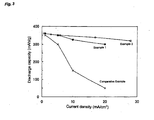
- the electrode material for the electrochemical device according to the present invention has a higher bulk density and a better filling property and thus can be more highly filled than an electrode material which is prepared by simply dry mixing the metal oxide and the conductive material. Furthermore, since the metal oxide covers the surfaces of the particles of the conductive material, the contact between the conductive material and the metal oxide increases. Thus, the electrode material of the present invention can provide an electrochemical device having a high capacity even at a high current density.
- the metal oxide used to produce the electrode material is an oxide of an element in a range of from Group 3 to Group 12 in the fourth, fifth and sixth periods of the Periodic Table.
- Specific examples of the oxides of the metal elements belonging to Group 3 to Group 12 in the fourth, fifth and sixth periods of the Periodic Table are oxides of Sc, Ti, V, Cr, Mn, Fe, Co, Ni, Cu, Zn, Y, Zr, Nb, Mo, Tc, Ru, Pd, Ag, Cd, lanthanoids, Hf, Ta, W, Re, Os, Ir, Pt, Au, Hg, etc.
- the oxides of the metal elements belonging to Group 5 to Group 10 in the fourth period of the Periodic Table such as V, Cr, Mn, Fe, Co and Ni, and a composite oxide comprising such a metal element and at least one other metal element are particularly preferable.
- the oxide of the metal element may contain an element other than the above elements, for example, Si, Sn, Al, an alkali metal element or an alkaline earth metal element such as Li, Mg, etc.
- the particulate conductive material carbonaceous materials such as acetylene black, carbon black, activated carbon, carbon fibers, carbon nanotubes, etc. and powder of metals such as aluminum, titanium, nickel, etc. can be used.
- the particulate conductive material may comprise primary particles or secondary particles, or chains of particles like acetylene black.
- the weight ratio of the metal oxide to the conductive material is preferably from 70:30 to 10:90, particularly preferably from 50:50 to 25:75.
- the above oxide of the metal element is firstly processed in the form of a colloidal solution and then mixed with the conductive material.
- the colloidal solution of the metal oxide is prepared by mixing a metal powder with a liquid containing an oxidizing agent such as hydrogen peroxide, or by mixing an acetate salt, a nitrate salt, a carbonate salt, etc. of the metal with a liquid containing an oxidizing agent.
- an oxidizing agent such as hydrogen peroxide
- the colloidal solution of the oxide of the metal element and the particulate conductive material are mixed and dispersed by any mixing means such as a stirrer, a ball mill, or ultrasonic dispersing, and the like.
- the mixing temperature and time are not limited.
- the mixture is mixed and dispersed at a temperature of 0 to 40°C for about 1 to 12 hours.
- the dispersion as prepared may be heated, or it may be heated after separating the mixture of the metal oxide and the conductive material from the dispersion to some extent by filtration, centrifugation, etc.
- the heating conditions are not limited.
- the temperature is at least 50°C, more preferably at least 80°C, and does not exceed preferably 450°C, more preferably 300°C.
- the heating time is preferably at least 1 hour, more preferably at least 3 hours, and is not longer than preferably 24 hours, more preferably 10 hours.
- the carbonaceous material when the heating temperature exceeds 450°C, the carbonaceous material may be oxidized and decomposed. Therefore, it is preferable to carry out the heating treatment at a lower temperature than in the case using the metal powder, more preferably, a temperature of 300°C or lower.
- the electrode material comprising the composite of the metal oxide and the conductive material, which is prepared thorough the above heating treatment, is observed with a transmission electron microscope, a black contour is observed on the surface of the conductive material particle. It is confirmed with an energy-dispersion type X-ray microanalyzer that the black contour comprises the metal oxide. That is, it is confirmed that the electrode material of the present invention comprises the particle of the conductive material on the surface of which a covering layer of the metal oxide is formed.
- the thickness of the covering layer of the metal oxide is preferably from 0.5 to 10 nm.
- the electrode material has the sufficient capacity.
- the thickness of the covering layer is 10 nm or less, the conductivity increases and thus the sufficient output is achieved.
- the electrode material is expressed "a composite material of a particulate conductive material and an oxide of a metal element in a range of from Group 3 to Group 12 in the fourth, fifth and sixth periods of the Periodic Table".
- This expression does not mean that the electrode material consists of the metal oxide and the conductive material only. Rather, a part of the metal oxide or the conductive material may be changed to other material by heating, or the composite may contain other material in an amount which does not adversely affect the properties of the electrode material. It is expected that safety, cycling properties, etc. may be improved by the selection of a suitable additive or additives.
- the electrode material which is prepared by the above method, has decreased bulkiness in comparison with the mixed powder prepared by simply mixing the metal oxide and the conductive material.
- the electrode material of the present invention has a high bulk density and a good filling property as an electrode material.
- the bulk density is a density of a powder including spaces among the powder particles when the powder is filled in a container, and can be calculated by dividing the weight of the powder filled in a specific volume with the specific volume.
- the higher bulk density means the smaller bulkiness of the powder and indicates the better filling property.
- a preferable range of the bulk density depends on the kinds of the metal oxide and the conductive material, and it is difficult to determine a commonly preferable range.
- the bulk density of the electrode material can be increased to about 15 to 60% of the true density of the material.
- An electrode can be produced using the electrode material of the present invention as follows:
- a binder such as polytetrafluoroethylene or polyvinylidene fluoride is added and mixed, and the electrode mixture is shaped with a suitable means.
- the electrode mixture is press molded.
- the electrode mixture is dispersed in a solvent to prepare a paste containing the electrode mixture (where the binder may be beforehand dissolved in a solvent and then mixed with the electrode material), the paste containing the electrode mixture is applied on an electrode collector made of a metal foil or a metal mesh and dried to form a thin film of the electrode mixture on the collector.
- the methods for the production of the electrode are not limited to the above methods, and other method may be employed.
- the collector is dipped in or coated with the dispersion of the colloidal solution of the metal oxide and the conductive electrode to apply the dispersion to the collector, and then heated.
- a suitable amount of an aqueous dispersion of the binder such as polytetrafluoroethylene may be added to the dispersion of the colloidal solution of the metal oxide and the conductive material.
- the electrode may be produced without a binder, since the electrode material of the present invention has a sufficient binding strength with the collector. Accordingly, the electrode material of the present invention can provide the electrochemical device having excellent output properties.
- the electrode material of the present invention can be used as the electrode material of the electrochemical device such as the lithium secondary battery, electrochemical capacitor, etc., since it has a function to dope and dedope lithium ions. Furthermore, the electrode material of the present invention may find an application in an electrochemical device comprising an aqueous electrolyte solution. Since the electrode material of the present invention has a high capacity even at a high current density, it is particularly suitable as the electrode material of the lithium secondary battery or an alkali battery, which is a power source used in a field requiring a high output, for example, an electric automobile, an electric bicycle, etc., or the electrochemical capacitor.
- the electrode material of the present invention has a high bulk density and a better filling property than the conventional electrode material comprising the mixed powder of the metal oxide and the conductive material, and can be processed to form an electrode even in the absence of a binder.
- the electrode material of the present invention can provide the electrochemical device having a high capacity even at a high current density.
- Fig. 1 schematically shows the shape of the composite of Example 1
- Fig. 2 schematically shows the cross section of the composite of Example 1.
- the composition of the electrode mixture of this electrode contained vanadium pentoxide, acetylene black and polytetrafluoroethylene in a weight ratio of 38:58:4.
- the electrode was stamped in the form of a disk having a diameter of 15 mm and used as a positive electrode, while a disk-form lithium having a diameter of 17 mm was used as a negative electrode, and propylene carbonate containing 1 mol/l of LiCl 4 dissolved therein was used as an electrolyte to assemble a coin-form lithium secondary battery having a diameter of 20 mm and a height of 1.6 mm.
- a colloidal solution of vanadium pentoxide which was prepared in the same manner as in Example 1, was heated at 120°C for 3 hours to obtain vanadium pentoxide fine powder.
- the vanadium pentoxide fine powder and acetylene black were mixed in a weight ratio of 7:10, and the bulk density of the resulting mixed powder was measured.
- the bulk density was 0.046 g/cm 3 . That is, when the vanadium pentoxide fine powder and acetylene black were mixed in the same weight ratio as that of the composite of Example 1, the bulk density of the mixture was less than one tenth (1/10) of that of the composite of Example 1, and thus the mixture had the low filling property.
Landscapes
- Chemical & Material Sciences (AREA)
- Engineering & Computer Science (AREA)
- Electrochemistry (AREA)
- Chemical Kinetics & Catalysis (AREA)
- General Chemical & Material Sciences (AREA)
- Power Engineering (AREA)
- Composite Materials (AREA)
- Inorganic Chemistry (AREA)
- Manufacturing & Machinery (AREA)
- Microelectronics & Electronic Packaging (AREA)
- Materials Engineering (AREA)
- Battery Electrode And Active Subsutance (AREA)
- Secondary Cells (AREA)
Abstract
Description
Claims (4)
- An electrode material for an electrochemical device comprising a composite of a metal oxide and a particulate conductive material which is obtainable by heating a mixture of a colloidal solution of an oxide of an element in a range of from Group 3 to Group 12 in the fourth, fifth and sixth periods of the Periodic Table, and a particulate conductive material.
- An electrode material for an electrochemical device comprising a composite of a particulate conductive material and an oxide of an element in a range of from Group 3 to Group 12 in the fourth, fifth and sixth periods of the Periodic Table, wherein a coating film of said oxide of said metal element having a thickness of 0.5 to 10 nm is formed on the surface of said particulate conductive material.
- A method for producing an electrode material for an electrochemical device comprising the steps of:mixing and dispersing a particulate conductive material with a colloidal solution of an oxide of an element in a range of from Group 3 to Group 12 in the fourth, fifth and sixth periods of the Periodic Table, andheating the mixture to form a composite of said particulate conductive material and said oxide of the element.
- An electrochemical device having an electrode comprising an electrode material of an electrochemical device according to claim 1 or 2.
Applications Claiming Priority (3)
| Application Number | Priority Date | Filing Date | Title |
|---|---|---|---|
| JP2000269531 | 2000-09-06 | ||
| JP2000269531 | 2000-09-06 | ||
| PCT/JP2001/007719 WO2002021617A1 (en) | 2000-09-06 | 2001-09-06 | Electrode material for electrochemical element and method for production thereof, and electrochemical element |
Publications (2)
| Publication Number | Publication Date |
|---|---|
| EP1347523A1 true EP1347523A1 (en) | 2003-09-24 |
| EP1347523A4 EP1347523A4 (en) | 2007-07-04 |
Family
ID=18756120
Family Applications (1)
| Application Number | Title | Priority Date | Filing Date |
|---|---|---|---|
| EP01963456A Withdrawn EP1347523A4 (en) | 2000-09-06 | 2001-09-06 | ELECTRODE MATERIAL FOR ELECTROCHEMICAL ELEMENT AND PROCESS FOR PRODUCING THE SAME, AND ELECTROCHEMICAL ELEMENT |
Country Status (6)
| Country | Link |
|---|---|
| US (1) | US7625673B2 (en) |
| EP (1) | EP1347523A4 (en) |
| JP (1) | JP4002829B2 (en) |
| KR (1) | KR100450463B1 (en) |
| AU (1) | AU2001284445A1 (en) |
| WO (1) | WO2002021617A1 (en) |
Families Citing this family (19)
| Publication number | Priority date | Publication date | Assignee | Title |
|---|---|---|---|---|
| US6758957B1 (en) * | 2001-04-17 | 2004-07-06 | University Of Central Florida | Electrochemical deposition of carbon nanoparticles from organic solutions |
| JPWO2003103076A1 (en) * | 2002-06-04 | 2005-10-06 | 伊藤忠商事株式会社 | Conductive material mixed electrode active material, electrode structure, secondary battery, and method of manufacturing conductive material mixed electrode active material |
| US8709648B2 (en) * | 2002-06-04 | 2014-04-29 | Ener1, Inc. | Conductor-mixed active electrode material, electrode structure, rechargeable battery, and manufacturing method of conductor-mixed active electrode material |
| DE10231319B4 (en) * | 2002-07-11 | 2013-08-14 | Dilo Trading Ag | Process for the production of electrical energy storage based on rechargeable lithium-polymer cells |
| US20060154071A1 (en) * | 2002-09-05 | 2006-07-13 | Itaru Homma | Carbon fine powder coated with metal oxide, metal nitride or metal carbide, process for producing the sdame, and supercapacitor and secondary battery carbon fine powder |
| CN1823439B (en) * | 2003-07-15 | 2013-07-17 | 伊藤忠商事株式会社 | Current collecting structure and electrode structure |
| JP5209171B2 (en) * | 2004-03-11 | 2013-06-12 | 株式会社Kri | Capacitor and manufacturing method thereof |
| US8143471B2 (en) * | 2006-04-21 | 2012-03-27 | Gas Technology Institute | Electrochemical capacitive concentration and deactivation of actinide nuclear materials |
| US8574759B2 (en) * | 2007-03-29 | 2013-11-05 | Mitsubishi Materials Corporation | Positive electrode forming material, component thereof, method for producing the same and rechargeable lithium-ion battery |
| KR101093266B1 (en) * | 2007-05-11 | 2011-12-14 | 주식회사 엘지화학 | Electrode Material for Secondary Battery and Manufacturing Method Thereof |
| JP5260893B2 (en) * | 2007-06-08 | 2013-08-14 | 三星エスディアイ株式会社 | Non-aqueous secondary battery negative electrode and non-aqueous secondary battery using the same |
| US20110070495A1 (en) * | 2009-09-23 | 2011-03-24 | Alliance For Sustainable Energy, Llc | Method of fabricating electrodes including high-capacity, binder-free anodes for lithium-ion batteries |
| US8599533B2 (en) | 2010-09-07 | 2013-12-03 | International Business Machines Corporation | Nanostructure electrode for pseudocapacitive energy storage |
| US9318745B2 (en) * | 2010-11-30 | 2016-04-19 | Sanyo Electric Co., Ltd. | Conductive agent for nonaqueous electrolyte secondary battery, positive electrode for nonaqueous electrolyte secondary battery, and nonaqueous electrolyte secondary battery |
| JP6040489B2 (en) * | 2011-10-29 | 2016-12-07 | 日本ケミコン株式会社 | Sheet composite, production method thereof, electrode and electrochemical element using the sheet composite |
| US10468684B2 (en) * | 2014-06-12 | 2019-11-05 | The University Of New Hampshire | Manganese oxide compositions and their use as electrodes for aqueous phase energy storage devices |
| JP6304198B2 (en) * | 2015-11-04 | 2018-04-04 | トヨタ自動車株式会社 | Non-aqueous electrolyte secondary battery and method for producing non-aqueous electrolyte secondary battery |
| FR3131450B1 (en) * | 2021-12-23 | 2025-05-02 | Hfg | METHOD FOR MANUFACTURING A POROUS ELECTRODE, AND BATTERY CONTAINING SUCH AN ELECTRODE |
| WO2023139429A1 (en) * | 2021-12-23 | 2023-07-27 | I-Ten | Method for producing a porous electrode, and battery containing such an electrode |
Family Cites Families (13)
| Publication number | Priority date | Publication date | Assignee | Title |
|---|---|---|---|---|
| CA2110097C (en) * | 1992-11-30 | 2002-07-09 | Soichiro Kawakami | Secondary battery |
| FR2715508B1 (en) * | 1994-01-21 | 1996-03-29 | Renata Ag | Primary or secondary electrochemical generator with nanoparticulate electrode. |
| JP3347555B2 (en) * | 1994-12-01 | 2002-11-20 | キヤノン株式会社 | Method for manufacturing negative electrode of lithium secondary battery |
| US5518836A (en) * | 1995-01-13 | 1996-05-21 | Mccullough; Francis P. | Flexible carbon fiber, carbon fiber electrode and secondary energy storage devices |
| EP0945907B1 (en) | 1996-06-26 | 2006-07-26 | SANYO ELECTRIC Co., Ltd. | Process for producing a hydrogen storing alloy electrode |
| JP3573905B2 (en) * | 1997-03-13 | 2004-10-06 | 三洋電機株式会社 | Method for producing hydrogen storage alloy electrode |
| EP0851515A3 (en) * | 1996-12-27 | 2004-10-27 | Canon Kabushiki Kaisha | Powdery material, electrode member, method for manufacturing same and secondary cell |
| JPH10275631A (en) | 1996-12-27 | 1998-10-13 | Canon Inc | Powder material, electrode structure, method for producing them, and secondary battery |
| WO1999005734A1 (en) * | 1997-07-25 | 1999-02-04 | Kabushiki Kaisha Toshiba | Positive active material and non-aqueous secondary cell made by using the same |
| JPH11233149A (en) * | 1998-02-13 | 1999-08-27 | Sony Corp | Non-aqueous electrolyte battery |
| JP2000036303A (en) | 1998-07-17 | 2000-02-02 | Fuji Electric Co Ltd | Electric energy storage element and method of manufacturing the same |
| KR100307453B1 (en) * | 1999-02-19 | 2001-09-26 | 김순택 | Cathode of Lithium ion secondary battery |
| JP3103357B1 (en) * | 1999-09-28 | 2000-10-30 | 株式会社サムスン横浜研究所 | Method for producing negative electrode material for lithium secondary battery |
-
2001
- 2001-09-06 EP EP01963456A patent/EP1347523A4/en not_active Withdrawn
- 2001-09-06 KR KR10-2002-7005729A patent/KR100450463B1/en not_active Expired - Fee Related
- 2001-09-06 AU AU2001284445A patent/AU2001284445A1/en not_active Abandoned
- 2001-09-06 JP JP2002525929A patent/JP4002829B2/en not_active Expired - Fee Related
- 2001-09-06 WO PCT/JP2001/007719 patent/WO2002021617A1/en not_active Ceased
- 2001-09-06 US US10/129,362 patent/US7625673B2/en not_active Expired - Fee Related
Also Published As
| Publication number | Publication date |
|---|---|
| EP1347523A4 (en) | 2007-07-04 |
| US20020172869A1 (en) | 2002-11-21 |
| AU2001284445A1 (en) | 2002-03-22 |
| KR20020064308A (en) | 2002-08-07 |
| KR100450463B1 (en) | 2004-10-01 |
| WO2002021617A1 (en) | 2002-03-14 |
| JP4002829B2 (en) | 2007-11-07 |
| JPWO2002021617A1 (en) | 2004-01-22 |
| US7625673B2 (en) | 2009-12-01 |
Similar Documents
| Publication | Publication Date | Title |
|---|---|---|
| US7625673B2 (en) | Electrode material for electrochemical element and method for production thereof, and electrochemical element | |
| JP5335264B2 (en) | Positive electrode forming material, material and manufacturing method thereof, and lithium ion secondary battery | |
| CA2462168C (en) | Electrode material for lithium secondary battery, electrode structure comprising the electrode material and secondary battery comprising the electrode structure | |
| JP6196329B2 (en) | Secondary battery with improved cathode active material, electrode and lithium ion mobility and battery capacity | |
| JP3568052B2 (en) | Porous metal body, method for producing the same, and battery electrode plate using the same | |
| JP4420022B2 (en) | Negative electrode material for lithium secondary battery, negative electrode using the same, lithium secondary battery using the negative electrode, and method for producing negative electrode material | |
| JP7469920B2 (en) | Positive electrode for all-solid-state battery and all-solid-state battery | |
| JP2010282873A (en) | Lithium secondary battery and manufacturing method thereof | |
| CN113711382A (en) | Negative electrode for nonaqueous electrolyte secondary battery and nonaqueous electrolyte secondary battery | |
| JP7524892B2 (en) | Electrode and method for manufacturing the same | |
| JP3373751B2 (en) | Secondary battery and manufacturing method thereof | |
| JPH10275631A (en) | Powder material, electrode structure, method for producing them, and secondary battery | |
| JP4654381B2 (en) | Negative electrode for lithium secondary battery and method for producing the same | |
| JP2003217583A (en) | Composite electrode and electrochemical device using the same | |
| JP3578272B2 (en) | Electrode for electrochemical device and electrochemical device | |
| JP2022153951A (en) | All-solid-state battery | |
| JP2003123737A (en) | Composite electrode material, method for producing the same, and composite electrode using the composite electrode material | |
| CN116072836B (en) | Positive electrode active material for lithium ion battery, method for producing same, and lithium ion battery | |
| JP5510704B2 (en) | Secondary battery and method of manufacturing the battery | |
| JP7453037B2 (en) | all solid state battery | |
| JP2011023146A (en) | Lithium secondary battery, and manufacturing method of the same | |
| JP7615966B2 (en) | Secondary battery | |
| JP2003123752A (en) | Composite electrode material, method for producing the same, and composite electrode using the composite electrode material | |
| JP2003217971A (en) | Electrochemical element | |
| CA2610487C (en) | Electrode material for lithium secondary battery, electrode structure comprising the electrode material and secondary battery comprising the electrode structure |
Legal Events
| Date | Code | Title | Description |
|---|---|---|---|
| PUAI | Public reference made under article 153(3) epc to a published international application that has entered the european phase |
Free format text: ORIGINAL CODE: 0009012 |
|
| 17P | Request for examination filed |
Effective date: 20020511 |
|
| AK | Designated contracting states |
Kind code of ref document: A1 Designated state(s): AT BE CH CY DE DK ES FI FR GB GR IE IT LI LU MC NL PT SE TR |
|
| AX | Request for extension of the european patent |
Extension state: AL LT LV MK RO SI |
|
| RBV | Designated contracting states (corrected) |
Designated state(s): AT BE DE FR |
|
| RIC1 | Information provided on ipc code assigned before grant |
Ipc: H01M 4/62 20060101ALN20070131BHEP Ipc: H01M 4/36 20060101ALN20070131BHEP Ipc: H01G 9/155 20060101ALI20070131BHEP Ipc: H01M 10/40 20060101ALI20070131BHEP Ipc: H01M 4/48 20060101ALI20070131BHEP Ipc: H01M 4/02 20060101AFI20070131BHEP |
|
| A4 | Supplementary search report drawn up and despatched |
Effective date: 20070606 |
|
| 17Q | First examination report despatched |
Effective date: 20071113 |
|
| STAA | Information on the status of an ep patent application or granted ep patent |
Free format text: STATUS: THE APPLICATION HAS BEEN WITHDRAWN |
|
| 18W | Application withdrawn |
Effective date: 20080806 |