EP1347477A2 - Biaxial orientierte, flammhemmend ausgerüstete Folie aus einem kristallisierbaren Thermoplasten, Verfahren zu ihrer Herstellung und ihre Verwendung - Google Patents
Biaxial orientierte, flammhemmend ausgerüstete Folie aus einem kristallisierbaren Thermoplasten, Verfahren zu ihrer Herstellung und ihre Verwendung Download PDFInfo
- Publication number
- EP1347477A2 EP1347477A2 EP03003294A EP03003294A EP1347477A2 EP 1347477 A2 EP1347477 A2 EP 1347477A2 EP 03003294 A EP03003294 A EP 03003294A EP 03003294 A EP03003294 A EP 03003294A EP 1347477 A2 EP1347477 A2 EP 1347477A2
- Authority
- EP
- European Patent Office
- Prior art keywords
- film
- weight
- film according
- flame
- flame retardant
- Prior art date
- Legal status (The legal status is an assumption and is not a legal conclusion. Google has not performed a legal analysis and makes no representation as to the accuracy of the status listed.)
- Withdrawn
Links
Classifications
-
- H—ELECTRICITY
- H01—ELECTRIC ELEMENTS
- H01G—CAPACITORS; CAPACITORS, RECTIFIERS, DETECTORS, SWITCHING DEVICES, LIGHT-SENSITIVE OR TEMPERATURE-SENSITIVE DEVICES OF THE ELECTROLYTIC TYPE
- H01G4/00—Fixed capacitors; Processes of their manufacture
- H01G4/002—Details
- H01G4/018—Dielectrics
- H01G4/06—Solid dielectrics
- H01G4/14—Organic dielectrics
- H01G4/18—Organic dielectrics of synthetic material, e.g. derivatives of cellulose
Definitions
- Biaxially oriented, flame-retardant film made from a crystallizable Thermoplastics, processes for their production and their use
- the invention relates to a flame-retardant, conductive coated, oriented Thermoplastic film with a thickness in the range of 0.5 to 12 ⁇ m.
- the foil contains at least one flame retardant and has a conductive coating.
- This film has also possibly at least one additional functionality over the flame retardant equipment.
- additional functionality includes the Shrinkage and solderability. All such foils are characterized by their low flammability and their good dielectric properties. In particular point they have a high dielectric strength and a low dissipation factor and if necessary in addition, one or more other functionalities.
- the invention relates also a process for producing the polyester film and its use in film capacitors.
- Foils for the production of capacitors have to meet high demands with regard to their dielectric strength and dielectric absorption in order to ensure sufficient voltage resistance in the capacitor and to heat up only slightly during the charging and discharging process. As described, inter alia, in EP-0-791 633, this is ensured by the high purity of the raw materials used. Therefore, it is usually necessary to do without additives (exceptions are inorganic mineral additives such as the SiO 2 or CaCO 3 pigments usually used and polymers with a very low dielectric constant such as polystyrene, etc.), in order not to have electrical properties to affect negatively.
- inorganic mineral additives such as the SiO 2 or CaCO 3 pigments usually used and polymers with a very low dielectric constant such as polystyrene, etc.
- Film capacitors made from conventional thermoplastic films are flammable and must be flame-retardant for applications that are subject to special fire protection requirements equipped materials are encased (boxed). These boxes do offer some protection, but the capacitor film inside still ignites from a certain temperature or after the box has melted.
- the box also generates additional costs and takes up space.
- SMD Surface Mounting Device
- Flame-retardant films made of thermoplastics are from DE-A 2346787 known.
- the raw materials used lead to considerable problems in the for the production of condenser foils necessary drying processes (including gluing and chain removal) and are not suitable due to their electrical properties for the production of electrically stable capacitors.
- PET films which are suitable for the production of SMD capacitors are known (WO 98/13415). However, these foils are not flame retardant and are made of them Manufactured capacitors can therefore not be used in areas in who need this property.
- the object of the present invention is to overcome the described disadvantages of the prior art Avoid technology
- the invention therefore relates to a biaxially oriented, flame-retardant film which, as the main constituent, contains a crystallizable thermoplastic and has a thickness in the range from 0.5 to 12 ⁇ m, preferably 1.2 to 6.0 ⁇ m, an electrical dielectric strength AC of ⁇ 200 kV / mm and a roughness R a of ⁇ 150 nm and which contains at least one flame retardant and has a conductive coating and is optionally provided with at least one further functionality.
- the invention further relates to a method for producing this film and its use.
- the film according to the invention is characterized by its low flammability and a high dielectric strength. It also has low dielectric absorption, (i.e. a low electrical dissipation factor) can be manufactured economically and is suitable due to its conductive coating for the production of electrically stable Capacitors, which are also flame retardant and possibly in one special embodiment are SMD solderable. Such a flame-retardant (SMD) capacitor does not require a box and therefore offers the advantage of a particularly small one Space requirements.
- SMD flame-retardant
- the film according to the invention can also without losing its properties are recycled before coating, i.e. that the regenerate is used again can be.
- a flame retardant effect means that the films or from them manufactured capacitors in a so-called fire protection test the conditions according to DIN 4102 Part 2 and in particular according to DIN 4102 Part 1 and in the Building material classes B2 and in particular B1 classified as flame retardant can be. Furthermore, the film and a capacitor made from it Fire class V0 according to UL-94 or UL94 V (vertical burning test) or VTM.
- a high dielectric strength means that the dielectric strength of the film measured according to DIN 53481 using the ball / plate method with alternating voltage (AC) ⁇ 200 kV / mm, preferably ⁇ 240 kV / mm and in particular ⁇ 280 kV / mm.
- AC alternating voltage
- a low dielectric loss factor means that it is at 30 ° C and 1 kHz Values of ⁇ 0.0065, preferably ⁇ 0.0055 and in particular ⁇ 0.0050 and at 120 ° C and 1 kHz has values of 0,0 0.027, preferably 0,0 0.025 and in particular ⁇ 0.021.
- electrically stable capacitors means that the flame retardant equipped capacitors have a significantly longer life and none have high failure rates in practice compared to non-flame retardant equipped capacitors.
- SMD solderable means that the capacitors are the same as those used for reflow soldering Do not deform temperatures above 220 ° C mechanically and are electrically stable stay.
- the main component of the film is a crystallizable thermoplastic.
- suitable Crystallizable or partially crystalline thermoplastics are, for example, polyethylene terephthalate (PET), polyethylene naphthalate (PEN), polybutylene terephthalate (PBT), bibenzene-modified Polyethylene terephthalate (PETBB), bibenzene-modified polybutylene terephthalate (PBTBB), bibenzene-modified polyethylene naphthalate (PENBB) or mixtures therefrom, with PET, PEN and PETBB being preferred.
- PET polyethylene terephthalate
- PEN polyethylene naphthalate
- PBT polybutylene terephthalate
- PBTBB bibenzene-modified Polyethylene terephthalate
- PBTBB bibenzene-modified polyethylene naphthalate
- PENBB bibenzene-modified polyethylene naphthalate
- isophthalic acid can also be used to manufacture the thermoplastics (IPA), trans and / or cis -1,4-cyclohexanedimethanol ( c -CHDM, t -CHDM or c / t-CHDM) and other suitable dicarboxylic acid components (or dicarboxylic acid esters) and diol components can be used.
- Polymers are preferred in which the dicarboxylic acid component is 95% and more, especially 98% and more consists of TA or NDA.
- Thermoplastics in which the diol component is 90% and more, in particular 93% and more consists of EG.
- Polymers in which the diethylene glycol fraction is also preferred of the total polymer is in the range of 1 to 2%. For all of the above The flame retardant is not taken into account in terms of quantities.
- the film according to the invention further contains inorganic or organic compounds which are required to adjust the surface topography.
- R a value a roughness
- the amount of the compounds used depends on the substances used and their particle size. The latter is in the range from 0.01 to 10.0, preferably 0.1 to 5.0 and in particular 0.3 to 3.0 ⁇ m.
- an R a value of ⁇ 150 nm and preferably of ⁇ 100 nm is aimed for.
- the R a value is 100 100 nm and preferably ⁇ 70 nm, while for film thicknesses below 2.4 ⁇ m it is von 70 nm and preferably ⁇ 50 nm having.
- Suitable compounds for achieving the roughness are, for example, calcium carbonate, apatite, silicon dioxide, titanium dioxide, aluminum oxide, crosslinked polystyrene, zeolites and other silicates and aluminum silicates. These compounds are generally used in amounts of 0.05 to 1.5%, preferably 0.1 to 0.6%. The roughness can be easily determined depending on the connection used by simple mixing tests and then measuring the R a values.
- a combination of the silicon dioxide pigments 0.11% ®Sylysia 320 (Fuji, Japan) and 0.3% ®Aerosil TT600 (Degussa, Germany) results in an R a value of 70 nm for a 5 ⁇ m film Film with a thickness of 5 ⁇ m, which contains 0.6% ®Omyalite (calcium carbonate from Omya, Switzerland) with an average particle size of 1.4 ⁇ m, an R a value of 60 nm.
- the same recipes are used to produce a 1.4 ⁇ m thick film gives an R a value of 35 nm ⁇ 5 nm.
- the melt resistance of the thermoplastic used has an average value of ⁇ 1 ⁇ 10 7 ⁇ cm, preferably ⁇ 10 ⁇ 10 7 ⁇ cm and in particular ⁇ 25 • 10 7 ⁇ cm.
- the standard viscosity SV (DCE) of the film measured in dichloroacetic acid according to DIN 53728, generally ranges from 600 to 1000, preferably from 700 to 900.
- the SV of the input raw materials is on average around 5 to 70 Units above the specified areas for the film.
- the film also contains a flame retardant, which is preferably the so-called Masterbatch technology is metered in directly during film production, with the proportion of the flame retardant in the range from 0.5 to 30.0% by weight, preferably from 1.0 to 20.0 wt .-%, based on the weight of the crystallizable thermoplastic, is. in the Masterbatch, the proportion of the flame retardant is generally 5.0 to 60.0 wt .-%, preferably 10.0 to 50.0% by weight, in each case based on the total weight of the masterbatch.
- a flame retardant which is preferably the so-called Masterbatch technology is metered in directly during film production, with the proportion of the flame retardant in the range from 0.5 to 30.0% by weight, preferably from 1.0 to 20.0 wt .-%, based on the weight of the crystallizable thermoplastic, is. in the Masterbatch, the proportion of the flame retardant is generally 5.0 to 60.0 wt .-%, preferably 10.0 to 50.0% by
- Suitable flame retardants are, for example, bromine and chlorine compounds (possibly in connection with antimony trioxide) and metal hydroxides as well as nitrogenous compounds (e.g. melamine compounds) and boron compounds.
- the halogen compounds However, they generally have the disadvantage that in the event of fire and during processing halogen-containing by-products can arise. In the event of fire arise in particular Hydrogen halides.
- Preferred flame retardants which are used according to the invention are, for example, organic phosphorus compounds such as carboxyphosphinic acids, their anhydrides and the phosphorus compound ®Amgard P 1045 from Albright & Wilson. It is advantageous if the organic phosphorus compounds are soluble in the thermoplastic, since otherwise the required properties are not always met.
- Organic phosphorus compounds which are incorporated into the chain of the thermoplastic for example phosphorus-containing esters such as (6-oxodibenzo [c, e 1,2] oxaphosphorin-6-ylmethyl) -succinic acid bis (2-hydroxyethyl) ester (CAS No. 63562-34-5).
- the film can also contain other components such as radical scavengers and / or contain other polymers such as polyetherimides.
- the flame retardant is preferably added using masterbatch technology.
- the flame retardant is first fully dispersed in a carrier material.
- Backing material comes from the thermoplastic itself, e.g. the polyethylene terephthalate or other polymers that are compatible with the thermoplastic are also possible. After Dosing to the thermoplastic for the film production melt the components of the masterbatch during the extrusion and are thus dissolved in the thermoplastic.
- the masterbatch can also be produced in-situ, i.e. the monomers for Production of the thermoplastic together with the other components, e.g. the Flame retardants and / or the compounds mixed to achieve the roughness and the mixtures obtained are polycondensed.
- the monomers for Production of the thermoplastic together with the other components, e.g. the Flame retardants and / or the compounds mixed to achieve the roughness and the mixtures obtained are polycondensed.
- the economic production includes that the raw materials or.
- Raw material components which are required for the production of the film, with commercially available Industrial dryers, such as vacuum dryers (i.e. under reduced pressure), Fluidized bed dryer, fluid bed dryer or fixed bed dryer (shaft dryer), can be dried. It is essential that the used according to the invention Do not glue raw materials and do not break down thermally.
- the dryer mentioned generally work at normal pressure with temperatures between 100 and 170 ° C, where state-of-the-art raw materials stick together can and add the dryer and / or extruder. With a vacuum dryer, the allows the most gentle drying conditions, the raw material goes through one Temperature range from approx. 30 ° C to 130 ° C at a reduced pressure of 50 mbar.
- the film according to the invention is generally known per se Extrusion process manufactured.
- the temperature at which the stretching is carried out can vary within a relatively wide range and depends on the desired properties of the film.
- the longitudinal stretching ratio is generally in the range from 2.5: 1 to 6.0: 1, preferably from 3.0: 1 to 5.5: 1.
- the transverse stretching ratio is generally in the range from 3.0: 1 to 5.0: 1, preferably from 3.5: 1 to 4.5: 1, and that of the second longitudinal and transverse stretching which may be carried out is 1.1: 1 to 5: 1.
- the longitudinal stretching can optionally be carried out simultaneously with the transverse stretching (simultaneous stretching). It has proven particularly favorable if the stretching ratio in the longitudinal and transverse directions is in each case greater than 3.5.
- the film is held at about 0.1 to 10 s Temperature of 180 to 260 ° C, preferably 220 to 245 ° C, held. Subsequent to or starting in heat setting, the film is 0 to 15%, preferably 1.5 up to 8%, relaxed in the transverse and possibly also in the longitudinal direction and the film in cooled and wound up in the usual way.
- the film is used in the subsequent heat setting for about 0.1 to 10 s at a temperature of 180 to 260 ° C, preferably 220 to 245 ° C, held. Then on or during the The film is heat-set, preferably in at least two stages, by a total of 4 up to 15%, preferably by 5 to 8%, relaxed in the transverse direction, at least the last 2% of the total relaxation at temperatures below 180 ° C, preferably at 180 to 130 ° C, take place. The film is then cooled in the usual way and wound up. A relaxation can also take place in the longitudinal direction.
- the wound film is then processed in conventional metallization machines (e.g. from Applied Films, formerly Leybold) metallized according to the known methods (a Coating with another conductive material such as conductive polymers is also possible possible) and assembled in the desired width for capacitor production. Out these metallized narrow cuts are made capacitor coils, then pressed flat (temperatures between 0 and 280 ° C), looped and contacted.
- conventional metallization machines e.g. from Applied Films, formerly Leybold
- metallized narrow cuts are made capacitor coils, then pressed flat (temperatures between 0 and 280 ° C), looped and contacted.
- the foil has after the metallization for SMD capacitors (or other conductive coating) a longitudinal shrinkage at 200 ° C (15 min) of ⁇ 5%, preferably ⁇ 4% and in particular ⁇ 3.5%.
- longitudinal shrinkage is not less than 1%.
- the cross shrink at 200 ° C (15 min) has values of ⁇ 2%, preferably ⁇ 1% and in particular ⁇ 0.5%.
- the shrinkage value in TD is always ⁇ -0.5%.
- a preferred option is to wrap the narrow cuts on wheels or bars looped, thermostabilized in the oven (temperatures between 100 and 280 ° C) and into the appropriate capacitor widths are cut (layer capacitors), which then finally be contacted. Annealing can also be carried out if necessary the Schoopen.
- the film does not has an intolerably higher dielectric loss factor (tangent) than comparable manufactured films without flame retardants. Nevertheless, the equipment with the Flame retardants also in the thin films according to the invention, both with the film and the capacitors made from it meet the requirements of to meet the above flame tests.
- the foils are therefore suitable particularly good for the production of capacitors, preferably interference suppression capacitors. So these capacitors show no higher failure rates in the voltage test and in their lifespan. Because of the good properties of the film, especially the The requirements of the fire protection test need to be met Capacitors no protective sheathing (box).
- the individual are measured Properties in accordance with the standards or procedures listed.
- the standard viscosity SV (DCE), based on DIN 53726, is measured at 25 ° C in dichloroacetic acid.
- Each 100 of the capacitors manufactured as described below are subjected to a fire test subjected to the UL-94V (vertical burning test).
- the test is passed if at least 99 capacitors at least meet fire class V0. Will this If the criteria are not met, the test is considered not passed.
- the roughness R a of the film is determined according to DIN 4768 with a cut-off of 0.25 mm.
- the dielectric strength is determined according to DIN53481 at AC voltage (50 Hz) given as the average of 10 measuring points.
- the loss factor is determined based on DIN53483.
- a voltage for 2 seconds is applied to 100 copies of the manufactured capacitors.
- the voltage test on each capacitor is passed if the voltage does not decrease by more than 10% during the two seconds.
- the overall test is considered passed if at most 2 of the capacitors used fail.
- 100 capacitors are at 50 ° C for 500 hours in an autoclave at 50% rel. Humidity stored and subjected to the voltage test before and after this time. The The test is considered passed if the capacitors used initially enter the Have passed the stress test, fail at most 2 after tempering.
- the thickness is either continuously measured on a 10 meter long film strip capacitive thickness measurement or determined every 2 cm using a button. The minimum measured Thickness is subtracted from the maximum and the result in percent of the average thickness specified.
- the thermal shrinkage is determined on 10 cm squares cut from the film.
- the edge length of the unheated samples (L 0 ) are measured precisely and the samples are tempered for 15 minutes in a forced-air drying cabinet at the temperature specified in each case.
- the tempered samples (L) are taken from the drying cabinet and a corresponding longitudinal edge is measured at room temperature with a precise comparison.
- Shrinkage (%) L 0 - L L 0 x 100
- the capacitors made from the film become one for 2 minutes Subject to heat treatment in an oven at 235 ° C. Then they become the Subjected to voltage test as indicated above. However, the test is only considered as passed if no deformations of the capacitors are visible. Deformed capacitors cannot be soldered in practice.
- Thermoplastic chips and the other components were according to the in the examples specified ratios mixed and in a fluidized bed dryer at 155 ° C for Precrystallized for 1 minute, then for 3 hours in a shaft dryer at 150 ° C dried and extruded at 290 ° C.
- the molten polymer came out of a nozzle drawn off via a take-off roller.
- the film was made by a factor of 3.8 in the machine direction stretched at 116 ° C and a transverse stretch in a frame at 110 ° C performed the factor 3.7.
- the film was then heat-set at 230 ° C. and relaxed in the transverse direction by 4% at temperatures of 200 - 180 ° C.
- the film was each vapor-coated with an approx. 500 Angstr ⁇ m thick aluminum layer, an unmetallized strip of 2 mm width being produced between each 18 mm wide, metallized strip using masking tapes, and the film was then cut into 10 mm wide strips so that at the edge of the 1 mm wide, unmetallized strips (free edge) remain.
- Two strips, each three meters long, one with the free edge on the left side and one with the free edge on the right side, are wound together on a metal pin with a diameter of 3 mm.
- the two strips have an offset of 0.5 mm in the width direction.
- the windings are then pressed flat at 140 ° C. for 5 minutes with a pressure of 50 kg / cm 2 .
- the resulting coils are looped on both sides and provided with contact wires.
- the melt resistance of the raw materials used ranged from 25 • 10 7 to 30 • 10 7 ⁇ • cm, only MB3 had a value of 0.4 • 10 7 ⁇ • cm.
- Films with the compositions according to Table 1 were produced.
- example Film thickness ( ⁇ m) composition 1 2 11.0 wt% MB2, 20.0 wt% MB1 and 69.0 wt% R1 2 6 8.0 wt% MB2, 20.0 wt% MB1 and 72.0 wt% R1 3 6 as example 2, but extrusion temperature 270 ° C.
- Thermoplastic chips and the other components were according to the in the examples specified ratios mixed and in a fluidized bed dryer at 155 ° C. Precrystallized for 1 minute, then in a shaft dryer for 3 hours Dried 150 ° C and extruded at 290 ° C. The molten polymer became out drawn off a nozzle via a take-off roller.
- the film was 3.8 in Machine direction stretched at 116 ° C and one in a frame at 110 ° C Lateral stretching by a factor of 3.7 was carried out. Then the film was added 239 ° C heat set and in the transverse direction by 4% at temperatures from 230 - 190 ° C and then relaxed again by 3% at temperatures of 180 - 130 ° C.
- the film was each vapor-coated with an approx. 500 ⁇ strstrm thick aluminum layer, an unmetallized strip of 2 mm width being produced between each 18 mm wide, metallized strip using masking tapes, and the film was then cut into 10 mm wide strips so that at the edge of the 1 mm wide, unmetallized strips (free edge) remained.
- a metal tape was tightened over the top layer with a pressure of 0.1 kg / cm 2 .
- the winding on the wheel was then looped on both sides, coated with a 0.2 mm thick layer of silver and annealed at 195 ° C. for 60 minutes in an oven (flooded with dry nitrogen).
- the metal strip was then removed from the winding wheel and then cut into individual capacitors at a distance of 0.7 cm.
- Example Foil thickness ( ⁇ m) composition 6 11.0 wt% MB2, 20.0 wt% MB1 and 69.0 wt% R1 7 6 8.0% by weight of MB4, 20.0% by weight of MB5 and 72.0% by weight of R2, extrusion temperature 305 ° C, stretching at 141 ° C.
- the film was then heat-set at 247 ° C. and relaxed in the transverse direction by 4% at temperatures from 247 to 190 ° C. and then again by 3% at temperatures from 180 to 150 ° C.
- V3 11.0 wt% MB2 and 89.0 wt% R1
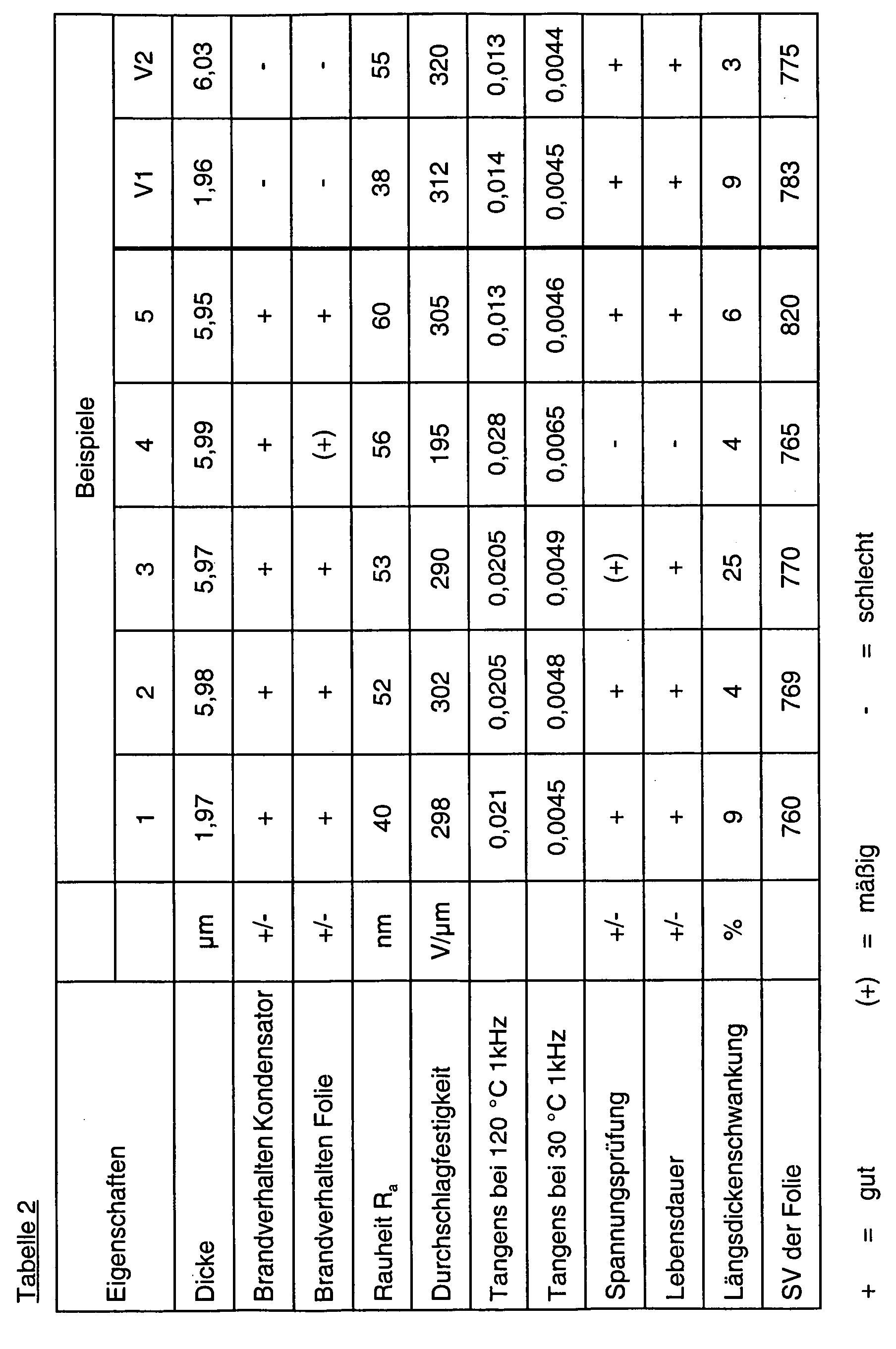
- Example 1 the fire behavior of the capacitors is correct.
- the Films of Examples 6 and 7 are additionally SMD-solderable. V1, V2 and V3 show one insufficient fire behavior.
Landscapes
- Engineering & Computer Science (AREA)
- Power Engineering (AREA)
- Manufacturing & Machinery (AREA)
- Microelectronics & Electronic Packaging (AREA)
- Manufacture Of Macromolecular Shaped Articles (AREA)
- Laminated Bodies (AREA)
Abstract
Description
- kristallisierbare Homopolymere,
- kristallisierbare Copolymere,
- kristallisierbare Compounds,
- kristallisierbares Recyklat und
- andere Variationen von kristallisierbaren Thermoplasten.
X1 (Xn) = der Anteil der Thermoplastchips der Komponente 1 (n) und
W1 (Wn) = der Widerstand der Thermoplastchips der Komponente 1 (n) ist

- Rohstoff R1:
- PET (Typ M 03, KoSa), SV-Wert 820
- Rohstoff R2:
- PEN, SV-Wert 900
- Masterbatch MB1:
- 15,0 Gew.-% (6-Oxo-dibenzo[c,e 1,2]oxaphosphorin-6-ylmethyl)-bernsteinsäure-bis(2-hydroxyethyl)ester (CAS-Nr. 63562-34-5) (M-Ester der Firma Sanko Co. Ltd.,Japan) und 85,0 Gew.% PET, SV-Wert 840

- Masterbatch MB2:
- 1,0 Gew.-% Sylysia 320,3,0 Gew.-% Aerosil TT600 und 96,0 Gew.-% PET, SV-Wert 800
- Masterbatch MB3:
- 10,0 Gew.-% Decabromdiphenylethan und 90,0 Gew.-% PET, SV-Wert 810
- Masterbatch MB4:
- 1,0 Gew.-% Sylysia 320,3,0 Gew.-% Aerosil TT600 und 96,0 Gew.-% PEN, SV-Wert 900
- Masterbatch MB5:
- 15,0 Gew.-% M-Ester der Firma Sanko Co. Ltd.,Japan (Cas Nr. 63562-34-5) und 85,0 Gew.% PEN, SV-Wert 900
| Beispiel | Foliend icke (µm) | Zusammensetzung |
| 1 | 2 | 11,0 Gew.-% MB2, 20,0 Gew.-% MB1 und 69,0 Gew.-% R1 |
| 2 | 6 | 8,0 Gew.-% MB2, 20,0 Gew.-% MB1 und 72,0 Gew.-% R1 |
| 3 | 6 | wie Beispiel 2, jedoch Extrusionstemperatur 270 °C |
| 4 | 6 | 8,0 Gew.-% MB2, 50,0 Gew.-% MB3 und 42,0 Gew.-% R1 |
| 5 5 | 6 6 | 8,0 Gew.-% MB4, 20,0 Gew.-% MB5 und 72,0 Gew.-% R2, Extrusionstemperatur 305 °C, Streckungen bei 141 °C |
| V1 | 2 | 11,0 Gew.-% MB2 und 89,0 Gew.-% R1 |
| V2 | 6 | 8,0 Gew.-% MB2 und 92,0 Gew.-% R1 |
| Beispiel | Folien dicke (µm) | Zusammensetzung |
| 6 | 2 | 11,0 Gew.-% MB2, 20,0 Gew.-% MB1 und 69,0 Gew.-% R1 |
| 7 | 6 | 8,0 Gew.-% MB4, 20,0 Gew.-% MB5 und 72,0 Gew.-% R2, Extrusionstemperatur 305 °C, Streckungen bei 141 °C. Anschließend wurde die Folie bei 247 °C thermofixiert und in Querrichtung um 4 % bei Temperaturen von 247 - 190 °C und dann nochmals um 3 % bei Temperaturen von 180 - 150 °C relaxiert. |
| V3 | 2 | 11,0 Gew.-% MB2 und 89,0 Gew.-% R1 |
| Eigenschaften | Beispiele | ||||
| 6 | 7 | V3 | |||
| Dicke | µm | 1,97 | 5,95 | 1,96 | |
| Brand-verhalten | Kondensator | +/- | + | + | - |
| Folie | +/- | + | + | - | |
| Rauheit Ra | nm | 39 | 62 | 37 | |
| Durchschlagfestigkeit | V/µm | 298 | 305 | 319 | |
| Tangens bei 120 °C 1kHz | 0,018 | 0,014 | 0,015 | ||
| Tangens bei 30 °C 1kHz | 0 | 0,005 | 0,005 | ||
| Spannungsprüfung | +/- | + | + | + | |
| Lebensdauer | +/- | + | + | + | |
| SMD-Lötbarkeit | +/- | + | + | + | |
| Längsdickenschwankung | % | 7 | 5 | 8 | |
| SV | 762 | 824 | 780 | ||
| Schrumpf MD 15 | % | 3,2 | 3,2 | 3,2 | |
| Schrumpf TD 15 | % | 0,1 | 0,1 | 0,2 | |
| + = gut (+) = mäßig (d.h. schwankende Ergebnisse) - = schlecht |
Claims (16)
- Biaxial orientierte, flammhemmend ausgerüstete Folie, die als Hauptbestandteil einen kristallisierbaren Thermoplasten enthält und eine Dicke im Bereich von 0,5 bis 12 µm aufweist, eine elektrische Durchschlagfestigkeit AC von ≥ 200 kV/mm und eine Rauheit Ra von ≤ 150 nm besitzt und die mindestens ein Flammschutzmittel enthält sowie leitfähig beschichtet ist.
- Folie nach Anspruch 1, dadurch gekennzeichnet, dass sie mit mindestens einer weiteren Funktionalität versehen ist.
- Folie nach Anspruch 1 oder 2, dadurch gekennzeichnet, dass der kristallisierbare Thermoplast ein Polyethylenterephthalat, Polybutylenterephthalat, Polyethylennaphthalat, bibenzolmodifiziertes Polyethylenterephthalat oder Mischungen daraus, vorzugsweise Polyethylenterephthalat, Polyethylennaphthalat oder bibenzolmodifiziertes Polyethylenterephthalat, ist.
- Folie nach Anspruch 1, 2 oder 3, dadurch gekennzeichnet, dass die Konzentration des Flammschutzmittels im Bereich von 0,5 Gew.-% bis 30,0 Gew.-%, vorzugsweise von 1,0 bis 20,0 Gew.-%, bezogen auf das Gewicht des kristallisierbaren Thermoplasten, liegt.
- Folie nach einem oder mehreren der Ansprüche 1 bis 4, dadurch gekennzeichnet, dass als Flammschutzmittel organische Phosphorverbindungen, vorzugsweise phosphorhaltige Ester, enthalten sind.
- Folie nach einem oder mehreren der Ansprüche 1 bis 5, dadurch gekennzeichnet, dass sie einen dielektrischen Verlustfaktor Tangens delta bei 1 kHz und 30 °C von ≤ 0,0065 und einen Tangens delta bei 1 kHz und 120 °C von ≤ 0,027 besitzt.
- Folie nach einem oder mehreren der Ansprüche 1 bis 6, dadurch gekennzeichnet, dass die Folie einen Längsschrumpf bei 200 °C (15 min) von ≤5 % und einen Querschrumpf bei 200 °C (15 min) von ≤ 2 % besitzt.
- Verfahren zur Herstellung einer Folie nach Anspruch 1, dadurch gekennzeichnet, dass ein kristallisierbarer Thermoplast und ein Flammschutzmittel nach einem Extrusionsverfahren zu einem flachen Schmelzefilm ausgeformt, mit Hilfe einer Kühlwalze abgeschreckt und die so erhaltene weitgehend amorphe Folie zur Verfestigung auf einer oder mehreren Walze/n abgezogen, die Folie anschließend biaxial gestreckt (orientiert), thermofixiert und die Folie in üblicher Weise abgekühlt, aufgewickelt und mit einer leitfähigen Beschichtung versehen wird.
- Verfahren nach Anspruch 8, dadurch gekennzeichnet, dass die Folie nach der biaxialen Streckung um insgesamt > 0 bis 15 % in Querrichtung relaxiert wird, wobei mindestens die letzten 2 % der Gesamtrelaxation bei Temperaturen unterhalb von 180 °C stattfinden.
- Verfahren nach Anspruch 8, dadurch gekennzeichnet, dass die letzten 2 % der Gesamtrelaxation der Folie bei Temperaturen von 180 bis 130 °C vorgenommen werden und die Gesamtrelaxation in Querrichtung 5 bis 8 % beträgt.
- Verfahren nach einem der Ansprüche 8 bis 10, dadurch gekennzeichnet, dass das Flammschutzmittel über die Masterbatch-Technologie zugeben wird und im Masterbatch neben dem Thermoplast in Mengen von 5,0 bis 60,0 Gew.-%, bevorzugt 10,0 bis 50,0 Gew.-%, jeweils bezogen auf das Gesamtgewicht des Masterbatches, enthalten ist.
- Verwendung der Folie nach einem oder mehreren der Ansprüche 1 bis 7 zur Herstellung von Kondensatoren.
- Verwendung nach Anspruch 12 als SMD-Kondensator.
- Verwendung nach Anspruch 12 als Entstörkondensator.
- Entstörkondensator, hergestellt unter Verwendung der Folie nach einem oder mehreren der Ansprüche 1 bis 7.
- SMD-Kondensator, hergestellt unter Verwendung der Folie nach einem oder mehreren der Ansprüche 1 bis 7.
Applications Claiming Priority (4)
| Application Number | Priority Date | Filing Date | Title |
|---|---|---|---|
| DE10209848 | 2002-03-06 | ||
| DE10209849 | 2002-03-06 | ||
| DE2002109848 DE10209848A1 (de) | 2002-03-06 | 2002-03-06 | Biaxial orientierte, flammhemmend ausgerüstete Folie aus einem kristallisierbaren Thermoplasten, Verfahren zur ihrer Herstellung und ihre Verwendung |
| DE2002109849 DE10209849A1 (de) | 2002-03-06 | 2002-03-06 | Biaxial orientierte, flammhemmend ausgerüstete Folie aus einem kristallisierbaren Thermoplasten, Verfahren zur ihrer Herstellung und ihre Verwendung |
Publications (2)
| Publication Number | Publication Date |
|---|---|
| EP1347477A2 true EP1347477A2 (de) | 2003-09-24 |
| EP1347477A3 EP1347477A3 (de) | 2006-02-01 |
Family
ID=27789733
Family Applications (1)
| Application Number | Title | Priority Date | Filing Date |
|---|---|---|---|
| EP03003294A Withdrawn EP1347477A3 (de) | 2002-03-06 | 2003-02-25 | Biaxial orientierte, flammhemmend ausgerüstete Folie aus einem kristallisierbaren Thermoplasten, Verfahren zu ihrer Herstellung und ihre Verwendung |
Country Status (2)
| Country | Link |
|---|---|
| US (1) | US20030171465A1 (de) |
| EP (1) | EP1347477A3 (de) |
Families Citing this family (7)
| Publication number | Priority date | Publication date | Assignee | Title |
|---|---|---|---|---|
| EP1342746A1 (de) * | 2002-03-06 | 2003-09-10 | Mitsubishi Polyester Film GmbH | Biaxial orientierte, hydrolysebeständige Kondensatorfolie aus einem kristallisierbaren Thermoplasten, Verfahren zu ihrer Herstellung und ihre Verwendung |
| DE10222348A1 (de) * | 2002-05-21 | 2003-12-04 | Mitsubishi Polyester Film Gmbh | Biaxial orientierte, hydrolysebeständige Folie aus einem Thermoplast mit einem Hydrolysestabilisator, Verfahren zu ihrer Herstellung, ihre Verwendung sowie aus der Folie hergestellte Kondensatoren |
| DE102004044326A1 (de) * | 2004-09-10 | 2006-03-16 | Mitsubishi Polyester Film Gmbh | Hydrolysebeständige Folie aus einem Polyester mit Hydrolyseschutzmittel sowie Verfahren zu ihrer Herstellung und ihre Verwendung |
| DE102006016156A1 (de) * | 2006-04-06 | 2007-10-11 | Mitsubishi Polyester Film Gmbh | Hydrolysebeständige, mehrschichtige Polyesterfolie mit Hydrolyseschutzmittel |
| DE102007028348A1 (de) * | 2007-06-20 | 2008-12-24 | Mitsubishi Polyester Film Gmbh | Bernsteinfarbene Polyesterfolie mit besonderer Eignung für Metallisierung und Stahllaminierung |
| US9558888B2 (en) | 2008-10-16 | 2017-01-31 | The Government Of The United States Of America, As Represented By Secretary Of The Navy | Multilayer polymer film having a charge-delocalizing interface |
| US8611068B2 (en) * | 2008-10-16 | 2013-12-17 | Case Western Reserve University | Multilayer polymer dialectric film having a charge-delocalizing interface |
Family Cites Families (10)
| Publication number | Priority date | Publication date | Assignee | Title |
|---|---|---|---|---|
| DE2726189A1 (de) * | 1977-06-10 | 1978-12-21 | Hoechst Ag | Flammwidrig ausgeruestete, biaxial orientierte polyesterfolie |
| JPS58176238A (ja) * | 1982-04-09 | 1983-10-15 | Teijin Ltd | ポリエステル組成物 |
| JP2794687B2 (ja) * | 1986-05-26 | 1998-09-10 | 東レ株式会社 | ポリエステルフイルム |
| JPH048758A (ja) * | 1990-04-27 | 1992-01-13 | Unitika Ltd | ポリエステル系2軸配向フィルム |
| IT1266625B1 (it) * | 1993-10-26 | 1997-01-09 | Himont Inc | Manufatti polimerici isolanti dotati di elevata resistivita' superficiale ed elevata resistenza alla fiamma |
| JP3397022B2 (ja) * | 1995-10-16 | 2003-04-14 | 東レ株式会社 | ポリエステルフィルム |
| WO1998013415A1 (de) * | 1996-09-24 | 1998-04-02 | Mitsubishi Polyester Film Gmbh | Biaxial orientierte pet-folie mit verbesserten mechanischen und schrumpfeigenschaften zur verwendung für smd-fähige folienkondensatoren und verfahren zur herstellung dieser folie |
| DE10015633A1 (de) * | 2000-03-29 | 2001-10-04 | Mitsubishi Polyester Film Gmbh | Siegelfähige biaxial orientierte Polyesterfolie |
| KR20020030007A (ko) * | 2000-09-29 | 2002-04-22 | 힐커트 | 결정성 열가소성 수지로부터 제조된 내가수분해성 투명이축배향 필름 및 그 제조방법 |
| DE10112493A1 (de) * | 2001-03-15 | 2002-09-19 | Mitsubishi Polyester Film Gmbh | Weiße, biaxial orientierte Folie aus einem kristallisierbaren Thermoplasten mit hohem Weißgrad und mit zusätzlicher Funktionalität |
-
2003
- 2003-02-25 EP EP03003294A patent/EP1347477A3/de not_active Withdrawn
- 2003-03-04 US US10/379,171 patent/US20030171465A1/en not_active Abandoned
Also Published As
| Publication number | Publication date |
|---|---|
| EP1347477A3 (de) | 2006-02-01 |
| US20030171465A1 (en) | 2003-09-11 |
Similar Documents
| Publication | Publication Date | Title |
|---|---|---|
| EP1344790B1 (de) | Biaxial orientierte Folie mit verbesserter Oberflächenqualität auf Basis von kristallisierbaren Polyestern und Verfahren zur Herstellung der Folie | |
| EP2184313B1 (de) | Biaxial gestreckte Polyesterfolie die einen Kettenverlängerer enthält, sowie Verfahren zu ihrer Herstellung und ihre Verwendung | |
| EP0929598B1 (de) | Biaxial orientierte pet-folie mit verbesserten mechanischen und schrumpfeigenschaften zur verwendung für smd-fähige folienkondensatoren und verfahren zur herstellung dieser folie | |
| EP2184312B1 (de) | Biaxial orientierte hydrolysebeständige Polyesterfolie enthaltend epoxidierte Fettsäurederivate sowie Verfahren zu ihrer Herstellung und ihre Verwendung | |
| EP1842662B1 (de) | Hydrolysebeständige, mehrschichtige Polyesterfolie mit Hydrolyseschutzmittel | |
| EP2251371B1 (de) | Biaxial gestreckte Polyesterfolie, enthaltend einen Decarboxylierungskatalysator, Verfahren zu ihrer Herstellung und ihre Verwendung in Elektroisolieranwendungen | |
| EP1518885B1 (de) | Orientierte, mittels elektromagnetischer Strahlung strukturierbare und mit Aminosilan beschichtete Folie aus thermoplastischem Polyester zur Herstellung selektiv metallisierter Folien | |
| EP1520872A1 (de) | Einschichtige, orientierte, mittels elektromagnetischer Strahlung strukturierbare Folie aus thermoplastischem Polyester zur Herstellung selektiv metallisierter Folien | |
| EP1842871A1 (de) | Hydrolysebeständige Polyesterfolie mit Hydrolyseschutzmittel | |
| DE102004044326A1 (de) | Hydrolysebeständige Folie aus einem Polyester mit Hydrolyseschutzmittel sowie Verfahren zu ihrer Herstellung und ihre Verwendung | |
| DE10222348A1 (de) | Biaxial orientierte, hydrolysebeständige Folie aus einem Thermoplast mit einem Hydrolysestabilisator, Verfahren zu ihrer Herstellung, ihre Verwendung sowie aus der Folie hergestellte Kondensatoren | |
| EP1518886B1 (de) | Mehrschichtige, orientierte, mittels elektromagnetischer Strahlung strukturierbare Folie aus thermoplastischem Polyester zur Herstellung selektiv metallisierter Folien | |
| DE102011009821A1 (de) | Verwendung einer biaxial gestreckten Polyesterfolie mit einem hohen Cyclohexandimethanolanteil und einem primären und sekundären Dicarbonsäureanteil in Elektroisolieranwendungen | |
| EP1193050B1 (de) | Hydrolysebeständig ausgerüstete, transparente, biaxial orientierte Folie aus einem kristallisierbaren Thermoplasten und Verfahren zu ihrer Herstellung | |
| WO2002087877A1 (de) | Pla-folie mit guten antistatischen eigenschaften | |
| EP1342746A1 (de) | Biaxial orientierte, hydrolysebeständige Kondensatorfolie aus einem kristallisierbaren Thermoplasten, Verfahren zu ihrer Herstellung und ihre Verwendung | |
| EP2482336A2 (de) | Schwarze oder graue biaxial gestreckte Polyesterfolie mit hohem Cyclohexandimethanolanteil und einem primären und sekundären Dicarbonsäureanteil sowie ein Verfahren zu ihrer Herstellung und ihre Verwendung | |
| US20030171465A1 (en) | Biaxially oriented, flame-retardant film comprising a crystallizable thermoplastic, its production and use | |
| DE10209848A1 (de) | Biaxial orientierte, flammhemmend ausgerüstete Folie aus einem kristallisierbaren Thermoplasten, Verfahren zur ihrer Herstellung und ihre Verwendung | |
| DE102004016054A1 (de) | Thermoplastfolie zur Herstellung von Kondensatoren mit verbesserter Spannungsfestigkeit, ein Verfahren zur Herstellung sowie ihre Verwendung | |
| DE10209849A1 (de) | Biaxial orientierte, flammhemmend ausgerüstete Folie aus einem kristallisierbaren Thermoplasten, Verfahren zur ihrer Herstellung und ihre Verwendung | |
| DE10209847A1 (de) | Biaxial orientierte, hydrolysebeständige Folie aus einem kristallisierbaren Thermoplasten, Verfahren zu ihrer Herstellung und ihre Verwendung | |
| DE10209850A1 (de) | Biaxial orientierte, hydrolysebeständige Folie aus einem kristallisierbaren Thermoplasten, Verfahren zu ihrer Herstellung und ihre Verwendung | |
| EP0791633A2 (de) | Polyesterzusammensetzung für Kondensatorfolie | |
| DE19736398A1 (de) | Biaxial orientierte PET-Folie mit verbesserten mechanischen und Schrumpfeigenschaften zur Verwendung für SMD-fähige Folienkondensatoren und Verfahren zur Herstellung dieser Folie |
Legal Events
| Date | Code | Title | Description |
|---|---|---|---|
| PUAI | Public reference made under article 153(3) epc to a published international application that has entered the european phase |
Free format text: ORIGINAL CODE: 0009012 |
|
| AK | Designated contracting states |
Kind code of ref document: A2 Designated state(s): AT BE BG CH CY CZ DE DK EE ES FI FR GB GR HU IE IT LI LU MC NL PT SE SI SK TR |
|
| AX | Request for extension of the european patent |
Extension state: AL LT LV MK RO |
|
| PUAL | Search report despatched |
Free format text: ORIGINAL CODE: 0009013 |
|
| AK | Designated contracting states |
Kind code of ref document: A3 Designated state(s): AT BE BG CH CY CZ DE DK EE ES FI FR GB GR HU IE IT LI LU MC NL PT SE SI SK TR |
|
| AX | Request for extension of the european patent |
Extension state: AL LT LV MK RO |
|
| STAA | Information on the status of an ep patent application or granted ep patent |
Free format text: STATUS: THE APPLICATION HAS BEEN WITHDRAWN |
|
| 18W | Application withdrawn |
Effective date: 20060323 |