EP1346721A1 - W/o/w composite emulsion - Google Patents
W/o/w composite emulsion Download PDFInfo
- Publication number
- EP1346721A1 EP1346721A1 EP01998326A EP01998326A EP1346721A1 EP 1346721 A1 EP1346721 A1 EP 1346721A1 EP 01998326 A EP01998326 A EP 01998326A EP 01998326 A EP01998326 A EP 01998326A EP 1346721 A1 EP1346721 A1 EP 1346721A1
- Authority
- EP
- European Patent Office
- Prior art keywords
- type composite
- water
- composite emulsion
- soluble
- emulsion according
- Prior art date
- Legal status (The legal status is an assumption and is not a legal conclusion. Google has not performed a legal analysis and makes no representation as to the accuracy of the status listed.)
- Withdrawn
Links
Images
Classifications
-
- A—HUMAN NECESSITIES
- A61—MEDICAL OR VETERINARY SCIENCE; HYGIENE
- A61K—PREPARATIONS FOR MEDICAL, DENTAL OR TOILETRY PURPOSES
- A61K9/00—Medicinal preparations characterised by special physical form
- A61K9/10—Dispersions; Emulsions
- A61K9/107—Emulsions ; Emulsion preconcentrates; Micelles
- A61K9/113—Multiple emulsions, e.g. oil-in-water-in-oil
Definitions
- the present invention relates to a W/O/W type composite emulsion.
- Liquid formulations are a type of formulation well adapted to use by ordinary people. For instance, liquid formulations for internal application can easily be administered to the aged people as well as to infants and children, who have low swallowing capability, so that liquid formulations are widely used as a medicine or a functional food.
- the method of masking the unpleasant taste of a liquid formulation by blending various types of taste-improving agents in the liquid formulation is often employed.
- this method of masking the unpleasant taste by blending taste-improving agents therein there are several restrictions such as the limited quantity of medical substances which can be blended in the liquid formulation.
- W/O/W type composite emulsions are advantageous in that they permit blending of water-soluble medical medicines, which are generally not adapted to blending due to the stability and taste, in an internal aqueous phase. They are also advantageous in that they permit preparation of an administrative preparation in which such medical substances that easily react to each other and can hardly be blended together are incorporated in combination into a preparation, since the medical substances can be isolated from each other by including some of the medical substances in an internal aqueous phase and the others in an external aqueous phase.
- W/O/W type composite emulsions are generally low in their stability, they are used in creamy preparations with high viscosity in which the stability is relatively preserved; however, there has been no report on use of W/O/W composite emulsions in such a preparation that is used as a liquid formulation for internal application with a viscosity of 150 mPa•s or below.
- the utility value of the W/O/W type composite emulsion becomes higher as the quantity of medical substances which can be included in one particle of the emulsion is larger.
- the percent inclusion of medical substances generally becomes lower.
- the percent inclusion of medical substances into emulsion can be determined as satisfactory when a value (B/Log 10 C) obtained by dividing the percent inclusion (%) of medical substances included in the internal aqueous solution of the W/O/W type composite emulsion by a common logarithm of the average particle diameter of the W/O/W type composite emulsion is 27 or more.
- a value (B/Log 10 C) obtained by dividing the percent inclusion (%) of medical substances included in the internal aqueous solution of the W/O/W type composite emulsion by a common logarithm of the average particle diameter of the W/O/W type composite emulsion is 27 or more.
- JP 4-100536 A discloses, for instance,technique for production of W/O/W type composite emulsions by using polyglycerin-condensated ricinoleic acid ester, a lipophilic emulsifier.
- the resulting emulsion cannot be satisfactorily applied to practical use, because it has an undesirably large particle diameter and undesirably low dispersion stability.
- JP 4-99716 A describes a technique for producing an injection, but the injection produced by the technique cannot be used as a liquid formulation for internal application because of the unfavorable taste of the emulsifier.
- W/O/W or S/O/W type emulsions are disclosed, for instance, in JP 3-127952 A, JP 10-158152 A, JP 10-203962 A, JP 11-188256 A, JP 11-240840 A, all the emulsions provided therein have an undesirably large particle diameter.
- the inventors of the present invention made an extensive study with an objective to obtain a W/O/W type composite emulsion which has a sufficient stability even in the fine particle state and which can preserve the percent inclusion of medical substances included in the internal aqueous phase thereof at a high level.
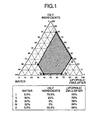
- the present invention provides a W/O/W type composite emulsion, wherein a W/O type emulsion comprising water, an oil ingredient and a lipophilic emulsifier each in a proportion expressed in term of mass ratio falling within a range enclosed with bold lines in Fig. 1 is dispersed in an external aqueous phase with a water-soluble macromolecule blended therein.
- a W/O/W type composite emulsion with an average particle diameter in a range, within which the dispersing stability in a liquid formulation can be preserved easily, of 2000 nm or below by providing a W/O type emulsion produced as described above while incorporating water, an oil ingredient and a lipophilic emulsifier each in a specific proportion and dispersing the W/O type emulsion in an external aqueous phase with a water-soluble macromolecule, which W/O/W type composite emulsion can preserve the percent inclusion of the medical substances included in the internal aqueous phase at a high level.
- the W/O/W type composite emulsion according to the present invention can make the volume of an internal aqueous phase larger, which enables in turn to drastically increase the quantity of medical substances included in each particle of the W/O/W type composite emulsion.
- polyglycerin fatty acid ester having an HLB value of 10 or less is preferable.
- the polymerization degree of the polyglycerin potion is preferably within the range of from 4 to 12.
- the fatty acid portion of the polyglycerin fatty acid ester is an unsaturated fatty acid, more preferably, unsaturated fatty acid having 16 to 22 carbon atoms, and still more preferably, a hydroxy-unsaturated fatty acid.
- oleic acid, linoleic acid, linolenic acid, ricinoleic acid and erucic acid are preferable and ricinoleic acid is particularly preferable.
- Those especially preferable polyglycerin-condensed ricinoleic acid esters include tetraglycerin-condensed ricinoleic acid ester, hexaglycerin-condensed ricinoleic acid ester, pentaglycerin-condensed ricinoleic acid ester, decaglycerin-condensed ricinoleic acid ester and the like as well as the mixtures thereof.
- Oil ingredients used in the present invention include commonly-used ones such as liquid paraffin, squalane, squalene, tocopherol, tocopherol acetate, tocopherol nicotinate, avocado oil, camellia oil, turtle oil, macadamia nuts oil, corn oil, mink oil, olive oil, rapeseed oil, yolk oil, sesame oil, wheat germ oil, Camellia sasanqua oil, castor oil, safflower oil, cottonseed oil, soybean oil, peanut oil and tricaprilyn, and of these tocopherol acetate is preferable.
- fat-soluble medical substances may be blended in the oil ingredients.
- the preferable water-soluble macromolecules used in the present invention include water-soluble proteins, water-soluble synthetic polymers, water-soluble polysaccharides and the derivatives thereof.
- the water-soluble proteins include casein, sodium caseinate, ⁇ -lactoglobulin, ⁇ -lactalbumin, albumin, gelatin, soybean protein, and of these casein, sodium caseinate, ⁇ -lactoglobulin and ⁇ -lactalbumin are preferable.
- the water-soluble synthetic polymers include polyvinyl alcohol, polyvinyl pyrrolidone, carboxyvinyl polymer, polyvinyl methyl ether and poly(sodium acrylate), and of these polyvinyl alcohol and polyvinyl pyrrolidone are preferable.
- the water-soluble polysaccharides or the derivatives thereof include xanthan gum, gelan gum, dextran, pullulan, gum arabic, carrageenan, locust bean gum, dextrin, guar gum, pectin, sodium alginate, hydroxypropylcellulose, hydroxypropyl methylcellulose, methylcellulose, hydroxyethylcellulose and carboxylmethylcellulose, and of these xanthan gum and hydroxypropylcellulose are preferable.
- the water-soluble macromolecules can be used in combination of two or more.
- the blend proportion of the water-soluble macromolecule according to the present invention preferably ranges from 0.001 to 20% by mass, and more preferably from 0.01 to 10% by mass, of the external aqueous phase.
- the blend proportion of the water-soluble macromolecule is too small, it is difficult to produce a homogeneous and fine W/O/W type composite emulsion, while the blend proportion of the water-soluble macromolecule is too large, the resultant W/O/W type composite emulsion has an undesirably high viscosity for internal application.
- the advantage of the present invention is fully exhibited, but even when commonly-used water-soluble medical substances are blended therein, the advantage can be expected inimprovement of the stability.
- the blend proportion of the water-soluble macromolecule that can be blended in the internal aqueous phase varies depending upon the solubility, but the advantages of the present invention can be achieved by adjusting the blend proportions of the oil ingredient and lipophilic emulsifier taking into considerations the quantity of internal aqueous phase after the medical substances have been dissolved therein so as to meet the presently recited blend proportion of each of the components.
- commercial value of the product can be improved by optionally blending pharmaceutical agents, other components, taste or odor reforming agents, pH adjusting agents, preservatives and the like in the external aqueous phase so far as the effect of the present invention is not adversely affected.
- the W/O/W type composite emulsion according to the present invention can be produced as described below.
- an oil phase such as an oil ingredient and lipophilic emulsifier is put into a container.
- the container is set on an agitator such as a vacuum emulsifying machine.
- the mixture is heated while agitating to a temperature in the approximate range of from 50 to 90°C, dissolved and homogenized.
- the resultant mixture is added gradually a specified quantity of an aqueous phase containing substances and optional additives to be included in the internal aqueous phase, and the resultant mixture is emulsified while agitating the same at a constant temperature in the approximate range of from 50 to 90°C.
- the resultant emulsion is cooled to 20 to 40°C while agitating for a certain period of time to obtain a W/O type emulsion.
- the W/O type emulsion is formed so as to have an average particle diameter of from approximately 10 to 500 nm.
- the W/O/W type composite emulsion can be produced by further dispersing this W/O type emulsion in an external aqueous phase containing a specified quantity of a water-soluble macromolecule and optional additives with any of the ordinary methods such as high-pressure homogenizer method, high-speed agitating method, ultrasonic wave emulsifying method and membrane emulsifying method. In addition, heating may be performed, if necessary, in the step of preparing the W/O/W type composite emulsion.
- a Internal aqueous phase Ferric ammonium citrate 8.5 g Water 76.5 g b: Oil ingredient Tocopherol acetate 37.5 g c: Lipophilic emulsifier Polyglycerin-condensed ricinoleic acid ester (produced by Sakamoto Yakuhin Kogyo Co., Ltd., CRS-75) 127.5 g
- Components b and c were heated to 70 to 80°C, and were homogeneously mixed and dissolved. Then the component a was gradually added to the resultant mixture while agitating. The mixture was agitated and emulsified while maintaining the liquid temperature at approximately 70 to 80°C. The resultant emulsion was further agitated for a certain period of time while gradually cooling it to a temperature of from 20 to 40°C to obtain a W/O type emulsion.
- the average particle diameter of the W/O type emulsion determined with a grain size distribution measuring device based on dynamic light scattering system was 113.8 nm.
- the W/O type emulsion obtained as described above was added, while agitating it with a homogenizer, to 180 g of an aqueous solution containing 0.5% by mass of sodium caseinate and 20% by mass of sugar, to obtain a W/O/W type composite emulsion with a relatively large particle diameter. Thereafter, the W/O/W type composite emulsion was passed through a perforated membrane to obtain a fine W/O/W type composite emulsion with an average particle diameter of 799.6 nm. The average particle diameter of the W/O/W type composite emulsion was determined with a grain size distribution measuring device based on laser beam diffraction/scattering system (HORIBA LA-920).
- Percent inclusion (%) (Wi - Wo x A)/Wi x 100 wherein Wi is a mass of substances included in the W/O/W type composite emulsion; Wo is a mass of substances included in the external aqueous phase; and A is a quotient of the mass of external aqueous phase by the mass of W/O/W type composite emulsion ((mass of external aqueous phase)/(mass of W/O/W type composite emulsion)).
- the mass of the substances included in the W/O/W type composite emulsion was measured after preprocessing by means of wet cineration method, etc., whereas the mass of the substances included in the external aqueous phase was measured after subjecting the W/O/W type composite emulsion to centrifugation to separate the particles of the W/O/W type composite emulsion from the external aqueous phase, each with atomic absorption method, respectively.
- the percent inclusion of the included substances was 98.29%.
- Example 1 Each of the samples was prepared with the composition shown in Table 1 in the same production method as that employed in Example 1. The average particle diameter of the W/O type emulsion was also measured in the same manner as that employed in Example 1.
- FAC indicates ferric ammonium citrate
- PGCR indicates polyglycerin-condensed ricinoleic acid ester (produced by Sakamoto Kogyo Co., Ltd., CRS-75).
- the W/O/W type composite emulsion was prepared by the same production method as that employed in Example 1.
- the average particle diameter of the W/O/W type composite emulsion was also measured in the same manner as that in Example 1.
- the percent inclusion of the substances (In this case, the included substance was iron) in the W/O/W type composite emulsion was measured in the same manner as that in Example 1.
- the W/O/W type composite emulsions were very fine as well as they met the requirement that the value obtained by dividing the percent inclusion (%) of the medical substances dissolved in the internal aqueous phase of the W/O/W type composite emulsion by the common logarithm for the average particle diameter of the W/O/W type composite emulsion (nm) (B/Log 10 C in Table 1) is 27 or more (See Examples 1 to 8).
- Each of the samples was prepared with the composition shown in Table 2 or 3 by the same production method as that employed in Example 1.
- the average particle diameter of the W/O type emulsion was also measured in the same manner as that employed in Example 1.
- the percent inclusion of the included substances (the included substance was iron in the Examples herein) in the fine W/O/W type composite emulsion was measured in the same manner as that employed in Example 1.
Landscapes
- Health & Medical Sciences (AREA)
- Chemical & Material Sciences (AREA)
- Animal Behavior & Ethology (AREA)
- General Health & Medical Sciences (AREA)
- Medicinal Chemistry (AREA)
- Pharmacology & Pharmacy (AREA)
- Epidemiology (AREA)
- Life Sciences & Earth Sciences (AREA)
- Oil, Petroleum & Natural Gas (AREA)
- Dispersion Chemistry (AREA)
- Public Health (AREA)
- Veterinary Medicine (AREA)
- Medicinal Preparation (AREA)
- Processes Of Treating Macromolecular Substances (AREA)
- Compositions Of Macromolecular Compounds (AREA)
- Medical Preparation Storing Or Oral Administration Devices (AREA)
- Colloid Chemistry (AREA)
Abstract
A W/O/W type composite emulsion, wherein a
W/O type emulsion containing water, an oil ingredient
and a lipophilic emulsifier each in a proportion
expressed in term of mass ratio falling within a range
enclosed with bold lines in Fig. 1 is dispersed in an
external aqueous phase with a water-soluble
macromolecule blended therein has a sufficient
stability, and permits preserving a percent inclusion
of medical substances included in an internal aqueous
phase of the W/O/W type composite emulsion at a high
level.
Because of the characteristics, it is now
possible to blend in a liquid formulation medical
substances having an unfavorable taste or unstable
medical substances which have to date hardly been
included in liquid formulations with low viscosity, so
that the W/O/W type composite emulsion can be utilized
for liquid formulations including a liquid formulation
for internal application, injections, etc.
Description
The present invention relates to a W/O/W type
composite emulsion.
Liquid formulations are a type of formulation
well adapted to use by ordinary people. For instance,
liquid formulations for internal application can easily
be administered to the aged people as well as to
infants and children, who have low swallowing
capability, so that liquid formulations are widely used
as a medicine or a functional food.
However, when medical substances having
unpleasant taste such as bitterness are blended in a
liquid formulation for internal application, the taste
of the medical substances is directly felt by the user,
so that the taste of the liquid formulation itself
becomes disadvantageously unpleasant. Further, in a
liquid formulation, the added medical substances easily
react with each other, and therefore it has been
difficult to blend medical substances each having high
reactivity in a liquid formulation.
To prevent the taste of a liquid formulation
from becoming unpleasant, the method of masking the
unpleasant taste of a liquid formulation by blending
various types of taste-improving agents in the liquid
formulation is often employed. In this method of
masking the unpleasant taste by blending taste-improving
agents therein, however, there are several
restrictions such as the limited quantity of medical
substances which can be blended in the liquid
formulation.
As a method of blending medical substances in
a liquid formulation in the stable state, the method of
emulsifying the liquid formulation is also known. As
water-soluble medical substances and fat-soluble
medical substances can be blended together in an
emulsion, many reports have been made for application
of emulsions, for instance, in medicines. However,for
conventional O/W type emulsions, it is difficult to
prevent the medical substances contained therein from
reacting with each other.
W/O/W type composite emulsions are
advantageous in that they permit blending of water-soluble
medical medicines, which are generally not
adapted to blending due to the stability and taste, in
an internal aqueous phase. They are also advantageous
in that they permit preparation of an administrative
preparation in which such medical substances that
easily react to each other and can hardly be blended
together are incorporated in combination into a
preparation, since the medical substances can be
isolated from each other by including some of the
medical substances in an internal aqueous phase and the
others in an external aqueous phase. As the W/O/W type
composite emulsions are generally low in their
stability, they are used in creamy preparations with
high viscosity in which the stability is relatively
preserved; however, there has been no report on use of
W/O/W composite emulsions in such a preparation that is
used as a liquid formulation for internal application
with a viscosity of 150 mPa•s or below.
There has generally been known for emulsions
that, the smaller the particle diameter of emulsions,
the higher the dispersion stability thereof in a liquid
formulation is. When the particle diameter of W/O/W
type composite emulsion is made smaller, however,
medical substances flow out from the internal aqueous
phase, which disadvantageously makes the percent
inclusion (a relative quantity of medical substances
included in the internal aqueous phase) smaller.
Therefore, in the range of the particle diameter from
20 to 2000 nm in which the dispersion stability in a
liquid formulation can be relatively well preserved, it
has been difficult to produce the W/O/W type composite
emulsion at a high percent inclusion.
Further the utility value of the W/O/W type
composite emulsion becomes higher as the quantity of
medical substances which can be included in one
particle of the emulsion is larger. However, when the
quantity of medical substances included in one particle
of emulsion becomes larger, the percent inclusion of
medical substances generally becomes lower.
The percent inclusion of medical substances
into emulsion can be determined as satisfactory when a
value (B/Log10C) obtained by dividing the percent
inclusion (%) of medical substances included in the
internal aqueous solution of the W/O/W type composite
emulsion by a common logarithm of the average particle
diameter of the W/O/W type composite emulsion is 27 or
more. Unfortunately, there has been no technique
allowing for production of emulsions having such low
viscosity of 150 mPa • s or below that allows their use
as a liquid formulation and at the same time meeting
the requirements as described above.
As the conventional technique for production
of W/O/W type composite emulsions, JP 4-100536 A
discloses, for instance,technique for production of
W/O/W type composite emulsions by using polyglycerin-condensated
ricinoleic acid ester, a lipophilic
emulsifier. However, the resulting emulsion cannot be
satisfactorily applied to practical use, because it has
an undesirably large particle diameter and undesirably
low dispersion stability.
As the technique for obtaining a W/O/W type
composite emulsion having a minute particle diameter,
JP 4-99716 A describes a technique for producing an
injection, but the injection produced by the technique
cannot be used as a liquid formulation for internal
application because of the unfavorable taste of the
emulsifier.
Although W/O/W or S/O/W type emulsions are
disclosed, for instance, in JP 3-127952 A, JP 10-158152
A, JP 10-203962 A, JP 11-188256 A, JP 11-240840 A, all
the emulsions provided therein have an undesirably
large particle diameter.
The inventors of the present invention made
an extensive study with an objective to obtain a W/O/W
type composite emulsion which has a sufficient
stability even in the fine particle state and which can
preserve the percent inclusion of medical substances
included in the internal aqueous phase thereof at a
high level. As a result, they have found that
producing a W/O type emulsion by blending water, an oil
ingredient and a lipophilic emulsifier each with a
specific blend ratio different from that in the
products based on the conventional technique and then
producing a W/O/W type composite emulsion by dispersing
the W/O type emulsion in an aqueous phase thereof with
a water-soluble macromolecule provide a W/O/W type
composite emulsion which has an extremely small
particle diameter and sufficient stability and can
preserve the percent inclusion of medical substances
included in an internal aqueous phase at a high level.
The present invention has been accomplished based on
those findings.
Thus, the present invention provides a W/O/W
type composite emulsion, wherein a W/O type emulsion
comprising water, an oil ingredient and a lipophilic
emulsifier each in a proportion expressed in term of
mass ratio falling within a range enclosed with bold
lines in Fig. 1 is dispersed in an external aqueous
phase with a water-soluble macromolecule blended
therein.
According to the present invention, there is
provided a W/O/W type composite emulsion with an
average particle diameter in a range, within which the
dispersing stability in a liquid formulation can be
preserved easily, of 2000 nm or below, by providing a
W/O type emulsion produced as described above while
incorporating water, an oil ingredient and a lipophilic
emulsifier each in a specific proportion and dispersing
the W/O type emulsion in an external aqueous phase with
a water-soluble macromolecule, which W/O/W type
composite emulsion can preserve the percent inclusion
of the medical substances included in the internal
aqueous phase at a high level. In addition, the W/O/W
type composite emulsion according to the present
invention can make the volume of an internal aqueous
phase larger, which enables in turn to drastically
increase the quantity of medical substances included in
each particle of the W/O/W type composite emulsion.
As the lipophilic emulsifier used in the
present invention, polyglycerin fatty acid ester having
an HLB value of 10 or less is preferable.
In the case described above where
polyglycerin fatty acid ester is used as the lipophilic
emulsifier, the polymerization degree of the
polyglycerin potion is preferably within the range of
from 4 to 12. Preferably, the fatty acid portion of
the polyglycerin fatty acid ester is an unsaturated
fatty acid, more preferably, unsaturated fatty acid
having 16 to 22 carbon atoms, and still more
preferably, a hydroxy-unsaturated fatty acid.
Specifically, oleic acid, linoleic acid, linolenic
acid, ricinoleic acid and erucic acid are preferable
and ricinoleic acid is particularly preferable.
Those especially preferable polyglycerin-condensed
ricinoleic acid esters include tetraglycerin-condensed
ricinoleic acid ester, hexaglycerin-condensed
ricinoleic acid ester, pentaglycerin-condensed
ricinoleic acid ester, decaglycerin-condensed
ricinoleic acid ester and the like as well as the
mixtures thereof.
Oil ingredients used in the present invention
include commonly-used ones such as liquid paraffin,
squalane, squalene, tocopherol, tocopherol acetate,
tocopherol nicotinate, avocado oil, camellia oil,
turtle oil, macadamia nuts oil, corn oil, mink oil,
olive oil, rapeseed oil, yolk oil, sesame oil, wheat
germ oil, Camellia sasanqua oil, castor oil, safflower
oil, cottonseed oil, soybean oil, peanut oil and
tricaprilyn, and of these tocopherol acetate is
preferable. In addition, fat-soluble medical
substances may be blended in the oil ingredients.
The preferable water-soluble macromolecules
used in the present invention include water-soluble
proteins, water-soluble synthetic polymers, water-soluble
polysaccharides and the derivatives thereof.
The water-soluble proteins include casein,
sodium caseinate, β-lactoglobulin, α-lactalbumin,
albumin, gelatin, soybean protein, and of these casein,
sodium caseinate, β-lactoglobulin and α-lactalbumin
are preferable.
The water-soluble synthetic polymers include
polyvinyl alcohol, polyvinyl pyrrolidone, carboxyvinyl
polymer, polyvinyl methyl ether and poly(sodium
acrylate), and of these polyvinyl alcohol and polyvinyl
pyrrolidone are preferable.
The water-soluble polysaccharides or the
derivatives thereof include xanthan gum, gelan gum,
dextran, pullulan, gum arabic, carrageenan, locust
bean gum, dextrin, guar gum, pectin, sodium alginate,
hydroxypropylcellulose, hydroxypropyl methylcellulose,
methylcellulose, hydroxyethylcellulose and
carboxylmethylcellulose, and of these xanthan gum and
hydroxypropylcellulose are preferable.
The water-soluble macromolecules can be used
in combination of two or more.
The blend proportion of the water-soluble
macromolecule according to the present invention
preferably ranges from 0.001 to 20% by mass, and more
preferably from 0.01 to 10% by mass, of the external
aqueous phase.
When the blend proportion of the water-soluble
macromolecule is too small, it is difficult to
produce a homogeneous and fine W/O/W type composite
emulsion, while the blend proportion of the water-soluble
macromolecule is too large, the resultant W/O/W
type composite emulsion has an undesirably high
viscosity for internal application.
When medical substances having unpleasant
taste or easily reacting with other components are
blended in the internal aqueous phase of the W/O/W type
composite emulsion according to the present invention,
the advantage of the present invention is fully
exhibited, but even when commonly-used water-soluble
medical substances are blended therein, the advantage
can be expected inimprovement of the stability.
The blend proportion of the water-soluble
macromolecule that can be blended in the internal
aqueous phase varies depending upon the solubility, but
the advantages of the present invention can be achieved
by adjusting the blend proportions of the oil
ingredient and lipophilic emulsifier taking into
considerations the quantity of internal aqueous phase
after the medical substances have been dissolved
therein so as to meet the presently recited blend
proportion of each of the components.
In the present invention, commercial value of
the product can be improved by optionally blending
pharmaceutical agents, other components, taste or odor
reforming agents, pH adjusting agents, preservatives
and the like in the external aqueous phase so far as
the effect of the present invention is not adversely
affected.
The W/O/W type composite emulsion according
to the present invention can be produced as described
below. At first, an oil phase such as an oil
ingredient and lipophilic emulsifier is put into a
container. The container is set on an agitator such as
a vacuum emulsifying machine. Then the mixture is
heated while agitating to a temperature in the
approximate range of from 50 to 90°C, dissolved and
homogenized. Then to the resultant mixture is added
gradually a specified quantity of an aqueous phase
containing substances and optional additives to be
included in the internal aqueous phase, and the
resultant mixture is emulsified while agitating the
same at a constant temperature in the approximate range
of from 50 to 90°C. Thereafter, the resultant emulsion
is cooled to 20 to 40°C while agitating for a certain
period of time to obtain a W/O type emulsion. At this
point of time, it is preferable that the W/O type
emulsion is formed so as to have an average particle
diameter of from approximately 10 to 500 nm. The W/O/W
type composite emulsion can be produced by further
dispersing this W/O type emulsion in an external
aqueous phase containing a specified quantity of a
water-soluble macromolecule and optional additives with
any of the ordinary methods such as high-pressure
homogenizer method, high-speed agitating method,
ultrasonic wave emulsifying method and membrane
emulsifying method. In addition, heating may be
performed, if necessary, in the step of preparing the
W/O/W type composite emulsion.
The present invention is further described in
detail with reference to Examples and Test Examples.
| a: Internal aqueous phase | |
| Ferric ammonium citrate | 8.5 g |
| Water | 76.5 g |
| b: Oil ingredient | |
| Tocopherol acetate | 37.5 g |
| c: Lipophilic emulsifier | |
| Polyglycerin-condensed ricinoleic acid ester (produced by Sakamoto Yakuhin Kogyo Co., Ltd., | |
| CRS-75) | 127.5 g |
Components b and c were heated to 70 to 80°C,
and were homogeneously mixed and dissolved. Then the
component a was gradually added to the resultant
mixture while agitating. The mixture was agitated and
emulsified while maintaining the liquid temperature at
approximately 70 to 80°C. The resultant emulsion was
further agitated for a certain period of time while
gradually cooling it to a temperature of from 20 to
40°C to obtain a W/O type emulsion.
The average particle diameter of the W/O type
emulsion determined with a grain size distribution
measuring device based on dynamic light scattering
system (NICOMP Model 370 (produced by HIAC/ROYCO)) was
113.8 nm.
20 g of the W/O type emulsion obtained as
described above was added, while agitating it with a
homogenizer, to 180 g of an aqueous solution containing
0.5% by mass of sodium caseinate and 20% by mass of
sugar, to obtain a W/O/W type composite emulsion with a
relatively large particle diameter. Thereafter, the
W/O/W type composite emulsion was passed through a
perforated membrane to obtain a fine W/O/W type
composite emulsion with an average particle diameter of
799.6 nm. The average particle diameter of the W/O/W
type composite emulsion was determined with a grain
size distribution measuring device based on laser beam
diffraction/scattering system (HORIBA LA-920).
The percent inclusion of the substances
included in the W/O/W type composite emulsion was
calculated through the following equation:
Percent inclusion (%) = (Wi - Wo x A)/Wi x
100
wherein Wi is a mass of substances included in the
W/O/W type composite emulsion; Wo is a mass of
substances included in the external aqueous phase; and
A is a quotient of the mass of external aqueous phase
by the mass of W/O/W type composite emulsion ((mass of
external aqueous phase)/(mass of W/O/W type composite
emulsion)).
The mass of the substances included in the
W/O/W type composite emulsion was measured after
preprocessing by means of wet cineration method, etc.,
whereas the mass of the substances included in the
external aqueous phase was measured after subjecting
the W/O/W type composite emulsion to centrifugation to
separate the particles of the W/O/W type composite
emulsion from the external aqueous phase, each with
atomic absorption method, respectively. As a result,
it was found that the percent inclusion of the included
substances (the included substance was iron in this
case) was 98.29%.
Each of the samples was prepared with the
composition shown in Table 1 in the same production
method as that employed in Example 1. The average
particle diameter of the W/O type emulsion was also
measured in the same manner as that employed in Example
1.
In the table showing the results in the
Examples, FAC indicates ferric ammonium citrate, and
PGCR indicates polyglycerin-condensed ricinoleic acid
ester (produced by Sakamoto Kogyo Co., Ltd., CRS-75).
The W/O/W type composite emulsion was
prepared by the same production method as that employed
in Example 1. The average particle diameter of the
W/O/W type composite emulsion was also measured in the
same manner as that in Example 1.
The percent inclusion of the substances (In
this case, the included substance was iron) in the
W/O/W type composite emulsion was measured in the same
manner as that in Example 1.
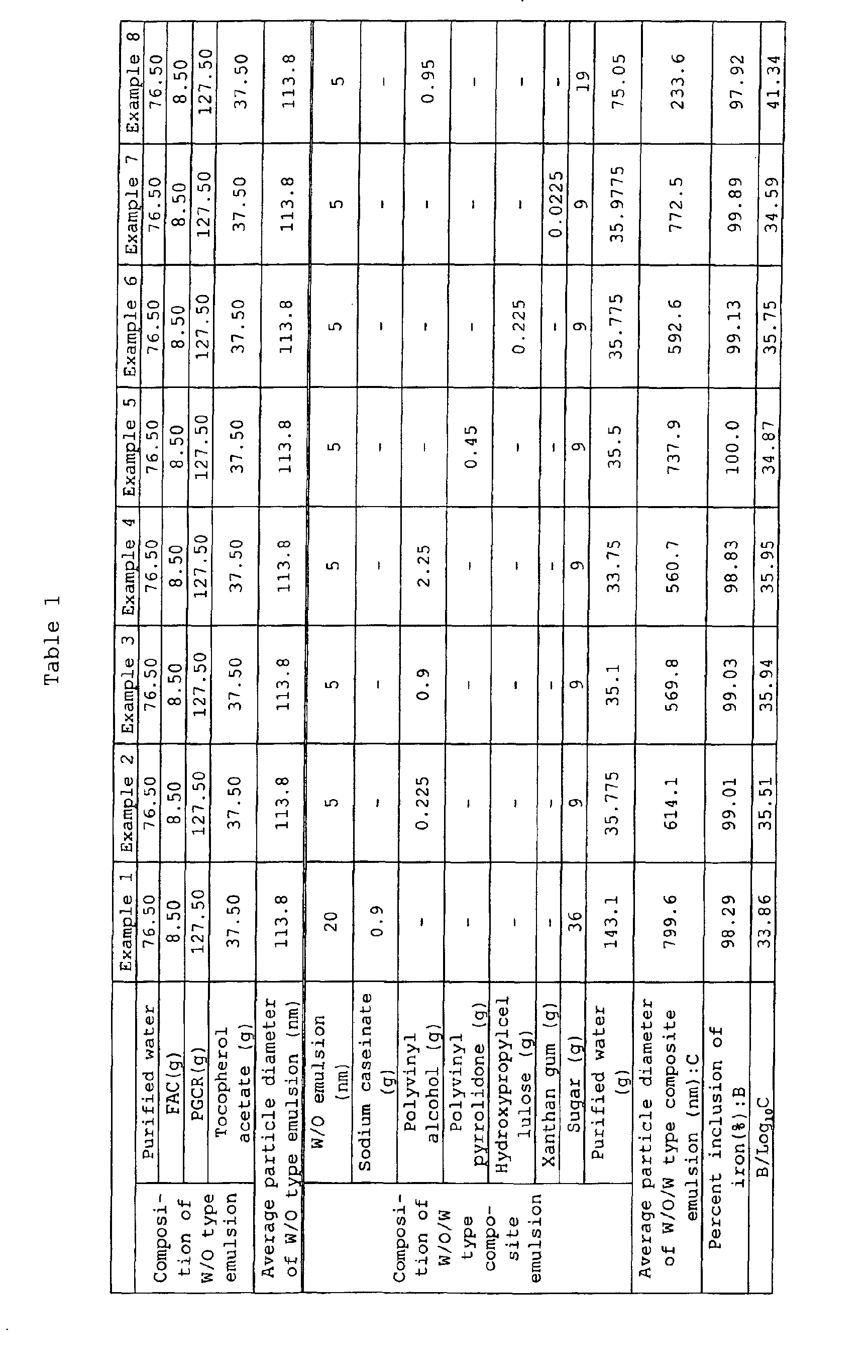
As clearly shown in Table 1, when the W/O
type emulsions having the blend proportions within the
range according to the present invention are dispersed
in an external aqueous phase with a water-soluble
macromolecule such as water-soluble protein, water-soluble
synthetic polymer or water-soluble
polysaccharide, very fine W/O/W type composite
emulsions with a high percent inclusion of medical
substances could be obtained. Further, the W/O/W type
composite emulsions were very fine as well as they met
the requirement that the value obtained by dividing the
percent inclusion (%) of the medical substances
dissolved in the internal aqueous phase of the W/O/W
type composite emulsion by the common logarithm for the
average particle diameter of the W/O/W type composite
emulsion (nm) (B/Log10 C in Table 1) is 27 or more (See
Examples 1 to 8).
Each of the samples was prepared with the
composition shown in Table 2 or 3 by the same
production method as that employed in Example 1. The
average particle diameter of the W/O type emulsion was
also measured in the same manner as that employed in
Example 1.
10 g of the W/O type emulsion obtained as
described above was added, while agitating with a
magnetic stirrer or a homogenizer,to 90 g of an aqueous
solution containing 2% by mass of polyvinyl alcohol and
20% by mass of sugar to obtain a first W/O/W type
composite emulsion with a relatively large particle
diameter. The first W/O/W type composite emulsion was
passed through a perforated membrane to obtain a fine
W/O/W type composite emulsion. The average particle
diameter of the fine W/O/W type composite emulsion was
measured with a grain size distribution measurement
device based on the laser diffraction/scattering system
(HORIBA LA-920).
The percent inclusion of the included
substances (the included substance was iron in the
Examples herein) in the fine W/O/W type composite
emulsion was measured in the same manner as that
employed in Example 1.


As described above, when the W/O type
emulsion having blend proportions within the range
according to the present invention is dispersed in an
external aqueous phase with a water-soluble
macromolecule, a very fine W/O/W type composite
emulsions with a high percent inclusion of medical
substances could be obtained. Further, the W/O/W type
composite emulsions were very fine as well as they met
the requirement that the value obtained by dividing the
percent inclusion (%) of the medical substances
dissolved in the internal aqueous phase of the W/O/W
type composite emulsion by the common logarithm for the
average particle diameter of the W/O/W type composite
emulsion (nm) (B/Log10, C in Table 1) is 27 or more (See
Examples 9 to 15). To the contrary, when the
composition of the W/O type emulsion was outside the
range according to the present invention, any W/O/W
type composite emulsion with excellent characteristics
could not be obtained (See Comparative examples 1 to
5).
With the present invention, it has become
possible to blend medical substances each with
unfavorable taste or unstable medical substances even
in a liquid solution of low viscosity.
Because of the characteristics, now even the
medical substances, which have hardly been blended in a
liquid formulation for internal application, an
injection or the like, can be used for production of
medical drugs.
Claims (16)
- A W/O/W type composite emulsion, wherein a W/O type emulsion comprising water, an oil ingredient and a lipophilic emulsifier each in a proportion expressed in term of mass ratio falling within a range enclosed with bold lines in Fig. 1 is dispersed in an external aqueous phase with a water-soluble macromolecule blended therein.
- The W/O/W type composite emulsion according to claim 1, wherein the external aqueous phase with a water-soluble macromolecule blended therein comprises from 0.001 to 20% by mass of the water-soluble macromolecule.
- The W/O/W type composite emulsion according to claim 1, wherein the emulsion has an average particle diameter falling within the range of from 20 to 2000 nm.
- The W/O/W type composite emulsion according to claim 1, wherein the lipophilic emulsifier is polyglycerin fatty acid ester having an HLB value of 10 or below.
- The W/O/W type composite emulsion according to claim 4, wherein the polyglycerin fatty acid ester having an HLB value of 10 or below is a polyglycerin unsaturated fatty acid ester.
- The W/O/W type composite emulsion according to claim 5, wherein the polyglycerin unsaturated fatty acid ester is a polyglycerin-condensated ricinoleic acid ester.
- The W/O/W type composite emulsion according to claim 1, wherein the water-soluble macromolecule is one or more members selected from the group consisting of water-soluble proteins, water-soluble synthetic polymers, water-soluble polysaccharides and derivatives thereof.
- The W/O/W type composite emulsion according to claim 1, wherein the water-soluble macromolecule is a water-soluble protein.
- The W/O/W type composite emulsion according to claim 8, wherein the water-soluble protein is casein, sodium caseinate, β-lactoglobulin or α-lactoalubumin.
- The W/O/W type composite emulsion according to claim 1, wherein the water-soluble macromolecule is a water-soluble synthetic polymer.
- The W/O/W type composite emulsion according to claim 10, wherein the water-soluble synthetic polymer is polyvinyl alcohol or polyvinyl pyrrolidone.
- The W/O/W type composite emulsion according to claim 1, wherein the water-soluble macromolecule is polysaccharide or a derivative thereof.
- The W/O/W type composite emulsion according to claim 12, wherein the water-soluble polysaccharide or a derivative thereof is xanthan gum or hydroxy propylcellulose.
- The W/O/W type composite emulsion according to claim 1, wherein the emulsion has a value obtained by dividing a percent inclusion (%) of a medical substances dissolved in an internal aqueous phase of the W/O/W type composite emulsion by a common logarithm for an average particle diameter (nm) of the W/O/W type composite emulsion of 27 or more.
- The W/O/W type composite emulsion according to claim 1, wherein the emulsion has a viscosity of 150 mPa•s or below.
- The W/O/W type composite emulsion according to claim 1, wherein the emulsion is a liquid formulation for internal application.
Applications Claiming Priority (3)
| Application Number | Priority Date | Filing Date | Title |
|---|---|---|---|
| JP2000362918 | 2000-11-29 | ||
| JP2000362918 | 2000-11-29 | ||
| PCT/JP2001/010422 WO2002043698A1 (en) | 2000-11-29 | 2001-11-29 | W/o/w composite emulsion |
Publications (2)
| Publication Number | Publication Date |
|---|---|
| EP1346721A1 true EP1346721A1 (en) | 2003-09-24 |
| EP1346721A4 EP1346721A4 (en) | 2009-04-29 |
Family
ID=18834115
Family Applications (1)
| Application Number | Title | Priority Date | Filing Date |
|---|---|---|---|
| EP01998326A Withdrawn EP1346721A4 (en) | 2000-11-29 | 2001-11-29 | COMPOSITE EMULSION W / O |
Country Status (8)
| Country | Link |
|---|---|
| US (1) | US6984691B2 (en) |
| EP (1) | EP1346721A4 (en) |
| JP (1) | JP3930805B2 (en) |
| KR (1) | KR20030059274A (en) |
| CN (1) | CN1482900A (en) |
| AU (2) | AU2002218498B2 (en) |
| CA (1) | CA2430286A1 (en) |
| WO (1) | WO2002043698A1 (en) |
Families Citing this family (17)
| Publication number | Priority date | Publication date | Assignee | Title |
|---|---|---|---|---|
| EP1935258B1 (en) | 2005-10-14 | 2013-02-13 | Knorr Foods Co., Ltd. | W1/o/w2-type double emulsion dressing and method for production thereof |
| AU2006316501A1 (en) * | 2005-11-22 | 2007-05-31 | Nestec S.A. | Easily dispersible lipidic phase |
| WO2007060177A1 (en) | 2005-11-22 | 2007-05-31 | Nestec S.A. | Oil-in-water emulsion and its use for the delivery of functionality |
| BRPI0618861A2 (en) * | 2005-11-23 | 2011-09-13 | Nestec Sa | oil-in-water emulsion for creating new product and powder consistency |
| KR101655346B1 (en) | 2009-11-27 | 2016-09-08 | (주)아모레퍼시픽 | Cosmetic composition stabilized higher oily part |
| CN103827956B (en) * | 2011-09-27 | 2017-06-13 | 皇家飞利浦有限公司 | For the apparatus and method of the dynamic range transform of image |
| WO2014178139A1 (en) * | 2013-05-01 | 2014-11-06 | キユーピー株式会社 | Composite emulsified seasoning |
| CN104642835A (en) * | 2013-11-19 | 2015-05-27 | 丰益(上海)生物技术研发中心有限公司 | Composition containing polyunsaturated fatty acid source and preparation thereof |
| CN108652001B (en) * | 2018-03-08 | 2021-07-20 | 江苏大学 | A kind of preparation method of cyanidin-3-glucoside complex emulsion |
| JPWO2020111144A1 (en) * | 2018-11-29 | 2021-10-28 | デンカ株式会社 | Latex manufacturing method and latex |
| CN109645499A (en) * | 2018-12-27 | 2019-04-19 | 中国农业科学院农产品加工研究所 | Preparation method of complex coacervation embedding system for masking the bitter taste of food-derived active peptides |
| CN110368322A (en) * | 2019-07-30 | 2019-10-25 | 浙江大学 | The preparation method and products thereof of the lactalbumin pectin Composite Double lotion of arbutin and coumaric acid is embedded simultaneously |
| IL269564B2 (en) | 2019-09-23 | 2023-11-01 | Keter Home & Garden Products Ltd | Work donkey |
| CN111631271A (en) * | 2020-05-22 | 2020-09-08 | 南昌大学 | A kind of preparation method of stable W/O/W type multiple emulsion |
| CN112210357B (en) * | 2020-10-23 | 2023-03-03 | 中国石油大学(华东) | A W/O/W type multiple emulsion water plugging system and its preparation method |
| CN112826009B (en) * | 2021-01-14 | 2022-08-12 | 苏州鲜活饮品股份有限公司 | Double-emulsification water-soluble pigment emulsion and preparation method thereof |
| CN115844812B (en) * | 2022-12-15 | 2026-05-05 | 邹威 | A W/O/W gel-type cream and its preparation method |
Family Cites Families (14)
| Publication number | Priority date | Publication date | Assignee | Title |
|---|---|---|---|---|
| US4328149A (en) * | 1980-01-30 | 1982-05-04 | Calgon Corporation | Polymerization method utilizing a three-phase emulsion system |
| JPS58143831A (en) * | 1982-02-22 | 1983-08-26 | Taihoo Kogyo Kk | W/O/W composite emulsion |
| JPS5980326A (en) * | 1982-10-29 | 1984-05-09 | Kobayashi Kooc:Kk | Preparation of w/o/w type emulsion |
| JPS60199833A (en) | 1984-03-26 | 1985-10-09 | Meiji Milk Prod Co Ltd | Preparation of w/o/w-type composite emulsion for pharmaceutical, cosmetic, etc. |
| JPS60203139A (en) * | 1984-03-27 | 1985-10-14 | Meiji Milk Prod Co Ltd | Production of w/o/w type complex emulsion for food |
| JP2889891B2 (en) * | 1989-10-11 | 1999-05-10 | 明治乳業株式会社 | W / O / W composite emulsion release controlled by salt and temperature |
| JP2720101B2 (en) | 1990-08-17 | 1998-02-25 | 明治乳業株式会社 | W / O / W composite emulsion for injection and method for producing the same |
| JP2772860B2 (en) * | 1990-08-17 | 1998-07-09 | 明治乳業株式会社 | W / O / W composite emulsion and method for producing the same |
| JP4113990B2 (en) | 1996-07-05 | 2008-07-09 | 宮崎県 | Anticancer agent-containing emulsion preparation and method for producing the same |
| JPH10203962A (en) | 1997-01-27 | 1998-08-04 | Miyazaki Pref Gov | Drug sustained release emulsified preparation and method for producing the same |
| JP3789027B2 (en) | 1997-07-17 | 2006-06-21 | 株式会社資生堂 | W / O / W type composite emulsion |
| JPH11188256A (en) | 1997-12-26 | 1999-07-13 | Nisshin Oil Mills Ltd:The | Oily composition and its production |
| JP4365900B2 (en) * | 1998-02-23 | 2009-11-18 | 太陽化学株式会社 | Allergy prevention composition |
| JP4478264B2 (en) * | 1999-11-29 | 2010-06-09 | ライオン株式会社 | W / O / W type composite emulsion |
-
2001
- 2001-11-29 CN CNA018214584A patent/CN1482900A/en active Pending
- 2001-11-29 AU AU2002218498A patent/AU2002218498B2/en not_active Ceased
- 2001-11-29 US US10/432,933 patent/US6984691B2/en not_active Expired - Fee Related
- 2001-11-29 WO PCT/JP2001/010422 patent/WO2002043698A1/en not_active Ceased
- 2001-11-29 EP EP01998326A patent/EP1346721A4/en not_active Withdrawn
- 2001-11-29 JP JP2002545671A patent/JP3930805B2/en not_active Expired - Fee Related
- 2001-11-29 CA CA002430286A patent/CA2430286A1/en not_active Abandoned
- 2001-11-29 KR KR10-2003-7007052A patent/KR20030059274A/en not_active Ceased
- 2001-11-29 AU AU1849802A patent/AU1849802A/en active Pending
Also Published As
| Publication number | Publication date |
|---|---|
| JPWO2002043698A1 (en) | 2004-04-02 |
| US20040010078A1 (en) | 2004-01-15 |
| WO2002043698A1 (en) | 2002-06-06 |
| AU1849802A (en) | 2002-06-11 |
| CN1482900A (en) | 2004-03-17 |
| US6984691B2 (en) | 2006-01-10 |
| AU2002218498B2 (en) | 2006-03-30 |
| CA2430286A1 (en) | 2002-06-06 |
| KR20030059274A (en) | 2003-07-07 |
| JP3930805B2 (en) | 2007-06-13 |
| EP1346721A4 (en) | 2009-04-29 |
Similar Documents
| Publication | Publication Date | Title |
|---|---|---|
| US6984691B2 (en) | W/O/W composite emulsion | |
| JP3974170B2 (en) | Micellar nanoparticles | |
| JP2643217B2 (en) | Aqueous liquid of fat-soluble substance | |
| KR910009048B1 (en) | Transparent composition | |
| JPS60199833A (en) | Preparation of w/o/w-type composite emulsion for pharmaceutical, cosmetic, etc. | |
| JPS63150221A (en) | Emulsified composition containing crystalline drug | |
| KR20010006480A (en) | Microemulsion | |
| JP3298867B2 (en) | Transparent composition | |
| JPH0356777B2 (en) | ||
| JP3358225B2 (en) | Water-soluble compound oil-solubilized preparation and production method thereof | |
| JPH0570494B2 (en) | ||
| JPH0316173B2 (en) | ||
| JPH0435212B2 (en) | ||
| JPWO2002043697A1 (en) | W / O / W composite emulsion | |
| JP2004000924A (en) | W / O / W composite emulsion | |
| JP2950348B2 (en) | Fat emulsion and method for producing the same | |
| JPH08245370A (en) | O/w-type emulsion composition | |
| JP4415560B2 (en) | W / O / W type composite emulsion | |
| JP2772860B2 (en) | W / O / W composite emulsion and method for producing the same | |
| JP2004323366A (en) | W / O / W composite emulsion | |
| JP2005097291A (en) | W / O / W type composite emulsion | |
| JP2004161650A (en) | W / O / W dry emulsion | |
| JPH1118696A (en) | Oil-containing gel-like composition and oil-in-water type emulsified composition | |
| JPH0824616A (en) | W / O emulsifier composition | |
| JPS59169531A (en) | Preparation of w/o/w type composite emulsion |
Legal Events
| Date | Code | Title | Description |
|---|---|---|---|
| PUAI | Public reference made under article 153(3) epc to a published international application that has entered the european phase |
Free format text: ORIGINAL CODE: 0009012 |
|
| 17P | Request for examination filed |
Effective date: 20030528 |
|
| AK | Designated contracting states |
Kind code of ref document: A1 Designated state(s): AT BE CH CY DE DK ES FI FR GB GR IE IT LI LU MC NL PT SE TR |
|
| AX | Request for extension of the european patent |
Extension state: AL LT LV MK RO SI |
|
| A4 | Supplementary search report drawn up and despatched |
Effective date: 20090327 |
|
| STAA | Information on the status of an ep patent application or granted ep patent |
Free format text: STATUS: THE APPLICATION HAS BEEN WITHDRAWN |
|
| 18W | Application withdrawn |
Effective date: 20090629 |