EP1346311B1 - Resolution enhancement by nearest neighbor classified filtering - Google Patents
Resolution enhancement by nearest neighbor classified filtering Download PDFInfo
- Publication number
- EP1346311B1 EP1346311B1 EP01986017A EP01986017A EP1346311B1 EP 1346311 B1 EP1346311 B1 EP 1346311B1 EP 01986017 A EP01986017 A EP 01986017A EP 01986017 A EP01986017 A EP 01986017A EP 1346311 B1 EP1346311 B1 EP 1346311B1
- Authority
- EP
- European Patent Office
- Prior art keywords
- vector
- class
- weighted
- image vector
- nearest neighbor
- Prior art date
- Legal status (The legal status is an assumption and is not a legal conclusion. Google has not performed a legal analysis and makes no representation as to the accuracy of the status listed.)
- Expired - Lifetime
Links
Images

Classifications
-
- G—PHYSICS
- G06—COMPUTING OR CALCULATING; COUNTING
- G06T—IMAGE DATA PROCESSING OR GENERATION, IN GENERAL
- G06T5/00—Image enhancement or restoration
- G06T5/20—Image enhancement or restoration using local operators
-
- G—PHYSICS
- G06—COMPUTING OR CALCULATING; COUNTING
- G06T—IMAGE DATA PROCESSING OR GENERATION, IN GENERAL
- G06T3/00—Geometric image transformations in the plane of the image
- G06T3/40—Scaling of whole images or parts thereof, e.g. expanding or contracting
- G06T3/4007—Scaling of whole images or parts thereof, e.g. expanding or contracting based on interpolation, e.g. bilinear interpolation
-
- G—PHYSICS
- G06—COMPUTING OR CALCULATING; COUNTING
- G06F—ELECTRIC DIGITAL DATA PROCESSING
- G06F18/00—Pattern recognition
- G06F18/20—Analysing
- G06F18/24—Classification techniques
- G06F18/241—Classification techniques relating to the classification model, e.g. parametric or non-parametric approaches
- G06F18/2413—Classification techniques relating to the classification model, e.g. parametric or non-parametric approaches based on distances to training or reference patterns
- G06F18/24133—Distances to prototypes
- G06F18/24137—Distances to cluster centroïds
-
- G—PHYSICS
- G06—COMPUTING OR CALCULATING; COUNTING
- G06V—IMAGE OR VIDEO RECOGNITION OR UNDERSTANDING
- G06V10/00—Arrangements for image or video recognition or understanding
- G06V10/40—Extraction of image or video features
- G06V10/46—Descriptors for shape, contour or point-related descriptors, e.g. scale invariant feature transform [SIFT] or bags of words [BoW]; Salient regional features
- G06V10/469—Contour-based spatial representations, e.g. vector-coding
-
- G—PHYSICS
- G06—COMPUTING OR CALCULATING; COUNTING
- G06V—IMAGE OR VIDEO RECOGNITION OR UNDERSTANDING
- G06V10/00—Arrangements for image or video recognition or understanding
- G06V10/70—Arrangements for image or video recognition or understanding using pattern recognition or machine learning
- G06V10/764—Arrangements for image or video recognition or understanding using pattern recognition or machine learning using classification, e.g. of video objects
Definitions
- the invention is related to the field of image processing.
- a second limitation with the binary-threshold classification is that it is sensitive to errors and changes in a single pixel. This sensitivity adds some randomness to the classification, driving the classes more towards mono-class behavior than they would otherwise have. While this provides smooth class transitions, it limits performance.
- US,5,852,470 discloses a signal converting apparatus for enhancing image resolution, and in particular for up converting a standard definition image into a high definition image.
- the apparatus receives a video signal, which is passed to a classification unit and a plurality of prediction calculators, within a prediction calculation unit.
- the prediction calculation unit forms interpolated pixels of an enhanced resolution version of the input video signal. Coefficients of the prediction calculation unit, which are used to form the interpolated pixels are selected in accordance with a classification of the input video signal which is determined by the classification unit.
- a method and apparatus for enhancing image resolution by determining a nearest neighbor class for an input image vector from a plurality of spatial classes are disclosed.
- the nearest neighbor class is determined by first receiving the input image vector that is to be classified into one of several spatial classes. Each spatial class has a corresponding normalized mean class vector. The input image vector is normalized. Then, the weighted distances from the normalized image vector to each normalized mean class vector are determined.
- the class vector which is the nearest neighbor class to the input image vector is determined based on the weighted distances.
- a filter corresponding to the nearest neighbor class is applied to the input image vector to enhance the resolution of the image.
- a method and apparatus for enhancing image resolution by determining a nearest neighbor class for an input image vector from a plurality of spatial classes are disclosed.
- the nearest neighbor class is determined by first receiving the input image vector that is to be classified into one of several spatial classes. Each spatial class has a corresponding normalized mean class vector. The input image vector is normalized. Then, the weighted distances from the normalized image vector to each normalized mean class vector are determined. The class vector which is the nearest neighbor class to the input image vector is determined based on the weighted distances. A filter corresponding to the nearest neighbor class is applied to the input image vector to enhance the resolution of the image.
- Spatial filtering has many uses in signal processing. For example, given the set of pixels indicated as circles in Figure 1 , the value of a sample from the location marked with a cross can be estimated. A series of similar estimations could be used to generate an enhanced resolution image, as shown in Figure 2 .
- class vectors can be generated and used to improve the image resolution using nearest neighbor classified filtering.
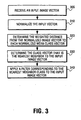
- a method for nearest neighbor classified filtering is shown in Figure 3 .
- the nearest neighbor class for each input image vector can be determined using the normalized mean class vector of each class and a distance measure to determine the relative distance from the input image vector to each normalized mean class vector.
- an input image vector is received, 305.
- the input image vector is normalized, 310, so that pixels near the center of the tap are most highly weighted as these are dearly the most correlated with the final output.
- the weighted distance from the normalized image vector to each class vector is determined, 320.
- the class vector that is the nearest neighbor to the input image vector is determined, 330.
- a filter corresponding to the nearest neighbor class is applied to the input image vector, 340, to enhance the resolution of the image.
- nearest neighbor classification can be used to classify input image data, as shown in Table 3 below, into one of two classes.
- the normalized mean class vectors for the two classes are shown in Tables 1 and 2 below.
- the normalized mean class vectors are used so that taps near the center of the filter are near the 0 level. This may not be achieved perfectly and so the center tap may have a slight offset from 0. This offset provides a means of class reduction, because classes can be inverted as necessary such that the center tap is always non-negative. Furthermore, classes with very small dynamic ranges are not fully expanded, so that quantization noise does not have as much weight as real edges in the training process.
- Table 1 shows an example of a normalized mean class vector for a first class, class 1.
- Table 1 0.17622 -2.73143 0.44055 0.17622 -1.67411 -0.88111 0.35244 0.26433 0.26433 0.00000 0.61678 0.52866 0.35244
- Table 2 shows an example of a normalized mean class vector for a second class, class 2.
- Table 2 -0.82990 -0.41495 -1.65981 -1.65981 1.24486 0.82990 0.41495 -0.82990 0.82990 0.41495 -0.41495 1.24486 0.00000
- Table 3 shows an input image vector to be classified into either class 1 or class 2 using nearest neighbor classification.
- Table 3 104 106 97 96 64 78 94 92 101 118 137 141 122
- the input image vector is normalized by subtracting the weighted mean from each element, and dividing by the standard deviation.
- the weighted mean of the input image vector is determined by multiplying each element of the input image vector by a corresponding distance weight, such as the weights shown in Table 4 below. Then, the weighted elements are added to form the weighted mean.
- Each element of the input image vector is multiplied by a corresponding distance weight, so that pixels near the center of the tap are most highly weighted as these are clearly the most correlated with the final output. The influence a tap has on the classification should drop off as the distance to the estimation coordinate is increased.
- One method of determining a set of distance weights is to initialize each weight to the reciprocal of the Euclidean distance from the tap to the estimation coordinate and then normalize the weights such that they sum to 1.
- the tap weights shown in Table 4 resulted for the output position (i-0.25, j-0.25).
- Table 4 j-2 j-1 j j+1 j+2 i-2 0.048 i-1 0.080 0.107 0.058 I 0.048 0.107 0.239 0.066 0.037 i+1 0.058 0.066 0.048 i+2 0.037
- Table 4 shows the distance weights that are applied to the image vector.
- Table 5 shows the near zero weighted mean vector. Table 5 38 4 -5 -6 -38 -24 -8 -10 -1 16 35 39
- the standard deviation of the near zero weighted mean image vector is determined.
- the near zero weighted mean image vector is normalized by dividing each vector element by the standard deviation, which is 23.859 in this example. If the center tap is negative, the vector is multiplied by -1 so that the center tap is non-negative.
- the result is the normalized image vector, as shown in Table 6.
- the weighted distance from the normalized input image vector to each normalized mean class vector is determined.
- the weighted distance from the normalized image vector to class 1 is determined.
- the weighted distance may be determined by subtracting each element of class 1 from the corresponding element of the image vector, squaring the result, multiplying the squared result by the corresponding distance weight, and adding the weighted squared results.
- the class having the smallest weighted distance from the normalized image vector is the nearest neighbor class for the image vector, which is class 1 in this example.
- the input image vector is added to the class which it is closest to.
- the vector mean of that class is updated by adding in the contribution of the current vector. After several iterations, the procedure is stopped and a filter is determined for each class via a least squares training procedure described below.
- the number of classes may be any number greater than two. Also, although the above example shows one input image vector, the number of input image vectors classified using this method may be any number greater than one.
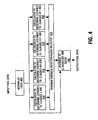
- Figure 4 shows an embodiment of a device 400 to perform nearest neighbor classified filtering for resolution enhancement.
- Input data for an image is received by normalize logic 405, which normalizes the input image vector data.
- the normalized image vector is input to distance calculators 410.
- the distance calculators determine the distance from the input image to each of the spatial classes.
- the distances are received from the calculators 410 by minimum distance detector 420.
- the detector 420 determines which class is the closest to the input image data.
- the closest class is selected as the nearest neighbor class.
- the image data can then be applied to filter 630 to enhance resolution.
- the pixel data that is output by the filter may be displayed by a display device, such as a television monitor for example.
- the device 400 shown in Figure 4 may be implemented as hardware circuitry, software stored in a computer readable medium and executed by a computer processor, or a combination of hardware and software.
- Resolution enhancement by nearest neighbor filtering can be applied to any form of temporally correlated data, including without limitation, video or other two-dimensional moving images, and three-dimensional moving images, and audio such as stereo.
- the term value in one embodiment, may refer to a component within a set of received or generated data.
- a data point may be a position, place, instance, location or range within data.
- an adaptive filter tap structure is an adaptive structure for filter tap definition based upon a corresponding class.
- a class may be defined based on one or more characteristics of the target data. For example, a class may also be defined based on one or more characteristics of the group containing the target data.
- a class ID is a specific value within the class that is used to describe and differentiate the target data from other data with respect to a particular characteristic.
- a class ID may be represented by a number, a symbol, or a code within a defined range.
- a parameter may be used as a predetermined or variable quantity that is used in evaluating, estimating, or classifying the data.
- Resolution enhancement by nearest neighbor filtering provides a method and apparatus for adaptive processing that generates data corresponding to a set of one or more data classes. This process is known as "class definition.” Class definition can be achieved by various attributes of signal distribution using conventional methods described by Richard O. Duda and Peter E. Hart in Pattern Classification and Scene Analysis, John Wiley & Sons, June 1973 , for example.
- each filter may be represented by a matrix of filter coefficients which are applied to the data.
- the filter coefficients can be generated by a training process, an example of which is described subsequently, that occurs as a preparation process prior to filtering.
- x i input data
- w i corresponds to each filter coefficient
- N is the number of coefficients
- y is the output data after error recovery.
- Filter coefficients can be generated for each class ID by a training process that occurs prior to the resolution enhancement process.
- Filter coefficients can be generated by a training process.
- training may be achieved according to the following criterion: min w ⁇ X ⁇ W - Y ⁇ 2
- X, W , and Y are, for example, the following matrices: X is the input data matrix defined by [formula 3], W is the coefficient matrix defined by [formula 4], and Y corresponds to the target data matrix defined by [formula 5].
- the coefficient w i can be obtained according to [formula 2], so that estimation errors against target data are minimized.
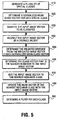
- a plurality of spatial classes are generated.
- a normalized mean class vector for each spatial class is determined, 520.
- the input image vector classified is quantized, 530.
- the input image vector is multiplied by a distance weight, 550.
- the weighted distance from the weighted image vector to each normalized mean class vector is determined, 560.
- the class vector that is the nearest neighbor to the input image vector is determined, 565.
- the input image vector to the nearest neighbor class is added, 570.
- the mean vector of the nearest neighbor class with the input image vector is updated, 580.
- a filter for each class is determined, 590.
Landscapes
- Engineering & Computer Science (AREA)
- Theoretical Computer Science (AREA)
- General Physics & Mathematics (AREA)
- Physics & Mathematics (AREA)
- Computer Vision & Pattern Recognition (AREA)
- Evolutionary Computation (AREA)
- Artificial Intelligence (AREA)
- Multimedia (AREA)
- General Health & Medical Sciences (AREA)
- Databases & Information Systems (AREA)
- Computing Systems (AREA)
- Medical Informatics (AREA)
- Software Systems (AREA)
- Health & Medical Sciences (AREA)
- Data Mining & Analysis (AREA)
- Life Sciences & Earth Sciences (AREA)
- Bioinformatics & Cheminformatics (AREA)
- Bioinformatics & Computational Biology (AREA)
- Evolutionary Biology (AREA)
- General Engineering & Computer Science (AREA)
- Image Processing (AREA)
- Television Systems (AREA)
- Image Analysis (AREA)
Applications Claiming Priority (3)
| Application Number | Priority Date | Filing Date | Title |
|---|---|---|---|
| US724808 | 2000-11-28 | ||
| US09/724,808 US6519368B1 (en) | 2000-11-28 | 2000-11-28 | Resolution enhancement by nearest neighbor classified filtering |
| PCT/US2001/044064 WO2002045060A2 (en) | 2000-11-28 | 2001-11-21 | Resolution enhancement by nearest neighbor classified filtering |
Publications (3)
| Publication Number | Publication Date |
|---|---|
| EP1346311A2 EP1346311A2 (en) | 2003-09-24 |
| EP1346311A4 EP1346311A4 (en) | 2008-07-02 |
| EP1346311B1 true EP1346311B1 (en) | 2012-06-20 |
Family
ID=24911995
Family Applications (1)
| Application Number | Title | Priority Date | Filing Date |
|---|---|---|---|
| EP01986017A Expired - Lifetime EP1346311B1 (en) | 2000-11-28 | 2001-11-21 | Resolution enhancement by nearest neighbor classified filtering |
Country Status (9)
| Country | Link |
|---|---|
| US (1) | US6519368B1 (enExample) |
| EP (1) | EP1346311B1 (enExample) |
| JP (1) | JP4252308B2 (enExample) |
| KR (1) | KR100848849B1 (enExample) |
| CN (1) | CN1258738C (enExample) |
| AU (1) | AU2002236486A1 (enExample) |
| DE (1) | DE10196979T1 (enExample) |
| HK (1) | HK1064775A1 (enExample) |
| WO (1) | WO2002045060A2 (enExample) |
Families Citing this family (13)
| Publication number | Priority date | Publication date | Assignee | Title |
|---|---|---|---|---|
| US7149369B2 (en) * | 2002-04-23 | 2006-12-12 | Hewlett-Packard Development Company, L.P. | Method and system for image scaling |
| US7016884B2 (en) * | 2002-06-27 | 2006-03-21 | Microsoft Corporation | Probability estimate for K-nearest neighbor |
| KR100505663B1 (ko) * | 2003-01-02 | 2005-08-03 | 삼성전자주식회사 | 적응형 윤곽 상관 보간에 의한 디스플레이 장치의 순차주사 방법 |
| US7287015B2 (en) * | 2004-09-30 | 2007-10-23 | International Business Machines Corporation | Methods and apparatus for transmitting signals through network elements for classification |
| US7327904B2 (en) * | 2004-12-15 | 2008-02-05 | Arcsoft, Inc. | Pattern classification and filter design for increasing image resolution |
| US8254716B2 (en) * | 2007-12-12 | 2012-08-28 | Intel Corporation | Method for adaptive image enhancement |
| US8150195B2 (en) | 2008-10-03 | 2012-04-03 | Sony Corporation | Adaptive prediction using a dimensionality reduction process |
| US8358857B2 (en) * | 2008-10-03 | 2013-01-22 | Sony Corporation | Dynamic clustering for adaptive prediction filters |
| JP5251637B2 (ja) * | 2009-03-16 | 2013-07-31 | 株式会社リコー | ノイズ低減装置、ノイズ低減方法、ノイズ低減プログラム、記録媒体 |
| CN103593825B (zh) * | 2013-10-17 | 2016-04-13 | 西安电子科技大学 | 基于改进的非局部约束和局部自相似性的图像超分辨方法 |
| WO2018163364A1 (ja) * | 2017-03-09 | 2018-09-13 | 国立大学法人東京大学 | フィルタリング装置及びフィルタリング方法 |
| US11710265B2 (en) * | 2021-06-08 | 2023-07-25 | Realfacevalue B.V. | Method for producing an image of expected results of medical cosmetic treatments on a human anatomical feature from an image of the anatomical feature prior to these medical cosmetic treatments |
| JP7024983B1 (ja) * | 2021-10-28 | 2022-02-24 | 竜太 綿貫 | フィルタリング装置及びフィルタリング方法 |
Citations (1)
| Publication number | Priority date | Publication date | Assignee | Title |
|---|---|---|---|---|
| US5136663A (en) * | 1988-12-23 | 1992-08-04 | Matsushita Electric Industrial Co., Ltd. | Vector quantization image processing apparatus |
Family Cites Families (3)
| Publication number | Priority date | Publication date | Assignee | Title |
|---|---|---|---|---|
| US5060277A (en) * | 1985-10-10 | 1991-10-22 | Palantir Corporation | Pattern classification means using feature vector regions preconstructed from reference data |
| US5852470A (en) * | 1995-05-31 | 1998-12-22 | Sony Corporation | Signal converting apparatus and signal converting method |
| US5835630A (en) * | 1996-05-08 | 1998-11-10 | Xerox Corporation | Modular time-varying two-dimensional filter |
-
2000
- 2000-11-28 US US09/724,808 patent/US6519368B1/en not_active Expired - Lifetime
-
2001
- 2001-11-21 DE DE10196979T patent/DE10196979T1/de not_active Withdrawn
- 2001-11-21 CN CNB018222862A patent/CN1258738C/zh not_active Expired - Fee Related
- 2001-11-21 WO PCT/US2001/044064 patent/WO2002045060A2/en not_active Ceased
- 2001-11-21 JP JP2002547147A patent/JP4252308B2/ja not_active Expired - Fee Related
- 2001-11-21 AU AU2002236486A patent/AU2002236486A1/en not_active Abandoned
- 2001-11-21 KR KR1020037007014A patent/KR100848849B1/ko not_active Expired - Fee Related
- 2001-11-21 HK HK04107646A patent/HK1064775A1/xx not_active IP Right Cessation
- 2001-11-21 EP EP01986017A patent/EP1346311B1/en not_active Expired - Lifetime
Patent Citations (1)
| Publication number | Priority date | Publication date | Assignee | Title |
|---|---|---|---|---|
| US5136663A (en) * | 1988-12-23 | 1992-08-04 | Matsushita Electric Industrial Co., Ltd. | Vector quantization image processing apparatus |
Non-Patent Citations (2)
| Title |
|---|
| MAKUR A: "Vector quantization of images using input-dependent weighted square error distortion", IEEE TRANSACTIONS ON CIRCUITS AND SYSTEMS FOR VIDEO TECHNOLOGY USA, vol. 3, no. 6, December 1993 (1993-12-01), pages 435 - 439, ISSN: 1051-8215 * |
| VELLAIKAL A ET AL: "Content-based retrieval of remote sensed images using vector quantization", PROCEEDINGS OF THE SPIE - THE INTERNATIONAL SOCIETY FOR OPTICAL ENGINEERING SPIE-INT. SOC. OPT. ENG USA, vol. 2488, 1995, pages 178 - 189, ISSN: 0277-786X * |
Also Published As
| Publication number | Publication date |
|---|---|
| JP2004523941A (ja) | 2004-08-05 |
| CN1258738C (zh) | 2006-06-07 |
| WO2002045060A3 (en) | 2002-10-31 |
| EP1346311A2 (en) | 2003-09-24 |
| KR20040016823A (ko) | 2004-02-25 |
| KR100848849B1 (ko) | 2008-07-28 |
| EP1346311A4 (en) | 2008-07-02 |
| HK1064775A1 (zh) | 2005-02-04 |
| JP4252308B2 (ja) | 2009-04-08 |
| US6519368B1 (en) | 2003-02-11 |
| WO2002045060A2 (en) | 2002-06-06 |
| AU2002236486A1 (en) | 2002-06-11 |
| CN1488119A (zh) | 2004-04-07 |
| DE10196979T1 (de) | 2003-10-23 |
Similar Documents
| Publication | Publication Date | Title |
|---|---|---|
| US6888564B2 (en) | Method and system for estimating sharpness metrics based on local edge kurtosis | |
| EP1346311B1 (en) | Resolution enhancement by nearest neighbor classified filtering | |
| US6285797B1 (en) | Method and apparatus for estimating digital video quality without using a reference video | |
| Soundararajan et al. | RRED indices: Reduced reference entropic differencing for image quality assessment | |
| Xue et al. | Gradient magnitude similarity deviation: A highly efficient perceptual image quality index | |
| CN101924878B (zh) | 图像处理设备、介质和方法 | |
| Shen et al. | Hybrid no-reference natural image quality assessment of noisy, blurry, JPEG2000, and JPEG images | |
| US8908989B2 (en) | Recursive conditional means image denoising | |
| Guan et al. | No-reference blur assessment based on edge modeling | |
| Pillai et al. | Blind image deconvolution using a robust GCD approach | |
| US8330810B2 (en) | Systems and method for dynamic stabilization of target data detected from a moving platform | |
| Kim et al. | Gradient information-based image quality metric | |
| Ponomaryov | Real-time 2D–3D filtering using order statistics based algorithms | |
| Roy et al. | Removal of ‘Salt & Pepper’noise from color images using adaptive fuzzy technique based on histogram estimation | |
| Nizami et al. | Distortion-specific feature selection algorithm for universal blind image quality assessment | |
| Kalatehjari et al. | A new reduced-reference image quality assessment based on the SVD signal projection | |
| CN116310356B (zh) | 深度学习模型的训练方法、目标检测方法、装置及设备 | |
| Li et al. | A novel spatial pooling strategy for image quality assessment | |
| Uppala et al. | On the design of quadratic filters with application to image processing | |
| Wang et al. | Color image quality assessment based on quaternion singular value decomposition | |
| KR101899070B1 (ko) | 랜덤신호에 대한 강건성 정량화를 통한 단독 영상 품질 평가 방법 및 장치 | |
| Hsu et al. | Combination of SSIM and JND with content-transition classification for image quality assessment | |
| Maksimović‐Moićević et al. | Objective estimation of subjective image quality assessment using multi‐parameter prediction | |
| Yin et al. | ICA and genetic algorithms for blind signal and image deconvolution and deblurring | |
| Núñez et al. | Particle swarm optimization applied to parameter tuning of clahe based on entropy and structural similarity index |
Legal Events
| Date | Code | Title | Description |
|---|---|---|---|
| PUAI | Public reference made under article 153(3) epc to a published international application that has entered the european phase |
Free format text: ORIGINAL CODE: 0009012 |
|
| 17P | Request for examination filed |
Effective date: 20030611 |
|
| AK | Designated contracting states |
Kind code of ref document: A2 Designated state(s): AT BE CH CY DE DK ES FI FR GB GR IE IT LI LU MC NL PT SE TR |
|
| AX | Request for extension of the european patent |
Extension state: AL LT LV MK RO SI |
|
| RIN1 | Information on inventor provided before grant (corrected) |
Inventor name: FUJIMORI, YASUHIRO., C/O SONY ELECTRONICS, INC. Inventor name: CARRIG, JAMES, J. Inventor name: KONDO, TETSUJIRO.,C/O SONY ELECTRONICS, INC. Inventor name: CAREY, WILLIAM, KNOX |
|
| A4 | Supplementary search report drawn up and despatched |
Effective date: 20080602 |
|
| RIC1 | Information provided on ipc code assigned before grant |
Ipc: G06T 5/20 20060101ALI20080527BHEP Ipc: G06T 3/40 20060101AFI20080527BHEP |
|
| 17Q | First examination report despatched |
Effective date: 20080721 |
|
| GRAJ | Information related to disapproval of communication of intention to grant by the applicant or resumption of examination proceedings by the epo deleted |
Free format text: ORIGINAL CODE: EPIDOSDIGR1 |
|
| GRAP | Despatch of communication of intention to grant a patent |
Free format text: ORIGINAL CODE: EPIDOSNIGR1 |
|
| GRAP | Despatch of communication of intention to grant a patent |
Free format text: ORIGINAL CODE: EPIDOSNIGR1 |
|
| GRAS | Grant fee paid |
Free format text: ORIGINAL CODE: EPIDOSNIGR3 |
|
| GRAA | (expected) grant |
Free format text: ORIGINAL CODE: 0009210 |
|
| RBV | Designated contracting states (corrected) |
Designated state(s): AT BE CH CY DE DK ES FI FR GR IE IT LI LU MC NL PT SE TR |
|
| AK | Designated contracting states |
Kind code of ref document: B1 Designated state(s): AT BE CH CY DE DK ES FI FR GR IE IT LI LU MC NL PT SE TR |
|
| REG | Reference to a national code |
Ref country code: CH Ref legal event code: EP |
|
| REG | Reference to a national code |
Ref country code: AT Ref legal event code: REF Ref document number: 563411 Country of ref document: AT Kind code of ref document: T Effective date: 20120715 |
|
| REG | Reference to a national code |
Ref country code: IE Ref legal event code: FG4D |
|
| REG | Reference to a national code |
Ref country code: DE Ref legal event code: R096 Ref document number: 60146753 Country of ref document: DE Effective date: 20120809 |
|
| REG | Reference to a national code |
Ref country code: NL Ref legal event code: T3 |
|
| PG25 | Lapsed in a contracting state [announced via postgrant information from national office to epo] |
Ref country code: SE Free format text: LAPSE BECAUSE OF FAILURE TO SUBMIT A TRANSLATION OF THE DESCRIPTION OR TO PAY THE FEE WITHIN THE PRESCRIBED TIME-LIMIT Effective date: 20120620 Ref country code: FI Free format text: LAPSE BECAUSE OF FAILURE TO SUBMIT A TRANSLATION OF THE DESCRIPTION OR TO PAY THE FEE WITHIN THE PRESCRIBED TIME-LIMIT Effective date: 20120620 |
|
| REG | Reference to a national code |
Ref country code: AT Ref legal event code: MK05 Ref document number: 563411 Country of ref document: AT Kind code of ref document: T Effective date: 20120620 |
|
| PG25 | Lapsed in a contracting state [announced via postgrant information from national office to epo] |
Ref country code: GR Free format text: LAPSE BECAUSE OF FAILURE TO SUBMIT A TRANSLATION OF THE DESCRIPTION OR TO PAY THE FEE WITHIN THE PRESCRIBED TIME-LIMIT Effective date: 20120921 |
|
| PG25 | Lapsed in a contracting state [announced via postgrant information from national office to epo] |
Ref country code: CY Free format text: LAPSE BECAUSE OF FAILURE TO SUBMIT A TRANSLATION OF THE DESCRIPTION OR TO PAY THE FEE WITHIN THE PRESCRIBED TIME-LIMIT Effective date: 20120620 Ref country code: AT Free format text: LAPSE BECAUSE OF FAILURE TO SUBMIT A TRANSLATION OF THE DESCRIPTION OR TO PAY THE FEE WITHIN THE PRESCRIBED TIME-LIMIT Effective date: 20120620 Ref country code: BE Free format text: LAPSE BECAUSE OF FAILURE TO SUBMIT A TRANSLATION OF THE DESCRIPTION OR TO PAY THE FEE WITHIN THE PRESCRIBED TIME-LIMIT Effective date: 20120620 |
|
| PG25 | Lapsed in a contracting state [announced via postgrant information from national office to epo] |
Ref country code: PT Free format text: LAPSE BECAUSE OF FAILURE TO SUBMIT A TRANSLATION OF THE DESCRIPTION OR TO PAY THE FEE WITHIN THE PRESCRIBED TIME-LIMIT Effective date: 20121022 Ref country code: IT Free format text: LAPSE BECAUSE OF FAILURE TO SUBMIT A TRANSLATION OF THE DESCRIPTION OR TO PAY THE FEE WITHIN THE PRESCRIBED TIME-LIMIT Effective date: 20120620 |
|
| PLBE | No opposition filed within time limit |
Free format text: ORIGINAL CODE: 0009261 |
|
| STAA | Information on the status of an ep patent application or granted ep patent |
Free format text: STATUS: NO OPPOSITION FILED WITHIN TIME LIMIT |
|
| PG25 | Lapsed in a contracting state [announced via postgrant information from national office to epo] |
Ref country code: DK Free format text: LAPSE BECAUSE OF FAILURE TO SUBMIT A TRANSLATION OF THE DESCRIPTION OR TO PAY THE FEE WITHIN THE PRESCRIBED TIME-LIMIT Effective date: 20120620 Ref country code: ES Free format text: LAPSE BECAUSE OF FAILURE TO SUBMIT A TRANSLATION OF THE DESCRIPTION OR TO PAY THE FEE WITHIN THE PRESCRIBED TIME-LIMIT Effective date: 20121001 |
|
| 26N | No opposition filed |
Effective date: 20130321 |
|
| REG | Reference to a national code |
Ref country code: NL Ref legal event code: V1 Effective date: 20130601 |
|
| REG | Reference to a national code |
Ref country code: CH Ref legal event code: PL |
|
| REG | Reference to a national code |
Ref country code: DE Ref legal event code: R097 Ref document number: 60146753 Country of ref document: DE Effective date: 20130321 |
|
| PG25 | Lapsed in a contracting state [announced via postgrant information from national office to epo] |
Ref country code: LI Free format text: LAPSE BECAUSE OF NON-PAYMENT OF DUE FEES Effective date: 20121130 Ref country code: CH Free format text: LAPSE BECAUSE OF NON-PAYMENT OF DUE FEES Effective date: 20121130 |
|
| REG | Reference to a national code |
Ref country code: IE Ref legal event code: MM4A |
|
| PG25 | Lapsed in a contracting state [announced via postgrant information from national office to epo] |
Ref country code: NL Free format text: LAPSE BECAUSE OF NON-PAYMENT OF DUE FEES Effective date: 20130601 |
|
| PG25 | Lapsed in a contracting state [announced via postgrant information from national office to epo] |
Ref country code: IE Free format text: LAPSE BECAUSE OF NON-PAYMENT OF DUE FEES Effective date: 20121121 |
|
| PG25 | Lapsed in a contracting state [announced via postgrant information from national office to epo] |
Ref country code: TR Free format text: LAPSE BECAUSE OF FAILURE TO SUBMIT A TRANSLATION OF THE DESCRIPTION OR TO PAY THE FEE WITHIN THE PRESCRIBED TIME-LIMIT Effective date: 20120620 Ref country code: MC Free format text: LAPSE BECAUSE OF NON-PAYMENT OF DUE FEES Effective date: 20121130 |
|
| PG25 | Lapsed in a contracting state [announced via postgrant information from national office to epo] |
Ref country code: LU Free format text: LAPSE BECAUSE OF NON-PAYMENT OF DUE FEES Effective date: 20121121 |
|
| PGFP | Annual fee paid to national office [announced via postgrant information from national office to epo] |
Ref country code: FR Payment date: 20141118 Year of fee payment: 14 Ref country code: DE Payment date: 20141128 Year of fee payment: 14 |
|
| REG | Reference to a national code |
Ref country code: DE Ref legal event code: R119 Ref document number: 60146753 Country of ref document: DE |
|
| REG | Reference to a national code |
Ref country code: FR Ref legal event code: ST Effective date: 20160729 |
|
| PG25 | Lapsed in a contracting state [announced via postgrant information from national office to epo] |
Ref country code: DE Free format text: LAPSE BECAUSE OF NON-PAYMENT OF DUE FEES Effective date: 20160601 |
|
| PG25 | Lapsed in a contracting state [announced via postgrant information from national office to epo] |
Ref country code: FR Free format text: LAPSE BECAUSE OF NON-PAYMENT OF DUE FEES Effective date: 20151130 |