EP1345378A2 - Verfahren und System zur Bereitstellung von Zwischenspeicherungsdiensten - Google Patents
Verfahren und System zur Bereitstellung von Zwischenspeicherungsdiensten Download PDFInfo
- Publication number
- EP1345378A2 EP1345378A2 EP02259038A EP02259038A EP1345378A2 EP 1345378 A2 EP1345378 A2 EP 1345378A2 EP 02259038 A EP02259038 A EP 02259038A EP 02259038 A EP02259038 A EP 02259038A EP 1345378 A2 EP1345378 A2 EP 1345378A2
- Authority
- EP
- European Patent Office
- Prior art keywords
- client device
- cookies
- message
- caching
- server
- Prior art date
- Legal status (The legal status is an assumption and is not a legal conclusion. Google has not performed a legal analysis and makes no representation as to the accuracy of the status listed.)
- Withdrawn
Links
Images


Classifications
-
- H—ELECTRICITY
- H04—ELECTRIC COMMUNICATION TECHNIQUE
- H04L—TRANSMISSION OF DIGITAL INFORMATION, e.g. TELEGRAPHIC COMMUNICATION
- H04L67/00—Network arrangements or protocols for supporting network services or applications
- H04L67/50—Network services
- H04L67/56—Provisioning of proxy services
- H04L67/565—Conversion or adaptation of application format or content
- H04L67/5651—Reducing the amount or size of exchanged application data
-
- H—ELECTRICITY
- H04—ELECTRIC COMMUNICATION TECHNIQUE
- H04L—TRANSMISSION OF DIGITAL INFORMATION, e.g. TELEGRAPHIC COMMUNICATION
- H04L67/00—Network arrangements or protocols for supporting network services or applications
- H04L67/01—Protocols
- H04L67/02—Protocols based on web technology, e.g. hypertext transfer protocol [HTTP]
-
- G—PHYSICS
- G06—COMPUTING OR CALCULATING; COUNTING
- G06F—ELECTRIC DIGITAL DATA PROCESSING
- G06F16/00—Information retrieval; Database structures therefor; File system structures therefor
- G06F16/90—Details of database functions independent of the retrieved data types
- G06F16/95—Retrieval from the web
- G06F16/957—Browsing optimisation, e.g. caching or content distillation
- G06F16/9574—Browsing optimisation, e.g. caching or content distillation of access to content, e.g. by caching
-
- H—ELECTRICITY
- H04—ELECTRIC COMMUNICATION TECHNIQUE
- H04L—TRANSMISSION OF DIGITAL INFORMATION, e.g. TELEGRAPHIC COMMUNICATION
- H04L69/00—Network arrangements, protocols or services independent of the application payload and not provided for in the other groups of this subclass
- H04L69/30—Definitions, standards or architectural aspects of layered protocol stacks
- H04L69/32—Architecture of open systems interconnection [OSI] 7-layer type protocol stacks, e.g. the interfaces between the data link level and the physical level
- H04L69/322—Intralayer communication protocols among peer entities or protocol data unit [PDU] definitions
- H04L69/329—Intralayer communication protocols among peer entities or protocol data unit [PDU] definitions in the application layer [OSI layer 7]
-
- H—ELECTRICITY
- H04—ELECTRIC COMMUNICATION TECHNIQUE
- H04L—TRANSMISSION OF DIGITAL INFORMATION, e.g. TELEGRAPHIC COMMUNICATION
- H04L67/00—Network arrangements or protocols for supporting network services or applications
- H04L67/50—Network services
- H04L67/56—Provisioning of proxy services
- H04L67/564—Enhancement of application control based on intercepted application data
Definitions
- This invention relates to a method and system for providing proxy based caching services to a client device on a wireless network.
- proxy servers are often deployed, where possible, in order to provide services on behalf of such client devices to enhance a user's experience when using the devices.
- a proxy server includes the caching of information on behalf of the thin client device.
- Cookies are small packets of information than an origin server sends to a client device for caching at the client device. Cookies can include a variety of information and typically includes information that identifies the client device to the origin server so that content in the origin server may be personalized for a particular user. Once a cookie has been set (i.e. cached in memory) it is used in subsequent communications from the client device to the origin server. Instead of caching the cookies at the client device, proxy servers may be used to cache the cookies on behalf of a thin client device,
- the invention provides a method for providing proxy based caching services to a client device.
- the method includes caching cookies on behalf of a thin client device wherein the cookies are stored separately for each unique combination of user identifier (ID), client device identifier (ID), and user agent type.
- ID unique combination of user identifier
- ID client device identifier
- ID user agent type
- basic authentication information required by an origin server to authenticate a client request is also stored separately in a proxy server for each unique combination of user identifier (ID), client device, identifier (ID), and user agent type.
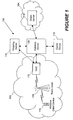
- Figure 1 shows an example of a network within which embodiments of the present invention may be practiced.
- FIGS 2A and 2B show an example of the interaction between the various components of the network shown in Figure 1, according to one embodiment of the invention.
- FIG. 3 shows exemplary hardware that may be used to practice embodiments of the present invention.
- Proxy servers may be deployed in order to provide caching services to thin client devices such as mobile telephones.
- An example of such a caching service includes a cookie caching service wherein cookies set by an origin server for a thin client device are cached in a proxy server.
- cookie caching as described has been done against some concept of user identification. This approach to cookie caching can be problematic, for example, in cases where a single subscriber may have multiple devices. To illustrate the problem that occurs in this scenario, consider for example the case where a single user identifier (ID) has been assigned to multiple client devices, such as in family calling plans where multiple mobile telephones belonging to different family members each share the same user ID for billing purposes.
- ID user identifier
- a first family member may visit an on-line shopping website using a mobile phone and create a shopping basket containing items which the user may be interested in purchasing at some time in the future. If a second family member accesses the same on-line shopping website using a different mobile phone, this second shopping member will have the ability to change the contents of the shopping basket since a cookie containing the contents of the shopping basket for the first user will be accessible to the second user as the two users share the same user ID. This situation is obviously undesirable.
- the Wireless Access Protocol (WAP) 2.0 supports state management and allows a user of a mobile device to selectively tum off caching services provided by a proxy cache. This feature is desirable if the user wants to avoid personal information being stored in a proxy cache. This feature of being able to selectively turn off proxy cookie caching is not supported in the WAP 1.0 specification. Thus, older client devices which run the WAP 1.0 protocol do not have the ability to selectively turn off proxy based cookie caching.
- Proxy based cookie caching method and system for providing cookie caching services on behalf of a thin client device.
- the cookie caching service stores cookies on behalf of a thin client device based on a unique combination of device ID, user ID and user agent type.
- basic authentication information (such as user ID and password) required to access an origin server is also cached based on the unique combination of device ID, user ID and user agent type.
- One advantage of the present invention is that it maintains a separate cookie cache for different users having different devices but who access a wireless network using the same user ID. Another advantage of the present invention is that it allows origin servers to set cookies based on device capabilities and user agent type. Thus, origin servers may customize content sent to users based on information about device and user agent type.
- the proxy based cookie caching service in accordance with the present invention will maintain multiple cookie caches for every device ID, user ID, and user agent combination. There is no sharing of cookies across devices or user agents belonging to a single subscriber.
- the device ID could be the Mobile Identification Number (MIN) or the Electronic Serial Number (ESN) of a mobile telephone which uniquely defines a device.
- MIN Mobile Identification Number
- ESN Electronic Serial Number
- cookie caching according to embodiments of the invention is based, in part, on the user agent type, a user may have multiple browsers on a single device (for example, browsers by Microsoft and Netscape), and cookies generated for each browser will be stored separately.
- reference numeral 100 generally indicates a network environment within which embodiments of the present invention may be practiced.
- the network environment 100 comprises a wireless network 102 which is connected to a wired network 104 by a proxy or gateway server 106.
- the wireless network 102 may, for example, be a network such as a wireless Local Area Network (LAN), a Mobile Digital Packet Data (MDPD) network, a Global System for Mobile (GSM), a Code Division Multiple Access (CDMA) network, or a Time Division Multiple Access (TDMA) network.
- the communications protocol used by the wireless network 102 may include, for example, Hyper Text Transfer Protocol over Transmission Control Protocol (HTTP/TCP), Wireless Application Protocol (WAP) and/or Handheld Device Protocol (HDTP).
- Components of the wireless network 102 include base stations 108 (only one of which is shown in Figure 1 of the drawings), each of which facilitates wireless communications within its respective cell.
- Wired network 104 may be or may include the Internet, an intranet, or a data network such as a Local Area Network (LAN) or wide area network (WAN), or combination thereof.
- a network resource in the form of an origin server 114 is shown connected to wired network 104.
- the origin server 114 may, in one embodiment, be a World Wide Web server.
- the communications protocol supporting wireless network 104 may be, for example, Transmission Control Protocol (TCP/IP), Hypertext Transfer Protocol (HTTP), or Secure HTTP (sHTTP).
- Gateway server 106 bridges communications between the wired network 104. In order to perform its function, gateway server 106 communicates with a network access server (NAS) 112, a mapping server 116, and a cache server 118, as will be explained in greater detail below.
- NAS network access server
- mapping server 116 returns the mapping or binding of device ID, user ID and mobile IP address for wireless client device 110 to gateway server 106.
- gateway server 106 requests cookie and Basic Authentication (BA) information from cache server 118 based on the combination of device ID, user ID, and user agent type associated with the request at 200.
- the BA information generally comprises authentication information, such as user ID and password, required by origin server 114 to allow access by a client device. Since request 200 to access origin server 114 is an original request to origin server 114, there being no prior request, the reply by cache server 118 to message 206 at 208 will contain no cookie or BA information.
- gateway server 106 sends request 200 to origin server 114. Since request 200 does not include any BA information, origin server 114 responds by issuing an authentication challenge at 212. In response, and at 214, gateway server 106 forwards the authentication challenge 212 to wireless client device 110.
- wireless client device 110 adds the BA information and sends a new request containing the BA information, at 218, to gateway server 106.
- Gateway server 106 sends a message at 220 to cache server 118 requesting cookie information based on the unique combination of device ID, user ID, and user agent type, in the new request and also requesting cache server 118 to cache the BA information.
- cache server 118 responds by saving the BA information but no cookies are attached since no cookies have been stored on behalf of the combination of device ID, user ID, and user agent type.
- Cache server 118 sends a reply containing no cookie at 224 to gateway server 106.
- Gateway server 106 forwards, at 226, the request and basic authentication information to origin server 114.
- origin server 114 sends a response 228 including cookies to gateway server 106.
- Gateway server 106 forwards the response 228 to cache server 118 at 230.
- cache server 118 removes the cookies from response 228 and caches the cookies separately based on each unique combination of device ID, user ID, and user agent type contained in message 230.
- gateway server 106 sends response 228 without the cookies to wireless client device 110.
- origin server 114 sends a reply to gateway server 106 at 232 including a cookie.
- gateway server 106 forwards the reply/response including the cookie to cache server 118 which, at 236, caches the cookie and sends a response without the cookie at 238 to gateway server 106.
- Gateway server 106 at 240, sends the response without the cookie to wireless client device 110.
- wireless client device 110 sends a new request during the same session, at 242, to gateway server 106, which then responds at 244, by requesting cookie and BA information from cache server 118.
- cache server 118 attaches the cookie that was previously cached at 236 and sends a reply, at 248, to gateway server 106 that includes the cookie.
- Cache server 118 will not add BA information to the request 252 since it already contains this information.
- Gateway server 106 at 250, sends the request 242 together with the cookie to origin server 114. It is assumed at 252, that Wireless client device 110 sends a new request which is a request in a new session between wireless client device 110 in origin server 114.
- Gateway server 106 responds to this request 252, at 254, by requesting cookie and BA information from cache server 118.
- Cache server 118 responds by attaching the cookie and basic authentication information that was saved at 226 to request 252, and by sending a response including the cookie and BA information, at 258, to gateway server 106.
- Gateway server 106 then forwards, at 260, the request including the cookie and BA information to origin server 114.
- the new request 252 is automatically authenticated at origin server 114 because cache server 118 attached the necessary BA information to the request. Saving the cookie at 236 and BA information at 226 is performed separately for each unique combination of device ID, user ID, and user agent type.
- the proxy caching service described with reference to Figures 2A and 2B may be selectively turned off.
- the manner in which the proxy based caching service is turned off will depend on the particular communications protocol used by the wireless client device. For example, if the wireless client device is running the Wireless Application Protocol (WAP) Version 2.0 then a user of the client device has an option of selectively turning off the proxy based caching service running on cache server 118 caching on behalf of the client device.
- WAP version 1.0 protocol does not provide support to selectively turn off proxy based cookie caching.
- Embodiments of the present invention overcome this problem by using information contained in a client request to an origin server as a key to stored information which indicates whether proxy based caching is to be disabled in a particular case.
- gateway server 106 or some other component in the network environment 100 stores a look-up table which contains information indicating whether proxy based caching is to be enabled or disabled based on a model and make of a client device.
- gateway server 106 extracts the model and client device information from a client request and uses this information as a key to access the look-up table in order to ascertain whether to enable or disable proxy based caching for the request.
- the present invention emulates the capability of WAP 2.0 to selectively turn off cookie caching on behalf of a client.
- reference numeral 300 generally indicates an example of processing system that may represent any of components 106, 112, 114, 116 and 118 shown in Figure 1 of the drawings.
- Processing system 300 typically includes at least one processor 302 coupled to a memory 304.
- Processor 302 may represent one or more processors (e.g. microprocessors), and memory 304 may represent random access memory (RAM) devices comprising a main storage of system 300, as well as any supplemental levels of memory e.g., cache memories, non-volatile or back-up memories (e.g. programmable or flash memories), read-only memories, etc.
- RAM random access memory
- memory 304 may be considered to include memory storage physically located elsewhere in system 300, e.g. any cache memory in a processor 302, as well as any storage capacity used as a virtual memory, e.g., as stored on a mass storage device 310 or on another computer coupled to system 300 via network 312.
- Processing system 300 also typically receives a number of inputs and outputs for communicating information externally.
- system 300 includes one or more user input devices 306 (e.g., a keyboard, a mouse, etc.) and a display 308 (e.g., a CRT monitor, a LCD panel).
- user input devices 306 e.g., a keyboard, a mouse, etc.
- display 308 e.g., a CRT monitor, a LCD panel.
- direct (local) user input and output may not be required, such that user input devices 306 and display 308 may be omitted.
- system 300 may also include one or more mass storage devices 310, e.g., a floppy or other removable disk drive, a hard disk drive, a Direct Access Storage Device (DASD), an optical drive (e.g. a CD drive, a DVD drive, etc.) and/or a tape drive, among others.
- mass storage devices 310 e.g., a floppy or other removable disk drive, a hard disk drive, a Direct Access Storage Device (DASD), an optical drive (e.g. a CD drive, a DVD drive, etc.) and/or a tape drive, among others.
- system 300 may include an interface with one or more networks 312 (e.g., a land, a WAN, a wireless network, and/or the Internet among others) to permit the communication of information with other computers coupled to the networks.
- networks 312 e.g., a land, a WAN, a wireless network, and/or the Internet among others
- system 300 typically includes suitable analog and/or digital interfaces
- Processing system 300 operates under the control of an operating system 314, and executes various computer software applications, components, programs, objects, modules, etc. (e.g. a program or module which performs operations as shown in Figure 2A and 2B of the drawings). Moreover, various applications, components, programs, objects, etc. may also execute on one or more processors in another computer coupled to system 300 via a network 312, e.g. in a distributed computing environment, whereby the processing required to implement the functions of a computer program may be allocated to multiple computers over a network.
- various computer software applications, components, programs, objects, modules, etc. e.g. a program or module which performs operations as shown in Figure 2A and 2B of the drawings.
- various applications, components, programs, objects, etc. may also execute on one or more processors in another computer coupled to system 300 via a network 312, e.g. in a distributed computing environment, whereby the processing required to implement the functions of a computer program may be allocated to multiple computers over a network.
- routines executed to implement the embodiments of the invention maybe implemented as part of an operating system or a specific application, component, program, object, module or sequence of Instructions referred to as "computer programs".
- the computer programs typically comprise one or more instructions set at various times in various memory and storage devices in a computer, and that, when read and executed by one or more processors in a computer, cause the computer to perform these steps necessary to execute steps or elements involving the various aspects of the invention.
- the various embodiments of the invention are capable of being distributed as a program product in a variety of forms, and that the invention applies equally regardless of the particular type of signal bearing media used to actually carry out the distribution.
- signal bearing media examples include recordable type media such as volatile and non-volatile memory devices, floppy and other removable disks, hard disk drives, optical disks (e.g. CD ROMS, DVDs, etc.), among others, and transmission type media such as digital and analog communication links.
- recordable type media such as volatile and non-volatile memory devices, floppy and other removable disks, hard disk drives, optical disks (e.g. CD ROMS, DVDs, etc.), among others
- transmission type media such as digital and analog communication links.
Landscapes
- Engineering & Computer Science (AREA)
- Computer Networks & Wireless Communication (AREA)
- Signal Processing (AREA)
- Databases & Information Systems (AREA)
- Theoretical Computer Science (AREA)
- Computer Security & Cryptography (AREA)
- Data Mining & Analysis (AREA)
- Physics & Mathematics (AREA)
- General Engineering & Computer Science (AREA)
- General Physics & Mathematics (AREA)
- Information Transfer Between Computers (AREA)
- Computer And Data Communications (AREA)
Applications Claiming Priority (4)
| Application Number | Priority Date | Filing Date | Title |
|---|---|---|---|
| US206592 | 1980-11-13 | ||
| US36498702P | 2002-03-14 | 2002-03-14 | |
| US364987P | 2002-03-14 | ||
| US10/206,592 US20030177196A1 (en) | 2002-03-14 | 2002-07-25 | Method and system for providing proxy based caching services to a client device |
Publications (2)
| Publication Number | Publication Date |
|---|---|
| EP1345378A2 true EP1345378A2 (de) | 2003-09-17 |
| EP1345378A3 EP1345378A3 (de) | 2004-03-24 |
Family
ID=27767477
Family Applications (1)
| Application Number | Title | Priority Date | Filing Date |
|---|---|---|---|
| EP02259038A Withdrawn EP1345378A3 (de) | 2002-03-14 | 2002-12-31 | Verfahren und System zur Bereitstellung von Zwischenspeicherungsdiensten |
Country Status (2)
| Country | Link |
|---|---|
| US (1) | US20030177196A1 (de) |
| EP (1) | EP1345378A3 (de) |
Cited By (3)
| Publication number | Priority date | Publication date | Assignee | Title |
|---|---|---|---|---|
| WO2009094657A1 (en) * | 2008-01-26 | 2009-07-30 | Citrix Systems, Inc. | Systems and methods for fine grain policy driven cookie proxying |
| WO2010006700A1 (en) * | 2008-06-30 | 2010-01-21 | Piins Holding Ag | Single point of entry server solution for world-wide-web annotation services with reduced latency |
| US7925694B2 (en) | 2007-10-19 | 2011-04-12 | Citrix Systems, Inc. | Systems and methods for managing cookies via HTTP content layer |
Families Citing this family (30)
| Publication number | Priority date | Publication date | Assignee | Title |
|---|---|---|---|---|
| US6970918B2 (en) * | 2001-09-24 | 2005-11-29 | International Business Machines Corporation | System and method for transcoding support of web content over secure connections |
| US20030074432A1 (en) * | 2001-09-26 | 2003-04-17 | Mazzitelli John Joseph | State data management method and system |
| US20040073629A1 (en) * | 2002-10-10 | 2004-04-15 | International Business Machines Corporation | Method of accessing internet resources through a proxy with improved security |
| CN100463469C (zh) * | 2002-10-25 | 2009-02-18 | 国际商业机器公司 | 在多通道上共享应用程序会话信息的方法、装置和系统 |
| US7164685B2 (en) * | 2003-04-11 | 2007-01-16 | Nokia Corporation | Cookies or liberty enabler for processing all connections between user/agent and origin server in a wireless network for enabling cookies or liberty support services for users/agents |
| US7921152B2 (en) * | 2003-07-17 | 2011-04-05 | International Business Machines Corporation | Method and system for providing user control over receipt of cookies from e-commerce applications |
| US8514867B2 (en) | 2004-01-06 | 2013-08-20 | Hava Corporation | Method of determining broadband content usage within a system |
| US10419996B2 (en) | 2004-01-06 | 2019-09-17 | Vasu Networks Corporation | Mobile device with automatic switching between cellular and wifi networks |
| US8913604B2 (en) * | 2004-01-06 | 2014-12-16 | Vasu Networks Corporation | Access point with controller for billing and generating income for access point owner |
| US8078164B2 (en) | 2004-01-06 | 2011-12-13 | Vasu Networks Corporation | Mobile telephone VOIP/cellular seamless roaming switching controller |
| US8520605B2 (en) | 2004-01-06 | 2013-08-27 | Vasu Networks Corporation | Apparatus for controlling broadband access and distribution of content and communications through an access point |
| WO2005067635A2 (en) | 2004-01-06 | 2005-07-28 | Hava Corp. | Telephone with automatic switching between cellular and voip networks |
| KR101046472B1 (ko) * | 2004-03-12 | 2011-07-04 | 톰슨 라이센싱 | 지리적 드라이브 상의 자동화된 원격 사이트 다운로드 |
| WO2006070536A1 (ja) * | 2004-12-27 | 2006-07-06 | Brother Kogyo Kabushiki Kaisha | ノード装置、情報送信処理プログラム、及び情報配信方法等 |
| US10320989B2 (en) | 2005-02-11 | 2019-06-11 | Vasu Networks Corporation | Access point with controller for billing and generating income for access point owner |
| US8402525B1 (en) * | 2005-07-01 | 2013-03-19 | Verizon Services Corp. | Web services security system and method |
| US20070157304A1 (en) * | 2006-01-05 | 2007-07-05 | International Business Machines Corporation | Method, apparatus and computer program product for automatic cookie synchronization between distinct web browsers |
| US9800614B2 (en) * | 2007-05-23 | 2017-10-24 | International Business Machines Corporation | Method and system for global logoff from a web-based point of contact server |
| US8370424B2 (en) * | 2007-06-22 | 2013-02-05 | Aol Inc. | Systems and methods for caching and serving dynamic content |
| US9009330B2 (en) | 2010-04-01 | 2015-04-14 | Cloudflare, Inc. | Internet-based proxy service to limit internet visitor connection speed |
| US9049247B2 (en) | 2010-04-01 | 2015-06-02 | Cloudfare, Inc. | Internet-based proxy service for responding to server offline errors |
| US9461878B1 (en) * | 2011-02-01 | 2016-10-04 | Palo Alto Networks, Inc. | Blocking download of content |
| US8285808B1 (en) | 2011-05-20 | 2012-10-09 | Cloudflare, Inc. | Loading of web resources |
| JP5801648B2 (ja) * | 2011-08-18 | 2015-10-28 | キヤノン株式会社 | 認証システム及び認証方法 |
| CN102594796B (zh) * | 2011-12-27 | 2015-05-20 | 中兴通讯股份有限公司 | 一种终端设备及用户信息同步方法 |
| US9183012B2 (en) * | 2012-06-22 | 2015-11-10 | Microsoft Technology Licensing, Llc | Adaptive rendering based on runtime capability check |
| US9253011B2 (en) * | 2012-09-27 | 2016-02-02 | Intuit Inc. | Session-server affinity for clients that lack session identifiers |
| US9549047B1 (en) * | 2013-03-14 | 2017-01-17 | Google Inc. | Initiating a client-side user model |
| US10068014B2 (en) * | 2014-02-06 | 2018-09-04 | Fastly, Inc. | Security information management for content delivery |
| US10341810B2 (en) * | 2016-06-23 | 2019-07-02 | T-Mobile Usa, Inc. | Geolocation compatibility for non-RCS devices |
Family Cites Families (10)
| Publication number | Priority date | Publication date | Assignee | Title |
|---|---|---|---|---|
| US5963915A (en) * | 1996-02-21 | 1999-10-05 | Infoseek Corporation | Secure, convenient and efficient system and method of performing trans-internet purchase transactions |
| US5848396A (en) * | 1996-04-26 | 1998-12-08 | Freedom Of Information, Inc. | Method and apparatus for determining behavioral profile of a computer user |
| US6085224A (en) * | 1997-03-11 | 2000-07-04 | Intracept, Inc. | Method and system for responding to hidden data and programs in a datastream |
| US6189000B1 (en) * | 1997-06-30 | 2001-02-13 | Microsoft Corporation | System and method for accessing user properties from multiple storage mechanisms |
| SE512672C2 (sv) * | 1998-06-12 | 2000-04-17 | Ericsson Telefon Ab L M | Förfarande och system för överföring av en cookie |
| US6751654B2 (en) * | 1999-03-31 | 2004-06-15 | International Business Machines Corporation | Simulating web cookies for non-cookie capable browsers |
| US20040049737A1 (en) * | 2000-04-26 | 2004-03-11 | Novarra, Inc. | System and method for displaying information content with selective horizontal scrolling |
| EP1295221A1 (de) * | 2000-05-29 | 2003-03-26 | Nokia Corporation | Ein synchronisierungsverfahren |
| US6961759B2 (en) * | 2001-09-24 | 2005-11-01 | International Business Machines Corporation | Method and system for remotely managing persistent state data |
| US7035854B2 (en) * | 2002-04-23 | 2006-04-25 | International Business Machines Corporation | Content management system and methodology employing non-transferable access tokens to control data access |
-
2002
- 2002-07-25 US US10/206,592 patent/US20030177196A1/en not_active Abandoned
- 2002-12-31 EP EP02259038A patent/EP1345378A3/de not_active Withdrawn
Cited By (7)
| Publication number | Priority date | Publication date | Assignee | Title |
|---|---|---|---|---|
| US7925694B2 (en) | 2007-10-19 | 2011-04-12 | Citrix Systems, Inc. | Systems and methods for managing cookies via HTTP content layer |
| WO2009094657A1 (en) * | 2008-01-26 | 2009-07-30 | Citrix Systems, Inc. | Systems and methods for fine grain policy driven cookie proxying |
| US8090877B2 (en) | 2008-01-26 | 2012-01-03 | Citrix Systems, Inc. | Systems and methods for fine grain policy driven cookie proxying |
| US8769660B2 (en) | 2008-01-26 | 2014-07-01 | Citrix Systems, Inc. | Systems and methods for proxying cookies for SSL VPN clientless sessions |
| US9059966B2 (en) | 2008-01-26 | 2015-06-16 | Citrix Systems, Inc. | Systems and methods for proxying cookies for SSL VPN clientless sessions |
| WO2010006700A1 (en) * | 2008-06-30 | 2010-01-21 | Piins Holding Ag | Single point of entry server solution for world-wide-web annotation services with reduced latency |
| EP2141891A3 (de) * | 2008-06-30 | 2010-07-21 | Hans E. Maier-Dech | Einzelner Eingangspunkt-Serverlösung für WWW-Notierungsdienste mit reduzierter Latenz |
Also Published As
| Publication number | Publication date |
|---|---|
| US20030177196A1 (en) | 2003-09-18 |
| EP1345378A3 (de) | 2004-03-24 |
Similar Documents
| Publication | Publication Date | Title |
|---|---|---|
| EP1345378A2 (de) | Verfahren und System zur Bereitstellung von Zwischenspeicherungsdiensten | |
| US7024177B2 (en) | Method and apparatus for authenticating users of mobile devices | |
| US8195153B1 (en) | Mobile access to backup and recovery services | |
| CA2480821C (en) | Connector gateway | |
| CA2480819C (en) | Mobile provisioning tool system | |
| US7967212B1 (en) | Web content power consumption notification for wireless devices | |
| US7801964B2 (en) | System and method for providing conditional access to server-based applications from remote access devices | |
| US8448231B2 (en) | Walled garden system for providing access to one or more websites that incorporate content from other websites and method thereof | |
| US20070060117A1 (en) | Short-range wireless architecture | |
| US20020002705A1 (en) | Computer profile update system | |
| CN103384993B (zh) | 用户设备访问网页的重定向方法、网关以及服务器 | |
| US20070073829A1 (en) | Partitioning data across servers | |
| US20100125668A1 (en) | Methods, Systems, and Computer Program Products for Enhancing Internet Security for Network Subscribers | |
| CN112003945A (zh) | 服务请求响应方法及装置 | |
| CN106161573A (zh) | 服务器缓存处理方法、装置及系统 | |
| US7797432B2 (en) | Sharing state information between dynamic web page generators | |
| CN111314454A (zh) | 应用的访问方法、装置、电子设备及存储介质 | |
| WO2002042920A1 (en) | Method and device for managing access to network | |
| JP4588443B2 (ja) | 適応性のあるサービスデータの同期 | |
| US8234373B1 (en) | Method and system for managing payment for web content based on size of the web content | |
| KR100601848B1 (ko) | 이동 통신 단말에서의 다운로드 디스크립터 처리 방법 | |
| EP1168765A2 (de) | System und Verfahren zur räumlichen Ablage von Lesezeichen und Informationen zur Nutzungsvorgeschichte auf einer Anzeigevorrichtung | |
| JP4382049B2 (ja) | ネットワークへのアクセスを管理する方法および装置 | |
| Tsai et al. | Client and Server Mobility for WEB Applications. | |
| Chen et al. | A mobile service platform using proxy technology |
Legal Events
| Date | Code | Title | Description |
|---|---|---|---|
| PUAI | Public reference made under article 153(3) epc to a published international application that has entered the european phase |
Free format text: ORIGINAL CODE: 0009012 |
|
| AK | Designated contracting states |
Kind code of ref document: A2 Designated state(s): AT BE BG CH CY CZ DE DK EE ES FI FR GB GR IE IT LI LU MC NL PT SE SI SK TR |
|
| AX | Request for extension of the european patent |
Extension state: AL LT LV MK RO SI |
|
| PUAL | Search report despatched |
Free format text: ORIGINAL CODE: 0009013 |
|
| AK | Designated contracting states |
Kind code of ref document: A3 Designated state(s): AT BE BG CH CY CZ DE DK EE ES FI FR GB GR IE IT LI LU MC NL PT SE SI SK TR |
|
| AX | Request for extension of the european patent |
Extension state: AL LT LV MK RO SI |
|
| 17P | Request for examination filed |
Effective date: 20040721 |
|
| R17P | Request for examination filed (corrected) |
Effective date: 20040721 |
|
| 17Q | First examination report despatched |
Effective date: 20041008 |
|
| AKX | Designation fees paid |
Designated state(s): AT BE BG CH CY CZ DE DK EE ES FI FR GB GR IE IT LI LU MC NL PT SE SI SK TR |
|
| GRAP | Despatch of communication of intention to grant a patent |
Free format text: ORIGINAL CODE: EPIDOSNIGR1 |
|
| GRAJ | Information related to disapproval of communication of intention to grant by the applicant or resumption of examination proceedings by the epo deleted |
Free format text: ORIGINAL CODE: EPIDOSDIGR1 |
|
| GRAP | Despatch of communication of intention to grant a patent |
Free format text: ORIGINAL CODE: EPIDOSNIGR1 |
|
| STAA | Information on the status of an ep patent application or granted ep patent |
Free format text: STATUS: THE APPLICATION IS DEEMED TO BE WITHDRAWN |
|
| 18D | Application deemed to be withdrawn |
Effective date: 20060210 |