EP1338636A1 - Abrasive material - Google Patents
Abrasive material Download PDFInfo
- Publication number
- EP1338636A1 EP1338636A1 EP01972649A EP01972649A EP1338636A1 EP 1338636 A1 EP1338636 A1 EP 1338636A1 EP 01972649 A EP01972649 A EP 01972649A EP 01972649 A EP01972649 A EP 01972649A EP 1338636 A1 EP1338636 A1 EP 1338636A1
- Authority
- EP
- European Patent Office
- Prior art keywords
- polishing
- polishing material
- abrasive
- dispersant
- sodium
- Prior art date
- Legal status (The legal status is an assumption and is not a legal conclusion. Google has not performed a legal analysis and makes no representation as to the accuracy of the status listed.)
- Granted
Links
Classifications
-
- C—CHEMISTRY; METALLURGY
- C09—DYES; PAINTS; POLISHES; NATURAL RESINS; ADHESIVES; COMPOSITIONS NOT OTHERWISE PROVIDED FOR; APPLICATIONS OF MATERIALS NOT OTHERWISE PROVIDED FOR
- C09K—MATERIALS FOR MISCELLANEOUS APPLICATIONS, NOT PROVIDED FOR ELSEWHERE
- C09K3/00—Materials not provided for elsewhere
- C09K3/14—Anti-slip materials; Abrasives
-
- C—CHEMISTRY; METALLURGY
- C09—DYES; PAINTS; POLISHES; NATURAL RESINS; ADHESIVES; COMPOSITIONS NOT OTHERWISE PROVIDED FOR; APPLICATIONS OF MATERIALS NOT OTHERWISE PROVIDED FOR
- C09K—MATERIALS FOR MISCELLANEOUS APPLICATIONS, NOT PROVIDED FOR ELSEWHERE
- C09K3/00—Materials not provided for elsewhere
- C09K3/14—Anti-slip materials; Abrasives
- C09K3/1454—Abrasive powders, suspensions and pastes for polishing
- C09K3/1463—Aqueous liquid suspensions
-
- B—PERFORMING OPERATIONS; TRANSPORTING
- B24—GRINDING; POLISHING
- B24D—TOOLS FOR GRINDING, BUFFING OR SHARPENING
- B24D3/00—Physical features of abrasive bodies, or sheets, e.g. abrasive surfaces of special nature; Abrasive bodies or sheets characterised by their constituents
- B24D3/34—Physical features of abrasive bodies, or sheets, e.g. abrasive surfaces of special nature; Abrasive bodies or sheets characterised by their constituents characterised by additives enhancing special physical properties, e.g. wear resistance, electric conductivity, self-cleaning properties
- B24D3/342—Physical features of abrasive bodies, or sheets, e.g. abrasive surfaces of special nature; Abrasive bodies or sheets characterised by their constituents characterised by additives enhancing special physical properties, e.g. wear resistance, electric conductivity, self-cleaning properties incorporated in the bonding agent
- B24D3/344—Physical features of abrasive bodies, or sheets, e.g. abrasive surfaces of special nature; Abrasive bodies or sheets characterised by their constituents characterised by additives enhancing special physical properties, e.g. wear resistance, electric conductivity, self-cleaning properties incorporated in the bonding agent the bonding agent being organic
-
- C—CHEMISTRY; METALLURGY
- C03—GLASS; MINERAL OR SLAG WOOL
- C03C—CHEMICAL COMPOSITION OF GLASSES, GLAZES OR VITREOUS ENAMELS; SURFACE TREATMENT OF GLASS; SURFACE TREATMENT OF FIBRES OR FILAMENTS MADE FROM GLASS, MINERALS OR SLAGS; JOINING GLASS TO GLASS OR OTHER MATERIALS
- C03C19/00—Surface treatment of glass, not in the form of fibres or filaments, by mechanical means
-
- C—CHEMISTRY; METALLURGY
- C09—DYES; PAINTS; POLISHES; NATURAL RESINS; ADHESIVES; COMPOSITIONS NOT OTHERWISE PROVIDED FOR; APPLICATIONS OF MATERIALS NOT OTHERWISE PROVIDED FOR
- C09K—MATERIALS FOR MISCELLANEOUS APPLICATIONS, NOT PROVIDED FOR ELSEWHERE
- C09K3/00—Materials not provided for elsewhere
- C09K3/14—Anti-slip materials; Abrasives
- C09K3/1454—Abrasive powders, suspensions and pastes for polishing
Definitions
- the present invention relates to a polishing material, and particularly to additives contained in constituting a polishing material having, as a major component, rare earth oxides including cerium oxide, composing such a polishing material.
- glass materials are widely utilized, and used in numerous areas such as not only optical lens applications, but also optical and magnetic disc applications, color filters for liquid crystals, LSI photomasks, and others. Glass materials for these applications require the smoothness of the surface with strictly high accuracy, and therefore polishing materials having, as the major component, rare earth oxides including cerium oxide have been conventionally employed for processing their surface.
- polishing materials having, as the major component, rare earth oxides including cerium oxide are generally used in a slurry state, in which the abrasive grains of a polishing material are dispersed into a dispersion medium such as water.
- a polishing material in this slurry condition is allowed to stand, the dispersoid, abrasive grains of the polishing material, is easily separated from the dispersion medium, causing a phenomenon of precipitation.
- polishing materials are used with cycling, so that the abrasive grains themselves will be ground and a glass component of a substrate to be polished will be included, and when the abrasive grains are precipitated, the precipitates tend to become very hard.
- Such separation and precipitation of the abrasive grains will disable the composition of a slurry having a given concentration or the concentration from being maintained while use with cycling, thereby decreasing the efficiency of polishing.
- the abrasive grain precipitates become hard, the abrasive grains tend to readily adhere onto the glass surface of a substrate to be polished, and operations are required for removing the abrasive grains from the glass surface; so-called washing property on the glass surface will be thus impaired.
- the hardening of the abrasive grain precipitates tends to result in a clogged polishing pad, which will be also a cause of forming scratches on the surface of a substrate to be polished.
- polishing glass materials are also pointed out for chemical mechanical polishing (CMP) conducted in a semiconductor manufacturing process.
- CMP chemical mechanical polishing
- ammonium phosphate salt Japanese Patent Application Laid-Open No. 56-147880
- phosphate salts of rare earth metals Japanese Patent Application Laid-Open No. 56-45975
- magnesium chloride Japanese Patent Application Laid-Open No. 3-146585
- calcium compounds Japanese Patent Application Laid-Open No. 6-330025
- amino acids and amines Japanese Patent Application Laid-Open No. 10-183104
- the present invention aims at providing a polishing material capable of not only improving dispersibility of abrasive grains of the polishing material and reducing hardness of abrasive grain precipitates, but also stably achieving high efficiency of polishing.
- the inventors have investigated additives for polishing materials, and have found that a well-balanced polishing material as a whole with respect to characteristics required as a polishing material is formed by containing two additives, an anti-solidification agent capable of softening abrasive grain precipitates of a polishing material when abrasive grains of the polishing material are dispersed into a dispersion medium and a dispersant capable of dispersing abrasive grains of a polishing material into a dispersion medium, in a polishing material having, as a major component, rare earth oxides including cerium oxide.
- the present invention is characterized by containing simultaneously two additives, an anti-solidification agent and a dispersant, in constituting a polishing material having, as a major component, rare earth oxides including cerium oxide.
- a polishing material having, as a major component, rare earth oxides including cerium oxide.
- Conventionally known anti-solidification agents can be employed in the present invention, however the present inventors' research revealed it is preferable to employ one selected from the group consisting of cellulose and cellulose derivatives, silicas, alginic acid and alginic acid derivatives, aromatic sulfonate formalin condensate salts, and calcium-containing compounds.
- the cellulose and cellulose derivatives as anti-solidification agents include cellulose, crystalline cellulose, methylcellulose, ethylcellulose, hydroxyethylcellulose, carboxymethylcellulose, carboxymethylcellulose ammonium, alkaline metal salts and alkaline earth metal salts of carboxymethylcellulose.
- the silicas as anti-solidification agents include synthetic silica, colloidal silica, fumed silica.
- the alginic acid and alginic acid derivatives include sodium alginate, propylene glycol ester of alginic acid.
- the aromatic sulfonate formalin condensate salts include sodium ⁇ -naphthalene sulfonate formalin condensate.
- the calcium-containing compounds include calcium sulfate, calcium hydroxide, calcium secondary phosphate.
- the following substances can provide the effect similar to that obtained by the above described anti-solidification agents.
- Proteins and polypeptides for example, glue, gelatine, albumin, casein, ) and starch and starch derivatives (for example, heat-treated or alkaline-treated potato starch and corn starch, carboxymethyl starch, dimethylamino starch, ) can be employed.
- starch and starch derivatives for example, heat-treated or alkaline-treated potato starch and corn starch, carboxymethyl starch, dimethylamino starch,
- iron salts for example, ferric sulfate, ferrous sulfate, ferric chloride, ferrous chloride,
- aluminum compounds for example, aluminum sulfate, polyaluminum chloride, sodium aluminate,
- Organic high-molecular flocculants can also be employed as anti-solidification agents of the present invention.
- hydrogencarbonates, lignin sulfonate hydrogencarbonates,
- Crystalline cellulose herein is a fine powder obtained by selecting refined pulp with particularly high purity, hydrolyzing it with a mineral acid under predetermined conditions, and then washing and removing non-crystalline regions formed by the cellulose molecule, followed by grinding, purifying and drying.
- the inventors have found that when this crystalline cellulose as an anti-solidification agent is added to a polishing material having, as the major component, rare earth oxides including cerium oxide, aggregation between the abrasive grains of a polishing material is reduced, and the abrasive grains can be precipitated in a relatively soft condition, whereby the hardening of the abrasive grain precipitates is efficiently prevented.
- each of calcium secondary phosphate, a condensate of sodium ⁇ -naphthalenesulphonate and formalin, and synthetic silica also serves as an anti-solidification agent having an effect similar to that of crystalline cellulose.
- Synthetic silica for use in the present invention means water-containing amorphous silicon dioxide synthesized by wet processes, and has a very high porosity due to possessing of a network structure in which minute spherical particles are chemically linked in three dimensions.
- surfactants that activate the surface of abrasive grains can be employed as a dispersant in the present invention, according to the research by the inventors, it is preferable to employ one selected from the group consisting of condensed phosphoric acid and condensed phosphates, polystyrene sulfonate salts, polycarboxylate type high-molecular compounds, polyoxyethylene sorbitan fatty acid esters, and polyoxyethylene sorbitol fatty acid esters.
- the condensed phosphoric acid and condensed phosphates include pyrophosphoric acid, sodium pyrophosphate, sodium tripolyphosphate, sodium hexametaphosphate, and the like.
- the polystyrene sulfonate salts include sodium polystyrene sulfonate.
- the polycarboxylate type high-molecular compounds include polyacrylic acid, polymaleic acid, acrylic acid/maleic acid copolymer, polyacrylate salts, polymaleate salts, acrylic acid/maleic acid copolymer salts, and the like.
- the polyoxyethylene sorbitan fatty acid esters include polyoxyethylene sorbitan mono coconut fatty acid ester, polyoxyethylene sorbitan monolaurate, polyoxyethylene sorbitan monopalmitate, polyoxyethylene sorbitan monostearate, polyoxyethylene sorbitan tristearate.
- the polyoxyethylene sorbitol fatty acid esters include tetraoleate polyoxyethylene sorbit.
- Alkyl sulfate ester salts for example, sodium lauryl sulfate, ammonium lauryl sulfate, triethanolamine lauryl sulfate
- higher alcohol sulfuric ester salts such as higher alcohol sulfuric ester sodium salt
- polyoxyethylene alkylether sulfuric ester salts for example, sodium polyoxyethylene laurylether sulfate, triethanolamine. polyoxyethylene alkylether sulfate
- Polyoxyethylene alkylethers for example, polyoxyethylene laurylether, polyoxyethylene cetylether, polyoxyethylene stearylether), polyoxyethylene alkenylethers such as polyoxyethylene oleylether, and polyoxyethylene higher alcohol ethers can be employed.
- Polyoxyethylene alkylphenylethers for example, polyoxyethylene octylphenylether, polyoxyethylene nonylphenylether, ), polyoxyethylene alkylenephenylehter, and polyoxyethylene derivatives can be employed.
- polyoxyethylene alkylamines alkyl alkanol amides, alkylamine salts (for example, coconut amine acetate, stearyl amine acetate, ), amine oxides such as lauryl dimethyl amine oxide, alkyl betaine or its analogues (for example, lauryl betaine, stearyl betaine, 2-alkyl-N-carboxymethyl-N-hydroxyethyl imidazolinium betaine, ) can be employed.
- sodium hexametaphosphate and sodium pyrophosphate it is particularly preferable to use sodium hexametaphosphate and sodium pyrophosphate, and these compounds improves dispersibility of abrasive grains in a dispersion medium to enable effective improvement of polishing efficiency.
- the polishing material of the present invention may contain the above described anti-solidification agents and dispersants in any combination. It is the most effective to contain crystalline cellulose as an anti-solidification agent and sodium hexametaphosphate as a dispersant in combination in a polishing material, and the present inventors have confirmed that the combination is excellent as a polishing material especially for glass materials.
- the polishing material in the present invention is preferably such that each of the above described anti-solidification agent and dispersant is contained at 0.02 to 2.0% by weight.
- each of the anti-solidification agent and dispersant is less than 0.02% by weight, it is impossible to soften abrasive grain precipitates, the dispersibility of the abrasive grains in a dispersion medium is deteriorated as well, and the efficiency of polishing is decreased.
- an anti-solidification agent above 2.0% by weight allows softening abrasive grain precipitates, but tends to reduce the efficiency of polishing, while a dispersant above 2.0% by weight results in a better dispersibility of the abrasive grains, but tends to harden abrasive grain precipitates.
- each of the anti-solidification agent and dispersant at percentages of 0.02 to 2.0% by weight, both additives work together efficiently, so that high efficiency of polishing can be achieved.
- the polishing material having, as the major component, rare earth oxides including cerium oxide there is no limitation, particularly on the content of cerium oxide in the polishing material. It is not preferable if the ratio of cerium oxide (CeO 2 )/total rare earth oxides (TREO) exceeds 99%, because expensive and high-purity materials are required for raw materials, and the resulting polishing material will be expensive as well. On the other hand, at ratios of cerium oxide (CeO 2 )/total rare earth oxides (TREO) less than 40%, it is not preferable, since polishing values are reduced to a great extent. Therefore, it is desirable that the ratio of cerium oxide (CeO 2 ) to the total rare earth oxides (TREO) in a polishing material is 40 to 99%.
- the above described polishing material according to the present invention can be dispersed into a water-born dispersion medium and used as an abrasive slurry, but the method to produce the abrasive slurry of the present invention is not particularly limited.
- the abrasive slurry of the present invention may be prepared by preparing abrasive powder and powder containing an anti-solidification agent and a dispersant separately in advance, mixing the powders, and then dispersed into a water-born dispersion medium such as water or a mixture of water and water-soluble organic solvent.
- the abrasive slurry of the present invention can also be prepared by charging an anti-solidification agent and a dispersant directly into an abrasive slurry in a process of producing an abrasive before making abrasive powder, drying to obtain abrasive powder containing the anti-solidification agent and the dispersant, and dispersing the abrasive powder in a water-born dispersion medium.
- the abrasive slurry of the present invention can be also prepared by charging an anti-solidification agent and a dispersant in a water-born dispersion medium such as water or a mixture of water and water-soluble organic solvent to prepare an additive solution and adding abrasive powder to the additive solution.
- the abrasive slurry of the present invention can also be prepared by dispersing abrasive powder in a water-born dispersion medium in advance, then charging an anti-solidification agent and a dispersant in the dispersion, or simultaneously charging abrasive powder, an anti-solidification agent, and a dispersant in a water-born dispersion medium.
- the order of mixing abrasive powder or slurry abrasive, an anti-solidification agent, and a dispersant or technique therefor is not particularly restricted in preparation of the abrasive slurry of the present invention.
- a polishing material in the present invention was used one manufactured by the following procedures. First, 20 kg of a concentrate bastnaesite having 70% of TREO and 50% of CeO 2 /TREO, and 20 l of pure water were milled for 5 hours in a wet-typed ball mill (a volume of 50 l) with 120 kg of steel balls having a diameter of 5 mm, and this milling process was carried out for 10 batches to prepare a large amount of powder slurry. The powder of this powder slurry had an average grain diameter of 0.9 ⁇ m.
- a cerium oxide-based polishing material was manufactured by treating the powder with hydrochloric acid having a concentration of 1 mol/l and washing with pure water, followed by filtration to obtain a cake, which in turn was dried and then roasted in a stationary furnace at 950°C for 5 hours, followed by re-milling and classifying.
- the cerium oxide-based polishing material obtained in this way had a cerium oxide (CeO 2 )/total rare earth oxides (TREO) of 50%.
- This first embodiment is directed to cases where in the cerium oxide-based polishing material obtained as described above, the anti-solidification agent utilizes crystalline cellulose, and the dispersant utilizes sodium hexametaphosphate.
- the dispersion medium in making a polishing slurry uses pure water
- crystalline cellulose that is an anti-solidification agent uses one under the trade name of "Avicel" (manufactured by Asahi Chemical Industry, Co., Ltd.).
- abrasive slurries were manufactured, varying the content of the anti-solidification agent or dispersant in the polishing material at 0.1 wt%, 1.0 wt%, 2.0 wt%, to carry out their evaluation.
- Abrasive slurries were made and used by adjusting the concentration of the polishing material in a polishing slurry employed for the characteristic evaluation to be at 5 wt% in each evaluation (hereinafter, all the polishing slurries in this embodiment were used by adjusting the concentration of the polishing material to be at 5 wt%).
- Table 1 shows the results of the polishing test when Comparative Examples 1 to 3 were used.
- the polishing test was carried out using an Oscar-typed polishing test machine (a model HSP-2I manufactured by Taito Seiki Co., Ltd.).
- an abrasive slurry was supplied at a rate of 25 ml/min.
- the pressure on the polished surface was set at 5.9kPa(0.06 kg/cm 2 )
- the rotation speed of the polishing machine was 500 rpm.
- the characteristic evaluation in the polishing test was made by measuring a decrease in the weight of the blue sheet glass that is a substrate to be polished, and calculating polishing values.
- the polishing values are values calculated by conversing, as relative values, weight decreases with the polishing materials of Comparative Examples 2 and 3, using as the reference the weight decrease when the blue sheet glass was polished with the polishing material of Comparative Example 1 under the above described condition (the weight decrease of Comparative Example 1 was defined as 100). Therefore, the polishing value is an index indicating that the higher the polishing value is relative to 100, the better the efficiency of polishing is.
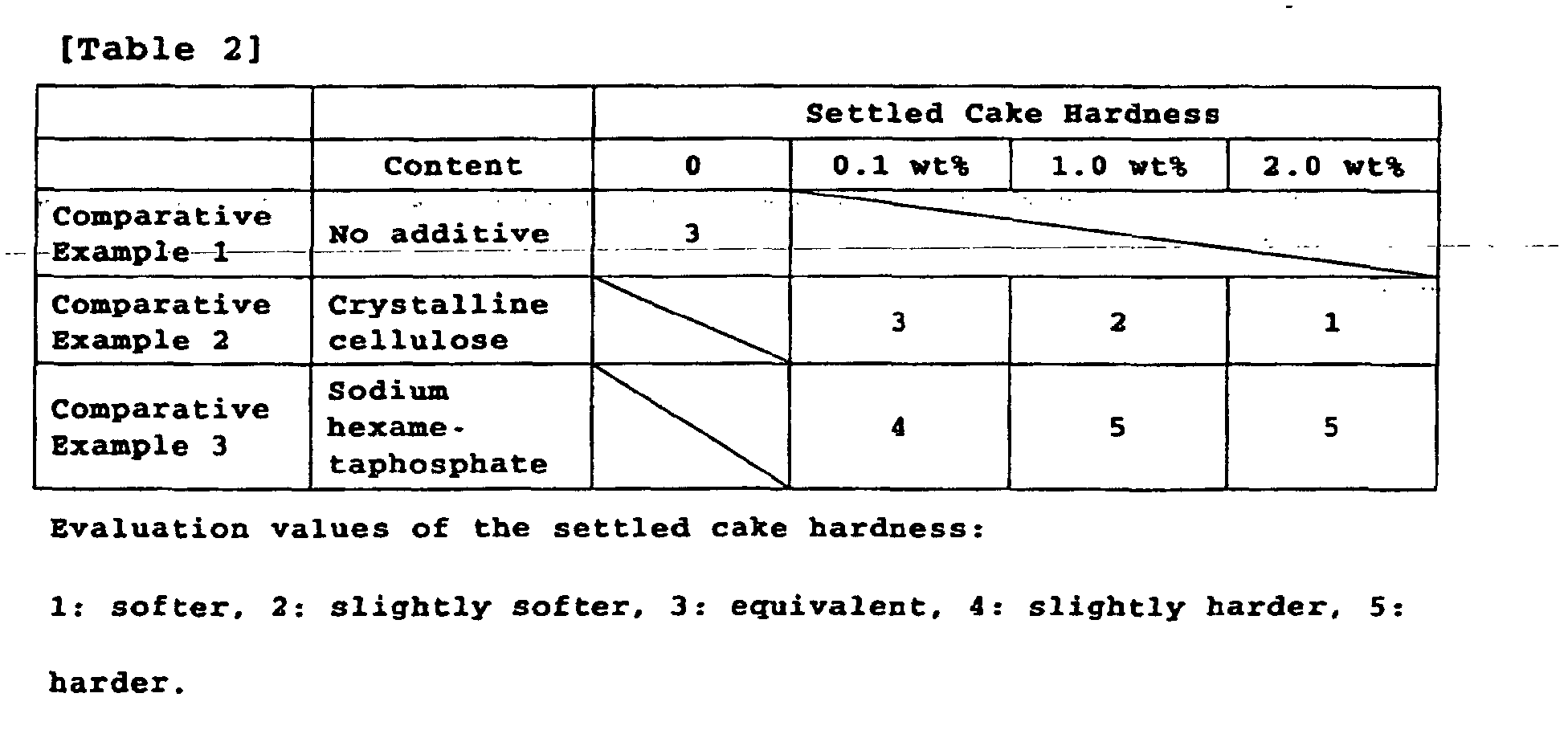
- the settled-cake hardness test is a test in which the hardness of a settled cake is examined by placing a polishing slurry into a given vessel, and forming a settled cake by allowing it to stand for 48 hours to precipitate the abrasive grains of a polishing material.
- the hardness of a settled cake was examined in five-leveled evaluation values, as relatively compared with the hardness of each of settled cakes, using as the reference the hardness of a settled cake for Comparative Example 1 having no added additive.
- the hardness of a settled cake for Comparative Example 1 was defined as an evaluation value of 3, and the evaluation values are given in five levels, depending on whether a cake has an equivalent hardness, or is softer or harder, as described below Table 2.
- Comparative Example 2 clearly displays a tendency for settled cakes to become soft as the content of crystalline cellulose is increased. In case of containing only sodium hexametaphosphate, on the other hand, settled cakes are shown to have a tendency to become very hard.
- the washing test was carried out by visual observation of stains on the polished surface after carrying out 10 minute polishing under the above described polishing condition, and then immersing the blue sheet glass that is a substrate to be polished, in pure water for 10 minutes, followed by subjecting the glass to water-wash treatment by getting it three times into and out of pure water, and then drying.
- relative comparison of washing test results for each of the polishing materials was made, using as the reference the washing result for Comparative Example 1 having no added additive, to examine its washing property, as in the above described settled-cake hardness test.
- the washing result for Comparative Example 1 was defined as an evaluation value of 4, and evaluation values are given in six levels, depending on whether a result is equivalent, or better or worse.
- polishing materials were made, varying the content of each of crystalline cellulose and sodium hexametaphosphate, and the above described polishing test, settled-cake hardness test, washing test, and settling test were carried out.
- Results of these Examples are shown in Table 4, where the contents of crystalline cellulose and sodium hexametaphosphate are indicated in columns and rows, respectively, and respective results obtained by carrying out the polishing test, settled-cake hardness test, washing test, and settling test are shown for polishing materials at each content.
- the polishing values, and the evaluation values for the settled cake hardness and washing property in Table 4 are expressed by values determined by relative evaluation using as the reference the results for Comparative Example 1 in which no additive was added, as in Comparative Examples described above.
- the settling test was performed to examine settling property by mixing 110 g of each of polishing materials and 2090 g of pure water and stirring them thoroughly to prepare a polishing slurry containing 5 wt% of a polishing material, putting this polishing slurry into a 2000 ml measuring cylinder, and reading a gradation at the interface between the suspension phase and the dispersion medium phase (pure water) in the abrasive slurry.
- the evaluation values of the settling test are values obtained by measuring the volume of the suspension phase after putting the polishing slurry into a measuring cylinder and allowing it to stand for 60 minutes, and calculating a ratio (%) of the measured suspension-phase volume relative to the whole polishing-slurry volume (2000 ml).
- the content range of sodium hexametaphosphate resulting in a good dispersibility of the abrasive grains of a polishing material in a polishing slurry is 0.02 to 2.0 wt%.
- the cerium oxide-based polishing material containing crystalline cellulose and sodium hexametaphosphate in contents within the content range is excellent as a polishing material.
- Table 6 shows the results of the examination of changes over time in the polishing test.
- the changes over time were examined by determining an amount decreased in the weight by means of polishing five successive plates of blue sheet glass which were weighed before polishing under the same condition as those of the above described polishing test, and measuring the weight of each plate of blue sheet glass after polishing.
- the efficiency of polishing is expressed by values to which, when the amount decreased in the weight of the first plate of blue sheet glass with Comparative Example 1 is defined as 100, amounts decreased in the weight of the other plates are converted as relative values. Accordingly, values exceeding 100 in Table 5 indicate that amounts decreased of the blue sheet glass by polishing are greater than that of the first plate of Comparative Example 1, and the efficiency of polishing is high.
- Plate Number 1 2 3 4 5 No Additive 100 93 90 86 84 0.5 wt% crystalline cellulose + 0.1 wt% sodium hexametaphosphate 135 136 135 134 135
- a polishing material of Comparative Example 1 having no additive added has a tendency to reduce the efficiency of polishing over time, as the number of processed plates of blue sheet glass is increased.
- a polishing material which contains 0.5 wt% of crystalline cellulose and 0.1 wt% of sodium hexametaphosphate on the other hand, it has turned out that even if the number of processed plates of blue sheet glass is increased, there is hardly any change in the efficiency of polishing, and thus a high efficiency of polishing can be achieved stably.
- the abrasive slurries used in Tables 1 to 6 described above were prepared by mixing abrasive powder with an anti-solidification agent and a dispersant in advance, then disperse the mixture into pure water to make slurry.
- the abrasive slurries evaluated here were prepared by disperse abrasive powder containing no anti-solidification agent or dispersant into pure water to make a slurry in advance, and then adding crystalline cellulose and sodium hexametaphosphate to the slurry.
- the polishing test, settled-cake hardness test, washing test, and settling test were carried out as in Table 4.
- Evaluation Item E the results of measurement of the settled-cake height 30 days later by the settling test for Evaluation Item D are also shown.
- Evaluation E the results are expressed in a relative value calculated based on the height of the settled cake containing no crystalline cellulose or sodium hexametaphosphate (0 wt% in Table 7) 30 days later assuming as 100.
- the results of evaluations shown here are obtained only for the case where crystalline cellulose and sodium hexametaphosphate were added in the same amount. The results are shown in Table 7.
- Second Embodiment In this second embodiment, an explanation of cases where the anti-solidification agent utilized calcium secondary phosphate, a condensate of sodium ⁇ -naphthalenesulphonate and formalin, and synthetic silica, and the dispersant utilized sodium pyrophosphate will be given.
- the calcium secondary phosphate used was a guaranteed reagent
- the condensate of sodium ⁇ -naphthalenesulphonate and formalin used was a product under the trade name of "Lavelin” (manufactured by Dai-ichi Kogyo Seiyaku Co., Ltd.)
- the synthetic silica used was a product under the trade name of "Carplex” (manufactured by Shionogi & Co., Ltd.).
- cerium oxide-based polishing materials were employed to make polishing materials containing 1.0 wt% of each of anti-solidification agents and 0.5 wt% of sodium hexametaphosphate as dispersant, and polishing materials containing 1.0 wt% of crystalline cellulose that is an anti-solidification agent and 0.5 wt% of sodium pyrophosphate that is a dispersant for carrying out the polishing test, settled-cake hardness test, washing test, and settling test. Results are shown in Table 8, where data, shown in Examples of the first embodiment, for a polishing material which contains 1.0 wt% crystalline cellulose and 0.5 wt% sodium hexametaphosphate are included for comparison.
- Polishing values, evaluation values for the settled cake hardness and washing property, and the ratios of the suspension-phase volume shown in Table 8 are those measured in a similar way to what is explained in the first embodiment.
- Anti-solidification agent 1.0 wt%) Dispersant (0.5 wt%) Crystalline Cellulose Sodium Hexametaphosphate A 125 B 2 C 3 D 99 Crystalline Cellulose Sodium Pyrophosphate A 119 B 2 C 3 D 98 Calcium Secondary Phosphate Sodium Hexametaphosphate A 128 B 2 C 4 D 97 Sodium ⁇ -Naphthalenesulphonate Formalin Condensate Sodium Hexametaphosphate A 118 B 2 C 3 D 98 Synthetic Silica Sodium Hexametaphosphate A 127 B 2 C 4 D 99 Row A: polishing value (g), Row B: settled cake hardness, Row C: washing property, Row D: ratio of the suspension-phase volume at a period of 60 minuets after making a polishing s
- polishing materials in case of containing calcium secondary phosphate, a condensate of sodium ⁇ -naphthalenesulphonate and formalin, and synthetic silica as anti-solidification agent, and sodium hexametaphosphate as dispersant have characteristic data that are almost equivalent to those of polishing materials containing the same amounts of crystalline cellulose and sodium hexametaphosphate.
- polishing materials containing crystalline cellulose and sodium pyrophosphate also have characteristics at equivalent levels to those of polishing materials containing sodium hexametaphosphate as dispersant.
- Third Embodiment In the third embodiment, the results of evaluation conducted on the combinations of the anti-solidification agents and the dispersants shown in Table 9 will be described. Regarding evaluation, the polishing test, settled-cake hardness test, washing test, and settling test conducted as in First and Second Embodiments were conducted. The abrasive slurries used for the evaluation were produced in similarly manner to those used for Tables 1 to 6. The results are shown in Table 10.
- Anti-solidification agent (0.3 wt%) Dispersant (0.3 wt%) a Propylene glycol alginate Sodium polyacrylate b Propylene glycol alginate Sodium hexametaphosphate c Synthetic silica Sodium polyacrylate d Colloidal silica Acrylic acid/maleic acid copolymer sodium salt e Colloidal silica Sodium pyrophosphate f Crystalline cellulose Acrylic acid/maleic acid copolymer sodium salt g Sodium alginate Sodium polystyrene sulfonate h Sodium alginate Sodium hexametaphosphate i Crystalline cellulose + Sodium carboxymethylcellulose Sodium polystyrene sulfonate j Fumed silica Polyoxyethylene sorbitan stearate k Fumed silica Sodium pyrophosphate l Sodium ⁇ -naphthalene sulfonate formalin condensate Polyoxyethylene sorbitan stearate m Crystalline
- the polishing materials containing the anti-solidification agents and dispersants in 14 combinations from a to n shown in Table 9 were evaluated. As a result, as shown in Table 10, it was found that the characteristics of the 14 polishing materials were similar to the characteristic data for the polishing material containing crystalline cellulose and sodium hexametaphosphate in the same amount in First Embodiment.
- the dispersibility of the abrasive grains of a polishing material can be made better and the hardness of abrasive grain precipitates can be reduced, and at the same time a high efficiency of polishing can be achieved stably. That is, according to the present invention, a polishing material with required characteristics of a polishing material with a totally very good balance, particularly extremely excellent as a polishing material is provided.
Landscapes
- Chemical & Material Sciences (AREA)
- Engineering & Computer Science (AREA)
- Materials Engineering (AREA)
- Organic Chemistry (AREA)
- Mechanical Engineering (AREA)
- Geochemistry & Mineralogy (AREA)
- Chemical Kinetics & Catalysis (AREA)
- General Chemical & Material Sciences (AREA)
- Life Sciences & Earth Sciences (AREA)
- Finish Polishing, Edge Sharpening, And Grinding By Specific Grinding Devices (AREA)
- Polishing Bodies And Polishing Tools (AREA)
- Emulsifying, Dispersing, Foam-Producing Or Wetting Agents (AREA)
- Compounds Of Alkaline-Earth Elements, Aluminum Or Rare-Earth Metals (AREA)
- Luminescent Compositions (AREA)
- Details Of Television Scanning (AREA)
- Detergent Compositions (AREA)
Abstract
Description



| Settling Time (min.) | 3 | 15 | 30 | 45 | 60 |
| Comparative Example 1 (no additive) | 83 | 44 | 32 | 29 | 26 |
| 0.5 wt% crystalline cellulose + 0.1 wt% sodium hexametaphosphate | 100 | 100 | 100 | 100 | 99 |
| (%) |
| Plate Number | 1 | 2 | 3 | 4 | 5 |
| No Additive | 100 | 93 | 90 | 86 | 84 |
| 0.5 wt% crystalline cellulose + 0.1 wt% sodium hexametaphosphate | 135 | 136 | 135 | 134 | 135 |
| Content of crystalline cellulose or sodium hexametaphosphate (wt%) | |||||||
| 0 | 00.2 | 0.1 | 0.5 | 1.0 | 2.0 | 3.0 | |
| A | 99 | 100 | 103 | 135 | 130 | 107 | 85 |
| B | 3 | 3 | 3 | 3 | 3 | 3 | 3 |
| C | 4 | 4 | 4 | 4 | 3 | 3 | 3 |
| D | 29 | 92 | 98 | 100 | 96 | 92 | 59 |
| E | 100 | 360 | 410 | 430 | 440 | 420 | 210 |
| Anti-solidification agent (1.0 wt%) | Dispersant (0.5 wt%) | ||
| Crystalline Cellulose | Sodium Hexametaphosphate | A | 125 |
| B | 2 | ||
| C | 3 | ||
| D | 99 | ||
| Crystalline Cellulose | Sodium Pyrophosphate | A | 119 |
| B | 2 | ||
| C | 3 | ||
| D | 98 | ||
| Calcium Secondary Phosphate | Sodium Hexametaphosphate | A | 128 |
| B | 2 | ||
| C | 4 | ||
| D | 97 | ||
| Sodium β-Naphthalenesulphonate Formalin Condensate | Sodium Hexametaphosphate | A | 118 |
| B | 2 | ||
| C | 3 | ||
| D | 98 | ||
| Synthetic Silica | Sodium Hexametaphosphate | A | 127 |
| B | 2 | ||
| C | 4 | ||
| D | 99 | ||
| Row A: polishing value (g), Row B: settled cake hardness, Row C: washing property, Row D: ratio of the suspension-phase volume at a period of 60 minuets after making a polishing slurry. |
| Anti-solidification agent (0.3 wt%) | Dispersant (0.3 wt%) | |
| a | Propylene glycol alginate | Sodium polyacrylate |
| b | Propylene glycol alginate | Sodium hexametaphosphate |
| c | Synthetic silica | Sodium polyacrylate |
| d | Colloidal silica | Acrylic acid/maleic acid copolymer sodium salt |
| e | Colloidal silica | Sodium pyrophosphate |
| f | Crystalline cellulose | Acrylic acid/maleic acid copolymer sodium salt |
| g | Sodium alginate | Sodium polystyrene sulfonate |
| h | Sodium alginate | Sodium hexametaphosphate |
| i | Crystalline cellulose + Sodium carboxymethylcellulose | Sodium polystyrene sulfonate |
| j | Fumed silica | Polyoxyethylene sorbitan stearate |
| k | Fumed silica | Sodium pyrophosphate |
| l | Sodium β-naphthalene sulfonate formalin condensate | Polyoxyethylene sorbitan stearate |
| m | Crystalline cellulose + carboxymethylcellulose | Tetraoleate polyoxyethylene sorbit |
| n | Propylene glycol alginate | Tetraoleate polyoxyethylene sorbit |
| a | b | c | d | e | f | g | |
| A | 120 | 119 | 122 | 121 | 123 | 122 | 120 |
| B | 3 | 3 | 3 | 3 | 3 | 2 | 2 |
| C | 4 | 4 | 4 | 4 | 4 | 4 | 4 |
| D | 96 | 95 | 97 | 95 | 96 | 97 | 95 |
| h | i | j | k | l | m | N | |
| A | 118 | 125 | 123 | 120 | 120 | 122 | 119 |
| B | 3 | 2 | 3 | 3 | 3 | 3 | 3 |
| C | 4 | 4 | 4 | 4 | 4 | 4 | 4 |
| D | 95 | 98 | 96 | 97 | 95 | 96 | 96 |
Claims (8)
- A polishing material having, as a major component, rare earth oxides including cerium oxide, characterized by containing an anti-solidification agent capable of softening abrasive grain precipitates of the polishing material when the abrasive grains of the polishing material are dispersed into a dispersion medium, and a dispersant capable of dispersing the abrasive grains of the polishing material into the dispersion medium.
- The polishing material according to Claim 1, characterized in that said anti-solidification agent is selected from the group consisting of cellulose and cellulose derivatives, silicas, alginic acid and alginic acid derivatives, aromatic sulfonate formalin condensate salts, and calcium-containing compounds.
- The polishing material according to Claim 2, characterized in that said anti-solidification agent is any one of crystalline cellulose, calcium secondary phosphate, a condensate of sodium β-naphthalenesulphonate and formalin, and synthetic silica.
- The polishing material according to any one of Claims 1 to 3, characterized in that said dispersant is selected from the group consisting of condensed phosphoric acid and condensed phosphates, polystyrene sulfonate salts, polycarboxylate type high-molecular compounds, polyoxyethylene sorbitan fatty acid esters, and polyoxyethylene sorbitol fatty acid esters.
- The polishing material according to Claim 4, characterized in that said dispersant is sodium hexametaphosphate or sodium pyrophosphate.
- The polishing material according to any one of Claims 1 to 5, characterized by containing 0.02 to 2.0% by weight of the anti-solidification agent and 0.02 to 2.0% by weight of the dispersant.
- The polishing material according to any one of Claims 1 to 6, characterized by having a cerium oxide (CeO2)/total rare earth oxides (TREO) of 40 to 99%.
- An abrasive slurry, characterized in that the polishing material according to any one of Claims 1 to 7 is dispersed into a water-born dispersion medium.
Applications Claiming Priority (3)
| Application Number | Priority Date | Filing Date | Title |
|---|---|---|---|
| JP2000307100 | 2000-10-06 | ||
| JP2000307100 | 2000-10-06 | ||
| PCT/JP2001/008671 WO2002031079A1 (en) | 2000-10-06 | 2001-10-02 | Abrasive material |
Publications (3)
| Publication Number | Publication Date |
|---|---|
| EP1338636A1 true EP1338636A1 (en) | 2003-08-27 |
| EP1338636A4 EP1338636A4 (en) | 2007-08-29 |
| EP1338636B1 EP1338636B1 (en) | 2011-01-05 |
Family
ID=18787662
Family Applications (1)
| Application Number | Title | Priority Date | Filing Date |
|---|---|---|---|
| EP01972649A Expired - Lifetime EP1338636B1 (en) | 2000-10-06 | 2001-10-02 | Abrasive material |
Country Status (11)
| Country | Link |
|---|---|
| US (1) | US6824578B2 (en) |
| EP (1) | EP1338636B1 (en) |
| JP (1) | JP3986960B2 (en) |
| KR (1) | KR100539007B1 (en) |
| CN (1) | CN1300277C (en) |
| AT (1) | ATE494345T1 (en) |
| AU (1) | AU2001292332A1 (en) |
| DE (1) | DE60143812D1 (en) |
| MY (1) | MY136599A (en) |
| TW (1) | TWI281493B (en) |
| WO (1) | WO2002031079A1 (en) |
Cited By (3)
| Publication number | Priority date | Publication date | Assignee | Title |
|---|---|---|---|---|
| EP2428541A1 (en) | 2010-09-08 | 2012-03-14 | Basf Se | Aqueous polishing composition and process for chemically mechanically polishing substrates containing silicon oxide dielectric and polysilicon films |
| WO2017102826A1 (en) * | 2015-12-16 | 2017-06-22 | Rhodia Operations | Method for polishing a phosphate glass or a fluorophosphate glass substrate |
| RU2631875C2 (en) * | 2012-02-10 | 2017-09-28 | Басф Се | Composition for chemical-mechanical polishing (cmp) containing protein |
Families Citing this family (37)
| Publication number | Priority date | Publication date | Assignee | Title |
|---|---|---|---|---|
| US7004819B2 (en) * | 2002-01-18 | 2006-02-28 | Cabot Microelectronics Corporation | CMP systems and methods utilizing amine-containing polymers |
| JP3463999B1 (en) * | 2002-05-16 | 2003-11-05 | 三井金属鉱業株式会社 | Manufacturing method of cerium-based abrasive |
| WO2004068570A1 (en) | 2003-01-31 | 2004-08-12 | Hitachi Chemical Co., Ltd. | Cmp polishing compound and polishing method |
| US7073496B2 (en) * | 2003-03-26 | 2006-07-11 | Saint-Gobain Abrasives, Inc. | High precision multi-grit slicing blade |
| US7300478B2 (en) * | 2003-05-22 | 2007-11-27 | Ferro Corporation | Slurry composition and method of use |
| KR101072269B1 (en) * | 2004-03-30 | 2011-10-11 | 주식회사 동진쎄미켐 | Chemical mechanical polishing slurry composition containing etchant |
| US9293344B2 (en) * | 2004-07-23 | 2016-03-22 | Hitachi Chemical Company, Ltd. | Cmp polishing slurry and method of polishing substrate |
| US7531105B2 (en) * | 2004-11-05 | 2009-05-12 | Cabot Microelectronics Corporation | Polishing composition and method for high silicon nitride to silicon oxide removal rate ratios |
| US7504044B2 (en) * | 2004-11-05 | 2009-03-17 | Cabot Microelectronics Corporation | Polishing composition and method for high silicon nitride to silicon oxide removal rate ratios |
| TWI271555B (en) * | 2005-06-13 | 2007-01-21 | Basf Ag | Slurry composition for polishing color filter |
| KR101028622B1 (en) * | 2005-10-19 | 2011-04-11 | 히다치 가세고교 가부시끼가이샤 | Cerium oxide slurry, cerium oxide polishing liquid and substrate polishing method using them |
| KR100813100B1 (en) * | 2006-06-29 | 2008-03-17 | 성균관대학교산학협력단 | Real-time scalable stereo matching system and method |
| CN101484982A (en) * | 2006-07-04 | 2009-07-15 | 日立化成工业株式会社 | Polishing liquid for CMP |
| TWI400142B (en) * | 2006-07-28 | 2013-07-01 | Toray Industries | Mutual invasive macromolecular reticular construct, grinding pad, and the preparing method thereof |
| US7696095B2 (en) * | 2007-02-23 | 2010-04-13 | Ferro Corporation | Auto-stopping slurries for chemical-mechanical polishing of topographic dielectric silicon dioxide |
| JP5819036B2 (en) * | 2008-03-25 | 2015-11-18 | 三井金属鉱業株式会社 | Cerium-based abrasive slurry |
| CN101608097B (en) * | 2009-07-14 | 2011-12-21 | 上海华明高纳稀土新材料有限公司 | Nano cerium oxide seriflux for chemical mechanical polishing and preparation method |
| JP5774283B2 (en) * | 2010-04-08 | 2015-09-09 | 株式会社フジミインコーポレーテッド | Polishing composition and polishing method |
| JP5516184B2 (en) * | 2010-07-26 | 2014-06-11 | 信越化学工業株式会社 | Method for producing synthetic quartz glass substrate |
| US20130260027A1 (en) * | 2010-12-29 | 2013-10-03 | Hoya Corporation | Method for manufacturing glass substrate for magnetic disk, and method for manufacturing magnetic disk |
| JPWO2013065491A1 (en) * | 2011-11-01 | 2015-04-02 | 旭硝子株式会社 | Manufacturing method of glass substrate |
| KR20140000496A (en) | 2012-06-22 | 2014-01-03 | 에스케이하이닉스 주식회사 | Polishing composition, method for fabricating thereof and method of chemical mechanical polishing using the same |
| CN103923604A (en) * | 2013-01-15 | 2014-07-16 | 安阳市岷山有色金属有限责任公司 | Cerium based abrasive material |
| US9281210B2 (en) * | 2013-10-10 | 2016-03-08 | Cabot Microelectronics Corporation | Wet-process ceria compositions for polishing substrates, and methods related thereto |
| US9340706B2 (en) * | 2013-10-10 | 2016-05-17 | Cabot Microelectronics Corporation | Mixed abrasive polishing compositions |
| CN103756571A (en) * | 2013-12-25 | 2014-04-30 | 上海华明高纳稀土新材料有限公司 | Rare-earth polishing powder and preparation method thereof |
| JP6204506B2 (en) * | 2014-01-31 | 2017-09-27 | Hoya株式会社 | Method for recycling used polishing slurry, method for producing glass substrate for magnetic disk |
| CN103992743B (en) * | 2014-05-09 | 2018-06-19 | 杰明纳微电子股份有限公司 | Polishing solution containing cerium dioxide powder and colloidal silicon dioxide mixed abrasive and preparation process thereof |
| CN106661428B (en) * | 2014-07-31 | 2020-01-31 | Hoya株式会社 | Method for producing polishing slurry, polishing abrasive grains, polishing slurry, and method for producing glass substrate |
| CN106978089A (en) * | 2017-04-20 | 2017-07-25 | 德米特(苏州)电子环保材料有限公司 | A kind of preparation method of polishing powder from rare earth |
| WO2019198622A1 (en) * | 2018-04-11 | 2019-10-17 | 日揮触媒化成株式会社 | Polishing composition |
| CN109227227B (en) * | 2018-11-28 | 2020-10-16 | 湖南兴龙环境艺术工程有限公司 | Preparation method of glass grinding disc |
| EP4499766A4 (en) * | 2022-03-24 | 2026-04-29 | Cmc Mat Llc | DOUBLE ADDITIVE POLISHING COMPOSITION FOR GLASS SUBSTRATES |
| KR20250026161A (en) * | 2022-06-27 | 2025-02-25 | 미쓰이금속광업주식회사 | Abrasive slurry and polishing method thereof |
| CN119547183A (en) * | 2022-06-27 | 2025-02-28 | 三井金属矿业株式会社 | Abrasive slurry and grinding method thereof |
| CN119137235A (en) * | 2022-07-12 | 2024-12-13 | 株式会社力森诺科 | Cerium-based abrasive material, abrasive liquid, method for producing abrasive liquid, and glass abrasive method |
| CN115519484A (en) * | 2022-09-27 | 2022-12-27 | 郑州磨料磨具磨削研究所有限公司 | Vitrified bond diamond grinding wheel with high porosity and preparation method thereof |
Family Cites Families (15)
| Publication number | Priority date | Publication date | Assignee | Title |
|---|---|---|---|---|
| JPS5645975A (en) | 1979-09-20 | 1981-04-25 | Akira Suzuki | Additive for abrasive material |
| JPS56147880A (en) | 1980-04-19 | 1981-11-17 | Akira Suzuki | Additive for abrasive material |
| EP0045826A1 (en) | 1980-08-12 | 1982-02-17 | Monsanto Company | Dicalcium phosphate dihydrate having improved stability and a method for preparing it |
| FR2624519A1 (en) | 1987-12-09 | 1989-06-16 | Rhone Poulenc Chimie | CERIUM-IMPROVED POLISHING COMPOSITION AND PROCESS FOR PREPARING THE SAME |
| JP2783330B2 (en) | 1989-11-01 | 1998-08-06 | 株式会社フジミインコーポレーテッド | Abrasive for glass polishing |
| JP2832270B2 (en) | 1993-05-18 | 1998-12-09 | 三井金属鉱業株式会社 | Abrasive for glass polishing |
| JPH09143455A (en) | 1995-09-21 | 1997-06-03 | Mitsubishi Chem Corp | Hard disk substrate polishing composition and polishing method using the same |
| JP3856513B2 (en) | 1996-12-26 | 2006-12-13 | 昭和電工株式会社 | Abrasive composition for glass polishing |
| BR9810241A (en) | 1997-06-04 | 2000-09-05 | Toto Ltd | Cleaning agent to clean the surface of a substrate, composition of subcoat to form a subcoat on the surface of a substrate, process to form a photocatalytically hydrophilicable coating on the surface of a substrate, together, and, member |
| US6248143B1 (en) * | 1998-01-27 | 2001-06-19 | Showa Denko Kabushiki Kaisha | Composition for polishing glass and polishing method |
| JP3857799B2 (en) | 1998-01-27 | 2006-12-13 | 昭和電工株式会社 | Abrasive composition for glass polishing and polishing method thereof |
| JP2000063806A (en) | 1998-08-17 | 2000-02-29 | Okamoto Machine Tool Works Ltd | Abrasive slurry and preparation thereof |
| JP3728950B2 (en) | 1998-12-04 | 2005-12-21 | 株式会社日立製作所 | Semiconductor device manufacturing method and planarization apparatus |
| JP2000256656A (en) | 1999-03-04 | 2000-09-19 | Hitachi Chem Co Ltd | Cmp abrasive material and abrasion of substrate |
| JP2000351956A (en) | 1999-06-10 | 2000-12-19 | Seimi Chem Co Ltd | Abrasive for semiconductor, obtained by adding thickener |
-
2001
- 2001-09-24 TW TW090123439A patent/TWI281493B/en not_active IP Right Cessation
- 2001-09-25 MY MYPI20014476A patent/MY136599A/en unknown
- 2001-10-02 US US10/363,678 patent/US6824578B2/en not_active Expired - Lifetime
- 2001-10-02 DE DE60143812T patent/DE60143812D1/en not_active Expired - Lifetime
- 2001-10-02 JP JP2002534451A patent/JP3986960B2/en not_active Expired - Fee Related
- 2001-10-02 KR KR10-2003-7003566A patent/KR100539007B1/en not_active Expired - Lifetime
- 2001-10-02 CN CNB018169368A patent/CN1300277C/en not_active Expired - Lifetime
- 2001-10-02 AU AU2001292332A patent/AU2001292332A1/en not_active Abandoned
- 2001-10-02 AT AT01972649T patent/ATE494345T1/en not_active IP Right Cessation
- 2001-10-02 WO PCT/JP2001/008671 patent/WO2002031079A1/en not_active Ceased
- 2001-10-02 EP EP01972649A patent/EP1338636B1/en not_active Expired - Lifetime
Cited By (3)
| Publication number | Priority date | Publication date | Assignee | Title |
|---|---|---|---|---|
| EP2428541A1 (en) | 2010-09-08 | 2012-03-14 | Basf Se | Aqueous polishing composition and process for chemically mechanically polishing substrates containing silicon oxide dielectric and polysilicon films |
| RU2631875C2 (en) * | 2012-02-10 | 2017-09-28 | Басф Се | Composition for chemical-mechanical polishing (cmp) containing protein |
| WO2017102826A1 (en) * | 2015-12-16 | 2017-06-22 | Rhodia Operations | Method for polishing a phosphate glass or a fluorophosphate glass substrate |
Also Published As
| Publication number | Publication date |
|---|---|
| EP1338636B1 (en) | 2011-01-05 |
| AU2001292332A1 (en) | 2002-04-22 |
| CN1697869A (en) | 2005-11-16 |
| MY136599A (en) | 2008-10-31 |
| EP1338636A4 (en) | 2007-08-29 |
| TWI281493B (en) | 2007-05-21 |
| US6824578B2 (en) | 2004-11-30 |
| KR100539007B1 (en) | 2005-12-26 |
| JPWO2002031079A1 (en) | 2004-02-19 |
| JP3986960B2 (en) | 2007-10-03 |
| KR20030048032A (en) | 2003-06-18 |
| ATE494345T1 (en) | 2011-01-15 |
| WO2002031079A1 (en) | 2002-04-18 |
| DE60143812D1 (en) | 2011-02-17 |
| CN1300277C (en) | 2007-02-14 |
| US20040010978A1 (en) | 2004-01-22 |
Similar Documents
| Publication | Publication Date | Title |
|---|---|---|
| US6824578B2 (en) | Abrasive material | |
| EP0717762B1 (en) | Activated polishing compositions | |
| EP2322322B1 (en) | Aluminum oxide particle and polishing composition containing the same | |
| JP6017315B2 (en) | Abrasive material and polishing composition | |
| KR100429940B1 (en) | Improved ceria powder | |
| US6645265B1 (en) | Polishing formulations for SiO2-based substrates | |
| KR100574259B1 (en) | Polishing slurry and polishing method | |
| KR20140034235A (en) | Abrasive and polishing composition | |
| US7300478B2 (en) | Slurry composition and method of use | |
| JP4105838B2 (en) | Abrasive and polishing method | |
| KR20170085034A (en) | Polishing composition and manufacturing method of substrate using same | |
| US20060218867A1 (en) | Polishing composition and polishing method using the same | |
| JP2004155913A (en) | Polishing abrasive grains, method for producing the same, and abrasive | |
| KR100447540B1 (en) | pollishing slurry for silicon wafer | |
| JP2850254B2 (en) | Abrasive composition | |
| JP2000256654A (en) | Cmp abrasive material and abrasion of substrate | |
| JP2004155914A (en) | Polishing abrasive grains, method for producing the same, and abrasive | |
| KR100359287B1 (en) | Cerium oxide slurry for rolishing, process for preparing the slurry, and process for polishing with the slurry |
Legal Events
| Date | Code | Title | Description |
|---|---|---|---|
| PUAI | Public reference made under article 153(3) epc to a published international application that has entered the european phase |
Free format text: ORIGINAL CODE: 0009012 |
|
| 17P | Request for examination filed |
Effective date: 20030505 |
|
| AK | Designated contracting states |
Designated state(s): AT BE CH CY DE DK ES FI FR GB GR IE IT LI LU MC NL PT SE TR |
|
| AX | Request for extension of the european patent |
Extension state: AL LT LV MK RO SI |
|
| A4 | Supplementary search report drawn up and despatched |
Effective date: 20070726 |
|
| 17Q | First examination report despatched |
Effective date: 20080515 |
|
| GRAP | Despatch of communication of intention to grant a patent |
Free format text: ORIGINAL CODE: EPIDOSNIGR1 |
|
| GRAS | Grant fee paid |
Free format text: ORIGINAL CODE: EPIDOSNIGR3 |
|
| GRAA | (expected) grant |
Free format text: ORIGINAL CODE: 0009210 |
|
| AK | Designated contracting states |
Kind code of ref document: B1 Designated state(s): AT BE CH CY DE DK ES FI FR GB GR IE IT LI LU MC NL PT SE TR |
|
| REG | Reference to a national code |
Ref country code: GB Ref legal event code: FG4D |
|
| REG | Reference to a national code |
Ref country code: CH Ref legal event code: EP |
|
| REG | Reference to a national code |
Ref country code: IE Ref legal event code: FG4D |
|
| REF | Corresponds to: |
Ref document number: 60143812 Country of ref document: DE Date of ref document: 20110217 Kind code of ref document: P |
|
| REG | Reference to a national code |
Ref country code: DE Ref legal event code: R096 Ref document number: 60143812 Country of ref document: DE Effective date: 20110217 |
|
| REG | Reference to a national code |
Ref country code: NL Ref legal event code: VDEP Effective date: 20110105 |
|
| PG25 | Lapsed in a contracting state [announced via postgrant information from national office to epo] |
Ref country code: SE Free format text: LAPSE BECAUSE OF FAILURE TO SUBMIT A TRANSLATION OF THE DESCRIPTION OR TO PAY THE FEE WITHIN THE PRESCRIBED TIME-LIMIT Effective date: 20110105 Ref country code: GR Free format text: LAPSE BECAUSE OF FAILURE TO SUBMIT A TRANSLATION OF THE DESCRIPTION OR TO PAY THE FEE WITHIN THE PRESCRIBED TIME-LIMIT Effective date: 20110406 Ref country code: PT Free format text: LAPSE BECAUSE OF FAILURE TO SUBMIT A TRANSLATION OF THE DESCRIPTION OR TO PAY THE FEE WITHIN THE PRESCRIBED TIME-LIMIT Effective date: 20110505 Ref country code: ES Free format text: LAPSE BECAUSE OF FAILURE TO SUBMIT A TRANSLATION OF THE DESCRIPTION OR TO PAY THE FEE WITHIN THE PRESCRIBED TIME-LIMIT Effective date: 20110416 |
|
| PG25 | Lapsed in a contracting state [announced via postgrant information from national office to epo] |
Ref country code: FI Free format text: LAPSE BECAUSE OF FAILURE TO SUBMIT A TRANSLATION OF THE DESCRIPTION OR TO PAY THE FEE WITHIN THE PRESCRIBED TIME-LIMIT Effective date: 20110105 Ref country code: NL Free format text: LAPSE BECAUSE OF FAILURE TO SUBMIT A TRANSLATION OF THE DESCRIPTION OR TO PAY THE FEE WITHIN THE PRESCRIBED TIME-LIMIT Effective date: 20110105 Ref country code: BE Free format text: LAPSE BECAUSE OF FAILURE TO SUBMIT A TRANSLATION OF THE DESCRIPTION OR TO PAY THE FEE WITHIN THE PRESCRIBED TIME-LIMIT Effective date: 20110105 Ref country code: CY Free format text: LAPSE BECAUSE OF FAILURE TO SUBMIT A TRANSLATION OF THE DESCRIPTION OR TO PAY THE FEE WITHIN THE PRESCRIBED TIME-LIMIT Effective date: 20110105 Ref country code: AT Free format text: LAPSE BECAUSE OF FAILURE TO SUBMIT A TRANSLATION OF THE DESCRIPTION OR TO PAY THE FEE WITHIN THE PRESCRIBED TIME-LIMIT Effective date: 20110105 |
|
| PG25 | Lapsed in a contracting state [announced via postgrant information from national office to epo] |
Ref country code: DK Free format text: LAPSE BECAUSE OF FAILURE TO SUBMIT A TRANSLATION OF THE DESCRIPTION OR TO PAY THE FEE WITHIN THE PRESCRIBED TIME-LIMIT Effective date: 20110105 |
|
| PLBE | No opposition filed within time limit |
Free format text: ORIGINAL CODE: 0009261 |
|
| STAA | Information on the status of an ep patent application or granted ep patent |
Free format text: STATUS: NO OPPOSITION FILED WITHIN TIME LIMIT |
|
| 26N | No opposition filed |
Effective date: 20111006 |
|
| PG25 | Lapsed in a contracting state [announced via postgrant information from national office to epo] |
Ref country code: IT Free format text: LAPSE BECAUSE OF FAILURE TO SUBMIT A TRANSLATION OF THE DESCRIPTION OR TO PAY THE FEE WITHIN THE PRESCRIBED TIME-LIMIT Effective date: 20110105 |
|
| REG | Reference to a national code |
Ref country code: DE Ref legal event code: R097 Ref document number: 60143812 Country of ref document: DE Effective date: 20111006 |
|
| PG25 | Lapsed in a contracting state [announced via postgrant information from national office to epo] |
Ref country code: MC Free format text: LAPSE BECAUSE OF NON-PAYMENT OF DUE FEES Effective date: 20111031 |
|
| REG | Reference to a national code |
Ref country code: CH Ref legal event code: PL |
|
| GBPC | Gb: european patent ceased through non-payment of renewal fee |
Effective date: 20111002 |
|
| PG25 | Lapsed in a contracting state [announced via postgrant information from national office to epo] |
Ref country code: CH Free format text: LAPSE BECAUSE OF NON-PAYMENT OF DUE FEES Effective date: 20111031 Ref country code: LI Free format text: LAPSE BECAUSE OF NON-PAYMENT OF DUE FEES Effective date: 20111031 Ref country code: DE Free format text: LAPSE BECAUSE OF NON-PAYMENT OF DUE FEES Effective date: 20120501 |
|
| REG | Reference to a national code |
Ref country code: IE Ref legal event code: MM4A |
|
| REG | Reference to a national code |
Ref country code: DE Ref legal event code: R119 Ref document number: 60143812 Country of ref document: DE Effective date: 20120501 |
|
| PG25 | Lapsed in a contracting state [announced via postgrant information from national office to epo] |
Ref country code: GB Free format text: LAPSE BECAUSE OF NON-PAYMENT OF DUE FEES Effective date: 20111002 |
|
| PG25 | Lapsed in a contracting state [announced via postgrant information from national office to epo] |
Ref country code: IE Free format text: LAPSE BECAUSE OF NON-PAYMENT OF DUE FEES Effective date: 20111002 |
|
| PG25 | Lapsed in a contracting state [announced via postgrant information from national office to epo] |
Ref country code: LU Free format text: LAPSE BECAUSE OF NON-PAYMENT OF DUE FEES Effective date: 20111002 |
|
| PG25 | Lapsed in a contracting state [announced via postgrant information from national office to epo] |
Ref country code: TR Free format text: LAPSE BECAUSE OF FAILURE TO SUBMIT A TRANSLATION OF THE DESCRIPTION OR TO PAY THE FEE WITHIN THE PRESCRIBED TIME-LIMIT Effective date: 20110105 |
|
| REG | Reference to a national code |
Ref country code: FR Ref legal event code: PLFP Year of fee payment: 16 |
|
| REG | Reference to a national code |
Ref country code: FR Ref legal event code: PLFP Year of fee payment: 17 |
|
| REG | Reference to a national code |
Ref country code: FR Ref legal event code: PLFP Year of fee payment: 18 |
|
| PGFP | Annual fee paid to national office [announced via postgrant information from national office to epo] |
Ref country code: FR Payment date: 20190913 Year of fee payment: 19 |
|
| PG25 | Lapsed in a contracting state [announced via postgrant information from national office to epo] |
Ref country code: FR Free format text: LAPSE BECAUSE OF NON-PAYMENT OF DUE FEES Effective date: 20201031 |