EP1336606A1 - Nouveaux coupleurs 6-alcoxy-2,3-diaminopyridine utiles pour la teinture des fibres kératiniques - Google Patents
Nouveaux coupleurs 6-alcoxy-2,3-diaminopyridine utiles pour la teinture des fibres kératiniques Download PDFInfo
- Publication number
- EP1336606A1 EP1336606A1 EP03290292A EP03290292A EP1336606A1 EP 1336606 A1 EP1336606 A1 EP 1336606A1 EP 03290292 A EP03290292 A EP 03290292A EP 03290292 A EP03290292 A EP 03290292A EP 1336606 A1 EP1336606 A1 EP 1336606A1
- Authority
- EP
- European Patent Office
- Prior art keywords
- amino
- methoxy
- pyrrolidine
- hydroxy
- ylamine
- Prior art date
- Legal status (The legal status is an assumption and is not a legal conclusion. Google has not performed a legal analysis and makes no representation as to the accuracy of the status listed.)
- Granted
Links
- 0 CC(CCC1*)N1c1c(*)ccc(OC)n1 Chemical compound CC(CCC1*)N1c1c(*)ccc(OC)n1 0.000 description 2
Classifications
-
- C—CHEMISTRY; METALLURGY
- C07—ORGANIC CHEMISTRY
- C07D—HETEROCYCLIC COMPOUNDS
- C07D401/00—Heterocyclic compounds containing two or more hetero rings, having nitrogen atoms as the only ring hetero atoms, at least one ring being a six-membered ring with only one nitrogen atom
- C07D401/02—Heterocyclic compounds containing two or more hetero rings, having nitrogen atoms as the only ring hetero atoms, at least one ring being a six-membered ring with only one nitrogen atom containing two hetero rings
- C07D401/04—Heterocyclic compounds containing two or more hetero rings, having nitrogen atoms as the only ring hetero atoms, at least one ring being a six-membered ring with only one nitrogen atom containing two hetero rings directly linked by a ring-member-to-ring-member bond
-
- C—CHEMISTRY; METALLURGY
- C07—ORGANIC CHEMISTRY
- C07D—HETEROCYCLIC COMPOUNDS
- C07D213/00—Heterocyclic compounds containing six-membered rings, not condensed with other rings, with one nitrogen atom as the only ring hetero atom and three or more double bonds between ring members or between ring members and non-ring members
- C07D213/02—Heterocyclic compounds containing six-membered rings, not condensed with other rings, with one nitrogen atom as the only ring hetero atom and three or more double bonds between ring members or between ring members and non-ring members having three double bonds between ring members or between ring members and non-ring members
- C07D213/04—Heterocyclic compounds containing six-membered rings, not condensed with other rings, with one nitrogen atom as the only ring hetero atom and three or more double bonds between ring members or between ring members and non-ring members having three double bonds between ring members or between ring members and non-ring members having no bond between the ring nitrogen atom and a non-ring member or having only hydrogen or carbon atoms directly attached to the ring nitrogen atom
- C07D213/60—Heterocyclic compounds containing six-membered rings, not condensed with other rings, with one nitrogen atom as the only ring hetero atom and three or more double bonds between ring members or between ring members and non-ring members having three double bonds between ring members or between ring members and non-ring members having no bond between the ring nitrogen atom and a non-ring member or having only hydrogen or carbon atoms directly attached to the ring nitrogen atom with hetero atoms or with carbon atoms having three bonds to hetero atoms with at the most one bond to halogen, e.g. ester or nitrile radicals, directly attached to ring carbon atoms
- C07D213/72—Nitrogen atoms
- C07D213/74—Amino or imino radicals substituted by hydrocarbon or substituted hydrocarbon radicals
Definitions
- the subject of the invention is a dye composition useful for dyeing fibers.
- keratin containing at least one oxidation base and at least one coupler of the type 6-alkoxy-2,3-diaminopyridine, the use of this composition for dyeing keratin fibers as well as the dyeing process using this composition.
- a subject of the invention is also new 6-alkoxy-2,3-diaminopyridine compounds. useful as couplers.
- oxidation bases such as ortho or paraphenylenediamines, ortho or paraaminophenols and compounds heterocyclic.
- oxidation bases are colorless or weakly composed colored which, associated with oxidizing products, can give rise to a oxidative condensation process to colored compounds.
- couplers or color modifiers these the latter being chosen in particular from aromatic metadiamines, metaaminophenols, metadiphenols and certain heterocyclic compounds such as indole compounds.
- the dyes should also cover white hair, and be the least selective possible, that is to say allow to obtain differences in coloring the lowest possible throughout the same keratin fiber, which is generally differently sensitized (i.e. damaged) between its tip and its root.
- each of the substituents may be a hydroxy, alkoxy, amino, or NR 1 R 2 with R 1 R 2 representing an H, alkyl, aryl.
- the coloring is obtained either by air oxidation or by an oxidizing medium containing hydrogen peroxide at basic pH. Due to the high oxidizability of these pyridine precursors, the dyes obtained on hair tend to change over time by changing color, which is particularly unattractive.
- compositions containing as coupler derivatives of 6-alkoxy-3-aminopyridine substituted in position 2 by an NH 2 or NHR 3 radical with R 3 H, C 1 -C 4 alkyl, hydroxy C 2 -C 4 alkyl in combination with conventional oxidation bases.
- These compositions give, in the presence of certain bases such as para-phenylene diamine or para-toluenediamine, dark blue shades that are fragile in light and lack of intensity and unison between the root and the tips of the hair.
- Patent application DE 4 115 148 proposes hair dye compositions containing as oxidation base a triamino pyrimidine derivative substituted by a fourth amino or hydroxy radical, a meta-aminophenol and a 6-methoxy-3-amino derivative pyridine substituted in position two by a C 1 -C 4 alkyl amino radical.
- Such compositions give the hair a black coloring.
- nuances such as coppery, mahogany, red, blue violet or green cannot be obtained by such compositions.
- Patent application FR 2 779 952 proposes to dye the hair with dye compositions based on pyridine derivatives as a coupler and pyrazolo [1,5-a] pyrimidines base as an oxidation base.
- the coloration obtained by such compositions does not make it possible to obtain a homogeneity (or unison) of the color from root to tip of the hair. Of more, it lacks intensity and chromaticity.
- Application EP 728 464 proposes to dye hair with hair compositions. tincture based on 4,5 or 3,4 diaminopyrazoles as oxidation bases and derivatives of pyridines as couplers. This solution provides nuances generally coppery-mahogany, but these lack intensity and tenacity when faced external agents such as shampoo, light and sweat and chromaticity.
- Patent application DE 199 36442 proposes a dye composition for dye human hair containing a para-aminophenol derivative as a base oxidation with at least one coupler derived from methylaminophenol and / or one coupler 2-aminopyridine derivative substituted in 3 and 6 by an H, amino, hydroxy or alkoxy.
- a dye composition for dye human hair containing a para-aminophenol derivative as a base oxidation with at least one coupler derived from methylaminophenol and / or one coupler 2-aminopyridine derivative substituted in 3 and 6 by an H, amino, hydroxy or alkoxy.
- Such a composition only makes it possible to dye hair having naturally a chestnut color.
- the resulting dyes are missing notably of shine and chromaticity.
- the aim of the present invention is to provide new dye compositions for dyeing keratin fibers which do not have the disadvantages of those of the prior art.
- the object of the present invention is to provide compositions which present powerful, uniform dyes between the root and the tip of the hair, having good chromaticity, not very selective and particularly resistant, while being able to generate intense colorings in various shades, especially in fundamental shades.
- R 5 and R 6 form, with the nitrogen atom with which they are attached, a heterocycle with 5 to 8 chains chosen from pyrrolidine, piperidine, homopiperidine, piperazine, homopiperazine, diazepane.
- R 5 and R 6 together form a heterocycle chosen from 2,5-dimethylpyrrolidine, proline, 3-hydroxyproline, 4-hydroxyproline, 2,4-dicarboxypyrrolidine, 3-hydroxy- 2-hydroxymethylpyrrolidine, 2-carboxamidopyrrolidine, 3-hydroxy-2-carboxamidopyrrolidine, 2- (diethylcarboxamido) pyrrolidine, 2-hydroxymethyl pyrrolidine, 3,4-dihydroxy-2-hydroxymethyl pyrrolidine, 3-hydroxypyrrolidine, 3,4-dihydroxy pyrrolidine, 3-amino pyrrolidine, 3-methylamino pyrrolidine, 4-amino-3-hydroxy pyrrolidine, 3-hydroxy-4- (2-hydroxyethyl) amino-pyrrolidine, 3-acetamidopyrrolidine, 3- (methylsulfonylamino) -pyrrolidine, piperidine, 2,6-dimethylpiperidine, 2-carboxypiperidine, 2-carboxamidopiperidine, 2-hydroxymethylsulfonyla
- R 5 and R 6 together form a heterocycle chosen from pyrrolidine, 3-hydroxypyrrolidine, 3-aminopyrrolidine, 3-acetamidopyrrolidine, 3- (methylsulfonylamino) -pyrrolidine, proline, 3-hydroxyproline, piperidine, hydroxypiperidines, homopiperidine, diazepane, N-methyl diazepane (also called N-methyl homopiperazine), N- (2-hydroxyethyl) - diazepane (also called N ⁇ -hydroxyethylhomopiperazine) 'addition.
- a heterocycle chosen from pyrrolidine, 3-hydroxypyrrolidine, 3-aminopyrrolidine, 3-acetamidopyrrolidine, 3- (methylsulfonylamino) -pyrrolidine, proline, 3-hydroxyproline, piperidine, hydroxypiperidines, homopiperidine, diazepane, N-methyl diazepane (also called N-methyl homopiperazine), N-
- alkyl means linear radicals or branched, for example methyl, ethyl, n-propyl, iso-propyl, butyl, etc.
- a radical alkoxy is an alk-O radical, the alkyl radical having the definition given above.
- Halogen preferably denotes Cl, Br, I.
- (Poly) aminoalkyl radicals are alkyl radicals substituted by one or several amino radicals.
- (Poly) hydroxyalkyl radicals are alkyl radicals substituted with one or more hydroxy substituents.
- the oxidative dye composition of the present invention comprises one or more several oxidation bases conventionally used in oxidation dyeing.
- these oxidation bases are chosen from the oxidation bases, by example paraphenylenediamines, bis-phenylalkylenediamines, para-aminophenols, ortho-aminophenols, heterocyclic bases other than those described above and their addition salts.
- paraphenylenediamines there may be mentioned by way of example, the paraphenylenediamine, paratoluylenediamine, 2-chloro paraphenylenediamine, 2,3-dimethyl paraphenylenediamine, 2,6-dimethyl paraphenylenediamine, 2,6-diethyl paraphenylenediamine, 2,5-dimethyl paraphenylenediamine, N, N-dimethyl paraphenylenediamine, N, N-diethyl paraphenylenediamine, N, N-dipropyl paraphenylenediamine, 4-amino N, N-diethyl 3-methyl aniline, N, N-bis- ( ⁇ -hydroxyethyl) paraphenylenediamine, 4-N, N-bis- ( ⁇ -hydroxyethyl) amino 2-methyl aniline, 4-N, N-bis- ( ⁇ -hydroxyethyl) amino 2-chloro aniline, 2- ⁇ -hydroxyethyl paraphenyl
- paraphenylenediamine paratoluylenediamine, 2-isopropyl paraphenylenediamine, 2- ⁇ -hydroxyethyl para-phenylenediamine, 2- ⁇ -hydroxyethyloxy para-phenylene diamine, 2,6-dimethyl paraphenylenediamine, 2,6-diethyl paraphenylenediamine, 2,3-dimethyl paraphenylenediamine, N, N-bis- ( ⁇ -hydroxyethyl) paraphenylenediamine, 2-chloro paraphenylenediamine, 2- ⁇ -acetylaminoethyloxy paraphenylenediamine, and their salts addition with an acid are particularly preferred.
- bis-phenylalkylenediamines there may be mentioned by way of example, N, N'-bis- ( ⁇ -hydroxyethyl) N, N'-bis- (4'-aminophenyl) 1,3-diamino propanol, N, N'-bis- ( ⁇ -hydroxyethyl) N, N'-bis- (4'-aminophenyl) ethylenediamine, N, N'-bis- (4-aminophenyl) tetramethylenediamine, N, N'-bis- ( ⁇ -hydroxyethyl) N, N'-bis- (4-aminophenyl) tetramethylenediamine, N, N'-bis- (4-methyl-aminophenyl) tetramethylenediamine, N, N'-bis- (ethyl) N, N'-bis- (4'-amino, 3'-methylphenyl) ethylenediamine, 1,8-bis- (2,5-di
- para-aminophenol there may be mentioned by way of example, para-aminophenol, 4-amino 3-methyl phenol, 4-amino 3-fluoro phenol, 4-amino 3-hydroxymethyl phenol, 4-amino 2-methyl phenol, 4-amino 2-hydroxymethyl phenol, 4-amino 2-methoxymethyl phenol, 4-amino 2-aminomethyl phenol, 4-amino 2- ( ⁇ -hydroxyethyl aminomethyl) phenol, 4-amino 2-fluoro phenol, and their addition salts with an acid.
- ortho-aminophenols there may be mentioned by way of example, 2-amino phenol, 2-amino 5-methyl phenol, 2-amino 6-methyl phenol, 5-acetamido 2-amino phenol, and their addition salts with an acid.
- heterocyclic bases that may be mentioned by way of example, the derivatives pyridine, pyrimidine derivatives and pyrazole derivatives.
- pyridine derivatives mention may be made of the compounds described for example in GB 1,026,978 and GB 1,153,196, such as 2,5-diamino pyridine, 2- (4-methoxyphenyl) amino 3-amino pyridine, 2,3-diamino 6-methoxy pyridine, 2- ( ⁇ -methoxyethyl) amino 3-amino 6-methoxy pyridine, 3,4-diamino pyridine, and their salts addition with an acid.
- pyrimidine derivatives mention may be made of the compounds described for example in DE 2,359,399 patents; JP 88-169,571; JP 05 163 124; EP 0 770 375 or request WO 96/15765 as la2,4,5,6-tetra-aminopyrimidine, 4-hydroxy 2,5,6-triaminopyrimidine, 2-hydroxy 4,5,6-triaminopyrimidine, 2,4-dihydroxy 5,6-diaminopyrimidine, 2,5,6-triaminopyrimidine, and pyrazolo-pyrimidine derivatives such as those mentioned in the patent application FR-A-2 750 048 and among which mention may be made of pyrazolo- [1,5-a] -pyrimidine-3,7-diamine ; 2,5-dimethyl pyrazolo- [1,5-a] -pyrimidine-3,7-diamine; pyrazolo- [1,5-a] -pyrimidine-3
- pyrazole derivatives mention may be made of the compounds described in the DE patents 3 843 892, DE 4 133 957 and patent applications WO 94/08969, WO 94/08970, FR-A-2 733 749 and DE 195 43 988 such as 4,5-diamino 1-methyl pyrazole, 4,5-diamino 1- ( ⁇ -hydroxyethyl) pyrazole, 3,4-diamino pyrazole, 4,5-diamino 1- (4'-chlorobenzyl) pyrazole, 4,5-diamino 1,3-dimethyl pyrazole, 4,5-diamino 3-methyl 1-phenyl pyrazole, 4,5-diamino 1-methyl 3-phenyl pyrazole, 4-amino 1,3-dimethyl 5-hydrazino pyrazole, 1-benzyl 4,5-diamino 3-methyl pyrazole, 4,5-diamino 3-ter
- the oxidation base (s) are generally each present in an amount included between 0.001 and 10% by weight approximately of the total weight of the dye composition, preferably between 0.005 and 6%.
- composition according to the invention may contain one or more additional couplers conventionally used for dyeing keratin fibers.
- additional couplers mention may in particular be made of metaphenylenediamines, metaaminophenols, metadiphenols, naphthalene couplers, couplers heterocyclics and their addition salts.
- the coupler (s) are each generally present in an amount between 0.001 and 10% by weight approximately of the total weight of the dye composition, preferably between 0.005 and 6%.
- addition salts of oxidation bases and couplers which can be used in the context of the invention are in particular chosen from addition salts with an acid such as hydrochlorides, hydrobromides, sulfates, citrates, succinates, tartrates, lactates, tosylates, benzenesulfonates, phosphates and acetates and addition salts with a base such as sodium hydroxide, potash, ammonia, amines or alkanolamines.
- an acid such as hydrochlorides, hydrobromides, sulfates, citrates, succinates, tartrates, lactates, tosylates, benzenesulfonates, phosphates and acetates
- a base such as sodium hydroxide, potash, ammonia, amines or alkanolamines.
- the dye composition in accordance with the invention may also contain one or more direct dyes which can in particular be chosen from the nitro dyes of the series benzene, cationic direct dyes, azo direct dyes, methine direct dyes.
- the medium suitable for dyeing also called dye support, generally consists of water or of a mixture of water and at least one organic solvent to dissolve the compounds which are not sufficiently soluble in water.
- organic solvent mention may, for example, be made of lower C 1 -C 4 alkanols, such as ethanol and isopropanol; polyols and polyol ethers such as 2-butoxyethanol, propylene glycol, propylene glycol monomethyl ether, monoethyl ether and diethylene glycol monomethyl ether, as well as aromatic alcohols such as benzyl alcohol or phenoxyethanol, and mixtures thereof.
- the solvents are preferably present in proportions preferably between 1 and 40% by weight approximately relative to the total weight of the dye composition, and even more preferably between 5 and 30% by weight about.
- the dye composition in accordance with the invention may also contain various adjuvants conventionally used in compositions for dyeing the hair, such as anionic, cationic, nonionic, amphoteric surfactants, zwitterionics or their mixtures, anionic, cationic polymers, non-ionic, amphoteric, zwitterionic or mixtures thereof, thickening agents mineral or organic, and in particular polymer associative thickeners anionic, cationic, nonionic and amphoteric, antioxidants, penetrating agents, sequestering agents, perfumes, buffers, agents dispersants, conditioning agents such as for example silicones volatile or non-volatile, modified or unmodified, film-forming agents, ceramides, preservatives, clouding agents.
- adjuvants conventionally used in compositions for dyeing the hair, such as anionic, cationic, nonionic, amphoteric surfactants, zwitterionics or their mixtures, anionic, cationic polymers, non-i
- the above adjuvants are generally present in an amount included for each of them between 0.01 and 20% by weight relative to the weight of the composition.
- the pH of the dye composition in accordance with the invention is generally understood between 3 and 12 approximately, and preferably between 5 and 11 approximately. It can be adjusted to the desired value by means of acidifying or basifying agents usually used in dyeing of keratin fibers or even using buffer systems classics.
- acidifying agents there may be mentioned, by way of example, mineral acids or organic like hydrochloric acid, orthophosphoric acid, sulfuric acid, carboxylic acids such as acetic acid, tartaric acid, citric acid, lactic acid, sulfonic acids.
- basifying agents there may be mentioned, by way of example, ammonia, alkali carbonates, alkanolamines such as mono-, di- and triethanolamines as well as their derivatives, sodium or potassium hydroxides and compounds of formula (III) below: in which W is a propylene residue optionally substituted by a hydroxyl group or a C 1 -C 4 alkyl radical; R a, R b, R c and R d, identical or different, represent a hydrogen atom, an alkyl radical in C 1 -C 4 hydroxyalkyl or C 1 -C 4.
- the dye composition according to the invention can be in various forms, such as liquids, creams, gels, or any other form suitable for dyeing keratin fibers, and in particular human hair.
- the fibers are applied composition according to the present invention, and the color is revealed using an agent oxidant.
- the color can be revealed at acid, neutral or alkaline pH and the oxidizing agent can be mixed with the composition of the invention just at the time of use or it can be implemented from an oxidizing composition containing it, applied simultaneously or sequentially with the composition of the invention.
- the composition according to the present invention is mixed, preferably at the time of use, with a composition containing, in a medium suitable for dyeing, at least one oxidizing agent, this oxidizing agent being present in sufficient amount to develop coloration.
- the mixture obtained is then applied to the keratin fibers. After an exposure time of 3 to 50 about minutes, preferably about 5 to 30 minutes, the keratin fibers are rinsed, washed with shampoo, rinsed again and then dried.
- the oxidizing agents conventionally used for the oxidation dyeing of fibers keratin are for example hydrogen peroxide, urea peroxide, alkali metal bromates, persalts such as perborates and persulfates, peracids and the oxidase enzymes among which mention may be made of peroxidases, 2-electron oxidoreductases such as uricases and 4-electron oxygenases like the laccases. Hydrogen peroxide is particularly preferred.
- the oxidizing composition may also contain various adjuvants used conventionally in compositions for dyeing hair and as defined previously for the composition of the invention.
- the pH of the oxidizing composition containing the oxidizing agent is such that after mixing with the dye composition, the pH of the resulting composition applied to the keratin fibers varies between 3 and 12 approximately, and preferably between 5 and 11. It can be adjusted to the desired value using acidifying or basifying agents usually used in dyeing keratin fibers and as defined previously.
- the ready-to-use composition which is finally applied to the keratin fibers may be in various forms, such as in the form of liquids, creams, gels or in any other form suitable for dyeing keratin fibers, and in particular human hair.
- Another object of the invention is a device with several compartments or "kit” for dye in which a first compartment contains the dye composition of the invention defined above and a second compartment contains a composition oxidizing.
- This device can be equipped with a means for delivering to the hair the desired mixture, such as the devices described in patent FR-2,586,913 in the name of the plaintiff.
- the present invention finally relates to the 6-alkoxy-2,3-diaminopyridine compounds of formula (I) and their corresponding addition salts as defined previously except for the 3-amino 6-methoxy 2- (4-methyl 2-propylimidazol-1-yl) -pyridine compounds and 3-amino 6-methoxy 2-pyrrolo-pyridine.
- the first step consists in reacting a 6-alkoxy-3-nitro-2-halogenopyridine derivative with an amine of type HNR 5 R 6 in which R 5 and R 6 have the same meanings indicated above in a polar solvent of boiling point between 70 ° C and 180 ° C.
- the reaction temperature varies according to the pyridine derivatives and the nucleophilic dye, from 75 ° C to 140 ° C.
- the alcohols such as ethanol, isopropanol, butanol, pentanol as well as acetic, formic acid or dioxane and DMF will be chosen as solvent.
- the second step is a reduction reaction carried out either by hydrogenation to heterogeneous catalysis, either by hydrogen transfer or by hydrides metallic or by the formic acid-acetic acid couple in the presence of palladium.
- the mixture is reduced for two hours under a pressure of 8 bars and then the catalyst is removed by filtration and the filtrate is acidified with hydrochloric acid.
- the precipitate formed is drained and dried under vacuum. up to constant weight.
- the mixture is brought to reflux for two hours with stirring then the catalyst is removed by filtration then the filtrate is acidified with hydrochloric acid. After dilution with diisopropyl ether, the precipitate formed is drained and dried under vacuum up to constant weight.
- the mixture is brought to reflux for two hours with stirring then the mixture is poured over a mixture of ice water with stirring. The precipitate formed is drained and vacuum dried to constant weight.
- the mixture is brought to reflux for two hours with stirring then the catalyst is removed by filtration then the filtrate is acidified with hydrochloric acid. After dilution with diisopropyl ether, the precipitate formed is drained and dried under vacuum up to constant weight.
- the mixture is brought to reflux for two hours with stirring then the mixture is poured over a mixture of ice water with stirring. The precipitate formed is drained and vacuum dried to constant weight.
- the mixture is brought to reflux for two hours with stirring then the catalyst is removed by filtration then the filtrate is acidified with hydrochloric acid. After dilution with diisopropyl ether the precipitate formed is drained and dried under vacuum up to constant weight.
- the mixture is brought to reflux for two hours with stirring then the mixture is poured over a mixture of ice water with stirring. The precipitate formed is drained and vacuum dried to constant weight.
- the mixture is brought to reflux for two hours with stirring then the catalyst is removed by filtration then the filtrate is acidified with hydrochloric acid. After dilution with diisopropyl ether the precipitate formed is drained and dried under vacuum up to constant weight.
- the mixture is brought to reflux for two hours with stirring then the mixture is poured over a mixture of ice water with stirring. The precipitate formed is drained and vacuum dried to constant weight.
- the mixture is brought to reflux for two hours with stirring then the catalyst is removed by filtration then the filtrate is acidified with hydrochloric acid. After dilution with diisopropyl ether the precipitate formed is drained and dried under vacuum up to constant weight.
- Example # 7 6-Methoxy-2- (4-methyl-piperazin-1-yl) -pyridin-3-ylamine
- the mixture is brought to reflux for two hours with stirring then the mixture is poured over a mixture of ice water with stirring. The precipitate formed is drained and vacuum dried to constant weight.
- the mixture is brought to reflux for two hours with stirring then the catalyst is removed by filtration then the filtrate is acidified with hydrochloric acid. After dilution with diisopropyl ether the precipitate formed is drained and dried under vacuum up to constant weight.
- Example # 8 6'-methoxy-2-methyl-3,4,5,6-tetrahydro-2H- [1,2 '] bipyridinyl-3'-ylamine ;
- the mixture is brought to reflux for two hours with stirring then the mixture is poured over a mixture of ice water with stirring. The precipitate formed is drained and vacuum dried to constant weight.
- the mixture is brought to reflux for two hours with stirring then the catalyst is removed by filtration then the filtrate is acidified with hydrochloric acid. After dilution with diisopropyl ether the precipitate formed is drained and dried under vacuum up to constant weight.
- the mixture is brought to reflux for two hours with stirring then the mixture is poured over a mixture of ice water with stirring. The precipitate formed is drained and vacuum dried to constant weight.
- the mixture is brought to reflux for two hours with stirring then the catalyst is removed by filtration then the filtrate is acidified with hydrochloric acid. After dilution with diisopropyl ether the precipitate formed is drained and dried under vacuum up to constant weight.
- the mixture is brought to reflux for two hours with stirring then the mixture is poured over a mixture of ice water with stirring. The precipitate formed is drained and vacuum dried to constant weight.
- the mixture is brought to reflux for two hours with stirring then the catalyst is removed by filtration then the filtrate is acidified with hydrochloric acid. After dilution with diisopropyl ether the precipitate formed is drained and dried under vacuum up to constant weight.
- each composition is mixed with an equal weight of water oxygenated to 20 volumes (6% by weight).
- a final pH of 7 or 9.5 is obtained depending on the medium used.
- Each lock is evaluated before and after dyeing in the L * a * b * system, at using a CM 2002 MINOLTA® spectrophotometer, (Illuminant D65).
Landscapes
- Chemical & Material Sciences (AREA)
- Organic Chemistry (AREA)
- Cosmetics (AREA)
- Pyridine Compounds (AREA)
- Plural Heterocyclic Compounds (AREA)
- Coloring (AREA)
Abstract
Description
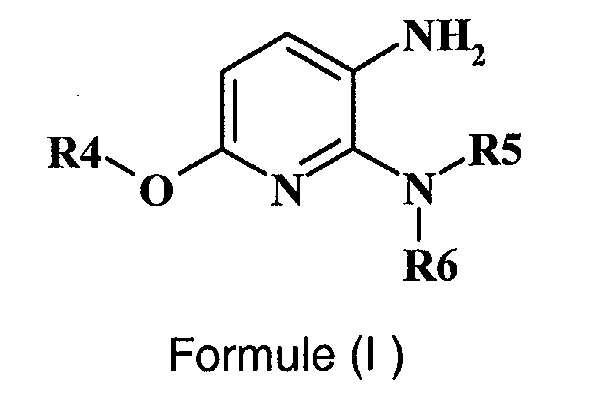
- R4 représente un radical alkyle en C1-C4 éventuellement substitué par un ou plusieurs radicaux choisis parmi les radicaux hydroxyle, alcoxy en C1-C2, NR7R8 où R7 et R8 sont choisis parmi l'hydrogène, les radicaux alkyle en C1-C4, (poly)hydroxyalkyle en C2-C6, (poly)aminoalkyle en C2-C6, amino-hydroxyalkyle en C2-C6 ;
- R5 et R6 forment avec l'atome d'azote avec lequel ils sont attachés un cycle comportant 5 à 8 chaínons dont un ou plusieurs atomes de carbone du cycle carboné peuvent être remplacés par un atome d'oxygène, d'azote éventuellement substitué, de soufre ou par un groupement SO2, et dont les atomes de carbone peuvent être, indépendamment les uns des autres, substitués ; ledit cycle ne comportant pas de liaison peroxyde, ni de radicaux diazo ou nitroso.
- la 6-méthoxy-2-pyrrolidin-1-yl-pyridin-3-ylamine ;
- la 2-(2,5-diméthyl-pyrrolidin-1-yl)-6-méthoxy-pyridin-3- ylamine ;
- la 6-méthoxy-2-morpholin-4-yl-pyridin-3-ylamine ;
- le N-[1-(3-amino-6-méthoxy-pyridin-2-yl)-pyrrolidin-3-yl]-acétamide ;
- la 6'-méthoxy-3,4,5,6-tetrahydro-2H-[1,2']bipyridinyl-3'-ylamine ;
- la 2-(3'-Amino-6'-methoxy-3,4,5,6-tetrahydro-2H-I [1,2']bipyridinyl-2-yl)-éthanol ;
- la 6-méthoxy-2-(4-méthyl-pipérazin-1-yl)-pyridin-3-ylamine ;
- la 6 '-méthoxy-2-méthyl-3, 4,5,6-tetrahydro-2H-[1,2']bipyridinyl-13'-ylamine ;
- la 6'-méthoxy-3-methyl-3,4,5,6-tetrahydro-2H-[1,2']bipyridinyl-3'-ylamine;
- la 2-(3'-Amino-6'-méthoxy-3,4,5,6-tetrahydro-2H-[1,2']-bipyridinyl-2-yl)-éthanol ainsi que leurs sels d'addition.


On obtient 11.6g de poudre jaune (Rdt = 98.3%, pF =82°C)

| Analyse CHCINO : | ||||
| Trouvée : C 45.11 | H 6.68 | N 15.18 | O 9.86 | Cl 24.13 |
| Calculée : C 45.13 | H 6.44 | N 15.79 | O 6.01 | Cl 26.64 |
On obtient 4.93g de poudre jaune
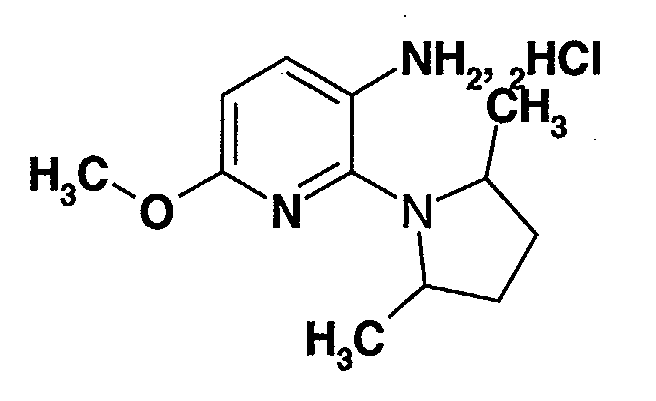
| Analyse CHCINO : | ||||
| Trouvée : C54.05 | H 7.26 | N 15.57 | O 11.66 | Cl 11.68 |
| Calculée : C 55.92 | H7.82 | N16.3 | O 6.21 | Cl 13.75 |

| Analyse CHCINO : | ||||
| Trouvée: C42.49 | H 6.40 | N 14.17 | O 15.70 | Cl 21.82 |
| Calculée : C42.57 | H 6.07 | N 14.89 | O 11.34 | Cl 25.13 |

| Analyse CHCINO : | ||||
| Trouvée: C 50.26 | H 6.68 | N 19.54 | O 11.16 | Cl 12.36 |
| Calculée : C 50.16 | H 6.83 | N 19.42 | O 11.30 | Cl 12.42 |

| Analyse CHCINO : | ||||
| Trouvée : C 47.19 | H 6.81 | N 14.81 | O 6.45 | Cl 25.44 |
| Calculée : C 47.15 | H 6.83 | N 15 | O 5.71 | Cl 25.31 |

| Analyse CHCINO : | ||||
| Trouvée : C 48.02 | H 7.23 | N 12.25 | 012.41 | Cl 19.36 |
| Calculée: C 48.16 | H 7.15 | N 12.96 | O 9.87 | Cl 21.87 |

| Analyse CHNOCl | ||||
| Trouvée : C 43.12 | H 7.02 | N | O 9.47 | Cl 22.77 |
| Calculée : C 44.76 | H 6.83 | N 18.98 | O 5.42 | Cl 24.02 |

| Analyse CHCINO : | ||||
| Trouvée : C 48.79 | H7.16 | N 14.04 | O 7.04 | Cl 22.01 |
| Calculée : C 48.99 | H7.19 | N 14.28 | O 5.44 | Cl 24.1 |

| Analyse CHCINO : | ||||
| Trouvée: C 50.31 | H 7.22 | N 13.99 | O 7.33 | Cl 20.16 |
| Calculée : C 48.99 | H 7.19 | N 14.28 | O 5.44 | Cl 24.1 |

| Analyse CHCINO : | ||||
| Trouvée: C 48.02 | H 7.23 | N12.25 | O 12.41 | Cl 19.36 |
| Calculée : C 48.16 | H 7.15 | N12.96 | O 9.87 | Cl 21.87 |
| Exemples | 1 | 2 |
| Paraphénylènediamine | 5.10-3 mole | - |
| N,N-Bis-(2-hydroxyethyl)-p-phenylenediamine) | - | 5.10-3 mole |
| 6-méthoxy-2-pyrrolidin-1-yl-pyridin-3-ylamine | 5.10-3 mole | 5.10-3 mole |
| Support de teinture | (1) | (1) |
| Eau déminéralisée q.s.p. | 100 g | 100 g |
| Alcool éthylique à 96° | 20 g |
| Métabisulfite de sodium en solution | |
| aqueuse à 35% | 0,2275gM.A |
| sel pentasodique de l'acide diethylene | 0,48 g M.A |
| triamino pentacétique | |
| Alkyl en C8-C15polyglucoside vendu en | 3,6 g M.A |
| solution à 60% sous la dénomination | |
| ORAMIXCG110 par la société SEPPIC | |
| Alcool benzylique | 2,0 g |
| Polyethylène glycol à 8 moles d'OE | 3,0 g |
| K2HPO4 | 20,9 g |
| KH2PO4 | 10,88g |
| Cheveux naturels | |||
| L* | a* | b* | |
| Exemple 1 | 22.24 | 0.1 | -3.4 |
| Exemple 2 | 29.75 | -6.68 | -9.3 |
Claims (21)
- Composition tinctoriale comprenant, dans un milieu de teinture approprié :dans laquelle :au moins une base d'oxydation, etau moins un coupleur 6-alcoxy-2,3-diaminopyridine de formule (I) ou l'un de ses sels d'addition correspondants :
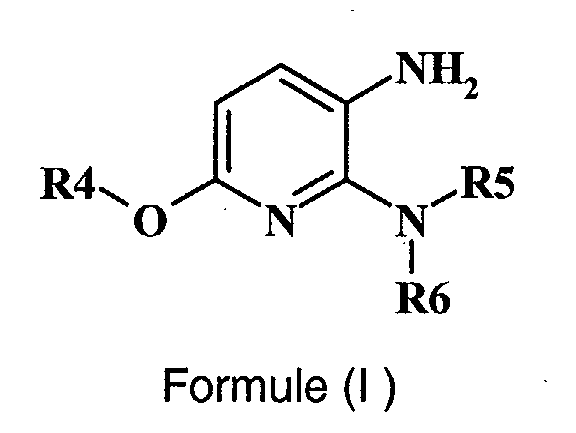 R4 représente un radical alkyle en C1-C4 éventuellement substitué par un ou plusieurs radicaux hydroxyle, alcoxy en C1-C2, NR7R8 où R7 et R8 sont choisis parmi l'hydrogène, les radicaux alkyle en C1-C4, (poly)hydroxyalkyle en C2-C6, (poly)aminoalkyle en C2-C6, amino-hydroxyalkyle en C2-C6 ;R5 et R6 forment avec l'atome d'azote avec lequel ils sont attachés un cycle comportant 5 à 8 chaínons dont un ou plusieurs atomes de carbone du cycle carboné peuvent être remplacés par un atome d'oxygène, d'azote éventuellement substitué, de soufre ou par un groupement SO2, et dont les atomes de carbone peuvent être, indépendamment les uns des autres, substitués ; ledit cycle ne comportant pas de liaison peroxyde, ni de radicaux diazo ou nitroso.
 - Composition selon la revendication 1 , dans laquelle R5 et R6 d'autre part, forment avec l'atome d'azote auquel ils sont rattachés un hétérocycle de 5 à 8 chaínons choisi parmi les hétérocycles pyrrolidine, pipéridine, homopipéridine, pipérazine, homopipérazine, diazépane, lesdits cycles pouvant être substitués par un ou plusieurs radicaux choisis parmi les radicaux :(i) alkyle en C1-C4 éventuellement substitué par un ou plusieurs radicaux choisis parmi les radicaux hydroxy, amino, (di)alkylamino en C1-C2, carboxy ;(ii) hydroxy,(iii) amino,(iv) (di)alkylamino en C1-C2 ,(v) carboxy,(vi) carboxamido,(vii) sulfonamido.
- Composition selon la revendication 1, dans laquelle R5 et R6 forment un hétérocycle choisi parmi la 2,5-diméthylpyrrolidine, la proline, la 3-hydroxyproline, la 4-hydroxyproline, la 2,4-dicarboxypyrrolidine, la 3-hydroxy-2-hydroxyméthylpyrrolidine, la 2-carboxamidopyrrolidine, la 3-hydroxy-2-carboxamidopyrrolidine, la 2-(diéthylcarboxamido)pyrrolidine, la 2-hydroxyméthyl pyrrolidine, la 3,4-dihydroxy-2-hydroxyméthyl pyrrolidine, la 3-hydroxypyrrolidine, la 3,4-dihydroxy pyrrolidine, la 3-amino pyrrolidine, la 3-méthylamino pyrrolidine, la 4-amino-3-hydroxy pyrrolidine, la 3-hydroxy-4-(2-hydroxyéthyl)amino-pyrrolidine, la 3-acétamidopyrrolidine, la 3-(méthylsulfonylamino)-pyrrolidine, la pipéridine, la 2,6-diméthylpipéridine, la 2-carboxypipéridine, la 2-carboxamidopipéridine, la 2-hydroxyméthylpipéridine, la 3-hydroxy-2-hydroxyméthylpipéridine, 3-hydroxypipéridine, la 4-hydroxypipéridine, la 3-hydroxyméthylpipéridine, l'homopipéridine, la 2-carboxyhomopipéridine, la 2-carboxamidohomopipéridine, le diazépane, le N-méthyl diazépane, le N-(2-hydroxyéthyl)- diazépane.
- Composition selon la revendication 3, dans laquelle R5 et R6 forment un hétérocycle choisi parmi la pyrrolidine, la 3-hydroxypyrrolidine, la 3-aminopyrrolidine, la 3-acétamidopyrrolidine, la 3-(méthylsulfonylamino)-pyrrolidine, la proline, la 3-hydroxyproline, la pipéridine, l'hydroxypipéridine, l'homopipéridine, le diazépane, N-méthyl homopipérazine, la N β-hydroxyéthylhomopipérazine et leurs sels d'addition.
- Composition selon la revendication 1, dans laquelle le composé de formule (I) est choisi parmi :la 6-méthoxy-2-pyrrolidin-1-yl-pyridin-3-ylamine ;la 2-(2,5-diméthyl-pyrrolidin-1-yl)-6-méthoxy-pyridin-3- ylamine ;la 6-méthoxy-2-morpholin-4-yl-pyridin-3-ylamine ;le N-[1-(3-amino-6-méthoxy-pyridin-2-yl)-pyrrolidin-3-yl]-acétamide ;la 6'-méthoxy-3,4,5,6-tetrahydro-2H-[1,2']bipyridinyl-3'-ylamine ;la 2-(3'-Amino-6'-methoxy-3,4,5,6-tetrahydro-2H-I [1,2']bipyridinyl-2-yl)-éthanol ;la 6-méthoxy-2-(4-méthyl-pipérazin-1-yl)-pyridin-3-ylamine ;la 6 '-méthoxy-2-méthyl-3, 4,5,6-tetrahydro-2H-[1,2']bipyridinyl-I3'-ylamine ;la 6'-méthoxy-3-methyl-3,4,5,6-tetrahydro-2H-[1,2']bipyridinyl-3'-ylamine;la 2-(3'-Amino-6'-méthoxy-3,4,5,6-tetrahydro-2H-[1,2']-bipyridinyl-2-yl)-éthanol ainsi que leurs sels d'addition.
- Composition selon l'une quelconque des revendications 1 à 5, où la ou les bases d'oxydation sont choisies parmi les paraphénylènediamines, les bis-phénylalkylènediamines, les para-aminophénols, les ortho-aminophénols, les bases hétérocycliques et leurs sels d'addition.
- Composition selon l'une quelconque des revendications 1 à 6, dans laquelle la ou les bases d'oxydation sont chacune présentes en quantité comprise 0,001 et 10 % en poids du poids total de la composition tinctoriale.
- Composition selon l'une quelconque des revendications 1 à 7, comprenant un ou plusieurs coupleurs additionnels choisis parmi les métaphénylènediamines, les métaaminophénols, les métadiphénols, les coupleurs naphtaléniques et les coupleurs hétérocycliques et leurs sels d'addition.
- Composition selon l'une quelconque des revendications 1 à 8, dans laquelle le ou les coupleurs sont présents chacun en quantité comprise entre 0,001 et 10 % en poids du poids total de la composition tinctoriale.
- Procédé de teinture d'oxydation des fibres kératiniques caractérisé en ce qu'on applique sur les fibres une composition telle que définie à l'une quelconque des revendications 1 à 9, et qu'on révèle la couleur à l'aide d'un agent oxydant.
- Procédé selon la revendication 10, dans lequel l'agent oxydant est choisi parmi le peroxyde d'hydrogène, le peroxyde d'urée, les bromates de métaux alcalins, les persels, les peracides et les enzymes oxydases.
- Procédé selon l'une des revendications 9 ou 10 dans lequel l'agent oxydant est mélangé au moment de l'emploi à la composition telle que définie selon l'une quelconque des revendications 1 à 9.
- Procédé selon l'une quelconque des revendications 10 à 12, dans lequel l'agent oxydant est appliqué sur les fibres simultanément ou séquentiellement à la composition telle que définie selon l'une quelconque des revendications 1 à 9 sous forme d'une composition oxydante.
- Dispositif à plusieurs compartiments ou "kit" de teinture à plusieurs compartiments, dans lequel un premier compartiment tinctoriale contient une composition telle que définie à l'une quelconque des revendications 1 à 9 et un deuxième compartiment contient une composition oxydante.
- Utilisation de la composition telle que définie selon l'une quelconque des revendications 1 à 9 pour la teinture des fibres kératiniques.
- Composé 6-alcoxy-2,3-diaminepyridine de formule (I) suivante :dans laquelle :
 R4 représente un radical alkyle en C1-C4 éventuellement substitué par un ou plusieurs radicaux hydroxyle, alcoxy en C1-C2 , NR7R8 où R7 et R8 sont choisis dans un groupe constitué par un atome d'hydrogène, un alkyle en C1-C4, un (poly)hydroxyalkyle en C2-C6, un (poly)aminoalkyle en C2-C6, un amino-hydroxyalkyle en C2-C6 ;R5 et R6 forment avec l'atome d'azote avec lequel ils sont attachés un cycle comportant 5 à 8 chaínons dont un ou plusieurs atomes de carbone du cycle carboné peuvent être remplacés par un atome d'oxygène, d'azote éventuellement substitué ou de soufre ou par un groupement SO2, et dont les atomes de carbone peuvent être, indépendamment les uns des autres, substitués ; ledit cycle ne comportant pas de liaison peroxyde, ni de radicaux diazo ou nitroso ainsi que ses sels d'addition à l'exception des composés 3-amino 6-méthoxy 2-(4-méthyl 2-propylimidazol-1-yl)-pyridine et 3-amino 6-méthoxy 2-pyrrolo-pyridine.
 - Composé selon la revendication 16 , dans laquelle R5 et R6 forment avec l'atome d'azote auquel ils sont rattachés un hétérocycle de 5 à 8 chaínons choisi parmi les hétérocycles pyrrolidine, pipéridine, homopipéridine, pipérazine, homopipérazine, diazépane.
- Composés selon la revendication 17 dans laquelle lesdits hétérocycles peuvent être substitués par un ou plusieurs radicaux choisis parmi :(viii) alkyle en C1-C4 éventuellement substitué par un ou plusieurs radicaux choisis dans le groupe constitué par un hydroxy, amino, (di)alkylamino en C1-C2, carboxy ;(ix) hydroxy,(x) amino,(xi) (di)alkylamino en C1-C2 ,(xii) carboxy,(xiii) carboxamido(xiv) ou sulfonamido.
- Composé selon la revendication 16, dans laquelle R5 et R6 forment un hétérocycle choisi parmi la 2,5-diméthylpyrrolidine, la proline, la 3-hydroxyproline, la 4-hydroxyproline, la 2,4-dicarboxypyrrolidine, la 3-hydroxy-2-hydroxyméthylpyrrolidine, la 2-carboxamidopyrrolidine, la 3-hydroxy-2-carboxamidopyrrolidine, la 2-(diéthylcarboxamido)pyrrolidine, la 2-hydroxyméthyl pyrrolidine, la 3,4-dihydroxy-2-hydroxyméthyl pyrrolidine, la 3-hydroxypyrrolidine, la 3,4-dihydroxy pyrrolidine, la 3-amino pyrrolidine, la 3-méthylamino pyrrolidine, la 4-amino-3-hydroxy pyrrolidine, la 3-hydroxy-4-(2-hydroxyéthyl)amino-pyrrolidine, la 3-acétamidopyrrolidine, la 3-(méthylsulfonylamino)-pyrrolidine, la pipéridine, la 2,6-diméthylpipéridine, la 2-carboxypipéridine, la 2-carboxamidopipéridine, la 2-hydroxyméthylpipéridine, la 3-hydroxy-2-hydroxyméthylpipéridine, 3-hydroxypipéridine, la 4-hydroxypipéridine, la 3-hydroxyméthylpipéridine, l'homopipéridine, la 2-carboxyhomopipéridine, la 2-carboxamidohomopipéridine, le diazépane, le N-méthyl diazépane, le N-(2-hydroxyéthyl)- diazépane.
- Composé selon la revendication 19, dans laquelle R5 et R6 forment un hétérocycle choisi parmi la pyrrolidine, la 3-hydroxypyrrolidine, la 3-aminopyrrolidine, la 3-acétamidopyrrolidine, la 3-(méthylsulfonylamino)-pyrrolidine, la proline, la 3-hydroxyproline, la pipéridine, les hydroxypipéridines, l'homopipéridine, le diazépane, N-méthyl diazépane, la N β-hydroxyéthyldiazépane et leurs sels d'addition.
- Composé selon la revendication 16, choisi parmi :la 6-méthoxy-2-pyrrolidin-1-yl-pyridin-3-ylamine ;la 2-(2,5-diméthyl-pyrrolidin-1-yl)-6-méthoxy-pyridin-3- ylamine ;la 6-méthoxy-2-morpholin-4-yl-pyridin-3-ylamine ;le N-[1-(3-amino-6-méthoxy-pyridin-2-yl)-pyrrolidin-3-yl]-acétamide ;la 6'-méthoxy-3,4,5,6-tetrahydro-2H-[1,2']bipyridinyl-3'-ylamine ;la 2-(3'-Amino-6'-methoxy-3,4,5,6-tetrahydro-2H-I [1,2']bipyridinyl-2-yl)-éthanol ;la 6-méthoxy-2-(4-méthyl-pipérazin-1-yl)-pyridin-3-ylamine ;la 6'-méthoxy-2-méthyl-3, 4,5,6-tetrahydro-2H-[1,2']bipyridinyl-I3'-ylamine ;la 6'-méthoxy-3-methyl-3,4,5,6-tetrahydro-2H-[1,2']bipyridinyl-3'-ylamine;la 2-(3'-Amino-6'-méthoxy-3,4,5,6-tetrahydro-2H-[1,2']-bipyridinyl-2-yl)-éthanol ainsi que leurs sels d'addition.
Applications Claiming Priority (2)
| Application Number | Priority Date | Filing Date | Title |
|---|---|---|---|
| FR0201710A FR2835741B1 (fr) | 2002-02-12 | 2002-02-12 | Nouveaux coupleurs 6-alcoxy-2,3-diaminopyridine utiles pour la teinture des fibres keratiniques |
| FR0201710 | 2002-02-12 |
Publications (2)
| Publication Number | Publication Date |
|---|---|
| EP1336606A1 true EP1336606A1 (fr) | 2003-08-20 |
| EP1336606B1 EP1336606B1 (fr) | 2006-12-27 |
Family
ID=27620122
Family Applications (1)
| Application Number | Title | Priority Date | Filing Date |
|---|---|---|---|
| EP03290292A Expired - Lifetime EP1336606B1 (fr) | 2002-02-12 | 2003-02-05 | Nouveaux coupleurs 6-alcoxy-2,3-diaminopyridine utiles pour la teinture des fibres kératiniques |
Country Status (6)
| Country | Link |
|---|---|
| EP (1) | EP1336606B1 (fr) |
| JP (1) | JP3719437B2 (fr) |
| AT (1) | ATE349429T1 (fr) |
| DE (1) | DE60310623T2 (fr) |
| ES (1) | ES2278122T3 (fr) |
| FR (1) | FR2835741B1 (fr) |
Cited By (2)
| Publication number | Priority date | Publication date | Assignee | Title |
|---|---|---|---|---|
| EP1586303A1 (fr) * | 2004-04-05 | 2005-10-19 | L'oreal | Composition tinctoriale comprenant au moins une base d'oxydation diaminopyrazole et au moins un coupleur 6-alcoxy-2,3-diaminopyridine |
| EP1413286B1 (fr) * | 2002-10-04 | 2009-04-22 | L'oreal | Composition tinctoriale comprenant au moins une base d'oxydation hétérocyclique et au moins un coupleur 2,3-diaminopyridine substitué |
Families Citing this family (1)
| Publication number | Priority date | Publication date | Assignee | Title |
|---|---|---|---|---|
| FR2845280B1 (fr) * | 2002-10-04 | 2006-06-02 | Oreal | Nouveaux coupleurs 6-alcoxy-2,3-diaminopyridine dont le radical amino en position 2 est un radical amino disubstitue et utilisation de ces coupleurs pour la teinture des fibres keratiniques |
Citations (2)
| Publication number | Priority date | Publication date | Assignee | Title |
|---|---|---|---|---|
| DE3233540A1 (de) * | 1982-09-10 | 1984-03-15 | Henkel Kgaa | Haarfaerbemittel |
| WO2000043392A2 (fr) * | 1999-01-20 | 2000-07-27 | Arzneimittelwerk Dresden Gmbh | Utilisation d'imidazo[1,5-a]-pyrido[3,2-e]-pyrazinones comme medicaments |
-
2002
- 2002-02-12 FR FR0201710A patent/FR2835741B1/fr not_active Expired - Fee Related
-
2003
- 2003-02-05 AT AT03290292T patent/ATE349429T1/de not_active IP Right Cessation
- 2003-02-05 ES ES03290292T patent/ES2278122T3/es not_active Expired - Lifetime
- 2003-02-05 EP EP03290292A patent/EP1336606B1/fr not_active Expired - Lifetime
- 2003-02-05 DE DE60310623T patent/DE60310623T2/de not_active Expired - Lifetime
- 2003-02-12 JP JP2003033225A patent/JP3719437B2/ja not_active Expired - Fee Related
Patent Citations (3)
| Publication number | Priority date | Publication date | Assignee | Title |
|---|---|---|---|---|
| DE3233540A1 (de) * | 1982-09-10 | 1984-03-15 | Henkel Kgaa | Haarfaerbemittel |
| US4784667A (en) * | 1982-09-10 | 1988-11-15 | Henkel Kommanditgesellschaft Auf Aktien | Oxidation hair dyes comprising diamino-substituted pyridines and amino-substituted aromatics as precursors |
| WO2000043392A2 (fr) * | 1999-01-20 | 2000-07-27 | Arzneimittelwerk Dresden Gmbh | Utilisation d'imidazo[1,5-a]-pyrido[3,2-e]-pyrazinones comme medicaments |
Non-Patent Citations (1)
| Title |
|---|
| PRUNIER, HERVE ET AL: "Novel and Selective Partial Agonists of 5-HT3 Receptors. 2. Synthesis and Biological Evaluation of Piperazinopyridopyrrolopyrazines, Piperazinopyrroloquinoxalines, and Piperazinopyridopyrroloquinoxalines", JOURNAL OF MEDICINAL CHEMISTRY., vol. 40, no. 12, 1997, AMERICAN CHEMICAL SOCIETY. WASHINGTON., US, pages 1808 - 1819, XP002218035, ISSN: 0022-2623 * |
Cited By (2)
| Publication number | Priority date | Publication date | Assignee | Title |
|---|---|---|---|---|
| EP1413286B1 (fr) * | 2002-10-04 | 2009-04-22 | L'oreal | Composition tinctoriale comprenant au moins une base d'oxydation hétérocyclique et au moins un coupleur 2,3-diaminopyridine substitué |
| EP1586303A1 (fr) * | 2004-04-05 | 2005-10-19 | L'oreal | Composition tinctoriale comprenant au moins une base d'oxydation diaminopyrazole et au moins un coupleur 6-alcoxy-2,3-diaminopyridine |
Also Published As
| Publication number | Publication date |
|---|---|
| ES2278122T3 (es) | 2007-08-01 |
| DE60310623T2 (de) | 2007-10-11 |
| FR2835741B1 (fr) | 2006-05-05 |
| ATE349429T1 (de) | 2007-01-15 |
| FR2835741A1 (fr) | 2003-08-15 |
| DE60310623D1 (de) | 2007-02-08 |
| JP2004035536A (ja) | 2004-02-05 |
| EP1336606B1 (fr) | 2006-12-27 |
| JP3719437B2 (ja) | 2005-11-24 |
Similar Documents
| Publication | Publication Date | Title |
|---|---|---|
| CA2391980A1 (fr) | Compositions de teinture des fibres keratiniques contenant des 3-amino pyrazolo-[1,5-a]-pyridines, procede de teinture, nouvelles 3-amino pyrazolo-[1,5-a]-pyridines | |
| EP1341508A1 (fr) | Composition de teinture a base de 1-(4-aminophenyl) pyrrolidines substituees au moins en position 2 et 3 | |
| WO2002045672A1 (fr) | Composition de teinture d'oxydation a base de 1-(4-aminophenyl)pyrrolidines substituees en position 2 et 4 | |
| EP1312606B1 (fr) | Nouvelles bases d'oxydation 2,5-diaminopyridine utiles pour la teinture des fibres kératiniques | |
| EP1417184B1 (fr) | Composition pour la teinture de fibre keratiniques contenant une paraphenylenediamine substituee par un radical diazacycloheptane | |
| EP1457199B1 (fr) | Nouveaux coupleurs du type 2,3,5-triaminopyridine et utilisation de ces coupleurs pour la teinture des fibres kératiniques | |
| EP1396486A1 (fr) | Dérivés bis-paraphénylènediamine à groupement pyrrolidinyle et utilisation de ces dérivés pour la coloration de fibres kératiniques | |
| WO2002045668A1 (fr) | Composition de teinture d'oxydation a base de 1-(4-aminophenyl) pyrrolidines substituees en positions 2 et 5 | |
| FR2817471A1 (fr) | Composition de teinture d'oxydation a base de 1-(4-aminophenyl) pyrrolidines substituees en position 3 et 4 et procede de teinture de mise en oeuvre | |
| EP1336606B1 (fr) | Nouveaux coupleurs 6-alcoxy-2,3-diaminopyridine utiles pour la teinture des fibres kératiniques | |
| EP1498109A1 (fr) | Dérivés du furane et composition tinctoriale comprenant à titre de coupleur un dérivé du furane | |
| EP1484049A1 (fr) | Nouveaux composés imidazoles et utilisation de ces composés pour la teinture de fibres kératiniques | |
| EP1551360B1 (fr) | Coupleurs 6-alcoxy- 2,3-diaminopyridine dont le radical amino en position 2 est un radical amino disubstitue et utilisation de ces coupleurs pour la teinture des fibres keratiniques | |
| EP1551806B1 (fr) | Coupleurs 6-alcoxy- 2,3-diaminopyridine et utilisation de ces coupleurs pour la teinture des fibres keratiniques | |
| EP1586302A1 (fr) | Composition tinctoriale comprenant au moins une base d'oxydation pyrazolopyrimidine et au moins un coupleur 6-alcoxy-2,3-diaminopyridine | |
| EP1586303A1 (fr) | Composition tinctoriale comprenant au moins une base d'oxydation diaminopyrazole et au moins un coupleur 6-alcoxy-2,3-diaminopyridine | |
| EP1459732A1 (fr) | Composition tinctoriale comprenant au moins une base d'oxydation hétérocyclique et au moins un coupleur 2,3,5-triaminopyridine | |
| WO2002074267A1 (fr) | Compositions tinctoriales pour la teinture de fibres keratiniques comprenant a titre de base d'oxydation des composes hydrazone heterocycliques a 6 chainons | |
| EP1438949A1 (fr) | Composition pour la teinture des fibres kératiniques comprenant un coupleur acylaminophénol | |
| EP1465873A1 (fr) | Derives de 4,5-diaminopyrazole sous forme du dimere et leur utilisation en teinture d'oxydation de fibres keratiniques | |
| EP1120405A2 (fr) | Nouvelles bases d'oxydation à chaíne guanidine, leur procédé de préparation, leur utilisation pour la teinture d'oxydation des fibres kératiniques, compositions tinctoriales et procédés de teinture | |
| FR2864957A1 (fr) | Composition pour la teinture des fibres keratiniques comprenant au moins un derive de para-phenylenediamine substitue par un noyau heptamethylenediamine | |
| EP1535904A2 (fr) | Procédé de préparation de dérives de 1- (4-nitrophényl)-3-pyrrolidinols optiquement actifs, et paraphénylenediamines à groupement pyrrolidinyle chirales |
Legal Events
| Date | Code | Title | Description |
|---|---|---|---|
| PUAI | Public reference made under article 153(3) epc to a published international application that has entered the european phase |
Free format text: ORIGINAL CODE: 0009012 |
|
| AK | Designated contracting states |
Designated state(s): AT BE BG CH CY CZ DE DK EE ES FI FR GB GR HU IE IT LI LU MC NL PT SE SI SK TR |
|
| AX | Request for extension of the european patent |
Extension state: AL LT LV MK RO |
|
| RTI1 | Title (correction) |
Free format text: 6-ALKOXY-2,3-DIAMINOPYRIDINE COUPLERS FOR DYEING KERATIN FIBERS |
|
| 17P | Request for examination filed |
Effective date: 20040220 |
|
| AKX | Designation fees paid |
Designated state(s): AT BE BG CH CY CZ DE DK EE ES FI FR GB GR HU IE IT LI LU MC NL PT SE SI SK TR |
|
| 17Q | First examination report despatched |
Effective date: 20040429 |
|
| GRAP | Despatch of communication of intention to grant a patent |
Free format text: ORIGINAL CODE: EPIDOSNIGR1 |
|
| RIC1 | Information provided on ipc code assigned before grant |
Ipc: C07D 401/04 20060101ALI20060821BHEP Ipc: A61K 8/49 20060101ALI20060821BHEP Ipc: A61Q 5/10 20060101ALI20060821BHEP Ipc: C07D 213/74 20060101AFI20060821BHEP |
|
| GRAS | Grant fee paid |
Free format text: ORIGINAL CODE: EPIDOSNIGR3 |
|
| GRAA | (expected) grant |
Free format text: ORIGINAL CODE: 0009210 |
|
| AK | Designated contracting states |
Kind code of ref document: B1 Designated state(s): AT BE BG CH CY CZ DE DK EE ES FI FR GB GR HU IE IT LI LU MC NL PT SE SI SK TR |
|
| PG25 | Lapsed in a contracting state [announced via postgrant information from national office to epo] |
Ref country code: IT Free format text: LAPSE BECAUSE OF FAILURE TO SUBMIT A TRANSLATION OF THE DESCRIPTION OR TO PAY THE FEE WITHIN THE PRESCRIBED TIME-LIMIT;WARNING: LAPSES OF ITALIAN PATENTS WITH EFFECTIVE DATE BEFORE 2007 MAY HAVE OCCURRED AT ANY TIME BEFORE 2007. THE CORRECT EFFECTIVE DATE MAY BE DIFFERENT FROM THE ONE RECORDED. Effective date: 20061227 Ref country code: NL Free format text: LAPSE BECAUSE OF FAILURE TO SUBMIT A TRANSLATION OF THE DESCRIPTION OR TO PAY THE FEE WITHIN THE PRESCRIBED TIME-LIMIT Effective date: 20061227 Ref country code: DK Free format text: LAPSE BECAUSE OF FAILURE TO SUBMIT A TRANSLATION OF THE DESCRIPTION OR TO PAY THE FEE WITHIN THE PRESCRIBED TIME-LIMIT Effective date: 20061227 Ref country code: AT Free format text: LAPSE BECAUSE OF FAILURE TO SUBMIT A TRANSLATION OF THE DESCRIPTION OR TO PAY THE FEE WITHIN THE PRESCRIBED TIME-LIMIT Effective date: 20061227 Ref country code: FI Free format text: LAPSE BECAUSE OF FAILURE TO SUBMIT A TRANSLATION OF THE DESCRIPTION OR TO PAY THE FEE WITHIN THE PRESCRIBED TIME-LIMIT Effective date: 20061227 Ref country code: CZ Free format text: LAPSE BECAUSE OF FAILURE TO SUBMIT A TRANSLATION OF THE DESCRIPTION OR TO PAY THE FEE WITHIN THE PRESCRIBED TIME-LIMIT Effective date: 20061227 Ref country code: IE Free format text: LAPSE BECAUSE OF FAILURE TO SUBMIT A TRANSLATION OF THE DESCRIPTION OR TO PAY THE FEE WITHIN THE PRESCRIBED TIME-LIMIT Effective date: 20061227 Ref country code: SI Free format text: LAPSE BECAUSE OF FAILURE TO SUBMIT A TRANSLATION OF THE DESCRIPTION OR TO PAY THE FEE WITHIN THE PRESCRIBED TIME-LIMIT Effective date: 20061227 Ref country code: SK Free format text: LAPSE BECAUSE OF FAILURE TO SUBMIT A TRANSLATION OF THE DESCRIPTION OR TO PAY THE FEE WITHIN THE PRESCRIBED TIME-LIMIT Effective date: 20061227 |
|
| REG | Reference to a national code |
Ref country code: GB Ref legal event code: FG4D Free format text: NOT ENGLISH |
|
| REG | Reference to a national code |
Ref country code: IE Ref legal event code: FG4D Free format text: LANGUAGE OF EP DOCUMENT: FRENCH |
|
| REF | Corresponds to: |
Ref document number: 60310623 Country of ref document: DE Date of ref document: 20070208 Kind code of ref document: P |
|
| PG25 | Lapsed in a contracting state [announced via postgrant information from national office to epo] |
Ref country code: LI Free format text: LAPSE BECAUSE OF NON-PAYMENT OF DUE FEES Effective date: 20070228 Ref country code: MC Free format text: LAPSE BECAUSE OF NON-PAYMENT OF DUE FEES Effective date: 20070228 Ref country code: CH Free format text: LAPSE BECAUSE OF NON-PAYMENT OF DUE FEES Effective date: 20070228 |
|
| PG25 | Lapsed in a contracting state [announced via postgrant information from national office to epo] |
Ref country code: SE Free format text: LAPSE BECAUSE OF FAILURE TO SUBMIT A TRANSLATION OF THE DESCRIPTION OR TO PAY THE FEE WITHIN THE PRESCRIBED TIME-LIMIT Effective date: 20070327 Ref country code: BG Free format text: LAPSE BECAUSE OF FAILURE TO SUBMIT A TRANSLATION OF THE DESCRIPTION OR TO PAY THE FEE WITHIN THE PRESCRIBED TIME-LIMIT Effective date: 20070327 |
|
| GBT | Gb: translation of ep patent filed (gb section 77(6)(a)/1977) |
Effective date: 20070417 |
|
| PG25 | Lapsed in a contracting state [announced via postgrant information from national office to epo] |
Ref country code: PT Free format text: LAPSE BECAUSE OF FAILURE TO SUBMIT A TRANSLATION OF THE DESCRIPTION OR TO PAY THE FEE WITHIN THE PRESCRIBED TIME-LIMIT Effective date: 20070528 |
|
| NLV1 | Nl: lapsed or annulled due to failure to fulfill the requirements of art. 29p and 29m of the patents act | ||
| REG | Reference to a national code |
Ref country code: ES Ref legal event code: FG2A Ref document number: 2278122 Country of ref document: ES Kind code of ref document: T3 |
|
| REG | Reference to a national code |
Ref country code: CH Ref legal event code: PL |
|
| PLBE | No opposition filed within time limit |
Free format text: ORIGINAL CODE: 0009261 |
|
| STAA | Information on the status of an ep patent application or granted ep patent |
Free format text: STATUS: NO OPPOSITION FILED WITHIN TIME LIMIT |
|
| 26N | No opposition filed |
Effective date: 20070928 |
|
| BERE | Be: lapsed |
Owner name: L'OREAL Effective date: 20070228 |
|
| PG25 | Lapsed in a contracting state [announced via postgrant information from national office to epo] |
Ref country code: BE Free format text: LAPSE BECAUSE OF NON-PAYMENT OF DUE FEES Effective date: 20070228 |
|
| PG25 | Lapsed in a contracting state [announced via postgrant information from national office to epo] |
Ref country code: GR Free format text: LAPSE BECAUSE OF FAILURE TO SUBMIT A TRANSLATION OF THE DESCRIPTION OR TO PAY THE FEE WITHIN THE PRESCRIBED TIME-LIMIT Effective date: 20070328 |
|
| PG25 | Lapsed in a contracting state [announced via postgrant information from national office to epo] |
Ref country code: EE Free format text: LAPSE BECAUSE OF FAILURE TO SUBMIT A TRANSLATION OF THE DESCRIPTION OR TO PAY THE FEE WITHIN THE PRESCRIBED TIME-LIMIT Effective date: 20061227 |
|
| PG25 | Lapsed in a contracting state [announced via postgrant information from national office to epo] |
Ref country code: CY Free format text: LAPSE BECAUSE OF FAILURE TO SUBMIT A TRANSLATION OF THE DESCRIPTION OR TO PAY THE FEE WITHIN THE PRESCRIBED TIME-LIMIT Effective date: 20061227 Ref country code: LU Free format text: LAPSE BECAUSE OF NON-PAYMENT OF DUE FEES Effective date: 20070205 |
|
| PG25 | Lapsed in a contracting state [announced via postgrant information from national office to epo] |
Ref country code: TR Free format text: LAPSE BECAUSE OF FAILURE TO SUBMIT A TRANSLATION OF THE DESCRIPTION OR TO PAY THE FEE WITHIN THE PRESCRIBED TIME-LIMIT Effective date: 20061227 Ref country code: HU Free format text: LAPSE BECAUSE OF FAILURE TO SUBMIT A TRANSLATION OF THE DESCRIPTION OR TO PAY THE FEE WITHIN THE PRESCRIBED TIME-LIMIT Effective date: 20070628 |
|
| REG | Reference to a national code |
Ref country code: FR Ref legal event code: PLFP Year of fee payment: 14 |
|
| REG | Reference to a national code |
Ref country code: FR Ref legal event code: PLFP Year of fee payment: 15 |
|
| REG | Reference to a national code |
Ref country code: FR Ref legal event code: PLFP Year of fee payment: 16 |
|
| PGFP | Annual fee paid to national office [announced via postgrant information from national office to epo] |
Ref country code: ES Payment date: 20180301 Year of fee payment: 16 Ref country code: GB Payment date: 20180131 Year of fee payment: 16 Ref country code: DE Payment date: 20180123 Year of fee payment: 16 |
|
| PGFP | Annual fee paid to national office [announced via postgrant information from national office to epo] |
Ref country code: FR Payment date: 20180111 Year of fee payment: 16 Ref country code: IT Payment date: 20180221 Year of fee payment: 16 |
|
| REG | Reference to a national code |
Ref country code: DE Ref legal event code: R119 Ref document number: 60310623 Country of ref document: DE |
|
| GBPC | Gb: european patent ceased through non-payment of renewal fee |
Effective date: 20190205 |
|
| PG25 | Lapsed in a contracting state [announced via postgrant information from national office to epo] |
Ref country code: DE Free format text: LAPSE BECAUSE OF NON-PAYMENT OF DUE FEES Effective date: 20190903 Ref country code: GB Free format text: LAPSE BECAUSE OF NON-PAYMENT OF DUE FEES Effective date: 20190205 |
|
| PG25 | Lapsed in a contracting state [announced via postgrant information from national office to epo] |
Ref country code: IT Free format text: LAPSE BECAUSE OF NON-PAYMENT OF DUE FEES Effective date: 20190205 Ref country code: FR Free format text: LAPSE BECAUSE OF NON-PAYMENT OF DUE FEES Effective date: 20190228 |
|
| REG | Reference to a national code |
Ref country code: ES Ref legal event code: FD2A Effective date: 20200327 |
|
| PG25 | Lapsed in a contracting state [announced via postgrant information from national office to epo] |
Ref country code: ES Free format text: LAPSE BECAUSE OF NON-PAYMENT OF DUE FEES Effective date: 20190206 |