EP1335898B1 - Carbamic acid compounds comprising an amide linkage as hdac inhibitors - Google Patents
Carbamic acid compounds comprising an amide linkage as hdac inhibitors Download PDFInfo
- Publication number
- EP1335898B1 EP1335898B1 EP01970014A EP01970014A EP1335898B1 EP 1335898 B1 EP1335898 B1 EP 1335898B1 EP 01970014 A EP01970014 A EP 01970014A EP 01970014 A EP01970014 A EP 01970014A EP 1335898 B1 EP1335898 B1 EP 1335898B1
- Authority
- EP
- European Patent Office
- Prior art keywords
- group
- compound according
- phenyl
- alkylene
- acid
- Prior art date
- Legal status (The legal status is an assumption and is not a legal conclusion. Google has not performed a legal analysis and makes no representation as to the accuracy of the status listed.)
- Expired - Lifetime
Links
- 150000001408 amides Chemical class 0.000 title claims abstract description 20
- KXDHJXZQYSOELW-UHFFFAOYSA-N Carbamic acid Chemical class NC(O)=O KXDHJXZQYSOELW-UHFFFAOYSA-N 0.000 title abstract description 39
- 239000003276 histone deacetylase inhibitor Substances 0.000 title description 9
- 125000004432 carbon atom Chemical group C* 0.000 claims abstract description 126
- 125000003118 aryl group Chemical group 0.000 claims abstract description 111
- 239000002253 acid Substances 0.000 claims abstract description 88
- 102000003964 Histone deacetylase Human genes 0.000 claims abstract description 67
- 108090000353 Histone deacetylase Proteins 0.000 claims abstract description 67
- 238000011282 treatment Methods 0.000 claims abstract description 36
- 150000002148 esters Chemical class 0.000 claims abstract description 31
- 150000003839 salts Chemical class 0.000 claims abstract description 23
- 230000002062 proliferating effect Effects 0.000 claims abstract description 16
- 239000012453 solvate Substances 0.000 claims abstract description 15
- 150000002170 ethers Chemical class 0.000 claims abstract description 10
- 150000001875 compounds Chemical class 0.000 claims description 444
- 125000001997 phenyl group Chemical group [H]C1=C([H])C([H])=C(*)C([H])=C1[H] 0.000 claims description 223
- -1 chloro, bromo, iodo, methyl Chemical group 0.000 claims description 155
- 238000000034 method Methods 0.000 claims description 137
- 229910052739 hydrogen Inorganic materials 0.000 claims description 96
- 239000000203 mixture Substances 0.000 claims description 70
- 229920006395 saturated elastomer Polymers 0.000 claims description 38
- 125000001931 aliphatic group Chemical group 0.000 claims description 30
- 125000000999 tert-butyl group Chemical group [H]C([H])([H])C(*)(C([H])([H])[H])C([H])([H])[H] 0.000 claims description 30
- 125000001449 isopropyl group Chemical group [H]C([H])([H])C([H])(*)C([H])([H])[H] 0.000 claims description 27
- 125000003368 amide group Chemical group 0.000 claims description 25
- 125000001495 ethyl group Chemical group [H]C([H])([H])C([H])([H])* 0.000 claims description 25
- 206010028980 Neoplasm Diseases 0.000 claims description 24
- YLQBMQCUIZJEEH-UHFFFAOYSA-N Furan Chemical compound C=1C=COC=1 YLQBMQCUIZJEEH-UHFFFAOYSA-N 0.000 claims description 22
- 125000002023 trifluoromethyl group Chemical group FC(F)(F)* 0.000 claims description 22
- 125000002723 alicyclic group Chemical group 0.000 claims description 21
- 239000011203 carbon fibre reinforced carbon Substances 0.000 claims description 20
- 125000001153 fluoro group Chemical group F* 0.000 claims description 18
- 201000011510 cancer Diseases 0.000 claims description 16
- 239000003814 drug Substances 0.000 claims description 16
- 125000004093 cyano group Chemical group *C#N 0.000 claims description 15
- 239000001257 hydrogen Substances 0.000 claims description 15
- 125000000449 nitro group Chemical group [O-][N+](*)=O 0.000 claims description 15
- 201000004681 Psoriasis Diseases 0.000 claims description 14
- 125000000956 methoxy group Chemical group [H]C([H])([H])O* 0.000 claims description 14
- 229910052799 carbon Inorganic materials 0.000 claims description 13
- 230000002401 inhibitory effect Effects 0.000 claims description 13
- UHOVQNZJYSORNB-UHFFFAOYSA-N Benzene Chemical compound C1=CC=CC=C1 UHOVQNZJYSORNB-UHFFFAOYSA-N 0.000 claims description 12
- JUJWROOIHBZHMG-UHFFFAOYSA-N Pyridine Chemical compound C1=CC=NC=C1 JUJWROOIHBZHMG-UHFFFAOYSA-N 0.000 claims description 12
- 150000001721 carbon Chemical group 0.000 claims description 11
- 125000005843 halogen group Chemical group 0.000 claims description 11
- 125000000843 phenylene group Chemical group C1(=C(C=CC=C1)*)* 0.000 claims description 11
- 241001465754 Metazoa Species 0.000 claims description 10
- KAESVJOAVNADME-UHFFFAOYSA-N Pyrrole Chemical compound C=1C=CNC=1 KAESVJOAVNADME-UHFFFAOYSA-N 0.000 claims description 10
- 238000004519 manufacturing process Methods 0.000 claims description 10
- RAXXELZNTBOGNW-UHFFFAOYSA-N imidazole Natural products C1=CNC=N1 RAXXELZNTBOGNW-UHFFFAOYSA-N 0.000 claims description 9
- UFWIBTONFRDIAS-UHFFFAOYSA-N Naphthalene Chemical compound C1=CC=CC2=CC=CC=C21 UFWIBTONFRDIAS-UHFFFAOYSA-N 0.000 claims description 8
- SMWDFEZZVXVKRB-UHFFFAOYSA-N Quinoline Chemical compound N1=CC=CC2=CC=CC=C21 SMWDFEZZVXVKRB-UHFFFAOYSA-N 0.000 claims description 8
- 238000000338 in vitro Methods 0.000 claims description 8
- 230000001404 mediated effect Effects 0.000 claims description 8
- 125000001246 bromo group Chemical group Br* 0.000 claims description 7
- 125000001309 chloro group Chemical group Cl* 0.000 claims description 7
- FCEHBMOGCRZNNI-UHFFFAOYSA-N 1-benzothiophene Chemical compound C1=CC=C2SC=CC2=C1 FCEHBMOGCRZNNI-UHFFFAOYSA-N 0.000 claims description 6
- UJOBWOGCFQCDNV-UHFFFAOYSA-N 9H-carbazole Chemical compound C1=CC=C2C3=CC=CC=C3NC2=C1 UJOBWOGCFQCDNV-UHFFFAOYSA-N 0.000 claims description 6
- SIKJAQJRHWYJAI-UHFFFAOYSA-N Indole Chemical compound C1=CC=C2NC=CC2=C1 SIKJAQJRHWYJAI-UHFFFAOYSA-N 0.000 claims description 6
- DZBUGLKDJFMEHC-UHFFFAOYSA-N acridine Chemical compound C1=CC=CC2=CC3=CC=CC=C3N=C21 DZBUGLKDJFMEHC-UHFFFAOYSA-N 0.000 claims description 6
- 125000002252 acyl group Chemical group 0.000 claims description 6
- NIHNNTQXNPWCJQ-UHFFFAOYSA-N fluorene Chemical compound C1=CC=C2CC3=CC=CC=C3C2=C1 NIHNNTQXNPWCJQ-UHFFFAOYSA-N 0.000 claims description 6
- 125000004043 oxo group Chemical group O=* 0.000 claims description 6
- 125000000732 arylene group Chemical group 0.000 claims description 5
- UMJSCPRVCHMLSP-UHFFFAOYSA-N pyridine Natural products COC1=CC=CN=C1 UMJSCPRVCHMLSP-UHFFFAOYSA-N 0.000 claims description 5
- 239000003937 drug carrier Substances 0.000 claims description 4
- 125000001624 naphthyl group Chemical group 0.000 claims description 4
- HYZJCKYKOHLVJF-UHFFFAOYSA-N 1H-benzimidazole Chemical compound C1=CC=C2NC=NC2=C1 HYZJCKYKOHLVJF-UHFFFAOYSA-N 0.000 claims description 3
- UFHFLCQGNIYNRP-UHFFFAOYSA-N Hydrogen Chemical compound [H][H] UFHFLCQGNIYNRP-UHFFFAOYSA-N 0.000 claims description 3
- 125000003785 benzimidazolyl group Chemical group N1=C(NC2=C1C=CC=C2)* 0.000 claims description 3
- 239000003085 diluting agent Substances 0.000 claims description 3
- 125000002541 furyl group Chemical group 0.000 claims description 3
- PZOUSPYUWWUPPK-UHFFFAOYSA-N indole Natural products CC1=CC=CC2=C1C=CN2 PZOUSPYUWWUPPK-UHFFFAOYSA-N 0.000 claims description 3
- RKJUIXBNRJVNHR-UHFFFAOYSA-N indolenine Natural products C1=CC=C2CC=NC2=C1 RKJUIXBNRJVNHR-UHFFFAOYSA-N 0.000 claims description 3
- 125000001041 indolyl group Chemical group 0.000 claims description 3
- 125000001544 thienyl group Chemical group 0.000 claims description 3
- JSPLKZUTYZBBKA-UHFFFAOYSA-N trioxidane Chemical compound OOO JSPLKZUTYZBBKA-UHFFFAOYSA-N 0.000 claims description 2
- 150000002431 hydrogen Chemical class 0.000 claims 2
- CREMABGTGYGIQB-UHFFFAOYSA-N carbon carbon Chemical compound C.C CREMABGTGYGIQB-UHFFFAOYSA-N 0.000 claims 1
- 230000000694 effects Effects 0.000 abstract description 49
- 208000037265 diseases, disorders, signs and symptoms Diseases 0.000 abstract description 15
- 208000035475 disorder Diseases 0.000 abstract description 8
- 201000010099 disease Diseases 0.000 abstract description 7
- 208000019425 cirrhosis of liver Diseases 0.000 abstract description 4
- 201000001320 Atherosclerosis Diseases 0.000 abstract description 3
- 230000033115 angiogenesis Effects 0.000 abstract description 3
- 230000000893 fibroproliferative effect Effects 0.000 abstract description 3
- 206010039073 rheumatoid arthritis Diseases 0.000 abstract description 3
- 208000035143 Bacterial infection Diseases 0.000 abstract description 2
- 206010008025 Cerebellar ataxia Diseases 0.000 abstract description 2
- 206010012438 Dermatitis atopic Diseases 0.000 abstract description 2
- 206010012689 Diabetic retinopathy Diseases 0.000 abstract description 2
- 206010017533 Fungal infection Diseases 0.000 abstract description 2
- 208000006968 Helminthiasis Diseases 0.000 abstract description 2
- 208000023105 Huntington disease Diseases 0.000 abstract description 2
- 206010020751 Hypersensitivity Diseases 0.000 abstract description 2
- 208000022559 Inflammatory bowel disease Diseases 0.000 abstract description 2
- 208000031888 Mycoses Diseases 0.000 abstract description 2
- 208000030852 Parasitic disease Diseases 0.000 abstract description 2
- 206010039085 Rhinitis allergic Diseases 0.000 abstract description 2
- 208000010112 Spinocerebellar Degenerations Diseases 0.000 abstract description 2
- 206010067584 Type 1 diabetes mellitus Diseases 0.000 abstract description 2
- 208000036142 Viral infection Diseases 0.000 abstract description 2
- 208000026935 allergic disease Diseases 0.000 abstract description 2
- 201000010105 allergic rhinitis Diseases 0.000 abstract description 2
- 230000007815 allergy Effects 0.000 abstract description 2
- 208000007502 anemia Diseases 0.000 abstract description 2
- 208000006673 asthma Diseases 0.000 abstract description 2
- 201000008937 atopic dermatitis Diseases 0.000 abstract description 2
- 208000022362 bacterial infectious disease Diseases 0.000 abstract description 2
- 230000003394 haemopoietic effect Effects 0.000 abstract description 2
- 230000008102 immune modulation Effects 0.000 abstract description 2
- 208000027866 inflammatory disease Diseases 0.000 abstract description 2
- 201000010901 lateral sclerosis Diseases 0.000 abstract description 2
- 206010025135 lupus erythematosus Diseases 0.000 abstract description 2
- 208000005264 motor neuron disease Diseases 0.000 abstract description 2
- 201000006417 multiple sclerosis Diseases 0.000 abstract description 2
- 201000008482 osteoarthritis Diseases 0.000 abstract description 2
- 208000014837 parasitic helminthiasis infectious disease Diseases 0.000 abstract description 2
- 208000037803 restenosis Diseases 0.000 abstract description 2
- 208000007056 sickle cell anemia Diseases 0.000 abstract description 2
- 210000002460 smooth muscle Anatomy 0.000 abstract description 2
- 201000002311 trypanosomiasis Diseases 0.000 abstract description 2
- 230000009385 viral infection Effects 0.000 abstract description 2
- 208000028172 protozoa infectious disease Diseases 0.000 abstract 1
- 125000001570 methylene group Chemical group [H]C([H])([*:1])[*:2] 0.000 description 213
- IAZDPXIOMUYVGZ-WFGJKAKNSA-N Dimethyl sulfoxide Chemical compound [2H]C([2H])([2H])S(=O)C([2H])([2H])[2H] IAZDPXIOMUYVGZ-WFGJKAKNSA-N 0.000 description 208
- WEVYAHXRMPXWCK-UHFFFAOYSA-N Acetonitrile Chemical compound CC#N WEVYAHXRMPXWCK-UHFFFAOYSA-N 0.000 description 165
- 238000005160 1H NMR spectroscopy Methods 0.000 description 119
- OKKJLVBELUTLKV-UHFFFAOYSA-N Methanol Chemical compound OC OKKJLVBELUTLKV-UHFFFAOYSA-N 0.000 description 108
- 125000002496 methyl group Chemical group [H]C([H])([H])* 0.000 description 94
- YMWUJEATGCHHMB-UHFFFAOYSA-N Dichloromethane Chemical compound ClCCl YMWUJEATGCHHMB-UHFFFAOYSA-N 0.000 description 87
- UQEAIHBTYFGYIE-UHFFFAOYSA-N hexamethyldisiloxane Chemical compound C[Si](C)(C)O[Si](C)(C)C UQEAIHBTYFGYIE-UHFFFAOYSA-N 0.000 description 77
- 125000004005 formimidoyl group Chemical group [H]\N=C(/[H])* 0.000 description 71
- 239000012071 phase Substances 0.000 description 64
- 229910001868 water Inorganic materials 0.000 description 62
- XLYOFNOQVPJJNP-UHFFFAOYSA-N water Substances O XLYOFNOQVPJJNP-UHFFFAOYSA-N 0.000 description 61
- 238000004128 high performance liquid chromatography Methods 0.000 description 60
- 239000012535 impurity Substances 0.000 description 59
- 239000000243 solution Substances 0.000 description 54
- 239000011347 resin Substances 0.000 description 52
- 229920005989 resin Polymers 0.000 description 52
- YSLDOTFAFZJPOC-UHFFFAOYSA-N hydron;methyl 6-aminohexanoate;chloride Chemical compound Cl.COC(=O)CCCCCN YSLDOTFAFZJPOC-UHFFFAOYSA-N 0.000 description 50
- 239000008363 phosphate buffer Substances 0.000 description 48
- 210000004027 cell Anatomy 0.000 description 45
- 125000006701 (C1-C7) alkyl group Chemical group 0.000 description 44
- XEKOWRVHYACXOJ-UHFFFAOYSA-N Ethyl acetate Chemical compound CCOC(C)=O XEKOWRVHYACXOJ-UHFFFAOYSA-N 0.000 description 44
- DTQVDTLACAAQTR-UHFFFAOYSA-N Trifluoroacetic acid Chemical compound OC(=O)C(F)(F)F DTQVDTLACAAQTR-UHFFFAOYSA-N 0.000 description 42
- 125000001424 substituent group Chemical group 0.000 description 37
- GVNVAWHJIKLAGL-UHFFFAOYSA-N 2-(cyclohexen-1-yl)cyclohexan-1-one Chemical compound O=C1CCCCC1C1=CCCCC1 GVNVAWHJIKLAGL-UHFFFAOYSA-N 0.000 description 35
- 101150065749 Churc1 gene Proteins 0.000 description 35
- 102100038239 Protein Churchill Human genes 0.000 description 35
- WYURNTSHIVDZCO-UHFFFAOYSA-N Tetrahydrofuran Chemical compound C1CCOC1 WYURNTSHIVDZCO-UHFFFAOYSA-N 0.000 description 29
- 239000000047 product Substances 0.000 description 29
- HEDRZPFGACZZDS-MICDWDOJSA-N Trichloro(2H)methane Chemical compound [2H]C(Cl)(Cl)Cl HEDRZPFGACZZDS-MICDWDOJSA-N 0.000 description 28
- 125000006413 ring segment Chemical group 0.000 description 28
- PEDCQBHIVMGVHV-UHFFFAOYSA-N Glycerine Chemical compound OCC(O)CO PEDCQBHIVMGVHV-UHFFFAOYSA-N 0.000 description 26
- 238000009472 formulation Methods 0.000 description 26
- 125000004429 atom Chemical group 0.000 description 25
- 239000004480 active ingredient Substances 0.000 description 23
- 239000003921 oil Substances 0.000 description 23
- PBAYDYUZOSNJGU-UHFFFAOYSA-N chelidonic acid Natural products OC(=O)C1=CC(=O)C=C(C(O)=O)O1 PBAYDYUZOSNJGU-UHFFFAOYSA-N 0.000 description 22
- 125000004435 hydrogen atom Chemical class [H]* 0.000 description 22
- 239000002904 solvent Substances 0.000 description 22
- AHVYPIQETPWLSZ-UHFFFAOYSA-N N-methyl-pyrrolidine Natural products CN1CC=CC1 AHVYPIQETPWLSZ-UHFFFAOYSA-N 0.000 description 21
- HEMHJVSKTPXQMS-UHFFFAOYSA-M Sodium hydroxide Chemical compound [OH-].[Na+] HEMHJVSKTPXQMS-UHFFFAOYSA-M 0.000 description 21
- 238000006243 chemical reaction Methods 0.000 description 21
- 239000000725 suspension Substances 0.000 description 21
- AVFZOVWCLRSYKC-UHFFFAOYSA-N 1-methylpyrrolidine Chemical compound CN1CCCC1 AVFZOVWCLRSYKC-UHFFFAOYSA-N 0.000 description 20
- WTDHULULXKLSOZ-UHFFFAOYSA-N Hydroxylamine hydrochloride Chemical compound Cl.ON WTDHULULXKLSOZ-UHFFFAOYSA-N 0.000 description 20
- 108010033040 Histones Proteins 0.000 description 19
- 125000003277 amino group Chemical group 0.000 description 19
- 230000015572 biosynthetic process Effects 0.000 description 19
- 125000000623 heterocyclic group Chemical group 0.000 description 19
- 239000007787 solid Substances 0.000 description 19
- FEIQOMCWGDNMHM-KBXRYBNXSA-N (2e,4e)-5-phenylpenta-2,4-dienoic acid Chemical compound OC(=O)\C=C\C=C\C1=CC=CC=C1 FEIQOMCWGDNMHM-KBXRYBNXSA-N 0.000 description 18
- SHGAZHPCJJPHSC-YCNIQYBTSA-N all-trans-retinoic acid Chemical compound OC(=O)\C=C(/C)\C=C\C=C(/C)\C=C\C1=C(C)CCCC1(C)C SHGAZHPCJJPHSC-YCNIQYBTSA-N 0.000 description 18
- 125000005842 heteroatom Chemical group 0.000 description 18
- RTZKZFJDLAIYFH-UHFFFAOYSA-N Diethyl ether Chemical compound CCOCC RTZKZFJDLAIYFH-UHFFFAOYSA-N 0.000 description 17
- ZMANZCXQSJIPKH-UHFFFAOYSA-N Triethylamine Chemical compound CCN(CC)CC ZMANZCXQSJIPKH-UHFFFAOYSA-N 0.000 description 17
- 230000004663 cell proliferation Effects 0.000 description 17
- VYPSYNLAJGMNEJ-UHFFFAOYSA-N Silicium dioxide Chemical compound O=[Si]=O VYPSYNLAJGMNEJ-UHFFFAOYSA-N 0.000 description 16
- 125000000816 ethylene group Chemical class [H]C([H])([*:1])C([H])([H])[*:2] 0.000 description 16
- GRVDJDISBSALJP-UHFFFAOYSA-N methyloxidanyl Chemical compound [O]C GRVDJDISBSALJP-UHFFFAOYSA-N 0.000 description 16
- 108090000623 proteins and genes Proteins 0.000 description 16
- LFQSCWFLJHTTHZ-UHFFFAOYSA-N Ethanol Chemical compound CCO LFQSCWFLJHTTHZ-UHFFFAOYSA-N 0.000 description 15
- ZMXDDKWLCZADIW-UHFFFAOYSA-N N,N-Dimethylformamide Chemical compound CN(C)C=O ZMXDDKWLCZADIW-UHFFFAOYSA-N 0.000 description 15
- 235000019439 ethyl acetate Nutrition 0.000 description 15
- 230000002829 reductive effect Effects 0.000 description 15
- 238000003786 synthesis reaction Methods 0.000 description 15
- RYHBNJHYFVUHQT-UHFFFAOYSA-N 1,4-Dioxane Chemical compound C1COCCO1 RYHBNJHYFVUHQT-UHFFFAOYSA-N 0.000 description 14
- VHYFNPMBLIVWCW-UHFFFAOYSA-N 4-Dimethylaminopyridine Chemical compound CN(C)C1=CC=NC=C1 VHYFNPMBLIVWCW-UHFFFAOYSA-N 0.000 description 14
- IJGRMHOSHXDMSA-UHFFFAOYSA-N Atomic nitrogen Chemical compound N#N IJGRMHOSHXDMSA-UHFFFAOYSA-N 0.000 description 14
- IAZDPXIOMUYVGZ-UHFFFAOYSA-N Dimethylsulphoxide Chemical compound CS(C)=O IAZDPXIOMUYVGZ-UHFFFAOYSA-N 0.000 description 14
- RTKIYFITIVXBLE-QEQCGCAPSA-N trichostatin A Chemical compound ONC(=O)/C=C/C(/C)=C/[C@@H](C)C(=O)C1=CC=C(N(C)C)C=C1 RTKIYFITIVXBLE-QEQCGCAPSA-N 0.000 description 14
- UWAKVEDNNJACSL-XBLVEGMJSA-N (2e,4e)-4-methyl-5-phenylpenta-2,4-dienoyl chloride Chemical compound ClC(=O)/C=C/C(/C)=C/C1=CC=CC=C1 UWAKVEDNNJACSL-XBLVEGMJSA-N 0.000 description 13
- NEAQRZUHTPSBBM-UHFFFAOYSA-N 2-hydroxy-3,3-dimethyl-7-nitro-4h-isoquinolin-1-one Chemical compound C1=C([N+]([O-])=O)C=C2C(=O)N(O)C(C)(C)CC2=C1 NEAQRZUHTPSBBM-UHFFFAOYSA-N 0.000 description 13
- 0 CC1(C)C=CC(*N(*)C(*C(NO)=O)=O)=CC=C1 Chemical compound CC1(C)C=CC(*N(*)C(*C(NO)=O)=O)=CC=C1 0.000 description 13
- 239000000651 prodrug Substances 0.000 description 13
- 229940002612 prodrug Drugs 0.000 description 13
- 102000006947 Histones Human genes 0.000 description 12
- 101001035011 Homo sapiens Histone deacetylase 2 Proteins 0.000 description 12
- 238000003556 assay Methods 0.000 description 12
- 125000004122 cyclic group Chemical group 0.000 description 12
- 230000005764 inhibitory process Effects 0.000 description 12
- 102100039999 Histone deacetylase 2 Human genes 0.000 description 11
- 101001035024 Homo sapiens Histone deacetylase 1 Proteins 0.000 description 11
- 125000002887 hydroxy group Chemical group [H]O* 0.000 description 11
- 239000007788 liquid Substances 0.000 description 11
- 239000002244 precipitate Substances 0.000 description 11
- 239000011541 reaction mixture Substances 0.000 description 11
- 102100039996 Histone deacetylase 1 Human genes 0.000 description 10
- VEXZGXHMUGYJMC-UHFFFAOYSA-N Hydrochloric acid Chemical compound Cl VEXZGXHMUGYJMC-UHFFFAOYSA-N 0.000 description 10
- AVXURJPOCDRRFD-UHFFFAOYSA-N Hydroxylamine Chemical compound ON AVXURJPOCDRRFD-UHFFFAOYSA-N 0.000 description 10
- MUBZPKHOEPUJKR-UHFFFAOYSA-N Oxalic acid Chemical compound OC(=O)C(O)=O MUBZPKHOEPUJKR-UHFFFAOYSA-N 0.000 description 10
- NBIIXXVUZAFLBC-UHFFFAOYSA-N Phosphoric acid Chemical compound OP(O)(O)=O NBIIXXVUZAFLBC-UHFFFAOYSA-N 0.000 description 10
- WQDUMFSSJAZKTM-UHFFFAOYSA-N Sodium methoxide Chemical compound [Na+].[O-]C WQDUMFSSJAZKTM-UHFFFAOYSA-N 0.000 description 10
- RTKIYFITIVXBLE-UHFFFAOYSA-N Trichostatin A Natural products ONC(=O)C=CC(C)=CC(C)C(=O)C1=CC=C(N(C)C)C=C1 RTKIYFITIVXBLE-UHFFFAOYSA-N 0.000 description 10
- ISAKRJDGNUQOIC-UHFFFAOYSA-N Uracil Chemical compound O=C1C=CNC(=O)N1 ISAKRJDGNUQOIC-UHFFFAOYSA-N 0.000 description 10
- 125000002947 alkylene group Chemical group 0.000 description 10
- 229910052757 nitrogen Inorganic materials 0.000 description 10
- 125000003258 trimethylene group Chemical group [H]C([H])([*:2])C([H])([H])C([H])([H])[*:1] 0.000 description 10
- 102000004190 Enzymes Human genes 0.000 description 9
- 108090000790 Enzymes Proteins 0.000 description 9
- FAPWRFPIFSIZLT-UHFFFAOYSA-M Sodium chloride Chemical class [Na+].[Cl-] FAPWRFPIFSIZLT-UHFFFAOYSA-M 0.000 description 9
- 230000001028 anti-proliverative effect Effects 0.000 description 9
- PFKFTWBEEFSNDU-UHFFFAOYSA-N carbonyldiimidazole Chemical compound C1=CN=CN1C(=O)N1C=CN=C1 PFKFTWBEEFSNDU-UHFFFAOYSA-N 0.000 description 9
- 239000000706 filtrate Substances 0.000 description 9
- 235000011187 glycerol Nutrition 0.000 description 9
- 125000002924 primary amino group Chemical group [H]N([H])* 0.000 description 9
- 239000005977 Ethylene Substances 0.000 description 8
- 238000004566 IR spectroscopy Methods 0.000 description 8
- UIIMBOGNXHQVGW-UHFFFAOYSA-M Sodium bicarbonate Chemical compound [Na+].OC([O-])=O UIIMBOGNXHQVGW-UHFFFAOYSA-M 0.000 description 8
- 125000003178 carboxy group Chemical group [H]OC(*)=O 0.000 description 8
- 239000006071 cream Substances 0.000 description 8
- 239000012043 crude product Substances 0.000 description 8
- MGHLEXNHPVAKSJ-UHFFFAOYSA-N methyl 2-(3-aminophenyl)prop-2-enoate Chemical compound COC(=O)C(=C)C1=CC=CC(N)=C1 MGHLEXNHPVAKSJ-UHFFFAOYSA-N 0.000 description 8
- 125000002950 monocyclic group Chemical group 0.000 description 8
- 238000012360 testing method Methods 0.000 description 8
- 238000002560 therapeutic procedure Methods 0.000 description 8
- RWQNBRDOKXIBIV-UHFFFAOYSA-N thymine Chemical compound CC1=CNC(=O)NC1=O RWQNBRDOKXIBIV-UHFFFAOYSA-N 0.000 description 8
- AQRLNPVMDITEJU-UHFFFAOYSA-N triethylsilane Chemical compound CC[SiH](CC)CC AQRLNPVMDITEJU-UHFFFAOYSA-N 0.000 description 8
- JGFZNNIVVJXRND-UHFFFAOYSA-N N,N-Diisopropylethylamine (DIPEA) Chemical compound CCN(C(C)C)C(C)C JGFZNNIVVJXRND-UHFFFAOYSA-N 0.000 description 7
- NINIDFKCEFEMDL-UHFFFAOYSA-N Sulfur Chemical compound [S] NINIDFKCEFEMDL-UHFFFAOYSA-N 0.000 description 7
- QVGXLLKOCUKJST-UHFFFAOYSA-N atomic oxygen Chemical compound [O] QVGXLLKOCUKJST-UHFFFAOYSA-N 0.000 description 7
- 230000000052 comparative effect Effects 0.000 description 7
- 229940079593 drug Drugs 0.000 description 7
- 239000012634 fragment Substances 0.000 description 7
- 230000014509 gene expression Effects 0.000 description 7
- 125000001072 heteroaryl group Chemical group 0.000 description 7
- 239000003112 inhibitor Substances 0.000 description 7
- 229910052760 oxygen Inorganic materials 0.000 description 7
- 239000001301 oxygen Substances 0.000 description 7
- 239000008194 pharmaceutical composition Substances 0.000 description 7
- 239000000843 powder Substances 0.000 description 7
- 239000011369 resultant mixture Substances 0.000 description 7
- 102000003702 retinoic acid receptors Human genes 0.000 description 7
- 108090000064 retinoic acid receptors Proteins 0.000 description 7
- 229940124530 sulfonamide Drugs 0.000 description 7
- 229910052717 sulfur Inorganic materials 0.000 description 7
- 239000011593 sulfur Substances 0.000 description 7
- 239000003826 tablet Substances 0.000 description 7
- KJAMZCVTJDTESW-UHFFFAOYSA-N tiracizine Chemical compound C1CC2=CC=CC=C2N(C(=O)CN(C)C)C2=CC(NC(=O)OCC)=CC=C21 KJAMZCVTJDTESW-UHFFFAOYSA-N 0.000 description 7
- NWKUGDBRICNTTN-XBLVEGMJSA-N (2e,4e)-4-methyl-5-phenylpenta-2,4-dienoic acid Chemical compound OC(=O)/C=C/C(/C)=C/C1=CC=CC=C1 NWKUGDBRICNTTN-XBLVEGMJSA-N 0.000 description 6
- ZWEHNKRNPOVVGH-UHFFFAOYSA-N 2-Butanone Chemical compound CCC(C)=O ZWEHNKRNPOVVGH-UHFFFAOYSA-N 0.000 description 6
- 208000036762 Acute promyelocytic leukaemia Diseases 0.000 description 6
- 108020004414 DNA Proteins 0.000 description 6
- YXFVVABEGXRONW-UHFFFAOYSA-N Toluene Chemical compound CC1=CC=CC=C1 YXFVVABEGXRONW-UHFFFAOYSA-N 0.000 description 6
- 230000021736 acetylation Effects 0.000 description 6
- 238000006640 acetylation reaction Methods 0.000 description 6
- 125000001797 benzyl group Chemical group [H]C1=C([H])C([H])=C(C([H])=C1[H])C([H])([H])* 0.000 description 6
- 239000012267 brine Substances 0.000 description 6
- 239000003795 chemical substances by application Substances 0.000 description 6
- OPTASPLRGRRNAP-UHFFFAOYSA-N cytosine Chemical compound NC=1C=CNC(=O)N=1 OPTASPLRGRRNAP-UHFFFAOYSA-N 0.000 description 6
- 125000002147 dimethylamino group Chemical group [H]C([H])([H])N(*)C([H])([H])[H] 0.000 description 6
- 239000000839 emulsion Substances 0.000 description 6
- 239000000284 extract Substances 0.000 description 6
- NUKZAGXMHTUAFE-UHFFFAOYSA-N methyl hexanoate Chemical compound CCCCCC(=O)OC NUKZAGXMHTUAFE-UHFFFAOYSA-N 0.000 description 6
- 125000004123 n-propyl group Chemical group [H]C([H])([H])C([H])([H])C([H])([H])* 0.000 description 6
- CTSLXHKWHWQRSH-UHFFFAOYSA-N oxalyl chloride Chemical compound ClC(=O)C(Cl)=O CTSLXHKWHWQRSH-UHFFFAOYSA-N 0.000 description 6
- 235000018102 proteins Nutrition 0.000 description 6
- 102000004169 proteins and genes Human genes 0.000 description 6
- JUJBNYBVVQSIOU-UHFFFAOYSA-M sodium;4-[2-(4-iodophenyl)-3-(4-nitrophenyl)tetrazol-2-ium-5-yl]benzene-1,3-disulfonate Chemical compound [Na+].C1=CC([N+](=O)[O-])=CC=C1N1[N+](C=2C=CC(I)=CC=2)=NC(C=2C(=CC(=CC=2)S([O-])(=O)=O)S([O-])(=O)=O)=N1 JUJBNYBVVQSIOU-UHFFFAOYSA-M 0.000 description 6
- HPALAKNZSZLMCH-UHFFFAOYSA-M sodium;chloride;hydrate Chemical compound O.[Na+].[Cl-] HPALAKNZSZLMCH-UHFFFAOYSA-M 0.000 description 6
- 239000003381 stabilizer Substances 0.000 description 6
- 210000004881 tumor cell Anatomy 0.000 description 6
- WAEXFXRVDQXREF-UHFFFAOYSA-N vorinostat Chemical compound ONC(=O)CCCCCCC(=O)NC1=CC=CC=C1 WAEXFXRVDQXREF-UHFFFAOYSA-N 0.000 description 6
- 229960000237 vorinostat Drugs 0.000 description 6
- HJNTVIYWZXFGLM-REZHQCRGSA-N (2e,4e)-5-(4-phenylphenyl)penta-2,4-dienoic acid Chemical compound C1=CC(/C=C/C=C/C(=O)O)=CC=C1C1=CC=CC=C1 HJNTVIYWZXFGLM-REZHQCRGSA-N 0.000 description 5
- ASOKPJOREAFHNY-UHFFFAOYSA-N 1-Hydroxybenzotriazole Chemical compound C1=CC=C2N(O)N=NC2=C1 ASOKPJOREAFHNY-UHFFFAOYSA-N 0.000 description 5
- WBJQTHIVYWAEDD-UHFFFAOYSA-N 3-(1,3-benzodioxol-5-yl)prop-2-enoyl chloride Chemical compound ClC(=O)C=CC1=CC=C2OCOC2=C1 WBJQTHIVYWAEDD-UHFFFAOYSA-N 0.000 description 5
- 229960000549 4-dimethylaminophenol Drugs 0.000 description 5
- QTBSBXVTEAMEQO-UHFFFAOYSA-N Acetic acid Chemical compound CC(O)=O QTBSBXVTEAMEQO-UHFFFAOYSA-N 0.000 description 5
- KCXVZYZYPLLWCC-UHFFFAOYSA-N EDTA Chemical compound OC(=O)CN(CC(O)=O)CCN(CC(O)=O)CC(O)=O KCXVZYZYPLLWCC-UHFFFAOYSA-N 0.000 description 5
- JOYRKODLDBILNP-UHFFFAOYSA-N Ethyl urethane Chemical compound CCOC(N)=O JOYRKODLDBILNP-UHFFFAOYSA-N 0.000 description 5
- DNIAPMSPPWPWGF-UHFFFAOYSA-N Propylene glycol Chemical group CC(O)CO DNIAPMSPPWPWGF-UHFFFAOYSA-N 0.000 description 5
- 239000012317 TBTU Substances 0.000 description 5
- CLZISMQKJZCZDN-UHFFFAOYSA-N [benzotriazol-1-yloxy(dimethylamino)methylidene]-dimethylazanium Chemical compound C1=CC=C2N(OC(N(C)C)=[N+](C)C)N=NC2=C1 CLZISMQKJZCZDN-UHFFFAOYSA-N 0.000 description 5
- MGSKVZWGBWPBTF-UHFFFAOYSA-N aebsf Chemical compound NCCC1=CC=C(S(F)(=O)=O)C=C1 MGSKVZWGBWPBTF-UHFFFAOYSA-N 0.000 description 5
- 239000000872 buffer Substances 0.000 description 5
- 150000001732 carboxylic acid derivatives Chemical class 0.000 description 5
- 230000024245 cell differentiation Effects 0.000 description 5
- 230000004069 differentiation Effects 0.000 description 5
- 239000003995 emulsifying agent Substances 0.000 description 5
- 239000003925 fat Substances 0.000 description 5
- 235000019197 fats Nutrition 0.000 description 5
- 125000000524 functional group Chemical group 0.000 description 5
- NPZTUJOABDZTLV-UHFFFAOYSA-N hydroxybenzotriazole Substances O=C1C=CC=C2NNN=C12 NPZTUJOABDZTLV-UHFFFAOYSA-N 0.000 description 5
- 239000013067 intermediate product Substances 0.000 description 5
- 125000000468 ketone group Chemical group 0.000 description 5
- 239000000463 material Substances 0.000 description 5
- YVGYLPKPRLVILJ-WVLBTEBZSA-N methyl 6-[[(2e,4e)-2-methyl-5-phenylpenta-2,4-dienoyl]amino]hexanoate Chemical compound COC(=O)CCCCCNC(=O)C(\C)=C\C=C\C1=CC=CC=C1 YVGYLPKPRLVILJ-WVLBTEBZSA-N 0.000 description 5
- LLQVQDWUDJKOOH-INOXDZRUSA-N methyl 6-[[(2e,4e)-5-phenylpenta-2,4-dienoyl]amino]hexanoate Chemical compound COC(=O)CCCCCNC(=O)\C=C\C=C\C1=CC=CC=C1 LLQVQDWUDJKOOH-INOXDZRUSA-N 0.000 description 5
- SZPIOWNSBBJLAC-KPKJPENVSA-N methyl 6-[[(e)-5-phenylpent-4-enoyl]amino]hexanoate Chemical compound COC(=O)CCCCCNC(=O)CC\C=C\C1=CC=CC=C1 SZPIOWNSBBJLAC-KPKJPENVSA-N 0.000 description 5
- 239000012044 organic layer Substances 0.000 description 5
- XUWHAWMETYGRKB-UHFFFAOYSA-N piperidin-2-one Chemical compound O=C1CCCCN1 XUWHAWMETYGRKB-UHFFFAOYSA-N 0.000 description 5
- 229930002330 retinoic acid Natural products 0.000 description 5
- 239000000741 silica gel Substances 0.000 description 5
- 229910002027 silica gel Inorganic materials 0.000 description 5
- 229960001866 silicon dioxide Drugs 0.000 description 5
- 239000000126 substance Substances 0.000 description 5
- 125000000383 tetramethylene group Chemical group [H]C([H])([*:1])C([H])([H])C([H])([H])C([H])([H])[*:2] 0.000 description 5
- 125000003396 thiol group Chemical group [H]S* 0.000 description 5
- 229960001727 tretinoin Drugs 0.000 description 5
- IJXZQTLMGOOIAI-JHMJBTLWSA-N (2e,4e)-5-(2-nitrophenyl)penta-2,4-dienoic acid Chemical compound OC(=O)\C=C\C=C\C1=CC=CC=C1[N+]([O-])=O IJXZQTLMGOOIAI-JHMJBTLWSA-N 0.000 description 4
- XFRGOISOCUABHY-ZPUQHVIOSA-N (2e,4e)-5-(4-chlorophenyl)penta-2,4-dienoic acid Chemical compound OC(=O)\C=C\C=C\C1=CC=C(Cl)C=C1 XFRGOISOCUABHY-ZPUQHVIOSA-N 0.000 description 4
- UODHHVJEXWSPFU-ZUVMSYQZSA-N (2e,4e)-5-(4-methoxyphenyl)penta-2,4-dienoic acid Chemical compound COC1=CC=C(\C=C\C=C\C(O)=O)C=C1 UODHHVJEXWSPFU-ZUVMSYQZSA-N 0.000 description 4
- WWELGGXEYFRHTD-ZPUQHVIOSA-N (2e,4e)-5-(4-nitrophenyl)penta-2,4-dienoic acid Chemical compound OC(=O)\C=C\C=C\C1=CC=C([N+]([O-])=O)C=C1 WWELGGXEYFRHTD-ZPUQHVIOSA-N 0.000 description 4
- ZSAPOECVQGXVKJ-GGWOSOGESA-N (2e,4e)-5-[4-(dimethylamino)phenyl]penta-2,4-dienoic acid Chemical compound CN(C)C1=CC=C(\C=C\C=C\C(O)=O)C=C1 ZSAPOECVQGXVKJ-GGWOSOGESA-N 0.000 description 4
- VBSYMODXUFYOLA-KBXRYBNXSA-N (2e,4e)-5-phenylpenta-2,4-dienoyl chloride Chemical compound ClC(=O)\C=C\C=C\C1=CC=CC=C1 VBSYMODXUFYOLA-KBXRYBNXSA-N 0.000 description 4
- XFRGOISOCUABHY-TZFCGSKZSA-N (2z,4e)-5-(4-chlorophenyl)penta-2,4-dienoic acid Chemical compound OC(=O)\C=C/C=C/C1=CC=C(Cl)C=C1 XFRGOISOCUABHY-TZFCGSKZSA-N 0.000 description 4
- WPGPRLVPWACBHW-UHFFFAOYSA-N (4-methoxy-4-oxobutyl)azanium;chloride Chemical compound Cl.COC(=O)CCCN WPGPRLVPWACBHW-UHFFFAOYSA-N 0.000 description 4
- SAXCMNMJPIZBEQ-BIQUGHLVSA-N (e)-3-[3-[[(2e,4e)-5-phenylpenta-2,4-dienoyl]amino]phenyl]prop-2-enoic acid Chemical compound OC(=O)\C=C\C1=CC=CC(NC(=O)\C=C\C=C\C=2C=CC=CC=2)=C1 SAXCMNMJPIZBEQ-BIQUGHLVSA-N 0.000 description 4
- IXLPKSIOZLQZOH-XVYDYJIPSA-N (e)-3-[3-[[(e)-3-(1,3-benzodioxol-5-yl)prop-2-enoyl]amino]phenyl]prop-2-enoic acid Chemical compound OC(=O)\C=C\C1=CC=CC(NC(=O)\C=C\C=2C=C3OCOC3=CC=2)=C1 IXLPKSIOZLQZOH-XVYDYJIPSA-N 0.000 description 4
- LKDFTXDJKHGCAC-SNAWJCMRSA-N (e)-3-pyridin-2-ylprop-2-enoic acid Chemical compound OC(=O)\C=C\C1=CC=CC=N1 LKDFTXDJKHGCAC-SNAWJCMRSA-N 0.000 description 4
- SSAYTINUCCRGDR-OWOJBTEDSA-N (e)-3-pyridin-4-ylprop-2-enoic acid Chemical compound OC(=O)\C=C\C1=CC=NC=C1 SSAYTINUCCRGDR-OWOJBTEDSA-N 0.000 description 4
- BDNKZNFMNDZQMI-UHFFFAOYSA-N 1,3-diisopropylcarbodiimide Chemical compound CC(C)N=C=NC(C)C BDNKZNFMNDZQMI-UHFFFAOYSA-N 0.000 description 4
- YBYIRNPNPLQARY-UHFFFAOYSA-N 1H-indene Chemical compound C1=CC=C2CC=CC2=C1 YBYIRNPNPLQARY-UHFFFAOYSA-N 0.000 description 4
- YEJRWHAVMIAJKC-UHFFFAOYSA-N 4-Butyrolactone Chemical compound O=C1CCCO1 YEJRWHAVMIAJKC-UHFFFAOYSA-N 0.000 description 4
- 101000899282 Homo sapiens Histone deacetylase 3 Proteins 0.000 description 4
- QFQYZMGOKIROEC-DUXPYHPUSA-N Methylenedioxycinnamic acid Chemical compound OC(=O)\C=C\C1=CC=C2OCOC2=C1 QFQYZMGOKIROEC-DUXPYHPUSA-N 0.000 description 4
- GLUUGHFHXGJENI-UHFFFAOYSA-N Piperazine Chemical compound C1CNCCN1 GLUUGHFHXGJENI-UHFFFAOYSA-N 0.000 description 4
- 125000002777 acetyl group Chemical group [H]C([H])([H])C(*)=O 0.000 description 4
- 239000000443 aerosol Substances 0.000 description 4
- 235000001014 amino acid Nutrition 0.000 description 4
- 150000001413 amino acids Chemical class 0.000 description 4
- MWPLVEDNUUSJAV-UHFFFAOYSA-N anthracene Chemical compound C1=CC=CC2=CC3=CC=CC=C3C=C21 MWPLVEDNUUSJAV-UHFFFAOYSA-N 0.000 description 4
- 239000002246 antineoplastic agent Substances 0.000 description 4
- 239000002585 base Substances 0.000 description 4
- 230000008901 benefit Effects 0.000 description 4
- 125000003236 benzoyl group Chemical group [H]C1=C([H])C([H])=C(C([H])=C1[H])C(*)=O 0.000 description 4
- 238000010256 biochemical assay Methods 0.000 description 4
- 125000003917 carbamoyl group Chemical group [H]N([H])C(*)=O 0.000 description 4
- 230000011712 cell development Effects 0.000 description 4
- JHIVVAPYMSGYDF-UHFFFAOYSA-N cyclohexanone Chemical compound O=C1CCCCC1 JHIVVAPYMSGYDF-UHFFFAOYSA-N 0.000 description 4
- 125000005725 cyclohexenylene group Chemical group 0.000 description 4
- BGTOWKSIORTVQH-UHFFFAOYSA-N cyclopentanone Chemical compound O=C1CCCC1 BGTOWKSIORTVQH-UHFFFAOYSA-N 0.000 description 4
- NNBZCPXTIHJBJL-UHFFFAOYSA-N decalin Chemical compound C1CCCC2CCCCC21 NNBZCPXTIHJBJL-UHFFFAOYSA-N 0.000 description 4
- INVTYAOGFAGBOE-UHFFFAOYSA-N entinostat Chemical compound NC1=CC=CC=C1NC(=O)C(C=C1)=CC=C1CNC(=O)OCC1=CC=CN=C1 INVTYAOGFAGBOE-UHFFFAOYSA-N 0.000 description 4
- JBKVHLHDHHXQEQ-UHFFFAOYSA-N epsilon-caprolactam Chemical compound O=C1CCCCCN1 JBKVHLHDHHXQEQ-UHFFFAOYSA-N 0.000 description 4
- RMBPEFMHABBEKP-UHFFFAOYSA-N fluorene Chemical compound C1=CC=C2C3=C[CH]C=CC3=CC2=C1 RMBPEFMHABBEKP-UHFFFAOYSA-N 0.000 description 4
- 239000008187 granular material Substances 0.000 description 4
- UYTPUPDQBNUYGX-UHFFFAOYSA-N guanine Chemical compound O=C1NC(N)=NC2=C1N=CN2 UYTPUPDQBNUYGX-UHFFFAOYSA-N 0.000 description 4
- 238000001727 in vivo Methods 0.000 description 4
- 239000007924 injection Substances 0.000 description 4
- 238000002347 injection Methods 0.000 description 4
- 230000000155 isotopic effect Effects 0.000 description 4
- 210000002510 keratinocyte Anatomy 0.000 description 4
- 208000032839 leukemia Diseases 0.000 description 4
- DPKNMWJNBBNNNN-GQBTYNQNSA-N methyl (e)-3-[3-[[(2e,4e)-4-methyl-5-phenylpenta-2,4-dienoyl]amino]phenyl]prop-2-enoate Chemical compound COC(=O)\C=C\C1=CC=CC(NC(=O)\C=C\C(\C)=C\C=2C=CC=CC=2)=C1 DPKNMWJNBBNNNN-GQBTYNQNSA-N 0.000 description 4
- NQEGAQGYYJUAPV-SNINNHDASA-N methyl (e)-3-[3-[[(2e,4e)-5-phenylpenta-2,4-dienoyl]amino]phenyl]prop-2-enoate Chemical compound COC(=O)\C=C\C1=CC=CC(NC(=O)\C=C\C=C\C=2C=CC=CC=2)=C1 NQEGAQGYYJUAPV-SNINNHDASA-N 0.000 description 4
- BDBRGZXNOZWXDZ-KZZDLZNXSA-N methyl (e)-3-[3-[[(e)-3-(1,3-benzodioxol-5-yl)prop-2-enoyl]amino]phenyl]prop-2-enoate Chemical compound COC(=O)\C=C\C1=CC=CC(NC(=O)\C=C\C=2C=C3OCOC3=CC=2)=C1 BDBRGZXNOZWXDZ-KZZDLZNXSA-N 0.000 description 4
- YUZRKWHYUUVMSU-UHFFFAOYSA-N methyl 3-[3-(3-phenylprop-2-enoylamino)phenyl]prop-2-enoate Chemical compound COC(=O)C=CC1=CC=CC(NC(=O)C=CC=2C=CC=CC=2)=C1 YUZRKWHYUUVMSU-UHFFFAOYSA-N 0.000 description 4
- LNUYTPQLQYCOAZ-UHFFFAOYSA-N methyl 6-(3-phenylprop-2-ynoylamino)hexanoate Chemical compound COC(=O)CCCCCNC(=O)C#CC1=CC=CC=C1 LNUYTPQLQYCOAZ-UHFFFAOYSA-N 0.000 description 4
- XMHBYJHCYJGKCY-UHFFFAOYSA-N methyl 6-(3-thiophen-2-ylprop-2-enoylamino)hexanoate Chemical compound COC(=O)CCCCCNC(=O)C=CC1=CC=CS1 XMHBYJHCYJGKCY-UHFFFAOYSA-N 0.000 description 4
- BYVMDGHXLSSMMA-UHFFFAOYSA-N methyl 6-(4-phenylbut-3-enoylamino)hexanoate Chemical compound COC(=O)CCCCCNC(=O)CC=CC1=CC=CC=C1 BYVMDGHXLSSMMA-UHFFFAOYSA-N 0.000 description 4
- GXPPLRFCLZLZFN-UHFFFAOYSA-N methyl 6-[3-(1h-indol-3-yl)prop-2-enoylamino]hexanoate Chemical compound C1=CC=C2C(C=CC(=O)NCCCCCC(=O)OC)=CNC2=C1 GXPPLRFCLZLZFN-UHFFFAOYSA-N 0.000 description 4
- YHYJQMRKZJJVSG-UHFFFAOYSA-N methyl 6-[3-(4-chloro-2-fluorophenyl)prop-2-enoylamino]hexanoate Chemical compound COC(=O)CCCCCNC(=O)C=CC1=CC=C(Cl)C=C1F YHYJQMRKZJJVSG-UHFFFAOYSA-N 0.000 description 4
- DWNASSSFJOLKGZ-UHFFFAOYSA-N methyl 6-[3-[3-(trifluoromethoxy)phenyl]prop-2-enoylamino]hexanoate Chemical compound COC(=O)CCCCCNC(=O)C=CC1=CC=CC(OC(F)(F)F)=C1 DWNASSSFJOLKGZ-UHFFFAOYSA-N 0.000 description 4
- GXVZXJIOLQDLCK-UHFFFAOYSA-N methyl 6-[3-[4-(trifluoromethyl)phenyl]prop-2-enoylamino]hexanoate Chemical compound COC(=O)CCCCCNC(=O)C=CC1=CC=C(C(F)(F)F)C=C1 GXVZXJIOLQDLCK-UHFFFAOYSA-N 0.000 description 4
- KNZAZAPRFULUMG-XUPYMNJSSA-N methyl 6-[[(2e,4e)-4-methyl-5-phenylpenta-2,4-dienoyl]amino]hexanoate Chemical compound COC(=O)CCCCCNC(=O)\C=C\C(\C)=C\C1=CC=CC=C1 KNZAZAPRFULUMG-XUPYMNJSSA-N 0.000 description 4
- AKMZSCLDSZBXOI-JLLMHHPOSA-N methyl 6-[[(2e,4e)-5-(2-nitrophenyl)penta-2,4-dienoyl]amino]hexanoate Chemical compound COC(=O)CCCCCNC(=O)\C=C\C=C\C1=CC=CC=C1[N+]([O-])=O AKMZSCLDSZBXOI-JLLMHHPOSA-N 0.000 description 4
- XAQKOOVRAVEZQI-XVYDYJIPSA-N methyl 6-[[(2e,4e)-5-(4-methoxyphenyl)penta-2,4-dienoyl]amino]hexanoate Chemical compound COC(=O)CCCCCNC(=O)\C=C\C=C\C1=CC=C(OC)C=C1 XAQKOOVRAVEZQI-XVYDYJIPSA-N 0.000 description 4
- XLJYBZHOOVVLKN-NSLJXJERSA-N methyl 6-[[(2e,4e)-5-(4-nitrophenyl)penta-2,4-dienoyl]amino]hexanoate Chemical compound COC(=O)CCCCCNC(=O)\C=C\C=C\C1=CC=C([N+]([O-])=O)C=C1 XLJYBZHOOVVLKN-NSLJXJERSA-N 0.000 description 4
- XBLRACOYOHTTHQ-KZZDLZNXSA-N methyl 6-[[(2e,4e)-5-[4-(dimethylamino)phenyl]penta-2,4-dienoyl]amino]hexanoate Chemical compound COC(=O)CCCCCNC(=O)\C=C\C=C\C1=CC=C(N(C)C)C=C1 XBLRACOYOHTTHQ-KZZDLZNXSA-N 0.000 description 4
- XPMNULPPGPSSEL-VQHVLOKHSA-N methyl 6-[[(e)-3-(1,3-benzodioxol-5-yl)prop-2-enoyl]amino]hexanoate Chemical compound COC(=O)CCCCCNC(=O)\C=C\C1=CC=C2OCOC2=C1 XPMNULPPGPSSEL-VQHVLOKHSA-N 0.000 description 4
- CYFVRXPYHWHZHI-MDZDMXLPSA-N methyl 6-[[(e)-3-pyridin-2-ylprop-2-enoyl]amino]hexanoate Chemical compound COC(=O)CCCCCNC(=O)\C=C\C1=CC=CC=N1 CYFVRXPYHWHZHI-MDZDMXLPSA-N 0.000 description 4
- DUCMEJZMTRLPDG-CMDGGOBGSA-N methyl 6-[[(e)-3-pyridin-3-ylprop-2-enoyl]amino]hexanoate Chemical compound COC(=O)CCCCCNC(=O)\C=C\C1=CC=CN=C1 DUCMEJZMTRLPDG-CMDGGOBGSA-N 0.000 description 4
- WWOXZKOQRCFPGB-VOTSOKGWSA-N methyl 6-[[(e)-3-pyridin-4-ylprop-2-enoyl]amino]hexanoate Chemical compound COC(=O)CCCCCNC(=O)\C=C\C1=CC=NC=C1 WWOXZKOQRCFPGB-VOTSOKGWSA-N 0.000 description 4
- SZPIOWNSBBJLAC-GHXNOFRVSA-N methyl 6-[[(z)-5-phenylpent-4-enoyl]amino]hexanoate Chemical compound COC(=O)CCCCCNC(=O)CC\C=C/C1=CC=CC=C1 SZPIOWNSBBJLAC-GHXNOFRVSA-N 0.000 description 4
- UUXWSOADXGUXJC-UQNWOCKMSA-N methyl 6-[methyl-[(2e,4e)-5-phenylpenta-2,4-dienoyl]amino]hexanoate Chemical compound COC(=O)CCCCCN(C)C(=O)\C=C\C=C\C1=CC=CC=C1 UUXWSOADXGUXJC-UQNWOCKMSA-N 0.000 description 4
- JEZCNTISOPYICJ-AOEKMSOUSA-N methyl 8-[[(2e,4e)-5-phenylpenta-2,4-dienoyl]amino]octanoate Chemical compound COC(=O)CCCCCCCNC(=O)\C=C\C=C\C1=CC=CC=C1 JEZCNTISOPYICJ-AOEKMSOUSA-N 0.000 description 4
- USZFJJNALITBKA-UHFFFAOYSA-N n-[3-(hydroxyamino)-2-methyl-3-oxopropyl]-5-phenylpenta-2,4-dienamide Chemical compound ONC(=O)C(C)CNC(=O)C=CC=CC1=CC=CC=C1 USZFJJNALITBKA-UHFFFAOYSA-N 0.000 description 4
- 125000004108 n-butyl group Chemical group [H]C([H])([H])C([H])([H])C([H])([H])C([H])([H])* 0.000 description 4
- 239000002674 ointment Substances 0.000 description 4
- 239000006072 paste Substances 0.000 description 4
- 239000000546 pharmaceutical excipient Substances 0.000 description 4
- YNPNZTXNASCQKK-UHFFFAOYSA-N phenanthrene Chemical compound C1=CC=C2C3=CC=CC=C3C=CC2=C1 YNPNZTXNASCQKK-UHFFFAOYSA-N 0.000 description 4
- 238000002953 preparative HPLC Methods 0.000 description 4
- 108090000765 processed proteins & peptides Proteins 0.000 description 4
- 125000006239 protecting group Chemical group 0.000 description 4
- BBEAQIROQSPTKN-UHFFFAOYSA-N pyrene Chemical compound C1=CC=C2C=CC3=CC=CC4=CC=C1C2=C43 BBEAQIROQSPTKN-UHFFFAOYSA-N 0.000 description 4
- 229910000030 sodium bicarbonate Inorganic materials 0.000 description 4
- 241000894007 species Species 0.000 description 4
- 125000003003 spiro group Chemical group 0.000 description 4
- KZNICNPSHKQLFF-UHFFFAOYSA-N succinimide Chemical compound O=C1CCC(=O)N1 KZNICNPSHKQLFF-UHFFFAOYSA-N 0.000 description 4
- CXWXQJXEFPUFDZ-UHFFFAOYSA-N tetralin Chemical compound C1=CC=C2CCCCC2=C1 CXWXQJXEFPUFDZ-UHFFFAOYSA-N 0.000 description 4
- 230000001225 therapeutic effect Effects 0.000 description 4
- 150000003568 thioethers Chemical class 0.000 description 4
- 229940113082 thymine Drugs 0.000 description 4
- 238000011200 topical administration Methods 0.000 description 4
- 229940035893 uracil Drugs 0.000 description 4
- 239000013598 vector Substances 0.000 description 4
- 125000000391 vinyl group Chemical group [H]C([*])=C([H])[H] 0.000 description 4
- YSQROKZQSRAXBO-BIQUGHLVSA-N (2e,4e)-n-[3-[(e)-3-(hydroxyamino)-3-oxoprop-1-enyl]phenyl]-5-phenylpenta-2,4-dienamide Chemical compound ONC(=O)\C=C\C1=CC=CC(NC(=O)\C=C\C=C\C=2C=CC=CC=2)=C1 YSQROKZQSRAXBO-BIQUGHLVSA-N 0.000 description 3
- KQWNFPRLKJMPKO-TVYVBBRWSA-N (2e,4e)-n-[6-(hydroxyamino)-6-oxohexyl]-4-methyl-5-phenylpenta-2,4-dienamide Chemical compound ONC(=O)CCCCCNC(=O)/C=C/C(/C)=C/C1=CC=CC=C1 KQWNFPRLKJMPKO-TVYVBBRWSA-N 0.000 description 3
- SHWCFVQJTNIIRQ-AVWSMISZSA-N (e)-3-[3-[[(2e,4e)-4-methyl-5-phenylpenta-2,4-dienoyl]amino]phenyl]prop-2-enoic acid Chemical compound C=1C=CC=CC=1\C=C(/C)\C=C\C(=O)NC1=CC=CC(\C=C\C(O)=O)=C1 SHWCFVQJTNIIRQ-AVWSMISZSA-N 0.000 description 3
- SCBUQIQXUBOQAI-XBXARRHUSA-N (e)-4-phenylbut-2-enoic acid Chemical compound OC(=O)\C=C\CC1=CC=CC=C1 SCBUQIQXUBOQAI-XBXARRHUSA-N 0.000 description 3
- WZCQBAUYZLJHRE-UHFFFAOYSA-N 2,3-dihydro-1H-indene Chemical compound C1=CC=C2CCCC2=C1.C1=CC=C2CCCC2=C1 WZCQBAUYZLJHRE-UHFFFAOYSA-N 0.000 description 3
- PNFVIPIQXAIUAY-UHFFFAOYSA-N 2-[(2-methylpropan-2-yl)oxycarbonylamino]butanoic acid Chemical compound CCC(C(O)=O)NC(=O)OC(C)(C)C PNFVIPIQXAIUAY-UHFFFAOYSA-N 0.000 description 3
- JKMHFZQWWAIEOD-UHFFFAOYSA-N 2-[4-(2-hydroxyethyl)piperazin-1-yl]ethanesulfonic acid Chemical compound OCC[NH+]1CCN(CCS([O-])(=O)=O)CC1 JKMHFZQWWAIEOD-UHFFFAOYSA-N 0.000 description 3
- YOETUEMZNOLGDB-UHFFFAOYSA-N 2-methylpropyl carbonochloridate Chemical compound CC(C)COC(Cl)=O YOETUEMZNOLGDB-UHFFFAOYSA-N 0.000 description 3
- 125000001622 2-naphthyl group Chemical group [H]C1=C([H])C([H])=C2C([H])=C(*)C([H])=C([H])C2=C1[H] 0.000 description 3
- NJJWVVQDXRGHLI-SOFGYWHQSA-N 6-[[(e)-3-(1,3-benzodioxol-5-yl)prop-2-enoyl]amino]-n-hydroxyhexanamide Chemical compound ONC(=O)CCCCCNC(=O)\C=C\C1=CC=C2OCOC2=C1 NJJWVVQDXRGHLI-SOFGYWHQSA-N 0.000 description 3
- HAQVDFULTKFINY-UHFFFAOYSA-N 6-amino-n-hydroxyhexanamide Chemical compound NCCCCCC(=O)NO HAQVDFULTKFINY-UHFFFAOYSA-N 0.000 description 3
- AFEKDKLUJJQBAN-UHFFFAOYSA-N 6-aminoheptanoic acid;hydrochloride Chemical compound Cl.CC(N)CCCCC(O)=O AFEKDKLUJJQBAN-UHFFFAOYSA-N 0.000 description 3
- NZIINLBRDPNMLK-UHFFFAOYSA-N 6-aminooctanoic acid;hydrochloride Chemical compound Cl.CCC(N)CCCCC(O)=O NZIINLBRDPNMLK-UHFFFAOYSA-N 0.000 description 3
- QTBSBXVTEAMEQO-UHFFFAOYSA-M Acetate Chemical compound CC([O-])=O QTBSBXVTEAMEQO-UHFFFAOYSA-M 0.000 description 3
- 241000251468 Actinopterygii Species 0.000 description 3
- 241000894006 Bacteria Species 0.000 description 3
- 241000238557 Decapoda Species 0.000 description 3
- 241000196324 Embryophyta Species 0.000 description 3
- 241000237858 Gastropoda Species 0.000 description 3
- 239000007995 HEPES buffer Substances 0.000 description 3
- 102100021455 Histone deacetylase 3 Human genes 0.000 description 3
- KFZMGEQAYNKOFK-UHFFFAOYSA-N Isopropanol Chemical compound CC(C)O KFZMGEQAYNKOFK-UHFFFAOYSA-N 0.000 description 3
- 229930194542 Keto Natural products 0.000 description 3
- 241000699670 Mus sp. Species 0.000 description 3
- 229910017912 NH2OH Inorganic materials 0.000 description 3
- OAICVXFJPJFONN-UHFFFAOYSA-N Phosphorus Chemical compound [P] OAICVXFJPJFONN-UHFFFAOYSA-N 0.000 description 3
- XUIMIQQOPSSXEZ-UHFFFAOYSA-N Silicon Chemical compound [Si] XUIMIQQOPSSXEZ-UHFFFAOYSA-N 0.000 description 3
- 210000001744 T-lymphocyte Anatomy 0.000 description 3
- YTPLMLYBLZKORZ-UHFFFAOYSA-N Thiophene Chemical compound C=1C=CSC=1 YTPLMLYBLZKORZ-UHFFFAOYSA-N 0.000 description 3
- 230000009471 action Effects 0.000 description 3
- 125000004423 acyloxy group Chemical group 0.000 description 3
- 125000004397 aminosulfonyl group Chemical group NS(=O)(=O)* 0.000 description 3
- 230000006907 apoptotic process Effects 0.000 description 3
- 238000013459 approach Methods 0.000 description 3
- 125000002837 carbocyclic group Chemical group 0.000 description 3
- 239000000969 carrier Substances 0.000 description 3
- 150000001768 cations Chemical class 0.000 description 3
- 230000025084 cell cycle arrest Effects 0.000 description 3
- 230000001413 cellular effect Effects 0.000 description 3
- 239000003153 chemical reaction reagent Substances 0.000 description 3
- 150000001923 cyclic compounds Chemical class 0.000 description 3
- 125000000596 cyclohexenyl group Chemical group C1(=CCCCC1)* 0.000 description 3
- 125000004956 cyclohexylene group Chemical group 0.000 description 3
- 125000004979 cyclopentylene group Chemical group 0.000 description 3
- 229940104302 cytosine Drugs 0.000 description 3
- 238000011161 development Methods 0.000 description 3
- 230000018109 developmental process Effects 0.000 description 3
- 239000003480 eluent Substances 0.000 description 3
- 125000004185 ester group Chemical group 0.000 description 3
- 125000001301 ethoxy group Chemical group [H]C([H])([H])C([H])([H])O* 0.000 description 3
- 235000019688 fish Nutrition 0.000 description 3
- 239000000499 gel Substances 0.000 description 3
- 230000012010 growth Effects 0.000 description 3
- CBOIHMRHGLHBPB-UHFFFAOYSA-N hydroxymethyl Chemical compound O[CH2] CBOIHMRHGLHBPB-UHFFFAOYSA-N 0.000 description 3
- 125000001841 imino group Chemical group [H]N=* 0.000 description 3
- 239000004615 ingredient Substances 0.000 description 3
- 239000000543 intermediate Substances 0.000 description 3
- 230000003211 malignant effect Effects 0.000 description 3
- 238000005259 measurement Methods 0.000 description 3
- 238000002844 melting Methods 0.000 description 3
- 230000008018 melting Effects 0.000 description 3
- LQJOLCHTWCJKMG-OOHIBURESA-N methyl 6-[[(2e,4e)-5-(4-phenylphenyl)penta-2,4-dienoyl]amino]hexanoate Chemical compound C1=CC(/C=C/C=C/C(=O)NCCCCCC(=O)OC)=CC=C1C1=CC=CC=C1 LQJOLCHTWCJKMG-OOHIBURESA-N 0.000 description 3
- HECXIXZXHJCMEJ-NIQPXEJBSA-N methyl 6-[[(2z,4e)-5-(4-chlorophenyl)penta-2,4-dienoyl]amino]hexanoate Chemical compound COC(=O)CCCCCNC(=O)\C=C/C=C/C1=CC=C(Cl)C=C1 HECXIXZXHJCMEJ-NIQPXEJBSA-N 0.000 description 3
- KSYYDWBWYHFQTK-BUHFOSPRSA-N methyl 6-[[(e)-3-phenylbut-2-enoyl]amino]hexanoate Chemical compound COC(=O)CCCCCNC(=O)\C=C(/C)C1=CC=CC=C1 KSYYDWBWYHFQTK-BUHFOSPRSA-N 0.000 description 3
- XOOGFTMRHMFBFB-UQNWOCKMSA-N methyl 7-[[(2e,4e)-5-phenylpenta-2,4-dienoyl]amino]heptanoate Chemical compound COC(=O)CCCCCCNC(=O)\C=C\C=C\C1=CC=CC=C1 XOOGFTMRHMFBFB-UQNWOCKMSA-N 0.000 description 3
- HNBDRPTVWVGKBR-UHFFFAOYSA-N methyl pentanoate Chemical compound CCCCC(=O)OC HNBDRPTVWVGKBR-UHFFFAOYSA-N 0.000 description 3
- VMGAPWLDMVPYIA-HIDZBRGKSA-N n'-amino-n-iminomethanimidamide Chemical compound N\N=C\N=N VMGAPWLDMVPYIA-HIDZBRGKSA-N 0.000 description 3
- OYKBQNOPCSXWBL-SNAWJCMRSA-N n-hydroxy-3-[(e)-3-(hydroxyamino)-3-oxoprop-1-enyl]benzamide Chemical compound ONC(=O)\C=C\C1=CC=CC(C(=O)NO)=C1 OYKBQNOPCSXWBL-SNAWJCMRSA-N 0.000 description 3
- YLZSBFDXVOZYTF-ZVSIBQGLSA-N n-hydroxy-5-[[(2e,4e)-5-phenylpenta-2,4-dienoyl]amino]pentanamide Chemical compound ONC(=O)CCCCNC(=O)\C=C\C=C\C1=CC=CC=C1 YLZSBFDXVOZYTF-ZVSIBQGLSA-N 0.000 description 3
- XUMLSOLPXZUQQK-UHFFFAOYSA-N n-hydroxy-6-(3-phenylprop-2-ynoylamino)hexanamide Chemical compound ONC(=O)CCCCCNC(=O)C#CC1=CC=CC=C1 XUMLSOLPXZUQQK-UHFFFAOYSA-N 0.000 description 3
- XDFOQOBUKZHXFI-WDZFZDKYSA-N n-hydroxy-6-[[(z)-5-phenylpent-4-enoyl]amino]hexanamide Chemical compound ONC(=O)CCCCCNC(=O)CC\C=C/C1=CC=CC=C1 XDFOQOBUKZHXFI-WDZFZDKYSA-N 0.000 description 3
- 125000004433 nitrogen atom Chemical group N* 0.000 description 3
- 125000000018 nitroso group Chemical group N(=O)* 0.000 description 3
- 239000012074 organic phase Substances 0.000 description 3
- 235000006408 oxalic acid Nutrition 0.000 description 3
- 229910052698 phosphorus Inorganic materials 0.000 description 3
- 239000011574 phosphorus Substances 0.000 description 3
- 239000011505 plaster Substances 0.000 description 3
- HNJBEVLQSNELDL-UHFFFAOYSA-N pyrrolidin-2-one Chemical compound O=C1CCCN1 HNJBEVLQSNELDL-UHFFFAOYSA-N 0.000 description 3
- 125000000168 pyrrolyl group Chemical group 0.000 description 3
- BOLDJAUMGUJJKM-LSDHHAIUSA-N renifolin D Natural products CC(=C)[C@@H]1Cc2c(O)c(O)ccc2[C@H]1CC(=O)c3ccc(O)cc3O BOLDJAUMGUJJKM-LSDHHAIUSA-N 0.000 description 3
- 229910052710 silicon Inorganic materials 0.000 description 3
- 239000010703 silicon Substances 0.000 description 3
- 210000003491 skin Anatomy 0.000 description 3
- 239000007921 spray Substances 0.000 description 3
- 125000005420 sulfonamido group Chemical group S(=O)(=O)(N*)* 0.000 description 3
- 150000003457 sulfones Chemical class 0.000 description 3
- 239000000829 suppository Substances 0.000 description 3
- 125000003831 tetrazolyl group Chemical group 0.000 description 3
- 238000013518 transcription Methods 0.000 description 3
- 230000035897 transcription Effects 0.000 description 3
- 238000012546 transfer Methods 0.000 description 3
- 241000701447 unidentified baculovirus Species 0.000 description 3
- PUPZLCDOIYMWBV-UHFFFAOYSA-N (+/-)-1,3-Butanediol Chemical compound CC(O)CCO PUPZLCDOIYMWBV-UHFFFAOYSA-N 0.000 description 2
- IYKLJXQYSMUBEO-RUFFMTGISA-N (2e,4e)-2,4-dimethyl-5-phenylpenta-2,4-dienoic acid Chemical compound OC(=O)C(/C)=C/C(/C)=C/C1=CC=CC=C1 IYKLJXQYSMUBEO-RUFFMTGISA-N 0.000 description 2
- WHEIBFYABJHSOM-NXZHAISVSA-N (2e,4e)-2-methyl-5-phenylpenta-2,4-dienoic acid Chemical compound OC(=O)C(/C)=C/C=C/C1=CC=CC=C1 WHEIBFYABJHSOM-NXZHAISVSA-N 0.000 description 2
- QBUCMPDJJMSFCR-XBLVEGMJSA-N (2e,4e)-3-methyl-5-phenylpenta-2,4-dienoic acid Chemical compound OC(=O)\C=C(/C)\C=C\C1=CC=CC=C1 QBUCMPDJJMSFCR-XBLVEGMJSA-N 0.000 description 2
- YGFQFCJUDQFCFR-JHMJBTLWSA-N (2e,4e)-5-(2-chlorophenyl)penta-2,4-dienoic acid Chemical compound OC(=O)\C=C\C=C\C1=CC=CC=C1Cl YGFQFCJUDQFCFR-JHMJBTLWSA-N 0.000 description 2
- VOYSRRAAFWNKEK-ZPUQHVIOSA-N (2e,4e)-5-(4-bromophenyl)penta-2,4-dienoic acid Chemical compound OC(=O)\C=C\C=C\C1=CC=C(Br)C=C1 VOYSRRAAFWNKEK-ZPUQHVIOSA-N 0.000 description 2
- SUTDFLFFLKVGFJ-LWUHNEAVSA-N (2e,4e)-5-naphthalen-1-ylpenta-2,4-dienoic acid Chemical compound C1=CC=C2C(/C=C/C=C/C(=O)O)=CC=CC2=C1 SUTDFLFFLKVGFJ-LWUHNEAVSA-N 0.000 description 2
- DWLKURFLMUIMJS-AVWSMISZSA-N (2e,4e)-n-[3-[(e)-3-(hydroxyamino)-3-oxoprop-1-enyl]phenyl]-4-methyl-5-phenylpenta-2,4-dienamide Chemical compound C=1C=CC=CC=1\C=C(/C)\C=C\C(=O)NC1=CC=CC(\C=C\C(=O)NO)=C1 DWLKURFLMUIMJS-AVWSMISZSA-N 0.000 description 2
- VVFZSONAKVCJMN-NVXXTVOZSA-N (2e,4e)-n-[6-(hydroxyamino)-6-oxohexyl]-2-methyl-5-phenylpenta-2,4-dienamide Chemical compound ONC(=O)CCCCCNC(=O)C(/C)=C/C=C/C1=CC=CC=C1 VVFZSONAKVCJMN-NVXXTVOZSA-N 0.000 description 2
- FIMYEORZUZGRFU-TVYVBBRWSA-N (2e,4e)-n-[6-(hydroxyamino)-6-oxohexyl]-3-methyl-5-phenylpenta-2,4-dienamide Chemical compound ONC(=O)CCCCCNC(=O)\C=C(/C)\C=C\C1=CC=CC=C1 FIMYEORZUZGRFU-TVYVBBRWSA-N 0.000 description 2
- VOYSRRAAFWNKEK-TZFCGSKZSA-N (2z,4e)-5-(4-bromophenyl)penta-2,4-dienoic acid Chemical compound OC(=O)\C=C/C=C/C1=CC=C(Br)C=C1 VOYSRRAAFWNKEK-TZFCGSKZSA-N 0.000 description 2
- 125000006272 (C3-C7) cycloalkyl group Chemical group 0.000 description 2
- KJPRLNWUNMBNBZ-QPJJXVBHSA-N (E)-cinnamaldehyde Chemical compound O=C\C=C\C1=CC=CC=C1 KJPRLNWUNMBNBZ-QPJJXVBHSA-N 0.000 description 2
- QXMYQAUGBLHFFT-CMDGGOBGSA-N (e)-2-methyl-3-phenylbut-2-enoic acid Chemical compound OC(=O)C(/C)=C(\C)C1=CC=CC=C1 QXMYQAUGBLHFFT-CMDGGOBGSA-N 0.000 description 2
- SWPOOYVUQSWZBS-UXBLZVDNSA-N (e)-2-methyl-5-phenylpent-2-en-4-ynoic acid Chemical compound OC(=O)C(/C)=C/C#CC1=CC=CC=C1 SWPOOYVUQSWZBS-UXBLZVDNSA-N 0.000 description 2
- XCNRMRKBMPBEBG-SNAWJCMRSA-N (e)-3-(1-methylpyrrol-2-yl)prop-2-enoic acid Chemical compound CN1C=CC=C1\C=C\C(O)=O XCNRMRKBMPBEBG-SNAWJCMRSA-N 0.000 description 2
- RYTBBLWPDBZDHT-MDZDMXLPSA-N (e)-3-(3-phenoxyphenyl)prop-2-enoic acid Chemical compound OC(=O)\C=C\C1=CC=CC(OC=2C=CC=CC=2)=C1 RYTBBLWPDBZDHT-MDZDMXLPSA-N 0.000 description 2
- FVLPOWWRHAOKMT-DUXPYHPUSA-N (e)-3-(4-chloro-2-fluorophenyl)prop-2-enoic acid Chemical compound OC(=O)\C=C\C1=CC=C(Cl)C=C1F FVLPOWWRHAOKMT-DUXPYHPUSA-N 0.000 description 2
- CLKZZEYGXRWYNI-SNAWJCMRSA-N (e)-3-[3-(trifluoromethoxy)phenyl]prop-2-enoic acid Chemical compound OC(=O)\C=C\C1=CC=CC(OC(F)(F)F)=C1 CLKZZEYGXRWYNI-SNAWJCMRSA-N 0.000 description 2
- NMUPNGOFONDDTN-XVYDYJIPSA-N (e)-3-[3-[[(e)-3-(1,3-benzodioxol-5-yl)prop-2-enoyl]amino]phenyl]-n-hydroxyprop-2-enamide Chemical compound ONC(=O)\C=C\C1=CC=CC(NC(=O)\C=C\C=2C=C3OCOC3=CC=2)=C1 NMUPNGOFONDDTN-XVYDYJIPSA-N 0.000 description 2
- KWGPBDBAAXYWOJ-SOFGYWHQSA-N (e)-3-naphthalen-2-ylprop-2-enoic acid Chemical compound C1=CC=CC2=CC(/C=C/C(=O)O)=CC=C21 KWGPBDBAAXYWOJ-SOFGYWHQSA-N 0.000 description 2
- PEXWJYDPDXUVSV-BQYQJAHWSA-N (e)-3-phenylbut-2-enoic acid Chemical compound OC(=O)\C=C(/C)C1=CC=CC=C1 PEXWJYDPDXUVSV-BQYQJAHWSA-N 0.000 description 2
- RDAFNSMYPSHCBK-QPJJXVBHSA-N (e)-3-phenylprop-2-en-1-amine Chemical compound NC\C=C\C1=CC=CC=C1 RDAFNSMYPSHCBK-QPJJXVBHSA-N 0.000 description 2
- WOGITNXCNOTRLK-VOTSOKGWSA-N (e)-3-phenylprop-2-enoyl chloride Chemical compound ClC(=O)\C=C\C1=CC=CC=C1 WOGITNXCNOTRLK-VOTSOKGWSA-N 0.000 description 2
- QRPSQQUYPMFERG-LFYBBSHMSA-N (e)-5-[3-(benzenesulfonamido)phenyl]-n-hydroxypent-2-en-4-ynamide Chemical compound ONC(=O)\C=C\C#CC1=CC=CC(NS(=O)(=O)C=2C=CC=CC=2)=C1 QRPSQQUYPMFERG-LFYBBSHMSA-N 0.000 description 2
- AAZIWQIHCVVUKB-WEVVVXLNSA-N (e)-5-phenylpent-2-en-4-ynoic acid Chemical compound OC(=O)\C=C\C#CC1=CC=CC=C1 AAZIWQIHCVVUKB-WEVVVXLNSA-N 0.000 description 2
- LSTVASBPNYLKNJ-OQLLNIDSSA-N (e)-n-[6-(hydroxyamino)-6-oxohexyl]-2-methyl-5-phenylpent-2-en-4-ynamide Chemical compound ONC(=O)CCCCCNC(=O)C(/C)=C/C#CC1=CC=CC=C1 LSTVASBPNYLKNJ-OQLLNIDSSA-N 0.000 description 2
- JYEUMXHLPRZUAT-UHFFFAOYSA-N 1,2,3-triazine Chemical compound C1=CN=NN=C1 JYEUMXHLPRZUAT-UHFFFAOYSA-N 0.000 description 2
- IANQTJSKSUMEQM-UHFFFAOYSA-N 1-benzofuran Chemical compound C1=CC=C2OC=CC2=C1 IANQTJSKSUMEQM-UHFFFAOYSA-N 0.000 description 2
- VBICKXHEKHSIBG-UHFFFAOYSA-N 1-monostearoylglycerol Chemical compound CCCCCCCCCCCCCCCCCC(=O)OCC(O)CO VBICKXHEKHSIBG-UHFFFAOYSA-N 0.000 description 2
- IEMAOEFPZAIMCN-UHFFFAOYSA-N 1H-pyrazole Chemical compound C=1C=NNC=1.C=1C=NNC=1 IEMAOEFPZAIMCN-UHFFFAOYSA-N 0.000 description 2
- HUEXNHSMABCRTH-UHFFFAOYSA-N 1h-imidazole Chemical compound C1=CNC=N1.C1=CNC=N1 HUEXNHSMABCRTH-UHFFFAOYSA-N 0.000 description 2
- AWBOSXFRPFZLOP-UHFFFAOYSA-N 2,1,3-benzoxadiazole Chemical compound C1=CC=CC2=NON=C21 AWBOSXFRPFZLOP-UHFFFAOYSA-N 0.000 description 2
- VEPOHXYIFQMVHW-XOZOLZJESA-N 2,3-dihydroxybutanedioic acid (2S,3S)-3,4-dimethyl-2-phenylmorpholine Chemical compound OC(C(O)C(O)=O)C(O)=O.C[C@H]1[C@@H](OCCN1C)c1ccccc1 VEPOHXYIFQMVHW-XOZOLZJESA-N 0.000 description 2
- FALRKNHUBBKYCC-UHFFFAOYSA-N 2-(chloromethyl)pyridine-3-carbonitrile Chemical compound ClCC1=NC=CC=C1C#N FALRKNHUBBKYCC-UHFFFAOYSA-N 0.000 description 2
- HZAXFHJVJLSVMW-UHFFFAOYSA-N 2-Aminoethan-1-ol Chemical compound NCCO HZAXFHJVJLSVMW-UHFFFAOYSA-N 0.000 description 2
- ASSKVPFEZFQQNQ-UHFFFAOYSA-N 2-benzoxazolinone Chemical compound C1=CC=C2OC(O)=NC2=C1 ASSKVPFEZFQQNQ-UHFFFAOYSA-N 0.000 description 2
- HLCPXAHJXRPKFB-XYRFXFQBSA-N 2-ethyl-n-hydroxy-6-[[(2e,4e)-5-phenylpenta-2,4-dienoyl]amino]hexanamide Chemical compound ONC(=O)C(CC)CCCCNC(=O)\C=C\C=C\C1=CC=CC=C1 HLCPXAHJXRPKFB-XYRFXFQBSA-N 0.000 description 2
- TUWTVRGEVPWFIX-UHFFFAOYSA-N 2-fluoren-9-ylideneacetic acid Chemical compound C1=CC=C2C(=CC(=O)O)C3=CC=CC=C3C2=C1 TUWTVRGEVPWFIX-UHFFFAOYSA-N 0.000 description 2
- 125000003903 2-propenyl group Chemical group [H]C([*])([H])C([H])=C([H])[H] 0.000 description 2
- 125000001494 2-propynyl group Chemical group [H]C#CC([H])([H])* 0.000 description 2
- ZPSJGADGUYYRKE-UHFFFAOYSA-N 2H-pyran-2-one Chemical compound O=C1C=CC=CO1 ZPSJGADGUYYRKE-UHFFFAOYSA-N 0.000 description 2
- JZIBVTUXIVIFGC-UHFFFAOYSA-N 2H-pyrrole Chemical compound C1C=CC=N1 JZIBVTUXIVIFGC-UHFFFAOYSA-N 0.000 description 2
- WMJBVALTYVXGHW-UHFFFAOYSA-N 3,3-diphenylprop-2-enoic acid Chemical compound C=1C=CC=CC=1C(=CC(=O)O)C1=CC=CC=C1 WMJBVALTYVXGHW-UHFFFAOYSA-N 0.000 description 2
- ANRMAUMHJREENI-UHFFFAOYSA-N 3-[4-(trifluoromethyl)phenyl]prop-2-enoic acid Chemical compound OC(=O)C=CC1=CC=C(C(F)(F)F)C=C1 ANRMAUMHJREENI-UHFFFAOYSA-N 0.000 description 2
- BLPUJDWDLFXOJQ-UHFFFAOYSA-N 3-[5-[3,5-bis(trifluoromethyl)phenyl]furan-2-yl]prop-2-enoic acid Chemical compound O1C(C=CC(=O)O)=CC=C1C1=CC(C(F)(F)F)=CC(C(F)(F)F)=C1 BLPUJDWDLFXOJQ-UHFFFAOYSA-N 0.000 description 2
- OKEAMBAZBICIFP-UHFFFAOYSA-N 3-oxido-2,1,3-benzoxadiazol-3-ium Chemical compound C1=CC=CC2=[N+]([O-])ON=C21 OKEAMBAZBICIFP-UHFFFAOYSA-N 0.000 description 2
- VUVORVXMOLQFMO-UHFFFAOYSA-N 3-pyridin-3-ylprop-2-enoic acid Chemical compound OC(=O)C=CC1=CC=CN=C1 VUVORVXMOLQFMO-UHFFFAOYSA-N 0.000 description 2
- JVQIKJMSUIMUDI-UHFFFAOYSA-N 3-pyrroline Chemical compound C1NCC=C1 JVQIKJMSUIMUDI-UHFFFAOYSA-N 0.000 description 2
- KKMZQOIASVGJQE-UHFFFAOYSA-N 3-thiophen-2-ylprop-2-enoic acid Chemical compound OC(=O)C=CC1=CC=CS1 KKMZQOIASVGJQE-UHFFFAOYSA-N 0.000 description 2
- MGPHWSQUSKFMKT-UHFFFAOYSA-N 4,4-diphenylbut-3-enoic acid Chemical compound C=1C=CC=CC=1C(=CCC(=O)O)C1=CC=CC=C1 MGPHWSQUSKFMKT-UHFFFAOYSA-N 0.000 description 2
- AVPYQKSLYISFPO-UHFFFAOYSA-N 4-chlorobenzaldehyde Chemical compound ClC1=CC=C(C=O)C=C1 AVPYQKSLYISFPO-UHFFFAOYSA-N 0.000 description 2
- AXCXHFKZHDEKTP-NSCUHMNNSA-N 4-methoxycinnamaldehyde Chemical compound COC1=CC=C(\C=C\C=O)C=C1 AXCXHFKZHDEKTP-NSCUHMNNSA-N 0.000 description 2
- ICUWRQQIEUKDDH-UHFFFAOYSA-N 4-phenylbut-3-enoyl chloride Chemical compound ClC(=O)CC=CC1=CC=CC=C1 ICUWRQQIEUKDDH-UHFFFAOYSA-N 0.000 description 2
- OZJPLYNZGCXSJM-UHFFFAOYSA-N 5-valerolactone Chemical compound O=C1CCCCO1 OZJPLYNZGCXSJM-UHFFFAOYSA-N 0.000 description 2
- MMHPCBFDYDBBIL-UHFFFAOYSA-N 6-[3-(4-chloro-2-fluorophenyl)prop-2-enoylamino]-n-hydroxyhexanamide Chemical compound ONC(=O)CCCCCNC(=O)C=CC1=CC=C(Cl)C=C1F MMHPCBFDYDBBIL-UHFFFAOYSA-N 0.000 description 2
- VOMLDEKDGLGZPC-UHFFFAOYSA-N 6-[3-(furan-2-yl)prop-2-enoylamino]-n-hydroxyhexanamide Chemical compound ONC(=O)CCCCCNC(=O)C=CC1=CC=CO1 VOMLDEKDGLGZPC-UHFFFAOYSA-N 0.000 description 2
- YHVYEVWUQTVQJX-XVYDYJIPSA-N 6-[[(2e,4e)-5-[4-(dimethylamino)phenyl]penta-2,4-dienoyl]amino]-n-hydroxyhexanamide Chemical compound CN(C)C1=CC=C(\C=C\C=C\C(=O)NCCCCCC(=O)NO)C=C1 YHVYEVWUQTVQJX-XVYDYJIPSA-N 0.000 description 2
- DUGMRFNSXDSEBU-JOVCIAKGSA-N 6-[[(2z,4e)-5-(4-chlorophenyl)penta-2,4-dienoyl]amino]-n-hydroxyhexanamide Chemical compound ONC(=O)CCCCCNC(=O)\C=C/C=C/C1=CC=C(Cl)C=C1 DUGMRFNSXDSEBU-JOVCIAKGSA-N 0.000 description 2
- XXFXSGLCBNBRPM-BQYQJAHWSA-N 6-[[(e)-3-(furan-2-yl)prop-2-enoyl]amino]hexanoic acid Chemical compound OC(=O)CCCCCNC(=O)\C=C\C1=CC=CO1 XXFXSGLCBNBRPM-BQYQJAHWSA-N 0.000 description 2
- USFLBNCCWXYHSV-VAWYXSNFSA-N 6-[[(e)-3-[1-(4-chlorophenyl)pyrrol-2-yl]prop-2-enoyl]amino]-n-hydroxyhexanamide Chemical compound ONC(=O)CCCCCNC(=O)\C=C\C1=CC=CN1C1=CC=C(Cl)C=C1 USFLBNCCWXYHSV-VAWYXSNFSA-N 0.000 description 2
- ITXQINFIWIXZEY-SOFGYWHQSA-N 6-[[(e)-3-[5-[3,5-bis(trifluoromethyl)phenyl]furan-2-yl]prop-2-enoyl]amino]-n-hydroxyhexanamide Chemical compound O1C(/C=C/C(=O)NCCCCCC(=O)NO)=CC=C1C1=CC(C(F)(F)F)=CC(C(F)(F)F)=C1 ITXQINFIWIXZEY-SOFGYWHQSA-N 0.000 description 2
- KDCGOANMDULRCW-UHFFFAOYSA-N 7H-purine Chemical compound N1=CNC2=NC=NC2=C1 KDCGOANMDULRCW-UHFFFAOYSA-N 0.000 description 2
- KOVPXZDUVJGGFU-UHFFFAOYSA-N 8-methoxy-8-oxooctanoic acid Chemical compound COC(=O)CCCCCCC(O)=O KOVPXZDUVJGGFU-UHFFFAOYSA-N 0.000 description 2
- 229920000936 Agarose Polymers 0.000 description 2
- QGZKDVFQNNGYKY-UHFFFAOYSA-O Ammonium Chemical compound [NH4+] QGZKDVFQNNGYKY-UHFFFAOYSA-O 0.000 description 2
- PAYRUJLWNCNPSJ-UHFFFAOYSA-N Aniline Chemical compound NC1=CC=CC=C1 PAYRUJLWNCNPSJ-UHFFFAOYSA-N 0.000 description 2
- 241000243818 Annelida Species 0.000 description 2
- 241000238421 Arthropoda Species 0.000 description 2
- LSNNMFCWUKXFEE-UHFFFAOYSA-M Bisulfite Chemical compound OS([O-])=O LSNNMFCWUKXFEE-UHFFFAOYSA-M 0.000 description 2
- ZOXJGFHDIHLPTG-UHFFFAOYSA-N Boron Chemical compound [B] ZOXJGFHDIHLPTG-UHFFFAOYSA-N 0.000 description 2
- 241000283690 Bos taurus Species 0.000 description 2
- OKTJSMMVPCPJKN-UHFFFAOYSA-N Carbon Chemical compound [C] OKTJSMMVPCPJKN-UHFFFAOYSA-N 0.000 description 2
- 239000004215 Carbon black (E152) Substances 0.000 description 2
- 241000238366 Cephalopoda Species 0.000 description 2
- 241000282693 Cercopithecidae Species 0.000 description 2
- 241000258920 Chilopoda Species 0.000 description 2
- 241000251556 Chordata Species 0.000 description 2
- 108010077544 Chromatin Proteins 0.000 description 2
- 241000218631 Coniferophyta Species 0.000 description 2
- UBJVUCKUDDKUJF-UHFFFAOYSA-N Diallyl sulfide Chemical compound C=CCSCC=C UBJVUCKUDDKUJF-UHFFFAOYSA-N 0.000 description 2
- ROSDSFDQCJNGOL-UHFFFAOYSA-N Dimethylamine Chemical compound CNC ROSDSFDQCJNGOL-UHFFFAOYSA-N 0.000 description 2
- 241000258963 Diplopoda Species 0.000 description 2
- 241000283073 Equus caballus Species 0.000 description 2
- VGGSQFUCUMXWEO-UHFFFAOYSA-N Ethene Chemical compound C=C VGGSQFUCUMXWEO-UHFFFAOYSA-N 0.000 description 2
- QUSNBJAOOMFDIB-UHFFFAOYSA-N Ethylamine Chemical compound CCN QUSNBJAOOMFDIB-UHFFFAOYSA-N 0.000 description 2
- 241000206602 Eukaryota Species 0.000 description 2
- 230000010190 G1 phase Effects 0.000 description 2
- 230000010337 G2 phase Effects 0.000 description 2
- 108010010803 Gelatin Proteins 0.000 description 2
- 241000238631 Hexapoda Species 0.000 description 2
- 102100034523 Histone H4 Human genes 0.000 description 2
- 108090000246 Histone acetyltransferases Proteins 0.000 description 2
- 102000003893 Histone acetyltransferases Human genes 0.000 description 2
- 101000882390 Homo sapiens Histone acetyltransferase p300 Proteins 0.000 description 2
- 101001032118 Homo sapiens Histone deacetylase 8 Proteins 0.000 description 2
- 241000270322 Lepidosauria Species 0.000 description 2
- 240000007472 Leucaena leucocephala Species 0.000 description 2
- 235000010643 Leucaena leucocephala Nutrition 0.000 description 2
- KDXKERNSBIXSRK-UHFFFAOYSA-N Lysine Natural products NCCCCC(N)C(O)=O KDXKERNSBIXSRK-UHFFFAOYSA-N 0.000 description 2
- 239000004472 Lysine Substances 0.000 description 2
- PEEHTFAAVSWFBL-UHFFFAOYSA-N Maleimide Chemical compound O=C1NC(=O)C=C1 PEEHTFAAVSWFBL-UHFFFAOYSA-N 0.000 description 2
- 241000124008 Mammalia Species 0.000 description 2
- YNAVUWVOSKDBBP-UHFFFAOYSA-N Morpholine Chemical compound C1COCCN1 YNAVUWVOSKDBBP-UHFFFAOYSA-N 0.000 description 2
- 241000699666 Mus <mouse, genus> Species 0.000 description 2
- HSHXDCVZWHOWCS-UHFFFAOYSA-N N'-hexadecylthiophene-2-carbohydrazide Chemical compound CCCCCCCCCCCCCCCCNNC(=O)c1cccs1 HSHXDCVZWHOWCS-UHFFFAOYSA-N 0.000 description 2
- SECXISVLQFMRJM-UHFFFAOYSA-N N-Methylpyrrolidone Chemical compound CN1CCCC1=O SECXISVLQFMRJM-UHFFFAOYSA-N 0.000 description 2
- WHNWPMSKXPGLAX-UHFFFAOYSA-N N-Vinyl-2-pyrrolidone Chemical compound C=CN1CCCC1=O WHNWPMSKXPGLAX-UHFFFAOYSA-N 0.000 description 2
- 241000244206 Nematoda Species 0.000 description 2
- 108010047956 Nucleosomes Proteins 0.000 description 2
- AYMDJVNVQHORSA-MDZDMXLPSA-N ONC(CCCCCNC(/C=C/c1c[nH]c2c1cccc2)=O)=O Chemical compound ONC(CCCCCNC(/C=C/c1c[nH]c2c1cccc2)=O)=O AYMDJVNVQHORSA-MDZDMXLPSA-N 0.000 description 2
- UCANCCXAPMKWKO-CMDGGOBGSA-N ONC(CCCCCNC(/C=C/c1cc(OC(F)(F)F)ccc1)=O)=O Chemical compound ONC(CCCCCNC(/C=C/c1cc(OC(F)(F)F)ccc1)=O)=O UCANCCXAPMKWKO-CMDGGOBGSA-N 0.000 description 2
- ZCQWOFVYLHDMMC-UHFFFAOYSA-N Oxazole Chemical compound C1=COC=N1 ZCQWOFVYLHDMMC-UHFFFAOYSA-N 0.000 description 2
- PCNDJXKNXGMECE-UHFFFAOYSA-N Phenazine Natural products C1=CC=CC2=NC3=CC=CC=C3N=C21 PCNDJXKNXGMECE-UHFFFAOYSA-N 0.000 description 2
- NQRYJNQNLNOLGT-UHFFFAOYSA-N Piperidine Chemical compound C1CCNCC1 NQRYJNQNLNOLGT-UHFFFAOYSA-N 0.000 description 2
- 241000242594 Platyhelminthes Species 0.000 description 2
- 241000243142 Porifera Species 0.000 description 2
- CZPWVGJYEJSRLH-UHFFFAOYSA-N Pyrimidine Chemical compound C1=CN=CN=C1 CZPWVGJYEJSRLH-UHFFFAOYSA-N 0.000 description 2
- 241000700159 Rattus Species 0.000 description 2
- PPBRXRYQALVLMV-UHFFFAOYSA-N Styrene Chemical compound C=CC1=CC=CC=C1 PPBRXRYQALVLMV-UHFFFAOYSA-N 0.000 description 2
- CZMRCDWAGMRECN-UGDNZRGBSA-N Sucrose Chemical compound O[C@H]1[C@H](O)[C@@H](CO)O[C@@]1(CO)O[C@@H]1[C@H](O)[C@@H](O)[C@H](O)[C@@H](CO)O1 CZMRCDWAGMRECN-UGDNZRGBSA-N 0.000 description 2
- 229930006000 Sucrose Natural products 0.000 description 2
- YPWFISCTZQNZAU-UHFFFAOYSA-N Thiane Chemical compound C1CCSCC1 YPWFISCTZQNZAU-UHFFFAOYSA-N 0.000 description 2
- FZWLAAWBMGSTSO-UHFFFAOYSA-N Thiazole Chemical compound C1=CSC=N1 FZWLAAWBMGSTSO-UHFFFAOYSA-N 0.000 description 2
- 241000700605 Viruses Species 0.000 description 2
- 238000002835 absorbance Methods 0.000 description 2
- 150000001266 acyl halides Chemical class 0.000 description 2
- ORILYTVJVMAKLC-UHFFFAOYSA-N adamantane Chemical compound C1C(C2)CC3CC1CC2C3 ORILYTVJVMAKLC-UHFFFAOYSA-N 0.000 description 2
- 239000002671 adjuvant Substances 0.000 description 2
- 150000001299 aldehydes Chemical class 0.000 description 2
- 150000001409 amidines Chemical class 0.000 description 2
- 125000000129 anionic group Chemical group 0.000 description 2
- 150000001450 anions Chemical class 0.000 description 2
- RDOXTESZEPMUJZ-UHFFFAOYSA-N anisole Chemical compound COC1=CC=CC=C1 RDOXTESZEPMUJZ-UHFFFAOYSA-N 0.000 description 2
- 230000001093 anti-cancer Effects 0.000 description 2
- 230000000259 anti-tumor effect Effects 0.000 description 2
- MNFORVFSTILPAW-UHFFFAOYSA-N azetidin-2-one Chemical compound O=C1CCN1 MNFORVFSTILPAW-UHFFFAOYSA-N 0.000 description 2
- 125000000852 azido group Chemical group *N=[N+]=[N-] 0.000 description 2
- CUFNKYGDVFVPHO-UHFFFAOYSA-N azulene Chemical compound C1=CC=CC2=CC=CC2=C1 CUFNKYGDVFVPHO-UHFFFAOYSA-N 0.000 description 2
- 239000011324 bead Substances 0.000 description 2
- HUMNYLRZRPPJDN-UHFFFAOYSA-N benzaldehyde Chemical compound O=CC1=CC=CC=C1 HUMNYLRZRPPJDN-UHFFFAOYSA-N 0.000 description 2
- IOJUPLGTWVMSFF-UHFFFAOYSA-N benzothiazole Chemical compound C1=CC=C2SC=NC2=C1 IOJUPLGTWVMSFF-UHFFFAOYSA-N 0.000 description 2
- 125000000051 benzyloxy group Chemical group [H]C1=C([H])C([H])=C(C([H])=C1[H])C([H])([H])O* 0.000 description 2
- LUFPJJNWMYZRQE-UHFFFAOYSA-N benzylsulfanylmethylbenzene Chemical compound C=1C=CC=CC=1CSCC1=CC=CC=C1 LUFPJJNWMYZRQE-UHFFFAOYSA-N 0.000 description 2
- VEZXCJBBBCKRPI-UHFFFAOYSA-N beta-propiolactone Chemical compound O=C1CCO1 VEZXCJBBBCKRPI-UHFFFAOYSA-N 0.000 description 2
- 230000033228 biological regulation Effects 0.000 description 2
- 239000012503 blood component Substances 0.000 description 2
- 229910052796 boron Inorganic materials 0.000 description 2
- 210000000481 breast Anatomy 0.000 description 2
- 229910052794 bromium Inorganic materials 0.000 description 2
- 239000002775 capsule Substances 0.000 description 2
- 125000005488 carboaryl group Chemical group 0.000 description 2
- 125000002915 carbonyl group Chemical group [*:2]C([*:1])=O 0.000 description 2
- 150000007942 carboxylates Chemical class 0.000 description 2
- 125000002091 cationic group Chemical group 0.000 description 2
- 230000022131 cell cycle Effects 0.000 description 2
- 230000003833 cell viability Effects 0.000 description 2
- 210000003483 chromatin Anatomy 0.000 description 2
- OTAFHZMPRISVEM-UHFFFAOYSA-N chromone Chemical compound C1=CC=C2C(=O)C=COC2=C1 OTAFHZMPRISVEM-UHFFFAOYSA-N 0.000 description 2
- KJPRLNWUNMBNBZ-UHFFFAOYSA-N cinnamic aldehyde Natural products O=CC=CC1=CC=CC=C1 KJPRLNWUNMBNBZ-UHFFFAOYSA-N 0.000 description 2
- 229940117916 cinnamic aldehyde Drugs 0.000 description 2
- 210000001072 colon Anatomy 0.000 description 2
- 238000002648 combination therapy Methods 0.000 description 2
- 230000000295 complement effect Effects 0.000 description 2
- 239000000306 component Substances 0.000 description 2
- RWGFKTVRMDUZSP-UHFFFAOYSA-N cumene Chemical compound CC(C)C1=CC=CC=C1 RWGFKTVRMDUZSP-UHFFFAOYSA-N 0.000 description 2
- 150000003950 cyclic amides Chemical class 0.000 description 2
- 150000005676 cyclic carbonates Chemical class 0.000 description 2
- 125000000113 cyclohexyl group Chemical group [H]C1([H])C([H])([H])C([H])([H])C([H])(*)C([H])([H])C1([H])[H] 0.000 description 2
- 229940127089 cytotoxic agent Drugs 0.000 description 2
- 230000003013 cytotoxicity Effects 0.000 description 2
- 231100000135 cytotoxicity Toxicity 0.000 description 2
- TXCDCPKCNAJMEE-UHFFFAOYSA-N dibenzofuran Chemical compound C1=CC=C2C3=CC=CC=C3OC2=C1 TXCDCPKCNAJMEE-UHFFFAOYSA-N 0.000 description 2
- IYYZUPMFVPLQIF-UHFFFAOYSA-N dibenzothiophene Chemical compound C1=CC=C2C3=CC=CC=C3SC2=C1 IYYZUPMFVPLQIF-UHFFFAOYSA-N 0.000 description 2
- ZUOUZKKEUPVFJK-UHFFFAOYSA-N diphenyl Chemical compound C1=CC=CC=C1C1=CC=CC=C1 ZUOUZKKEUPVFJK-UHFFFAOYSA-N 0.000 description 2
- VHJLVAABSRFDPM-QWWZWVQMSA-N dithiothreitol Chemical compound SC[C@@H](O)[C@H](O)CS VHJLVAABSRFDPM-QWWZWVQMSA-N 0.000 description 2
- 239000002552 dosage form Substances 0.000 description 2
- 239000012149 elution buffer Substances 0.000 description 2
- 125000002587 enol group Chemical group 0.000 description 2
- 125000000031 ethylamino group Chemical group [H]C([H])([H])C([H])([H])N([H])[*] 0.000 description 2
- 125000002534 ethynyl group Chemical group [H]C#C* 0.000 description 2
- 239000003889 eye drop Substances 0.000 description 2
- 229940012356 eye drops Drugs 0.000 description 2
- GVEPBJHOBDJJJI-UHFFFAOYSA-N fluoranthrene Natural products C1=CC(C2=CC=CC=C22)=C3C2=CC=CC3=C1 GVEPBJHOBDJJJI-UHFFFAOYSA-N 0.000 description 2
- 239000006260 foam Substances 0.000 description 2
- 230000037406 food intake Effects 0.000 description 2
- 125000002485 formyl group Chemical group [H]C(*)=O 0.000 description 2
- 230000004927 fusion Effects 0.000 description 2
- 108020001507 fusion proteins Proteins 0.000 description 2
- 102000037865 fusion proteins Human genes 0.000 description 2
- 239000008273 gelatin Substances 0.000 description 2
- 229920000159 gelatin Polymers 0.000 description 2
- 235000019322 gelatine Nutrition 0.000 description 2
- 235000011852 gelatine desserts Nutrition 0.000 description 2
- XLYOFNOQVPJJNP-ZSJDYOACSA-N heavy water Substances [2H]O[2H] XLYOFNOQVPJJNP-ZSJDYOACSA-N 0.000 description 2
- 230000006197 histone deacetylation Effects 0.000 description 2
- 102000047036 human HDAC2 Human genes 0.000 description 2
- 239000001866 hydroxypropyl methyl cellulose Substances 0.000 description 2
- 235000010979 hydroxypropyl methyl cellulose Nutrition 0.000 description 2
- 229920003088 hydroxypropyl methyl cellulose Polymers 0.000 description 2
- YAMHXTCMCPHKLN-UHFFFAOYSA-N imidazolidin-2-one Chemical compound O=C1NCCN1 YAMHXTCMCPHKLN-UHFFFAOYSA-N 0.000 description 2
- 150000003949 imides Chemical class 0.000 description 2
- 150000002466 imines Chemical class 0.000 description 2
- 238000011534 incubation Methods 0.000 description 2
- 238000007918 intramuscular administration Methods 0.000 description 2
- 238000001990 intravenous administration Methods 0.000 description 2
- 229910052740 iodine Inorganic materials 0.000 description 2
- 125000000959 isobutyl group Chemical group [H]C([H])([H])C([H])(C([H])([H])[H])C([H])([H])* 0.000 description 2
- IQZZFVDIZRWADY-UHFFFAOYSA-N isocoumarin Chemical compound C1=CC=C2C(=O)OC=CC2=C1 IQZZFVDIZRWADY-UHFFFAOYSA-N 0.000 description 2
- 125000001261 isocyanato group Chemical group *N=C=O 0.000 description 2
- 125000002462 isocyano group Chemical group *[N+]#[C-] 0.000 description 2
- AWJUIBRHMBBTKR-UHFFFAOYSA-N isoquinoline Chemical compound C1=NC=CC2=CC=CC=C21 AWJUIBRHMBBTKR-UHFFFAOYSA-N 0.000 description 2
- ZLTPDFXIESTBQG-UHFFFAOYSA-N isothiazole Chemical compound C=1C=NSC=1 ZLTPDFXIESTBQG-UHFFFAOYSA-N 0.000 description 2
- CTAPFRYPJLPFDF-UHFFFAOYSA-N isoxazole Chemical compound C=1C=NOC=1 CTAPFRYPJLPFDF-UHFFFAOYSA-N 0.000 description 2
- 150000003951 lactams Chemical class 0.000 description 2
- 150000002596 lactones Chemical class 0.000 description 2
- 125000005647 linker group Chemical group 0.000 description 2
- 239000002502 liposome Substances 0.000 description 2
- 239000006210 lotion Substances 0.000 description 2
- 210000004072 lung Anatomy 0.000 description 2
- FPYJFEHAWHCUMM-UHFFFAOYSA-N maleic anhydride Chemical compound O=C1OC(=O)C=C1 FPYJFEHAWHCUMM-UHFFFAOYSA-N 0.000 description 2
- 125000005439 maleimidyl group Chemical group C1(C=CC(N1*)=O)=O 0.000 description 2
- 239000002609 medium Substances 0.000 description 2
- VCSGRXIKJCLEAN-UHFFFAOYSA-N methyl 3-(3-aminophenyl)prop-2-enoate Chemical compound COC(=O)C=CC1=CC=CC(N)=C1 VCSGRXIKJCLEAN-UHFFFAOYSA-N 0.000 description 2
- ARRLMUKQUHZMSX-URBVVNBUSA-N methyl 4-[[(2e,4e)-5-(2-chlorophenyl)penta-2,4-dienoyl]amino]butanoate Chemical compound COC(=O)CCCNC(=O)\C=C\C=C\C1=CC=CC=C1Cl ARRLMUKQUHZMSX-URBVVNBUSA-N 0.000 description 2
- MRMQWMKZEAXLCJ-BUSIMMOISA-N methyl 4-[[(2e,4e)-5-(4-bromophenyl)penta-2,4-dienoyl]amino]butanoate Chemical compound COC(=O)CCCNC(=O)\C=C\C=C\C1=CC=C(Br)C=C1 MRMQWMKZEAXLCJ-BUSIMMOISA-N 0.000 description 2
- UPZJVLVZFURZKC-BUSIMMOISA-N methyl 4-[[(2e,4e)-5-(4-chlorophenyl)penta-2,4-dienoyl]amino]butanoate Chemical compound COC(=O)CCCNC(=O)\C=C\C=C\C1=CC=C(Cl)C=C1 UPZJVLVZFURZKC-BUSIMMOISA-N 0.000 description 2
- MRMQWMKZEAXLCJ-JGJYBARTSA-N methyl 4-[[(2z,4e)-5-(4-bromophenyl)penta-2,4-dienoyl]amino]butanoate Chemical compound COC(=O)CCCNC(=O)\C=C/C=C/C1=CC=C(Br)C=C1 MRMQWMKZEAXLCJ-JGJYBARTSA-N 0.000 description 2
- FAKIZCQRTPAOSH-UHFFFAOYSA-N methyl 5-aminopentanoate;hydrochloride Chemical compound Cl.COC(=O)CCCCN FAKIZCQRTPAOSH-UHFFFAOYSA-N 0.000 description 2
- GJBRORQGPLBHSJ-UHFFFAOYSA-N methyl 6-[(2-fluoren-9-ylideneacetyl)amino]hexanoate Chemical compound C1=CC=C2C(=CC(=O)NCCCCCC(=O)OC)C3=CC=CC=C3C2=C1 GJBRORQGPLBHSJ-UHFFFAOYSA-N 0.000 description 2
- YMQLACXDDHLDEG-UHFFFAOYSA-N methyl 6-[3-[5-[3,5-bis(trifluoromethyl)phenyl]furan-2-yl]prop-2-enoylamino]hexanoate Chemical compound O1C(C=CC(=O)NCCCCCC(=O)OC)=CC=C1C1=CC(C(F)(F)F)=CC(C(F)(F)F)=C1 YMQLACXDDHLDEG-UHFFFAOYSA-N 0.000 description 2
- WYCGVXVCIHZOFF-QESAQRRWSA-N methyl 6-[[(2e,4e)-2,4-dimethyl-5-phenylpenta-2,4-dienoyl]amino]hexanoate Chemical compound COC(=O)CCCCCNC(=O)C(\C)=C\C(\C)=C\C1=CC=CC=C1 WYCGVXVCIHZOFF-QESAQRRWSA-N 0.000 description 2
- IOKALZUUBWABND-XUPYMNJSSA-N methyl 6-[[(2e,4e)-3-methyl-5-phenylpenta-2,4-dienoyl]amino]hexanoate Chemical compound COC(=O)CCCCCNC(=O)\C=C(/C)\C=C\C1=CC=CC=C1 IOKALZUUBWABND-XUPYMNJSSA-N 0.000 description 2
- HECXIXZXHJCMEJ-NSLJXJERSA-N methyl 6-[[(2e,4e)-5-(4-chlorophenyl)penta-2,4-dienoyl]amino]hexanoate Chemical compound COC(=O)CCCCCNC(=O)\C=C\C=C\C1=CC=C(Cl)C=C1 HECXIXZXHJCMEJ-NSLJXJERSA-N 0.000 description 2
- ADMPXMRYTZFOGJ-DOOUNCHDSA-N methyl 6-[[(2e,4e)-5-naphthalen-1-ylpenta-2,4-dienoyl]amino]hexanoate Chemical compound C1=CC=C2C(/C=C/C=C/C(=O)NCCCCCC(=O)OC)=CC=CC2=C1 ADMPXMRYTZFOGJ-DOOUNCHDSA-N 0.000 description 2
- YPJFRJZHHHFRGC-CCEZHUSRSA-N methyl 6-[[(e)-2-methyl-3-phenylbut-2-enoyl]amino]hexanoate Chemical compound COC(=O)CCCCCNC(=O)C(\C)=C(/C)C1=CC=CC=C1 YPJFRJZHHHFRGC-CCEZHUSRSA-N 0.000 description 2
- WZVXYBHJGSRIMN-MHWRWJLKSA-N methyl 6-[[(e)-2-methyl-5-phenylpent-2-en-4-ynoyl]amino]hexanoate Chemical compound COC(=O)CCCCCNC(=O)C(\C)=C\C#CC1=CC=CC=C1 WZVXYBHJGSRIMN-MHWRWJLKSA-N 0.000 description 2
- SAWNFCHSRKSTPS-MDZDMXLPSA-N methyl 6-[[(e)-3-(1-methylpyrrol-2-yl)prop-2-enoyl]amino]hexanoate Chemical compound COC(=O)CCCCCNC(=O)\C=C\C1=CC=CN1C SAWNFCHSRKSTPS-MDZDMXLPSA-N 0.000 description 2
- GRKMTANOMFNRCG-CCEZHUSRSA-N methyl 6-[[(e)-3-(3-phenoxyphenyl)prop-2-enoyl]amino]hexanoate Chemical compound COC(=O)CCCCCNC(=O)\C=C\C1=CC=CC(OC=2C=CC=CC=2)=C1 GRKMTANOMFNRCG-CCEZHUSRSA-N 0.000 description 2
- MANGONYMGBXKHN-ACCUITESSA-N methyl 6-[[(e)-3-naphthalen-2-ylprop-2-enoyl]amino]hexanoate Chemical compound C1=CC=CC2=CC(/C=C/C(=O)NCCCCCC(=O)OC)=CC=C21 MANGONYMGBXKHN-ACCUITESSA-N 0.000 description 2
- JFDBKFWCRPOPSU-XYOKQWHBSA-N methyl 6-[[(e)-4-phenylbut-2-enoyl]amino]hexanoate Chemical compound COC(=O)CCCCCNC(=O)\C=C\CC1=CC=CC=C1 JFDBKFWCRPOPSU-XYOKQWHBSA-N 0.000 description 2
- GYDDATAACVXVLQ-MDWZMJQESA-N methyl 6-[[(e)-5-phenylpent-2-en-4-ynoyl]amino]hexanoate Chemical compound COC(=O)CCCCCNC(=O)\C=C\C#CC1=CC=CC=C1 GYDDATAACVXVLQ-MDWZMJQESA-N 0.000 description 2
- 125000000250 methylamino group Chemical group [H]N(*)C([H])([H])[H] 0.000 description 2
- MGJXBDMLVWIYOQ-UHFFFAOYSA-N methylazanide Chemical compound [NH-]C MGJXBDMLVWIYOQ-UHFFFAOYSA-N 0.000 description 2
- 125000004170 methylsulfonyl group Chemical group [H]C([H])([H])S(*)(=O)=O 0.000 description 2
- 238000000465 moulding Methods 0.000 description 2
- KUXNDCIELOAGFI-UHFFFAOYSA-N n-[3-[3-(hydroxyamino)-3-oxoprop-1-enyl]phenyl]-3-phenylprop-2-enamide Chemical compound ONC(=O)C=CC1=CC=CC(NC(=O)C=CC=2C=CC=CC=2)=C1 KUXNDCIELOAGFI-UHFFFAOYSA-N 0.000 description 2
- NKVIPERVBBCIII-BYDSPXIWSA-N n-hydroxy-2-methyl-6-[[(2e,4e)-5-phenylpenta-2,4-dienoyl]amino]hexanamide Chemical compound ONC(=O)C(C)CCCCNC(=O)\C=C\C=C\C1=CC=CC=C1 NKVIPERVBBCIII-BYDSPXIWSA-N 0.000 description 2
- WVPIZPXRNGPDTL-KBXRYBNXSA-N n-hydroxy-4-[[[(2e,4e)-5-phenylpenta-2,4-dienoyl]amino]methyl]cyclohexane-1-carboxamide Chemical compound C1CC(C(=O)NO)CCC1CNC(=O)\C=C\C=C\C1=CC=CC=C1 WVPIZPXRNGPDTL-KBXRYBNXSA-N 0.000 description 2
- VATDMPJOGIGKIP-UHFFFAOYSA-N n-hydroxy-6-(3-naphthalen-1-ylprop-2-enoylamino)hexanamide Chemical compound C1=CC=C2C(C=CC(=O)NCCCCCC(=O)NO)=CC=CC2=C1 VATDMPJOGIGKIP-UHFFFAOYSA-N 0.000 description 2
- NRWALYHECPWEAM-UHFFFAOYSA-N n-hydroxy-6-(3-phenylprop-2-enoylamino)hexanamide Chemical compound ONC(=O)CCCCCNC(=O)C=CC1=CC=CC=C1 NRWALYHECPWEAM-UHFFFAOYSA-N 0.000 description 2
- XOMFJUUNFKIMNH-UHFFFAOYSA-N n-hydroxy-6-(3-thiophen-2-ylprop-2-enoylamino)hexanamide Chemical compound ONC(=O)CCCCCNC(=O)C=CC1=CC=CS1 XOMFJUUNFKIMNH-UHFFFAOYSA-N 0.000 description 2
- UCANCCXAPMKWKO-UHFFFAOYSA-N n-hydroxy-6-[3-[3-(trifluoromethoxy)phenyl]prop-2-enoylamino]hexanamide Chemical compound ONC(=O)CCCCCNC(=O)C=CC1=CC=CC(OC(F)(F)F)=C1 UCANCCXAPMKWKO-UHFFFAOYSA-N 0.000 description 2
- JIWGGYKIMONDAY-UHFFFAOYSA-N n-hydroxy-6-[3-[4-(trifluoromethyl)phenyl]prop-2-enoylamino]hexanamide Chemical compound ONC(=O)CCCCCNC(=O)C=CC1=CC=C(C(F)(F)F)C=C1 JIWGGYKIMONDAY-UHFFFAOYSA-N 0.000 description 2
- ZKPWTXIOJZOULL-QBXHZEQXSA-N n-hydroxy-6-[[(2e,4e)-5-(4-phenylphenyl)penta-2,4-dienoyl]amino]hexanamide Chemical compound C1=CC(/C=C/C=C/C(=O)NCCCCCC(=O)NO)=CC=C1C1=CC=CC=C1 ZKPWTXIOJZOULL-QBXHZEQXSA-N 0.000 description 2
- IFDKTBYIWUSLJA-MFKOMQOXSA-N n-hydroxy-6-[[(2e,4e)-5-naphthalen-1-ylpenta-2,4-dienoyl]amino]hexanamide Chemical compound C1=CC=C2C(/C=C/C=C/C(=O)NCCCCCC(=O)NO)=CC=CC2=C1 IFDKTBYIWUSLJA-MFKOMQOXSA-N 0.000 description 2
- PURRZOITXQGXTB-HRNDJLQDSA-N n-hydroxy-6-[[(e)-3-pyridin-2-ylprop-2-enoyl]amino]hexanamide;oxalic acid Chemical compound OC(=O)C(O)=O.ONC(=O)CCCCCNC(=O)\C=C\C1=CC=CC=N1 PURRZOITXQGXTB-HRNDJLQDSA-N 0.000 description 2
- QESQXSAUEMCLNH-IPZCTEOASA-N n-hydroxy-6-[[(e)-3-pyridin-4-ylprop-2-enoyl]amino]hexanamide;oxalic acid Chemical compound OC(=O)C(O)=O.ONC(=O)CCCCCNC(=O)\C=C\C1=CC=NC=C1 QESQXSAUEMCLNH-IPZCTEOASA-N 0.000 description 2
- XAYMVAJVLKNZSL-JXMROGBWSA-N n-hydroxy-6-[[(e)-4-phenylbut-3-enoyl]amino]hexanamide Chemical compound ONC(=O)CCCCCNC(=O)C\C=C\C1=CC=CC=C1 XAYMVAJVLKNZSL-JXMROGBWSA-N 0.000 description 2
- YJNJHKMXLHHSDM-KPKJPENVSA-N n-hydroxy-6-[[(e)-5-phenylpent-2-en-4-ynoyl]amino]hexanamide Chemical compound ONC(=O)CCCCCNC(=O)\C=C\C#CC1=CC=CC=C1 YJNJHKMXLHHSDM-KPKJPENVSA-N 0.000 description 2
- XDFOQOBUKZHXFI-IZZDOVSWSA-N n-hydroxy-6-[[(e)-5-phenylpent-4-enoyl]amino]hexanamide Chemical compound ONC(=O)CCCCCNC(=O)CC\C=C\C1=CC=CC=C1 XDFOQOBUKZHXFI-IZZDOVSWSA-N 0.000 description 2
- 125000000740 n-pentyl group Chemical group [H]C([H])([H])C([H])([H])C([H])([H])C([H])([H])C([H])([H])* 0.000 description 2
- 229940097496 nasal spray Drugs 0.000 description 2
- 239000007922 nasal spray Substances 0.000 description 2
- QJGQUHMNIGDVPM-UHFFFAOYSA-N nitrogen group Chemical group [N] QJGQUHMNIGDVPM-UHFFFAOYSA-N 0.000 description 2
- 210000001623 nucleosome Anatomy 0.000 description 2
- 239000003883 ointment base Substances 0.000 description 2
- 210000000056 organ Anatomy 0.000 description 2
- WCPAKWJPBJAGKN-UHFFFAOYSA-N oxadiazole Chemical compound C1=CON=N1 WCPAKWJPBJAGKN-UHFFFAOYSA-N 0.000 description 2
- CQDAMYNQINDRQC-UHFFFAOYSA-N oxatriazole Chemical compound C1=NN=NO1 CQDAMYNQINDRQC-UHFFFAOYSA-N 0.000 description 2
- 238000004806 packaging method and process Methods 0.000 description 2
- RDOWQLZANAYVLL-UHFFFAOYSA-N phenanthridine Chemical compound C1=CC=C2C3=CC=CC=C3C=NC2=C1 RDOWQLZANAYVLL-UHFFFAOYSA-N 0.000 description 2
- XNERWVPQCYSMLC-UHFFFAOYSA-N phenylpropiolic acid Chemical compound OC(=O)C#CC1=CC=CC=C1 XNERWVPQCYSMLC-UHFFFAOYSA-N 0.000 description 2
- 125000002467 phosphate group Chemical group [H]OP(=O)(O[H])O[*] 0.000 description 2
- JTHRRMFZHSDGNJ-UHFFFAOYSA-N piperazine-2,3-dione Chemical compound O=C1NCCNC1=O JTHRRMFZHSDGNJ-UHFFFAOYSA-N 0.000 description 2
- CNMOHEDUVVUVPP-UHFFFAOYSA-N piperidine-2,3-dione Chemical compound O=C1CCCNC1=O CNMOHEDUVVUVPP-UHFFFAOYSA-N 0.000 description 2
- 125000003367 polycyclic group Chemical group 0.000 description 2
- 229920000036 polyvinylpyrrolidone Polymers 0.000 description 2
- 235000013855 polyvinylpyrrolidone Nutrition 0.000 description 2
- GNSKLFRGEWLPPA-UHFFFAOYSA-M potassium dihydrogen phosphate Chemical class [K+].OP(O)([O-])=O GNSKLFRGEWLPPA-UHFFFAOYSA-M 0.000 description 2
- 230000003389 potentiating effect Effects 0.000 description 2
- 229940069328 povidone Drugs 0.000 description 2
- 239000003755 preservative agent Substances 0.000 description 2
- 238000002810 primary assay Methods 0.000 description 2
- 230000008569 process Effects 0.000 description 2
- 229960000380 propiolactone Drugs 0.000 description 2
- RUOJZAUFBMNUDX-UHFFFAOYSA-N propylene carbonate Chemical compound CC1COC(=O)O1 RUOJZAUFBMNUDX-UHFFFAOYSA-N 0.000 description 2
- 210000002307 prostate Anatomy 0.000 description 2
- 238000000746 purification Methods 0.000 description 2
- CRTBNOWPBHJICM-UHFFFAOYSA-N pyrazine Chemical compound C1=CN=CC=N1.C1=CN=CC=N1 CRTBNOWPBHJICM-UHFFFAOYSA-N 0.000 description 2
- IOXGEAHHEGTLMQ-UHFFFAOYSA-N pyridazine Chemical compound C1=CC=NN=C1.C1=CC=NN=C1 IOXGEAHHEGTLMQ-UHFFFAOYSA-N 0.000 description 2
- 125000004076 pyridyl group Chemical group 0.000 description 2
- DHERNFAJQNHYBM-UHFFFAOYSA-N pyrrolidin-2-one Chemical compound O=C1CCCN1.O=C1CCCN1 DHERNFAJQNHYBM-UHFFFAOYSA-N 0.000 description 2
- XSCHRSMBECNVNS-UHFFFAOYSA-N quinoxaline Chemical compound N1=CC=NC2=CC=CC=C21 XSCHRSMBECNVNS-UHFFFAOYSA-N 0.000 description 2
- 230000002285 radioactive effect Effects 0.000 description 2
- 230000001105 regulatory effect Effects 0.000 description 2
- 125000002914 sec-butyl group Chemical group [H]C([H])([H])C([H])([H])C([H])(*)C([H])([H])[H] 0.000 description 2
- 239000002002 slurry Substances 0.000 description 2
- 239000011780 sodium chloride Substances 0.000 description 2
- 238000007920 subcutaneous administration Methods 0.000 description 2
- 229940014800 succinic anhydride Drugs 0.000 description 2
- 229960002317 succinimide Drugs 0.000 description 2
- 239000005720 sucrose Substances 0.000 description 2
- 125000000565 sulfonamide group Chemical group 0.000 description 2
- 150000003456 sulfonamides Chemical class 0.000 description 2
- BDHFUVZGWQCTTF-UHFFFAOYSA-M sulfonate Chemical compound [O-]S(=O)=O BDHFUVZGWQCTTF-UHFFFAOYSA-M 0.000 description 2
- 125000001273 sulfonato group Chemical group [O-]S(*)(=O)=O 0.000 description 2
- 239000006228 supernatant Substances 0.000 description 2
- HLZKNKRTKFSKGZ-UHFFFAOYSA-N tetradecan-1-ol Chemical compound CCCCCCCCCCCCCCO HLZKNKRTKFSKGZ-UHFFFAOYSA-N 0.000 description 2
- 150000003536 tetrazoles Chemical class 0.000 description 2
- 125000005031 thiocyano group Chemical group S(C#N)* 0.000 description 2
- WBYWAXJHAXSJNI-VOTSOKGWSA-N trans-cinnamic acid Chemical compound OC(=O)\C=C\C1=CC=CC=C1 WBYWAXJHAXSJNI-VOTSOKGWSA-N 0.000 description 2
- 230000009466 transformation Effects 0.000 description 2
- 230000014616 translation Effects 0.000 description 2
- 230000005945 translocation Effects 0.000 description 2
- 150000003852 triazoles Chemical class 0.000 description 2
- 125000000876 trifluoromethoxy group Chemical group FC(F)(F)O* 0.000 description 2
- 125000002221 trityl group Chemical group [H]C1=C([H])C([H])=C([H])C([H])=C1C([*])(C1=C(C(=C(C(=C1[H])[H])[H])[H])[H])C1=C([H])C([H])=C([H])C([H])=C1[H] 0.000 description 2
- 230000004614 tumor growth Effects 0.000 description 2
- PAPBSGBWRJIAAV-UHFFFAOYSA-N ε-Caprolactone Chemical compound O=C1CCCCCO1 PAPBSGBWRJIAAV-UHFFFAOYSA-N 0.000 description 2
- TXFHMRWMCNRLKR-GRSRPBPQSA-N (2e,4e)-5-(4-bromophenyl)-n-[4-(hydroxyamino)-4-oxobutyl]penta-2,4-dienamide Chemical compound ONC(=O)CCCNC(=O)\C=C\C=C\C1=CC=C(Br)C=C1 TXFHMRWMCNRLKR-GRSRPBPQSA-N 0.000 description 1
- FUBVECHXTDFPNN-GRSRPBPQSA-N (2e,4e)-5-(4-chlorophenyl)-n-[4-(hydroxyamino)-4-oxobutyl]penta-2,4-dienamide Chemical compound ONC(=O)CCCNC(=O)\C=C\C=C\C1=CC=C(Cl)C=C1 FUBVECHXTDFPNN-GRSRPBPQSA-N 0.000 description 1
- NWOQZQVTYTTZKX-SWYPJHQNSA-N (2e,4e)-n-[6-(hydroxyamino)-6-oxohexyl]-2,4-dimethyl-5-phenylpenta-2,4-dienamide Chemical compound ONC(=O)CCCCCNC(=O)C(/C)=C/C(/C)=C/C1=CC=CC=C1 NWOQZQVTYTTZKX-SWYPJHQNSA-N 0.000 description 1
- TXFHMRWMCNRLKR-IKENXXAYSA-N (2z,4e)-5-(4-bromophenyl)-n-[4-(hydroxyamino)-4-oxobutyl]penta-2,4-dienamide Chemical compound ONC(=O)CCCNC(=O)\C=C/C=C/C1=CC=C(Br)C=C1 TXFHMRWMCNRLKR-IKENXXAYSA-N 0.000 description 1
- IWZSHWBGHQBIML-ZGGLMWTQSA-N (3S,8S,10R,13S,14S,17S)-17-isoquinolin-7-yl-N,N,10,13-tetramethyl-2,3,4,7,8,9,11,12,14,15,16,17-dodecahydro-1H-cyclopenta[a]phenanthren-3-amine Chemical compound CN(C)[C@H]1CC[C@]2(C)C3CC[C@@]4(C)[C@@H](CC[C@@H]4c4ccc5ccncc5c4)[C@@H]3CC=C2C1 IWZSHWBGHQBIML-ZGGLMWTQSA-N 0.000 description 1
- MAYZWDRUFKUGGP-VIFPVBQESA-N (3s)-1-[5-tert-butyl-3-[(1-methyltetrazol-5-yl)methyl]triazolo[4,5-d]pyrimidin-7-yl]pyrrolidin-3-ol Chemical compound CN1N=NN=C1CN1C2=NC(C(C)(C)C)=NC(N3C[C@@H](O)CC3)=C2N=N1 MAYZWDRUFKUGGP-VIFPVBQESA-N 0.000 description 1
- PLVPPLCLBIEYEA-AATRIKPKSA-N (E)-3-(indol-3-yl)acrylic acid Chemical compound C1=CC=C2C(/C=C/C(=O)O)=CNC2=C1 PLVPPLCLBIEYEA-AATRIKPKSA-N 0.000 description 1
- ANRMAUMHJREENI-ZZXKWVIFSA-N (E)-4-(trifluoromethyl)cinnamic acid Chemical compound OC(=O)\C=C\C1=CC=C(C(F)(F)F)C=C1 ANRMAUMHJREENI-ZZXKWVIFSA-N 0.000 description 1
- FDKXTQMXEQVLRF-ZHACJKMWSA-N (E)-dacarbazine Chemical compound CN(C)\N=N\c1[nH]cnc1C(N)=O FDKXTQMXEQVLRF-ZHACJKMWSA-N 0.000 description 1
- SDVVLIIVFBKBMG-ONEGZZNKSA-N (E)-penta-2,4-dienoic acid Chemical compound OC(=O)\C=C\C=C SDVVLIIVFBKBMG-ONEGZZNKSA-N 0.000 description 1
- VLUMOWNVWOXZAU-VQHVLOKHSA-N (e)-2-methyl-3-phenylprop-2-enal Chemical compound O=CC(/C)=C/C1=CC=CC=C1 VLUMOWNVWOXZAU-VQHVLOKHSA-N 0.000 description 1
- ALGQVMMYDWQDEC-OWOJBTEDSA-N (e)-3-(4-nitrophenyl)prop-2-enal Chemical compound [O-][N+](=O)C1=CC=C(\C=C\C=O)C=C1 ALGQVMMYDWQDEC-OWOJBTEDSA-N 0.000 description 1
- CQNPVMCASGWEHM-VMPITWQZSA-N (e)-3-[4-(dimethylamino)phenyl]prop-2-enoic acid Chemical compound CN(C)C1=CC=C(\C=C\C(O)=O)C=C1 CQNPVMCASGWEHM-VMPITWQZSA-N 0.000 description 1
- ISCHCBAXHSLKOZ-XBXARRHUSA-N (e)-5-phenylpent-4-enoic acid Chemical compound OC(=O)CC\C=C\C1=CC=CC=C1 ISCHCBAXHSLKOZ-XBXARRHUSA-N 0.000 description 1
- ZGYIXVSQHOKQRZ-COIATFDQSA-N (e)-n-[4-[3-chloro-4-(pyridin-2-ylmethoxy)anilino]-3-cyano-7-[(3s)-oxolan-3-yl]oxyquinolin-6-yl]-4-(dimethylamino)but-2-enamide Chemical compound N#CC1=CN=C2C=C(O[C@@H]3COCC3)C(NC(=O)/C=C/CN(C)C)=CC2=C1NC(C=C1Cl)=CC=C1OCC1=CC=CC=N1 ZGYIXVSQHOKQRZ-COIATFDQSA-N 0.000 description 1
- MOWXJLUYGFNTAL-DEOSSOPVSA-N (s)-[2-chloro-4-fluoro-5-(7-morpholin-4-ylquinazolin-4-yl)phenyl]-(6-methoxypyridazin-3-yl)methanol Chemical compound N1=NC(OC)=CC=C1[C@@H](O)C1=CC(C=2C3=CC=C(C=C3N=CN=2)N2CCOCC2)=C(F)C=C1Cl MOWXJLUYGFNTAL-DEOSSOPVSA-N 0.000 description 1
- ISCHCBAXHSLKOZ-YWEYNIOJSA-N (z)-5-phenylpent-4-enoic acid Chemical compound OC(=O)CC\C=C/C1=CC=CC=C1 ISCHCBAXHSLKOZ-YWEYNIOJSA-N 0.000 description 1
- FNQJDLTXOVEEFB-UHFFFAOYSA-N 1,2,3-benzothiadiazole Chemical compound C1=CC=C2SN=NC2=C1 FNQJDLTXOVEEFB-UHFFFAOYSA-N 0.000 description 1
- QMMJWQMCMRUYTG-UHFFFAOYSA-N 1,2,4,5-tetrachloro-3-(trifluoromethyl)benzene Chemical compound FC(F)(F)C1=C(Cl)C(Cl)=CC(Cl)=C1Cl QMMJWQMCMRUYTG-UHFFFAOYSA-N 0.000 description 1
- KTZQTRPPVKQPFO-UHFFFAOYSA-N 1,2-benzoxazole Chemical compound C1=CC=C2C=NOC2=C1 KTZQTRPPVKQPFO-UHFFFAOYSA-N 0.000 description 1
- XBYRMPXUBGMOJC-UHFFFAOYSA-N 1,2-dihydropyrazol-3-one Chemical compound OC=1C=CNN=1 XBYRMPXUBGMOJC-UHFFFAOYSA-N 0.000 description 1
- RFHNRBUNYAPJAE-UHFFFAOYSA-N 1,2-dihydropyrazol-3-one;pyrazol-3-one Chemical compound O=C1C=CN=N1.O=C1C=CNN1 RFHNRBUNYAPJAE-UHFFFAOYSA-N 0.000 description 1
- CIISBYKBBMFLEZ-UHFFFAOYSA-N 1,2-oxazolidine Chemical compound C1CNOC1 CIISBYKBBMFLEZ-UHFFFAOYSA-N 0.000 description 1
- JLHMJWHSBYZWJJ-UHFFFAOYSA-N 1,2-thiazole 1-oxide Chemical compound O=S1C=CC=N1 JLHMJWHSBYZWJJ-UHFFFAOYSA-N 0.000 description 1
- BGJSXRVXTHVRSN-UHFFFAOYSA-N 1,3,5-trioxane Chemical compound C1OCOCO1 BGJSXRVXTHVRSN-UHFFFAOYSA-N 0.000 description 1
- FTNJQNQLEGKTGD-UHFFFAOYSA-N 1,3-benzodioxole Chemical compound C1=CC=C2OCOC2=C1 FTNJQNQLEGKTGD-UHFFFAOYSA-N 0.000 description 1
- BCMCBBGGLRIHSE-UHFFFAOYSA-N 1,3-benzoxazole Chemical compound C1=CC=C2OC=NC2=C1 BCMCBBGGLRIHSE-UHFFFAOYSA-N 0.000 description 1
- WNXJIVFYUVYPPR-UHFFFAOYSA-N 1,3-dioxolane Chemical compound C1COCO1 WNXJIVFYUVYPPR-UHFFFAOYSA-N 0.000 description 1
- KCOPAESEGCGTKM-UHFFFAOYSA-N 1,3-oxazol-4-one Chemical compound O=C1COC=N1 KCOPAESEGCGTKM-UHFFFAOYSA-N 0.000 description 1
- IHDKBHLTKNUCCW-UHFFFAOYSA-N 1,3-thiazole 1-oxide Chemical compound O=S1C=CN=C1 IHDKBHLTKNUCCW-UHFFFAOYSA-N 0.000 description 1
- OGYGFUAIIOPWQD-UHFFFAOYSA-N 1,3-thiazolidine Chemical compound C1CSCN1 OGYGFUAIIOPWQD-UHFFFAOYSA-N 0.000 description 1
- YNGDWRXWKFWCJY-UHFFFAOYSA-N 1,4-Dihydropyridine Chemical compound C1C=CNC=C1 YNGDWRXWKFWCJY-UHFFFAOYSA-N 0.000 description 1
- VMLKTERJLVWEJJ-UHFFFAOYSA-N 1,5-naphthyridine Chemical compound C1=CC=NC2=CC=CN=C21 VMLKTERJLVWEJJ-UHFFFAOYSA-N 0.000 description 1
- APWRZPQBPCAXFP-UHFFFAOYSA-N 1-(1-oxo-2H-isoquinolin-5-yl)-5-(trifluoromethyl)-N-[2-(trifluoromethyl)pyridin-4-yl]pyrazole-4-carboxamide Chemical compound O=C1NC=CC2=C(C=CC=C12)N1N=CC(=C1C(F)(F)F)C(=O)NC1=CC(=NC=C1)C(F)(F)F APWRZPQBPCAXFP-UHFFFAOYSA-N 0.000 description 1
- ABDDQTDRAHXHOC-QMMMGPOBSA-N 1-[(7s)-5,7-dihydro-4h-thieno[2,3-c]pyran-7-yl]-n-methylmethanamine Chemical compound CNC[C@@H]1OCCC2=C1SC=C2 ABDDQTDRAHXHOC-QMMMGPOBSA-N 0.000 description 1
- 125000001637 1-naphthyl group Chemical group [H]C1=C([H])C([H])=C2C(*)=C([H])C([H])=C([H])C2=C1[H] 0.000 description 1
- WJFKNYWRSNBZNX-UHFFFAOYSA-N 10H-phenothiazine Chemical compound C1=CC=C2NC3=CC=CC=C3SC2=C1 WJFKNYWRSNBZNX-UHFFFAOYSA-N 0.000 description 1
- TZMSYXZUNZXBOL-UHFFFAOYSA-N 10H-phenoxazine Chemical compound C1=CC=C2NC3=CC=CC=C3OC2=C1 TZMSYXZUNZXBOL-UHFFFAOYSA-N 0.000 description 1
- LGEZTMRIZWCDLW-UHFFFAOYSA-N 14-methylpentadecyl octadecanoate Chemical compound CCCCCCCCCCCCCCCCCC(=O)OCCCCCCCCCCCCCC(C)C LGEZTMRIZWCDLW-UHFFFAOYSA-N 0.000 description 1
- MREIFUWKYMNYTK-UHFFFAOYSA-N 1H-pyrrole Chemical compound C=1C=CNC=1.C=1C=CNC=1 MREIFUWKYMNYTK-UHFFFAOYSA-N 0.000 description 1
- AAILEWXSEQLMNI-UHFFFAOYSA-N 1h-pyridazin-6-one Chemical compound OC1=CC=CN=N1 AAILEWXSEQLMNI-UHFFFAOYSA-N 0.000 description 1
- SDQJTWBNWQABLE-UHFFFAOYSA-N 1h-quinazoline-2,4-dione Chemical compound C1=CC=C2C(=O)NC(=O)NC2=C1 SDQJTWBNWQABLE-UHFFFAOYSA-N 0.000 description 1
- FJRPOHLDJUJARI-UHFFFAOYSA-N 2,3-dihydro-1,2-oxazole Chemical compound C1NOC=C1 FJRPOHLDJUJARI-UHFFFAOYSA-N 0.000 description 1
- ZABMHLDQFJHDSC-UHFFFAOYSA-N 2,3-dihydro-1,3-oxazole Chemical compound C1NC=CO1 ZABMHLDQFJHDSC-UHFFFAOYSA-N 0.000 description 1
- FLNPFFMWAPTGOT-UHFFFAOYSA-N 2,3-dihydro-1h-pyrazole Chemical compound C1NNC=C1.C1NNC=C1 FLNPFFMWAPTGOT-UHFFFAOYSA-N 0.000 description 1
- JKTCBAGSMQIFNL-UHFFFAOYSA-N 2,3-dihydrofuran Chemical compound C1CC=CO1 JKTCBAGSMQIFNL-UHFFFAOYSA-N 0.000 description 1
- GPWNWKWQOLEVEQ-UHFFFAOYSA-N 2,4-diaminopyrimidine-5-carbaldehyde Chemical compound NC1=NC=C(C=O)C(N)=N1 GPWNWKWQOLEVEQ-UHFFFAOYSA-N 0.000 description 1
- IZXIZTKNFFYFOF-UHFFFAOYSA-N 2-Oxazolidone Chemical compound O=C1NCCO1 IZXIZTKNFFYFOF-UHFFFAOYSA-N 0.000 description 1
- 125000004174 2-benzimidazolyl group Chemical group [H]N1C(*)=NC2=C([H])C([H])=C([H])C([H])=C12 0.000 description 1
- UXGVMFHEKMGWMA-UHFFFAOYSA-N 2-benzofuran Chemical compound C1=CC=CC2=COC=C21 UXGVMFHEKMGWMA-UHFFFAOYSA-N 0.000 description 1
- 125000004182 2-chlorophenyl group Chemical group [H]C1=C([H])C(Cl)=C(*)C([H])=C1[H] 0.000 description 1
- SFAAOBGYWOUHLU-UHFFFAOYSA-N 2-ethylhexyl hexadecanoate Chemical compound CCCCCCCCCCCCCCCC(=O)OCC(CC)CCCC SFAAOBGYWOUHLU-UHFFFAOYSA-N 0.000 description 1
- CSDSSGBPEUDDEE-UHFFFAOYSA-N 2-formylpyridine Chemical compound O=CC1=CC=CC=N1 CSDSSGBPEUDDEE-UHFFFAOYSA-N 0.000 description 1
- 125000002941 2-furyl group Chemical group O1C([*])=C([H])C([H])=C1[H] 0.000 description 1
- VMSMELHEXDVEDE-HWKANZROSA-N 2-nitrocinnamaldehyde Chemical compound [O-][N+](=O)C1=CC=CC=C1\C=C\C=O VMSMELHEXDVEDE-HWKANZROSA-N 0.000 description 1
- VSWICNJIUPRZIK-UHFFFAOYSA-N 2-piperideine Chemical compound C1CNC=CC1 VSWICNJIUPRZIK-UHFFFAOYSA-N 0.000 description 1
- 125000004105 2-pyridyl group Chemical group N1=C([*])C([H])=C([H])C([H])=C1[H] 0.000 description 1
- RSEBUVRVKCANEP-UHFFFAOYSA-N 2-pyrroline Chemical compound C1CC=CN1 RSEBUVRVKCANEP-UHFFFAOYSA-N 0.000 description 1
- 125000000389 2-pyrrolyl group Chemical group [H]N1C([*])=C([H])C([H])=C1[H] 0.000 description 1
- 125000000175 2-thienyl group Chemical group S1C([*])=C([H])C([H])=C1[H] 0.000 description 1
- BQTJMKIHKULPCZ-UHFFFAOYSA-N 2H-indene Chemical compound C1=CC=CC2=CCC=C21 BQTJMKIHKULPCZ-UHFFFAOYSA-N 0.000 description 1
- VHMICKWLTGFITH-UHFFFAOYSA-N 2H-isoindole Chemical compound C1=CC=CC2=CNC=C21 VHMICKWLTGFITH-UHFFFAOYSA-N 0.000 description 1
- MGADZUXDNSDTHW-UHFFFAOYSA-N 2H-pyran Chemical compound C1OC=CC=C1 MGADZUXDNSDTHW-UHFFFAOYSA-N 0.000 description 1
- CMLFRMDBDNHMRA-UHFFFAOYSA-N 2h-1,2-benzoxazine Chemical compound C1=CC=C2C=CNOC2=C1 CMLFRMDBDNHMRA-UHFFFAOYSA-N 0.000 description 1
- QMEQBOSUJUOXMX-UHFFFAOYSA-N 2h-oxadiazine Chemical compound N1OC=CC=N1 QMEQBOSUJUOXMX-UHFFFAOYSA-N 0.000 description 1
- BCHZICNRHXRCHY-UHFFFAOYSA-N 2h-oxazine Chemical compound N1OC=CC=C1 BCHZICNRHXRCHY-UHFFFAOYSA-N 0.000 description 1
- BOLMDIXLULGTBD-UHFFFAOYSA-N 3,4-dihydro-2h-oxazine Chemical compound C1CC=CON1 BOLMDIXLULGTBD-UHFFFAOYSA-N 0.000 description 1
- SCJHPUGWYHCYAZ-UHFFFAOYSA-N 3,5-diethyl-2-propylpyridine Chemical compound CCCC1=NC=C(CC)C=C1CC SCJHPUGWYHCYAZ-UHFFFAOYSA-N 0.000 description 1
- GOLORTLGFDVFDW-UHFFFAOYSA-N 3-(1h-benzimidazol-2-yl)-7-(diethylamino)chromen-2-one Chemical compound C1=CC=C2NC(C3=CC4=CC=C(C=C4OC3=O)N(CC)CC)=NC2=C1 GOLORTLGFDVFDW-UHFFFAOYSA-N 0.000 description 1
- HCDMJFOHIXMBOV-UHFFFAOYSA-N 3-(2,6-difluoro-3,5-dimethoxyphenyl)-1-ethyl-8-(morpholin-4-ylmethyl)-4,7-dihydropyrrolo[4,5]pyrido[1,2-d]pyrimidin-2-one Chemical compound C=1C2=C3N(CC)C(=O)N(C=4C(=C(OC)C=C(OC)C=4F)F)CC3=CN=C2NC=1CN1CCOCC1 HCDMJFOHIXMBOV-UHFFFAOYSA-N 0.000 description 1
- BYHQTRFJOGIQAO-GOSISDBHSA-N 3-(4-bromophenyl)-8-[(2R)-2-hydroxypropyl]-1-[(3-methoxyphenyl)methyl]-1,3,8-triazaspiro[4.5]decan-2-one Chemical compound C[C@H](CN1CCC2(CC1)CN(C(=O)N2CC3=CC(=CC=C3)OC)C4=CC=C(C=C4)Br)O BYHQTRFJOGIQAO-GOSISDBHSA-N 0.000 description 1
- YGYGASJNJTYNOL-CQSZACIVSA-N 3-[(4r)-2,2-dimethyl-1,1-dioxothian-4-yl]-5-(4-fluorophenyl)-1h-indole-7-carboxamide Chemical compound C1CS(=O)(=O)C(C)(C)C[C@@H]1C1=CNC2=C(C(N)=O)C=C(C=3C=CC(F)=CC=3)C=C12 YGYGASJNJTYNOL-CQSZACIVSA-N 0.000 description 1
- SRVXSISGYBMIHR-UHFFFAOYSA-N 3-[3-[3-(2-amino-2-oxoethyl)phenyl]-5-chlorophenyl]-3-(5-methyl-1,3-thiazol-2-yl)propanoic acid Chemical compound S1C(C)=CN=C1C(CC(O)=O)C1=CC(Cl)=CC(C=2C=C(CC(N)=O)C=CC=2)=C1 SRVXSISGYBMIHR-UHFFFAOYSA-N 0.000 description 1
- 125000004179 3-chlorophenyl group Chemical group [H]C1=C([H])C(*)=C([H])C(Cl)=C1[H] 0.000 description 1
- 125000003682 3-furyl group Chemical group O1C([H])=C([*])C([H])=C1[H] 0.000 description 1
- WPXMLUUYWNHQOR-UHFFFAOYSA-N 3-naphthalen-1-ylprop-2-enoic acid Chemical compound C1=CC=C2C(C=CC(=O)O)=CC=CC2=C1 WPXMLUUYWNHQOR-UHFFFAOYSA-N 0.000 description 1
- WWXMVRYHLZMQIG-SNAWJCMRSA-N 3-nitrocinnamic acid Chemical compound OC(=O)\C=C\C1=CC=CC([N+]([O-])=O)=C1 WWXMVRYHLZMQIG-SNAWJCMRSA-N 0.000 description 1
- IDASOVSVRKONFS-UHFFFAOYSA-N 3-phenylprop-2-ynal Chemical compound O=CC#CC1=CC=CC=C1 IDASOVSVRKONFS-UHFFFAOYSA-N 0.000 description 1
- 125000003349 3-pyridyl group Chemical group N1=C([H])C([*])=C([H])C([H])=C1[H] 0.000 description 1
- 125000001397 3-pyrrolyl group Chemical group [H]N1C([H])=C([*])C([H])=C1[H] 0.000 description 1
- 125000001541 3-thienyl group Chemical group S1C([H])=C([*])C([H])=C1[H] 0.000 description 1
- VXIKDBJPBRMXBP-UHFFFAOYSA-N 3H-pyrrole Chemical compound C1C=CN=C1 VXIKDBJPBRMXBP-UHFFFAOYSA-N 0.000 description 1
- WFFZGYRTVIPBFN-UHFFFAOYSA-N 3h-indene-1,2-dione Chemical compound C1=CC=C2C(=O)C(=O)CC2=C1 WFFZGYRTVIPBFN-UHFFFAOYSA-N 0.000 description 1
- RELAJOWOFXGXHI-UHFFFAOYSA-N 3h-oxathiole Chemical compound C1SOC=C1 RELAJOWOFXGXHI-UHFFFAOYSA-N 0.000 description 1
- VJPPLCNBDLZIFG-ZDUSSCGKSA-N 4-[(3S)-3-(but-2-ynoylamino)piperidin-1-yl]-5-fluoro-2,3-dimethyl-1H-indole-7-carboxamide Chemical compound C(C#CC)(=O)N[C@@H]1CN(CCC1)C1=C2C(=C(NC2=C(C=C1F)C(=O)N)C)C VJPPLCNBDLZIFG-ZDUSSCGKSA-N 0.000 description 1
- YFCIFWOJYYFDQP-PTWZRHHISA-N 4-[3-amino-6-[(1S,3S,4S)-3-fluoro-4-hydroxycyclohexyl]pyrazin-2-yl]-N-[(1S)-1-(3-bromo-5-fluorophenyl)-2-(methylamino)ethyl]-2-fluorobenzamide Chemical compound CNC[C@@H](NC(=O)c1ccc(cc1F)-c1nc(cnc1N)[C@H]1CC[C@H](O)[C@@H](F)C1)c1cc(F)cc(Br)c1 YFCIFWOJYYFDQP-PTWZRHHISA-N 0.000 description 1
- QCQCHGYLTSGIGX-GHXANHINSA-N 4-[[(3ar,5ar,5br,7ar,9s,11ar,11br,13as)-5a,5b,8,8,11a-pentamethyl-3a-[(5-methylpyridine-3-carbonyl)amino]-2-oxo-1-propan-2-yl-4,5,6,7,7a,9,10,11,11b,12,13,13a-dodecahydro-3h-cyclopenta[a]chrysen-9-yl]oxy]-2,2-dimethyl-4-oxobutanoic acid Chemical compound N([C@@]12CC[C@@]3(C)[C@]4(C)CC[C@H]5C(C)(C)[C@@H](OC(=O)CC(C)(C)C(O)=O)CC[C@]5(C)[C@H]4CC[C@@H]3C1=C(C(C2)=O)C(C)C)C(=O)C1=CN=CC(C)=C1 QCQCHGYLTSGIGX-GHXANHINSA-N 0.000 description 1
- RUKJCCIJLIMGEP-ONEGZZNKSA-N 4-dimethylaminocinnamaldehyde Chemical compound CN(C)C1=CC=C(\C=C\C=O)C=C1 RUKJCCIJLIMGEP-ONEGZZNKSA-N 0.000 description 1
- MBVFRSJFKMJRHA-UHFFFAOYSA-N 4-fluoro-1-benzofuran-7-carbaldehyde Chemical compound FC1=CC=C(C=O)C2=C1C=CO2 MBVFRSJFKMJRHA-UHFFFAOYSA-N 0.000 description 1
- HIQIXEFWDLTDED-UHFFFAOYSA-N 4-hydroxy-1-piperidin-4-ylpyrrolidin-2-one Chemical compound O=C1CC(O)CN1C1CCNCC1 HIQIXEFWDLTDED-UHFFFAOYSA-N 0.000 description 1
- 125000004172 4-methoxyphenyl group Chemical group [H]C1=C([H])C(OC([H])([H])[H])=C([H])C([H])=C1* 0.000 description 1
- UQRONKZLYKUEMO-UHFFFAOYSA-N 4-methyl-1-(2,4,6-trimethylphenyl)pent-4-en-2-one Chemical group CC(=C)CC(=O)Cc1c(C)cc(C)cc1C UQRONKZLYKUEMO-UHFFFAOYSA-N 0.000 description 1
- 125000006418 4-methylphenylsulfonyl group Chemical group 0.000 description 1
- ISDBWOPVZKNQDW-UHFFFAOYSA-N 4-phenylbenzaldehyde Chemical compound C1=CC(C=O)=CC=C1C1=CC=CC=C1 ISDBWOPVZKNQDW-UHFFFAOYSA-N 0.000 description 1
- OBKXEAXTFZPCHS-UHFFFAOYSA-N 4-phenylbutyric acid Chemical compound OC(=O)CCCC1=CC=CC=C1 OBKXEAXTFZPCHS-UHFFFAOYSA-N 0.000 description 1
- 125000000339 4-pyridyl group Chemical group N1=C([H])C([H])=C([*])C([H])=C1[H] 0.000 description 1
- IRPVABHDSJVBNZ-RTHVDDQRSA-N 5-[1-(cyclopropylmethyl)-5-[(1R,5S)-3-(oxetan-3-yl)-3-azabicyclo[3.1.0]hexan-6-yl]pyrazol-3-yl]-3-(trifluoromethyl)pyridin-2-amine Chemical compound C1=C(C(F)(F)F)C(N)=NC=C1C1=NN(CC2CC2)C(C2[C@@H]3CN(C[C@@H]32)C2COC2)=C1 IRPVABHDSJVBNZ-RTHVDDQRSA-N 0.000 description 1
- KCBWAFJCKVKYHO-UHFFFAOYSA-N 6-(4-cyclopropyl-6-methoxypyrimidin-5-yl)-1-[[4-[1-propan-2-yl-4-(trifluoromethyl)imidazol-2-yl]phenyl]methyl]pyrazolo[3,4-d]pyrimidine Chemical compound C1(CC1)C1=NC=NC(=C1C1=NC=C2C(=N1)N(N=C2)CC1=CC=C(C=C1)C=1N(C=C(N=1)C(F)(F)F)C(C)C)OC KCBWAFJCKVKYHO-UHFFFAOYSA-N 0.000 description 1
- UYZBNNODRNHVBB-UHFFFAOYSA-N 6-[(2-fluoren-9-ylideneacetyl)amino]-n-hydroxyhexanamide Chemical compound C1=CC=C2C(=CC(=O)NCCCCCC(=O)NO)C3=CC=CC=C3C2=C1 UYZBNNODRNHVBB-UHFFFAOYSA-N 0.000 description 1
- NUKCJUSBWKSLFU-WOARVNPXSA-N 6-[[(2e,4e)-5-(2-chlorophenyl)penta-2,4-dienoyl]amino]-n-hydroxyhexanamide Chemical compound ONC(=O)CCCCCNC(=O)\C=C\C=C\C1=CC=CC=C1Cl NUKCJUSBWKSLFU-WOARVNPXSA-N 0.000 description 1
- DUGMRFNSXDSEBU-XOKGJFMYSA-N 6-[[(2e,4e)-5-(4-chlorophenyl)penta-2,4-dienoyl]amino]-n-hydroxyhexanamide Chemical compound ONC(=O)CCCCCNC(=O)\C=C\C=C\C1=CC=C(Cl)C=C1 DUGMRFNSXDSEBU-XOKGJFMYSA-N 0.000 description 1
- SLXKOJJOQWFEFD-UHFFFAOYSA-N 6-aminohexanoic acid Chemical compound NCCCCCC(O)=O SLXKOJJOQWFEFD-UHFFFAOYSA-N 0.000 description 1
- ZCYVEMRRCGMTRW-UHFFFAOYSA-N 7553-56-2 Chemical compound [I] ZCYVEMRRCGMTRW-UHFFFAOYSA-N 0.000 description 1
- YNBDVONJRSJFLP-UHFFFAOYSA-N 8-(hydroxyamino)-8-oxooctanoic acid Chemical compound ONC(=O)CCCCCCC(O)=O YNBDVONJRSJFLP-UHFFFAOYSA-N 0.000 description 1
- GJCOSYZMQJWQCA-UHFFFAOYSA-N 9H-xanthene Chemical compound C1=CC=C2CC3=CC=CC=C3OC2=C1 GJCOSYZMQJWQCA-UHFFFAOYSA-N 0.000 description 1
- ZRPZPNYZFSJUPA-UHFFFAOYSA-N ARS-1620 Chemical compound Oc1cccc(F)c1-c1c(Cl)cc2c(ncnc2c1F)N1CCN(CC1)C(=O)C=C ZRPZPNYZFSJUPA-UHFFFAOYSA-N 0.000 description 1
- 241000238876 Acari Species 0.000 description 1
- ZSLZBFCDCINBPY-ZSJPKINUSA-N Acetyl-CoA Natural products O[C@@H]1[C@H](OP(O)(O)=O)[C@@H](COP(O)(=O)OP(O)(=O)OCC(C)(C)[C@@H](O)C(=O)NCCC(=O)NCCSC(=O)C)O[C@H]1N1C2=NC=NC(N)=C2N=C1 ZSLZBFCDCINBPY-ZSJPKINUSA-N 0.000 description 1
- 108010013043 Acetylesterase Proteins 0.000 description 1
- 239000005964 Acibenzolar-S-methyl Substances 0.000 description 1
- 241000242759 Actiniaria Species 0.000 description 1
- 102000007469 Actins Human genes 0.000 description 1
- 108010085238 Actins Proteins 0.000 description 1
- 229930024421 Adenine Natural products 0.000 description 1
- GFFGJBXGBJISGV-UHFFFAOYSA-N Adenine Chemical compound NC1=NC=NC2=C1N=CN2 GFFGJBXGBJISGV-UHFFFAOYSA-N 0.000 description 1
- 206010001197 Adenocarcinoma of the cervix Diseases 0.000 description 1
- 208000034246 Adenocarcinoma of the cervix uteri Diseases 0.000 description 1
- YCIPQJTZJGUXND-UHFFFAOYSA-N Aglaia odorata Alkaloid Natural products C1=CC(OC)=CC=C1C1(C(C=2C(=O)N3CCCC3=NC=22)C=3C=CC=CC=3)C2(O)C2=C(OC)C=C(OC)C=C2O1 YCIPQJTZJGUXND-UHFFFAOYSA-N 0.000 description 1
- 244000307697 Agrimonia eupatoria Species 0.000 description 1
- 235000016626 Agrimonia eupatoria Nutrition 0.000 description 1
- 241000242757 Anthozoa Species 0.000 description 1
- 241000269350 Anura Species 0.000 description 1
- 101100123574 Arabidopsis thaliana HDA19 gene Proteins 0.000 description 1
- 241000239223 Arachnida Species 0.000 description 1
- 241000239290 Araneae Species 0.000 description 1
- 241000243812 Arenicola marina Species 0.000 description 1
- 241000258957 Asteroidea Species 0.000 description 1
- 241000416162 Astragalus gummifer Species 0.000 description 1
- 241000972773 Aulopiformes Species 0.000 description 1
- 241000271566 Aves Species 0.000 description 1
- NOWKCMXCCJGMRR-UHFFFAOYSA-N Aziridine Chemical compound C1CN1 NOWKCMXCCJGMRR-UHFFFAOYSA-N 0.000 description 1
- 241000237519 Bivalvia Species 0.000 description 1
- 208000020084 Bone disease Diseases 0.000 description 1
- 206010006187 Breast cancer Diseases 0.000 description 1
- 208000026310 Breast neoplasm Diseases 0.000 description 1
- WKBOTKDWSSQWDR-UHFFFAOYSA-N Bromine atom Chemical compound [Br] WKBOTKDWSSQWDR-UHFFFAOYSA-N 0.000 description 1
- 241000269420 Bufonidae Species 0.000 description 1
- COVZYZSDYWQREU-UHFFFAOYSA-N Busulfan Chemical compound CS(=O)(=O)OCCCCOS(C)(=O)=O COVZYZSDYWQREU-UHFFFAOYSA-N 0.000 description 1
- 239000004358 Butane-1, 3-diol Substances 0.000 description 1
- AKXIQRNPCMKNDN-CCEZHUSRSA-N C/C(/CCC(NCCCCCC(NO)=O)=O)=C\C1C=CC=CC1 Chemical compound C/C(/CCC(NCCCCCC(NO)=O)=O)=C\C1C=CC=CC1 AKXIQRNPCMKNDN-CCEZHUSRSA-N 0.000 description 1
- RTKIYFITIVXBLE-WKWSCTOISA-N CC(/C=C(\C)/C=C/C(NO)=O)C(c(cc1)ccc1N(C)C)=O Chemical compound CC(/C=C(\C)/C=C/C(NO)=O)C(c(cc1)ccc1N(C)C)=O RTKIYFITIVXBLE-WKWSCTOISA-N 0.000 description 1
- FULLCRYHPCGGSO-GQCTYLIASA-N CN(C)/C=C/C#CN(C)N Chemical compound CN(C)/C=C/C#CN(C)N FULLCRYHPCGGSO-GQCTYLIASA-N 0.000 description 1
- JEMKPDNFMQLNRR-JLLMHHPOSA-N COC(CCCCCNC(/C=C/C=C/c1ccccc1Cl)=O)=O Chemical compound COC(CCCCCNC(/C=C/C=C/c1ccccc1Cl)=O)=O JEMKPDNFMQLNRR-JLLMHHPOSA-N 0.000 description 1
- YMQLACXDDHLDEG-VQHVLOKHSA-N COC(CCCCCNC(/C=C/c1ccc(-c2cc(C(F)(F)F)cc(C(F)(F)F)c2)[o]1)=O)=O Chemical compound COC(CCCCCNC(/C=C/c1ccc(-c2cc(C(F)(F)F)cc(C(F)(F)F)c2)[o]1)=O)=O YMQLACXDDHLDEG-VQHVLOKHSA-N 0.000 description 1
- BYVMDGHXLSSMMA-DHZHZOJOSA-N COC(CCCCCNC(C/C=C/c1ccccc1)=O)=O Chemical compound COC(CCCCCNC(C/C=C/c1ccccc1)=O)=O BYVMDGHXLSSMMA-DHZHZOJOSA-N 0.000 description 1
- 241000282465 Canis Species 0.000 description 1
- CURLTUGMZLYLDI-UHFFFAOYSA-N Carbon dioxide Chemical compound O=C=O CURLTUGMZLYLDI-UHFFFAOYSA-N 0.000 description 1
- 208000005623 Carcinogenesis Diseases 0.000 description 1
- 235000014653 Carica parviflora Nutrition 0.000 description 1
- 241000700199 Cavia porcellus Species 0.000 description 1
- GHPODDMCSOYWNE-UHFFFAOYSA-N Cc1ccc2OCOc2c1 Chemical compound Cc1ccc2OCOc2c1 GHPODDMCSOYWNE-UHFFFAOYSA-N 0.000 description 1
- XXMOQTXOSXQZOS-UHFFFAOYSA-N Cc1cccc2c1O[IH]O2 Chemical compound Cc1cccc2c1O[IH]O2 XXMOQTXOSXQZOS-UHFFFAOYSA-N 0.000 description 1
- 241000242722 Cestoda Species 0.000 description 1
- ZAMOUSCENKQFHK-UHFFFAOYSA-N Chlorine atom Chemical compound [Cl] ZAMOUSCENKQFHK-UHFFFAOYSA-N 0.000 description 1
- 241000251730 Chondrichthyes Species 0.000 description 1
- 241000243321 Cnidaria Species 0.000 description 1
- 244000060011 Cocos nucifera Species 0.000 description 1
- 235000013162 Cocos nucifera Nutrition 0.000 description 1
- 241000254173 Coleoptera Species 0.000 description 1
- 206010009944 Colon cancer Diseases 0.000 description 1
- 241000699800 Cricetinae Species 0.000 description 1
- 241000270722 Crocodylidae Species 0.000 description 1
- 229920002785 Croscarmellose sodium Polymers 0.000 description 1
- 241000238424 Crustacea Species 0.000 description 1
- 241000218916 Cycas Species 0.000 description 1
- BZKFMUIJRXWWQK-UHFFFAOYSA-N Cyclopentenone Chemical compound O=C1CCC=C1 BZKFMUIJRXWWQK-UHFFFAOYSA-N 0.000 description 1
- FBPFZTCFMRRESA-FSIIMWSLSA-N D-Glucitol Natural products OC[C@H](O)[C@H](O)[C@@H](O)[C@H](O)CO FBPFZTCFMRRESA-FSIIMWSLSA-N 0.000 description 1
- WQZGKKKJIJFFOK-CBPJZXOFSA-N D-Gulose Chemical compound OC[C@H]1OC(O)[C@H](O)[C@H](O)[C@H]1O WQZGKKKJIJFFOK-CBPJZXOFSA-N 0.000 description 1
- FBPFZTCFMRRESA-KVTDHHQDSA-N D-Mannitol Chemical compound OC[C@@H](O)[C@@H](O)[C@H](O)[C@H](O)CO FBPFZTCFMRRESA-KVTDHHQDSA-N 0.000 description 1
- WQZGKKKJIJFFOK-WHZQZERISA-N D-aldose Chemical compound OC[C@H]1OC(O)[C@@H](O)[C@@H](O)[C@H]1O WQZGKKKJIJFFOK-WHZQZERISA-N 0.000 description 1
- WQZGKKKJIJFFOK-IVMDWMLBSA-N D-allopyranose Chemical compound OC[C@H]1OC(O)[C@H](O)[C@H](O)[C@@H]1O WQZGKKKJIJFFOK-IVMDWMLBSA-N 0.000 description 1
- FBPFZTCFMRRESA-JGWLITMVSA-N D-glucitol Chemical compound OC[C@H](O)[C@@H](O)[C@H](O)[C@H](O)CO FBPFZTCFMRRESA-JGWLITMVSA-N 0.000 description 1
- HMFHBZSHGGEWLO-AGQMPKSLSA-N D-lyxofuranose Chemical compound OC[C@H]1OC(O)[C@@H](O)[C@H]1O HMFHBZSHGGEWLO-AGQMPKSLSA-N 0.000 description 1
- WQZGKKKJIJFFOK-QTVWNMPRSA-N D-mannopyranose Chemical compound OC[C@H]1OC(O)[C@@H](O)[C@@H](O)[C@@H]1O WQZGKKKJIJFFOK-QTVWNMPRSA-N 0.000 description 1
- HMFHBZSHGGEWLO-SOOFDHNKSA-N D-ribofuranose Chemical compound OC[C@H]1OC(O)[C@H](O)[C@@H]1O HMFHBZSHGGEWLO-SOOFDHNKSA-N 0.000 description 1
- 241000411536 Dangond Species 0.000 description 1
- 108020005199 Dehydrogenases Proteins 0.000 description 1
- DLVJMFOLJOOWFS-UHFFFAOYSA-N Depudecin Natural products CC(O)C1OC1C=CC1C(C(O)C=C)O1 DLVJMFOLJOOWFS-UHFFFAOYSA-N 0.000 description 1
- BUDQDWGNQVEFAC-UHFFFAOYSA-N Dihydropyran Chemical compound C1COC=CC1 BUDQDWGNQVEFAC-UHFFFAOYSA-N 0.000 description 1
- 241000251475 Dipnoi Species 0.000 description 1
- 241000258955 Echinodermata Species 0.000 description 1
- 241000257465 Echinoidea Species 0.000 description 1
- 241000792859 Enema Species 0.000 description 1
- 241000195955 Equisetum hyemale Species 0.000 description 1
- 241000588724 Escherichia coli Species 0.000 description 1
- OTMSDBZUPAUEDD-UHFFFAOYSA-N Ethane Chemical compound CC OTMSDBZUPAUEDD-UHFFFAOYSA-N 0.000 description 1
- ZFDIRQKJPRINOQ-HWKANZROSA-N Ethyl crotonate Chemical compound CCOC(=O)\C=C\C ZFDIRQKJPRINOQ-HWKANZROSA-N 0.000 description 1
- KMTRUDSVKNLOMY-UHFFFAOYSA-N Ethylene carbonate Chemical compound O=C1OCCO1 KMTRUDSVKNLOMY-UHFFFAOYSA-N 0.000 description 1
- IAYPIBMASNFSPL-UHFFFAOYSA-N Ethylene oxide Chemical compound C1CO1 IAYPIBMASNFSPL-UHFFFAOYSA-N 0.000 description 1
- PIICEJLVQHRZGT-UHFFFAOYSA-N Ethylenediamine Chemical compound NCCN PIICEJLVQHRZGT-UHFFFAOYSA-N 0.000 description 1
- 241000289695 Eutheria Species 0.000 description 1
- GISRWBROCYNDME-PELMWDNLSA-N F[C@H]1[C@H]([C@H](NC1=O)COC1=NC=CC2=CC(=C(C=C12)OC)C(=O)N)C Chemical compound F[C@H]1[C@H]([C@H](NC1=O)COC1=NC=CC2=CC(=C(C=C12)OC)C(=O)N)C GISRWBROCYNDME-PELMWDNLSA-N 0.000 description 1
- 241000282324 Felis Species 0.000 description 1
- 241000282326 Felis catus Species 0.000 description 1
- 206010016654 Fibrosis Diseases 0.000 description 1
- PXGOKWXKJXAPGV-UHFFFAOYSA-N Fluorine Chemical compound FF PXGOKWXKJXAPGV-UHFFFAOYSA-N 0.000 description 1
- 241000233866 Fungi Species 0.000 description 1
- 102000004878 Gelsolin Human genes 0.000 description 1
- 108090001064 Gelsolin Proteins 0.000 description 1
- 235000011201 Ginkgo Nutrition 0.000 description 1
- 244000194101 Ginkgo biloba Species 0.000 description 1
- 235000008100 Ginkgo biloba Nutrition 0.000 description 1
- WQZGKKKJIJFFOK-GASJEMHNSA-N Glucose Chemical compound OC[C@H]1OC(O)[C@H](O)[C@@H](O)[C@@H]1O WQZGKKKJIJFFOK-GASJEMHNSA-N 0.000 description 1
- 241000282575 Gorilla Species 0.000 description 1
- 101150083200 HDA1 gene Proteins 0.000 description 1
- 108700010412 HOS1 Proteins 0.000 description 1
- 101150089323 HOS1 gene Proteins 0.000 description 1
- 101150079884 HOS3 gene Proteins 0.000 description 1
- 241000545744 Hirudinea Species 0.000 description 1
- 108010023981 Histone Deacetylase 2 Proteins 0.000 description 1
- 102100038885 Histone acetyltransferase p300 Human genes 0.000 description 1
- 102100021454 Histone deacetylase 4 Human genes 0.000 description 1
- 102100021453 Histone deacetylase 5 Human genes 0.000 description 1
- 102100022537 Histone deacetylase 6 Human genes 0.000 description 1
- 102100038715 Histone deacetylase 8 Human genes 0.000 description 1
- 102100038720 Histone deacetylase 9 Human genes 0.000 description 1
- 101000899259 Homo sapiens Histone deacetylase 4 Proteins 0.000 description 1
- 101000899255 Homo sapiens Histone deacetylase 5 Proteins 0.000 description 1
- 101000899330 Homo sapiens Histone deacetylase 6 Proteins 0.000 description 1
- 101001032113 Homo sapiens Histone deacetylase 7 Proteins 0.000 description 1
- 101000964425 Homo sapiens Zinc finger and BTB domain-containing protein 16 Proteins 0.000 description 1
- 241001504070 Huperzia Species 0.000 description 1
- LELOWRISYMNNSU-UHFFFAOYSA-N Hydrocyanic acid Natural products N#C LELOWRISYMNNSU-UHFFFAOYSA-N 0.000 description 1
- 241000282620 Hylobates sp. Species 0.000 description 1
- 241000235789 Hyperoartia Species 0.000 description 1
- WQZGKKKJIJFFOK-YIDFTEPTSA-N IDOSE Chemical compound OC[C@H]1OC(O)[C@@H](O)[C@H](O)[C@H]1O WQZGKKKJIJFFOK-YIDFTEPTSA-N 0.000 description 1
- WRYCSMQKUKOKBP-UHFFFAOYSA-N Imidazolidine Chemical compound C1CNCN1 WRYCSMQKUKOKBP-UHFFFAOYSA-N 0.000 description 1
- 238000012404 In vitro experiment Methods 0.000 description 1
- 206010061218 Inflammation Diseases 0.000 description 1
- 239000007836 KH2PO4 Substances 0.000 description 1
- WQZGKKKJIJFFOK-VSOAQEOCSA-N L-altropyranose Chemical compound OC[C@@H]1OC(O)[C@H](O)[C@@H](O)[C@H]1O WQZGKKKJIJFFOK-VSOAQEOCSA-N 0.000 description 1
- HMFHBZSHGGEWLO-HWQSCIPKSA-N L-arabinofuranose Chemical compound OC[C@@H]1OC(O)[C@H](O)[C@H]1O HMFHBZSHGGEWLO-HWQSCIPKSA-N 0.000 description 1
- 241000283953 Lagomorpha Species 0.000 description 1
- 241000255777 Lepidoptera Species 0.000 description 1
- 241000209510 Liliopsida Species 0.000 description 1
- 108091036060 Linker DNA Proteins 0.000 description 1
- 206010058467 Lung neoplasm malignant Diseases 0.000 description 1
- 241000289581 Macropus sp. Species 0.000 description 1
- 241000218922 Magnoliophyta Species 0.000 description 1
- 229930195725 Mannitol Natural products 0.000 description 1
- 206010027476 Metastases Diseases 0.000 description 1
- UUIQMZJEGPQKFD-UHFFFAOYSA-N Methyl butyrate Chemical compound CCCC(=O)OC UUIQMZJEGPQKFD-UHFFFAOYSA-N 0.000 description 1
- 241000237852 Mollusca Species 0.000 description 1
- 241000289390 Monotremata Species 0.000 description 1
- 108010085220 Multiprotein Complexes Proteins 0.000 description 1
- 102000007474 Multiprotein Complexes Human genes 0.000 description 1
- 241001529936 Murinae Species 0.000 description 1
- 101000978776 Mus musculus Neurogenic locus notch homolog protein 1 Proteins 0.000 description 1
- 241000237536 Mytilus edulis Species 0.000 description 1
- 241000251752 Myxine glutinosa Species 0.000 description 1
- WWGBHDIHIVGYLZ-UHFFFAOYSA-N N-[4-[3-[[[7-(hydroxyamino)-7-oxoheptyl]amino]-oxomethyl]-5-isoxazolyl]phenyl]carbamic acid tert-butyl ester Chemical compound C1=CC(NC(=O)OC(C)(C)C)=CC=C1C1=CC(C(=O)NCCCCCCC(=O)NO)=NO1 WWGBHDIHIVGYLZ-UHFFFAOYSA-N 0.000 description 1
- LPTPZEWMCZGXIQ-UHFFFAOYSA-N N-hydroxy-6-(methylamino)hexanamide Chemical compound CNCCCCCC(=O)NO LPTPZEWMCZGXIQ-UHFFFAOYSA-N 0.000 description 1
- 150000001204 N-oxides Chemical class 0.000 description 1
- 102000007399 Nuclear hormone receptor Human genes 0.000 description 1
- 108020005497 Nuclear hormone receptor Proteins 0.000 description 1
- VYEAHXRPWKOEMY-UHFFFAOYSA-N O-(9H-fluoren-9-ylmethyl)hydroxylamine Chemical compound C1=CC=C2C(CON)C3=CC=CC=C3C2=C1 VYEAHXRPWKOEMY-UHFFFAOYSA-N 0.000 description 1
- CTQNGGLPUBDAKN-UHFFFAOYSA-N O-Xylene Chemical compound CC1=CC=CC=C1C CTQNGGLPUBDAKN-UHFFFAOYSA-N 0.000 description 1
- BHVRCUAHXVLSNX-UHFFFAOYSA-N O-[(4,5-dimethoxy-2-nitrophenyl)methyl]hydroxylamine Chemical compound COC1=CC(CON)=C([N+]([O-])=O)C=C1OC BHVRCUAHXVLSNX-UHFFFAOYSA-N 0.000 description 1
- SJSOWFHBJSVQDL-UHFFFAOYSA-N O=C1NCCN1.O=C1NCCN1 Chemical compound O=C1NCCN1.O=C1NCCN1 SJSOWFHBJSVQDL-UHFFFAOYSA-N 0.000 description 1
- IDRGFNPZDVBSSE-UHFFFAOYSA-N OCCN1CCN(CC1)c1ccc(Nc2ncc3cccc(-c4cccc(NC(=O)C=C)c4)c3n2)c(F)c1F Chemical compound OCCN1CCN(CC1)c1ccc(Nc2ncc3cccc(-c4cccc(NC(=O)C=C)c4)c3n2)c(F)c1F IDRGFNPZDVBSSE-UHFFFAOYSA-N 0.000 description 1
- PCKPVGOLPKLUHR-UHFFFAOYSA-N OH-Indolxyl Natural products C1=CC=C2C(O)=CNC2=C1 PCKPVGOLPKLUHR-UHFFFAOYSA-N 0.000 description 1
- RBGPABVQDTUYKU-INOXDZRUSA-N ONC(CCCCCCNC(/C=C/C=C/c1ccccc1)=O)=O Chemical compound ONC(CCCCCCNC(/C=C/C=C/c1ccccc1)=O)=O RBGPABVQDTUYKU-INOXDZRUSA-N 0.000 description 1
- MMHPCBFDYDBBIL-SOFGYWHQSA-N ONC(CCCCCNC(/C=C/c(c(F)c1)ccc1Cl)=O)=O Chemical compound ONC(CCCCCNC(/C=C/c(c(F)c1)ccc1Cl)=O)=O MMHPCBFDYDBBIL-SOFGYWHQSA-N 0.000 description 1
- USXIMHIREQIDPD-LUZURFALSA-N ONC(CCCNC(/C=C/C=C/c1ccccc1)=O)=O Chemical compound ONC(CCCNC(/C=C/C=C/c1ccccc1)=O)=O USXIMHIREQIDPD-LUZURFALSA-N 0.000 description 1
- 101150022822 OSH15 gene Proteins 0.000 description 1
- 108700020796 Oncogene Proteins 0.000 description 1
- 241000257458 Ophiuroidea Species 0.000 description 1
- 241000289371 Ornithorhynchus anatinus Species 0.000 description 1
- 241000283973 Oryctolagus cuniculus Species 0.000 description 1
- 241000237502 Ostreidae Species 0.000 description 1
- WYNCHZVNFNFDNH-UHFFFAOYSA-N Oxazolidine Chemical compound C1COCN1 WYNCHZVNFNFDNH-UHFFFAOYSA-N 0.000 description 1
- 238000012408 PCR amplification Methods 0.000 description 1
- 229910019142 PO4 Inorganic materials 0.000 description 1
- 241000282577 Pan troglodytes Species 0.000 description 1
- 241001504519 Papio ursinus Species 0.000 description 1
- 241001494479 Pecora Species 0.000 description 1
- 241000269907 Pleuronectes platessa Species 0.000 description 1
- 101150016155 Pml gene Proteins 0.000 description 1
- 239000002202 Polyethylene glycol Substances 0.000 description 1
- 229920001214 Polysorbate 60 Polymers 0.000 description 1
- 241000288906 Primates Species 0.000 description 1
- 208000033826 Promyelocytic Acute Leukemia Diseases 0.000 description 1
- 206010037075 Protozoal infections Diseases 0.000 description 1
- 241000382353 Pupa Species 0.000 description 1
- GIIWGCBLYNDKBO-UHFFFAOYSA-N Quinoline 1-oxide Chemical compound C1=CC=C2[N+]([O-])=CC=CC2=C1 GIIWGCBLYNDKBO-UHFFFAOYSA-N 0.000 description 1
- 102000007056 Recombinant Fusion Proteins Human genes 0.000 description 1
- 108010008281 Recombinant Fusion Proteins Proteins 0.000 description 1
- 239000008156 Ringer's lactate solution Substances 0.000 description 1
- 241000283984 Rodentia Species 0.000 description 1
- 230000018199 S phase Effects 0.000 description 1
- GNSXDDLDAGAXTL-UHFFFAOYSA-N S1OCCCC1.O1SCCCC1 Chemical compound S1OCCCC1.O1SCCCC1 GNSXDDLDAGAXTL-UHFFFAOYSA-N 0.000 description 1
- 229910006074 SO2NH2 Inorganic materials 0.000 description 1
- 240000004808 Saccharomyces cerevisiae Species 0.000 description 1
- 101100395456 Saccharomyces cerevisiae (strain ATCC 204508 / S288c) HOS2 gene Proteins 0.000 description 1
- 101100330413 Schizosaccharomyces pombe (strain 972 / ATCC 24843) dad2 gene Proteins 0.000 description 1
- 101100297422 Schizosaccharomyces pombe (strain 972 / ATCC 24843) phd1 gene Proteins 0.000 description 1
- 101100364665 Schizosaccharomyces pombe (strain 972 / ATCC 24843) ryh1 gene Proteins 0.000 description 1
- 241000239226 Scorpiones Species 0.000 description 1
- 241000242583 Scyphozoa Species 0.000 description 1
- 229920005654 Sephadex Polymers 0.000 description 1
- 239000012507 Sephadex™ Substances 0.000 description 1
- 241000270295 Serpentes Species 0.000 description 1
- VMHLLURERBWHNL-UHFFFAOYSA-M Sodium acetate Chemical compound [Na+].CC([O-])=O VMHLLURERBWHNL-UHFFFAOYSA-M 0.000 description 1
- DBMJMQXJHONAFJ-UHFFFAOYSA-M Sodium laurylsulphate Chemical compound [Na+].CCCCCCCCCCCCOS([O-])(=O)=O DBMJMQXJHONAFJ-UHFFFAOYSA-M 0.000 description 1
- NWGKJDSIEKMTRX-AAZCQSIUSA-N Sorbitan monooleate Chemical compound CCCCCCCC\C=C/CCCCCCCC(=O)OC[C@@H](O)[C@H]1OC[C@H](O)[C@H]1O NWGKJDSIEKMTRX-AAZCQSIUSA-N 0.000 description 1
- UCKMPCXJQFINFW-UHFFFAOYSA-N Sulphide Chemical compound [S-2] UCKMPCXJQFINFW-UHFFFAOYSA-N 0.000 description 1
- 229920001615 Tragacanth Polymers 0.000 description 1
- 102000040945 Transcription factor Human genes 0.000 description 1
- 108091023040 Transcription factor Proteins 0.000 description 1
- 229930189037 Trapoxin Natural products 0.000 description 1
- 241000242541 Trematoda Species 0.000 description 1
- 239000007983 Tris buffer Substances 0.000 description 1
- 241000397921 Turbellaria Species 0.000 description 1
- 241000251539 Vertebrata <Metazoa> Species 0.000 description 1
- 241000289674 Vombatidae Species 0.000 description 1
- 240000008042 Zea mays Species 0.000 description 1
- 235000007244 Zea mays Nutrition 0.000 description 1
- 102100040314 Zinc finger and BTB domain-containing protein 16 Human genes 0.000 description 1
- DGEZNRSVGBDHLK-UHFFFAOYSA-N [1,10]phenanthroline Chemical compound C1=CN=C2C3=NC=CC=C3C=CC2=C1 DGEZNRSVGBDHLK-UHFFFAOYSA-N 0.000 description 1
- QSHDDOUJBYECFT-BJUDXGSMSA-N [200Hg] Chemical compound [200Hg] QSHDDOUJBYECFT-BJUDXGSMSA-N 0.000 description 1
- GXVKHKJETWAWRR-UHFFFAOYSA-N a805143 Chemical compound C1CCNC1.C1CCNC1 GXVKHKJETWAWRR-UHFFFAOYSA-N 0.000 description 1
- 230000001594 aberrant effect Effects 0.000 description 1
- 230000002159 abnormal effect Effects 0.000 description 1
- 238000010521 absorption reaction Methods 0.000 description 1
- DHKHKXVYLBGOIT-UHFFFAOYSA-N acetaldehyde Diethyl Acetal Natural products CCOC(C)OCC DHKHKXVYLBGOIT-UHFFFAOYSA-N 0.000 description 1
- 150000001241 acetals Chemical class 0.000 description 1
- 125000000218 acetic acid group Chemical group C(C)(=O)* 0.000 description 1
- 229940100228 acetyl coenzyme a Drugs 0.000 description 1
- ZSLZBFCDCINBPY-ZSJPKINUSA-J acetyl-CoA(4-) Chemical compound O[C@@H]1[C@H](OP([O-])([O-])=O)[C@@H](COP([O-])(=O)OP([O-])(=O)OCC(C)(C)[C@@H](O)C(=O)NCCC(=O)NCCSC(=O)C)O[C@H]1N1C2=NC=NC(N)=C2N=C1 ZSLZBFCDCINBPY-ZSJPKINUSA-J 0.000 description 1
- 125000003668 acetyloxy group Chemical group [H]C([H])([H])C(=O)O[*] 0.000 description 1
- 108020002494 acetyltransferase Proteins 0.000 description 1
- 102000005421 acetyltransferase Human genes 0.000 description 1
- 239000008186 active pharmaceutical agent Substances 0.000 description 1
- 239000013543 active substance Substances 0.000 description 1
- 125000002015 acyclic group Chemical group 0.000 description 1
- 125000004442 acylamino group Chemical group 0.000 description 1
- 229960000643 adenine Drugs 0.000 description 1
- 239000000853 adhesive Substances 0.000 description 1
- 230000001070 adhesive effect Effects 0.000 description 1
- 229910001413 alkali metal ion Inorganic materials 0.000 description 1
- 125000005907 alkyl ester group Chemical group 0.000 description 1
- WQZGKKKJIJFFOK-PHYPRBDBSA-N alpha-D-galactose Chemical compound OC[C@H]1O[C@H](O)[C@H](O)[C@@H](O)[C@H]1O WQZGKKKJIJFFOK-PHYPRBDBSA-N 0.000 description 1
- HSFWRNGVRCDJHI-UHFFFAOYSA-N alpha-acetylene Natural products C#C HSFWRNGVRCDJHI-UHFFFAOYSA-N 0.000 description 1
- 150000001412 amines Chemical class 0.000 description 1
- 229960002684 aminocaproic acid Drugs 0.000 description 1
- 230000003321 amplification Effects 0.000 description 1
- 238000004458 analytical method Methods 0.000 description 1
- 125000002490 anilino group Chemical group [H]N(*)C1=C([H])C([H])=C([H])C([H])=C1[H] 0.000 description 1
- 238000010171 animal model Methods 0.000 description 1
- 150000001449 anionic compounds Chemical class 0.000 description 1
- 230000002141 anti-parasite Effects 0.000 description 1
- 238000010913 antigen-directed enzyme pro-drug therapy Methods 0.000 description 1
- 239000003963 antioxidant agent Substances 0.000 description 1
- 235000006708 antioxidants Nutrition 0.000 description 1
- 230000001640 apoptogenic effect Effects 0.000 description 1
- 238000003782 apoptosis assay Methods 0.000 description 1
- 239000008346 aqueous phase Substances 0.000 description 1
- 239000003125 aqueous solvent Substances 0.000 description 1
- 125000000637 arginyl group Chemical group N[C@@H](CCCNC(N)=N)C(=O)* 0.000 description 1
- 238000011914 asymmetric synthesis Methods 0.000 description 1
- 230000003416 augmentation Effects 0.000 description 1
- XYOVOXDWRFGKEX-UHFFFAOYSA-N azepine Chemical compound N1C=CC=CC=C1 XYOVOXDWRFGKEX-UHFFFAOYSA-N 0.000 description 1
- HONIICLYMWZJFZ-UHFFFAOYSA-N azetidine Chemical compound C1CNC1 HONIICLYMWZJFZ-UHFFFAOYSA-N 0.000 description 1
- CJYXCQLOZNIMFP-UHFFFAOYSA-N azocan-2-one Chemical compound O=C1CCCCCCN1 CJYXCQLOZNIMFP-UHFFFAOYSA-N 0.000 description 1
- YDLSUFFXJYEVHW-UHFFFAOYSA-N azonan-2-one Chemical compound O=C1CCCCCCCN1 YDLSUFFXJYEVHW-UHFFFAOYSA-N 0.000 description 1
- HNYOPLTXPVRDBG-UHFFFAOYSA-N barbituric acid Chemical compound O=C1CC(=O)NC(=O)N1 HNYOPLTXPVRDBG-UHFFFAOYSA-N 0.000 description 1
- 150000003936 benzamides Chemical class 0.000 description 1
- BNBQRQQYDMDJAH-UHFFFAOYSA-N benzodioxan Chemical compound C1=CC=C2OCCOC2=C1 BNBQRQQYDMDJAH-UHFFFAOYSA-N 0.000 description 1
- WPYMKLBDIGXBTP-UHFFFAOYSA-N benzoic acid group Chemical group C(C1=CC=CC=C1)(=O)O WPYMKLBDIGXBTP-UHFFFAOYSA-N 0.000 description 1
- 125000004196 benzothienyl group Chemical group S1C(=CC2=C1C=CC=C2)* 0.000 description 1
- QRUDEWIWKLJBPS-UHFFFAOYSA-N benzotriazole Chemical compound C1=CC=C2N[N][N]C2=C1 QRUDEWIWKLJBPS-UHFFFAOYSA-N 0.000 description 1
- 239000012964 benzotriazole Substances 0.000 description 1
- 239000011230 binding agent Substances 0.000 description 1
- 230000004071 biological effect Effects 0.000 description 1
- 239000004305 biphenyl Substances 0.000 description 1
- 235000010290 biphenyl Nutrition 0.000 description 1
- 210000004369 blood Anatomy 0.000 description 1
- 239000008280 blood Substances 0.000 description 1
- 210000004204 blood vessel Anatomy 0.000 description 1
- 230000037396 body weight Effects 0.000 description 1
- 210000004556 brain Anatomy 0.000 description 1
- GDTBXPJZTBHREO-UHFFFAOYSA-N bromine Substances BrBr GDTBXPJZTBHREO-UHFFFAOYSA-N 0.000 description 1
- 125000004799 bromophenyl group Chemical group 0.000 description 1
- RHDGNLCLDBVESU-UHFFFAOYSA-N but-3-en-4-olide Chemical compound O=C1CC=CO1 RHDGNLCLDBVESU-UHFFFAOYSA-N 0.000 description 1
- 235000019437 butane-1,3-diol Nutrition 0.000 description 1
- 150000004648 butanoic acid derivatives Chemical class 0.000 description 1
- 125000004369 butenyl group Chemical group C(=CCC)* 0.000 description 1
- 125000000484 butyl group Chemical group [H]C([*])([H])C([H])([H])C([H])([H])C([H])([H])[H] 0.000 description 1
- 125000004063 butyryl group Chemical group O=C([*])C([H])([H])C([H])([H])C([H])([H])[H] 0.000 description 1
- BPKIGYQJPYCAOW-FFJTTWKXSA-I calcium;potassium;disodium;(2s)-2-hydroxypropanoate;dichloride;dihydroxide;hydrate Chemical compound O.[OH-].[OH-].[Na+].[Na+].[Cl-].[Cl-].[K+].[Ca+2].C[C@H](O)C([O-])=O BPKIGYQJPYCAOW-FFJTTWKXSA-I 0.000 description 1
- 230000036952 cancer formation Effects 0.000 description 1
- AIXAANGOTKPUOY-UHFFFAOYSA-N carbachol Chemical group [Cl-].C[N+](C)(C)CCOC(N)=O AIXAANGOTKPUOY-UHFFFAOYSA-N 0.000 description 1
- 150000001715 carbamic acids Chemical class 0.000 description 1
- 235000013877 carbamide Nutrition 0.000 description 1
- 150000001720 carbohydrates Chemical group 0.000 description 1
- 235000011089 carbon dioxide Nutrition 0.000 description 1
- 150000001733 carboxylic acid esters Chemical class 0.000 description 1
- 125000002843 carboxylic acid group Chemical group 0.000 description 1
- 231100000504 carcinogenesis Toxicity 0.000 description 1
- 150000001767 cationic compounds Chemical class 0.000 description 1
- 238000000423 cell based assay Methods 0.000 description 1
- 230000010261 cell growth Effects 0.000 description 1
- 238000001516 cell proliferation assay Methods 0.000 description 1
- 238000005119 centrifugation Methods 0.000 description 1
- 201000006662 cervical adenocarcinoma Diseases 0.000 description 1
- 229940082500 cetostearyl alcohol Drugs 0.000 description 1
- 238000012512 characterization method Methods 0.000 description 1
- 239000007795 chemical reaction product Substances 0.000 description 1
- 238000002512 chemotherapy Methods 0.000 description 1
- 239000000460 chlorine Substances 0.000 description 1
- 229910052801 chlorine Inorganic materials 0.000 description 1
- 125000000068 chlorophenyl group Chemical group 0.000 description 1
- 210000000349 chromosome Anatomy 0.000 description 1
- 230000001684 chronic effect Effects 0.000 description 1
- WCZVZNOTHYJIEI-UHFFFAOYSA-N cinnoline Chemical compound N1=NC=CC2=CC=CC=C21 WCZVZNOTHYJIEI-UHFFFAOYSA-N 0.000 description 1
- 235000020639 clam Nutrition 0.000 description 1
- 229940110456 cocoa butter Drugs 0.000 description 1
- 235000019868 cocoa butter Nutrition 0.000 description 1
- 238000004440 column chromatography Methods 0.000 description 1
- 238000011284 combination treatment Methods 0.000 description 1
- 239000002299 complementary DNA Substances 0.000 description 1
- 239000007891 compressed tablet Substances 0.000 description 1
- 238000007906 compression Methods 0.000 description 1
- 230000006835 compression Effects 0.000 description 1
- 210000002808 connective tissue Anatomy 0.000 description 1
- 238000013270 controlled release Methods 0.000 description 1
- 238000007796 conventional method Methods 0.000 description 1
- 238000001816 cooling Methods 0.000 description 1
- 239000002537 cosmetic Substances 0.000 description 1
- 239000001767 crosslinked sodium carboxy methyl cellulose Substances 0.000 description 1
- 235000010947 crosslinked sodium carboxy methyl cellulose Nutrition 0.000 description 1
- 210000004748 cultured cell Anatomy 0.000 description 1
- 125000002592 cumenyl group Chemical group C1(=C(C=CC=C1)*)C(C)C 0.000 description 1
- 125000001651 cyanato group Chemical group [*]OC#N 0.000 description 1
- 125000001047 cyclobutenyl group Chemical group C1(=CCC1)* 0.000 description 1
- 125000001995 cyclobutyl group Chemical group [H]C1([H])C([H])([H])C([H])(*)C1([H])[H] 0.000 description 1
- FWFSEYBSWVRWGL-UHFFFAOYSA-N cyclohex-2-enone Chemical compound O=C1CCCC=C1 FWFSEYBSWVRWGL-UHFFFAOYSA-N 0.000 description 1
- WQPDQJCBHQPNCZ-UHFFFAOYSA-N cyclohexa-2,4-dien-1-one Chemical compound O=C1CC=CC=C1 WQPDQJCBHQPNCZ-UHFFFAOYSA-N 0.000 description 1
- 125000004210 cyclohexylmethyl group Chemical group [H]C([H])(*)C1([H])C([H])([H])C([H])([H])C([H])([H])C([H])([H])C1([H])[H] 0.000 description 1
- FQQOMPOPYZIROF-UHFFFAOYSA-N cyclopenta-2,4-dien-1-one Chemical compound O=C1C=CC=C1 FQQOMPOPYZIROF-UHFFFAOYSA-N 0.000 description 1
- 125000002433 cyclopentenyl group Chemical group C1(=CCCC1)* 0.000 description 1
- 125000001511 cyclopentyl group Chemical group [H]C1([H])C([H])([H])C([H])([H])C([H])(*)C1([H])[H] 0.000 description 1
- 125000000298 cyclopropenyl group Chemical group [H]C1=C([H])C1([H])* 0.000 description 1
- 125000001559 cyclopropyl group Chemical group [H]C1([H])C([H])([H])C1([H])* 0.000 description 1
- 125000004186 cyclopropylmethyl group Chemical group [H]C([H])(*)C1([H])C([H])([H])C1([H])[H] 0.000 description 1
- 230000002492 cytodifferentiating effect Effects 0.000 description 1
- 239000002254 cytotoxic agent Substances 0.000 description 1
- 231100000599 cytotoxic agent Toxicity 0.000 description 1
- 230000006196 deacetylation Effects 0.000 description 1
- 238000003381 deacetylation reaction Methods 0.000 description 1
- 230000003247 decreasing effect Effects 0.000 description 1
- SASYSVUEVMOWPL-NXVVXOECSA-N decyl oleate Chemical compound CCCCCCCCCCOC(=O)CCCCCCC\C=C/CCCCCCCC SASYSVUEVMOWPL-NXVVXOECSA-N 0.000 description 1
- 230000002939 deleterious effect Effects 0.000 description 1
- DLVJMFOLJOOWFS-INMLLLKOSA-N depudecin Chemical compound C[C@@H](O)[C@@H]1O[C@H]1\C=C\[C@H]1[C@H]([C@H](O)C=C)O1 DLVJMFOLJOOWFS-INMLLLKOSA-N 0.000 description 1
- 231100000223 dermal penetration Toxicity 0.000 description 1
- 230000001627 detrimental effect Effects 0.000 description 1
- AQEFLFZSWDEAIP-UHFFFAOYSA-N di-tert-butyl ether Chemical compound CC(C)(C)OC(C)(C)C AQEFLFZSWDEAIP-UHFFFAOYSA-N 0.000 description 1
- WGLUMOCWFMKWIL-UHFFFAOYSA-N dichloromethane;methanol Chemical compound OC.ClCCl WGLUMOCWFMKWIL-UHFFFAOYSA-N 0.000 description 1
- 235000014113 dietary fatty acids Nutrition 0.000 description 1
- ZBCBWPMODOFKDW-UHFFFAOYSA-N diethanolamine Chemical compound OCCNCCO ZBCBWPMODOFKDW-UHFFFAOYSA-N 0.000 description 1
- HPNMFZURTQLUMO-UHFFFAOYSA-N diethylamine Chemical compound CCNCC HPNMFZURTQLUMO-UHFFFAOYSA-N 0.000 description 1
- 238000010790 dilution Methods 0.000 description 1
- 239000012895 dilution Substances 0.000 description 1
- HGGNZMUHOHGHBJ-UHFFFAOYSA-N dioxepane Chemical compound C1CCOOCC1 HGGNZMUHOHGHBJ-UHFFFAOYSA-N 0.000 description 1
- ZZVUWRFHKOJYTH-UHFFFAOYSA-N diphenhydramine Chemical group C=1C=CC=CC=1C(OCCN(C)C)C1=CC=CC=C1 ZZVUWRFHKOJYTH-UHFFFAOYSA-N 0.000 description 1
- 125000005982 diphenylmethyl group Chemical group [H]C1=C([H])C([H])=C(C([H])=C1[H])C([H])(*)C1=C([H])C([H])=C([H])C([H])=C1[H] 0.000 description 1
- 239000007884 disintegrant Substances 0.000 description 1
- 239000002270 dispersing agent Substances 0.000 description 1
- 239000006196 drop Substances 0.000 description 1
- 241001233061 earthworms Species 0.000 description 1
- 238000000921 elemental analysis Methods 0.000 description 1
- 238000010828 elution Methods 0.000 description 1
- 230000001804 emulsifying effect Effects 0.000 description 1
- 239000008387 emulsifying waxe Substances 0.000 description 1
- 150000002081 enamines Chemical class 0.000 description 1
- 239000007920 enema Substances 0.000 description 1
- 229940095399 enema Drugs 0.000 description 1
- 239000003623 enhancer Substances 0.000 description 1
- 150000002085 enols Chemical class 0.000 description 1
- 239000002702 enteric coating Substances 0.000 description 1
- 238000009505 enteric coating Methods 0.000 description 1
- 230000007613 environmental effect Effects 0.000 description 1
- 125000005678 ethenylene group Chemical group [H]C([*:1])=C([H])[*:2] 0.000 description 1
- 125000001033 ether group Chemical group 0.000 description 1
- SRCZQMGIVIYBBJ-UHFFFAOYSA-N ethoxyethane;ethyl acetate Chemical compound CCOCC.CCOC(C)=O SRCZQMGIVIYBBJ-UHFFFAOYSA-N 0.000 description 1
- CRNRSPSCKUXAAB-UHFFFAOYSA-N ethyl 4-[7,7-dimethyl-2,5-dioxo-4,4-bis(trifluoromethyl)-6,8-dihydro-3h-quinazolin-1-yl]benzoate Chemical compound C1=CC(C(=O)OCC)=CC=C1N1C(CC(C)(C)CC2=O)=C2C(C(F)(F)F)(C(F)(F)F)NC1=O CRNRSPSCKUXAAB-UHFFFAOYSA-N 0.000 description 1
- OAYLNYINCPYISS-UHFFFAOYSA-N ethyl acetate;hexane Chemical compound CCCCCC.CCOC(C)=O OAYLNYINCPYISS-UHFFFAOYSA-N 0.000 description 1
- UREBWPXBXRYXRJ-UHFFFAOYSA-N ethyl acetate;methanol Chemical compound OC.CCOC(C)=O UREBWPXBXRYXRJ-UHFFFAOYSA-N 0.000 description 1
- 125000004705 ethylthio group Chemical group C(C)S* 0.000 description 1
- 241001233957 eudicotyledons Species 0.000 description 1
- 210000003527 eukaryotic cell Anatomy 0.000 description 1
- 238000001704 evaporation Methods 0.000 description 1
- 230000008020 evaporation Effects 0.000 description 1
- 230000007717 exclusion Effects 0.000 description 1
- 230000029142 excretion Effects 0.000 description 1
- 239000011536 extraction buffer Substances 0.000 description 1
- 229930195729 fatty acid Natural products 0.000 description 1
- 239000000194 fatty acid Substances 0.000 description 1
- 150000004665 fatty acids Chemical class 0.000 description 1
- 210000002950 fibroblast Anatomy 0.000 description 1
- 230000004761 fibrosis Effects 0.000 description 1
- 239000011737 fluorine Substances 0.000 description 1
- 229910052731 fluorine Inorganic materials 0.000 description 1
- 125000001207 fluorophenyl group Chemical group 0.000 description 1
- 238000001640 fractional crystallisation Methods 0.000 description 1
- WCVXAYSKMJJPLO-UHFFFAOYSA-N furan Chemical compound C=1C=COC=1.C=1C=COC=1 WCVXAYSKMJJPLO-UHFFFAOYSA-N 0.000 description 1
- 150000002243 furanoses Chemical class 0.000 description 1
- JKFAIQOWCVVSKC-UHFFFAOYSA-N furazan Chemical compound C=1C=NON=1 JKFAIQOWCVVSKC-UHFFFAOYSA-N 0.000 description 1
- 229960003082 galactose Drugs 0.000 description 1
- 206010017758 gastric cancer Diseases 0.000 description 1
- 208000010749 gastric carcinoma Diseases 0.000 description 1
- 210000001035 gastrointestinal tract Anatomy 0.000 description 1
- 238000001415 gene therapy Methods 0.000 description 1
- 238000010914 gene-directed enzyme pro-drug therapy Methods 0.000 description 1
- 102000034356 gene-regulatory proteins Human genes 0.000 description 1
- 108091006104 gene-regulatory proteins Proteins 0.000 description 1
- 230000002068 genetic effect Effects 0.000 description 1
- VANNPISTIUFMLH-UHFFFAOYSA-N glutaric anhydride Chemical compound O=C1CCCC(=O)O1 VANNPISTIUFMLH-UHFFFAOYSA-N 0.000 description 1
- 229940075507 glyceryl monostearate Drugs 0.000 description 1
- 229930182470 glycoside Natural products 0.000 description 1
- 150000002338 glycosides Chemical class 0.000 description 1
- 239000001963 growth medium Substances 0.000 description 1
- 125000004997 halocarbonyl group Chemical group 0.000 description 1
- 125000005067 haloformyl group Chemical group 0.000 description 1
- 125000005059 halophenyl group Chemical group 0.000 description 1
- 230000036541 health Effects 0.000 description 1
- 230000011132 hemopoiesis Effects 0.000 description 1
- 230000002440 hepatic effect Effects 0.000 description 1
- 125000005549 heteroarylene group Chemical group 0.000 description 1
- 125000006038 hexenyl group Chemical group 0.000 description 1
- 230000006195 histone acetylation Effects 0.000 description 1
- 229940121372 histone deacetylase inhibitor Drugs 0.000 description 1
- 102000045898 human HDAC1 Human genes 0.000 description 1
- 150000004677 hydrates Chemical class 0.000 description 1
- BHEPBYXIRTUNPN-UHFFFAOYSA-N hydridophosphorus(.) (triplet) Chemical compound [PH] BHEPBYXIRTUNPN-UHFFFAOYSA-N 0.000 description 1
- 125000001183 hydrocarbyl group Chemical group 0.000 description 1
- 230000007062 hydrolysis Effects 0.000 description 1
- 238000006460 hydrolysis reaction Methods 0.000 description 1
- PZPSRTWFJCGJLP-UHFFFAOYSA-N hydron;methyl 4-(aminomethyl)cyclohexane-1-carboxylate;chloride Chemical compound Cl.COC(=O)C1CCC(CN)CC1 PZPSRTWFJCGJLP-UHFFFAOYSA-N 0.000 description 1
- 239000008309 hydrophilic cream Substances 0.000 description 1
- UWYVPFMHMJIBHE-OWOJBTEDSA-N hydroxymaleic acid group Chemical group O/C(/C(=O)O)=C/C(=O)O UWYVPFMHMJIBHE-OWOJBTEDSA-N 0.000 description 1
- 125000004029 hydroxymethyl group Chemical group [H]OC([H])([H])* 0.000 description 1
- 206010020718 hyperplasia Diseases 0.000 description 1
- 230000002390 hyperplastic effect Effects 0.000 description 1
- MTNDZQHUAFNZQY-UHFFFAOYSA-N imidazoline Chemical compound C1CN=CN1 MTNDZQHUAFNZQY-UHFFFAOYSA-N 0.000 description 1
- 238000009169 immunotherapy Methods 0.000 description 1
- 239000007943 implant Substances 0.000 description 1
- 238000000099 in vitro assay Methods 0.000 description 1
- 125000002249 indol-2-yl group Chemical group [H]C1=C([H])C([H])=C2N([H])C([*])=C([H])C2=C1[H] 0.000 description 1
- 125000000814 indol-3-yl group Chemical group [H]C1=C([H])C([H])=C2N([H])C([H])=C([*])C2=C1[H] 0.000 description 1
- PLVPPLCLBIEYEA-UHFFFAOYSA-N indoleacrylic acid Natural products C1=CC=C2C(C=CC(=O)O)=CNC2=C1 PLVPPLCLBIEYEA-UHFFFAOYSA-N 0.000 description 1
- JYGFTBXVXVMTGB-UHFFFAOYSA-N indolin-2-one Chemical compound C1=CC=C2NC(=O)CC2=C1 JYGFTBXVXVMTGB-UHFFFAOYSA-N 0.000 description 1
- 239000000411 inducer Substances 0.000 description 1
- 239000003701 inert diluent Substances 0.000 description 1
- 230000004054 inflammatory process Effects 0.000 description 1
- 229910001412 inorganic anion Inorganic materials 0.000 description 1
- 229910001411 inorganic cation Inorganic materials 0.000 description 1
- 229910010272 inorganic material Inorganic materials 0.000 description 1
- 239000011147 inorganic material Substances 0.000 description 1
- 230000003993 interaction Effects 0.000 description 1
- 238000001361 intraarterial administration Methods 0.000 description 1
- 238000007912 intraperitoneal administration Methods 0.000 description 1
- 238000007913 intrathecal administration Methods 0.000 description 1
- 230000009545 invasion Effects 0.000 description 1
- 239000011630 iodine Substances 0.000 description 1
- 125000006303 iodophenyl group Chemical group 0.000 description 1
- 230000007794 irritation Effects 0.000 description 1
- 229940078545 isocetyl stearate Drugs 0.000 description 1
- 229960004592 isopropanol Drugs 0.000 description 1
- 125000000555 isopropenyl group Chemical group [H]\C([H])=C(\*)C([H])([H])[H] 0.000 description 1
- XUGNVMKQXJXZCD-UHFFFAOYSA-N isopropyl palmitate Chemical compound CCCCCCCCCCCCCCCC(=O)OC(C)C XUGNVMKQXJXZCD-UHFFFAOYSA-N 0.000 description 1
- 125000001810 isothiocyanato group Chemical group *N=C=S 0.000 description 1
- 239000010410 layer Substances 0.000 description 1
- QDLAGTHXVHQKRE-UHFFFAOYSA-N lichenxanthone Natural products COC1=CC(O)=C2C(=O)C3=C(C)C=C(OC)C=C3OC2=C1 QDLAGTHXVHQKRE-UHFFFAOYSA-N 0.000 description 1
- 239000003446 ligand Substances 0.000 description 1
- GZQKNULLWNGMCW-PWQABINMSA-N lipid A (E. coli) Chemical compound O1[C@H](CO)[C@@H](OP(O)(O)=O)[C@H](OC(=O)C[C@@H](CCCCCCCCCCC)OC(=O)CCCCCCCCCCCCC)[C@@H](NC(=O)C[C@@H](CCCCCCCCCCC)OC(=O)CCCCCCCCCCC)[C@@H]1OC[C@@H]1[C@@H](O)[C@H](OC(=O)C[C@H](O)CCCCCCCCCCC)[C@@H](NC(=O)C[C@H](O)CCCCCCCCCCC)[C@@H](OP(O)(O)=O)O1 GZQKNULLWNGMCW-PWQABINMSA-N 0.000 description 1
- 150000002632 lipids Chemical class 0.000 description 1
- 229940057995 liquid paraffin Drugs 0.000 description 1
- 210000004185 liver Anatomy 0.000 description 1
- 239000000314 lubricant Substances 0.000 description 1
- 201000005296 lung carcinoma Diseases 0.000 description 1
- 208000037841 lung tumor Diseases 0.000 description 1
- 125000003588 lysine group Chemical group [H]N([H])C([H])([H])C([H])([H])C([H])([H])C([H])([H])C([H])(N([H])[H])C(*)=O 0.000 description 1
- 239000012139 lysis buffer Substances 0.000 description 1
- 201000004792 malaria Diseases 0.000 description 1
- 239000000594 mannitol Substances 0.000 description 1
- 235000010355 mannitol Nutrition 0.000 description 1
- 239000003550 marker Substances 0.000 description 1
- 241001515942 marmosets Species 0.000 description 1
- 230000000873 masking effect Effects 0.000 description 1
- 230000007246 mechanism Effects 0.000 description 1
- 201000001441 melanoma Diseases 0.000 description 1
- AUHZEENZYGFFBQ-UHFFFAOYSA-N mesitylene Substances CC1=CC(C)=CC(C)=C1 AUHZEENZYGFFBQ-UHFFFAOYSA-N 0.000 description 1
- 125000001827 mesitylenyl group Chemical group [H]C1=C(C(*)=C(C([H])=C1C([H])([H])[H])C([H])([H])[H])C([H])([H])[H] 0.000 description 1
- 230000002503 metabolic effect Effects 0.000 description 1
- 230000009401 metastasis Effects 0.000 description 1
- GBMDVOWEEQVZKZ-UHFFFAOYSA-N methanol;hydrate Chemical compound O.OC GBMDVOWEEQVZKZ-UHFFFAOYSA-N 0.000 description 1
- UZKWTJUDCOPSNM-UHFFFAOYSA-N methoxybenzene Substances CCCCOC=C UZKWTJUDCOPSNM-UHFFFAOYSA-N 0.000 description 1
- DJGVRAMNBWFWCF-YOYBCKCWSA-N methyl 4-[[(2e,4e)-5-phenylpenta-2,4-dienoyl]amino]butanoate Chemical compound COC(=O)CCCNC(=O)\C=C\C=C\C1=CC=CC=C1 DJGVRAMNBWFWCF-YOYBCKCWSA-N 0.000 description 1
- WYYLUOPXDIQEJN-NXZHAISVSA-N methyl 4-[[[(2e,4e)-5-phenylpenta-2,4-dienoyl]amino]methyl]cyclohexane-1-carboxylate Chemical compound C1CC(C(=O)OC)CCC1CNC(=O)\C=C\C=C\C1=CC=CC=C1 WYYLUOPXDIQEJN-NXZHAISVSA-N 0.000 description 1
- XAASDCBSYBPSAC-VAWYXSNFSA-N methyl 6-[[(e)-3-phenylprop-2-enoyl]amino]hexanoate Chemical compound COC(=O)CCCCCNC(=O)\C=C\C1=CC=CC=C1 XAASDCBSYBPSAC-VAWYXSNFSA-N 0.000 description 1
- RDKWRNYHOKNJDF-UHFFFAOYSA-N methyl 6-aminoheptanoate;hydrochloride Chemical compound Cl.COC(=O)CCCCC(C)N RDKWRNYHOKNJDF-UHFFFAOYSA-N 0.000 description 1
- MCAWIEAEFQBDTQ-UHFFFAOYSA-N methyl 6-aminooctanoate;hydrochloride Chemical compound Cl.CCC(N)CCCCC(=O)OC MCAWIEAEFQBDTQ-UHFFFAOYSA-N 0.000 description 1
- 125000006431 methyl cyclopropyl group Chemical group 0.000 description 1
- 150000004702 methyl esters Chemical class 0.000 description 1
- WBYWAXJHAXSJNI-UHFFFAOYSA-N methyl p-hydroxycinnamate Natural products OC(=O)C=CC1=CC=CC=C1 WBYWAXJHAXSJNI-UHFFFAOYSA-N 0.000 description 1
- 125000004458 methylaminocarbonyl group Chemical group [H]N(C(*)=O)C([H])([H])[H] 0.000 description 1
- 230000011987 methylation Effects 0.000 description 1
- 238000007069 methylation reaction Methods 0.000 description 1
- 125000002816 methylsulfanyl group Chemical group [H]C([H])([H])S[*] 0.000 description 1
- 239000002480 mineral oil Substances 0.000 description 1
- 150000007522 mineralic acids Chemical class 0.000 description 1
- 230000002438 mitochondrial effect Effects 0.000 description 1
- 239000001788 mono and diglycerides of fatty acids Substances 0.000 description 1
- 150000004682 monohydrates Chemical class 0.000 description 1
- 229910000402 monopotassium phosphate Inorganic materials 0.000 description 1
- 125000006518 morpholino carbonyl group Chemical group [H]C1([H])OC([H])([H])C([H])([H])N(C(*)=O)C1([H])[H] 0.000 description 1
- 230000000877 morphologic effect Effects 0.000 description 1
- 239000002324 mouth wash Substances 0.000 description 1
- 235000020638 mussel Nutrition 0.000 description 1
- 229940043348 myristyl alcohol Drugs 0.000 description 1
- MRHQBBSKCLIMRH-UHFFFAOYSA-N n-(acetamidomethoxymethyl)acetamide Chemical compound CC(=O)NCOCNC(C)=O MRHQBBSKCLIMRH-UHFFFAOYSA-N 0.000 description 1
- SYSQUGFVNFXIIT-UHFFFAOYSA-N n-[4-(1,3-benzoxazol-2-yl)phenyl]-4-nitrobenzenesulfonamide Chemical class C1=CC([N+](=O)[O-])=CC=C1S(=O)(=O)NC1=CC=C(C=2OC3=CC=CC=C3N=2)C=C1 SYSQUGFVNFXIIT-UHFFFAOYSA-N 0.000 description 1
- 125000001280 n-hexyl group Chemical group C(CCCCC)* 0.000 description 1
- WOWOKNXYVCJSCQ-WOARVNPXSA-N n-hydroxy-6-[[(2e,4e)-5-(2-nitrophenyl)penta-2,4-dienoyl]amino]hexanamide Chemical compound ONC(=O)CCCCCNC(=O)\C=C\C=C\C1=CC=CC=C1[N+]([O-])=O WOWOKNXYVCJSCQ-WOARVNPXSA-N 0.000 description 1
- LAANDCFECCHVMV-XOKGJFMYSA-N n-hydroxy-6-[[(2e,4e)-5-(4-nitrophenyl)penta-2,4-dienoyl]amino]hexanamide Chemical compound ONC(=O)CCCCCNC(=O)\C=C\C=C\C1=CC=C([N+]([O-])=O)C=C1 LAANDCFECCHVMV-XOKGJFMYSA-N 0.000 description 1
- KQVHAPWDDOGVTF-GNXRPPCSSA-N n-hydroxy-6-[[(2e,4e)-5-phenylpenta-2,4-dienoyl]amino]hexanamide Chemical compound ONC(=O)CCCCCNC(=O)\C=C\C=C\C1=CC=CC=C1 KQVHAPWDDOGVTF-GNXRPPCSSA-N 0.000 description 1
- UATYQBMTDUEJGY-BUHFOSPRSA-N n-hydroxy-6-[[(e)-2-methyl-3-phenylbut-2-enoyl]amino]hexanamide Chemical compound ONC(=O)CCCCCNC(=O)C(/C)=C(\C)C1=CC=CC=C1 UATYQBMTDUEJGY-BUHFOSPRSA-N 0.000 description 1
- UMHKADGUPOVSLM-CMDGGOBGSA-N n-hydroxy-6-[[(e)-3-(1-methylpyrrol-2-yl)prop-2-enoyl]amino]hexanamide Chemical compound CN1C=CC=C1\C=C\C(=O)NCCCCCC(=O)NO UMHKADGUPOVSLM-CMDGGOBGSA-N 0.000 description 1
- OOXZKJUGMOGDNK-BUHFOSPRSA-N n-hydroxy-6-[[(e)-3-(3-phenoxyphenyl)prop-2-enoyl]amino]hexanamide Chemical compound ONC(=O)CCCCCNC(=O)\C=C\C1=CC=CC(OC=2C=CC=CC=2)=C1 OOXZKJUGMOGDNK-BUHFOSPRSA-N 0.000 description 1
- DJXUCMNCFXZVAW-ZRDIBKRKSA-N n-hydroxy-6-[[(e)-3-naphthalen-2-ylprop-2-enoyl]amino]hexanamide Chemical compound C1=CC=CC2=CC(/C=C/C(=O)NCCCCCC(=O)NO)=CC=C21 DJXUCMNCFXZVAW-ZRDIBKRKSA-N 0.000 description 1
- YXWAJSXNEUVXMZ-OUKQBFOZSA-N n-hydroxy-6-[[(e)-3-phenylbut-2-enoyl]amino]hexanamide Chemical compound ONC(=O)CCCCCNC(=O)\C=C(/C)C1=CC=CC=C1 YXWAJSXNEUVXMZ-OUKQBFOZSA-N 0.000 description 1
- BIBXRQYQBDTBCT-USRGLUTNSA-N n-hydroxy-6-[[(e)-3-pyridin-3-ylprop-2-enoyl]amino]hexanamide;oxalic acid Chemical compound OC(=O)C(O)=O.ONC(=O)CCCCCNC(=O)\C=C\C1=CC=CN=C1 BIBXRQYQBDTBCT-USRGLUTNSA-N 0.000 description 1
- 239000007923 nasal drop Substances 0.000 description 1
- 229940100662 nasal drops Drugs 0.000 description 1
- 230000014399 negative regulation of angiogenesis Effects 0.000 description 1
- 125000001971 neopentyl group Chemical group [H]C([*])([H])C(C([H])([H])[H])(C([H])([H])[H])C([H])([H])[H] 0.000 description 1
- 210000005170 neoplastic cell Anatomy 0.000 description 1
- 230000001613 neoplastic effect Effects 0.000 description 1
- 230000001537 neural effect Effects 0.000 description 1
- 230000000626 neurodegenerative effect Effects 0.000 description 1
- 230000003472 neutralizing effect Effects 0.000 description 1
- HKKDKUMUWRTAIA-UHFFFAOYSA-N nitridooxidocarbon(.) Chemical class [O]C#N HKKDKUMUWRTAIA-UHFFFAOYSA-N 0.000 description 1
- 150000002825 nitriles Chemical class 0.000 description 1
- GQPLMRYTRLFLPF-UHFFFAOYSA-N nitrous oxide Inorganic materials [O-][N+]#N GQPLMRYTRLFLPF-UHFFFAOYSA-N 0.000 description 1
- UMRZSTCPUPJPOJ-KNVOCYPGSA-N norbornane Chemical compound C1C[C@H]2CC[C@@H]1C2 UMRZSTCPUPJPOJ-KNVOCYPGSA-N 0.000 description 1
- 108020004017 nuclear receptors Proteins 0.000 description 1
- 238000003199 nucleic acid amplification method Methods 0.000 description 1
- 210000004940 nucleus Anatomy 0.000 description 1
- LUHFJLLCZSYACL-UHFFFAOYSA-N o-(2,2,2-trichloroethyl)hydroxylamine Chemical compound NOCC(Cl)(Cl)Cl LUHFJLLCZSYACL-UHFFFAOYSA-N 0.000 description 1
- GWCBVFMHGHMALR-UHFFFAOYSA-N o-(2-trimethylsilylethyl)hydroxylamine Chemical compound C[Si](C)(C)CCON GWCBVFMHGHMALR-UHFFFAOYSA-N 0.000 description 1
- XYEOALKITRFCJJ-UHFFFAOYSA-N o-benzylhydroxylamine Chemical compound NOCC1=CC=CC=C1 XYEOALKITRFCJJ-UHFFFAOYSA-N 0.000 description 1
- KKVUFSINQFSJNK-UHFFFAOYSA-N o-tert-butylhydroxylamine Chemical compound CC(C)(C)ON KKVUFSINQFSJNK-UHFFFAOYSA-N 0.000 description 1
- GLDOVTGHNKAZLK-UHFFFAOYSA-N octadecan-1-ol Chemical compound CCCCCCCCCCCCCCCCCCO GLDOVTGHNKAZLK-UHFFFAOYSA-N 0.000 description 1
- 230000003287 optical effect Effects 0.000 description 1
- 150000007524 organic acids Chemical class 0.000 description 1
- 235000005985 organic acids Nutrition 0.000 description 1
- 150000002891 organic anions Chemical class 0.000 description 1
- 150000002892 organic cations Chemical class 0.000 description 1
- 230000002611 ovarian Effects 0.000 description 1
- GHCAUEMXBSLMGU-UHFFFAOYSA-N oxadiazole;1,2,5-oxadiazole Chemical compound C=1C=NON=1.C1=CON=N1 GHCAUEMXBSLMGU-UHFFFAOYSA-N 0.000 description 1
- WQSAHTBJJKVJND-UHFFFAOYSA-N oxan-2-one;piperidin-2-one Chemical compound O=C1CCCCN1.O=C1CCCCO1 WQSAHTBJJKVJND-UHFFFAOYSA-N 0.000 description 1
- GUVKYQNSMXSMMU-UHFFFAOYSA-N oxane Chemical compound C1CCOCC1.C1CCOCC1 GUVKYQNSMXSMMU-UHFFFAOYSA-N 0.000 description 1
- AZHVQJLDOFKHPZ-UHFFFAOYSA-N oxathiazine Chemical compound O1SN=CC=C1 AZHVQJLDOFKHPZ-UHFFFAOYSA-N 0.000 description 1
- 125000002971 oxazolyl group Chemical group 0.000 description 1
- ATYBXHSAIOKLMG-UHFFFAOYSA-N oxepin Chemical compound O1C=CC=CC=C1 ATYBXHSAIOKLMG-UHFFFAOYSA-N 0.000 description 1
- AHHWIHXENZJRFG-UHFFFAOYSA-N oxetane Chemical compound C1COC1 AHHWIHXENZJRFG-UHFFFAOYSA-N 0.000 description 1
- 150000002923 oximes Chemical class 0.000 description 1
- 125000005740 oxycarbonyl group Chemical group [*:1]OC([*:2])=O 0.000 description 1
- 235000020636 oyster Nutrition 0.000 description 1
- 210000000496 pancreas Anatomy 0.000 description 1
- QNGNSVIICDLXHT-UHFFFAOYSA-N para-ethylbenzaldehyde Natural products CCC1=CC=C(C=O)C=C1 QNGNSVIICDLXHT-UHFFFAOYSA-N 0.000 description 1
- RUVINXPYWBROJD-UHFFFAOYSA-N para-methoxyphenyl Natural products COC1=CC=C(C=CC)C=C1 RUVINXPYWBROJD-UHFFFAOYSA-N 0.000 description 1
- 239000012188 paraffin wax Substances 0.000 description 1
- 238000007911 parenteral administration Methods 0.000 description 1
- 239000002245 particle Substances 0.000 description 1
- 239000011236 particulate material Substances 0.000 description 1
- 235000010603 pastilles Nutrition 0.000 description 1
- 239000008188 pellet Substances 0.000 description 1
- 230000035515 penetration Effects 0.000 description 1
- 125000002255 pentenyl group Chemical group C(=CCCC)* 0.000 description 1
- 239000003208 petroleum Substances 0.000 description 1
- 239000008251 pharmaceutical emulsion Substances 0.000 description 1
- NQFOGDIWKQWFMN-UHFFFAOYSA-N phenalene Chemical compound C1=CC([CH]C=C2)=C3C2=CC=CC3=C1 NQFOGDIWKQWFMN-UHFFFAOYSA-N 0.000 description 1
- 229950000688 phenothiazine Drugs 0.000 description 1
- GJSGGHOYGKMUPT-UHFFFAOYSA-N phenoxathiine Chemical compound C1=CC=C2OC3=CC=CC=C3SC2=C1 GJSGGHOYGKMUPT-UHFFFAOYSA-N 0.000 description 1
- 125000000951 phenoxy group Chemical group [H]C1=C([H])C([H])=C(O*)C([H])=C1[H] 0.000 description 1
- WLJVXDMOQOGPHL-UHFFFAOYSA-N phenylacetic acid Chemical compound OC(=O)CC1=CC=CC=C1 WLJVXDMOQOGPHL-UHFFFAOYSA-N 0.000 description 1
- 229950009215 phenylbutanoic acid Drugs 0.000 description 1
- 125000000286 phenylethyl group Chemical group [H]C1=C([H])C([H])=C(C([H])=C1[H])C([H])([H])C([H])([H])* 0.000 description 1
- 125000003170 phenylsulfonyl group Chemical group C1(=CC=CC=C1)S(=O)(=O)* 0.000 description 1
- 235000011007 phosphoric acid Nutrition 0.000 description 1
- 230000026731 phosphorylation Effects 0.000 description 1
- 238000006366 phosphorylation reaction Methods 0.000 description 1
- 238000002428 photodynamic therapy Methods 0.000 description 1
- XKJCHHZQLQNZHY-UHFFFAOYSA-N phthalimide Chemical compound C1=CC=C2C(=O)NC(=O)C2=C1 XKJCHHZQLQNZHY-UHFFFAOYSA-N 0.000 description 1
- 125000005545 phthalimidyl group Chemical group 0.000 description 1
- 239000006187 pill Substances 0.000 description 1
- IWELDVXSEVIIGI-UHFFFAOYSA-N piperazin-2-one Chemical compound O=C1CNCCN1 IWELDVXSEVIIGI-UHFFFAOYSA-N 0.000 description 1
- LVEAYTYVOHMNSV-UHFFFAOYSA-N piperidin-2-one Chemical compound OC1=NCCCC1.O=C1CCCCN1 LVEAYTYVOHMNSV-UHFFFAOYSA-N 0.000 description 1
- KNCYXPMJDCCGSJ-UHFFFAOYSA-N piperidine-2,6-dione Chemical compound O=C1CCCC(=O)N1 KNCYXPMJDCCGSJ-UHFFFAOYSA-N 0.000 description 1
- 239000013612 plasmid Substances 0.000 description 1
- 229920001223 polyethylene glycol Polymers 0.000 description 1
- LZMJNVRJMFMYQS-UHFFFAOYSA-N poseltinib Chemical compound C1CN(C)CCN1C(C=C1)=CC=C1NC1=NC(OC=2C=C(NC(=O)C=C)C=CC=2)=C(OC=C2)C2=N1 LZMJNVRJMFMYQS-UHFFFAOYSA-N 0.000 description 1
- 230000029279 positive regulation of transcription, DNA-dependent Effects 0.000 description 1
- 230000001323 posttranslational effect Effects 0.000 description 1
- 238000002360 preparation method Methods 0.000 description 1
- 230000002335 preservative effect Effects 0.000 description 1
- 238000003825 pressing Methods 0.000 description 1
- 150000003138 primary alcohols Chemical class 0.000 description 1
- 230000005522 programmed cell death Effects 0.000 description 1
- 230000000069 prophylactic effect Effects 0.000 description 1
- 125000001501 propionyl group Chemical group O=C([*])C([H])([H])C([H])([H])[H] 0.000 description 1
- QQONPFPTGQHPMA-UHFFFAOYSA-N propylene Natural products CC=C QQONPFPTGQHPMA-UHFFFAOYSA-N 0.000 description 1
- 235000013772 propylene glycol Nutrition 0.000 description 1
- 125000004805 propylene group Chemical group [H]C([H])([H])C([H])([*:1])C([H])([H])[*:2] 0.000 description 1
- 238000000425 proton nuclear magnetic resonance spectrum Methods 0.000 description 1
- 230000002685 pulmonary effect Effects 0.000 description 1
- UFZNZKGKBWOSJG-UHFFFAOYSA-N purin-2-one Chemical compound O=C1N=CC2=NC=NC2=N1 UFZNZKGKBWOSJG-UHFFFAOYSA-N 0.000 description 1
- 150000003215 pyranoses Chemical class 0.000 description 1
- JEXVQSWXXUJEMA-UHFFFAOYSA-N pyrazol-3-one Chemical compound O=C1C=CN=N1 JEXVQSWXXUJEMA-UHFFFAOYSA-N 0.000 description 1
- UBRJWPDONDYLLX-UHFFFAOYSA-N pyrazolidine Chemical compound C1CNNC1.C1CNNC1 UBRJWPDONDYLLX-UHFFFAOYSA-N 0.000 description 1
- ILVXOBCQQYKLDS-UHFFFAOYSA-N pyridine N-oxide Chemical compound [O-][N+]1=CC=CC=C1 ILVXOBCQQYKLDS-UHFFFAOYSA-N 0.000 description 1
- BGUWFUQJCDRPTL-UHFFFAOYSA-N pyridine-4-carbaldehyde Chemical compound O=CC1=CC=NC=C1 BGUWFUQJCDRPTL-UHFFFAOYSA-N 0.000 description 1
- VTGOHKSTWXHQJK-UHFFFAOYSA-N pyrimidin-2-ol Chemical compound OC1=NC=CC=N1 VTGOHKSTWXHQJK-UHFFFAOYSA-N 0.000 description 1
- YMXFJTUQQVLJEN-UHFFFAOYSA-N pyrimidine Chemical compound C1=CN=CN=C1.C1=CN=CN=C1 YMXFJTUQQVLJEN-UHFFFAOYSA-N 0.000 description 1
- ZVJHJDDKYZXRJI-UHFFFAOYSA-N pyrroline Natural products C1CC=NC1 ZVJHJDDKYZXRJI-UHFFFAOYSA-N 0.000 description 1
- 125000001453 quaternary ammonium group Chemical group 0.000 description 1
- JWVCLYRUEFBMGU-UHFFFAOYSA-N quinazoline Chemical compound N1=CN=CC2=CC=CC=C21 JWVCLYRUEFBMGU-UHFFFAOYSA-N 0.000 description 1
- 238000001959 radiotherapy Methods 0.000 description 1
- 239000012429 reaction media Substances 0.000 description 1
- 230000009467 reduction Effects 0.000 description 1
- 230000025053 regulation of cell proliferation Effects 0.000 description 1
- 230000004043 responsiveness Effects 0.000 description 1
- 230000002441 reversible effect Effects 0.000 description 1
- 238000012552 review Methods 0.000 description 1
- OHRURASPPZQGQM-GCCNXGTGSA-N romidepsin Chemical compound O1C(=O)[C@H](C(C)C)NC(=O)C(=C/C)/NC(=O)[C@H]2CSSCC\C=C\[C@@H]1CC(=O)N[C@H](C(C)C)C(=O)N2 OHRURASPPZQGQM-GCCNXGTGSA-N 0.000 description 1
- YGSDEFSMJLZEOE-UHFFFAOYSA-M salicylate Chemical compound OC1=CC=CC=C1C([O-])=O YGSDEFSMJLZEOE-UHFFFAOYSA-M 0.000 description 1
- 229960001860 salicylate Drugs 0.000 description 1
- 235000019515 salmon Nutrition 0.000 description 1
- 238000003345 scintillation counting Methods 0.000 description 1
- 238000002805 secondary assay Methods 0.000 description 1
- XIIOFHFUYBLOLW-UHFFFAOYSA-N selpercatinib Chemical compound OC(COC=1C=C(C=2N(C=1)N=CC=2C#N)C=1C=NC(=CC=1)N1CC2N(C(C1)C2)CC=1C=NC(=CC=1)OC)(C)C XIIOFHFUYBLOLW-UHFFFAOYSA-N 0.000 description 1
- 238000000926 separation method Methods 0.000 description 1
- 125000003607 serino group Chemical group [H]N([H])[C@]([H])(C(=O)[*])C(O[H])([H])[H] 0.000 description 1
- 238000007493 shaping process Methods 0.000 description 1
- 238000001542 size-exclusion chromatography Methods 0.000 description 1
- 208000017520 skin disease Diseases 0.000 description 1
- 239000011734 sodium Substances 0.000 description 1
- 239000001632 sodium acetate Substances 0.000 description 1
- 235000017281 sodium acetate Nutrition 0.000 description 1
- 239000008354 sodium chloride injection Substances 0.000 description 1
- AJPJDKMHJJGVTQ-UHFFFAOYSA-M sodium dihydrogen phosphate Chemical class [Na+].OP(O)([O-])=O AJPJDKMHJJGVTQ-UHFFFAOYSA-M 0.000 description 1
- 235000019333 sodium laurylsulphate Nutrition 0.000 description 1
- 239000008109 sodium starch glycolate Substances 0.000 description 1
- 229940079832 sodium starch glycolate Drugs 0.000 description 1
- 229920003109 sodium starch glycolate Polymers 0.000 description 1
- 239000000600 sorbitol Substances 0.000 description 1
- 235000010356 sorbitol Nutrition 0.000 description 1
- 238000010186 staining Methods 0.000 description 1
- 238000003756 stirring Methods 0.000 description 1
- 210000002784 stomach Anatomy 0.000 description 1
- 201000000498 stomach carcinoma Diseases 0.000 description 1
- 238000003860 storage Methods 0.000 description 1
- 125000005504 styryl group Chemical group 0.000 description 1
- 238000006467 substitution reaction Methods 0.000 description 1
- 150000005846 sugar alcohols Polymers 0.000 description 1
- 125000000020 sulfo group Chemical group O=S(=O)([*])O[H] 0.000 description 1
- 125000001174 sulfone group Chemical group 0.000 description 1
- 150000003459 sulfonic acid esters Chemical class 0.000 description 1
- 125000000472 sulfonyl group Chemical group *S(*)(=O)=O 0.000 description 1
- 239000004094 surface-active agent Substances 0.000 description 1
- 238000001356 surgical procedure Methods 0.000 description 1
- 239000000375 suspending agent Substances 0.000 description 1
- 125000004213 tert-butoxy group Chemical group [H]C([H])([H])C(O*)(C([H])([H])[H])C([H])([H])[H] 0.000 description 1
- FGTJJHCZWOVVNH-UHFFFAOYSA-N tert-butyl-[tert-butyl(dimethyl)silyl]oxy-dimethylsilane Chemical compound CC(C)(C)[Si](C)(C)O[Si](C)(C)C(C)(C)C FGTJJHCZWOVVNH-UHFFFAOYSA-N 0.000 description 1
- IFLREYGFSNHWGE-UHFFFAOYSA-N tetracene Chemical compound C1=CC=CC2=CC3=CC4=CC=CC=C4C=C3C=C21 IFLREYGFSNHWGE-UHFFFAOYSA-N 0.000 description 1
- KHVCOYGKHDJPBZ-WDCZJNDASA-N tetrahydrooxazine Chemical compound OC[C@H]1ONC[C@@H](O)[C@@H]1O KHVCOYGKHDJPBZ-WDCZJNDASA-N 0.000 description 1
- OULAJFUGPPVRBK-UHFFFAOYSA-N tetratriacontyl alcohol Natural products CCCCCCCCCCCCCCCCCCCCCCCCCCCCCCCCCCO OULAJFUGPPVRBK-UHFFFAOYSA-N 0.000 description 1
- 238000010257 thawing Methods 0.000 description 1
- 229940124597 therapeutic agent Drugs 0.000 description 1
- GVIJJXMXTUZIOD-UHFFFAOYSA-N thianthrene Chemical compound C1=CC=C2SC3=CC=CC=C3SC2=C1 GVIJJXMXTUZIOD-UHFFFAOYSA-N 0.000 description 1
- CBDKQYKMCICBOF-UHFFFAOYSA-N thiazoline Chemical compound C1CN=CS1 CBDKQYKMCICBOF-UHFFFAOYSA-N 0.000 description 1
- 239000002562 thickening agent Substances 0.000 description 1
- JWCVYQRPINPYQJ-UHFFFAOYSA-N thiepane Chemical compound C1CCCSCC1 JWCVYQRPINPYQJ-UHFFFAOYSA-N 0.000 description 1
- XSROQCDVUIHRSI-UHFFFAOYSA-N thietane Chemical compound C1CSC1 XSROQCDVUIHRSI-UHFFFAOYSA-N 0.000 description 1
- VOVUARRWDCVURC-UHFFFAOYSA-N thiirane Chemical compound C1CS1 VOVUARRWDCVURC-UHFFFAOYSA-N 0.000 description 1
- 125000000858 thiocyanato group Chemical group *SC#N 0.000 description 1
- BQAJJINKFRRSFO-UHFFFAOYSA-N thiolane Chemical compound C1CCSC1.C1CCSC1 BQAJJINKFRRSFO-UHFFFAOYSA-N 0.000 description 1
- BRNULMACUQOKMR-UHFFFAOYSA-N thiomorpholine Chemical compound C1CSCCN1 BRNULMACUQOKMR-UHFFFAOYSA-N 0.000 description 1
- 125000005505 thiomorpholino group Chemical group 0.000 description 1
- WEMNATFLVGEPEW-UHFFFAOYSA-N thiophene Chemical compound C=1C=CSC=1.C=1C=CSC=1 WEMNATFLVGEPEW-UHFFFAOYSA-N 0.000 description 1
- 229930192474 thiophene Natural products 0.000 description 1
- 210000001519 tissue Anatomy 0.000 description 1
- 125000003944 tolyl group Chemical group 0.000 description 1
- 230000000699 topical effect Effects 0.000 description 1
- 239000012049 topical pharmaceutical composition Substances 0.000 description 1
- 125000002088 tosyl group Chemical group [H]C1=C([H])C(=C([H])C([H])=C1C([H])([H])[H])S(*)(=O)=O 0.000 description 1
- 230000001988 toxicity Effects 0.000 description 1
- 231100000419 toxicity Toxicity 0.000 description 1
- 239000000196 tragacanth Substances 0.000 description 1
- 235000010487 tragacanth Nutrition 0.000 description 1
- 229940116362 tragacanth Drugs 0.000 description 1
- ZFDIRQKJPRINOQ-UHFFFAOYSA-N transbutenic acid ethyl ester Natural products CCOC(=O)C=CC ZFDIRQKJPRINOQ-UHFFFAOYSA-N 0.000 description 1
- 108091006108 transcriptional coactivators Proteins 0.000 description 1
- 230000002103 transcriptional effect Effects 0.000 description 1
- 108091006107 transcriptional repressors Proteins 0.000 description 1
- 238000001890 transfection Methods 0.000 description 1
- 230000001131 transforming effect Effects 0.000 description 1
- 108010060597 trapoxin A Proteins 0.000 description 1
- 150000004684 trihydrates Chemical class 0.000 description 1
- 125000000026 trimethylsilyl group Chemical group [H]C([H])([H])[Si]([*])(C([H])([H])[H])C([H])([H])[H] 0.000 description 1
- LENZDBCJOHFCAS-UHFFFAOYSA-N tris Chemical compound OCC(N)(CO)CO LENZDBCJOHFCAS-UHFFFAOYSA-N 0.000 description 1
- 239000003981 vehicle Substances 0.000 description 1
- PXXNTAGJWPJAGM-UHFFFAOYSA-N vertaline Natural products C1C2C=3C=C(OC)C(OC)=CC=3OC(C=C3)=CC=C3CCC(=O)OC1CC1N2CCCC1 PXXNTAGJWPJAGM-UHFFFAOYSA-N 0.000 description 1
- 229920002554 vinyl polymer Polymers 0.000 description 1
- 239000011534 wash buffer Substances 0.000 description 1
- 239000008215 water for injection Substances 0.000 description 1
- 239000001993 wax Substances 0.000 description 1
- 239000008096 xylene Substances 0.000 description 1
- 125000005023 xylyl group Chemical group 0.000 description 1
Classifications
-
- C—CHEMISTRY; METALLURGY
- C07—ORGANIC CHEMISTRY
- C07D—HETEROCYCLIC COMPOUNDS
- C07D207/00—Heterocyclic compounds containing five-membered rings not condensed with other rings, with one nitrogen atom as the only ring hetero atom
- C07D207/02—Heterocyclic compounds containing five-membered rings not condensed with other rings, with one nitrogen atom as the only ring hetero atom with only hydrogen or carbon atoms directly attached to the ring nitrogen atom
- C07D207/30—Heterocyclic compounds containing five-membered rings not condensed with other rings, with one nitrogen atom as the only ring hetero atom with only hydrogen or carbon atoms directly attached to the ring nitrogen atom having two double bonds between ring members or between ring members and non-ring members
- C07D207/32—Heterocyclic compounds containing five-membered rings not condensed with other rings, with one nitrogen atom as the only ring hetero atom with only hydrogen or carbon atoms directly attached to the ring nitrogen atom having two double bonds between ring members or between ring members and non-ring members with only hydrogen atoms, hydrocarbon or substituted hydrocarbon radicals, directly attached to ring carbon atoms
- C07D207/33—Heterocyclic compounds containing five-membered rings not condensed with other rings, with one nitrogen atom as the only ring hetero atom with only hydrogen or carbon atoms directly attached to the ring nitrogen atom having two double bonds between ring members or between ring members and non-ring members with only hydrogen atoms, hydrocarbon or substituted hydrocarbon radicals, directly attached to ring carbon atoms with substituted hydrocarbon radicals, directly attached to ring carbon atoms
- C07D207/337—Radicals substituted by carbon atoms having three bonds to hetero atoms with at the most one bond to halogen, e.g. ester or nitrile radicals
-
- A—HUMAN NECESSITIES
- A61—MEDICAL OR VETERINARY SCIENCE; HYGIENE
- A61K—PREPARATIONS FOR MEDICAL, DENTAL OR TOILETRY PURPOSES
- A61K31/00—Medicinal preparations containing organic active ingredients
- A61K31/16—Amides, e.g. hydroxamic acids
-
- A—HUMAN NECESSITIES
- A61—MEDICAL OR VETERINARY SCIENCE; HYGIENE
- A61K—PREPARATIONS FOR MEDICAL, DENTAL OR TOILETRY PURPOSES
- A61K31/00—Medicinal preparations containing organic active ingredients
- A61K31/185—Acids; Anhydrides, halides or salts thereof, e.g. sulfur acids, imidic, hydrazonic or hydroximic acids
- A61K31/19—Carboxylic acids, e.g. valproic acid
- A61K31/195—Carboxylic acids, e.g. valproic acid having an amino group
-
- A—HUMAN NECESSITIES
- A61—MEDICAL OR VETERINARY SCIENCE; HYGIENE
- A61K—PREPARATIONS FOR MEDICAL, DENTAL OR TOILETRY PURPOSES
- A61K31/00—Medicinal preparations containing organic active ingredients
- A61K31/185—Acids; Anhydrides, halides or salts thereof, e.g. sulfur acids, imidic, hydrazonic or hydroximic acids
- A61K31/19—Carboxylic acids, e.g. valproic acid
- A61K31/195—Carboxylic acids, e.g. valproic acid having an amino group
- A61K31/197—Carboxylic acids, e.g. valproic acid having an amino group the amino and the carboxyl groups being attached to the same acyclic carbon chain, e.g. gamma-aminobutyric acid [GABA], beta-alanine, epsilon-aminocaproic acid or pantothenic acid
- A61K31/198—Alpha-amino acids, e.g. alanine or edetic acid [EDTA]
-
- A—HUMAN NECESSITIES
- A61—MEDICAL OR VETERINARY SCIENCE; HYGIENE
- A61K—PREPARATIONS FOR MEDICAL, DENTAL OR TOILETRY PURPOSES
- A61K31/00—Medicinal preparations containing organic active ingredients
- A61K31/275—Nitriles; Isonitriles
- A61K31/277—Nitriles; Isonitriles having a ring, e.g. verapamil
-
- A—HUMAN NECESSITIES
- A61—MEDICAL OR VETERINARY SCIENCE; HYGIENE
- A61K—PREPARATIONS FOR MEDICAL, DENTAL OR TOILETRY PURPOSES
- A61K31/00—Medicinal preparations containing organic active ingredients
- A61K31/33—Heterocyclic compounds
- A61K31/38—Heterocyclic compounds having sulfur as a ring hetero atom
-
- A—HUMAN NECESSITIES
- A61—MEDICAL OR VETERINARY SCIENCE; HYGIENE
- A61K—PREPARATIONS FOR MEDICAL, DENTAL OR TOILETRY PURPOSES
- A61K31/00—Medicinal preparations containing organic active ingredients
- A61K31/33—Heterocyclic compounds
- A61K31/38—Heterocyclic compounds having sulfur as a ring hetero atom
- A61K31/381—Heterocyclic compounds having sulfur as a ring hetero atom having five-membered rings
-
- A—HUMAN NECESSITIES
- A61—MEDICAL OR VETERINARY SCIENCE; HYGIENE
- A61K—PREPARATIONS FOR MEDICAL, DENTAL OR TOILETRY PURPOSES
- A61K31/00—Medicinal preparations containing organic active ingredients
- A61K31/33—Heterocyclic compounds
- A61K31/395—Heterocyclic compounds having nitrogen as a ring hetero atom, e.g. guanethidine or rifamycins
- A61K31/41—Heterocyclic compounds having nitrogen as a ring hetero atom, e.g. guanethidine or rifamycins having five-membered rings with two or more ring hetero atoms, at least one of which being nitrogen, e.g. tetrazole
- A61K31/425—Thiazoles
- A61K31/426—1,3-Thiazoles
-
- A—HUMAN NECESSITIES
- A61—MEDICAL OR VETERINARY SCIENCE; HYGIENE
- A61P—SPECIFIC THERAPEUTIC ACTIVITY OF CHEMICAL COMPOUNDS OR MEDICINAL PREPARATIONS
- A61P17/00—Drugs for dermatological disorders
- A61P17/06—Antipsoriatics
-
- A—HUMAN NECESSITIES
- A61—MEDICAL OR VETERINARY SCIENCE; HYGIENE
- A61P—SPECIFIC THERAPEUTIC ACTIVITY OF CHEMICAL COMPOUNDS OR MEDICINAL PREPARATIONS
- A61P31/00—Antiinfectives, i.e. antibiotics, antiseptics, chemotherapeutics
- A61P31/12—Antivirals
- A61P31/20—Antivirals for DNA viruses
-
- A—HUMAN NECESSITIES
- A61—MEDICAL OR VETERINARY SCIENCE; HYGIENE
- A61P—SPECIFIC THERAPEUTIC ACTIVITY OF CHEMICAL COMPOUNDS OR MEDICINAL PREPARATIONS
- A61P35/00—Antineoplastic agents
-
- A—HUMAN NECESSITIES
- A61—MEDICAL OR VETERINARY SCIENCE; HYGIENE
- A61P—SPECIFIC THERAPEUTIC ACTIVITY OF CHEMICAL COMPOUNDS OR MEDICINAL PREPARATIONS
- A61P43/00—Drugs for specific purposes, not provided for in groups A61P1/00-A61P41/00
-
- C—CHEMISTRY; METALLURGY
- C07—ORGANIC CHEMISTRY
- C07C—ACYCLIC OR CARBOCYCLIC COMPOUNDS
- C07C233/00—Carboxylic acid amides
- C07C233/01—Carboxylic acid amides having carbon atoms of carboxamide groups bound to hydrogen atoms or to acyclic carbon atoms
- C07C233/45—Carboxylic acid amides having carbon atoms of carboxamide groups bound to hydrogen atoms or to acyclic carbon atoms having the nitrogen atom of at least one of the carboxamide groups bound to a carbon atom of a hydrocarbon radical substituted by carboxyl groups
- C07C233/46—Carboxylic acid amides having carbon atoms of carboxamide groups bound to hydrogen atoms or to acyclic carbon atoms having the nitrogen atom of at least one of the carboxamide groups bound to a carbon atom of a hydrocarbon radical substituted by carboxyl groups with the substituted hydrocarbon radical bound to the nitrogen atom of the carboxamide group by an acyclic carbon atom
- C07C233/49—Carboxylic acid amides having carbon atoms of carboxamide groups bound to hydrogen atoms or to acyclic carbon atoms having the nitrogen atom of at least one of the carboxamide groups bound to a carbon atom of a hydrocarbon radical substituted by carboxyl groups with the substituted hydrocarbon radical bound to the nitrogen atom of the carboxamide group by an acyclic carbon atom having the carbon atom of the carboxamide group bound to a carbon atom of an acyclic unsaturated carbon skeleton
-
- C—CHEMISTRY; METALLURGY
- C07—ORGANIC CHEMISTRY
- C07C—ACYCLIC OR CARBOCYCLIC COMPOUNDS
- C07C233/00—Carboxylic acid amides
- C07C233/64—Carboxylic acid amides having carbon atoms of carboxamide groups bound to carbon atoms of six-membered aromatic rings
- C07C233/81—Carboxylic acid amides having carbon atoms of carboxamide groups bound to carbon atoms of six-membered aromatic rings having the nitrogen atom of at least one of the carboxamide groups bound to a carbon atom of a hydrocarbon radical substituted by carboxyl groups
- C07C233/82—Carboxylic acid amides having carbon atoms of carboxamide groups bound to carbon atoms of six-membered aromatic rings having the nitrogen atom of at least one of the carboxamide groups bound to a carbon atom of a hydrocarbon radical substituted by carboxyl groups with the substituted hydrocarbon radical bound to the nitrogen atom of the carboxamide group by an acyclic carbon atom
- C07C233/83—Carboxylic acid amides having carbon atoms of carboxamide groups bound to carbon atoms of six-membered aromatic rings having the nitrogen atom of at least one of the carboxamide groups bound to a carbon atom of a hydrocarbon radical substituted by carboxyl groups with the substituted hydrocarbon radical bound to the nitrogen atom of the carboxamide group by an acyclic carbon atom of an acyclic saturated carbon skeleton
-
- C—CHEMISTRY; METALLURGY
- C07—ORGANIC CHEMISTRY
- C07C—ACYCLIC OR CARBOCYCLIC COMPOUNDS
- C07C235/00—Carboxylic acid amides, the carbon skeleton of the acid part being further substituted by oxygen atoms
- C07C235/02—Carboxylic acid amides, the carbon skeleton of the acid part being further substituted by oxygen atoms having carbon atoms of carboxamide groups bound to acyclic carbon atoms and singly-bound oxygen atoms bound to the same carbon skeleton
- C07C235/32—Carboxylic acid amides, the carbon skeleton of the acid part being further substituted by oxygen atoms having carbon atoms of carboxamide groups bound to acyclic carbon atoms and singly-bound oxygen atoms bound to the same carbon skeleton the carbon skeleton containing six-membered aromatic rings
- C07C235/34—Carboxylic acid amides, the carbon skeleton of the acid part being further substituted by oxygen atoms having carbon atoms of carboxamide groups bound to acyclic carbon atoms and singly-bound oxygen atoms bound to the same carbon skeleton the carbon skeleton containing six-membered aromatic rings having the nitrogen atoms of the carboxamide groups bound to hydrogen atoms or to acyclic carbon atoms
-
- C—CHEMISTRY; METALLURGY
- C07—ORGANIC CHEMISTRY
- C07C—ACYCLIC OR CARBOCYCLIC COMPOUNDS
- C07C237/00—Carboxylic acid amides, the carbon skeleton of the acid part being further substituted by amino groups
- C07C237/28—Carboxylic acid amides, the carbon skeleton of the acid part being further substituted by amino groups having the carbon atom of at least one of the carboxamide groups bound to a carbon atom of a non-condensed six-membered aromatic ring of the carbon skeleton
- C07C237/36—Carboxylic acid amides, the carbon skeleton of the acid part being further substituted by amino groups having the carbon atom of at least one of the carboxamide groups bound to a carbon atom of a non-condensed six-membered aromatic ring of the carbon skeleton having the nitrogen atom of the carboxamide group bound to an acyclic carbon atom of a hydrocarbon radical substituted by carboxyl groups
-
- C—CHEMISTRY; METALLURGY
- C07—ORGANIC CHEMISTRY
- C07C—ACYCLIC OR CARBOCYCLIC COMPOUNDS
- C07C255/00—Carboxylic acid nitriles
- C07C255/49—Carboxylic acid nitriles having cyano groups bound to carbon atoms of six-membered aromatic rings of a carbon skeleton
- C07C255/57—Carboxylic acid nitriles having cyano groups bound to carbon atoms of six-membered aromatic rings of a carbon skeleton containing cyano groups and carboxyl groups, other than cyano groups, bound to the carbon skeleton
-
- C—CHEMISTRY; METALLURGY
- C07—ORGANIC CHEMISTRY
- C07C—ACYCLIC OR CARBOCYCLIC COMPOUNDS
- C07C259/00—Compounds containing carboxyl groups, an oxygen atom of a carboxyl group being replaced by a nitrogen atom, this nitrogen atom being further bound to an oxygen atom and not being part of nitro or nitroso groups
- C07C259/04—Compounds containing carboxyl groups, an oxygen atom of a carboxyl group being replaced by a nitrogen atom, this nitrogen atom being further bound to an oxygen atom and not being part of nitro or nitroso groups without replacement of the other oxygen atom of the carboxyl group, e.g. hydroxamic acids
- C07C259/06—Compounds containing carboxyl groups, an oxygen atom of a carboxyl group being replaced by a nitrogen atom, this nitrogen atom being further bound to an oxygen atom and not being part of nitro or nitroso groups without replacement of the other oxygen atom of the carboxyl group, e.g. hydroxamic acids having carbon atoms of hydroxamic groups bound to hydrogen atoms or to acyclic carbon atoms
-
- C—CHEMISTRY; METALLURGY
- C07—ORGANIC CHEMISTRY
- C07C—ACYCLIC OR CARBOCYCLIC COMPOUNDS
- C07C259/00—Compounds containing carboxyl groups, an oxygen atom of a carboxyl group being replaced by a nitrogen atom, this nitrogen atom being further bound to an oxygen atom and not being part of nitro or nitroso groups
- C07C259/04—Compounds containing carboxyl groups, an oxygen atom of a carboxyl group being replaced by a nitrogen atom, this nitrogen atom being further bound to an oxygen atom and not being part of nitro or nitroso groups without replacement of the other oxygen atom of the carboxyl group, e.g. hydroxamic acids
- C07C259/08—Compounds containing carboxyl groups, an oxygen atom of a carboxyl group being replaced by a nitrogen atom, this nitrogen atom being further bound to an oxygen atom and not being part of nitro or nitroso groups without replacement of the other oxygen atom of the carboxyl group, e.g. hydroxamic acids having carbon atoms of hydroxamic groups bound to carbon atoms of rings other than six-membered aromatic rings
-
- C—CHEMISTRY; METALLURGY
- C07—ORGANIC CHEMISTRY
- C07D—HETEROCYCLIC COMPOUNDS
- C07D207/00—Heterocyclic compounds containing five-membered rings not condensed with other rings, with one nitrogen atom as the only ring hetero atom
- C07D207/02—Heterocyclic compounds containing five-membered rings not condensed with other rings, with one nitrogen atom as the only ring hetero atom with only hydrogen or carbon atoms directly attached to the ring nitrogen atom
- C07D207/30—Heterocyclic compounds containing five-membered rings not condensed with other rings, with one nitrogen atom as the only ring hetero atom with only hydrogen or carbon atoms directly attached to the ring nitrogen atom having two double bonds between ring members or between ring members and non-ring members
- C07D207/34—Heterocyclic compounds containing five-membered rings not condensed with other rings, with one nitrogen atom as the only ring hetero atom with only hydrogen or carbon atoms directly attached to the ring nitrogen atom having two double bonds between ring members or between ring members and non-ring members with hetero atoms or with carbon atoms having three bonds to hetero atoms with at the most one bond to halogen, e.g. ester or nitrile radicals, directly attached to ring carbon atoms
- C07D207/36—Oxygen or sulfur atoms
- C07D207/40—2,5-Pyrrolidine-diones
-
- C—CHEMISTRY; METALLURGY
- C07—ORGANIC CHEMISTRY
- C07D—HETEROCYCLIC COMPOUNDS
- C07D207/00—Heterocyclic compounds containing five-membered rings not condensed with other rings, with one nitrogen atom as the only ring hetero atom
- C07D207/02—Heterocyclic compounds containing five-membered rings not condensed with other rings, with one nitrogen atom as the only ring hetero atom with only hydrogen or carbon atoms directly attached to the ring nitrogen atom
- C07D207/30—Heterocyclic compounds containing five-membered rings not condensed with other rings, with one nitrogen atom as the only ring hetero atom with only hydrogen or carbon atoms directly attached to the ring nitrogen atom having two double bonds between ring members or between ring members and non-ring members
- C07D207/34—Heterocyclic compounds containing five-membered rings not condensed with other rings, with one nitrogen atom as the only ring hetero atom with only hydrogen or carbon atoms directly attached to the ring nitrogen atom having two double bonds between ring members or between ring members and non-ring members with hetero atoms or with carbon atoms having three bonds to hetero atoms with at the most one bond to halogen, e.g. ester or nitrile radicals, directly attached to ring carbon atoms
- C07D207/36—Oxygen or sulfur atoms
- C07D207/40—2,5-Pyrrolidine-diones
- C07D207/404—2,5-Pyrrolidine-diones with only hydrogen atoms or radicals containing only hydrogen and carbon atoms directly attached to other ring carbon atoms, e.g. succinimide
-
- C—CHEMISTRY; METALLURGY
- C07—ORGANIC CHEMISTRY
- C07D—HETEROCYCLIC COMPOUNDS
- C07D209/00—Heterocyclic compounds containing five-membered rings, condensed with other rings, with one nitrogen atom as the only ring hetero atom
- C07D209/02—Heterocyclic compounds containing five-membered rings, condensed with other rings, with one nitrogen atom as the only ring hetero atom condensed with one carbocyclic ring
- C07D209/04—Indoles; Hydrogenated indoles
- C07D209/10—Indoles; Hydrogenated indoles with substituted hydrocarbon radicals attached to carbon atoms of the hetero ring
- C07D209/14—Radicals substituted by nitrogen atoms, not forming part of a nitro radical
-
- C—CHEMISTRY; METALLURGY
- C07—ORGANIC CHEMISTRY
- C07D—HETEROCYCLIC COMPOUNDS
- C07D209/00—Heterocyclic compounds containing five-membered rings, condensed with other rings, with one nitrogen atom as the only ring hetero atom
- C07D209/02—Heterocyclic compounds containing five-membered rings, condensed with other rings, with one nitrogen atom as the only ring hetero atom condensed with one carbocyclic ring
- C07D209/04—Indoles; Hydrogenated indoles
- C07D209/10—Indoles; Hydrogenated indoles with substituted hydrocarbon radicals attached to carbon atoms of the hetero ring
- C07D209/14—Radicals substituted by nitrogen atoms, not forming part of a nitro radical
- C07D209/16—Tryptamines
-
- C—CHEMISTRY; METALLURGY
- C07—ORGANIC CHEMISTRY
- C07D—HETEROCYCLIC COMPOUNDS
- C07D209/00—Heterocyclic compounds containing five-membered rings, condensed with other rings, with one nitrogen atom as the only ring hetero atom
- C07D209/02—Heterocyclic compounds containing five-membered rings, condensed with other rings, with one nitrogen atom as the only ring hetero atom condensed with one carbocyclic ring
- C07D209/04—Indoles; Hydrogenated indoles
- C07D209/10—Indoles; Hydrogenated indoles with substituted hydrocarbon radicals attached to carbon atoms of the hetero ring
- C07D209/18—Radicals substituted by carbon atoms having three bonds to hetero atoms with at the most one bond to halogen, e.g. ester or nitrile radicals
-
- C—CHEMISTRY; METALLURGY
- C07—ORGANIC CHEMISTRY
- C07D—HETEROCYCLIC COMPOUNDS
- C07D209/00—Heterocyclic compounds containing five-membered rings, condensed with other rings, with one nitrogen atom as the only ring hetero atom
- C07D209/02—Heterocyclic compounds containing five-membered rings, condensed with other rings, with one nitrogen atom as the only ring hetero atom condensed with one carbocyclic ring
- C07D209/04—Indoles; Hydrogenated indoles
- C07D209/10—Indoles; Hydrogenated indoles with substituted hydrocarbon radicals attached to carbon atoms of the hetero ring
- C07D209/18—Radicals substituted by carbon atoms having three bonds to hetero atoms with at the most one bond to halogen, e.g. ester or nitrile radicals
- C07D209/22—Radicals substituted by carbon atoms having three bonds to hetero atoms with at the most one bond to halogen, e.g. ester or nitrile radicals with an aralkyl radical attached to the ring nitrogen atom
-
- C—CHEMISTRY; METALLURGY
- C07—ORGANIC CHEMISTRY
- C07D—HETEROCYCLIC COMPOUNDS
- C07D213/00—Heterocyclic compounds containing six-membered rings, not condensed with other rings, with one nitrogen atom as the only ring hetero atom and three or more double bonds between ring members or between ring members and non-ring members
- C07D213/02—Heterocyclic compounds containing six-membered rings, not condensed with other rings, with one nitrogen atom as the only ring hetero atom and three or more double bonds between ring members or between ring members and non-ring members having three double bonds between ring members or between ring members and non-ring members
- C07D213/04—Heterocyclic compounds containing six-membered rings, not condensed with other rings, with one nitrogen atom as the only ring hetero atom and three or more double bonds between ring members or between ring members and non-ring members having three double bonds between ring members or between ring members and non-ring members having no bond between the ring nitrogen atom and a non-ring member or having only hydrogen or carbon atoms directly attached to the ring nitrogen atom
- C07D213/06—Heterocyclic compounds containing six-membered rings, not condensed with other rings, with one nitrogen atom as the only ring hetero atom and three or more double bonds between ring members or between ring members and non-ring members having three double bonds between ring members or between ring members and non-ring members having no bond between the ring nitrogen atom and a non-ring member or having only hydrogen or carbon atoms directly attached to the ring nitrogen atom containing only hydrogen and carbon atoms in addition to the ring nitrogen atom
-
- C—CHEMISTRY; METALLURGY
- C07—ORGANIC CHEMISTRY
- C07D—HETEROCYCLIC COMPOUNDS
- C07D213/00—Heterocyclic compounds containing six-membered rings, not condensed with other rings, with one nitrogen atom as the only ring hetero atom and three or more double bonds between ring members or between ring members and non-ring members
- C07D213/02—Heterocyclic compounds containing six-membered rings, not condensed with other rings, with one nitrogen atom as the only ring hetero atom and three or more double bonds between ring members or between ring members and non-ring members having three double bonds between ring members or between ring members and non-ring members
- C07D213/04—Heterocyclic compounds containing six-membered rings, not condensed with other rings, with one nitrogen atom as the only ring hetero atom and three or more double bonds between ring members or between ring members and non-ring members having three double bonds between ring members or between ring members and non-ring members having no bond between the ring nitrogen atom and a non-ring member or having only hydrogen or carbon atoms directly attached to the ring nitrogen atom
- C07D213/24—Heterocyclic compounds containing six-membered rings, not condensed with other rings, with one nitrogen atom as the only ring hetero atom and three or more double bonds between ring members or between ring members and non-ring members having three double bonds between ring members or between ring members and non-ring members having no bond between the ring nitrogen atom and a non-ring member or having only hydrogen or carbon atoms directly attached to the ring nitrogen atom with substituted hydrocarbon radicals attached to ring carbon atoms
- C07D213/54—Radicals substituted by carbon atoms having three bonds to hetero atoms with at the most one bond to halogen, e.g. ester or nitrile radicals
- C07D213/55—Acids; Esters
-
- C—CHEMISTRY; METALLURGY
- C07—ORGANIC CHEMISTRY
- C07D—HETEROCYCLIC COMPOUNDS
- C07D213/00—Heterocyclic compounds containing six-membered rings, not condensed with other rings, with one nitrogen atom as the only ring hetero atom and three or more double bonds between ring members or between ring members and non-ring members
- C07D213/02—Heterocyclic compounds containing six-membered rings, not condensed with other rings, with one nitrogen atom as the only ring hetero atom and three or more double bonds between ring members or between ring members and non-ring members having three double bonds between ring members or between ring members and non-ring members
- C07D213/04—Heterocyclic compounds containing six-membered rings, not condensed with other rings, with one nitrogen atom as the only ring hetero atom and three or more double bonds between ring members or between ring members and non-ring members having three double bonds between ring members or between ring members and non-ring members having no bond between the ring nitrogen atom and a non-ring member or having only hydrogen or carbon atoms directly attached to the ring nitrogen atom
- C07D213/24—Heterocyclic compounds containing six-membered rings, not condensed with other rings, with one nitrogen atom as the only ring hetero atom and three or more double bonds between ring members or between ring members and non-ring members having three double bonds between ring members or between ring members and non-ring members having no bond between the ring nitrogen atom and a non-ring member or having only hydrogen or carbon atoms directly attached to the ring nitrogen atom with substituted hydrocarbon radicals attached to ring carbon atoms
- C07D213/54—Radicals substituted by carbon atoms having three bonds to hetero atoms with at the most one bond to halogen, e.g. ester or nitrile radicals
- C07D213/56—Amides
-
- C—CHEMISTRY; METALLURGY
- C07—ORGANIC CHEMISTRY
- C07D—HETEROCYCLIC COMPOUNDS
- C07D233/00—Heterocyclic compounds containing 1,3-diazole or hydrogenated 1,3-diazole rings, not condensed with other rings
- C07D233/04—Heterocyclic compounds containing 1,3-diazole or hydrogenated 1,3-diazole rings, not condensed with other rings having one double bond between ring members or between a ring member and a non-ring member
-
- C—CHEMISTRY; METALLURGY
- C07—ORGANIC CHEMISTRY
- C07D—HETEROCYCLIC COMPOUNDS
- C07D233/00—Heterocyclic compounds containing 1,3-diazole or hydrogenated 1,3-diazole rings, not condensed with other rings
- C07D233/04—Heterocyclic compounds containing 1,3-diazole or hydrogenated 1,3-diazole rings, not condensed with other rings having one double bond between ring members or between a ring member and a non-ring member
- C07D233/06—Heterocyclic compounds containing 1,3-diazole or hydrogenated 1,3-diazole rings, not condensed with other rings having one double bond between ring members or between a ring member and a non-ring member with only hydrogen atoms or radicals containing only hydrogen and carbon atoms, directly attached to ring carbon atoms
- C07D233/08—Heterocyclic compounds containing 1,3-diazole or hydrogenated 1,3-diazole rings, not condensed with other rings having one double bond between ring members or between a ring member and a non-ring member with only hydrogen atoms or radicals containing only hydrogen and carbon atoms, directly attached to ring carbon atoms with alkyl radicals, containing more than four carbon atoms, directly attached to ring carbon atoms
-
- C—CHEMISTRY; METALLURGY
- C07—ORGANIC CHEMISTRY
- C07D—HETEROCYCLIC COMPOUNDS
- C07D235/00—Heterocyclic compounds containing 1,3-diazole or hydrogenated 1,3-diazole rings, condensed with other rings
- C07D235/02—Heterocyclic compounds containing 1,3-diazole or hydrogenated 1,3-diazole rings, condensed with other rings condensed with carbocyclic rings or ring systems
- C07D235/04—Benzimidazoles; Hydrogenated benzimidazoles
- C07D235/06—Benzimidazoles; Hydrogenated benzimidazoles with only hydrogen atoms, hydrocarbon or substituted hydrocarbon radicals, directly attached in position 2
- C07D235/14—Radicals substituted by nitrogen atoms
-
- C—CHEMISTRY; METALLURGY
- C07—ORGANIC CHEMISTRY
- C07D—HETEROCYCLIC COMPOUNDS
- C07D235/00—Heterocyclic compounds containing 1,3-diazole or hydrogenated 1,3-diazole rings, condensed with other rings
- C07D235/02—Heterocyclic compounds containing 1,3-diazole or hydrogenated 1,3-diazole rings, condensed with other rings condensed with carbocyclic rings or ring systems
- C07D235/04—Benzimidazoles; Hydrogenated benzimidazoles
- C07D235/24—Benzimidazoles; Hydrogenated benzimidazoles with hetero atoms or with carbon atoms having three bonds to hetero atoms with at the most one bond to halogen, e.g. ester or nitrile radicals, directly attached in position 2
-
- C—CHEMISTRY; METALLURGY
- C07—ORGANIC CHEMISTRY
- C07D—HETEROCYCLIC COMPOUNDS
- C07D271/00—Heterocyclic compounds containing five-membered rings having two nitrogen atoms and one oxygen atom as the only ring hetero atoms
- C07D271/02—Heterocyclic compounds containing five-membered rings having two nitrogen atoms and one oxygen atom as the only ring hetero atoms not condensed with other rings
- C07D271/06—1,2,4-Oxadiazoles; Hydrogenated 1,2,4-oxadiazoles
-
- C—CHEMISTRY; METALLURGY
- C07—ORGANIC CHEMISTRY
- C07D—HETEROCYCLIC COMPOUNDS
- C07D307/00—Heterocyclic compounds containing five-membered rings having one oxygen atom as the only ring hetero atom
- C07D307/02—Heterocyclic compounds containing five-membered rings having one oxygen atom as the only ring hetero atom not condensed with other rings
- C07D307/34—Heterocyclic compounds containing five-membered rings having one oxygen atom as the only ring hetero atom not condensed with other rings having two or three double bonds between ring members or between ring members and non-ring members
-
- C—CHEMISTRY; METALLURGY
- C07—ORGANIC CHEMISTRY
- C07D—HETEROCYCLIC COMPOUNDS
- C07D307/00—Heterocyclic compounds containing five-membered rings having one oxygen atom as the only ring hetero atom
- C07D307/02—Heterocyclic compounds containing five-membered rings having one oxygen atom as the only ring hetero atom not condensed with other rings
- C07D307/34—Heterocyclic compounds containing five-membered rings having one oxygen atom as the only ring hetero atom not condensed with other rings having two or three double bonds between ring members or between ring members and non-ring members
- C07D307/38—Heterocyclic compounds containing five-membered rings having one oxygen atom as the only ring hetero atom not condensed with other rings having two or three double bonds between ring members or between ring members and non-ring members with substituted hydrocarbon radicals attached to ring carbon atoms
- C07D307/54—Radicals substituted by carbon atoms having three bonds to hetero atoms with at the most one bond to halogen, e.g. ester or nitrile radicals
-
- C—CHEMISTRY; METALLURGY
- C07—ORGANIC CHEMISTRY
- C07D—HETEROCYCLIC COMPOUNDS
- C07D317/00—Heterocyclic compounds containing five-membered rings having two oxygen atoms as the only ring hetero atoms
- C07D317/08—Heterocyclic compounds containing five-membered rings having two oxygen atoms as the only ring hetero atoms having the hetero atoms in positions 1 and 3
- C07D317/44—Heterocyclic compounds containing five-membered rings having two oxygen atoms as the only ring hetero atoms having the hetero atoms in positions 1 and 3 ortho- or peri-condensed with carbocyclic rings or ring systems
- C07D317/46—Heterocyclic compounds containing five-membered rings having two oxygen atoms as the only ring hetero atoms having the hetero atoms in positions 1 and 3 ortho- or peri-condensed with carbocyclic rings or ring systems condensed with one six-membered ring
- C07D317/48—Methylenedioxybenzenes or hydrogenated methylenedioxybenzenes, unsubstituted on the hetero ring
- C07D317/50—Methylenedioxybenzenes or hydrogenated methylenedioxybenzenes, unsubstituted on the hetero ring with only hydrogen atoms, hydrocarbon or substituted hydrocarbon radicals, directly attached to atoms of the carbocyclic ring
- C07D317/60—Radicals substituted by carbon atoms having three bonds to hetero atoms with at the most one bond to halogen, e.g. ester or nitrile radicals
-
- C—CHEMISTRY; METALLURGY
- C07—ORGANIC CHEMISTRY
- C07D—HETEROCYCLIC COMPOUNDS
- C07D333/00—Heterocyclic compounds containing five-membered rings having one sulfur atom as the only ring hetero atom
- C07D333/02—Heterocyclic compounds containing five-membered rings having one sulfur atom as the only ring hetero atom not condensed with other rings
- C07D333/04—Heterocyclic compounds containing five-membered rings having one sulfur atom as the only ring hetero atom not condensed with other rings not substituted on the ring sulphur atom
- C07D333/06—Heterocyclic compounds containing five-membered rings having one sulfur atom as the only ring hetero atom not condensed with other rings not substituted on the ring sulphur atom with only hydrogen atoms, hydrocarbon or substituted hydrocarbon radicals, directly attached to the ring carbon atoms
- C07D333/24—Radicals substituted by carbon atoms having three bonds to hetero atoms with at the most one bond to halogen, e.g. ester or nitrile radicals
-
- C—CHEMISTRY; METALLURGY
- C07—ORGANIC CHEMISTRY
- C07D—HETEROCYCLIC COMPOUNDS
- C07D333/00—Heterocyclic compounds containing five-membered rings having one sulfur atom as the only ring hetero atom
- C07D333/50—Heterocyclic compounds containing five-membered rings having one sulfur atom as the only ring hetero atom condensed with carbocyclic rings or ring systems
- C07D333/52—Benzo[b]thiophenes; Hydrogenated benzo[b]thiophenes
- C07D333/54—Benzo[b]thiophenes; Hydrogenated benzo[b]thiophenes with only hydrogen atoms, hydrocarbon or substituted hydrocarbon radicals, directly attached to carbon atoms of the hetero ring
- C07D333/60—Radicals substituted by carbon atoms having three bonds to hetero atoms with at the most one bond to halogen, e.g. ester or nitrile radicals
-
- C—CHEMISTRY; METALLURGY
- C07—ORGANIC CHEMISTRY
- C07D—HETEROCYCLIC COMPOUNDS
- C07D403/00—Heterocyclic compounds containing two or more hetero rings, having nitrogen atoms as the only ring hetero atoms, not provided for by group C07D401/00
- C07D403/02—Heterocyclic compounds containing two or more hetero rings, having nitrogen atoms as the only ring hetero atoms, not provided for by group C07D401/00 containing two hetero rings
- C07D403/12—Heterocyclic compounds containing two or more hetero rings, having nitrogen atoms as the only ring hetero atoms, not provided for by group C07D401/00 containing two hetero rings linked by a chain containing hetero atoms as chain links
-
- C—CHEMISTRY; METALLURGY
- C07—ORGANIC CHEMISTRY
- C07C—ACYCLIC OR CARBOCYCLIC COMPOUNDS
- C07C2603/00—Systems containing at least three condensed rings
- C07C2603/02—Ortho- or ortho- and peri-condensed systems
- C07C2603/04—Ortho- or ortho- and peri-condensed systems containing three rings
- C07C2603/06—Ortho- or ortho- and peri-condensed systems containing three rings containing at least one ring with less than six ring members
- C07C2603/10—Ortho- or ortho- and peri-condensed systems containing three rings containing at least one ring with less than six ring members containing five-membered rings
- C07C2603/12—Ortho- or ortho- and peri-condensed systems containing three rings containing at least one ring with less than six ring members containing five-membered rings only one five-membered ring
- C07C2603/18—Fluorenes; Hydrogenated fluorenes
-
- Y—GENERAL TAGGING OF NEW TECHNOLOGICAL DEVELOPMENTS; GENERAL TAGGING OF CROSS-SECTIONAL TECHNOLOGIES SPANNING OVER SEVERAL SECTIONS OF THE IPC; TECHNICAL SUBJECTS COVERED BY FORMER USPC CROSS-REFERENCE ART COLLECTIONS [XRACs] AND DIGESTS
- Y02—TECHNOLOGIES OR APPLICATIONS FOR MITIGATION OR ADAPTATION AGAINST CLIMATE CHANGE
- Y02A—TECHNOLOGIES FOR ADAPTATION TO CLIMATE CHANGE
- Y02A50/00—TECHNOLOGIES FOR ADAPTATION TO CLIMATE CHANGE in human health protection, e.g. against extreme weather
- Y02A50/30—Against vector-borne diseases, e.g. mosquito-borne, fly-borne, tick-borne or waterborne diseases whose impact is exacerbated by climate change
Definitions
- This invention pertains generally to the field of biologically active compounds, and more specifically to certain active carbamic acid compounds which inhibit HDAC (histone deacetylase) activity.
- the present invention also pertains to pharmaceutical compositions comprising such compounds, and the use of such compounds and compositions, both in vitro and in vivo, to inhibit HDAC, and, e.g., to inhibit proliferative conditions, such as cancer and psoriasis.
- Histones are small, positively charged proteins which are rich in basic amino acids (positively charged at physiological pH), which contact the phosphate groups (negatively charged at physiological pH) of DNA.
- Histones There are five main classes of histones, H1, H2A, H2B, H3, and H4.
- the amino acid sequences of histones H2A, H2B, H3, and H4 show remarkable conservation between species, whereas H1 varies somewhat, and in some cases is replaced by another histone, e.g., H5.
- H2A, H2B, H3, and H4 together form a disk-shaped octomeric protein core, around which DNA (about 140 base pairs) is wound to form a nucleosome.
- Individual nucleosomes are connected by short stretches of linker DNA associated with another histone molecule (e.g., H1, or in certain cases, H5) to form a structure resembling a beaded string, which is itself arranged in a helical stack, known as a solenoid.
- histones are synthesised during the S phase of the cell cycle, and newly synthesised histones quickly enter the nucleus to become associated with DNA. Within minutes of its synthesis, new DNA becomes associated with histones in nucleosomal structures.
- a small fraction of histones, more specifically, the amino side chains thereof, are enzymatically modified by post-translational addition of methyl, acetyl, or phosphate groups, neutralising the positive charge of the side chain, or converting it to a negative charge.
- lysine and arginine groups may be methylated
- lysine groups may be acetylated
- serine groups may be phosphorylated.
- Methylation, acetylation, and phosphorylation of amino termini of histones which extend from the nucleosomal core affects chromatin structure and gene expression. (See, for example, Spencer and Davie, 1999).
- Acetylation and deacetylation of histones is associated with transcriptional events leading to cell proliferation and/or differentiation. Regulation of the function of transcription factors is also mediated through acetylation. Recent reviews of histone deacetylation include Kouzarides, 1999 and Pazin et al., 1997.
- acetylases e.g., histone acetyltransferase, HAT
- deacetylases e.g., histone deacetylase, HDAC
- histone acetylation correlates with transcriptional activation
- histone deacetylation is associated with gene repression.
- HDACs histone deacetylases
- the first deacetylase, HDAC1 was identified in 1996 (see, for example, Tauton et al., 1996).
- HDAC2 and HDAC3 two other nuclear mammalian deacetylases has been found, HDAC2 and HDAC3 (see, for example, Yang et al., 1996, 1997, and Emiliani et al., 1998). See also, Grozinger et al., 1999; Kao et al., 2000; and Van den Wyngaert et al., 2000.
- HDACs 1,2,3 and 8 are in class I
- HDACs 4,5,6 and 7 are in class II.
- histone deacetylases there are a number of histone deacetylases in yeast, including the following:
- HDACs function as part of large multiprotein complexes, which are tethered to the promoter and repress transcription.
- Well characterised transcriptional repressors such as Mad (Laherty et al., 1997), pRb (Brehm et al., 1998), nuclear receptors (Wong et al., 1998) and YY1 (Yang et al., 1997) associate with HDAC complexes to exert their repressor function.
- Trichostatin A (Yoshida et al., 1990a) causes cell cycle arrest at both G1 and G2 phases (Yoshida and Beppu, 1988), reverts the transformed phenotype of different cell lines, and induces differentiation of Friend leukaemia cells and others (Yoshida et al., 1990b).
- TSA and SAHA have been reported to inhibit cell growth, induce terminal differentiation, and prevent the formation of tumours in mice (Finnin et al., 1999).
- TSA Cell cycle arrest by TSA correlates with an increased expression of gelsolin (Hoshikawa et al., 1994), an actin regulatory protein that is down regulated in malignant breast cancer (Mielnicki et al., 1999). Similar effects on cell cycle and differentiation have been observed with a number of deacetylase inhibitors (Kim et al., 1999).
- Trichostatin A has also been reported to be useful in the treatment of fibrosis, e.g., liver fibrosis and liver cirrhosis. See, e.g., Geerts et al., 1998.
- TSA trichostatin A
- SAHA suberoylanilide hydroxamic acid
- phenylbutyrate has been reported to act, at least in part, by inhibiting histone deacetylase (see, e.g., Yoshida et al., 1990; Richon et al., 1998; Kijima et al., 1993).
- diallyl sulfide and related molecules see, e.g., Lea et al., 1999), oxamflatin (see, e.g., Kim et al., 1999), MS-27-275, a synthetic benzamide derivative (see, e.g., Saito et al., 1999; Suzuki et al., 1999; note that MS-27-275 was later re-named as MS-275), butyrate derivatives (see, e.g., Lea and Tulsyan, 1995), FR901228 (see, e.g., Nokajima et al., 1998), depudecin (see, e.g., Kwon et al., 1998), and m-carboxycinnamic acid bishydroxamide (see, e.g., Richon et al., 1998) have been reported to inhibit histone deacetylases.
- HDACs histone deacetylases
- APL acute promyelocytic leukaemias
- t(15;17) a translocation of chromosomes 15 and 17 results in the expression of a fusion protein containing the N-terminal portion of PML gene product linked to most of RAR ⁇ (retinoic acid receptor).
- RAR ⁇ retinoic acid receptor
- the wild type RAR ⁇ represses target genes by tethering HDAC repressor complexes to the promoter DNA.
- retinoic acid binds RAR ⁇ and displaces the repressor complex, allowing expression of genes implicated in myeloid differentiation.
- the RAR ⁇ fusion proteins occurring in APL patients are no longer responsive to physiological levels of RA and they interfere with the expression of the RA-inducible genes that promote myeloid differentiation. This results in a clonal expansion of promyelocytic cells and development of leukaemia.
- HDACs may be important therapeutic targets in other types of cancer.
- Cell lines derived from many different cancers prostate, colorectal, breast, neuronal, hepatic are induced to differentiate by HDAC inhibitors (Yoshida and Horinouchi, 1999).
- HDAC inhibitors have been studied in animal models of cancer. They reduce tumour growth and prolong the lifespan of mice bearing different types of transplanted tumours, including melanoma, leukaemia, colon, lung and gastric carcinomas, etc. (Ueda et al., 1994; Kim et al., 1999).
- Psoriasis is a common chronic disfiguring skin disease which is characterised by well-demarcated, red, hardened scaly plaques: these may be limited or widespread.
- the prevalence rate of psoriasis is approximately 2%, i.e., 12.5 million sufferers in the triad countries (US/Europe/Japan). While the disease is rarely fatal, it clearly has serious detrimental effects upon the quality of life of the patient: this is further compounded by the lack of effective therapies. Present treatments are either ineffective, cosmetically unacceptable, or possess undesired side effects. There is therefore a large unmet clinical need for effective and safe drugs for this condition.
- Psoriasis is a disease of complex etiology. Whilst there is clearly a genetic component, with a number of gene loci being involved, there are also undefined environmental triggers. Whatever the ultimate cause of psoriasis, at the cellular level, it is characterised by local T-cell mediated inflammation, by keratinocyte hyperproliferation, and by localised angiogenesis. These are all processes in which histone deacetylases have been implicated (see, e.g., Saunders et al., 1999; Bernhard et al, 1999; Takahashi et al, 1996; Kim et al, 2001). Therefore HDAC inhibitors may be of use in therapy for psoriasis.
- Candidate drugs may be screened, for example, using proliferation assays with T-cells and/or keratinocytes.
- one aim of the present invention is the provision of compounds which are potent inhibitors of histone deacetylases (HDACs).
- HDACs histone deacetylases
- Such molecules desirably have one or more of the following properties and/or effects:
- hydroxamic acid compounds which are claimed to inhibit cell proliferation.
- Some of the compounds are carbamic acid compounds having a substituted phenyl-dione group linked to a carbamic acid group (-CONHOH) via an aryl-substituted alkylene group.
- hydroxamic acid compounds which have a phenyl (or substituted phenyl) group linked via an oxazole group to a carbamic acid group. These compounds were reported to inhibit a deacetylase enzyme critical in the biosynthesis of lipid A (a component of the outer membrance of Gram-negative bacteria).
- Some of the compounds are carbamic acid compounds having an arylamide group linked to a carbamic acid group via a methylene or substituted methylene group (see, for example, pages 16 and 17).
- Some of the compounds are carbamic acid compounds having a phenylamido group (-CONHPh) linked to a carbamic acid group (-CONHOH) via a long alkylene chain, -(CH 2 ) n -, wherein n is from 4 to 7 (see, for example, pages 47, 48, and 58 therein).
- Some of the compounds are carbamic acid compounds having an aryl group linked via a short chain to an amide group (-CONH-), which in turn is linked via a short chain (e.g., 3 atoms or less) to a carbamic acid group (-CONHOH). See, for example, page 16, 2nd formula; page 46, 4th formula; page 51, compound 7; and page 61, 2nd formula.
- Some of the compounds are carbamic acid compounds having a substituted phenylacylamido group (-NHCOPh) linked to a carbamic acid (-CONHOH) group via a long alkylene chain, -(CH 2 ) n -, wherein n is from 4 to 8
- Some of the compounds are carbamic acid compounds having a substituted phenylamido group (-CONHPh) or phenylacylamido group (-NHCOPh) linked to a carbamic acid (-CONHOH) group via a long alkylene chain, -(CH 2 ) n -, wherein n is from 4 to 8 (see, for example, columns 7 and 13 of Breslow et al., 1997), or via a phenylene group (see, for example, columns 24, 30-31 and compounds 20-55 in Table 1 of Breslow et al., 1997).
- One of the compounds is a carbamic acid compound having benzylamido group (-CONHCH 2 Ph) linked to a carbamic acid group (-CONHOH) via a -(CH 2 ) 6 - group (see, for example, compound 19 in Table 1, at column 37 of Breslow et al., 1997).
- Kato et al., 1998 describe a number of aromatic hydroxamic acid compounds, comprising an aryl group linked via an alkylene group to a carbamic acid group, which are apparently active in the treatment of neurodegenerative conditions.
- One compound, 4-1 at columns 63-64 has a phenylamido group (PhCONH-) linked via a -(CH 2 ) 5 -group to a carbamic acid group.
- CBHA m-carboxy-cinnamic acid bishydroxamide
- Oxamflatin also known as (2E)-5-[3-[(phenylsulfonyl)amino] phenyl]-pent-2-en-4-ynohydroxamic acid, shown below, has been reported to have in vitro antiproliferative activity against various mouse and human tumour cell lines, and in vivo antitumour activity against B16 melanoma (see, e.g., Sonoda et al., 1996; Kim et al., 1999).
- a number of hydroxamic acid compounds which are claimed to be inhibitors of ras transformation.
- Many of the compounds are hydroxmic acid compounds which have a sulfonamide group, and which employ an acid leader which is: a phenylene-ortho-alkylene (e.g., I-10); phenylene-meta-alkylene (e.g., I-24); phenylene-para-alkylene (e.g., I-12); or napthylen-1,2-diyl (e.g., I-20).
- the sulfonamide group is -SO 2 NR-, as opposed to -NRSO 2 -.
- the terminal aryl group is linked directly to the -SO 2 NR- sulfonamide group, without an intervening aryl leader.
- Ohtani et al., 1996 describe similar compounds.
- 51 are indicated to have a -SO 2 NR-sulfonamide group
- 3 are indicated to have a - NRSO 2 - sulfonamide group.
- All of the 54 sulfonamide carbamic acids employ a phenylene-alkylene acid leader group (analogous to Q 2 herein).
- 52 employ a phenylene-para-alkylene group
- only 2 employ a phenylene-meta-alkylene group (-Ph-CH 2 - and -Ph-(CH 2 ) 4 -, respectively).
- Compounds 41 and 26 both have a -SO 2 NR- sulfonamide group, as opposed to a -NRSO 2 -sulfonamide group; the former has a benzothiophenyl group, and the latter has a phenyl group.
- All but one of the 54 sulfonamide carbamic acids have an aryl group linked directly to the sulfonamide; compound 100 has a benzyl group (Ph-CH 2 -) linked a - SO 2 NR- sulfonamide group linked to phenylene-para-ethylene.
- One aspect of the invention pertains to active carbamic acid compounds, as described herein, which inhibit HDAC activity.
- Another aspect of the invention pertains to active compounds, as described herein, which treat a proliferative condition, such as cancer, psoriasis, etc.
- Another aspect of the invention pertains to active compounds, as described herein, which treat conditions which are known to be mediated by HDAC, or which are known to be treated by HDAC inhibitors (such as, e.g., trichostatin A).
- HDAC inhibitors such as, e.g., trichostatin A
- compositions comprising a compound as described herein and a pharmaceutically acceptable carrier.
- Another aspect of the present invention pertains to methods of inhibiting HDAC in a cell, comprising contacting said cell with an effective amount of an active compound, as described herein, in vitro.
- Another aspect of the present invention pertains to methods of inhibiting cell proliferation, comprising contacting a cell with an effective amount of an active compound, as described herein, in vitro .
- Another aspect of the present invention pertains to an active compound, as described herein, for use in a method of treatment of the human or animal body.
- Another aspect of the present invention pertains to use of an active compound, as described herein, for the manufacture of a medicament for use in the treatment of a proliferative condition.
- the proliferative condition is cancer.
- the proliferative condition is psoriasis.
- Another aspect of the present invention pertains to use of an active compound for the manufacture of a medicament, for example, for the treatment of conditions which are known to be mediated by HDAC, or which are known to be treated by HDAC inhibitors (such as, e.g., trichostatin A), as discussed herein.
- HDAC inhibitors such as, e.g., trichostatin A
- kits comprising (a) the active compound, preferably provided as a pharmaceutical composition and in a suitable container and/or with suitable packaging; and (b) instructions for use, for example, written instructions on how to administer the active compound.
- Another aspect of the present invention pertains to compounds obtainable by a method of synthesis as described herein, or a method comprising a method of synthesis as described herein.
- Another aspect of the present invention pertains to compounds obtained by a method of synthesis as described herein, or a method comprising a method of synthesis as described herein.
- Another aspect of the present invention pertains to novel intermediates, as described herein, which are suitable for use in the methods of synthesis described herein.
- Another aspect of the present invention pertains to the use of such novel intermediates, as described herein, in the methods of synthesis described herein.
- the present invention pertains to carbamic acid compounds of the formula: wherein:
- J is -NR 1 CO-, and the compounds have the following formula:
- J is -CONR 1 -, and the compounds have the following formula:
- Q 1 is an aryl leader
- the aryl group, A is linked to Q 1 via a covalent single bond.
- the aryl group, A may be fused to Q 1 and so the moiety A-Q 1 - forms a fused polycyclic structure.
- the moiety 2,3-dihydro-1H-indene-2-yl, derived from indan (2,3-dihydro-1 H-indene) is considered to be a phenyl group (A) fused to a C 5 cycloalkyl group (Q 1 ):
- the tridentate aryl leader, Q 1 may be denoted as:
- the moiety 9H-fluorene-9-yl, derived from fluorene, is considered to be two phenyl groups (either of which is A), fused to a C 5 cycloalkyl group, which forms part of Q 1 :
- the pentadentate aryl leader, Q 1 may be denoted as:
- the aryl group, A is a C 5-20 aryl group, and is optionally substituted.
- A is a C 5-20 heteroaryl group, and is optionally substituted. In one preferred embodiment, A is a monocyclic C 5-20 heteroaryl group, and is optionally substituted. In one preferred embodiment, A is a monocyclic C 5-6 heteroaryl group, and is optionally substituted.
- A is a C 5-20 carboaryl group, and is optionally substituted. In one preferred embodiment, A is a monocyclic C 5-20 carboaryl group, and is optionally substituted. In one preferred embodiment, A is a monocyclic C 5-6 carboaryl group, and is optionally substituted. In one preferred embodiment, A is a phenyl group, and is optionally substituted.
- A is a C 5-20 aryl group derived from one of the following: benzene, pyridine, furan, indole, pyrrole, imidazole, naphthalene, quinoline, benzimidazole, benzothiofuran, fluorene, acridine, and carbazole.
- Ar is a pyridyl group, or a substituted pyridyl group, for example, 2-pyridyl, 3-pyridyl, or 4-pyridyl:
- Ar is a furanyl group, or a substituted furanyl group, for example, furan-2-yl or furan-3-yl:
- Ar is a thiophenyl group, or a substituted thiophenyl group, for example, thiophen-2-yl or thiophen-3-yl:
- Ar is a pyrrolyl group, or a substituted pyrrolyl group, for example, pyrrol-2-yl or pyrrol-3-yl:
- Ar is a naphthyl group, or a substituted naphthyl group, for example, naphth-1-yl or naphth-2-yl:
- Ar is a benzimidazolyl group, or a substituted benzimidazolyl group, for example, benzimidazol-2-yl:
- Ar is a indolyl group, or a substituted indolyl group, for example, indol-2-yl or indol-3-yl:
- A is an optionally substituted phenyl group of the formula: wherein n is an integer from 0 to 5, and each R A is independently a substituent as defined herein.
- A is an optionally substituted phenyl group
- J is -NR 1 CO-, and the compounds have the following formula:
- A is an optionally substituted phenyl group
- J is -CONR 1 -
- the compounds have the following formula:
- n is an integer from 0 to 5.
- n is an integer from 0 to 4.
- n is an integer from 0 to 3.
- n is an integer from 0 to 2.
- n is 0 or 1.
- n is an integer from 1 to 5.
- n is an integer from 1 to 4.
- n is an integer from 1 to 3.
- n 1 or 2.
- n is 5.
- n 4.
- n 3.
- n is 2.
- n 1
- n 0.
- R A may be arranged in any combination. For example, if n is 1, R A may be in the 2'-, 3'-, 4'-, 5'-, or 6'-position. Similarly, if n is 2, the two R A groups may be in, for example, the 2',3'-, 2',4'-, 2',5'-, 2',6'-, 3',4'-, or 3',5'-positions. If n is 3, the three R A groups may be in, for example, the 2',3',4'-, 2',3',5'-, 2',3',6'-, or 3',4',5'-positions.
- n is 1, and the R A group is in the 4'-position.
- n is 2, and one R A group is in the 4'-position, and the other R A group is in the 2'-position.
- n is 2, and one R A group is in the 4'-position, and the other R A group is in the 3'-position.
- Each aryl substituent, R A is a substituent as defined herein.
- R A examples include, but are not limited to, the following: fluoro, chloro, bromo, iodo, methyl, ethyl, isopropyl, t-butyl, cyano, trifluoromethyl, hydroxy, methoxy, ethoxy, isopropoxy, trifluoromethoxy, phenoxy, methylthio, trifluoromethylthio, hydroxymethyl, amino, dimethylamino, diethylamino, morpholino, amido (unsubstituted, i.e., -CONH 2 ), acetamido, acetyl, nitro, sulfonamido (unsubstituted, i.e., -SO 2 NH 2 ), and phenyl.
- A is a substituted phenyl group selected from:
- A is a substituted phenyl group selected from:
- A is a substituted phenyl group selected from:
- n 2 or larger, and two substituents, R A , together form a bidentate substituent.
- the bidentate substituent is attached to adjacent phenyl ring carbon atoms.
- the bidentdate substituent is -O-CH 2 -O .
- A is, for example, one of:
- the aryl leader group, Q 1 has a backbone of at least 2 carbon atoms; that is, the shortest chain of atoms linking the aryl group, A, and the linker group, J, has 2 or more atoms, more specifically, 2 or more carbon atoms. In this way, groups such as methylene (-CH 2 -) and substituted methylene (-CR 2 - and -CHR-) are excluded.
- A-Q 1 - is derived from indan (2,3-dihydro-1 H-indene)
- A is considered to be a phenyl group fused to Q 1 , a C 5 cycloalkyl group:
- each path there are two paths to the aryl group.
- one path has 1 carbon atom, and the other path has 3 carbon atoms, and so the relevant backbone length is 1.
- both paths In the second case, both paths have 2 carbon atoms, and so the relevant backbone length is 2.
- the aryl group furthest from the amide group, J is identified as A; the relevant backbone is then the shortest chain of atoms linking that aryl group and the amide group, J.
- the phenyl group marked "1" is identified as the A, Q 1 is -CH 2 CH(Ph)- (i.e., substituted ethylene), and the backbone length is 2.
- the amide group is -NR 1 CO- (as opposed to -CONR 1 -), and substituent, R 1 , discussed below, is or comprises an aryl group (or two or more aryl groups), then the aryl group furthest from the amide group nitrogen atom, as measured by counting chain atoms, is identified as A.
- R 1 substituent, discussed below, is or comprises an aryl group (or two or more aryl groups)
- the aryl group furthest from the amide group nitrogen atom, as measured by counting chain atoms is identified as A.
- the group A-Q 1 -NR 1 CO- is as shown below
- the phenyl group marked "1" is identified as the A
- Q 1 is -CH 2 -
- the backbone length is 1.
- the aryl leader group, Q 1 has a backbone of at least 3 carbon atoms.
- the aryl leader group, Q 1 has a backbone of at least 4 carbon atoms.
- the aryl leader group, Q 1 has a backbone of at least 5 carbon atoms.
- the aryl leader group, Q 1 has a backbone of:
- the aryl leader group, Q 1 has a backbone of:
- the aryl leader group, Q 1 has a backbone of:
- the aryl leader group, Q 1 has a backbone of 2 carbon atoms.
- the aryl leader group, Q 1 has a backbone of 3 carbon atoms.
- the aryl leader group, Q 1 has a backbone of 4 carbon atoms.
- the aryl leader group, Q 1 has a backbone of 5 carbon atoms.
- the aryl leader group, Q 1 has a backbone of at least 2 carbon atoms, and is a partially unsaturated C 2-7 alkylene group.
- Q 1 has a backbone of at least 3 carbon atoms, and is a partially unsaturated C 3-7 alkylene group.
- Q 1 has a backbone of at least 2 carbon atoms, and is a partially unsaturated aliphatic C 2-7 alkylene group.
- Q 1 has a backbone of at least 3 carbon atoms, and is a partially unsaturated aliphatic C 3-7 alkylene group.
- Q 1 has a backbone of at least 2 carbon atoms, and is a partially unsaturated linear C 2-7 alkylene group.
- Q 1 has a backbone of at least 3 carbon atoms, and is a partially unsaturated linear C 3-7 alkylene group.
- Q 1 has a backbone of at least 2 carbon atoms, and is a partially unsaturated branched C 3-7 alkylene group.
- Q 1 has a backbone of at least 3 carbon atoms, and is a partially unsaturated branched C 4-7 alkylene group.
- Q 1 has a backbone of at least 2 carbon atoms, and is a partially unsaturated alicyclic C 3-7 alkylene group.
- Q 1 has a backbone of at least 3 carbon atoms, and is a partially unsaturated alicyclic C 4-7 alkylene group.
- Q 1 is a partially unsaturated alkylene group, and is not saturated at the carbon atom adjacent to J.
- Compounds of this embodiment have surprising and unexpected activity, as compared to the analogous excluded compounds.
- Q 1 is unsubstituted.
- Q 1 is optionally substituted.
- Q 1 is substituted.
- substituents on Q 1 include, but are not limited to, those described under the heading "Substituents" below.
- substituents on Q 1 are independently selected from: halo, hydroxy, ether (e.g., C 1-7 alkoxy), C 5-20 aryl, acyl, amido, and oxo.
- substituents on Q 1 are -OH or -Ph.
- substituents on Q 1 are -Ph.
- Q 1 is substituted, it is not substituted at the carbon atom adjacent to J.
- Compounds of this embodiment have surprising and unexpected activity, as compared to the analogous excluded compounds.
- Q 1 is selected from the following:
- Q 1 is selected from:
- Q 1 is selected from:
- Q 1 is selected from:
- Q 1 is selected from:
- Q 1 is selected from:
- Q 1 is selected from:
- Q 1 is selected from:
- Q 1 is selected from:
- the amido substituent, R 1 is hydrogen, C 1-7 alkyl (including, e.g., C 5-20 aryl-C 1-7 alkyl), C 3-20 heterocyclyl, or C 5-20 aryl.
- R 1 is a monodentate species. It is not intended that R 1 be additionally linked to A, Q 1 , and/or Q 2 , thereby forming a cyclic group.
- R 1 is hydrogen, C 1-7 alkyl, or C 5-20 aryl.
- R 1 is hydrogen or C 1-7 alkyl.
- R 1 is hydrogen, saturated C 1-7 alkyl, or C 5-20 aryl.
- R 1 is hydrogen or saturated C 1-7 alkyl.
- R 1 is hydrogen, saturated aliphatic C 1-7 alkyl, or C 5-20 aryl.
- R 1 is hydrogen or saturated aliphatic C 1-7 alkyl.
- R 1 is -H, -Me, -Et, -nPr, -iPr, -nBu, -sBu, -tBu, -Ph, or -Bn.
- R 1 is -H, -Me, -Et, -nPr, -iPr, -nBu, -sBu, or -tBu.
- R 1 is -H, -Me, -Et, -Ph, or -Bn.
- R 1 is -H, -Me, or -Et.
- R 1 is -H.
- the acid leader group, Q 2 is C 1-10 alkylene; C 5-20 arylene; C 5-20 arylene-C 1-10 alkylene; or C 1-10 alkylene-C 5-20 arylene; and is optionally substituted.
- Q 2 is C 1-7 alkylene; C 5-20 arylene; C 5-20 arylene-C 1-7 alkylene; or C 1-7 alkylene-C 5-20 arylene; and is optionally substituted.
- Q 2 is unsubstituted.
- Q 2 is optionally substituted.
- Q 2 is substituted.
- groups such as methylene (-CH 2 -), substituted methylene (-CR 2 - and -CHR-), ethylene (-CH 2 CH 2 -), and substituted ethylene (e.g., -CHRCH 2 -) are excluded.
- the acid leader group, Q 2 has a backbone of at least 4 carbon atoms.
- the acid leader group, Q 2 has a backbone of at least 5 carbon atoms.
- the acid leader group, Q 2 has a backbone of:
- the acid leader group, Q 2 has a backbone of:
- the acid leader group, Q 2 has a backbone of:
- the acid leader group, Q 2 has a backbone of:
- the acid leader group, Q 2 is C 3-10 alkylene and is optionally substituted.
- the acid leader group, Q 2 is C 3-7 alkylene and is optionally substituted.
- Q 2 is a C 3-10 alkylene group.
- Q 2 is a C 3-7 alkylene group.
- Q 2 is a saturated C 3-10 alkylene group.
- Q 2 is a saturated C 3-7 alkylene group.
- Q 2 is a partially unsaturated C 3-10 alkylene group. In one preferred embodiment, Q 2 is a partially unsaturated C 3-7 alkylene group.
- Q 2 is an aliphatic C 3-10 alkylene group.
- Q 2 is an aliphatic C 3-7 alkylene group.
- Q 2 is a linear C 3-10 alkylene group.
- Q 2 is a linear C 3-7 alkylene group.
- Q 2 is a branched C 4-10 alkylene group.
- Q 2 is a branched C 4-7 alkylene group.
- Q 2 is an alicyclic C 4-10 alkylene group.
- Q 2 is an alicyclic C 4-7 alkylene group.
- Q 2 is a saturated aliphatic C 3-10 alkylene group.
- Q 2 is a saturated aliphatic C 3-7 alkylene group.
- Q 2 is a saturated linear C 3-10 alkylene group.
- Q 2 is a saturated linear C 3-7 alkylene group.
- Q 2 is a saturated branched C 4-10 alkylene group.
- Q 2 is a saturated branched C 4-7 alkylene group.
- Q 2 is a saturated alicyclic C 4-10 alkylene group.
- Q 2 is a saturated alicyclic C 4-7 alkylene group.
- Q 2 is a partially unsaturated aliphatic C 3-10 alkylene group.
- Q 2 is a partially unsaturated aliphatic C 3-7 alkylene group.
- Q 2 is a partially unsaturated linear C 3-10 alkylene group.
- Q 2 is a partially unsaturated linear C 3-7 alkylene group.
- Q 2 is a partially unsaturated branched C 4-10 alkylene group.
- Q 2 is a partially unsaturated branched C 4-7 alkylene group.
- Q 2 is a partially unsaturated alicyclic C 4-10 alkylene group.
- Q 2 is a partially unsaturated alicyclic C 4-7 alkylene group.
- Q 2 may additionally have a backbone length as described in the preceding section.
- Q 2 is a saturated aliphatic C 3-10 alkylene group, with a backbone length of 3 to 7 carbon atoms.
- Q 2 is selected from:
- Q 2 is selected from:
- Q 2 is selected from:
- Q 2 is selected from -(CH 2 ) n - wherein n is an integer from:
- Q 2 is selected from: -(CH 2 ) 3 -, -(CH 2 ) 4 -, -(CH 2 ) 5 -, -(CH 2 ) 6 - and -(CH 2 ) 7 -.
- Q 2 is selected from: -(CH 2 ) 4 -, -(CH 2 ) 5 -, -(CH 2 ) 6 - and -(CH 2 ) 7 -.
- Q 2 is selected from: -(CH 2 ) 4 -, -(CH 2 ) 5 -, and -(CH 2 ) 6 -
- Q 2 is selected from: -(CH 2 ) 5 -, and -(CH 2 ) 6 -.
- the compound has the following formula:
- the compound has the following formula:
- the acid leader group, Q 2 is C 5-20 arylene, and is optionally substituted.
- Q 2 is C 5-20 arylene. In one preferred embodiment, Q 2 is C 5-6 arylene. In one preferred embodiment, Q 2 is phenylene.
- the acid leader group, Q 2 is C 5-20 arylene-C 1-7 alkylene or C 1-7 alkylene-C 5-20 arylene, and is optionally substituted. If Q 2 is C 5-20 arylene-C 1-7 alkylene, then: (i) the C 1-7 alkylene moiety does not comprise a carbon-carbon triple bond; or (ii) Q 2 has a backbone of less than 7 carbon atoms.
- Q 2 is C 5-6 arylene-C 1-7 alkylene or C 1-7 alkylene-C 5-6 arylene, and is optionally substituted.
- Q 2 is C 1-7 alkylene-C 5-20 arylene. In one preferred embodiment, Q 2 is C 1-7 alkylene-C 5-6 arylene.
- Q 2 is C 5-20 arylene-C 1-7 alkylene. In one preferred embodiment, Q 2 is C 5-6 arylene-C 1-7 alkylene.
- Q 2 is C 5-20 arylene-C 1-7 alkylene, wherein said C 1-7 alkylene moiety does not comprise a carbon-carbon triple bond. In one preferred embodiment, Q 2 is C 5-6 arylene-C 1-7 alkylene, wherein said C 1-7 alkylene moiety does not comprise a carbon-carbon triple bond.
- Q 2 is phenylene-C 1-7 alkylene, wherein said C 1-7 alkylene moiety does not comprise a carbon-carbon triple bond.
- Q 2 is C 1-7 alkylene-C 5-20 arylene, wherein said C 1-7 alkylene moiety does not comprise a carbon-carbon triple bond.
- Q 2 is C 1-7 alkylene-C 5-6 arylene, wherein said C 1-7 alkylene moiety does not comprise a carbon-carbon triple bond.
- Q 2 is C 1-7 alkylene-phenylene, wherein said C 1-7 alkylene moiety does not comprise a carbon-carbon triple bond.
- Q 2 is C 5-20 arylene-C 1-7 alkylene, wherein Q 2 has a backbone of less than 7 carbon atoms, preferably less than 6 carbon atoms.
- Q 2 is C 5-6 arylene-C 1-7 alkylene, wherein Q 2 has a backbone of less than 7 carbon atoms, preferably less than 6 carbon atoms.
- Q 2 is phenylene-C 1-7 alkylene, wherein Q 2 has a backbone of less than 7 carbon atoms, preferably less than 6 carbon atoms.
- Q 2 is C 1-7 alkylene-C 5-20 arylene, wherein Q 2 has a backbone of less than 7 carbon atoms, preferably less than 6 carbon atoms.
- Q 2 is C 1-7 alkylene-C 5-6 arylene, wherein Q 2 has a backbone of less than 7 carbon atoms, preferably less than 6 carbon atoms.
- Q 2 is C 1-7 alkylene-phenylene, wherein Q 2 has a backbone of less than 7 carbon atoms, preferably less than 6 carbon atoms.
- Q 2 is C 5-20 arylene-C 1-7 alkylene, wherein said C 1-7 alkylene moiety is saturated.
- Q 2 is C 5-6 arylene-C 1-7 alkylene, wherein said C 1-7 alkylene moiety is saturated.
- Q 2 is phenylene-C 1-7 alkylene, wherein said C 1-7 alkylene moiety is saturated.
- Q 2 is C 1-7 alkylene-C 5-20 arylene, wherein said C 1-7 alkylene moiety is saturated.
- Q 2 is C 1-7 alkylene-C 5-6 arylene, wherein said C 1-7 alkylene moiety is saturated.
- Q 2 is C 1-7 alkylene-phenylene, wherein said C 1-7 alkylene moiety is saturated.
- Q 2 is C 1-7 alkylene-phenylene. In one preferred embodiment, Q 2 is methylene-phenylene, ethylene-phenylene, propylene-phenylene, and ethenylene-phenylene (also known as vinylene-phenylene).
- Q 2 is phenylene-C 1-7 alkylene. In one preferred embodiment, Q 2 is phenylene-methylene, phenylene-ethylene, phenylene-propylene, or phenylene-ethenylene (also known as phenylene-vinylene).
- the phenylene linkage may be ortho, meta, or para, and the phenylene group is optionally substituted with from 1 to 4 aryl substituents, R B :
- the phenylene linkage is meta or para. In one preferred embodiment, the phenylene linkage is para. In one preferred embodiment, the phenylene linkage is meta.
- m is an integer from 0 to 4.
- m is an integer from 0 to 3.
- m is an integer from 0 to 2.
- m is 0 or 1.
- m is an integer from 1 to 4.
- m is an integer from 1 to 3.
- m is 1 or 2.
- m is 4.
- m is 3.
- n is 2.
- m is 1.
- m is 0.
- Each aryl substituent, R B is a substituent as defined herein.
- R B examples include, but are not limited to, the following: fluoro, chloro, methyl, ethyl, isopropyl, t-butyl, trifluoromethyl, hydroxy, methoxy, ethoxy, isopropoxy, methylthio, amino, dimethylamino, diethylamino, morpholino, acetamido, nitro, and phenyl.
- the phenylene linkage is meta, and Q 2 has the following formula, wherein R Q2 is C 1-7 alkylene and is optionally substitued (referred to herein as "phenylene-meta-C 1-7 alkylene”):
- R Q2 is a saturated C 1-7 alkylene group.
- R Q2 is a partially unsaturated C 2-7 alkylene group.
- R Q2 is an aliphatic C 1-7 alkylene group.
- R Q2 is a linear C 1-7 alkylene group.
- R Q2 is a branched C 2-7 alkylene group.
- R Q2 is an alicyclic C 3-7 alkylene group.
- R Q2 is a saturated aliphatic C 1-7 alkylene group.
- R Q2 is a saturated linear C 1-7 alkylene group.
- R Q2 is a saturated branched C 2-7 alkylene group.
- R Q2 is a saturated alicyclic C 3-7 alkylene group.
- R Q2 is a partially unsaturated aliphatic C 2-7 alkylene group.
- R Q2 is a partially unsaturated linear C 2-7 alkylene group.
- R Q2 is a partially unsaturated branched C 2-7 alkylene group.
- R Q2 is a partially unsaturated alicyclic C 3-7 alkylene group.
- R Q2 is selected from:
- R Q2 is selected from:
- n is 0, and Q 2 is (referred to herein as "unsubstituted phenylene-meta-trans-ethylene”):
- Q 2 is selected from:
- Additional preferred embodiments are those which are combinations of one of (1-A) through (1-H) with one of (2-B) through (2-F). Each one of these combinations is explicitly included herein, as if it were individually recited.
- Q 1 and Q 2 are as defined in any one of the embodiments above, and A is optionally substituted phenyl.
- carbo refers to compounds and/or groups which have only carbon and hydrogen atoms.
- hetero refers to compounds and/or groups which have at least one heteroatom, for example, multivalent heteroatoms (which are also suitable as ring heteroatoms) such as boron, silicon, nitrogen, phosphorus, oxygen, and sulfur, and monovalent heteroatoms, such as fluorine, chlorine, bromine, and iodine.
- multivalent heteroatoms which are also suitable as ring heteroatoms
- monovalent heteroatoms such as fluorine, chlorine, bromine, and iodine.
- saturated refers to compounds and/or groups which do not have any carbon-carbon double bonds or carbon-carbon triple bonds.
- unsaturated as used herein, pertains to compounds and/or groups which have at least one carbon-carbon double bond or carbon-carbon triple bond.
- aliphatic refers to compounds and/or groups which are linear or branched, but not cyclic (also known as “acyclic” or “open-chain” groups).
- cyclic refers to compounds and/or groups which have one ring, or two or more rings (e.g., spiro, fused, bridged).
- ring refers to a closed ring of from 3 to 10 covalently linked atoms, more preferably 3 to 8 covalently linked atoms.
- aromatic ring refers to a closed ring of from 3 to 10 covalently linked atoms, more preferably 5 to 8 covalently linked atoms, which ring is aromatic.
- heterocyclic ring refers to a closed ring of from 3 to 10 covalently linked atoms, more preferably 3 to 8 covalently linked atoms, wherein at least one of the ring atoms is a multivalent ring heteroatom, for example, nitrogen, phosphorus, silicon, oxygen, and sulfur, though more commonly nitrogen, oxygen, and sulfur.
- alicyclic refers to compounds and/or groups which have one ring, or two or more rings (e.g., spiro, fused, bridged), wherein said ring(s) are not aromatic.
- aromatic refers to compounds and/or groups which have one ring, or two or more rings (e.g., fused), wherein at least one of said ring(s) is aromatic.
- heterocyclic refers to cyclic compounds and/or groups which have one heterocyclic ring, or two or more heterocyclic rings (e.g., spiro, fused, bridged), wherein said ring(s) may be alicyclic or aromatic.
- heterocyclic refers to cyclic compounds and/or groups which have one heterocyclic ring, or two or more heterocyclic rings (e.g., fused), wherein said ring(s) is aromatic.
- substituted refers to a parent group which bears one or more substituents.
- substituted is used herein in the conventional sense and refers to a chemical moiety which is covalently attached to, appended to, or if appropriate, fused to, a parent group.
- substituents are well known, and methods for their formation and introduction into a variety of parent groups are also well known.
- the substituent(s), often referred to herein as R are independently selected from: halo; hydroxy; ether (e.g., C 1-7 alkoxy); formyl; acyl (e.g., C 1-7 alkylacyl, C 5-20 arylacyl); acylhalide; carboxy; ester; acyloxy; amido; acylamido; thioamido; tetrazolyl; amino; nitro; nitroso; azido; cyano; isocyano; cyanato; isocyanato; thiocyano; isothiocyano; sulfhydryl; thioether (e.g., C 1-7 alkylthio); sulfonic acid; sulfonate; sulfone; sulfonyloxy; sulfinyloxy; sulfamino; sulfonamino; sulfinaminamino;
- substituent(s), often referred to herein as R are independently selected from:
- the substituent(s), often referred to herein as R are independently selected from: hydroxy; ether (e.g., C 1-7 alkoxy); ester; amido; amino; and, C 1-7 alkyl (including, e.g., C 1-7 haloalkyl, C 1-7 hydroxyalkyl, C 1-7 carboxyalkyl, C 1-7 aminoalkyl, C 5-20 aryl-C 1-5 alkyl).
- substituent(s), often referred to herein as R are independently selected from:
- C 1-7 alkyl refers to a monovalent moiety obtained by removing a hydrogen atom from a C 1-7 hydrocarbon compound having from 1 to 7 carbon atoms, which may be aliphatic or alicyclic, or a combination thereof, and which may be saturated, partially unsaturated, or fully unsaturated.
- Examples of (unsubstituted) saturated linear C 1-7 alkyl groups include, but are not limited to, methyl, ethyl, n-propyl, n-butyl, and n-pentyl (amyl).
- Examples of (unsubstituted) saturated branched C 1-7 alkyl groups include, but are not limited to, iso-propyl, iso-butyl, sec-butyl, tert-butyl, and neo-pentyl.
- saturated alicyclic (also carbocyclic) C 1-7 alkyl groups include, but are not limited to, unsubstituted groups such as cyclopropyl, cyclobutyl, cyclopentyl, cyclohexyl, and norbornane, as well as substituted groups (e.g., groups which comprise such groups), such as methylcyclopropyl, dimethylcyclopropyl, methylcyclobutyl, dimethylcyclobutyl, methylcyclopentyl, dimethylcyclopentyl, methylcyclohexyl, dimethylcyclohcxyl, cyclopropylmethyl and cyclohexylmethyl.
- C 1-7 alkyl groups which have one or more carbon-carbon triple bonds
- C 2-7 alkynyl groups include, but are not limited to, ethynyl (ethinyl) and 2-propynyl (propargyl).
- Examples of unsaturated alicyclic (also carbocyclic) C 1-7 alkyl groups which have one or more carbon-carbon double bonds include, but are not limited to, unsubstituted groups such as cyclopropenyl, cyclobutenyl, cyclopentenyl, and cyclohexenyl, as well as substituted groups (e.g., groups which comprise such groups) such as cyclopropenylmethyl and cyclohexenylmethyl.
- substituted C 3-7 cycloalkyl groups include, but are not limited to, those with one or more other rings fused thereto, for example, those derived from: indene (C 9 ), indan (2,3-dihydro-1H-indene) (C 9 ), tetraline (1,2,3,4-tetrahydronaphthalene (C 10 ), adamantane (C 10 ), decalin (decahydronaphthalene) (C 12 ), fluorene (C 13 ), phenalene (C 13 ).
- 2H-inden-2-yl is a C 5 cycloalkyl group with a substituent (phenyl) fused thereto.
- C 3-20 heterocyclyl refers to a monovalent moiety obtained by removing a hydrogen atom from a ring atom of a C 3-20 heterocyclic compound, said compound having one ring, or two or more rings (e.g., spiro, fused, bridged), and having from 3 to 20 ring atoms, of which from 1 to 10 are ring heteroatoms, and wherein at least one of said ring(s) is a heterocyclic ring.
- each ring has from 3 to 7 ring atoms, of which from 1 to 4 are ring heteroatoms.
- the prefixes denote the number of ring atoms, or range of number of ring atoms, whether carbon atoms or heteroatoms.
- C 5-6 heterocyclyl as used herein, pertains to a heterocyclyl group having 5 or 6 ring atoms.
- groups of heterocyclyl groups include C 3-20 heterocyclyl, C 3-7 heterocyclyl, C 5-7 heterocyclyl.
- non-aromatic monocyclic heterocyclyl groups include, but are not limited to, those derived from:
- substituted (non-aromatic) monocyclic heterocyclyl groups include saccharides, in cyclic form, for example, furanoses (C 5 ), such as arabinofuranose, lyxofuranose, ribofuranose, and xylofuranse, and pyranoses (C 6 ), such as allopyranose, altropyranose, glucopyranose, mannopyranose, gulopyranose, idopyranose, galactopyranose, and talopyranose.
- furanoses C 5
- arabinofuranose such as arabinofuranose, lyxofuranose, ribofuranose, and xylofuranse
- pyranoses C 6
- allopyranose altropyranose
- glucopyranose glucopyranose
- mannopyranose gulopyranose
- idopyranose galactopyranose
- heterocyclyl groups which are also heteroaryl groups are described below with aryl groups.
- the ring atoms may be all carbon atoms, as in "carboaryl groups” (e.g., C 5-20 carboaryl).
- carboaryl groups include, but are not limited to, those derived from benzene (i.e., phenyl) (C 6 ), naphthalene (C 10 ), azulene (C 10 ), anthracene (C 14 ), phenanthrene (C 14 ), naphthacene (C 18 ), and pyrene (C 16 ).
- benzene i.e., phenyl
- C 10 naphthalene
- azulene C 10
- anthracene C 14
- phenanthrene C 14
- naphthacene C 18
- pyrene C 16
- aryl groups which comprise fused rings include, but are not limited to, groups derived from indene (C 9 ), isoindene (C 9 ), and fluorene (C 13 ).
- the ring atoms may include one or more heteroatoms, including but not limited to oxygen, nitrogen, and sulfur, as in “heteroaryl groups.”
- the group may conveniently be referred to as a “C 5-20 heteroaryl” group, wherein “C 5-20 " denotes ring atoms, whether carbon atoms or heteroatoms.
- each ring has from 5 to 7 ring atoms, of which from 0 to 4 are ring heteroatoms.
- monocyclic heteroaryl groups include, but are not limited to, those derived from:
- heterocyclic groups (some of which are also heteroaryl groups) which comprise fused rings, include, but are not limited to:
- Heterocyclic groups which have a nitrogen ring atom in the form of an -NH- group may be N-substituted, that is, as -NR-.
- pyrrole may be N-methyl substituted, to give N-methypyrrole.
- N-substitutents include, but are not limited to C 1-7 alkyl, C 3-20 heterocyclyl, C 5-20 aryl, and acyl groups.
- quinoline may be substituted to give quinoline N-oxide; pyridine to give pyridine N-oxide; benzofurazan to give benzofurazan N-oxide (also known as benzofuroxan).
- Monocyclic examples of such groups include, but are not limited to, those derived from:
- Polycyclic examples of such groups include, but are not limited to, those derived from:
- a C 1-7 alkyl group may be substituted with, for example, hydroxy (also referred to as a C 1-7 hydroxyalkyl group), C 1-7 alkoxy (also referred to as a C 1-7 alkoxyalkyl group), amino (also referred to as a C 1-7 aminoalkyl group), halo (also referred to as a C 1-7 haloalkyl group), carboxy (also referred to as a C 1-7 carboxyalkyl group), and C 5-20 aryl (also referred to as a C 5-20 aryl-C 1-7 alkyl group).
- a C 5-20 aryl group may be substituted with, for example, hydroxy (also referred to as a C 5-20 hydroxyaryl group), halo (also referred to as a C 5-20 haloaryl group), amino (also referred to as a C 5-20 aminoaryl group, e.g., as in aniline), C 1-7 alkyl (also referred to as a C 1-7 alkyl-C 5-20 aryl group, e.g., as in toluene), and C 1-7 alkoxy (also referred to as a C 1-7 alkoxy-C 5-20 aryl group, e.g., as in anisole).
- hydroxy also referred to as a C 5-20 hydroxyaryl group
- halo also referred to as a C 5-20 haloaryl group
- amino also referred to as a C 5-20 aminoaryl group, e.g., as in aniline
- C 1-7 alkyl also referred to as a C
- a bidentate group may be covalently bound to two different atoms on two different groups, thereby acting as a linker therebetween.
- a bidentate group may be covalently bound to two different atoms on the same group, thereby forming, together with the two atoms to which it is attached (and any intervening atoms, if present) a cyclic or ring structure. In this way, the bidentate substituent may give rise to a heterocyclic group/compound and/or an aromatic group/compound.
- the ring has from 3 to 8 ring atoms, which ring atoms are carbon or divalent heteroatoms (e.g., boron, silicon, nitrogen, phosphorus, oxygen, and sulfur, typically nitrogen, oxygen, and sulfur), and wherein the bonds between said ring atoms are single or double bonds, as permitted by the valencies of the ring atoms.
- the bidentate group is covalently bound to vicinal atoms, that is, adjacent atoms, in the parent group.
- linear saturated C 1-7 alkylene groups include, but are not limited to, -(CH 2 ) n - where n is an integer from 1 to 7, for example, -CH 2 - (methylene), -CH 2 CH 2 - (ethylene), -CH 2 CH 2 CH 2 - (propylene), and -CH 2 CH 2 CH 2 CH 2 -(butylene).
- Examples of branched saturated C 1-7 alkylene groups include, but are not limited to, -CH(CH 3 )-, -CH(CH 3 )CH 2 -, -CH(CH 3 )CH 2 CH 2 -, -CH(CH 3 )CH 2 CH 2 CH 2 -, -CH 2 CH(CH 3 )CH 2 -, -CH 2 CH(CH 3 )CH 2 -, -CH 2 CH(CH 3 )CH 2 CH 2 -, -CH(CH 2 CH 3 )-, -CH(CH 2 CH 3 )CH 2 -, and -CH 2 CH(CH 2 CH 3 )CH 2 -.
- alicyclic saturated C 1-7 alkylene groups include, but are not limited to, cyclopentylene (e.g., cyclopent-1,3-ylene), and cyclohexylene (e.g., cyclohex-1,4-ylene).
- alicyclic partially unsaturated C 1-7 alkylene groups include, but are not limited to, cyclopentenylene (e.g., 4-cyclopenten-1,3-ylene), cyclohexenylene (e.g., 2-cyclohexen-1,4-ylene, 3-cyclohexen-1,2-ylene, 2,5-cyclohexadien-1,4-ylene).
- cyclopentenylene e.g., 4-cyclopenten-1,3-ylene
- cyclohexenylene e.g., 2-cyclohexen-1,4-ylene, 3-cyclohexen-1,2-ylene, 2,5-cyclohexadien-1,4-ylene.
- the ring atoms may be all carbon atoms, as in "carboarylene groups,” in which case the group may conveniently be referred to as a “C 5-20 carboarylene” group.
- the ring atoms may include one or more heteroatoms, including but not limited to oxygen, nitrogen, and sulfur, as in “heteroarylene groups.”
- the group may conveniently be referred to as a “C 5-20 heteroarylene” group, wherein “C 5-20 " denotes ring atoms, whether carbon atoms or heteroatoms.
- each ring has from 5 to 7 ring atoms, of which from 0 to 4 are ring heteroatoms.
- C 5-20 arylene groups which do not have ring heteroatoms include, but are not limited to, those derived from benzene (i.e., phenyl) (C 6 ), naphthalene (C 10 ), anthracene (C 14 ), phenanthrene (C 14 ), and pyrene (C 16 ).
- C 5-20 heteroarylene groups include, but are not limited to, C 5 heteroarylene groups derived from furan (oxole), thiophene (thiole), pyrrole (azole), imidazole (1,3-diazole), pyrazole (1,2-diazole), triazole, oxazole, isoxazole, thiazole, isothiazole, oxadiazole, and oxatriazole; and C 6 heteroarylene groups derived from isoxazine, pyridine (azine), pyridazine (1,2-diazine), pyrimidine (1,3-diazine; e.g., cytosine, thymine, uracil), pyrazine (1,4-diazine), triazine, tetrazole, and oxadiazole (furazan).
- C 5 heteroarylene groups derived from furan (oxole), thi
- C 5-20 alkylene-C 1-7 arylene groups include, but are not limited to, methylene-phenylene, ethylene-phenylene, propylene-phenylene, and ethenylene-phenylene (also known as vinylene-phenylene).
- a reference to carboxylic acid also includes carboxylate (-COO - ).
- a reference to an amino group includes a salt, for example, a hydrochloride salt, of the amino group.
- a reference to a hydroxyl group also includes conventional protected forms of a hydroxyl group.
- a reference to an amino group also includes conventional protected forms of an amino group.
- a certain compound may exist in one or more particular geometric, optical, enantiomeric, diasteriomeric, epimeric, stereoisomeric, tautomeric, conformational, or anomeric forms, including but not limited to, cis- and transforms; E- and Z-forms; c-, t-, and r- forms; endo- and exo-forms; R-, S-, and meso-forms; D- and L-forms; (+) and (-) forms; keto-, enol-, and enolate-forms; syn- and anti-forms; synclinal- and anticlinal-forms; ⁇ - and ⁇ -forms; axial and equatorial forms; boat-, chair-, twist-, envelope-, and halfchair-forms; and combinations thereof, hereinafter collectively referred to as "isomers” (or "isomeric forms").
- isomers are structural (or constitutional) isomers (i.e., isomers which differ in the connections between atoms rather than merely by the position of atoms in space).
- a reference to a methoxy group, -OCH 3 is not to be construed as a reference to its structural isomer, a hydroxymethyl group, -CH 2 OH.
- a reference to ortho-chlorophenyl is not to be construed as a reference to its structural isomer, meta-chlorophenyl.
- a reference to a class of structures may well include structurally isomeric forms falling within that class (e.g., C 1-7 alkyl includes n-propyl and iso-propyl; butyl includes n-, iso-, sec-, and tert-butyl; methoxyphenyl includes ortho-, meta-, and para-methoxyphenyl).
- C 1-7 alkyl includes n-propyl and iso-propyl
- butyl includes n-, iso-, sec-, and tert-butyl
- methoxyphenyl includes ortho-, meta-, and para-methoxyphenyl
- keto/enol (illustrated below), imine/enamine, amide/imino alcohol, amidine/amidine, nitroso/oxime, thioketonelenethiol, N-nitroso/hydroxyazo, and nitro/aci-nitro.
- H may be in any isotopic form, including 1 H, 2 H (D), and 3 H (T); C may be in any isotopic form, including 12 C, 13 C , and 14 C; O may be in any isotopic form, including 16 O and 18 O; and the like.
- a reference to a particular compound includes all such isomeric forms, including racemic and other mixtures thereof.
- Methods for the preparation (e.g., asymmetric synthesis) and separation (e.g., fractional crystallisation and chromatographic means) of such isomeric forms are either known in the art or are readily obtained by adapting the methods taught herein in a known manner.
- a reference to a particular compound also includes ionic, salt, solvate (e.g., hydrate), protected forms, and prodrugs thereof, for example, as discussed below.
- a corresponding salt of the active compound for example, a pharmaceutically-acceptable salt.
- a pharmaceutically-acceptable salt examples of pharmaceutically acceptable salts are discussed in Berge et al., 1977, "Pharmaceutically Acceptable Salts," J. Pharm. Sci., Vol. 66, pp. 1-19.
- a salt may be formed with a suitable cation.
- suitable inorganic cations include, but are not limited to, alkali metal ions such as Na+ and K+, alkaline earth cations such as Ca 2+ and Mg 2+ , and other cations such as Al +3 .
- Suitable organic cations include, but are not limited to, ammonium ion (i.e., NH 4 + ) and substituted ammonium ions (e.g., NH 3 R + , NH 2 R 2 + , NHR 3 + , NR 4 + ).
- suitable substituted ammonium ions are those derived from: ethylamine, diethylamine, ethylenediamine, ethanolamine, diethanolamine, piperazine.
- An example of a common quaternary ammonium ion is N(CH 3 ) 4 + .
- a salt may be formed with a suitable anion.
- suitable inorganic anions include, but are not limited to, those derived from the following inorganic acids: hydrochloric, hydrobromic, hydroiodic, sulfuric, sulfurous, nitric, nitrous, phosphoric, and phosphorous.
- Suitable organic anions include, but are not limited to, anions from the following organic acids: acetic, propionic, succinic, gycolic, stearic, lactic, malic, tartaric, citric, ascorbic, maleic, hydroxymaleic, phenylacetic, glutamic, benzoic, salicylic, sulfanilic, 2-acetyoxybenzoic, fumaric, toluenesulfonic, methanesulfonic, ethanesulfonic, ethane disulfonic, oxalic, isethionic, and valeric.
- organic acids include, but are not limited to, anions from the following organic acids: acetic, propionic, succinic, gycolic, stearic, lactic, malic, tartaric, citric, ascorbic, maleic, hydroxymaleic, phenylacetic, glutamic, benzoic, salicylic, sulfanilic, 2-ace
- solvate is used herein in the conventional sense to refer to a complex of solute (e.g., active compound, salt of active compound) and solvent. If the solvent is water, the solvate may be conveniently referred to as a hydrate, for example, a mono-hydrate, a di-hydrate, a tri-hydrate, etc.
- the term "chemically protected form,” as used herein, pertains to a compound in which one or more reactive functional groups are protected from undesirable chemical reactions, that is, are in the form of a protected or protecting group (also known as a masked or masking group).
- a protected or protecting group also known as a masked or masking group.
- the aldehyde or ketone group is readily regenerated by hydrolysis using a large excess of water in the presence of acid.
- an amine group may be protected, for example, as an amide (-NRCO-R) or a urethane (-NRCO-OR), for example, as: a methyl amide (-NHCO-CH 3 ); a benzyloxy amide (-NHCO-OCH 2 C 6 H 5 , -NH-Cbz); as a t-butoxy amide (-NHCO-OC(CH 3 ) 3 , -NH-Boc); a 2-biphenyl-2-propoxy amide (-NHCO-OC(CH 3 ) 2 C 6 H 4 C 6 H 5 , -NH-Bpoc), as a 9-fluorenylmethoxy amide (-NH-Fmoc), as a 6-nitroveratryloxy amide (-NH-Nvoc), as a 2-trimethylsilylethyloxy amide (-NH-Teoc), as a 2,2,2-trichloroethyloxy amide (-NH-Troc),
- a carboxylic acid group may be protected as an ester or an amide, for example, as: a benzyl ester; a t-butyl ester; a methyl ester; or a methyl amide.
- prodrug refers to a compound which, when metabolised, yields the desired active compound.
- the prodrug is inactive, or less active than the active compound, but may provide advantageous handling, administration, or metabolic properties.
- some prodrugs are esters of the active compound; during metabolysis, the ester group is cleaved to yield the active drug.
- some prodrugs are activated enzymatically to yield the active compound, or a compound which, upon further chemical reaction, yields the active compound.
- the prodrug may be a sugar derivative or other glycoside conjugate, or may be an amino acid ester derivative.
- the compounds may be prepared, for example, by the methods described herein, or by adapting these or other well known methods in well known ways.
- a suitable resin with pendant hydroxy groups is reacted with a suitable carboxylic acid having a protected amino group, to form a pendant group which is linked to the solid support via an ester group, and which has a terminal protected amino group.
- the terminal protected amino group is then reacted with a suitable aryl carboxoylic acid, to give a terminal aryl amide.
- the resulting compound is then cleaved from the resin using hydroxylamine to give the desired carbamic acid.
- the resin is ArgoGelJ-OH resin
- the reaction conditions are as follows: (i) DIC, DMAP, DCM, room temperature, 4 hours; (ii) DCM/TFA/TES (70:25:5, v/v), room temperature, 30 min.; (iii) aryl carboxoylic acid, HOBT, TBTU, DIPEA, NMP, room temperature, 16 hours; (iv) 50% NH 2 OH, dioxane, room temperature, 48 hours.
- a aryl-alkyl-carboxylic acid is reacted with a suitable amine having a terminal protected carboxylic acid (e.g, as an ester), to form a product having, on the one hand, an aryl amide, and on the other hand, a protected carboxylic acid.
- a suitable amine having a terminal protected carboxylic acid e.g, as an ester
- the protected carboxylic acid is then deprotected, and the product reacted with hydroxylamine, to give the desired carbamic acid.
- reaction conditions are as follows: (i) 1,1'-carbonyl-diimidazole, TEA, THF, room temperature, 6 hours; (ii) NH 2 OH, room temperature, 4 hours.
- a m-aminophenylacrylic acid methyl ester is reacted with a phenylacryloylchloride, and the product is reacted with hydroxylamine and sodium hydroxide in methanol, to give the desired carbamic acid.
- reaction conditions are as follows: (i) NaHCO 3 , H 2 O, THF, room temperature, 1 hour; (ii) NaOH/MeOH-H 2 O, NH 2 OH, room temperature, 1.5 hours.
- the present invention provides active compounds which are capable of inhibiting HDAC (for example, inhibiting HDAC activity, inhibiting formation of HDAC complexes, inhibiting activity of HDAC complexes), as well as methods of inhibiting HDAC activity, comprising contacting a cell with an effective amount of an active compound, in vitro.
- active pertains to compounds which are capable of inhibiting HDAC activity, and specifically includes both compounds with intrinsic activity (drugs) as well as prodrugs of such compounds, which prodrugs may themselves exhibit little or no intrinsic activity.
- a candidate compound is active, that is, capable of inhibiting HDAC activity.
- assays which may conveniently be used to assess the inhibition offered by a particular compound are described in the examples below.
- a sample of cells e.g., from a tumour
- a candidate compound brought into contact with the cells, and the effect of the compound on those cells observed.
- effect the morphological status of the cells may be determined (e.g., alive or dead), or the expression levels of genes regulated by HDAC.
- the candidate compound is found to exert an influence on the cells, this may be used as a prognostic or diagnostic marker of the efficacy of the compound in methods of treating a patient carrying cells of the same type (e.g., the tumour or a tumour of the same cellular type).
- the present invention provides antiproliferative agents.
- antiproliferative agent as used herein, pertains to a compound which treats a proliferative condition (i.e., a compound which is useful in the treatment of a proliferative condition).
- proliferative condition refers to an unwanted or uncontrolled cellular proliferation of excessive or abnormal cells which is undesired, such as, neoplastic or hyperplastic growth, whether in vitro or in vivo.
- proliferative conditions include, but are not limited to, pre-malignant and malignant cellular proliferation, including but not limited to, malignant neoplasms and tumours, cancers, leukemias, psoriasis, bone diseases, fibroproliferative disorders (e.g., of connective tissues), and atherosclerosis. Any type of cell may be treated, including but not limited to, lung, colon, breast, ovarian, prostate, liver, pancreas, brain, and skin.
- Antiproliferative compounds of the present invention have application in the treatment of cancer, and so the present invention further provides anticancer agents.
- anticancer agent as used herein, pertains to a compound which treats a cancer (i.e., a compound which is useful in the treatment of a cancer).
- the anti-cancer effect may arise through one or more mechanisms, including but not limited to, the regulation of cell proliferation, the inhibition of angiogenesis (the formation of new blood vessels), the inhibition of metastasis (the spread of a tumour from its origin), the inhibition of invasion (the spread of tumour cells into neighbouring normal structures), or the promotion of apoptosis (programmed cell death).
- the compounds of the present invention may also be used in the treatment of conditions which are known to be mediated by HDAC, or which are known to be treated by HDAC inhibitors (such as, e.g., trichostatin A).
- HDAC inhibitors such as, e.g., trichostatin A.
- the invention further provides active compounds for use in a method of treatment of the human or animal body.
- a method may comprise administering to such a subject a therapeutically-effective amount of an active compound, preferably in the form of a pharmaceutical composition.
- treatment refers generally to treatment and therapy, whether of a human or an animal (e.g., in veterinary applications), in which some desired therapeutic effect is achieved, for example, the inhibition of the progress of the condition, and includes a reduction in the rate of progress, a halt in the rate of progress, amelioration of the condition, and cure of the condition. Treatment as a prophylactic measure is also included.
- terapéuticaally-effective amount pertains to that amount of an active compound, or a material, composition or dosage from comprising an active compound, which is effective for producing some desired therapeutic effect, commensurate with a reasonable benefit/risk ratio.
- treatment includes combination treatments and therapies, in which two or more treatments or therapies are combined, for example, sequentially or simultaneously.
- treatments and therapies include, but are not limited to, chemotherapy (the administration of active agents, including, e.g., drugs, antibodies (e.g., as in immunotherapy), prodrugs (e.g., as in photodynamic therapy, GDEPT, ADEPT, etc.); surgery; radiation therapy; and gene therapy.
- the invention further provides the use of an active compound for the manufacture of a medicament, for example, for the treatment of a proliferative condition, as discussed above.
- the invention further provides the use of an active compound for the manufacture of a medicament, for example, for the treatment of conditions which are known to be mediated by HDAC, or which are known to be treated by HDAC inhibitors (such as, e.g., trichostatin A), as discussed above.
- HDAC inhibitors such as, e.g., trichostatin A
- the invention further provides a method for inhibiting HDAC in a cell comprising said cell with an effective amount of an active compound.
- Active compounds may also be used, as described above, in combination therapies, that is, in conjunction with other agents, for example, cytotoxic agents.
- Active compounds may also be used as part of an in vitro assay, for example, in order to determine whether a candidate host is likely to benefit from treatment with the compound in question.
- Active compounds may also be used as a standard, for example, in an assay, in order to identify other active compounds, other antiproliferative agents, etc.
- the compounds of the present invention may also be used in methods of improving protein production by cultured cells (see, e.g., Furukawa et al., 1998).
- the active compound or pharmaceutical composition comprising the active compound may be administered to a subject by any convenient route of administration, whether systemically/ peripherally or topically (i.e., at the site of desired action).
- Routes of administration include, but are not limited to, oral (e.g, by ingestion); buccal; sublingual; transdermal (including, e.g., by a patch, plaster, etc.); transmucosal (including, e.g., by a patch, plaster, etc.); intranasal (e.g., by nasal spray); ocular (e.g., by eyedrops); pulmonary (e.g., by inhalation or insufflation therapy using, e.g., via an aerosol, e.g., through the mouth or nose); rectal (e.g., by suppository or enema); vaginal (e.g., by pessary); parenteral, for example, by injection, including subcutaneous, intradermal, intramuscular, intravenous, intraarterial, intracardiac, intrathecal, intraspinal, intracapsular, subcapsular, intraorbital, intraperitoneal, intratracheal, subcuticular,
- the subject may be a prokaryote (e.g., bacteria) or a eukaryote (e.g., protoctista, fungi, plants, animals).
- a prokaryote e.g., bacteria
- a eukaryote e.g., protoctista, fungi, plants, animals.
- the subject may be a protoctista, an alga, or a protozoan.
- the subject may be a plant, an angiosperm, a dicotyledon, a monocotyledon, a gymnosperm, a conifer, a ginkgo, a cycad, a fern, a horsetail, a clubmoss, a liverwort, or a moss.
- the subject may be an animal.
- the subject may be a chordate, an invertebrate, an echinoderm (e.g., starfish, sea urchins, brittlestars), an arthropod, an annelid (segmented worms) (e.g., earthworms, lugworms, leeches), a mollusk (cephalopods (e.g., squids, octopi), pelecypods (e.g., oysters, mussels, clams), gastropods (e.g., snails, slugs)), a nematode (round worms), a platyhelminthes (flatworms) (e.g., planarians, flukes, tapeworms), a cnidaria (e.g., jelly fish, sea anemones, corals), or a porifera (e.g., sponges).
- a nematode round worms
- the subject may be an arthropod, an insect (e.g., beetles, butterflies, moths), a chilopoda (centipedes), a diplopoda (millipedes), a crustacean (e.g., shrimps, crabs, lobsters), or an arachnid (e.g., spiders, scorpions, mites).
- an insect e.g., beetles, butterflies, moths
- a chilopoda centipedes
- a diplopoda millipedes
- crustacean e.g., shrimps, crabs, lobsters
- an arachnid e.g., spiders, scorpions, mites
- the subject may be a chordate, a vertebrate, a mammal, a bird, a reptile (e.g., snakes, lizards, crocodiles), an amphibian (e.g., frogs, toads), a bony fish (e.g., salmon, plaice, eel, lungfish), a cartilaginous fish (e.g., sharks, rays), or a jawless fish (e.g., lampreys, hagfish).
- a reptile e.g., snakes, lizards, crocodiles
- an amphibian e.g., frogs, toads
- a bony fish e.g., salmon, plaice, eel, lungfish
- cartilaginous fish e.g., sharks, rays
- jawless fish e.g., lampreys, hagfish
- the subject may be a mammal, a placental mammal, a marsupial (e.g., kangaroo, wombat), a monotreme (e.g., duckbilled platypus), a rodent (e.g., a guinea pig, a hamster, a rat, a mouse), murine (e.g., a mouse), a lagomorph (e.g., a rabbit), avian (e.g., a bird), canine (e.g., a dog), feline (e.g., a cat), equine (e.g., a horse), porcine (e.g., a pig), ovine (e.g., a sheep), bovine (e.g., a cow), a primate, simian (e.g., a monkey or ape), a monkey (e.g., marmoset, baboon), an ape
- the subject may be any of its forms of development, for example, a spore, a seed, an egg, a larva, a pupa, or a foetus.
- the subject is a human.
- composition comprising at least one active ingredient, as defined above, together with one or more pharmaceutically acceptable carriers, excipients, buffers, adjuvants, stabilisers, or other materials well known to those skilled in the art and optionally other therapeutic agents.
- the present invention further provides pharmaceutical compositions, as defined above, and methods of making a pharmaceutical composition comprising admixing at least one active ingredient, as defined above, together with one or more pharmaceutically acceptable carriers, excipients, buffers, adjuvants, stabilisers, or other materials, as described herein.
- pharmaceutically acceptable refers to compounds, materials, compositions, and/or dosage forms which are, within the scope of sound medical judgement, suitable for use in contact with the tissues of a subject (e.g., human) without excessive toxicity, irritation, allergic response, or other problem or complication, commensurate with a reasonable benefit/risk ratio.
- a subject e.g., human
- Each carrier, excipient, etc. must also be “acceptable” in the sense of being compatible with the other ingredients of the formulation.
- the formulations may conveniently be presented in unit dosage form and may be prepared by any methods well known in the art of pharmacy. Such methods include the step of bringing into association the active ingredient with the carrier which constitutes one or more accessory ingredients. In general, the formulations are prepared by uniformly and intimately bringing into association the active ingredient with liquid carriers or finely divided solid carriers or both, and then if necessary shaping the product.
- Formulations may be in the form of liquids, solutions, suspensions, emulsions, tablets, losenges, granules, powders, capsules, cachets, pills, ampoules, suppositories, pessaries, ointments, gels, pastes, creams, sprays, foams, lotions, oils, boluses, electuaries, or aerosols.
- Formulations suitable for oral administration may be presented as discrete units such as capsules, cachets or tablets, each containing a predetermined amount of the active ingredient; as a powder or granules; as a solution or suspension in an aqueous or non-aqueous liquid; or as an oil-in-water liquid emulsion or a water-in-oil liquid emulsion; as a bolus; as an electuary; or as a paste.
- a tablet may be made by compression or moulding, optionally with one or more accessory ingredients.
- Compressed tablets may be prepared by compressing in a suitable machine the active ingredient in a free-flowing form such as a powder or granules, optionally mixed with a binder (e.g., povidone, gelatin, hydroxypropylmethyl cellulose), lubricant, inert diluent, preservative, disintegrant (e.g., sodium starch glycolate, cross-linked povidone, cross-linked sodium carboxymethyl cellulose), surface-active or dispersing agent.
- Moulded tablets may be made by moulding in a suitable machine a mixture of the powdered compound moistened with an inert liquid diluent.
- the tablets may optionally be coated or scored and may be formulated so as to provide slow or controlled release of the active ingredient therein using, for example, hydroxypropylmethyl cellulose in varying proportions to provide the desired release profile. Tablets may optionally be provided with an enteric coating, to provide release in parts of the gut other than the stomach.
- Formulations suitable for topical administration may be formulated as an ointment, cream, suspension, lotion, powder, solution, paste, gel, spray, aerosol, or oil.
- a formulation may comprise a patch or a dressing such as a bandage or adhesive plaster impregnated with active ingredients and optionally one or more excipients or diluents.
- Formulations suitable for topical administration in the mouth include losenges comprising the active ingredient in a flavored basis, usually sucrose and acacia or tragacanth; pastilles comprising the active ingredient in an inert basis such as gelatin and glycerin, or sucrose and acacia; and mouthwashes comprising the active ingredient in a suitable liquid carrier.
- Formulations suitable for topical administration to the eye also include eye drops wherein the active ingredient is dissolved or suspended in a suitable carrier, especially an aqueous solvent for the active ingredient.
- Formulations suitable for nasal administration wherein the carrier is a solid, include a coarse powder having a particle size, for example, in the range of about 20 to about 500 microns which is administered in the manner in which snuff is taken, i.e., by rapid inhalation through the nasal passage from a container of the powder held close up to the nose.
- Suitable formulations wherein the carrier is a liquid for administration as, for example, nasal spray, nasal drops, or by aerosol administration by nebuliser include aqueous or oily solutions of the active ingredient.
- Formulations suitable for topical administration via the skin include ointments, creams, and emulsions.
- the active ingredient may optionally be employed with either a paraffinic or a water-miscible ointment base.
- the active ingredients may be formulated in a cream with an oil-in-water cream base.
- the aqueous phase of the cream base may include, for example, at least about 30% w/w of a polyhydric alcohol, i.e., an alcohol having two or more hydroxyl groups such as propylene glycol, butane-1,3-diol, mannitol, sorbitol, glycerol and polyethylene glycol and mixtures thereof.
- the topical formulations may desirably include a compound which enhances absorption or penetration of the active ingredient through the skin or other affected areas. Examples of such dermal penetration enhancers include dimethylsulfoxide and related analogues.
- the oily phase may optionally comprise merely an emulsifier (otherwise known as an emulgent), or it may comprises a mixture of at least one emulsifier with a fat or an oil or with both a fat and an oil.
- an emulsifier otherwise known as an emulgent
- a hydrophilic emulsifier is included together with a lipophilic emulsifier which acts as a stabiliser. It is also preferred to include both an oil and a fat.
- the emulsifier(s) with or without stabiliser(s) make up the so-called emulsifying wax
- the wax together with the oil and/or fat make up the so-called emulsifying ointment base which forms the oily dispersed phase of the cream formulations.
- Suitable emulgents and emulsion stabilisers include Tween 60, Span 80, cetostearyl alcohol, myristyl alcohol, glyceryl monostearate and sodium lauryl sulfate.
- suitable oils or fats for the formulation is based on achieving the desired cosmetic properties, since the solubility of the active compound in most oils likely to be used in pharmaceutical emulsion formulations may be very low.
- the cream should preferably be a non-greasy, non-staining and washable product with suitable consistency to avoid leakage from tubes or other containers.
- Straight or branched chain, mono- or dibasic alkyl esters such as di-isoadipate, isocetyl stearate, propylene glycol diester of coconut fatty acids, isopropyl myristate, decyl oleate, isopropyl palmitate, butyl stearate, 2-ethylhexyl palmitate or a blend of branched chain esters known as Crodamol CAP may be used, the last three being preferred esters. These may be used alone or in combination depending on the properties required. Alternatively, high melting point lipids such as white soft paraffin and/or liquid paraffin or other mineral oils can be used.
- Formulations suitable for rectal administration may be presented as a suppository with a suitable base comprising, for example, cocoa butter or a salicylate.
- Formulations suitable for vaginal administration may be presented as pessaries, tampons, creams, gels, pastes, foams or spray formulations containing in addition to the active ingredient, such carriers as are known in the art to be appropriate.
- Formulations suitable for parenteral administration include aqueous and non-aqueous isotonic, pyrogen-free, sterile injection solutions which may contain anti-oxidants, buffers, preservatives, stabilisers, bacteriostats and solutes which render the formulation isotonic with the blood of the intended recipient; and aqueous and non-aqueous sterile suspensions which may include suspending agents and thickening agents, and liposomes or other microparticulate systems which are designed to target the compound to blood components or one or more organs.
- Suitable isotonic vehicles for use in such formulations include Sodium Chloride Injection, Ringer's Solution, or Lactated Ringer's Injection.
- concentration of the active ingredient in the solution is from about 1 ng/ml to about 10 ⁇ g/ml, for example from about 10 ng/ml to about 1 ⁇ g/ml.
- the formulations may be presented in unit-dose or multidose sealed containers, for example, ampoules and vials, and may be stored in a freese-dried (lyophilised) condition requiring only the addition of the sterile liquid carrier, for example water for injections, immediately prior to use.
- Extemporaneous injection solutions and suspensions may be prepared from sterile powders, granules, and tablets.
- Formulations may be in the form of liposomes or other microparticulate systems which are designed to target the active compound to blood components or one or more organs.
- appropriate dosages of the active compounds, and compositions comprising the active compounds can vary from patient to patient. Determining the optimal dosage will generally involve the balancing of the level of therapeutic benefit against any risk or deleterious side effects of the treatments of the present invention.
- the selected dosage level will depend on a variety of factors including, but not limited to, the activity of the particular compound, the route of administration, the time of administration, the rate of excretion of the compound, the duration of the treatment, other drugs, compounds, and/or materials used in combination, and the age, sex, weight, condition, general health, and prior medical history of the patient.
- the amount of compound and route of administration will ultimately be at the discretion of the physician, although generally the dosage will be to achieve local concentrations at the site of action which achieve the desired effect.
- Administration in vivo can be effected in one dose, continuously or intermittently throughout the course of treatment. Methods of determining the most effective means and dosage of administration are well known to those of skill in the art and will vary with the formulation used for therapy, the purpose of the therapy, the target cell being treated, and the subject being treated. Single or multiple administrations can be carried out with the dose level and pattern being selected by the treating physician.
- a suitable dose of the active compound is in the range of about 0.1 to about 250 mg per kilogram body weight of the subject per day.
- the active ingredient is a salt, an ester, prodrug, or the like
- the amount administered is calculated on the basis the parent compound and so the actual weight to be used is increased proportionately.
- kits comprising (a) the active ingredient, preferably provided in a suitable container and/or with suitable packaging; and (b) instructions for use, for example, written instructions on how to administer the active compound.
- the written instructions may also include a list of indications for which the active ingredient is a suitable treatment.
- ArgoGelJ-OH resin 500 mg, 0.245 mmol was placed in a reaction vessel and was swollen by the addition of dichloromethane (2.5 ml).
- DMAP 4-(dimethylamino)pyridine
- the resin was filtered and was washed with 1-methylpyrrolidine (5 ml) and alternately with methanol (4 x 5 ml) and dichloromethane (5 x 5 ml).
- the resin was dried and a sample was analysed by IR spectroscopy (IR(resin/cm -1 ) 1714 (urethane) and 1736 (ester).
- the resin (500 mg, 0.245 mmol) obtained from the first step was treated with a mixture of dichloromethane / trifluoroacetic acid/ triethylsilane (70:25:5, v/v) (5 ml) at ambient temperature for thirty minutes.
- the resin was filtered and was washed with 1-methylpyrrolidine (5 ml) and alternately with methanol (4 x 5 ml) and dichloromethane (4 x 5 ml).
- the resin was dried and a sample was analysed by IR spectroscopy (IR(resin/cm -1 ) 1733 (ester).
- the resin (500 mg, 0.245 mmol) obtained from the second step was placed in a reaction vessel and was swollen by the addition of 1-methylpyrrolidine (2 ml).
- the resin was filtered and washed with 1-methylpyrrolidine (5 ml) and alternately with methanol (4 x 5 ml) and dichloromethane (4 x 5
- the resin (500 mg, 0.245 mmol) obtained from the third step was placed in a reaction vessel and was swollen by the addition of dioxane (4 ml). A 50% wt solution of hydroxylamine in water (0.4 ml, 6.125 mmol) was added and the resultant suspension was agitated at ambient temperature for forty-eight hours. The resin was filtered and washed with a mixture of dioxane and water (1:1) (5 ml). The filtrates were combined and the solvent was removed under reduced pressure.
- the crude product obtained was purified by preparative hplc using a 150 x 21.2 mm 5 ⁇ m Hypersil7 Elite C 18 column eluting with a gradient of 5% ACN/95% H 2 O + 0.2% TFA to 95% ACN/5% H 2 O + 0.2% TFA over 10 minutes.
- the flow rate was 25 mlmin -1 and the detector was set at 254 nm.
- ArgoGeIJ-OH resin 500 mg, 0.245 mmol was placed in a reaction vessel and was swollen by the addition of dichloromethane (2.5 ml).
- the resin (500 mg, 0.245 mmol) obtained from the first step was treated with a mixture of dichloromethane / trifluoroacetic acid/ triethylsilane (70:25:5, v/v) (5 ml) at ambient temperature for thirty minutes.
- the resin was filtered and was washed with 1-methylpyrrolidine (5 ml) and alternately with methanol (4 ⁇ 5 ml) and dichloromethane (4 ⁇ 5 ml).
- the resin was dried and a sample was analysed by IR spectroscopy (IR(resin/cm -1 ) 1733 (ester)).
- the resin (500 mg, 0.245 mmol) obtained from the second step was placed in a reaction vessel and was swollen by the addition of 1-methylpyrrolidine (2 ml).
- the resin was filtered and washed with 1-methylpyrrolidine (5 ml) and alternately with methanol (4 x 5 ml) and dichloromethane (4 x 5 ml).
- the resin (500 mg, 0.245 mmol) obtained from the third step was placed in a reaction vessel and was swollen by the addition of dioxane (4 ml). A 50% wt solution of hydroxylamine in water (0.4 ml, 6.125 mmol) was added and the resultant suspension was agitated at ambient temperature for forty-eight hours. The resin was filtered and washed with a mixture of dioxane and water (1:1) (5 ml). The filtrates were combined and the solvent was removed under reduced pressure.
- the crude product obtained was purified by preparative hplc using a 150 x 21.2 mm 5 ⁇ m Hypersil7 Elite C 18 column eluting with a gradient of 5% ACN/95% H 2 O + 0.2% TFA to 95% ACN/5% H 2 O + 0.2% TFA over 10 minutes.
- the flow rate was 25 mlmin -1 and the detector was set at 254 nm.
- ArgoGeIJ-OH resin 500 mg, 0.245 mmol was placed in a reaction vessel and was swollen by the addition of dichloromethane (2.5 ml).
- DMAP 4-(dimethylamino)pyridine
- the resin was filtered and was washed with 1-methylpyrrolidine (5 ml) and alternately with methanol (4 x 5 ml) and dichloromethane (5 x 5 ml).
- the resin was dried and a sample was analysed by IR spectroscopy (IR(resin/cm -1 ) 1714 (urethane) and 1736 (ester)).
- the resin (500 mg, 0.245 mmol) obtained from the first step was treated with a mixture of dichloromethane / trifluoroacetic acid/ triethylsilane (70:25:5, v/v) (5 ml) at ambient temperature for thirty minutes.
- the resin was filtered and was washed with 1-methylpyrrolidine (5 ml) and alternately with methanol (4 x 5 ml) and dichloromethane (4 x 5 ml).
- the resin was dried and a sample was analysed by IR spectroscopy (IR(resin/cm -1 ) 1733 (ester)).
- the resin (500 mg, 0.245 mmol) obtained from the second step was placed in a reaction vessel and was swollen by the addition of 1-methylpyrrolidine (2 ml).
- the resin was filtered and washed with 1-methylpyrrolidine (5 ml) and alternately with methanol (4 x 5 ml) and dichloromethane (4 x 5
- the resin (500 mg, 0.245 mmol) obtained from the third step was placed in a reaction vessel and was swollen by the addition of dioxane (4 ml). A 50% wt solution of hydroxylamine in water (0.4 ml, 6.125 mmol) was added and the resultant suspension was agitated at ambient temperature for forty-eight hours. The resin was filtered and washed with a mixture of dioxane and water (1:1) (5 ml). The filtrates were combined and the solvent was removed under reduced pressure.
- the crude product obtained was purified by preparative hplc using a 150 x 21.2 mm 5 ⁇ m Hypersil7 Elite C 18 column eluting with a gradient of 5% ACN/95% H 2 O + 0.2% TFA to 95% ACN/5% H 2 O + 0.2% TFA over 10 minutes.
- the flow rate was 25 mimin -1 and the detector was set at 254 nm.
- ArgoGelJ-OH resin 500 mg, 0.245 mmol was placed in a reaction vessel and was swollen by the addition of dichloromethane (2.5 ml).
- DMAP 4-(dimethylamino)pyridine
- the resin was filtered and was washed with 1-methylpyrrolidine (5 ml) and alternately with methanol (4 x 5 ml) and dichloromethane (5 x 5 ml).
- the resin was dried and a sample was analysed by IR spectroscopy (IR(resin/cm -1 ) 1714 (urethane) and 1736 (ester)).
- the resin (500 mg, 0.245 mmol) obtained from the first step was treated with a mixture of dichloromethane / trifluoroacetic acid/ triethylsilane (70:25:5, v/v) (5 ml) at ambient temperature for thirty minutes.
- the resin was filtered and was washed with 1-methylpyrrolidine (5 ml) and alternately with methanol (4 ⁇ 5 ml) and dichloromethane (4 ⁇ 5 ml).
- the resin was dried and a sample was analysed by IR spectroscopy (IR(resin/cm -1 ) 1733 (ester).
- the resin (500 mg, 0.245 mmol) obtained from the second step was placed in a reaction vessel and was swollen by the addition of 1-methylpyrrolidine (2 ml).
- a solution of 5-phenylpenta-2,4-dienoic acid (171 mg, 0.98 mmol) see Villieras J., Rambaud M., 1983, Synthesis, pp. 300-303; and Vig B., Kanwar R., Singh V., 1977, Indian J. Chem. Soc., Vol. 15B, pp.
- the resin (500 mg, 0.245 mmol) obtained from the third step was placed in a reaction vessel and was swollen by the addition of dioxane (4 ml). A 50% wt solution of hydroxylamine in water (0.4 ml, 6.125 mmol) was added and the resultant suspension was agitated at ambient temperature for forty-eight hours. The resin was filtered and washed with a mixture of dioxane and water (1:1) (5 ml). The filtrates were combined and the solvent was removed under reduced pressure.
- the crude product obtained was purified by preparative hplc using a 150 x 21.2 mm 5 ⁇ m Hypersil7 Elite C 18 column eluting with a gradient of 5% ACN/95% H 2 O + 0.2% TFA to 95% ACN/5% H 2 O+ 0.2% TFA over 10 minutes.
- the flow rate was 25 mlmin -1 and the detector was set at 254 nm.
- 1,1'-Carbonyldiimidazole (0.81 g, 5 mmol) was added to a solution of 5-phenylpenta-2,4-dienoic acid (0.87 g, 5 mmol) in dry tetrahydrofuran (10 ml) and the obtained mixture was stirred for one hour at ambient temperature.
- Triethylamine (0.76 g 7.5 mmol) and methyl 4-aminobutyrate hydrochloride (0.84g, 0.55 mmol) were added and the resultant mixture was stirred for six hours at ambient temperature. The residue was filtered off, washed with water and dried.
- the intermediate product 4-[((2E)(4E)-5-phenylpenta-2,4-dienoylamino)methyl] cyclohexanecarboxylic acid methyl ester, was prepared in a manner analogous to the intermediate compound in the previous example, using 4-(aminomethyl) cyclohexanecarboxylic acid methyl ester hydrochloride.
- the desired product was prepared in a manner analagous to the desired product in the previous example.
- the intermediate product 6-((2E)(4E)-5-phenylpenta-2,4-dienoylamino)hexanoic acid methyl ester, was prepared in a manner analogous to the intermediate product in the previous example, using 6-(amino)hexanoic acid methyl ester hydrochloride.
- the product 3 was obtained as a white solid (60%), m.p. 125-127°C.
- the desired product was prepared in a manner analagous to the desired product in the previous example.
- This compound was prepared in a manner analagous to that used in Examples 9-11.
- This compound was prepared in a manner analagous to that used in Examples 9-11.
- This compound was prepared in a manner analagous to that used in Examples 9-11.
- This compound was prepared in a manner analagous to that used in Examples 9-11.
- the title compound was prepared from m-nitrocinnamic acid (Acros) as described in Bellamy et al., 1984.
- the title compound was prepared from 6-aminocaproic acid (Acros) as described in Chen et al., 1978 and Backer et al., 1940.
- the title compound was prepared from 2-azacyclooctanone (Acros) as described in Chen et al., 1978 and Backer et al., 1940.
- the title compound was prepared from 2-azacyclononanone (Acros) as described in Chen et al., 1978 and Backer et al., 1940.
- the title compound was synthesized from 4-chlorobenzaldehyde (Acros) as described in Carbonnier et al., 1981.
- the title compound was prepared from benzaldehyde (Acros) and ethyl crotonate (Acros) as described by Anghelova et al., 1973.
- the title compound was obtained from (E)-3-(4-pyridinyl)-2-propenoic acid ( 9q ) and methyl 6-aminohexanoate hydrochloride ( 10 ) in the same manner as described above in Example 24.
- the product was purified on silica gel, mobile phase - acetonitrile - water, 10:1, yield 34%, m.p. 92-94°C.
- the reaction mixture was diluted with brine (50 ml) and extracted with ethyl acetate (3 x 25 ml). The organic phase was washed successively with brine, 5% NaHCO 3 , brine, saturated KH 2 PO 4 , brine, and dried (Na 2 SO 4 ). The solvent was evaporated and the residue (0.526 g) was chromatographed on silica gel (20 g) with hexane-ethyl acetate (1.5:8.5) as eluent affording pure title compound (0.423 g, 57%).
Landscapes
- Chemical & Material Sciences (AREA)
- Organic Chemistry (AREA)
- Health & Medical Sciences (AREA)
- Life Sciences & Earth Sciences (AREA)
- General Health & Medical Sciences (AREA)
- Animal Behavior & Ethology (AREA)
- Veterinary Medicine (AREA)
- Public Health (AREA)
- Medicinal Chemistry (AREA)
- Pharmacology & Pharmacy (AREA)
- Epidemiology (AREA)
- Chemical Kinetics & Catalysis (AREA)
- General Chemical & Material Sciences (AREA)
- Nuclear Medicine, Radiotherapy & Molecular Imaging (AREA)
- Engineering & Computer Science (AREA)
- Bioinformatics & Cheminformatics (AREA)
- Virology (AREA)
- Molecular Biology (AREA)
- Oncology (AREA)
- Communicable Diseases (AREA)
- Dermatology (AREA)
- Biotechnology (AREA)
- Acyclic And Carbocyclic Compounds In Medicinal Compositions (AREA)
- Pharmaceuticals Containing Other Organic And Inorganic Compounds (AREA)
- Organic Low-Molecular-Weight Compounds And Preparation Thereof (AREA)
- Low-Molecular Organic Synthesis Reactions Using Catalysts (AREA)
- Plural Heterocyclic Compounds (AREA)
- Heterocyclic Carbon Compounds Containing A Hetero Ring Having Nitrogen And Oxygen As The Only Ring Hetero Atoms (AREA)
- Heterocyclic Compounds That Contain Two Or More Ring Oxygen Atoms (AREA)
- Heterocyclic Compounds Containing Sulfur Atoms (AREA)
- Furan Compounds (AREA)
- Pyridine Compounds (AREA)
- Pyrrole Compounds (AREA)
- Indole Compounds (AREA)
Abstract
Description
- This invention pertains generally to the field of biologically active compounds, and more specifically to certain active carbamic acid compounds which inhibit HDAC (histone deacetylase) activity. The present invention also pertains to pharmaceutical compositions comprising such compounds, and the use of such compounds and compositions, both in vitro and in vivo, to inhibit HDAC, and, e.g., to inhibit proliferative conditions, such as cancer and psoriasis.
- DNA in eukaryotic cells is tightly complexed with proteins (histones) to form chromatin. Histones are small, positively charged proteins which are rich in basic amino acids (positively charged at physiological pH), which contact the phosphate groups (negatively charged at physiological pH) of DNA. There are five main classes of histones, H1, H2A, H2B, H3, and H4. The amino acid sequences of histones H2A, H2B, H3, and H4 show remarkable conservation between species, whereas H1 varies somewhat, and in some cases is replaced by another histone, e.g., H5. Four pairs of each of H2A, H2B, H3, and H4 together form a disk-shaped octomeric protein core, around which DNA (about 140 base pairs) is wound to form a nucleosome. Individual nucleosomes are connected by short stretches of linker DNA associated with another histone molecule (e.g., H1, or in certain cases, H5) to form a structure resembling a beaded string, which is itself arranged in a helical stack, known as a solenoid.
- The majority of histones are synthesised during the S phase of the cell cycle, and newly synthesised histones quickly enter the nucleus to become associated with DNA. Within minutes of its synthesis, new DNA becomes associated with histones in nucleosomal structures.
- A small fraction of histones, more specifically, the amino side chains thereof, are enzymatically modified by post-translational addition of methyl, acetyl, or phosphate groups, neutralising the positive charge of the side chain, or converting it to a negative charge. For example, lysine and arginine groups may be methylated, lysine groups may be acetylated, and serine groups may be phosphorylated. For lysine, the -(CH2)4-NH2 sidechain may be acetylated, for example by an acetyltransferase enzyme, to give the amide
-(CH2)4-NHC(=O)CH3. Methylation, acetylation, and phosphorylation of amino termini of histones which extend from the nucleosomal core affects chromatin structure and gene expression. (See, for example, Spencer and Davie, 1999). - Acetylation and deacetylation of histones is associated with transcriptional events leading to cell proliferation and/or differentiation. Regulation of the function of transcription factors is also mediated through acetylation. Recent reviews of histone deacetylation include Kouzarides, 1999 and Pazin et al., 1997.
- The correlation between the acetylation status of histones and the transcription of genes has been known for over 30 years (see, for example, Howe et al., 1999). Certain enzymes, specifically acetylases (e.g., histone acetyltransferase, HAT) and deacetylases (e.g., histone deacetylase, HDAC), which regulate the acetylation state of histones have been identified in many organisms and have been implicated in the regulation of numerous genes, confirming the link between acetylation and transcription. See, for example, Davie, 1998. In general, histone acetylation correlates with transcriptional activation, whereas histone deacetylation is associated with gene repression.
- A growing number of histone deacetylases (HDACs) have been identified (see, for example, Ng and Bird, 2000). The first deacetylase, HDAC1, was identified in 1996 (see, for example, Tauton et al., 1996). Subsequently, two other nuclear mammalian deacetylases has been found, HDAC2 and HDAC3 (see, for example, Yang et al., 1996, 1997, and Emiliani et al., 1998). See also, Grozinger et al., 1999; Kao et al., 2000; and Van den Wyngaert et al., 2000.
-
- HDAC1 (Genbank Accession No. NP_004955)
- HDAC2 (Genbank Accession No. NP_001518)
- HDAC3 (Genbank Accession No. O15739)
- HDAC4 (Genbank Accession No. AAD29046)
- HDAC5 (Genbank Accession No. NP_005465)
- HDAC6 (Genbank Accession No. NP_006035)
- HDAC7 (Genbank Accession No. AAF63491)
- HDAC8 (Genbank Accession No. AAF73428)
-
- These eight human HDACs fall in two distinct classes: HDACs 1,2,3 and 8 are in class I, and HDACs 4,5,6 and 7 are in class II.
- There are a number of histone deacetylases in yeast, including the following:
- RPD3 (Genbank Accession No. NP_014069)
- HDA1 (Genbank Accession No. P53973)
- HOS1 (Genbank Accession No. Q12214)
- HOS2 (Genbank Accession No. P53096)
- HOS3 (Genbank Accession No. Q02959)
-
- There are also numerous plant deacetylases, for example, HD2, in Zea mays (Genbank Accession No. AF254073_1).
- HDACs function as part of large multiprotein complexes, which are tethered to the promoter and repress transcription. Well characterised transcriptional repressors such as Mad (Laherty et al., 1997), pRb (Brehm et al., 1998), nuclear receptors (Wong et al., 1998) and YY1 (Yang et al., 1997) associate with HDAC complexes to exert their repressor function.
- The study of inhibitors of histone deacetylases indicates that these enzymes play an important role in cell proliferation and differentiation. The inhibitor Trichostatin A (TSA) (Yoshida et al., 1990a) causes cell cycle arrest at both G1 and G2 phases (Yoshida and Beppu, 1988), reverts the transformed phenotype of different cell lines, and induces differentiation of Friend leukaemia cells and others (Yoshida et al., 1990b). TSA (and SAHA) have been reported to inhibit cell growth, induce terminal differentiation, and prevent the formation of tumours in mice (Finnin et al., 1999).


- Cell cycle arrest by TSA correlates with an increased expression of gelsolin (Hoshikawa et al., 1994), an actin regulatory protein that is down regulated in malignant breast cancer (Mielnicki et al., 1999). Similar effects on cell cycle and differentiation have been observed with a number of deacetylase inhibitors (Kim et al., 1999).
- Trichostatin A has also been reported to be useful in the treatment of fibrosis, e.g., liver fibrosis and liver cirrhosis. See, e.g., Geerts et al., 1998.
- Recently, certain compounds that induce differentiation have been reported to inhibit histone deacetylases. Several experimental antitumour compounds, such as trichostatin A (TSA), trapoxin, suberoylanilide hydroxamic acid (SAHA), and phenylbutyrate have been reported to act, at least in part, by inhibiting histone deacetylase (see, e.g., Yoshida et al., 1990; Richon et al., 1998; Kijima et al., 1993). Additionally, diallyl sulfide and related molecules (see, e.g., Lea et al., 1999), oxamflatin (see, e.g., Kim et al., 1999), MS-27-275, a synthetic benzamide derivative (see, e.g., Saito et al., 1999; Suzuki et al., 1999; note that MS-27-275 was later re-named as MS-275), butyrate derivatives (see, e.g., Lea and Tulsyan, 1995), FR901228 (see, e.g., Nokajima et al., 1998), depudecin (see, e.g., Kwon et al., 1998), and m-carboxycinnamic acid bishydroxamide (see, e.g., Richon et al., 1998) have been reported to inhibit histone deacetylases. In vitro, some of these compounds are reported to inhibit the growth of fibroblast cells by causing cell cycle arrest in the G1 and G2 phases, and can lead to the terminal differentiation and loss of transforming potential of a variety of transformed cell lines (see, e.g., Richon et al, 1996; Kim et al., 1999; Yoshida et al., 1995; Yoshida & Beppu, 1988). In vivo, phenybutyrate is reported to be effective in the treatment of acute promyelocytic leukemia in conjunction with retinoic acid (see, e.g., Warrell et al., 1998). SAHA is reported to be effective in preventing the formation of mammary tumours in rats, and lung tumours in mice (see, e.g., Desai et al., 1999).
- The clear involvement of HDACs in the control of cell proliferation and differentiation suggest that aberrant HDAC activity may play a role in cancer. The most direct demonstration that deacetylases contribute to cancer development comes from the analysis of different acute promyelocytic leukaemias (APL). In most APL patients, a translocation of chromosomes 15 and 17 (t(15;17)) results in the expression of a fusion protein containing the N-terminal portion of PML gene product linked to most of RARα (retinoic acid receptor). In some cases, a different translocation (t(11;17)) causes the fusion between the zinc finger protein PLZF and RARα. In the absence of ligand, the wild type RARα represses target genes by tethering HDAC repressor complexes to the promoter DNA. During normal hematopoiesis, retinoic acid (RA) binds RARα and displaces the repressor complex, allowing expression of genes implicated in myeloid differentiation. The RARα fusion proteins occurring in APL patients are no longer responsive to physiological levels of RA and they interfere with the expression of the RA-inducible genes that promote myeloid differentiation. This results in a clonal expansion of promyelocytic cells and development of leukaemia. In vitro experiments have shown that TSA is capable of restoring RA-responsiveness to the fusion RARα proteins and of allowing myeloid differentiation. These results establish a link between HDACs and oncogenesis and suggest that HDACs are potential targets for pharmaceutical intervention in APL patients. (See, for example, Kitamura et al., 2000; David et al., 1998; Lin et al., 1998).
- Furthermore, different lines of evidence suggest that HDACs may be important therapeutic targets in other types of cancer. Cell lines derived from many different cancers (prostate, colorectal, breast, neuronal, hepatic) are induced to differentiate by HDAC inhibitors (Yoshida and Horinouchi, 1999). A number of HDAC inhibitors have been studied in animal models of cancer. They reduce tumour growth and prolong the lifespan of mice bearing different types of transplanted tumours, including melanoma, leukaemia, colon, lung and gastric carcinomas, etc. (Ueda et al., 1994; Kim et al., 1999).
- Psoriasis is a common chronic disfiguring skin disease which is characterised by well-demarcated, red, hardened scaly plaques: these may be limited or widespread. The prevalence rate of psoriasis is approximately 2%, i.e., 12.5 million sufferers in the triad countries (US/Europe/Japan). While the disease is rarely fatal, it clearly has serious detrimental effects upon the quality of life of the patient: this is further compounded by the lack of effective therapies. Present treatments are either ineffective, cosmetically unacceptable, or possess undesired side effects. There is therefore a large unmet clinical need for effective and safe drugs for this condition.
- Psoriasis is a disease of complex etiology. Whilst there is clearly a genetic component, with a number of gene loci being involved, there are also undefined environmental triggers. Whatever the ultimate cause of psoriasis, at the cellular level, it is characterised by local T-cell mediated inflammation, by keratinocyte hyperproliferation, and by localised angiogenesis. These are all processes in which histone deacetylases have been implicated (see, e.g., Saunders et al., 1999; Bernhard et al, 1999; Takahashi et al, 1996; Kim et al, 2001). Therefore HDAC inhibitors may be of use in therapy for psoriasis. Candidate drugs may be screened, for example, using proliferation assays with T-cells and/or keratinocytes.
- Thus, one aim of the present invention is the provision of compounds which are potent inhibitors of histone deacetylases (HDACs). There is a pressing need for such compounds, particularly for use as antiproliferatives, for example, anti-cancer agents, agents for the treatment of psoriasis, etc.
- Such molecules desirably have one or more of the following properties and/or effects:
- (a) easily gain access to and act upon tumour cells;
- (b) down-regulate HDAC activity;
- (c) inhibit the formation of HDAC complexes;
- (d) inhibit the interactions of HDAC complexes;
- (e) inhibit tumour cell proliferation;
- (e) promote tumour cell apoptosis;
- (f) inhibit tumour growth; and,
- (g) complement the activity of traditional chemotherapeutic agents.
-
- A number of carbamic acid compounds have been described.
- Hashimoto et al., 1989 describe hydroxamic acid compounds which are claimed to inhibit cell proliferation. Some of the compounds are carbamic acid compounds having a substituted phenyl-dione group linked to a carbamic acid group (-CONHOH) via an aryl-substituted alkylene group.
- Ohtani et al., 1993 describe a number of hydroxamic acid compounds which are claimed to be inhibitors of ras transformation. A few of the compounds are carbamic acid compounds having a phenylacylamido group (-NHCOPh) linked to a carbamic acid group (-CONHOH) via a phenylene-meta-alkylene group having a carbon-carbon triple bond. See, for example, compounds I-29 (page 69), I-39 (page 87), and I-41 (page 90). Compound I-41, shown below, employs an aryl leader.

- Onishi et al., 1996, describe several hydroxamic acid compounds which have a phenyl (or substituted phenyl) group linked via an oxazole group to a carbamic acid group. These compounds were reported to inhibit a deacetylase enzyme critical in the biosynthesis of lipid A (a component of the outer membrance of Gram-negative bacteria).
- Parsons et al., 1998 describe a number of hydroxamic acid compounds which are claimed to selectively prevent the growth of a variety of human tumour cell lines.
- Some of the compounds are carbamic acid compounds having an arylamide group linked to a carbamic acid group via a methylene or substituted methylene group (see, for example, pages 16 and 17).
- Some of the compounds are carbamic acid compounds having a phenylamido group (-CONHPh) linked to a carbamic acid group (-CONHOH) via a long alkylene chain, -(CH2)n-, wherein n is from 4 to 7 (see, for example, pages 47, 48, and 58 therein).
- Some of the compounds are carbamic acid compounds having an aryl group linked via a short chain to an amide group (-CONH-), which in turn is linked via a short chain (e.g., 3 atoms or less) to a carbamic acid group (-CONHOH). See, for example, page 16, 2nd formula; page 46, 4th formula; page 51, compound 7; and page 61, 2nd formula.

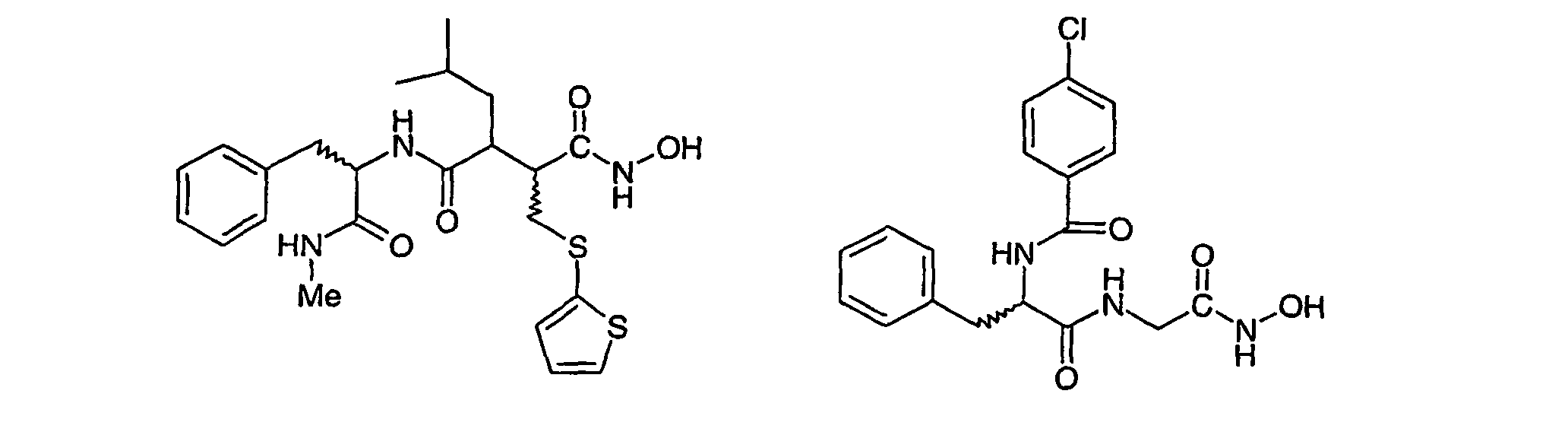
- Richon et al., 1998 describe several hydroxamic acid compounds, including SAHA, which apparently inhibit HDAC activity, and induce terminal differentiation and/or apoptosis in various transformed cells (see, for example, Table 1 therein).
- Suzuki et al., 1998 describe a number of hydroxamic acid compounds which are claimed to have antitumour activity. Some of the compounds are carbamic acid compounds having a substituted phenylamido group (-CONHPh) linked to a carbamic acid (-CONHOH) group via a phenylene-meta-ethenylene or phenylene-para-ethylene group (see, for example, pages 8 and 9, compounds 31-50).
- Breslow et al., 1994, 1995, 1997 describe a number of hydroxamic acid compounds which are claimed to selectively induce terminal differentiation of neoplastic cells.
- Some of the compounds are carbamic acid compounds having a substituted phenylacylamido group (-NHCOPh) linked to a carbamic acid (-CONHOH) group via a long alkylene chain, -(CH2)n-, wherein n is from 4 to 8
- Some of the compounds are carbamic acid compounds having a substituted phenylamido group (-CONHPh) or phenylacylamido group (-NHCOPh) linked to a carbamic acid (-CONHOH) group via a long alkylene chain, -(CH2)n-, wherein n is from 4 to 8 (see, for example, columns 7 and 13 of Breslow et al., 1997), or via a phenylene group (see, for example, columns 24, 30-31 and compounds 20-55 in Table 1 of Breslow et al., 1997).
- One of the compounds is a carbamic acid compound having benzylamido group (-CONHCH2Ph) linked to a carbamic acid group (-CONHOH) via a -(CH2)6- group (see, for example, compound 19 in Table 1, at column 37 of Breslow et al., 1997).
- Jung et al., 1997, 1999, describe several aromatic hydroxamic acid compounds which apparently inhibit HDAC. Some of the compounds have a phenylamido group (PhCONH-). One compound, a peptide analog, is shown below (see, e.g., compound 6 in Jung et al., 1997; compound 4 in Jung et al., 1999).

- Kato et al., 1998, describe a number of aromatic hydroxamic acid compounds, comprising an aryl group linked via an alkylene group to a carbamic acid group, which are apparently active in the treatment of neurodegenerative conditions. One compound, 4-1 at columns 63-64, has a phenylamido group (PhCONH-) linked via a -(CH2)5-group to a carbamic acid group.
- Glick et al., 1999, describe the apparent apoptotic and differentiating effects of m-carboxy-cinnamic acid bishydroxamide (CBHA) on various tumour cell lines.
- Massa et al., 2001, describe various hydroxamic acid compounds which have a benzoyl (or substituted benzoyl) group linked via a pyrrolyl group and an C2alkylene group (-CH=CH- or -CH2CH2-) to a carbamic acid group. The compounds apparently showed HDAC inhibitory activity in the micromolar range.
- Schmidt, K., et al., 1999, Archiv. Pharm., Vol. 332, No. 10, pp. 353-357 describes several histone deacetylase inhibitors, including the following compound (No. 3 in Scheme 1 on page 353 therein).

- Barnett, R., et al., international patent application publication number WO 00/44709 published 03 August 2000, describes a number of acetylenic α-amino acid-based sulphonamide hydroxamic acid TACE inhibitors, including, apparently, the following compound:

- Bocan, T., et al., international patent application publication number WO 98/26773 published 25 June 1998, describes a number of matrix metalloproteinase inhibitors, apparently useful for the treatment of neurological disorders and promoting wound healing, including, apparently, the following compound:
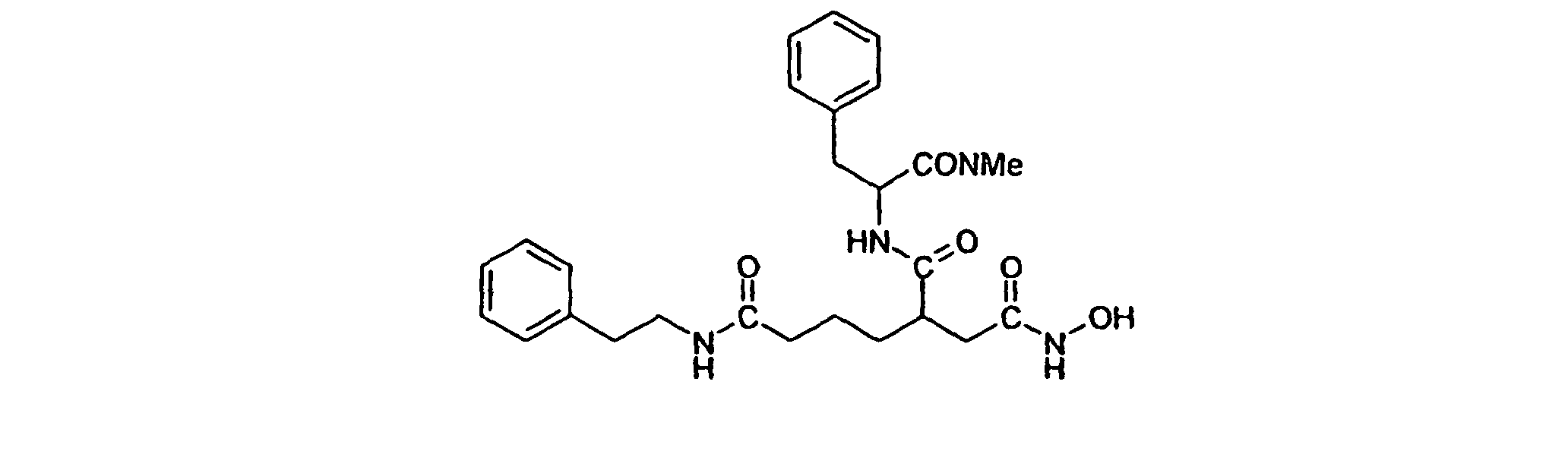
- Bair, K., et al., international patent application publication number WO 02/22577 published 21 March 2002 (Novartis-Erfindungen Verwaltungsgesellschaft M.B.H.) appears to disclose a number of deacetylase inhibitors, including the following compound, denoted Example 129, at page 51 therein:

- Oxamflatin, also known as (2E)-5-[3-[(phenylsulfonyl)amino] phenyl]-pent-2-en-4-ynohydroxamic acid, shown below, has been reported to have in vitro antiproliferative activity against various mouse and human tumour cell lines, and in vivo antitumour activity against B16 melanoma (see, e.g., Sonoda et al., 1996; Kim et al., 1999).

- Ohtani et al., 1993, describe a number of hydroxamic acid compounds which are claimed to be inhibitors of ras transformation. Many of the compounds are hydroxmic acid compounds which have a sulfonamide group, and which employ an acid leader which is: a phenylene-ortho-alkylene (e.g., I-10); phenylene-meta-alkylene (e.g., I-24); phenylene-para-alkylene (e.g., I-12); or napthylen-1,2-diyl (e.g., I-20). However, in every case, the sulfonamide group is -SO2NR-, as opposed to -NRSO2-. Also, in every case, the terminal aryl group is linked directly to the -SO2NR- sulfonamide group, without an intervening aryl leader. Ohtani et al., 1996, describe similar compounds.
- Richon et al., 2001, describe various branched compounds which apparently inhibit histone deacetylase. See the table at pages 96-101 therein. Some of the compounds are carbamic acid compounds having a carbamic acid group (-CONHOH) linked to a branch point, from which two aryl groups are appended. A few linear carbamic acid compounds are also described, including a single -SO2NH- sulfonamide carbamic acid with a -(CH2)5- acid leader (compound 671).
- Delorme et al., 2001, describe various carbamic acid compounds, including compounds having, inter alia, a sulfonamide group. Of the 108 compounds in the table at pages 114-123 therein, 88 are carbamic acids (-CONHOH), and the remainder are terminal amides, -CONHR. Of the 88 carbamic acid compounds, 54 have a sulfonamide linkage.
- Of the 54 sulfonamide carbamic acids, 51 are indicated to have a -SO2NR-sulfonamide group, and 3 (compounds 98, 161, and 162) are indicated to have a - NRSO2- sulfonamide group.
- All of the 54 sulfonamide carbamic acids employ a phenylene-alkylene acid leader group (analogous to Q2 herein). Of the 54 compounds, 52 employ a phenylene-para-alkylene group, and only 2 (compounds 41 and 26) employ a phenylene-meta-alkylene group (-Ph-CH2- and -Ph-(CH2)4-, respectively). Compounds 41 and 26 both have a -SO2NR- sulfonamide group, as opposed to a -NRSO2-sulfonamide group; the former has a benzothiophenyl group, and the latter has a phenyl group.
- All but one of the 54 sulfonamide carbamic acids have an aryl group linked directly to the sulfonamide; compound 100 has a benzyl group (Ph-CH2-) linked a - SO2NR- sulfonamide group linked to phenylene-para-ethylene.
- One aspect of the invention pertains to active carbamic acid compounds, as described herein, which inhibit HDAC activity.
- Another aspect of the invention pertains to active compounds, as described herein, which treat a proliferative condition, such as cancer, psoriasis, etc.
- Another aspect of the invention pertains to active compounds, as described herein, which treat conditions which are known to be mediated by HDAC, or which are known to be treated by HDAC inhibitors (such as, e.g., trichostatin A).
- Another aspect of the present invention pertains to a composition comprising a compound as described herein and a pharmaceutically acceptable carrier.
- Another aspect of the present invention pertains to methods of inhibiting HDAC in a cell, comprising contacting said cell with an effective amount of an active compound, as described herein, in vitro.
- Another aspect of the present invention pertains to methods of inhibiting cell proliferation, comprising contacting a cell with an effective amount of an active compound, as described herein, in vitro.
- Another aspect of the present invention pertains to an active compound, as described herein, for use in a method of treatment of the human or animal body.
- Another aspect of the present invention pertains to use of an active compound, as described herein, for the manufacture of a medicament for use in the treatment of a proliferative condition. In one preferred embodiment, the proliferative condition is cancer. In one preferred embodiment, the proliferative condition is psoriasis.
- Another aspect of the present invention pertains to use of an active compound for the manufacture of a medicament, for example, for the treatment of conditions which are known to be mediated by HDAC, or which are known to be treated by HDAC inhibitors (such as, e.g., trichostatin A), as discussed herein.
- Another aspect of the present invention pertains to a kit comprising (a) the active compound, preferably provided as a pharmaceutical composition and in a suitable container and/or with suitable packaging; and (b) instructions for use, for example, written instructions on how to administer the active compound.
- Another aspect of the present invention pertains to compounds obtainable by a method of synthesis as described herein, or a method comprising a method of synthesis as described herein.
- Another aspect of the present invention pertains to compounds obtained by a method of synthesis as described herein, or a method comprising a method of synthesis as described herein.
- Another aspect of the present invention pertains to novel intermediates, as described herein, which are suitable for use in the methods of synthesis described herein.
- Another aspect of the present invention pertains to the use of such novel intermediates, as described herein, in the methods of synthesis described herein.
- As will be appreciated by one of skill in the art, features and preferred embodiments of one aspect of the invention will also pertain to other aspects of the invention.
- In one embodiment, the present invention pertains to carbamic acid compounds of the formula:wherein:

- A is an aryl group;
- Q1 is an aryl leader group having a backbone of at least two carbon atoms;
- J is an amide linkage selected from:

- R1 is an amido substituent; and,
- Q2 is an acid leader group; and pharmaceutically acceptable salts, solvates, amides, esters, ethers, chemically protected forms, and prodrugs thereof.
-
- In preferred embodiments, the carbamic acid group, -C(=O)NHOH, is unmodified (e.g., is not an ester).
- In one preferred embodiment, J is -NR1CO-, and the compounds have the following formula:

- In one preferred embodiment, J is -CONR1-, and the compounds have the following formula:

- In one embodiment, where Q1 is an aryl leader, the aryl group, A, is linked to Q1 via a covalent single bond.
- In one embodiment, where Q1 is a cyclic aryl leader, the aryl group, A, may be fused to Q1 and so the moiety A-Q1- forms a fused polycyclic structure. For example, the moiety 2,3-dihydro-1H-indene-2-yl, derived from indan (2,3-dihydro-1 H-indene), is considered to be a phenyl group (A) fused to a C5cycloalkyl group (Q1):

- In such cases, the tridentate aryl leader, Q1, may be denoted as:

- In a similar example, the moiety 9H-fluorene-9-yl, derived from fluorene, is considered to be two phenyl groups (either of which is A), fused to a C5cycloalkyl group, which forms part of Q1:

- In such cases, the pentadentate aryl leader, Q1, may be denoted as:

- The aryl group, A, is a C5-20aryl group, and is optionally substituted.
- In one preferred embodiment, A is a C5-20heteroaryl group, and is optionally substituted. In one preferred embodiment, A is a monocyclic C5-20heteroaryl group, and is optionally substituted. In one preferred embodiment, A is a monocyclic C5-6heteroaryl group, and is optionally substituted.
- In one preferred embodiment, A is a C5-20carboaryl group, and is optionally substituted. In one preferred embodiment, A is a monocyclic C5-20carboaryl group, and is optionally substituted. In one preferred embodiment, A is a monocyclic C5-6carboaryl group, and is optionally substituted. In one preferred embodiment, A is a phenyl group, and is optionally substituted.
- In one preferred embodiment, A is a C5-20aryl group derived from one of the following: benzene, pyridine, furan, indole, pyrrole, imidazole, naphthalene, quinoline, benzimidazole, benzothiofuran, fluorene, acridine, and carbazole.
- In one preferred embodiment, Ar is a pyridyl group, or a substituted pyridyl group, for example, 2-pyridyl, 3-pyridyl, or 4-pyridyl:

- In one preferred embodiment, Ar is a furanyl group, or a substituted furanyl group, for example, furan-2-yl or furan-3-yl:

- In one preferred embodiment, Ar is a thiophenyl group, or a substituted thiophenyl group, for example, thiophen-2-yl or thiophen-3-yl:

- In one preferred embodiment, Ar is a pyrrolyl group, or a substituted pyrrolyl group, for example, pyrrol-2-yl or pyrrol-3-yl:

- In one preferred embodiment, Ar is a naphthyl group, or a substituted naphthyl group, for example, naphth-1-yl or naphth-2-yl:

- In one preferred embodiment, Ar is a benzimidazolyl group, or a substituted benzimidazolyl group, for example, benzimidazol-2-yl:

- In one preferred embodiment, Ar is a indolyl group, or a substituted indolyl group, for example, indol-2-yl or indol-3-yl:

- In one preferred embodiment, A is an optionally substituted phenyl group of the formula:wherein n is an integer from 0 to 5, and each RA is independently a substituent as defined herein.

- In one preferred embodiment, A is an optionally substituted phenyl group, J is -NR1CO-, and the compounds have the following formula:

- In one preferred embodiment, A is an optionally substituted phenyl group, J is -CONR1-, and the compounds have the following formula:

- In one preferred embodiment, n is an integer from 0 to 5.
- In one preferred embodiment, n is an integer from 0 to 4.
- In one preferred embodiment, n is an integer from 0 to 3.
- In one preferred embodiment, n is an integer from 0 to 2.
- In one preferred embodiment, n is 0 or 1.
- In one preferred embodiment, n is an integer from 1 to 5.
- In one preferred embodiment, n is an integer from 1 to 4.
- In one preferred embodiment, n is an integer from 1 to 3.
- In one preferred embodiment, n is 1 or 2.
- In one preferred embodiment, n is 5.
- In one preferred embodiment, n is 4.
- In one preferred embodiment, n is 3.
- In one preferred embodiment, n is 2.
- In one preferred embodiment, n is 1.
- In one preferred embodiment, n is 0.
- If the phenyl group has less than the full complement of ring substituents, RA, they may be arranged in any combination. For example, if n is 1, RA may be in the 2'-, 3'-, 4'-, 5'-, or 6'-position. Similarly, if n is 2, the two RA groups may be in, for example, the 2',3'-, 2',4'-, 2',5'-, 2',6'-, 3',4'-, or 3',5'-positions. If n is 3, the three RA groups may be in, for example, the 2',3',4'-, 2',3',5'-, 2',3',6'-, or 3',4',5'-positions.
- In one preferred embodiment, n is 1, and the RA group is in the 4'-position.
- In one preferred embodiment, n is 2, and one RA group is in the 4'-position, and the other RA group is in the 2'-position.
- In one preferred embodiment, n is 2, and one RA group is in the 4'-position, and the other RA group is in the 3'-position.
- Each aryl substituent, RA, is a substituent as defined herein.
- Examples of preferred aryl substituents, RA, include, but are not limited to, the following: fluoro, chloro, bromo, iodo, methyl, ethyl, isopropyl, t-butyl, cyano, trifluoromethyl, hydroxy, methoxy, ethoxy, isopropoxy, trifluoromethoxy, phenoxy, methylthio, trifluoromethylthio, hydroxymethyl, amino, dimethylamino, diethylamino, morpholino, amido (unsubstituted, i.e., -CONH2), acetamido, acetyl, nitro, sulfonamido (unsubstituted, i.e., -SO2NH2), and phenyl.
- In one preferred embodiment, A is a substituted phenyl group selected from:
- para-(fluoro)phenyl; ortho-(fluoro)phenyl; meta-(fluoro)phenyl;
- para-(chloro)phenyl; ortho-(chloro)phenyl; meta-(chloro)phenyl;
- para-(bromo)phenyl; ortho-(bromo)phenyl; meta-(bromo)phenyl;
- para-(iodo)phenyl; ortho-(iodo)phenyl; meta-(iodo)phenyl;
- para-(methyl)phenyl; ortho-(methyl)phenyl; meta-(methyl)phenyl;
- para-(ethyl)phenyl; ortho-(ethyl)phenyl; meta-(ethyl)phenyl;
- para-(isopropyl)phenyl; ortho-(isopropyl)phenyl; meta-(isopropyl)phenyl;
- para-(t-butyl)phenyl; ortho-(t-butyl)phenyl; meta-(t-butyl)phenyl;
- para-(cyano)phenyl; ortho-(cyano)phenyl; meta-(cyano)phenyl;
- para-(trifluoromethyl)phenyl; ortho-(trifluoromethyl)phenyl; meta-(trifluoromethyl)phenyl;
- para-(hydroxy)phenyl; ortho-(hydroxy)phenyl; meta-(hydroxy)phenyl;
- para-(methoxy)phenyl; ortho-(methoxy)phenyl; meta-(methoxy)phenyl;
- para-(ethoxy)phenyl; ortho-(ethoxy)phenyl; meta-(ethoxy)phenyl;
- para-(isopropoxy)phenyl; ortho-(isopropoxy)phenyl; meta-(isopropoxy)phenyl;
- para-(trifluoromethoxy)phenyl; ortho-(trifluoromethoxy)phenyl; meta-(trifluoromethoxy)phenyl;
- para-(phenoxy)phenyl; ortho-(phenoxy)phenyl; meta-(phenoxy)phenyl;
- para-(methylthio)phenyl; ortho-(methylthio)phenyl; meta-(methylthio)phenyl;
- para-(trifluoromethylthio)phenyl; ortho-(trifluoromethylthio)phenyl; meta-(trifluoromethylthio)phenyl;
- para-(hydroxymethyl)phenyl; ortho-(hydroxymethyl)phenyl; meta-(hydroxymethyl)phenyl;
- para-(amino)phenyl; ortho-(amino)phenyl; meta-(amino)phenyl;
- para-(dimethylamino)phenyl; ortho-(dimethylamino)phenyl; meta-(dimethylamino)phenyl;
- para-(diethylamino)phenyl; ortho-(diethylamino)phenyl; meta-(diethylamino)phenyl;
- para-(morpholino)phenyl; ortho-(morpholino)phenyl; meta-(morpholino)phenyl;
- para-(amido)phenyl; ortho-(amido)phenyl; meta-(amido)phenyl;
- para-(acetamido)phenyl; ortho-(acetamido)phenyl; meta-(acetamido)phenyl;
- para-(acetyl)phenyl; ortho-(acetyl)phenyl; meta-(acetyl)phenyl;
- para-(nitro)phenyl; ortho-(nitro)phenyl; meta-(nitro)phenyl;
- para-(sulfonamido)phenyl; ortho-(sulfonamido)phenyl; meta-(sulfonamido)phenyl; and,
- para-(phenyl)phenyl; ortho-(phenyl)phenyl; meta-(phenyl)phenyl.
-
- In one preferred embodiment, A is a substituted phenyl group selected from:
- para-(fluoro)phenyl;
- para-(chloro)phenyl;
- para-(bromo)phenyl;
- para-(iodo)phenyl;
- para-(methyl)phenyl;
- para-(ethyl)phenyl;
- para-(isopropyl)phenyl;
- para-(t-butyl)phenyl;
- para-(cyano)phenyl;
- para-(trifluoromethyl)phenyl;
- para-(hydroxy)phenyl;
- para-(methoxy)phenyl;
- para-(ethoxy)phenyl;
- para-(isopropoxy)phenyl;
- para-(trifluoromethoxy)phenyl;
- para-(phenoxy)phenyl;
- para-(methylthio)phenyl;
- para-(triiluoromethylthio)phenyl;
- para-(hydroxymethyl)phenyl;
- para-(amino)phenyl;
- para-(dimethylamino)phenyl;
- para-(diethylamino)phenyl;
- para-(morpholino)phenyl;
- para-(amido)phenyl;
- para-(acetamido)phenyl;
- para-(acetyl)phenyl;
- para-(nitro)phenyl;
- para-(sulfonamido)phenyl; and,
- para-(phenyl)phenyl.
-
- In one preferred embodiment, A is a substituted phenyl group selected from:
- ortho,para-di(methoxy)phenyl;
ortho,para-di(halo)phenyl;
ortho,para-di(fluoro)phenyl;
ortho-(methoxy),para-(methyl)phenyl;
ortho-(methoxy),para-(trifluoromethyl)phenyl;
ortho-(trifluoromethyf),para-(halo)phenyf; - ortho,meta-di(trifluoromethyl)phenyl;
ortho-(halo),meta-(trifluoromethyl)phenyl; - meta,para-di(halo)phenyl;
meta,para-di(hydroxy)phenyl; - meta, para-di (methyl) phenyl;
meta,para-di(methoxy)phenyl;
meta-(halo),para-(nitro)phenyl; - 3',5'-di(trifluoromethyl)phenyl;
3'-(trifluorornethyl),5'-(methoxy)phenyl;
3'-(trifluoromethyl),5'-(halo)phenyl; - 2'-(halo),5'-(methyl)phenyl;
- 2',6'-di(methyl)phenyl;
2',6'-di(halo)phenyl;
2',6'-di(isopropyl)phenyl; - 2',4',6'-tri(halo)phenyl;
3',4',5'-tri(halo)phenyl;
3',4',5'-tri(methoxy)phenyl;
2',5'-di(halo)-4'-(hydroxy)phenyl; and
3'-(trifluoromethyl),5',6'-di(halo)phenyl. -
- In one embodiment, n is 2 or larger, and two substituents, RA, together form a bidentate substituent. In one embodiment, the bidentate substituent is attached to adjacent phenyl ring carbon atoms. In one embodiment, the bidentdate substituent is -O-CH2-O . In one embodiment, A is, for example, one of:

- The aryl leader group, Q1, has a backbone of at least 2 carbon atoms; that is, the shortest chain of atoms linking the aryl group, A, and the linker group, J, has 2 or more atoms, more specifically, 2 or more carbon atoms. In this way, groups such as methylene (-CH2-) and substituted methylene (-CR2- and -CHR-) are excluded.
- If there are two or more paths linking the aryl group, A, and the amide group, J, then the shortest path is relevant. For example, in the embodiments shown below, where the moiety A-Q1- is derived from indan (2,3-dihydro-1 H-indene), A is considered to be a phenyl group fused to Q1, a C5cycloalkyl group:

- In each case, there are two paths to the aryl group. In the first case, one path has 1 carbon atom, and the other path has 3 carbon atoms, and so the relevant backbone length is 1. In the second case, both paths have 2 carbon atoms, and so the relevant backbone length is 2.
- In one embodiment, there is only a single path (i.e., a single chain) linking the aryl group, A, and the amide group, J.
- If the group A-Q1- has two or more aryl groups, the aryl group furthest from the amide group, J, as measured by counting chain atoms, is identified as A; the relevant backbone is then the shortest chain of atoms linking that aryl group and the amide group, J. For example, where the group A-Q1- is as shown below, the phenyl group marked "1" is identified as the A, Q1 is -CH2CH(Ph)- (i.e., substituted ethylene), and the backbone length is 2.

- If the amide group is -NR1CO- (as opposed to -CONR1-), and substituent, R1, discussed below, is or comprises an aryl group (or two or more aryl groups), then the aryl group furthest from the amide group nitrogen atom, as measured by counting chain atoms, is identified as A. For example, where the group A-Q1-NR1CO- is as shown below, the phenyl group marked "1" is identified as the A, Q1 is -CH2-, and the backbone length is 1.

- In one preferred embodiment, the aryl leader group, Q1, has a backbone of at least 3 carbon atoms.
- In one preferred embodiment, the aryl leader group, Q1, has a backbone of at least 4 carbon atoms.
- In one preferred embodiment, the aryl leader group, Q1, has a backbone of at least 5 carbon atoms.
- In one embodiment, the aryl leader group, Q1, has a backbone of:
- from 2 to 7 carbon atoms;
- from 2 to 6 carbon atoms; or,
- from 2 to 5 carbon atoms.
-
- In one embodiment, the aryl leader group, Q1, has a backbone of:
- from 3 to 7 carbon atoms;
- from 3 to 6 carbon atoms; or,
- from 3 to 5 carbon atoms.
-
- In one embodiment, the aryl leader group, Q1, has a backbone of:
- from 4 to 7 carbon atoms;
- from 4 to 6 carbon atoms; or,
- from 4 to 5 carbon atoms.
-
- In one embodiment, the aryl leader group, Q1, has a backbone of 2 carbon atoms.
- In one embodiment, the aryl leader group, Q1, has a backbone of 3 carbon atoms.
- In one embodiment, the aryl leader group, Q1, has a backbone of 4 carbon atoms.
- In one embodiment, the aryl leader group, Q1, has a backbone of 5 carbon atoms.
- The aryl leader group, Q1, has a backbone of at least 2 carbon atoms, and is a partially unsaturated C2-7alkylene group.
- In one preferred embodiment, Q1 has a backbone of at least 3 carbon atoms, and is a partially unsaturated C3-7alkylene group.
- In one preferred embodiment, Q1 has a backbone of at least 2 carbon atoms, and is a partially unsaturated aliphatic C2-7alkylene group.
- In one preferred embodiment, Q1 has a backbone of at least 3 carbon atoms, and is a partially unsaturated aliphatic C3-7alkylene group.
- In one preferred embodiment, Q1 has a backbone of at least 2 carbon atoms, and is a partially unsaturated linear C2-7alkylene group.
- In one preferred embodiment, Q1 has a backbone of at least 3 carbon atoms, and is a partially unsaturated linear C3-7alkylene group.
- In one preferred embodiment, Q1 has a backbone of at least 2 carbon atoms, and is a partially unsaturated branched C3-7alkylene group.
- In one preferred embodiment, Q1 has a backbone of at least 3 carbon atoms, and is a partially unsaturated branched C4-7alkylene group.
- In one preferred embodiment, Q1 has a backbone of at least 2 carbon atoms, and is a partially unsaturated alicyclic C3-7alkylene group.
- In one preferred embodiment, Q1 has a backbone of at least 3 carbon atoms, and is a partially unsaturated alicyclic C4-7alkylene group.
- In one preferred embodiment, Q1 is a partially unsaturated alkylene group, and is not saturated at the carbon atom adjacent to J. For example, in such an embodiment, -Q1-J- as -CH=CH-CH2-J- is excluded, but -Q1-J- as -CH2-CH=CH-J-is included. Compounds of this embodiment have surprising and unexpected activity, as compared to the analogous excluded compounds.
- Note that, as discussed below in the context of isomers, where unsaturation permits isomers, e.g., cis- and trans, E- and Z-, etc., and combinations thereof, a reference to one isomer is to be considered a reference to all such isomers, unless otherwise specified.
- In one embodiment, Q1 is unsubstituted.
- In one embodiment, Q1 is optionally substituted.
- In one embodiment, Q1 is substituted.
- Examples of substituents on Q1 include, but are not limited to, those described under the heading "Substituents" below.
- In one preferred embodiment, substituents on Q1, if present, are independently selected from: halo, hydroxy, ether (e.g., C1-7alkoxy), C5-20aryl, acyl, amido, and oxo.
- In one preferred embodiment, substituents on Q1, if present, are independently selected from -F, -Cl, -Br, -I, -OH, -OMe, -OEt, -OPr, -Ph, and =O.
- In one preferred embodiment, substituents on Q1, if present, are -OH or -Ph.
- In one preferred embodiment, substituents on Q1, if present, are -Ph.
- In one embodiment, if Q1 is substituted, it is not substituted at the carbon atom adjacent to J. For example, in such an embodiment, -Q1-J- as -CH=CH(Me)-J- is excluded, but -Q1-J- as -CH(Me)=CH-J- is included. Compounds of this embodiment have surprising and unexpected activity, as compared to the analogous excluded compounds.
- Note that, for embodiments excluding, e.g., certain backbone lengths, etc., it is to be understood that the corresponding species listed below are similarly excluded from the respective embodiments discussed below.
- In one preferred embodiment, Q1 is selected from the following:
- -CH=CH-;
-CH=CHCH2- and -CH2CH=CH-;
-CH=CHCH2CHz-, -CH2CH=CHCH2-, and -CH2CH2CH=CH-;
-CH=CHCH2CH2CH2-, -CH2CH=CHCH2CH2-, -CH2CH2CH=CHCH2-, and -CH2CH2CH2CH=CH-;
-CH=CHCH2CH2CH2CH2-, -CH2CH=CHCH2CH2CH2-, -CH2CH2CH=CHCH2CH2-, -CH2CH2CH2CH=CHCH2-, and -CH2CH2CH2CH2CH=CH-; - -C(CH3)=CH- and -CH=C(CH3)-;
-C(CH3)=CHCH2-, -CH=C(CH3)CH2-, and -CH=CHCH(CH3)-;
-CH(CH3)CH=CH-, -CH2C(CH3)=CH-, and -CH2CH=C(CH3)-;
-CH=CHCH=CH-;
-CH=CHCH=CHCH2-, -CH2CH=CHCH=CH-, and -CH=CHCH2CH=CH-;
-CH=CHCH=CHCH2CH2-, -CH=CHCH2CH=CHCH2-,
-CH=CHCH2CH2CH=CH-, -CH2CH=CHCH=CHCH2-, -CH2CH=CHCH2CH=CH-, and -CH2CH2CH=CHCH=CH-; - -C(CH3)=CHCH=CH-, -CH=C(CH3)CH=CH-, -CH=CHC(CH3)=CH-, and -CH=CHCH=C(CH3)-;
- -C≡C-;
-C≡CCH2-, -CH2C≡C-; -C≡CCH(CH3)-, and -CH(CH3)C≡C-;
-C≡CCH2CH2-, -CH2C≡CCH2-, and -CH2CH2C≡C-;
-C≡CCH(CH3)CH2- and -C≡CCH2CH(CH3)-;
-CH(CH3)C≡CCH2- and -CH2C≡CCH(CH3)-;
-CH(CH3)CH2C≡C- and -CH2CH(CH3)C≡C-;
-C≡CCH=CH-, -CH=CHC≡C-, and -C≡CC≡C-;
-C≡CCH2CH2CH2- and -CH2CH2CH2C≡C-;
-C≡CCH2CH2CH2CH2- and -CH2CH2CH2CH2C≡C-;
-C≡CCH=CHCH=CH-, -CH=CHC≡C-CH=CH-, and -CH=CHCH=CHC≡C-; - -C(CH3)=CHC≡C-, -CH=C(CH3)C≡C-, -C≡CC(CH3)=CH-, and -C≡CCH=C(CH3)-;
- cyclopentenylene; and,
cyclohexenylene, and cyclohexadienylene. -
- In one preferred embodiment, Q1 is selected from:
- -CH=CH-;
-CH=CH-CH=CH-;
-CH=CHCH2CH2CH2- and -CH2CH2CH2CH=CH-;
-CH=CHCH2CH2CH2CH2- and -CH2CH2CH2CH2CH=CH-;
-C(CH3)=CHCH=CH-, -CH=C(CH3)CH=CH-, -CH=CHC(CH3)=CH-, and -CH=CHCH=C(CH3)-; -
- In one preferred embodiment, Q1 is selected from:
- -CH=CH-;
-CH=CH-CH=CH-;
-C(CH3)=CHCH=CH-, -CH=C(CH3)CH=CH-, -CH=CHC(CH3)=CH-, and -CH=CHCH=C(CH3)-;
-CH=CHCH2CH2CH2- and -CH2CH2CH2CH=CH-; and,
-
- In one preferred embodiment, Q1 is selected from:
- -CH=CH-, -CH=CH-CH=CH-, -C(CH3)=CH-CH=CH-, -CH=CH-C(CH3)=CH-, -CH=CH-CH=C(CH3)-, or -C≡C-CH=CH-.
-
- In one preferred embodiment, Q1 is selected from:
- -CH=CH-, -CH=CH=CH=CH-, and -C(CH3)=CH-CH=CH-.
-
- In one preferred embodiment, Q1 is selected from:


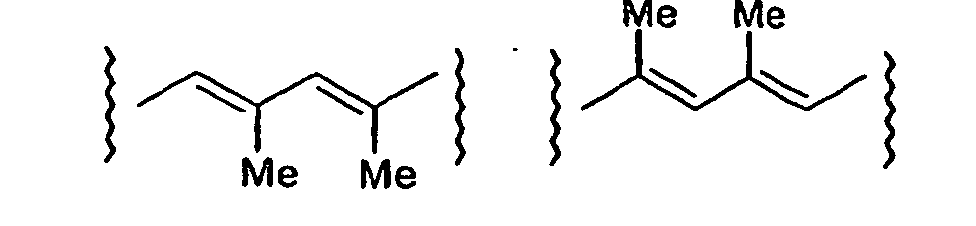
- In one preferred embodiment, Q1 is selected from:





- In one preferred embodiment, Q1 is selected from:

- In one preferred embodiment, Q1 is selected from:

- The amido substituent, R1, is hydrogen, C1-7alkyl (including, e.g., C5-20aryl-C1-7alkyl), C3-20heterocyclyl, or C5-20aryl.
- Note that R1 is a monodentate species. It is not intended that R1 be additionally linked to A, Q1, and/or Q2, thereby forming a cyclic group.
- In one preferred embodiment, R1 is hydrogen, C1-7alkyl, or C5-20aryl.
- In one preferred embodiment, R1 is hydrogen or C1-7alkyl.
- In one preferred embodiment, R1 is hydrogen, saturated C1-7alkyl, or C5-20aryl.
- In one preferred embodiment, R1 is hydrogen or saturated C1-7alkyl.
- In one preferred embodiment, R1 is hydrogen, saturated aliphatic C1-7alkyl, or C5-20aryl.
- In one preferred embodiment, R1 is hydrogen or saturated aliphatic C1-7alkyl.
- In one preferred embodiment, R1 is -H, -Me, -Et, -nPr, -iPr, -nBu, -sBu, -tBu, -Ph, or -Bn.
- In one preferred embodiment, R1 is -H, -Me, -Et, -nPr, -iPr, -nBu, -sBu, or -tBu.
- In one preferred embodiment, R1 is -H, -Me, -Et, -Ph, or -Bn.
- In one preferred embodiment, R1 is -H, -Me, or -Et.
- In one preferred embodiment, R1 is -H.
- The acid leader group, Q2, is C1-10alkylene; C5-20arylene;
C5-20arylene-C1-10alkylene; or C1-10alkylene-C5-20arylene; and is optionally substituted. - In one preferred embodiment, Q2 is C1-7alkylene; C5-20arylene;
C5-20arylene-C1-7alkylene; or C1-7alkylene-C5-20arylene; and is optionally substituted. - In one embodiment, Q2 is unsubstituted.
- In one embodiment, Q2 is optionally substituted.
- In one embodiment, Q2 is substituted.
- The acid leader group, Q2, has a backbone of at least 3 carbon atoms; that is, the shortest chain of atoms linking the group, J, and the carbamic acid group (-C(=O)NHOH) has 3 or more atoms, more specifically, 3 or more carbon atoms. In this way, groups such as methylene (-CH2-), substituted methylene (-CR2- and -CHR-), ethylene (-CH2CH2-), and substituted ethylene (e.g., -CHRCH2-) are excluded.
- In one embodiment, the acid leader group, Q2, has a backbone of at least 4 carbon atoms.
- In one embodiment, the acid leader group, Q2, has a backbone of at least 5 carbon atoms.
- In one embodiment, the acid leader group, Q2, has a backbone of:
- from 3 to 10 carbon atoms;
- from 3 to 9 carbon atoms;
- from 3 to 8 carbon atoms;
- from 3 to 7 carbon atoms;
- from 3 to 6 carbon atoms; or,
- from 3 to 5 carbon atoms.
-
- In one embodiment, the acid leader group, Q2, has a backbone of:
- from 4 to 10 carbon atoms;
- from 4 to 9 carbon atoms;
- from 4 to 8 carbon atoms;
- from 4 to 7 carbon atoms;
- from 4 to 6 carbon atoms; or,
- from 4 to 5 carbon atoms.
-
- In one embodiment, the acid leader group, Q2, has a backbone of:
- from 5 to 10 carbon atoms;
- from 5 to 9 carbon atoms;
- from 5 to 8 carbon atoms;
- from 5 to 7 carbon atoms; or,
- from 5 to 6 carbon atoms.
-
- In one embodiment, the acid leader group, Q2, has a backbone of:
- 3 carbon atoms;
- 4 carbon atoms;
- 5 carbon atoms;
- 6 carbon atoms;
- 7 carbon atoms;
- 8 carbon atoms;
- 9 carbon atoms; or,
- 10 carbon atoms.
-
- In one preferred embodiment, the acid leader group, Q2, is C3-10alkylene and is optionally substituted.
- In one preferred embodiment, the acid leader group, Q2, is C3-7alkylene and is optionally substituted.
- In one preferred embodiment, Q2 is a C3-10alkylene group.
- In one preferred embodiment, Q2 is a C3-7alkylene group.
- In one preferred embodiment, Q2 is a saturated C3-10alkylene group.
- In one preferred embodiment, Q2 is a saturated C3-7alkylene group.
- In one preferred embodiment, Q2 is a partially unsaturated C3-10alkylene group. In one preferred embodiment, Q2 is a partially unsaturated C3-7alkylene group.
- In one preferred embodiment, Q2 is an aliphatic C3-10alkylene group.
- In one preferred embodiment, Q2 is an aliphatic C3-7alkylene group.
- In one preferred embodiment, Q2 is a linear C3-10alkylene group.
- In one preferred embodiment, Q2 is a linear C3-7alkylene group.
- In one preferred embodiment, Q2 is a branched C4-10alkylene group.
- In one preferred embodiment, Q2 is a branched C4-7alkylene group.
- In one preferred embodiment, Q2 is an alicyclic C4-10alkylene group.
- In one preferred embodiment, Q2 is an alicyclic C4-7alkylene group.
- In one preferred embodiment, Q2 is a saturated aliphatic C3-10alkylene group.
- In one preferred embodiment, Q2 is a saturated aliphatic C3-7alkylene group.
- In one preferred embodiment, Q2 is a saturated linear C3-10alkylene group.
- In one preferred embodiment, Q2 is a saturated linear C3-7alkylene group.
- In one preferred embodiment, Q2 is a saturated branched C4-10alkylene group.
- In one preferred embodiment, Q2 is a saturated branched C4-7alkylene group.
- In one preferred embodiment, Q2 is a saturated alicyclic C4-10alkylene group.
- In one preferred embodiment, Q2 is a saturated alicyclic C4-7alkylene group.
- In one preferred embodiment, Q2 is a partially unsaturated aliphatic C3-10alkylene group.
- In one preferred embodiment, Q2 is a partially unsaturated aliphatic C3-7alkylene group.
- In one preferred embodiment, Q2 is a partially unsaturated linear C3-10alkylene group.
- In one preferred embodiment, Q2 is a partially unsaturated linear C3-7alkylene group.
- In one preferred embodiment, Q2 is a partially unsaturated branched C4-10alkylene group.
- In one preferred embodiment, Q2 is a partially unsaturated branched C4-7alkylene group.
- In one preferred embodiment, Q2 is a partially unsaturated alicyclic C4-10alkylene group.
- In one preferred embodiment, Q2 is a partially unsaturated alicyclic C4-7alkylene group.
- For the avoidance of doubt, for each of the above embodiments, Q2 may additionally have a backbone length as described in the preceding section.
- For example, in one preferred embodiment, Q2 is a saturated aliphatic C3-10alkylene group, with a backbone length of 3 to 7 carbon atoms.
- Note that, for embodiments excluding, e.g., certain backbone lengths, etc., it is to be understood that the corresponding species listed below are similarly excluded from the respective embodiments discussed below.
- In one preferred embodiment, Q2 is selected from:
- - (CH2)n- where n is an integer from 3 to 7;
- -CH(CH3)CH2CH2-, -CH2CH(CH3)CH2-, and -CH2CH2CH(CH3)-;
-CH(CH3)CH2CH2CH2-, -CH2CH(CH3)CH2CH2-, -CH2CH2CH(CH3)CH2-, and -CH2CH2CH2CH(CH3)-;
-CH(CH3)CH2CH2CH2CH2-, -CH2CH(CH3)CH2CH2CH2-, -CH2CH2CH(CH3)CH2CH2-, -CH2CH2CH2CH(CH3)CH2-, and -CH2CH2CH2CH2CH(CH3)-; - - CH(CH2CH3)CH2CH2-, -CH2CH(CH2CH3)CH2-, and -CH2CH2CH(CH2CH3)-;
-CH(CH2CH3)CH2CH2CH2-, -CH2CH(CH2CH3)CH2CH2-, -CH2CH2CH(CH2CH3)CH2-, and -CH2CH2CH2CH(CH2CH3)-;
-CH(CH2CH3)CH2CH2CH2CH2-, -CH2CH(CH2CH3)CH2CH2CH2-, -CH2CH2CH(CH2CH3)CH2CH2-, -CH2CH2CH2CH(CH2CH3)CH2-, and -CH2CH2CH2CH2CH(CH2CH3)-; - -CH=CHCH2- and -CH2CH=CH-;
-CH=CHCH2CH2-, -CH2CH=CHCH2-, and -CH2CH2CH=CH-;
-CH=CHCH2CH2CH2-, -CH2CH=CHCH2CH2-, -CH2CH2CH=CHCH2-, and -CH2CH2CH2CH=CH-;
-CH=CHCH2CH2CH2CH2-, -CH2CH=CHCH2CH2CH2-, -CH2CH2CH=CHCH2CH2-, -CH2CH2CH2CH=CHCH2-, and -CH2CH2CH2CH2CH=CH-; - -C(CH3)=CHCH2-, -CH=C(CH3)CH2-, and -CH=CHCH(CH3)-;
-CH(CH3)CH=CH-, -CH2C(CH3)=CH-, and -CH2CH=C(CH3)-; - -CH=CHCH=CH-;
-CH=CHCH=CHCH2-, -CH2CH=CHCH=CH-, and -CH=CHCH2CH=CH-;
-CH=CHCH=CHCH2CH2-, -CH=CHCH2CH=CHCH2-, and
-CH=CHCH2CH2CH=CH-, -CH2CH=CHCH=CHCH2-, -CH2CH=CHCH2CH=CH-, and -CH2CH2CH=CHCH=CH-; - -C(CH3)=CHCH=CH-, -CH=C(CH3)CH=CH-, -CH=CHC(CH3)=CH-, and -CH=CHCH=C(CH3)-;
- -C≡CCH2-, -CH2C≡C-; -C≡CCH(CH3)-, and -CH(CH3)C≡C-;
-C≡CCH2CH2-, -CH2C≡CCH2-, and -CH2CH2C≡C-;
-C≡CCH(CH3)CH2- and -C≡CCH2CH(CH3)-;
-CH(CH3)C≡CCH2- and -CH2C≡CCH(CH3)-;
-CH(CH3)CH2C≡C- and -CH2CH(CH3)C≡C-;
-C≡CCH=CH-, -CH=CHC≡C-, and -C≡CC≡C-;
-C≡CCH2CH2CH2- and -CH2CH2CH2C≡C-;
-C≡CCH2CH2CH2CH2- and -CH2CH2CH2CH2C≡C-;
-C≡CCH=CHCH=CH-, -CH=CHC≡C-CH=CH-, and -CH=CHCH=CHC≡C-; - -C(CH3)=CHC≡C-, -CH=C(CH3)C≡C-, -C≡CC(CH3)=CH-, and -C≡CCH=C(CH3)-;
- cyclopentylene and cyclopentenylene; and,
cyclohexylene, cyclohexenylene, and cyclohexadienylene. -
- In one preferred embodiment, Q2 is selected from:
- -(CH2)3-, -(CH2)4-, -(CH2)5-, and -(CH2)6-;
-CH(CH3)CH2CH2CH2CH2-, -CH2CH(CH3)CH2CH2CH2-,
-CH2CH2CH2CH(CH3)CH2-, and -CH2CH2CH2CH2CH(CH3)-;
-CH=CHCH2CH2CH2- and -CH2CH2CH2CH=CH-;
-CH=CHCH2CH2CH2CH2- and -CH2CH2CH2CH2CH=CH-;


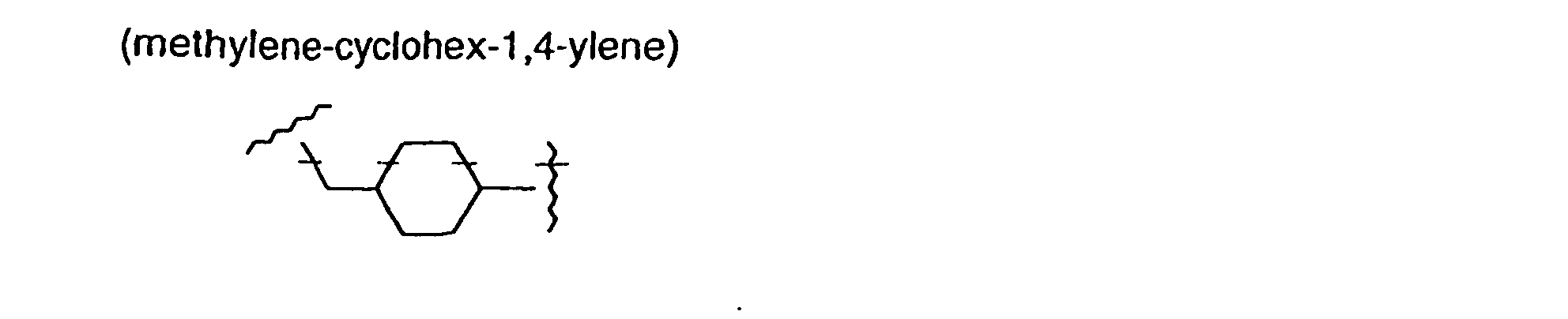
-
- In one preferred embodiment, Q2 is selected from:
- -CH2)3-, -(CH2)4-, -(CH2)5-, and -(CH2)6-;
-CH(CH3)CH2CH2CH2CH2- and -CH2CH2CH2CH2CH(CH3)-;

-CH2CH2CH2CH=CH-; and,
-CH2CH2CH2CH2CH=CH-. -
- In one preferred embodiment, Q2 is selected from -(CH2)n- wherein n is an integer from:
- 3 to 10; 3 to 8; 3 to 7; 3 to 6;
- 4 to 10; 4 to 8; 4 to 7; 4 to 6;
- 5 to 10; 5 to 8; 5 to 7; or, 5 to 6.
-
- In one preferred embodiment, Q2 is selected from: -(CH2)3-, -(CH2)4-, -(CH2)5-, -(CH2)6- and -(CH2)7-.
- In one preferred embodiment, Q2 is selected from: -(CH2)4-, -(CH2)5-, -(CH2)6- and -(CH2)7-.
- In one preferred embodiment, Q2 is selected from: -(CH2)4-, -(CH2)5-, and -(CH2)6-
- In one preferred embodiment, Q2 is selected from: -(CH2)5-, and -(CH2)6-.
- In one preferred embodiment, the compound has the following formula:

- In one preferred embodiment, the compound has the following formula:

- In one preferred embodiment, the acid leader group, Q2, is C5-20arylene, and is optionally substituted.
- In one preferred embodiment, Q2 is C5-20arylene. In one preferred embodiment, Q2 is C5-6arylene. In one preferred embodiment, Q2 is phenylene.
- In one preferred embodiment, the acid leader group, Q2, is C5-20arylene-C1-7alkylene or C1-7alkylene-C5-20arylene, and is optionally substituted. If Q2 is C5-20arylene-C1-7alkylene, then: (i) the C1-7alkylene moiety does not comprise a carbon-carbon triple bond; or (ii) Q2 has a backbone of less than 7 carbon atoms.
- In one preferred embodiment, Q2 is C5-6arylene-C1-7alkylene or C1-7alkylene-C5-6arylene, and is optionally substituted.
- In one preferred embodiment, Q2 is C1-7alkylene-C5-20arylene. In one preferred embodiment, Q2 is C1-7alkylene-C5-6arylene.
- In one preferred embodiment, Q2 is C5-20arylene-C1-7alkylene. In one preferred embodiment, Q2 is C5-6arylene-C1-7alkylene.
- In one preferred embodiment, Q2 is C5-20arylene-C1-7alkylene, wherein said C1-7alkylene moiety does not comprise a carbon-carbon triple bond. In one preferred embodiment, Q2 is C5-6arylene-C1-7alkylene, wherein said C1-7alkylene moiety does not comprise a carbon-carbon triple bond.
- In one preferred embodiment, Q2 is phenylene-C1-7alkylene, wherein said C1-7alkylene moiety does not comprise a carbon-carbon triple bond.
- In one preferred embodiment, Q2 is C1-7alkylene-C5-20arylene, wherein said C1-7alkylene moiety does not comprise a carbon-carbon triple bond.
- In one preferred embodiment, Q2 is C1-7alkylene-C5-6arylene,
wherein said C1-7alkylene moiety does not comprise a carbon-carbon triple bond. - In one preferred embodiment, Q2 is C1-7alkylene-phenylene, wherein said C1-7alkylene moiety does not comprise a carbon-carbon triple bond.
- In one preferred embodiment, Q2 is C5-20arylene-C1-7alkylene, wherein Q2 has a backbone of less than 7 carbon atoms, preferably less than 6 carbon atoms.
- In one preferred embodiment, Q2 is C5-6arylene-C1-7alkylene, wherein Q2 has a backbone of less than 7 carbon atoms, preferably less than 6 carbon atoms.
- In one preferred embodiment, Q2 is phenylene-C1-7alkylene, wherein Q2 has a backbone of less than 7 carbon atoms, preferably less than 6 carbon atoms.
- In one preferred embodiment, Q2 is C1-7alkylene-C5-20arylene, wherein Q2 has a backbone of less than 7 carbon atoms, preferably less than 6 carbon atoms.
- In one preferred embodiment, Q2 is C1-7alkylene-C5-6arylene, wherein Q2 has a backbone of less than 7 carbon atoms, preferably less than 6 carbon atoms.
- In one preferred embodiment, Q2 is C1-7alkylene-phenylene, wherein Q2 has a backbone of less than 7 carbon atoms, preferably less than 6 carbon atoms.
- In one preferred embodiment, Q2 is C5-20arylene-C1-7alkylene, wherein said C1-7alkylene moiety is saturated.
- In one preferred embodiment, Q2 is C5-6arylene-C1-7alkylene, wherein said C1-7alkylene moiety is saturated.
- In one preferred embodiment, Q2 is phenylene-C1-7alkylene, wherein said C1-7alkylene moiety is saturated.
- In one preferred embodiment, Q2 is C1-7alkylene-C5-20arylene, wherein said C1-7alkylene moiety is saturated.
- In one preferred embodiment, Q2 is C1-7alkylene-C5-6arylene, wherein said C1-7alkylene moiety is saturated.
- In one preferred embodiment, Q2 is C1-7alkylene-phenylene, wherein said C1-7alkylene moiety is saturated.
- In one preferred embodiment, Q2 is C1-7alkylene-phenylene. In one preferred embodiment, Q2 is methylene-phenylene, ethylene-phenylene, propylene-phenylene, and ethenylene-phenylene (also known as vinylene-phenylene).
- In one preferred embodiment, Q2 is phenylene-C1-7alkylene. In one preferred embodiment, Q2 is phenylene-methylene, phenylene-ethylene, phenylene-propylene, or phenylene-ethenylene (also known as phenylene-vinylene).
- In the above alkylene-phenylene and phenylene-alkylene groups, the phenylene linkage may be ortho, meta, or para, and the phenylene group is optionally substituted with from 1 to 4 aryl substituents, RB:

- In one preferred embodiment, the phenylene linkage is meta or para. In one preferred embodiment, the phenylene linkage is para. In one preferred embodiment, the phenylene linkage is meta.
- In one preferred embodiment, m is an integer from 0 to 4.
- In one preferred embodiment, m is an integer from 0 to 3.
- In one preferred embodiment, m is an integer from 0 to 2.
- In one preferred embodiment, m is 0 or 1.
- In one preferred embodiment, m is an integer from 1 to 4.
- In one preferred embodiment, m is an integer from 1 to 3.
- In one preferred embodiment, m is 1 or 2.
- In one preferred embodiment, m is 4.
- In one preferred embodiment, m is 3.
- In one preferred embodiment, m is 2.
- In one preferred embodiment, m is 1.
- In one preferred embodiment, m is 0.
- Each aryl substituent, RB, is a substituent as defined herein.
- Examples of preferred aryl substituents, RB, include, but are not limited to, the following: fluoro, chloro, methyl, ethyl, isopropyl, t-butyl, trifluoromethyl, hydroxy, methoxy, ethoxy, isopropoxy, methylthio, amino, dimethylamino, diethylamino, morpholino, acetamido, nitro, and phenyl.
- In one preferred embodiment, the phenylene linkage is meta, and Q2 has the following formula, wherein RQ2 is C1-7alkylene and is optionally substitued (referred to herein as "phenylene-meta-C1-7alkylene"):

- In one preferred embodiment, RQ2 is a saturated C1-7alkylene group.
- In one preferred embodiment, RQ2 is a partially unsaturated C2-7alkylene group.
- In one preferred embodiment, RQ2 is an aliphatic C1-7alkylene group.
- In one preferred embodiment, RQ2 is a linear C1-7alkylene group.
- In one preferred embodiment, RQ2 is a branched C2-7alkylene group.
- In one preferred embodiment, RQ2 is an alicyclic C3-7alkylene group.
- In one preferred embodiment, RQ2 is a saturated aliphatic C1-7alkylene group.
- In one preferred embodiment, RQ2 is a saturated linear C1-7alkylene group.
- In one preferred embodiment, RQ2 is a saturated branched C2-7alkylene group.
- In one preferred embodiment, RQ2 is a saturated alicyclic C3-7alkylene group.
- In one preferred embodiment, RQ2 is a partially unsaturated aliphatic C2-7alkylene group.
- In one preferred embodiment, RQ2 is a partially unsaturated linear C2-7alkylene group.
- In one preferred embodiment, RQ2 is a partially unsaturated branched C2-7alkylene group.
- In one preferred embodiment, RQ2 is a partially unsaturated alicyclic C3-7alkylene group.
- In one preferred embodiment, RQ2 is selected from:
- -(CH2)n- where n is an integer from 1 to 7;
-CH(CH3)-;
-CH(CH3)CH2- and -CH2CH(CH3)-;
-CH(CH3)CH2CH2-, -CH2CH(CH3)CH2-, and -CH2CH2CH(CH3)-;
-CH(CH3)CH2CH2CH2-, -CH2CH(CH3)CH2CH2-, -CH2CH2CH(CH3)CH2-, and -CH2CH2CH2CH(CH3)-;
-CH(CH3)CH2CH2CH2CH2-, -CH2CH(CH3)CH2CH2CH2-, -CH2CH2CH(CH3)CH2CH2-, -CH2CH2CH2CH(CH3)CH2-, and -CH2CH2CH2CH2CH(CH3)-; - -CH(CH2CH3)-;
-CH(CH2CH3)CH2- and -CH2CH(CH2CH3)-;
-CH(CH2CH3)CH2CH2-, -CH2CH(CH2CH3)CH2-, and -CH2CH2CH(CH2CH3)-;
-CH(CH2CH3)CH2CH2CH2-, -CH2CH(CH2CH3)CH2CH2-,
-CH2CH2CH(CH2CH3)CH2-, and -CH2CH2CH2CH(CH2CH3)-;
-CH(CH2CH3)CH2CH2CH2CH2-, -CH2CH(CH2CH3)CH2CH2CH2-, -CH2CH2CH(CH2CH3)CH2CH2-, -CH2CH2CH2CH(CH2CH3)CH2-, and -CH2CH2CH2CH2CH(dH2CH3)-; - -CH=CH-;
-CH=CHCH2- and -CH2CH=CH-;
-CH=CHCH2CH2-, -CH2CH=CHCH2-, and -CH2CH2CH=CH-;
-CH=CHCH2CH2CH2-, -CH2CH=CHCH2CH2-, -CH2CH2CH=CHCH2-, and -CH2CH2CH2CH=CH-;
-CH=CHCH2CH2CH2CH2-, -CH2CH=CHCH2CH2CH2-,
-CH2CH2CH=CHCH2CH2-, -CH2CH2CH2CH=CHCH2-, and
-CH2CH2CH2CH2CH=CH-; - -C(CH3)=CH- and -CH=C(CH3)-;
-C(CH3)=CHCH2-, -CH=C(CH3)CH2-, and -CH=CHCH(CH3)-;
-CH(CH3)CH=CH-, -CH2C(CH3)=CH-, and -CH2CH=C(CH3)-; - -CH=CHCH=CH-;
-CH=CHCH=CHCH2-, -CH2CH=CHCH=CH-, and -CH=CHCH2CH=CH-;
-CH=CHCH=CHCH2CH2-, -CH=CHCH2CH=CHCH2-, and
-CH=CHCH2CH2CH=CH-, -CH2CH=CHCH=CHCH2-, -CH2CH=CHCH2CH=CH-, and -CH2CH2CH=CHCH=CH-; - -C(CH3)=CHCH=CH-, -CH=C(CH3)CH=CH-, -CH=CHC(CH3)=CH-, and -CH=CHCH=C(CH3)-;
- cyclopentylene and cyclopentenylene; and,
cyclohexylene, cyclohexenylene, and cyclohexadienylene. -
- In one preferred embodiment, RQ2 is selected from:
- -CH2-, -(CH2)2-, -(CH2)3-, -(CH2)4-, -(CH2)5-, and -(CH2)6-; -CH=CH-, -CH=CH-CH=CH-;
-
- In one preferred embodiment, RQ2 is cis or trans -CH=CH-.
- In one preferred embodiment, RQ2 is cis -CH=CH-.
- In one preferred embodiment, RQ2 is trans -CH=CH-.
- In one preferred embodiment, RQ2 is -CH=CH-, and Q2 is (referred to herein as "phenylene-meta-trans-ethylene"):
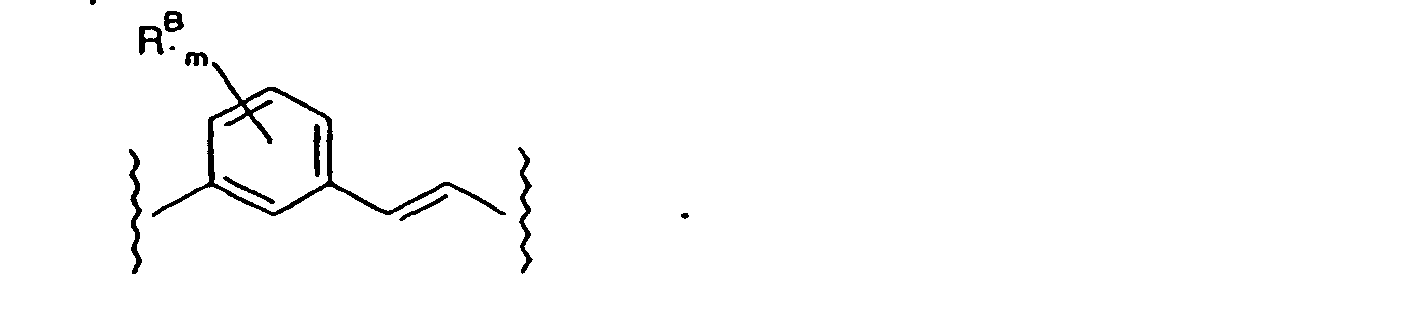
- In one preferred embodiment, m is 0, and Q2 is (referred to herein as "unsubstituted phenylene-meta-trans-ethylene"):
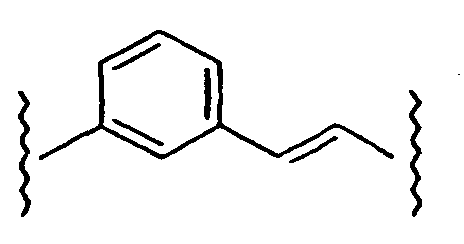
- In one preferred embodiment, Q2 is selected from:

- As discussed above, in all embodiments:
- (a) the aryl leader, Q1, is partially unsaturated C2-7alkylene with backbone of at least 2 carbon atoms, and is optionally substituted; and,
- (b) the acid leader, Q2, is C1-10alkylene; C5-20arylene; C5-20arylene-C1-10alkylene; or C1-10alkylene-C5-20arylene; and is optionally substituted; and if Q2 is C5-20arylene-C1-7alkylene, then: (i) the C1-7alkylene moiety does not comprise a carbon-carbon triple bond; or (ii) Q2 has a backbone of less than 7 carbon atoms.
- (1-A) In one embodiment, the aryl leader, Q1, is a partially unsaturated aliphatic C2-7alkylene group with a backbone of at least 2 carbon atoms.
- (1-B) In one embodiment, the aryl leader, Q1, is a partially unsaturated aliphatic C2-7alkylene group with a backbone of at least 2 carbon atoms, and in Q1, the carbon atom adjacent to J is not saturated.
- (1-C) In one embodiment, the aryl leader, Q1, is a partially unsaturated aliphatic C3-7alkylene group with a backbone of at least 3 carbon atoms.
- (1-D) In one embodiment, the aryl leader, Q1, is a partially unsaturated aliphatic C3-7alkylene group with a backbone of at least 3 carbon atoms, and in Q1, the carbon atom adjacent to J is not saturated.
- (1-E) In one embodiment, the aryl leader, Q1, is an unsubstituted partially unsaturated aliphatic C2-7alkylene group with a backbone of at least 2 carbon atoms.
- (1-F) In one embodiment, the aryl leader, Q1, is an unsubstituted partially unsaturated aliphatic C2-7alkylene group with a backbone of at least 2 carbon atoms and Q1 is not saturated at the carbon atom adjacent to J.
- (1-G) In one embodiment, the aryl leader, Q1, is an unsubstituted partially unsaturated aliphatic C3-7alkylene group with a backbone of at least 3 carbon atoms.
- (1-H) In one embodiment, the aryl leader, Q1, is an unsubstituted partially unsaturated aliphatic C3-7alkylene group with a backbone of at least 3 carbon atoms and Q1 is not saturated at the carbon atom adjacent to J.
- (2-A) In one embodiment, the acid leader, Q2 has a backbone of at least 4 carbon atoms.
- (2-B) In one embodiment, the acid leader, Q2 is a C4-10alkylene group with backbone of at least 4 carbon atoms.
- (2-C) In one embodiment, the acid leader, Q2 is an aliphatic C4-10alkylene group with backbone of at least 4 carbon atoms.
- (2-D) In one embodiment, the acid leader, Q2 is a linear C4-10alkylene group with backbone of at least 4 carbon atoms.
- (2-E) In one embodiment, the acid leader, Q2 is a linear saturated C4-10alkylene group with backbone of at least 4 carbon atoms.
- (2-F) In one embodiment, the acid leader, Q2 is a C5-20arylene-C1-7alkylene group,
wherein:
- (i) said C1-7alkylene moiety does not comprise a carbon-carbon triple bond; or,
- (ii) Q2 has a backbone of less than 7 carbon atoms; or,
- (iii) both (i) and (ii); or,
- (iv) Q2 is unsubstituted phenylene-meta-trans-ethylene:
-
- Additional preferred embodiments are those which are combinations of one of (1-A) through (1-H) with one of (2-B) through (2-F). Each one of these combinations is explicitly included herein, as if it were individually recited.
- For example, in one embodiment:
- (1-C) the aryl leader, Q1, is a partially unsaturated aliphatic C3-7alkylene group with a backbone of at least 3 carbon atoms; and,
- (2-E) In one embodiment, the acid leader, Q2 is a linear saturated C4-10alkylene group with backbone of at least 4 carbon atoms.
-
- In one embodiment, Q1 and Q2 are as defined in any one of the embodiments above, and A is optionally substituted phenyl.
- Examples of compounds with no Q1 group (i.e., where Q1 is a covalent bond) are shown below, for comparison purposes.
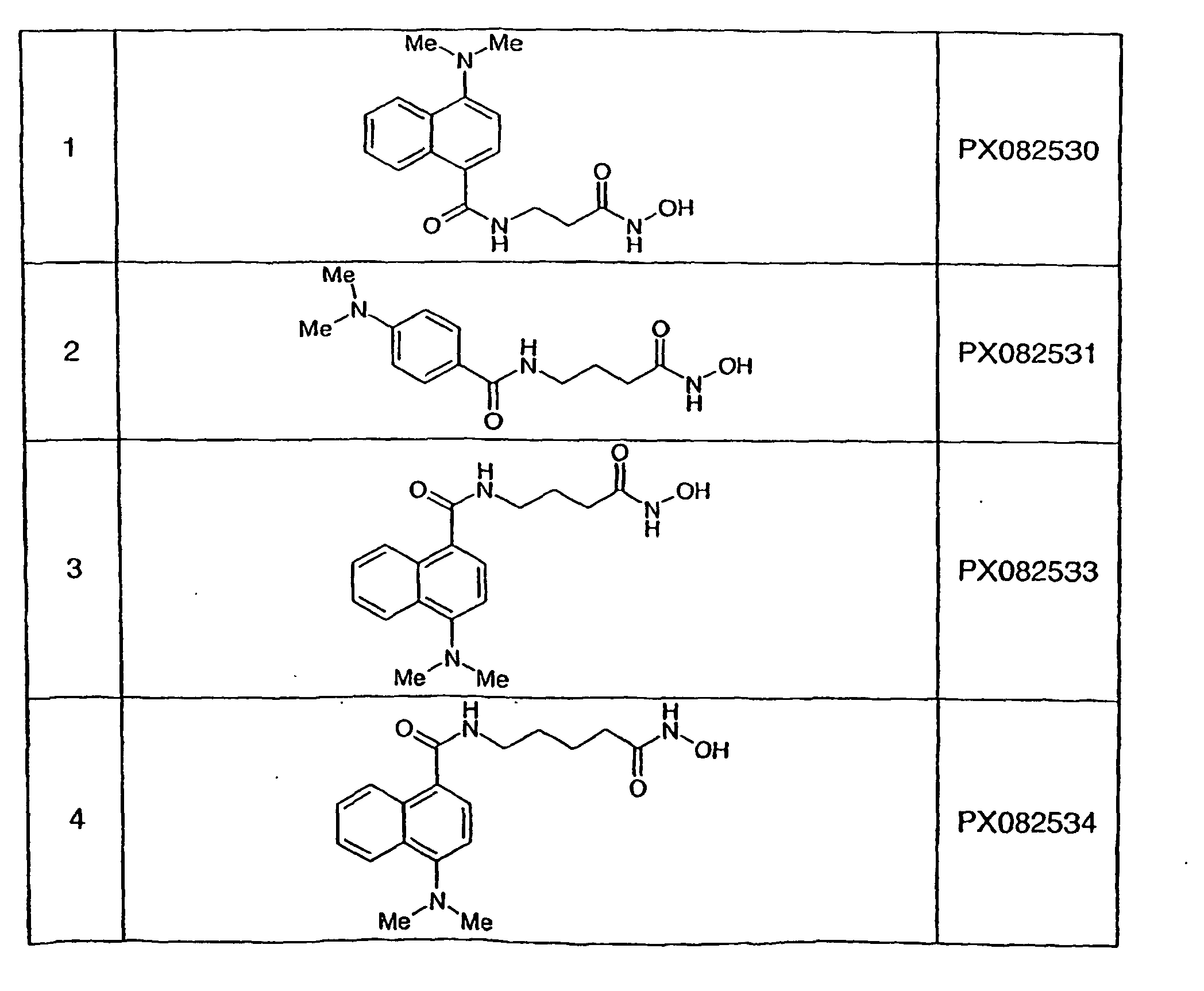
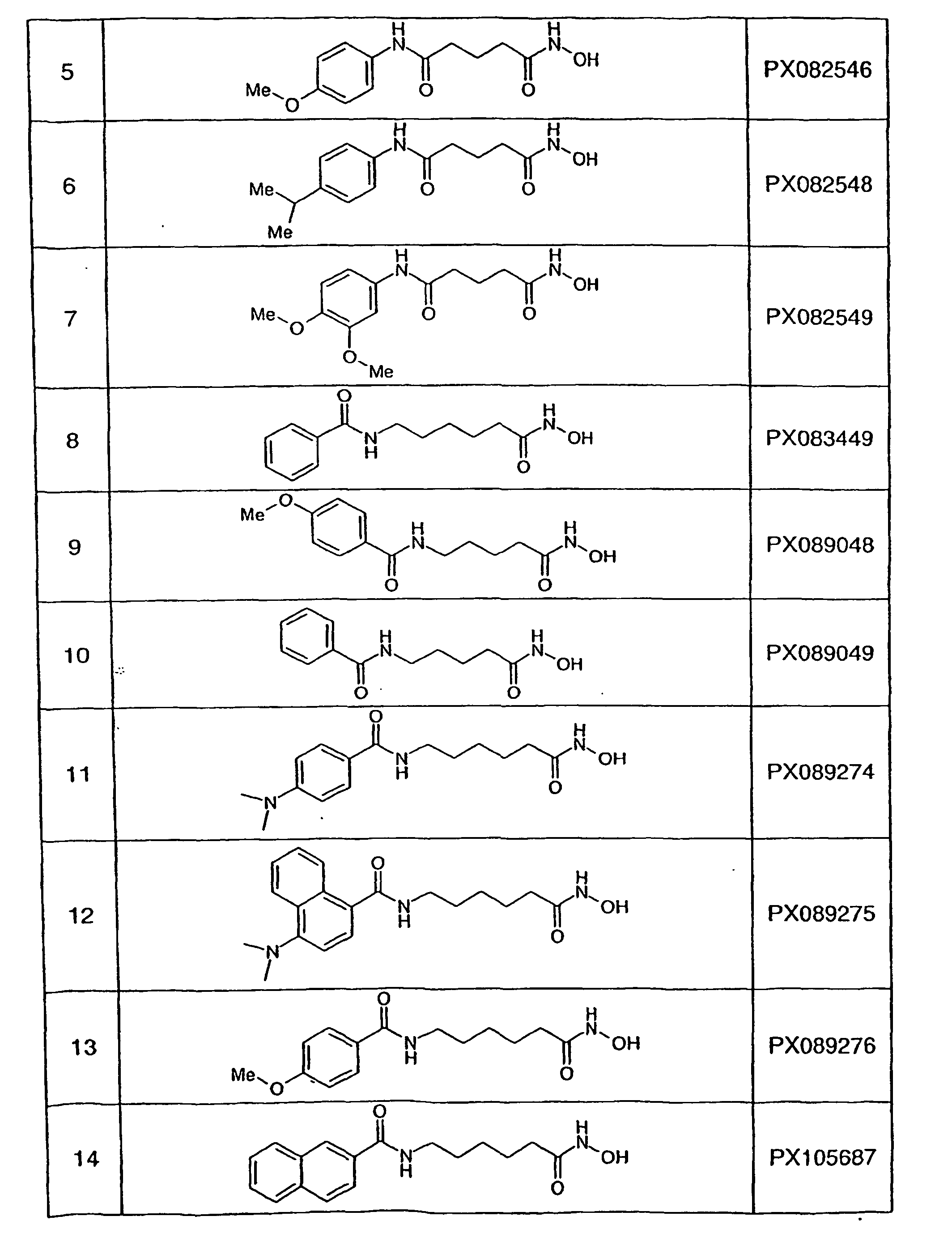

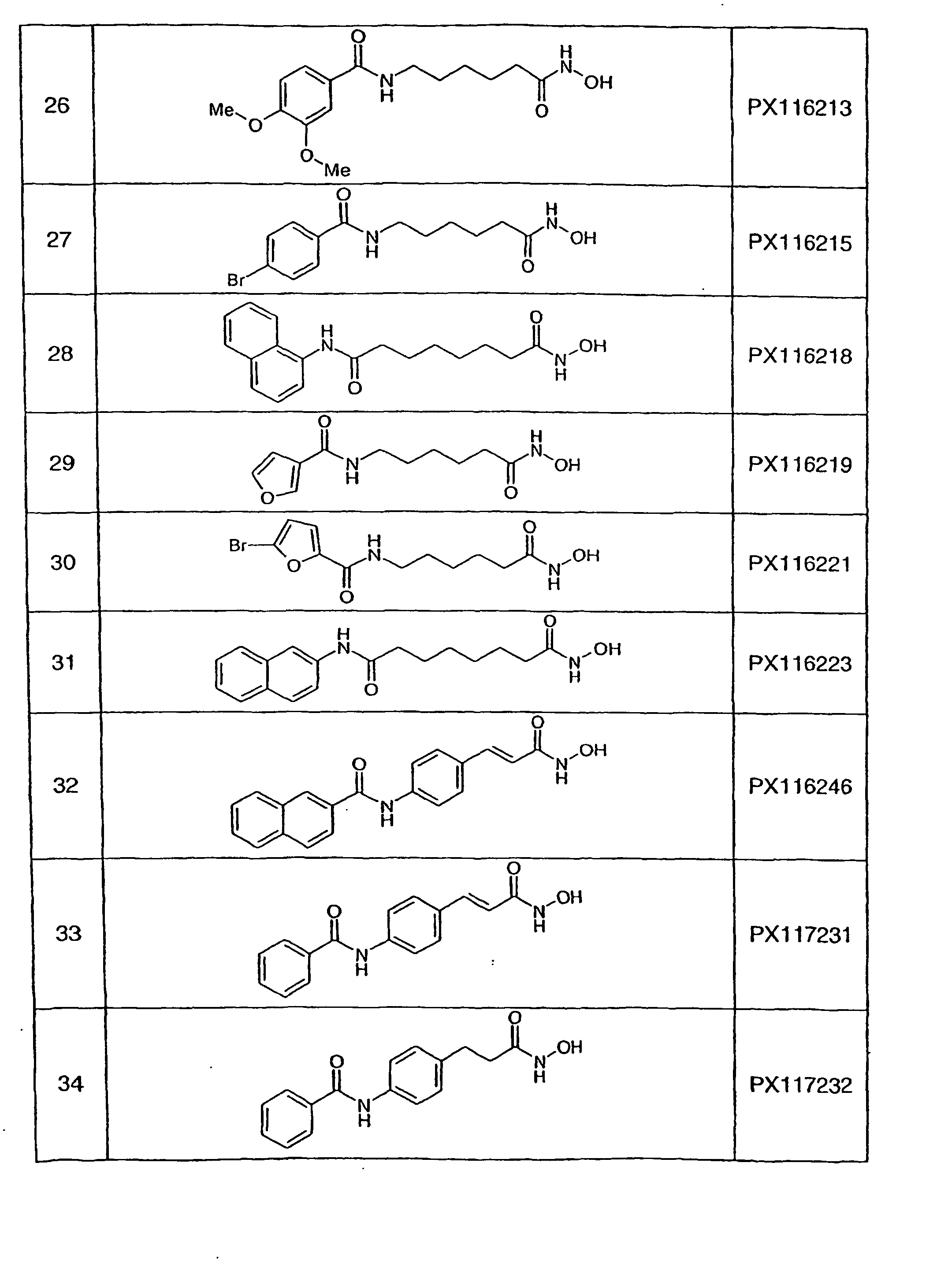

- Examples of compounds where Q1 has a backbone length 1 are shown below, for comparison purposes.
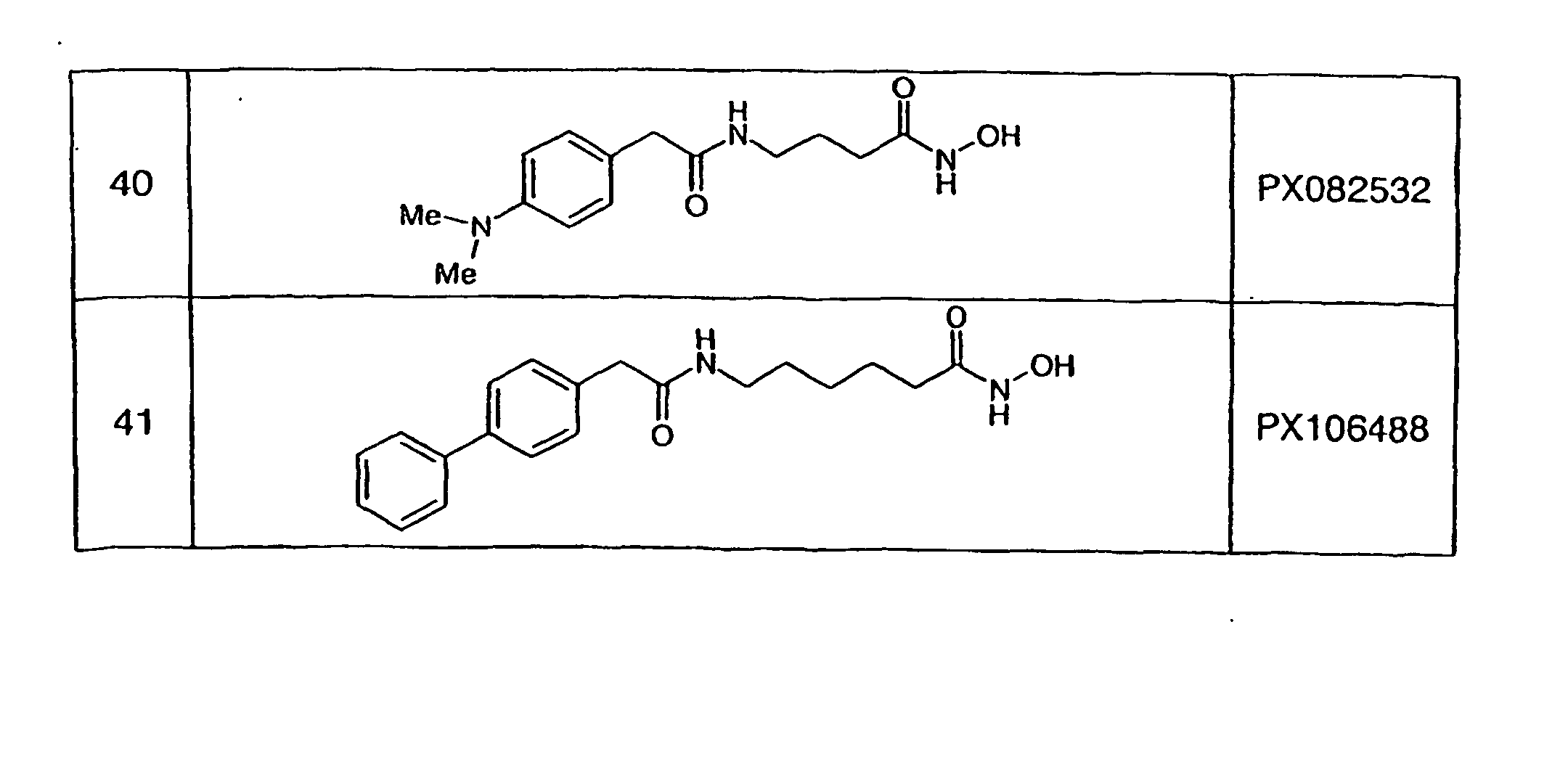
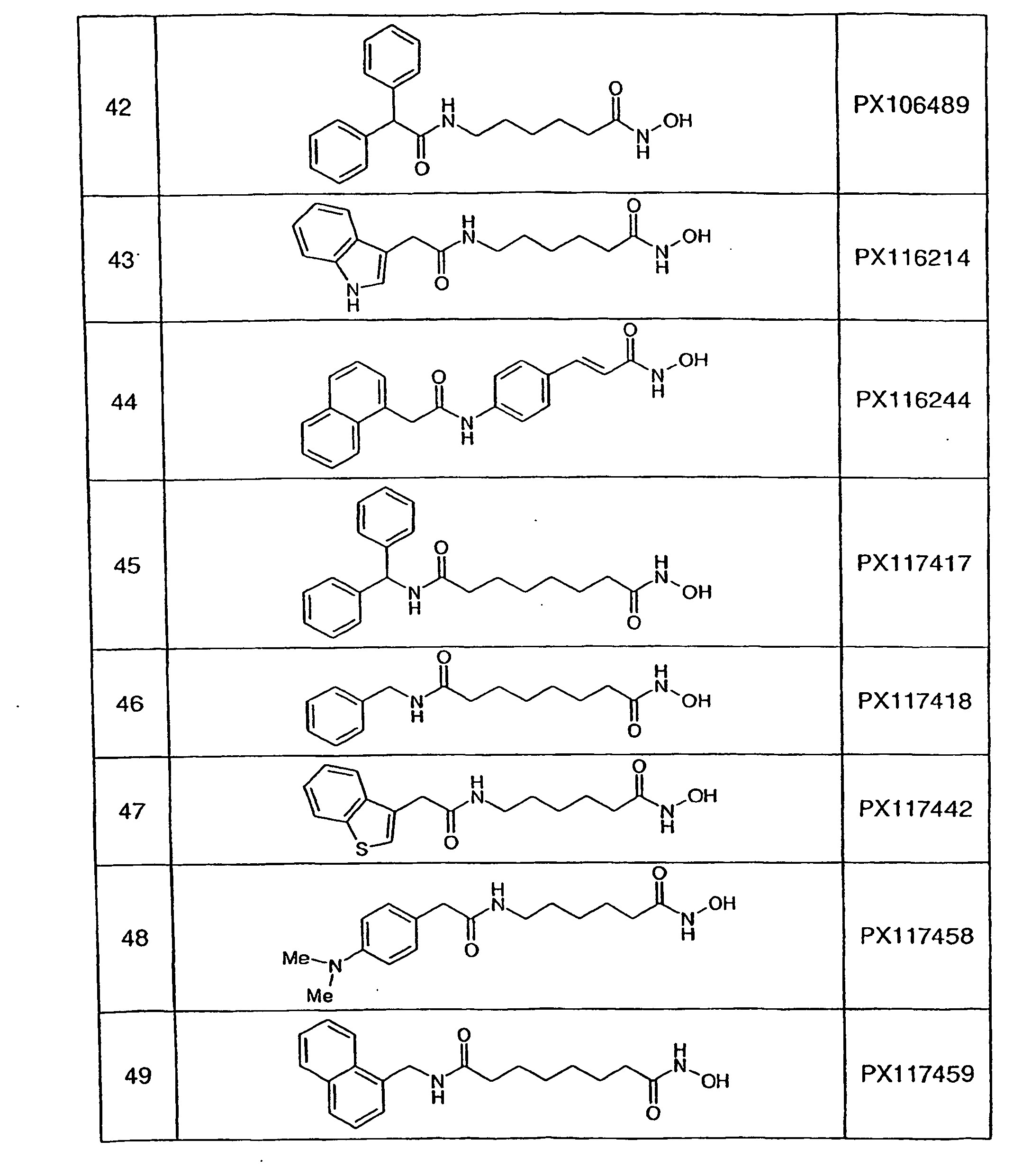
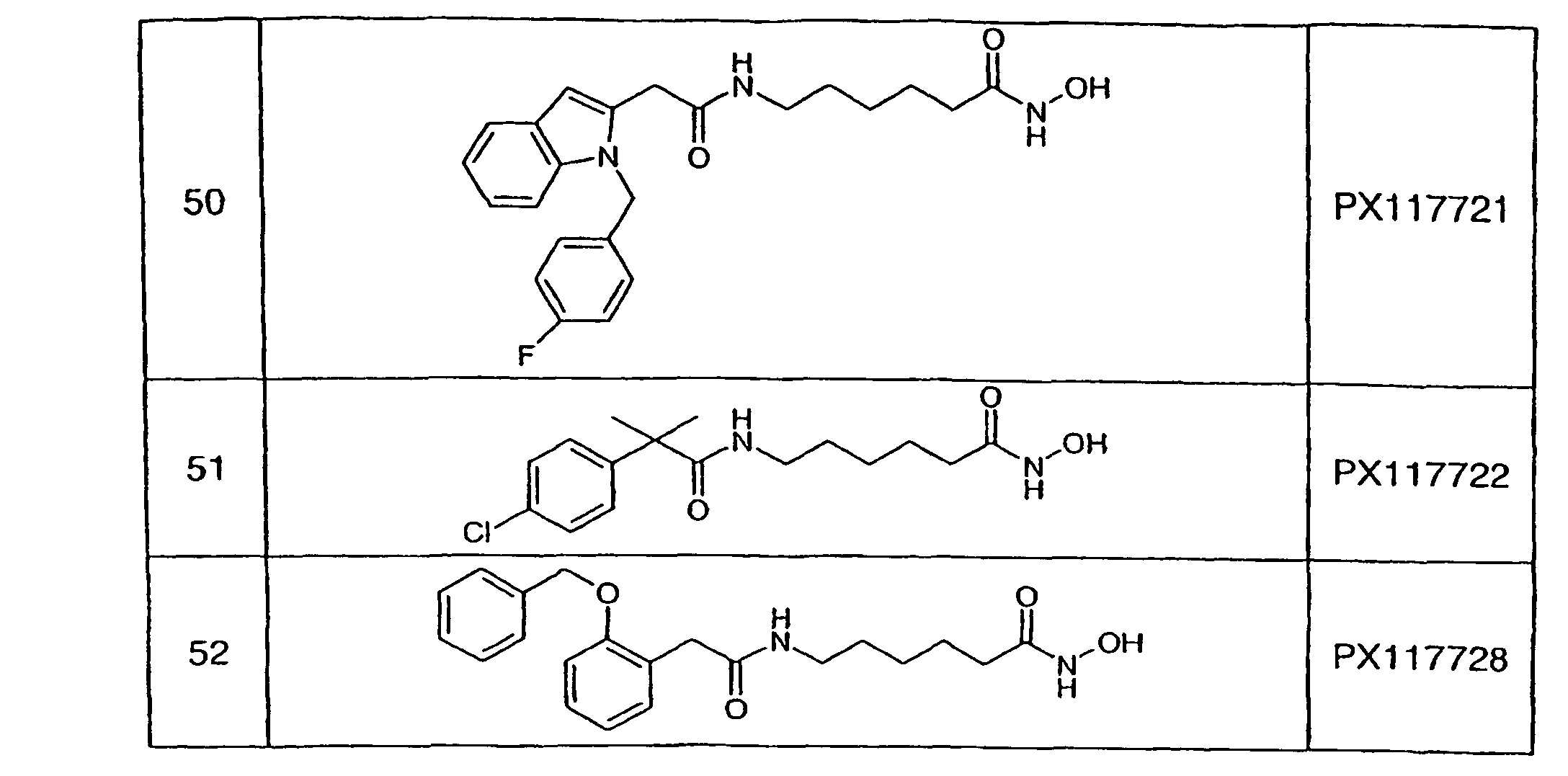
- Some individual embodiments of the present invention include the following compounds.
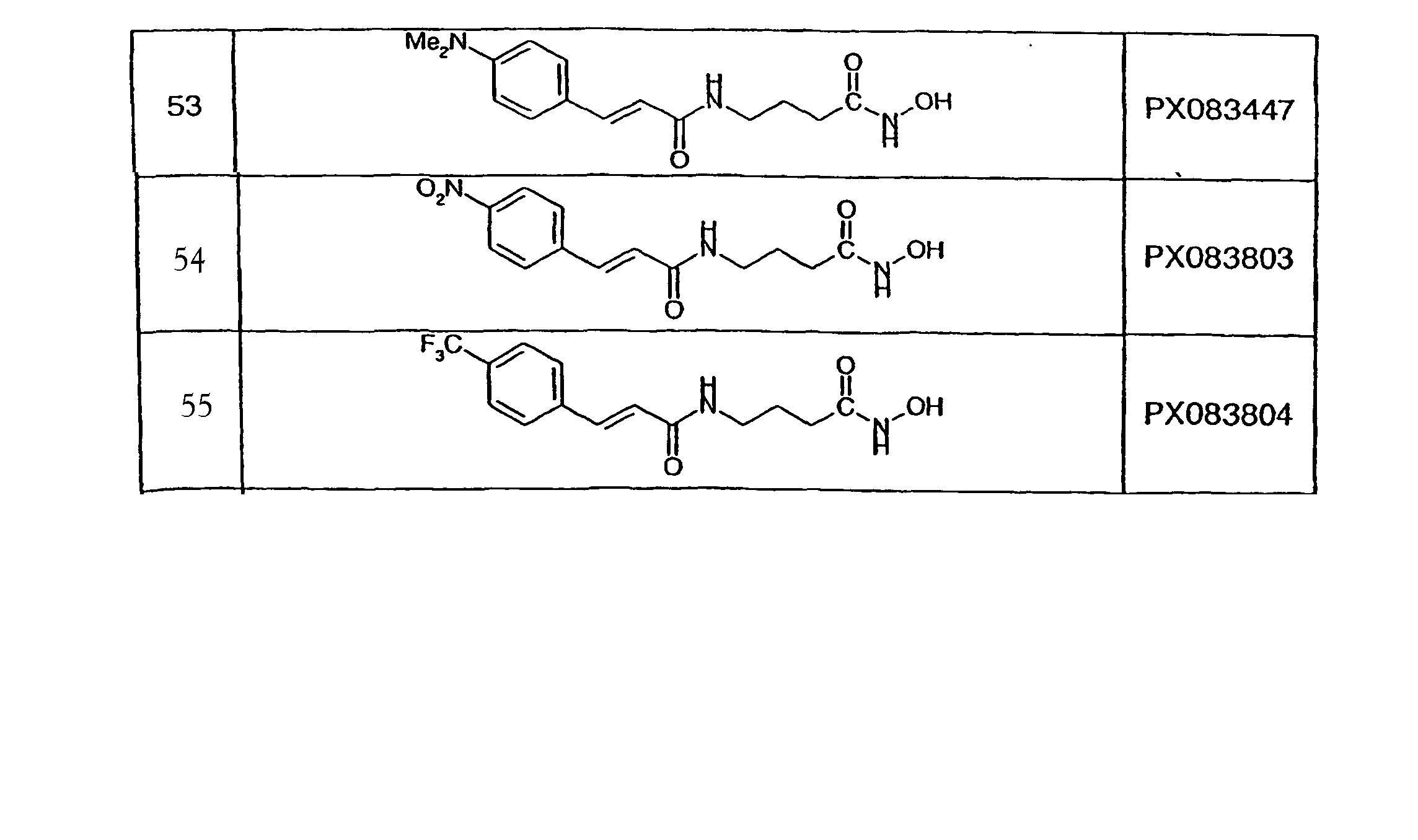
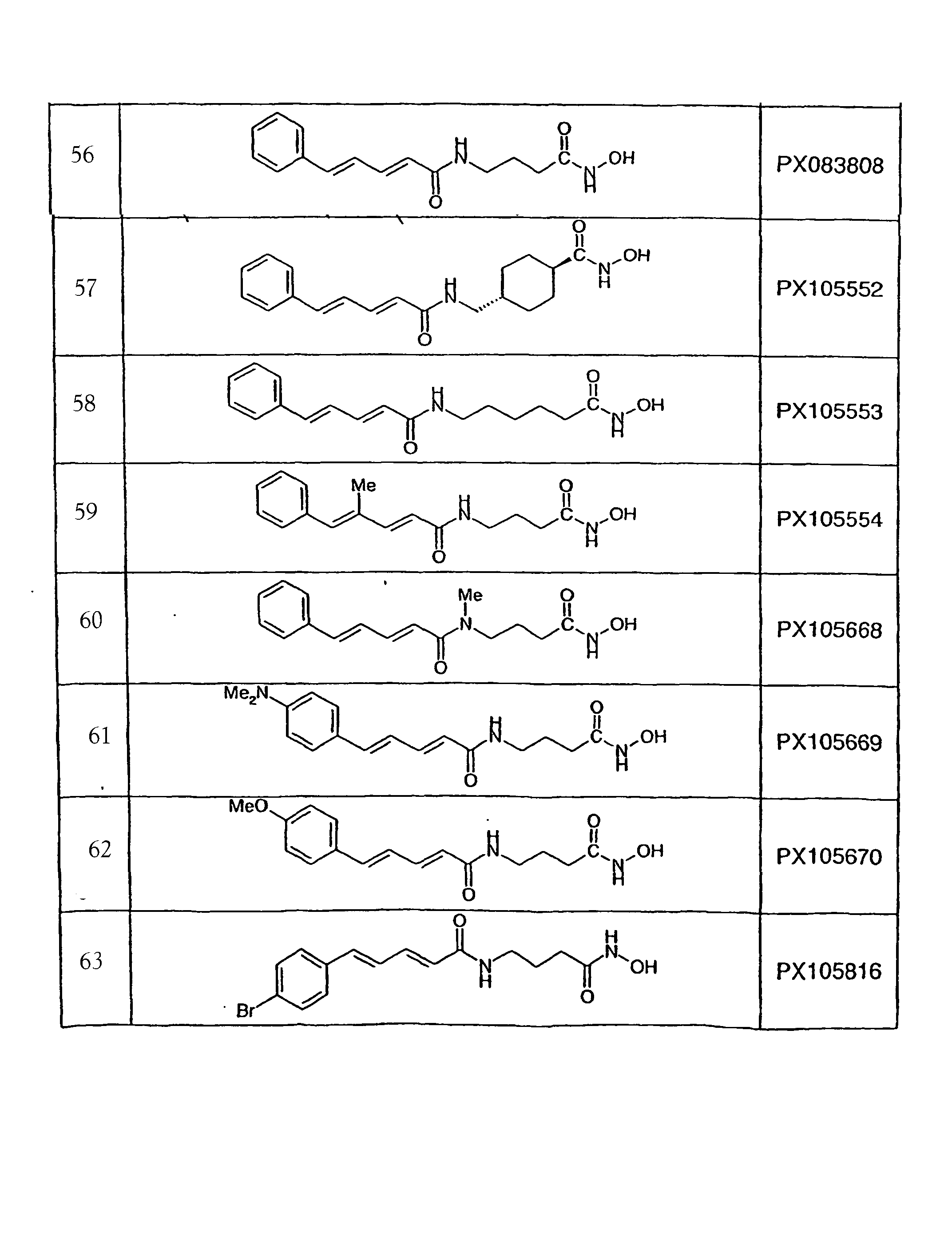
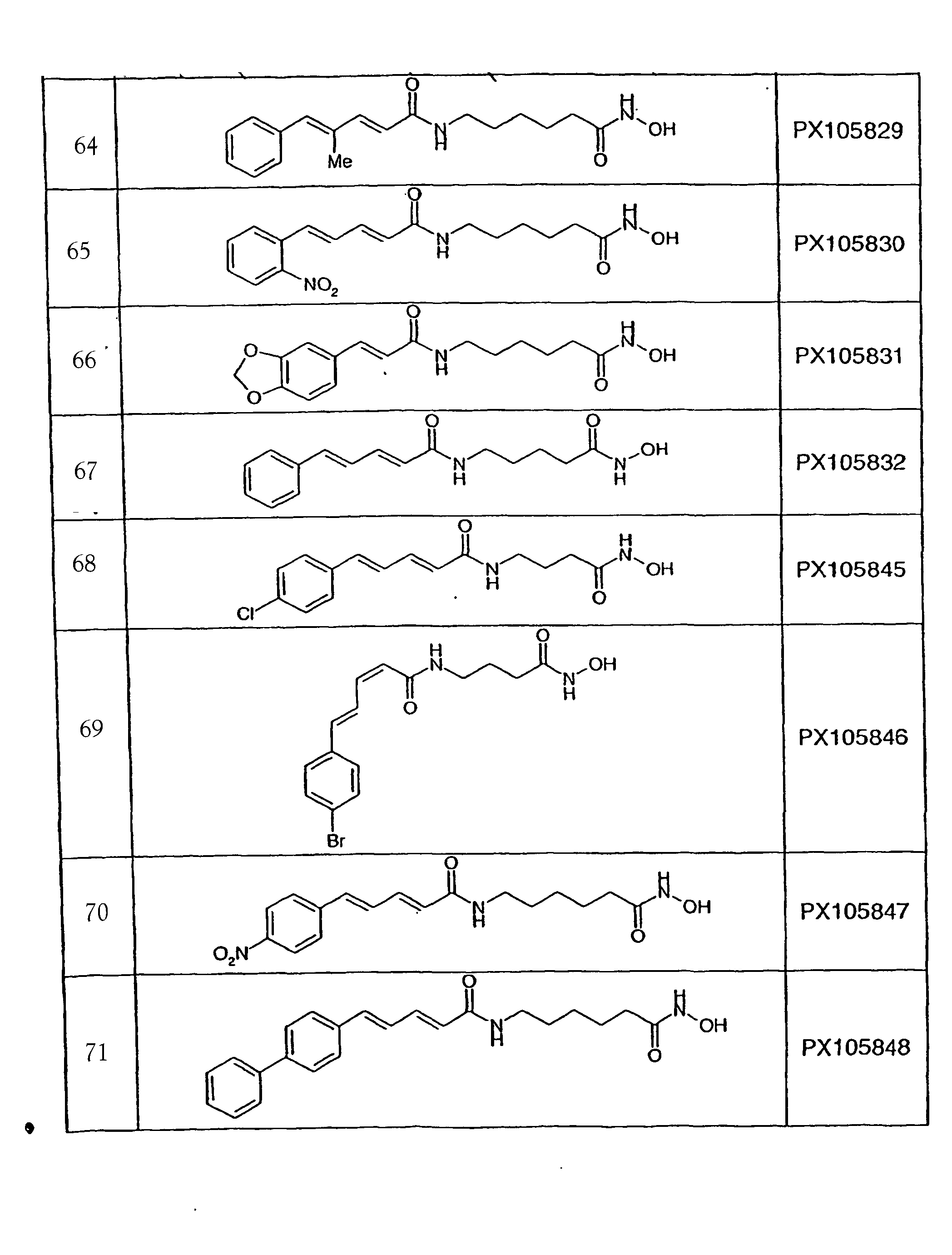

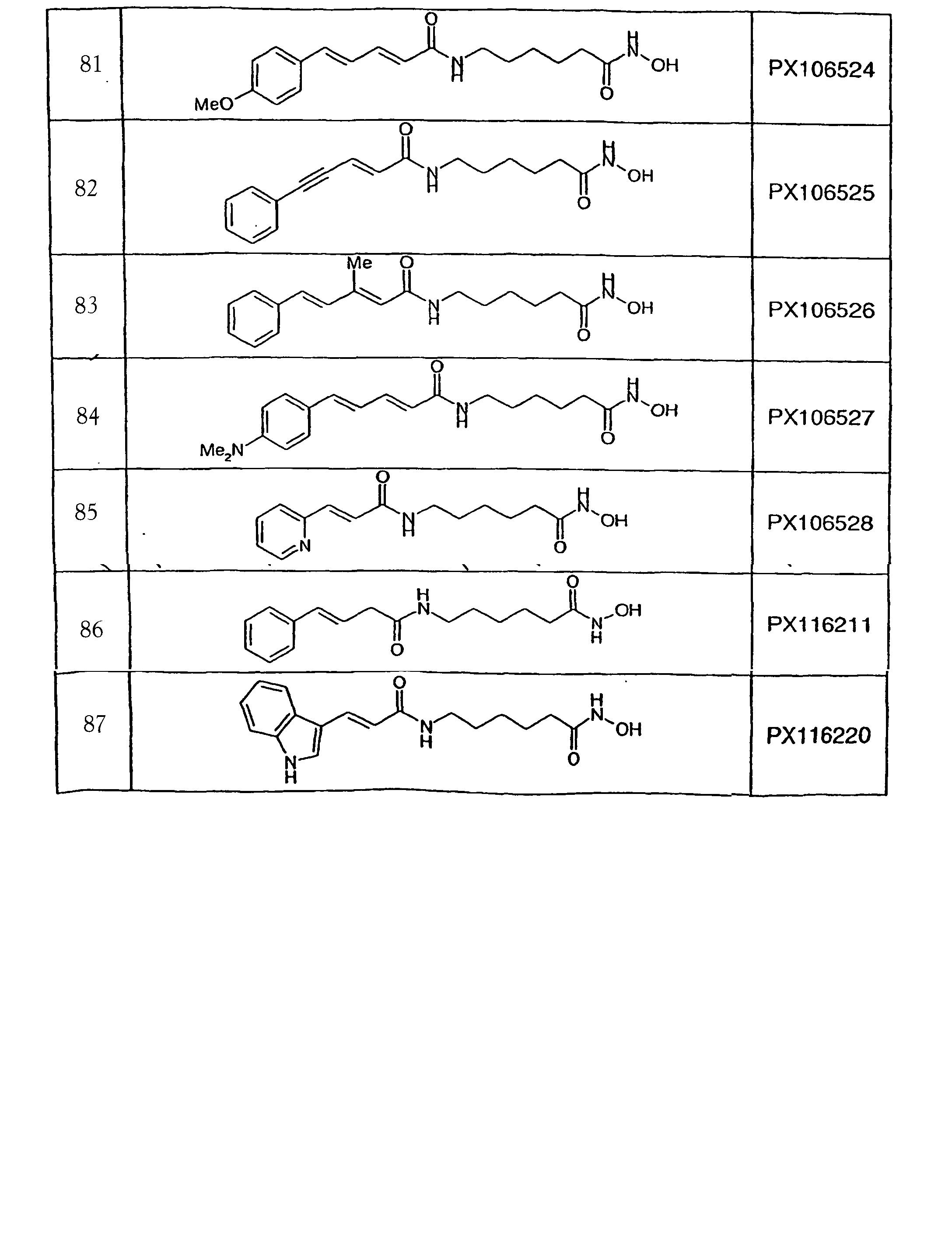
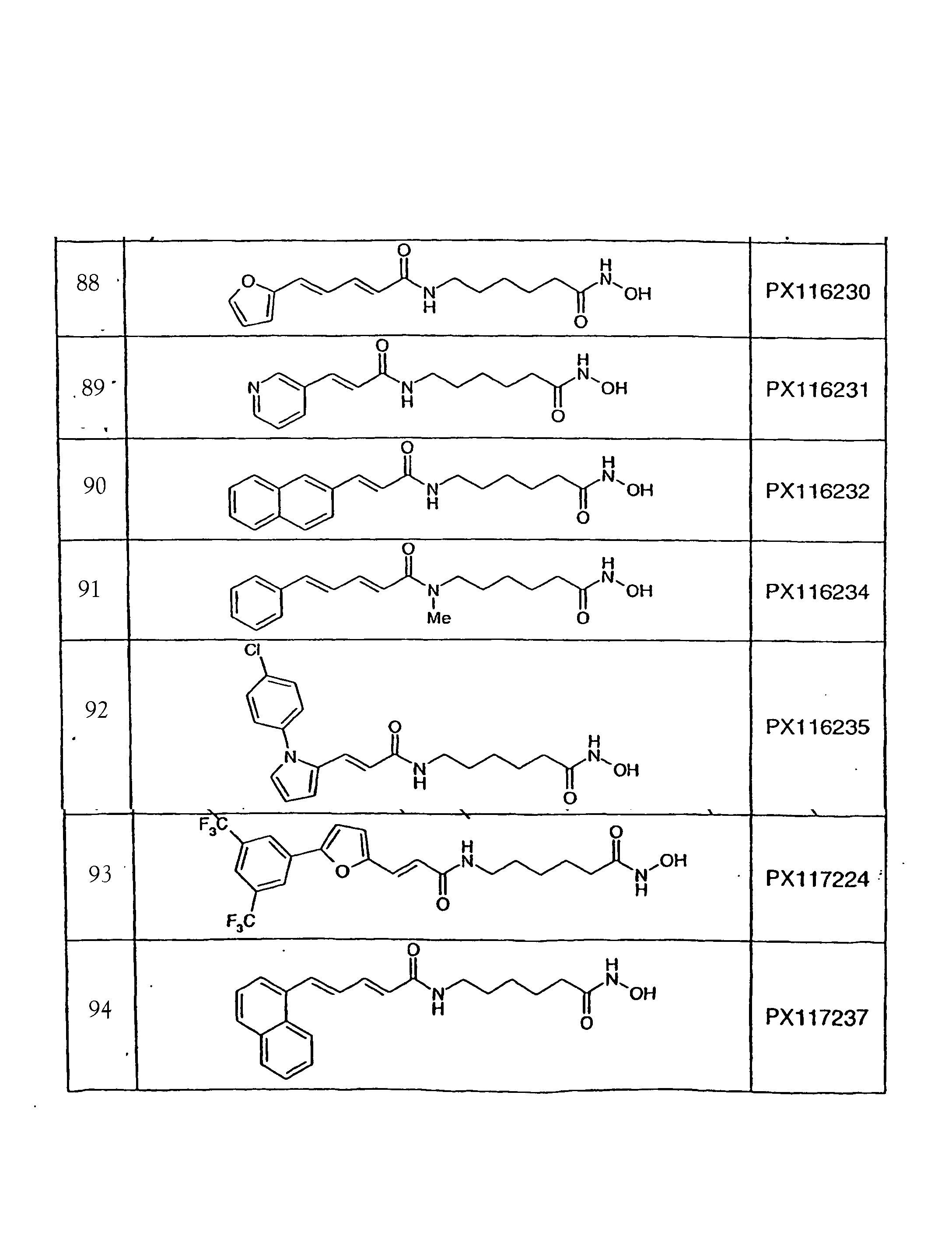
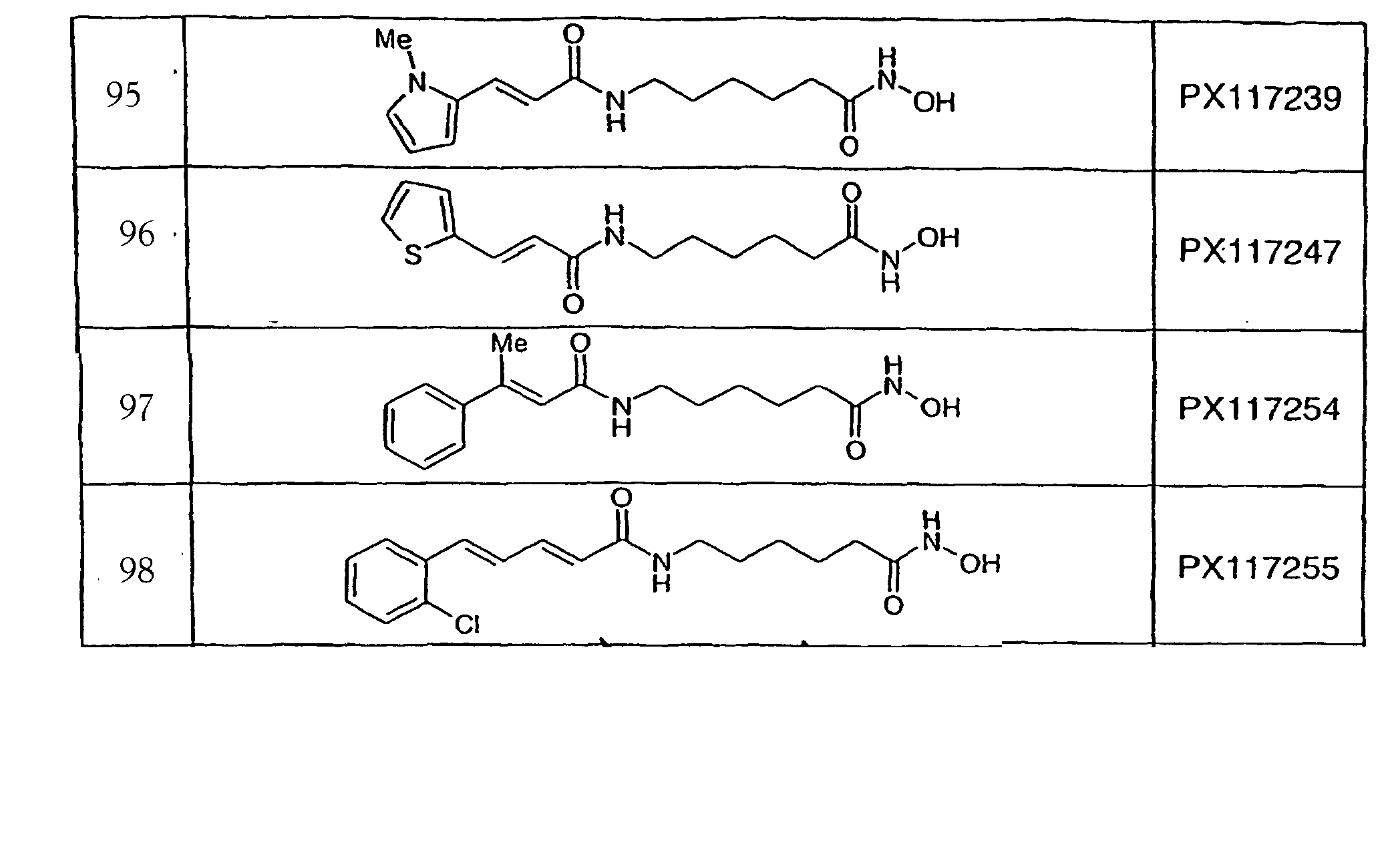

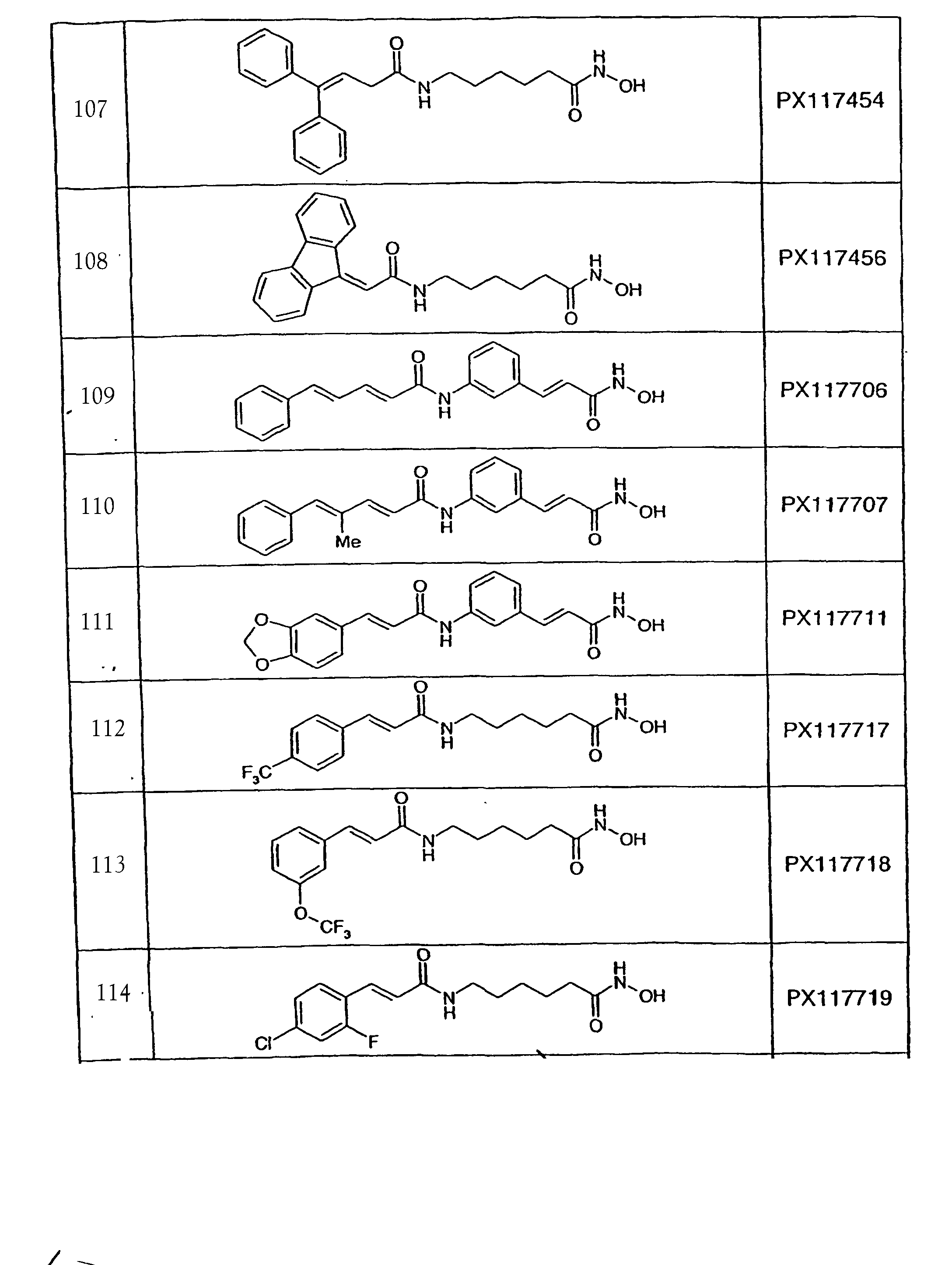


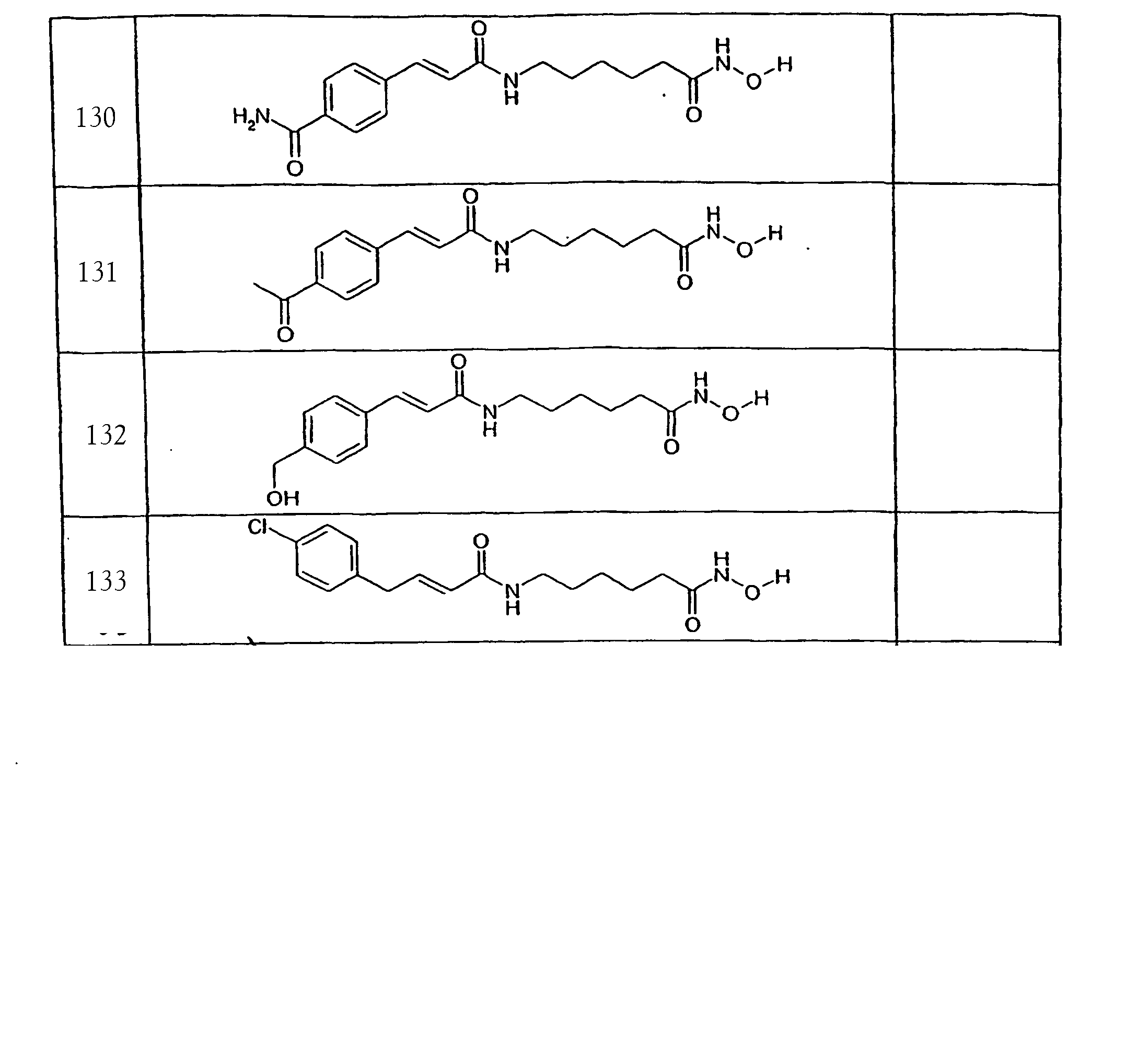
- Some comparison compounds are shown below.
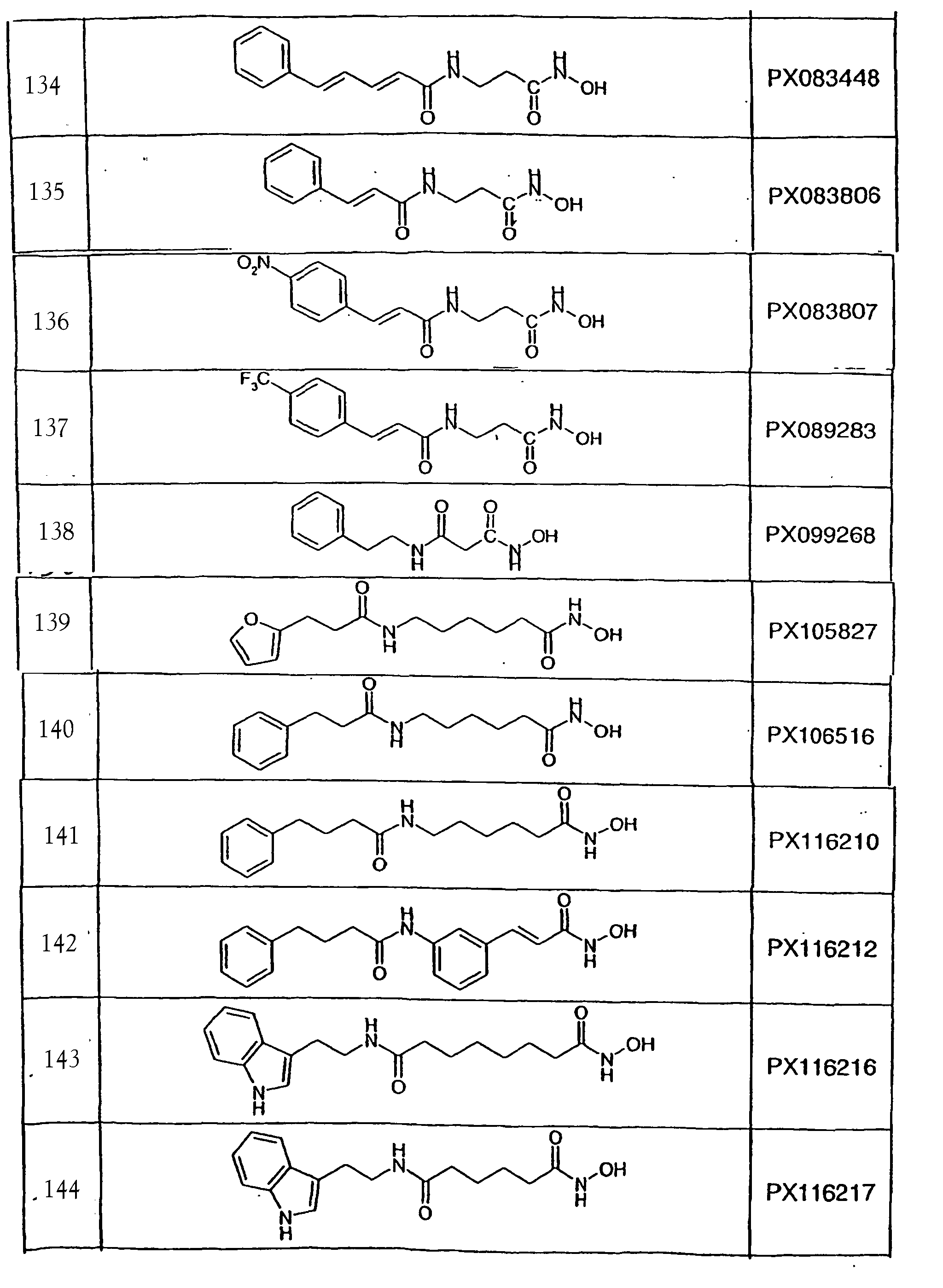
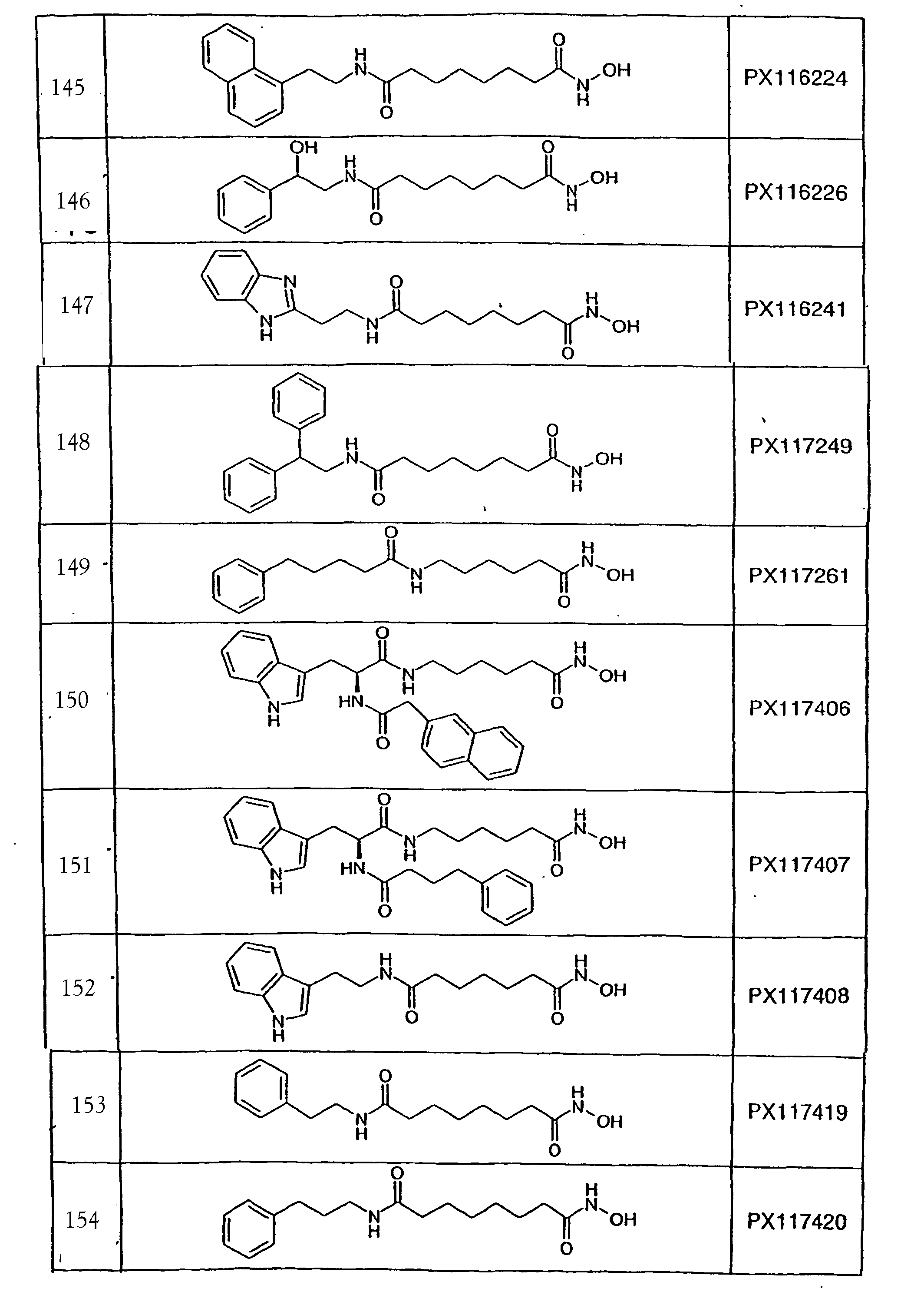
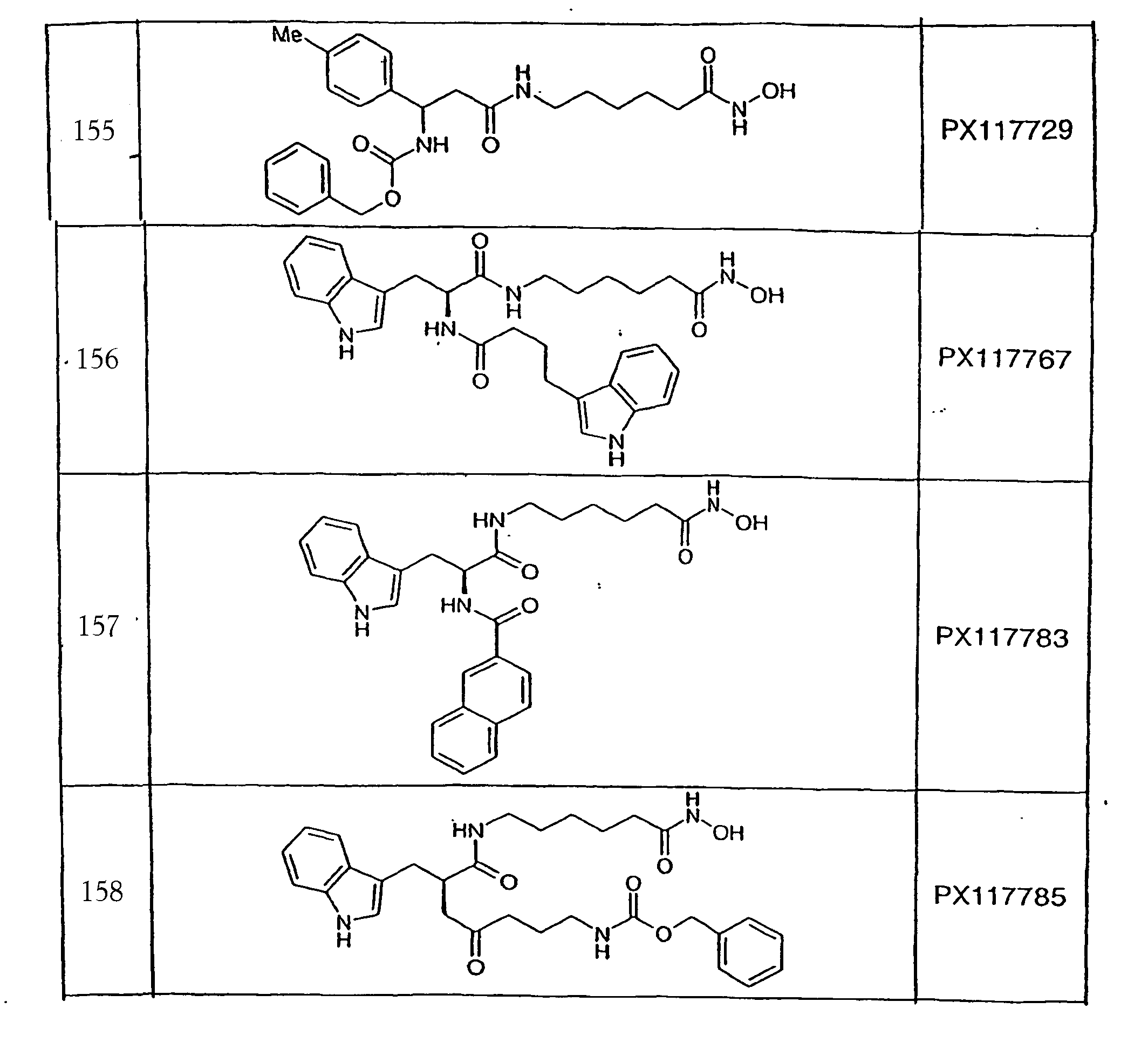
- The term "carbo," "carbyl," "hydrocarbo," and "hydrocarbyl," as used herein, pertain to compounds and/or groups which have only carbon and hydrogen atoms.
- The term "hetero," as used herein, pertains to compounds and/or groups which have at least one heteroatom, for example, multivalent heteroatoms (which are also suitable as ring heteroatoms) such as boron, silicon, nitrogen, phosphorus, oxygen, and sulfur, and monovalent heteroatoms, such as fluorine, chlorine, bromine, and iodine.
- The term "saturated," as used herein, pertains to compounds and/or groups which do not have any carbon-carbon double bonds or carbon-carbon triple bonds.
- The term "unsaturated," as used herein, pertains to compounds and/or groups which have at least one carbon-carbon double bond or carbon-carbon triple bond.
- The term "aliphatic," as used herein, pertains to compounds and/or groups which are linear or branched, but not cyclic (also known as "acyclic" or "open-chain" groups).
- The term "cyclic," as used herein, pertains to compounds and/or groups which have one ring, or two or more rings (e.g., spiro, fused, bridged).
- The term "ring," as used herein, pertains to a closed ring of from 3 to 10 covalently linked atoms, more preferably 3 to 8 covalently linked atoms.
- The term "aromatic ring," as used herein, pertains to a closed ring of from 3 to 10 covalently linked atoms, more preferably 5 to 8 covalently linked atoms, which ring is aromatic.
- The term "heterocyclic ring," as used herein, pertains to a closed ring of from 3 to 10 covalently linked atoms, more preferably 3 to 8 covalently linked atoms,
wherein at least one of the ring atoms is a multivalent ring heteroatom, for example, nitrogen, phosphorus, silicon, oxygen, and sulfur, though more commonly nitrogen, oxygen, and sulfur. - The term "alicyclic," as used herein, pertains to compounds and/or groups which have one ring, or two or more rings (e.g., spiro, fused, bridged), wherein said ring(s) are not aromatic.
- The term "aromatic," as used herein, pertains to compounds and/or groups which have one ring, or two or more rings (e.g., fused), wherein at least one of said ring(s) is aromatic.
- The term "heterocyclic," as used herein, pertains to cyclic compounds and/or groups which have one heterocyclic ring, or two or more heterocyclic rings (e.g., spiro, fused, bridged), wherein said ring(s) may be alicyclic or aromatic.
- The term "heteroaromatic," as used herein, pertains to cyclic compounds and/or groups which have one heterocyclic ring, or two or more heterocyclic rings (e.g., fused), wherein said ring(s) is aromatic.
- The phrase "optionally substituted," as used herein, pertains to a parent group which may be unsubstituted or which may be substituted.
- Unless otherwise specified, the term "substituted," as used herein, pertains to a parent group which bears one or more substituents. The term "substituent" is used herein in the conventional sense and refers to a chemical moiety which is covalently attached to, appended to, or if appropriate, fused to, a parent group. A wide variety of substituents are well known, and methods for their formation and introduction into a variety of parent groups are also well known.
- In one preferred embodiment, the substituent(s), often referred to herein as R, are independently selected from: halo; hydroxy; ether (e.g., C1-7alkoxy); formyl; acyl (e.g., C1-7alkylacyl, C5-20arylacyl); acylhalide; carboxy; ester; acyloxy; amido; acylamido; thioamido; tetrazolyl; amino; nitro; nitroso; azido; cyano; isocyano; cyanato; isocyanato; thiocyano; isothiocyano; sulfhydryl; thioether (e.g., C1-7alkylthio); sulfonic acid; sulfonate; sulfone; sulfonyloxy; sulfinyloxy; sulfamino; sulfonamino; sulfinamino; sulfamyl; sulfonamido; C1-7alkyl (including, e.g., C1-7haloalkyl, C1-7hydroxyalkyl, C1-7carboxyalkyl, C1-7aminoalkyl, C5-20aryl-C1-7alkyl); C3-20heterocyclyl; or C5-20aryl (including, e.g., C5-20carboaryl, C5-20heteroaryl, C1-7alkyl-C5-20aryl and C5-20haloaryl)).
- In one preferred embodiment, the substituent(s), often referred to herein as R, are independently selected from:
- -F, -Cl, -Br, and -I;
- -OH;
- -OMe, -OEt, -O(tBu), and -OCH2Ph;
- -SH;
- -SMe, -SEt, -S(tBu), and -SCH2Ph;
- -C(=O)H;
- -C(=O)Me, -C(=O)Et, -C(=O)(tBu), and -C(=O)Ph;
- -C(=O)OH;
- -C(=O)OMe, -C(=O)OEt, and -C(=O)O(tBu);
- -C(=O)NH2, -C(=O)NHMe, -C(=O)NMe2, and -C(=O)NHEt;
- -NHC(=O)Me, -NHC(=O)Et, -NHC(=O)Ph, succinimidyl, and maleimidyl;
- -NH2, -NHMe, -NHEt, -NH(iPr), -NH(nPr), -NMe2, -NEt2, -N(iPr)2, -N(nPr)2,
- -N(nBu)2, and -N(tBu)2;
- -CN;
- -NO2;
- -Me, -Et, -nPr, -iPr, -nBu, -tBu;
- -CF3, -CHF2, -CH2F, -CCl3, -CBr3, -CH2CH2F, -CH2CHF2, and -CH2CF3;
- -OCF3, -OCHF2, -OCH2F, -OCCl3, -OCBr3, -OCH2CH2F, -OCH2CHF2, and
- -OCH2CF3;
- -CH2OH, -CH2CH2OH, and -CH(OH)CH2OH;
- -CH2NH2,-CH2CH2NH2, and -CH2CH2NMe2; and, optionally substituted phenyl.
-
- In one preferred embodiment, the substituent(s), often referred to herein as R, are independently selected from: -F, -Cl, -Br, -l, -OH, -OMe, -OEt, -SH, -SMe, -SEt, -C(=O)Me, -C(=O)OH, -C(=O)OMe, -CONH2, -CONHMe, -NH2, -NMe2, -NEt2, -N(nPr)2, -N(iPr)2, -CN, -NO2, -Me, -Et, -CF3, -OCF3, -CH2OH, -CH2CH2OH, -CH2NH2, -CH2CH2NH2, and -Ph.
- In one preferred embodiment, the substituent(s), often referred to herein as R, are independently selected from: hydroxy; ether (e.g., C1-7alkoxy); ester; amido; amino; and, C1-7alkyl (including, e.g., C1-7haloalkyl, C1-7hydroxyalkyl, C1-7carboxyalkyl, C1-7aminoalkyl, C5-20aryl-C1-5alkyl).
- In one preferred embodiment, the substituent(s), often referred to herein as R, are independently selected from:
- -OH;
- -OMe, -OEt, -O(tBu), and -OCH2Ph;
- -C(=O)OMe, -C(=O)OEt, and -C(=O)O(tBu);
- -C(=O)NH2, -C(=O)NHMe, -C(=O)NMe2, and -C(=O)NHEt;
- -NH2, -NHMe, -NHEt, -NH(iPr), -NH(nPr), -NMe2, -NEt2, -N(iPr)2, -N(nPr)2,
- -N(nBu)2, and -N(tBu)2;
- -Me, -Et, -nPr, -iPr, -nBu, -tBu;
- -CF3, -CHF2, -CH2F, -CCl3, -CBr3, -CH2CH2F, -CH2CHF2, and -CH2CF3;
- -CH2OH, -CH2CH2OH, and -CH(OH)CH2OH; and,
- -CH2NH2,-CH2CH2NH2, and -CH2CH2NMe2.
-
- The substituents are described in more detail below.
- C1-7alkyl: The term "C1-7alkyl," as used herein, pertains to a monovalent moiety obtained by removing a hydrogen atom from a C1-7hydrocarbon compound having from 1 to 7 carbon atoms, which may be aliphatic or alicyclic, or a combination thereof, and which may be saturated, partially unsaturated, or fully unsaturated.
- Examples of (unsubstituted) saturated linear C1-7alkyl groups include, but are not limited to, methyl, ethyl, n-propyl, n-butyl, and n-pentyl (amyl).
- Examples of (unsubstituted) saturated branched C1-7alkyl groups include, but are not limited to, iso-propyl, iso-butyl, sec-butyl, tert-butyl, and neo-pentyl.
- Examples of saturated alicyclic (also carbocyclic) C1-7alkyl groups (also referred to as "C3-7cycloalkyl", groups) include, but are not limited to, unsubstituted groups such as cyclopropyl, cyclobutyl, cyclopentyl, cyclohexyl, and norbornane, as well as substituted groups (e.g., groups which comprise such groups), such as methylcyclopropyl, dimethylcyclopropyl, methylcyclobutyl, dimethylcyclobutyl, methylcyclopentyl, dimethylcyclopentyl, methylcyclohexyl, dimethylcyclohcxyl, cyclopropylmethyl and cyclohexylmethyl.
- Examples of (unsubstituted) unsaturated C1-7alkyl groups which have one or more carbon-carbon double bonds (also referred to as "C2-7alkenyl" groups) include, but are not limited to, ethenyl (vinyl, -CH=CH2), 2-propenyl (allyl, -CH-CH=CH2), isopropenyl (-C(CH3)=CH2), butenyl, pentenyl, and hexenyl.
- Examples of (unsubstituted) unsaturated C1-7alkyl groups which have one or more carbon-carbon triple bonds (also referred to as "C2-7alkynyl" groups) include, but are not limited to, ethynyl (ethinyl) and 2-propynyl (propargyl).
- Examples of unsaturated alicyclic (also carbocyclic) C1-7alkyl groups which have one or more carbon-carbon double bonds (also referred to as "C3-7cycloalkenyl" groups) include, but are not limited to, unsubstituted groups such as cyclopropenyl, cyclobutenyl, cyclopentenyl, and cyclohexenyl, as well as substituted groups (e.g., groups which comprise such groups) such as cyclopropenylmethyl and cyclohexenylmethyl.
- Additional examples of substituted C3-7cycloalkyl groups include, but are not limited to, those with one or more other rings fused thereto, for example, those derived from: indene (C9), indan (2,3-dihydro-1H-indene) (C9), tetraline (1,2,3,4-tetrahydronaphthalene (C10), adamantane (C10), decalin (decahydronaphthalene) (C12), fluorene (C13), phenalene (C13). For example, 2H-inden-2-yl is a C5cycloalkyl group with a substituent (phenyl) fused thereto.
- C3-20heterocyclyl: The term "C3-20heterocyclyl," as used herein, pertains to a monovalent moiety obtained by removing a hydrogen atom from a ring atom of a C3-20heterocyclic compound, said compound having one ring, or two or more rings (e.g., spiro, fused, bridged), and having from 3 to 20 ring atoms, of which from 1 to 10 are ring heteroatoms, and wherein at least one of said ring(s) is a heterocyclic ring. Preferably, each ring has from 3 to 7 ring atoms, of which from 1 to 4 are ring heteroatoms.
- In this context, the prefixes (e.g., C3-20, C3-7, C5-6, etc.) denote the number of ring atoms, or range of number of ring atoms, whether carbon atoms or heteroatoms. For example, the term "C5-6heterocyclyl," as used herein, pertains to a heterocyclyl group having 5 or 6 ring atoms. Examples of groups of heterocyclyl groups include C3-20heterocyclyl, C3-7heterocyclyl, C5-7heterocyclyl.
- Examples of (non-aromatic) monocyclic heterocyclyl groups include, but are not limited to, those derived from:
- N1: aziridine (C3), azetidine (C4), pyrrolidine (tetrahydropyrrole) (C5), pyrroline (e.g., 3-pyrroline, 2,5-dihydropyrrole) (C5), 2H-pyrrole or 3H-pyrrole (isopyrrole, isoazole) (C5), piperidine (C6), dihydropyridine (C6), tetrahydropyridine (C6), azepine (C7);
- O1: oxirane (C3), oxetane (C4), oxolane (tetrahydrofuran) (C5), oxole (dihydrofuran) (C5), oxane (tetrahydropyran) (C6), dihydropyran (C6), pyran (C6), oxepin (C7);
- S1: thiirane (C3), thietane (C4), thiolane (tetrahydrothiophene) (C5), thiane (tetrahydrothiopyran) (C6), thiepane (C7);
- O2: dioxolane (C5), dioxane (C6), and dioxepane (C7);
- O3: trioxane (C6);
- N2: imidazolidine (C5), pyrazolidine (diazolidine) (C5), imidazoline (C5), pyrazoline (dihydropyrazole) (C5), piperazine (C6);
- N1O1: tetrahydrooxazole (C5), dihydrooxazole (C5), tetrahydroisoxazole (C5), dihydroisoxazole (C5), morpholine (C6), tetrahydrooxazine (C6), dihydrooxazine (C6), oxazine (C6);
- N1S1: thiazoline (C5), thiazolidine (C5), thiomorpholine (C6);
- N2O1: oxadiazine (C6);
- O1S1: oxathiole (C5) and oxathiane (thioxane) (C6); and,
- N1O1S1: oxathiazine (C6).
-
- Examples of substituted (non-aromatic) monocyclic heterocyclyl groups include saccharides, in cyclic form, for example, furanoses (C5), such as arabinofuranose, lyxofuranose, ribofuranose, and xylofuranse, and pyranoses (C6), such as allopyranose, altropyranose, glucopyranose, mannopyranose, gulopyranose, idopyranose, galactopyranose, and talopyranose.
- Examples of heterocyclyl groups which are also heteroaryl groups are described below with aryl groups.
- C5-20aryl: The term "C5-20aryl," as used herein, pertains to a monovalent moiety obtained by removing a hydrogen atom from an aromatic ring atom of a C5-20aromatic compound, said compound having one ring, or two or more rings (e.g., fused), and having from 5 to 20 ring atoms, and wherein at least one of said ring(s) is an aromatic ring. Preferably, each ring has from 5 to 7 ring atoms. In this context, the prefixes (e.g., C3-20, C5-7, C5-6, etc.) denote the number of ring atoms, or range of number of ring atoms, whether carbon atoms or heteroatoms. For example, the term "C5-6aryl," as used herein, pertains to an aryl group having 5 or 6 ring atoms. Examples of groups of aryl groups include C3-20aryl, C5-7aryl, C5-6aryl.
-
- The ring atoms may be all carbon atoms, as in "carboaryl groups" (e.g., C5-20carboaryl).
- Examples of carboaryl groups include, but are not limited to, those derived from benzene (i.e., phenyl) (C6), naphthalene (C10), azulene (C10), anthracene (C14), phenanthrene (C14), naphthacene (C18), and pyrene (C16).
- Examples of aryl groups which comprise fused rings, at least one of which is an aromatic ring, include, but are not limited to, groups derived from indene (C9), isoindene (C9), and fluorene (C13).
- Alternatively, the ring atoms may include one or more heteroatoms, including but not limited to oxygen, nitrogen, and sulfur, as in "heteroaryl groups." In this case, the group may conveniently be referred to as a "C5-20heteroaryl" group, wherein "C5-20" denotes ring atoms, whether carbon atoms or heteroatoms. Preferably, each ring has from 5 to 7 ring atoms, of which from 0 to 4 are ring heteroatoms.
- Examples of monocyclic heteroaryl groups include, but are not limited to, those derived from:
- N1: pyrrole (azole) (C5), pyridine (azine) (C6);
- O1: furan (oxole) (C5);
- S1: thiophene (thiole) (C5);
- N1O1: oxazole (C5), isoxazole (C5), isoxazine (C6);
- N2O1: oxadiazole (furazan) (C5);
- N3O1: oxatriazole (C5);
- N1S1: thiazole (C5), isothiazole (C5);
- N2: imidazole (1,3-diazole) (C5), pyrazole (1,2-diazole) (C5), pyridazine (1,2-diazine) (C6), pyrimidine (1,3-diazine) (C6) (e.g., cytosine, thymine, uracil), pyrazine (1,4-diazine) (C6);
- N3: triazole (C5), triazine (C6); and,
- N4: tetrazole (C5).
-
- Examples of heterocyclic groups (some of which are also heteroaryl groups) which comprise fused rings, include, but are not limited to:
- C9heterocyclic groups (with 2 fused rings) derived from benzofuran (O1), isobenzofuran (O1), indole (N1), isoindole (N1), purine (N4) (e.g., adenine, guanine), benzimidazole (N2), benzoxazole (N1O1), benzisoxazole (N1O1), benzodioxole (O2), benzofurazan (N2O1), benzotriazole (N3), benzothiofuran (S1), benzothiazole (N1S1), benzothiadiazole (N2S);
- C10heterocyclic groups (with 2 fused rings) derived from benzodioxan (O2), quinoline (N1), isoquinoline (N1), benzoxazine (N1O1), benzodiazine (N2), pyridopyridine (N2), quinoxaline (N2), quinazoline (N2);
- C13heterocyclic groups (with 3 fused rings) derived from carbazole (N1), dibenzofuran (O1), dibenzothiophene (S1); and,
- C14heterocyclic groups (with 3 fused rings) derived from acridine (N1), xanthene (O1), phenoxathiin (O1S1), phenazine (N2), phenoxazine (N1O1), phenothiazine (N1S1), thianthrene (S2), phenanthridine (N1), phenanthroline (N2), phenazine (N2).
-
- Heterocyclic groups (including heteroaryl groups) which have a nitrogen ring atom in the form of an -NH- group may be N-substituted, that is, as -NR-. For example, pyrrole may be N-methyl substituted, to give N-methypyrrole. Examples of N-substitutents include, but are not limited to C1-7alkyl, C3-20heterocyclyl, C5-20aryl, and acyl groups.
- Heterocyclic groups (including heteroaryl groups) which have a nitrogen ring atom in the form of an -N= group may be substituted in the form of an N-oxide, that is, as -N(→O)= (also denoted -N+(→O-)=). For example, quinoline may be substituted to give quinoline N-oxide; pyridine to give pyridine N-oxide; benzofurazan to give benzofurazan N-oxide (also known as benzofuroxan).
- Cyclic groups may additionally bear one or more oxo (=O) groups on ring carbon atoms. Monocyclic examples of such groups include, but are not limited to, those derived from:
- C5: cyclopentanone, cyclopentenone, cyclopentadienone;
- C6: cyclohexanone, cyclohexenone, cyclohexadienone;
- O1: furanone (C5), pyrone (C6);
- N1: pyrrolidone (pyrrolidinone) (C5), piperidinone (piperidone) (C6), piperidinedione (C6);
- N2: imidazolidone (imidazolidinone) (C5), pyrazolone (pyrazolinone) (C5), piperazinone (C6), piperazinedione (C6), pyridazinone (C6), pyrimidinone (C6) (e.g., cytosine), pyrimidinedione (C6) (e.g., thymine, uracil), barbituric acid (C6);
- N1S1: thiazolone (C5), isothiazolone (C5);
- N1O1: oxazolinone (C5).
-
- Polycyclic examples of such groups include, but are not limited to, those derived from:
- C9: indenedione;
- N1: oxindole (C9);
- O1: benzopyrone (e.g., coumarin, isocoumarin, chromone) (C10);
- N1O1: benzoxazolinone (C9), benzoxazolinone (C10);
- N2: quinazolinedione (C10);
- N4: purinone (C9) (e.g., guanine).
-
- Still more examples of cyclic groups which bear one or more oxo (=O) groups on ring carbon atoms include, but are not limited to, those derived from:
- cyclic anhydrides (-C(=O)-O-C(=O)- in a ring), including but not limited to maleic anhydride (C5), succinic anhydride (C5), and glutaric anhydride (C6);
- cyclic carbonates (-O-C(=O)-O- in a ring), such as ethylene carbonate (C5) and 1,2-propylene carbonate (C5);
- imides (-C(=O)-NR-C(=O)- in a ring), including but not limited to, succinimide (C5), maleimide (C5), phthalimide, and glutarimide (C6);
- lactones (cyclic esters, -O-C(=O)- in a ring), including, but not limited to, β-propiolactone, γ-butyrolactone, δ-valerolactone (2-piperidone), and ε-caprolactone;
- lactams (cyclic amides, -NR-C(=O)- in a ring), including, but not limited to, β-propiolactam (C4), γ-butyrolactam (2-pyrrolidone) (C5), δ-valerolactam (C6), and ε-caprolactam (C7);
- cyclic carbamates (-O-C(=O)-NR- in a ring), such as 2-oxazolidone (C5);
- cyclic ureas (-NR-C(=O)-NR- in a ring), such as 2-imidazolidone (C5) and pyrimidine-2,4-dione (e.g., thymine, uracil) (C6).
-
- The above C1-7alkyl, C3-20heterocyclyl, and C5-20aryl groups, whether alone or part of another substituent, may themselves optionally be substituted with one or more groups selected from themselves and the additional substituents listed below.
- Hydrogen: -H. Note that if the substituent at a particular position is hydrogen, it may be convenient to refer to the compound as being "unsubstituted" at that position.
- Halo: -F, -Cl, -Br, and -I.
- Hydroxy: -OH.
- Ether: -OR, wherein R is an ether substituent, for example, a C1-7alkyl group (also referred to as a C1-7alkoxy group, discussed below), a C3-20heterocyclyl group (also referred to as a C3-20hetercyclyloxy group), or a C5-20aryl group (also referred to as a C5-20aryloxy group), preferably a C1-7alkyl group.
- C1-7alkoxy: -OR, wherein R is a C1-7alkyl group. Examples of C1-7alkoxy groups include, but are not limited to, -OCH3 (methoxy), -OCH2CH3 (ethoxy) and -OC(CH3)3 (tert-butoxy).
- Oxo (keto, -one): =O. Examples of cyclic compounds and/or groups having, as a substituent, an oxo group (=O) include, but are not limited to, carbocyclics such as cyclopentanone and cyclohexanone; heterocyclics, such as pyrone, pyrrolidone, pyrazolone, pyrazolinone, piperidone, piperidinedione, piperazinedione, and imidazolidone; cyclic anhydrides, including but not limited to maleic anhydride and succinic anhydride; cyclic carbonates, such as propylene carbonate; imides, including but not limited to, succinimide and maleimide; lactones (cyclic esters, -O-C(=O)- in a ring), including, but not limited to, β-propiolactone, γ-butyrolactone, δ-valerolactone, and ε-caprolactone; and lactams (cyclic amides, -NH-C(=O)- in a ring), including, but not limited to, β-propiolactam, γ-butyrolactam, δ-valerolactam, and ε-caprolactam.
- Imino (imine): =NR, wherein R is an imino substituent, for example, hydrogen, C1-7alkyl group, a C3-20heterocyclyl group, or a C5-20aryl group, preferably hydrogen or a C1-7alkyl group. Examples of imino groups include, but are not limited to, =NH, =NMe, =NEt, and =NPh.
- Formyl (carbaldehyde, carboxaldehyde): -C(=O)H.
- Acyl (keto): -C(=O)R, wherein R is an acyl substituent, for example, a C1-7alkyl group (also referred to as C1-7alkylacyl or C1-7alkanoyl), a C3-20heterocyclyl group (also referred to as C3-20heterocyclylacyl), or a C5-20aryl group (also referred to as C5-20arylacyl), preferably a C1-7alkyl group. Examples of acyl groups include, but are not limited to, -C(=O)CH3 (acetyl), -C(=O)CH2CH3 (propionyl), -C(=O)C(CH3)3 (butyryl), and -C(=O)Ph (benzoyl, phenone).
- Acylhalide (haloformyl, halocarbonyl): -C(=O)X, wherein X is -F, -Cl, -Br, or -I, preferably -Cl, -Br, or -I.
- Carboxy (carboxylic acid): -COOH.
- Ester (carboxylate, carboxylic acid ester, oxycarbonyl): -C(=O)OR, wherein R is an ester substituent, for example, a C1-7alkyl group, a C3-20heterocyclyl group, or a C5-20aryl group, preferably a C1-7alkyl group. Examples of ester groups include, but are not limited to, -C(=O)OCH3, -C(=O)OCH2CH3, -C(=O)OC(CH3)3, and - C(=O)OPh.
- Acyloxy (reverse ester): -OC(=O)R, wherein R is an acyloxy substituent, for example, a C1-7alkyl group, a C3-20heterocyclyl group, or a C5-20aryl group, preferably a C1-7alkyl group. Examples of acyloxy groups include, but are not limited to, -OC(=O)CH3 (acetoxy), -OC(=O)CH2CH3, -OC(=O)C(CH3)3, -OC(=O)Ph, and -OC(=O)CH2Ph.
- Amido (carbamoyl, carbamyl, aminocarbonyl, carboxamide): -C(=O)NR1R2, wherein R1 and R2 are independently amino substituents, as defined for amino groups. Examples of amido groups include, but are not limited to, -C(=O)NH2, -C(=O)NHCH3, -C(=O)NH(CH3)2, -C(=O)NHCH2CH3, and -C(=O)N(CH2CH3)2, as well as amido groups in which R1 and R2, together with the nitrogen atom to which they are attached, form a heterocyclic structure as in, for example, piperidinocarbonyl, morpholinocarbonyl, thiomorpholinocarbonyl, and piperazinocarbonyl.
- Acylamido (acylamino): -NR1C(=O)R2, wherein R1 is an amide substituent, for
example, a C1-7alkyl group, a C3-20heterocyclyl group, or a C5-20aryl group,
preferably a C1-7alkyl group, and R2 is an acyl substituent, for example, a C1-7alkyl
group, a C3-20heterocyclyl group, or a C5-20aryl group, preferably a C1-7alkyl group.
Examples of acylamido groups include, but are not limited to, -NHC(=O)CH3 ,
-NHC(=O)CH2CH3, and -NHC(=O)Ph. R1 and R2 may together form a cyclic
structure, as in, for example, for example, succinimidyl, maleimidyl, and
phthalimidyl:

- Thioamido (thiocarbamyl): -C(=S)NR1R2, wherein R1 and R2 are independently amino substituents, as defined for amino groups. Examples of amido groups include, but are not limited to, -C(=S)NH2, -C(=S)NHCH3, -C(=S)NH(CH3)2, and -C(=S)NHCH2CH3.
- Tetrazolyl: a five membered aromatic ring having four nitrogen atoms and one
carbon atom,

- Amino: -NR1R2, wherein R1 and R2 are independently amino substituents, for example, hydrogen, a C1-7alkyl group (also referred to as C1-7alkylamino or di-C1-7alkylamino), a C3-20heterocyclyl group, or a C5-20aryl group, preferably H or a C1-7alkyl group, or, in the case of a "cyclic" amino group, R1 and R2, taken together with the nitrogen atom to which they are attached, form a heterocyclic ring having from 4 to 8 ring atoms. Examples of amino groups include, but are not limited to, -NH2, -NHCH3, -NHCH(CH3)2, -N(CH3)2, -N(CH2CH3)2, and -NHPh. Examples of cyclic amino groups include, but are not limited to, aziridino, azetidino, piperidino, piperazino, morpholino, and thiomorpholino.
- Nitro: -NO2.
- Nitroso: -NO.
- Azido: -N3.
- Cyano (nitrile, carbonitrile): -CN.
- Isocyano: -NC.
- Cyanato: -OCN.
- Isocyanato: -NCO.
- Thiocyano (thiocyanato): -SCN.
- Isothiocyano (isothiocyanato): -NCS.
- Sulfhydryl (thiol, mercapto): -SH.
- Thioether (sulfide): -SR, wherein R is a thioether substituent, for example, a C1-7alkyl group (also referred to as a C1-7alkylthio group), a C3-20heterocyclyl group, or a C5-20aryl group, preferably a C1-7alkyl group. Examples of C1-7alkylthio groups include, but are not limited to, -SCH3 and -SCH2CH3.
- Sulfonic acid (sulfo): -S(=O)20H.
- Sulfonate (sulfonic acid ester): -S(=O)2OR, wherein R is a sulfonate substituent, for example, a C1-7alkyl group, a C3-20heterocyclyl group, or a C5-20aryl group, preferably a C1-7alkyl group. Examples of sulfonate groups include, but are not limited to, -S(=O)2OCH3 and -S(=O)2OCH2CH3.
- Sulfone (sulfonyl): -S(=O)2R, wherein R is a sulfone substituent, for example, a C1-7alkyl group, a C3-20heterocyclyl group, or a C5-20aryl group, preferably a C1-7alkyl group. Examples of sulfone groups include, but are not limited to, -S(=O)2CH3 (methanesulfonyl, mesyl), -S(=O)2CF3, -S(=O)2CH2CH3, and 4-methylphenylsulfonyl (tosyl).
- Sulfonyloxy: -OS(=O)2R, wherein R is a sulfonyloxy substituent, for example, a C1-7alkyl group, a C3-20heterocyclyl group, or a C5-20aryl group, preferably a C1-7alkyl group. Examples of sulfonyloxy groups include, but are not limited to, -OS(=O)2CH3 and -OS(=O)2CH2CH3.
- Sulfinyloxy: -OS(=O)R, wherein R is a sulfinyloxy substituent, for example, a C1-7alkyl group, a C3-20heterocyclyl group, or a C5-20aryl group, preferably a C1-7alkyl group. Examples of sulfinyloxy groups include, but are not limited to, -OS(=O)CH3 and -OS(=O)CH2CH3.
- Sulfamino: -NR1S(=O)2OH, wherein R1 is an amino substituent, as defined for amino groups. Examples of sulfamino groups include, but are not limited to, -NHS(=O)2OH and -N(CH3)S(=O)2OH.
- Sulfonamino: -NR1S(=O)2R, wherein R1 is an amino substituent, as defined for amino groups, and R is a sulfonamino substituent, for example, a C1-7alkyl group, a C3-20heterocyclyl group, or a C5-20aryl group, preferably a C1-7alkyl group. Examples of sulfonamino groups include, but are not limited to, -NHS(=O)2CH3 and -N(CH3)S(=O)2C6H5.
- Sulfinamino: -NR1S(=O)R, wherein R1 is an amino substituent, as defined for amino groups, and R is a sulfinamino substituent, for example, a C1-7alkyl group, a C3-20heterocyclyl group, or a C5-20aryl group, preferably a C1-7alkyl group. Examples of sulfinamino groups include, but are not limited to, -NHS(=O)CH3 and -N(CH3)S(=O)C6H5.
- Sulfamyl: -S(=O)NR1R2, wherein R1 and R2 are independently amino substituents, as defined for amino groups. Examples of sulfamyl groups include, but are not limited to, -S(=O)NH2, -S(=O)NH(CH3), -S(=O)N(CH3)2, -S(=O)NH(CH2CH3), -S(=O)N(CH2CH3)2, and -S(=O)NHPh.
- Sulfonamido: -S(=O)2NR1R2, wherein R1 and R2 are independently amino substituents, as defined for amino groups. Examples of sulfonamido groups include, but are not limited to, -S(=O)2NH2, -S(=O)2NH(CH3), -S(=O)2N(CH3)2, -S(=O)2NH(CH2CH3), -S(=O)2N(CH2CH3)2, and -S(=O)2NHPh,
-
- As mentioned above, a C1-7alkyl group may be substituted with, for example, hydroxy (also referred to as a C1-7hydroxyalkyl group), C1-7alkoxy (also referred to as a C1-7alkoxyalkyl group), amino (also referred to as a C1-7aminoalkyl group), halo (also referred to as a C1-7haloalkyl group), carboxy (also referred to as a C1-7carboxyalkyl group), and C5-20aryl (also referred to as a C5-20aryl-C1-7alkyl group).
- Similarly, a C5-20aryl group may be substituted with, for example, hydroxy (also referred to as a C5-20hydroxyaryl group), halo (also referred to as a C5-20haloaryl group), amino (also referred to as a C5-20aminoaryl group, e.g., as in aniline), C1-7alkyl (also referred to as a C1-7alkyl-C5-20aryl group, e.g., as in toluene), and C1-7alkoxy (also referred to as a C1-7alkoxy-C5-20aryl group, e.g., as in anisole).
- These and other specific examples of such substituted groups are also discussed below.
- C1-7haloalkyl group: The term "C1-7haloalkyl group," as used herein, pertains to a C1-7alkyl group in which at least one hydrogen atom (e.g., 1, 2, 3) has been replaced with a halogen atom (e.g., F, CI, Br, I). If more than one hydrogen atom has been replaced with a halogen atom, the halogen atoms may independently be the same or different. Every hydrogen atom may be replaced with a halogen atom, in which case the group may conveniently be referred to as a C1-7perhaloalkyl group." Examples of C1-7haloalkyl groups include, but are not limited to, -CF3, -CHF2, -CH2F, -CCl3, -CBr3, -CH2CH2F, -CH2CHF2, and -CH2CF3.
- C1-7hydroxyalkyl: The term "C1-7hydroxyalkyl group," as used herein, pertains to a C1-7alkyl group in which at least one hydrogen atom has been replaced with a hydroxy group. Examples of C1-7hydroxyalkyl groups include, but are not limited to, -CH2OH,-CH2CH2OH, and -CH(OH)CH2OH.
- C1-7carboxyalkyl: The term "C1-7carboxyalkyl group," as used herein, pertains to a C1-7alkyl group in which at least one hydrogen atom has been replaced with a carboxy group. Examples of C1-7carboxyalkyl groups include, but are not limited to, -CH2COOH and -CH2CH2COOH.
- C1-7aminoalkyl: The term "C1-7aminoalkyl group," as used herein, pertains to a C1-7alkyl group in which at least one hydrogen atom has been replaced with an amino group. Examples of C1-7aminoalkyl groups include, but are not limited to, -CH2NH2,-CH2CH2NH2, and -CH2CH2N(CH3)2.
- C1-7alkyl-C5-20aryl: The term "C1-7alkyl-C1-20aryl," as used herein, describes certain C5-20aryl groups which have been substituted with a C1-7alkyl group. Examples of such groups include, but are not limited to, tolyl (as in toluene), xylyl (as in xylene), mesityl (as in mesitylene), styryl (as in styrene), and cumenyl (as in cumene).
- C5-20aryl-C1-7alkyl: The term "C5-20aryl-C1-7alkyl," as used herein, describers certain C1-7alkyl groups which have been substituted with a C5-20aryl group. Examples of such groups include, but are not limited to, benzyl (phenylmethyl), tolylmethyl, phenylethyl, and triphenylmethyl (trityl).
- C5-20haloaryl: The term "C5-20haloaryl," as used herein, describes certain C5-20aryl groups which have been substituted with one or more halo groups. Examples of such groups include, but are not limited to, halophenyl (e.g., fluorophenyl, chlorophenyl, bromophenyl, or iodophenyl, whether ortho-, meta-, or para-substituted), dihalophenyl, trihalophenyl, tetrahalophenyl, and pentahalophenyl.
-
- Some substituents are bidentate, that is, have two points for covalent attachment. For example, a bidentate group may be covalently bound to two different atoms on two different groups, thereby acting as a linker therebetween. Alternatively, a bidentate group may be covalently bound to two different atoms on the same group, thereby forming, together with the two atoms to which it is attached (and any intervening atoms, if present) a cyclic or ring structure. In this way, the bidentate substituent may give rise to a heterocyclic group/compound and/or an aromatic group/compound. Typically, the ring has from 3 to 8 ring atoms, which ring atoms are carbon or divalent heteroatoms (e.g., boron, silicon, nitrogen, phosphorus, oxygen, and sulfur, typically nitrogen, oxygen, and sulfur), and wherein the bonds between said ring atoms are single or double bonds, as permitted by the valencies of the ring atoms. Typically, the bidentate group is covalently bound to vicinal atoms, that is, adjacent atoms, in the parent group.
- C1-7alkylene: The term "C1-7alkylene," as used herein, pertains to a bidentate moiety obtained by removing two hydrogen atoms, either both from the same carbon atom, or one from each of two different carbon atoms, of a C1-7hydrocarbon compound having from 1 to 7 carbon atoms, which may be aliphatic or alicyclic, or a combination thereof, and which may be saturated, partially unsaturated, or fully unsaturated.
-
- Examples of linear saturated C1-7alkylene groups include, but are not limited to, -(CH2)n- where n is an integer from 1 to 7, for example, -CH2- (methylene), -CH2CH2- (ethylene), -CH2CH2CH2- (propylene), and -CH2CH2CH2CH2-(butylene).
- Examples of branched saturated C1-7alkylene groups include, but are not limited to, -CH(CH3)-, -CH(CH3)CH2-, -CH(CH3)CH2CH2-, -CH(CH3)CH2CH2CH2-, -CH2CH(CH3)CH2-, -CH2CH(CH3)CH2CH2-, -CH(CH2CH3)-, -CH(CH2CH3)CH2-, and -CH2CH(CH2CH3)CH2-.
- Examples of linear partially unsaturated C1-7alkylene groups include, but are not limited to, -CH=CH- (vinylene), -CH=CH-CH2-, -CH=CH-CH2-CH2-, -CH=CH-CH2-CH2-CH2-, -CH=CH-CH=CH-, -CH=CH-CH=CH-CH2-, -CH=CH-CH=CH-CH2-CH2-, -CH=CH-CH2-CH=CH-, and -CH=CH-CH2-CH2-CH=CH-.
- Examples of branched partially unsaturated C1-7alkylene groups include, but are not limited to, -C(CH3)=CH-, -C(CH3)=CH-CH2-, and -CH=CH-CH(CH3)-.
- Examples of alicyclic saturated C1-7alkylene groups include, but are not limited to, cyclopentylene (e.g., cyclopent-1,3-ylene), and cyclohexylene (e.g., cyclohex-1,4-ylene).
- Examples of alicyclic partially unsaturated C1-7alkylene groups include, but are not limited to, cyclopentenylene (e.g., 4-cyclopenten-1,3-ylene), cyclohexenylene (e.g., 2-cyclohexen-1,4-ylene, 3-cyclohexen-1,2-ylene, 2,5-cyclohexadien-1,4-ylene).
- C5-20arylene: The term "C5-20arylene," as used herein, pertains to a bidentate moiety obtained by removing two hydrogen atoms, one from each of two different ring atoms of a C5-20aromatic compound, said compound having one ring, or two or more rings (e.g., fused), and having from 5 to 20 ring atoms, and wherein at least one of said ring(s) is an aromatic ring. Preferably, each ring has from 5 to 7 ring atoms.
-
- The ring atoms may be all carbon atoms, as in "carboarylene groups," in which case the group may conveniently be referred to as a "C5-20carboarylene" group.
- Alternatively, the ring atoms may include one or more heteroatoms, including but not limited to oxygen, nitrogen, and sulfur, as in "heteroarylene groups." In this case, the group may conveniently be referred to as a "C5-20heteroarylene" group, wherein "C5-20" denotes ring atoms, whether carbon atoms or heteroatoms. Preferably, each ring has from 5 to 7 ring atoms, of which from 0 to 4 are ring heteroatoms.
- Examples of C5-20arylene groups which do not have ring heteroatoms (i.e., C5-20carboarylene groups) include, but are not limited to, those derived from benzene (i.e., phenyl) (C6), naphthalene (C10), anthracene (C14), phenanthrene (C14), and pyrene (C16).
- Examples of C5-20heteroarylene groups include, but are not limited to, C5heteroarylene groups derived from furan (oxole), thiophene (thiole), pyrrole (azole), imidazole (1,3-diazole), pyrazole (1,2-diazole), triazole, oxazole, isoxazole, thiazole, isothiazole, oxadiazole, and oxatriazole; and C6heteroarylene groups derived from isoxazine, pyridine (azine), pyridazine (1,2-diazine), pyrimidine (1,3-diazine; e.g., cytosine, thymine, uracil), pyrazine (1,4-diazine), triazine, tetrazole, and oxadiazole (furazan).
- C5-20Arylene-C1-7alkylene: The term "C5-20arylene-C1-7alkylene," as used herein, pertains to a bidentate moiety comprising a C5-20arylene moiety, -Arylene-, linked to a C1-7alkylene moiety, -Alkylene-, that is, -Arylene-Alkylene-.
- Examples of C5-20arylene-C1-7alkylene groups include, but are not limited to, phenylene-methylene, phenylene-ethylene, phenylene-propylene, and phenylene-ethenylene (also known as phenylene-vinylene).
- C5-20Alkylene-C1-7arylene: The term "C5-20alkylene-C1-7arylene," as used herein, pertains to a bidentate moiety comprising a C5-20alkylene moiety, -Alkylene-, linked to a C1-7arylene moiety, -Arylene-, that is, -Alkylene-Arylene-.
-
- Examples of C5-20alkylene-C1-7arylene groups include, but are not limited to, methylene-phenylene, ethylene-phenylene, propylene-phenylene, and ethenylene-phenylene (also known as vinylene-phenylene).
- Included in the above are the well known ionic, salt, solvate (e.g., hydrate), and protected forms of these substituents. For example, a reference to carboxylic acid (-COOH) also includes carboxylate (-COO-). Similarly, a reference to an amino group includes a salt, for example, a hydrochloride salt, of the amino group. A reference to a hydroxyl group also includes conventional protected forms of a hydroxyl group. Similarly, a reference to an amino group also includes conventional protected forms of an amino group.
- For convenience, many chemical moieties are represented herein using well known abbreviations, including but not limited to, methyl (Me), ethyl (Et), n-propyl (nPr), iso-propyl (iPr), n-butyl (nBu), tert-butyl (tBu), n-hexyl (nHex), cyclohexyl (cHex), phenyl (Ph), biphenyl (biPh), benzyl (Bn), naphthyl (naph), methoxy (MeO), ethoxy (EtO), benzoyl (Bz), and acetyl (Ac).
- For convenience, many chemical compounds are represented herein using well known abbreviations, including but not limited to, methanol (MeOH), ethanol (EtOH), iso-propanol (i-PrOH), methyl ethyl ketone (MEK), acetic acid (AcOH), dichloromethane (methylene chloride, DCM), trifluoroacetic acid (TFA), dimethylformamide (DMF), and tetrahydrofuran (THF).
- A certain compound may exist in one or more particular geometric, optical, enantiomeric, diasteriomeric, epimeric, stereoisomeric, tautomeric, conformational, or anomeric forms, including but not limited to, cis- and transforms; E- and Z-forms; c-, t-, and r- forms; endo- and exo-forms; R-, S-, and meso-forms; D- and L-forms; (+) and (-) forms; keto-, enol-, and enolate-forms; syn- and anti-forms; synclinal- and anticlinal-forms; α- and β-forms; axial and equatorial forms; boat-, chair-, twist-, envelope-, and halfchair-forms; and combinations thereof, hereinafter collectively referred to as "isomers" (or "isomeric forms").
- Note that, except as discussed below for tautomeric forms, specifically excluded from the term "isomers," as used herein, are structural (or constitutional) isomers (i.e., isomers which differ in the connections between atoms rather than merely by the position of atoms in space). For example, a reference to a methoxy group, -OCH3, is not to be construed as a reference to its structural isomer, a hydroxymethyl group, -CH2OH. Similarly, a reference to ortho-chlorophenyl is not to be construed as a reference to its structural isomer, meta-chlorophenyl. However, a reference to a class of structures may well include structurally isomeric forms falling within that class (e.g., C1-7alkyl includes n-propyl and iso-propyl; butyl includes n-, iso-, sec-, and tert-butyl; methoxyphenyl includes ortho-, meta-, and para-methoxyphenyl).
- The above exclusion does not pertain to tautomeric forms, for example, keto-, enol-, and enolate-forms, as in, for example, the following tautomeric pairs: keto/enol (illustrated below), imine/enamine, amide/imino alcohol, amidine/amidine, nitroso/oxime, thioketonelenethiol, N-nitroso/hydroxyazo, and nitro/aci-nitro.

- Note that specifically included in the term "isomer" are compounds with one or more isotopic substitutions. For example, H may be in any isotopic form, including 1H, 2H (D), and 3H (T); C may be in any isotopic form, including 12C, 13C , and 14C; O may be in any isotopic form, including 16O and 18O; and the like.
- Unless otherwise specified, a reference to a particular compound includes all such isomeric forms, including racemic and other mixtures thereof. Methods for the preparation (e.g., asymmetric synthesis) and separation (e.g., fractional crystallisation and chromatographic means) of such isomeric forms are either known in the art or are readily obtained by adapting the methods taught herein in a known manner.
- Unless otherwise specified, a reference to a particular compound also includes ionic, salt, solvate (e.g., hydrate), protected forms, and prodrugs thereof, for example, as discussed below.
- It may be convenient or desirable to prepare, purify, and/or handle a corresponding salt of the active compound, for example, a pharmaceutically-acceptable salt. Examples of pharmaceutically acceptable salts are discussed in Berge et al., 1977, "Pharmaceutically Acceptable Salts," J. Pharm. Sci., Vol. 66, pp. 1-19.
- For example, if the compound is anionic, or has a functional group which may be anionic (e.g., -COOH may be -COO-), then a salt may be formed with a suitable cation. Examples of suitable inorganic cations include, but are not limited to, alkali metal ions such as Na+ and K+, alkaline earth cations such as Ca2+ and Mg2+, and other cations such as Al+3. Examples of suitable organic cations include, but are not limited to, ammonium ion (i.e., NH4 +) and substituted ammonium ions (e.g., NH3R+, NH2R2 +, NHR3 +, NR4 +). Examples of some suitable substituted ammonium ions are those derived from: ethylamine, diethylamine, ethylenediamine, ethanolamine, diethanolamine, piperazine. An example of a common quaternary ammonium ion is N(CH3)4 +.
- If the compound is cationic, or has a functional group which may be cationic (e.g., -NH2 may be -NH3 +), then a salt may be formed with a suitable anion. Examples of suitable inorganic anions include, but are not limited to, those derived from the following inorganic acids: hydrochloric, hydrobromic, hydroiodic, sulfuric, sulfurous, nitric, nitrous, phosphoric, and phosphorous. Examples of suitable organic anions include, but are not limited to, anions from the following organic acids: acetic, propionic, succinic, gycolic, stearic, lactic, malic, tartaric, citric, ascorbic, maleic, hydroxymaleic, phenylacetic, glutamic, benzoic, salicylic, sulfanilic, 2-acetyoxybenzoic, fumaric, toluenesulfonic, methanesulfonic, ethanesulfonic, ethane disulfonic, oxalic, isethionic, and valeric.
- It may be convenient or desirable to prepare, purify, and/or handle a corresponding solvate of the active compound. The term "solvate" is used herein in the conventional sense to refer to a complex of solute (e.g., active compound, salt of active compound) and solvent. If the solvent is water, the solvate may be conveniently referred to as a hydrate, for example, a mono-hydrate, a di-hydrate, a tri-hydrate, etc.
- It may be convenient or desirable to prepare, purify, and/or handle the active compound in a chemically protected form. The term "chemically protected form," as used herein, pertains to a compound in which one or more reactive functional groups are protected from undesirable chemical reactions, that is, are in the form of a protected or protecting group (also known as a masked or masking group). By protecting a reactive functional group, reactions involving other unprotected reactive functional groups can be performed, without affecting the protected group; the protecting group may be removed, usually in a subsequent step, without substantially affecting the remainder of the molecule. See, for example, Protective Groups in Organic Synthesis (T. Green and P. Wuts, Wiley, 1991), and Protective Groups in Organic Synthesis (T. Green and P. Wuts; 3rd Edition; John Wiley and Sons, 1999).
- For example, a hydroxy group may be protected as an ether (-OR) or an ester (-OC(=O)R), for example, as: a t-butyl ether; a benzyl, benzhydryl (diphenylmethyl), or trityl (triphenylmethyl) ether; a trimethylsilyl or t-butyldimethylsilyl ether; or an acetyl ester (-OC(=O)CH3, -OAc).
- For example, an aldehyde or ketone group may be protected as an acetal or ketal, respectively, in which the carbonyl group (>C=O) is converted to a diether (>C(OR)2), by reaction with, for example, a primary alcohol. The aldehyde or ketone group is readily regenerated by hydrolysis using a large excess of water in the presence of acid.
- For example, an amine group may be protected, for example, as an amide (-NRCO-R) or a urethane (-NRCO-OR), for example, as: a methyl amide (-NHCO-CH3); a benzyloxy amide (-NHCO-OCH2C6H5, -NH-Cbz); as a t-butoxy amide (-NHCO-OC(CH3)3, -NH-Boc); a 2-biphenyl-2-propoxy amide (-NHCO-OC(CH3)2C6H4C6H5, -NH-Bpoc), as a 9-fluorenylmethoxy amide (-NH-Fmoc), as a 6-nitroveratryloxy amide (-NH-Nvoc), as a 2-trimethylsilylethyloxy amide (-NH-Teoc), as a 2,2,2-trichloroethyloxy amide (-NH-Troc), as an allyloxy amide (-NH-Alloc), as a 2(-phenylsulfonyl)ethyloxy amide (-NH-Psec); or, in suitable cases (e.g., cyclic amines), as a nitroxide radical (>N-O•).
- For example, a carboxylic acid group may be protected as an ester or an amide, for example, as: a benzyl ester; a t-butyl ester; a methyl ester; or a methyl amide.
- For example, a thiol group may be protected as a thioether (-SR), for example, as: a benzyl thioether; an acetamidomethyl ether (-S-CH2NHC(=O)CH3).
- It may be convenient or desirable to prepare, purify, and/or handle the active compound in the form of a prodrug. The term "prodrug," as used herein, pertains to a compound which, when metabolised, yields the desired active compound. Typically, the prodrug is inactive, or less active than the active compound, but may provide advantageous handling, administration, or metabolic properties. For example, some prodrugs are esters of the active compound; during metabolysis, the ester group is cleaved to yield the active drug. Also, some prodrugs are activated enzymatically to yield the active compound, or a compound which, upon further chemical reaction, yields the active compound. For example, the prodrug may be a sugar derivative or other glycoside conjugate, or may be an amino acid ester derivative.
- Several methods for the chemical synthesis of compounds of the present invention as well as comparative compounds, are described herein. These methods may be modified and/or adapted in known ways in order to facilitate the synthesis of additional compounds within the scope of the present invention.
- The compounds may be prepared, for example, by the methods described herein, or by adapting these or other well known methods in well known ways.
- In one method, a suitable resin with pendant hydroxy groups is reacted with a suitable carboxylic acid having a protected amino group, to form a pendant group which is linked to the solid support via an ester group, and which has a terminal protected amino group. The terminal protected amino group is then reacted with a suitable aryl carboxoylic acid, to give a terminal aryl amide. The resulting compound is then cleaved from the resin using hydroxylamine to give the desired carbamic acid.
- One example of this approach is illustrated below, wherein the resin is ArgoGelJ-OH resin, and the reaction conditions are as follows: (i) DIC, DMAP, DCM, room temperature, 4 hours; (ii) DCM/TFA/TES (70:25:5, v/v), room temperature, 30 min.; (iii) aryl carboxoylic acid, HOBT, TBTU, DIPEA, NMP, room temperature, 16 hours; (iv) 50% NH2OH, dioxane, room temperature, 48 hours.
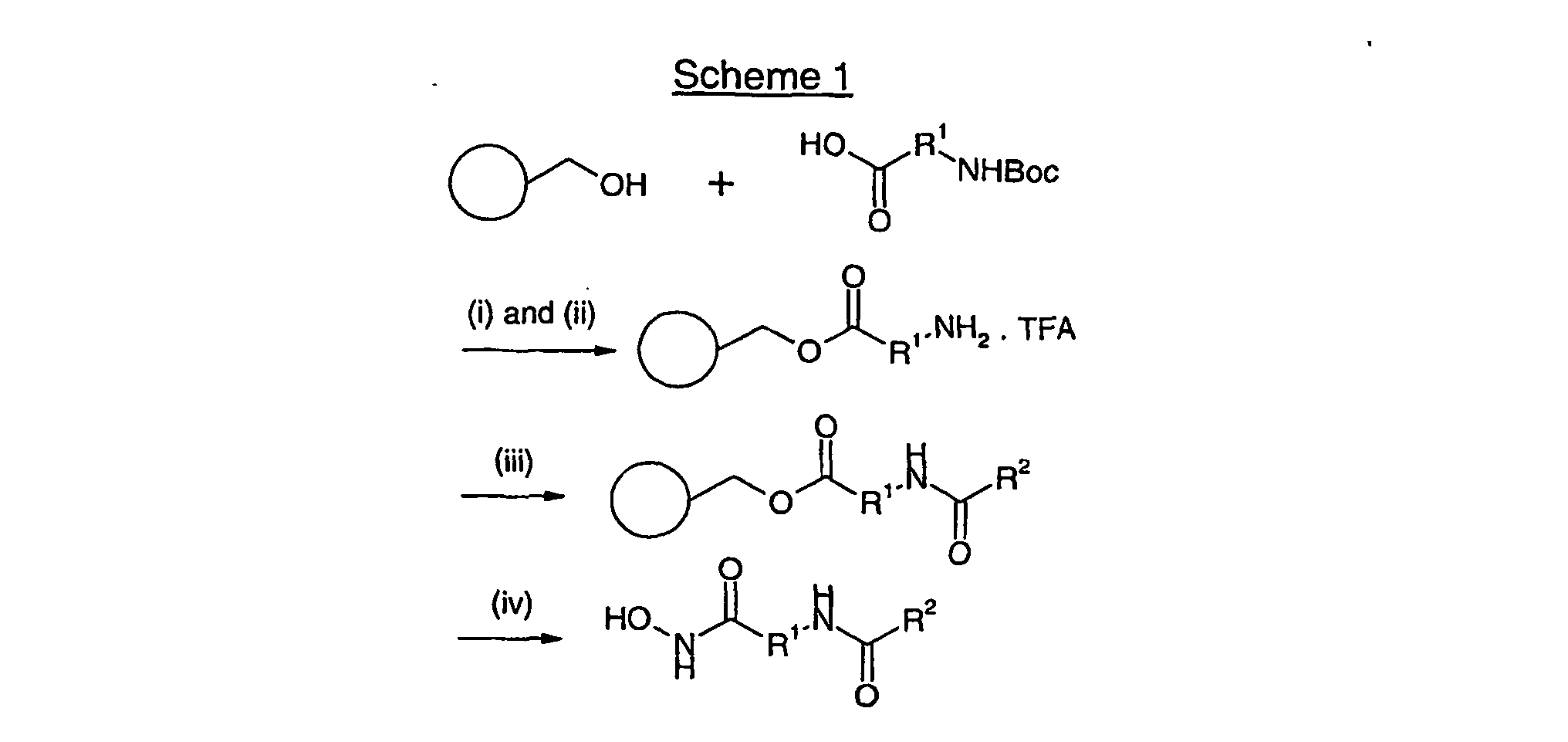
- In another method, a aryl-alkyl-carboxylic acid is reacted with a suitable amine having a terminal protected carboxylic acid (e.g, as an ester), to form a product having, on the one hand, an aryl amide, and on the other hand, a protected carboxylic acid. The protected carboxylic acid is then deprotected, and the product reacted with hydroxylamine, to give the desired carbamic acid.
- One example of this approach is illustrated below, wherein the reaction conditions are as follows: (i) 1,1'-carbonyl-diimidazole, TEA, THF, room temperature, 6 hours; (ii) NH2OH, room temperature, 4 hours.
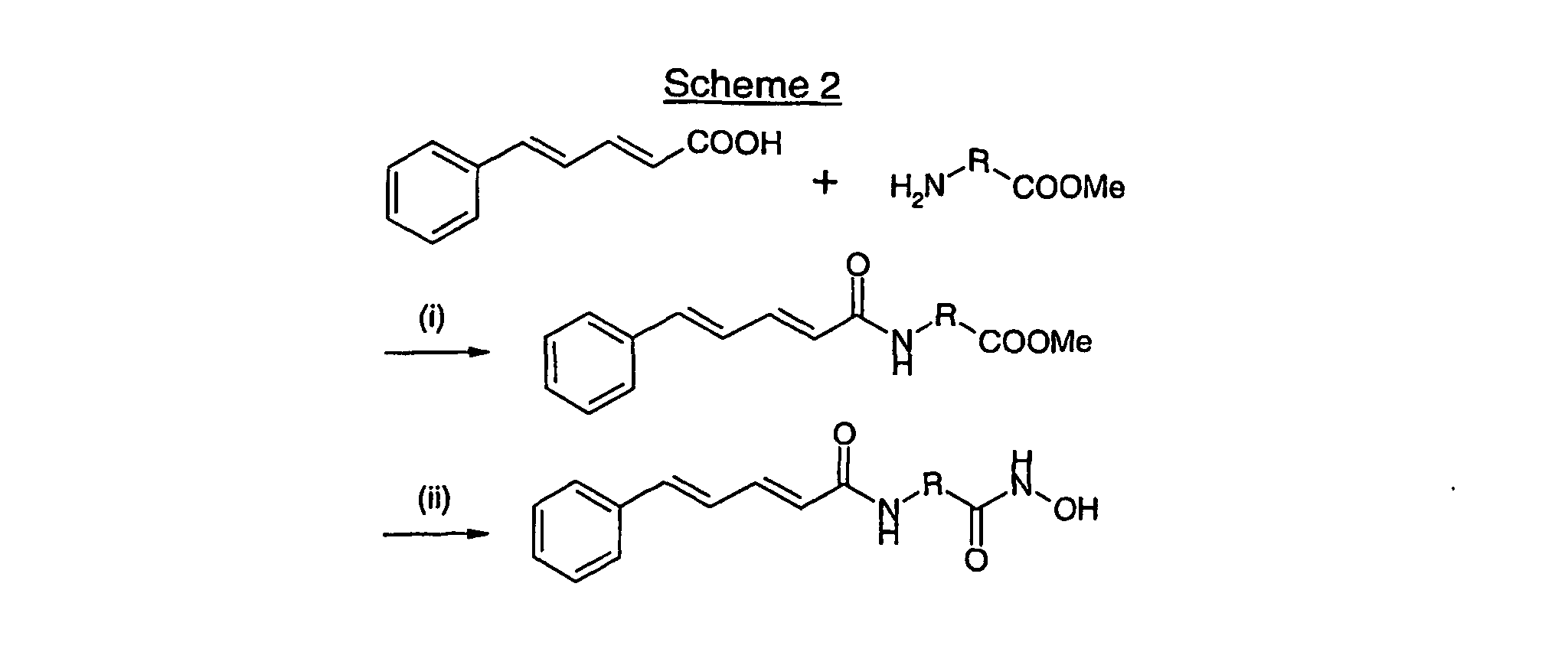
- In another method, a m-aminophenylacrylic acid methyl ester is reacted with a phenylacryloylchloride, and the product is reacted with hydroxylamine and sodium hydroxide in methanol, to give the desired carbamic acid.
- One example of this approach is illustrated below, wherein the reaction conditions are as follows: (i) NaHCO3, H2O, THF, room temperature, 1 hour;
(ii) NaOH/MeOH-H2O, NH2OH, room temperature, 1.5 hours.
- Additional methods for the synthesis of compounds of the present invention as well as comparative compounds, are illustrated below and are exemplified in the examples below.
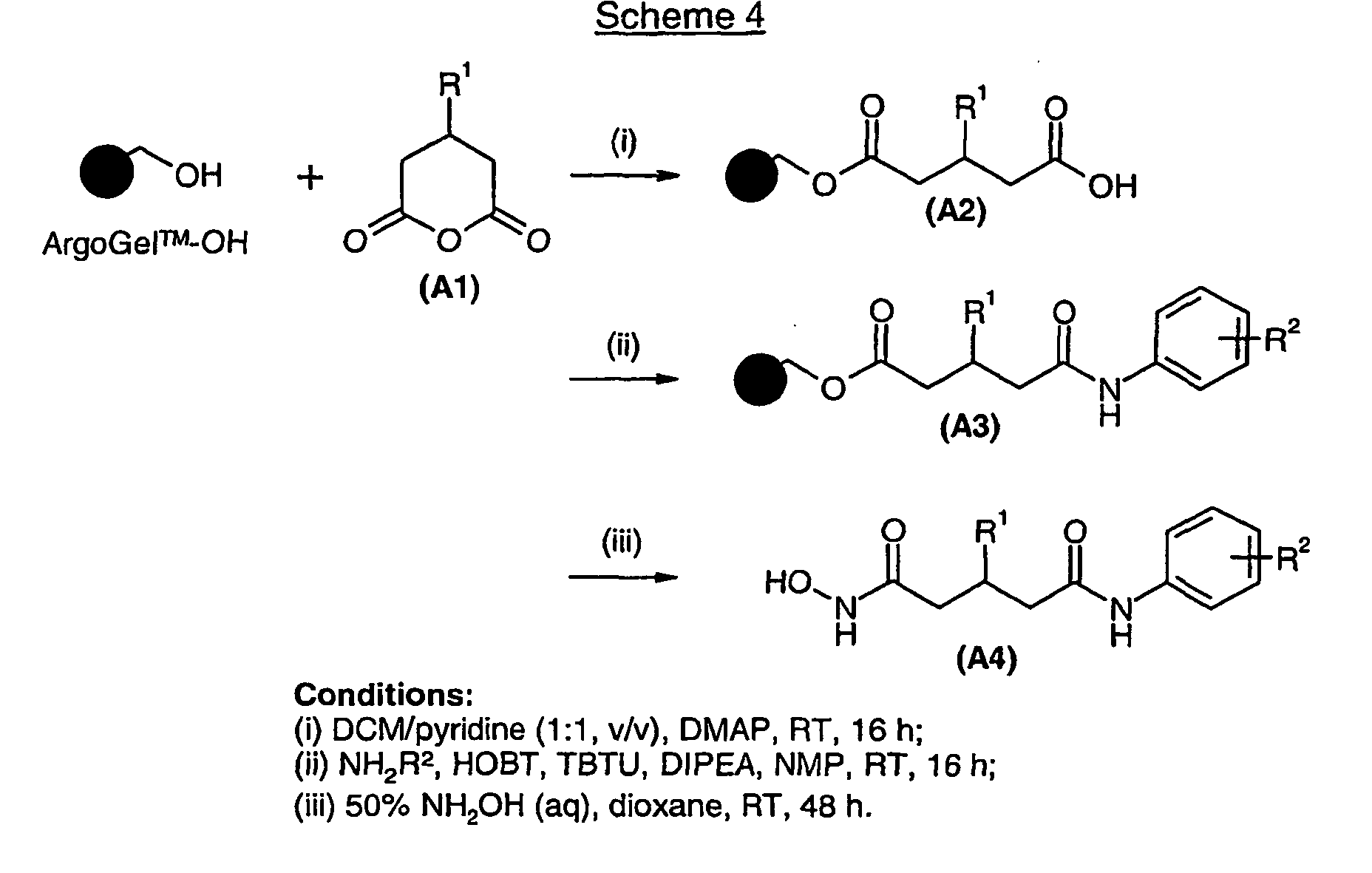
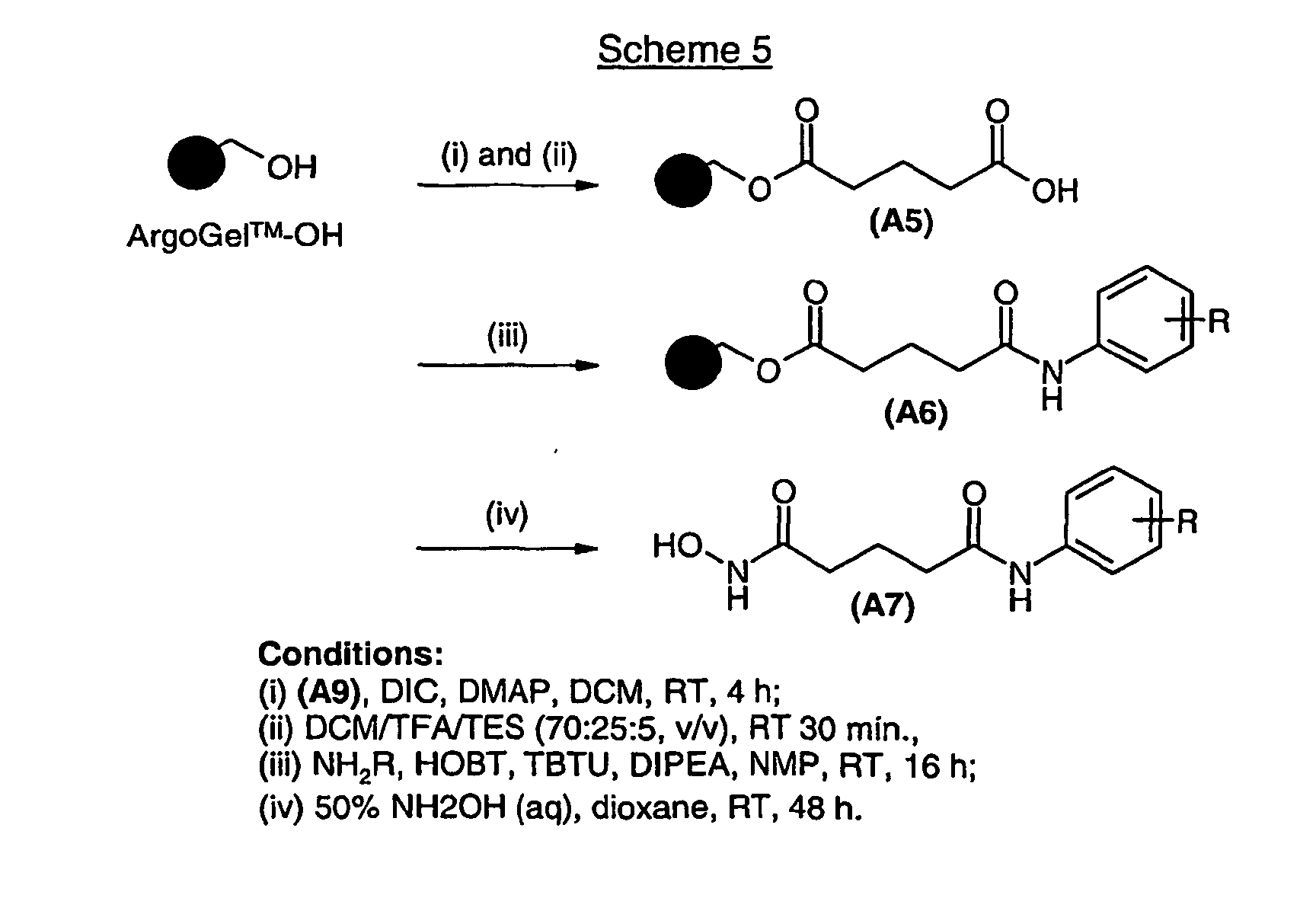
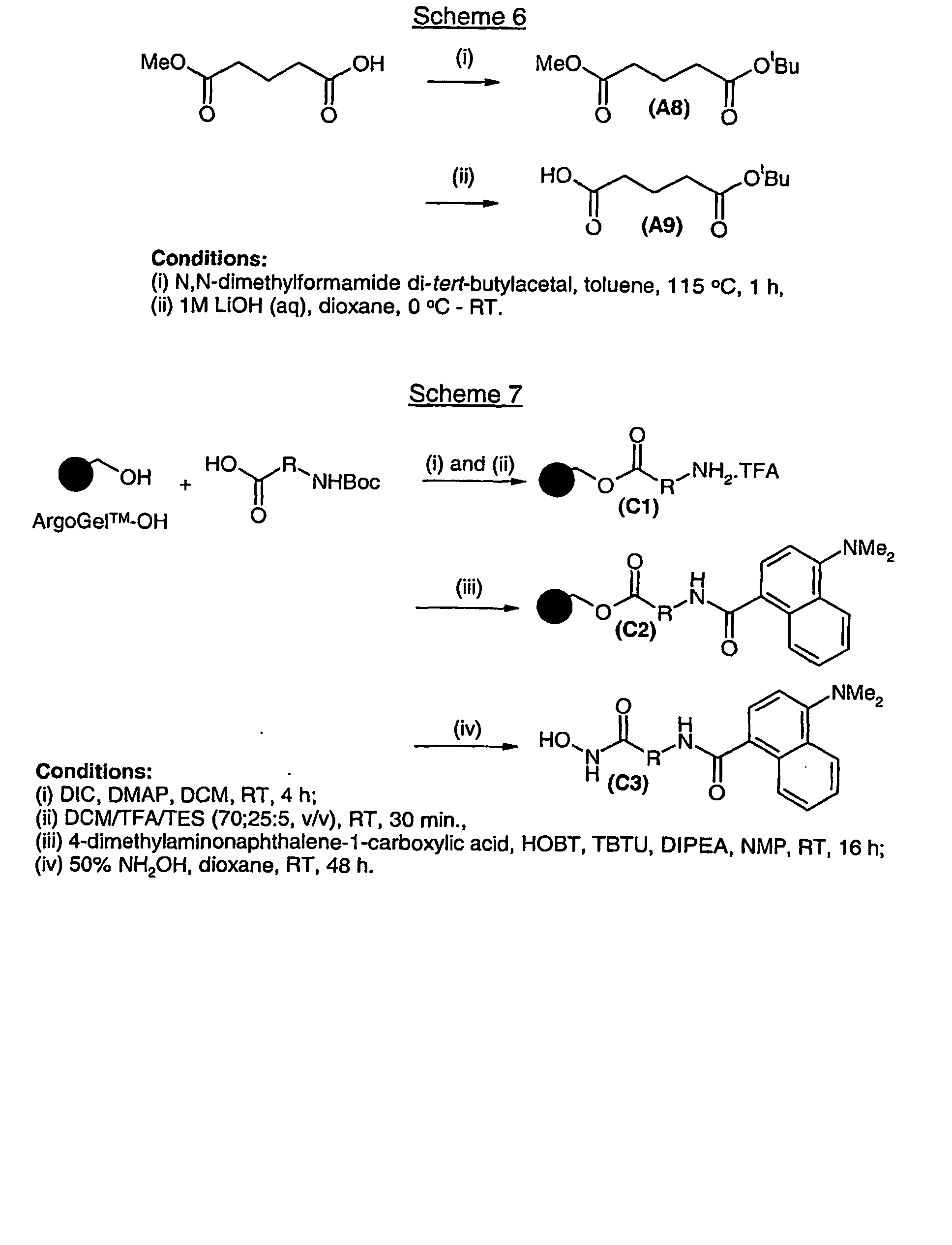

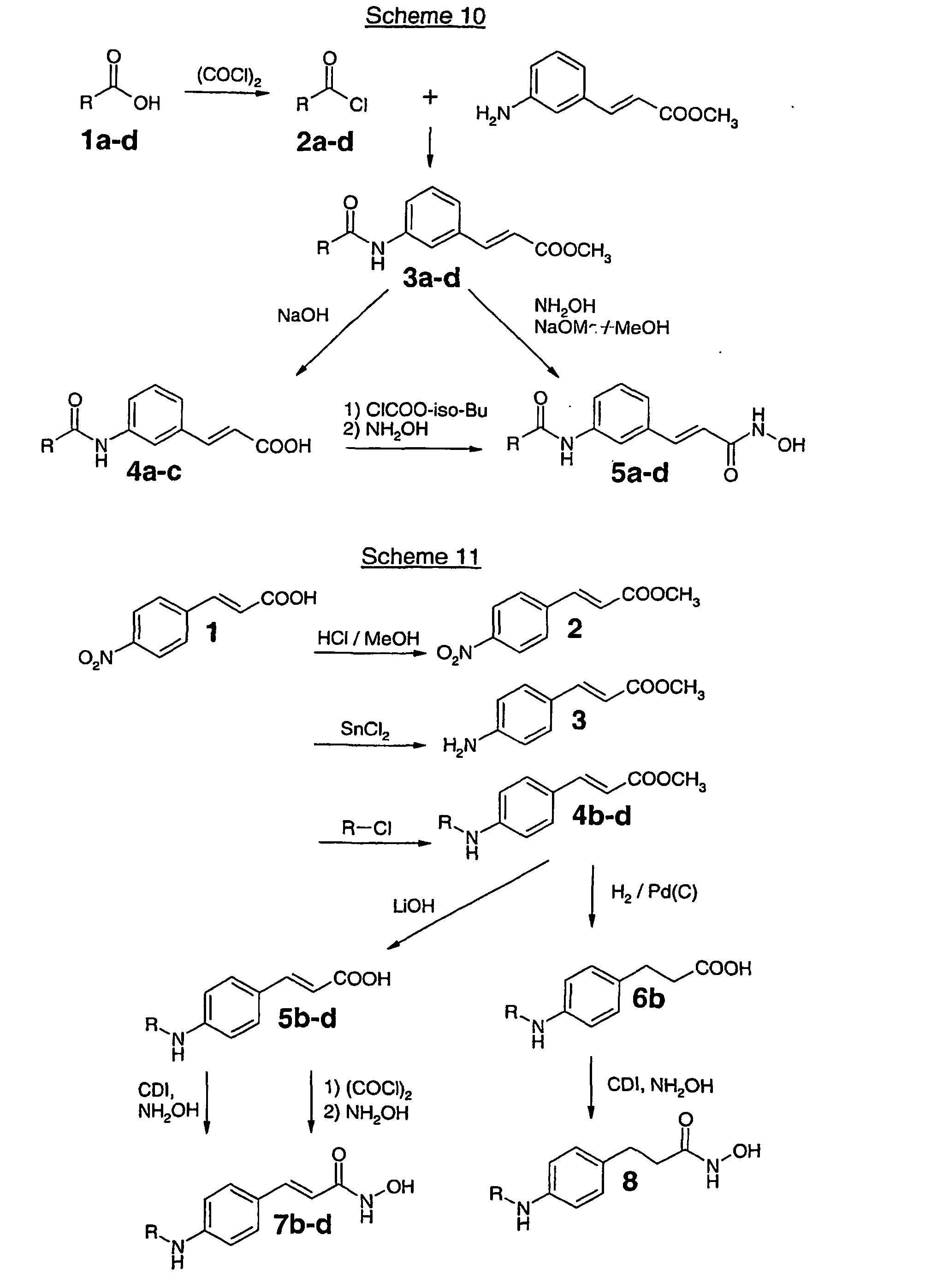

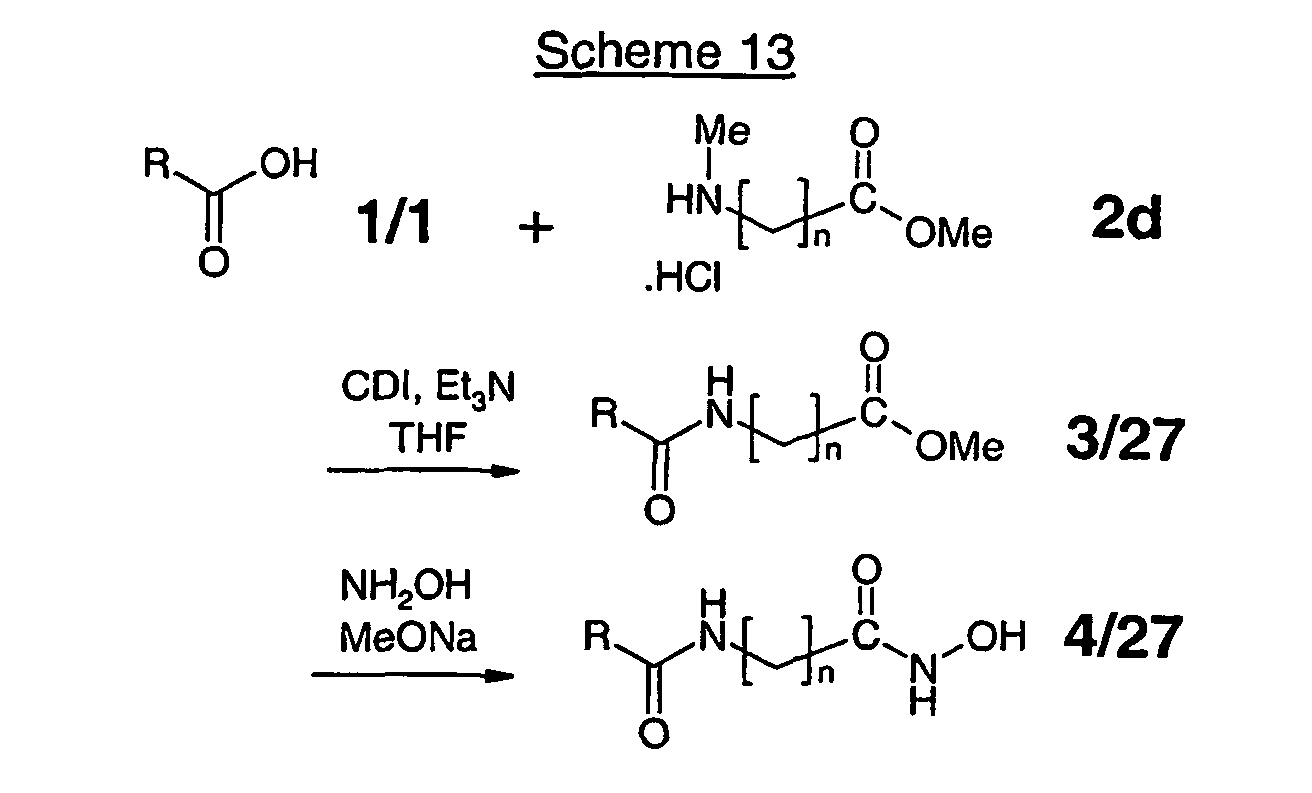
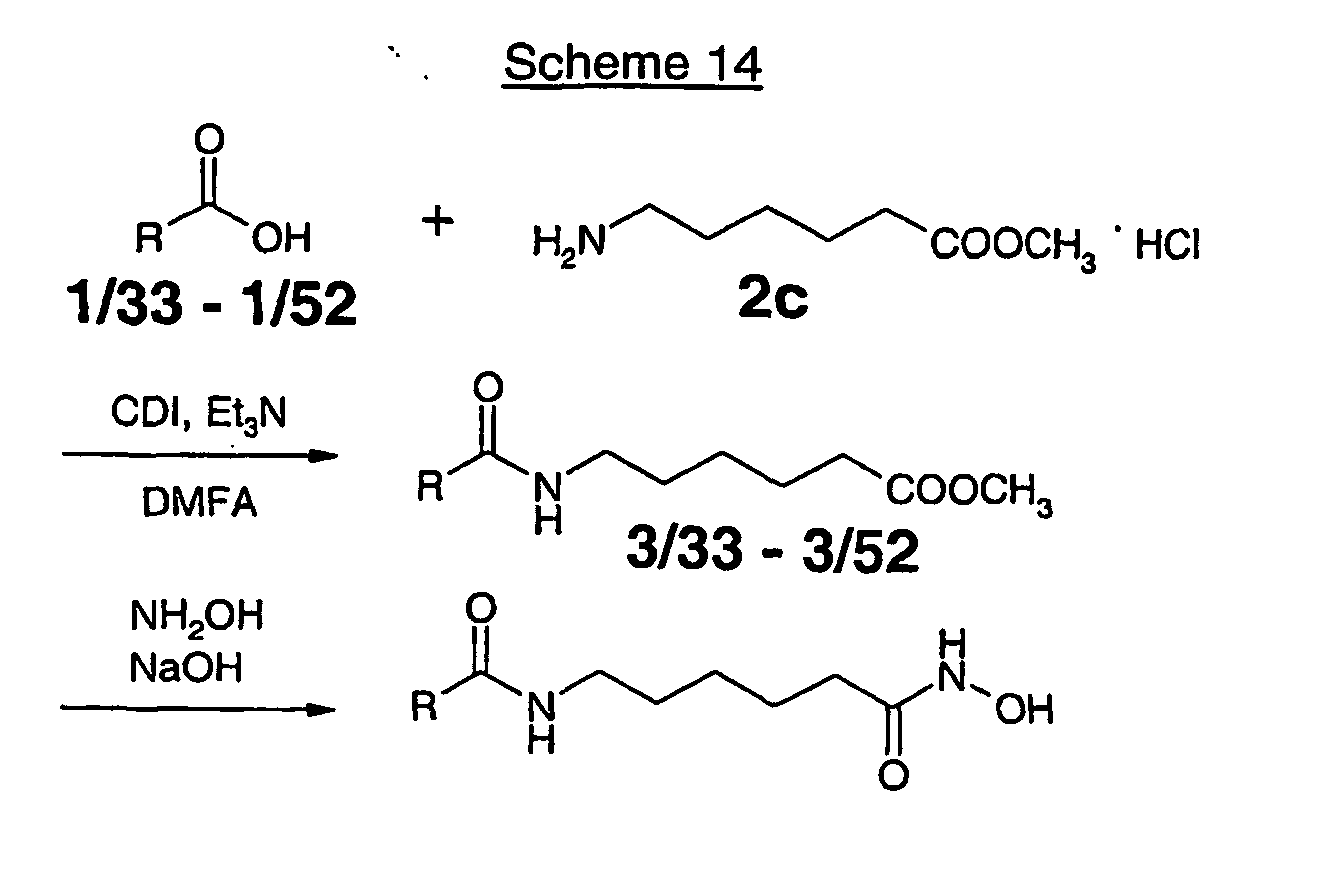
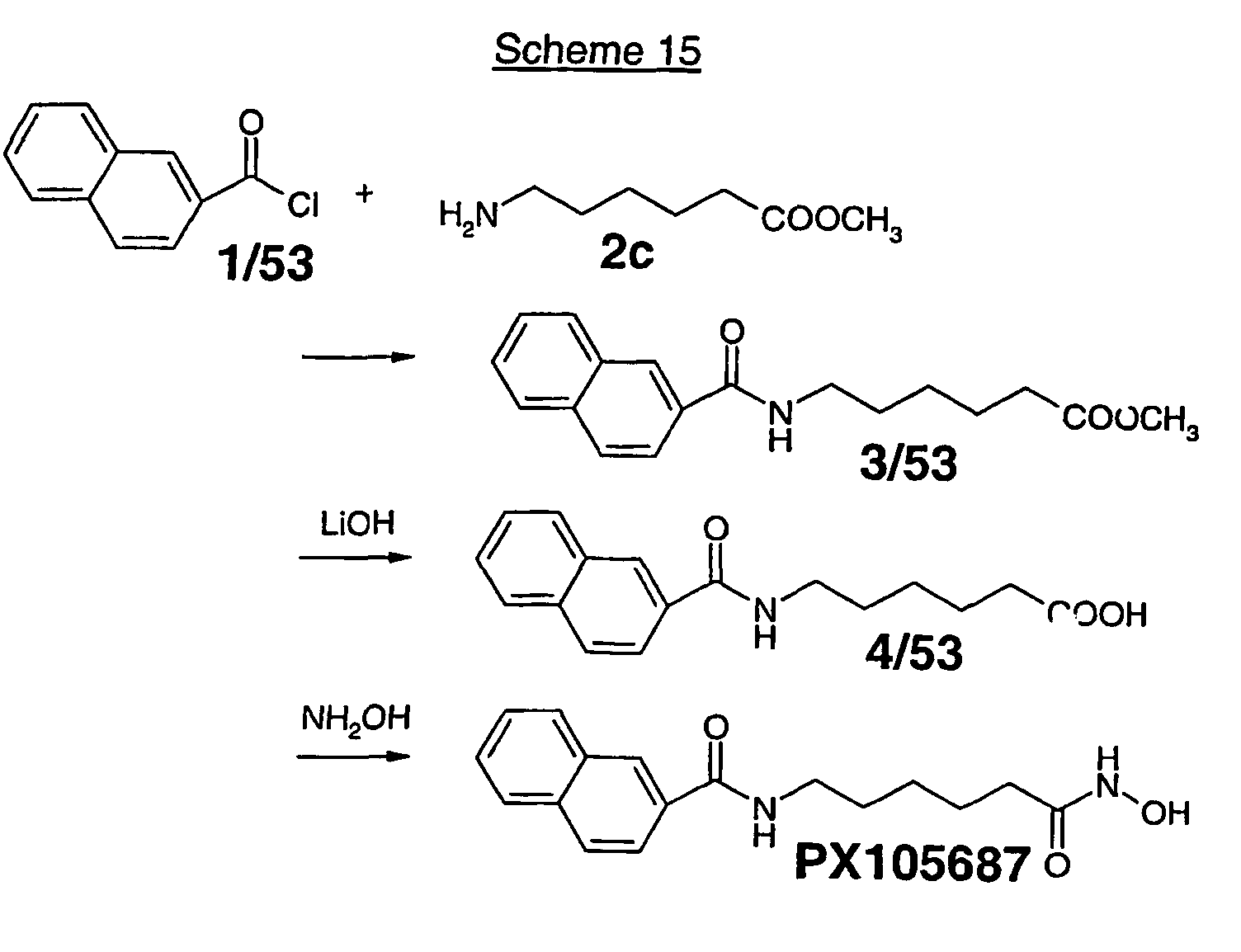

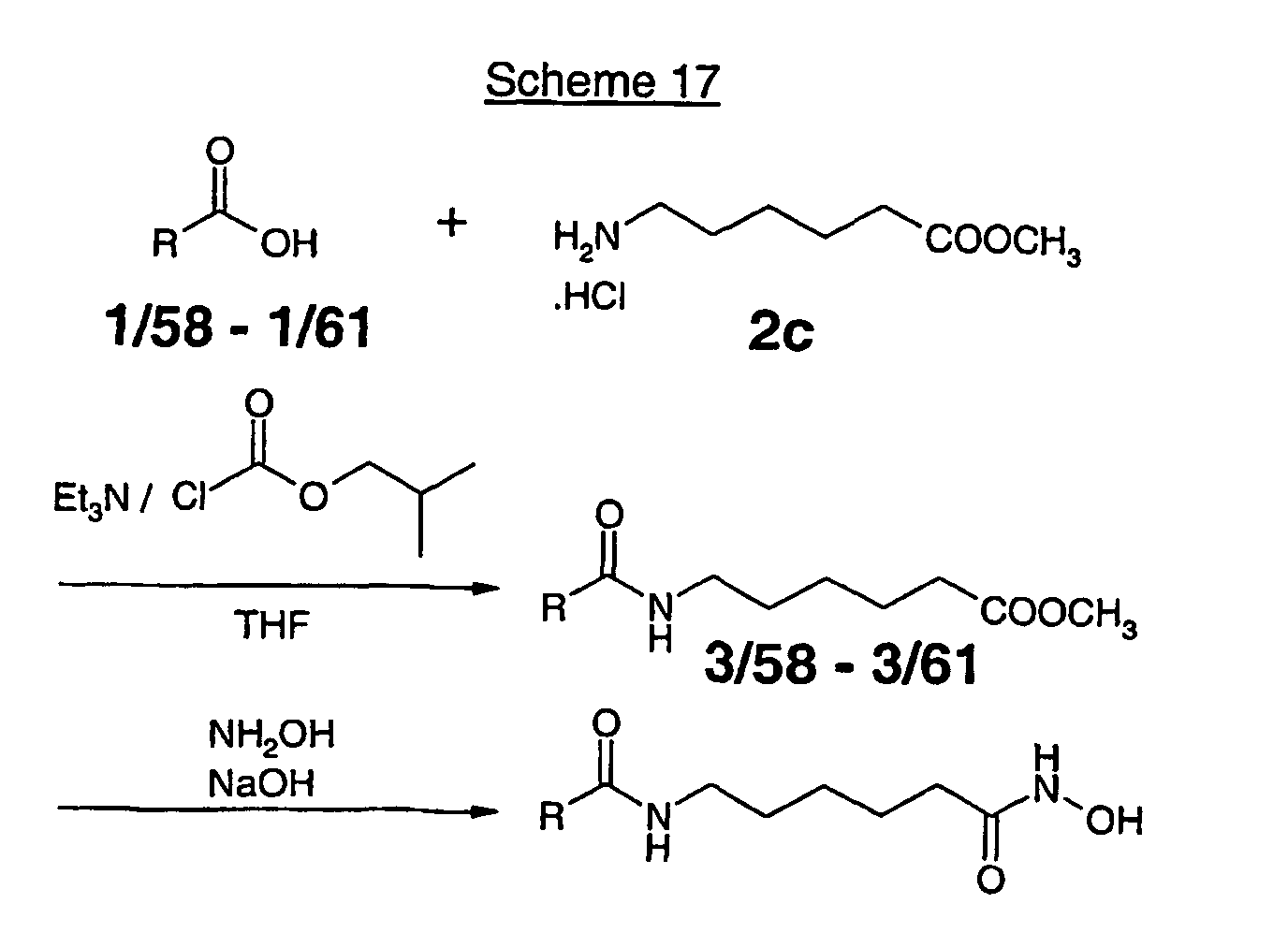
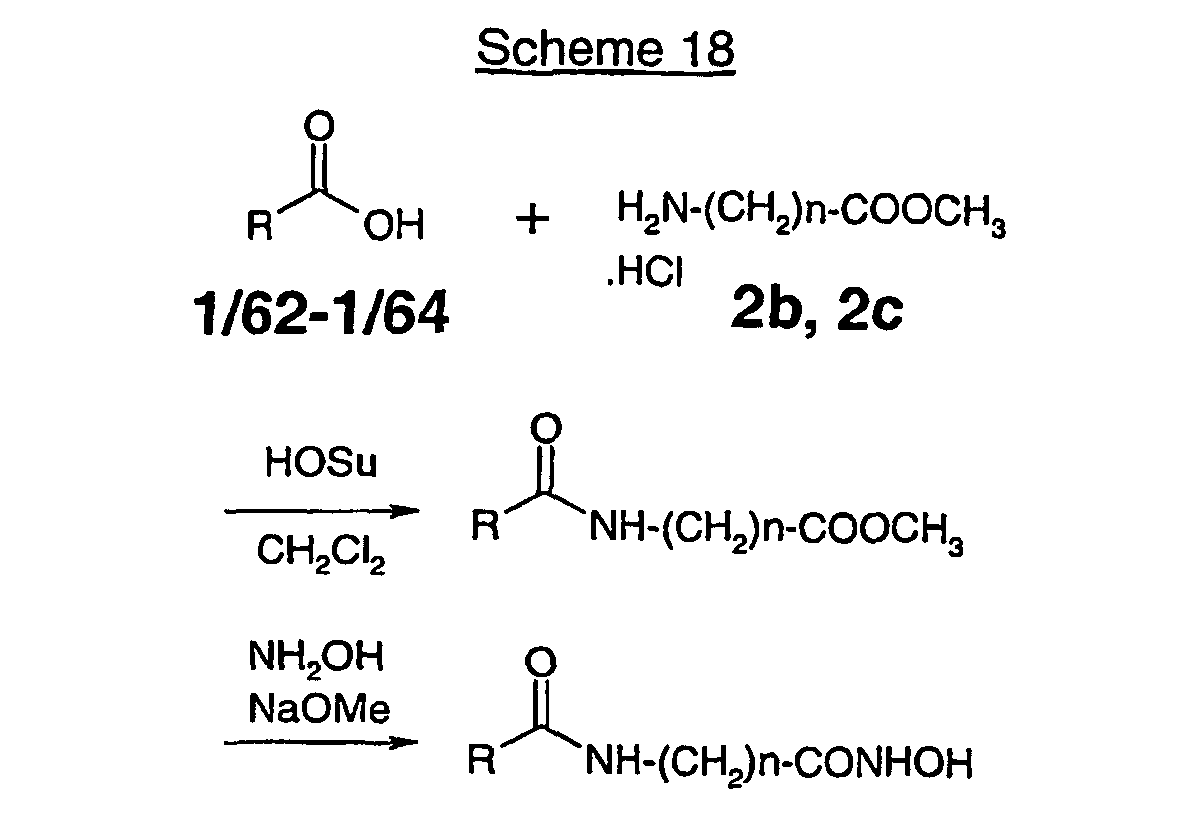

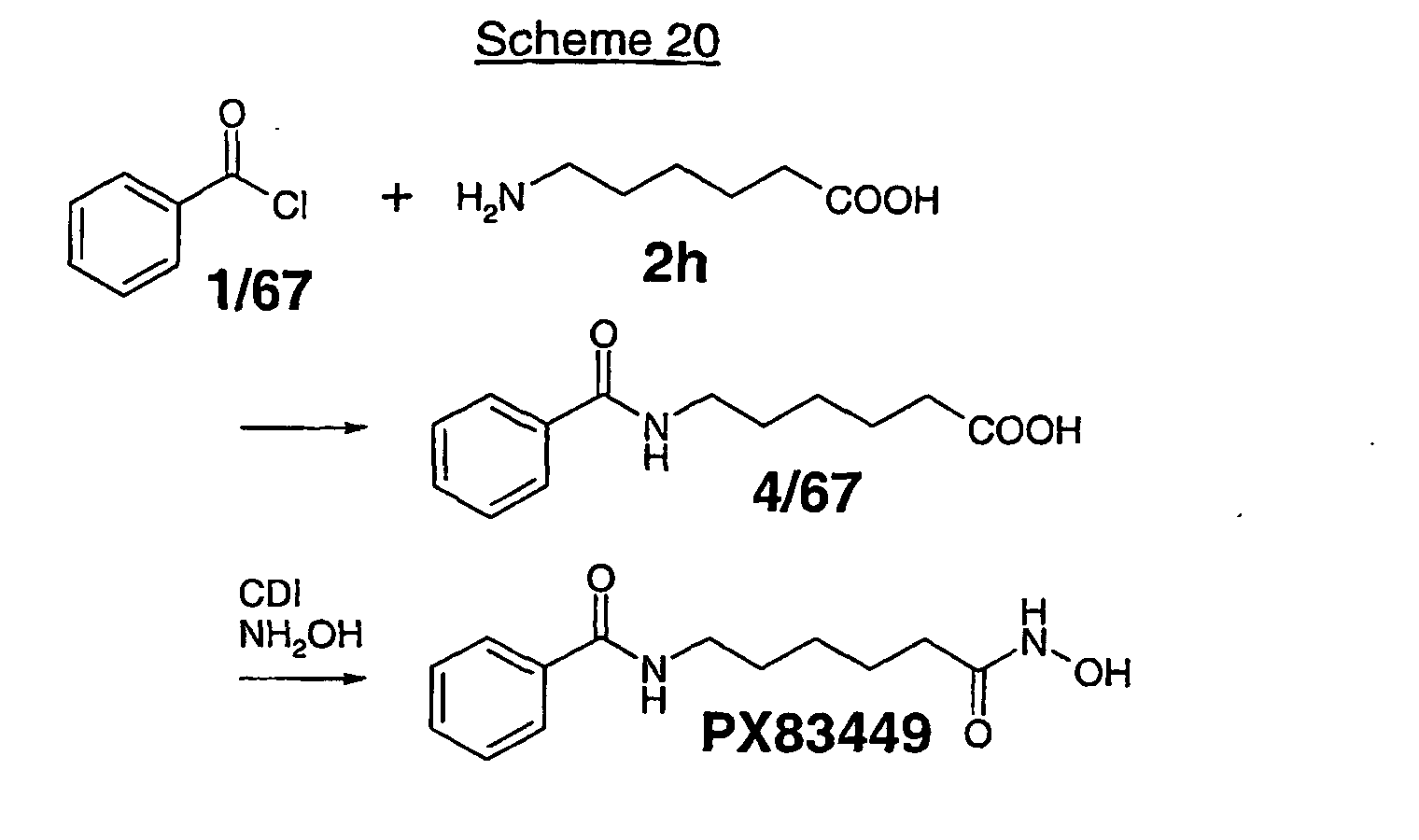
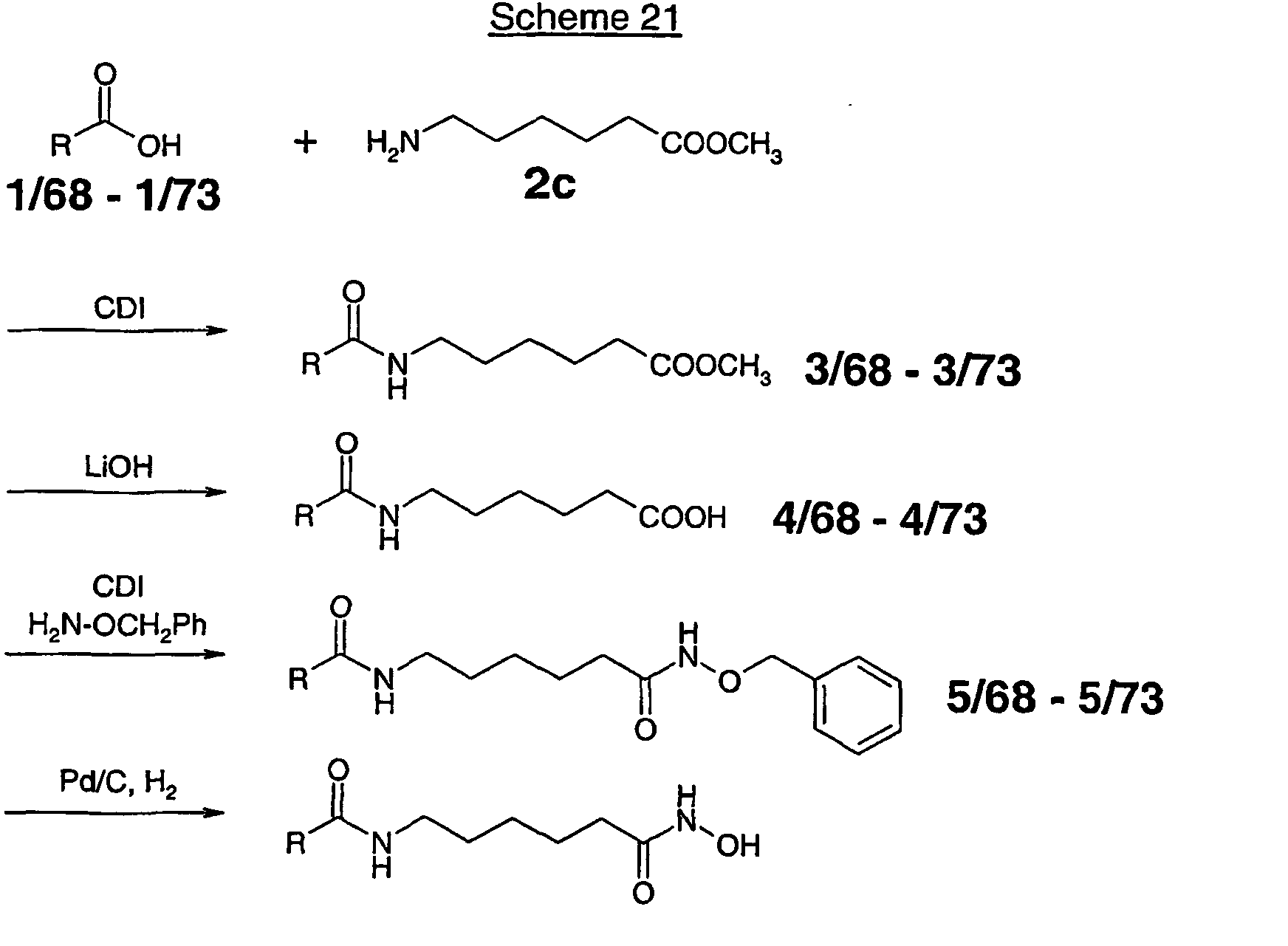


- The present invention provides active compounds which are capable of inhibiting HDAC (for example, inhibiting HDAC activity, inhibiting formation of HDAC complexes, inhibiting activity of HDAC complexes), as well as methods of inhibiting HDAC activity, comprising contacting a cell with an effective amount of an active compound, in vitro.
- The term "active," as used herein, pertains to compounds which are capable of inhibiting HDAC activity, and specifically includes both compounds with intrinsic activity (drugs) as well as prodrugs of such compounds, which prodrugs may themselves exhibit little or no intrinsic activity.
- One of ordinary skill in the art is readily able to determine whether or not a candidate compound is active, that is, capable of inhibiting HDAC activity. For example, assays which may conveniently be used to assess the inhibition offered by a particular compound are described in the examples below.
- For example, a sample of cells (e.g., from a tumour) may be grown in vitro and a candidate compound brought into contact with the cells, and the effect of the compound on those cells observed. As examples of "effect," the morphological status of the cells may be determined (e.g., alive or dead), or the expression levels of genes regulated by HDAC. Where the candidate compound is found to exert an influence on the cells, this may be used as a prognostic or diagnostic marker of the efficacy of the compound in methods of treating a patient carrying cells of the same type (e.g., the tumour or a tumour of the same cellular type).
- In one aspect, the present invention provides antiproliferative agents. The term "antiproliferative agent" as used herein, pertains to a compound which treats a proliferative condition (i.e., a compound which is useful in the treatment of a proliferative condition).
- The terms "cell proliferation," "proliferative condition," "proliferative disorder," and "proliferative disease," are used interchangeably herein and pertain to an unwanted or uncontrolled cellular proliferation of excessive or abnormal cells which is undesired, such as, neoplastic or hyperplastic growth, whether in vitro or in vivo. Examples of proliferative conditions include, but are not limited to, pre-malignant and malignant cellular proliferation, including but not limited to, malignant neoplasms and tumours, cancers, leukemias, psoriasis, bone diseases, fibroproliferative disorders (e.g., of connective tissues), and atherosclerosis. Any type of cell may be treated, including but not limited to, lung, colon, breast, ovarian, prostate, liver, pancreas, brain, and skin.
- Antiproliferative compounds of the present invention have application in the treatment of cancer, and so the present invention further provides anticancer agents. The term "anticancer agent" as used herein, pertains to a compound which treats a cancer (i.e., a compound which is useful in the treatment of a cancer). The anti-cancer effect may arise through one or more mechanisms, including but not limited to, the regulation of cell proliferation, the inhibition of angiogenesis (the formation of new blood vessels), the inhibition of metastasis (the spread of a tumour from its origin), the inhibition of invasion (the spread of tumour cells into neighbouring normal structures), or the promotion of apoptosis (programmed cell death).
- The compounds of the present invention may also be used in the treatment of conditions which are known to be mediated by HDAC, or which are known to be treated by HDAC inhibitors (such as, e.g., trichostatin A). Examples of such conditions include, but are not limited to, the following:
- Cancer (see, e.g., Vigushin et al., 2001).
- Psoriasis (see, e.g., lavarone et al., 1999).
- Fibroproliferative disorders (e.g., liver fibrosis) (see, e.g., Niki et al., 1999; Corneil et al., 1998).
- Smooth muscle proliferative disorder (e.g., atherosclerosis, restenosis) (see, e.g., Kimura et al., 1994).
- Neurodegenative diseases (e.g., Alzheimer's, Parkinson's, Huntington's chorea, amyotropic lateral sclerosis, spino-cerebellar degeneration) (see, e.g., Kuusisto et al., 2001).
- Inflammatory disease (e.g., osteoarthritis, rheumatoid arthritis) (see, e.g., Dangond et al., 1998; Takahashi et al., 1996).
- Diseases involving angiogenesis (e.g., cancer, rheumatoid arthritis, psoriasis, diabetic retinopathy) (see, e.g., Kim et al., 2001).
- Haematopoietic disorders (e.g., anaemia, sickle cell anaemia, thalassaeimia) (see, e.g., McCaffrey et al., 1997).
- Fungal infection (see, e.g., Bernstein et al., 2000; Tsuji et al., 1976).
- Parasitic infection (e.g., malaria, trypanosomiasis, helminthiasis, protozoal infections (see, e.g., Andrews et al., 2000).
- Bacterial infection (see, e.g., Onishi et al., 1996).
- Viral infection (see, e.g., Chang et al., 2000).
- Conditions treatable by immune modulation (e.g., multiple sclerosis, autoimmune diabetes, lupus, atopic dermatitis, allergies, asthma, allergic rhinitis, inflammatory bowel disease; and for improving grafting of transplants) (see, e.g., Dangond et al., 1998; Takahashi et al., 1996).
-
- The invention further provides active compounds for use in a method of treatment of the human or animal body. Such a method may comprise administering to such a subject a therapeutically-effective amount of an active compound, preferably in the form of a pharmaceutical composition.
- The term "treatment," as used herein in the context of treating a condition, pertains generally to treatment and therapy, whether of a human or an animal (e.g., in veterinary applications), in which some desired therapeutic effect is achieved, for example, the inhibition of the progress of the condition, and includes a reduction in the rate of progress, a halt in the rate of progress, amelioration of the condition, and cure of the condition. Treatment as a prophylactic measure is also included.
- The term "therapeutically-effective amount," as used herein, pertains to that amount of an active compound, or a material, composition or dosage from comprising an active compound, which is effective for producing some desired therapeutic effect, commensurate with a reasonable benefit/risk ratio.
- The term "treatment" includes combination treatments and therapies, in which two or more treatments or therapies are combined, for example, sequentially or simultaneously. Examples of treatments and therapies include, but are not limited to, chemotherapy (the administration of active agents, including, e.g., drugs, antibodies (e.g., as in immunotherapy), prodrugs (e.g., as in photodynamic therapy, GDEPT, ADEPT, etc.); surgery; radiation therapy; and gene therapy.
- The invention further provides the use of an active compound for the manufacture of a medicament, for example, for the treatment of a proliferative condition, as discussed above.
- The invention further provides the use of an active compound for the manufacture of a medicament, for example, for the treatment of conditions which are known to be mediated by HDAC, or which are known to be treated by HDAC inhibitors (such as, e.g., trichostatin A), as discussed above.
- The invention further provides a method for inhibiting HDAC in a cell comprising said cell with an effective amount of an active compound.
- Active compounds may also be used, as described above, in combination therapies, that is, in conjunction with other agents, for example, cytotoxic agents.
- Active compounds may also be used as part of an in vitro assay, for example, in order to determine whether a candidate host is likely to benefit from treatment with the compound in question.
- Active compounds may also be used as a standard, for example, in an assay, in order to identify other active compounds, other antiproliferative agents, etc.
- The compounds of the present invention may also be used in methods of improving protein production by cultured cells (see, e.g., Furukawa et al., 1998).
- The active compound or pharmaceutical composition comprising the active compound may be administered to a subject by any convenient route of administration, whether systemically/ peripherally or topically (i.e., at the site of desired action).
- Routes of administration include, but are not limited to, oral (e.g, by ingestion); buccal; sublingual; transdermal (including, e.g., by a patch, plaster, etc.); transmucosal (including, e.g., by a patch, plaster, etc.); intranasal (e.g., by nasal spray); ocular (e.g., by eyedrops); pulmonary (e.g., by inhalation or insufflation therapy using, e.g., via an aerosol, e.g., through the mouth or nose); rectal (e.g., by suppository or enema); vaginal (e.g., by pessary); parenteral, for example, by injection, including subcutaneous, intradermal, intramuscular, intravenous, intraarterial, intracardiac, intrathecal, intraspinal, intracapsular, subcapsular, intraorbital, intraperitoneal, intratracheal, subcuticular, intraarticular, subarachnoid, and intrasternal; by implant of a depot or reservoir, for example, subcutaneously or intramuscularly.
- The subject may be a prokaryote (e.g., bacteria) or a eukaryote (e.g., protoctista, fungi, plants, animals).
- The subject may be a protoctista, an alga, or a protozoan.
- The subject may be a plant, an angiosperm, a dicotyledon, a monocotyledon, a gymnosperm, a conifer, a ginkgo, a cycad, a fern, a horsetail, a clubmoss, a liverwort, or a moss.
- The subject may be an animal.
- The subject may be a chordate, an invertebrate, an echinoderm (e.g., starfish, sea urchins, brittlestars), an arthropod, an annelid (segmented worms) (e.g., earthworms, lugworms, leeches), a mollusk (cephalopods (e.g., squids, octopi), pelecypods (e.g., oysters, mussels, clams), gastropods (e.g., snails, slugs)), a nematode (round worms), a platyhelminthes (flatworms) (e.g., planarians, flukes, tapeworms), a cnidaria (e.g., jelly fish, sea anemones, corals), or a porifera (e.g., sponges).
- The subject may be an arthropod, an insect (e.g., beetles, butterflies, moths), a chilopoda (centipedes), a diplopoda (millipedes), a crustacean (e.g., shrimps, crabs, lobsters), or an arachnid (e.g., spiders, scorpions, mites).
- The subject may be a chordate, a vertebrate, a mammal, a bird, a reptile (e.g., snakes, lizards, crocodiles), an amphibian (e.g., frogs, toads), a bony fish (e.g., salmon, plaice, eel, lungfish), a cartilaginous fish (e.g., sharks, rays), or a jawless fish (e.g., lampreys, hagfish).
- The subject may be a mammal, a placental mammal, a marsupial (e.g., kangaroo, wombat), a monotreme (e.g., duckbilled platypus), a rodent (e.g., a guinea pig, a hamster, a rat, a mouse), murine (e.g., a mouse), a lagomorph (e.g., a rabbit), avian (e.g., a bird), canine (e.g., a dog), feline (e.g., a cat), equine (e.g., a horse), porcine (e.g., a pig), ovine (e.g., a sheep), bovine (e.g., a cow), a primate, simian (e.g., a monkey or ape), a monkey (e.g., marmoset, baboon), an ape (e.g., gorilla, chimpanzee, orangutang, gibbon), or a human.
- Furthermore, the subject may be any of its forms of development, for example, a spore, a seed, an egg, a larva, a pupa, or a foetus.
- In one preferred embodiment, the subject is a human.
- While it is possible for the active ingredient to be administered alone, it is preferable to present it as a pharmaceutical composition (e.g., formulation) comprising at least one active ingredient, as defined above, together with one or more pharmaceutically acceptable carriers, excipients, buffers, adjuvants, stabilisers, or other materials well known to those skilled in the art and optionally other therapeutic agents.
- Thus, the present invention further provides pharmaceutical compositions, as defined above, and methods of making a pharmaceutical composition comprising admixing at least one active ingredient, as defined above, together with one or more pharmaceutically acceptable carriers, excipients, buffers, adjuvants, stabilisers, or other materials, as described herein.
- The term "pharmaceutically acceptable" as used herein pertains to compounds, materials, compositions, and/or dosage forms which are, within the scope of sound medical judgement, suitable for use in contact with the tissues of a subject (e.g., human) without excessive toxicity, irritation, allergic response, or other problem or complication, commensurate with a reasonable benefit/risk ratio. Each carrier, excipient, etc. must also be "acceptable" in the sense of being compatible with the other ingredients of the formulation.
- The formulations may conveniently be presented in unit dosage form and may be prepared by any methods well known in the art of pharmacy. Such methods include the step of bringing into association the active ingredient with the carrier which constitutes one or more accessory ingredients. In general, the formulations are prepared by uniformly and intimately bringing into association the active ingredient with liquid carriers or finely divided solid carriers or both, and then if necessary shaping the product.
- Formulations may be in the form of liquids, solutions, suspensions, emulsions, tablets, losenges, granules, powders, capsules, cachets, pills, ampoules, suppositories, pessaries, ointments, gels, pastes, creams, sprays, foams, lotions, oils, boluses, electuaries, or aerosols.
- Formulations suitable for oral administration (e.g., by ingestion) may be presented as discrete units such as capsules, cachets or tablets, each containing a predetermined amount of the active ingredient; as a powder or granules; as a solution or suspension in an aqueous or non-aqueous liquid; or as an oil-in-water liquid emulsion or a water-in-oil liquid emulsion; as a bolus; as an electuary; or as a paste.
- A tablet may be made by compression or moulding, optionally with one or more accessory ingredients. Compressed tablets may be prepared by compressing in a suitable machine the active ingredient in a free-flowing form such as a powder or granules, optionally mixed with a binder (e.g., povidone, gelatin, hydroxypropylmethyl cellulose), lubricant, inert diluent, preservative, disintegrant (e.g., sodium starch glycolate, cross-linked povidone, cross-linked sodium carboxymethyl cellulose), surface-active or dispersing agent. Moulded tablets may be made by moulding in a suitable machine a mixture of the powdered compound moistened with an inert liquid diluent. The tablets may optionally be coated or scored and may be formulated so as to provide slow or controlled release of the active ingredient therein using, for example, hydroxypropylmethyl cellulose in varying proportions to provide the desired release profile. Tablets may optionally be provided with an enteric coating, to provide release in parts of the gut other than the stomach.
- Formulations suitable for topical administration (e.g., transdermal, intranasal, ocular, buccal, and sublingual) may be formulated as an ointment, cream, suspension, lotion, powder, solution, paste, gel, spray, aerosol, or oil. Alternatively, a formulation may comprise a patch or a dressing such as a bandage or adhesive plaster impregnated with active ingredients and optionally one or more excipients or diluents.
- Formulations suitable for topical administration in the mouth include losenges comprising the active ingredient in a flavored basis, usually sucrose and acacia or tragacanth; pastilles comprising the active ingredient in an inert basis such as gelatin and glycerin, or sucrose and acacia; and mouthwashes comprising the active ingredient in a suitable liquid carrier.
- Formulations suitable for topical administration to the eye also include eye drops wherein the active ingredient is dissolved or suspended in a suitable carrier, especially an aqueous solvent for the active ingredient.
- Formulations suitable for nasal administration, wherein the carrier is a solid, include a coarse powder having a particle size, for example, in the range of about 20 to about 500 microns which is administered in the manner in which snuff is taken, i.e., by rapid inhalation through the nasal passage from a container of the powder held close up to the nose. Suitable formulations wherein the carrier is a liquid for administration as, for example, nasal spray, nasal drops, or by aerosol administration by nebuliser, include aqueous or oily solutions of the active ingredient.
- Formulations suitable for topical administration via the skin include ointments, creams, and emulsions. When formulated in an ointment, the active ingredient may optionally be employed with either a paraffinic or a water-miscible ointment base. Alternatively, the active ingredients may be formulated in a cream with an oil-in-water cream base. If desired, the aqueous phase of the cream base may include, for example, at least about 30% w/w of a polyhydric alcohol, i.e., an alcohol having two or more hydroxyl groups such as propylene glycol, butane-1,3-diol, mannitol, sorbitol, glycerol and polyethylene glycol and mixtures thereof. The topical formulations may desirably include a compound which enhances absorption or penetration of the active ingredient through the skin or other affected areas. Examples of such dermal penetration enhancers include dimethylsulfoxide and related analogues.
- When formulated as a topical emulsion, the oily phase may optionally comprise merely an emulsifier (otherwise known as an emulgent), or it may comprises a mixture of at least one emulsifier with a fat or an oil or with both a fat and an oil. Preferably, a hydrophilic emulsifier is included together with a lipophilic emulsifier which acts as a stabiliser. It is also preferred to include both an oil and a fat. Together, the emulsifier(s) with or without stabiliser(s) make up the so-called emulsifying wax, and the wax together with the oil and/or fat make up the so-called emulsifying ointment base which forms the oily dispersed phase of the cream formulations.
- Suitable emulgents and emulsion stabilisers include Tween 60, Span 80, cetostearyl alcohol, myristyl alcohol, glyceryl monostearate and sodium lauryl sulfate. The choice of suitable oils or fats for the formulation is based on achieving the desired cosmetic properties, since the solubility of the active compound in most oils likely to be used in pharmaceutical emulsion formulations may be very low. Thus the cream should preferably be a non-greasy, non-staining and washable product with suitable consistency to avoid leakage from tubes or other containers. Straight or branched chain, mono- or dibasic alkyl esters such as di-isoadipate, isocetyl stearate, propylene glycol diester of coconut fatty acids, isopropyl myristate, decyl oleate, isopropyl palmitate, butyl stearate, 2-ethylhexyl palmitate or a blend of branched chain esters known as Crodamol CAP may be used, the last three being preferred esters. These may be used alone or in combination depending on the properties required. Alternatively, high melting point lipids such as white soft paraffin and/or liquid paraffin or other mineral oils can be used.
- Formulations suitable for rectal administration may be presented as a suppository with a suitable base comprising, for example, cocoa butter or a salicylate.
- Formulations suitable for vaginal administration may be presented as pessaries, tampons, creams, gels, pastes, foams or spray formulations containing in addition to the active ingredient, such carriers as are known in the art to be appropriate.
- Formulations suitable for parenteral administration (e.g., by injection, including cutaneous, subcutaneous, intramuscular, intravenous and intradermal), include aqueous and non-aqueous isotonic, pyrogen-free, sterile injection solutions which may contain anti-oxidants, buffers, preservatives, stabilisers, bacteriostats and solutes which render the formulation isotonic with the blood of the intended recipient; and aqueous and non-aqueous sterile suspensions which may include suspending agents and thickening agents, and liposomes or other microparticulate systems which are designed to target the compound to blood components or one or more organs. Examples of suitable isotonic vehicles for use in such formulations include Sodium Chloride Injection, Ringer's Solution, or Lactated Ringer's Injection. Typically, the concentration of the active ingredient in the solution is from about 1 ng/ml to about 10 µg/ml, for example from about 10 ng/ml to about 1 µg/ml. The formulations may be presented in unit-dose or multidose sealed containers, for example, ampoules and vials, and may be stored in a freese-dried (lyophilised) condition requiring only the addition of the sterile liquid carrier, for example water for injections, immediately prior to use. Extemporaneous injection solutions and suspensions may be prepared from sterile powders, granules, and tablets. Formulations may be in the form of liposomes or other microparticulate systems which are designed to target the active compound to blood components or one or more organs.
- It will be appreciated that appropriate dosages of the active compounds, and compositions comprising the active compounds, can vary from patient to patient. Determining the optimal dosage will generally involve the balancing of the level of therapeutic benefit against any risk or deleterious side effects of the treatments of the present invention. The selected dosage level will depend on a variety of factors including, but not limited to, the activity of the particular compound, the route of administration, the time of administration, the rate of excretion of the compound, the duration of the treatment, other drugs, compounds, and/or materials used in combination, and the age, sex, weight, condition, general health, and prior medical history of the patient. The amount of compound and route of administration will ultimately be at the discretion of the physician, although generally the dosage will be to achieve local concentrations at the site of action which achieve the desired effect.
- Administration in vivo can be effected in one dose, continuously or intermittently throughout the course of treatment. Methods of determining the most effective means and dosage of administration are well known to those of skill in the art and will vary with the formulation used for therapy, the purpose of the therapy, the target cell being treated, and the subject being treated. Single or multiple administrations can be carried out with the dose level and pattern being selected by the treating physician.
- In general, a suitable dose of the active compound is in the range of about 0.1 to about 250 mg per kilogram body weight of the subject per day. Where the active ingredient is a salt, an ester, prodrug, or the like, the amount administered is calculated on the basis the parent compound and so the actual weight to be used is increased proportionately.
- One aspect of the invention pertains to a kit comprising (a) the active ingredient, preferably provided in a suitable container and/or with suitable packaging; and (b) instructions for use, for example, written instructions on how to administer the active compound.
- The written instructions may also include a list of indications for which the active ingredient is a suitable treatment.
- The following are examples are provided solely to illustrate the present invention and are not intended to limit the scope of the invention, as described herein.
- 1H NMR spectra were recorded at ambient temperature with WH-90/DS or Mercury 200 (Varian) spectrometers. The HPLC measurements were performed on a Gilson Model 302 system equipped with a spectrophotometer. Elemental analyses were obtained with a Carlo Erba EA 1108 instrument. Melting points were measured on a "Boëtius" or "Fisher" micro melting point apparatus and are uncorrected. Silicagel, 0.035-0.070 mm, (Acros) was employed for column chromatography. All the solvents were purified before use by routine techniques. To isolate reaction products, the solvents were removed by evaporation using a vacuum rotary evaporator, the water bath temperature not exceeding 40°C.
- Various reagents were purchased from Sigma-Aldrich (The Old Brickyard, New Road, Gillingham, Dorset, UK), Acros Organics (Janssens Pharmaceuticalaan 3A, 2440 Geel, Belgium), Lancaster Synthesis Ltd. (Eastgate, White Lund, Morecambe, Lancashire, LA3 3DY, UK), and Maybridge plc (Trevillett, Tingagel, Cornwall, PL34 0HW, UK).
-

- ArgoGelJ-OH resin (500 mg, 0.245 mmol) was placed in a reaction vessel and was swollen by the addition of dichloromethane (2.5 ml). A solution of N-tert butoxycarbonyl-aminobutyric acid (249 mg, 1.225 mmol), N,N'-diisopropylcarbodiimide (DIC) (192 µl, 1.225 mmol) and 4-(dimethylamino)pyridine (DMAP) (3 mg, 0.0245 mmol) in dichloromethane (2.5 ml) was added and the resultant suspension was agitated at ambient temperature for four hours. The resin was filtered and was washed with 1-methylpyrrolidine (5 ml) and alternately with methanol (4 x 5 ml) and dichloromethane (5 x 5 ml). The resin was dried and a sample was analysed by IR spectroscopy (IR(resin/cm-1) 1714 (urethane) and 1736 (ester).
- The resin (500 mg, 0.245 mmol) obtained from the first step was treated with a mixture of dichloromethane / trifluoroacetic acid/ triethylsilane (70:25:5, v/v) (5 ml) at ambient temperature for thirty minutes. The resin was filtered and was washed with 1-methylpyrrolidine (5 ml) and alternately with methanol (4 x 5 ml) and dichloromethane (4 x 5 ml). The resin was dried and a sample was analysed by IR spectroscopy (IR(resin/cm-1) 1733 (ester).
- The resin (500 mg, 0.245 mmol) obtained from the second step was placed in a reaction vessel and was swollen by the addition of 1-methylpyrrolidine (2 ml). A solution of 4-dimethylaminocinnamic acid (187 mg, 0.98 mmol), 1-hydroxybenzotriazole (HOBT) (66 mg, 0.49 mmol), 2-(1H-benzotriazole-1-yl)-1,1,3,3-teramethyluronium tetrafluoroborate (TBTU) (315 mg, 0.98 mmol), N,N-diisopropytethytamine (DIPEA) (0.38 ml, 2.205 mmol) in 1-methylpyrrolidine (2 ml) was added and the resultant suspension was agitated at ambient temperature for sixteen hours. The resin was filtered and was washed with 1-methylpyrrolidine (5 ml) and alternately with methanol (4 x 5 ml) and dichloromethane (4 x 5 ml).
- The resin (500 mg, 0.245 mmol) obtained from the third step was placed in a reaction vessel and was swollen by the addition of dioxane (4 ml). A 50% wt solution of hydroxylamine in water (0.4 ml, 6.125 mmol) was added and the resultant suspension was agitated at ambient temperature for forty-eight hours. The resin was filtered and washed with a mixture of dioxane and water (1:1) (5 ml). The filtrates were combined and the solvent was removed under reduced pressure. The crude product obtained was purified by preparative hplc using a 150 x 21.2 mm 5 µm Hypersil7 Elite C18 column eluting with a gradient of 5% ACN/95% H2O + 0.2% TFA to 95% ACN/5% H2O + 0.2% TFA over 10 minutes. The flow rate was 25 mlmin-1 and the detector was set at 254 nm. The fractions that contained the desired product were concentrated under reduced pressure and the resultant residue was lyophilised from a mixture of dioxane and water to afford the desired product as a yellow oil (7.8 mg, 12 %), tR 1.35 (254 nm, 1.5 mlmin-1, 10% ACN/90% H2O + 0.2% TFA), m/z [ES] 314 [M + Na]+.
-

- ArgoGeIJ-OH resin (500 mg, 0.245 mmol) was placed in a reaction vessel and was swollen by the addition of dichloromethane (2.5 ml). A solution of N-tert-butoxycarbonyl-aminobutyic acid (249 mg, 1.225 mmol),
- N,N'-diisopropylcarbodiimide (DIC) (192 µl, 1.225 mmol) and 4-(dimethylamino)pyridine (DMAP) (3 mg, 0.0245 mmol) in dichloromethane (2.5 ml) was added and the resultant suspension was agitated at ambient temperature for four hours. The resin was filtered and was washed with 1-methylpyrrolidine (5 ml) and alternately with methanol (4 x 5 ml) and dichloromethane (5 x 5 ml). The resin was dried and a sample was analysed by IR spectroscopy (IR(resin/cm-1) 1714 (urethane) and 1736 (ester).
- The resin (500 mg, 0.245 mmol) obtained from the first step was treated with a mixture of dichloromethane / trifluoroacetic acid/ triethylsilane (70:25:5, v/v) (5 ml) at ambient temperature for thirty minutes. The resin was filtered and was washed with 1-methylpyrrolidine (5 ml) and alternately with methanol (4 × 5 ml) and dichloromethane (4 × 5 ml). The resin was dried and a sample was analysed by IR spectroscopy (IR(resin/cm-1) 1733 (ester)).
- The resin (500 mg, 0.245 mmol) obtained from the second step was placed in a reaction vessel and was swollen by the addition of 1-methylpyrrolidine (2 ml). A solution of 4-nitrocinnamic acid (189 mg, 0.98 mmol), 1-hydroxybenzotriazole (HOBT) (66 mg, 0.49 mmol), 2-(1H-benzotriazole-1-yl)-1,1,3,3-teramethyluronium tetrafluoroborate (TBTU) (315 mg, 0.98 mmol), N,N-diisopropylethylamine (DIPEA) (0.38 ml, 2.205 mmol) in 1-methylpyrrolidine (2 ml) was added and the resultant suspension was agitated at ambient temperature for sixteen hours. The resin was filtered and was washed with 1-methylpyrrolidine (5 ml) and alternately with methanol (4 x 5 ml) and dichloromethane (4 x 5 ml).
- The resin (500 mg, 0.245 mmol) obtained from the third step was placed in a reaction vessel and was swollen by the addition of dioxane (4 ml). A 50% wt solution of hydroxylamine in water (0.4 ml, 6.125 mmol) was added and the resultant suspension was agitated at ambient temperature for forty-eight hours. The resin was filtered and washed with a mixture of dioxane and water (1:1) (5 ml). The filtrates were combined and the solvent was removed under reduced pressure.
- The crude product obtained was purified by preparative hplc using a 150 x 21.2 mm 5 µm Hypersil7 Elite C18 column eluting with a gradient of 5% ACN/95% H2O + 0.2% TFA to 95% ACN/5% H2O + 0.2% TFA over 10 minutes. The flow rate was 25 mlmin-1 and the detector was set at 254 nm. The fractions that contained the desired product were concentrated under reduced pressure and the resultant residue was lyophilised from a mixture of dioxane and water to afford the desired compound as a yellow oil (24.1 mg, 34 %), tR 4.55 (254 nm, 1.5 mlmin-1, 25% ACN/75% H2O + 0.2% TFA), m/z [ES] 294 [M + H]+.
-

- ArgoGeIJ-OH resin (500 mg, 0.245 mmol) was placed in a reaction vessel and was swollen by the addition of dichloromethane (2.5 ml). A solution of N-tert-butoxycarbonyl-aminobutyric acid (249 mg, 1.225 mmol), N,N'-diisopropylcarbodiimide (DIC) (192 µl, 1.225 mmol) and 4-(dimethylamino)pyridine (DMAP) (3 mg, 0.0245 mmol) in dichloromethane (2.5 ml) was added and the resultant suspension was agitated at ambient temperature for four hours. The resin was filtered and was washed with 1-methylpyrrolidine (5 ml) and alternately with methanol (4 x 5 ml) and dichloromethane (5 x 5 ml). The resin was dried and a sample was analysed by IR spectroscopy (IR(resin/cm-1) 1714 (urethane) and 1736 (ester)).
- The resin (500 mg, 0.245 mmol) obtained from the first step was treated with a mixture of dichloromethane / trifluoroacetic acid/ triethylsilane (70:25:5, v/v) (5 ml) at ambient temperature for thirty minutes. The resin was filtered and was washed with 1-methylpyrrolidine (5 ml) and alternately with methanol (4 x 5 ml) and dichloromethane (4 x 5 ml). The resin was dried and a sample was analysed by IR spectroscopy (IR(resin/cm-1) 1733 (ester)).
- The resin (500 mg, 0.245 mmol) obtained from the second step was placed in a reaction vessel and was swollen by the addition of 1-methylpyrrolidine (2 ml). A solution of 4-trifluoromethylcinnamic acid (212 mg, 0.98 mmol), 1-hydroxybenzotriazole (HOBT) (66 mg, 0.49 mmol), 2-(1H-benzotriazole-1-yl)-1,1,3,3-teramethyluronium tetrafluoroborate (TBTU) (315 mg, 0.98 mmol), N, N-diisopropylethylamine (DIPEA) (0.38 ml, 2.205 mmol) in 1-methylpyrrolidine (2 ml) was added and the resultant suspension was agitated at ambient temperature for sixteen hours. The resin was filtered and was washed with 1-methylpyrrolidine (5 ml) and alternately with methanol (4 x 5 ml) and dichloromethane (4 x 5 ml).
- The resin (500 mg, 0.245 mmol) obtained from the third step was placed in a reaction vessel and was swollen by the addition of dioxane (4 ml). A 50% wt solution of hydroxylamine in water (0.4 ml, 6.125 mmol) was added and the resultant suspension was agitated at ambient temperature for forty-eight hours. The resin was filtered and washed with a mixture of dioxane and water (1:1) (5 ml). The filtrates were combined and the solvent was removed under reduced pressure.
- The crude product obtained was purified by preparative hplc using a 150 x 21.2 mm 5 µm Hypersil7 Elite C18 column eluting with a gradient of 5% ACN/95% H2O + 0.2% TFA to 95% ACN/5% H2O + 0.2% TFA over 10 minutes. The flow rate was 25 mimin-1 and the detector was set at 254 nm. The fractions that contained the desired product were concentrated under reduced pressure and the resultant residue was lyophilised from a mixture of dioxane and water to afford the desired product as a yellow oil (20.8 mg, 27 %), tR 4.4 (254 nm, 1.5 mlmin-1, 30% ACN/70% H2O + 0.2% TFA), m/z [ES] 317 [M + H]+.
-

- ArgoGelJ-OH resin (500 mg, 0.245 mmol) was placed in a reaction vessel and was swollen by the addition of dichloromethane (2.5 ml). A solution of N-tert butoxycarbonyl-aminobutyric acid (249 mg, 1.225 mmol), N,N'-diisopropylcarbodiimide (DIC) (192 µl, 1.225 mmol) and 4-(dimethylamino)pyridine (DMAP) (3 mg, 0.0245 mmol) in dichloromethane (2.5 ml) was added and the resultant suspension was agitated at ambient temperature for four hours. The resin was filtered and was washed with 1-methylpyrrolidine (5 ml) and alternately with methanol (4 x 5 ml) and dichloromethane (5 x 5 ml). The resin was dried and a sample was analysed by IR spectroscopy (IR(resin/cm-1) 1714 (urethane) and 1736 (ester)).
- The resin (500 mg, 0.245 mmol) obtained from the first step was treated with a mixture of dichloromethane / trifluoroacetic acid/ triethylsilane (70:25:5, v/v) (5 ml) at ambient temperature for thirty minutes. The resin was filtered and was washed with 1-methylpyrrolidine (5 ml) and alternately with methanol (4 × 5 ml) and dichloromethane (4 × 5 ml). The resin was dried and a sample was analysed by IR spectroscopy (IR(resin/cm-1) 1733 (ester).
- The resin (500 mg, 0.245 mmol) obtained from the second step was placed in a reaction vessel and was swollen by the addition of 1-methylpyrrolidine (2 ml). A solution of 5-phenylpenta-2,4-dienoic acid (171 mg, 0.98 mmol) (see Villieras J., Rambaud M., 1983, Synthesis, pp. 300-303; and Vig B., Kanwar R., Singh V., 1977, Indian J. Chem. Soc., Vol. 15B, pp. 1048-1049), 1-hydroxybenzotriazole (HOBT) (66 mg, 0.49 mmol), 2-(1H-benzotriazole-1-yl)-1,1,3,3-teramethyluronium tetrafluoroborate (TBTU) (315 mg, 0.98 mmol), N,N-diisopropylethylamine (DIPEA) (0.38 ml, 2.205 mmol) in 1-methylpyrrolidine (2 ml) was added and the resultant suspension was agitated at ambient temperature for sixteen hours. The resin was filtered and was washed with 1-methylpyrrolidine (5 ml) and alternately with methanol (4 x 5 ml) and dichloromethane (4 x 5 ml).
- The resin (500 mg, 0.245 mmol) obtained from the third step was placed in a reaction vessel and was swollen by the addition of dioxane (4 ml). A 50% wt solution of hydroxylamine in water (0.4 ml, 6.125 mmol) was added and the resultant suspension was agitated at ambient temperature for forty-eight hours. The resin was filtered and washed with a mixture of dioxane and water (1:1) (5 ml). The filtrates were combined and the solvent was removed under reduced pressure.
- The crude product obtained was purified by preparative hplc using a 150 x 21.2 mm 5 µm Hypersil7 Elite C18 column eluting with a gradient of 5% ACN/95% H2O + 0.2% TFA to 95% ACN/5% H2O+ 0.2% TFA over 10 minutes. The flow rate was 25 mlmin-1 and the detector was set at 254 nm. The fractions that contained the desired product were concentrated under reduced pressure and the resultant residue was lyophilised from a mixture of dioxane and water to afford the desired product as a yellow oil (6.4 mg, 10 %), tR 3.99 (254 nm, 3.0 mlmin-1, 5% ACN/95% H2O + 0.2% TFA to 95% ACN/5% H2O + 0.2% TFA over 3.5 min then 2.5 min at 95% ACN/5% H2O + 0-2% TFA), m/z [ES] 275[M + H]+.
-

- 1,1'-Carbonyldiimidazole (0.81 g, 5 mmol) was added to a solution of 5-phenylpenta-2,4-dienoic acid (0.87 g, 5 mmol) in dry tetrahydrofuran (10 ml) and the obtained mixture was stirred for one hour at ambient temperature. Triethylamine (0.76 g 7.5 mmol) and methyl 4-aminobutyrate hydrochloride (0.84g, 0.55 mmol) were added and the resultant mixture was stirred for six hours at ambient temperature. The residue was filtered off, washed with water and dried.
- The intermediate product, 4-((2E)(4E)-5-phenylpenta-2,4-dienoylamino)butyric acid methyl ester, (0.93 g, 68%) was obtained as a white solid, m.p. 153-155°C. 1H NMR (DMSO-d6, HMDSO), δ: 1.47-1.89 (2H, m, CH2); 2.34 (2H, t, J=7.5 Hz, CH2); 3.16 (2H, q, J=6.5 Hz, CH2); 3.58 (3H, s, CH3); 6.12 (1 H, d, J=14.8 Hz, CH); 6.83-7.65 (8H, m, C6H5, CH=CH-CH); 8.07 (1 H, unresolv. t, NH).
- A solution of sodium methylate (18 mmol) in methanol (7 ml) was added to a solution of hydroxylamine hydrochloride (0.83 g, 12 mmol) in methanol (10 ml). A mixture was stirred for 10 min. and the precipitate was filtered off. 4-((2E)(4E)-5-Phenylpenta-2,4-dienoylarnino)butyric acid methyl ester (0.82 g, 3 mmol) was added to the filtrate and the mixture was heated until a complete dissolving. The resultant mixture was stirred for 4 hours at ambient temperature and the solvent was removed under reduced pressure. The product was dissolved in water (15 ml) and the solution was acidified with 3% HCl. The precipitate was filtered and crystallised from ethanol.
- The desired product (0.58 g, 70%) was obtained as a white solid, m.p. 178-179°C. 1H NMR (DMSO-d6, HMDSO), δ: 1.55-1.81 (2H, m, CH2); 1.98 (2H, t, J=7.2 Hz, CH2); 3.13 (2H, q, J=6.2 Hz, CH2); 6.11 (1H, d, J=14.4 Hz, CH); 6.81-7.77 (8H, m, C6H5, CH=CH-CH); 8.15 (1 H, unresolv. t, NH); 8.73 (1 H, s, NH), 10.40 (1H, s, OH).
- HPLC analysis on Symmetry C18: impurities 1.0% (column size 3.9 x 150 mm; mobile phase acetonitrile - 0.1 M phosphate buffer (pH 2.5), 30:70; detector UV 230 nm; sample concentration 1 mg/ml). Anal. Calcd for C15H18N2O3, %: C 65.68, H 6.61, N 10.21. Found, %: C 65.63, H 6.60, N 10.17.
-

- The intermediate product, 4-[((2E)(4E)-5-phenylpenta-2,4-dienoylamino)methyl] cyclohexanecarboxylic acid methyl ester,
was prepared in a manner analogous to the intermediate compound in the previous example, using 4-(aminomethyl) cyclohexanecarboxylic acid methyl ester hydrochloride. - The intermediate product was obtained as a white solid (95%), m.p. 124-125°C. 1H NMR (DMSO=d6, HMDSO), δ: 0.63-2.36 (10H, m, C6H10); 3.01 (2H, t, J=6.0 Hz, CH2N); 3.56 (3H, s, CH3); 6.16 (1 H, d, J=14.8 Hz, CH); 6.83-7.18 (2H, m, CH=CH); 7.20-7.76 (6H, m, C6H5, CH); 8.03 (1 H, unresolv. t, NH).
- The desired product was prepared in a manner analagous to the desired product in the previous example.
- The desired product was obtained as a white solid (34%), m.p. 210-212°C. 1H NMR (DMSO-d6, HMDSO), δ: 0.63-2.09 (10H, m, C6H10); 3.01 (2H, t, J=6.5 Hz, CH2N); 6.16 (1H, d, J=14.8 Hz, CH); 6.92-7.16 (2H, m, CH=CH); 7.23-7.69 (6H, m, C6H5, CH); 8.03 (1H, t, J=6.1 Hz, CH2NH); 8.61 (1H, s, NH), 10.32 (1H, s, OH).
- HPLC analysis on Symmetry C18: impurities 2.2% (column size 3.9 x 150 mm; mobile phase acetonitrile - 0.1 M phosphate buffer (pH 2.5), 35:65; detector UV 254 nm; sample concentration 0.8 mg/ml). Anal. Calcd for C19H24N2O3 x 0.2H2O, %: C 68.73, H 7.41, N 8.44. Found, %: C 68.48, H 7.32 N 8.28.
-

- The intermediate product, 6-((2E)(4E)-5-phenylpenta-2,4-dienoylamino)hexanoic acid methyl ester, was prepared in a manner analogous to the intermediate product in the previous example, using 6-(amino)hexanoic acid methyl ester hydrochloride.
- The product 3 was obtained as a white solid (60%), m.p. 125-127°C. 1H NMR (DMSO-d6, HMDSO), δ:1.05-1.72 (6H, m, CH2); 2.29 (2H, t, J=7.3 Hz, CH2); 3.12 (2H, q, J=6.0 Hz, CH2N); 3.58 (3H, s, CH3); 6.12 (1 H, d, J=14.8 Hz, CH); 6.91-7.16 (2H, m, CH-CH); 7.23-7.66 (6H, m, C6H5, CH); 8.05 (1 H, t, J=5.8 Hz, NH).
- The desired product was prepared in a manner analagous to the desired product in the previous example.
- The desired product was obtained as a white solid (78%), m.p. 160-161 °C. 1H NMR (DMSO-d6, HMDSO), δ: 1.05-1.69 (6H, m, CH2); 1.81-2.07 (2H, m, CH2); 3.12 (2H, q, J=5.8 Hz, CH2N); 6.14 (1 H, d, J=14.8 Hz, CH); 6.89-7.14 (2H, m, CH-CH); 7.23-7.65 (6H, m, C6H5, CH); 8.05 (1H, t, J=6.0 Hz, NH); 8.63 (1H, s, NH), 10.34 (1H, s, OH).
- HPLC analysis on Symmetry C18: impurities 1.0% (column size 3.9 x 150 mm; mobile phase acetonitrile - 0.1 M phosphate buffer (pH 2.5), 30:70; detector UV 230 nm; sample concentration 1 mg/ml). Anal. Calcd for C17H22N2O3, %: C 65.68, H 6.61, N 10.21. Found, %: C 65.63, H 6.60, N 10.17.
-

- This compound was prepared in a manner analagous to that used in Examples 9-11.
-
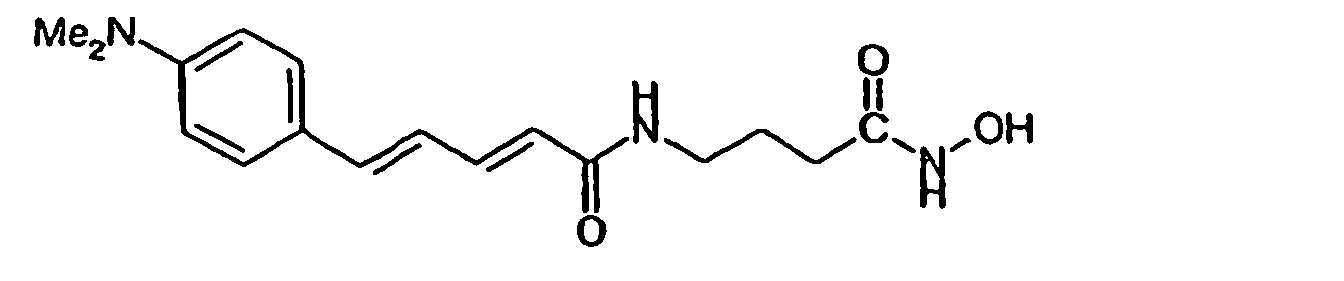
- This compound was prepared in a manner analagous to that used in Examples 9-11.
-

- This compound was prepared in a manner analagous to that used in Examples 9-11.
-

- This compound was prepared in a manner analagous to that used in Examples 9-11.
-

- The title compound was prepared from m-nitrocinnamic acid (Acros) as described in Bellamy et al., 1984.
-

- A solution of phenylacryloylchloride (0.47g, 2.85 mmol) (Acros) in tetrahydrofuran (10.0 ml) was added to a mixture of m-aminophenylacrylic acid methyl ester (7) (0.44 g, 2.50 mmol) in tetrahydrofuran (15.0 ml) and NaHCO3 (0.37g, 4.50 mmol) in water (8.0 ml), and the resultant solution was stirred at room temperature for one hour. The reaction mixture was evaporated and the residue was partitioned between ethyl acetate and 2N HCl. The organic layer was washed successively with water, saturated NaCl, and dried (Na2SO4). The solvent was removed and the residue was chromatographed on silica gel with petroleum ether-ethyl acetate (2:1, v/v) as eluent. The obtained product was washed with diethyl ether to give the title compound (0.54 g, 70 %).1H NMR (DMSO-d6, HMDSO), δ: 3.72 (3H, s); 6.52 (1H, d, J=16.0 Hz); 6.83 (1 H, d, J=16.0 Hz); 7.29-7.85 (10H, m); 7.98 (1H, br s); 10.32 (1H, br s).
-

- To a suspension of hydroxylamine hydrochloride (0.14 g, 2.01 mmol) (Acros) in methanol (2.0 ml) a solution of NaOH (0.16g, 4.00 mmol) in H2O (0.2 ml) was added and the resultant mixture was stirred at ambient temperature for 5 min. To the reaction mixture a 3-[3-(3-phenylacryloylamino)-phenyl)-acrylic acid methyl ester (8) (0.15g, 0.49 mmol) solution in methanol (2.0 ml) was added and stirred at ambient temperature for 1.5 hour. The reaction mixture was partitioned between ethyl acetate and 2N HCl. The organic layer was washed successively with water and saturated NaCl, and the solvent was removed. The residue was crystallized from ethyl acetate-methanol giving pure title compound (0.040 g, 26%), m.p. 178°C.1H NMR (DMSO-d6, HMDSO), δ: 6.45 (d, 1H, J=16.0 Hz); 6.85 (d, 1H, J=16.0 Hz); 7.14-7.76 (m, 10 H); 8.00 (br s, 1H); 9.03 (br s, 1H); 10.32 (br s, 1H); 10.83 (br s, 1H). HPLC analysis on Zorbax SB-C18 column: impurities 4.5% (column size 4.6x150 mm; mobile phase acetonitrile - 0.1 % H3PO4, gradient from 30 to 100%; sample concentration 0.25 mg/ml; flow rate 1.5 ml/min; detector: UV 270 nm). Anal. Calcd for C18H16N2O3 x 0.25 H2O, %: C 69.11, H 5.32, N 8.95. Found, %: C 69.09, H 5.06, N 8.81.
-

- The title compound was prepared from 6-aminocaproic acid (Acros) as described in Chen et al., 1978 and Backer et al., 1940.
-

- The title compound was prepared from 2-azacyclooctanone (Acros) as described in Chen et al., 1978 and Backer et al., 1940.
-

- The title compound was prepared from 2-azacyclononanone (Acros) as described in Chen et al., 1978 and Backer et al., 1940.
-

- The title compound was synthesized by the procedures described in the literature (Villieras et al., 1983; Vig et al., 1977; Banerji et al., 1984), from o-nitrocinnamaldehyde (Acros).
-

- To a solution of (2E,4E)-5-(2-nitrophenyl)penta-2,4-dienoic acid (9a) (0.44 g, 2.0 mmol) in dry tetrahydrofuran (10 ml) 1,1'-carbonyldiimidazole (0.36 g, 2.2 mmol) (Sigma-Aldrich) was added and the mixture was stirred for 1 hour at ambient temperature. To the reaction mixture triethylamine (0.30 g 3.0 mmol) and methyl 6-aminohexanoate hydrochloride (10) (0.40 g, 2.2 mmol) successively were added and the resultant suspension was stirred for 6 hour at ambient temperature. The solvent was evaporated, to the obtained residue water (15 ml) was added and the precipitate was filtered off. The precipitate was washed with an additional amount of water and dried to give the title compound (0.62 g, 89%) as a yellow solid, m.p. 115-117°C. 1H NMR (DMSO-d6, HMDSO), δ: 1.10-1.79 (6H, m, CH2); 2.29 (2H, J=7.0 Hz, CH2); 3.17 (2H, q, J=5.6 Hz, CH2N); 3.60 (3H, s); 6.24 (1H, d, J=14.8 Hz, CH); 7.04-8.10 (8H, m, CH-CH=CH, C6H4, NH).
-

- A solution of sodium methylate (6.0 mmol) in methanol (5 ml) was added to a solution of hydroxylamine hydrochloride (0.28 g, 4.0 mmol) (Acros) in methanol (8 ml). The mixture was stirred for 10 min. and the precipitate was filtered off. (2E,4E)-6-[5-(2-Nitrophenyl)penta-2,4-dienoylamino]hexanoic acid methyl ester (13a) (0.35 g, 1 mmol) was added to the filtrate and the obtained mixture was heated to the complete dissolving. The resultant mixture was stirred for 4 hours at ambient temperature and the solvent was removed under reduced pressure. The product was dissolved in water (10 ml) and the solution was acidified with 3% HCl. The precipitate was filtered and crystallized from acetonitrile to give the title compound (0.23 g, 66%) as a yellow solid. M.p. 131-133°C. 1H NMR (DMSO-d6, HMDSO), δ: 1.06-1.73 (6H, m, CH2); 1.87-2.09 (2H, m, CH2); 3.15 (2H, q, J=5.6 Hz, CH2N); 6.26 (1H, d, J=14.8 Hz, CH); 7.00-8.06 (8H, m, CH-CH=CH, C6H4, NH); 8.06 (1H, t, J=5.9 Hz, NH); 10.33 (1H, s, OH). HPLC analysis on Symmetry C18 column: impurities <1.0% (column size 3.9 x 150 mm; mobile phase acetonitrile - 0.1 M phosphate buffer (pH 2.5), 35:65; detector UV 220 nm; sample concentration 0.15 mg/ml). Anal. Calcd for C17H21N3O5, %: 58.78, H 6.09, N 12.10. Found, %: C 58.26, H 6.08, N 11.87.
-

- The title compound was synthesized by the procedures described in the literature (Villieras et al., 1983; Vig et al., 1977; Banerji et al., 1984), from α-methyl-trans-cinnamaldehyde (Sigma-Aldrich).
-

- The title compound was obtained from (2E,4E)-4-methyl-5-phenyl-2,4-pentadienoic acid (9b) and methyl 6-aminohexanoate hydrochloride (10), in the same manner as described above in Example 24. Yield 49%, m.p. 53-55°C.1H NMR (DMSO-d6, HMDSO), δ: 1.01-1.69 (6H, m, CH2); 1.98 (3H, s, CH3); 2.29 (2H, t, J=7.5 Hz, CH2); 2.92-3.22 (2H, m, CH2N);3.58 (3H, s, CH3); 6.12 (1H, d, J=14.8 Hz, CH); 6.85 (1H, s, CH); 7.07-7.49 (6H, m, CH, C6H5); 7.98 (1H, unresolv. t, NH).
-

- The title compound was obtained from (2E,4E)-6-(4-methyl-5-phenylpenta-2,4-dienoylamino)-hexanoic acid methyl ester (13b) in the same manner as described above in Example 25. Yield 74%, m.p. 129-131°C. 1H NMR (DMSO-d6, HMDSO), δ: 1.05-1.69 (6H, m, CH2); 1.82-2.06 (2H, m, CH2); 1.98 (3H, s, CH3); 3.12 (2H, q, J=5.7 Hz, CH2N); 6.12 (1 H, d, J=14.9 Hz, CH); 6.83 (1H, s, CH); 7.21 (1H, d, J=14.9 Hz, CH); 7.34 (5H, s, C6H5); 7.94 (1H, t, J=5.8 Hz, NH); 8.61 (1H, s, NH), 10.29 (1H, s, OH). HPLC analysis on Symmetry C18 column: impurities 1.8% (column size 3.9 x 150 mm; mobile phase acetonitrile - 0.1 M phosphate buffer (pH 2.5), 35:65; detector UV 220 nm; sample concentration 0.5 mg/ml). Anal. Calcd for C18H24N2O3 x H2O, %: C 64.65, H 7.84, N 8.38. Found, %: C 64.65, H 7.82, N 8.28.
-

- The title compound was synthesized by the procedures described in the literature (Villieras et al., 1983; Vig et al., 1977; Banerji et al., 1984), from 4-nitrocinnamaldehyde (Lancaster).
-

- The title compound was obtained from (2E,4E)-5-(4-nitrophenyl)-2,4-pentadienoic acid (9c) and methyl 6-aminohexanoate hydrochloride (10), in the same manner as described above in Example 24. Yield 82%, m.p. 178-180°C. 1H NMR (DMSO-d6, HMDSO), δ: 0.99-1.69 (6H, m, CH2); 2.19 (2H, t, J=6.8 Hz, CH2); 2.89-3.23 (2H, m, CH2N); 3.61 (3H, s, CH3O); 6.27 (1H, d, J=15.0 Hz, CH); 6.89-7.54 (3H, m, CH-CH=CH); 7.85 (2H, d, J=8.4 Hz, C6H2); 8.21 (2H, d, J=8.4 Hz, C5H2); 8.23 (1H, t, NH, overlapped with C6H2).
-

- The title compound was obtained from (2E,4E)-6-[5-(4-nitrophenyl)penta-2,4-dienoylamino]hexanoic acid methyl ester (13c) in the same manner as described above in Example 25. Yield 44%, m.p. 111-113°C. 1H NMR (DMSO-d6, HMDSO), δ: 0.99-1.69 (6H, m, CH2); 1.76-2.29 (2H, m, CH2); 2.91-3.29 (2H, m, CH2N); 6.24 (1H, d, J=15.0 Hz, CH); 6.84-7.42 (4H, m, CH-CH=CH, NH); 7.80 (2H, d, J=8.4 Hz, C6H2); 8.20 (2H, d, J=8.4 Hz, C6H2); 8.13 (1H, t, NH, overlapped with C6H2); 10.34 (1H, s, OH). HPLC analysis on Symmetry C18 column: impurities 1.0% (column size 3.9 x 150 mm; mobile phase acetonitrile - 0.1 M phosphate buffer (pH 2.5), 30:70; detector UV 220 nm; sample concentration 0.15 mg/ml). Anal. Calcd for C17H21 N3O5, %: C 58.78, H 6.09, N 12.10. Found, %: C 58.38, H 6.16, N 12.15.
-

- The title compound was obtained from (E)-3-(1,3-benzodioxol-5-yl)-2-propenoic acid (9d) (Acros) and methyl 6-aminohexanoate hydrochloride (10), in the same manner as described above in Example 24. Yield 70%, m.p. 73-75°C. 1H NMR (DMSO-d6, HMDSO), δ: 0.95-1.70 (6H, m, CH2); 1.96 (2H, t, J=7.5 Hz, CH2); 3.14 (2H, q, J=5.7 Hz, CH2N); 3.60 (3H, s, CH3O); 6.05 (2H, s, CH2); 6.45 (1 H, d, J=15.0 Hz, CH); 6.72-7.18 (3H, s, C6H3); 7.34 (1H, d, J=15.0 Hz, CH); 7.94 (1H, unresolv. t, NH); 8.65 (1 H, s, NH), 10.32 (1H, s, OH).
-

- The title compound was obtained from (E)-6-(3-benzo[1,3]dioxol-5-yl-acryloylamino)hexanoic acid methyl ester (13d), in the same manner as described above in Example 25. Yield 67%, m.p. 191-193°C. 1H NMR (DMSO-d6, HMDSO), δ:1.00-1.72 (6H, m, CH2); 1.81-2.05 (2H, unresolv. t, CH2); 3.14 (2H, q, J=5.7 Hz, CH2N); 6.05 (2H, s, CH2); 6.45 (1H, d, J=15.0 Hz, CH); 6.72-7.18 (3H, s, C6H3); 7.34 (1H, d, J=15.0 Hz, CH); 7.94 (1H, unresolv. t, NH); 8.65 (1H, s, NH), 10.32 (1H, s, OH). HPLC analysis on Symmetry C18 column: impurities 1.0% (column size 3.9 x 150 mm; mobile phase acetonitrile - 0.1 M phosphate buffer (pH 2.5), 35:65; detector UV 220 nm; sample concentration 0.25 mg/ml). Anal. Calcd for C16H20N2O5, %: C 59.99, H 6.29, N 8.74. Found, %: C 59.87, H 6.29, N 8.60.
-

- The title compound was synthesized by the procedures described in the literature (Villieras et al., 1983; Vig et al., 1977; Banerji et al., 1984), from 4-biphenylcarboxaldehyde (Acros).
-

- The title compound was obtained from (2E,4E)-5-[1,1'-biphenyl]-4-yl-2,4-pentadienoic acid (9e) and methyl 6-aminohexanoate hydrochloride (10), in the same manner as described above in Example 24. Yield 81%, m.p. 168-170°C. 1H NMR (DMSO-d6, HMDSO), δ:0.93-1.76 (6H, m, CH2); 2.11-2.42 (2H, m, CH2); 2.91-3.36 (2H, m, CH2N); 3.56 (3H, s, CH3O); 6.20 (1H, d, J=15.0 Hz, CH); 6.87-7.25 (2H, m, CH-CH); 7.24-7.91 (10H, m, C6H5-C6H4, CH); 8.05 (1H, unresolv. t, NH).
-

- The title compound was obtained from (2E,4E)-6-(5-biphenyl-4-yl-penta-2,4-dienoylamino)-hexanoic acid methyl ester (9e) in the same manner as described above in Example 25. Yield 91%, m.p. 222-224°C. 1H NMR (DMSO-d6, HMDSO), δ:0.96-1.72 (6H, m, CH2); 1.78-2.09 (2H, m, CH2); 2.94-3.34 (2H, m, CH2N); 6.18 (1 H, d, J=14.8 Hz, CH); 6.82-7.21 (2H, m, CH-CH); 7.21-7.87 (10H, m, C6H5-C6H4, CH); 8.05 (1 H, unresolv. t, NH); 8.67 (1 H, s, NH), 10.36 (1H, s, OH). HPLC analysis on Symmetry C18 column: impurities 3.0% (column size 3.9 x 150 mm; mobile phase acetonitrile - 0.1 M phosphate buffer (pH 2.5), 50:50; detector UV 254 nm; sample concentration 0.07 mg/ml). Anal. Calcd for C23H26N2O3 x 0.5H2O, %: C 71.30, H 7.02, N 7.23. Found, %: C 71.08, H 6.73, N 6.94.
-

- The title compound was synthesized from 4-chlorobenzaldehyde (Acros) as described in Carbonnier et al., 1981.
-

- The title compound was obtained from (2Z,4E)-5-(4-chlorophenyl)-2,4-pentadienoic acid (9f) and methyl 6-aminohexanoate hydrochloride (10), in the same manner as described above in Example 24. Yield 62%, m.p. 83-85°C. 1H NMR (DMSO-d6, HMDSO), δ: 1.05-1.74 (6H, m, CH2); 2.29 (2H, t, J=7.5 Hz, CH2); 3.12 (2H, q, J=6.0 Hz, CH2N); 3.58 (3H, s, CH3O); 5.78 (1H, d, J=11.2 Hz, CH); 6.58 (1H, t, J=11.2 Hz, CH); 6.74 (1H, d, J=15.8 Hz, CH); 7.27-7.60 (4H, m, C6H4); 8.07 (1H, unresolv. t, NH); 8.29 (1H, dd, J=11.2 Hz, and 15.8 Hz, CH).
-

- The title compound was obtained from (2Z,4E)-6-[5-(4-chloro-phenyl)-penta-2,4-dienoylamino]-hexanoic acid methyl ester (13f) in the same manner as described above in Example 25. Yield 56%, m.p. 158-160°C. 1H NMR (DMSO-d6, HMDSO), δ: 0.92-1.69 (6H, m, CH2); 1.74-2.09 (2H, m, CH2); 2.82-3.36 (2H, m, CH2N); 5.78 (1H, d, J=11.0 Hz, CH); 6.56 (1H, t, J=11.0 Hz, CH); 6.76 (1H, d, J=15.8 Hz, CH); 7.12-7.63 (4H, m, C6H4); 8.07 (1 H, unresolv. t, NH); 8.26 (1 H, dd, J=11.0 Hz, and 15.8 Hz, CH); 8.63 (1 H, s, NH), 10.29 (1 H, s, OH). HPLC analysis on Symmetry C18 column: impurities 3.0% (column size 3.9 x 150 mm; mobile phase acetonitrile - 0.1M phosphate buffer (pH 2.5), 40:60; detector UV 230 nm; sample concentration 0.33 mg/ml). Anal. Calcd for C17H21ClN2O3, %: C 60.62, H 6.28, N 8.32. Found, %: C 60.33, H 6.26, N 8.03.
-

- The title compound was synthesized from 4-chlorobenzaldehyde (Acros) by the procedures described in the literature (Villieras et al., 1983; Vig et al., 1977; Banerji et al., 1984).
-

- The title compound was obtained from (2E,4E)-5-(4-chlorophenyl)-2,4-pentadienoic acid (9g) and methyl 6-aminohexanoate hydrochloride (10), in the same manner as described above in Example 24. Yield 64%, m.p. 148-150°C. 1H NMR (DMSO-d6, HMDSO), δ: 1.01-1.70 (6H, m, CH2); 2.27 (2H, t, J=7.5 Hz, CH2); 3.14 (2H, q, J=6.0 Hz, CH2N); 3.57 (3H, s, CH3O); 6.12 (1H, d, J=14.8 Hz, CH); 6.78-7.27 (3H, m, CH=CH-CH); 7.41 (2H, d, J=8.0 Hz, C6H2); 7.58 (2H, d, J=8.0 Hz, C6H2); 8.05 (1H, unresolv. t, NH).
-

- The title compound was obtained from (2E,4E)-6-[5-(4-chlorophenyl)penta-2,4-dienoylamino]hexanoic acid methyl ester (13g) in the same manner as described above in Example 25. Yield 90%, m.p. 164-168°C. 1H NMR (DMSO-d6, HMDSO), δ: 0.98-1.67 (6H, m, CH2); 1.94 (2H, t, J=7.0 Hz, CH2); 2.94-3.50 (2H, m, CH2N); 6.16 (1 H, d, J=14.8 Hz, CH); 6.83-7.22 (3H, m, CH=CH-CH); 7.36 (2H, d, J=8.0 Hz, C6H2); 7.58 (2H, d, J=8.0 Hz, C6H2); 8.05 (1 H, unresolv. t, NH); 8.63 (1 H, s, NH), 10.29 (1 H, s, OH). HPLC analysis on Symmetry C18 column: impurities <1.0% (column size 3.9 x 150 mm; mobile phase acetonitrile - 0.1 M phosphate buffer (pH 2.5), 30:70; detector UV 230 nm; sample concentration 1.0 mg/ml). Anal. Calcd for C17H21ClN2O3, %: C 60.62, H 6.28, N 8.32. Found, %: C 60.20, H 6.25, N 8.00.
-

- The title compound was synthesized by the procedures described in the literature (Villieras et al., 1983; Vig et al., 1977; Banerji et al., 1984), from cinnamaldehyde (Acros)
-

- The title compound was obtained from (2E,4E)-5-phenyl-2,4-pentadienoic acid (9h) and methyl 6-aminooctanoate hydrochloride (12), in the same manner as described above in Example 24. Yield 43%, m.p. 98-100°C. 1H NMR (DMSO-d6, HMDSO), δ:1.05-1.65 (10H, m, CH2); 2.27 (2H, t, J=7.0 Hz, CH2); 3.14 (2H, q, J=5.4 Hz, CH2N); 3.59 (3H, s, CH3O); 6.16 (1 H, d, J=15.0 Hz, CH); 6.90-7.19 (2H, m, CH=CH); 7.24-7.70 (6H, m, C6H5,CH); 8.04 (1 H, unresolv. t, NH).
-

- The title compound was obtained from (2E,4E)-8-(5-phenylpenta-2,4-dienoylamino)octanoic acid methyl ester (13h) in the same manner as described above in Example 25. Yield 60%, m.p. 160-162°C. 1H NMR (DMSO-d6, HMDSO), δ: 1.07-1.67 (10H, m, CH2); 1.94 (2H, t, J=7.0 Hz, CH2); 3.14 (2H, q, J=5.4 Hz, CH2N); 6.14 (1H, d, J=14.8 Hz, CH); 6.92-7.16 (2H, m, CH=CH); 7.23-7.67 (6H, m, C6H5, CH); 8.03 (1H, unresolv. t, NH); 8.63 (1H, s, NH), 10.32 (1H, s, OH). HPLC analysis on Zorbax SB-C18 column: impurities 3.0% (column size 4.6 x 150 mm; mobile phase gradient 10 min. 50-100% acetonitrile - 0.1% H3PO4; detector UV 270 nm; sample concentration 0.3 mg/ml). Anal. Calcd for C19H26N2O3, %: C 69.06, H 7.93, N 8.48. Found, %: C 68.81, H 7.97, N 8.36.
-

- The title compound was obtained from (2E,4E)-5-phenyl-2,4-pentadienoic acid (9h) and methyl 6-aminoheptanoate hydrochloride (11), in the same manner as described above in Example 24. Yield 46%, m.p. 104-106°C. 1H NMR (DMSO-d6, HMDSO), δ: 0.76-1.70 (8H, m, CH2); 2.29 (2H, t, J=7.0 Hz, CH2); 3.16 (2H, q, J=5.4 Hz, CH2N); 3.57 (3H, s, CH3O); 6.16 (1 H, d, J=15.1 Hz, CH); 6.70-7.23 (2H, m, CH-CH); 7.23-7.67 (6H, m, C6H5, CH); 8.04 (1 H, unresolv. t, NH).
-

- The title compound was obtained from (2E,4E)-7-(5-phenylpenta-2,4-dienoylamino)heptanoic acid methyl ester (13i) in the same manner as described above in Example 25. Yield 45%, m.p. 147-149°C. 1H NMR (DMSO-d6, HMDSO), δ: 0.72-1.72 (8H, m, CH2); 1.94 (2H, t, J=7.5 Hz, CH2); 3.14 (2H, q, J=6.0 Hz, CH2N); 6.14 (1 H, d, J=15.0 Hz, CH); 6.72-7.21 (2H, m, CH-CH); 7.21-7.65 (6H, m, C6H5, CH); 8.01 (1 H, unresolv. t, NH); 8.65 (1 H, s, NH), 10.32 (1 H, s, OH). HPLC analysis on Zorbax SB-C18 column: impurities 1.5% (column size 4.6 x 150 mm; mobile phase gradient 10 min. 30-100% acetonitrile - 0.1 % H3PO4; detector UV 270 nm; sample concentration 0.25 mg/ml). Anal. Calcd for C18H24N2O3, %: C 68.33, H 7.65, N 8.85. Found, %: C 68.36, H 7.74, N 8.74.
-

- The title compound was synthesized from cinnamaldehyde (Acros) by the procedures described in the literature (Villieras et al., 1983; Vig et al., 1977; Banerji et al., 1984).
-

- The title compound was obtained from (2E,4E)-2-methyl-5-phenyl-2,4-pentadienoic acid (9j) and methyl 6-aminohexanoate hydrochloride (10), in the same manner as described above in Example 24. Yield 94%, m.p. 68-70°C. 1H NMR (DMSO-d6, HMDSO), δ:1.02-1.77 (6H, m, CH2); 2.29 (3H, s, CH3); 1.98 (2H, t, J=7.0 Hz, CH2); 3.12 (2H, q, J=5.8 Hz, CH2N); 3.58 (3H, s, CH3O); 6.67-7.11 (3H, m, CH=CH-CH); 7.14-7.47 (3H, m, C6H3); 7.49-7.69 (2H, m, C6H2); 7.78 (1 H, t, J=5.5 Hz, NH).
-

- The title compound was prepared from (2E,4E)-6-(2-methyl-5-phenylpenta-2,4-dienoylamino)hexanoic acid methyl ester (13j) in the same manner as described above in Example 25. Yield 48%, m.p. 158-160°C. 1H NMR (DMSO-d6, HMDSO), δ:1.03-1.76 (6H, m, CH2); 1.82-2.06 (2H, m, CH2); 1.98 (3H, s, CH3); 3.13 (2H, q, J=5.8 Hz, CH2N); 6.67-7.09 (3H, m, CH=CH-CH); 7.09-7.41 (3H, m, C6H3); 7.41-7.63 (2H, m, C6H2); 7.76 (1H, t, J=5.5 Hz, NH); 8.56 (1H, s, NH), 10.27 (1H, s, OH). HPLC analysis on Symmetry C18 column: impurities <1.0% (column size 3.9 x 150 mm; mobile phase acetonitrile - 0.1M phosphate buffer (pH 2.5), 35:65; detector UV 230 nm; sample concentration 0.25 mg/ml). Anal. Calcd for C18H24N2O3, %: C 68.33, H 7.65, N 8.85. Found, %: C 68.32, H 7.63, N 8.87.
-

- The title compound was synthesized by the procedures described in the literature (Villieras et al., 1983; Vig et al., 1977; Banerji et al., 1984), from 4-methoxycinnamaldehyde (Lancaster).
-

- The title compound was obtained from (2E,4E)-5-(4-methoxyphenyl)-2,4-pentadienoic acid (9k) and methyl 6-aminohexanoate hydrochloride (10), in the same manner as described above in Example 24. Yield 87%, m.p. 129-131°C. 1H NMR (DMSO-d6, HMDSO), δ:1.11-1.79 (6H, m, CH2); 2.27 (2H, t, J=7.0 Hz, CH2); 3.13 (2H, q, J=5.8 Hz, CH2N); 3.57 (3H, s, CH3O); 3.75 (3H, s, CH3O); 6.05 (1H, d, J=15.0 Hz, CH); 6.78-7.39 (3H, m, CH=CH-CH); 6.97 (2H, d, J=8.4 Hz, C6H2); 7.54 (2H, d, J=8.4 Hz, C6H2); 7.96 (1H, unresolv. t, NH).
-

- The title compound was obtained from (2E,4E)-6-[5-(4-methoxyphenyl)penta-2,4-dienoylamino]hexanoic acid methyl ester (13k) in the same manner as described above in Example 25. Yield 73%, m.p. 152-154°C. 1H NMR (DMSO-d6, HMDSO), δ:1.01-1.69 (6H, m, CH2); 1.82-2.06 (2H, m, CH2); 3.13 (2H, q, J=5.8 Hz, CH2N); 3.76 (3H, s, CH3); 6.05 (1 H, d, J=15.0 Hz, CH); 6.76-7.36 (3H, m, CH=CH-CH); 6.94 (2H, d, J=8.4 Hz, C6H2); 7.52 (2H, d, J=8.4 Hz, C6H2); 7.98 (1 H, unresolv. t, NH); 8.65 (1 H, s, NH), 10.32 (1 H, s, OH). HPLC analysis on Symmetry C18 column: impurities <1.0% (column size 3.9 x 150 mm; mobile phase acetonitrile-0.1 M phosphate buffer (pH 2.5), 35:65; detector UV 230 nm; sample concentration 0.33 mg/ml). Anal. Calcd for C18H24N2O4, %: C 65.04, H 7.28, N 8.43. Found, %: C 64.90, H 7.28, N 8.37.
-

- The title compound was synthesized by the procedures described in the literature (Villieras et al., 1983; Vig et al., 1977; Banerji et al., 1984), from phenylpropargyl aldehyde (Sigma-Aldrich).
-

- The title compound was obtained from (E)-5-phenyl-2-penten-4-ynoic acid (9l) and methyl 6-aminohexanoate hydrochloride (10), in the same manner as described above in Example 24. Yield 53%, m.p. 87-89°C.1H NMR (DMSO-d6, HMDSO), δ:1.05-1.70 (6H, m, CH2); 2.29 (2H, t, J=7.0 Hz, CH2); 3.13 (2H, q, J=5.8 Hz, CH2N); 3.55 (3H, s, CH3O); 6.48 (1H, d, J=15.8 Hz, CH); 6.75 (1H, d, J=15.8 Hz, CH); 7.44 (5H, s, C6H5); 8.17 (1H, unresolv. t, NH).
-

- The title compound was obtained from (E)-6-(5-phenyl-pent-2-en-4-ynoylamino)-hexanoic acid methyl ester (13l) in the same manner as described above in Example 25. Yield 81%, m.p. 146-148°C. 1H NMR (DMSO-d6, HMDSO), δ:1.03-1.72 (6H, m, CH2); 1.94 (2H, t, J=7.5 Hz, CH2); 3.13 (2H, q, J=5.8 Hz, CH2N); 6.47 (1 H, d, J=15.8 Hz, CH); 6.76 (1 H, d, J=15.8 Hz, CH); 7.45 (5H, s, C6H5); 8.16 (1H, unresolv. t, NH); 8.65 (1H, s, NH), 10.27 (1 H, s, OH). HPLC analysis on Zorbax SB-C18 column: impurities 1.5% (column size 4.6 x 150 mm; mobile phase gradient 10 min. 30-100% acetonitrile - 0.1 % H2PO4; detector UV 270 nm; sample concentration 1.0 mg/ml). Anal. Calcd for C17H20N2O3, %: C 67.98, H 6.71, N 9.33. Found, %: C 67.83, H 6.71, N 9.16.
-

- The title compound was prepared from benzaldehyde (Acros) and ethyl crotonate (Acros) as described by Anghelova et al., 1973.
-

- The title compound was obtained from (2E,4E)-3-methyl-5-phenyl-2,4-pentadienoic acid (9m) and methyl 6-aminohexanoate hydrochloride (10), in the same manner as described above in Example 24. Yield 90%, m.p. 83-85°C. 1H NMR (DMSO-d6, HMDSO), δ: 1.01-1.78 (6H, m, CH2); 2.28 (2H, t, J=7.0 Hz, CH2); 2.29 (3H, s, CH3); 3.09 (2H, q, J=6.0 Hz, CH2N); 3.55 (3H, s, CH3O); 5.94 (1H, s, CH); 6.88 (2H, s, CH=CH); 7.21-7.67 (5H, m, C6H5); 7.96 (1H, unresolv. t, NH).
-

- The title compound was prepared from (2E,4E)-6-(3-methyl-5-phenyl-penta-2,4-dienoylamino)-hexanoic acid methyl ester (13m) in the same manner as described above in Example 25. Yield 60%, m.p. 147-149°C. 1H NMR (DMSO-d6, HMDSO), δ: 1.01-1.74 (6H, m, CH2); 1.94 (2H, t, J=6.0 Hz, CH2); 2.29 (3H, s, CH3); 3.09 (2H, q, J=6.0 Hz, CH2N); 5.94 (1H, s, CH); 6.89 (2H, s, CH=CH); 7.14-7.69 (5H, m, C6H5); 7.96 (1 H, unresolv. t, NH); 8.67 (1H, s, NH), 10.29 (1H, s, OH). HPLC analysis on Symmetry C18 column: impurities 1.0% (column size 3.9 x 150 mm; mobile phase acetonitrile - 0.1 M phosphate buffer (pH 2.5), 45:55; detector UV 270 nm; sample concentration 0.22 mg/ml). Anal. Calcd for C18H24N2O3, %: C 68.33, H 7.65, N 8.85. Found, %: C 68.32, H 7.58, N 8.89.
-

- The title compound was synthesized by the procedures described in the literature (Villieras et al., 1983; Vig et al., 1977; Banerji et al., 1984), from 4-dimethylaminocinnamaldehyde (Acros).
-

- The title compound was obtained from (2E,4E)-5-[4-(dimethylamino)phenyl]-2,4-pentadienoic acid (9n) and methyl 6-aminohexanoate hydrochloride (10), in the same manner as described above in Example 24. Yield 88%, m.p. 118-120°C. 1H NMR (DMSO-d6, HMDSO), δ:0.97-1.64 (6H, m, CH2); 2.28 (2H, t, J=7.0 Hz, CH2); 2.94 (6H, s, CH3); 3.13 (2H, q, J=6.0 Hz, CH2N); 3.57 (3H, s, CH3O); 5.98 (1H, d, J=15.0 Hz, CH); 6.63-7.26 (3H, m, CH=CH-CH); 6.74 (2H, d, J=8.8 Hz, C6H2); 7.43 (2H, d, J=8.8 Hz, C6H2); 7.89 (1H, unresolv. t, NH).
-

- The title compound was obtained from (2E,4E)-6-[5-(4-dimethylaminophenyl)penta-2,4-dienoylamino]-hexanoic acid methyl ester (13n) in the same manner as described above in Example 25. Yield 64%, m.p. 172-174°C.1H NMR (DMSO-d6, HMDSO), δ: 0.94-1.61 (6H, m, CH2); 1.83-2.07 (2H, m, CH2); 2.94 (6H, s, CH3); 3.12 (2H, q, J=6.0 Hz, CH2N); 5.96 (1 H, d, J=15.0 Hz, CH); 6.61-7.25 (3H, m, CH=CH-CH); 6.72 (2H, d, J=8.8 Hz, C6H2); 7.41 (2H, d, J=8.8 Hz, C6H2); 7.87 (1 H, unresolv. t, NH); 8.61 (1 H, s, NH), 10.29 (1 H, s, OH). HPLC analysis on Symmetry C18 column: impurities 2.6% (column size 3.9 x 150 mm; mobile phase acetonitrile - 0.1M phosphate buffer (pH 2.5), 25:75; detector UV 270 nm; sample concentration 0.12 mg/ml). Anal. Calcd for C19H27N3O3, %: C 66.06, H 7.88, N 12.16. Found, %: C 65.78, H 7.94, N 12.06.
-

- The title compound was obtained from (E)-3-phenyl-2-propenoic acid (9p) (Sigma-Aldrich (Dorset, UK)) and methyl 6-aminohexanoate hydrochloride (10), in the same manner as described above in Example 24, as a white solid, yield 42%. 1H NMR (CDCl3, HMDSO), δ: 1.11-1.86 (6H, m, CH2); 2.32 (2H, t, J=6.5 Hz, CH2); 3.38 (2H, q, J=5.8 Hz, CH2N); 3.65 (3H, s, CH3); 5.68 (1H, br s, NH); 6.37 (2H, d, J=15.6 Hz, CH); 7.13-7.61 (5H, m, C6H5); 7.59 (2H, d, J=15.6 Hz).
-

- The title compound was obtained from methyl 6-{[(E)-3-phenyl-2-propenoyl]amino}hexanoate (13p) in the same manner as described above in Example 25. Yield 60%, m.p. 154-155°C. 1H NMR (DMSO-d6, HMDSO), δ:1.05-1.74 (6H, m); 1.94 (2H, t, J=6.4 Hz); 3.16 (2H, m); 6.61 (1H, d, J=15.9 Hz); 7.16-7.66 (6H, m); 8.06 (1H, t, J=5.3 Hz, NH); 8.63 (1H, s); 10.32 (1H, s). HPLC analysis on Zorbax SB-C18 column: impurities 4 % (column size 4.6 x 150 mm; mobile phase acetonitrile - 0.1 % H3PO4, gradient from 30:70 to 100:0; detector UV 270 nm; sample concentration 0.2 mg/ml; flow rate 1.0 ml/min). Anal. Calcd for C15H22N2O3, %: C 65.20, H 7.30, N 10.14. Found, %: C 64.93, H 7.33, N 10.21.
-

- The title compound was synthesized by the procedures described in the literature (Villieras et al., 1983; Vig et al., 1977; Banerji et al., 1984), from 4-pyridinecarboxaldehyde (Acros).
-

- The title compound was obtained from (E)-3-(4-pyridinyl)-2-propenoic acid (9q) and methyl 6-aminohexanoate hydrochloride (10) in the same manner as described above in Example 24. The product was purified on silica gel, mobile phase - acetonitrile - water, 10:1, yield 34%, m.p. 92-94°C. 1H NMR (DMSO-d6, HMDSO), δ:1.09-1.76 (6H, m, CH2); 2.28 (2H, t, J=7.5 Hz, CH2); 3.16 (2H, q, J=6.0 Hz, CH2N); 3.57 (3H, s, CH3O); 6.81 (1H, d, J=16.0 Hz, CH); 7.41 (1H, d, J=16.0 Hz, CH); 7.52 (2H, d, J=6.0 Hz, C5H2N); 8.23 (1H, unresolv. t, NH); 8.61 (2H, d, J=6.0 Hz, C5H2N).
-

- The title compound was obtained from (E)-6-(3-pyridin-4-yl-acryloylamino)hexanoic acid methyl ester (13q), in the same manner as described above in Example 25, and dissolved in ethanol. To the solution a solution of oxalic acid (2 equivalents) (Sigma-Aldrich) was added. The precipitate was filtered and crystallized from methanol. Yield 50%, m.p. 168-170°C. 1H NMR (DMSO-d6, HMDSO), δ: 1.09-1.69 (6H, m, CH2); 1.94 (2H, t, J=7.5 Hz, CH2); 3.16 (2H, q, J=6.0 Hz, CH2N); 6.81 (1H, d, J=16.0 Hz, CH); 7.38 (1H, d, J=16.0 Hz, CH); 7.51 (2H, d, J=6.0 Hz, C5H2N); 8.19 (1H, unresolv. t, NH); 8.57 (2H, d, J=6.0 Hz, C5H2N); 10.21 (1 H, s, OH). HPLC analysis on Symmetry C18 column: impurities 2.7% (column size 3.9 x 150 mm; mobile phase acetonitrile - 0.1M phosphate buffer (pH 2.5), 6.5:93.5; detector UV 270 nm; sample concentration 0.5 mg/ml). Anal. Calcd for C14H19N3O3 x (COOH)2 x 0.25H2O, %: C 51.68, H 5.83, N 11.30. Found, %: C 51.44, H 5.62, N 11.23.
-

- The title compound was synthesized by the procedures described in the literature (Villieras et al., 1983; Vig et al., 1977; Banerji et al., 1984), from 2-pyridinecarboxaldehyde (Acros).
-

- The title compound was obtained from (E)-3-(2-pyridinyl)-2-propenoic acid (9r) and methyl 6-aminohexanoate hydrochloride (10) in the same manner as described above in Example 24, as an oil, yield 45%.1H NMR (DMSO-d6, HMDSO), δ:1.02-1.72 (6H, m, CH2); 2.28 (2H, t, J=7.0 Hz, CH2); 3.16 (2H, q, J=6.0 Hz, CH2N); 3.56 (3H, s, CH3O); 6.89 (1H, d, J=15.2 Hz, CH); 7.21-7.42 (1H, m, C5HN); 7.38 (1H, d, J=15.2 Hz, CH); 7.49 (1H, dt, J=1.9 Hz and J=7.5 Hz, C5HN); 7.76-7.99 (1H, m, C5HN); 8.23 (1H, t, J=5.6 Hz, NH); 8.50-8.74 (1H, m, C5HN).
-

- The title compound was obtained from (E)-6-(3-pyridin-2-yl-acryloylamino)hexanoic acid methyl ester (13r), in the same manner as described above in Example 25 and Example 70. Yield 46%, m.p. 126-128°C. 1H NMR (DMSO-d6, HMDSO), δ: 1.15-1.65 (6H, m, CH2); 1.94 (2H, t, J=7.2 Hz, CH2); 3.16 (2H, q, J=6.0 Hz, CH2N); 7.08 (1H, d, J=15.4 Hz, CH); 7.32 (1H, dd, J=4.8 Hz and J=6.8 Hz, C5HN); 7.42 (1H, d, J=15.4 Hz, CH); 7.56 (1H, d, J=7.8 Hz, C5HN); 7.83 (1H, dt, J=1.8 Hz and J=7.8 Hz, C5HN); 8.28 (1H, t, J=5.5 Hz, NH); 8.60 (1H, d, J=4.8 Hz, C5HN); 10.35 (1H, s, OH). HPLC analysis on Symmetry C18 column: impurities 1.8% (column size 3.9 x 150 mm; mobile phase acetonitrile - 0.1 M phosphate buffer (pH 2.5), 8:92; detector UV 254 nm; sample concentration 0.5 mg/ml). Anal. Calcd for C14H19N3O3 x (COOH)2 x 0.5H2O, %: C 51.06, H 5.89, N 11.16. Found, %: C 50.95, H 5.76, N 11.34.
-

- To a solution of 3-furyl-2-acrylic acid (0.389 g, 2.81 mmol) (Acros) in dimethylformamide (3 ml) at ice bath temperature carbonyldiimidazole (0.490 g, 3.02 mmol) was added. The mixture was stirred for 30 min, then successively triethylamine (1.0 ml, 7.17 mmol) and a solution of methyl 6-aminocaproate hydrochloride (0.500 g, 2.75 mmol) in dimethylformamide (3 ml) were added. The reaction mixture was stirred for 0.5 h at ice bath temperature, then the cooling bath was removed and the stirring was continued for 20 h at room temperature. The reaction mixture was diluted with brine (50 ml) and extracted with ethyl acetate (3 x 25 ml). The organic phase was washed successively with brine, 5% NaHCO3, brine, saturated KH2PO4, brine, and dried (Na2SO4). The solvent was evaporated and the residue (0.526 g) was chromatographed on silica gel (20 g) with hexane-ethyl acetate (1.5:8.5) as eluent affording pure title compound (0.423 g, 57%). 1H-NMR (CDCl3, HMDSO), δ: 1.22-1.79 (m, 6H); 2.24 (t, J=7.0 Hz, 2H); 3.17-3.44 (m, 2H); 5.51 (br s, 1H); 6.19 (d, J=16.0 Hz, 1H); 6.44 (dd, J=3.6 and 1.8 Hz, 1H); 6.53 (d, J=3.6 Hz, 1H); 7.37 (d, J=16.0 Hz, 1H); 7.43 (d, J=1.8 Hz, 1 H).
-

- To a solution of 6-{[(E)-3-(2-furyl)-2-propenoyl]amino} hexanoate (0.200 g, 0.75 mmol) in methanol (2 ml) a solution of hydroxylamine hydrochloride (0.210 g, 3.02 mmol) in methanol (3 ml) and NaOH (242 mg, 6.04 mmol) in H2O (1 ml) were added. The mixture was stirred for 30 min at room temperature and acidified with 1 N HCl to pH 3 of the reaction medium. The mixture was extracted with ethyl acetate (3 x 25 ml), the organic phase was washed with brine and dried (Na2SO4). The solvent was evaporated and the residue (0.172 g) was crystallized from acetonitrile (5 ml) to give the title compound (0.117 g, 58%). M.p. 151-152.5°C. 1H-NMR (DMSO-d6, HMDSO), δ: 1.15-1.62 (m, 6H); 1.94 (t, J=7.2 Hz, 2H); 3.14-3.22 (m, 2H); 6.40 (d, J=15.5 Hz, 1H); 6.57 (dd, J=1.6 and 3.2 Hz, 1H); 6.74 (d, J=3.2 Hz, 1H); 7.21 (d, J=15.5 Hz, 1 H); 7.75 (s, 1H); 8.11 (t, J=5.6 Hz, 1H); 8.67 (d, J=1.6 Hz, 1H); 10.34 (s, 1H). HPLC analysis on Zorbax SB-C18 column: impurities 1 % (column size 4.6 x 150 mm; mobile phase acetonitrile + 0.1 % H3PO4, gradient from 25 to 100%; detector UV 270 nm; sample concentration 1.0 mg/ml; flow rate 1.5 m/min). Anal. Calcd for C13H18N2O4, %: C 58.64, H 6.81, N 10.52. Found, %: C 58.64, H 6.
-

- (Method G2) To a suspension of 3-benzo[1,3]dioxol-5-yl-acrylic acid (1a) (0.38 g, 1.98 mmol) in dichloromethane (8.0 ml) oxalyl chloride (0.62 ml, 7.08 mmol) and one drop of dimethylformamide were added. The reaction mixture was stirred at 40°C for one hour and concentrated under reduced pressure to give crude title compound (0.41 g, 98%).
-

- (Method G3) A solution of 3-benzo[1,3]dioxol-5-yl-acryloyl chloride (2a) (0.41g,1.95 mmol) in tetrahydrofuran (8.0 ml) was added to a mixture of m-aminophenylacrylic acid methyl ester (0.35 g, 1.97 mmol) in tetrahydrofuran (12.0 ml) and NaHCO3 (0.25g, 3.00 mmol) in water (7.0 ml), and the resultant solution was stirred at room temperature for one hour. The reaction mixture was evaporated and the residue was partitioned between ethyl acetate and 2N HCl. The organic layer was washed successively with water, saturated NaCl, and dried (Na2SO4). The solvent was removed and the residue was chromatographed on silica gel with dichlormethane-methanol (40:1, v/v) as eluent. The obtained product was washed with diethyl ether to give the title compound (0.50 g, 71 %). 1H NMR (DMSO-d6" HMDSO), δ: 3.73 (3H, s); 6.09 (2H, s); 6.49 (1 H, d, J=16.0 Hz); 6.67 (1 H, d, J=16.0 Hz); 6.89-7.83 (8H, m).; 7.98 (1 H, br s); 10.23 ppm (1 H, br s)
-

- (Method G4) 1 N NaOH solution (2.56 ml, 2.56 mmol) was added to a solution of 3-[3-[[(E)-3-(1,3-benzodioxol-5-yl)-1-oxo-2-propenyl]amino]phenyl]-(E)-2-propenoic acid methyl ester (3a) (0.30g, 0.85 mmol) in tetrahydrofuran (4.0 ml), and the resultant mixture was stirred at ambient temperature overnight. The reaction mixture was partitioned between ethyl acetate and water. The aqueous layer was acidified with 2N HCl solution and extracted with ethyl acetate. The organic layer was washed successively with water, saturated NaCl, and dried (Na2SO4). The solvent was removed and the residue was washed with diethyl ether. The title compound was obtained as a white solid (0.24 g, 84%). 1H NMR (DMSO-d6,, HMDSO), δ: 6.09 (2H, s); 6.43 (1 H, d, J=16.0 Hz); 6.60 (1 H, d, J=16.0 Hz); 6.89-7.76 (8H, m).; 7.92 (1 H, br s); 10.16 (1H, brs); 12.38 ppm (1H, brs).
-

- (Method G5) To a solution of 3-[3-[[(E)-3-(1,3-benzodioxol-5-yl)-1-oxo-2-propenyl]amino]phenyl]-(E)-2-propenoic acid (4a) (0.24 g, 0.71 mmol) in tetrahydrofuran (5.0 ml) at 0°C temperature iso-butylchloroformate (0.1 ml ,0.80 mmol) and triethylamine (0.12ml, 0.88 mmol) were added, and the mixture was stirred for 15 min. To a solution of KOH (0.084g, 1.43 mmol) in methanol (0.40ml) at 0°C hydroxylamine hydrochloride (0.10g, 1.43 mmol) in methanol (1.0ml) was added and the reaction mixture was stirred for 15 min. The precipitated KCI was removed and the filtrate was added to the first solution. The reaction mixture was stirred at room temperature for 1 hour and then the mixture was partitioned between 1 N KH2PO4 and ethyl acetate. The organic layer was washed with water, saturated NaCl, and dried (Na2SO4). The solvent was evaporated and the residue was washed with hot ethyl acetate and hot methanol affording pure title compound (0.13 g, 52%). M.p. 128°C. 1H NMR (DMSO-d6, HMDSO) δ: 6.49 (d, 1H, J=16.0 Hz); 6.67 (d, 1H, J= 16.0 Hz); 6.87-7.76 (m, 8 H); 7.98 (br s, 1 H); 9.03 (br s, 1H); 10.18 (br s, 1H); 10.80 (br s, 1H). HPLC analysis on Symmetry C18 column: impurities 3.2 % (column size 3.9x150 mm; mobile phase acetonitrile - 0.1 M phosphate buffer (pH 2.5), 50:50; sample concentration 0.5 mg/ml; flow rate 1.0 ml/min; detector UV 254 nm). Anal. Calcd for C19H16N2O5 * H2O, %: C 61.62, H 4.90, N 7.56. Found, %: C 61.93, H 5.03, N 7.24.
-

- Using an analogous method (G2), the title compound was obtained from 5-phenyl-(2E,4E)-pentadienoic acid (1 b) and oxalyl chloride, ca. yield of the crude product 100% (yellow oil).
-

- Using an analogous method (G3), the title compound was obtained from 5-phenyl-(2E,4E)-pentadienoyl chloride (2b) and 3-(3-aminophenyl)acrylic acid methyl ester as a white solid, yield 67%. 1H NMR (DMSO-d6, HMDSO), δ: 3.74 (3H, s); 6.35 (1H, d, J=15.0 Hz); 6.53 (1H, d, J=16.0 Hz); 7.00-7.15 (2H, m); 7.28-7.73 (10H, m); 7.95 (1H, s); 10.24 (1H, s).
-

- Using an analogous method (G4), the title compound was obtained from 3-[3-[[(2E,4E)-1-oxo-5-phenyl-2,4-pentadienyl]amino]phenyl]-(2E)-propenoic acid methyl ester (3b) and sodium hydroxide, ca. yield of a crude product 87%. 1H NMR (DMSO-d6, HMDSO), δ: 6.35 (1H, d, J=15.4 Hz); 6.44 (1H, d, J=16.0 Hz); 7.02 (1H, m); 7.30-7.55 (8H, m); 7.58-7.80 (2H, m); 7.96 (1H, s); 10.22 (1H, s), 12.48 (1H, br s).
-

- Using an analogous method (G5), the title compound was obtained from 3-[3-[[(2E,4E)-1-oxo-5-phenyl-2,4-pentadienyl]amino]phenyl]-(2E)-propenoic acid (4b), isobutylchloroformate, and hydroxylamine hydrochloride, yield 27%. M.p. 192°C (dec.). 1H NMR (DMSO-d6, HMDSO) δ: 6.38 (d, 1H, J=14.6 Hz); 6.45 (d, 1H, J=15.2 Hz); 6.99-7.19 (m, 2H); 7.20-7.52 (m, 7H); 7.55-7.68 (m, 3H); 8.01 (s, 1H); 9.09 (s, 1 H); 10.28 (s, 1H); 10.84 (s, 1H). HPLC analysis on Zorbax SB-C18 column: impurities 8 % (the presence of other Z,E-isomers in minor quantities is possible) (column size 4.6 x 150 mm; mobile phase methanol - 0.1 % H3PO4, gradient from 50:50 to 90:10; detector UV 270 nm; flow rate 1.5 ml/min; sample concentration 0.15 mg/ml). Anal. Calcd for C20H18N2O3 * 0.25 EtOAc, %: C 70.77, H 5.66, N 7.86. Found, %: C 70.77, H 5.59, N 7.65.
-

- Using an analogous method (G2), the title compound was obtained from 5-phenyl-4-methyl-(2E,4E)-pentadienoic acid (1c) and oxalyl chloride, ca. yield of the crude product 100% (yellow oil).
-

- Using an analogous method (G3), the title compound was obtained from 5-phenyl-4-methyl-(2E,4E)-pentadienoyl chloride (2c) and 3-(3-aminophenyl)acrylic acid methyl ester as a white solid, yield 58%.
-

- Using an analogous method (G4), the title compound was obtained from 3-[3-[[(2E,4E)-4-methyl-1-oxo-5-phenyl-2,4-pentadienyl]amino]phenyl]-(2E)-propenoic acid methyl ester (3c) and sodium hydroxide, ca. yield of a crude product 79%.
-

- Using an analogous method (G5), the title compound was obtained from 3-[3-[[(2E,4E)-4-methyl-1-oxo-5-phenyl-2,4-pentadienyl]amino]phenyl]-(2E)-propenoic acid (4c), isobutylchloroformate, and hydroxylamine hydrochloride, yield 45%. M.p. 145-148°C. 1H NMR (DMSO-d6, HMDSO) δ: 2.07 (s, 3H); 6.35 (d, 1H, J=15.5 Hz); 6.44 (d, 1H, J=15.7 Hz); 7.00 (s, 1H); 7.19-7.49 (m, 9H); 7.61 (d, 1H, J=8.2 Hz); 8.01 (s, 1H); 9.09 (s, 1H); 10.26 (s, 1H); 10.84 (s, 1H). HPLC analysis on Zorbax SB-C18 column: impurities 7.7 % (the presence of other Z,E-isomers in minor quantities is possible) (column size 4.6 x 150 mm; mobile phase acetonitrile - 0.1 M phosphate buffer (pH 2.5), 50:50; detector UV 270 nm; flow rate 1.25 ml/min; sample concentration 0.5 mg/ml). Anal. Calcd for C21H20N2O3 * 0.3 EtOAc, %: C 71.14, H 6.02, N 7.47. Found, %: C 70.91, H 5.93, N 7.42.
-

- (Method J1A) 1,1'-Carbonyldiimidazole (0.36 g, 2.2 mmol) was added to a solution of 5-phenyl-penta-2E,4E-dienoic acid (1/1) (0.35 g, 2 mmol) in dry tetrahydrofuran (10 ml) and the obtained mixture was stirred for 1 hour at ambient temperature. To the mixture triethylamine (0.30 g 3.0 mmol) and methyl 6-aminohexanoate hydrochloride (2c) (0.40 g, 2.2 mmol) were added and the resultant suspension was stirred for 6 hours at ambient temperature. The solvent was removed under reduced pressure, to the residue water (15 ml) was added and the precipitate was filtered off, washed with water and dried. The title compound (0.36 g, 60%) was obtained as a white solid. M. p. 125-127°C. 1H NMR (DMSO-d6, HMDSO), δ: 1.05-1.72 (6H, m, CH2); 2.29 (2H, t, J=7.3 Hz, CH2); 3.12 (2H, q, J=6.0 Hz, CH2N); 3.58 (3H, s, CH3); 6.12 (1H, d, J=14.8 Hz, CH); 6.91-7.16 (2H, m, CH-CH); 7.23-7.66 (6H, m, C6H5, CH); 8.05 (1H, t, J=5.8 Hz, NH).
-

- (Method J1B) A solution of sodium methylate (6 mmol) in methanol (5 ml) was added to a solution of hydroxylamine hydrochloride (0.28 g, 4 mmol) in methanol (8 ml). A mixture was stirred for 10 min. and the precipitate was filtered off. (2E)(4E)-6-(5-Phenylpenta-2,4-dienoylamino)hexanoic acid methyl ester (3/1) (0.30 g, 1 mmol) was added to the filtrate and the mixture was heated to the complete dissolving. The resultant mixture was stirred for 4 hours at ambient temperature and the solvent was removed under reduced pressure. The product was dissolved in water (10 ml) and acidified with 3% HCl. Precipitate was filtered off and crystallized from methanol. The title compound (0.23 g, 66%) was obtained as a white solid. M. p 160-161°C°C. 1H NMR (DMSO-d6, HMDSO), δ: 1.05-1.69 (6H, m, CH2); 1.81-2.07 (2H, m, CH2); 3.12 (2H, q, J=5.8 Hz, CH2N); 6.14 (1H, d, J=14.8 Hz, CH); 6.89-7.14 (2H, m, CH-CH); 7.23-7.65 (6H, m, C6H5, CH); 8.05 (1H, t, J=6.0 Hz, NH); 8.63 (1H, s, NH), 10.34 (1H, s, OH). HPLC analysis on Symmetry C18: impurities 1.0% (column size 3.9 x 150 mm; mobile phase acetonitrile - 0.1M phosphate buffer (pH 2.5), 30:70; detector UV 230 nm; sample concentration 0.1 mg/ml). Anal. Calcd for C17H22N2O3: C 65.68, H 6.61, N 10.21. Found: C 65.63, H 6.60, N 10.17.
-

- Using an analogous method (J1A), the title compound was obtained from 5-(4-chloro-phenyl)-penta-2E,4E-dienoic acid (1/3) and methyl 4-aminobutyrate hydrochloride (2a). Yield (66%), m.p. 140-142°C. 1H NMR (90 MHz, DMSO-d6) δ: 1.38-1.87 (2H, m, CH2); 2.25 (2H, t, J=7.0 Hz, CH2); 3.09 (2H, q, J=5.6 Hz, CH2); 3.55 (3H, s, CH3); 6.05 (1H, d, J=15.0 Hz, CH); 6.61-7.32 (3H, m, CH=CH-CH); 7.32 (2H, d, J=8.0 Hz, C6H2); 7.49 (2H, d, J=8.0 Hz, C6H2); 7.98 (1H, t, J=5.3 Hz, NH).
-

- Using an analogous method (J1B), the title compound was obtained. Yield 58%, m.p. 164-166'C. 1H NMR (90 MHz, DMSO-d6) δ: 1.41-1.85 (2H, m, CH2); 2.01 (2H, t, J=7.0 Hz, CH2); 3.61 (2H, q, J=5.6 Hz, CH2); 6.16 (1H, d, J=14.8 Hz, CH); 6.72-7.29 (3H, m, CH=CH-CH); 7.38 (2H, d, J=7.6 Hz, C6H2); 7.56 (2H, d, J=7.6 Hz, C6H2); 8.09 (1H, unresolv. t, NH); 8.69 (1H, br s, NH), 10.38 (1H, br s, OH). HPLC analysis on Symmetry C18: impurities <1% (column size 3.9 x 150 mm; mobile phase acetonitrile - 0.1 M phosphate buffer (pH 2.5), 25:75; detector UV 220 nm; sample concentration 0.33 mg/ml). Anal. Calcd for C15H17ClN2O3:C 58.35, H 5.55, N 9.07. Found: C 57.99, H 5.50, N 8.87.
-

- Using an analogous method (J1A), the title compound was obtained from 5-(4-bromo-phenyl)-penta-2E,4E-dienoic acid (1/4) and methyl 4-aminobutyrate hydrochloride (2a). Yield (56%), m.p. 149-151 °C. 1H NMR (90 MHz, DMSO-d6) δ: 1.40-1.86 (2H, m, CH2); 2.30 (2H, t, J=6.9 Hz, CH2); 3.27 (2H, q, J=5.9 Hz, CH2); ); 3.58 (3H, s, CH3); 6.12 (1H, d, J=15.0 Hz, CH); 6.70-7.41 (3H, m, CH=CH-CH); 7.57 (4H, s, C6H4); 8.10 (1H, t, J=5.0 Hz, NH).
-

- Using an analogous method (J1B), the title compound was obtained. Yield 63%, m.p. 173-175°C. 1H NMR (90 MHz, DMSO-d6) δ: 1.38-1.83 (2H, m, CH2); 1.98 (2H, t, J=7.0 Hz, CH2); 2.93-3.28 (2H, m, CH2); 6.14 (1H, d, J=14.9 Hz, CH); 6.72-7.38 (3H, m, CH=CH-CH); 7.54 (4H, s, C6H4); 8.07 (1H, unresolv. t, NH); 8.72 (1H, br s, NH), 10.18 (1H, br s, OH). HPLC analysis on Symmetry C18: impurities <1% (column size 3.9 x 150 mm; mobile phase acetonitrile - 0.1M phosphate buffer (pH 2.5), 40:60; detector UV 220 nm; sample concentration 0.5 mg/ml). Anal. Calcd for: C15H17BrN2O3: C 51.01, H 4.85, N 7.93. Found: C 50.87, H 4.83, N 7.83.
-

- Using an analogous method (J1A), the title compound was obtained from 5-(4-bromo-phenyl)-penta-2Z,4E-dienoic acid (1/5) and methyl 4-aminobutyrate hydrochloride (2a). Yield 56%, m.p. 74-76°C. 1H NMR (90 MHz, DMSO-d6) δ: 1.42-1.85 (2H, m, CH2); 2.15 (2H, t, J=6.8 Hz, CH2); 3.15 (2H, q, J=5.6 Hz, CH2); 3.56 (3H, s, CH3); 5.83 (1H, d, J=11.1 Hz, CH); 6.58 (1H, t, J=11.0 Hz, CH); 6.75 (1H, d, J=16.0 Hz, CH); 7.38 (2H, d, J=7.0 Hz, C6H2); 7.55 (2H, d, J=7.0 Hz, C6H2); 8.26 (1H, dd, J=11.0 Hz, and 16.0 Hz, CH); 8.12 (1H, t, J=5.2 Hz, NH).
-

- Using an analogous method (J1B), the title compound was obtained. Yield 79%, m.p. 172-174°C. 1H NMR (90 MHz, DMSO-d6) δ: 1.41-1.83 (2H, m, CH2); 1.98 (2H, t, J=7.0 Hz, CH2); 3.12 (2H, q, J=5.4 Hz, CH2); 5.78 (1H, d, J=11.2 Hz, CH); 6.56 (1H, t, J=11.0 Hz, CH); 6.72 (1H, d, J=15.8 Hz, CH); 7.36 (2H, d, J=7.0 Hz, C6H2); 7.54 (2H, d, J=7.0 Hz, C6H2); 8.24 (1H, dd, J=11.0 Hz, and 15.8 Hz, CH); 8.09 (1H, unresolv. t, NH); 8.65 (1H, br s, NH), 10.32 (1H, br s, OH). HPLC analysis on Symmetry C18: impurities 1.3 % (column size 3.9 x 150 mm; mobile phase acetonitrile - 0.1 M phosphate buffer (pH 2.5), 35:65; detector UV 220 nm; sample concentration 1.0 mg/ml). Anal. Calcd for C15H17BrN2O3: C 51.01, H 4.85, N 7.93. Found: C 50.91, H 4.74, N 7.84.
-

- Using an analogous method (J1A), the title compound was obtained from 5-phenyl-penta-2E,4E-dienoic acid (1/6) and methyl 5-aminopentanoate hydrochloride (2b). Yield 71%, m.p. 113-115°C.1H NMR (90 MHz, DMSO-d6): δ: 1.05-1.72 (6H, m, CH2); 2.29 (2H, t, J=7.1 Hz, CH2); 3.14 (2H, q, J=6.0 Hz, CH2N); 3.58 (3H, s, CH3); 6.11 (1H, d, J=15.0 Hz, CH); 6.61-7.74 (8H, m, C6H5CH=CH-CH); 8.07 (1H, t, J=5.2 Hz, NH).
-

- Using an analogous method (J1B), the title compound was obtained. Yield 77%, m.p. 168-170°C. 1H NMR (200 MHz, DMSO-d6) δ:1.01-1.72 (4H, m, CH2); 1.72-2.09 (2H, m, CH2); 2.94-3.36 (2H, m, CH2N); 6.12 (1H, d, J=14.8 Hz, CH); 6.61-7.74 (8H, m, C6H5CH=CH-CH); 8.05 (1H, unresolv. t, NH); 8.72 (1 H, s, NH), 10.29 (1H, s, OH). HPLC analysis on Symmetry C18: impurities 1.5 % (column size 3.9 x 150 mm; mobile phase acetonitrile - 0.1 M phosphate buffer (pH 2.5), 30:70; detector UV 254 nm; sample concentration 0.08 mg/ml). Anal. Calcd for C16H20N2O3: C 66.65, H 7.00, N 9.72. Found: C 67.15, H 7.18, N 9.33.
-

- Using an analogous method (J1A), the title compound was obtained from 3-naphthalen-2-yl-acrylic acid (1/10) and methyl 6-aminohexanoate hydrochloride (2c). Yield 94%, m.p.74-76°C. 1H NMR (90 MHz, DMSO-d6): δ: 1.10-1.78 (6H, m, CH2); 2.25 (2H, t, J=6.5 Hz, CH2); 3.21 (2H, q, J=5.6 Hz, CH2N); 3.58 (3H, s, CH3); 6.78 (1H, d, J=15.5 Hz, CH); 7.46-8.23 (9H, m, C10H7, CH, NH).
-

- Using an analogous method (J1B), the title compound was obtained. Yield 74%, m.p.161-163°C. 1H NMR (90 MHz, DMSO-d6): δ: 1.07-1.74 (6H, m, CH2); 1.81-2.14 (2H, unresolv. t, CH2); 3.03-3.41 (2H, m, CH2N); 6.74 (1 H, d, J=16.0 Hz, CH); 7.43-8.21 (9H, m, C10H7, CH, NH); 8.63 (1 H, s, NH), 10.32 (1 H, s, OH). HPLC analysis on Symmetry C18 column: impurities <1 % (column size 3.9 x 150 mm; mobile phase acetonitrile - 0.1 M phosphate buffer (pH 2.5), 35:65; detector UV 230 nm; sample concentration 0.125 mg/ml). Anal. Calcd for C19H22N2O5 * H2O: C 66.26, H 7.02, N 8.13. Found: C 66.51, H 7.11, N 8.01.
-

- Using an analogous method (J1A), the title compound was obtained from 5-naphthalen-1-yl-penta-2E,4E-dienoic acid (1/11) and methyl 6-aminohexanoate hydrochloride (2c). Yield 77%, m.p. 131-134°C. 1H NMR (90 MHz, DMSO-d6) δ: 1.01-1.78 (6H, m, CH2); 1.96 (2H, t, J=7.0 Hz, CH2); 3.18 (2H, q, J=5.6 Hz, CH2N); 3.57 (3H, s, CH3); 6.24 (1H, d, J=16.0 Hz, CH); 6.87-7.47 (2H, m, CH=CH); 7.47-7.71 (3H, m, C10H3); 7.71-8.18 (5H, m, C10H3, CH, NH); 8.18-8.45 (1 H, m, C10H).
-

- Using an analogous method (J1B), the title compound was obtained. Yield 71%, m.p. 143-145°C. 1H NMR (90 MHz, DMSO-d6) δ:1.01-1.78 (6H, m, CH2); 1.96 (2H, t, J=7.0 Hz, CH2); 3.18 (2H, q, J=5.6 Hz, CH2N); 6.24 (1 H, d, J=16.0 Hz, CH); 6.87-7.47 (2H, m, CH=CH); 7.47-7.71 (3H, m, C10H3); 7.71-8.18 (5H, m, C10H3, CH, NH); 8.18-8.45 (1H, m, C10H); 8.72 (1 H, s, NH), 10.31 (1 H, s, OH). HPLC analysis on Symmetry C18 column: impurities 2.5 % (column size 3.9 x 150 mm; mobile phase acetonitrile - 0.1 M phosphate buffer (pH 2.5), 35:65; detector UV 270 nm; sample concentration 0. 5 mg/ml). Anal. Calcd for C21H24N2O3: C 71.57, H 6.86, N 7.95. Found: C 71.38, H 6.91, N 7.98.
-

- Using an analogous method (J1A), the title compound was obtained from 3-[1-(4-chloro-phenyl)-1H-pyrrol-2-yl)-acrylic acid (1/12) and methyl 6-aminohexanoate hydrochloride (2c). Yield 81%, an oil. 1H NMR (90 MHz, DMSO-d6) δ: 1.02-1.72 (6H, m, CH2); 2.28 (2H, t, J=6.7 Hz, CH2); 3.14 (2H, q, J=5.6 Hz, CH2N); 3.57 (3H, s, CH3); 6.26-6.46 (1H, m, C4HN); 6.33 (1H, d, J=15.5 Hz, CH); 6.60-6.78 (1H, m, C4HN); 7.09 (1H, d, J=15.5 Hz, CH); 7.10-7.25 (1H, m, C4HN); 7.37 (2H, d, J=8.4 Hz, C6H2); 7.61 (2H, d, J=8.4 Hz, C6H2); 7.95 (1H, t, J=5.0 Hz, NH).
-

- Using an analogous method (J1B), the title compound was obtained. Yield 85%, m.p 167-169°C. 1H NMR (90 MHz, DMSO-d6) δ: 1.01-1.69 (6H, m, CH2); 1.78-2.07 (2H, m, CH2); 3.12 (2H, q, J=6.0 Hz, CH2N); 6.27-6.45 (1H, m, C4HN); 6.31 (1H, d, J=15.4 Hz, CH); 6.63-6.76 (1H, m, C4HN); 7.07 (1 H, d, J=15.4 Hz, CH); 7.08-7.23 (1H, m, C4HN); 7.36 (2H, d, J=8.4 Hz, C6H2); 7.63 (2H, d, J=8.4 Hz, C6H2); 7.93 (1 H, unresolv. t, NH); 8.65 (1 H, s, NH), 10.33 (1 H, s, OH). HPLC analysis on Symmetry C18 column: impurities 2.8 % (column size 3.9 x 150 mm; mobile phase acetonitrile - 0.1 M phosphate buffer (pH 2.5), 35:65; detector UV 230 nm; sample concentration 0. 4 mg/ml). Anal. Calcd for C19H22CIN3O3: C 60.72, H 5.90, N 11.18. Found: C 60.69, H 5.87, N 11.27.
-

- Using an analogous method (J1A), the title compound was obtained from 3-[5-(3,5-bis-trifluoromethyl-phenyl)-furan-2-yl]-acrylic acid (1/13) and methyl 6-aminohexanoate hydrochloride (2c). Yield 73%, white solid. 1H NMR (CDCl3, HMDSO), δ: 1.07-1.85 (6H, m, CH2); 2.33 (2H, t, J=6.6 Hz, CH2); 3.42 (2H, q, J=6.0 Hz, CH2N); 3.68 (3H, s, CH3); 5.82 (1H, br t, J=5.6 Hz, NH); 6.51 (1H, d, J=15.7 Hz, CH=); 6.62 (1H, d, J=3.4 Hz, CH=); 6.88 (1H, d, J=3.4 Hz, CH=); 7.46 (1H, d, J=15.7 Hz, CH=); 7.77 (1H, s, C6H); 8.08 (2H, s, C6H2).
-

- Using an analogous method (J1B), the title compound was obtained. Yield 61 %, m.p 186°C (dec.). 1H NMR (DMSO-d6, HMDSO) δ: 1.20-1.36 (m, 2H); 1.36-1.58 (M, 4H); 1.95 (t, 2H, J=7.6 Hz); 3.08-3.23 (m, 2H); 6.64 (d, 1H, J=15.7 Hz); 6.96 (d, 1H, J=3.4 Hz); 7.27 (d, 1H, J=15.7 Hz); 7.56 (d, 1H, J=3.4 Hz); 8.04 (s, 1 H); 8.21 (t, 1H, J=5.4 Hz); 8.37 (s, 2H); 8.66 (d, 1H, J=1.6 Hz); 10.34 (s, 1H). HPLC analysis on Symmetry C8 column: impurities <1 % (column size 3.9 x 150 mm; mobile phase acetonitrile - 0.1 M phosphate buffer (pH 2.5), 50:50; detector UV 230 nm; sample concentration 0.15 mg/ml). Anal. Calcd for C21H20F6N2O4: C 52.73, H 4.21, N 5.86. Found: C 52.75, H 4.11, N 5.82.
-

- Using an analogous method (J1A), the title compound was obtained from 3-phenyl-but-2E-enoic acid (1/14) and methyl 6-aminohexanoate hydrochloride (2c). Yield 51%, m.p. 131-133°C. 1H NMR (90 MHz, DMSO-d6): δ: 0.93-1.66 (6H, m, CH2); 2.29 (2H, t, J=6.5 Hz, CH2); 2.47 (3H, c, CH3, overlapped with DMSO); 3.09 (2H, q, J=5.5 Hz, CH2N); 6.18 (1 H, s, CH); 7.07-7.65 (5H, m, C6H5), 7.97 (1H, t, J=5.5, NH).
-

- Using an analogous method (J1B), the title compound was obtained. Yield 82%, m.p. 131-133°C. 1H NMR (90 MHz, DMSO-d6) δ: 0.83-1.69 (6H, m, CH2); 1.78-2.12 (2H, m, CH2); 2.47 (3H, c, CH3, overlapped with DMSO); 2.89-3.34 (2H, m, CH2N); 6.23 (1 H, s, CH); 7.05-7.62 (5H, m, C6H5); 7.97 (1H, unresolv. t, NH); 8.76 (1 H, br s, NH), 10.31 (1 H, br s, OH). HPLC analysis on Symmetry C18 column: impurities <1 % (column size 3.9 x 150 mm; mobile phase acetonitrile - 0.1M phosphate buffer (pH 2.5), 30:70; detector UV 270 nm; sample concentration 0.1 mg/ml). Anal. Calcd for C16H22N2O3: C 66.19, H 7.64, N 9.65. Found: C 66.19, H 7.66, N 9.68.
-

- Using an analogous method (J1A), the title compound was obtained from 3-(1-methyl-1H-pyrrol-2-yl)-acrylic acid (1/15) and methyl 6-aminohexanoate hydrochloride (2c). Yield 64%, an oil. 1H NMR (90 MHz, DMSO-d6) δ: 1.03-1.74 (6H, m, CH2); 2.29 (2H, t, J=6.5 Hz, CH2); 3.14 (2H, q, J=5.6 Hz, CH2N); 3.58 (3H, s, CH3); 3.65 (3H, s, CH3); 6.05 (1 H, dd, J=2.4 Hz, J=3.8 Hz, CH); 6.27 (1H, d, J=15.0 Hz, CH); 6.47 (1H, dd, J=1.8 Hz, J=3.8 Hz, CH); 6.87 (1H, t, J=2.0 Hz, CH); 7.32 (1H, d, J=15.0 Hz, CH); 7.87 (1H, t, J=5.0 Hz, NH).
-
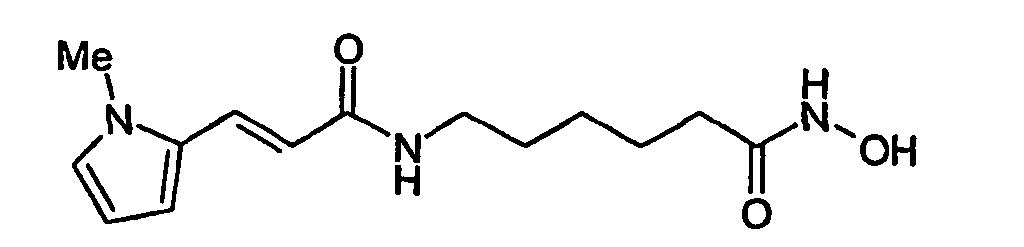
- Using an analogous method (J1B), the title compound was obtained. Yield 48%, m.p. 103-105°C. 1H NMR (90 MHz, DMSO-d6) δ: 1.05-1.72 (6H, m, CH2); 1.94 (2H, t, J=6.5 Hz, CH2); 3.14 (2H, q, J-5.7 Hz, CH2N); 3.66 (3H, s, CH3); 6.07 (1 H, dd, J=2.4 Hz, J=3.8 Hz, CH); 6.27 (1H, d, J=16.0 Hz, CH); 6.49 (1H, dd, J=1.8 Hz, J=3.8 Hz, CH); 6.89 (1H, t, J=2.0 Hz, CH); 7.16 (1H, d, J=16.0 Hz, CH); 7.89 (1H, t, J=5.0 Hz, NH); 8.65 (1H, s, NH), 10.34 (1H, s, OH). HPLC analysis on Symmetry C18 column: impurities 3 % (column size 3.9 x 150 mm; mobile phase acetonitrile - 0.1 M phosphate buffer (pH 2.5), 20:80; detector UV 220 nm; sample concentration 0.5 mg/ml). Anal. Calcd for C14H21N3O3: C 60.20, H 7.58, N 15.04. Found: C 60.07, H 7.54, N 15.20.
-

- Using an analogous method (J1A), the title compound was obtained from 4-phenyl-but-2E-enoic acid (1/16) and methyl 6-aminohexanoate hydrochloride (2c). Yield 49%, m.p. 49-51°C. 1H NMR (90 MHz, DMSO-d6) δ: 0.98-1.70 (6H, m, CH2); 2.25 (2H, t, J=6.7 Hz, CH2); 2.91-3.13 (4H, m, CH2); 3.57 (3H, s, CH3); 6.09-6.58 (2H, m, CH=CH); 7.03-7.75 (5H, m, C6H5); 7.85 (1 H, unresolv, t, NH).
-
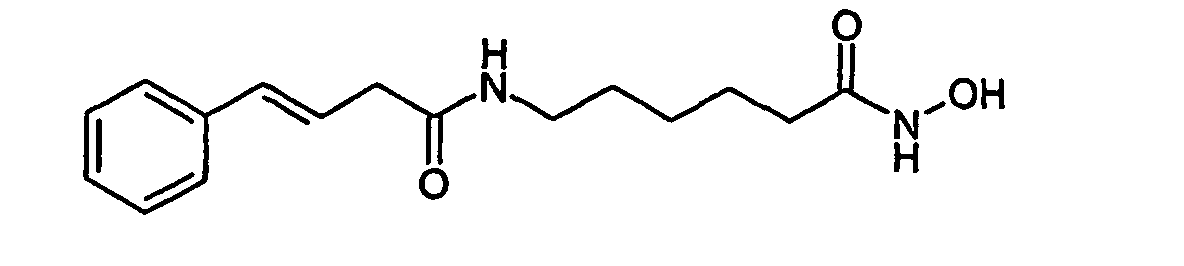
- Using an analogous method (J1B), the title compound was obtained. Yield 52%, m.p. 126-128°C. 1H NMR (90 MHz, DMSO-d6) δ:1.01-1.65 (6H, m, CH2); 1.92 (2H, t, J=6.8 Hz, CH2); 2.90-3.11 (4H, m, CH2); 6.12-6.63 (2H, m, CH=CH); 7.05-7.72 (5H, m, C6H5); 7.83 (1 H, unresolv. t, NH); 8.61 (1 H, br s, NH), 10.29 (1 H, br s, OH). HPLC analysis on Symmetry C18 column: impurities <1 % (column size 3.9 x 150 mm; mobile phase acetonitrile - 0.1 M phosphate buffer (pH 2.5), 35:65; detector UV 254 nm; sample concentration 0.8 mg/ml). Anal. Calcd for C16H22N2O3: C 66.19, H 7.64, N 9.65. Found: C 66.18, H 7.74, N 9.56.
-

- Using an analogous method (J1A), the title compound was obtained from 5-(2-chloro-phenyl)-penta-2E,4E-dienoic acid (1/17) and methyl 6-aminohexanoate hydrochloride (2c). Yield 61 %, m.p. 110-112°C. 1H NMR (90 MHz, DMSO-d6) δ: 1.10-1.70 (6H, m, CH2); 2.29 (2H, t, J=6.5 Hz, CH2); 3.16 (2H, q, J=5.7 Hz, CH2N); 3.56 (3H, s, CH3); 6.25 (1 H, d, J=15.7 Hz, CH); 7.03-7.64(6H, m, CH=CH-CH, C6H3); 7.72-7.96 (1H, m, C6H); 8.09 (1H, d, J=5.7 Hz, NH).
-

- Using an analogous method (J1B), the title compound was obtained. Yield 87%, m.p. 129-131°C. 1H NMR (90 MHz, DMSO-d6) δ: 1.05-1.67 (6H, m, CH2); 1.95 (2H, t, J=6.6 Hz, CH2); 3.14 (2H, q, J=5.8 Hz, CH2N); 6.22 (1H, d, J=15.8 Hz, CH); 7.01-7.61 (6H, m, CH=CH-CH, C6H3); 7.74-7.94 (1H, m, C6H); 8.07 (1H, d, J=5.5 Hz, NH); 8.61 (1 H, s, NH), 10.29 (1 H, s, OH). HPLC analysis on Symmetry C18 column: impurities 2.5 % (column size 3.9 x 150 mm; mobile phase acetonitrile - 0.1 M phosphate buffer (pH 2.5), 40:60; detector UV 270 nm; sample concentration 0.7 mg/ml). Anal. Calcd for C17H21ClN2O3: C 60.62, H 6.28, N 8.32. Found: C 60.37, H 6.22, N 8.07.
-

- Using an analogous method (J1A), the title compound was obtained from 3-(3-phenoxy-phenyl)-acrylic acid (1/18) and methyl 6-aminohexanoate hydrochloride (2c). Yield 84%, an oil. 1H NMR (90 MHz, DMSO-d6) δ: 1.01-1.71 (6H, m, CH2); 2.29 (2H, t, J=6.6 Hz, CH2); 3.18 (2H, q, J=5.7 Hz, CH2N); 3.59 (3H, s, CH3); 6.53 (1H, d, J=15.7 Hz, CH); 6.78-7.60 (10H, m, C6H5, CH); 8.01 (1H, t, J=5.2 Hz, NH).
-

- Using an analogous method (J1B), the title compound was obtained. Yield 45%, m.p. 113-115°C. 1H NMR (90 MHz, DMSO-d6) δ: 1.03-1.68 (6H, m, CH2); 1.93 (2H, t, J=6.5 Hz, CH2); 3.14 (2H, q, J=5.8 Hz, CH2N); 6.57 (1H, d, J=15.8 Hz, CH); 6.81-7.58 (10H, m, C6H5, CH); 8.04 (1H, t, J=5.3 Hz, NH); 8.79 (1H, s, NH), 10.33 (1H, s, OH). HPLC analysis on Symmetry C18 column: impurities 1.0 % (column size 3.9 x 150 mm; mobile phase acetonitrile - 0.1 M phosphate buffer (pH 2.5), 45:55; detector UV 230 nm; sample concentration 0.5 mg/ml). Anal. Calcd for C21H24N2O4: C 68.46, H 6.57, N 7.60. Found: C 68.28, H 6.57, N 7.60.
-

- Using an analogous method (J1A), the title compound was obtained from 3,3-diphenyl-acrylic acid (1/19) and methyl 6-aminohexanoate hydrochloride (2c). Yield 82%, an oil. 1H NMR (90 MHz, DMSO-d6) δ: 0.91-1.70 (6H, m, CH2); 2.30 (2H, t, J=6.9 Hz, CH2); 3.01 (2H, q, J=5.6 Hz, CH2N); 3.59 (3H, s, CH3); 6.45 (1H, s, CH); 7.03-7.50 (10H, m, C6H5); 7.80 (1H, t, J=5.0 Hz, NH).
-

- Using an analogous method (J1B), the title compound was obtained. Yield 63%, m.p. 123-125°C. 1H NMR (90 MHz, DMSO-d6) δ:0.90-1.63 (6H, m, CH2); 2.01 (2H, t, J=7.0 Hz, CH2); 2.97 (2H, q, J=5.5 Hz, CH2N); 6.43 (1H, s, CH); 7.01-7.47 (10H, m, C6H5); 7.78 (1H, t, J=5.0 Hz, NH); 8.63 (1H, s, NH), 10.32 (1H, s, OH). HPLC analysis on Symmetry C18 column: impurities 1.0 % (column size 3.9 x 150 mm; mobile phase acetonitrile - 0.1M phosphate buffer (pH 2.5), 30:70; detector UV 230 nm; sample concentration 0.5 mg/ml). Anal. Calcd for C21H24N2O3: C 71.57, H 6.86, N 7.95. Found: C 71.56, H 6.87, N 7.98.
-

- Using an analogous method (J1A), the title compound was obtained from 5,5-diphenyl-penta-2E,4-dienoic acid (1/20) and methyl 6-aminohexanoate hydrochloride (2c). Yield 84%, an oil. 1H NMR (90 MHz, DMSO-d6) δ: 1.00-1.61 (6H, m, CH2); 2.25 (2H, t, J=7.0 Hz, CH2); 3.06 (2H, q, J=5.8 Hz, CH2N); 3.59 (3H, s, CH3); 6.16-6.36 (1H, m, CH); 6.86-7.04 (2H, m, CH-CH); 7.11-7.60 (5H, m, C6H5); 8.03 (1 H, t, J=5.5 Hz, NH).
-

- Using an analogous method (J1B), the title compound was obtained. Yield 91%, m.p. 167-169°C. 1H NMR (90 MHz, DMSO-d6) δ: 1.02-1.58 (6H, m, CH2); 1.93 (2H, t, J=7.1 Hz, CH2); 3.06 (2H, q, J=5.8 Hz, CH2N); 6.15-6.35 (1H, m, CH); 6.88-7.02 (2H, m, CH-CH); 7.10-7.58 (5H, m, C6H5); 8.07 (1H, t, J=5.0 Hz, NH); 8.67 (1 H, s, NH), 10.34 (1 H, s, OH). HPLC analysis on Symmetry C18 column: impurities <1 % (column size 3.9 x 150 mm; mobile phase acetonitrile - 0.1M phosphate buffer (pH 2.5), 35:65; detector UV 254 nm; sample concentration 0.5 mg/ml). Anal. Calcd for C23H26N2O3: C 72.99, H 6.92, N 7.40. Found: C 72.64, H 6.89, N 7.32.
-

- Using an analogous method (J1A), the title compound was obtained from 2-methyl-5-phenyl-pent-2E-en-4-ynoic acid (1/21) and methyl 6-aminohexanoate hydrochloride (2c). Yield 62%, m.p. 62-64°C. 1H NMR (9C MHz, DMSO-d6) δ: 1.03-1.70 (6H, m, CH2); 2.26 (2H, t, J=6.6 Hz, CH2); 2.09 (3H, s, CH3); 3.14 (2H, q, J=5.6 Hz, CH2N); 3.56 (3H, s, CH3); 6.50 (1H, s, CH); 7.30-7.74 (5H, m, C6H5); 8.06 (1 H, t, J=5.0 Hz, NH).
-

- Using an analogous method (J1B), the title compound was obtained. Yield 85%, m.p. 135-137°C. 1H NMR (90 MHz, DMSO-d6) δ: 1.01-1.72 (6H, m, CH2); 1.96 (2H, t, J=6.5 Hz, CH2); 2.08 (3H, s, CH3); 3.15 (2H, q, J=5.5 Hz, CH2N); 6.49 (1 H, s, CH); 7.33-7.72 (5H, m, C6H5); 8.03 (1H, t, J=5.0 Hz, NH); 9.52 (2H, br s, NH, OH). HPLC analysis on Symmetry C18 column: impurities 1.4 % (column size 3.9 x 150 mm; mobile phase acetonitrile - 0.1 M phosphate buffer (pH 2.5), 35:65; detector UV 230 nm; sample concentration 0.3 mg/ml). Anal. Calcd for C18H22N2O3: C 68.77, H 7.05, N 8.91. Found: C 68.61, H 7.12, N 8.84.
-

- Using an analogous method (J1A), the title compound was obtained from 4,4-diphenyl-but-3-enoic acid (1/22) and methyl 6-aminohexanoate hydrochloride (2c). Yield 60%, an oil. 1H NMR (90 MHz, DMSO-d6) δ: 0.94-1.65 (6H, m, CH2); 2.25 (2H, t, J=6.9 Hz, CH2); 2.94 (2H, d, J=7.0 Hz, CH2); 3.04 (2H, q, J=6.0 Hz, CH2N); 3.58 (3H, s, CH3); 6.27 (1 H, t, J=7.0 Hz, CH); 6.94-7.69 (11H, m, C6H5, CH); 7.76 (1H, unresolv t, NH).
-

- Using an analogous method (J1B), the title compound was obtained. Yield 63%, m.p. 101-103°C. 1H NMR (90 MHz, DMSO-d6) δ: 0.94-1.65 (6H, m, CH2); 1.92 (2H, t, J=7.0 Hz, CH2); 2.72-3.16 (4H, m, CH2); 6.24 (1H, t, J=7.5 Hz, CH); 6.98-7.56 (11H, m, C6H5, CH); 7.79 (1 H, t, J=5.0 Hz, NH); 9.49 (1H, br s, NH, OH). HPLC analysis on Symmetry C18 column: impurities 1.0 % (column size 3.9 x 150 mm; mobile phase acetonitrile - 0.1 M phosphate buffer (pH 2.5), 35:65; detector UV 230 nm; sample concentration 0.5 mg/ml). Anal. Calcd for C22H26N2O3: C 71.57, H 6.86, N 7.95. Found: C 71.56, H 6.87, N 7.98.
-

- Using an analogous method (J1A), the title compound was obtained from 2-methyl-3-phenyl-but-2E-enoic acid (1/23) and methyl 6-aminohexanoate hydrochloride (2c). Yield 52%, m.p 104-106°C. 1H NMR (90 MHz, DMSO-d6) δ: 1.07-1.76 (6H, m, CH2); 1.72 (3H, q, J=1.0 Hz, CH3); 2.01 (3H, q, J=1.0 Hz, CH3); 2.34 (2H, t, J=6.8 Hz, CH2); 3.15 (2H, q, J=5.6 Hz CH2N); 3.63 (3H, s, CH3); 7.15-7.64 (5H, m, C6H5); 7.98 (1 H, t, J=5.0 Hz, NH).
-

- Using an analogous method (J1B), the title compound was obtained. Yield 71%, m.p 129-131°C. 1H NMR (90 MHz, DMSO-d6) δ: 1.07-1.69 (6H, m, CH2); 1.63 (3H, q, J=1.0 Hz, CH3); 1.78-2.05 (2H, m, CH2); 1.94 (3H, q, J=1.0 Hz, CH3); 3.13 (2H, q, J=5.5 Hz CH2N); 7.07-7.58 (5H, m, C6H5); 7.93 (1 H, t, J=5.5 Hz, NH); 8.61 (1H, s, NH), 10.31 (1 H, s, OH). HPLC analysis on Symmetry C18 column: impurities 1.5 % (column size 3.9 x 150 mm; mobile phase acetonitrile - 0.1M phosphate buffer (pH 2.5), 35:65; detector UV 254 nm; sample concentration 0.5 mg/ml). Anal. Calcd for C17H24N2O3: C 67.08, H 7.95, N 9.20. Found: C 66.74, H 7.98, N 9.20.
-

- Using an analogous method (J1A), the title compound was obtained from 2,4-dimethyl-5-phenyl-penta-2E,4E-dienoic acid (1/24) and methyl 6-aminohexanoate hydrochloride (2c). Yield 92%, m.p. 58-60°C. 1H NMR (90 MHz, DMSO-d6) δ: 1.05-1.74 (6H, m, CH2); 1.94-2.09 (6H, m, CH3); 2.29 (2H, t, J=6.6 Hz, CH2); 3.14 (2H, q, J=5.8 Hz CH2N); 3.61 (3H, s, CH3); 6.55 (1 H, s, CH); 6.77 (1 H, s, CH); 7.21-7.49 (5H, m, C6H5); 7.87 (1 H, t, J=5.2 Hz, NH).
-

- Using an analogous method (J1B), the title compound was obtained. Yield 86%, m.p. 120-122°C. 1H NMR (200 MHz, DMSO-d6) δ: 1.10-1.34 (2H, m, CH2); 1.34-1.58 (4H, m, CH2); 1.95 (2H, t, J=7.4 Hz, CH2); 2.00 (3H, s, CH3); 2.04 (3H, s, CH3); 3.11 (2H, q, J=6.1 Hz CH2N); 6.55 (1 H, s, CH); 6.77 (1 H, s, CH); 7.20-7.46 (5H, m, C6H5); 7.89 (1H, t, J=5.3 Hz, NH); 8.67 (1H, s, NH), 10.34 (1H, s, OH). HPLC analysis on Symmetry C18 column: impurities 1.5 % (column size 3.9 x 150 mm; mobile phase acetonitrile - 0.1 M phosphate buffer (pH 2.5), 50:50; detector UV 254 nm; sample concentration 0.5 mg/ml). Anal. Calcd for C19H26N2O3: C 69.06, H 7.93, N 8.48. Found C 68.63, H 7.91, N 8.58.
-

- Using an analogous method (J1A), the title compound was obtained from fluoren-9-ylidene-acetic acid (1/25) and methyl 6-aminohexanoate hydrochloride (2c). Yield 73%, m.p. 54-56°C.1H NMR (90 MHz, DMSO-d6) δ: 1.05-1.76 (6H, m, CH2); 2.28 (2H, t, J=7.3 Hz, CH2); 3.27 (2H, q, J=6.1 Hz, CH2); 3.59 (3H, s, CH3); 7.11 (1 H, s, CH); 7.22-7.59 (4H, m, C13H4); 7.64-7.95 (3H, m, C13H3); 8.51 (1 H, t, J=5.2 Hz, NH); 8.62-8.84 (1H, m, C13H).
-

- Using an analogous method (J1B), the title compound was obtained. Yield 84%, m.p. 174-176°C. 1H NMR (90 MHz, DMSO-d6) δ:1.02-1.74 (6H, m, CH2); 1.97 (2H, t, J=7.5 Hz, CH2); 3.25 (2H, q, J=6.0 Hz, CH2); 7.09 (1H, s, CH); 7.21-7.56 (4H, m, C13H4); 7.69-7.94 (3H, m, C13H3); 8.49 (1 H, t, J=5.0 Hz, NH); 8.59-8.81 (1 H, m, C13H); 8.65 (1 H, s, NH), 10.34 (1 H, s, OH). HPLC analysis on Symmetry C18 column: impurities 2.0 % (column size 3.9 x 150 mm; mobile phase acetonitrile - 0.1 M phosphate buffer (pH 2.5), 45:55; detector UV 254 nm; sample concentration 0.25 mg/ml). Anal. Calcd for C21H22N2O3: C 71.98, H 6.33, N 7.99. Found: C 71.91, H 6.37, N 8.03.
-

- Using an analogous method (J1A), the title compound was obtained from 3-pyridin-3-yl-acrylic acid (1/26) and methyl 6-aminohexanoate hydrochloride (2c). Yield 52%, m.p. 75-77°C. 1H NMR (90 MHz, DMSO-d6) δ: 1.01-1.78 (6H, m, CH2); 225 (2H, t, J=7.2 Hz, CH2); 3.16 (2H, q, J=6.0 Hz, CH2N); 3.57 (3H, s, CH3); 6.75 (1 H, d, J=16.0 Hz, CH); 7.49 (1 H, d, J=16.0 Hz, CH); 7.49 (1 H, dd, J=3.2 Hz and J=8.6 Hz, C5HN); 7.98 (1 H, dt, J=3.2 Hz and J=8.6 Hz, C5HN); 8.14 (1 H, t, J=5.3 Hz, NH); 8.56 (1 H, dd, J=1.6 Hz and J=4.4 Hz, C5HN); 8.76 (1 H, d, J=1.6 Hz, C5HN).
-

- A solution of sodium methylate (6 mmol) in methanol (5 ml) was added to a solution of hydroxylamine hydrochloride (0.28 g, 4 mmol) in methanol (8 ml). The mixture was stirred for 10 min, and NaCl was filtered off. 6-(E-3-Pyridin-3-yl-acryloylamino)hexanoic acid methyl ester (3/26) (0.28 g, 1 mmol) was added to the filtrate and the resultant mixture was stirred for 4 hours at ambient temperature. The solvent was removed under reduced pressure, product was dissolved in ethanol (10 ml), and then oxalic acid (0.36 g, 4 mmol) was added to the solution. The precipitate was filtered off and crystallized from water. The title compound (0.22 g, 68%) was obtained as a white solid. M. p. 157-159°C. 1H NMR (200 MHz, DMSO-d6) δ: 1.03-1.72 (6H, m, CH2); 1.96 (2H, t, J=7.2 Hz, CH2); 3.18 (2H, q, J=6.0 Hz, CH2N); 6.74 (1H, d, J=15.8 Hz, CH); 7.45 (1H, d, J=15.8 Hz, CH); 7.49 (1H, dd, J=3.0 Hz and J=8.5 Hz, C5HN); 7.98 (1H, dt, J=3.0 Hz and J=8.5 Hz, C5HN); 8.18 (1H, t, J=5.2 Hz, NH); 8.54 (1H, dd, J=1.6 Hz and J=4.4 Hz, C5HN); 8.75 (1H, d, J=1.6 Hz, C5HN); 10.34 (1H, s, OH). HPLC analysis on Zorbax SB-C18 column: impurities 2.0 % (column size 4.6 x 150 mm; mobile phase gradient 10 min 5-100% acetonitrile - 0.1 % H3PO4; detector UV 220 nm; sample concentration 1.0 mg/ml). Anal. Calcd for C14H19N3O3 * 0.5(COOH)2 * 2H2O: C 50.27, H 6.75, N 11.73. Found: C 50.28, H 6.71, N 11.60.
-

- Using an analogous method (J1A), the title compound was obtained was prepared from 5-phenyl-penta-2E,4E-dienoic acid (1/1) and methyl 6-N-methylaminohexanoate hydrochloride (2d) by the method of example 1. Yield 69%, oil. 1H NMR (90 MHz, DMSO-d6): δ:0.98-1.77 (6H, m, CH2); 2.29 (2H, t, J=6.5 Hz, CH2); 2.87 and 3.03 (3H, s,s, CH3); 3.38 (2H, unresolv. t, CH2N); 3.56 (3H, s, CH3); 6.78 (1H, d, J=15.5 Hz, CH); 6.85-7.75 (8H, m, C6H5, CH-CH=CH).
-

- Using an analogous method (J1B), the title compound was obtained was prepared from 6-{methyl-[(2E)(4E)-5-phenylpenta-2,4-dienoyl]amino}hexanoic acid methyl ester (3/27) by the method of example 1. Yield (40%), m.p. 145-147°C. 1H NMR (90 MHz, DMSO-d6): δ:0.96-1.74 (6H, m, CH2); 1.78-2.06 (2H, m, CH2); 2.89 and 3.05 (3H, s,s, CH3); 3.35 (2H, unresolv. t, CH2N); 6.64 (1H, d, J=14.5 Hz, CH); 6.83-7.72 (8H, m, C6H5, CH-CH=CH); 8.69 (1H, s, NH), 10.36 (1H, s, OH). HPLC analysis on Symmetry C18 column: impurities <1 % (column size 3.9 x 150 mm; mobile phase acetonitrile - 0.1 M phosphate buffer (pH 2.5), 35:65; detector UV 230 nm; sample concentration 0.25 mg/ml). Anal. Calcd for C18H24N2O3: C 68.33, H 7.65, N 8.85. Found C 68.15, H 7.67, N 8.88.
-

- Using an analogous method (J4A), the title compound was obtained from 3-(1H-indol-3-yl)-acrylic acid (1/40), yield 42%. 1H NMR (CDCl3, HMDSO), δ: 1.01 - 1.69(m, 6H); 2 27(t, J=7.0 Hz, partly overlapped with DMSO signal); 3.00-3.32(m, overlapped with H2O signal); 3.51 (s, 3H); 6.58(d, J=16.0 Hz, 1H); 6.00-7.45(m, 3H); 7.58(d, J=16.0 Hz, 1H); 7.69-7.94(m. 3H); 10.47(s, 1H).
-

- Using an analogous method (J4B), the title compound was obtained from 6-(3-1H-indol-3-yl-acryloylamino)-hexanoic acid methyl ester (3/40), yield 32%, m.p. 92-94°C. 1H NMR (DMSO-d6, HMDSO), δ: 1.20-1.62(m, 6H); 1.95(t, J=7.0 Hz, 2H); 3.16(q. J=6.0 Hz, 2H); 6.60(d, J=15.8 Hz, 1H); 7.10-7.24(m, 2H); 7.39-7.50(m. 1H); 7.58(d, J=15.8 Hz, 1H); 7.73(d, J=2.6 Hz, 1H); 7.80-7.94(m, 2H); 8.66(d, J=1.6 Hz, 1H); 10.34(s, 1H); 11.52(s, 1H). HPLC analysis on Symmetry C8 column: impurities 3.4 % (column size 3.9 x 150 mm; mobile phase 25% acetonitrile - 75% 0.1 M phosphate buffer (pH 2.5); detector UV 220 nm; sample concentration 0.25 mg/ml; flow rate 1.3 ml/min). Anal. Calcd for C17H21N3O3 * H2O: C 61.25, H 6.95, N 12.60. Found: C 61.49, H 6.84, N 13.04.
-

- Using an analogous method (J4A), the title compound was obtained from 3-thiophen-2-yl-acrylic acid (1/42), yield 63%. 1H NMR (CDCl3, HMDSO), δ: 1.16-1.75(m, 6H); 2.31 (t, J=7.0 Hz, 2H); 3.37(q, J=6.0 Hz, 2H); 3.65(s, 3H); 5.92(br s, 1 H); 6.42(d, J=16.0 Hz, 1 ); 7.10(dd, J=4 and 2.0 Hz, 1 ); 7.38(d, J=4.0 Hz, 1 ); 7.58(d, J=2.0 Hz, 1H); 7.81 (d, J=16.0 Hz, 1 ).
-

- Using an analogous method (J4B), the title compound was obtained from 6-(3-thiophen-2-yl-acryloylamino)-hexanoic acid methyl ester (3/42), yield 73%, m.p. 151-153°C. 1H NMR (DMSO-d6, HMDSO), δ: 1.16-1.60(m, 6H); 1.94(t. J=7.2 Hz, 2H); 3.13(q, J=5.8 Hz, 2H); 6.37(d, J=15.6 Hz, 1H); 7.09(dd, J=5.2 and 3.5 Hz, 1H); 7.35(d, J=3.5 Hz, 1H); 7.54(d, J=15.6 Hz, 1H); 7.58(d, J=5.2 Hz, 1H); 8.08(t, J=5.6 Hz, 1H); 8.67(s, 1H); 10.34(s, 1H). HPLC analysis on Symmetry C8 column: impurities 4 % (column size 3.9 x 150 mm; mobile phase 30% acetonitrile - 70% 0.1 M phosphate buffer (pH 2.5); detector UV 270 nm; sample concentration 0.5 mg/ml; flow rate 1.0 ml/min). Anal. Calcd for C13H18N2O3S: C 55.30, H 6.43, N 9.92. Found: C 55.56, H 6.41, N 9.75.
-

- Using an analogous method (J4A), the title compound was obtained from phenyl-propynoic acid (1/43), yield 89%. 1H NMR (CDCl3, HMDSO), δ: 1.25-1.92(m, 6H); 2.34(t, J=7.0 Hz, 2H); 3.34(q, J=6.0 Hz, 2H); 3.65(s, 3H); 7.27-7.63(m, 5H).
-

- Using an analogous method (J4B), the title compound was obtained from 6-(3-phenyl-propynoylamino)-hexanoic acid methyl ester (3/43), yield 70%, m.p. 112-113°C.1H NMR (DMSO-d6, HMDSO), δ: 1.15-1.55(m, 6H); 1.94(t, J=7.2 Hz, 2H); 3.10(q, J=6.2 Hz, 2H); 7.39-7.61 (m, 5H); 8.66(s, 1H); 8.76(t, J=5.4 Hz, 1H); 10.33(s, 1H). HPLC analysis on Symmetry C18 column: impurities 1.5 % (column size 3.9 x 150 mm; mobile phase 30% acetonitrile - 70% 0.1 M phosphate buffer (pH 2.5); detector UV 220 nm; sample concentration 0.5 mg/ml; flow rate 1.0 ml/min). Anal. Calcd for C15H18IN2O3: C 65.68, H 6.61, N 10.21. Found: C 65.49, H 6.61, N 10.24.
-

- Using an analogous method (J4A), the title compound was obtained from 3-naphthalen-1-yl-acrylic acid (1/45), yield 65%. 1H NMR (CDCl3, HMDSO), δ: 1.13-1.87(m, 6H); 2.29(t, J=7.0 Hz, 2H); 3.90(q, J=6.0 Hz, 2H); 3.63(s, 3H); 6.00(br s, 1H); 6.47(d, J=16.0 Hz, 1H); 7.29-7.94(m, 6H); 8.00-8.27(m, 1H); 8.43(d, J=16.0 Hz, 1H).
-

- Using an analogous method (J4B), the title compound was obtained from 6-(3-naphtalen-1-yl-acryloylamino)-hexanoic acid methyl ester (3/45), yield 89%, m.p. 135-137°C. 1H NMR (DMSO-d6, HMDSO), δ: 1.19-1.37(m, 2H); 1.39-1.62(m, 4H); 1.96(t, J=7.1 Hz, 2H); 3.12-3.27(m, 2H); 6.68(d, J=15.6 Hz, 1H); 7.50-7.68(m, 3H); 7.77(d, J=7.0 Hz, 1H); 7.92-8.20(m, 2H); 8.19(d, J=15.6 Hz, 1H); 8.12-8.31 (m, 2H); 8.70(s, 1 H); 10.37(s, 1H). HPLC analysis on Zorbax SB-C18 column: impurities 3.2 % (column size 4.6 x 150 mm; mobile phase 50% -100% MeOH + 0.1 % H3PO4; detector UV 230 nm; sample concentration 1.0 mg/ml; flow rate 1.0 ml/min). Anal. Calcd for C19H22N2O3: C 69.92, H 6.79, N 8.58. Found: C 69.73, H 6.78, N 8.54.
-

- Using an analogous method (J4A), the title compound was obtained from 5-phenyl-pent-4Z-enoic acid (1/51), yield 29%. 1H NMR (CDCl3, HMDSO), δ: 1.14-1.81 (m, 6H); 2.16-2.38 (m, 4H); 2.52-2.83 (m, 2H); 3.22 (q, J=6.0 Hz, 2H); 3.65 (s, 3H); 5.63 (dt, 1H, J=11.4 and 7.0 Hz); 6.47 (d, 1H, J=11.4 Hz); 7.17-7.38 (m, 5H).
-

- Using an analogous method (J4B), the title compound was obtained from 6-(5-phenyl-pent-4Z-enoylamino)-hexanoic acid methyl ester (3/51), yield 50%, m.p. 101-103°C. 1H NMR (DMSO-d6, HMDSO), δ: 1.12-1.56 (8H, m, CH2): 1.92 (2H, t, J=6.8 Hz, CH2); 2.19 (2H, t, J=7.6 Hz, CH2); 3.00 (2H, q, J=6.0 Hz, NCH2); 5.60 (1H, dt, J=11.6 and 5.8 Hz, CH=); 6.41 (1H, d, J=11.6 Hz, CH=); 7.18-7.42 (5H, m, C6H5); 7.84 (1H, t, J=5.2 Hz, NH); 8.67 (1H, s, NH); 10.34 (1 H, s, OH). HPLC analysis on Symmetry C18 column: impurities ~1 % (column size 3.9 x 150 mm; mobile phase acetonitrile-0.1 M phosphate buffer (40:60), pH 2.5; detector UV 230 nm; sample concentration 0.5 mg/ml; flow rate 0.8 ml/min). Anal. Calcd for C17H24N2O3: C 67.08, H 7.95, N 9.20. Found: C 66.96, H 7.91, N 9.10.
-

- Using an analogous method (J4A), the title compound was obtained from 5-phenyl-pent-4E-enoic acid (1/52), yield 82%. 1H NMR (CDCl3, HMDSO), δ: 1.10-1.78 (m, 6H); 2.07-2.69 (m, 6H); 3.25 (q, J=6.0 Hz, 2H); 3.65 (s, 3H); 5.53 (br s, 1H); 6.20 (dt, 1H, J=16.0 and 6.0 Hz); 6.49 (d, 1H, J=16.0 Hz); 7.07-7.45 (m, 5H).
-

- Using an analogous method (J4B), the title compound was obtained from 6-(5-phenyl-pent-4E-enoylamino)-hexanoic acid methyl ester (3/52), yield 10%, m.p. 131-133°C. 1H NMR (DMSO-d6, HMDSO), δ:1.12-1.54 (8H, m, 4CH2); 1.90 (2H, t, J=6.8 Hz, CH2); 2.10-2.40 (2H, m, CH2); 3.00 (2H, m, NCH2); 6.25-6.50 (2H, m, 2CH=); 7.18-7.42 (5H,m, C6H5); 7.81 (1H, t, J=5.2 Hz, NH); 8.65 (1H, s, NH); 10.32 (1H, s, OH). HPLC analysis on Symmetry C8 column: impurities ~1 % (column size 3.9 x 150 mm; mobile phase acetonitrile-0.1 M phosphate buffer (40:60), pH 2.5; detector UV 220 nm; sample concentration 0.5 mg/ml; flow rate 1.0 ml/min). Anal. Calcd for C17H24N2O3: C 67.08, H 7.95, N 9.20. Found: C 66.67, H 7.94, N 9.17.
-

- Using an analogous method (J6), the title compound was obtained from 4-phenyl-but-3-enoyl chloride (1/57) and methyl 6-amino hexanoate hydrochloride (2c). Yield 48%. 1H NMR (CDCl3, HMDSO), δ:1.12-1.81 (6H, m); 2.29 (2H, t, J=7.0 Hz); 3.14 (2H, d, J=6.2 Hz); 3.26 (2H, q, J=6.5 Hz); 3.64 (3H, s); 5.65 (1H, br s); 6.27 (1H, dt, J=6.2 and 16.0 Hz); 6.57 (1H, d, J=16.0 Hz); 7.21-7.52 (5H, m).
-

- (Method J7) To a mixture of 6-(4-phenyl-but-3-enoylamino)-hexanoic acid methyl ester (3/57) (100 mg, 0.35 mmol) and hydroxylamine hydrochloride (96 mg, 1.38 mmol) in methanol (1 ml) the 3.43 N solution of sodium methylate (0.61 ml, 2.1 mmol) in methanol was added. The mixture was stirred for 1 hour at room temperature, diluted with saturated NaH2PO4 (10 ml), and extracted with ethyl acetate (2 x 20 ml). The organic extracts were combined, washed with brine, and dried (Na2SO4). The solvent was evaporated and the residue was crystallized from ethyl acetate to give the title product, yield 66%. M.p. 127-128°C (from ethyl acetate). 1H NMR (DMSO-d6, HMDSO), δ: 1.07-1.68 (m, 6H); 1.78-2.06 (m, 2H); 2.03 (t, 2H, J=6.6 Hz); 2.85-3.18 (m, 4H); 6.30 (dd, 1H, J=16.1 and 6.0 Hz); 6.48 (d, 1H, J=16.1 Hz); 7.14-7.53 (m, 5H); 7.85 (t, 1H, J=5.8 Hz); 8.63 (br s, 1H); 10.32 (br s, 1H). HPLC analysis on Zorbax SB-C18 column: impurities 2 % (column size 4.6 x 150 mm; mobile phase 0.1 % H3PO4, gradient from 50:50 to 90:10; detector UV 254 nm; sample concentration 0.75 mg/ml, flow rate 1.5 ml/min). Anal. Calcd for C16H22N2O3: C 66.19, H 7.64, N 9.65. Found: C 66.19, H 7.69, N 9.67.
-

- Using an analogous method (J8), the title compound was obtained from (3-(4-trifluoromethyl-phenyl)-acrylic acid (1/59) and methyl 6-aminohexanoate hydrochloride (2c). Yield 80%. 1H NMR (CDCl3, HMDSO), δ: 1.14-1.87(m, 6H); 2.32(t, J=7.0 Hz, 2H); 3.38(q, J=6.0 Hz, 2H); 3.65(s, 3H); 5.78(bs, 1H); 6.45(d, J=16.0 Hz, 1H); 7.56-7.72(m, 4H); 7.63(d, J=16.0 Hz, 1H).
-

- Using an analogous method (J4B), the title compound was obtained from 6-[3-(4-trifluoromethyl-phenyl)acryloylamino]-hexanoic acid methyl ester (3/59). Yield 37%. M.p. 132-134°C. 1H NMR (DMSO-d6, HMDSO), δ: 1.1 5-1.62(m, 6H); 1.94(t, J=7.4 Hz, 2H); 3.16(q, J=6.2 Hz, 2H); 6.74(d, J=16.2 Hz, 1H); 7.47(d, J=16.2 Hz, 1H); 7.77(s, 4H); 8.20(t, J=5.4 Hz, 1H); 8.66(d, J=1.4 Hz, 1H); 10.34(s, 1H). HPLC analysis on Symmetry 18 column: impurities 1.2 % (column size 3.9 x 150 mm; mobile phase 40% acetonitrile - 60% 0.1 M phosphate buffer (pH 2.5); detector UV 254 nm; sample concentration 0.5 mg/ml, flow rate 1.0 ml/min). Anal. Calcd . for C16H19F3N2O3: C 55.81, H 5.56, N 8.14. Found: C 55.50, H 5.58, N 8.19.
-

- Using an analogous method (J8), the title compound was obtained from 3-(3-trifluoromethoxy-phenyl)-acrylic acid (1/60) and methyl 6-aminohexanoate hydrochloride (2c). Yield 83%. 1H NMR (CDCl3, HMDSO), δ: 1.20-1.85(m, 6H); 2.29(t, J=7.0 Hz, 2H); 3.38(q, J=6.0 Hz, 2H); 3.60(s, 3H); 5.88(bs, 1H); 6.41 (d, J=16.0 Hz, 1H); 7.18-7.49(m, 4H); 7.63(d, J=16.0 Hz, 1H).
-

- Using an analogous method (J4B), the title compound was obtained from 6-[3-(3-trifluoromethoxy-phenyl)-acryloylamino]-hexanoic acid methyl ester (3/60). Yield 30%. M.p. 109-111°C. 1H NMR (DMSO-d6, HMDSO), δ: 1.14-1.62(m, 6H); 1.94(t, J=7.0 Hz, 2H); 3.15(q, J=6.2 Hz, 2H); 6.70(d, J=16.2 Hz, 1H); 7.30-7.44(m, 1H); 7.44(d, J=16.2 Hz, 1H); 7.46-7.66(m, 3H); 8.13(t, J=5.4 Hz, 1H); 8.67(s, 1H); 10.34(s, 1H). HPLC analysis on Symmetry 18 column: impurities 1.2 % (column size 3.9 x 150 mm; mobile phase 40% acetonitrile - 60% 0.1 M phosphate buffer (pH 2.5); detector UV 215 nm; sample concentration 0.5 mg/ml, flow rate 1.0 ml/min). Anal. Calcd for C16H19F3N2O4: C 53.33, H 5.31, N 7.77. Found: C 53.47, H 5.45, N 7.77.
-

- Using an analogous method (J8), the title compound was obtained from 3-(4-chloro-2-fluoro-phenyl)-acrylic acid (1/61) and methyl 6-aminohexanoate hydrochloride (2c). Yield 76%. 1H NMR (CDCl3, HMDSO), δ: 1.16-1.85(m, 6H); 2.32(t, J=7.0 Hz, 2H); 3.40(q, J=6.0 Hz, 2H); 3.65(s, 3H); 5.80(bs, 1H); 6.52(d, J=16.0 Hz, 1H); 7.00-7.54(m, 3H); 7.56(d, J=7.0 Hz, 1H).
-

- Using an analogous method (J4B), the title compound was obtained from 6-[3-(4-chloro-2-fluoro-phenyl)-acryloylamino]-hexanoic acid methyl ester (3/61). Yield 27%. M.p. 155-157°C. 1H NMR (DMSO-d6, HMDSO), δ: 1.16-1.60(m, 6H); 1.94(t, J=7.3 Hz, 2H); 3.15(q, J=6.2 Hz, 2H); 6.72(d, J=16.0 Hz, 1H); 7.35(dd, J=8.4 and 2.2 Hz, 1H); 7.42(d, J=16.0 Hz, 1H); 7.53(dd, J=11.0 and 2.2 Hz, 1H); 7.68(t, J=8.4 Hz, 1H); 8.23(t, J=5.4 Hz, 1H); 8.67(d, J=1.8 Hz, 1H); 10.34(s, 1H). HPLC analysis on Symmetry 18 column: impurities 1.2 % (column size 3.9 x 150 mm; mobile phase 50-100% acetonitrile + 0.1 % H3PO4; detector UV 270 nm; sample concentration 1.0 mg/ml, flow rate 1.0 ml/min). Anal. Calcd for C15H18ClFN2O3: C 54.80, H 5.52, N 8.52. Found: C 54.60, H 5.55, N 8.60.
-

- Using an analogous method (), the title compound was obtained from suberic acid monomethyl ester (6c) and 3-phenyl-allylamine (1/79) by the method of example 12, yield 64%.1H NMR (CDCl3, HMDSO) δ: 1.16-1.83(m, 8H); 2.21(t, J=8.0 Hz, 2H); 2.29(t, J=8.0 Hz, 2H); 3.63(s, 3H); 4.03(t, J=6.0 Hz, 2H); 5.56(br s, 1H); 6.14(dt, J=16.0 and 6.0 Hz, 1H); 6.52(d, J=16.0 Hz,1H); 7.29(s, 5H).
-

- Using an analogous method (), the title compound was obtained from 7-(3-phenyl-allylcarbamoyl)-heptanoic acid methyl ester (7/79) by the method of example 12, yield 64%. M.p. 133-133.5°C. 1H NMR (DMSO-d6, HMDSO), δ: 1.26-1.35(m, 4H); 1.37-1.59(m, 4H); 1.93(t, J=7.4 Hz, 2H); 2.10(t, J=7.4 Hz, 2H); 3.84(t, J=5.6 Hz, 2H); 6.22(dt, J=16.0 and 5.6 Hz, 1H); 6.46(d, J=16.0 Hz, 1H); 7.18-7.44(m, 5H); 8.04(t, J=5.6 Hz, 1H); 8.66(d, J=1.8 Hz, 1H); 10.33(s, 1 H). HPLC analysis on Symmetry C8 column: impurities 1.6 % (column size 3.9 x 150 mm; mobile phase 35% acetonitrile - 65% 0.1 M phosphate buffer (pH 2.5); detector UV 254 nm; sample concentration 0.4 mg/ml, flow rate 1.1 ml/min). Anal. Calcd for C17H24N2O3 * 0.5 H2O containing 1% of inorganic material: C 64.50, H 7.96, N 8.85. Found: C 64.31, H 7.54, N 8.88.
- Candidate compounds were assessed for their ability to inhibit deacetylase activity (biochemical assays) and to inhibit cell proliferation (cell-based antiproliferation assays), as described below.
- Briefly, this assay relies on the release of radioactive acetate from a radioactively labelled histone fragment by the action of HDAC enzyme. Test compounds, which inhibit HDAC, reduce the yield of radioactive acetate. Signal (e.g., scintillation counts) measured in the presence and absence of a test compound provide an indication of that compound's ability to inhibit HDAC activity.
Decreased activity indicates increased inhibition by the test compound. - The histone fragment was an N-terminal sequence from histone H4, and it was labelled with radioactively labelled acetyl groups using tritiated acetylcoenzyme A (coA) in conjunction with an enzyme which is the histone acetyltransferase domain of the transcriptional coactivator p300. 0.33 mg of peptide H4 (the N-terminal 20 amino acids of histone H4, synthesised using conventional methods) were incubated with His6-tagged p300 histone acetyltransferase domain (amino acids 1195-1673, expressed in E. coli strain BLR(DE3)pLysS (Novagen, Cat. No. 69451-3) and 3H-acetyl coA (10 µL of 3.95 Ci/mmol; from Amersham) in a total volume of 300 µL of HAT buffer (50 mM TrisCl pH 8, 5% glycerol, 50 mM KCI, 0.1 mM ethylenediaminetetraacetic acid (EDTA), 1 mM dithiothreitol (DTT) and 1 mM 4-(2-aminoethyl)-benzenesulfonylfluoride (AEBSF)). The mixture was incubated at 30°C for 45 min after which the His-p300 was removed using nickel-trinitriloacetic acid agarose (Qiagen, Cat No. 30210). The acetylated peptide was then separated from free acetyl coA by size exclusion chromatography on Sephadex G-15 (Sigma G-15-120), using distilled H2O as the mobile phase.
- After purification of the radiolabelled histone fragment, it was incubated with a source of HDAC (e.g., an extract of HeLa cells (a rich source of HDAC), recombinantly produced HDAC1 or HDAC2) and any released acetate was extracted into an organic phase and quantitatively determined using scintillation counting. By including a test compound with the source of HDAC, that compound's ability to inhibit the HDAC was determined.
- The HeLa cell extract was made from HeLa cells (ATCC Ref. No. CCL-2) by freeze-thawing three times in 6C mM TrisCl pH 8.0, 450 mM NaCl, 30% glycerol. Two cell volumes of extraction buffer were used, and particulate material was centrifuged out (20800 g, 4°C, 10 min). The supernatant extract having deacetylase activity was aliquotted and frozen for storage.
- Recombinant plasmids were prepared as follows.
- Full length human HDAC1 was cloned by PCR using a λgt11 Jurkat cDNA library (Clontech-HL5012b). The amplified fragment was inserted into the EcoRl-Sall sites of pFlag-CTC vector (Sigma-E5394), in frame with the Flag tag. A second PCR was carried out in order to amplify a fragment containing the HDAC1 sequence fused to the Flag tag. The resulting fragment was subcloned into the EcoRI-Sac1 sites of the baculovirus transfer vector pAcHTL-C (Pharmingen-21466P).
- Full length human HDAC2 was subcloned into pAcHLT-A baculovirus transfer vector (Pharmingen-21464P) by PCR amplification of the EcoRI-Sac1 fragment from a HDAC2-pFlag-CTC construct.
- Recombinant protein expression and purification was performed as follows.
- HDAC1 and HDAC2 recombinant baculoviruses were constructed using BaculoGold Transfection Kit (Pharmingen-554740). Transfer vectors were co-transfected into SF9 insect cells (Pharmingen-21300C). Amplification of recombinant viruses was performed according to the Pharmingen Instruction Manual. SF9 cells were maintained in serum-free SF900 medium (Gibco 10902-096).
- For protein production, 2x10⁷ cells were infected with the appropriate recombinant virus for 3 days. Cells were then harvested and spun at 3,000 rpm for 5 minutes. They were then washed twice in PBS and resuspended in 2 pellet volumes of lysis buffer (25 mM HEPES pH 7.9, 0.1 mM EDTA, 400 mM KCI, 10% glycerol, 0.1% NP-40, 1 mM AEBSF). Resuspended cells were frozen on dry ice and thawed at 37°C 3 times and centrifuged for 10 minutes at 14,000 rpm. The supernatant was collected and incubated with 300 µl of 50% Ni-NTA agarose bead slurry (Qiagen-30210). Incubation was carried out at 4°C for 1 hour on a rotating wheel. The slurry was then centrifuged at 500 g for 5 minutes. Beads were washed twice in 1 ml of wash buffer (25 mM HEPES pH7.9, 0.1 mM EDTA, 150 mM KCI, 10% glycerol, 0.1 % NP-40, 1 mM AEBSF). Protein was eluted 3 times in 300 µl elution buffer (25 mM HEPES pH 7.9, 0.1 mM EDTA, 250 mM KCI, 10% glycerol, 0.1 % NP-40, 1 mM AEBSF) containing increasing concentrations of imidazole: 0.2 M, 0.5 M and 1 M. Each elution was performed for 5 minutes at room temperature. Eluted protein was kept in 50% glycerol at -70°C.
- A source of HDAC (e.g., 2 µL of crude HeLa extract, 5 µL of HDAC1 or HDAC2; in elution buffer, as above) was incubated with 3 µL of radioactively labelled peptide along with appropriate dilutions of candidate compounds (1.5 µL) in a total volume of 150 µL of buffer (20 mM Tris pH 7.4, 10% glycerol). The reaction was carried out at 37°C for one hour, after which the reaction was stopped by adding 20 µL of 1 M HCl / 0.4 M sodium acetate. Then, 750 µL of ethyl acetate was added, the samples vortexed and, after centrifugation (14000 rpm, 5 min), 600 µL from the upper phase were transferred to a vial containing 3 mL of scintillation liquid (UltimaGold, Packard, Cat. No. 6013329). Radioactivity was measured using a Tri-Carb 2100TR Liquid Scintillation Analyzer (Packard).
- Percent activity (% activity) for each test compound was calculated as:
- IC50 data for several compounds of the present invention, as determined using this assay, are also shown in Table 1, below.
- Measurement of cell viability in the presence of increasing concentration of test compound at different time points is used to assess both cytotoxicity and the effect of the compound on cell proliferation.
- Compounds with HDAC inhibition activity, as determined using the primary assay, were subsequently evaluated using secondary cell-based assays. The following cell lines were used:
- HeLa - Human cervical adenocarcinoma cell line (ATCC ref. No. CCL-2).
- K11 - HPV E7 transformed human keratinocyte line provided by Pidder Jansen-Duerr, Institut für Biomedizinische Alternsforschung, Innsbruck, Austria.
- NHEK-Ad - Primary human adult keratinocyte line (Cambrex Corp., East Rutherford, NJ, USA).
- JURKAT - Human T-cell line (ATCC no. TIB-152).
-
- Cells were cultured, exposed to candidate compounds, and incubated for a time, and the number of viable cells was then assessed using the Cell Proliferation Reagent WST-1 from Boehringer Mannheim (Cat. No. 1 644 807), described below.
- Cells were plated in 96-well plates at 3-10×103 cells/well in 100 µL of culture medium. The following day, different concentrations of candidate compounds were added and the cells incubated at 37°C for 48 h. Subsequently, 10 µL/well of WST-1 reagent was added and the cells reincubated for 1 hour. After the incubation time, absorbance was measured.
- WST-1 is a tetrazolium salt which is cleaved to formazan dye by cellular enzymes. An expansion in the number of viable cells results in an increase in the overall activity of mitochondrial dehydrogenases in the sample. This augmentation in the enzyme activity leads to an increase in the amount of formazan dye formed, which directly correlates to the number of metabolically active cells in the culture. The formazan dye produced is quantified by a scanning multiwell spectrophotometer by measuring the absorbance of the dye solution at 450 nm wavelength (reference wavelength 690 nm).
- Percent activity (% activity) in reducing the number of viable cells was calculated for each test compound as:
- IC50 values were calculated using the software package Prism 3.0 (GraphPad Software Inc., San Diego, CA) , setting top value at 100 and bottom value at 0.
- IC50 data for several compounds of the present invention, as determined using this assay, are also shown in Table 2, below.
- Measurement of cell viability in the presence of increasing concentration of test compound at different time points is used to assess both cytotoxicity and the effect of the compound on cell proliferation.
- IC50 (or percent activity) data for several compounds of the present invention, as well as comparative compounds, as determined using the assays described above are summarised in Table 1 and Table 2, below.
Biochemical Assay Data Compound HDAC Inhibition
(IC50 unless otherwise specified)No. Ref. HeLa HDAC1 HDAC2 TSA 5 15 17 1 PX082530 13%@ 1 µM 18%@5 µM 2 PX082531 16%@ 1 µM 3 PX082533 2%@ 1 µM 4 PX082534 1500 5 PX082546 36%@ 1 µM 6 PX082548 41%@ 1 µM 7 PX082549 43%@ 1 µM 8 PX083449 238 688 9 PX089048 34%@ 1 µM 10 PX089049 >1000 11 PX089274 109 206 12 PX089275 466 175 480 13 PX089276 165 250 312 14 PX105687 21 33 29 15 PX105824 69 69 16 PX105826 396 17 PX105828 333 18 PX106492 42%@ 500 nM 19 PX106493 20 25 20 PX106494 100 21 PX106495 34%@500nM 22 PX106496 82 23 PX106497 30%@500nM 24 PX106515 27.7 25 PX106519 46%@ 500 nM 26 PX116213 48%@500nM 27 PX116215 70%@500nM 28 PX116218 33 29 PX116219 26%@ 500 nM 30 PX116221 72%@ 500 nM 31 PX116223 <12.5 32 PX116246 52%@ 500 nM 33 PX117231 72%@ 500 nM 34 PX117232 43%@ 500 nM 35 PX117421 85 36 PX117461 20 37 PX117720 40 38 PX117723 46%@ 500 nM 39 PX117726 35%@500nM Biochemical Assay Data Compound HDAC Inhibition
(IC50 unless otherwise specified)No. Ref. HeLa HDAC1 HDAC2 40 PX082532 21%@ 1µM 41 PX106488 51%@ 500 nM 42 PX106489 3300 4000 43 PX116214 35% @ 500 nM 44 PX116244 22 45 PX117417 56%@ 500 nM 46 PX117418 39% @ 500 nM 47 PX117442 31% @ 500 nM 48 PX117458 9% @ 500 nM 49 PX117459 63%@ 500 nM 50 PX117721 10%@100nM 51 PX117722 >100 52 PX117728 >100 Biochemical Assay Data Compound HDAC Inhibition
(IC50 unless otherwise specified)No. Ref. HeLa HDAC1 HDAC2 53 PX083447 15%@ 1 µM 54 PX083448 >1000 55 PX083803 15%@ 1 µM 56 PX083804 14%@ 1 µM 57 PX083806 19%@ 1 µM 58 PX083807 9%@ 1 µM 59 PX083808 20000 60 PX089283 21 %@ 1 µM 61 PX099268 18% @ 10µM 62 PX105552 500 967 63 PX105553 18 38 47 64 PX105554 21900 31000 65 PX105668 >10000 66 PX105669 28000 67 PX105670 29%@ 1 µM 68 PX105816 20% @ 500 nM 69 PX105827 34%@ 500 nM 70 PX105829 54 31 38 71 PX105830 82 72 PX105831 33 64 69 73 PX105832 438 74 PX105845 22%@ 500 nM 75 PX105846 46%@ 500 nM 76 PX105847 75 77 PX105848 22 25 56 78 PX105849 29 50 63 79 PX105850 28 25 75 80 PX105851 18 12 50 81 PX106491 83 82 PX106513 43%@ 500 nM 438 83 PX106516 27%@500nM 84 PX106517 83 85 PX106518 62 86 PX106520 63 87 PX106521 138 88 PX106524 57%@500nM 89 PX106525 28 37 90 PX106526 9.1 91 PX106527 24 92 PX106528 67%@ 500 nM 93 PX116210 19%@500nM 94 PX116211 53%@500nM 95 PX116212 72%@500nM 96 PX116216 100 97 PX116217 17%@500nM 98 PX116220 6.3 99 PX116224 78%@ 500 nM 100 PX116226 562 101 PX116230 insoluble 102 PX116231 51%@500nM 103 PX116232 10 104 PX116234 15 105 PX116235 10 106 PX116241 39%@ 500 nM 107 PX117224 81%@ 500 nM 108 PX117237 63 109 PX117239 85% @ 500 nM 110 PX117247 19 111 PX117249 64% @ 500 nM 112 PX117254 40 113 PX117255 50 114 PX117261 51%@ 500 nM 115 PX117406 48%@500nM 116 PX117407 40%@500nM 117 PX117408 41%@500nM 118 PX117415 62 119 PX117416 75%@500nM 120 PX117419 46% @ 500 nM 121 PX117420 73%@ 500 nM 122 PX117430 85 123 PX117436 64% @ 500 nM 124 PX117437 95%@ 500nM 125 PX117441 48 126 PX117444 688 127 PX117451 31 128 PX117454 263 129 PX117456 3 130 PX117706 320 131 PX117707 235 133 PX117711 440 134 PX117717 22 135 PX117718 67 136 PX117719 15 137 PX117729 13%@ 100 nM 138 PX117737 1200 139 PX117738 131 140 PX117767 90 141 PX117783 100 142 PX117785 192 143 PX117797 688 Cell-Based Antiproliferation Assay Data Compound Cell Proliferation Inhibition WST-1
(IC50 unless otherwise specified)No. Ref. HeLa K11 NHEK-AD Jurkat TSA 0.350 0.38 0.2 0.042 Oxamflatin 1.1 4.56 3.53 0.260 MS-275 9.16 3.1 0.365 SAHA 2.2 6.82 5.3 0.750 4 PX082534 24 8 PX083449 6.3 11 PX089274 4.4 12 PX089275 2.3 13 PX089276 6.3 14 PX105687 1.1 2.6 0.40 15 PX105824 5.2 16 PX105826 18 17 PX105828 17 19 PX106493 0.36 2.1 0.20 22 PX106496 5.8 24 PX106515 3.6 1.8 2.7 31 PX116223 <0.310 1.7 1.3 0.22 35 PX117421 3.1 36 PX117461 >5 37 PX117720 1.8 2.5 0.26 38 PX117723 10.0 1.2 39 PX117726 4.1 9.9 Cell-Based Antiproliferation Assay Data Compound Cell Proliferation Inhibition WST-1
(IC50 unless otherwise specified)No. Ref. HeLa K11 NHEK-AD Jurkat 42 PX106489 60 44 PX116244 <0.310 50 PX117721 20 12 1.2 51 PX117722 >30 8.8 52 PX117728 28 4.1 Cell-Based Antiproliferation Assay Data Compound Cell Proliferation Inhibition WST-1
(IC50 unless otherwise specified)No. Ref. HeLa K11 NHEK-AD Jurkat 62 PX105552 10 10 7.9 63 PX105553 5.7 7.5 2.4 3.7 64 PX105554 114 20 70 PX105829 3.8 71 PX105830 14 72 PX105831 9 76 PX105847 8.3 77 PX105848 4.3 78 PX105849 5.3 79 PX105850 6.3 80 PX105851 4.2 81 PX106491 0.52 84 PX106517 0.47 85 PX106518 0.65 86 PX106520 8.4 87 PX106521 46 89 PX106525 4.7 2.8 3.6 90 PX106526 2.1 91 PX106527 1.0 96 PX116216 6.0 98 PX116220 3.7 9.5 2.4 4.5 100 PX116226 4.1 5.1 3.2 103 PX116232 18.3 2.7 1.7 7.3 104 PX116234 3.4 3.6 2.7 105 PX116235 1.0 2.6 0.70 106 PX116241 56.0 107 PX117224 26.0 108 PX117237 17.0 109 PX117239 10.0 110 PX117247 0.57 111 PX117249 11 112 PX117254 6.6 113 PX117255 18 114 PX117261 71 115 PX117406 6.9 116 PX117407 13 117 PX117408 11 118 PX117415 11 119 PX117416 7.4 8.5 3.6 120 PX117419 13 >30 3.5 121 PX117420 15 23.5 5.3 122 PX117430 27 4.4 4.6 123 PX117436 8.5 >30 3.5 124 PX117437 3.7 3.4 1.4 125 PX117441 17 4.9 4.3 126 PX117444 45 127 PX117451 22 12 128 PX117454 15 13 3.4 129 PX117456 0.65 0.74 0.25 0.18 130 PX117706 30 6.9 1.8 131 PX117707 43 7.7 1.5 133 PX117711 9.8 7.9 0.92 134 PX117717 5.9 2.34 0.41 135 PX117718 39 3.7 4.4 136 PX117719 6.8 0.94 0.56 137 PX117729 33 23 2.8 138 PX117737 32 >30 2.2 139 PX117738 24 3.2 1.7 140 PX117767 15 6.2 3.0 141 PX117783 6µM 9.7 µM 1.6 µM 142 PX117785 Inactive Inactive 143 PX117797 21 21 5.6 - Comparative data for sets of compounds, where the only difference in chemical structure is the aryl leader, are shown below.
- Compounds which employ, as Q1, either: a covalent bond, or: an aryl leader having a backbone of at least 2 carbon atoms surprisingly and unexpectedly have superior activity as compared to their analogs which comprise, as Q1, an aryl leader having a backbone of 1 carbon atom. The observation that, as Q1, a 1 atom backbone gives substantially reduced activity as compared to a covalent bond, but that a 2 atom backbone give substantially improved activity as compared to a 1 atom backbone, is surprising and unexpected.
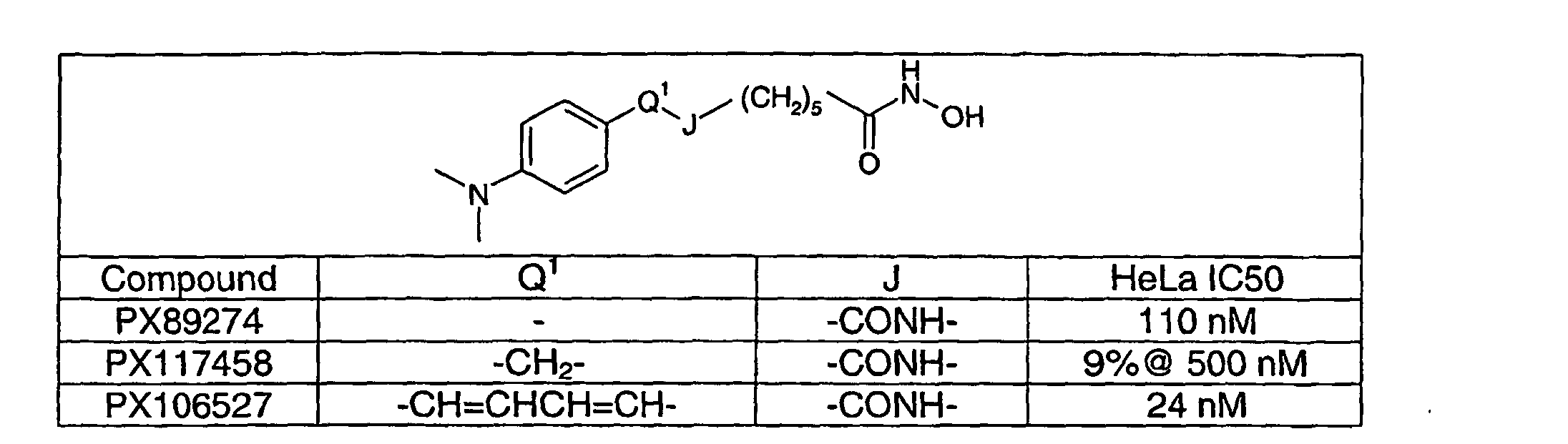
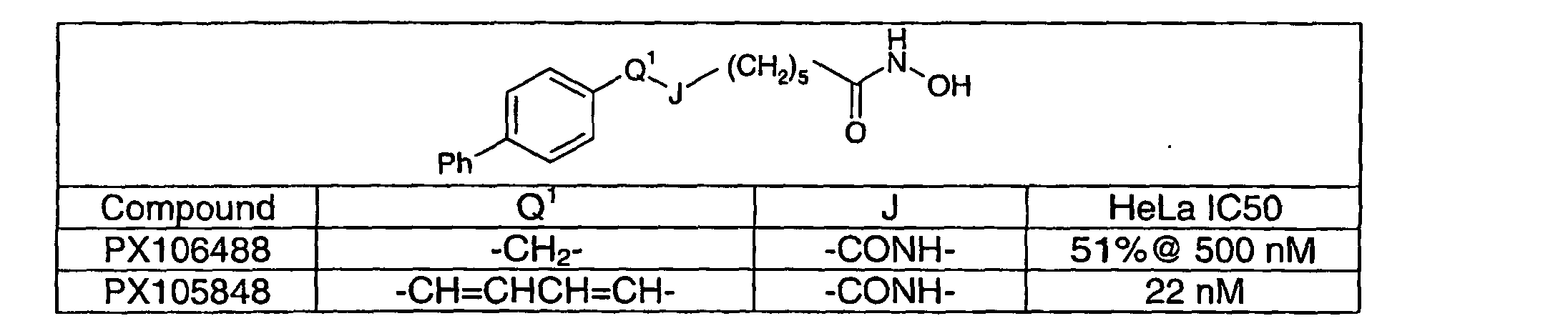

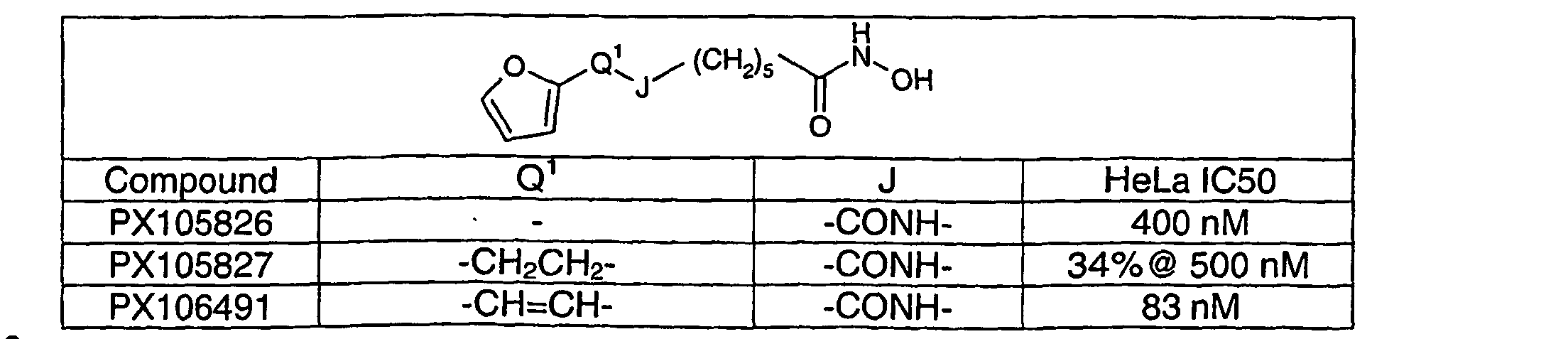
- Comparative data for sets of compounds, where the only difference in chemical structure is the acid leader, are shown below.
- Compounds which employ, as Q2, an alkylene group (e.g., having a backbone of at least 3, 4, 5 carbon atoms) surprisingly and unexpectedly have superior activity as compared to their analogs which comprise, as Q1, an aryl leader comprising an arylene group (e.g., arylene-alkylene).
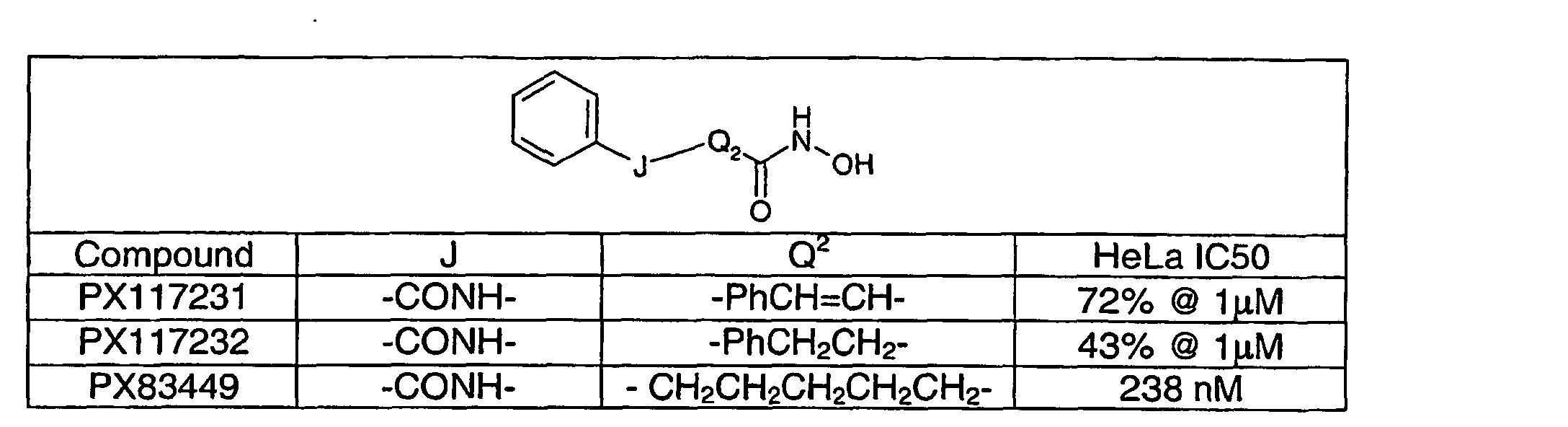

- Compounds which employ, as Q2, an alkylene group having a backbone of at least 4 carbon atoms, or at least 5 carbon atoms) surprisingly and unexpectedly have superior activity as compared to their analogs which comprise, as Q1, shorter backbone lengths.

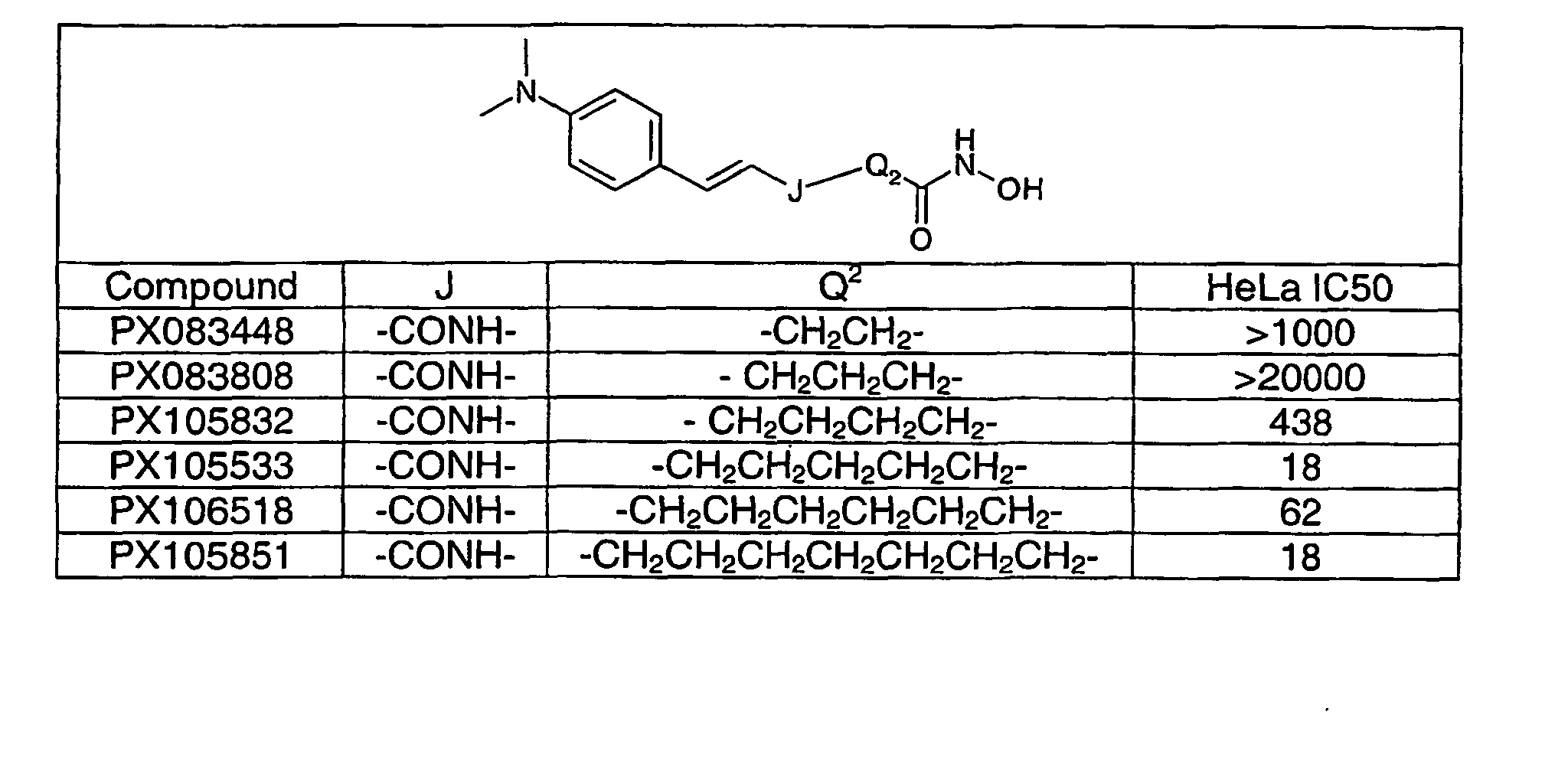
- A number of patents and publications are cited herein in order to more fully describe and disclose the invention and the state of the art to which the invention pertains. Full citations for these references are provided herein.
- Andrews et al., 2000, Int. J. Parasitol., Vol. 30, No. 6, pp. 761-768.
- Anghelova, Y. et al, 1973, Chem. Ber., Vo1.106, p. 2643.
- Backer, H.J., et al., 1940, Recl. Trav. Chim. Pays-Bas, Vol. 59, p. 423.
- Banerji, A., et al., 1984, Indian J. Chem., Vol. 23B, pp. 546-549.
- Bellamy, F.D., et al., 1984, Tetrahedron Letters, Vol. 25, No. 8, p. 839.
- Bernhard, D. et al., 1999, "Apoptosis induced by the histone deacetylase inhibitor sodium butyrate in human leukemic lymphoblasts," FASEB J., Vol. 13, No. 14, pp. 1991-2001.
- Bernstein et al., 2000, Proc. Natl. Acad. Sci. USA, Vol. 97, No. 25, pp. 13708. 13713.
- Bistrzycki, 1912, Chem. Ber., Vol. 45, p. 3483.
- Brehm, A., et al., 1998, "Retinoblastoma protein recruits histone deacetylase to repress transcription," Nature, 1998, Vol. 391, pp. 597-601.
- Breslow et al., 1994, "Potent inducers of terminal differentiation and methods of use thereof," U.S. Patent No. 5,369,108 issued 29 November 1994.
- Breslow et al., 1995, "Novel potent inducers of terminal differentiation and methods of use thereof," published international (PCT) patent application number WO 95/31977 published 30 November 1995.
- Breslow et al., 1997, "Potent inducers of terminal differentiation and methods of use thereof," U.S. Patent No. 5,700,811 issued 23 December 1997.
- Carbonnier, J., et al., 1981, Physiol. Plant., 1981, Vol. 51, p. 1.
- Chang et al., 2000, Nucleic Acids Res., Vol. 28, No. 20, pp. 3918-3925.
- Chen, W.-S., et al., 1978, Biochemistry, Vol. 17, No. 23, p. 4916.
- Copeland, R.A.B., et al., 1943, J. Amer. Chem. Soc., Vol. 65, p. 1072.
- Corneil et al., 1998, published Japanese patent application, publication number JP 10114681 A2.
- Dangond et al., 1998, Biochem. Biophys, Res. Commun., Vol. 242, No. 3, pp. 648-652.
- David, G., et al., 1998, Oncogene, Vol. 16(19), pp. 2549-2556.
- Davie, J.R., 1998, "Covalent modifications of histones: expression from chromatic templates," Curr. Opin. Genet. Dev., Vol. 8, pp. 173-178.
- Delorme et al., 2001, "Inhibitors of Histone Deacetylase," published international (PCT) patent application number WO 01/38322 published 31 May 2001.
- Desai et al., 1999, Proc. AACR, Vol. 40, abstract #2396.
- Emiliani, S., et al., 1998, "Characterization of a human RPD3 ortholog, HDAC3," Proc. Natl. Acad. Sci. USA, Vol. 95, p. 2795-2800.
- Finnin et al., 1999, Nature, Vol. 401, pp. 188-193.
- Furukawa et al., 1998, U.S. Patent No. 5834,249, "Process for production of protein," 10 November 1998.
- Geerts et al., 1998, European patent publication no. EP 0 827 742 A1, published 11 March 1998.
- Glick, R.D., et al., 1999, "Hybrid polar histone deacetylase inhibitor induces apoptosis and CD95/CD95 ligand expression in human neuroblastoma," Cancer Research, Vol. 59, No. 17, pp. 4392-4399.
- Grozinger et al., 1999, Proc. Natl. Acad. Sci. USA, Vol. 96, pp. 4868-4873. Hashimoto, N., et al., 1989, "Cell proliferation inhibitors," European Patent Publication No. EP 0 301 861 A1.
- Hoshikawa, Y., et al., 1994, Exp. Cell. Res., Vol. 214(1), pp. 189-197.
- Howe, L., et al., 1999, Crit. Rev. Eukaryot. Gene Expr., Vol. 9(3-4), pp. 231-243. lavarone et al., 1999, Mol. Cell Biol., Vol. 19, No. 1, pp. 916-922.
- Jung et al., 1997, Bioorganic & Medicinal Chemistry Letters, Vol. 7, No. 13, pp. 1655-1658.
- Jung et al., 1999, J. Med. Chem., Vol. 42, pp. 4669-4679.
- Kao et al., 2000, Genes & Dev., Vol. 14, p. 55-66.
- Kato et al., 1998, U.S. Patent No. 5,804,601, "Aromatic hydroxamic acid compounds, their production and use," 08 September 1998.
- Kijima et al., 1993, J. Biol. Chem., Vol. 268, pp. 22429-22435.
- Kim et al., 1999, Oncogene, Vol. 18(15), pp. 2461-2470.
- Kim et al., 2001, Nature Medicine, Vol. 7, No. 4, pp. 437-443.
- Kim, M.S., et al., 2001 " Histone deacetylases induce angiogenesis by negative regulation of tumour suppressor genes," Nature Medicine, Vol 7. No. 4 pp. 437-443.
- Kimura et al., 1994, Biol. Pharm. Bull., Vol. 17, No. 3, pp. 399-402.
- Kitamura, K., et al., 2000, Br. J. Haematol., Vol. 108(4), pp. 696-702.
- Kouzarides, T., 1999, "Histone acetylases and deacetylases in cell proliferation," Curr. Opin. Genet. Dev., Vol. 9, No. 1, pp. 40-48.
- Kuusisto et al., 2001, Biochem. Biophys. Res. Commun., Vol. 280, No. 1, pp. 223-228.
- Kwon et al., 1998, Proc. Natl. Acad. Sci. USA, Vol. 95, pp. 3356-3361.
- Laherty, C.D., et al., 1997, Cell, Vol. 89(3), pp. 349-356.
- Lea and Tulsyan, 1995, Anticancer Res., Vol. 15, pp. 879-883.
- Lea et al., 1999, Int. J. Oncol., Vol. 2, pp. 347-352.
- Lin, R.J., et al., 1998, Nature, Vol. 391(6669), pp. 811-814.
- Massa et al., 26 May 2001, Journal of Medicinal Chemistry, Vol. 44, No. 13, pp. 2069-2072.
- McCaffrey et al., 1997, Blood, Vol. 90, No. 5, pp. 2075-2083.
- Mielnicki, L.M., et al., 1999, Exp. Cell. Res., Vol. 249(1), pp. 161-176.
- Ng, H.H. and Bird, A., 2000, Trends Biochem. Sci., Vol. 25(3), pp. 121-126.
- Niki et al., 1999, Hepatology. Vol. 29, No. 3, pp. 858-867.
- Nokajima et al., 1998, Exp. Cell Res., Vol. 241, pp. 126-133.
- Ohtani et al., 1993, "Hydroxamic acid derivatives based on aromatic sulfonamide," published international (PCT) patent application number WO 93/12075 published 24 June 1993.
- Ohtani et al., 1996, "(2E)-5-[3-[(Phenylsulfonyl)amino] phenyl]-pent-2-en-4-yno-hydroxamic acid and its derivatives as novel and potent inhibitors of ras transformation," J. Medicinal Chemistry, Vol. 39, No. 15, pp. 2871-2873.
- Onishi et al., 1996, Science, Vol. 274, pp. 939-940.
- Parsons et al., 1998, "Hydroxamic acid compounds having anticancer and antiparasitic properties," published international (PCT) patent application number WO 98/55449 published 10 December 1998.
- Pazin, M.J., et al., 1997, "What's up and down with histone deacetylation and transcription?," Cell, Vol. 89, No. 3, pp. 325-328.
- Richon et al, 1996, Proc. Natl. Acad. Sci. USA, Vol. 93, pp. 5705-5708.
- Richon et al., 1998, "A class of hybrid poler inducers of transformed cell differentiation inhibits histone deacetylases," Proc. Natl. Acad. Sci. USA, Vol. 95, pp. 3003-3007.
- Richon et al., 2001, "Novel class of cytodifferentiating agents and histone deacetylase inhibitors, and methods of use thereof," published international (PCT) patent application number WO 01/18171 published 15 March 2001.
- Saito et al., 1999, Proc. Natl. Acad. Sci. USA, Vol. 96, pp. 4592-4597.
- Saunders, N. et al, 1999 "Histone deacetylase inhibitors as potential anti-skin cancer agents," Cancer Res., Vol. 59, No. 2 pp. 399-404.
- Sonoda, H. et al., 1996, Oncogene, Vol. 13, pp. 143-149.
- Spencer, V.A. and Davie, J.R., 1999, Gene, Vol. 240(1), pp. 1-12.
- Suzuki et al., 1998, Japanese patent publication number 10-182583 published 07 July 1998.
- Suzuki et al., 1999, "Synthesis and histone deactylase inhibitory activity of new benzamide derivatives," J. Med. Chem., Vol. 42, pp. 3001-3003.
- Takahashi et al., 1996, J. Antibiot. (Tokyo), Vol. 49, No. 5, pp. 453-457.
- Takahashi, I., et al, 1996, "Selective inhibition of IL-2 gene expression by trichostatin A, a potent inhibitor of mammalian histone deacetylase," J. Antibiot. (Tokyo), Vol. 49, No. 5, pp. 453-457.
- Tauton, J., et al., 1996, "A mammalian histone deacetylase related to the yeast transcriptional regulator Rpd3p," Science, Vol. 272, pp. 408-411.
- Tsuji et al., 1976, J. Antibiot. (Tokyo), Vol. 29, No. 1, pp. 1-6.
- Ueda, H., et al., 1994, J. Antibiot. (Tokyo), Vol. 47(3), pp. 315-323.
- Van den Wyngaert et al., 2000, FEBS, Vol. 478, pp. 77-83.
- Vig, B., et al., 1977, Indian J. Chem., Vol. 15B, pp. 1048-9.
- Vigushin et al., 2001, Clin. Cancer Res., Vol. 7, No. 4, pp. 971-976.
- Villieras, J., et al., 1983, Synthesis, pp. 300-3.
- Warrell et al., 1998, J. Natl. Cancer Inst., Vol. 90, pp. 1621-1625.
- Wong, J., et al., 1998, EMBO J., Vol. 17(2), pp. 520-534.
- Yang, W.M., et al., 1996, "Transcriptional repression of YY1 is mediated by interaction with a mammalian homolog of the yeast global regulator RPD3," Proc. Natl. Acad. Sci. USA, Vol. 93, pp. 12845-12850.
- Yang, W.M., et al., 1997, "Isolation and characterization of cDNAs corresponding to an additional member of the human histone deacetylase gene family," J. Biol. Chem., Vol 272, pp. 28001-28007.
- Yoshida et al., 1995, Bioessays, Vol. 17, pp. 423-430.
- Yoshida, M. and Horinouchi, S., 1999, Ann. N. Y. Acad. Sci., Vol. 886, pp. 23-36.
- Yoshida, M., Beppu, T., 1988, "Reversible arrest of proliferation of rat 3Y1 fibroblasts in both G1 and G2 phases by trichostatin A," Exp. Cell. Res., Vol. 177, pp. 122-131.
- Yoshida, M., et al., 1990a, J. Biol. Chem., Vol. 265(28), pp. 17174-17179.
- Yoshida, M., et al., 1990b, J. Antibiot. (Tokyo), Vol. 43(9), pp. 1101-1106.
-
Certain preferred embodiments are described below.
Claims (86)
- A compound of the formula:wherein:
 and wherein:A is an aryl group;Q1 is an aryl leader group having a backbone of at least 2 carbon atoms;J is an amide linkage selected from:
 R1 is an amido substituent; and,Q2 is an acid leader group;and pharmaceutically acceptable salts, solvates, amides, esters, and ethers, thereof.A, is a C5-20aryl group, and is unsubstituted, or is substituted with one or more of the following groups: fluoro, chloro, bromo, iodo, methyl, ethyl, isopropyl, t-butyl, cyano, trifluoromethyl, hydroxy, methoxy, ethoxy, isopropoxy, trifluoromethoxy, phenoxy, methylthio, trifluoromethylthio, hydroxymethyl, amino, dimethylamino, diethylamino, morpholino, amido, acetamido, acetyl, nitro, sulfonamido, and phenyl;the aryl leader group, Q1, is a partially unsaturated C2-7alkylene group and is unsubstituted, or is substituted with one or more groups selected from: halo, hydroxy, ether, C5-20aryl, acyl, amido, and oxo;the amido substituent, R1, is:hydrogen,C1-7alkyl,C3-20heterocyclyl, orC5-20aryl;the acid leader group, Q2, is:and the arylene group is unsubstituted, or is substituted with one or more of: fluoro, chloro, methyl, ethyl, isopropyl, t-butyl, trifluoromethyl, hydroxy, methoxy, ethoxy, isopropoxy, methylthio, amino, dimethylamino, diethylamino, morpholino, acetamido, nitro, and phenyl; and,C3-7alkylene:C5-20arylene;C5-20arylene-C1-7alkylene; orC1-7alkylene-C5-20arylene;the acid leader group, Q2, has a backbone of at least 3 carbon atoms; and wherein:if Q2 is C5-20arylene-C1-7alkylene,then:(i) the C1-7alkylene moiety does not comprise a carbon-carbon triple bond; or(ii) Q2 has a backbone of less than 7 carbon atoms;
 - A compound according to claim 1, wherein J is -C(=O)NR1-.
- A compound according to claim 1, wherein J is -NR1C(=O)-.
- A compound according to any one of claims 1 to 3, wherein the aryl leader group, Q1, is a partially unsaturated aliphatic C2-7alkylene group.
- A compound according to any one of claims 1 to 3, wherein the aryl leader group, Q1, is a partially unsaturated linear C2-7alkylene group.
- A compound according to any one of claims 1 to 3, wherein the aryl leader group, Q1, is a partially unsaturated branched C2-7alkylene group.
- A compound according to any one of claims 1 to 6, wherein the aryl leader, Q1, is not saturated at the carbon atom adjacent to J.
- A compound according to any one of claims 1 to 7, wherein the aryl leader group, Q1, has a backbone of at least 3 carbon atoms.
- A compound according to any one of claims 1 to 7, wherein the aryl leader group, Q1, has a backbone of at least 4 carbon atoms.
- A compound according to any one of claims 1 to 7, wherein the aryl leader group, Q1, has a backbone of from 2 to 7 carbon atoms.
- A compound according to any one of claims 1 to 7, wherein the aryl leader group, Q1, has a backbone of from 3 to 7 carbon atoms.
- A compound according to any one of claims 1 to 7, wherein the aryl leader group, Q1, has a backbone of 2 carbon atoms.
- A compound according to any one of claims 1 to 7, wherein the aryl leader group, Q1, has a backbone of 3 carbon atoms.
- A compound according to any one of claims 1 to 7, wherein the aryl leader group, Q1, has a backbone of 4 carbon atoms.
- A compound according to any one of claims 1 to 14, wherein the aryl leader group, Q1, is unsubstituted, or is substituted with one or more groups selected from: -F, -Cl, -Br, -I, -OH, -OMe, -OEt, -OPr, -Ph, and =O.
- A compound according to any one of claims 1 to 15, wherein the aryl leader group, Q1, is unsubstituted.
- A compound according to any one of claims 1 to 3, wherein the aryl leader group, Q1, is selected from:







- A compound according to any one of claims 1 to 3, wherein the aryl leader group, Q1, is selected from:




- A compound according to any one of claims 1 to 3, wherein the aryl leader group, Q1, is selected from:-CH=CH-,-CH2CH=CH-,-CH=CH-CH=CH-,-CH=CHC(CH3)=CH-,-C=-C-CH=CH-, and-C=C-CH=C(CH3)-.
- A compound according to any one of claims 1 to 3, wherein the aryl leader group, Q1, is selected from:-CH=CH-,-CH2CH=CH-,-CH=CH-CH=CH-, and-CH=CHC(CH3)=CH-.
- A compound according to any one of claims 1 to 3, wherein the aryl leader group, Q1, is selected from:-CH=CH- and-CH=CH-CH=CH-.
- A compound according to any one of claims 1 to 21, wherein the acid leader group, Q2, is a saturated C3-10alkylene group.
- A compound according to any one of claims 1 to 21, wherein the acid leader group, Q2, is a saturated C3-7alkylene group.
- A compound according to any one of claims 1 to 21, wherein the acid leader group, Q2, is a partially unsaturated C3-10alkylene group.
- A compound according to any one of claims 1 to 21, wherein the acid leader group, Q2, is a partially unsaturated C3-7alkylene group.
- A compound according to any one of claims 1 to 21, wherein the acid leader group, Q2, is an aliphatic C3-10alkylene group.
- A compound according to any one of claims 1 to 21, wherein the acid leader group, Q2, is a linear C3-10alkylene group.
- A compound according to any one of claims 1 to 21, wherein the acid leader group, Q2, is a branched C4-10alkylene group.
- A compound according to any one of claims 1 to 21, wherein the acid leader group, Q2, is an alicyclic C4-10alkylene group.
- A compound according to any one of claims 1 to 21, wherein the acid leader group, Q2, is a saturated linear C3-10alkylene group.
- A compound according to any one of claims 1 to 21, wherein the acid leader group, Q2, is a saturated aliphatic C3-7alkylene group.
- A compound according to any one of claims 1 to 21, wherein the acid leader group, Q2, is a saturated linear C3-7alkylene group.
- A compound according to any one of claims 1 to 21, wherein the acid leader group, Q2, is a saturated branched C4-7alkylene group.
- A compound according to any one of claims 1 to 21, wherein the acid leader group, Q2, is a saturated alicyclic C4-7alkylene group.
- A compound according to any one of claims 1 to 34, wherein the acid leader group, Q2, has a backbone of at least 4 carbon atoms.
- A compound according to any one of claims 1 to 34, wherein the acid leader group, Q2, has a backbone of from 3 to 7 carbon atoms.
- A compound according to any one of claims 1 to 34, wherein the acid leader group, Q2, has a backbone of from 4 to 7 carbon atoms.
- A compound according to any one of claims 1 to 34, wherein the acid leader group, Q2, has a backbone of 4 carbon atoms.
- A compound according to any one of claims 1 to 34, wherein the acid leader group, Q2, has a backbone of 5 carbon atoms.
- A compound according to any one of claims 1 to 34, wherein the acid leader group, Q2, has a backbone of 6 carbon atoms.
- A compound according to any one of claims 1 to 40, wherein the acid leader group, Q2, is unsubstituted.
- A compound according to any one of claims 1 to 21, wherein the acid leader group, Q2, is selected from: -(CH2)3-, -(CH2)4-, -(CH2)5-, -(CH2)6-, and -(CH2)7-.
- A compound according to any one of claims 1 to 21, wherein the acid leader group, Q2, is selected from: -(CH2)4-, -(CH2)5-, -(CH2)6-, and -(CH2)7-.
- A compound according to any one of claims 1 to 21, wherein the acid leader group, Q2, is selected from: -(CH2)4-, -(CH2)5-, and -(CH2)6-.
- A compound according to any one of claims 1 to 21, wherein the acid leader group, Q2, is C5-20arylene, and is unsubstituted, or is substituted with one or more of: fluoro, chloro, methyl, ethyl, isopropyl, t-butyl, trifluoromethyl, hydroxy, methoxy, ethoxy, isopropoxy, methylthio, amino, dimethylamino, diethylamino, morpholino, acetamido, nitro, and phenyl.
- A compound according to any one of claims 1 to 21, wherein the acid leader group, Q2, is phenylene, and is unsubstituted, or is substituted with one or more of: fluoro, chloro, methyl, ethyl, isopropyl, t-butyl, trifluoromethyl, hydroxy, methoxy, ethoxy, isopropoxy, methylthio, amino, dimethylamino, diethylamino, morpholino, acetamido, nitro, and phenyl.
- A compound according to any one of claims 1 to 21, wherein the acid leader group, Q2 is C5-20arylene-C1-7alkylene, and:(i) the C1-7alkylene moiety does not comprise a carbon-carbon triple bond; or(ii) Q2 has a backbone of less than 7 carbon atoms.
- A compound according to any one of claims 1 to 21, wherein the acid leader group, Q2 is C5-20arylene-C1-7alkylene, and:(i) the C1-7alkylene moiety does not comprise a carbon-carbon triple bond; or(ii) Q2 has a backbone of less than 6 carbon atoms.
- A compound according to any one of claims 1 to 21, 47, and 48, wherein the acid leader group, Q2, is C5-20arylene-C1-7alkylene or C1-7alkylene-C5-20arylene and the arylene group is unsubstituted, or is substituted with one or more of: fluoro, chloro, methyl, ethyl, isopropyl, t-butyl, trifluoromethyl, hydroxy, methoxy, ethoxy, isopropoxy, methylthio, amino, dimethylamino, diethylamino, morpholino, acetamido, nitro, and phenyl.
- A compound according to any one of claims 1 to 21, 47, and 48, wherein the acid leader group, Q2 is C5-6arylene-C1-7alkylene or C1-7alkylene-C5-6arylene and the arylene group is unsubstituted, or is substituted with one or more of: fluoro, chloro, methyl, ethyl, isopropyl, t-butyl, trifluoromethyl, hydroxy, methoxy, ethoxy, isopropoxy, methylthio, amino, dimethylamino, diethylamino, morpholino, acetamido, nitro, and phenyl.
- A compound according to any one of claims 1 to 21, 47, and 48, wherein the acid leader group, Q2 is phenylene-C1-7alkylene and the phenylene group is unsubstituted, or is substituted with one or more of: fluoro, chloro, methyl, ethyl, isopropyl, t-butyl, trifluoromethyl, hydroxy, methoxy, ethoxy, isopropoxy, methylthio, amino, dimethylamino, diethylamino, morpholino, acetamido, nitro, and phenyl.
- A compound according to any one of claims 1 to 21, 47, and 48, wherein the acid leader group, Q2 is phenylene-meta-C1-7alkylene or phenylene-para-C1-7alkylene and the phenylene group is unsubstituted, or is substituted with one or more of: fluoro, chloro, methyl, ethyl, isopropyl, t-butyl, trifluoromethyl, hydroxy, methoxy, ethoxy, isopropoxy, methylthio, amino, dimethylamino, diethylamino, morpholino, acetamido, nitro, and phenyl.
- A compound according to any one of claims 1 to 21 and 47 to 52, wherein the acid leader group, Q2, is unsubstituted.
- A compound according to any one of claims 1 to 21, wherein the acid leader group, Q2, is selected from:

- A compound according to any one of claims 1 to 21, wherein the acid leader group, Q2, is :

- A compound according to any one of claims 1 to 55, wherein A is C5-20heteroaryl or C5-20carboaryl, and is unsubstituted, or is substituted with one or more of the following groups: fluoro, chloro, bromo, iodo, methyl, ethyl, isopropyl, t-butyl, cyano, trifluoromethyl, hydroxy, methoxy, ethoxy, isopropoxy, trifluoromethoxy, phenoxy, methylthio, trifluoromethylthio, hydroxymethyl, amino, dimethylamino, diethylamino, morpholino, amido, acetamido, acetyl, nitro, sulfonamido, and phenyl.
- A compound according to any one of claims 1 to 55, wherein A is a C5-20aryl group derived from one of the following: benzene, pyridine, furan, indole, pyrrole, imidazole, naphthalene, quinoline, benzimidazole, benzothiofuran, fluorene, acridine, and carbazole.
- A compound according to any one of claims 1 to 55, wherein A is a furanyl group and is unsubstituted, or is substituted with one or more of the following groups: fluoro, chloro, bromo, iodo, methyl, ethyl, isopropyl, t-butyl, cyano, trifluoromethyl, hydroxy, methoxy, ethoxy, isopropoxy, trifluoromethoxy, phenoxy, methylthio, trifluoromethylthio, hydroxymethyl, amino, dimethylamino, diethylamino, morpholino, amido, acetamido, acetyl, nitro, sulfonamido, and phenyl.
- A compound according to any one of claims 1 to 55, wherein A is a thiophenyl group and is unsubstituted, or is substituted with one or more of the following groups: fluoro, chloro, bromo, iodo, methyl, ethyl, isopropyl, t-butyl, cyano, trifluoromethyl, hydroxy, methoxy, ethoxy, isopropoxy, trifluoromethoxy, phenoxy, methylthio, trifluoromethylthio, hydroxymethyl, amino, dimethylamino, diethylamino, morpholino, amido, acetamido, acetyl, nitro, sulfonamido, and phenyl.
- A compound according to any one of claims 1 to 55, wherein A is a indolyl group and is unsubstituted, or is substituted with one or more of the following groups: fluoro, chloro, bromo, iodo, methyl, ethyl, isopropyl, t-butyl, cyano, trifluoromethyl, hydroxy, methoxy, ethoxy, isopropoxy, trifluoromethoxy, phenoxy, methylthio, trifluoromethylthio, hydroxymethyl, amino, dimethylamino, diethylamino, morpholino, amido, acetamido, acetyl, nitro, sulfonamido, and phenyl.
- A compound according to any one of claims 1 to 55, wherein A is a naphthyl group and is unsubstituted, or is substituted with one or more of the following groups: fluoro, chloro, bromo, iodo, methyl, ethyl, isopropyl, t-butyl, cyano, trifluoromethyl, hydroxy, methoxy, ethoxy, isopropoxy, trifluoromethoxy, phenoxy, methylthio, trifluoromethylthio, hydroxymethyl, amino, dimethylamino, diethylamino, morpholino, amido, acetamido, acetyl, nitro, sulfonamido, and phenyl.
- A compound according to any one of claims 1 to 55, wherein A is a benzimidazolyl group and is unsubstituted, or is substituted with one or more of the following groups: fluoro, chloro, bromo, iodo, methyl, ethyl, isopropyl, t-butyl, cyano, trifluoromethyl, hydroxy, methoxy, ethoxy, isopropoxy, trifluoromethoxy, phenoxy, methylthio, trifluoromethylthio, hydroxymethyl, amino, dimethylamino, diethylamino, morpholino, amido, acetamido, acetyl, nitro, sulfonamido, and phenyl.
- A compound according to any one of claims 1 to 55, wherein A is a phenyl group which is unsubstituted, or is substituted with one or more of the following groups: fluoro, chloro, bromo, iodo, methyl, ethyl, isopropyl, t-butyl, cyano, trifluoromethyl, hydroxy, methoxy, ethoxy, isopropoxy, trifluoromethoxy, phenoxy, methylthio, trifluoromethylthio, hydroxymethyl, amino, dimethylamino, diethylamino, morpholino, amido, acetamido, acetyl, nitro, sulfonamido, and phenyl.
- A compound according to any one of claims 1 to 55, wherein A is a phenyl group which is unsubstituted, or is substituted with one or more of the following groups: fluoro, chloro, bromo, iodo, trifluoromethyl, and nitro.
- A compound according to any one of claims 1 to 55, wherein A is selected from :

- A compound according to any one of claims 1 to 65, wherein the amido substituent, R1, is hydrogen, C1-7alkyl, or C5-20aryl.
- A compound according to any one of claims 1 to 65, wherein the amido substituent, R1, is hydrogen or C1-7alkyl.
- A compound according to any one of claims 1 to 65, wherein the amido substituent, R1, is -H.
- A compound selected from the following compounds, and pharmaceutically acceptable salts, solvates, amides, esters, and ethers thereof:














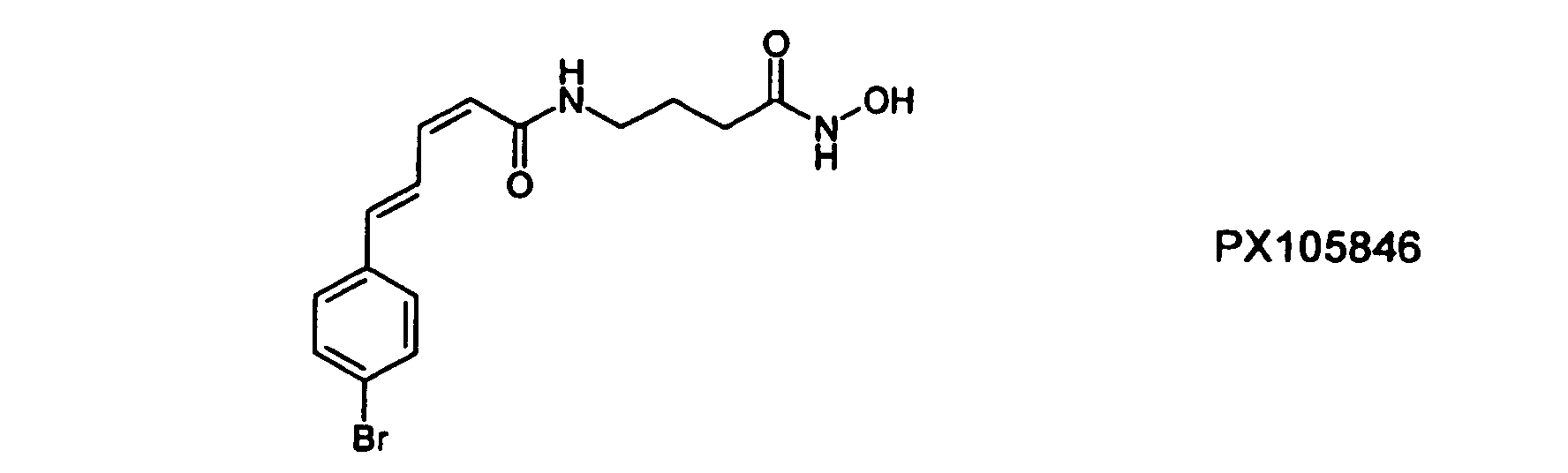
















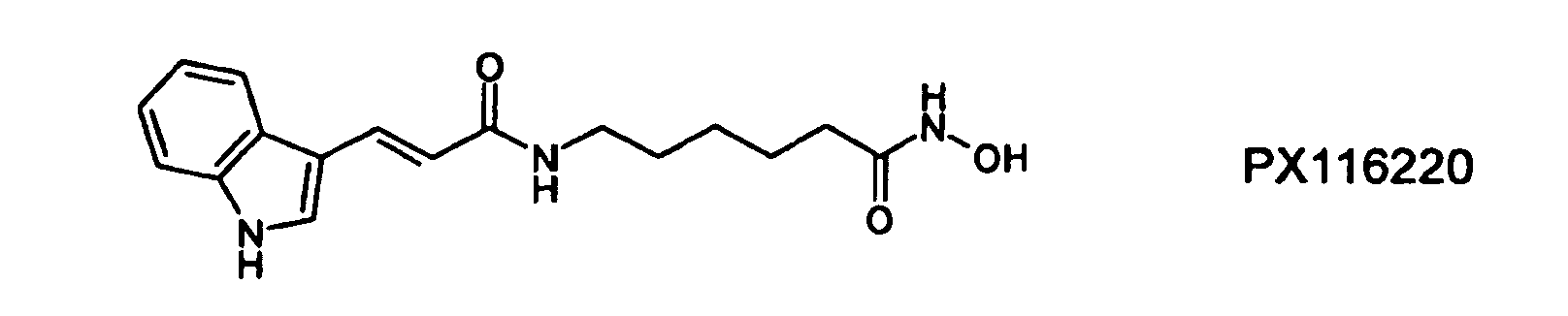





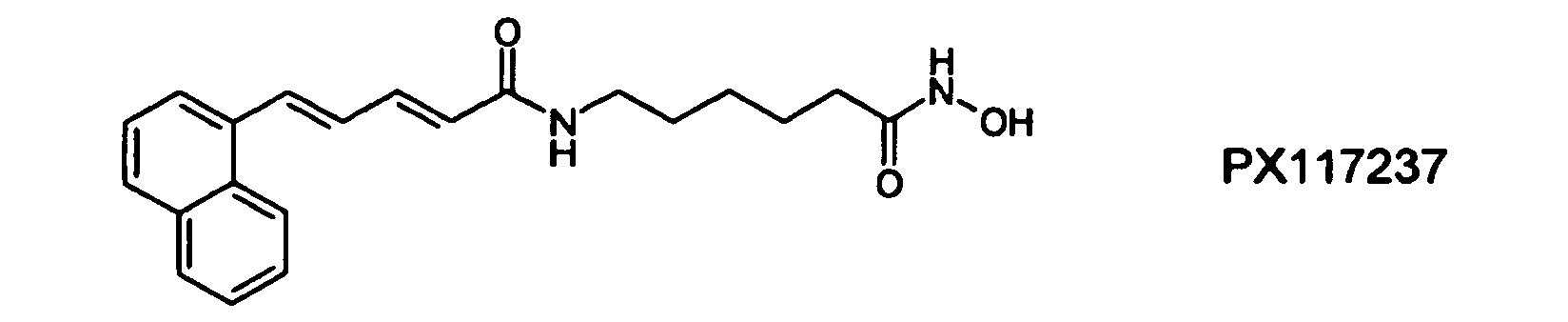




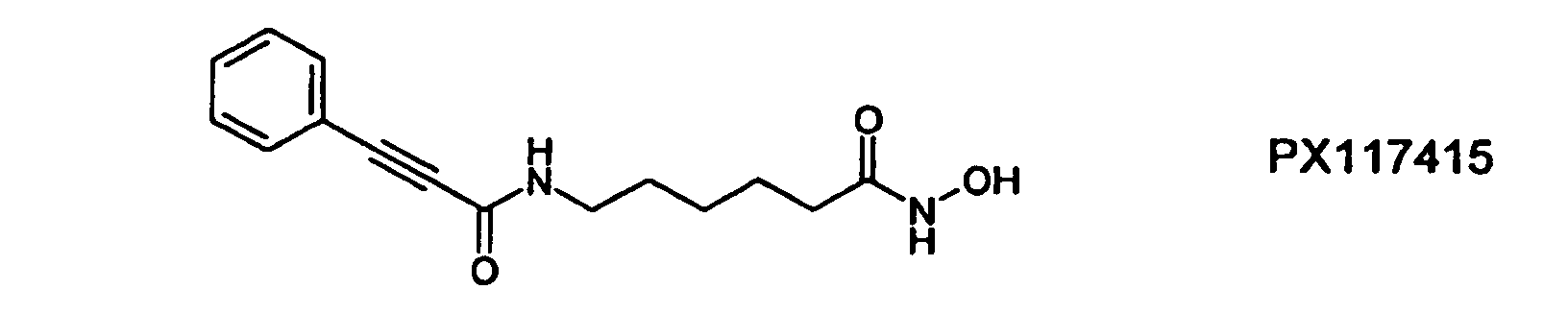


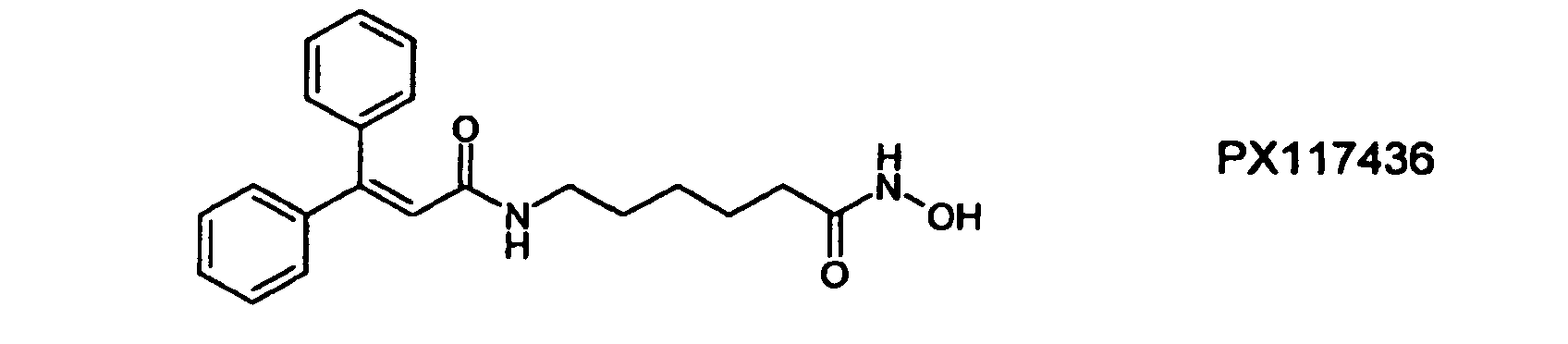
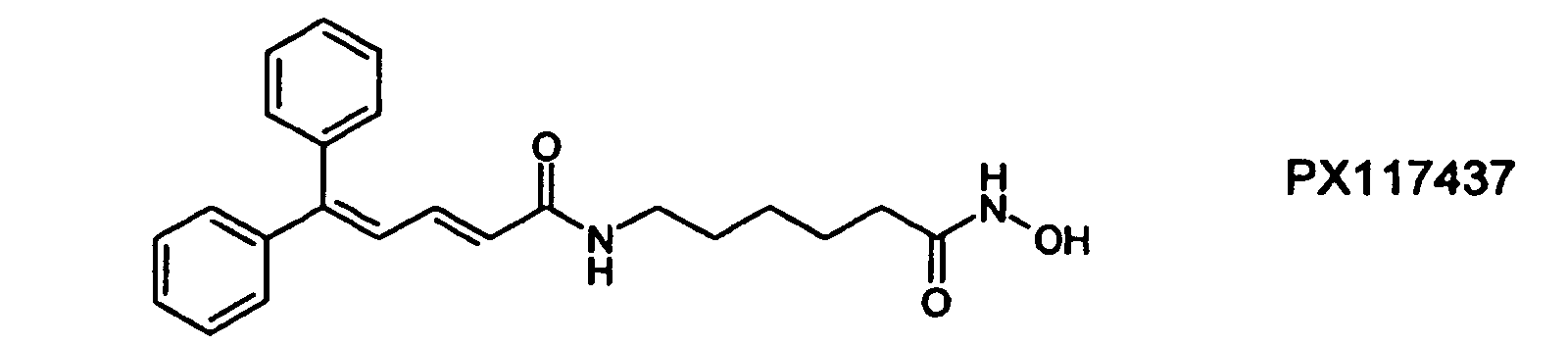



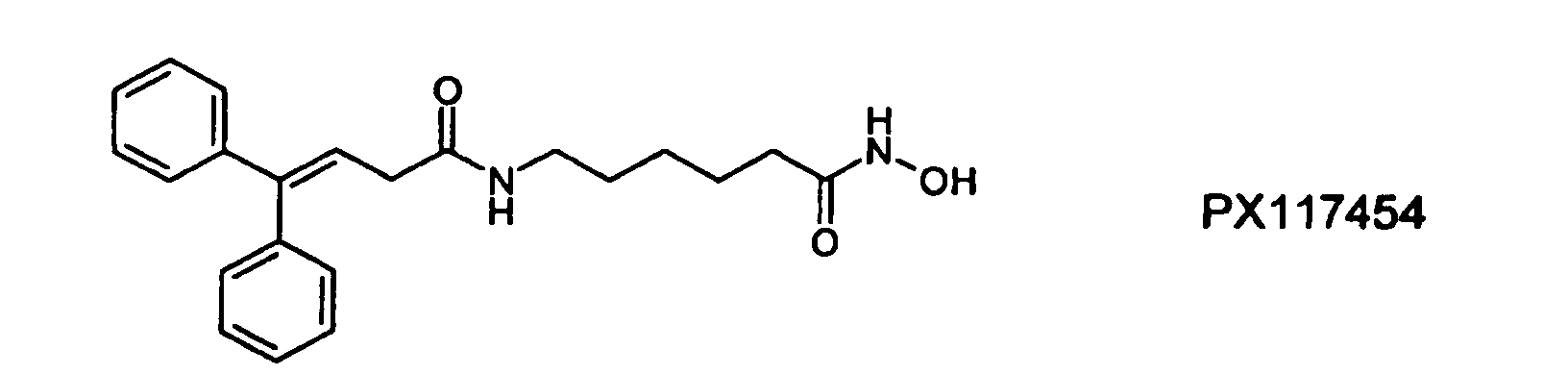
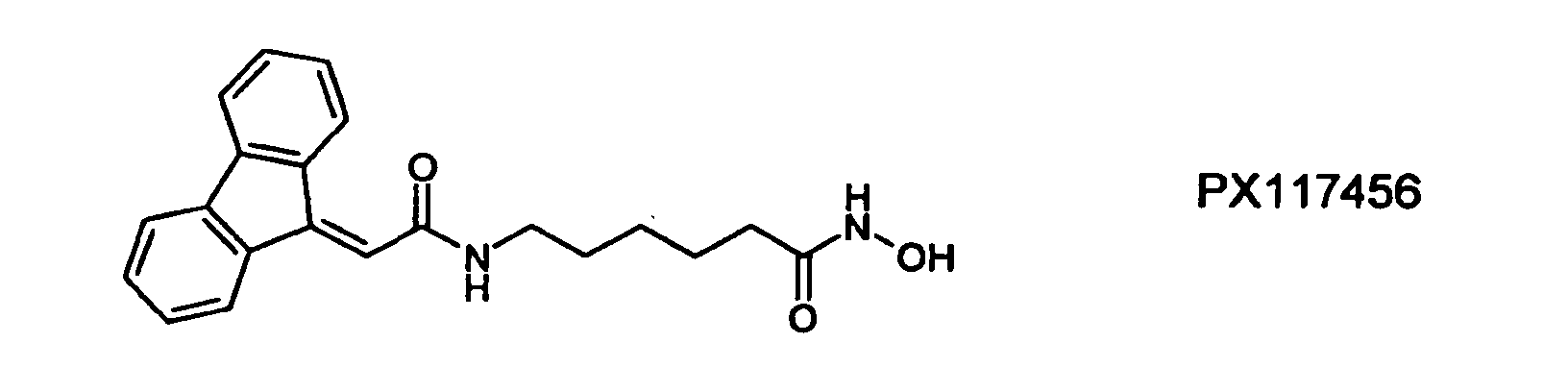



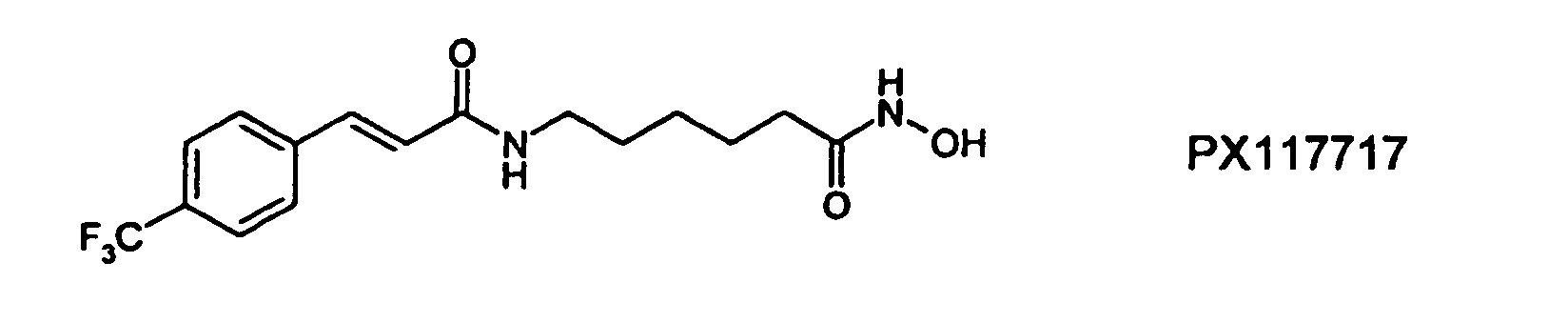
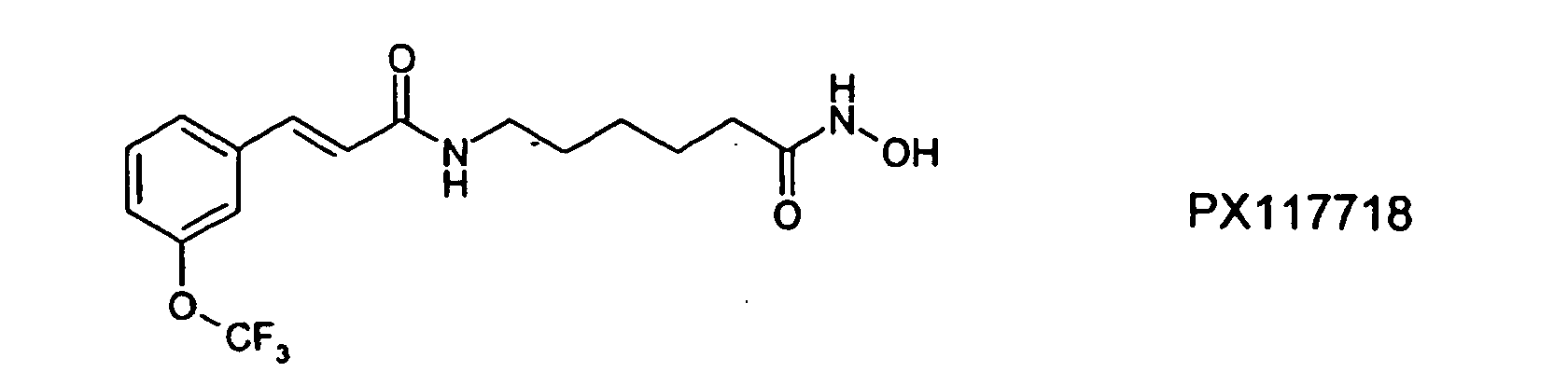




- A compound according to claim 1, selected from a compound of the following formula, and pharmaceutically acceptable salts, solvates, amides, esters, and ethers thereof:

- A compound according to claim 1, selected from a compound of the following formula, and pharmaceutically acceptable salts, solvates, amides, esters, and ethers thereof:

- A compound according to claim 1, selected from a compound of the following formula, and pharmaceutically acceptable salts, solvates, amides, esters, and ethers thereof:

- A compound according to claim 1, selected from a compound of the following formula, and pharmaceutically acceptable salts, solvates, amides, esters, and ethers thereof:

- A compound according to claim 1, selected from a compound of the following formula, and pharmaceutically acceptable salts, solvates, amides, esters, and ethers thereof:

- A compound according to claim 1, selected from a compound of the following formula, and pharmaceutically acceptable salts, solvates, amides, esters, and ethers thereof:

- A composition comprising a compound according to any one of claims 1 to 75 and a pharmaceutically acceptable carrier or diluent.
- A compound according to any one of claims 1 to 75 for use in a method of treatment of the human or animal body.
- A compound according to any one of claims 1 to 75 for use in a method of treatment of a condition mediated by HDAC of the human or animal body.
- A compound according to any one of claims 1 to 75 for use in a method of treatment of a proliferative condition of the human or animal body.
- A compound according to any one of claims 1 to 75 for use in a method of treatment of cancer of the human or animal body.
- A compound according to any one of claims 1 to 75 for use in a method of treatment of psoriasis of the human or animal body.
- Use of a compound according to any one of claims 1 to 75 for the manufacture of a medicament for use in the treatment of a condition mediated by HDAC.
- Use of a compound according to any one of claims 1 to 75 for the manufacture of a medicament for use in the treatment of a proliferative condition.
- Use of a compound according to any one of claims 1 to 75 for the manufacture of a medicament for use in the treatment of cancer.
- Use of a compound according to any one of claims 1 to 75 for the manufacture of a medicament for use in the treatment of psoriasis.
- A method inhibiting HDAC in a cell in vitro comprising said cell with an effective amount of a compound according to any one of claims 1 to 75.
Priority Applications (2)
| Application Number | Priority Date | Filing Date | Title |
|---|---|---|---|
| EP05015737A EP1598067B1 (en) | 2000-09-29 | 2001-09-27 | Carbamic acid compounds comprising an amide linkage for the treatment of malaria |
| EP09004388A EP2083005A1 (en) | 2000-09-29 | 2001-09-27 | Carbamic acid compounds comprising an amide linkage as HDAC inhibitors |
Applications Claiming Priority (5)
| Application Number | Priority Date | Filing Date | Title |
|---|---|---|---|
| GB0023985 | 2000-09-29 | ||
| GB0023985A GB0023985D0 (en) | 2000-09-29 | 2000-09-29 | Therapeutic compounds |
| US29778501P | 2001-06-14 | 2001-06-14 | |
| US297785P | 2001-06-14 | ||
| PCT/GB2001/004329 WO2002026696A1 (en) | 2000-09-29 | 2001-09-27 | Carbamic acid compounds comprising an amide linkage as hdac inhibitors |
Related Child Applications (1)
| Application Number | Title | Priority Date | Filing Date |
|---|---|---|---|
| EP05015737A Division EP1598067B1 (en) | 2000-09-29 | 2001-09-27 | Carbamic acid compounds comprising an amide linkage for the treatment of malaria |
Publications (2)
| Publication Number | Publication Date |
|---|---|
| EP1335898A1 EP1335898A1 (en) | 2003-08-20 |
| EP1335898B1 true EP1335898B1 (en) | 2005-11-23 |
Family
ID=26245083
Family Applications (3)
| Application Number | Title | Priority Date | Filing Date |
|---|---|---|---|
| EP05015737A Expired - Lifetime EP1598067B1 (en) | 2000-09-29 | 2001-09-27 | Carbamic acid compounds comprising an amide linkage for the treatment of malaria |
| EP09004388A Withdrawn EP2083005A1 (en) | 2000-09-29 | 2001-09-27 | Carbamic acid compounds comprising an amide linkage as HDAC inhibitors |
| EP01970014A Expired - Lifetime EP1335898B1 (en) | 2000-09-29 | 2001-09-27 | Carbamic acid compounds comprising an amide linkage as hdac inhibitors |
Family Applications Before (2)
| Application Number | Title | Priority Date | Filing Date |
|---|---|---|---|
| EP05015737A Expired - Lifetime EP1598067B1 (en) | 2000-09-29 | 2001-09-27 | Carbamic acid compounds comprising an amide linkage for the treatment of malaria |
| EP09004388A Withdrawn EP2083005A1 (en) | 2000-09-29 | 2001-09-27 | Carbamic acid compounds comprising an amide linkage as HDAC inhibitors |
Country Status (10)
| Country | Link |
|---|---|
| US (3) | US7569724B2 (en) |
| EP (3) | EP1598067B1 (en) |
| JP (1) | JP2004509941A (en) |
| AT (2) | ATE310719T1 (en) |
| AU (1) | AU2001290134A1 (en) |
| CA (1) | CA2423868C (en) |
| DE (2) | DE60138658D1 (en) |
| DK (1) | DK1335898T3 (en) |
| ES (1) | ES2257441T3 (en) |
| WO (1) | WO2002026696A1 (en) |
Families Citing this family (155)
| Publication number | Priority date | Publication date | Assignee | Title |
|---|---|---|---|---|
| US6777217B1 (en) | 1996-03-26 | 2004-08-17 | President And Fellows Of Harvard College | Histone deacetylases, and uses related thereto |
| FR2758459B1 (en) * | 1997-01-17 | 1999-05-07 | Pharma Pass | FENOFIBRATE PHARMACEUTICAL COMPOSITION HAVING HIGH BIODAVAILABILITY AND PROCESS FOR PREPARING THE SAME |
| US20030129724A1 (en) * | 2000-03-03 | 2003-07-10 | Grozinger Christina M. | Class II human histone deacetylases, and uses related thereto |
| US7244853B2 (en) | 2001-05-09 | 2007-07-17 | President And Fellows Of Harvard College | Dioxanes and uses thereof |
| US6706686B2 (en) | 2001-09-27 | 2004-03-16 | The Regents Of The University Of Colorado | Inhibition of histone deacetylase as a treatment for cardiac hypertrophy |
| EP1443928B1 (en) | 2001-10-16 | 2011-07-27 | Sloan-Kettering Institute For Cancer Research | Treatment of neurodegenerative diseases and cancer of the brain |
| DE60216972T2 (en) * | 2001-12-04 | 2007-10-18 | De Novo Pharmaceuticals Ltd., Histon | BACTERIAL ENZYMIN HIBITORS |
| NZ536116A (en) | 2002-04-03 | 2007-01-26 | Topotarget Uk Ltd | Carbamic acid compounds comprising a piperazine linkage as HDAC inhibitors |
| KR20050034732A (en) * | 2002-08-02 | 2005-04-14 | 아젠터 디스커버리 리미티드 | Substituted thienyl-hydroxamic acids as histone deacetylase inhibitors |
| US7154002B1 (en) | 2002-10-08 | 2006-12-26 | Takeda San Diego, Inc. | Histone deacetylase inhibitors |
| US7250514B1 (en) | 2002-10-21 | 2007-07-31 | Takeda San Diego, Inc. | Histone deacetylase inhibitors |
| JP4612621B2 (en) | 2003-01-17 | 2011-01-12 | トポターゲット ユーケー リミテッド | Carbamate compounds containing ester or ketone linkages as HDAC inhibitors |
| AU2003900608A0 (en) * | 2003-02-11 | 2003-02-27 | Fujisawa Pharmaceutical Co., Ltd. | Hdac inhibitor |
| US7244751B2 (en) | 2003-02-14 | 2007-07-17 | Shenzhen Chipscreen Biosciences Ltd. | Histone deacetylase inhibitors of novel benzamide derivatives with potent differentiation and anti-proliferation activity |
| EP1599449A2 (en) | 2003-02-25 | 2005-11-30 | TopoTarget UK Limited | Carbamic acid compounds comprising a bicyclic heteroaryl group as hdac inhibitors |
| US7375228B2 (en) | 2003-03-17 | 2008-05-20 | Takeda San Diego, Inc. | Histone deacetylase inhibitors |
| US7842835B2 (en) | 2003-07-07 | 2010-11-30 | Georgetown University | Histone deacetylase inhibitors and methods of use thereof |
| EP1644323B1 (en) * | 2003-07-07 | 2015-03-18 | Georgetown University | Histone deacetylase inhibitors and methods of use thereof |
| JP4799408B2 (en) * | 2003-07-15 | 2011-10-26 | コリア リサーチ インスティテュート オブ バイオサイエンス アンド バイオテクノロジー | Use of novel 2-oxoheterocyclic compounds and pharmaceutical compositions containing them |
| WO2005014588A1 (en) * | 2003-08-01 | 2005-02-17 | Argenta Discovery Limited | Substituted thienyl-hydroxamic acids having histone deacetylase activity |
| MXPA05011286A (en) | 2003-08-20 | 2006-01-24 | Axys Pharm Inc | Acetylene derivatives as inhibitors of histone deacetylase. |
| KR101127201B1 (en) * | 2003-09-22 | 2012-04-12 | 에스*바이오 피티이 리미티드 | Benzimidazole derivatives: preparation and pharmaceutical applications |
| CA2552279C (en) | 2003-12-02 | 2014-07-15 | The Ohio State University Research Foundation | Zn2+-chelating motif-tethered short -chain fatty acids as a novel class of histone deacetylase inhibitors |
| US20050137234A1 (en) * | 2003-12-19 | 2005-06-23 | Syrrx, Inc. | Histone deacetylase inhibitors |
| GB0401876D0 (en) | 2004-01-28 | 2004-03-03 | Vereniging Het Nl Kanker I | New use for cancer antigen |
| GB0402380D0 (en) * | 2004-02-03 | 2004-03-10 | Argenta Discovery Ltd | Novel compounds |
| ITMI20041347A1 (en) | 2004-07-05 | 2004-10-05 | Italfarmaco Spa | ALPHA-AMINO ACID DERIVATIVES FOR ANTI-INFLAMMATORY ACTIVITIES |
| EA200700243A1 (en) | 2004-07-14 | 2007-08-31 | ПиТиСи ТЕРАПЬЮТИКС, ИНК. | METHODS OF TREATMENT OF HEPATITIS C |
| US7772271B2 (en) | 2004-07-14 | 2010-08-10 | Ptc Therapeutics, Inc. | Methods for treating hepatitis C |
| US7868037B2 (en) | 2004-07-14 | 2011-01-11 | Ptc Therapeutics, Inc. | Methods for treating hepatitis C |
| US7781478B2 (en) | 2004-07-14 | 2010-08-24 | Ptc Therapeutics, Inc. | Methods for treating hepatitis C |
| EP1781289A1 (en) | 2004-07-22 | 2007-05-09 | PTC Therapeutics, Inc. | Thienopyridines for treating hepatitis c |
| KR100620488B1 (en) | 2004-08-13 | 2006-09-08 | 연세대학교 산학협력단 | Novel histone deacetylase inhibitors and preparation methods thereof |
| US7202383B2 (en) | 2004-09-14 | 2007-04-10 | The Hospital For Sick Children | Compounds useful for modulating abnormal cell proliferation |
| ITMI20041869A1 (en) | 2004-10-01 | 2005-01-01 | Dac Srl | NEW INHIBITORS OF DEACETYLASE HISTONS |
| US8242175B2 (en) | 2004-10-01 | 2012-08-14 | Dac S.R.L. | Class of histone deacetylase inhibitors |
| EP1812451A4 (en) * | 2004-11-01 | 2009-10-21 | Nuada Llc | Compounds and methods of use thereof |
| US7642275B2 (en) | 2004-12-16 | 2010-01-05 | Takeda San Diego, Inc. | Histone deacetylase inhibitors |
| NZ589276A (en) | 2005-02-03 | 2012-06-29 | Topotarget Uk Ltd | Combination therapies using hdac inhibitors and erlotinib (tarceva) |
| SG171690A1 (en) * | 2005-03-22 | 2011-06-29 | Harvard College | Treatment of protein degradation disorders |
| CN101180288A (en) * | 2005-03-31 | 2008-05-14 | 科学与工业研究会 | Aromatic-substituted pentadienoic acid amides in combination with anti-infective drugs |
| KR100844277B1 (en) * | 2005-04-29 | 2008-07-07 | (주)아모레퍼시픽 | A hydroxamic acid derivative and the preparation method thereof |
| GB0509223D0 (en) | 2005-05-05 | 2005-06-15 | Chroma Therapeutics Ltd | Enzyme inhibitors |
| GB0509225D0 (en) | 2005-05-05 | 2005-06-15 | Chroma Therapeutics Ltd | Inhibitors of enzymatic activity |
| JP2008540574A (en) | 2005-05-11 | 2008-11-20 | タケダ サン ディエゴ インコーポレイテッド | Histone deacetylase inhibitor |
| SI1901729T1 (en) | 2005-05-13 | 2012-05-31 | Topotarget Uk Ltd | Pharmaceutical formulations of hdac inhibitors |
| CA2615105A1 (en) * | 2005-07-14 | 2007-01-25 | Takeda San Diego, Inc. | Histone deacetylase inhibitors |
| EP2275096A3 (en) | 2005-08-26 | 2011-07-13 | Braincells, Inc. | Neurogenesis via modulation of the muscarinic receptors |
| EP2258357A3 (en) | 2005-08-26 | 2011-04-06 | Braincells, Inc. | Neurogenesis with acetylcholinesterase inhibitor |
| WO2007047978A2 (en) | 2005-10-21 | 2007-04-26 | Braincells, Inc. | Modulation of neurogenesis by pde inhibition |
| EP2314289A1 (en) | 2005-10-31 | 2011-04-27 | Braincells, Inc. | Gaba receptor mediated modulation of neurogenesis |
| CA2627923C (en) * | 2005-11-10 | 2016-01-12 | Topotarget Uk Limited | Histone deacetylase (hdac) inhibitors (pxdlol) for the treatment of cancer |
| EP1975158B9 (en) * | 2005-12-27 | 2012-02-29 | Universidad Del Pais Vasco-Euskal Herriko Unibersitatea | Novel pyrrole derivatives with histone deacetylase inhibitor activity |
| WO2008091349A1 (en) * | 2006-02-14 | 2008-07-31 | The President And Fellows Of Harvard College | Bifunctional histone deacetylase inhibitors |
| DK2010168T3 (en) | 2006-02-14 | 2014-07-21 | Harvard College | Histone deacetylase inhibitore |
| US20100216734A1 (en) | 2006-03-08 | 2010-08-26 | Braincells, Inc. | Modulation of neurogenesis by nootropic agents |
| WO2007113644A2 (en) * | 2006-04-05 | 2007-10-11 | Orchid Research Laboratories Limited | New hdac inhibitors |
| WO2007130429A2 (en) * | 2006-05-03 | 2007-11-15 | The President And Fellows Of Harvard College | Histone deacetylase and tubulin deacetylase inhibitors |
| US7678808B2 (en) | 2006-05-09 | 2010-03-16 | Braincells, Inc. | 5 HT receptor mediated neurogenesis |
| EP2021000A2 (en) | 2006-05-09 | 2009-02-11 | Braincells, Inc. | Neurogenesis by modulating angiotensin |
| CA2659478A1 (en) * | 2006-08-03 | 2008-02-14 | Georgetown University | Isoform-selective hdac inhibitors |
| WO2008030651A1 (en) | 2006-09-08 | 2008-03-13 | Braincells, Inc. | Combinations containing a 4-acylaminopyridine derivative |
| US20100184806A1 (en) | 2006-09-19 | 2010-07-22 | Braincells, Inc. | Modulation of neurogenesis by ppar agents |
| GB0619753D0 (en) | 2006-10-06 | 2006-11-15 | Chroma Therapeutics Ltd | Enzyme inhibitors |
| CA2668070A1 (en) | 2006-10-30 | 2008-05-08 | Chroma Therapeutics Ltd. | Hydroxamates as inhibitors of histone deacetylase |
| US20100256147A1 (en) * | 2007-04-13 | 2010-10-07 | Hangauer Jr David G | Biaryl acetamide derivatives as modulators of the kinase cascade for the treatment of hearing loss, osteoporosis and cell proliferation disorders |
| CA2691987C (en) * | 2007-06-12 | 2016-08-16 | Achaogen, Inc. | Antibacterial agents |
| WO2009009041A2 (en) * | 2007-07-06 | 2009-01-15 | Kinex Pharmaceuticals, Llc | Compositions and methods for modulating a kinase cascade |
| JP2010536876A (en) * | 2007-08-21 | 2010-12-02 | アークル インコーポレイテッド | HDAC inhibitor |
| CN101868446A (en) | 2007-09-25 | 2010-10-20 | 托波塔吉特英国有限公司 | Synthetic method of some hydroxamic acid compounds |
| CA2702536A1 (en) * | 2007-10-10 | 2009-04-16 | Orchid Research Laboratories Limited | Novel histone deacetylase inhibitors |
| US8293513B2 (en) * | 2007-12-14 | 2012-10-23 | Georgetown University | Histone deacetylase inhibitors |
| US7863315B2 (en) | 2008-01-15 | 2011-01-04 | Shenzhen Chipscreen Biosciences, Ltd. | 2-indolinone derivatives as selective histone deacetylase inhibitors |
| SI2262493T1 (en) * | 2008-03-07 | 2015-07-31 | Onxeo Dk Branch Of Onxeo S.A. France | Methods of treatment employing prolonged continuous infusion of belinostat |
| US8158656B2 (en) | 2008-05-16 | 2012-04-17 | Shenzhen Chipscreen Biosciences Ltd. | 2-indolinone derivatives as multi-target protein kinase inhibitors and histone deacetylase inhibitors |
| US8178577B2 (en) | 2008-05-21 | 2012-05-15 | Shenzhen Chipscreen Biosciences Ltd. | Tricyclic derivatives as potent and selective histone deacetylase inhibitors |
| EP2321264B1 (en) * | 2008-07-23 | 2016-05-04 | President and Fellows of Harvard College | Deacetylase inhibitors and uses thereof |
| GB0900555D0 (en) * | 2009-01-14 | 2009-02-11 | Topotarget As | New methods |
| ME02254B (en) | 2009-01-23 | 2015-12-31 | Euro Celtique Sa | Hydroxamic acid derivatives |
| US20100216805A1 (en) | 2009-02-25 | 2010-08-26 | Braincells, Inc. | Modulation of neurogenesis using d-cycloserine combinations |
| GB0903480D0 (en) * | 2009-02-27 | 2009-04-08 | Chroma Therapeutics Ltd | Enzyme Inhibitors |
| US8716326B2 (en) | 2009-05-15 | 2014-05-06 | Korea Research Institute Of Chemical Technology | Isoindolinone derivatives, preparation method thereof and a pharmaceutical composition comprising same |
| US8211901B2 (en) | 2009-05-22 | 2012-07-03 | Shenzhen Chipscreen Biosciences Ltd. | Naphthamide derivatives as multi-target protein kinase inhibitors and histone deacetylase inhibitors |
| PL2435409T3 (en) | 2009-05-28 | 2015-01-30 | Novartis Ag | Substituted aminopropionic derivatives as neprilysin inhibitors |
| CA2763565A1 (en) | 2009-05-28 | 2010-12-02 | Novartis Ag | Substituted aminobutyric derivatives as neprilysin inhibitors |
| CN101906076B (en) | 2009-06-04 | 2013-03-13 | 深圳微芯生物科技有限责任公司 | Naphthaline amide derivative serving as protein kinase inhibitor and histone deacetylase inhibitor and preparation method and application thereof |
| EP2440053A4 (en) | 2009-06-09 | 2012-10-31 | California Capital Equity Llc | Benzyl substituted triazine derivatives and their therapeutical applications |
| WO2010144586A1 (en) | 2009-06-09 | 2010-12-16 | Abraxis Bioscience, Llc | Isoquinoline, quinoline, and quinazoline derivatives as inhibitors of hedgehog signaling |
| CA2765030C (en) | 2009-06-09 | 2015-10-27 | California Capital Equity, Llc | Triazine derivatives and their therapeutical applications |
| US8716344B2 (en) | 2009-08-11 | 2014-05-06 | President And Fellows Of Harvard College | Class- and isoform-specific HDAC inhibitors and uses thereof |
| CN102020588B (en) * | 2009-09-16 | 2014-01-29 | 深圳微芯生物科技有限责任公司 | Tricyclic compound with histone deacetylases inhibition activity and preparation method and application thereof |
| JO2967B1 (en) | 2009-11-20 | 2016-03-15 | نوفارتس ايه جي | Substituted carbamoylmethylamino acetic acid derivatives as novel NEP inhibitors |
| TWI429628B (en) | 2010-03-29 | 2014-03-11 | Univ Taipei Medical | Indolyl or indolinyl hydroxamate compounds |
| EP2571352A4 (en) * | 2010-05-21 | 2014-09-17 | Sloan Kettering Inst Cancer | HDAC SELECTIVE INHIBITORS |
| CN102775368B (en) * | 2011-05-10 | 2016-08-17 | 上海驺虞医药科技有限公司 | One class thiazole compound and its production and use |
| EP2548869A1 (en) * | 2011-07-20 | 2013-01-23 | Cytec Technology Corp. | Process for the Synthesis of N-substituted Cyclic Alkylene Ureas |
| AR087342A1 (en) | 2011-07-29 | 2014-03-19 | Karyopharm Therapeutics Inc | NUCLEAR TRANSPORT MODULATORS CONTAINING HYDRAZIDE AND ITS USES |
| EA201490406A1 (en) * | 2011-07-29 | 2014-07-30 | Кариофарм Терапевтикс, Инк. | NUCLEAR TRANSPORT MODULATORS AND THEIR APPLICATION |
| WO2013052110A1 (en) | 2011-10-03 | 2013-04-11 | The Trustees Of Columbia University In The City Of New York | Novel molecules that selectively inhibit histone deacetylase 6 relative to histone deacetylase 1 |
| TWI573792B (en) | 2012-02-01 | 2017-03-11 | 歐陸斯迪公司 | Novel therapeutic agent |
| WO2013169858A1 (en) | 2012-05-08 | 2013-11-14 | The Broad Institute, Inc. | Diagnostic and treatment methods in patients having or at risk of developing resistance to cancer therapy |
| SMT202000347T1 (en) * | 2012-05-09 | 2020-07-08 | Biogen Ma Inc | Nuclear transport modulators and uses thereof |
| WO2013170165A1 (en) | 2012-05-10 | 2013-11-14 | Achaogen, Inc. | Antibacterial agents |
| WO2014011713A2 (en) | 2012-07-10 | 2014-01-16 | Dana-Farber Cancer Institue, Inc. | Anti-proliferative compounds and uses thereof |
| US9926273B2 (en) | 2012-08-30 | 2018-03-27 | Athenex, Inc. | Composition and methods for modulating a kinase cascade |
| WO2014126972A1 (en) | 2013-02-14 | 2014-08-21 | Novartis Ag | Substituted bisphenyl butanoic acid derivatives as nep inhibitors with improved in vivo efficacy |
| SG11201506018PA (en) | 2013-02-14 | 2015-08-28 | Novartis Ag | Substituted bisphenyl butanoic phosphonic acid derivatives as nep (neutral endopeptidase) inhibitors |
| US10202366B2 (en) | 2013-03-15 | 2019-02-12 | Karyopharm Therapeutics Inc. | Methods of promoting wound healing using CRM1 inhibitors |
| KR102322794B1 (en) | 2013-06-21 | 2021-11-05 | 카리오팜 쎄라퓨틱스, 인코포레이티드 | Nuclear transport modulators and uses thereof |
| WO2015051035A1 (en) | 2013-10-01 | 2015-04-09 | The J. David Gladstone Institutes | Compositions, systems and methods for gene expression noise drug screening and uses thereof |
| EP3062783B1 (en) | 2013-10-18 | 2020-08-12 | The General Hospital Corporation | Imaging histone deacetylases with a radiotracer using positron emission tomography |
| CA2933907A1 (en) | 2013-12-23 | 2015-07-02 | The Trustees Of Columbia University In The City Of New York | Selective hdac6 inhibitors |
| KR102116107B1 (en) | 2013-12-30 | 2020-05-28 | 삼성디스플레이 주식회사 | Display device |
| MA39171A1 (en) | 2014-01-10 | 2017-07-31 | Glaxosmithkline Intellectual Property (No 2) Ltd | Hydroxy formamide derivatives and their use |
| ES2748434T3 (en) | 2014-01-10 | 2020-03-16 | Univ Cornell | Dipeptides as inhibitors of human immunoproteasomes |
| GB201409471D0 (en) | 2014-05-28 | 2014-07-09 | Euro Celtique Sa | Pharmaceutical composition |
| GB201409488D0 (en) | 2014-05-28 | 2014-07-09 | Euro Celtique Sa | Pharmaceutical composition |
| GB201409485D0 (en) | 2014-05-28 | 2014-07-09 | Euro Celtique Sa | Pharmaceutical composition |
| SG11201700789SA (en) | 2014-08-15 | 2017-02-27 | Karyopharm Therapeutics Inc | Polymorphs of selinexor |
| US11202817B2 (en) | 2014-08-18 | 2021-12-21 | Cornell University | Dipeptidomimetics as inhibitors of human immunoproteasomes |
| US9809539B2 (en) | 2015-03-03 | 2017-11-07 | Shuttle Pharmaceuticals, Llc | Dual function molecules for histone deacetylase inhibition and ataxia telangiectasia mutated activation and methods of use thereof |
| US9745253B2 (en) | 2015-03-13 | 2017-08-29 | Forma Therapeutics, Inc. | Alpha-cinnamide compounds and compositions as HDAC8 inhibitors |
| EP3283066B1 (en) * | 2015-04-16 | 2022-05-11 | Phenotec AG | 4-phenylbutyric acid derivatives |
| EP3307746A1 (en) * | 2015-05-18 | 2018-04-18 | National and Kapodistrian Universty of Athens | Autotaxin inhibitors and uses thereof |
| MY195058A (en) | 2015-05-22 | 2023-01-05 | Chong Kun Dang Pharmaceutical Corp | Heterocyclicalkyl Derivative Compounds as Selective Histone Deacetylase Inhibitors and Pharmaceutical Compositions Comprising the Same |
| EP4006012A1 (en) | 2015-10-15 | 2022-06-01 | Cornell University | Proteasome inhibitors and uses thereof |
| US10709706B2 (en) | 2015-12-31 | 2020-07-14 | Karopharm Therapeutics Inc. | Nuclear transport modulators and uses thereof |
| US10526295B2 (en) | 2015-12-31 | 2020-01-07 | Karyopharm Therapeutics Inc. | Nuclear transport modulators and uses thereof |
| TWI808055B (en) | 2016-05-11 | 2023-07-11 | 美商滬亞生物國際有限公司 | Combination therapies of hdac inhibitors and pd-1 inhibitors |
| TWI794171B (en) | 2016-05-11 | 2023-03-01 | 美商滬亞生物國際有限公司 | Combination therapies of hdac inhibitors and pd-l1 inhibitors |
| WO2018068832A1 (en) | 2016-10-11 | 2018-04-19 | Euro-Celtique S.A. | Hodgkin lymphoma therapy |
| WO2018098472A1 (en) | 2016-11-28 | 2018-05-31 | Karyopharm Therapeutics Inc. | Crm1 inhibitors for treating epilepsy |
| US11584733B2 (en) | 2017-01-09 | 2023-02-21 | Shuttle Pharmaceuticals, Inc. | Selective histone deacetylase inhibitors for the treatment of human disease |
| US11034667B2 (en) | 2017-01-09 | 2021-06-15 | Shuttle Pharmaceuticals, Inc. | Selective histone deacetylase inhibitors for the treatment of human disease |
| US10357493B2 (en) | 2017-03-10 | 2019-07-23 | Selenity Therapeutics (Bermuda), Ltd. | Metalloenzyme inhibitor compounds |
| GB201709403D0 (en) | 2017-06-13 | 2017-07-26 | Euro Celtique Sa | Compounds for treating sarcoma |
| GB201709406D0 (en) | 2017-06-13 | 2017-07-26 | Euro-Cletique S A | Compounds for treating TNBC |
| GB201709405D0 (en) | 2017-06-13 | 2017-07-26 | Euro Celtique Sa | Compounds for treating ovarian cancer |
| GB201709402D0 (en) | 2017-06-13 | 2017-07-26 | Euro Celtique Sa | Compounds for treating t-pll |
| EP3461480A1 (en) | 2017-09-27 | 2019-04-03 | Onxeo | Combination of a dna damage response cell cycle checkpoint inhibitors and belinostat for treating cancer |
| EP3461488A1 (en) | 2017-09-27 | 2019-04-03 | Onxeo | Combination of a dbait molecule and a hdac inhibitor for treating cancer |
| WO2019075252A1 (en) | 2017-10-11 | 2019-04-18 | Cornell University | Peptidomimetic proteasome inhibitors |
| WO2019102488A1 (en) | 2017-11-27 | 2019-05-31 | Council Of Scientific & Industrial Research | Indole (sulfomyl) n-hydroxy benzamide derivatives as selective hdac inhibitors |
| WO2019139921A1 (en) | 2018-01-09 | 2019-07-18 | Shuttle Pharmaceuticals, Inc. | Selective histone deacetylase inhibitors for the treatment of human disease |
| EP3897626B1 (en) | 2018-12-18 | 2025-09-10 | Mundipharma International Corporation Limited | Tinostamustine for treating multiple myeloma |
| CN114727974A (en) | 2019-07-30 | 2022-07-08 | 艾科尼佐治疗股份有限公司 | HDAC6 inhibitors and uses thereof |
| WO2021148581A1 (en) | 2020-01-22 | 2021-07-29 | Onxeo | Novel dbait molecule and its use |
| CN112592305B (en) * | 2020-12-23 | 2022-10-18 | 中南大学 | A kind of organic compound and its preparation method and application |
| WO2022169985A1 (en) | 2021-02-03 | 2022-08-11 | Eikonizo Therapeutics, Inc. | Hdac6 inhibitors and uses thereof |
| EP4337653A4 (en) * | 2021-06-02 | 2025-07-23 | Univ North Carolina Chapel Hill | RNA-TARGETTING LIGANDS, COMPOSITIONS THEREOF, AND METHODS FOR THE PREPARATION AND USE THEREOF |
| EP4370109A4 (en) * | 2021-07-14 | 2025-10-22 | Univ Maryland | Suberoylanilide hydroxamic acid (SAHA) drugs, conjugates and nanoparticules, and methods of using the same |
| EP4405680A1 (en) | 2021-09-20 | 2024-07-31 | Institut National de la Santé et de la Recherche Médicale (INSERM) | Methods for improving the efficacy of hdac inhibitor therapy and predicting the response to treatment with hdac inhibitor |
| US20250213523A1 (en) | 2022-04-05 | 2025-07-03 | Istituto Nazionale Tumori Irccs - Fondazione G. Pascale | Combination of hdac inhibitors and statins for use in the treatment of pancreatic cancer |
| AU2023250964A1 (en) | 2022-04-08 | 2024-11-07 | Eikonizo Therapeutics, Inc. | Oxadiazole hdac6 inhibitors and uses thereof |
| WO2025026925A1 (en) | 2023-07-28 | 2025-02-06 | Ospedale San Raffaele S.R.L. | Gtf2i inhibitors and uses thereof |
Family Cites Families (41)
| Publication number | Priority date | Publication date | Assignee | Title |
|---|---|---|---|---|
| FR1571198A (en) | 1967-06-28 | 1969-06-13 | ||
| CA1317962C (en) | 1987-07-29 | 1993-05-18 | Naoto Hashimoto | Cell proliferation inhibitors |
| US5369108A (en) * | 1991-10-04 | 1994-11-29 | Sloan-Kettering Institute For Cancer Research | Potent inducers of terminal differentiation and methods of use thereof |
| US5700811A (en) | 1991-10-04 | 1997-12-23 | Sloan-Kettering Institute For Cancer Research | Potent inducers of terminal differentiation and method of use thereof |
| DE69221290T2 (en) | 1991-12-10 | 1998-01-15 | Shionogi & Co | AROMATIC SULPHONAMID-BASED HYDROXAMIC ACID DERIVATIVES |
| GB9223904D0 (en) | 1992-11-13 | 1993-01-06 | British Bio Technology | Inhibition of cytokine production |
| DE4327365A1 (en) | 1993-08-14 | 1995-02-16 | Boehringer Mannheim Gmbh | Use of phenols and phenol derivatives as drugs with a fibrinogen-lowering effect |
| JPH0775593A (en) * | 1993-09-08 | 1995-03-20 | Suntory Ltd | Method for producing protein |
| US5804601A (en) * | 1995-04-10 | 1998-09-08 | Takeda Chemical Industries, Ltd. | Aromatic hydroxamic acid compounds, their production and use |
| GB2312674A (en) | 1996-05-02 | 1997-11-05 | Ciba Geigy Ag | Tetrahydroquinoline inhibitors of trypsin and thrombin |
| US6001329A (en) | 1996-05-06 | 1999-12-14 | Uab Research Foundation | Radiolabeled fusion toxins for cancer therapy |
| IT1283637B1 (en) * | 1996-05-14 | 1998-04-23 | Italfarmaco Spa | COMPOUNDS WITH ANTI-INFLAMMATORY AND IMMUNOSOPPRESSIVE ACTIVITY |
| EP0827742A1 (en) | 1996-09-04 | 1998-03-11 | Vrije Universiteit Brussel | Use of histone deacetylase inhibitors for treating fribosis or cirrhosis |
| WO1998015525A1 (en) * | 1996-10-07 | 1998-04-16 | Sumitomo Pharmaceuticals Co., Ltd. | Hydroxamic acids |
| BR9714142A (en) * | 1996-12-17 | 2000-02-29 | Warner Lambert Co | Use of matrix metalloproteinase inhibitors to treat neurological disorders and promote wound healing |
| JPH10182583A (en) | 1996-12-25 | 1998-07-07 | Mitsui Chem Inc | New hydroxamic acid derivative |
| IL131493A (en) | 1997-03-04 | 2004-05-12 | Monsanto Co | Aromatic sulfonyl alphahydroxy hydroxamic acid compounds and their use in the production of medicaments for treating a condition associated with pathological matrix metalloprotease activity |
| AUPO721997A0 (en) | 1997-06-06 | 1997-07-03 | Queensland Institute Of Medical Research, The | Anticancer compounds |
| WO1999005109A1 (en) | 1997-07-25 | 1999-02-04 | Tsumura & Co. | PYRIDYLACRYLAMIDE DERIVATIVES AND NEPHRITIS REMEDIES AND TGF-β INHIBITORS CONTAINING THE SAME |
| AU749132B2 (en) | 1997-08-28 | 2002-06-20 | Biovitrum Ab | Inhibitors of protein tyrosine phosphatase |
| EP1024134A4 (en) * | 1997-10-09 | 2003-05-14 | Ono Pharmaceutical Co | Aminobutanoic acid derivatives |
| JPH11122671A (en) | 1997-10-16 | 1999-04-30 | Nec Corp | Wireless terminal system with latitude / longitude measurement function |
| JPH11130761A (en) | 1997-10-24 | 1999-05-18 | Otsuka Pharmaceut Co Ltd | Benzothiazole derivative |
| WO1999024399A1 (en) | 1997-11-12 | 1999-05-20 | Darwin Discovery Limited | Hydroxamic and carboxylic acid derivatives having mmp and tnf inhibitory activity |
| PT1037868E (en) | 1997-11-21 | 2003-06-30 | Upjohn Co | ALPHA-HYDROXY AMINO AND HALO DERIVATIVES OF BETA-SULFONYL-HYDROXAMIC ACIDS AS MATRIX METALOPROTEINASE INHIBITORS |
| GB9801690D0 (en) | 1998-01-27 | 1998-03-25 | Pfizer Ltd | Therapeutic agents |
| US5986102A (en) * | 1998-04-29 | 1999-11-16 | Pharmacopeia, Inc. | Hydroxypropylamide peptidomimetics as inhibitors of aspartyl proteases |
| WO2000000194A1 (en) | 1998-06-27 | 2000-01-06 | Photogenesis, Inc. | Ophthalmic uses of ppargamma agonists and ppargamma antagonists |
| WO2000021979A2 (en) | 1998-10-13 | 2000-04-20 | Fujisawa Pharmaceutical Co., Ltd. | Cyclic tetrapeptide and their use as histone deacetylase inhibitor |
| AR035313A1 (en) | 1999-01-27 | 2004-05-12 | Wyeth Corp | ACETILENIC TACE INHIBITORS OF HYDROXAMIC ACID OF SULFONAMIDE BASED ON ALFA-AMINO ACIDS, PHARMACEUTICAL COMPOSITIONS AND THE USE OF THE SAME FOR THE MANUFACTURE OF MEDICINES. |
| AR035311A1 (en) * | 1999-01-27 | 2004-05-12 | Wyeth Corp | HYDROXAMIC ACID DERIVATIVES CONTAINING ALQUINYL, AS INHIBITORS OF THE METALLOPROTEINAS OF MATRIX AND THE TACE, PHARMACEUTICAL COMPOSITION AND THE USE OF THE SAME FOR THE MANUFACTURE OF A MEDICINAL PRODUCT |
| US6225311B1 (en) * | 1999-01-27 | 2001-05-01 | American Cyanamid Company | Acetylenic α-amino acid-based sulfonamide hydroxamic acid tace inhibitors |
| JP2003525203A (en) | 1999-03-22 | 2003-08-26 | ダーウィン・ディスカバリー・リミテッド | Hydroxam and carboxylic acid derivatives |
| WO2000069819A1 (en) | 1999-05-12 | 2000-11-23 | G.D. Searle & Co. | Hydroxamic acid derivatives as matrix metalloprotease inhibitors |
| BR0014254A (en) | 1999-09-08 | 2002-08-27 | Sloan Kettering Inst Cancer | New class of cytodifferentiation agents and histone deacetylase inhibitors, and methods of using them |
| US6696456B1 (en) | 1999-10-14 | 2004-02-24 | The Procter & Gamble Company | Beta disubstituted metalloprotease inhibitors |
| KR20100035666A (en) | 1999-11-23 | 2010-04-05 | 메틸진 인크. | Inhibitors of histone deacetylase |
| PE20020354A1 (en) | 2000-09-01 | 2002-06-12 | Novartis Ag | HYDROXAMATE COMPOUNDS AS HISTONE-DESACETILASE (HDA) INHIBITORS |
| EP2292593A3 (en) | 2000-09-29 | 2011-05-25 | TopoTarget UK Limited | Carbamic acid compounds comprising a sulfonamide linkage as HDAC inhibitors |
| GB0023983D0 (en) | 2000-09-29 | 2000-11-15 | Prolifix Ltd | Therapeutic compounds |
| GB0024795D0 (en) * | 2000-10-10 | 2000-11-22 | Hoffmann La Roche | Pyrazole derivatives for the treatment of viral diseases |
-
2001
- 2001-09-27 CA CA2423868A patent/CA2423868C/en not_active Expired - Fee Related
- 2001-09-27 ES ES01970014T patent/ES2257441T3/en not_active Expired - Lifetime
- 2001-09-27 DK DK01970014T patent/DK1335898T3/en active
- 2001-09-27 EP EP05015737A patent/EP1598067B1/en not_active Expired - Lifetime
- 2001-09-27 AT AT01970014T patent/ATE310719T1/en active
- 2001-09-27 WO PCT/GB2001/004329 patent/WO2002026696A1/en not_active Ceased
- 2001-09-27 EP EP09004388A patent/EP2083005A1/en not_active Withdrawn
- 2001-09-27 US US10/381,791 patent/US7569724B2/en not_active Expired - Fee Related
- 2001-09-27 DE DE60138658T patent/DE60138658D1/en not_active Expired - Fee Related
- 2001-09-27 AT AT05015737T patent/ATE430567T1/en not_active IP Right Cessation
- 2001-09-27 DE DE60115279T patent/DE60115279T2/en not_active Expired - Lifetime
- 2001-09-27 JP JP2002531082A patent/JP2004509941A/en active Pending
- 2001-09-27 AU AU2001290134A patent/AU2001290134A1/en not_active Abandoned
- 2001-09-27 EP EP01970014A patent/EP1335898B1/en not_active Expired - Lifetime
-
2009
- 2009-06-03 US US12/477,493 patent/US7880020B2/en not_active Expired - Fee Related
-
2011
- 2011-01-04 US US12/983,971 patent/US20110105572A1/en not_active Abandoned
Also Published As
| Publication number | Publication date |
|---|---|
| US20110105572A1 (en) | 2011-05-05 |
| US7880020B2 (en) | 2011-02-01 |
| DE60138658D1 (en) | 2009-06-18 |
| CA2423868A1 (en) | 2002-04-04 |
| AU2001290134A1 (en) | 2002-04-08 |
| ES2257441T3 (en) | 2006-08-01 |
| US7569724B2 (en) | 2009-08-04 |
| DE60115279T2 (en) | 2006-12-28 |
| WO2002026696A1 (en) | 2002-04-04 |
| DE60115279D1 (en) | 2005-12-29 |
| JP2004509941A (en) | 2004-04-02 |
| EP1598067A1 (en) | 2005-11-23 |
| EP1598067B1 (en) | 2009-05-06 |
| ATE430567T1 (en) | 2009-05-15 |
| ATE310719T1 (en) | 2005-12-15 |
| EP2083005A1 (en) | 2009-07-29 |
| US20100249197A1 (en) | 2010-09-30 |
| US20040092598A1 (en) | 2004-05-13 |
| CA2423868C (en) | 2011-06-07 |
| EP1335898A1 (en) | 2003-08-20 |
| DK1335898T3 (en) | 2006-04-03 |
Similar Documents
| Publication | Publication Date | Title |
|---|---|---|
| EP1598067B1 (en) | Carbamic acid compounds comprising an amide linkage for the treatment of malaria | |
| AU2003229883B2 (en) | Carbamic acid compounds comprising a piperazine linkage as HDAC inhibitors | |
| AU2001290131B2 (en) | Carbamic acid compounds comprising a sulfonamide linkage as HDAC inhibitors | |
| US6960685B2 (en) | Carbamic acid compounds comprising an ether linkage as HDAC inhibitors | |
| AU2001290131A1 (en) | Carbamic acid compounds comprising a sulfonamide linkage as HDAC inhibitors | |
| CA2765409C (en) | Hydroxamic acid compounds comprising a sulfonamide linkage as hdac inhibitors | |
| NZ535065A (en) | Carbamic acid compounds comprising a sulfonamide linkage as HDAC inhibitors |
Legal Events
| Date | Code | Title | Description |
|---|---|---|---|
| PUAI | Public reference made under article 153(3) epc to a published international application that has entered the european phase |
Free format text: ORIGINAL CODE: 0009012 |
|
| 17P | Request for examination filed |
Effective date: 20030429 |
|
| AK | Designated contracting states |
Designated state(s): AT BE CH CY DE DK ES FI FR GB GR IE IT LI LU MC NL PT SE TR |
|
| AX | Request for extension of the european patent |
Extension state: AL LT LV MK RO SI |
|
| 17Q | First examination report despatched |
Effective date: 20031015 |
|
| RAP1 | Party data changed (applicant data changed or rights of an application transferred) |
Owner name: TOPOTARGET UK LIMITED |
|
| GRAP | Despatch of communication of intention to grant a patent |
Free format text: ORIGINAL CODE: EPIDOSNIGR1 |
|
| GRAS | Grant fee paid |
Free format text: ORIGINAL CODE: EPIDOSNIGR3 |
|
| GRAA | (expected) grant |
Free format text: ORIGINAL CODE: 0009210 |
|
| AK | Designated contracting states |
Kind code of ref document: B1 Designated state(s): AT BE CH CY DE DK ES FI FR GB GR IE IT LI LU MC NL PT SE TR |
|
| REG | Reference to a national code |
Ref country code: GB Ref legal event code: FG4D |
|
| REG | Reference to a national code |
Ref country code: CH Ref legal event code: EP |
|
| REF | Corresponds to: |
Ref document number: 60115279 Country of ref document: DE Date of ref document: 20051229 Kind code of ref document: P |
|
| REG | Reference to a national code |
Ref country code: IE Ref legal event code: FG4D |
|
| REG | Reference to a national code |
Ref country code: SE Ref legal event code: TRGR |
|
| REG | Reference to a national code |
Ref country code: DK Ref legal event code: T3 |
|
| REG | Reference to a national code |
Ref country code: GR Ref legal event code: EP Ref document number: 20060400648 Country of ref document: GR |
|
| REG | Reference to a national code |
Ref country code: ES Ref legal event code: FG2A Ref document number: 2257441 Country of ref document: ES Kind code of ref document: T3 |
|
| ET | Fr: translation filed | ||
| PLBE | No opposition filed within time limit |
Free format text: ORIGINAL CODE: 0009261 |
|
| STAA | Information on the status of an ep patent application or granted ep patent |
Free format text: STATUS: NO OPPOSITION FILED WITHIN TIME LIMIT |
|
| 26N | No opposition filed |
Effective date: 20060824 |
|
| PGFP | Annual fee paid to national office [announced via postgrant information from national office to epo] |
Ref country code: IT Payment date: 20100929 Year of fee payment: 10 |
|
| PGFP | Annual fee paid to national office [announced via postgrant information from national office to epo] |
Ref country code: MC Payment date: 20110916 Year of fee payment: 11 Ref country code: LU Payment date: 20110926 Year of fee payment: 11 Ref country code: DK Payment date: 20110926 Year of fee payment: 11 Ref country code: CH Payment date: 20110927 Year of fee payment: 11 Ref country code: IE Payment date: 20110927 Year of fee payment: 11 |
|
| PGFP | Annual fee paid to national office [announced via postgrant information from national office to epo] |
Ref country code: GB Payment date: 20110920 Year of fee payment: 11 Ref country code: SE Payment date: 20110927 Year of fee payment: 11 Ref country code: GR Payment date: 20110916 Year of fee payment: 11 Ref country code: AT Payment date: 20110928 Year of fee payment: 11 Ref country code: ES Payment date: 20110914 Year of fee payment: 11 Ref country code: PT Payment date: 20110914 Year of fee payment: 11 Ref country code: TR Payment date: 20110919 Year of fee payment: 11 Ref country code: FR Payment date: 20111004 Year of fee payment: 11 Ref country code: DE Payment date: 20110926 Year of fee payment: 11 Ref country code: FI Payment date: 20110928 Year of fee payment: 11 |
|
| PGFP | Annual fee paid to national office [announced via postgrant information from national office to epo] |
Ref country code: NL Payment date: 20110927 Year of fee payment: 11 |
|
| PGFP | Annual fee paid to national office [announced via postgrant information from national office to epo] |
Ref country code: BE Payment date: 20110927 Year of fee payment: 11 |
|
| PGFP | Annual fee paid to national office [announced via postgrant information from national office to epo] |
Ref country code: CY Payment date: 20110915 Year of fee payment: 11 |
|
| BERE | Be: lapsed |
Owner name: *TOPOTARGET UK LTD Effective date: 20120930 |
|
| REG | Reference to a national code |
Ref country code: PT Ref legal event code: MM4A Free format text: LAPSE DUE TO NON-PAYMENT OF FEES Effective date: 20130327 |
|
| REG | Reference to a national code |
Ref country code: NL Ref legal event code: V1 Effective date: 20130401 |
|
| PG25 | Lapsed in a contracting state [announced via postgrant information from national office to epo] |
Ref country code: SE Free format text: LAPSE BECAUSE OF NON-PAYMENT OF DUE FEES Effective date: 20120928 Ref country code: MC Free format text: LAPSE BECAUSE OF NON-PAYMENT OF DUE FEES Effective date: 20120930 Ref country code: FI Free format text: LAPSE BECAUSE OF NON-PAYMENT OF DUE FEES Effective date: 20120927 |
|
| REG | Reference to a national code |
Ref country code: SE Ref legal event code: EUG Ref country code: CH Ref legal event code: PL |
|
| REG | Reference to a national code |
Ref country code: AT Ref legal event code: MM01 Ref document number: 310719 Country of ref document: AT Kind code of ref document: T Effective date: 20120927 |
|
| REG | Reference to a national code |
Ref country code: GR Ref legal event code: ML Ref document number: 20060400648 Country of ref document: GR Effective date: 20130404 |
|
| GBPC | Gb: european patent ceased through non-payment of renewal fee |
Effective date: 20120927 |
|
| PG25 | Lapsed in a contracting state [announced via postgrant information from national office to epo] |
Ref country code: CY Free format text: LAPSE BECAUSE OF NON-PAYMENT OF DUE FEES Effective date: 20120927 Ref country code: PT Free format text: LAPSE BECAUSE OF NON-PAYMENT OF DUE FEES Effective date: 20130327 |
|
| REG | Reference to a national code |
Ref country code: DK Ref legal event code: EBP |
|
| REG | Reference to a national code |
Ref country code: IE Ref legal event code: MM4A |
|
| REG | Reference to a national code |
Ref country code: FR Ref legal event code: ST Effective date: 20130531 |
|
| REG | Reference to a national code |
Ref country code: DE Ref legal event code: R119 Ref document number: 60115279 Country of ref document: DE Effective date: 20130403 |
|
| PG25 | Lapsed in a contracting state [announced via postgrant information from national office to epo] |
Ref country code: LI Free format text: LAPSE BECAUSE OF NON-PAYMENT OF DUE FEES Effective date: 20120930 Ref country code: BE Free format text: LAPSE BECAUSE OF NON-PAYMENT OF DUE FEES Effective date: 20120930 Ref country code: DE Free format text: LAPSE BECAUSE OF NON-PAYMENT OF DUE FEES Effective date: 20130403 Ref country code: GB Free format text: LAPSE BECAUSE OF NON-PAYMENT OF DUE FEES Effective date: 20120927 Ref country code: IE Free format text: LAPSE BECAUSE OF NON-PAYMENT OF DUE FEES Effective date: 20120927 Ref country code: AT Free format text: LAPSE BECAUSE OF NON-PAYMENT OF DUE FEES Effective date: 20120927 Ref country code: CH Free format text: LAPSE BECAUSE OF NON-PAYMENT OF DUE FEES Effective date: 20120930 |
|
| PG25 | Lapsed in a contracting state [announced via postgrant information from national office to epo] |
Ref country code: IT Free format text: LAPSE BECAUSE OF NON-PAYMENT OF DUE FEES Effective date: 20120927 Ref country code: GR Free format text: LAPSE BECAUSE OF NON-PAYMENT OF DUE FEES Effective date: 20130404 Ref country code: FR Free format text: LAPSE BECAUSE OF NON-PAYMENT OF DUE FEES Effective date: 20121001 Ref country code: NL Free format text: LAPSE BECAUSE OF NON-PAYMENT OF DUE FEES Effective date: 20130401 |
|
| REG | Reference to a national code |
Ref country code: ES Ref legal event code: FD2A Effective date: 20131022 |
|
| PG25 | Lapsed in a contracting state [announced via postgrant information from national office to epo] |
Ref country code: DK Free format text: LAPSE BECAUSE OF NON-PAYMENT OF DUE FEES Effective date: 20121001 |
|
| PG25 | Lapsed in a contracting state [announced via postgrant information from national office to epo] |
Ref country code: TR Free format text: LAPSE BECAUSE OF NON-PAYMENT OF DUE FEES Effective date: 20120927 |
|
| PG25 | Lapsed in a contracting state [announced via postgrant information from national office to epo] |
Ref country code: LU Free format text: LAPSE BECAUSE OF NON-PAYMENT OF DUE FEES Effective date: 20120927 Ref country code: ES Free format text: LAPSE BECAUSE OF NON-PAYMENT OF DUE FEES Effective date: 20120928 |