EP1335565A2 - Verfahren und Vorrichtung zur Verarbeitung von Datenpaketen - Google Patents
Verfahren und Vorrichtung zur Verarbeitung von Datenpaketen Download PDFInfo
- Publication number
- EP1335565A2 EP1335565A2 EP03290242A EP03290242A EP1335565A2 EP 1335565 A2 EP1335565 A2 EP 1335565A2 EP 03290242 A EP03290242 A EP 03290242A EP 03290242 A EP03290242 A EP 03290242A EP 1335565 A2 EP1335565 A2 EP 1335565A2
- Authority
- EP
- European Patent Office
- Prior art keywords
- node
- rules
- tree
- analysis
- action
- Prior art date
- Legal status (The legal status is an assumption and is not a legal conclusion. Google has not performed a legal analysis and makes no representation as to the accuracy of the status listed.)
- Granted
Links
Images






Classifications
-
- G—PHYSICS
- G06—COMPUTING OR CALCULATING; COUNTING
- G06F—ELECTRIC DIGITAL DATA PROCESSING
- G06F16/00—Information retrieval; Database structures therefor; File system structures therefor
- G06F16/90—Details of database functions independent of the retrieved data types
- G06F16/903—Querying
- G06F16/90335—Query processing
- G06F16/90339—Query processing by using parallel associative memories or content-addressable memories
Definitions
- the present invention relates to a packet processing method data according to rules applied to each data packet, in data function contained in this packet.
- It relates more particularly to a method for configuring a special memory device used for processing packets of data.
- Patent application FR-A-2 812 491 discloses a device for access control for ATM networks.
- This device includes a controller which configures traffic analyzers to deal with them one by one ATM traffic carrying cells. Traffic analyzers proceed by analysis of the content of ATM traffic carrying cells by associating them with routing references by means of an associative memory of the Trie type.
- Such devices can also be used in IP routers, security devices (“Firewall”), traffic measurement devices, etc.
- the processing assigned to each data packet can be an addressing of this packet, a modification of data of this packet, the recording of information established from this packet, or, so general, an action determined from the contents of this package
- Trie type memory allows a quick and in any order of parts analysis of the contents of the traffic carrying cells.
- Such memory and its use in analysis of data packets are described in the patent application EP-A-1 030 493 or US S.N. 09 / 493,583, which is incorporated herein as reference.
- the Trie memory configuration is implemented at the access control manager.
- An object of the present invention is to obtain a configuration of this memory which makes it possible to assign an appropriate processing to each packet of data according to parts of its content.
- the invention proposes a method for configuring a memory associative of the Trie type for the processing of data packets as a function of a set of rules.
- the Trie memory is used for the analysis of binary strings located in specific locations of each packet of data.
- Each rule assigns an action to a packet according to the values said binary strings.
- Trie memory has compound registers of a determined number of elementary cells to receive references respectively.
- the method comprises a step during which we translate the set of rules into a packet analysis tree, comprising nodes distributed in successive stages respectively associated with locations considered in a specific order, arcs, and sheets corresponding to actions attributable by the rules.
- Each bow has a knot departure and arrival point consisting of either a node on the next floor that of the starting node is in a sheet.
- the first floor includes a single root node.
- Each arc of the tree is associated with a domain of binary string values that can appear at the location associated with the floor from its starting node.
- the analysis tree thus defines consistent paths each in a series of n arcs, n being an integer at least equal to 1, such that the end point of each arc of a path other than the last arc is the node starting point of the next arc on the said path, and the end point of the last arc of the path be a sheet corresponding to an action assigned according to the set of rules for each packet having, at n locations respectively associated with the stages of the starting nodes of the n arcs of the path, binary string values falling in the n domains respectively associated with said arcs.
- Trie memory configuration mode offers great flexibility to take into account a wide variety of rules traffic ranking, which can correspond to various actions to undertake on data packets according to the content of locations analyzed.
- the tree paths correspond to graphs of analysis which are browsed by means of indexing operations and indirection in the Trie memory thus configured.
- Such an organization of the analysis structure ensures that the duration of analysis of any data packet is limited by a upper bound fixed by the analysis considered.
- This terminal corresponds to the height of the analysis tree, i.e. the number of fields to analyze. This allows the operator of a communication network using the invention to perform real-time processing of data packets that arise at the entrance to the traffic analyzer, allocating sufficient analysis resources.
- the order considered at the tree construction stage of analysis advantageously results from a sorting of the locations carried out after counting of elementary intervals.
- For each of the locations defines consecutive elementary intervals covering values of chain binary can appear at this location, each elementary interval being such that the action assigned by each of the rules is not modified by a change, within said elementary interval, of the value of the binary chain located at said location in a processed packet.
- Sorting locations is then operated in an order such as the location for which the greatest number of elementary intervals has been defined be placed in latest. We can in particular sort the locations in the order of the numbers crescents of elementary intervals.
- An advantage of such sorting of locations lies in the minimization the size of the Trie memory required to analyze the content of each data packet, from which an action is assigned to each packet according to the set of rules. So a lot of data packets corresponding to a significant variety of actions assigned to each of them can be treated with a single operation to analyze the contents of these packets.
- a Trie memory is presented in the form of an array whose lines, called registers, have a fixed number of cells, per example 4, 8, 16 or 32 cells.
- the size of the Trie memory then corresponds to the number of registers in this memory.
- the present invention therefore allows reduce the number of registers required to perform an analysis given the contents of the data packets.
- the method for configuring the Trie memory of the invention includes the transcription of the analysis tree in this memory in the form of references written in the memory cells.
- An analysis tree large usually requires an even larger Trie memory. It is therefore advantageous to design the analysis tree and its transcription in order to reduce the necessary size of the Trie memory.
- the number of node stages in the analysis tree corresponds to number of locations within the data packets at which the binary strings are to be read.
- the first stage of the analysis tree includes the root node as the only node.
- the second stage of the analysis tree includes a number of nodes at most equal to the number of intervals elementary defined for the location placed first according to the chosen order for locations.
- the number of nodes of the third stage of the tree of analysis is equal at most to the product of the two numbers of intervals elementary respectively defined for the two locations to which are associated the first two stages of nodes.
- the number of nodes of any stage of the analysis tree associated with a given location is less than or equal to the product of the number of intervals elementary respectively defined for all the places preceding the location to which the floor considered is associated according to the sorting order of locations.
- N denotes the number of binary chain locations defined in the data packets on which the packet analysis is based
- the number of nodes of the last stage of the analysis tree is therefore less than produces (N - 1) numbers of elementary intervals corresponding to (N - 1) first locations according to the sorting order of the locations.
- This value therefore constitutes a limit higher than the number of nodes of the last stage of the analysis tree, which corresponds to an upper limit of the size of the sort memory required.
- this upper bound is the smallest when the sort order of the locations is as is placed last that of the locations for which the largest number of elementary intervals has been defined.
- the chains binaries read at said locations are numbers or values including numbers. It is therefore particularly convenient to define the elementary intervals respecting an order relation between these numbers, or by using an order relation adapted to the structure of the values read, to allow rapid configuration of the Trie memory.
- the translation of the rule set into an analysis tree is such that at least a node of the analysis tree is the end point of several arcs from starting nodes separate from the previous floor.
- This subtree has a root formed by said knot and is composed of knots, arcs and leaves encountered from said node along the different paths passing through said node.
- the translation of the set of rules is then carried out in such a way that the analysis tree does not include first and second sub-trees having distinct roots and such that we can match their respective nodes, their respective arcs and their respective leaves, so that each node of the first subtree is matched to a node of the second belonging subtree on the same floor, that each leaf of the first subtree is matched to a leaf of the second subtree corresponding to the same action, and that two matched arcs of the first and second subtrees have starting nodes matched and paired endpoints and are associated with the same domain of values.
- each rule is defined by an action and corresponding ranges of values respectively to at least some of the locations, and attributes said action to packets having, at said locations, binary string values falling respectively in said ranges.
- the following precaution is used: when, for a given location, a rule does not have an explicit range, a range is added to it which corresponds to this location and which includes the set binary string values that can be read in packets of data at this location.
- Priorities can respectively be allocated to the rules of all.
- the action corresponding to the leaf of the tree assigned to said audit arc is that of one of the detected rules, selected on the basis of allocated priorities.
- the data packets can in particular be ATM cells carriers of AAL 5 frames or IP packets.
- a access control device placed between two ATM transmission networks ("Asynchronous Transfer Mode"), in which can be implemented the method of the invention, is described in detail in the patent application PCT / FR01 / 02394.
- a access control device can be composed of two main parts 1, 2 cooperating with an ATM switch 3.
- the first part 1 is dedicated to taking into account an access control policy and analyzing it ATM signaling. The result of this analysis is used to construct dynamically a configuration.
- This is used by the second part 2 to provide an information-based access control service transported in ATM cells.
- This second part 2 is capable of retrieve ATM, IP and transport level information in order to decide whether a communication must be allowed or prohibited.
- the configuration of the whole is done using a unique language.
- Part 1 can be done using a workstation, such as than a station marketed by Sun Microsystem, Inc.
- the analyzer signaling 4 is the element of this part 1 which performs the actions of access control at ATM signaling level in combination with access control manager 7.
- Part 2 can be done using a PC type station running for example with the Solaris x86 operating system.
- This station is equipped with cards 20, 21 for real-time analysis of ATM cells, or traffic analyzers, hereinafter called IFT cards ("IP Fast Translator”), which perform ATM cell access control actions by ATM cell.
- IFT cards IP Fast Translator
- ACPDL Access Control Policy Definition Language
- PDL Policy Description Language
- IETF Internet Engineering Task Force
- a policy is defined by a set of rules, each rule itself being made up of a set of conditions and an action which is executed when the set of conditions is fulfilled.
- Condition :: ⁇ ACCESS CONTROL PARAMETER> ⁇ RELATIONAL OPERATOR> ⁇ VALUE>
- An action is broken down into three parts. The first indicates whether the communication described by the conditions must be authorized or prohibited.
- the ⁇ ACTION LEVEL> parameter corresponds to the protocol layer in which action should be performed.
- the last part describes the importance granted to the access control event and allows the classification of results.
- each device is identified by its source address (IP_SRC_ADDRESS) and its destination address (IP_DST_ADDRESS).
- IP_SRC_ADDRESS source address
- IP_DST_ADDRESS destination address
- the WWW service is identified by the source (SRC_PORT) and destination (DST_PORT) ports.
- the second command line given in the example is used to prohibit connection requests on the WWW port of an internal station.
- the access control policy is defined by the security officer at using a man-machine interface (HMI) 6 of station 1, using the ACPDL language. It is used to configure the two parts of the controller. However, this policy cannot be used directly by both access control tools 4, 20/21. Manager 7 is the module that allows to solve this problem by translating the access control policy into configuration commands for both tools.
- HMI man-machine interface
- the manager 7 uses the addresses Source and destination ATM to find the corresponding IP addresses. This translation is carried out by means of a file describing the IP and ATM addresses. She can also use a server address resolution (ATMARP).
- AMARP server address resolution
- Manager 7 then tries to find a match between IP addresses and generic TCP / IP level access control rules.
- the resulting subset of rules is instantiated with IP addresses and associated with other information (addresses, encapsulation, identifiers of connection, direction).
- This set of information is used by the manager in order to build the analysis tree that will be used to configure IFT cards, and is retained for the life of the connection.
- the manager 7 receives a signal from the signaling 4 in order to possibly reconfigure the IFT cards 20, 21 in erasing connection information. The manager destroyed then the information associated with the connection.
- the signaling analyzer 4 is based on two functions. The first one is the redirection of signaling messages from internal networks and external to a filter belonging to the analyzer 4. The second is the capacity decompose signaling messages according to the UNI 3.1 specification ATM Forum ("ATM User-Network Interface Specification, Version 3.1", ATM Forum, July 1994) and to transmit or delete these messages in depending on the access control configuration provided by the manager 7.
- Station 1 has two ATM interface cards 8, 9 respectively connected to two interfaces 12, 13 of switch 3.
- the others represented interfaces of switch 3 are noted 10 (internal network), 11 (external network), 14 and 15 (IFT cards 20 and 21).
- the ATM switch 3 is configured so as to direct the signaling messages to station 1. This configuration can be carried out by deactivating the signaling protocol on interfaces 10, 11, 12 and 13. A virtual channel (VC) must then be built between each pair of interfaces for each signaling channel. Canals for example are identified by a virtual channel identifier (VCI) equal to 5.
- VCI virtual channel identifier
- the signaling messages from the external network are directed to the interface 13 of station 1 while messages from the internal network are directed to interface 12.
- signaling messages When signaling messages are received by the signaling 4, these are broken down into information elements according to the UNI 3.1 specification. The pieces of information are then broken down into basic information such as addresses, identifiers of connection, call reference, quality of service descriptors and service identifiers. Analyzer 4 then looks to see if the message can be associated with an existing connection by means of the message type and the call reference. If the connection is new, a connection descriptor containing this information is constructed. When the connection already exists, the connection descriptor is updated. The connection descriptor is associated with the connection status and the original interface. It is identified by a connection identifier. The descriptor is then sent to the filter of the signaling analyzer 4 in order to be analyzed.
- basic information such as addresses, identifiers of connection, call reference, quality of service descriptors and service identifiers.
- Analyzer 4 looks to see if the message can be associated with an existing connection by means of the message type and the call reference. If the connection is new, a
- connection descriptor When the connection descriptor indicates receipt of a message RELEASE_COMPLETE, which completes the release of a connection, the connection descriptor is again sent to the manager 7.
- the communications between manager 7 and the signaling filter can be do it conventionally using a shared memory segment and signals.
- Figure 2 describes the information that can be analyzed by the cards IFT 20, 21 in the case of CLIP (CLIP1) and CLIP protocols without SNAP-LLC encapsulation (CLIP2).
- CLIP CLIP
- CLIP2 CLIP protocols without SNAP-LLC encapsulation
- the UD and TD fields indicate the start data segments for UDP and TCP, respectively.
- IFT cards have access to ATM, IP, TCP, UDP level information and in some cases level information application.
- the optional fields which can be find in the IP packet is not shown. The presence of these fields (of variable length) can postpone TCP level information or UDP in the second ATM cell.
- the first part of the process ATM cell-level access control involves redirecting traffic from internal and external networks to IFT cards 20, 21.
- the configuration must preserve the configuration carried out for signaling control.
- the channels identified by a VCI value of 31 are voluntarily left free to allow ATM switch 3 to reject ATM cells belonging to a communication which must be prohibited.
- the ATM switch 3 is then configured to create a virtual channel for each value of VCI different from 5 and 31 between each pair of interfaces (10, 14) and (11, 15).
- the second part of the access control process is the configuration of IFT cards 20, 21 so that they provide the service of access control desired.
- this configuration is made by the manager 7.
- the IFT cards were originally designed to be managed remotely by several managers.
- Appropriate software 27 (daemon RPC) is then used in station 2 to serialize the requests addressed to the control circuit 28 (driver) of the cards 20, 21.
- a library gives access to the configuration functions. This bookstore translates local calls into remote calls on station 2.
- the communications between the two devices for example through a dedicated Ethernet type network.
- the configuration of the Sort memories of the cards 20, 21 is based on a description of the communications to be checked in the form of trees.
- Each branch of the tree describes the coded value of a binary string, for example of 4 bits, which can be found during the analysis process. This process consists of browsing the portion of ATM cell to be analyzed in 4-bit increments used to access the content of the Trie memory included in each IFT card.
- An analysis tree built from an instruction of access control provided by the manager 7, corresponds to a sequence given of 4-bit slices found at determined locations in browsing the ATM cell.
- the root of the tree corresponds to a porter who is recognized in order to begin the analysis of the tree. Examples of trees analysis and resulting configurations of Trie memories of IFT cards are now presented.
- each location to be analyzed, or field comprises a number of bits fixed by the dimension of this field, for example 32 bits. Its analysis by slices is carried out so that the values which each slice can assume correspond to the elementary cells of one or more registers of the Trie memory used.
- the analysis of a field generally includes the analyzes of a large number of bit slices, successively chained until the pursuit by analyzing another field in the same frame, or until a action assigned to the frame analyzed by the access control policy.
- the examples presented below each have only one quartet for each field covered analysis.
- the number of rules considered and the number of fields taken into account for analysis are very limited, whereas an actual access control policy may understand many access rules covering a larger number protocol control information fields.
- a first example is given for two fields x and y read in ATM cells, represented by pairs (x, y).
- Binary strings read in the x and y fields are quartets represented by numbers hexadecimal between 0 and F.
- the Re1 rule is assumed to have priority over the Re2 rule, if although action A1 is performed alone when it is assigned simultaneously in action A2 to the same couple (x, y), respectively by each rule. If the condition of neither of the two rules Re1 and Re2 is satisfied by a pair (x, y) given, then a default action O is assigned to this couple.
- Actions A1, A2 and O can be simple reject actions (“DENY”) or acceptance (“PERMIT”) of the frames. They can also correspond to more complex actions, such as the pursuit of control access by examining other parameters such as authorized domains assigned to a recipient of the frame in question.
- the rejection or acceptance action is coded by means of a node particular causing the end of the analysis and returning the identifier of connection that will be assigned to all cells in the AAL 5 frame corresponding.
- the “DENY” action is coded by directing the frame towards the channel not configured (VCI 31) at switch 3.
- the VCI 31 is thus used as a trash VCI to discard any non-conforming ATM cells security policy.
- the "PERMIT” action is coded leaving the connection identifier unchanged.
- the set of numbers that can be read in the x field is distributed by the rules Re1 and Re2 according to the following 4 intervals: x ⁇ 2, 2 ⁇ x ⁇ 7, 7 ⁇ x ⁇ B and x> B.
- the set of numbers can be read in the field y is distributed according to the following 3 intervals: y ⁇ 3, 3 ⁇ y ⁇ 8 and y> 8.
- FIG. 3 An analysis tree resulting from the application of the two rules Re1 and Re2 to the pairs (x, y) is shown in Figure 3, first analyzing the value of x, then the value of y.
- the root node 100 represents the point of start of the analysis of couples (x, y).
- Knots 102, or leaves of the analysis tree, connected to the nodes 101 by arcs 131 correspond respectively for the previous results of the analysis of the value of x to the results of the analysis of the value of y with respect to 3 intervals identified for y.
- the analysis of the pairs (x, y) does not require an analysis of the value of y for determine the action assigned by the two rules Re1 and Re2.
- a arc 131 directly connects a leaf 102 to the root node 100.
- the analysis of the value of y does not involve all the interval limits defined for y. Indeed, certain defined intervals for y can be united when they correspond to the same actions assigned by the two rules.
- Lines 110 and 111 respectively indicate the sheets 102 for which action A2 and / or action A1 is assigned by the rules Re2 and Re1, considered separately.
- a line 120 indicates the action AA corresponding to each sheet 102 resulting from the application of the two rules Re1 and Re2 combined.
- line 120 resumes line 111 by completing it with action A2 for those of sheets 102 for which line 110 assigns the action A2 while line 111 does not assign them no action.
- line 120 assigns the default action O to sheets 102 considered in neither of the two lines 110 and 111.
- a Trie memory is used whose successive registers R0, R1, R2, ... all include sixteen elementary cells.
- An example of configuration of this Trie memory corresponding to the analysis tree of FIG. 3 is as follows:
- the gate register R0 is assigned to the analysis of the value of x, and the registers R1, R2 and R3 to the analysis of the value of y.
- R0 is therefore the register by which the analysis of each couple (x, y) has started.
- the register R0 returns to one of the registers R1, R2 or R3 for the continuation of analysis.
- This last register indicates, as a function of the value of y of the couple (x, y) analyzed, the action to perform associated with sheet 102 of the tree analysis which leads to the path which corresponds to successive results analyzes of x and y.
- 4 memory registers Sort are necessary to allow the analysis of all possible couples (x, y).
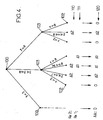
- the classification according to the invention of the two locations x and y allows, in this example, to reduce the size of the Trie memory by one register necessary to allow the application of the same processing rules.
- the priority relationship between the three rules is: Re2> Re1> Re3. Only the highest priority action is still finally assigned to each triplet, from among the actions assigned by each of the three rules.
- a default action O is also assigned to a triplet (x, y, z) which meets the requirements of any of the three rules.
- Figure 5 shows an analysis tree corresponding to the three previous rules Re1, Re2 and Re3, first analyzing the value of x, then the value of y, and finally the value of z.
- This analysis tree is constructed from the same as the trees in Figures 3 and 4. References 100 and 120 have the meanings already introduced.
- Nodes 104 correspond to the results of the analysis of the value of x which do not allow directly determine the action indicated by each rule, namely 5 ⁇ x ⁇ A, A ⁇ x ⁇ C and x> C.
- nodes 105 correspond to the results of the analysis of the value of y when the analysis of triples must still be followed by the analysis of the value of z.
- the leaves 106 of the analysis tree are connected by direct arcs to nodes 100, 104 or 105.
- Lines 112, 113 and 114 indicate, for each of the sheets 106, the actions respectively indicated by each of the three rules, taken in increasing order of priority.
- a line 120 indicates the final action assigned to each triple (x, y, z) according to the priority between the actions indicated by the three rules.
- Trie memory with sixteen cells elementary by register.
- the configuration of the Trie memory requires as many registers as nodes 100, 104 or 105, i.e. 9 registers in total.
- Figure 6 shows an analysis tree corresponding to the rules Re1, Re2 and Re3 by first analyzing the value of y, then the value of z, and lastly that of x, in ascending order the number of intervals defined respectively for x, y and z.
- Two knots intermediaries 107 correspond to the results of the analysis of the values of y, performed first, and six intermediate nodes 108 to the results of the analysis of the values of z, then carried out.
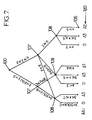
- the analysis tree in Figure 7 then corresponds to that of the Figure 6 by grouping the homologous sub-trees.
- the configuration of the Trie memory requires as many registers as nodes 100, 107 or 108, or 6 registers in total. Thus, 3 Trie memory registers have been saved compared to the configuration of the Trie memory from the analysis tree of FIG. 5.
- An example of configuration of the Trie memory which corresponds to the analysis tree of Figure 7 is:
- FIG. 8 details the different stages of the creation of a new arc of the analysis tree according to the preferred mode of implementation of the method of the invention which avoids, from the construction of the analysis tree, the creation of homologous sub-trees. It is a question of determining the end point of a new arc coming from a node NP of a p-th stage of the analysis tree, and associated with a domain D determined for the location E p associated with the p-th floor.
- the method described is applied repeatedly to each stage of the analysis tree, taken according to the order of the locations respectively associated with the stages.
- This method generates the nodes of the analysis tree, at the same time as it assigns to each created node a subset of rules.
- a subset ⁇ R j ⁇ of rules is already associated with this node, j being an integer numbering.
- each rule R j assigns an action when, for certain locations, the binary string read at this location is included in a range of values specified by this rule.
- This form of the rules R j corresponds to that of the previous examples.
- a first interrogation 200 we seek those of the rules Rj a range of which contains the domain D for which the associated arc is being creation. If none of the Rj rules have a range containing the domain D, then the end point of the arc is a sheet 102, 106 associated with the action defined by default O, according to step 201.
- the second interrogation 210 consists in searching among the rules R j1 identified during step 200, the rules R j2 of which at least one range corresponds to a location E q posterior to the location E p according to the sort order of locations. If none of the rules R j1 does not have a range corresponding to a location posterior to E p , then (step 211) the end point of the arc is a sheet 102, 106 associated with the action of the most priority rule among the rules R j1 identified in step 200.
- rule R j2 are identified during step 210.
- this node is the end point of the new arc coming from the node NP (step 222).
- a new node N p + 1 is created in the stage (p + 1) and associated with the subset ⁇ R j2 ⁇ of the rules identified during step 210 (step 221).
- the configuration of the Trie memory according to the invention is performed as new rules are introduced, or deletion of rules, at the level of the access control manager.
- This manager includes a compilation module that builds and modifies analysis trees according to the updates of rules introduced, before modify the existing configuration of the Trie memory.
Landscapes
- Engineering & Computer Science (AREA)
- Databases & Information Systems (AREA)
- Theoretical Computer Science (AREA)
- Computational Linguistics (AREA)
- Data Mining & Analysis (AREA)
- Physics & Mathematics (AREA)
- General Engineering & Computer Science (AREA)
- General Physics & Mathematics (AREA)
- Data Exchanges In Wide-Area Networks (AREA)
- Communication Control (AREA)
Applications Claiming Priority (2)
| Application Number | Priority Date | Filing Date | Title |
|---|---|---|---|
| FR0201705A FR2835991B1 (fr) | 2002-02-12 | 2002-02-12 | Procede de configuration d'une memoire trie pour le traitement de paquets de donnees, et dispositif de traitement de paquets mettant en oeuvre un tel procede |
| FR0201705 | 2002-02-12 |
Publications (3)
| Publication Number | Publication Date |
|---|---|
| EP1335565A2 true EP1335565A2 (de) | 2003-08-13 |
| EP1335565A3 EP1335565A3 (de) | 2005-10-05 |
| EP1335565B1 EP1335565B1 (de) | 2006-11-15 |
Family
ID=27589623
Family Applications (1)
| Application Number | Title | Priority Date | Filing Date |
|---|---|---|---|
| EP03290242A Expired - Lifetime EP1335565B1 (de) | 2002-02-12 | 2003-01-31 | Verfahren und Vorrichtung zur Verarbeitung von Datenpaketen |
Country Status (7)
| Country | Link |
|---|---|
| US (1) | US7023859B2 (de) |
| EP (1) | EP1335565B1 (de) |
| AT (1) | ATE345634T1 (de) |
| CA (1) | CA2373331A1 (de) |
| DE (1) | DE60309611T2 (de) |
| ES (1) | ES2276021T3 (de) |
| FR (1) | FR2835991B1 (de) |
Families Citing this family (14)
| Publication number | Priority date | Publication date | Assignee | Title |
|---|---|---|---|---|
| FR2812491B1 (fr) * | 2000-07-25 | 2003-01-10 | France Telecom | Dispositif de controle d'acces entre des reseaux atm |
| US7899067B2 (en) * | 2002-05-31 | 2011-03-01 | Cisco Technology, Inc. | Method and apparatus for generating and using enhanced tree bitmap data structures in determining a longest prefix match |
| US7508825B2 (en) * | 2002-08-05 | 2009-03-24 | Intel Corporation | Data packet classification |
| JP4610240B2 (ja) | 2004-06-24 | 2011-01-12 | 富士通株式会社 | 分析プログラム、分析方法及び分析装置 |
| US7281642B2 (en) * | 2004-09-16 | 2007-10-16 | Prime Time Toys, Ltd. | Squirting toy |
| US20060288024A1 (en) * | 2005-04-28 | 2006-12-21 | Freescale Semiconductor Incorporated | Compressed representations of tries |
| US7804774B2 (en) * | 2006-12-01 | 2010-09-28 | Sonus Networks, Inc. | Scalable filtering and policing mechanism for protecting user traffic in a network |
| US7672336B2 (en) * | 2006-12-01 | 2010-03-02 | Sonus Networks, Inc. | Filtering and policing for defending against denial of service attacks on a network |
| US7940657B2 (en) | 2006-12-01 | 2011-05-10 | Sonus Networks, Inc. | Identifying attackers on a network |
| USD606130S1 (en) | 2009-04-21 | 2009-12-15 | Prime Time Toys, Ltd. | Squirting toy |
| USD621451S1 (en) | 2009-08-31 | 2010-08-10 | Easeon Services, Ltd. | Squirting toy with animal head |
| USD621449S1 (en) | 2009-08-31 | 2010-08-10 | Easeon Services, Ltd. | Squirting toy with animal head |
| USD621452S1 (en) | 2009-09-02 | 2010-08-10 | Easeon Services, Ltd. | Squirting toy with handle |
| US8732207B2 (en) * | 2012-07-02 | 2014-05-20 | International Business Machines Corporation | Attribute-based linked tries for rule evaluation |
Family Cites Families (4)
| Publication number | Priority date | Publication date | Assignee | Title |
|---|---|---|---|---|
| AU620994B2 (en) * | 1989-07-12 | 1992-02-27 | Digital Equipment Corporation | Compressed prefix matching database searching |
| FR2789778B1 (fr) * | 1999-02-12 | 2001-09-14 | France Telecom | Procede pour associer des references d'acheminement a des paquets de donnees au moyen d'une memoire trie, et routeur de paquets appliquant ce procede |
| EP1128608B1 (de) * | 2000-01-27 | 2006-03-01 | International Business Machines Corporation | Verfahren und Vorrichtung für Klassifizierung von Datenpaketen |
| FR2812491B1 (fr) | 2000-07-25 | 2003-01-10 | France Telecom | Dispositif de controle d'acces entre des reseaux atm |
-
2002
- 2002-02-12 FR FR0201705A patent/FR2835991B1/fr not_active Expired - Fee Related
- 2002-02-25 US US10/082,647 patent/US7023859B2/en not_active Expired - Lifetime
- 2002-02-26 CA CA002373331A patent/CA2373331A1/en not_active Abandoned
-
2003
- 2003-01-31 ES ES03290242T patent/ES2276021T3/es not_active Expired - Lifetime
- 2003-01-31 AT AT03290242T patent/ATE345634T1/de not_active IP Right Cessation
- 2003-01-31 DE DE60309611T patent/DE60309611T2/de not_active Expired - Lifetime
- 2003-01-31 EP EP03290242A patent/EP1335565B1/de not_active Expired - Lifetime
Also Published As
| Publication number | Publication date |
|---|---|
| ES2276021T3 (es) | 2007-06-16 |
| DE60309611T2 (de) | 2007-09-06 |
| US20030156590A1 (en) | 2003-08-21 |
| US7023859B2 (en) | 2006-04-04 |
| ATE345634T1 (de) | 2006-12-15 |
| FR2835991B1 (fr) | 2004-04-23 |
| EP1335565B1 (de) | 2006-11-15 |
| FR2835991A1 (fr) | 2003-08-15 |
| DE60309611D1 (de) | 2006-12-28 |
| CA2373331A1 (en) | 2003-08-12 |
| EP1335565A3 (de) | 2005-10-05 |
Similar Documents
| Publication | Publication Date | Title |
|---|---|---|
| EP1335565B1 (de) | Verfahren und Vorrichtung zur Verarbeitung von Datenpaketen | |
| EP1030493B1 (de) | Verfahren um Verteilungsreferenzen mit Datenpaketen mittels eines TRIE-Speichers zu verknüpfen und Paketverarbeitungssystem das dieses Verfahren anwendet | |
| US6651096B1 (en) | Method and apparatus for organizing, storing and evaluating access control lists | |
| EP0639013B1 (de) | Verfahren und Vorrichtung zur Auswertung von Datenstrukturinformationen | |
| US6529508B1 (en) | Methods and apparatus for packet classification with multiple answer sets | |
| US8139591B1 (en) | Methods and apparatus for range matching during packet classification based on a linked-node structure | |
| EP1303953B1 (de) | Zugangskontrolleinrichtung zwischen atm-netzen | |
| JP2004503986A (ja) | コンテンツ・アウェアネットワーク装置 | |
| US7813350B2 (en) | System and method to process data packets in a network using stateful decision trees | |
| JP2001053789A (ja) | コンピュータネットワークにおける多層広帯域準備のためのシステム | |
| Lagrasse et al. | Digital forensic readiness framework for software-defined networks using a trigger-based collection mechanism | |
| FR2737372A1 (fr) | Dispositif et procede d'interconnexion de reseaux, routeur ip comprenant un tel dispositif | |
| Alouneh et al. | An effective classification approach for big data security based on GMPLS/MPLS networks | |
| Waldvogel | Multi-dimensional prefix matching using line search | |
| EP1142182B1 (de) | Vorrichtung und verfahren zur verarbeitung einer paketsequenz | |
| EP3818442B1 (de) | Verwaltung der anwendung einer richtlinie in einer sdn-umgebung eines kommunikationsnetzes | |
| US12401623B2 (en) | Merging chained actions in traffic policies having branch rules | |
| Donnelly et al. | IP route lookups as string matching | |
| WO2005052812A1 (fr) | Dispositif de memoire de type trie avec mecanisme de compression | |
| EP0989502A1 (de) | Aktualisierungsverfahren für einen inhaltsadressierbaren Trietypspeicher, und Router um solch ein Verfahren zu implementieren | |
| Wasti | Hardware assisted packet filtering firewall | |
| JPH1070570A (ja) | パケット処理装置 | |
| RU181257U1 (ru) | Межсетевой экран на основе кластеризации данных | |
| EP3018886B1 (de) | Verfahren zur weiterleitung von netzrahmen zu verarbeitungsressourcen | |
| Xu | Efficient table lookup algorithms for the next generation IP networks |
Legal Events
| Date | Code | Title | Description |
|---|---|---|---|
| PUAI | Public reference made under article 153(3) epc to a published international application that has entered the european phase |
Free format text: ORIGINAL CODE: 0009012 |
|
| AK | Designated contracting states |
Designated state(s): AT BE BG CH CY CZ DE DK EE ES FI FR GB GR HU IE IT LI LU MC NL PT SE SI SK TR |
|
| AX | Request for extension of the european patent |
Extension state: AL LT LV MK RO |
|
| PUAL | Search report despatched |
Free format text: ORIGINAL CODE: 0009013 |
|
| AK | Designated contracting states |
Kind code of ref document: A3 Designated state(s): AT BE BG CH CY CZ DE DK EE ES FI FR GB GR HU IE IT LI LU MC NL PT SE SI SK TR |
|
| AX | Request for extension of the european patent |
Extension state: AL LT LV MK RO |
|
| 17P | Request for examination filed |
Effective date: 20060315 |
|
| AKX | Designation fees paid |
Designated state(s): AT BE BG CH CY CZ DE DK EE ES FI FR GB GR HU IE IT LI LU MC NL PT SE SI SK TR |
|
| GRAP | Despatch of communication of intention to grant a patent |
Free format text: ORIGINAL CODE: EPIDOSNIGR1 |
|
| GRAS | Grant fee paid |
Free format text: ORIGINAL CODE: EPIDOSNIGR3 |
|
| GRAA | (expected) grant |
Free format text: ORIGINAL CODE: 0009210 |
|
| AK | Designated contracting states |
Kind code of ref document: B1 Designated state(s): AT BE BG CH CY CZ DE DK EE ES FI FR GB GR HU IE IT LI LU MC NL PT SE SI SK TR |
|
| PG25 | Lapsed in a contracting state [announced via postgrant information from national office to epo] |
Ref country code: IE Free format text: LAPSE BECAUSE OF FAILURE TO SUBMIT A TRANSLATION OF THE DESCRIPTION OR TO PAY THE FEE WITHIN THE PRESCRIBED TIME-LIMIT Effective date: 20061115 Ref country code: SK Free format text: LAPSE BECAUSE OF FAILURE TO SUBMIT A TRANSLATION OF THE DESCRIPTION OR TO PAY THE FEE WITHIN THE PRESCRIBED TIME-LIMIT Effective date: 20061115 Ref country code: SI Free format text: LAPSE BECAUSE OF FAILURE TO SUBMIT A TRANSLATION OF THE DESCRIPTION OR TO PAY THE FEE WITHIN THE PRESCRIBED TIME-LIMIT Effective date: 20061115 Ref country code: CZ Free format text: LAPSE BECAUSE OF FAILURE TO SUBMIT A TRANSLATION OF THE DESCRIPTION OR TO PAY THE FEE WITHIN THE PRESCRIBED TIME-LIMIT Effective date: 20061115 Ref country code: AT Free format text: LAPSE BECAUSE OF FAILURE TO SUBMIT A TRANSLATION OF THE DESCRIPTION OR TO PAY THE FEE WITHIN THE PRESCRIBED TIME-LIMIT Effective date: 20061115 Ref country code: NL Free format text: LAPSE BECAUSE OF FAILURE TO SUBMIT A TRANSLATION OF THE DESCRIPTION OR TO PAY THE FEE WITHIN THE PRESCRIBED TIME-LIMIT Effective date: 20061115 Ref country code: FI Free format text: LAPSE BECAUSE OF FAILURE TO SUBMIT A TRANSLATION OF THE DESCRIPTION OR TO PAY THE FEE WITHIN THE PRESCRIBED TIME-LIMIT Effective date: 20061115 |
|
| REG | Reference to a national code |
Ref country code: GB Ref legal event code: FG4D Free format text: NOT ENGLISH |
|
| REG | Reference to a national code |
Ref country code: CH Ref legal event code: EP |
|
| REF | Corresponds to: |
Ref document number: 60309611 Country of ref document: DE Date of ref document: 20061228 Kind code of ref document: P |
|
| REG | Reference to a national code |
Ref country code: IE Ref legal event code: FG4D Free format text: LANGUAGE OF EP DOCUMENT: FRENCH |
|
| PG25 | Lapsed in a contracting state [announced via postgrant information from national office to epo] |
Ref country code: MC Free format text: LAPSE BECAUSE OF NON-PAYMENT OF DUE FEES Effective date: 20070131 Ref country code: LI Free format text: LAPSE BECAUSE OF NON-PAYMENT OF DUE FEES Effective date: 20070131 Ref country code: CH Free format text: LAPSE BECAUSE OF NON-PAYMENT OF DUE FEES Effective date: 20070131 |
|
| PG25 | Lapsed in a contracting state [announced via postgrant information from national office to epo] |
Ref country code: BG Free format text: LAPSE BECAUSE OF FAILURE TO SUBMIT A TRANSLATION OF THE DESCRIPTION OR TO PAY THE FEE WITHIN THE PRESCRIBED TIME-LIMIT Effective date: 20070215 Ref country code: DK Free format text: LAPSE BECAUSE OF FAILURE TO SUBMIT A TRANSLATION OF THE DESCRIPTION OR TO PAY THE FEE WITHIN THE PRESCRIBED TIME-LIMIT Effective date: 20070215 Ref country code: SE Free format text: LAPSE BECAUSE OF FAILURE TO SUBMIT A TRANSLATION OF THE DESCRIPTION OR TO PAY THE FEE WITHIN THE PRESCRIBED TIME-LIMIT Effective date: 20070215 |
|
| GBT | Gb: translation of ep patent filed (gb section 77(6)(a)/1977) |
Effective date: 20070222 |
|
| PG25 | Lapsed in a contracting state [announced via postgrant information from national office to epo] |
Ref country code: PT Free format text: LAPSE BECAUSE OF FAILURE TO SUBMIT A TRANSLATION OF THE DESCRIPTION OR TO PAY THE FEE WITHIN THE PRESCRIBED TIME-LIMIT Effective date: 20070416 |
|
| NLV1 | Nl: lapsed or annulled due to failure to fulfill the requirements of art. 29p and 29m of the patents act | ||
| REG | Reference to a national code |
Ref country code: ES Ref legal event code: FG2A Ref document number: 2276021 Country of ref document: ES Kind code of ref document: T3 |
|
| REG | Reference to a national code |
Ref country code: IE Ref legal event code: FD4D |
|
| REG | Reference to a national code |
Ref country code: CH Ref legal event code: PL |
|
| PLBE | No opposition filed within time limit |
Free format text: ORIGINAL CODE: 0009261 |
|
| STAA | Information on the status of an ep patent application or granted ep patent |
Free format text: STATUS: NO OPPOSITION FILED WITHIN TIME LIMIT |
|
| 26N | No opposition filed |
Effective date: 20070817 |
|
| BERE | Be: lapsed |
Owner name: FRANCE TELECOM Effective date: 20070131 |
|
| PG25 | Lapsed in a contracting state [announced via postgrant information from national office to epo] |
Ref country code: BE Free format text: LAPSE BECAUSE OF NON-PAYMENT OF DUE FEES Effective date: 20070131 |
|
| PG25 | Lapsed in a contracting state [announced via postgrant information from national office to epo] |
Ref country code: GR Free format text: LAPSE BECAUSE OF FAILURE TO SUBMIT A TRANSLATION OF THE DESCRIPTION OR TO PAY THE FEE WITHIN THE PRESCRIBED TIME-LIMIT Effective date: 20070216 |
|
| PG25 | Lapsed in a contracting state [announced via postgrant information from national office to epo] |
Ref country code: EE Free format text: LAPSE BECAUSE OF FAILURE TO SUBMIT A TRANSLATION OF THE DESCRIPTION OR TO PAY THE FEE WITHIN THE PRESCRIBED TIME-LIMIT Effective date: 20061115 |
|
| PG25 | Lapsed in a contracting state [announced via postgrant information from national office to epo] |
Ref country code: LU Free format text: LAPSE BECAUSE OF NON-PAYMENT OF DUE FEES Effective date: 20070131 Ref country code: CY Free format text: LAPSE BECAUSE OF FAILURE TO SUBMIT A TRANSLATION OF THE DESCRIPTION OR TO PAY THE FEE WITHIN THE PRESCRIBED TIME-LIMIT Effective date: 20061115 |
|
| PG25 | Lapsed in a contracting state [announced via postgrant information from national office to epo] |
Ref country code: HU Free format text: LAPSE BECAUSE OF FAILURE TO SUBMIT A TRANSLATION OF THE DESCRIPTION OR TO PAY THE FEE WITHIN THE PRESCRIBED TIME-LIMIT Effective date: 20070516 Ref country code: TR Free format text: LAPSE BECAUSE OF FAILURE TO SUBMIT A TRANSLATION OF THE DESCRIPTION OR TO PAY THE FEE WITHIN THE PRESCRIBED TIME-LIMIT Effective date: 20061115 |
|
| REG | Reference to a national code |
Ref country code: FR Ref legal event code: PLFP Year of fee payment: 13 |
|
| REG | Reference to a national code |
Ref country code: FR Ref legal event code: PLFP Year of fee payment: 14 |
|
| REG | Reference to a national code |
Ref country code: FR Ref legal event code: PLFP Year of fee payment: 15 |
|
| REG | Reference to a national code |
Ref country code: FR Ref legal event code: PLFP Year of fee payment: 16 |
|
| PGFP | Annual fee paid to national office [announced via postgrant information from national office to epo] |
Ref country code: GB Payment date: 20201218 Year of fee payment: 19 |
|
| PGFP | Annual fee paid to national office [announced via postgrant information from national office to epo] |
Ref country code: IT Payment date: 20210104 Year of fee payment: 19 |
|
| PGFP | Annual fee paid to national office [announced via postgrant information from national office to epo] |
Ref country code: DE Payment date: 20201217 Year of fee payment: 19 Ref country code: ES Payment date: 20210201 Year of fee payment: 19 |
|
| REG | Reference to a national code |
Ref country code: DE Ref legal event code: R079 Ref document number: 60309611 Country of ref document: DE Free format text: PREVIOUS MAIN CLASS: H04L0029060000 Ipc: H04L0065000000 |
|
| PGFP | Annual fee paid to national office [announced via postgrant information from national office to epo] |
Ref country code: FR Payment date: 20211215 Year of fee payment: 20 |
|
| REG | Reference to a national code |
Ref country code: DE Ref legal event code: R119 Ref document number: 60309611 Country of ref document: DE |
|
| GBPC | Gb: european patent ceased through non-payment of renewal fee |
Effective date: 20220131 |
|
| PG25 | Lapsed in a contracting state [announced via postgrant information from national office to epo] |
Ref country code: GB Free format text: LAPSE BECAUSE OF NON-PAYMENT OF DUE FEES Effective date: 20220131 Ref country code: DE Free format text: LAPSE BECAUSE OF NON-PAYMENT OF DUE FEES Effective date: 20220802 |
|
| PG25 | Lapsed in a contracting state [announced via postgrant information from national office to epo] |
Ref country code: IT Free format text: LAPSE BECAUSE OF NON-PAYMENT OF DUE FEES Effective date: 20220131 |
|
| REG | Reference to a national code |
Ref country code: ES Ref legal event code: FD2A Effective date: 20230303 |
|
| PG25 | Lapsed in a contracting state [announced via postgrant information from national office to epo] |
Ref country code: ES Free format text: LAPSE BECAUSE OF NON-PAYMENT OF DUE FEES Effective date: 20220201 |