EP1335299A1 - Parallel operation device, entertainment device, operating method, computer program, and semiconductor device - Google Patents
Parallel operation device, entertainment device, operating method, computer program, and semiconductor device Download PDFInfo
- Publication number
- EP1335299A1 EP1335299A1 EP01980956A EP01980956A EP1335299A1 EP 1335299 A1 EP1335299 A1 EP 1335299A1 EP 01980956 A EP01980956 A EP 01980956A EP 01980956 A EP01980956 A EP 01980956A EP 1335299 A1 EP1335299 A1 EP 1335299A1
- Authority
- EP
- European Patent Office
- Prior art keywords
- arithmetical
- inner product
- sum
- during
- products
- Prior art date
- Legal status (The legal status is an assumption and is not a legal conclusion. Google has not performed a legal analysis and makes no representation as to the accuracy of the status listed.)
- Withdrawn
Links
Images



Classifications
-
- G—PHYSICS
- G06—COMPUTING OR CALCULATING; COUNTING
- G06F—ELECTRIC DIGITAL DATA PROCESSING
- G06F9/00—Arrangements for program control, e.g. control units
- G06F9/06—Arrangements for program control, e.g. control units using stored programs, i.e. using an internal store of processing equipment to receive or retain programs
- G06F9/30—Arrangements for executing machine instructions, e.g. instruction decode
- G06F9/30003—Arrangements for executing specific machine instructions
- G06F9/30007—Arrangements for executing specific machine instructions to perform operations on data operands
- G06F9/3001—Arithmetic instructions
-
- G—PHYSICS
- G06—COMPUTING OR CALCULATING; COUNTING
- G06F—ELECTRIC DIGITAL DATA PROCESSING
- G06F17/00—Digital computing or data processing equipment or methods, specially adapted for specific functions
- G06F17/10—Complex mathematical operations
- G06F17/16—Matrix or vector computation, e.g. matrix-matrix or matrix-vector multiplication, matrix factorization
-
- G—PHYSICS
- G06—COMPUTING OR CALCULATING; COUNTING
- G06F—ELECTRIC DIGITAL DATA PROCESSING
- G06F7/00—Methods or arrangements for processing data by operating upon the order or content of the data handled
- G06F7/38—Methods or arrangements for performing computations using exclusively denominational number representation, e.g. using binary, ternary, decimal representation
- G06F7/48—Methods or arrangements for performing computations using exclusively denominational number representation, e.g. using binary, ternary, decimal representation using non-contact-making devices, e.g. tube, solid state device; using unspecified devices
- G06F7/544—Methods or arrangements for performing computations using exclusively denominational number representation, e.g. using binary, ternary, decimal representation using non-contact-making devices, e.g. tube, solid state device; using unspecified devices for evaluating functions by calculation
- G06F7/5443—Sum of products
-
- G—PHYSICS
- G06—COMPUTING OR CALCULATING; COUNTING
- G06F—ELECTRIC DIGITAL DATA PROCESSING
- G06F2207/00—Indexing scheme relating to methods or arrangements for processing data by operating upon the order or content of the data handled
- G06F2207/38—Indexing scheme relating to groups G06F7/38 - G06F7/575
- G06F2207/48—Indexing scheme relating to groups G06F7/48 - G06F7/575
- G06F2207/4802—Special implementations
- G06F2207/4814—Non-logic devices, e.g. operational amplifiers
Definitions
- the present invention relates to a technology for carrying out parallel processing that uses a plurality of arithmetic unitsand, more particularly, to a parallel arithmetic processing technology for carrying out processing such as geometry processing on computer graphics at high speed.
- Some objects to be displayed with three-dimensional computer graphics may be modeled as a set of a plurality of basic graphics (polygons).
- the vertices of a polygon are expressed by four-dimensional coordinates (x, y, z, w) using homogeneous coordinates.
- the coordinates of the polygon vertices are subjected to coordinate transformation according to points of view coordinates and subjected to perspective transformation, etc. according to distances. That is, transformation is made in such a way that farther objects appear smaller. This series of processing is called "geometry processing".
- a matrix operation that uses a 4 ⁇ 4 transformation matrix is performed for rotation, expansion, contraction, perspective projection and parallel translation of a polygon.
- An inner product operation is carried out to determine, for example, brightness on a light-receptive surface.
- the matrix and inner product operations require repetitions of sum-of-products operations.
- a processing method that uses floating-points that are conventionally used for high end systems is used also in the field of entertainment apparatuses for generating entertainment images such as video game images and the field with severe constraints on costs such as the field of portable information terminals. This is because processing methods that use the floating-points increase the data dynamic range and facilitate programming, and are therefore suited to sophisticated processing.
- a parallel arithmetic apparatus which incorporates a plurality of floating-point sum-of-products operators (FMACs: Floating Multiply Accumulators) and carries out matrix operations efficiently.
- FMACs floating-point sum-of-products operators
- the plurality of FMACs allows parallel arithmetic operations increasing the processing speed.
- Some apparatuses such as entertainment apparatuses and personal computers, that carry out three-dimensional image processing can obtain fine and realistic three-dimensional images at high speed by means of carrying out the aforementioned geometry processing using such a parallel arithmetic apparatus.
- the parallel arithmetic apparatus can easily perform matrix operations using a 4 ⁇ 4 transformation matrix as shown in the mathematical expression 1.
- component values corresponding to a single row of the transformation matrix and coordinate values of the coordinates to be transformed are fed into each of four FMACs as arithmetical elements to be operated.
- the component values of the transformation matrix and the coordinate values of the coordinates entered are subjected to a sum-of-products operation to perform a matrix operation.
- component values (M11, M12, M13, M14) on the first row of the transformation matrix and coordinate values of the coordinates (Vx, Vy, Vz, Vw) are subjected to a sum-of-products operation to calculate "M11•Vx + M12•Vy + M13•Vz + M14•Vw". Since each of the four FMACs carries out a similar sum-of-products operation, matrix operations are completed efficiently.
- "•" denotes multiplication.
- each of the four FMACs is associated with one of the component values of the components X, Y, Z and W. Therefore, Ax and Bx, Ay and By, Az and Bz, and Aw and Bw are supplied to the four FMACs, respectively. Ax•Bx, Ay•By, Az•Bz and Aw•Bw are calculated as their respective outputs.
- execution of the mathematical expression 2 requires a separate adder for adding up the outputs of the four FMACs, which increased the scale of the circuit.
- the conventional parallel arithmetic apparatus can provide efficient processing of matrix operations.
- the FMACs provided in parallel alone cannot perform vector inner product operations and sometimes require an additional adder.
- the parallel arithmetic apparatus of the present invention can, when the selecting means selects recording means of the pair in which the selecting means itself is inserted, perform operations using arithmetical elements independent of each other in each pair. That is, it is possible to carry out the matrix operations similar to those in the conventional art.
- the selecting means selects one recording means after another from among all the recording means in a round-robin fashion, it is possible to perform operations using the arithmetical elements recorded in the recording means of each pair. That is, the parallel arithmetic apparatus of the present invention can perform inner product operations easily without the need to use other circuits such as adders.
- This parallel arithmetic apparatus can also insert temporary recording means for temporarily recording the arithmetical elements recorded in the recording means of a pair in which the selecting means is not inserted is inserted between the recording means and operating means of the pair.
- the selecting means is constructed in such a way as to supply the arithmetical elements recorded in the temporary recording means to the operating means when the recording means of the pair in which the selecting means is not inserted is selected.
- Inserting the temporary recording means eliminates the need to occupy the output ports of the recording means when arithmetical elements are taken in from the recording means. This allows the recording means and operating means of the pair in which the temporary recording means is inserted to perform other processing.
- the recording means of all pairs record, during a matrix operation, a first arithmetical element to be subjected to the matrix operation, and during a vector inner product operation, a second arithmetical element to be subjected to the vector inner product operation
- the selecting means is constructed in such a way as to input the first arithmetical element from the recording means of the own pair to the operating means of the own pair, and during the inner product operation, in such a way as to select the recording means of all the pairs one by one in a round-robin fashion and supply the second arithmetical element from the selected recording means to the operating means of the own pair.
- Each of the operating means performs operations with a content independently assigned to the pair using the operating elements recorded in the recording means of the pair and when this parallel arithmetic apparatus is used for three-dimensional computer graphics, such an operation is associated with any one of components of four-dimensional coordinates.
- Another embodiment of the present invention is a parallel arithmetic apparatus that selectively performs a matrix operation and vector inner product Operation, comprising a plurality of recording means for recording, during the matrix operation, a first arithmetical element to be subjected to the matrix operation and recording, during the inner product operation, a second arithmetical element to be subjected to the inner product operation, a plurality of operating means forming a one-to-one correspondence with the plurality of recording means for performing, during the matrix operation, a sum-of-products operation by each operating means receiving the first arithmetical element recorded in the corresponding recording means and performing, during the inner product operation, a sum-of-products operation by predetermined one of the operating means receiving the second arithmetical element recorded in all the recording means and selecting means for selecting, during the matrix operation, the recording means corresponding to the predetermined operating means and supplying a first arithmetical element recorded in this recording means to the predetermined operating means, and selecting, during the inner product operation, the
- the operating means is constructed so as to carry out a sum-of-products operation on the floating-point numbers when, for example, the arithmetical elements are expressed with floating-point numbers.
- the entertainment apparatus is an entertainment apparatus that performs image processing on an entertainment image by performing a matrix operation with regard to coordinates expressing a position and a shape of an object and performing an inner product operation with regard to vectors used to express an image of the object, comprising a plurality of registers that records, during the matrix operation, a first arithmetical element subjected to the matrix operation and records, during the inner product operation, a second arithmetical element subjected to the inner product operation, a plurality of sum-of-products operators forming a one-to-one correspondence with the plurality of registers that performs, during the matrix operation, a sum-of-products operation by each sum-of-products operator receiving the first arithmetical element recorded in the corresponding registers, and performs, during the inner product operation, a sum-of-products operation by predetermined one of the sum-of-products operators receiving the second arithmetical element recorded in all registers and a selector that selects, during the matrix
- Another entertainment apparatus of the present invention is an entertainment apparatus that performs image processing on an entertainment image by carrying out a matrix operation between a matrix and coordinate values to perform a coordinate transformation of coordinates expressing the position and a shape of an object and carrying out an inner product operation between a normal vector oriented in the normal direction of the surface of the object and position vector of a light source to determine the display mode of the surface of the object, comprising a plurality of registers that records the coordinate values and component values corresponding to any one row of the matrix during the matrix operation and records the normal vector and component values corresponding to any one component of the position vector during the inner product operation, a sum-of-products operators forming a one-to-one correspondence with the plurality of registers that carries out a sum-of-products operation during the matrix operation by each sum-of-products receiving the coordinate values recorded in the corresponding register and component values corresponding to the one row of the matrix, and carry out a sum-of-products operation during the inner product operation by predetermined one of the sum-of-product
- the processing method according to the present invention is a processing method that allows a matrix operation and vector inner product operation to be selectively executed and is executed by an apparatus provided with a plurality of operating means, comprising the steps of supplying, during the matrix operation, arithmetical elements subjected to the matrix operation by assigning the arithmetical elements to the plurality of operating means based on the features thereof to carry out a sum-of-products operation based on the assigned arithmetical elements and supplying, during the inner product operation, arithmetical elements subjected to the inner product operation in one predetermined operating means to allow the operating means to carry out a sum-of-products operation based on the arithmetical elements.
- the computer program according to the present invention is a computer program that makes it possible to selectively execute a matrix operation and vector inner product operation and renders a computer provided with a plurality of operating means to execute a step of supplying, during the matrix operation, arithmetical elements subjected to the matrix operation by assigning the arithmetical elements to the plurality of operating means based on the features thereof to carry out a sum-of-products operation based on the assigned arithmetical elements and supplying, during the inner product operation, arithmetical elements subjected to the inner product operation in one predetermined operating means to allow the operating means to carry out a sum-of-products operation based on the arithmetical elements.
- the semiconductor device is a semiconductor device that makes it possible to selectively execute a matrix operation and vector inner product operation and is built in an apparatus incorporating a computer provided with a plurality of operating means, rendering the apparatus to execute a step of supplying, during the matrix operation, arithmetical elements subjected to the matrix operation by assigning the arithmetical elements to the plurality of operating means based on the features thereof to allow each operating means to carry out a sum-of-products operation based on the assigned arithmetical elements and supplying, during the inner product operation, arithmetical elements subjected to the inner product operation in one predetermined operating means to allow the operating means to carry out a sum-of-products operation based on the arithmetical elements.
- FIG. 1 is a view illustrating a configuration example of an entertainment apparatus including a parallel arithmetic apparatus according to the present invention.
- This entertainment apparatus 1 comprises two buses, a main bus B1 and a sub bus B2, to which a plurality of semiconductor devices each having a specific function are connected. These buses B1 and B2 are connected to or disconnected from each other through a bus interface INT.
- the main bus B1 is connected to a main CPU 10 which is a main semiconductor device, a main memory 11 that is made up of a RAM, a main DMAC (Direct Memory Access Controller) 12, an MPEG (Moving Picture Experts Group) decoder (MDEC) 13 and a graphic processing unit (hereinafter referred to as "GPU") 14 having a built-in frame memory 15 which serves as a drawing memory.
- the GPU 14 is connected to a CRTC (CRT Controller) 16 for generating a video output signal so that the data drawn in the frame memory 15 can be displayed on a display apparatus which is not shown.
- CRTC CRT Controller
- the main CPU 10 loads a bootstrap program from the ROM 23 on the sub bus B2 through the bus interface INT upon activation of the entertainment apparatus 1, and executes the bootstrap program to start an operating system. It controls the media drive 27, reads an application program or data from the medium 28 mounted in this media drive 27, and stores this in the main memory 11. It performs the above-described geometry processing for various data read from the medium 28, such as three-dimensional object data (coordinate values of the vertices (representative points) of polygons) made up of a plurality of basic graphics (the polygons). Then, it generates a display list containing as its contents polygon definition information (specifications of a shape of the polygon used, its drawing position, type, color or texture of components of the polygon), as a result of the geometry processing.
- polygon definition information specificallyations of a shape of the polygon used, its drawing position, type, color or texture of components of the polygon
- a parallel arithmetic apparatus 100 is included in the main CPU 10 and is used for the geometry processing, etc. Details of the parallel arithmetic apparatus 100 will be described later.
- the GPU 14 is a semiconductor device having the functions of storing drawing context (drawing data including polygon components), carrying out rendering processing (drawing processing) by reading drawing context according to the display list notified from the main CPU 10 and drawing polygons in the frame memory 15.
- the frame memory 15 can also be used as a texture memory. Thus, a pixel image in the frame memory 15 can be pasted as texture to a polygon to be drawn.
- the main DMAC 12 is a semiconductor device that controls not only DMA transfer to each circuit connected to the main bus B1, but also DMA transfer to each circuit connected to the sub bus B2 according to the state of the bus interface INT.
- the MDEC 13 is a semiconductor device that operates in parallel with the main CPU 10 and has the function of decompressing data compressed, for example, in the MPEG (Moving Picture Experts Group) or JPEG (Joint Photographic Experts Group) format.
- the sub bus B2 is connected to a sub CPU 20 including a microprocessor, a sub memory 21 made up of a RAM, a sub DMAC 22, a ROM 23 on which a control program such as an operating system is stored, a sound processing semiconductor device (SPU: Sound Processing Unit) 24 that reads sound data stored in the sound memory 25 and produces them as an audio output, a communication control section (ATM) 26 that exchanges information with an external apparatus via a network which is not shown, a media drive 27 in which a medium 28, such as a CD-ROM and a DVD-ROM, can be loaded, and an input device 31.
- a sub CPU 20 including a microprocessor, a sub memory 21 made up of a RAM, a sub DMAC 22, a ROM 23 on which a control program such as an operating system is stored, a sound processing semiconductor device (SPU: Sound Processing Unit) 24 that reads sound data stored in the sound memory 25 and produces them as an audio output, a communication control section (ATM) 26 that exchanges information with an
- the sub CPU 20 carries out various operations according to the control program stored in the ROM 23.
- the sub DMAC 22 is a semiconductor device that controls operations such as DMA transfer to each circuit connected to the sub bus B2 only when the bus interface INT disconnects the main bus B1 from sub bus B2.
- the input device 31 is provided with a connection terminal 32 through which an input signal from an operating device 33 is supplied.
- the entertainment apparatus 1 with such a configuration can carry out matrix operations and inner product operations at high speed that are performed during the geometry processing through the parallel arithmetic apparatus 100 included in the main CPU 10, which will be described below.
- the parallel arithmetic apparatus 100 executes at high speed a matrix operation between a transformation matrix and vertex coordinate values that are performed when the coordinates of polygon vertices are transformed and an inner product operation between a normal vector oriented in the normal direction of the surface and a position vector of a light source carried out when a display condition such as brightness of the surface of an object is determined.
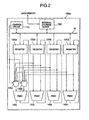
- FIG. 2 shows a configuration example of the parallel arithmetic apparatus 100 included in the main CPU 10.
- This parallel arithmetic apparatus 100a acquires coordinate values of polygon vertices and data (arithmetical elements) that are necessary for the geometry processing such as a transformation matrix used for matrix operations from the main memory 11 via the main bus B1 and carries out the operations.
- the parallel arithmetic apparatus 100a is configured from a control circuit 110, registers 120a to 120d, selectors 130a and 130b, FMACs 140a to 140d as arithmetic units, and an internal storage device 150.
- the registers 120a to 120d and the internal storage device 150 are connected via the internal bus B.
- the registers 120a to 120d each form a pair with the FMACs 140a to 140d, that is, the registers are designed to have a one-to-one correspondence with the FMACs.
- this embodiment uses four pairs of registers and FMACs, but the number of pairs can be determined according to the processing, as appropriate.
- the selectors 130a and 130b are provided between the register 120a and the FMAC 140a.
- the arithmetical elements used for the matrix operations and the inner product operations are given by using floating-point numbers, but it goes without saying that fixed-point numbers can also be used instead.
- the arithmetical elements are expressed with the fixed-point numbers, sum-of-products operators for the fixed-point numbers will be used rather than the FMACs 140a to 140d.
- the control circuit 110 controls the overall operation of the parallel arithmetic apparatus 100a.
- the control circuit controls the internal storage device 150, the recording of arithmetical elements in the registers 120a to 120d and the operations of the selectors 130a and 130b.
- the registers 120a to 120d take in and record the arithmetical elements assigned to the respective registers from among the arithmetical elements such as component values of a transformation matrix used for operations such as matrix operations or inner product operations, coordinate values of coordinates to be transformed and vector component values from the internal storage device 150 under the control of the control circuit 110.
- the registers take in and record component values assigned to the respective registers as arithmetical elements from among component values of two four-dimensional vectors.
- the register 120a records components values Ax and Bx
- the register 120b records components values Ay and By
- the register 120c records components values Az and Bz
- the register 120d records components values Aw and Bw.
- the registers take in and record, as arithmetical elements, the coordinate values of the four-dimensional coordinates to be transformed and component values of a row assigned to the respective registers of the transformation matrix.
- the registers 120a to 120d record component values of the transformation matrix in addition to coordinate values of the four-dimensional coordinates; the register 120a records the component values of the 1st row of the transformation matrix, the register 120b records the component values of the 2nd row of the transformation matrix, the register 120c records the component values of the 3rd row of the transformation matrix and the register 120d records the component values of the 4th row of the transformation matrix as their respective arithmetical elements.
- the registers 120a to 120d each record a pair of the 1st column component value of each row of the transformation matrix and the 1st component value of the four-dimensional coordinate to be transformed, a pair of the 2nd column component value and the 2nd component value, a pair of the 3rd column component value and the 3rd component value and a pair of the 4th column component value and the 4th component value, and these values are read one pair at a time.
- the registers 120a to 120d record calculation results of the FMACs 140a to 120d each forming a pair therewith.
- the selectors 130a and 130b select one of the registers 120a to 120d, take in an arithmetical element to be recorded in the selected register and supply it to the FMAC 140a.
- the selectors select one of the registers 120a to 120d in a round-robin fashion, take in an arithmetical element to be recorded in the selected register and supply it to the FMAC 140a.
- the selectors always select the register 120a and take in the arithmetical element recorded in the register 120a and supply it to the FMAC 140a.
- the selectors 130a and 130b select a register indicated by the control circuit 110 based on the content of an operation carried out at that time and the situation of progress of the operation, etc.
- the FMACs 140a to 140d take in two arithmetical elements recorded in the registers 120a to 120d and multiply and add up them.
- FIG. 3 is an internal block diagram of the FMAC 140a. Since the other FMACs 140b to 140d also have a similar configuration, only the configuration of the FMAC 140a is described here and description of the other FMACs 140b to 140d will be omitted.
- a floating-point number multiplier (FMUL: Floating MULtiply) 141 and a floating-point number adder (FADD: Floating ADDer) 142 are provided.
- the two arithmetical elements that are taken in are multiplied by the FMUL 141 first.
- the multiplication result is sent to the FADD 142.
- the FADD 142 adds up the multiplication results sent from the FMUL 141 one by one.
- the FMAC 140a obtains the following calculation result: a0•b0 + a1•b1 + a2•b2 + ... + a(n - 1) •b(n - 1) + an•bn
- the FMACs 140a to 140d supply the calculation results to the registers that form their respective pairs.
- the FMACs 140a to 140d perform the following operations during the inner product and matrix operations.
- the FMAC 140a multiplies the component values of the components of two vectors supplied from the registers 120a to 120d via the selectors 130a and 130b and adds up the multiplication results one by one. The number of times the multiplication and addition are performed may be counted, making the state of the progress of the inner product operation available to prevent the subsequent instruction from starting until the inner product operation is completed.
- the FMACs 140a to 140d multiply the component values of the transformation matrix taken in from the corresponding registers 120a to 120d by coordinate values of the four-dimensional coordinates which form pairs and add up the multiplication results one by one.
- the internal storage device 150 takes in coordinate values of polygon vertices, component values of the transformation matrix used for the matrix operations, data necessary for the geometry processing of the vector component values from the main memory 11 and records these values under the control of the control circuit 110. Furthermore, the internal storage device 150 takes in and records the calculation results from the registers 120a to 120d. The calculation results are sent to the main memory 11 via the internal storage device 150.
- a direct memory access transfer is performed between the internal storage device 150 and the main memory 11, which allows high speed data exchange and is convenient for processing of that requires a large volume of data processing, such as image processing.
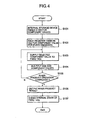
- FIG. 4 is a flow chart showing such a processing procedure.
- the parallel arithmetic apparatus 100a takes in the component values of the vector A (Ax, Ay, Az, Aw) and the vector B (Bx, By, Bz, Bw) stored in the main memory 11 through the direct memory access transfer and records the component values in the internal storage device 150 (step S101).
- the registers 120a to 120d take in the component values assigned to the respective registers from among the component values of the vector A (Ax, Ay, Az, Aw) and the vector B (Bx, By, Bz, Bw) stored in the internal storage device 150. That is, the register 120a takes in Ax and Bx, the register 120b takes in Ay and By, the register 120c takes in Az and Bz and the register 120d takes in Aw and Bw (step S102).
- the selectors 130a and 130b select one of the registers 120a to 120d, take in the component values of the vector A and the vector B to be recorded in the selected register and supply them to the FMAC 140a.
- the control circuit 110 determines which of the registers 120a to 120d should be selected according to the state of the progress of the inner product operation.
- the selectors 130a and 130b select one of the registers 120a to 120d under the control of the control circuit 110.
- the selectors first select the register 120a, take in Ax and Bx and supply them to the FMAC 140a (step S103).
- the FMAC 140a performs a sum-of-products operation between Ax and Bx using the FMUL 141 and the FADD 142 (step S104). Before the first sum-of-products operation is carried out, the internal state of the FMAC 140a is cleared.
- the FMAC 140a determines whether the inner product operation has been completed or not (step S105). Whether the inner product operation has been completed or not can be determined by understanding the number of the component values of the vectors subjected to the inner product operation. The number of times the sum-of products operations are performed is counted and it is when the count value becomes equal to the number of the component values of the received vectors that it is determined that the inner product operation has been completed. This makes it possible to find out from the count value the register from which the subsequent component value should be extracted. The result of the determination as to whether the inner product operation has been completed or not is sent to the control circuit 110.
- step S105 N
- the control circuit 110 allows the selectors 130a and130b to select the register 120b.
- the selectors 130a and130b select the register 120b under the control of the control circuit 110, take in Ay and By and supply them to the FMAC 140a.
- the FMUL 141 and the FADD 142 perform a sum-of-products operation to obtain Ax•Bx + Ay•By.
- the steps S103 to S105 are repeated until the inner product operations are completed to obtain Ax•Bx + Ay•By + Az•Bz + Aw•Bw.
- step S105 Upon determining that the inner product operations have been completed (step S105: Y), the FMAC 140a supplies the calculation result to the register 120a (step S106). After the output, the FMAC 140a clears the internal state (step S107). The output calculation result is supplied from the register 120a to the internal storage device 150 and sent to the main memory 11.
- Tthe selectors 130a and 130b allows calculations between the component values of different components, making it easier to carry out inner product operations.
- the selectors 130a and 130b are provided between the register 120a and the FMAC 140a, which is not intended to be restrictive.
- the selectors may also be provided between the register 120b and the FMAC 140b, between the register 120c and the FMAC 140c or between the register 120d and the FMAC 140d.
- the selectors 130a and 130b always select the register 120a, only supply the arithmetical element recorded in the register 120a to the FMAC 140a and never supply the arithmetical elements recorded in the other registers 120b to d to the FMAC 140a.
- the arithmetical elements recorded in the registers 120b to 120d are taken into the FMACs 140b to 140d with which the FMACs 140b to 140d form their respective pairs and processed.
- the register 120a records the component values (M11, M12, M13, M14) of the 1st row of the transformation matrix and the coordinate values (Vx, Vy, Vz, Vw) of the four-dimensional coordinates.
- the register 120b records the component values (M21, M22, M23, M24) of the 2nd row of the transformation matrix and the coordinate values (Vx, Vy, Vz, Vw) of the four-dimensional coordinates.
- the register 120c records the component values (M31, M32, M33, M34) of the 3rd row of the transformation matrix and the coordinate values (Vx, Vy, Vz, Vw) of the four-dimensional coordinates.
- the register 120d records the component values (M41, M42, M43, M44) of the 4th row of the transformation matrix and the coordinate values (Vx, Vy, Vz, Vw) of the four-dimensional coordinates.
- the FMACs 140a to 140d sequentially take in the component values and the coordinate values recorded in the registers 120a to 120d with which the FMACs form their respective pairs and carry out operations.
- the FMAC 140a is taken as an example, the FMAC 140a takes in M11 and Vx from the register 120a via the selectors 130a and 130b and calculates M11•Vx using the FMUL 141. They sends this to the FADD 142. Then, they takes in M12 and Vy and calculates M12•Vy, sends this to the FADD 142 and calculates M11•Vx + M12•Vy.
- the other FMACs 140b to 140d carry out the same operations.
- the FMACs 140a to 140d carry out operations in parallel executing thereby 4 ⁇ 4 matrix operations at the same speed as the conventional art.
- the parallel arithmetic apparatus 100a is an apparatus that selectively carries out the matrix operations and the vector inner product operations.
- the parallel arithmetic apparatus is provided with at least the registers 120a to 120d that record the component values of a transformation matrix as the arithmetical elements during the matrix operation and record the vector component values as arithmetical elements during the inner product operation, the FMACs 140a to 140d that take in the arithmetical elements recorded in the registers 120a to 120d and carry out sum-of-products operations, the selectors 130a and 130b that select one register from the registers 120a to 120d and supply the arithmetical elements registered in the selected register to the FMAC 140a.
- the registers 120b to 120d form a one-to-one correspondence with the FMACs 140b to 140d.
- the selectors 130a and 130b supply the component values of the transformation matrix recorded in the register 120a to the FMAC 140a during the matrix operation and select the registers 120a to 120d one by one in a round-robin fashion and supply the vector component value recorded in the selected register to the FMAC 140a during the inner product operation.
- the selectors 130a and 130b make it possible to carry out the matrix operation and the inner product operation selectively.
- FIG. 5 is a block diagram of a parallel arithmetic apparatus 100b according to another embodiment.
- the parallel arithmetic apparatus 100b is only different in that temporary registers 160b to 160d are provided at the output ends of the registers 120b to 120d.
- This parallel arithmetic apparatus 100b is configured with registers 120a to 120d that record arithmetical elements, and the FMACs 140a to 140d that carry out sum-of-products operations based on the arithmetical elements recorded in these registers 120a to 120d.
- Selectors 130a and 130b are inserted between the register 120a and the FMAC 140a and the temporary registers 160b to 160d are inserted between the registers 120b to 120d and the FMAC 140b to 140d.
- the selectors 130a and 130b select one from among the register 120a and the temporary registers 160b to 160d and supplies the arithmetical element recorded in the selected register 120a or temporary register 160b to 160d to the FMAC 140a. Operations of these components are controlled by the control circuit 110.
- the temporary registers 160b to 160d have a one-to-one correspondence with the registers 120b to 120d.
- the temporary registers 160b to 160d temporarily store the arithmetical elements recorded in their respective registers 120b to 120d when these are sent to the FMAC 140b to 140d or the selectors 130a and 130b.
- the temporary registers 160b to 160d temporarily record the arithmetical elements from the registers 120b to 120d, even if the arithmetical elements are not taken from the registers 120b to 120d into the FMAC 140a at the same timing as in the case of the inner product operation, the read ports of the registers 120b to 120d are not occupied by the arithmetical elements for inner product operations.
- the FMAC 140a is carrying out a matrix operation
- the other FMAC 140b to d can take in the subsequent arithmetical elements from the registers 120b to 120d, allowing a sum-of-products operation.
- the entertainment apparatus using the parallel arithmetic apparatus 100 is described as an example, which is not restrictive.
- the parallel arithmetic apparatus of the present invention may use any information processor which carries out parallel arithmetic processing and carries out at least matrix operations and vector inner product operations.
- the number of pairs of the registers and the sum-of-product operators (FMAC) is not limited to 4. The number of pairs may be determined according to the processing carried out by the relevant apparatus.
- the parallel arithmetic apparatus 100 can also be implemented by rendering a computer to execute the computer program of the present invention.
- This embodiment forms functional blocks corresponding to the selectors 130a and 130b on the computer with a plurality of FMACs through a co-operation between the computer program recorded in a computer-accessible recording medium such as a disk device or semiconductor memory and a control program (OS, etc.) incorporated in the computer.
- a computer-accessible recording medium such as a disk device or semiconductor memory
- a control program OS, etc.
- the present invention can perform the vector inner product operations easily while performing the matrix operations as efficiently as the conventional arts.
Landscapes
- Engineering & Computer Science (AREA)
- Physics & Mathematics (AREA)
- General Physics & Mathematics (AREA)
- Theoretical Computer Science (AREA)
- Computational Mathematics (AREA)
- Mathematical Analysis (AREA)
- Mathematical Optimization (AREA)
- Pure & Applied Mathematics (AREA)
- Mathematical Physics (AREA)
- Software Systems (AREA)
- General Engineering & Computer Science (AREA)
- Data Mining & Analysis (AREA)
- Computing Systems (AREA)
- Databases & Information Systems (AREA)
- Algebra (AREA)
- Complex Calculations (AREA)
- Image Processing (AREA)
- Image Generation (AREA)
- Advance Control (AREA)
- Multi Processors (AREA)
Abstract
The present invention provides a parallel arithmetic apparatus capable of easily
performing vector inner product operations as well as efficient matrix operations. A
parallel arithmetic apparatus (100a) is provided with pairs of registers (120a to 120d)
that record arithmetical elements to be operated and FMACs (140a to 140d) that
perform sum-of-products operations based on the arithmetical elements recorded in
these registers (120a to 120d). Selectors (130a, 130b) are inserted between the register
(120a) and the FMAC (140a). The selectors (130a, 130b) supply the arithmetical
element recorded in the register (120a) to the FMAC (140a) during a matrix operation,
select the registers (120a to d) one by one in a round-robin fashion and supply the
arithmetical element recorded in the selected register to the FMAC (140a) during a
vector inner product operation.
Description
The present invention relates to a technology for carrying out parallel
processing that uses a plurality of arithmetic unitsand, more particularly, to a parallel
arithmetic processing technology for carrying out processing such as geometry
processing on computer graphics at high speed.
Some objects to be displayed with three-dimensional computer graphics may
be modeled as a set of a plurality of basic graphics (polygons). The vertices of a
polygon are expressed by four-dimensional coordinates (x, y, z, w) using homogeneous
coordinates. The coordinates of the polygon vertices are subjected to coordinate
transformation according to points of view coordinates and subjected to perspective
transformation, etc. according to distances. That is, transformation is made in such a
way that farther objects appear smaller. This series of processing is called "geometry
processing".
There are various modes of geometry processing. For example, a matrix
operation that uses a 4 × 4 transformation matrix is performed for rotation, expansion,
contraction, perspective projection and parallel translation of a polygon. An inner
product operation is carried out to determine, for example, brightness on a light-receptive
surface. The matrix and inner product operations require repetitions of sum-of-products
operations.
In three-dimensional computer graphics, a processing method that uses
floating-points that are conventionally used for high end systems is used also in the field
of entertainment apparatuses for generating entertainment images such as video game
images and the field with severe constraints on costs such as the field of portable
information terminals. This is because processing methods that use the floating-points
increase the data dynamic range and facilitate programming, and are therefore suited to
sophisticated processing.
For the purpose of carrying out a matrix operation on floating-point numbers to
be used for processing that uses the floating-points, a parallel arithmetic apparatus is
available which incorporates a plurality of floating-point sum-of-products operators
(FMACs: Floating Multiply Accumulators) and carries out matrix operations efficiently.
The plurality of FMACs allows parallel arithmetic operations increasing the processing
speed.
Some apparatuses, such as entertainment apparatuses and personal computers,
that carry out three-dimensional image processing can obtain fine and realistic three-dimensional
images at high speed by means of carrying out the aforementioned
geometry processing using such a parallel arithmetic apparatus.
For a parallel arithmetic apparatus with, for example, four FMACs placed in
parallel, the parallel arithmetic apparatus can easily perform matrix operations using a 4
× 4 transformation matrix as shown in the mathematical expression 1. However, it is
difficult to perform an inner product operation between a vector A (Ax, Ay, Az, Aw)
and a vector B (Bx, By, Bz, Bw) as shown in the mathematical expression 2.
This is because the coordinates X, Y, Z and W that are subjected to processing
are independently operated in a one-to-one correspondence with four FMACs.
This is explained more specifically.
When a matrix operation in the mathematical expression 1 is carried out,
component values corresponding to a single row of the transformation matrix and
coordinate values of the coordinates to be transformed are fed into each of four FMACs
as arithmetical elements to be operated. The component values of the transformation
matrix and the coordinate values of the coordinates entered are subjected to a sum-of-products
operation to perform a matrix operation. For example, component values (M11,
M12, M13, M14) on the first row of the transformation matrix and coordinate values of
the coordinates (Vx, Vy, Vz, Vw) are subjected to a sum-of-products operation to
calculate "M11•Vx + M12•Vy + M13•Vz + M14•Vw". Since each of the four FMACs
carries out a similar sum-of-products operation, matrix operations are completed
efficiently. In this Specification, "•" denotes multiplication.
When an inner product operation in the mathematical expression 2 is carried
out, each of the four FMACs is associated with one of the component values of the
components X, Y, Z and W. Therefore, Ax and Bx, Ay and By, Az and Bz, and Aw and
Bw are supplied to the four FMACs, respectively. Ax•Bx, Ay•By, Az•Bz and Aw•Bw
are calculated as their respective outputs. Thus, execution of the mathematical
expression 2 requires a separate adder for adding up the outputs of the four FMACs,
which increased the scale of the circuit.
As apparent from the above, the conventional parallel arithmetic apparatus can
provide efficient processing of matrix operations. However, the FMACs provided in
parallel alone cannot perform vector inner product operations and sometimes require an
additional adder.

It is a main object of the present invention to provide a parallel arithmetic
apparatus capable of carrying out vector inner product operations easily while carrying
out matrix operations as efficiently as conventional parallel arithmetic apparatuses.
A parallel arithmetic apparatus according to the present invention that solves
the above-mentioned problems comprises multiple pairs of recording means for
recording arithmetical elements to be operated and operating means for performing
sum-of-products operations based on the arithmetical elements recorded in the
recording means, wherein one of said recording means of all pairs is selected and
selecting means for supplying the arithmetical elements recorded in the selected
recording means to the operating means of the pair is inserted between the recording
means and operating means of any one pair.
The parallel arithmetic apparatus of the present invention can, when the
selecting means selects recording means of the pair in which the selecting means itself
is inserted, perform operations using arithmetical elements independent of each other in
each pair. That is, it is possible to carry out the matrix operations similar to those in the
conventional art.
On the other hand, when the selecting means selects one recording means after
another from among all the recording means in a round-robin fashion, it is possible to
perform operations using the arithmetical elements recorded in the recording means of
each pair. That is, the parallel arithmetic apparatus of the present invention can perform
inner product operations easily without the need to use other circuits such as adders.
This parallel arithmetic apparatus can also insert temporary recording means
for temporarily recording the arithmetical elements recorded in the recording means of a
pair in which the selecting means is not inserted is inserted between the recording
means and operating means of the pair. In this case, the selecting means is constructed
in such a way as to supply the arithmetical elements recorded in the temporary
recording means to the operating means when the recording means of the pair in which
the selecting means is not inserted is selected.
Inserting the temporary recording means eliminates the need to occupy the
output ports of the recording means when arithmetical elements are taken in from the
recording means. This allows the recording means and operating means of the pair in
which the temporary recording means is inserted to perform other processing.
In the parallel arithmetic apparatus, the recording means of all pairs record,
during a matrix operation, a first arithmetical element to be subjected to the matrix
operation, and during a vector inner product operation, a second arithmetical element to
be subjected to the vector inner product operation, the selecting means is constructed in
such a way as to input the first arithmetical element from the recording means of the
own pair to the operating means of the own pair, and during the inner product operation,
in such a way as to select the recording means of all the pairs one by one in a round-robin
fashion and supply the second arithmetical element from the selected recording
means to the operating means of the own pair.
Each of the operating means performs operations with a content independently
assigned to the pair using the operating elements recorded in the recording means of the
pair and when this parallel arithmetic apparatus is used for three-dimensional computer
graphics, such an operation is associated with any one of components of four-dimensional
coordinates.
Another embodiment of the present invention is a parallel arithmetic apparatus
that selectively performs a matrix operation and vector inner product Operation,
comprising a plurality of recording means for recording, during the matrix operation, a
first arithmetical element to be subjected to the matrix operation and recording, during
the inner product operation, a second arithmetical element to be subjected to the inner
product operation, a plurality of operating means forming a one-to-one correspondence
with the plurality of recording means for performing, during the matrix operation, a
sum-of-products operation by each operating means receiving the first arithmetical
element recorded in the corresponding recording means and performing, during the
inner product operation, a sum-of-products operation by predetermined one of the
operating means receiving the second arithmetical element recorded in all the recording
means and selecting means for selecting, during the matrix operation, the recording
means corresponding to the predetermined operating means and supplying a first
arithmetical element recorded in this recording means to the predetermined operating
means, and selecting, during the inner product operation, the plurality of recording
means one by one in a round-robin fashion and supplying a second arithmetical element
recorded in the selected recording means to the predetermined operating means.
In such a parallel arithmetic apparatus, the operating means is constructed so as
to carry out a sum-of-products operation on the floating-point numbers when, for
example, the arithmetical elements are expressed with floating-point numbers.
The entertainment apparatus according to the present invention is an
entertainment apparatus that performs image processing on an entertainment image by
performing a matrix operation with regard to coordinates expressing a position and a
shape of an object and performing an inner product operation with regard to vectors
used to express an image of the object, comprising a plurality of registers that records,
during the matrix operation, a first arithmetical element subjected to the matrix
operation and records, during the inner product operation, a second arithmetical element
subjected to the inner product operation, a plurality of sum-of-products operators
forming a one-to-one correspondence with the plurality of registers that performs,
during the matrix operation, a sum-of-products operation by each sum-of-products
operator receiving the first arithmetical element recorded in the corresponding registers,
and performs, during the inner product operation, a sum-of-products operation by
predetermined one of the sum-of-products operators receiving the second arithmetical
element recorded in all registers and a selector that selects, during the matrix operation,
a register corresponding to the predetermined sum-of-products operator and supplies a
first arithmetical element recorded in this register to the predetermined sum-of-products
operator, and selects, during the inner product operation, the plurality of registers one by
one in a round-robin fashion and supplies a second arithmetical element recorded in the
selected register to the predetermined sum-of-products operator.
Another entertainment apparatus of the present invention is an entertainment
apparatus that performs image processing on an entertainment image by carrying out a
matrix operation between a matrix and coordinate values to perform a coordinate
transformation of coordinates expressing the position and a shape of an object and
carrying out an inner product operation between a normal vector oriented in the normal
direction of the surface of the object and position vector of a light source to determine
the display mode of the surface of the object, comprising a plurality of registers that
records the coordinate values and component values corresponding to any one row of
the matrix during the matrix operation and records the normal vector and component
values corresponding to any one component of the position vector during the inner
product operation, a sum-of-products operators forming a one-to-one correspondence
with the plurality of registers that carries out a sum-of-products operation during the
matrix operation by each sum-of-products receiving the coordinate values recorded in
the corresponding register and component values corresponding to the one row of the
matrix, and carry out a sum-of-products operation during the inner product operation by
predetermined one of the sum-of-products operators receiving the normal vector
recorded in all registers and component values of the position vector, a selector that
selects, during the matrix operation, a register corresponding to the predetermined sum-of
products operator and supplies the coordinate value recorded in this register and
component values corresponding to the one row of the matrix to the predetermined sum-of-products
operator, and selects, during the inner product operation, the plurality of
registers one by one in a round-robin fashion and supplies component values of the
normal vector and the position vector recorded in the selected register in the
predetermined sum-of-products operator.
The processing method according to the present invention is a processing
method that allows a matrix operation and vector inner product operation to be
selectively executed and is executed by an apparatus provided with a plurality of
operating means, comprising the steps of supplying, during the matrix operation,
arithmetical elements subjected to the matrix operation by assigning the arithmetical
elements to the plurality of operating means based on the features thereof to carry out a
sum-of-products operation based on the assigned arithmetical elements and supplying,
during the inner product operation, arithmetical elements subjected to the inner product
operation in one predetermined operating means to allow the operating means to carry
out a sum-of-products operation based on the arithmetical elements.
The computer program according to the present invention is a computer
program that makes it possible to selectively execute a matrix operation and vector
inner product operation and renders a computer provided with a plurality of operating
means to execute a step of supplying, during the matrix operation, arithmetical elements
subjected to the matrix operation by assigning the arithmetical elements to the plurality
of operating means based on the features thereof to carry out a sum-of-products
operation based on the assigned arithmetical elements and supplying, during the inner
product operation, arithmetical elements subjected to the inner product operation in one
predetermined operating means to allow the operating means to carry out a sum-of-products
operation based on the arithmetical elements.
The semiconductor device according to the present invention is a
semiconductor device that makes it possible to selectively execute a matrix operation
and vector inner product operation and is built in an apparatus incorporating a computer
provided with a plurality of operating means, rendering the apparatus to execute a step
of supplying, during the matrix operation, arithmetical elements subjected to the matrix
operation by assigning the arithmetical elements to the plurality of operating means
based on the features thereof to allow each operating means to carry out a sum-of-products
operation based on the assigned arithmetical elements and supplying, during
the inner product operation, arithmetical elements subjected to the inner product
operation in one predetermined operating means to allow the operating means to carry
out a sum-of-products operation based on the arithmetical elements.
Embodiments of the present invention are specifically described with reference
to the drawings accompanying herewith.
FIG. 1 is a view illustrating a configuration example of an entertainment
apparatus including a parallel arithmetic apparatus according to the present invention.
This entertainment apparatus 1 comprises two buses, a main bus B1 and a sub
bus B2, to which a plurality of semiconductor devices each having a specific function
are connected. These buses B1 and B2 are connected to or disconnected from each other
through a bus interface INT.
The main bus B1 is connected to a main CPU 10 which is a main
semiconductor device, a main memory 11 that is made up of a RAM, a main DMAC
(Direct Memory Access Controller) 12, an MPEG (Moving Picture Experts Group)
decoder (MDEC) 13 and a graphic processing unit (hereinafter referred to as "GPU") 14
having a built-in frame memory 15 which serves as a drawing memory. The GPU 14 is
connected to a CRTC (CRT Controller) 16 for generating a video output signal so that
the data drawn in the frame memory 15 can be displayed on a display apparatus which
is not shown.
The main CPU 10 loads a bootstrap program from the ROM 23 on the sub bus
B2 through the bus interface INT upon activation of the entertainment apparatus 1, and
executes the bootstrap program to start an operating system. It controls the media drive
27, reads an application program or data from the medium 28 mounted in this media
drive 27, and stores this in the main memory 11. It performs the above-described
geometry processing for various data read from the medium 28, such as three-dimensional
object data (coordinate values of the vertices (representative points) of
polygons) made up of a plurality of basic graphics (the polygons). Then, it generates a
display list containing as its contents polygon definition information (specifications of a
shape of the polygon used, its drawing position, type, color or texture of components of
the polygon), as a result of the geometry processing.
A parallel arithmetic apparatus 100 is included in the main CPU 10 and is used
for the geometry processing, etc. Details of the parallel arithmetic apparatus 100 will be
described later.
The GPU 14 is a semiconductor device having the functions of storing drawing
context (drawing data including polygon components), carrying out rendering
processing (drawing processing) by reading drawing context according to the display
list notified from the main CPU 10 and drawing polygons in the frame memory 15. The
frame memory 15 can also be used as a texture memory. Thus, a pixel image in the
frame memory 15 can be pasted as texture to a polygon to be drawn.
The main DMAC 12 is a semiconductor device that controls not only DMA
transfer to each circuit connected to the main bus B1, but also DMA transfer to each
circuit connected to the sub bus B2 according to the state of the bus interface INT. The
MDEC 13 is a semiconductor device that operates in parallel with the main CPU 10 and
has the function of decompressing data compressed, for example, in the MPEG
(Moving Picture Experts Group) or JPEG (Joint Photographic Experts Group) format.
The sub bus B2 is connected to a sub CPU 20 including a microprocessor, a
sub memory 21 made up of a RAM, a sub DMAC 22, a ROM 23 on which a control
program such as an operating system is stored, a sound processing semiconductor
device (SPU: Sound Processing Unit) 24 that reads sound data stored in the sound
memory 25 and produces them as an audio output, a communication control section
(ATM) 26 that exchanges information with an external apparatus via a network which is
not shown, a media drive 27 in which a medium 28, such as a CD-ROM and a DVD-ROM,
can be loaded, and an input device 31.
The sub CPU 20 carries out various operations according to the control
program stored in the ROM 23. The sub DMAC 22 is a semiconductor device that
controls operations such as DMA transfer to each circuit connected to the sub bus B2
only when the bus interface INT disconnects the main bus B1 from sub bus B2. The
input device 31 is provided with a connection terminal 32 through which an input signal
from an operating device 33 is supplied.
The entertainment apparatus 1 with such a configuration can carry out matrix
operations and inner product operations at high speed that are performed during the
geometry processing through the parallel arithmetic apparatus 100 included in the main
CPU 10, which will be described below.
The parallel arithmetic apparatus 100 executes at high speed a matrix operation
between a transformation matrix and vertex coordinate values that are performed when
the coordinates of polygon vertices are transformed and an inner product operation
between a normal vector oriented in the normal direction of the surface and a position
vector of a light source carried out when a display condition such as brightness of the
surface of an object is determined.
FIG. 2 shows a configuration example of the parallel arithmetic apparatus 100
included in the main CPU 10.
This parallel arithmetic apparatus 100a acquires coordinate values of polygon
vertices and data (arithmetical elements) that are necessary for the geometry processing
such as a transformation matrix used for matrix operations from the main memory 11
via the main bus B1 and carries out the operations.
The parallel arithmetic apparatus 100a is configured from a control circuit 110,
registers 120a to 120d, selectors 130a and 130b, FMACs 140a to 140d as arithmetic
units, and an internal storage device 150. The registers 120a to 120d and the internal
storage device 150 are connected via the internal bus B.
The registers 120a to 120d each form a pair with the FMACs 140a to 140d, that
is, the registers are designed to have a one-to-one correspondence with the FMACs. To
allow matrix operations using a 4 × 4 transformation matrix and inner product
operations of four-dimensional vectors, this embodiment uses four pairs of registers and
FMACs, but the number of pairs can be determined according to the processing, as
appropriate.
The selectors 130a and 130b are provided between the register 120a and the
FMAC 140a.
In this embodiment, the arithmetical elements used for the matrix operations
and the inner product operations are given by using floating-point numbers, but it goes
without saying that fixed-point numbers can also be used instead. When the arithmetical
elements are expressed with the fixed-point numbers, sum-of-products operators for the
fixed-point numbers will be used rather than the FMACs 140a to 140d.
The control circuit 110 controls the overall operation of the parallel arithmetic
apparatus 100a. For example, the control circuit controls the internal storage device 150,
the recording of arithmetical elements in the registers 120a to 120d and the operations
of the selectors 130a and 130b.
The registers 120a to 120d take in and record the arithmetical elements
assigned to the respective registers from among the arithmetical elements such as
component values of a transformation matrix used for operations such as matrix
operations or inner product operations, coordinate values of coordinates to be
transformed and vector component values from the internal storage device 150 under
the control of the control circuit 110.
When an inner product operation of four-dimensional vectors is carried out, the
registers take in and record component values assigned to the respective registers as
arithmetical elements from among component values of two four-dimensional vectors.
For example, of the two four-dimensional vectors (Ax, Ay, Az, Aw) and (Bx, By, Bz,
Bw), the register 120a records components values Ax and Bx, the register 120b records
components values Ay and By, the register 120c records components values Az and Bz
and the register 120d records components values Aw and Bw.
When a matrix operation is carried out using a 4 × 4 transformation matrix, the
registers take in and record, as arithmetical elements, the coordinate values of the four-dimensional
coordinates to be transformed and component values of a row assigned to
the respective registers of the transformation matrix. For example, the registers 120a to
120d record component values of the transformation matrix in addition to coordinate
values of the four-dimensional coordinates; the register 120a records the component
values of the 1st row of the transformation matrix, the register 120b records the
component values of the 2nd row of the transformation matrix, the register 120c records
the component values of the 3rd row of the transformation matrix and the register 120d
records the component values of the 4th row of the transformation matrix as their
respective arithmetical elements. The registers 120a to 120d each record a pair of the 1st
column component value of each row of the transformation matrix and the 1st
component value of the four-dimensional coordinate to be transformed, a pair of the 2nd
column component value and the 2nd component value, a pair of the 3rd column
component value and the 3rd component value and a pair of the 4th column component
value and the 4th component value, and these values are read one pair at a time.
Furthermore, the registers 120a to 120d record calculation results of the
FMACs 140a to 120d each forming a pair therewith.
The selectors 130a and 130b select one of the registers 120a to 120d, take in an
arithmetical element to be recorded in the selected register and supply it to the FMAC
140a. When an inner product operation is carried out, the selectors select one of the
registers 120a to 120d in a round-robin fashion, take in an arithmetical element to be
recorded in the selected register and supply it to the FMAC 140a. When a matrix
operation is carried out, the selectors always select the register 120a and take in the
arithmetical element recorded in the register 120a and supply it to the FMAC 140a.
The selectors 130a and 130b select a register indicated by the control circuit
110 based on the content of an operation carried out at that time and the situation of
progress of the operation, etc.
The FMACs 140a to 140d take in two arithmetical elements recorded in the
registers 120a to 120d and multiply and add up them.
FIG. 3 is an internal block diagram of the FMAC 140a. Since the other FMACs
140b to 140d also have a similar configuration, only the configuration of the FMAC
140a is described here and description of the other FMACs 140b to 140d will be
omitted.
In order to multiply and add up the arithmetical elements taken in, a floating-point
number multiplier (FMUL: Floating MULtiply) 141 and a floating-point number
adder (FADD: Floating ADDer) 142 are provided. The two arithmetical elements that
are taken in are multiplied by the FMUL 141 first. The multiplication result is sent to
the FADD 142. The FADD 142 adds up the multiplication results sent from the FMUL
141 one by one.
For example, when a0 to an and b0 to bn are taken in one after another as the
arithmetical elements, the FMAC 140a obtains the following calculation result:
a0•b0 + a1•b1 + a2•b2 + ... + a(n - 1) •b(n - 1) + an•bn
The FMACs 140a to 140d supply the calculation results to the registers that
form their respective pairs.
Using the selectors 130a and 130b, the FMACs 140a to 140d perform the
following operations during the inner product and matrix operations.
When an inner product operation is carried out, the FMAC 140a multiplies the
component values of the components of two vectors supplied from the registers 120a to
120d via the selectors 130a and 130b and adds up the multiplication results one by one.
The number of times the multiplication and addition are performed may be counted,
making the state of the progress of the inner product operation available to prevent the
subsequent instruction from starting until the inner product operation is completed.
When a matrix operation is carried out, the FMACs 140a to 140d multiply the
component values of the transformation matrix taken in from the corresponding
registers 120a to 120d by coordinate values of the four-dimensional coordinates which
form pairs and add up the multiplication results one by one.
The internal storage device 150 takes in coordinate values of polygon vertices,
component values of the transformation matrix used for the matrix operations, data
necessary for the geometry processing of the vector component values from the main
memory 11 and records these values under the control of the control circuit 110.
Furthermore, the internal storage device 150 takes in and records the calculation results
from the registers 120a to 120d. The calculation results are sent to the main memory 11
via the internal storage device 150.
A direct memory access transfer is performed between the internal storage
device 150 and the main memory 11, which allows high speed data exchange and is
convenient for processing of that requires a large volume of data processing, such as
image processing.
The processing procedure when the parallel arithmetic apparatus 100a carries
out the inner product operation in the mathematical expression 2, that is, the inner
product operation between the vector A (Ax, Ay, Az, Aw) and the vector B (Bx, By, Bz,
Bw) is described. FIG. 4 is a flow chart showing such a processing procedure.
The parallel arithmetic apparatus 100a takes in the component values of the
vector A (Ax, Ay, Az, Aw) and the vector B (Bx, By, Bz, Bw) stored in the main
memory 11 through the direct memory access transfer and records the component
values in the internal storage device 150 (step S101).
The registers 120a to 120d take in the component values assigned to the
respective registers from among the component values of the vector A (Ax, Ay, Az, Aw)
and the vector B (Bx, By, Bz, Bw) stored in the internal storage device 150. That is, the
register 120a takes in Ax and Bx, the register 120b takes in Ay and By, the register 120c
takes in Az and Bz and the register 120d takes in Aw and Bw (step S102).
The selectors 130a and 130b select one of the registers 120a to 120d, take in
the component values of the vector A and the vector B to be recorded in the selected
register and supply them to the FMAC 140a. The control circuit 110 determines which
of the registers 120a to 120d should be selected according to the state of the progress of
the inner product operation. The selectors 130a and 130b select one of the registers 120a
to 120d under the control of the control circuit 110. Here, the selectors first select the
register 120a, take in Ax and Bx and supply them to the FMAC 140a (step S103). The
FMAC 140a performs a sum-of-products operation between Ax and Bx using the
FMUL 141 and the FADD 142 (step S104). Before the first sum-of-products operation
is carried out, the internal state of the FMAC 140a is cleared.
After the sum-of-products operation, the FMAC 140a determines whether the
inner product operation has been completed or not (step S105). Whether the inner
product operation has been completed or not can be determined by understanding the
number of the component values of the vectors subjected to the inner product operation.
The number of times the sum-of products operations are performed is counted and it is
when the count value becomes equal to the number of the component values of the
received vectors that it is determined that the inner product operation has been
completed. This makes it possible to find out from the count value the register from
which the subsequent component value should be extracted. The result of the
determination as to whether the inner product operation has been completed or not is
sent to the control circuit 110.
In this case, the inner product operation has not been completed yet (step S105:
N), and therefore the control circuit 110 allows the selectors 130a and130b to select the
register 120b. The selectors 130a and130b select the register 120b under the control of
the control circuit 110, take in Ay and By and supply them to the FMAC 140a. When
the FMAC 140a takes in Ay and By, the FMUL 141 and the FADD 142 perform a sum-of-products
operation to obtain Ax•Bx + Ay•By. Likewise, the steps S103 to S105 are
repeated until the inner product operations are completed to obtain Ax•Bx + Ay•By +
Az•Bz + Aw•Bw.
Upon determining that the inner product operations have been completed (step
S105: Y), the FMAC 140a supplies the calculation result to the register 120a (step
S106). After the output, the FMAC 140a clears the internal state (step S107). The output
calculation result is supplied from the register 120a to the internal storage device 150
and sent to the main memory 11.
This completes the inner product operations.
When a matrix operation is performed, the selectors 130a and 130b always
select the register 120a, only supply the arithmetical element recorded in the register
120a to the FMAC 140a and never supply the arithmetical elements recorded in the
other registers 120b to d to the FMAC 140a. The arithmetical elements recorded in the
registers 120b to 120d are taken into the FMACs 140b to 140d with which the FMACs
140b to 140d form their respective pairs and processed.
For example, when the matrix operation in the mathematical expression 1 is
carried out, the register 120a records the component values (M11, M12, M13, M14) of
the 1st row of the transformation matrix and the coordinate values (Vx, Vy, Vz, Vw) of
the four-dimensional coordinates. The register 120b records the component values (M21,
M22, M23, M24) of the 2nd row of the transformation matrix and the coordinate values
(Vx, Vy, Vz, Vw) of the four-dimensional coordinates. The register 120c records the
component values (M31, M32, M33, M34) of the 3rd row of the transformation matrix
and the coordinate values (Vx, Vy, Vz, Vw) of the four-dimensional coordinates. The
register 120d records the component values (M41, M42, M43, M44) of the 4th row of
the transformation matrix and the coordinate values (Vx, Vy, Vz, Vw) of the four-dimensional
coordinates.
The FMACs 140a to 140d sequentially take in the component values and the
coordinate values recorded in the registers 120a to 120d with which the FMACs form
their respective pairs and carry out operations. Suppose the FMAC 140a is taken as an
example, the FMAC 140a takes in M11 and Vx from the register 120a via the selectors
130a and 130b and calculates M11•Vx using the FMUL 141. They sends this to the
FADD 142. Then, they takes in M12 and Vy and calculates M12•Vy, sends this to the
FADD 142 and calculates M11•Vx + M12•Vy. Then, They carries out the same
calculation on M13 and Vz, and M14 and Vw and calculates M11•Vx + M12•Vy +
M13•Vz + M14•Vw. The other FMACs 140b to 140d carry out the same operations.
Thus, the FMACs 140a to 140d carry out operations in parallel executing thereby 4 × 4
matrix operations at the same speed as the conventional art.
As described above, the parallel arithmetic apparatus 100a is an apparatus that
selectively carries out the matrix operations and the vector inner product operations.
The parallel arithmetic apparatus is provided with at least the registers 120a to 120d that
record the component values of a transformation matrix as the arithmetical elements
during the matrix operation and record the vector component values as arithmetical
elements during the inner product operation, the FMACs 140a to 140d that take in the
arithmetical elements recorded in the registers 120a to 120d and carry out sum-of-products
operations, the selectors 130a and 130b that select one register from the
registers 120a to 120d and supply the arithmetical elements registered in the selected
register to the FMAC 140a. The registers 120b to 120d form a one-to-one
correspondence with the FMACs 140b to 140d. The selectors 130a and 130b supply the
component values of the transformation matrix recorded in the register 120a to the
FMAC 140a during the matrix operation and select the registers 120a to 120d one by
one in a round-robin fashion and supply the vector component value recorded in the
selected register to the FMAC 140a during the inner product operation.
As apparent from the above, the selectors 130a and 130b make it possible to
carry out the matrix operation and the inner product operation selectively.
FIG. 5 is a block diagram of a parallel arithmetic apparatus 100b according to
another embodiment.
Compared to the parallel arithmetic apparatus 100a shown in FIG. 2, the
parallel arithmetic apparatus 100b is only different in that temporary registers 160b to
160d are provided at the output ends of the registers 120b to 120d.
This parallel arithmetic apparatus 100b is configured with registers 120a to
120d that record arithmetical elements, and the FMACs 140a to 140d that carry out
sum-of-products operations based on the arithmetical elements recorded in these
registers 120a to 120d. Selectors 130a and 130b are inserted between the register 120a
and the FMAC 140a and the temporary registers 160b to 160d are inserted between the
registers 120b to 120d and the FMAC 140b to 140d. The selectors 130a and 130b select
one from among the register 120a and the temporary registers 160b to 160d and
supplies the arithmetical element recorded in the selected register 120a or temporary
register 160b to 160d to the FMAC 140a. Operations of these components are
controlled by the control circuit 110.
The temporary registers 160b to 160d have a one-to-one correspondence with
the registers 120b to 120d. The temporary registers 160b to 160d temporarily store the
arithmetical elements recorded in their respective registers 120b to 120d when these are
sent to the FMAC 140b to 140d or the selectors 130a and 130b.
Since the temporary registers 160b to 160d temporarily record the arithmetical
elements from the registers 120b to 120d, even if the arithmetical elements are not taken
from the registers 120b to 120d into the FMAC 140a at the same timing as in the case of
the inner product operation, the read ports of the registers 120b to 120d are not occupied
by the arithmetical elements for inner product operations. Thus, while the FMAC 140a
is carrying out a matrix operation, the other FMAC 140b to d can take in the subsequent
arithmetical elements from the registers 120b to 120d, allowing a sum-of-products
operation.
In the above-described embodiments, the entertainment apparatus using the
parallel arithmetic apparatus 100 is described as an example, which is not restrictive.
The parallel arithmetic apparatus of the present invention may use any information
processor which carries out parallel arithmetic processing and carries out at least matrix
operations and vector inner product operations. Moreover, the number of pairs of the
registers and the sum-of-product operators (FMAC) is not limited to 4. The number of
pairs may be determined according to the processing carried out by the relevant
apparatus.
Furthermore, the parallel arithmetic apparatus 100 can also be implemented by
rendering a computer to execute the computer program of the present invention. This
embodiment forms functional blocks corresponding to the selectors 130a and 130b on
the computer with a plurality of FMACs through a co-operation between the computer
program recorded in a computer-accessible recording medium such as a disk device or
semiconductor memory and a control program (OS, etc.) incorporated in the computer.
As described above, the present invention can perform the vector inner product
operations easily while performing the matrix operations as efficiently as the
conventional arts.
Claims (12)
- A parallel arithmetic apparatus comprising multiple pairs of recording means for recording arithmetical elements to be operated and operating means for performing sum-of-products operations based on the arithmetical elements recorded in said recording means, wherein
one of said recording means of all pairs is selected and selecting means for supplying said arithmetical elements recorded in the selected recording means to the operating means of said pair is inserted between the recording means and operating means of any one pair. - The parallel arithmetic apparatus according to claim 1, wherein temporary recording means for temporarily recording said arithmetical elements recorded in the recording means of a pair in which said selecting means is not inserted is inserted between the recording means and operating means of said pair, and
said selecting means is constructed in such a way as to supply the arithmetical elements recorded in said temporary recording means to said operating means when the recording means of the pair in which said selecting means is not inserted is selected. - The parallel arithmetic apparatus according to claim 1, wherein said recording means of all pairs record, during a matrix operation, a first arithmetical element to be subjected to said matrix operation, and during a vector inner product operation, a second arithmetical element to be subjected to said inner product operation,
said selecting means is constructed, during said matrix operation, in such a way as to input said first arithmetical element from the recording means of the own pair to the operating means of the own pair and, during said inner product operation, in such a way as to select said recording means of all pairs one by one in a round-robin fashion and supply said second arithmetical element from the selected recording means to the operating means of the own pair. - The parallel arithmetic apparatus according to claim 1, wherein each of said operating means performs an operation with a content independently assigned to said pair using said arithmetical elements recorded in the recording means of said pair.
- The parallel arithmetic apparatus according to claim 4, wherein said operation is an operation associated with any one of four-dimensional coordinate components.
- A parallel arithmetic apparatus that selectively performs a matrix operation and vector inner product operation, comprising:a plurality of recording means for recording, during said matrix operation, a first arithmetical element to be subjected to said matrix operation and recording, during said inner product operation, a second arithmetical element to be subjected to said inner product operation;a plurality of operating means forming a one-to-one correspondence with said plurality of recording means for performing, during said matrix operation, a sum-of-products operation by each operating means receiving said first arithmetical element recorded in the corresponding recording means, and performing, during said inner product operation, a sum-of-products operation by predetermined one of the operating means receiving said second arithmetical element recorded in all the recording means; andselecting means for selecting, during said matrix operation, the recording means corresponding to said predetermined operating means and supplying a first arithmetical element recorded in this recording means to said predetermined operating means, and selecting, during said inner product operation, said plurality of recording means one by one in a round-robin fashion and supplying a second arithmetical element recorded in the selected recording means to said predetermined operating means.
- The parallel arithmetic apparatus according to claim 6, wherein said arithmetical element is expressed with a floating point number and said operating means is constructed so as to perform a sum-of products operation of the floating point number.
- An entertainment apparatus that performs image processing on an entertainment image by performing a matrix operation with regard to coordinates expressing a position and a shape of an object and performing an inner product operation with regard to vectors used to express an image of said object, comprising:a plurality of registers that records, during said matrix operation, a first arithmetical element subjected to said matrix operation and records, during said inner product operation, a second arithmetical element subjected to said inner product operation;a plurality of sum-of-products operators forming a one-to-one correspondence with said plurality of registers that performs, during said matrix operation, a sum-of-products operation by each sum-of-products operator receiving said first arithmetical element recorded in the corresponding register, and performs, during said inner product operation, a sum-of-products operation by predetermined one of the sum-of-products operators receiving said second arithmetical element recorded in all registers; anda selector that selects, during said matrix operation, a register corresponding to said predetermined sum-of-products operator and supplies a first arithmetical element recorded in this register to said predetermined sum-of-products operator, and selects, during said inner product operation, said plurality of registers one by one in a round-robin fashion and supplies a second arithmetical element recorded in the selected register to said predetermined sum-of-products operator.
- An entertainment apparatus that performs image processing on an entertainment image by carrying out a matrix operation between a matrix and coordinate values to perform a coordinate transformation of coordinates expressing the position and a shape of an object and carrying out an inner product operation between a normal vector oriented in the normal direction of the surface of said object and position vector of a light source to determine the display mode of the surface of said object, comprising:a plurality of registers that records said coordinate values and component values corresponding to any one row of said matrix during said matrix operation and records said normal vector and component values corresponding to any one component of said position vector during said inner product operation;sum-of-products operators forming a one-to-one correspondence with said plurality of registers that carry out a sum-of-products operation during said matrix operation by each sum-of-products operator receiving said coordinate values recorded in the corresponding register and component values corresponding to said one row of said matrix, and carry out a sum-of-products operation during said inner product operation by predetermined one of the sum-of-products operators receiving said normal vector recorded in all registers and component values of said position vector;a selector that selects, during said matrix operation, a register corresponding to said predetermined sum-of-products operator and supplies said coordinate value recorded in this register and component values corresponding to said one row of said matrix to said predetermined sum-of-products operator, and selects, during said inner product operation, said plurality of registers one by one in a round-robin fashion and supplies component values of said normal vector and said position vector recorded in the selected register in said predetermined sum-of-product operator.
- A processing method that allows a matrix operation and vector inner product operation to be selectively executed and is executed by an apparatus provided with a plurality of operating means, comprising the steps of:supplying, during said matrix operation, arithmetical elements subjected to said matrix operation by assigning the arithmetical elements to said plurality of operating means based on the features thereof to carry out a sum-of-products operation based on the assigned arithmetical elements; andsupplying, during said inner product operation, arithmetical elements subjected to said inner product operation in one predetermined operating means to allow said operating means to carry out a sum-of-products operation based on the arithmetical elements.
- A computer program that that makes it possible to selectively execute a matrix operation and vector inner product operation and renders a computer provided with a plurality of operating means to execute:a step of supplying, during said matrix operation, arithmetical elements subjected to said matrix operation by assigning the arithmetical elements to said plurality of operating means based on the features thereof to carry out a sum-of-products operation based on the assigned arithmetical elements; anda step of supplying, during said inner product operation, arithmetical elements subjected to said inner product operation in one predetermined operating means to allow said operating means to carry out a sum-of-products operation based on the arithmetical elements.
- A semiconductor device that makes it possible to selectively execute a matrix operation and vector inner product operation and is built in an apparatus incorporating a computer provided with a plurality of operating means, rendering said apparatus to execute:a step of supplying, during said matrix operation, arithmetical elements subjected to said matrix operation by assigning the arithmetical elements to said plurality of operating means based on the features thereof to allow each operating means to carry out a sum-of-products operation based on the assigned arithmetical elements; anda step of supplying, during said inner product operation, arithmetical elements subjected to said inner product operation in one predetermined operating means to allow said operating means to carry out a sum-of-products operation based on the arithmetical elements.
Applications Claiming Priority (5)
| Application Number | Priority Date | Filing Date | Title |
|---|---|---|---|
| JP2000335787 | 2000-11-02 | ||
| JP2000335787 | 2000-11-02 | ||
| JP2001318590 | 2001-10-16 | ||
| JP2001318590A JP3338043B2 (en) | 2000-11-02 | 2001-10-16 | Parallel arithmetic device, entertainment device, arithmetic processing method, computer program, semiconductor device |
| PCT/JP2001/009616 WO2002037317A1 (en) | 2000-11-02 | 2001-11-02 | Parallel operation device, entertainment device, operating method, computer program, and semiconductor device |
Publications (2)
| Publication Number | Publication Date |
|---|---|
| EP1335299A1 true EP1335299A1 (en) | 2003-08-13 |
| EP1335299A4 EP1335299A4 (en) | 2009-09-23 |
Family
ID=26603342
Family Applications (1)
| Application Number | Title | Priority Date | Filing Date |
|---|---|---|---|
| EP01980956A Withdrawn EP1335299A4 (en) | 2000-11-02 | 2001-11-02 | Parallel operation device, entertainment device, operating method, computer program, and semiconductor device |
Country Status (8)
| Country | Link |
|---|---|
| US (1) | US20020143838A1 (en) |
| EP (1) | EP1335299A4 (en) |
| JP (1) | JP3338043B2 (en) |
| KR (1) | KR100882113B1 (en) |
| CN (1) | CN1320479C (en) |
| AU (1) | AU2002212702A1 (en) |
| TW (1) | TW571202B (en) |
| WO (1) | WO2002037317A1 (en) |
Cited By (1)
| Publication number | Priority date | Publication date | Assignee | Title |
|---|---|---|---|---|
| US7430577B2 (en) | 2002-09-24 | 2008-09-30 | Interdigital Technology Corporation | Computationally efficient mathematical engine |
Families Citing this family (10)
| Publication number | Priority date | Publication date | Assignee | Title |
|---|---|---|---|---|
| JP4046716B2 (en) | 2004-10-06 | 2008-02-13 | 株式会社ソニー・コンピュータエンタテインメント | Information processing apparatus and data transmission method |
| JP3768516B1 (en) | 2004-12-03 | 2006-04-19 | 株式会社ソニー・コンピュータエンタテインメント | Multiprocessor system and program execution method in the system |
| JP2007122209A (en) * | 2005-10-26 | 2007-05-17 | Nec System Technologies Ltd | Three-dimensional graphics drawing device, method therefor and program |
| JP4981398B2 (en) * | 2006-10-05 | 2012-07-18 | 日本電信電話株式会社 | Parallel computing system |
| KR100919236B1 (en) * | 2007-05-22 | 2009-09-30 | 한국전자통신연구원 | A method for 3D Graphic Geometric Transformation using Parallel Processor |
| CN102722412A (en) | 2011-03-31 | 2012-10-10 | 国际商业机器公司 | Combined computational device and method |
| US8893083B2 (en) | 2011-08-09 | 2014-11-18 | International Business Machines Coporation | Collective operation protocol selection in a parallel computer |
| CN102411558B (en) * | 2011-10-31 | 2015-05-13 | 中国人民解放军国防科学技术大学 | Vector processor oriented large matrix multiplied vectorization realizing method |
| US9411726B2 (en) * | 2014-09-30 | 2016-08-09 | Samsung Electronics Co., Ltd. | Low power computation architecture |
| US20230056246A1 (en) * | 2021-08-03 | 2023-02-23 | Micron Technology, Inc. | Parallel matrix operations in a reconfigurable compute fabric |
Family Cites Families (18)
| Publication number | Priority date | Publication date | Assignee | Title |
|---|---|---|---|---|
| US3763365A (en) * | 1972-01-21 | 1973-10-02 | Evans & Sutherland Computer Co | Computer graphics matrix multiplier |
| US6556044B2 (en) * | 2001-09-18 | 2003-04-29 | Altera Corporation | Programmable logic device including multipliers and configurations thereof to reduce resource utilization |
| JPS58207177A (en) | 1982-05-28 | 1983-12-02 | Nec Corp | Arithmetic device |
| US5278781A (en) * | 1987-11-12 | 1994-01-11 | Matsushita Electric Industrial Co., Ltd. | Digital signal processing system |
| US5222230A (en) * | 1988-01-29 | 1993-06-22 | Texas Instruments Incorporated | Circuitry for transferring data from a data bus and temporary register into a plurality of input registers on clock edges |
| US5311459A (en) * | 1992-09-17 | 1994-05-10 | Eastman Kodak Company | Selectively configurable integrated circuit device for performing multiple digital signal processing functions |
| JPH07141325A (en) * | 1993-11-17 | 1995-06-02 | Oki Electric Ind Co Ltd | Signal processor |
| JP3649478B2 (en) * | 1995-07-20 | 2005-05-18 | 株式会社ソニー・コンピュータエンタテインメント | Image information processing apparatus and image information processing method |
| US6247036B1 (en) * | 1996-01-22 | 2001-06-12 | Infinite Technology Corp. | Processor with reconfigurable arithmetic data path |
| JP3203180B2 (en) * | 1996-03-27 | 2001-08-27 | 三菱電機株式会社 | Geometric operation device |
| DE19625569A1 (en) * | 1996-06-26 | 1998-01-02 | Philips Patentverwaltung | Signal processor |
| US5889689A (en) * | 1997-09-08 | 1999-03-30 | Lucent Technologies Inc. | Hierarchical carry-select, three-input saturation |
| US6609143B1 (en) * | 1998-01-21 | 2003-08-19 | Matsushita Electric Industrial Co., Ltd | Method and apparatus for arithmetic operation |
| JP3287305B2 (en) * | 1998-04-23 | 2002-06-04 | 日本電気株式会社 | Product-sum operation unit |
| US6477203B1 (en) * | 1998-10-30 | 2002-11-05 | Agilent Technologies, Inc. | Signal processing distributed arithmetic architecture |
| US6526430B1 (en) * | 1999-10-04 | 2003-02-25 | Texas Instruments Incorporated | Reconfigurable SIMD coprocessor architecture for sum of absolute differences and symmetric filtering (scalable MAC engine for image processing) |
| US6557022B1 (en) * | 2000-02-26 | 2003-04-29 | Qualcomm, Incorporated | Digital signal processor with coupled multiply-accumulate units |
| US6606700B1 (en) * | 2000-02-26 | 2003-08-12 | Qualcomm, Incorporated | DSP with dual-mac processor and dual-mac coprocessor |
-
2001
- 2001-10-16 JP JP2001318590A patent/JP3338043B2/en not_active Expired - Fee Related
- 2001-11-01 US US10/035,453 patent/US20020143838A1/en not_active Abandoned
- 2001-11-02 TW TW090127301A patent/TW571202B/en not_active IP Right Cessation
- 2001-11-02 AU AU2002212702A patent/AU2002212702A1/en not_active Abandoned
- 2001-11-02 CN CNB01803389XA patent/CN1320479C/en not_active Expired - Fee Related
- 2001-11-02 WO PCT/JP2001/009616 patent/WO2002037317A1/en not_active Ceased
- 2001-11-02 EP EP01980956A patent/EP1335299A4/en not_active Withdrawn
- 2001-11-02 KR KR1020027007926A patent/KR100882113B1/en not_active Expired - Fee Related
Cited By (2)
| Publication number | Priority date | Publication date | Assignee | Title |
|---|---|---|---|---|
| US7430577B2 (en) | 2002-09-24 | 2008-09-30 | Interdigital Technology Corporation | Computationally efficient mathematical engine |
| US8112467B2 (en) | 2002-09-24 | 2012-02-07 | Interdigital Technology Corporation | Computationally efficient mathematical engine |
Also Published As
| Publication number | Publication date |
|---|---|
| JP2002202964A (en) | 2002-07-19 |
| CN1320479C (en) | 2007-06-06 |
| TW571202B (en) | 2004-01-11 |
| AU2002212702A1 (en) | 2002-05-15 |
| US20020143838A1 (en) | 2002-10-03 |
| JP3338043B2 (en) | 2002-10-28 |
| EP1335299A4 (en) | 2009-09-23 |
| KR100882113B1 (en) | 2009-02-06 |
| WO2002037317A1 (en) | 2002-05-10 |
| KR20020069217A (en) | 2002-08-29 |
| CN1394314A (en) | 2003-01-29 |
Similar Documents
| Publication | Publication Date | Title |
|---|---|---|
| KR100725331B1 (en) | Image generating device | |
| US6891544B2 (en) | Game system with graphics processor | |
| US6246418B1 (en) | Data processing method and apparatus | |
| EP0820037B1 (en) | Apparatus and method for drawing | |
| US6326963B1 (en) | Method and apparatus for efficient animation and collision detection using local coordinate systems | |
| US6873324B2 (en) | Data processing method, recording medium and data processing apparatus | |
| EP1335299A1 (en) | Parallel operation device, entertainment device, operating method, computer program, and semiconductor device | |
| EP0910039A2 (en) | Graphics accelerator | |
| US7212215B2 (en) | Apparatus and method for rendering an antialiased image | |
| JP7797413B2 (en) | Method and apparatus for data compression | |
| JP2004280157A (en) | Image processing device | |
| EP1288863B1 (en) | Method and device for drawing | |
| US6900806B2 (en) | Method and apparatus for performing perspective transformation | |
| US6728420B2 (en) | Image processing apparatus, image processing method, recording medium and its program | |
| JP3618109B2 (en) | Central processing unit | |
| EP1170701A2 (en) | Image generating system | |
| CA2298337C (en) | Game system with graphics processor | |
| US20080055307A1 (en) | Graphics rendering pipeline | |
| US6489967B1 (en) | Image formation apparatus and image formation method | |
| JPH0435792B2 (en) | ||
| JP3583443B2 (en) | Arithmetic device and arithmetic method | |
| JP3657350B2 (en) | Function generator | |
| US6542152B2 (en) | Method and apparatus for culling | |
| JP2001118049A (en) | Image processing apparatus having matrix computing unit | |
| EP1308900A2 (en) | Device for texture processing and mapping |
Legal Events
| Date | Code | Title | Description |
|---|---|---|---|
| PUAI | Public reference made under article 153(3) epc to a published international application that has entered the european phase |
Free format text: ORIGINAL CODE: 0009012 |
|
| 17P | Request for examination filed |
Effective date: 20021010 |
|
| AK | Designated contracting states |
Designated state(s): BE CH DE DK ES FI FR GB IT LI NL SE |
|
| A4 | Supplementary search report drawn up and despatched |
Effective date: 20090826 |
|
| STAA | Information on the status of an ep patent application or granted ep patent |
Free format text: STATUS: THE APPLICATION IS DEEMED TO BE WITHDRAWN |
|
| 18D | Application deemed to be withdrawn |
Effective date: 20091127 |