EP1335000A2 - Phthalocyanine compounds - Google Patents
Phthalocyanine compounds Download PDFInfo
- Publication number
- EP1335000A2 EP1335000A2 EP03002850A EP03002850A EP1335000A2 EP 1335000 A2 EP1335000 A2 EP 1335000A2 EP 03002850 A EP03002850 A EP 03002850A EP 03002850 A EP03002850 A EP 03002850A EP 1335000 A2 EP1335000 A2 EP 1335000A2
- Authority
- EP
- European Patent Office
- Prior art keywords
- grams
- ink
- phthalocyanine
- dye
- totally incorporated
- Prior art date
- Legal status (The legal status is an assumption and is not a legal conclusion. Google has not performed a legal analysis and makes no representation as to the accuracy of the status listed.)
- Granted
Links
Classifications
-
- C—CHEMISTRY; METALLURGY
- C07—ORGANIC CHEMISTRY
- C07D—HETEROCYCLIC COMPOUNDS
- C07D487/00—Heterocyclic compounds containing nitrogen atoms as the only ring hetero atoms in the condensed system, not provided for by groups C07D451/00 - C07D477/00
- C07D487/22—Heterocyclic compounds containing nitrogen atoms as the only ring hetero atoms in the condensed system, not provided for by groups C07D451/00 - C07D477/00 in which the condensed system contains four or more hetero rings
-
- C—CHEMISTRY; METALLURGY
- C09—DYES; PAINTS; POLISHES; NATURAL RESINS; ADHESIVES; COMPOSITIONS NOT OTHERWISE PROVIDED FOR; APPLICATIONS OF MATERIALS NOT OTHERWISE PROVIDED FOR
- C09B—ORGANIC DYES OR CLOSELY-RELATED COMPOUNDS FOR PRODUCING DYES, e.g. PIGMENTS; MORDANTS; LAKES
- C09B47/00—Porphines; Azaporphines
- C09B47/04—Phthalocyanines abbreviation: Pc
- C09B47/06—Preparation from carboxylic acids or derivatives thereof, e.g. anhydrides, amides, mononitriles, phthalimide, o-cyanobenzamide
- C09B47/067—Preparation from carboxylic acids or derivatives thereof, e.g. anhydrides, amides, mononitriles, phthalimide, o-cyanobenzamide from phthalodinitriles naphthalenedinitriles, aromatic dinitriles prepared in situ, hydrogenated phthalodinitrile
- C09B47/0675—Preparation from carboxylic acids or derivatives thereof, e.g. anhydrides, amides, mononitriles, phthalimide, o-cyanobenzamide from phthalodinitriles naphthalenedinitriles, aromatic dinitriles prepared in situ, hydrogenated phthalodinitrile having oxygen or sulfur linked directly to the skeleton
Definitions
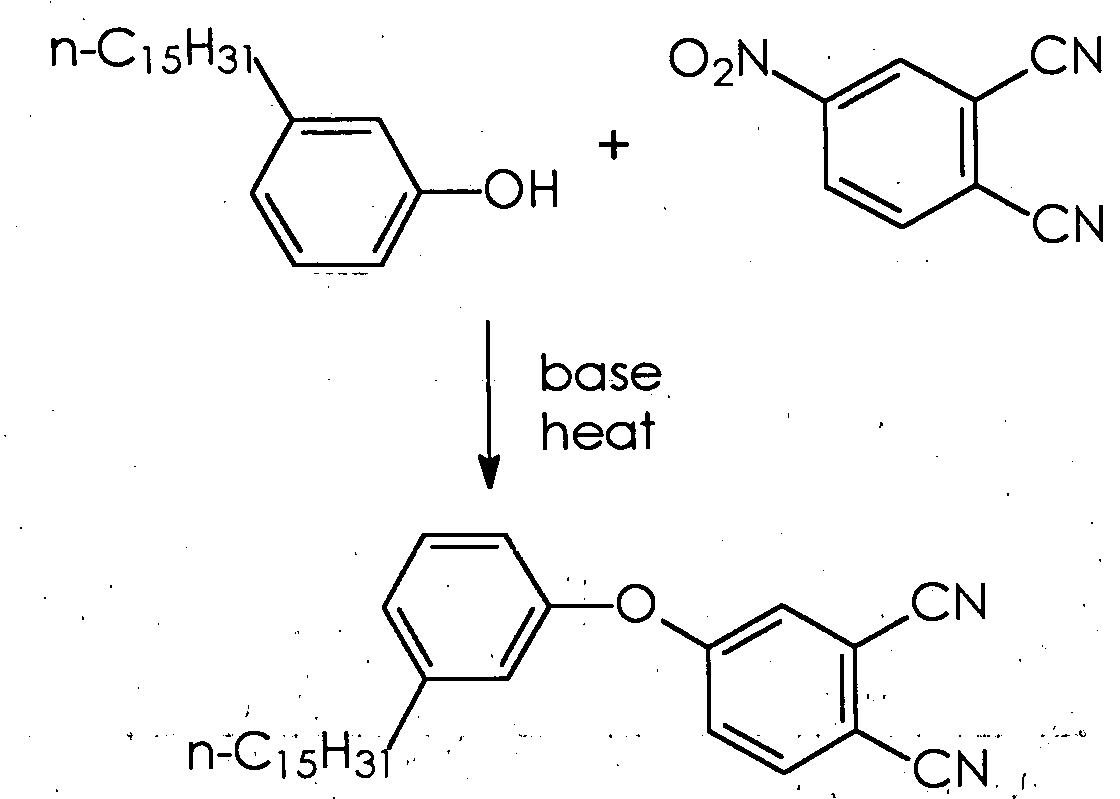
- Mahabadi discloses a process for preparing a colorant of the formula wherein M is an atom or group of atoms capable of bonding to the central cavity of a phthalocyanine molecule, wherein axial ligands optionally can be attached to M, which comprises (a) reacting 3-n-pentadecylphenol with 4-nitrophthalonitrile in the presence of a base to form an alkylarylether adduct of phthalonitrile; and (b) reacting the alkylarylether adduct of phthalonitrile with either (i) a metal compound, or (ii) an ammonia-releasing compound in the presence of an alkanolamine solvent, or (iii) mixtures of (i) and (ii), to form the colorant.
- the present invention is directed to colorant compounds. More specifically, the present invention is directed to phthalocyanine colorant compounds particularly suitable for use in hot melt or phase change inks.
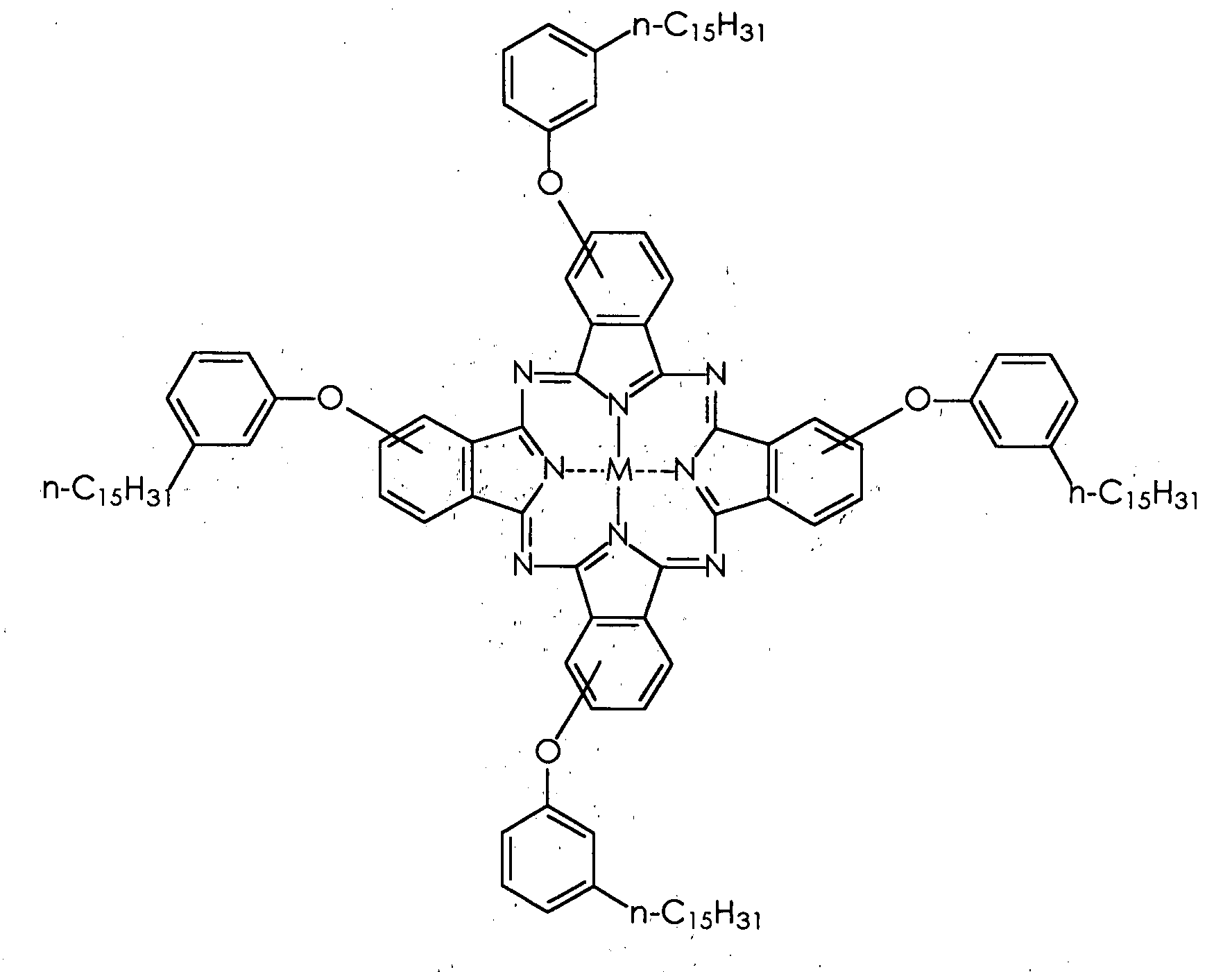
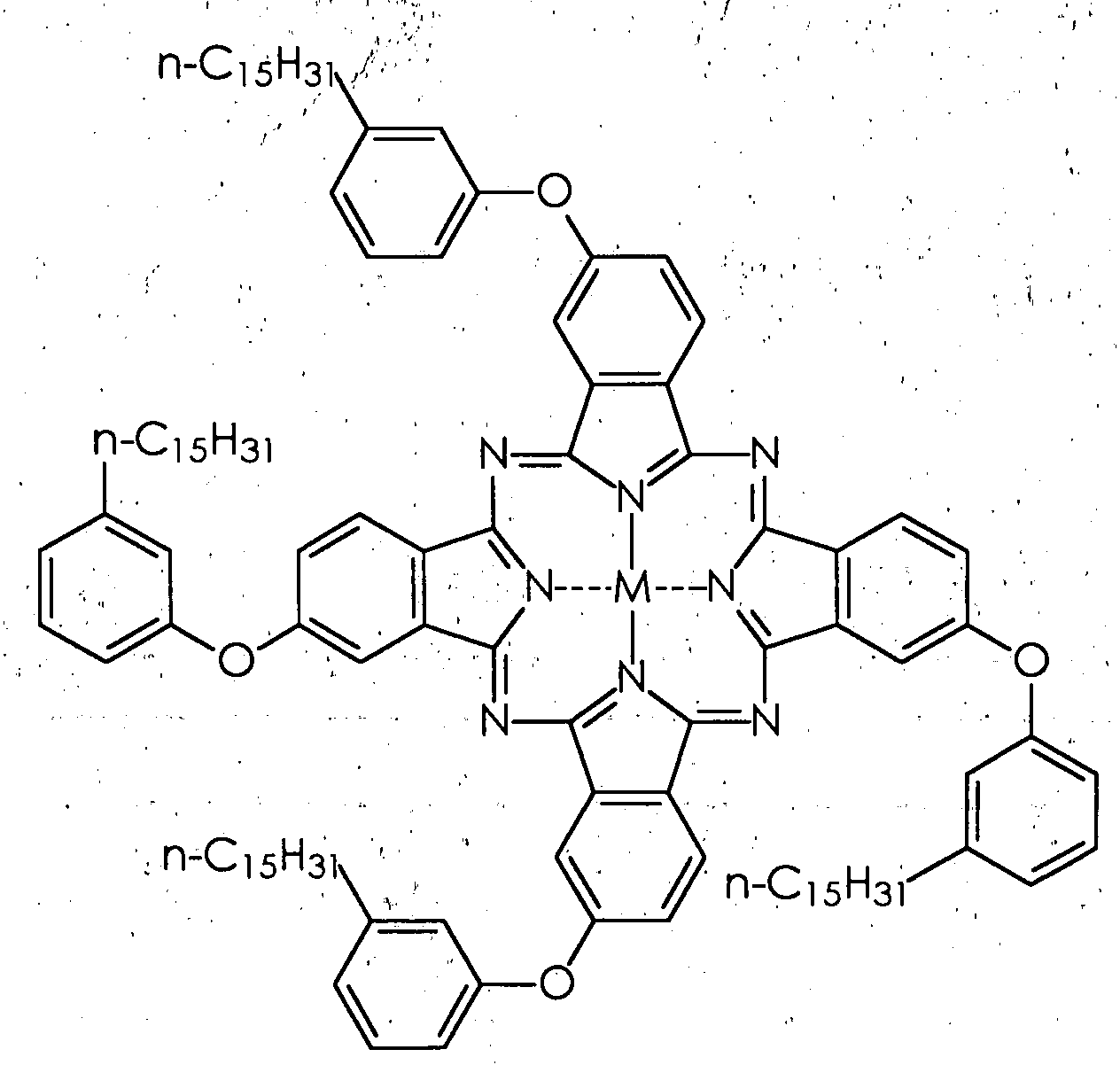
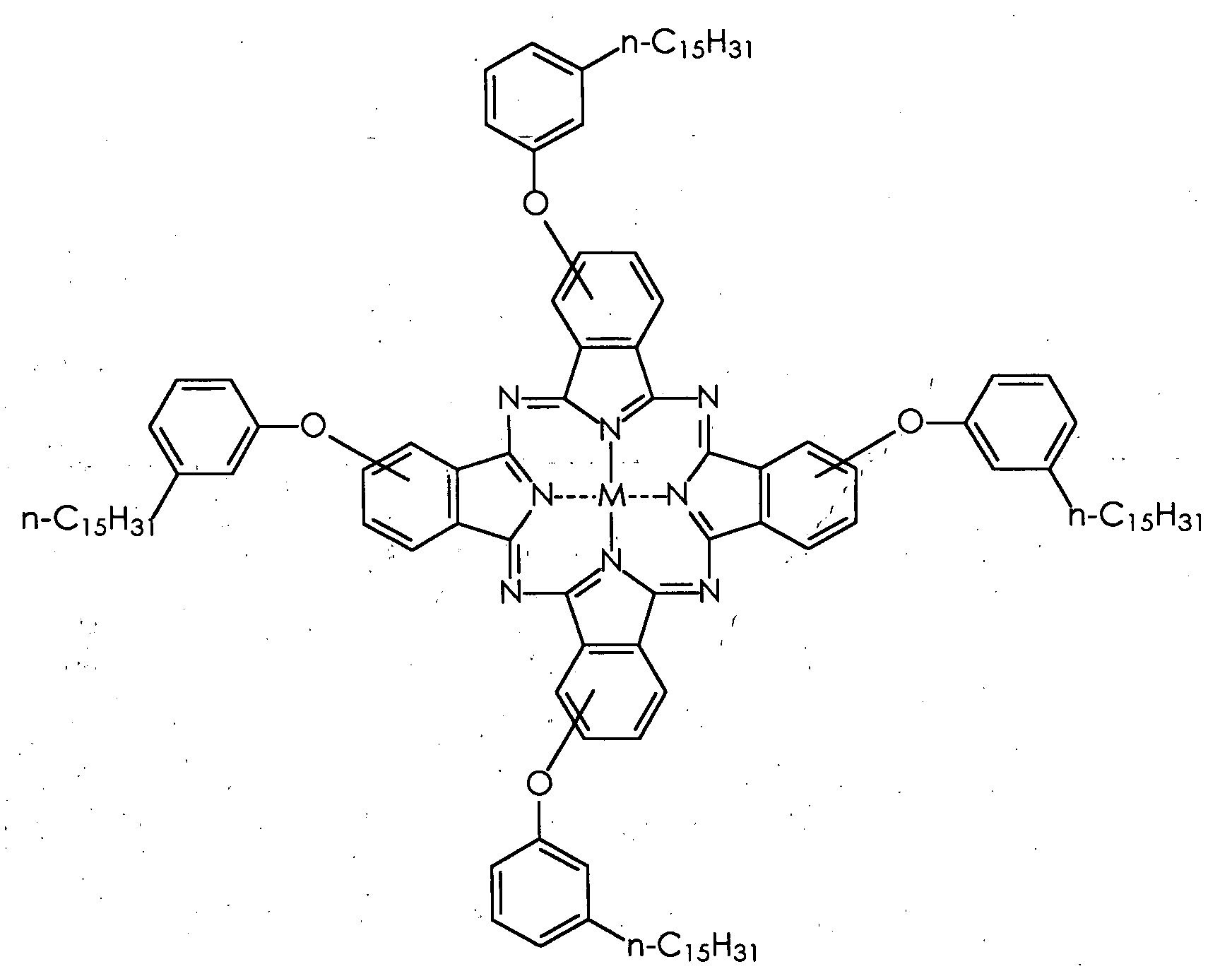
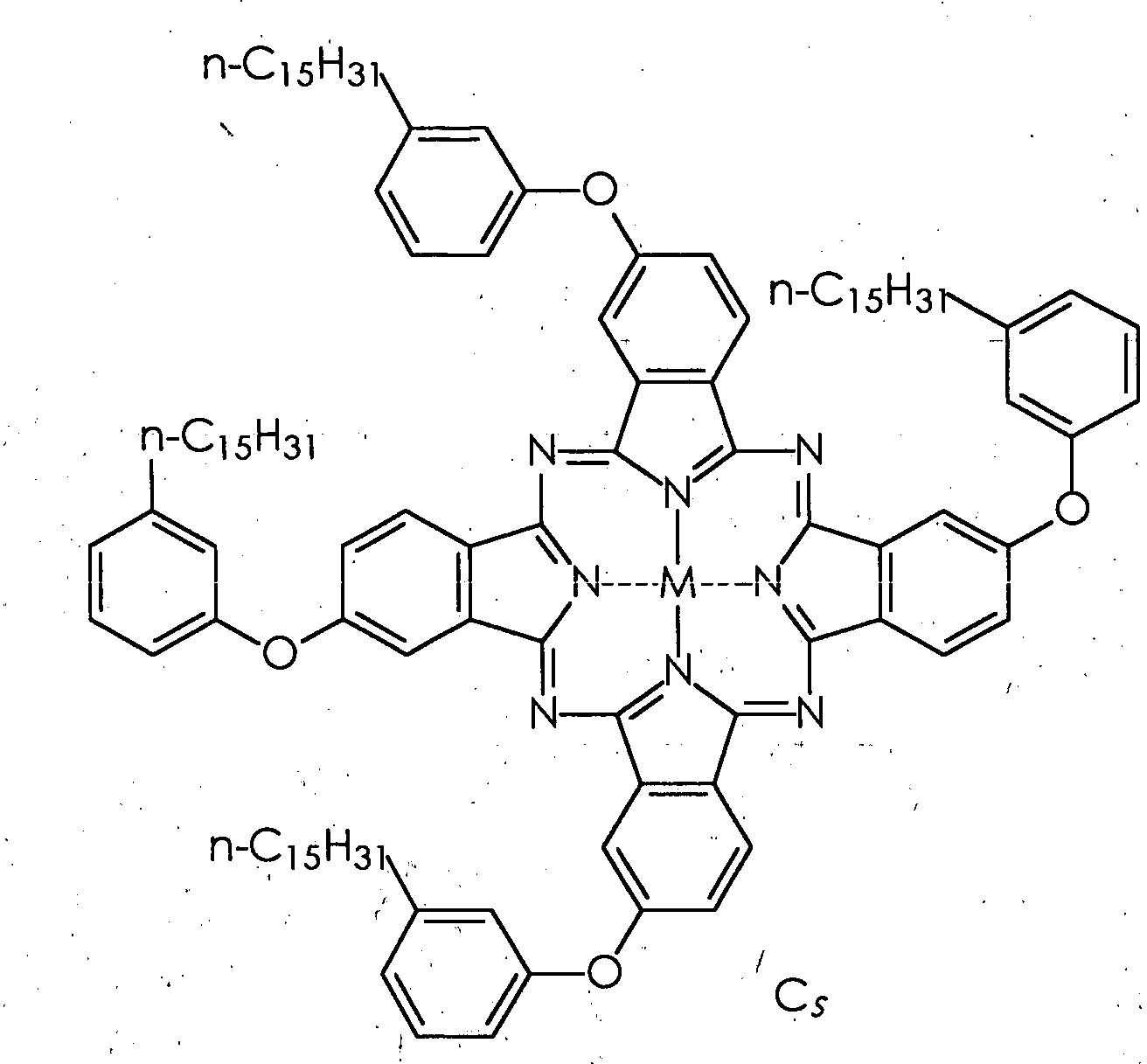
- One embodiment of the present invention is directed to compounds of the formula wherein M is an atom or group of atoms capable of bonding to the central cavity of a phthalocyanine molecule, wherein axial ligands optionally can be attached to M.
- phase change inks (sometimes referred to as "hot melt inks”) are in the solid phase at ambient temperature, but exist in the liquid phase at the elevated operating temperature of an ink jet printing device. At the jet operating temperature, droplets of liquid ink are ejected from the printing device and, when the ink droplets contact the surface of the recording substrate, either directly or via an intermediate heated transfer belt or drum, they quickly solidify to form a predetermined pattern of solidified ink drops.
- Phase change inks have also been used in other printing technologies, such as gravure printing, as disclosed in, for example, U.S. Patent 5,496,879 and German Patent Publications DE 4205636AL and DE 4205713AL, the disclosures of each of which are totally incorporated herein by reference.
- Phase change inks for color printing typically comprise a phase change ink carrier composition which is combined with a phase change ink compatible colorant.
- a series of colored phase change inks can be formed by combining ink carrier compositions with compatible subtractive primary colorants.
- the subtractive primary colored phase change inks can comprise four component dyes, namely, cyan, magenta, yellow and black, although the inks are not limited to these four colors.
- These subtractive primary colored inks can be formed by using a single dye or a mixture of dyes.
- magenta can be obtained by using a mixture of Solvent Red Dyes or a composite black can be obtained by mixing several dyes.
- Patent 4,889,761, and U.S. Patent 5,372,852 the disclosures of each of which are totally incorporated herein by reference, teach that the subtractive primary colorants employed can comprise dyes from the classes of Color Index (C.I.) Solvent Dyes, Disperse Dyes, modified Acid and Direct Dyes, and Basic Dyes.
- the colorants can also include pigments, as disclosed in, for example, U.S. Patent 5,221,335, the disclosure of which is totally incorporated herein by reference.
- U.S. Patent 5,621,022 the disclosure of which is totally incorporated herein by reference, discloses the use of a specific class of polymeric dyes in phase change ink compositions.
- Phase change inks have also been used for applications such as postal marking and industrial marking and labelling.
- Phase change inks are desirable for ink jet printers because they remain in a solid phase at room temperature during shipping, long term storage, and the like.
- the problems associated with nozzle clogging as a result of ink evaporation with liquid ink jet inks are largely eliminated, thereby improving the reliability of the ink jet printing.
- the droplets solidify immediately upon contact with the substrate, so that migration of ink along the printing medium is prevented and dot quality is improved.
- compositions suitable for use as phase change ink carrier compositions are known.
- Some representative examples of references disclosing such materials include U.S. Patent 3,653,932, U.S. Patent 4,390,369, U.S. Patent 4,484,948, U.S. Patent 4,684,956, U.S. Patent 4,851,045, U.S. Patent 4,889,560, U.S. Patent 5,006,170, U.S. Patent 5,151,120, U.S. Patent 5,372,852, U.S.
- Suitable carrier materials can include paraffins, microcrystalline waxes, polyethylene waxes, ester waxes, fatty acids and other waxy materials, fatty amide containing materials, sulfonamide materials, resinous materials made from different natural sources (tall oil rosins and rosin esters, for example), and many synthetic resins, oligomers, polymers, and copolymers.
- Colorants suitable for hot melt or phase change ink compositions include members of the phthalocyanine class of chromophore which have been appropriately modified by chemical substitution to make them soluble in the organic carrier composition. Many such phthalocyanine derivatives are known to have a good cyan color, and absorb light strongly in the wavelength region of from about 600 to about 700 nanometers. Further, their well-known high chemical, thermal, and photochemical stability make them particularly attractive for printing applications where archival print properties are desired.
- phthalocyanines soluble in organic media fall into three generic classes: axially-substituted phthalocyanines, tetra-peripherally-substituted phthalocyanines, and octa-peripherally-substituted phthalocyanines.
- the first class is illustrated by the following structure:
- M is tetravalent silicon, germanium, or tin and L 1 and L 2 can each be either bulky alkylsiloxy groups, such as-OSiR 3 (wherein R is, for example, n-hexyl) or long-chain oxyhydrocarbon groups.
- R is, for example, n-hexyl
- L 1 and L 2 can each be either bulky alkylsiloxy groups, such as-OSiR 3 (wherein R is, for example, n-hexyl) or long-chain oxyhydrocarbon groups.
- M is a divalent transition metal, such as iron, cobalt, zinc, or ruthenium
- L 1 and L 2 are neutral coordinating ligands, such as pyridine, quinoline, or 1,4-diazabicyclo[2,2,2]octane; see, for example, "Synthesis and properties of conducting bridged macrocyclic metal complexes," M. A.
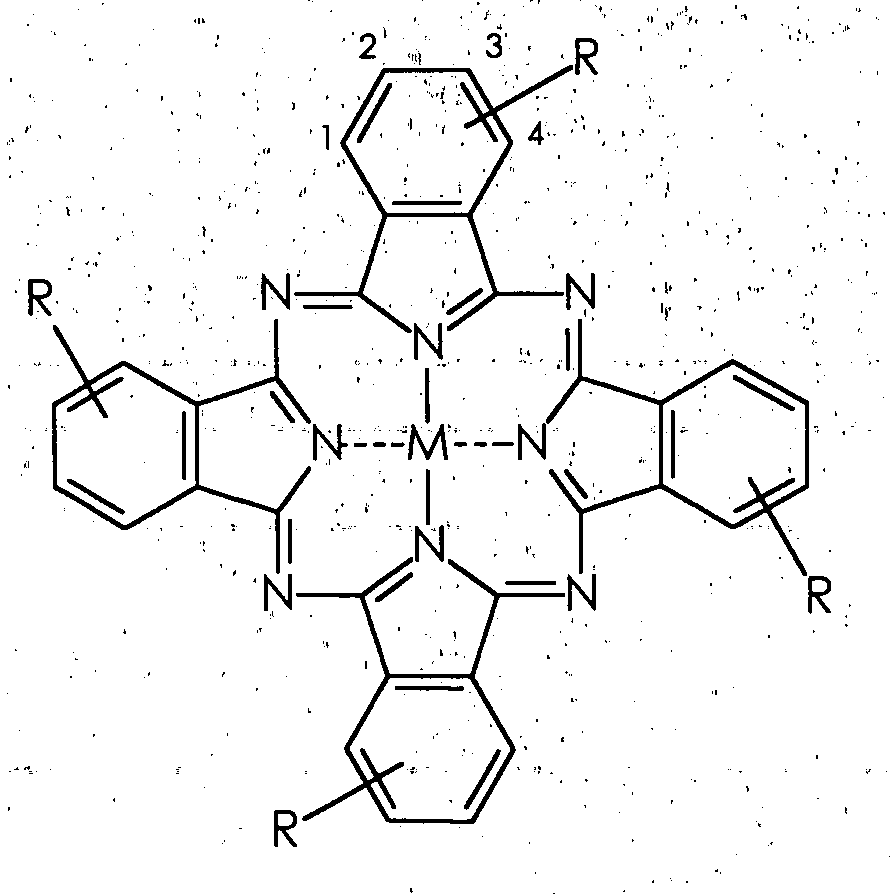
- Peripherally tetrasubstituted phthalocyanines soluble in organic media are also known.
- Substituents can be either at the 2- (or 3-) positions, or at the 1- (or 4-) positions, as illustrated below, and typically are bulky (e.g. tertiary-alkyl) or contain long alkyl chains (e.g., more than about five carbons):
- Some reported examples of R-groups conferring solubility are tert-butyl ("Phthalocyanines and related compounds IX. Synthesis and electronic absorption spectra of tetra-t-butylphthalocyanines," S. A. Mikhalenko, S. V. Barknova, O. L. Lebedev, and E. A.
- tetrasubstituted phthalocyanines are obtained as a mixture of four constitutional isomers resulting from statistical cyclotetramerization of four isoindolenine units ("Synthesis and Chromatographic separation of tetrasubstituted and Unsymmetrically substituted phthalocyanines," G. Schmid, M. Sommerauer, M. Geyer, and M. Hanack, in Phthalocyanines -- Properties and Applications, C. C. Leznoff and A. B. P. Lever, Editors, Volume 4, Chapter 1, the disclosure of which is totally incorporated herein by reference).
- Tetra-substituted phthalocyanines having different R groups are also described in "Synthesis of Novel Unsymmetrical Substituted Push-Pull Phthalocyanines," A. Sastre, B. del Rey, and T. Torres, J. Org. Chem., Vol. 61, No. 24, p. 8591 (1996), the disclosure of which is totally incorporated herein by reference.
- This paper discloses the synthesis and characterization of novel, non-centrosymmetrically, push-pull substituted metal-free phtholocyanines.
- the compounds had different donor (dialkoxy, ten-butyl, methyl, p-tolylthio) and/or attractor (p-tolylsulfinyl, p-tolylsulfonyl, nitro) functional groups, were soluble in organic solvents, and were especially designed to study their second- and third-order nonlinear optical properties.
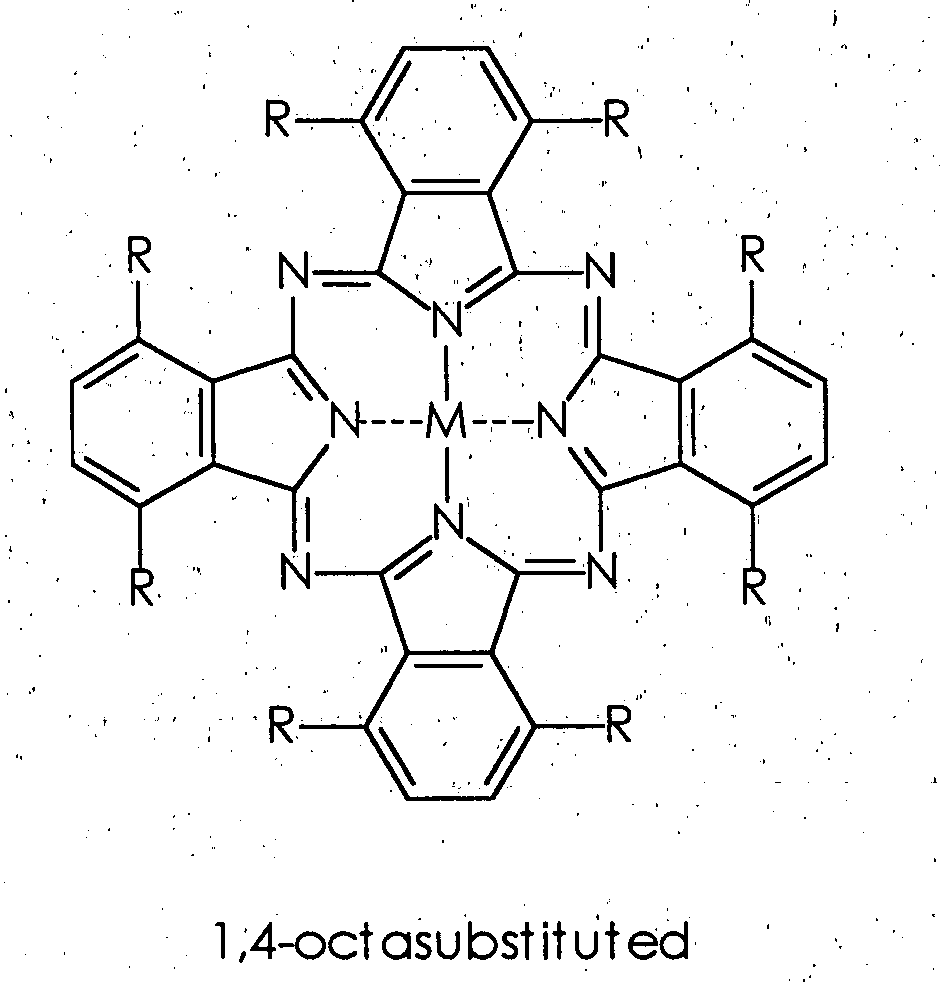
- the third generic class of phthalocyanines soluble in common organic solvents is the peripherally octa-substituted compounds illustrated below.
- the substituents can occupy either the 1,4- or the 2,3-positions. These compounds are generally obtained as a single isomer.
- the solubility in a given solvent is related to the nature and chain length of the R group, with more than about five carbon atoms per chain being typical: Many examples, have been reported for this class: 2,3-alkyl ("Annelides XXIX. Influence of the nature of the side-chains on the mesomorphic properties of octasubstituted phthalocyanine derivatives," K. Ohta, L. Jacquemin, C. Sirlin, L.
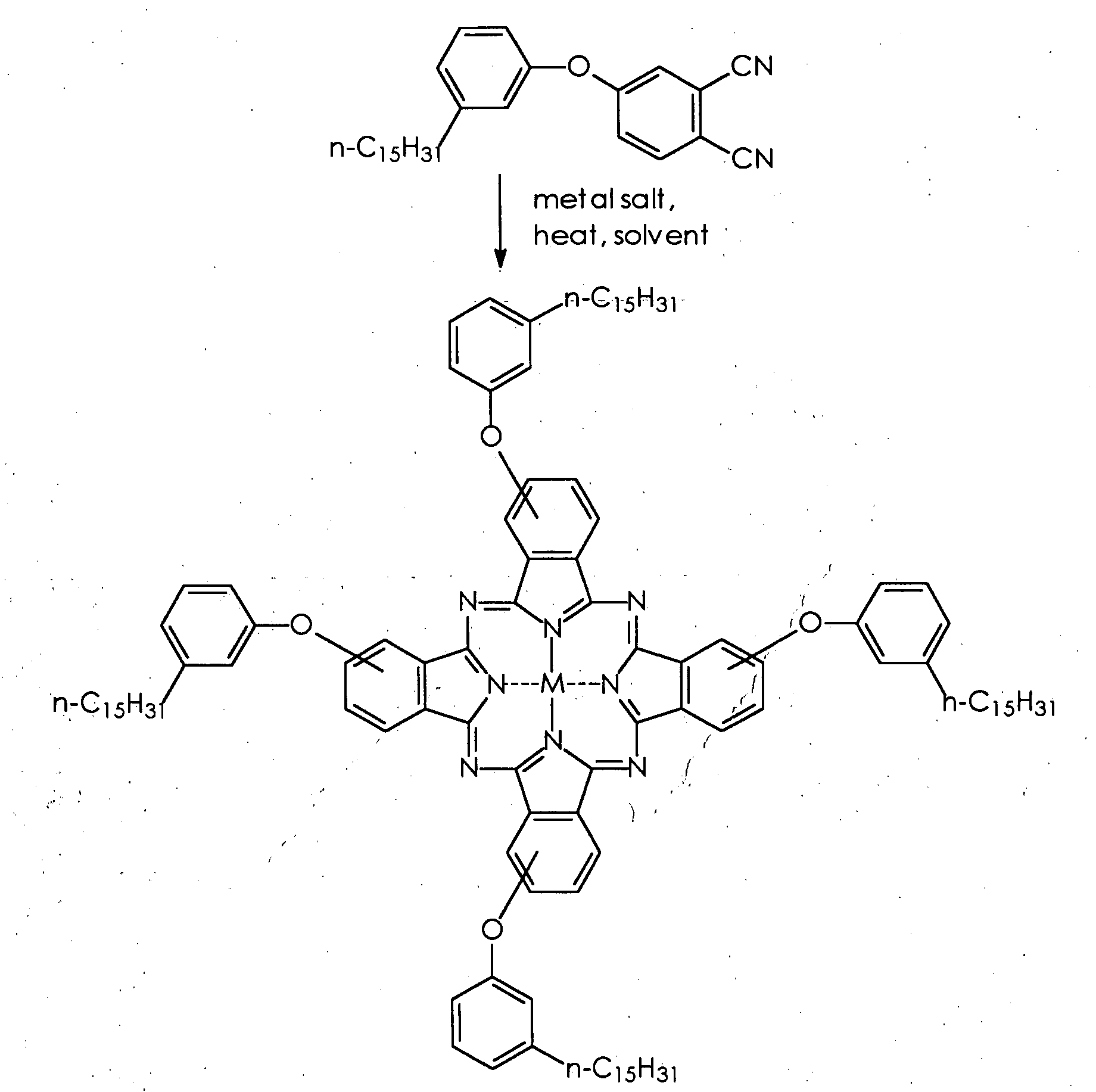
- Substituted metal phthalocyanines may be prepared by, for example, the cyclotetramerization, generally in a high boiling solvent, of suitable precursors in the presence of a metal salt.
- suitable precursors are substituted phthalonitriles, 1,3-diiminoisondolines, orthocyanobenzamide, phthalic anhydrides, and phthalimides. With the latter two precursors, a source of ammonia such as urea is provided to obtain phthalocyanine (F. H. Moser and A. L. Thomas, "The Phthalocyanines. Volume 1, Properties," CRC Press, 1983, the disclosure of which is totally incorporated herein by reference).
- Metal-free phthalocyanine can be obtained by, for example, refluxing phthalonitrile with ammonia gas in 2-N,N-dimethylaminoethanol (P. J. Brach, S. J. Grammatica, O. A. Ossanna, and I. Weinberger, J. Heterocyclic Chem ., 7 (1970), 1403, the disclosure of which is totally incorporated herein by reference), by the condensation of phthalonitrile in hydroquinone solvent (J. A. Thompson, K. Murata, D. C. Miller, J. L. Stanton, W. E. Broderick, B. M. Hoffmann, and J.
- substituted phthalocyanines such as 3- and 4-substituted phthalic anhydrides, phthalimides, and phthalonitriles
- phthalimides such as 3- and 4-substituted phthalic anhydrides, phthalimides, and phthalonitriles
- Others can be prepared by, for example, oxidation of substituted ortho-xylenes ("Phthalocyanines and related compounds IX. Synthesis and electronic absorption spectra of tetra-t-butylphthalocyanines," S. A. Mikhalenko, S. V. Barknova, O. L. Lebedev, and E. A. Luk'yanets, Zhur.
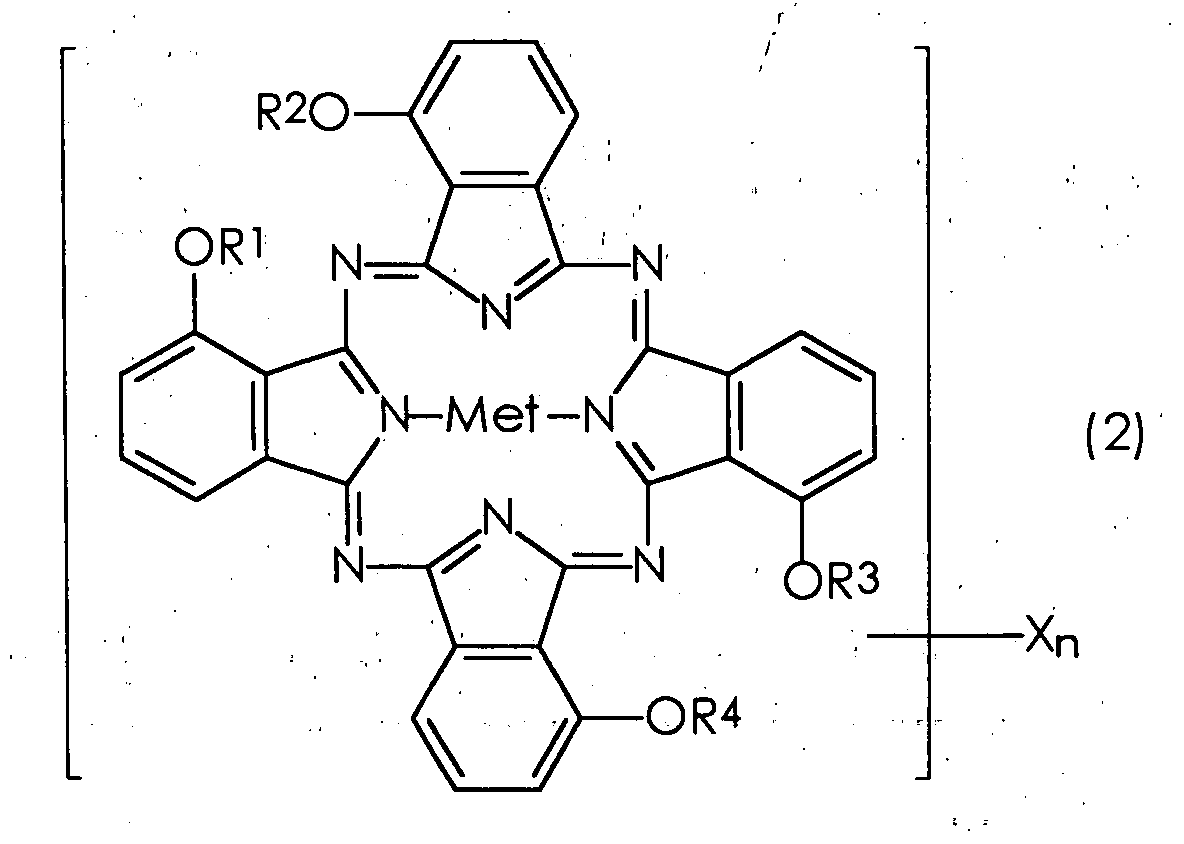
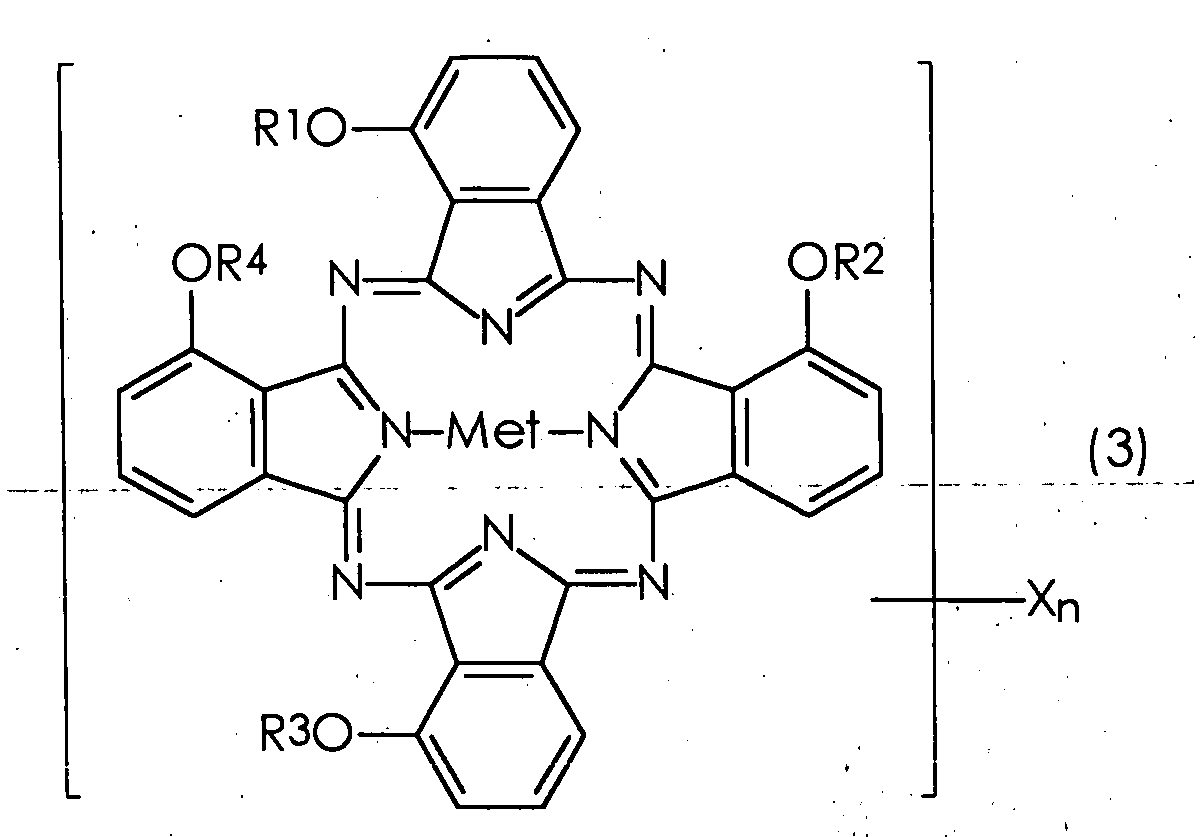
- U.S. Patent 5,280,114 discloses halogenated alkoxyphthalocyanine having a controlled grade of halogenation that can be prepared by reacting a single compound or a mixture of phthalocyanine represented by the formula: wherein R 1 is a substituted or unsubstituted alkyl group and may be the same or different, and Met is two hydrogen atoms, a divalent metal atom, or a trivalent or tetravalent metal derivative, with 1 to 6 mole ratio of a halogenating agent at 0° to 260°C in a solvent of from 1 to 1000 times by weight.
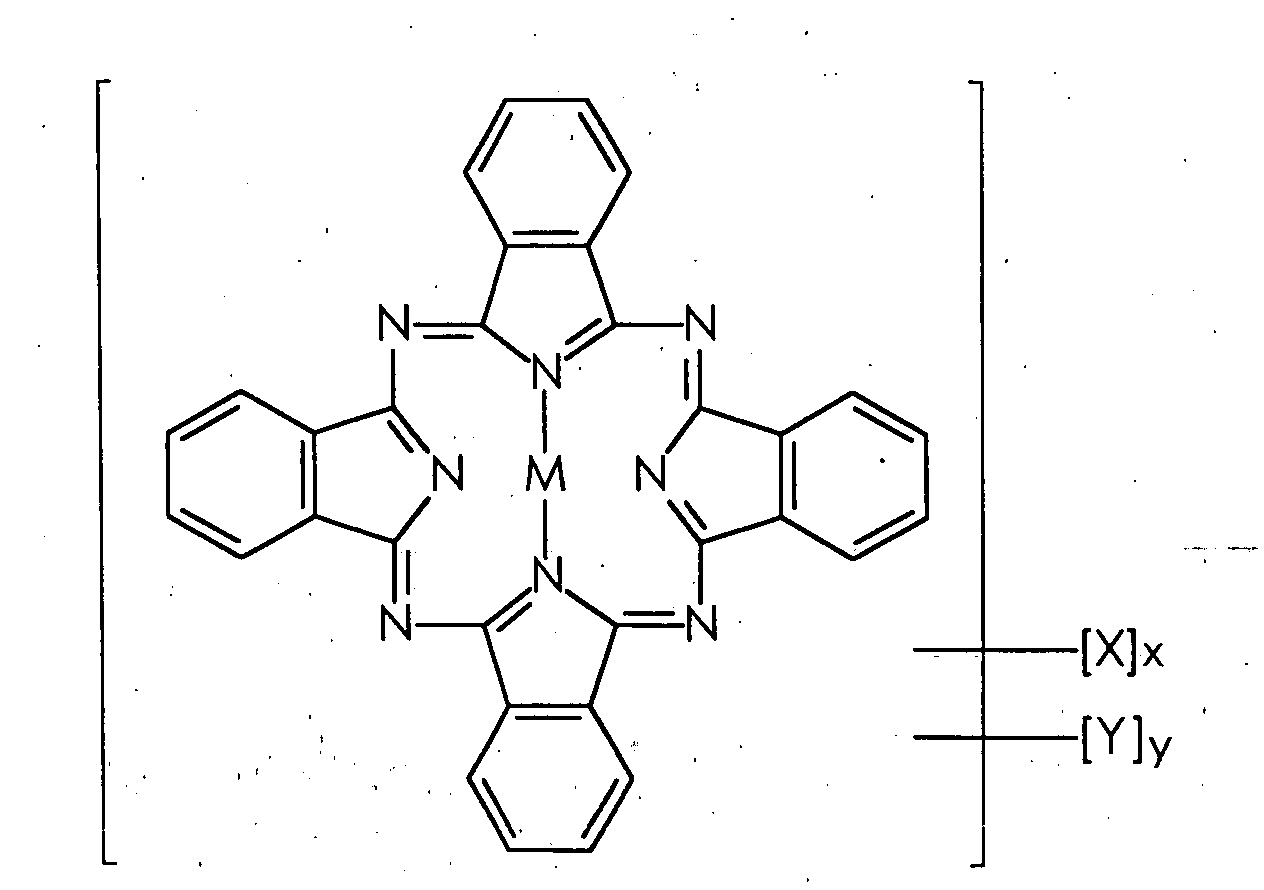
- U.S. Patent 5,149,800 discloses a colorant for natural or synthetic resinous or polymeric materials, having the formula: A-[D-Z-SO 2 -N(R 2 )-Y] 1-16 wherein R 2 is selected from hydrogen, methyl, cyclohexyl, phenyl, or Y; A is a nonionic metallophthalocyanine chromophore which can be substituted for example with halogen, alkyl, alkoxy, alkylthio, or aryloxy; Z is an arylene moiety; D is a linking group being or containing at least one of -O-, -S-, -SO 2 -, -N(R 3 )-, or -N(SO 2 R 4 )- as the linking moiety, wherein R 4 is unsubstituted or substituted alkyl, cycloalkyl, or aryl, and
- each R 1 is independently hydrogen, C 1-4 alkyl, or C 1-4 alkyl monosubstituted by hydroxy, halo, cyano, or C 1-4 alkoxy
- each of X 1 and X 3 is independently halo, hydroxy, C 1-4 alkyl, C 1-4 alkoxy, phenyl, phenoxy, amino, or an aliphatic, cycloaliphatic, aromatic, or heterocyclic amino group
- each of X 2 and X 4 is independently an aliphatic, cycloaliphatic, aromatic, or heterocyclic amino group containing at least one protonatable nitrogen atom or quaternary ammonium group
- m is 0 or 1
- each of n 1 and n 2 is independently 0 or 1, with the proviso that n 1 + n 2 is 1 or 2, wherein each halo is independently fluoro,
- U.S. Patent 3,674,494 discloses improved relief plates, particularly printing plates, prepared by exposing under an image-bearing transparency a layer, which can be crosslinked by exposure and has been to a light-reflecting substrate of a substantially homogeneous mixture of solid polymers, monomers, photoinitiators, and, if desired, polymerization inhibitors, which mixture also contains finely dispersed therein a soluble metal complex dye, and washing out the unexposed areas.
- PCT Patent Application WO 98/14520 discloses a phthalocyanine or its metal complex of a divalent metal, oxometal, halogenometal, or hydroxymetal, which comprises at least one unsubstituted or substituted formyl, carbonyl, hydroxymethyl, or carboxyl group which is attached at the peripheral carbon skeleton.
- phthalocyanines or their derivatives are used in recording layers of optical recording media.
- M is a divalent metal, oxometal, halogenometal, or hydroxymetal, or two hydrogen atoms
- Y is -OR 1 , -OOCR 2 , -NHR 1 , -N(R 1 )R 2 , or -SR 1
- x is 0 or a number from 1 to 8
- y depending on z is a number from z to 4
- z is a number from 1 to 4, by reacting a compound of the formula wherein M, X, Y, x, and y are as defined above, with z moles each of dimethylformamide and phosphoryl chloride.
- European Patent Application EP 0742255 discloses the coloration of high molecular weight organic materials in the mass with soluble phthalocyanine precursors of structure or isomers thereof, to the soluble phthalocyanine precursors as such wherein M is Zn, Ti, or V or wherein L 1 is morpholino, pyrrolidino or C 1 -C 12 alkyl substituted piperidino, to compositions containing high molecular weight organic materials and the above soluble phthalocyanine precursors, and to a process for making structured color images and applications thereof.
- European Patent Application EP 787732 discloses phthalocyanine compounds substituted by from 1 to 8 substituents of formula (-O-R-O-) wherein R is a 1,2-arylene group.
- the phthalocyanine compounds are substituted by catechol. Additional substituents which may be present include hydrocarbyloxy, hydrocarbylthio, halogen, and sulfonic acid or a salt thereof.
- EP 1013721 discloses solid preparations of metal-containing or metal-free phthalocyanine dyes which have an average particle size of greater than 100 microns and. which have a pH of greater than or equal to 10 when dissolved in 10 times the amount of water.
- the dyes are particularly suitable for the dyeing and printing of paper, after dissolution in water.
- European Patent Publication EP 540953 discloses solid solutions containing (a) about 90 to about 10 percent by weight of a chlorinated copper phthalocyanine containing about 14 to about 16 atoms of chlorine per molecule, and (b) about 10 to about 90 percent by weight of a copper phthalocyanine containing about 3 to about 4 atoms of chlorine, wherein said compositions are characterized by X-ray diffraction patterns that differ from the sum of the X-ray diffraction patterns of the individual components.
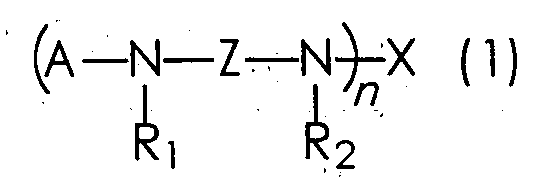
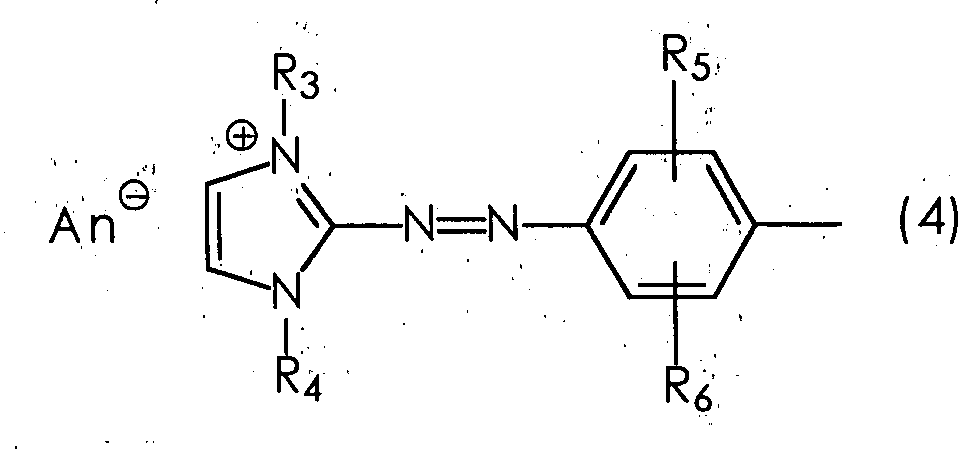
- EP 714954 discloses cationic imidazole azo dyes of the formulae (1) (2) and (3) in which A and A 1 Independently of one another are each a radical of the formula (4) Z is the radical of an aliphatic or aromatic diamine, R 1 and R 2 are each hydrogen or substituted or unsubstituted C 1 -C 4 alkyl or, together with the two nitrogen atoms to which they are attached and with Z, form a 5-, 6- or 7-membered ring, X is the radical of a bridging member, n is 2, 3 or 4, Z 1 is the radical of an aromatic diamine, Z 2 is the radical of an aliphatic diamine, KK is the radical of a coupling component, R 3 and R 4 are each hydrogen or substituted or unsubstituted C 1 -C 4 alkyl, R 5 and R 6 independently of one another are each hydrogen or substituted or unsubsti
- EP398716 discloses a pigment composition capable of giving a pigment dispersion which has excellent fluidity, high gloss, and high coloring power and is free from bluish tint, which comprises 100 parts by weight of at least one highly halogenated copper phthalocyanine and 0.3 to 30 parts by weight of a highly halogenated aluminum phthalocyanine
- European Patent Publication EP 209487 discloses pigmentary copper phthalocyanine prepared by converting crude copper phthalocyanine by methods known per se in the presence of trichlorophenoxy copper phthalocyanine. The resulting pigment is heat resistant and solvent resistant.
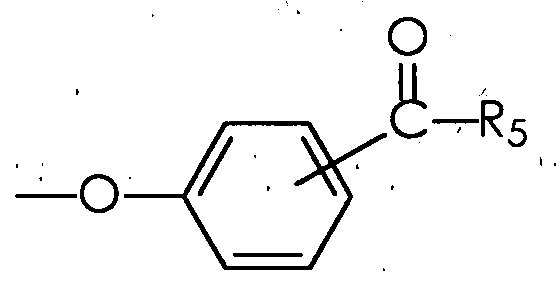
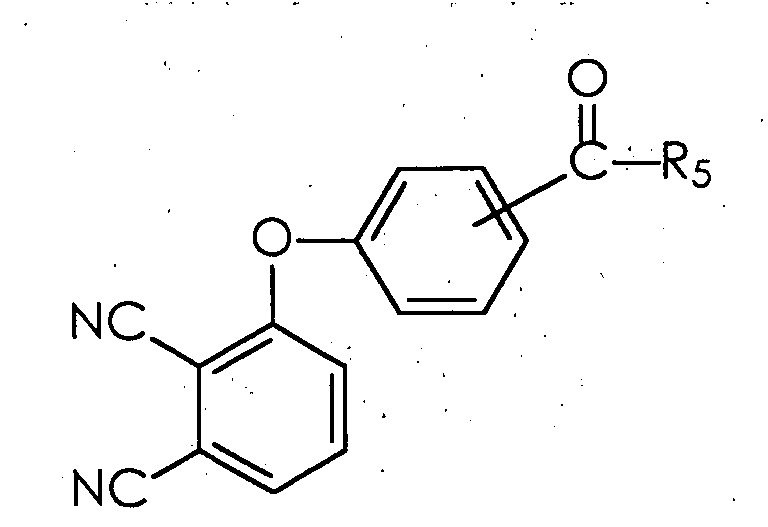
- Japanese Patent Publication JP 8302224 discloses a compound of formula I wherein R 1 to R 4 are each formula II [R 5 is an alkyl, an alkoxy, a (substituted) phenyl(oxy) or a benzyl(oxy)]; regarding the positions of R 1 to R 4 , R 1 is at C 1 or C 4 , R 2 is at C 5 or C 8 , R 3 is at C 9 or C 12 , and R 4 is at C 13 or C 16 ; M is a pair of H atoms, a divalent metal, or a metal derivative of a trivalent or tetravalent metal.
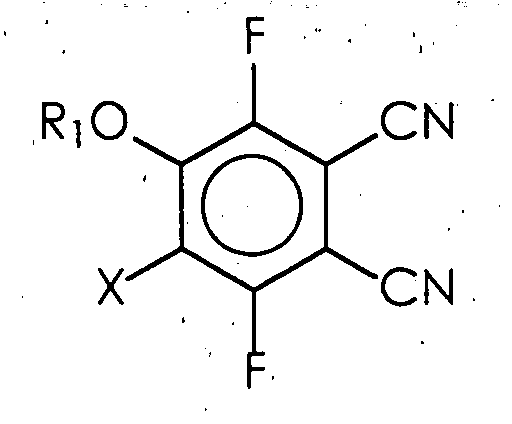
- the compound is preferably obtained by reacting (A) a phthalonitrile compound of formula III with (B) a metal derivative (e.g. palladium chloride) e.g. in a ratio of the component B: the component A of 1:3 to 1:6 (mol ratio) in the presence of a catalyst such as 1,8-diazabicyclo[5,4,0]-7-undecene in a solvent such as n-aminoalcohol at 130-230°C for 5 to 15 hours.
- a catalyst such as 1,8-diazabicyclo[5,4,0]-7-undecene
- a solvent such as n-aminoalcohol at 130-230°C for 5 to 15 hours.
- the compound has a high solubility and absorption coefficient and is capable of providing a color filter excellent in transparency behavior, light resistance, and heat resistance.
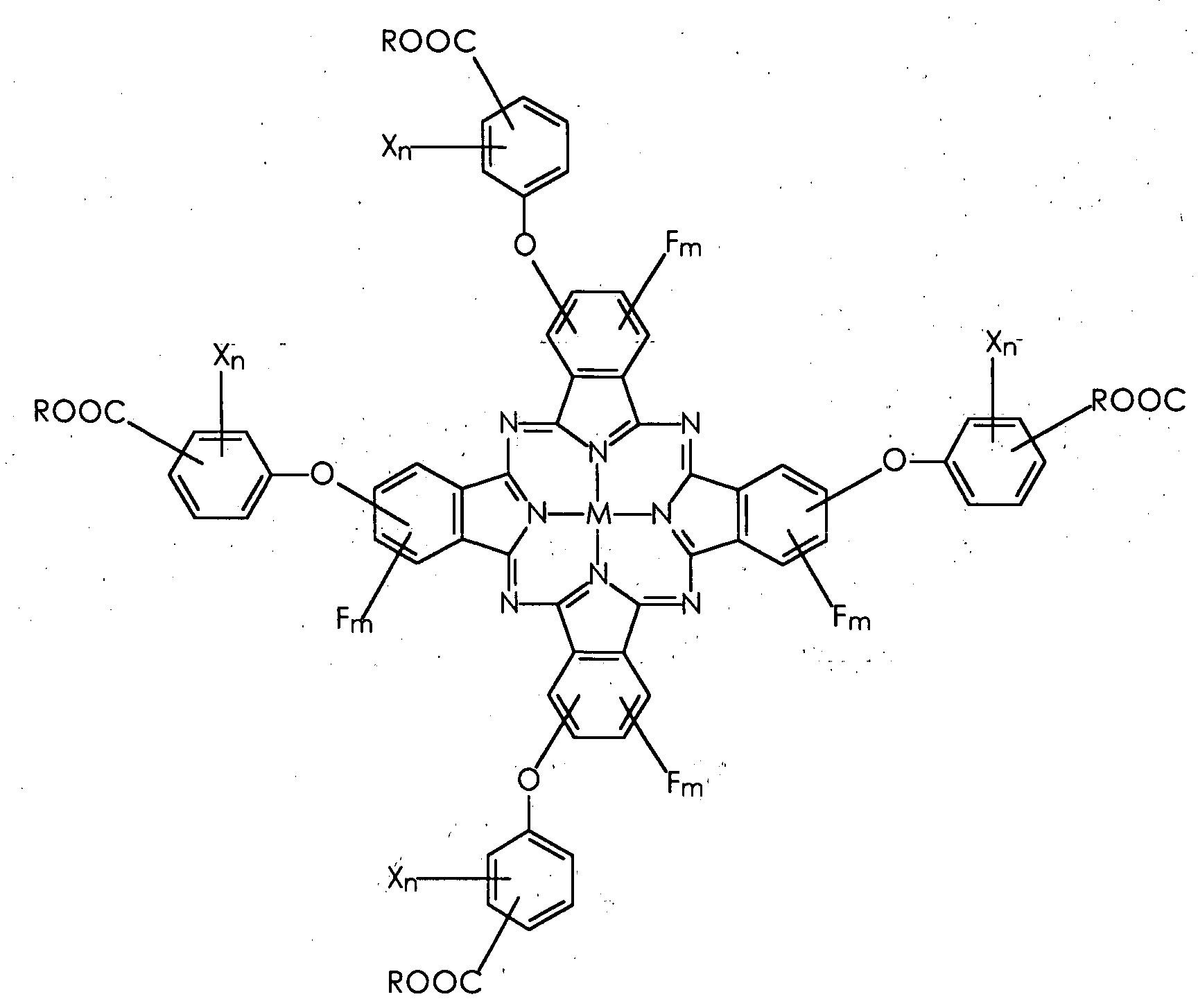
- Japanese Patent Publication JP 8225751 discloses a compound obtained by reacting (A) a phthalonitrile compound of formula I (COOR is a carboxylic acid ester having a heterocycle; X is a halogen, etc.; m is an integer of 0-3; n is an integer of 0-4) with (B) a metallic compound and expressed by (C) the formula II in which 1-8 pieces of benzene nuclei in 16 substitutable positions in a phthalocyanine skeleton are substituted with phenoxy and the phenoxy is substituted with a carboxylic acid ester having more than one heterocycles (M is a metal, a metal oxide or a metal halide).
- the objective optical recording medium is obtained by adding the compound to a recording medium placed on a substrate.
- the compound has excellent absorbing properties, solubility, light resistance, and economical efficiency and is useful for a near-infrared absorbing pigment, especially for an addition-type optical recording medium.
- Japanese Patent Publication JP 9279050 (Shuichi et al.), the disclosure of which is totally incorporated herein by reference, discloses a phthalocyanine compound prepared by a process in which equimolar amounts of a phthalonitrile compound (e.g. 3-[4-t-butyl- ⁇ -iso-propylbenzyloxy]phthalonitrile) represented by formula I and an organic base (e.g. 1,8-diazabicyclo[5.4.0]-7-undecene) are dissolved in a solvent (e.g. amyl alcohol) under heating.
- a metal compound e.g.
- a phthalocyanine compound e.g. compound represented by formula II
- formula III a phthalocyanine compound containing several isomers represented by formula III (wherein R 1 to R 4 are each a 1-6 C alkyl; R 5 to R 24 are each H, a halogen, a 1-6 C alkyl, a 1-6 C fluoroalkyl or the like; Z 1 to Z 4 are each H or a halogen; and M is a divalent metal atom, a tri- or tetra-valent substituted metal atom or the like).
- R 1 to R 4 are each a 1-6 C alkyl
- R 5 to R 24 are each H, a halogen, a 1-6 C alkyl, a 1-6 C fluoroalkyl or the like
- Z 1 to Z 4 are each H or a halogen
- M is a divalent metal atom, a tri- or tetra-valent substituted metal atom or the like).
- a film of a mixture of the phthalocyanine compound with a binder is formed on a base made of, e.g. an acrylic resin by, e.g. spin coating to obtain a recording layer having a thickness of about 100 angstroms to 5 microns.
- Japanese Patent Publication JP 5086301 discloses compounds of formulas I to IV wherein R 1 to R 4 are each a 6 to 9 carbon alkyl group having 2 to 4 secondary, tertiary, or quaternary carbon atoms, Met is a divalent metal atom, a monosubstituted trivalent metal atom, or a disubstituted tetravalent metal atom, X is halogen, and n is 1 to 4.
- the compound is excellent in solubility in a solvent and useful as a compound for forming a recording layer of an optical recording medium which has high refractive index and sensitivity.
- Japanese Patent Publication JP 5222302 discloses a phthalocyanine compound of the formula wherein X is F, OR 2 , or SR 4 , R 1 , R 2 , and R 3 are each a 1 to 20 carbon alkyl group, a 4 to 6 carbon cycloalkyl group, or a phenyl, benzyl, or naphthyl group optionally substituted by halogen or by a 1 to 4 carbon alkyl or 1 to 4 carbon alkoxyl group, and M is a metal, a metal oxide, or a metal halide.
- the compound is produced by reacting a phthalonitrile compound of the formula with a metal oxide or halide or a metal salt of an organic acid of the formula M m X n wherein M is a metal or a metal oxide, X is O, halogen, or an organic acid group, and m and n are each 1 to 5.
- the phthalocyanine compound has an absorption band in the near-infrared region of 650 to 900 nanometers and an excellent solubility especially in an alcoholic solvent.
- Japanese Patent Publication JP 621 11249 discloses a photosensitive composition principally comprising a photosensitive didzo resin and a lipophilic high molecular compound, wherein said photosensitive composition further contains a metal complex dye soluble in an organic solvent. Also disclosed is a photosensitive lithographic printing plate employing such a photosensitive composition.
- Japanese Patent Publication JP 61146597 discloses a way to obtain a clear half-tone transfer picture of higher density levels than in the case of transfer using only dye by a method in which a thermal transfer ink sheet is made up using a filler and a dye so as to obtain the same hue and the recording density in the high-density region is complemented by the transfer of the filler.
- a toluene solution of polyester resin is coated on a base material of condenser paper and dried to form an intermediate adhesive layer.
- a solution of Kayaset blue-K-FL as a dye, an aliphatic amide as a low-melting substance, a paraffin wax as an auxiliary to lower the viscosity of the low-melting substance, and copper phthalocyanine as inorganic pigment filler in acetone is coated by a bar coater on the intermediate layer and dried to form an ink layer.
- a recording paper is laminated on the ink layer side of the ink sheet and solid transfer printing is made by using a thermal facsimile device to obtain clear cyanine-color transfer picture.
- Japanese Patent Publication JP 58196295 discloses a way to recognize easily the surface part of a metal plate covered with a solid lubricant with the eye and to prevent the deterioration of pressing properties and dragging resistance caused by unevenness of coating, by adding a colorant to a solution of the solid lubricant.
- a solid lubricant consisting essentially of metallic soap, higher fatty acid, wax, etc. or a solid lubricant consisting essentially of an organic synthetic resin such as water-soluble acrylic polymer, etc. is blended with pigment or dye such as copper phthalocyanine blue, etc. in a volume ratio of usually (25:1)-(50:1).
- Japanese Patent Publication JP 00290577 discloses a way to improve pigment-dispersing properties and resistance to drying by compounding a pigment, water, a water-soluble organic solvent and caprolactam.
- a mixed solvent comprising water and 2 to 60 weight percent, preferably 5 to 35 weight percent, of a water-soluble organic solvent are admixed 1 to 25 weight percent, preferably 2 to 15 weight percent, of an inorganic pigment such as carbon black, ultramarine blue, or the like or an organic pigment such as copper phthalocyanine blue, benzidine yellow, or the like, 0.1 to 20 weight percent, preferably 1 to 10 weight percent of caprolactam of the formula and, as required, additives such as a pH adjusting agent, an antiseptic agent, a mildew-proofing agent, a fluorine-containing surfactant, a nonionic, anionic or cationic surfactant, an anti-foaming agent or the like.
- an inorganic pigment such as carbon black, ultramarine blue, or the like or an organic pigment such as copper phthalocyanine blue, benzidine yellow, or the like
- additives such as a pH adjusting agent, an antiseptic agent, a mildew-proofing
- This ink composition hardly suffers from flocculation and sedimentation of pigments and can maintain not only the same density of handwriting as in the initial stage even when filled in a writing tool and left upright or upside-down but also the same volume of an ink discharged in writing as in the initial stage even when a writing tip is left exposed to the outside and the solid content is raised by evaporation of a solvent.
- Phthalocyanines Properties and Applications, C. C. Leznoff and A. B. P. Lever, eds., the disclosure of which is totally incorporated herein by reference, discloses at p. 35 various substituted phthalocyanines.
- the compounds had different donor (dialkoxy, tert-butyl, methyl, p-tolylthio) and/or attractor (p-tolylsulfinyl, p-tolylsulfonyl, nitro) functional groups, were soluble in organic solvents, and were especially designed to study their second- and third-order nonlinear optical properties.
- donor dialkoxy, tert-butyl, methyl, p-tolylthio
- attractor p-tolylsulfinyl, p-tolylsulfonyl, nitro
- phthalocyanines discussed above are considered to be soluble in organic media, they are not necessarily suited for use as phase change ink colorants. Accordingly, while known compositions and processes are suitable for their intended purposes, a need remains for improved colorant compositions. In addition, a need remains for improved phthalocyanine compositions. Further, a need remains for colorants suitable for use in phase change inks. Additionally, a need remains for colorants that enable good to excellent lightfastness. There is also a need for improved colorants having improved cyan color for primary subtractive imaging. In addition, there is a need for improved colorants having high tinctorial power or spectral strength.
- phase change ink colorants that are highly thermally stable in ink compositions for several weeks in air at temperatures exceeding 140°C. Additionally, there is a need for phase change ink colorants with low diffusion characteristic that will not bleed into inks containing other colorants. A need also remains for colorants with good to excellent lightfastness that are compatible with phase change ink vehicles. In addition, a need remains for colorants suitable for use in phase change inks that exhibit reduced or no variation in color over the life of the ink in the printer. Further, a need remains for colorants suitable for use in phase change inks that exhibit reduced or no variation in color subsequent to being deposited in imagewise fashion on substrates. Additionally, a need remains for colorants that have no carcinogenic or mutagenic effects. There is also a need for colorants that, when dissolved in phase change ink carriers, do not leave residues of material that might otherwise complicate filtration efficiency.
- the present invention provides:
- the present invention is directed to compounds of the formula wherein M is an atom or group of atoms capable of bonding to the central cavity of a phthalocyanine molecule, wherein axial ligands optionally can be attached to M.
- M is an atom or group of atoms capable of bonding to the central cavity of a phthalocyanine molecule, wherein axial ligands optionally can be attached to M.
- axial ligands optionally can be attached to M.
- About seventy atoms or groups are known to bond in the central cavity of a phthalocyanine molecule, as disclosed in, for example, Phthalocyanine Materials, N. B.
- a divalent metal atom such as beryllium, magnesium, calcium, strontium, barium, chromium, manganese, iron, cobalt, nickel, copper, zinc, tin, lead, cadmium, and the like
- a divalent halometal or -metalloid group such as chloroiron(III), chlorotitanium(III), chlorochromium(III), chloroaluminum, chlorogallium, chloroindium, chlorophosphorus(lll), dichlorotitanium(IV), dichlorosilicon, dichlorogermanium, dichlorotin, and the like, as well as the corresponding fluorides, bromides, and iodides
- a divalent hydroxy metal group such as hydroxyaluminum, hydroxygallium, di
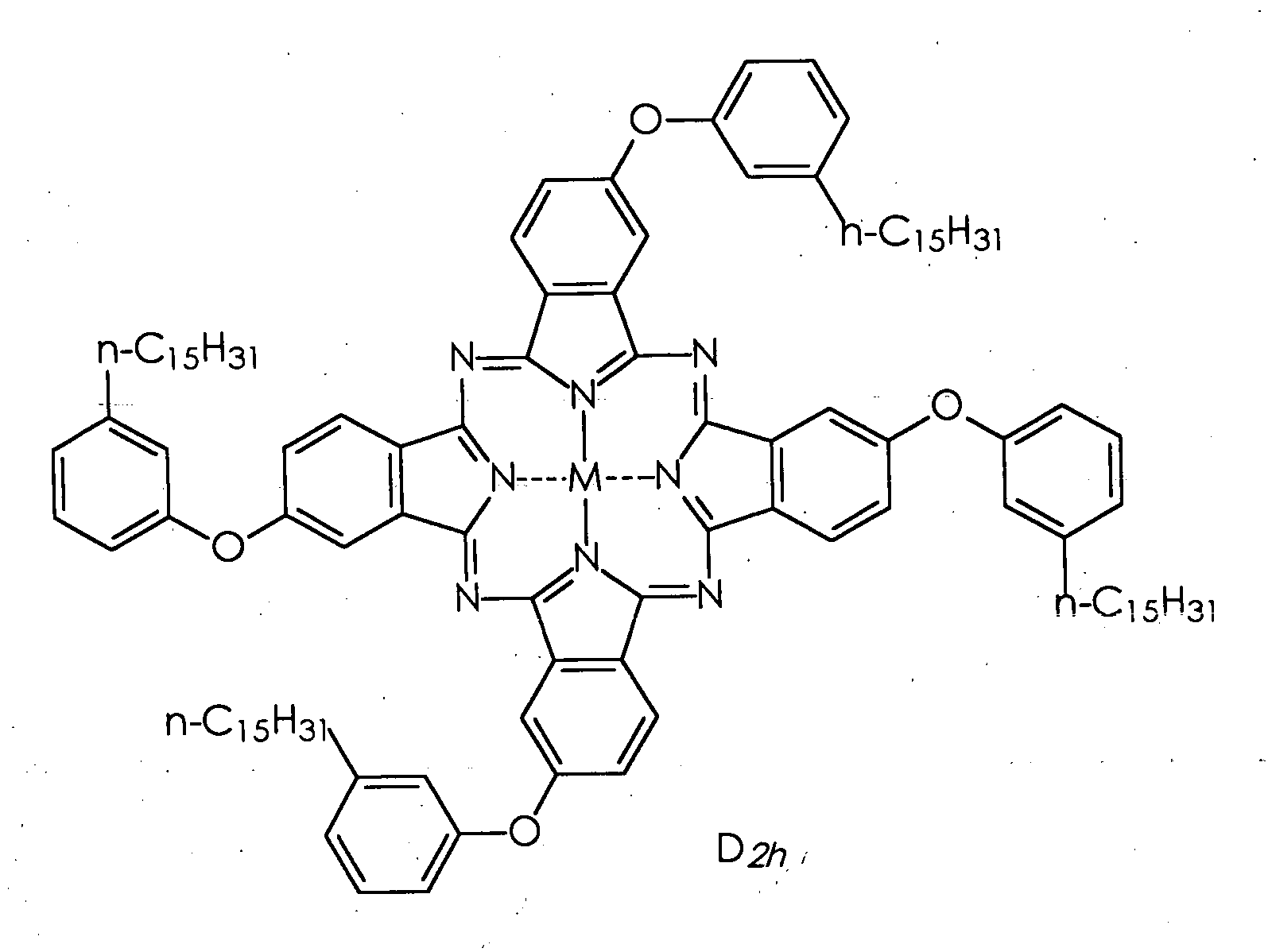
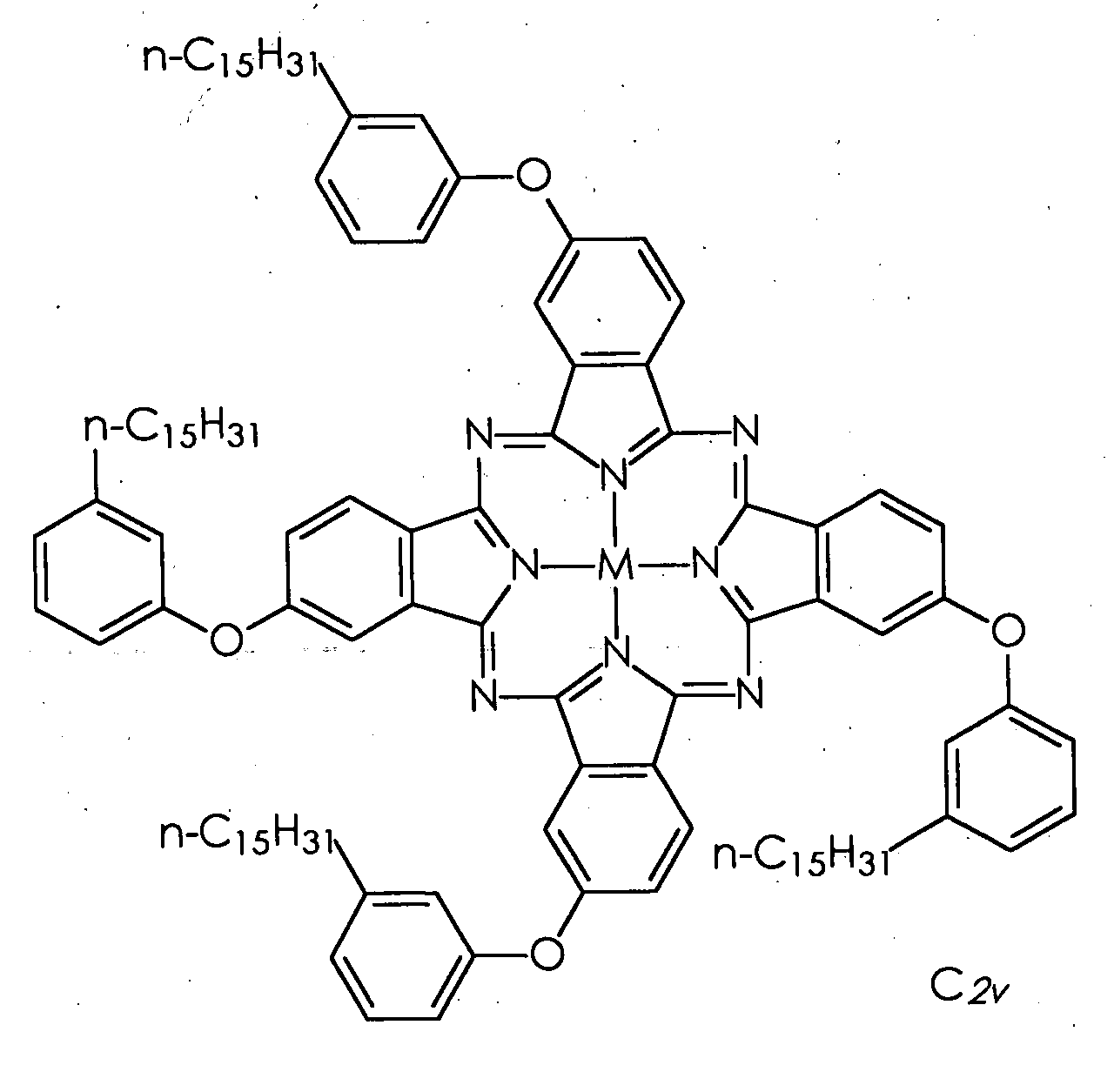
- colorant molecules of the present invention are obtained as mixtures of four isomeric forms as illustrated below, wherein the C 4h , D 2h , C 2v , and C s isomers are present in the approximate ratio of, respectively, about 1:1:2:4: and
- the colorant molecules of the present invention exhibit a spectral strength, measured as described prior to the Examples herein below, in one embodiment of at least about 1 ⁇ 10 5 milliliters absorbance per gram, and in another embodiment of at least about 1.15 ⁇ 10 5 milliliters absorbance per gram, and in one embodiment of no more than about 1.5 ⁇ 10 5 milliliters absorbance per gram, and in another embodiment of no more than about 1.3 ⁇ 10 5 milliliters absorbance per gram, although the spectral strength can be outside of these ranges.
- the colorant molecules of the present invention can be prepared by any desired or effective process.
- the process is carried out in two steps, the first of which is the synthesis of the alkylarylether adduct of phthalonitrile (4-(3-n-pentadecyl)phenoxyphthalonitrile):
- This process can be carried out by reacting the desired C 15 phenol (3-n-pentadecylphenol) with 4-nitrophthalonitrile in the presence of a base.
- C 15 phenols are commercially available as, for example, CARDOLITE®, predominantly a meta C 15 alkyl phenol obtained from cashew nut distillation and containing small amounts of naturally occurring isomers thereof, available from Cardolite Corporation, Newark, NJ, and AF 6518, available from Palmer International Inc., Worchester PA, also predominantly a meta C 15 alkyl phenol obtained from cashew nut distillation and containing small amounts of naturally occurring isomers thereof.
- Suitable bases include both organic and inorganic bases.
- organic bases include (but are not limited to) trialkyl amines (including triethylamine, tripropylamine, tributylamine, and the like), piperidine, 1,4-diazabicyclo[2.2.2]octane, and the like, as well as mixtures thereof.
- inorganic bases include (but are not limited to) lithium hydroxide, sodium hydroxide, potassium hydroxide, lithium carbonate, sodium carbonate, potassium carbonate, lithium hydride, sodium hydride, potassium hydride, lithium alkoxide, sodium alkoxide, potassium alkoxide (wherein the alkoxide can be, but is not limited to, methoxide, ethoxide, propoxide, butoxide (including t-butoxide), and the like), and the like, as well as mixtures thereof.
- the reactants are dissolved in any solvent capable of dissolving the reactants, such as methanol, ethanol, propanol, butanol, dioxane, acetone, toluene, nitrobenzene, dimethyl formamide, dimethyl sulfoxide, 1-methyl-2-pyrrolidinone, 1-cyclohexyl-2-pyrrolidinone, sulfolane, and the like, as well as mixtures thereof.
- any solvent capable of dissolving the reactants such as methanol, ethanol, propanol, butanol, dioxane, acetone, toluene, nitrobenzene, dimethyl formamide, dimethyl sulfoxide, 1-methyl-2-pyrrolidinone, 1-cyclohexyl-2-pyrrolidinone, sulfolane, and the like, as well as mixtures thereof.
- the solids content of the reaction mixture in one embodiment is at least about 0.5 parts by weight solvent per every 1 part by weight C 15 phenol, and in another embodiment is at least about 2 parts by weight solvent per every 1 part by weight C 15 phenol, and in one embodiment is no more than about 20 parts by weight solvent per every 1 part by weight C 15 phenol, and in another embodiment is no more than about 6 parts by weight solvent per every 1 part by weight C 15 phenol, although the solids content can be outside of these ranges.
- the C 15 phenol and the base are added to the solvent, followed by heating the reaction mixture, in one embodiment to a temperature of at least about 30°C, and in another embodiment to a temperature of at least about 80°C, and in one embodiment to a temperature of no more than about 150°C, and in another embodiment to a temperature of no more than about 120°C, although the temperature can be outside of these ranges, for a period of time in one embodiment of at least about 0.25 hour, and in another embodiment of at least about 0.5 hour, and in one embodiment of no more than about 8 hours, and in another embodiment of no more than about 2 hours, although the time can be outside of these ranges.
- the C 15 phenoxide salt is formed; optionally, the 4-nitrophthalonitrile can be added with the C 15 phenol and the base in a single step, in which case the preheating step is eliminated.
- the 4-nitrophthalonitrile is added to the reaction mixture and the reaction mixture is then heated, in one embodiment to a temperature of at least about 30°C, and in another embodiment to a temperature of at least about 70°C, and in one embodiment to a temperature of no more than about 150°C, and in another embodiment to a temperature of no more than about 110°C, although the temperature can be outside of these ranges, for a period of time in one embodiment of at least about 0.25 hour, and in another embodiment of at least about 0.5 hour, and in one embodiment of no more than about 24 hours, and in another embodiment of no more than about 4 hours, although the time can be outside of these ranges.
- the reaction mixture is cooled, in one embodiment to a temperature of at least about 20°C, and in one embodiment to a temperature of no more than about 100°C, and in another embodiment to a temperature of no more than about 60°C, although the temperature can be outside of these ranges, followed by quenching in a precipitant solvent, such as water, methanol, mixtures thereof, and the like, by stirring the reaction solution into the precipitant solvent or vice-versa, in an amount in one embodiment of at least about 0.25 part by weight precipitant solvent per every 1 part by weight reaction solution, and in another embodiment of at least about 0.5 part by weight precipitant solvent per every 1 part by weight reaction solution, and in one embodiment of no more than about 2 parts by weight precipitant solvent per every 1 part by weight reaction solution, and in another embodiment of no more than about 10 parts by weight precipitant solvent per every 1 part by weight reaction solution, although the relative amounts can be outside of these ranges, thereby causing precipitation of the alkylaryloxyphthalonitrile intermediate product, which can be isolated by filtration
- the intermediate can be reslurried with water or dilute acid (for example, 2 percent wt/volume hydrochloric acid) or base (for example, 2 percent sodium hydroxide) and filtered, and then reslurried and filtered with pure water, and the process repeated until inorganic and/or organic salts are removed from the product and the filtrate is of neutral pH and has a conductivity of less than about 20 microSiemens.
- dilute acid for example, 2 percent wt/volume hydrochloric acid
- base for example, 2 percent sodium hydroxide
- the product can be further purified by slurrying it in a solvent, such as methanol, ethanol, propanol, isopropanol, acetone, N,N'-dimethylformamide, mixtures thereof, mixtures of one or more of these solvents with water, and the like, followed by isolation of the product by filtration, which process may remove minor organic contaminants from the alkylaryloxyphthalonitrile intermediate.
- a solvent such as methanol, ethanol, propanol, isopropanol, acetone, N,N'-dimethylformamide, mixtures thereof, mixtures of one or more of these solvents with water, and the like
- the solid product can, if desired, be dried by heating under vacuum at a temperature in one embodiment of at least about 20°C, and in another embodiment of at least about 25°C, and in one embodiment of no more than about 100°C, and in another embodiment of no more than about 50°C, although the temperature can be outside of these ranges, for a period in one embodiment of at least about 1 hour, and in one embodiment of no more than about 72 hours, although the time can be outside of these ranges.
- the yield of the dried product typically (although not necessarily) ranges from about 80 to 90 percent.
- Purity of the final product in one embodiment is greater than about 98 percent, as ascertained by any conventional analytical technique, such as High Performance Liquid Chromatography (HPLC), Nuclear Magnetic Resonance (NMR) Spectroscopy, or Infrared (IR) Spectroscopy.
- HPLC High Performance Liquid Chromatography
- NMR Nuclear Magnetic Resonance
- IR Infrared
- the product can be recrystallized by heating in a solvent, such as methanol, ethanol, isopropanol, and the like, cooling to about 0°C, and filtering and drying the crystals.
- the molar ratio of C 15 phenol to 4-nitrophthalonitrile in one embodiment is at least about 1:1, and in one embodiment is no more than about 3:1, and in another embodiment is no more than about 1.5:1, although the molar ratio can be outside of these ranges
- the molar ratio of C 15 phenol to base in one embodiment is at least about 1:1, and in one embodiment is no more than about 3:1, and in another embodiment is no more than about 1:1 to about 1.5:1, although the molar ratio can be outside of these ranges.
- the second step in the synthesis of the colorant molecules of the present invention entails conversion of the alkylarylether phthalonitrile adduct to the phthalocyanine: This process can be carried out by reacting the alkylarylether phthalonitrile adduct with a metal compound.
- suitable metal compounds include anhydrous and hydrated salts or complexes of the formula MX n •yH 2 O wherein M is a metal, such as lithium, sodium, potassium, beryllium, magnesium, calcium, scandium, titanium, zirconium, vanadium, niobium, chromium, molybdenum, manganese, rhenium, iron, ruthenium, cobalt, rhodium, nickel, palladium, platinum, copper, zinc, cadmium, aluminum, gallium, indium, silicon, germanium, tin, lead, and the like, X is an anion, such as a carboxylate-containing molety, such as formate, acetate, acetoacetate, propionate, butyrate, benzoate, and the like, an alkoxide, such as methoxide, ethoxide, isopropoxide, or the like, acetyl acetonate, a halide atom, such as fluor
- anhydrous copper chloride hydrated copper chloride, anhydrous copper acetate, hydrated copper acetate, anhydrous copper sulfate, hydrated copper sulfate, anhydrous copper nitrate, hydrated copper nitrate, anhydrous copper bromide, hydrated copper bromide, and the like, as well as mixtures thereof.
- alkylarylether phthalonitrile adduct, metal compound, and a solvent such as ethylene glycol, amyl alcohol, hexanol, heptanol, tetralin, decalin, ISOPAR® (refined mineral spirits solvents available from Exxon), xylene, tributyl amine, N,N-dimethylaniline, quinoline, 1-chloronaphthalene, trialkanolamines, monoalkyl dialkanolamines, dialkyl monoalkanolamines (such as 2-dimethylaminoethanol, 2-diethylaminoethanol, 2-dimethylamino-1-propanol, and the like), dimethylsulfoxide, N,N-dimethylformamide, N,N-dimethylacetamide, 1-methyl-2-pyrrolidinone, N-cyclohexyl-2-pyrrolidinone, sulfolane, and the like, as well as mixtures thereof, are combined
- the solids content of the reaction mixture in one embodiment is at least about 3 parts by weight alkylarylether phthalonitrile adduct per every 100 parts by weight solvent, and in another embodiment is at least about 10 parts by weight alkylarylether phthalonitrile adduct per every 100 parts by weight solvent, and in one embodiment is no more than about 60 parts by weight alkylarylether phthalonitrile adduct per every 100 parts by weight solvent, and in another embodiment is no more than about 30 parts by weight alkylarylether phthalonitrile adduct per every 100 parts by weight solvent, although the solids content can be outside of these ranges.
- the reaction mixture is heated to reflux.
- Reflux temperature in one embodiment is at least about 80°C, and in another embodiment is at least about 140°C, and in one embodiment is no more than about 250°C, and in another embodiment is no more than about 190°C, although the temperature can be outside of these ranges.
- the reaction mixture is refluxed for a period of time in one embodiment of at least about 1 hour, and in another embodiment of at least about 2 hours, and in one embodiment of no more than about 24 hours, and in another embodiment of no more than about 8 hours, although the time can be outside of these ranges.
- the reaction is cooled to a temperature in one embodiment of at least about 25°C, and in another embodiment of at least about 50°C, and in one embodiment of no more than about 150°C, and in another embodiment of no more than about 100°C, although the temperature can be outside of these ranges, filtered, typically through a filter of paper, glass fiber, polypropylene, GORETEX®, and the like, although other methods of filtration can also be used, and washed with a solvent, such as water, acetone, methyl ethyl ketone, methyl isobutyl ketone, methanol, ethanol, propanol, butanol, acetone, dimethyl formamide, dimethyl sulfoxide, N-methyl pyrrolidinone, sulfolane, and the like, as well as mixtures thereof.
- a solvent such as water, acetone, methyl ethyl ketone, methyl isobutyl ketone, methanol, ethanol, propan
- the precipitated blue solids can then again be filtered, slurried with a solvent, such as acetone, methyl ethyl ketone, methyl isobutyl ketone, methanol, ethanol, propanol, butanol, acetone, dimethyl formamide, dimethyl sulfoxide, N-methyl pyrrolidinone, sulfolane, and the like, as well as mixtures thereof, in relative amounts in one embodiment of at least about 3 parts by weight solvent per every 1 part by weight product, and in one embodiment of no more than about 100 parts by weight solvent per every 1 part by weight product, although the relative amounts can be outside of these ranges, for a period of time in one embodiment of at least about 0.5 hour, and in one embodiment of no more than about 24 hours, although the time can be outside of these ranges, and at a temperature in one embodiment of at least about 25°C, and in another embodiment of at least about 50°C, and in one embodiment of no more than about 200°C, and
- a catalyst or reaction promoter can also be included in the reaction mixture.
- suitable catalysts or reaction promoters include trialkanolamines, dialkyl monoalkanolamines, monoalkyl dialkanolamines, and the like, wherein the alkyl groups, which can be connected to the nitrogen atom through a primary, secondary, or tertiary carbon atom, in one embodiment have from 1 to about 6 carbon atoms, and in another embodiment have from 1 to about 3 carbon atoms, although the number of carbon atoms can be outside of these ranges, including (but not limited to) methyl, ethyl, n-propyl, isopropyl, and the like, and wherein the alkanol groups, which can be primary, secondary, or tertiary alkanols and can be connected to the nitrogen atom through a primary, secondary, or tertiary carbon atom, in one embodiment have from about 2 to about 6 carbon atoms, and in another embodiment have from about 2 to about 3
- Suitable catalysts or reaction promoters also include ammonia-releasing compounds.
- Suitable ammonia-releasing compounds are any ammonium salts that release ammonia when heated, including (but not limited to) ammonium carbonate, ammonium carbamate, ammonium bicarbonate, ammonium molybdate, urea, ammonium salts of mono- and dicarboxylic acids, including (but not limited to) formic acid, acetic acid, propionic acid, butyric acid, benzoic acid, oxalic acid, malonic acid, and the like, as well as mixtures thereof.
- the reaction of the alkylarylether phthalonitrile adduct with the copper salt takes place with a two stage temperature-warming profile.
- the first stage entails heating the reaction mixture to an intermediate temperature, in one embodiment of at least about 80°C, and in one embodiment of no more than about 140°C, although the temperature can be outside of these ranges, and for a period of from time in one embodiment of at least about 0.25 hour, and in one embodiment of no more than about 3 hours, although the time can be outside of these ranges, during which time ammonia gas is slowly released.
- the reaction mixture is heated to a final temperature, in one embodiment of at least about 120°C, and in another embodiment of at least about 140°C, and in one embodiment of no more than about 250°C, and in another embodiment of no more than about 190°C, although the temperature can be outside of these ranges, and for a period of time in one embodiment of at least about 1 hour, and in another embodiment of at least about 2 hours, and in one embodiment of no more than about 24 hours, and in another embodiment of no more than about 10 hours, although the time can be outside of these ranges.
- the molar ratio of 3-pentadecylphenoxy phthalonitrile adduct to metal compound in one embodiment is at least about 2:1, and in another embodiment is at least about 3:1, and in one embodiment is no more than about 10:1, and in another embodiment is no more than about 6:1, although the molar ratio can be outside of these ranges.
- the molar ratio of catalyst or reaction promoter to metal compound in one embodiment is at least about 0.1:1, and in another embodiment is at least about 0.5:1, and in one embodiment is no more than about 10:1, and in another embodiment is no more than about 2:1, although the molar ratio can be outside of these ranges.
- two or more catalysts or reaction promoters can be used, such as one or more from the class of alkanolamines and one or more from the class of ammonia-releasing compounds, two or more from the class of alkanolamines, two or more from the class of ammonia-releasing compounds, or the like.
- Metal-free phthalocyanine can be prepared by treatment of an alkali metal phthalocyanine such as dilithium, disodium, dipotassium, beryllium, magnesium, or calcium phthalocyanine, prepared according to the above process, with a dilute aqueous or alcoholic acid.
- an alkali metal phthalocyanine such as dilithium, disodium, dipotassium, beryllium, magnesium, or calcium phthalocyanine
- suitable acids include (but are not limited to) hydrochloric acid, phosphoric acid, sulfuric acid, nitric acid, sulfonic acids, such as alkylsulfonic, arylsulfonic, arylalkylsulfonic, and alkylarylsulfonic, wherein the alkyl portions thereof can be linear or branched, in one embodiment with from 1 to about 18 carbon atoms, although the number of carbon atoms can be outside of this range, and wherein the aryl portions thereof in one embodiment have from 6 to about 12 carbon atoms, although the number of carbon atoms can be outside of this range, carboxylic acids, such as alkylcarboxylic, arylcarboxylic, arylalkylcarboxylic, and alkylarylcarboxylic, wherein the alkyl portions thereof can be linear or branched, and wherein the carboxylic acid in one embodiment has from 1 to about 24 carbon atoms, although the number of carbon atoms can be outside
- the acid is present in the water or alcohol solution in any desired or effective concentration, in one embodiment of at least about 1 percent by weight acid, and in another embodiment of at least about 2 percent by weight acid, and in one embodiment of no more than about 10 percent by weight acid, and in another embodiment of no more than about 5 percent by weight acid, although the acid concentration can be outside of these ranges.
- suitable alcohols include (but are not limited to) methanol, ethanol, propanol, isopropanol, ethylene glycol, and the like, as well as mixtures thereof.
- the metal-free phthalocyanine dye can be prepared by heating a concentrated solution of 4-(3-pentadecyl)phenoxyphthalonitrile in a dialkyl monoalkanolamine solvent, wherein the alkyl groups, which can be connected to the nitrogen atom through a primary, secondary, or tertiary carbon atom, in one embodiment have from 1 to about 6 carbon atoms, and in another embodiment have from 1 to about 3 carbon atoms, although the number of carbon atoms can be outside of these ranges, including (but not limited to) methyl, ethyl, n-propyl, isopropyl, and the like, and wherein the alkanol groups, which can be primary, secondary, or tertiary alkanols and can be connected to the nitrogen atom through a primary, secondary, or tertiary carbon atom, in one embodiment have from about 2 to about 6 carbon atoms, and in another embodiment have from about 2 to about 3 carbon atoms, although the number
- the ratio by weight of 4-(3-pentadecyl)phenoxyphthalonitrile to dialkyl monoalkanolamine solvent in one embodiment is at least about 10:80, and in another embodiment is at least about 25:75, and in one embodiment is no more than about 60:40, and in another embodiment is no more than about 50:50, although the relative amounts can be outside of these ranges.
- Suitable ammonia-releasing compounds include those listed hereinabove with respect to catalysts or reaction promoters.
- the molar ratio of ammonia-releasing compound to 4-(3-pentadecyl)phenoxyphthalonitrile in one embodiment is at least about 0.1 molar equivalent ammonia-releasing compound per every 1 molar equivalent of 4-(3-pentadecyl)phenoxyphthalonitrile, and in another embodiment is at least about 0.5 molar equivalent ammonia-releasing compound per every 1 molar equivalent of 4-(3-pentadecyl)phenoxyphthalonitrile, and in one embodiment is no more than about 5 molar equivalents ammonia-releasing compound per every 1 molar equivalent of 4-(3-pentadecyl)phenoxyphthalonitrile, and in another embodiment is no more than about 2 molar equivalents ammonia-releasing compound per every 1 molar equivalent of 4-(3-pentadecyl)phenoxyphthalonitrile, although the relative amounts can be outside of these ranges.
- the mixture can be initially heated to a first temperature, in one embodiment of at least about 50°C, and in another embodiment of at least about 65°C, and in one embodiment of no more than about 130°C, and in another embodiment of no more than about 125°C, although the temperature can be outside of these ranges, for a period of time in one embodiment of at least about 10 minutes, and in another embodiment of at least about 20 minutes, and in one embodiment of no more than about 120 minutes, and in another embodiment of no more than about 60 minutes, although the time can be outside of these ranges, to promote slow release of ammonia, then is subsequently heated to a second temperature which is higher than the first temperature, in one embodiment of at least about 120°C, and in another embodiment of at least about 135°C, and in one embodiment of no more than about 200°C, and in another embodiment of no more than about 170°C, although the temperature can be outside of these ranges, for a period of time in one embodiment of at least about 1 hour, and in another embodiment of at least about 2 hours, and in one
- the reaction mixture is cooled, in one embodiment to a temperature of at least about 25°C, and in another embodiment to a temperature of at least about 50°C, and in one embodiment to a temperature of no more than about 125°C, and in another embodiment to a temperature of no more than about 100°C, although the temperature can be outside of these ranges, and the product is separated by filtration or by decantation and washed with a solvent, such as water, acetone, methyl ethyl ketone, methyl isobutyl ketone, methanol, ethanol, propanol, butanol, acetone, dimethyl formamide, dimethyl sulfoxide, N-methyl pyrrolidinone, sulfolane, and the like, as well as mixtures thereof.
- a solvent such as water, acetone, methyl ethyl ketone, methyl isobutyl ketone, methanol, ethanol, propanol, butanol, acetone,
- the precipitated blue solids can then again be filtered, slurried with a solvent, such as acetone, methyl ethyl ketone, methyl isobutyl ketone, methanol, ethanol, propanol, butanol, acetone, dimethyl formamide, dimethyl sulfoxide, N-methyl pyrrolidinone, sulfolane, and the like, as well as mixtures thereof, in relative amounts in one embodiment of at least about 3 parts by weight solvent per every 1 part by weight product, and in one embodiment of no more than about 100 parts by weight solvent per every 1 part by weight product, although the relative amounts can be outside of these ranges, for a period of time in one embodiment of at least about 0.5 hour, and in one embodiment of no more than about 24 hours, although the time can be outside of these ranges, and at a temperature in one embodiment of at least about 25°C, and in another embodiment of at least about 50°C, and in one embodiment of no more than about 200°C, and
- the alkylarylether phthalonitrile adduct need not be isolated by addition of precipitant subsequent to its synthesis and prior to its reaction with the metal compound.
- the reaction mixture in which the alkylarylether phthalonitrile adduct was formed can, if desired, optionally be filtered to remove any inorganic salts, followed by addition to the reaction mixture of the metal compound and, optionally, any desired reaction promoter.
- the reaction mixture is heated, to a temperature in one embodiment of at least about 120 °C, and in another embodiment of at least about 140°C, and in one embodiment of no more than about 250°C, and in another embodiment of no more than about 190°C, although the temperature can be outside of these ranges, for a period of time in one embodiment of at least about 1 hour, and in another embodiment of at least about 2 hours, and in one embodiment for a period of time of no more than about 24 hours, and in another embodiment of no more than about 8 hours, although the time can be outside of these ranges.
- the phthalocyanine product thus formed can then be isolated as described hereinabove with respect to the two-step process.
- the absorbance of the dilute dye solution was determined at lambda max, which is the maximum absorption wavelength, typically 680 nanometers.
- the spectral strength was calculated by dividing the absorbance of the dilute dye solution at 680 nanometers by the concentration of the dilute dye solution in grams per milliliter.
- spectral strength values ranging from 1.1 ⁇ 10 5 to 1.3 ⁇ 10 5 A*ml/g were judged to be acceptable for phase change ink formulations. The highest value attained, 1.3 ⁇ 105 A*ml/g, is believed to be indicative of about 100 percent pure dye.
- CARDOLITE® NC510 predominantly a meta C 15 alkyl phenol of the formula obtained from cashew nut distillation and containing small amounts of naturally occurring isomers thereof, obtained from Cardolite Corporation, Newark, NJ
- 9.3 grams (0.68 mole) of potassium carbonate obtained from Aldrich Chemical Co., Milwaukee, WI
- NMP 1-methyl-2-pyrrolidinone
- the precipitated beige solid was separated by filtration, then was reslurried and filtered using about 600 milliliter portions of deionized water, until the water used to wash the solid product was of neutral pH. The product was then twice reslurried in 600 milliliters of methanol, filtered, and vacuum dried at 40°C to give 42.6 grams (68 percent yield) of 4-(3-pentadecyl)phenoxyphthalonitrile. The purity of this material as measured by HPLC was about 98 percent.
- the precipitated beige suspension was stirred until it had cooled to room temperature, then was filtered.
- the solid was then reslurried and filtered, using about 6 liter portions of deionized water, until the water used to wash the solid product was of neutral pH.
- the solid was then twice reslurried in 4 liters of methanol, filtered, and vacuum dried at 40°C to give 519.8 grams (84 percent yield) of 4-(3-pentadecyl)phenoxyphthalonitrile.
- the purity of this material as measured by HPLC was more than 89 percent.
- the precipitated beige solid was stirred until the suspension had cooled to room temperature, then was separated by filtration. It was then twice slurried and filtered using about 6 liter portions of deionized water. The wet cake was then stirred for 1 hour in 6 liters of 2 percent aqueous hydrochloric acid, which served to dissolve small amounts of insoluble metal carbonate contaminants, then was filtered. It was slurried, filtered, and reslurried in 6 liter portions of deionized water until the water used to wash the solid product was of neutral pH.
- the product was then filtered and the solid was washed in the filter funnel with 2 ⁇ 100 milliliter portion of DMF. It was then stirred in 200 milliliters of acetone at 50°C and subsequently filtered. This acetone treatment was repeated, and the solid was dried at 60°C overnight to give the product as a coarse powder (19.9 grams, 74 percent).
- the spectral strength of this material was 1.27 ⁇ 10 5 A*ml/g, which is indicative of high (i.e. about 98 percent) purity.
- the mixture was then cooled to room temperature and the product was washed in the filter funnel with 50 milliliters of DMF, followed by washing with 50 milliliters of methanol.
- the product was then slurried in 100 milliliters of methanol, followed by filtration and drying at 60°C to give 9.2 grams (41 percent) of the dye as a fine, bluish black solid.
- a phase change ink vehicle was prepared as follows. In a stainless steel beaker were combined 140 grams of polyethylene wax (PE 655, obtained from Baker Petrolite, Tulsa, OK, of the formula CH 3 (CH 2 ) 50 CH 3 ), 32 grams of stearyl stearamide wax (KEMAMIDE® S-180, obtained from Crompton Corporation, Greenwich, CT, about 40 grams of a tetraamide resin obtained from the reaction of one equivalent of dimer acid with two equivalents of ethylene diamine and UNICID® 700 (obtained from Baker Petrolite, Tulsa, OK, a carboxylic acid derivative of a long chain alcohol), prepared as described in Example 1 of U.S.
- PE 655 polyethylene wax
- KEMAMIDE® S-180 obtained from Crompton Corporation, Greenwich, CT
- Patent 6,174,937 the disclosure of which is totally incorporated herein by reference, 30 grams of a urethane resin obtained from the reaction of two equivalents of ABITOL® E hydroabietyl alcohol (obtained from Hercules Inc., Wilmington, DE) and one equivalent of isophorone diisocyanate, prepared as described in Example 1 of U.S. Patent 5,782,966, the disclosure of which is totally incorporated herein by reference, 12 grams of a urethane resin that was the adduct of three equivalents of stearyl isocyanate and a glycerol-based alcohol prepared as described in Example 4 of U.S.
- Patent 6,309,453 the disclosure of which is totally incorporated herein by reference, and 0.5 gram of NAUGUARD® 445 antioxidant (obtained from Uniroyal Chemical Co., Middlebury, CT).
- the materials were melted together at a temperature of about 140°C in an oven, then blended by stirring in a temperature controlled mantle at about 135°C for about 0.5 hour.
- a 0.5 gram sample of the copper dye prepared as described in Example X was stirred in 9.5 grams of the above ink base in a 2.5 inch diameter aluminum weighing pan on a hotplate-stirrer heated to a surface temperature of 150°C. The mixture was stirred for 30 minutes using a magnetic stirrer. A sample of this molten ink was spread on Hammermill Laser Print paper using a doctor blade with a 10 micron gap. The resulting swatch was a uniform blue color with an optical density of about 1.2.
- a test ink was formulated with this dye by the method described in Comparative Example A with a 0.25 gram portion of the dye from this Comparative Example (note: the molecular weight of this dye is about half that of the dye of Example X ).
- the resultant ink swatch revealed poor solubility of the test dye as evidenced by dark streaks caused by undissolved dye clumps in the ink.
- Tetra-t-butyl metal-free phthalocyanine (1.48 grams, 2 mmole) in 30 milliliters of anhydrous methanol was treated with a solution of lithium methoxide in methanol (1.0 molar solution, obtained from Aldrich Chemical Co.; 5 milliliters, 5 mmoles).
- the resultant solution of dilithium phthalocyanine was stirred under an argon atmosphere for 1 hour, and then was treated with anhydrous zinc chloride (0.30 gram, 2.2 mmoles) in small portions with vigorous stirring.
- a test ink was formulated with this dye by the method described in Comparative Example A with a 0.25 gram portion of the dye from this Comparative Example (note: the molecular weight of this dye is about half that of the dye of Example X ).
- the resultant ink swatch revealed poor solubility of the test dye as evidenced by dark streaks caused by undissolved dye clumps in the ink.
- a phase change ink according to the present invention was prepared as follows. In a stainless steel beaker were combined 140 grams of polyethylene wax (PE 655, obtained from Baker Petrolite, Tulsa, OK, of the formula CH 3 (CH 2 ) 50 CH 3 ), 32 grams of stearyl stearamide wax (KEMAMIDE® S-180, obtained from Crompton Corporation, Greenwich, CT), about 40 grams of a tetraamide resin obtained from the reaction of one equivalent of dimer acid with two equivalents of ethylene diamine and UNICID® 700 (obtained from Baker Petrolite, Tulsa, OK, a carboxylic acid derivative of a long chain alcohol), prepared as described in Example 1 of U.S.
- PE 655 polyethylene wax
- KEMAMIDE® S-180 obtained from Crompton Corporation, Greenwich, CT
- a tetraamide resin obtained from the reaction of one equivalent of dimer acid with two equivalents of ethylene diamine and UNICID® 700 (obtained from Baker Petrolite, T
- Patent 6,174,937 the disclosure of which is totally incorporated herein by reference, 30 grams of a urethane resin obtained from the reaction of two equivalents of ABITOL® E hydroabietyl alcohol (obtained from Hercules Inc., Wilmington, DE) and one equivalent of isophorone diisocyanate, prepared as described in Example 1 of U.S. Patent 5,782,966, the disclosure of which is totally incorporated herein by reference, 12 grams of a urethane resin that was the adduct of three equivalents of stearyl isocyanate and a glycerol-based alcohol prepared as described in Example 4 of U.S.
- Patent 6,309,453 the disclosure of which is totally incorporated herein by reference, and 0.5 gram of NAUGUARD® 445 antioxidant (obtained from Uniroyal Chemical Co., Middlebury, CT).
- the materials were melted together at a temperature of about 140°C in an oven, then blended by stirring in a temperature controlled mantle at about 135°C for about 0.5 hour.
- To this mixture was then added about 13 grams of the copper phthalocyanine compound prepared as described in Example I .
- the cyan ink thus formed was filtered through a heated MOTT® apparatus (obtained from Mott Metallurgical) using #3 Whatman filter paper and a pressure of about 15 pounds per square inch.
- the filtered phase change ink was poured into molds and allowed to solidify to form ink sticks.
- the cyan phase change ink thus prepared exhibited a viscosity of about 10.6 centipoise as measured by a Rheometrics cone-plate viscometer at about 140°C, a melting point of about 80°C as measured by differential scanning calorimetry using a DuPont 2100 calorimeter, a glass transition temperature (T g ) of about 14°C, and a spectral strength, determined by using a spectrophotographic procedure based on the measurement of the colorant in solution by dissolving the solid ink in toluene and measuring the absorbance using a Perkin Elmer Lambda 2S UV/VIS spectrophotometer, of about 4535 milliliters absorbance per gram at 681 nanometers.
- a phase change ink was prepared as follows. In a stainless steel beaker were combined 400 grams of polyethylene wax (PE 655, obtained from Baker Petrolite, Tulsa, OK, of the formula CH 3 (CH 2 ) 50 CH 3 ), 100 grams of stearyl stearamide wax (KEMAMIDE® S-180, obtained from Crompton Corporation, Greenwich, CT), 152 grams of a tetraamide resin obtained from the reaction of one equivalent of dimer acid with two equivalents of ethylene diamine and UNICID® 700 (obtained from Baker Petrolite, Tulsa, OK, a carboxylic acid derivative of a long chain alcohol), prepared as described in Example 1 of U.S.
- PE 655 polyethylene wax
- KEMAMIDE® S-180 obtained from Crompton Corporation, Greenwich, CT
- a tetraamide resin obtained from the reaction of one equivalent of dimer acid with two equivalents of ethylene diamine and UNICID® 700 (obtained from Baker Petrolite, Tulsa, OK
- Patent 6,174,937 the disclosure of which is totally incorporated herein by reference, 100 grams of a urethane resin obtained from the reaction of two equivalents of ABITOL® E hydroabietyl alcohol (obtained from Hercules Inc., Wilmington, DE) and one equivalent of isophorone diisocyanate, prepared as described in Example 1 of U.S. Patent 5,782,966, the disclosure of which is totally incorporated herein by reference, 42 grams of a urethane resin that was the adduct of three equivalents of stearyl isocyanate and a glycerol-based alcohol, prepared as described in Example 4 of U.S.
- Patent 6,309,453 the disclosure of which is totally incorporated herein by reference, and 0.5 gram of NAUGUARD® 445 antioxidant (obtained from Uniroyal Chemical Co., Middlebury, CT).
- NAUGUARD® 445 antioxidant obtained from Uniroyal Chemical Co., Middlebury, CT.
- the materials were melted together at a temperature of about 140°C in an oven, then blended by stirring in a temperature controlled mantle at about 135°C for about 0.5 hour.
- To this mixture was then added about 23 grams of a commercially available copper phthalocyanine dye (SAVINYL BLUE GLS, obtained from Clariant Corporation, Coventry, RI).
- the cyan ink thus formed was filtered through a heated MOTT® apparatus (obtained from Mott Metallurgical) using #3 Whatman filter paper and a pressure of about 15 pounds per square inch.
- the filtered phase change ink was poured into molds and allowed to solidify to form ink sticks.
- the cyan phase change ink thus prepared exhibited a viscosity of about 10.6 centipoise as measured by a Rheometrics cone-plate viscometer at about 140°C; a melting point of about 80°C as measured by differential scanning calorimetry using a DuPont 2100 calorimeter, a glass transition temperature (Tg) of about 15°C, and a spectral strength, determined by using a spectrophotographic procedure based on the measurement of the colorant in solution by dissolving the solid ink in butanol and measuring the absorbance using a Perkin Elmer Lambda 2S UV/VIS spectrophotometer, of about 1224 milliliters absorbance per gram at about 670 nanometers.
- the cyan ink thus prepared was placed in a XEROX® PHASER 860 printer, which uses a printing process wherein the ink is first jetted in an imagewise pattern onto an intermediate transfer member followed by transfer of the imagewise pattern from the intermediate transfer member to a final recording substrate.
- the ink was printed with a printhead temperature of 138°C and an intermediate transfer drum. temperature of 64°C with HAMMERMILL LASERPRINT® paper (obtained from International Paper, Memphis, TN).
- a phase change ink was prepared as follows. In a stainless steel beaker were 500 grams of stearyl stearamide wax (KEMAMIDE® S-180, obtained from Crompton Corporation, Greenwich, CT) about 150 grams of a tetraamide resin (UNIREZ® 2970, Arizona Chemical Company, Jacksonville, FL), 100 grams of a urethane resin obtained from the reaction of two equivalents of ABITOL® E hydroabietyl alcohol (obtained from Hercules Inc., Wilmington, DE) and one equivalent of isophorone diisocyanate, prepared as described in Example 1 of U.S.
- KEMAMIDE® S-180 obtained from Crompton Corporation, Greenwich, CT
- a tetraamide resin UNIREZ® 2970, Arizona Chemical Company, Jacksonville, FL
- ABITOL® E hydroabietyl alcohol obtained from Hercules Inc., Wilmington, DE
- isophorone diisocyanate prepared as described in Example 1 of U.S.
- Patent 5,782,966 the disclosure of which is totally incorporated herein by reference
- 0.5 gram of NAUGUARD® 445 antioxidant obtained from Uniroyal Chemical Co., Middlebury, CT.
- the materials were melted together at a temperature of about 140®C in an oven, then blended by stirring in a temperature controlled mantle at about 135®C for about 0.5 hour.
- the cyan phase change ink thus prepared exhibited a viscosity of about 10.6 centipoise as measured by a Rheometrics cone-plate viscometer at about 140°C, a melting point of about 80°C as measured by differential scanning calorimetry using a DuPont 2100 calorimeter, a glass transition temperature (Tg) of about 5°C, and a spectral strength, determined by using a spectrophotographic procedure based on the measurement of the colorant in solution by dissolving the solid ink in butanol and measuring the absorbance using a Perkin Elmer Lambda 2S UV/VIS spectrophotometer, of about 3332 milliliters absorbance per gram at about 670 nanometers.
- the cyan ink thus prepared was placed in a XEROX® PHASER 860 printer, which uses a printing process wherein the ink is first jetted in an imagewise pattern onto an intermediate transfer member followed by transfer of the imagewise pattern from the intermediate transfer member to a final recording substrate.
- the ink was printed with a printhead temperature of 138°C and an intermediate transfer drum temperature of 64°C with HAMMERMILL LASERPRINT® paper (obtained from International Paper, Memphis, TN).
- the ink of Comparative Example D exhibits a low tinctoral strength relative to Example XV , demonstrating the unsuitability of the commercially available copper phthalocyanine dye in this ink.
- a phase change ink was prepared according to the method described in Example 4 of U.S. Patent 5,919,839, the disclosure of which is totally incorporated herein by reference.
- the cyan phase change ink thus prepared exhibited a viscosity of about 10.6 centipoise as measured by a Rheometrics cone-plate viscometer at about 140°C, a melting point of about 80°C as measured by differential scanning calorimetry using a DuPont 2100 calorimeter, a glass transition temperature (Tg) of about 10°C, and a spectral strength, determined by using a spectrophotographic procedure based on the measurement of the colorant in solution by dissolving the solid ink in butanol and measuring the absorbance using a Perkin Elmer Lambda 25 UV/VIS spectrophotometer, of about 1400 milliliters absorbance per gram at about 628 nanometers.
- the cyan ink thus prepared was placed in a XEROX® PHASER 860 printer, which uses a printing process wherein the ink is first jetted in an imagewise pattern onto an intermediate transfer member followed by transfer of the imagewise pattern from the intermediate transfer member to a final recording substrate.
- the ink was printed with a printhead temperature of 138°C and an intermediate transfer drum temperature of 64°C with HAMMERMILL LASERPRINT® paper (obtained from International Paper, Memphis, TN).
- Swatches of printed cyan solid inks from Example XV and of printed cyan solid inks from this Comparative Example were irradiated for 100 hours with a xenon lamp.
- the color difference of each irradiated sample relative to its respective un-irradiated control swatch was determined according to the methods described hereinabove for obtaining CIELAB values. Color differences were determined following ASTM D2244-89 (Standard Test Method for Calculation of Color Differences From instrumentally Measured Color Coordinates).
- ⁇ E Irradiation Color Difference
- Swatches of printed cyan solid inks from Example XV and of printed cyan solid inks from this Comparative Example were placed in an Atlas Fade-ometer (Atlas Electric Devices Co, Chicago, IL) and irradiated for 100 hours at a lamp power of about 1,800 watts.
- the color difference of each irradiated sample relative to its respective un-irradiated control swatch was determined according to the methods described hereinabove for obtaining CIELAB values. Color differences were determined following ASTM D2244-89 (Standard Test-Method for Calculation of Color Differences From instrumentally Measured Color Coordinates).
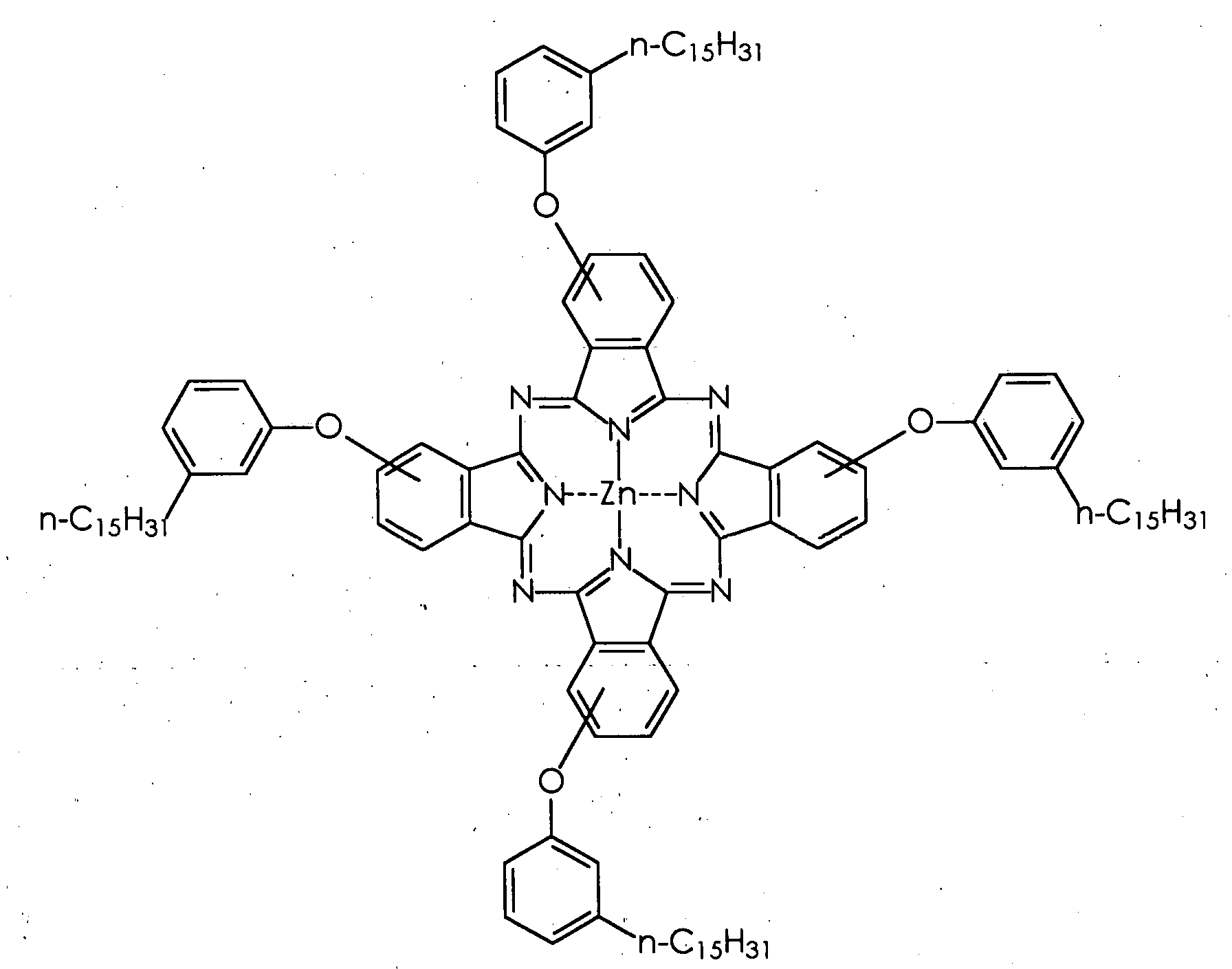
- a phase change ink was prepared as described in Example XV except that a zinc dye according to the present invention prepared as described in Example XI was substituted for the dye prepared as described in Example I .
- the ink thus prepared exhibited a viscosity of about 10.6 centipoise as measured by a Rheometrics cone-plate viscometer at about 140°C, a melting point of about 80°C as measured by differential scanning calorimetry using a DuPont 2100 calorimeter, and a glass transition temperature (Tg) of about 14°C.
- a phase change ink was prepared as described in Example XV except that a metal-free dye according to the present invention prepared as described in Example XII was substituted for the dye prepared as described in Example I .
- the ink thus prepared exhibited a viscosity of about 10.6 centipoise as measured by a Rheometrics cone-plate viscometer at about 140°C, a melting point of about 80°C as measured by differential scanning calorimetry using a DuPont 2100 calorimeter, and a glass transition temperature (Tg) of about 14°C.
- a phase change ink is prepared as described in Example XV except that a nickel dye according to the present invention prepared as described in Example XIII is substituted for the dye prepared as described in Example I . It is believed that the ink thus prepared will exhibit a viscosity of about 10.6 centipoise as measured by a Rheometrics cone-plate viscometer at about 140°C, a melting point of about 80°C as measured by differential scanning calorimetry using a DuPont 2100 calorimeter, and a glass transition temperature (T g ) of about 14°C.
- a phase change ink was prepared as described in Example XV except that a cobalt dye according to the present invention prepared as described in Example XIII was substituted for the dye prepared as described in Example I.
- the ink thus prepared exhibited a viscosity of about 10.6 centipoise as measured by a Rheometrics cone-plate viscometer at about 140°C, a melting point of about 80°C as measured by differential scanning calorimetry using a DuPont 2100 calorimeter, and a glass transition temperature (Tg) of about 14°C.
- Printed samples of the inks of Examples XV, XVI, XVII, and XIX were evaluated for their color characteristics, which are reported in the table below.
- Spectral strength (SS) is reported in units of milliliters Absorbance per gram, in toluene.
- Lambda max ( ⁇ max ) is reported in nanometers.
- the printed swatch of the ink made using the dye wherein M is a zinc atom is both more green and less blue than the printed swatch of the ink made using the dye wherein M is a copper atom (Example XV ).
- the printed swatch of the ink made using the dye wherein M is a cobalt atom is less green and more blue than the printed swatch of the ink made using the dye wherein M is a copper atom (Example XV ).
- the printed swatch of the ink made using the dye wherein M is dihydrogen is more green and less blue than the printed swatch of the ink made using the dye wherein M is a copper atom (Example XV ).
Landscapes
- Chemical & Material Sciences (AREA)
- Organic Chemistry (AREA)
- Nitrogen Condensed Heterocyclic Rings (AREA)
- Inks, Pencil-Leads, Or Crayons (AREA)
- Organic Low-Molecular-Weight Compounds And Preparation Thereof (AREA)
Abstract
Description






















| Example | L* | a* | b* | C* |
| XV | 58 | -33 | -24 | 41 |
| D | 78 | -24 | -23 | 33 |
| E | 64 | -24 | -39 | 46 |
| Example | Before Irradiation | After Irradiation | Color Difference (ΔE) | ||||
| L* | a* | b* | L* | a* | b* | ||
| XV | 54 | -37 | -31 | 55 | -41 | -26 | 6 |
| F | 57 | -22 | -41 | 95 | -2 | 3 | 61 |
| Example | Before Irradiation | After Irradiation | Color Difference (ΔE) | ||||
| L* | a* | b* | L* | a* | b* | ||
| XV | 54 | -37 | -31 | 54 | -39 | -31 | 1.4 |
| F | 57 | -22 | -41 | 61 | -15 | 22 | 21 |
| Example | L* | a* | b* | C* | SS | λmax |
| XV | 58 | -33 | -24 | 41 | 5503 | 681 |
| XVI | 64 | -40 | -20 | 45 | 5349 | 681 |
| XVII | 59 | -41 | -22 | 47 | 4136 | 703 |
| XIX | 55 | -13 | -30 | 33 | 4000 | 673 |
Claims (10)
- A compound of the formulawherein M is an atom or group of atoms capable of bonding to the central cavity of a phthalocyanine molecule, wherein axial ligands optionally can be attached to M.

- A compound according to claim 1 wherein M is dihydrogen.
- A compound according to claim 1 wherein M is dilithium, disodium, dipotassium, beryllium, magnesium, calcium, strontium, barium, chromium, manganese, iron, cobalt, nickel, copper, zinc, tin, lead, cadmium, or mixtures thereof.
- A compound according to claim 1 wherein M is copper, nickel, cobalt, or zinc.
- A compound according to claim 1 wherein M is copper.
- A compound according to claim 1 wherein M is a divalent halometal or -metalloid group.
- A compound according to claim 1 wherein M is a divalent oxometal group.
- A compound according to claim 1 wherein M is a hydroxymetal group.
- A compound according to claim 1 wherein M is a divalent metal- or metalloidal-oxyhydrocarbon group.
- A compound according to claim 1 wherein the compound is of the formula


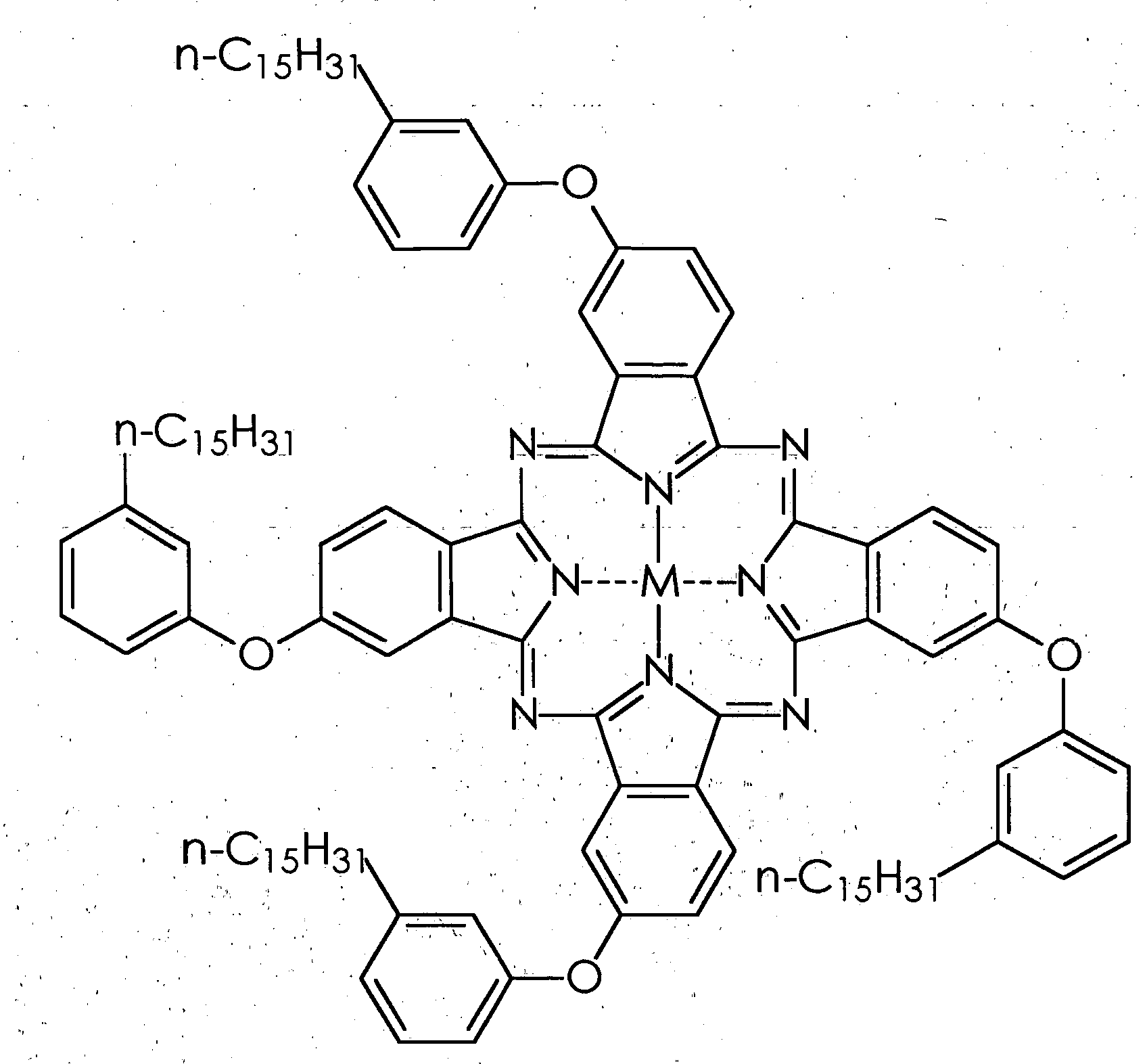 or mixtures thereof.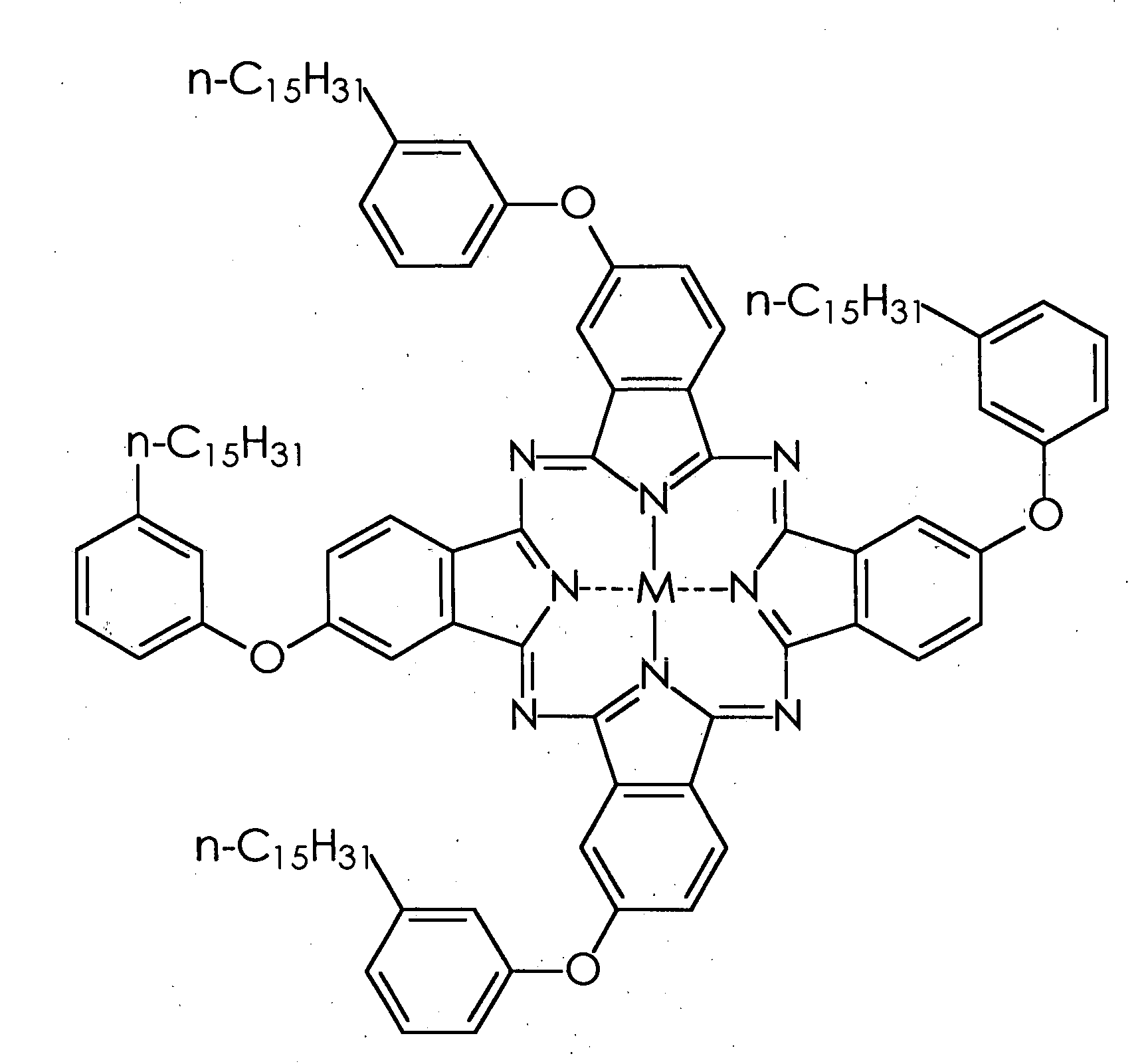
Applications Claiming Priority (2)
| Application Number | Priority Date | Filing Date | Title |
|---|---|---|---|
| US72241 | 2002-02-08 | ||
| US10/072,241 US6472523B1 (en) | 2002-02-08 | 2002-02-08 | Phthalocyanine compositions |
Publications (3)
| Publication Number | Publication Date |
|---|---|
| EP1335000A2 true EP1335000A2 (en) | 2003-08-13 |
| EP1335000A3 EP1335000A3 (en) | 2003-11-05 |
| EP1335000B1 EP1335000B1 (en) | 2008-10-08 |
Family
ID=22106410
Family Applications (1)
| Application Number | Title | Priority Date | Filing Date |
|---|---|---|---|
| EP03002850A Expired - Lifetime EP1335000B1 (en) | 2002-02-08 | 2003-02-07 | Phthalocyanine compounds |
Country Status (4)
| Country | Link |
|---|---|
| US (1) | US6472523B1 (en) |
| EP (1) | EP1335000B1 (en) |
| JP (1) | JP4471573B2 (en) |
| DE (1) | DE60323892D1 (en) |
Cited By (3)
| Publication number | Priority date | Publication date | Assignee | Title |
|---|---|---|---|---|
| WO2011040920A1 (en) * | 2009-09-30 | 2011-04-07 | Hewelt-Packard Development Company, L.P. | Dispersion of near infrared absorbing pigments and method of making the same |
| RU2641743C1 (en) * | 2016-12-19 | 2018-01-22 | Федеральное государственное бюджетное образовательное учреждение высшего образования "Ивановский государственный химико-технологический университет" (ИГХТУ) | Metal complexes of octa-4,5-[4-(1-methyl-1-phenylethyl)phenoxy]phthalocyanine as luminescent materials and dyes for polymeric materials and method of their production |
| CN110563737A (en) * | 2019-08-22 | 2019-12-13 | 深圳市国华光电科技有限公司 | Metal phthalocyanine compound, printing ink and electrowetting display |
Families Citing this family (121)
| Publication number | Priority date | Publication date | Assignee | Title |
|---|---|---|---|---|
| DE10329711A1 (en) * | 2003-07-02 | 2005-01-27 | Bayer Chemicals Ag | Process for the preparation of alkoxy-substituted phthalocyanines |
| US20050274274A1 (en) * | 2004-06-14 | 2005-12-15 | Gore Makarand P | Methods and compositions for dying a substrate |
| US7879143B2 (en) * | 2005-05-11 | 2011-02-01 | Xerox Corporation | Polyalkylene materials |
| US7572325B2 (en) * | 2005-11-30 | 2009-08-11 | Xerox Corporation | Ink carriers, phase change inks including same and methods for making same |
| US7563314B2 (en) * | 2005-11-30 | 2009-07-21 | Xerox Corporation | Ink carriers containing nanoparticles, phase change inks including same and methods for making same |
| US7758268B2 (en) * | 2005-12-20 | 2010-07-20 | Xerox Corporation | Hand held photochromic marking implement |
| US20070252879A1 (en) * | 2006-04-28 | 2007-11-01 | Xerox Corporation | Phase change ink additives |
| US7786209B2 (en) * | 2006-10-27 | 2010-08-31 | Xerox Corporation | Nanostructured particles, phase change inks including same and methods for making same |
| US20080145557A1 (en) | 2006-12-18 | 2008-06-19 | Xerox Corporation | Phase change inks containing dialkyl ethers |
| US7544796B2 (en) | 2006-12-19 | 2009-06-09 | Xerox Corporation | Colorant compounds |
| US7713342B2 (en) * | 2006-12-19 | 2010-05-11 | Xerox Corporation | Phase change inks |
| US7645875B2 (en) * | 2006-12-19 | 2010-01-12 | Xerox Corporation | Colorant compounds |
| US7781026B2 (en) | 2006-12-19 | 2010-08-24 | Xerox Corporation | Ink compositions |
| US20080154032A1 (en) * | 2006-12-21 | 2008-06-26 | Xerox Corporation | Colorant compounds |
| US8057589B2 (en) * | 2006-12-21 | 2011-11-15 | Xerox Corporation | Phase change inks |
| US20080187664A1 (en) * | 2007-02-06 | 2008-08-07 | Xerox Corporation | Phase change inks containing colorant compounds |
| US7677713B2 (en) | 2007-05-30 | 2010-03-16 | Xerox Corporation | Solid ink set incorporating naturally derived materials and processes thereof |
| US8791202B2 (en) * | 2007-09-21 | 2014-07-29 | Xerox Corporation | Phase change ink compositions |
| JP2009139933A (en) * | 2007-11-14 | 2009-06-25 | Konica Minolta Business Technologies Inc | Electrostatic latent image developing toner and image forming method |
| US20090223409A1 (en) | 2008-03-07 | 2009-09-10 | Xerox Corporation | Compounds suitable for use in inks and inks having such compounds |
| US8168359B2 (en) * | 2008-03-10 | 2012-05-01 | Xerox Corporation | Nanosized particles of phthalocyanine pigments |
| US8809523B2 (en) * | 2008-03-10 | 2014-08-19 | Xerox Corporation | Method of making nanosized particles of phthalocyanine pigments |
| JP5669720B2 (en) * | 2008-03-25 | 2015-02-12 | ゼロックス コーポレイションXerox Corporation | Silica-encapsulated organic nanopigment and its production method |
| US8123344B2 (en) * | 2008-08-04 | 2012-02-28 | Xerox Corporation | Ink carriers containing surface modified nanoparticles, phase change inks including same, and methods for making same |
| US8029861B2 (en) * | 2008-09-23 | 2011-10-04 | Xerox Corporation | Ink carriers containing low viscosity functionalized waxes, phase change inks including same, and methods for making same |
| US7985286B2 (en) * | 2008-11-24 | 2011-07-26 | Xerox Corporation | Solid inks with lower coefficient of friction |
| US20100215865A1 (en) * | 2009-02-26 | 2010-08-26 | Xerox Corporation | Preparation of flexographic printing masters using an additive process |
| US20100242790A1 (en) | 2009-03-24 | 2010-09-30 | Xerox Corporation | Cationically and hybrid curable uv gels |
| US9005484B2 (en) | 2009-03-31 | 2015-04-14 | Xerox Corporation | Low polarity nano silver gels |
| US8293444B2 (en) | 2009-06-24 | 2012-10-23 | Xerox Corporation | Purified polyester resins for toner performance improvement |
| US8262210B2 (en) | 2009-09-29 | 2012-09-11 | Xerox Corporation | Curable gel inks with reduced syneresis and halo formation |
| US8383311B2 (en) * | 2009-10-08 | 2013-02-26 | Xerox Corporation | Emulsion aggregation toner composition |
| US8226757B2 (en) * | 2009-10-22 | 2012-07-24 | Hewlett-Packard Development Company, L.P. | Phthalocyanine dye and ink containing the same |
| US8465579B2 (en) | 2011-04-27 | 2013-06-18 | Xerox Corporation | Solid ink compositions comprising crystalline esters of tartaric acid |
| US8506040B2 (en) | 2011-04-27 | 2013-08-13 | Xerox Corporation | Solid ink compositions comprising crystalline-amorphous mixtures |
| US8449095B2 (en) | 2010-07-13 | 2013-05-28 | Xerox Corporation | Radiation curable solid ink compositions suitable for transfuse printing applications |
| US8308286B2 (en) | 2010-09-14 | 2012-11-13 | Xerox Corporation | Curable phase change ink containing alkoxysilane monomer |
| US8657430B2 (en) | 2010-10-08 | 2014-02-25 | Xerox Corporation | Curable phase change inks containing crystalline polyesters |
| US8613507B2 (en) | 2010-10-18 | 2013-12-24 | Xerox Corporation | Curable phase change inks containing functionalized isosorbides |
| US8343715B2 (en) | 2010-11-03 | 2013-01-01 | Xerox Corporation | Photochromic polyesters and methods of producing photochromic polyesters |
| US8449102B2 (en) | 2010-12-17 | 2013-05-28 | Xerox Corporation | Curable solid inks for raised print applications and methods for using the same |
| US8450385B2 (en) | 2010-12-21 | 2013-05-28 | Xerox Corporation | Urea-urethane gellant compositions with controlled molecular weight and methods of preparation |
| US8651849B2 (en) | 2011-01-10 | 2014-02-18 | Xerox Corporation | Digitally prepared stamp masters and methods of making the same |
| US8591785B2 (en) | 2011-01-10 | 2013-11-26 | Xerox Corporation | Digitally prepared stamp masters and methods of making the same |
| US8459788B2 (en) | 2011-03-04 | 2013-06-11 | Xerox Corporation | Curable solid ink compositions comprising novel curable wax |
| US8652723B2 (en) | 2011-03-09 | 2014-02-18 | Xerox Corporation | Toner particles comprising colorant-polyesters |
| US8287632B1 (en) | 2011-04-27 | 2012-10-16 | Xerox Corporation | Solid ink compositions comprising amorphous esters of citric acid |
| US8833917B2 (en) | 2011-04-27 | 2014-09-16 | Xerox Corporation | Solid ink compositions comprising crystalline-amorphous mixtures |
| US8500896B2 (en) | 2011-04-27 | 2013-08-06 | Xerox Corporation | Solid ink compositions comprising amorphous esters of tartaric acid |
| US8460447B2 (en) | 2011-04-27 | 2013-06-11 | Xerox Corporation | Substituted oxazoline compounds or substituted oxazoline derivatives |
| US8372189B2 (en) | 2011-04-27 | 2013-02-12 | Xerox Corporation | Phase change inks and methods of making the same |
| US8690309B2 (en) | 2011-04-27 | 2014-04-08 | Xerox Corporation | Print process for phase separation ink |
| US8308859B1 (en) | 2011-04-27 | 2012-11-13 | Xerox Corporation | Phase change ink components and methods of making the same |
| US8840232B2 (en) | 2011-04-27 | 2014-09-23 | Xerox Corporation | Phase change ink |
| US8328924B2 (en) | 2011-04-27 | 2012-12-11 | Xerox Corporation | Phase change inks and methods of making the same |
| US8500260B2 (en) | 2011-04-27 | 2013-08-06 | Xerox Corporation | Ink compositions incorporating substituted oxazoline compounds or substituted oxazoline derivatives |
| US8506694B2 (en) | 2011-04-27 | 2013-08-13 | Xerox Corporation | Phase separation ink |
| US8714723B2 (en) | 2011-05-11 | 2014-05-06 | Xerox Corporation | Robust curable solid inks and methods for using the same |
| US9109124B2 (en) | 2011-06-01 | 2015-08-18 | Xerox Corporation | Solid ink compositions comprising semicrystalline oligomer resins |
| US8888907B2 (en) | 2011-08-02 | 2014-11-18 | Xerox Corporation | Solid phase change ink compositions comprising oxazolines |
| US9085546B2 (en) | 2012-04-09 | 2015-07-21 | Xerox Corporation | Amide gellant compositions containing isosorbide |
| US8772416B2 (en) | 2012-04-09 | 2014-07-08 | Xerox Corporation | Ink compositions containing isosorbide-capped amide gellant |
| US8741040B2 (en) | 2012-04-26 | 2014-06-03 | Xerox Corporation | Phase change ink compositions comprising aromatic ethers |
| US8814999B2 (en) | 2012-04-26 | 2014-08-26 | Xerox Corporation | Phase change ink compositions comprising crystalline sulfone compounds and derivatives thereof |
| US8882897B2 (en) | 2012-04-26 | 2014-11-11 | Xerox Corporation | Phase change inks comprising aromatic diester crystalline compounds |
| US8647424B2 (en) | 2012-04-26 | 2014-02-11 | Xerox Corporation | Phase change inks comprising inorganic nucleating agents |
| US8961673B2 (en) | 2012-04-26 | 2015-02-24 | Xerox Corporation | Phase change ink compositions comprising diurethanes as amorphous materials |
| US8647423B2 (en) | 2012-04-26 | 2014-02-11 | Xerox Corporation | Phase change inks comprising fatty acids |
| US9528016B2 (en) | 2012-04-26 | 2016-12-27 | Xerox Corporation | Phase change inks comprising crystalline amides |
| US8741043B2 (en) | 2012-04-26 | 2014-06-03 | Xerox Corporation | Bio-renewable fast crystallizing phase change inks |
| US9528015B2 (en) | 2012-04-26 | 2016-12-27 | Xerox Corporation | Phase change ink compositions comprising crystalline diurethanes and derivatives thereof |
| US8888905B2 (en) | 2012-04-26 | 2014-11-18 | Xerox Corporation | Fast crystallizing crystalline-amorphous ink compositions and methods for making the same |
| US8784547B2 (en) | 2012-06-18 | 2014-07-22 | Xerox Corporation | Lightfast solid ink compositions |
| US8894762B2 (en) | 2012-09-24 | 2014-11-25 | Xerox Corporation | Phase change ink comprising a polyhydroxyalkanoate compound |
| US8696100B1 (en) | 2012-10-02 | 2014-04-15 | Xerox Corporation | Phase change ink containing synergist for pigment dispersion |
| US8714724B2 (en) | 2012-10-02 | 2014-05-06 | Xerox Corporation | Phase change inks containing novel synergist |
| US9062226B2 (en) | 2012-11-19 | 2015-06-23 | Xerox Corporation | Compositions of pigment concentrates in phase change inks |
| US8753441B2 (en) | 2012-11-19 | 2014-06-17 | Xerox Corporation | Bio-renewable phase change inks comprising recycled resin materials |
| US8591640B1 (en) | 2012-11-19 | 2013-11-26 | Xerox Corporation | Bio-renewable fast crystallizing phase change inks |
| US8758494B2 (en) | 2012-11-19 | 2014-06-24 | Xerox Corporation | Pigmented magenta and yellow phase change inks |
| US8952191B2 (en) | 2012-11-19 | 2015-02-10 | Xerox Corporation | Ester resin compositions |
| US8936359B2 (en) | 2012-11-19 | 2015-01-20 | Xerox Corporation | Ink compositions incorporating ester resins |
| US9090758B2 (en) | 2012-11-30 | 2015-07-28 | Xerox Corporation | Phase change ink comprising modified naturally-derived colorants |
| US8616693B1 (en) | 2012-11-30 | 2013-12-31 | Xerox Corporation | Phase change ink comprising colorants derived from plants and insects |
| US8808438B2 (en) | 2013-01-14 | 2014-08-19 | Xerox Corporation | Amorphous materials for use in phase change inks |
| US8551236B1 (en) | 2013-01-14 | 2013-10-08 | Xerox Corporation | Phase change inks comprising crystalline-amorphous mixtures |
| US9109131B2 (en) | 2013-01-16 | 2015-08-18 | Xerox Corporation | Photochromic phase change ink compositions |
| US8827393B2 (en) | 2013-01-16 | 2014-09-09 | Xerox Corporation | Fluorescent phase change ink compositions |
| US8741044B1 (en) | 2013-01-18 | 2014-06-03 | Xerox Corporation | Cycylohexyl-mannitol diketal derivatives as vehicle modifiers and gelators |
| US8747535B1 (en) | 2013-01-18 | 2014-06-10 | Xerox Corporation | Solid ink compositions comprising crystalline-amorphous mixtures |
| US8747536B1 (en) | 2013-01-31 | 2014-06-10 | Xerox Corporation | Phase change ink formulation including malic acid derivatives as amorphous materials |
| US9139743B2 (en) | 2013-01-31 | 2015-09-22 | Xerox Corporation | Malic acid derivatives as amorphous materials for phase change ink |
| US8815000B1 (en) | 2013-02-14 | 2014-08-26 | Xerox Corporation | Solid inks comprising liquid crystalline materials |
| US9090791B2 (en) | 2013-06-04 | 2015-07-28 | Xerox Corporation | Mixtures of ester of tartaric acid and ester of citric acid as amorphous materials for phase change inks |
| US9139746B2 (en) | 2013-06-04 | 2015-09-22 | Xerox Corporation | Phase change ink compositions comprising mixtures of ester of tartaric acid and ester of citric acid as amorphous materials |
| US9096768B2 (en) | 2013-08-15 | 2015-08-04 | Xerox Corporation | Curable phase change ink compositions |
| US9193869B2 (en) | 2013-08-26 | 2015-11-24 | Xerox Corporation | Dye compounds, method of making the compounds and ink composition employing the compounds |
| US8920551B1 (en) | 2013-08-28 | 2014-12-30 | Xerox Corporation | Phase change inks |
| US8981088B1 (en) | 2013-08-28 | 2015-03-17 | Xerox Corporation | Boron subphthalocyanine compounds and method of making |
| US9394319B2 (en) | 2013-08-28 | 2016-07-19 | Xerox Corporation | Boron subphthalocyanine compounds and method of making |
| US9074104B2 (en) | 2013-09-04 | 2015-07-07 | Xerox Corporation | Inks comprising amorphous ureas |
| US9056998B2 (en) | 2013-10-14 | 2015-06-16 | Xerox Corporation | Crystalline compounds for phase change inks |
| US9011587B1 (en) | 2013-10-14 | 2015-04-21 | Xerox Corporation | Phase change inks comprising novel crystalline compounds |
| US9120943B2 (en) | 2013-10-15 | 2015-09-01 | Xerox Corporation | Bio-renewable phase change inks |
| US9528012B2 (en) | 2013-10-30 | 2016-12-27 | Xerox Corporation | Electron beam curable inks for indirect printing |
| US9074105B2 (en) | 2013-10-30 | 2015-07-07 | Xerox Corporation | Emulsified UV curable inks for indirect printing |
| US9422440B2 (en) | 2013-12-06 | 2016-08-23 | Xerox Corporation | Bis-ureas as amorphous materials for phase-change ink |
| US9228102B2 (en) | 2014-04-03 | 2016-01-05 | Xerox Corporation | Scratch resistant inks |
| US20150283758A1 (en) | 2014-04-08 | 2015-10-08 | Xerox Corporation | Method of making three-dimensional objects using crystalline and amorphous compounds |
| US20150283759A1 (en) | 2014-04-08 | 2015-10-08 | Xerox Corporation | Method of making three-dimensional objects using bio-renewable crystalline-amorphous materials |
| CN106550603A (en) * | 2014-07-28 | 2017-03-29 | 陶氏环球技术有限责任公司 | For the phthalocyanine compound of the light filter of LCD |
| US9676952B2 (en) | 2015-02-24 | 2017-06-13 | Xerox Corporation | 3D printing system comprising solid build ink comprising colorant |
| US9910373B2 (en) | 2015-07-17 | 2018-03-06 | Xerox Corporation | Cold pressure fix toner compositions based on small molecule crystalline and amorphous organic compound mixtures |
| US9977356B2 (en) | 2015-07-17 | 2018-05-22 | Xerox Corporation | Cold pressure fix toner compositions based on crystalline polyester and amorphous organic compound mixtures |
| US9738759B1 (en) | 2016-03-14 | 2017-08-22 | Xerox Corporation | Cold pressure fix toners comprising crystalline co-polyester-co-poly(alkylsiloxane) |
| US9703217B1 (en) | 2016-03-25 | 2017-07-11 | Xerox Corporation | Toner compositions for magnetic ink character recognition |
| US10048605B1 (en) | 2017-01-24 | 2018-08-14 | Xerox Corporation | Cold pressure fix toner comprising crystalline resin and high and low Tg amorphous polyester |
| TWI732111B (en) | 2017-03-28 | 2021-07-01 | 日商住友電木股份有限公司 | Photosensitive compositions, color filter and microlens derived therefrom |
| EP3601452B1 (en) | 2017-03-31 | 2023-09-13 | Kao Corporation | Radiation curable ink compositions, printed articles, and methods of using the same |
| US11312170B2 (en) | 2018-04-05 | 2022-04-26 | Kao Corporation | In-line primer printing methods |
| CN114538593B (en) * | 2022-02-21 | 2022-10-21 | 杭州师范大学钱江学院 | Application of hydrophobic phthalocyanine as heterogeneous catalyst in oxidizing phenol wastewater by hydrogen peroxide |
Family Cites Families (48)
| Publication number | Priority date | Publication date | Assignee | Title |
|---|---|---|---|---|
| NL168054C (en) | 1969-02-01 | Basf Ag | PROCESS FOR THE MANUFACTURE OF RELIEF FORMS, AND A SOLID, PHOTOPOLYMERIZABLE ELEMENT, MANUFACTURED BY APPLICATION OF THIS PROCESS. | |
| BE755392A (en) | 1969-08-28 | 1971-02-01 | Teletype Corp | INK AND ELECTROSTATIC PRINTING APPARATUS |
| US4390369A (en) | 1981-12-17 | 1983-06-28 | Exxon Research And Engineering Co. | Natural wax-containing ink jet inks |
| US4484948A (en) | 1981-12-17 | 1984-11-27 | Exxon Research And Engineering Co. | Natural wax-containing ink jet inks |
| JPS58196295A (en) | 1982-05-12 | 1983-11-15 | Sumitomo Metal Ind Ltd | Lubricating treatment of metal plate |
| DE3579067D1 (en) | 1984-05-10 | 1990-09-13 | Willett Int Ltd | METHOD FOR COATING A SUBSTRATE WITH THERMOPLASTIC INKS, AND COATING COMPOSITION. |
| JPS61146597A (en) | 1984-12-20 | 1986-07-04 | Fujitsu Ltd | Thermal transfer recording system |
| EP0187352B1 (en) | 1984-12-31 | 1991-06-05 | Howtek, Inc. | A method of ink jet colour printing |
| GB8515600D0 (en) | 1985-06-20 | 1985-07-24 | Ciba Geigy Ag | Pigmentary copper phthalocyanine |
| DE3671460D1 (en) | 1985-06-25 | 1990-06-28 | Howtek Inc | INK FOR INK JET PRINT. |
| USH477H (en) * | 1985-08-21 | 1988-06-07 | United States Of America | Monolayer-forming substituted phthalocyanine compounds and method of preparation thereof |
| JPH0642071B2 (en) | 1985-11-09 | 1994-06-01 | コニカ株式会社 | Photosensitive composition and photosensitive lithographic printing plate |
| CH672923A5 (en) | 1986-06-07 | 1990-01-15 | Sandoz Ag | |
| JPS6354476A (en) | 1986-08-25 | 1988-03-08 | Seiko Epson Corp | Hot-melting ink |
| US4889560A (en) | 1988-08-03 | 1989-12-26 | Tektronix, Inc. | Phase change ink composition and phase change ink produced therefrom |
| US4889761A (en) | 1988-08-25 | 1989-12-26 | Tektronix, Inc. | Substrates having a light-transmissive phase change ink printed thereon and methods for producing same |
| US5151120A (en) | 1989-03-31 | 1992-09-29 | Hewlett-Packard Company | Solid ink compositions for thermal ink-jet printing having improved printing characteristics |
| US5149800A (en) | 1989-06-26 | 1992-09-22 | Milliken Research Corporation | Poly(oxyalkylene) modified phthalocyanine colorants |
| JPH0819346B2 (en) | 1989-05-19 | 1996-02-28 | 東洋インキ製造株式会社 | Pigment composition and pigment dispersion |
| US5006170A (en) | 1989-06-22 | 1991-04-09 | Xerox Corporation | Hot melt ink compositions |
| US5280114A (en) | 1990-04-07 | 1994-01-18 | Mitsui Toatsu Chemicals, Incorporated | Halogenation of alkoxyphthalocyanine |
| US5221335A (en) | 1990-05-23 | 1993-06-22 | Coates Electrographics Limited | Stabilized pigmented hot melt ink containing nitrogen-modified acrylate polymer as dispersion-stabilizer agent |
| EP0484027B1 (en) | 1990-11-02 | 1996-12-18 | Zeneca Limited | Polysubstituted phthalocyanines |
| GB9023893D0 (en) * | 1990-11-02 | 1990-12-12 | Ici Plc | Infra-red absorber |
| DE69117905T2 (en) * | 1990-12-26 | 1996-11-14 | Mitsui Toatsu Chemicals | Manufacturing process for alkoxyphthalocyanines |
| JPH07116371B2 (en) | 1991-09-30 | 1995-12-13 | 三井東圧化学株式会社 | Halogenated alkoxyphthalocyanine for recording / storing material, method for producing the same, and optical recording medium using the same |
| US5248336A (en) | 1991-11-05 | 1993-09-28 | Miles Inc. | Solid solutions of copper phthalocyanine compounds |
| JP3238183B2 (en) | 1992-02-10 | 2001-12-10 | 株式会社日本触媒 | Novel phthalocyanine compound and method for producing the same |
| DE4205636C2 (en) | 1992-02-25 | 1994-12-22 | Siegwerk Druckfarben Gmbh & Co | Gravure and planographic printing processes and printing machines for carrying out the processes |
| DE4205713C2 (en) | 1992-02-25 | 1994-08-04 | Siegwerk Druckfarben Gmbh & Co | Printing ink, process for its production and its use |
| US5312706A (en) * | 1992-05-29 | 1994-05-17 | Xerox Corporation | Infra-red photoconductor based on octa-substituted phthalocyanines |
| US5385957A (en) | 1992-08-24 | 1995-01-31 | Videojet Systems International, Inc. | Hotmelt ink jet comprising ionomers having melting points from about 50° C. to about 130° or a softening point below about 80° C., and an image-forming agent |
| US5372852A (en) | 1992-11-25 | 1994-12-13 | Tektronix, Inc. | Indirect printing process for applying selective phase change ink compositions to substrates |
| US5621022A (en) | 1992-11-25 | 1997-04-15 | Tektronix, Inc. | Use of polymeric dyes in hot melt ink jet inks |
| GB9316820D0 (en) * | 1993-08-12 | 1993-09-29 | Zeneca Ltd | Phthalocyanines |
| DE69532096T2 (en) * | 1994-03-31 | 2004-08-26 | Tdk Corp. | Optical recording medium |
| JP3857327B2 (en) * | 1994-04-20 | 2006-12-13 | 株式会社リコー | Phthalocyanine compounds |
| DE59507878D1 (en) * | 1994-09-23 | 2000-04-06 | Ciba Sc Holding Ag | Mixtures of isomers of alkoxy-substituted phthalocyanines and process for their preparation |
| JPH08225751A (en) | 1994-10-26 | 1996-09-03 | Nippon Shokubai Co Ltd | New phthalocyanine compound, its production and optical recording medium using the same |
| DE59510392D1 (en) | 1994-11-03 | 2002-10-31 | Ciba Sc Holding Ag | Cationic imidazole azo dyes |
| JP3707093B2 (en) | 1995-04-28 | 2005-10-19 | 山本化成株式会社 | Phthalocyanine compound, intermediate thereof, method for producing the phthalocyanine compound, color filter using the same, and oil-based ink composition |
| EP0742255B1 (en) | 1995-05-12 | 2004-04-14 | Ciba SC Holding AG | Colouration of high molecular weight organic materials in the mass with soluble phthalocyanine precursors |
| GB9602095D0 (en) | 1996-02-02 | 1996-04-03 | Zeneca Ltd | Phthalocyanines |
| JP3653855B2 (en) | 1996-04-15 | 2005-06-02 | 三菱化学株式会社 | Phthalocyanine compound and optical recording medium using the same |
| DE69713512T2 (en) | 1996-10-03 | 2003-02-13 | Ciba Speciality Chemicals Holding Inc., Basel | SUBSTITUTED PHTALOCYANINE AND THEIR USE |
| WO1998016588A1 (en) * | 1996-10-14 | 1998-04-23 | Nippon Shokubai Co., Ltd. | Phthalocyanine compounds, process for preparing the same, and optical recording medium made using the same |
| DE19858965A1 (en) | 1998-12-21 | 2000-06-29 | Bayer Ag | Solid phthalocyanine preparations |
| US6221137B1 (en) * | 1999-06-18 | 2001-04-24 | Xerox Corporation | Metal phthalocyanine colorants for phase change inks |
-
2002
- 2002-02-08 US US10/072,241 patent/US6472523B1/en not_active Expired - Fee Related
-
2003
- 2003-02-05 JP JP2003027856A patent/JP4471573B2/en not_active Expired - Fee Related
- 2003-02-07 EP EP03002850A patent/EP1335000B1/en not_active Expired - Lifetime
- 2003-02-07 DE DE60323892T patent/DE60323892D1/en not_active Expired - Lifetime
Cited By (4)
| Publication number | Priority date | Publication date | Assignee | Title |
|---|---|---|---|---|
| WO2011040920A1 (en) * | 2009-09-30 | 2011-04-07 | Hewelt-Packard Development Company, L.P. | Dispersion of near infrared absorbing pigments and method of making the same |
| US8337610B2 (en) | 2009-09-30 | 2012-12-25 | Hewlett-Packard Development Company, L.P. | Dispersion of near infrared absorbing pigments and method of making the same |
| RU2641743C1 (en) * | 2016-12-19 | 2018-01-22 | Федеральное государственное бюджетное образовательное учреждение высшего образования "Ивановский государственный химико-технологический университет" (ИГХТУ) | Metal complexes of octa-4,5-[4-(1-methyl-1-phenylethyl)phenoxy]phthalocyanine as luminescent materials and dyes for polymeric materials and method of their production |
| CN110563737A (en) * | 2019-08-22 | 2019-12-13 | 深圳市国华光电科技有限公司 | Metal phthalocyanine compound, printing ink and electrowetting display |
Also Published As
| Publication number | Publication date |
|---|---|
| US6472523B1 (en) | 2002-10-29 |
| JP4471573B2 (en) | 2010-06-02 |
| EP1335000A3 (en) | 2003-11-05 |
| JP2003277639A (en) | 2003-10-02 |
| DE60323892D1 (en) | 2008-11-20 |
| EP1335000B1 (en) | 2008-10-08 |
Similar Documents
| Publication | Publication Date | Title |
|---|---|---|
| US6472523B1 (en) | Phthalocyanine compositions | |
| US6476219B1 (en) | Methods for preparing phthalocyanine compositions | |
| US6726755B2 (en) | Ink compositions containing phthalocyanines | |
| EP1468051B1 (en) | Phthalocyanine dye mixture and ink containing the same | |
| EP1468050B1 (en) | Water-soluble phthalocyanine compound-containing ink for ink jetting, ink jet recording method and method for improving ozone gas discoloration of colored image material | |
| EP1364994B1 (en) | Phthalocyanine compound, ink, ink for ink-jet recording, ink-jet recording method and method for improving ozone gas resistance of colored imaging material | |
| KR100644113B1 (en) | Colored image forming compositions containing phthalocyanine compounds, inks, inkjet inks, inkjet recording methods and methods for improving ozone gas fading resistance | |
| AU2003202806A1 (en) | Dye mixture and ink containing the same | |
| US7132012B2 (en) | Phthalocyanine compound, ink, ink jet recording method and image forming method | |
| AU2003202805A1 (en) | Water-soluble phthalocyanine compound-containing ink for ink jetting, ink jet recording method and method for improving ozone gas discoloration of colored image material | |
| US20090226835A1 (en) | Nanosized particles of phthalocyanine pigments | |
| EP1491590B1 (en) | Triphenylmethane colorant compounds and phase change inks containing the same | |
| EP2206751A1 (en) | Coloring composition, method for production thereof, and coloring method | |
| US8057589B2 (en) | Phase change inks | |
| US20080188662A1 (en) | Colorant compounds | |
| US7781026B2 (en) | Ink compositions | |
| US7544796B2 (en) | Colorant compounds | |
| US20080154032A1 (en) | Colorant compounds |
Legal Events
| Date | Code | Title | Description |
|---|---|---|---|
| PUAI | Public reference made under article 153(3) epc to a published international application that has entered the european phase |
Free format text: ORIGINAL CODE: 0009012 |
|
| AK | Designated contracting states |
Designated state(s): AT BE BG CH CY CZ DE DK EE ES FI FR GB GR HU IE IT LI LU MC NL PT SE SI SK TR |
|
| AX | Request for extension of the european patent |
Extension state: AL LT LV MK RO |
|
| PUAL | Search report despatched |
Free format text: ORIGINAL CODE: 0009013 |
|
| RIC1 | Information provided on ipc code assigned before grant |
Ipc: 7C 09D 11/00 B Ipc: 7C 09B 47/18 B Ipc: 7C 09B 47/067 A |
|
| AK | Designated contracting states |
Kind code of ref document: A3 Designated state(s): AT BE BG CH CY CZ DE DK EE ES FI FR GB GR HU IE IT LI LU MC NL PT SE SI SK TR |
|
| AX | Request for extension of the european patent |
Extension state: AL LT LV MK RO |
|
| 17P | Request for examination filed |
Effective date: 20040506 |
|
| AKX | Designation fees paid |
Designated state(s): CH DE FR GB LI |
|
| GRAP | Despatch of communication of intention to grant a patent |
Free format text: ORIGINAL CODE: EPIDOSNIGR1 |
|
| GRAS | Grant fee paid |
Free format text: ORIGINAL CODE: EPIDOSNIGR3 |
|
| GRAA | (expected) grant |
Free format text: ORIGINAL CODE: 0009210 |
|
| AK | Designated contracting states |
Kind code of ref document: B1 Designated state(s): CH DE FR GB LI |
|
| REG | Reference to a national code |
Ref country code: GB Ref legal event code: FG4D |
|
| REG | Reference to a national code |
Ref country code: CH Ref legal event code: NV Representative=s name: E. BLUM & CO. AG PATENT- UND MARKENANWAELTE VSP Ref country code: CH Ref legal event code: EP |
|
| REF | Corresponds to: |
Ref document number: 60323892 Country of ref document: DE Date of ref document: 20081120 Kind code of ref document: P |
|
| PLBE | No opposition filed within time limit |
Free format text: ORIGINAL CODE: 0009261 |
|
| STAA | Information on the status of an ep patent application or granted ep patent |
Free format text: STATUS: NO OPPOSITION FILED WITHIN TIME LIMIT |
|
| 26N | No opposition filed |
Effective date: 20090709 |
|
| PGFP | Annual fee paid to national office [announced via postgrant information from national office to epo] |
Ref country code: GB Payment date: 20130129 Year of fee payment: 11 Ref country code: FR Payment date: 20130408 Year of fee payment: 11 Ref country code: CH Payment date: 20130130 Year of fee payment: 11 Ref country code: DE Payment date: 20130124 Year of fee payment: 11 |
|
| REG | Reference to a national code |
Ref country code: DE Ref legal event code: R119 Ref document number: 60323892 Country of ref document: DE |
|
| REG | Reference to a national code |
Ref country code: CH Ref legal event code: PL |
|
| GBPC | Gb: european patent ceased through non-payment of renewal fee |
Effective date: 20140207 |
|
| PG25 | Lapsed in a contracting state [announced via postgrant information from national office to epo] |
Ref country code: LI Free format text: LAPSE BECAUSE OF NON-PAYMENT OF DUE FEES Effective date: 20140228 Ref country code: CH Free format text: LAPSE BECAUSE OF NON-PAYMENT OF DUE FEES Effective date: 20140228 |
|
| REG | Reference to a national code |
Ref country code: FR Ref legal event code: ST Effective date: 20141031 |
|
| REG | Reference to a national code |
Ref country code: DE Ref legal event code: R119 Ref document number: 60323892 Country of ref document: DE Effective date: 20140902 |
|
| PG25 | Lapsed in a contracting state [announced via postgrant information from national office to epo] |
Ref country code: FR Free format text: LAPSE BECAUSE OF NON-PAYMENT OF DUE FEES Effective date: 20140228 Ref country code: GB Free format text: LAPSE BECAUSE OF NON-PAYMENT OF DUE FEES Effective date: 20140207 Ref country code: DE Free format text: LAPSE BECAUSE OF NON-PAYMENT OF DUE FEES Effective date: 20140902 |