EP1333054B1 - Process using a paint composition for automotive weather strips - Google Patents
Process using a paint composition for automotive weather strips Download PDFInfo
- Publication number
- EP1333054B1 EP1333054B1 EP03002610A EP03002610A EP1333054B1 EP 1333054 B1 EP1333054 B1 EP 1333054B1 EP 03002610 A EP03002610 A EP 03002610A EP 03002610 A EP03002610 A EP 03002610A EP 1333054 B1 EP1333054 B1 EP 1333054B1
- Authority
- EP
- European Patent Office
- Prior art keywords
- automotive weather
- urethane
- drying
- weather strips
- paint
- Prior art date
- Legal status (The legal status is an assumption and is not a legal conclusion. Google has not performed a legal analysis and makes no representation as to the accuracy of the status listed.)
- Expired - Lifetime
Links
Images
Classifications
-
- C—CHEMISTRY; METALLURGY
- C08—ORGANIC MACROMOLECULAR COMPOUNDS; THEIR PREPARATION OR CHEMICAL WORKING-UP; COMPOSITIONS BASED THEREON
- C08K—Use of inorganic or non-macromolecular organic substances as compounding ingredients
- C08K5/00—Use of organic ingredients
- C08K5/54—Silicon-containing compounds
- C08K5/5406—Silicon-containing compounds containing elements other than oxygen or nitrogen
-
- C—CHEMISTRY; METALLURGY
- C08—ORGANIC MACROMOLECULAR COMPOUNDS; THEIR PREPARATION OR CHEMICAL WORKING-UP; COMPOSITIONS BASED THEREON
- C08G—MACROMOLECULAR COMPOUNDS OBTAINED OTHERWISE THAN BY REACTIONS ONLY INVOLVING UNSATURATED CARBON-TO-CARBON BONDS
- C08G18/00—Polymeric products of isocyanates or isothiocyanates
- C08G18/06—Polymeric products of isocyanates or isothiocyanates with compounds having active hydrogen
- C08G18/28—Polymeric products of isocyanates or isothiocyanates with compounds having active hydrogen characterised by the compounds used containing active hydrogen
- C08G18/2805—Compounds having only one group containing active hydrogen
- C08G18/288—Compounds containing at least one heteroatom other than oxygen or nitrogen
- C08G18/289—Compounds containing at least one heteroatom other than oxygen or nitrogen containing silicon
-
- C—CHEMISTRY; METALLURGY
- C09—DYES; PAINTS; POLISHES; NATURAL RESINS; ADHESIVES; COMPOSITIONS NOT OTHERWISE PROVIDED FOR; APPLICATIONS OF MATERIALS NOT OTHERWISE PROVIDED FOR
- C09D—COATING COMPOSITIONS, e.g. PAINTS, VARNISHES OR LACQUERS; FILLING PASTES; CHEMICAL PAINT OR INK REMOVERS; INKS; CORRECTING FLUIDS; WOODSTAINS; PASTES OR SOLIDS FOR COLOURING OR PRINTING; USE OF MATERIALS THEREFOR
- C09D175/00—Coating compositions based on polyureas or polyurethanes; Coating compositions based on derivatives of such polymers
- C09D175/04—Polyurethanes
Definitions
- the present invention relates to a processes for producing automotive weather strips.
- curable urethane-based paints on the surface of the substrate to impart it special functions such as wear resistance and slip property (sliding property) or provide it with better appearance.
- curable urethane-based paints of a solvent type have been used in the manufacture of automotive weather strips; however, with the recent concern over the global environment and the health of working personnel, a need has arisen for a shift toward aqueous and other paints of a non-solvent type.
- aqueous-type paints require preliminary drying in order to prevent "flashing" due to nearly instantaneous volatilization of water. As a result, longer drying times are required by the aqueous paints and in order to deal with this low productivity problem, it becomes necessary to build a new drying oven for shifting from the solvent-type paint to the aqueous type.
- thermosetting elastomers such as EPDM rubber (ethylene propylene rubber) or thermoplastic elastomers such as TPO (thermoplastic polyolefins)
- thermoplastic elastomers are used as the substrate, drying should be carried out at a low temperatures of 150°C or below to prevent thermal deformation that would otherwise occur during post-application drying; however, if the paint applied is of the aqueous type, the drying operation is not highly productive since water is very difficult to dry.
- the EPDM rubber as an exemplary thermosetting elastomer is nonpolar and has low sticking property and it is also hydrophobic; hence, aqueous paints cannot produce a more adhesive coat than solvent-type paints.
- pretreatments such as corona discharge and primer application are conventionally applied to the substrate surface but problems still remain, such as high initial cost and the difficulty involved in performing positive pretreatments on complexly shaped articles.
- an object of the invention is to provide a process for producing automotive weather strips which does not require the as-applied coat to be cured completely in a drying oven but which permits it to be cured completely by the heat inertia of the drying step and which can also shorten the length of the drying oven or lower the drying temperature.
- the object of the invention can be attained by a process for producing automotive weather strips which comprises the steps of extruding a semi-finished product of automotive weather strip while it is continuously coated with a urethane-based aqueous paint, then drying and curing the product in a heating furnace, or comprises extruding a semi-finished product of automotive weather strip, heating it, immediately followed by continuous application of a urethane-based aqueous paint, then drying and curing the product in a heating furnace, or comprises unrolling a semi-finished extruded product of automotive weather strip while it is continuously coated with a urethane-based aqueous paint, then drying and curing the extruded product in a heating furnace, wherein a silicone compound having an amino group is applied to the coated surface of the semi-finished product or extruded product after it leaves the heating furnace, or wherein a silicone compound having an amino group is incorporated in the urethane-based aqueous paint.
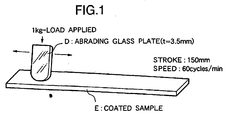
- Fig. 1 is a schematic representation of an abrasion tester according to a method specified by the Japan Society for Promotion of Scientific Research.
- the curable urethane-based emulsion paint which is used as the base of the paint composition is a urethane-based emulsion paint which typically uses an isocyanate-, melamine-, epoxy- or carbodiimide-based curing agent.
- silane coupling agent having an amino group examples include y-aminopropyltrimethoxysilane, ⁇ -aminopropyltriethoxysilane and N- ⁇ -(aminoethyl)- ⁇ -aminopropyltrimethoxysilane.
- silane coupling agent having an epoxy group examples include - ⁇ -glycidoxypropyltrimethoxysilane, ⁇ -glycidoxypropyltriethoxysilane and ⁇ -(3,4-epoxycyclohexyl)ethyltrimethoxysilane.
- silane coupling agent having a methacryloxy group examples include ⁇ -methacryloxypropyltrimethoxysilane, ⁇ -methacryloxypropyltriethoxysilane, ⁇ -methacryloxypropylmethyldiethoxysilane and 3-acryloxypropylmethoxysilane.
- At least two of the silane coupling agents listed above or their reaction product is preferably added in an amount of 10 to 40 parts by weight per 100 parts by weight of the involatile content in the base curable urethane-based emulsion paint.
- the substrate of automotive weather strips is not limited in any particular way but thermoplastic elastomers are preferably used.
- the urethane-based aqueous paint may be a urethane-based emulsion paint which typically uses an isocyanate-, melamine-, epoxy- or carbodiimide-based curing agent.
- silicone compound having an amino group examples include aminosilane coupling agents such as ⁇ -aminopropyltrimethoxysilane, ⁇ -aminopropyltriethoxysilane and N- ⁇ -(aminoethyl)- ⁇ -aminopropyltrimethoxysilane, as well as amino-modified silicone oils.
- aminosilane coupling agents such as ⁇ -aminopropyltrimethoxysilane, ⁇ -aminopropyltriethoxysilane and N- ⁇ -(aminoethyl)- ⁇ -aminopropyltrimethoxysilane, as well as amino-modified silicone oils.
- silicone compounds having an amino group may be applied to the coated surface of the substrate as it emerges from the drying oven, it may be diluted with water.
- the application method is in no way limited and spraying and brushing may be mentioned as typical examples.
- Table 1 demonstrates the advantages of the process for producing an automotive weather strip according to the invention.
- Extruded, heated and later cooled automotive weather strips were coated with two samples of urethane-based aqueous paint containing ⁇ -aminopropyltrimethoxysilane as a silicone compound having an amino group, thereby preparing weather strip products, which were tested for wear resistance.
- the results are shown in Table 1 together with those of two comparative products.
- Ex. 1 Ex. 2 Comp. 1 Comp. 2 Treatment with silicon compound yes yes no no no Drying/curing conditions 200°C x 10 min 80°C x 10 min 200°C x 10 min 80°C x 10 min Wear resistance (cycles)
- EPDM rubber 20,000 20,000 10,000 5,000 TPO 5,000 5,000 2,000 100
- the processes for producing automotive weather strips according to the present invention do not require the as-applied coat to be cured completely in a drying oven but they permit it to be cured completely by the heat inertia of the drying step and they can also shorten the length of the drying oven or lower the drying temperature.
- the improvement in productivity is particularly noticeable if thermoplastic elastomers such as TPO are used as the substrate of automotive weather strips.
Landscapes
- Chemical & Material Sciences (AREA)
- Organic Chemistry (AREA)
- Health & Medical Sciences (AREA)
- Chemical Kinetics & Catalysis (AREA)
- Medicinal Chemistry (AREA)
- Polymers & Plastics (AREA)
- Materials Engineering (AREA)
- Engineering & Computer Science (AREA)
- Life Sciences & Earth Sciences (AREA)
- Wood Science & Technology (AREA)
- Seal Device For Vehicle (AREA)
- Application Of Or Painting With Fluid Materials (AREA)
- Paints Or Removers (AREA)
- Window Of Vehicle (AREA)
- Coating Of Shaped Articles Made Of Macromolecular Substances (AREA)
- Sealing Material Composition (AREA)
Description
- The present invention relates to a processes for producing automotive weather strips.
- Most automotive weather strips are coated with curable urethane-based paints on the surface of the substrate to impart it special functions such as wear resistance and slip property (sliding property) or provide it with better appearance.
- Conventionally, curable urethane-based paints of a solvent type have been used in the manufacture of automotive weather strips; however, with the recent concern over the global environment and the health of working personnel, a need has arisen for a shift toward aqueous and other paints of a non-solvent type.
- However, water which is the medium for paints of the aqueous type have more latent heat of evaporation than solvents, so the aqueous paints require more heat than paints of the solvent type in order to dry up the water after application. In addition, unlike solvent-type paints that allow adjustment of volatilization temperature and rate by combining several kinds of solvents, aqueous-type paints require preliminary drying in order to prevent "flashing" due to nearly instantaneous volatilization of water. As a result, longer drying times are required by the aqueous paints and in order to deal with this low productivity problem, it becomes necessary to build a new drying oven for shifting from the solvent-type paint to the aqueous type.
- Most automotive weather strips use substrates that are made of thermosetting elastomers such as EPDM rubber (ethylene propylene rubber) or thermoplastic elastomers such as TPO (thermoplastic polyolefins)
- If thermoplastic elastomers are used as the substrate, drying should be carried out at a low temperatures of 150°C or below to prevent thermal deformation that would otherwise occur during post-application drying; however, if the paint applied is of the aqueous type, the drying operation is not highly productive since water is very difficult to dry.
- The EPDM rubber as an exemplary thermosetting elastomer is nonpolar and has low sticking property and it is also hydrophobic; hence, aqueous paints cannot produce a more adhesive coat than solvent-type paints.
- With a view to solving this problem, pretreatments such as corona discharge and primer application are conventionally applied to the substrate surface but problems still remain, such as high initial cost and the difficulty involved in performing positive pretreatments on complexly shaped articles.
- Therefore, an object of the invention is to provide a process for producing automotive weather strips which does not require the as-applied coat to be cured completely in a drying oven but which permits it to be cured completely by the heat inertia of the drying step and which can also shorten the length of the drying oven or lower the drying temperature.
- The object of the invention can be attained by a process for producing automotive weather strips which comprises the steps of extruding a semi-finished product of automotive weather strip while it is continuously coated with a urethane-based aqueous paint, then drying and curing the product in a heating furnace, or comprises extruding a semi-finished product of automotive weather strip, heating it, immediately followed by continuous application of a urethane-based aqueous paint, then drying and curing the product in a heating furnace, or comprises unrolling a semi-finished extruded product of automotive weather strip while it is continuously coated with a urethane-based aqueous paint, then drying and curing the extruded product in a heating furnace, wherein a silicone compound having an amino group is applied to the coated surface of the semi-finished product or extruded product after it leaves the heating furnace, or wherein a silicone compound having an amino group is incorporated in the urethane-based aqueous paint.
- Particular embodiments and examples in accordance with this invention will now be described with reference to the accompanying drawing; in which:-
- Fig. 1 is a schematic representation of an abrasion tester according to a method specified by the Japan Society for Promotion of Scientific Research.
- The curable urethane-based emulsion paint which is used as the base of the paint composition is a urethane-based emulsion paint which typically uses an isocyanate-, melamine-, epoxy- or carbodiimide-based curing agent.
- Examples of the silane coupling agent having an amino group include y-aminopropyltrimethoxysilane, γ-aminopropyltriethoxysilane and N-β-(aminoethyl)-γ-aminopropyltrimethoxysilane.
- Examples of the silane coupling agent having an epoxy group include -γ-glycidoxypropyltrimethoxysilane, γ-glycidoxypropyltriethoxysilane and β-(3,4-epoxycyclohexyl)ethyltrimethoxysilane.
- Examples of the silane coupling agent having a methacryloxy group include γ-methacryloxypropyltrimethoxysilane, γ-methacryloxypropyltriethoxysilane, γ-methacryloxypropylmethyldiethoxysilane and 3-acryloxypropylmethoxysilane.
- At least two of the silane coupling agents listed above or their reaction product is preferably added in an amount of 10 to 40 parts by weight per 100 parts by weight of the involatile content in the base curable urethane-based emulsion paint.
- The following is the description of a mode for carrying out the invention as it relates to a process for producing automotive weather strips.
- The substrate of automotive weather strips is not limited in any particular way but thermoplastic elastomers are preferably used.
- The urethane-based aqueous paint may be a urethane-based emulsion paint which typically uses an isocyanate-, melamine-, epoxy- or carbodiimide-based curing agent.
- Preferred examples of the silicone compound having an amino group include aminosilane coupling agents such as γ-aminopropyltrimethoxysilane, γ-aminopropyltriethoxysilane and N-β-(aminoethyl)-γ-aminopropyltrimethoxysilane, as well as amino-modified silicone oils.
- If the silicone compounds having an amino group is to be applied to the coated surface of the substrate as it emerges from the drying oven, it may be diluted with water. The application method is in no way limited and spraying and brushing may be mentioned as typical examples.
- The present invention is illustrated in greater detail below with reference to the following Examples, but the invention should not be construed as being limited thereto.
- The data in Table 1 demonstrates the advantages of the process for producing an automotive weather strip according to the invention. Extruded, heated and later cooled automotive weather strips were coated with two samples of urethane-based aqueous paint containing γ-aminopropyltrimethoxysilane as a silicone compound having an amino group, thereby preparing weather strip products, which were tested for wear resistance. The results are shown in Table 1 together with those of two comparative products.
Ex. 1 Ex. 2 Comp. 1 Comp. 2 Treatment with silicon compound yes yes no no Drying/curing conditions 200°C x 10 min 80°C x 10 min 200°C x 10 min 80°C x 10 min Wear resistance (cycles) EPDM rubber 20,000 20,000 10,000 5,000 TPO 5,000 5,000 2,000 100 - The processes for producing automotive weather strips according to the present invention do not require the as-applied coat to be cured completely in a drying oven but they permit it to be cured completely by the heat inertia of the drying step and they can also shorten the length of the drying oven or lower the drying temperature. The improvement in productivity is particularly noticeable if thermoplastic elastomers such as TPO are used as the substrate of automotive weather strips.
Claims (4)
- A process for producing an automotive weather strip, comprising:applying a urethane-based aqueous paint onto a semi-finished product of an automotive weather strip;drying and curing the paint-applied product in a heating furnace; andapplying a silicone compound having an amino group onto the semi-finished product.
- The process according to claim 1, wherein said silicone compound is applied onto the urethane-based aqueous paint surface after said drying step.
- The process according to claim 1 or 2, wherein said automotive weather strip has a substrate comprising a thermoplastic elastomer.
- The process according to any one of the preceding claims, wherein said silicone compound having an amino group is contained in said urethane-based aqueous paint.
Applications Claiming Priority (3)
| Application Number | Priority Date | Filing Date | Title |
|---|---|---|---|
| JP2000214704 | 2000-07-14 | ||
| JP2000214704A JP3727010B2 (en) | 2000-07-14 | 2000-07-14 | Manufacturing method of weather strip for automobile and glass run |
| EP01302285A EP1172403B1 (en) | 2000-07-14 | 2001-03-13 | Paint composition and its use |
Related Parent Applications (1)
| Application Number | Title | Priority Date | Filing Date |
|---|---|---|---|
| EP01302285A Division EP1172403B1 (en) | 2000-07-14 | 2001-03-13 | Paint composition and its use |
Publications (3)
| Publication Number | Publication Date |
|---|---|
| EP1333054A2 EP1333054A2 (en) | 2003-08-06 |
| EP1333054A3 EP1333054A3 (en) | 2004-01-02 |
| EP1333054B1 true EP1333054B1 (en) | 2005-11-23 |
Family
ID=18710233
Family Applications (3)
| Application Number | Title | Priority Date | Filing Date |
|---|---|---|---|
| EP03002609A Expired - Lifetime EP1318170B1 (en) | 2000-07-14 | 2001-03-13 | Process using a paint composition for glass run channels |
| EP01302285A Expired - Lifetime EP1172403B1 (en) | 2000-07-14 | 2001-03-13 | Paint composition and its use |
| EP03002610A Expired - Lifetime EP1333054B1 (en) | 2000-07-14 | 2001-03-13 | Process using a paint composition for automotive weather strips |
Family Applications Before (2)
| Application Number | Title | Priority Date | Filing Date |
|---|---|---|---|
| EP03002609A Expired - Lifetime EP1318170B1 (en) | 2000-07-14 | 2001-03-13 | Process using a paint composition for glass run channels |
| EP01302285A Expired - Lifetime EP1172403B1 (en) | 2000-07-14 | 2001-03-13 | Paint composition and its use |
Country Status (4)
| Country | Link |
|---|---|
| US (3) | US6590027B2 (en) |
| EP (3) | EP1318170B1 (en) |
| JP (1) | JP3727010B2 (en) |
| DE (3) | DE60101245T2 (en) |
Families Citing this family (8)
| Publication number | Priority date | Publication date | Assignee | Title |
|---|---|---|---|---|
| US20080046471A1 (en) * | 2005-02-01 | 2008-02-21 | Moore James F | Calendar Synchronization using Syndicated Data |
| JP2006282026A (en) * | 2005-04-01 | 2006-10-19 | Nishikawa Rubber Co Ltd | Automotive sealant |
| US7368174B2 (en) * | 2005-12-14 | 2008-05-06 | Lord Corporation | Aqueous dispersion coating composition having noise and/or friction abatement properties |
| JP4684879B2 (en) * | 2005-12-19 | 2011-05-18 | オキツモ株式会社 | Method of forming a slip coating on the surface of a rubber part |
| JP2008056772A (en) * | 2006-08-30 | 2008-03-13 | Seikoh Chem Co Ltd | Aqueous coating agent for ethylene-propylene rubber |
| JP4653845B2 (en) * | 2009-08-19 | 2011-03-16 | モメンティブ・パフォーマンス・マテリアルズ・ジャパン合同会社 | Coating agent composition |
| WO2014038565A1 (en) * | 2012-09-06 | 2014-03-13 | 宇部興産株式会社 | Rubber laminate and method for producing same |
| JP6470827B1 (en) | 2017-11-30 | 2019-02-13 | 西川ゴム工業株式会社 | Automotive sealant |
Family Cites Families (30)
| Publication number | Priority date | Publication date | Assignee | Title |
|---|---|---|---|---|
| US4341677A (en) * | 1980-04-03 | 1982-07-27 | Ppg Industries, Inc. | Antioxidants and reinforced polymers and oil-in-water emulsions of antioxidants |
| US4374177A (en) * | 1981-12-24 | 1983-02-15 | Ppg Industries, Inc. | Aqueous sizing composition for glass fibers and sized glass fibers for thermoplastic reinforcement |
| EP0232703A3 (en) * | 1986-01-11 | 1988-03-30 | Nishikawa Rubber Co., Ltd. | Wear-proof paint for polymers |
| US4759992A (en) * | 1986-09-10 | 1988-07-26 | Uniroyal Chemical Company, Inc. | Process for coating moisture-curable low molecular weight polymers and composites thereof |
| US4720518A (en) * | 1987-03-05 | 1988-01-19 | Gencorp Inc. | Coatings which are abrasion resistant |
| JPH01218667A (en) * | 1988-02-29 | 1989-08-31 | Hashimoto Forming Ind Co Ltd | Manufacture of resin-made window |
| US4822835A (en) * | 1988-05-31 | 1989-04-18 | Syn-Coat Enterprises, Inc. | Adhesive system |
| US5115007A (en) * | 1989-11-30 | 1992-05-19 | Gencorp Inc. | Abrasion resistant polyurethane blend compositions |
| DE3942803A1 (en) * | 1989-12-23 | 1991-06-27 | Basf Lacke & Farben | METHOD FOR PRODUCING A MULTILAYER, PROTECTIVE AND / OR DECORATIVE COATING |
| US5183613A (en) * | 1990-08-22 | 1993-02-02 | Gencorp Inc. | Process for the preparation of solventless, low friction, abrasion-resistant coatings for elastomeric substrates |
| JPH04173885A (en) * | 1990-11-07 | 1992-06-22 | Hitachi Chem Co Ltd | Undercoating agent composition for tacky sheet |
| AU656588B2 (en) * | 1991-06-20 | 1995-02-09 | Chemtura Corporation | Automotive weatherstripping |
| US5306537A (en) * | 1991-12-20 | 1994-04-26 | The Standard Products Company | Wear resistant coating for glass run channel |
| CA2072288A1 (en) * | 1992-06-25 | 1993-12-26 | Chak-Kai Yip | Water reducible silicone weatherstrip coating |
| US5236982A (en) * | 1992-07-13 | 1993-08-17 | Owens-Corning Fiberglas Technology, Inc. | Size composition |
| JPH06286478A (en) * | 1993-03-31 | 1994-10-11 | Toyoda Gosei Co Ltd | Manufacture of weather strip with built-in core |
| US5506302A (en) * | 1993-09-10 | 1996-04-09 | Shin-Etsu Chemical Co., Inc. | Organopolysiloxane composition and rubber substrate having a coating thereof |
| JPH07108835A (en) * | 1993-10-14 | 1995-04-25 | Sumitomo Chem Co Ltd | Automotive weather strip |
| US5488092A (en) * | 1994-04-26 | 1996-01-30 | Gencorp Inc. | Low VOC, primerless, polyurethane compostions |
| US5543200A (en) * | 1994-12-19 | 1996-08-06 | Gencorp Inc. | Abrasion-resistant article coated with a coating compositions based on fluorinated monohydric alcohol |
| US5766703A (en) * | 1994-12-27 | 1998-06-16 | Toyoda Gosei Co., Ltd. | Automobile weather strip |
| US5525427A (en) * | 1995-03-08 | 1996-06-11 | General Electric Company | Abrasion resistant silicone weatherstrip coating |
| US6309708B1 (en) * | 1995-09-22 | 2001-10-30 | Daikin Industries, Ltd. | Stain-proofing agent for preventing adherence of stain and composition for paints |
| US5795941A (en) * | 1995-10-03 | 1998-08-18 | The Dow Chemical Company | Crosslinkable bimodal polyolefin compositions |
| US6087051A (en) * | 1996-07-12 | 2000-07-11 | Konica Corporation | Information recording material |
| EP0827994B1 (en) * | 1996-09-04 | 2002-12-18 | Degussa AG | Use of grafted amorphous poly-alfa-olefins as moisture-curable raw material for adhesives and as adhesives |
| CN1155667C (en) * | 1997-07-24 | 2004-06-30 | Sk化研株式会社 | Stain-resistant agent for water-based paint, stain-resistant water-based paint composition, and method of using the same |
| JPH10114813A (en) * | 1997-09-01 | 1998-05-06 | Mitsui Chem Inc | One-pack type urethane resin composition |
| US6037008A (en) * | 1998-09-08 | 2000-03-14 | Ck Witco Corporation | Use of emulsified silane coupling agents as primers to improve adhesion of sealants, adhesives and coatings |
| KR100677835B1 (en) * | 1999-11-01 | 2007-02-05 | 미쓰이 가가쿠 가부시키가이샤 | Olefin Thermoplastic Elastomer Laminates and Construction Gaskets |
-
2000
- 2000-07-14 JP JP2000214704A patent/JP3727010B2/en not_active Expired - Lifetime
-
2001
- 2001-03-13 DE DE60101245T patent/DE60101245T2/en not_active Expired - Lifetime
- 2001-03-13 DE DE60116120T patent/DE60116120T2/en not_active Expired - Lifetime
- 2001-03-13 EP EP03002609A patent/EP1318170B1/en not_active Expired - Lifetime
- 2001-03-13 DE DE60115278T patent/DE60115278T2/en not_active Expired - Lifetime
- 2001-03-13 EP EP01302285A patent/EP1172403B1/en not_active Expired - Lifetime
- 2001-03-13 EP EP03002610A patent/EP1333054B1/en not_active Expired - Lifetime
- 2001-03-19 US US09/810,616 patent/US6590027B2/en not_active Expired - Lifetime
-
2002
- 2002-07-18 US US10/197,416 patent/US6805913B2/en not_active Expired - Lifetime
- 2002-07-18 US US10/197,417 patent/US6790479B2/en not_active Expired - Lifetime
Also Published As
| Publication number | Publication date |
|---|---|
| US20030088018A1 (en) | 2003-05-08 |
| EP1318170B1 (en) | 2005-12-21 |
| JP3727010B2 (en) | 2005-12-14 |
| EP1172403B1 (en) | 2003-11-19 |
| EP1333054A3 (en) | 2004-01-02 |
| JP2002030247A (en) | 2002-01-31 |
| EP1318170A2 (en) | 2003-06-11 |
| US6590027B2 (en) | 2003-07-08 |
| US6805913B2 (en) | 2004-10-19 |
| EP1172403A1 (en) | 2002-01-16 |
| DE60101245D1 (en) | 2003-12-24 |
| DE60115278D1 (en) | 2005-12-29 |
| DE60101245T2 (en) | 2004-04-22 |
| EP1318170A3 (en) | 2004-01-02 |
| EP1333054A2 (en) | 2003-08-06 |
| DE60115278T2 (en) | 2006-06-01 |
| DE60116120T2 (en) | 2006-07-20 |
| US6790479B2 (en) | 2004-09-14 |
| US20030088017A1 (en) | 2003-05-08 |
| DE60116120D1 (en) | 2006-01-26 |
| US20020032274A1 (en) | 2002-03-14 |
Similar Documents
| Publication | Publication Date | Title |
|---|---|---|
| EP1234862B1 (en) | Aqueous coating composition | |
| JP2003510444A (en) | Coating means for elastomers | |
| EP1333054A2 (en) | Process using a paint composition | |
| EP1523511A1 (en) | Primer with long cure time for polymeric substrates | |
| KR20060052949A (en) | Isocyanate-Glass Primer Compositions for Glass and Glass Ceramics | |
| US20050215654A1 (en) | Ultraviolet-curable waterborne coating | |
| JP2006336015A (en) | Weatherstrip coating | |
| JPH0238129B2 (en) | ||
| JP4674815B2 (en) | Repair method of old paint film | |
| JP6000604B2 (en) | Rubber coating method, rubber coating used in the rubber coating method, rubber coating composition, and ground treatment agent for rubber coating | |
| KR100620120B1 (en) | A composition powder paint | |
| JP3943316B2 (en) | 2 coat 1 bake coating film forming method | |
| CN107641455A (en) | A kind of automotive upholstery anti-fingerprint UV coating, preparation method and applications | |
| JPS6051869B2 (en) | Color matching easy painting method | |
| CN121045619A (en) | A type of automotive powder-coated rubber strip | |
| JPH04372668A (en) | Top coating composition and method for forming coating film | |
| JPH01111474A (en) | Coating method for reactive injection molded product | |
| CN115651520A (en) | High-hardness high-wear-resistance quick-drying water-based automobile finish and preparation method thereof | |
| CN112430441A (en) | Automobile sealant as well as preparation method and use method thereof | |
| WO2000000355A1 (en) | Production of abrasion-resistant printed silicon shaped parts | |
| JPS5933111B2 (en) | electrostatic flocking products | |
| JPS60150872A (en) | Overlapping painting method | |
| JPH04310269A (en) | Method for painting resin molded part and obtained painted part | |
| JPH01170622A (en) | Coating of frp molded article | |
| KR20080094250A (en) | Golf ball paint finished with one coat |
Legal Events
| Date | Code | Title | Description |
|---|---|---|---|
| PUAI | Public reference made under article 153(3) epc to a published international application that has entered the european phase |
Free format text: ORIGINAL CODE: 0009012 |
|
| 17P | Request for examination filed |
Effective date: 20030219 |
|
| AC | Divisional application: reference to earlier application |
Ref document number: 1172403 Country of ref document: EP Kind code of ref document: P |
|
| AK | Designated contracting states |
Designated state(s): DE FR GB |
|
| PUAL | Search report despatched |
Free format text: ORIGINAL CODE: 0009013 |
|
| AK | Designated contracting states |
Kind code of ref document: A3 Designated state(s): DE FR GB |
|
| AKX | Designation fees paid |
Designated state(s): DE FR GB |
|
| RTI1 | Title (correction) |
Free format text: PROCESS USING A PAINT COMPOSITION FOR AUTOMOTIVE WEATHER STRIPS |
|
| GRAP | Despatch of communication of intention to grant a patent |
Free format text: ORIGINAL CODE: EPIDOSNIGR1 |
|
| GRAS | Grant fee paid |
Free format text: ORIGINAL CODE: EPIDOSNIGR3 |
|
| GRAA | (expected) grant |
Free format text: ORIGINAL CODE: 0009210 |
|
| AC | Divisional application: reference to earlier application |
Ref document number: 1172403 Country of ref document: EP Kind code of ref document: P |
|
| AK | Designated contracting states |
Kind code of ref document: B1 Designated state(s): DE FR GB |
|
| REG | Reference to a national code |
Ref country code: GB Ref legal event code: FG4D |
|
| REF | Corresponds to: |
Ref document number: 60115278 Country of ref document: DE Date of ref document: 20051229 Kind code of ref document: P |
|
| ET | Fr: translation filed | ||
| PLBE | No opposition filed within time limit |
Free format text: ORIGINAL CODE: 0009261 |
|
| STAA | Information on the status of an ep patent application or granted ep patent |
Free format text: STATUS: NO OPPOSITION FILED WITHIN TIME LIMIT |
|
| 26N | No opposition filed |
Effective date: 20060824 |
|
| PGFP | Annual fee paid to national office [announced via postgrant information from national office to epo] |
Ref country code: GB Payment date: 20090311 Year of fee payment: 9 |
|
| PGFP | Annual fee paid to national office [announced via postgrant information from national office to epo] |
Ref country code: FR Payment date: 20090316 Year of fee payment: 9 |
|
| GBPC | Gb: european patent ceased through non-payment of renewal fee |
Effective date: 20100313 |
|
| REG | Reference to a national code |
Ref country code: FR Ref legal event code: ST Effective date: 20101130 |
|
| PG25 | Lapsed in a contracting state [announced via postgrant information from national office to epo] |
Ref country code: FR Free format text: LAPSE BECAUSE OF NON-PAYMENT OF DUE FEES Effective date: 20100331 |
|
| PG25 | Lapsed in a contracting state [announced via postgrant information from national office to epo] |
Ref country code: GB Free format text: LAPSE BECAUSE OF NON-PAYMENT OF DUE FEES Effective date: 20100313 |
|
| PGFP | Annual fee paid to national office [announced via postgrant information from national office to epo] |
Ref country code: DE Payment date: 20190226 Year of fee payment: 19 |
|
| REG | Reference to a national code |
Ref country code: DE Ref legal event code: R119 Ref document number: 60115278 Country of ref document: DE |
|
| PG25 | Lapsed in a contracting state [announced via postgrant information from national office to epo] |
Ref country code: DE Free format text: LAPSE BECAUSE OF NON-PAYMENT OF DUE FEES Effective date: 20201001 |