EP1332864A1 - Method for producing embossed sheet and embossed sheet - Google Patents
Method for producing embossed sheet and embossed sheet Download PDFInfo
- Publication number
- EP1332864A1 EP1332864A1 EP01974849A EP01974849A EP1332864A1 EP 1332864 A1 EP1332864 A1 EP 1332864A1 EP 01974849 A EP01974849 A EP 01974849A EP 01974849 A EP01974849 A EP 01974849A EP 1332864 A1 EP1332864 A1 EP 1332864A1
- Authority
- EP
- European Patent Office
- Prior art keywords
- sheet
- embossed
- producing
- roll
- molten resin
- Prior art date
- Legal status (The legal status is an assumption and is not a legal conclusion. Google has not performed a legal analysis and makes no representation as to the accuracy of the status listed.)
- Withdrawn
Links
Images

Classifications
-
- B—PERFORMING OPERATIONS; TRANSPORTING
- B29—WORKING OF PLASTICS; WORKING OF SUBSTANCES IN A PLASTIC STATE IN GENERAL
- B29C—SHAPING OR JOINING OF PLASTICS; SHAPING OF MATERIAL IN A PLASTIC STATE, NOT OTHERWISE PROVIDED FOR; AFTER-TREATMENT OF THE SHAPED PRODUCTS, e.g. REPAIRING
- B29C59/00—Surface shaping of articles, e.g. embossing; Apparatus therefor
- B29C59/02—Surface shaping of articles, e.g. embossing; Apparatus therefor by mechanical means, e.g. pressing
- B29C59/04—Surface shaping of articles, e.g. embossing; Apparatus therefor by mechanical means, e.g. pressing using rollers or endless belts
-
- B—PERFORMING OPERATIONS; TRANSPORTING
- B29—WORKING OF PLASTICS; WORKING OF SUBSTANCES IN A PLASTIC STATE IN GENERAL
- B29C—SHAPING OR JOINING OF PLASTICS; SHAPING OF MATERIAL IN A PLASTIC STATE, NOT OTHERWISE PROVIDED FOR; AFTER-TREATMENT OF THE SHAPED PRODUCTS, e.g. REPAIRING
- B29C59/00—Surface shaping of articles, e.g. embossing; Apparatus therefor
- B29C59/02—Surface shaping of articles, e.g. embossing; Apparatus therefor by mechanical means, e.g. pressing
- B29C59/04—Surface shaping of articles, e.g. embossing; Apparatus therefor by mechanical means, e.g. pressing using rollers or endless belts
- B29C59/046—Surface shaping of articles, e.g. embossing; Apparatus therefor by mechanical means, e.g. pressing using rollers or endless belts for layered or coated substantially flat surfaces
-
- B—PERFORMING OPERATIONS; TRANSPORTING
- B29—WORKING OF PLASTICS; WORKING OF SUBSTANCES IN A PLASTIC STATE IN GENERAL
- B29C—SHAPING OR JOINING OF PLASTICS; SHAPING OF MATERIAL IN A PLASTIC STATE, NOT OTHERWISE PROVIDED FOR; AFTER-TREATMENT OF THE SHAPED PRODUCTS, e.g. REPAIRING
- B29C43/00—Compression moulding, i.e. applying external pressure to flow the moulding material; Apparatus therefor
- B29C43/22—Compression moulding, i.e. applying external pressure to flow the moulding material; Apparatus therefor of articles of indefinite length
- B29C43/222—Compression moulding, i.e. applying external pressure to flow the moulding material; Apparatus therefor of articles of indefinite length characterised by the shape of the surface
-
- B—PERFORMING OPERATIONS; TRANSPORTING
- B29—WORKING OF PLASTICS; WORKING OF SUBSTANCES IN A PLASTIC STATE IN GENERAL
- B29C—SHAPING OR JOINING OF PLASTICS; SHAPING OF MATERIAL IN A PLASTIC STATE, NOT OTHERWISE PROVIDED FOR; AFTER-TREATMENT OF THE SHAPED PRODUCTS, e.g. REPAIRING
- B29C43/00—Compression moulding, i.e. applying external pressure to flow the moulding material; Apparatus therefor
- B29C43/22—Compression moulding, i.e. applying external pressure to flow the moulding material; Apparatus therefor of articles of indefinite length
- B29C43/28—Compression moulding, i.e. applying external pressure to flow the moulding material; Apparatus therefor of articles of indefinite length incorporating preformed parts or layers, e.g. compression moulding around inserts or for coating articles
-
- B—PERFORMING OPERATIONS; TRANSPORTING
- B29—WORKING OF PLASTICS; WORKING OF SUBSTANCES IN A PLASTIC STATE IN GENERAL
- B29C—SHAPING OR JOINING OF PLASTICS; SHAPING OF MATERIAL IN A PLASTIC STATE, NOT OTHERWISE PROVIDED FOR; AFTER-TREATMENT OF THE SHAPED PRODUCTS, e.g. REPAIRING
- B29C48/00—Extrusion moulding, i.e. expressing the moulding material through a die or nozzle which imparts the desired form; Apparatus therefor
- B29C48/03—Extrusion moulding, i.e. expressing the moulding material through a die or nozzle which imparts the desired form; Apparatus therefor characterised by the shape of the extruded material at extrusion
- B29C48/07—Flat, e.g. panels
- B29C48/08—Flat, e.g. panels flexible, e.g. films
-
- B—PERFORMING OPERATIONS; TRANSPORTING
- B29—WORKING OF PLASTICS; WORKING OF SUBSTANCES IN A PLASTIC STATE IN GENERAL
- B29D—PRODUCING PARTICULAR ARTICLES FROM PLASTICS OR FROM SUBSTANCES IN A PLASTIC STATE
- B29D11/00—Producing optical elements, e.g. lenses or prisms
- B29D11/00009—Production of simple or compound lenses
- B29D11/00278—Lenticular sheets
- B29D11/00288—Lenticular sheets made by a rotating cylinder
-
- B—PERFORMING OPERATIONS; TRANSPORTING
- B29—WORKING OF PLASTICS; WORKING OF SUBSTANCES IN A PLASTIC STATE IN GENERAL
- B29C—SHAPING OR JOINING OF PLASTICS; SHAPING OF MATERIAL IN A PLASTIC STATE, NOT OTHERWISE PROVIDED FOR; AFTER-TREATMENT OF THE SHAPED PRODUCTS, e.g. REPAIRING
- B29C43/00—Compression moulding, i.e. applying external pressure to flow the moulding material; Apparatus therefor
- B29C43/32—Component parts, details or accessories; Auxiliary operations
- B29C43/44—Compression means for making articles of indefinite length
- B29C43/46—Rollers
- B29C2043/461—Rollers the rollers having specific surface features
- B29C2043/463—Rollers the rollers having specific surface features corrugated, patterned or embossed surface
-
- B—PERFORMING OPERATIONS; TRANSPORTING
- B29—WORKING OF PLASTICS; WORKING OF SUBSTANCES IN A PLASTIC STATE IN GENERAL
- B29C—SHAPING OR JOINING OF PLASTICS; SHAPING OF MATERIAL IN A PLASTIC STATE, NOT OTHERWISE PROVIDED FOR; AFTER-TREATMENT OF THE SHAPED PRODUCTS, e.g. REPAIRING
- B29C48/00—Extrusion moulding, i.e. expressing the moulding material through a die or nozzle which imparts the desired form; Apparatus therefor
-
- B—PERFORMING OPERATIONS; TRANSPORTING
- B29—WORKING OF PLASTICS; WORKING OF SUBSTANCES IN A PLASTIC STATE IN GENERAL
- B29K—INDEXING SCHEME ASSOCIATED WITH SUBCLASSES B29B, B29C OR B29D, RELATING TO MOULDING MATERIALS OR TO MATERIALS FOR MOULDS, REINFORCEMENTS, FILLERS OR PREFORMED PARTS, e.g. INSERTS
- B29K2995/00—Properties of moulding materials, reinforcements, fillers, preformed parts or moulds
- B29K2995/0018—Properties of moulding materials, reinforcements, fillers, preformed parts or moulds having particular optical properties, e.g. fluorescent or phosphorescent
- B29K2995/003—Reflective
-
- B—PERFORMING OPERATIONS; TRANSPORTING
- B29—WORKING OF PLASTICS; WORKING OF SUBSTANCES IN A PLASTIC STATE IN GENERAL
- B29L—INDEXING SCHEME ASSOCIATED WITH SUBCLASS B29C, RELATING TO PARTICULAR ARTICLES
- B29L2011/00—Optical elements, e.g. lenses, prisms
- B29L2011/0016—Lenses
-
- B—PERFORMING OPERATIONS; TRANSPORTING
- B29—WORKING OF PLASTICS; WORKING OF SUBSTANCES IN A PLASTIC STATE IN GENERAL
- B29L—INDEXING SCHEME ASSOCIATED WITH SUBCLASS B29C, RELATING TO PARTICULAR ARTICLES
- B29L2011/00—Optical elements, e.g. lenses, prisms
- B29L2011/0016—Lenses
- B29L2011/005—Fresnel lenses
Definitions
- the present invention relates to a method for producing an embossed sheet and an embossed sheet.
- An embosses sheet made from thermoplastic resin with embossed patterns formed on one surface thereof is useful as a lens function sheet such as a Fresnel lens sheet, a lenticular lens sheet, and a prism lens sheet.
- a retroreflective sheet a plastic-made light reflector
- a cube corner type of microprism processed thereon is now widely used in the fields of security, indicators, fashions, constructions, or the like.
- the retroreflective sheets now used in the market include glass-bead type one and cube comer (three-dimensional corner) type one.
- cube corner type of retroreflective sheet is more excellent in the long range visibility and reflection brightness as compares to the glass-bead type retroreflective sheet.
- thermoplastic sheet is pressed at an appropriate temperature and under an appropriate pressure to a die for forming an embossed pattern.
- an embossed flat plate with a fine surface is used, heat press is performed in vacuum, and after the plate is cooled, the die is separated from the embossed flat plate.
- a surface to be subjected to embossing of a base is softened, namely softened by flames or by heating without using flames, and then is subjected to embossing.
- thermoplastic sheet As a thermoplastic sheet is rapidly heated, it is difficult to heat the sheet uniformly, and in addition sometimes an operator may be exposed to dangerous situations.
- the method for producing an embossed sheet according to the present invention is characterized in that an embossed sheet is obtained by pressing a cooled and solidified base sheet with a rolling pressing roll and an embossing roll laminating and melting-bonding a molten resin to the base sheet as well as to the embossing roll.
- the materials available for the base sheet include polystyrene (PS), acrylic resins such as polymethyl methacrylate (PMMA), polycarbonate (PC), polyvinyl chloride (PVC), polyethylene (PE), and polypropylene (PP).
- PS polystyrene
- acrylic resins such as polymethyl methacrylate (PMMA), polycarbonate (PC), polyvinyl chloride (PVC), polyethylene (PE), and polypropylene (PP).
- the embossing roll is a roll having, as its main components, an embossing plate for transferring an embossed pattern provided as an outermost layer, and an elastic member provided on a rear surface of the embossing plate. Also the embossing roll is a metallic roll with embossed patterns engraved thereon.
- the pressing roll can be made by, for instance, winding silicone rubber or the like around a metallic roll.
- the productivity is high, and it is possible to provide fine and precise embossed patterns.
- the molten resin is decided taking into considerations a combination thereof with the base sheet, and it is preferable that both the base sheet and the molten resin comprises the same material.
- a material for the base sheet is any of polycarbonate (PC), polyvinyl chloride (PVC), polypropylene (PP), and polymethyl methacrylate (PMMA), the material of the molten resin is the same as that of the base sheet.
- PC polycarbonate
- PVC polyvinyl chloride
- PP polypropylene
- PMMA polymethyl methacrylate
- the molten resin is well melting-bonded and adhered to the base sheet.
- the material of the molten resin is a thermally adhesive material.
- the molten resin is preferably made of a thermally adhesive material such as an acrylic resin
- a material of the base sheet is polypropylene (PP)
- ionomer may be used as a material of the molten resin.
- a surface material of the pressing roll is preferably an elastic material.
- such materials as silicone-based rubber or fluorine-based rubber may be used as the elastic material.
- the hardness of the elastic material should preferably be in the range of 60 to 90 degrees (based on JIS Z 2246 Type A).
- the surface material of the pressing roll according to the present invention is an elastic material, when a sheet is pressed by the pressing roll, a pressed area of the sheet increases, so that embossing can be performed finely and precisely.
- the embossing roll should preferably have a cooling function.
- the sheet can be cooled immediately after embossing is finished, so that deformation of the embossed surface such as sags associated with the cooling process can be prevented, and a high precision embossed sheet can be obtained.
- a pressing force of the pressing roll and that of the embossing roll should preferably be in the range from 50000 to 1200000 N/m (which correspond to 5 to 120 kgf/cm respectively when converted).
- the pressing force should preferably be in the range from 40000 to 800000 N/m (4 to 80 kgf/cm respectively when converted).
- the thickness of the cooled and solidified base sheet should preferably be larger than that of the molten resin layer.
- the base sheet When the thickness of the base sheet is smaller than that of the molten resin layer, the base sheet is softened due to heat generated from the molten resin, so that the pressing force is delivered insufficiently, and in that case, the die can not sufficiently be filled with resin, or bank marks may be generated.
- the draw-out speed by the pressing roll as well as the embossing roll should preferably be not less than 10 m/min.
- the molten resin is cooled down before the molten resin reaches the embossing roll, and in that case the embossing by pressing may not sufficiently be performed.
- the embossed sheet according to the present invention is obtained by the method for producing an embossed sheet according to the present invention as described above, and the obtained sheet is preferably a retroreflective sheet.
- the retroreflectivity of the retroreflective sheet is measured by the method stipulated in JIS Z 8714, and the retroreflectivity is largely affected by precision in embossing.
- the embossed sheet obtained by means of the production method according to the present invention described above has a high precision embossed surface, the excellent retroreflectivity satisfying the requirements in JIS can be expected.
- the embossed sheet according to the present invention can be used in various fields including security, indicators, fashions, and constructions.
- Fig. 1 shows an embossed sheet 10 according to an embodiment of the present invention.
- the embossed sheet 10 is a retroreflective sheet comprising a base material layer 11 comprising a base sheet and an embossed layer 12 formed by depositing a molten resin on the base material layer 11 and cooling and solidifying the molten resin.
- the base material layer 11 is a sheet made of such a material as polycarbonate (PC), polyvinyl chloride (PVC), polymethyl methacrylate (PMMA), or polypropylene (PP), and is supplied as a raw material roll formed by, for instance, extrusion molding with the specified thickness.
- PC polycarbonate
- PVC polyvinyl chloride
- PMMA polymethyl methacrylate
- PP polypropylene
- a surface 11A in the opposite side from the laminated surface of the embossed layer 12 is mirror-finished.
- the embossed layer 12 comprises either the same material as that or a material different from that of the base layer 11.
- a surface in the opposite side from the laminated surface of the base sheet layer 11 is embossed to a cube corner prism surface 12A.
- the thickness H11 of the base material 11 is larger than that H12 of the embossed layer 12.
- the light introduced at the incidence angle of 0 degrees from the surface 11A of the base material layer 11 of the embossed sheet 10 is totally reflected repeatedly on the cube comer prism 12A of the embossed layer 12, and returns in the direction along the normal line to the surface 11A.
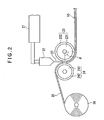
- the production apparatus for producing the embossed sheet 10 as described above comprises, as shown in Fig. 2, an extrusion machine 21, a die 22 attached to this extrusion machine 21, and an embossing roll 23, a press role 24 positioned in the opposite side from the embossing roll 23, and a roll 26 for feeding out a base sheet 25 cooled and solidified.
- the extrusion machine 21 described above is a section for fusing and kneading a chip-formed resin, and is a monoaxial extrusion machine in this embodiment.
- the die 22 is a die used to extrude the molten resin 27 in a sheet-like form, and a T die is used in this embodiment.
- Types of the T die includes, but not limited to, a straight manifold type, a coat hanger type, a combination of the two types, and any type may be selected according to a material to be used.
- the embossing roll is a section for forming an embossed surface on a surface of the sheet-formed molten resin extruded from the T die, and can be formed by winding or adhering and fixing an embossing plate 232 for emboss pattern transfer around a metallic roll 231 or to a surface thereof.
- this embossing roll 23 Provided inside this embossing roll 23 is a cooling mechanism in which cooling water is circulated, and the embossed molten resin 27 is cooled and solidified in the section indicated by ⁇ in Fig. 2.
- the pattern is not always an array of repeated unit patterns, and may be a random array of structures each having the same or a different size respectively.
- the pattern is mechanically machined at least in one section of the embossing roll.
- Each structure of a pattern is called emboss. Number of and a space between the embosses, and characteristics of each discrete emboss such as, for instance, a depth of the emboss, an angle of sharp edge, and a form thereof can be changed according to the necessity.
- the pressing roll 24 is a section for generating a pressing force for embossing, and is formed by winding an elastic material 242 made of silicone rubber or the like around a peripheral surface of the metallic roll 241. The elastic material 242 is wounded therearound so that the pressure is homogeneously loaded to the pressed surface.
- the pressing force by this pressing roll 24 may be set in the range from 50000 to 1200000 N/m (corresponding to 5 to 120 kgf/cm respectively when converted), and more preferably in the range from 40000 to 800000 N/m (corresponding to 4 to 80 kgf/cm respectively when converted).
- the embossed sheet 10 is produced as described below.
- the wind-up speed in this step is set to 10 m/min or more so that the molten resin 27 extruded from the die 22 reaches the embossing roll 23 before it is cooled and solidified.
- the surface material of the pressing roll 24 is an elastic material, so that a contact area of the pressing roll 24 with the sheet increases, and therefore embossing can be performed finely and precisely.
- the sheet can immediately be cooled after embossing, so that deformation of the embossed surface such as sags associated with the cooling process can be prevented, and the high precision embossed sheet 10 can be obtained.
- the pressing force of the pressing roll 24 to the range from 50000 to 1200000 N/m, the molten resin 27 can accurately be embossed.
- the thickness of the base sheet 25 is larger than that of the molten resin layer, generation of bank marks can be prevented.
- a roll formed by winding the emboss plate 232 for transferring an emboss pattern around an external peripheral surface of the metallic roll 231 is used as the embossing roll 23, but the present invention is not limited to this embodiment, and a metallic roll with a prespecified emboss pattern engraved on a surface thereof may be employed.
- a roll formed by winding the elastic material 242 made of silicone rubber or the like around a surface of the metallic roll 241 is used as the pressing roll 24, but the present invention is not limited to this embodiment, and a roll, which is itself an elastic material, may be employed.
- Embossing roll material: Ni, Width: 300 mm, inner diameter: 254 mm
- Emboss pattern cube corner prism pattern, length of an edge: 173 ⁇ m, height: 86 ⁇ m (regular triangular pyramid)
- Pressing roll surface material: silicone rubber, hardness; 80 degrees (JIS Z 2246, type A), width: 300 mm, inner diameter: 400 mm
- the materials and thicknesses of the base sheets, materials and thicknesses of the molten resin layers, and pressing forces of the pressing rolls and embossing rolls are different respectively.
- the vacuum press method based on the conventional technology is described below as a comparative example.
- the size of the press is as follows; the length in the longitudinal direction:300 mm, and the length in the lateral direction: 300 mm, and the apparatus is based on the batch system in which the presses are arrayed in five stages.
- the heating time for melting is 30 minutes, and the cooling time for solidification is 30 minutes.
- Brightness was measured as a condition for measurement of precision in the retroreflectivity of each embossed sheet.
- Material and thickness of base sheet( ⁇ m) Material and thickness of molten resin layer( ⁇ m) Pressing forces of pressing roll and emboss roll(N/m) Draw-out speed of pressing roll and emboss roll(m/min) Brightness (cd/lux/m 2 )
- Example 1 PP(150) PP(100) 60000 20 130
- Example 3 PP(150) PMMA(100) 80000 20 220 Comparative example 1 pp - - 0.025 -
- the embossed sheets in Examples 1 to 3 are more excellent in the term of productivity, because the draw-out speed is higher, as compared to that in Comparative Example 1. Further Table 1 shows that embossed sheets also excellent in the retroreflectivity were obtained in the Examples 1 to 3.
- the embossed sheets according to the present invention are useful as lens function sheets including the Fresnel lens sheet having emboss patterns, lenticular lens sheets, and prism lens sheets.
- the retroreflective sheet with the cube corner type of microprism processed thereon can be used in the various fields including, but not limited to, security, indicators, fashion, and construction.
Landscapes
- Engineering & Computer Science (AREA)
- Mechanical Engineering (AREA)
- Health & Medical Sciences (AREA)
- Manufacturing & Machinery (AREA)
- Ophthalmology & Optometry (AREA)
- Shaping Of Tube Ends By Bending Or Straightening (AREA)
- Optical Elements Other Than Lenses (AREA)
- Extrusion Moulding Of Plastics Or The Like (AREA)
Abstract
Description
| Material and thickness of base sheet(µm) | Material and thickness of molten resin layer(µm) | Pressing forces of pressing roll and emboss roll(N/m) | Draw-out speed of pressing roll and emboss roll(m/min) | Brightness (cd/lux/m2) | |
| Example 1 | PP(150) | PP(100) | 60000 | 20 | 130 |
| Example 2 | PP(150) | PP(100) | 80000 | 20 | 220 |
| Example 3 | PP(150) | PMMA(100) | 80000 | 20 | 220 |
| Comparative example 1 | pp | - | - | 0.025 | - |
Claims (12)
- A method for producing an embossed sheet which comprises pressing a cooled and solidified base sheet by a rotating pressing roll and an embossing roll, while laminating a molten resin on the embossing roll side surface of the base sheet.
- The method for producing an embossed sheet according to claim 1, wherein a material of the base sheet is the same as that of the molten resin.
- The method for producing an embossed sheet according to claim 2, wherein a material of the base sheet and the molten resin is selected from the group consisting of polycarbonate (PC), polyvinyl chloride (PVC), polypropylene (PP), and polymethyl methacrylate (PMMA).
- The method for producing an embossed sheet according to claim 1, wherein a material of the base sheet is different from that of the molten resin, and the material of said molten resin is thermally adhesive.
- The method for producing an embossed sheet according to claim 4, wherein a material of the base sheet is polycarbonate, and a material of the molten resin is polymethyl methacrylate.
- The method for producing an embossed sheet according to any of claims 1 to 5, wherein a surface material of the pressing roll is an elastic material.
- The method for producing an embossed sheet according to any of claims 1 to 6, wherein the embossing roll has a cooling mechanism.
- The method for producing an embossed sheet according to any of claims 1 to 7, wherein the pressing forces of the pressing roll and the embossing roll are in the range from 50000 to 1200000 N/m.
- The method for producing an embossed sheet according to any of claims 1 to 8, wherein the thickness of the cooled and solidified base sheet is larger than that of the molten resin layer.
- The method for producing an embossed sheet according to any of claims 1 to 9, wherein the draw-out speed by the pressing roll and the embossing roll is 10 m/min or more.
- An embossed sheet produced by the method for producing an embossed sheet according to any of claims 1 to 10.
- The embossed sheet according to claim 11, wherein the embossed sheet is a retroreflective sheet.
Applications Claiming Priority (3)
| Application Number | Priority Date | Filing Date | Title |
|---|---|---|---|
| JP2000318376 | 2000-10-18 | ||
| JP2000318376 | 2000-10-18 | ||
| PCT/JP2001/009027 WO2002032653A1 (en) | 2000-10-18 | 2001-10-15 | Method for producing embossed sheet and embossed sheet |
Publications (2)
| Publication Number | Publication Date |
|---|---|
| EP1332864A1 true EP1332864A1 (en) | 2003-08-06 |
| EP1332864A4 EP1332864A4 (en) | 2004-03-03 |
Family
ID=18797012
Family Applications (1)
| Application Number | Title | Priority Date | Filing Date |
|---|---|---|---|
| EP01974849A Withdrawn EP1332864A4 (en) | 2000-10-18 | 2001-10-15 | PROCESS FOR PRODUCING EMBOSSED SHEET AND EMBOSSED SHEET |
Country Status (7)
| Country | Link |
|---|---|
| US (1) | US20040026824A1 (en) |
| EP (1) | EP1332864A4 (en) |
| JP (1) | JPWO2002032653A1 (en) |
| KR (1) | KR20030059200A (en) |
| CN (1) | CN1481303A (en) |
| TW (1) | TW499357B (en) |
| WO (1) | WO2002032653A1 (en) |
Cited By (2)
| Publication number | Priority date | Publication date | Assignee | Title |
|---|---|---|---|---|
| DE102005009365A1 (en) * | 2005-03-01 | 2006-09-07 | Forhouse Corp., Shenkang | Substrate-making apparatus comprises substrate-providing unit, cooler, skin layer-providing unit, rolling unit having textured roller for skin layer, and cutting unit in sequence |
| EP1477830B1 (en) * | 2003-05-16 | 2008-03-19 | Eastman Kodak Company | Method for manufacturing an optical imaging device comprising stacked planar light guide ribbons |
Families Citing this family (15)
| Publication number | Priority date | Publication date | Assignee | Title |
|---|---|---|---|---|
| KR20070055510A (en) * | 2004-08-24 | 2007-05-30 | 후지필름 가부시키가이샤 | Method of producing a resin sheet |
| JP2006056214A (en) * | 2004-08-24 | 2006-03-02 | Fuji Photo Film Co Ltd | Manufacturing method of resin sheet |
| DE102005012371A1 (en) * | 2005-03-09 | 2006-09-14 | Siemens Ag | Twelve-pulse high-voltage direct-current meeting |
| US20090014116A1 (en) * | 2005-03-16 | 2009-01-15 | Fujifilm Corporation | Method of producing resin sheet |
| CN101142068A (en) * | 2005-03-23 | 2008-03-12 | 富士胶片株式会社 | Manufacturing method of resin sheet |
| DE102005060731A1 (en) * | 2005-12-16 | 2007-06-21 | Röhm Gmbh | Prism films for optical applications |
| TW201022018A (en) * | 2008-09-05 | 2010-06-16 | Sumitomo Chemical Co | Method for producing surface shape transcribed resin sheet |
| JP5469364B2 (en) * | 2009-04-21 | 2014-04-16 | 出光興産株式会社 | Embossed transfer thermoplastic resin sheet, thermoplastic resin embossed sheet, and thermoplastic resin embossed sheet manufacturing method |
| JP5497467B2 (en) * | 2010-02-08 | 2014-05-21 | 旭化成イーマテリアルズ株式会社 | Fine etching mask manufacturing method and exposure processing apparatus |
| WO2013042807A1 (en) * | 2011-09-21 | 2013-03-28 | 주식회사 엘지하우시스 | Anti-slip vinyl flooring and method for manufacturing same |
| EP3467550B1 (en) * | 2016-05-25 | 2020-12-23 | Toppan Printing Co., Ltd. | Optical element, optical-element stencil structure, printed article, and method for manufacturing optical element |
| CN107436457B (en) * | 2017-05-22 | 2019-11-22 | 江西盛汇光学科技协同创新有限公司 | A kind of microprism reflective film and its manufacturing method |
| CN108215146A (en) * | 2018-01-04 | 2018-06-29 | 浙江宝汇薄膜有限公司 | A kind of processing technology and its mold of membrane pressure decorative pattern |
| CN113927926A (en) * | 2021-10-14 | 2022-01-14 | 无锡市博宇塑机有限公司 | PVC floor and production line and preparation method thereof |
| CN216300229U (en) * | 2021-10-14 | 2022-04-15 | 无锡市博宇塑机有限公司 | PVC floor production line |
Family Cites Families (15)
| Publication number | Priority date | Publication date | Assignee | Title |
|---|---|---|---|---|
| GB1436696A (en) * | 1971-12-23 | 1976-05-19 | Bakelite Xylonite Ltd | Sheet materials |
| US5232535A (en) * | 1989-02-23 | 1993-08-03 | Anthony Industries, Inc. | Process for preparing embossed, coated paper |
| JP2627821B2 (en) * | 1990-11-28 | 1997-07-09 | 三洋加工紙株式会社 | Process paper with mold and method for producing the same |
| JPH04327937A (en) * | 1991-04-26 | 1992-11-17 | Sekisui Chem Co Ltd | Embossed polycarbonate sheet and its manufacture |
| US5330799A (en) * | 1992-09-15 | 1994-07-19 | The Phscologram Venture, Inc. | Press polymerization of lenticular images |
| WO1996009154A1 (en) * | 1994-09-23 | 1996-03-28 | Karszes William M | Method of making lenticular plastics |
| JP2925069B2 (en) * | 1994-10-25 | 1999-07-26 | 五洋紙工株式会社 | Continuous sheet with optical function |
| JP3732253B2 (en) * | 1995-05-18 | 2006-01-05 | 大日本印刷株式会社 | Manufacturing method of lens sheet for liquid crystal display device |
| US5945042A (en) * | 1995-10-24 | 1999-08-31 | Nippon Carbide Kogyo Kabushiki Kaisha | Method for continuously forming an array of optical elements and apparatus therefor |
| ATE215439T1 (en) * | 1996-10-14 | 2002-04-15 | Idemitsu Petrochemical Co | METHOD FOR PRODUCING A DECORATIVE FILM AND DEVICE FOR PRODUCING IT |
| JP3693458B2 (en) * | 1997-04-18 | 2005-09-07 | 株式会社クラレ | Foamable polyurethane composition and foam |
| JP4138044B2 (en) * | 1997-05-13 | 2008-08-20 | 凸版印刷株式会社 | Manufacturing method of decorative sheet |
| CA2308625A1 (en) * | 1997-11-05 | 1999-05-14 | William M. Karszes | Method and apparatus for making lenticular plastics |
| DE19943604C2 (en) * | 1999-09-11 | 2002-06-27 | Schroeder Heinrich Friedrich | Process for the continuous production of endless, optically imageable films, sheets and plates made of plastics and device for carrying out the process |
| US6373636B1 (en) * | 2000-09-08 | 2002-04-16 | Kenneth E. Conley | Heat stabilized and dimensionally stable thin lenticular film |
-
2001
- 2001-10-15 JP JP2002535869A patent/JPWO2002032653A1/en active Pending
- 2001-10-15 CN CNA018207286A patent/CN1481303A/en active Pending
- 2001-10-15 US US10/399,046 patent/US20040026824A1/en not_active Abandoned
- 2001-10-15 KR KR10-2003-7005372A patent/KR20030059200A/en not_active Ceased
- 2001-10-15 EP EP01974849A patent/EP1332864A4/en not_active Withdrawn
- 2001-10-15 WO PCT/JP2001/009027 patent/WO2002032653A1/en not_active Ceased
- 2001-10-18 TW TW090125826A patent/TW499357B/en not_active IP Right Cessation
Cited By (3)
| Publication number | Priority date | Publication date | Assignee | Title |
|---|---|---|---|---|
| EP1477830B1 (en) * | 2003-05-16 | 2008-03-19 | Eastman Kodak Company | Method for manufacturing an optical imaging device comprising stacked planar light guide ribbons |
| US7548676B2 (en) | 2003-05-16 | 2009-06-16 | Eastman Kodak Company | Apparatus and method for forming an optical converter |
| DE102005009365A1 (en) * | 2005-03-01 | 2006-09-07 | Forhouse Corp., Shenkang | Substrate-making apparatus comprises substrate-providing unit, cooler, skin layer-providing unit, rolling unit having textured roller for skin layer, and cutting unit in sequence |
Also Published As
| Publication number | Publication date |
|---|---|
| EP1332864A4 (en) | 2004-03-03 |
| WO2002032653A1 (en) | 2002-04-25 |
| KR20030059200A (en) | 2003-07-07 |
| US20040026824A1 (en) | 2004-02-12 |
| JPWO2002032653A1 (en) | 2004-02-26 |
| CN1481303A (en) | 2004-03-10 |
| TW499357B (en) | 2002-08-21 |
Similar Documents
| Publication | Publication Date | Title |
|---|---|---|
| US20040026824A1 (en) | Method for producing embossed sheet and embossed sheet | |
| EP0799686B1 (en) | Method of continuously forming optical device assembly and apparatus therefor | |
| EP0818301B1 (en) | Method of embossing a sheet and embossing apparatus | |
| JPWO1997015435A1 (en) | Method and apparatus for continuously forming an optical element assembly | |
| EP2263873B1 (en) | Multi-layer laminates with microprismatic elements | |
| JPH0517023B2 (en) | ||
| US20110242847A1 (en) | Laminated double-sided light guide plate | |
| EP1366888A1 (en) | Method of manufacturing micro emboss sheet and micro emboss sheet | |
| US20030075264A1 (en) | Method for producing a continuous sheet having optical functions | |
| JP2012252906A (en) | Method for manufacturing of light guide plate with protective film | |
| TW201223740A (en) | Optical sheet manufactured with patterned rollers | |
| JP2011222511A (en) | Double-sided light guide plate manufactured with patterned roller | |
| US20120051705A1 (en) | Optical sheet with laminated double-sided light guide plate | |
| TWI461762B (en) | Thin double-sided light guide plate | |
| US20060145374A1 (en) | Method for producing optical sheet, optical sheet, and method for producing lenticular lens sheet | |
| EP2846977A1 (en) | Process and apparatus for embossing precise microstructures in rigid thermoplastic panels | |
| TW201223742A (en) | Optical sheet manufactured with micro-patterned carrier | |
| JPH08309851A (en) | Method and apparatus for producing planar thermoplastic resin having embossed pattern | |
| TW201202016A (en) | Double sided light guide plate manufactured with micro-patterned carrier | |
| JPH04299329A (en) | Production of both-side lenticular sheet | |
| CN109532068B (en) | Impression cutter, lens mold, visual separation element and preparation method thereof | |
| KR20070120506A (en) | Method of producing resin sheet | |
| JPH11138634A (en) | Manufacturing method of synthetic resin sheet | |
| US6508558B1 (en) | Retroflective prismatic retro-reflectors without visually disturbing seams | |
| US20200230901A1 (en) | Method and apparatus to manufacture a rigid polymer panel having integrally formed optical quality surfaces |
Legal Events
| Date | Code | Title | Description |
|---|---|---|---|
| PUAI | Public reference made under article 153(3) epc to a published international application that has entered the european phase |
Free format text: ORIGINAL CODE: 0009012 |
|
| 17P | Request for examination filed |
Effective date: 20030502 |
|
| AK | Designated contracting states |
Designated state(s): AT BE CH CY DE DK ES FI FR GB GR IE IT LI LU MC NL PT SE TR |
|
| A4 | Supplementary search report drawn up and despatched |
Effective date: 20040119 |
|
| RIC1 | Information provided on ipc code assigned before grant |
Ipc: 7B 29C 59/04 A Ipc: 7B 29C 43/22 B Ipc: 7B 32B 27/00 B Ipc: 7G 02B 5/00 B Ipc: 7B 29C 43/28 B Ipc: 7B 29D 11/00 B |
|
| 17Q | First examination report despatched |
Effective date: 20040304 |
|
| RBV | Designated contracting states (corrected) |
Designated state(s): DE FR GB IT |
|
| RAP1 | Party data changed (applicant data changed or rights of an application transferred) |
Owner name: IDEMITSU PETROCHEMICAL CO., LTD. |
|
| RAP1 | Party data changed (applicant data changed or rights of an application transferred) |
Owner name: IDEMITSU KOSAN CO., LTD. |
|
| STAA | Information on the status of an ep patent application or granted ep patent |
Free format text: STATUS: THE APPLICATION IS DEEMED TO BE WITHDRAWN |
|
| 18D | Application deemed to be withdrawn |
Effective date: 20050728 |