EP1331379A2 - Tip impingement turbine air starter for turbine engine - Google Patents
Tip impingement turbine air starter for turbine engine Download PDFInfo
- Publication number
- EP1331379A2 EP1331379A2 EP03075029A EP03075029A EP1331379A2 EP 1331379 A2 EP1331379 A2 EP 1331379A2 EP 03075029 A EP03075029 A EP 03075029A EP 03075029 A EP03075029 A EP 03075029A EP 1331379 A2 EP1331379 A2 EP 1331379A2
- Authority
- EP
- European Patent Office
- Prior art keywords
- turbine
- compressed air
- bucket member
- engine
- compressor
- Prior art date
- Legal status (The legal status is an assumption and is not a legal conclusion. Google has not performed a legal analysis and makes no representation as to the accuracy of the status listed.)
- Granted
Links
Images
Classifications
-
- F—MECHANICAL ENGINEERING; LIGHTING; HEATING; WEAPONS; BLASTING
- F02—COMBUSTION ENGINES; HOT-GAS OR COMBUSTION-PRODUCT ENGINE PLANTS
- F02C—GAS-TURBINE PLANTS; AIR INTAKES FOR JET-PROPULSION PLANTS; CONTROLLING FUEL SUPPLY IN AIR-BREATHING JET-PROPULSION PLANTS
- F02C7/00—Features, components parts, details or accessories, not provided for in, or of interest apart form groups F02C1/00 - F02C6/00; Air intakes for jet-propulsion plants
- F02C7/26—Starting; Ignition
- F02C7/268—Starting drives for the rotor, acting directly on the rotor of the gas turbine to be started
- F02C7/27—Fluid drives
-
- F—MECHANICAL ENGINEERING; LIGHTING; HEATING; WEAPONS; BLASTING
- F05—INDEXING SCHEMES RELATING TO ENGINES OR PUMPS IN VARIOUS SUBCLASSES OF CLASSES F01-F04
- F05D—INDEXING SCHEME FOR ASPECTS RELATING TO NON-POSITIVE-DISPLACEMENT MACHINES OR ENGINES, GAS-TURBINES OR JET-PROPULSION PLANTS
- F05D2260/00—Function
- F05D2260/85—Starting
-
- Y—GENERAL TAGGING OF NEW TECHNOLOGICAL DEVELOPMENTS; GENERAL TAGGING OF CROSS-SECTIONAL TECHNOLOGIES SPANNING OVER SEVERAL SECTIONS OF THE IPC; TECHNICAL SUBJECTS COVERED BY FORMER USPC CROSS-REFERENCE ART COLLECTIONS [XRACs] AND DIGESTS
- Y02—TECHNOLOGIES OR APPLICATIONS FOR MITIGATION OR ADAPTATION AGAINST CLIMATE CHANGE
- Y02T—CLIMATE CHANGE MITIGATION TECHNOLOGIES RELATED TO TRANSPORTATION
- Y02T50/00—Aeronautics or air transport
- Y02T50/60—Efficient propulsion technologies, e.g. for aircraft
Definitions
- the present invention generally relates to a method for starting turbine engines and more specifically to a tip impingement air starter for a turbine engine.
- This invention relates to power plants and particularly to a gas turbine power plant that may be used for effecting propulsion of aircraft at high speeds.
- a power plant may include an air compressor, a combustion apparatus, and a gas turbine compactly arranged in series to keep the weight, overall length and diameter of the unit to a minimum.
- These parts may be built into the wing of an aircraft or mounted centrally within and supported by an outer casing of streamline form that directs the flow of air through the power plant.
- the turbine is driven by the hot gases provided by the compressor and combustion apparatus and extracts at least sufficient power from these gases to drive the compressor.
- the remainder of the available power may be utilized to propel the aircraft by ejecting the gases from a propulsion jet rearwardly of the turbine.
- Lightweight impingement air starters have been used in the past, but unfortunately were not efficient in their use of the supplied compressed air.
- Present day air starters are efficient but at the expense of weight, gearing complexity and cost.
- Present day air starters are also subject to mechanical breakdown.
- the present invention involves introducing a channel into the turbine case by which compressed air can be introduced from a pressurized air source to turn the High Pressure (HP) turbine, thereby turning the HP compressor, and enabling the gas turbine engine to be started.
- High pressure air is introduced through a channel in the turbine casing and expanded/accelerated by a series of diffusers. This high velocity air impinges upon at least one turbine bucket member that is located on the tip of a HP turbine blade.
- These turbine bucket members are preferably impulse-type turbine bucket members. After kinetic energy from the high velocity air is extracted by the turbine bucket members, the gas can be directed through a series of openings located upstream of the turbine blade and is directed to the airfoil section of the turbine blade to extract any remaining kinetic energy.
- the channel in the casing is located close to an axial compressor in a gas turbine engine's forward section.
- one stage of an axial compressor in a gas turbine engine's forward section is modified to incorporate a small turbine bucket member at the top of each compressor blade. Air is then introduced to the small turbine bucket member in a manner similar to that described above to start the engine.
- the configuration of this stage can be used to help recover gas energy.
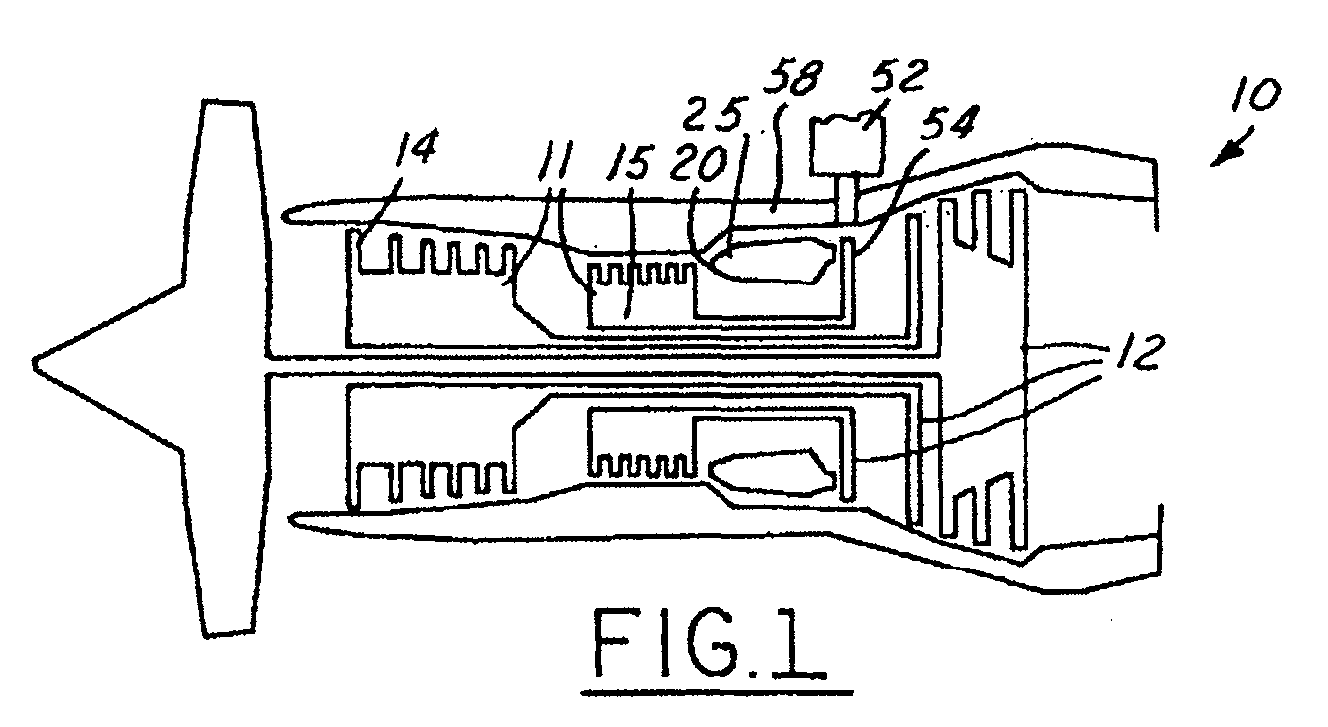
- a high-pressure gas jet turbine engine 10 is shown as having a multistage axial compressor 11, a multistage turbine 12, a combuster 25 having a nozzle 20, and a fan 17.
- the multistage axial compressor 11 consists of a low pressure compressor 13 and a high pressure compressor 15.
- the multi-stage turbine 12 has a low pressure turbine 19, an intermediate pressure turbine 21, and a high pressure turbine 23.
- the high pressure turbine 23 is coupled to the high pressure compressor 15, the intermediate pressure turbine 17 coupled to the low pressure compressor 13, and the low pressure turbine coupled to a fan 19.
- the multi-stage axial compressor 11 comprises alternating sets of rotating blades 14 and stationary blades that draw in air and compresses it.
- Fuel is injected into the combustion chamber 25 from the fuel nozzle 20 and combustion is effected.
- the rise in temperature produces a considerable increase in the volume of the gases, which are expelled through the exhaust nozzle (not shown) in the rear.
- the turbine 12 absorbs a portion of the energy from the gases necessary to drive the compressor 11, the greater portion is utilized to develop propulsive thrust
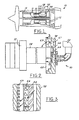
- Figures 2 and 3 depict close-up views of the gas turbine engine 10 of Figure 1.
- a high pressure turbine 12 has a turbine blade 54 and a turbine casing 58 that directs the hot combustion gas introduced from compressor 11 and from the combustion chamber 25.
- the casing 58 also has a channel 60 by which compressed air can be introduced from a pressurized air source 52 to turn the high pressure turbine 23, thereby turning the HP compressor 15 (shown as 15 in Figure 1) of the axial compressor 11, and enabling the engine 10 to be started.
- the source of pressurized air constituting the pressurized air source 52 preferably is a ground start cart or another closely coupled turbine engine, or combinations of both. However, a person of ordinary skill in the art would appreciate that other potential sources of pressurized air are possible.
- the compressed air (shown by arrows) is introduced to the channel 60, as best shown in Figure 3, the air is expanded by a series of diffusers 64 located in the turbine casing 58. This high velocity air then impinges upon a series of turbine bucket members 66 that are located at the tip 68, or shroud, of the turbine blade 54. These turbine bucket members 66 are preferably impulse-type turbine bucket members 66. After the kinetic energy from the high velocity air is extracted, the gas is then directed through a series of openings 69 in the casing 58 located upstream of the turbine blade 54 and is directed to the airfoil section of the turbine blade 54 to extract any remaining kinetic energy.
- the gas turbine engine 10 as shown in Figures 2 and 3 offer improvements over known systems.
- the new system reduces weight by eliminating the conventional starter system and associated case impingement cooling system.
- the turbine blades 54 are preferably shrouded to reduce tip leakage, the addition of a plurality of small turbine bucket members 66 only slightly increases the weight. Pressurizing the cavity 67 will reduce tip 68 leakage to almost zero and will also help to cool the turbine blades 54 and casing 58.
- the present invention also improves reliability by eliminating moving parts from the starting mechanisms.
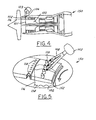
- Figures 4 and 5 depict a high-pressure gas jet turbine engine 150 according to another preferred embodiment of the present invention.
- one stage of an axial compressor 100 in a gas turbine engine's forward section is modified to incorporate a small turbine and turbine bucket at the top of each compressor blade. This stage can be used to help recover gas energy and can be used as a starter for the turbine engine 150.
- the front axial section 101 of the engine compressor 100 has an integrated compressor/turbine blade 102 and a casing 104.
- Each integrated compressor/turbine blade 102 comprises an airfoil 116, a shroud 152, and a turbine or turbines, preferably impulse type turbines 110.
- the casing 104 has a channel 106 by which compressed air can be introduced from a pressurized air source 103 to turn the compressor/turbine blade102 thereby turning the compressor 100, and enabling the engine 150 to be started.
- the source of pressurized air constituting the pressurized air source 103 preferably is a ground start cart or bleed air from another closely coupled turbine engine, or combinations of both.
- the pressurized air is expanded by a series of diffusers 108.
- This high velocity air then impinges upon at least one turbine bucket member 110 that is located at the tip 152 of the integrated compressor/turbine blade 102, thereby driving the blade 102 and the compressor 100 to start the turbine engine 150.
- These turbine bucket members 110 are preferably impulse-type turbine bucket members 110.
- the gas is preferably then directed through a series of openings 114 located upstream of the blade 102 and is then directed to the airfoil 116 of the integrated compressor/turbine blade 102 to extract any remaining kinetic energy.
- the gas jet turbine engine 150 as shown in Figures 4 and 5 replaces the air starters of the prior art and offer improvements in terms of reliability while reducing cost and weight.
Landscapes
- Engineering & Computer Science (AREA)
- Chemical & Material Sciences (AREA)
- Combustion & Propulsion (AREA)
- Mechanical Engineering (AREA)
- General Engineering & Computer Science (AREA)
- Structures Of Non-Positive Displacement Pumps (AREA)
Abstract
Description
Claims (18)
- A method for starting a gas jet turbine engine 10 having a multi-stage axial compressor 11 and a high pressure turbine 12 comprising:providing a channel 60 within a turbine casing 58;introducing at least one turbine bucket member 66 to a tip 68 of at least one of a plurality of turbine blades 54 of the high pressure turbine 12; andproviding a quantity of compressed air through said channel 60 of said turbine casing 58;expanding said quantity of compressed air within a series of diffusers 64; andimpinging said at least one turbine bucket member 66 with said expanded quantity of compressed air to rotate the high pressure turbine.
- The method of claim 1, wherein the step of providing a quantity of compressed air comprises:providing a quantity of compressed air from a pressurized air source 52 through said turbine casing 58 from a pressurized air source 52.
- The method of claim 1 further comprising:directing said expanded quantity of compressed air through a series of openings 69 located upstream of said plurality of turbine blades 54 after impinging said at least one turbine bucket member 66; anddirecting said expanded quantity of compressed air to an airfoil section of said plurality of turbine blades 54 to extract any remaining kinetic energy from said expanded quantity of compressed air.
- The method of claim 1, wherein said plurality of turbine blades 54 comprises a plurality of shrouded turbine blades 54.
- The method of claim 1, wherein introducing at least one turbine bucket member 66 to a tip 68 of at least one of a plurality of turbine blades 54 of the turbine 12 comprises introducing at least one impulse-type turbine bucket member 66 to a tip 68 of at least one of a plurality of turbine blades 54 of the high pressure turbine 12.
- A method for starting a gas jet turbine engine 150 having a multi-stage axial compressor 100 comprising:introducing an integrated compressor/turbine blade 102 located in a front axial section of the multi-stage axial compressor, said integrated compressor/turbine blade 102 comprising an airfoil 116, a shroud 152, and a turbine 110 comprising at least one turbine bucket member 110;providing a channel 106 within a turbine casing 104 near said front axial portion of the multi-stage axial compressor 100; andproviding a quantity of compressed air from through said turbine casing 104; andexpanding said quantity of compressed air within a series of diffusers 108; andimpinging a turbine bucket member 110 with said expanded quantity of compressed air to rotate the integrated compressor/turbine blade 102 and the multi-stage axial compressor 100.
- The method of claim 6, wherein the step of providing a quantity of compressed air comprises:providing a quantity of compressed air through said turbine casing 104 from a pressurized air source 103.
- The method of claim 6 further comprising:directing said expanded quantity of compressed air through a series of openings 114 located upstream of said integrated compressor/turbine blade 102 after impinging said turbine bucket member 110; anddirecting said expanded quantity of compressed air to said airfoil 116 to extract any remaining kinetic energy from said expanded quantity of compressed air.
- The method of claim 6, wherein introducing an integrated compressor/turbine blade 102 comprises introducing an integrated compressor/turbine blade 102 located in a front axial section of the multi-stage axial compressor 100, said integrated compressor/turbine blade 102 comprising an airfoil 116, a shroud 158, and an impulse-type turbine comprising an impulse-type turbine bucket member 110.
- A gas jet turbine engine 10 comprising:a multi-stage axial compressor 11;a turbine casing 58 having a channel 60;a pressurized gas source 52 coupled to said turbine casing 58 and enclosing said channel 60 on its outer periphery;a turbine 12 having a plurality of turbine blades 54, wherein at least one of said turbine blades 54 is closely coupled with said channel 60, wherein said at least one of said turbine blades 54 comprises an airfoil and at least one turbine bucket member 66, wherein said pressurized gas source 52 is used to introduce a quantity of compressed air through said channel 60 to impinge said at least one turbine bucket member 66 to start the gas jet turbine engine 10.
- The gas jet turbine engine 10 of claim 10, wherein said at least one turbine bucket member 66 comprises at least one impulse-type turbine bucket member 66.
- The gas turbine jet engine 10 of claim 11, wherein said plurality of turbine blades 54 comprises a plurality of shrouded turbine blades 54, wherein each of said plurality of shrouded turbine blades 54 comprises an airfoil and at least one turbine bucket member 66.
- The gas turbine jet engine 10 of claim 11, wherein said turbine casing 58 further comprises a series of diffusers 64 used to expand a quantity of compressed air leaving said channel 60 prior to engaging said at least one turbine bucket member 66.
- The gas turbine jet engine 10 of claim 13, wherein said turbine casing 54 further comprises a series of openings 69 used to move said quantity of expanded compressed air to said airfoil after engaging said at least one turbine bucket member 66.
- A gas jet turbine engine 150 comprising:a turbine casing 104 having a channel 106;a pressurized gas source 103 coupled to said turbine casing 104 and enclosing said channel 106 on its outer periphery;a multi-stage axial compressor 100 having at least one integrated compressor/turbine blades 102 located in close proximity to said channel 106, wherein said integrated compressor/turbine blade 102 comprises an airfoil 116, a shroud 152 and at least one turbine bucket member 110 coupled to said shroud 152, wherein said pressurized gas source 103 is used to introduce a quantity of compressed air through said channel 106 to impinge said at least one turbine bucket member 110 to start the gas jet turbine engine 150.
- The gas jet turbine engine 150 of claim 15, wherein said at least one turbine bucket member 110 comprises at least one impulse-type turbine bucket member 110.
- The gas turbine jet engine of claim 15, wherein said turbine casing 104 further comprises a series of diffusers 108 used to expand a quantity of compressed air leaving said channel 106 prior to engaging said at least one turbine bucket member 110.
- The gas turbine jet engine of claim 17, wherein said turbine casing 104 further comprises a series of openings 114 used to move said quantity of expanded compressed air to said airfoil 116 after engaging said at least one turbine bucket member 110.
Applications Claiming Priority (2)
| Application Number | Priority Date | Filing Date | Title |
|---|---|---|---|
| US52180 | 2002-01-17 | ||
| US10/052,180 US6644033B2 (en) | 2002-01-17 | 2002-01-17 | Tip impingement turbine air starter for turbine engine |
Publications (3)
| Publication Number | Publication Date |
|---|---|
| EP1331379A2 true EP1331379A2 (en) | 2003-07-30 |
| EP1331379A3 EP1331379A3 (en) | 2005-02-09 |
| EP1331379B1 EP1331379B1 (en) | 2007-03-14 |
Family
ID=21975964
Family Applications (1)
| Application Number | Title | Priority Date | Filing Date |
|---|---|---|---|
| EP03075029A Expired - Lifetime EP1331379B1 (en) | 2002-01-17 | 2003-01-06 | Tip impingement turbine air starter for turbine engine |
Country Status (3)
| Country | Link |
|---|---|
| US (1) | US6644033B2 (en) |
| EP (1) | EP1331379B1 (en) |
| DE (1) | DE60312409T2 (en) |
Cited By (1)
| Publication number | Priority date | Publication date | Assignee | Title |
|---|---|---|---|---|
| EP2267288A3 (en) * | 2009-06-25 | 2014-05-21 | Hamilton Sundstrand Corporation | Lightweight start system for a gas turbine engine |
Families Citing this family (52)
| Publication number | Priority date | Publication date | Assignee | Title |
|---|---|---|---|---|
| US6941760B1 (en) * | 2003-03-19 | 2005-09-13 | Hamilton Sundstrand Corporation | Start system for expendable gas turbine engine |
| EP1828683B1 (en) | 2004-12-01 | 2013-04-10 | United Technologies Corporation | Combustor for turbine engine |
| US7607286B2 (en) | 2004-12-01 | 2009-10-27 | United Technologies Corporation | Regenerative turbine blade and vane cooling for a tip turbine engine |
| WO2006060014A1 (en) | 2004-12-01 | 2006-06-08 | United Technologies Corporation | Starter generator system for a tip turbine engine |
| US7878762B2 (en) | 2004-12-01 | 2011-02-01 | United Technologies Corporation | Tip turbine engine comprising turbine clusters and radial attachment lock arrangement therefor |
| WO2006060001A1 (en) | 2004-12-01 | 2006-06-08 | United Technologies Corporation | Fan rotor assembly for a tip turbine engine |
| EP1828545A2 (en) | 2004-12-01 | 2007-09-05 | United Technologies Corporation | Annular turbine ring rotor |
| EP1819907A2 (en) | 2004-12-01 | 2007-08-22 | United Technologies Corporation | Fan blade with integral diffuser section and tip turbine blade section for a tip turbine engine |
| WO2006059988A1 (en) | 2004-12-01 | 2006-06-08 | United Technologies Corporation | Modular tip turbine engine |
| EP1825111B1 (en) | 2004-12-01 | 2011-08-31 | United Technologies Corporation | Counter-rotating compressor case for a tip turbine engine |
| EP1828591B1 (en) * | 2004-12-01 | 2010-07-21 | United Technologies Corporation | Peripheral combustor for tip turbine engine |
| US7882695B2 (en) | 2004-12-01 | 2011-02-08 | United Technologies Corporation | Turbine blow down starter for turbine engine |
| WO2006059995A1 (en) | 2004-12-01 | 2006-06-08 | United Technologies Corporation | Gearbox lubrication supply system for a tip turbine engine |
| US7934902B2 (en) | 2004-12-01 | 2011-05-03 | United Technologies Corporation | Compressor variable stage remote actuation for turbine engine |
| WO2006059980A2 (en) * | 2004-12-01 | 2006-06-08 | United Technologies Corporation | Diffuser aspiration for a tip turbine engine |
| DE602004016065D1 (en) | 2004-12-01 | 2008-10-02 | United Technologies Corp | VARIABLE BULB INLET BUCKET ASSEMBLY, TURBINE ENGINE WITH SUCH AN ARRANGEMENT AND CORRESPONDING STEERING PROCEDURE |
| US8365511B2 (en) | 2004-12-01 | 2013-02-05 | United Technologies Corporation | Tip turbine engine integral case, vane, mount and mixer |
| US9003759B2 (en) | 2004-12-01 | 2015-04-14 | United Technologies Corporation | Particle separator for tip turbine engine |
| EP1825117B1 (en) | 2004-12-01 | 2012-06-13 | United Technologies Corporation | Turbine engine with differential gear driven fan and compressor |
| WO2006059971A2 (en) | 2004-12-01 | 2006-06-08 | United Technologies Corporation | Tip turbine engine integral fan, combustor, and turbine case |
| DE602004027766D1 (en) | 2004-12-01 | 2010-07-29 | United Technologies Corp | HYDRAULIC SEAL FOR A GEARBOX OF A TOP TURBINE ENGINE |
| US7874802B2 (en) | 2004-12-01 | 2011-01-25 | United Technologies Corporation | Tip turbine engine comprising turbine blade clusters and method of assembly |
| US8641367B2 (en) | 2004-12-01 | 2014-02-04 | United Technologies Corporation | Plurality of individually controlled inlet guide vanes in a turbofan engine and corresponding controlling method |
| US7976273B2 (en) | 2004-12-01 | 2011-07-12 | United Technologies Corporation | Tip turbine engine support structure |
| US7959406B2 (en) | 2004-12-01 | 2011-06-14 | United Technologies Corporation | Close coupled gearbox assembly for a tip turbine engine |
| EP1825113B1 (en) | 2004-12-01 | 2012-10-24 | United Technologies Corporation | Counter-rotating gearbox for tip turbine engine |
| US7976272B2 (en) | 2004-12-01 | 2011-07-12 | United Technologies Corporation | Inflatable bleed valve for a turbine engine |
| EP1831520B1 (en) * | 2004-12-01 | 2009-02-25 | United Technologies Corporation | Tip turbine engine and corresponding operating method |
| WO2006060006A1 (en) | 2004-12-01 | 2006-06-08 | United Technologies Corporation | Tip turbine engine non-metallic tailcone |
| US7845157B2 (en) | 2004-12-01 | 2010-12-07 | United Technologies Corporation | Axial compressor for tip turbine engine |
| WO2006060013A1 (en) | 2004-12-01 | 2006-06-08 | United Technologies Corporation | Seal assembly for a fan rotor of a tip turbine engine |
| WO2006060010A1 (en) * | 2004-12-01 | 2006-06-08 | United Technologies Corporation | Compressor inlet guide vane for tip turbine engine and corresponding control method |
| EP1825116A2 (en) * | 2004-12-01 | 2007-08-29 | United Technologies Corporation | Ejector cooling of outer case for tip turbine engine |
| DE602004031470D1 (en) * | 2004-12-01 | 2011-03-31 | United Technologies Corp | TRANSITION CHANNEL WITH MEANS FOR FLOW VECTOR INFLUENCE ON A GAS TURBINE |
| WO2006110125A2 (en) * | 2004-12-01 | 2006-10-19 | United Technologies Corporation | Stacked annular components for turbine engines |
| WO2006059986A1 (en) | 2004-12-01 | 2006-06-08 | United Technologies Corporation | Tip turbine engine and operating method with reverse core airflow |
| WO2006059978A1 (en) | 2004-12-01 | 2006-06-08 | United Technologies Corporation | Cantilevered tip turbine engine |
| US8104257B2 (en) * | 2004-12-01 | 2012-01-31 | United Technologies Corporation | Tip turbine engine with multiple fan and turbine stages |
| US7883314B2 (en) | 2004-12-01 | 2011-02-08 | United Technologies Corporation | Seal assembly for a fan-turbine rotor of a tip turbine engine |
| EP1825114B1 (en) * | 2004-12-01 | 2008-08-20 | United Technologies Corporation | Tip turbine engine with a heat exchanger |
| US8807936B2 (en) | 2004-12-01 | 2014-08-19 | United Technologies Corporation | Balanced turbine rotor fan blade for a tip turbine engine |
| US8757959B2 (en) | 2004-12-01 | 2014-06-24 | United Technologies Corporation | Tip turbine engine comprising a nonrotable compartment |
| US9109537B2 (en) | 2004-12-04 | 2015-08-18 | United Technologies Corporation | Tip turbine single plane mount |
| FR2896537B1 (en) * | 2006-01-24 | 2011-07-29 | Snecma | TURBOMACHINE WITH INTEGRATED GENERATOR-STARTER |
| RU2315882C1 (en) * | 2006-04-27 | 2008-01-27 | Открытое акционерное общество "Энергомашкорпорация" | Method of air starting of gas-turbine engine |
| US8967945B2 (en) | 2007-05-22 | 2015-03-03 | United Technologies Corporation | Individual inlet guide vane control for tip turbine engine |
| GB2499576A (en) * | 2011-11-29 | 2013-08-28 | Eaton Aerospace Ltd | Aircraft on board inert gas generation system |
| US9429070B2 (en) | 2013-03-01 | 2016-08-30 | Paccar Inc | Turbine engine starting system |
| US10247104B2 (en) * | 2015-04-23 | 2019-04-02 | Rolls-Royce North American Technologies, Inc. | Oxygen enhanced pneumatic starting |
| CN106640376A (en) * | 2016-12-29 | 2017-05-10 | 深圳智慧能源技术有限公司 | LNG gas turbine and starting system thereof |
| US20200191061A1 (en) * | 2018-12-17 | 2020-06-18 | United Technologies Corporation | Integrated additive bladder for charging and insulation of small attritable engine |
| US11346284B1 (en) | 2021-03-04 | 2022-05-31 | Rolls-Royce North American Technologies Inc. | Gas turbine engine with pyrotechnic air starter |
Family Cites Families (21)
| Publication number | Priority date | Publication date | Assignee | Title |
|---|---|---|---|---|
| US2457833A (en) | 1943-02-03 | 1949-01-04 | Westinghouse Electric Corp | Cartridge starter for combustion gas turbines |
| US2597641A (en) | 1945-12-03 | 1952-05-20 | Gen Electric | Pressure-operated starting device |
| US2640315A (en) | 1949-06-28 | 1953-06-02 | A V Roe Canada Ltd | Gas turbine starter mounting |
| US2651493A (en) * | 1951-04-13 | 1953-09-08 | Bendix Aviat Corp | Gas turbine engine starter |
| US2816417A (en) * | 1952-08-13 | 1957-12-17 | Gen Electric | Control system for dual rotor pump drives |
| GB716263A (en) * | 1953-02-06 | 1954-09-29 | Bristol Aeroplane Co Ltd | Improvements in or relating to gas turbine engines |
| GB749009A (en) * | 1953-04-24 | 1956-05-16 | Power Jets Res & Dev Ltd | An improved jet propulsion plant |
| CH313450A (en) * | 1953-06-17 | 1956-04-15 | Plessey Co Ltd | Starting device for gas turbine systems |
| GB774503A (en) * | 1954-07-01 | 1957-05-08 | Power Jets Res & Dev Ltd | Gas turbine starting system |
| US2959919A (en) * | 1958-01-02 | 1960-11-15 | Gen Electric | Gas impingement starter nozzle for turbines |
| US2971333A (en) * | 1958-05-14 | 1961-02-14 | Gen Electric | Adjustable gas impingement turbine nozzles |
| US3009320A (en) * | 1959-06-15 | 1961-11-21 | Gen Electric | Fluid impingement starter for turbine engines |
| US3085396A (en) * | 1959-07-03 | 1963-04-16 | Rolls Royce | Gas turbine engine with gas starter |
| GB1069199A (en) * | 1965-02-20 | 1967-05-17 | Bristol Siddeley Engines Ltd | Improvements in means for starting gas turbine engines |
| US3451215A (en) * | 1967-04-03 | 1969-06-24 | Gen Electric | Fluid impingement starting means |
| GB1229203A (en) * | 1967-05-18 | 1971-04-21 | ||
| US4161102A (en) * | 1977-10-05 | 1979-07-17 | Teledyne Industries, Inc. | Turbine engine starting system |
| DE3441509A1 (en) | 1984-11-14 | 1986-05-22 | Klöckner-Humboldt-Deutz AG, 5000 Köln | METHOD AND DEVICE FOR STARTING A GAS TURBINE |
| US5054283A (en) | 1989-09-19 | 1991-10-08 | Sundstrand Corporation | Turbine engine impingement assembly |
| US5115637A (en) | 1989-12-22 | 1992-05-26 | Sundstrand Corporation | External cartridge gas combustor ignitor |
| US5263315A (en) | 1990-11-09 | 1993-11-23 | Sundstrand Corp. | Starting of a small turbojet |
-
2002
- 2002-01-17 US US10/052,180 patent/US6644033B2/en not_active Expired - Fee Related
-
2003
- 2003-01-06 DE DE60312409T patent/DE60312409T2/en not_active Expired - Lifetime
- 2003-01-06 EP EP03075029A patent/EP1331379B1/en not_active Expired - Lifetime
Cited By (1)
| Publication number | Priority date | Publication date | Assignee | Title |
|---|---|---|---|---|
| EP2267288A3 (en) * | 2009-06-25 | 2014-05-21 | Hamilton Sundstrand Corporation | Lightweight start system for a gas turbine engine |
Also Published As
| Publication number | Publication date |
|---|---|
| US6644033B2 (en) | 2003-11-11 |
| DE60312409T2 (en) | 2007-11-29 |
| EP1331379B1 (en) | 2007-03-14 |
| EP1331379A3 (en) | 2005-02-09 |
| US20030131607A1 (en) | 2003-07-17 |
| DE60312409D1 (en) | 2007-04-26 |
Similar Documents
| Publication | Publication Date | Title |
|---|---|---|
| US6644033B2 (en) | Tip impingement turbine air starter for turbine engine | |
| EP3415437B1 (en) | Aft fan counter-rotating turbine engine | |
| US11624317B2 (en) | Supercritical fluid systems | |
| EP2333237B1 (en) | Multistage bladed tip fan | |
| EP1033484B1 (en) | Gas turbine cooling system | |
| EP2333238A2 (en) | Gas turbine engine with outer fans | |
| EP3255263A1 (en) | Deep heat recovery gas turbine engine | |
| US10443544B2 (en) | Gas turbine engine driven by sCO2 cycle with advanced heat rejection | |
| CN107013268B (en) | Compression fairing for jet engine exhaust | |
| JPS59103947A (en) | Reversely rotating power turbine | |
| JPH0650176A (en) | Cooling device for gas turbine engine | |
| CN104937251A (en) | Engine architecture with reverse rotation integral drive and vaneless turbine | |
| EP3901445B1 (en) | Supercritical co2 cycle for gas turbine engines using powered cooling flow | |
| CN117846777A (en) | Waste heat recovery system | |
| US12031478B2 (en) | Air bottoming cycle driven propulsor | |
| EP1637712A2 (en) | Gas turbine engine having improved core system | |
| US3486340A (en) | Gas turbine powerplant with means for cooling compressed air | |
| GB2379483A (en) | Augmented gas turbine propulsion system | |
| KR100521393B1 (en) | Jet engine using exhaust gas | |
| EP4617482A1 (en) | Hydrogen fuel heating with open loop waste heat recovery cycle | |
| US20170306843A1 (en) | Method and apparatus for increasing useful energy/thrust of a gas turbine engine by one or more rotating fluid moving (agitator) pieces due to formation of a defined steam region | |
| EP2336491A2 (en) | Turbofan engine with power extraction system | |
| KR20040079218A (en) | Jet engine using exhaust gas |
Legal Events
| Date | Code | Title | Description |
|---|---|---|---|
| PUAI | Public reference made under article 153(3) epc to a published international application that has entered the european phase |
Free format text: ORIGINAL CODE: 0009012 |
|
| AK | Designated contracting states |
Designated state(s): AT BE BG CH CY CZ DE DK EE ES FI FR GB GR HU IE IT LI LU MC NL PT SE SI SK TR |
|
| AX | Request for extension of the european patent |
Extension state: AL LT LV MK RO SI |
|
| PUAL | Search report despatched |
Free format text: ORIGINAL CODE: 0009013 |
|
| AK | Designated contracting states |
Kind code of ref document: A3 Designated state(s): AT BE BG CH CY CZ DE DK EE ES FI FR GB GR HU IE IT LI LU MC NL PT SE SI SK TR |
|
| AX | Request for extension of the european patent |
Extension state: AL LT LV MK RO |
|
| 17P | Request for examination filed |
Effective date: 20050503 |
|
| 17Q | First examination report despatched |
Effective date: 20050617 |
|
| AKX | Designation fees paid |
Designated state(s): DE FR GB |
|
| GRAP | Despatch of communication of intention to grant a patent |
Free format text: ORIGINAL CODE: EPIDOSNIGR1 |
|
| GRAS | Grant fee paid |
Free format text: ORIGINAL CODE: EPIDOSNIGR3 |
|
| GRAA | (expected) grant |
Free format text: ORIGINAL CODE: 0009210 |
|
| AK | Designated contracting states |
Kind code of ref document: B1 Designated state(s): DE FR GB |
|
| REG | Reference to a national code |
Ref country code: GB Ref legal event code: FG4D |
|
| REF | Corresponds to: |
Ref document number: 60312409 Country of ref document: DE Date of ref document: 20070426 Kind code of ref document: P |
|
| ET | Fr: translation filed | ||
| PLBE | No opposition filed within time limit |
Free format text: ORIGINAL CODE: 0009261 |
|
| STAA | Information on the status of an ep patent application or granted ep patent |
Free format text: STATUS: NO OPPOSITION FILED WITHIN TIME LIMIT |
|
| 26N | No opposition filed |
Effective date: 20071217 |
|
| REG | Reference to a national code |
Ref country code: FR Ref legal event code: PLFP Year of fee payment: 14 |
|
| REG | Reference to a national code |
Ref country code: FR Ref legal event code: PLFP Year of fee payment: 15 |
|
| REG | Reference to a national code |
Ref country code: FR Ref legal event code: PLFP Year of fee payment: 16 |
|
| PGFP | Annual fee paid to national office [announced via postgrant information from national office to epo] |
Ref country code: DE Payment date: 20180129 Year of fee payment: 16 Ref country code: GB Payment date: 20180129 Year of fee payment: 16 |
|
| PGFP | Annual fee paid to national office [announced via postgrant information from national office to epo] |
Ref country code: FR Payment date: 20180125 Year of fee payment: 16 |
|
| REG | Reference to a national code |
Ref country code: DE Ref legal event code: R119 Ref document number: 60312409 Country of ref document: DE |
|
| GBPC | Gb: european patent ceased through non-payment of renewal fee |
Effective date: 20190106 |
|
| PG25 | Lapsed in a contracting state [announced via postgrant information from national office to epo] |
Ref country code: DE Free format text: LAPSE BECAUSE OF NON-PAYMENT OF DUE FEES Effective date: 20190801 Ref country code: FR Free format text: LAPSE BECAUSE OF NON-PAYMENT OF DUE FEES Effective date: 20190131 |
|
| PG25 | Lapsed in a contracting state [announced via postgrant information from national office to epo] |
Ref country code: GB Free format text: LAPSE BECAUSE OF NON-PAYMENT OF DUE FEES Effective date: 20190106 |