EP1330136A1 - Method of cell initial search in cdma digital mobile telecommunication system - Google Patents
Method of cell initial search in cdma digital mobile telecommunication system Download PDFInfo
- Publication number
- EP1330136A1 EP1330136A1 EP01900378A EP01900378A EP1330136A1 EP 1330136 A1 EP1330136 A1 EP 1330136A1 EP 01900378 A EP01900378 A EP 01900378A EP 01900378 A EP01900378 A EP 01900378A EP 1330136 A1 EP1330136 A1 EP 1330136A1
- Authority
- EP
- European Patent Office
- Prior art keywords
- characteristic window
- carrier
- power characteristic
- calculating
- deviation
- Prior art date
- Legal status (The legal status is an assumption and is not a legal conclusion. Google has not performed a legal analysis and makes no representation as to the accuracy of the status listed.)
- Granted
Links
Images


Classifications
-
- H—ELECTRICITY
- H04—ELECTRIC COMMUNICATION TECHNIQUE
- H04W—WIRELESS COMMUNICATION NETWORKS
- H04W52/00—Power management, e.g. Transmission Power Control [TPC] or power classes
- H04W52/04—Transmission power control [TPC]
- H04W52/30—Transmission power control [TPC] using constraints in the total amount of available transmission power
- H04W52/32—TPC of broadcast or control channels
-
- H—ELECTRICITY
- H04—ELECTRIC COMMUNICATION TECHNIQUE
- H04B—TRANSMISSION
- H04B1/00—Details of transmission systems, not covered by a single one of groups H04B3/00 - H04B13/00; Details of transmission systems not characterised by the medium used for transmission
- H04B1/69—Spread spectrum techniques
- H04B1/707—Spread spectrum techniques using direct sequence modulation
- H04B1/7073—Synchronisation aspects
- H04B1/7075—Synchronisation aspects with code phase acquisition
- H04B1/70758—Multimode search, i.e. using multiple search strategies
-
- H—ELECTRICITY
- H04—ELECTRIC COMMUNICATION TECHNIQUE
- H04B—TRANSMISSION
- H04B1/00—Details of transmission systems, not covered by a single one of groups H04B3/00 - H04B13/00; Details of transmission systems not characterised by the medium used for transmission
- H04B1/69—Spread spectrum techniques
- H04B1/707—Spread spectrum techniques using direct sequence modulation
- H04B1/7073—Synchronisation aspects
- H04B1/7075—Synchronisation aspects with code phase acquisition
- H04B1/7077—Multi-step acquisition, e.g. multi-dwell, coarse-fine or validation
-
- H—ELECTRICITY
- H04—ELECTRIC COMMUNICATION TECHNIQUE
- H04B—TRANSMISSION
- H04B1/00—Details of transmission systems, not covered by a single one of groups H04B3/00 - H04B13/00; Details of transmission systems not characterised by the medium used for transmission
- H04B1/69—Spread spectrum techniques
- H04B1/707—Spread spectrum techniques using direct sequence modulation
- H04B1/7073—Synchronisation aspects
- H04B1/7083—Cell search, e.g. using a three-step approach
-
- H—ELECTRICITY
- H04—ELECTRIC COMMUNICATION TECHNIQUE
- H04W—WIRELESS COMMUNICATION NETWORKS
- H04W56/00—Synchronisation arrangements
- H04W56/001—Synchronization between nodes
-
- H—ELECTRICITY
- H04—ELECTRIC COMMUNICATION TECHNIQUE
- H04W—WIRELESS COMMUNICATION NETWORKS
- H04W52/00—Power management, e.g. Transmission Power Control [TPC] or power classes
- H04W52/04—Transmission power control [TPC]
- H04W52/38—TPC being performed in particular situations
- H04W52/50—TPC being performed in particular situations at the moment of starting communication in a multiple access environment
-
- H—ELECTRICITY
- H04—ELECTRIC COMMUNICATION TECHNIQUE
- H04W—WIRELESS COMMUNICATION NETWORKS
- H04W56/00—Synchronisation arrangements
Definitions
- the present invention relates generally to mobile communication technology, and more particularly to a cell initial search method of user equipment (UE) in a CDMA digital cellular mobile communication system with training sequence (pilot).
- UE user equipment
- a cell initial search is made first. Purposes of the cell initial search are to select a suitable working frequency and to obtain downlink synchronization between the UE and a base station at this working frequency. Only in this way, the UE can correctly receive message sent by the base station.
- the main clock in UE and a base station is completely independent. Even if both are working at same working frequency, there must be a carrier deviation (or called frequency difference, frequency deviation) between them.
- carrier deviation or called frequency difference, frequency deviation
- UE cannot implement relative accurate carrier deviation recovery (or said calibration, correction) then there will be remaining carrier component in the baseband signal, this will affect processing of the baseband signal, further cause code error and make the UE cannot correctly receive information sent by a base station.
- UE must perform the following works during cell initial search: working frequency locking, obtaining downlink synchronization with the base station at the locked working frequency, correcting carrier frequency deviation.
- the downlink synchronization is performed by a pilot channel.
- the convention implementation of a downlink synchronization are: first, locking at a working frequency, then solving the correlation between the whole data frame received and a preset pilot sequence (training sequence), continuously sliding the working frequency for solving correlation until the correlation peak is greater than a preset threshold, then the downlink synchronization is performed at this working frequency.
- the working frequency where the correlation peak is located is the UE receiving position.
- the conventional correlation operation has the following limitation. As the correlation operation is slid at each chip or even fractional chip level of the whole data frame, so the operation volume is huge and a long calculation time is needed. Besides, as the correlation operation is taken for whole data frame, it increases probability of error decision, especially, in the Time Division Duplex CDMA (TDD-CMDA) system.
- TDD-CDMA Time Division Duplex CDMA
- the UE A receives a more powerful signal power sent by UE B than a signal power sent by the base station. This leads a mistaken decision about the correlation peak position that is not the real receiving position of the UE, and produces mistaken downlink synchronization information.
- carrier frequency deviation is corrected at a digital demodulator (for general situation, a certain degree of carrier deviation will not affect downlink synchronization, but will affect the demodulated information).
- An analogy phase-locked circuit which is mature in technology, is used in convention. Disadvantages of this solution are: it is difficult to take account of performance and capture bandwidth at the same time, and it is sensitive to carrier jitter and it is complex for hardware circuit.
- Purpose of the invention is to provide a cell initial search method for a CDMA digital mobile communication system.
- the method improves the conventional cell initial search method, i.e. proposes a solution for downlink synchronization and carrier deviation correction during cell initial search.
- UE can rapidly and accurately perform downlink synchronization with base station and has a better effect for carrier deviation correction.
- a cell initial search method for a digital mobile communication system with CDMA is used for an user equipment correctly receiving information sent by a base station.
- the method is characterized that user equipment selects a working frequency, and obtains downlink synchronization with the base station at the working frequency, comprising:
- the said: "based on a power characteristic window value method of training sequence” comprises:
- searching power characteristic window values of the DwPTS to discover a position range of the synchronization symbols includes:
- each synchronization symbol power is that first suppose the receiving moment is a synchronization symbol beginning point, then add powers of all chips belonging to the symbol to obtain the power of each synchronization symbol.
- the said: "calculate power characteristic window value at each synchronization symbol position" is that based on each chip power with chip level sliding, calculate power characteristic window value at each position.
- a cell initial search method for a digital mobile communication system with CDMA is used for a user equipment correctly receives information sent by a base station.
- the method is characterized that the user equipment traces carrier deviation between the user equipment and the base station, and corrects the carrier deviation in a digital demodulator, comprising:
- the said step a includes: estimating carrier deviation of each data frame by software, calculating adjustment value for hardware, adjusting automatic frequency control hardware in the digital demodulator with the calculated adjustment value.
- ⁇ represents an estimated frequency difference
- I and Q are orthogonal demodulation signals
- L is a statistic length
- fa ( n ) fe ( n ) *coef k ( n ), wherein fe(n) is the estimated frequency difference for the n th data frame received, the range of adjustment coefficient coef k is between 0 ⁇ 1, and when k is greater, select a smaller coef k .
- multipath and multiple access interference is suppressed based on joint detection method for carrier deviation correction, and the carrier deviation is corrected to a range required by baseband demodulation
- compress multipath and multiple access interference with joint detection technology, and symbols near the training sequence midamble is demodulated further includes: demodulate data with the joint detection technology and obtain P characters before and after the training sequence midamble, and recorded as X(1) ... X(P) and Y(1) ...
- a cell initial search method for a digital mobile communication system with CDMA comprises: an user equipment selects a working frequency point and obtains downlink synchronization with a base station at the working frequency; the user equipment traces carrier deviation between the user equipment and the base station, and corrects the carrier deviation in a digital demodulator.
- the said: " based on a power characteristic window value method of training sequence,” comprises:
- the invention is a cell initial search method for a CDMA mobile communication system, and is a downlink synchronization method for a CDMA mobile communication system.
- the method implements locking a working frequency point during a cell initial search, obtaining downlink synchronization with the base station and recovering carrier frequency difference between the base station and user equipment.
- the method of locking a working frequency point and obtaining downlink synchronization with the base station is: first, deciding a rough range of the training sequence by using a power characteristic window value method based on training sequence, then solving correlation of a data frame received and the training sequence to obtain the accurate receiving position and to complete a downlink synchronization with the base station.
- the method of recovering carrier frequency difference between the base station and user equipment is a carrier frequency difference correction method based on joint detection technology. Implementing several steps of the two methods above (or any one of them) will implement a cell initial search of the invention and user equipment completes downlink synchronization rapidly and accurately.
- the method of the invention is a cell initial search method mainly pointed to mobile communication system with training sequence.
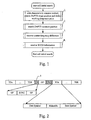
- Fig.1 shows basic steps of a cell initial search procedure from starting to ending in a cellular mobile communication system, by taking a Time Division - Synchronized Code Division Multiple Access (TD-SCDMA) system as an example.
- Step1 searches a rough position range of DwPTS by using the power characteristic window value method of the invention, and defines the working frequency point.
- Step2 searches accurate receiving position by using conventional solving correlation method in the position range defined by step 1, and obtains accurate receiving position.
- Step3 start to recover carrier frequency difference based on the joint detection method of carrier frequency difference correction used in the invention.
- information in the broadcast channel (BCCH) can be monitored.
- BCCH broadcast channel
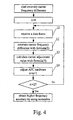
- Fig.2 shows a frame structure required when using the power characteristic window value method for implementing downlink synchronization.
- two training sequences are defined in a frame structure of TD-SCDMA system: an independent DwPTS 5 and a midamble in burst data TD0 ?? TDn, TU0 Hz Tun.
- the two training sequences have different function during a cell initial search.
- the DwPTS 5 occupies an independent timeslot including N GP (guard) symbols, M SYNC (synchronization) symbols and again N GP symbols.
- N GP guard
- M SYNC synchronization
- P data symbols Before and after the midamble, there are P data symbols, respectively, and the two data symbols and the midamble together occupy a timeslot.
- the SYNC symbol is a code selected from a set of orthogonal codes. The code can be obtained by solving correlation, but the operation must be made over whole data frame and the set of orthogonal codes, so the operation volume is very large.
- the downlink synchronization method of the invention let base station raise transmitting power of SYNC symbols but make no transmitting power at GP symbols. In this way when receiving, user equipment can first search the power characteristic window value of the DwPTS, and discovers a rough position range of the SYNC symbols, then solves correlation only near the position range. Therefore, the downlink synchronization time will be greatly shrunk and probability of decision error will be decreased.
- Fig.3 shows procedure for searching rough position range of DwPTS.
- the procedure starts searching with the characteristic window method and ends with discovering the rough position range of DwPTS or without finding the rough position range of DwPTS.
- step6 first user equipment is locked at a working frequency point, which should be a possible frequency point of a mobile communication system, and then the user equipment receives a complete data frame (e.g. 5ms + ⁇ ms).
- step7 calculate each symbol power P, i.e. first suppose that the receiving moment is the starting point of a symbol, then add power of all chips belong to the symbol to obtain the symbol power.
- P a complete data frame
- R i is the power characteristic window value for each position
- i represents the real receiving position
- P(k) represents each symbol power
- M and N are parameters of the characteristic window shape.
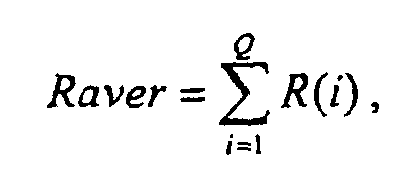
- step 9 calculate average power characteristic window value (ratio) on a frame: Raver , with the formula:
- R(i) is a power characteristic window value on each receiving position
- Q represents number of receiving position for a frame.
- Raver / Rmin i.e. average power characteristic window value/ minimum power characteristic window value
- Fig. 4 and 5 correcting carrier deviation is implemented by two big steps, which are shown in Fig. 4 and 5, respectively.
- the first big step a frequency difference is estimated by software and a decision and feedback mechanism for hardware adjustment is introduced.
- frequency difference is recovered from an initial larger value to a smaller range; for example, when using a crystal oscillator with accuracy 3ppm and working frequency range about 2G, the initial value can be considered as about 6 kHz.
- the second big step by mainly using joint detection technology to suppress multipath and multiple access interference, the smaller frequency difference (for example, about 1kHz) will be corrected to a range required by baseband demodulation in order to obtain a more accurate frequency difference information for guiding hardware adjustment.
- Fig.4 is an uninterrupted procedure starting from recovering carrier frequency difference until higher frequency accuracy obtained by using midamble.
- the frequency difference is estimated by software, the automatic frequency control (AFC) is made for hardware by a decision and feedback mechanism.
- the procedure corrects frequency difference from an initial larger value to a smaller range.
- Estimating frequency difference by software is also a software compensation process. If only using the software compensation without adjustment for hardware, each time the estimation must be accurate. In addition, under wireless channel the software estimation method is not estimation without tolerance. Therefore, only with software compensation, the effect is not good enough. On the other hand, although under wireless channel the software estimation is not very accurate, but the estimated frequency difference direction is reliable, especially in an average of multiple frames. Therefore, the software estimation can be used to guide the AFC hardware adjustment, to satisfy the requirement of the first big step. The specific steps are as follow.
- Step 12 estimate frequency difference of each data frame by software with formula (2):
- ⁇ represents an estimated frequency difference
- I and Q are orthogonal demodulation signal
- L is a statistic length.
- fe(n) is an estimated frequency difference, i.e. ⁇ for the n th data frame received; adjustment coefficient coef k ranges between 0 ⁇ 1, the selection principle is that greater k takes smaller coef k .
- a received data frame can be divided into k1, k2, ..., kn sections; when there are k1 ⁇ k2 ⁇ ... ⁇ kn , take coef k1 . > coef k2 >...> coef kn .
- Q is a preset number of adjustment frames
- the feedback in this case is interadjusting between software and hardware, i.e. first calculate frequency difference with software, then adjust hardware guided by the calculated frequency difference; after hardware has been adjusted, software estimates frequency difference again; repeat the procedure until a preset number of times.
- Fig.5 shows a procedure that deploys midamble to obtain higher frequency accuracy. Based on joint detection, a smaller frequency deviation is corrected into a range, which can be borne by the baseband demodulation.
- using joint detection technology means inserting a training sequence (midamble) to each frame for estimating real channel response.
- user equipment can suppress multipath and multiple access interference with joint detection technology, demodulates data symbols near the training sequence midamble, and guides adjustment of AFC by using frequency deviation information involved in these symbols. Specific steps are as following:
- Step15 receive m data frames.
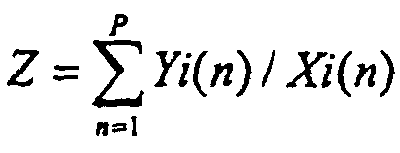
- Stepl6 demodulate the m data frames with joint detection technology, i.e. demodulate data symbols near the training sequence midamble and obtain P symbols before and after the training sequence midamble, respectively, which can be named as X(1) ... X(P) and Y(1) ... Y(P), respectively.
- Step 18 set adjustment step length (STEP Hz) of AFC hardware, according to the calculated frequency difference direction.
- Step19 according to the frequency difference direction obtained in step17, adjust AFC hardware with the step length STEP.
- Steps 15 to 19 can be repeated. Along with a corrected frequency difference decreases gradually, more data symbols near the training sequence midamble can be taken to obtain more frequency difference information, and the adjustment step length of AFC hardware can be decreased gradually.
- the method of the invention is a cell initial search method based on having training sequence system and can be used in a CDMA mobile communication system.
- a CDMA communication system using joint detection technology can use the invention, which is a method for correcting carrier deviation based on joint detection, to estimate carrier deviation. In a space wireless channel environment, the method can have a well effect.
- the invention a downlink synchronization and carrier deviation correction method, is designed based on a TD-SCDMA system, which is proposed by CWTS (China Wireless Telecommunication Standardization) and is one of the RTT (Radio Transmission Technology) of International IMT-2000, but it can be fully used on other digital cellular mobile communication systems after an adequate update.
- CWTS China Wireless Telecommunication Standardization
- RTT Radio Transmission Technology
Landscapes
- Engineering & Computer Science (AREA)
- Computer Networks & Wireless Communication (AREA)
- Signal Processing (AREA)
- Mobile Radio Communication Systems (AREA)
- Radio Relay Systems (AREA)
- Synchronisation In Digital Transmission Systems (AREA)
Abstract
Description





Claims (19)
- A cell initial search method for a CDMA digital mobile communication system, is used for a user equipment correctly receives information sent by a base station, it is characterized that the method comprises:selecting a working frequency point by the user equipment;obtaining downlink synchronization with the base station at the working frequency point, comprising:a. deciding a range of downlink training sequence timeslot by using a power characteristic window value method based on training sequence;b. obtaining accurate receiving position for the user equipment by calculating correlation of received data and training sequence in the range.
- The method according to Claim 1, wherein the power characteristic window value method based on training sequence comprises:a. increasing transmitting power of synchronization symbols in a downlink pilot sequence timeslot (DwPTS) of a base station data frame, and making no transmitting power on protected symbols located before and after the synchronization symbols in the DwPTS;b. searching power characteristic window values of the DwPTS first by user equipment, during receiving, and after having been discovered a position range of the synchronization symbols, making correlation calculation only near the position.
- The method according to Claim 1 or 2, wherein searching power characteristic window values of the DwPTS to discover a position range of the synchronization symbols comprises:locking a working frequency point by the user equipment first, and receiving a data frame;calculating each synchronization symbol power in the DwPTS;calculating power characteristic window values at each synchronization symbol position;calculating average power characteristic window value over the complete data frame;searching minimum one of power characteristic window values at all synchronization symbols position of the receiving data frame;deciding whether the ratio of average power characteristic window value and minimum power characteristic window value being greater than a threshold value, if it being so, then the position of the minimum power characteristic window value being the beginning position of the DwPTS;solving correlation near the beginning position to obtain an accurate receiving beginning point and ending downlink synchronization.
- The method according to Claim 3, wherein calculating each synchronization symbol power comprises:supposing the receiving moment being a synchronization symbol beginning point first, adding powers of all chips belonging to the synchronization symbol, and getting the power of the synchronization symbol.
- The method according to Claim 3, wherein calculating power characteristic window values at each synchronization symbol position comprises:wherein i represents a real receiving position, P(k) represents power value of each synchronization symbol, N and M are characteristic window parameters.sliding with symbol level on the receiving data frame, and calculating each position power characteristic window value R(i) at each position with the following formula:

- The method according to Claim 3, wherein calculating power characteristic window values at each synchronization symbol position comprises:sliding with chip level based on each chip power, and calculating the power characteristic window value at each position.
- A cell initial search method for a CDMA digital mobile communication system, is used for a user equipment correctly receives information sent by a base station, it is characterized that the method comprises:tracing carrier deviation between the user equipment and the base station by the user equipment;correcting the carrier deviation in a digital demodulator of the user equipment, comprising:a. estimating the carrier deviation by software, and adjusting hardware by using a decision and feedback method;b. by using a carrier deviation correction method based on joint detection, suppressing multipath and multiple access interference and correcting the carrier deviation to a range required by baseband demodulation.
- The method according to Claim 7, wherein the step a further comprises:estimating the carrier deviation of each data frame by software;calculating a adjustment value for hardware; andadjusting automatic frequency control (AFC) hardware in the digital demodulator with the calculated adjustment value.
- The method according to Claim 7 or 8, wherein using the formula to estimate the carrier deviation of each data frame:wherein α represents the estimated frequency deviation, I and Q are orthogonal demodulation signals, and L is a statistic length.

- The method according to Claim 7 or 8, wherein using the formula to calculate a adjustment value for hardware:
- The method according to Claim 7, wherein the step b further comprises:inserting a training sequence midamble of data burst into each data frame for estimating real channel response;suppressing multipath and multiple access interference with joint detection technology by the user equipment, and demodulating symbols near the training sequence midamble;adjusting automatic frequency control hardware with the carrier deviation information included in these symbols.
- The method according to Claim 7 or 11, wherein suppressing multipath and multiple access interference with joint detection technology and demodulating symbols near the training sequence midamble comprises:demodulating receiving data with joint detection technology, and getting P characters before and after the training sequence midamble, and recorded as X(1) ... X(P) and Y(1) ... Y(P), respectively;calculating Xi(n) = X(n)/Xj(n) , Yi(n) = Y(n)/Yj(n) , respectively, wherein Xj(n) = Yj(n) = ±π/4 or ±3π/4;getting carrier deviation direction by the formula:
 setting an adjustment step length of automatic frequency control hardware based on the calculated carrier frequency deviation direction; andadjusting automatic frequency control hardware with the adjustment step length according to the carrier frequency deviation direction.
 - A cell initial search method for a CDMA digital mobile communication system, comprises: selecting a working frequency point by an user equipment and obtaining downlink synchronization with a base station at the working frequency point; tracing carrier deviation between the user equipment and the base station by the user equipment, and correcting the carrier deviation in a digital demodulator; it is characterized that:obtaining downlink synchronization with a base station further comprising:a. deciding a range of downlink training sequence timeslot first by using a power characteristic window value method based on training sequence;b. obtaining accurate receiving position of the user equipment by calculating correlation of data received and training sequence in the range;correcting the carrier deviation in a digital demodulator further comprising:a. estimating the carrier deviation by software, and adjusting hardware by using a decision and feedback method;b. suppressing multipath and multiple access interference by using a carrier deviation correction method based on joint detection, and correcting the carrier deviation to a range required by baseband demodulation.
- A cell initial search method for a CDMA digital mobile communication systems, comprises:searching a rough position range of DwPTS by using a power characteristic window value method and defining a working frequency point;searching accurate receiving position by solving correlation method in the position range defined and obtaining downlink synchronization;recovering carrier deviation by using a carrier deviation correction method based on joint detection.
- The method according to Claim 14, wherein searching a rough position range of DwPTS by using a power characteristic window value method comprises:locking a working frequency point first by a user equipment and receiving a complete data frame;calculating each symbol power P;calculating power characteristic window values at each symbol position;calculating average power characteristic window value;searching the minimum one of all power characteristic window values;calculating a ratio of average power characteristic window value and minimum power characteristic window value, anddeciding whether the ratio being greater than a threshold value, if it is, then the position of the minimum power characteristic window value being the starting position of DwPTS.
- The method according to Claim 15, wherein calculating each symbol power P further comprises:supposing the receiving moment being a symbol beginning point first, adding powers of all chips belonging to the symbol, and getting the power of the symbol.
- The method according to Claim 14, wherein recovering carrier deviation by using a carrier deviation correction method based on joint detection comprises:a. setting frame number n = 0, receiving a data frame;b. estimating carrier frequency deviation of the data frame by software;c. calculating a adjustment value of carrier frequency deviation, i.e. calculating hardware adjustment value;d. adjusting automatic frequency control hardware according to the calculated hardware adjustment value, doing n = n+1, deciding whether n being greater than a preset number of adjustment frames Q, if not being so, receiving next data frame and going to step b, otherwise ending.
- The method according to Claim 14 or 17, wherein recovering carrier deviation by using a carrier deviation correction method based on joint detection further comprises:e. receiving m data frames;f. demodulating the m data frames received with joint detection technology, i.e. demodulating data symbols near a training sequence midamble and getting P symbols before and after the training sequence midamble, respectively;g. calculating carrier frequency deviation direction on the P symbols before and after the training sequence midamble of m data frames, respectively;h. setting an adjustment step length for automatic frequency control hardware, according to the calculated carrier frequency deviation direction;i. adjusting automatic frequency control hardware with the adjustment step length, according to the frequency carrier deviation direction obtained.
- The method according to Claim 18, further comprises repeating steps e to i.
Applications Claiming Priority (3)
| Application Number | Priority Date | Filing Date | Title |
|---|---|---|---|
| CN00103548 | 2000-03-27 | ||
| CN00103548A CN1131653C (en) | 2000-03-27 | 2000-03-27 | Small-region initial search method for CDMA digital mobile communication system |
| PCT/CN2001/000018 WO2001074103A1 (en) | 2000-03-27 | 2001-01-12 | Method of cell initial search in cdma digital mobile telecommunication system |
Publications (3)
| Publication Number | Publication Date |
|---|---|
| EP1330136A1 true EP1330136A1 (en) | 2003-07-23 |
| EP1330136A4 EP1330136A4 (en) | 2009-11-04 |
| EP1330136B1 EP1330136B1 (en) | 2012-03-07 |
Family
ID=4577070
Family Applications (1)
| Application Number | Title | Priority Date | Filing Date |
|---|---|---|---|
| EP01900378A Expired - Lifetime EP1330136B1 (en) | 2000-03-27 | 2001-01-12 | Method of cell initial search in cdma digital mobile telecommunication system |
Country Status (13)
| Country | Link |
|---|---|
| US (1) | US6778588B2 (en) |
| EP (1) | EP1330136B1 (en) |
| JP (1) | JP4530603B2 (en) |
| KR (1) | KR100564826B1 (en) |
| CN (1) | CN1131653C (en) |
| AT (1) | ATE548807T1 (en) |
| AU (2) | AU2001225004B2 (en) |
| BR (1) | BRPI0109610B1 (en) |
| CA (1) | CA2403929C (en) |
| MX (1) | MXPA02009561A (en) |
| RU (1) | RU2274954C2 (en) |
| TW (1) | TW508967B (en) |
| WO (1) | WO2001074103A1 (en) |
Cited By (6)
| Publication number | Priority date | Publication date | Assignee | Title |
|---|---|---|---|---|
| CN1298114C (en) * | 2004-05-14 | 2007-01-31 | 中兴通讯股份有限公司 | A method for determining preact of time |
| US7633927B2 (en) | 2003-01-31 | 2009-12-15 | Nokia Corporation | System and method for extending neighboring cell search window |
| US7917140B2 (en) | 2004-12-06 | 2011-03-29 | Telefonaktiebolaget L M Ericsson (Publ) | Initial cell search in mobile communications systems |
| CN103298101A (en) * | 2013-06-19 | 2013-09-11 | 中国人民解放军空军工程大学 | Wide-range code auxiliary carrier synchronization achieving method |
| CN105897304A (en) * | 2016-05-31 | 2016-08-24 | 西安空间无线电技术研究所 | Rapid sync method of frequency hopping communication system |
| WO2018163440A1 (en) | 2017-03-10 | 2018-09-13 | Nec Corporation | Position estimation apparatus |
Families Citing this family (39)
| Publication number | Priority date | Publication date | Assignee | Title |
|---|---|---|---|---|
| JP3851525B2 (en) * | 2001-08-09 | 2006-11-29 | 株式会社エヌ・ティ・ティ・ドコモ | Mobile station apparatus, mobile communication system, and carrier detection method |
| KR100524730B1 (en) * | 2002-11-02 | 2005-10-31 | 엘지전자 주식회사 | Early syncrounization search method for mobile communication system |
| CN1224280C (en) * | 2002-12-27 | 2005-10-19 | 大唐移动通信设备有限公司 | Time-varying channel correction method for time-division slot mobile communication system |
| CN1512794A (en) * | 2002-12-30 | 2004-07-14 | �ʼҷ����ֵ��ӹɷ�����˾ | Small cell searching method and device for mobile terminal in TDD-CDMA system |
| AU2003211659A1 (en) * | 2003-01-23 | 2004-08-13 | Linkair Communications, Inc. | Implement method and apparatus for downlink synchronization subsystem |
| CN1259785C (en) * | 2003-08-04 | 2006-06-14 | 大唐移动通信设备有限公司 | Method for obtaining carrier frequency departure of time division synchronous CDMA (TD-SCDMA) user terminal and equipment |
| CN1263322C (en) * | 2003-08-06 | 2006-07-05 | 大唐移动通信设备有限公司 | Gain control method for community initial search in TD-SCDMA mobile communication system |
| KR100565313B1 (en) * | 2003-11-26 | 2006-03-30 | 엘지전자 주식회사 | Domain Power Measurement Method of Mobile Communication System with Time Division Multiple Access and Code Division Multiple Access |
| CN1303839C (en) * | 2003-12-19 | 2007-03-07 | 北京天碁科技有限公司 | Method and device for reducing sum of calculation for searching in zones and increasing accuracy of calculation |
| CN100337508C (en) * | 2004-01-12 | 2007-09-12 | 大唐移动通信设备有限公司 | Method for searching down synchronous signal position in mobile communication system |
| CN100403657C (en) * | 2004-05-25 | 2008-07-16 | 大唐移动通信设备有限公司 | TD-SCDMA system frequency offset compensating method and apparatus based on exercising sequence |
| CN100356704C (en) * | 2004-06-02 | 2007-12-19 | 大唐移动通信设备有限公司 | Method for compensating frequency offset in wireless mobile communication system |
| CN100369386C (en) * | 2004-06-29 | 2008-02-13 | 大唐移动通信设备有限公司 | A combined detection method and apparatus with incorporated frequency deviation compensation |
| CN100362892C (en) * | 2004-07-01 | 2008-01-16 | 凯明信息科技股份有限公司 | Method and apparatus of initial cell search in time division synchronous CDMA system |
| RU2384948C2 (en) * | 2004-08-05 | 2010-03-20 | Эл Джи Электроникс Инк. | Interruption of use of frequency level convergence circuit |
| EP1743440B1 (en) | 2004-08-05 | 2009-10-07 | LG Electronics, Inc. | Interrupting use of frequency layer convergence scheme |
| US7684378B2 (en) * | 2004-11-08 | 2010-03-23 | Interdigital Technology Corporation | Method and apparatus for estimating channelization codes in a wireless transmit/receive unit |
| CN1780175B (en) * | 2004-11-19 | 2010-09-29 | 上海宣普实业有限公司 | A Parallel Iterative Method for the First and Second Steps of Cell Search in Time Division Duplex Systems |
| CN1780174B (en) * | 2004-11-19 | 2011-05-25 | 上海宣普实业有限公司 | A Parallel Iterative Method for the First and Second Steps of Cell Search in Time Division Duplex Systems |
| WO2006067657A1 (en) * | 2004-12-24 | 2006-06-29 | Koninklijke Philips Electronics N.V. | Method and apparatus for cell search in wireless communication system |
| CN1797990B (en) * | 2004-12-27 | 2010-12-08 | 上海宣普实业有限公司 | Frequency Point Scanning Method in Time Division Synchronous Code Division Multiple Access System |
| WO2006121302A1 (en) | 2005-05-13 | 2006-11-16 | Samsung Electronics Co., Ltd. | Method and apparatus for indexing physical channels in an ofdma system |
| CN100409588C (en) * | 2005-06-03 | 2008-08-06 | 上海原动力通信科技有限公司 | Multi-cell Joint Detection Method in Slotted Code Division Multiple Access System |
| CN1905406B (en) * | 2005-07-28 | 2011-04-20 | 上海原动力通信科技有限公司 | Synchronous method for wideband time division duplex cellular system |
| CN1988415B (en) * | 2005-12-21 | 2010-04-14 | 大唐移动通信设备有限公司 | Method for judging downward pilot frequency signal transmission mode in CDMA communication system |
| CN1996791B (en) * | 2006-01-06 | 2015-09-09 | 上海原动力通信科技有限公司 | A kind of downlink synchronization method of broadband time and division duplex cellular system |
| CN101009513B (en) * | 2006-01-26 | 2013-02-13 | 上海原动力通信科技有限公司 | Cell synchronization method and initial cell searching method for broadband time-division dual-duplex cellular system |
| KR101208541B1 (en) | 2006-11-01 | 2012-12-05 | 엘지전자 주식회사 | Method For Detecting The Position Of Synchronization Signal, And Method For Searching Cell Using The Same |
| CN101072438B (en) * | 2007-06-15 | 2010-09-29 | 中兴通讯股份有限公司 | A method for initial cell search by mobile terminal in TD-SCDMA system |
| JP2009089203A (en) * | 2007-10-02 | 2009-04-23 | Panasonic Corp | Radio apparatus and radio communication system |
| CN101222280B (en) * | 2007-11-30 | 2012-02-29 | 深圳国人通信有限公司 | Single time slot power detecting method and system |
| JP2009141832A (en) * | 2007-12-10 | 2009-06-25 | Mitsubishi Electric Corp | Communication system, receiving terminal and radio base station |
| CN101958746B (en) * | 2010-04-02 | 2014-03-12 | 展讯通信(上海)有限公司 | Coarse synchronization method of wireless terminal |
| CN102821442B (en) * | 2011-06-10 | 2014-10-22 | 联芯科技有限公司 | Scan method and device for frequency points |
| CN104253680B (en) * | 2013-06-27 | 2018-07-31 | 华为技术有限公司 | The sending method and device of synchronizing signal in a kind of FBMC systems |
| KR102421473B1 (en) * | 2015-10-01 | 2022-07-18 | 삼성전자주식회사 | Communication device performing carrier search in TD-SCDMA system and control method thereof |
| CN105933052B (en) * | 2016-05-20 | 2019-09-06 | 中国电子科技集团公司第十研究所 | Cross-polarization interference cancellation method in time domain |
| EP3769483A1 (en) * | 2018-03-20 | 2021-01-27 | Telefonaktiebolaget LM Ericsson (publ) | A wireless device, a network node and methods therein for enabling and determining reference signal configurations in a wireless communications network |
| CN114584438B (en) * | 2022-01-05 | 2023-08-15 | 华信咨询设计研究院有限公司 | 5G CFO estimation method based on reference carrier frequency offset |
Family Cites Families (13)
| Publication number | Priority date | Publication date | Assignee | Title |
|---|---|---|---|---|
| US5805983A (en) * | 1996-07-18 | 1998-09-08 | Ericsson Inc. | System and method for equalizing the delay time for transmission paths in a distributed antenna network |
| US6128470A (en) * | 1996-07-18 | 2000-10-03 | Ericsson Inc. | System and method for reducing cumulative noise in a distributed antenna network |
| JP2937897B2 (en) * | 1996-09-30 | 1999-08-23 | 株式会社ワイ・アール・ピー移動通信基盤技術研究所 | Channel assignment method and communication network using the method |
| JP3376224B2 (en) * | 1996-10-23 | 2003-02-10 | 株式会社エヌ・ティ・ティ・ドコモ | Initial synchronization method and receiver in asynchronous cellular system between DS-CDMA base stations |
| JP3373746B2 (en) * | 1997-01-07 | 2003-02-04 | 株式会社鷹山 | Initial synchronization method and receiver in asynchronous cellular system between DS-CDMA base stations |
| DE59802152D1 (en) * | 1997-06-17 | 2001-12-20 | Siemens Ag | METHOD FOR TIME SYNCHRONIZATION FOR A MOBILE STATION IN A RADIO COMMUNICATION SYSTEM |
| CN1061205C (en) * | 1997-07-24 | 2001-01-24 | 北京信威通信技术有限公司 | Method for device of carrier exalting and compensating in frequency spreading communication system |
| JPH11112472A (en) * | 1997-08-04 | 1999-04-23 | Toshiba Corp | Spread spectrum communication equipment |
| JP3897427B2 (en) * | 1997-12-01 | 2007-03-22 | 松下電器産業株式会社 | Base station apparatus, mobile station apparatus, mobile communication system, radio transmission method, and radio reception method |
| JP3793632B2 (en) * | 1997-12-18 | 2006-07-05 | 松下電器産業株式会社 | Cell search method and mobile station apparatus |
| US6490454B1 (en) * | 1998-08-07 | 2002-12-03 | Telefonaktiebolaget Lm Ericsson (Publ) | Downlink observed time difference measurements |
| EP1391094A1 (en) * | 2001-05-31 | 2004-02-25 | Nortel Networks Limited | Apparatus and method for measuring sub-carrier frequencies and sub-carrier frequency offsets |
| KR100589478B1 (en) * | 2001-11-29 | 2006-06-14 | 인터디지탈 테크날러지 코포레이션 | Cell Discovery Method, Node Ratio, and User Equipment in Time Division Dual Systems |
-
2000
- 2000-03-27 CN CN00103548A patent/CN1131653C/en not_active Expired - Lifetime
-
2001
- 2001-01-12 AU AU2001225004A patent/AU2001225004B2/en not_active Expired
- 2001-01-12 AU AU2500401A patent/AU2500401A/en active Pending
- 2001-01-12 KR KR1020027012743A patent/KR100564826B1/en not_active Expired - Lifetime
- 2001-01-12 JP JP2001571693A patent/JP4530603B2/en not_active Expired - Lifetime
- 2001-01-12 AT AT01900378T patent/ATE548807T1/en active
- 2001-01-12 CA CA 2403929 patent/CA2403929C/en not_active Expired - Lifetime
- 2001-01-12 BR BRPI0109610-9A patent/BRPI0109610B1/en not_active IP Right Cessation
- 2001-01-12 WO PCT/CN2001/000018 patent/WO2001074103A1/en not_active Ceased
- 2001-01-12 EP EP01900378A patent/EP1330136B1/en not_active Expired - Lifetime
- 2001-01-12 RU RU2002128747A patent/RU2274954C2/en active
- 2001-01-12 MX MXPA02009561A patent/MXPA02009561A/en active IP Right Grant
- 2001-08-24 TW TW90121115A patent/TW508967B/en not_active IP Right Cessation
-
2002
- 2002-09-25 US US10/255,334 patent/US6778588B2/en not_active Expired - Lifetime
Cited By (8)
| Publication number | Priority date | Publication date | Assignee | Title |
|---|---|---|---|---|
| US7633927B2 (en) | 2003-01-31 | 2009-12-15 | Nokia Corporation | System and method for extending neighboring cell search window |
| US7869423B2 (en) | 2003-01-31 | 2011-01-11 | Nokia Corporation | System and method for extending neighboring cell search window |
| CN1298114C (en) * | 2004-05-14 | 2007-01-31 | 中兴通讯股份有限公司 | A method for determining preact of time |
| US7917140B2 (en) | 2004-12-06 | 2011-03-29 | Telefonaktiebolaget L M Ericsson (Publ) | Initial cell search in mobile communications systems |
| CN103298101A (en) * | 2013-06-19 | 2013-09-11 | 中国人民解放军空军工程大学 | Wide-range code auxiliary carrier synchronization achieving method |
| CN103298101B (en) * | 2013-06-19 | 2016-02-17 | 中国人民解放军空军工程大学 | A kind of code subcarrier synchronization realizing method of wide region |
| CN105897304A (en) * | 2016-05-31 | 2016-08-24 | 西安空间无线电技术研究所 | Rapid sync method of frequency hopping communication system |
| WO2018163440A1 (en) | 2017-03-10 | 2018-09-13 | Nec Corporation | Position estimation apparatus |
Also Published As
| Publication number | Publication date |
|---|---|
| US6778588B2 (en) | 2004-08-17 |
| KR100564826B1 (en) | 2006-03-30 |
| RU2274954C2 (en) | 2006-04-20 |
| EP1330136B1 (en) | 2012-03-07 |
| JP4530603B2 (en) | 2010-08-25 |
| BRPI0109610B1 (en) | 2015-08-18 |
| CA2403929A1 (en) | 2002-09-24 |
| US20030031238A1 (en) | 2003-02-13 |
| CA2403929C (en) | 2008-09-23 |
| KR20020092401A (en) | 2002-12-11 |
| WO2001074103A1 (en) | 2001-10-04 |
| TW508967B (en) | 2002-11-01 |
| BR0109610A (en) | 2003-06-17 |
| AU2500401A (en) | 2001-10-08 |
| WO2001074103A8 (en) | 2003-05-15 |
| ATE548807T1 (en) | 2012-03-15 |
| CN1315808A (en) | 2001-10-03 |
| CN1131653C (en) | 2003-12-17 |
| JP2003529302A (en) | 2003-09-30 |
| RU2002128747A (en) | 2004-03-10 |
| MXPA02009561A (en) | 2004-07-30 |
| AU2001225004B2 (en) | 2005-03-17 |
| EP1330136A4 (en) | 2009-11-04 |
Similar Documents
| Publication | Publication Date | Title |
|---|---|---|
| EP1330136B1 (en) | Method of cell initial search in cdma digital mobile telecommunication system | |
| EP1276248B1 (en) | Search window delay tracking in code division multiple access communication systems | |
| US8738054B2 (en) | Efficient frame tracking in mobile receivers | |
| EP1289163B1 (en) | Frequency offset correction circuit for WCDMA | |
| CN100539464C (en) | Automatic frequency correction method and device for time division wireless communication system | |
| KR20050035148A (en) | Acquisition circuit for low chip rate option for mobile telecommunication system | |
| JP2001525628A (en) | Method and apparatus for phase-locked averaged power estimation | |
| WO2005013524A1 (en) | A method and device of the estimating carrier frequency offset of subscriber terminal | |
| US6885693B1 (en) | Synchronization in digital data transmission systems | |
| EP1668786A1 (en) | Initial synchronization for receivers | |
| JP3031350B2 (en) | Spread spectrum demodulator and method | |
| CA2170464A1 (en) | Frame synchronization apparatus | |
| KR102023373B1 (en) | Method and apparatus for timing acquisition in code division multiple access system | |
| CN100403657C (en) | TD-SCDMA system frequency offset compensating method and apparatus based on exercising sequence | |
| US20050117630A1 (en) | Receiver | |
| EP1065798A1 (en) | Receiver and method of reception | |
| KR101137344B1 (en) | Method and apparatus for estimating frame synchronization | |
| CN1777160B (en) | Coarse frequency correcting method | |
| JP4077255B2 (en) | Wireless communication device | |
| JP2005341277A (en) | RADIO COMMUNICATION TERMINAL DEVICE AND METHOD FOR CORRECTING TRANSMISSION PATH ESTIMATED VALUE OF RADIO COMMUNICATION TERMINAL DEVICE | |
| HK1039861B (en) | A cell initial searching method for cdma digital mobile communication system |
Legal Events
| Date | Code | Title | Description |
|---|---|---|---|
| PUAI | Public reference made under article 153(3) epc to a published international application that has entered the european phase |
Free format text: ORIGINAL CODE: 0009012 |
|
| 17P | Request for examination filed |
Effective date: 20020917 |
|
| AK | Designated contracting states |
Designated state(s): AT BE CH CY DE DK ES FI FR GB GR IE IT LI LU MC NL PT SE TR |
|
| A4 | Supplementary search report drawn up and despatched |
Effective date: 20091007 |
|
| 17Q | First examination report despatched |
Effective date: 20100421 |
|
| REG | Reference to a national code |
Ref country code: DE Ref legal event code: R079 Ref document number: 60146215 Country of ref document: DE Free format text: PREVIOUS MAIN CLASS: H04Q0007360000 Ipc: H04B0001707000 |
|
| RIC1 | Information provided on ipc code assigned before grant |
Ipc: H04B 1/707 20110101AFI20110530BHEP |
|
| GRAP | Despatch of communication of intention to grant a patent |
Free format text: ORIGINAL CODE: EPIDOSNIGR1 |
|
| GRAS | Grant fee paid |
Free format text: ORIGINAL CODE: EPIDOSNIGR3 |
|
| GRAA | (expected) grant |
Free format text: ORIGINAL CODE: 0009210 |
|
| AK | Designated contracting states |
Kind code of ref document: B1 Designated state(s): AT BE CH CY DE DK ES FI FR GB GR IE IT LI LU MC NL PT SE TR |
|
| REG | Reference to a national code |
Ref country code: GB Ref legal event code: FG4D |
|
| REG | Reference to a national code |
Ref country code: AT Ref legal event code: REF Ref document number: 548807 Country of ref document: AT Kind code of ref document: T Effective date: 20120315 Ref country code: CH Ref legal event code: EP |
|
| REG | Reference to a national code |
Ref country code: IE Ref legal event code: FG4D |
|
| REG | Reference to a national code |
Ref country code: DE Ref legal event code: R096 Ref document number: 60146215 Country of ref document: DE Effective date: 20120510 |
|
| REG | Reference to a national code |
Ref country code: NL Ref legal event code: VDEP Effective date: 20120307 |
|
| PG25 | Lapsed in a contracting state [announced via postgrant information from national office to epo] |
Ref country code: NL Free format text: LAPSE BECAUSE OF FAILURE TO SUBMIT A TRANSLATION OF THE DESCRIPTION OR TO PAY THE FEE WITHIN THE PRESCRIBED TIME-LIMIT Effective date: 20120307 |
|
| PG25 | Lapsed in a contracting state [announced via postgrant information from national office to epo] |
Ref country code: FI Free format text: LAPSE BECAUSE OF FAILURE TO SUBMIT A TRANSLATION OF THE DESCRIPTION OR TO PAY THE FEE WITHIN THE PRESCRIBED TIME-LIMIT Effective date: 20120307 Ref country code: GR Free format text: LAPSE BECAUSE OF FAILURE TO SUBMIT A TRANSLATION OF THE DESCRIPTION OR TO PAY THE FEE WITHIN THE PRESCRIBED TIME-LIMIT Effective date: 20120608 |
|
| REG | Reference to a national code |
Ref country code: AT Ref legal event code: MK05 Ref document number: 548807 Country of ref document: AT Kind code of ref document: T Effective date: 20120307 |
|
| PG25 | Lapsed in a contracting state [announced via postgrant information from national office to epo] |
Ref country code: CY Free format text: LAPSE BECAUSE OF FAILURE TO SUBMIT A TRANSLATION OF THE DESCRIPTION OR TO PAY THE FEE WITHIN THE PRESCRIBED TIME-LIMIT Effective date: 20120307 |
|
| PG25 | Lapsed in a contracting state [announced via postgrant information from national office to epo] |
Ref country code: SE Free format text: LAPSE BECAUSE OF FAILURE TO SUBMIT A TRANSLATION OF THE DESCRIPTION OR TO PAY THE FEE WITHIN THE PRESCRIBED TIME-LIMIT Effective date: 20120307 Ref country code: BE Free format text: LAPSE BECAUSE OF FAILURE TO SUBMIT A TRANSLATION OF THE DESCRIPTION OR TO PAY THE FEE WITHIN THE PRESCRIBED TIME-LIMIT Effective date: 20120307 |
|
| PG25 | Lapsed in a contracting state [announced via postgrant information from national office to epo] |
Ref country code: PT Free format text: LAPSE BECAUSE OF FAILURE TO SUBMIT A TRANSLATION OF THE DESCRIPTION OR TO PAY THE FEE WITHIN THE PRESCRIBED TIME-LIMIT Effective date: 20120709 |
|
| PLBE | No opposition filed within time limit |
Free format text: ORIGINAL CODE: 0009261 |
|
| STAA | Information on the status of an ep patent application or granted ep patent |
Free format text: STATUS: NO OPPOSITION FILED WITHIN TIME LIMIT |
|
| PG25 | Lapsed in a contracting state [announced via postgrant information from national office to epo] |
Ref country code: AT Free format text: LAPSE BECAUSE OF FAILURE TO SUBMIT A TRANSLATION OF THE DESCRIPTION OR TO PAY THE FEE WITHIN THE PRESCRIBED TIME-LIMIT Effective date: 20120307 Ref country code: DK Free format text: LAPSE BECAUSE OF FAILURE TO SUBMIT A TRANSLATION OF THE DESCRIPTION OR TO PAY THE FEE WITHIN THE PRESCRIBED TIME-LIMIT Effective date: 20120307 |
|
| 26N | No opposition filed |
Effective date: 20121210 |
|
| PG25 | Lapsed in a contracting state [announced via postgrant information from national office to epo] |
Ref country code: IT Free format text: LAPSE BECAUSE OF FAILURE TO SUBMIT A TRANSLATION OF THE DESCRIPTION OR TO PAY THE FEE WITHIN THE PRESCRIBED TIME-LIMIT Effective date: 20120307 |
|
| REG | Reference to a national code |
Ref country code: DE Ref legal event code: R097 Ref document number: 60146215 Country of ref document: DE Effective date: 20121210 |
|
| PG25 | Lapsed in a contracting state [announced via postgrant information from national office to epo] |
Ref country code: ES Free format text: LAPSE BECAUSE OF FAILURE TO SUBMIT A TRANSLATION OF THE DESCRIPTION OR TO PAY THE FEE WITHIN THE PRESCRIBED TIME-LIMIT Effective date: 20120618 |
|
| PG25 | Lapsed in a contracting state [announced via postgrant information from national office to epo] |
Ref country code: MC Free format text: LAPSE BECAUSE OF NON-PAYMENT OF DUE FEES Effective date: 20130131 |
|
| REG | Reference to a national code |
Ref country code: CH Ref legal event code: PL |
|
| REG | Reference to a national code |
Ref country code: IE Ref legal event code: MM4A |
|
| PG25 | Lapsed in a contracting state [announced via postgrant information from national office to epo] |
Ref country code: LI Free format text: LAPSE BECAUSE OF NON-PAYMENT OF DUE FEES Effective date: 20130131 Ref country code: CH Free format text: LAPSE BECAUSE OF NON-PAYMENT OF DUE FEES Effective date: 20130131 |
|
| PG25 | Lapsed in a contracting state [announced via postgrant information from national office to epo] |
Ref country code: IE Free format text: LAPSE BECAUSE OF NON-PAYMENT OF DUE FEES Effective date: 20130112 |
|
| PG25 | Lapsed in a contracting state [announced via postgrant information from national office to epo] |
Ref country code: TR Free format text: LAPSE BECAUSE OF FAILURE TO SUBMIT A TRANSLATION OF THE DESCRIPTION OR TO PAY THE FEE WITHIN THE PRESCRIBED TIME-LIMIT Effective date: 20120307 |
|
| PG25 | Lapsed in a contracting state [announced via postgrant information from national office to epo] |
Ref country code: LU Free format text: LAPSE BECAUSE OF NON-PAYMENT OF DUE FEES Effective date: 20130112 |
|
| REG | Reference to a national code |
Ref country code: FR Ref legal event code: PLFP Year of fee payment: 16 |
|
| REG | Reference to a national code |
Ref country code: FR Ref legal event code: PLFP Year of fee payment: 17 |
|
| REG | Reference to a national code |
Ref country code: FR Ref legal event code: PLFP Year of fee payment: 18 |
|
| PGFP | Annual fee paid to national office [announced via postgrant information from national office to epo] |
Ref country code: GB Payment date: 20200131 Year of fee payment: 20 Ref country code: DE Payment date: 20200113 Year of fee payment: 20 |
|
| PGFP | Annual fee paid to national office [announced via postgrant information from national office to epo] |
Ref country code: FR Payment date: 20200130 Year of fee payment: 20 |
|
| REG | Reference to a national code |
Ref country code: DE Ref legal event code: R071 Ref document number: 60146215 Country of ref document: DE |
|
| REG | Reference to a national code |
Ref country code: GB Ref legal event code: PE20 Expiry date: 20210111 |
|
| PG25 | Lapsed in a contracting state [announced via postgrant information from national office to epo] |
Ref country code: GB Free format text: LAPSE BECAUSE OF EXPIRATION OF PROTECTION Effective date: 20210111 |