EP1329467A2 - Process for the manufacture of copolymers of formaldehyde and diphenyl oxide - Google Patents
Process for the manufacture of copolymers of formaldehyde and diphenyl oxide Download PDFInfo
- Publication number
- EP1329467A2 EP1329467A2 EP03000569A EP03000569A EP1329467A2 EP 1329467 A2 EP1329467 A2 EP 1329467A2 EP 03000569 A EP03000569 A EP 03000569A EP 03000569 A EP03000569 A EP 03000569A EP 1329467 A2 EP1329467 A2 EP 1329467A2
- Authority
- EP
- European Patent Office
- Prior art keywords
- pka
- acid
- dpo
- range
- viscosity
- Prior art date
- Legal status (The legal status is an assumption and is not a legal conclusion. Google has not performed a legal analysis and makes no representation as to the accuracy of the status listed.)
- Withdrawn
Links
Classifications
-
- C—CHEMISTRY; METALLURGY
- C08—ORGANIC MACROMOLECULAR COMPOUNDS; THEIR PREPARATION OR CHEMICAL WORKING-UP; COMPOSITIONS BASED THEREON
- C08G—MACROMOLECULAR COMPOUNDS OBTAINED OTHERWISE THAN BY REACTIONS ONLY INVOLVING UNSATURATED CARBON-TO-CARBON BONDS
- C08G16/00—Condensation polymers of aldehydes or ketones with monomers not provided for in the groups C08G4/00 - C08G14/00
- C08G16/02—Condensation polymers of aldehydes or ketones with monomers not provided for in the groups C08G4/00 - C08G14/00 of aldehydes
- C08G16/0212—Condensation polymers of aldehydes or ketones with monomers not provided for in the groups C08G4/00 - C08G14/00 of aldehydes with acyclic or carbocyclic organic compounds
- C08G16/0218—Condensation polymers of aldehydes or ketones with monomers not provided for in the groups C08G4/00 - C08G14/00 of aldehydes with acyclic or carbocyclic organic compounds containing atoms other than carbon and hydrogen
- C08G16/0225—Condensation polymers of aldehydes or ketones with monomers not provided for in the groups C08G4/00 - C08G14/00 of aldehydes with acyclic or carbocyclic organic compounds containing atoms other than carbon and hydrogen containing oxygen
-
- C—CHEMISTRY; METALLURGY
- C08—ORGANIC MACROMOLECULAR COMPOUNDS; THEIR PREPARATION OR CHEMICAL WORKING-UP; COMPOSITIONS BASED THEREON
- C08G—MACROMOLECULAR COMPOUNDS OBTAINED OTHERWISE THAN BY REACTIONS ONLY INVOLVING UNSATURATED CARBON-TO-CARBON BONDS
- C08G63/00—Macromolecular compounds obtained by reactions forming a carboxylic ester link in the main chain of the macromolecule
- C08G63/02—Polyesters derived from hydroxycarboxylic acids or from polycarboxylic acids and polyhydroxy compounds
- C08G63/12—Polyesters derived from hydroxycarboxylic acids or from polycarboxylic acids and polyhydroxy compounds derived from polycarboxylic acids and polyhydroxy compounds
- C08G63/16—Dicarboxylic acids and dihydroxy compounds
- C08G63/20—Polyesters having been prepared in the presence of compounds having one reactive group or more than two reactive groups
- C08G63/21—Polyesters having been prepared in the presence of compounds having one reactive group or more than two reactive groups in the presence of unsaturated monocarboxylic acids or unsaturated monohydric alcohols or reactive derivatives thereof
Definitions
- This invention relates to a process for the manufacture of copolymers of formaldehyde and diphenyl oxide having dependent unsaturation derived from the concurrent reaction with olefinically unsaturated mono- or dicarboxylic acids.
- a key specification for these copolymer products is the viscosity of the neat resin, and a key requirement is that the viscosity level be consistent from batch to batch.
- a problem with using a strong acid as catalyst in the manufacturing process is that viscosity of the neat resin can vary from less than 10,000 mPa.s to greater than 100,000 mPa.s even when the processing parameters are held within a very narrow range from batch to batch.
- This invention is a process for the manufacture of a copolymer of formaldehyde or paraformaldehyde, diphenyl oxide, and a mono- or dicarboxylic acid in the presence of an acid catalyst with a pKa within the range of 1.2 to 3.
- an acid catalyst with a pKa within this range are that the product viscosity is less sensitive to reaction conditions compared to the use of acids with lower pKa values, and levels of residual starting materials can be kept to acceptably low levels for commercial use.
- the formaldehyde component of this process can be used in all its forms, including solutions in water or aqueous methanol, or paraformaldehyde.
- the diphenyl oxide can be unsubstituted, or the aromatic rings can be substituted with alkyl groups of one to ten carbon atoms, or can be halogenated in one or both rings. It is preferred to use diphenyl oxide in solid form and not in an aqueous solution.
- Acids with pKa values within the range of 1.2 to 3.0 for use as catalysts include o-aminobenzosulfonic (pKa 2.48), arsenic (pKa 2.25), bromoacetic (pKa 2.69), o-bromobenzoic (pKa 2.84), chloroacetic (pKa 2.85), chlorobenzoic (pKa 2.92), chlorobutyric (pKa 2.86), chloropropionic (pKa 2.83, cyanoacetic (pKa 2.45), cyanobutyric (pKa 2.42), cyanophenoxyacetic (pKa 2.98), dichloroacetic (pKa 1.48), dichloroacetylacetic (pKa 2.11), dihydroxybenzoic (pKa 2.94), dihydroxymalic (pKa 1.92), dinicotinic (pKa 2.80), fluorobenzoic (pKa 2.90), hydroxybenzoic (pKa 2.97),
- acids be used in solid form and not in aqueous solution.
- Preferred acids are those with a pKa in the range of 1.75 to 2.25.
- a more preferred acid is phosphorous acid.
- Olefinically unsaturated monocarboxylic acids suitable for use in this process will have three to ten carbon atoms and include acrylic, crotonic, angelic, methacrylic, ethacrylic, oleic and linoleic acids.
- Olefinically unsaturated dicarboxylic acids or anhydrides will have four to twelve carbons atoms and include maleic, fumaric, itaconic, 3-hexene-1,6-dicarboxylic acid, citaconic phenyl maleic, and similar acids.
- the reaction temperature generally is in a range of 86° and greater to 94°C and lower, preferably 88° and greater to 92°C and lower, and more preferably 90°C.
- the range for the reaction temperature is generally lower and for the reaction time longer than in prior art processes, which is attributed to the higher pKa values of the acid catalysts.
- the weaker acid and milder reaction temperature compared to those of prior art processes is believed to make the viscosity of the product less sensitive to minor variations in reaction parameters. The result is product with viscosity consistent from batch to batch.
- stoichiometry of this process is determined relative to DPO.
- DPO is the limiting reagent inasmuch as any residual DPO cannot be stripped or washed from the product, and therefore must be fully reacted.
- Suitable mole ratios for the reactants per mole of DPO are three to four moles of carboxylic acid and two to three moles formaldehyde.
- the ratio to DPO for the acid catalyst will vary depending on the acid chosen, with a higher ratio needed for the weaker of the acids.
- One skilled in the art can determine the appropriate ratio for the acid catalyst without undue experimentation.
- the ratio per mole of DPO will be in the range of 1.8 to 2.2 moles of phosphorous acid.
- the work-up and isolation of the product may follow any suitable commercial practice.
- One such commercial practice is as follows.
- the reaction mixture is cooled, and washed with a mixture of water and methylene chloride.
- a suitable ratio of water to methylene chloride is in the range of 70:30 to 60:40.
- the lower product layer is drawn off and washed with water, then drawn off again, and washed with a mixture of methanol and water.
- a suitable ratio of water to methanol is in the range of 70:30 to 60:40.
- the product layer is neutralized to pH 7.5-9.0 using ammonium hydroxide. Methanol is added to the neutralized product layer and the aqueous layer is separated from the product layer.
- the product layer is washed two more times with methanol and water, dried over sieves and then stripped under vacuum with an air sparge and inhibitors (methoxyhydroquinone, hydroquinone, and butylated hydroxytoluene) to 70-90% solids.
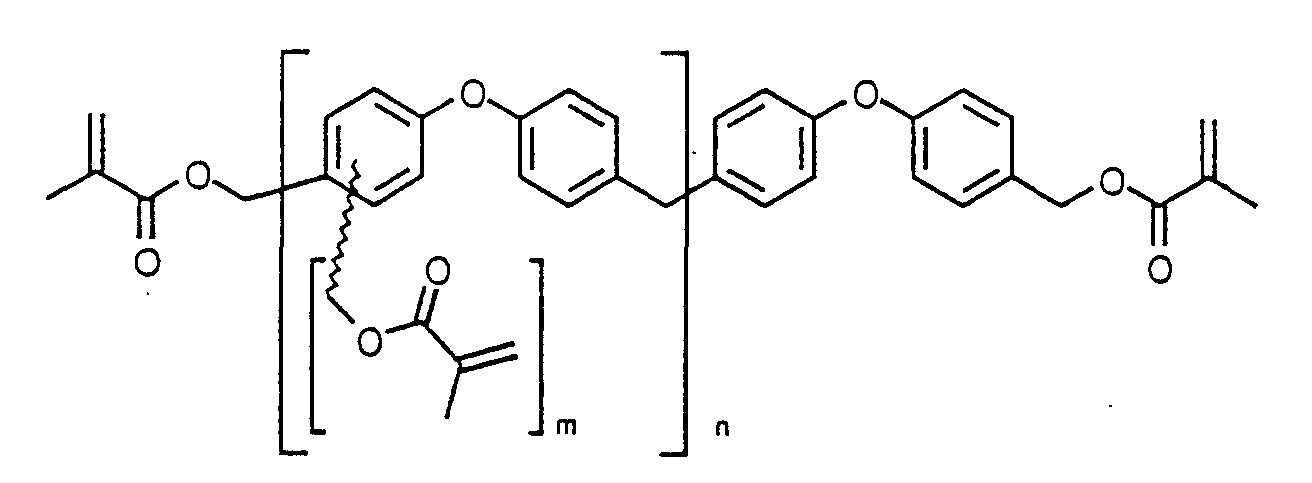
- the copolymer synthesized for illustration of this invention was diphenyl methylacrylate (DPMA) having the structure in which n is approximately 3 and n is greater than m.
- DPMA diphenyl methylacrylate
- the DPMA copolymer was prepared from the reaction of diphenyl oxide, methyl methacrylate and paraformaldehyde.
- COMPARATIVE EXAMPLE 1 Laboratory scale productions of DPMA were made to examine the influence of catalyst amount on reaction conversion.
- the molar ratio of methacrylic acid to DPO was 4.2 to 1.
- the molar ratio of paraformaldehyde to DPO was 3.2 to1.
- Paratoluene sulfonic acid (PTSA) was used as the catalyst.
- the molar ratio for the PTSA to DPO, the reaction time, reaction temperature, product viscosity, product percent solids and residual DPO levels are reported in Table 1. The data show that as the molar ratio of the acid increases, the product exhibits increasing viscosity and eventually gells, and the residual DPO levels vary widely.
- COMPARATIVE EXAMPLE 2 Commercial scale productions of DPMA were made with a target residual level of DPO selected to be 4000 ppm or less, and the viscosity to be within the range of 28,000 mPa.s or more to 40,000 mPa.s or less at 98% to 99% solids.
- SA Sulfuric acid
- the molar ratios for the reactants per mole of DPO were 14 moles of MAA, 4.4 moles of CHO, and 9 moles of SA.
- the reaction temperature was held between 64° to 66°C for each of the batches in an attempt to control the reaction, and the reaction time was 2 hours and 45 minutes plus or minus 2 to 3 minutes for the various batches.
- EXAMPLE A series of reactions to synthesize DPMA were carried out to investigate the parameters of the reaction process conditions and the effectiveness of an acid with a pKa within the range of 1.2 to 3. Phosphorous acid with a pKa of 2.0 was used as the catalyst.
- the molar ratios of the reactants, the reaction time, reaction temperature, product viscosity, product percent solids and residual DPO levels are reported in Table 3.
- the residual level of DPO arbitrarily was specified to be 4000 ppm or less, and the viscosity to be approximately 1,780 mPa.s at 83% solids, and within the range of 15.000 mPa.s or more to 40,000 mPa.s or less at 98% to 99% solids.
Landscapes
- Chemical & Material Sciences (AREA)
- Health & Medical Sciences (AREA)
- Chemical Kinetics & Catalysis (AREA)
- Medicinal Chemistry (AREA)
- Polymers & Plastics (AREA)
- Organic Chemistry (AREA)
- Emergency Medicine (AREA)
- Organic Low-Molecular-Weight Compounds And Preparation Thereof (AREA)
- Phenolic Resins Or Amino Resins (AREA)
- Low-Molecular Organic Synthesis Reactions Using Catalysts (AREA)
- Polyoxymethylene Polymers And Polymers With Carbon-To-Carbon Bonds (AREA)
Abstract
Description
| ParaToluene Sulfonic Acid as Catalyst | ||||||
| Batch Number | 1 | 2 | 3 | 4 | 5 | 6 |
| Mole ratio PTSA:DPO | 0.050 : 1 | 0.100 : 1 | 0.125 : 1 | 0.150 : 1 | 0.175 : 1 | 0.200 : 1 |
| Reaction Temp (°C) | 105-110 | 105-110 | 105-110 | 105-110 | 105-110 | 105-110 |
| Reaction Time (hours) | 1.25 | 1.25 | 1.00 | 1.00 | 1.00 | 1.00 |
| Viscosity 25°C (mPa.s) | 47 | 1,117 | 2,202 | 137,700 | Gelled | Gelled |
| Product Solids (%) | 58.5 | 78.6 | 79.3 | 87.9 | Gelled | Gelled |
| Residual DPO (ppm) | 376 | 13,241 | 2,783 | 2.240 | Gelled | Gelled |
| Commercial DPMA Batches | ||
| Batch # | Viscosity at 98-99% solids, (mPa.s at 50°C) | Residual DPO (ppm) |
| 7 | 13,200 | 6,525 |
| 8 | 13,200 | 8,528 |
| 9 | 36,500 | 6,007 |
| 10 | 90,000 | 13,840 |
| Target | 28,000-40,000 | <4,000 |
| Phosphorous Acid as Catalyst | ||||||
| Batch Number | 11 | 12 | 13 | 14 | 15 | 16 |
| Mole ratio PA : DPO | 0.7 : 1 | 0.7 : 1 | 1 : 1 | 1 : 1 | 2 : 1 | 2 : 1 |
| Mole ratio MAA : DPO | 3.5 : 1 | 3.5 : 1 | 3.5 : 1 | 4.4 : 1 | 3.5 : 1 | 6 : 1 |
| Mole ratio CHO : DPO | 2.5 : 1 | 2.5 : 1 | 2.5 : 1 | 3.2 : 1 | 2.5 : 1 | 4 : 1 |
| Reaction Temp (°C) | 90 | 105 | 90 | 90 | 90 | 90 |
| Reaction Time (hours) | 23 | 23 | 48 | 48 | 24 | 24 |
| Viscosity 25°C (mPa.s) | 548 | 1,465 | 2,213 | 3,976 | 1,941 | 7,745 |
| Product Solids (%) | 84.2 | 85.9 | 90.2 | 89.8 | 83.2 | 89.0 |
| Residual DPO Ppm | 47,988 | 25,817 | 6,352 | 22,387 | 582 | 29 |
| Batch Number | Temp (°C) | Time Hrs | Viscosity (mPa.s at 25°C) | DPO (ppm) | Solids, (%) |
| 17 | 85 | 26 | 1,601 (2,262) | 76 | 84.1 |
| 18 | 95 | 26 | 1,847 (524) | <25 | 78.6 |
| 19 | 95 | 22 | 3,244 (1,133) | 0 | 81.5 |
| 20 | 90 | 24 | 2,365 (2,449) | 560 | 84.4 |
| 21 | 85 | 22 | 2,412 (1,293) | 49 | 82.0 |
| 22 | 90 | 24 | 4,558 (5,297) | 432 | 87.3 |
| Target | in parentheses | <4,000 | 80±10 |
Claims (7)
- A process for the manufacture of a copolymer of the monomers diphenyl oxide, formaldehyde or paraformaldehyde, and an unsaturated carboxylic or dicarboxylic acid, comprising reacting the monomers in the presence of an acid catalyst with a pKa within the range of 1.2 to 3.0.
- The process according to claim 1 in which the acid catalyst has a pKa within the range of 1.75 to 2.25.
- The process according to claim 1 in which the acid catalyst is solid phosphorous acid.
- The process according to claim 1 in which the reaction is conducted within the range of 86°C or higher to 94°C or lower, for a time period within the range of 18 hours or more to 30 hours or fewer.
- The process according to any one of claims 1 to 4 in which the carboxylic or dicarboxylic acid is methacrylic acid.
- The process according to claim 5 in which the molar ratio of the reactants is 1 mole diphenyl oxide to 3 to 4 moles methacrylic acid to 2 to 3 moles paraformaldehyde.
- The process according to claim 5 in which the molar ratio of the reactants is 1 mole diphenyl oxide to 3 to 4 moles methacrylic acid to 2 to 3 moles paraformaldehyde to 1.8 to 2.2 moles phosphorous acid.
Applications Claiming Priority (2)
| Application Number | Priority Date | Filing Date | Title |
|---|---|---|---|
| US10/052,422 US6646095B2 (en) | 2002-01-16 | 2002-01-16 | Process for the manufacture of copolymers of formaldehyde and diphenyl oxide |
| US52422 | 2002-01-16 |
Publications (2)
| Publication Number | Publication Date |
|---|---|
| EP1329467A2 true EP1329467A2 (en) | 2003-07-23 |
| EP1329467A3 EP1329467A3 (en) | 2004-01-14 |
Family
ID=21977513
Family Applications (1)
| Application Number | Title | Priority Date | Filing Date |
|---|---|---|---|
| EP03000569A Withdrawn EP1329467A3 (en) | 2002-01-16 | 2003-01-13 | Process for the manufacture of copolymers of formaldehyde and diphenyl oxide |
Country Status (5)
| Country | Link |
|---|---|
| US (1) | US6646095B2 (en) |
| EP (1) | EP1329467A3 (en) |
| JP (1) | JP2003231727A (en) |
| KR (1) | KR20030062267A (en) |
| CA (1) | CA2416072A1 (en) |
Family Cites Families (3)
| Publication number | Priority date | Publication date | Assignee | Title |
|---|---|---|---|---|
| US3579470A (en) | 1968-12-30 | 1971-05-18 | Westinghouse Electric Corp | Diphenyl oxide modified phenolic resin insulating varnishes |
| US3914194A (en) * | 1973-04-02 | 1975-10-21 | Dow Chemical Co | Unsaturated formaldehyde copolymer resins derived from diaryl oxides, sulfides, dibenzofuran or dibenzothiophene |
| EP0112650B1 (en) * | 1982-12-06 | 1991-01-02 | Imperial Chemical Industries Plc | Aromatic oligomers and resins |
-
2002
- 2002-01-16 US US10/052,422 patent/US6646095B2/en not_active Expired - Lifetime
-
2003
- 2003-01-13 CA CA002416072A patent/CA2416072A1/en not_active Abandoned
- 2003-01-13 EP EP03000569A patent/EP1329467A3/en not_active Withdrawn
- 2003-01-14 JP JP2003005863A patent/JP2003231727A/en active Pending
- 2003-01-14 KR KR10-2003-0002480A patent/KR20030062267A/en not_active Withdrawn
Also Published As
| Publication number | Publication date |
|---|---|
| US20030162936A1 (en) | 2003-08-28 |
| CA2416072A1 (en) | 2003-07-16 |
| US6646095B2 (en) | 2003-11-11 |
| JP2003231727A (en) | 2003-08-19 |
| EP1329467A3 (en) | 2004-01-14 |
| KR20030062267A (en) | 2003-07-23 |
Similar Documents
| Publication | Publication Date | Title |
|---|---|---|
| CN102171273B (en) | Method for producing phosphated polycondensation products and the use thereof | |
| JPH06313032A (en) | Biodegradable poly(lactic acid) with improved physical characteristics and its production | |
| WO2003027166A1 (en) | Process for producing poly(ethylene-aromatic dicarboxylate ester) resin and resin product | |
| KR101693546B1 (en) | Poly lactic acid based biodegradable resin composition with good processability and flexibility and biodegradable film prepared therefrom | |
| US6646095B2 (en) | Process for the manufacture of copolymers of formaldehyde and diphenyl oxide | |
| US7691946B2 (en) | Soy-based thermosensitive hydrogels for controlled release systems | |
| KR101690309B1 (en) | Method for preparing poly(butylene carbonate-co-terephthalate) resin | |
| JPH10182838A (en) | Water-dispersible polymer | |
| CN101035837B (en) | Method for producing polymeric hydroxyalkyl-terminated polysulfides | |
| US3424724A (en) | Aldehyde-modified carbamates | |
| US2902469A (en) | Linear polyesters | |
| KR19980064301A (en) | The functional group terminal polymer containing a sulfonate group through sulfonation of an ethylenically unsaturated polymer | |
| JPS61181804A (en) | Production of hydrolyzed polymaleic anhydride | |
| US3642724A (en) | Process of making unsaturated polyesters of low flammability and product obtained thereby | |
| ES2240788T3 (en) | PROCEDURE FOR PREPARING REAGENT RESINS OF INSATURED POLYESTERS FROM 2-METHYL-1,3-PROPANODIOL. | |
| US4501920A (en) | Preparation of trimethoxybenzoate salts and trimethoxybenzoic acid | |
| US4293685A (en) | Method for manufacturing crosslinked polyetherester resins | |
| US3402147A (en) | Process for preparing polyester resins from a telomer | |
| JP2679161B2 (en) | Polyester production method | |
| JP2003146981A (en) | Method for producing 6-hydroxy-2,5,7,8-tetramethylchroman-2-carboxylic acid ester | |
| RU2116289C1 (en) | Method of preparing pentaerythrite | |
| JPH0139447B2 (en) | ||
| JPS5738819A (en) | Production of polyester-polyether copolymer | |
| SU565044A1 (en) | Method for obtaining polyethyleneterephtalate | |
| CN112538161A (en) | Preparation method of epoxysuccinic acid-2- (hydroxyimino) sodium malonate copolymer |
Legal Events
| Date | Code | Title | Description |
|---|---|---|---|
| PUAI | Public reference made under article 153(3) epc to a published international application that has entered the european phase |
Free format text: ORIGINAL CODE: 0009012 |
|
| AK | Designated contracting states |
Designated state(s): AT BE BG CH CY CZ DE DK EE ES FI FR GB GR HU IE IT LI LU MC NL PT SE SI SK TR |
|
| AX | Request for extension of the european patent |
Extension state: AL LT LV MK RO |
|
| PUAL | Search report despatched |
Free format text: ORIGINAL CODE: 0009013 |
|
| AK | Designated contracting states |
Kind code of ref document: A3 Designated state(s): AT BE BG CH CY CZ DE DK EE ES FI FR GB GR HU IE IT LI LU MC NL PT SE SI SK TR |
|
| AX | Request for extension of the european patent |
Extension state: AL LT LV MK RO |
|
| RIC1 | Information provided on ipc code assigned before grant |
Ipc: 7C 08G 16/02 A |
|
| 17P | Request for examination filed |
Effective date: 20040615 |
|
| AKX | Designation fees paid |
Designated state(s): AT BE BG CH CY CZ DE DK EE ES FI FR GB GR HU IE IT LI LU MC NL PT SE SI SK TR |
|
| GRAP | Despatch of communication of intention to grant a patent |
Free format text: ORIGINAL CODE: EPIDOSNIGR1 |
|
| STAA | Information on the status of an ep patent application or granted ep patent |
Free format text: STATUS: THE APPLICATION IS DEEMED TO BE WITHDRAWN |
|
| 18D | Application deemed to be withdrawn |
Effective date: 20060429 |