EP1329421A1 - Lepidocrosite type potassium magnesium titanate and method for production thereof, and friction material - Google Patents
Lepidocrosite type potassium magnesium titanate and method for production thereof, and friction material Download PDFInfo
- Publication number
- EP1329421A1 EP1329421A1 EP01984411A EP01984411A EP1329421A1 EP 1329421 A1 EP1329421 A1 EP 1329421A1 EP 01984411 A EP01984411 A EP 01984411A EP 01984411 A EP01984411 A EP 01984411A EP 1329421 A1 EP1329421 A1 EP 1329421A1
- Authority
- EP
- European Patent Office
- Prior art keywords
- magnesium titanate
- potassium magnesium
- ktmo
- friction
- potassium
- Prior art date
- Legal status (The legal status is an assumption and is not a legal conclusion. Google has not performed a legal analysis and makes no representation as to the accuracy of the status listed.)
- Granted
Links
Images




Classifications
-
- C—CHEMISTRY; METALLURGY
- C01—INORGANIC CHEMISTRY
- C01G—COMPOUNDS CONTAINING METALS NOT COVERED BY SUBCLASSES C01D OR C01F
- C01G23/00—Compounds of titanium
-
- C—CHEMISTRY; METALLURGY
- C01—INORGANIC CHEMISTRY
- C01G—COMPOUNDS CONTAINING METALS NOT COVERED BY SUBCLASSES C01D OR C01F
- C01G23/00—Compounds of titanium
- C01G23/003—Titanates
-
- F—MECHANICAL ENGINEERING; LIGHTING; HEATING; WEAPONS; BLASTING
- F16—ENGINEERING ELEMENTS AND UNITS; GENERAL MEASURES FOR PRODUCING AND MAINTAINING EFFECTIVE FUNCTIONING OF MACHINES OR INSTALLATIONS; THERMAL INSULATION IN GENERAL
- F16D—COUPLINGS FOR TRANSMITTING ROTATION; CLUTCHES; BRAKES
- F16D69/00—Friction linings; Attachment thereof; Selection of coacting friction substances or surfaces
- F16D69/02—Composition of linings ; Methods of manufacturing
-
- C—CHEMISTRY; METALLURGY
- C01—INORGANIC CHEMISTRY
- C01P—INDEXING SCHEME RELATING TO STRUCTURAL AND PHYSICAL ASPECTS OF SOLID INORGANIC COMPOUNDS
- C01P2002/00—Crystal-structural characteristics
- C01P2002/60—Compounds characterised by their crystallite size
-
- C—CHEMISTRY; METALLURGY
- C01—INORGANIC CHEMISTRY
- C01P—INDEXING SCHEME RELATING TO STRUCTURAL AND PHYSICAL ASPECTS OF SOLID INORGANIC COMPOUNDS
- C01P2002/00—Crystal-structural characteristics
- C01P2002/70—Crystal-structural characteristics defined by measured X-ray, neutron or electron diffraction data
- C01P2002/72—Crystal-structural characteristics defined by measured X-ray, neutron or electron diffraction data by d-values or two theta-values, e.g. as X-ray diagram
-
- C—CHEMISTRY; METALLURGY
- C01—INORGANIC CHEMISTRY
- C01P—INDEXING SCHEME RELATING TO STRUCTURAL AND PHYSICAL ASPECTS OF SOLID INORGANIC COMPOUNDS
- C01P2002/00—Crystal-structural characteristics
- C01P2002/80—Crystal-structural characteristics defined by measured data other than those specified in group C01P2002/70
- C01P2002/88—Crystal-structural characteristics defined by measured data other than those specified in group C01P2002/70 by thermal analysis data, e.g. TGA, DTA, DSC
-
- C—CHEMISTRY; METALLURGY
- C01—INORGANIC CHEMISTRY
- C01P—INDEXING SCHEME RELATING TO STRUCTURAL AND PHYSICAL ASPECTS OF SOLID INORGANIC COMPOUNDS
- C01P2004/00—Particle morphology
- C01P2004/01—Particle morphology depicted by an image
- C01P2004/03—Particle morphology depicted by an image obtained by SEM
-
- C—CHEMISTRY; METALLURGY
- C01—INORGANIC CHEMISTRY
- C01P—INDEXING SCHEME RELATING TO STRUCTURAL AND PHYSICAL ASPECTS OF SOLID INORGANIC COMPOUNDS
- C01P2004/00—Particle morphology
- C01P2004/20—Particle morphology extending in two dimensions, e.g. plate-like
-
- C—CHEMISTRY; METALLURGY
- C01—INORGANIC CHEMISTRY
- C01P—INDEXING SCHEME RELATING TO STRUCTURAL AND PHYSICAL ASPECTS OF SOLID INORGANIC COMPOUNDS
- C01P2004/00—Particle morphology
- C01P2004/30—Particle morphology extending in three dimensions
- C01P2004/45—Aggregated particles or particles with an intergrown morphology
-
- C—CHEMISTRY; METALLURGY
- C01—INORGANIC CHEMISTRY
- C01P—INDEXING SCHEME RELATING TO STRUCTURAL AND PHYSICAL ASPECTS OF SOLID INORGANIC COMPOUNDS
- C01P2004/00—Particle morphology
- C01P2004/60—Particles characterised by their size
- C01P2004/61—Micrometer sized, i.e. from 1-100 micrometer
-
- F—MECHANICAL ENGINEERING; LIGHTING; HEATING; WEAPONS; BLASTING
- F16—ENGINEERING ELEMENTS AND UNITS; GENERAL MEASURES FOR PRODUCING AND MAINTAINING EFFECTIVE FUNCTIONING OF MACHINES OR INSTALLATIONS; THERMAL INSULATION IN GENERAL
- F16D—COUPLINGS FOR TRANSMITTING ROTATION; CLUTCHES; BRAKES
- F16D2200/00—Materials; Production methods therefor
- F16D2200/006—Materials; Production methods therefor containing fibres or particles
- F16D2200/0065—Inorganic, e.g. non-asbestos mineral fibres
Definitions
- This invention relates to lepidocrocite potassium magnesium titanate, a method for manufacturing the same and a friction material.
- Friction materials as heretofore used to form braking members utilize asbestos in the form of being dispersed in and integrated by organic or inorganic binders.
- these show insufficient heat resistance and frictional wear properties, e.g., friction coefficient and wear resistance, that tend to drop in the high-temperature range, resulting in the increased occurrence of a fading phenomenon when braking is effected.
- friction coefficient and wear resistance When braking is effected, the contact of such friction materials with a high-speed brake disc causes the frequent occurrence of "braking noise".
- asbestos is a known cancer-causing substance and is readily made into dusts. In view of the environmental hygienic problem that workers may inhale asbestos during operation, the use of asbestos has been increasingly self-restrained. Under these circumstances, it has been strongly demanded to develop asbestos substitutes.
- friction materials using non-carcinogenic potassium titanate fibers as a friction control agent have been proposed and achieved a widespread use for incorporation primarily in automobile braking pads.
- the friction materials containing potassium titanate fibers exhibit superior sliding properties and good braking effect. Nevertheless, they provide little damage to braking discs, which is a very favored advantage thereof. However, they suffer from insufficient wear resistance, particularly in the high-temperature range, and a slightly faster wear rate. Also, they have not yet offered a sufficient solution to "braking noise" developed in braking devices.
- the potassium titanate fibers because of their fibrous form, are bulky and poor in flowability, leading to their tendency to deposit on a wall of a feed passage and block the passage during manufacture of friction materials, which has been a problem.
- Japanese Patent Laying-Open No. Hei 5-221759 describes potassium magnesium titanate having an orthorhombic layer structure, i.e., lepidocrocite potassium magnesium titanate, with a composition represented by the formula K 0.8 Mg 0.4 Ti 1.6 O 4 , a major diameter (length) of 5 mm, a minor diameter (breadth) of 2 - 3 mm and a thickness of 0.1 - 0.5 mm.
- J Patent Registration No. 3027577 describes the utility of lepidocrocite potassium magnesium titanate as a friction control agent for friction materials. Such friction materials exhibit stable frictional wear properties in the low- to high-temperature ranges.
- this invention is concerned with lepidocrocite potassium magnesium titanate with a composition represented by the formula K 0.2-0.7 Mg 0.4 Ti 1.6 O 3.7-4 , a method for manufacturing the same and friction materials using the same.
- the manufacturing method of the present invention is characterized as including the steps of adding an acid to an aqueous slurry of lepidocrocite potassium magnesium titanate having a composition represented by the formula K 0.8 Mg 0.4 Ti 1.6 O 4 while adjusting the slurry to a pH of 6 - 9, preferably 6.5 - 8.5, more preferably 6.5 - 7.5, separating solids from the slurry and then calcining the solids.
- the friction control agent of the present invention is characterized as comprising lepidocrocite potassium magnesium titanate either of the present invention or made by the practice of the manufacturing method of the present invention.
- the friction material of the present invention is characterized as containing 1 - 80 % by weight of lepidocrocite potassium magnesium titanate either of the present invention or made by the practice of the manufacturing method of the present invention.
- Lepidocrocite potassium magnesium titanate of the present invention (hereinafter abbreviated as "KTMO" unless otherwise particularly specified) has a layer structure and shows stable heat resistance and frictional wear properties regardless of temperature. Also, since it does not exist in a fibrous form, unlike potassium titanate fibers, it is very unlikely to block a feed passage during manufacture and worsen a working environment due to the presence of respirable fibers.
- Friction materials containing KTMO as a friction control agent are able to exhibit extremely stable heat resistance and frictional wear properties (such as friction resistance and frictional coefficients) over the low- to high-temperature ranges. Their heat resistance and frictional wear properties are maintained extremely stable even during a long-term use over several tens hours.
- the use of the friction material of this invention for braking members e.g., clutch facings, brake linings and disc pads incorporated in braking devices as of automobiles, aircrafts, railway vehicles and industrial apparatuses not only improves and stabilizes their braking functions but also extends their service lives.
- the lepidocrocite potassium magnesium titanate (KTMO) of the present invention generally has a composition represented by the formula: K 0.2-0.7 Mg 0.4 Ti 1.6 O 3.7-4 and has an orthorhombic layer structure.
- the preferred KTMO is represented by the formula K 0.2-0.5 Mg 0.4 Ti 1.6 O 3.7-4 and has a potassium content within the range of 0.2 - 0.5 moles.
- KTMO of the present invention generally has a flaky or sheetlike shape as similar to mica, pulverized pieces of shells and the like.
- the compound may be represented by the formula: K x Mg 0.4 Ti 1.6 O 4 which should be regarded as the same compound represented by the above formula.
- thermal analysis revealed a melting point of about 1,375 °C for the substance KTMO of the present invention and a melting point of about 1,300 °C for the known substance KTMO-a. In this regard, they are evidently dissimilar inorganic substances.
- An arithmetic mean of major and minor diameters ((major diameter + minor diameter)/2), a proportion of a major to minor diameter (major diameter/minor diameter) and a mean thickness for KTMO of the present invention spread over a wide range of values and may be suitably chosen depending upon the end use contemplated.
- KTMO may be used having an arithmetic mean of major and minor diameters generally in the approximate range of 0.1-100 ⁇ m, preferably in the approximate range of 1 - 30 ⁇ m, a proportion of a major to minor diameter of from 1 to below 5, preferably from 1 to below 3, and a thickness generally in the range of 50 - 5,000 nm, preferably in the range of 200-2,000 nm.
- major and minor diameters and thickness are determined by a scanning electron microscope.
- the arithmetic mean of major and minor diameters, proportion of a major to minor diameter and mean thickness are arithmetic averages of values determined for about 20 particles, respectively.
- the major diameter is the longest diameter of each flake particle in its sheetlike flat plane.
- the minor diameter is the shortest diameter of each flake particle in its sheetlike flat plane.
- the particularly preferred KTMO has an arithmetic mean of major and minor diameters generally in the approximate range of 0.1 - 100 ⁇ m, a proportion of a major to minor diameter of from 1 to below 5 and a thickness generally in the range of 50 - 5,000 nm, and exists in the form of flakes.
- KTMO of the present invention can be manufactured, for example, by adding an acid to an aqueous slurry of KTMO-a, mixing them, separating solids from the slurry and calcining the solids.
- KTMO-a can be obtained, for example, by mixing sources of titanium, potassium and magnesium, adding a flux and, subsequnet to thorough mixing, calcining the mixture at a temperature of 1,000 - 1,100 °C for a period of 1 - 8 hours.
- the titanium source can be optionally chosen from titanium-containing compounds, specific examples of which include titanium oxide, rutile ore, titanium hydroxide wet cake, water-containing titania and the like. Such titanium sources may be used alone or in combination.
- the potassium source can be chosen from compounds which produce potassium oxide when exposed to heat, specific examples of which include potassium oxide, potassium carbonate, potassium hydroxide, potassium nitrate and the like. Such potassium sources may be used alone or in any combination. Also, the potassium source may be used in combination with a small amount of one or more of oxides, carbonates, hydroxides and nitrates of any other alkaline metal.
- magnesium sources include magnesium hydroxide, magnesium carbonate, magnesium fluoride and the like. Such magnesium sources may be used alone or in any combination.
- a large deviation from the specified ratio sometimes results in the unfavorable deposition of a side product, K 2 MgTi 7 O 16 , which is not sheetlike.
- fluxes examples include potassium chloride, potassium fluoride, potassium molybdenate, potassium tangstenate and the like.
- potassium chloride is particularly preferred.
- the flux is added to the raw material in the molar ratio (raw material:flux) of 3:1 - 3:15, preferably 3:3 - 3:10. Lower loadings of the flux increase an economical advantage. However, if the flux loading is excessive, the unfavorable collapse of a sheetlike crystal may result.
- Calcination can be achieved using an optional technique such as an electric furnace, muffle furnace or the like.
- a tunnel kiln may preferably be used to calcine the raw material previously pressed into a bricklike or cylindrical shape.
- calcination is performed at a temperature between 1,000 - 1,100 °C for a retention period of 1 - 24 hours. Temperature may be raised or owered at any rate, but generally preferably at 3 - 7 °C/min. The higher calcination temperatures result in larger-scale sheetlike products. However, if it exceeds 1,100 °C, the product shape may be impaired due to fusion, which is an unfavorable result. The longer retention period increases the size of resulting particles.
- the product may be wet disintegrated. Specifically, it may be crushed and ground using a jaw crusher, a bin mill and the like, dispersed in water and stirred in the form of a 5 - 10 wt.% slurry. When needed, this slurry may be further subjected to a sequence of classifying, filtering and drying to obtain a sheetlike potassium magnesium titanate (KTMO-a).
- KTMO-a sheetlike potassium magnesium titanate
- the concentration of the aqueous slurry of KTMO-a is not particularly specified and may be suitably chosen from a wide range. In view of workability, the aqueous slurry may be maintained at a concentration of about 1 - 30 weight %, preferably about 2 - 15 weight %.
- the acid used is not particularly specified in type and can be chosen from known acids, examples of which include inorganic acids such as sulfuric acid, hydrochloric acid and nitric acid; organic acids such as acetic acid; and the like. Such acids may be used in combination, when needed.
- the acid may be added to the aqueous slurry in the effective amount to maintain the aqueous slurry at a pH of 6 - 9, preferably at a pH of 6.5 - 8.5, more preferably at a pH of 6.5 - 7.5.
- the pH measurement of the aqueous slurry is performed after addition of the acid and following about 1-5 hours of stirring.
- the acid is generally used in the form of an aqueous solution.
- the concentration of the aqueous acid solution is not particularly specified and may be suitably chosen from a wide range. It may be generally maintained in the approximate range of 1 - 80 weight %.
- the solids present therein is separated by a conventional separating means such as filtering, centrifuging or the like.
- the separated solids may be washed with water, if necessary.
- the solids is then calcined. Generally, calcination is carried out at a temperature of about 400 - 700 °C and completes after about 1 - 12 hours. After calcination, the resulting powder may be pulverized or passed through a screen for disintegration.
- the present invention also provides a friction material containing KTMO as a friction control agent.
- the friction material of the present invention contains a binder and a friction control agent as essential components.
- binders include organic binders and inorganic binders.
- organic binders include thermosetting resins such as a phenol resin, formaldehyde resin, melamine resin, epoxy resin, acrylic resin, aromatic polyester resin and urea resin; elastomers such as a natural rubber, nitrile rubber, butadiene rubber, styrene butadiene rubber, chloroprene rubber, polyisoprene rubber, acrylic rubber, high styrene rubber and styrene propylene diene copolymer; thermoplastic resins such as a polyamide resin, polyphenylene sulfide resin, polyether resin, polyimide resin, polyether ether ketone resin and thermoplastic liquid crystal polyester resin; and the like.
- inorganic binders include an alumina sol, silica sol, silicone resins and the like. The above-listed binders may be used alone or in any combination
- KTMO of the present invention Used for a friction control agent is KTMO of the present invention as represented by the above-specified formula (1).
- the friction material of the present invention may further contain a fibrous substance.
- a fibrous substance Any fibrous substance which has been conventionally used in the art is applicable.
- fibrous substances include resin fibers such as aramid fiber, metal fibers such as steel and brass fibers, carbon fibers, glass fibers, ceramic fibers, rock wool, wood pulp and the like. These fibrous substances may be used alone or in combination. Also, these fibrous substances may be subjected to a surface treatment using a silane coupling agent such as an aminosilane, epoxysilane or vinylsilane coupling agent, a titanate coupling agent, phosphate ester or the like, for purposes as of improving their dispersion properties and adhesion to binders.
- silane coupling agent such as an aminosilane, epoxysilane or vinylsilane coupling agent, a titanate coupling agent, phosphate ester or the like
- the friction material of the present invention may also contain a friction control agent conventionally used in the art, within the range that does not impair the favored properties of the friction material, examples of which include organic powders such as natural or synthetic rubber powders, either vulcanized or unvulcanized, cashew resin powders, resin dusts and rubber dusts; inorganic powders such as carbon black, graphite powder, molybdenum disulfide, barium sulfate, calcium carbonate, clay, mica, talc, diatomite, antigorite, sepiolite, montmorillonite, zeolite, sodium trititanate, sodium hexatitanate, potassium hexatitanate and potassium octatitanate; metal powders such as copper, aluminum, zinc and iron; oxide powders such as alumina, silica, chromium oxide, titanium oxide and iron oxide; and the like. These conventional friction control agents may be used alone or in any combination thereof.
- organic powders such as natural or synthetic rubber
- the friction material of the present invention may further contain one or more of a rust-preventive agent, lubricant and abrasive.
- the components of the friction material of the present invention can be blended in the proportions that can be suitably chosen from a wide range depending upon various conditions including the types of the binder, optional fibrous substance, conventional friction control agent and other additives used, the sliding and mechanical properties sought for the resulting friction materials, the end uses contemplated and the like.
- the friction material may contain 5 - 60 weight % (preferably 10 - 40 weight %) of a binder, 1 - 80 weight % (preferably 3 - 50 weight %) of a friction control agent (inclusive of a conventional friction control agent), up to 60 weight % (preferably 1 - 40 weight %) of a fibrous substance and up to 60 weight % (preferably 5 - 50 weight %) of other additives, based on the total amount of the friction material.
- the preferred friction material contains the fibrous substance, together with the binder and friction control agent, as essential components.
- the friction material of the present invention can be manufactured by various techniques known in the art as being useful for manufacture of friction materials. To illustrate one technique, a fibrous substance, if needed, is dispersed in a binder, a friction control agent and other optional components are subsequently added to the binder, either as a mixture or separately, and the resulting mixture is brought into a mold where it is integrated by application of heat and pressure.
- a technique may be used whereby the binder is melt kneaded in a twin screw extruder into which the friction control agent, optional fibrous substance and other components, either as a mixture or separately, are fed through a hopper and the resulting extrudate is machined into a desired shape.
- a technique can be used whereby the fibrous substance, if necessary, is dispersed in the binder to which the friction control agent and other optional components are subsequently added to form a mixture, the mixture is dispersed such as in water and wet laid on a net and then dewatered into a sheet, the sheet is pressed and heated for integration by a press machine, and the resulting product is properly cut and polished into a desired shape.
- the calcined product was pulverized to obtain a white powder with an arithmetic mean of major and minor diameters of 3 ⁇ m, a mean thickness of 300 nm and a proportion of a major to minor diameter of 1.5.
- the white powder was identified as having a composition of K 0.8 Mg 0.4 Ti 1.6 O 4 by fluorescent X-ray analysis using an FP (fundamental parameter) method.
- Figure 2 is an X-ray diffraction chart of the white powder obtained. The diffraction peaks were found to correspond reasonably to those given in ICDD card No. 35-0046.
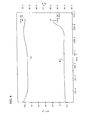
- Figure 4 is a thermal analysis chart of the white powder obtained and shows TG (thermogravimetric analysis) and DTA (differential thermal analysis) curves. As can be seen from Figure 4, a melting point was found to be about 1,300 °C .
- KTMO-a was used to prepare 80 liters of a 2 % aqueous slurry to which 526 g of a 76 % aqueous solution of sulfuric acid was subsequently added. The slurry was stirred for 2 hours and then adjusted to a pH of 7.5. This aqueous slurry was subjected to treatment by a centrifugal separator. The resulting cake (solids) was dispensed, dried at 110 °C for 5 hours and then calcined at 600 °C for 12 hours in an electric furnace.
- the calcined product was cooled gradually and then passed through a 20 mesh screen to obtain a white powder with an arithmetic mean of major and minor diameters of 3 ⁇ m, a mean thickness of 300 nm and a proportion of a major to minor diameter of 1.5.
- the white powder was identified as having a composition of K 0.8 Mg 0.4 Ti 1.6 O 3 ⁇ 8 by fluorescent X-ray analysis using an FP (fundamental parameter) method.
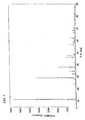
- Figure 1 is an X-ray diffraction chart of the white powder obtained. The diffraction peaks were found to show resemblance to those of KTMO-a shown in Figure 2 and correspond reasonably to those given in ICDD card No. 35-0046. These suggest that, like KTMO-a, KTMO of the present invention most probably has an orthorhombic layer structure.
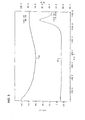
- Figure 3 is a thermal analysis chart of the white powder obtained. As can be seen from Figure 3, a melting point was found to be about 1,375 °C.
- KTMO of the present invention is a compound clearly distinct from KTMO-a prior to being subjected to an acid treatment.
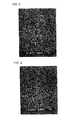
- FIG. 8 A photomicrograph of KTMO when taken using a scanning electron microscope is shown in Figure 8.
- FIG. 9 A photomicrograph of KTMO-a when taken using a scanning electron microscope is shown in Figure 9.
- KTMO K 0.8 Mg 0.4 Ti 1.6 O 3.8
- aramid fibers product name: Kevlar Pulp, a means fiber length of 3 mm
- phenol resin binder
- barium sulfate barium sulfate
- the mixture was preformed at a pressure of 29.4 MPa at an ambient temperature for 1 minute, integrated in a mold at a pressure of 14.7 MPa at a temperature of 170 °C for 5 minutes and heat-treated at 180 °C for subsequent 3 hours.
- the molded product was removed from the mold and polished to fabricate a disc pad A (JIS D 4411 test piece).
- Example 2 The procedure of Example 2 was repeated, except that each of the below-specified fibrous substances (friction control agents) B - E was used in the amount of 30 parts instead of using 30 parts of KTMO and aramid fibers, to fabricate disc pads B - E.
- Fibrous substance B potassium hexatitanate fibers (having a section diameter of 5 - 10 ⁇ m and an aspect ratio of 5)
- Fibrous substance C asbestos fibers (6 Class)
- Fibrous substance D large-size potassium hexatitanate fibers (having a section diameter of 20 - 50 ⁇ m and a length of 100 - 300 ⁇ m)
- Fibrous substance E minute needle-like potassium octatitanate fibers (having a section diameter of 0.2 - 0.5 ⁇ m and a length of 5 - 15 ⁇ m)
- Example 2 The procedure of Example 2 was followed, except that KTMO-a was used in the place of KTMO obtained in Example 1, to fabricate a disc pad F.
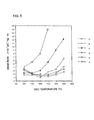
- the disc pad A shows the reduced wearability at a high temperature range, i.e., the superior wear resistance.
- KTMO-a obtained in (1) of Example 1 was used to prepare 80 liters of a 2 % aqueous slurry to which 126 g of a 76 % aqueous solution of sulfuric acid was subsequently added. The slurry was stirred for 2 hours and then ajusted to a pH of 8.5. This aqueous slurry was subjected to treatment by a centrifugal separator. The resulting cake (solids) was dispensed, dried at 110 °C for 5 hours and then calcined at 600 °C for 12 hours in an electric furnace.
- the calcined product was cooled gradually and then passed through a 20 mesh screen to obtain a white powder with an arithmetic mean of major and minor diameters of 3 ⁇ m, a mean thickness of 300 nm and a proportion of a major to minor diameter of 1.5.
- the white powder was identified as having a composition of K 0.7 Mg 0.4 Ti 1.6 O 3.95 by fluorescent X-ray analysis using an FP method. Also, its melting point was found to be about 1,372 °C .
- KTMO-a obtained in (1) of Example 1 was used to prepare 80 liters of a 2 % aqueous slurry to which 189 g of a 76 % aqueous solution of sulfuric acid was subsequently added. The slurry was stirred for 2 hours and then adjusted to a pH of 8.0. This aqueous slurry was subjected to treatment by a centrifugal separator. The resulting cake (solids) was dispensed, dried at 110 °C for 5 hours and then calcined at 600 °C for 12 hours in an electric furnace.
- the calcined product was cooled gradually and then passed through a 20 mesh screen to obtain a white powder with an arithmetic mean of major and minor diameters of 3 m, a mean thickness of 300 nm and a proportion of a major to minor diameter of 1.5.
- the white powder was identified as having a composition of K 0.6 Mg 0.4 Ti 1.6 O 3.9 by fluorescent X-ray analysis using an FP method.
- Figure 10 is a thermal analysis chart of the obtained white powder. As can be seen from Figure 10, its melting point was about 1,375 °C .
- the present invention provides novel lepidocrocite potassium magnesium titanate suitable for use as a friction control agent.
- the friction material of the present invention contains the above lepidocrocite potassium magnesium titanate as a friction control agent and can be suitably used for braking members, e.g., clutch facings and brake linings incorporated in braking devices as of automobiles, aircrafts, railway vehicles and industrial apparatuses.
Landscapes
- Chemical & Material Sciences (AREA)
- Organic Chemistry (AREA)
- General Engineering & Computer Science (AREA)
- Engineering & Computer Science (AREA)
- Geology (AREA)
- Inorganic Chemistry (AREA)
- Life Sciences & Earth Sciences (AREA)
- General Life Sciences & Earth Sciences (AREA)
- Environmental & Geological Engineering (AREA)
- Mechanical Engineering (AREA)
- Inorganic Compounds Of Heavy Metals (AREA)
- Braking Arrangements (AREA)
- Lubricants (AREA)
Abstract
Description
Claims (7)
- Lepidocrocite potassium magnesium titanate having a composition represented by the formula K0.2-0.7Mg0.4Ti1.6O3.7-4.
- The lepidocrocite potassium magnesium titanate as recited in claim 1, characterized as having a composition represented by the formula K0.2-0.5Mg0.4Ti1.6O3.7-4.
- The lepidocrocite potassium magnesium titanate as recited in claim 1 or 2, characterized as having an arithmetic mean of major and minor diameters of 0.1 - 100 µm, a proportion of a major to minor diameter of from 1 to below 5, a mean thickness of 50 - 5,000 nm and a flaky shape.
- A method for manufacturing the lepidocrocite potassium magnesium titanate as recited in any one of claims 1 - 3, characterized as including the steps of adding an acid to an aqueous slurry of lepidocrocite potassium magnesium titanate having a composition represented by the formula K0.8Mg0.4Ti1.6O4 so that the slurry is adjusted to a pH of 6 - 9, separating solids from the slurry and calcining the solids.
- The method for manufacturing the lepidocrocite potassium magnesium titanate as recited in claim 4, characterized in that the slurry is adjusted to a pH of 6.5 - 8.5.
- A friction control agent comprising the lepidocrocite potassium magnesium titanate either recited in any one of claims 1 - 3 or manufactured by the method as recited in claim 4 or 5.
- A friction material characterized as containing 1-80 % by weight of the lepidocrocite potassium magnesium titanate either recited in any one of claims 1 - 3 or manufactured by the method as recited in claim 4 or 5.
Applications Claiming Priority (3)
| Application Number | Priority Date | Filing Date | Title |
|---|---|---|---|
| JP2000231514 | 2000-07-31 | ||
| JP2000231514 | 2000-07-31 | ||
| PCT/JP2001/006492 WO2002010069A1 (en) | 2000-07-31 | 2001-07-27 | Lepidocrosite type potassium magnesium titanate and method for production thereof, and friction material |
Publications (3)
| Publication Number | Publication Date |
|---|---|
| EP1329421A1 true EP1329421A1 (en) | 2003-07-23 |
| EP1329421A4 EP1329421A4 (en) | 2004-12-29 |
| EP1329421B1 EP1329421B1 (en) | 2006-03-01 |
Family
ID=18724342
Family Applications (1)
| Application Number | Title | Priority Date | Filing Date |
|---|---|---|---|
| EP01984411A Expired - Lifetime EP1329421B1 (en) | 2000-07-31 | 2001-07-27 | Lepidocrosite type potassium magnesium titanate and method for production thereof, and friction material |
Country Status (12)
| Country | Link |
|---|---|
| US (1) | US7307047B2 (en) |
| EP (1) | EP1329421B1 (en) |
| JP (1) | JP4673541B2 (en) |
| KR (1) | KR100732278B1 (en) |
| CN (1) | CN1300000C (en) |
| AT (1) | ATE318793T1 (en) |
| BR (1) | BR0112812B1 (en) |
| DE (1) | DE60117599T2 (en) |
| DK (1) | DK1329421T3 (en) |
| ES (1) | ES2259043T3 (en) |
| MX (1) | MXPA03000411A (en) |
| WO (1) | WO2002010069A1 (en) |
Cited By (5)
| Publication number | Priority date | Publication date | Assignee | Title |
|---|---|---|---|---|
| EP2022821A4 (en) * | 2006-05-30 | 2010-08-04 | Otsuka Chemical Co Ltd | GRANULATED FLUID-TITANIC ACID SALTS, METHOD FOR PRODUCING THE SAME, RESIN COMPOSITIONS CONTAINING SAME |
| WO2011116788A1 (en) | 2010-03-25 | 2011-09-29 | Saint Petersburg State University | Layered titanates |
| WO2012169545A1 (en) * | 2011-06-07 | 2012-12-13 | 日立化成工業株式会社 | Non-asbestos friction material composition |
| RU2525238C1 (en) * | 2013-04-09 | 2014-08-10 | Федеральное государственное бюджетное образовательное учреждение высшего профессионального образования "Саратовский государственный аграрный университет имени Н.И. Вавилова" | Lubricant composition |
| EP3130816A1 (en) * | 2015-04-27 | 2017-02-15 | Akebono Brake Industry Co., Ltd. | Friction material composition, friction material and production method thereof |
Families Citing this family (39)
| Publication number | Priority date | Publication date | Assignee | Title |
|---|---|---|---|---|
| JP5051978B2 (en) * | 2005-01-31 | 2012-10-17 | 大塚化学株式会社 | Method for manufacturing titanic acid film coated resin substrate |
| US7708863B2 (en) * | 2005-08-24 | 2010-05-04 | Raytech Composites, Inc. | Process for molding a friction wafer |
| JP4878861B2 (en) * | 2006-02-15 | 2012-02-15 | 三洋電機株式会社 | Non-aqueous electrolyte battery |
| US20070219289A1 (en) * | 2006-03-15 | 2007-09-20 | Federal-Mogul World Wide, Inc. | Friction Material |
| JP5073262B2 (en) * | 2006-10-06 | 2012-11-14 | 株式会社クボタ | Friction material containing composite titanic acid compound and powder thereof |
| JP2008214124A (en) * | 2007-03-02 | 2008-09-18 | Otsuka Chemical Co Ltd | Titanic acid alkali metal salt-stuck titanate, its production method, and resin composition containing titanic acid alkali metal salt-stuck titanate |
| US20090325829A1 (en) * | 2008-06-27 | 2009-12-31 | Cowan Sandra S | Reduced Molybdenum Grease Formulation |
| JP5535669B2 (en) * | 2010-01-28 | 2014-07-02 | 株式会社クボタ | Titanate compound powder and cosmetics |
| JP6042599B2 (en) * | 2011-03-22 | 2016-12-14 | 日清紡ブレーキ株式会社 | Friction material |
| JP5895366B2 (en) * | 2011-06-07 | 2016-03-30 | 日立化成株式会社 | Non-asbestos friction material composition |
| JP5895367B2 (en) * | 2011-06-07 | 2016-03-30 | 日立化成株式会社 | Non-asbestos friction material composition |
| CN102230223B (en) * | 2011-06-16 | 2013-12-18 | 申偲伯 | Method for preparing magnesium potassium titanate by directly utilizing magnesium oxide |
| RU2493104C1 (en) * | 2012-02-03 | 2013-09-20 | Александр Владиленович Гороховский | Potassium titanide powder and based on it lubricating composition |
| JP6211282B2 (en) * | 2013-03-27 | 2017-10-11 | 大塚化学株式会社 | Resin composition, friction material, and production method thereof |
| JP6304984B2 (en) * | 2013-09-17 | 2018-04-04 | 曙ブレーキ工業株式会社 | Friction material |
| JP6084541B2 (en) | 2013-09-30 | 2017-02-22 | 大塚化学株式会社 | Resin composition containing lipidocrocite-type titanate |
| JP2016160299A (en) * | 2015-02-27 | 2016-09-05 | 株式会社アドヴィックス | Non-asbestos friction material |
| CN104894636B (en) * | 2015-04-29 | 2017-10-27 | 华东理工大学 | The preparation method of eight potassium titanate crystal whiskers |
| JP5958623B2 (en) * | 2015-08-13 | 2016-08-02 | 日立化成株式会社 | Non-asbestos friction material composition |
| JP5958624B2 (en) * | 2015-08-13 | 2016-08-02 | 日立化成株式会社 | Non-asbestos friction material composition |
| US10233988B2 (en) | 2015-09-23 | 2019-03-19 | Akebono Brake Industry Co., Ltd | Friction material |
| JP6487055B2 (en) | 2015-09-24 | 2019-03-20 | 大塚化学株式会社 | Porous titanate compound particles and method for producing the same |
| JP6301997B2 (en) * | 2016-04-19 | 2018-03-28 | 日清紡ブレーキ株式会社 | Friction material |
| CN106117965A (en) * | 2016-06-29 | 2016-11-16 | 芜湖德业摩擦材料有限公司 | A kind of high temperature resistant brake |
| CN106367810B (en) * | 2016-09-18 | 2018-09-04 | 唐山晶须复合材料制造有限公司 | The synthetic method of magnesium titanate platelet is synthesized by sheet-shaped material |
| CN106752969A (en) * | 2016-11-22 | 2017-05-31 | 启东市清清蔬果农地股份专业合作社 | A kind of polishing fluid of aluminum alloy casing |
| CN106763358A (en) * | 2016-12-06 | 2017-05-31 | 周潇潇 | A kind of anticorrosive anti-wear brake pad material |
| US11352265B2 (en) | 2016-12-13 | 2022-06-07 | Otsuka Chemical Co., Ltd. | Potassium titanate powder, method for producing same, friction modifier, resin composition, friction material, and friction member |
| CN106830062A (en) * | 2016-12-29 | 2017-06-13 | 江南大学 | A kind of method for preparing sheet magnesium titanate with mixing titanium source |
| CN106979268A (en) * | 2017-06-08 | 2017-07-25 | 海安县东洋通达汽车配件有限公司 | A kind of automobile friction |
| CN107601553B (en) * | 2017-09-12 | 2023-11-10 | 南京工业大学 | Functional potassium magnesium titanate and preparation method thereof |
| CN111276734B (en) * | 2018-12-05 | 2021-10-26 | 新奥科技发展有限公司 | Solid electrolyte conducting potassium ions, preparation method and potassium solid battery |
| CN112032228B (en) * | 2020-09-02 | 2022-05-17 | 浙江铭泰汽车零部件有限公司 | Dry-mixed cold-pressed friction material, brake pad and preparation method of brake pad |
| US20220127158A1 (en) * | 2020-10-23 | 2022-04-28 | Miyoshi America, Inc. | Titanate crystal particle dispersions |
| US20220127157A1 (en) * | 2020-10-23 | 2022-04-28 | Miyoshi America, Inc. | Titanate crystals and surface treated titanate crystals |
| CN113174748B (en) * | 2020-11-09 | 2023-04-28 | 常州泰特耐特新材料科技有限公司 | Potassium magnesium titanate modified coupling aramid fiber and friction material |
| CN116601811A (en) * | 2020-12-04 | 2023-08-15 | 大塚化学株式会社 | Titanate-based solid electrolyte material |
| US20250043841A1 (en) | 2021-12-13 | 2025-02-06 | Otsuka Chemical Co., Ltd. | Friction modifier, friction material composition, friction material, and friction member |
| CN121219239A (en) * | 2023-05-26 | 2025-12-26 | 大塚化学株式会社 | Potassium magnesium titanate, friction modifiers, friction material compositions, friction materials and friction components |
Family Cites Families (4)
| Publication number | Priority date | Publication date | Assignee | Title |
|---|---|---|---|---|
| JPH0327577A (en) * | 1989-06-23 | 1991-02-05 | イーストマン・コダックジャパン株式会社 | light emitting diode array |
| JPH05221795A (en) * | 1992-02-10 | 1993-08-31 | Natl Inst For Res In Inorg Mater | Production of monoclinic plate crystal having layer structure represented by axmyti2-yo4 |
| JPH05229900A (en) * | 1992-02-20 | 1993-09-07 | Natl Inst For Res In Inorg Mater | Process for producing orthorhombic layered titanate plate-like crystals represented by HxMyTi2-yO4.nH2O |
| JP3027577B1 (en) * | 1999-02-09 | 2000-04-04 | 大塚化学株式会社 | Friction material |
-
2001
- 2001-07-27 CN CNB018134602A patent/CN1300000C/en not_active Expired - Lifetime
- 2001-07-27 AT AT01984411T patent/ATE318793T1/en active
- 2001-07-27 DE DE60117599T patent/DE60117599T2/en not_active Expired - Lifetime
- 2001-07-27 ES ES01984411T patent/ES2259043T3/en not_active Expired - Lifetime
- 2001-07-27 JP JP2002516208A patent/JP4673541B2/en not_active Expired - Lifetime
- 2001-07-27 DK DK01984411T patent/DK1329421T3/en active
- 2001-07-27 MX MXPA03000411A patent/MXPA03000411A/en active IP Right Grant
- 2001-07-27 US US10/343,005 patent/US7307047B2/en not_active Expired - Lifetime
- 2001-07-27 WO PCT/JP2001/006492 patent/WO2002010069A1/en not_active Ceased
- 2001-07-27 EP EP01984411A patent/EP1329421B1/en not_active Expired - Lifetime
- 2001-07-27 KR KR1020037001354A patent/KR100732278B1/en not_active Expired - Lifetime
- 2001-07-27 BR BRPI0112812-4A patent/BR0112812B1/en not_active IP Right Cessation
Cited By (6)
| Publication number | Priority date | Publication date | Assignee | Title |
|---|---|---|---|---|
| EP2022821A4 (en) * | 2006-05-30 | 2010-08-04 | Otsuka Chemical Co Ltd | GRANULATED FLUID-TITANIC ACID SALTS, METHOD FOR PRODUCING THE SAME, RESIN COMPOSITIONS CONTAINING SAME |
| WO2011116788A1 (en) | 2010-03-25 | 2011-09-29 | Saint Petersburg State University | Layered titanates |
| WO2012169545A1 (en) * | 2011-06-07 | 2012-12-13 | 日立化成工業株式会社 | Non-asbestos friction material composition |
| RU2525238C1 (en) * | 2013-04-09 | 2014-08-10 | Федеральное государственное бюджетное образовательное учреждение высшего профессионального образования "Саратовский государственный аграрный университет имени Н.И. Вавилова" | Lubricant composition |
| EP3130816A1 (en) * | 2015-04-27 | 2017-02-15 | Akebono Brake Industry Co., Ltd. | Friction material composition, friction material and production method thereof |
| US10323708B2 (en) | 2015-04-27 | 2019-06-18 | Akebono Brake Industry Co., Ltd. | Friction material composition, friction material and production method thereof |
Also Published As
| Publication number | Publication date |
|---|---|
| DE60117599T2 (en) | 2006-11-09 |
| US7307047B2 (en) | 2007-12-11 |
| JP4673541B2 (en) | 2011-04-20 |
| ATE318793T1 (en) | 2006-03-15 |
| ES2259043T3 (en) | 2006-09-16 |
| MXPA03000411A (en) | 2004-11-01 |
| WO2002010069A1 (en) | 2002-02-07 |
| KR20030059083A (en) | 2003-07-07 |
| EP1329421B1 (en) | 2006-03-01 |
| CN1444544A (en) | 2003-09-24 |
| BR0112812A (en) | 2003-07-01 |
| DK1329421T3 (en) | 2006-06-26 |
| KR100732278B1 (en) | 2007-06-25 |
| BR0112812B1 (en) | 2010-11-03 |
| EP1329421A4 (en) | 2004-12-29 |
| DE60117599D1 (en) | 2006-04-27 |
| US20030147804A1 (en) | 2003-08-07 |
| CN1300000C (en) | 2007-02-14 |
Similar Documents
| Publication | Publication Date | Title |
|---|---|---|
| EP1329421B1 (en) | Lepidocrosite type potassium magnesium titanate and method for production thereof, and friction material | |
| EP1440940B1 (en) | Lepidocrocite type lithium potassium titanate, method for preparation thereof, and friction material | |
| EP2130798B1 (en) | Potassium titanate, process for production of the same, friction materials, and resin compositions | |
| EP1170257B1 (en) | Platy potassium titanate, process for producing the same, and friction material | |
| JPWO2002010069A1 (en) | Lepidocrocite-type potassium magnesium titanate, its manufacturing method and friction material | |
| KR101311633B1 (en) | Sodium hexatitanate and method for production thereof | |
| JP4435929B2 (en) | Plate-like potassium titanate, method for producing the same, and friction material | |
| HK1141505B (en) | Sodium hexatitanate and method for production thereof | |
| HK1136262B (en) | Potassium titanate, process for production of the same, friction materials, and resin compositions | |
| HK1070046B (en) | Repidocrocite type lithium potassium titanate, method for preparation thereof, and friction material |
Legal Events
| Date | Code | Title | Description |
|---|---|---|---|
| PUAI | Public reference made under article 153(3) epc to a published international application that has entered the european phase |
Free format text: ORIGINAL CODE: 0009012 |
|
| 17P | Request for examination filed |
Effective date: 20030116 |
|
| AK | Designated contracting states |
Designated state(s): AT BE CH CY DE DK ES FI FR GB GR IE IT LI LU MC NL PT SE TR |
|
| A4 | Supplementary search report drawn up and despatched |
Effective date: 20041116 |
|
| 17Q | First examination report despatched |
Effective date: 20050114 |
|
| GRAP | Despatch of communication of intention to grant a patent |
Free format text: ORIGINAL CODE: EPIDOSNIGR1 |
|
| GRAS | Grant fee paid |
Free format text: ORIGINAL CODE: EPIDOSNIGR3 |
|
| GRAA | (expected) grant |
Free format text: ORIGINAL CODE: 0009210 |
|
| AK | Designated contracting states |
Kind code of ref document: B1 Designated state(s): AT BE CH CY DE DK ES FI FR GB GR IE IT LI LU MC NL PT SE TR |
|
| PG25 | Lapsed in a contracting state [announced via postgrant information from national office to epo] |
Ref country code: FI Free format text: LAPSE BECAUSE OF FAILURE TO SUBMIT A TRANSLATION OF THE DESCRIPTION OR TO PAY THE FEE WITHIN THE PRESCRIBED TIME-LIMIT Effective date: 20060301 Ref country code: NL Free format text: LAPSE BECAUSE OF FAILURE TO SUBMIT A TRANSLATION OF THE DESCRIPTION OR TO PAY THE FEE WITHIN THE PRESCRIBED TIME-LIMIT Effective date: 20060301 |
|
| REG | Reference to a national code |
Ref country code: GB Ref legal event code: FG4D |
|
| REG | Reference to a national code |
Ref country code: CH Ref legal event code: EP |
|
| REG | Reference to a national code |
Ref country code: IE Ref legal event code: FG4D |
|
| REF | Corresponds to: |
Ref document number: 60117599 Country of ref document: DE Date of ref document: 20060427 Kind code of ref document: P |
|
| PG25 | Lapsed in a contracting state [announced via postgrant information from national office to epo] |
Ref country code: SE Free format text: LAPSE BECAUSE OF FAILURE TO SUBMIT A TRANSLATION OF THE DESCRIPTION OR TO PAY THE FEE WITHIN THE PRESCRIBED TIME-LIMIT Effective date: 20060601 |
|
| REG | Reference to a national code |
Ref country code: CH Ref legal event code: NV Representative=s name: A. BRAUN, BRAUN, HERITIER, ESCHMANN AG PATENTANWAE |
|
| REG | Reference to a national code |
Ref country code: DK Ref legal event code: T3 |
|
| PG25 | Lapsed in a contracting state [announced via postgrant information from national office to epo] |
Ref country code: IE Free format text: LAPSE BECAUSE OF NON-PAYMENT OF DUE FEES Effective date: 20060727 |
|
| PG25 | Lapsed in a contracting state [announced via postgrant information from national office to epo] |
Ref country code: MC Free format text: LAPSE BECAUSE OF NON-PAYMENT OF DUE FEES Effective date: 20060731 |
|
| PG25 | Lapsed in a contracting state [announced via postgrant information from national office to epo] |
Ref country code: PT Free format text: LAPSE BECAUSE OF FAILURE TO SUBMIT A TRANSLATION OF THE DESCRIPTION OR TO PAY THE FEE WITHIN THE PRESCRIBED TIME-LIMIT Effective date: 20060801 |
|
| ET | Fr: translation filed | ||
| NLV1 | Nl: lapsed or annulled due to failure to fulfill the requirements of art. 29p and 29m of the patents act | ||
| REG | Reference to a national code |
Ref country code: ES Ref legal event code: FG2A Ref document number: 2259043 Country of ref document: ES Kind code of ref document: T3 |
|
| PLBE | No opposition filed within time limit |
Free format text: ORIGINAL CODE: 0009261 |
|
| STAA | Information on the status of an ep patent application or granted ep patent |
Free format text: STATUS: NO OPPOSITION FILED WITHIN TIME LIMIT |
|
| 26N | No opposition filed |
Effective date: 20061204 |
|
| PG25 | Lapsed in a contracting state [announced via postgrant information from national office to epo] |
Ref country code: GR Free format text: LAPSE BECAUSE OF FAILURE TO SUBMIT A TRANSLATION OF THE DESCRIPTION OR TO PAY THE FEE WITHIN THE PRESCRIBED TIME-LIMIT Effective date: 20060602 |
|
| REG | Reference to a national code |
Ref country code: CH Ref legal event code: PFA Owner name: OTSUKA CHEMICAL COMPANY, LIMITED Free format text: OTSUKA CHEMICAL COMPANY, LIMITED#2-27, OTEDORI 3-CHOME, CHUO-KU#OSAKA-SHI, OSAKA 540-0021 (JP) -TRANSFER TO- OTSUKA CHEMICAL COMPANY, LIMITED#2-27, OTEDORI 3-CHOME, CHUO-KU#OSAKA-SHI, OSAKA 540-0021 (JP) |
|
| PG25 | Lapsed in a contracting state [announced via postgrant information from national office to epo] |
Ref country code: LU Free format text: LAPSE BECAUSE OF NON-PAYMENT OF DUE FEES Effective date: 20060727 Ref country code: TR Free format text: LAPSE BECAUSE OF FAILURE TO SUBMIT A TRANSLATION OF THE DESCRIPTION OR TO PAY THE FEE WITHIN THE PRESCRIBED TIME-LIMIT Effective date: 20060301 |
|
| PG25 | Lapsed in a contracting state [announced via postgrant information from national office to epo] |
Ref country code: CY Free format text: LAPSE BECAUSE OF FAILURE TO SUBMIT A TRANSLATION OF THE DESCRIPTION OR TO PAY THE FEE WITHIN THE PRESCRIBED TIME-LIMIT Effective date: 20060301 |
|
| REG | Reference to a national code |
Ref country code: CH Ref legal event code: PCAR Free format text: NEW ADDRESS: HOLBEINSTRASSE 36-38, 4051 BASEL (CH) |
|
| REG | Reference to a national code |
Ref country code: FR Ref legal event code: PLFP Year of fee payment: 16 |
|
| PGFP | Annual fee paid to national office [announced via postgrant information from national office to epo] |
Ref country code: CH Payment date: 20160726 Year of fee payment: 16 |
|
| PGFP | Annual fee paid to national office [announced via postgrant information from national office to epo] |
Ref country code: AT Payment date: 20160720 Year of fee payment: 16 |
|
| PGFP | Annual fee paid to national office [announced via postgrant information from national office to epo] |
Ref country code: BE Payment date: 20160721 Year of fee payment: 16 |
|
| REG | Reference to a national code |
Ref country code: FR Ref legal event code: PLFP Year of fee payment: 17 |
|
| PGFP | Annual fee paid to national office [announced via postgrant information from national office to epo] |
Ref country code: DK Payment date: 20170724 Year of fee payment: 17 |
|
| REG | Reference to a national code |
Ref country code: CH Ref legal event code: PL |
|
| REG | Reference to a national code |
Ref country code: AT Ref legal event code: MM01 Ref document number: 318793 Country of ref document: AT Kind code of ref document: T Effective date: 20170727 |
|
| PG25 | Lapsed in a contracting state [announced via postgrant information from national office to epo] |
Ref country code: LI Free format text: LAPSE BECAUSE OF NON-PAYMENT OF DUE FEES Effective date: 20170731 Ref country code: CH Free format text: LAPSE BECAUSE OF NON-PAYMENT OF DUE FEES Effective date: 20170731 |
|
| PG25 | Lapsed in a contracting state [announced via postgrant information from national office to epo] |
Ref country code: AT Free format text: LAPSE BECAUSE OF NON-PAYMENT OF DUE FEES Effective date: 20170727 |
|
| REG | Reference to a national code |
Ref country code: BE Ref legal event code: MM Effective date: 20170731 |
|
| REG | Reference to a national code |
Ref country code: FR Ref legal event code: PLFP Year of fee payment: 18 |
|
| PG25 | Lapsed in a contracting state [announced via postgrant information from national office to epo] |
Ref country code: BE Free format text: LAPSE BECAUSE OF NON-PAYMENT OF DUE FEES Effective date: 20170731 |
|
| REG | Reference to a national code |
Ref country code: DK Ref legal event code: EBP Effective date: 20180731 |
|
| PG25 | Lapsed in a contracting state [announced via postgrant information from national office to epo] |
Ref country code: DK Free format text: LAPSE BECAUSE OF NON-PAYMENT OF DUE FEES Effective date: 20180731 |
|
| PGFP | Annual fee paid to national office [announced via postgrant information from national office to epo] |
Ref country code: FR Payment date: 20200611 Year of fee payment: 20 |
|
| PGFP | Annual fee paid to national office [announced via postgrant information from national office to epo] |
Ref country code: DE Payment date: 20200714 Year of fee payment: 20 Ref country code: ES Payment date: 20200803 Year of fee payment: 20 Ref country code: GB Payment date: 20200716 Year of fee payment: 20 |
|
| PGFP | Annual fee paid to national office [announced via postgrant information from national office to epo] |
Ref country code: IT Payment date: 20200610 Year of fee payment: 20 |
|
| REG | Reference to a national code |
Ref country code: DE Ref legal event code: R071 Ref document number: 60117599 Country of ref document: DE |
|
| REG | Reference to a national code |
Ref country code: GB Ref legal event code: PE20 Expiry date: 20210726 |
|
| PG25 | Lapsed in a contracting state [announced via postgrant information from national office to epo] |
Ref country code: GB Free format text: LAPSE BECAUSE OF EXPIRATION OF PROTECTION Effective date: 20210726 |
|
| PG25 | Lapsed in a contracting state [announced via postgrant information from national office to epo] |
Ref country code: ES Free format text: LAPSE BECAUSE OF EXPIRATION OF PROTECTION Effective date: 20210728 |