EP1328797B1 - Usage of a bismuth alloy electrode for voltammetric analysis - Google Patents
Usage of a bismuth alloy electrode for voltammetric analysis Download PDFInfo
- Publication number
- EP1328797B1 EP1328797B1 EP01975045A EP01975045A EP1328797B1 EP 1328797 B1 EP1328797 B1 EP 1328797B1 EP 01975045 A EP01975045 A EP 01975045A EP 01975045 A EP01975045 A EP 01975045A EP 1328797 B1 EP1328797 B1 EP 1328797B1
- Authority
- EP
- European Patent Office
- Prior art keywords
- electrode
- hydrogen
- metal
- alloy
- zinc
- Prior art date
- Legal status (The legal status is an assumption and is not a legal conclusion. Google has not performed a legal analysis and makes no representation as to the accuracy of the status listed.)
- Expired - Lifetime
Links
- 238000004458 analytical method Methods 0.000 title claims abstract description 11
- 229910001152 Bi alloy Inorganic materials 0.000 title description 3
- 229910052739 hydrogen Inorganic materials 0.000 claims abstract description 31
- 239000001257 hydrogen Substances 0.000 claims abstract description 31
- UFHFLCQGNIYNRP-UHFFFAOYSA-N Hydrogen Chemical compound [H][H] UFHFLCQGNIYNRP-UHFFFAOYSA-N 0.000 claims abstract description 26
- 229910052751 metal Inorganic materials 0.000 claims abstract description 24
- 239000002184 metal Substances 0.000 claims abstract description 24
- 229910045601 alloy Inorganic materials 0.000 claims abstract description 14
- 239000000956 alloy Substances 0.000 claims abstract description 14
- 239000007787 solid Substances 0.000 claims abstract description 3
- BQCADISMDOOEFD-UHFFFAOYSA-N Silver Chemical compound [Ag] BQCADISMDOOEFD-UHFFFAOYSA-N 0.000 claims description 26
- 229910052709 silver Inorganic materials 0.000 claims description 26
- 239000004332 silver Substances 0.000 claims description 26
- 229910052797 bismuth Inorganic materials 0.000 claims description 14
- JCXGWMGPZLAOME-UHFFFAOYSA-N bismuth atom Chemical compound [Bi] JCXGWMGPZLAOME-UHFFFAOYSA-N 0.000 claims description 14
- 238000003943 differential pulse anodic stripping voltammetry Methods 0.000 claims description 8
- BASFCYQUMIYNBI-UHFFFAOYSA-N platinum Chemical compound [Pt] BASFCYQUMIYNBI-UHFFFAOYSA-N 0.000 claims description 7
- PCHJSUWPFVWCPO-UHFFFAOYSA-N gold Chemical compound [Au] PCHJSUWPFVWCPO-UHFFFAOYSA-N 0.000 claims description 3
- 229910052737 gold Inorganic materials 0.000 claims description 3
- 239000010931 gold Substances 0.000 claims description 3
- 229910052697 platinum Inorganic materials 0.000 claims description 3
- 238000001514 detection method Methods 0.000 abstract description 13
- 150000001875 compounds Chemical class 0.000 abstract description 12
- 238000000034 method Methods 0.000 abstract description 10
- 238000004832 voltammetry Methods 0.000 abstract description 8
- 239000000203 mixture Substances 0.000 abstract description 5
- 231100000252 nontoxic Toxicity 0.000 abstract description 5
- 230000003000 nontoxic effect Effects 0.000 abstract description 5
- 238000006479 redox reaction Methods 0.000 abstract 1
- HCHKCACWOHOZIP-UHFFFAOYSA-N Zinc Chemical compound [Zn] HCHKCACWOHOZIP-UHFFFAOYSA-N 0.000 description 25
- 229910052725 zinc Inorganic materials 0.000 description 25
- 239000011701 zinc Substances 0.000 description 25
- QSHDDOUJBYECFT-UHFFFAOYSA-N mercury Chemical compound [Hg] QSHDDOUJBYECFT-UHFFFAOYSA-N 0.000 description 16
- 229910052753 mercury Inorganic materials 0.000 description 16
- 150000002739 metals Chemical class 0.000 description 8
- 229910052793 cadmium Inorganic materials 0.000 description 7
- BDOSMKKIYDKNTQ-UHFFFAOYSA-N cadmium atom Chemical compound [Cd] BDOSMKKIYDKNTQ-UHFFFAOYSA-N 0.000 description 7
- 230000008021 deposition Effects 0.000 description 7
- YEXPOXQUZXUXJW-UHFFFAOYSA-N oxolead Chemical compound [Pb]=O YEXPOXQUZXUXJW-UHFFFAOYSA-N 0.000 description 7
- 239000007772 electrode material Substances 0.000 description 6
- 239000000243 solution Substances 0.000 description 6
- PXHVJJICTQNCMI-UHFFFAOYSA-N Nickel Chemical compound [Ni] PXHVJJICTQNCMI-UHFFFAOYSA-N 0.000 description 4
- 230000015572 biosynthetic process Effects 0.000 description 4
- 150000002431 hydrogen Chemical class 0.000 description 4
- 238000002474 experimental method Methods 0.000 description 3
- 229910000765 intermetallic Inorganic materials 0.000 description 3
- 229910001092 metal group alloy Inorganic materials 0.000 description 3
- 239000010453 quartz Substances 0.000 description 3
- VYPSYNLAJGMNEJ-UHFFFAOYSA-N silicon dioxide Inorganic materials O=[Si]=O VYPSYNLAJGMNEJ-UHFFFAOYSA-N 0.000 description 3
- 238000001179 sorption measurement Methods 0.000 description 3
- 229910000497 Amalgam Inorganic materials 0.000 description 2
- XEEYBQQBJWHFJM-UHFFFAOYSA-N Iron Chemical compound [Fe] XEEYBQQBJWHFJM-UHFFFAOYSA-N 0.000 description 2
- 229910021607 Silver chloride Inorganic materials 0.000 description 2
- 239000002775 capsule Substances 0.000 description 2
- 238000006243 chemical reaction Methods 0.000 description 2
- 229910017052 cobalt Inorganic materials 0.000 description 2
- 239000010941 cobalt Substances 0.000 description 2
- GUTLYIVDDKVIGB-UHFFFAOYSA-N cobalt atom Chemical compound [Co] GUTLYIVDDKVIGB-UHFFFAOYSA-N 0.000 description 2
- 238000011161 development Methods 0.000 description 2
- 239000007788 liquid Substances 0.000 description 2
- 229910052759 nickel Inorganic materials 0.000 description 2
- 239000012086 standard solution Substances 0.000 description 2
- 229910001316 Ag alloy Inorganic materials 0.000 description 1
- 229910001312 Amalgam (dentistry) Inorganic materials 0.000 description 1
- OKTJSMMVPCPJKN-UHFFFAOYSA-N Carbon Chemical compound [C] OKTJSMMVPCPJKN-UHFFFAOYSA-N 0.000 description 1
- 229910000645 Hg alloy Inorganic materials 0.000 description 1
- ZOKXTWBITQBERF-UHFFFAOYSA-N Molybdenum Chemical compound [Mo] ZOKXTWBITQBERF-UHFFFAOYSA-N 0.000 description 1
- WCUXLLCKKVVCTQ-UHFFFAOYSA-M Potassium chloride Chemical class [Cl-].[K+] WCUXLLCKKVVCTQ-UHFFFAOYSA-M 0.000 description 1
- ZOKDWBDDYVCACM-UHFFFAOYSA-N bismuth platinum Chemical compound [Pt].[Bi] ZOKDWBDDYVCACM-UHFFFAOYSA-N 0.000 description 1
- 239000012267 brine Substances 0.000 description 1
- 239000003153 chemical reaction reagent Substances 0.000 description 1
- 239000002131 composite material Substances 0.000 description 1
- 239000000448 dental amalgam Substances 0.000 description 1
- 230000000694 effects Effects 0.000 description 1
- 238000005868 electrolysis reaction Methods 0.000 description 1
- 239000003344 environmental pollutant Substances 0.000 description 1
- 229910021397 glassy carbon Inorganic materials 0.000 description 1
- 229910002804 graphite Inorganic materials 0.000 description 1
- 239000010439 graphite Substances 0.000 description 1
- 239000003673 groundwater Substances 0.000 description 1
- 229910001385 heavy metal Inorganic materials 0.000 description 1
- 229910052741 iridium Inorganic materials 0.000 description 1
- GKOZUEZYRPOHIO-UHFFFAOYSA-N iridium atom Chemical compound [Ir] GKOZUEZYRPOHIO-UHFFFAOYSA-N 0.000 description 1
- 229910052742 iron Inorganic materials 0.000 description 1
- 229910000464 lead oxide Inorganic materials 0.000 description 1
- 238000012423 maintenance Methods 0.000 description 1
- 239000000463 material Substances 0.000 description 1
- 230000007246 mechanism Effects 0.000 description 1
- 239000012528 membrane Substances 0.000 description 1
- 229910052750 molybdenum Inorganic materials 0.000 description 1
- 239000011733 molybdenum Substances 0.000 description 1
- 229910000510 noble metal Inorganic materials 0.000 description 1
- 238000003969 polarography Methods 0.000 description 1
- 231100000719 pollutant Toxicity 0.000 description 1
- 238000009790 rate-determining step (RDS) Methods 0.000 description 1
- 238000011536 re-plating Methods 0.000 description 1
- 229910052702 rhenium Inorganic materials 0.000 description 1
- WUAPFZMCVAUBPE-UHFFFAOYSA-N rhenium atom Chemical compound [Re] WUAPFZMCVAUBPE-UHFFFAOYSA-N 0.000 description 1
- 229910052703 rhodium Inorganic materials 0.000 description 1
- 239000010948 rhodium Substances 0.000 description 1
- MHOVAHRLVXNVSD-UHFFFAOYSA-N rhodium atom Chemical compound [Rh] MHOVAHRLVXNVSD-UHFFFAOYSA-N 0.000 description 1
- 229920006395 saturated elastomer Polymers 0.000 description 1
- HKZLPVFGJNLROG-UHFFFAOYSA-M silver monochloride Chemical compound [Cl-].[Ag+] HKZLPVFGJNLROG-UHFFFAOYSA-M 0.000 description 1
- HPALAKNZSZLMCH-UHFFFAOYSA-M sodium;chloride;hydrate Chemical compound O.[Na+].[Cl-] HPALAKNZSZLMCH-UHFFFAOYSA-M 0.000 description 1
- 239000002689 soil Substances 0.000 description 1
- 238000012360 testing method Methods 0.000 description 1
- 229910052716 thallium Inorganic materials 0.000 description 1
- BKVIYDNLLOSFOA-UHFFFAOYSA-N thallium Chemical compound [Tl] BKVIYDNLLOSFOA-UHFFFAOYSA-N 0.000 description 1
- 231100000419 toxicity Toxicity 0.000 description 1
- 230000001988 toxicity Effects 0.000 description 1
- WFKWXMTUELFFGS-UHFFFAOYSA-N tungsten Chemical compound [W] WFKWXMTUELFFGS-UHFFFAOYSA-N 0.000 description 1
- 229910052721 tungsten Inorganic materials 0.000 description 1
- 239000010937 tungsten Substances 0.000 description 1
- 238000001075 voltammogram Methods 0.000 description 1
- XLYOFNOQVPJJNP-UHFFFAOYSA-N water Chemical compound O XLYOFNOQVPJJNP-UHFFFAOYSA-N 0.000 description 1
Images



Classifications
-
- G—PHYSICS
- G01—MEASURING; TESTING
- G01N—INVESTIGATING OR ANALYSING MATERIALS BY DETERMINING THEIR CHEMICAL OR PHYSICAL PROPERTIES
- G01N27/00—Investigating or analysing materials by the use of electric, electrochemical, or magnetic means
- G01N27/26—Investigating or analysing materials by the use of electric, electrochemical, or magnetic means by investigating electrochemical variables; by using electrolysis or electrophoresis
- G01N27/416—Systems
- G01N27/48—Systems using polarography, i.e. measuring changes in current under a slowly-varying voltage
Definitions
- the present invention relates to the use of an electrode according to claim 1.
- Liquid mercury and liquid diluted mercury amalgams have been the major electrode systems employed in voltammetry and related methods. This is mainly due to their high overvoltage to hydrogen, which enables the determination of heavy metals (zinc, nickel and cobalt etc.) and other species with high negative half wave potentials.
- Mercury has been, since the development of polarography, the most used electrode material in voltammetric techniques 1 . The main reason for this is that a new fresh electrode surface is formed for each mercury droplet. Mercury has however, the added advantages that it has a high overvoltage towards hydrogen and that the formation of diluted amalgams prevents the formation of intermetallic compounds in many cases.
- the present authors have recently invented a method to substitute mercury with dental amalgam and related solid compounds 10,16 in electrode systems. It has been found that such systems have a very high overvoltage to hydrogen, allowing for trace analyses at potentials sufficiently negative to allow determination of e.g. zinc, cobalt, nickel and iron at trace levels. This has not previously been possible except through use of mercury, or mercury film electrodes. Such determinations are very important for field and online analyses of pollutants in soil and groundwater, and the electrode may be used repeatedly.
- the present invention has been conceived to provide a solution to the problems with prior art electrodes as described above.
- the pure metal is metallic silver, gold or platinum with too low overvoltage for hydrogen to be used alone for a certain analytical purpose.
- Bismuth is used as the second metal with the effect of increasing the resulting overvoltage for hydrogen.
- the alloy comprises less than 10% of the second metal or compound. In a preferred embodiment of the invention the alloy comprises about 4% of the second metal or compound.
- the electrode is may be used as a measuring electrode in differential pulse anodic stripping voltammetry.
- Electrode materials with a metal or a compound with low hydrogen over-voltage change their hydrogen overvoltage properties substantially when contaminated with even small amounts of metals or compounds possessing high hydrogen overvoltage. This extends greatly the range of potentially available electrode systems and thereby analytical possibilities of voltammetry.
- the counter electrode may also be made from a composite compound in order to act as a reservoir for the re-plating of the electrode surface. In this way a new electrode surface may be generated prior to each scan. Such results have also been demonstrated in previous work using pure silver electrodes 13 .
- the electrodes were prepared by simply mixing powdered samples of the given in a mixing capsule. The capsule was subsequently installed in a mixer and mixed for 30 seconds. The alloy was than transferred to a quartz tube (internal diameter 4 mm) which was then evacuated and sealed. The sealed quartz tube was then transferred to an oven preheated to 1000 °C, where the metal alloy was melted and kept for 2 min. The alloy was thereafter allowed to cool down and solidify. The quartz tube was subsequently crushed, and the final metal alloy cylinder retrieved and sealed inside an inert plastic membrane in such a way that only a small surface was exposed.
- the electrode end was cleanly cut and polished once using a fine soften sandpaper, and washed in water purified by Millipore Elix and then with Millipore Milli-Q Gradient system (Millipore Corporation, SA 67120 Molsheim France). The electrode is shown in Fig. 1 .
- the custom voltammetric equipment was constructed in our laboratories. This comprises a digital device capable of performing all modes of voltammetry. This equipment has been described previously 14 . All reagents were of analytical grade.
- the working alloy electrodes were polished prior to the experiments and then used without any maintenance during the experiment over a period of ca one week.
- DPASV differential pulse anodic stripping voltammetry
- This section is divided into three parts.
- the first part shows results obtained using an electrode with an alloy composed of silver (96 %) and bismuth (4%).
- the second part summarises results from a mixture of silver (96 %) and lead(II) oxide (4%), and the third part gives the result from an alloy containing silver (96 %) and mercury (4%).
- Fig. 2 shows a typical plot of a blank NH 4 Ac (0.05 M) solution.
- a sweep is performed from -1200 mV to -200 mV with a silver electrode contaminated with 4% bismuth. Insert as a small picture up in the left corner a typical plot of a pure silver electrode.
- the scan was performed in DPASV mode in NH 4 Ac (0.05 M), with a scan rate of 15 mV / s, and pulse height 70 mV.
- a pure silver electrode may normally be used down to about -750 mV, before the current increases dramatically due to the hydrogen formation, as shown in the small frame up in the left corner in Fig. 2 .
- Some analyses were performed to detect zinc on this type of electrode. Three different concentrations were detected by the standard addition method.
- Zinc standard solution 50 mg l -1 , 400 ⁇ l
- NH 4 Ac 0.05 M, 75 ml
- a voltammetric scan was run after each addition. The peak heights for zinc were measured and corrected for offset, and presented in Fig. 3 .
- Fig.3 In Fig.3 detection of zinc on silver with 4 % bismuth alloy electrode is shown. Concentrations were 267, 534 and 800 ⁇ g l -1 . All scans were performed in DPASV mode in NH 4 Ac (0.05 M), with a scan rate of 15 mV / s, pulse height 70 mV and a deposition time of two minutes. Current values were corrected for offset. As a small frame up in the right corner in Fig.3 , is shown detection of zinc on the silver electrode with 4% bismuth, but as current ( ⁇ A) as a function of potential (mV).
- Fig. 4 shows a typical plot of a blank NH 4 Ac (0.05 M) solution and corresponding when zinc was added. As shown there is a high hydrogen over-voltage also on this electrode, as for the silver electrode containing 4 % bismuth described in section 3.1.
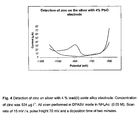
- detection of zinc on silver with 4 % lead(II) oxide alloy electrode is shown as a plot of current ( ⁇ A) as a function of potential (mV). The concentration of zinc was 534 ⁇ g l -1 . All scans were performed in DPASV mode in NH 4 Ac (0.05 M), with a scan rate of 15 mV / s, pulse height 70 mV and a deposition time of two minutes.
- Fig. 5 shows the result from zinc detection on this type of electrode.
- Zinc standard solution 50 mg l -1 , 150 ⁇ l
- NH 4 Ac 0.05 M, 75 ml
- a voltammetric scan was run after each addition.
- Fig.5 detection of zinc on silver with 4 % mercury alloy electrode is shown as a plot of current ( ⁇ A) as a function of concentration (ppb).
- the concentration of zinc was 100, 200, 300 and 400 ⁇ g l -1 .
- a detection of cadmium (200 ppb) was performed in a NH 4 Ac (0.05 M) solution containing zinc (400 ppb), and are shown in Fig. 6 .
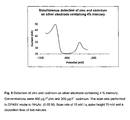
- Fig.6 detection of zinc and cadmium on silver electrode containing 4 % mercury is shown as a plot of the resulting current ( ⁇ A) as a function of potential (mV). Concentrations were 400 ⁇ g l -1 zinc and 200 ⁇ g l -1 cadmium.
- the scan was performed in DPASV mode in NH 4 Ac (0.05 M), with a scan rate of 15 mV / s, pulse height 70 mV and a deposition time of two minutes. The addition of cadmium had only an insignificant influence on the peak height for zinc.
- Electrodes comprising a metal or a compound with low hydrogen overvoltage change their hydrogen over-voltage properties substantially when contaminated with even small amounts of metals or compounds which show high hydrogen overvoltage. This extends greatly the range of potentially available non-toxic electrode systems and thereby analytical possibilities of voltammetry and related methods, also for online use in the field.
- the counter electrode in a three-electrode system may be prepared with the same composition as the working electrode. Then a new film may be plated prior to each new scan with material from the counter electrode. With that a new working electrode surface may be generated continuously.
- the specific composition of an electrode may be prepared in such a way that it is optimal for some metals, particular considering the possibility to prevent intermetallic compounds.
Landscapes
- Chemical & Material Sciences (AREA)
- Life Sciences & Earth Sciences (AREA)
- Health & Medical Sciences (AREA)
- General Physics & Mathematics (AREA)
- Pathology (AREA)
- Electrochemistry (AREA)
- Physics & Mathematics (AREA)
- Analytical Chemistry (AREA)
- Biochemistry (AREA)
- General Health & Medical Sciences (AREA)
- Molecular Biology (AREA)
- Immunology (AREA)
- Chemical Kinetics & Catalysis (AREA)
- Electrolytic Production Of Metals (AREA)
- Investigating, Analyzing Materials By Fluorescence Or Luminescence (AREA)
- Investigating Or Analyzing Non-Biological Materials By The Use Of Chemical Means (AREA)
- Electrodes For Compound Or Non-Metal Manufacture (AREA)
- Battery Electrode And Active Subsutance (AREA)
- Inert Electrodes (AREA)
- Other Investigation Or Analysis Of Materials By Electrical Means (AREA)
Abstract
Description
- The present invention relates to the use of an electrode according to
claim 1. - Liquid mercury and liquid diluted mercury amalgams have been the major electrode systems employed in voltammetry and related methods. This is mainly due to their high overvoltage to hydrogen, which enables the determination of heavy metals (zinc, nickel and cobalt etc.) and other species with high negative half wave potentials.
- Mercury has been, since the development of polarography, the most used electrode material in voltammetric techniques1. The main reason for this is that a new fresh electrode surface is formed for each mercury droplet. Mercury has however, the added advantages that it has a high overvoltage towards hydrogen and that the formation of diluted amalgams prevents the formation of intermetallic compounds in many cases.
- Due to the toxicity of mercury, its use is now restricted and may be prohibited, even for analytical purposes. It is necessary therefore, to develop new electrode materials to meet the need for a non-toxic electrode material in voltammetry.
- Numerous papers dealing with alternative electrodes and techniques have been published recently. Among these the glassy carbon electrode2, graphite electrode3-5, gold electrode6, silver electrode7,8, bismuth electrode9 and platinum-bismuth alloy coated electrodes used in brine electrolysis are important contributions. But, except from the bismuth electrode, there is a main drawback for these types of electrodes; their use is limited below -800 mV, restricted by the lack of hydrogen overvoltage.
- The present authors have recently invented a method to substitute mercury with dental amalgam and related solid compounds10,16 in electrode systems. It has been found that such systems have a very high overvoltage to hydrogen, allowing for trace analyses at potentials sufficiently negative to allow determination of e.g. zinc, cobalt, nickel and iron at trace levels. This has not previously been possible except through use of mercury, or mercury film electrodes. Such determinations are very important for field and online analyses of pollutants in soil and groundwater, and the electrode may be used repeatedly.
- The phenomena governing hydrogen overvoltage have their foundation in those mechanisms by which the hydrogen evolution reaction occurs for a given metal. Important factors are the steps in the evolution of hydrogen, the energy of the metal-hydrogen bond, the dependence of the surface coverage by hydrogen on the over potential, the double-layer structure, and the pre- exponential factors of the kinetic equation for the slow stage of the process11. The way by which the electrode material or the electrode-surface affects these factors is not properly known. Some important trends are however identified:
- For metals such as lead, mercury, thallium, cadmium, bismuth etc, which possess high hydrogen overvoltage, an increase in the exchange current density is found with increased hydrogen adsorption energy. This means that the current density at the equilibrium potential increases for these metals, with increased strength of the bond of hydrogen to metal. Accordingly a low coverage with hydrogen is found at their surface and the rate-determining step must be the proton discharge reaction.
- For metals such as platinum, rhenium, rhodium, tungsten, iridium, molybdenum, etc. high values of hydrogen-adsorption energy is observed and a decrease in the exchange current density is found with an increase in the hydrogen adsorption energy, and high hydrogen coverage12.
- The present invention has been conceived to provide a solution to the problems with prior art electrodes as described above.
- In accordance with a first aspect of the invention there is provided the use of an electrode according to
claim 1. - The pure metal is metallic silver, gold or platinum with too low overvoltage for hydrogen to be used alone for a certain analytical purpose. Bismuth is used as the second metal with the effect of increasing the resulting overvoltage for hydrogen.
- The alloy comprises less than 10% of the second metal or compound. In a preferred embodiment of the invention the alloy comprises about 4% of the second metal or compound.
- The electrode is may be used as a measuring electrode in differential pulse anodic stripping voltammetry.
- Electrode materials with a metal or a compound with low hydrogen over-voltage change their hydrogen overvoltage properties substantially when contaminated with even small amounts of metals or compounds possessing high hydrogen overvoltage. This extends greatly the range of potentially available electrode systems and thereby analytical possibilities of voltammetry.
- The voltammetric behaviour of some non-toxic electrodes that have been contaminated with small amounts of metals or compounds possessing high hydrogen overvoltage was investigated. It was found that these electrodes increase their hydrogen overvoltage dramatically. This means, for instance, that the noble metals may be given a high hydrogen overvoltage. This allows for new opportunities in voltammetry and related methods. Not only as a large number of different undoubtedly non-toxic electrode metals and electrode compounds may be available, but such systems also allow for the development of customise electrodes for specific analyses.
- The counter electrode may also be made from a composite compound in order to act as a reservoir for the re-plating of the electrode surface. In this way a new electrode surface may be generated prior to each scan. Such results have also been demonstrated in previous work using pure silver electrodes13.
- The invention is stated in the appended claims.
- Embodiments of the invention will now be described in the following with reference to the accompanying drawings, where
-
Figure 1 shows a cross section of a metal alloy electrode according to an embodiment of the invention, -
Figure 2 is a plot of a sweep from -1200mV to -200mV with a silver electrode contaminated with 4% bismuth according to an embodiment of the invention, -
Figure 3 is a plot showing detection of zinc on the electrode infigure 2 , -
Figure 4 is a plot showing detection of zinc on a silver electrode contaminated with 4% lead(II) oxide according to an embodiment not part of the invention, -
Figure 5 is a plot showing detection of zinc using a silver electrode contaminated with 4% mercury according to an embodiment not part of the invention, and -
Figure 6 is a plot showing simultaneous detection of zinc and cadmium on the electrode infigure 5 . - Three distinct silver-based electrodes were produced in connection with this preliminary paper. These were contaminated with four percent bismuth, four percent lead oxide and four percent mercury, respectively (all by weight). The electrodes were prepared by simply mixing powdered samples of the given in a mixing capsule. The capsule was subsequently installed in a mixer and mixed for 30 seconds. The alloy was than transferred to a quartz tube (
internal diameter 4 mm) which was then evacuated and sealed. The sealed quartz tube was then transferred to an oven preheated to 1000 °C, where the metal alloy was melted and kept for 2 min. The alloy was thereafter allowed to cool down and solidify. The quartz tube was subsequently crushed, and the final metal alloy cylinder retrieved and sealed inside an inert plastic membrane in such a way that only a small surface was exposed. Finally, the electrode end was cleanly cut and polished once using a fine soften sandpaper, and washed in water purified by Millipore Elix and then with Millipore Milli-Q Gradient system (Millipore Corporation, SA 67120 Molsheim France). The electrode is shown inFig. 1 . - All experiments were performed in NH4Ac (0.05 M, pH 6). A three-electrode system where the potential was measured vs. a silver/silver chloride/saturated silver chloride/saturated potassium chloride reference electrode was used. The counter electrode in these preliminary tests was a platinum wire, however a counter electrode with same alloy composition as the working electrode may also be used.
- The custom voltammetric equipment was constructed in our laboratories. This comprises a digital device capable of performing all modes of voltammetry. This equipment has been described previously14. All reagents were of analytical grade.
- The working alloy electrodes were polished prior to the experiments and then used without any maintenance during the experiment over a period of ca one week.
- All of the analyses reported in this preliminary paper were performed as differential pulse anodic stripping voltammetry (DPASV), with a scan rate of 15 mV / s, pulse height 70 mV and a deposition time of two minutes.
- This section is divided into three parts. The first part shows results obtained using an electrode with an alloy composed of silver (96 %) and bismuth (4%). The second part summarises results from a mixture of silver (96 %) and lead(II) oxide (4%), and the third part gives the result from an alloy containing silver (96 %) and mercury (4%).
- The voltammetric scan was performed as described in
section 2. Both deposition and start potential was -1200 mV.Fig. 2 shows a typical plot of a blank NH4Ac (0.05 M) solution. InFig.2 a sweep is performed from -1200 mV to -200 mV with a silver electrode contaminated with 4% bismuth. Insert as a small picture up in the left corner a typical plot of a pure silver electrode. The scan was performed in DPASV mode in NH4Ac (0.05 M), with a scan rate of 15 mV / s, and pulse height 70 mV. - A pure silver electrode may normally be used down to about -750 mV, before the current increases dramatically due to the hydrogen formation, as shown in the small frame up in the left corner in
Fig. 2 . There is no doubt that the addition of small amount of bismuth gives the silver alloy electrode a high over potential. Some analyses were performed to detect zinc on this type of electrode. Three different concentrations were detected by the standard addition method. Zinc standard solution (50 mg l-1, 400 µl) was added to NH4Ac (0.05 M, 75 ml) solution in three sequential steps giving zinc concentrations of 267, 534 and 800 µg l-1. A voltammetric scan was run after each addition. The peak heights for zinc were measured and corrected for offset, and presented inFig. 3 . InFig.3 detection of zinc on silver with 4 % bismuth alloy electrode is shown. Concentrations were 267, 534 and 800 µg l-1. All scans were performed in DPASV mode in NH4Ac (0.05 M), with a scan rate of 15 mV / s, pulse height 70 mV and a deposition time of two minutes. Current values were corrected for offset. As a small frame up in the right corner inFig.3 , is shown detection of zinc on the silver electrode with 4% bismuth, but as current (µA) as a function of potential (mV). - The voltammetric scan was performed as described in
section 2. Both deposition and start potential was -1200 mV.Fig. 4 shows a typical plot of a blank NH4Ac (0.05 M) solution and corresponding when zinc was added. As shown there is a high hydrogen over-voltage also on this electrode, as for the silver electrode containing 4 % bismuth described in section 3.1. InFig. 4 , detection of zinc on silver with 4 % lead(II) oxide alloy electrode is shown as a plot of current (µA) as a function of potential (mV). The concentration of zinc was 534 µg l-1. All scans were performed in DPASV mode in NH4Ac (0.05 M), with a scan rate of 15 mV / s, pulse height 70 mV and a deposition time of two minutes. - When the zinc concentration exceeded 500 ppb, a change in the voltammogram was detected around -1100 mV. This change may represent the formation of intermetallic compound. This phenomenon was not observed on the silver electrode with bismuth in section 3.1.
- Detection of cadmium was also impossible on this electrode because of the huge current level raising from ca. -600 mV, due to the grate amount of lead inside the electrode.
- Analyses as in section 3.1 and 3.2 were performed for a silver electrode containing ca. four percent mercury.
Fig. 5 below shows the result from zinc detection on this type of electrode. Four different concentrations were detected by the standard addition method. Zinc standard solution (50 mg l-1, 150 µl) was added to NH4Ac (0.05 M, 75 ml) solution in three sequential steps giving zinc concentrations of 100, 200, 300 and 400 µg l-1. A voltammetric scan was run after each addition. InFig.5 detection of zinc on silver with 4 % mercury alloy electrode is shown as a plot of current (µA) as a function of concentration (ppb). The concentration of zinc was 100, 200, 300 and 400 µg l-1. All scans were performed in DPASV mode in NH4Ac (0.05 M), with a scan rate of 15 mV / s, pulse height 70 mV and a deposition time of two minutes. As a small frame to the right is shown a plot of current (µA) vs. potential (mV) for the main plot inFig.5 . - A high degree of linearity was registered. This is indicated by the relative high R2 (R2 = 0,9724) coefficient between the experimental data end the applied linear fit in each case.
- Also a detection of cadmium (200 ppb) was performed in a NH4Ac (0.05 M) solution containing zinc (400 ppb), and are shown in
Fig. 6 . InFig.6 detection of zinc and cadmium on silver electrode containing 4 % mercury is shown as a plot of the resulting current (µA) as a function of potential (mV). Concentrations were 400 µg l-1 zinc and 200 µg l-1 cadmium. The scan was performed in DPASV mode in NH4Ac (0.05 M), with a scan rate of 15 mV / s, pulse height 70 mV and a deposition time of two minutes. The addition of cadmium had only an insignificant influence on the peak height for zinc. - Results in this present paper shows that electrode materials comprising a metal or a compound with low hydrogen overvoltage change their hydrogen over-voltage properties substantially when contaminated with even small amounts of metals or compounds which show high hydrogen overvoltage. This extends greatly the range of potentially available non-toxic electrode systems and thereby analytical possibilities of voltammetry and related methods, also for online use in the field.
- A very important point is that the counter electrode in a three-electrode system may be prepared with the same composition as the working electrode. Then a new film may be plated prior to each new scan with material from the counter electrode. With that a new working electrode surface may be generated continuously.
- The specific composition of an electrode may be prepared in such a way that it is optimal for some metals, particular considering the possibility to prevent intermetallic compounds.
- Having described preferred embodiments of the invention it will be apparent to those skilled in the art that other embodiments incorporating the concepts may be used. These and other examples of the invention illustrated above are intended by way of example only and the actual scope of the invention is to be determined from the following claims.
-
- 1 Douglas A. Skoog, Donald M. West, FA. James Holler, Fundamentals of Analytical Chemistry, 7th Ed., Harcourt Brace Jovanovich Ltd. Fort Worth, 1996.
- 2 E Fischer, CMG vandenBerg, Analytica Chimica Acta, 1999, 385, 1-3, 273.
- 3 CA Borgo, RT Ferrari, LMS Colpini, CMM Costa, ML Baesso, AC Bento, Analytica Chimica Acta, 1999, 385, 1-3, 103.
- 4 M Korolczuk, Fresenius Journal of Analytical Chemistry, 1997, 357, 4, 389.
- 5 M Fujimoto, Y Kida, T Nohma, M Takahashi, K Nishio, T Saito, Journal of Power Sources, 1996, 63, 1, 127.
- 6 Y Bonfil, M Brand, E KirowaEisner, Analytica Chimica Acta, 1999, 387, 1, 85.
- 7 O Cavalleri, AM Bittner, H Kind, K Kern, Zeitschrift Fur Physikalische Chemie - International Journal of Research in Physical Chemishy & Chemical Physics, 1999, 208, 1-2, 107.
- 8 Øyvind Mikkelsen, Knut H Schrøder, Electroanalysis, 2000, In press.
- 9 J Wang, JM Lu, SB Hocevar, PAM Farias, B Ogorevc, Analytical Chemistry, 2000, 72, 14, 3218-3222.
- 10 Mikkelsen, Øyvind and Schrøder, Knut H., Analytical Letters, 2000, 33, (15), 3253-3269.
- 11 D. R. Crow, Principles and applications of electrochemistry, Blackie Academic & Professional, 4. Ed, 1994.
- 12 Andrzej Wieckowski, Interfacial electrochemistry, theory, experiments, and applications, Marcel Dekker, Inc., Basel, Switzerland, 1999.
- 13 Mikkelsen, Øyvind and Schrøder, Knut H., Electroanalysis, 2000, In press.
- 14 Mikkelsen, Øyvind and Schrøder, Knut H., Electroanalysis, 2000, 12, 15.
- 15
US 3,293,167 - 16 Mikkelsen, Øyvind et al, Collect. Czech. Chem. Comm., 2001, 66, 465-471.
Claims (2)
- Use of an electrode, said electrode comprising an alloy in a solid state, the alloy comprising a pure metal and a second metal, said pure metal being selected from the group consisting of metallic silver, gold and platinum, said second metal being bismuth, and said alloy comprising less than 10 percent by weight of the second metal; as a measuring electrode in voltammetric analysis, requiring high overvoltage for hydrogen.
- Use according to claim 1, wherein said voltammetric analysis is differential pulse anodic stripping voltammetry.
Applications Claiming Priority (3)
| Application Number | Priority Date | Filing Date | Title |
|---|---|---|---|
| NO20004641 | 2000-09-15 | ||
| NO20004641A NO316342B1 (en) | 2000-09-15 | 2000-09-15 | Electrode for voltammetric analysis |
| PCT/NO2001/000376 WO2002023179A1 (en) | 2000-09-15 | 2001-09-14 | Electrode for analytical voltammetry |
Publications (2)
| Publication Number | Publication Date |
|---|---|
| EP1328797A1 EP1328797A1 (en) | 2003-07-23 |
| EP1328797B1 true EP1328797B1 (en) | 2010-03-10 |
Family
ID=19911589
Family Applications (1)
| Application Number | Title | Priority Date | Filing Date |
|---|---|---|---|
| EP01975045A Expired - Lifetime EP1328797B1 (en) | 2000-09-15 | 2001-09-14 | Usage of a bismuth alloy electrode for voltammetric analysis |
Country Status (7)
| Country | Link |
|---|---|
| US (1) | US7195703B2 (en) |
| EP (1) | EP1328797B1 (en) |
| AT (1) | ATE460660T1 (en) |
| AU (1) | AU2001294414A1 (en) |
| DE (1) | DE60141527D1 (en) |
| NO (1) | NO316342B1 (en) |
| WO (1) | WO2002023179A1 (en) |
Families Citing this family (8)
| Publication number | Priority date | Publication date | Assignee | Title |
|---|---|---|---|---|
| DE102006005949B3 (en) * | 2006-02-09 | 2007-10-25 | Chmiel, Horst, Prof. Dr.-Ing. | Measuring electrode e.g. mercury drop electrode, for voltammetry measurement of liquids, has permeable membrane for retaining impurities of liquid on retentate side of membrane, and conductive film placed on permeate side of membrane |
| CN100397710C (en) * | 2006-08-25 | 2008-06-25 | 中国船舶重工集团公司第七二五研究所 | Copper/saturated copper sulfate gel reference electrode |
| JP5473382B2 (en) * | 2008-04-17 | 2014-04-16 | キヤノン株式会社 | Immunoassay method |
| CN102590300A (en) * | 2011-01-13 | 2012-07-18 | 华中农业大学 | Magnetic metal working electrode |
| CN102262112B (en) * | 2011-04-02 | 2014-03-26 | 中国科学院烟台海岸带研究所 | Alloy electrode electrochemical sensor for detecting trace heavy metals |
| US8822071B2 (en) | 2011-10-26 | 2014-09-02 | Toyota Motor Engineering & Manufacturing North America, Inc. | Active material for rechargeable battery |
| CN105891294B (en) * | 2016-06-23 | 2019-07-23 | 中国科学院长春应用化学研究所 | A method for detecting heavy metal ions by electrochemical analysis |
| CN114002279A (en) * | 2021-10-12 | 2022-02-01 | 华中科技大学 | Method for efficiently detecting content of germanium ions in trace amount and application of method in germanium ore metallurgy |
Citations (3)
| Publication number | Priority date | Publication date | Assignee | Title |
|---|---|---|---|---|
| US3293167A (en) * | 1962-10-08 | 1966-12-20 | Engelhard Ind Inc | Platinum bismuth alloy coated electrodes |
| JPS5979151A (en) * | 1982-10-28 | 1984-05-08 | Fuji Electric Corp Res & Dev Ltd | Determination of nitrate ion |
| WO2000063686A1 (en) * | 1999-04-16 | 2000-10-26 | Leiv Eiriksson Nyfotek As | Method and means for performing electrochemical analysis |
Family Cites Families (6)
| Publication number | Priority date | Publication date | Assignee | Title |
|---|---|---|---|---|
| DE148987C (en) | ||||
| DE2547629B1 (en) * | 1975-10-24 | 1976-11-25 | Licentia Gmbh | PLATINUM ELECTRODE FOR THE ELECTROCHEMICAL DETECTION OF CARBON MONOXIDE IN AIR, WHERE THE ELECTRODE IS ARRANGED IN AN ELECTROLYTE |
| US4211623A (en) * | 1978-12-27 | 1980-07-08 | Orion Research Incorporated | Halide electrode |
| US4936979A (en) * | 1987-11-27 | 1990-06-26 | Brown Leonard L | Swimming pool bacteria and algae control system and method |
| GB9311035D0 (en) * | 1993-05-28 | 1993-07-14 | Environmental Med Prod | Electrochemical metal analysis |
| US5755954A (en) * | 1996-01-17 | 1998-05-26 | Technic, Inc. | Method of monitoring constituents in electroless plating baths |
-
2000
- 2000-09-15 NO NO20004641A patent/NO316342B1/en not_active IP Right Cessation
-
2001
- 2001-09-14 WO PCT/NO2001/000376 patent/WO2002023179A1/en not_active Ceased
- 2001-09-14 US US10/380,517 patent/US7195703B2/en not_active Expired - Fee Related
- 2001-09-14 AU AU2001294414A patent/AU2001294414A1/en not_active Abandoned
- 2001-09-14 EP EP01975045A patent/EP1328797B1/en not_active Expired - Lifetime
- 2001-09-14 AT AT01975045T patent/ATE460660T1/en not_active IP Right Cessation
- 2001-09-14 DE DE60141527T patent/DE60141527D1/en not_active Expired - Lifetime
Patent Citations (3)
| Publication number | Priority date | Publication date | Assignee | Title |
|---|---|---|---|---|
| US3293167A (en) * | 1962-10-08 | 1966-12-20 | Engelhard Ind Inc | Platinum bismuth alloy coated electrodes |
| JPS5979151A (en) * | 1982-10-28 | 1984-05-08 | Fuji Electric Corp Res & Dev Ltd | Determination of nitrate ion |
| WO2000063686A1 (en) * | 1999-04-16 | 2000-10-26 | Leiv Eiriksson Nyfotek As | Method and means for performing electrochemical analysis |
Non-Patent Citations (4)
| Title |
|---|
| "Silberamalgame", ROEMPP ONLINE * |
| MIKKELSEN O. ET AL: "DENTAL AMALGAM, AN ALTERNATIVE ELECTRODE MATERIAL FOR VOLTAMMETRIC ANALYSES OF POLLUTANTS", COLLECT. CZECH. CHEM. COMMUN., vol. 66, 1 January 2001 (2001-01-01), pages 465 - 472 * |
| MIKKELSEN O.; SCHRODER K.: "DENTAL AMALGAM IN VOLTAMMETRY, SOME PRELIMINARY RESULTS", ANALYTICAL LETTRES, vol. 33, no. 15, 1 January 2000 (2000-01-01), pages 3253 - 3269 * |
| WANG J. ET AL: "BISMUT-COATED CARBON ELECTRODES FOR ANODIC STRIPPING VOLTAMMETRY", ANALYTICAL CHEMISTRY, vol. 72, no. 14, 15 July 2000 (2000-07-15), pages 3218 - 3222 * |
Also Published As
| Publication number | Publication date |
|---|---|
| AU2001294414A1 (en) | 2002-03-26 |
| WO2002023179A1 (en) | 2002-03-21 |
| ATE460660T1 (en) | 2010-03-15 |
| EP1328797A1 (en) | 2003-07-23 |
| US7195703B2 (en) | 2007-03-27 |
| NO316342B1 (en) | 2004-01-12 |
| NO20004641L (en) | 2002-03-18 |
| US20040045820A1 (en) | 2004-03-11 |
| NO20004641D0 (en) | 2000-09-15 |
| DE60141527D1 (en) | 2010-04-22 |
Similar Documents
| Publication | Publication Date | Title |
|---|---|---|
| Mikkelsen et al. | Alloy electrodes with high hydrogen overvoltage for analytical use in voltammetry. Some preliminary results | |
| Mikkelsen et al. | Dental amalgam in voltammetry. Some preliminary results | |
| Huang | Voltammetric determination of bisphenol A using a carbon paste electrode based on the enhancement effect of cetyltrimethylammonium bromide (CTAB) | |
| Gardiner et al. | Polarography of the tetrahydroborate ion. The effect of hydrolysis on the system | |
| Huang et al. | Electrocatalytic determination of Reduced Glutathione using rutin as a mediator at acetylene black spiked carbon paste electrode | |
| Anderson et al. | Fabrication and characterization of a Kel-F-graphite composition electrode for general voltammetric applications | |
| Mikkelsen et al. | Dental amalgam, an alternative electrode material for voltammetric analyses of pollutants | |
| US7195703B2 (en) | Electrode for analytical voltammetry | |
| Brossia et al. | A reference electrode for use in methanol solutions | |
| Stankovic et al. | Determination of Pb and Cd in water by potentiometric stripping analysis (PSA) | |
| Huang et al. | Anodic stripping voltammetric determination of mercury by use of a sodium montmorillonite-modified carbon-paste electrode | |
| Beinrohr et al. | Design and characterization of flow-through coulometric cells with porous working electrodes made of crushed vitreous carbon | |
| Yao et al. | Study on the voltammetric behavior of metronidazole and its determination at a Co/GC modified electrode | |
| Er‐Kang et al. | Determination of isoniazid and hydrazine by capillary electrophoresis with amperometric detection at a Pt‐particle modified carbon fiber microelectrode | |
| EP1281071B1 (en) | Voltammetric analysis using an amalgam electrode | |
| Tramontina et al. | Removal of Cd2+ ion from diluted aqueous solutions by electrodeposition on reticulated vitreous carbon electrodes | |
| Huang | Voltammetric determination of bismuth in water and nickel metal samples with a sodium montmorillonite (SWy-2) modified carbon paste electrode | |
| Mohadesi et al. | Adsorptive stripping voltammetric determination of cobalt (II) on the carbon paste electrode | |
| Yosypchuk et al. | Reference electrodes based on solid amalgams | |
| Sharma et al. | Studies on the coulometric determination of uranium and plutonium employing a graphite electrode | |
| Temmerman et al. | Anodic stripping voltammetry of silver in cadmium at the glassy carbon electrode | |
| Agrahari et al. | Development of a carbon paste electrode containing benzo-15-crown-5 for trace determination of the uranyl ion by using a voltammetric technique | |
| JPS60501673A (en) | Method for determining halogen concentration in organic samples | |
| Vandenbalck et al. | Electrochemical micro-determinations of thallium (I) and chromium (VI) ions using DPASV and DP polarography | |
| Senda et al. | Stripping analysis using ion-transfer voltammetry at liquid/liquid interface |
Legal Events
| Date | Code | Title | Description |
|---|---|---|---|
| PUAI | Public reference made under article 153(3) epc to a published international application that has entered the european phase |
Free format text: ORIGINAL CODE: 0009012 |
|
| 17P | Request for examination filed |
Effective date: 20030414 |
|
| AK | Designated contracting states |
Designated state(s): AT BE CH CY DE DK ES FI FR GB GR IE IT LI LU MC NL PT SE TR |
|
| AX | Request for extension of the european patent |
Extension state: AL LT LV MK RO SI |
|
| GRAP | Despatch of communication of intention to grant a patent |
Free format text: ORIGINAL CODE: EPIDOSNIGR1 |
|
| RTI1 | Title (correction) |
Free format text: USAGE OF A BISMUTH ALLOY ELECTRODE FOR VOLTAMMETRIC ANALYSIS |
|
| GRAS | Grant fee paid |
Free format text: ORIGINAL CODE: EPIDOSNIGR3 |
|
| GRAA | (expected) grant |
Free format text: ORIGINAL CODE: 0009210 |
|
| AK | Designated contracting states |
Kind code of ref document: B1 Designated state(s): AT BE CH CY DE DK ES FI FR GB GR IE IT LI LU MC NL PT SE TR |
|
| REG | Reference to a national code |
Ref country code: GB Ref legal event code: FG4D |
|
| REG | Reference to a national code |
Ref country code: CH Ref legal event code: EP |
|
| REG | Reference to a national code |
Ref country code: IE Ref legal event code: FG4D |
|
| REF | Corresponds to: |
Ref document number: 60141527 Country of ref document: DE Date of ref document: 20100422 Kind code of ref document: P |
|
| REG | Reference to a national code |
Ref country code: NL Ref legal event code: VDEP Effective date: 20100310 |
|
| PG25 | Lapsed in a contracting state [announced via postgrant information from national office to epo] |
Ref country code: AT Free format text: LAPSE BECAUSE OF FAILURE TO SUBMIT A TRANSLATION OF THE DESCRIPTION OR TO PAY THE FEE WITHIN THE PRESCRIBED TIME-LIMIT Effective date: 20100310 Ref country code: FI Free format text: LAPSE BECAUSE OF FAILURE TO SUBMIT A TRANSLATION OF THE DESCRIPTION OR TO PAY THE FEE WITHIN THE PRESCRIBED TIME-LIMIT Effective date: 20100310 |
|
| PG25 | Lapsed in a contracting state [announced via postgrant information from national office to epo] |
Ref country code: GR Free format text: LAPSE BECAUSE OF FAILURE TO SUBMIT A TRANSLATION OF THE DESCRIPTION OR TO PAY THE FEE WITHIN THE PRESCRIBED TIME-LIMIT Effective date: 20100611 Ref country code: ES Free format text: LAPSE BECAUSE OF FAILURE TO SUBMIT A TRANSLATION OF THE DESCRIPTION OR TO PAY THE FEE WITHIN THE PRESCRIBED TIME-LIMIT Effective date: 20100621 Ref country code: CY Free format text: LAPSE BECAUSE OF FAILURE TO SUBMIT A TRANSLATION OF THE DESCRIPTION OR TO PAY THE FEE WITHIN THE PRESCRIBED TIME-LIMIT Effective date: 20100310 Ref country code: BE Free format text: LAPSE BECAUSE OF FAILURE TO SUBMIT A TRANSLATION OF THE DESCRIPTION OR TO PAY THE FEE WITHIN THE PRESCRIBED TIME-LIMIT Effective date: 20100310 Ref country code: NL Free format text: LAPSE BECAUSE OF FAILURE TO SUBMIT A TRANSLATION OF THE DESCRIPTION OR TO PAY THE FEE WITHIN THE PRESCRIBED TIME-LIMIT Effective date: 20100310 Ref country code: SE Free format text: LAPSE BECAUSE OF FAILURE TO SUBMIT A TRANSLATION OF THE DESCRIPTION OR TO PAY THE FEE WITHIN THE PRESCRIBED TIME-LIMIT Effective date: 20100310 |
|
| PGFP | Annual fee paid to national office [announced via postgrant information from national office to epo] |
Ref country code: FR Payment date: 20100920 Year of fee payment: 10 |
|
| PGFP | Annual fee paid to national office [announced via postgrant information from national office to epo] |
Ref country code: GB Payment date: 20100901 Year of fee payment: 10 |
|
| PLBE | No opposition filed within time limit |
Free format text: ORIGINAL CODE: 0009261 |
|
| STAA | Information on the status of an ep patent application or granted ep patent |
Free format text: STATUS: NO OPPOSITION FILED WITHIN TIME LIMIT |
|
| PG25 | Lapsed in a contracting state [announced via postgrant information from national office to epo] |
Ref country code: DK Free format text: LAPSE BECAUSE OF FAILURE TO SUBMIT A TRANSLATION OF THE DESCRIPTION OR TO PAY THE FEE WITHIN THE PRESCRIBED TIME-LIMIT Effective date: 20100310 Ref country code: PT Free format text: LAPSE BECAUSE OF FAILURE TO SUBMIT A TRANSLATION OF THE DESCRIPTION OR TO PAY THE FEE WITHIN THE PRESCRIBED TIME-LIMIT Effective date: 20100712 |
|
| 26N | No opposition filed |
Effective date: 20101213 |
|
| PG25 | Lapsed in a contracting state [announced via postgrant information from national office to epo] |
Ref country code: IT Free format text: LAPSE BECAUSE OF FAILURE TO SUBMIT A TRANSLATION OF THE DESCRIPTION OR TO PAY THE FEE WITHIN THE PRESCRIBED TIME-LIMIT Effective date: 20100310 |
|
| PG25 | Lapsed in a contracting state [announced via postgrant information from national office to epo] |
Ref country code: MC Free format text: LAPSE BECAUSE OF NON-PAYMENT OF DUE FEES Effective date: 20100930 |
|
| REG | Reference to a national code |
Ref country code: CH Ref legal event code: PL |
|
| PG25 | Lapsed in a contracting state [announced via postgrant information from national office to epo] |
Ref country code: IE Free format text: LAPSE BECAUSE OF NON-PAYMENT OF DUE FEES Effective date: 20100914 Ref country code: LI Free format text: LAPSE BECAUSE OF NON-PAYMENT OF DUE FEES Effective date: 20100930 Ref country code: CH Free format text: LAPSE BECAUSE OF NON-PAYMENT OF DUE FEES Effective date: 20100930 |
|
| GBPC | Gb: european patent ceased through non-payment of renewal fee |
Effective date: 20110914 |
|
| REG | Reference to a national code |
Ref country code: FR Ref legal event code: ST Effective date: 20120531 |
|
| PG25 | Lapsed in a contracting state [announced via postgrant information from national office to epo] |
Ref country code: GB Free format text: LAPSE BECAUSE OF NON-PAYMENT OF DUE FEES Effective date: 20110914 Ref country code: FR Free format text: LAPSE BECAUSE OF NON-PAYMENT OF DUE FEES Effective date: 20110930 |
|
| REG | Reference to a national code |
Ref country code: DE Ref legal event code: R084 Ref document number: 60141527 Country of ref document: DE |
|
| PG25 | Lapsed in a contracting state [announced via postgrant information from national office to epo] |
Ref country code: LU Free format text: LAPSE BECAUSE OF NON-PAYMENT OF DUE FEES Effective date: 20100914 |
|
| REG | Reference to a national code |
Ref country code: DE Ref legal event code: R084 Ref document number: 60141527 Country of ref document: DE |
|
| PG25 | Lapsed in a contracting state [announced via postgrant information from national office to epo] |
Ref country code: TR Free format text: LAPSE BECAUSE OF FAILURE TO SUBMIT A TRANSLATION OF THE DESCRIPTION OR TO PAY THE FEE WITHIN THE PRESCRIBED TIME-LIMIT Effective date: 20100310 |
|
| REG | Reference to a national code |
Ref country code: DE Ref legal event code: R084 Ref document number: 60141527 Country of ref document: DE Effective date: 20120929 Ref country code: DE Ref legal event code: R084 Ref document number: 60141527 Country of ref document: DE Effective date: 20120906 |
|
| PGFP | Annual fee paid to national office [announced via postgrant information from national office to epo] |
Ref country code: DE Payment date: 20140822 Year of fee payment: 14 |
|
| REG | Reference to a national code |
Ref country code: DE Ref legal event code: R119 Ref document number: 60141527 Country of ref document: DE |
|
| PG25 | Lapsed in a contracting state [announced via postgrant information from national office to epo] |
Ref country code: DE Free format text: LAPSE BECAUSE OF NON-PAYMENT OF DUE FEES Effective date: 20160401 |