EP1328079A1 - A process for transmitting information using hadamard and/or OVSF codes, device and computer program product therefor - Google Patents
A process for transmitting information using hadamard and/or OVSF codes, device and computer program product therefor Download PDFInfo
- Publication number
- EP1328079A1 EP1328079A1 EP02425011A EP02425011A EP1328079A1 EP 1328079 A1 EP1328079 A1 EP 1328079A1 EP 02425011 A EP02425011 A EP 02425011A EP 02425011 A EP02425011 A EP 02425011A EP 1328079 A1 EP1328079 A1 EP 1328079A1
- Authority
- EP
- European Patent Office
- Prior art keywords
- matrix
- codes
- hadamard
- ovsf
- formula
- Prior art date
- Legal status (The legal status is an assumption and is not a legal conclusion. Google has not performed a legal analysis and makes no representation as to the accuracy of the status listed.)
- Withdrawn
Links
- 238000000034 method Methods 0.000 title claims description 15
- 230000008569 process Effects 0.000 title claims description 9
- 238000004590 computer program Methods 0.000 title claims description 4
- 239000011159 matrix material Substances 0.000 claims abstract description 34
- 230000014509 gene expression Effects 0.000 claims abstract description 4
- 230000015654 memory Effects 0.000 claims description 8
- 230000005540 biological transmission Effects 0.000 claims description 4
- 108010003272 Hyaluronate lyase Proteins 0.000 claims description 3
- 238000004891 communication Methods 0.000 abstract description 6
- 239000013598 vector Substances 0.000 description 6
- 238000010276 construction Methods 0.000 description 5
- 238000010586 diagram Methods 0.000 description 5
- 230000000694 effects Effects 0.000 description 2
- 230000009467 reduction Effects 0.000 description 2
- 238000001228 spectrum Methods 0.000 description 2
- 239000000872 buffer Substances 0.000 description 1
- 238000004422 calculation algorithm Methods 0.000 description 1
- 238000004364 calculation method Methods 0.000 description 1
- 230000000295 complement effect Effects 0.000 description 1
- 230000001143 conditioned effect Effects 0.000 description 1
- 238000000354 decomposition reaction Methods 0.000 description 1
- 238000009472 formulation Methods 0.000 description 1
- 230000006870 function Effects 0.000 description 1
- 239000000203 mixture Substances 0.000 description 1
- 230000004048 modification Effects 0.000 description 1
- 238000012986 modification Methods 0.000 description 1
- 238000012545 processing Methods 0.000 description 1
- 230000007480 spreading Effects 0.000 description 1
- 238000013519 translation Methods 0.000 description 1
Images


Classifications
-
- H—ELECTRICITY
- H04—ELECTRIC COMMUNICATION TECHNIQUE
- H04J—MULTIPLEX COMMUNICATION
- H04J13/00—Code division multiplex systems
- H04J13/0007—Code type
- H04J13/004—Orthogonal
- H04J13/0048—Walsh
-
- H—ELECTRICITY
- H04—ELECTRIC COMMUNICATION TECHNIQUE
- H04J—MULTIPLEX COMMUNICATION
- H04J13/00—Code division multiplex systems
- H04J13/0007—Code type
- H04J13/004—Orthogonal
- H04J13/0044—OVSF [orthogonal variable spreading factor]
-
- H—ELECTRICITY
- H04—ELECTRIC COMMUNICATION TECHNIQUE
- H04J—MULTIPLEX COMMUNICATION
- H04J13/00—Code division multiplex systems
- H04J13/16—Code allocation
- H04J13/18—Allocation of orthogonal codes
-
- H—ELECTRICITY
- H04—ELECTRIC COMMUNICATION TECHNIQUE
- H04J—MULTIPLEX COMMUNICATION
- H04J13/00—Code division multiplex systems
- H04J13/16—Code allocation
- H04J13/18—Allocation of orthogonal codes
- H04J13/20—Allocation of orthogonal codes having an orthogonal variable spreading factor [OVSF]
Definitions
- the present invention relates to techniques for the transmission of information with the use of codes, and has been developed with particular attention paid to its possible application in the field of communication systems operating according to a Code-Division-Multiple-Access (CDMA) scheme.
- CDMA Code-Division-Multiple-Access
- CDMA modulation performs an operation of spectrum spreading which introduces a redundancy on the content of the data transmitted, in such a way that the stream x occupies a band and a bit rate n times greater than the one allocated for each channel d j .
- WH Walsh Hadamard
- OVSF Orthogonal-Variable-Spreading-Factor
- the aforesaid block codes are optimal in the sense that they maximize the distance between two codes belonging to the same family. In other words, for an assigned code length, the likelihood of confusing in reception two similar codes in the case of transmission affected by noise is the lowest possible.
- the channelling operation envisages that the code length will vary from one channel to another according to the quality of the transmission medium and according to the bit rate required by the user. This may potentially lead to the need for various replicas of the code generators in order to cover all the code lengths required by the service at a given moment.
- a typical solution indicated in the prior art uses memory tables, or else recursive tree procedures, which, for each channel and at each symbol time, are run through a number of times to deduce the desired code symbol.
- the purpose of the present invention is therefore to provide a solution that will enable a further reduction in the amount of resources necessary for generating a Hadamard code and/or an OVSF code, in particular without having to use memories and without having to provide various replicas of the code generators in order to cover all the lengths required by the service at a given moment, as could be required in the framework of the UMTS standard.
- the invention also relates to the corresponding system, as well as to the corresponding computer program product, i.e., a product which can be directly loaded into the memory of a digital processor and which comprises portions of software code for obtaining the process according to the invention when the product is run on a numerical computer.
- the solution according to the invention generates, instant by instant, only the symbol that is to be processed, thus enabling a saving on resources that would otherwise be allocated for other non-utilized symbols.
- the solution according to the invention may possibly be implemented in such a way as to give rise to a structure configured for generating a single type of base code, whether this be a Hadamard code or an OVSF code; the said structure may then be driven in such a way that the code actually generated is either one or the other, by means of a simple operation of modification or translation of the index that identifies, in the context of a given code, a given string.
- a possible choice for the channelling codes c d,1 ... c d,7 envisages choosing the entire set of the channelling codes as rows or columns of a Hadamard matrix.
- a matrix of this sort can be constructed by means of an iterative procedure based upon the recognition of the fact that the Hadamard matrix of size 2N x 2N is obtained by applying, to the matrix N x N, an operator J, which bestows on the Hadamard matrix H the property of symmetry and orthogonality, in so far as said operator J is itself symmetrical and orthogonal.
- Figure 2 (parts a and b) illustrates the construction of a Hadamard matrix H(4) obtained from the one of lower order H(2) by applying the operator J.
- Figure 3 represents a graph for recursive construction of an OVSF matrix of any order.
- the operator J is applied to the previous row, thus giving rise to two new rows. Since the operator J is used for generating both of the matrices, the OVSF matrix is identical to the H matrix if the order of some rows is exchanged.
- a row of the Hadamard matrix H with address r n ...r 2 r 1 r 0 - expressed in binary form - is identical to the row of the OVSF matrix with address r 0 r 1 r 2 ...r n - also in this case expressed in binary form - as may be seen in Figure 2.
- a single optimized generator H can thus be used also for calculating the OVSF codes.
- each symbol can be expressed as a function of the row-addressing and column-addressing bits as follows:
- the complexity of the calculation unit is equal to 18 logic gates, to which the nine-bit row and column decoder is to be added.
- N-XOR non-exclusive OR
- the reference number 10a designates an input line on which the mux module 10 receives a further logic signal Had_Ovsf, which assumes different logic levels depending upon whether a Hadamard code or an OVSF code is generated according to the criteria described in the Italian patent application already cited in the introductory part of the present description.
- the solution according to the invention thus enables the generation of serial Hadamard-OVSF sequences without the use of memory banks and/or recursive procedures with dynamically variable code lengths.
Landscapes
- Engineering & Computer Science (AREA)
- Computer Networks & Wireless Communication (AREA)
- Signal Processing (AREA)
- Error Detection And Correction (AREA)
Abstract
In communication systems such as CDMA systems, the
information is transmitted by using encoded sequences
(cj ) consisting of orthogonal codes chosen from between
Hadamard codes and OVSF codes. The symbols of the
sequences are generated in a dynamic way as symbols
b(rnr1r0, cnc1c0) belonging to a respective matrix,
according to the formula
b(rn ..r 1 r 0,cn ..c 1 c 0) = cn·rn ⊕ ...⊕ c 2·r 2 ⊕ r 1·c 1 ⊕ c 0·r 0
where rnr1r0, cnc1c0 designate the row and column coordinates
of the symbol expressed in binary form, and
the symbol ⊕ designates the logic-sum operator,
or according to the expressions equivalent to said formula in terms of Boolean algebra.
or according to the expressions equivalent to said formula in terms of Boolean algebra.
Description
- The present invention relates to techniques for the transmission of information with the use of codes, and has been developed with particular attention paid to its possible application in the field of communication systems operating according to a Code-Division-Multiple-Access (CDMA) scheme.
- CDMA-code modulation techniques enable channelling of n base-band data vectors encoded with sequences C j into a single stream through the following relation:
- In reception, each vector dm is reconstructed by multiplying the sequence x by the corresponding code cm* (complex conjugate) on the hypothesis that the following conditions are verified:
- In practice, CDMA modulation performs an operation of spectrum spreading which introduces a redundancy on the content of the data transmitted, in such a way that the stream x occupies a band and a bit rate n times greater than the one allocated for each channel dj.
- The properties of orthogonality between the various codes enables discrimination of the desired data vector from all the others and from the mode noise. It is thus possible to transmit information with a signal power lower than that of the thermal noise (signal-to-noise ratio in negative dBs).
- Among the various types of families of orthogonal codes, the ones adopted for channelling in the CDMA standard are the codes currently referred to as Walsh Hadamard (WH) codes, or simply as Hadamard codes, and Orthogonal-Variable-Spreading-Factor (OVSF) codes.
- The aforesaid block codes are optimal in the sense that they maximize the distance between two codes belonging to the same family. In other words, for an assigned code length, the likelihood of confusing in reception two similar codes in the case of transmission affected by noise is the lowest possible.
- For general information on Hadamard codes, useful reference may be made to J. Proakis, "Digital Communications", McGraw-Hill, p. 422 et seq., and Roger L. Peterson, "Introduction to Spread Spectrum Communication", Prentice-Hall, p. 542 et seq., as well as to the article by S.W. Golomb and L.D. Baumert, "The Search for Hadamard Matrices", Amer. Math. Monthly.
- For general information on OVSF codes, in particular for their application in the UMTS communication standard, useful reference may be made to the 3G TS25.213V.3.2.0 standard document, accessible on the web site www.gpp.org. Again with reference to the UMTS application, the US standards (for example, the IS95CDMA standard) envisage the use of Hadamard codes, whilst in the European context, for the same application, the use of OVSF codes has asserted itself.
- In the UMTS standard, the channelling operation envisages that the code length will vary from one channel to another according to the quality of the transmission medium and according to the bit rate required by the user. This may potentially lead to the need for various replicas of the code generators in order to cover all the code lengths required by the service at a given moment. A typical solution indicated in the prior art uses memory tables, or else recursive tree procedures, which, for each channel and at each symbol time, are run through a number of times to deduce the desired code symbol.
- There thus exists the need to reduce the amount of resources in any case necessary for generating the aforesaid codes, also taking into account the fact that the equipment that uses the codes is frequently configured in the form of portable devices (for example, UMTS mobile terminals), frequently having the character of miniaturized devices.
- The purpose of the present invention is therefore to provide a solution that will enable a further reduction in the amount of resources necessary for generating a Hadamard code and/or an OVSF code, in particular without having to use memories and without having to provide various replicas of the code generators in order to cover all the lengths required by the service at a given moment, as could be required in the framework of the UMTS standard.
- According to the present invention, the above purpose is achieved thanks to a process having the characteristics specified in the claims which follow. The invention also relates to the corresponding system, as well as to the corresponding computer program product, i.e., a product which can be directly loaded into the memory of a digital processor and which comprises portions of software code for obtaining the process according to the invention when the product is run on a numerical computer.
- As has already been said previously, according to the known solutions existing in the literature the vectors of the symbols are stored in memories or else are calculated en bloc using recursive procedures.
- For codes of length n = 29 samples, each memory would have a size 29 x 29 = 262144 bits, whilst the recursive solution, albeit reducing the memory size to the value 2 x 29 = 1024 bits, adds complexity and latency to the logic part of the algorithm.
- Instead, the solution according to the invention generates, instant by instant, only the symbol that is to be processed, thus enabling a saving on resources that would otherwise be allocated for other non-utilized symbols.
- There is thus a reduction in the power dissipated and in the area occupied in the hardware implementation, it likewise being possible to minimize the latency in the software implementation. The efficiency of the solution according to the invention is thus amplified when the need exists of handling a plurality of serial-data channels simultaneously. In fact, in the case of processing of serial-data streams, such as in the case of telecommunications, the throughput of the bits of code takes place serially without the use of buffers for each code. The bits are simply generated instant by instant as required.
- The solution according to the invention may possibly be implemented in such a way as to give rise to a structure configured for generating a single type of base code, whether this be a Hadamard code or an OVSF code; the said structure may then be driven in such a way that the code actually generated is either one or the other, by means of a simple operation of modification or translation of the index that identifies, in the context of a given code, a given string. This solution, to which the Italian patent application TO2000A000871 refers, is based upon the recognition of the fact that the strings of the two codes in question (Hadamard and OVSF) are in effect identical even though they are, so to speak, "permuted" in the two codes, in so far as the indices that identify identical strings are different in the two codes. In this way it is possible to avoid separate generation of Hadamard codes on the one hand, and OVSF codes on the other, the generation of both of the codes being brought back to the operation of generation of a single code.
- The invention will now be described, purely by way of non-limiting example, with reference to the attached drawings, in which:
- Figure 1 illustrates, in the form of a block diagram, the general structure of a transmitter of a communication system based upon channelling of n data channels into a single stream;
- Figure 2, which comprises four parts, namely a, b, c, and d, illustrates the characteristics of Hadamard and OVSF matrices of order 2 and 4;
- Figure 3 is a schematic illustration of the tree-like iterative construction of the OVSF matrix;
- Figure 4 illustrates the scheme of identification of the quadrant to which a symbol belongs within a Hadamard matrix; and
- Figure 5 illustrates the general diagram of a dynamic generator of Hadamard-OVSF codes which operates according to the invention.
- In the diagram of Figure 1, which represents a transmitter of encoded signals, designated as a whole by 1, the references CH1, ..., CH7 generally designate n data vectors (n = 7) which are designed to be encoded and combined together in such a way as to give rise to a single output stream s.
- The above result is obtained by multiplying the various data vectors by respective sequences cd,1 ... cd,7, then by a scaling factor βd, and finally by adding the results thus obtained in partial-adder nodes, designated by 2 and 3, the output lines of which flow together into a final-adder node designated by 4. The spectrum-spreading operation thus performed, which is based upon the characteristics of orthogonality of the various codes cd,1 ... cd,7, namely,
- What has been described above corresponds, however, to criteria and principles altogether known to the art and already recalled in the introductory part of the present description.
- A possible choice for the channelling codes cd,1 ... cd,7 envisages choosing the entire set of the channelling codes as rows or columns of a Hadamard matrix.
- A matrix of this sort can be constructed by means of an iterative procedure based upon the recognition of the fact that the Hadamard matrix of size 2N x 2N is obtained by applying, to the matrix N x N, an operator J, which bestows on the Hadamard matrix H the property of symmetry and orthogonality, in so far as said operator J is itself symmetrical and orthogonal.
- The said operator J is defined asso that

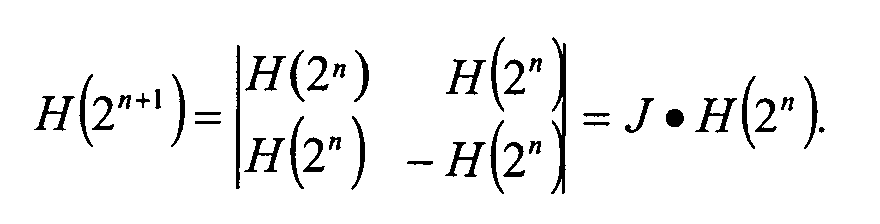
- In particular, Figure 2 (parts a and b) illustrates the construction of a Hadamard matrix H(4) obtained from the one of lower order H(2) by applying the operator J.
- The same properties can be recognized also in the case of OVSF matrices. This may be explained if it is taken into account that, as already mentioned previously, the rows of an OVSF matrix are in effect identical to the rows of a Hadamard matrix, with the sole difference represented by the different location of the rows or columns within each matrix.
- Consequently, as represented in Figure 2 (parts c and d) the OVSF matrix of a given order can be calculated by applying the operator- instead of to the matrix of the lower order - to each previous row, as indicated below:


- Figure 3 represents a graph for recursive construction of an OVSF matrix of any order.
- At each vertex, the operator J is applied to the previous row, thus giving rise to two new rows. Since the operator J is used for generating both of the matrices, the OVSF matrix is identical to the H matrix if the order of some rows is exchanged.
- More precisely, a row of the Hadamard matrix H with address rn...r2r1r0 - expressed in binary form - is identical to the row of the OVSF matrix with address r0r1r2...rn - also in this case expressed in binary form - as may be seen in Figure 2.
- A single optimized generator H can thus be used also for calculating the OVSF codes.
- It is convenient to represent the elements of the matrices with zeros and ones {0, 1} instead of {-1, +1}, so as to be able to use Boolean algebra and provide an easier mathematical formulation of the problem.
- In the simple case of H(2), each symbol can be expressed as a function of the row-addressing and column-addressing bits as follows:

- For the matrix H(4), thanks to the relation

- There is inversion only if the symbol that that is to be obtained is in the fourth quadrant addressed for r1 = c1 = 1:
- As illustrated in greater detail in Figure 4, in a similar way it is possible to generalize the construction of any symbol whatsoever b(rnr1r0, cnc1c0) belonging to the matrix H(n) by applying the following formula:
- For a spreading factor of 512, the complexity of the calculation unit is equal to 18 logic gates, to which the nine-bit row and column decoder is to be added.
- By way of example, Figure 5 presents a diagram of a dynamic generator for n = 4 based upon the implementation of the relations seen previously.
- In the diagram in question, the reference number 10 designates a normal mux module to the input of which are sent the row-address signals Row_Addr(i) with i = 0,1,2,3.
- The reference numbers 11 designate corresponding NOR logic gates, each of which receives on one input one of the signals coming (according to criteria that will emerge more clearly hereinafter) from the mux module 10, and also receives on the other input column-address signals Col_Addr(j) with j = 0,1,2,3.
- The outputs of the NOR gates 11 are sent in pairs to the inputs of N-XOR (negated exclusive OR) gates 12, the outputs of which constitute the inputs of a further N-XOR gate 13, the output of which represents, usually with interposition of a flip-flop 14, the sequence Bit_out of the output bits s.
- Finally, the reference number 10a designates an input line on which the mux module 10 receives a further logic signal Had_Ovsf, which assumes different logic levels depending upon whether a Hadamard code or an OVSF code is generated according to the criteria described in the Italian patent application already cited in the introductory part of the present description.
- It will be appreciated that the row-addressing and column-addressing criteria specified previously can be applied in a complementary way with respect to what has been described, namely applying column addresses to the input of the module 10 and row addresses to the inputs of the gates 11.
- If the second row of OVSF code is used, at each symbol period a bit is produced to obtain the sequence 0;0;1;1. For reasons of convenience, the values obtained represent the sign bits of the original matrix formed by +1;-1. It should moreover be noted from the last relation mentioned above that the term
- It is thus possible to partialize the penultimate relation seen previously to the first m terms for generating codes with a spreading factor lower than the maximum one allowed. With this further degree of freedom it is possible to vary dynamically the length of the codes produced by forcing to zero the most significant addressing bits rn, rn-1,..., rm+1 and cn, cn-1, ..., cm+1.
- The solution according to the invention thus enables the generation of serial Hadamard-OVSF sequences without the use of memory banks and/or recursive procedures with dynamically variable code lengths.
- The foregoing is achieved with particularly efficient solutions of implementation both at a hardware level and at a software level, and whether recourse is had to dedicated processors or to general-purpose processors on which a corresponding computer program product is run. It should finally be noted that any type of equivalent expression in terms of Boolean algebra, namely any formula that may be obtained by applying the Boolean algebra to the penultimate relation seen previously, such as factoring, decomposition, and representation by means of other logic gates (NAND, NOR, etc.), constitutes a mere variant embodiment and consequently falls within the scope of the present invention.
- Of course, without prejudice to the principle of the invention, the details of construction and the embodiments may vary widely with respect to what is described and illustrated herein, without thereby departing from the scope of the present invention as defined in the attached claims.
Claims (9)
- A process for the transmission of information with the use of encoded sequences (cj) consisting of orthogonal codes chosen from between Hadamard codes and OVSF codes, characterized in that it comprises the operation of generating the symbols of said sequences in a dynamic way as symbols b(rnr1r0, cnc1c0) belonging to a respective matrix H(n), using a formula chosen in the group consisting of the formula
and of the expressions equivalent to said formula in terms of Boolean algebra. - The process according to Claim 1, characterized in that it comprises the operation of selectively partializing the aforesaid formula to the first m terms for generating codes with reduced spreading factor.
- The process according to Claim 1 or Claim 2, characterized in that it comprises the operation of dynamically varying the length of the codes produced by forcing to zero the most significant addressing bits rn, rn-1, ..., rm+1 and cn,cn-1,...,cm+1 within said matrix.
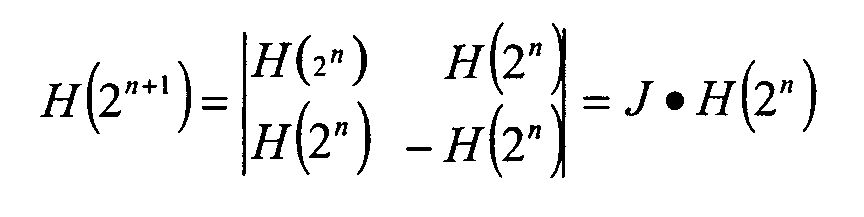
- The process according to any one of Claims 1 to 3, characterized in that said matrix H(n) is a Hadamard matrix constructed in an iterative way by generating the Hadamard matrix of generic size 2N x 2N, applying to the matrix N x N an operator J defined asso that

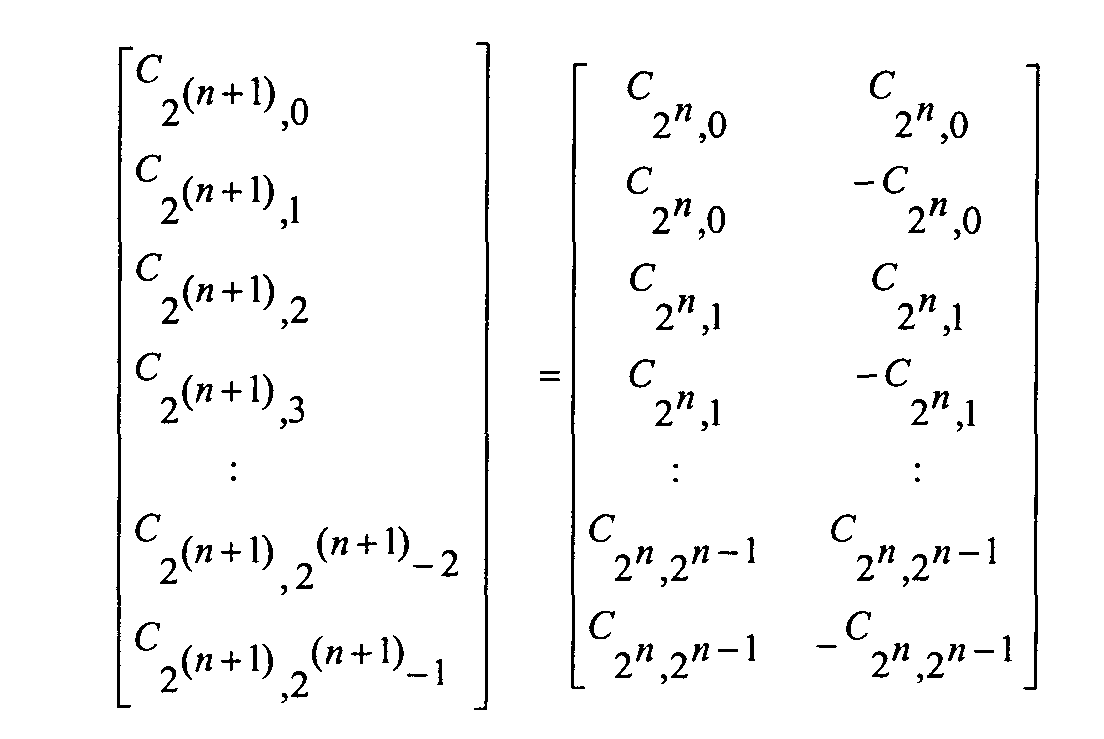
- The process according to any one of Claims 1 to 3, characterized in that said matrix H(n) is an OVSF matrix generated by applying the operatorto each previous row, so that


- A device for generating encoded sequences (cj) (cj)] made up of orthogonal codes chosen from between Hadamard codes and OVSF codes, characterized in that it comprises a logic network (10, 11, 12, 13, 14) for generating the symbols of said sequences in a dynamic way as symbols b(rnr1r0, cnc1c0) belonging to a respective matrix H(n), said logic network (10, 11, 12, 13, 14) being configured for implementing a formula chosen in the group consisting of the formula
and of the expressions equivalent to said formula in terms of Boolean algebra. - The device according to Claim 6, characterized in that said logic network comprises:a mux module (10) to the input of which are sent first signals of address (Row_Addr(i)) of said matrix H(n) ;a level of NOR logic gates (11) which receive at input the outputs of said mux module (10) and second signals of address (Col_Addr(j)) of said matrix H(n);a first level of N-XOR logic gates (12) which receives at input the outputs of said level of NOR logic gates (11); anda second level of N-XOR logic gates (14) which receives at input the outputs of said first level of N-XOR logic gates (13).
- The device according to Claim 7, characterized in that associated to said mux module (10) is a control input (10a) which can be sent to different logic levels (Had_Ovsf) for selective control of generation of a Hadamard code and an OVSF code.
- A computer program product directly loadable into the memory of a digital computer and comprising software code portions for performing the process according to any one of Claims 1 to 5 when said product is run on a computer.
Priority Applications (1)
| Application Number | Priority Date | Filing Date | Title |
|---|---|---|---|
| EP02425011A EP1328079A1 (en) | 2002-01-14 | 2002-01-14 | A process for transmitting information using hadamard and/or OVSF codes, device and computer program product therefor |
Applications Claiming Priority (1)
| Application Number | Priority Date | Filing Date | Title |
|---|---|---|---|
| EP02425011A EP1328079A1 (en) | 2002-01-14 | 2002-01-14 | A process for transmitting information using hadamard and/or OVSF codes, device and computer program product therefor |
Publications (1)
| Publication Number | Publication Date |
|---|---|
| EP1328079A1 true EP1328079A1 (en) | 2003-07-16 |
Family
ID=8185825
Family Applications (1)
| Application Number | Title | Priority Date | Filing Date |
|---|---|---|---|
| EP02425011A Withdrawn EP1328079A1 (en) | 2002-01-14 | 2002-01-14 | A process for transmitting information using hadamard and/or OVSF codes, device and computer program product therefor |
Country Status (1)
| Country | Link |
|---|---|
| EP (1) | EP1328079A1 (en) |
Cited By (1)
| Publication number | Priority date | Publication date | Assignee | Title |
|---|---|---|---|---|
| WO2015152915A1 (en) * | 2014-04-02 | 2015-10-08 | Halliburton Energy Services, Inc. | Boolean algebra for claim mapping and analysis |
Citations (1)
| Publication number | Priority date | Publication date | Assignee | Title |
|---|---|---|---|---|
| US3795864A (en) * | 1972-12-21 | 1974-03-05 | Western Electric Co | Methods and apparatus for generating walsh functions |
-
2002
- 2002-01-14 EP EP02425011A patent/EP1328079A1/en not_active Withdrawn
Patent Citations (1)
| Publication number | Priority date | Publication date | Assignee | Title |
|---|---|---|---|---|
| US3795864A (en) * | 1972-12-21 | 1974-03-05 | Western Electric Co | Methods and apparatus for generating walsh functions |
Non-Patent Citations (1)
| Title |
|---|
| MESTRE X ET AL: "ADAPTIVE BEAMFORMING FOR HIGH BIT RATE SERVICES IN THE FDD MODE OF UTRA", VTC 1999-FALL. IEEE VTS 50TH. VEHICULAR TECHNOLOGY CONFERENCE. GATEWAY TO THE 21ST. CENTURY COMMUNICATIONS VILLAGE. AMSTERDAM, SEPT. 19 -22, 1999, IEEE VEHICULAR TECHNOLGY CONFERENCE, NEW YORK, NY: IEEE, US, vol. 4 CONF. 50, 19 September 1999 (1999-09-19), pages 1951 - 1955, XP000895953, ISBN: 0-7803-5436-2 * |
Cited By (2)
| Publication number | Priority date | Publication date | Assignee | Title |
|---|---|---|---|---|
| WO2015152915A1 (en) * | 2014-04-02 | 2015-10-08 | Halliburton Energy Services, Inc. | Boolean algebra for claim mapping and analysis |
| US10628744B2 (en) | 2014-04-02 | 2020-04-21 | Halliburton Energy Services, Inc. | Boolean algebra for claim mapping and analysis |
Similar Documents
| Publication | Publication Date | Title |
|---|---|---|
| JP3181440B2 (en) | CDMA communication device | |
| EP1121818B1 (en) | Communicating a scrambling code identifier in a mobile communication system | |
| KR101037520B1 (en) | Method and apparatus for generating scrambling code in a broadband wireless communication system | |
| US4685132A (en) | Bent sequence code generator | |
| CA2277747A1 (en) | A method and an arrangement for despreading a coded sequence in a communication system | |
| US7308104B1 (en) | Forward multiple scrambling code generating method and apparatus | |
| EP1145456B1 (en) | Method for generating complex quasi-orthogonal code and apparatus and method for spreading channel data using the quasi-orthogonal code in cdma communication system | |
| KR20010033148A (en) | Rate detection in direct sequence code division multiple access systems | |
| US6788617B1 (en) | Device for generating memory address and mobile station using the address for writing/reading data | |
| Thompson et al. | Compressed neighbour discovery using sparse Kerdock matrices | |
| FI104023B (en) | Communication method and system | |
| EP1111784B1 (en) | A method and an electrical device for efficient multi-rate pseudo random noise (PN) sequence generation | |
| US6792032B2 (en) | CDMA system transmission matrix coefficient calculation | |
| US6611494B1 (en) | Orthogonal sequence generator | |
| EP1170893A2 (en) | Orthogonal code generation apparatus, scrambling code generation apparatus and portable radio terminal using such apparatus | |
| KR100511299B1 (en) | Data symbol mapping and spreading apparatus for mobile communication system | |
| US7289426B2 (en) | Method and low consumption device for parallel generating channelization codes for CDMA transmissions, in particular WH and OVSF codes | |
| US7839762B2 (en) | Method and apparatus for vector based walsh code bit sequence generation | |
| KR101459044B1 (en) | Apparatus and method for efficiently generating an OVSF code using a two-stage method in a wireless communication system | |
| WO2013085262A1 (en) | Method and apparatus for generating pair of orthogonal sets with wide range of spreading factors | |
| KR200151261Y1 (en) | Walsh code generating circuit of ds/cdma cellular system | |
| KR101085039B1 (en) | Low Power OFS Code Generator | |
| KR100186324B1 (en) | Spread spectrum communication device | |
| KR100424628B1 (en) | Apparatus and method for generating spreading code in mobile communication system | |
| KR100338635B1 (en) | Address generating device and method for use in multi-stage channel interleaver/deinterleaver |
Legal Events
| Date | Code | Title | Description |
|---|---|---|---|
| PUAI | Public reference made under article 153(3) epc to a published international application that has entered the european phase |
Free format text: ORIGINAL CODE: 0009012 |
|
| AK | Designated contracting states |
Designated state(s): AT BE CH CY DE DK ES FI FR GB GR IE IT LI LU MC NL PT SE TR |
|
| AX | Request for extension of the european patent |
Extension state: AL LT LV MK RO SI |
|
| AKX | Designation fees paid | ||
| REG | Reference to a national code |
Ref country code: DE Ref legal event code: 8566 |
|
| STAA | Information on the status of an ep patent application or granted ep patent |
Free format text: STATUS: THE APPLICATION IS DEEMED TO BE WITHDRAWN |
|
| 18D | Application deemed to be withdrawn |
Effective date: 20040117 |